
On this page
- Quick Reference (60 Seconds)
- What the Control Asks For
- Why Management Responsibilities for Security Matter
- Scope and Applicability
- Key Definitions and Terminology
- Relationship to Other Controls
- Implementation Roadmap (Week-by-Week)
- Detailed Implementation Guidance
- Tools, Technologies, and Solutions
- Policy and Procedure Templates
- Risk Assessment and Treatment
- Audit and Compliance Checklist
- Metrics and KPIs
- Common Pitfalls and How to Avoid Them
- Illustrative Scenarios
- Multi-Framework Mapping
- Regulatory and Industry Context
- Roles and Responsibilities (RACI) for A.5.4 Implementation
- Documentation and Evidence Requirements
- Continuous Improvement
- FAQ
- References and Further Reading
Quick Reference (60 Seconds)
Control: A.5.4, Management Responsibilities
Purpose: Ensure management at all levels actively requires personnel to apply information security in accordance with policies, procedures, and standards.
ISO 27002 attributes: Control type: Preventive · Properties: Confidentiality, Integrity, Availability · Concepts: Identify · Capabilities: Governance · Domains: Governance and ecosystem
Who it applies to: All managers, supervisors, team leads, and business leaders who have direct or indirect reports.
Minimum viable actions:
- Document management security responsibilities in the information security policy
- Include security performance in manager evaluations and KPIs
- Require managers to conduct security briefings with their teams
- Establish management security accountability in business plans and reviews
- Ensure managers model security behavior and lead by example
Key deliverables: Management Security Responsibility Statement, Manager Security Accountability Framework, Security Culture Index, Management Security Review Agenda, Board Security Reporting Template.
Audit questions you should be able to answer:
- How do you ensure management enforces security policies?
- Are security responsibilities included in management performance evaluations?
- Do managers lead security by example?
- Is there a mechanism for holding management accountable for security failures?
What the Control Asks For
Do you need this control?
A.5.4 is not mandatory in itself: under clause 6.1.3 you include it if your risk assessment calls for it, and record the decision in your Statement of Applicability. Almost always included, because clause 5.1 already makes leadership responsible for the ISMS. A.5.4 asks managers to require everyone to apply security in line with the policies. Scale it: in a small company this can be a founder-led briefing and documented expectations.
Annex A 5.4 asks management to require all personnel to apply information security in line with the organisation's information security policy, topic-specific policies and procedures.
Clause 5.1 vs A.5.4. Clause 5.1 (mandatory for every ISMS) is about top management's leadership and commitment to the ISMS. A.5.4 extends the duty to managers at every level: they must make sure their people actually apply security day to day.
In our own words, ISO 27002 says management should visibly support the policies and controls, and make sure that people:
- are briefed on their security roles and responsibilities before they are given access to information and assets;
- receive guidelines stating the security expectations of their role;
- are required to follow the information security policy and topic-specific policies;
- reach a level of awareness relevant to their role (A.6.3);
- comply with their terms of employment, contract or agreement, including appropriate ways of working;
- keep their security skills and qualifications up to date;
- where practicable, have a confidential channel to report policy violations ("whistleblowing"), allowing anonymous reporting or limiting knowledge of the reporter's identity to those who need it;
- have adequate resources and project time to implement security processes and controls.
What the Standard Does NOT Require
- The standard does not require a specific management structure or hierarchy
- It does not mandate particular management meetings or reporting formats
- It does not require management to be security experts (though they must support and enforce policies)
- It does not specify how management enforces security (formal, informal, or a combination)
- It does not require a dedicated security management role (though this is recommended)
Why Management Responsibilities for Security Matter
The Leadership Effect
Management behavior is the single most powerful predictor of organizational security culture. When management treats security as a priority, employees follow. When management treats security as an inconvenience, employees ignore it.
Key principles:
- Tone at the top: The Board, CEO, and senior leadership set the security tone. If they prioritize security, the organization will too.
- Middle management cascade: Frontline managers translate senior leadership's intent into daily action. Without middle management enforcement, security policies become paper exercises.
- Accountability signal: When managers are held accountable for security failures, they hold their teams accountable. This creates a chain of accountability.
- Resource allocation: Management controls budgets. Without management commitment, security does not get funded.
- Business integration: Security must be integrated into business decisions. Only management can ensure this happens.
The Business Impact of Weak Management Security Accountability
| Impact Type | Description | Quantifiable Cost |
|---|---|---|
| Security culture failure | Employees ignore security because managers do not enforce it | More human-error incidents and slower reporting |
| Policy non-compliance | Policies exist but are not followed because no one enforces them | Audit findings, regulatory penalties, incidents |
| Resource starvation | Security budgets are cut because management does not prioritize | Underinvestment in security controls |
| Incident amplification | Managers do not respond to security incidents promptly | Longer containment and wider impact |
| Employee turnover | Security-conscious employees leave organizations with weak security leadership | Recruitment and training costs |
| Regulatory penalties | Regulators hold management accountable for security failures | Commercial |
| Reputational damage | Public breaches reveal management negligence | Stock price impact, customer trust erosion |
The Indian Context
Indian organizations face unique management security challenges:
- Hierarchical culture: Indian organizations are often hierarchical. Security directives from the top are followed, but middle management may not cascade enforcement.
- Family-run businesses: In family businesses, security decisions may be centralized with the founder, but enforcement across extended family members and employees is inconsistent.
- Cost-driven mindset: Management may view security as a cost center rather than a business enabler, leading to underinvestment.
- Growth over governance: Rapidly scaling startups prioritize growth over security governance, creating management accountability gaps.
- Regulatory pressure: RBI, SEBI, and IRDAI explicitly hold management (Board, CEO, CISO) accountable for cybersecurity.
- Digital India: Government digital initiatives require management accountability but government structures may lack clear security ownership.
- DPDP Act 2023: The Act imposes significant penalties on organizations, and penalties fall on the Data Fiduciary (the organisation); management must therefore make sure the safeguards actually work.
- SME challenges: Small and medium enterprises often have owner-operators who handle all management functions, but security enforcement may be informal and inconsistent.
Scope and Applicability
In Scope
This control applies to all management roles and their security responsibilities:
- Board of Directors: Ultimate governance oversight of security
- CEO / Managing Director: Overall accountability for organizational security
- CISO / Security Head: Security program leadership and management
- CIO / CTO: Technology security leadership
- CFO / COO: Financial and operational security integration
- Business Unit Heads: Security of their business units
- Department Heads: Security of their departments
- Team Leads / Managers: Day-to-day security enforcement with their teams
- Project Managers: Security in project delivery
- HR Managers: Security in people processes
- IT Managers: Security in IT operations
- Facilities Managers: Physical security leadership
- Compliance Officers: Regulatory security compliance
- Risk Managers: Security risk management
- Regional / Country Managers: Security in geographic operations
Applicability by Organization Type
| Organization Type | Management Security Focus | Typical Challenges |
|---|---|---|
| Family-run businesses | Founder/owner must enforce security across family and non-family employees | Informal enforcement, reluctance to discipline family members, no formal HR processes |
| Startups | Founder/CEO must integrate security into growth | Security seen as slowing growth, no dedicated security leadership, investor pressure |
| SMEs | Department heads must enforce security with limited resources | No dedicated security manager, managers have multiple roles, limited training budget |
| Large enterprises | Multi-layer management must cascade security enforcement | Silos, inconsistent enforcement, corporate vs. local priorities, matrix structures |
| Government / PSUs | Bureaucratic hierarchy must enforce security directives | Slow decision-making, lack of accountability, union considerations, legacy culture |
| Banks / Financial services | RBI-mandated management accountability for cybersecurity | Regulatory intensity, board-level reporting, significant penalties for failure |
| IT / Software companies | Engineering managers must enforce secure development practices | Developer resistance to security controls, speed vs. security tension, tool fatigue |
| Manufacturing | Plant managers must enforce OT and IT security | Industrial control system security, physical-digital convergence, shift management |
| Healthcare | Clinical and administrative managers must protect patient data | Clinical workflow disruption, patient care priority, DPDP and ABDM compliance |
| E-commerce | Operations and tech managers must secure customer data | High transaction volume, PCI DSS requirements, customer trust dependency |
Key Definitions and Terminology
| Term | Definition |
|---|---|
| Management Responsibility | The obligation of management to enforce, support, and integrate information security into their area of control |
| Tone at the Top | The attitude and behavior of senior leadership toward security, which influences the entire organization |
| Security Accountability | The answerability of management for security outcomes in their domain |
| Leading by Example | Management personally adhering to security policies to model expected behavior |
| Management Security Review | Regular review of security status, risks, and incidents by management |
| Security Culture | The collective security attitudes, behaviors, and norms shaped by management |
| Cascading Accountability | The flow of security accountability from senior management down to frontline staff |
| Security Governance | The framework by which management directs and controls security |
| Management Performance Indicator | A measurable metric used to evaluate management's security performance |
| Security Resource Allocation | The process by which management budgets for and assigns resources to security |
| Security-First Decision Making | The practice of considering security implications in all business decisions |
| Management Security Briefing | Regular communication from management to staff about security matters |
| Security Exception Approval | Management's authority to approve deviations from security policies with risk acceptance |
| Management Security Training | Education for managers on their specific security responsibilities |
| Board Security Reporting | The mechanism by which management reports security status to the Board |
| Security Risk Appetite | The level of security risk that management is willing to accept |
| Management Security Dashboard | A visual summary of security metrics for management review |
| Security Escalation | The process by which staff raise security concerns to management |
| Management Security Walkthrough | Physical inspection of security controls by management |
| Security Incident Management | Management's role in directing and overseeing incident response |
| Business Continuity Leadership | Management's responsibility for ensuring security during disruptions |
| Vendor Security Oversight | Management's accountability for third-party security |
| Compliance Management | Management's responsibility for ensuring regulatory security compliance |
| Security Investment Justification | Management's process for evaluating and approving security investments |
| Management Security Recognition | Acknowledgment and reward for managers who excel in security |
| Security Failure Investigation | Management's role in investigating security failures and learning from them |
Relationship to Other Controls
Directly Related Controls
| Control | Relationship |
|---|---|
| A.5.1, Policies for information security | Management must enforce policies; policy must define management responsibilities |
| A.5.2, Information security roles and responsibilities | Management roles must be defined as part of security roles |
| A.5.3, Segregation of duties | Management must enforce SoD and ensure management itself does not have conflicting duties |
| A.5.5, Contact with authorities | Management must maintain regulatory relationships |
| A.5.6, Contact with special interest groups | Management supports engagement with external security groups |
| A.5.7, Threat intelligence | Management must direct threat intelligence strategy and resource allocation |
| A.5.8, Information security in project management | Management must ensure security is in project governance |
| A.5.15, Access control | Management must approve access and enforce access policies |
| A.5.24, Information security incident management planning and preparation | Management must direct incident response and communicate with stakeholders |
| A.6.8, Information security event reporting | The confidential reporting channel links to event reporting |
| Clause 6.1.3, Risk treatment | Risk owners (often managers) accept residual risk |
| A.5.30, ICT readiness for continuity | Management must ensure business continuity planning |
| A.5.31, Legal, statutory, regulatory and contractual requirements | Management must ensure compliance |
| A.5.36, Compliance with policies, rules and standards | Management must enforce compliance within their areas |
| A.5.37, Documented operating procedures | Management must ensure procedures are followed |
| A.6.1, Screening | Management must ensure personnel screening is conducted |
| A.6.2, Terms and conditions of employment | Management must ensure security clauses in contracts |
| A.6.3, Information security awareness, education and training | Management must support and enforce training |
| A.6.4, Disciplinary process | Management must enforce disciplinary consequences for security violations |
| A.6.5, Responsibilities after termination or change of employment | Management must ensure proper offboarding |
| Clause 10.2 and A.5.27, Root cause analysis | Nonconformities and incidents need root-cause analysis (clause 10.2, A.5.27); the roles that perform it must be defined |
Framework Mapping
| Framework | Relevant Control / Reference |
|---|---|
| NIST CSF 2.0 | GV.RR-01 (leadership is responsible and accountable), GV.RR-04 (cybersecurity in HR practices), GV.OV (oversight) |
| NIST SP 800-53 Rev 5 | PM-1 (Information Security Program Plan), PM-2 (Information Security Program Leadership), PM-3 (Resources), AT-3 (Role-Based Training), PS-2 (Position Risk Designation), PS-6 (Access Agreements), IR-1 (Incident Response Policy), RA-1 (Risk Assessment Policy) |
| COBIT 2019 | EDM01 (Ensure Governance Framework), EDM02 (Ensure Benefits Delivery), EDM03 (Ensure Risk Optimization), EDM04 (Ensure Resource Optimization), EDM05 (Ensure Stakeholder Transparency), APO01 (Managed People), APO02 (Managed Strategy), APO10 (Managed Vendors), APO12 (Managed Risk), APO14 (Managed Data), BAI01 (Managed Programs) |
| ITIL 4 | Organizational Change Management, Workforce and Talent Management, Relationship Management, Risk Management |
| CIS Controls v8 | Control 14 (Security Awareness and Skills Training), Control 17 (Incident Response Management) |
| PCI DSS v4.0.1 | Req 12.1.3 and 12.1.4 (security responsibilities; executive responsibility), Req 12.6 (security awareness program) |
| SOX | Section 302 (CEO/CFO Certification), Section 404 (Internal Controls) |
| GDPR | Art 32 (Security of Processing), Art 37 (DPO) |
| DPDP Act 2023 | Section 8(5) (Reasonable security safeguards)), Section 8(4) (Appropriate technical and organisational measures)) |
| RBI Cybersecurity Framework | Governance requirements for Board and CEO |
| SEBI CSCRF (2024) | Board and management accountability for cybersecurity |
| COSO Framework | Control Environment, Monitoring Activities |
Implementation Roadmap (Week-by-Week)
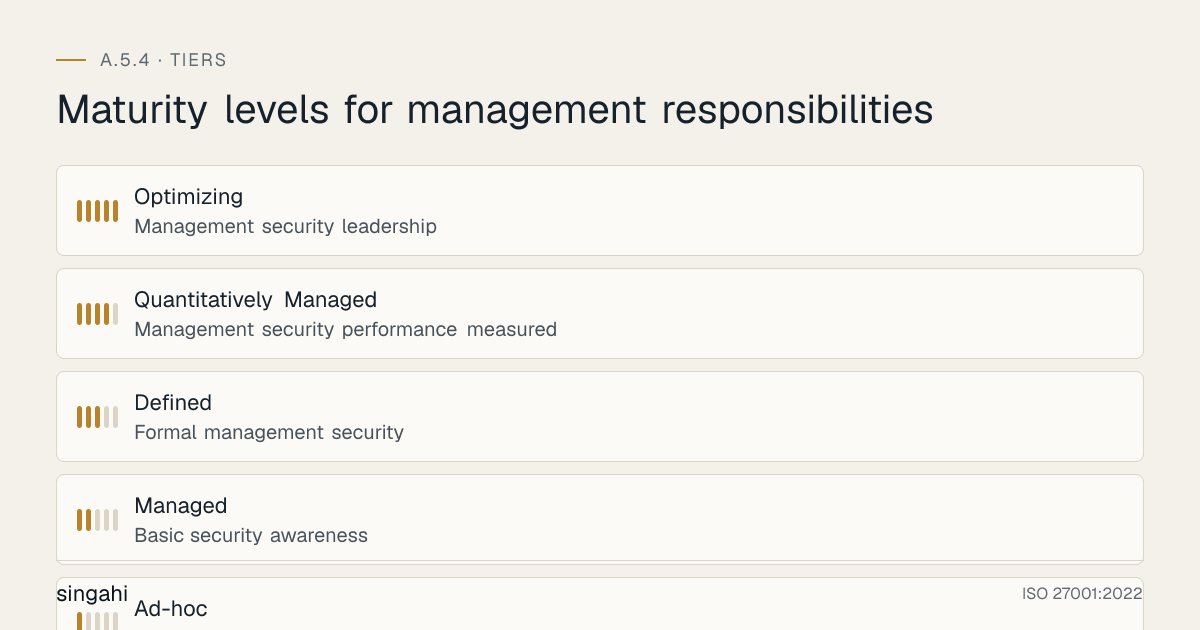
Figure · Tiers
Maturity levels for management responsibilities
Phase 1: Foundation (Weeks 1–4)
Week 1: Management Security Assessment
- Assess current management security awareness and accountability
- Survey managers on their understanding of security responsibilities
- Review existing management performance metrics for security content
- Identify management security gaps and inconsistencies
- Document findings in a management security gap analysis
Week 2: Management Security Framework Design
- Design management security responsibility framework by management level
- Define security responsibilities for Board, CEO, C-suite, BU heads, department heads, team leads
- Design management security performance indicators
- Design management security review cadence and agenda
- Design management security reporting structure to Board
Week 3: Policy and Documentation
- Draft Management Security Responsibility Statement
- Update Information Security Policy to include management responsibilities
- Draft management security briefing template
- Draft management security review agenda template
- Draft board security reporting template
Week 4: Approval and Communication
- Review framework with senior leadership and HR
- Obtain formal approval from CEO and Board
- Communicate management security responsibilities to all managers
- Publish management security documentation on intranet
- Schedule initial management security briefings
Deliverables: Gap analysis, Framework design, Policy updates, Management communication
Phase 2: Integration (Weeks 5–8)
Week 5: HR Integration
- Integrate security responsibilities into manager job descriptions
- Integrate security KPIs into manager performance evaluations
- Update manager employment contracts with security clauses
- Develop manager security training curriculum
- Schedule manager security training sessions
Week 6: Process Integration
- Integrate security review into management meeting agendas
- Integrate security into business planning and budget processes
- Integrate security into project approval processes
- Integrate security into vendor management processes
- Integrate security into change management processes
Week 7: Training and Awareness
- Conduct management security training for all managers
- Conduct security culture briefings for leadership teams
- Train managers on how to enforce security with their teams
- Train managers on incident escalation and response
- Provide managers with security talking points and communication guides
Week 8: Tools and Dashboards
- Deploy management security dashboard
- Configure management security reporting
- Establish management security metrics tracking
- Implement management security alert mechanisms
- Create management security mobile app or portal access
Deliverables: HR integration, Process integration, Training completion, Dashboard deployment
Phase 3: Operationalization (Weeks 9–12)
Week 9: Management Security Reviews
- Conduct first management security review meetings
- Review security metrics, incidents, risks, and compliance status
- Identify security issues requiring management action
- Assign management action items with deadlines
- Document management security review minutes
Week 10: Board Reporting
- Prepare first board security report
- Present security status, risks, and investments to Board
- Obtain Board feedback and direction on security priorities
- Document Board security decisions and action items
- Establish board security reporting cadence (quarterly)
Week 11: Enforcement and Accountability
- Managers begin enforcing security policies with their teams
- Managers begin conducting security briefings with their teams
- Managers begin reviewing security metrics for their areas
- Security violations addressed through management channels
- Management security performance tracked and reported
Week 12: Baseline Assessment
- Assess management security behavior change
- Survey employees on management security enforcement
- Review management security metrics baseline
- Identify remaining gaps and improvement areas
- Document lessons learned and refine approach
Deliverables: Management reviews active, Board reporting active, Enforcement active, Baseline assessment
Phase 4: Optimization (Weeks 13–16)
Week 13-14: Metrics and Monitoring
- Define and implement complete management security KPIs
- Conduct first formal assessment of management security performance
- Identify high-performing managers and recognize them
- Identify struggling managers and provide coaching
- Monitor management security culture trend
Week 15-16: Continuous Improvement
- Update management security framework based on experience
- Refine management security training and communication
- Enhance management security dashboard and reporting
- Update management security policy and documentation
- Plan for annual management security review and refresh cycle
Deliverables: KPI tracking, Performance assessment, Recognition program, Updated framework
Maturity Model
| Level | Description | Typical Timeline |
|---|---|---|
| 1, Ad-hoc | No formal management security responsibilities; security is not discussed in management meetings | Pre-implementation |
| 2, Managed | Basic security awareness among management; informal enforcement; security mentioned in some meetings | Weeks 1–4 |
| 3, Defined | Formal management security responsibilities defined; security integrated into meetings, performance reviews, and planning; regular briefings; board reporting | Weeks 5–12 |
| 4, Quantitatively Managed | Management security performance measured; KPIs tracked; management security culture assessed; recognition and coaching programs active | Weeks 13–16 |
| 5, Optimizing | Management security leadership is proactive; security is a competitive advantage; managers drive security innovation; continuous improvement embedded | Ongoing |
Detailed Implementation Guidance
Management Security Responsibility Framework
By Management Level
Board of Directors / Board Security Committee
- Accountability: Ultimate governance oversight of organizational security
- Responsibilities:
- Approve the information security strategy and policy
- Review and approve security risk appetite
- Receive and review quarterly security reports from management
- Ensure adequate resources are allocated for security
- Hold CEO and senior management accountable for security performance
- Review major security incidents and their implications
- Approve major security investments and initiatives
- Ensure regulatory compliance for security
- Review security audit findings and management responses
- Oversee the security governance framework
- Performance Indicators:
- Number of security-related board agenda items per year
- Board security reporting frequency (target: quarterly)
- Security audit findings closed on time
- Security budget approval rate
- Regulatory compliance status
CEO / Managing Director
- Accountability: Overall organizational security performance
- Responsibilities:
- Champion security as a business priority
- Approve the information security policy and strategy
- Allocate resources for the security program
- Appoint and empower the CISO or security leader
- Ensure security is integrated into business strategy and planning
- Receive and act on security risk reports
- Communicate security importance to the organization
- Ensure management at all levels are accountable for security
- Represent the organization in security matters to external stakeholders
- Approve exceptions with high residual risk, alongside the risk owner who accepts it
- Performance Indicators:
- Security culture index trend
- Security incident frequency and severity trend
- Security budget as percentage of IT budget
- Compliance audit results
- Employee security awareness score
- Time to respond to critical security incidents
CISO / Chief Information Security Officer
- Accountability: Effectiveness of the information security program
- Responsibilities:
- Develop and maintain the information security strategy, policy, and standards
- Lead the security team and manage security operations
- Report security status, risks, and incidents to the CEO and Board
- Ensure regulatory compliance and manage security audits
- Drive security culture and awareness across the organization
- Manage security budget and investments
- Coordinate security governance and decision-making
- Serve as the primary security liaison with external stakeholders
- Approve security exceptions and risk acceptance (within authority)
- Ensure security is integrated into business processes and projects
- Performance Indicators:
- Security incident metrics (MTTD, MTTR, MTTC)
- Compliance audit findings (number, severity, trend)
- Security risk treatment completion rate
- Security awareness training completion rate
- Security control implementation rate
- Security budget use and ROI
CIO / Chief Information Officer
- Accountability: Security of IT infrastructure and systems
- Responsibilities:
- Ensure security is integrated into IT strategy and architecture
- Allocate IT resources for security controls and tools
- Ensure secure development practices in technology projects
- Manage IT security architecture and engineering
- Ensure IT systems meet security standards and compliance requirements
- Coordinate with CISO on technology security initiatives
- Approve IT security investments and architecture decisions
- Ensure IT staff are trained on security responsibilities
- Manage IT security incidents and vulnerabilities
- Performance Indicators:
- IT security vulnerability remediation time
- Secure development lifecycle adoption rate
- IT security incident rate
- IT security compliance rate
- IT security patch compliance
- IT security architecture review completion rate
CFO / Chief Financial Officer
- Accountability: Security of financial data and processes
- Responsibilities:
- Protect financial data and ensure access controls
- Ensure financial processes comply with security policies
- Allocate and manage security budget
- Ensure financial reporting security (SOX, internal controls)
- Report financial security incidents (fraud, unauthorized transactions)
- Ensure financial systems meet security standards
- Approve security investments within financial authority
- Coordinate with CISO on security budget and ROI
- Performance Indicators:
- Financial system security compliance
- Financial data security incident rate
- Security budget use
- Fraud detection and prevention rate
- Financial audit security findings
COO / Chief Operating Officer
- Accountability: Security of operations and business processes
- Responsibilities:
- Ensure operational processes comply with security policies
- Integrate security into operations planning and execution
- Ensure physical security of facilities and assets
- Manage business continuity and disaster recovery security
- Ensure supply chain and vendor security
- Coordinate with CISO on operational security initiatives
- Approve operational security investments and changes
- Ensure operations staff are trained on security responsibilities
- Performance Indicators:
- Operational security compliance rate
- Business continuity drill success rate
- Physical security incident rate
- Vendor security compliance rate
- Supply chain security incident rate
- Operational security audit findings
Business Unit Heads / Department Heads
- Accountability: Security of their business unit or department
- Responsibilities:
- Ensure their unit complies with security policies and standards
- Appoint and support data owners and system owners within their unit
- Allocate resources for security within their unit
- Ensure staff in their unit are trained on security responsibilities
- Report security incidents and risks within their unit
- Participate in security governance and decision-making
- Integrate security into business processes and projects
- Conduct security briefings and reviews with their teams
- Enforce security discipline within their unit
- Review security metrics for their unit regularly
- Performance Indicators:
- Business unit security compliance rate
- Business unit security incident rate
- Business unit security training completion rate
- Business unit audit findings
- Security integration into business processes
- Employee security awareness score within unit
Team Leads / Managers
- Accountability: Day-to-day security enforcement within their team
- Responsibilities:
- Ensure team members follow security policies and procedures
- Conduct security briefings and discussions with team members
- Review and approve security-related requests from team members
- Monitor team security behavior and compliance
- Report security incidents and concerns from their team
- Ensure team members complete required security training
- Enforce security consequences for policy violations within their team
- Integrate security into team workflows and processes
- Escalate security issues to department heads or security team
- Lead by example by personally adhering to security policies
- Performance Indicators:
- Team security compliance rate
- Team security incident rate
- Team security training completion rate
- Team policy violation rate
- Security incident reporting rate from team
- Employee security awareness score within team
Project Managers
- Accountability: Security of project deliverables and processes
- Responsibilities:
- Ensure security requirements are included in project planning
- Allocate project resources for security activities
- Ensure security reviews are conducted at project gates
- Manage security risks within the project scope
- Ensure project deliverables meet security standards
- Coordinate with security team on project security matters
- Report security incidents and risks within the project
- Ensure project team members are trained on security responsibilities
- Performance Indicators:
- Security requirements included in projects (percentage)
- Security review completion at project gates
- Security defects in project deliverables
- Project security risk closure rate
- Security training completion by project team
HR Managers
- Accountability: Security of people processes and employee data
- Responsibilities:
- Ensure security is included in job descriptions and employment contracts
- Conduct security screening and background checks
- Deliver security onboarding and awareness training
- Manage security aspects of termination and role changes
- Enforce security consequences through disciplinary process
- Maintain employee security training records
- Report insider threats and security concerns related to personnel
- Ensure HR systems and data are secured
- Performance Indicators:
- Security screening completion rate
- Security training completion rate
- Security clause inclusion in contracts
- Termination security process completion rate
- Employee security incident rate
- HR system security compliance
IT Managers
- Accountability: Security of IT operations and systems
- Responsibilities:
- Ensure IT systems and operations comply with security policies
- Manage IT security controls and configurations
- Ensure IT staff follow security procedures
- Report IT security incidents and vulnerabilities
- Coordinate with security team on IT security matters
- Manage IT security projects and initiatives
- Ensure IT change management includes security review
- Ensure IT systems are patched and updated
- Manage IT security metrics and reporting
- Performance Indicators:
- IT system security compliance rate
- IT security incident rate
- IT vulnerability remediation time
- IT security patch compliance
- IT security audit findings
- IT security training completion rate
Management Security Meetings and Reviews
Management Security Review Agenda (Monthly):
Template
Management Security Review, [Date]
Attendees: [Department/Business Unit Heads, Security Team, IT Manager]
1. Security Metrics Review (10 min)
- Incident count and severity trend
- Compliance status and audit findings
- Risk treatment progress
- Training completion rate
- Vulnerability status
2. Incident Review (10 min)
- New incidents since last review
- Ongoing incident status
- Lessons learned from recent incidents
- Actions taken and effectiveness
3. Risk Assessment Update (10 min)
- New risks identified
- Risk treatment status
- Risks requiring management decision or escalation
- Risk acceptance decisions
4. Compliance Status (10 min)
- Regulatory compliance updates
- Audit findings and remediation status
- Certification status (ISO 27001, PCI DSS, etc.)
- Contractual security compliance
5. Security Projects and Initiatives (10 min)
- Project status updates
- Resource requirements and allocation
- Security investment decisions
- Implementation challenges and support needed
6. Team Security Performance (10 min)
- Department/unit security compliance metrics
- Security incidents by department/unit
- Training completion by department/unit
- Policy violations and enforcement actions
7. Security Culture and Awareness (5 min)
- Phishing simulation results
- Security awareness quiz scores
- Employee feedback on security
- Culture improvement initiatives
8. Operational Security (5 min)
- Physical security status
- Vendor security incidents
- Business continuity and DR status
- Change management security review status
9. Action Items and Decisions (10 min)
- Management decisions required
- Action items assigned with owners and deadlines
- Escalation items to senior leadership or Board
- Next review date and focus
Board Security Report (Quarterly):
Template
Board Security Report, Q[X] [Year]
Executive Summary
- Overall security posture: [Green/Yellow/Red]
- Critical incidents: [Number and brief description]
- Regulatory compliance: [Status]
- Key risks: [Top 3 risks]
- Investments made: [Summary]
- Board decisions needed: [List]
Security Metrics Dashboard
- MTTD: [X hours] (Target: <4 hours)
- MTTR: [X hours] (Target: <24 hours)
- Incident count: [X] (Trend: Up/Down/Stable)
- Critical vulnerabilities: [X] (Trend: Up/Down/Stable)
- Compliance score: [X%] (Target: >95%)
- Training completion: [X%] (Target: 100%)
- Security budget use: [X%]
Incident Summary
- [Incident 1]: Date, severity, impact, root cause, status, lessons learned
- [Incident 2]: Date, severity, impact, root cause, status, lessons learned
Risk Status
- [Risk 1]: Description, likelihood, impact, treatment status, owner
- [Risk 2]: Description, likelihood, impact, treatment status, owner
Compliance Status
- ISO 27001: [Status]
- PCI DSS: [Status]
- DPDP Act 2023: [Status]
- RBI/SEBI/IRDAI: [Status]
Audit Findings
- [Finding 1]: Description, severity, remediation status, owner
- [Finding 2]: Description, severity, remediation status, owner
Security Investments
- [Investment 1]: Description, amount, ROI, status
- [Investment 2]: Description, amount, ROI, status
Upcoming Priorities
- [Priority 1]: Description, timeline, resource needs
- [Priority 2]: Description, timeline, resource needs
Board Decisions Needed
- [Decision 1]: Description, options, recommendation
- [Decision 2]: Description, options, recommendation
Management Security Performance Management
Manager Security Performance Evaluation Template:
Template
Manager Security Performance Evaluation, [Year]
Manager: [Name] Department: [Department] Evaluator: [Name]
Security Leadership (Weight: 25%)
- Does the manager demonstrate visible commitment to security?
- Does the manager communicate security importance to their team?
- Does the manager lead by example (follows policies personally)?
- Rating: [1-5] Comments: ___________
Security Enforcement (Weight: 25%)
- Does the manager enforce security policies within their team?
- Does the manager address security violations promptly?
- Does the manager ensure team members complete security training?
- Does the manager report security incidents and concerns?
- Rating: [1-5] Comments: ___________
Security Integration (Weight: 20%)
- Does the manager integrate security into team workflows?
- Does the manager consider security in project planning and execution?
- Does the manager allocate resources for team security needs?
- Does the manager participate in security governance?
- Rating: [1-5] Comments: ___________
Security Metrics (Weight: 20%)
- Team security compliance rate: [X%] (Target: >95%)
- Team security incident count: [X] (Target: 0)
- Team training completion rate: [X%] (Target: 100%)
- Team policy violation count: [X] (Target: 0)
- Rating: [1-5] Comments: ___________
Security Improvement (Weight: 10%)
- Has the manager implemented security improvements in their area?
- Has the manager suggested security enhancements?
- Has the manager reduced security risks in their area?
- Rating: [1-5] Comments: ___________
Overall Security Performance Score: [X/5.0]
Impact on Overall Performance Review: [Weight: X%]
Development Plan: [Actions to improve security performance]
Leading by Example
Management must personally model security behavior. Specific actions:
- Attend security training: Managers should attend the same security training as their teams (and complete it on time)
- Follow MFA policies: Managers should use MFA for all accounts and encourage their teams to do the same
- Lock screens: Managers should visibly lock their screens when away from their desks
- Handle data properly: Managers should classify and handle data according to policy
- Report incidents: Managers should report security incidents promptly, demonstrating that reporting is valued
- Use approved tools: Managers should only use approved software and services
- Respect access controls: Managers should not request or accept unauthorized access privileges
- Support security decisions: Managers should publicly support security team decisions, even when they cause inconvenience
- Discuss security in meetings: Managers should regularly raise security topics in team meetings
- Recognize security behavior: Managers should acknowledge and reward team members who demonstrate good security practices
Security in Business Decision-Making
Management must integrate security into all business decisions:
- Strategic planning: Security risk and investment must be part of annual strategic planning
- Budget allocation: Security budget must be allocated based on risk, not just residual IT budget
- Product development: Security must be a design requirement for all products and services
- Vendor selection: Security must be a criterion in vendor evaluation and selection
- M&A activity: Security due diligence must be part of merger and acquisition evaluation
- New market entry: Security and regulatory requirements must be assessed before entering new markets
- Technology adoption: Security must be evaluated before adopting new technologies (cloud, AI, IoT)
- Outsourcing: Security must be a key factor in outsourcing decisions and contracts
- HR decisions: Security must be considered in hiring, promotion, and termination decisions
- Facility decisions: Physical security must be part of facility selection and design
Tools, Technologies, and Solutions
Management Security Dashboards and Reporting
| Tool | Best For | Pricing model |
|---|---|---|
| ServiceNow GRC | Enterprise security governance, management reporting | Enterprise pricing |
| RSA Archer | Enterprise GRC, executive dashboards, board reporting | Enterprise pricing |
| MetricStream | Enterprise GRC, management dashboards | Enterprise pricing |
| SAP GRC | Management security reporting for SAP environments | Enterprise pricing |
| StandardFusion | SMB management security dashboards | Commercial |
| Hyperproof | Compliance operations, management views | Commercial |
| Splunk | Security metrics and management dashboards | Enterprise pricing |
| Elastic Security | Open source security dashboards | Free / Enterprise |
| Excel / Google Sheets | Small organization management dashboards | Free / Included |
Management Security Training and Awareness
| Tool | Best For | Pricing model |
|---|
Indian Management Security Advisory Services
| Vendor | Offering | Website |
|---|---|---|
| Singahi | Management security governance, CISO advisory, board security reporting, management security training | / |
| NASSCOM | CISO forums, executive security guidance | https://www.nasscom.in |
| CERT-In | Government security guidance, incident management | https://www.cert-in.org.in |
| IIMs / ISB | General executive education (some offer cybersecurity leadership programmes) | Multiple |
| XLRI / IIFT | Management and security leadership programs | Multiple |
Policy and Procedure Templates
Management Security Responsibilities Policy (Template)
Template
Management Security Responsibilities Policy
Document ID: POL-MGMT-SEC-001 Version: 1.0 Effective Date: [DATE] Owner: CEO / Managing Director (maintained by the CISO) Approved By: [CEO Name] (and the Board, where it oversees the ISMS) Review Cycle: Annual
1. Purpose
This policy establishes the security responsibilities of management at all levels and ensures that management actively requires all personnel to apply information security in accordance with the organization's policies, procedures, and standards.
2. Scope
This policy applies to all management personnel, including Board members, senior executives, business unit heads, department heads, team leads, project managers, and any person with supervisory or leadership responsibilities.
3. Policy Statements
3.1 Management Accountability
- All management personnel are accountable for security performance in their area of responsibility.
- Management security responsibilities must be documented in job descriptions, performance evaluations, and employment contracts.
- Managers must be evaluated on their security performance as part of their overall performance review.
- Security failures in a manager's area may result in performance consequences, up to and including termination for serious negligence.
3.2 Leading by Example
- All management personnel must personally follow all information security policies and procedures.
- Managers must demonstrate visible commitment to security through their actions, decisions, and communications.
- Managers must not request or accept exceptions to security policies for convenience unless properly approved.
- Managers must participate in security training and awareness programs.
3.3 Security Enforcement
- Managers must actively enforce security policies within their teams.
- Managers must address security violations promptly and consistently.
- Managers must ensure their team members complete required security training within the required timeframe.
- Managers must report security incidents and concerns from their teams to the security team or appropriate authority.
- Managers must not ignore, tolerate, or cover up security violations.
3.4 Security Integration
- Managers must integrate security considerations into all business decisions, projects, and processes within their area.
- Managers must allocate adequate resources for security within their budgets.
- Managers must ensure security requirements are included in project planning and execution.
- Managers must participate in security governance processes, including security reviews, risk assessments, and incident response.
3.5 Security Communication
- Managers must regularly communicate security expectations and updates to their teams.
- Managers must conduct security briefings with their teams at least monthly.
- Managers must acknowledge and respond to security concerns raised by their team members.
- Managers must escalate security issues that cannot be resolved at their level.
3.6 Board and Executive Responsibilities
- The Board is responsible for overseeing the organization's security governance, risk appetite, and strategy.
- The CEO is responsible for championing security as a business priority and ensuring adequate resources.
- The CISO is responsible for developing and implementing the security program, reporting to the CEO and Board.
- The CIO is responsible for integrating security into technology strategy and operations.
- The CFO is responsible for securing financial data and allocating security budgets.
- The COO is responsible for integrating security into operations and business continuity.
3.7 Performance Management
- Security performance must be included in management performance evaluations with a minimum weight of [X%].
- Managers who demonstrate exceptional security leadership must be recognized and rewarded.
- Managers who fail to meet security performance expectations must be provided coaching and development plans.
- Repeated security performance failures may result in reassignment, demotion, or termination.
3.8 Reporting and Escalation
- Managers must report security incidents within their area to the security team within [timeframe].
- Managers must escalate security risks that cannot be managed at their level to senior leadership.
- Managers must participate in security review meetings and provide accurate security status updates.
- Managers must not suppress or delay reporting of security incidents or risks.
3.x Before Access and Confidential Reporting
- Managers ensure every new joiner, contractor and mover is briefed on their security responsibilities before access is granted, and the briefing is recorded.
- The organisation provides a confidential channel to report violations of security policies (for example an ethics hotline or a dedicated mailbox monitored by Compliance), allowing anonymous reports where practicable.
- Reporters acting in good faith are protected from retaliation; reports are handled under the vigil mechanism (Companies Act s.177, where applicable), A.6.8 and the disciplinary process (A.6.4).
4. Roles and Responsibilities
- Board: Oversee security governance; review security strategy; hold CEO accountable; approve major security investments
- CEO: Champion security; allocate resources; appoint CISO; integrate security into business strategy
- CISO: Develop security program; report to CEO and Board; manage security team; enforce security governance
- Business Unit Heads: Enforce security in their units; allocate unit security resources; report unit security status
- Department Heads: Enforce security in their departments; ensure staff training; report department security status
- Team Leads: Enforce security with their teams; conduct security briefings; ensure team compliance; report team security status
- HR: Include security in management job descriptions, evaluations, and training
- Security Manager: Support managers in enforcing security; provide security metrics; conduct management security training
5. Exceptions
Exceptions to management security responsibilities require written CEO or Board approval with documented risk acceptance.
6. Enforcement
Failure to fulfill management security responsibilities may result in performance review impact, disciplinary action, or termination (for serious negligence or willful violations).
7. Related Documents
- Information Security Policy (POL-INFO-001)
- Security Roles and Responsibilities Policy (POL-ROLES-001)
- Disciplinary Process Policy (POL-DISC-001)
- Security Awareness Policy (POL-AWARE-001)
- Incident Response Policy (POL-INCIDENT-001)
- Risk Management Policy (POL-RISK-001)
- Access Control Policy (POL-ACCESS-001)
8. Revision History
| Version | Date | Author | Changes |
|---|---|---|---|
| 1.0 | [DATE] | [Name] | Initial version |
Management Security Briefing Template
Template
Management Security Briefing, [Date]
Manager: [Name] Department: [Department] Period: [Month/Quarter]
1. Security Metrics for [Department]
- Incidents: [X] (vs. last period: [X])
- Policy violations: [X] (vs. last period: [X])
- Training completion: [X%] (Target: 100%)
- Vulnerabilities: [X] (vs. last period: [X])
- Compliance score: [X%] (Target: >95%)
2. Key Security Updates
- [Update 1]: New policy, threat, incident, or requirement
- [Update 2]: New policy, threat, incident, or requirement
3. Team Security Performance
- High performers: [Name(s), recognize good security behavior]
- Concerns: [Name(s) or issues requiring attention]
- Training needs: [Specific training needed by team]
4. Action Items
- [Action 1]: Owner, deadline
- [Action 2]: Owner, deadline
5. Discussion and Questions
- [Team member questions or concerns]
- [Manager responses and commitments]
6. Next Steps
- Next briefing date: [Date]
- Focus areas for next period: [Topics]
Risk Assessment and Treatment
Risk Assessment for Management Security Responsibilities
| Risk ID | Risk Description | Likelihood | Impact | Risk Level | Mitigation |
|---|---|---|---|---|---|
| R-001 | Management does not enforce security policies | High | Critical | Critical | Policy enforcement, performance evaluation integration, training, consequences |
| R-002 | Management does not personally follow security policies | Medium | High | High | Tone-at-the-top program, leading-by-example training, management accountability |
| R-003 | Security not included in management performance evaluations | High | High | High | HR integration, mandatory security KPIs, performance management system update |
| R-004 | Management does not allocate resources for security | Medium | High | High | Budget process integration, security ROI justification, board oversight |
| R-005 | Management does not integrate security into business decisions | Medium | High | High | Decision-making framework, security review gates, training |
| R-006 | Management does not report security incidents promptly | Medium | High | High | Incident reporting procedure, escalation training, monitoring, consequences |
| R-007 | Management security training is inadequate | Medium | Medium | Medium | Manager-specific training curriculum, mandatory attendance, competency assessment |
| R-008 | Board does not receive adequate security reporting | Medium | High | High | Board reporting template, quarterly reporting cadence, CISO accountability |
| R-009 | Management does not conduct security briefings with teams | Medium | Medium | Medium | Management briefing template, calendar reminders, compliance monitoring |
| R-010 | Management creates security exceptions without proper approval | Medium | High | High | Exception approval workflow, management education, audit |
| R-011 | Middle management does not cascade security from senior leadership | Medium | High | High | Cascade communication, middle management training, monitoring, metrics |
| R-012 | Management turnover causes security accountability gaps | Medium | Medium | Medium | Succession planning, role documentation, handover procedures, interim accountability |
| R-013 | Management in remote locations does not enforce security | Medium | Medium | Medium | Remote management training, virtual meetings, regional security coordinators, monitoring |
| R-014 | Management prioritizes business speed over security | High | High | High | Risk-based decision framework, security culture, management education, business case for security |
| R-015 | Management does not hold vendors accountable for security | Medium | High | High | Vendor management policy, contractual security requirements, vendor audit, SLA monitoring |
Risk Treatment Options
| Risk | Treatment | Residual Risk |
|---|---|---|
| R-001 | Management security policy, performance evaluation, training, consequences | Low |
| R-002 | Tone-at-top program, leading-by-example training, accountability | Low |
| R-003 | HR integration, mandatory KPIs, system update | Low |
| R-004 | Budget process integration, ROI justification, board oversight | Low |
| R-005 | Decision framework, review gates, training | Low |
| R-006 | Reporting procedure, escalation training, monitoring, consequences | Low |
| R-007 | Manager training curriculum, mandatory attendance, assessment | Low |
| R-008 | Board reporting template, quarterly cadence, CISO accountability | Low |
| R-009 | Briefing template, calendar reminders, compliance monitoring | Low |
| R-010 | Exception workflow, management education, audit | Low |
| R-011 | Cascade communication, middle management training, monitoring | Low |
| R-012 | Succession planning, role documentation, handover, interim accountability | Low |
| R-013 | Remote training, virtual meetings, regional coordinators, monitoring | Low |
| R-014 | Risk-based framework, culture, education, business case | Low |
| R-015 | Vendor policy, contractual requirements, vendor audit, SLA monitoring | Low |
Audit and Compliance Checklist
Pre-Audit Self-Assessment
| # | Question | Evidence | Status |
|---|---|---|---|
| 1 | Are management security responsibilities documented in policy? | Management Security Policy | ☐ |
| 2 | Are management security responsibilities in job descriptions? | Job descriptions | ☐ |
| 3 | Are management security responsibilities in employment contracts? | Contracts | ☐ |
| 4 | Is security included in management performance evaluations? | Performance evaluation forms | ☐ |
| 5 | Do managers personally follow security policies? | Observation, audit, incident records | ☐ |
| 6 | Do managers enforce security policies with their teams? | Team compliance records, incident records | ☐ |
| 7 | Do managers conduct security briefings with their teams? | Briefing records, meeting minutes | ☐ |
| 8 | Do managers ensure their teams complete security training? | Training records | ☐ |
| 9 | Do managers report security incidents from their teams? | Incident reporting records | ☐ |
| 10 | Is there a mechanism for holding management accountable for security? | Performance records, disciplinary records | ☐ |
| 11 | Does the Board receive security reports? | Board reports, meeting minutes | ☐ |
| 12 | Does the CEO champion security as a business priority? | Communications, budget records, strategic plans | ☐ |
| 13 | Are people briefed on their security responsibilities before they get access? | Onboarding records, briefing acknowledgements | ☐ |
| 14 | Is there a confidential channel to report policy violations, and do people know about it? | Whistleblowing procedure, awareness material, case log | ☐ |
| 14 | Do managers integrate security into business decisions? | Decision records, project records, meeting minutes | ☐ |
| 15 | Do managers allocate resources for security in their budgets? | Budget records, resource allocation records | ☐ |
| 16 | Are managers trained on their specific security responsibilities? | Training records, curriculum | ☐ |
| 17 | Is there a management security dashboard? | Dashboard, metrics | ☐ |
| 18 | Are management security reviews conducted regularly? | Review records, meeting minutes | ☐ |
| 19 | Is security included in management meeting agendas? | Meeting agendas, minutes | ☐ |
| 20 | Do managers escalate security risks they cannot manage? | Escalation records, risk register | ☐ |
| 21 | Are managers recognized for strong security performance? | Recognition records, awards | ☐ |
| 22 | Are managers disciplined for poor security performance? | Disciplinary records, performance records | ☐ |
| 23 | Does management participate in security governance? | Governance records, committee minutes | ☐ |
| 24 | Do managers ensure security in project management? | Project records, security review records | ☐ |
| 25 | Do managers ensure security in vendor management? | Vendor records, contract records | ☐ |
| 26 | Do managers ensure security in change management? | Change records, security review records | ☐ |
| 27 | Do managers ensure security in hiring and termination? | HR records, onboarding/offboarding records | ☐ |
| 28 | Do managers ensure security in remote work? | Remote work policy, monitoring records | ☐ |
| 29 | Do managers ensure security in business continuity? | BCP records, DR records | ☐ |
| 30 | Do managers ensure security in physical security? | Physical security records, access records | ☐ |
Auditor Interview Questions
Be prepared to answer:
- "How do you ensure management enforces security policies?"
- "Are security responsibilities included in management performance evaluations?"
- "Can you show me evidence of management security briefings?"
- "Does the Board receive security reports? How often?"
- "How does the CEO demonstrate commitment to security?"
- "Do managers personally follow security policies?"
- "How do you hold management accountable for security failures?"
- "Are managers trained on their security responsibilities?"
- "How is security integrated into management decision-making?"
- "Can you show me a management security review meeting record?"
Common Audit Findings and How to Avoid Them
| Finding | Cause | Prevention |
|---|---|---|
| "No documented management security responsibilities" | No policy or framework | Create Management Security Responsibilities Policy; define responsibilities by level |
| "Security not in management performance evaluations" | HR not integrated | Update performance evaluation forms; include security KPIs; weight appropriately |
| "Managers do not enforce security with their teams" | No accountability mechanism | Performance evaluation integration; consequences; monitoring; training |
| "No evidence of management security briefings" | No communication process | Implement briefing template; calendar reminders; compliance monitoring |
| "Board does not receive security reports" | No governance mechanism | Quarterly board reporting; security committee; CISO reporting |
| "CEO does not champion security" | No tone-at-the-top | CEO security communications; visible participation; budget allocation |
| "Managers personally violate security policies" | No leading-by-example expectation | Management training; tone-at-the-top; consequences for violations |
| "Security not in business decisions" | No integration framework | Decision gates; security review in planning; project requirements |
| "No management security training" | No training program | Manager-specific security training; mandatory attendance; competency assessment |
| "Managers do not report incidents" | No reporting culture | Reporting procedure; training; protection from retaliation; recognition |
| "Security resources not allocated" | No budget integration | Security budget process; ROI justification; board oversight |
| "Middle management does not cascade security" | No cascade mechanism | Middle management training; metrics; communication; monitoring |
| "No management security dashboard" | No monitoring | Implement dashboard; regular reporting; metrics tracking |
| "Managers create unauthorized exceptions" | No exception control | Exception approval workflow; management education; audit |
| "Security not in management meeting agendas" | No meeting integration | Add security as standing agenda item; meeting minutes; follow-up |
Metrics and KPIs
Figure · Measures
The measures that show A.5.4 is working
- Management Security Policy Coverage100%Annual
- Manager Security Responsibility100%Annual
- Security in Performance Evaluations100%Annual
- Management Security Training Completion100%Annual
- Management Security Briefing Completion100%Monthly
Process Metrics
| Metric | Formula | Target | Frequency |
|---|---|---|---|
| Management Security Policy Coverage | (# of management levels with defined responsibilities / # of total management levels) × 100 | 100% | Annual |
| Manager Security Responsibility Documentation | (# of managers with documented security responsibilities / # of total managers) × 100 | 100% | Annual |
| Security in Performance Evaluations | (# of managers with security in performance evaluation / # of total managers) × 100 | 100% | Annual |
| Management Security Training Completion | (# of managers who completed security training / # of total managers) × 100 | 100% | Annual |
| Management Security Briefing Completion | (# of managers who conducted team security briefings / # of total managers) × 100 | 100% | Monthly |
| Board Security Reporting Frequency | Board security reports delivered per year | 4 | Quarterly |
| Management Security Review Frequency | Management security reviews conducted per year | 12 | Monthly |
| Incidents Reported Within SLA | (# of incidents in each manager's area reported within the SLA / # of incidents in that area) × 100 | 100% | Monthly |
| Pre-access Briefing Rate | (# of joiners briefed before access / # of joiners) × 100 | 100% | Monthly |
| Manager Security Violation Rate | Security violations by managers per year | 0 | Annual |
| Management Security Dashboard Usage | (# of managers who actively use dashboard / # of total managers) × 100 | > 80% | Monthly |
| Security in Meeting Agendas | (# of management meetings with security agenda item / # of total management meetings) × 100 | > 90% | Monthly |
| Management Security Exception Approval Compliance | (# of exceptions with proper management approval / # of total exceptions) × 100 | 100% | Quarterly |
| Security Budget Allocation by Management | (# of departments with security budget allocation / # of total departments) × 100 | 100% | Annual |
| Management Security Action Item Closure | (# of management security action items closed on time / # of total action items) × 100 | > 95% | Quarterly |
| Management Security Coaching Completion | (# of managers who received security coaching / # of managers needing it) × 100 | 100% | Annual |
Outcome Metrics
| Metric | Formula | Target | Frequency |
|---|---|---|---|
| Security Culture Index | Aggregated security culture survey score | Increasing | Annual |
| Employee Security Awareness | Average employee security awareness score | > 80% | Quarterly |
| Team Security Compliance by Manager | Average team compliance rate across all managers | > 95% | Quarterly |
| Team Security Incident Rate by Manager | Average team incident rate across all managers | < 2/year | Quarterly |
| Management Security Satisfaction | Manager satisfaction with security support and resources | > 4.0/5.0 | Annual |
| Security Integration in Projects | Projects with security requirements included | > 95% | Quarterly |
| Security Budget Use | Security budget spent vs. allocated | > 90% | Annual |
| Incident Response Speed | Mean time to report incidents from management | < 1 hour | Per incident |
| Risk Escalation Timeliness | Mean time for managers to escalate unmanaged risks | < 1 week | Per risk |
| Regulatory Compliance Score | Overall regulatory compliance score | > 95% | Quarterly |
| Audit Finding Closure Rate | (# of audit findings closed / # of total findings) × 100 | > 95% | Per audit |
| Management Security Recognition Rate | (# of managers recognized for security / # of high-performing managers) × 100 | > 80% | Annual |
| Security-Related Employee Turnover | Turnover of security-conscious employees due to poor management | Decreasing | Annual |
| Business Decision Security Review Rate | Major business decisions with security review | > 95% | Quarterly |
| Management Security Competency Score | Average manager score on security competency assessment | > 80% | Annual |
Dashboard Sample
┌─────────────────────────────────────────────────────────────────────┐
│           MANAGEMENT SECURITY RESPONSIBILITIES DASHBOARD             │
│                    [Organization] — [Month Year]                        │
├─────────────────────────────────────────────────────────────────────┤
│  RESPONSIBILITY DOC: 100%    ██████████████████████  Target: 100%   │
│  PERF EVAL SECURITY: 100%    ██████████████████████  Target: 100%   │
│  TRAINING COMP: 100%       ██████████████████████  Target: 100%   │
│  BRIEFING COMP: 100%       ██████████████████████  Target: 100%   │
│  BOARD REPORTS: 4/4        ██████████████████████  Target: 4/q     │
│  MGMT REVIEWS: 12/12       ██████████████████████  Target: 12/mo  │
│  INCIDENT REPORTING: 100%    ██████████████████████  Target: 100%   │
│  MGR VIOLATIONS: 0         ░░░░░░░░░░░░░░░░░░░░░  Target: 0     │
│  DASHBOARD USAGE: 85%      █████████████████░░░░░░  Target: >80%  │
│  MTG AGENDA SECURITY: 95%  ██████████████████████  Target: >90%  │
│  BUDGET ALLOC: 100%        ██████████████████████  Target: 100%   │
│  ACTION ITEMS: 98%         ██████████████████████  Target: >95%  │
│  CULTURE INDEX: 4.3/5.0    ██████████████████████  Target: >4.0  │
│  AWARENESS SCORE: 82%      ██████████████████░░░░  Target: >80%  │
│  COMPLIANCE: 97%           ██████████████████████  Target: >95%  │
└─────────────────────────────────────────────────────────────────────┘
Common Pitfalls and How to Avoid Them
Pitfall 1: "Security Is the CISO's Job, Not Mine"
Symptom: Managers view security as solely the CISO's responsibility and do not actively enforce it with their teams.
Reality: The CISO designs the security program, but managers enforce it. Without manager enforcement, security policies are just documents. The CISO cannot be in every team meeting, every project review, and every business decision. Managers are the frontline enforcers.
Solution:
- Integrate security into manager job descriptions and performance evaluations
- Train managers on their specific enforcement responsibilities
- Hold managers accountable for team security compliance
- Provide managers with enforcement tools and talking points
- Recognize managers who actively enforce security
- Make security a standing agenda item in management meetings
Pitfall 2: "I Don't Have Time for Security"
Symptom: Managers are too busy with business targets to prioritize security enforcement.
Reality: Security is not separate from business, it is part of business. A manager who ignores security to meet a business target is creating long-term risk that will eventually harm the business. Security must be integrated into daily management, not treated as an additional task.
Solution:
- Integrate security into existing management processes (meetings, reviews, planning) rather than adding separate security tasks
- Automate security monitoring and reporting to reduce manual effort
- Show managers how security enables business (e.g., faster customer trust, smoother audits, fewer incidents)
- Include security as a core management competency, not an optional add-on
- Provide managers with efficient security tools and dashboards
Pitfall 3: "Do As I Say, Not As I Do"
Symptom: Managers demand security compliance from staff but personally bypass controls (e.g., sharing passwords, skipping MFA, using personal email for work).
Reality: When managers violate security policies, they signal that security is not important. Employees will follow the manager's behavior, not their words. Leading by example is the most powerful management security tool.
Solution:
- Make manager security behavior visible and auditable
- Include manager personal security compliance in performance evaluations
- Address manager violations with the same seriousness as staff violations
- Use managers as security champions and role models
- Share stories of managers who lead by example
- Create a "manager security pledge" that all managers sign
Pitfall 4: "Security Is a Cost, Not an Investment"
Symptom: Management views security as a cost center that drains resources rather than a business enabler that protects value.
Reality: Security is an investment in business continuity, customer trust, regulatory compliance, and risk reduction. Organizations that view security as a cost underinvest and suffer breaches. Organizations that view security as an investment gain competitive advantage.
Solution:
- Frame security in business terms: revenue protection, customer trust, competitive advantage, regulatory compliance
- Calculate security ROI: cost of prevention vs. cost of breach
- Benchmark security spending against industry peers
- Share illustrative scenarios of security as a business enabler
- Include security in business case justifications for projects
- Measure and report security business value, not just security metrics
Pitfall 5: "Middle Management Is the Security Weak Link"
Symptom: Senior leadership supports security, but middle management does not cascade it to frontline teams.
Reality: Middle management is often the "security dead zone", senior leadership talks about security at town halls, but middle managers do not translate it into daily action. This is because middle managers are squeezed between senior leadership expectations and frontline execution pressures.
Solution:
- Train middle managers specifically on their security cascade role
- Give middle managers security tools and authority to enforce
- Include middle manager security performance in their evaluations
- Create middle manager security forums for peer support
- Make middle managers accountable for team security metrics
- Provide middle managers with clear security talking points and scripts
Pitfall 6: "Board Members Don't Understand Security"
Symptom: Board members receive security reports but lack the context to make informed decisions.
Reality: Board members are often not security experts. They need security information translated into business risk, financial impact, and strategic implications. If they cannot understand security, they cannot govern it effectively.
Solution:
- Translate security reports into business language (risk, impact, investment, competitive advantage)
- Use visual dashboards and summaries for Board reports
- Provide Board security education (annual briefing, expert sessions)
- Include security experts in Board presentations
- Frame security in terms of fiduciary duty and shareholder value
- Use real-world breach examples to illustrate consequences
Pitfall 7: "Security Exceptions Are Routine"
Symptom: Managers routinely approve security exceptions for convenience without proper risk assessment.
Reality: When exceptions become routine, the security policy loses its effectiveness. Managers may approve exceptions to avoid conflict, accommodate business demands, or because they do not understand the risk. This creates a culture of security bypass.
Solution:
- Implement a formal exception approval process with risk assessment
- Require CISO approval for high-risk exceptions
- Track and report exception rates by manager and department
- Limit the number of exceptions per manager per quarter
- Require managers to present exceptions to the Security Committee
- Audit exceptions regularly and hold managers accountable for excessive exceptions
Pitfall 8: "We Train Managers Once, That's Enough"
Symptom: Managers receive security training during onboarding but never again.
Reality: Security threats evolve, regulations change, and business processes adapt. Manager security training must be ongoing and refreshed. One-time training creates a knowledge gap that grows over time.
Solution:
- Annual manager security training refresher
- Quarterly security updates for managers (threats, incidents, policy changes)
- Just-in-time training when managers face new security situations
- Manager security competency assessment annually
- Manager security training (for example a recognised security management certification for technical managers)
- Manager security peer learning forums
Illustrative Scenarios
Illustrative scenario, a composite example for guidance, not a specific Singahi engagement or a verified outcome.
Illustrative Scenario 1: Indian IT Services SME, Management Security Transformation
Organization: A 200-employee IT services company in Hyderabad serving US and European clients. ISO 27001 certified but struggling with management security enforcement. Context: The company had a CISO, security policies, and tools, but security compliance was poor. Project managers prioritized delivery deadlines over security reviews. Department heads did not enforce security training completion. Team leads ignored policy violations. The CISO was frustrated because "we have everything except management enforcement." Challenge: Transform management from passive security supporters to active security enforcers without slowing down the business. Approach:
- Week 1-2: The consultant conducted a management security assessment. Found: 80% of managers viewed security as "CISO's job," 60% had never received manager-specific security training, only 30% included security in team meetings, security training completion was 65% (target: 100%), project security reviews were skipped in 40% of projects, managers had no security KPIs in performance evaluations.
- Week 3-4: Designed a management security accountability framework:
- Management Security Policy: Defined responsibilities for each management level (CEO, BU heads, department heads, team leads, project managers)
- Performance Integration: Security KPIs added to all manager performance evaluations (20% weight)
- Security KPIs: Team compliance rate, incident reporting rate, training completion, project security review completion, policy violation count
- Management Security Briefing: Monthly template for team leads to discuss security with their teams
- Board Reporting: Quarterly security report to the CEO and Board
- Week 5-6: Implemented the framework:
- HR updated all manager job descriptions and performance evaluation forms
- Manager security training conducted (half-day workshop for 25 managers)
- Management security dashboard deployed (visible to all managers)
- Monthly management security review meeting established (first Wednesday of each month)
- Project management process updated to require security review at each project gate
- Week 7-8: Activated enforcement:
- First management security review meeting held (CISO presented metrics, managers discussed issues, action items assigned)
- First manager security performance evaluations conducted with new security KPIs
- Managers began conducting monthly security briefings with their teams
- CEO sent an all-hands email emphasizing that security is a management responsibility, not just the CISO's
- High-performing managers (on security) recognized in the company newsletter
- Week 9-12: Monitored and refined:
- Monthly metrics tracked: training completion rose from 65% to 92% in 3 months
- Project security review completion rose from 60% to 95%
- Policy violations dropped from 15/month to 3/month
- Incident reporting from teams rose from 2/month to 12/month (more issues being reported, not more occurring)
- One manager who consistently ignored security was put on a performance improvement plan (strong signal to other managers)
- Ongoing: Continuous improvement:
- Quarterly board security reports established
- Annual manager security training refresher
- Manager security competency assessment
- Manager security champions program (top managers mentor others) Results:
- Manager security training completion: 100% within 3 months
- Team security compliance: 94% average (up from 72%)
- Project security review completion: 95% (up from 60%)
- Policy violations: 3/month (down from 15/month)
- Incident reporting: 12/month (up from 2/month, better detection)
- Security culture survey: 3.2/5.0 → 4.1/5.0 in 6 months
- Customer audit findings: 8 findings in first audit → 1 finding in next audit (related to a legacy system, not management)
- Employee satisfaction with security: 62% → 84% (employees felt managers were taking security seriously)
- CISO satisfaction: "I now have 25 managers helping me enforce security, not just 1 CISO team" Key Lesson: The CISO cannot enforce security alone. When management is empowered, trained, and held accountable, security enforcement becomes a distributed function that scales with the organization. The key is making security part of management's job, not an extra task.
Illustrative Scenario 2: Indian Bank, Board-Level Management Security Governance
Organization: A mid-size private bank in India with 300 branches, 4,000+ employees, and significant RBI regulatory exposure. Context: The bank had a CISO, but security governance was weak. The Board received ad-hoc security updates only after major incidents. The CEO viewed security as a compliance checkbox. Business unit heads did not include security in their plans. Department heads had no security KPIs. RBI had noted "inadequate management accountability for cybersecurity" in the last inspection. Challenge: Establish strong board-level and management-level security governance to meet RBI requirements and transform security from a compliance burden to a business priority. Approach:
- Phase 1: Assessment (Month 1-2): The consultant conducted a complete management security governance assessment. Found: No Board security committee, no quarterly board security reporting, CEO had no security KPIs, business unit heads had no security budget allocation, department heads had no security performance metrics, only 20% of managers conducted security briefings, security was not discussed in management meetings, project security reviews were skipped in 50% of projects, RBI had 8 findings related to management accountability.
- Phase 2: Governance Design (Month 3-4): Designed a complete management security governance framework:
- Board Security Committee: Established a sub-committee of the Board with independent directors, CIO, CISO, and external security advisor. Mandate: quarterly security review, strategy approval, risk oversight, CISO accountability.
- CEO Security Accountability: CEO security KPIs defined (incident rate, compliance score, budget allocation, culture index). CEO quarterly security report to the Board.
- CISO Empowerment: CISO given direct reporting to CEO (not CIO), board-level visibility, authority to stop projects that fail security reviews, authority to mandate security training.
- Business Unit Head Security: Each BU head given security KPIs (20% weight in performance evaluation), security budget allocation requirement, mandatory monthly security review with their teams, quarterly security report to the CEO.
- Department Head Security: Each department head given security KPIs (15% weight), mandatory security briefings, incident reporting requirements, compliance accountability.
- Project Manager Security: Project security review gates mandated at initiation, design, testing, and deployment. Security non-compliance is a project stopper.
- Phase 3: Implementation (Month 5-8): Implemented the governance framework:
- First Board Security Committee meeting held (quarterly cadence established)
- First CEO security report to the Board presented (metrics, incidents, risks, investments)
- CEO publicly communicated security as a top-3 priority in the annual strategy meeting
- Business unit heads began quarterly security reporting to the CEO
- Department heads began monthly security briefings with their teams
- Project management office updated to include mandatory security review gates
- Management security dashboard deployed for all department heads and above
- Manager security training conducted for 120+ managers across the bank
- Phase 4: Enforcement (Month 9-10): Activated accountability:
- First performance evaluations with security KPIs conducted
- One department head who consistently missed security targets was reassigned (strong signal)
- One business unit that had 50% project security review completion was put on enhanced monitoring
- Security budget allocation became mandatory in annual planning (no BU could submit a plan without security budget)
- RBI inspection preparation conducted with the new governance framework
- Phase 5: RBI Inspection (Month 11): RBI conducted its annual inspection:
- Board Security Committee impressed the RBI inspectors
- Quarterly board reporting demonstrated governance maturity
- Management security KPIs showed active accountability
- Security was integrated into business planning and project management
- RBI findings: 0 management accountability findings (down from 8 in the previous inspection)
- Phase 6: Optimization (Month 12+): Continuous improvement:
- Board Security Committee continued quarterly meetings with 100% attendance
- CEO security report refined with predictive analytics and risk forecasting
- Management security culture survey conducted annually (score improved from 2.9/5.0 to 4.2/5.0)
- Manager security champions program launched (top managers recognized and promoted)
- Security became a positive factor in customer trust and new client acquisition Results:
- Board Security Committee: Operational with quarterly meetings and documented minutes
- CEO security reporting: Quarterly reports to Board with metrics and decisions
- CISO reporting line: Direct to CEO (achieved independence and authority)
- Business unit security KPIs: 100% of BUs have security KPIs in evaluations
- Department head security briefings: 95% of departments conduct monthly briefings
- Project security review: 98% of projects pass security review gates
- Manager security training: 100% of 120+ managers completed training
- RBI findings: 0 management accountability findings (down from 8)
- Security culture index: 2.9/5.0 → 4.2/5.0 in 12 months
- Incident response time: Mean time to escalate to management reduced from 4 hours to 30 minutes
- Security budget allocation: Increased from 3% of IT budget to 8% of IT budget (with CEO and Board support)
- Customer trust: Security maturity became a competitive differentiator in client pitches
- ROI: RBI regulatory penalties avoided (potential +), customer trust and new business acquisition (immeasurable but significant) Key Lesson: Board-level and management-level security governance is not just about compliance, it is about transforming security into a strategic business function. When the Board, CEO, and business leaders actively govern security, the entire organization shifts. RBI pressure was the catalyst, but the business value (customer trust, competitive advantage, risk reduction) was the true driver.
Multi-Framework Mapping
NIST SP 800-53 Rev 5 Mapping
| NIST Control | Description | A.5.4 Mapping |
|---|---|---|
| PM-1 | Information Security Program Plan | Management plan for security |
| PM-2 | Information Security Program Leadership | Management leadership for security |
| PM-3 | Information Security and Privacy Resources | Management resource allocation |
| AT-3 | Role-Based Training | Management security training |
| PS-2 | Position Risk Designation | Management risk designation |
| PS-6 | Access Agreements | Management access accountability |
| IR-1 | Incident Response Policy | Management incident response direction |
| RA-1 | Risk Assessment Policy | Management risk assessment accountability |
| CA-1 | Security Assessment and Authorization | Management audit accountability |
| PL-1 | Security Planning | Management security planning |
| PL-2 | System Security Plan | Management plan oversight |
| SA-1 | System and Services Acquisition Policy | Management acquisition oversight |
| CM-1 | Configuration Management Policy | Management change control |
| SI-1 | System and Information Integrity Policy | Management integrity oversight |
| AU-1 | Audit and Accountability Policy | Management audit oversight |
| MA-1 | System Maintenance Policy | Management maintenance oversight |
COBIT 2019 Mapping
| COBIT Practice | Description | A.5.4 Mapping |
|---|---|---|
| EDM01 | Ensure Governance Framework | Management governance framework |
| EDM02 | Ensure Benefits Delivery | Management benefit delivery with security |
| EDM03 | Ensure Risk Optimization | Management risk optimization |
| EDM04 | Ensure Resource Optimization | Management resource optimization |
| EDM05 | Ensure Stakeholder Transparency | Management stakeholder transparency |
| APO07 | Managed Human Resources | Management of people security |
| APO02 | Managed Strategy | Management of security strategy |
| APO03 | Managed Enterprise Architecture | Management of architecture security |
| APO10 | Managed Vendors | Management of vendor security |
| APO12 | Managed Risk | Management of security risk |
| APO14 | Managed Data | Management of data security |
| BAI01 | Managed Programs | Management of program security |
| BAI02 | Managed Requirements | Management of security requirements |
| BAI03 | Managed Solutions | Management of solution security |
| BAI06 | Managed Changes | Management of change security |
| DSS01 | Managed Operations | Management of operational security |
| DSS05 | Managed Security Services | Management of security services |
| DSS06 | Managed Business Process Controls | Management of process security |
| MEA01 | Managed Performance | Management of security performance |
| MEA02 | Managed System of Internal Control | Management of internal controls |
SOX Mapping
| SOX Requirement | A.5.4 Mapping |
|---|---|
| Section 302 | CEO/CFO certification of internal controls, management accountability |
| Section 404 | Management assessment of internal controls, security governance |
| Section 409 | Real-time disclosure, management responsibility for security incident disclosure |
| Section 806 | Whistleblower protection, management responsibility for reporting security concerns |
| Section 906 | Criminal penalties for false certification, management accountability for security |
COSO Framework Mapping
| COSO Component | A.5.4 Mapping |
|---|---|
| Control Environment | Management sets the tone for security control environment |
| Risk Assessment | Management directs security risk assessment |
| Control Activities | Management ensures control activities are implemented |
| Information and Communication | Management communicates security information |
| Monitoring Activities | Management monitors security controls |
PCI DSS v4.0.1 Mapping
| PCI DSS Requirement | A.5.4 Mapping |
|---|---|
| Req 12.1.3 / 12.1.4 | Security responsibilities assigned; executive responsibility for information security |
| Req 12.6 | Security awareness training, management ensures completion |
| Req 12.7 | Background checks, management ensures screening |
| Req 12.8 | Vendor security, management oversees vendor security |
| Req 12.10 | Incident response plan, management approves and tests |
DPDP Act 2023: Relevant Provisions
| DPDP Act Section | A.5.4 Mapping |
|---|---|
| Section 8(5) | Reasonable security safeguards, management accountability for implementation |
| Section 8(4) | Appropriate technical and organisational measures, management integration into design |
| Section 6(1) | Consent covers only the data needed for the stated purpose; management direction on data handling |
| Sections 5–6 | Notice and consent define the purposes; management oversight of data processing |
| Section 8(6) | Personal data breach intimation, management responsibility for notification |
| Section 8(7) | Storage limitation (erase once the purpose is served), management direction on data retention |
| Section 13 | Right of grievance redressal, management accountability for grievances |
Regulatory and Industry Context
India
| Regulation | Management Security Relevance | Key Mandates |
|---|---|---|
| DPDP Act 2023 | Critical | The Data Fiduciary (the organisation) is responsible for compliance (Section 8(1)); management must ensure it; Section 8(5) (Reasonable security safeguards); Section 8(4) (Appropriate technical and organisational measures) |
| IT Act 2000 | High | Section 43A: reasonable security practices; management accountable for implementation |
| RBI Cybersecurity Framework | Critical for banks | Board and CEO accountability for cybersecurity; quarterly reporting to Board; CISO appointment mandatory |
| SEBI CSCRF (2024) | Critical for markets | Board and management accountability for cyber resilience; reporting requirements |
| IRDAI Guidelines | Critical for insurance | Management accountability for information security; governance requirements |
| Companies Act 2013 | High | Section 134(5): Board responsibility for internal controls; Section 143: auditor's report on internal controls |
| CERT-In Guidelines | High | Security contact point; incident reporting; management accountability |
| ICAI Standards | High | Internal control standards require management accountability for security controls |
| Digital India | High | Government e-services require management accountability but face governance challenges |
International
| Regulation | Management Security Relevance | Key Mandates |
|---|---|---|
| SOX (USA) | Critical | CEO/CFO certification of internal controls; management assessment of controls; criminal penalties for false certification |
| PCI DSS v4.0.1 | Critical | Management assignment of security responsibilities; management support for awareness program |
| GDPR | High | Art 32: management accountability for security measures; Art 37: DPO appointment |
| HIPAA (US-facing work only) | Medium | Security Rule: assigned security responsibility and administrative safeguards |
| NIST CSF 2.0 | High | Governance category (GV) requires management leadership and accountability |
| COSO Framework | High | Control environment requires management to establish tone at the top |
| Basel III/IV | Critical for banks | Operational risk management requires board and management accountability |
| FISMA | High | Federal agency management responsible for information security |
| GLBA | High | Financial institution management responsible for customer information security |
| CCPA/CPRA | High | Management accountability for consumer privacy and security |
| LGPD | High | Management accountability for data protection |
| PDPA | High | Management designation of data protection officer |
| POPIA | High | Information officer accountable for data protection |
| UK Bribery Act | High | Adequate procedures require management accountability for anti-bribery controls |
| FCPA | High | Management accountability for internal controls and anti-bribery |
Roles and Responsibilities (RACI) for A.5.4 Implementation
RACI Matrix for A.5.4 Implementation
| Activity | Board | CEO | CISO | HR Head | Business Unit Heads | Department Heads | Team Leads | Security Manager | Compliance Officer |
|---|---|---|---|---|---|---|---|---|---|
| Define management security policy | C | A | R | C | C | C | I | C | C |
| Approve management security policy | A | R | C | I | I | I | I | I | C |
| Design management security framework | C | A | R | C | C | C | I | C | C |
| Integrate into job descriptions | I | C | C | R/A | C | C | I | C | I |
| Integrate into performance evaluations | I | C | C | R/A | C | C | I | C | I |
| Conduct manager security training | I | C | A | R | C | C | C | R | I |
| Conduct team security briefings | I | I | C | I | C | C | R/A | C | I |
| Enforce security with teams | I | I | C | I | C | C | R/A | C | I |
| Report security status to Board | I | A | R | I | C | I | I | C | C |
| Report security status to CEO | I | R/A | R | I | C | C | I | C | C |
| Allocate security resources | C | A | R | C | R | C | I | C | I |
| Integrate security into projects | I | C | C | I | A | R | C | C | I |
| Integrate security into budgets | I | A | R | C | R | C | I | C | I |
| Conduct management security reviews | I | A | R | C | R | C | I | C | C |
| Escalate security risks | I | A | R | I | C | C | C | C | C |
| Enforce disciplinary actions | I | A | C | R | C | C | C | C | C |
| Audit management security | A | C | C | C | I | I | I | C | R |
| Recognize security performance | I | A | R | R | C | C | C | C | I |
| Lead by example | R | A | R | R | R | R | R | R | R |
| Participate in security governance | R | A | R | C | C | C | I | C | C |
| Ensure regulatory compliance | C | A | R | C | C | C | I | C | R |
| Manage security incidents | C | A | R | C | C | C | I | R | C |
| Manage security exceptions | C | A | R | C | C | C | I | C | C |
| Manage third-party security | I | A | R | C | R | C | I | C | C |
| Manage business continuity security | C | A | R | C | C | C | I | C | I |
| Conduct security walkthroughs | I | C | C | I | R | R | R | C | I |
| Review security metrics | R | A | R | I | R | C | I | C | C |
| Communicate security to stakeholders | A | R | C | I | C | C | I | I | I |
Role Descriptions for A.5.4 Implementation
| Role | Key Responsibilities for A.5.4 | Required Skills |
|---|---|---|
| Board | Oversee security governance; receive security reports; approve strategy; hold CEO accountable; approve major investments | Governance, risk oversight, strategic leadership |
| CEO | Champion security; allocate resources; appoint CISO; integrate security into strategy; hold management accountable; report to Board | Leadership, strategic vision, communication, accountability |
| CISO | Develop security program; report to CEO and Board; manage security team; enforce governance; direct training and awareness | Security leadership, program management, communication, governance |
| HR Head | Integrate security into job descriptions, evaluations, contracts; conduct manager training; enforce disciplinary process; manage security training records | HR management, organizational development, training, legal compliance |
| Business Unit Heads | Enforce security in their units; allocate unit security resources; report unit security status; integrate security into unit business decisions | Business management, leadership, security awareness, communication |
| Department Heads | Enforce security in their departments; ensure staff training; report department security status; conduct security briefings; integrate security into department processes | Department management, leadership, security awareness, communication |
| Team Leads | Enforce security with their teams; conduct team security briefings; ensure team compliance; report team security status; lead by example; address violations | Team management, leadership, communication, security enforcement |
| Security Manager | Support managers in enforcing security; provide security metrics and dashboards; conduct management security training; monitor management security performance; manage security incidents | Security management, metrics, training, incident response, communication |
| Compliance Officer | Ensure regulatory compliance; track compliance status; support regulatory audits; report compliance to CISO; manage regulatory relationships | Compliance expertise, regulatory knowledge, audit, reporting |
Documentation and Evidence Requirements
Recommended Documentation
ISO 27001 does not mandate specific documents for this control. If you select it, keep the documented information you need to show it is planned and working (clause 7.5), and set retention in your own retention schedule. Typical records:
| Document | Purpose | Suggested retention | Owner |
|---|---|---|---|
| Management Security Responsibilities Policy | Governance framework | Per retention schedule | CISO |
| Management Security Framework | Responsibility definition by level | Per retention schedule | CISO |
| Manager Job Descriptions with Security | Security responsibilities in roles | Per retention schedule | HR |
| Manager Performance Evaluation Forms | Security KPIs in evaluations | Per retention schedule | HR |
| Manager Security Training Records | Training completion evidence | Per retention schedule | HR / Security |
| Management Security Briefing Records | Team briefing evidence | Per retention schedule | Managers |
| Management Security Review Meeting Minutes | Governance meeting evidence | Per retention schedule | Security Manager |
| Board Security Reports | Board-level reporting | Per retention schedule | CISO |
| Board Security Committee Minutes | Board governance evidence | Per retention schedule | Board Secretary |
| Management Security Dashboard | Metrics and reporting | Per retention schedule | Security Manager |
| Management Security Metrics Reports | KPI tracking | Per retention schedule | Security Manager |
| CEO Security Communications | Tone-at-the-top evidence | Per retention schedule | CEO / CISO |
| Manager Security Competency Assessments | Competency evidence | Per retention schedule | HR |
| Management Security Exception Approvals | Exception approval evidence | Per retention schedule | CISO |
| Management Security Incident Reports | Incident reporting by managers | Per retention schedule | Security Manager |
| Management Security Risk Escalations | Risk escalation evidence | Per retention schedule | Security Manager |
| Manager Security Recognition Records | Recognition and rewards | Per retention schedule | HR |
| Manager Security Disciplinary Records | Enforcement evidence | Per retention schedule | HR |
| Management Security Budget Records | Resource allocation evidence | Per retention schedule | Finance |
| Management Security Project Records | Security in projects | Per retention schedule | Project Managers |
| Management Security Audit Records | Audit of management security | Per retention schedule | Internal Audit |
| Management Security Survey Results | Culture and awareness survey | Per retention schedule | Security Manager |
| Management Security Communication Plan | Communication strategy | Per retention schedule | Security Manager |
| Management Security Coaching Records | Coaching and development | Per retention schedule | HR |
| Management Security Walkthrough Records | Physical inspection records | Per retention schedule | Security Manager |
| Management Security Vendor Records | Vendor security oversight | Per retention schedule | Procurement |
| Management Security BCP/DR Records | Business continuity security | Per retention schedule | Business Continuity |
| Management Security Change Records | Change management security | Per retention schedule | Change Management |
| Management Security Access Review Records | Access review by managers | Per retention schedule | Security Manager |
| Management Security Policy Review Records | Policy review and update | Per retention schedule | CISO |
Evidence for Audit
| Audit Question | Evidence Required |
|---|---|
| "How do you ensure management enforces security policies?" | Management Security Policy, performance evaluations, incident records |
| "Are security responsibilities in management job descriptions?" | Job descriptions, HR records |
| "Can you show evidence of management security briefings?" | Briefing records, meeting minutes |
| "Does the Board receive security reports?" | Board reports, meeting minutes, committee records |
| "How does the CEO demonstrate security commitment?" | Communications, budget records, strategic plans, board reports |
| "Do managers personally follow security policies?" | Incident records, compliance monitoring, observation |
| "How do you hold management accountable for security?" | Performance evaluations, disciplinary records, consequences |
| "Are managers trained on their security responsibilities?" | Training records, curriculum, competency assessments |
| "How is security integrated into management decisions?" | Decision records, project records, meeting agendas, budget records |
| "Can you show a management security review meeting?" | Meeting minutes, agenda, attendance records |
| "Are security resources allocated by management?" | Budget records, resource allocation records |
| "Do managers report security incidents?" | Incident reporting records, escalation records |
| "Are managers recognized for security performance?" | Recognition records, awards, communications |
| "How do you ensure managers lead by example?" | Policy, training, observation, performance metrics |
| "Are management security exceptions controlled?" | Exception register, approval records, audit records |
Continuous Improvement
Improvement Cycle
Plan → Implement → Measure → Review → Improve
Plan: Set targets for management security policy coverage, training completion, briefing frequency, performance integration, board reporting, and culture improvement.
Implement: Deploy policy, framework, training, dashboards, performance integration, and governance.
Measure: Track KPIs, conduct surveys, analyze audit results, monitor manager behavior, and assess culture.
Review: Monthly metrics review, quarterly governance review, annual complete assessment, and post-incident review.
Improve: Update policy, refine framework, enhance training, improve dashboards, and advance governance.
Improvement Triggers
| Trigger | Action |
|---|---|
| Organizational change (reorganization, merger, acquisition) | Review all management security roles and update framework |
| New regulation | Update management security responsibilities to reflect new regulatory requirements |
| Security incident | Review management response; identify gaps; update procedures |
| Audit finding | Update management security controls or documentation to address finding |
| Management turnover | Ensure new managers receive security responsibilities briefing and training |
| Business expansion | Add new management roles and security responsibilities |
| Security maturity advancement | Refine management security governance as organization matures |
| Industry benchmark | Compare management security maturity with peers; set improvement targets |
| Employee feedback | Refine management security processes based on team feedback |
| Board feedback | Enhance board reporting, governance, or strategic alignment |
| Technology adoption | Update management security responsibilities for new technology |
| Budget change | Adjust management security resources and priorities |
| Skills gap | Add training, certification, or recruitment for management security roles |
| Culture decline | Investigate root cause; enhance management security leadership; reinforce accountability |
| Regulatory enforcement action | Urgent review of management security governance; remediation; enhanced reporting |
Maturity Advancement Path
| From Level | To Level | Key Actions | Typical Timeline |
|---|---|---|---|
| 1 (Ad-hoc) | 2 (Managed) | Basic security awareness; informal management enforcement; security mentioned in some meetings | 1–2 months |
| 2 (Managed) | 3 (Defined) | Formal management security responsibilities; policy; performance integration; regular briefings; board reporting; governance | 3–4 months |
| 3 (Defined) | 4 (Quantitatively Managed) | Management security performance measured; KPIs tracked; culture assessed; recognition and coaching; metrics-driven | 3–4 months |
| 4 (Quantitatively Managed) | 5 (Optimizing) | Proactive management security leadership; security as competitive advantage; continuous improvement; innovation; predictive governance | 6–12 months |
FAQ
Q1: Does ISO 27001 require the CEO to be personally responsible for security?
A: ISO 27001 does not require the CEO to be the security expert or to personally implement controls. However, the standard requires that management (which includes the CEO) actively requires personnel to apply security. The CEO must champion security, allocate resources, and hold management accountable. In practice, this means the CEO must visibly support security, not just delegate it to the CISO.
Q2: Can a manager be held personally liable for a security breach in their team?
A: In many jurisdictions, managers are not personally criminally liable for breaches unless they acted with criminal intent or gross negligence. However, managers can face employment consequences (performance review impact, disciplinary action, termination) and, in some cases, civil liability. Under the DPDP Act 2023, significant data fiduciaries must have accountability structures, and management failures can lead to penalties on the organisation of up to ₹250 crore. Under SOX, CEOs and CFOs can face criminal penalties for certifying false internal controls.
Q3: How do we hold middle managers accountable for security without creating a toxic culture?
A: Accountability should be balanced with support. Provide managers with the tools, training, and resources they need to succeed. Recognize and reward good security performance, not just punish failures. Frame security as a team success, not a blame game. Use coaching and development for struggling managers rather than immediate punishment. Make security metrics transparent so managers understand expectations. Ensure senior leadership models the same accountability they expect from middle managers.
Q4: Should security be a separate line item in every manager's budget?
A: For large organizations, yes. Security should be explicitly budgeted at the department and business unit level. For smaller organizations, security may be a central budget managed by the CISO or IT manager. The key is that management is accountable for allocating and using security resources, whether the budget is centralized or decentralized. The budget should be based on risk, not just a fixed percentage.
Q5: How do we get the Board to care about security?
A: Translate security into business language: risk, financial impact, competitive advantage, regulatory compliance, and shareholder value. Use real-world breach examples from peer companies. Frame security as a fiduciary duty. Show how security enables business (e.g., faster customer trust, smoother audits). Use visual dashboards and summaries rather than technical reports. Bring in external experts to brief the Board. Connect security to the organization's strategic objectives. Make it clear that the Board's oversight is required by regulators (RBI, SEBI, DPDP Act).
Q6: What if a manager refuses to enforce security policies?
A: First, understand why: lack of knowledge, disagreement with the policy, resource constraints, or cultural resistance. Provide training and support. If the manager still refuses, escalate to their superior and HR. Include security performance in their performance evaluation. If the refusal continues, apply disciplinary action. For critical security roles, consider reassignment. The message must be clear: security enforcement is a non-negotiable management responsibility.
Q7: How do we balance security enforcement with employee empowerment and trust?
A: Security enforcement is not about micromanagement or distrust. It is about setting clear expectations, providing tools and training, and holding people accountable. Empower employees by giving them the knowledge and authority to make secure decisions. Trust employees to follow policies, but verify through monitoring and audits. Recognize and reward good security behavior. Address violations with coaching first, escalation only for repeated or serious issues. Create a culture where security is seen as protecting the team, not policing them.
Q8: Should project managers be responsible for security in their projects?
A: Yes. Project managers must ensure that security requirements are included in project scope, design, testing, and deployment. They should allocate project resources for security activities. They must ensure security reviews are conducted at project gates. They are accountable for security defects in project deliverables. However, project managers should be supported by security architects and the security team, not expected to be security experts themselves.
Q9: How do we measure "leading by example"?
A: Use a combination of objective and subjective measures: (1) Manager's personal security compliance rate (MFA usage, training completion, policy adherence), (2) Employee surveys asking whether managers model security behavior, (3) Incident records showing manager involvement in security incidents, (4) Observation of manager behavior in meetings and daily work, (5) Manager's own security incident reporting rate. Combine these into a "leadership by example" score in the performance evaluation.
Q10: What is the right weight for security in a manager's performance evaluation?
A: It depends on the role. For a CISO or security manager, security should be 50-80% of the evaluation. For a business unit head, 15-25% is appropriate. For a team lead, 10-20% is typical. For a project manager, 10-15% is reasonable. The weight should reflect the manager's ability to influence security outcomes. Higher for roles with direct security impact, lower for roles with indirect impact. The key is that security is not zero, it must be visible and meaningful.
Q11: How do we handle security accountability in a matrix organization?
A: Matrix organizations are challenging because managers have multiple reporting lines. Define security accountability clearly in the matrix: the functional manager (e.g., department head) is responsible for security policy compliance, while the project manager is responsible for project security. Use RACI matrices to clarify who is accountable for each security activity. Ensure both functional and project managers have security KPIs. Communicate security accountability clearly to all employees in the matrix.
Q12: How do we ensure security accountability in a remote or hybrid workforce?
A: Remote work requires remote management security enforcement: (1) Virtual security briefings and team meetings, (2) Digital monitoring of security compliance (MFA, patch status, training completion), (3) Regular check-ins on security topics, (4) Remote security audits and assessments, (5) Clear security expectations for remote work (home office security, device security, network security), (6) Manager accountability for remote team security metrics, (7) Use of collaboration tools for security communication and enforcement.
Q13: Should managers be penalized for security incidents that were not their fault?
A: Accountability should be fair and proportionate. Managers should not be penalized for incidents that were truly unforeseeable and outside their control. However, managers should be accountable for: (1) Whether they had adequate controls in place, (2) Whether they responded appropriately to the incident, (3) Whether they learned from the incident and improved, (4) Whether they had ignored prior warnings or vulnerabilities. The focus should be on process and response, not just outcome. A manager who had good controls, responded well, and learned from the incident should not be penalized.
Q14: How do we handle management security in a family-run business?
A: Family businesses face unique challenges: family members may resist formal accountability, and there may be reluctance to discipline family members. Solutions: (1) Treat family members the same as non-family employees for security accountability, (2) Use the founder/patriarch as the tone-at-the-top champion, (3) Implement external audits for independent validation, (4) Document security responsibilities in family employment agreements, (5) Use external advisors to provide objective security guidance, (6) Frame security as protecting the family business legacy, not as external control.
Q15: Can AI help with management security governance?
A: Yes, AI can help: (1) AI-powered dashboards that automatically generate management security reports, (2) AI analysis of management security behavior patterns, (3) AI-driven coaching recommendations for managers based on their team security metrics, (4) Automated alerts for managers when their team security metrics decline, (5) AI-assisted board reporting that translates technical security data into business language, (6) Predictive analytics for management security risk. However, AI cannot replace human judgment in governance decisions, accountability, and culture-building.
References and Further Reading
Standards and Guidelines
- ISO/IEC 27001:2022: Information Security, Cybersecurity and Privacy Protection, Information Security Management Systems, Requirements. ISO, 2022.
- ISO/IEC 27002:2022: Information Security, Cybersecurity and Privacy Protection, Information Security Controls. ISO, 2022.
- NIST SP 800-53 Rev 5: Security and Privacy Controls for Information Systems and Organizations. NIST, 2020.
- NIST CSF 2.0: Cybersecurity Framework. NIST, 2024.
- COBIT 2019: Control Objectives for Information and Related Technologies. ISACA, 2019.
- COSO Framework: Internal Control, Integrated Framework. COSO, 2013.
- CIS Controls v8: Center for Internet Security, 2021.
- PCI DSS v4.0: Payment Card Industry Data Security Standard. PCI SSC, 2022.
- ITIL 4: IT Service Management. AXELOS, 2019.
- SOX (Sarbanes-Oxley Act): US Congress, 2002.
- Basel Committee on Banking Supervision: Operational Risk Management Guidelines. BIS, 2011.
- ISACA Standards: Governance and Management Framework. ISACA, 2023.
Security Leadership and Governance
- "CISO Compass: Navigating Cybersecurity Leadership Challenges with Insights from Pioneers": Todd Fitzgerald, CRC Press, 2019.
- "The CISO Evolution: Business Knowledge for Cybersecurity Executives": Matthew K. Sharp and Kyriakos Lambros, Wiley, 2022.
- "Tribe of Hackers: Leadership": Marcus J. Carey and Jennifer Jin, Wiley, 2021.
- "Cybersecurity Leadership: Powering the Modern Organization": Mansur Hasib, Leadership + Design, 2019.
- "The Security Culture Playbook": Perry Carpenter and Kai Roer, Wiley, 2022.
- "Building an Effective Security Organization": Various authors, SANS Institute.
Management and Organizational Behavior
- "Leading Change": John P. Kotter, Harvard Business Press, 2012.
- "The Halo Effect": Phil Rosenzweig, Free Press, 2007.
Indian Regulatory Resources
- Digital Personal Data Protection Act 2023: Government of India, 2023.
- RBI Master Direction on Information Technology Governance, Risk, Controls and Assurance Practices: Reserve Bank of India, 7 November 2023 (in force from 1 April 2024); and RBI Cyber Security Framework in Banks: circular of 2 June 2016.
- SEBI Cybersecurity and Cyber Resilience Framework (CSCRF) for SEBI Regulated Entities, circular of 20 August 2024.
- IRDAI Guidelines on Information and Cybersecurity: Insurance Regulatory and Development Authority of India, 2023.
- IT Act 2000 (as amended): Ministry of Electronics and Information Technology, India.
- CERT-In Security Guidelines: https://www.cert-in.org.in/
- MeitY Cybersecurity Guidelines: Ministry of Electronics and Information Technology, India.
- Companies Act 2013: Ministry of Corporate Affairs, India.
- ICAI Standards on Internal Control: Institute of Chartered Accountants of India, 2023.
Industry Research
- IBM Cost of a Data Breach Report 2024: IBM Security and Ponemon Institute, 2024.
- Verizon Data Breach Investigations Report 2024: Verizon, 2024.
- SANS Security Culture Report: SANS Institute, 2023.