
On this page
- Quick Reference
- What the Control Asks For
- Why It Matters
- Scope and Applicability
- Key Definitions
- Relationship to Other Controls
- Implementation Roadmap
- Detailed Guidance
- Tools and Technologies
- Policy Templates and Documentation
- Risk Assessment
- Audit and Assessment Checklist
- Metrics and KPIs
- Common Pitfalls and How to Avoid Them
- Illustrative Scenarios
- Multi-Framework Mapping
- Regulatory and Compliance Context
- RACI Matrix
- Documentation and Record Keeping
- Continuous Improvement
- Frequently Asked Questions
- Further Implementation Guidance
- More Illustrative Scenarios
- More Frequently Asked Questions
- References and Further Reading
Quick Reference
| Attribute | Detail |
|---|---|
| Control Number | A.5.6 |
| Control Title | Contact with Special Interest Groups |
| ISO 27001:2022 Domain | Organizational Controls (5) |
| Control Type | Preventive, Corrective |
| Information Security Attribute | Confidentiality, Integrity, Availability |
| Maturity Model Level | Level 1–5 (see the maturity section below) |
| Typical Implementation Time | 2–4 months for basic; 6–12 months for mature program |
| Main cost drivers | Membership fees, conferences, staff time |
| Primary Owner | CISO / Head of Information Security |
| Key Stakeholders | Legal, Compliance, PR, Incident Response, Risk Management |
| Audit Frequency | Annual review + event-triggered assessments |
| ISO 27002 attributes | Control type: Preventive, Corrective · Properties: Confidentiality, Integrity, Availability · Concepts: Protect, Respond, Recover · Capabilities: Governance · Domains: Defence |
What the Control Asks For
In short:
ISO 27001:2022 Annex A 5.6 asks organizations to establish and maintain contact with special interest groups, security forums, and professional associations.
Do you need this control?
A.5.6 is not mandatory in itself: under clause 6.1.3 you include it if your risk assessment calls for it, and record the decision in your Statement of Applicability. Useful wherever the team needs current threat and practice information from outside. A small organisation might decide that vendor advisories and CERT-In alerts are enough and record that reasoning; most include it with a light-touch membership list.
In our own words, ISO 27002 suggests considering membership of special interest groups and forums as a way to:
- keep up to date with good practice and relevant security information;
- keep your understanding of the security environment current;
- get early warning of alerts, advisories and patches about attacks and vulnerabilities;
- get access to specialist security advice;
- share and exchange information about new technologies, products, services, threats and vulnerabilities;
- have liaison points ready for use during security incidents (A.5.24 to A.5.28).
Contributing back to the community and feeding what you learn into your security programme are good practice rather than requirements. Evidence that the contacts are maintained and used is what an auditor will look for.
Why It Matters
The Threat Landscape is Too Large for Any Single Organization
No organization, regardless of size or budget, can monitor the entire global threat landscape independently. In 2024, about 40,000 new CVEs were published, hundreds of active APT groups, and countless zero-day vulnerabilities being traded in underground markets. Special interest groups provide crowdsourced intelligence that dramatically extends an organization's visibility.
Early Warning Saves Millions
Access to timely threat intelligence through ISACs (Information Sharing and Analysis Centers) and industry forums can provide hours to days of advance warning before widespread attacks.
Regulatory and Compliance Expectations
Indian regulators increasingly expect organizations to demonstrate engagement with the broader security ecosystem:
- RBI expects banks to participate in the IB-CART (IDRBT)
- SEBI CSCRF (2024) expects regulated entities to use threat intelligence, including from CERT-In and CSIRT-Fin (CERT-In's finance-sector team)
- CERT-In directions under the IT Act require all service providers, intermediaries, data centres, body corporates and government organisations to report specified incidents and share information on request; NCIIPC handles Critical Information Infrastructure
Benchmarking and Maturity Improvement
Industry groups provide benchmarks that help organizations understand where they stand relative to peers. A manufacturing company in the Pune industrial belt might discover through ISAC engagement that its incident response time is 3x the industry median, triggering targeted improvement investments.
Professional Development and Retention
Security talent retention is a critical challenge in India. Participation in professional forums, conferences, and working groups provides career development opportunities that improve retention of high-value security staff. Engagement programmes also help retain security staff, who value the learning and networking.
Incident Response Collaboration
During major incidents, pre-established relationships with industry peers and government bodies accelerate response. Peers who have seen the same attack can share indicators and containment steps within hours, which matters when CERT-In expects a report within 6 hours.
Vendor and Supply Chain Intelligence
Special interest groups often share intelligence about compromised vendors, supply chain attacks, and third-party risks before public disclosure. This "neighbor watch" effect is particularly valuable for organizations with complex vendor ecosystems.
Scope and Applicability
In Scope
This control applies to:
- All organizations seeking ISO 27001 certification, regardless of size or sector
- Internal security teams responsible for threat intelligence and situational awareness
- Management teams making strategic security investment decisions
- Incident response teams requiring external coordination capabilities
- Compliance teams tracking regulatory developments
Organizational Size Considerations
Small Organizations (≤50 employees):
- Focus on free or lightweight communities (OWASP, local ISACA chapters, online forums)
- Use sector-specific chat groups only for low-sensitivity (TLP:CLEAR or TLP:GREEN) information
- Participate in 1–2 annual conferences or webinars
- Assign a single point of contact (typically the IT lead or outsourced CISO)
Medium Organizations (50–500 employees):
- Join 2–3 formal industry associations or ISACs
- Budget for annual conference attendance (2–4 events)
- Establish formal liaison roles within security team
- Participate in working groups and committees
Large Organizations (≥500 employees):
- Maintain memberships in 5+ professional bodies and ISACs
- Sponsor or host industry events and roundtables
- Maintain dedicated threat intelligence team with external liaison responsibilities
- Contribute to industry standards development and public advisories
- Maintain government liaison for critical infrastructure sectors
Sector-Specific Considerations
| Sector | Key Groups to Engage |
|---|---|
| Banking & Finance | IB-CART (IDRBT), CSIRT-Fin (CERT-In's finance-sector CSIRT), ISACA Mumbai/Delhi chapters |
| Healthcare | Health-ISAC (international), NCIIPC for health sector, CERT-In advisories |
| IT/ITeS | NASSCOM cybersecurity forums, Data Security Council of India (DSCI), OWASP India chapters, Null Community |
| Manufacturing | CII cybersecurity committees, sector-specific ISACs (automotive, pharma), FICCI cybersecurity forums |
| Government/Defense | NCIIPC sectoral coordination, CERT-In, MHA (I4C) initiatives |
| E-commerce/Retail | DSCI, e-commerce industry forums, PCI SSC community (global), consumer protection forums |
| Energy/Utilities | NCIIPC energy sector coordination, CSIRT-Power, CEA cybersecurity guidelines |
| Telecom | DoT security directions, COAI cybersecurity committees, CERT-In |
Key Definitions
| Term | Definition |
|---|---|
| Special Interest Group (SIG) | A community of organizations or professionals with shared interests in specific security topics, sectors, or technologies |
| ISAC (Information Sharing and Analysis Center) | A sector-specific organization that facilitates sharing of cybersecurity threat intelligence, best practices, and incident response coordination among member organizations |
| Threat Intelligence | Evidence-based knowledge about existing or emerging threats to assets, including context, mechanisms, indicators, implications, and actionable advice |
| Information Sharing | The voluntary exchange of security-related information (threats, vulnerabilities, incidents, best practices) among trusted parties |
| Professional Association | A formal organization representing professionals in a specific field (e.g., ISACA, ISC², CSI) that provides certification, training, and networking |
| Industry Forum | A gathering or ongoing platform for organizations within a sector to discuss common challenges, standards, and collaborative approaches |
| Community of Practice (CoP) | An informal or semi-formal group that shares knowledge and expertise on specific security domains |
| Government Liaison | Formal or informal relationship with government cybersecurity agencies (CERT-In, NCIIPC, state CERTs) for threat sharing and incident reporting |
| Trusted Introducer | A mechanism for vetting and establishing trust between organizations before sensitive information sharing |
| Traffic Light Protocol (TLP 2.0) | Labels that tell recipients how far they may share information you send or receive: TLP:RED (named recipients only), TLP:AMBER+STRICT (recipient's organisation only), TLP:AMBER (recipient's organisation and its clients, need to know), TLP:GREEN (community), TLP:CLEAR (public). TLP governs onward sharing; your internal classification (A.5.12) is separate. |
Relationship to Other Controls
Directly Related Controls
| Control | Relationship |
|---|---|
| A.5.5 Contact with Authorities | Complementary; A.5.6 covers industry/community contacts, A.5.5 covers regulatory/government contacts. Both together provide complete external intelligence coverage. |
| A.5.7 Threat Intelligence | A.5.6 provides the channels through which threat intelligence is obtained; A.5.7 covers the process of collecting, analyzing, and acting on that intelligence. |
| A.5.24 Information Security Incident Management | Industry contacts provide early warning, coordination, and lessons learned that improve incident response capabilities. |
| A.6.3 Information Security Awareness Training | External engagement content feeds into internal training programs, keeping material current and relevant. |
| A.5.37 Documented Operating Procedures | Engagement procedures should be documented, including contact protocols, information classification, and escalation paths. |
Indirectly Related Controls
| Control | Relationship |
|---|---|
| A.8.8 Management of Technical Vulnerabilities | Industry groups often share vulnerability intelligence before public disclosure. |
| A.5.21 Information Security in ICT Supply Chain | Sector ISACs provide supply chain risk intelligence and compromised vendor notifications. |
| A.5.21 Managing Information Security in ICT | Industry forums share best practices for cloud security, SaaS security, and emerging technology risks. |
| A.8.31 Development, Testing & Production Environments | Security communities share DevSecOps practices, secure coding patterns, and tooling recommendations. |
Implementation Roadmap
Figure · Timeline
Rollout in order
- 1–2Identify relevant industry groups, ISACs
- Week 3Evaluate membership options, benefits
- Week 4Obtain budget approval and join 2–3
- 5–6Assign liaison roles and establish
- 7–8Document information sharing procedures
Phase 1: Foundation (Months 1–2)
Objective: Establish basic external engagement capabilities
| Week | Activity | Deliverable |
|---|---|---|
| 1–2 | Identify relevant industry groups, ISACs, and professional associations | Inventory of 10–15 relevant organizations with contact details |
| 3 | Evaluate membership options, benefits, and costs | Membership recommendation matrix with value analysis |
| 4 | Obtain budget approval and join 2–3 priority groups | Membership confirmations and onboarding |
| 5–6 | Assign liaison roles and establish contact protocols | RACI matrix, contact directory, communication protocols |
| 7–8 | Document information sharing procedures (TLP classification) | Information Sharing Policy v1.0 |
Phase 2: Operationalization (Months 3–4)
Objective: Make engagement systematic and value-producing
| Week | Activity | Deliverable |
|---|---|---|
| 9–10 | Establish regular intelligence review meetings (weekly) | Meeting cadence, agenda templates, distribution lists |
| 11–12 | Integrate external intelligence into threat monitoring | Threat intelligence platform integration (if applicable) |
| 13–14 | Attend first conference or major industry event | Event attendance report, key takeaways, action items |
| 15–16 | Begin contributing anonymized insights back to community | First contributions to working groups or anonymized incident reports |
Phase 3: Maturity (Months 5–12)
Objective: Achieve mature, bidirectional engagement with measurable security outcomes
| Month | Activity | Deliverable |
|---|---|---|
| 5–6 | Evaluate membership value and expand to additional groups | Annual review report, revised membership portfolio |
| 7–8 | Establish formal information sharing agreements with key partners | Information Sharing Agreements (ISAs) with 3–5 peer organizations |
| 9–10 | Participate in sector-specific working groups or standards development | Working group participation records, contributed standards inputs |
| 11–12 | Annual program review and strategic planning | Annual engagement report, budget for next year, strategic plan |
Detailed Guidance
Identifying Relevant Special Interest Groups
The first step is creating a complete inventory of relevant groups. Use this framework:
Tier 1, Sector-Specific ISACs (Highest Priority)
- IB-CART (IDRBT) (banking and financial services)
- Health-ISAC (international, healthcare)
- CSIRT-Power and NCIIPC sector coordination (energy and utilities)
- DSCI and NASSCOM forums (IT and IT-enabled services)
Tier 2, National Security Bodies
- CERT-In (Indian Computer Emergency Response Team)
- NCIIPC (National Critical Information Infrastructure Protection Centre)
- State-level CERTs (Maharashtra, Karnataka, etc.)
- MHA cybersecurity coordination
- National Security Council Secretariat (for defense contractors)
Tier 3, Professional Associations
- ISACA (Information Systems Audit and Control Association), India chapters
- ISC², India chapters
- CSI (Computer Society of India), cybersecurity special interest group
- Null Community (India's largest open security community)
- OWASP India chapters
Tier 4, Industry Forums and Trade Bodies
- NASSCOM cybersecurity forums and councils
- Data Security Council of India (DSCI)
- CII cybersecurity committees
- FICCI cybersecurity forums
- ASSOCHAM IT security committees
Tier 5, International and Regional Groups
- FIRST (Forum of Incident Response and Security Teams)
- AP-CERT (Asia Pacific CERT communities)
- Sector-specific international ISACs
- Regional security conferences (c0c0n, BSides India, Nullcon)
Tier 6, Vendor-Specific and Technology Communities
- Major vendor security advisory programs (Microsoft, Cisco, Palo Alto, etc.)
- Open-source security communities
- Cloud security alliances (CSA India chapters)
Evaluating Membership Value
Before joining any group, conduct a structured evaluation:
| Criteria | Weight | Questions |
|---|---|---|
| Relevance | 25% | Does this group cover our sector, technology stack, and threat landscape? |
| Timeliness | 20% | How quickly does intelligence flow through this channel? |
| Actionability | 20% | Is the shared intelligence actionable, or just general awareness? |
| Trust | 15% | Is there a vetting process? Are members bound by confidentiality? |
| Cost | 10% | What are membership fees, staff time requirements, travel costs? |
| Reciprocity | 10% | Can we contribute without exposing sensitive information? |
Create a scorecard for each candidate group and prioritize those scoring above 75%.
Establishing Contact Protocols
Formalize how your organization engages with external groups:
Primary Contact Model:
- Assign a Primary Liaison for each external group (typically a senior security analyst or manager)
- Define a Secondary/Backup contact for continuity
- Maintain a Contact Directory with names, roles, communication channels, and escalation paths
Communication Protocols:
- Inbound: How intelligence is received, logged, classified, and distributed internally
- Outbound: What information can be shared, under what TLP classification, with what approval
- Emergency: Special protocols for active incident coordination (24/7 contact methods, secure communication channels)
Information Classification for External Sharing:
- Apply TLP classification to all shared information
- Train staff on appropriate marking and handling
- Establish a vetting workflow before any outbound information sharing
- Legal review for information that might expose liability or competitive intelligence
Integrating Intelligence into Operations
External engagement only adds value when intelligence is operationalized:
Threat Intelligence Integration:
- Feed industry IOCs (Indicators of Compromise) into SIEM, EDR, and threat intelligence platforms
- Correlate external intelligence with internal security monitoring
- Track time-to-detection improvement from external intelligence feeds
Vulnerability Management:
- Prioritize patching based on industry-reported active exploitation
- Subscribe to sector-specific vulnerability disclosure channels
- Participate in coordinated vulnerability disclosure when appropriate
Incident Response:
- Maintain pre-established communication channels for incident coordination
- Share sanitized incident details to help the community (with legal approval)
- Use community expertise during complex incidents
Policy and Strategy:
- Use industry benchmarks to inform security investment decisions
- Track regulatory developments through industry association channels
- Align security roadmap with sector-wide emerging practices
Contributing Back to the Community
Bidirectional engagement builds trust and enhances your organization's reputation:
Appropriate Contributions:
- Anonymized incident lessons learned (sanitized to remove identifying details)
- Detection rules and signatures for new threats (e.g., YARA rules, Sigma rules)
- Best practice documentation and whitepapers
- Speaking at conferences and webinars
- Hosting community meetups or roundtables
- Mentoring junior professionals
Information Sanitization Process:
- Extract technical indicators and lessons from incidents
- Remove all organizational identifiers (names, IP ranges, hostnames)
- Remove business-sensitive information (revenue impact, strategic context)
- Legal review for liability and compliance exposure
- CISO approval before external release
- Apply appropriate TLP classification
Benefits of Contributing:
- Enhanced industry reputation and brand positioning
- Priority access to reciprocal intelligence from other members
- Recruitment advantages (talent attracted to visible organizations)
- Speaking opportunities at major conferences
- Potential for media coverage and thought leadership
Managing Multiple Group Memberships
As membership grows, coordination becomes critical:
Membership Management:
- Maintain a Membership Registry tracking all memberships, renewal dates, costs, and key contacts
- Conduct annual value reviews, cancel memberships not delivering value
- Avoid duplicate memberships in overlapping groups
Intelligence Overlap Management:
- Track which intelligence feeds overlap to avoid duplicate analysis
- Identify unique sources for each group
- Consolidate intelligence feeds into a central threat intelligence platform
Staff Time Management:
- Budget realistic staff time for engagement (typically 2–4 hours per week per group)
- Rotate attendance at events across team members for development and coverage
- Use virtual participation where possible to reduce travel costs
Sector-Specific Engagement Guidance
Banking and Financial Services:
- Expected: participation in information-sharing arrangements such as IB-CART (IDRBT) and CSIRT-Fin advisories
- CSIRT-Fin, set up under CERT-In for the financial sector, issues alerts and advisories; RBI also sends advisories to regulated entities
- Participate in SEBI's cybersecurity awareness programs for market infrastructure
- Engage with IDRBT (Institute for Development and Research in Banking Technology) for banking technology security research
- Track NPCI (National Payments Corporation of India) security advisories for payment infrastructure
Healthcare:
- Health-ISAC provides international threat intelligence relevant to Indian healthcare organizations
- NABH (National Accreditation Board for Hospitals) increasingly references cybersecurity in accreditation standards
- Engage with the Indian Medical Association's IT committees
- Track CDSCO (Central Drugs Standard Control Organization) guidance on medical device cybersecurity
- DSCI provides healthcare-specific data protection guidance
IT/ITeS and SaaS:
- NASSCOM's cybersecurity councils provide sector-specific guidance and government liaison
- DSCI is essential for any organization handling personal data
- Null Community and OWASP chapters provide technical depth at lightweight
- Cloud security forums (AWS, Azure, GCP India communities) for cloud-native organizations
- Participate in the government's "IndiaAI" cybersecurity working groups for AI companies
Manufacturing:
- CII's cybersecurity committees provide sector-specific industrial control system (ICS) guidance
- Engage with NCIIPC for critical manufacturing infrastructure protection
- FICCI forums for supply chain security intelligence
E-commerce and Retail:
- PCI SSC community (global) for payment security guidance
- E-commerce industry associations (IAMAI, RAI) for consumer protection and fraud intelligence
- DSCI for data protection and privacy developments
- Track RBI's digital payment security guidelines evolution
Tools and Technologies
Threat Intelligence Platforms (TIPs)
| Platform | Use Case | Cost Estimate |
|---|---|---|
| MISP (Malware Information Sharing Platform) | Open-source threat intelligence sharing and storage | Free (self-hosted) |
For Indian organizations starting out, MISP is the recommended open-source platform. Many sector platforms, such as IB-CART, share indicators in STIX/TAXII formats that MISP can ingest.
Communication and Collaboration Tools
| Tool | Purpose | Notes |
|---|---|---|
| Slack/Discord | Community real-time chat | Many Indian security communities use Discord or Slack |
| Telegram | Group communication (groups are not end-to-end encrypted) | Some community groups use it for public alerts; don't share sensitive information |
| Signal or other end-to-end encrypted messengers | Encrypted messaging for sensitive sharing | Use for TLP:RED or TLP:AMBER exchanges with verified contacts |
| Zoom/Teams | Virtual meetings and webinars | Standard for remote participation |
| Mastodon | Alternative social for security community | Growing adoption in privacy-conscious circles |
| LinkedIn Groups | Professional networking and announcements | Useful for formal announcements |
Information Sharing Standards
| Standard | Purpose |
|---|---|
| STIX/TAXII | Structured threat intelligence exchange (technical) |
| TLP (Traffic Light Protocol) | Information sharing classification |
| FIRST Standard | Incident response information sharing standards |
| CISA AIS | Automated Indicator Sharing (US-based, but international members welcome) |
| CyBOX | Cyber Observable eXpression (now part of STIX) |
Event and Conference Management
| Platform | Purpose |
|---|---|
| Eventbrite | Conference registration and management |
| Meetup.com | Local security community meetups |
| Zoom Events / Microsoft Teams webinars | Virtual conference platforms |
| Conference websites | Nullcon, c0c0n, BSides India, OWASP AppSec India |
Policy Templates and Documentation
External Engagement Policy (Template)
Template
External Security Engagement Policy
1. Purpose
This policy defines how [Organization Name] engages with external security communities, industry groups, and professional associations to enhance our information security posture.
2. Scope
Applies to all employees, contractors, and third parties engaged in information security activities who may interact with external groups.
3. Policy Statements
3.1 Authorized Engagement:
- All external security engagement must be pre-approved by the CISO
- A register of approved memberships and contacts is maintained by [Role]
- Unauthorized engagement on behalf of the organization is prohibited
3.2 Information Sharing:
- Information received under a TLP label is handled according to that label (TLP 2.0)
- Before sharing our own information externally, classify it under our scheme (A.5.12) and choose the TLP label to apply
- Confidential information is sanitised and approved by the CISO before sharing, normally as TLP:AMBER or TLP:AMBER+STRICT
- Information received as TLP:RED stays with the named recipients
- TLP:GREEN and TLP:CLEAR information may be shared by authorized liaisons
3.3 Confidentiality:
- Internal security procedures, vulnerabilities, and incident details are confidential
- Information sharing agreements must be reviewed by Legal before execution
- Staff must sign confidentiality agreements before participating in sensitive forums
3.4 Brand and Representation:
- Only authorized spokespersons may represent the organization publicly
- Speaking engagements, publications, and media interactions require PR and CISO approval
3.5 Conflict of Interest:
- Staff must declare any personal relationships with external group leadership
- Staff must not share information that could benefit competitors at organizational expense
4. Roles and Responsibilities
- CISO: Overall ownership and approval authority
- Security Manager: Day-to-day coordination and liaison management
- Legal: Review of agreements and information sharing arrangements
- HR: Training and awareness on engagement protocols
5. Violations
Unauthorized information sharing, misrepresentation, or engagement that damages organizational interests may result in disciplinary action up to and including termination.
6. Review
This policy is reviewed annually and updated as needed.
Approved by: _______________ Date: _______________ CISO
Information Sharing Agreement (ISA) Template
Template
Information Sharing Agreement (ISA)
Between: [Organization A] and [Organization B]
Date: [Date]
Purpose: To establish a framework for mutual sharing of cybersecurity threat intelligence and best practices.
1. Definitions
- TLP:RED: Not for disclosure, restricted to participants only.
- TLP:AMBER: Limited disclosure, restricted to participants' organizations.
- TLP:GREEN: Limited disclosure, restricted to the community.
- TLP:CLEAR: Disclosure is not limited.
2. Scope of Sharing
Both parties agree to share:
- Indicators of Compromise (IOCs) under TLP:GREEN or TLP:CLEAR
- Sanitized incident lessons learned under TLP:AMBER or TLP:GREEN
- Best practices and security guidance under TLP:CLEAR
- Vulnerability information under appropriate TLP classification
3. Confidentiality
- Both parties agree to handle shared information according to its TLP classification
- Information marked TLP:RED or TLP:AMBER shall not be disclosed to third parties without written consent
- Both parties shall implement appropriate safeguards to protect shared information
4. Disclaimer
Shared information is provided "as-is" without warranty. Neither party is liable for decisions made based on shared information.
5. Term and Termination
- This agreement is effective for [12/24/36] months
- Either party may terminate with 30 days written notice
- Confidentiality obligations survive termination
6. Governing Law
This agreement is governed by the laws of [Jurisdiction, India].
Signed:
[Organization A Representative] [Organization B Representative] Date: _______________ Date: _______________
Risk Assessment
Figure · Risk grid
Contact with special interest groups risks by likelihood and impact
Likelihood across · impact up
- Missed early threat warningHigh/High
- Regulatory non-complianceMedium/High
- Slower incident responseMedium/High
- Supply chain blind spotsMedium/High
- Investment in wrong controlsMedium/Medium
- Talent attritionMedium/Medium
Figure · Matrix
How the options compare: Information leakage to Reputational damage
Risks of NOT Engaging
| Risk | Likelihood | Impact | Risk Score | Mitigation |
|---|---|---|---|---|
| Missed early threat warning | High | High | Critical | Join ISACs and threat intelligence feeds |
| Regulatory non-compliance | Medium | High | High | Engage with sector-specific regulatory forums |
| Slower incident response | Medium | High | High | Pre-establish incident coordination channels |
| Investment in wrong controls | Medium | Medium | Medium | Benchmark against industry through forums |
| Talent attrition | Medium | Medium | Medium | Provide professional development through engagement |
| Supply chain blind spots | Medium | High | High | Join sector ISACs for vendor intelligence |
Risks of Engagement
| Risk | Likelihood | Impact | Risk Score | Mitigation |
|---|---|---|---|---|
| Information leakage | Medium | High | High | TLP classification, legal review, sanitization |
| Reputational damage from association | Low | Medium | Low | Vet groups before joining, maintain professional standards |
| Resource drain without value | Medium | Medium | Medium | Annual membership review, value analysis |
| Conflicts of interest | Low | Medium | Low | Disclosure requirements, conflict of interest policy |
| Competitor intelligence gathering | Medium | Low | Low | Controlled information sharing, TLP protocols |
| Legal liability from shared information | Low | Medium | Low | Disclaimers, legal review, ISA terms |
Risk Treatment Plan
| Risk | Treatment | Owner | Timeline |
|---|---|---|---|
| Information leakage | Implement TLP classification and legal review workflow | CISO | 1 month |
| Resource drain | Annual membership value review with metrics | Security Manager | Ongoing |
| Legal liability | Standard ISA templates with legal review | Legal / CISO | 2 months |
| Reputational damage | Vetting criteria for group membership | CISO | 1 month |
Audit and Assessment Checklist
Documentation Review
- Are the external groups and contacts recorded (a documented policy is good practice, not an ISO requirement)?
- Is there a register of all special interest group memberships?
- Are information sharing agreements (ISAs) in place with key partners?
- Is there a documented TLP classification and handling procedure?
- Are contact protocols and liaison roles defined?
- Is there evidence of annual membership value reviews?
- Are incident coordination procedures documented?
- Is there a training record for staff engaged in external forums?
Implementation Review
- Are staff actively participating in at least 2–3 approved external groups?
- Is there evidence of regular intelligence review meetings?
- Are external intelligence feeds integrated into security operations?
- Is there evidence of information sharing (inbound or outbound)?
- Are TLP classifications applied to all shared information?
- Is there a process for sanitizing information before external sharing?
- Are emergency contact channels tested and maintained?
- Is there evidence of contribution back to the community?
Effectiveness Review
- Has time-to-detection improved since engagement began?
- Are threat intelligence sources being tracked and credited?
- Are advisories received from groups triaged and, where relevant, actioned?
- Are staff reporting professional development benefits?
- Is there measurable improvement in security posture benchmarking?
- Are there documented cases of incident response coordination?
- Has the organization received value proportional to engagement cost?
Compliance Review
- Is engagement aligned with sector-specific regulatory expectations?
- Are there records of CERT-In or NCIIPC engagement (for critical sectors)?
- Is there evidence of participation in sector-specific security initiatives?
- Are information sharing practices compliant with DPDP Act requirements?
- Is there alignment with RBI/SEBI/IRDAI guidance on information sharing?
Metrics and KPIs
Figure · Measures
The measures that show A.5.6 is working
- Number of Active Memberships≥3 for mediumMonthly
- Membership Coverage Score≥60%Quarterly
- Staff Participation Rate≥50%Quarterly
- Event Attendance Rate≥40%Annual
- Virtual Participation Rate≥30%Annual
Engagement Metrics
| KPI | Formula | Target | Frequency |
|---|---|---|---|
| Number of Active Memberships | Count of current memberships in approved groups | ≥3 for medium orgs, ≥5 for large | Monthly |
| Membership Coverage Score | % of relevant sector groups with membership | ≥60% | Quarterly |
| Staff Participation Rate | % of security team participating in external forums | ≥50% | Quarterly |
| Event Attendance Rate | Number of events attended / Number of relevant events | ≥40% | Annual |
| Virtual Participation Rate | % of events attended virtually vs. in-person | ≥30% | Annual |
Intelligence Metrics
| KPI | Formula | Target | Frequency |
|---|---|---|---|
| Intelligence Items Received | Count of unique intelligence items per month | ≥20 | Monthly |
| Intelligence Actionability Rate | % of intelligence items that led to action | ≥30% | Quarterly |
| Time-to-Intelligence | Hours between industry alert and internal notification | ≤4 hours | Per alert |
| IOC Integration Rate | % of received IOCs integrated into monitoring | ≥80% | Monthly |
| False Positive Rate | % of intelligence items that were false positives | ≤10% | Quarterly |
Operational Impact Metrics
| KPI | Formula | Target | Frequency |
|---|---|---|---|
| Threat Detection Improvement | % reduction in time-to-detection YoY | ≥15% YoY | Annual |
| Advisories Actioned | Relevant advisories received from groups that led to a documented action | Tracked | Quarterly |
| Incident Response Coordination | Number of incidents with external coordination | ≥1 per year | Annual |
| Patch Prioritization Accuracy | % of critical patches identified through industry intel | ≥25% | Quarterly |
| Vulnerability Exposure Time | Days between disclosure and patching for industry-prioritized vulns | ≤7 days | Monthly |
Cost and Value Metrics
| KPI | Formula | Target | Frequency |
|---|---|---|---|
| Cost per Intelligence Item | Total engagement cost / Intelligence items received | ≤ | Annual |
| Membership Renewal Rate | % of memberships renewed after review | ≥70% | Annual |
| Staff Development Value | Training hours from external engagement / Total training hours | ≥20% | Annual |
Contribution Metrics
| KPI | Formula | Target | Frequency |
|---|---|---|---|
| Community Contributions | Number of anonymized contributions per year | ≥4 per year | Annual |
| Speaking Engagements | Number of approved external speaking engagements | ≥2 per year | Annual |
| Published Content | Number of whitepapers, blogs, or articles published | ≥2 per year | Annual |
| Community Recognition | Awards, mentions, or acknowledgments received | ≥1 per year | Annual |
Common Pitfalls and How to Avoid Them
Passive Membership Without Engagement
Pitfall: Paying membership fees but never participating, attending, or using intelligence. Impact: Wasted budget, missed value, audit non-compliance. Solution: Assign dedicated liaisons, schedule regular participation, conduct quarterly value reviews, and cancel memberships not delivering value.
Information Overload
Pitfall: Joining too many groups and receiving overwhelming volumes of intelligence that cannot be processed. Impact: Staff burnout, missed critical alerts, operational inefficiency. Solution: Start with 2–3 groups, implement automated filtering and prioritization, use a TIP for consolidation, and establish clear criteria for membership expansion.
Inadequate Information Protection
Pitfall: Sharing sensitive organizational information without proper sanitization or classification. Impact: Regulatory violations, competitive disadvantage, reputational damage, legal liability. Solution: Implement mandatory TLP classification, legal review workflow, staff training, and information sanitization procedures. When in doubt, do not share.
Lack of Integration
Pitfall: Intelligence is received but never integrated into security operations, policy, or strategy. Impact: Engagement becomes a checkbox exercise with no security improvement. Solution: Establish formal intelligence review meetings, integrate IOCs into SIEM/EDR, update policies based on industry guidance, and track operational metrics.
Inconsistent Participation
Pitfall: Staff participate irregularly, missing critical intelligence windows and failing to build relationships. Impact: Reduced trust, missed early warnings, inability to coordinate during incidents. Solution: Include engagement responsibilities in job descriptions and KPIs, provide time allocation, track participation, and hold staff accountable.
No Measurement or Review
Pitfall: No systematic evaluation of whether engagement is delivering value. Impact: Continued investment in low-value memberships, missed opportunities for high-value groups. Solution: Conduct annual value reviews with defined metrics, maintain a membership scorecard, and require value justification for renewals.
Ignoring Free Communities
Pitfall: Focusing only on paid memberships and ignoring valuable free communities (Null, OWASP, etc.). Impact: Missed technical depth, younger talent networks, and grassroots threat intelligence. Solution: Allocate staff time to free communities alongside paid memberships. Often, the best technical intelligence comes from volunteer-driven communities.
Failure to Contribute Back
Pitfall: Only receiving intelligence without contributing, damaging trust and reputation. Impact: Reduced access to premium intelligence, damaged relationships, community exclusion. Solution: Establish a contribution program, allocate time for sharing sanitized lessons learned, and recognize staff who contribute to the community.
Regulatory Misalignment
Pitfall: Engaging with groups that don't align with Indian regulatory requirements or sharing information in ways that violate DPDP Act, IT Act, or sectoral regulations. Impact: Regulatory penalties, legal action, loss of certifications. Solution: Legal review of all sharing agreements, alignment with CERT-In guidance, sector-specific compliance checks, and regular regulatory training.
Over-Reliance on External Intelligence
Pitfall: Depending too heavily on external intelligence while neglecting internal detection and analysis capabilities. Impact: Blind spots in internal environment, delayed response to organization-specific threats, atrophy of internal capabilities. Solution: Maintain a balanced program with strong internal monitoring alongside external engagement. External intelligence should augment, not replace, internal capabilities.
Illustrative Scenarios
Illustrative scenario, a composite example for guidance, not a specific Singahi engagement or a verified outcome.
Illustrative Scenario 1: Indian Private Sector Bank, IB-CART Early Warning Prevents ATM Malware Campaign
Organization: Large private sector bank with 5,000+ ATMs across India Sector: Banking and Financial Services Challenge: The bank was concerned about ATM malware campaigns targeting Indian banks after global attacks on Diebold Nixdorf and NCR systems.
Implementation:
- Joined IB-CART (IDRBT) in 2021
- Assigned a dedicated ATM security specialist as IB-CART liaison
- Integrated IB-CART intelligence feeds into the bank's SIEM
- Participated in monthly virtual threat briefings and quarterly in-person meetings
- Established a direct WhatsApp channel with 5 other member banks for real-time coordination
Incident: In March 2023, the IB-CART issued a TLP:AMBER alert about a new ATM malware variant targeting specific Diebold Nixdorf firmware versions. The alert included IOCs, attack timeline predictions, and recommended countermeasures.
Outcome:
- The bank's liaison received the alert within 2 hours of ISAC distribution
- ATM security team cross-referenced the IOCs against their environment
- Identified 12 ATMs with the vulnerable firmware version
- Emergency patching was initiated within 6 hours
- All 12 ATMs were patched before the predicted attack window
- Two other banks (non-ISAC members) in the same city experienced ATM malware infections two days later, losing approximately s in fraudulent withdrawals
- The bank estimated a significant avoided loss, plus preserved customer trust
Key Success Factors:
- Active participation in the ISAC (not just passive membership)
- Dedicated liaison with authority to act quickly
- Integration of intelligence into operational workflows
- Pre-established technical capability for rapid response
- Community trust enabling timely sharing of sensitive indicators
Lessons Learned:
- The value of ISAC membership became evident only during an active threat
- Dedicated liaison role was essential for rapid response
- Investment in intelligence integration (SIEM feeds) paid off significantly
- The bank later increased its ISAC contribution by sharing its own detection rules
Illustrative Scenario 2: Indian Pharmaceutical Manufacturer, Community Intelligence Identifies Supply Chain Compromise
Organization: Mid-sized pharmaceutical manufacturer with global supply chain Sector: Healthcare / Manufacturing Challenge: The organization had limited visibility into supply chain security risks, particularly for software vendors and logistics partners.
Implementation:
- Joined CII's cybersecurity committee for manufacturing in 2022
- Subscribed to Health-ISAC for pharmaceutical sector intelligence (international membership)
- Participated in the Null Community monthly meetups for technical depth
- Engaged with NCIIPC for critical infrastructure classification guidance
- Established informal information sharing with 3 peer pharmaceutical companies
Incident: In August 2023, a Null Community member (working at a different pharmaceutical company) posted an anonymized technical analysis of a supply chain compromise involving a widely used ERP software vendor. The analysis included behavioral indicators and network signatures.
The organization's security analyst, who regularly attended Null Community meetups, recognized the ERP vendor as one used by their organization. The analyst escalated to the CISO within hours.
Outcome:
- Internal investigation confirmed that the same compromised ERP module was deployed in their environment
- The compromise was in an early stage, attacker had established initial access but not yet exfiltrated data or deployed ransomware
- The organization was able to isolate the affected systems, remove the compromised module, and restore from clean backups
- The organization later contributed its own incident analysis back to the community (sanitized) to help others
Key Success Factors:
- Participation in a grassroots technical community (Null) provided early, unfiltered intelligence
- Technical staff had authority and confidence to act on informal intelligence
- Community reciprocity, the organization later contributed back, strengthening trust
- Combination of formal (CII, Health-ISAC) and informal (Null) engagement provided complete coverage
Lessons Learned:
- Free communities can provide intelligence faster than formal ISACs because they have less bureaucracy
- Technical staff need empowerment to act on informal intelligence without lengthy approval processes
- Supply chain security is a critical use case for external engagement
- The combination of formal and informal engagement channels provides the best coverage
Multi-Framework Mapping
NIST CSF 2.0 Mapping
| NIST CSF Function | Category | Subcategory | Mapping to A.5.6 |
|---|---|---|---|
| IDENTIFY (ID) | ID.RA | ID.RA-05 | External threat intelligence informs risk assessment |
| GOVERN (GV) | GV.SC | GV.SC-07 | Supplier intelligence sharing supports supply chain risk |
| PROTECT (PR) | PR.DS | PR.DS-01 | Community best practices inform data protection |
| DETECT (DE) | DE.AE | DE.AE-04 | External intelligence enhances anomaly detection |
| DETECT (DE) | DE.AE | DE.AE-08 | Industry incident data improves event correlation |
| RESPOND (RS) | RS.CO | RS.CO-03 | External coordination during incident response |
| RESPOND (RS) | RS.CO | RS.CO-03 | Information sharing with external stakeholders |
| GOVERN (GV) | GV.PO | GV.PO-02 | External policy alignment and benchmarking |
| GOVERN (GV) | GV.RM | GV.RM-03 | External risk intelligence informs risk management |
PCI DSS v4.0.1 Mapping
| PCI DSS Requirement | Mapping to A.5.6 |
|---|---|
| 12.10.1 Incident response plan | Industry coordination enhances incident response capabilities |
| 12.10.5 Incident response testing | External threat intelligence informs incident scenarios |
| 6.3.1 Security vulnerabilities identified using industry sources | Industry and vendor sources (including CERT-In, CVE feeds and peer groups) inform vulnerability management |
SOC 2 Type II Mapping
| TSC Category | Mapping to A.5.6 |
|---|---|
| CC7.1 System monitoring | External intelligence enhances monitoring capabilities |
| CC7.2 Incident detection | ISAC feeds improve incident detection |
| CC7.4 Incident response | External coordination supports incident response |
| CC7.5 Incident recovery | Industry lessons learned improve recovery processes |
| CC9.1 Risk identification | External threat intelligence informs risk identification |
| CC9.2 Risk assessment | Industry benchmarks support risk assessment |
COBIT 2019 Mapping
| COBIT Domain | COBIT Component | Mapping to A.5.6 |
|---|---|---|
| APO12 Managed Risk | APO12.02 | External intelligence feeds risk analysis |
| APO12 Managed Risk | APO12.03 | Industry risk scenarios inform risk evaluation |
| APO13 Managed Security | APO13.01 | Security community engagement supports security management |
| APO13 Managed Security | APO13.02 | Threat intelligence from external groups |
| APO14 Managed Data | APO14.03 | Data security community best practices |
| DSS04 Managed Continuity | DSS04.02 | Industry continuity practices and lessons |
| DSS05 Managed Security Services | DSS05.01 | External security service intelligence |
CIS Controls v8 Mapping
| CIS Control | Safeguard | Mapping to A.5.6 |
|---|---|---|
| Control 13: Network Monitoring and Defense | 13.1 | External threat intelligence for network defense |
| Control 15: Service Provider Management | 15.1 | Industry intelligence on compromised service providers |
| Control 17: Incident Response Management | 17.2 | External coordination and intelligence sharing |
| Control 18: Penetration Testing | 18.1 | Community sharing of attack techniques and defenses |
RBI Cybersecurity Framework Mapping
| RBI Requirement | Mapping to A.5.6 |
|---|---|
| Cybersecurity Operations, Threat Intelligence | IB-CART and sector engagement for threat intelligence |
| Cybersecurity Operations, Incident Response | Coordination with CSIRT-Fin and peer banks |
| Governance, Information Sharing | Participation in industry forums and regulatory working groups |
| Compliance, Regulatory Updates | Engagement with RBI and IDRBT for regulatory guidance |
SEBI CSCRF Mapping
| SEBI Requirement | Mapping to A.5.6 |
|---|---|
| Information Sharing | Market infrastructure entities expected to share threat intelligence |
| Incident Reporting | Coordination with SEBI and peer entities during incidents |
| Periodic Reviews | Industry benchmarking for cybersecurity posture |
Regulatory and Compliance Context
Indian Regulatory Landscape
Information Technology Act, 2000 (as amended)
- Section 70B empowers CERT-In to issue directions for cybersecurity
- CERT-In's Directions of 28 April 2022 encourage information sharing for incident response
- Reporting of specified cybersecurity incidents to CERT-In within 6 hours is mandatory for all service providers, intermediaries, data centres, body corporates and government organisations
- A.5.6 engagement with CERT-In and related forums supports compliance with these requirements
Digital Personal Data Protection Act, 2023 (DPDP Act)
- Section 8 mandates reasonable security safeguards for personal data
- While the Act is still being fully operationalized, engagement with industry groups on data protection best practices will be essential for demonstrating "reasonable" safeguards
- DSCI and other privacy forums provide guidance on DPDP compliance
RBI Cybersecurity Framework for Banks (2016, updated)
- Banks expected to participate in threat intelligence sharing through IB-CART (IDRBT)
- UCBs (Urban Cooperative Banks) and NBFCs increasingly encouraged to join sector ISACs
- RBI's "Cybersecurity Alerts" through CSIRT-Fin require active monitoring
- Annual cyber drills often involve sector-wide coordination
SEBI Cybersecurity and Cyber Resilience Framework (CSCRF) for SEBI Regulated Entities, circular of 20 August 2024
- MIIs expected to have mechanisms for information sharing with peer entities
- SEBI's cybersecurity audits assess engagement with external security communities
- Cybersecurity reports to SEBI may reference external intelligence sources
IRDAI Information and Cyber Security Guidelines (2023)
- Insurance companies expected to monitor external threat landscape
- Engagement with insurance sector ISACs and IRDAI forums supports compliance
NCIIPC Guidelines (Critical Infrastructure)
- Organizations designated as Critical Information Infrastructure (CII) must engage with NCIIPC
- Sectoral coordination groups established by NCIIPC require participation
- CII entities must report to NCIIPC and participate in sector exercises
Telecom Security Directives (DoT/TRAI)
- Telecom service providers follow DoT licence security conditions and coordinate with CERT-In
- TRAI consultations on cybersecurity require industry participation
International Regulatory Alignment
GDPR (for organizations handling EU data subjects)
- Article 32 requires "state of the art" security measures
- Industry engagement demonstrates commitment to keeping security current
- Data breach notifications may benefit from cross-border coordination
ISO 27001:2022 Certification Requirements
- A.5.6 is an Annex A control, engagement must be demonstrated during audits
- Evidence that contacts are maintained and used is what auditors look for
- Documentation of intelligence integration into security operations is expected
Sectoral Compliance Requirements
| Sector | Regulatory Body | Engagement Expectation |
|---|---|---|
| Banking | RBI | IB-CART (IDRBT) participation, CSIRT-Fin coordination |
| Securities | SEBI | MII information sharing, peer coordination |
| Insurance | IRDAI | Sector forum participation, threat monitoring |
| Telecom | DoT/TRAI | DoT security directions, CERT-In coordination |
| Healthcare | CDSCO/NABH | Health-ISAC, patient data protection forums |
| Energy | CEA/MoP | NCIIPC energy sector, CSIRT-Power |
| Government | NCIIPC/CERT-In | Mandatory coordination for CII, reporting obligations |
| IT/ITeS | MeitY | DSCI, NASSCOM, CERT-In engagement |
RACI Matrix
Engagement Activities RACI
| Activity | CISO | Security Manager | Security Analyst | Legal | PR/Comms | HR |
|---|---|---|---|---|---|---|
| Strategy and Policy | ||||||
| Define engagement strategy | A | R | C | C | I | I |
| Approve external memberships | A | R | C | C | I | I |
| Develop engagement policy | A | R | C | C | C | I |
| Review policy annually | A | R | C | C | I | I |
| Operational Activities | ||||||
| Identify relevant groups | C | A | R | I | I | I |
| Evaluate membership value | C | A | R | I | I | I |
| Manage membership renewals | I | A | R | I | I | I |
| Assign liaison roles | A | R | C | I | I | I |
| Attend meetings and events | C | C | R | I | I | I |
| Receive and log intelligence | I | C | R | I | I | I |
| Distribute intelligence internally | C | A | R | I | I | I |
| Information Sharing | ||||||
| Classify information (TLP) | C | A | R | C | I | I |
| Sanitize information for sharing | C | A | R | C | I | I |
| Legal review of outbound sharing | C | C | C | A | I | I |
| Approve external sharing | A | R | C | C | I | I |
| Execute ISAs | C | R | I | A | I | I |
| Contribution and Representation | ||||||
| Prepare anonymized illustrative scenarios | C | A | R | C | C | I |
| Approve external presentations | A | R | C | C | A | I |
| Approve published content | A | R | C | C | A | I |
| Represent at conferences | A | R | C | I | A | I |
| Review and Improvement | ||||||
| Conduct annual value review | A | R | C | I | I | I |
| Measure engagement metrics | C | A | R | I | I | I |
| Report to management | A | R | C | I | I | I |
| Update engagement plan | A | R | C | I | I | I |
R = Responsible, A = Accountable, C = Consulted, I = Informed
Documentation and Record Keeping
Suggested Records
ISO 27001 sets no retention periods. The periods below are examples; set yours from legal, contractual and DPDP erasure obligations.
| Document | Purpose | Retention Period | Owner |
|---|---|---|---|
| External Engagement Policy | Defines engagement rules and boundaries | 7 years | CISO |
| Membership Register | Tracks all memberships, contacts, costs | 7 years | Security Manager |
| Contact Directory | Liaison contacts for each group | 3 years | Security Manager |
| Information Sharing Agreements | Formal agreements with partner organizations | Duration of agreement + 7 years | Legal |
| Intelligence Receipt Log | Records all intelligence received | 3 years | Security Analyst |
| Intelligence Distribution Log | Records internal distribution of intelligence | 3 years | Security Analyst |
| Outbound Sharing Log | Records all information shared externally | 7 years | Security Manager |
| TLP Classification Records | Documents classification of shared information | 7 years | Security Manager |
| Event Attendance Records | Records of conferences, meetings, webinars attended | 3 years | Security Manager |
| Annual Value Review Report | Evaluates ROI and effectiveness of engagement | 7 years | CISO |
| Training Records | Staff training on engagement protocols | 3 years | HR |
| Incident Coordination Records | Records of external coordination during incidents | 7 years | CISO |
| Contribution Records | Documentation of community contributions | 3 years | Security Manager |
Record Keeping Best Practices
- Centralized Repository: Maintain all engagement records in a centralized document management system with appropriate access controls
- Version Control: Track versions of policies, agreements, and procedures
- Access Control: Restrict access to TLP:AMBER and TLP:RED intelligence records
- Backup: Ensure engagement records are backed up as part of organizational backup procedures
- Audit Trail: Maintain audit trails for all intelligence sharing decisions
- Privacy Compliance: Ensure records comply with DPDP Act requirements for personal data
- Legal Privilege: Mark records that may be subject to legal privilege appropriately
Continuous Improvement
Figure · Tiers
Maturity levels for contact with special interest groups
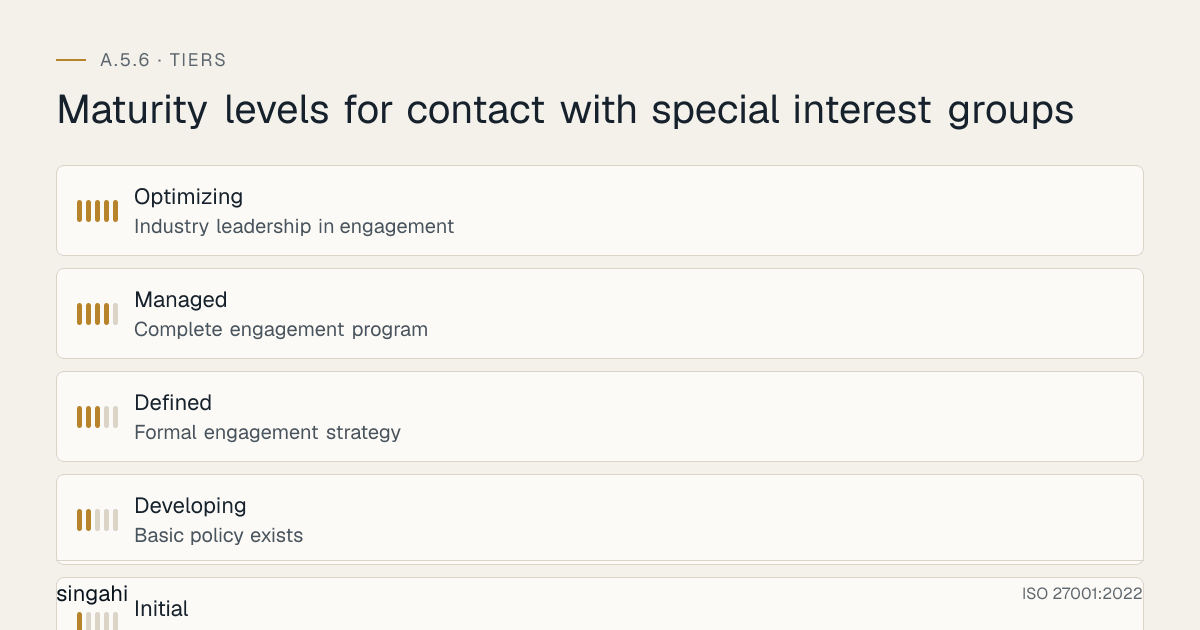
Maturity Model for A.5.6
| Level | Name | Characteristics | Evidence |
|---|---|---|---|
| 1 | Initial | Ad-hoc engagement; no formal policy; individual staff may belong to informal groups; no integration into operations | Random email subscriptions, occasional conference attendance |
| 2 | Developing | Basic policy exists; 1–2 formal memberships; intelligence received but not systematically processed; no outbound sharing | Membership register, policy document, some meeting records |
| 3 | Defined | Formal engagement strategy; 3–5 active memberships; regular intelligence review meetings; TLP classification applied; some outbound sharing | Strategy document, meeting minutes, intelligence logs, contribution records |
| 4 | Managed | Complete engagement program; 5+ memberships; full intelligence integration into SIEM/EDR; regular outbound contributions; annual value reviews; ISAs with key partners | Metrics dashboards, integrated IOCs, ISA portfolio, annual reports |
| 5 | Optimizing | Industry leadership in engagement; speaking engagements, published research, standards participation; bidirectional intelligence flows with government and industry; engagement directly informs strategic security investments | Conference speaking records, published papers, standards contributions, government liaison records, strategic planning documents |
Improvement Cycle
Plan:
- Annual engagement strategy review
- Benchmark against industry peers
- Identify gaps in group coverage or intelligence integration
- Set improvement targets and budget
Do:
- Implement new memberships or partnerships
- Enhance intelligence integration
- Increase staff participation and contribution
- Upgrade tools and platforms
Check:
- Quarterly metric reviews
- Annual value assessment with ROI analysis
- Staff feedback surveys on engagement value
- Audit findings and compliance reviews
Act:
- Cancel low-value memberships
- Expand high-value engagements
- Update policies and procedures based on lessons learned
- Invest in staff development and tools
- Share improvement stories with leadership
Benchmarking Sources
- ISO 27001 peer assessments during certification audits
- Industry reports from ISACs and professional associations
- Peer benchmarking through industry forums and working groups
- CERT-In and NCIIPC sectoral assessments (for critical infrastructure)
Frequently Asked Questions
Q1: Is A.5.6 mandatory for ISO 27001 certification?
A: Not automatically. No Annex A control is mandatory. Under clause 6.1.3 you choose the controls your risk assessment calls for, then record A.5.6 in your Statement of Applicability as included (and how) or excluded (and why). For most organizations, A.5.6 is included because external threat intelligence is essential for modern security operations. A very small organisation could decide that other sources (vendor advisories, CERT-In alerts) treat the risk well enough and exclude it with that reason, but most include it.
Q2: Do we need to join paid ISACs to satisfy A.5.6?
A: No. The standard requires "contact with special interest groups", this can be satisfied through free communities (Null, OWASP, online forums), professional associations with modest fees, or even informal peer relationships. However, paid ISACs often provide the most actionable, timely intelligence. A balanced approach with 1–2 paid memberships and 2–3 free community engagements is often optimal.
Q3: How do we share information without violating confidentiality?
A: Use the TLP classification system, sanitize information to remove organizational identifiers, obtain legal review, and only share what is necessary. When in doubt, don't share. Many organizations contribute detection rules, sanitized behavioral descriptions, and best practices rather than raw incident details.
Q4: What is the minimum evidence needed for an ISO 27001 audit?
A: Auditors usually look for: (1) a record of the groups and contacts you maintain (a short policy is good practice), (2) evidence of active participation in at least 1–2 groups, (3) records of intelligence received and acted upon, (4) documentation of liaison roles and responsibilities, and (5) evidence of annual review.
Q5: Can we use WhatsApp or Telegram groups for security engagement?
A: Yes, many Indian security professionals use these platforms for real-time coordination. However, implement appropriate controls: verify group membership, use only for TLP:CLEAR or TLP:GREEN information, avoid sharing sensitive details, and document participation as part of your engagement records. For sensitive information, use more secure channels.
Q6: What if our competitors are in the same ISAC?
A: This is normal and expected. ISACs operate under strict confidentiality rules, and members share intelligence about threats, not competitive information. In fact, having competitors in the same ISAC strengthens the community because everyone faces similar threats. Information sharing is governed by TLP classification and ISAs, not by competitive concerns.
Q7: How do we engage with government bodies like CERT-In or NCIIPC?
A: For CERT-In, register as an organization on their portal, subscribe to advisories, and report incidents as required. For NCIIPC, CII organizations must establish formal liaison. Attend CERT-In workshops and webinars, participate in sectoral exercises, and respond to information requests. Document all engagement for audit evidence.
Q8: Should our CISO personally attend all external events?
A: No. While the CISO should attend strategic events and maintain high-level relationships, operational events and technical meetups can be delegated to security managers, analysts, and engineers. This distributes knowledge, develops junior staff, and ensures the CISO's time is used strategically. The key is ensuring someone appropriate attends and reports back.
Q9: Can we use A.5.6 engagement as a substitute for internal threat intelligence capabilities?
A: No. External engagement should augment internal capabilities, not replace them. Organizations need internal expertise to contextualize, validate, and act on external intelligence. Relying solely on external intelligence creates blind spots and dependency. The most effective programs combine strong internal capabilities with strong external engagement.
Q10: How do we handle conflicting intelligence from different sources?
A: Implement a threat intelligence platform that correlates and validates multiple sources. Establish analyst workflows for evaluating source reliability, timeliness, and relevance. Not all intelligence is equal, some sources may have better track records for specific threat types. Maintain a "source reliability" rating system and weight intelligence accordingly.
Q11: What is the difference between A.5.6 and A.5.7 (Threat Intelligence)?
A: A.5.6 covers the channels and relationships, the groups, forums, and associations you engage with. A.5.7 covers the process, how you collect, analyze, and act on threat intelligence. Think of A.5.6 as "who you talk to" and A.5.7 as "what you do with the information." Both are necessary for a complete threat intelligence program.
Access to Specialized Expertise
External security communities provide access to expertise that would be economically impractical to maintain internally. A mid-sized Indian manufacturing company cannot afford to employ a full-time ICS/OT security specialist, a cloud security architect, and a threat intelligence analyst. However, through community engagement, the organization can access guidance from hundreds of such specialists across the industry.
Influence on Standards and Regulation
Active participation in standards bodies and regulatory consultations allows organizations to shape the rules that will govern them. Indian security professionals who participated in DSCI's consultations on the DPDP Act had early visibility into compliance requirements and could pre-position their organizations. Similarly, participation in BIS (Bureau of Indian Standards) working groups on information security standards provides input into national standards that may become mandatory. Organizations that only react to published regulations are perpetually behind; those that engage during formulation are prepared when requirements take effect.
Crisis Communication and Reputation Management
When major breaches occur, organizations with pre-established industry relationships have access to crisis communication support, legal precedents, and reputation management guidance. Peers who have handled similar incidents can share response templates and practical lessons, as long as nothing confidential leaves your organisation.
Further Implementation Guidance
Building Trusted Relationships with Government Bodies
For organizations in critical sectors or handling sensitive data, government engagement is not optional, it is an extension of A.5.6 into the regulatory domain (complementing A.5.5). Effective government liaison requires:
CERT-In Engagement:
- Register your organization on the CERT-In portal for advisory subscriptions
- Designate a CERT-In point of contact within your security team
- Report cybersecurity incidents within the mandated timelines (varies by sector)
- Participate in CERT-In workshops, webinars, and capacity-building programs
- Respond to information requests and participate in sectoral surveys
- Maintain records of all CERT-In interactions for audit and compliance evidence
NCIIPC Engagement (for CII organizations):
- Establish formal liaison with your sectoral NCIIPC coordinator
- Participate in sectoral risk assessment exercises
- Implement NCIIPC guidelines and advisories
- Coordinate on sector-wide incident response and exercise programs
- Report significant incidents to both NCIIPC and CERT-In as required
- Maintain documentation of NCIIPC compliance and engagement
State CERT Coordination:
- Organizations in Maharashtra, Karnataka, and other states with active CERTs should register locally
- State CERTs often provide faster, localized incident response support
- Participate in state-level cybersecurity exercises and awareness programs
- Coordinate with local law enforcement cybercrime units for incident support
Regulatory Body Engagement:
- Banking: RBI's CSITE cell (Department of Supervision) and CSIRT-Fin
- Securities: SEBI's IT Department and market infrastructure cybersecurity committees
- Insurance: IRDAI's IT and cybersecurity advisory panels
- Telecom: DoT's security division and TRAI consultations
- Healthcare: CDSCO medical device cybersecurity consultations
Virtual vs. In-Person Engagement Strategy
The COVID-19 pandemic permanently shifted the engagement landscape. A balanced strategy should include:
Virtual Engagement (60–70% of activities):
- Weekly or monthly virtual threat briefings from ISACs
- Webinar attendance for regulatory updates and technical deep-dives
- Online training and certification programs
- Virtual "coffee chats" and informal community calls
- Discord/Slack community participation for real-time technical discussions
- Virtual tabletop exercises and simulations
In-Person Engagement (30–40% of activities):
- Annual flagship conferences (Nullcon, c0c0n, BSides India, OWASP AppSec)
- Quarterly in-person ISAC working group meetings
- Local chapter meetups and community gatherings
- Government-hosted roundtables and consultations
- Vendor-hosted security summits (with appropriate skepticism about commercial bias)
- Peer organization site visits and exchange programs
Hybrid Engagement:
- Many conferences now offer hybrid attendance, strategically choose in-person vs. virtual based on content
- Technical, hands-on sessions benefit from in-person attendance
- Regulatory updates and briefings work well virtually
- Networking and relationship-building require in-person presence
- Budget constraints may dictate more virtual participation for smaller organizations
Managing Information Security in External Engagement
Engaging with external groups itself introduces security risks that must be managed:
Communication Security:
- Use organization-approved communication channels for sensitive discussions
- Never share credentials, internal network diagrams, or unredacted logs
- Verify the identity of contacts before sharing TLP:AMBER information
- Use encrypted channels (Signal, encrypted email) for sensitive coordination
- Be aware that conference Wi-Fi and hotel networks may be monitored
Device and Data Security:
- Use dedicated "travel devices" or virtual desktops for conference attendance
- Avoid accessing sensitive internal systems from conference networks
- Enable full disk encryption and remote wipe on conference devices
- Physically secure devices during events, conference theft is not uncommon
- Be cautious of "swag" USB drives and other potentially malicious items
Social Engineering Awareness:
- Conference attendees and community members may be targeted by threat actors
- Be cautious about what you disclose in informal conversations
- Verify unexpected contacts claiming to be from known organizations
- Report suspicious approaches to your security team and community moderators
- Remember that intelligence gathering is a two-way street, competitors and adversaries may be in the same rooms
Using Academic and Research Institutions
Indian academic institutions increasingly contribute to cybersecurity research and threat intelligence:
IIT Cybersecurity Research:
- IIT Bombay, IIT Kanpur, IIT Delhi, and IIT Kharagpur have active cybersecurity research centers
- Engage with these institutions for modern research, threat landscape studies, and talent recruitment
- Participate in industry-academia collaboration programs
- Sponsor research projects or M.Tech/Ph.D. students in relevant areas
IDRBT (Institute for Development and Research in Banking Technology):
- Bank-neutral research institution focused on banking technology security
- Provides research, training, and advisory services to Indian banks
- Engage for specialized banking security research and guidance
C-DAC (Centre for Development of Advanced Computing):
- Government research organization with cybersecurity divisions
- Participates in national cybersecurity initiatives and standards development
- Engage for government policy insight and research collaboration
University Cybersecurity Programs:
- Amity University, VIT, SRM, and others offer cybersecurity programs
- Engage for recruitment, guest lectures, and curriculum input
- Student talent often brings fresh perspectives on emerging threats
More Illustrative Scenarios
Illustrative Scenario 3: Indian SaaS Startup, Open-Source Community Engagement Accelerates Security Maturity
Organization: B2B SaaS startup in Bengaluru (50 employees, Series A funded, serving Indian and US customers) Sector: Information Technology / Software-as-a-Service Challenge: Limited security budget ( annually), no dedicated security team, SOC 2 Type II certification requirement from US enterprise customers, and need to demonstrate "security awareness" for investor confidence.
Implementation:
- CTO (who handled security part-time) joined the Null Community Bengaluru chapter in 2022
- Participated in monthly meetups (free, evening events)
- Joined OWASP Bengaluru chapter for application security guidance
- Subscribed to free CERT-In advisories and DSCI newsletters
- Participated in the NASSCOM DeepTech SaaS community for peer benchmarking
- Engaged with the "Cloud Security Alliance, Bangalore" chapter for cloud security guidance
- Joined the "IndiaSaaS" community for startup-specific security discussions
- Two engineering team members attended BSides Bangalore (per ticket) annually
Journey and Outcomes:
Month 1–3: Learning Phase
- Through Null Community meetups, the CTO learned about secure coding practices, DevSecOps tooling, and common cloud misconfigurations
- Attended hands-on workshops on container security and Kubernetes hardening
- Cost: (Null Community is free) + for BSides ticket = Month 4–6: Implementation Phase
- Applied lessons learned to implement basic security controls: AWS security group hardening, S3 bucket policies, IAM least privilege
- Implemented Semgrep (open-source static analysis) based on community recommendations
- Established basic vulnerability disclosure process modeled after community-shared templates
- Cost: Tooling costs only (Semgrep free tier, open-source scanners) = Month 7–12: Certification and Growth Phase
- Used community-shared SOC 2 preparation playbooks and auditor recommendations from peer discussions
- Implemented controls for all 5 Trust Service Criteria with community-informed guidance
- Received a SOC 2 Type II report with no exceptions noted
- CTO was invited to speak at a Null Community meetup about "SOC 2 on a startup budget", enhancing company reputation
- Two enterprise customers cited "security program maturity" as a factor in contract decisions
- Investor due diligence praised the "security-conscious culture" evidenced by community engagement
Quantified Benefits:
- SOC 2 preparation was faster because of community-shared templates
- Recruitment: attracted two security-conscious engineers who specifically mentioned the company's community engagement in interviews
- Time to basic security maturity: 8 months vs. estimated 18 months without community guidance
Key Success Factors:
- Used free communities for maximum value at minimal cost
- Applied learnings immediately rather than just passively consuming information
- Contributed back by sharing their own SOC 2 experience (building reciprocity)
- Involved technical staff (engineers) in community engagement, not just management
- Used community guidance to inform tool selection, avoiding expensive mistakes
Lessons Learned:
- Free communities can provide 80% of the value of paid engagements for small organizations
- The "pay it forward" principle of community engagement generates disproportionate returns
- Hands-on technical meetups provide more value than conference keynote speeches for practitioners
- Community engagement should be a core part of startup security strategy, not an afterthought
More importantly, the relationships we built helped us navigate our SOC 2 audit, respond to a vulnerability disclosure, and win enterprise customers. The ROI is almost incalculable for a startup."
More Frequently Asked Questions
Q12: How do we balance security engagement with "need to know" and confidentiality requirements?
A: Implement a tiered engagement model. Public forums and conferences handle TLP:CLEAR information. Closed ISACs and trusted peer relationships handle TLP:GREEN and TLP:AMBER. Internal-only discussions handle TLP:RED. Train staff on what can be shared where. When attending events, brief staff on confidentiality boundaries. Most engagement involves receiving intelligence, not sharing sensitive information, the risk is primarily in what staff might accidentally disclose in informal conversations.
Q13: What should we do if we receive intelligence suggesting an active threat but cannot confirm it in our environment?
A: Treat it as a proactive defense opportunity. Increase monitoring for the relevant IOCs, brief your security operations team, check logs for any historical matches, and consider proactive defensive measures (e.g., blocking IOCs at the perimeter). Document the intelligence receipt and your response for audit evidence. Even if the threat is not present now, the intelligence improves your detection capability. If the threat becomes relevant later, you have already prepared.
Q14: How do we handle language barriers in international ISACs or forums?
A: Most international ISACs operate in English, which is generally not a barrier for Indian professionals. For regional groups (e.g., AP-CERT), some materials may be in regional languages. Designate bilingual staff where needed, use translation tools for written materials, and focus on English-language forums initially. As the organization matures, consider regional engagement for deeper local intelligence. Many Indian ISACs and communities operate in English or Hinglish, reducing language barriers.
Q15: Should we disclose our ISO 27001 certification status in external forums?
A: Yes, disclosing ISO 27001 certification (which is public information, the certificate can be verified) is generally positive. It demonstrates security maturity and can attract like-minded organizations for deeper collaboration. However, avoid disclosing audit findings, specific control gaps, or certification scope details that might reveal sensitive information. Focus on the certification as a trust signal, not as a detailed technical disclosure.
Q16: How do we manage engagement when staff leave the organization?
A: This is a critical continuity risk. Maintain organization-level memberships (not individual) where possible. For individual memberships (professional associations), budget for membership transfers or new memberships. Document all engagement relationships, contacts, and intelligence in organizational repositories, not personal accounts. Conduct knowledge transfer sessions when liaison staff leave. Include engagement responsibilities in exit interview checklists. Ensure backup contacts are established for all critical relationships.
Q17: Can we engage with "dark web" or underground communities for threat intelligence?
A: This is extremely high-risk and generally not recommended for most organizations. Accessing underground forums may violate laws, expose the organization to legal liability, and create security risks. If such intelligence is necessary, engage with commercial threat intelligence providers (e.g., Recorded Future, Mandiant) who access these sources legally and professionally. For organizations with legitimate law enforcement or national security needs, coordinate through government channels (CERT-In, NCIIPC, police cybercrime units). Never attempt independent "dark web" access without legal clearance and specialized expertise.
Q18: How do we demonstrate A.5.6 value to skeptical leadership or board members?
A: Translate engagement into business terms: (1) incidents avoided and potential financial losses prevented, (2) regulatory compliance benefits and penalty avoidance, (3) faster incident response reducing business disruption, (4) improved security benchmarking reducing insurance premiums, (5) talent retention and recruitment advantages, (6) customer trust and competitive differentiation. Use specific illustrative scenarios from your sector. If direct measurement is difficult, use industry benchmarks, e.g., "Organizations in our ISAC avoided an average of 2.3 major incidents last year."
Q19: How do we handle "competing" intelligence from multiple sources that contradicts each other?
A: Intelligence is rarely 100% certain. When sources conflict, evaluate: (1) source reliability and track record, (2) timeliness (newer information may supersede older), (3) specificity (specific IOCs are more reliable than general warnings), (4) corroboration from other sources, (5) contextual fit with your threat model. Maintain a "source reliability scorecard" and weight intelligence accordingly. When uncertain, err on the side of caution and implement defensive measures while continuing to investigate. Document your evaluation process for audit and future reference.
The following toolkit assets are available for this control:
| # | Toolkit File | Description |
|---|---|---|
| 1 | 01-contact-with-special-interest--policy-template.md | Policy Template |
| 2 | 02-contact-with-special-interest--procedure.md | Procedure |
| 3 | 03-contact-with-special-interest--checklist.md | Checklist |
| 4 | 04-audit-evidence-checklist.md | Audit Evidence Checklist |
| 5 | 05-implementation-roadmap.md | Implementation Roadmap |
| 6 | 06-quick-reference-card.md | Quick Reference Card |
| 7 | 07-training-materials.md | Training Materials |
| 8 | 08-incident-response-playbook.md | Incident Response Playbook |
| 9 | 09-risk-assessment-template.md | Risk Assessment Template |
| 10 | 10-vendor-security-template.md | Vendor Security Template |
| 11 | 11-metrics-and-kpi-dashboard.md | Metrics and KPI Dashboard |
| 12 | 12-gap-analysis-template.md | Gap Analysis Template |
| 13 | 13-raci-matrix.md | RACI Matrix |
| 14 | 14-tool-comparison-matrix.md | Tool Comparison Matrix |
| 15 | 15-communication-plan.md | Communication Plan |
| 16 | 16-roles-and-responsibilities.md | Roles and Responsibilities |
| 17 | 17-regulatory-mapping.md | Regulatory Mapping |
References and Further Reading
Standards and Frameworks
- ISO/IEC 27001:2022, Information Security, Cybersecurity and Privacy Protection, Information Security Management Systems, Requirements
- ISO/IEC 27002:2022, Information Security, Cybersecurity and Privacy Protection, Information Security Controls
- NIST Cybersecurity Framework 2.0 (2024)
- NIST SP 800-150, Guide to Cyber Threat Information Sharing
- FIRST (Forum of Incident Response and Security Teams) Standards
Indian Regulatory References
- Information Technology Act, 2000 (as amended through 2008)
- CERT-In Directions under section 70B(6) of the IT Act, 28 April 2022
- Digital Personal Data Protection Act, 2023 and DPDP Rules, 2025
- RBI Cyber Security Framework in Banks (2016) and Master Direction on IT Governance, Risk, Controls and Assurance Practices (2023)
- SEBI Cybersecurity and Cyber Resilience Framework (CSCRF) for SEBI Regulated Entities, 20 August 2024
- IRDAI Information and Cyber Security Guidelines, 2023
- NCIIPC Guidelines for Protection of Critical Information Infrastructure
Industry and Academic Sources
- ISACA, Information Security and Risk Management Resources
- ISC², Cybersecurity Workforce Studies and Guidance
- Data Security Council of India (DSCI), Publications and Frameworks
- OWASP, Threat Intelligence and Community Resources
- Null Community, India's Open Security Community
- SANS Institute, Threat Intelligence Courses and Research
- MISP Project, Open Source Threat Intelligence Platform Documentation
International ISACs and Forums
- FIRST, www.first.org
- Health-ISAC, www.h-isac.org
- Financial Services-ISAC, www.fsisac.com
- AP-CERT, Asia Pacific CERT Community
Indian Security Communities and Events
- Null Community
- OWASP India Chapters, owasp.org
- c0c0n, Annual Security Conference (Kerala)
- Nullcon, Annual Security Conference (Goa)
- BSides India, Various city chapters
- DSCI, dsci.in
- NASSCOM Cybersecurity, nasscom.in
Government Resources
- CERT-In, cert-in.org.in
- NCIIPC, nciipc.gov.in
- MeitY, meity.gov.in
- RBI, rbi.org.in
- SEBI, sebi.gov.in