
On this page
- Quick Reference (60 Seconds)
- What the Standard Actually Requires
- Why This Control Matters
- Scope and Applicability
- Key Definitions and Terminology
- Relationship to Other Clauses and Frameworks
- Detailed Implementation Guidance, The Worked BCMS Process Architecture
- Tools, Technologies, and Solutions
- Policy and Procedure Templates
- Risk Assessment and Treatment
- Audit and Compliance Checklist
- Metrics and KPIs
- Common Pitfalls and Audit Failures
- Illustrative Scenario 1: Failure, Kaveri Cooperative Bank (Illustrative)
- Illustrative Scenario 2: Success, Tarang Logistics (Illustrative)
- Multi-Framework Mapping
- Implementation Roadmap
- FAQ
- Industry-Specific Requirements
- Maturity Model
- Emerging Trends
- References and Further Reading
Quick Reference (60 Seconds)
| Attribute | Detail |
|---|---|
| Clause | ISO 22301:2019 Clause 4.4, Business Continuity Management System (the management-system-establishment clause, structurally identical in intent to ISO/IEC 27001:2022 Clause 4.4 and ISO 9001:2015 Clause 4.4 under the ISO Harmonized Structure) |
| What it asks for (paraphrase) | ISO 22301 Clause 4.4 asks organizations to establish, implement, maintain, and continually improve a business continuity management system with the processes and interactions it needs, in accordance with the requirements of the standard. The four verbs, establish, implement, maintain, continually improve, are the lifecycle of the management system itself. |
| Domain | Context of the organization (Clause 4). The culmination of the Clause 4 trilogy: 4.1 names the issues; 4.2 names the interested parties and obligations; 4.3 draws the boundary; 4.4 brings the management system into existence inside that boundary and gives it the process architecture that every subsequent clause (5 through 10) operates within. |
| What you must produce | (a) A documented BCMS process architecture, an inventory of the processes the BCMS needs (governance, BIA, risk assessment, strategy, plans, exercise, evaluation, improvement, and the supporting Clauses 5 to 7 processes), their sequence, and their interactions; (b) a process interaction map showing how the PDCA loop flows across the BCMS, who triggers what, and which inputs/outputs cross process boundaries; (c) a PDCA assignment matrix that maps every Clauses 5 to 10 requirement to the Plan, Do, Check, or Act quadrant that owns it; (d) a BCMS Manual or equivalent top-level documented information that integrates the scope, policy, objectives, processes, and interactions into a single navigable artefact; (e) evidence of the four-verb lifecycle, establish (design artefacts), implement (operating records), maintain (review and update records), continually improve (corrective action and improvement records); (f) the determination of which processes are outsourced and the control over each (the 4.4 hook into Clauses 7.1, 8.1, and the relevant supplier provisions). |
| Typical owner | BCM Lead or BCM Manager, accountable to the executive sponsor (COO / CRO / CIO depending on sector). Delivered with active input from Quality (if ISO 9001 certified), Information Security (if ISO 27001 certified, the integrated management system opportunity is large here), IT Service Management, Risk, Compliance, Procurement, HR and Internal Audit. |
| Minimum viable actions | (1) Inventory the processes your BCMS needs, mapped to Clauses 4 to 10; (2) determine the sequence and interaction of those processes (a process interaction map); (3) decide the criteria and methods each process needs to operate effectively (RTO/RPO for BIA-driven processes, criteria for management review, thresholds for monitoring); (4) ensure the information and resources each process needs are available (Clause 7 wiring); (5) implement monitoring and measurement of each process (Clause 9.1 wiring); (6) implement actions to achieve the planned results and continual improvement (Clauses 8, 9.2, 9.3, 10); (7) capture the architecture in a BCMS Manual; (8) wire outsourced processes into Clause 8.1 control; (9) verify the PDCA loop actually closes (the single most-tested 4.4 attribute at audit). |
| Maturity floor (L1) | A BCM Policy and a BC/DR plan held by one person; no process architecture; no interaction map; no PDCA evidence; the management system is a folder of documents, not an operating system. |
| Maturity target (L4 to L5) | A GRC-platform-hosted BCMS with a live process inventory, an automated process-interaction map fed by CMDB and workflow data, a PDCA dashboard with lead and lag indicators per process, integration with the integrated management system (ISO 27001 / ISO 9001), auditable evidence of all four verbs (establish, implement, maintain, continually improve) per process, and a closed-loop improvement system that demonstrably drives year-on-year resilience gains. |
| Audit red flag | A 4.4 "BCMS" that is a binder of Clause 8 plans but has no evidence of (a) the management-system processes that own Clauses 5, 6, 7, 9, 10; (b) the interactions between the BIA, the risk assessment, the strategy selection, the plan set, the exercise programme, and the corrective-action log; (c) the Check and Act quadrants operating at all (no internal audit, no management review, no corrective action); or (d) any update cycle, a "frozen" BCMS is a 4.4 failure regardless of how good the Clause 8 content is. |
| Quick win | Convert your existing BCM documentation folder into a 4.4 evidence artefact: a BCMS Manual that lists every process the BCMS runs, who owns it, what triggers it, what it produces, and which downstream process consumes the output. Most growing companies in India can produce this in 6 to 10 weeks of internal effort. It is the single artefact most likely to convert a Stage 1 major nonconformity into a Stage 1 pass. |
| Time to implement (first cycle) | Growing companies (50 to 250 staff): 8 to 14 weeks for the first architecture pass. Larger growing (250 to 2,000): 12 to 20 weeks, usually rolled process-family by process-family. Multi-entity enterprise: 4 to 9 months, integrated with existing management systems (ISO 27001, ISO 9001, ISO 20000) where they exist. |
| Related clauses | 4.1 (context is the input the BCMS responds to), 4.2 (interested parties and obligations are inputs), 4.3 (scope is the boundary inside which the BCMS operates), 5.1 (leadership operates the BCMS), 5.2 (policy is the apex BCMS artefact), 5.3 (roles operate the processes), 6.1 (risk/opportunity actions feed the BCMS), 6.2 (objectives are what the BCMS achieves), 6.3 (changes to the BCMS are managed), 7.1 to 7.5 (support resources the processes need), 8.1 to 8.6 (the operational core of the BCMS, the Do quadrant), 9.1 to 9.3 (the Check quadrant), 10.1 to 10.2 (the Act quadrant). |
If you only read one thing: Clause 4.4 is where the BCMS stops being a folder of plans and becomes a management system. A 4.4-conformant BCMS is a set of processes that interact across a Plan-Do-Check-Act loop, that are established, implemented, maintained, and continually improved over time, and that demonstrably convert the Clauses 4.1, 4.2 and 4.3 inputs into the resilience outcomes Clauses 8 and 9 measure. Get 4.4 wrong, a binder of plans with no management system around them, and however technically excellent the Clause 8 content, the certification auditor will record a major nonconformity on the absence of the management system itself. Get it right, and every other clause becomes easier to evidence because the architecture carries the proof.
What the Standard Actually Requires
Figure · Process
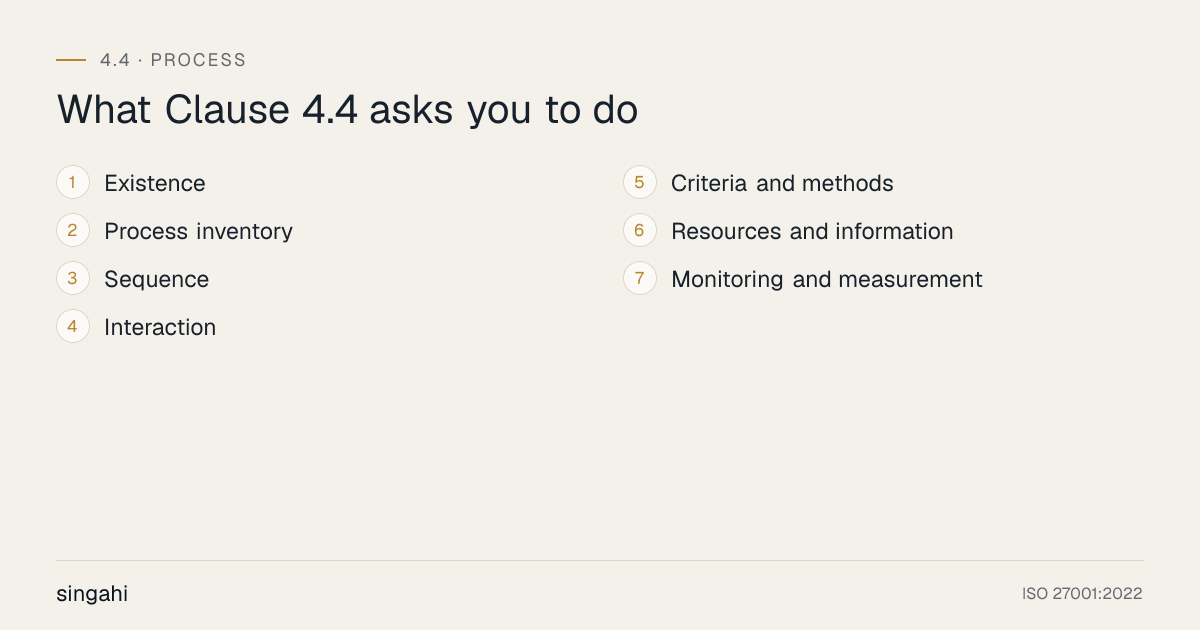
What Clause 4.4 asks you to do
The paraphrased requirement
ISO 22301 Clause 4.4 asks organizations to establish, implement, maintain, and continually improve a business continuity management system with the processes and interactions it needs, in accordance with the requirements of the standard. The four verbs, establish, implement, maintain, and continually improve, describe the lifecycle of the management system itself, not the lifecycle of any single plan. With the processes and interactions it needs is the explicit hook for the process approach: an organisation cannot conform to 4.4 by holding a binder of Clause 8 plans; it must also run the management-system processes (governance, planning, support, evaluation, improvement) and demonstrate how those processes interact. And the closing tie-back to the standard's requirements as a whole connects 4.4 to every other clause, the BCMS is the integrating frame that Clauses 5 through 10 populate.
Clause 4.4 is structurally identical to Clause 4.4 of ISO/IEC 27001:2022, Clause 4.4 of ISO 9001:2015, and the corresponding clauses in every ISO management-system standard built on the Harmonized Structure (Annex SL). The intent is identical too: the organisation must show that the management system exists as an operating set of processes, not merely as a documentation set. For Indian organisations running an integrated management system (commonly ISO 27001 + ISO 22301, sometimes with ISO 9001 as well, particularly in BFSI, ITeS, and SaaS), this is good news: the same 4.4 architecture serves multiple standards, and the integration is itself a 4.4 strength.
In practical terms, an organisation has to be able to answer nine questions in writing:
- Existence. Can you show, on a single diagram or in a single document, the set of processes that collectively are the BCMS? An auditor will ask "show me your BCMS", the answer is the process architecture, not the BCM Policy alone.
- Process inventory. Have you named every process the BCMS needs to operate? At minimum this includes the Clause 5 governance processes (policy approval, role assignment), Clause 6 planning processes (risk and opportunity actions, objective setting, change management), Clause 7 support processes (resources, competence, awareness, communication, documented information control), Clause 8 operational processes (BIA, risk assessment, strategy selection, plan maintenance, exercise programme, post-disruption evaluation), Clause 9 evaluation processes (monitoring and measurement, internal audit, management review), and Clause 10 improvement processes (nonconformity and corrective action, continual improvement).
- Sequence. For each process, can you describe what triggers it and what its output is? An auditor will trace, for example, the path from a BIA output (Clause 8.2) to a strategy decision (Clause 8.3) to a plan maintenance action (Clause 8.4) to an exercise finding (Clause 8.5) to a corrective action (Clause 10.1), a broken link anywhere is a 4.4 finding.
- Interaction. Have you mapped the interactions between processes, which process feeds which, which produces the input the next consumes, which loops back? The PDCA loop is the master interaction; every Clause 5 to 10 process sits somewhere on it.
- Criteria and methods. For each process, have you determined the criteria for effective operation (RTO/RPO thresholds for BIA-derived processes, eligibility criteria for internal audit findings, escalation thresholds for incident response) and the methods to achieve them?
- Resources and information. Have you ensured the resources and information each process needs are available? This is the 4.4 hook into Clause 7.1 (resources) and Clause 7.5 (documented information).
- Monitoring and measurement. Are you implementing the monitoring and measurement each process needs (Clause 9.1)? A process that is never measured is not being maintained under the 4.4 verb set.
- Improvement loop. Are you implementing actions to achieve planned results and continual improvement (Clauses 9.2, 9.3, 10.1, 10.2)? The Act quadrant is what keeps the BCMS alive; without it, the system is being maintained in the sense of "kept unchanged", which is not what 4.4 means.
- Outsourced processes. Have you determined which BCMS-relevant processes are outsourced (a BIA done by an external consultant, a DR site operated by a third party, an exercise facilitated externally) and established control over each? This is the 4.4 hook into Clause 8.1 and the supplier-control expectations of Clauses 7.1, 8.1 and 8.3.
What the standard does NOT require
Clause 4.4 is the most under-served clause in the public BCM literature because most commentators reduce it to "have a management system". It is helpful to be explicit about what is out of scope for 4.4, because auditors test the boundary:
- It does not require identifying internal/external issues. That is Clause 4.1. 4.1 names the issues; 4.4 brings into existence the management system that responds to them.
- It does not require identifying interested parties. That is Clause 4.2.
- It does not require drawing the boundary. That is Clause 4.3. 4.4 operates within the boundary 4.3 draws.
- It does not require specific recovery solutions. Strategy selection is Clause 8.3. 4.4 ensures the strategy-selection process exists and runs; it does not select the strategy itself.
- It does not require a specific process taxonomy. ISO 22301 does not prescribe how many processes you must have, what you must call them, or how you must group them. A 35-process architecture and a 12-process architecture can both conform, provided both are internally consistent, complete against Clauses 5 to 10, and demonstrably operating.
- It does not require a single "BCMS Manual" as a named document. A BCMS Manual is the most common way to satisfy 4.4's documented-information expectations, but the standard does not mandate the name or the form. An integrated management-system manual (covering ISO 27001 + ISO 22301 + ISO 9001) is equally conformant, as is a process architecture held in a GRC platform.
- It does not require proprietary software. A 4.4-conformant BCMS can run on documents, spreadsheets, and a workflow tool. The audit evidence is the operation of the processes, not the platform.
- It does not require the BCMS to be a separate system from your ISMS or QMS. Integration is permitted and encouraged (Annex SL was designed for it). Many Indian growing companies run a single integrated management system with ISO 27001, ISO 22301, and sometimes ISO 9001 as concurrent scopes.
- It does not require any specific frequency for the PDCA cycle. The frequency is set by the requirements of the individual clauses (annual internal audit under 9.2, planned-interval management review under 9.3, scheduled and event-triggered BIA refresh under 8.2). 4.4 requires that the cycle operates, not that it runs at any particular speed.
The companion guidance (ISO 22313:2020)
The clause text is short; the method lives in companion documents and in the lineage of Annex SL management-system standards. Five are most relevant for Clause 4.4:
- ISO 22313:2020, Security and resilience, Business continuity management systems, Guidance on the use of ISO 22301. The clause-by-clause companion. For Clause 4.4 it explains that the BCMS is more than the sum of its plans: it is the interacting set of processes that convert the context, scope and policy into continuity outcomes and improvement. It emphasises that the process approach is not optional, it is the architectural principle on which the standard is built.
- ISO/IEC 27001:2022 Clause 4.4, the structurally identical requirement for the ISMS. If your organisation runs an integrated ISMS+BCMS, the two 4.4 architectures should be reconciled into one process architecture that serves both standards.
- ISO 9001:2015 Clause 4.4, the same requirement for the QMS. Indian manufacturing organisations running ISO 9001 typically have a strong 4.4 foundation to reuse for ISO 22301.
- ISO 31000:2018, Risk management, Guidelines. The risk-management process architecture that Clause 6.1 of ISO 22301 inherits; 4.4 ensures this process is wired into the BCMS.
- ISO 22300:2021, Vocabulary. Defines "process", "management system", "continuity", and the architectural terms (a 2025 edition is under development (ISO/DIS 22300, 4th ed.) and not yet published, verify).
What auditors actually check
Certification auditors (BSI Group, DNV, SGS, TÜV, Bureau Veritas, NQA, Intertek, plus Indian certification bodies operating under NABCB accreditation) test Clause 4.4 by triangulating four things:
- The process architecture. Is there a documented inventory of the BCMS processes, with sequence and interaction mapped? Is it consistent with the Clauses 5 to 10 requirements? Is it approved by top management? Is there evidence the architecture is current (refreshed after the last BIA cycle, the last exercise, the last management review, the last corrective action)?
- The four-verb evidence. For each significant process, can the organisation show evidence of establish (the design, the policy, the procedure, the role assignment), implement (operating records, minutes, logs, completed templates, exercised plans), maintain (review records, update records, version history), and continually improve (corrective action records, management-review decisions, improvement projects)? The four verbs are tested in parallel; a process with strong establish/implement evidence but no maintain/improve evidence is a 4.4 finding.
- The interaction loop. Can the organisation trace a sample interaction end to end, for example, from a 6.1 risk-assessment output, into an 8.2 BIA update, into an 8.3 strategy change, into an 8.4 plan update, into an 8.5 exercise, into a 9.1 KPI change, into a 9.3 management-review decision, into a 10.1 corrective action, and back into a 6.1 update? A broken link anywhere is a 4.4 finding. The single most common 4.4 finding is a Clause 8 exercise finding that does not propagate into a Clause 10.1 corrective action, the loop is open.
- Outsourced-process control. Has the organisation identified the BCMS-relevant processes that are outsourced (external BIA consultancy, externally-operated DR site, externally-hosted GRC platform, externally-delivered awareness training) and established control over each per Clause 8.1? An outsourced process that is not under control is a 4.4 (and 8.1) finding.
The audit pressure on 4.4 has risen sharply since the 2019 edition replaced the 2012 edition. The 2012 standard treated 4.4 implicitly; the 2019 standard, aligned to Annex SL, treats 4.4 explicitly as the management-system-establishment clause. Indian certification bodies under IAF MD 1 and NABCB rules are increasingly strict on 4.4, a "document folder" BCMS that would have passed a decade ago will not pass today.
Why This Control Matters
The business case
Clause 4.4 is the single decision that most decisively shapes whether an ISO 22301 certification produces operational resilience or merely a certificate. Done well, 4.4 turns the BCM Policy, the BIA, the strategies, the plans and the exercise programme into an operating system, a set of processes that interact, that are maintained, and that demonstrably improve year on year. Done badly, the same artefacts remain a folder, technically present, individually creditable, collectively inert. The certification auditor sees the difference immediately; the regulator sees it the day a real disruption tests it; the board sees it in the post-incident review.
The financial logic of getting 4.4 right is unusually clear, and it runs in two directions. Up-front, a properly architected BCMS is cheaper than a folder-plus-emergency-rework approach, because the architecture carries the audit evidence and the operating cadence organically, you are not re-creating evidence in the months before a surveillance audit. Downstream, a properly architected BCMS converts disruptions into recoveries rather than crises, because the processes that should run during a disruption (incident response, activation, communications, recovery coordination, post-incident review) are the same processes that have been exercised and improved in the steady state. Indian growing companies routinely get this wrong on both sides, under-investing in the architecture up-front ("we will build the management system after we get the certificate") and then over-paying for emergency remediation after a surveillance-audit finding or a real outage.
A 4.4-conformant BCMS also compounds. Each PDCA cycle makes the next one cheaper: the BIA gets cleaner because the previous cycle's exercises validated the RTO assumptions; the strategy gets sharper because the previous cycle's post-incident reviews exposed what did not work; the audit gets faster because the architecture carries the evidence trail. A folder-based BCMS, by contrast, decays: each year the documentation drifts further from the operational reality, the surveillance audit gets harder, and the gap between the certificate and the actual resilience widens.
Indian context, why this clause matters more in India than in most markets
Six features of the Indian business environment sharpen the consequences of a 4.4 failure:
-
Dense, overlapping regulatory expectations of management-system maturity. The Reserve Bank's Master Direction on IT Governance, Risk, Controls and Assurance Practices (issued 7 November 2023, effective 1 April 2024) does not merely require banks and NBFCs to have a BCP, it requires the management-system machinery around it: board-approved policy, defined RTO/RPO, documented DR drills, third-party continuity oversight, IT readiness for crisis events, and assurance reporting. SEBI's Cybersecurity and Cyber Resilience Framework (CSCRF, circular SEBI/HO/ITD-1/ITD_CSC_EXT/P/CIR/2024/113, 20 August 2024) organises the entire regime around five Cyber Resilience Goals and six cybersecurity functions (Governance, Identify, Protect, Detect, Respond, Recover), a structural PDCA in all but name. IRDAI's Information and Cyber Security Guidelines 2023 (24 April 2023) require a board-approved Information and Cyber Security Policy including BCP/DR, with explicit board-committee oversight. Each of these is, in effect, a regulator demanding a 4.4-conformant management system. A growing company that builds a 4.4-conformant BCMS is building the same architecture the regulator will ask for.
-
The CERT-In horizontal regime. The CERT-In Directions (No. 20(3)/2022-CERT-In, 28 April 2022) apply horizontally to every entity operating ICT in India, six hours to report prescribed incidents, 180-day log retention, NTP clock sync, point-of-contact designation, cooperation with investigations. These obligations only function inside a management system that has an incident-response process, a logging-and-monitoring process, a communications process, and a corrective-action process. CERT-In compliance without a 4.4-conformant BCMS is brittle; with one, it is organic.
-
DPDP Act 2023 security safeguards. Section 8(5) of the Digital Personal Data Protection Act 2023 (Act 22 of 2023) requires every Data Fiduciary to take reasonable security safeguards against a personal data breach, and the Act counts loss of availability as a breach, enforceable with penalties up to ₹250 crore under the Schedule for failure to take adequate security safeguards. The DPDP Rules 2025 (notified November 2025) require breach intimation without delay and a detailed report to the Board within 72 hours (from about May 2027). Availability is a continuity outcome; a continuity outcome requires a management system to deliver it. 4.4 is the statutory underpinning for DPDP availability compliance.
-
Group structures and captive subsidiaries. Indian growing companies are frequently structured as a parent plus operating subsidiaries plus a captive IT or BPO entity plus an overseas contracting vehicle. A BCMS process architecture that runs cleanly inside one entity breaks down at the entity boundary unless 4.4 is built with multi-entity operation in mind, common processes, common documentation control, common evidence standards, entity-specific annexures. The single most common 4.4 failure in Indian groups is a process architecture that works at the parent and silently stops at the subsidiary.
-
Outsourcing intensity. Indian BFSI, SaaS and ITeS firms outsource heavily, DR sites, payment switches, SMS gateways, identity providers, SOC services, BIA consultancy, exercise facilitation. Clause 4.4 explicitly expects outsourced processes to be under control; Clause 8.1 makes that control operational. A 4.4 architecture that treats outsourcing as a procurement matter rather than a BCMS matter is exposed on the day the outsourced process fails.
-
Skills and rotation pressure. The Indian BCM profession is shallow relative to demand; key-person risk on the BCM Lead is high; rotation into and out of BCM roles is common. A 4.4-conformant BCMS, with documented processes, defined interactions, and an operating cadence, survives a BCM Lead change. A folder-based BCMS does not. The management system is the institutional memory.
The cost of getting it wrong
A defective 4.4 architecture generates three categories of cost:
-
Certification and audit cost. Stage 1 audit (the documentation review) is in large part a 4.4 examination: is there a management system here, or merely a folder? A deficient architecture generates Stage 1 findings that delay Stage 2 by 2 to 6 months; extra audit days and consultancy; and, in the worst case, withdrawal of certification post-issuance when the architectural gap surfaces. Annual surveillance audits then re-extract the cost: a process that has no operating evidence must be reconstructed each year at consultancy rates.
-
Operational disruption cost. An architecture that does not close the PDCA loop produces a BCMS that cannot learn. The same exercise finding recurs year after year; the same plan defect surfaces in the next real outage; the same supplier dependency goes uncorrected. The illustrative Kaveri Cooperative Bank scenario in Section 14 traces how a BCMS that was technically present (the binder existed, the certificate existed) but architecturally inert (the PDCA loop did not close) produced a heavy loss when the same DR defect that had been noted in three previous drills recurred in the real ransomware event of October 2024.
-
Regulatory cost. Where the BCMS is required by an Indian regulator (RBI MD IT Governance for banks and NBFCs, SEBI CSCRF for SEBI Regulated Entities, IRDAI 2023 for insurers, CERT-In horizontally), an inadequate architecture is a regulatory breach. The Reserve Bank's 2 December 2020 action against HDFC Bank (restriction on new digital products and fresh credit cards, partially lifted 17 August 2021, fully lifted March 2022) is the canonical Indian example of repeated digital outages escalating into a regulatory restriction; the RBI asked the bank's board to examine the lapses and fix accountability. The DPDP penalties (up to ₹250 crore) and the Companies Act 2013 Section 134(3)(n) board-risk-oversight duty make the absence of a functioning BCMS a material balance-sheet risk for any Indian company of size.
The counter-case is equally clear. A clean 4.4 architecture concentrates effort on the right cadence and visibly widens the resilience posture without inflating the BCMS cost. The illustrative Tarang Logistics scenario in Section 15 traces how a Mumbai-based third-party logistics firm spent three years building a 4.4-conformant BCMS (process architecture, BCMS Manual, GRC-platform hosting, integrated with its existing ISO 9001 QMS), survived a 14-day warehouse shutdown during the July 2025 monsoon flooding of the Mumbai-Pune expressway corridor without losing a single enterprise customer, and recovered the investment through avoided service credits and retained customers.
Scope and Applicability
Who 4.4 applies to
Clause 4.4 applies to every organisation seeking ISO 22301:2019 certification, regardless of size, sector or geographic footprint. It is a universal requirement, not a sector-conditional one. A 30-person SaaS startup, a 1,200-person NBFC, a 6,000-staff hospital chain and a 50,000-employee manufacturing group all build a 4.4-conformant BCMS, the complexity of the architecture scales, but the obligation does not.
4.4 also applies to organisations pursuing internal alignment with ISO 22301 (without seeking certification). The discipline of designing the management system is the same; only the audit pressure differs. Many growing companies in India run a "shadow" 4.4 cycle 12 to 24 months before pursuing certification, to surface architectural gaps before the certification body does.
What "the organization" means for 4.4
ISO management-system standards use "the organization" to mean the entity to which the standard is being applied, the same definition used by Clause 4.3 to bound the scope. For 4.4, this determines whose processes constitute the BCMS. In India, the question is non-trivial because of common group structures:
- Single-company BCMS, the management system covers one legal entity. The process architecture is owned by that entity. Most common for independent growing companies.
- Multi-entity group BCMS, the management system covers several related legal entities. The process architecture is shared (common policy, common procedures, common documentation control) with entity-level annexures for variations. Common in larger growing companies and enterprise groups.
- Partial-entity BCMS, the management system covers one or more business units within a larger legal entity. The process architecture must explicitly bound itself to the in-scope units; the management-system processes for out-of-scope units sit outside the BCMS. Permissible but requires careful interface design.
- Cross-border BCMS, the management system covers the Indian operations of a foreign-headquartered group, or vice versa. Requires explicit treatment of the parent's BCM regime, data-localisation boundaries, and any cross-border regulatory regimes (DORA for EU financial-sector customers, APRA CPS 230 for Australian captives, MAS TRM for Singapore subsidiaries, HKMA OR-2 / TM-G-2 for Hong Kong).
What 4.4 does NOT cover
4.4 establishes the BCMS, it does not itself populate every process. The following are commonly confused with 4.4 but are different clauses:
- Context analysis, Clause 4.1.
- Interested-party analysis and obligations, Clause 4.2.
- Boundary drawing, Clause 4.3. 4.4 operates within the boundary.
- Leadership and policy, Clauses 5.1 to 5.3. 4.4 establishes the management system in which leadership operates.
- Risk treatment, Clause 6.1. 4.4 ensures the risk-treatment process exists; 6.1 runs it.
- BIA and risk assessment, Clause 8.2. 4.4 ensures the BIA process is part of the BCMS; 8.2 executes the BIA.
- Strategy selection, Clause 8.3. 4.4 ensures the strategy process is wired to the BIA and to plan maintenance; 8.3 selects the strategy.
- Plans, Clause 8.4. 4.4 ensures the plan-maintenance process runs; 8.4 holds the plans.
- Exercises, Clause 8.5. 4.4 ensures the exercise programme runs and feeds corrective action; 8.5 designs and runs the exercises.
- Internal audit and management review, Clauses 9.2 and 9.3. 4.4 establishes the Check quadrant; 9.2 and 9.3 are the Check processes themselves.
- Corrective action and continual improvement, Clauses 10.1 and 10.2. 4.4 establishes the Act quadrant; 10.1 and 10.2 are the Act processes themselves.
By organisation size
The mechanics of 4.4 scale with organisation size:
- Small (10 to 50 staff), a single BCMS Manual (10 to 20 pages), a process inventory of 8 to 12 processes, a simple process-interaction diagram, a PDCA assignment table, the four-verb evidence held in the operating records of each process. The whole 4.4 cycle is achievable in 6 to 10 weeks of part-time effort.
- Growing companies (50 to 250 staff), a 20- to 40-page BCMS Manual, a process inventory of 12 to 18 processes, a worked process-interaction map, a PDCA assignment matrix, a documented review cadence per process, integration with existing ISMS or QMS where present. 8 to 14 weeks of cross-functional effort; usually owned by the BCM Lead with executive sponsorship.
- Larger growing (250 to 2,000 staff), a 40- to 80-page BCMS Manual plus process-level procedures, a process inventory of 18 to 30 processes, a process-interaction map maintained in a GRC platform or workflow tool, a PDCA dashboard, entity-level process annexures for groups, an integrated management-system manual where ISO 27001/ISO 9001 co-exist. 12 to 20 weeks for first cycle; a permanent management-system function thereafter.
- Enterprise (2,000+ staff), a BCMS Manual set (master plus per-business-unit annexures plus per-geography annexures), a process inventory of 30 to 60 processes, a GRC-platform-hosted process architecture with live workflow integration, a real-time PDCA dashboard reported to the BCM Steering Committee, an integrated management-system environment, and a dedicated management-system team. 4 to 9 months for first cycle; a permanent BCMS-office function thereafter.
By industry (preview, Section 21 has the deep treatment)
The 4.4 signature varies sharply by industry:
- BFSI, regulator-driven architecture (RBI MD IT Governance requires the management-system machinery explicitly), dense integration with the ISMS and the cyber-resilience framework, board-level oversight architecture.
- Healthcare, patient-safety dimension in the process architecture (clinical-continuity processes must sit alongside IT DR processes), integration with clinical governance, hospital-data scope dimension (DPDP SDF for hospitals handling large patient datasets).
- IT/ITeS and SaaS, integration with ITSM (ISO 20000 / ITIL), enterprise-customer contractual perimeter in the architecture (customer-facing BCM clauses drive the audit and reporting processes), cross-border regimes (DORA/CPS 230/MAS TRM/HKMA OR-2) reflected in entity-level process annexures.
- Manufacturing (especially chemical), physical-safety dimension (NDMA Chemical Disaster Guidelines require integration of industrial plans with District Disaster Management Plans), OT/IT process boundary, multi-plant process architecture, integration with ISO 9001 QMS (commonly already certified).
- Government and PSU, departmental process architecture, RTI transparency dimension, integration with departmental Disaster Management Plans under DM Act 2005 Section 40.
Key Definitions and Terminology
Clause 4.4 turns on a small set of architectural terms whose precise meaning an auditor will test. Definitions below reconcile ISO 22300:2021 vocabulary with Indian regulatory usage and Annex SL management-system lineage.
- Management system, in our own words: the connected web of structures, policies, processes, and resources through which an organisation sets its objectives and pursues them systematically. ISO 22301's BCMS is one of a family of ISO management systems (ISMS, QMS, EnMS, OH&S MS) built on the common Harmonized Structure. The "system" in BCMS is the architecture, not the binder.
- Business Continuity Management System (BCMS), the management system that an organisation uses to develop and implement its business continuity policy, manage continuity risks, and establish objectives and processes consistent with that policy. The BCMS is the operating system of continuity; the plans are the applications that run on it.
- Process, a set of interrelated or interacting activities that use inputs to deliver an intended result. The BIA is a process; the strategy selection is a process; the exercise programme is a process; the management review is a process. 4.4 requires that the set of processes the BCMS needs is identified, sequenced, and shown to interact.
- Process approach, the management principle that consistent and predictable results are achieved more effectively when activities are understood and managed as interrelated processes that function as a coherent system. The process approach is the architectural principle underlying Annex SL and Clause 4.4.
- Plan-Do-Check-Act (PDCA), the iterative management method that drives continual improvement. Plan = establish the objectives and processes needed to deliver results; Do = implement the processes; Check = monitor and measure processes against policy and objectives and report results; Act = take actions to improve performance. In ISO 22301, Plan maps roughly to Clauses 4 to 7 plus 6 plus 8.1, 8.2, 8.3; Do maps to 8.4, 8.5 and the operational aspects of 7; Check maps to 9; Act maps to 10.
- Interaction, the relationship between two processes where one produces an output that the other consumes, or where one triggers the other, or where one constrains the other. The BIA feeds the strategy selection; the strategy selection feeds the plan maintenance; the exercise programme triggers the corrective action; the corrective action updates the BIA. Mapping these interactions is the second half of 4.4.
- Sequence, the order in which processes operate. The BIA precedes the strategy selection; the strategy precedes the plan; the plan precedes the exercise; the exercise precedes the corrective action; the corrective action precedes the next BIA cycle. 4.4 requires sequence to be determined, not merely implied.
- Establish, to design and bring into existence. For a BCMS process, establish means: define the purpose, the trigger, the inputs, the steps, the outputs, the owner, the resources, the criteria, and the records. The "establish" verb is what produces the architecture.
- Implement, to operate the process as designed. For a BCMS process, implement means: run it, produce the records, deliver the outputs. A process that is established but not implemented is a 4.4 finding.
- Maintain, to keep the process in operation and current. For a BCMS process, maintain means: review it at planned intervals, update it when its inputs change, version-control it, keep its evidence current. A process that is established and implemented but not maintained is a 4.4 finding.
- Continually improve, to enhance the process's performance over time. For a BCMS process, continually improve means: use the Check quadrant's outputs to identify improvement opportunities, take action on them, and verify effectiveness. A process that is established, implemented, and maintained but not improved is a 4.4 finding, and is the single most common 4.4 finding in Indian growing companies.
- Outsourced process, a process that the organisation needs for its BCMS and that it has chosen to have performed by an external party. Outsourcing moves the operation of the process outside; it does not move the accountability for the process outcome. 4.4 requires outsourced processes to be identified and brought under control (typically via Clause 8.1 and the supplier-control expectations).
- BCMS Manual, the top-level documented information that describes the BCMS: its scope (per 4.3), its policy (per 5.2), its processes (per 4.4), its interactions (per 4.4), and its documentation structure. The BCMS Manual is the most common (though not the only) way to satisfy 4.4's documented-information expectations. In an integrated management system, a single Manual may serve multiple standards.
- Integrated Management System (IMS), a single management system that satisfies the requirements of two or more management-system standards simultaneously. Common in India: ISO 27001 + ISO 22301 (BFSI, SaaS); ISO 9001 + ISO 22301 (manufacturing); ISO 27001 + ISO 22301 + ISO 9001 (large ITeS). Integration is permitted and encouraged under the Harmonized Structure.
- Harmonized Structure (Annex SL), the common high-level structure, identical core text, and common terms and core definitions that ISO uses for all new and revised management-system standards. Clause 4.4 of ISO 22301 is identical in placement and intent to Clause 4.4 of ISO 27001 and ISO 9001 because all three inherit the Harmonized Structure.
- Process owner, the role accountable for the design, operation, maintenance, and improvement of a single BCMS process. The BCM Lead typically owns the architecture-level processes; subject-matter owners own the operational processes (the CISO often owns the incident-response process; the Head of HR often owns the awareness process; the CIO often owns the IT DR process).
- Documented information, the information an organisation is required to control and maintain (per Clause 7.5). The 4.4 architecture is held as documented information; the four-verb evidence is held as documented information; the process-interaction map is held as documented information.
- Corrective action, the Act-quadrant process (Clause 10.1) that reacts to nonconformities, eliminates their causes, and prevents recurrence. The corrective-action process is what closes the PDCA loop; without it, the BCMS cannot continually improve.
- Management review, the Check-quadrant process (Clause 9.3) in which top management evaluates the BCMS's continuing suitability, adequacy, effectiveness, and alignment with strategic direction. The management-review process is the apex of the Check quadrant and the principal input to the Act quadrant.
- Internal audit, the Check-quadrant process (Clause 9.2) that audits the BCMS at planned intervals against the standard's requirements and the organisation's own documentation. Internal audit is the systematic evidence-gathering process that feeds both management review and corrective action.
Relationship to Other Clauses and Frameworks
Inside ISO 22301:2019
Clause 4.4 is the architectural keystone that sits between the Clause 4 context trilogy (4.1, 4.2, 4.3) and the operating clauses (5 through 10). It is the clause that brings the management system into existence. Every downstream clause operates within the architecture 4.4 establishes:
| Downstream clause | How 4.4 establishes the architecture for it |
|---|---|
| 5.1 Leadership | 4.4 establishes the BCMS that top management leads; leadership commitment is exercised on the architecture 4.4 defines. |
| 5.2 Policy | 4.4 establishes the management system of which the policy is the apex statement; the policy does not stand alone. |
| 5.3 Roles | 4.4 establishes the processes whose ownership 5.3 assigns; a role without a process to own is a 5.3 gap that 4.4 surfaces. |
| 6.1 Risks and opportunities | 4.4 establishes the risk-treatment process; 6.1 runs it. The 4.4 architecture ensures the risk-treatment outputs flow into the BIA, the strategy, and the corrective-action processes. |
| 6.2 Objectives | 4.4 establishes the objective-setting process; 6.2 sets the objectives. The architecture ensures objectives are scoped, measurable, monitored, and aligned with the policy. |
| 6.3 Planning changes | 4.4 establishes the change-management process; 6.3 runs it. The architecture ensures BCMS changes are deliberate and propagated. |
| 7.1 Resources | 4.4 establishes the resource-identification process; 7.1 provides the resources. The architecture ensures each process's resource needs are surfaced. |
| 7.2 Competence | 4.4 establishes the competence-identification process; 7.2 satisfies it. The architecture ensures each process has competent people. |
| 7.3 Awareness | 4.4 establishes the awareness process; 7.3 runs it. The architecture ensures awareness is targeted at the right people. |
| 7.4 Communication | 4.4 establishes the communication process; 7.4 runs it. The architecture ensures internal and external communications support the BCMS. |
| 7.5 Documented information | 4.4 establishes the documentation architecture; 7.5 controls it. The BCMS Manual is the apex 4.4 + 7.5 artefact. |
| 8.1 Operational planning | 4.4 establishes the operational-planning process; 8.1 runs it, including the control of outsourced processes that 4.4 also surfaces. |
| 8.2 BIA and risk assessment | 4.4 establishes the BIA and risk-assessment processes as interacting elements of the Do quadrant; 8.2 executes them. |
| 8.3 Strategies and solutions | 4.4 ensures the strategy-selection process is wired to receive the BIA outputs and to feed the plan-maintenance process; 8.3 selects the strategies. |
| 8.4 Plans and procedures | 4.4 ensures the plan-maintenance process is wired to receive the strategy outputs and to be exercised; 8.4 holds the plans. |
| 8.5 Exercise programme | 4.4 ensures the exercise programme feeds the corrective-action process and the post-disruption evaluation process; 8.5 designs and runs the exercises. |
| 8.6 Evaluation of documentation and capabilities | 4.4 ensures the post-disruption evaluation process is wired to feed corrective action; 8.6 executes the evaluations. |
| 9.1 Monitoring, measurement, analysis, evaluation | 4.4 establishes the monitoring process; 9.1 runs it. The architecture ensures each process is measured. |
| 9.2 Internal audit | 4.4 establishes the BCMS that 9.2 audits. A 4.4-conformant architecture is what makes a 9.2 audit even possible. |
| 9.3 Management review | 4.4 establishes the BCMS that 9.3 reviews. The management-review process is the apex of the Check quadrant; 4.4 ensures the inputs to it are produced across the BCMS. |
| 10.1 Nonconformity and corrective action | 4.4 establishes the corrective-action process; 10.1 runs it. The architecture ensures the PDCA loop closes. |
| 10.2 Continual improvement | 4.4 establishes the improvement process; 10.2 runs it. The architecture ensures improvement is systemic, not incidental. |
PDCA mapping, the master interaction
The Plan-Do-Check-Act loop is the master interaction that 4.4 requires the BCMS to embody. The mapping of ISO 22301 clauses to PDCA quadrants:
| PDCA quadrant | ISO 22301 clauses | What happens in this quadrant |
|---|---|---|
| Plan | 4 (Context), 5 (Leadership), 6 (Planning), 7 (Support, partly), 8.1 (Operational planning), 8.2 (BIA), 8.3 (Strategy) | The organisation establishes the objectives and processes needed to deliver continuity results: context, scope, policy, objectives, risk actions, BIA, strategy. |
| Do | 7 (Support, operational), 8.4 (Plans), 8.5 (Exercises) | The organisation implements the processes: resources, competence, awareness, communications, plans activated during disruption, exercises that test them. |
| Check | 8.6 (Evaluation), 9.1 (Monitoring and measurement), 9.2 (Internal audit), 9.3 (Management review) | The organisation monitors and measures the processes against policy, objectives, and the standard, and reports the results. |
| Act | 10.1 (Nonconformity and corrective action), 10.2 (Continual improvement) | The organisation takes actions to improve performance: corrective action, improvement projects, updates that propagate back into the Plan quadrant. |
The 4.4 architecture must make this loop visible and operational. The most common 4.4 audit technique is to ask the BCM Lead to trace a single artefact end-to-end around the loop, for example, from a risk-assessment output, through the BIA, through the strategy, through the plan, through the exercise, through the corrective action, and back into the next risk assessment. A break anywhere is a 4.4 finding.
Cross-framework alignment
Clause 4.4 sits in a wider landscape of management-system, resilience, and operational-continuity frameworks. The principal alignments:
- ISO/IEC 27001:2022 Clause 4.4, structurally identical requirement for the ISMS. Organisations running an integrated ISMS+BCMS reconcile the two architectures into one.
- ISO 9001:2015 Clause 4.4, structurally identical requirement for the QMS. Indian manufacturing organisations typically reuse the ISO 9001 process architecture for ISO 22301.
- ISO 22313:2020 §4.4, the companion guidance for Clause 4.4.
- NIST SP 800-34 Rev 1 (May 2010), the seven-step contingency-planning method (initiate, conduct BIA, identify preventive controls, create recovery strategies, develop and implement plans, test, maintain). Not a management-system standard, but its seven steps map cleanly onto the Plan and Do quadrants of ISO 22301; the maintain step is the bridge to Check and Act.
- NIST CSF 2.0 (26 February 2024), the Govern function (GV) and the Recover function (RC) are the closest NIST-CSF analogues to the BCMS architecture. GV.OC (organisational context), GV.RM (risk management strategy), GV.RR (roles), GV.PO (policy), GV.OV (oversight) map to the Plan quadrant; RC.RP (recovery plan execution), RC.CO (communications) map to the Do quadrant.
- FFIEC BCM Booklet (November 2019, OCC 2019-57 / FRB SR 19-13 / FDIC FIL-71-2019), the US financial-sector BCM standard. Its four-phase structure (governance, business impact analysis, recovery strategies, testing/exercises) is a simplified PDCA; an ISO 22301-conformant US bank can map FFIEC BCM onto its 4.4 architecture cleanly.
- DORA (Regulation (EU) 2022/2554, applies 17 January 2025), Articles 5 to 7 (governance, accountability, internal literacy), Articles 11 to 14 (ICT risk management framework, BIA, backup, crisis communications). DORA's ICT risk management framework is a management system in PDCA terms; an Indian SaaS or fintech serving EU financial entities maps its 4.4 architecture onto DORA's Article 6 framework.
- APRA CPS 230 (effective 1 July 2025), paragraphs 11 to 22 (accountability, risk management framework, roles). CPS 230's operational-risk management framework is a management-system requirement; an Indian captive of an Australian APRA-regulated entity maps its 4.4 architecture onto CPS 230's framework requirements.
- MAS TRM Guidelines (18 January 2021), Section 4 (Technology Risk Management Framework) is the management-system anchor; an Indian subsidiary of a Singapore MAS-regulated FI maps its 4.4 architecture onto the MAS TRM framework.
- HKMA OR-2 / TM-G-2 (31 May 2022), the operational-resilience and BCP supervisory policy manuals; the OR-2 important-business-services identification and tolerance-setting process is the architecture layer that 4.4 must accommodate.
- Companies Act 2013 Section 134(3)(n) and Section 177, board-risk-oversight duty and Audit Committee responsibility for risk-management systems. A 4.4-conformant BCMS is the substance behind the Section 134(3)(n) disclosure.
- RBI Master Direction IT Governance (7 November 2023, effective 1 April 2024), Chapter V (Business Continuity and Disaster Recovery Management) and the governance chapter together constitute a management-system expectation that a 4.4-conformant BCMS satisfies.
- SEBI CSCRF (20 August 2024), the five Cyber Resilience Goals × six cybersecurity functions structure is a management-system architecture; a 4.4-conformant BCMS that integrates with the ISMS satisfies it.
- IRDAI Information and Cyber Security Guidelines 2023 (24 April 2023), the board-approved policy, the CISO role, the BCP/DR chapter, and the audit reporting together are a management-system requirement.
- CERT-In Directions (28 April 2022), the incident reporting, log retention, and cooperation obligations assume an incident-response process; that process is part of the 4.4 architecture.
- NDMA guidelines and Disaster Management Act 2005, Section 40 of the DM Act requires every State department to prepare a Disaster Management Plan; the NDMA template (Prevention, Mitigation, Preparedness, Response, Relief, Recovery, Capacity Building) is a process architecture that 4.4 can integrate.
Section 16 expands the multi-framework mapping into a worked cross-reference table.
Detailed Implementation Guidance, The Worked BCMS Process Architecture
This section is the practitioner core of the guide. It walks through the ten-step method for building a 4.4-conformant BCMS process architecture, with worked artefacts (process inventory, sequence, interaction map, PDCA wiring, four-verb evidence, outsourced-process control) that a BCM Lead can take and adapt directly.
The ten-step method (overview)
- Inventory the BCMS processes, the complete list of processes the BCMS needs.
- Determine the sequence, what triggers each process, what each produces.
- Map the interactions, which process feeds which, where the loops run.
- Assign PDCA quadrants, every process to its quadrant.
- Define process criteria and methods, how each process operates effectively.
- Wire resources and information, Clause 7 inputs per process.
- Wire monitoring and measurement, Clause 9.1 inputs per process.
- Design the improvement loop, how Check outputs drive Act actions.
- Identify and control outsourced processes, the 8.1 hook.
- Capture the architecture in the BCMS Manual, the apex documented information.
Each step below includes the worked content a BCM Lead needs to produce.
Step 1, Inventory the BCMS processes
The first 4.4 deliverable is a complete list of the processes the BCMS needs. A common mistake is to confuse the Clause 8 operational processes (BIA, strategy, plans, exercises) with the whole BCMS; in fact, Clauses 5 to 10 each translate into a family of management-system processes. The inventory below is a starting set of 22 processes that most growing companies in India will need, organised by clause family. Adapt the names and the granularity to your organisation.
Clause 5 (Leadership) processes:
- P-01 BCMS Policy management (drafting, approval, communication, review).
- P-02 Roles, responsibilities and authorities assignment (Clause 5.3).
- P-03 Top-management engagement (Clause 5.1, the cadence by which leadership demonstrates commitment).
Clause 6 (Planning) processes:
- P-04 Risks and opportunities management (Clause 6.1, the risk-assessment and risk-treatment process that feeds the BIA).
- P-05 BC objectives management (Clause 6.2, objective-setting, cascading, monitoring).
- P-06 BCMS change management (Clause 6.3, planned changes to the BCMS itself).
Clause 7 (Support) processes:
- P-07 BCMS resource planning (Clause 7.1).
- P-08 BCMS competence management (Clause 7.2).
- P-09 BCMS awareness programme (Clause 7.3).
- P-10 BCMS communication management (Clause 7.4).
- P-11 Documented information control (Clause 7.5).
Clause 8 (Operation) processes:
- P-12 BIA and risk assessment (Clause 8.2).
- P-13 BC strategy and solution management (Clause 8.3).
- P-14 BC plans and procedures management (Clause 8.4).
- P-15 Exercise programme (Clause 8.5).
- P-16 Post-disruption evaluation (Clause 8.6).
Clause 9 (Performance evaluation) processes:
- P-17 Monitoring, measurement, analysis, evaluation (Clause 9.1).
- P-18 Internal audit programme (Clause 9.2).
- P-19 Management review process (Clause 9.3).
Clause 10 (Improvement) processes:
- P-20 Nonconformity and corrective action (Clause 10.1).
- P-21 Continual improvement programme (Clause 10.2).
Cross-cutting:
- P-22 Supplier and outsourced-process continuity management (Clauses 7.1, 8.1, 8.3, the managed-dependency process).
For each process, record in a single row of a process register: the process ID (P-01, P-02…), the process name, the clause reference, the process owner (role), the inputs, the outputs, the trigger, the frequency, the documented information it produces, and the PDCA quadrant. The register is the single most useful 4.4 artefact, it is the BCMS architecture on a page.
Step 2, Determine the sequence
For each process, document (a) what triggers it (a scheduled review, an event, an input from another process, a management decision), and (b) what its outputs are (an artefact, a decision, a record). Sequence emerges from this: a process that is triggered by the output of another process follows that process. Examples from the standard 22-process set:
- P-12 (BIA) is triggered by the annual refresh cycle or by a material change captured by P-06. Its outputs are the prioritised-activity register, the RTO/RPO/MBCO per activity, and the dependency map. These outputs flow into P-13.
- P-13 (Strategy) is triggered by the completion (or update) of P-12. Its outputs are the selected strategies per prioritised activity, with resource requirements. These outputs flow into P-14.
- P-14 (Plans) is triggered by the completion (or update) of P-13. Its outputs are the plan set (response structure, incident response, business-continuity procedures, IT DR, communications, occupant-evacuation as applicable).
- P-15 (Exercise programme) is triggered by the annual exercise calendar and by the existence of an updated plan set. Its outputs are exercise reports with findings.
- P-20 (Corrective action) is triggered by P-15 findings, P-16 post-disruption evaluations, P-18 internal-audit findings, P-19 management-review decisions, and P-17 monitoring thresholds. Its outputs are corrective-action records, updates to processes, and verifications of effectiveness, which feed back into P-04 (risk), P-12 (BIA), P-13 (strategy), and P-14 (plans).
- P-19 (Management review) is triggered at planned intervals (typically annual or semi-annual). Its inputs include outputs from P-17, P-18, P-20, P-21. Its outputs are decisions that drive updates across the architecture.
The sequence is rarely strictly linear; it loops. The 4.4 architecture must show the loops, not flatten them into a false linearity.
Step 3, Map the interactions
The interaction map is the visual artefact that shows how processes feed each other. A 4.4-conformant interaction map typically contains:
- A central PDCA ring (four quadrants).
- Each process placed in its quadrant.
- Arrows showing input-output relationships (P-12 → P-13 → P-14 → P-15).
- Arrows showing feedback loops (P-15 → P-20 → P-12; P-18 → P-20 → P-04).
- Annotations at each arrow describing what flows (artefact type, frequency, trigger).
- A clear visual distinction between scheduled flows (annual cycles) and event-triggered flows (incidents, audits, management-review decisions).
The interaction map is what an auditor wants to see first when evaluating 4.4. It demonstrates in one artefact that the BCMS is a system, not a folder. Most growing companies can produce a credible interaction map in a single workshop with the BCM Lead, the CISO (or Head of IT), the Head of Operations, and the Quality Manager (if ISO 9001 certified).
Step 4, Assign PDCA quadrants
Every process belongs in a PDCA quadrant. The assignment is rarely ambiguous, but documenting it explicitly is part of 4.4. The standard 22-process assignment:
| Process | Clause | PDCA quadrant |
|---|---|---|
| P-01 BCMS Policy management | 5.2 | Plan |
| P-02 Roles, responsibilities, authorities | 5.3 | Plan |
| P-03 Top-management engagement | 5.1 | Plan (with Act overlay) |
| P-04 Risks and opportunities | 6.1 | Plan |
| P-05 BC objectives | 6.2 | Plan / Check |
| P-06 BCMS change management | 6.3 | Plan |
| P-07 Resource planning | 7.1 | Plan / Do |
| P-08 Competence management | 7.2 | Do |
| P-09 Awareness programme | 7.3 | Do |
| P-10 Communication management | 7.4 | Do |
| P-11 Documented information control | 7.5 | Do (with cross-quadrant) |
| P-12 BIA and risk assessment | 8.2 | Plan (operational) |
| P-13 Strategy and solution management | 8.3 | Plan (operational) |
| P-14 Plans and procedures management | 8.4 | Do |
| P-15 Exercise programme | 8.5 | Do / Check |
| P-16 Post-disruption evaluation | 8.6 | Check |
| P-17 Monitoring, measurement, evaluation | 9.1 | Check |
| P-18 Internal audit | 9.2 | Check |
| P-19 Management review | 9.3 | Check (with Act overlay) |
| P-20 Nonconformity and corrective action | 10.1 | Act |
| P-21 Continual improvement | 10.2 | Act |
| P-22 Supplier / outsourced-process management | 7.1/8.1/8.3 | Plan / Do |
Step 5, Define process criteria and methods
For each process, define (a) the criteria for effective operation (what "good" looks like), and (b) the methods used to achieve the criteria (the procedure, the tool, the technique). Examples:
- P-12 (BIA) criteria: every prioritised activity has an RTO, RPO, MBCO, MTPD, and dependency map; RTO ≤ MTPD for every activity; BIA refreshed at least annually and on material change. Methods: structured workshop per business unit, standardised impact-over-time matrix, dependency-mapping template per ISO/TS 22317:2021.
- P-13 (Strategy) criteria: every prioritised activity has a selected strategy that demonstrably meets RTO/RPO/MBCO inside MTPD; strategy options documented with cost, time-to-implement, and residual risk. Methods: strategy-options matrix (people, premises, technology, suppliers), gap analysis against RTO/RPO/MBCO.
- P-15 (Exercise) criteria: exercise programme covers every plan type at the frequency required (typically tabletop quarterly, simulation semi-annually, full failover annually for critical plans); every exercise produces a report with findings; every finding propagates to P-20 within 30 days. Methods: exercise programme per Clause 8.5 guidance, scenario library, exercise-after-action report template.
- P-19 (Management review) criteria: held at planned intervals (at least annually); covers the standard's 9.3 inputs (status of actions, audit results, performance against objectives, external changes, opportunities for improvement); produces decisions; decisions propagate to P-20 and to the relevant Plan-quadrant processes. Methods: management-review pack prepared by BCM Lead, structured agenda, decision-and-action log.
Step 6, Wire resources and information
For each process, identify the resources (people, technology, facilities, financial) and the information (inputs, references) the process needs. This is the 4.4 hook into Clause 7. The BCM Manual or process register should record, per process:
- People: the process owner (role), the contributors (roles), the competence requirements (per P-08).
- Technology: the tools used (GRC platform, ticketing system, document management, BIA tool).
- Facilities: the spaces used (workshop rooms, exercise venues, the DRS).
- Financial: the budget line that funds the process (typically annual BCM budget).
- Information: the inputs (from which upstream processes), the references (standards, regulations, internal documents), the outputs (to which downstream processes).
Step 7, Wire monitoring and measurement
For each process, identify what is monitored and measured (Clause 9.1 inputs), the method, the frequency, and the threshold that triggers corrective action. Section 12 (KPIs) provides the worked set; here, the architecture point is that every process has at least one indicator. A process that is not measured is not being maintained in the 4.4 sense.
Step 8, Design the improvement loop
The Act quadrant is what keeps the BCMS alive. The 4.4 architecture must make the improvement loop visible and operational. Design points:
- Single corrective-action register. A single register (P-20) captures corrective actions from all sources: exercise findings, post-disruption evaluations, internal-audit findings, management-review decisions, monitoring thresholds, external-audit findings, regulatory-visit findings, customer-audit findings. A single register prevents the silo failure where each source has its own register and the loop never closes.
- Root-cause analysis standard. Define a standard method for root-cause analysis (the five-whys method, the Ishikawa diagram, the bow-tie for complex causes) that every corrective action uses. Consistency of method is what produces consistency of outcome.
- Effectiveness verification. Every corrective action has a verification step: did the action actually eliminate the root cause? Verification is scheduled, owned, and recorded. Without verification, the corrective-action process is a list, not a loop.
- Propagation. Corrective actions that surface a Plan-quadrant defect must propagate back into the Plan processes (P-04 risk, P-12 BIA, P-13 strategy, P-14 plans). The architecture must show this propagation explicitly.
- Improvement projects. Clause 10.2 (continual improvement) is distinct from Clause 10.1 (corrective action). Improvement projects are proactive, they enhance the BCMS even where no nonconformity exists. Maintain a separate but linked register for improvement projects.
Step 9, Identify and control outsourced processes
Clause 4.4 (read with Clause 8.1) requires the organisation to identify which BCMS processes are outsourced and to establish control over each. Typical outsourced processes in an Indian BCMS:
- External BIA consultancy, the BIA is facilitated by an external consultant. Control: a statement of work that defines deliverables, methodology, RTO/RPO/MBCO definitions, and acceptance criteria; a contractual confidentiality and IP clause; a knowledge-transfer requirement so the organisation can run the next BIA cycle internally if desired.
- Externally-operated DR site, the DRS is owned and operated by a third-party DR-services provider. Control: an SLA with RTO/RPO metrics, tested failover, periodic audit right, exit plan, and a Clause 8.3 alignment check that the DRS can actually deliver the strategy.
- Externally-hosted GRC platform, the platform that hosts the BCMS documentation and workflow. Control: a SaaS agreement with availability SLA, data-localisation clause (data stays in India per RBI / DPDP expectations), backup and recovery, exit plan.
- Externally-delivered awareness training, e-learning or instructor-led training delivered by a third party. Control: content review, customisation to the organisation's BCMS, completion tracking, effectiveness measurement.
- Externally-facilitated exercises, tabletop or simulation exercises facilitated by an external BCM specialist. Control: scenario-design approval, observation and reporting requirements, integration with the internal exercise programme.
- Outsourced SOC / incident-detection, a managed-security-service provider detects incidents. Control: SLA on detection-to-notification, integration with the internal incident-response process, escalation thresholds.
- Outsourced customer-support failover, a BPO provider handles customer calls during a disruption. Control: BCP clauses in the BPO contract, periodic joint exercises, data-protection compliance.
For each outsourced process, the process register records the supplier, the contract reference, the control mechanism (SLA, audit right, joint exercise), the last control-effectiveness review date, and the exit plan. Clause 7.1 (resources), Clause 8.1 (operational planning and control, including outsourced processes), Clause 8.3 (strategy, including supplier strategy), and the RBI Master Direction on Outsourcing of IT Services (10 April 2023) for RBI-regulated entities are the load-bearing references.
Step 10, Capture the architecture in the BCMS Manual
The BCMS Manual is the apex 4.4 documented information. It is the document an auditor asks to see first. A 4.4-conformant Manual typically contains:
- Introduction and purpose, why the BCMS exists, what it covers, how it is structured.
- Scope, the Clause 4.3 Scope Statement (or a reference to it).
- Policy, the Clause 5.2 BCM Policy (or a reference to it).
- Objectives, the current Clause 6.2 objectives (or a reference to the objectives register).
- Process architecture, the process inventory (Section 7.2), the sequence, the interaction map (Section 7.4), the PDCA assignment (Section 7.5).
- Documented information structure, the structure of the BCMS documentation set: the Manual itself, the policies, the procedures, the plans, the registers, the templates, the records. Where each lives (GRC platform, document repository, physical file). Who owns each. The review and approval cadence.
- Clause cross-reference, a table mapping every ISO 22301 Clause 4 to 10 requirement to the process that satisfies it and the documented information that evidences it. This is the single most useful audit-preparation artefact in the BCMS.
- Roles and responsibilities, the Clause 5.3 role assignments, summarised.
- Outsourced-process inventory, the Clause 4.4/8.1 outsourced-process list with control mechanisms.
- Review and improvement, the cycle by which the Manual itself is reviewed and improved (typically annually, alongside the management review).
In an integrated management system, the BCMS Manual may be a chapter of an Integrated Management System Manual covering ISO 27001, ISO 22301 and (where applicable) ISO 9001. Integration is permitted and encouraged under the Harmonized Structure; it is the normal pattern in mature Indian organisations.
The four-verb evidence map
For each process in the inventory, the BCM Lead maintains a four-verb evidence map. This is the artefact that demonstrates the lifecycle 4.4 requires. A single-page-per-process template works well:
| Verb | Evidence type | Example artefact |
|---|---|---|
| Establish | Design artefacts: charter, procedure, role assignment, training material | The BIA Procedure document, approved by the BCM Steering Committee, with named roles |
| Implement | Operating records: minutes, completed templates, logs | The latest BIA workshop minutes; the completed BIA worksheets for each business unit |
| Maintain | Review and update records: version history, review minutes | The BIA Procedure version history showing the last three reviews and updates |
| Continually improve | Improvement records: corrective actions, improvement projects, management-review decisions affecting the process | The corrective-action record showing how an audit finding on BIA depth led to a revised BIA template and a re-run BIA |
An audit-ready BCMS has this four-verb evidence map available for every process. The single most common 4.4 finding is a process with strong establish and implement evidence but no maintain or continually improve evidence, a "frozen" process.
Tools, Technologies, and Solutions
A 4.4-conformant BCMS can run on documents, spreadsheets, and a workflow tool. However, for larger growing companies (250 to 2,000 staff) and enterprise organisations, a GRC platform materially reduces the cost of maintaining the architecture. The tooling landscape below is grouped by category; vendor names are deliberately omitted, your procurement team should run a category-level RFP, and selection is beyond this guide.
GRC / BCM platforms
GRC platforms host the process inventory, the interaction map, the BCMS documentation, the workflow, and the KPI dashboard. They are the single most impactful 4.4 investment for a larger growing company or an enterprise organisation. Features that matter for 4.4 specifically:
- A process-architecture module where the inventory, the sequence, and the interactions can be modelled and version-controlled.
- A documentation-control module that hosts the Manual, the policies, the procedures, and the records with appropriate access control, version control, and review-cadence enforcement.
- A workflow engine that routes approvals, escalations, and corrective actions across the PDCA loop.
- An audit-evidence module that produces the four-verb evidence map on demand per process.
- An integration layer that connects to the CMDB (for the dependency map), the ticketing system (for incident-to-corrective-action flow), the HR system (for competence and awareness records), and the supplier-management system.
Pricing is usually per user per month, with custom enterprise tiers; implementation typically takes 8 to 24 weeks for an organisation of 250 to 2,000 staff. Several global GRC platforms have Indian sales, support, and implementation-partner presence in Bengaluru, Mumbai, Pune, and Hyderabad; an India-based platform vendor presence also exists.
Process mapping and diagramming tools
For the process inventory, the sequence diagram, and the interaction map. Free and paid diagramming tools both work, including the one already in your office suite; collaborative whiteboards help in workshops. For growing companies, the diagramming tool is sufficient for the first 4.4 cycle; for larger organisations, the GRC platform typically replaces the standalone diagramming tool at L4 maturity.
BIA and risk-assessment tooling
Structured BIA tooling materially improves the quality of the BIA process (P-12) and the strategy process (P-13) and reduces the per-cycle effort. Features that matter: standardised impact-over-time matrices, dependency-mapping templates, RTO/RPO/MBCO capture per activity, scenario libraries, BIA-report generation. It is often included in the GRC platform. Some India-based BCM consultancies offer BIA tooling bundled with their consultancy engagement.
IT DR and recovery tooling
The IT DR layer of the architecture (P-14 plans, P-15 exercises) requires recovery tooling: backup, replication, failover orchestration. For growing companies, cloud-native DR (AWS, Azure, GCP) is typically sufficient and the most cost-effective. For larger organisations and enterprise with on-premise workloads, dedicated DR-orchestration tooling is common. Cost varies widely by workload.
Incident response and crisis-management tooling
For the P-14 incident-response plans and the P-10 communications process, a crisis-management platform (mass-notification, incident-command, runbook automation) materially reduces the time-to-activate during a disruption.
Awareness training
For P-09 (awareness), e-learning platforms with BCM content, often combined with phishing-simulation platforms for the cyber-resilience dimension.
Audit and evidence tooling
For P-18 (internal audit), audit-management platforms that host the audit programme, the audit checklists, the findings, and the corrective actions. Often a module of the GRC platform; standalone options exist.
The minimum viable stack (growing companies)
For a growing company (50 to 250 staff) at L2 to L3 maturity, the minimum viable 4.4 stack is:
- A document repository (Microsoft SharePoint, Google Workspace, or equivalent) with access control and version control, for the Manual, the policies, the procedures, the plans.
- A spreadsheet for the process register (the inventory, sequence, interactions, PDCA assignment, four-verb evidence map).
- A diagramming tool for the interaction map.
- A ticketing system (the existing ITSM tool typically suffices) for the corrective-action register.
- A BIA tool or structured spreadsheet for the BIA process.
- An e-learning platform for the awareness programme.
This stack carries most growing companies to L3. GRC platform investment becomes worthwhile at L4, when the architecture needs to be live-fed from CMDB and procurement data, when the workflow needs to be auditable, when multiple entities need separate-but-integrated annexures, or when the certification body is asking for evidence-grade traceability.
Policy and Procedure Templates
This section previews the templates in the toolkit (Section 19 lists them; the toolkit itself contains the full documents). Each template is Singahi's own drafting, ready to customise; sample "shall" language is illustrative, not a copy of any standard's text.
The BCMS Manual (toolkit document 01)
The apex 4.4 artefact. Contains: introduction, scope, policy reference, objectives, process architecture, documented-information structure, clause cross-reference, roles, outsourced-process inventory, review and improvement. The Manual is approved by top management (typically the executive sponsor) and reviewed annually alongside the management review.
The BCMS Process Architecture Procedure (toolkit document 02)
The procedure by which the BCM Lead maintains the process inventory, the sequence, the interaction map, and the PDCA assignment. Contains the ten-step method from Section 7, with workshop outlines, artefact templates, and the review cadence.
The PDCA Assignment Matrix (toolkit document 03)
A worked matrix mapping every Clause 4 to 10 requirement to its PDCA quadrant, its process owner, its inputs, its outputs, and its documented information. Adapted from the Section 7.5 assignment, expanded to sub-clause granularity.
The Outsourced Process Control Procedure (toolkit document 04)
The procedure by which the organisation identifies, controls, and reviews outsourced BCMS processes. Includes the supplier-BCP questionnaire (toolkit document 10), the contract-clause library, and the control-effectiveness review cadence.
The Integrated Management System integration note (toolkit document 06)
For organisations running an integrated ISMS+BCMS (or BCMS+QMS), a note describing the integration: which processes are shared, which are ISMS-only, which are BCMS-only, how the two scopes interact, how the integrated audit programme works. Integration is permitted under the Harmonized Structure and is the normal pattern in mature Indian organisations.
The toolkit's full 17 documents are listed in Section 19.
Risk Assessment and Treatment
Clause 4.4 does not itself require a risk assessment, Clause 6.1 does that. But 4.4 requires that the risk-treatment process is wired into the architecture, and it requires that the risks to the BCMS itself are surfaced and addressed. The 4.4 risk register is therefore a register of risks to the management system's ability to function, distinct from (though linked to) the Clause 6.1 risk register that captures risks to continuity outcomes.
Risks to the BCMS itself
Typical risks to the BCMS architecture:
- Key-person risk on the BCM Lead. The BCM Lead leaves; the architecture is in their head; the next BCM Lead starts from scratch. Mitigation: documented architecture (the Manual), deputy designation, handover protocol, knowledge-transfer cadence.
- Documentation drift. The Manual and the procedures are not updated as the operational reality changes; the architecture becomes fictional. Mitigation: documented review cadence per process; event-triggered reviews (post-incident, post-exercise, post-audit); version control; GRC-platform-hosted documentation.
- Open PDCA loop. Check-quadrant outputs (audit findings, exercise findings, monitoring thresholds) do not propagate into Act-quadrant actions. Mitigation: single corrective-action register; escalation thresholds; management-review scrutiny of open actions; effectiveness verification.
- Outsourced-process control gap. Outsourced processes are not identified or are identified but not controlled. Mitigation: outsourced-process inventory (Section 7.10); supplier-BCP clauses; control-effectiveness review cadence.
- Integration gap. The BCMS is operated as a separate system from the ISMS, the QMS, or the operational-risk framework, producing duplicate or contradictory processes. Mitigation: IMS integration note (toolkit document 06); common processes where possible; clear interface definitions where separate.
- Funding volatility. The BCMS budget is cut in a tight year; the architecture decays. Mitigation: multi-year BCMS budget; board-level protection of the BCM budget; clear articulation of the regulatory and contractual consequences of cuts.
- Audit fatigue. The BCMS is audited by the certification body, by internal audit, by enterprise customers, by regulators, and by the parent group, producing duplicate or conflicting findings. Mitigation: a single audit calendar; common audit evidence; coordinated audit-programme management.
- Scope creep without architecture update. The Clause 4.3 scope expands (new subsidiary, new geography, new product) without the architecture expanding to cover it. Mitigation: scope-change trigger that propagates into the architecture review.
The BCMS risk register
Maintain a register of risks to the BCMS, reviewed at least annually and on material change. Each entry: the risk, the source, the likelihood, the impact (on the BCMS's ability to function), the mitigation, the owner, the review date. The register feeds the Clause 9.3 management review and is one of the principal inputs to the Clause 10.2 continual-improvement programme.
The four-verb risk lens
A useful diagnostic is to view BCMS risks through the four-verb lens. For each process:
- Establish risk, is the process correctly designed? If not, the design defect is a risk.
- Implement risk, is the process actually operating as designed? If not, the implementation gap is a risk.
- Maintain risk, is the process being kept current? If not, the drift is a risk.
- Continually improve risk, is the process being improved over time? If not, the stagnation is a risk.
This four-verb risk lens is the diagnostic that most cleanly surfaces 4.4 architectural weaknesses. It is also the diagnostic most useful to the internal audit (P-18) when scoping the annual audit programme.
Audit and Compliance Checklist
The following 27 questions cover what a certification auditor (and an internal auditor) will test for Clause 4.4. Each lists the expected evidence and the red flag that converts a question into a finding. Use this checklist as the basis for a pre-audit self-assessment.
Architecture and inventory
- Is there a documented BCMS process architecture? Evidence: the BCMS Manual, the process register, the interaction map. Red flag: no single artefact that demonstrates the BCMS is a system of interacting processes.
- Does the process inventory cover Clauses 5 to 10? Evidence: the process register cross-references every clause. Red flag: the inventory covers Clause 8 only (a folder-of-plans BCMS).
- Is every ISO 22301 requirement mapped to a process that satisfies it? Evidence: the clause cross-reference in the Manual. Red flag: orphan requirements with no owning process.
- Is the process inventory approved by top management? Evidence: approval record in the Manual. Red flag: the architecture is a BCM-Lead artefact with no leadership sign-off.
Sequence and interaction
- Is the sequence of processes documented? Evidence: for each process, a documented trigger and output. Red flag: the architecture implies sequence but does not document it.
- Is there a process interaction map? Evidence: the visual interaction map (Section 7.4). Red flag: no visual artefact showing how processes feed each other.
- Can the BCM Lead trace a sample interaction end-to-end? Evidence: a worked trace (e.g., from a 6.1 risk output, through 8.2 BIA, through 8.3 strategy, through 8.4 plan, through 8.5 exercise, through 10.1 corrective action, and back into 6.1). Red flag: a broken link anywhere in the trace.
- Does the interaction map show feedback loops? Evidence: the Act-to-Plan arrows (corrective action updating BIA, strategy, plans). Red flag: a one-directional Plan-Do-Check-Act diagram with no feedback arrows.
PDCA assignment
- Is every process assigned to a PDCA quadrant? Evidence: the PDCA assignment matrix (Section 7.5). Red flag: no explicit assignment.
- Does the Check quadrant operate? Evidence: 9.1 monitoring records, 9.2 internal-audit reports, 9.3 management-review minutes. Red flag: a Check quadrant that exists on paper but has no operating records.
- Does the Act quadrant operate? Evidence: 10.1 corrective-action records, 10.2 improvement records. Red flag: an Act quadrant that exists on paper but has no operating records (the single most common 4.4 finding).
- Does the management review scrutinise open corrective actions? Evidence: the management-review pack includes the corrective-action register with ageing. Red flag: corrective actions are not on the management-review agenda.
Process criteria and methods
- Does every process have defined criteria for effective operation? Evidence: the process register's criteria column. Red flag: a process with no criteria.
- Does every process have a defined method? Evidence: the procedure document or the method column. Red flag: a process with no method.
Resources and information
- Are the resources for each process identified and available? Evidence: the resource column in the process register; the budget line. Red flag: a process with no identified resources.
- Is the documented information each process needs available? Evidence: the documentation structure in the Manual; the GRC platform or document repository. Red flag: a process whose inputs cannot be located.
Monitoring and measurement
- Is every process monitored and measured? Evidence: the KPI dashboard (Section 12). Red flag: a process with no indicator.
- Are monitoring thresholds linked to corrective action? Evidence: the trigger column in the KPI dashboard; the corrective-action register. Red flag: monitoring that does not trigger action when breached.
Improvement loop
- Is there a single corrective-action register? Evidence: the register itself. Red flag: multiple siloed registers (exercise findings in one place, audit findings in another).
- Does every corrective action have a root-cause analysis? Evidence: the root-cause-analysis field in the register. Red flag: actions taken without root-cause analysis (treating symptoms, not causes).
- Is every corrective action verified for effectiveness? Evidence: the verification field in the register. Red flag: actions taken but never verified.
- Do corrective actions propagate back into Plan-quadrant processes? Evidence: examples of BIA, strategy, or plan updates that originated in corrective actions. Red flag: corrective actions that close without updating the upstream processes.
- Is there a continual-improvement register distinct from corrective action? Evidence: the improvement register (Clause 10.2). Red flag: improvement projects conflated with corrective actions (or no improvement projects at all).
Outsourced processes
- Is there an inventory of outsourced BCMS processes? Evidence: the outsourced-process inventory (Section 7.10). Red flag: no inventory.
- Is each outsourced process under control? Evidence: the contract, the SLA, the audit right, the joint-exercise record, the control-effectiveness review. Red flag: an outsourced process with no control mechanism.
- Are outsourced processes reviewed for control effectiveness? Evidence: the control-effectiveness review records. Red flag: contracts signed but never reviewed.
Four-verb evidence
- Can the organisation produce the four-verb evidence (establish, implement, maintain, continually improve) for a sample process on demand? Evidence: the four-verb evidence map per process (Section 7.12). Red flag: a process with strong establish/implement evidence but no maintain/improve evidence, a "frozen" process.
Auditor interview questions (the verbal test)
Beyond the documentary evidence, the auditor will interview the BCM Lead and selected process owners. Typical questions:
- "Show me your BCMS." (The correct answer is the architecture, not the binder.)
- "Take me through what happens when a risk is identified in your Clause 6.1 process." (Trace through to the BIA, the strategy, the plan, the exercise.)
- "Show me an exercise finding from last year and tell me what happened to it." (Trace through to the corrective-action register and the resulting plan update.)
- "When did you last update your BCMS Manual, and why?" (Looking for the maintain verb in operation.)
- "Tell me about a corrective action that did not work the first time." (Looking for evidence of effectiveness verification and re-treatment.)
- "What is your single biggest BCMS improvement over the last 12 months?" (Looking for evidence of continual improvement.)
- "How does the BCMS interact with your ISMS / QMS?" (Looking for evidence of integration or clean interface.)
- "Which processes are outsourced, and how do you control them?" (Looking for the outsourced-process inventory and control mechanisms.)
Metrics and KPIs
Figure · Measures
The measures that show Clause 4.4 is working
- Process coverage100%Annual
- Process review currency≥ 95%Quarterly
- PDCA loop closure rate≥ 90%Quarterly
- Corrective-action closure within target≥ 85%Monthly
- Corrective-action effectiveness≥ 90%Quarterly
A 4.4-conformant BCMS measures its own operation, not just its continuity outcomes. The KPI set below covers both the architecture (is the management system functioning?) and the outcomes (is continuity being delivered?). Each KPI has a formula, a target, a frequency, and an owner.
Architecture KPIs (is the BCMS functioning?)
| # | KPI | Formula | Target | Frequency | Owner |
|---|---|---|---|---|---|
| 1 | Process coverage | (Number of Clause 4-10 requirements with an assigned owning process) / (total requirements) | 100% | Annual | BCM Lead |
| 2 | Process review currency | (Number of processes reviewed within their defined cadence) / (total processes) | ≥ 95% | Quarterly | BCM Lead |
| 3 | PDCA loop closure rate | (Number of Check-quadrant outputs that propagate to Act-quadrant actions within 30 days) / (total Check-quadrant outputs) | ≥ 90% | Quarterly | BCM Lead |
| 4 | Corrective-action closure within target | (Number of corrective actions closed within their target date) / (total corrective actions) | ≥ 85% | Monthly | BCM Lead |
| 5 | Corrective-action effectiveness | (Number of corrective actions verified effective) / (total corrective actions closed) | ≥ 90% | Quarterly | Internal Audit |
| 6 | Corrective-action ageing (open > 90 days) | (Number of open corrective actions aged > 90 days) | ≤ 5 | Monthly | BCM Lead |
| 7 | Internal-audit programme completion | (Number of internal audits completed per the annual plan) / (number planned) | 100% | Annual | Internal Audit |
| 8 | Management-review decisions implemented | (Number of management-review decisions implemented within their target) / (total decisions) | ≥ 90% | Semi-annual | BCM Lead |
| 9 | Outsourced-process control-effectiveness | (Number of outsourced processes with current control-effectiveness review) / (total outsourced processes) | 100% | Annual | BCM Lead |
| 10 | Documentation currency | (Number of BCMS documents within their review cadence) / (total BCMS documents) | ≥ 95% | Quarterly | BCM Lead |
Outcome KPIs (is continuity being delivered?)
| # | KPI | Formula | Target | Frequency | Owner |
|---|---|---|---|---|---|
| 11 | RTO achievement rate | (Number of disruptions where RTO was met for in-scope prioritised activities) / (total disruptions) | 100% | Per disruption | BCM Lead |
| 12 | RPO achievement rate | (Number of disruptions where RPO was met) / (total disruptions) | 100% | Per disruption | BCM Lead |
| 13 | Exercise programme coverage | (Number of plans exercised per the programme) / (number planned) | 100% | Annual | BCM Lead |
| 14 | CERT-In 6-hour reporting compliance | (Number of reportable incidents reported within 6 hours) / (total reportable incidents) | 100% | Per incident | CISO |
| 15 | DPDP breach-notification compliance | (Number of breaches intimated without delay and reported in detail within 72 hours) / (total reportable breaches) | 100% | Per breach | DPO |
The BCMS dashboard sample
A 4.4-conformant dashboard, reported to the BCM Steering Committee and to the Risk Committee of the board, typically contains:
- The architecture KPIs (1 to 10) in a single view, with traffic-light status.
- The outcome KPIs (11 to 15) in a single view, with traffic-light status.
- The top-five open corrective actions, with ageing and owner.
- The next-two planned exercises, with scope and date.
- The next management-review date and the status of input preparation.
- A register of risks to the BCMS (Section 10.2), with movement since the last report.
The dashboard is the artefact that keeps the BCMS visible to leadership. A BCMS that is invisible to leadership is a BCMS that is not being maintained in the 4.4 sense.
Common Pitfalls and Audit Failures
Across hundreds of ISO 22301 engagements, the same 4.4 anti-patterns recur. Each is named, explained, and given a mitigation. These are the failure modes an auditor will recognise on sight.
"The folder of plans"
The most common 4.4 failure. The organisation holds a BCM Policy, a BIA report, a set of BC/DR plans, and an exercise report, but there is no architecture connecting them, no process inventory, no interaction map, no PDCA loop, no evidence of the four verbs. The certification auditor sees a binder; the standard requires a system. Mitigation: build the BCMS Manual (Section 7.11) and the process register (Section 7.2) before the Stage 1 audit. This is the single highest-use 4.4 action.
"The frozen BCMS"
The BCMS was correctly architected at certification time, but no process has been updated since. The Manual has a three-year-old version date; the BIA was last run at the original certification; the exercise programme has been on hold; the corrective-action register is empty (not because there are no findings, but because nobody is logging them). Mitigation: schedule and enforce the review cadence per process; tie the cadence to the management-review cycle; make the GRC platform enforce review deadlines.
"The open PDCA loop"
Check-quadrant outputs (audit findings, exercise findings, monitoring thresholds) are produced but never reach the Act quadrant. The internal audit reports are filed; the exercise reports are filed; the monitoring dashboard is generated, but the corrective-action register is empty because nobody is converting the Check outputs into Act inputs. Mitigation: a single corrective-action register with explicit triggers from every Check source; escalation thresholds; management-review scrutiny of the register.
"The siloed registers"
Corrective actions are logged in different places by different teams: exercise findings in the BCM register, audit findings in the audit register, incident learnings in the incident register, customer-audit findings in the customer-compliance register. No single register; no consolidated view; the loop never closes. Mitigation: consolidate into a single corrective-action register (P-20) with source-tagging.
"The leaderless BCMS"
The BCM Lead operates the BCMS alone, with no top-management engagement, no BCM Steering Committee, no management review beyond a perfunctory annual sign-off. Leadership commitment (Clause 5.1) is invisible. The BCMS is a side project. Mitigation: a BCM Steering Committee with a senior executive sponsor; a management review (P-19) held at planned intervals with a real agenda; BCMS objectives in executive scorecards.
"The outsourced-process blind spot"
Outsourced processes (external BIA, externally-operated DRS, externally-hosted GRC, externally-delivered awareness, externally-facilitated exercises) are treated as procurement matters, not as BCMS processes. They are not in the inventory; they are not under control. Mitigation: the outsourced-process inventory (Section 7.10); supplier-BCP clauses; control-effectiveness reviews.
"The dual-system drag"
The BCMS and the ISMS are operated as completely separate systems, with duplicate policies, duplicate processes, duplicate audits, and contradictory corrective actions. Integration opportunity is missed; cost is doubled; staff are confused. Mitigation: the Integrated Management System integration note (toolkit document 06); common processes where possible; clear interfaces where separate.
"The scope-architecture mismatch"
The Clause 4.3 scope expands (new subsidiary acquired, new geography entered, new product launched) but the architecture does not expand to cover it. The scope statement names the new subsidiary; the process register still lists only the parent's processes. Mitigation: the scope-change trigger (P-06) that propagates into the architecture review; the annual scope-architecture reconciliation.
"The audit-time reconstruction"
The BCMS has not been operated consistently through the year; in the weeks before the surveillance audit, evidence is reconstructed to create the appearance of operation. The auditor spots the reconstruction (timestamps, version histories, witness testimony) and records a major nonconformity that is worse than the underlying gap. Mitigation: operate the BCMS to its cadence; use the GRC platform to enforce deadlines; never reconstruct evidence.
"The plan-test-correct loop without the management-system loop"
The organisation runs an exercise programme (Clause 8.5) and a corrective-action process (Clause 10.1), so the plan-test-correct loop operates. But the management-system loop (Clause 9.1 monitoring, 9.2 internal audit, 9.3 management review, 10.2 continual improvement) is missing. The plans get better; the management system does not. Auditors record this as a 4.4 + 9.x finding. Mitigation: operate the full PDCA, not just the operational slice.
"The competency monoculture"
Only the BCM Lead understands the BCMS. The process owners do not understand their processes; the leadership does not understand the architecture; the internal audit does not understand how to audit it. Key-person risk is extreme. Mitigation: the awareness programme (P-09) targeted at process owners and leadership; internal-audit training on ISO 22301; a deputy BCM Lead designation.
"The maturity mirage"
The organisation has invested in a GRC platform and produces impressive dashboards, but the underlying processes are weak: the BIA is shallow, the strategies are untested, the exercises are tabletop-only, the corrective actions are perfunctory. The dashboard reports green; the reality is amber. Mitigation: outcome KPIs (RTO achievement, exercise coverage, corrective-action effectiveness) alongside the architecture KPIs; effectiveness verification by internal audit.
Illustrative Scenario 1: Failure, Kaveri Cooperative Bank (Illustrative)
Illustrative scenario, a composite example for guidance, not a specific Singahi engagement or a verified outcome.
The following is an illustrative scenario based on patterns observed in multiple Indian urban-cooperative-bank and small-NBFC incidents. Kaveri is a composite; any resemblance to a specific firm is coincidental.
The organisation
Kaveri Cooperative Bank Ltd. is a Tier-2 Urban Cooperative Bank headquartered in Bengaluru, with 38 branches across Karnataka and Maharashtra, ~1,800 employees, ~₹4,200 crore in deposits, and a core-banking platform hosted in a primary data centre in Bengaluru and a vendor-operated disaster-recovery site in Hyderabad. The bank achieved ISO 22301:2019 certification in March 2022 (certificate issued by an Indian certification body under NABCB accreditation). At certification, the BCMS was correctly scoped, the BCM Policy was board-approved, the BIA was run, the strategy was documented, the plans were in place, and two exercises had been conducted.
The 4.4 posture at T-12 months
By October 2023, 19 months after certification, the BCMS had decayed significantly:
- The BCM Manual existed but had not been updated since certification. The version date was March 2022.
- The process register existed but the cadences had not been enforced. Of the 18 processes listed, 11 had not been reviewed since certification.
- The exercise programme had run one tabletop (perfunctory) and zero simulations or full-failover exercises in the 19 months since certification.
- The corrective-action register contained three open items from the certification audit itself, all aged over 12 months, none with effectiveness verification.
- The management review (Clause 9.3) had been held once, in March 2023, with a half-page set of minutes that recorded no decisions.
- The internal-audit programme (Clause 9.2) had not been run at all. There was no internal audit of the BCMS in the 19 months since certification.
- The BCM Lead had changed twice. The current BCM Lead, in role for four months, had inherited a folder and a half-remembered architecture.
- The vendor-operated DRS had not been tested since certification. The failover procedure existed on paper; nobody had validated it.
The bank's ISO 22301 certificate remained valid. The surveillance audit in March 2023 had passed, but with minor nonconformities on documentation currency that had not been closed. The next surveillance was due March 2024.
The incident (T = 0, October 2024)
On 14 October 2024, the core-banking platform was hit by a ransomware variant that encrypted the production database and the adjacent backup repository. The primary data centre's storage layer was rendered inoperable. The incident was detected by the SOC (a managed-security service) at 02:17 IST. The CERT-In six-hour clock started at detection.
The bank activated the incident-response plan and the IT DR plan. The plan called for failover to the Hyderabad DRS within an RTO of 4 hours (per the BIA). The failover did not occur. Three compounding defects:
- The DRS failover procedure had not been updated to reflect a storage-architecture change made in November 2023 (the original procedure referenced storage paths that no longer existed).
- The DRS replication had been failing silently for 11 weeks (a network change in July 2024 had broken the replication; the monitoring had not caught it because the monitoring threshold was set on a different metric).
- The vendor-operated DRS could not be reached by the bank's incident commander for 90 minutes (the vendor's on-call roster had changed and the bank's copy was out of date).
The bank's core-banking platform was down for 47 hours. Branch operations were conducted on manual mode (cheque collection, cash deposit/withdrawal with paper slips) for two business days. UPI and IMPS transactions for the bank's customers were unavailable through the NPCI switch for the full 47 hours.
What went wrong, the 4.4 failures
The root-cause analysis (commissioned by the RBI after the regulator was notified) traced the failure to four 4.4 architectural defects:
- The frozen BCMS (Pitfall 13.2). The Manual, the process register, and the plan set were frozen at certification time. The storage-architecture change of November 2023 had not propagated into the IT DR plan because the change-management process (P-06) had not been operated.
- The open PDCA loop (Pitfall 13.3). The same DR defects (DRS failover procedure currency, replication monitoring, vendor on-call reachability) had been noted in the original certification audit, in the March 2023 self-assessment, and in a vendor-penetration-test report in May 2024. None of these Check-quadrant outputs had propagated into Act-quadrant actions. The corrective-action register contained the items, all open, all aged.
- The competency monoculture (Pitfall 13.11). The BCM Lead change had destroyed institutional knowledge of the DR plan. The incident commander was the Head of IT Operations, who had not been the DR plan owner and did not know the procedure's known gaps.
- The outsourced-process blind spot (Pitfall 13.6). The vendor-operated DRS was treated as a procurement matter, not as a BCMS process. There was no current control-effectiveness review; the vendor's on-call roster change had not been captured; the replication-monitoring defect had not been escalated by the vendor.
The financial impact
The 47-hour outage and the manual-mode fallback produced direct costs and consequential costs:
- RBI supervisory action. The RBI invoked a supervisory restriction on the bank's digital channels for 90 days while remediation was verified; a monetary penalty was imposed under the Banking Regulation Act.
- Service credits and customer compensation. The bank's SLA with corporate customers required service credits for downtime, and customers were compensated for UPI/IMPS downtime.
- Manual-mode operations. Two business days of branch operations on manual mode, with overtime, paper handling, and reconciliation.
- Remediation. Emergency DR restoration, storage rebuild, consultancy to redo the BCMS architecture, a full BIA refresh, a full exercise programme, and an outsourced internal-audit cycle.
- Certification. The certification body conducted an unannounced special surveillance in November 2024 and suspended the ISO 22301 certificate. Re-certification (effectively a Stage 1 + Stage 2 from scratch) was completed in July 2025.
- Reputation. Three corporate customers moved their banking relationship to a private-sector bank within six months.
The post-incident 4.4 overhaul
The RBI-required remediation programme rebuilt the BCMS architecture from the ground up:
- A new BCMS Manual, with a complete process register, sequence, interaction map, and PDCA assignment.
- A GRC-platform-hosted architecture with enforced review cadences per process.
- A single corrective-action register with escalation thresholds.
- A resumed internal-audit programme (Clause 9.2), quarterly.
- A resumed management review (Clause 9.3), semi-annual, with a real agenda and decision-and-action log.
- A quarterly exercise programme including semi-annual full-failover of the DRS.
- An outsourced-process inventory and a current control-effectiveness review of the DRS vendor.
- A deputy BCM Lead designation and a knowledge-transfer cadence.
Lessons (in ISO 22301 clause language)
- A BCMS that is not maintained (verb three) is not a BCMS. The certificate was valid; the management system was not.
- The PDCA loop closing is the single most load-bearing 4.4 attribute. Kaveri's defects had been identified three times; the loop never closed.
- Outsourced-process control is a 4.4 + 8.1 obligation, not a procurement matter. The vendor's defects were the bank's defects.
- The competency monoculture is a 4.4 risk (Section 10.1) as much as an HR risk.
- Surveillance-audit minor nonconformities are early-warning signals; failing to close them is a strategic 4.4 failure.
Illustrative Scenario 2: Success, Tarang Logistics (Illustrative)
The following is an illustrative scenario based on patterns observed in multiple Indian third-party-logistics and manufacturing firms. Tarang is a composite; any resemblance to a specific firm is coincidental.
The organisation
Tarang Logistics Private Limited is a Mumbai-based third-party logistics (3PL) provider serving the consumer-goods, automotive, and pharmaceutical sectors. Headcount 1,400; FY24 revenue ₹620 crore; 22 warehouses across Maharashtra, Gujarat, Tamil Nadu, Karnataka, and Telangana; a technology stack including a warehouse-management system (WMS), a transport-management system (TMS), and an in-house fleet-tracking platform. Tarang had been ISO 9001 certified since 2016 and ISO 27001 certified since 2021. The board approved an ISO 22301 initiative in January 2023, motivated by enterprise-customer RFPs (two large FMCG customers had made BCM certification a contractual condition) and by the increasing frequency of monsoon-related disruptions to the Mumbai-Pune expressway corridor.
The 4.4 programme
Tarang spent three years (FY24 to FY26) building a 4.4-conformant BCMS as an integrated extension of its existing ISO 27001 + ISO 9001 management systems:
- Year 1 (FY24): BCM Lead appointment (internal promotion); external consultancy for the architecture design; the BCMS Manual; the process register; the interaction map; the PDCA assignment; the integrated-management-system integration note; the BIA (Clause 8.2); the strategy selection (Clause 8.3); the plan set (Clause 8.4); the first exercise programme (Clause 8.5); the first internal audit (Clause 9.2); the first management review (Clause 9.3); Stage 1 and Stage 2 certification (certification achieved March 2024).
- Year 2 (FY25): GRC-platform deployment (hosting the BCMS and integrating with the existing ISMS); a second exercise cycle including a full-failover of the WMS to the secondary site; a second internal audit; a second management review; the supplier-BCP programme rolled across the top-20 suppliers; an outsourced-process inventory and control-effectiveness reviews; an updated BIA covering the two new warehouses added in FY25.
- Year 3 (FY26, ongoing run): GRC-platform subscription; the third exercise cycle; the third internal audit; the third management review; continual-improvement projects (a mobile incident-command kit, a supplier-resilience scorecard, a climate-driven BIA refresh for the monsoon-exposed warehouses); the first surveillance audit under the certification cycle.
The 4.4 architecture
Tarang's BCMS architecture comprises 26 processes, mapped to Clauses 4 to 10, hosted in the GRC platform, integrated with the ISMS (12 shared processes, including P-11 documented information control, P-21 continual improvement, and P-22 supplier management) and the QMS (5 shared processes, including P-08 competence management and P-15 exercise programme which doubles as the QMS's internal-audit-equivalent for warehouse processes). The interaction map is maintained in the GRC platform and reviewed semi-annually alongside the management review. The PDCA loop is closed via a single corrective-action register (P-20) fed by exercise findings, post-disruption evaluations, internal audits, management-review decisions, monitoring thresholds, customer-audit findings, and supplier-audit findings.
The test (July 2025 monsoon flooding)
In the second week of July 2025, the Mumbai-Pune expressway corridor experienced record monsoon flooding. Three Tarang warehouses (Chakan, Talegaon, and one customer-dedicated facility in Lonavala) were within the flood-affected zone. The Chakan warehouse took on water in the lower storage bays on 9 July; the Talegaon warehouse lost power on 10 July; the Lonavala facility was inaccessible by road from 9 to 14 July.
The activation
Tarang activated its BCMS at 06:40 IST on 9 July when the Chakan warehouse manager reported water ingress. The activation chain:
- The incident commander (the COO, designated in the P-14 incident-response plan) convened the crisis-management team within 45 minutes (per the plan's RTO for incident-command activation).
- The P-14 business-continuity procedures for warehouse flooding (a scenario exercised in the March 2025 simulation cycle) were invoked: stock relocation to upper bays, then to the alternative warehouse in Bhiwandi (a Clause 8.3 strategy selection, contracted and tested in FY24).
- The P-10 communications process activated: customer notifications to the 18 affected enterprise customers within 4 hours of activation (per the contractual communication SLAs); employee safety communications; regulator notifications (none triggered for 3PL operations, but the process was on standby).
- The P-15 exercise programme's lessons (the March 2025 simulation had rehearsed a near-identical scenario) propagated cleanly: the Bhiwandi alternative warehouse had a current stock-relocation runbook; the alternative-power arrangement for Talegaon was the one tested in March.
- The P-17 monitoring dashboard tracked warehouse-by-warehouse status, customer-by-customer service-level status, and the corrective-action register for the activation.
- The P-16 post-disruption evaluation was initiated on day 3 of the activation (per the procedure).
The outcome
Across the 14-day disruption:
- Zero enterprise customer contracts were breached for service-level commitments. The Bhiwandi alternative warehouse absorbed the relocated stock within the customer SLAs.
- Zero customer churn occurred in the six months following the disruption (the two FMCG customers who had driven the certification initiative both renewed; one expanded the contract).
- Zero employee safety incidents occurred across the three affected warehouses (the occupant-evacuation plan, exercised in March 2025, was activated for Chakan).
- The WMS remained available throughout (the Chakan warehouse's WMS was failed over to the secondary site within the 4-hour RTO; Talegaon's WMS ran on the alternative-power arrangement).
- The corrective-action register captured 14 findings from the activation; 11 were closed within 60 days; the remaining 3 (a longer-term stock-relocation-strategy upgrade, a customer-communication-template revision, and a flood-barrier capital project for Chakan) were scheduled into the FY26 improvement programme.
The outcome
- Service credits avoided. Without the BCMS, a 14-day disruption would typically have breached service levels for 18 enterprise customers; the managed activation kept those credits from being triggered.
- Customers retained. The two FMCG customers whose contracts required BCM certification stayed.
- No emergency improvisation. There was no need for spot-rate alternative warehousing, emergency power or ad-hoc customer communications.
- New business. A pharmaceutical contract won in FY25 cited BCM certification as a differentiator.
Lessons
- A 4.4-conformant BCMS converts a 100-year monsoon event into a managed activation. The architecture carried the response; the plans ran because the management system had kept them current.
- The integration with ISO 27001 and ISO 9001 cut the cost of the BCMS (shared processes, shared GRC platform, shared audit programme).
- The exercise programme (Clause 8.5) is what made the activation work. The March 2025 simulation had rehearsed a near-identical scenario; the response was muscle memory.
- The PDCA loop closure (the 11 corrective actions closed within 60 days, the 3 scheduled into the improvement programme) is what will make the next activation cheaper.
- The board's three-year commitment to the BCMS budget (Section 15.2) is what made the architecture possible. Year-by-year budget cuts would have produced the Kaveri outcome (Section 14).
Multi-Framework Mapping
Figure · Matrix
How the options compare: ISO 22301:2019 to ISO/IEC 20000-1:2018
Clause 4.4 is the most portable clause in ISO 22301. Because it sits in the Harmonized Structure, it maps cleanly to the corresponding clauses of every other ISO management-system standard, and to the management-system expectations of every major resilience framework. The table below provides real control numbers, use it to drop a verifiable cross-reference into any audit, customer response, or board pack.
ISO management-system standards (Harmonized Structure)
| Standard | Clause | What it requires (paraphrased) | Mapping to 4.4 |
|---|---|---|---|
| ISO 22301:2019 | 4.4 | Establish, implement, maintain, continually improve a BCMS | Identity |
| ISO/IEC 27001:2022 | 4.4 | Establish, implement, maintain, continually improve an ISMS | Structurally identical; integrate where both apply |
| ISO 9001:2015 | 4.4 | Establish, implement, maintain, continually improve a QMS and its processes | Structurally identical; integrate where both apply |
| ISO 45001:2018 | 4.4 | Establish, implement, maintain, continually improve an OH&S MS | Structurally identical; integrate where both apply |
| ISO 14001:2015 | 4.4 | Establish, implement, maintain, continually improve an EMS | Structurally identical; integrate where both apply |
| ISO/IEC 20000-1:2018 | 4.4 | Establish, implement, maintain, continually improve an SMS (service-management system) | Structurally identical; integrate where both apply (common in ITSM) |
Global resilience and operational-continuity frameworks
| Framework | Reference | What it sets | Mapping to 4.4 |
|---|---|---|---|
| NIST SP 800-34 Rev 1 (May 2010) | Seven-step contingency-planning method | Initiate, BIA, preventive controls, recovery strategies, plan, test, maintain | Steps 1 and 7 (initiate, maintain) map to the 4.4 architecture; steps 2 to 6 map to the Plan and Do quadrants |
| NIST CSF 2.0 (26 February 2024) | Govern (GV) and Recover (RC) functions | GV.OC organisational context; GV.RM risk-management strategy; GV.RR roles; GV.PO policy; GV.OV oversight; RC.RP recovery execution; RC.CO communications | GV maps to the Plan quadrant; RC maps to the Do quadrant during disruption; GV.OV is the closest CSF analogue to the 4.4 architecture |
| FFIEC BCM Booklet (November 2019) | Governance, BIA, strategies, testing | Four-phase BCM expectations for US financial institutions | Governance phase maps to 4.4; the four-phase structure is a simplified PDCA |
| DORA (Reg EU 2022/2554, applies 17 January 2025) | Art 5 management body accountability; Art 6 ICT risk-management framework; Art 7 ICT risk-management framework requirements; Art 11 BIA; Art 12 backup and resilience; Art 13 ICT-related incident management; Art 14 crisis communications | Art 6 ICT risk-management framework is a management-system requirement in PDCA terms; the framework's review cycle is the Check quadrant; the lessons-learned requirement (Art 13) is the Act quadrant | An Indian SaaS or fintech serving EU financial entities maps its 4.4 architecture onto the Art 6 framework; the 4.4 Manual becomes the DORA Article 6 framework documentation |
| APRA CPS 230 (effective 1 July 2025) | Paras 11 to 22 accountability, risk-management framework, roles; paras 23 to 33 critical operations; para 37 tolerance levels; paras 34 to 45 incident management and BCP | The CPS 230 operational-risk-management framework is a management-system requirement; para 11 (key principles), para 15 (risk-management framework), para 19 (Board accountability) collectively are the Plan-quadrant architecture | An Indian captive of an Australian APRA-regulated entity maps its 4.4 architecture onto CPS 230 paras 11 to 22; para 37 is the BIA triple (MTPD, RPO, MBCO) |
| MAS TRM Guidelines (18 January 2021) | Section 8 technology risk management framework; Section 9 oversight; Section 11 BCM | The MAS TRM framework is a management-system requirement | An Indian subsidiary of a Singapore MAS-regulated FI maps its 4.4 architecture onto MAS TRM Section 4; Section 8 (IT Resilience) is the Clause 8 operational core |
| HKMA OR-2 (31 May 2022) | Important Business Services identification, tolerance-setting, scenario testing | OR-2 is the operational-resilience management system for Hong Kong authorised institutions | An Indian operation of a Hong Kong AI maps its 4.4 architecture onto OR-2; the IBS identification and tolerance-setting processes become 4.4 processes |
| UK Operational Resilience (PRA SS1/21, FCA PS21/3) | Important Business Services, impact tolerances, severe-but-plausible scenarios | The UK operational-resilience framework is a management-system requirement | Same integration pattern as HKMA OR-2 |
| FEMA FCD-1 / FCD-2 (2017, under PPD-40) | Continuity-of-operations planning for US federal agencies | FCD-1 establishes the management-system expectations; FCD-2 the multi-year cycle | Relevance for Indian operations is limited to US-federal-contractor scenarios |
Indian regulatory mapping (the load-bearing row)
| Indian instrument | Management-system expectation (the 4.4 equivalent) | How the 4.4 architecture satisfies it |
|---|---|---|
| RBI Master Direction IT Governance (7 November 2023, effective 1 April 2024) | Board-approved BCP/DR policy; documented RTO/RPO for critical systems; DRS with defined failover; periodic drills; third-party continuity oversight; IT readiness for crisis events; assurance reporting | The 4.4 architecture establishes the management system within which these RBI requirements operate. The Manual is the apex documentation; the P-12 to P-15 processes execute the RBI expectations; P-18 and P-19 execute the assurance expectations. |
| RBI Cyber Security Framework in Banks (2 June 2016) | Board-approved cyber-security policy; Cyber Crisis Management Plan; 24x7 SOC; baseline cyber-security and resilience requirements; incident reporting 2 to 6 hours; periodic drills | The 4.4 architecture integrates the cyber-resilience dimension via the P-12 (BIA), P-14 (plans, including the CCMP), P-15 (exercises, including cyber drills), and P-17 (monitoring, including SOC reporting). |
| RBI Master Direction Outsourcing of IT Services (10 April 2023) | Outsourced IT/cloud arrangements inherit the RE's BCP/DR standards; concentration-risk monitoring; exit plans; right-of-audit | The 4.4 outsourced-process inventory (Section 7.10) and P-22 supplier management process satisfy this directly. |
| SEBI CSCRF (20 August 2024) | Five Cyber Resilience Goals × six cybersecurity functions (Governance, Identify, Protect, Detect, Respond, Recover) | The CSCRF structure is a PDCA architecture; the 4.4 architecture integrates with it (the five goals map to processes; the six functions map to PDCA quadrants). |
| SEBI BCP-DR for MIIs (22 March 2021) | Near Site + DRS architecture; RTO 45 minutes and RPO 15 minutes for critical systems; live failover drills; vendor/dependency BCP; board approval; document review cadence | The 4.4 architecture establishes the management system; the P-12 to P-15 processes execute the MII-specific requirements. |
| IRDAI Information and Cyber Security Guidelines 2023 (24 April 2023) | Board-approved Information and Cyber Security Policy including BCP/DR; CISO; 180-day log retention; DR drills; data-locality; incident reporting; ICT outsourcing continuity oversight; annual compliance reporting | The 4.4 architecture is the management system within which the IRDAI policy operates; P-22 satisfies the ICT outsourcing oversight; P-18 and P-19 satisfy the compliance reporting. |
| CERT-In Directions (28 April 2022) | Six-hour incident reporting; 180-day log retention; NTP clock sync; PoC designation; cooperation with investigations | The 4.4 architecture establishes the incident-response process (part of P-14), the monitoring process (P-17), and the corrective-action process (P-20) that together satisfy the CERT-In obligations. |
| DPDP Act 2023 (Act 22 of 2023) and DPDP Rules 2025 | Section 8(5) security-safeguards duty (covers availability); Section 8(6) + Schedule breach notification within 72 hours; SDF enhanced obligations | The 4.4 architecture establishes the management system that delivers availability (continuity outcome) and the breach-notification process (part of P-14 and P-10). |
| NDMA guidelines and Disaster Management Act 2005 | Section 40 state-department DMPs; NDMA DMP template (Prevention, Mitigation, Preparedness, Response, Relief, Recovery, Capacity Building); Section 51 to 60 penalties | The 4.4 architecture can integrate the NDMA template as a process-family overlay (particularly for chemical, manufacturing, and critical-infrastructure operators). |
| Companies Act 2013 | Section 134(3)(n) board-risk-oversight disclosure; Section 177 Audit Committee; SEBI LODR Reg 21 Risk Management Committee | The 4.4 architecture is the substance behind the Section 134(3)(n) disclosure; the P-19 management review feeds the RMC. |
| IT Act 2000 | Sections 43, 65, 66, 70, 70A (NCIIPC), 70B (CERT-In), 72, 84A | The 4.4 architecture operates within the IT Act statutory frame, particularly for NCIIPC-notified Protected Systems and for CERT-In-affected entities. |
The integration opportunity
For an Indian organisation that is simultaneously a RBI RE, a SEBI RE, an IRDAI-regulated entity, a CERT-In addressee, a DPDP Data Fiduciary, and a contractor to EU/Australian/Singapore/Hong Kong financial customers (a common profile for a BFSI or SaaS firm of 250 to 2,000 staff), the 4.4 architecture is the single integration point. Building it once, completely, satisfies the management-system expectations of every regulator simultaneously. Maintaining it once satisfies every surveillance cycle. Auditing it once (with the right scope statement per audit) satisfies every customer-audit questionnaire. This is the single strongest argument for investing in a 4.4-conformant BCMS rather than in regulator-by-regulator compliance point solutions.
Implementation Roadmap
The roadmap below is a 30/90/180-day plan for a growing company (50 to 250 staff) building a 4.4-conformant BCMS from a standing start. Adapt the timeline to your starting maturity and organisation size.
Day 0 to Day 30, establish the architectural intent
- Day 1 to 5: Executive sponsor designation (COO, CRO, or CIO); BCM Lead designation; BCM Steering Committee charter; the Clause 4.1 context and 4.2 interested-party inputs gathered (these are pre-requisites from Clauses 4.1 and 4.2; if they are not yet done, run them in parallel).
- Day 6 to 15: Clause 4.3 scope determination (parallel track; 4.4 operates within the scope).
- Day 10 to 20: Inventory workshop (Section 7.2); produce the first draft of the process register.
- Day 20 to 30: Sequence and interaction mapping workshop (Section 7.3, 7.4); produce the first draft of the interaction map.
Day 31 to Day 90, establish the BCMS Manual and the four-verb evidence base
- Day 31 to 50: Draft the BCMS Manual (Section 7.11); draft the PDCA assignment matrix (Section 7.5); draft the clause cross-reference.
- Day 50 to 70: Process-by-process criteria and methods definition (Section 7.6); resources and information wiring (Section 7.7); monitoring and measurement wiring (Section 7.8).
- Day 70 to 90: Top-management approval of the Manual; first BCM Steering Committee; the four-verb evidence base seeded (the establish evidence for every process; the implement and maintain evidence identified for collection).
Day 91 to Day 180, implement the operating cadence
- Day 91 to 120: Run the first BIA cycle (P-12); select the strategies (P-13); document the plans (P-14); run the first tabletop exercise (P-15).
- Day 120 to 150: Run the first internal audit (P-18); open the first corrective actions (P-20).
- Day 150 to 180: Hold the first management review (P-19); close the first corrective actions; verify effectiveness; update the Manual and the process register based on the lessons.
By Day 180, the BCMS has completed one full PDCA cycle. The architecture is established, implemented, maintained, and has demonstrated continual improvement. The organisation is audit-ready for Stage 1.
Day 181 to Day 365, the certification cycle and the second PDCA iteration
- Day 181 to 210: Stage 1 audit; address Stage 1 findings.
- Day 210 to 270: Stage 2 audit; address any Stage 2 findings.
- Day 270 to 365: Certification (expected); second PDCA iteration begins; second-year improvement projects scoped.
Year 2 and Year 3, the maturity progression
- Year 2: GRC-platform deployment (if not done in Year 1); integration with ISMS/QMS where applicable; second and third exercise cycles including a full-failover; second and third internal audits; second management review; supplier-BCP programme across the top suppliers; outsourced-process control-effectiveness reviews; first surveillance audit.
- Year 3: Real-time PDCA dashboard; continual-improvement projects; climate-driven BIA refresh; second surveillance audit; recertification preparation.
Critical-path risks to the roadmap
- Leadership commitment withdrawal. The single most common roadmap-killer. Mitigation: the BCM Steering Committee; BCMS objectives in executive scorecards; the board's three-year budget commitment.
- BCM Lead change. Mitigation: deputy designation; knowledge-transfer cadence; GRC-platform-hosted architecture (not in the BCM Lead's head).
- Clause 4.3 scope disputes. The scope is a 4.4 pre-requisite. Mitigation: complete 4.3 before deep 4.4 work (or operate 4.4 conditionally on a draft scope).
- BIA or strategy controversy. The BIA and the strategy are Clause 8 work, but they exercise the architecture. Mitigation: run the first BIA as part of Day 91 to 120; surface the controversies early.
- Existing ISMS / QMS integration friction. Mitigation: involve the ISMS Lead and the QMS Lead in the Day 1 to 30 workshops; build the IMS integration note explicitly (toolkit document 06).
FAQ
Q1. Is Clause 4.4 the same as Clause 4.4 of ISO 27001 and ISO 9001?
Yes, structurally. All three sit in the ISO Harmonized Structure (Annex SL) and require the organisation to establish, implement, maintain, and continually improve a management system with the processes and interactions it needs. If you are already ISO 27001 or ISO 9001 certified, your existing 4.4 architecture is the starting point for ISO 22301 4.4, the integration opportunity is large and the integration is permitted under the Harmonized Structure.
Q2. Do we have to call our top-level document a "BCMS Manual"?
No. The standard does not mandate the name or the form. A BCMS Manual is the most common way to satisfy 4.4's documented-information expectations, but an Integrated Management System Manual (covering ISO 27001 + ISO 22301 + ISO 9001) is equally conformant, as is a process architecture held in a GRC platform with no single named "Manual". The audit evidence is the existence and operation of the architecture, not the name of the document.
Q3. How many processes should our BCMS have?
ISO 22301 does not prescribe a number. The 22-process set in Section 7.2 is a starting point that most growing companies in India adapt. A 12-process architecture can conform; a 60-process architecture can conform. The test is completeness (every Clause 4 to 10 requirement has an owning process), internal consistency, and demonstrable operation. The right number is the smallest set that meets those tests for your organisation.
Q4. Our BCMS is a folder of plans. Is that a 4.4 failure?
Almost certainly. A folder of plans without an architecture is the single most common 4.4 finding. Build the BCMS Manual (Section 7.11) and the process register (Section 7.2) before the Stage 1 audit. This is the single highest-use 4.4 action.
Q5. Our certification auditor did not flag our 4.4 architecture at the last surveillance. Are we safe?
Not necessarily. The 2019 edition raised the 4.4 bar relative to the 2012 edition; surveillance depth varies by certification body and by auditor; and surveillance sampling can miss architectural defects. Run the Section 11 self-assessment before the next surveillance, irrespective of the last surveillance's findings. A clean 4.4 architecture also makes the surveillance itself faster and cheaper.
Q6. We use a GRC platform. Does that satisfy 4.4?
The platform is a tool, not the architecture. A GRC platform can host, automate, and enforce the 4.4 architecture, but the architecture itself, the process inventory, the sequence, the interactions, the PDCA assignment, the criteria, the monitoring, the improvement loop, has to be designed and operated. A GRC platform without the underlying design is an expensive binder.
Q7. How does 4.4 interact with the RBI Master Direction IT Governance?
The RBI Master Direction (7 November 2023, effective 1 April 2024) requires banks and NBFCs to maintain a board-approved BCP/DR, documented RTO/RPO, DRS with defined failover, periodic drills, third-party continuity oversight, and assurance reporting. Each of these is a management-system expectation. A 4.4-conformant BCMS is the management system within which these RBI requirements operate, building it once satisfies the RBI expectations organically, rather than as a parallel compliance exercise.
Q8. We outsource our DR site. Is that a 4.4 issue?
Outsourcing the DR site is permitted; failing to control it is a 4.4 (and 8.1) finding. Identify the DR site as an outsourced BCMS process in the inventory (Section 7.10); control it via the SLA, the audit right, the joint exercises, the exit plan, and the control-effectiveness reviews. The same applies to outsourced BIA consultancy, outsourced GRC hosting, outsourced awareness training, and outsourced exercises.
Q9. How often should the BCMS Manual be reviewed?
At least annually, alongside the management review (Clause 9.3). Event-triggered reviews after material changes (M&A, new geography, new regulator, post-incident, post-exercise if the exercise surfaced an architectural defect, post-audit if the audit surfaced an architectural defect). The Manual's version history should show at least annual reviews even in quiet years.
Q10. What is the single most common 4.4 finding in Indian growing companies?
The open PDCA loop (Pitfall 13.3). Check-quadrant outputs (audit findings, exercise findings, monitoring thresholds) are produced but never reach the Act quadrant; the corrective-action register is empty (not because there are no findings, but because nobody is converting the Check outputs into Act inputs). The single corrective-action register (P-20) with explicit triggers from every Check source is the mitigation.
Q11. Can we integrate our BCMS with our ISMS?
Yes, and you should, if you hold both certifications. The Harmonized Structure permits and encourages integration. Shared processes typically include documented information control (P-11), continual improvement (P-21), supplier management (P-22), competence management (P-08), internal audit (P-18), management review (P-19), and corrective action (P-20). The integration typically halves the run cost of the BCMS. Toolkit document 06 provides the integration note template.
Q12. We are a small company (under 50 staff). Do we need the full 22-process architecture?
You need an architecture proportionate to your size and complexity. A smaller process set (8 to 12 processes) with the same architectural rigour, inventory, sequence, interaction, PDCA, criteria, monitoring, improvement, can conform. The test is whether the architecture is complete against Clauses 4 to 10 and demonstrably operating, not whether it has a particular number of processes.
Industry-Specific Requirements
The 4.4 architecture is universal, but its flavour varies by industry. The signatures below highlight the principal differences.
BFSI (banks, NBFCs, payment system operators, insurers)
- Regulatory density. The RBI Master Direction IT Governance, the RBI Cyber Security Framework, the RBI Outsourcing of IT Services MD, the SEBI CSCRF (for SEBI-regulated entities within a group), the IRDAI Information and Cyber Security Guidelines 2023 (for insurers), and the DPDP Act 2023 all apply simultaneously to a typical BFSI group. The 4.4 architecture is the integration point that satisfies all of them.
- Process architecture signature. A larger P-22 (supplier management) given outsourcing intensity; a dedicated cyber-incident-response sub-process under P-14 reflecting the CERT-In 6-hour clock and the RBI 2-to-6-hour clock; a board-level reporting process under P-19 reflecting Companies Act 134(3)(n) and SEBI LODR Reg 21.
- Integration. Typically ISO 27001 + ISO 22301 (and sometimes ISO 20000 for ITSM). The integrated architecture is the norm.
- Critical dependencies. NPCI, payment switches, credit bureaus, centralised KYC repositories, SWIFT (for banks with cross-border operations), the SFMS via IDRBT, each is an outsourced-process control point under P-22.
Healthcare (hospitals, diagnostic chains, health-tech)
- Patient-safety dimension. Clinical-continuity processes sit alongside IT DR processes in the architecture. The P-14 plan set includes clinical-triage continuity, surgical-case continuity, medication-cold-chain continuity, and patient-data availability (DPDP SDF for hospitals handling large patient datasets).
- Process architecture signature. A clinical-governance interface process (the bridge between the BCMS and the clinical-governance framework); a medical-equipment-continuity sub-process; a blood-bank and pharmacy continuity sub-process.
- Regulatory perimeter. DPDP for patient data; the Clinical Establishments Act (where applicable); state-level health-department rules; NDMA guidelines for hospital disaster planning.
- Integration. Less commonly integrated with ISO 27001 than BFSI, but increasingly so for health-tech and digital-health platforms.
IT / ITeS and SaaS
- Enterprise-customer contractual perimeter. BCM clauses in enterprise contracts drive the audit-and-reporting processes (P-18, P-19); customer BCM questionnaires are a regular input to the corrective-action register.
- Cross-border regimes. DORA (for SaaS serving EU financial entities); APRA CPS 230 (for captives of Australian APRA-regulated entities); MAS TRM (for Singapore MAS-regulated customers); HKMA OR-2 (for Hong Kong customers). Each creates a process-architecture annexure.
- Integration. Commonly ISO 27001 + ISO 22301; often with ISO 20000 or SOC 2 alongside. The integrated architecture is the norm.
- SaaS-on-SaaS dependencies. Cloud-provider dependencies (typically cloud, identity, payment, SMS, email) are critical outsourced-process control points under P-22.
Manufacturing (especially chemical and process industries)
- Physical-safety dimension. NDMA Chemical Disaster Guidelines require integration of industrial plans with District Disaster Management Plans. The P-14 plan set includes on-site emergency plans, off-site coordination plans, mutual-aid arrangements.
- Process architecture signature. An OT (operational technology) continuity sub-process distinct from IT continuity; a multi-plant coordination process for groups; a supplier-continuity sub-process for raw-material and utilities dependencies.
- Integration. Commonly ISO 9001 + ISO 22301 (and increasingly ISO 27001 for OT/IT convergence). The integration is well-established in Indian manufacturing.
- Regulatory perimeter. NDMA guidelines; state PCB (Pollution Control Board) rules; Factory Act requirements; NDMA-guideline-driven District DMP integration.
Government and PSU
- Departmental process architecture. Government departments operate under the NDMA DMP template (Prevention, Mitigation, Preparedness, Response, Relief, Recovery, Capacity Building) per DM Act 2005 Section 40. The 4.4 architecture integrates with the departmental DMP.
- RTI transparency dimension. Government BCMS documentation is subject to the Right to Information Act; the documented-information control process (P-11) must accommodate RTI requests.
- Multi-departmental dependencies. Government BCMS typically depends on common infrastructure (NIC, NICSI-empanelled cloud, state data centres), each an outsourced-process control point.
- Critical-information-infrastructure dimension. For Protected Systems declared under IT Act Section 70 (NCIIPC is the nodal agency under Section 70A), the 4.4 architecture must reflect the enhanced protection expectations.
Maturity Model
Figure · Tiers
Maturity levels for business continuity management system
- OptimisingLive, continuously updated
- Quantitatively managed100 to 300 GRC-hosted
- Managed40 to 80 controlled documents
- Defined15 to 25 controlled documents
- Initial / ad hoc3 to 8 documents
The L1 to L5 maturity model for Clause 4.4 helps a growing company locate its current posture and plan the next maturity step. The model is specific to 4.4 (the BCMS architecture); companion clauses (8.2 for BIA, 8.5 for exercises) have their own maturity dimensions.
Level 1, Initial / ad hoc
- Posture: The BCMS is a folder of plans held by one person. There is no process architecture, no interaction map, no PDCA assignment, no evidence of the four verbs. The BCM Policy exists; the BIA may exist; the plans may exist; the connections between them do not.
- Typical artefact count: 3 to 8 documents, unstructured.
- Likely audit outcome: Major nonconformity on Clause 4.4 (the BCMS does not exist as a management system).
Level 2, Defined
- Posture: A BCMS Manual exists, naming the major processes (typically 10 to 15). A simple interaction map exists. The PDCA assignment is documented at clause-family level. The four-verb evidence is held in operating records. The Manual has been approved by top management. The architecture has been refreshed at least once.
- Typical artefact count: 15 to 25 controlled documents; one Manual; one interaction map; one PDCA assignment.
- Likely audit outcome: Minor nonconformities on process-criteria detail, outsourced-process control, and PDCA loop closure; certification achievable with corrective action.
Level 3, Managed
- Posture: A complete process inventory (typically 18 to 30 processes) mapped to every Clause 4 to 10 requirement. A worked interaction map showing feedback loops. A PDCA assignment at process level. Process criteria and methods documented per process. Monitoring and measurement wired to every process. A single corrective-action register with effectiveness verification. The four-verb evidence map maintained per process. Integration with the ISMS / QMS where applicable. The Manual reviewed annually alongside the management review.
- Typical artefact count: 40 to 80 controlled documents; the Manual; the process register; the interaction map; the PDCA assignment; the four-verb evidence maps.
- Likely audit outcome: Clean certification; minor findings on tooling and cadence enforcement.
Level 4, Quantitatively managed
- Posture: A GRC-platform-hosted BCMS with a live process architecture, automated workflow, enforced review cadences, real-time PDCA dashboard, integrated with the CMDB and the supplier-management system. A real-time corrective-action register with escalation thresholds. A BCM Steering Committee with monthly cadence. Board-level reporting via the architecture KPIs. Regulator-by-regulator annexures for the applicable regimes. Entity-level annexures for group structures.
- Typical artefact count: 100 to 300 controlled documents hosted in the GRC platform; the Manual; live dashboards.
- Likely audit outcome: Clean certification; supervisor-grade artefacts; positive regulatory feedback; faster surveillance audits.
Level 5, Optimising
- Posture: Predictive BCMS analytics (process-health scoring, drift detection before audit); continuous-dependency discovery; benchmark posture against peers; integration with enterprise-risk-management and with the operational-resilience programme; BCMS as a sales asset in enterprise-customer RFPs; climate-driven BIA refresh; AI-supported corrective-action effectiveness prediction; year-on-year resilience gains demonstrable in the outcome KPIs.
- Typical artefact count: N/A (live, continuously-updated architecture environment).
- Likely audit outcome: Clean certification; benchmark posture; sectoral leadership; the BCMS is a competitive advantage.
Maturity summary table
| Level | Posture | Typical artefact count | Likely audit outcome |
|---|---|---|---|
| L1 | Initial / ad hoc | 3 to 8 documents | Major NC |
| L2 | Defined | 15 to 25 controlled documents | Minor NC; certification achievable |
| L3 | Managed | 40 to 80 controlled documents | Clean; minor findings on tooling |
| L4 | Quantitatively managed | 100 to 300 GRC-hosted | Clean; supervisor-grade |
| L5 | Optimising | Live, continuously updated | Clean; benchmark posture |
The progression pattern
Most Indian growing companies enter the maturity model at L1 or low L2 and progress one level per one-to-two-year cycle. The L2 to L3 progression is typically the certification cycle (Year 1 to Year 2 of the ISO 22301 programme). The L3 to L4 progression typically follows the first or second surveillance audit and is triggered by the cost-of-evidence argument (the GRC platform becomes cheaper than the manual evidence reconstruction before each audit). The L4 to L5 progression is sector-dependent and is typically driven by enterprise-customer demand, regulatory expectation, or post-incident learning.
Emerging Trends
Several trends are reshaping what a mature 4.4 architecture looks like over the next two to three years.
- Operational resilience overtaking BCP. The shift, most visible in HKMA OR-2, UK PRA SS1/21 / FCA PS21/3, and APRA CPS 230 (effective 1 July 2025), is from "do you have a plan?" to "can you maintain critical operations within tolerance through severe disruption?". The 4.4 architecture absorbs this shift by adding important-business-services identification, tolerance-setting, and severe-but-plausible-scenario testing as architectural processes. For Indian organisations with cross-border operations, the operational-resilience dimension is becoming a 4.4 driver.
- DORA's third-party regime. DORA's ICT-third-party regime (Arts 28 to 30, plus Arts 31 to 44 CTPP oversight, applies from 17 January 2025) is creating a new class of managed dependency for Indian SaaS and IT-services firms serving EU financial-services customers. The 4.4 outsourced-process inventory (Section 7.10) becomes the integration point; the DORA Article 6 framework documentation becomes an annexure to the Manual.
- Climate-driven BCMS refresh (Amendment 1:2024). ISO 22301:2019 Amendment 1:2024 (Climate action changes) explicitly added climate change to Clauses 4.1 and 4.2 (4.1: determine whether climate change is a relevant issue; 4.2: interested parties can have climate-related requirements). The 4.4 architecture absorbs climate by ensuring the BIA process (P-12) includes climate scenarios and the strategy process (P-13) includes climate-driven strategy options. For flood-exposed, heat-exposed, and water-dependent Indian operations, climate is a material 4.4 input.
- RBI's expanding expectations. The 7 November 2023 Master Direction IT Governance (effective 1 April 2024) materially expanded business continuity and DR expectations; further updates are likely as the Reserve Bank's supervisory practice evolves. The 4.4 architecture is the management system within which RBI compliance operates organically.
- CERT-In enforcement maturing. The Directions are now in their fourth year; enforcement is shifting from "issuing the rule" to "follow-up on compliance". The 6-hour clock, the 180-day log retention, and the PoC designation are now routinely tested in RBI and SEBI inspections. The 4.4 incident-response and monitoring processes are the operational substrate of CERT-In compliance.
- DPDP operationalisation. The DPDP Act 2023 is in force; the DPDP Rules 2025 were notified in November 2025; the Data Protection Board of India is being operationalised. Significant Data Fiduciaries face enhanced obligations (DPIA, periodic security audits, DPO). The 4.4 architecture absorbs the DPDP security-safeguards duty (Section 8(5), which covers availability) as a continuity outcome and the breach-notification duty (Section 8(6)) as a process within P-14 and P-10.
- AI-related BCMS process expansion. As AI/ML systems become part of critical operations, new processes enter the architecture: model-inference availability, training-data-pipeline continuity, model-validation evidence chains, AI-incident response. The 4.4 architecture for AI-driven critical services must capture these explicitly.
- Integrated management systems as the default. The Harmonized Structure was designed for integration; the cost-of-evidence argument now makes integration the default rather than the exception. A 4.4 architecture that integrates ISO 27001 + ISO 22301 (and often ISO 9001) is the normal pattern in mature Indian organisations.
- GRC-platform maturity. GRC platforms increasingly host the full 4.4 architecture (process inventory, interaction map, PDCA, four-verb evidence) with workflow enforcement. The L4-to-L5 transition is increasingly platform-supported.
- Board-level resilience dashboards. Boards are increasingly asking for resilience dashboards (not just compliance reports). The 4.4 architecture's KPI set (Section 12) feeds directly into such dashboards; the BCM Steering Committee becomes the producer-of-record for board resilience reporting.
- Concentration-risk scrutiny. The 17 September 2024 Jio DC fire and the 12 April 2025 NPCI/UPI ~5-hour nationwide degradation showed the blast radius of single-vendor concentration. Regulators are increasingly asking about concentration in the 4.4 outsourced-process inventory; secondary suppliers and geo-diversity are becoming managed-dependency requirements.
References and Further Reading
The references below are Tier-1 sources (the issuing body itself) and standard editions cited in this guide. Where a source could not be independently verified, it is flagged.
Standards and companion guidance
- ISO 22301:2019, Security and resilience, Business continuity management systems, Requirements (2nd edition), ISO/TC 292. International Organization for Standardization.
- ISO 22301:2019/Amd 1:2024, Climate action changes.
- ISO 22313:2020, Security and resilience, Business continuity management systems, Guidance on the use of ISO 22301.
- ISO 22300:2021, Security and resilience, Vocabulary (3rd edition; a 2025 edition is under development (ISO/DIS 22300, 4th ed.) and not yet published, verify current edition at iso.org).
- ISO/TS 22317:2021, Guidelines for business impact analysis (2nd edition; 2015 edition withdrawn).
- ISO/TS 22318:2021, Guidelines for supply chain continuity (2nd edition; 2015 edition withdrawn).
- ISO/TS 22331:2018, Guidelines for business continuity strategy.
- ISO 22316:2017, Organizational resilience, Principles and attributes.
- ISO 31000:2018, Risk management, Guidelines.
- ISO/IEC 27001:2022, Information security management systems, Requirements.
- ISO 9001:2015, Quality management systems, Requirements.
- ISO/IEC Directives, Part 1, Consolidated ISO Supplement, Annex SL (Harmonized Structure).
Indian regulatory instruments
- Reserve Bank of India, Master Direction on Information Technology Governance, Risk, Controls and Assurance Practices, issued 7 November 2023, effective 1 April 2024. https://www.rbi.org.in/Scripts/BS_ViewMasDirections.aspx?id=12562
- Reserve Bank of India, Cyber Security Framework in Banks (DBS.CO/CSITE/BC.11/33.01.001/2015-16), 2 June 2016.
- Reserve Bank of India, Master Directions on Outsourcing of Information Technology Services, 10 April 2023.
- Securities and Exchange Board of India, Cybersecurity and Cyber Resilience Framework for SEBI Regulated Entities (SEBI/HO/ITD-1/ITD_CSC_EXT/P/CIR/2024/113), 20 August 2024. https://www.sebi.gov.in/legal/circulars/aug-2024/cybersecurity-and-cyber-resilience-framework-cscrf-for-sebi-regulated-entities-res-_85964.html
- Securities and Exchange Board of India, Guidelines for Business Continuity Plan and Disaster Recovery of Market Infrastructure Institutions (SEBI/HO/MRD1/DTCS/CIR/P/2021/33), 22 March 2021.
- IRDAI, Information and Cyber Security Guidelines, 2023, 24 April 2023.
- CERT-In, Directions under Section 70B(6) of the IT Act, 2000 (No. 20(3)/2022-CERT-In), 28 April 2022. https://www.cert-in.org.in/PDF/CERT-In_Directions_70B_28.04.2022.pdf
- Digital Personal Data Protection Act, 2023 (Act No. 22 of 2023), enacted 11 August 2023. https://www.meity.gov.in/data-protection-framework
- Digital Personal Data Protection Rules, 2025, notified November 2025.
- Disaster Management Act, 2005 (Act No. 53 of 2005). https://ndma.gov.in/acts-rules
- NDMA, National Disaster Management Guidelines, Chemical Disasters (Industrial), 2007.
- Companies Act, 2013, Section 134(3)(n) and Section 177. https://www.mca.gov.in/Ministry/pdf/CompaniesAct2013.pdf
- SEBI, Listing Obligations and Disclosure Requirements (LODR) Regulations, 2015, Regulation 21 (Risk Management Committee).
- Information Technology Act, 2000 (as amended 2008), Sections 43, 65, 66, 70, 70A (NCIIPC), 70B (CERT-In), 72, 84A. https://www.indiacode.nic.in/
Global frameworks
- NIST SP 800-34 Rev 1, Contingency Planning Guide for Federal Information Systems, May 2010. https://doi.org/10.6028/NIST.SP.800-34r1
- NIST CSF 2.0, Cybersecurity Framework (NIST.CSWP.29), 26 February 2024.
- FFIEC IT Examination Handbook, Business Continuity Management Booklet, November 2019 (OCC 2019-57; FRB SR 19-13; FDIC FIL-71-2019). https://ithandbook.ffiec.gov/it-booklets/business-continuity-management.aspx
- Regulation (EU) 2022/2554, Digital Operational Resilience Act (DORA), applicable 17 January 2025.
- APRA CPS 230, Operational Risk Management, effective 1 July 2025.
- MAS, Technology Risk Management Guidelines, 18 January 2021.
- HKMA, Supervisory Policy Manual TM-G-2 (Business Continuity Planning) and OR-2 (Operational Resilience), 31 May 2022.
- UK PRA SS1/21 and FCA PS21/3, Operational Resilience.
Practitioner guidance and bodies of knowledge
- Business Continuity Institute, BCI practitioner guidance.
- DRI International, Professional Practices for Business Continuity Management. https://drii.org
- BCI, Horizon Scan report series (annual).
- ISO/TC 292, Security and resilience published standards. https://www.iso.org/committee/5263285.html
Note on paraphrase and IP
Every ISO 22301:2019 clause statement in this guide is paraphrased, not reproduced; the Clause 4.4 paraphrase is "ISO 22301 Clause 4.4 asks organizations to establish, implement, maintain, and continually improve a business continuity management system with the processes and interactions it needs, in accordance with the requirements of the standard". Framework and regulator names are retained because they are the subject matter. Verify current standard editions and regulatory instruments on the issuing body's official portal before relying on them in audit, contractual, or regulatory work.
© Singahi. This guide is general guidance for organisations implementing ISO 22301. The paraphrased requirement, the sample templates, and the analytical content are Singahi's own drafting. ISO 22301:2019 clause text is not reproduced. All framework and regulatory references are to public instruments named; verify current versions on the issuing body's official portal before relying on them.