
On this page
- Quick Reference (60 Seconds)
- What the Control Asks For
- Why Test Data Security Matters
- Scope and Applicability
- Key Definitions and Terminology
- Relationship to Other Controls
- Implementation Roadmap (Week-by-Week)
- Detailed Implementation Guidance
- Tools, Technologies, and Solutions
- Policy and Procedure Templates
- Risk Assessment and Treatment
- Audit and Compliance Checklist
- Metrics and KPIs
- Common Pitfalls and How to Avoid Them
- Illustrative Scenarios
- Multi-Framework Mapping
- Regulatory and Industry Context
- Roles and Responsibilities (RACI)
- Documentation and Evidence Requirements
- Continuous Improvement
- FAQ
- References and Further Reading
Quick Reference (60 Seconds)
Control: A.8.33, Test Data
Purpose: Protect test data from unauthorized access, modification, or leakage, ensuring that testing activities do not compromise sensitive information or create compliance violations.
ISO 27002 attributes: Control type: Preventive · Properties: Confidentiality, Integrity · Concepts: Protect · Capabilities: Information protection · Domains: Protection
Who it applies to: All organizations that use test data in development, testing, or training environments.
Minimum viable actions:
- Establish a test data classification and handling policy
- Never use unprotected production data in test environments (mask, anonymize, or synthesize)
- Implement access controls for test data based on classification
- Log and monitor test data access and transfers
- Delete test data securely when no longer needed
Key deliverables: Test Data Policy, Data Masking Procedure, Test Data Inventory, Access Control Matrix, Data Deletion Log.
Audit questions you should be able to answer:
- How do you ensure test data does not contain real customer information?
- Who has access to test data?
- How is test data created, managed, and destroyed?
- Are there logs of test data transfers between environments?
What the Control Asks For
Do you need this control?
A.8.33 is not mandatory in itself: under clause 6.1.3 you include it if your risk assessment calls for it, and record the decision in your Statement of Applicability. Include it if you test systems with data. If you only ever use synthetic data, the control is easy to meet but still worth including.
Annex A 8.33 asks organizations to select, protect, and manage test information appropriately.
What ISO 27002:2022 Adds
ISO/IEC 27002:2022 (8.33), paraphrased: choose test information so that test results are reliable and operational information stays confidential. Sensitive information, including personal data, should not be copied into development and test environments (8.31). If operational information is used for testing, whether the test environment is in-house or on a cloud service:
- (a) apply the same access-control procedures as in production;
- (b) get a separate authorisation each time operational information is copied to a test environment;
- (c) log the copying and use to keep an audit trail;
- (d) protect sensitive information by removal or masking (8.11);
- (e) delete it from the test environment as soon as testing is complete (8.10).
Store test information securely, so it cannot be tampered with (which would make results invalid), and use it only for testing.
What the Standard Does NOT Require
- The standard does not mandate that all test data must be synthetic
- It does not prohibit using production data if it is properly protected (masked, anonymized)
- It does not specify particular tools or technologies for test data management
- It does not require separate storage for all test data (but access controls must be appropriate)
Why Test Data Security Matters
The Hidden Data Breach Vector
Test environments are often the weakest link in an organization's data protection strategy:
- Weaker security controls: Test environments typically have broader access, fewer monitoring tools, and less rigorous security
- Broader user base: Testers, developers, contractors, and offshore teams may all have test environment access
- Less oversight: Test data is often created and managed informally without formal governance
- Data proliferation: A single production data refresh can create hundreds of copies across dev, test, and personal environments
How it goes wrong (hypothetical patterns):
- Public test bucket: a developer copies a production database export to a cloud storage bucket for testing and leaves it publicly readable.
- Vendor copy that never comes back: a full customer table is sent to an offshore test team "for a week" and is still on their laptops a year later.
- Forgotten refresh: staging is refreshed from production every month, unmasked, and has none of production's monitoring.
- Children's records in a demo: an edtech product's sales demo environment contains real student records.
These are hypothetical patterns, not specific reported incidents.
The Regulatory Risk
Using unprotected production data in test environments violates multiple regulations:
- DPDP Act 2023 (India): personal data may be processed only for the purpose in the notice and consent (sections 5 and 6), or a legitimate use under section 7, and must be protected by reasonable security safeguards (s.8(5)) and erased when no longer needed (s.8(7)). Testing with real personal data is hard to fit within those purposes; masked or synthetic data avoids the question.
- GDPR (EU): Article 5 requires data minimization and purpose limitation. Article 32 requires security of processing. Article 25 requires data protection by design.
- HIPAA (US): the Security Rule applies to electronic PHI wherever it is held, including test systems.
- PCI DSS v4.0.1: requirement 6.5.5 says live PANs must not be used in pre-production environments unless those environments are in the CDE and protected accordingly; 6.5.6 requires test data and test accounts to be removed before a system goes live.
- RBI: the Cyber Security Framework in Banks (2016) and the Master Direction on IT Governance (2023) expect customer data to be protected wherever it is held, including non-production systems.
The Indian Context
Indian organizations face unique test data challenges:
- DPDP Act 2023: Aadhaar numbers, mobile numbers and financial data in unprotected test environments are hard to justify under the Act's purpose and safeguard duties
- Aadhaar: the Aadhaar Act and UIDAI rules restrict storing and displaying Aadhaar numbers; never put real Aadhaar numbers in test data (see A.8.11)
- Children's data: DPDP s.9 requires verifiable parental consent and bans tracking and targeted advertising aimed at children; real children's records should never reach test or demo environments (edtech especially)
- Offshore development: Test data shared with offshore teams increases exposure risk
- UPI ecosystem: Payment test data must not contain real UPI IDs, account numbers, or transaction data
- Startup ecosystem: Fast-moving startups often skip test data protection to ship faster, creating long-term risk
- Government Digital India: Citizen data in test environments for e-governance projects must be strictly protected
- Cost sensitivity: Organizations may resist investing in data masking tools, but the cost of a breach far exceeds the cost of protection
Scope and Applicability
In Scope
This control applies to:
- All test data in development environments: Used by developers for unit testing and debugging
- All test data in testing environments: Used by QA teams for integration, system, and UAT testing
- All test data in staging environments: Used for pre-production validation
- All test data in training environments: Used for training staff on systems
- All test data in sandbox environments: Used for experimentation and proof-of-concept
- All test data in outsourced/vendor environments: Shared with third-party developers or testers
- All test data in cloud environments: Stored in cloud dev/test instances
- All test data in container/VM environments: Used in ephemeral test environments
- All test data in AI/ML environments: Used for model training, validation, and testing
- All test data backups: Backups of test databases and datasets
- All test data in local developer machines: Data downloaded or copied to developer laptops
Out of Scope (with caveats)
- Production data in production environments: Covered by data protection controls (A.8.24, A.8.11, etc.)
- Publicly available data: Open data, public datasets, government open data (but still needs access control)
- Synthetic data that never contained real data: Fully synthetic data with no production origin
- Anonymized data that meets irreversibility standards: Properly anonymized data with no re-identification risk
Caveat: Test data that was once production data (even if masked) must be tracked and protected. Data that has been anonymized using techniques that are reversible (simple substitution, basic hashing) may still be in scope if re-identification is possible.
Applicability by Organization Type
| Organization Type | Applicability | Typical Test Data Focus |
|---|---|---|
| Financial services | Critical | Customer financial data, transaction data, KYC data, payment data |
| Healthcare | Critical | Patient health information (PHI), clinical data, diagnostic data |
| E-commerce | Critical | Customer PII, payment data, order history, addresses |
| Government | Critical | Citizen data, Aadhaar data, tax records, benefit data |
| Software product companies | High | Customer data, user profiles, behavioral data, billing data |
| Manufacturing | High | Employee data, supply chain data, customer data, IoT data |
| Startups | High | User data, customer PII, payment data, growth metrics |
| NGOs | Moderate | Donor data, beneficiary data, grant data, volunteer data |
Key Definitions and Terminology
| Term | Definition |
|---|---|
| Test Data | Data used in non-production environments for testing, development, training, or demonstration purposes |
| Production Data | Real data from live systems containing actual customer, employee, or business information |
| Synthetic Data | Artificially generated data that mimics the statistical properties of real data but contains no real information |
| Data Masking | The process of obscuring specific data within a database so that the data is available for testing but the sensitive information is hidden |
| Data Anonymization | The process of removing personally identifiable information from data so that individuals cannot be identified |
| Pseudonymization | The processing of personal data in such a manner that the data can no longer be attributed to a specific data subject without additional information |
| Data Subsetting | Creating a smaller, representative sample of a larger dataset for testing purposes |
| Data Obfuscation | Making data unclear or unintelligible to unauthorized users while preserving its utility for testing |
| Referential Integrity | Maintaining consistency across related tables and databases when data is masked or transformed |
| Data Classification | The process of categorizing data based on its sensitivity and the impact to the organization if it is compromised |
| Data Residency | The physical or geographical location where data is stored |
| Data Sovereignty | The concept that data is subject to the laws and governance structures of the country where it is collected |
| Data Leakage Prevention (DLP) | Tools and processes that prevent unauthorized transfer of data from test environments |
| Test Data Management (TDM) | The process of planning, designing, storing, and managing test data for software testing |
| Data Lifecycle | The stages through which data passes from creation to deletion |
| Re-identification Risk | The risk that anonymized or pseudonymized data can be linked back to individuals |
| K-Anonymity | A privacy model where each record in a dataset is indistinguishable from at least k-1 other records |
| L-Diversity | A privacy model ensuring that sensitive attributes in a dataset have at least l distinct values |
| T-Closeness | A privacy model ensuring that the distribution of sensitive attributes in a dataset is close to the overall distribution |
| Differential Privacy | A mathematical framework for sharing information about a dataset while withholding information about individuals |
Relationship to Other Controls
Directly Related Controls
| Control | Relationship |
|---|---|
| A.5.12, Classification of information | Sensitivity decides whether data may be used in test |
| A.5.34, Privacy and protection of PII | Personal data in test |
| A.8.3, Information access restriction | Same access control as production (27002 8.33(a)) |
| A.8.10, Information deletion | Delete test copies after testing (8.33(e)) |
| A.8.11, Data masking | Mask or remove sensitive data (8.33(d)) |
| A.8.12, Data leakage prevention | Detect production data in lower environments |
| A.8.15, Logging | Log copying and use (8.33(c)) |
| A.8.29, Security testing | Test data used in security testing |
| A.8.30, Outsourced development | Test data shared with vendors |
| A.8.31, Separation of environments | Keep sensitive data out of dev and test |
Framework Mapping
| Framework | Relevant Control / Reference |
|---|---|
| NIST CSF 2.0 | PR.DS-01 (data at rest), PR.DS-02 (data in transit), PR.AA-05 (access permissions) |
| NIST SP 800-53 Rev 5 | SA-3(2) (use of live or operational data), SI-12 (information management and retention), AC-3, MP-6 |
| PCI DSS v4.0.1 | 6.5.5 (no live PANs in pre-production unless in CDE), 6.5.6 (remove test data and accounts before go-live), 3.5.1 (render stored PAN unreadable) |
| COBIT 2019 | BAI03.07 (prepare for solution testing), APO14 (managed data) |
| CIS Controls v8 | 3.x (data protection), 16.8 (separate production and non-production) |
| GDPR | Art 5 (principles), Art 25 (data protection by design), Art 32 (security of processing) |
| DPDP Act 2023 | Sections 5–7 (notice, consent, legitimate uses), 8(5) (safeguards), 8(7) (erasure), 9 (children's data) |
Implementation Roadmap (Week-by-Week)
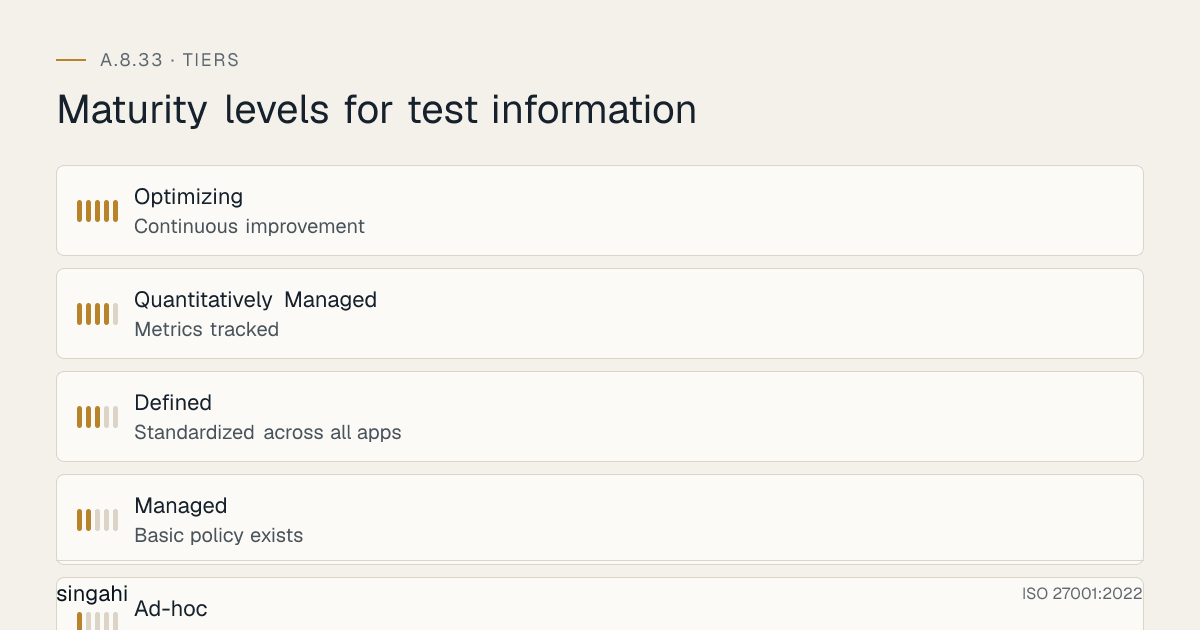
Figure · Tiers
Maturity levels for test information
Phase 1: Foundation (Weeks 1–3)
Week 1: Inventory and Classification
- Inventory all test data across all environments
- Classify test data by sensitivity (public, internal, confidential, restricted)
- Identify test data that contains or originated from production data
- Identify test data shared with vendors, contractors, or offshore teams
- Document current test data handling practices
Week 2: Policy and Standard Definition
- Draft the Test Data Policy
- Define test data classification scheme
- Define test data lifecycle (creation, use, retention, destruction)
- Define roles and responsibilities for test data management
- Select data masking/synthetic data approach
Week 3: Tool Selection and Setup
- Evaluate data masking tools
- Evaluate synthetic data generation tools
- Evaluate test data management (TDM) platforms
- Set up data masking pipeline for one critical application
- Establish test data access controls
Deliverables: Test Data Inventory, Policy Draft, Tool Selection, Classification Scheme, Baseline Assessment
Phase 2: Pilot (Weeks 4–6)
Week 4-5: Pilot Implementation
- Select one critical application for pilot test data protection
- Implement data masking or synthetic data generation for pilot application
- Implement access controls for pilot test data
- Implement logging and monitoring for pilot test data
- Train pilot team on test data handling
Week 6: Validation and Refinement
- Validate that test data does not contain unprotected production data
- Validate that testers can perform their functions with masked/synthetic data
- Validate that access controls are working
- Refine masking rules and synthetic data generation based on feedback
- Update policy and procedures based on pilot findings
Deliverables: Pilot Test Data Set, Masking Rules, Access Controls, Training Records, Updated Policy
Phase 3: Rollout (Weeks 7–12)
Week 7-9: Organization-Wide Deployment
- Apply test data protection to all applications and environments
- Implement data masking/synthetic data for all test data originating from production
- Implement access controls for all test data environments
- Deploy monitoring and DLP for test data environments
- Establish test data refresh schedules and procedures
Week 10-12: Process Integration
- Integrate test data management into CI/CD pipeline
- Integrate test data management into SDLC
- Train all developers, testers, and operations staff
- Establish test data governance committee
- Implement test data retention and destruction schedules
Deliverables: Organization-wide deployment, Integrated processes, Training completion, Governance established
Phase 4: Optimization (Weeks 13–16)
Week 13-14: Metrics and Monitoring
- Define and collect KPIs (see Section 13)
- Conduct first internal audit of test data management
- Identify gaps and improvement opportunities
- Update synthetic data quality based on testing effectiveness
Week 15-16: Continuous Improvement
- Implement automated test data quality validation
- Implement automated re-identification risk assessment
- Update data masking rules for new data types
- Enhance training with lessons learned
- Update tools and processes based on feedback
Deliverables: KPI dashboard, Internal audit report, Automated validation, Updated processes
Maturity Model
| Level | Description | Typical Timeline |
|---|---|---|
| 1, Ad-hoc | No test data policy, unprotected production data in test, no access controls, no inventory | Pre-implementation |
| 2, Managed | Basic policy exists, some masking for critical data, manual process, limited access controls | Weeks 1–3 |
| 3, Defined | Standardized across all apps, automated masking/synthetic data, formal access controls, monitoring, governance | Weeks 4–8 |
| 4, Quantitatively Managed | Metrics tracked, automated quality validation, re-identification risk assessment, TDM platform, vendor controls | Weeks 9–12 |
| 5, Optimizing | Continuous improvement, AI-generated synthetic data, real-time re-identification risk monitoring, predictive test data quality, self-service TDM | Ongoing |
Detailed Implementation Guidance
Test Data Classification
All test data must be classified based on its sensitivity and the risk of using it in test environments:
| Classification | Description | Test Data Examples | Handling Requirements |
|---|---|---|---|
| Public | No sensitivity, can be freely shared | Public datasets, open government data, sample files | Standard access controls |
| Internal | Organization-internal, limited sensitivity | Internal process data, non-sensitive configuration | Role-based access, no external sharing |
| Confidential | Sensitive, requires protection | Customer data (masked), employee data (masked), financial summaries | Masked if from production, access logging, encryption |
| Restricted | Highly sensitive, strict protection | Unmasked PII, PHI, financial data, Aadhaar numbers, PAN | Never use unmasked in test; must be masked, anonymized, or synthetic; encryption, DLP, strict access controls |
Test Data Classification Decision Tree:
Does the test data contain or originate from production data?
├── No → Classify as Public or Internal based on content
└── Yes → Does it contain PII, PHI, financial data, or other sensitive data?
    ├── No → Classify as Internal, mask as precaution
    └── Yes → Is it masked, anonymized, or synthetic?
        ├── Yes → Classify as Confidential, maintain access controls
        └── No → RESTRICTED — Do not use in test environment without masking
Test Data Creation Strategies
Strategy 1: Synthetic Data Generation
When to use: When testing new features, when no production data exists, when maximum privacy is required, when data volume is manageable.
Advantages:
- Zero risk of exposing real data
- No data masking complexity
- Can create edge cases and boundary conditions not present in production
- No dependency on production data availability
- Can be shared freely with vendors and offshore teams
Disadvantages:
- May not reflect real data distributions
- Requires effort to create realistic data
- May miss real-world data anomalies and patterns
- Can be expensive to generate at large scale
Tools:
- Python: Faker, Mimesis, Synthetic Data Vault (SDV)
- Java: JavaFaker, JFairy
- JavaScript: Chance, Faker.js
- Commercial: Delphix, Tonic.ai, Mostly AI, Hazy, Gretel.ai
Example (Python Faker):
from faker import Faker
import pandas as pd

fake = Faker('en_IN')  # Indian locale

def generate_synthetic_customer(n=1000):
    data = []
    for _ in range(n):
        data.append({
            'customer_id': fake.uuid4(),
            'name': fake.name(),
            'email': fake.email(),
            'phone': fake.phone_number(),
            'address': fake.address(),
            'pan': fake.bothify(text='?????####?'),  # Fake PAN format
            'account_number': fake.bothify(text='###########'),
            'balance': fake.random_number(digits=6),
            'created_at': fake.date_time_this_decade()
        })
    return pd.DataFrame(data)

customers = generate_synthetic_customer(10000)
customers.to_csv('synthetic_customers.csv', index=False)
Example (Tonic.ai):
## Tonic.ai provides sophisticated synthetic data generation
## with statistical fidelity to production data
from tonic import TonicClient

client = TonicClient(api_key='your-api-key')
workspace = client.create_workspace(
    name='customer_db_test',
    source_connection='production_postgres',
    destination_connection='test_postgres'
)

## Configure generation with privacy protection
workspace.add_table('customers',
    generator='synthetic',
    columns={
        'name': {'generator': 'name', 'locale': 'en_IN'},
        'email': {'generator': 'email', 'domain': 'example.com'},
        'phone': {'generator': 'phone', 'country': 'IN'},
        'pan': {'generator': 'regex', 'pattern': '[A-Z]{5}[0-9]{4}[A-Z]'},
        'balance': {'generator': 'numeric', 'distribution': 'preserve'}
    }
)
workspace.generate()
Strategy 2: Data Masking
When to use: When real data distributions are critical for testing, when production data is the only source of realistic test cases, when testing requires referential integrity across tables.
Advantages:
- Preserves real data distributions and relationships
- Maintains referential integrity across database tables
- Enables testing with realistic data volumes
- Easier to generate than synthetic data for complex schemas
Disadvantages:
- Re-identification risk if masking is not strong
- Complex to implement correctly for all data types
- Requires ongoing maintenance as production data changes
- May not be truly irreversible (deterministic masking can be reversed with the key)
Masking Techniques:
| Technique | Description | Best For | Re-identification Risk |
|---|---|---|---|
| Substitution | Replace with fake values from a dictionary | Names, addresses, cities | Low |
| Shuffling | Shuffle values within a column | IDs, codes, categories | Low (preserves distribution) |
| Encryption | Encrypt with key not available in test | PAN, SSN, Aadhaar | Very Low (if key is secured) |
| Nulling/Redaction | Replace with NULL or fixed value | Non-essential sensitive fields | Very Low (but loses utility) |
| Tokenization | Replace with random tokens | PAN, account numbers | Very Low (if token vault is secured) |
| Date shifting | Add/subtract random days | Birth dates, transaction dates | Low (preserves intervals) |
| Number variance | Apply random percentage change | Salaries, balances, amounts | Low (preserves range) |
| Character masking | Show first/last few characters | Credit cards, phone numbers | Medium (partial information) |
| Deterministic masking | Same input always produces same output | Testing consistency, joins | Medium (can be reversed with key) |
| Random masking | Same input produces different output each time | Maximum privacy | Low |
| Format-preserving encryption (FPE) | Encrypt while preserving format | PAN, Aadhaar, credit cards | Very Low |
| K-anonymity | Ensure k records share same quasi-identifiers | Datasets with multiple identifiers | Low (if k is sufficient) |
Masking Example (Database):
-- PostgreSQL masking function for customer names
CREATE OR REPLACE FUNCTION mask_name(original_name TEXT)
DECLARE
    first_name TEXT;
    last_name TEXT;
BEGIN
    -- Extract first and last name
    first_name := split_part(original_name, ' ', 1);
    last_name := split_part(original_name, ' ', 2);

    -- Return masked: first letter + *** + last letter
    RETURN LEFT(first_name, 1) || '***' ||
           CASE WHEN last_name != '' THEN LEFT(last_name, 1) || '***' ELSE '' END;
END;

-- Apply masking to test database
UPDATE test_customers
SET name = mask_name(name),
    email = CONCAT('user', id, '@example.com'),
    phone = CONCAT('99999', LPAD(id::TEXT, 5, '0')),
    pan = CONCAT('XXXXX', RIGHT(pan, 5)),
    aadhaar = CONCAT('XXXX-XXXX-', RIGHT(aadhaar, 4)),
    account_number = CONCAT('TEST', LPAD(id::TEXT, 8, '0'));
Format-Preserving Encryption (FPE) for Aadhaar:
from cryptography.fernet import Fernet
import base64

## FPE for 12-digit Aadhaar: preserve format but encrypt
## Using AES-FF1 format-preserving encryption (NIST SP 800-38G)
from ff1 import FF1

key = b'your-32-byte-key-here-1234567890'
tweak = b'application-specific-tweak'

## FF1 with radix 10 for digits
fpe = FF1(key, tweak, radix=10)

def mask_aadhaar(aadhaar):
    """Encrypt Aadhaar while preserving 12-digit format"""
    encrypted = fpe.encrypt(aadhaar)
    return encrypted

## Example: 1234-5678-9012 → 7391-8402-6157 (different each time with random)
Strategy 3: Data Subsetting
When to use: When full production data is too large for testing, when testing requires specific scenarios, when reducing the attack surface of test data.
Approaches:
- Random subset: Random X% of records
- Stratified subset: Ensure representation across categories (e.g., all account types, all states)
- Time-based subset: Recent data only (last 30 days, last quarter)
- Scenario-based subset: Specific test cases (high-value accounts, edge cases, error conditions)
- Referential subset: Include related records (customer + all their transactions + all their accounts)
Subsetting with Referential Integrity:
import pandas as pd

## Subset 10% of customers and all their related data
customers = pd.read_csv('production_customers.csv')
selected_customers = customers.sample(frac=0.1, random_state=42)
selected_ids = set(selected_customers['customer_id'])

## Get all transactions for selected customers
transactions = pd.read_csv('production_transactions.csv')
test_transactions = transactions[transactions['customer_id'].isin(selected_ids)]

## Get all accounts for selected customers
accounts = pd.read_csv('production_accounts.csv')
test_accounts = accounts[accounts['customer_id'].isin(selected_ids)]

## Verify referential integrity
assert set(test_transactions['customer_id']).issubset(selected_ids)
assert set(test_accounts['customer_id']).issubset(selected_ids)
Strategy 4: Combination Approach
Best practice: Use a combination of strategies for different data types and testing needs:
| Data Type | Strategy | Example |
|---|---|---|
| PII (names, addresses, emails) | Synthetic + Substitution | Faker-generated names, fake addresses |
| Government IDs (PAN, Aadhaar, passport) | FPE + Tokenization | Format-preserving encryption |
| Financial data (account numbers, balances) | Tokenization + Number variance | Random tokens, variance ±5% |
| Dates (birth, transaction) | Date shifting | Shift by random days (0-365) |
| Phone numbers | Substitution | Fake phone numbers in same format |
| Medical data (diagnoses, medications) | K-anonymity + Generalization | Generalize ICD codes, group medications |
| Free text (notes, comments) | Redaction + Synthetic | Remove or replace with synthetic text |
| Images (medical images, photos) | Anonymization + Synthetic | Blur faces, generate synthetic images |
| Geolocation | Generalization | Round to city level, not exact coordinates |
| Behavioral data (clicks, searches) | Synthetic + Statistical matching | Match distribution patterns |
Test Data Lifecycle Management
Creation
Production-to-Test Data Pipeline:
Production Database → Extract → Mask/Anonymize → Subset →
Validate (no real PII) → Transfer to Test → Log Transfer → Delete Staging
Creation Controls:
- Production data extraction requires approval (data owner, DPO, security)
- Masking must be validated before transfer (automated PII detection)
- Transfer must be encrypted (TLS 1.3, encrypted storage)
- Transfer must be logged (who, what, when, why)
- Staging data must be deleted immediately after transfer
Use
Test Data Access Controls:
- Access based on role (tester, developer, security, vendor)
- Access based on data classification (public, internal, confidential, restricted)
- Time-limited access (access expires after project/sprint)
- Purpose-limited access (access only for specified testing)
- MFA for test environments containing confidential/restricted data
Test Data Usage Rules:
- Test data must not be downloaded to personal devices
- Test data must not be shared outside the organization without approval
- Test data must not be used for purposes other than testing
- Screenshots containing test data must be labeled and protected
- Test data in code repositories must be checked for PII before commit
Retention
Test Data Retention Policy:
| Test Data Type | Retention Period | Rationale |
|---|---|---|
| Synthetic data | Per project lifecycle | Recreate as needed |
| Masked production data | 30 days after testing | Refresh from production if needed |
| Performance test data | 90 days | May need to reproduce results |
| Regression test data | Until test case is obsolete | Maintained with test suite |
| UAT data | 30 days after UAT sign-off | Evidence of testing |
| Security test data | 90 days after test | Evidence for audit |
| Training data | Duration of training program | Update with new scenarios |
| Vendor-shared data | Duration of engagement + 30 days | Contract requirement |
Destruction
Secure Deletion Methods:
| Storage Type | Deletion Method | Verification |
|---|---|---|
| Database tables | DROP TABLE + VACUUM (PostgreSQL) | Query to confirm no data |
| Database records | DELETE + VACUUM / TRUNCATE | Row count verification |
| Files | Secure delete (shred, srm) | File system scan |
| Cloud storage | Delete + empty trash + versioning disabled | Bucket scan |
| Backups | Expire backup retention / delete manually | Backup inventory check |
| Container volumes | Volume deletion + reclaim | Docker/K8s volume check |
| Local developer machines | Remote wipe (if applicable) | Endpoint scan |
| Logs containing test data | Log rotation + secure deletion | Log retention check |
Destruction Certificate:
TEST DATA DESTRUCTION CERTIFICATE

Data Set: ___________________
Environment: ___________________
Destruction Date: ___________________
Destruction Method: ___________________
Verification Method: ___________________
Verified By: ___________________
Date: ___________________
Signature: ___________________

I confirm that the above test data has been securely destroyed and
can no longer be recovered.
Test Data Quality Assurance
Quality Dimensions:
| Dimension | Description | Validation Method |
|---|---|---|
| Completeness | All required fields have values | Schema validation, null checks |
| Accuracy | Data values are correct and realistic | Domain validation, range checks |
| Consistency | Data is consistent across related tables | Referential integrity checks |
| Uniqueness | Primary keys and unique fields are unique | Duplicate detection |
| Validity | Data conforms to business rules | Business rule validation |
| Privacy | No real PII/PHI is present | PII detection scanning, manual review |
| Referential Integrity | Foreign keys match primary keys | RI constraint validation |
| Statistical Fidelity | Data distributions match production | Statistical comparison (mean, std, distribution) |
| Coverage | Test data covers all test scenarios | Test case coverage mapping |
| Freshness | Data is current and relevant | Timestamp validation |
Automated Quality Validation:
import pandas as pd
from great_expectations import DataContext

## Validate test data quality using Great Expectations
context = DataContext()

## Define expectations for test data
suite = context.create_expectation_suite('test_data_validation')

## Expect no nulls in critical fields
suite.add_expectation(
    expectation_type='expect_column_values_to_not_be_null',
    kwargs={'column': 'customer_id'}
)

## Expect no real email domains (only the reserved example.com domain)
suite.add_expectation(
    expectation_type='expect_column_values_to_match_regex')

## Expect no real phone numbers (only 99999 prefix)
suite.add_expectation(
    expectation_type='expect_column_values_to_match_regex')

## Expect no real PANs (only XXXXX prefix)
suite.add_expectation(
    expectation_type='expect_column_values_to_match_regex')

## Expect referential integrity
def validate_referential_integrity(parent_df, child_df, parent_key, child_key):
    orphan_count = child_df[~child_df[child_key].isin(parent_df[parent_key])].shape[0]
    assert orphan_count == 0, f"Found {orphan_count} orphan records"

## Run validation
results = context.run_checkpoint('test_data_checkpoint')
if not results.success:
    raise ValueError("Test data validation failed")
Special Test Data Scenarios
Vendor/Offshore Test Data Sharing
Additional Controls:
- Contractual data handling requirements for vendors
- Data minimization (only share necessary data)
- Vendor access logs and monitoring
- Vendor data deletion verification at engagement end
- Vendor security assessment including test data handling
- Data residency requirements (data must stay in India for certain data types)
Vendor Test Data Agreement:
Vendor Test Data Handling Agreement

1. Vendor will only use test data for the specified testing purpose.
2. Vendor will not share test data with any third party.
3. Vendor will implement access controls equivalent to client's controls.
4. Vendor will not download test data to personal devices.
5. Vendor will delete all test data within 30 days of engagement completion.
6. Vendor will report any test data breach within 24 hours.
7. Vendor will allow client to audit test data handling.
8. Vendor will not use test data for training AI/ML models without approval.
AI/ML Test Data
Special Considerations:
- Training data must be separated from test/validation data
- Production data used for training must be masked or anonymized
- Model evaluation data must not contain production inference data
- Synthetic training data must be validated for statistical fidelity
- Bias testing requires diverse and representative test data
- Adversarial testing requires carefully crafted test inputs
AI/ML Test Data Requirements:
- Labelled data for supervised learning (labels must be accurate)
- Balanced datasets for classification (avoid class imbalance)
- Edge cases for strength testing (adversarial examples)
- Temporal data for time-series models (preserve time ordering)
- Privacy-preserving data for sensitive domains (differential privacy)
Performance Testing Data
Special Considerations:
- Volume must match or exceed production peak load
- Data distribution must match production (hot spots, cold data)
- Concurrent user simulation requires realistic user profiles
- Data refresh may be needed for long-running performance tests
- Results must be reproducible (same data, same conditions)
Security Testing Data
Special Considerations:
- Malicious inputs for injection testing (SQL, XSS, command injection)
- Boundary data for fuzzing (maximum lengths, special characters)
- Authentication bypass data (null bytes, unicode, encoding tricks)
- Authorization bypass data (role escalation, ID manipulation)
- Data exfiltration test cases (large responses, error message analysis)
Tools, Technologies, and Solutions
Data Masking Tools
| Tool | Best For | Pricing model |
|---|---|---|
| Delphix | Enterprise TDM, masking, subsetting, virtualization | Enterprise pricing |
| IBM InfoSphere Optim | Enterprise masking, test data management | Enterprise pricing |
| Oracle Data Masking and Subsetting | Oracle environments, integrated with Oracle stack | Enterprise pricing |
| Microsoft SQL Server Data Masking | SQL Server environments, dynamic masking | Included in SQL Server |
| Informatica Test Data Management | Enterprise TDM, masking, synthetic data | Enterprise pricing |
| CA Test Data Manager (Broadcom) | Enterprise TDM, mainframe support | Enterprise pricing |
| K2View | Enterprise TDM, micro-database approach | Enterprise pricing |
| Mostly AI | AI-powered synthetic data, high fidelity | Enterprise pricing |
| Hazy | Synthetic data, privacy-preserving | Enterprise pricing |
| Gretel.ai | Synthetic data, differential privacy | Free / Pay-per-use |
| Mimesis | Python library, developer-friendly synthetic data | Free (open source) |
| Faker | Python library, simple synthetic data generation | Free (open source) |
| Benerator | Java-based, data generation and masking | Free (open source) |
Test Data Management (TDM) Platforms
| Platform | Best For | Pricing model |
|---|---|---|
| Delphix | Enterprise TDM, data virtualization, masking | Enterprise pricing |
| IBM InfoSphere Optim | Enterprise TDM, ETL integration | Enterprise pricing |
| Informatica TDM | Enterprise TDM, cloud and on-premise | Enterprise pricing |
| CA Test Data Manager | Enterprise TDM, mainframe | Enterprise pricing |
| K2View | Enterprise TDM, micro-databases | Enterprise pricing |
| GenRocket | Synthetic data generation, test data automation | Commercial |
| DATPROF | Data masking, subsetting, TDM | Commercial |
| RightData | Test data management, data quality | Commercial |
| Test Data Automation (TDA) | Automated test data provisioning | Commercial |
| Home-grown (Python + SQL) | Small teams, custom needs | Free (development cost) |
Data Anonymization and Privacy Tools
| Tool | Best For | Pricing model |
|---|---|---|
| ARX Data Anonymization Tool | Open source, k-anonymity, l-diversity, t-closeness | Free |
| Google DP Library | Differential privacy, open source | Free |
| IBM Diffprivlib | Differential privacy, Python | Free (open source) |
| TensorFlow Privacy | Differential privacy for ML, Google | Free (open source) |
| Opacus | Differential privacy for PyTorch, Meta | Free (open source) |
| Anonimatron | Java-based anonymization | Free (open source) |
| Amnesia | Open source, k-anonymity | Free |
| Aircloak | Query-based anonymization | Commercial |
| Privitar | Enterprise data privacy | Enterprise pricing |
| Immuta | Data access control + anonymization | Enterprise pricing |
DLP and Monitoring Tools for Test Data
| Tool | Best For | Pricing model |
|---|---|---|
| Symantec DLP | Enterprise DLP, complete | Enterprise pricing |
| Microsoft Purview | Microsoft 365, Azure DLP | Included in E5 |
| Digital Guardian | Endpoint DLP, data classification | Enterprise pricing |
| Forcepoint DLP | Cloud and endpoint DLP | Enterprise pricing |
| Nightfall AI | Cloud-native DLP, API-based | Commercial |
| Netwrix | Data security, access governance | Commercial |
| AWS Macie | AWS-native, S3 data discovery | Pay-per-use |
| Azure Purview | Azure-native data catalog + DLP | Commercial |
| Google Cloud DLP | GCP-native, data discovery | Pay-per-use |
| GitGuardian | Secrets detection in code | Commercial |
| TruffleHog | Secrets detection in repos | Free |
| Git-secrets | Pre-commit secrets detection | Free |
Synthetic Data Generation Libraries
| Library | Language | Best For |
|---|---|---|
| Faker | Python, JavaScript, PHP, Ruby, Java | General-purpose fake data |
| Mimesis | Python | High-performance, localized data |
| Synthetic Data Vault (SDV) | Python | Statistical fidelity, relational data |
| CTGAN | Python | GAN-based synthetic tabular data |
| CopulaGAN | Python | Copula-based synthetic data |
| TVAE | Python | Variational autoencoder for synthetic data |
| RDT (Reversible Data Transforms) | Python | Reversible transformations for ML |
| Gretel Synthetics | Python | Privacy-preserving synthetic data |
| MOSTLY AI | Python, API | High-fidelity synthetic data |
| Synthea | Java | Healthcare synthetic data (patients, records) |
| Synthetik | R | Statistical synthetic data |
| DataSynthesizer | Python | Differential privacy synthetic data |
Policy and Procedure Templates
Test Data Policy (Template)
Template
Test Data Policy
Document ID: POL-TEST-DATA-001 Version: 1.0 Effective Date: [DATE] Owner: CISO / Data Protection Officer Approved By: [Name], [Title] Review Cycle: Annual
1. Purpose
This policy establishes the requirements for protecting test data in all non-production environments at [Organization].
2. Scope
This policy applies to:
- All test data in development environments
- All test data in testing environments (integration, system, UAT, security)
- All test data in staging environments
- All test data in training and sandbox environments
- All test data shared with vendors, contractors, or offshore teams
- All test data on developer laptops, cloud instances, and portable media
- All test data backups and archives
3. Policy Statements
3.1 Test Data Classification
- All test data must be classified based on sensitivity.
- Test data containing or originating from production data requires higher protection than synthetic data.
- Test data classification must be reviewed and updated when production data classification changes.
3.2 Production Data in Test Environments
- Production data must not be used in test environments without proper masking, anonymization, or transformation.
- Unmasked production data classified as Restricted is prohibited in all test environments.
- Masked production data must be validated to ensure no real PII/PHI remains before transfer to test environments.
- Data masking must be irreversible or use keys not available in test environments.
3.3 Synthetic Data
- Synthetic data is preferred for new feature testing and development.
- Synthetic data must be validated for statistical fidelity and test coverage.
- Synthetic data may be freely shared with vendors and offshore teams.
- Synthetic data generation must be documented and reproducible.
3.4 Data Masking
- Data masking must be applied to all production data transferred to test environments.
- Masking must preserve referential integrity across related tables.
- Masking must preserve data format and type for testing purposes.
- Masking techniques must be selected based on data sensitivity and re-identification risk.
- Masked data must be scanned for residual PII before use in testing.
3.5 Test Data Access Controls
- Access to test data must be based on role and data classification.
- Test data containing confidential or restricted data requires MFA.
- Test data access must be logged and reviewed.
- Test data must not be downloaded to personal devices without approval.
- Test data must not be shared outside the organization without approval.
- Vendor access to test data requires contractual data handling requirements.
3.6 Test Data Lifecycle
- Test data must be created through approved processes.
- Test data must be used only for specified testing purposes.
- Test data must be retained only for the approved retention period.
- Test data must be securely destroyed when no longer needed.
- Test data backups must be protected and deleted when the primary data is deleted.
3.7 Test Data Transfers
- Test data transfers between environments must be encrypted.
- Test data transfers must be logged and approved.
- Test data transfers to vendors must be approved by Data Protection Officer.
- Test data transfers must use secure channels (VPN, encrypted file transfer).
- Test data must not be transferred via email or unsecured messaging.
3.8 Test Data Quality
- Test data must be validated for quality before use.
- Test data must not contain real PII/PHI (validated by automated scanning).
- Test data must maintain referential integrity.
- Test data must be refreshed periodically to reflect production changes.
- Test data quality must be measured and reported.
3.9 Monitoring and Compliance
- Test data environments must be monitored for unauthorized access.
- DLP must be deployed to detect production data in test environments.
- Test data handling must be audited annually.
- Test data breaches must be reported and investigated.
- Test data compliance must be verified against DPDP Act, GDPR, and other applicable regulations.
4. Roles and Responsibilities
- CISO: Owns the policy, approves exceptions, reports to board
- Data Protection Officer (DPO): Ensures DPDP Act/GDPR compliance, approves production data transfers, investigates breaches
- Data Owner: Approves use of their data for testing, defines masking requirements
- Database Administrator: Implements data masking, manages data refresh, executes data destruction
- Test Data Manager: Manages test data inventory, quality, distribution, and lifecycle
- Development Lead: Ensures developers follow test data handling rules
- QA Lead: Ensures testers use approved test data, reports data quality issues
- Security Operations: Monitors test data environments, investigates alerts
- Compliance Officer: Verifies regulatory compliance, supports audits
5. Exceptions
Exceptions require written CISO and DPO approval with documented risk acceptance and compensating controls.
6. Enforcement
Non-compliance may result in revoked access, audit findings, disciplinary action, or legal consequences.
7. Related Documents
- Data Protection Policy (POL-DATA-001)
- Information Classification Policy (POL-CLASS-001)
- Environment Separation Policy (POL-ENV-SEP-001)
- Data Masking Procedure (PROC-MASK-001)
- Vendor Data Handling Agreement (AGREE-VENDOR-DATA-001)
8. Revision History
| Version | Date | Author | Changes |
|---|---|---|---|
| 1.0 | [DATE] | [Name] | Initial version |
Data Masking Procedure (Template)
Template
Data Masking Procedure
Document ID: PROC-MASK-001 Version: 1.0 Effective Date: [DATE] Owner: Database Administrator / Test Data Manager
1. Purpose
To define the procedure for masking production data for use in test environments.
2. Scope
All production data transferred to non-production environments.
3. Procedure Steps
Step 1: Request Approval (Day 1)
- Data requester submits a Production-Data-to-Test Request Form (one per copy; 27002 8.33(b)) with:
- Application/database name
- Data requirements (tables, columns, volume)
- Testing purpose
- Target environment
- Required retention period and deletion date
- Masking to be applied
- Why masked or synthetic data is not enough
- Data Owner reviews and approves request.
- DPO reviews for regulatory compliance.
- Security Lead reviews for risk assessment.
Step 2: Extract Production Data (Day 2)
- DBA extracts production data to secure staging area.
- Staging area is encrypted and access-controlled.
- Extraction is logged.
- Data volume is verified.
Step 3: Apply Masking (Day 2-3)
- DBA applies masking rules per the Data Masking Standard.
- Masking rules are based on data classification and sensitivity.
- Referential integrity is maintained.
- Masking is validated (automated + manual spot checks).
Step 4: Validate No Real PII (Day 3)
- Automated PII detection scan on masked data.
- Manual review of sample records.
- If real PII is detected, remasking is required.
- Validation must be documented.
Step 5: Subset (if required) (Day 3)
- Apply subsetting rules if full data is not needed.
- Verify referential integrity after subsetting.
- Verify test coverage is maintained.
Step 6: Transfer to Test Environment (Day 4)
- Transfer encrypted data to test environment.
- Transfer is logged.
- Access is provisioned to approved users only.
- Staging area data is deleted after successful transfer.
Step 7: Verify in Test Environment (Day 4)
- Test lead verifies data is usable for testing.
- Security team verifies no real PII in test environment.
- Data owner verifies data meets requirements.
Step 8: Monitor and Maintain (Ongoing)
- Monitor test data access.
- Each refresh is a new copy and needs a new approval.
- Delete the data as soon as testing is complete (27002 8.33(e)), and record the deletion.
- Document all activities.
4. Masking Rules by Data Type
| Data Type | Masking Technique | Example |
|---|---|---|
| Name | Substitution | Rajesh Kumar → Anil Sharma |
| Domain substitution | rajesh@company.com → user123@example.com | |
| Phone | Format preservation + substitution | +91-98765-43210 → +91-99999-00001 |
| PAN | Partial masking + format preservation | ABCDE1234F → XXXXX1234X |
| Aadhaar | Replace with synthetic test numbers; keep last 4 only where the use case needs it | 1234-5678-9012 → XXXX-XXXX-9012 |
| Account Number | Tokenization | 123456789012 → TEST12345678 |
| Balance | Number variance (±5%) | 1,25,000 → 1,21,870 |
| Date | Date shifting (+/- 180 days) | 2024-01-15 → 2024-07-20 |
| Address | Substitution | Real address → Fake address |
| Medical Diagnosis | Generalization | Specific ICD → ICD category |
| Free Text | Redaction or synthetic | Notes → [REDACTED] or synthetic text |
| Image | Blur or synthetic | Face → blurred face |
| IP Address | Subnet preservation | 192.168.1.100 → 10.0.0.100 |
| Credit Card | Tokenization + format preservation | 4111-1111-1111-1111 → 5555-5555-5555-4444 |
5. Roles
- Requester: Submits request, uses test data
- Data Owner: Approves use of their data
- DPO: Reviews regulatory compliance
- Security Lead: Assesses risk
- DBA: Extracts, masks, transfers, destroys data
- Test Lead: Verifies data usability
- Security Team: Validates no real PII
6. Records
- Test Data Request Form
- Approval records
- Masking execution log
- Validation report
- Transfer log
- Destruction certificate
Risk Assessment and Treatment
Risk Assessment for Test Data
| Risk ID | Risk Description | Likelihood | Impact | Risk Level | Mitigation |
|---|---|---|---|---|---|
| R-001 | Unmasked production data used in test environments | High | Critical | Critical | Masking policy, automated scanning, DLP, synthetic data preference |
| R-002 | Test data containing real PII leaked to unauthorized parties | Medium | Critical | Critical | Access controls, encryption, DLP, vendor controls, monitoring |
| R-003 | Test data backups not protected | Medium | High | High | Backup encryption, backup access controls, retention limits |
| R-004 | Developer downloads test data to personal laptop | Medium | High | High | DLP, policy, endpoint protection, monitoring |
| R-005 | Vendor shares test data with subcontractors | Medium | High | High | Vendor contract, data handling agreement, monitoring |
| R-006 | Test data retention exceeds approved period | Medium | Medium | Medium | Retention policy, automated deletion, audit |
| R-007 | Masking is reversible, allowing re-identification | Medium | High | High | Strong masking techniques, key separation, re-identification testing |
| R-008 | Test data environment breached, exposing test data | Medium | High | High | Environment separation, access controls, monitoring, encryption |
| R-009 | Test data not validated for quality, causing test failures | Medium | Medium | Medium | Quality validation, automated checks, referential integrity |
| R-010 | Test data transferred via unsecured channels | Medium | High | High | Secure transfer policy, encrypted channels, monitoring |
| R-011 | Screenshots/logs containing test data exposed | Medium | Medium | Medium | Data labeling, screenshot policies, log sanitization |
| R-012 | Synthetic data does not reflect real data, causing production bugs | Medium | Medium | Medium | Statistical fidelity validation, production-like testing, feedback loop |
| R-013 | Test data shared in code repositories | Medium | High | High | Secrets scanning, pre-commit hooks, repository monitoring |
| R-014 | AI/ML training data includes production data without protection | Medium | High | High | Data pipeline controls, anonymization, differential privacy |
| R-015 | Test data destruction not verified | Low | Medium | Medium | Destruction certificates, verification scans, audit |
Risk Treatment Options
| Risk | Treatment | Residual Risk |
|---|---|---|
| R-001 | Policy + automated scanning + DLP + synthetic data | Low |
| R-002 | Access controls + encryption + DLP + vendor controls + monitoring | Low |
| R-003 | Backup encryption + access controls + retention limits | Low |
| R-004 | DLP + policy + endpoint protection + monitoring | Low |
| R-005 | Vendor contract + data handling agreement + monitoring | Low |
| R-006 | Retention policy + automated deletion + audit | Low |
| R-007 | Strong masking + key separation + re-identification testing | Low |
| R-008 | Environment separation + access controls + monitoring + encryption | Low |
| R-009 | Quality validation + automated checks + referential integrity | Low |
| R-010 | Secure transfer policy + encrypted channels + monitoring | Low |
| R-011 | Data labeling + screenshot policies + log sanitization | Low |
| R-012 | Statistical fidelity validation + production-like testing | Low |
| R-013 | Secrets scanning + pre-commit hooks + repository monitoring | Low |
| R-014 | Pipeline controls + anonymization + differential privacy | Low |
| R-015 | Destruction certificates + verification + audit | Low |
Audit and Compliance Checklist
Pre-Audit Self-Assessment
| # | Question | Evidence | Status |
|---|---|---|---|
| 1 | Is there a documented Test Data Policy? | Policy document | ☐ |
| 2 | Is there a test data inventory? | Inventory document | ☐ |
| 3 | Is test data classified by sensitivity? | Classification records | ☐ |
| 4 | Is unmasked production data prohibited in test environments? | Policy, scanning records | ☐ |
| 5 | Is data masking applied to production data before test use? | Masking records | ☐ |
| 6 | Is masked data validated for residual PII? | Validation reports | ☐ |
| 7 | Is synthetic data used where possible? | Synthetic data records | ☐ |
| 8 | Are test data access controls implemented? | Access control records | ☐ |
| 9 | Is test data access logged? | Access logs | ☐ |
| 10 | Is test data encrypted in transit and at rest? | Encryption configuration | ☐ |
| 11 | Is test data retention defined and enforced? | Retention policy, deletion records | ☐ |
| 12 | Is test data securely destroyed when no longer needed? | Destruction certificates | ☐ |
| 13 | Is test data transfer between environments logged? | Transfer logs | ☐ |
| 14 | Are vendors subject to test data handling requirements? | Vendor contracts | ☐ |
| 15 | Is DLP deployed to detect production data in test? | DLP configuration, alerts | ☐ |
| 16 | Is test data quality validated? | Quality reports | ☐ |
| 17 | Is test data referential integrity maintained? | Validation records | ☐ |
| 18 | Are developers trained on test data handling? | Training records | ☐ |
| 19 | Is test data handling audited? | Audit records | ☐ |
| 20 | Is test data compliance verified (DPDP Act, GDPR, etc.)? | Compliance records | ☐ |
| 21 | Is test data shared with vendors tracked? | Vendor data sharing records | ☐ |
| 22 | Is test data in code repositories scanned for PII? | Repository scanning records | ☐ |
| 23 | Are test data backups protected? | Backup configuration | ☐ |
| 24 | Is test data re-identification risk assessed? | Risk assessment records | ☐ |
| 25 | Are test data environments monitored? | Monitoring records | ☐ |
| 26 | Is there a test data request and approval process? | Request forms, approval records | ☐ |
| 27 | Is test data labeling applied? | Labeling records | ☐ |
| 28 | Are test data incidents tracked and investigated? | Incident records | ☐ |
| 29 | Is AI/ML test data protected? | AI/ML data protection records | ☐ |
| 30 | Are test data metrics tracked? | Metrics dashboard | ☐ |
Auditor Interview Questions
Be prepared to answer:
- "How do you ensure test data does not contain real customer information?"
- "Can you show me the test data masking process?"
- "Who has access to test data?"
- "How is test data created, managed, and destroyed?"
- "Are there logs of test data transfers between environments?"
- "How do you handle vendor access to test data?"
- "What happens when test data is no longer needed?"
- "How do you detect real PII in test environments?"
- "Is synthetic data used for testing?"
- "How do you maintain referential integrity in masked test data?"
Common Audit Findings and How to Avoid Them
| Finding | Cause | Prevention |
|---|---|---|
| "Unmasked production data in test environment" | Masking gap | Automated PII scanning, masking policy, DLP |
| "No test data policy" | Governance gap | Create and approve test data policy |
| "Test data not classified" | Classification gap | Implement classification for all test data |
| "No logs of test data transfers" | Logging gap | Log all transfers, implement approval workflow |
| "Test data retention not enforced" | Retention gap | Automated deletion, retention policy, audit |
| "Vendor test data not controlled" | Vendor gap | Vendor contracts, data handling agreements, monitoring |
| "No DLP for test environments" | Monitoring gap | Deploy DLP, configure for test data detection |
| "Test data backups not protected" | Backup gap | Backup encryption, access controls |
| "No test data quality validation" | Quality gap | Automated validation, referential integrity checks |
| "Developer laptops contain test data" | Endpoint gap | DLP, policy, endpoint encryption, monitoring |
Metrics and KPIs
Figure · Measures
The measures that show A.8.33 is working
- Test Data Masking Coverage100%Monthly
- Synthetic Data Usage Rate> 50%Quarterly
- PII Detection Rate0%Monthly
- Test Data Access Review Rate100%Quarterly
- Test Data Retention Compliance100%Monthly
Process Metrics
| Metric | Formula | Target | Frequency |
|---|---|---|---|
| Test Data Masking Coverage | (# of production data sources masked / # of production data sources in test) × 100 | 100% | Monthly |
| Synthetic Data Usage Rate | (# of test scenarios using synthetic data / # of total test scenarios) × 100 | > 50% | Quarterly |
| PII Detection Rate | (# of test environments with detected PII / # of test environments scanned) × 100 | 0% | Monthly |
| Test Data Access Review Rate | (# of quarterly access reviews completed / # of required reviews) × 100 | 100% | Quarterly |
| Test Data Retention Compliance | (# of data sets destroyed on time / # of data sets due for destruction) × 100 | 100% | Monthly |
| Masking Validation Pass Rate | (# of masked data sets passing validation / # of masked data sets) × 100 | 100% | Monthly |
| Test Data Transfer Logging | (# of transfers logged / # of transfers) × 100 | 100% | Monthly |
| Vendor Test Data Compliance | (# of vendors with compliant data handling / # of vendors with test data) × 100 | 100% | Quarterly |
| DLP Alert Resolution | (# of DLP alerts resolved within SLA / # of DLP alerts) × 100 | > 95% | Monthly |
| Test Data Quality Pass Rate | (# of test data sets passing quality checks / # of test data sets) × 100 | > 95% | Monthly |
| Re-identification Risk Score | Average re-identification risk score (0-100) | < 10 | Quarterly |
| Test Data Training Completion | (# of staff trained / # of staff with test data access) × 100 | 100% | Quarterly |
| Test Data Request Approval Rate | (# of approved requests with proper documentation / # of total requests) × 100 | 100% | Monthly |
| Data Destruction Verification | (# of destructions verified / # of destructions) × 100 | 100% | Monthly |
| Test Data Audit Findings | Number of test data findings per audit | 0 | Per audit |
Outcome Metrics
| Metric | Formula | Target | Frequency |
|---|---|---|---|
| Test Data Breach Incidents | Incidents involving test data per year | 0 | Annually |
| Test Data Compliance Score | Average compliance score across regulations | > 90/100 | Quarterly |
| Test Data Quality Score | Average quality score (completeness, accuracy, consistency) | > 85/100 | Quarterly |
| Test Data Creation Time | Average days to create test data for a new project | < 3 days | Per project |
| Test Data Refresh Cycle Time | Average days to refresh test data from production | < 2 days | Monthly |
| Cost of Test Data Management | Cost per test data set or per project | Decreasing | Quarterly |
| Tester Satisfaction | Survey score on test data quality and availability | > 4.0/5.0 | Quarterly |
| Production Bug Escape Rate | Bugs that escaped to production due to inadequate test data | < 2% | Quarterly |
| Test Data Incident Cost | Financial impact of test data incidents per year | Decreasing | Annually |
| Regulatory Fine Avoidance | Estimated fines avoided through proper test data handling | Track qualitatively | Annually |
Dashboard Sample
┌─────────────────────────────────────────────────────────────────────┐
│                       TEST DATA SECURITY DASHBOARD                  │
│                    [Organization] — [Month Year]                    │
├─────────────────────────────────────────────────────────────────────┤
│  MASKING COVERAGE: 100%      ██████████████████████  Target: 100%  │
│  SYNTHETIC USAGE: 62%        █████████████░░░░░░░░  Target: >50%  │
│  PII DETECTED: 0%            ░░░░░░░░░░░░░░░░░░░░░░  Target: 0%    │
│  RETENTION COMPLIANCE: 98%   ████████████████████░░  Target: 100% │
│  MASK VALIDATION: 100%       ██████████████████████  Target: 100%  │
│  DLP RESOLUTION: 97%         ████████████████████░░  Target: 95%  │
│  QUALITY PASS: 96%           ███████████████████░░░  Target: 95%  │
│  RE-ID RISK: 5/100           █░░░░░░░░░░░░░░░░░░░░  Target: <10   │
│  VENDOR COMPLIANCE: 100%     ██████████████████████  Target: 100%  │
│  BREACH INCIDENTS: 0         ░░░░░░░░░░░░░░░░░░░░░░  Target: 0     │
│  AUDIT FINDINGS: 0           ░░░░░░░░░░░░░░░░░░░░░░  Target: 0     │
│  TESTER SATISFACTION: 4.3/5  ████████████████████░░  Target: >4.0 │
└─────────────────────────────────────────────────────────────────────┘
Common Pitfalls and How to Avoid Them
Pitfall 1: "Test Data Is Not Real Data, So We Don't Need to Protect It"
Symptom: Organization treats test data as "not real" and applies no security controls.
Reality: Test data often IS real data (production data copied to test). Even synthetic data may contain patterns that reveal business logic. Test data breaches can be just as damaging as production breaches.
Solution:
- Treat test data as a protected asset
- Apply the same security controls to test data as to production data of equivalent classification
- Train staff that test data protection is mandatory
- Include test data in security audits and assessments
Pitfall 2: "Masking Is Too expensive and Time-Consuming"
Symptom: Organization skips masking because of cost or effort concerns.
Reality: The cost of masking is a fraction of the cost of a data breach. Modern tools automate masking. Synthetic data generation eliminates the need for masking entirely.
Solution:
- Use automated masking tools (Delphix, Tonic, etc.)
- Use synthetic data for new development (no masking needed)
- Calculate ROI: cost of masking vs. cost of breach
- Start with critical data (PII, PHI, financial) and expand
Pitfall 3: "Simple Substitution Is Good Enough"
Symptom: Organization uses basic substitution (e.g., replace all names with "John Doe") and considers it masked.
Reality: Simple substitution destroys data utility for testing and may not prevent re-identification. Deterministic masking with a known key can be reversed.
Solution:
- Use format-preserving encryption or tokenization for identifiers
- Use statistical methods that preserve data distributions
- Validate that masked data is not re-identifiable
- Use k-anonymity or differential privacy for datasets with multiple identifiers
Pitfall 4: "We Masked It Once, We're Done"
Symptom: Masking is applied once and never reviewed or updated.
Reality: Production data changes, new data types are added, masking rules may have gaps, and new re-identification techniques emerge.
Solution:
- Review masking rules quarterly
- Re-scan masked data periodically for new PII patterns
- Update masking when new regulations or data types are introduced
- Test re-identification risk annually
Pitfall 5: "Testers Need Real Data to Test Effectively"
Symptom: Testers insist on using unmasked production data for "realistic testing."
Reality: High-quality synthetic data and properly masked data can be just as effective for testing. The risk of using real data far outweighs the testing benefit.
Solution:
- Invest in high-quality synthetic data generation
- Use statistical fidelity validation to ensure masked data is realistic
- Train testers on using synthetic/masked data effectively
- Demonstrate that production bugs can be caught with synthetic data
- Make synthetic data the default, with masking as fallback
Pitfall 6: "Test Data on Developer Laptops Is Not a Risk"
Symptom: Developers download test data to laptops for convenience.
Reality: Laptops are lost, stolen, and compromised. Test data on a laptop is test data at risk.
Solution:
- Prohibit downloading test data to personal devices (policy + DLP)
- Use remote desktop or cloud-based development environments
- If local access is absolutely necessary, use encrypted containers and remote wipe
- Monitor endpoint DLP for test data patterns
Pitfall 7: "We Forgot About Test Data Backups"
Symptom: Test data is deleted but backups remain accessible.
Reality: Backups are a common source of data breaches. Unprotected test data backups can be restored and accessed.
Solution:
- Encrypt all test data backups
- Limit backup access to authorized personnel
- Include test data backups in retention and destruction schedules
- Regularly audit backup inventories
Pitfall 8: "Vendor Test Data Is the Vendor's Problem"
Symptom: Test data shared with vendors is not monitored or controlled.
Reality: The organization is responsible for data shared with vendors. Vendor test data breaches are the organization's breach.
Solution:
- Include test data handling in vendor contracts
- Require vendor security assessments for test data access
- Monitor vendor test data access and usage
- Require vendor data deletion verification
- Use synthetic data for vendor testing where possible
Illustrative Scenarios
Illustrative scenario, a composite example for guidance, not a specific Singahi engagement or a verified outcome.
Illustrative Scenario 1: Indian Fintech Company, Test Data Protection Transformation
Organization: A fintech startup in Bengaluru with 2 million users, offering personal loans and credit scoring. Context: 40 developers, 15 QA engineers, 3 offshore vendors. Test environments used full production database copies. No masking. No access controls. No retention policy. Developers downloaded production data to laptops for "local testing." Challenge: DPDP Act 2023 compliance required. RBI mandated data protection for all environments. First external audit found unmasked production data in all 6 test environments. 500+ customer PANs and Aadhaar numbers exposed in a test API that was accidentally left public. Approach:
- Week 1-2: The consultant conducted test data audit. Found: 6 test environments with full production data, 3 vendor environments with unmasked data, 20+ developer laptops with production data, no masking, no DLP, no retention policy.
- Week 3-4: Implemented data masking pipeline using custom Python scripts + Faker. Masked all PII (names, emails, phones, PAN, Aadhaar, addresses). Implemented format-preserving encryption for PAN and Aadhaar. Verified no real PII remained using automated scanning.
- Week 5-6: Deployed synthetic data generation for new feature testing. Created synthetic customer profiles, transaction histories, and loan applications. Validated statistical fidelity against production distributions.
- Week 7-8: Implemented test data access controls. Role-based access for test environments. MFA for test environments with confidential data. Removed production data from all developer laptops (DLP scan + remote wipe). Implemented DLP (AWS Macie) for test S3 buckets.
- Week 9-10: Established test data governance. Test Data Request and Approval process. Retention policy (30 days for masked data, project duration for synthetic). Secure destruction process. Quarterly access review.
- Week 11-12: Trained all developers and testers on test data handling. Created synthetic data self-service portal. Implemented automated test data quality validation in CI/CD. Results:
- Unmasked production data in test environments: 0 (verified by monthly scan)
- PII detected in test environments: 0 (DLP + automated scanning)
- Developer laptops with production data: 0 (DLP + policy enforcement)
- Vendor test data compliance: 100% (all vendors using masked or synthetic data)
- DPDP Act compliance: achieved on first audit
- RBI satisfaction: no findings on test data protection
- Test data creation time: 2 days (down from 7 days of manual copying)
- Tester satisfaction: 4.1/5.0 (synthetic data quality improved over time)
- Cost of potential DPDP Act fine (2 million users): + (based on per data principal) Key Lesson: Test data protection is not optional. The investment in masking and synthetic data pays for itself with a single avoided breach or regulatory fine.
Illustrative Scenario 2: Indian Hospital Chain, PHI Test Data Protection
Organization: A hospital chain with 15 hospitals, implementing a new EHR system. Context: 500+ developers, 200+ testers, 5 vendors. EHR system processes PHI for 2 million+ patients. HIPAA compliance required. DPDP Act 2023 compliance required. Challenge: EHR test environments used full production patient databases. No masking of PHI. Testers had access to real patient names, diagnoses, medications, and medical histories. Vendors in India and the US had access to test environments with unmasked PHI. HIPAA audit flagged "inadequate test data protection." Approach:
- Phase 1 (Months 1-2): The consultant conducted complete test data audit. Found: 12 test environments with full PHI, 5 vendor environments with PHI, 100+ developer laptops with patient data, no masking, no DLP, no synthetic data.
- Phase 2 (Months 3-4): Implemented data masking for all PHI in test environments. Names substituted with synthetic names. Medical record numbers tokenized. Diagnoses generalized (ICD codes to categories). Medications generalized (specific drugs to drug classes). Dates shifted by random days. Free text notes redacted or replaced with synthetic notes.
- Phase 3 (Months 5-6): Implemented synthetic patient data generation using Synthea (healthcare synthetic data generator). Created 100,000 synthetic patients with realistic demographics, conditions, medications, and encounters. Validated statistical fidelity against production distributions.
- Phase 4 (Months 7-8): Implemented strict access controls for test environments. Role-based access (testers only see test data for their modules). MFA for all test environment access. Vendor access restricted to synthetic data only (no masked PHI). DLP implemented across all test environments.
- Phase 5 (Months 9-10): Established test data governance committee (CISO, DPO, CIO, QA Lead). Test Data Request and Approval process. Retention policy (30 days for masked, 90 days for synthetic). Secure destruction with certificates. Quarterly access review. Annual test data audit.
- Phase 6 (Months 11-12): Trained all 700+ staff on test data protection. Created self-service synthetic data portal for testers. Implemented automated test data quality validation. Integrated test data management into CI/CD pipeline. Results:
- PHI in test environments: 0 (verified by monthly automated scan + manual review)
- Developer laptops with PHI: 0 (DLP + remote wipe + policy)
- Vendor test data compliance: 100% (all vendors using synthetic data only)
- HIPAA audit: zero findings on test data protection
- DPDP Act compliance: demonstrated through complete test data governance
- Test data creation time: 1 day (self-service portal)
- Synthetic data quality score: 87/100 (validated against production distributions)
- Tester satisfaction: 4.0/5.0 (initially lower due to learning curve, improved over time)
- Cost of HIPAA breach avoided (2 million patients): + (based on HIPAA penalties and Indian patient trust impact) Key Lesson: Healthcare test data requires the highest level of protection. Synthetic data is the gold standard for healthcare testing. The investment in synthetic data generation and governance is essential for HIPAA and DPDP Act compliance.
Multi-Framework Mapping
Figure · Matrix
Comparison: APO14.08 to BAI03.08
NIST SP 800-53 Rev 5 Mapping
| NIST Control | Description | A.8.33 Mapping |
|---|---|---|
| SC-28 | Protection of information at rest | Test data encryption at rest |
| SC-8 | Transmission confidentiality and integrity | Test data encryption in transit |
| SI-12 | Information handling | Test data handling and information lifecycle |
| MP-6 | Media sanitization | Test data secure destruction |
| AC-3 | Access enforcement | Test data access controls |
| AC-6 | Least privilege | Test data least privilege access |
| AU-6 | Audit review | Test data access audit |
| CM-2 | Baseline configuration | Test data environment configuration |
| CM-4 | Security impact analysis | Impact of test data on security |
| SA-9 | External information system services | Vendor test data handling |
COBIT 2019 Mapping
| COBIT Practice | Description | A.8.33 Mapping |
|---|---|---|
| APO14.08 | Manage the life cycle of data assets | Test data life cycle and deletion |
| BAI03.07 | Prepare for solution testing | Test data selected and prepared |
| BAI03.08 | Execute solution testing | Test data used only for testing |
PCI DSS v4.0.1 Mapping
| PCI DSS Requirement | Test Data Focus |
|---|---|
| 6.5.5 | Live PANs not used in pre-production unless those environments are in the CDE |
| 6.5.6 | Test data and test accounts removed before the system goes live |
| 3.5.1 | Stored PAN rendered unreadable |
| 12.8 | Third-party providers that handle test data |
DPDP Act 2023: Test Data Implications
| DPDP Act Section | Test Data Implication |
|---|---|
| Sections 5–7 | Processing only for the purpose in the notice and consent, or a legitimate use; testing with real data is hard to fit |
| Section 8(5) | Reasonable security safeguards apply to any personal data in test |
| Section 8(6) | A breach of test data is a personal data breach like any other |
| Section 8(7) | Erase data when the purpose is served; delete test copies after testing |
| Section 9 | Children's data: never in test sets |
OWASP SAMM Mapping
| SAMM Practice | Maturity Level | A.8.33 Mapping |
|---|---|---|
| Implementation - Secure Build | Level 1-3 | Test data security in build process |
| Implementation - Defect Management | Level 1-3 | Test data in defect management |
| Verification - Security Testing | Level 1-3 | Test data for security testing |
| Operations - Environment Management | Level 1-3 | Test data environment management |
| Operations - Incident Management | Level 1-3 | Test data incident management |
CIS Controls v8 Mapping
| CIS Control | Earliest IG | A.8.33 Mapping |
|---|---|---|
| Control 3 | IG1 | Data protection, test data protection |
| Control 4 | IG1 | Secure configuration, test environment config |
| Control 6 | IG1 | Access control management, test data access |
| Control 7 | IG1 | Continuous vulnerability management, test data scanning |
| Control 16 | IG2 | Application software security, test data in app security |
| Control 15 | IG1 | Service provider management, vendor test data |
Regulatory and Industry Context
India
| Regulation | Test Data Relevance | Key Mandates |
|---|---|---|
| DPDP Act 2023 | Critical | Sections 5–7, 8(5), 8(7), 9: purpose, safeguards, erasure, children's data |
| IT Act 2000 | High | Section 43A: Reasonable security practices include test data protection |
| RBI | Critical for banks | Customer data protected wherever held (CSF 2016; MD IT Governance 2023) |
| SEBI CSCRF (2024) | Critical for markets | Data protection across environments for regulated entities |
| IRDAI Guidelines | Critical for insurance | Information security requires test data protection for customer data |
| CERT-In | High | Security best practices include test data protection |
| Digital India | Critical for government | Citizen data in test environments must be protected |
International
| Regulation | Relevance | Key Mandates |
|---|---|---|
| PCI DSS v4.0.1 | Critical for card data | 6.5.5: no live PANs in pre-production; 6.5.6: remove test data before go-live |
| GDPR | Critical | Art 5: Data processing principles; Art 25: Data protection by design; Art 32: Security of processing |
| HIPAA | Critical for health | Security Rule: Technical safeguards for PHI in all environments; Privacy Rule: PHI protection |
| SOX | High for public companies | IT general controls require test data protection for financial systems |
| NIST CSF 2.0 | High | PR.DS-01/02: Data security includes test data; PR.AA-05: Access control for test data |
| CCPA/CPRA | High | Security requirements for personal information in test environments |
| LGPD | High | Data processing principles require test data protection |
| PDPA | High | Protection obligations require test data protection |
Roles and Responsibilities (RACI)
RACI Matrix for Test Data Management
| Activity | CISO | DPO | Data Owner | DBA | Test Data Manager | Dev Lead | QA Lead | Security Ops | Compliance Officer |
|---|---|---|---|---|---|---|---|---|---|
| Define test data policy | A | R | C | I | C | I | I | C | C |
| Classify test data | I | C | R/A | C | C | I | I | C | C |
| Approve production data for test | I | R/A | C | C | C | I | I | C | C |
| Implement data masking | I | C | I | R/A | C | I | I | C | I |
| Generate synthetic data | I | C | I | C | R/A | C | C | I | I |
| Validate test data quality | I | C | I | C | R | I | C | C | I |
| Validate no real PII | I | C | I | C | R | I | I | C | C |
| Manage test data access | I | C | I | C | R/A | C | C | C | I |
| Provision test data | I | C | I | R | C | C | C | I | I |
| Monitor test data environments | I | C | I | I | C | I | I | R/A | I |
| Execute data destruction | I | C | I | R | C | I | I | C | I |
| Audit test data handling | R/A | C | I | I | C | I | I | C | C |
| Manage vendor test data | I | C | I | C | R/A | I | I | C | C |
| Handle test data incidents | A | C | C | C | C | I | I | R | C |
| Train staff on test data | A | C | I | I | R | C | C | I | I |
| Track test data metrics | R/A | C | I | I | C | I | I | C | C |
| Manage test data retention | I | C | I | C | R/A | I | I | C | I |
| Verify compliance | I | C | I | I | C | I | I | I | R/A |
| Manage test data backups | I | C | I | R | C | I | I | C | I |
| Review test data quality | I | C | I | C | C | C | R/A | I | I |
Legend: R = Responsible, A = Accountable, C = Consulted, I = Informed
Role Descriptions
| Role | Key Responsibilities | Required Skills |
|---|---|---|
| CISO | Policy ownership, exception approval, incident oversight, board reporting | Security leadership, risk management, data governance |
| Data Protection Officer (DPO) | Regulatory compliance, production data transfer approval, breach investigation, DPDP Act/GDPR expertise | Data protection law, privacy, compliance, risk assessment |
| Data Owner | Approves use of their data for testing, defines masking requirements, reviews test data quality | Business domain knowledge, data stewardship, security awareness |
| Database Administrator (DBA) | Extracts production data, implements masking, manages data refresh, executes destruction, maintains database security | Database administration, SQL, data masking, ETL, security |
| Test Data Manager | Manages test data inventory, quality, distribution, lifecycle, vendor coordination, metrics | Data management, test management, quality assurance, governance |
| Development Lead | Ensures developers follow test data handling rules, reviews code for test data security, manages dev environment data | Software development, security awareness, team management |
| QA Lead | Ensures testers use approved test data, reports data quality issues, validates test data usability, manages test environment data | Testing methodologies, quality assurance, data awareness |
| Security Operations | Monitors test data environments, investigates alerts, scans for PII, manages DLP, incident response | SIEM, monitoring, incident response, threat detection, DLP |
| Compliance Officer | Verifies regulatory compliance, supports audits, compliance verification, regulatory reporting | Regulatory knowledge, compliance frameworks, audit, data protection |
Documentation and Evidence Requirements
Recommended Documentation
ISO 27001 does not mandate specific documents for this control. If you select it, keep the documented information you need to show it is planned and working (clause 7.5), and set retention in your own retention schedule. Typical records:
| Document | Purpose | Suggested retention | Owner |
|---|---|---|---|
| Test Data Policy | Governance framework | Per retention schedule | CISO |
| Test Data Classification Scheme | Classification rules and categories | Current version + your retention period | DPO |
| Test Data Inventory | List of all test data sets and their locations | Current version + your retention period | Test Data Manager |
| Data Masking Standard | Masking techniques by data type | Current version + your retention period | DBA |
| Data Masking Procedure | Step-by-step masking process | Current version + your retention period | DBA |
| Synthetic Data Generation Procedure | How synthetic data is created and validated | Current version + your retention period | Test Data Manager |
| Test Data Request Form | Request and approval process | Per retention schedule | Test Data Manager |
| Test Data Access Control Matrix | Who has access to what test data | Current version + your retention period | Test Data Manager |
| Test Data Transfer Log | Record of all test data transfers | Per retention schedule | DBA |
| Test Data Validation Report | Evidence that masked data contains no real PII | Per retention schedule | DBA / Security Ops |
| Test Data Quality Report | Quality validation results | Per retention schedule | Test Data Manager |
| Test Data Retention Schedule | How long each type of test data is retained | Current version + your retention period | Test Data Manager |
| Test Data Destruction Certificate | Evidence of secure destruction | Per retention schedule | DBA |
| Vendor Test Data Agreement | Vendor data handling requirements | Per retention schedule | Test Data Manager |
| Test Data Training Materials | Staff training on test data protection | Per retention schedule | Test Data Manager |
| Test Data Training Records | Staff competency evidence | Per retention schedule | HR / Security |
| Test Data Incident Records | Security incident documentation | Per retention schedule | Security Operations |
| Test Data Audit Records | Internal and external audit findings | Per retention schedule | CISO |
| Re-identification Risk Assessment | Risk of re-identifying masked data | Per retention schedule | DPO |
| Test Data Backup Records | Backup inventory and access logs | Per retention schedule | DBA |
| Test Data Metrics Reports | KPI tracking | Per retention schedule | Test Data Manager |
| DLP Alert Records | Data loss prevention alerts and resolutions | 1 year | Security Operations |
| Test Data Environment Configuration | Test environment security configuration | Current version + your retention period | DBA |
| Synthetic Data Statistical Fidelity Report | Comparison of synthetic vs. production data | Per retention schedule | Test Data Manager |
| Compliance Verification Records | Compliance attestation and verification | Per retention schedule | Compliance Officer |
Evidence for Audit
| Audit Question | Evidence Required |
|---|---|
| "Show me the test data policy" | Approved Test Data Policy |
| "How do you ensure test data has no real PII?" | Masking procedure, validation reports, PII scanning results |
| "Can you show me the test data inventory?" | Test Data Inventory document |
| "How is test data masked?" | Data Masking Standard, masking execution logs |
| "Who has access to test data?" | Access Control Matrix, access review records |
| "How do you handle vendor test data?" | Vendor Test Data Agreement, vendor access records |
| "What happens to test data when no longer needed?" | Destruction certificates, retention schedule |
| "Are test data transfers logged?" | Transfer logs, approval records |
| "How do you detect real PII in test environments?" | DLP configuration, scanning results, alert records |
| "Is synthetic data used?" | Synthetic data generation records, quality reports |
Continuous Improvement
Improvement Cycle
Plan → Implement → Measure → Review → Improve
Plan: Set targets for masking coverage, synthetic data usage, PII detection, quality scores, retention compliance.
Implement: Deploy masking, synthetic data generation, access controls, DLP, monitoring, governance.
Measure: Track KPIs, conduct surveys, analyze audit results, monitor incidents, assess quality.
Review: Monthly metrics review, quarterly access review, annual complete review, post-incident review.
Improve: Update masking rules, enhance synthetic data quality, adopt new tools, improve training, automate compliance.
Improvement Triggers
| Trigger | Action |
|---|---|
| New data type introduced | Update masking rules, classification, and synthetic data generation |
| New regulation | Update compliance requirements, data handling procedures, DPO review |
| Security incident | Root cause analysis, update controls if test data gap contributed |
| Audit finding | Update process, policy, or control to address finding |
| New application | Design test data strategy for new application from the start |
| Vendor change | Review vendor test data handling, update agreements |
| Technology change | Evaluate new masking, synthetic data, or TDM tools |
| Quality issue | Improve synthetic data generation, enhance masking, validate better |
| Tester feedback | Refine synthetic data, improve usability, add scenarios |
| Industry benchmark | Compare metrics, set improvement targets |
| Re-identification technique discovered | Update masking, assess re-identification risk, enhance controls |
| DPDP Act/GDPR guidance update | Update compliance procedures, retrain staff, review policies |
Maturity Advancement Path
| From Level | To Level | Key Actions | Typical Timeline |
|---|---|---|---|
| 1 (Ad-hoc) | 2 (Managed) | Create policy + inventory, implement basic masking for critical data, establish access controls | 1–2 months |
| 2 (Managed) | 3 (Defined) | Standardize across all apps, implement synthetic data, formal governance, quality validation, DLP | 3–4 months |
| 3 (Defined) | 4 (Quantified) | Metrics tracked, automated quality validation, re-identification risk assessment, self-service portal, vendor controls | 3–4 months |
| 4 (Quantified) | 5 (Optimizing) | AI-powered synthetic data, real-time re-identification risk monitoring, predictive test data quality, automated compliance, continuous improvement | 6–12 months |
FAQ
Q1: Can we use production data in test environments if we have a good reason?
A: Only if it is properly masked, anonymized, or transformed to prevent re-identification. Unmasked production data should never be in test environments. Even masked data requires approval from the Data Owner and DPO, and must be validated for residual PII.
Q2: What is the difference between masking and anonymization?
A: Masking replaces sensitive data with fake data while preserving format and utility for testing. Anonymization removes all identifying information such that the individual cannot be identified. Anonymization is irreversible; masking may be reversible if the key is known. For test data, masking is typically preferred because it preserves data utility. For public release, anonymization is required.
Q3: How do we ensure masked data cannot be re-identified?
A: Use strong masking techniques (FPE, tokenization with secure vault). Test re-identification risk by attempting to link masked records to real individuals. Use k-anonymity to ensure each record is indistinguishable from k-1 others. Use differential privacy for datasets with high re-identification risk. Validate with automated re-identification risk assessment tools.
Q4: Is synthetic data as good as real data for testing?
A: For most testing scenarios, yes. High-quality synthetic data that preserves statistical distributions and relationships can be just as effective. For some edge cases and real-world anomalies, synthetic data may miss rare patterns. The solution is to combine synthetic data with carefully curated masked data for specific scenarios, and to validate synthetic data quality against production metrics.
Q5: How do we handle test data for performance testing?
A: Performance testing requires data volume and distribution that matches production. Options: (1) Use masked production data at full volume, (2) Use scaled synthetic data that matches production distributions, (3) Use a subset of masked production data with volume scaled. Ensure that performance test data is protected with the same controls as other test data.
Q6: What about test data in code repositories?
A: Never commit real data (even test data) to code repositories. Use environment variables, secrets management, or configuration files that are gitignored. Implement pre-commit hooks to detect and block data that looks like PII. Use synthetic data fixtures for unit tests. Scan repositories regularly for secrets and PII.
Q7: How do we handle screenshots and logs that contain test data?
A: Label all screenshots containing test data with "TEST DATA, CONTAINS SYNTHETIC/MASKED DATA." Sanitize logs to remove PII before sharing. Use log aggregation that supports PII redaction. Train staff on handling test data in screenshots, presentations, and documentation.
Q8: Can we use production data in AI/ML training?
A: Only if it is anonymized or used with differential privacy. Training on raw production data creates model memorization risk (the model may reproduce training data). Use federated learning, differential privacy, or synthetic data for AI/ML training. Validate that models do not leak training data through inference attacks.
Q9: How do we handle test data for third-party SaaS testing tools?
A: Use synthetic data or masked data for SaaS testing tools. Review SaaS vendor's data handling practices. Ensure contractual data protection requirements. Do not upload unmasked production data to SaaS testing platforms unless the platform is certified for your data classification (e.g., HIPAA BAA for health data).
Q10: What is the retention period for test data?
A: It depends on the test data type and regulatory requirements. General guidance: synthetic data, retain for project lifecycle; masked data, 30 days after testing; performance test data, 90 days; UAT data, 30 days after sign-off; security test data, 90 days. Always define retention in your Test Data Policy and enforce it.
Q11: How do we handle test data backups?
A: Encrypt all test data backups. Limit backup access to authorized personnel. Include test data backups in retention schedules. Delete backups when the primary test data is deleted. Audit backup inventories regularly. Do not retain test data backups longer than the primary data.
Q12: What is the role of the DPO in test data management?
A: The DPO approves all transfers of production data to test environments. The DPO ensures test data handling complies with DPDP Act, GDPR, and other regulations. The DPO investigates test data breaches. The DPO advises on masking and anonymization techniques. The DPO supports regulatory audits related to test data.
Q13: How do we measure synthetic data quality?
A: Measure statistical fidelity (distributions, correlations, ranges match production). Measure referential integrity (foreign keys match). Measure test coverage (all scenarios are covered). Measure privacy (no real PII, low re-identification risk). Measure tester satisfaction (can testers perform their jobs effectively?).
Q14: What if a developer needs local test data for offline work?
A: Prefer cloud-based development environments that don't require local data. If local data is absolutely necessary, use fully synthetic data only. Use encrypted containers. Implement remote wipe capability. Monitor with endpoint DLP. Limit the data volume. Require approval from Test Data Manager.
Q15: How do we handle test data incident response?
A: Treat test data breaches with the same seriousness as production breaches. Activate incident response plan. Determine scope and impact. Notify affected parties if required (DPDP Act may require notification). Notify regulators if thresholds are met. Remediate root cause. Update controls. Document lessons learned.
References and Further Reading
Standards and Guidelines
- ISO/IEC 27001:2022: Information Security, Cybersecurity and Privacy Protection, Information Security Management Systems, Requirements. ISO, 2022.
- ISO/IEC 27002:2022: Information Security, Cybersecurity and Privacy Protection, Information Security Controls. ISO, 2022.
- NIST SP 800-53 Rev 5: Security and Privacy Controls for Information Systems and Organizations. NIST, 2020.
- NIST SP 800-188: De-Identifying Government Data: A Handbook for Federal Agencies. NIST, 2016.
- PCI DSS v4.0: Payment Card Industry Data Security Standard. PCI SSC, 2022.
- CIS Controls v8: Center for Internet Security, 2021.
- OWASP Software Assurance Maturity Model (SAMM) v2.0. OWASP, 2020.
- BSIMM: Building Security In Maturity Model (use the latest edition).
- COBIT 2019: Control Objectives for Information and Related Technologies. ISACA, 2019.
- ISO/IEC 27701: Privacy Information Management System. ISO, 2019.
Data Privacy and Anonymization
- "Anonymisation: Managing Data Protection Risk Code of Practice": UK Information Commissioner's Office, 2012.
- "Guidelines on Anonymisation and Pseudonymisation": European Data Protection Supervisor, 2019.
- "Differential Privacy: A Primer for a Non-Technical Audience": Harvard Privacy Tools Project, 2017.
- "K-Anonymity: A Model for Protecting Privacy": L. Sweeney, International Journal on Uncertainty, Fuzziness and Knowledge-based Systems, 2002.
- "The Algorithmic Foundations of Differential Privacy": C. Dwork and A. Roth, Foundations and Trends in Theoretical Computer Science, 2014.
Test Data Management and Synthetic Data
- "Test Data Management: A Complete Guide": Various, Delphix, 2023.
- "Synthetic Data Generation: A Survey": Various, Journal of Big Data, 2023.
- "The Synthetic Data Vault": MIT, https://sdv.dev
- "Faker Documentation": https://faker.readthedocs.io/
- "Synthea: Synthetic Patient Population Simulator": https://synthetichealth.github.io/synthea/
- "Gretel.ai Synthetic Data Documentation": https://docs.gretel.ai/
- "Tonic.ai Documentation": https://docs.tonic.ai/
- "Mostly AI Synthetic Data Platform": https://mostly.ai/
Indian Regulatory Resources
- Digital Personal Data Protection Act 2023: Government of India, 2023.
- RBI Master Direction on Information Technology Governance, Risk, Controls and Assurance Practices: Reserve Bank of India, 7 November 2023 (in force from 1 April 2024); and RBI Cyber Security Framework in Banks: circular of 2 June 2016.
- SEBI Cybersecurity and Cyber Resilience Framework (CSCRF) for SEBI Regulated Entities, circular of 20 August 2024.
- IRDAI Guidelines on Information and Cybersecurity: Insurance Regulatory and Development Authority of India, 2023.
- IT Act 2000 (as amended): Ministry of Electronics and Information Technology, India.
- MeitY Data Protection Guidelines: Ministry of Electronics and Information Technology, India.
- DSCI Privacy Framework: Data Security Council of India, https://dsci.in
Industry Research
- IBM Cost of a Data Breach Report 2024: IBM Security and Ponemon Institute, 2024.
- Verizon Data Breach Investigations Report 2024: Verizon, 2024.