
On this page
- 🚀 Time-Constrained? Start Here
- 📋 48-Hour Quick Start
- What the Control Asks For
- What ISO 27002 Recommends (in Our Words)
- Multi-Framework Mapping
- Control Integration Map
- Change Management Maturity Model
- Change Types and Approval Matrix
- Role Definitions (RACI)
- The Change Management Process (Step-by-Step)
- DevOps and CI/CD Change Management
- Infrastructure as Code (IaC) Changes
- Cloud-Native Change Management
- AI/ML Model Change Management
- Third-Party and SaaS Vendor Changes
- Emergency Change Procedure
- Supplier Change Management (5.22 Integration)
- Templates and Forms
- Audit Evidence and Auditor Checklist
- Metrics and KPIs
- Real Incident Illustrative Scenarios
- Automation and Tooling Guide
- Implementation Roadmap
- Quick Reference
- Indian Regulatory Context
- Expanded Illustrative Scenarios: Indian Change Management Incidents
- Continuous Improvement
🚀 Time-Constrained? Start Here
| Time You Have | What to Read | What You'll Get |
|---|---|---|
| 15 minutes | What the Control Asks For + Change Types and Approval Matrix | The nine points ISO 27002 lists, 4 change types, approval thresholds |
| 1 hour | What the Control Asks For + Process + Templates | Understand the control and have a working template |
| 1 day | Maturity Model + Types + RACI | Build your complete organizational framework |
| 1 week | Full guide + Toolkit implementation | Full implementation with automation, metrics, and audit readiness |
📋 48-Hour Quick Start
- Download the Change Management Policy Template (Day 1, AM)
- Customize it with your company name (Day 1, PM)
- Create 5 change request forms using the template (Day 2, AM)
- Schedule your first change review meeting (Day 2, PM)
- Done. You have the core of a change management process; an auditor will also want to see it used, with records, over time.
What the Control Asks For
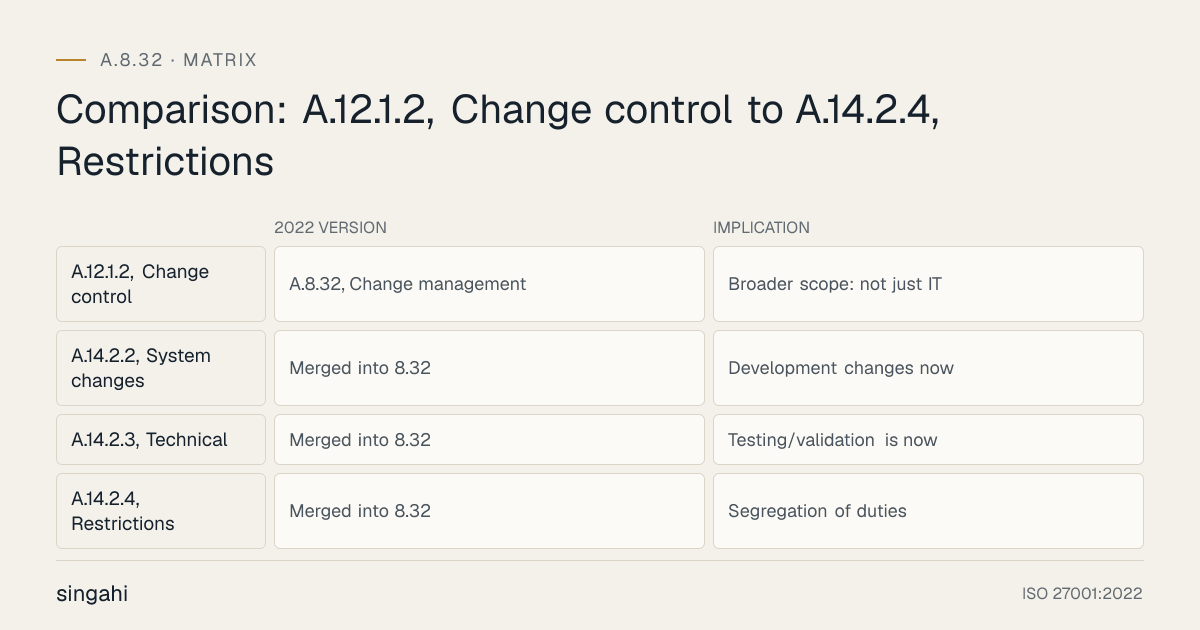
Figure · Matrix
Comparison: A.12.1.2, Change to A.14.2.4, Restrictions
The Control in Plain Words
ISO 27001:2022 Annex A 8.32 asks organizations to control changes to information processing facilities and systems through change management procedures.
ISO 27002 attributes: Control type: Preventive · Properties: Confidentiality, Integrity, Availability · Concepts: Protect · Capabilities: Application security, System and network security · Domains: Protection
What Changed from ISO 27001:2013
| 2013 Version | 2022 Version | Implication |
|---|---|---|
| A.12.1.2, Change management | A.8.32, Change management | Same subject: changes to information processing facilities and information systems |
| A.14.2.2, System changes | Merged into 8.32 | Development changes now under same control |
| A.14.2.3, Technical review | Merged into 8.32 | Testing/validation is now part of change management |
| A.14.2.4, Restrictions on changes | Merged into 8.32 | Segregation of duties is now part of change management |
Scope: A.8.32 covers changes to information processing facilities and information systems: infrastructure, operating systems, databases, middleware, applications, cloud services and their configuration, from early design through maintenance. ISO 27002 recommends integrating change control for ICT infrastructure and software wherever practicable.
Two things sit outside A.8.32:
- Changes to the ISMS itself (scope, policies, processes, objectives) are planned under clause 6.3, Planning of changes, which is mandatory for every ISMS.
- Updating documentation and continuity plans is not a separate scope. It is a consequence of a system change that the change procedure must handle (points (h) and (i) below).
What ISO 27002 Recommends (in Our Words)
ISO 27002 says new systems and major changes should follow agreed rules and a formal process covering documentation, specification, testing, quality control and managed implementation, with management responsibilities defined. Change procedures should be documented, enforced and applied across the whole development life cycle. They should cover:
| # | ISO 27002 point (paraphrased) | Where this guide covers it |
|---|---|---|
| (a) | Plan the change and assess its impact, including all dependencies | Step 2, Impact and Risk Assessment |
| (b) | Authorise the change | Step 3 and the approval matrix |
| (c) | Tell the people who need to know | Step 5, communication |
| (d) | Test the change and accept the test results (see A.8.29) | Step 6, Testing |
| (e) | Implement it with a deployment plan | Step 7, Implementation |
| (f) | Plan for emergencies and contingencies, including fall-back | Emergency Change Procedure, rollback planning |
| (g) | Keep records of all of the above | Step 8, Documentation and Record Keeping |
| (h) | Update operating documentation (A.5.37) and user procedures | Change template, "documentation updated" field |
| (i) | Update ICT continuity, response and recovery plans (A.5.30) | Change template, "continuity impact" field |
ISO 27002 also notes that poorly controlled changes are a common cause of failures, that changes moving from development to production can affect integrity and availability, and that testing in an environment separate from both production and development (A.8.31) is good practice, including for patches and updates.
Do you need this control?
A.8.32 is selected through risk treatment like every Annex A control, and recorded in your Statement of Applicability. Almost every organisation that runs or configures its own systems, including cloud services, includes it, because uncontrolled change is one of the most common causes of outages and security failures. An organisation that only uses SaaS products it cannot change might rely on supplier controls (A.5.22) instead, and say so in its Statement of Applicability.
Multi-Framework Mapping
Annex A 8.32 Across Major Frameworks
| Framework | Control Reference | Equivalent Requirement | Key Difference |
|---|---|---|---|
| ISO 27001:2022 | A.8.32 (systems); clause 6.3 (ISMS changes) | Change management for information processing facilities and systems | Clause 6.3 covers changes to the ISMS itself |
| SOC 2 (TSC 2017) | CC8.1 | Change management | Requires change log; more focused on IT systems |
| PCI DSS v4.0.1 | Req 6.5.1 to 6.5.6 | Change control for system components | 6.5.1 change procedures; 6.5.2 confirm PCI DSS requirements after significant changes; 6.5.3 to 6.5.6 environment separation, roles, test data. Patching is 6.3.3 |
| NIST SP 800-53 Rev 5 | CM-3 | Configuration change control | Technical focus; requires automated tools for high-impact systems |
| NIST CSF 2.0 | PR.PS-01, PR.PS-02, ID.IM | Configuration and software management practices | Change management is part of platform security; improvement feeds ID.IM |
| DORA (EU) | Art. 9(4)(e) | ICT change management | Documented, risk-based change procedures; applies to EU financial entities |
| COBIT 2019 | BAI06.01 | Manage changes | Governance-focused; links to risk management |
| ITIL 4 | Practice: Change Enablement | Service change management | Service-focused; includes standard, normal, emergency, and major changes |
Mapping: ISO 27001 A.8.32 → SOC 2 CC8.1
| ISO 27001 A.8.32 Component | SOC 2 CC8.1 Trust Service Criteria | Evidence Needed |
|---|---|---|
| Impact assessment (1) | CC8.1, System changes are authorized and tested | Risk assessment document per change |
| Authorization (2) | CC8.1, Changes are authorized before implementation | Approval workflow with timestamps |
| Testing (4) | CC8.1, Changes are tested before implementation | Test results, validation logs |
| Record keeping (7) | CC8.1, Change activities are logged | Change log with requester, approver, implementer |
| Post-implementation review (implied) | CC8.1, Changes are reviewed after implementation | Post-change review report |
Practical note: If you're seeking dual certification (ISO 27001 + SOC 2), design one change management process that satisfies both. Both focus on changes to systems; ISMS-level changes sit under ISO 27001 clause 6.3. The SOC 2 version is more audit-evidence-focused.
Control Integration Map
Annex A 8.32 doesn't exist in isolation. Changes affect everything. Here's how it connects to other controls:
Upstream Controls (Inputs to 8.32)
| Control | Relationship | Change Management Trigger |
|---|---|---|
| 5.8, Info security in project management | Project outputs become changes | Every project deliverable must go through change management before production |
| 5.22, Monitoring/review of supplier services | Supplier changes affect your systems | Supplier patch, update, or service change triggers your change management |
| 5.31, Legal/regulatory/contractual requirements | New requirements drive changes | Regulatory update (e.g., DORA, NIS2) triggers policy/process changes |
| 8.27, Secure system architecture | Architecture changes need 8.32 | Architecture review outputs become formal changes |
| 8.29, Security testing in development | Tested changes need approval | Test results feed into change authorization decision |
Downstream Controls (Outputs from 8.32)
| Control | Relationship | Change Management Output |
|---|---|---|
| 8.28, Secure coding | Code changes need secure coding | Secure coding guidelines must be updated when frameworks change |
| 8.30, Outsourced development | Outsourced changes need 8.32 control | Supplier change requests must flow through your 8.32 process |
| 8.31, Separation of dev/test/prod | Environments change | New environments or environment changes need 8.32 approval |
| 8.33, Test information | Test data changes | Test data sets, synthetic data generation changes need 8.32 |
| 8.34, Protection during audit/testing | Audit changes | Auditor-requested changes (e.g., temporary access) need 8.32 |
| 5.37, Documented operating procedures | Procedures change | Every procedure update is a change under 8.32 |
Parallel Controls (Happening Simultaneously)
| Control | Relationship | Joint Process |
|---|---|---|
| 8.9, Configuration management | Configuration changes = changes | Configuration changes should be a subset of change management |
| 8.16, Monitoring activities | Changes trigger monitoring | Change implementation should update monitoring rules |
| 6.8, Info security event reporting | Failed changes = incidents | Post-implementation failures should trigger incident response |
| 5.24, Info security incident management | Change failures = incidents | Same workflow: failed change → incident → lesson learned → process update |
Change Management Maturity Model
Use this maturity model to place your current practice and plan the next step:
Level 1: Ad-Hoc (Chaos)
- Changes happen without process
- No documentation, no approval
- Emergency fixes are the only "process"
- Incidents are frequent and untraceable
- Audit result: Major non-conformity
- Example: Developer pushes to production directly
Level 2: Defined (Paper Process)
- Change policy exists but is not followed
- Some changes are documented in emails/spreadsheets
- Approval is informal ("asked in Slack")
- No testing or rollback planning
- Audit result: Minor non-conformity, observations
- Example: Change request form exists but only 30% of changes use it
Level 3: Managed (Working Process)
- All changes go through formal process
- Change log is maintained
- Testing happens for major changes
- Rollback plans exist for critical changes
- Metrics are tracked manually
- Audit result: Conformity with observations
- Example: Jira workflow for changes; weekly change review meetings
Level 4: Measured (Data-Driven)
- Change metrics are tracked automatically
- Success rate, MTTR, rollback frequency measured
- Changes are categorized by risk and type
- Automated testing in CI/CD
- Post-implementation reviews are mandatory
- Audit result: Full conformity
- Example: Dashboard showing change success rate, SLA compliance, audit trail completeness
Level 5: Optimized (Self-Improving)
- Machine learning predicts change risk
- Automated approval for standard changes
- Canary deployments with automatic rollback
- Change metrics drive continuous improvement
- Process updates are automated based on lessons learned
- Audit result: Exceeds expectations
- Example: AI-powered change risk scoring; 95% of standard changes are auto-approved
Change Types and Approval Matrix
Change types decide how much approval and testing a change needs:
| Change Type | Definition | Examples | Risk Level | Approval Required | Testing Required | Rollback Plan | Timeline |
|---|---|---|---|---|---|---|---|
| Standard | Pre-approved, low-risk, repeatable | Patch Tuesday updates, routine config changes, scheduled backups | Low | Pre-approved (auto) | Automated | Pre-tested | < 24 hrs |
| Normal | Planned, moderate risk | New feature deployment, infrastructure upgrade, policy change | Medium | IT Manager + Security Lead | Staging environment | Documented | 3-7 days |
| Major | High-impact, complex | Data center migration, ERP implementation, cloud migration | High | CISO + CIO + Business Owner | Full QA + UAT | Detailed, tested | 2-4 weeks |
| Emergency | Critical fix, cannot wait | Security patch for zero-day, production outage fix | Critical | Emergency CAB (on-call) | Minimal before release (smoke test), full testing and a post-implementation review afterwards | Immediate rollback plan | < 4 hrs |
Approval Thresholds by Risk Level
| Risk Score | Approver | Testing | Rollback |
|---|---|---|---|
| 1-3 (Low) | Team Lead | Automated unit tests | Automatic (blue-green) |
| 4-6 (Medium) | IT Manager + Security | Staging + integration tests | Manual, documented |
| 7-8 (High) | CISO + Department Head | Full QA + penetration test | Full rollback test |
| 9-10 (Critical) | Emergency CAB | Smoke test before release; full testing and post-implementation review afterwards | Immediate, tested |
Risk Scoring Matrix
| Factor | Weight | Score 1-5 |
|---|---|---|
| Business impact if change fails | 30% | 1=minimal, 5=critical business halt |
| Number of systems/users affected | 25% | 1=single system, 5=enterprise-wide |
| Reversibility | 20% | 1=easily reversible, 5=irreversible |
| Security impact | 15% | 1=no security impact, 5=critical security change |
| Regulatory/compliance impact | 10% | 1=no impact, 5=regulatory breach risk |
Risk Score = weighted average. Round to nearest whole number.
Role Definitions (RACI)
Who does what:
| Activity | Change Requester | Change Manager | IT Lead | Security Lead | CISO | Auditor | CAB |
|---|---|---|---|---|---|---|---|
| Initiate change request | R | A | C | I | I | I | - |
| Assess impact/risk | C | R | A | C | I | I | - |
| Approve change | I | C | C | C | A (high risk) | I | A (emergency) |
| Schedule change | I | R | A | C | I | I | - |
| Test change | R | A | C | C | I | I | - |
| Implement change | R | A | C | I | I | I | - |
| Verify change | C | R | A | C | I | I | - |
| Document change | C | R | A | C | I | I | - |
| Post-implementation review | C | R | A | C | I | I | - |
| Audit change | I | C | I | I | C | R | - |
R = Responsible, A = Accountable, C = Consulted, I = Informed
Role Definitions
| Role | Responsibility | Typical Person |
|---|---|---|
| Change Requester | Identifies need, completes request form, provides business justification | Developer, System Admin, Business Analyst |
| Change Manager | Coordinates process, ensures documentation, schedules CAB, maintains log | Compliance Manager, IT Operations Manager |
| IT Lead | Technical assessment, implementation planning, resource allocation | IT Manager, Infrastructure Lead |
| Security Lead | Security impact assessment, risk evaluation, approval for security changes | Security Engineer, CISO (for high risk) |
| CISO | Final approval for high-risk changes, policy ownership, escalation point | Chief Information Security Officer |
| Auditor | Reviews change evidence, tests controls, reports findings | Internal/External Auditor |
| CAB (Change Advisory Board) | Reviews major/emergency changes, makes go/no-go decisions | Cross-functional team: IT, Security, Business, Legal |
The Change Management Process (Step-by-Step)
The process below covers every ISO 27002 point, (a) to (i).
Step 1: Initiation
What to include:
- Change request should include: business justification, expected benefit, risk acceptance, budget/resource estimate
- For technical changes: architecture diagram (before/after), dependency map, blast radius analysis
- For non-technical changes: stakeholder impact assessment, communication plan
Change Request Form Fields (minimum):
- Change ID (auto-generated)
- Requester name, department, date
- Change title and description
- Business justification
- Affected systems/services/assets
- Risk assessment (pre-filled from matrix)
- Proposed implementation date/time
- Testing plan
- Rollback plan
- Required approvals (auto-populated based on risk)
Step 2: Impact and Risk Assessment
What to include:
- Dependency mapping: Use a CMDB (Configuration Management Database) to trace what else breaks if this system changes
- Blast radius analysis: If this change fails, how many systems/users are affected? Map it.
- Security impact assessment: Does this change affect encryption, access controls, logging, or monitoring?
- Compliance impact assessment: Does this change affect PCI DSS scope, HIPAA protected data, GDPR processing?
- Performance impact: Will this change affect system performance under load?
Impact Assessment Template:
| Impact Area | Assessment Question | Score (1-5) | Mitigation |
|---|---|---|---|
| Business operations | Will business operations be disrupted? | ||
| Security posture | Does this weaken or strengthen security? | ||
| Compliance | Does this affect regulatory scope or controls? | ||
| Data integrity | Could this corrupt or lose data? | ||
| Availability | Will this affect system uptime? | ||
| Dependencies | What systems depend on this? | ||
| Reversibility | Can we reverse this if it fails? | ||
| Testing coverage | Can we test this adequately? |
Step 3: Authorization
What to include:
- Approval quorum: For high-risk changes, require 2+ approvers from different departments (segregation of duties)
- Approval with conditions: Approver can approve with conditions (e.g., "approved if tested in staging for 48 hours")
- Approval escalation: If approver doesn't respond within 24 hours (normal) or 2 hours (emergency), escalate
- Approval revocation: Approver can revoke approval before implementation if new risk information emerges
Step 4: Planning and Scheduling
What to include:
- Change freeze periods: No changes during month-end, quarter-end, audit periods, or holiday seasons
- Change windows: Define approved change windows (e.g., Saturday 2-6 AM for production)
- Blackout dates: Maintain a calendar of blackout dates (audits, critical business periods)
- Resource planning: Ensure implementer, tester, and rollback team are available during change window
- Communication plan: Who needs to know, when, and how (email, Slack, status page, PagerDuty)
Step 5: Testing and Validation
What to include:
- Testing pyramid for changes:
- Unit tests (automated): 70% of test coverage
- Integration tests (automated): 20% of test coverage
- End-to-end/UAT (manual): 10% of test coverage
- Test environment parity: Staging must mirror production (infrastructure, data volume, security controls)
- Security testing: SAST/DAST for code changes, vulnerability scan for infrastructure changes
- Performance testing: Load testing for changes that affect performance
- Regression testing: Ensure the change doesn't break existing functionality
- Chaos engineering: For critical systems, test failure scenarios (Netflix Simian Army approach)
Step 6: Implementation
What to include:
- Deployment strategies:
- Blue-green deployment: Two identical environments, switch traffic
- Canary deployment: Roll out to 5% of users first, monitor, then expand
- Feature flags: Deploy code but enable feature gradually
- A/B testing: Compare old vs. new version with real traffic
- Rollback readiness: Pre-stage rollback artifacts, have rollback command ready, test rollback in staging
- Monitoring during change: Real-time monitoring of error rates, performance, security alerts during implementation
- Communication during change: Status updates every 15 minutes for major changes
Step 7: Verification and Closure
What to include:
- Verification checklist:
- System is operational and accessible
- No new errors in logs
- Performance is within acceptable parameters
- Security controls are functioning
- Monitoring and alerting are active
- Backups are functioning
- Users can access the system
- No compliance gaps introduced
- Hold period: For major changes, hold for 24-72 hours before declaring success
- Incident correlation: Check if any incidents occurred during/after change window
- Stakeholder sign-off: Business owner confirms the change meets requirements
Step 8: Documentation and Record Keeping
What to include:
- Retention requirements: ISO 27001 sets no retention period. Set one in your policy, long enough to cover audits, investigations and sector rules (many organisations keep change records for 3 years or more)
- Immutable logs: Change logs should be tamper-proof (write-once storage, blockchain, or audit-trail-enabled system)
- Searchability: Change records should be searchable by system, date, requester, risk level, outcome
- Integration with incident records: If change caused incident, link change record to incident record
- Integration with asset inventory: Change record should reference affected assets in CMDB
DevOps and CI/CD Change Management
Annex A 8.32 in a DevOps world.
The Challenge
Traditional change management assumes:
- Changes are infrequent (weekly/monthly)
- Changes are large (full releases)
- Changes go through manual approval
DevOps reality:
- Changes are frequent (hourly/daily)
- Changes are small (microservices, commits)
- Changes are automated
Solution: GitOps Change Management
Principle: Your Git repository is the single source of truth. Every change is a commit. Every commit is traceable.
| Traditional Change Management | GitOps Change Management |
|---|---|
| Change request form | Pull request (PR) with template |
| Manual approval | Branch protection + required reviewers |
| Impact assessment | PR description with risk assessment |
| Testing | CI/CD pipeline (automated tests) |
| Implementation | Merge to main branch (auto-deploy) |
| Rollback | Revert commit or rollback to previous tag |
| Documentation | Commit messages + PR description + auto-generated docs |
| Audit trail | Git log (immutable, timestamped, signed) |
GitHub/GitLab Change Management Setup
Branch Protection Rules (production branch):
- Require pull request reviews before merging (2 reviewers for high-risk)
- Require status checks to pass (CI/CD tests, security scans)
- Require signed commits (GPG/SSH signing)
- Require linear history (no merge commits for traceability)
- Include administrators in restrictions (no bypassing)
- Allow force pushes: Never
- Allow deletions: Never
Pull Request Template (.github/pull_request_template.md):
Template
Change Request
- Change ID linked to change log
- Business justification provided
- Risk assessment completed (score: __/10)
- Affected systems documented
- Testing plan documented
- Rollback plan documented
- Security impact assessed
- Compliance impact assessed
Risk Level
- Low (1-3), Standard change
- Medium (4-6), Normal change
- High (7-8), Major change
- Critical (9-10), Emergency change
Testing
- Unit tests pass
- Integration tests pass
- Security scan passes
- Performance test passes (if applicable)
CI/CD Pipeline Integration:
## Example GitHub Actions workflow
name: Change Management Gate
on:
  pull_request:
    branches: [main]

jobs:
  change-gate:
    runs-on: ubuntu-latest
    steps:
      - name: Check PR template completeness
        run: |
          # Script to verify PR template fields are filled
          # Fail if risk assessment is missing
      - name: Run security scan
        run: |
          # SAST/DAST scan
          # Fail if critical vulnerabilities found
      - name: Run compliance check
        run: |
          # Check if change affects PCI DSS scope
          # Check if change affects sensitive data
      - name: Require approval from security team
        run: |
          # Verify at least one security team member approved
Infrastructure as Code (IaC) Changes
Terraform, CloudFormation, Ansible, Pulumi changes.
IaC Change Management Principles
- Infrastructure changes are code changes. Apply the same change management rigor to
.tffiles as to.pyfiles. - Plan before apply. Always run
terraform plan(or equivalent) beforeterraform apply. The plan is your impact assessment. - State file protection. Terraform state contains sensitive data. Protect it like a database.
- Drift detection. Run drift detection daily. Unplanned infrastructure changes are incidents.
Terraform Change Management Workflow
1. Developer writes Terraform change (.tf file)
2. Create PR with terraform plan output attached
3. Security review: Does this open new ports? New IAM roles? New public access?
4. Compliance review: Does this affect PCI DSS scope? Add new data stores?
5. Run terraform plan in CI/CD (auto-generated plan output as PR comment)
6. Approval required from Infrastructure Lead + Security Lead
7. Merge PR → triggers terraform apply in CI/CD
8. Post-apply verification: Run terraform plan again to confirm no drift
9. Update CMDB/asset inventory automatically
Terraform Plan as Impact Assessment
The terraform plan output IS your impact assessment. It shows:
- What will be created
- What will be modified
- What will be destroyed
- What will be replaced
Require terraform plan output in every infrastructure change PR.
Drift Detection
## Daily drift detection workflow
name: Infrastructure Drift Detection
on:
  schedule:
    - cron: '0 6 * * *'  # Daily at 6 AM

jobs:
  drift-check:
    runs-on: ubuntu-latest
    steps:
      - name: Run terraform plan
        run: |
          terraform plan -detailed-exitcode
        # If exit code 2 = changes detected = drift = incident
Cloud-Native Change Management
Kubernetes, containers, serverless.
Kubernetes Change Management
Kubernetes changes that need 8.32 control:
- New deployments or deployment updates
- ConfigMap or Secret changes
- NetworkPolicy changes
- RBAC (Role/RoleBinding/ClusterRole) changes
- Ingress or Service changes
- PersistentVolume or StorageClass changes
- CRD (Custom Resource Definition) changes
Kubernetes Change Management Workflow:
1. Change is a YAML manifest change
2. PR with manifest diff + impact assessment
3. CI/CD validates YAML syntax, security (OPA/Kyverno policies)
4. Deploy to staging cluster first
5. Run smoke tests, integration tests, security scan
6. Canary deploy to production (5% → 25% → 100%)
7. Monitor metrics: error rate, latency, resource usage
8. If metrics degrade → automatic rollback
9. If metrics stable → full rollout + documentation
Kyverno/OPA Policy Gates (Security as Code):
## Kyverno policy: No changes without label "change-id"
apiVersion: kyverno.io/v1
kind: ClusterPolicy
metadata:
  name: require-change-id
spec:
  validationFailureAction: Enforce
  rules:
  - name: check-change-id
    match:
      resources:
        kinds:
        - Deployment
        - ConfigMap
        - Secret
    validate:
      message: "All changes must have a change-id label"
      pattern:
        metadata:
          labels:
            change-id: "?*"
AI/ML Model Change Management
AI/ML model deployment, retraining, updates.
Why AI/ML Changes Need Special Change Management
- Model changes are invisible. A model file update looks like any other file update, but changes behavior unpredictably.
- Model drift. Model performance degrades over time. Retraining is a change.
- Data pipeline changes. Training data changes, feature engineering changes, label changes.
- Explainability requirements. GDPR, EU AI Act may require explanation of model changes.
- Bias and fairness. Model changes can introduce or remove bias.
AI/ML Change Management Framework
| Change Type | Examples | Risk Level | Special Controls |
|---|---|---|---|
| Model deployment | Deploy new model to production | High | A/B test, shadow mode, human-in-the-loop approval |
| Model retraining | Retrain on new data | High | Data validation, bias check, performance benchmark |
| Feature engineering | Add/remove features | Medium | Feature importance analysis, backward compatibility |
| Hyperparameter tuning | Learning rate, batch size | Medium | Performance regression test |
| Data pipeline | ETL change, new data source | High | Data quality check, schema validation, PII scan |
| Inference infra | Scaling, batching, GPU changes | Medium | Load test, latency check |
AI/ML Change Management Checklist
- Model version is tagged and tracked (MLflow, Weights & Biases)
- Training data lineage is documented
- Model performance metrics are benchmarked against previous version
- Bias/fairness check is completed
- Explainability test is passed (if required by regulation)
- Security scan of model artifacts (no malicious code)
- Rollback to previous model version is tested
- Monitoring dashboard is updated for new model metrics
- Data protection impact assessment is completed (if processing PII)
- EU AI Act compliance check (if high-risk AI system)
Third-Party and SaaS Vendor Changes
When your SaaS vendor changes something.
The Problem
Your SaaS vendor (Salesforce, AWS, Office 365, GitHub) makes changes:
- Feature updates
- Security patches
- API changes
- Data center moves
- Terms of service changes
You have no control over the change, but you are affected by it.
Third-Party Change Management Process
| Step | Action | Owner | Timeline |
|---|---|---|---|
| 1 | Vendor notifies you of planned change | Vendor | Variable |
| 2 | Log vendor change in your change register | Change Manager | Within 24 hrs |
| 3 | Assess impact on your systems/data/processes | IT Lead | 3 days |
| 4 | Assess security impact | Security Lead | 3 days |
| 5 | Assess compliance impact (scope, controls) | Compliance Officer | 3 days |
| 6 | Approve or object to vendor change | CISO/CIO | 5 days |
| 7 | Plan internal testing/validation | IT Lead | Before vendor change |
| 8 | Monitor vendor change window | IT Operations | During change |
| 9 | Validate post-change | IT Lead | Within 24 hrs after |
| 10 | Update documentation/procedures | Change Manager | Within 1 week |
Vendor Change Notification Template
Subject: [Vendor] Planned Change Notification — Change ID [XXX]

Vendor: [Vendor Name]
Change Type: [Feature Update / Security Patch / API Change / Infrastructure Change]
Planned Date: [Date and Time]
Affected Services: [List of your services affected]

Impact Assessment:
- Business Impact: [Low/Medium/High]
- Security Impact: [Low/Medium/High]
- Compliance Impact: [Low/Medium/High]

Required Actions:
- [ ] Review vendor change notes
- [ ] Test in non-production environment
- [ ] Update internal documentation
- [ ] Brief affected teams

Approval: [Pending/Approved/Objected]
Emergency Change Procedure
Emergency changes need their own, faster route, with full review afterwards.
Emergency Change Triggers
| Trigger | Examples | Response Time |
|---|---|---|
| Zero-day vulnerability | Log4j, Heartbleed, Shellshock | < 1 hour |
| Active security incident | Ransomware, data breach, DDoS | < 30 minutes |
| Production outage | System failure, database corruption | < 15 minutes |
| Regulatory deadline | Compliance deadline, audit finding | < 4 hours |
| Vendor mandate | Critical vendor patch, API deprecation | < 24 hours |
Emergency Change Procedure
T+0:   Incident detected or emergency identified
T+0:   Emergency CAB is convened (on-call team)
T+15m: Impact assessment completed (verbal, documented after)
T+30m: Emergency CAB approves/denies change
T+30m: Change is implemented (with minimal testing)
T+1h:   Smoke test completed
T+2h:   Post-implementation review begins
T+24h:  Full documentation completed
T+1w:   Root cause analysis completed
T+1w:   Process improvement implemented
Emergency Change Documentation (After-the-Fact)
Even emergency changes require documentation. The documentation is completed AFTER the change, within 24 hours.
| Document | Completed By | Timeline |
|---|---|---|
| Emergency change justification | Change Requester | T+2h |
| Emergency CAB decision log | Change Manager | T+2h |
| Implementation details | Implementer | T+4h |
| Test results | Tester | T+4h |
| Post-implementation review | Change Manager | T+24h |
| Root cause analysis | Security Lead | T+1 week |
| Lessons learned | Change Manager | T+1 week |
| Process improvement | CISO | T+2 weeks |
Failed Changes and Incidents
A change that causes an outage or security problem becomes an incident (A.5.24–A.5.26): raise it, assess whether it is reportable (CERT-In's 6-hour rule, sector regulators), and roll back if the plan says so. Fixes made during an incident go through the emergency change route, with the after-the-fact review above. The person who implements a change should not be its only approver (see the single-person rule in A.8.31).
Worked Example: Log4j Emergency Patch
Worked example (timeline is illustrative): December 2021, the Log4j vulnerability Log4Shell (CVE-2021-44228) is disclosed.
| Time | Action | Who |
|---|---|---|
| Day 0, 10:00 AM | Security team detects Log4j vulnerability in environment | Security Lead |
| Day 0, 10:15 AM | Emergency CAB convened (CISO, CTO, Security Lead, Infrastructure Lead) | CISO |
| Day 0, 10:30 AM | Emergency CAB approves emergency patching across all systems | Emergency CAB |
| Day 0, 11:00 AM | Infrastructure team begins patching | Infrastructure Team |
| Day 0, 6:00 PM | All critical systems patched | Infrastructure Team |
| Day 0, 8:00 PM | Smoke tests completed | QA Team |
| Day 1, 9:00 AM | Post-implementation review completed | Change Manager |
| Day 1, 12:00 PM | Emergency change documentation completed | Change Manager |
| Day 7 | Root cause analysis: Why wasn't this caught by vulnerability management? | Security Lead |
| Day 14 | Process improvement: Vulnerability scanning frequency increased from weekly to daily | CISO |
Supplier Change Management (5.22 Integration)
Supplier changes need the same discipline (A.5.22 links here).
Why It Matters
ISO 27001:2022 has TWO change management controls:
- A.8.32: Your internal change management
- A.5.22: Monitoring and review of supplier services (includes supplier changes)
If your supplier changes something, it triggers BOTH controls.
Supplier Change Management Integration
| Supplier Change Type | 5.22 Trigger | 8.32 Trigger | Joint Process |
|---|---|---|---|
| Supplier security patch | Yes, monitor supplier patch | Yes, your system changes | Log in both registers |
| Supplier feature update | Yes, review impact | Yes, your users/processes change | Joint impact assessment |
| Supplier data center move | Yes, review continuity | Yes, your data residency changes | Joint risk assessment |
| Supplier API change | Yes, monitor service | Yes, your integration changes | Joint testing required |
| Supplier termination | Yes, review transition | Yes, your systems change | Joint migration plan |
| Supplier subcontractor change | Yes, review chain | Yes, your due diligence changes | Joint audit required |
Supplier Change Register
Maintain a separate supplier change register (or section in your main register) that tracks:
| Field | Description |
|---|---|
| Supplier name | Who made the change |
| Change ID | Your internal tracking ID |
| Supplier change ID | Supplier's tracking ID |
| Change type | Patch, update, migration, etc. |
| Notification date | When supplier told you |
| Impact assessment | Your assessment of impact |
| Your approval status | Approved, objected, monitoring |
| Your testing status | Tested, pending, N/A |
| Implementation date | When supplier implemented |
| Your validation date | When you validated |
| Linked 8.32 change ID | Your internal change record |
Templates and Forms
Change Request Form (Filled Example)
═══════════════════════════════════════════════════════════════
                    CHANGE REQUEST FORM
═══════════════════════════════════════════════════════════════

Change ID:              CHG-2026-0042
Date Submitted:         2026-06-15
Requester:              [Name], Senior Developer
Department:             Engineering

Change Title:           Upgrade PostgreSQL from 14 to 16

Business Justification:
PostgreSQL 14 reaches end-of-life in November 2026. PostgreSQL 16
provides 30% performance improvement and enhanced security features
including SCRAM-SHA-256 authentication and improved encryption.

Affected Systems:
  - Production database (prod-db-01, prod-db-02)
  - Staging database (staging-db-01)
  - Backup system (automated backups use pg_dump)
  - Application servers (connection string changes required)
  - Monitoring system (PostgreSQL metrics exporters)

Risk Assessment:
  - Business impact if failed: 5 (production outage, data loss)
  - Systems affected: 4 (multiple systems, 500+ users)
  - Reversibility: 2 (rollback possible via point-in-time recovery)
  - Security impact: 2 (improves security posture)
  - Regulatory impact: 3 (affects PCI DSS data store)

  Risk Score: 5.2 → MEDIUM (Normal change)

Proposed Implementation:
  Date: 2026-06-20 (Saturday, 2:00 AM — low traffic period)
  Duration: 4 hours
  Window: 2:00 AM — 6:00 AM IST

Testing Plan:
  1. Upgrade staging database (completed 2026-06-10)
  2. Run full regression test suite (completed, 100% pass)
  3. Run performance benchmark (completed, 32% improvement)
  4. Run security scan (completed, no new vulnerabilities)
  5. Test backup/restore on staging (completed, 45 min restore time)

Rollback Plan:
  - Primary: Point-in-time recovery to pre-upgrade snapshot
  - Time to rollback: 45 minutes
  - Rollback tested: Yes (2026-06-12)
  - Data loss risk: 0 (PITR to exact moment before upgrade)

Required Approvals:
  - IT Lead: [APPROVED] 2026-06-15 — Rajesh Kumar
  - Security Lead: [APPROVED] 2026-06-15 — Anjali Mehta
  - Database Admin: [APPROVED] 2026-06-15 — Vikram Rao

═══════════════════════════════════════════════════════════════
Change Log Entry (Filled Example)
═══════════════════════════════════════════════════════════════
                       CHANGE LOG ENTRY
═══════════════════════════════════════════════════════════════

Change ID:              CHG-2026-0042
Status:                 COMPLETED

Implementation Details:
  Implementer:          Vikram Rao, Database Admin
  Start Time:           2026-06-20 02:00 AM IST
  End Time:             2026-06-20 05:30 AM IST
  Duration:             3.5 hours (within 4-hour window)

Verification Results:
  [✓] System operational
  [✓] No errors in logs
  [✓] Performance within parameters (32% improvement)
  [✓] Security controls functioning (SCRAM-SHA-256 active)
  [✓] Monitoring active (metrics flowing)
  [✓] Backups functioning (tested post-upgrade)
  [✓] User access confirmed (500 users tested)
  [✓] PCI DSS scope unchanged

Post-Implementation Review:
  Date: 2026-06-21
  Attendees: [Change manager], [Developer], [DBA], [Service owner]

  What went well:
    - Testing in staging was thorough and realistic
    - Rollback plan was tested and ready
    - Communication was clear (all teams notified in advance)

  What could be improved:
    - Upgrade took 3.5 hours vs. estimated 4 hours (good)
    - One monitoring exporter needed manual restart (gap in automation)

  Lessons learned:
    - Include monitoring exporter restart in upgrade script
    - Update runbook to include post-upgrade monitoring check

  Action items:
    - Update PostgreSQL upgrade runbook ([Developer], by [date])
    - Add monitoring exporter restart to CI/CD (Vikram Rao, by 2026-06-30)

═══════════════════════════════════════════════════════════════
Change Management Policy (Template Outline)
═══════════════════════════════════════════════════════════════
              CHANGE MANAGEMENT POLICY
         [Organization Name] — ISO 27001:2022 Annex A 8.32
═══════════════════════════════════════════════════════════════

1. PURPOSE
   This policy defines how [Organization Name] manages changes to
   information systems, services, software, data, and processes to
   ensure information security is maintained.

2. SCOPE
   This policy applies to all changes to:
   - Information systems and infrastructure
   - Software and applications
   - Cloud services and SaaS configurations
   - Data models, schemas, and classifications
   - Security controls and policies
   - Business processes affecting information security
   - Documentation and procedures
   - Physical facilities and hardware

3. DEFINITIONS
   - Standard Change: Pre-approved, low-risk, repeatable
   - Normal Change: Planned, moderate risk, requires approval
   - Major Change: High-impact, complex, requires CAB approval
   - Emergency Change: Critical fix, requires Emergency CAB

4. ROLES AND RESPONSIBILITIES
   [Insert RACI matrix from Section 8]

5. CHANGE MANAGEMENT PROCESS
   [Insert 8-step process from Section 9]

6. CHANGE TYPES AND APPROVALS
   [Insert approval matrix from Section 7]

7. EMERGENCY CHANGE PROCEDURE
   [Insert emergency procedure from Section 15]

8. RECORD KEEPING
   - All changes are logged in the Change Register
   - Records are retained for [3 years / as defined]
   - Change logs are immutable and tamper-proof
   - Records are available for audit review

9. SUPPLIER CHANGE MANAGEMENT
   [Insert 5.22 integration from Section 16]

10. METRICS AND REPORTING
    [Insert metrics from Section 19]

11. TRAINING AND AWARENESS
    - All staff involved in change management are trained annually
    - Change management process is part of security onboarding
    - Emergency change procedures are drilled quarterly

12. POLICY REVIEW
    - This policy is reviewed annually
    - Changes to this policy require CISO approval
    - Last review date: [Date]
    - Next review date: [Date + 1 year]

Approved by: ___________________ Date: ___________
[CISO Name]
═══════════════════════════════════════════════════════════════
Audit Evidence and Auditor Checklist
What Auditors Look For (ISO 27001)
| Audit Evidence | Where to Find It | What Auditor Checks |
|---|---|---|
| Change Management Policy | Document repository | Exists, approved, current, covers all asset types |
| Change Register | Change management system | All changes logged, no gaps, dates align |
| Change Request Forms | Change management system | Completed, approved, risk assessed |
| Approval Records | Change management system / email | Authorized approvers, segregation of duties |
| Test Records | Test system / CI/CD logs | Testing occurred, results documented |
| Rollback Plans | Change request / runbook | Exists for high-risk changes, tested |
| Post-Implementation Reviews | Change management system | Completed, action items tracked |
| Training Records | LMS / HR system | Staff trained, records current |
| Emergency Change Records | Change management system | Justified, documented within 24 hours |
| Supplier Change Records | Supplier register | Supplier changes tracked, assessed |
Auditor Checklist (What to Prepare)
□ Change Management Policy exists and is approved (within last 12 months)
□ Change Register covers last 12 months (or audit period)
□ Sample of 10 changes reviewed:
   □ All 10 have change request forms
   □ All 10 have risk assessments
   □ All 10 have approvals from authorized personnel
   □ All 10 have test records (or justification for no testing)
   □ High-risk changes have rollback plans
   □ All 10 have post-implementation reviews (or are in progress)
□ Emergency changes (if any):
   □ Emergency CAB records exist
   □ Post-implementation documentation completed within 24 hours
   □ Root cause analysis completed
□ Change management metrics:
   □ Change success rate tracked
   □ Change-related incidents tracked
   □ Trends analyzed and acted upon
□ Training:
   □ All change management staff trained (records)
   □ Training is current (within last 12 months)
□ Supplier changes:
   □ Supplier change register maintained
   □ Sample of 5 supplier changes reviewed for impact assessment
Common Audit Findings (Non-Conformities)
| Finding | Severity | How to Avoid |
|---|---|---|
| Changes made without formal request | Major | Enforce PR/ticket workflow; no direct production access |
| Missing approval records | Major | Use approval workflow with timestamps; no verbal approvals |
| Changes tested in production | Major | Separate environments; CI/CD gate prevents direct deploy |
| No rollback plan for high-risk changes | Minor | Require rollback plan for all medium+ risk changes |
| Emergency changes not documented within 24 hours | Minor | Post-implementation review mandatory within 24 hours |
| Change register has gaps | Minor | All changes must be logged; use automated logging |
| Same person approves and implements | Minor | Enforce segregation of duties in workflow |
🎯 Singahi Audit Tip: We prepare clients for 8.32 audits by running a mock audit 4 weeks before the real one. We review the same sample the auditor will review, fix gaps, and document everything. See our audit preparation service.
Metrics and KPIs
Measure the process so you can show it works:
Primary Metrics (Measure Every Change)
| Metric | Formula | Target | Measured By |
|---|---|---|---|
| Change Success Rate | Successful changes / Total changes × 100 | > 95% | Change register |
| Change-Related Incidents | Incidents caused by changes / Total changes × 100 | < 5% | Incident register |
| Emergency Change Rate | Emergency changes / Total changes × 100 | < 10% | Change register |
| Rollback Rate | Rollbacks / Total changes × 100 | < 3% | Change register |
| Mean Time to Implement | Sum of implementation times / Number of changes | Per change type | Change register |
| Approval Time | Time from request to approval | < 48 hrs (normal) | Change register |
| Post-Implementation Review Completion | Reviews completed / Changes requiring review × 100 | 100% | Change register |
| Change Documentation Completeness | Complete records / Total changes × 100 | 100% | Audit sample |
Secondary Metrics (Trend Analysis)
| Metric | Why It Matters | Review Frequency |
|---|---|---|
| Change volume by system | Identify systems with high change frequency | Monthly |
| Change volume by type | Identify process improvements (too many emergency?) | Monthly |
| Change volume by risk level | Are risk assessments accurate? | Monthly |
| Change-related security incidents | Are security changes more risky? | Monthly |
| Failed changes by category | Where does process break down? | Monthly |
| Change implementation delays | Are estimates realistic? | Monthly |
| Supplier change volume | Are suppliers changing too much? | Quarterly |
| Change process SLA compliance | Is process efficient? | Monthly |
Metrics Dashboard (Example)
┌─────────────────────────────────────────────────────────────┐
│                    CHANGE MANAGEMENT DASHBOARD               │
│                         June 2026                            │
├─────────────────────────────────────────────────────────────┤
│  Total Changes: 47    │  Success Rate: 97.9%  ▲ 2.1%        │
│  Emergency: 3 (6.4%)  │  Rollbacks: 1 (2.1%)  ▼ 0.5%        │
│  Incidents: 2 (4.3%)  │  Avg Approval Time: 36 hrs           │
├─────────────────────────────────────────────────────────────┤
│  Changes by Risk Level:                                     │
│  Low: 28 (59.6%)  Medium: 15 (31.9%)  High: 4 (8.5%)        │
│                                                             │
│  Changes by System:                                         │
│  Database: 12  Web App: 15  API: 8  Network: 4  Policy: 8   │
│                                                             │
│  Changes by Type:                                           │
│  Standard: 20  Normal: 24  Major: 3  Emergency: 0           │
├─────────────────────────────────────────────────────────────┤
│  Trending: ↗ Standard changes up 15% (automation working)   │
│            ↘ Emergency changes down 40% (better planning)    │
│            ⚠ 2 post-implementation reviews overdue            │
└─────────────────────────────────────────────────────────────┘
Real Incident Illustrative Scenarios
These are real, publicly reported incidents. The "what a good process would do" notes are our analysis, not findings from the investigations.
Case 1: Equifax (2017), a Known Patch Not Applied
What happened: the Apache Struts vulnerability CVE-2017-5638 was disclosed in March 2017 with a fix available. Equifax's online dispute portal was not patched; attackers exploited it from May and the breach was found in late July. About 147 million people were affected. Investigations by the US Government Accountability Office (GAO-18-559) and the House Committee on Oversight and Government Reform (December 2018) reported that the alert did not reach the people responsible for the system, a later scan did not find the vulnerable application, and an expired certificate had stopped traffic inspection on that network segment for months.
Lessons for 8.32:
- Critical security patches need an expedited change route with defined deadlines.
- Change management must be fed by vulnerability management and the asset inventory, so the right owner gets the change.
- Verify after the change that the vulnerability is actually closed.
- Changes to security tooling (certificates on inspection devices) are changes too, with owners and expiry tracking.
Case 2: CrowdStrike (July 2024), a Content Update Released Everywhere at Once
What happened: on 19 July 2024 a Falcon sensor content configuration update for Windows caused system crashes; Microsoft estimated about 8.5 million Windows devices were affected. CrowdStrike's root-cause analysis described a mismatch between the fields a new template type expected and what the sensor supplied, which its content validation did not catch. CrowdStrike said it would add staged deployment for these content updates.
Lessons for 8.32:
- Configuration and content updates are changes, not just code releases.
- Test in a representative environment, then roll out in stages with monitoring and a hold at each stage.
- Have a rollback route that works even when the change breaks the system it runs on.
- Supplier changes that reach your estate need your own controls too (A.5.22): know which of your suppliers can push changes automatically.
Case 3: British Airways (May 2017), Power Work at a Data Centre
What happened: an uncontrolled loss and restoration of power at a data centre near Heathrow damaged IT systems and grounded flights over a bank holiday weekend. Around 75,000 passengers were affected, and BA's parent company IAG put the cost at about £80 million. Reports attributed the failure to how the power supply was disconnected and reconnected.
Lessons for 8.32:
- Work on facilities that support critical systems (power, cooling) needs change control and a tested recovery plan.
- Changes that touch resilience and failover need testing under realistic conditions, and post-implementation review is not optional.
- Update continuity and recovery plans when such infrastructure changes (27002 8.32(i)).
Automation and Tooling Guide
Tooling options:
Tool Selection by Organization Size
| Organization Size | Budget | Recommended Stack |
|---|---|---|
| Small (< 50 employees) | Low | GitHub/GitLab PRs + Jira/Linear + Google Sheets change log |
| Medium (50-500) | Medium | GitHub/GitLab + Jira Service Management + Confluence |
| Large (500-5000) | High | ServiceNow Change Management + GitHub Enterprise + Jira |
| Enterprise (5000+) | Very High | ServiceNow + GitHub Enterprise + SonarQube + Terraform Enterprise |
GitHub Setup for Change Management
1. Repository Settings → Branch Protection Rules (for main/production):
✓ Require a pull request before merging
  ✓ Require approvals: 2 (for high-risk repos)
  ✓ Dismiss stale PR approvals when new commits are pushed
  ✓ Require review from CODEOWNERS (security team for security files)

✓ Require status checks to pass before merging
  ✓ Require branches to be up to date before merging

✓ Require conversation resolution before merging

✓ Require signed commits

✓ Require linear history

✓ Include administrators

✓ Allow force pushes: OFF
✓ Allow deletions: OFF
2. Pull Request Template:
Template
Change Management Checklist
- Change ID assigned (format: CHG-YYYY-NNNN)
- Risk assessment completed (score: __/10)
- Business justification documented
- Affected systems listed
- Testing plan documented
- Rollback plan documented
- Security impact assessed by Security team
- Compliance impact assessed (PCI/HIPAA/GDPR if applicable)
Risk Level
- Low (1-3), Auto-approved after tests pass
- Medium (4-6), Requires 1 reviewer + Security approval
- High (7-8), Requires CAB review
- Critical (9-10), Requires Emergency CAB
Testing
- Unit tests pass
- Integration tests pass
- Security scan passes (SAST/DAST)
- Performance test passes (if applicable)
- Manual testing completed (if applicable)
Deployment Plan
- Deployment date/time scheduled
- Communication plan defined
- Monitoring plan defined
- Rollback command tested
3. GitHub Actions for Change Management:
name: Change Management Gate
on:
  pull_request:
    branches: [main, production]

jobs:
  change-check:
    runs-on: ubuntu-latest
    steps:
      - uses: actions/checkout@v4

      - name: Check PR template completeness
        uses: actions/github-script@v7
        with:
          script: |
            const body = context.payload.pull_request.body;
            const required = ['Change ID', 'Risk assessment', 'Business justification'];
            const missing = required.filter(field => !body.includes(field));
            if (missing.length > 0) {
            }

            // Check risk score is filled
            const riskMatch = body.match(/score:\s*(\d+)/);
            if (!riskMatch) {
              core.setFailed('Risk score not provided');
            }
            const risk = parseInt(riskMatch[1]);
            if (risk < 1 || risk > 10) {
              core.setFailed('Risk score must be 1-10');
            }

      - name: Require security approval for high-risk changes
        uses: actions/github-script@v7
        if: github.event.pull_request.draft == false
        with:
          script: |
            const body = context.payload.pull_request.body;
            const riskMatch = body.match(/score:\s*(\d+)/);
            const risk = parseInt(riskMatch[1]);

            if (risk >= 7) {
              // Check if security team has approved
              const reviews = await github.rest.pulls.listReviews({
                owner: context.repo.owner,
                repo: context.repo.repo,
                pull_number: context.issue.number
              });

              const securityApprovals = reviews.data.filter(r =>
                r.state === 'APPROVED' &&
                r.user &&
                r.user.login.startsWith('security-')
              );

              if (securityApprovals.length === 0) {
                core.setFailed('High-risk changes (>=7) require Security team approval');
              }
            }
Implementation Roadmap
Figure · Timeline
Rollout in order
- Week 3Pilot with IT team
- Week 3Refine process based on feedback
- Week 4Expand to all departments
- Week 4Set up emergency CAB
- Week 4Create communication plan
Phase 1: Foundation (Week 1-2)
| Week | Task | Deliverable | Owner |
|---|---|---|---|
| 1 | Draft Change Management Policy | Policy document v1.0 | CISO |
| 1 | Define change types and risk matrix | Approval matrix | Security Lead |
| 1 | Define RACI matrix | Role document | Change Manager |
| 2 | Set up change register | Spreadsheet or tool | Change Manager |
| 2 | Create change request form | Template | Change Manager |
| 2 | Create change log template | Template | Change Manager |
| 2 | Train core team | Training session | CISO |
Phase 2: Process Rollout (Week 3-4)
| Week | Task | Deliverable | Owner |
|---|---|---|---|
| 3 | Pilot with IT team | 10 changes processed | Change Manager |
| 3 | Refine process based on feedback | Updated templates | Change Manager |
| 4 | Expand to all departments | All departments using process | Change Manager |
| 4 | Set up emergency CAB | On-call roster | CISO |
| 4 | Create communication plan | Email/Slack announcements | Change Manager |
Phase 3: Automation (Week 5-8)
| Week | Task | Deliverable | Owner |
|---|---|---|---|
| 5 | Set up GitHub/GitLab branch protection | Protected branches | DevOps Lead |
| 5 | Create PR template | Template in repo | DevOps Lead |
| 6 | Set up CI/CD gates | GitHub Actions/GitLab CI | DevOps Lead |
| 6 | Integrate with Jira/ServiceNow | Automation rules | Change Manager |
| 7 | Set up metrics dashboard | Dashboard v1 | Change Manager |
| 7 | Automate change log population | Integration script | DevOps Lead |
| 8 | Test full workflow end-to-end | 5 changes through full flow | Change Manager |
| 8 | Train all staff | All-hands session | CISO |
Phase 4: Optimization (Week 9-12)
| Week | Task | Deliverable | Owner |
|---|---|---|---|
| 9 | First metrics review | Monthly report | Change Manager |
| 9 | Identify process bottlenecks | Improvement list | Change Manager |
| 10 | Implement quick wins | Updated process | Change Manager |
| 10 | Run first emergency drill | Drill report | CISO |
| 11 | Conduct first internal audit | Audit report | Internal Auditor |
| 11 | Address audit findings | Corrective actions | CISO |
| 12 | Review and update policy | Policy v2.0 | CISO |
| 12 | Plan for next quarter | Q2 roadmap | CISO |
Quick Reference
One-Page Summary: Annex A 8.32 in 60 Seconds
═══════════════════════════════════════════════════════════════
         ISO 27001:2022 ANNEX A 8.32 — QUICK REFERENCE
═══════════════════════════════════════════════════════════════

WHAT: Change management for information systems, software,
      services, data, processes, and documentation.

WHY: Uncontrolled changes cause 70% of production incidents.

9 COMPONENTS:
1. Impact assessment     6. Fallback planning
2. Authorization         7. Record keeping
3. Notification          8. Documentation review
4. Testing               9. Continuity plan update
5. Implementation

4 CHANGE TYPES:
Standard  → Pre-approved, auto-implemented
Normal    → Planned, 3-7 days, 2 approvers
Major     → Complex, 2-4 weeks, CAB approval
Emergency → Critical, < 4 hours, Emergency CAB

RISK SCORE = weighted average (business impact 30%,
             systems affected 25%, reversibility 20%,
             security impact 15%, compliance impact 10%)

APPROVAL THRESHOLDS:
Risk 1-3:   Team Lead
Risk 4-6:   IT Manager + Security Lead
Risk 7-8:   CISO + CAB
Risk 9-10:  Emergency CAB

EMERGENCY CHANGES:
- Implement first, document within 24 hours
- Emergency CAB approves after implementation
- Root cause analysis within 1 week
- Process improvement within 2 weeks

AUDIT EVIDENCE:
□ Policy exists and approved
□ Change register complete
□ Sample of 10 changes reviewed
□ All changes have request, approval, test, review
□ Emergency changes documented
□ Training records current

KEY METRICS:
- Success rate: > 95%
- Change incidents: < 5%
- Rollback rate: < 3%
- Emergency rate: < 10%

═══════════════════════════════════════════════════════════════
Change Request Form (Minimal Version)
Change ID: ____________    Date: ____________    Requester: ____________

Title: ________________________________________________________________

Type: [ ] Standard  [ ] Normal  [ ] Major  [ ] Emergency

Risk Score: ___/10    (Business: __  Systems: __  Reversible: __
                       Security: __  Compliance: __)

Affected Systems: ___________________________________________________

Business Justification: _______________________________________________
______________________________________________________________________

Testing Plan: ________________________________________________________

Rollback Plan: _______________________________________________________

Approvals Required:
[ ] IT Lead: ____________ Date: ________
[ ] Security Lead: ________ Date: ________
[ ] CISO: ________________ Date: ________ (if risk >= 7)
[ ] CAB: _________________ Date: ________ (if risk >= 8)

═══════════════════════════════════════════════════════════════
Indian Regulatory Context
DPDP Act 2023 and Change Management
| DPDP Act Requirement | Change Management Implication | Implementation |
|---|---|---|
| Section 6, Consent | Changes to consent management systems require CAB approval | Classify consent system changes as "Major" |
| Sections 11–14, Data Principal Rights | Changes to DSAR systems must be reviewed for privacy impact | Include privacy impact assessment in change request |
| Section 9, Children's Data | Changes to children's data processing require enhanced review | CISO approval mandatory for children's data changes |
| Section 13, Grievance Redressal | Changes to grievance systems must not disrupt redressal | Test grievance workflows before deployment |
| Section 33 and the Schedule, Penalties | A breach caused by an unsafe change can lead to penalties for failing to take reasonable security safeguards | Enforce CAB approval for high-risk changes |
| Section 8(6), Personal Data Breach Intimation | Changes must not disrupt breach detection/notification | Security review mandatory for incident response system changes |
RBI Cybersecurity Framework for Banks
The RBI Cyber Security Framework in Banks (2016) and the Master Direction on Information Technology Governance, Risk, Controls and Assurance Practices (2023) expect regulated entities to run a documented change management process. In practice that means:
| Expectation | Change Management Implementation |
|---|---|
| Documented change process | Policy, change types and approval matrix |
| Risk and impact assessment | Impact assessment for every non-standard change |
| Testing before production | Staging tests; user acceptance for business changes |
| Approval and segregation | Approver independent of implementer; no developer deploys to production unaided |
| Emergency changes | Expedited route with after-the-fact review |
| Rollback | Documented and tested rollback for critical systems |
| Vendor changes | Vendor change notification and assessment (RBI MD on Outsourcing of IT Services, 2023) |
SEBI CSCRF (2024)
SEBI's Cybersecurity and Cyber Resilience Framework (2024) expects regulated entities to control changes to their IT systems, with testing and approvals. For market-facing systems, stock exchange rules may also require software changes (for example trading or algorithm software) to be tested in exchange mock-trading sessions before use. Check the current exchange circulars that apply to you.
| Expectation | Change Management Implementation |
|---|---|
| Controlled change to critical systems | CAB approval, testing, rollback plan |
| Timing | Changes outside market hours unless an emergency |
| Exchange-connected software | Testing as exchange rules require (for example mock sessions) |
| Records | Change log with approvals and test evidence |
IT Act 2000 (as amended)
| Provision | Change Management Implication |
|---|---|
| Section 43A, reasonable security practices | Unapproved changes that weaken security undermine "reasonable security practices" |
| Section 70B and the CERT-In Directions (2022) | Changes to logging must keep ICT logs for 180 days in India, and must not break the ability to report incidents within 6 hours |
Expanded Illustrative Scenarios: Indian Change Management Incidents
Hypothetical scenarios: composite patterns for guidance, not real organisations or verified events.
Scenario 4: Unapproved Change to a Core Banking System
What happens: a bank's IT team changes database settings on the core banking system during business hours to speed up queries, without approval. The change causes a deadlock and the system is down for hours across branches, ATMs and digital channels.
Root causes: no approval for core-system changes; no maintenance window; no staging test; no rollback plan; a developer could change production directly.
Lessons:
- Core-system changes need approval, testing in staging and a tested rollback plan.
- Changes only in approved windows, unless they go through the emergency route.
- Segregation: the person who writes a change does not deploy it unaided (see A.8.31).
- An outage of this kind may also be reportable to the regulator and to CERT-In; check the timelines that apply.
Scenario 5: Payment Integration Released on a Sale Day
What happens: an e-commerce company releases a new payment-gateway integration on its biggest sale day without approval. A race condition charges some customers twice; reconciliation takes days.
Root causes: no blackout period; no approval for payment changes; load testing far below peak; no idempotency (see A.8.26); no monitoring for duplicate payments.
Lessons:
- Blackout periods for peak days (sales, festivals, quarter-end).
- Payment changes get the highest scrutiny and a phased rollout.
- Load-test above expected peak; monitor for duplicates and failures in real time.
Scenario 6: AI Model Updated Without Review
What happens: a health-tech company replaces its diagnostic model without review. The new model performs worse for one patient group, and clinicians notice only after weeks.
Root causes: model changes not treated as major changes; no subgroup testing; no clinical validation; no monitoring for accuracy drift; no model rollback.
Lessons:
- Treat model updates as major changes with validation, subgroup testing and a rollback version.
- Monitor model performance after release.
- Record each model version and its test results.
Continuous Improvement
Change Management Improvement Cycle
┌─────────────────────────────────────────────────────────────┐
│  PLAN                                                        │
│  • Review change metrics and trends                          │
│  • Identify root causes of emergency changes                 │
│  • Benchmark against industry standards                      │
│  • Plan process improvements                                  │
└─────────────────────────────────────────────────────────────┘
                              │
                              ▼
┌─────────────────────────────────────────────────────────────┐
│  DO                                                          │
│  • Implement process improvements                            │
│  • Update templates and tools                                │
│  • Train team on changes                                      │
│  • Deploy new automation                                      │
└─────────────────────────────────────────────────────────────┘
                              │
                              ▼
┌─────────────────────────────────────────────────────────────┐
│  CHECK                                                       │
│  • Measure improvement effectiveness                         │
│  • Review post-implementation metrics                        │
│  • Gather feedback from stakeholders                         │
│  • Audit the improved process                                 │
└─────────────────────────────────────────────────────────────┘
                              │
                              ▼
┌─────────────────────────────────────────────────────────────┐
│  ACT                                                         │
│  • Standardize successful improvements                       │
│  • Document lessons learned                                   │
│  • Update policy and procedures                               │
│  • Communicate changes to organization                        │
└─────────────────────────────────────────────────────────────┘
Improvement Metrics
| Metric | Baseline | Target | Measurement |
|---|---|---|---|
| Emergency change rate | 30% | <10% | (Emergency changes / Total changes) × 100 |
| Failed change rate | 15% | <5% | (Failed changes / Total changes) × 100 |
| CAB approval time | 5 days | <2 days | Mean time from submission to approval |
| Change cycle time | 2 weeks | <1 week | Mean time from request to deployment |
| Rollback success rate | 80% | >95% | (Successful rollbacks / Attempted rollbacks) × 100 |
| Post-change incident rate | 20% | <5% | (Incidents after changes / Total changes) × 100 |
| Change documentation completeness | 70% | >95% | (Complete records / Total changes) × 100 |
| Stakeholder satisfaction | 3.5/5 | >4.5/5 | Survey score from change stakeholders |
Annual Improvement Agenda
| Month | Focus | Activities | Deliverable |
|---|---|---|---|
| January | Metrics review | Analyze annual change metrics, identify trends | Annual change report |
| February | Process optimization | Streamline approval workflow, update templates | Updated process v2.X |
| March | Training update | Refresh change management training, new hire onboarding | Updated training materials |
| April | Tool evaluation | Evaluate new change management tools, automation | Tool evaluation report |
| May | Integration review | Review integration with CI/CD, DevOps, ITSM | Integration assessment |
| June | Mid-year audit | Internal audit of change management process | Audit report |
| July | Emergency change review | Analyze emergency changes, reduce root causes | Emergency change reduction plan |
| August | Automation enhancement | Deploy new automation, improve CI/CD integration | Automation roadmap |
| September | Stakeholder feedback | Survey stakeholders, address pain points | Feedback report |
| October | Policy update | Update change management policy for new requirements | Policy v2.X |
| November | Audit preparation | Prepare evidence, conduct mock audit | Audit-ready package |
| December | Year-end review | Complete review, plan next year | Annual improvement plan |