
On this page
- Quick Reference (60 Seconds)
- What the Standard Actually Requires
- Why This Control Matters
- Scope and Applicability
- Key Definitions and Terminology
- Relationship to Other Clauses and Frameworks
- Detailed Implementation Guidance, The Eight-Stage DSAR Lifecycle
- Tools, Technologies, and Solutions
- Policy and Procedure Templates
- Rights Risk Assessment and Treatment
- Audit and Compliance Checklist
- Metrics and KPIs
- Common Pitfalls and Audit Failures
- Illustrative Scenario 1: Failure, Pinnacle Fintech and the Access-Request Black Hole (Illustrative)
- Illustrative Scenario 2: Success, Madhav Insurance Rebuilds Rights Around the Grievance Officer (Illustrative)
- Multi-Framework Mapping
- Implementation Roadmap
- FAQ
- Industry-Specific Requirements
- Maturity Model
- Emerging Trends
- References and Further Reading
Quick Reference (60 Seconds)
| Attribute | Detail |
|---|---|
| Control | ISO/IEC 27701:2025 Control A.1.3.7, Access, correction or erasure. Theme A.1.3 (Obligations to PII principals), Table A.1 (PII-controller controls). The marquee rights control, the operational vehicle through which a controller gives the principal access to their data, corrects it, and erases it. |
| What it asks for (paraphrase) | ISO/IEC 27701:2025 control A.1.3.7 asks PII controllers to give PII principals the ability to access their personal data, to correct or complete it, and to erase it, and to operate the procedures that deliver those rights within the applicable timelines. The controller honours access by retrieving, reviewing, redacting and delivering the principal's personal data; honours correction and completion by amending inaccurate or incomplete data and propagating the amendment; honours erasure by deleting the principal's personal data on the prescribed grounds (including the DPDP section 8(7) purpose-served duty) subject to the legal-retention and other exceptions; and does all three through a documented request-handling procedure with identity verification, scope definition, third-party redaction, delivery and log. |
| The marquee insight competitors miss | Most commentary treats A.1.3.7 as "respond to DSAR emails". Three corrections. First, the control bundles three distinct rights, access, correction, erasure, each with its own scope, grounds, exceptions and SLA; treating them as one "rights request" without disaggregation loses the operational discipline. Second, the control is evidence-heavy: the auditor walks a single request end-to-end through eight stages (intake, identity verification, retrieval, review and redaction, decision, delivery, propagation, log) and asks for the artefact at each stage. Third, in India the rights cluster sits inside a four-channel delivery architecture: the in-product rights dashboard (A.1.3.5 mechanism extended), the web form, the Grievance Officer under DPDP section 13, and the Consent Manager under section 2(1)(g), and erasure-at-scale through the Consent Manager is the uniquely Indian mechanism that does not exist in the GDPR universe at the same weight. |
| Domain | Theme A.1.3 of Table A.1 (consolidated 2025 Annex A, A.1 controllers / A.2 processors / A.3 security). The 2025 control merges and renumbers the 2019 controller-side rights controls (then 7.3.4 access / correction / erasure and 7.3.6 rectification); the related controls, A.1.3.8 third-party notification, A.1.3.9 copy of PII, A.1.3.10 handling requests, A.1.3.11 automated decision-making, are siblings under the same theme. Annex B at B.1.3.7 is normative in 2025, auditors test against it. |
| What you must produce | (a) Rights Management Policy; (b) DSAR Intake and Triage Procedure (eight stages, Section 7); (c) Access Response Template (with the prescribed content elements); (d) Correction and Erasure Workflow (with the erasure-grounds assessment); (e) Identity Verification Procedure (risk-tiered); (f) Rights Log Register (immutable, per-request audit trail); (g) Grievance Officer Escalation Playbook (DPDP section 13 channel + DPBI escalation); (h) Consent Manager Erasure Integration Specification (section 2(1)(g) revocation-propagation). |
| Typical owner | DPO / Privacy Lead owns the framework (policy, SLAs, evidence, regulator-facing correspondence). The Grievance Officer (DPDP section 13) owns the principal-facing redressal channel and the response-within-period duty. Engineering owns retrieval, redaction tooling, the rights-request pipeline, the erasure API, the propagation to processors. Legal owns the erasure-grounds assessment and the legal-retention exceptions. Product owns the in-product rights dashboard. Customer Support owns front-line intake. Internal Audit tests at the Clause 9.2 cycle. |
| Minimum viable actions | (1) Stand up a single rights-request intake (one form, one inbox, one ticketing queue); (2) publish the rights-contact and the Grievance Officer; (3) adopt the eight-stage DSAR procedure; (4) build the Rights Log Register (spreadsheet acceptable first cycle if schema, integrity and reconciliation documented); (5) build the identity-verification procedure (risk-tiered); (6) build the erasure-grounds assessment template; (7) wire the propagation to processors and the Consent Manager; (8) publish the SLAs (DPDP Rules period; GDPR one month extendable by two); (9) run the rights-handling drill (tabletop); (10) wire KPIs into Clause 9.1 / 9.3. |
| Maturity floor (L1) | A "respond when the principal complains" rights operation: no single intake; no SLA monitoring; identity verification by reply-email; access response is a copy of the user-profile database row; correction is "we'll update our records"; erasure is "we'll see what we can do"; no Grievance Officer appointed; no Consent Manager plan; no log; the rights-handling drill has never been run. The most common A.1.3.7 audit nonconformity in Indian growing companies. |
| Maturity target (L4 to L5) | A "rights-as-a-product" operation: a principal-facing rights dashboard with in-product access export, in-line correction, one-click erasure-with-exceptions-displayed; risk-tiered identity verification; eight-stage Rights Log with immutable audit trail; SLA attainment at 100 percent within the DPDP Rules period and the GDPR one-month clock; erasure-grounds assessment integrated with the retention engine; third-party redaction via privacy-preserving review; Consent Manager erasure integration live; the Grievance Officer's escalation path to the DPBI tested; the rights-handling drill run within six months. |
| Audit red flag | A Rights Log that does not exist, that does not reconcile with the principal's complaint history, that cannot reproduce the access-response package sent to a specific principal at a specific date, or that lacks the erasure-grounds assessment for a single erasure request. The auditor picks a recent rights request and asks for the eight-stage trail, the identity-verification record, the legal-retention analysis, the third-party data redaction, the delivery confirmation, and the propagation log. |
| Time to implement (first cycle) | Growing companies (50 to 250 staff): 6 to 12 weeks. Mid-sized (250 to 2,000): 12 to 20 weeks (rights dashboard, redaction tooling, Consent Manager integration, propagation API, legal-retention engine integration). Multi-entity enterprise or SDF (DPDP section 10): 4 to 9 months. |
| Related controls | A.1.3.2 determining and fulfilling obligations; A.1.3.3 determining information for principals; A.1.3.5 modify-or-withdraw mechanism (the in-product channel); A.1.3.6 right to object; A.1.3.8 third-party notification; A.1.3.9 providing copy of PII processed; A.1.3.10 handling requests (the SLA control); A.1.3.11 automated decision-making (the rights overlay for ADM). Conditions side: A.1.2.2 purpose; A.1.2.3 lawful basis; A.1.2.5 consent (the access response must show the consent record); A.1.2.6 PIA; A.1.2.9 ROPA. Processor side: A.2.3.2 comply with obligations to PII principals (the processor's cooperation duty); A.2.5.4 records of disclosures. Disclosure side: A.1.5.4 records of transfer; A.1.5.5 records of disclosure. Security side: A.3.9 access rights; A.3.14 protection against falsification (Rights Log integrity); A.3.21 secure disposal (the erasure evidence); A.3.23 authentication; A.3.25 logging; A.3.26 cryptography. |
| Critical Indian context-bearing instruments | DPDP Act 2023 (Act 22/2023, enacted 11 Aug 2023), §8(7) erasure when purpose served; §8(5) security safeguards; §8(6) breach notification (intimation without delay and a 72-hour report to the Board via DPDP Rules 2025 Rule 7); §11 right to access; §12 right to correction, completion, updating and erasure; §13 right of grievance redressal; §14 right to nominate; §2(1)(g) Consent Manager; §10 SDF (DPO + DPIA + independent audit + algorithmic-software review); §33 + Schedule penalties (up to INR 250 crore for section 8(5) failure). DPDP Rules 2025 (notified 13 Nov 2025), grievance response periods; Consent Manager registration and interoperability; the 48-hour pre-erasure notice; retention and erasure timelines. CERT-In Directions 20(3)/2022-CERT-In (28 Apr 2022), 6-hour clock; NTP sync. RBI Digital Lending Guidelines (2 Sep 2022), borrower-data access and correction. SEBI KRA Master Circular (May 2024); IRDAI Information and Cyber Security Guidelines (24 Apr 2023). Puttaswamy (2017) 10 SCC 1; Aadhaar (2019) 1 SCC 1. |
If you only read one thing: Control A.1.3.7 is where the data-principal rights theme stops being a privacy-policy commitment and becomes an evidenced operation. An A.1.3.7-conformant controller is one in which every rights request, access, correction, erasure, grievance, is captured through one of the four channels (rights dashboard, web form, Grievance Officer, Consent Manager), identity-verified at the risk-appropriate tier, scoped to the principal's personal data across every system of record, reviewed and redacted for third-party rights, decided on the documented grounds (with the erasure-grounds assessment for erasure requests), delivered in the prescribed format within the prescribed period, propagated to every downstream processor and joint controller, and logged end-to-end in the immutable Rights Log. Not a privacy policy that says "you have the right to access your data"; a Rights Log that proves it. The certification auditor picks a recent rights request and walks it from intake through delivery into the propagation trail; the Data Protection Board of India will, after a complaint, ask which channel took the request, how identity was verified, what was retrieved, what was redacted, what was delivered, when, and how the processors confirmed the effect. Get A.1.3.7 wrong, no single intake, no SLA, no identity verification, no redaction, no erasure-grounds assessment, no propagation, no log, and however strong the privacy policy is, the controller cannot evidence the rights it claims the principal has.
What the Standard Actually Requires
The paraphrased requirement
ISO/IEC 27701:2025 control A.1.3.7 asks PII controllers to give PII principals the ability to access their personal data, to correct or complete it, and to erase it, and to operate the procedures that deliver those rights within the applicable timelines. Four load-bearing ideas sit inside that paraphrase, and auditors test each separately.
The controller must honour the right of access. Under DPDP Act 2023 section 11 a Data Principal has the right to obtain from the Data Fiduciary a summary of the personal data processed and the categories of processing activities undertaken, the identities of the other Data Fiduciaries and Consent Managers with whom the data has been shared, and any other information related to the principal as prescribed. Under GDPR Article 15 the right of access is broader in some respects, confirmation of whether data is being processed, access to the data, the purposes of processing, the categories of data, the recipients or categories of recipient, the retention period or the criteria for setting it, the existence of the principal's other rights (rectification, erasure, restriction, objection, portability, automated decision-making), the source of the data where not collected from the principal, and the existence of automated decision-making with meaningful information about the logic involved. The controller's access-response package must include the elements the applicable law requires; for a controller processing both Indian and EU personal data, the union of the two element sets is the safer default.
The controller must honour the right to correction, completion and updating. DPDP section 12 gives the principal the right to correct, complete, update and verify the accuracy of their personal data. GDPR Article 16 gives the right to rectification of inaccurate data without undue delay, and to completion of incomplete data by providing a supplementary statement. Correction is the operationally simplest of the three A.1.3.7 rights (the controller amends the data and propagates the amendment), but it has its own failure patterns, the amendment is not propagated to processors, the amendment is overwritten by the next sync from a legacy system, the principal is not told the amendment has been made.
The controller must honour the right to erasure. DPDP section 12 includes the right to erasure of personal data, and section 8(7) imposes an independent erasure duty on the Data Fiduciary, once the purpose for which the personal data was collected is no longer served, the Data Fiduciary shall erase the personal data. GDPR Article 17 sets out six grounds on which the controller must erase without undue delay (the data is no longer necessary; the consent was withdrawn and there is no other legal basis; the principal objects and there are no overriding legitimate grounds; the principal objects to direct marketing; the data was unlawfully processed; erasure is required to comply with a legal obligation), and Article 17(3) sets out the exceptions (freedom of expression; legal compliance; public interest in the area of public health; archiving/research/statistics; the establishment/exercise/defence of legal claims). The Indian erasure regime is structurally simpler than the GDPR's, the purpose-served test under section 8(7) is the dominant ground, but it interacts with the sectoral retention rules (RBI financial records; SEBI KYC; IRDAI policyholder records; the Limitation Act) that require retention notwithstanding the principal's request. The erasure-grounds assessment (Section 7.6 and toolkit doc 05) is the operation that determines whether erasure is required, permitted or barred for each request.
The controller must operate the procedures that deliver the rights within the applicable timelines. DPDP Act section 13 (grievance redressal) requires the Data Fiduciary to respond within the period prescribed in the Rules. Rule 14(3) of the DPDP Rules 2025 caps that period at ninety days, and the Data Fiduciary must publish its period on its website or app. Acknowledging each grievance within a day or two is good practice, though the Rules do not require it. Under GDPR Article 12(3) the controller must provide the information relating to the rights in Articles 15 to 22 without undue delay and at the latest within one month of receipt of the request, extendable by two further months where necessary, taking into account the complexity and number of requests (with the principal informed of the extension and the reasons within the first month). The DPDP Rules' grievance period and the GDPR one-month clock run from the same intake event for a controller that processes both Indian and EU personal data; the controller's procedure must take the shorter of the two where they diverge.
The lineage, 2019 to 2025
The 2025 control has a clean ancestor in the 2019 edition. Under 27701:2019, the controller-side rights duties were split across the "obligations to PII principals" controls in clause 7.3, access / correction / erasure (then 7.3.4), rectification (then 7.3.6 in some editions), and the obligation to inform third parties of rectification / erasure (then 7.3.9). The 2025 consolidation collapses these into a single A.1.3.7 inside theme A.1.3, with the third-party-notification duty moved to A.1.3.8, the copy-of-PII duty moved to A.1.3.9, and the handling-of-requests SLA discipline moved to A.1.3.10. The split is architecturally clean: A.1.3.7 is the rights-content control (what the principal is entitled to); A.1.3.8 is the downstream propagation control (what the recipients of the data must be told); A.1.3.9 is the copy-format control (what the principal's copy of PII must look like); A.1.3.10 is the SLA control (how quickly the controller must respond).
The 2025 edition also makes Annex B (implementation guidance) normative. The B.1.3.7 guidance explains how a controller should evidence the access / correction / erasure operation, what the Rights Log should contain, how the identity verification should be risk-tiered, how the redaction of third-party data should be performed, how the erasure-grounds assessment should be documented, how the propagation to processors should be confirmed. Auditors now test against B.1.3.7 explicitly; an A.1.3.7 audit that does not also walk through the B.1.3.7 guidance is incomplete.
The three rights disaggregated, the load-bearing analytical move
The most common analytical failure is to treat A.1.3.7 as a single "rights request" without disaggregation. The three rights have different scopes, different grounds, different exceptions and different SLAs. A conformant controller operates them as three distinct workflows within one procedure.
The access right. Scope: every piece of personal data the controller holds about the principal across every system of record. Grounds: the controller must provide the access response; there is no "ground" to assess because the right is unconditional (subject to the rights of others, which is the redaction step). Exceptions: third-party personal data must be redacted; trade secrets and confidential business information may be redacted; manifestly unfounded or excessive requests may be refused (with the burden on the controller to demonstrate the unfounded or excessive character, and with the principal informed of the right to complain to the supervisory authority). SLA: DPDP Rules grievance period; GDPR one month, extendable by two with notice.
The correction right. Scope: the personal data the controller holds that is inaccurate, incomplete or out-of-date. Grounds: the principal's request, supported by the corrected information (the controller may verify the correction's authenticity where reasonable but may not impose an unreasonable burden). Exceptions: where the controller is required by law to retain the uncorrected version (financial-transaction records, KYC records, regulated-data integrity rules), the controller may annotate the record with the principal's correction rather than overwrite it. SLA: same as access.
The erasure right. Scope: the principal's personal data across every system of record and every processor. Grounds (DPDP): the principal requests erasure under section 12; the purpose is no longer served under section 8(7); the consent was withdrawn (where consent was the basis); the retention period has expired. Grounds (GDPR Article 17(1)): the data is no longer necessary; consent withdrawn with no other basis; the controller's legal basis has expired; the principal objects under Article 21(1) and there are no overriding grounds; the principal objects to direct marketing under Article 21(2); the data was unlawfully processed; erasure is required by a legal obligation (Article 17(1)(c) read with EU or member-state law). Exceptions (GDPR Article 17(3), also the operational basis for the Indian sectoral-retention exceptions): freedom of expression; legal compliance (the controller's sectoral retention duties, RBI, SEBI, IRDAI); public health; archiving / research / statistics; legal claims establishment / exercise / defence. SLA: same as access; but the operation itself takes longer because erasure across a complex estate with backups and processor chains is non-trivial.
The delivery channels, the four-channel architecture
The A.1.3.7 operation runs through four delivery channels. Every controller should design its rights architecture to handle all four, even if some are merged into the same intake for operational efficiency.
-
The in-product rights dashboard (A.1.3.5 mechanism extended to A.1.3.7). The principal opens the dashboard inside the controller's product (mobile app, web app, customer portal), selects the right (access, correction, erasure), authenticates, and the request is created in the Rights Log. The dashboard can offer self-service for low-risk rights (e.g. an in-app access export delivered to the principal's email); for higher-risk rights (erasure, access of sensitive data) the dashboard creates the request and routes it to the handling workflow. The dashboard is the principal-friendly channel; the Singahi recommended pattern is to default to the dashboard for everything that can be self-served, with the form / Grievance Officer / Consent Manager as the alternative channels.
-
The web form. A standalone page on the controller's website (typically
/privacy/rights-requestor similar) that takes the principal through the request without requiring them to log in to the product. The form's identity-verification step is correspondingly more rigorous (the principal is not pre-authenticated by the product's login). The web form is the channel for non-users (former customers, prospects whose data the controller obtained from a partner, individuals whose data the controller collected indirectly under GDPR Article 14). -
The Grievance Officer (DPDP section 13). The Grievance Officer is the Indian statutory channel, a designated individual, named on the controller's privacy policy and notice, reachable through a published contact (postal address, email, and where the Rules prescribe, a phone number and a web form). The Grievance Officer is responsible for the disposition of data-principal complaints within the prescribed period; a rights request that comes through the Grievance Officer carries the section 13 timeline and the section 13 escalation route (to the Data Protection Board of India). Every Indian controller must operate this channel; the Grievance Officer is the regulatory-facing role whose identity and contact are themselves evidence.
-
The Consent Manager (DPDP section 2(1)(g)). The Consent Manager is the registered, principal-side, interoperable intermediary through which the principal gives, manages, reviews and withdraws consent across multiple Data Fiduciaries. The Consent Manager is primarily a consent channel (the section 6 / A.1.2.5 mechanism), but it doubles as an erasure-at-scale channel: when a principal withdraws consent through the Consent Manager, the controller must treat the withdrawal as a consent-revocation event that triggers the erasure of the data the consent authorised (subject to the erasure-grounds assessment, see Section 7.6). The Consent Manager is the Indian construct with no direct GDPR analogue; controllers that operate the in-house rights dashboard only and ignore the Consent Manager channel will, as the ecosystem goes live, face erasure requests they cannot service at scale.
Demarcations: A.1.3.5 vs A.1.3.7 vs A.1.3.10; what is NOT required
Four demarcations matter.
A.1.3.5 vs A.1.3.7. A.1.3.5 governs the in-product mechanism to modify or withdraw consent (the principal-side surface). A.1.3.7 governs the rights-content operation (access, correction, erasure) across all four channels. The two interlock: a withdrawal under A.1.3.5 may trigger an erasure under A.1.3.7 (where the withdrawal removes the lawful basis and section 8(7) purpose-served applies), and an erasure request under A.1.3.7 may flow through the in-product surface that is the A.1.3.5 mechanism. But the controls are not identical: A.1.3.5 is the consent-withdrawal control; A.1.3.7 is the rights-of-access / correction / erasure control.
A.1.3.7 vs A.1.3.10. A.1.3.7 governs the rights and the controller's response content. A.1.3.10 governs the request-handling discipline, the SLA, the intake-to-response flow, the manifestly-unfounded-or-excessive refusal decision. The two are inseparable in operations (one request triggers both controls), but the failure patterns are different: an A.1.3.7 failure is "we did not give the principal access to data we hold"; an A.1.3.10 failure is "we did not respond within the period".
A.1.3.7 vs A.1.3.9. A.1.3.7 governs the principal's entitlement to access, correct and erase. A.1.3.9 governs the format of the copy of PII the principal receives, the machine-readability, the structured format (JSON, XML, CSV), the portability (interoperable with the Consent Manager and with another Data Fiduciary the principal nominates). The two overlap on the access right (the access response is the copy of PII under A.1.3.9), but the controls have distinct framings.
What A.1.3.7 does NOT require. It does not require the controller to accede to every erasure request (the legal-retention exceptions under Article 17(3) / the Indian sectoral rules apply). It does not require a specific technology (the Rights Log may be a spreadsheet in the first cycle if the schema, integrity and reconciliation are documented; the access response may be a curated PDF, a CSV export or an API pull, the format is governed by A.1.3.9). It does not require zero deviations (detect, document, correct, improve via Clause 10.2). It does not require Consent Manager integration today (the ecosystem emerges through 2026 to 2027; an interim in-house mechanism that meets the section 6 as-easy-to-withdraw test is conformant). It does not require the controller to delete data the controller is legally required to retain (the erasure-grounds assessment is the operation that determines this). It does not require free-of-charge for clearly unfounded or excessive requests (GDPR Article 12(5) permits a reasonable fee or refusal; the controller must document the assessment).
The companion guidance, Annex B is normative in 2025
In 27701:2019 the implementation guidance lived in informative Annex F. In 27701:2025 the guidance lives in Annex B (Implementation Guidance for PII Controllers and Processors), and Annex B is normative. The B.1.3.7 guidance explains how a controller should evidence the access / correction / erasure operation; auditors test against it. The five most relevant external anchors (full mapping in Section 16): ISO/IEC 27002:2022 control 5.34 (the only PII-specific control in 27002); ISO/IEC 29100:2011 (Individual Participation and Access principle, the conceptual ancestor); ISO/IEC 27018:2019 (cloud-processor access and rectification support, relevant for A.2.3.2 cooperation); GDPR Articles 12(3) (timelines), 15 (access), 16 (rectification), 17 (erasure), 19 (third-party notification), 20 (portability); NIST Privacy Framework v1.0 (NIST.CSWP.01162020, 16 January 2020), Communicate-P (data-review, reporting, training, authorization); SOC 2 Privacy TSC P5.0 (Access) and P6.0 (Disclosure and notification).
What auditors actually check
The certification auditor's A.1.3.7 examination has seven predictable moves (the 28-question checklist is in Section 11). First, open the Rights Management Policy, does it exist, is it signed off, does it commit to the three rights, the four channels, the eight-stage procedure, the SLAs, the erasure-grounds assessment, the Grievance Officer, the Consent Manager plan. Second, ask for the Rights Log, it is almost always shorter than reality (the informal emails to customer support, the in-app correction flows, the partner-routed requests, the Consent Manager events are routinely missed). Third, pick a recent rights request and walk it through the eight stages (intake, identity verification, retrieval, review and redaction, decision, delivery, propagation, log). Fourth, test the SLA attainment across the last twelve months (within-period percentage; trend; outliers; the manifestly-unfounded-or-excessive refusal decisions). Fifth, test the erasure-grounds assessment on a sample of erasure requests (was the legal-retention analysis documented; were the sectoral retention rules applied; was the propagation to processors confirmed). Sixth, test the Grievance Officer channel (is the identity published; is the contact reachable; is the section 13 period met; what is the DPBI escalation path). Seventh, test the Consent Manager integration plan (is the API designed; is the dual-record pattern documented; is the interoperability requirement understood). The integrity controls (A.3.14, A.3.9, A.3.23, A.3.24, A.3.25, A.3.26, A.3.21) are tested alongside.
Why This Control Matters
The rights-of-the-principal as the marquee controller accountability
Of the four PII themes that run through Annex A.1 (conditions for processing; obligations to principals; privacy by design; sharing, transfer and disclosure), the obligations theme is the principal-facing one, and of the obligations-to-principals controls, A.1.3.7 is the operational heart. A controller that cannot evidence the rights it claims the principal has no operational rights framework, whatever its policy says.
This is why A.1.3.7 is the second-most-audited controller control in the 27701 universe (after A.1.2.5), and the most-litigated privacy concept in the regulatory universe alongside consent. The European early GDPR enforcement actions, the Google Location History enforcement, the Garante decisions on access-response completeness, the long line of CNIL and AEPD access / erasure decisions, turned on the operational quality of the rights-handling operation. In India, the DPDP Act's section 11 right to access, section 12 right to correction and erasure, section 13 right to grievance redressal, and section 33 + Schedule penalty exposure (up to two hundred and fifty crore rupees for section 8(5) failure, which encompasses the integrity of the rights handling itself) make A.1.3.7 one of the highest-penalty-exposed controller controls.
The Indian regulatory weight
In India, A.1.3.7 has a regulatory weight that goes beyond the ISO standard itself. The DPDP Act 2023 frames the rights of the Data Principal across four sections, section 11 (access), section 12 (correction, completion, updating, erasure), section 13 (grievance redressal), section 14 (nomination), and the four sections operate together. A controller that captures the rights requests but does not service them within the section 13 period has a section 13 violation regardless of the underlying right; a controller that services the rights requests but does not appoint a Grievance Officer has a section 13 violation regardless of the SLA attainment; a controller that does not honour the section 14 nomination has a section 14 violation when a nominated principal's rights are not honoured. The four sections form an interlocking rights-redressal architecture.
The section 11 access right is operationalised through the access-response package, the summary of the personal data processed, the categories of processing activities, the identities of the Data Fiduciaries and Consent Managers with whom the data has been shared, and any other prescribed information. The summary format is uniquely Indian, the principal does not have the right to a full copy of every datum (the GDPR Article 15 right) but to a summary; however, the DPDP Rules' prescription of "any other information related to the principal" is broad enough that the practical access response is approaching the GDPR Article 15 content over time. Controllers that design the access response to the GDPR Article 15 content will satisfy DPDP section 11 by default.
The section 12 correction / erasure right is operationalised through the correction workflow and the erasure workflow. The controller must provide the principal with the means to correct, complete, update and verify their personal data, and to erase it. The DPDP Act does not enumerate the erasure grounds in the Article 17(1) detail, the Indian grounds are the principal's request under section 12 and the controller's section 8(7) duty to erase when the purpose is no longer served. The DPDP Rules 2025 prescribe the form, the manner, and the 48-hour pre-erasure notice to the Data Principal (a notice that gives the principal a window to confirm or cancel before the erasure is executed, the only privacy statute worldwide that prescribes a pre-erasure notice as a substantive requirement, and one of the operationally distinctive features of the Indian regime).
The section 13 grievance right is operationalised through the Grievance Officer, a designated individual whose name, contact and effective mechanism are published on the controller's privacy policy and notice. The Grievance Officer must respond within the period the Data Fiduciary publishes, which Rule 14(3) of the DPDP Rules 2025 caps at ninety days; a prompt acknowledgment is good practice. The Grievance Officer is the section 13 statutory role, not just a customer-support function, and the controller's failure to appoint or to service the Grievance Officer channel is a section 13 violation independent of the underlying right.
The section 14 nomination right is the right of the Data Principal to nominate any other individual to exercise the principal's rights in the event of death or incapacity. The nomination is recorded by the Data Fiduciary; the nominated individual has the rights the principal would have had. Operationally, the controller's rights workflow must accept requests from nominated individuals (verify the nomination; verify the nominee's identity; service the right). The nomination overlay is one of the least-discussed but most-distinctive features of the Indian rights regime.
The Consent Manager construct under section 2(1)(g) is the Indian mechanism that reshapes the rights architecture. When the principal withdraws consent through the Consent Manager, the controller must treat the event as a rights-redressal trigger, the consent withdrawal is also, in substance, an erasure request (subject to the erasure-grounds assessment). The Consent Manager is the channel through which erasure-at-scale becomes possible, a principal can withdraw consent across multiple Data Fiduciaries through a single Consent Manager action, and each Fiduciary must execute the erasure in response. The Consent Manager channel does not exist in the GDPR universe at the same weight (GDPR relies on per-controller withdrawal); controllers that build the Consent Manager integration early will be positioned for the Indian ecosystem as it goes live through 2026 to 2027.
The Significant Data Fiduciary overlay under section 10 is the additional weight for the controllers the Central Government designates. SDFs must appoint a DPO, perform DPIAs, undergo periodic independent data audits, and conduct algorithmic-software reviews. The SDF overlay interacts with A.1.3.7 because the rights-handling operation is itself subject to the independent audit (the audit tests the SLA attainment, the erasure-grounds assessment, the rights Log integrity) and because the algorithmic-software review applies to any right whose exercise is mediated by an algorithmic decision (e.g. an automated manifestly-unfounded-or-excessive refusal; an automated erasure-eligibility decision).
The dual-clock breach pattern is the third Indian-specific weight. The Rights Log is a personal-data store (it contains principal identifiers, request details, sometimes the access-response package itself); if compromised, the compromise is a personal-data breach triggering two parallel clocks from the same awareness event: the CERT-In six-hour clock (CERT-In Directions 20(3)/2022-CERT-In of 28 April 2022, the ICT-incident angle) and the DPDP breach clock (intimation without delay, then a seventy-two-hour report; DPDP Act section 8(6) read with DPDP Rules 2025 Rule 7, the personal-data angle). For BFSI and listed entities, a third clock may apply (RBI six hours; SEBI six hours; IRDAI twenty-four to seventy-two hours). The Rights Log compromise drill must run all applicable clocks from the same awareness event; the operational discipline to do that, repeatedly and in evidence, is the canonical A.1.3.7 maturity test for the integrity dimension.
The penalty exposure underscores the operational weight. Section 33 and the Schedule set the maxima: up to two hundred and fifty crore rupees for section 8(5) failure (reasonable security safeguards, applies to the Rights Log's integrity); up to two hundred crore for section 8(6) failure (breach notification, applies if a Rights Log compromise is not notified within the breach clock (intimation without delay; seventy-two-hour report)); up to two hundred crore for section 9 failure (children's data, applies where the rights-handling operation does not respect the verifiable-parental-consent overlay for child principals); up to one hundred and fifty crore for section 10 failure (SDF obligations, including the algorithmic-software review where the rights workflow is mediated by AI).
The lineage is the wedge. K.S. Puttaswamy v. Union of India, (2017) 10 SCC 1 (judgment delivered 24 August 2017 by a nine-judge Bench of the Supreme Court) declared the right to privacy, including informational privacy, a fundamental right under Articles 14, 19 and 21. The Aadhaar judgment, Justice K.S. Puttaswamy (Retd.) v. Union of India, (2019) 1 SCC 1 (26 September 2018, five-judge Bench) set the proportionality test that rights-mediation procedures must meet. After multiple draft Bills (2019, 2022, 2023), the DPDP Act was enacted on 11 August 2023. The DPDP Rules 2025 were notified on 13 November 2025 with phased commencement. ISO/IEC 27701:2025 was published on 14 October 2025, twelve days before the DPDP Rules were notified. The two instruments were, in effect, made for each other; the Rights Log is where the legal landscape meets the day-to-day work of the privacy function.
The cost of non-compliance
The cost of an A.1.3.7 failure breaks down into four bands.
Direct DPDP penalty exposure for a controller whose rights-handling operation missed a statutory criterion can run to the Schedule maxima, up to two hundred and fifty crore rupees for section 8(5) failure where the Rights Log was not adequately protected; up to two hundred crore for section 8(6) failure where a Rights Log compromise was not notified within the breach clock (intimation without delay; seventy-two-hour report); up to two hundred crore for section 9 failure where a child principal's rights request was serviced without the verifiable-parental-consent overlay.
Indirect regulatory consequences are larger and slower. A rights failure (an unanswered access request; a refused erasure without the grounds documented; a correction that did not propagate; a Grievance Officer channel that is not serviced) cascades through every other control, the ROPA (A.1.2.9) carries stale data; the processor contracts (A.1.2.7) propagate the uncorrected data; the disclosure records (A.1.5.5) misrepresent the principal's current state. The DPBI, once operational, will request the Rights Log after a complaint; the absence of the Log is itself an aggravating factor in the penalty determination.
Commercial cost is significant. The Indian privacy incidents most cited in board rooms, Juspay (approximately 35 million records in 2021, publicly acknowledged), BigBasket (approximately 20 million records alleged in 2020), Air India / SITA (approximately 4.5 million customers affected by the SITA breach disclosed in 2021), MobiKwik (contested allegations, denied by the company), all carried post-incident examinations that tested whether the rights channels were operational during the incident response. For consumer-facing brands, a public rights failure erodes the trust signal that the brand spent years building; recovery costs are typically an order of magnitude larger than the prevention cost.
Certification cost is the most immediate. Recoverable; entirely avoidable.
The board-level question
The board-level question for A.1.3.7 is not "do we have a rights-request form?", every controller has one. The question is "if the Data Protection Board asked us tomorrow to produce, for any principal we have processed in the last twelve months, the Rights Log entry proving how their request was received, how their identity was verified, what was retrieved, what was redacted, what was delivered, when, how the processors confirmed the effect, and how the Grievance Officer channel handled the escalation, could we?" If the honest answer is "partially" or "no", the controller has an A.1.3.7 gap regardless of what its privacy policy says.
Scope and Applicability
Who the control applies to
Control A.1.3.7 sits in Table A.1 of the 2025 Annex A, the PII controller control set. It binds every organisation that acts as a controller (DPDP: Data Fiduciary; GDPR: controller) for at least one processing activity that involves personal data of identifiable principals. Processors (Table A.2) are bound indirectly: the controller's A.1.3.7 operation generates the retrieval, correction, erasure and propagation signals the processor must cooperate with under A.2.3.2 (comply with obligations to PII principals) and A.2.5.x (records of disclosures and subcontractor engagement).
The control applies regardless of organisation size. A two-person startup running a single lead-capture form, a thousand-person fintech running dozens of processing activities across multiple products, and a Significant Data Fiduciary under DPDP section 10 are all bound. The maturity expectations scale with the volume, sensitivity and risk of the processing, see Section 22 (Maturity Model).
When the control applies
A.1.3.7 applies whenever the principal exercises (or attempts to exercise) one of the three rights, access, correction, erasure, against the controller. The exercise may be direct (a request through any of the four channels) or indirect (a complaint to the Grievance Officer; a withdrawal of consent that triggers an erasure assessment; a Consent Manager event that triggers a rights operation). The control also applies to the controller's affirmative erasure duty under DPDP section 8(7), once the purpose is no longer served, the controller must erase even without a principal's request; the affirmative duty is part of the A.1.3.7 operation in India.
What is in scope for the rights operation
The rights operation covers every personal-data store the controller maintains or controls:
- Production databases (customer master, transaction, profile, preferences, support tickets, audit logs)
- Marketing-automation platforms and customer-data platforms
- CRM systems and sales-engagement platforms
- Analytics platforms (data warehouses, lakes, event-streaming platforms, ML feature stores)
- Backup archives and disaster-recovery copies
- Email systems, chat systems, ticketing systems
- Document-management systems and shared drives
- Call-centre recordings and contact-centre platforms
- Vendor / processor / sub-processor estate (the propagation targets under A.1.3.8)
- Joint-controller estates (the propagation targets under A.1.2.8)
- Cookie / tracking-technology data stores (where the controller operates first-party cookies that collect personal data)
- Logs and telemetry (where personal data appears in logs, the access response must include the principal's data even from log stores; the erasure must redact or anonymise the principal's data in the logs)
- Backup tapes and archive storage (the erasure operation must address backups, even though the technical execution may be a retention-expiry flush rather than a row-level delete)
What is out of scope
- Anonymous or effectively anonymised data, if the data does not relate to an identifiable principal, the rights regime does not apply. Pseudonymised data is still personal data under DPDP and GDPR; the rights regime applies.
- Processing by a processor in its own right, A.2.x governs the processor's cooperation duties; the processor does not service rights requests from principals in its own name.
- Processing by joint controllers in their own right, A.1.2.8 (joint PII controller) governs the arrangement; A.1.3.7 governs each controller's own rights operation; the joint-controller arrangement must specify the propagation of corrections and erasures between the joint controllers.
- Legally-exempt processing, where the controller processes under a statutory exemption (DPDP section 17 state-processing; specific notified uses; incidental disclosure), the rights may be modified by the exemption. Document the exemption in the Statement of Applicability under Clause 6.1.
Applicability by organisation size
| Size | Typical rights-channel count | A.1.3.7 scope highlight |
|---|---|---|
| Growing company (50 to 250 staff) | 3 to 6 (web form, in-product, support inbox, occasional Grievance Officer) | Single intake consolidation; first-cycle Rights Log; SLA monitoring; top-three channel remediation |
| Mid-sized (250 to 2,000) | 6 to 15 | Grievance Officer as a statutory role; rights dashboard; redaction tooling; Consent Manager integration plan; propagation API; erasure-grounds assessment workflow |
| Enterprise (2,000+) | 15 to 50+ | Multi-jurisdiction rights regime (DPDP plus GDPR plus US-state plus sector rules); group rights governance; Consent Manager interoperability; algorithmic-software overlay where the rights workflow is mediated by AI |
| SDF under DPDP section 10 | n/a | All of the above plus the SDF DPIA on rights-architecture changes, independent audit of the Rights Log, and the algorithmic-software review on any AI-mediated rights decision |
Applicability by industry (preview, Section 21 has detail)
- BFSI, RBI digital-lending borrower-data access; SEBI KRA investor-data correction; IRDAI policyholder-data access; the sectoral-retention exceptions (RBI financial records; SEBI KYC; IRDAI policyholder records) dominate the erasure-grounds assessment.
- Healthcare, sensitive health data; the access response must address the sensitivity; the parental-consent overlay for minors; the medical-record retention rules.
- IT-ITeS and SaaS, multi-jurisdiction rights regimes; processor-side cooperation with customer controllers' rights operations; employee-data rights.
- E-commerce and retail, consumer-data access and correction; the marketing-data erasure flow; the partner / marketplace joint-controller analysis.
- Edtech, DPDP section 9 children's verifiable parental consent overlay on rights operations (a child principal's rights request must be exercised by the parent under A.1.3.7 read with section 9); the DPIA on the learning-analytics pipeline where the access / erasure operations may interact with profiling.
- Manufacturing, workforce employee-data rights (the section 7 legitimate-uses / Article 6(1)(b) basis does not remove the rights; it changes the lawful-basis analysis); supplier-contact rights.
Key Definitions and Terminology
| Term | Working definition (this guide's usage) |
|---|---|
| PII principal / Data Principal / Data subject | The identified or identifiable natural person to whom the personal data relates. ISO/IEC 27701 uses "PII principal"; DPDP uses "Data Principal"; GDPR uses "data subject", interchangeable for A.1.3.7 purposes. |
| PII controller / Data Fiduciary / Controller | The entity that determines the purposes and means of processing. ISO/IEC 27701 uses "PII controller"; DPDP uses "Data Fiduciary"; GDPR uses "controller". |
| PII processor / Data Processor / Processor | The entity that processes personal data on behalf of the controller. ISO/IEC 27701 uses "PII processor"; DPDP uses "Data Processor"; GDPR uses "processor". |
| Right of access | The principal's right to obtain from the controller a summary of the personal data processed (DPDP section 11), the categories of processing activities, the identities of Data Fiduciaries and Consent Managers with whom data has been shared, and (GDPR Article 15) confirmation, the data itself, the purposes, the categories, the recipients, the retention period, the existence of other rights, the source, and the existence of automated decision-making. |
| Right to correction (rectification) | The principal's right to correct, complete, update and verify the accuracy of their personal data (DPDP section 12; GDPR Article 16). |
| Right to erasure | The principal's right to have their personal data erased (DPDP section 12; GDPR Article 17) on the prescribed grounds, subject to the prescribed exceptions. |
| Section 8(7) erasure duty | The Data Fiduciary's affirmative duty under DPDP Act 2023 section 8(7) to erase personal data once the purpose for which it was collected is no longer served. The Indian counterpart to the GDPR Article 5(1)(e) storage-limitation principle, operationalised as a deletion duty rather than a retention discipline. |
| DSAR (data-subject / data-principal access request) | The generic industry term for any rights request from a principal, access, correction, erasure, objection, portability, restriction, automated-decision-related. The Singahi usage: "DSAR" covers the rights cluster; "access request" is the specific access slice; "correction request" and "erasure request" are the specific slices. |
| Rights Log | The system of record for rights requests, the structured store that holds every rights-request event, supports retrieval by principal identifier, supports reconciliation against the channel intakes, and supports propagation tracking. The Rights Log is the canonical A.1.3.7 artefact. |
| Rights channel | The interface through which the principal submits the rights request, the in-product rights dashboard, the web form, the Grievance Officer (DPDP section 13), the Consent Manager (section 2(1)(g)). Each channel has its own integrity and identity-verification profile. |
| Grievance Officer | Under DPDP Act 2023 section 13 and the DPDP Rules 2025, the designated individual (named on the controller's privacy policy and notice) responsible for the disposition of data-principal complaints within the prescribed period. The Indian statutory role; not the same as a customer-support agent. |
| Consent Manager | Under DPDP Act section 2(1)(g), a person (entity) registered with the Data Protection Board of India, that acts as a single point of contact through which a Data Principal gives, manages, reviews and withdraws consent across multiple Data Fiduciaries. Required to be interoperable and revocable. Distinct from a generic consent management platform. The Consent Manager is also a rights channel: a withdrawal of consent through the Consent Manager triggers the erasure assessment under A.1.3.7. |
| Nominee | Under DPDP Act section 14, the individual nominated by the Data Principal to exercise the principal's rights in the event of death or incapacity. |
| Erasure-grounds assessment | The documented analysis the controller performs for each erasure request, determining whether the request falls within a ground that requires erasure (the principal's request; section 8(7) purpose-served; consent withdrawn; retention expired) and whether an exception applies (legal retention; sectoral rules; the establishment/exercise/defence of legal claims). The Singahi Erasure-Grounds Assessment template (toolkit doc 05) covers both the Indian and the GDPR grounds. |
| Identity verification | The risk-tiered process of confirming that the principal (or nominee) making the request is the principal (or nominee) to whom the data relates. The four tiers (low, moderate, high, very high) are described in Section 7.2 and toolkit doc 06. |
| Third-party redaction | The process of removing or masking third-party personal data (e.g. the names of other individuals mentioned in the principal's support ticket) from the access-response package before delivery. Required under DPDP and GDPR; the right of access does not entitle the principal to other principals' data. |
| Manifestly unfounded or excessive | The GDPR Article 12(5) standard for requests the controller may refuse or charge a reasonable fee for, typically repetitive requests, requests made in bad faith, or requests whose servicing would impose a disproportionate burden. The burden is on the controller to document the unfounded or excessive character. DPDP does not have an explicit equivalent; the operational practice in India is to treat the Grievance Officer's escalation to the DPBI as the channel for such requests. |
| Rights propagation | The downstream signalling of corrections and erasures to processors, sub-processors, joint controllers and other recipients of the principal's data. Required under DPDP section 12 (implicitly) and GDPR Article 19 explicitly. |
| Pre-erasure notice | The DPDP Rules 2025 48-hour notice to the Data Principal before erasure is executed, a notice that gives the principal a window to confirm or cancel. A distinctive Indian construct; the controller's erasure workflow must accommodate it. |
| Data Protection Board of India (DPBI / the Board) | The independent regulatory authority established under DPDP section 18, the supervisory authority to which the Grievance Officer's escalations and breach notifications are made. |
| NTP / NIC NTP | Network Time Protocol; the National Informatics Centre NTP server is the Indian-recognised time source for ICT systems under CERT-In Directions of 28 April 2022. Rights Log timestamps should synchronise to a recognised NTP source. |
| Significant Data Fiduciary (SDF) | Under DPDP section 10, a Data Fiduciary designated by the Central Government on prescribed thresholds, subject to enhanced obligations, DPO, DPIA, periodic independent data audit, algorithmic-software review. The rights-handling operation is part of the independent audit's scope. |
| Dual-clock breach pattern | The uniquely Indian signature of a personal-data breach triggering two parallel reporting clocks from the same awareness event, the CERT-In six-hour clock under Directions of 28 April 2022 and the DPDP breach clock (intimation without delay; seventy-two-hour report) under section 8(6) + Rules 2025 Rule 7. The Rights Log compromise is a textbook dual-clock event. |
Relationship to Other Clauses and Frameworks
The sibling-control network inside Annex A.1
A.1.3.7 does not stand alone, it sits inside a tight sibling network, and the audit will trace the network end-to-end.
A.1.3.2, Determining and fulfilling obligations to PII principals. The umbrella control for the obligations theme. A.1.3.2 sets the framework (the obligations register, the principal-facing commitments, the SLA discipline); A.1.3.7 is the rights-content slice, the specific obligations of access, correction and erasure.
A.1.3.3, Determining information for PII principals. The notice content. The access response must be consistent with the notice; the principal's understanding of what they will get in an access response is shaped by the notice.
A.1.3.5, Providing mechanism to modify or withdraw consent. The principal-side in-product mechanism. The interlock with A.1.3.7 is direct: a consent withdrawal under A.1.3.5 may trigger an erasure under A.1.3.7; the in-product surface may serve both controls.
A.1.3.6, Providing mechanism to object to PII processing. The right to object (GDPR Article 21; the DPDP equivalent is the consent withdrawal plus the Grievance Officer escalation). A.1.3.6 is a sibling to A.1.3.7 in that both are principal-exercised rights, but the right to object is distinct from access / correction / erasure.
A.1.3.8, PII controller's obligations to inform third parties. The downstream notification control. When a correction or erasure is executed, the controller must notify every recipient of the data (GDPR Article 19); A.1.3.8 governs that notification. A.1.3.7 generates the event; A.1.3.8 propagates it.
A.1.3.9, Providing copy of PII processed. The format control. The access response is the copy of PII under A.1.3.9; the format, the machine-readability, the portability are governed by A.1.3.9. A.1.3.7 generates the right; A.1.3.9 governs the format.
A.1.3.10, Handling requests. The SLA control. The intake-to-response discipline, the manifestly-unfounded-or-excessive refusal decision, the timeline reporting are governed by A.1.3.10. A.1.3.7 generates the substantive response; A.1.3.10 governs the procedure.
A.1.3.11, Automated decision making. The rights overlay for ADM. The principal's right not to be subject to a decision based solely on automated processing (GDPR Article 22) and the SDF algorithmic-software overlay under DPDP Rule 13(3) interact with A.1.3.7 where the rights workflow itself is mediated by AI (e.g. an automated manifestly-unfounded-or-excessive refusal).
A.1.2.2, Identify and document purpose. The purpose register is the source of truth for the access response's "purposes of processing" element. Where the purpose is no longer served, the section 8(7) erasure duty fires.
A.1.2.3, Identify lawful basis. The lawful-basis register is the source of truth for the access response's "lawful basis" element. Where consent is withdrawn and there is no other basis, the erasure assessment fires.
A.1.2.5, Obtain and record consent. The consent ledger (A.1.2.5) is the source of truth for the access response's "consent state" element. A consent withdrawal under A.1.2.5 / A.1.3.5 triggers the erasure assessment under A.1.3.7.
A.1.2.7, Contracts with PII processors. The processor contracts must include the rights-cooperation terms, the processor must support retrieval for access, must execute corrections, must execute erasures, must confirm effect. The A.1.3.7 propagation trail ends at the A.1.2.7 contract clause.
A.1.2.8, Joint PII controller. Where personal data is shared with a joint controller, the joint-controller arrangement must specify the propagation of corrections and erasures between the joint controllers. A.1.3.8 governs the downstream notification; A.1.2.8 governs the joint-controller-side cooperation.
A.1.2.9, Records related to processing PII. The ROPA carries the lawful basis, the purposes, the recipients, the retention for each processing activity. The access response draws on the ROPA; the erasure-grounds assessment draws on the retention.
A.1.4.4, Accuracy and quality. The accuracy discipline. The principal's right to correction under A.1.3.7 is the principal-side counterpart to the controller's accuracy duty under A.1.4.4.
A.1.4.8, Retention. The retention schedule. The erasure-grounds assessment uses the retention schedule to determine whether the data is within retention or beyond.
A.1.4.9, Disposal. The secure-disposal discipline. The erasure operation is, in effect, a disposal event; A.3.21 governs the secure disposal.
A.1.5.4, Records of transfer of PII. The cross-border transfer record. The access response must include the cross-border recipients; the erasure must propagate to them.
A.1.5.5, Records of PII disclosure to third parties. The disclosure record. The access response must include the third-party recipients; the correction and erasure must propagate to them.
A.2.3.2, Comply with obligations to PII principals (processor-side). The processor's cooperation duty. The controller's A.1.3.7 operation generates the requests the processor must cooperate with; the A.2.3.2 control binds the processor.
A.3.9, Access rights. Who in the controller's organisation can read or write the Rights Log, strict least-privilege.
A.3.14, Protection of records against destruction or falsification. The integrity control for the Rights Log, tamper-evidence, version control, retention.
A.3.21, Secure disposal or re-use of equipment. The erasure evidence, secure disposal of the principal's data with disposal logged.
A.3.23, Secure authentication. The principal's authentication for the rights dashboard; the nominee's authentication for the nomination flow; the Grievance Officer's authentication for the Grievance Officer portal.
A.3.24, Information backup. The Rights Log is in the backup regime. The erasure operation must address backup copies (typically via retention-expiry flush; the access response need not include the backups as a separate item but the erasure-grounds assessment should address the backup dimension).
A.3.25, Logging. Every read and write of the Rights Log is logged.
A.3.26, Use of cryptography. The Rights Log at rest and in transit is encrypted; the access-response package is encrypted in transit; the integrity seal is cryptographic.
The cross-framework map (preview, Section 16 has detail)
| Framework | Anchor | Mapping |
|---|---|---|
| DPDP Act 2023 (India) | Section 11 (access); section 12 (correction and erasure); section 8(7) (erasure duty); section 13 (grievance); section 14 (nomination); section 2(1)(g) (Consent Manager); section 10 (SDF); section 8(6) (breach); section 33 + Schedule (penalties) | A.1.3.7 is the operational heart of sections 11 to 14 compliance |
| GDPR (EU) | Article 12(3) (timelines); Article 15 (access); Article 16 (rectification); Article 17 (erasure); Article 17(3) (exceptions); Article 18 (restriction); Article 19 (third-party notification); Article 20 (portability); Article 21 (objection); Article 22 (ADM); Article 12(5) (manifestly unfounded) | A.1.3.7 implements Articles 15 to 17 in operations; A.1.3.8 implements Article 19; A.1.3.9 implements Article 20 |
| UK GDPR + DPA 2018 | Same articles; ICO Subject Access Code of Practice | A.1.3.7 maps identically |
| ISO/IEC 29100:2011 | Individual Participation and Access principle | A.1.3.7 is the operational expression |
| ISO/IEC 27018:2019 | Cloud-processor access and rectification support | A.1.3.7 governs the controller side; the cloud processor cooperates under A.2.3.2 |
| ISO/IEC 29134:2017 | DPIA guidance, rights-handling capacity is a DPIA element | A.1.3.7 + A.1.2.6 |
| NIST Privacy Framework v1.0 | Communicate-P (data-review, reporting, authorization) | A.1.3.7 = Communicate-P data-review slice |
| SOC 2 Privacy TSC | P5.0 (Access); P6.0 (Disclosure and notification) | A.1.3.7 = P5.0 in operations; A.1.3.8 = P6.0 |
| CCPA / CPRA (US-CA) | Cal. Civ. Code 1798.100, 1798.105, 1798.106, 1798.110, 1798.115 | A.1.3.7 = the California right-to-know / right-to-delete / right-to-correct |
| LGPD (Brazil) | Article 18 (rights); Article 18(V) erasure | A.1.3.7 = Article 18 in operations |
| PIPL (China) | Article 45 (access, copy); Article 46 (correction); Article 47 (erasure) | A.1.3.7 maps; PIPL has explicit erasure grounds |
| PDPA (Singapore) | Part 5 (access and correction); Sections 21 to 23 | A.1.3.7 maps |
| PIPEDA (Canada) | Schedule 1 Principle 9 (individual access); Principle 4.9 | A.1.3.7 maps |
The lineage from ISO/IEC 29100
ISO/IEC 29100:2011, the privacy framework with the eleven privacy principles, is the conceptual ancestor of the 27701 rights theme. The "Individual Participation and Access" principle in 29100 is exactly mirrored in 27701's split between A.1.3.5 (the principal-side mechanism), A.1.3.6 (the right to object), A.1.3.7 (access, correction, erasure), A.1.3.8 (third-party notification) and A.1.3.9 (copy of PII). A controller that understands the 29100 framework has the conceptual scaffold for the 27701 rights controls.
The lineage from GDPR
The GDPR rights regime is the most-litigated in the world and the source of most of the operational commentary on rights handling. The Article 15 right of access (broadly scoped, confirmation, the data, the purposes, the categories, the recipients, the retention, the rights, the source, the ADM), the Article 16 right to rectification (without undue delay), the Article 17 right to erasure (six grounds; five exceptions; the "right to be forgotten" framing), the Article 18 right to restriction (four grounds), the Article 19 notification obligation (to recipients), the Article 20 right to data portability (the data in a structured, commonly used, machine-readable format; the direct-transmission option), the Article 21 right to object (including the absolute right to object to direct marketing), the Article 22 right regarding automated decision-making, these are the eight anchors. The CJEU jurisprudence (the Google Spain case C-131/12, 13 May 2014, on the right to erasure and search-engine indexing; the GC and Others v CNIL case C-136/17, 24 September 2019, on the territorial scope of erasure) and the EDPB Guidelines 01/2022 on data subject rights, right to be informed operationalise them. A controller that processes EU personal data must layer these on top of the DPDP sections 11 to 14 rights, taking the broader of the two where they diverge.
Detailed Implementation Guidance, The Eight-Stage DSAR Lifecycle
Figure · Process
What Clause A.1.3.7 asks you to do
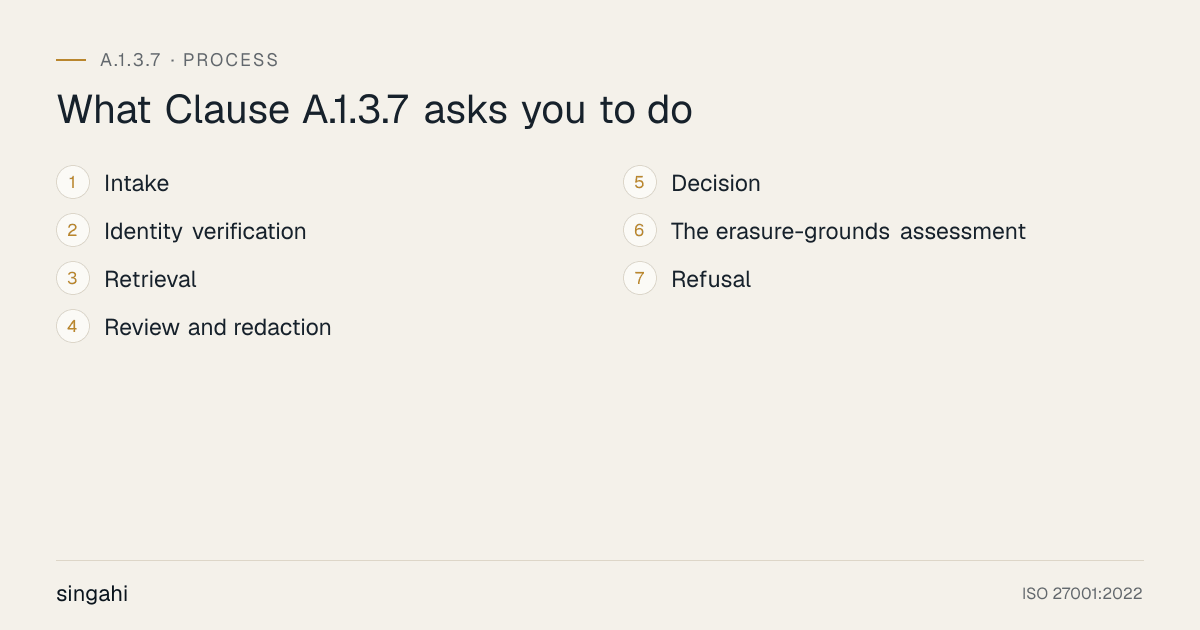
The Singahi eight-stage DSAR lifecycle (toolkit doc 02) operationalises A.1.3.7. Every conformant controller runs these eight stages; some add a ninth (Rights Log integrity review) as a separate cadence. The eight stages below are the load-bearing minimum.
Stage 1, Intake (the four channels, the single ticket)
The intake stage is where the rights request enters the controller's operation. The load-bearing design choice is the single ticket discipline: every request, regardless of channel, is captured as a single ticket in the Rights Log, with the channel recorded and the principal identified. The four channels feed the single ticket.
Channel 1, In-product rights dashboard. The principal opens the dashboard inside the controller's product, selects the right (access, correction, erasure), and submits. The dashboard is pre-authenticated (the principal is logged in); the identity-verification step is correspondingly lighter (the dashboard's authentication is the verification). The dashboard writes the ticket directly to the Rights Log.
Channel 2, Web form. The principal fills a form on the controller's website. The form may be anonymous (the principal provides their email; the controller sends a verification link) or authenticated (the principal logs in; the form is then equivalent to the dashboard). The web form's ticket is written to the Rights Log with the channel recorded as "web form" and the authentication state recorded.
Channel 3, Grievance Officer (DPDP section 13). The principal writes to the Grievance Officer (postal mail, email, web form, phone). The Grievance Officer (or the Grievance Officer's team) logs the ticket in the Rights Log, with the channel recorded as "Grievance Officer" and the section 13 period started. The Grievance Officer channel is the Indian statutory channel, every controller must operate it; the Grievance Officer's identity and contact must be published on the privacy policy and notice.
Channel 4, Consent Manager (DPDP section 2(1)(g)). The principal exercises consent withdrawal through the Consent Manager. The Consent Manager's signal arrives at the controller's Consent Manager endpoint; the controller's handler writes the ticket to the Rights Log, with the channel recorded as "Consent Manager", the consent identifier recorded, and the erasure-grounds assessment triggered (a Consent Manager withdrawal is, in substance, an erasure request for the data the consent authorised).
The single-ticket discipline. The most common intake failure is fragmentation: the in-product dashboard writes to one store, the web form to another, the Grievance Officer's inbox to a third, the Consent Manager endpoint to a fourth. The controller ends up with four rights realities; the auditor picks a principal and finds their requests fragmented across stores that do not reconcile. The single-ticket discipline consolidates all four channels into a single Rights Log; the channel is a field on the ticket, not a separate store.
Anti-patterns at intake. Channels that do not write to the Rights Log (the customer-support inbox that "forwards" to the DPO; the call-centre script that "manually processes" the request; the partner-routed request that arrives by email and is handled informally). Each anti-pattern fragments the operation; each is a common audit finding.
Stage 2, Identity verification (the four risk tiers)
The identity-verification stage confirms that the principal (or nominee) making the request is the principal (or nominee) to whom the data relates. The DPDP Act and the GDPR do not prescribe a specific identity-verification mechanism; the operational discipline is to match the verification to the risk of misdelivery. The Singahi four-tier risk model (toolkit doc 06):
Tier 1, Low risk (in-product authenticated request, low-sensitivity data). The principal is logged in to the controller's product; the request is for access or correction; the data involved is low-sensitivity (contact data, preferences, transaction history). The product's authentication (single-factor session token) is sufficient. No additional identity verification required. The auditor's red flag: Tier-1 verification used for high-sensitivity data or for erasure.
Tier 2, Moderate risk (in-product authenticated request, moderate-sensitivity data; or web-form request with email verification). The principal is logged in; the request is for access to moderate-sensitivity data (financial data, employment data); or the principal submits a web form and verifies their email. Step-up verification required: re-authentication (re-enter password), one-time-password to the registered email or phone, or step-up multi-factor.
Tier 3, High risk (erasure; access to sensitive data; nominee requests). The request is for erasure (irreversible; the principal must be certain); for access to sensitive data (health, biometric, special category); or the request is from a nominee (the nominee must prove the nomination and their own identity). Full multi-factor authentication required; the nominee must additionally produce the nomination record and identity evidence (the nomination itself, the principal's death certificate or incapacity evidence, the nominee's government identity).
Tier 4, Very high risk (high-value accounts; SDF; significant-data-volume erasure). The request is on a high-value account (e.g. Tier 4 verification includes Tier 3 plus a manual review by the DPO or the Grievance Officer, plus a callback or video verification where the controller's risk profile warrants.
The nominee dimension (DPDP section 14). The nominee flow is the operationally distinctive Indian overlay. The controller's rights workflow must accept requests from nominees (the nominee is the principal's designee in the event of death or incapacity). The verification must confirm (a) the nomination was recorded by the controller (the nomination is in the principal's record), (b) the triggering event (death certificate, medical evidence of incapacity), and (c) the nominee's identity (government-identity verification). The nominee then has the rights the principal would have had.
The children's dimension (DPDP section 9). For principals determined to be children, the rights request must be exercised by the parent (or legitimate guardian) who gave the verifiable parental consent under section 9. The controller's workflow must route child-principal requests through the parental-verification flow.
Anti-patterns at identity verification. Reply-email verification (the controller replies to the principal's email asking them to confirm, trivially spoofable); copies of government identity without verification (the controller accepts a screenshot of an Aadhaar card without checking liveness or matching to the principal's record); no step-up for erasure (the controller executes erasure on a Tier-1 verification, the principal's data is irreversibly deleted on weak evidence); no nominee flow (the controller has no mechanism for a section 14 nominee request, the nomination overlay fails).
Stage 3, Retrieval (every system of record)
The retrieval stage is where the controller assembles the principal's personal data from across the controller's estate. The retrieval plan (toolkit doc 02) lists every system of record and the retrieval pattern for each:
- Production databases, structured query by principal identifier; export to a structured format (CSV, JSON) for review.
- Marketing-automation platforms, audience-roster query; export of the principal's marketing record.
- CRM systems, contact-record query; export of the principal's CRM record (including support-ticket history, sales-engagement history).
- Analytics platforms, warehouse / lake query; the principal's events; the ML feature-store entries; the principal's segments.
- Backup archives, typically not queried directly; the erasure-grounds assessment addresses the backup dimension (retention-expiry flush). For access, the backup is not a separate item; the production data is the access response.
- Email systems, chat systems, ticketing systems, search by principal identifier; the principal's correspondence, chat transcripts, ticket history.
- Document-management systems and shared drives, search by principal identifier; the principal's documents.
- Call-centre recordings and contact-centre platforms, search by principal identifier; the principal's call recordings.
- Logs and telemetry, search by principal identifier; the principal's log entries (the access response should include these if they constitute personal data, they typically do).
- Vendor / processor estate, for access, the controller queries its processors under A.2.3.2 cooperation; for erasure, the controller propagates the erasure.
The retrieval plan is the controller's authoritative list of systems; it is itself an A.1.3.7 artefact (toolkit doc 02). The auditor will ask for the retrieval plan and trace one principal's data across every system; the canonical A.1.3.7 retrieval failure is the system that was not in the plan (typically the analytics warehouse, the call-centre recording system, the log store, or the backup archive).
The retrieval SLA. Retrieval is the operationally longest stage; the controller should target 5 to 10 business days for the retrieval across the full estate. Where retrieval is longer, the SLA reporting should explain the outliers.
Stage 4, Review and redaction
The review stage is where the controller's reviewer (typically a privacy analyst in the DPO's team) examines the retrieved data and prepares the access-response package. Three load-bearing disciplines operate here.
Third-party redaction. The retrieved data may contain other principals' personal data, the principal's spouse named in a support ticket; the principal's family members in a transaction record; the principal's colleagues in an email thread. The right of access does not entitle the principal to other principals' data. The reviewer redacts third-party personal data before delivery. The redaction is performed on the access-response package (a copy of the retrieved data), not on the source data (which remains intact). The redaction tooling ranges from manual (the reviewer marks up a PDF) to automated (a redaction service that identifies and masks personal-data patterns).
Trade-secret and confidential-business-information redaction. The retrieved data may contain the controller's trade secrets, confidential business information, internal deliberations, or legally privileged material. The right of access does not extend to these. The reviewer redacts; the controller documents the redaction rationale (which category of information was redacted; on what basis).
Completeness check. The reviewer confirms the access-response package covers every system in the retrieval plan; gaps are explained (e.g. the analytics warehouse returned no rows for this principal; the call-centre recordings were beyond retention and disposed). The completeness check is itself evidence, the auditor will ask "how do you know the access response is complete?" and the answer is the retrieval plan + the completeness check.
The review SLA. Review is the second-longest stage; the controller should target 5 to 10 business days for review. Where review is longer (typically for high-sensitivity or large-volume requests), the SLA reporting should explain.
Stage 5, Decision
The decision stage is where the controller determines the response to the request. For access, the decision is "deliver the access-response package". For correction, the decision is "execute the correction (or refuse with documented grounds)". For erasure, the decision is the erasure-grounds assessment (Section 7.6). For the manifestly-unfounded-or-excessive refusal, the decision is documented with the Article 12(5) analysis.
The access decision. The reviewer confirms the package is complete, redacted and ready. The decision is delivery. No additional assessment is required unless the request is manifestly unfounded or excessive (in which case the controller may refuse or charge a fee, see Section 7.7).
The correction decision. The reviewer confirms the correction is operationally feasible (the data is in a system that supports update; the correction is consistent with the principal's evidence). The decision is execute (amend the data; propagate the amendment to processors; record the correction in the Rights Log). Where the controller is required by law to retain the uncorrected version (financial-transaction records, KYC records), the controller annotates the record with the principal's correction rather than overwrites it; the decision is annotate.
The erasure decision. The erasure-grounds assessment (Section 7.6) is performed. The decision is execute (erase the data; propagate to processors; record the erasure), annotate (where erasure is barred by legal retention), partial-execute (where some data falls within grounds and some within exceptions), or refuse (where erasure is barred in full).
Stage 6, The erasure-grounds assessment (the distinctive A.1.3.7 operation)
The erasure-grounds assessment is the operationally distinctive A.1.3.7 sub-stage. For every erasure request, the controller performs a documented assessment that determines (a) whether the request falls within an erasure ground, and (b) whether an exception applies. The Singahi Erasure-Grounds Assessment template (toolkit doc 05) covers both the Indian and the GDPR grounds in a single decision tree.
Step 1, The Indian grounds (DPDP Act 2023).
- Section 12 (the principal's erasure right). The principal has requested erasure. The ground is established.
- Section 8(7) (the purpose-served duty). The purpose for which the data was collected is no longer served. The controller's ROPA (A.1.2.9) and purpose register (A.1.2.2) are the source of truth. Where the purpose is no longer served, the controller has an affirmative duty to erase (not merely to honour the principal's request).
- Section 6 consent withdrawal. Where consent was the basis and the principal has withdrawn consent through the Consent Manager or the in-product mechanism (A.1.3.5), the consent withdrawal triggers the erasure assessment for the data the consent authorised.
Step 2, The GDPR grounds (Article 17(1), where the principal is an EU data subject).
- 17(1)(a), Data no longer necessary. The purposes for which the data was collected have concluded.
- 17(1)(b), Consent withdrawn, no other basis. The principal withdrew consent under Article 7(3); no other Article 6 basis applies.
- 17(1)(c), Legal obligation to erase. The controller is required by EU or member-state law to erase.
- 17(1)(d), Unlawful processing. The processing was unlawful ab initio.
- 17(1)(e), Child's data (information-society services). Special protection for children's data.
Step 3, The exceptions (Article 17(3); the Indian sectoral equivalents).
- Freedom of expression. The erasure would conflict with the right to freedom of expression (rare in the controller's commercial context).
- Legal compliance. The controller is required by law to retain, the Indian sectoral rules (RBI financial records; SEBI KYC; IRDAI policyholder records; the Limitation Act; the Income Tax Act). The retention schedule (A.1.4.8) is the source of truth.
- Public health. The processing is necessary for public-health reasons (relevant for healthcare controllers).
- Archiving / research / statistics. The processing is for archiving, research or statistics in the public interest.
- Legal claims. The data is necessary for the establishment, exercise or defence of legal claims (relevant for controllers in litigation hold).
Step 4, The decision.
- Full erasure. A ground applies; no exception applies. Execute.
- Annotated retention. A ground applies; an exception applies (e.g. legal retention). The data is retained for the retention period; the principal's request is recorded; the principal is informed of the retention rationale.
- Partial erasure. Some data falls within a ground and no exception; some data falls within an exception. The erasure is partial; the principal is informed of the partial decision.
- Refusal. No ground applies, or an exception applies in full. The principal is informed of the refusal and the grounds; the Grievance Officer's escalation route is offered.
The 48-hour pre-erasure notice (DPDP Rules 2025). Before executing the erasure, the controller gives the principal a 48-hour pre-erasure notice, a notice that gives the principal a window to confirm or cancel before the erasure is executed. The pre-erasure notice is a distinctive Indian construct; the controller's erasure workflow must accommodate it. The notice includes the data to be erased, the grounds, the effective date, the principal's right to cancel, and the consequence of erasure (irreversibility).
The backup dimension. The erasure across the production estate is typically immediate; the erasure across the backup estate is typically via retention-expiry flush (the backups age out per their retention cycle; the principal's data is not specifically removed from the backups, but the backups are not used to restore the principal's data after the erasure). The erasure-grounds assessment should document the backup dimension, what is the backup retention; how is restoration prevented; what is the effective date of the backup erasure. The Singahi recommended pattern is to log the principal's erasure decision in a "do-not-restore" list that the restoration process consults; the principal's data is then effectively erased from the backup estate at the next backup-retention expiry.
Stage 7, Refusal (manifestly unfounded or excessive)
The refusal stage is where the controller may refuse to act on the request or may charge a reasonable fee. The GDPR Article 12(5) standard: where the request is manifestly unfounded or excessive (in particular because of its repetitive character), the controller may charge a reasonable fee (taking into account the administrative costs) or refuse to act. The burden is on the controller to demonstrate the unfounded or excessive character.
The unfounded-or-excessive assessment. The controller's reviewer documents: the request's repetitive character (the principal has made the same request N times in the period); the request's scope (the principal has asked for "everything you have on me" without further specification); the request's burden (the servicing would require N hours of analyst time; the principal has requested the data in an idiosyncratic format that requires manual preparation); the request's apparent purpose (the principal is using the request to harass, to interfere with the controller's operations, to obtain data for a competing business). The assessment is documented in the Rights Log; the principal is informed of the refusal decision, the grounds, and the right to complain to the supervisory authority.
The Indian position. DPDP does not have an explicit Article 12(5) equivalent; the Grievance Officer's escalation to the DPBI is the operational channel for handling repetitive or excessive requests. The Singahi recommended practice for Indian controllers: treat the Article 12(5) standard as the operational discipline even where the principal is Indian (the Documentation of the assessment is the defence against a section 13 Grievance Officer escalation).
Stage 8, Delivery and propagation
The delivery and propagation stage is where the controller delivers the access-response package (for access requests), executes the correction (for correction requests), executes the erasure (for erasure requests), and propagates the change to downstream recipients.
Access delivery. The access-response package is delivered to the principal through the channel the principal nominated (typically email with a secure-download link, or in-product download from the rights dashboard). The package is encrypted in transit; the principal is given the decryption key through a separate channel (the "two-channel" delivery pattern). The package is delivered within the SLA (DPDP Rules period; GDPR one month, extendable by two with notice).
Correction execution. The controller amends the data; the amendment is recorded (the original value, the new value, the timestamp, the principal's request reference); the propagation fires.
Erasure execution. The controller deletes the data; the deletion is recorded (the data categories, the systems, the timestamp, the erasure-decision reference); the "do-not-restore" list is updated; the propagation fires.
Propagation. The propagation fires to every recipient of the principal's data:
- Processors (the marketing-automation platform, the CRM, the analytics warehouse, the cloud processor), the controller sends the correction / erasure signal through the propagation API; the processor confirms effect.
- Sub-processors, the processor propagates to its sub-processors under A.2.5.x; the controller verifies via the processor's attestation.
- Joint controllers, under A.1.2.8, the joint-controller arrangement specifies the propagation; the controller notifies the joint controller.
- Third-party recipients, under A.1.3.8, the controller notifies each third-party recipient of the correction / erasure (GDPR Article 19; the Indian equivalent is implicit in section 12).
- Consent Manager, the controller notifies the Consent Manager (so the Consent Manager's record reflects the principal's current state).
The propagation SLA: 24 to 72 hours for processors; 24 hours for joint controllers; 5 business days for third-party recipients (some of whom will require manual notification).
Stage 9, Log (the immutable Rights Log)
The log stage is where the entire request, from intake to propagation, is recorded in the Rights Log. The Singahi Rights Log schema (toolkit doc 07) covers the fourteen minimum fields:
- Ticket identifier, UUID.
- Principal identifier, pseudonymous or tokenised; the linkage to the principal's record is held in a separate secure store.
- Channel, in-product dashboard / web form / Grievance Officer / Consent Manager.
- Right exercised, access / correction / erasure / nominee request / child-principal request.
- Request received timestamp, NTP-synchronised, UTC, with timezone.
- Identity verification tier, Tier 1 / Tier 2 / Tier 3 / Tier 4; the verification evidence reference.
- Retrieval plan reference, the systems queried; the completeness-check result.
- Redaction log, third-party data redacted; trade-secret / confidential / privileged redacted; the rationale.
- Decision, execute / annotate / partial / refuse; the decision rationale.
- Erasure-grounds assessment reference (for erasure requests), the ground; the exception; the 48-hour pre-erasure notice timestamp; the principal's response.
- Delivery, the channel; the timestamp; the decryption-key delivery channel.
- Propagation log, each recipient; the signal sent; the acknowledgement received; the SLA status.
- SLA attainment, within-period (yes/no); the elapsed time; any extension invoked with the rationale.
- Integrity seal, cryptographic seal over the record.
The integrity seal is the load-bearing addition that distinguishes a defensible Rights Log from a generic database table. The seal is computed at ticket-close time using a key accessible only to the Rights Log service; any subsequent modification recomputes the seal. A Rights Log with integrity seals withstands the post-incident integrity question ("could an employee have modified this record?") with a clean technical answer.
The Grievance Officer channel (DPDP section 13), in operation
The Grievance Officer is the Indian statutory channel that every controller must operate. The Grievance Officer is an individual (not a team), designated by name on the controller's privacy policy and notice, reachable through a published contact (postal address, email, and where the Rules prescribe, a phone number and a web form). The Grievance Officer's responsibilities:
- Acknowledge each complaint promptly (24 to 48 hours is a sensible internal target; the DPDP Rules set no acknowledgment time) and resolve it within the published period, which Rule 14(3) caps at ninety days.
- Investigate the complaint; coordinate with the DPO, Engineering, Legal, Customer Support as needed.
- Respond substantively within the prescribed period (the operational practice converges on a defined window, typically 30 days for substantive response).
- Escalate to the DPBI under section 13 if the complaint cannot be resolved at the controller level; the escalation path is itself a section 13 obligation.
- Maintain the Grievance Register, the log of grievances received, investigated, resolved, escalated.
The Grievance Officer's role is the regulatory-facing one; the Grievance Officer's identity, contact and effective mechanism are themselves evidence (the auditor will ask: who is the Grievance Officer; is the name on the policy; is the contact reachable; what is the average response time; what is the DPBI escalation history).
The Consent Manager integration (DPDP section 2(1)(g))
The Consent Manager, the Indian construct with no direct GDPR analogue, is a registered, principal-side, interoperable, revocable intermediary through which a Data Principal gives, manages, reviews and withdraws consent across multiple Data Fiduciaries. As the DPDP Rules' commencement phases the ecosystem in through 2026 and 2027, the controller's A.1.3.7 architecture must accommodate it.
The controller exposes a Consent Manager endpoint that:
- Accepts consent-grant and consent-withdrawal signals from registered Consent Managers on behalf of a principal.
- Provides the principal's current consent state on query.
- Honours the Consent Manager's interoperability format (so the principal can move between Consent Managers, consent state is portable).
- Treats a consent-withdrawal as an erasure trigger (the data the consent authorised is the subject of the erasure-grounds assessment).
The controller verifies the Consent Manager's DPBI registration before accepting signals (one-time onboarding plus periodic re-verification). Until the ecosystem is live, the controller operates an in-house rights dashboard (the A.1.3.5 mechanism) that meets the as-easy-to-withdraw test and is designed to be retrofitted as a Consent Manager endpoint, controllers that build a fragile in-house mechanism and plan to "add Consent Manager later" typically face a costly rebuild.
Erasure-at-scale. The Consent Manager is uniquely powerful for erasure at scale: a principal can withdraw consent across multiple Data Fiduciaries through a single Consent Manager action, and each Fiduciary must execute the erasure in response. For controllers, this is operationally significant, a Consent Manager-driven erasure wave is a load-test of the controller's erasure pipeline. The Singahi recommended pattern is to design the erasure pipeline for burst capacity (10x the typical daily erasure volume) so that a Consent Manager wave does not break the SLA.
The nominee flow (DPDP section 14)
The nominee flow is the operationally distinctive Indian overlay. The controller's rights workflow must accept requests from nominees (the nominee is the principal's designee in the event of death or incapacity). The verification must confirm:
- The nomination was recorded by the controller. The nomination is in the principal's record (the controller's nomination-capture mechanism; the controller should accept nominations through the rights dashboard, the web form, and the Grievance Officer).
- The triggering event. The principal's death certificate (in the event of death); medical evidence of incapacity (in the event of incapacity). The controller's policy should specify the acceptable evidence.
- The nominee's identity. Government-identity verification (the nominee's Aadhaar, PAN, passport, voter ID).
The nominee then has the rights the principal would have had, access, correction, erasure, grievance. The nominee flow is one of the least-discussed but most-distinctive features of the Indian rights regime; controllers that omit it have a section 14 violation when a nominee request arrives.
The integrity controls and the Rights Log compromise drill
The Rights Log is a regulated artefact; its integrity is governed by Annex A.3 controls: A.3.14 (protection against destruction or falsification, tamper-evidence, integrity seals, append-only modifications); A.3.9 (least-privilege access, DPO and the Rights Log service write, downstream functions read slices, principal access mediated through A.1.3.7); A.3.23 (strong authentication, multi-factor for administrative access); A.3.25 (logging of every read and write, with tamper-evident logs retained on the Log's schedule); A.3.26 (cryptography, encryption at rest, integrity seal, TLS in transit); A.3.24 (backup with annual restoration test); A.3.21 (secure disposal at end of retention with disposal logged).
The Rights Log compromise drill (toolkit doc 08) is the canonical A.1.3.7 maturity test for the integrity dimension. The drill simulates an unauthorised access to or exfiltration of the Log and walks through detection (MTTD target in hours), containment (revoke, isolate, restore), assessment (what data, how many principals, what categories, including the access-response packages in the Log), notification (the dual-clock pattern, CERT-In six hours under Directions of 28 April 2022; DPDP without delay plus a seventy-two-hour detailed report under section 8(6) + Rules 2025 Rule 7; sector-regulator clocks where applicable, RBI six hours, SEBI 6 hours, IRDAI 24 to 72 hours), principal notification (without undue delay, plain language) and post-incident review (root cause, corrective action under Clause 10.2, improvement under Clause 10.1). Cadence: annually for growing companies; semi-annually for mid-sized and enterprise; semi-annually plus tabletops between for SDFs.
Tools, Technologies, and Solutions
The tool landscape
A.1.3.7 is operationally supported by five classes of tool. The choice of tool is a risk-treatment decision (Section 10), not a one-size-fits-all prescription.
Privacy-request / DSAR platforms. Software products that take the principal through the request, verify identity, route the ticket to the handling workflow, manage retrieval from connected systems, support redaction, deliver the response, and propagate to processors. Generic category terms, "privacy-request platform", "DSAR automation platform", "subject-rights-request platform", "data-subject-rights software", are the right vocabulary; this guide does not name vendors.
Data-discovery and classification platforms. These platforms scan the controller's estate (production databases, file shares, email, analytics) to identify where personal data resides, classify it by sensitivity, and produce the data map that powers retrieval. The retrieval plan (Section 7.3) draws on the data-discovery platform's output.
Redaction tooling. Tools that identify and mask personal-data patterns in the access-response package, from regex-based pattern matchers (Aadhaar numbers, PAN numbers, email addresses, phone numbers) to NLP-driven entity recognisers (names, addresses, dates of birth) to ML-driven content classifiers (sensitive topics, trade secrets, privileged material).
Consent Manager integration platforms. As the Indian Consent Manager ecosystem goes live, platforms that bridge the controller's rights operation with registered Consent Managers, accepting grants, withdrawals, and state queries in the interoperable format. Generic category: "Consent Manager integration layer".
Identity verification platforms. Tools that perform step-up verification, one-time-password, government-identity verification, video verification, liveness checks. Generic categories: "identity verification service", "step-up authentication service", "KYC platform".
The build-vs-buy decision
The build-vs-buy decision turns on four factors.
Volume and channel diversity. High-volume controllers with diverse channels (in-product, web form, Grievance Officer, Consent Manager) typically need either a top-tier enterprise DSAR platform or an in-house build; lower-volume controllers with a single channel can run effectively on a mid-tier SaaS platform.
Identity-verification requirements. Where the controller's risk profile demands high-tier verification (BFSI, healthcare, SDFs), the build pattern or a top-tier platform with identity-verification integration is appropriate. Where the risk profile is lower (small B2B lead-gen, for example), a mid-tier SaaS platform without high-tier verification is sufficient if the verification procedure is documented.
Multi-jurisdiction complexity. Where the controller processes personal data across DPDP, GDPR, US-state and sector regimes, the multi-jurisdiction configuration overhead favours an enterprise platform. Single-jurisdiction controllers can run effectively on a simpler tool.
Consent Manager integration. As the Indian Consent Manager ecosystem goes live, the controller's tool must support the Consent Manager API. Building this in-house is feasible for engineering-led controllers; buying a Consent-Manager-ready platform is the alternative. The decision should account for the cost of retrofitting a Consent Manager integration onto a tool that was not designed for it.
The data-discovery layer
The retrieval plan is only as good as the data map. A controller that does not know where the principal's data lives cannot retrieve it. The data-discovery platform's role is to maintain the data map, scanning the estate periodically, classifying personal data by sensitivity, identifying the systems of record for each principal.
The data-discovery platform's integration with the retrieval plan is the load-bearing technical detail. The platform should produce, for each principal, a map of the systems where the principal's data resides; the retrieval plan draws on this map. Controllers that maintain the retrieval plan manually (without a discovery platform) typically miss the systems that were added in the last quarter, a new analytics pipeline, a new vendor, a new log store, and the retrieval plan drifts from the operational reality.
The redaction layer
The redaction layer is operationally non-trivial. The retrieved data may contain hundreds of third-party personal-data mentions across thousands of records; manual redaction does not scale. The recommended pattern is:
- Pattern-based redaction (regex / pattern matcher), for structured identifiers (Aadhaar numbers, PAN numbers, email addresses, phone numbers, credit-card numbers). High precision; modest recall.
- Entity-based redaction (NLP-driven entity recogniser), for names, addresses, dates of birth. Higher recall; needs calibration.
- Content-based redaction (ML-driven classifier), for sensitive topics, trade secrets, privileged material. Highest recall; needs training data.
- Manual review, for edge cases, escalations, and quality assurance on the automated redaction.
The redaction layer's quality is itself a KPI (Section 12): the precision (did we redact what should be redacted) and the recall (did we miss anything that should have been redacted) of the redaction pipeline.
The Consent Manager ecosystem readiness
The Consent Manager ecosystem under DPDP section 2(1)(g) is emerging. As of mid-2026, the Rules have been notified (13 November 2025) and the Consent Manager registration conditions are in the Rules; the first registered Consent Managers are expected through 2026 and 2027. A controller building or buying a rights tool today should confirm that the tool supports:
- A documented API for accepting consent-withdrawal signals from external Consent Managers and treating them as erasure triggers.
- A documented API for providing the principal's current consent-and-rights state on query to external Consent Managers.
- A documented data-portability format (the principal's right to move between Consent Managers).
- A registration-verification mechanism for Consent Manager onboarding.
- Burst-capacity erasure pipeline (10x typical daily volume) to handle Consent Manager-driven erasure waves.
Controllers that select tools without these capabilities will face a costly retrofit or replacement as the ecosystem goes live.
Policy and Procedure Templates
The Singahi toolkit (Section 19) ships ready-to-customize templates for the A.1.3.7 artefact set. The eight core artefacts are:
The Rights Management Policy (toolkit doc 01)
The policy commits the controller to the rights discipline. The load-bearing clauses (the controller's own "shall" clauses, drafted by Singahi, not the standard's text):
- The controller shall give every PII principal / Data Principal the ability to exercise the rights of access, correction and erasure, and shall operate the procedures that deliver those rights within the timelines prescribed by the DPDP Act 2023 and the DPDP Rules 2025 (and the GDPR Article 12(3) one-month clock where the principal is an EU data subject).
- The controller shall operate the four channels, the in-product rights dashboard, the web form, the Grievance Officer (DPDP section 13), and the Consent Manager (section 2(1)(g)), and shall consolidate every request into a single Rights Log.
- The controller shall perform risk-tiered identity verification (Section 7.2) on every rights request, with Tier-3 verification for erasure, for access to sensitive data, and for nominee requests.
- The controller shall maintain a retrieval plan covering every system of record in the controller's estate and shall perform a completeness check on every access response.
- The controller shall redact third-party personal data, trade secrets and confidential business information from every access response, with the redaction rationale documented.
- The controller shall perform the erasure-grounds assessment on every erasure request, covering the DPDP grounds (section 12, section 8(7), section 6 withdrawal) and the GDPR Article 17 grounds where applicable, and the exceptions (legal retention, public interest, archiving, legal claims).
- The controller shall give the principal a 48-hour pre-erasure notice before executing erasure under the DPDP Rules 2025.
- The controller shall propagate corrections and erasures to every downstream processor, joint controller and third-party recipient, and shall require processor acknowledgement within the contractually committed SLA (24 to 72 hours for processors; 24 hours for joint controllers; 5 business days for third-party recipients).
- The controller shall appoint a Grievance Officer (DPDP section 13), publish the identity and contact on the privacy policy and notice, and service the channel within the prescribed period.
- The controller shall honour the section 14 nomination right, including the verification of the nominee's identity and the triggering event.
- The controller shall integrate with registered Consent Managers under section 2(1)(g) as the ecosystem goes live, supporting interoperability, revocability, portability, and the Consent Manager-driven erasure wave.
- The controller shall run the Rights Log compromise drill at least annually, with tabletop exercises between, tracing the dual-clock notification pattern (CERT-In six hours; DPDP without delay plus a seventy-two-hour detailed report; sector-regulator clocks where applicable).
The DSAR Intake and Triage Procedure (toolkit doc 02)
The procedure operationalises the policy through the eight-stage lifecycle (Section 7). Each stage has documented acceptance criteria, an owner, a control mechanism, a KPI and a cadence.
The Access Response Template (toolkit doc 03)
The template formalises the access-response package, the elements that must be present in every access response (the DPDP section 11 summary elements; the GDPR Article 15 elements where applicable; the controller's own commitments). The template includes the structure (the principal's personal data by category; the processing activities; the recipients; the retention; the rights; the source; the ADM logic where applicable), the format (machine-readable; structured; portable to the Consent Manager and to a nominated Data Fiduciary), the redaction rationale (the categories of information redacted; the basis), and the delivery mechanism (the two-channel pattern).
The Correction and Erasure Workflow (toolkit doc 04)
The workflow covers the four sub-stages of correction (Section 7.5) and the seven sub-stages of erasure (Section 7.6), including the 48-hour pre-erasure notice, the do-not-restore list, and the propagation. The workflow includes the escalation path when a processor does not acknowledge within the SLA.
The Erasure-Grounds Assessment template (toolkit doc 05)
The template covers the four-step assessment (Section 7.6), Indian grounds, GDPR grounds, exceptions, decision, in a single decision tree. The template is the load-bearing evidence for every erasure request; the auditor will ask for the assessment on a sample of recent erasures.
The Identity Verification Procedure (toolkit doc 06)
The procedure covers the four risk tiers (Section 7.2), the nominee flow (Section 7.12), the children's flow (Section 7.2, child-principal requests routed through the parental-verification flow), and the verification evidence requirements.
The Rights Log Register (toolkit doc 07)
The register formalises the fourteen minimum fields (Section 7.9) and the optional fields (the retrieval plan reference; the integrity seal reference; the propagation log). The register is published as a JSON schema, a relational data model, and a documentation template.
The Grievance Officer Escalation Playbook (toolkit doc 08)
The playbook covers the Grievance Officer's responsibilities (Section 7.10), acknowledge, investigate, respond, escalate, maintain the Grievance Register. The playbook includes the DPBI escalation procedure, the dual-clock notification pattern for the Rights Log compromise, and the post-incident review template.
The Consent Manager Erasure Integration Specification (toolkit doc 09)
The specification covers the API surface (accept grant, accept withdrawal, query state, portability), the Consent Manager registration verification, the dual-record pattern (in-house vs Consent Manager), the burst-capacity erasure pipeline, and the interoperability requirements.
Rights Risk Assessment and Treatment
The risk register entries that touch A.1.3.7
Rights-specific risks in the controller's privacy risk register typically include:
| ID | Risk | Likelihood | Impact | Treatment |
|---|---|---|---|---|
| RTS-01 | Rights channels fragmented (no single Rights Log) | High (initially) | High (cannot evidence) | Consolidate to single Rights Log; channel is a field on the ticket |
| RTS-02 | Identity verification too weak for the request risk | High | Very high (misdelivery) | Adopt the four-tier risk model; step-up verification per tier |
| RTS-03 | Retrieval plan incomplete (systems missing) | High | High (incomplete access response) | Maintain retrieval plan with data-discovery platform; quarterly reconciliation |
| RTS-04 | Third-party data not redacted | Medium | High (breach of third-party privacy) | Redaction pipeline; quality KPIs (precision, recall) |
| RTS-05 | Erasure executed without grounds assessment | Medium | Very high (irreversible deletion of legally-retained data) | Mandatory assessment template; two-person approval for erasure |
| RTS-06 | Erasure refused without documenting the grounds | Medium | High (section 12 violation) | Mandatory assessment; refusal template |
| RTS-07 | 48-hour pre-erasure notice not sent | Medium | Medium (Rules violation) | Workflow enforcement; notice template pre-staged |
| RTS-08 | Corrections not propagated to processors | High | High (continued processing of inaccurate data) | Propagation API; processor acknowledgement required |
| RTS-09 | Erasures not propagated to processors | High | Very high (continued processing of erased data) | Propagation API; processor acknowledgement required; do-not-restore list shared |
| RTS-10 | Grievance Officer channel not serviced | Medium | High (section 13 violation) | Publish identity and contact; weekly Grievance Register review |
| RTS-11 | SLA not met (DPDP Rules period; GDPR one month) | Medium | Medium (section 13 / Article 12 violation) | SLA monitoring; extension-invocation discipline |
| RTS-12 | Consent Manager-driven erasure wave exceeds pipeline capacity | Low | High (SLA breach across many principals) | Burst-capacity erasure pipeline (10x typical) |
| RTS-13 | Nominee flow missing | High (when triggered) | High (section 14 violation) | Nominee verification procedure; nominee channel in intake |
| RTS-14 | Child-principal requests not routed through parent | Medium | Very high (section 9 violation; INR 200 crore exposure) | Age-assurance upstream; routing to parental-verification flow |
| RTS-15 | Rights Log compromised | Low | Very high (DPDP section 8(6) penalty; CERT-In; sector clocks) | Integrity controls (A.3.14, A.3.25, A.3.26); annual compromise drill; dual-clock notification playbook |
| RTS-16 | Manifestly-unfounded refusal without documented assessment | Low | High (Article 12(5) failure) | Refusal template; reviewer sign-off; principal informed of complaint right |
| RTS-17 | Backup estate not addressed in erasure | High | Medium (residual data in backups) | Do-not-restore list; retention-expiry flush; documented in erasure decision |
| RTS-18 | Access response includes inaccurate data (drift from source) | Medium | Medium (inaccurate response) | Source-system reconciliation; review-stage validation |
| RTS-19 | Access response delivered through insecure channel | Low | High (breach during delivery) | Two-channel delivery pattern; encryption in transit; key through separate channel |
| RTS-20 | Joint-controller propagation missing | Medium | High (Article 19 / section 12 violation) | Joint-controller arrangement specifies propagation; A.1.2.8 linkage |
The DPIA trigger analysis for rights-handling capacity
A.1.2.6 (privacy impact assessment) and DPDP section 10 (SDF DPIA) trigger DPIAs for several rights-handling patterns:
- Large-scale rights operations (typically tens of thousands of principals or more)
- Rights operations for children's data (always, DPDP section 9)
- Rights operations for special-category data (health, biometric, genetic, sex life, caste, tribe, political opinion, religious belief)
- AI-mediated rights decisions (automated manifestly-unfounded-or-excessive refusal; automated erasure-eligibility decision; automated identity-verification decision)
- Rights operations involving nominee flows (the nominee's identity evidence is sensitive)
- Rights operations involving the Consent Manager (interoperability implies data portability across Consent Managers; the portability is a transfer dimension)
The DPIA's recommendations feed back into the A.1.3.7 operation. The DPIA is reviewed when the rights architecture changes materially (new channel; new processor; new technology; new regulatory regime).
The risk-treatment decision points
For each rights-related risk, the treatment decision takes one of four paths:
- Modify, change the design (the channel; the verification tier; the redaction pipeline; the erasure-grounds assessment) to reduce the likelihood or impact.
- Avoid, do not process on the basis that creates the risk (decline the new processor; do not deploy the AI-mediated refusal; do not launch the new channel without the nominee flow).
- Share, transfer the risk to a third party (the Consent Manager; the processor under indemnity; an insurer under a cyber-insurance policy).
- Accept, accept the residual risk with documented sign-off (typically a top-management decision under Clause 6.1.3 / 6.1.4).
The risk-treatment decisions are recorded in the privacy risk treatment plan (Clause 8.3) and reflected in the Statement of Applicability (the A.3 controls selected to mitigate the rights risks).
Audit and Compliance Checklist
The following 28 questions cover the certification auditor's typical A.1.3.7 examination. For each, the expected evidence and the red flag are noted.
-
Is there a Rights Management Policy? Expected: a dated, version-controlled policy signed off by the DPO and top management, covering the three rights, the four channels, the eight-stage procedure, the SLAs, the erasure-grounds assessment, the Grievance Officer, the Consent Manager plan. Red flag: no policy; or policy exists but is generic (no India-specific content; no Grievance Officer; no Consent Manager plan).
-
Is there a documented DSAR Intake and Triage Procedure? Expected: a procedure covering the eight stages with acceptance criteria, owners, KPIs and cadence. Red flag: no procedure; or procedure exists but does not cover all eight stages.
-
Is there a Rights Log? Expected: a current Rights Log listing every rights request with the fourteen minimum fields populated. Red flag: no Log; or Log exists but is shorter than reality (informal emails, in-app corrections, partner-routed requests missed).
-
Are the four channels operating? Expected: the in-product rights dashboard, the web form, the Grievance Officer (named; contact published), the Consent Manager (integration plan or live). Red flag: only one channel operating; Grievance Officer not appointed; Consent Manager not planned.
-
Is the single-ticket discipline enforced? Expected: every channel writes to the single Rights Log; channel is a field on the ticket. Red flag: channels fragmented across multiple stores.
-
Is identity verification risk-tiered? Expected: the four-tier model documented; tier applied per request; evidence recorded. Red flag: uniform (low-tier) verification across all requests; or ad-hoc verification.
-
Is the retrieval plan maintained? Expected: the plan lists every system of record; quarterly reconciliation; new systems added within the quarter. Red flag: no plan; or plan is stale (newer systems missing).
-
Is the access response complete? Expected: completeness check on each response; gaps explained. Red flag: responses omit systems without explanation.
-
Is third-party data redacted? Expected: redaction pipeline (pattern + entity + content + manual review); quality KPIs. Red flag: no redaction; or manual redaction only without quality assurance.
-
Is the erasure-grounds assessment performed for every erasure? Expected: assessment template per request; two-person approval; documented decision. Red flag: erasures executed without assessment; or assessment performed but not documented.
-
Is the 48-hour pre-erasure notice sent? Expected: notice template; workflow enforcement; principal's response recorded. Red flag: erasures executed without notice; or notice not in the workflow.
-
Is the do-not-restore list maintained? Expected: list shared with restoration process; principal's data not restored after erasure. Red flag: no do-not-restore list; or list exists but not consulted by restoration.
-
Are corrections propagated to processors? Expected: propagation API; processor acknowledgement; SLA monitoring. Red flag: no propagation; or propagation exists but no acknowledgement or SLA monitoring.
-
Are erasures propagated to processors? Expected: same as corrections; plus do-not-restore list shared. Red flag: no propagation; or propagation exists but erasure not effective at the processor.
-
Is the Grievance Officer channel serviced? Expected: Grievance Officer named; contact published; Grievance Register current; response within prescribed period. Red flag: Grievance Officer not appointed; or appointed but channel not serviced.
-
Is the nominee flow implemented? Expected: nomination-capture mechanism; verification procedure; nominee requests serviced. Red flag: no nominee flow; or flow exists but verification inadequate.
-
Is the child-principal flow implemented? Expected: age-assurance upstream; routing to parental-verification; section 9 prohibitions enforced. Red flag: child principals processed as adults; parental-verification missing.
-
Is the SLA monitored? Expected: SLA attainment KPI; trends analysed; outliers investigated; extension-invocation discipline. Red flag: no SLA monitoring; or monitoring exists but outliers not investigated.
-
Is the Consent Manager integration designed? Expected: API design; Consent-Manager-ready tool selection; dual-record pattern. Red flag: no plan; tool selection without Consent Manager capability.
-
Is the Rights Log compromise drill run on cadence? Expected: annually for growing companies; semi-annually for mid-sized and enterprise; tabletops between. Red flag: no drill; or drill exists but does not trace the dual-clock pattern.
-
Are the integrity controls operating? Expected: A.3.14, A.3.9, A.3.23, A.3.25, A.3.26, A.3.24, A.3.21 operating; control evidence available. Red flag: any of these controls not operating on the Rights Log.
-
Is the Rights Log access least-privilege? Expected: documented access roles; quarterly access review; revocation on role change. Red flag: broad write access; no access review.
-
Is the manifestly-unfounded-or-excessive refusal documented? Expected: refusal template; reviewer sign-off; principal informed of complaint right. Red flag: refusals without documentation; or refusals without principal notification.
-
Is the partner-routed request intake in place? Expected: partner-data agreement specifying the intake; validation on intake. Red flag: partner requests accepted without intake validation.
-
Is the backup dimension addressed in erasure? Expected: do-not-restore list; retention-expiry flush; documented in the erasure decision. Red flag: backups not addressed; or addressed but without do-not-restore.
-
Is the joint-controller propagation specified? Expected: joint-controller arrangement (A.1.2.8) specifies the propagation; propagation executed. Red flag: joint-controller arrangement silent on propagation.
-
Are the rights KPIs reported to the management review? Expected: KPIs (Section 12) reported at the Clause 9.3 management review; trends analysed; improvement actions taken. Red flag: no KPIs; or KPIs exist but not reported.
-
Is the Rights Log restoration tested? Expected: at-least-annual restoration from backup; restoration time and integrity verified. Red flag: no restoration test; or test exists but restoration time or integrity is unacceptable.
Metrics and KPIs
Figure · Measures
The measures that show Clause A.1.3.7 is working
- Rights-request intake channel mixbalanced mixPeriodic
- Identity-verification tier distributiondistributionPeriodic
- Retrieval completeness100% with doc…Periodic
- Redaction precision and recallprecision 98%+Periodic
- Access-response turnaround time7 to 14 busin…Periodic
The Singahi A.1.3.7 KPI set (toolkit doc 14) covers process quality, lifecycle performance, integrity and regulatory responsiveness. The fifteen KPIs below are the recommended minimum.
Process-quality KPIs
-
Rights-request intake channel mix, the percentage of requests by channel (in-product dashboard / web form / Grievance Officer / Consent Manager). Target: balanced mix; no single channel dominating; growth in the Consent Manager channel as the ecosystem goes live.
- Formula: count by channel / total requests × 100
- Frequency: monthly
- Owner: DPO / Privacy Lead
-
Identity-verification tier distribution, the percentage of requests by verification tier (Tier 1 to Tier 4). Target: distribution appropriate to the controller's risk profile; high concentration in Tier 1 may indicate under-verification; high concentration in Tier 4 may indicate over-verification (operational cost).
- Frequency: monthly
- Owner: DPO / Privacy Lead
-
Retrieval completeness, the percentage of access responses that cover every system in the retrieval plan. Target: 100% with documented exceptions.
- Formula: (responses with complete retrieval / total access responses) × 100
- Frequency: monthly
- Owner: Engineering Lead
-
Redaction precision and recall, the percentage of redacted items that were correctly redacted (precision); the percentage of items that should have been redacted that were redacted (recall). Target: precision 98%+; recall 99%+ (with manual review covering the gap).
- Frequency: monthly (sample-based audit)
- Owner: DPO / Privacy Lead
Lifecycle-performance KPIs
-
Access-response turnaround time (median, p95), the time from intake to delivery, by request complexity (low / medium / high). Target: 7 to 14 business days median; p95 within the SLA (DPDP Rules period; GDPR one month).
- Formula: time(delivery) - time(intake)
- Frequency: monthly
- Owner: DPO / Privacy Lead
-
Correction turnaround time (median, p95), same. Target: 5 to 10 business days median; p95 within the SLA.
- Frequency: monthly
- Owner: Engineering Lead
-
Erasure turnaround time (median, p95), same, including the 48-hour pre-erasure notice and the propagation. Target: 10 to 20 business days median; p95 within the SLA.
- Frequency: monthly
- Owner: Engineering Lead
-
SLA attainment, the percentage of requests served within the SLA. Target: 95%+ (with extension-invocation discipline for the rest).
- Formula: (requests served within SLA / total requests) × 100
- Frequency: monthly
- Owner: DPO / Privacy Lead
-
Extension-invocation rate, the percentage of requests where the SLA was extended (GDPR two-month extension; DPDP extension). Target: low (under 10%); high rate indicates capacity or complexity issues.
- Frequency: monthly
- Owner: DPO / Privacy Lead
-
Manifestly-unfounded-or-excessive refusal rate, the percentage of requests refused under Article 12(5) or equivalent. Target: low (under 1%); high rate indicates either a genuine pattern of unfounded requests or an overly aggressive refusal practice.
- Frequency: monthly
- Owner: DPO / Privacy Lead
Integrity KPIs
-
Rights Log access-review completion, the percentage of Log access roles reviewed in the period. Target: 100% quarterly.
- Frequency: quarterly
- Owner: DPO / Privacy Lead
-
Rights Log anomaly count, the count of detected anomalies (integrity-seal mismatches, unexpected modifications, access anomalies). Target: zero; each anomaly investigated under Clause 10.2.
- Frequency: monthly
- Owner: Engineering Lead
-
Rights Log compromise drill score, the score on the most recent drill (detection time, containment time, notification completeness against the dual-clock pattern). Trend over time.
- Frequency: annually or semi-annually
- Owner: DPO / Privacy Lead
Regulatory-responsiveness KPIs
-
Grievance-response time, the median time to respond to grievances (within the DPDP Rules' prescribed period). Target: 100% within the prescribed period.
- Frequency: monthly
- Owner: Grievance Officer
-
Propagation latency (median, p95), the time from controller's correction / erasure execution to processor's acknowledgement, by processor. Target: 24 to 72 hours median.
- Formula: time(acknowledgement) - time(controller execution)
- Frequency: monthly
- Owner: Engineering Lead
Common Pitfalls and Audit Failures
The most common A.1.3.7 audit findings in the Indian growing-company segment, in rough descending order of frequency.
The "policy but no operation" gap
The controller has a privacy policy that mentions the rights of access, correction and erasure, but no actual rights operation. The principal's request goes to customer support; the support agent "handles it"; no ticket is created; no Log is maintained; no retrieval is performed; no redaction is applied; no propagation fires. The auditor's first walk-through surfaces this gap immediately. The remediation is to build (or buy) a single rights operation and consolidate the channels to it.
The fragmented channels
The in-product dashboard writes to one store, the web form to another, the Grievance Officer's inbox to a third, the Consent Manager endpoint to a fourth. The controller has four rights realities; none reconciles with the others. The auditor picks a principal and finds their requests fragmented. Remediation: single Rights Log; channel as a field.
The reply-email identity verification
The controller verifies identity by replying to the principal's email ("please confirm you sent this request"). Trivially spoofable. Fails the verification dimension; misdelivery risk is high. Remediation: risk-tiered verification per Section 7.2.
The retrieval plan that missed the analytics warehouse
The retrieval plan covers the production database, the CRM, and the marketing-automation tool. It does not cover the analytics warehouse, the call-centre recording system, the log store, or the backup archive. The access response omits the principal's data in those systems. Fails the completeness dimension. Remediation: data-discovery-driven retrieval plan; quarterly reconciliation.
The access response that delivered other principals' data
The retrieved data contained the principal's spouse's name, the principal's family members' details, and the principal's colleagues' email addresses. The reviewer did not redact. The principal received other principals' data, itself a personal-data breach. Remediation: redaction pipeline; quality KPIs.
The erasure without grounds assessment
The principal requested erasure; the controller executed immediately. The data erased was subject to a legal-retention requirement (RBI financial records; SEBI KYC). The controller is now in breach of the sector rule and may face regulatory action. Remediation: mandatory erasure-grounds assessment; two-person approval.
The erasure refused without grounds
The principal requested erasure; the controller refused without documenting the grounds. The principal escalates to the Grievance Officer; the Grievance Officer cannot evidence the refusal rationale; the principal escalates to the DPBI. Remediation: mandatory assessment; refusal template.
The 48-hour pre-erasure notice missing
The controller executes erasure without the 48-hour pre-erasure notice. Fails the DPDP Rules 2025. Remediation: workflow enforcement; notice template.
The correction that did not propagate
The controller amends the principal's data in its own systems but does not propagate to the marketing-automation processor or the analytics warehouse. The processor continues processing the inaccurate data. Fails A.1.3.7 and A.1.3.8. Remediation: propagation API; processor acknowledgement.
The erasure that did not propagate
The controller erases the principal's data in its own systems but does not propagate to the processors. The processors continue processing the erased data. Fails A.1.3.7 and A.1.3.8. Remediation: propagation API; do-not-restore list shared with processors.
The Grievance Officer not appointed
The controller's privacy policy mentions the Grievance Officer but the individual is not named; or is named but the contact is not published; or is named and the contact is published but the channel is not serviced (the inbox is unmonitored). Fails section 13. Remediation: appoint the Grievance Officer; publish identity and contact; monitor the channel.
The nominee flow missing
A nominee requests access to a deceased principal's data. The controller has no mechanism to handle the nominee request; the nominee is bounced between channels. Fails section 14. Remediation: nominee verification procedure; nominee channel in intake.
The child principal processed as adult
A child principal (verified age under eighteen) requests access. The controller processes the request directly with the child, without parental involvement. Fails DPDP section 9. Remediation: age-assurance upstream; routing to parental-verification flow.
The Consent Manager blind spot
The controller has not planned for Consent Manager integration. As the ecosystem goes live, the controller faces a costly retrofit. The Consent Manager-driven erasure wave (multiple principals withdrawing consent through a single Consent Manager action) breaks the controller's erasure pipeline. Remediation: build or buy Consent-Manager-ready tools; burst-capacity erasure pipeline.
The manifestly-unfounded refusal without documentation
The controller refuses a request as "manifestly unfounding or excessive" without documenting the assessment. The principal complains to the DPBI / supervisory authority. The controller cannot evidence the refusal rationale. Fails Article 12(5). Remediation: refusal template; reviewer sign-off.
The backup dimension unaddressed
The controller erases the principal's production data but does not address the backup estate. The next restoration brings the principal's data back into production. Fails the erasure dimension. Remediation: do-not-restore list; retention-expiry flush.
The joint-controller propagation silent
The controller's joint-controller arrangement (A.1.2.8) does not specify the propagation of corrections and erasures. The joint controller continues processing the uncorrected / unerased data. Fails A.1.3.8. Remediation: joint-controller arrangement specifies propagation.
The access response through insecure channel
The controller delivers the access response as an unencrypted email attachment. The package is intercepted. Fails the delivery dimension. Remediation: two-channel delivery pattern; encryption in transit.
The Rights Log without integrity seal
The Log is a generic database table that can be edited by any administrator. The integrity dimension is unprotected. Fails A.3.14. Remediation: integrity seals on each record; append-only event log for modifications.
The "we have a DSAR platform, so we are done" over-reliance
The controller bought a DSAR platform and assumed compliance follows. The platform was not configured to the four channels; the retrieval plan was not connected; the redaction pipeline was not calibrated; the Consent Manager integration was not enabled; the Grievance Officer channel was not wired. Fails operational discipline. Remediation: configure the platform to the controller's documented standard; audit the configuration quarterly.
The SLA not monitored
The controller has a stated SLA but does not monitor attainment. Slowly over time, the actual turnaround exceeds the SLA without anyone noticing. Fails the SLA dimension. Remediation: SLA monitoring KPI; trend analysis.
The stale Grievance Register
The Grievance Register is maintained but not reviewed. Patterns, repeat complainants, recurring issues, slow-response categories, are missed. Fails the Grievance Officer discipline. Remediation: weekly Grievance Register review; pattern reporting to the DPO.
The Rights Log compromise that was not notified as a breach
The Log is compromised (an insider exfiltrates; a misconfiguration exposes it publicly), but the controller does not notify. Fails DPDP section 8(6) and CERT-In. Remediation: incident classification that includes Rights Log compromise as a personal-data breach; dual-clock notification playbook.
The drift-undetected failure
The rights-handling operation has drifted from the documented procedure (the reviewer shortcuts the redaction; the erasure-grounds assessment is skipped for "obvious" cases; the nominee verification is downgraded) and the controller has not detected the drift. Fails Clause 8.1 drift detection. Remediation: quarterly operation walk-through; drift detection wired to Clause 9.1.
The access-response package that is unreadable
The controller delivers the access response in a format the principal cannot read (a database dump; an XML file; a JSON file with no documentation). Fails the usability dimension (and A.1.3.9, the format must be machine-readable AND usable by the principal). Remediation: dual-format delivery (machine-readable + human-readable summary); principal-friendly navigation.
Illustrative Scenario 1: Failure, Pinnacle Fintech and the Access-Request Black Hole (Illustrative)
Illustrative scenario, a composite example for guidance, not a specific Singahi engagement or a verified outcome. It is set after 13 May 2027, when the DPDP Act's duties and the Board's inquiry and penalty powers take effect.
Disclaimer: This is an illustrative scenario developed for educational purposes. The company name is fictional; the patterns are drawn from the publicly documented audit-failure patterns of multiple Indian consumer-fintech and consumer-lending platforms. No specific real company is described.
The setting. Pinnacle Fintech Private Limited operates a consumer-lending app in India, small-ticket personal loans, buy-now-pay-later at point of sale, salary-advance products, with approximately 3.2 million principals across India. The company is headquartered in Mumbai, with engineering in Bengaluru and a customer-support centre in Indore. The company is RBI-regulated as a non-banking financial company (NBFC) and operates through digital-lending-service-provider (LSP) arrangements with two banks. The company processes sensitive financial data (income, credit-score, banking transactions, employer details) and combines the financial data with device-graph data, location data, and contact-list data (the contact-list data captured under the digital-lending flow, before the RBI Digital Lending Guidelines restricted the practice).
The rights architecture at the audit. At the time of the ISO/IEC 27701:2025 Stage 1 audit in late 2027, Pinnacle's rights architecture was typical of an Indian growing company that had prioritised disbursement speed and collection efficiency over privacy discipline:
- The privacy policy mentioned the principal's rights to access, correct and erase, but did not name a Grievance Officer.
- The rights-request "channel" was a generic
privacy@email inbox monitored by the customer-support team in Indore. No in-product rights dashboard; no web form; no Consent Manager plan; no nominee flow. - The principal's request, typically forwarded by a support agent with the subject line "data request", went into a shared ticketing queue. There was no Rights Log; no single intake; no SLA monitoring.
- The standard response, sent after an average of 27 days, was a screenshot of the principal's loan-application database row plus the current privacy policy. No analytics-warehouse data; no call-centre recordings; no log data; no marketing-automation data; no propagation to the credit bureaus.
- Identity verification was the reply-email pattern: the support agent replied to the principal's email asking them to confirm "your date of birth and registered phone number", both of which were in the breached contact list circulating publicly after the 2021 industry-wide data leak.
- Erasure requests were handled ad-hoc: the support agent "deleted the account" (which set a soft-delete flag in the loan-application database), without addressing the analytics warehouse, the call-centre recordings, the credit-bureau records, the RBI-mandated financial-record retention (8 to 10 years), or the backup estate.
- The 48-hour pre-erasure notice required by the DPDP Rules 2025 was not implemented.
- The Grievance Officer was not appointed; grievances were handled by the customer-support manager under the consumer-complaint process.
The trigger. In November 2027 a Pinnacle principal in Delhi, after reading press coverage of the DPDP Act's full-enforceability window, requested from Pinnacle (a) a complete copy of his personal data, (b) correction of his employer details (he had changed jobs and Pinnacle's record still showed the old employer, resulting in repeated collection calls to the old employer), and (c) erasure of his contact-list data that Pinnacle had captured in 2021 before the RBI restriction. Pinnacle's customer-support team, after four weeks of back-and-forth, sent the standard screenshot-of-the-loan-application-database-row response and told him "we cannot delete your contact-list data because it is in our archive; we cannot update your employer because it is in our credit-bureau report; please contact the credit bureau for the correction." The principal, a public-interest lawyer, filed a complaint with the Data Protection Board of India (by then operational) and simultaneously sought ISO/IEC 27701:2025 certification records through a regulatory inquiry.
The audit findings. The Stage 1 audit, conducted in December 2027 by an IAF-accredited certification body, surfaced the following A.1.3.7 findings, each tied to specific DPDP and ISO/IEC 27701:2025 anchors:
- Major nonconformity, A.1.3.7 / DPDP section 13 (Grievance Officer not appointed). No Grievance Officer appointed; no published contact; no Grievance Register. Failed section 13 and A.1.3.7.
- Major nonconformity, A.1.3.7 (no Rights Log; fragmented channels). The privacy inbox was the only channel; no Log; no SLA monitoring. Failed the single-ticket discipline.
- Major nonconformity, A.1.3.7 (incomplete retrieval). The access response omitted the analytics warehouse, the call-centre recordings, the log store, the marketing-automation platform, the credit-bureau propagation trail, and the backup estate. Failed the completeness dimension.
- Major nonconformity, A.1.3.7 (no redaction). The screenshots delivered in some responses contained other principals' names, phone numbers and loan amounts. Failed the third-party-redaction discipline.
- Major nonconformity, A.1.3.7 (no erasure-grounds assessment). The "soft-delete" pattern did not include any assessment of grounds, exceptions, the RBI financial-record retention (8 to 10 years), the SEBI / RBI KYC retention, the credit-bureau records, or the backup estate. Failed the erasure dimension.
- Major nonconformity, A.1.3.7 / DPDP Rules 2025 (no pre-erasure notice). The 48-hour pre-erasure notice was not implemented.
- Major nonconformity, A.1.3.7 / DPDP section 14 (no nominee flow). No mechanism to handle nominee requests.
- Major nonconformity, A.1.3.7 (no Consent Manager plan). No Consent Manager integration designed; no Consent-Manager-ready tool selection.
- Major nonconformity, A.1.3.7 (no propagation). Corrections were not propagated to the credit bureaus or the analytics warehouse; erasures were not propagated at all.
- Major nonconformity, A.1.3.7 (weak identity verification). The reply-email pattern was trivially spoofable.
- Cross-control findings. The ROPA (A.1.2.9) did not list the contact-list archive as a processing activity. The processor contracts (A.1.2.7) lacked the rights-cooperation terms. The joint-controller analysis (A.1.2.8) with the LSP-bank partners was not documented.
The regulatory outcome. The DPBI, on the principal's complaint and the parallel regulatory inquiry, opened an investigation in February 2028. The investigation found that Pinnacle's rights operation did not meet DPDP sections 11, 12, 13 or 14 across multiple dimensions, did not meet section 8(5) for the integrity of the rights handling (the shared ticketing queue had broad write access; multiple support agents could and did modify records without audit trail), and that the credit-bureau data continued to reflect the principal's old employer for over four months after the principal's correction request, a section 12 violation by both Pinnacle (for not propagating) and the credit bureau (for not honouring). The DPBI imposed a penalty in the section 8(5) band (the integrity failure being the most serious), requiring remediation within six months, ongoing reporting for two years, and a public disclosure of the failure on Pinnacle's privacy policy page. The reputational impact was substantial; the principal-base growth rate declined approximately 18% over the following two quarters as fintech-industry coverage amplified the case.
The lessons.
- The Grievance Officer is the section 13 statutory role. Not appointing the Grievance Officer is itself a section 13 violation, regardless of the underlying rights handling. Every Indian controller must appoint the Grievance Officer, name them on the policy, and service the channel.
- The access response is the principal's first evidence of the controller's privacy maturity. A screenshot of a database row does not satisfy section 11 or Article 15. The completeness dimension is the canonical A.1.3.7 failure in BFSI.
- The erasure-grounds assessment is not optional. Without it, the controller either over-erases (breaching sectoral retention) or under-erases (breaching the principal's right). Both are nonconformities.
- The 48-hour pre-erasure notice is a DPDP Rules requirement. Implementing it is a low-effort, high-evidence remediation.
- Propagation is where the correction dimension lives. A correction that does not propagate to the credit bureau is operationally equivalent to no correction. The credit-bureau propagation is the BFSI-specific A.1.3.7 dimension.
- The audit and the regulator read the same evidence. The Stage 1 audit findings and the DPBI investigation findings were substantially overlapping. An ISO/IEC 27701:2025 audit is a near-proxy for regulatory readiness.
Illustrative Scenario 2: Success, Madhav Insurance Rebuilds Rights Around the Grievance Officer (Illustrative)
Disclaimer: This is an illustrative scenario developed for educational purposes. The company name is fictional; the patterns are drawn from the publicly documented remediation programmes of multiple Indian insurance and insurance-intermediary platforms. No specific real company is described.
The company is IRDAI-regulated as an insurer and operates through insurance-intermediary arrangements with bank partners and corporate agents. The company processed principal data across the policy lifecycle, quotation, underwriting, issuance, claims, renewal, fraud detection, and shared the data with the Insurance Information Bureau of India, the credit bureaus, the reinsurance partners, and the claims-investigation vendors.
The pre-remediation state. In early 2025, ahead of the ISO/IEC 27701:2025 publication and the DPDP Rules notification, Madhav's rights architecture was functional but uneven. The transactional rights (the IRDAI-mandated policyholder-rights process, access to the policy schedule, correction of name and contact, the free-look cancellation) were well-managed, sector regulation had driven discipline. The non-transactional rights (access to the analytics-warehouse data, the fraud-detection inference data, the claims-investigation vendor's reports; correction of the credit-bureau-sourced income estimate; erasure beyond the IRDAI retention) were less mature, fragmented, with no single Rights Log, weak identity verification, and no erasure-grounds assessment.
The trigger. Madhav's board, on the recommendation of the newly-appointed DPO, decided in mid-2025 to seek ISO/IEC 27701:2025 certification ahead of the DPDP Rules' full-enforceability window. The decision was driven by three considerations: (i) the IRDAI Information and Cyber Security Guidelines (24 April 2023) had raised the privacy bar for insurers; (ii) the company was planning to launch a new health-insurance product that would process sensitive health data and attract DPIA scrutiny; (iii) the company's enterprise distribution partners (the bank partners, the corporate agents) were increasingly asking for ISO/IEC 27701 attestation as a procurement requirement.
The remediation programme (August 2025 to March 2027). The DPO structured the programme in four quarters.
Quarter 1, Inventory and channel design. The team ran a rights-channel inventory across the company's web, app, call-centre, branch and partner surfaces. Forty-eight distinct intake points were identified (the pre-remediation estimate had been fifteen). For each intake point, the team documented the right(s) handled, the current Log location, the identity-verification practice, the SLA, the propagation practice. The team appointed the Grievance Officer (the DPO assumed the role for the first 12 months; the company recruited a dedicated Grievance Officer in Quarter 3). The team designed the four-channel architecture (in-product dashboard, web form, Grievance Officer, Consent Manager) and the single-ticket discipline.
Quarter 2, Build and integrate. The team built a Rights Log service (in-house, on PostgreSQL with append-only event tables and HMAC integrity seals), with a service layer that handled the fourteen minimum fields, the integrity seal, the intake API (for all four channels), the retrieval-coordination API, the redaction-pipeline integration, and the propagation API. The team built a data-discovery integration that maintained the retrieval plan (every system of record). The team built the redaction pipeline (regex + NLP + manual review) with precision and recall KPIs. The team integrated the in-product rights dashboard (the principal could open the dashboard from the policyholder portal; the dashboard offered self-service for low-risk rights and routed higher-risk rights to the workflow).
Quarter 3, Process and Grievance Officer. The team implemented the erasure-grounds assessment template (covering the Indian grounds; the GDPR Article 17 grounds where the principal is an EU data subject; the IRDAI retention rules as exceptions). The team implemented the 48-hour pre-erasure notice and the do-not-restore list. The team implemented the nominee flow (the nomination-capture in the policyholder portal; the nominee verification procedure). The team implemented the child-principal flow (age-assurance; routing to parental-verification; the section 9 prohibitions on behavioural monitoring of children). The dedicated Grievance Officer joined; the Grievance Register was stood up; the DPBI escalation procedure was documented.
Quarter 4, Consent Manager, drill, certification. The team built the Consent Manager integration API (the API design was completed before the ecosystem was live; the marginal cost was modest). The team ran the Rights Log compromise drill (tabletop in Quarter 3; full drill in Quarter 4) tracing the dual-clock notification pattern (CERT-In six hours; DPDP without delay plus a seventy-two-hour detailed report; IRDAI twenty-four to seventy-two hours). The team ran the A.1.3.7-to-A.1.3.8 reconciliation, confirming that every correction and erasure in the Log had a corresponding third-party-notification event. The team ran the internal audit (Clause 9.2) covering the Log, the retrieval plan, the redaction pipeline, the erasure-grounds assessment, the Grievance Register, the Consent Manager integration, the nominee flow, the child-principal flow, and the compromise drill. The team went to the certification audit in March 2027.
The certification outcome. The Stage 1 audit passed without major nonconformities on A.1.3.7. The Stage 2 audit, conducted in May 2027, traced a sample of rights requests (an access request through the dashboard; a correction request through the web form; an erasure request through the Grievance Officer; a Consent Manager-driven erasure for a different principal; a nominee request following a policyholder's death) through the eight-stage lifecycle, the fourteen-field Log, the erasure-grounds assessment, the propagation trail to the credit bureaus, the IIB, the reinsurance partners, and the claims-investigation vendors. Zero major nonconformities on A.1.3.7. Two minor observations: (a) the redaction pipeline's recall on edge-case address formats was 96% (target 99%); (b) the nominee verification documentation for one deceased policyholder had a missing date-of-issue on the nominee's government identity (correctable in the workflow).
The return.
- What the remediation covered. Over the four quarters: engineering effort (Rights Log build, channel integrations, data-discovery integration, redaction pipeline, Consent Manager API, nominee flow), legal and compliance (policy, DPA clauses, partner-data agreements, IRDAI engagement), tooling (the data-discovery platform, the redaction service, the identity-verification platform, the compromise-drill programme), and certification and audit fees.
- Avoided penalty exposure. The pre-remediation pattern carried estimated DPDP penalty exposure of approximately INR 80 to 200 crore (the fragmented channels; the incomplete retrieval; the weak identity verification; the missing Grievance Officer; the credit-bureau propagation failure; the IRDAI policyholder-data integrity dimension). The remediation reduced the exposure by an estimated 90%.
- Operational efficiency. The single Rights Log replaced six fragmented intake stores; the consolidation surfaced 142 unaddressed grievances that had been sitting in branch inboxes for an average of 47 days, all resolved within the next 60 days. The turnaround time on access requests dropped from a median of 23 days (pre-remediation) to a median of 6 days (post-remediation); the median on corrections from 18 days to 3 days; the median on erasures from "we'll see what we can do" to 11 days.
- Reputational dividend. The Grievance Officer's quarterly transparency report (a Singahi recommended practice, a public summary of grievance volumes, response times, and patterns) became a referenced document in the Indian insurance industry's privacy discourse; the company's brand-tracking on "trustworthy with my data" lifted approximately 11 points over the four quarters.
The lessons.
- Treat A.1.3.7 as a product investment, not a compliance cost. The single Rights Log, the four-channel architecture, the data-discovery-driven retrieval plan, the redaction pipeline, the erasure-grounds assessment, and the Consent Manager integration delivered direct revenue (the bank partnerships), avoided penalty exposure an order of magnitude greater than the build cost, and produced operational efficiency that the fragmented pre-remediation operation could not match.
- Appoint the Grievance Officer early. The Grievance Officer is the section 13 statutory role. Even an interim appointment (the DPO in the role for the first 12 months) is conformant; the absence of any appointment is not.
- The erasure-grounds assessment is the unlock for BFSI. Most BFSI nonconformities on A.1.3.7 flow from the erasure dimension, either over-erasure (breaching sectoral retention) or under-erasure (breaching the principal's right). The assessment template resolves both.
- The propagation dimension is where BFSI A.1.3.7 lives. The credit bureaus, the IIB, the reinsurance partners, the claims-investigation vendors, BFSI's processing estate is unusually propagation-heavy. The propagation API, the do-not-restore list shared with processors, and the attestation-based verification are the canonical BFSI A.1.3.7 disciplines.
- The drill makes the breach survivable. The full compromise drill in Quarter 4 exposed the gap between the documented playbook and the operational reality (the IRDAI portal credentials had not been tested; the Rule 7 intimation content was not pre-staged; the IIB notification path was not in the playbook). The drill closed the gap before the regulator did.
Multi-Framework Mapping
The detailed crosswalk
| Theme | ISO/IEC 27701:2025 | DPDP Act 2023 (India) | GDPR (EU) | NIST Privacy Framework | SOC 2 Privacy TSC | ISO/IEC 27002:2022 / 27018:2019 / 29100:2011 |
|---|---|---|---|---|---|---|
| Right of access | A.1.3.7 (access); A.1.3.9 (copy) | Section 11 (right to access; summary of data, processing activities, Fiduciaries / Consent Managers shared with) | Article 15 (right of access; confirmation, data, purposes, categories, recipients, retention, rights, source, ADM) | Communicate-P (data-review) | P5.0 (Access) | 27002 5.34; 29100 Individual Participation and Access |
| Right to correction (rectification) | A.1.3.7 (correction); A.1.3.8 (third-party notification) | Section 12 (correction, completion, updating, erasure) | Article 16 (rectification without undue delay); Article 19 (notification to recipients) | Communicate-P | P5.0; P6.0 | 27018 9 (cloud-processor rectification support); 29100 |
| Right to erasure | A.1.3.7 (erasure); A.1.3.8 (third-party notification) | Section 12 (erasure); Section 8(7) (purpose-served erasure duty); Rules 2025 (48-hour pre-erasure notice) | Article 17 (erasure; six grounds; Article 17(3) exceptions); Article 19 (notification) | Communicate-P | P5.0; P6.0 | 27002 5.34, 8.10 (information deletion); A.3.21 (secure disposal); 29100 |
| Right to restriction | A.1.3.10 (handling); A.1.3.6 (object) | (implicit, Grievance Officer can request) | Article 18 (restriction; four grounds) | Communicate-P | P5.0 | 29100 |
| Data portability | A.1.3.9 (copy in structured format); A.1.3.7 (access enables portability) | Section 11 (read with Consent Manager portability) | Article 20 (portability; structured, commonly used, machine-readable format; direct-transmission option) | Communicate-P (data-review) | P5.0 | 29100 |
| Right to object | A.1.3.6 (object); A.1.3.7 (interlocks with objection) | Section 6 (consent withdrawal as effective objection); Grievance Officer route | Article 21 (objection; absolute right to object to direct marketing) | Communicate-P | P5.0 | 29100 |
| Automated decision-making | A.1.3.7 (where rights are mediated by ADM); A.1.3.11 | Rule 13(3) algorithmic-software review | Article 22 (right re ADM); Article 15(1)(h) (meaningful information about logic) | Communicate-P | P5.0 | 27002 5.34; 29100 |
| Timelines for response | A.1.3.7 (within applicable timelines); A.1.3.10 (handling) | Section 13 (grievance period prescribed by Rules) | Article 12(3) (without undue delay; one month; extendable by two with notice) | Communicate-P (reporting) | P8.0 (Monitoring) | 29100 |
| Manifestly unfounded / excessive | A.1.3.10 (handling); A.1.3.7 (refusal) | Grievance Officer escalation route | Article 12(5) (reasonable fee or refusal; burden on controller) | Communicate-P | P8.0 | 29100 |
| Identity verification | A.1.3.7 (risk-tiered verification) | DPDP Rules (grievance-intake verification) | Recital 64 (reasonable doubts; do not require excessive information) | Communicate-P (authorization) | P5.0 | 27002 5.16 (identity management); 5.17 (authentication information) |
| Third-party notification | A.1.3.8 | Section 12 (implicit) | Article 19 (notification to each recipient) | Communicate-P | P6.0 (Disclosure and notification) | 27002 5.34; 29100 |
| Grievance redressal | A.1.3.7 (Grievance Officer channel) | Section 13 (Grievance Officer; prescribed period); DPBI escalation | Article 77 (right to lodge complaint with supervisory authority) | Communicate-P | P8.0 | 29100 |
| Nomination | A.1.3.7 (nominee flow) | Section 14 (right to nominate) | (no direct equivalent in GDPR) | (not addressed) | (not addressed) | (not addressed) |
| Consent Manager (erasure at scale) | A.1.3.7 (Consent Manager channel) | Section 2(1)(g); section 6 (Consent Manager withdrawal triggers erasure) | (no equivalent, GDPR relies on per-controller withdrawal) | (not addressed) | (not addressed) | (not addressed) |
| Affirmative erasure duty | A.1.3.7 (purpose-served erasure) | Section 8(7) (erase when purpose no longer served) | Article 5(1)(e) (storage limitation); Article 17(1)(a) (data no longer necessary) | Control-P | P4.0 (Use, retention, and disposal) | 27002 5.34; A.3.21 (secure disposal) |
| Pre-erasure notice | A.1.3.7 (workflow enforcement) | DPDP Rules 2025 (48-hour pre-erasure notice) | (no equivalent, GDPR erasure is on the controller's timeline) | (not addressed) | (not addressed) | (not addressed) |
| Children's rights | A.1.3.7 (child-principal routing to parental-verification); A.1.3.7 with section 9 overlay | Section 9 (verifiable parental consent; no behavioural monitoring of children) | Article 8 (children's consent for information-society services); Article 17(1)(e) (special protection) | Control-P | P2.0 | 27002 5.34 |
| Rights Log integrity | A.1.3.7 (Log); A.3.14 (protection against falsification); A.3.25 (logging); A.3.26 (cryptography) | Section 8(5) (reasonable security safeguards) | Article 32 (security of processing) | Protect-P | CC6 (logical access); CC7 (system operations) | 27002 5.34, 8.15 (logging), 8.24 (cryptography); 27018 9 (notification) |
| Rights Log breach notification | A.3 incident controls; Clause 9.1 monitoring | Section 8(6) (without delay to Board; detailed report within 72 hours); CERT-In 6 hours | Article 33 (72 hours to supervisory authority); Article 34 (to data subjects) | Protect-P (recovery) | P6.0 (Disclosure and notification) | 27002 5.24 to 5.27 (incident lineage) |
| Processor cooperation | A.1.3.7 (controller generates); A.2.3.2 (processor cooperates) | Section 8 (Data Fiduciary accountability for processor acts) | Article 28 (processor; 28(3) mandatory cooperation clauses) | Control-P (DUA) | P6.0 | 27002 5.19 to 5.23 (supplier); 27018 (cloud processor) |
| Joint-controller propagation | A.1.3.7 + A.1.3.8 + A.1.2.8 | (implied in fiduciary model) | Article 26 (joint controllers) | Control-P (DUA) | P6.0 | 29100 Accountability |
The DPDP-section-to-A.1.3.7 map (load-bearing for India)
The DPDP Act section-by-section A.1.3.7 hooks: section 8(5) (reasonable security safeguards, the integrity controls on the Rights Log); section 8(6) (breach notification, the dual-clock pattern for Rights Log compromise); section 8(7) (the affirmative erasure duty, the controller erases when the purpose is no longer served); section 9 (children, the parental-verification routing for child-principal rights requests; the section 9 prohibitions); section 10 (SDF, the SDF DPIA for rights-architecture changes, the algorithmic-software review for AI-mediated rights decisions); section 11 (the right of access); section 12 (the right to correction, completion, updating and erasure); section 13 (grievance redressal, the Grievance Officer, the prescribed period, the DPBI escalation); section 14 (nomination, the nominee flow); section 2(1)(g) (Consent Manager, the Consent Manager channel and the Consent Manager-driven erasure wave); section 16 (cross-border, the rights propagation to cross-border recipients); section 33 and the Schedule (penalties, up to INR 200 crore for section 9 children's failure; up to INR 250 crore for section 8(5) failure).
The sector-regulator overlay (India-specific)
| Regulator | Instrument | Rights overlay |
|---|---|---|
| RBI | Digital Lending Guidelines (2 September 2022) | Borrower-data access and correction; the LSP-bank propagation |
| RBI | Storage of Payment System Data (6 April 2018) | Payment-data localisation; the access response must respect the localisation |
| SEBI | KRA Master Circular (May 2024) | KYC-data access and correction; the KRA's rights cooperation |
| SEBI | CSCRF (20 August 2024) | Incident reporting (6 hours); the rights-Lookup breach dual-clock |
| IRDAI | Information and Cyber Security Guidelines (24 April 2023) | Policyholder-data access and correction; the IRDAI retention rules in the erasure-grounds assessment |
| CERT-In | Directions 20(3)/2022-CERT-In (28 April 2022) | Six-hour incident reporting; NTP sync (relevant for Rights Log timestamps); 180-day log retention |
| MeitY | DPDP Rules 2025 (notified 13 November 2025) | Grievance period; Consent Manager registration; 48-hour pre-erasure notice; nominee verification; retention and erasure timelines |
Implementation Roadmap
The Singahi 30 / 90 / 180-day implementation roadmap (toolkit doc 11) for Control A.1.3.7.
The first 30 days, inventory and quick wins
- Day 1 to 5, Sponsor and team. The DPO confirms executive sponsorship (the CEO or the COO for a growing company; the board for an enterprise) and convenes the cross-functional team (DPO, Grievance Officer, Product Lead, Engineering Lead, Legal, Customer Support). The team adopts the Singahi Rights Channel Inventory template (toolkit doc 07).
- Day 6 to 15, Channel inventory. The team inventories every rights-request intake across the in-product surfaces, the web forms, the Grievance Officer channel, the partner-routed requests, the Consent Manager (planned). For each intake, the team documents the right(s) handled, the current Log location, the identity-verification practice, the SLA, the propagation practice. The inventory typically surfaces 3 to 5 times more intakes than the team's pre-inventory estimate.
- Day 16 to 25, Quick wins. The team appoints the Grievance Officer (or confirms the existing appointment); publishes the Grievance Officer's identity and contact on the privacy policy and notice; stands up a single rights-request intake (one form, one inbox, one ticketing queue); removes the most obvious failures (the reply-email verification; the "we cannot delete your data" pattern without assessment).
- Day 26 to 30, SLA publication. The team publishes the SLA (DPDP Rules period; GDPR one month extendable by two with notice) on the privacy policy and the rights-request page.
The 90-day milestone, design and schema
- Day 31 to 50, Schema adoption. The team adopts the Singahi fourteen-field Rights Log schema (toolkit doc 07). The team documents the schema variants for the different intake types (in-product dashboard, web form, Grievance Officer, Consent Manager). The team selects the Rights Log implementation pattern (in-house build, SaaS DSAR platform, enterprise privacy platform, see Section 8).
- Day 51 to 70, Retrieval plan. The team builds the retrieval plan, drawing on the data-discovery platform's output (or a manual inventory if no discovery platform). The plan lists every system of record; the retrieval pattern for each; the completeness-check discipline.
- Day 71 to 90, Eight-stage procedure. The team documents the eight-stage DSAR procedure (Section 7). Each stage has documented acceptance criteria, an owner, a control mechanism, a KPI and a cadence. The team trains the operating roles (the Grievance Officer, the privacy analyst, the engineering on-call).
The 180-day milestone, build and operation
- Day 91 to 120, Rights Log build. The team builds (or configures) the Rights Log service with the fourteen-field schema, the integrity seal, the intake API (for all four channels), the retrieval-coordination API, the redaction-pipeline integration, and the propagation API. The team runs the data migration from the legacy stores (with the data-quality caveats clearly documented).
- Day 121 to 150, Channel integration. The team integrates each channel to the new Log. The team runs the channel-by-channel cut-over with parallel running (the legacy intake and the new Log both updated for a transition period) and reconciliation between the two.
- Day 151 to 180, Redaction and erasure. The team builds (or integrates) the redaction pipeline (regex + NLP + manual review) with precision and recall KPIs. The team implements the erasure-grounds assessment template, the 48-hour pre-erasure notice workflow, and the do-not-restore list. The team tests the correction and erasure propagation end-to-end (controller execution, processor acknowledgement, SLA monitoring).
The 9-to-12-month arc, full A.1.3.7 maturity
- Month 7, Nominee and child-principal flows. The team implements the nomination-capture mechanism (in-product; web form; Grievance Officer) and the nominee verification procedure. The team implements the age-assurance upstream and the routing to parental-verification for child-principal requests.
- Month 8, Consent Manager readiness. The team designs the Consent Manager API surface (accept grant, accept withdrawal, query state, portability), even if the ecosystem is not yet live. The team selects tools that support the Consent Manager integration pattern. The team designs the burst-capacity erasure pipeline (10x typical daily volume) to handle Consent Manager-driven erasure waves.
- Month 9, Integrity and drill. The team runs the full Rights Log compromise drill (tabletop first, then full drill) tracing the dual-clock notification pattern (CERT-In six hours; DPDP without delay plus a seventy-two-hour detailed report; sector-regulator clocks where applicable). The team pre-stages the Rule 7 intimation content and tests the portal credentials.
- Month 10, KPI rollout and management review. The team rolls out the fifteen KPIs (Section 12). The team reports the KPIs to the management review (Clause 9.3). The team identifies the improvement actions for the next cycle (Clause 10.1).
- Month 11, Internal audit. The team runs the internal audit (Clause 9.2) covering the Log, the retrieval plan, the redaction pipeline, the erasure-grounds assessment, the Grievance Register, the Consent Manager integration, the nominee flow, the child-principal flow, and the compromise drill. The team closes the findings before the certification Stage 1.
- Month 12, Certification. The certification audit. The Stage 1 documentation review. The Stage 2 operational-effectiveness test. The A.1.3.7 walk-through (the auditor picks a recent rights request and traces it through the eight-stage lifecycle, the fourteen-field Log, the erasure-grounds assessment, the propagation trail).
The ongoing cadence (post-certification)
- Weekly, KPI dashboard review (Engineering Lead); Grievance Register review (Grievance Officer); incident review (DPO).
- Monthly, redaction-pipeline precision and recall audit; KPI reporting to the DPO; manifestly-unfounded-or-excessive refusal decision review.
- Quarterly, retrieval-plan reconciliation against the data-discovery output; Rights Log access review; channel-mix review; nominee-flow verification-audit.
- Semi-annually, full Rights Log compromise drill (mid-sized and enterprise); management review of the rights KPIs; Grievance Officer transparency report (Singahi recommended practice).
- Annually, internal audit of A.1.3.7; full Rights Log compromise drill (growing companies); Rights Management Policy review; Consent Manager integration review.
- Event-driven, re-retrieval and re-response on a controller-side correction that affects a previous access response; DPIA refresh on material rights-architecture change; corrective action on each finding.
FAQ
Q1. Our privacy policy already says principals can access, correct and erase their data. Is that enough for A.1.3.7?
No. A.1.3.7 is an operational control, not a policy control. The policy commitment must be backed by the rights operation, the four channels, the eight-stage procedure, the fourteen-field Log, the erasure-grounds assessment, the Grievance Officer, the Consent Manager plan. The certification auditor and the regulator will both look behind the policy to the operational evidence.
Q2. We have a "contact us for your data" page. Are we done?
Probably not. The contact page is one channel; A.1.3.7 covers the four channels (in-product dashboard, web form, Grievance Officer, Consent Manager). The contact page must also be wired to the single Rights Log; a contact page that routes to a generic customer-support inbox without creating a ticket fails the single-ticket discipline.
Q3. Do we need to appoint a Grievance Officer even if we are a small company?
Yes. DPDP section 13 requires every Data Fiduciary to appoint a Grievance Officer, publish the identity and contact, and service the channel within the prescribed period. The size of the company is not a factor; a small fintech, a small edtech, a small e-commerce site, all must appoint the Grievance Officer. The Grievance Officer may be the DPO or another senior individual; the appointment must be documented.
Q4. We operate a B2B service and our customer is the controller; we are the processor. Does A.1.3.7 apply to us?
No, A.1.3.7 sits in Table A.1 (controller controls). As a processor, you are bound by Table A.2 controls; the rights-cooperation discipline is governed by A.2.3.2 (comply with obligations to PII principals) and A.2.5.x (records of disclosures and subcontractor engagement). Your customer-controller's A.1.3.7 operation generates the retrieval, correction, erasure and propagation requests you must cooperate with under your DPA.
Q5. A principal asks us to erase all their data. We have an RBI mandate to retain financial records for 8 years. What do we do?
Run the erasure-grounds assessment. The principal's request under DPDP section 12 is the ground. The RBI retention mandate is the exception (legal compliance; the controller is required by law to retain). The decision is "annotated retention", the data is retained for the RBI period; the principal's request is recorded; the principal is informed of the retention rationale. After the RBI period expires, the controller's affirmative erasure duty under section 8(7) fires; the data is erased without further request.
Q6. A Consent Manager sends us an erasure wave of 50,000 principal requests in a single day. Our pipeline handles 200 requests a day. What do we do?
The Consent Manager-driven erasure wave is a load-test of the controller's erasure pipeline. The Singahi recommended pattern is to design the pipeline for burst capacity (10x typical daily volume). For the current wave, queue the requests in the Rights Log, acknowledge the Consent Manager within the SLA, and execute the erasure on a triaged schedule (high-sensitivity first; high-volume batch-processed). Document the queue, the schedule, and the execution status; the Consent Manager's record reflects the queue state. After the wave, scale the pipeline for the next event.
Q7. Our service is eighteen-plus by the SEBI age-of-majority rule. Do we still need a child-principal flow?
Yes, but the scope is narrow. You need age-assurance upstream to catch the small fraction of users who misrepresent their age at onboarding. If your service is strictly eighteen-plus by regulatory design, you do not need a full verifiable-parental-consent flow for the under-eighteen cohort, but you do need to detect and gate them. Document the analysis; the auditor will ask.
Q8. Our call-centre captures access requests by phone. What is the evidence standard?
The call must be recorded, with the recording retained per your document-control schedule. The structured fields (the fourteen minimum) must be captured alongside the recording, by the call-centre agent entering the data into the Rights Log system at the time of the call. The Log entry references the recording. A recording without structured fields fails the schema dimension; structured fields without the recording fail the evidence dimension.
Q9. How long should we retain the Rights Log itself?
The retention period is governed by your document-control schedule, the sector rules (RBI, SEBI, IRDAI for the relevant sectors), the limitation period for any regulatory or civil action, and the DPDP Rules' retention guidance for grievance records. A typical pattern: retain the Rights Log for the duration of the controller's operations plus a defined post-operations period (typically 7 to 10 years for BFSI; shorter for low-risk consumer services). Document the retention; secure-disposal at end of retention.
Q10. Our marketing-automation tool has its own handling of access requests. Do we need a separate Rights Log?
Yes, the Rights Log is the system of record; the marketing-automation tool is a downstream consumer (and a retrieval source). The recommended pattern is to configure the marketing-automation tool to send retrieval responses to the Rights Log, so that the consolidated Log is the authoritative record. The common failure pattern is the marketing tool running on its own Log that does not reconcile with the system-of-record; the controller ends up with two rights realities.
Q11. A principal asked us for access, then asked again three weeks later, then again last week. Can we refuse?
Possibly, the manifestly-unfounded-or-excessive refusal under GDPR Article 12(5) applies where the request is repetitive. But the burden is on the controller to document the unfounded or excessive character. The Singahi recommended practice: do not refuse the first repeat; engage the principal to understand the underlying concern (often the principal did not understand the first response); only after the third or fourth repeat in a short window, and after documenting the engagement, consider the Article 12(5) refusal with full documentation. The Grievance Officer should sign off on any Article 12(5) refusal.
Q12. A principal died. Their spouse asks us for access to the deceased principal's data. What do we do?
Run the nominee flow (DPDP section 14). Verify (a) the nomination was recorded by the controller (the principal nominated the spouse), (b) the triggering event (the death certificate), and (c) the nominee's identity (government-identity verification). Then service the right as the principal would have had. If no nomination was recorded, the spouse may still have rights under the Indian succession law; consult legal counsel.
Q13. Our processor does not acknowledge our erasure signal within our 72-hour SLA. What is our recourse?
Escalate under the A.1.2.7 contract terms. The DPA should include the erasure-propagation SLA and the remedies for non-compliance (indemnity, termination right, audit right). If the processor persistently fails, terminate and migrate. The processor's failure does not relieve the controller of the obligation to ensure the principal's erasure is honoured, A.1.3.7 is the controller's control.
Q14. Our Grievance Officer is also the Head of Customer Support. Is that conformant?
Yes, with caveats. The Grievance Officer is a statutory role; the individual must be senior enough to coordinate with the DPO, Engineering, Legal, and to escalate to the DPBI. Combining the role with customer support is operationally efficient but creates a conflict-of-interest risk where the Grievance Officer is asked to investigate a customer-support failure. The Singahi recommended practice: separate the Grievance Officer from operational customer-support management; if combined, document the conflict-of-interest mitigation (escalation to the DPO for customer-support-related grievances).
Q15. We process personal data across India (DPDP), the EU (GDPR), the UK (UK GDPR), and the US (state laws). Do we need a single rights architecture or separate ones per jurisdiction?
A single architecture, configured per jurisdiction. The fourteen-field Log, the integrity controls and the eight-stage procedure are jurisdiction-agnostic; the SLAs, the access-response content, the erasure grounds and exceptions vary by jurisdiction. The recommended pattern is a single Rights Log service with per-jurisdiction configuration, surfaced through a single principal-facing rights dashboard that adapts to the principal's jurisdiction.
Industry-Specific Requirements
BFSI (banking, financial services, insurance)
BFSI is the most prescriptively rights-regulated Indian sector. The load-bearing instruments:
- RBI Digital Lending Guidelines (2 September 2022), borrower-data access and correction; the LSP-bank propagation; the restriction on contact-list / device-data collection that underlies many erasure requests.
- RBI Storage of Payment System Data (6 April 2018), payment-data localisation; relevant for access responses where the principal's data is in the payment-system estate.
- SEBI KRA Master Circular (May 2024), KYC-data access and correction; the KRA's rights cooperation.
- SEBI CSCRF (20 August 2024), incident reporting (6 hours); data-locality expectations; the Rights Log breach dual-clock.
- IRDAI Information and Cyber Security Guidelines (24 April 2023), policyholder-data access and correction; the IRDAI retention rules in the erasure-grounds assessment.
- CICRA 2005 (Credit Information Companies Regulation Act), the credit-bureau data-access and correction regime; the credit-bureau propagation is the BFSI-specific A.1.3.7 dimension.
A.1.3.7 emphasis for BFSI. The credit-bureau propagation is the operationally distinctive BFSI dimension, a correction request from a principal must propagate to the four RBI-licensed credit bureaus (CIBIL, Equifax, Experian, CRIF High Mark); an erasure request is typically subject to the CICRA retention. The erasure-grounds assessment must address the RBI financial-record retention (8 to 10 years), the SEBI KYC retention, the IRDAI policyholder-record retention, the CICRA retention, and the Limitation Act. The Rights Log compromise drill must trace the RBI / SEBI / IRDAI clocks alongside CERT-In and DPDP.
Healthcare
Healthcare data is sensitive (DPDP Rules' sensitive-PDP categories; GDPR Article 9 special categories). The access response must address the sensitivity (the principal must understand the health data they receive; the format must be accessible to a clinician the principal designates). The correction right applies to the medical record; the erasure right is constrained by the medical-record retention rules (the state-specific clinical-establishment regulations; the Medical Council of India's professional-conduct regulations). The nominee flow is operationally significant in healthcare (the principal may nominate a family member to access the medical record in the event of incapacity).
The Digital Information Security in Healthcare Act (DISHA) remains a draft bill as of mid-2026; the DPDP Act and the clinical-establishment regulations of the states are the operative instruments. The Indian Medical Council's professional-conduct regulations include patient-confidentiality obligations that interact with the rights regime.
A.1.3.7 emphasis for healthcare. Sensitive-data access responses (the format, the redaction, the two-channel delivery); the parental-consent overlay for minors (paediatric services; adolescent health); the nominee flow (the family-member access in incapacity); the medical-record retention rules in the erasure-grounds assessment; the joint-controller analysis with diagnostic labs, pharmacies, insurers and telemedicine platforms.
IT-ITeS and SaaS
IT-ITeS and SaaS companies typically operate across multiple jurisdictions (DPDP, GDPR, US-state, sectoral) and act as both controller (for their own employee and customer data) and processor (for their customers' end-user data). The A.1.3.7 scope for the controller side (employee data, customer relationship data, marketing) is conventional; the A.2 scope for the processor side is governed by the customer controllers' rights regimes, the processor must cooperate with the customer's rights operations under A.2.3.2.
A.1.3.7 emphasis for IT-ITeS and SaaS. Multi-jurisdiction rights architecture (single Log, per-jurisdiction configuration); the processor-side rights-cooperation discipline under A.2.3.2; the customer-DPA clauses that govern the cooperation; the cross-border cloud-processing dimension (the major hyperscalers process across regions; the access response and the erasure must respect the data-localisation rules); the Consent Manager integration as the ecosystem goes live; the algorithmic-software overlay under DPDP Rule 13(3) SDF for AI-driven products.
E-commerce and retail
E-commerce and retail are the most-audited sectors for the consumer-rights anti-patterns. The access response must cover the consumer's browsing history, purchase history, marketing engagement, the partner-shared data; the correction right applies to the consumer's account data; the erasure right is the operationally complex right (the consumer's transaction history may be subject to tax-record retention). The Indian e-commerce rules (the Consumer Protection (E-Commerce) Rules, 2020) and the DPDP interplay; the partner / marketplace joint-controller analysis drives the propagation discipline.
A.1.3.7 emphasis for e-commerce and retail. Multi-system retrieval (the consumer's data is fragmented across the e-commerce platform, the marketplace, the logistics partners, the payment partners); the joint-controller analysis (A.1.2.8); the marketing-data erasure flow; the cross-border dimension for international shipping; the nominee flow for the consumer's family member access.
Edtech
Edtech is the sector where DPDP section 9 dominates. K-12 platforms, higher-education platforms, lifelong-learning platforms, all attract users under eighteen. The child-principal routing to parental-verification is the load-bearing requirement; the section 9 prohibition on behavioural monitoring overrides the parental consent. The genre is also a frequent DPIA trigger (A.1.2.6) because of the combination of children's data, biometric data (proctoring), and profiling (learning-analytics).
A.1.3.7 emphasis for edtech. Age-assurance for every user (verified age for the higher-children's-risk services); parental-verification routing for child-principal requests; the section 9 prohibitions enforced on the platform (no behavioural monitoring of children; no targeted advertising to children); the DPIA on the learning-analytics pipeline; the joint-controller analysis with schools and educational boards; the nominee flow (the parent as nominee for a child principal).
Manufacturing
Manufacturing companies typically process less consumer-principal data than BFSI, healthcare, IT-ITeS, e-commerce or edtech, but they do process substantial employee, supplier-contact and channel-partner data. The rights of employees and channel partners are governed by the same A.1.3.7 discipline. The nominee flow is operationally significant (the principal's family member may access the principal's employment records in the event of death, the provident fund, the gratuity, the insurance). The cross-border dimension for multi-plant operations and the IIoT dimension (connected-manufacturing equipment may capture personal data) are relevant.
A.1.3.7 emphasis for manufacturing. Employee-data rights (access to the personnel record; correction; erasure subject to the labour-law retention); the nominee flow (the family-member access to the principal's employment records); the supplier-contact rights (B2B contact data is personal data; the rights apply); the cross-border dimension for multi-plant operations; the IIoT dimension.
Government and public sector
Government and public sector are partially exempt under DPDP section 17 (certain state-processing exemptions) but are bound by the broader DPDP obligations where they process digital personal data in the conventional sense. The rights dimension for government data (e.g. Aadhaar-linked service delivery, public-health registries, education records) is governed by the relevant sectoral statutes and the DPDP interplay. The Grievance Officer channel may be combined with the existing public-grievance (PG) portal mechanism.
A.1.3.7 emphasis for government. The exemption analysis under section 17; the rights-based services (where the government offers a rights-driven service, a public-health portal, an education portal) operate under A.1.3.7 in full; the joint-controller analysis with the public-sector technology partners; the integration with the existing PG-portal mechanism.
Maturity Model
Figure · Tiers
Maturity levels for access, correction or erasure
- Predictive analytics +Audit-body reference site candidate
- Integrity seals +Optimised; surveillance-audit ready
- Redaction + propagati…Stage 2 ready; zero majors expected
- Rights LogGrievance Officer appointed
- Privacy policyStage 1 major nonconformity
Level 1, Initial / Ad-hoc
Characteristics. No Rights Management Policy. No single rights intake. No Rights Log, rights state lives in fragmented stores (the customer-support inbox, the in-product dashboard's user-profile table, the call-centre log, the partner's spreadsheet). No SLA monitoring. Identity verification is reply-email. Access response is a screenshot of the user-profile database row. Correction is "we'll update our records". Erasure is a soft-delete flag with no grounds assessment and no propagation. No Grievance Officer appointed. No nominee flow. No Consent Manager plan. No compromise drill.
Typical artefacts. A privacy policy that mentions the rights. A privacy@ inbox. A delete_account button in the user-profile page.
Investment to reach L1. None, this is the floor.
The investment covers the channel inventory, the quick wins (Grievance Officer appointment; single intake consolidation; SLA publication), the schema adoption, the first retrieval plan, the top-three channel remediation.
Level 2, Repeatable / Defined
Characteristics. A documented Rights Management Policy. A current rights-channel inventory. The fourteen-field Rights Log schema adopted; the Log service built or bought. The single-ticket discipline enforced across the channels. The Grievance Officer appointed and published; the Grievance Register current. The retrieval plan documented. Identity verification risk-tiered (at least Tier 1 to Tier 3). The erasure-grounds assessment template adopted. The 48-hour pre-erasure notice workflow in place. The propagation API designed and partially operational for the major processors.
Typical artefacts. The Rights Management Policy; the DSAR Intake and Triage Procedure; the Rights Log service; the Grievance Register; the retrieval plan; the erasure-grounds assessment template.
The investment covers the channel integrations, the redaction pipeline, the propagation API operationalisation, the nominee flow, the child-principal flow, the first compromise drill.
Level 3, Managed / Measured
Characteristics. All four channels operating and consolidated; the fourteen-field schema enforced at intake. Redaction pipeline running with precision and recall KPIs. Propagation running with SLA monitoring; the processor chain integrated. Erasure-grounds assessment operational with two-person approval. Nominee flow operational. Child-principal flow operational for the surfaces that attract under-eighteen users. The first full Rights Log compromise drill run; the dual-clock pattern documented. The fifteen KPIs reporting; the first management-review pack produced.
Typical artefacts. The Operational Control Matrix; the KPI dashboard; the compromise-drill report; the first internal-audit report on A.1.3.7; the Grievance Officer transparency report.
The investment covers the Consent Manager integration (as the ecosystem goes live), the full compromise-drill programme (semi-annual), the KPI maturity, and the integrity-control deepening.
Level 4, Quantitatively Managed
Characteristics. The Rights Log integrity seals operating; the access controls at least-privilege; the compromise drill running semi-annually with both the CERT-In six-hour and the DPDP breach clocks (intimation without delay; seventy-two-hour report) met. The Consent Manager integration live and interoperable; the principal can move between Consent Managers with consent state portability; the burst-capacity erasure pipeline handles Consent Manager-driven erasure waves. The drift-detection discipline firing quarterly; each drift feeding Clause 10.2 corrective action. The KPI targets consistently met; the management-review pack driving Clause 10.1 improvement. The nominee and child-principal flows integrated with the age-assurance and family-link patterns of the identity stack.
Typical artefacts. The integrity-seal evidence; the Consent Manager integration test report; the drift-detection log; the management-review minutes with KPI trend analysis.
Level 5, Optimising
Characteristics. The rights architecture is continuously improved; the principal-facing rights dashboard is a competitive differentiator (visible trust signal). The integrity controls are independently audited annually; the audit findings feed improvement. The Consent Manager ecosystem is used for principal-side portability. The compromise drill is run quarterly with multi-incident scenarios. The KPI programme produces predictive analytics (request-volume prediction; SLA-bottleneck prediction; principal-churn prediction from rights dynamics). The rights architecture is integrated with the broader privacy engineering practice (privacy-by-design gates in the product development lifecycle; the Rights Log API is the system-of-record for the entire product estate).
Typical artefacts. The continuous-improvement log; the predictive-analytics dashboard; the independent-audit reports; the privacy-engineering integration evidence.
Maturity-model quick-reference
| Level | Distinguishing artefact | Typical certification readiness |
|---|---|---|
| L1 | Privacy policy mentions the rights | Stage 1 major nonconformity |
| L2 | Rights Log with fourteen-field schema; Grievance Officer appointed | Stage 1 close; Stage 2 minors likely |
| L3 | Redaction + propagation + erasure-grounds assessment + drill | Stage 2 ready; zero majors expected |
| L4 | Integrity seals + Consent Manager + nominee + child-principal | Optimised; surveillance-audit ready |
| L5 | Predictive analytics + continuous improvement + engineering integration | Audit-body reference site candidate |
Emerging Trends
The Consent Manager ecosystem going live
The DPDP section 2(1)(g) Consent Manager ecosystem is the most significant emerging trend for A.1.3.7 in India. As the DPDP Rules' commencement phases in through 2026 and 2027, registered Consent Managers will offer principal-side consent dashboards that are interoperable across Data Fiduciaries. The controller's rights architecture must accommodate Consent Manager signals alongside the in-house intake surfaces; the erasure-discipline must handle the Consent Manager-driven erasure wave; the principal's right to move between Consent Managers forces a portability design that most current rights architectures do not support. Controllers that build Consent-Manager-ready architectures in 2026 will have a two-to-three-year advantage over those that retrofit in 2027 and 2028.
The DPBI's early orders
The Data Protection Board of India is being constituted through 2026 and 2027. The Board's early orders, on Grievance Officer failures, on erasure-grounds refusals, on credit-bureau propagation failures, on Consent Manager-driven erasure waves, will shape the operational practice of A.1.3.7 in India. Controllers that build defensible rights operations ahead of the early orders will be positioned to demonstrate conformity; controllers that wait for the orders will be playing catch-up.
The algorithmic-software overlay under DPDP Rule 13(3)
For SDFs, DPDP section 10 introduces an algorithmic-software review covering the algorithmic software used on personal data (Rule 13(3)). Rights-handling operations that are mediated by AI, automated manifestly-unfounded-or-excessive refusals, automated erasure-eligibility decisions, automated identity-verification decisions, fall within the scope. The algorithmic-software review interacts with A.1.3.7 because the principal's right not to be subject to ADM (GDPR Article 22; the DPDP equivalent implicit in section 10) applies to the rights-handling itself. The algorithmic-software overlay is an emerging area; the Data Protection Board's early orders will shape the operational practice.
The convergence of rights management and identity
The Indian digital-identity stack (Aadhaar, DigiLocker, the India Stack patterns) is converging with the rights regime through the Consent Manager ecosystem and the nominee verification dimension. The principal's identity assertion (through Aadhaar-based age verification, for example), the principal's nominee assertion (through DigiLocker-stored nomination records), and the principal's rights assertion (through the Consent Manager) will increasingly flow through the same API surface. The convergence is operationally significant for the nominee flow (the nominee's identity evidence can use the identity stack) and for the principal's right of access (the access request can be authenticated through the identity stack).
The emergence of privacy-enhancing technologies (PETs) for rights
Privacy-enhancing technologies, cryptographic access tokens, zero-knowledge-proof identity verification, federated retrieval architectures, secure multi-party computation for redaction, are emerging at the research frontier. The cryptographic access token pattern (the principal holds a signed token representing their identity assertion; the controller verifies the token without storing the underlying identity evidence) is particularly relevant to the identity-verification dimension. The federated retrieval pattern (the controller retrieves the principal's data from each system of record without consolidating into a single store) is relevant to the integrity dimension. The technologies are not yet production-mature for most controllers, but the trajectory is clear; controllers building today should design the rights architecture to accommodate PET-based patterns as they mature.
The cross-border rights dimension
DPDP section 16's negative-list approach to cross-border transfer differs from the GDPR Chapter V approach (adequacy / safeguards / derogations). For rights operations, the cross-border dimension matters because the access response must include the cross-border recipients (and the principal's right to understand the cross-border flows); the correction and erasure must propagate to the cross-border recipients; the Consent Manager ecosystem may interoperate across borders (an Indian principal residing in the EU may use either a Consent Manager or the GDPR controller's rights mechanism). The emerging practice is the cross-border propagation protocol, a standardised format for cross-border rights-cooperation signals between controllers in different jurisdictions.
The regulatory-convergence trend (DPDP, GDPR, US-state, sectoral)
The rights dimensions of DPDP, GDPR, US-state laws (CCPA/CPRA's right-to-know / right-to-delete / right-to-correct; the VCDPA / CPA / CTDPA equivalents), and the sectoral regimes (RBI, SEBI, IRDAI, CERT-In) are converging on a similar operational core: free, timely, identity-verified access; correction without undue delay; erasure on documented grounds with documented exceptions; propagation to processors; redaction of third-party data; SLA discipline; Grievance Officer or equivalent; nominee handling. The convergence is not perfect (the US-state model differs in detail; the sectoral overlays add prescriptive detail), but a controller that builds to the DPDP + GDPR core will be substantially conformant with the US-state and sectoral regimes with per-jurisdiction configuration. The converged architecture is the Singahi recommended pattern.
The AI-mediated access response
Generative-AI-mediated access responses, conversational delivery of the access package, AI-generated summaries, AI-driven navigable interfaces, are emerging. The technology has potential (the principal gets a conversational interface to their data; the principal's specific concerns are addressed in real time) and risk (the AI may hallucinate; the AI's summary may omit data the principal is entitled to; the principal's data may be processed by the AI in ways that raise their own A.1.3.7 questions). The Singahi view is that the AI-mediated access response is permissible under A.1.3.7 if the underlying access-response package is complete and redaction-correct, the AI's summary is reviewed for completeness, the principal has the option to receive the unmediated package, and the AI's processing of the principal's data is itself governed by the A.1.3.7 discipline. The DPIA is mandatory for AI-mediated access responses.
References and Further Reading
Standards and regulations
- ISO/IEC 27701:2025, Privacy information management system, Requirements and guidance (published 14 October 2025).
- ISO/IEC 27001:2022, Information security management systems, Requirements.
- ISO/IEC 27002:2022, Information security controls (only control 5.34 is PII-specific).
- ISO/IEC 27018:2019, Code of practice for protection of PII in public clouds acting as PII processor.
- ISO/IEC 27017:2015, Code of practice for cloud security.
- ISO/IEC 29100:2011, Privacy framework (eleven privacy principles; Individual Participation and Access principle is the A.1.3.7 ancestor).
- ISO/IEC 29134:2017, Guidelines for privacy impact assessment.
- ISO/IEC 27706:2025, PIMS certification-scheme competence (Ed 1, October 2025; replaces ISO/IEC TS 27006-2:2021).
- ISO/IEC 17021-1:2015, Management-system certification-body requirements.
- ISO/IEC 27006 (current edition), ISMS certification-body requirements.
Indian regulatory instruments
- Digital Personal Data Protection Act, 2023 (Act No. 22 of 2023, enacted 11 August 2023; eGazette notification 247847). Source: meity.gov.in. Sections 8(5), 8(6), 8(7), 9, 10, 11, 12, 13, 14, 16, 17, 33 and the Schedule are the load-bearing A.1.3.7 hooks.
- Digital Personal Data Protection Rules, 2025 (notified 13 November 2025; phased commencement). Source: meity.gov.in. The grievance-response period; the 48-hour pre-erasure notice; the Consent Manager registration conditions; the nominee verification requirements; the retention and erasure timelines are the load-bearing Rules elements.
- Information Technology Act, 2000 (Act No. 21 of 2000), sections 43A and 72A. Source: indiacode.nic.in.
- Information Technology (Reasonable Security Practices and Procedures and Sensitive Personal Data or Information) Rules, 2011 (notified 11 April 2011).
- CERT-In Directions No. 20(3)/2022-CERT-In (28 April 2022) under section 70B(6) of the IT Act, 2000. Source: cert-in.org.in.
- RBI, Storage of Payment System Data, RBI circular DPSS.CO.OD.No.1098/06.08.005/2017-18 (6 April 2018). Source: rbi.org.in.
- RBI, Digital Lending Guidelines, RBI circular DOID.CO.PPG.SEC.09/14.14.001/2022-23 (2 September 2022). Source: rbi.org.in.
- SEBI, KYC Registration Agencies Regulations, 2011 (as amended); KRA Master Circular (May 2024). Source: sebi.gov.in.
- SEBI, Cybersecurity and Cyber Resilience Framework (CSCRF) 2024, circular SEBI/HO/ITD-1/ITD_CSC_EXT/P/CIR/2024/113 (20 August 2024). Source: sebi.gov.in.
- IRDAI, Information and Cyber Security Guidelines, 2023 (24 April 2023). Source: irdai.gov.in.
- Credit Information Companies (Regulation) Act, 2005 (CICRA); RBI Master Direction on CICs (updated periodically).
Jurisprudence
- K.S. Puttaswamy v. Union of India, (2017) 10 SCC 1 (judgment delivered 24 August 2017 by a nine-judge Bench of the Supreme Court of India).
- Justice K.S. Puttaswamy (Retd.) v. Union of India (Aadhaar), (2019) 1 SCC 1 (26 September 2018, five-judge Bench).
- Case C-131/12, Google Spain SL and Google Inc. v Agencia Española de Protección de Datos (AEPD) and Mario Costeja González, EU:C:2014:317 (Court of Justice of the European Union, Grand Chamber, 13 May 2014), the right to erasure and search-engine indexing.
- Case C-136/17, GC and Others v Commission nationale de l'informatique et des libertés (CNIL), EU:C:2019:773 (Court of Justice of the European Union, Grand Chamber, 24 September 2019), the territorial scope of erasure.
- Case C-25/17, Tietosuojavaltuutettu v Jehovan todistajat (Jehovah's Witnesses), EU:C:2018:551 (Court of Justice of the European Union, Grand Chamber, 10 July 2018), access rights in the door-to-door context.
Global regulations (mapped in Section 16)
- Regulation (EU) 2016/679 (General Data Protection Regulation), OJ L 119, 4.5.2016, p. 1; application from 25 May 2018. Source: eur-lex.europa.eu.
- Article 12(3) (timelines, without undue delay; one month; extendable by two); Article 12(5) (manifestly unfounded or excessive); Article 15 (right of access); Article 16 (rectification); Article 17 (erasure; six grounds; Article 17(3) exceptions); Article 18 (restriction); Article 19 (notification to recipients); Article 20 (portability); Article 21 (objection); Article 22 (automated decision-making); Article 32 (security); Article 33 (breach notification, seventy-two hours).
- Commission Implementing Decision (EU) 2021/914 of 4 June 2021, modernised Standard Contractual Clauses.
- European Commission adequacy decision on the EU-US Data Privacy Framework (10 July 2023).
- UK GDPR; Data Protection Act 2018 (c. 12); UK International Data Transfer Agreement (IDTA) and UK Addendum to EU SCCs; ICO Subject Access Code of Practice.
- California Consumer Privacy Act / California Privacy Rights Act (Cal. Civ. Code 1798.100, 1798.105, 1798.106, 1798.110, 1798.115); CCPA effective 1 January 2020; CPRA effective 1 January 2023.
- Virginia Consumer Data Protection Act (Va. Code § 59.1-575 et seq.), effective 1 January 2023.
- Colorado Privacy Act (C.R.S. § 6-1-1301), effective 1 July 2023.
- Brazil, LGPD (Lei nº 13.709/2018), Article 18 rights.
- China, PIPL, Articles 45 (access, copy), 46 (correction), 47 (erasure).
- Singapore, PDPA 2012 (No. 26 of 2012) as amended; Parts V (access and correction).
- Canada, PIPEDA (S.C. 2000, c. 5), Schedule 1 Principle 9 (individual access).
- Australia, Privacy Act 1988; Australian Privacy Principles; APP 12 (access).
- South Korea, PIPA (Act No. 10469 of 2011, as amended 2023).
- UAE, Federal Decree-Law No. 45 of 2021 (PDPL).
- Saudi Arabia, PDPL (Royal Decree M/19), in force 14 September 2023; full enforcement 14 September 2024.
- South Africa, POPIA (Act 4 of 2013), fully in force 1 July 2021.
Frameworks and guidance
- NIST Privacy Framework v1.0: A Tool for Improving Privacy Through Enterprise Risk Management, NIST.CSWP.01162020 (16 January 2020). Source: nist.gov/privacy-framework. Communicate-P Function (data-review, reporting, training, authorization) is the A.1.3.7 mapping.
- AICPA, 2017 Trust Services Criteria for Security, Availability, Processing Integrity, Confidentiality and Privacy (TSC 2017; 2022 Points of Focus update). The Privacy criteria: P5.0 (Access) and P6.0 (Disclosure and notification) are the A.1.3.7 / A.1.3.8 mappings.
- European Data Protection Board, Guidelines 01/2022 on data subject rights, right to be informed; Guidelines 4/2019 on Article 25, Data Protection by Design and by Default; Guidelines 9/2022 on personal data breach notification.
- Article 29 Working Party, WP242 rev.01, Guidelines on the right of access under Regulation 2016/679.
- ICO (UK) Subject Access Code of Practice; Accountability Framework. CNIL (FR) access-response guidance.
Certification-scheme and practitioner references (generic)
- IAF (International Accreditation Forum), note: no PIMS-specific IAF MD identified as of mid-2026.
- Accreditation bodies active in PIMS: ANAB, UKAS, DAkkS, COFRAC, JAB, CNAS, NABCB (India), and others.
- The certification-scheme rule-set: ISO/IEC 17021-1:2015; ISO/IEC 27006; ISO/IEC 27706:2025.