
On this page
- Quick Reference
- What the Control Asks For
- Why It Matters
- Scope and Applicability
- Key Definitions
- Relationship to Other Controls
- Implementation Roadmap
- Detailed Guidance
- Tools and Technologies
- Policy Templates and Documentation
- Risk Assessment
- Audit and Assessment Checklist
- Metrics and KPIs
- Common Pitfalls and How to Avoid Them
- Illustrative Scenarios
- Multi-Framework Mapping
- Regulatory and Compliance Context
- RACI Matrix
- Documentation and Record Keeping
- Continuous Improvement
- Toolkit Download
- Frequently Asked Questions
- References and Further Reading
Quick Reference
| Attribute | Detail |
|---|---|
| Control Number | A.5.11 |
| Control Title | Return of Assets |
| ISO 27001:2022 Domain | Organizational Controls (5) |
| Control Type | Preventive |
| Information Security Attribute | Confidentiality, Integrity, Availability |
| Maturity Model Level | Level 1–5 (see the maturity model below) |
| Typical Implementation Time | 2–4 weeks for policy; 1–2 months for process integration |
| Main cost drivers | Staff time, system changes, legal support |
| Primary Owner | HR and IT asset management run the process; the CISO is accountable for the control |
| Key Stakeholders | IT, Security, Legal, Procurement, Facilities, Managers, Finance |
| Audit Frequency | Quarterly review + event-triggered assessments |
| ISO 27002 attributes | Control type: Preventive · Properties: Confidentiality, Integrity, Availability · Concepts: Protect · Capabilities: Asset management · Domains: Protection |
What the Control Asks For
In short:
ISO 27001:2022 Annex A 5.11 asks organizations to have personnel and other interested parties return the organization's assets in their possession when their employment, contract or agreement changes or ends.
Do you need this control?
A.5.11 is not mandatory in itself: under clause 6.1.3 you include it if your risk assessment calls for it, and record the decision in your Statement of Applicability. Include it if you issue laptops, phones, tokens, badges or documents to people who later leave or change roles. Exclusion is credible only if you genuinely issue nothing; a fully BYOD company may instead focus on revoking access and wiping company data (A.8.1).
This control requires organizations to:
- Identify all assets that must be returned, hardware, software, data, access credentials, documents, physical items, and intellectual property
- Establish clear procedures for asset return upon employment or contract changes, including termination, resignation, transfer, retirement, and end of engagement
- Define responsibilities for initiating, tracking, and verifying asset return
- Integrate with HR and IT processes so that asset return is triggered automatically upon employment status changes
- Enforce the process with appropriate consequences for non-compliance
- Document and verify all asset returns with audit trails and sign-offs
The control is deceptively simple in statement but complex in practice because it requires coordination across HR, IT, security, legal, and facilities teams, often under time pressure (e.g., immediate termination scenarios).
Why It Matters
Data Exfiltration by Departing Employees
Departing employees are one of the highest insider threat risks. Insider-risk research (for example the Ponemon Institute and DTEX Cost of Insider Risks reports) consistently finds insider incidents frequent and costly, and departing employees are a recurring source. The risk is highest in the 30 days before and after termination.
An Indian IT company discovered that a resigning senior engineer had downloaded 12,000 confidential source code files to a personal cloud account in the two weeks before his last day. The files included proprietary algorithms and client-specific configurations representing years of development effort. Without a strong return of assets process, the theft would not have been discovered until much later.
Access Persistence Risk
When employees leave without proper return of assets, they often retain:
- Physical access cards: allowing entry to buildings, data centers, and secure areas
- Laptops and mobile devices: containing cached data, saved passwords, VPN configurations, and email archives
- Remote access credentials: VPN tokens, RSA SecurID, or software tokens that may not be immediately revoked
- Cloud service access: personal cloud accounts with synchronized organizational data
- Email forwarding rules: set up to automatically forward organizational email to personal accounts
- API keys and service accounts: embedded in code or scripts on personal devices
A former employee of a Delhi-based fintech startup used an unreturned laptop (with saved VPN credentials) to access the company's AWS environment three months after termination, causing a data breach before it was detected.
Regulatory and Compliance Consequences
Failure to implement return of assets controls can result in:
- RBI penalties for banks where departing employees retain access to customer data or financial systems
- SEBI sanctions when securities professionals retain market-sensitive information
- DPDP Act 2023 violations if personal data is retained by former employees without authorization
- PCI DSS non-compliance if departing employees retain access to cardholder data environments
- Contractual breach with clients who require vendor personnel return obligations
Intellectual Property Protection
For knowledge-intensive industries, intellectual property is the primary asset:
- Source code retained on personal devices or cloud accounts
- Design documents and CAD files copied before departure
- Customer lists and pricing strategies exported to personal email
- Research data and proprietary methodologies transferred to competing organizations
- Strategic plans and acquisition targets photographed or copied
A Mumbai-based pharmaceutical company lost a proprietary drug formulation when a departing research scientist retained research notebooks and digital files that were later used by a competitor.
Cost of Unreturned Assets
Physical assets that are not returned represent direct financial loss:
- Laptops and mobile devices
- Specialized equipment (test equipment, development kits, measuring instruments)
- Security tokens and smart cards
- Software licenses that cannot be reclaimed
- Company vehicles (for field staff)
- Uniforms and branded materials (minor but trackable)
An Indian logistics company with 500 delivery staff found that a significant share of company phones were not returned when drivers left: a recurring hardware loss before counting any data exposure.
Reputational and Customer Trust Impact
When former employees retain customer data or access, the organization's reputation is at risk:
- Customers lose confidence in the organization's ability to protect their data
- Competitors may gain access to customer lists and relationships
- Former employees may contact customers using organizational data
- Media coverage of data breaches involving former employees damages brand value
- Regulatory publicity around insider threats creates market perception issues
Legal and Forensic Evidence Preservation
Return of assets processes support legal proceedings:
- Litigation hold: preserving evidence on employee devices for ongoing legal matters
- Investigation support: examining returned devices for evidence of misconduct
- Contract enforcement: documenting that the employee returned all materials as required
- Confidentiality enforcement: demonstrating that the employee no longer holds organizational information (post-employment non-compete clauses are generally void in India under s.27 of the Indian Contract Act, so rely on confidentiality and, where reasonable, non-solicitation terms)
- Criminal proceedings: providing evidence of theft or unauthorized retention
Clean Transition for New Employees
Proper asset return ensures that new employees receive clean, secure equipment:
- Data sanitization: returned devices are wiped and re-imaged for new users
- License reclamation: software licenses are transferred to new staff
- Access provisioning: clean accounts are created without legacy permissions
- Configuration standards: new equipment is deployed with current security baselines
Supply Chain and Contractor Risk
Contractors and temporary staff pose unique return of assets challenges:
- Shorter engagement periods: less time to build awareness and accountability
- Multiple simultaneous clients: contractors may mix organizational data with other client data
- Less organizational loyalty: reduced incentive to comply with return requirements
- Third-party payroll: HR processes may not trigger return workflows automatically
- Remote contractors: physical assets may be in different cities or countries
A Bengaluru-based SaaS company discovered that a contract developer in another city had retained source code, API documentation, and customer data on his personal laptop after contract termination. The developer had already started working for a competitor.
Scope and Applicability
In Scope, Assets to be Returned
Hardware Assets:
- Laptops, desktops, and tablets
- Mobile phones and smartphones
- External monitors, keyboards, mice, docking stations
- Printers, scanners, and peripherals (if assigned)
- USB drives, external hard drives, and removable media
- Security tokens, smart cards, and access badges
- VPN devices and mobile hotspots
- Specialized equipment (test equipment, cameras, audio equipment)
- Company vehicles (if assigned)
- Company credit cards and expense cards
- Keys and physical access items (building keys, locker keys, safe keys)
- Uniforms and branded apparel (if applicable)
Information Assets:
- All organizational documents (physical and digital)
- Customer data, employee data, and financial records
- Source code and development artifacts
- Design documents, CAD files, and technical drawings
- Research data and laboratory notebooks
- Presentations, reports, and strategic plans
- Email archives and communication records
- Databases and database extracts
- Backup copies of organizational data
- Notes and personal notebooks containing organizational information
Access Credentials and Accounts:
- User IDs and passwords for all systems
- VPN credentials and tokens
- Cloud service accounts (AWS, Azure, GCP, SaaS)
- Email accounts and aliases
- Database access credentials
- API keys and service accounts
- Code repository access (GitHub, GitLab, Bitbucket)
- Collaboration tool accounts (Slack, Teams, Confluence)
- Social media accounts managed for the organization
- Domain registrar and DNS management credentials
- SSL certificate management credentials
Software and Licenses:
- Licensed software installed on personal devices (if BYOD)
- Software licenses assigned to the individual
- Development tools and IDE licenses
- Subscription services linked to the individual's account
- Cloud service subscriptions
Physical and Facilities Access:
- Building access cards and badges
- Parking permits and access cards
- Data center access credentials
- Locker combinations and keys
- Secure area access authorizations
- Biometric enrollment data (where removable)
Trigger Events for Asset Return
| Event Type | Description | Timing |
|---|---|---|
| Voluntary Resignation | Employee submits resignation | On or before last working day |
| Involuntary Termination | Employee is fired or laid off | Immediately upon termination |
| Contract End | Contractor engagement completes | On or before contract end date |
| Transfer | Employee moves to different department, location, or role | Before transfer effective date |
| Promotion | Employee moves to a new role with different asset needs | Before new role effective date |
| Retirement | Employee retires | On or before retirement date |
| Long-Term Leave | Extended leave (sabbatical, medical, maternity/paternity) | Before leave begins |
| Secondment | Employee loaned to another organization | Before secondment begins |
| Vendor Change | Contractor switches to a different vendor or client | Before change effective date |
| Suspension | Employee suspended pending investigation | Immediately upon suspension |
Organizational Size Considerations
Small Organizations (≤50 employees):
- Simple return checklist (1–2 pages)
- Manager or business owner handles return process
- Manual verification and sign-off
- Focus on highest-value assets (laptops, data, access)
- Exit interview includes return discussion
Medium Organizations (50–500 employees):
- Structured return process with HR, IT, and manager coordination
- Standardized return checklist by role type
- Automated access revocation upon termination
- IT asset verification and data wipe procedures
- Return tracking system or spreadsheet
Large Organizations (≥500 employees):
- Enterprise return process integrated with HRIS and ITSM
- Automated workflow triggered by HR status changes
- Role-specific return checklists with hundreds of items
- Automated access revocation across all systems
- Asset recovery team or dedicated process owner
- Integration with identity governance and provisioning tools
- Physical security verification for all access items
- Forensic imaging for high-risk departures
- Legal hold integration for litigation matters
Key Definitions
| Term | Definition |
|---|---|
| Return of Assets | The process by which departing or transferring employees and contractors surrender all organizational property, data, access, and credentials |
| Asset Return Checklist | A structured list of all items that must be returned or verified for a specific role or individual |
| Exit Interview | A formal meeting with a departing employee to discuss handover, return of assets, and post-employment obligations |
| Termination | The end of employment or engagement, whether voluntary (resignation) or involuntary (dismissal, layoff) |
| Clearance Process | The formal workflow to verify that all assets have been returned and all access revoked before final settlement |
| Final Settlement | Calculating and paying final dues. Wages due must be paid within two working days of exit (Code on Wages s.17(2)); unreturned assets are recovered through lawful deductions (s.18) or civil action, not by holding back wages |
| Data Sanitization | The secure removal of all organizational data from returned devices before reallocation or disposal |
| Access Revocation | The removal of all system, application, and physical access for a departing user |
| BYOD Data Removal | The process of removing organizational data from personally owned devices used for work |
| Legal Hold | A requirement to preserve evidence and data for ongoing or anticipated legal proceedings |
| Non-Disclosure Agreement (NDA) | A contract prohibiting the disclosure of confidential information after employment ends |
| Non-Compete Agreement | A contract restricting the employee from working for competitors for a specified period |
| Knowledge Transfer | The process of transferring job knowledge, responsibilities, and access from a departing employee to a replacement or team |
| Offboarding | The complete process of removing an employee from the organization, including asset return, access revocation, and administrative closure |
| Suspension | Temporary removal of access and duties pending investigation, often requiring immediate asset return |
| Escalation | The process of raising unresolved return issues to higher management or legal for resolution |
Relationship to Other Controls
Directly Related Controls
| Control | Relationship |
|---|---|
| A.5.9 Inventory of Information and Other Assets | The asset inventory identifies what assets must be returned. Without inventory, the return process is incomplete. |
| A.5.10 Acceptable Use of Information | The AUP establishes expectations for asset use during employment, including the obligation to return assets upon departure. |
| A.5.12 Classification of Information | Classification determines the sensitivity of data that must be returned and the sanitization requirements for devices. |
| A.5.15 Access Control | Access revocation is a core component of the return process, ensuring departing users cannot access systems. |
| A.6.2 Terms and Conditions of Employment | Employment contracts and agreements establish the legal obligation to return assets. |
| A.6.4 Disciplinary Process | The disciplinary process addresses failure to return assets or unauthorized retention. |
| A.6.5 Responsibilities After Termination or Change of Employment | Defines the duties that continue after exit, such as confidentiality; asset return closes out the physical and data side. |
| A.5.18 Access Rights | Access rights are removed or adjusted when employment ends or changes. |
| A.6.6 Confidentiality or Non-Disclosure Agreements | NDAs require return or certified destruction of confidential information. |
| A.7.14 Secure Disposal or Re-use of Equipment | Returned devices are sanitised before re-issue or disposal. |
| A.8.6 Capacity Management | Returned assets are reallocated or retired, affecting capacity planning. |
| A.7.1 Physical Security Perimeters | Physical access items (badges, keys) must be returned to maintain physical security. |
| A.7.2 Physical Entry | Returned access cards must be deactivated in physical access control systems. |
| A.8.1 User Endpoint Devices | Returned devices require data sanitization and security verification. |
| A.8.13 Information Backup | Departing employees may have personal backups of organizational data that must be identified and returned/deleted. |
| A.8.16 Monitoring Activities | Monitoring may detect departing employees attempting to exfiltrate data before return. |
| A.8.23 Web Filtering | Web filtering logs may reveal data exfiltration attempts by departing employees to cloud storage. |
| A.8.24 Use of Cryptography | Encryption keys and certificates assigned to individuals must be returned or revoked. |
| A.8.25 Secure Development Life Cycle | Developers must return code, repositories, and development environment access. |
| A.8.30 Outsourced Development | Contractors must return all development assets and code upon contract completion. |
Indirectly Related Controls
| Control | Relationship |
|---|---|
| A.5.7 Threat Intelligence | Threat intelligence may indicate increased risk from departing employees in specific roles or sectors. |
| A.5.21 Information Security in ICT Supply Chain | Supply chain personnel may have access to sensitive vendor and partner data that must be returned. |
| A.5.24 Information Security Incident Management | Departing employees may be involved in incidents requiring investigation before or during asset return. |
| A.5.34 Privacy and Protection of PII | Departing employees may have personal data that must be returned or deleted to comply with privacy regulations. |
| A.6.3 Information Security Awareness Training | Training includes expectations for asset return and post-employment obligations. |
| A.6.8 Information Security Event Reporting | Employees must report suspected data exfiltration by departing colleagues. |
| A.7.8 Equipment Siting and Protection | Returned equipment must be properly stored and protected. |
| A.8.8 Management of Technical Vulnerabilities | Returned devices must be patched and secured before reallocation. |
| A.8.31 Development, Testing & Production Environments | Departing developers must return access to all environments. |
| A.8.28 Secure Coding | Departing developers must return secure code and remove access to code repositories. |
Implementation Roadmap
Figure · Matrix
Comparison: Per departure to Annually
Phase 1: Foundation (Weeks 1–2)
| Week | Activity | Deliverable |
|---|---|---|
| 1 | Define return process scope, roles, and responsibilities | Return process charter |
| 2 | Develop asset return checklists by role type | Role-specific return checklists |
Phase 2: Policy and Integration (Weeks 3–4)
| Week | Activity | Deliverable |
|---|---|---|
| 3 | Draft return of assets policy and integrate with HR offboarding | Policy document and HR workflow integration |
| 4 | Develop access revocation procedures and automate where possible | Access revocation procedure, automation scripts |
Phase 3: Operationalization (Weeks 5–6)
| Week | Activity | Deliverable |
|---|---|---|
| 5 | Deploy return tracking system and train staff | Tracking system live, training complete |
| 6 | Conduct test run with mock departures and refine | Test results, process improvements |
Phase 4: Continuous Improvement (Ongoing)
| Frequency | Activity | Deliverable |
|---|---|---|
| Per departure | Execute return process, verify, and document | Signed return checklist, access revocation log |
| Monthly | Review return metrics, identify trends | Monthly return report |
| Quarterly | Audit return completion rates and unresolved items | Quarterly audit report |
| Annually | Complete process review and update | Annual process review report |
Detailed Guidance
Return Process Workflow
Step 1: Trigger and Notification
- HR initiates the return process upon receiving resignation, termination notice, or contract end notification
- HR notifies IT, Security, Facilities, and the employee's manager within 24 hours
- For involuntary termination, notification is immediate and may be simultaneous with the termination event
- A "departure ticket" or workflow is created in the ITSM/HRIS system
Step 2: Asset Identification
- IT queries the asset inventory for all assets assigned to the departing employee
- Manager identifies any team-specific or project-specific assets not in the formal inventory
- Security identifies all access credentials, accounts, and privileges
- Facilities identifies physical access items, parking, and keys
- Finance identifies any company credit cards, expense items, or financial instruments
Step 3: Pre-Departure Monitoring (for resignations)
- For voluntary resignations with notice period, enable enhanced monitoring
- DLP alerts for data exfiltration attempts are escalated to Security
- Log analysis for unusual access patterns, bulk downloads, or cloud uploads
- Email forwarding rules are reviewed and disabled if unauthorized
- Cloud service sync status is checked (OneDrive, Google Drive, Dropbox)
- Manager is briefed on monitoring findings and signs of data exfiltration
Step 4: Return Collection
- On the last working day (or immediately for termination), the employee returns physical assets to IT/HR
- IT verifies each item against the checklist and records condition
- Physical access items are returned to Facilities
- Software licenses are noted for reclamation
- Mobile devices are factory reset in the presence of the employee or IT staff
- Laptops are secured for data sanitization
- Any damaged or missing items are documented
Step 5: Data Verification and Sanitization
- IT verifies that organizational data has been removed from BYOD devices (if applicable)
- Cloud service sync folders are checked and unlinked
- Personal email accounts are checked for auto-forwarding rules from organizational email
- Returned devices are forensically imaged if there is legal hold or investigation requirement
- Devices are securely wiped using approved methods (NIST SP 800-88)
- Sanitization certificates are generated for high-sensitivity devices
Step 6: Access Revocation
- All system accounts are disabled or deleted
- VPN access is revoked and tokens returned/collected
- Email account is disabled; auto-reply and forwarding rules are removed
- Physical access cards are deactivated in the access control system
- Cloud service accounts are disabled or transferred
- Code repository access is removed
- Database and application access is revoked
- Third-party service accounts are checked and disabled
- API keys associated with the user are rotated or revoked
- MFA enrollments are removed
Step 7: Verification and Sign-off
- HR verifies that all checklist items are complete
- IT confirms access revocation across all systems
- Security confirms no active DLP alerts or monitoring concerns
- Facilities confirms physical access deactivation
- Finance confirms no outstanding financial items
- The employee signs the return checklist acknowledging completion
- Manager signs off confirming knowledge transfer and handover
- Final settlement is processed only after clearance is complete
Step 8: Post-Departure Verification
- 30 days post-departure, IT verifies that no access attempts have occurred
- Cloud service audit logs are checked for unauthorized access attempts
- VPN logs are reviewed for connection attempts using old credentials
- Email logs are checked for delivery attempts to disabled accounts
- Any anomalies trigger investigation and potential legal action
Role-Specific Return Checklists
General Employee Checklist:
- Laptop / desktop computer (with charger and accessories)
- Mobile phone / smartphone (if company-provided)
- Security token / smart card
- Building access card / badge
- Parking card / permit
- Keys (office, locker, cabinet, safe)
- External monitor, keyboard, mouse, docking station
- USB drives and external storage
- Company credit card / expense card
- Physical documents and files
- Uniforms and branded materials (if applicable)
- Library books, training materials, reference documents
IT/Technical Staff Additional Items:
- Test equipment, development kits, specialized hardware
- Server access credentials and console access devices
- VPN tokens and remote access devices
- Cloud service credentials and API keys
- Code repository access (SSH keys, personal access tokens)
- Database credentials and connection strings
- SSL certificates and private keys
- Domain registrar and DNS management credentials
- Backup media and encryption keys
- Infrastructure documentation and network diagrams
- Root/admin passwords (if individually held)
Developer Additional Items:
- Source code on personal devices (verified deleted)
- Development environment configurations
- Build scripts and deployment tools
- Docker images and container registries (personal)
- Cloud development environment data
- GitHub/GitLab/Bitbucket personal access tokens
- IDE licenses and plugin configurations
- API documentation and integration guides
- Testing data and test case libraries
Sales/Marketing Additional Items:
- Customer lists and CRM data exports
- Pricing documents and proposal templates
- Marketing materials and brand assets
- Trade show materials and equipment
- Demo equipment and presentation devices
- Social media account credentials (organizational accounts)
- Customer communication records
- Contract drafts and negotiation notes
HR/Finance Additional Items:
- Employee records and personnel files
- Payroll data and salary information
- Financial statements and accounting records
- Budget documents and forecasts
- Audit records and compliance documentation
- Tax records and regulatory filings
- Bank account access and credentials
- Insurance documents and records
Executive Additional Items:
- Strategic plans and board materials
- M&A documentation and due diligence materials
- Investor relations materials
- Executive access to all systems (superuser accounts)
- Signature authority and authorization powers
- Safe combinations and high-security access items
- Legal documents and privileged communications
Contractor/Vendor Additional Items:
- Project deliverables and work product
- Client data and project-specific information
- Development artifacts and source code
- Access to client systems and environments
- Third-party tool licenses (if provided by organization)
- Time sheets and billing records
- Confidentiality and NDA acknowledgments
Access Revocation Procedures
Immediate Revocation (for involuntary termination and high-risk departures):
- Disable Active Directory / LDAP account within 1 hour of termination
- Disable email account and remove from distribution lists
- Revoke VPN access and disable tokens
- Deactivate access cards in physical access control system
- Disable cloud service accounts (AWS, Azure, GCP, Office 365, Google Workspace)
- Remove from code repositories and collaboration tools
- Revoke database and application access
- Remove from MFA systems
- Rotate shared credentials if the employee had access
- Notify security team for enhanced monitoring of any access attempts
Graceful Revocation (for voluntary resignation with notice):
- Maintain access during notice period but with enhanced monitoring
- Disable access to most sensitive systems immediately (financial, HR, strategic)
- Maintain access to necessary systems for handover and knowledge transfer
- Revoke administrative and privileged access immediately
- Plan full revocation for last working day or end of business on last day
- Coordinate with manager to ensure knowledge transfer is complete before final revocation
Post-Revocation Verification:
- Verify account deactivation by attempting login (should fail)
- Check for "ghost accounts" or shadow accounts created by the user
- Verify removal from all security groups and distribution lists
- Confirm physical access deactivation by testing access card
- Check cloud service audit logs for any post-revocation access attempts
- Monitor VPN and remote access logs for 30 days
- Verify that auto-forwarding rules have been removed from email
- Confirm that shared mailbox delegations have been removed
Data Sanitization Standards
Device Sanitization Methods:
| Method | Description | Use Case |
|---|---|---|
| Clear (NIST 800-88) | Overwrite data with non-sensitive data | Low-sensitivity devices, rapid reuse |
| Purge (NIST 800-88) | Cryptographic erase, block erase or sanitize commands (degaussing for magnetic media); recovery is infeasible even with lab techniques | Sensitive data, devices leaving your control |
| Destroy (NIST 800-88) | Shredding, disintegration, pulverisation or incineration | End-of-life media with highly sensitive data, or media that cannot be purged |
| Cryptographic Erase | Destroy encryption keys, rendering data unreadable | Encrypted devices, efficient sanitization |
| Manufacturer sanitize commands | ATA or NVMe sanitize / secure-erase commands | SSDs and modern drives (multi-pass overwriting is ineffective on SSDs) |
Sanitization Responsibilities:
- IT staff must be trained on approved sanitization methods
- Sanitization must be verified and documented
- High-sensitivity devices may require third-party sanitization with certificate
- Failed sanitization attempts must be escalated to physical destruction
- Sanitization records must be retained for audit and compliance
- Devices under legal hold must not be sanitized until legal clearance
BYOD Data Removal:
- For BYOD devices, organizational data must be removed while preserving personal data
- Use MDM "selective wipe" or "corporate wipe" features
- Verify that organizational email, documents, and apps are removed
- Ensure that organizational accounts are signed out and credentials removed
- Confirm that cloud sync for organizational accounts is disabled
- Document BYOD data removal with user sign-off
Handling Special Scenarios
Immediate Termination (Firing):
- Security and HR should coordinate for immediate access revocation
- Employee may be escorted from premises without returning to desk
- Assets at the desk are collected by IT/manager after departure
- Personal items are returned to the employee or collected by HR
- Remote access is revoked before or simultaneously with termination notification
- Email account is disabled to prevent outgoing communication
- Legal counsel should be involved in planning the termination process
Remote Worker Departure:
- Ship return kit with prepaid return label for hardware
- Remote wipe of BYOD devices via MDM
- Video call for visual verification of BYOD data removal (if needed)
- Remote access revoked before or simultaneously with departure notification
- Virtual exit interview and return checklist completion
- Hardware received by IT before final settlement
Contractor with Multiple Clients:
- Clear separation of organizational data from other client data
- Verification that organizational data is not mixed with other client data
- Ensure contractor's NDA and data handling obligations are enforced
- Return process may be managed through the contracting agency
- Verify that agency has equivalent return processes
M&A and Divestiture:
- Employees transferring to acquiring/divested entity may retain some assets
- Clear documentation of which assets transfer and which must be returned
- Data transfer agreements for assets moving to the new entity
- Access revocation from original systems while provisioning new access
- Special handling for shared systems and data during transition
Legal Hold Scenarios:
- Departing employee's devices may be subject to litigation hold
- Do not sanitize devices under legal hold
- Forensic imaging may be required before any sanitization
- Legal counsel must approve any device handling
- Chain of custody must be maintained for evidentiary devices
- Employee must be informed that devices are being retained for legal purposes
Death or Incapacity:
- Sensitive legal and privacy considerations
- Legal next-of-kin procedures for returning assets
- Data privacy considerations for personal data on organizational devices
- Estate executor may be involved in asset return
- Security access must be revoked regardless of personal circumstances
- Compassionate handling balanced with security requirements
Integration with HR Systems
HRIS Integration Points:
- Resignation submission triggers return workflow automatically
- Termination entry in HRIS initiates immediate access revocation
- Transfer request triggers asset reallocation workflow
- Final settlement hold until clearance is confirmed
- Return checklist status visible in HRIS employee record
- Automated notifications to IT, Security, Facilities, and Finance
Onboarding-Offboarding Integration:
- Offboarding is the mirror of onboarding, use the same asset inventory
- Assets provisioned during onboarding must be returned during offboarding
- Access granted during onboarding must be revoked during offboarding
- Compare onboarding and offboarding checklists to ensure completeness
- Track asset lifecycle from provisioning to return to reallocation
Manager Responsibilities:
- Manager must be notified of departure and return requirements
- Manager identifies team-specific assets and knowledge transfer needs
- Manager verifies that handover is complete before final settlement
- Manager provides input on whether the employee retains any ongoing obligations
- Manager is responsible for returning shared or team assets assigned to the departing employee
Tools and Technologies
Identity and Access Management (IAM)
| Tool | Purpose | Examples |
|---|---|---|
| Microsoft Active Directory | Central user account management and disablement | Standard for Windows environments |
| Azure AD / Entra ID | Cloud identity management, SSO, conditional access | Microsoft cloud environments |
| Okta | Universal directory, SSO, lifecycle management | Multi-cloud and hybrid environments |
| OneLogin | Identity and access management | Cloud-focused organizations |
| SailPoint | Enterprise identity governance, access certification | Large enterprises |
| Saviynt | Identity governance and cloud security | Cloud-native enterprises |
| Oracle Identity Management | Enterprise IAM suite | Oracle-heavy environments |
HR and Workflow Automation
| Tool | Purpose | Examples |
|---|---|---|
| Workday | HRIS with offboarding workflows | Large enterprises |
| SAP SuccessFactors | HR suite with lifecycle management | SAP environments |
| BambooHR | HRIS for small and medium businesses | SMBs |
| Zoho People | HR automation with offboarding | Indian SMEs |
| ServiceNow | ITSM with HR service delivery and offboarding | Enterprises |
| Jira Service Management | ITSM with workflow automation | Tech organizations |
| Freshservice | ITSM with asset management | SMBs and growing companies |
| ZenHR | HR automation | Growing organizations |
Mobile Device Management (MDM) and Endpoint
| Tool | Purpose | Examples |
|---|---|---|
| Microsoft Intune | Device management, selective wipe, compliance | Microsoft-centric environments |
| Omnissa Workspace ONE (formerly VMware) | UEM with lifecycle management | Multi-platform environments |
| Jamf Pro | Apple device management | macOS/iOS organizations |
| Google Workspace MDM | Android and Chrome management | Google environments |
| IBM MaaS360 | Multi-platform UEM | Enterprise environments |
| Scalefusion | Device management for Indian SMEs | Indian vendor with an SME focus |
| ManageEngine Mobile Device Manager Plus | Affordable MDM | Budget-conscious organizations |
| Kandji | Modern Apple device management | Mac-centric tech companies |
Data Loss Prevention (DLP) and Monitoring
| Tool | Purpose | Examples |
|---|---|---|
| Microsoft Purview DLP | Data protection, exfiltration detection | Microsoft 365 environments |
| Symantec DLP | Enterprise data loss prevention | Large enterprises |
| Digital Guardian | Endpoint DLP and data protection | High-security environments |
| Forcepoint DLP | Cloud and endpoint DLP | Cloud-first organizations |
| Netskope | Cloud security and CASB | Cloud-heavy environments |
| Proofpoint | Email DLP and security | Email-focused protection |
| Mimecast | Email security and data protection | Email and cloud protection |
| Wazuh | Open-source endpoint monitoring | Budget-conscious organizations |
Asset Management and Inventory
| Tool | Purpose | Examples |
|---|---|---|
| ServiceNow Asset Management | Enterprise asset lifecycle | ServiceNow customers |
| Lansweeper | Network and asset discovery | Agentless discovery |
| ManageEngine AssetExplorer | IT asset management | Indian organizations |
| Snipe-IT | Open-source asset management | Free, self-hosted |
| Asset Panda | Cloud asset tracking | Mobile-first asset management |
| GLPI | Open-source ITSM with asset management | Free, complete |
| OCS Inventory | Open-source inventory and deployment | Free, agent-based |
Data Sanitization Tools
| Tool | Purpose | Notes |
|---|---|---|
| nvme-cli / hdparm | Issue NVMe or ATA sanitize commands | Open-source; suits SSDs (DBAN is discontinued and does not sanitise SSDs) |
| Blancco | Enterprise data erasure with certificates | Certified, audit-compliant |
| WhiteCanyon | Commercial data wiping | NIST 800-88 compliant |
| macOS Erase All Content and Settings | Cryptographic erase on Apple silicon and T2 Macs | Built-in; Disk Utility secure-erase options do not apply to SSDs |
| Windows Reset (with data wipe) | Windows built-in reset | Modern Windows versions |
| Samsung Magician | SSD secure erase | For Samsung SSDs |
| Parted Magic | Linux-based disk utilities | Bootable, complete |
| Eraser | Windows file and disk erasure | Free, open-source |
Policy Templates and Documentation
Return of Assets Policy (Template)
Template
Return of Assets Policy
1. Purpose
This policy establishes the requirements and procedures for the return of all organizational assets by employees, contractors, and other authorized users upon the termination, transfer, or change of their employment, contract, or engagement.
2. Scope
This policy applies to all individuals who have been granted access to organizational assets, including employees, contractors, consultants, temporary staff, interns, and third-party vendors.
3. Policy Statements
3.1 Obligation to Return:
- All organizational assets in the possession or control of an individual must be returned upon the end of their engagement, change of role, or upon request by the organization
- This obligation exists regardless of the reason for departure (resignation, termination, retirement, transfer, contract end)
- The obligation extends to all asset types: hardware, software, data, access credentials, documents, and physical items
- Personal devices that contain organizational data (BYOD) must have all organizational data removed
3.2 Return Process:
- HR will initiate the return process upon notification of departure or change
- IT will identify all assigned assets and access credentials
- The individual's manager will identify any team-specific or project-specific assets
- A return checklist will be completed and verified for all items
- Access revocation will occur on or before the last working day (immediately for terminations)
- Asset return is tracked to closure alongside final settlement; wages due are paid on time (Code on Wages s.17(2)), and unreturned assets are recovered only through deductions the Code permits (s.18), after notice and a chance to respond, or through civil action
3.3 Access Revocation:
- All system access will be revoked on or before the last working day
- Physical access cards will be deactivated upon return
- Email accounts will be disabled and forwarding rules removed
- Cloud service accounts will be disabled or transferred
- VPN and remote access will be revoked
- Shared credentials will be rotated if the individual had access
3.4 Data Handling:
- Organizational data must not be retained on personal devices or personal cloud accounts after departure
- Personal devices with organizational data must be wiped or have organizational data removed under IT supervision
- Email forwarding rules to personal accounts must be removed before departure
- Physical documents must be returned or securely destroyed under supervision
- No copies of organizational data may be retained after departure
3.5 Non-Compliance:
- Failure to return assets may lead to recovery action (demand notice, civil claim) and, only where the Code on Wages 2019 s.18 permits, a deduction from wages; wages due on exit are still paid within two working days (s.17(2))
- Unreturned assets may be treated as theft and reported to law enforcement
- Legal action may be taken to recover assets and seek damages
- Disciplinary action may apply if discovered before departure
4. Roles and Responsibilities
- HR: Initiate return process, coordinate with departments, hold final settlement
- IT: Identify and collect assets, revoke access, perform data sanitization
- Security: Monitor for data exfiltration, investigate violations, verify access revocation
- Facilities: Collect physical access items, deactivate access cards
- Manager: Identify team assets, verify knowledge transfer, confirm handover
- Employee/Contractor: Return all assets, cooperate with data removal, sign checklist
- Legal: Advise on legal holds, enforcement actions, and contractual obligations
- Finance: Reconcile financial items, process final settlement after clearance
5. Return Checklist
[Organization to attach role-specific return checklist]
6. Acknowledgment
By signing below, I acknowledge that I have read, understood, and agree to comply with this Return of Assets Policy. I understand that failure to return organizational assets may result in legal and financial consequences.
Name: _________________________
Signature: _________________________
Date: _________________________
Employee ID: _________________________
Approved by: _______________ Date: _______________ CISO / HR Director
Return Checklist Template (Employee)
Template
Employee Asset Return Checklist
Employee Name: _________________________
Employee ID: _________________________
Department: _________________________
Role: _________________________
Last Working Day: _________________________
Type of Departure: [ ] Resignation [ ] Termination [ ] Transfer [ ] Retirement [ ] Other
IT Assets, Returned to IT Department
| Item | Asset ID | Condition | Returned | Verified By | Date |
|---|---|---|---|---|---|
| Laptop / Desktop | [ ] Good [ ] Damaged [ ] Missing | [ ] Yes [ ] No | |||
| Mobile Phone | [ ] Good [ ] Damaged [ ] Missing | [ ] Yes [ ] No | |||
| Charger / Adapter | [ ] Good [ ] Damaged [ ] Missing | [ ] Yes [ ] No | |||
| Monitor | [ ] Good [ ] Damaged [ ] Missing | [ ] Yes [ ] No | |||
| Keyboard / Mouse | [ ] Good [ ] Damaged [ ] Missing | [ ] Yes [ ] No | |||
| Docking Station | [ ] Good [ ] Damaged [ ] Missing | [ ] Yes [ ] No | |||
| Security Token | [ ] Good [ ] Damaged [ ] Missing | [ ] Yes [ ] No | |||
| USB Drives / External Storage | [ ] Good [ ] Damaged [ ] Missing | [ ] Yes [ ] No | |||
| Headset / Webcam | [ ] Good [ ] Damaged [ ] Missing | [ ] Yes [ ] No | |||
| Other: __________ | [ ] Good [ ] Damaged [ ] Missing | [ ] Yes [ ] No |
Facilities, Returned to Facilities / Security
| Item | ID Number | Returned | Verified By | Date |
|---|---|---|---|---|
| Access Card / Badge | [ ] Yes [ ] No | |||
| Parking Card / Permit | [ ] Yes [ ] No | |||
| Office Keys | [ ] Yes [ ] No | |||
| Locker Key | [ ] Yes [ ] No | |||
| Safe Key | [ ] Yes [ ] No | |||
| Other Keys | [ ] Yes [ ] No |
Finance, Returned to Finance Department
| Item | Details | Returned / Cleared | Verified By | Date |
|---|---|---|---|---|
| Company Credit Card | [ ] Yes [ ] No | |||
| Expense Reports | [ ] Yes [ ] No | |||
| Petty Cash | [ ] Yes [ ] No | |||
| Company Vehicle | [ ] Yes [ ] No | |||
| Fuel Card | [ ] Yes [ ] No |
Data and Access, Verified by IT / Security
| Item | Status | Verified By | Date |
|---|---|---|---|
| AD / LDAP Account Disabled | [ ] Yes [ ] N/A | ||
| Email Account Disabled | [ ] Yes [ ] N/A | ||
| Email Forwarding Removed | [ ] Yes [ ] N/A | ||
| VPN Access Revoked | [ ] Yes [ ] N/A | ||
| Cloud Accounts Disabled | [ ] Yes [ ] N/A | ||
| Code Repository Access Removed | [ ] Yes [ ] N/A | ||
| Database Access Revoked | [ ] Yes [ ] N/A | ||
| Application Access Removed | [ ] Yes [ ] N/A | ||
| MFA Enrollment Removed | [ ] Yes [ ] N/A | ||
| BYOD Data Wiped | [ ] Yes [ ] N/A | ||
| Personal Cloud Sync Disabled | [ ] Yes [ ] N/A | ||
| Physical Access Deactivated | [ ] Yes [ ] N/A |
Documents and Information, Returned to Manager / HR
| Item | Description | Returned | Verified By | Date |
|---|---|---|---|---|
| Physical Documents | [ ] Yes [ ] N/A | |||
| Customer Lists / Data | [ ] Yes [ ] N/A | |||
| Project Files | [ ] Yes [ ] N/A | |||
| Notes / Notebooks | [ ] Yes [ ] N/A | |||
| Training Materials | [ ] Yes [ ] N/A | |||
| Library Books | [ ] Yes [ ] N/A | |||
| Branded Materials | [ ] Yes [ ] N/A |
Knowledge Transfer, Verified by Manager
| Item | Status | Verified By | Date |
|---|---|---|---|
| Handover Document Completed | [ ] Yes [ ] N/A | ||
| Project Status Documented | [ ] Yes [ ] N/A | ||
| Shared and service credentials rotated and handed over via the password vault (personal passwords are never shared) | [ ] Yes [ ] N/A | ||
| Client Contacts Transferred | [ ] Yes [ ] N/A | ||
| Process Documentation Complete | [ ] Yes [ ] N/A | ||
| Replacement Briefed | [ ] Yes [ ] N/A |
Signatures
Employee: I confirm that I have returned all organizational assets and understand my ongoing confidentiality obligations.
Employee Signature: _________________________
Date: _________________________
Manager: I confirm that knowledge transfer is complete and all team assets have been returned.
Manager Signature: _________________________
Date: _________________________
IT / Security: I confirm that all access has been revoked and all IT assets have been returned or accounted for.
IT/Security Signature: _________________________
Date: _________________________
HR: I confirm that all return requirements are complete and the employee is cleared for final settlement.
HR Signature: _________________________
Date: _________________________
Final Settlement Hold: [ ] Released [ ] Held (Reason: _________________________)
Risk Assessment
Figure · Risk grid
Return of assets risks by likelihood and impact
Likelihood across · impact up
- Privacy violation during deviceMedium/Medium
- Delayed final settlement disputesMedium/Medium
- Employee morale damageMedium/Low
- Legal challenge for wrongful terminationLow/High
- Negative Glassdoor/employer brandMedium/Low
Risks of Inadequate Return of Assets Process
| Risk | Likelihood | Impact | Risk Score | Mitigation |
|---|---|---|---|---|
| Data exfiltration by departing employee | High | Very High | Critical | Enhanced monitoring, DLP, return verification, legal enforcement |
| Persistent unauthorized access | High | High | Critical | Immediate access revocation, post-departure verification |
| Intellectual property theft | Medium | Very High | Critical | Legal agreements, forensic imaging, legal enforcement |
| Physical asset loss | High | Medium | High | Checklist tracking, final settlement hold, legal recovery |
| Customer data breach | Medium | Very High | Critical | DLP, access revocation, customer notification readiness |
| Reputational damage | Medium | High | High | Communication planning, incident response, legal action |
| Regulatory non-compliance | Medium | High | High | Process documentation, audit trails, legal compliance |
| Evidence destruction | Medium | High | High | Legal hold procedures, forensic imaging, chain of custody |
| License compliance failure | Medium | Medium | Medium | License tracking, reclamation, audit |
| Knowledge loss | High | Medium | Medium | Knowledge transfer requirements, documentation |
Risks of Overly Aggressive Return Process
| Risk | Likelihood | Impact | Risk Score | Mitigation |
|---|---|---|---|---|
| Employee morale damage | Medium | Low | Low | Compassionate handling, clear communication, fair process |
| Legal challenge for wrongful termination | Low | High | Medium | Legal review, proper procedure, documentation |
| Privacy violation during device inspection | Medium | Medium | Medium | Privacy protections, limited scope, legal oversight |
| Delayed final settlement disputes | Medium | Medium | Medium | Clear process, timely completion, transparent communication |
| Negative Glassdoor/employer brand | Medium | Low | Low | Fair process, respectful handling, consistent application |
Risk Treatment Plan
| Risk | Treatment | Owner | Timeline |
|---|---|---|---|
| Data exfiltration | Deploy DLP, enhanced monitoring for departing employees, BYOD controls | CISO | 1 month |
| Persistent access | Automate access revocation, integrate with HRIS, verify post-departure | IT Director | 1 month |
| IP theft | NDA enforcement, forensic imaging for high-risk roles, legal readiness | Legal / CISO | 2 months |
| Physical asset loss | Asset tracking, final settlement hold, checklist verification | HR / IT | 1 month |
| Regulatory non-compliance | Document process, maintain audit trails, legal compliance review | Compliance Officer | 1 month |
Audit and Assessment Checklist
Documentation Review
- Is there a documented Return of Assets Policy?
- Are there role-specific return checklists?
- Is there a documented access revocation procedure?
- Is there a data sanitization procedure for returned devices?
- Is there a BYOD data removal procedure?
- Are return requirements incorporated into employment contracts and NDAs?
- Is there a documented process for handling legal hold scenarios?
- Is there evidence of regular process review and update?
- Are return checklists retained for audit evidence?
- Is there a process for post-departure verification?
Implementation Review
- Is there evidence that return processes are executed for departures?
- Are return checklists completed and signed for departing employees?
- Is access revoked on or before the last working day?
- Is there evidence of physical asset collection and verification?
- Is there evidence of data sanitization for returned devices?
- Is there evidence of BYOD data removal (if applicable)?
- Are return status and final settlement tracked together, with wages paid on time and any deductions lawful?
- Are there records of unresolved returns and escalation actions?
- Is there evidence of post-departure access verification?
- Are contractors and temporary staff subject to return requirements?
Effectiveness Review
- What percentage of departures have completed return checklists? (Target: 100%)
- What is the average time to complete asset return? (Target: ≤last working day)
- How many unresolved returns are pending? (Target: 0)
- Have there been any incidents of post-departure unauthorized access?
- Have there been any data exfiltration incidents by departing employees?
- What is the value of unreturned assets? (Target: decreasing trend)
- Is the process handling all departure types (resignation, termination, transfer, contract end)?
- Are there any recurring issues or gaps in the process?
Metrics and KPIs
Figure · Measures
The measures that show A.5.11 is working
- Return Completion Rate100%Monthly
- Return Timeliness100%Monthly
- Unresolved Returns0Monthly
- Checklist Accuracy≥95%Quarterly
- Access Revocation Timeliness100%Monthly
Process Completion Metrics
| KPI | Formula | Target | Frequency |
|---|---|---|---|
| Return Completion Rate | % of departures with completed return checklists | 100% | Monthly |
| Return Timeliness | % of returns completed on or before last working day | 100% | Monthly |
| Unresolved Returns | Count of returns incomplete after 30 days | 0 | Monthly |
| Checklist Accuracy | % of checklist items verified as complete | ≥95% | Quarterly |
| Access Revocation Timeliness | % of access revoked within 24 hours of departure | 100% | Monthly |
Asset Recovery Metrics
| KPI | Formula | Target | Frequency |
|---|---|---|---|
| Asset Recovery Rate | % of assigned assets returned in good condition | ≥95% | Monthly |
| Unreturned Asset Value | Total value of unreturned assets | Decreasing trend | Monthly |
| Damaged Asset Rate | % of returned assets with damage | ≤5% | Monthly |
| Data Sanitization Rate | % of returned devices sanitized before reallocation | 100% | Monthly |
| BYOD Data Removal Rate | % of BYOD departures with verified data removal | 100% | Monthly |
Security Metrics
| KPI | Formula | Target | Frequency |
|---|---|---|---|
| Post-Departure Access Attempts | Number of access attempts by departed users | 0 | Monthly |
| Data Exfiltration Incidents | Count of confirmed data exfiltration by departing employees | 0 | Quarterly |
| DLP Alerts (Departing Employees) | Number of DLP alerts from departing employees | Decreasing trend | Monthly |
| Email Forwarding Rules | % of departures with unauthorized forwarding rules detected | ≤5% | Monthly |
| Cloud Sync Violations | Count of unauthorized cloud sync from departing employees | 0 | Monthly |
Compliance and Financial Metrics
| KPI | Formula | Target | Frequency |
|---|---|---|---|
| Final Settlement Hold Rate | % of departures with settlement held for incomplete return | ≤10% | Monthly |
| Legal Action Rate | Number of legal actions for unreturned assets | ≤1 per year | Annual |
| Audit Finding Rate | Number of audit findings related to return of assets | 0 | Annual |
| Asset Reallocation Time | Days from return to device reallocation | ≤14 days | Monthly |
| License Reclamation Rate | % of software licenses reclaimed from departing users | ≥95% | Quarterly |
Common Pitfalls and How to Avoid Them
No Formal Process
Pitfall: Asset return is handled ad-hoc without a defined process, checklist, or accountability. Impact: Inconsistent returns, missing assets, persistent access, data exfiltration, compliance failures. Solution: Implement a formal process with checklists, clear responsibilities, and tracking. Integrate with HR offboarding.
Delayed Access Revocation
Pitfall: Access is not revoked promptly, leaving departed employees with system access for hours, days, or weeks. Impact: Unauthorized access, data breaches, sabotage, regulatory violations. Solution: Automate access revocation. Trigger from HRIS. For terminations, revoke before or simultaneously with notification. Verify revocation with test logins.
Incomplete Asset Identification
Pitfall: The organization doesn't know what assets were assigned to the employee, so the return is incomplete. Impact: Missing assets, unreturned data, unknown access credentials, compliance gaps. Solution: Maintain accurate asset inventory (A.5.9). Use asset inventory as the basis for return checklists. Involve managers for team-specific items.
Ignoring BYOD Risks
Pitfall: Organizations focus on company-owned devices but ignore organizational data on personal devices. Impact: Data exfiltration to personal phones, tablets, and cloud accounts. Persistent data access after departure. Solution: Implement MDM with selective wipe capability. Verify BYOD data removal during return process. Include BYOD data in return checklist.
No Post-Departure Verification
Pitfall: The organization assumes the return was complete but never verifies after departure. Impact: Persistent access goes undetected. Data exfiltration is discovered months later. Compliance gaps are missed. Solution: Implement 30-day post-departure verification. Review logs for access attempts. Check cloud service audit logs. Verify email forwarding rules are removed.
Return Left Until After the Last Day
Pitfall: Collection starts after the person has gone, when there is little practical means of getting assets back. Impact: Unreturned assets accumulate and recovery becomes difficult. Solution: Start the return checklist when notice is given and collect items on or before the last working day. Do not hold back wages (Code on Wages s.17(2)); use deductions only as s.18 permits, or civil recovery, and escalate unresolved items to legal.
Inconsistent Handling of Departures
Pitfall: Resignations are handled well, but terminations, contractor ends, and transfers are neglected. Impact: Inconsistent security posture. Contractors and terminated employees retain access and assets. Solution: Apply the same process to all departure types. Create specific checklists for contractors and transfers. Train HR on all scenarios.
No Knowledge Transfer Requirement
Pitfall: Focus is only on asset return, not on knowledge and responsibility handover. Impact: Critical knowledge walks out the door. Projects stall. Customer relationships are lost. Replacement staff struggle. Solution: Include knowledge transfer in the return process. Require handover documentation. Schedule overlap time if possible. Document critical knowledge before departure.
Failure to Address Cloud and SaaS Access
Pitfall: Organizations revoke AD access but forget cloud services, SaaS applications, and collaboration tools. Impact: Departed employees retain access to Google Drive, Slack, Trello, GitHub, and other cloud services. Solution: Maintain a complete access inventory. Use SSO where possible for centralized revocation. Manually check and disable SaaS accounts. Audit cloud service access quarterly.
Ignoring Legal and Investigation Requirements
Pitfall: Devices are sanitized before legal or investigative review, destroying evidence. Impact: Evidence destruction. Legal liability. Inability to prosecute theft or misconduct. Regulatory penalties. Solution: Implement legal hold procedures. Flag high-risk departures for legal review. Forensically image devices before sanitization when there is evidence of misconduct. Maintain chain of custody.
Illustrative Scenarios
Illustrative scenario, a composite example for guidance, not a specific Singahi engagement or a verified outcome.
Illustrative Scenario 1: Indian SaaS Company, Incomplete Return Process Leads to Customer Data Breach
Organization: SaaS startup (80 employees) providing CRM platform to 500+ Indian SMEs Sector: Information Technology / Software-as-a-Service Challenge: The company had experienced rapid growth but had no formal HR or IT processes. Departures were handled informally, employees simply stopped coming to work, and no one tracked what assets they had or what access they retained. The company was preparing for a Series B funding round and needed to demonstrate operational maturity.
Incident: A customer support lead resigned to join a competing CRM startup. The departure was "friendly", the employee gave two weeks' notice and was even invited to a farewell lunch. No formal return process was conducted. The employee's manager assumed "IT would handle it." IT assumed "HR would handle it." HR assumed the manager had collected everything.
Two months after departure, the company received a complaint from a major customer that their competitor had detailed knowledge of their CRM configuration, pricing, and contract terms. Investigation revealed:
- The departed employee had never returned his laptop
- His VPN token was still active (he had reported it "lost" and received a replacement, but the original was never deactivated)
- His email account was still active with an auto-forwarding rule to his Gmail
- He had exported the customer database to a CSV file before departure (detected in email logs)
- His access to the AWS console was still active through a service account he had created for "testing"
- He had invited his personal Google account to shared Google Drive folders containing product roadmaps
Impact:
- Customer breach: 200 customer records were compromised, including contact details, pricing, and contract terms
- Customer loss: 3 major customers terminated contracts, citing loss of trust (a significant share of annual revenue)
- Competitive damage: The competitor used the stolen roadmap to accelerate feature development
- Funding risk: The data breach nearly derailed the Series B funding round
- Legal costs: significant spend on legal investigation, customer notifications, and remediation
- Reputational damage: Negative social media coverage and Glassdoor reviews
Response and Remediation:
- Immediate engagement of an external consultant to design and implement a complete return of assets process
- Forensic investigation of all departed employees in the past 12 months (found 6 other employees with retained access)
- Emergency access revocation for all potentially compromised accounts
- CERT-In incident report and customer notification under contract (DPDP Act breach intimation will apply once its Rules commence)
- Implementation of:
- HRIS-integrated return workflow
- Role-specific return checklists
- Automated access revocation scripts
- DLP for departing employee monitoring
- 30-day post-departure verification
- Final settlement hold process
Outcome:
- The return process was implemented within 4 weeks
- No further incidents of post-departure access in the following 18 months
- Series B funding was successfully closed after demonstrating improved security posture
- Customer trust recovered through transparent communication and security improvements
- The process became a model for the investor's portfolio companies
Key Lessons:
- Friendly departures are just as risky as hostile ones, in fact, friendly departures may have more time to exfiltrate data
- Assumptions between departments (HR, IT, manager) create dangerous gaps
- No one department "owns" return of assets, it requires explicit coordination
- Post-departure verification is essential because some issues only become visible after the employee leaves
- The cost of implementing a proper process is a fraction of the cost of a single breach
Illustrative Scenario 2: Indian Manufacturing Firm, Return Process Protects IP During Competitive Recruitment
Organization: Precision tooling manufacturer (350 employees) in Pune, holding 15 patents for specialized automotive tooling Sector: Manufacturing Challenge: The company faced intense competition from domestic and Chinese manufacturers. Employee poaching was common, with competitors offering 30–50% salary increases to experienced engineers and designers. The company had no formal process for protecting intellectual property when employees left. Patent filings and design documents were stored on network shares with no tracking of who accessed or copied them.
Implementation:
- CISO and Legal Director collaborated to design a return process specifically focused on IP protection
- Deployed Microsoft Purview DLP to monitor and control access to design files, patent documentation, and customer drawings
- Implemented role-specific return checklists for engineers, designers, and R&D staff
- Enhanced monitoring for employees in the 90 days before departure (resignation notice period in India is often 90 days for senior roles)
- Integrated return process with HRIS (BambooHR) to trigger workflows automatically
- Legal review of all employment contracts to strengthen IP protection and return obligations
- Training for all R&D staff on IP protection and post-employment obligations
- Forensic imaging requirement for all departing R&D and engineering staff
Incident: Nine months after implementation, a senior design engineer with 8 years of service and knowledge of 5 active patents submitted his resignation. He had accepted a position with a competitor in a nearby industrial area.
Enhanced Monitoring Findings:
- In the 30 days before resignation, DLP logs showed a 400% increase in his access to design files
- He had accessed patent documentation folders that he had not opened in the previous 6 months
- He had downloaded 23 CAD files to his laptop (within his authorized access, but unusual pattern)
- He had connected a personal USB drive to his workstation (detected by endpoint protection)
- He had emailed 3 large ZIP files to his personal Gmail account the day before submitting resignation (DLP blocked, but alerted security)
Return Process Execution:
- Security team immediately notified the CISO and Legal Director
- The employee's access to design folders and patent documentation was revoked immediately (while maintaining access to general systems for handover)
- Enhanced return checklist was initiated:
- Laptop returned and forensically imaged before sanitization
- All USB drives and external storage collected and scanned
- Personal devices inspected for organizational data (BYOD policy required MDM enrollment)
- Cloud accounts checked for sync status
- Email forwarding rules verified as absent
- Code repository access removed
- Design system access revoked
- Physical notebooks and sketches collected
- Legal counsel sent a formal notice reminding the employee of NDA and IP obligations
- The return process was completed over 3 days, with the employee's cooperation (he was aware that legal action was a possibility)
Forensic Findings:
- The forensic image of his laptop confirmed the 23 CAD files and showed additional files that had been deleted (recoverable)
- The DLP-blocked email was confirmed to contain compressed design files
- His MDM-managed personal phone showed no organizational data (selective wipe had been executed)
- No evidence of cloud sync of organizational data
Outcome:
- IP Protection: The competitor did not receive the complete design files or patent documentation
- Legal Deterrence: The formal legal notice and thorough process sent a clear signal that IP theft would be pursued
- Process Validation: The case demonstrated that the new process was effective
- Employee Awareness: Other R&D staff noticed the enhanced process and understood that IP protection was taken seriously
- Insurance: Cyber insurance claim for investigation and forensic costs was approved
- No Business Impact: The employee's departure was managed smoothly; his replacement was able to continue work with full documentation
Key Success Factors:
- The company had the legal foundation (NDAs, employment contracts) to enforce return obligations
- DLP provided early warning of unusual behavior before resignation
- The forensic imaging requirement ensured that even deleted files could be recovered if needed
- The process was firm but professional, the employee cooperated because the process was clear and consistent
- The 90-day notice period in India provided time for thorough monitoring and handover
Lessons Learned:
- Manufacturing companies must protect IP with the same rigor as tech companies protect source code
- The 90-day notice period in India is both a risk (time to exfiltrate) and an opportunity (time to monitor and protect)
- DLP is essential for detecting unusual data access patterns before departure
- Legal readiness (NDAs, contracts, legal counsel) is as important as technical controls
- Forensic imaging should be standard for high-risk departures, not exceptional
- The return process must be visible to all employees to create deterrence
Multi-Framework Mapping
NIST CSF 2.0 Mapping
| NIST CSF Function | Category | Subcategory | Mapping to A.5.11 |
|---|---|---|---|
| GOVERN (GV) | GV.PO | GV.PO-01 | Return process is part of organizational security policy |
| IDENTIFY (ID) | ID.AM | ID.AM-01 | Asset inventory enables return process |
| PROTECT (PR) | PR.AT | PR.AT-01 | Return process includes awareness training on obligations |
| PROTECT (PR) | PR.DS | PR.DS-01 | Return process ensures data is returned or removed |
| GOVERN (GV) | GV.RR | GV.RR-04 | Return of assets is built into HR offboarding |
| PROTECT (PR) | PR.AA | PR.AA-01 | Access revocation is core to return process |
| PROTECT (PR) | PR.AA | PR.AA-05 | Access revocation removes all access permissions |
| DETECT (DE) | DE.CM | DE.CM-01 | Monitoring detects departing employee data exfiltration |
| RESPOND (RS) | RS.AN | RS.AN-03 | Returned devices support analysis of what happened |
PCI DSS v4.0.1 Mapping
| PCI DSS Requirement | Mapping to A.5.11 |
|---|---|
| 7.1.1 Access restrictions | Return process ensures access is revoked for departed users |
| 7.2.1 Access control | Return process is part of access control lifecycle |
| 12.5.1 Inventory of in-scope system components | Asset inventory enables return process |
| 8.2.5 Access for terminated users is immediately revoked | Directly met by access revocation at exit |
| 12.1.3 Security roles and responsibilities | Return process defines security responsibilities |
| 12.2.1 Acceptable use policies | Return obligations are part of the acceptable use rules |
SOC 2 Type II Mapping
| TSC Category | Mapping to A.5.11 |
|---|---|
| CC1.1 Integrity and ethical values | Return process enforces ethical obligations |
| CC2.2 Internal communication | Return process communicates security expectations |
| CC6.2 Registration and removal of credentials | Credentials are removed when a person leaves |
| CC6.5 Discontinuing protection of physical assets | Returned devices are sanitised before reuse or disposal |
| CC6.2 Access removal | Return process ensures access removal upon termination |
| CC6.3 Access authorization | Return process is part of access authorization lifecycle |
| CC7.1 System monitoring | Return process includes monitoring for data exfiltration |
| CC7.2 Incident detection | Return process detects insider threat incidents |
| CC9.1 Risk identification | Return process addresses insider threat risk |
COBIT 2019 Mapping
| COBIT Domain | COBIT Component | Mapping to A.5.11 |
|---|---|---|
| APO07 Managed Human Resources | APO07.01 | Staffing, including joiner, mover and leaver processes |
| APO07 Managed Human Resources | APO07.03 | Skills and competencies (awareness of return obligations) |
| APO07 Managed Human Resources | APO07.06 | Manage contract staff (return on contract end) |
| APO12 Managed Risk | APO12.01 | Risk identification including insider threat |
| APO13 Managed Security | APO13.01 | Security management including access control |
| APO14 Managed Data | APO14.01 | Data protection including return and removal |
| BAI09 Managed Assets | BAI09.01 | Asset records show what each person holds |
| DSS01 Managed Operations | DSS01.05 | Operational security including access control |
| DSS05 Managed Security Services | DSS05.02 | Security service access management |
| MEA01 Managed Performance | MEA01.02 | Performance monitoring including return metrics |
CIS Controls v8 Mapping
| CIS Control | Safeguard | Mapping to A.5.11 |
|---|---|---|
| Control 1: Inventory and Control of Enterprise Assets | 1.1 | Asset inventory shows what each person holds |
| Control 2: Inventory and Control of Software Assets | 2.1 | Software inventory supports licence reclamation |
| Control 5: Account Management | 5.1 | Account management and return process |
| Control 5: Account Management | 5.3 | Disable dormant accounts left by leavers |
| Control 6: Access Control Management | 6.2 | Establish an access revoking process (directly applies) |
| Control 14: Security Awareness and Skills Training | 14.1 | Training on return obligations |
| Control 17: Incident Response Management | 17.1 | Return process supports incident response |
RBI Cybersecurity Framework Mapping
| RBI Requirement | Mapping to A.5.11 |
|---|---|
| Access Control | RBI requires access revocation upon termination |
| Cybersecurity Operations | RBI requires monitoring for insider threats |
| IT Governance | RBI requires asset management and return processes |
| Compliance | RBI requires documentation of access lifecycle |
SEBI CSCRF Mapping
| SEBI Requirement | Mapping to A.5.11 |
|---|---|
| Access Management | SEBI requires access revocation upon termination |
| User Lifecycle | SEBI requires user lifecycle management |
| Incident Management | SEBI requires detection of insider threats |
| Compliance | SEBI requires documentation of access controls |
DPDP Act 2023: Relevant Provisions
| DPDP Act Provision | Mapping |
|---|---|
| Section 8(5) Reasonable security safeguards | Protect personal data through the safeguards in this control |
| Section 8(6) Personal data breach intimation | Detect and notify relevant breaches to the Board and affected principals |
Regulatory and Compliance Context
Indian Legal Framework
Information Technology Act, 2000:
- Section 43 (Penalty for damage to computer, computer system, etc.), Departing employees who retain and misuse access may face penalties
- Section 66 (Computer-related offenses), Hacking, data theft, and unauthorized access by former employees are criminal offenses
- Section 66C (Identity theft), Using retained credentials for unauthorized access
- Section 72 (Breach of confidentiality and privacy), Retaining and disclosing confidential information
- Section 70 (Protected systems), Unauthorized access to protected systems by former employees
Indian Contract Act, 1872:
- Employment contracts can include explicit return of assets obligations
- Breach of contract for failure to return assets may result in civil liability
- Specific performance may be sought for return of unique assets (e.g., original research notebooks)
Bharatiya Nyaya Sanhita, 2023 (BNS, which replaced the Indian Penal Code on 1 July 2024):
- Section 303 (Theft; IPC s.378), Retaining organizational assets without permission may constitute theft
- Section 316 (Criminal breach of trust; IPC s.405), Misappropriation of assets by a trusted employee
- Section 318 (Cheating; IPC s.420), Obtaining assets under false pretenses
- Section 336 (Forgery; IPC s.463), Using forged credentials or documents
Digital Personal Data Protection Act, 2023:
- Section 8 (General obligations of Data Fiduciary), Organizations must ensure personal data is not retained by unauthorized persons, including former employees
- Data breach notification requirements if departing employee causes a breach
- Data subject rights may be compromised if former employees retain personal data
Labor Law Considerations:
- Industrial Relations Code 2020 (standing orders; replaced the Industrial Employment (Standing Orders) Act 1946), Return of assets may be incorporated into standing orders as a condition of employment
- Final settlement cannot be arbitrarily withheld, but legitimate asset recovery deductions may be permissible
- Proper procedure must be followed for any deductions or holds on final pay
- Consult labor law counsel before implementing financial holds for asset return
Sectoral Regulatory Requirements
| Sector | Regulatory Body | Return-Related Requirements |
|---|---|---|
| Banking | RBI | Access revocation upon termination is mandatory; customer data must not be retained by former employees; RBI examiners review user lifecycle management |
| Securities | SEBI | Market intermediaries must revoke access upon termination; insider trading restrictions extend to former employees with retained information |
| Insurance | IRDAI | Customer data and policy information must be returned upon departure; access revocation required |
| Telecom | DoT/TRAI | Customer data and network access must be revoked; SIM card and device return for field staff |
| Healthcare | CDSCO/NABH | Patient data must not be retained by former employees; DPDP duties apply to health data |
| Government | NCIIPC/CERT-In | Classified and sensitive government data must be returned; security clearance revocation |
| IT/ITeS | MeitY/STPI | Client data in outsourcing must be returned upon contract end |
| E-commerce | MeitY/Consumer Affairs | Customer data and payment information must be returned; seller data protection |
| Manufacturing | Industry Bodies | IP and trade secrets must be returned; patent documentation must be recovered |
| Education | UGC/AICTE | Student data must not be retained by former staff; research data must be returned |
Contractual and NDA Enforcement
Employment Contracts:
- Explicit clause requiring return of all assets upon termination
- Definition of "assets" to include data, documents, and access credentials
- Acknowledgment that failure to return may result in financial deductions or legal action
- Post-employment confidentiality obligations and, where reasonable, non-solicitation (post-employment non-compete clauses are generally void in India under s.27 of the Indian Contract Act; restrictions during the notice period are generally enforceable)
Non-Disclosure Agreements (NDAs):
- Definition of confidential information that must be returned or destroyed
- Procedure for return or certified destruction upon termination
- Duration of confidentiality obligations post-employment
- Remedies for breach (injunction, damages, legal costs)
Service Agreements (for Contractors):
- Return of deliverables, work product, and project data
- Return of client data and proprietary tools
- Verification of data deletion from contractor systems
- Transition assistance requirements
Enforcement Mechanisms:
- Civil suits for recovery of assets or damages
- Criminal complaints under the IT Act and the BNS for data theft
- Note: withholding wages exposes you to claims under the Code on Wages; use deductions only as s.18 permits
- Arbitration clauses in employment contracts
- Injunctions to prevent use of retained information by competitors
RACI Matrix
Return of Assets Activities RACI
| Activity | Board | CISO | HR Director | IT Director | Legal | Manager | Employee |
|---|---|---|---|---|---|---|---|
| Strategy and Policy | |||||||
| Define return process strategy | I | A | R | C | C | I | I |
| Approve return policy | I | A | R | C | C | I | I |
| Integrate with employment contracts | C | C | C | C | A | I | I |
| Process Initiation | |||||||
| Initiate return process upon departure | I | C | A | C | I | C | R |
| Notify all departments of departure | I | C | A | C | I | C | I |
| Identify assigned assets | I | C | C | A | I | C | I |
| Execution | |||||||
| Collect physical assets | I | C | C | A | I | C | R |
| Revoke system access | I | A | C | R | I | I | I |
| Revoke physical access | I | A | C | R | I | I | I |
| Verify asset condition | I | C | C | A | I | C | R |
| Remove data from BYOD | I | A | I | R | I | I | R |
| Verify knowledge transfer | I | C | C | I | I | A | R |
| Verification and Closure | |||||||
| Verify return completion | I | C | A | R | C | C | I |
| Verify access revocation | I | A | C | R | I | I | I |
| Approve final settlement | I | I | A | I | C | I | I |
| Sign return checklist | I | I | C | C | I | C | R |
| Post-Departure | |||||||
| Monitor post-departure access | I | A | I | R | I | I | I |
| Investigate violations | C | A | C | R | R | I | I |
| Enforce legal action | I | C | C | C | A | I | I |
| Update process based on lessons | C | A | C | C | C | I | I |
R = Responsible, A = Accountable, C = Consulted, I = Informed
Documentation and Record Keeping
Suggested Records
ISO 27001 sets no retention periods. The periods below are examples; set yours from legal, contractual and DPDP erasure obligations.
| Document | Purpose | Retention Period | Owner |
|---|---|---|---|
| Return of Assets Policy | Defines return requirements and process | 7 years | CISO |
| Role-Specific Return Checklists | Lists all items to be returned by role | 7 years | HR / IT |
| Completed Return Checklists | Evidence of return for each departure | Duration of employment + 7 years | HR |
| Access Revocation Logs | Records of system access deactivation | 3 years | IT |
| Asset Condition Reports | Documentation of returned asset condition | 3 years | IT |
| Data Sanitization Records | Evidence of secure data removal from devices | 3 years | IT |
| BYOD Data Removal Records | Verification of organizational data removal from personal devices | 3 years | IT / Security |
| Post-Departure Verification Logs | Records of post-departure access monitoring | 1 year | Security |
| Final Settlement Hold Records | Documentation of settlement holds and releases | 7 years | HR / Finance |
| Legal Hold Records | Documentation of devices retained for legal purposes | Duration of legal matter + 7 years | Legal |
| Forensic Imaging Records | Evidence of forensic imaging for high-risk departures | 7 years | Security / Legal |
| Violation Investigation Records | Documentation of return violations and investigations | 7 years | Security / Legal |
| Employment Contracts with Return Clauses | Legal basis for return obligations | Duration of employment + 7 years | Legal / HR |
| NDA Acknowledgments | Records of confidentiality agreements | Duration of employment + 7 years | Legal / HR |
| Training Records | Evidence of staff training on return obligations | 3 years | HR |
| Process Review Records | Annual and periodic process review documentation | 7 years | CISO |
Record Keeping Best Practices
- Legal Privilege: Investigation records and legal hold documentation may be subject to privilege, mark and protect appropriately
- Access Control: Return records contain sensitive information about departed employees, restrict access to HR, Legal, and Security
- Audit Trail: Maintain complete audit trails for all access revocations and asset returns
- Cross-Department Coordination: Ensure records are consistent across HR, IT, and Security systems
- Retention Compliance: Align retention periods with legal requirements and sectoral regulations
- Privacy Compliance: Handle departed employee personal data in accordance with DPDP Act and privacy policy
- Litigation Readiness: Ensure records can be retrieved quickly for legal proceedings or regulatory inquiries
- Secure Destruction: Securely destroy records when retention periods expire
Continuous Improvement
Figure · Tiers
Maturity levels for return of assets
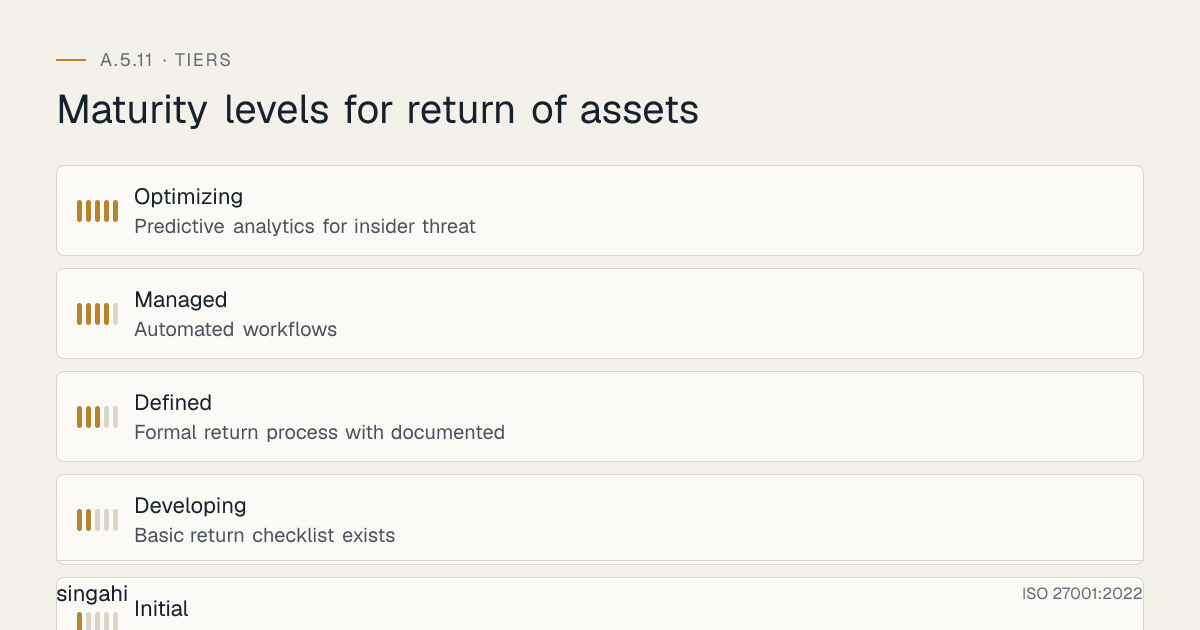
Maturity Model for A.5.11
| Level | Name | Characteristics | Evidence |
|---|---|---|---|
| 1 | Initial | No formal return process; ad-hoc handling; no checklists; access revoked manually when remembered; no tracking | No documentation, inconsistent handling, no records |
| 2 | Developing | Basic return checklist exists; manual process; IT and HR coordinate informally; some access revocation; basic tracking | Simple checklist, some records, informal coordination |
| 3 | Defined | Formal return process with documented procedures; role-specific checklists; HRIS integration; systematic access revocation; tracking system; return verification | Policy, checklists, HRIS workflow, systematic records, verification |
| 4 | Managed | Automated workflows; integrated with IAM and HRIS; DLP monitoring for departing employees; post-departure verification; BYOD data removal; forensic imaging for high-risk roles; knowledge transfer requirements; final settlement hold | Automation, integration, DLP, post-departure verification, forensic capability |
| 5 | Optimizing | Predictive analytics for insider threat detection; proactive monitoring for resignation risk; self-service return portals; automated legal hold integration; cross-organizational benchmarking; industry-leading return process; contributes to business continuity and competitive advantage | Predictive analytics, self-service, legal integration, benchmarking, competitive advantage |
Improvement Cycle
Plan:
- Annual process review with cross-functional input (HR, IT, Security, Legal, Finance)
- Benchmarking against industry standards and peer organizations
- Analysis of violation trends and incident data
- Technology evaluation for automation and enhancement
- Maturity assessment and target setting
Do:
- Implement workflow automation and system integrations
- Enhance monitoring for departing employees
- Expand role-specific checklists and coverage
- Improve BYOD data removal capabilities
- Deploy self-service return tools
- Enhance knowledge transfer processes
Check:
- Monthly return completion and timeliness metrics
- Quarterly audit of unresolved returns and access revocation
- Annual complete process effectiveness review
- Incident analysis for departures involving security events
- Employee and manager feedback on process efficiency
- Post-departure verification results
- Legal and compliance audit findings
Act:
- Update process based on findings and emerging risks
- Enhance automation for recurring issues
- Invest in tools that improve efficiency and security
- Expand training for high-risk roles and scenarios
- Refine checklists based on missed items and new asset types
- Report improvements to leadership and board
- Share best practices and lessons learned
Toolkit Download
The A.5.11 Control Pack contains the return of assets policy, a step-by-step offboarding procedure, the employee and role-specific return checklists from this page, an unreturned-asset escalation playbook, an audit evidence checklist, a RACI, metrics and a regulatory mapping.
Frequently Asked Questions
Q1: Is a Return of Assets process mandatory for ISO 27001?
A: Not automatically. No Annex A control is mandatory. Under clause 6.1.3 you choose the controls your risk assessment calls for, then record A.5.11 in your Statement of Applicability as included (and how) or excluded (and why). Any organisation that issues laptops, phones, tokens, badges or documents to people who later leave or change roles will normally include it, because unreturned assets are a direct confidentiality risk. Exclusion is only credible if you genuinely issue nothing.
Q2: Can we withhold final salary if an employee doesn't return assets?
A: No, not the wages themselves. Under the Code on Wages 2019, wages due on exit must be paid within two working days (s.17(2)), and deductions are allowed only on the grounds and within the limits in s.18: for an asset, only where it was expressly entrusted to the employee and the loss is due to their neglect or default, after giving them a chance to explain. Gratuity can be forfeited only on the narrow grounds in s.53(6) of the Code on Social Security 2020, and PF cannot be withheld. Consult labor law counsel before implementing financial holds. Alternative approaches: treat as a loan recovery, pursue civil recovery, or report as theft for high-value items. The safest approach is to make return a clear contractual obligation and pursue legal recovery rather than unilateral deductions.
Q3: How do we handle asset return for remote employees who are in different cities?
A: For remote employees: (1) ship a prepaid return kit with packaging and labels, (2) arrange courier pickup, (3) conduct virtual return verification via video call, (4) use MDM remote wipe for BYOD and company devices before shipping, (5) revoke all access before the device is received, (6) for high-value items, require insured shipping with tracking, (7) have the employee photograph returned items as evidence, (8) process final settlement only after verified receipt of assets. For remote terminations, consider immediate access revocation and then coordinate asset return separately.
Q4: What if an employee claims they never received certain assets?
A: This is why the asset inventory (A.5.9) and onboarding records are critical. If you have documentation that the asset was assigned (signed receipt, inventory record, delivery confirmation), the employee is responsible for its return. If there is no documentation, the organization may not have a strong basis for requiring return. Best practices: (1) maintain signed asset assignment receipts during onboarding, (2) conduct periodic asset verification, (3) require employees to report lost or damaged assets promptly, (4) for high-value items, use asset tags and serial numbers. Disputes should be handled through HR and legal, not unilateral action.
Q5: How do we handle asset return for employees who leave without notice (abandonment)?
A: Job abandonment (not reporting to work without notice) is a common challenge. Steps: (1) attempt to contact the employee through all available channels, (2) send formal written notice requiring return of assets, (3) revoke all access immediately upon determination of abandonment, (4) report to police if high-value assets or sensitive data are involved, (5) document all contact attempts, (6) process final settlement according to labor law (may require holding until contact is made), (7) for company devices, use MDM remote wipe and location tracking if available, (8) consider legal action for recovery of assets or damages. The AUP and employment contract should explicitly address abandonment scenarios.
Q6: Do we need to return assets for internal transfers?
A: Yes, but the process may differ. For transfers: (1) return assets that are not needed in the new role, (2) reallocate assets that will be used in the new role (update inventory, reassign ownership), (3) revoke access to systems not needed in the new role, (4) grant access to new role systems, (5) update role-based return checklist for future departures, (6) ensure physical access is updated for new location/area, (7) transfer knowledge and responsibilities to the new role. The transfer is a departure from one role and onboarding to another, apply both processes.
Q7: How do we handle cloud data that an employee may have synced to personal devices?
A: This is a major risk. Prevention: (1) use MDM to control sync behavior, (2) use cloud services with centralized admin control (not personal accounts), (3) use CASB to monitor and control cloud sync, (4) prohibit personal cloud sync for organizational data. For departing employees: (1) revoke cloud access, which typically disables sync, (2) for personal devices with MDM, use selective wipe to remove organizational data, (3) use CASB to unlink personal device sync, (4) require employee to sign off that organizational data has been removed from personal devices, (5) for high-risk roles, verify removal through remote access or video call. The best approach is prevention through MDM and CASB, not relying on employee honesty after departure.
Q8: Can we monitor a departing employee's activity during their notice period?
A: Yes, provided that: (1) the AUP explicitly informs employees that monitoring occurs, (2) the monitoring is proportionate to the risk (higher for sensitive roles), (3) the monitoring is for security purposes, not performance evaluation or harassment, (4) the employee was previously informed of monitoring scope, (5) monitoring respects privacy boundaries (e.g., not reading personal emails on personal accounts). Enhanced monitoring for departing employees is a standard and defensible security practice when properly authorized by the AUP.
Q9: How do we handle assets of an employee who has passed away?
A: This requires sensitivity and legal care. Steps: (1) revoke all access immediately for security, (2) contact the legal next of kin or estate executor, (3) request return of company assets through formal channels, (4) for personal devices with organizational data, work with the family to arrange data removal while respecting personal privacy, (5) offer to assist the family with data extraction if needed, (6) legal counsel should guide the process to avoid privacy violations, (7) maintain compassion while ensuring security, (8) do not sanitize devices without legal clearance if there may be legal holds or estate matters. This is a scenario where security and humanity must be balanced.
Q10: What is the most common mistake in return of assets processes?
A: The most common mistake is assuming that access revocation is complete when it is not. Organizations often revoke Active Directory access but forget: cloud service accounts, SaaS applications, code repositories, shared mailbox delegations, email forwarding rules, API keys, VPN tokens, physical access cards, and third-party system accounts. The solution is to maintain a complete access inventory, use automated deprovisioning tools, and verify post-departure. Another common mistake is treating asset return as an IT-only task when it requires HR, Security, Legal, Facilities, and manager coordination.
Q11: Should we conduct exit interviews for all departures?
A: Exit interviews are valuable for voluntary resignations and can serve as a return reminder and knowledge transfer opportunity. However, for involuntary terminations, the exit interview may not be appropriate or may need to be conducted after departure. Best practice: (1) conduct exit interviews for voluntary resignations, (2) use the exit interview to review return checklist and confidentiality obligations, (3) gather feedback on security practices and concerns, (4) for terminations, focus on immediate return and access revocation rather than interview, (5) document all exit interviews. Exit interviews are not a substitute for the formal return process but can complement it.
Q12: How do we handle return of assets for contractors managed through agencies?
A: Contractors through agencies add complexity. The organization's contract with the agency should include: (1) agency responsibility for ensuring contractor return of assets, (2) right to audit agency compliance, (3) notification requirements when contractor engagement ends, (4) liability for contractor failures. The contractor should still sign the organization's AUP and return checklist. The agency should be notified of departure and required to confirm return completion. If the agency fails to ensure return, the organization may seek recovery from the agency per the contract.
Q13: Do we need to return "knowledge" in an employee's head?
A: You cannot extract knowledge from someone's memory, but you can require knowledge transfer. This includes: (1) documentation of processes, procedures, and tribal knowledge, (2) handover notes and transition guides, (3) training of replacement staff, (4) recording of critical processes (videos, screen recordings), (5) documentation of customer relationships and preferences, (6) transfer of ongoing project status and plans. The employment contract and return process should include knowledge transfer obligations. The employee cannot be forced to share everything they know, but they can be required to document and hand over their work responsibilities systematically.
Q14: How do we prioritize which assets to focus on for return?
A: Prioritize based on risk: (1) Highest priority: Access credentials, customer data, financial data, source code, strategic plans, physical access cards, these pose immediate security risk if retained. (2) High priority: Laptops and mobile devices with cached data, VPN tokens, cloud service accounts, email access. (3) Medium priority: General documents, training materials, peripherals. (4) Lower priority: Physical items with no data (monitors, keyboards, mice), branded materials. The return checklist should be ordered by priority to ensure the most critical items are addressed first, especially in time-constrained scenarios.
Q15: Can we use the return process to investigate an employee for misconduct before termination?
A: Yes, but with legal caution. If an employee is under investigation, the return process may be part of a broader investigation strategy. Key considerations: (1) legal counsel should guide the process, (2) evidence preservation is critical, do not sanitize devices, (3) forensic imaging may be needed before the employee is aware, (4) the return process should not tip off the employee if it could compromise the investigation, (5) coordinate with HR and legal on timing, (6) if the investigation leads to termination, the return process should be ready for immediate execution. The return process is a security control, not an investigation tool, but it can support investigations when properly coordinated.
The following toolkit assets are available for this control:
| # | Toolkit File | Description |
|---|---|---|
| 1 | 01-return-of-assets-policy-template.md | Policy Template |
| 2 | 02-return-of-assets-procedure.md | Procedure |
| 3 | 03-return-of-assets-checklist.md | Checklist |
| 4 | 04-audit-evidence-checklist.md | Audit Evidence Checklist |
| 5 | 05-implementation-roadmap.md | Implementation Roadmap |
| 6 | 06-quick-reference-card.md | Quick Reference Card |
| 7 | 07-training-materials.md | Training Materials |
| 8 | 08-incident-response-playbook.md | Incident Response Playbook |
| 9 | 09-risk-assessment-template.md | Risk Assessment Template |
| 10 | 10-vendor-security-template.md | Vendor Security Template |
| 11 | 11-metrics-and-kpi-dashboard.md | Metrics and KPI Dashboard |
| 12 | 12-gap-analysis-template.md | Gap Analysis Template |
| 13 | 13-raci-matrix.md | RACI Matrix |
| 14 | 14-tool-comparison-matrix.md | Tool Comparison Matrix |
| 15 | 15-communication-plan.md | Communication Plan |
| 16 | 16-roles-and-responsibilities.md | Roles and Responsibilities |
| 17 | 17-regulatory-mapping.md | Regulatory Mapping |
References and Further Reading
Standards and Frameworks
- ISO/IEC 27001:2022, Information Security, Cybersecurity and Privacy Protection, Information Security Management Systems, Requirements
- ISO/IEC 27002:2022, Information Security, Cybersecurity and Privacy Protection, Information Security Controls
- NIST Cybersecurity Framework 2.0 (2024)
- NIST SP 800-53, Security and Privacy Controls for Information Systems and Organizations
- NIST SP 800-88 Rev. 2 (2025), Guidelines for Media Sanitization
- CIS Controls v8, Controls 1, 2, 5, 6, 14, 17
- COBIT 2019, APO07 (Managed People)
Indian Legal and Regulatory References
- Information Technology Act, 2000 (as amended)
- Digital Personal Data Protection Act, 2023
- Indian Contract Act, 1872
- Bharatiya Nyaya Sanhita, 2023 (replaced the Indian Penal Code from 1 July 2024): ss.303, 316, 318, 336
- Industrial Relations Code 2020 (standing orders; replaced the Industrial Employment (Standing Orders) Act 1946)
- RBI Cybersecurity Framework for Banks
- SEBI CSCRF (2024)
- IRDAI Cybersecurity Guidelines
Industry and Research Sources
- Ponemon Institute and DTEX Systems, Cost of Insider Risks Global Report (2023)
- Verizon Data Breach Investigations Report (2024), Insider threat statistics
- SANS Institute, Insider Threat Resources
- CERT Insider Threat Center, Resources and frameworks
- CISA, Insider Threat Mitigation Guide
Tool Documentation
- Microsoft Intune Documentation, Device management and selective wipe
- Microsoft Entra ID Documentation, Identity lifecycle management
- ServiceNow HR Service Delivery, Offboarding workflows
- SailPoint IdentityNow, Access lifecycle management
- Various MDM vendor documentation (Omnissa Workspace ONE, Jamf, Ivanti)
- Various DLP vendor documentation (Symantec, Microsoft, Digital Guardian)
Additional Reading
- "The CERT Guide to Insider Threats" by Andrew Moore, Dawn Cappelli, Randall Trzeciak
- "Insider Threats in Cyber Security", edited by Probst, Hunker, Gollmann and Bishop (Springer, 2010)
- "Social Engineering: The Art of Human Hacking" by Christopher Hadnagy
- "No Tech Hacking" by Johnny Long, Physical security and social engineering
- NIST SP 800-207, Zero Trust Architecture (relevant for access revocation and lifecycle management)
Document Control
- Version: 1.0
- Author: Singahi, ISO 27001 Implementation Experts
- Review Cycle: Annual + Event-Triggered
- Next Review: June 2027 (annual) / Event-triggered for technology/regulatory changes
- Classification: TLP:CLEAR, Public Information