
On this page
- Quick Reference
- What the Control Asks For
- Why It Matters
- Scope and Applicability
- Key Definitions
- Relationship to Other Controls
- Implementation Roadmap
- Detailed Guidance
- Tools and Technologies
- Policy Templates and Documentation
- Risk Assessment
- Audit and Assessment Checklist
- Metrics and KPIs
- Common Pitfalls and How to Avoid Them
- Illustrative Scenarios
- Multi-Framework Mapping
- Regulatory and Compliance Context
- RACI Matrix
- Documentation and Record Keeping
- Continuous Improvement
- Frequently Asked Questions
- References and Further Reading
Quick Reference
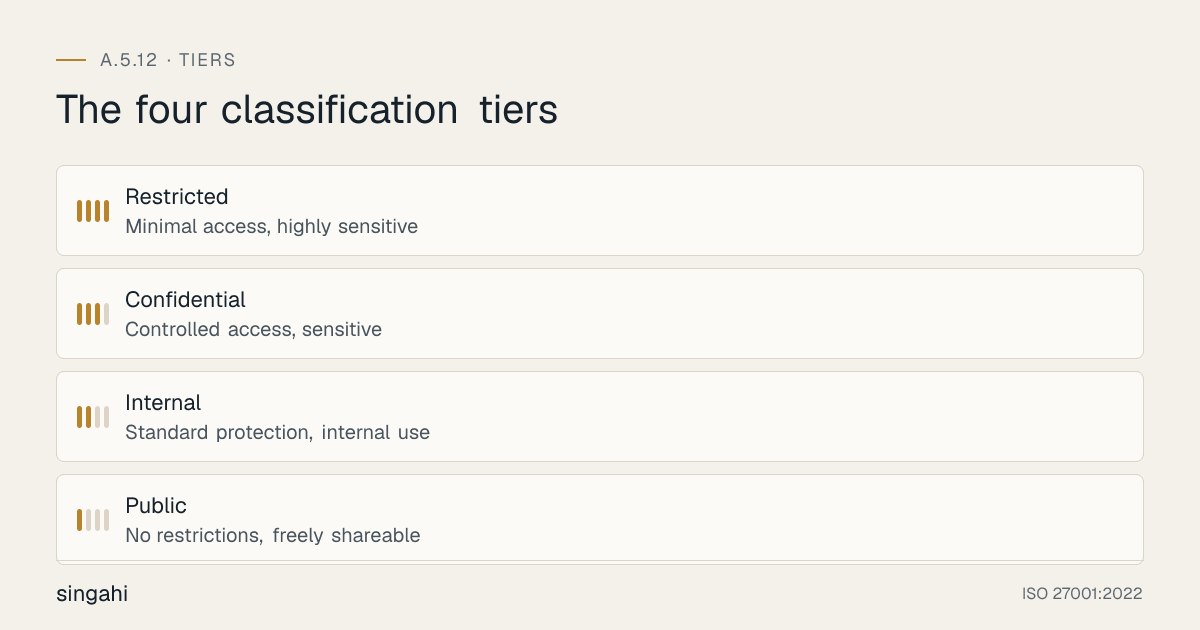
Figure · Tiers
The four classification tiers
| Attribute | Detail |
|---|---|
| Control Number | A.5.12 |
| Control Title | Classification of Information |
| ISO 27001:2022 Domain | Organizational Controls (5) |
| Control Type | Preventive |
| Information Security Attribute | Confidentiality, Integrity, Availability |
| Maturity Model Level | Level 1–5 (see the maturity model below) |
| Typical Implementation Time | 3–6 months for initial classification; ongoing maintenance |
| Main cost drivers | Tools, staff time, training, DLP |
| Primary Owner | CISO or Data Governance Lead (scheme); information owners classify their information |
| Key Stakeholders | Data Owners, IT, Legal, Compliance, HR, All Employees |
| Audit Frequency | Quarterly review + annual complete assessment |
| ISO 27002 attributes | Control type: Preventive · Properties: Confidentiality, Integrity, Availability · Concepts: Identify · Capabilities: Information protection · Domains: Protection, Defence |
What the Control Asks For
In short:
ISO 27001:2022 Annex A 5.12 asks organizations to classify information according to their information security needs, based on confidentiality, integrity, availability and the requirements of relevant interested parties.
Do you need this control?
A.5.12 is not mandatory in itself: under clause 6.1.3 you include it if your risk assessment calls for it, and record the decision in your Statement of Applicability. Most organisations include it, because classification is how you show protection matches the value and sensitivity of information. You can keep the scheme small (for example Public, Internal, Confidential) rather than exclude it.
This control requires organizations to:
- Establish a classification scheme: Define levels that reflect the organization's information security needs, based on confidentiality, integrity, availability and interested-party requirements (legal, contractual, customer)
- Classify information: Apply the scheme consistently across the whole organisation, including assets associated with the information
ISO/IEC 27002 adds guidance that auditors commonly test (paraphrased):
- set a topic-specific policy on classification and communicate it to relevant interested parties
- make information owners accountable for classifying their information
- align the scheme with the access control policy (A.5.15) and with business needs for sharing or restricting information
- include criteria for reviewing classification over time, because value and sensitivity change (for example after public release)
- keep the scheme consistent across the organisation so everyone classifies and protects information the same way
- make the scheme understandable to recipients, and agree how to interpret other organisations' schemes when information is exchanged
- remember that the scheme can address integrity and availability, not only confidentiality: even Public information needs integrity protection
Handling rules for each level belong to labelling (A.5.13), transfer (A.5.14) and acceptable use (A.5.10); training and periodic review are good practice that makes the scheme work.
Classification is the foundation of proportionate security. Without classification, organizations apply the same controls to all information, either over-protecting low-value data (wasting resources) or under-protecting sensitive data (creating unacceptable risk).
Why It Matters
Proportionate Security Investment
Not all information requires the same level of protection. Public marketing materials need minimal security controls. Customer financial data needs encryption, access controls, monitoring, and DLP. Board-level strategic plans need the highest level of protection. Classification enables organizations to apply the right level of protection to the right data, optimizing security spend.
An Indian banking group with 15,000 employees implemented a four-tier classification system and found that only a small share of its data was Confidential or Restricted and needed stronger controls; most needed only standard or minimal controls. (Illustrative example.)
Regulatory and Compliance Requirements
Indian and international regulations increasingly mandate data classification:
- DPDP Act 2023 treats all digital personal data alike: there is no "sensitive" category. Extra rules apply to children's data (s.9) and to Significant Data Fiduciaries (s.10), and sector rules (Aadhaar Act, RBI, ABDM) add requirements for some data types
- RBI requires banks to classify customer data based on sensitivity
- SEBI mandates classification of market-sensitive information
- PCI DSS requires identification of cardholder data (CHD) and sensitive authentication data (SAD)
- GDPR requires organizations to identify special categories of personal data
- Health sector rules (the ABDM Health Data Management Policy for ABDM participants, NABH accreditation standards) expect patient data to be identified and protected
Without classification, organizations cannot demonstrate compliance with these differentiated requirements. A healthcare organization that treats all patient data the same may fail to meet enhanced requirements for sensitive health information, while over-investing in protecting routine appointment schedules.
Data Breach Impact Mitigation
When breaches occur, classification determines the response severity and regulatory obligations:
- Public data breaches may require minimal response
- Internal data breaches may require internal investigation and remediation
- Confidential data breaches may require customer notification, regulatory reporting, and legal review
- Restricted data breaches may require immediate incident response, law enforcement notification, regulatory penalties, and media management
An Indian e-commerce platform suffered a breach affecting customer records. Because they had classified their data, they knew exactly which records were affected, which customers needed notification, and which regulators required reporting. Their response was faster and cheaper than investigating the entire database. (Illustrative example.)
Access Control and Least Privilege
Classification enables granular access control. Employees should only access data necessary for their role. A sales representative needs customer contact information but not financial records. A developer needs source code but not HR data. Classification provides the framework for defining these boundaries and implementing least-privilege access.
A Mumbai-based IT services company with 800 employees reduced unauthorized access incidents by 45% after implementing classification-based access controls. Employees could no longer accidentally access data outside their classification scope, and security teams could easily identify inappropriate access patterns.
Cloud and Third-Party Data Protection
Classification is essential for cloud migration and third-party data sharing decisions:
- Public data can be stored on public cloud with minimal controls
- Internal data can be stored on standard cloud with basic controls
- Confidential data requires encrypted cloud storage, CASB monitoring, and contractual controls
- Restricted data may require private cloud, data residency, and enhanced vendor assessments
Without classification, organizations cannot make rational cloud and outsourcing decisions. They either avoid cloud entirely (losing agility benefits) or place all data in the cloud without differentiation (creating unacceptable risk).
Data Retention and Disposal
Classification drives how information is disposed of, not how long it is kept:
- Retention periods come from legal, regulatory, contractual and business requirements, recorded in your retention schedule (A.5.33): for example the Companies Act's eight years for books of account
- Personal data must be erased once its purpose is served and no law requires keeping it (DPDP Act s.8(7)), so the most sensitive personal data should often be kept for the shortest time
- Disposal method scales with classification: standard deletion for Internal, cryptographic erase or verified destruction for Confidential and Restricted (A.8.10, A.7.14)
An Indian manufacturing company cut storage costs once a classification and retention review showed that much of its stored data was outdated internal material that could be deleted, while a small set of restricted IP needed better protection. (Illustrative example.)
Incident Response Prioritization
During security incidents, classification enables intelligent prioritization:
- Incidents affecting Restricted data trigger immediate executive escalation and legal involvement
- Incidents affecting Confidential data trigger standard incident response with regulatory notification assessment
- Incidents affecting Internal data trigger routine investigation and remediation
- Incidents affecting Public data may require minimal response
This prioritization ensures that the most damaging incidents receive the most attention, rather than treating all incidents equally (which can lead to alert fatigue and delayed response to truly critical events).
Employee Awareness and Culture
Classification creates a tangible security culture:
- Employees understand that data has different values and protection requirements
- Classification labels serve as constant visual reminders of security responsibilities
- Employees can make better decisions about sharing, storing, and handling data
- Classification training is concrete and practical, not abstract
Visible labels make security concrete: when people can see that a request touches Confidential data, they are more likely to question it and report it.
Scope and Applicability
In Scope, Information to be Classified
Business Information:
- Strategic plans and board materials
- Financial statements, budgets, and forecasts
- M&A documentation and due diligence materials
- Customer lists, contracts, and pricing information
- Product roadmaps and development plans
- Marketing strategies and campaign data
- Competitive intelligence and market research
- Vendor and supplier information
- Audit reports and compliance documentation
Customer and Client Data:
- Personal identifiers (name, address, phone, email, Aadhaar)
- Financial information (account numbers, transaction history, credit scores)
- Payment card data (primary account number, CVV, expiry)
- Health and medical records (for healthcare organizations)
- Insurance policy details and claims data
- Legal and case information (for legal services)
- Service usage data and preferences
- Communication records and support tickets
Employee and HR Data:
- Personal information and contact details
- Salary, compensation, and benefits data
- Performance reviews and disciplinary records
- Background check and verification data
- Health and insurance records
- Training and certification records
- Attendance and leave records
Technical and Operational Information:
- Source code and development artifacts
- System architecture and network diagrams
- Configuration files and security settings
- Database schemas and data dictionaries
- API documentation and integration details
- Security policies and incident response plans
- Vulnerability assessments and penetration test results
- Backup configurations and recovery procedures
Regulatory and Legal Information:
- Regulatory filings and submissions
- Legal contracts and agreements
- Litigation materials and privileged communications
- Intellectual property and patent documentation
- Government correspondence and licenses
- Compliance audit reports and findings
Third-Party Information:
- Customer data processed on behalf of clients
- Partner and vendor confidential information
- Shared data under contractual agreements
- Data subject to third-party security requirements
Classification Dimensions
While confidentiality is the primary classification dimension, organizations should consider:
Confidentiality: Who should have access to this information?
- Public: Anyone can access
- Internal: Employees and authorized personnel
- Confidential: Specific authorized individuals with business need
- Restricted: Minimal authorized individuals with strict controls
Integrity: How important is accuracy and completeness?
- Low: Minor errors acceptable
- Medium: Errors should be detected and corrected
- High: Must be accurate; tampering must be prevented
- Critical: Must be 100% accurate; any modification is catastrophic
Availability: What are the uptime and recovery requirements?
- Low: Can be unavailable for days
- Medium: Should be available during business hours
- High: Must be available 24/7 with minimal downtime
- Critical: Must be available continuously; any outage is catastrophic
Regulatory Sensitivity: What regulatory requirements apply?
- Standard: General business data
- Personal: Personal data subject to DPDP Act
- Sensitive Personal: personal data your organisation treats as higher-risk (health, financial, biometric, Aadhaar, children's data); an internal tier, since the DPDP Act has no sensitive category
- Financial: Subject to RBI/SEBI/IRDAI requirements
- Health: Subject to healthcare data protection requirements
- Government: Subject to official secrets or classified handling
Organizational Size Considerations
Small organizations (up to 50 employees):
- Simple 3-tier classification (Public, Internal, Confidential)
- Manual classification by document creators
- Basic labeling (file names, folder structures, email footers)
- Annual review and training
Medium organizations (51 to 500 employees):
- 4-tier classification (Public, Internal, Confidential, Restricted)
- Automated classification tools for sensitive data types
- Visual labeling (headers, footers, watermarks)
- Integration with DLP and email security
- Quarterly review and refresher training
Large organizations (over 500 employees):
- Multi-dimensional classification (confidentiality × integrity × availability)
- Automated classification with machine learning
- Metadata tagging and integration with security tools
- Enterprise DLP with classification-driven policies
- Role-based access tied to classification
- Monthly monitoring and quarterly review
- Budget: –+ annually
Key Definitions
| Term | Definition |
|---|---|
| Information Classification | The systematic process of categorizing information based on its sensitivity, value, and required protection level |
| Classification Scheme | The defined set of categories or levels used to classify information within an organization |
| Classification Level | A specific category within the classification scheme (e.g., Public, Internal, Confidential, Restricted) |
| Data Owner | The individual or business unit accountable for the classification, accuracy, and protection of specific information |
| Data Custodian | The individual or IT function responsible for the technical storage, maintenance, and security of information on behalf of the owner |
| Data User | Any individual who accesses, processes, or handles information in the course of their duties |
| Confidentiality | The property that information is not made available or disclosed to unauthorized individuals, entities, or processes |
| Integrity | The property of accuracy and completeness (ISO/IEC 27000) |
| Availability | The property of being accessible and usable upon demand by an authorized entity |
| Classification Label | A visual or metadata indicator applied to information to show its classification level (e.g., header, footer, watermark, tag) |
| Handling Rules | The specific requirements for how information of a particular classification must be stored, transmitted, processed, and destroyed |
| Downgrading | The process of changing information to a lower classification level when the sensitivity decreases |
| Upgrading | The process of changing information to a higher classification level when the sensitivity increases |
| Reclassification | The general process of changing an information's classification level, either up or down |
| Need-to-Know | The principle that information should only be accessible to those who require it for legitimate business purposes |
| Data Mapping | The process of identifying and documenting where data resides, how it flows, and how it is processed across systems |
| Sensitive Personal Data | (Internal tier and IT Act SPDI Rules term; not a DPDP Act category.) Personal data your organisation treats as more sensitive, such as financial, health and biometric data (the SPDI Rules 2011 list passwords, financial, health, sexual-orientation, medical and biometric information) |
| Data Principal | The individual to whom personal data relates (DPDP Act term; GDPR says "data subject") |
| Information Asset | Data, information, or knowledge that has value to the organization and requires protection |
| Classification Authority | The role or individual with the authority to determine, approve, or change information classification |
| Data Lineage | The tracking of data as it flows through an organization from creation to consumption |
| Metadata Tagging | The application of classification information as metadata to files, emails, and database records for automated enforcement |
| Visual Marking | The physical or digital marking of documents with classification indicators (headers, footers, stamps, watermarks) |
Relationship to Other Controls
Directly Related Controls
| Control | Relationship |
|---|---|
| A.5.9 Inventory of Information and Other Assets | The inventory records classification levels for all assets. |
| A.5.10 Acceptable Use of Information and Other Associated Assets | The AUP enforces handling rules based on classification. |
| A.5.11 Return of Assets | Classification determines the handling requirements for returned assets. |
| A.5.13 Labeling of Information | Classification levels are applied as labels to information. |
| A.5.14 Information Transfer | Classification determines how information may be transferred and to whom. |
| A.5.15 Access Control | Classification drives access control decisions and least-privilege implementation. |
| A.5.34 Privacy and Protection of PII | Classification identifies personal data requiring enhanced privacy protection. |
| A.6.3 Information Security Awareness Training | Classification is a primary training topic; employees must understand classification responsibilities. |
| A.8.13 Information Backup | Classification determines backup frequency, retention, and encryption requirements. |
| A.8.15 Logging | Classification determines which systems and data access must be logged. |
| A.8.16 Monitoring Activities | Classification determines which assets require enhanced monitoring. |
| A.8.24 Use of Cryptography | Classification determines which data requires encryption. |
| A.8.25 Secure Development Life Cycle | Classification determines security requirements for different code and data types. |
| A.8.30 Outsourced Development | Classification determines what data can be shared with third-party developers. |
Indirectly Related Controls
| Control | Relationship |
|---|---|
| A.5.7 Threat Intelligence | Classification helps prioritize threat intelligence application to specific data types. |
| A.5.21 Information Security in ICT Supply Chain | Classification determines what data can be shared with supply chain partners. |
| A.5.19 Information Security in Supplier Relationships | Classification determines security requirements for supplier data handling. |
| A.5.23 Information Security for Use of Cloud Services | Classification informs which data may be placed in which cloud services. |
| A.5.24 Information Security Incident Management Planning and Preparation | Classification determines incident response severity and escalation. |
| A.8.14 Redundancy of Information Processing Facilities | Classification determines availability requirements and redundancy needs. |
| A.6.2 Terms and Conditions of Employment | Employment contracts may include classification handling obligations. |
| A.7.1 Physical Security Perimeters | Classification determines physical protection requirements for information storage. |
| A.8.1 User Endpoint Devices | Classification determines endpoint protection requirements. |
| A.8.8 Management of Technical Vulnerabilities | Classification prioritizes patching for systems handling sensitive data. |
| A.8.31 Development, Testing & Production Environments | Classification determines data handling rules across environments. |
| A.8.23 Web Filtering | Classification may influence what web services can process organizational data. |
| A.8.28 Secure Coding | Classification determines security requirements for code handling different data types. |
Implementation Roadmap
Figure · Timeline
First four weeks
- Week 1Governance and roles defined
- Week 2Scheme and handling rules drafted
- Week 3Legal review and approval
- Week 4Labelling standards published
Phase 1: Foundation (Weeks 1–4)
| Week | Activity | Deliverable |
|---|---|---|
| 1 | Define classification governance, roles, and authority | Classification charter |
| 2 | Develop classification scheme with handling rules | Classification policy draft |
| 3 | Legal review and stakeholder approval | Approved classification policy |
| 4 | Develop labeling standards and templates | Labeling guide and templates |
Phase 2: Pilot and Validation (Weeks 5–10)
| Week | Activity | Deliverable |
|---|---|---|
| 5–6 | Select pilot department and classify all information | Pilot classification report |
| 7–8 | Validate classification with data owners and security team | Validation feedback and adjustments |
| 9–10 | Refine handling rules and develop training materials | Finalized handling rules and training content |
Phase 3: Enterprise Rollout (Weeks 11–18)
| Week | Activity | Deliverable |
|---|---|---|
| 11–12 | Deploy classification tools (DLP, auto-classification) | Tool deployment and configuration |
| 13–14 | Train all employees and data owners | Training completion records |
| 15–16 | Classify all critical and high-value information | Critical data classification report |
| 17–18 | Integrate classification with DLP, IAM, and email security | Integration verification |
Phase 4: Continuous Improvement (Ongoing)
| Frequency | Activity | Deliverable |
|---|---|---|
| Monthly | Review classification accuracy and DLP alerts | Monthly classification report |
| Quarterly | Audit classification compliance and update rules | Quarterly audit report |
| Bi-annually | Refresher training and awareness campaigns | Training records |
| Annually | Complete classification scheme review | Annual review report |
| Event-triggered | Reclassification for M&A, regulatory changes, incidents | Updated classification records |
Detailed Guidance
Figure · Matrix
Where each tier may be stored
Designing the Classification Scheme
The classification scheme must be simple enough for employees to understand and use, yet complete enough to cover all information types. A typical 4-tier scheme:
Level 1, Public
- Definition: Information intended for public disclosure with no restriction on distribution
- Examples: Marketing materials, website content, press releases, published annual reports, job postings, public APIs
- Handling Rules:
- No access restrictions required
- Standard integrity controls (prevent unauthorized modification)
- Standard availability controls (backup, basic redundancy)
- No encryption required for storage or transmission
- Can be shared with anyone, including media and public
- Label: PUBLIC or no label
Level 2, Internal
- Definition: Information for internal use only, not intended for public disclosure but not highly sensitive
- Examples: Internal memos, HR policies, training materials, organizational charts, operational procedures, internal newsletters, meeting minutes (non-sensitive)
- Handling Rules:
- Access limited to employees and authorized contractors
- Authentication required for access
- Backup per the backup policy; retention per the retention schedule (A.5.33)
- Encryption not required for internal transmission
- Not to be shared with external parties without authorization
- Can be printed for internal use; secure disposal recommended but not mandatory
- Label: INTERNAL
Level 3, Confidential
- Definition: Sensitive information whose unauthorized disclosure could cause significant harm to the organization, customers, or partners
- Examples: Customer data, financial records, contracts, source code, employee personal data, strategic plans, product designs, pricing information, vendor agreements, audit reports
- Handling Rules:
- Access strictly limited to individuals with business need-to-know
- Multi-factor authentication required for access
- Encryption required for storage and external transmission
- DLP monitoring and prevention for exfiltration
- Enhanced logging and access monitoring
- Secure printing and disposal (shredding)
- External sharing requires approval and encryption
- Backup with encryption and restricted access
- Retention per the retention schedule; erase personal data once its purpose is served
- Label: CONFIDENTIAL
Level 4, Restricted
- Definition: Highly sensitive information whose unauthorized disclosure could cause severe harm, including regulatory penalties, competitive damage, or national security implications
- Examples: M&A plans, board strategy documents, encryption keys, bulk exports of customer personal data, customer payment data (CHD), source code for critical systems, classified government data, trade secrets, customer biometric data, passwords and credentials, incident response details during active investigation
- Handling Rules:
- Minimal access, only specifically authorized individuals
- Strong encryption (AES-256) for storage and transmission
- Multi-factor authentication with strong factors (hardware tokens, biometrics)
- Compartmentalized access (no bulk access, per-document authorization)
- Enhanced monitoring with real-time alerting
- External transmission only encrypted, to named recipients, with the information owner's approval
- Secure printing with watermarking and tracking
- Physical storage in secure areas with access logging
- Mandatory secure disposal with certificate
- Segregated backup with enhanced access controls
- Regular access recertification (quarterly)
- Production secrets and keys live in a secrets manager or KMS; pipelines and services reach them by role, so people do not copy them
- Label: RESTRICTED
Classification Authority and Governance
Classification Authority Levels:
| Level | Authority | Scope |
|---|---|---|
| Level 1 (Default) | Information Creator / User | Public and Internal information they create |
| Level 2 (Department) | Data Owner / Department Head | Confidential information within their domain |
| Level 3 (Organization) | Information owner, advised by the CISO (and the DPO where one is appointed) | Restricted information and cross-departmental classification |
| Level 4 (Executive) | CEO / Board | Strategic, M&A, and board-level information |
| Level 5 (Legal) | General Counsel / Legal | Litigation-related, privileged, and legally sensitive information |
Classification Governance Process:
- Default Classification: New information is classified at creation based on the creator's judgment and default rules
- Review and Validation: Data owners review and validate classification for their domain
- Escalation: Uncertain cases are escalated to the CISO or classification committee
- Dispute Resolution: Disagreements on classification are resolved by the classification committee (CISO, Legal, Data Owner)
- Periodic Review: All classifications are reviewed annually or upon significant business changes
- Reclassification: Changes to classification level require approval and documentation
Classification by Data Type
Different data types have inherent classification requirements:
| Data Type | Default Classification | Rationale |
|---|---|---|
| Customer PII | Confidential | DPDP Act requirements; customer trust; regulatory obligations |
| Bulk exports of personal data (full customer or employee extracts) | Restricted | Aggregation raises breach impact |
| Customer Financial Data | Restricted | RBI/SEBI requirements; fraud risk; high impact of breach |
| Payment Card Data (CHD) | Restricted | PCI DSS requirements; severe breach impact; card-brand penalties and possible loss of card acceptance |
| Employee PII | Confidential | Privacy requirements; employee trust; legal obligations |
| Employee Salary Data | Confidential | Privacy; employee relations; competitive sensitivity |
| Source Code | Confidential | Intellectual property; competitive advantage; security risk |
| Cryptographic Keys | Restricted | Foundation of security; catastrophic impact if compromised |
| Strategic Plans | Restricted | Competitive advantage; market impact; board-level sensitivity |
| Financial Statements (Unpublished) | Confidential | Regulatory requirements; market sensitivity; investor relations |
| Financial Statements (Published) | Public | Already disclosed; no confidentiality requirement |
| Contracts | Confidential | Legal obligations; commercial sensitivity; third-party relationships |
| Vulnerability Reports | Confidential | Security risk; attacker utility; responsible disclosure obligations |
| Incident Details (Active) | Restricted | Investigation integrity; attacker awareness; legal privilege |
| Incident Details (Closed) | Confidential | Lessons learned; regulatory reporting; customer notification |
| Marketing Materials (Draft) | Internal | Work in progress; not approved for external release |
| Marketing Materials (Published) | Public | Approved for public consumption |
| Research Data | Confidential | Intellectual property; competitive advantage; regulatory requirements |
| Health Records | Confidential | Patient privacy; medical ethics; regulatory requirements |
| Government Classified Data | Restricted | National security; legal obligations; severe penalties |
| Trade Secrets | Restricted | Competitive survival; legal protection; economic value |
Automated Classification Tools and Techniques
Pattern-Based Classification:
- Regular expression matching for PII (Aadhaar numbers, PAN, passport numbers, phone numbers, email addresses)
- Keyword matching for sensitive topics ("confidential," "restricted," "password," "proprietary")
- Dictionary matching for financial terms, medical terms, legal terms
- Template matching for document types (contracts, invoices, medical records)
Machine Learning Classification:
- Content-based classification using NLP and text analysis
- Behavioral classification based on user access patterns
- Contextual classification considering document location, author, and recipients
- Image classification for scanned documents and screenshots
- Sentiment and topic analysis for classification suggestions
Metadata-Based Classification:
- Author department classification (e.g., Finance documents default to Confidential)
- File location classification (e.g., files in "Board" folder default to Restricted)
- Email domain classification (e.g., external recipient emails suggest higher classification)
- Application context (e.g., CRM data defaults to Confidential)
DLP Integration:
- DLP policies trigger automatic classification suggestions
- DLP blocks or warns when data is handled contrary to its classification
- DLP scans discover unclassified sensitive data and suggest classifications
- DLP reports help identify misclassified data through violation patterns
Labeling and Visual Marking
Document Labeling Standards:
- Header: Classification level at the top of every page (e.g., "CONFIDENTIAL, [Organization Name]")
- Footer: Classification level at the bottom of every page
- Watermark: Semi-transparent classification marking for highly sensitive documents (especially when printed or shared)
- Email Subject: Prefix classification to email subject lines (e.g., "[CONFIDENTIAL] Q3 Financial Review")
- File Metadata: Classification embedded in document properties (Word, PDF, Excel)
- Database Fields: Classification tags in database metadata or data catalogs
- Physical Documents: Color-coded stamps or labels on physical folders and documents
Color Coding Scheme (Example):
| Classification | Color | Hex Code | Usage |
|---|---|---|---|
| Public | Green | #28a745 | No restrictions, freely shareable |
| Internal | Blue | #007bff | Internal use, standard protection |
| Confidential | Orange | #fd7e14 | Sensitive, controlled access |
| Restricted | Red | #dc3545 | Highly sensitive, minimal access |
Email Classification Rules:
- All emails containing Confidential or Restricted attachments must have classification in the subject line
- External emails containing Confidential data must be encrypted
- Auto-classification plugins can scan email content and suggest classification
- Distribution lists must be labeled with maximum classification they can handle
Handling Rules by Classification Level
Storage Rules:
| Classification | On-Premises Storage | Cloud Storage | Endpoint Storage | Mobile Storage |
|---|---|---|---|---|
| Public | Standard file shares | Any approved cloud | Allowed | Allowed |
| Internal | Standard file shares with access control | Approved cloud with basic controls | Allowed with encryption | Allowed with password |
| Confidential | Encrypted file shares with access control | Approved cloud with encryption, CASB, DLP | Encrypted only | Not allowed without MDM |
| Restricted | Encrypted, access-controlled, monitored | Approved cloud with customer-managed keys, restricted access and logging | Only on approved, encrypted, managed devices | Not allowed |
Transmission Rules:
| Classification | Instant Messaging | File Transfer | Cloud Sharing | |
|---|---|---|---|---|
| Public | Allowed | Allowed | Allowed | Allowed |
| Internal | Allowed | Allowed | Allowed | Allowed with approved tools |
| Confidential | Encrypted only | Approved secure channels only | Encrypted SFTP/FTPS only | Approved secure sharing with access controls |
| Restricted | Encrypted, to named recipients, with owner approval | Not allowed | Approved secure transfer only | Named individuals only, with expiry |
Printing Rules:
| Classification | Printing | Marking | Disposal |
|---|---|---|---|
| Public | Allowed | No marking | Standard recycling |
| Internal | Allowed | Optional header | Standard recycling |
| Confidential | Allowed with logging | Mandatory header/footer | Secure shredding |
| Restricted | Restricted with approval | Mandatory header/footer/watermark | Secure shredding with certificate |
Disposal Rules:
| Classification | Digital Disposal | Physical Disposal | Retention Period |
|---|---|---|---|
| Public | Standard deletion | Recycling | Per retention schedule (A.5.33) |
| Internal | Standard deletion | Recycling | Per retention schedule |
| Confidential | Cryptographic erase or the cloud provider's deletion process (NIST SP 800-88) | Shredding | Per retention schedule; erase personal data when its purpose is served |
| Restricted | Cryptographic erase or physical destruction | Certified shredding/destruction | Per retention schedule; keep no longer than needed |
Data Mapping and Classification
Classification requires understanding where data flows:
Data Mapping Process:
- Identify Data Sources: Where is data created or collected? (Forms, sensors, APIs, manual entry, imports)
- Map Data Flows: How does data move between systems, departments, and external parties?
- Identify Storage Locations: Where is data stored at rest? (Databases, file shares, cloud, backups, archives)
- Identify Processing Points: Where is data transformed, analyzed, or enriched?
- Identify Access Points: Who accesses the data and through what channels?
- Identify Disposal Points: Where and how is data deleted or archived?
- Apply Classification: Assign classification to each data element based on its sensitivity and regulatory requirements
- Document Dependencies: Note systems and processes that depend on the data
Data Mapping Tools:
- Microsoft Purview Data Map
- OneTrust Data Mapping
- BigID Data Intelligence
- Informatica Data Catalog
- Custom spreadsheets and diagrams for smaller organizations
Third-Party and Cloud Data Classification
Classification extends to data shared with third parties:
Cloud Service Classification:
- Public data: Can be stored on any reputable cloud service
- Internal data: Can be stored on approved cloud services with standard controls
- Confidential data: Can be stored on approved cloud services with encryption, CASB, and contractual controls
- Restricted data: Requires private cloud, dedicated instances, or on-premises storage with enhanced contractual controls
Third-Party Sharing Requirements:
- Public data: No special requirements for sharing
- Internal data: NDA required; standard contractual terms
- Confidential data: Enhanced security addendum; encryption required; audit rights; DPA under DPDP Act
- Restricted data: Dedicated security agreement; encryption mandatory; no subprocessors without approval; regular audits; limited data sets; strict return/destruction requirements
Data Residency and Classification:
- Sectoral rules (RBI payment data, SEBI cloud framework, CERT-In logs) may require certain data to remain in India; the DPDP Act only bars transfers to countries the government restricts (s.16)
- Record residency as a handling attribute next to classification: sector rules and contracts decide where data must stay, not sensitivity alone
- Cloud service selection must consider data residency requirements for each classification level
Tools and Technologies
Data Classification Platforms
| Platform | Type | Key Features | Notes |
|---|---|---|---|
| Microsoft Purview Information Protection | Sensitivity labels and auto-labelling | Manual labels, DLP integration, data map | Manual labels in Business Premium/E3; auto-labelling needs E5 or an add-on |
| Fortra Data Classification (formerly Titus and Boldon James) | User-driven classification | Email and document labelling, metadata for DLP | Strong for regulated, label-heavy organisations |
| Google Workspace labels / DLP | Drive labels and DLP rules | Label-driven sharing restrictions | Enterprise editions |
| Amazon Macie | Discovery in S3 | Finds personal and sensitive data in buckets | AWS-only |
| BigID | Data discovery and classification | Structured and unstructured discovery, privacy mapping | Enterprise scale |
| Varonis | Data security platform | Discovery, permissions analysis, classification | File shares and Microsoft 365 |
DLP with Classification Integration
| Tool | Classification Integration | Key Features |
|---|---|---|
| Microsoft Purview DLP | Native sensitivity labels | DLP policies based on classification labels, auto-classification, endpoint, cloud, email |
| Symantec DLP | Custom classification fields | Content-aware detection, policy-based classification, integration with Fortra Data Classification |
| Forcepoint DLP | Classification tagging | User-driven classification, automated detection, behavioral analytics |
| Digital Guardian | Endpoint classification | Content classification, endpoint enforcement, cloud DLP |
| Netskope | CASB + classification | Cloud data classification, SaaS DLP, shadow IT discovery |
| Proofpoint | Email classification | Email DLP with classification, encryption integration |
| Mimecast | Email classification | Content classification, email security, data leak prevention |
Open-Source and lightweight Options
| Tool | Purpose | Cost |
|---|---|---|
| Custom Scripts (Python/PowerShell) | Pattern-based classification | Free (development time) |
| grep/awk/sed | Basic pattern matching | Free |
| Elastic Stack | Log-based data discovery | Free (open-source) |
| OpenMetadata | Open-source data governance | Free (open-source) |
| Apache Atlas | Open-source metadata management | Free (open-source) |
| Amundsen (Lyft) | Open-source data catalog | Free (open-source) |
| DataHub (LinkedIn) | Open-source metadata platform | Free (open-source) |
Policy Templates and Documentation
Information Classification Policy (Template)
Template
Information Classification Policy
1. Purpose
This policy establishes the framework for classifying organizational information based on its sensitivity, value, and required protection level to ensure proportionate security controls and regulatory compliance.
2. Scope
Applies to all information created, received, processed, stored, or transmitted by the organization, regardless of format, location, or medium.
3. Classification Scheme
3.1 Public
- Information intended for public disclosure
- No restrictions on access or distribution
- Examples: Website content, press releases, published reports, job postings
- Handling: Standard integrity and availability controls; no encryption required
3.2 Internal
- Information for internal use only
- Not intended for public disclosure but not highly sensitive
- Examples: Internal memos, HR policies, training materials, operational procedures
- Handling: Access limited to employees and authorized personnel; authentication required; secure disposal recommended
3.3 Confidential
- Sensitive information whose unauthorized disclosure could cause significant harm
- Examples: Customer data, financial records, contracts, source code, employee personal data, strategic plans
- Handling: Strict need-to-know access; encryption for storage and external transmission; DLP monitoring; enhanced logging; secure printing and disposal; external sharing requires approval
3.4 Restricted
- Highly sensitive information whose unauthorized disclosure could cause severe harm
- Examples: M&A plans, board strategy, encryption keys, payment card data, trade secrets, classified government data
- Handling: Minimal access; strong encryption; MFA with strong factors; enhanced monitoring; no external transmission without CISO and legal approval; secure printing with watermarking; mandatory secure disposal with certificate; segregated backup; quarterly access recertification
4. Classification Responsibilities
4.1 Information Creator
- Classify information at the point of creation based on this policy
- Apply appropriate labels and markings
- Follow handling rules for the assigned classification
- Escalate uncertain cases to data owner or CISO
4.2 Data Owner
- Validate and approve classification for information in their domain
- Review classification annually and upon significant changes
- Approve access requests and sharing decisions
- Ensure handling rules are enforced for their data
4.3 CISO
- Maintain and update the classification policy
- Resolve classification disputes
- Advise owners on Restricted classification; approve exceptions to handling rules
- Monitor classification compliance and effectiveness
4.4 All Employees
- Understand and apply the classification scheme to information they handle
- Report misclassified information
- Follow handling rules for all classified information
- Complete classification training annually
5. Classification Process
5.1 Default Classification
- New information is classified by the creator based on content, context, and this policy
- Default classifications by data type are defined in the Data Type Classification Matrix
5.2 Review and Validation
- Information owners review classifications for their domain at least annually, and when the information's value, sensitivity or legal status changes
- The CISO samples Restricted assignments in the quarterly ISMS review
5.3 Reclassification
- Information may be reclassified when sensitivity changes
- Upgrading classification requires immediate notification to affected users
- Downgrading classification requires data owner and CISO approval
- Reclassification is documented with reason and approval
5.4 Dispute Resolution
- Classification disputes are escalated to the Classification Committee (CISO, Legal, Data Owner)
- Committee decisions are documented and communicated
- Appeals may be made to the CEO for strategic or board-level information
6. Handling Rules
[Attach detailed handling rules matrices for Storage, Transmission, Printing, and Disposal by classification level]
7. Labeling Requirements
7.1 Digital Documents
- Classification header and footer on every page
- Metadata classification tags in document properties
- Email subject line prefix for Confidential and Restricted
7.2 Physical Documents
- Color-coded stamps or labels on folders and documents
- Header and footer on printed pages
- Watermarking for Restricted documents
7.3 Databases and Systems
- Metadata tagging in data catalogs
- Field-level classification in database schemas
- System-level classification in asset inventory
8. Training and Awareness
- All employees receive classification training during onboarding
- Annual refresher training for all employees
- Specialized training for data owners and handlers of Confidential/Restricted data
- Training records maintained by HR
9. Violations
- Misclassification, failure to classify, or mishandling of classified information may result in disciplinary action
- Intentional misclassification to circumvent controls is treated as a serious violation
- Failure to report misclassification by others may result in disciplinary action
10. Review
This policy is reviewed annually and updated as needed for regulatory changes, business changes, or incident lessons.
Approved by: _______________ Date: _______________ CISO / Board
Data Type Classification Matrix (Template)
Template
Data Type Classification Matrix
| Data Type | Default Classification | Rationale | Owner |
|---|---|---|---|
| Customer PII | Confidential | DPDP Act requirements | Customer Success Head |
| Customer Financial Data | Restricted | RBI requirements; high breach impact | CFO |
| Payment Card Data | Restricted | PCI DSS requirements | CISO |
| Employee PII | Confidential | Privacy requirements | HR Director |
| Employee Salary Data | Confidential | Privacy; competitive sensitivity | HR Director |
| Source Code | Confidential | Intellectual property | CTO |
| Cryptographic Keys | Restricted | Foundation of security | CISO |
| Strategic Plans | Restricted | Competitive advantage | CEO |
| Financial Statements (Unpublished) | Confidential | Regulatory; market sensitivity | CFO |
| Financial Statements (Published) | Public | Already disclosed | CFO |
| Contracts | Confidential | Legal obligations | Legal Director |
| Vulnerability Reports | Confidential | Security risk | CISO |
| Incident Details (Active) | Restricted | Investigation integrity | CISO |
| Incident Details (Closed) | Confidential | Lessons learned | CISO |
| Marketing (Draft) | Internal | Work in progress | CMO |
| Marketing (Published) | Public | Approved for public | CMO |
| Research Data | Confidential | IP; regulatory | R&D Head |
| Health Records | Confidential | Patient privacy | Medical Director |
| Government Classified | Restricted | National security | Government Liaison |
| Trade Secrets | Restricted | Competitive survival | CTO |
Handling Rules Matrix (Template)
Template
Handling Rules by Classification
Storage
| Classification | On-Premises | Cloud | Endpoint | Mobile |
|---|---|---|---|---|
| Public | Standard | Any approved | Allowed | Allowed |
| Internal | Standard + AC | Approved + basic | Allowed + encryption | Allowed + password |
| Confidential | Encrypted + AC | Approved + encryption + CASB | Encrypted only | Not allowed without MDM |
| Restricted | Encrypted + AC + monitor | Approved cloud with customer-managed keys | Approved managed devices only | Not allowed |
Transmission
| Classification | IM | File Transfer | Cloud Sharing | |
|---|---|---|---|---|
| Public | Allowed | Allowed | Allowed | Allowed |
| Internal | Allowed | Allowed | Allowed | Approved tools |
| Confidential | Encrypted | Secure channels | Encrypted SFTP | Secure sharing + AC |
| Restricted | Encrypted, named recipients, owner approval | Not allowed | Approved secure transfer only | Named individuals, with expiry |
Printing
| Classification | Allowed | Marking | Disposal |
|---|---|---|---|
| Public | Yes | None | Standard recycling |
| Internal | Yes | Optional header | Standard recycling |
| Confidential | Yes (with logging) | Mandatory header/footer | Secure shredding |
| Restricted | Restricted (with approval) | Header/footer/watermark | Certified shredding |
Disposal
| Classification | Digital | Physical | Retention |
|---|---|---|---|
| Public | Standard deletion | Recycling | Per retention schedule |
| Internal | Standard deletion | Recycling | Per retention schedule |
| Confidential | Cryptographic erase / provider deletion | Shredding | Per retention schedule |
| Restricted | Cryptographic erase/physical destruction | Certified destruction | Per retention schedule |
Risk Assessment
Figure · Risk grid
Classification risks by likelihood and impact
Likelihood across · impact up
- Under-protecting sensitive dataHigh/Very high
- Regulatory non-complianceHigh/High
- Over-protecting low-value dataHigh/Medium
- Inefficient security spendingHigh/Medium
- Breach with severe impactMedium/Very high
Risks of Inadequate Classification
| Risk | Likelihood | Impact | Risk Score | Mitigation |
|---|---|---|---|---|
| Over-protection of low-value data | High | Medium | High | Implement classification scheme with proportionate controls |
| Under-protection of sensitive data | High | Very High | Critical | Implement classification with appropriate handling rules |
| Regulatory non-compliance | High | High | Critical | Align classification with regulatory requirements |
| Inefficient security spending | High | Medium | High | Right-size controls based on classification |
| Data breach with severe impact | Medium | Very High | Critical | Ensure sensitive data receives enhanced protection |
| Inability to respond to incidents | High | High | Critical | Classification enables incident prioritization |
| Customer trust erosion | Medium | High | High | Protect customer data with appropriate classification |
| Competitive disadvantage | Medium | High | High | Protect trade secrets and strategic information |
| Audit failures | High | Medium | High | Demonstrate classification-based control implementation |
| Employee confusion | Medium | Medium | Medium | Train employees on classification scheme and rules |
Risks of Classification Process
| Risk | Likelihood | Impact | Risk Score | Mitigation |
|---|---|---|---|---|
| Misclassification | Medium | High | High | Train users, validate classifications, implement review |
| Overly complex scheme | Medium | Medium | Medium | Keep scheme simple (3–4 tiers maximum for most organizations) |
| Inconsistent application | Medium | High | High | Automated tools, training, monitoring, enforcement |
| Classification fatigue | Medium | Low | Low | Automate where possible, simplify manual processes |
| Labeling errors | Medium | Medium | Medium | Automated labeling, validation checks |
| Resistance to classification | Medium | Medium | Medium | Training, executive endorsement, demonstrate value |
Risk Treatment Plan
| Risk | Treatment | Owner | Timeline |
|---|---|---|---|
| Under-protection | Deploy classification with DLP and access controls | CISO | 2 months |
| Misclassification | Train users and implement validation workflow | CISO | 2 months |
| Regulatory non-compliance | Align classification with regulatory requirements | Compliance Officer | 1 month |
| Inconsistent application | Deploy automated classification tools | Security Manager | 3 months |
| Overly complex scheme | Simplify to 3–4 tiers with clear handling rules | CISO | 1 month |
Audit and Assessment Checklist
Documentation Review
- Is there a documented Information Classification Policy?
- Is the classification scheme clearly defined (3–4 tiers with descriptions)?
- Are handling rules documented for each classification level?
- Is there a Data Type Classification Matrix?
- Are classification roles and responsibilities defined (creator, owner, CISO)?
- Is there a classification dispute resolution process?
- Is there a reclassification process with approval requirements?
- Are labeling requirements documented?
- Is there training material on classification?
- Is there evidence of annual policy review?
- Are handling rules aligned with regulatory requirements?
- Is there a classification committee or governance structure?
Implementation Review
- Is there evidence that information is being classified at creation?
- Are classification labels visible on documents, emails, and systems?
- Is there evidence of data owner validation of classifications?
- Are DLP policies aligned with classification levels?
- Are access controls proportionate to classification levels?
- Is there evidence of encryption for Confidential and Restricted data?
- Are there secure disposal procedures for Confidential and Restricted data?
- Is there evidence of classification training delivery?
- Are classification metrics tracked and reviewed?
- Is there evidence of misclassification detection and correction?
- Are third-party data sharing agreements aligned with classification?
- Is there evidence of cloud storage classification enforcement?
Effectiveness Review
- What percentage of information is classified? (Target: ≥95% of identified information)
- What is the classification accuracy rate? (Target: ≥90%)
- How many misclassifications are detected per quarter? (Target: decreasing trend)
- Are DLP violations correlated with classification levels?
- Is there evidence of cost optimization from classification?
- Are incidents appropriately prioritized based on classification?
- Is there evidence of regulatory compliance based on classification?
- Do employees understand and correctly apply the classification scheme?
- Are there any unclassified sensitive data repositories?
- Is the classification scheme still appropriate for the business?
Metrics and KPIs
Figure · Measures
The five measures that matter
- Classification coverage≥95%Quarterly
- New documents classified≥90%Monthly
- Unclassified sensitive stores0Quarterly
- Correct by data type≥95%Quarterly
- Cloud resources tagged≥95%Monthly
Classification Coverage Metrics
| KPI | Formula | Target | Frequency |
|---|---|---|---|
| Classification Coverage Rate | % of identified information assets with assigned classification | ≥95% | Quarterly |
| New Information Classification Rate | % of new documents/emails classified at creation | ≥90% | Monthly |
| Unclassified Sensitive Data | Count of sensitive data repositories without classification | 0 | Quarterly |
| Classification by Data Type | % of each data type with correct classification | ≥95% | Quarterly |
| Cloud Asset Classification | % of cloud resources with classification tags | ≥95% | Monthly |
Classification Accuracy Metrics
| KPI | Formula | Target | Frequency |
|---|---|---|---|
| Classification Accuracy | % of classifications verified as correct during audit | ≥90% | Quarterly |
| Misclassification Detection Rate | Number of misclassifications detected and corrected | Tracked: rising detection early on is expected, then a falling trend | Monthly |
| DLP Correlation Accuracy | % of DLP alerts correctly aligned with classification | ≥95% | Monthly |
| Access Control Alignment | % of access controls aligned with classification | ≥95% | Quarterly |
| Reclassification Rate | Number of reclassifications per quarter | Stable or decreasing | Quarterly |
Operational Metrics
| KPI | Formula | Target | Frequency |
|---|---|---|---|
| Encryption Coverage | % of Confidential/Restricted data encrypted | 100% | Monthly |
| DLP Policy Coverage | % of classified data under DLP monitoring | ≥90% | Monthly |
| Secure Disposal Compliance | % of Confidential/Restricted data disposed securely | 100% | Quarterly |
| Access Review Compliance | % of classified systems with completed access reviews | 100% | Quarterly |
| Labeling Compliance | % of documents with appropriate classification labels | ≥90% | Monthly |
Training and Awareness Metrics
| KPI | Formula | Target | Frequency |
|---|---|---|---|
| Training Completion Rate | % of employees completing classification training | ≥95% | Quarterly |
| Training Pass Rate | % of employees passing classification knowledge test | ≥90% | Per training |
| Classification Question Volume | Number of classification clarification requests | Indicator of clarity | Monthly |
| Self-Reported Misclassification | Number of employees reporting misclassification | Increasing trend | Monthly |
Business Impact Metrics
| KPI | Formula | Target | Frequency |
|---|---|---|---|
| Security Cost Efficiency | Security spend per classification tier vs. risk reduction | Optimizing | Annual |
| Incident Response Time | Time to respond by classification level | ≤2 hours for Restricted | Per incident |
| Compliance Audit Findings | Number of classification-related audit findings | 0 | Annual |
| Data Breach Impact by Classification | Actual breach impact vs. predicted by classification | Aligned | Per incident |
| Storage Reduction | Data deleted under the retention schedule after classification review | Tracked | Annual |
Common Pitfalls and How to Avoid Them
Too Many Classification Tiers
Pitfall: Creating 6–8 classification levels that confuse employees and create inconsistent application. Impact: Employees cannot remember or apply the scheme; misclassification increases; scheme becomes meaningless. Solution: Use 3–4 tiers maximum for most organizations. Public, Internal, Confidential, and Restricted cover 95% of needs. If you need more granularity, use sub-labels or metadata rather than additional tiers.
No Clear Handling Rules
Pitfall: Defining classification levels but not defining what each level means in practice for storage, transmission, printing, and disposal. Impact: Employees know something is "Confidential" but don't know what to do differently; controls are not implemented; policy is ineffective. Solution: Create detailed handling rules matrices for each classification level. Make rules concrete and actionable. Provide examples and scenarios in training.
Inconsistent Application
Pitfall: Different departments or individuals apply classification differently, creating inconsistency across the organization. Impact: Some data is over-protected, some under-protected; compliance gaps; audit findings; employee confusion. Solution: Implement automated classification tools where possible. Provide clear data type classification matrix. Train all employees. Monitor and enforce consistency. Use classification committee for disputes.
Lack of Executive Support
Pitfall: Classification is treated as an IT or security project without executive endorsement and modeling. Impact: Employees ignore classification; executives don't classify their documents; policy lacks authority. Solution: Obtain board/CEO approval for classification policy. Executives must model classification behavior. Include classification in executive communications. Make classification a board-reporting topic.
Ignoring Regulatory Alignment
Pitfall: Classification scheme is designed without considering regulatory requirements (DPDP Act, RBI, SEBI, PCI DSS). Impact: Regulatory non-compliance; penalties; inability to demonstrate appropriate controls; audit failures. Solution: Map regulatory requirements to classification levels. Involve compliance and legal in scheme design. Align handling rules with regulatory requirements. Review scheme when regulations change.
No Automated Enforcement
Pitfall: Classification is manual only, with no technical enforcement through DLP, access controls, or encryption. Impact: Classification relies on user compliance, which is inconsistent; sensitive data is not protected; policy becomes a suggestion rather than a control. Solution: Integrate classification with DLP, IAM, encryption, and email security. Implement automated classification tools. Use metadata tags for system enforcement. Monitor and alert on violations.
Failure to Review and Update
Pitfall: Classification scheme is implemented once and never reviewed, becoming outdated as business and regulations change. Impact: Classifications no longer reflect reality; new data types are unclassified; regulatory requirements are missed. Solution: Annual complete review. Event-triggered reviews for M&A, regulatory changes, and major incidents. Quarterly data owner reviews. Track classification currency metrics.
Over-Reliance on User Classification
Pitfall: Expecting users to manually classify all documents without automated assistance or validation. Impact: Users forget to classify, misclassify, or classify everything at the lowest level to avoid hassle. Solution: Deploy automated classification tools. Set default classifications by data type and location. Implement classification suggestions in email and document tools. Require classification before saving or sending. Use DLP to detect and remediate misclassification.
Neglecting Physical Documents
Pitfall: Classification focuses only on digital data, ignoring printed documents, whiteboards, and physical files. Impact: Sensitive information is exposed through printed documents, meeting room whiteboards, and physical files. Solution: Apply classification to physical documents with color-coded labels and stamps. Implement clean desk policy. Use secure printing for Confidential and Restricted. Provide secure disposal (shredding) bins. Train on physical data protection.
No Third-Party Classification Requirements
Pitfall: Classification stops at the organizational boundary, with no requirements for third parties handling organizational data. Impact: Sensitive data shared with vendors is not protected according to classification; supply chain breaches expose classified data. Solution: Extend classification requirements to contracts and NDAs. Require third parties to implement equivalent controls. Audit third-party classification compliance. Include classification in data sharing agreements.
Illustrative Scenarios
Illustrative scenario, a composite example for guidance, not a specific Singahi engagement or a verified outcome.
Illustrative Scenario 1: Indian Private Bank, Classification Drives Regulatory Compliance and efficiency gains
Organization: Private sector bank with 200 branches, 5,000 employees, 2 million customers Sector: Banking and Financial Services (Regulated by RBI) Challenge: The bank had grown rapidly through acquisitions and digital expansion. Data was stored across 40+ systems with no consistent classification. The RBI cybersecurity examination identified this as a major gap, noting that the bank could not demonstrate differentiated protection for customer financial data vs. marketing materials. The bank was at risk of regulatory penalties and was overspending on uniform protection for all data.
Implementation:
- Phase 1 (Weeks 1–4): Formed a cross-functional classification committee (CISO, CFO, Legal, Retail Banking Head, Compliance). Defined a 4-tier classification scheme aligned with RBI requirements and DPDP Act provisions.
- Phase 2 (Weeks 5–10): Conducted data discovery across all 40+ systems using Microsoft Purview and manual surveys. Mapped all customer data, financial records, employee data, and operational information. Created a Data Type Classification Matrix with 45 data types.
- Phase 3 (Weeks 11–16): Deployed automated classification with sensitivity labels in Microsoft 365. Integrated DLP policies with classification levels. Implemented encryption policies for Confidential and Restricted data. Rolled out training to all 5,000 employees with department-specific scenarios.
- Phase 4 (Weeks 17–22): Validated classification accuracy through sampling and audit. Adjusted handling rules based on user feedback. Integrated classification with access controls and privileged access management. Established quarterly review process.
Results:
- Regulatory compliance: Passed RBI cybersecurity examination with zero classification-related findings.
- Cost optimization: Identified that 72% of stored data was Internal or Public, requiring only standard controls.
- Enhanced protection: Customer financial data (22% of data) was classified as Restricted and received enhanced encryption, monitoring, and DLP. Payment card data (3%) received PCI DSS-aligned controls.
- Incident response: When a phishing incident affected 12 employees, classification enabled rapid identification that only Internal data was at risk, no customer data exposure. Response time was 2 hours vs. previous average of 8 hours.
- DPDP Act readiness: Classification mapped to personal data, children's data and sector-regulated data (health, payment), enabling rapid compliance assessment.
- Employee adoption: 94% of employees correctly classified test scenarios after training. Classification questions to help desk decreased by 60% after 6 months.
Key Success Factors:
- Cross-functional committee ensured business buy-in and regulatory alignment
- Automated tools reduced manual classification burden and improved consistency
- RBI alignment from the start ensured regulatory acceptance
- efficiency gains provided business case justification beyond compliance
- Training with real bank scenarios (customer data, loan applications, transaction records) made it relevant
Lessons Learned:
- Banking classification must align with RBI from day one, retrofitting is harder
- Automated classification is essential at scale, manual only works for small organizations
- efficiency gains from right-sizing protection can fund the classification program
- Data discovery often reveals surprising data locations (shadow databases, Excel files with customer data)
- Physical documents in branches are often the biggest classification gap
Illustrative Scenario 2: Indian Healthcare Technology Company, Classification Enables DPDP Compliance and Patient Trust
Organization: Health tech startup (250 employees) providing telemedicine platform and patient management system to 300+ clinics and 15 hospitals Sector: Healthcare / Information Technology Challenge: The company processed health records, patient PII, doctor consultation notes, and payment data across cloud services, mobile apps, and third-party integrations. With the DPDP Rules notified in November 2025 and phasing in, the company needed to demonstrate that it could identify and protect patients' personal data. A previous data breach (unrelated to classification) had damaged patient trust, and the company needed to rebuild confidence.
Implementation:
- Phase 1 (Weeks 1–3): Engaged an external security consultant to design a healthcare-specific classification scheme. Defined 4 tiers with special attention to health data, patient PII, and payment data. Aligned with the DPDP Act's definition of personal data, plus health-sector rules.
- Phase 2 (Weeks 4–8): Deployed BigID for sensitive data discovery across AWS, Azure, MongoDB databases, and file storage. Discovered 18 unencrypted S3 buckets containing patient consultation recordings, 3 test databases with production patient data, and 45 employee laptops with downloaded patient records.
- Phase 3 (Weeks 9–14): Implemented automated classification with field-level tagging in the patient database. Health records were classified as Restricted, patient PII as Confidential, appointment schedules as Internal, and marketing content as Public. Deployed DLP to prevent exfiltration of Restricted and Confidential data.
- Phase 4 (Weeks 15–18): Trained all staff (clinical and technical) on healthcare-specific classification. Clinical staff learned to classify consultation notes and prescriptions. Technical staff learned to classify code, configuration, and system data. Implemented secure disposal for printed patient records in clinics.
- Phase 5 (Weeks 19–24): Validated classification through internal audit. Updated all third-party agreements (payment processor, cloud provider, analytics vendor) with classification-based security requirements. Published patient-facing transparency report on data protection.
Results:
- DPDP Act readiness: Complete data mapping and classification enabled the company to demonstrate "reasonable security safeguards" for personal data. Data Principal access requests could be fulfilled within 48 hours because the company knew exactly where each patient's data resided.
- Patient trust recovery: Published transparency report citing classification-based protection. Patient acquisition increased by 25% in the following quarter, attributed to improved data protection reputation.
- Breach prevention: DLP blocked 340 data exfiltration attempts in the first 6 months, 90% of which were classified as Confidential or Restricted. All attempts were investigated; none resulted in data loss.
- Operational efficiency: Classification enabled the company to prioritize security investments. The 15% of data classified as Restricted received 60% of security budget, while the 35% classified as Internal received standard controls.
- Compliance expansion: The classification framework enabled rapid compliance with new partner requirements (a major hospital chain required proof of patient data classification as a condition of partnership).
- Incident response: When a clinic employee accidentally emailed patient records to the wrong recipient, classification enabled immediate identification of the data scope (15 patients, Confidential classification) and notification of the affected patients without delay (once the DPDP Rules' breach duties apply, the Data Protection Board must also be told).
Key Success Factors:
- Healthcare-specific classification was essential, generic schemes don't address patient data nuances
- Clinical staff engagement was critical, they are the creators of the most sensitive data
- BigID discovery revealed hidden risks that would have been missed by manual surveys
- Third-party agreement updates extended classification protection beyond organizational boundaries
- Transparency reporting converted security investment into marketable patient trust
Lessons Learned:
- Health data classification must be designed with clinical workflows in mind, not imposed from IT
- Field-level classification in databases is more useful than document-level for healthcare
- Patient trust is a competitive advantage that classification can enable
- DPDP Act compliance is easier when classification is in place before the Rules' main duties apply (about May 2027)
- Third-party integrations (payment, analytics, telephony) are often the weakest link in healthcare data protection
Multi-Framework Mapping
NIST CSF 2.0 Mapping
| NIST CSF Function | Category | Subcategory | Mapping to A.5.12 |
|---|---|---|---|
| IDENTIFY (ID) | ID.AM | ID.AM-07 | Data assets are identified and classified |
| GOVERN (GV) | GV.PO | GV.PO-01 | Classification policy informs organizational security policy |
| GOVERN (GV) | GV.PO | GV.PO-02 | Classification establishes security rules and expectations |
| PROTECT (PR) | PR.DS | PR.DS-01 | Classification supports data protection through differentiated controls |
| PROTECT (PR) | PR.DS | PR.DS-02 | Classification drives protection of data in transit |
| PROTECT (PR) | PR.DS | PR.DS-10 | Classification drives protection of data in use |
| PROTECT (PR) | PR.AA | PR.AA-01 | Classification supports access control decisions |
| PROTECT (PR) | PR.AA | PR.AA-05 | Classification enables access permissions management |
| DETECT (DE) | DE.CM | DE.CM-01 | Classification determines monitoring scope and priority |
| RESPOND (RS) | RS.MA | RS.MA-03 | Classification helps categorise and prioritise incidents |
PCI DSS v4.0.1 Mapping
| PCI DSS Requirement | Mapping to A.5.12 |
|---|---|
| 3.2.1 Account data storage kept to a minimum | Classification shows where account data is stored and its retention limit |
| 3.3.1 SAD not retained after authorization | Classification flags SAD so it is never stored |
| 3.4.1 PAN masked when displayed | Classification drives masking rules |
| 3.5.1 PAN rendered unreadable wherever stored | Classification determines where encryption, hashing or truncation apply |
| 9.4.2 Media with cardholder data is classified | Directly met: the one PCI DSS requirement that names classification |
| 12.5.1 Inventory of in-scope system components | Classification is recorded with the inventory |
SOC 2 Type II Mapping
| TSC Category | Mapping to A.5.12 |
|---|---|
| C1.1 Confidential information is identified and maintained | Directly met: classification identifies confidential information |
| CC2.2 Internal communication | Classification communicates security expectations |
| CC6.1 Logical access security | Classification drives logical access decisions |
| CC7.1 System monitoring | Classification determines monitoring scope |
| CC7.2 Incident detection | Classification enables incident prioritization |
| CC9.1 Risk identification | Classification identifies risks related to data sensitivity |
| CC9.2 Risk assessment | Classification enables risk assessment |
| CC9.3 Risk mitigation | Classification drives mitigation priorities |
COBIT 2019 Mapping
| COBIT Domain | COBIT Component | Mapping to A.5.12 |
|---|---|---|
| APO12 Managed Risk | APO12.01 | Classification supports risk identification |
| APO13 Managed Security | APO13.01 | Classification is part of security management |
| APO14 Managed Data | APO14.01 | Data management strategy and roles (owners accountable for classification) |
| APO14 Managed Data | APO14.03 | Metadata management (classification recorded as metadata) |
| APO14 Managed Data | APO14.08 | Life cycle of data assets |
| APO14 Managed Data | APO14.09 | Data archiving and retention |
| DSS01 Managed Operations | DSS01.04 | Operational security based on data classification |
| DSS05 Managed Security Services | DSS05.02 | Security service management based on classification |
| MEA01 Managed Performance | MEA01.02 | Performance monitoring of classification effectiveness |
CIS Controls v8 Mapping
| CIS Control | Safeguard | Mapping to A.5.12 |
|---|---|---|
| Control 3: Data Protection | 3.1 | Establish and maintain a data management process |
| Control 3: Data Protection | 3.2 | Establish and maintain a data inventory |
| Control 3: Data Protection | 3.3 | Configure data access control lists |
| Control 3: Data Protection | 3.7 | Establish and maintain a data classification scheme (direct match) |
| Control 3: Data Protection | 3.10 | Encrypt sensitive data in transit |
| Control 3: Data Protection | 3.11 | Encrypt sensitive data at rest |
| Control 3: Data Protection | 3.13 | Deploy a data loss prevention solution |
| Control 6: Access Control Management | 6.1 | Access control based on data classification |
| Control 14: Security Awareness | 14.1 | Training on data classification and handling |
| Control 17: Incident Response | 17.1 | Incident response based on data classification |
RBI Cybersecurity Framework Mapping
| RBI Requirement | Mapping to A.5.12 |
|---|---|
| Asset Management | RBI's Cyber Security Framework for banks (2016, Annex 1) asks banks to classify data and information assets by sensitivity |
| Cybersecurity Operations | RBI requires differentiated protection for sensitive customer data |
| IT Governance | RBI requires data classification governance and accountability |
SEBI CSCRF Mapping
| SEBI Requirement | Mapping to A.5.12 |
|---|---|
| Information Classification | SEBI requires classification of market-sensitive information |
| Access Management | SEBI requires access controls based on data sensitivity |
| Incident Management | SEBI requires prioritization based on data sensitivity |
| Compliance | SEBI requires demonstration of appropriate data protection |
DPDP Act 2023: Relevant Provisions
| DPDP Act Provision | Mapping |
|---|---|
| Section 8(5) Reasonable security safeguards | Protect personal data through the safeguards in this control |
| Section 8(6) Personal data breach intimation | Detect and notify relevant breaches to the Board and affected principals |
Regulatory and Compliance Context
Indian Regulatory Requirements for Data Classification
Digital Personal Data Protection Act, 2023:
- Applies one standard to all digital personal data: there is no sensitive category and no separate "explicit consent" tier
- Children's data needs verifiable parental consent (s.9); Significant Data Fiduciaries have extra duties (s.10)
- Many organisations still classify health, financial, biometric and Aadhaar data in a higher internal tier, because of sector rules and the IT Act SPDI Rules (in force until DPDP s.44(2) commences, about May 2027)
- Data fiduciaries must implement "reasonable security safeguards", classification is foundational to this
- Breach intimation under DPDP s.8(6) applies to any personal data breach, whatever its sensitivity; classification helps you scope it quickly
- Data Principal rights (access, correction, erasure) require knowing where personal data resides
- Significant Data Fiduciaries have enhanced obligations that classification supports
- Data Protection Board will expect organizations to demonstrate knowledge of their data processing activities
- Classification must align with DPDP Act definitions and requirements
Information Technology Act, 2000:
- Section 43A (in force until DPDP Act s.44(2) commences, about May 2027) requires compensation for failure to protect sensitive personal data
- Section 72 requires protection of confidentiality and privacy
- CERT-In directions require protection of sensitive data and incident reporting
- Classification supports compliance with these obligations
RBI Cybersecurity Framework for Banks:
- Banks must classify information assets based on criticality and sensitivity
- Customer data must be classified and protected according to RBI requirements
- Classification must support business continuity and risk assessment
- UCBs and NBFCs have proportionate requirements
SEBI CSCRF (2024):
- Market Infrastructure Institutions must classify information based on sensitivity
- Market-sensitive information requires enhanced protection
- Intermediaries must classify client data and trading information
- SEBI cybersecurity audits review classification implementation
IRDAI Cybersecurity Guidelines:
- Insurance companies must classify customer and policy data
- Classification must support data protection and business continuity
- Health and financial data require enhanced protection
NCIIPC (for CII):
- Critical Information Infrastructure entities must classify critical information
- Classification supports sectoral risk assessment and protection
- National security data requires highest classification and protection
Sectoral Requirements:
- Telecom (DoT/TRAI): Customer data and network information classification
- Healthcare (ABDM participants, NABH): Patient data classification and protection
- Government: Classification of official and classified information
- Defense: Classification of strategic and defense-related information
- Energy: Classification of critical infrastructure data
International Regulatory Alignment
GDPR (for EU data subjects):
- Article 9 requires special categories of personal data (health, genetic, biometric, racial, political, religious) to receive enhanced protection
- Article 32 requires security of processing with regard to state of the art and risk
- Article 33 requires breach notification within 72 hours, classification enables rapid scoping
- Article 30 requires records of processing activities, classification provides the "what" and "how sensitive"
PCI DSS:
- Requirement 3 requires protection of CHD and SAD
- Classification identifies which systems process, store, or transmit CHD
- Classification determines scope of PCI DSS assessment (CDE scope)
HIPAA (for US healthcare data):
- Requires identification of Protected Health Information (PHI)
- Classification determines which data is subject to HIPAA safeguards
- Breach notification requirements differ based on data type and volume
Other Frameworks:
- SOX (Sarbanes-Oxley): Classification of financial reporting data
- NERC CIP: Classification of critical cyber assets in energy sector
- APRA CPS 234: Classification of information assets in Australian banking
- FISMA: Classification of federal information in US government
RACI Matrix
Classification Activities RACI
| Activity | Board | CISO | Data Owner | Security Manager | Legal | IT | All Employees |
|---|---|---|---|---|---|---|---|
| Strategy and Policy | |||||||
| Define classification strategy | I | A | C | R | C | I | I |
| Approve classification policy | A | R | C | C | C | I | I |
| Define classification scheme | C | A | C | R | C | I | I |
| Implementation | |||||||
| Classify data at creation | I | C | A | C | I | I | R |
| Validate classifications | I | C | A/R | C | I | I | I |
| Deploy automated tools | I | A | C | R | I | C | I |
| Integrate with DLP/IAM | I | A | C | R | I | C | I |
| Develop training materials | C | A | C | R | C | I | I |
| Deliver training | I | A | C | R | I | I | I |
| Operations | |||||||
| Monitor classification compliance | I | A | C | R | I | C | I |
| Investigate misclassification | I | A | C | R | C | I | I |
| Review classifications | I | A | R | C | I | I | I |
| Reclassify data | C | A | R | C | C | I | I |
| Audit and Compliance | |||||||
| Prepare audit evidence | I | A | R | R | C | C | I |
| Respond to findings | I | A | R | R | C | I | I |
| Report to management | I | A | C | R | I | I | I |
R = Responsible, A = Accountable, C = Consulted, I = Informed
Documentation and Record Keeping
Suggested Records
ISO 27001 sets no retention periods. The periods below are examples; set yours from legal, contractual and DPDP erasure obligations.
| Document | Purpose | Retention Period | Owner |
|---|---|---|---|
| Information Classification Policy | Defines classification scheme and rules | 7 years | CISO |
| Data Type Classification Matrix | Default classifications by data type | 7 years | CISO |
| Handling Rules Matrix | Storage, transmission, printing, disposal rules | 7 years | CISO |
| Classification Records | Classification assignments for all information | Duration + 7 years | Data Owner |
| Reclassification Records | Changes to classification with approvals | 7 years | CISO |
| Classification Audit Reports | Accuracy and compliance assessments | 7 years | CISO |
| Training Records | Employee training on classification | 3 years | HR |
| DLP Classification Rules | Technical enforcement configurations | 3 years | Security Manager |
| Third-Party Classification Agreements | Contractual classification requirements | Duration of agreement + 7 years | Legal |
| Data Mapping Records | Data flow and location documentation | 3 years | Data Owner |
| Classification Committee Minutes | Governance decisions and disputes | 7 years | CISO |
| Annual Review Reports | Complete classification review | 7 years | CISO |
Record Keeping Best Practices
- Centralized Repository: Maintain classification records in a centralized system with access control
- Access Control: Restrict access to classification records based on need-to-know
- Version Control: Track version history for classification policy and matrices
- Audit Trail: Maintain complete audit trails for classification changes and decisions
- Backup: Classification records are critical for compliance and must be backed up
- Privacy Compliance: Handle personal data in classification records per DPDP Act
- Legal Privilege: Protect classification records related to litigation or investigation
- Cross-Reference: Link classification records to asset inventory and risk register
- Retention Compliance: Align retention with legal and regulatory requirements
- Secure Destruction: Securely destroy records when retention periods expire
Continuous Improvement
Maturity Model for A.5.12
| Level | Name | Characteristics | Evidence |
|---|---|---|---|
| 1 | Initial | No formal classification; ad-hoc labeling; inconsistent protection; no scheme; no training | No documentation, inconsistent handling, no labels |
| 2 | Developing | Basic scheme exists; manual classification; some labeling; limited training; annual review | Basic policy, some labels, manual handling, basic training |
| 3 | Defined | Complete scheme with levels that fit the business; documented handling rules; role-based training; data owner validation; quarterly review; basic DLP integration | Complete policy, handling matrices, training records, validation, DLP rules |
| 4 | Managed | Automated classification; integration with DLP, IAM, encryption; metadata tagging; shadow data discovery; cloud classification; third-party classification requirements; metrics-driven | Automation, integration, metadata, cloud tagging, third-party requirements, metrics |
| 5 | Optimizing | AI-driven classification; predictive risk analytics; self-healing misclassification; real-time compliance monitoring; industry-leading practices; classification drives strategic decisions; continuous optimization | AI classification, predictive analytics, self-healing, real-time compliance, strategic integration |
Improvement Cycle
Plan:
- Annual classification scheme review with cross-functional input
- Benchmarking against industry standards and peer organizations
- Regulatory change assessment and alignment
- Technology evaluation for automation and enhancement
- Maturity assessment and target setting
- Incident analysis for classification lessons
Do:
- Implement new classification levels or adjustments
- Deploy enhanced automated classification tools
- Expand classification coverage to new data types and systems
- Enhance integration with security and compliance tools
- Deliver refresher training and awareness campaigns
- Update third-party classification requirements
Check:
- Quarterly classification accuracy audits
- Monthly DLP alignment reviews
- Annual complete classification effectiveness review
- Compliance audit preparation and results
- Employee feedback and comprehension assessment
- Cost optimization and ROI measurement
- Incident response effectiveness by classification
Act:
- Update classification policy based on findings and emerging risks
- Refine handling rules based on user feedback and incidents
- Invest in tools that improve automation and accuracy
- Expand training for high-risk roles and new data types
- Report improvements to leadership and board
- Share best practices and lessons learned
- Benchmark against industry standards
Frequently Asked Questions
Q1: Is information classification mandatory for ISO 27001 certification?
A: Not automatically. No Annex A control is mandatory. Under clause 6.1.3 you choose the controls your risk assessment calls for, then record A.5.12 in your Statement of Applicability as included (and how) or excluded (and why). Most organisations include it, because a simple classification scheme is how you show that protection is proportionate to the value and sensitivity of the information. A small organisation may keep it very simple (for example two or three levels) rather than exclude it.
Q2: How many classification tiers should we have?
A: Most organizations should use 3–4 tiers:
- 3 tiers: Public, Internal, Confidential (simplest, suitable for small organizations)
- 4 tiers: Public, Internal, Confidential, Restricted (most common, suitable for most organizations)
- 5+ tiers: Only for large, complex organizations with specific regulatory needs (e.g., government contractors with classified data)
More tiers create confusion and inconsistency. Fewer tiers may not provide enough granularity for differentiated protection. The 4-tier model is the sweet spot for most organizations.
Q3: Who should be the data owner?
A: The data owner should be a business manager who understands the data's value and usage, not an IT person. Examples:
- Customer data: Customer Success Head or Sales Director
- Financial data: CFO or Finance Manager
- Employee data: HR Director
- Source code: CTO or Engineering Manager
- Marketing data: CMO or Marketing Manager
- Product data: Product Manager or VP of Product
The data owner is accountable for classification decisions and access approvals. IT acts as the custodian, implementing technical controls.
Q4: Can we use the same classification scheme as another organization?
A: You can use another organization's scheme as a starting point, but you must customize it for your business, data types, regulatory requirements, and risk appetite. Copying a scheme without customization leads to misalignment and ineffective protection. The scheme must reflect your organization's specific needs.
Q5: How do we handle information that contains multiple data types with different classifications?
A: The document or file should be classified at the highest level of any data it contains. For example, a report containing both Public marketing data and Confidential financial data should be classified as Confidential. For databases, consider field-level classification where possible. When mixing data types, apply the "highest common denominator" principle.
Q6: What if employees resist classification as "too bureaucratic"?
A: Address resistance through: (1) executive endorsement demonstrating that classification applies to everyone, (2) showing how classification protects employee data too (not just customer data), (3) making classification as easy as possible with automated tools and clear defaults, (4) demonstrating that classification reduces security friction for low-sensitivity data (fewer controls for Internal data), (5) recognizing and rewarding good classification behavior, (6) framing classification as empowerment (employees know what to protect and why). If resistance persists, treat it as a disciplinary matter for repeated non-compliance.
Q7: How do we classify data in third-party systems (SaaS, cloud, outsourced)?
A: Classification extends to third-party systems. Steps: (1) classify data before sharing with third parties, (2) include classification requirements in contracts and DPAs, (3) require third parties to implement equivalent protection for the classification level, (4) audit third-party classification compliance, (5) use CASB to monitor how third-party services handle classified data, (6) restrict what classification levels can be shared with which third parties (e.g., Restricted data may not go to consumer-grade SaaS).
Q8: How do we handle classification for emails and instant messages?
A: Emails should be classified based on their content and attachments. Rules: (1) email subject line should include classification for Confidential and Restricted, (2) auto-classification plugins can suggest classification based on content, (3) DLP can enforce rules (e.g., block external sending of Confidential without encryption), (4) instant messages containing Confidential or Restricted data should use approved secure channels, (5) email retention policies should align with classification, (6) auto-forwarding rules should be restricted for Confidential and Restricted mailboxes.
Q9: What is the difference between data classification and data categorization?
A: Classification is about sensitivity and protection requirements (Public, Internal, Confidential, Restricted). Categorization is about type and purpose (customer data, financial data, HR data, marketing data). Both are useful and complementary. Your Data Type Classification Matrix combines both, it categorizes by type and assigns a default classification. Classification drives protection; categorization drives organization and retrieval.
Q10: How do we maintain classification when data is copied, transformed, or aggregated?
A: Classification should follow the data. When data is copied, the copy retains the classification. When data is transformed (e.g., anonymized), classification may be downgraded if the transformation genuinely reduces sensitivity. When data is aggregated, classification may be upgraded if the aggregate reveals more sensitive insights. These changes should be documented and approved. Automated tools can help track classification lineage.
Q11: Can we downgrade classification when data becomes less sensitive?
A: Yes, but with proper process. Downgrading requires: (1) data owner approval, (2) CISO review for significant downgrades, (3) documentation of the reason and approval, (4) notification to affected users, (5) adjustment of technical controls to match new classification, (6) audit trail of the change. Downgrading should not be used to circumvent controls or reduce protection unnecessarily. Some data (e.g., health records, financial records) may have legal retention requirements that prevent downgrading regardless of business sensitivity.
Q12: How do we handle classification for unstructured data (file shares, SharePoint, etc.)?
A: Unstructured data is challenging because it lacks the structure of databases. Approaches: (1) classify folders and directories by default classification (e.g., "Finance" folder = Confidential), (2) use automated tools to scan file contents and suggest classification, (3) train users to classify documents at creation, (4) implement DLP to monitor and enforce classification rules, (5) periodic audits of file shares to identify misclassified data, (6) migrate unclassified data to classified folders with appropriate controls. The key is to make classification the path of least resistance.
Q13: Should we classify data in development and test environments?
A: Yes. Development and test environments often contain copies of production data. Classification rules: (1) production data in dev/test should retain its production classification, (2) use data masking or synthetic data for dev/test where possible, (3) dev/test environments should have equivalent controls to production for the classification level, (4) access to dev/test with production data should be restricted, (5) data in dev/test should be clearly labeled with its classification, (6) dev/test data should be securely disposed when environments are decommissioned. The OWASP Top 10 (2021 edition) includes "A01:2021 – Broken Access Control" which often manifests in dev/test data exposure.
Q14: How do we handle classification during a merger or acquisition?
A: M&A creates classification challenges: (1) classify target company's data before acquisition close, (2) harmonize classification schemes if both companies have different schemes, (3) handle data with different classifications for the same data type (e.g., target's "Confidential" may be equivalent to acquirer's "Restricted"), (4) integrate data protection controls, (5) train acquired employees on the new classification scheme, (6) identify data that may need reclassification due to changed business context. Create a dedicated M&A classification integration project with clear timelines and responsibilities.
The following toolkit assets are available for this control:
| # | Toolkit File | Description |
|---|---|---|
| 1 | 01-classification-of-information-policy-template.md | Policy Template |
| 2 | 02-classification-of-information-procedure.md | Procedure |
| 3 | 03-classification-of-information-checklist.md | Checklist |
| 4 | 04-audit-evidence-checklist.md | Audit Evidence Checklist |
| 5 | 05-implementation-roadmap.md | Implementation Roadmap |
| 6 | 06-quick-reference-card.md | Quick Reference Card |
| 7 | 07-training-materials.md | Training Materials |
| 8 | 08-incident-response-playbook.md | Incident Response Playbook |
| 9 | 09-risk-assessment-template.md | Risk Assessment Template |
| 10 | 10-vendor-security-template.md | Vendor Security Template |
| 11 | 11-metrics-and-kpi-dashboard.md | Metrics and KPI Dashboard |
| 12 | 12-gap-analysis-template.md | Gap Analysis Template |
| 13 | 13-raci-matrix.md | RACI Matrix |
| 14 | 14-tool-comparison-matrix.md | Tool Comparison Matrix |
| 15 | 15-communication-plan.md | Communication Plan |
| 16 | 16-roles-and-responsibilities.md | Roles and Responsibilities |
| 17 | 17-regulatory-mapping.md | Regulatory Mapping |
References and Further Reading
Standards and Frameworks
- ISO/IEC 27001:2022, Information Security, Cybersecurity and Privacy Protection, Information Security Management Systems, Requirements
- ISO/IEC 27002:2022, Information Security, Cybersecurity and Privacy Protection, Information Security Controls
- NIST Cybersecurity Framework 2.0 (2024)
- NIST SP 800-53, Security and Privacy Controls for Information Systems and Organizations
- NIST SP 800-60, Guide for Mapping Types of Information and Information Systems to Security Categories
- CIS Controls v8, Controls 3 (Data Protection)
- COBIT 2019, APO14 (Managed Data)
- ITIL 4, Information Security Management Practice
Indian Legal and Regulatory References
- Digital Personal Data Protection Act, 2023
- Information Technology Act, 2000 (as amended through 2008)
- CERT-In Directions under section 70B(6) of the IT Act (28 April 2022)
- RBI Cybersecurity Framework for Banks (2016, updated)
- SEBI Cybersecurity and Cyber Resilience Framework (CSCRF) for SEBI Regulated Entities, circular of 20 August 2024
- IRDAI Information and Cyber Security Guidelines (2023)
- NCIIPC Guidelines for Protection of Critical Information Infrastructure
- Bharatiya Nyaya Sanhita, 2023 (replaced the Indian Penal Code from 1 July 2024): theft s.303, criminal breach of trust s.316
Industry and Research Sources
- SANS Institute, Data Protection and Classification Resources
- ISACA, Data Classification and Information Governance Guidance
- Ponemon Institute, Cost of Data Breach Studies (classification impact on breach costs)
- Verizon Data Breach Investigations Report (data sensitivity statistics)
- IAPP (International Association of Privacy Professionals), Classification and Data Mapping Resources
Tool Documentation
- Microsoft Purview Documentation, Sensitivity Labels and Data Classification
- Fortra Data Classification (formerly Titus and Boldon James) Documentation
- BigID Data Intelligence Platform Documentation
- Varonis Data Security Platform Documentation
- Spirion Data Privacy Platform Documentation
- OneTrust Privacy and Data Governance Documentation
- Informatica Data Catalog Documentation
- Collibra Data Governance Documentation
Open Source Resources
- OpenMetadata, Open-source metadata management and data discovery
- Apache Atlas, Open-source metadata management and governance
- DataHub (LinkedIn), Open-source metadata platform
- Amundsen (Lyft), Open-source data catalog
- Elastic Stack, Log-based data discovery and monitoring
- Custom Python/Regex scripts for basic pattern-based classification
Document Control
- Version: 1.0
- Author: Singahi, ISO 27001 Implementation Experts
- Review Cycle: Annual + event-triggered
- Next Review: June 2027
- Classification: TLP:CLEAR, Public Information