
On this page
- Quick Reference
- What the Control Asks For
- Why It Matters
- Scope and Applicability
- Key Definitions
- Relationship to Other Controls
- Implementation Roadmap
- Detailed Guidance
- Tools and Technologies
- Policy Templates and Documentation
- Risk Assessment
- Audit and Assessment Checklist
- Metrics and KPIs
- Common Pitfalls and How to Avoid Them
- Illustrative Scenarios
- Multi-Framework Mapping
- Regulatory and Compliance Context
- RACI Matrix
- Documentation and Record Keeping
- Continuous Improvement
- Toolkit Download
- Frequently Asked Questions
- References and Further Reading
Quick Reference
| Attribute | Detail |
|---|---|
| Control Number | A.5.14 |
| Control Title | Information Transfer |
| ISO 27001:2022 Domain | Organizational Controls (5) |
| Control Type | Preventive |
| Information Security Attribute | Confidentiality, Integrity, Availability |
| Maturity Model Level | Level 1–5 (see the maturity model below) |
| Typical Implementation Time | 4–8 weeks for basic; 2–3 months for enterprise |
| Main cost drivers | Tools, training, legal review |
| Primary Owner | CISO (policy owner); information owners approve sensitive transfers |
| Key Stakeholders | Data Owners, IT, Legal, Compliance, All Employees, Third Parties |
| Audit Frequency | Quarterly + annual complete assessment |
| ISO 27002 attributes | Control type: Preventive · Properties: Confidentiality, Integrity, Availability · Concepts: Protect · Capabilities: Asset management, Information protection · Domains: Protection |
What the Control Asks For
In short:
ISO 27001:2022 Annex A 5.14 asks organizations to put transfer rules, procedures, and controls in place to protect information moved within the organization and with external parties.
Do you need this control?
A.5.14 is not mandatory in itself: under clause 6.1.3 you include it if your risk assessment calls for it, and record the decision in your Statement of Applicability. Almost every organisation transfers information by email, file sharing, APIs or physical media, so most include it. Shape the rules around the transfers your risk assessment finds, rather than a generic list.
This control requires organizations to:
- Transfer rules, procedures or agreements for every type of transfer facility: electronic (email, file sharing, APIs, messaging), physical storage media, and verbal transfer
- Coverage inside and outside the organisation: transfers between internal teams and systems, and with customers, suppliers, partners and regulators
- Rules based on classification (A.5.12), so protection matches the sensitivity of what is moved
ISO/IEC 27002 guidance auditors commonly test (paraphrased):
- All transfers: protect against interception, unauthorised copying or modification, misrouting and loss; keep traceability (chain of custody, and non-repudiation where it matters); name the contacts responsible; set responsibilities and liabilities if something goes wrong (for example lost media); use the agreed labels; consider legal requirements such as electronic signatures
- Transfer agreements with other parties: who notifies dispatch and receipt; traceability; minimum technical standards for packaging and transmission; escrow where needed; courier identification standards; incident responsibilities and liabilities; label mapping; standards for recording and reading the data; any special controls such as encryption
- Electronic transfer: detect malware, protect attachments, prevent sending to the wrong address, get approval before using external public services (consumer messaging, file sharing, cloud), use stronger authentication over public networks, and restrict automatic forwarding
- Physical media: reliable couriers, tamper-evident packaging, delivery logs (see A.7.10)
- Verbal: no confidential conversations in public places or over insecure channels, no confidential voicemail, suitable rooms, and say the classification before a sensitive discussion
Monitoring transfers and returning or destroying data when relationships end are good practice that supports these rules.
Information transfer is one of the most vulnerable points in the information lifecycle. Whether it's an email attachment, a file shared via cloud storage, a USB drive, or a data feed between systems, every transfer creates an opportunity for data loss, interception, or unauthorized access. A.5.14 is the control that ensures these transfers are controlled, protected, and auditable.
Why It Matters
Data Transfer Is the Primary Attack Vector
Most data breaches involve information transfer at some stage. Whether it's an email with a malicious attachment, a cloud file shared with overly broad permissions, or a USB drive left in a taxi, the transfer of information creates exposure.
An Indian e-commerce platform with 500,000 customers discovered that its customer data was being transferred via unencrypted email to a third-party analytics vendor. When the vendor's systems were breached, the customer data of 12,000 users was exposed. The e-commerce platform faced regulatory scrutiny and customer complaints. The transfer itself was the critical vulnerability.
Regulatory Mandates for Transfer Controls
Indian and international regulations increasingly mandate specific controls for information transfer:
- DPDP Act 2023: Section 16 of the DPDP Act allows transfers of personal data outside India except to countries the Central Government restricts by notification (a negative list); stricter sector rules still apply. Data fiduciaries must keep reasonable security safeguards during any transfer (s.8(5))
- RBI: The Cyber Security Framework for banks (2016) expects customer data to be protected in transit and a data leak prevention strategy (Annex 1)
- SEBI: Market infrastructure institutions must ensure secure transfer of sensitive market data
- GDPR (for EU data subjects): Cross-border transfers require adequacy decisions, standard contractual clauses, or binding corporate rules
- PCI DSS: CHD and SAD must be encrypted during transfer over open, public networks
Several of these duties apply directly to transfers, so formal transfer rules are the practical way to meet them.
Third-Party Risk Management
Information transfers to third parties (vendors, customers, partners, regulators) create a supply chain risk. The third party's security becomes your security, because your data is now in their environment. A 2018 Opus and Ponemon Institute survey found that 59% of organizations had experienced a data breach caused by a vendor or other third party. The transfer to the third party was the entry point.
A Noida-based IT services company with 800 employees transferred client source code to an offshore development partner. The partner had weak access controls, and the source code was exfiltrated by an insider. The client terminated the contract, and the IT company faced contractual penalties. The transfer was not governed by adequate controls or a strong contract.
Insider Threat Prevention
Information transfer is a common vector for insider threats. A disgruntled employee can email confidential documents to a personal account, upload sensitive data to a cloud storage service, or copy data to a USB drive before leaving. Transfer controls are the primary defense against malicious insider data exfiltration.
A Bengaluru-based fintech company with 300 employees detected that an employee in the finance department had transferred 400 sensitive customer files to a personal Google Drive account over six months. The transfers were not detected because the company had no DLP or transfer monitoring in place. The employee was arrested, but the reputational damage and regulatory scrutiny persisted.
Business Continuity and Availability
Information transfer controls are not just about preventing data loss, they also ensure that legitimate transfers are reliable and available. If a critical data feed between systems is interrupted, business operations can fail. Transfer controls ensure that authorized transfers are protected, monitored, and recoverable.
An Indian manufacturing company with 12 plants discovered that a critical data transfer between its ERP system and its logistics partner had been silently failing for three days. The failure was not detected because there was no transfer monitoring or validation. The company lost revenue to delayed shipments and customer penalties.
Data Integrity During Transfer
Information can be corrupted, modified, or replaced during transfer. Transfer controls ensure that the information received is the same as the information sent. This includes:
- Checksums and hashes to verify data integrity
- Encryption to prevent tampering in transit
- Digital signatures to verify the sender and detect tampering
- Validation rules to ensure the format and content of transferred data are correct
- Error handling to detect and respond to failed or corrupted transfers
A pharmaceutical company in Ahmedabad received a corrupted batch of clinical trial data from a CRO partner. The corruption was not detected because the transfer lacked integrity checks. The company made incorrect decisions based on the corrupted data, delaying the drug trial by six months.
Legal and Contractual Obligations
Information transfers are often governed by contracts, NDAs, and regulatory agreements:
- NDAs restrict the transfer of confidential information to third parties
- Customer contracts may specify how data must be transferred and protected
- Vendor contracts may include data protection clauses governing transfer
- Regulatory agreements may specify encryption, logging, or jurisdiction requirements for transfer
- Standard Contractual Clauses (SCCs) where you export personal data out of the EU/EEA under GDPR
Transfer controls ensure compliance with these legal and contractual obligations.
Incident Response and Forensics
Transfer logs are critical for incident response and forensic investigation:
- When did the data leave the organization?
- Who transferred it?
- To whom was it transferred?
- What controls were in place during the transfer?
- Was the transfer authorized or unauthorized?
- What data was transferred?
Without transfer logs and monitoring, incident response is blind. An organization cannot investigate what it cannot see.
Scope and Applicability
Transfer Types In Scope
Email Transfers:
- Internal email with attachments
- External email to customers, vendors, partners, regulators
- Email forwarding of sensitive information
- Auto-forwarding rules and delegation
- Distribution lists and group emails
- Email to personal accounts (Gmail, Yahoo, Outlook)
- Email to mobile devices
File Sharing and Cloud Storage:
- OneDrive, Google Drive, Dropbox, Box file sharing
- SharePoint document sharing
- Cloud storage sync and share
- External sharing links (public, anyone with link, specific people)
- Shared folders and team drives
- Cloud-to-cloud transfers
Removable Media:
- USB drives, external hard drives, SSDs
- CDs, DVDs, Blu-ray discs
- SD cards, memory cards, flash drives
- Portable media players, smartphones as storage
- Printed documents (physical transfer)
- Tape backups transferred offsite
Network and System Transfers:
- FTP, SFTP, FTPS file transfers
- API data transfers (REST, SOAP, GraphQL)
- Database replication and synchronization
- ETL (Extract, Transform, Load) data transfers
- File transfer protocols (SCP, rsync, Robocopy)
- Cloud-to-cloud integrations (SaaS to SaaS)
- Inter-system data feeds (ERP to CRM, HR to finance)
- Batch file transfers and scheduled transfers
- Real-time data streams and event streaming
Physical Transfers:
- Printed documents delivered by courier or mail
- Hand delivery of physical files or media
- Documents left at printers, copiers, or fax machines
- Whiteboards and physical notes in shared spaces
- Documents taken offsite (home, client site, travel)
- Documents disposed of in trash or recycling
Mobile and Remote Transfers:
- Data transferred to mobile devices (smartphones, tablets)
- Data transferred via mobile apps (WhatsApp, Telegram, Slack)
- Data transferred via messaging platforms (Teams, Slack, Zoom chat)
- Data transferred during remote work (home networks, public Wi-Fi)
- Data transferred via VPN or remote access
- Data transferred to personal cloud accounts from corporate devices
Third-Party and External Transfers:
- Data transferred to SaaS vendors (Salesforce, SAP, Oracle)
- Data transferred to cloud hosting providers (AWS, Azure, GCP)
- Data transferred to analytics and marketing platforms
- Data transferred to payment processors (Razorpay, PayU, Stripe)
- Data transferred to regulatory bodies (RBI, SEBI, Income Tax)
- Data transferred to auditors, consultants, and legal advisors
- Data transferred to offshore development partners
- Data transferred to data brokers and aggregators
Organizational Size Considerations
Small organizations (up to 50 employees):
- Simple email encryption (TLS, S/MIME)
- Basic cloud sharing controls (link expiration, password protection)
- USB device policies (encryption, disablement)
- Basic transfer logging
- Manual transfer approval for sensitive data
Medium organizations (51 to 500 employees):
- DLP for email and cloud transfers
- Automated transfer encryption based on classification
- File sharing platform with access controls
- Removable media encryption and monitoring
- Transfer approval workflows for sensitive data
- API security and transfer validation
Large organizations (over 500 employees):
- Enterprise DLP with behavior analytics
- CASB (Cloud Access Security Broker) for cloud transfers
- API security gateway with transfer validation
- Automated transfer classification and encryption
- Real-time transfer monitoring and alerting
- Third-party transfer governance and contractual controls
- Cross-border transfer compliance (GDPR, DPDP Act)
Key Definitions
| Term | Definition |
|---|---|
| Information Transfer | The movement of information from one location, system, or party to another, including internal, external, digital, and physical transfers |
| Transfer Procedure | A documented, formal process describing how information is transferred, including authorization, protection, monitoring, and validation |
| Encryption in Transit | The protection of information during transfer using encryption protocols (TLS, SSL, IPsec, VPN) |
| Encryption at Rest | The protection of stored information using encryption, applied to files on removable media or cloud storage |
| Data Loss Prevention (DLP) | Tools and processes that monitor, detect, and prevent unauthorized data transfers |
| CASB (Cloud Access Security Broker) | A security tool that sits between cloud users and cloud services to monitor and enforce security policies for cloud transfers |
| Transfer Authorization | The formal approval required before transferring sensitive or classified information |
| Transfer Log | A record of information transfers, including sender, recipient, timestamp, content type, and controls applied |
| Third-Party Transfer | The transfer of information to an external party (vendor, customer, partner, regulator) |
| Cross-Border Transfer | The transfer of information across national borders, subject to specific legal and regulatory requirements |
| Standard Contractual Clauses (SCCs) | EU-approved contract terms for transfers of personal data out of the EU/EEA under GDPR (relevant only if you receive EU personal data) |
| Transfer Validation | The process of verifying that transferred data is complete, accurate, and unmodified |
| Transfer Monitoring | The continuous observation and logging of information transfers for security and compliance |
| Removable Media | Portable storage devices that can be easily disconnected and transported (USB drives, CDs, external hard drives) |
| Secure File Transfer | The transfer of files using secure protocols (SFTP, FTPS, HTTPS) with encryption and authentication |
| Transfer Protocol | A technical standard for transferring data between systems (HTTP, FTP, SMTP, API, etc.) |
| Data Sovereignty | The principle that data is subject to the laws of the country where it is stored or transferred |
| Bilateral Agreement | An agreement between two countries governing cross-border data transfers |
| Multilateral Agreement | An agreement among multiple countries or organizations governing cross-border data transfers |
| Transfer Impact Assessment | An assessment of the risks and controls for a specific data transfer, especially cross-border |
| Data Localization | The requirement that data must be stored and processed within a specific country or jurisdiction |
| Anonymization | The process of removing personal identifiers from data so that individuals cannot be identified, used before transfer to reduce sensitivity |
| Pseudonymization | The process of replacing personal identifiers with pseudonyms, reducing the sensitivity of data during transfer |
Relationship to Other Controls
Directly Related Controls
| Control | Relationship |
|---|---|
| A.5.12 Classification of Information | Classification determines the level of protection required during transfer |
| A.5.13 Labeling of Information | Labels identify information that requires transfer controls |
| A.5.15 Access Control | Access controls govern who can initiate transfers and to whom |
| A.5.10 Acceptable Use of Information and Other Associated Assets | The AUP defines acceptable transfer behavior and prohibited transfer methods |
| A.5.21 Information Security in ICT Supply Chain | Third-party transfer is governed by supply chain security controls |
| A.5.23 Information Security for Use of Cloud Services | Cloud and SaaS transfers follow the cloud security rules |
| A.5.24 Information Security Incident Management Planning and Preparation | Transfer logs are used for incident detection and investigation |
| A.5.30 ICT Readiness for Continuity | Transfer controls ensure continuity of critical data transfers |
| A.5.34 Privacy and Protection of PII | Personal data transfers require privacy-specific controls |
| A.5.35 Independent Review of Information Security | Transfer controls are reviewed as part of the security review |
| A.5.36 Compliance with Policies, Rules and Standards for Information Processing | Transfer compliance is monitored and enforced |
| A.8.1 User Endpoint Devices | Endpoint device controls govern transfers from devices to external systems |
| A.8.2 Privileged Access Rights | Privileged users have enhanced transfer capabilities that require additional controls |
| A.8.3 Information Access Restriction | Access restrictions govern what information can be transferred |
| A.8.5 Secure Authentication | Authentication ensures that only authorized users can initiate transfers |
| A.8.8 Management of Technical Vulnerabilities | Vulnerabilities in transfer systems must be managed |
| A.8.9 Configuration Management | Transfer systems must be securely configured |
| A.8.15 Logging | Transfer activities must be logged for security and compliance |
| A.8.16 Monitoring Activities | Transfer activities must be monitored for security threats |
| A.8.20 Networks Security | Network security controls protect information during transfer over networks |
| A.8.21 Security of Network Services | Network services must be secure for information transfer |
| A.8.24 Use of Cryptographic Controls | Cryptography protects information during transfer |
| A.8.25 Secure Development Life Cycle | Transfer mechanisms in applications must be securely developed |
| A.8.28 Secure Coding | Code for transfer APIs and interfaces must be securely developed |
| A.8.32 Change Management | Changes to transfer systems must follow change management |
| A.8.30 Outsourced Development | Transfer to outsourced developers must be controlled |
Indirectly Related Controls
| Control | Relationship |
|---|---|
| A.5.9 Inventory of Information and Other Associated Assets | Asset identification discovers what information is transferred |
| A.5.9 Inventory of Information and Other Assets | The inventory records where information is transferred |
| A.5.11 Return of Assets | Transfer procedures include return of information when relationships end |
| A.5.20 Addressing Information Security Within Supplier Agreements | Supplier agreements govern data transfers to vendors |
| A.5.22 Monitoring, Review and Audit of Supplier Services | Supplier transfer activities are monitored and audited |
| A.5.23 Information Security for Use of Cloud Services | Cloud transfers are governed by cloud security controls |
| A.5.28 Collection of Evidence | Transfer logs are evidence for incident investigation |
| A.5.29 Information Security During Disruption | Business continuity plans include transfer continuity |
| A.5.31 Legal, Statutory, Regulatory and Contractual Requirements | Legal requirements govern transfer, especially cross-border |
| A.5.33 Protection of Records | Records of transfers must be protected and retained |
| A.7.1 Physical Security Perimeters | Physical security protects information during physical transfer |
| A.7.2 Physical Entry Controls | Entry controls protect physical transfer points |
| A.7.5 Protecting Against Physical and Environmental Threats | Environmental threats affect physical transfer media |
| A.7.7 Clear Desk and Clear Screen | Clear desk prevents physical transfer via unattended documents |
| A.8.4 Access to Source Code | Source code access and transfer must be controlled |
| A.8.6 Capacity Management | Capacity planning ensures transfer systems can handle data volumes |
| A.8.7 Protection Against Malware | Malware can be transferred via email, file sharing, and removable media |
| A.8.10 Information Deletion | Deleted information must be securely removed from transfer copies |
| A.8.11 Data Masking | Data masking reduces sensitivity before transfer |
| A.8.12 Data Leakage Prevention | DLP is a primary technical control for transfer |
| A.8.13 Information Backup | Backup transfers to offsite locations must be secure |
| A.8.13 Information Backup | Backup transfers are a type of information transfer |
| A.8.19 Installation of Software on Operational Systems | Software installation can transfer malicious code |
| A.8.23 Web Filtering | Web filtering can prevent transfers to unauthorized sites |
| A.8.26 Application Security Requirements | Application security requirements govern transfer interfaces |
| A.8.27 Secure System Architecture | System architecture must secure transfer channels |
| A.8.33 Test Information | Test data must be protected during transfer to test environments |
| A.8.31 Protection of Test Data | Test data protection includes transfer controls |
| A.8.33 Test Data Protection | Test data must be protected during transfer |
Implementation Roadmap
Figure · Matrix
Comparison: Monthly to Event-triggered
Figure · Timeline
Rollout in order
- Week 5Deploy email encryption and DLP
- Week 6Deploy cloud sharing controls and CASB
- Week 7Deploy removable media controls
- Week 8Deploy API security and system transfer
Phase 1: Design and Assessment (Weeks 1–2)
| Week | Activity | Deliverable |
|---|---|---|
| 1 | Inventory all information transfer mechanisms and channels | Transfer inventory |
| 2 | Classify transfer types by risk and sensitivity | Transfer risk classification |
Phase 2: Policy and Procedure Development (Weeks 3–4)
| Week | Activity | Deliverable |
|---|---|---|
| 3 | Develop transfer policy and procedures | Transfer policy document |
| 4 | Design transfer approval workflows and technical controls | Transfer control design |
Phase 3: Technical Implementation (Weeks 5–8)
| Week | Activity | Deliverable |
|---|---|---|
| 5 | Deploy email encryption and DLP | Email transfer controls live |
| 6 | Deploy cloud sharing controls and CASB | Cloud transfer controls live |
| 7 | Deploy removable media controls | Media transfer controls live |
| 8 | Deploy API security and system transfer controls | System transfer controls live |
Phase 4: Rollout and Monitoring (Weeks 9–12)
| Week | Activity | Deliverable |
|---|---|---|
| 9 | Train employees on transfer procedures | Training completion records |
| 10 | Launch transfer monitoring and alerting | Monitoring dashboards live |
| 11 | Conduct pilot testing and validation | Pilot test report |
| 12 | Full production rollout | Production controls live |
Phase 5: Continuous Improvement (Ongoing)
| Frequency | Activity | Deliverable |
|---|---|---|
| Monthly | Review transfer logs and metrics | Monthly transfer report |
| Quarterly | Audit transfer compliance | Quarterly audit report |
| Bi-annually | Refresher training | Training records |
| Annually | Complete procedure review | Annual review report |
| Event-triggered | Update for new transfer channels, regulations, incidents | Updated procedures |
Detailed Guidance
Transfer Control Framework
The transfer control framework is built on five layers:
Layer 1: Policy and Governance
- Transfer policy defining what is allowed, prohibited, and required
- Classification-based transfer rules (e.g., RESTRICTED requires the information owner's approval)
- Role-based transfer permissions (e.g., only managers can transfer Confidential externally)
- Third-party transfer governance and contractual requirements
- Cross-border transfer compliance (GDPR, DPDP Act, data localization)
Layer 2: Authorization and Approval
- Transfer request and approval workflows for sensitive data
- Automated approval for low-risk transfers (e.g., Internal to Internal)
- Manager approval for medium-risk transfers (e.g., Confidential to external)
- CISO or Data Owner approval for high-risk transfers (e.g., RESTRICTED to third party)
- Exception handling for urgent transfers
Layer 3: Technical Protection
- Encryption for all transfers over public or untrusted networks (TLS 1.2+, IPsec, VPN)
- Encryption for sensitive data on removable media (BitLocker To Go, encrypted APFS volumes on Mac, VeraCrypt)
- DLP to detect and prevent unauthorized transfers
- CASB to monitor and enforce cloud transfer policies
- API security gateways to validate and secure API transfers
- File integrity checks (checksums, hashes, digital signatures)
- Anti-malware scanning of transferred files
Layer 4: Monitoring and Logging
- Transfer logs for all email, file sharing, cloud, and system transfers
- Real-time monitoring for anomalous transfer patterns (large volumes, unusual destinations, after-hours transfers)
- Alerting for policy violations (e.g., RESTRICTED data transferred to personal email)
- Incident response integration with transfer logs
- Retention of transfer logs for compliance and forensics
Layer 5: Validation and Review
- Periodic validation that transfer controls are effective
- Transfer compliance audits
- Third-party transfer audits and security assessments
- Incident review and lessons learned
- Continuous improvement based on threats, incidents, and regulations
Email Transfer Controls
Email Encryption:
- TLS (Transport Layer Security): All email must use TLS 1.2 or higher for transport encryption. Configure email servers to reject TLS 1.0 and 1.1. For critical partners, enforce TLS with MTA-STS or DANE and partner-specific connectors (certificate pinning does not apply to SMTP).
- S/MIME or PGP: End-to-end encryption for sensitive emails, especially external transfers of Confidential and RESTRICTED data. S/MIME is easier for enterprise deployment; PGP is more common for technical users.
- Gateway Encryption: Email gateway encryption (e.g., Cisco Email Security, Proofpoint, Mimecast) that encrypts emails based on content, classification, or recipient domain. The recipient receives a secure portal link.
- Office 365 Message Encryption (OME): For Microsoft 365 users, OME encrypts emails with classification-based policies. Recipients can view encrypted emails without special software.
Email DLP Policies:
- Block emails with RESTRICTED attachments to external recipients
- Encrypt emails with CONFIDENTIAL attachments to external recipients
- Warn on emails with INTERNAL attachments to external recipients
- Block emails to personal email domains (Gmail, Yahoo, Outlook) containing sensitive keywords
- Flag emails with unusually large attachments (potential data exfiltration)
- Flag emails sent to multiple external recipients (potential bulk data leak)
- Flag emails with attachments that match sensitive data patterns (credit card numbers, PAN, Aadhaar, SSN, bank account numbers)
Email Size and Attachment Limits:
- Maximum attachment size limits (e.g., 10 MB for Internal, 25 MB for all)
- Restricted file types for attachments (e.g., block .exe, .bat, .zip unless scanned)
- Attachment scanning for malware before delivery
- Quarantine for suspicious attachments pending review
Email Auto-Forwarding and Delegation:
- Disable or monitor auto-forwarding rules to external domains
- Monitor and alert on email delegation to external accounts
- Require approval for email forwarding rules to external domains
- Regular audit of email forwarding rules and delegates
Email Retention and Disposal:
- Retention policies for emails with different classifications
- Secure deletion of emails when retention periods expire
- Disposal of email backups containing sensitive data
- Email archive encryption and access controls
File Sharing and Cloud Storage Transfer Controls
External Sharing Policies:
- Default sharing setting: "Only people in your organization"
- External sharing requires approval or is blocked for Confidential and RESTRICTED data
- Sharing links must have expiration dates (e.g., 30 days)
- Sharing links to sensitive data must be password-protected
- "Anyone with the link" sharing is disabled for Internal and above
- Public sharing is disabled for all data above Public
- Sharing notifications sent to data owners and security team
Cloud Access Security Broker (CASB):
- Deploy CASB (e.g., Microsoft Defender for Cloud Apps, Netskope, Skyhigh Security (formerly McAfee MVISION Cloud)) to monitor and enforce cloud transfer policies
- Detect and block unauthorized cloud storage uploads (e.g., employee uploading to personal Dropbox)
- Detect and block unauthorized cloud sharing (e.g., sharing to personal Gmail)
- Enforce data loss prevention in cloud applications
- Monitor cloud app usage and risk scores
- Discover shadow IT and unauthorized cloud services
- Encrypt sensitive data in cloud storage
Cloud-to-Cloud Transfer:
- API security for cloud integrations (e.g., Salesforce to Azure, SAP to AWS)
- OAuth and token-based authentication for cloud integrations
- Data validation and integrity checks for cloud-to-cloud transfers
- Monitoring and logging of cloud-to-cloud data flows
- Encryption for data in transit between cloud services
File Sharing Platform Configuration:
- OneDrive/SharePoint: Configure sharing settings, external access, DLP integration, and sensitivity labels
- Google Drive: Configure sharing settings, external access, DLP integration, and Google Workspace security
- Dropbox Business: Configure sharing settings, team policies, DLP, and external sharing controls
- Box: Configure collaboration policies, external access, DLP, and encryption
Verbal Transfer Controls
- Do not discuss Confidential or Restricted information in public places (trains, cafés, shared co-working spaces) or over insecure channels
- Do not leave confidential details in voicemail or unattended speakerphone messages
- Use a closed room or a meeting tool with access control for sensitive discussions; check who is on the call before starting
- State the classification at the start of a sensitive conversation, so participants know the rules that apply
- Record sensitive verbal instructions (for example payment changes) through a second, verified channel, which also defeats voice-impersonation fraud
Removable Media Transfer Controls
Media Encryption:
- All removable media (USB drives, external hard drives) must be encrypted using full-disk encryption (BitLocker To Go for Windows, encrypted APFS volumes for Mac, VeraCrypt for cross-platform)
- Encryption keys managed by the organization, not the user
- Password policies for removable media (minimum complexity, not written on the device)
- Self-encrypting drives (SEDs) for high-sensitivity environments
Media Use Policies:
- Prohibit or restrict personal USB drives on corporate devices
- Issue only organization-approved, encrypted USB drives
- USB port controls (disable USB ports on sensitive workstations, use port locking software)
- CD/DVD burning restrictions (disable or monitor)
- SD card slot restrictions on corporate devices
- Mobile device as storage restrictions (prevent smartphones from being used as USB storage)
Media Transfer Logging:
- Log all USB device connections and disconnections
- Log file transfers to and from removable media
- Alert on large-volume transfers to removable media
- Alert on transfers of sensitive data to removable media
- Monitor and review media transfer logs
Media Disposal:
- Secure wipe or physical destruction of removable media before disposal
- Certificate of destruction for sensitive media
- Disposal of CDs/DVDs by shredding or incineration
- Return of media to the organization when employees leave or projects end
Network and System Transfer Controls
Secure File Transfer Protocols:
- SFTP (SSH File Transfer Protocol): Preferred over FTP for all file transfers. Uses SSH encryption and authentication.
- FTPS (FTP over SSL/TLS): Alternative to SFTP, uses TLS encryption. Requires certificate management.
- HTTPS: For web-based file transfers and API transfers. Use TLS 1.2+ and valid certificates.
- SCP (Secure Copy): For command-line file transfers over SSH. Simple and secure for bulk transfers.
- rsync over SSH: For synchronized file transfers. Efficient for large data volumes.
API Transfer Security:
- API Authentication: OAuth 2.0, API keys, JWT tokens, or mutual TLS (mTLS) for all API transfers
- API Authorization: Role-based access controls for API endpoints and data scopes
- API Encryption: TLS 1.2+ for all API communications
- API Rate Limiting: Prevent abuse and data exfiltration via API
- API Input Validation: Validate all data received via API to prevent injection and corruption
- API Output Filtering: Filter sensitive data from API responses based on caller permissions
- API Logging: Log all API requests and responses for security and compliance
- API Gateway: Deploy an API gateway (e.g., Kong, Apigee, AWS API Gateway) for centralized security, monitoring, and control
- API Security Testing: Regular penetration testing and vulnerability scanning of APIs
Database Transfer Controls:
- Database replication must use encrypted channels (TLS, VPN, IPsec)
- ETL pipelines must encrypt data in transit and validate data integrity
- Database export/import must be authorized and logged
- Data masking or anonymization for transfers to non-production environments
- Row-level security and column-level encryption for sensitive data during transfer
- Database activity monitoring (DAM) to detect unauthorized transfers
Inter-System Data Feeds:
- Data feeds between ERP, CRM, HR, finance, and other systems must be encrypted
- Data validation and integrity checks at the receiving end
- Failover and redundancy for critical data feeds
- Monitoring and alerting for data feed failures or anomalies
- Change management for data feed configurations
- Security assessment of data feed endpoints and middleware
Physical Transfer Controls
Courier and Mail:
- Use only authorized courier services with tracking and insurance
- Encrypt or seal sensitive documents before courier transport
- Require signature confirmation for sensitive deliveries
- Use tamper-evident packaging for sensitive documents
- Track and log all courier shipments of sensitive data
- Prohibit sending sensitive data via regular postal mail without encryption
Hand Delivery:
- Require chain of custody documentation for sensitive documents
- Use sealed, tamper-evident envelopes or containers
- Verify identity of recipient before handover
- Log hand deliveries in a transfer register
- Prohibit leaving sensitive documents unattended during hand delivery
Printer and Copier Security:
- Secure print release (user must authenticate at the printer to release the print job)
- Automatic deletion of uncollected print jobs after a timeout (e.g., 15 minutes)
- Encryption of print jobs in transit from the computer to the printer
- Audit logging of all print, copy, scan, and fax activities
- Prohibit printing of RESTRICTED documents to shared or public printers
- Secure disposal of printed documents (shredding, not regular trash)
Fax Security:
- Minimize or eliminate fax use; use secure digital transfer instead
- If fax is unavoidable, use a business fax service with encryption, access control and logging
- Secure fax machines in restricted areas
- Require confirmation before sending sensitive faxes
- Log all fax transmissions
- Prohibit faxing of RESTRICTED data
Mobile and Remote Transfer Controls
Mobile Device Transfer Controls:
- Mobile Device Management (MDM) to control data transfer on corporate devices
- Containerization (e.g., Samsung Knox, Microsoft Intune) to separate corporate and personal data
- Prevent transfer of corporate data to personal apps (e.g., prevent saving corporate email attachment to personal Google Drive)
- DLP on mobile devices to detect and prevent unauthorized transfers
- Remote wipe capability for lost or stolen devices
- Biometric or PIN authentication for mobile access to sensitive data
Messaging Platform Controls:
- Enterprise messaging (Teams, Slack, Mattermost) for work communication instead of personal apps (WhatsApp, Telegram)
- DLP integration with enterprise messaging platforms
- Restrict file sharing in messaging platforms based on classification
- Audit logging of file transfers in messaging platforms
- Prohibit sharing of RESTRICTED data in messaging platforms
- Retention policies for messages and files in messaging platforms
Remote Work Transfer Controls:
- VPN or Zero Trust Network Access (ZTNA) for all remote access to corporate systems
- Prohibit transfer of sensitive data over public Wi-Fi without VPN
- Home network security requirements (firewall, WPA3, no guest network for work)
- Secure remote desktop protocols (RDP over VPN, not exposed to internet)
- Monitor and alert on large data transfers from remote locations
- Prohibit use of personal cloud storage from corporate devices for work data
Third-Party and External Transfer Controls
Third-Party Transfer Governance:
- Third-party security assessment before transferring sensitive data
- Data processing agreement for transfers involving personal data
- Standard Contractual Clauses (SCCs) if the data is EU personal data being exported under GDPR
- Contractual clauses specifying encryption, access controls, and data handling requirements
- Right to audit the third party's security controls
- Data localization requirements (if a sector rule applies; the DPDP Act has no general localisation rule)
- Return or destruction of data upon contract termination
- Notification requirements for data breaches involving transferred data
Cross-Border Transfer Compliance (DPDP Act 2023):
- Section 16 of the DPDP Act allows transfers of personal data outside India except to countries the Central Government restricts by notification (a negative list); stricter sector rules still apply
- There is no adequacy test: check that the destination is not on a restricted list and that no sector rule (RBI, SEBI, IRDAI) or contract requires the data to stay in India
- Process personal data only for a lawful purpose (consent or a legitimate use under s.7), wherever it goes; DPDP duties travel with the data
- Keep reasonable security safeguards and a processing contract with any overseas Data Processor (s.8(2), s.8(5))
- Watch for government notifications restricting countries, and note that the DPDP Rules let the government require Significant Data Fiduciaries to keep specified personal data in India
Cross-Border Transfer Compliance (GDPR):
- If processing EU data subjects' data, cross-border transfers require:
- Adequacy decision by the European Commission (e.g., for countries with adequate protection)
- Standard Contractual Clauses (SCCs) with the recipient
- Binding Corporate Rules (BCRs) for intra-group transfers
- Codes of conduct or certification mechanisms
- Document the mechanism used and maintain records
- Conduct a transfer impact assessment (TIA) for high-risk transfers
- Implement additional safeguards if the destination country's laws may compromise protection
SaaS and Cloud Vendor Transfer Controls:
- Vendor security assessment (e.g., SOC 2, ISO 27001 certification)
- Data encryption in transit and at rest
- Data residency and localization options
- Data segregation (multi-tenant vs. dedicated infrastructure)
- Backup and recovery procedures for transferred data
- Incident notification and breach response procedures
- Data portability and return procedures upon contract termination
- Sub-processor governance (if the vendor transfers data to sub-processors)
Tools and Technologies
Data Loss Prevention (DLP)
| Platform | Key Features |
|---|---|
| Microsoft Purview DLP | Endpoint, email, cloud and on-premises DLP; sensitivity labels; policy tips (endpoint DLP needs E5 or an add-on) |
| Symantec DLP (Broadcom) | Network, endpoint, cloud and discovery DLP; incident management |
| Forcepoint DLP | Network, endpoint, cloud and web DLP; behaviour analytics |
| Digital Guardian (Fortra) | Endpoint and cloud DLP; strong for insider risk |
| Trellix DLP | Endpoint, network and discovery DLP; device control |
| Google Workspace DLP | DLP rules for Gmail, Drive and Chat |
Cloud Access Security Broker (CASB) and SSE
| Platform | Key Features |
|---|---|
| Microsoft Defender for Cloud Apps | SaaS discovery, session controls, DLP |
| Netskope | CASB with inline DLP and SSE |
| Zscaler | Cloud-native DLP, CASB and zero trust access |
| Skyhigh Security | CASB and SSE (formerly McAfee MVISION Cloud) |
Email Security and Encryption
| Platform | Key Features |
|---|---|
| Microsoft Purview Message Encryption | Native Microsoft 365 email encryption; label integration |
| Google Workspace S/MIME and client-side encryption | Standards-based encryption for Gmail (enterprise editions) |
| Proofpoint / Mimecast | Gateway DLP and encryption with a secure portal for recipients |
| S/MIME and PGP | Standards-based end-to-end encryption; needs certificate or key management |
Managed File Transfer and API Security
| Platform | Key Features |
|---|---|
| AWS Transfer Family / Azure Storage SFTP | Managed SFTP endpoints for partner exchange |
| GoAnywhere MFT (Fortra) / Kiteworks / Progress MOVEit | Managed file transfer with audit trails (MFT products have been major breach targets, for example the 2023 MOVEit flaw: patch quickly) |
| Kong / Apigee / Azure API Management | API gateways with authentication, rate limiting and logging |
Mobile Device Management (MDM) and DLP
| Platform | Key Features |
|---|---|
| Microsoft Intune | MDM, app protection (MAM), conditional access |
| Omnissa Workspace ONE | Multi-platform UEM (formerly VMware) |
| Samsung Knox | Containerisation on Samsung devices |
Policy Templates and Documentation
Information Transfer Policy (Template)
Template
Information Transfer Policy
1. Purpose
This policy establishes the requirements for transferring information within and outside the organization to protect the confidentiality, integrity, and availability of information during transfer.
2. Scope
Applies to all information transfers, including digital and physical transfers, internal and external transfers, and all formats and media.
3. Policy Statements
3.1 General Transfer Requirements
- Information transfers follow the rules for their classification; electronic transfers of Confidential and Restricted information are logged by the systems that carry them
- Transfer authorization must be based on information classification and need-to-know
- Bulk or Restricted transfers require the information owner's approval
- Cross-border transfers require legal and compliance review
- Third-party transfers require a security assessment and contractual controls
- All transfers must comply with applicable laws, regulations, and contractual obligations
3.2 Email Transfer Requirements
- All email must use TLS 1.2+ encryption for transport
- Confidential and RESTRICTED email attachments must be encrypted end-to-end (S/MIME, PGP, or gateway encryption)
- DLP must scan all emails for sensitive data and policy violations
- Auto-forwarding to external domains is prohibited without approval
- Emails with RESTRICTED attachments to external recipients are blocked unless encrypted, sent to named recipients and approved by the information owner
- Emails with CONFIDENTIAL attachments to external recipients must be encrypted (no separate approval when the recipient is under contract or NDA)
- Emails to personal email domains (Gmail, Yahoo, Outlook) are monitored and flagged
3.3 Cloud and File Sharing Transfer Requirements
- External sharing of Confidential and RESTRICTED data is prohibited or requires approval
- Sharing links must have expiration dates and password protection for sensitive data
- "Anyone with the link" sharing is disabled for Internal and above
- CASB must monitor and enforce cloud transfer policies
- Personal cloud storage (Dropbox personal, Google Drive personal) is prohibited for work data
- Cloud-to-cloud integrations must be approved and secured with API authentication and encryption
3.4 Removable Media Transfer Requirements
- Personal USB drives are prohibited on corporate devices
- Only organization-approved, encrypted USB drives are permitted
- All removable media must be encrypted with full-disk encryption
- USB port restrictions apply to sensitive workstations
- Large data transfers to removable media require approval and logging
- Removable media must be securely wiped or destroyed before disposal
3.5 Network and System Transfer Requirements
- All network transfers must use secure protocols (SFTP, FTPS, HTTPS, SCP)
- FTP without encryption is prohibited
- API transfers must use TLS 1.2+, authentication, and rate limiting
- Database transfers must use encrypted channels and data validation
- Inter-system data feeds must be encrypted, validated, and monitored
- File integrity checks (checksums, hashes) must be used for critical transfers
3.6 Physical Transfer Requirements
- Sensitive physical documents must be sealed and tracked during courier or mail transport
- Hand delivery requires chain of custody documentation and recipient verification
- Secure print release must be used for Confidential and RESTRICTED documents
- Printed documents must be collected immediately and not left on printers or copiers
- Sensitive documents must be shredded, not discarded in regular trash
- Fax use is minimized; encrypted digital transfer is preferred
3.7 Mobile and Remote Transfer Requirements
- Corporate data must not be transferred to personal apps or personal cloud storage
- Mobile devices must use MDM with DLP and containerization
- Remote work requires VPN or ZTNA for all access to corporate systems
- Sensitive data must not be transferred over public Wi-Fi without VPN
- Messaging platforms for work must be enterprise-approved (Teams, Slack) with DLP integration
- Personal messaging apps (WhatsApp, Telegram) are prohibited for work data transfer
3.8 Third-Party Transfer Requirements
- Third-party transfers require a security assessment and contractual controls
- Data processing agreements are required for transfers of personal data
- Standard Contractual Clauses (SCCs) are used when exporting EU personal data under GDPR
- Third parties must implement encryption, access controls, and incident notification
- Data localization requirements must be respected (if applicable)
- Data must be returned or destroyed upon contract termination
- The organization has the right to audit the third party's security controls
3.9 Cross-Border Transfer Requirements
- Cross-border transfers of personal data must comply with the DPDP Act and destination jurisdiction laws
- Transfers of personal data outside India are allowed except to countries the government restricts by notification (DPDP Act s.16)
- Sector and contract rules that require data to stay in India (RBI payment data, SEBI and IRDAI rules, client contracts) are respected
- High-risk transfers are risk-assessed and the decision recorded
- GDPR exports of EU personal data use SCCs, BCRs or an adequacy decision
4. Transfer Authorization Matrix
| Transfer Type | Internal | External (Trusted) | External (Third Party) | Cross-Border |
|---|---|---|---|---|
| Public | No approval | No approval | No approval | No approval |
| Internal | No approval | No approval (NDA or contract in place) | Covered by contract or NDA | Covered by contract |
| Confidential | No approval | Encrypt; approved channel | Encrypt; contract or DPA in place; owner approval for bulk transfers | Encrypt; contract; check sector and contract residency rules |
| RESTRICTED | Need-to-know only | Owner approval; encrypt | Owner approval; encrypt; contract | Owner and Legal approval; encrypt |
5. Roles and Responsibilities
- Data Owner: Approve transfers of data in their domain; validate transfer controls
- CISO: Approve high-risk transfers; monitor transfer compliance; investigate violations
- IT: Deploy and maintain transfer technical controls; configure DLP, CASB, encryption
- Legal: Review cross-border transfers; approve contractual clauses; ensure regulatory compliance
- Compliance: Audit transfer controls; ensure regulatory compliance; report to regulators
- All Employees: Follow transfer procedures; report violations; apply appropriate controls
6. Monitoring and Logging
- Email, cloud sharing, removable media and API transfers are logged by the systems that carry them (sender, recipient, time, DLP result)
- Physical transfers of Confidential and Restricted media are logged (sender, recipient, tracking number)
- Logs are kept for at least 180 days in India where the CERT-In Directions apply, and otherwise as your retention schedule sets; logs contain personal data, so do not keep them indefinitely
- Anomalous transfer patterns must be alerted and investigated
7. Violations and Disciplinary Action
- Unauthorized transfer of sensitive data may result in disciplinary action, up to and including termination
- Intentional data exfiltration may result in legal action and prosecution
- Failure to report a suspected unauthorized transfer may result in disciplinary action
- Bypassing transfer controls (e.g., using personal email to avoid DLP) is a serious violation
8. Review
This policy is reviewed annually and updated as needed.
Approved by: _______________ Date: _______________ CISO / Board
Supporting Document Templates
Transfer Request Form:
Template
Information Transfer Request Form
Request Date: _______________ Requester: _______________ Department: _______________ Data Owner: _______________
Transfer Details:
- Information Type: _______________
- Classification: ☐ Public ☐ Internal ☐ Confidential ☐ RESTRICTED
- Transfer Method: ☐ Email ☐ Cloud Sharing ☐ Removable Media ☐ API ☐ Physical ☐ Other: _______________
- Source: _______________
- Destination: _______________
- Recipient(s): _______________
- Third Party: ☐ Yes ☐ No | Name: _______________
- Cross-Border: ☐ Yes ☐ No | Destination Country: _______________
- Volume/Quantity: _______________
- Transfer Reason: _______________
- Retention Period at Destination: _______________
Controls Applied:
- ☐ Encryption in transit (TLS/SSL)
- ☐ Encryption at rest
- ☐ DLP scan passed
- ☐ Anti-malware scan passed
- ☐ Data validation performed
- ☐ Access controls configured
- ☐ Sharing link expiration set
- ☐ Password protection applied
- ☐ Chain of custody documentation
- ☐ Other: _______________
Approvals:
- Manager Approval: _______________ Date: _______________
- Data Owner Approval: _______________ Date: _______________
- CISO Approval (for RESTRICTED or third-party): _______________ Date: _______________
- Legal Approval (for cross-border): _______________ Date: _______________
Transfer Log ID: _______________ Completion Date: _______________ Verification: _______________
Risk Assessment
Figure · Tiers
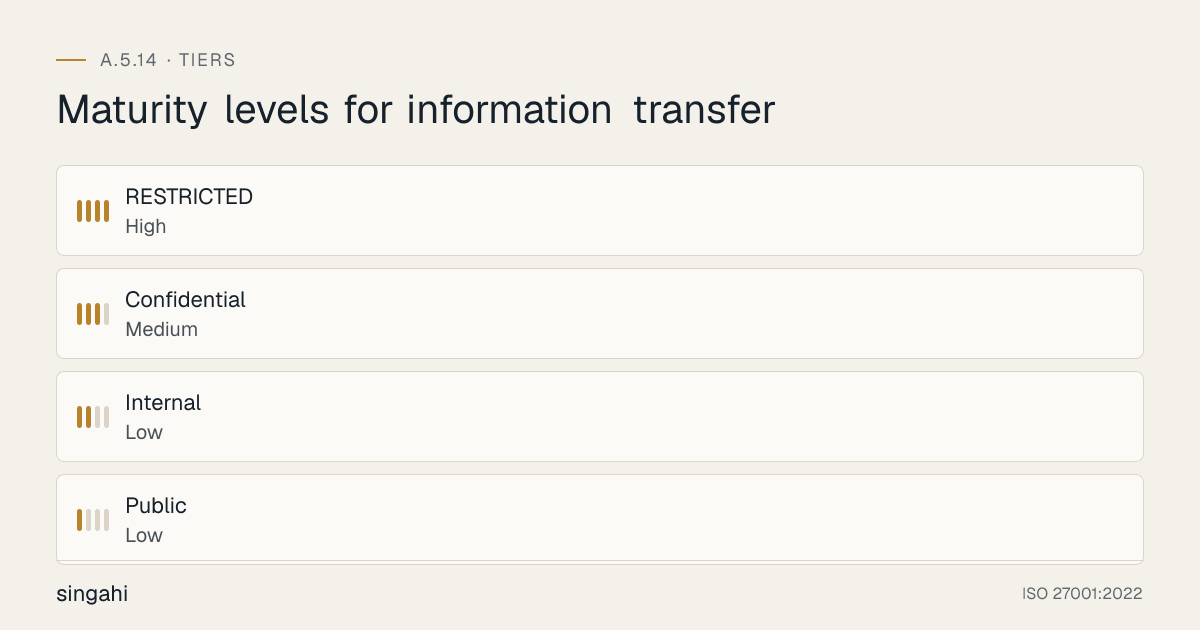
Maturity levels for information transfer
Risks of Inadequate Transfer Controls
| Risk | Likelihood | Impact | Risk Score | Mitigation |
|---|---|---|---|---|
| Data breach via email | Very High | High | Critical | Email encryption, DLP, anti-phishing |
| Data breach via cloud sharing | Very High | High | Critical | Cloud sharing controls, CASB, DLP |
| Data breach via removable media | Medium | High | High | Media encryption, USB restrictions, monitoring |
| Data breach via API | Medium | High | High | API security, authentication, rate limiting |
| Data breach via physical transfer | Medium | High | High | Physical controls, courier tracking, secure print |
| Insider data exfiltration | Medium | High | High | DLP, monitoring, behavioral analytics |
| Third-party data breach | High | High | Critical | Third-party assessment, contractual controls, monitoring |
| Regulatory non-compliance | Medium | High | High | Compliance controls, legal review, documentation |
| Data corruption during transfer | Medium | Medium | Medium | Integrity checks, validation, error handling |
| Business disruption from transfer failure | Medium | Medium | Medium | Redundancy, monitoring, failover |
| Cross-border transfer violation | Medium | High | High | Legal review, SCCs, impact assessment |
| Loss of data sovereignty | Low | High | Medium | Data localization, residency controls |
| Malware transfer via email or file sharing | High | Medium | High | Anti-malware, sandboxing, file type restrictions |
| Unauthorized mobile transfer | Medium | High | High | MDM, MAM, DLP on mobile devices |
Transfer Risk Matrix by Classification
| Classification | Internal Transfer | External Transfer | Cross-Border Transfer | Physical Transfer |
|---|---|---|---|---|
| Public | Low | Low | Low | Low |
| Internal | Low | Medium | Medium | Low |
| Confidential | Medium | High | High | Medium |
| RESTRICTED | High | Critical | Critical | High |
Risk Treatment Plan
| Risk | Treatment | Owner | Timeline |
|---|---|---|---|
| Data breach via email | Deploy email encryption and DLP | CISO | 1 month |
| Data breach via cloud sharing | Deploy CASB and cloud sharing controls | Security Manager | 1 month |
| Third-party data breach | Implement third-party assessment and contractual controls | CISO / Legal | 2 months |
| Insider exfiltration | Deploy endpoint DLP and behavioral analytics | Security Manager | 2 months |
| Cross-border compliance | Implement legal review, SCCs, and impact assessments | Legal / CISO | 2 months |
| Data corruption | Implement integrity checks and validation for critical transfers | IT | 1 month |
| Malware transfer | Deploy anti-malware and sandboxing for file transfers | Security Manager | 1 month |
| Mobile transfer risk | Deploy MDM, MAM, and mobile DLP | IT | 2 months |
| Physical transfer loss | Implement courier tracking, secure print, and physical controls | Facilities | 1 month |
Audit and Assessment Checklist
Documentation Review
- Is there a documented Information Transfer Policy?
- Is there a transfer authorization matrix?
- Are transfer procedures defined for each transfer type (email, cloud, media, physical, API, system)?
- Is there a third-party transfer governance procedure?
- Is there a cross-border transfer compliance procedure?
- Is there a transfer monitoring and logging procedure?
- Is there a transfer request and approval form?
- Is there training material on transfer procedures?
- Are transfer logs retained for the required period?
- Is there a process for handling transfer violations?
Implementation Review
- Is email encryption (TLS 1.2+) deployed for all email?
- Is DLP deployed for email, cloud, and endpoint transfers?
- Is CASB deployed for cloud transfer monitoring?
- Are cloud sharing controls configured (expiration, password, external sharing restrictions)?
- Is removable media encrypted and restricted?
- Are API transfers secured with authentication, TLS, and rate limiting?
- Are system transfers encrypted and validated?
- Is secure print release deployed for sensitive documents?
- Is MDM deployed with DLP for mobile devices?
- Is remote work transfer controlled (VPN, ZTNA)?
- Are third-party transfers governed by contractual controls?
- Are cross-border transfers reviewed by legal?
- Is physical transfer tracked and logged?
- Are transfer logs monitored for anomalous patterns?
Effectiveness Review
- What percentage of transfers are encrypted? (Target: ≥95% for sensitive data)
- What percentage of DLP policy violations are detected? (Target: ≥90%)
- How many unauthorized transfers are detected per month? (Target: decreasing trend)
- Are transfer logs complete and reviewable?
- Is there evidence of third-party transfer assessments?
- Are there any cross-border transfer compliance gaps?
- Are there any recurring transfer violations or incidents?
- Is the transfer control framework still appropriate for the business?
Metrics and KPIs
Figure · Measures
The measures that show A.5.14 is working
- Email Encryption Coverage≥99%Monthly
- DLP Policy Coverage≥90%Monthly
- CASB Coverage≥90%Monthly
- Media Encryption Coverage≥95%Quarterly
- Secure API Coverage≥95%Quarterly
Transfer Coverage Metrics
| KPI | Formula | Target | Frequency |
|---|---|---|---|
| Email Encryption Coverage | % of emails using TLS 1.2+ | ≥99% | Monthly |
| DLP Policy Coverage | % of transfer channels monitored by DLP | ≥90% | Monthly |
| CASB Coverage | % of cloud apps monitored by CASB | ≥90% | Monthly |
| Media Encryption Coverage | % of removable media encrypted | ≥95% | Quarterly |
| Secure API Coverage | % of APIs using TLS + authentication | ≥95% | Quarterly |
Transfer Compliance Metrics
| KPI | Formula | Target | Frequency |
|---|---|---|---|
| DLP Violation Detection Rate | % of policy violations detected by DLP | ≥90% | Monthly |
| Unauthorized Transfer Rate | Number of unauthorized transfers detected per month | Decreasing | Monthly |
| Transfer Approval Compliance | % of high-risk transfers with documented approval | ≥95% | Monthly |
| Cross-Border Compliance | % of cross-border transfers with legal review | 100% | Quarterly |
| Third-Party Transfer Compliance | % of third-party transfers with contractual controls | ≥95% | Quarterly |
Operational Metrics
| KPI | Formula | Target | Frequency |
|---|---|---|---|
| Transfer Volume | Number of transfers per month by channel | Trend analysis | Monthly |
| Transfer Failure Rate | % of transfers failing integrity or validation checks | ≤2% | Monthly |
| Transfer Response Time | Time to resolve transfer issues or violations | ≤4 hours | Monthly |
| Training Compliance | % of employees completing transfer training | ≥95% | Quarterly |
| Audit Finding Rate | Number of transfer-related audit findings per audit | 0 | Annual |
Business Impact Metrics
| KPI | Formula | Target | Frequency |
|---|---|---|---|
| Data Breach Reduction | % reduction in transfer-related data breaches | ≥50% | Annual |
| Incident Response Time | Time to identify transfer-related incidents | ≤30 minutes | Per incident |
| Regulatory Compliance | Number of transfer-related regulatory findings | 0 | Annual |
| Third-Party Risk Reduction | % of third-party transfers with security assessment | ≥90% | Quarterly |
| Business Continuity | % of critical transfers with redundancy and failover | ≥95% | Annual |
Common Pitfalls and How to Avoid Them
Focusing Only on Email, Ignoring Other Channels
Pitfall: Organizations deploy email DLP but ignore cloud storage, removable media, messaging apps, and APIs. Impact: Data exfiltration shifts to unmonitored channels. The attacker or insider simply uses the path of least resistance. Solution: Implement a complete transfer control framework covering ALL channels: email, cloud, removable media, APIs, physical, mobile, and messaging. Use CASB for cloud, endpoint DLP for media, API gateways for APIs, and MDM for mobile. Map all transfer channels and ensure each has controls.
Over-Reliance on Blocking, Under-Reliance on Monitoring
Pitfall: Organizations block transfers but don't monitor the attempts. Employees find workarounds, and the organization never sees the attempts. Impact: Transfers are blocked but the organization doesn't know why, by whom, or how often. The underlying behavior is not addressed. Solution: Monitor and log ALL transfer attempts, even blocked ones. Use the logs to identify training needs, policy gaps, and potential insider threats. Alerts on repeated blocked attempts should trigger investigation, not just dismissal.
No Third-Party Transfer Governance
Pitfall: Organizations transfer data to third parties without security assessments, contractual controls, or monitoring. Impact: Third-party breaches expose the organization's data. The organization has no legal recourse or evidence of due diligence. Solution: Implement a third-party transfer governance program: (1) security assessment before transfer, (2) contractual controls (data processing agreement; SCCs only for EU personal data), (3) right to audit, (4) transfer monitoring, (5) incident notification requirements, (6) data return/destruction on termination. Never transfer sensitive data to a third party without a signed agreement.
Ignoring Cross-Border Transfer Compliance
Pitfall: Organizations transfer personal data across borders without legal review or compliance mechanisms. Impact: Regulatory penalties, legal action, loss of customer trust, and potential data localization enforcement. Solution: For every cross-border transfer of personal data, conduct a legal review. Implement SCCs for GDPR, check the DPDP Act s.16 restricted-country list and sector localisation rules, and document the transfer assessment. Maintain records of cross-border transfers and compliance mechanisms. Respect sector localisation requirements (for example RBI payment data).
Weak Physical Transfer Controls
Pitfall: Organizations focus on digital transfer controls but neglect printed documents, courier shipments, and hand deliveries. Impact: Sensitive printed documents are lost, stolen, or left in public. Courier shipments are intercepted or misdelivered. Solution: Implement physical transfer controls: secure print release, sealed and tracked courier shipments, chain of custody for hand deliveries, shredders for disposal, and secure storage for physical documents. Train employees on physical transfer procedures. Audit physical security regularly.
No Transfer Validation or Integrity Checks
Pitfall: Organizations transfer data without verifying that the received data is complete, accurate, and unmodified. Impact: Corrupted or incomplete data leads to business errors, bad decisions, and operational failures. Solution: Implement transfer validation: checksums, hashes, file size verification, record count validation, and format validation. For critical transfers, use digital signatures to verify sender identity and data integrity. Establish error handling and retry procedures for failed transfers.
Neglecting Mobile and Remote Transfer Controls
Pitfall: Organizations assume remote workers use the same controls as office workers, but mobile and remote transfers bypass traditional controls. Impact: Sensitive data is transferred via personal apps, public Wi-Fi, and personal cloud storage, creating massive exposure. Solution: Deploy MDM with DLP and containerization for all corporate mobile devices. Require VPN or ZTNA for all remote access. Prohibit personal cloud storage for work data. Use enterprise messaging platforms (Teams, Slack) with DLP. Monitor and alert on anomalous transfers from remote locations.
No Transfer Logging or Retention
Pitfall: Organizations transfer data but don't log or retain transfer records. Impact: When a breach occurs, the organization cannot determine what was transferred, to whom, or when. Incident response is blind, and compliance is impossible. Solution: Log electronic transfers in the systems that carry them, and log physical transfers of Confidential and Restricted media. Keep logs for at least 180 days in India where the CERT-In Directions apply, and otherwise per your retention schedule; logs hold personal data, so avoid indefinite retention. Ensure logs are tamper-resistant and protected. Use logs for monitoring, incident response, and compliance audits.
Transfer Controls Without User Training
Pitfall: Organizations deploy technical controls but don't train employees on why they matter or how to use them. Impact: Employees bypass controls because they don't understand them. Workarounds become the norm, and the controls become ineffective. Solution: Train employees on transfer policies, procedures, and technical controls. Use real-world scenarios and examples. Explain the "why" behind the controls. Provide clear guidance on approved transfer methods and how to request exceptions. Make it easy to do the right thing and hard to do the wrong thing.
Not Updating Controls for New Transfer Channels
Pitfall: Organizations implement transfer controls for existing channels but don't update them when new channels emerge (new cloud apps, new messaging platforms, new collaboration tools). Impact: Employees adopt new tools for convenience, and the organization has no visibility or control over transfers through these tools. Solution: Maintain an inventory of all transfer channels and review it quarterly. When new tools are adopted, assess their transfer risks and implement controls before allowing sensitive data. Use CASB shadow IT discovery to detect unauthorized cloud apps. Update transfer policies and DLP rules for new channels.
Illustrative Scenarios
Illustrative scenario, a composite example for guidance, not a specific Singahi engagement or a verified outcome.
Illustrative Scenario 1: Indian Healthcare Provider, DLP and Email Encryption Prevent a Patient-Data Breach
Organization: Multi-specialty hospital chain (8 hospitals, 2,000 employees) based in Delhi, with international patient services Sector: Healthcare (DPDP Act for all patients; data-protection terms in contracts with overseas insurers and referral partners) Challenge: A billing employee nearly emailed a spreadsheet of international patients' records to a personal account; the mistake was noticed by chance. The hospital had no controls on email, cloud or USB transfers.
Implementation:
- Phase 1 (Weeks 1–4): Security assessment and policy development. The CISO conducted a complete transfer channel inventory and identified email, cloud storage (Google Drive personal), USB drives, and personal messaging apps (WhatsApp) as the highest-risk channels. Developed a Healthcare Information Transfer Policy aligned with the DPDP Act and its partner contracts.
- Phase 2 (Weeks 5–8): Email and cloud DLP deployment. Deployed Microsoft Purview DLP across Microsoft 365 email, OneDrive, and SharePoint. Configured policies:
- Block all emails containing patient data to personal email domains (Gmail, Yahoo, Outlook)
- Block all external emails containing patient data without encryption
- Encrypt all external emails containing patient data using Office 365 Message Encryption
- Warn on internal emails with patient data sent to broad distribution lists
- Block all OneDrive/SharePoint sharing of patient data to external recipients
- Block all uploads of patient data to non-corporate cloud services (detected via endpoint DLP)
- Policy tips appeared in Outlook and OneDrive to educate users in real-time
- Phase 3 (Weeks 9–12): Endpoint and mobile controls. Deployed Microsoft Intune MDM with endpoint DLP on all laptops. Enforced USB restrictions: only approved, encrypted USB drives were permitted. Personal USB drives were blocked. Deployed mobile app protection policies (MAM) that prevented saving patient data from corporate apps to personal apps. WhatsApp was blocked on corporate devices for work communication; Microsoft Teams was enforced.
- Phase 4 (Weeks 13–16): Third-party and cross-border governance. Developed a Third-Party patient data Transfer Agreement template for all vendors handling patient data. Checked that no destination country was restricted under DPDP s.16 and recorded each cloud provider's contractual safeguards. Conducted security assessments of all cloud vendors (AWS, Azure, Salesforce) and documented their security commitments. Implemented transfer logs and monitoring dashboards.
- Phase 5 (Weeks 17–20): Training and rollout. Trained all 2,000 employees on the new transfer controls, with special training for clinical staff, billing, and IT. Training included real-world scenarios: "What happens if you email a patient list to your personal account?" The answer: "The email is blocked, you see a policy tip, and the security team follows up with a short coaching session." The training was mandatory and tested.
Results:
- Zero patient data breaches: In the 18 months following implementation, zero incidents of patient data transferred to unauthorized recipients. The DLP system detected and blocked 12 attempted violations in the first 3 months (all accidental, all resolved with training rather than discipline).
- Customer assurance: Overseas insurers' and referral partners' security questionnaires were answered with evidence from the DLP and encryption controls.
- DPDP Act readiness: The transfer controls, logs, and third-party agreements positioned the organization for DPDP Act compliance. The privacy lead cited the transfer controls as a key enabler for the organization's compliance posture.
- Employee behavior change: The policy tips in Outlook and OneDrive educated employees in real-time. Help desk questions about "why can't I email this file?" decreased from 50 per week to 5 per week after 6 months. Employees understood the controls and adapted their workflows.
- Operational efficiency: The encrypted email system actually improved communication with international patients. Patients could securely receive their medical records, test results, and appointment confirmations via encrypted email.
Key Success Factors:
- Real-time policy tips in Outlook and OneDrive educated users without requiring constant training
- Blocking personal email domains was a simple, effective rule that prevented the most common exfiltration vector
- Encrypting external patient data emails improved patient experience while maintaining security
- MDM and MAM prevented the "shadow IT" problem of personal apps and cloud storage
- Third-party governance ensured that vendors could not become the weak link
- The near-miss incident was the catalyst for investment, not an actual breach
Lessons Learned:
- Healthcare data transfer is the highest-risk activity for patient data exposure
- DLP must be configured to block the most dangerous transfers (personal email domains) immediately
- Encryption improves the user experience for legitimate external transfers while protecting against unauthorized ones
- Real-time user education (policy tips) is more effective than annual training
- Mobile and remote work are the fastest-growing transfer risk vectors, prioritize them
- Third-party governance is essential; the weakest vendor can become the breach point
Illustrative Scenario 2: Indian Manufacturing Conglomerate, Complete Transfer Controls Secure Multi-Plant Data Exchange and Vendor Collaboration
Organization: Manufacturing conglomerate (12 plants, 5,000 employees) with operations in India, Southeast Asia, and Europe Sector: Manufacturing (Automotive and industrial components) Challenge: The conglomerate operated a complex ecosystem of 12 manufacturing plants, 200+ vendors, 50+ logistics partners, and customers across 20 countries. Data transfers occurred across multiple channels: ERP system data feeds between plants, design files shared with vendors, quality data shared with customers, logistics data shared with partners, and financial data shared with auditors and regulators. The organization had no unified transfer control framework. Each plant had its own practices, leading to inconsistency and gaps. A recent incident involved a design file for a new automotive component being transferred via unencrypted FTP to a vendor in China, where it was intercepted and potentially copied. The organization faced intellectual property theft, competitive disadvantage, and customer loss of trust. The lack of transfer controls was also a barrier to ISO 27001 certification, which a major customer was requiring for contract renewal.
Implementation:
- Phase 1 (Months 1–2): Enterprise transfer assessment and architecture. The CISO led a cross-functional team (IT, Operations, Legal, Procurement, Plant Managers) to inventory all transfer channels across all plants. The inventory identified 47 distinct transfer channels, including ERP-to-ERP data feeds, vendor file sharing, customer portals, logistics APIs, email, cloud storage, and physical media. The team classified each channel by risk (volume, sensitivity, destination, frequency) and developed a unified transfer control architecture.
- Phase 2 (Months 3–4): Policy and governance framework. Developed a conglomerate-wide Information Transfer Policy with plant-specific addendums. The policy defined:
- Classification-based transfer rules (RESTRICTED designs = encrypted + owner approval; Confidential quality data = encrypted)
- Approved transfer channels by classification level
- Vendor transfer requirements (security assessment, contractual controls, encryption, return/destruction)
- Cross-border transfer rules (design files to EU partners = contract and NDA terms; any EU personal data = GDPR rules; transfers to China = export-control screening and legal review)
- Physical transfer controls (secure courier, tamper-evident packaging, chain of custody)
- Mobile and remote transfer controls (VPN, MDM, DLP)
- Transfer monitoring and logging requirements (electronic transfers logged by the carrying systems; retention per the log retention schedule)
- Phase 3 (Months 5–7): Technical controls deployment. Deployed a complete technical control stack:
- ERP and System Transfers: Replaced unencrypted FTP with SFTP and API gateways (Kong) for all inter-system transfers. Implemented TLS 1.3 for all data feeds. Deployed data validation and integrity checks (checksums, hashes) for all critical transfers. Implemented API authentication (OAuth 2.0 + mTLS) for vendor and customer API integrations.
- Email and Cloud: Deployed Microsoft Purview DLP for email and cloud sharing. Blocked all external sharing of RESTRICTED data. Required encryption for all external sharing of Confidential data. Implemented CASB (Netskope) to monitor and enforce cloud transfer policies across all plants. Blocked unauthorized cloud apps (200+ shadow IT apps discovered and blocked).
- Removable Media: Deployed endpoint encryption (BitLocker) on all devices. Blocked all personal USB drives. Issued approved, encrypted USB drives for approved transfers. Implemented USB port restrictions on sensitive workstations (design engineering, R&D).
- Physical Transfer: Deployed secure print release across all plants. Implemented tamper-evident packaging for courier shipments of sensitive documents. Tracked all courier shipments with insurance and signature confirmation. Required chain of custody for hand deliveries of design files and prototypes.
- Mobile and Remote: Deployed Microsoft Intune MDM across all mobile devices. Enforced VPN for all remote access. Implemented mobile DLP to prevent data transfer to personal apps. Blocked WhatsApp and Telegram for work communication; enforced Microsoft Teams with DLP.
- Phase 4 (Months 8–9): Vendor and third-party governance. Developed a Third-Party Data Transfer Agreement template and required all 200+ vendors to sign it. The agreement included:
- Encryption requirements for all data transfers
- Access control requirements for shared data
- Incident notification within 24 hours
- Right to audit vendor security controls
- Data return or destruction upon contract termination
- Prohibition on sub-contracting without approval
- Conducted security assessments of the top 50 vendors (by data volume and sensitivity). Two vendors were required to remediate significant gaps before receiving sensitive data.
- Phase 5 (Months 10–12): Cross-border compliance. Mapped which transfers carried personal data and which carried only technical data. For personal data, checked DPDP s.16 (no restricted destinations) and put processing contracts in place; where EU customers sent personal data to India, those customers' SCCs governed it. For design and technical data, applied NDAs, contract terms and export-control screening for controlled items.
- Phase 6 (Months 13–14): Monitoring, training, and certification. Deployed a centralized SIEM (Splunk) to aggregate transfer logs from all plants and systems. Implemented real-time dashboards for transfer monitoring. Trained all 5,000 employees on the new transfer controls. Conducted a complete internal audit of transfer controls across all plants. Achieved ISO 27001 certification with zero findings on information transfer.
Results:
- Zero IP theft incidents: In the 24 months following implementation, zero incidents of intellectual property theft or unauthorized design file transfer. The previous 12 months had seen 2 incidents (one confirmed, one suspected).
- The customer cited "demonstrable supply chain security" as the primary reason for renewal.
- Vendor compliance: 98% of vendors signed the Third-Party Data Transfer Agreement. The two vendors who failed the security assessment were replaced, improving the overall vendor security posture.
- Cross-border compliance: All cross-border transfers were documented and compliant. An external readiness review found the transfer records complete for both DPDP and customer contract requirements.
- Operational efficiency: The unified transfer architecture reduced IT complexity. The standardization of transfer protocols (all SFTP, all API gateways) reduced the number of transfer methods from 47 to 12, making management and monitoring easier. The API gateway reduced integration time with new vendors from 4 weeks to 1 week.
- Cultural change: The unified policy and training created a consistent security culture across all 12 plants. Employees at every plant understood the same transfer rules and used the same tools. This was a significant improvement from the previous inconsistent practices.
Key Success Factors:
- Enterprise-wide approach rather than plant-by-plant implementation ensured consistency
- The CISO led a cross-functional team, not just IT, ensuring operational alignment
- The major customer contract renewal was the business driver, not just compliance
- Standardization of transfer protocols reduced complexity and improved manageability
- Vendor governance was non-negotiable; all vendors signed the agreement or were replaced
- Cross-border compliance was addressed proactively, not reactively
- Centralised transfer logs gave the investigation team the evidence it needed
Lessons Learned:
- Manufacturing organizations with complex supply chains need enterprise-wide transfer controls, not plant-level solutions
- The vendor ecosystem is the weakest link; vendor governance is non-negotiable
- IP theft is the primary manufacturing risk; transfer controls must prioritize design and R&D data
- Standardization of transfer protocols reduces complexity and improves security
- Cross-border compliance must be addressed before transfers, not after an audit finding
- Business drivers (customer contracts) are more effective than compliance alone for securing investment
- Physical transfer controls (secure print, courier tracking) are essential for manufacturing with physical prototypes and documents
Multi-Framework Mapping
NIST CSF 2.0 Mapping
| NIST CSF Function | Category | Subcategory | Mapping to A.5.14 |
|---|---|---|---|
| PROTECT (PR) | PR.DS | PR.DS-02 | Data in transit is protected |
| PROTECT (PR) | PR.DS | PR.DS-01 | Data at rest on removable media and shared storage is protected |
| PROTECT (PR) | PR.AA | PR.AA-05 | Access permissions decide who may send what to whom |
| PROTECT (PR) | PR.AT | PR.AT-01 | Staff know the transfer rules |
| DETECT (DE) | DE.CM | DE.CM-01 | Networks are monitored for unauthorised transfers |
| DETECT (DE) | DE.CM | DE.CM-09 | Endpoints and data are monitored (DLP) |
| GOVERN (GV) | GV.PO | GV.PO-01 | Transfer policy is established and communicated |
| GOVERN (GV) | GV.SC | GV.SC-05 | Transfer requirements are written into supplier contracts |
| IDENTIFY (ID) | ID.AM | ID.AM-03 | Data flows and transfer channels are documented |
PCI DSS v4.0.1 Mapping
| PCI DSS Requirement | Mapping to A.5.14 |
|---|---|
| 4.2.1 Strong cryptography for PAN over open, public networks | Directly met by transfer encryption rules |
| 4.2.2 PAN secured when sent by end-user messaging | Email and chat rules for card data |
| 9.4.3 / 9.4.4 Media with cardholder data sent securely and approved by management | Physical media transfer rules |
| 12.2.1 Acceptable use policies for end-user technologies | Approved transfer tools and channels |
| 12.8.2 Written agreements with third-party service providers | Transfer agreements with providers handling account data |
SOC 2 Type II Mapping
| TSC Category | Mapping to A.5.14 |
|---|---|
| CC6.1 Logical access security | Access controls decide who can transfer what |
| CC6.7 Transmission and movement of information is restricted and protected | Direct match: encryption and approved channels for transfers |
| CC9.2 Vendor and business partner risk | Transfer requirements in supplier agreements |
| C1.1 Confidential information is identified and maintained | Confidential data is identified before transfer |
| P6.1 Disclosure to third parties (Privacy criteria) | Personal data shared only for stated purposes and under agreement |
COBIT 2019 Mapping
| COBIT Domain | COBIT Component | Mapping to A.5.14 |
|---|---|---|
| APO13 Managed Security | APO13.01 | Transfer rules are part of the ISMS |
| APO10 Managed Vendors | APO10.03 | Transfer requirements managed in vendor relationships |
| DSS05 Managed Security Services | DSS05.02 | Network and connectivity security for transfers |
| DSS05 Managed Security Services | DSS05.06 | Sensitive documents and output devices |
| DSS02 Managed Service Requests and Incidents | DSS02.02 | Misdirected or unauthorised transfers handled as incidents |
| DSS06 Managed Business Process Controls | DSS06.06 | Information assets protected during processing and exchange |
CIS Controls v8 Mapping
| CIS Control | Safeguard | Mapping to A.5.14 |
|---|---|---|
| Control 3: Data Protection | 3.8 | Document data flows (direct match for transfer channels) |
| Control 3: Data Protection | 3.10 | Encrypt sensitive data in transit |
| Control 3: Data Protection | 3.9 | Encrypt data on removable media |
| Control 3: Data Protection | 3.13 | Deploy a data loss prevention solution |
| Control 9: Email and Web Browser Protections | 9.2 | Use DNS filtering services |
| Control 9: Email and Web Browser Protections | 9.5 | Implement DMARC |
| Control 9: Email and Web Browser Protections | 9.6 | Block unnecessary file types |
| Control 15: Service Provider Management | 15.4 | Ensure service provider contracts include security requirements |
| Control 14: Security Awareness | 14.4 | Train staff on data handling best practices |
RBI Cybersecurity Framework Mapping
| RBI Requirement | Mapping to A.5.14 |
|---|---|
| Asset Management | RBI requires transfer controls for all customer data |
| Cybersecurity Operations | RBI requires encryption for customer data transfers |
| IT Governance | RBI requires transfer governance and accountability |
| Compliance | RBI requires transfer compliance monitoring |
| Third-Party Risk | RBI requires transfer controls for third-party vendors |
| Data Protection | RBI requires data protection during transfer |
| Incident Response | RBI requires transfer logs for incident response |
| Business Continuity | RBI requires transfer continuity for critical operations |
| Audit | RBI requires transfer audit trails |
| Reporting | RBI requires transfer reporting to the board |
SEBI CSCRF Mapping
| SEBI Requirement | Mapping to A.5.14 |
|---|---|
| Information Classification | SEBI requires transfer controls for market-sensitive data |
| Access Management | SEBI requires access controls for transfer authorization |
| Incident Management | SEBI requires transfer logs for incident response |
| Compliance | SEBI requires transfer compliance monitoring |
| Third-Party Risk | SEBI requires transfer controls for third-party vendors |
| Data Protection | SEBI requires data protection during transfer |
| Business Continuity | SEBI requires transfer continuity for critical operations |
| Audit | SEBI requires transfer audit trails |
| Reporting | SEBI requires transfer reporting to the board |
| Market Infrastructure | SEBI requires transfer controls for market infrastructure |
DPDP Act 2023: Relevant Provisions
| DPDP Act Provision | Mapping |
|---|---|
| Section 8(5) Reasonable security safeguards | Protect personal data through the safeguards in this control |
| Section 8(6) Personal data breach intimation | Detect and notify relevant breaches to the Board and affected principals |
Regulatory and Compliance Context
Indian Regulatory Requirements for Transfer
Digital Personal Data Protection Act, 2023:
- Cross-border transfer of personal data is allowed except to countries the government restricts by notification (s.16, a negative list); stricter sector rules still apply
- Data fiduciaries must implement reasonable security safeguards for data transfers, including encryption and access controls
- Significant Data Fiduciaries must carry out periodic Data Protection Impact Assessments (s.10), which should cover high-risk transfers
- Data breach notification requirements apply to transfers that result in breaches
- The Data Protection Board may investigate transfer violations and impose penalties
- Future rules may specify additional cross-border transfer requirements
Information Technology Act, 2000:
- Section 43A and the SPDI Rules 2011 require reasonable security practices for sensitive personal data, including in transfer (until DPDP s.44(2) omits s.43A, about May 2027)
- Section 72 requires protection of confidentiality and privacy during transfer
- For classified government material, transfer rules come from the MHA's Manual of Departmental Security Instructions and defence security instructions; wrongful disclosure is an offence under the Official Secrets Act 1923
RBI Cybersecurity Framework for Banks:
- Banks must protect customer data in transit over public networks
- RBI's 2016 framework (Annex 1) asks banks to have a data leak prevention strategy covering email and other channels
- Banks must assess third-party transfer risks and implement contractual controls
- UCBs and NBFCs have proportionate requirements
SEBI CSCRF (2024):
- Market infrastructure institutions must implement transfer controls for market-sensitive data
- Intermediaries must encrypt and monitor transfers of client data and trading information
- Third-party transfer governance is required for all vendors handling market data
IRDAI Cybersecurity Guidelines:
- Insurance companies must implement transfer controls for customer and policy data
- Health data transfers require encryption and access controls
- Third-party transfer governance is required for all vendors handling insurance data
- Cross-border transfers of health data require enhanced protection
Defense and Government:
- Contractors move classified material only through the channels the contracting ministry prescribes, under the MHA's Manual of Departmental Security Instructions and defence security instructions
- Wrongful disclosure of official secrets is an offence under the Official Secrets Act 1923
Sector-Specific Transfer Requirements
| Sector | Regulatory Body | Key Transfer Requirements |
|---|---|---|
| Banking | RBI | Encrypt all customer data transfers; maintain transfer logs; DLP for email and cloud; third-party transfer governance; cross-border compliance |
| Securities | SEBI | Encrypt market-sensitive data transfers; monitor and log all transfers; third-party transfer governance; cross-border compliance; transfer audit trails |
| Insurance | IRDAI | Encrypt customer and health data transfers; third-party transfer governance; cross-border health data compliance; transfer audit trails |
| Telecom | DoT/TRAI | Encrypt customer data transfers; lawful interception data transfer controls; cross-border data transfer compliance; third-party transfer governance |
| Healthcare | MoHFW / NABH | Encrypt patient data transfers; DPDP Act duties; ABDM rules for ABDM participants; third-party transfer governance |
| Government | NCIIPC/CERT-In | Transfer classified information only through authorized channels; encryption and tracking; MHA security instructions for classified material |
| Defense | MHA/Defence | Government-approved transfer controls; encryption and tracking for classified transfers; defence security instructions; no unauthorised cross-border transfer |
| IT/ITeS | MeitY | Customer data transfer under client contracts; encryption; client-specified location restrictions |
| E-commerce | MeitY/Consumer Affairs | Encrypt customer and payment data transfers; PCI DSS compliance for payment transfers; third-party transfer governance; cross-border compliance |
| Manufacturing | Industry Bodies | Encrypt IP and design data transfers; third-party transfer governance; cross-border compliance; export control compliance; transfer audit trails |
RACI Matrix
Transfer Activities RACI
| Activity | Board | CISO | Data Owner | Security Manager | IT | Legal | All Employees | Compliance |
|---|---|---|---|---|---|---|---|---|
| Strategy and Policy | ||||||||
| Define transfer strategy | I | A | C | C | I | C | I | C |
| Approve transfer policy | A | R | C | C | I | C | I | C |
| Design transfer controls | C | A | C | R | C | I | I | C |
| Implementation | ||||||||
| Deploy DLP and CASB | I | A | C | R | C | I | I | C |
| Deploy email encryption | I | A | C | C | R | I | I | C |
| Deploy API security | I | A | C | R | R | I | I | C |
| Deploy physical controls | I | A | C | R | I | I | I | C |
| Deploy mobile controls | I | A | C | C | R | I | I | C |
| Develop training | I | A | C | R | I | I | I | C |
| Deliver training | I | A | C | R | I | I | I | C |
| Operations | ||||||||
| Authorize transfers | I | C | A | C | I | C | I | C |
| Monitor transfer logs | I | A | C | R | C | I | I | C |
| Investigate violations | I | A | C | R | C | I | I | C |
| Manage third-party transfers | I | A | C | R | I | C | I | C |
| Manage cross-border transfers | I | A | C | C | I | R | I | C |
| Audit and Compliance | ||||||||
| Prepare audit evidence | I | A | R | R | C | I | I | C |
| Respond to findings | I | A | R | R | I | C | I | C |
| Report to management | I | A | C | R | I | C | I | C |
R = Responsible, A = Accountable, C = Consulted, I = Informed
Documentation and Record Keeping
Suggested Records
ISO 27001 sets no retention periods. The periods below are examples; set yours from legal, contractual and DPDP erasure obligations.
| Document | Purpose | Retention Period | Owner |
|---|---|---|---|
| Information Transfer Policy | Defines transfer requirements and procedures | 7 years | CISO |
| Transfer Authorization Matrix | Defines approval requirements by classification and transfer type | 3 years | CISO |
| Transfer Procedures by Channel | Detailed procedures for email, cloud, media, physical, API, system transfers | 3 years | CISO |
| Third-Party Transfer Governance | Security assessment records, contractual controls, monitoring reports | 7 years | CISO |
| Cross-Border Transfer Register | All cross-border transfers with compliance mechanism and legal review | 7 years | Legal |
| Transfer Request and Approval Forms | Individual transfer requests and approvals | 7 years | CISO |
| Transfer Logs | All transfer logs (email, cloud, media, API, system, physical) | 7 years | Security Manager |
| DLP and CASB Reports | DLP violation reports, CASB monitoring reports, anomaly reports | 3 years | Security Manager |
| Incident Response Records | Transfer-related incident investigations and response | 7 years | Security Manager |
| Training Records | Employee training on transfer procedures | 3 years | HR |
| Third-Party Security Assessments | Security assessment reports for vendors receiving data | 3 years | CISO |
| Audit Reports | Internal and external audit reports on transfer controls | 7 years | Compliance |
| Standard Contractual Clauses (SCCs) | SCCs for GDPR cross-border transfers | Duration + 7 years | Legal |
| Business Associate Agreements (BAAs) | BAAs for HIPAA PHI transfers | Duration + 7 years | Legal |
| Data Processing Agreements (DPAs) | DPAs for third-party data transfers | Duration + 7 years | Legal |
Record Keeping Best Practices
- Centralized Repository: Maintain transfer policy, procedures, and records in a centralized system
- Access Control: Restrict access to transfer logs and compliance records
- Version Control: Track version history for transfer policies and procedures
- Audit Trail: Maintain complete audit trails for transfer approvals and changes
- Backup: Transfer logs are critical for compliance and forensics and must be backed up
- Privacy Compliance: Handle personal data in transfer logs per DPDP Act
- Legal Privilege: Protect transfer records related to litigation or investigation
- Cross-Reference: Link transfer records to classification, asset inventory, and incident records
- Retention Compliance: Align retention with legal and regulatory requirements
- Secure Destruction: Securely destroy records when retention periods expire
- Chain of Custody: Maintain chain of custody for physical transfer records
- Tamper Resistance: Ensure transfer logs are tamper-resistant and immutable
- Real-Time Access: Enable real-time access to transfer logs for incident response
- Reporting: Enable automated reporting on transfer metrics and compliance
- Integration: Integrate transfer records with SIEM, incident response, and compliance systems
Continuous Improvement
Maturity Model for A.5.14
| Level | Name | Characteristics | Evidence |
|---|---|---|---|
| 1 | Initial | No formal transfer controls; ad-hoc transfers; no policy; no encryption; no logging; no monitoring | No documentation, no controls, no logs, incidents common |
| 2 | Developing | Basic transfer controls for some channels; email encryption for some; basic DLP for email; some logging; limited policy | Some controls, some logs, basic policy, some incidents |
| 3 | Defined | Complete transfer policy; controls for all major channels (email, cloud, media, physical); DLP for email and cloud; encryption for sensitive transfers; logging for all channels; training; quarterly review | Complete policy, channel controls, DLP, encryption, logs, training, review |
| 4 | Managed | Automated transfer controls; DLP for all channels; CASB for cloud; API security for system transfers; mobile DLP; real-time monitoring; third-party governance; cross-border compliance; metrics-driven | Automation, CASB, API security, mobile DLP, monitoring, governance, metrics |
| 5 | Optimizing | AI-driven transfer monitoring; predictive analytics for transfer risks; self-healing transfer controls; behavioral analytics for insider threats; industry-leading practices; transfer controls drive strategic security decisions; continuous optimization | AI monitoring, predictive analytics, behavioral analytics, strategic integration |
Improvement Cycle
Plan:
- Annual transfer policy and procedure review
- Benchmarking against industry standards and peer organizations
- Regulatory change assessment and alignment (DPDP Act, GDPR, RBI, SEBI)
- Technology evaluation for automation and enhancement (AI, behavioral analytics, zero trust)
- Maturity assessment and target setting
- Incident analysis for transfer lessons
- Threat intelligence integration for emerging transfer risks
Do:
- Implement new transfer controls for emerging channels
- Deploy enhanced automated transfer tools (AI DLP, behavioral analytics)
- Expand transfer coverage to new systems and formats
- Enhance integration with SIEM, SOAR, and incident response
- Deliver refresher training and awareness campaigns
- Update third-party transfer requirements and assessments
- Implement zero trust for transfer authorization
- Deploy API security for new integrations
- Enhance mobile and remote transfer controls
- Implement data sovereignty and localization controls
Check:
- Monthly transfer compliance metrics and dashboards
- Quarterly transfer accuracy and coverage audits
- Annual complete transfer effectiveness review
- Compliance audit preparation and results
- Employee feedback and comprehension assessment
- Cost optimization and ROI measurement
- Incident response effectiveness with transfer logs
- Third-party transfer compliance assessment
- Cross-border transfer compliance review
- Transfer log analysis for patterns and anomalies
Act:
- Update transfer policy based on findings, incidents, and emerging threats
- Refine transfer controls based on user feedback and incidents
- Invest in tools that improve automation, accuracy, and monitoring
- Expand training for high-risk roles, new channels, and remote work
- Report improvements to leadership and board
- Share best practices and lessons learned
- Benchmark against industry standards and peer organizations
- Engage with regulatory bodies on transfer compliance
- Participate in industry forums on transfer security
- Publish transfer security research and illustrative scenarios
Toolkit Download
The A.5.14 Control Pack contains a policy template, a step-by-step procedure, checklists, an audit evidence checklist, training materials, an issue playbook, a RACI, a metrics dashboard and a regulatory mapping.
Frequently Asked Questions
Q1: Is information transfer control mandatory for ISO 27001 certification?
A: Not automatically. No Annex A control is mandatory. Under clause 6.1.3 you choose the controls your risk assessment calls for, then record A.5.14 in your Statement of Applicability as included (and how) or excluded (and why). Almost every organisation transfers information by email, file sharing, APIs or physical media, so most include it. What you implement should match the transfers your risk assessment actually finds, rather than a generic list.
Q2: Do we need to control all types of information transfers, or just email?
A: You must control ALL types of information transfers. While email is the most common channel, data can be transferred via cloud storage, removable media, APIs, physical documents, mobile apps, messaging platforms, and system-to-system feeds. An attacker or insider will simply use the uncontrolled channel. Your transfer control framework must cover all channels, or you will have gaps that can be exploited.
Q3: What is the most effective way to prevent accidental data leaks via email?
A: The most effective approach is a layered defense: (1) DLP to detect sensitive data in emails and block or warn on policy violations, (2) Email encryption (TLS for transport, S/MIME or gateway encryption for sensitive content) to protect data in transit, (3) Auto-forwarding restrictions to prevent exfiltration to personal accounts, (4) User training to educate employees on safe email practices, (5) Policy tips in the email client to remind users of classification and handling rules. The combination of technical controls and user education is more effective than either alone.
Q4: How do we handle cloud file sharing without blocking legitimate collaboration?
A: The key is classification-based controls, not blanket blocking. Allow Internal and Public data to be shared freely (with appropriate logging). For Confidential data, allow external sharing with encryption and manager approval. For RESTRICTED data, block external sharing entirely or require CISO approval. Use CASB to monitor and enforce these policies. Set expiration dates and password protection on sharing links. Use "specific people only" sharing instead of "anyone with the link." The goal is to enable collaboration while protecting sensitive data, not to block all collaboration.
Q5: What is the best way to control removable media (USB drives)?
A: The best approach is a combination of technical and procedural controls: (1) Block personal USB drives on corporate devices using endpoint DLP or USB port control, (2) Issue only approved, encrypted USB drives to employees who genuinely need them, (3) Encrypt all removable media with full-disk encryption (BitLocker To Go, encrypted APFS volumes on Mac, VeraCrypt), (4) Log all USB connections and transfers, (5) Alert on large-volume transfers to removable media, (6) Require approval for transfers of sensitive data to removable media, (7) Securely wipe or destroy all media before disposal. The goal is to make USB transfers secure, monitored, and auditable, not to eliminate them entirely.
Q6: How do we control information transfers to third parties (vendors, partners)?
A: Third-party transfer governance requires: (1) Security assessment of the third party before transferring sensitive data, (2) Contractual controls (data processing agreement, and Standard Contractual Clauses where EU personal data is involved) that specify encryption, access controls, and incident notification, (3) Right to audit the third party's security controls, (4) Transfer monitoring to detect anomalous transfers, (5) Data return or destruction requirements upon contract termination, (6) Incident notification within 24 hours of any breach involving your data. Never transfer sensitive data to a third party without a signed agreement and security assessment.
Q7: What are the cross-border transfer requirements under the DPDP Act 2023?
A: The DPDP Act 2023 takes a negative-list approach: Section 16 allows transfers of personal data outside India except to countries the Central Government restricts by notification. In practice: (1) check the destination is not restricted, (2) check whether a sector rule requires localisation (RBI payment data, SEBI cloud framework, CERT-In logs) or whether you are a Significant Data Fiduciary subject to transfer restrictions under the DPDP Rules 2025, (3) keep reasonable security safeguards and contractual terms with the recipient, and (4) document the decision. The fiduciary duties apply from about May 2027, so monitor notifications. Legal review is essential for all cross-border transfers.
Q8: How do we control data transfers when employees work from home?
A: Remote work transfer controls require: (1) VPN or ZTNA for all remote access to corporate systems, (2) MDM with DLP on all corporate mobile devices, (3) Prohibition of personal cloud storage for work data (OneDrive, Google Drive personal, Dropbox personal), (4) Enterprise messaging platforms (Teams, Slack) with DLP, not personal apps (WhatsApp, Telegram), (5) Endpoint DLP on laptops to prevent unauthorized transfers, (6) Monitoring of remote transfer patterns (large volumes, unusual destinations, after-hours transfers), (7) Secure remote desktop (RDP over VPN, not exposed to internet), (8) Home network security requirements (firewall, WPA3, no guest network for work). Remote work is a permanent feature, so transfer controls must be designed for it.
Q9: How do we balance transfer security with business efficiency?
A: The key is risk-based controls, not blanket restrictions. (1) Low-risk transfers (Public, Internal) should have minimal controls to enable efficiency, (2) Medium-risk transfers (Confidential) should have proportionate controls (encryption and approved channels) that don't block normal work, (3) High-risk transfers (RESTRICTED) should have strict controls (CISO approval, encryption, monitoring) that may require additional time but are necessary for protection. Use automation (auto-encryption, auto-labeling) to reduce manual effort. The goal is to make the right thing easy and the wrong thing hard, not to make all transfers difficult.
Q10: How do we ensure transfer controls don't create a false sense of security?
A: Transfer controls are not foolproof. They can be bypassed, misconfigured, or exploited. To avoid false security: (1) Regular testing: penetration test transfer controls, (2) Red team exercises: simulate insider and external attacks on transfer channels, (3) Monitoring: don't just deploy controls; monitor their effectiveness, (4) Incident analysis: analyze every transfer-related incident to find control gaps, (5) Continuous improvement: update controls based on new threats and technologies, (6) User awareness: remind employees that controls are a safety net, not a guarantee, and that their judgment is still critical. Security is a combination of technology, process, and people, controls alone are not enough.
Q11: How do we handle encrypted transfers when the recipient doesn't have the decryption key?
A: For external recipients who cannot receive encrypted emails (e.g., no S/MIME support), use gateway encryption or secure portal solutions: (1) Gateway encryption: the email gateway encrypts the email and sends the recipient a secure portal link to view it, (2) Secure file sharing: share files via a secure portal with password protection and expiration, (3) Password-protected files: encrypt the file with a password and share the password separately (e.g., via SMS), (4) Approved secure file transfer platforms: use enterprise file sharing platforms with built-in encryption. The recipient experience should be simple, or they will find workarounds. Test the recipient experience before deploying.
Q12: How do we handle transfer of large data volumes (e.g., databases, backups)?
A: Large data transfers require specific controls: (1) Encryption: use strong encryption for all large transfers (TLS, IPsec, VPN), (2) Integrity checks: use checksums or hashes to verify data integrity, (3) Segmentation: break large transfers into segments with validation, (4) Monitoring: monitor transfer progress and detect failures or anomalies, (5) Bandwidth management: schedule large transfers during off-peak hours to avoid business impact, (6) Redundancy: use redundant transfer paths for critical data, (7) Secure protocols: use SFTP, FTPS, or secure API transfers, never unencrypted FTP or HTTP, (8) Physical media: for extremely large transfers, use encrypted physical media with courier tracking. Document the transfer and validate completion.
Q13: How do we handle transfer of data to personal devices (BYOD)?
A: BYOD transfer controls require: (1) MDM with MAM (Mobile Application Management) to create a corporate container on personal devices, (2) Containerization: corporate data is in a secure container separate from personal data, (3) DLP: prevent transfer of corporate data from the container to personal apps, (4) Remote wipe: ability to wipe only the corporate container (not the entire personal device), (5) Authentication: strong authentication for access to the corporate container, (6) No local storage: prevent corporate data from being stored locally on the personal device (cloud-only access), (7) Monitoring: monitor BYOD access and transfer patterns. BYOD increases transfer risk significantly, so controls must be proportionate.
Q14: How do we measure the effectiveness of our transfer controls?
A: Key effectiveness indicators: (1) DLP detection rate: percentage of policy violations detected by DLP, (2) Unauthorized transfer rate: number of unauthorized transfers detected per month, (3) Encryption coverage: percentage of sensitive transfers encrypted, (4) Transfer approval compliance: percentage of high-risk transfers with documented approval, (5) Third-party compliance: percentage of third-party transfers with contractual controls, (6) Cross-border compliance: percentage of cross-border transfers with legal review, (7) Incident response time: time to identify transfer-related incidents, (8) Audit findings: number of transfer-related audit findings, (9) User awareness: test scores on transfer policy and procedures, (10) Business impact: reduction in transfer-related data breaches and regulatory fines. Measure baseline before implementation and track trends over time. Report improvements to leadership quarterly.
The following toolkit assets are available for this control:
| # | Toolkit File | Description |
|---|---|---|
| 1 | 01-information-transfer-policy-template.md | Policy Template |
| 2 | 02-information-transfer-procedure.md | Procedure |
| 3 | 03-information-transfer-checklist.md | Checklist |
| 4 | 04-audit-evidence-checklist.md | Audit Evidence Checklist |
| 5 | 05-implementation-roadmap.md | Implementation Roadmap |
| 6 | 06-quick-reference-card.md | Quick Reference Card |
| 7 | 07-training-materials.md | Training Materials |
| 8 | 08-incident-response-playbook.md | Incident Response Playbook |
| 9 | 09-risk-assessment-template.md | Risk Assessment Template |
| 10 | 10-vendor-security-template.md | Vendor Security Template |
| 11 | 11-metrics-and-kpi-dashboard.md | Metrics and KPI Dashboard |
| 12 | 12-gap-analysis-template.md | Gap Analysis Template |
| 13 | 13-raci-matrix.md | RACI Matrix |
| 14 | 14-tool-comparison-matrix.md | Tool Comparison Matrix |
| 15 | 15-communication-plan.md | Communication Plan |
| 16 | 16-roles-and-responsibilities.md | Roles and Responsibilities |
| 17 | 17-regulatory-mapping.md | Regulatory Mapping |
References and Further Reading
Standards and Frameworks
- ISO/IEC 27001:2022, Information Security, Cybersecurity and Privacy Protection, Information Security Management Systems, Requirements
- ISO/IEC 27002:2022, Information Security, Cybersecurity and Privacy Protection, Information Security Controls
- ISO/IEC 27017:2015, Code of Practice for Information Security Controls Based on ISO/IEC 27002 for Cloud Services
- ISO/IEC 27018:2019, Code of Practice for Protection of Personally Identifiable Information (PII) in Public Clouds
- NIST Cybersecurity Framework 2.0 (2024)
- NIST SP 800-53, Security and Privacy Controls for Information Systems and Organizations
- NIST SP 800-171, Protecting Controlled Unclassified Information in Nonfederal Systems and Organizations
- CIS Controls v8, Controls 3 (Data Protection), 9 (Email and Web Browser Protections), 13 (Network Traffic Management)
- COBIT 2019, APO14 (Managed Data), DSS01 (Managed Operations), DSS05 (Managed Security Services)
- ITIL 4, Information Security Management Practice
Indian Legal and Regulatory References
- Digital Personal Data Protection Act, 2023
- Information Technology Act, 2000 (as amended through 2008)
- Official Secrets Act, 1923 (for government and defense classified information)
- CERT-In Directions under section 70B(6) of the IT Act (28 April 2022)
- RBI Cybersecurity Framework for Banks (2016, updated)
- SEBI Cybersecurity and Cyber Resilience Framework (CSCRF) for SEBI Regulated Entities, circular of 20 August 2024
- IRDAI Information and Cyber Security Guidelines (2023)
- NCIIPC Guidelines for Protection of Critical Information Infrastructure
- Bharatiya Nyaya Sanhita, 2023 (replaced the Indian Penal Code from 1 July 2024): theft s.303, criminal breach of trust s.316
- Companies Act, 2013 and Companies (Accounts) Rules 2014, rule 3 (electronic books of account kept accessible in India)
International Regulatory References
- GDPR (General Data Protection Regulation), EU Regulation 2016/679
- Standard Contractual Clauses (SCCs) for GDPR Cross-Border Transfers (2021)
- HIPAA (Health Insurance Portability and Accountability Act), US
- PCI DSS (Payment Card Industry Data Security Standard) v4.0
- SOX (Sarbanes-Oxley Act), US
- CCPA (California Consumer Privacy Act) and CPRA (California Privacy Rights Act)
- PIPEDA (Personal Information Protection and Electronic Documents Act), Canada
- LGPD (Lei Geral de Proteção de Dados), Brazil
- POPIA (Protection of Personal Information Act), South Africa
- PDPA (Personal Data Protection Act), Singapore
Industry and Research Sources
- SANS Institute, Data Protection and Transfer Security Resources
- ISACA, Information Transfer Governance and Risk Management Guidance
- Ponemon Institute, Cost of Data Breach Studies (transfer-related breach costs)
- Verizon Data Breach Investigations Report (email, cloud, and media transfer statistics)
- IAPP (International Association of Privacy Professionals), Cross-Border Transfer and Privacy Resources
- OWASP, API Security Top 10 (transfer API security)
- Cloud Security Alliance (CSA), Cloud Security Guidance and Best Practices
- Microsoft Documentation, Purview DLP, CASB, Message Encryption, Intune
- Netskope Documentation, CASB and Cloud Security
- Proofpoint and Mimecast Documentation, Email Security and DLP
Tool Documentation
- Microsoft Purview Documentation, DLP, CASB, Message Encryption, Sensitivity Labels, Intune
- Netskope Documentation, CASB, Cloud Security, DLP, Zero Trust
- Zscaler Documentation, Cloud Security, DLP, Zero Trust
- Symantec/Broadcom Documentation, DLP, Cloud Security, Email Security
- Digital Guardian Documentation, DLP, Endpoint Security, Data Protection
- Forcepoint Documentation, DLP, CASB, Web Security
- McAfee Documentation, DLP, CASB, Endpoint Security
- Varonis Documentation, Data Security, DLP, Access Analytics
- Kong Documentation, API Gateway, Security, Rate Limiting
- Apigee Documentation, API Management, Security, Analytics
- AWS API Gateway Documentation, API Management, Security, Monitoring
- Azure API Management Documentation, API Gateway, Security, Analytics
- Various vendor documentation for SFTP, FTPS, and managed file transfer solutions
Open Source Resources
- OpenMetadata, Open-source metadata management and data governance
- Apache Atlas, Open-source metadata management and data governance
- Kong, Open-source API gateway
- WSO2, Open-source API management
- VeraCrypt, Open-source disk encryption
- OpenSSH, Open-source secure shell and SFTP
- FileZilla Server, Open-source FTP/FTPS server
- ProFTPD, Open-source FTP server with TLS support
- Custom Python/Regex scripts for transfer log analysis and monitoring
- Custom PowerShell scripts for Windows transfer monitoring and USB control
- Custom scripts for API security testing and transfer validation
Document Control
- Version: 1.0
- Author: Singahi, ISO 27001 Implementation Experts
- Review Cycle: Quarterly + Annual
- Next Review: June 2027
- Classification: TLP:CLEAR, Public Information