
On this page
- Quick Reference (60 Seconds)
- What the Control Asks For
- Why Information Security in Supplier Relationships Matters
- Scope and Applicability
- Key Definitions and Terminology
- Relationship to Other Controls
- Implementation Roadmap (Week-by-Week)
- Detailed Implementation Guidance
- Tools, Technologies, and Solutions
- Policy and Procedure Templates
- Risk Assessment and Treatment
- Audit and Compliance Checklist
- Metrics and KPIs
- Common Pitfalls and How to Avoid Them
- Illustrative Scenarios
- Multi-Framework Mapping
- Regulatory and Industry Context
- Roles and Responsibilities (RACI)
- Documentation and Evidence Requirements
- Continuous Improvement
- FAQ
- References and Further Reading
Quick Reference (60 Seconds)
ISO 27001:2022 Annex A 5.19 asks organizations to define and run processes for managing information security in supplier relationships, ensuring that suppliers and their services, products, and personnel do not introduce unacceptable risk to the organization's information and systems.
| Element | What You Need to Know |
|---|---|
| Standard Reference | ISO/IEC 27001:2022, Annex A, Control 5.19 |
| 27002 Guidance | ISO/IEC 27002:2022, Clause 5.19, Information security in supplier relationships |
| Objective | Ensure information security is managed throughout the lifecycle of supplier relationships |
| Key Requirement | Risk assessment, security requirements in contracts, monitoring, auditing, incident management, change control, termination |
| Who It Applies To | All suppliers with access to information, systems, or premises: IT vendors, cloud providers, consultants, cleaners, security guards, managed services, outsourced development, SaaS |
| Audit Focus | Supplier inventory, risk assessments, contractual security clauses, monitoring records, audit rights, incident history, change management |
| Typical Failures | No supplier inventory, no security clauses, no risk assessment, no monitoring, no audit rights, no termination procedure |
| ISO 27002 attributes | Control type: Preventive · Properties: Confidentiality, Integrity, Availability · Concepts: Identify · Capabilities: Supplier relationships security · Domains: Governance and ecosystem, Protection |
The Bottom Line: You can have the strongest internal security in the world, but one vulnerable supplier can destroy it all. Supplier security is your security. If you don't manage it, you don't own your risk.
What the Control Asks For
The Control in Brief
In short:
ISO 27001:2022 Annex A 5.19 asks organizations to define and apply processes and controls to manage the security risks of using suppliers' products and services.
Do you need this control?
A.5.19 is not mandatory in itself: under clause 6.1.3 you include it if your risk assessment calls for it, and record the decision in your Statement of Applicability. Include it if suppliers handle your information or provide services you depend on, which is nearly everyone. Scale the effort by supplier risk: a tiering approach lets you treat a payroll processor very differently from a stationery vendor.
What ISO 27002:2022 Adds
ISO/IEC 27002 guidance for 5.19 (paraphrased). Set a topic-specific policy on supplier relationships, communicate it, and run processes, including what you require suppliers to do when you start and stop using them, that cover:
- (a) the types of suppliers that can affect your information (ICT services, logistics, utilities, financial services, infrastructure components)
- (b)–(c) how suppliers and their products are evaluated and selected according to sensitivity, including how well their controls protect integrity
- (d)–(e) which of your information, services and facilities suppliers can access, monitor, control or use, and which supplier-provided components can affect you
- (f) risks from suppliers' use of your information (including malicious supplier personnel) and from malfunctions or vulnerabilities in their products and software components
- (g)–(h) monitoring suppliers' compliance (including third-party reviews and product validation) and dealing with non-compliance
- (i) handling incidents and contingencies, with responsibilities on both sides
- (j) resilience, recovery and contingency so that supplier problems do not take your information offline
- (k) awareness and training for your own staff who deal with suppliers
- (l) managing the transition of information and assets, keeping security intact throughout
- (m) secure termination: removing access, handling information, intellectual property ownership, information portability if you change supplier or bring the work in-house, records, return of assets, secure disposal and ongoing confidentiality
- (n) the personnel and physical security you expect at the supplier
27002 also asks you to plan how processing continues if a supplier can no longer deliver (for example by identifying alternatives in advance). Where you cannot impose requirements on a supplier, decide on the basis of risk and record the decision. Supplier agreements are covered by A.5.20, the ICT supply chain by A.5.21, monitoring and change of supplier services by A.5.22, and cloud services by A.5.23.
What Auditors Usually Look For
None of these is mandated by ISO; they are what auditors typically ask to see.
| Component | Evidence Required | Common Failure |
|---|---|---|
| 1. Supplier inventory | Complete list of all suppliers with access to information | No inventory; shadow suppliers |
| 2. Supplier risk assessment | Risk assessment per supplier or supplier category | No assessment; generic template |
| 3. Security requirements in contracts | Security clauses in all supplier agreements | Generic contracts; no security clauses |
| 4. Supplier monitoring | Evidence of ongoing monitoring and review | No monitoring after contract signing |
| 5. Audit rights | Contractual right to audit; audit execution records | No audit clause; never exercised |
| 6. Termination procedure | Return/destruction of data; access revocation | Data left with supplier; access not revoked |
Why Information Security in Supplier Relationships Matters
The Supplier Risk Reality
| Statistic | Source | Impact |
|---|---|---|
| 30% of breaches involved a third party, double the previous year | Verizon DBIR 2025 | Supplier risk is a major and growing breach source |
| 15% of breaches involved a third party (software supply chain, partner infrastructure, data custodians) | Verizon DBIR 2024 | The baseline the 2025 figure doubled from |
The Indian Context
India's digital economy is deeply intertwined with global and local suppliers. Key factors amplifying supplier risk in India:
- IT/ITES Hub: India hosts thousands of IT service providers, BPOs, and KPOs handling global customer data. A breach at one Indian supplier can expose data from 50+ international clients.
- DPDP Act 2023: The Act makes the "data fiduciary" (your organization) liable for breaches, even if caused by a supplier. Section 8(1) keeps you responsible for processing done by your processors, s.8(2) lets you use a processor only under a valid contract, and s.8(5)'s "reasonable security safeguards" extend to your supply chain.
- RBI, SEBI, IRDAI mandates: Financial regulators explicitly require vendor risk management. RBI's Master Direction on Outsourcing of Information Technology Services (2023) requires due diligence, contractual controls, monitoring, incident reporting and exit plans for IT outsourcing by regulated entities.
- Offshoring and outsourcing: Many Indian companies are suppliers to global enterprises, subject to stringent client audits (SOC 2, ISO 27001, PCI DSS). Failing supplier security means losing contracts.
- SMB supplier ecosystem: Indian SMEs often rely on small local IT vendors, website developers, and accountants who lack security awareness. These are the weakest links.
Scope and Applicability
What Suppliers Are Covered
A.5.19 applies to any external party that has access to the organization's information, systems, or premises. This includes:
| Supplier Category | Examples | Security Risk Level | Typical Access |
|---|---|---|---|
| IT service providers | Managed IT services, system integrators, IT consultants, MSPs | High | Systems, networks, admin credentials |
| Cloud and SaaS providers | AWS, Azure, Google Cloud, Salesforce, Zoho, Freshworks | High | Data, infrastructure, APIs |
| Software development vendors | Offshore development centers, custom software shops, app developers | High | Source code, databases, customer data |
| Data processors | Payroll processors, CRM managers, analytics providers, data cleansing services | High | Personal data, financial data, employee records |
| Professional services | Auditors, legal firms, management consultants, marketing agencies | Medium-High | Confidential reports, strategy documents, customer data |
| Facilities and physical services | Security guards, cleaning staff, facility management, maintenance | Medium | Premises, devices, physical documents |
| Logistics and courier | Document couriers, warehouse operators, delivery services | Medium | Physical documents, devices, media |
| Recruitment and staffing | Temp agencies, background check providers, headhunters | Medium | Employee data, candidate PII |
| Outsourced business functions | BPO, KPO, customer support, accounting, HR administration | High | Customer data, financial data, employee data |
| Subcontractors | Your supplier's suppliers, often invisible | High (indirect) | Data passed through primary supplier |
| Hardware and software vendors | OEMs, resellers, implementation partners | Medium | Systems, licenses, support access |
| Research and academic partners | Universities, research institutes, joint venture partners | Medium-High | Research data, IP, confidential findings |
| Government and regulatory | Tax consultants, compliance auditors, regulatory filers | Medium | Financial data, regulatory submissions |
| Freelancers and individual contractors | Individual developers, designers, content creators | Medium-High | Systems, content, customer data |
Supplier Access Types
| Access Type | Description | Examples | Risk Implications |
|---|---|---|---|
| Logical access | Remote or on-premise access to systems, networks, applications | VPN, RDP, SSH, cloud console, admin portal | High risk of data breach, lateral movement |
| Physical access | Access to buildings, data centers, offices, secure areas | ID card, biometric, visitor pass | Risk of theft, espionage, unauthorized device access |
| Data access | Access to data stored in supplier systems or transferred to supplier | Cloud storage, email, file transfer, database replication | Risk of data leakage, unauthorized processing, DPDP violation |
| Personnel access | Supplier personnel working on your premises or as part of your team | Embedded developers, consultants, managed service staff | Insider threat, credential sharing, knowledge leakage |
| Subcontractor access | Access granted to your supplier's subcontractors | Offshore development partner of your main vendor | Invisible risk; often no direct contract |
| Integration access | API, webhook, or system-to-system integration access | Payment gateway, CRM integration, logistics API | Risk of API abuse, data interception, supply chain attack |
Organizational Scope
| Entity Type | Applicability | Special Considerations |
|---|---|---|
| Startups and SMEs | All vendors with data access: cloud, dev, accounting, payroll | Lightweight process; focus on high-risk suppliers; use standardized contract clauses |
| Growing companies (250-5000 employees) | All IT, professional services, facilities, and outsourced functions | Formal TPRM program; risk tiers; quarterly reviews; annual audits for Critical suppliers |
| Large enterprises (5000+ employees) | All suppliers including indirect/subcontractors; global supply chain | Enterprise TPRM platform; automated risk scoring; continuous monitoring; on-site audits |
| Government and PSUs | All vendors for e-governance, citizen data, and infrastructure | CERT-In compliance; additional security clearances; make-in-India preferences |
| BFSI sector | All vendors handling financial data, payment systems, customer data | RBI/SEBI/IRDAI mandates; PCI DSS for payment suppliers; data location rules (e.g. RBI payment data storage) |
| Healthcare | All vendors handling patient data, clinical records, insurance claims | DPDP Act (health data is personal data; no separate sensitive category); ABDM and Clinical Establishments rules; HIPAA alignment for US partnerships |
| IT/ITES and SaaS | All client-facing suppliers; development partners; cloud providers | Client audits; SOC 2 alignment; ISO 27001 certification of suppliers |
| Manufacturing | ERP vendors, OT system integrators, IoT device suppliers, logistics | IEC 62443 for OT; supply chain integrity; counterfeiting risk |
| Retail and E-commerce | Payment gateways, logistics, marketplace vendors, marketing tech | PCI DSS for all payment touchpoints; DPDP for customer data |
Key Definitions and Terminology
| Term | Definition | Source/Context |
|---|---|---|
| Supplier | An external organization or individual that provides a product, service, or information to the organization | ISO 27001:2022, adapted |
| Third-Party Risk Management (TPRM) | The process of identifying, assessing, and controlling risks arising from relationships with external parties | Industry standard term |
| Vendor Risk Management (VRM) | Synonym for TPRM; often used in IT procurement contexts | Industry standard term |
| Supplier Risk Assessment | The evaluation of a supplier's potential to introduce information security risk based on access, data, criticality, and controls | ISO 27002:2022 guidance |
| Security Clause / Security Addendum | Contractual provisions that specify information security requirements, obligations, and remedies | Contract law / ISO 27001 practice |
| Data Processing Agreement (DPA) | A contract or clause that governs how a supplier processes personal data on behalf of the organization | GDPR Art. 28 / DPDP Act 2023 |
| Right to Audit | A contractual provision allowing the organization to audit the supplier's security controls | ISO 27002:2022, Clause 5.19 |
| Subcontractor / Sub-supplier | A supplier engaged by your primary supplier to deliver part of the contracted service | ISO 27001:2022 context |
| Supplier Security Questionnaire (SSQ) | A standardized set of questions used to assess a supplier's security posture | TPRM best practice |
| Security Rating / Score | A numerical or categorical assessment of a supplier's security posture, often based on external telemetry | SecurityScorecard, BitSight, etc. |
| Due Diligence | The investigation and verification of a supplier's security capabilities before engagement | ISO 27002:2022 guidance |
| Continuous Monitoring | Ongoing assessment of supplier security posture through automated tools, alerts, and periodic reviews | TPRM best practice |
| Offboarding / Termination | The process of ending a supplier relationship, including data return/destruction and access revocation | ISO 27002:2022, Clause 5.19 |
| Supply Chain Attack | A cyberattack that targets a less-secure supplier to gain access to the primary target organization | Industry threat terminology |
| Fourth-Party Risk | Risk introduced by your supplier's suppliers (subcontractors), indirect supply chain risk | TPRM advanced concept |
| Data Residency | The requirement that data must be stored and processed within a specific geographic boundary | Sector rules (RBI payment data, SEBI cloud framework), CERT-In logs, contracts; the DPDP Act has no general residency rule |
| Service Level Agreement (SLA) | A contract that defines the expected level of service, including security-related metrics | IT service management |
| Business Associate Agreement (BAA) | A HIPAA-specific contract for healthcare suppliers handling protected health information | USA healthcare regulation |
| Incident Notification Clause | A contractual requirement for the supplier to notify the organization of security incidents within a defined timeframe | ISO 27002:2022, Clause 5.19 |
Relationship to Other Controls
Figure · Matrix
Comparison: A.6.1 Screening to A.6.8 Information
Control A.5.19 is a central organizational control that intersects with nearly every other control in ISO 27001:2022. Supplier relationships are conduits for risk, and their management must be coordinated across the entire standard.
Organizational Controls (5.x)
| Control | Relationship | How They Work Together |
|---|---|---|
| A.5.1 Policies for information security | Parent policy | The supplier security policy is a topic-specific policy under the overall information security policy |
| A.5.4 Management responsibilities | Governance | Senior management ensures resources and authority for TPRM |
| A.5.2 Information security roles and responsibilities | Role definition | Supplier security roles (Vendor Risk Manager, Supplier Security Officer) are defined |
| A.8.29 Security testing in development and acceptance | Supplier acceptance | New systems/services from suppliers must pass security acceptance before production use |
| A.5.20 Addressing information security within supplier agreements | Contractual basis | A.5.20 sets what goes in each supplier agreement; A.5.19 runs the overall supplier process |
| A.5.21 Managing information security in the ICT supply chain | ICT supply chain | Extra requirements for ICT products and services and their sub-suppliers |
| A.5.22 Monitoring, review and change management of supplier services | Ongoing assurance | Monitoring supplier performance and managing changes to their services |
| A.5.23 Information security for use of cloud services | Cloud suppliers | Specific rules for acquiring, using and exiting cloud services |
| A.5.14 Information transfer | Data exchange | How information moves to and from suppliers |
| A.5.8 Information security in project management | Project suppliers | Projects involving suppliers apply both A.5.8 (project security) and A.5.19 (supplier security) |
| A.5.30 ICT readiness for business continuity | Supplier resilience | Supplier business continuity must be verified to ensure organizational resilience |
| A.5.37 Documented operating procedures | Operational handover | Supplier-delivered systems must have documented operating procedures |
People Controls (6.x)
| Control | Relationship | How They Work Together |
|---|---|---|
| A.6.1 Screening | Supplier personnel screening | Supplier personnel with access may need background verification |
| A.6.3 Information security awareness, education and training | Supplier training | Supplier personnel must be trained on the organization's security requirements |
| A.6.4 Disciplinary process | Supplier enforcement | Supplier contract must allow for consequences of security breaches |
| A.6.7 Remote working | Supplier remote access | Supplier personnel working remotely must comply with the organization's remote work policy |
| A.6.8 Information security event reporting | Supplier incident reporting | Supplier must report security events to the organization per contract |
Physical Controls (7.x)
| Control | Relationship | How They Work Together |
|---|---|---|
| A.7.1 Physical security perimeters | Supplier physical access | Supplier personnel accessing premises must comply with physical security controls |
| A.7.4 Physical security monitoring | Supplier activity monitoring | Supplier personnel on premises are subject to physical monitoring |
| A.7.8 Equipment siting and protection | Supplier equipment | Supplier equipment on premises must be secured and accounted for |
| A.7.9 Security of assets off-premises | Supplier off-site assets | Assets provided to suppliers (laptops, documents) must be secured off-premises |
Technological Controls (8.x)
| Control | Relationship | How They Work Together |
|---|---|---|
| A.8.1 User endpoint devices | Supplier devices | Supplier devices connecting to your network must meet endpoint security standards |
| A.8.5 Secure authentication | Supplier access | Supplier accounts must use strong authentication (MFA) |
| A.8.8 Management of technical vulnerabilities | Supplier patching | Supplier must maintain vulnerability management for their systems touching your data |
| A.8.9 Configuration management | Supplier systems | Supplier systems must be configured securely |
| A.5.15 Access control | Supplier access rights | Supplier access must be controlled, minimized, and reviewed |
| A.8.6 Capacity management | Supplier capacity | Supplier must maintain capacity for security operations (logging, monitoring) |
| A.8.2 Privileged access rights | Supplier admin access | Supplier admin access must be controlled and monitored |
| A.8.24 Use of cryptography | Supplier encryption | Supplier must encrypt data in transit and at rest per your requirements |
| A.8.25 Secure development lifecycle | Supplier development | Software development suppliers must follow secure development practices |
| A.8.28 Secure coding | Supplier code | Code from suppliers must meet your secure coding standards |
| A.8.29 Security testing in development and acceptance | Supplier testing | Supplier must conduct security testing before delivery |
| A.8.31 Separation of development, test and production environments | Supplier environments | Supplier must maintain environment separation |
| A.8.32 Change management | Supplier changes | Supplier changes affecting your systems must be controlled and approved |
| A.8.33 Test data | Supplier test data | Supplier must not use your production data for testing without anonymization |
The Supplier Control Family (A.5.19 to A.5.23)
In ISO 27001:2013, supplier security sat in A.15.1 (information security in supplier relationships) and A.15.2 (supplier service delivery management). In 2022 the topic became a family of five controls:
- A.5.19 (Information security in supplier relationships): the supplier policy and the end-to-end process
- A.5.20 (Addressing information security within supplier agreements): what each agreement must contain
- A.5.21 (Managing information security in the ICT supply chain): ICT products, services and their sub-suppliers
- A.5.22 (Monitoring, review and change management of supplier services): ongoing assurance and change
- A.5.23 (Information security for use of cloud services): cloud acquisition, use and exit
Implement them together: A.5.19 is the process, the other four apply it to agreements, the ICT supply chain, ongoing operation and cloud.
Implementation Roadmap (Week-by-Week)
Figure · Timeline
Rollout in order
- Week 1Inventory + Risk Framework
- Week 2Assess Critical + Policy
- Week 3Contract Remediation + High Assessment
- Week 4Monitoring + Offboarding + Training
- Week 5Audit + Harden
Standard Implementation: 10 Weeks
The following roadmap is designed for growing companies (250-5000 employees) with 50-200 active suppliers. Adjust for smaller or larger organizations.
| Week | Phase | Activities | Deliverables | Owner |
|---|---|---|---|---|
| Week 1 | Discovery & Inventory | Inventory all suppliers; categorize by access type and data handled; identify shadow suppliers; assess current contracts | Supplier inventory (initial); shadow supplier report; contract gap analysis | Procurement / IT / Security |
| Week 2 | Risk Framework Design | Define supplier risk tiers; design risk assessment methodology; create risk scoring matrix; define risk treatment options | Supplier risk framework; risk scoring matrix; tier definitions | Vendor Risk Manager / CISO |
| Week 3 | Policy & Template Development | Draft Supplier Security Policy; create Security Questionnaire; design contract security clauses; build monitoring checklist | Policy draft; SSQ template; contract clause library; monitoring checklist | Legal / Security / Procurement |
| Week 4 | Assessment Execution (Critical) | Send SSQ to all Critical suppliers; review responses; conduct follow-up calls; rate each supplier | Critical supplier risk assessments; risk register entries | Vendor Risk Manager |
| Week 5 | Assessment Execution (High/Medium) | Send SSQ to High and Medium suppliers; review responses; rate suppliers; identify gaps | High/Medium supplier risk assessments; consolidated risk register | Vendor Risk Manager |
| Week 6 | Contract Remediation | Review all supplier contracts; identify missing security clauses; negotiate amendments with Critical/High suppliers; execute new contracts for new suppliers | Amended contracts; new contract templates; contract tracking report | Legal / Procurement |
| Week 7 | Monitoring & Audit Setup | Define monitoring frequency per tier; schedule annual audits for Critical suppliers; set up security rating service (if budget allows); configure alert thresholds | Monitoring schedule; audit calendar; security rating baseline | Vendor Risk Manager / Security Operations |
| Week 8 | Termination & Offboarding | Document termination procedures; create data return/destruction checklist; design access revocation workflow; test with 1-2 departing suppliers | Termination procedure; offboarding checklist; access revocation workflow | IT / Security / Vendor Risk Manager |
| Week 9 | Training & Communication | Train procurement on security clauses; train IT on supplier access provisioning; train security on TPRM process; communicate policy to all suppliers | Training records; communication log; policy acknowledgment | HR / Security / Procurement |
| Week 10 | Audit & Refinement | Conduct internal audit of TPRM implementation; verify supplier inventory completeness; sample contract reviews; test offboarding workflow; refine templates | Internal audit report; refined templates; continuous improvement plan | Internal Auditor / CISO |
Accelerated Implementation: 5 Weeks
For organizations with urgent certification deadlines or fewer than 50 suppliers:
| Week | Focus | Key Actions |
|---|---|---|
| Week 1 | Inventory + Risk Framework | Complete supplier inventory; define 3 risk tiers; create SSQ |
| Week 2 | Assess Critical + Policy | Assess all Critical suppliers; draft policy; create contract clauses |
| Week 3 | Contract Remediation + High Assessment | Amend Critical contracts; assess High suppliers |
| Week 4 | Monitoring + Offboarding + Training | Set up monitoring; document offboarding; train key staff |
| Week 5 | Audit + Harden | Internal audit; fix gaps; finalize documentation |
Enterprise Implementation: 16 Weeks
For large organizations with 500+ suppliers, global operations, multiple procurement teams, and complex subcontractor chains:
| Phase | Weeks | Focus |
|---|---|---|
| Phase 1: Foundation | 1-4 | Multi-region supplier inventory; enterprise risk framework; tool selection (TPRM platform); governance structure |
| Phase 2: Policy & Standards | 5-6 | Global policy; regional addenda (India DPDP, EU GDPR, US state laws); contract clause library; standard operating procedures |
| Phase 3: Assessment at Scale | 7-10 | Automated SSQ distribution; external security ratings integration; risk scoring automation; Critical supplier deep-dive assessments |
| Phase 4: Contract Remediation | 11-12 | Bulk contract review; negotiation with Critical/High; new contract template rollout; procurement system integration |
| Phase 5: Monitoring & Audit | 13-14 | Continuous monitoring setup; annual audit program; quarterly business reviews with Critical suppliers; automated alert configuration |
| Phase 6: Optimization | 15-16 | Fourth-party risk visibility; AI-assisted risk prediction; integration with ERM and GRC; external pre-certification audit |
Detailed Implementation Guidance
Figure · Tiers
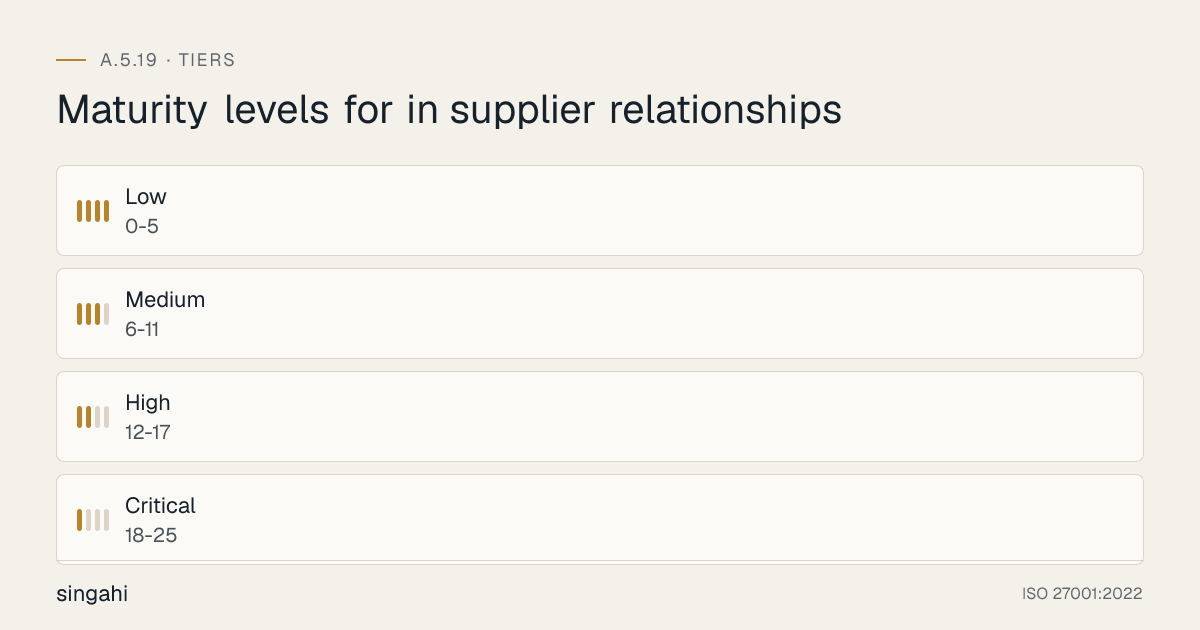
Maturity levels for in supplier relationships
Step 1: Supplier Inventory, Know Your Suppliers
You cannot manage what you do not know. The first step is a complete inventory of all suppliers with access to your information, systems, or premises.
Inventory Sources:
- Accounts payable / finance records (all paid vendors)
- Procurement system / contract database
- IT system access logs (who has VPN, RDP, admin accounts?)
- Cloud admin consoles (who has IAM access?)
- Physical access logs (visitor management, security passes)
- Email domain analysis (who is on your distribution lists?)
- Department interviews (ask each department who they share data with)
- SaaS subscription discovery (use tools like Productiv, Torii, or manual survey)
Inventory Attributes:
| Attribute | Purpose | Example Values |
|---|---|---|
| Supplier Name | Unique identification | Accenture India Pvt. Ltd. |
| Supplier ID | Internal tracking | SUP-2024-0147 |
| Category | Risk grouping | IT Services, Cloud, Professional Services, Facilities |
| Data Accessed | Risk determination | Customer PII, Financial Data, Employee Records, Public Data |
| System Access | Technical risk scope | VPN, Cloud Console, API, Email, Physical Only |
| Access Type | Control design | Admin, User, Read-Only, Physical |
| Personnel Count | Scale of exposure | 5 developers, 2 admins, 10 support staff |
| Location | Regulatory/geographic risk | India, USA, Philippines, EU |
| Subcontractors | Fourth-party risk | Yes, 2 offshore dev vendors |
| Contract Start/End | Lifecycle management | 2024-01-15 to 2026-01-14 |
| Annual Spend | Business criticality | |
| Risk Tier | Management priority | Critical |
| Last Assessment Date | Monitoring frequency | 2024-06-10 |
| Security Certifications | Evidence of controls | ISO 27001, SOC 2 Type II, PCI DSS |
| Key Contact | Escalation | Vendor Security Officer |
Shadow Supplier Discovery:
Shadow suppliers are vendors engaged by individual departments without procurement or security knowledge. Common examples:
- Marketing team using a freelance designer with Google Drive access to brand assets
- Sales team using a personal CRM subscription with customer data
- Developer using a personal GitHub account for company code
- HR using a free survey tool for employee feedback with PII
Discovery techniques:
- Expense report analysis (look for SaaS subscriptions, freelance payments)
- Email domain analysis (which external domains appear in internal distribution lists?)
- Cloud access logs (which external IPs access your cloud?)
- Department surveys ("List all external parties with access to your data")
- Network traffic analysis (which SaaS APIs are your systems calling?)
Step 2: Supplier Risk Classification, Tier Your Suppliers
Not all suppliers are equal. Risk-based tiering ensures you focus your limited resources on the suppliers that matter most.
Tiering Criteria:
| Factor | Weight | Scoring |
|---|---|---|
| Data sensitivity | 30% | Secret/Confidential = 5; Internal = 3; Public = 1 |
| System access level | 25% | Admin/root = 5; User/write = 4; Read-only = 2; None = 0 |
| Business criticality | 20% | Business cannot operate without = 5; Major disruption = 3; Minor inconvenience = 1 |
| Supplier security maturity | 15% | No certifications/unknown = 5; ISO 27001/SOC 2 = 2; Enterprise-grade + audit = 1 |
| Subcontractor complexity | 10% | Multiple unknown subcontractors = 5; Known subcontractors = 3; No subcontractors = 1 |
Risk Tier Definitions:
| Tier | Risk Score | Proportion of Suppliers | Management Intensity | Example |
|---|---|---|---|---|
| Critical | 18-25 | Top 5-10% | Deep due diligence before contract; annual on-site audit; quarterly business reviews; continuous monitoring; dedicated relationship manager | Core banking system integrator; cloud provider with all customer data; payment processor |
| High | 12-17 | Next 15-20% | Standard due diligence; annual SSQ review; semi-annual review; monitoring for security news | CRM vendor; payroll processor; major IT consultant |
| Medium | 6-11 | Next 30-40% | Lightweight SSQ; biennial review; ad-hoc monitoring for incidents | Marketing agency; cleaning service; hardware vendor |
| Low | 0-5 | Remaining 30-50% | Minimal assessment; triennial review; incident-driven monitoring | Courier service; office supplies; training provider |
Step 3: Supplier Security Assessment, Evaluate Before You Trust
The Security Questionnaire (SSQ):
A well-designed SSQ covers 8 domains:
| Domain | Key Questions | Evidence Requested |
|---|---|---|
| 1. Governance and Policy | Do you have an information security policy? Is it approved by management? How often is it reviewed? | Policy document, review records |
| 2. Risk Management | Do you conduct risk assessments? How often? What methodology? | Risk assessment report, methodology document |
| 3. Access Control | How do you manage user access? Is MFA enforced? How often are access reviews conducted? | Access control policy, MFA configuration evidence, review records |
| 4. Data Protection | How do you classify data? Is encryption used? What are your data retention and destruction policies? | Data classification policy, encryption configuration, retention policy |
| 5. Incident Management | Do you have an incident response plan? What is your notification timeframe? Do you conduct post-incident reviews? | IR plan, incident records (sanitized), notification SLA |
| 6. Business Continuity | What is your RTO/RPO? Do you conduct DR drills? Are backups tested? | BCP/DR plan, test records, RTO/RPO documentation |
| 7. Compliance and Audit | What certifications do you hold? When was your last audit? Are audit reports available? | Certificates, SOC 2 report, pen test report, audit reports |
| 8. Subcontractor Management | Do you use subcontractors? How do you manage their security? Do you disclose all subcontractors? | Subcontractor list, their security assessments, contractual clauses |
SSQ Response Evaluation:
| Score | Rating | Meaning | Action |
|---|---|---|---|
| 90-100% | Excellent | Mature security program; enterprise-grade | Proceed with standard monitoring |
| 70-89% | Good | Adequate security; some gaps | Proceed with gap remediation plan; monitor closely |
| 50-69% | Fair | Significant gaps; immature program | Conditional approval with mandatory remediation; increased monitoring |
| 30-49% | Poor | Major gaps; high risk | Do not proceed unless critical and no alternatives; require major investment in controls; consider risk transfer (insurance, liability caps) |
| <30% | Unacceptable | No meaningful security program | Do not engage; find alternative supplier |
Alternative Assessment Methods:
| Method | When to Use | Cost | Depth |
|---|---|---|---|
| Security Questionnaire (SSQ) | All suppliers | Low | Medium |
| External Security Rating | All suppliers for baseline; Critical for continuous monitoring | Medium | Medium (external telemetry) |
| On-site Audit | Critical suppliers; high-risk suppliers with poor SSQ | High | High |
| Virtual Audit / Video Walkthrough | High suppliers; remote suppliers; pandemic/travel constraints | Medium | Medium-High |
| Third-Party Certification Review | All certified suppliers | Low (request report) | Medium (trust but verify) |
| Penetration Test of Supplier | Critical suppliers handling highly sensitive data | Very High | Very High |
| Financial and Background Check | Critical suppliers; suppliers with physical access | Medium | Low-Medium (business risk) |
Step 4: Contractual Security Requirements, Put It in Writing
Security requirements that are not in the contract are not enforceable. Every supplier contract must include a security addendum or embedded security clauses.
Mandatory Contract Clauses for Critical/High Suppliers:
| Clause | Minimum Requirement | Purpose |
|---|---|---|
| 1. Security Standard Compliance | Supplier must comply with ISO 27001 or equivalent; maintain certification; notify of certification lapses | Baseline security assurance |
| 2. Data Protection | Encryption at rest and in transit (TLS 1.2 or later; 1.3 preferred); data minimization; purpose limitation; no unauthorized processing | Data confidentiality and integrity |
| 3. Data Location | Data stored and processed only in agreed locations; changes notified in advance; no transfer to countries restricted under DPDP s.16 | Client contracts, sector rules (e.g. RBI payment data storage in India), DPDP s.16 |
| 4. Access Control | MFA for all admin access; principle of least privilege; quarterly access reviews; no shared accounts | Prevent unauthorized access |
| 5. Incident Notification | Notify without delay and within 24 hours at most (sooner where your own deadlines are shorter, e.g. CERT-In's 6 hours); provide detailed incident report within 72 hours; cooperate with investigation | Timely incident response |
| 6. Right to Audit | Organization may audit supplier's security controls annually with 30 days' notice; supplier must cooperate and provide evidence | Verification of compliance |
| 7. Subcontractor Disclosure and Control | Supplier must disclose all subcontractors; subcontractor must meet same security standards; supplier remains liable for subcontractor breaches | Fourth-party risk management |
| 8. Change Management | Supplier must notify of material changes (location, personnel, technology, subcontractors) 30 days in advance; organization may reassess | Risk control during relationship |
| 9. Vulnerability Management | Supplier must patch Critical vulnerabilities within 7 days; High within 30 days; annual penetration testing | Technical security maintenance |
| 10. Business Continuity | Supplier must maintain BCP/DR plan with RTO and RPO agreed for the risk tier; annual DR test; evidence of backup restoration | Operational resilience |
| 11. Personnel Security | Background checks for personnel with access to organization data; security awareness training; confidentiality agreements | Human risk mitigation |
| 12. Data Return and Destruction | Return all data within 30 days of termination; certify destruction; allow verification | Data lifecycle control |
| 13. Access Revocation | Revoke all access within 24 hours of termination; return all credentials, devices, and materials | Immediate risk removal |
| 14. Liability and Insurance | Supplier must maintain cyber insurance (amount set by risk tier); liability for breaches caused by supplier negligence; indemnification | Financial risk transfer |
| 15. Termination for Security Cause | Organization may terminate immediately for material security breach; pro-rata refund if applicable | Enforcement mechanism |
Clause Library by Supplier Type:
| Supplier Type | Additional Clauses |
|---|---|
| Cloud/SaaS | SOC 2 Type II report; data portability; API security; multi-tenant isolation; customer data segregation |
| Software Development | Secure development lifecycle (SDL); source code escrow; IP ownership; no open-source with viral licenses; security testing before delivery |
| Data Processor | DPIA cooperation (where required); Data Principal rights support; breach notification to you without delay (you notify the Data Protection Board); processing records |
| Professional Services | Confidentiality of client data; no use of data for AI training; return of all work product; conflict of interest disclosure |
| Facilities/Physical | Background checks; no photography in secure areas; visitor escort; incident reporting; key/card return |
| Logistics/Courier | Chain of custody; tamper-evident packaging; GPS tracking; no subcontracting without approval; incident reporting |
| Managed Security Services | SOC 2 Type II; 24/7 monitoring; SLA for detection and response; dedicated CISO contact; threat intelligence sharing |
Step 5: Supplier Monitoring, Trust but Verify
Signing a contract with security clauses is not enough. You must monitor the supplier's ongoing compliance.
Monitoring Methods by Tier:
| Tier | Frequency | Methods | Evidence |
|---|---|---|---|
| Critical | Monthly | Security metrics review; vulnerability scan of supplier-facing assets; log review; quarterly business review (QBR) with security agenda; annual on-site audit | QBR minutes; scan reports; audit reports; metrics dashboard |
| High | Quarterly | SSQ refresh; security news alert monitoring; certificate validity check; semi-annual review meeting | Updated SSQ; news alerts; certificate checks; meeting minutes |
| Medium | Bi-annually | SSQ refresh; incident inquiry; ad-hoc monitoring for major security news | SSQ; incident records; news alerts |
| Low | Annually | Light SSQ or attestation; incident-driven inquiry | Attestation letter; incident records |
Continuous Monitoring Techniques:
-
Security Rating Services: BitSight, SecurityScorecard, UpGuard, or Panorays provide daily security ratings based on external telemetry (open ports, malware, SSL certificates, breach history). Use for all Critical and High suppliers.
-
Certificate Monitoring: Track ISO 27001, SOC 2, PCI DSS certification expiry dates. Set alerts 90 days before expiry.
-
Security News Monitoring: Google Alerts, Feedly, or vendor-specific threat intelligence for supplier breach news. A supplier breach may expose your data even if they don't notify you proactively.
-
Log Monitoring: If suppliers have VPN or system access, monitor their access logs for anomalies: unusual hours, geolocation changes, excessive data download, privilege escalation.
-
Vulnerability Scanning: Scan supplier-facing assets (APIs, portals, integrations) for vulnerabilities. If their infrastructure is weak, your connection is at risk.
-
Dark Web Monitoring: Monitor for leaked credentials, data, or intellectual property related to your supplier relationships.
-
Quarterly Business Reviews (QBR): For Critical suppliers, include a standing security agenda: incident review, patch status, access review, certification status, subcontractor changes.
Step 6: Supplier Audit, See for Yourself
Audit Planning:
| Element | Critical Supplier | High Supplier |
|---|---|---|
| Frequency | Annual | Every 2 years |
| Notice | 30 days | 30 days |
| Duration | 2-3 days | 1 day |
| Scope | Full ISMS review; technical controls; personnel; physical; subcontractors | Key controls; data protection; access control; incident management |
| Team | Internal auditor + security architect + compliance officer | Internal auditor + security analyst |
| Follow-up | CAP for findings; re-audit in 6 months if major findings | CAP for findings; evidence review in 3 months |
Audit Checklist (Critical Supplier):
| # | Area | Audit Questions | Evidence |
|---|---|---|---|
| 1 | Governance | Is there a documented security policy? Approved by management? | Policy document, approval record |
| 2 | Governance | Is there a security organization chart? Roles defined? | Org chart, job descriptions |
| 3 | Risk | Is there a risk register? Last updated? Methodology? | Risk register, methodology doc |
| 4 | Access | Is MFA enforced for all admin access? | Configuration screenshot, policy |
| 5 | Access | When was the last access review? Findings? | Access review report, minutes |
| 6 | Data | Is data encrypted at rest? Algorithm? Key management? | Configuration, encryption policy |
| 7 | Data | Is data encrypted in transit? TLS version? | SSL Labs scan, configuration |
| 8 | Incident | Is there an incident response plan? Tested? | IR plan, test records |
| 9 | Incident | What incidents occurred in the last 12 months? | Incident log (sanitized) |
| 10 | BC/DR | What is the RTO/RPO? Last DR test? | BCP, DR test report |
| 11 | Subcontractors | List all subcontractors. Assessments available? | Subcontractor list, assessments |
| 12 | Personnel | Background checks for staff with access? | Sample background check records |
| 13 | Physical | Secure area for our data? Access control? | Site walkthrough, photos |
| 14 | Technical | Vulnerability scan results? Pen test results? | Scan report, pen test report |
| 15 | Compliance | ISO 27001 certificate? SOC 2 report? Audit findings? | Certificates, reports, CARs |
Step 7: Incident Management with Suppliers
Supplier Incident Response Protocol:
-
Detection: Your SOC detects anomalous activity from a supplier account, or you receive a supplier breach notification, or you read about a supplier breach in the news.
-
Notification Verification: Contact the supplier's security team immediately. Verify the scope: what data, what systems, what timeframe, what is the root cause.
-
Impact Assessment: Determine if your data, systems, or customers are affected. Classify the incident internally per your incident response plan.
-
Containment:
- Disable supplier accounts if compromise is confirmed
- Revoke API keys, certificates, or VPN access
- Isolate supplier-connected systems if necessary
- Engage the supplier's incident response team for joint containment
-
Eradication: Work with the supplier to ensure the root cause is fixed. Require evidence of remediation before re-enabling access.
-
Recovery: Re-enable access under heightened monitoring. Conduct a security review of the supplier's improved controls.
-
Post-Incident:
- Update the supplier risk assessment
- Consider contract termination if the breach was due to gross negligence
- Update your incident response playbook with lessons learned
- Notify authorities where required: CERT-In within 6 hours of noticing a reportable incident; RBI-regulated entities report cyber incidents to RBI within 2 to 6 hours; under the DPDP Rules, intimate the Data Protection Board and affected people without delay, with a detailed report within 72 hours
- Notify affected customers if personal data was compromised
Step 8: Change Management, When Suppliers Change
Supplier changes that must trigger a reassessment:
| Change Type | Risk Implication | Action Required |
|---|---|---|
| New subcontractor | Unknown fourth-party risk | Require disclosure; conduct assessment; update contract |
| Change in data processing location | Possible breach of contract or sector location rules; DPDP s.16 if the new country is restricted | Verify new location compliance; update DPA; reassess |
| Change in key personnel | Loss of institutional knowledge; new insider risk | Verify background checks; update access; conduct handover |
| Change in technology stack | New vulnerabilities; integration risks | Architecture review; security testing; update monitoring |
| Merger or acquisition | New entity; unknown security posture | Full reassessment; contract novation; integration review |
| Certification lapse | Unverified security claims | Demand immediate recertification or enhanced monitoring |
| Service scope expansion | More data, more access, more risk | Update risk assessment; amend contract; additional controls |
Step 9: Termination and Offboarding, Close Securely
Termination Triggers:
- Contract natural expiry
- Early termination for convenience
- Termination for breach (including security breach)
- Supplier insolvency or business closure
- Service consolidation or replacement
Offboarding Checklist:
| # | Task | Owner | Timeline | Evidence |
|---|---|---|---|---|
| 1 | Notify supplier of termination (official) | Procurement | Day 0 | Termination letter/email |
| 2 | Revoke all system access (VPN, RDP, cloud, API, email) | IT / Security | Day 0 | Access revocation log |
| 3 | Disable supplier accounts in all systems | IT / Security | Day 0 | Account disablement log |
| 4 | Change shared passwords/credentials if any | IT / Security | Day 0 | Password change log |
| 5 | Revoke physical access (ID cards, biometrics, keys) | Facilities / Security | Day 0 | Access revocation record |
| 6 | Collect all company assets (laptops, devices, documents) | IT / Facilities | Day 1-7 | Asset return receipt |
| 7 | Request return of all data | Procurement / Data Owner | Day 1-7 | Data transfer log |
| 8 | Request certificate of data destruction | Procurement / Security | Day 14-30 | Destruction certificate |
| 9 | Verify data destruction (sample audit if possible) | Security / Internal Audit | Day 30-45 | Verification report |
| 10 | Remove supplier from monitoring and alert systems | Security Operations | Day 0 | Configuration change |
| 11 | Update supplier inventory status to "Terminated" | Vendor Risk Manager | Day 0 | Updated inventory |
| 12 | Retain termination records for audit/evidence | Vendor Risk Manager | Permanent | Archive record |
| 13 | Conduct post-termination review (lessons learned) | Vendor Risk Manager | Day 30-45 | Lessons learned log |
| 14 | Notify relevant stakeholders (legal, compliance, audit) | Procurement | Day 0 | Communication log |
| 15 | Update incident response plan (remove supplier references) | Security Operations | Day 7 | Updated IR plan |
Data Destruction Verification:
For Critical suppliers handling sensitive data, do not trust a self-signed certificate of destruction. Require:
- Detailed destruction methodology (NIST 800-88 Clear, Purge, or Destroy)
- Third-party attestation or audit of destruction
- Sample verification (if contract allows, request proof for a sample of records)
- Chain of custody documentation for data transfer before destruction
Tools, Technologies, and Solutions
Third-Party Risk Management (TPRM) Platforms
| Platform | Key Features | Best For |
|---|---|---|
| Spreadsheet + shared mailbox | Simple register, SSQs by email, review calendar | Fewer than about 30 suppliers |
| Archer (RSA) | Enterprise GRC with TPRM module; deep customisation | Large enterprise; existing Archer GRC |
| MetricStream | GRC + TPRM; integrated risk management; regulatory mapping | Large enterprise; integrated GRC |
| OneTrust Third-Party Risk | Questionnaires, risk scoring, privacy integration | Privacy-led programmes |
| ProcessUnity / Mitratech Prevalent | Vendor lifecycle workflow, assessments, monitoring | Mid-market to enterprise |
| ServiceNow Vendor Risk Management | TPRM on the ServiceNow platform | ServiceNow customers |
| SecurityScorecard / BitSight / UpGuard | External security ratings | Continuous outside-in monitoring |
Contract and Procurement Tools
| Tool | Purpose | Integration with TPRM |
|---|---|---|
| Ironclad | Contract lifecycle management; clause library; approval workflows | API integrations with TPRM platforms |
| DocuSign CLM | Contract management; e-signature; template management | Integrations with Salesforce, GRC tools |
| Icertis | Enterprise contract management; AI-powered clause extraction | TPRM module available |
| Conga Contracts | Contract automation; template management; compliance tracking | CRM and ERP integrations |
| Zoho Contracts (India) | Affordable CLM for Indian SMEs; India-specific templates | Zoho ecosystem integration |
Discovery and Monitoring Tools
| Tool | Purpose |
|---|---|
| Productiv | SaaS application discovery; usage analytics; renewal management |
| Torii | SaaS management; shadow IT discovery; spend optimization |
| Netskope | Cloud access security broker (CASB); shadow IT discovery; DLP |
| Obsidian Security | SaaS security; identity threat detection; configuration monitoring |
| Google Alerts / Feedly | Free security news monitoring for suppliers |
| Recorded Future / Flashpoint | Threat intelligence; supplier risk monitoring; dark web |
Indian Market Considerations
| Consideration | Guidance |
|---|---|
| Data location | Check where the TPRM platform stores supplier data and whether a client or sector rule restricts it |
| Local support | India-based support teams provide faster response and understand local regulatory context |
| Regional compliance | Indian TPRM platforms often include RBI, SEBI, IRDAI, and DPDP compliance templates |
| Language | Some platforms offer Hindi or regional language support for supplier communication |
Policy and Procedure Templates
Supplier Security Policy (Template Outline)
1. Purpose and Scope
   1.1 Purpose: Define requirements for managing information security in all supplier relationships
   1.2 Scope: All suppliers with access to information, systems, or premises
   1.3 Applicability: All procurement, IT, security, facilities, and business teams

2. Roles and Responsibilities
   2.1 CISO: Accountable for supplier security framework; approves Critical supplier engagements
   2.2 Vendor Risk Manager: Responsible for TPRM program execution; assessments; monitoring; audits
   2.3 Procurement: Responsible for including security clauses in contracts; enforcing procurement process
   2.4 Legal: Responsible for contract security clause drafting; enforcement; termination
   2.5 IT / Security Operations: Responsible for supplier access provisioning; monitoring; revocation
   2.6 Data Owners: Responsible for defining data protection requirements for suppliers
   2.7 Business Units: Responsible for identifying and registering all suppliers

3. Supplier Classification and Risk Tiering
   3.1 Classification criteria (data, access, criticality, maturity, subcontractors)
   3.2 Four-tier system: Critical, High, Medium, Low
   3.3 Classification authority and review frequency

4. Supplier Security Assessment
   4.1 Timing: Before contract signing; periodic reassessment
   4.2 Methodology: SSQ + external ratings + audits
   4.3 Evaluation criteria and scoring
   4.4 Exception handling and risk acceptance

5. Contractual Security Requirements
   5.1 Mandatory clauses for each tier
   5.2 Data protection addendum requirements
   5.3 Subcontractor control clauses
   5.4 Right to audit and inspection
   5.5 Incident notification and response
   5.6 Termination and data return

6. Supplier Monitoring and Review
   6.1 Monitoring frequency by tier
   6.2 Continuous monitoring techniques
   6.3 Quarterly business review requirements
   6.4 Security news and alert monitoring

7. Supplier Audit Program
   7.1 Audit frequency by tier
   7.2 Audit planning and notification
   7.3 Audit scope and checklist
   7.4 Finding remediation and follow-up

8. Supplier Change Management
   8.1 Changes requiring notification
   8.2 Reassessment triggers
   8.3 Contract amendment process

9. Supplier Incident Management
   9.1 Incident notification requirements
   9.2 Joint response protocol
   9.3 Root cause analysis and remediation
   9.4 Contract termination for security cause

10. Supplier Termination and Offboarding
    10.1 Termination triggers
    10.2 Offboarding checklist and timeline
    10.3 Data return and destruction verification
    10.4 Access revocation procedures
    10.5 Post-termination review

11. Subcontractor and Fourth-Party Risk
    11.1 Disclosure requirements
    11.2 Assessment obligations
    11.3 Liability and control

12. Training and Awareness
    12.1 Procurement training on security clauses
    12.2 Business unit training on supplier registration
    12.3 Security team training on TPRM

13. Compliance and Audit
    13.1 Internal audit requirements
    13.2 Evidence retention
    13.3 Non-conformance handling

14. Policy Review
    14.1 Annual review cycle
    14.2 Trigger-based review (incident, regulation, breach)
Supplier Security Procedure (Template Outline)
Procedure: SUP-SEC-001 Supplier Security Management Lifecycle

1. Supplier Identification and Registration
   Step 1: Business unit identifies supplier need
   Step 2: Procurement requests supplier registration
   Step 3: Supplier completes registration form with access and data details
   Step 4: Supplier added to inventory with unique ID
   Step 5: Initial classification (Low default until assessment)

2. Pre-Engagement Assessment
   Step 6: Vendor Risk Manager classifies supplier based on registration data
   Step 7: For Critical/High: Full SSQ + external rating + certification review
   Step 8: For Medium: Standard SSQ + certification review
   Step 9: For Low: Light attestation or certification check
   Step 10: Risk assessment completed and scored
   Step 11: Risk treatment plan defined if gaps exist
   Step 12: Security approval obtained before contract

3. Contracting
   Step 13: Legal includes security clauses based on tier
   Step 14: Data Owner confirms data protection requirements
   Step 15: CISO approves Critical/High supplier contracts
   Step 16: Contract signed and archived with security addendum

4. Onboarding and Access Provisioning
   Step 17: IT provisions access per least privilege principle
   Step 18: MFA enforced for all logical access
   Step 19: Physical access provisioned (if applicable) with escort/area restrictions
   Step 20: Supplier personnel complete security awareness training
   Step 21: Supplier added to monitoring and alert systems

5. Ongoing Monitoring
   Step 22: Monthly QBR for Critical suppliers (security agenda)
   Step 23: Quarterly review for High suppliers
   Step 24: Bi-annual review for Medium suppliers
   Step 25: Annual light review for Low suppliers
   Step 26: Continuous monitoring via security ratings and news alerts
   Step 27: Access reviews quarterly for Critical/High suppliers

6. Audit
   Step 28: Annual on-site audit for Critical suppliers
   Step 29: Bi-annual virtual audit for High suppliers
   Step 30: Audit findings documented; CAP issued; follow-up scheduled

7. Change Management
   Step 31: Supplier notifies of material change
   Step 32: Vendor Risk Manager evaluates change impact
   Step 33: Reassessment conducted if required
   Step 34: Contract amended if required
   Step 35: Updated monitoring scope applied

8. Incident Response
   Step 36: Incident detected or reported by supplier
   Step 37: Impact assessment conducted
   Step 38: Containment actions executed (access revocation if needed)
   Step 39: Joint investigation with supplier
   Step 40: Root cause analysis and remediation verification
   Step 41: Risk assessment updated; contract termination considered if negligence

9. Termination and Offboarding
   Step 42: Termination triggered (expiry, convenience, breach)
   Step 43: Termination notice issued
   Step 44: All access revoked within 24 hours
   Step 45: Data return requested and verified
   Step 46: Destruction certificate obtained and verified
   Step 47: Assets collected and accounted for
   Step 48: Supplier removed from inventory and monitoring
   Step 49: Lessons learned captured
Supplier Security Questionnaire (SSQ) Template (Excerpt)
SUPPLIER SECURITY QUESTIONNAIRE
Supplier Name: _________________________
Assessment Date: _________________________
Assessed By: _________________________
Risk Tier: _________________________

SECTION A: GOVERNANCE AND POLICY (10 points)
A1. Do you have a documented information security policy?
    □ Yes, approved by management, reviewed annually
    □ Yes, but not reviewed recently
    □ No
A2. Do you have a dedicated security function or CISO?
    □ Yes, full-time CISO or security team
    □ Yes, part-time or outsourced
    □ No
A3. Have you achieved any of the following certifications?
    □ ISO 27001 (current) — provide certificate
    □ SOC 2 Type II (current) — provide report
    □ PCI DSS (if applicable) — provide AOC
    □ None

SECTION B: ACCESS CONTROL (15 points)
B1. Do you enforce Multi-Factor Authentication (MFA) for all administrative access?
    □ Yes, for all admin accounts
    □ Yes, for some admin accounts
    □ No
B2. How frequently do you review user access rights?
    □ Quarterly or more frequently
    □ Annually
    □ Ad-hoc or never
B3. Do you maintain a principle of least privilege for all users?
    □ Yes, enforced and audited
    □ Yes, but not formally audited
    □ No

SECTION C: DATA PROTECTION (20 points)
C1. Is our data encrypted at rest? Algorithm?
    □ AES-256 or equivalent
    □ AES-128 or equivalent
    □ No encryption
C2. Is our data encrypted in transit? Protocol?
    □ TLS 1.3 or equivalent
    □ TLS 1.2
    □ Unencrypted or TLS 1.0/1.1
C3. Do you have a data retention and destruction policy?
    □ Yes, documented and enforced
    □ Yes, but not enforced
    □ No

SECTION D: INCIDENT MANAGEMENT (15 points)
D1. Do you have an incident response plan?
    □ Yes, documented, tested, and maintained
    □ Yes, but not tested
    □ No
D2. What is your incident notification timeframe to customers?
    □ Within 24 hours
    □ Within 72 hours
    □ Within 1 week
    □ No defined timeframe
D3. How many security incidents did you experience in the last 12 months?
    □ 0
    □ 1-2
    □ 3-5
    □ More than 5

SECTION E: BUSINESS CONTINUITY (10 points)
E1. What is your Recovery Time Objective (RTO)?
    □ < 4 hours
    □ < 24 hours
    □ < 72 hours
    □ > 72 hours or no RTO
E2. When was your last disaster recovery test?
    □ Within 6 months
    □ Within 12 months
    □ > 12 months ago
    □ Never

SECTION F: SUBCONTRACTORS (10 points)
F1. Do you use subcontractors for services related to our data?
    □ No
    □ Yes — list attached
    □ Yes — but not disclosed
F2. Do you assess your subcontractors' security?
    □ Yes, same standard as our own
    □ Yes, but less rigorously
    □ No

SECTION G: COMPLIANCE AND AUDIT (10 points)
G1. When was your last external security audit?
    □ Within 12 months
    □ Within 24 months
    □ > 24 months ago
    □ Never
G2. Are you willing to provide audit reports or undergo our audit?
    □ Yes, fully cooperative
    □ Yes, with restrictions
    □ No

SECTION H: REGULATORY (10 points)
H1. Are you familiar with the Digital Personal Data Protection Act 2023 (India)?
    □ Yes, and we comply
    □ Yes, but not fully compliant
    □ No
H2. Can you store and process all our data within India?
    □ Yes
    □ Yes, with some exceptions (specify)
    □ No

SCORING:
Total Score: ___ / 100
Rating: □ Excellent (90-100) □ Good (70-89) □ Fair (50-69) □ Poor (30-49) □ Unacceptable (<30)
Risk Assessment and Treatment
Supplier Risk Assessment Methodology
Step 1: Inherent Risk Assessment
Inherent risk is the risk before considering the supplier's controls. It is determined by what the supplier does, not how well they do it.
| Factor | Score | Rationale |
|---|---|---|
| Data sensitivity | 1-5 | What data will the supplier access? |
| System access | 1-5 | What level of access to your systems? |
| Business criticality | 1-5 | How important is the service to operations? |
| Supplier location | 1-5 | Geographic risk (sanctions, data residency, cybercrime rate) |
| Subcontractor complexity | 1-5 | How many layers of subcontractors? |
| Inherent Risk Score | Sum of above | 5-25 scale |
Step 2: Control Effectiveness Assessment
Evaluate the supplier's security controls based on SSQ, certifications, and external ratings.
| Control Area | Weight | Supplier Score (1-5) | Weighted Score |
|---|---|---|---|
| Governance and policy | 15% | ___ | ___ |
| Access control | 20% | ___ | ___ |
| Data protection | 25% | ___ | ___ |
| Incident management | 10% | ___ | ___ |
| Business continuity | 10% | ___ | ___ |
| Subcontractor management | 10% | ___ | ___ |
| Compliance and audit | 10% | ___ | ___ |
| Control Effectiveness Score | 100% | ___ / 5 |
Step 3: Residual Risk Calculation
Residual Risk = Inherent Risk × (1 - Control Effectiveness/5)
| Residual Risk Score | Risk Level | Action |
|---|---|---|
| >15 | Critical | Do not engage unless no alternative; board-level risk acceptance; enhanced monitoring; contract termination clause |
| 10-15 | High | Conditional engagement with mandatory remediation; quarterly monitoring; annual audit |
| 5-9 | Medium | Standard engagement with standard monitoring; biennial review |
| <5 | Low | Standard engagement with lightweight monitoring; triennial review |
Sample Supplier Risk Register
| Supplier ID | Supplier Name | Category | Inherent Risk | Control Score | Residual Risk | Tier | Treatment | Status |
|---|---|---|---|---|---|---|---|---|
| SUP-001 | CloudServe India | Cloud Hosting | 20 | 4.2 | 3.2 | Critical | Standard + enhanced monitoring | Active |
| SUP-002 | DevTech Solutions | Software Dev | 18 | 3.0 | 7.2 | High | Conditional + remediation plan | Active |
| SUP-003 | PaySecure Gateway | Payment Processing | 22 | 4.5 | 2.4 | Critical | Standard + PCI DSS validation | Active |
| SUP-004 | CleanPro Services | Facilities | 8 | 2.5 | 4.0 | Medium | Standard | Active |
| SUP-005 | MarketBoost Agency | Marketing | 12 | 3.5 | 4.2 | Medium | Standard | Active |
| SUP-006 | GlobalLogistics | Courier | 10 | 2.0 | 6.0 | High | Conditional + access restriction | Active |
| SUP-007 | OffshoreDev Ltd | Development | 20 | 1.5 | 14.0 | Critical | Termination planned | Terminating |
| SUP-008 | BackupVault | Data Backup | 16 | 4.0 | 3.2 | High | Standard + encryption verification | Active |
| SUP-009 | TaxConsult Partners | Professional Services | 10 | 3.0 | 4.0 | Medium | Standard | Active |
| SUP-010 | TempStaff Agency | Staffing | 12 | 2.5 | 6.0 | High | Conditional + background checks | Active |
Risk Treatment Options
| Treatment | When to Use | Example | Cost |
|---|---|---|---|
| Avoid | High inherent risk with no compensating value | Do not engage OffshoreDev Ltd due to unacceptable security | Opportunity cost |
| Mitigate | Supplier has potential but gaps exist | Require DevTech to implement MFA, SAST, and annual pen test | Supplier effort; follow-up |
| Accept | Low residual risk; cost of treatment exceeds benefit | Accept CleanPro's medium risk with standard monitoring | Monitoring cost only |
| Share | Risk cannot be fully mitigated, or is jointly held | Cyber insurance; liability caps and indemnities; co-developed controls in partnerships | Insurance premium; legal cost |
Audit and Compliance Checklist
Use this checklist during internal audits, certification audits, and customer audits. Each question should be answered with evidence.
Policy and Governance (5 questions)
| # | Audit Question | Evidence Required | Pass Criteria |
|---|---|---|---|
| 1 | Is there a documented policy for managing information security in supplier relationships? | Policy document, version controlled, approved | Policy exists; covers all supplier types; approved within 12 months |
| 2 | Does the policy define roles and responsibilities for supplier security management? | Policy section or RACI matrix | Roles defined for procurement, security, legal, IT, business units |
| 3 | Is there a complete inventory of all suppliers with access to information/systems/premises? | Supplier inventory; procurement records; access logs | Inventory complete; no shadow suppliers; includes subcontractors |
| 4 | Are suppliers classified by risk tier (Critical, High, Medium, Low)? | Classification records; risk scoring methodology | All suppliers classified; methodology documented; review frequency defined |
| 5 | Does senior management review supplier security performance? | Meeting minutes; dashboard reports; management review records | At least quarterly review for Critical suppliers; actions documented |
Risk Assessment and Contracting (6 questions)
| # | Audit Question | Evidence Required | Pass Criteria |
|---|---|---|---|
| 6 | Is a security risk assessment conducted before engaging new suppliers? | Risk assessment records for new suppliers | 100% of sampled new suppliers have pre-engagement assessment |
| 7 | Are security requirements included in all supplier contracts? | Contract samples; clause library; redlined contracts | Security clauses in 100% of sampled contracts; clause library exists |
| 8 | Do contracts include data protection requirements (encryption, residency, DPA)? | Contract addenda; DPA templates | DPA for all personal data processors; encryption requirements present |
| 9 | Do contracts include incident notification requirements (timeframe, contact, cooperation)? | Contract clauses; incident response records | Notification clause in 100% of contracts; SLA defined (≤24 hours for Critical) |
| 10 | Do contracts include right to audit and inspect supplier controls? | Audit clause in contracts; audit records | Audit clause in Critical/High contracts; audits conducted per schedule |
| 11 | Do contracts include termination and data return/destruction clauses? | Termination clauses; offboarding records | Data return clause in 100% of contracts; destruction verification evidenced |
Monitoring and Audit (6 questions)
| # | Audit Question | Evidence Required | Pass Criteria |
|---|---|---|---|
| 12 | Is there a defined monitoring frequency for each supplier tier? | Monitoring schedule; calendar records | Schedule exists; aligns with tier definitions; executed as planned |
| 13 | Are Critical suppliers monitored at least quarterly? | QBR minutes; monitoring reports; metric reviews | Evidence of quarterly reviews for all Critical suppliers |
| 14 | Are security ratings or external assessments used for continuous monitoring? | Security rating platform subscription; rating reports | Platform in use for Critical/High; ratings reviewed; alerts acted upon |
| 15 | Are supplier security incidents monitored and tracked? | Incident log; supplier incident records; tracking system | Supplier incidents logged; impact assessed; corrective actions tracked |
| 16 | Are on-site or virtual audits conducted for Critical/High suppliers? | Audit plan; audit reports; CAPs; follow-up records | Critical: annual audit; High: biennial audit; evidence of execution |
| 17 | Are supplier access rights reviewed periodically? | Access review records; IAM logs | Quarterly for Critical/High; evidence of review and remediation |
Change and Incident Management (5 questions)
| # | Audit Question | Evidence Required | Pass Criteria |
|---|---|---|---|
| 18 | Are suppliers required to notify of material changes (subcontractors, location, technology)? | Change notification records; contract clauses | Notification clause exists; changes tracked; reassessments triggered |
| 19 | Is there a joint incident response protocol with Critical suppliers? | IR plan; joint response records; contact lists | Protocol documented; tested at least annually; contacts current |
| 20 | Are supplier-caused incidents investigated and root cause analyzed? | Incident reports; RCA documents; supplier CARs | Investigations conducted; supplier accountability enforced; CAPs tracked |
| 21 | Can the organization terminate supplier relationships for security cause? | Contract clauses; termination records | Termination for security cause clause exists; executed if needed |
| 22 | Are supplier incidents reported to regulators when required? | Regulatory filings; incident notification records | DPDP 72-hour notification; RBI 6-hour for payment; evidence of compliance |
Termination and Offboarding (5 questions)
| # | Audit Question | Evidence Required | Pass Criteria |
|---|---|---|---|
| 23 | Is there a documented offboarding procedure for suppliers? | Offboarding procedure; checklists; workflow | Procedure documented; covers access, data, assets, monitoring |
| 24 | Is all supplier access revoked within 24 hours of termination? | Access revocation logs; IAM records | 100% of sampled terminations: access revoked within 24 hours |
| 25 | Is data returned or destroyed upon termination, with verification? | Data return log; destruction certificate; verification evidence | Return/destruction evidenced; certificate obtained; verification conducted for Critical |
| 26 | Are supplier termination records retained for audit purposes? | Archive records; retention policy | Retained per the retention schedule; accessible for audit |
| 27 | Are lessons learned from supplier incidents and terminations captured? | Lessons learned log; knowledge base updates | Captured within 30 days; fed into policy/template updates |
Subcontractor and Fourth-Party Risk (3 questions)
| # | Audit Question | Evidence Required | Pass Criteria |
|---|---|---|---|
| 28 | Are all subcontractors disclosed by primary suppliers? | Subcontractor lists; contract clauses; disclosure records | Disclosure clause in contracts; lists obtained for Critical/High |
| 29 | Are subcontractors assessed for security risk? | Subcontractor assessments; risk registers | Assessments conducted for subcontractors of Critical suppliers |
| 30 | Does the primary supplier remain liable for subcontractor security breaches? | Contractual liability clauses; incident records | Liability clause in 100% of contracts; enforced in incidents |
Metrics and KPIs
Supplier Security KPIs
| KPI ID | KPI Name | Formula | Target | Measurement Frequency | Data Source |
|---|---|---|---|---|---|
| KPI-01 | Supplier Inventory Coverage | (Suppliers in inventory / Total known suppliers) × 100 | 100% | Monthly | Inventory vs. finance/AP records |
| KPI-02 | Risk Assessment Completion | (Suppliers with completed risk assessment / Total active suppliers) × 100 | 100% | Monthly | Risk register |
| KPI-03 | Critical Supplier Assessment Rate | (Critical suppliers with current assessment / Total Critical suppliers) × 100 | 100% | Monthly | Risk register |
| KPI-04 | Security Clause Coverage | (Contracts with security clauses / Total active contracts) × 100 | 100% | Quarterly | Contract review sample |
| KPI-05 | Audit Execution Rate | (Audits completed per plan / Audits planned) × 100 | 100% | Quarterly | Audit calendar |
| KPI-06 | Supplier Incident Count | Number of security incidents caused by or involving suppliers | 0 for Critical; trend downward | Monthly | Incident management system |
| KPI-07 | Incident Notification Compliance | (Supplier incidents notified within SLA / Total supplier incidents) × 100 | 100% | Per incident | Incident records |
| KPI-08 | Access Review Completion | (Supplier access reviews completed on schedule / Total scheduled reviews) × 100 | 100% | Quarterly | Access review records |
| KPI-09 | Termination Offboarding Compliance | (Terminations with complete offboarding / Total terminations) × 100 | 100% | Per termination | Offboarding records |
| KPI-10 | Security Rating Trend | Average security rating of Critical suppliers (month-over-month) | Improving or stable | Monthly | Security rating platform |
| KPI-11 | Shadow Supplier Discovery | Number of unregistered suppliers discovered per month | 0 | Monthly | Discovery process |
| KPI-12 | DPA Coverage for Data Processors | (Data processors with signed DPA / Total data processors) × 100 | 100% | Quarterly | Contract review |
| KPI-13 | Supplier Change Notification Compliance | (Supplier changes notified per contract / Total observed changes) × 100 | >90% | Quarterly | Change records |
| KPI-14 | Subcontractor Disclosure Rate | (Critical suppliers with disclosed subcontractors / Total Critical suppliers) × 100 | 100% | Quarterly | Subcontractor lists |
| KPI-15 | Supplier Security Training Completion | (Procurement staff completing supplier security training / Total procurement staff) × 100 | 100% | Annual | Training records |
KPI Dashboard Layout
SUPPLIER SECURITY DASHBOARD — June 2026
========================================

Active Suppliers: 187
Critical: 12 | High: 34 | Medium: 78 | Low: 63
New This Month: 5 | Terminated This Month: 2

COVERAGE METRICS
- Inventory Coverage: 100% (187/187) ✓
- Risk Assessment Completion: 98% (183/187) ⚠️
- Security Clause Coverage: 97% (181/187) ⚠️
- DPA Coverage: 100% (45/45) ✓

QUALITY METRICS
- Audit Execution Rate: 100% (8/8) ✓
- Access Review Completion: 100% (46/46) ✓
- Offboarding Compliance: 100% (2/2) ✓

RISK METRICS
- Supplier Incidents (MTD): 1 (Medium severity, contained) ⚠️
- Security Rating Trend: Stable (avg 78/100)
- Shadow Suppliers Discovered: 0 ✓

ACTIONS
1. Complete risk assessment for 4 pending Medium suppliers (SUP-184 to SUP-187)
2. Renegotiate security clauses with 6 suppliers missing data residency terms
3. Schedule Q3 audit for SUP-012 (CloudServe India) — certificate expiry approaching
Common Pitfalls and How to Avoid Them
The 15 Most Common Pitfalls
| # | Pitfall | Why It Happens | Impact | How to Avoid |
|---|---|---|---|---|
| 1 | No supplier inventory | Procurement and IT do not coordinate; shadow IT proliferates | Unknown risk exposure; audit failure | Mandatory registration process; finance cross-check; SaaS discovery tools |
| 2 | Generic security clauses in all contracts | Legal uses one template for all vendors | Inadequate protection for Critical suppliers; unenforceable terms | Tiered clause library; Critical/High get full clauses; Low gets lightweight |
| 3 | No pre-engagement assessment | Business urgency; "we need them now" | Engaging high-risk suppliers without knowing it | Security approval gate before contract signature; no exceptions for Critical |
| 4 | Assessment never revisited after initial engagement | "We assessed them last year; they must be fine" | Supplier security degrades; certifications lapse; incidents missed | Calendar-driven reassessment; expiry alerts; continuous monitoring |
| 5 | No monitoring of supplier security news | No process to track supplier breaches | Breach discovered months late; customer data already leaked | Google Alerts; security rating platform; threat intelligence feed |
| 6 | Subcontractors ignored | Primary supplier does not disclose; organization does not ask | Fourth-party risk is invisible; major breach vector | Mandatory disclosure clause; request subcontractor lists; assessment for Critical |
| 7 | Access not revoked promptly on termination | HR/procurement delays; IT not informed; "we might need them again" | Former supplier retains access; data exposure; audit failure | Automated offboarding workflow; 24-hour SLA; checklist with sign-offs |
| 8 | Data left with supplier after termination | No data return requirement; no verification | Supplier retains your data indefinitely; DPDP violation | Data return clause; destruction certificate; sample verification |
| 9 | Supplier incidents not investigated | "It's their problem, not ours" | Recurrence; liability; regulatory penalty | Joint investigation protocol; root cause analysis; contract enforcement |
| 10 | No right to audit exercised | Audit clause exists but never used; "we trust them" | Unverified security claims; false assurance | Annual audit calendar; budget for audits; treat as non-negotiable |
| 11 | Over-reliance on certifications | "They have ISO 27001, so they're secure" | Certification does not mean perfect security; scope may not cover your data | Trust but verify; certification + SSQ + monitoring + audit |
| 12 | Small suppliers exempted | "They're too small to matter" | Small vendors are often the weakest link; used as attack vector | All suppliers assessed; lightweight process for Low tier; no exemptions |
| 13 | Physical security suppliers ignored | Focus on IT; cleaning/security guards "not technical" | Physical theft; dumpster diving; tailgating; device access | Include facilities suppliers in inventory; background checks; physical access controls |
| 14 | No integration between procurement and security | Procurement buys; security finds out later | Security as afterthought; renegotiation cost; delays | Security approval workflow in procurement system; security checkpoint before PO |
| 15 | DPDP Act requirements ignored in supplier contracts | Legal unaware of DPDP; "we'll add it later" | Regulatory violation; fine exposure; customer trust loss | DPDP clause library; legal training; mandatory DPA for all personal data processors |
Illustrative Scenarios
Illustrative scenario, a composite example for guidance, not a specific Singahi engagement or a verified outcome.
Illustrative Scenario 1: Indian Growing SaaS Company, Building TPRM from Scratch
Organization: CloudCraft Solutions Pvt. Ltd., a Hyderabad-based SaaS company with 320 employees, providing project management software to 4,000+ SMB customers in India and Southeast Asia.
Challenge:
- 85 active suppliers, but no formal inventory; estimated 30+ shadow suppliers
- Preparing for first SOC 2 Type II audit and ISO 27001 certification
- No security clauses in 60% of contracts
- Customer audit from a large enterprise client identified supplier security gaps
- Budget: for TPRM program setup
Implementation Steps:
Step 1, Supplier Discovery (Week 1): The consultant conducted a complete discovery:
- Finance record analysis: 87 paid vendors in last 12 months
- IT access log analysis: 23 external accounts with system access
- Cloud IAM analysis: 12 external IAM users in AWS
- Department survey: 15 additional suppliers not in finance records
- Total discovered: 107 suppliers (22 more than initially known)
Step 2, Classification and Tiering (Week 2): Using the risk framework:
- Critical: 8 (cloud hosting, payment gateway, core development vendor, customer support BPO)
- High: 18 (CRM, email, backup, legal, accounting, major IT consultants)
- Medium: 35 (marketing tools, recruitment, training, minor consultants)
- Low: 46 (office supplies, couriers, travel, minor services)
Step 3, Policy and Templates (Week 3): The consultant delivered:
- Supplier Security Policy (aligned with DPDP Act 2023, SOC 2, and ISO 27001)
- Tiered contract clause library (Critical: 15 clauses; High: 12 clauses; Medium: 8 clauses; Low: 4 clauses)
- Standard Supplier Security Questionnaire (SSQ) with 80 questions across 8 domains
- Offboarding checklist with 15 tasks and evidence requirements
Step 4, Critical Supplier Assessment (Weeks 4-5): All 8 Critical suppliers assessed:
- Cloud hosting provider (Provider A): ISO 27001 + SOC 2; score 94/100, Excellent
- Payment gateway (Provider B): PCI DSS Level 1; score 91/100, Excellent
- Core development vendor (Bengaluru ODC): No ISO 27001; score 58/100, Fair
- Customer support BPO (Chennai): No certifications; score 45/100, Poor
- Backup provider: ISO 27001; score 88/100, Good
- Email/SaaS provider (Provider C): SOC 2; score 95/100, Excellent
- CDN/WAF provider (Provider D): SOC 2; score 92/100, Excellent
- Penetration testing vendor (Provider E): ISO 27001; score 89/100, Good
Step 5, Remediation and Contract Amendments (Weeks 6-8):
- Core development vendor: Required to achieve ISO 27001 within 12 months; interim: enhanced monitoring, quarterly SSQ, mandatory SAST/DAST on all deliverables, secure coding training for 20 developers. Contract amended with security addendum and a higher liability cap cap.
- Customer support BPO: Required to implement MFA, quarterly access reviews, incident notification within 24 hours, and annual pen test. Contract amended with security milestones and right to audit. Score improved to 68/100 within 6 months.
- All 8 Critical suppliers: Contract amendments signed with new security clauses.
- High suppliers: Batch contract review; 14 of 18 amended successfully; 4 in negotiation.
Step 6, Monitoring Setup (Week 9):
- Subscribed to SecurityScorecard for 8 Critical + 10 High suppliers
- Configured Google Alerts for all 107 suppliers
- Quarterly Business Review (QBR) calendar established for Critical suppliers
- Access review calendar: quarterly for Critical/High; bi-annual for Medium
Step 7, Offboarding Test (Week 10): Tested offboarding with 1 departing Low supplier:
- Access revoked in 4 hours (exceeded 24-hour target)
- Data return: 500 GB of backup logs transferred and verified
- Destruction certificate obtained
- Lessons learned: improve asset collection process for remote suppliers
Step 8, Training and Rollout (Week 11):
- Procurement team trained on security clause library and approval workflow (4 hours)
- IT team trained on access provisioning and revocation procedures (2 hours)
- Business unit heads trained on supplier registration requirement (1 hour)
- Policy communicated to all 107 suppliers via email with acknowledgment request
Outcome:
- SOC 2 Type II audit (Month 6): zero exceptions in the vendor management trust services criteria
- ISO 27001 Stage 2 audit (Month 8): zero major non-conformities in A.5.19; one minor (missing access review for 1 Medium supplier, fixed in 48 hours)
- Customer audit from large enterprise client: passed with commendation for "mature TPRM for company size"
- Supplier security incidents in first 12 months: 1 (supplier phishing attempt; contained within 2 hours due to monitoring)
- Core development vendor achieved ISO 27001 certification in Month 10
- CloudCraft's TPRM program became a reference model for 3 peer companies in their Hyderabad tech cluster
Key Lessons:
- Growing SaaS companies can build effective TPRM in 10-12 weeks with focused effort and templates
- Shadow supplier discovery is critical, 20% of suppliers were invisible before the program
- Tiered contract clauses are essential, one-size-fits-all contracts leave gaps or create unnecessary burden
- Security rating platforms provide continuous visibility at reasonable cost for growing companies
- Customer audits are powerful motivators, use them to justify TPRM investment to management
Illustrative Scenario 2: Large Indian Enterprise Bank, Enterprise TPRM Transformation
Regulated by RBI under the Banking Regulation Act.
Challenge:
- 2,400+ active suppliers across IT, facilities, professional services, BPO, ATM maintenance, cash logistics, and consulting
- RBI's Master Direction on Outsourcing of Information Technology Services (2023) requires complete IT vendor risk management
- 200+ Critical suppliers with access to core banking systems, payment networks, and customer data
- Legacy TPRM process was manual, spreadsheet-based, and conducted annually, inadequate for current threat landscape
- Multiple audit findings: inconsistent supplier assessments, missing security clauses, no continuous monitoring, delayed incident notification
- Budget: for TPRM transformation over 18 months
Implementation Steps:
Step 1, Program Establishment (Months 1-2): The consultant established a dedicated Vendor Risk Management (VRM) function:
- Hired Vendor Risk Manager (reporting to CISO)
- 4 Vendor Risk Analysts (2 for Critical, 2 for High)
- Governance: Monthly VRM Committee with CISO, CIO, CRO, Head of Procurement, and Head of Legal
- Policy: Complete rewrite of Supplier Security Policy with RBI-specific requirements
Step 2, Enterprise Inventory and Discovery (Months 2-4):
- Migrated from spreadsheets to a TPRM platform
- Integrated with SAP Ariba (procurement) for automatic supplier registration
- Integrated with Active Directory and VPN logs for access-based supplier discovery
- Integrated with AWS, Azure, and GCP IAM for cloud-based supplier discovery
- Final inventory: 2,847 suppliers (447 more than previously known)
- Shadow supplier reduction: 78% of newly discovered suppliers registered within 60 days
Step 3, Risk Classification at Scale (Months 3-5):
- Automated risk scoring based on: data sensitivity, system access, annual spend, certification status, location
- Critical: 247 (up from 200 due to better visibility)
- High: 512
- Medium: 1,034
- Low: 1,054
Step 4, Assessment Automation (Months 4-8):
- Automated SSQ distribution via OneTrust to all 2,847 suppliers
- 78% response rate within 30 days; follow-up for non-responders
- External security ratings (BitSight) integrated for all Critical and High suppliers
- Automated risk score calculation: inherent risk × control effectiveness
- 312 suppliers flagged for remediation; 18 flagged for potential termination
Step 5, Contract Remediation at Scale (Months 6-12):
- Legal team engaged in largest contract remediation effort in bank history
- 2,100 contracts reviewed; 1,680 required amendment
- Critical suppliers: 100% amended with full security addendum (15 clauses + RBI-specific requirements)
- High suppliers: 85% amended; 15% in negotiation or replacement
- New contract template: Security addendum is mandatory; no PO issued without security sign-off from VRM
- Data location clause: payment system data stored only in India (RBI 2018 directive); location of other customer data agreed per contract and RBI outsourcing rules
Step 6, Continuous Monitoring (Months 8-14):
- BitSight ratings reviewed daily for Critical; weekly for High
- Automated alerts for: certification expiry, rating drop >20 points, breach news, dark web mentions
- Monthly QBRs for all 247 Critical suppliers with standard security agenda
- Quarterly access reviews for all Critical/High supplier accounts
- Penetration testing of supplier-facing APIs and portals: quarterly
Step 7, Audit Program (Months 10-16):
- 50 on-site audits conducted for Critical suppliers (ATM maintenance, cash logistics, core banking integrators, cloud providers)
- 120 virtual audits conducted for High suppliers
- Total audit findings: 340; 98% closed within 90 days; 2% escalated to contract termination
- Subcontractor audits: 15 audits of subcontractor facilities (primarily offshore development centers and BPOs)
Step 8, Incident Response Integration (Months 12-16):
- Joint incident response protocol established with top 20 Critical suppliers
- 24/7 security contact matrix with escalation paths
- Supplier incident tabletop exercise: conducted quarterly with 3 suppliers rotating per quarter
- Actual incident during Month 14: BPO supplier detected unauthorized access attempt; notified BNB within 4 hours; joint containment within 2 hours; no data exposure; supplier's access suspended for 48 hours pending investigation; root cause: supplier employee credential phishing; supplier enhanced MFA and training; relationship continued with enhanced monitoring
Step 9, Termination and Offboarding Hardening (Months 14-16):
- Automated offboarding workflow in ServiceNow: termination trigger → access revocation tickets → data return tracking → certificate verification
- 12 suppliers terminated during program (security cause: 3; business: 9)
- Average offboarding time: 18 hours for access revocation; 14 days for data return/destruction
- 100% of terminations completed with full evidence package
Step 10, Regulatory Compliance and Certification (Months 16-18):
- RBI inspection (Month 17): VRM programme reviewed; no adverse findings on vendor risk management
- ISO 27001 surveillance audit (Month 18): zero non-conformities in A.5.19 to A.5.22
- Internal audit: VRM program maturity rated Level 4 (Managed) on the CMMI scale
Outcome:
- Supplier security incidents: 3 in 18 months (all detected and contained within 4 hours due to monitoring)
- Audit findings pre-program: 47 annually; post-program: 3 annually (93% reduction)
- Customer trust: 2 major enterprise clients renewed contracts citing "strong supplier security governance" as a factor
Key Lessons:
- Enterprise TPRM requires dedicated technology, manual spreadsheets do not scale beyond 100 suppliers
- Procurement system integration is essential for preventing shadow suppliers and enforcing security gates
- RBI-regulated banks must go beyond ISO 27001 minimums; regulator expectations are higher than standard
- Subcontractor audits are non-negotiable for Critical suppliers in BFSI, 15% of audit findings were in subcontractor facilities
- Automated offboarding is critical at scale, manual processes fail under volume and time pressure
- The investment in TPRM is small compared with the cost of a single supplier-related breach in banking
Multi-Framework Mapping
ISO 27001:2022 ↔ SOC 2 ↔ PCI DSS ↔ NIST 800-53 ↔ CIS Controls ↔ COBIT 2019 ↔ GDPR/DPDP
| Framework | Reference | Relationship |
|---|---|---|
| SOC 2 | CC9.2 (vendor and business partner risk), CC3.2 (risk identification includes vendors) | Vendor risk assessment and management |
| PCI DSS v4.0.1 | 12.8.1 (list of TPSPs), 12.8.2 (written agreements), 12.8.3 (due diligence before engagement), 12.8.4 (monitor TPSPs' PCI DSS status at least annually), 12.8.5 (which requirements each TPSP manages); 12.9.x applies to TPSPs themselves | Third-party service provider management |
| NIST SP 800-53 Rev 5 | SA-4, SA-9, SR-3, SR-5, SR-6, SR-8, PS-7 | Acquisition, external services, supply chain risk family |
| NIST CSF 2.0 | GV.SC-01 to GV.SC-10 | Cybersecurity supply chain risk management |
| CIS Controls v8 | Control 15 (15.1–15.7) | Service provider management |
| COBIT 2019 | APO10 (Managed Vendors) | Vendor selection, contracts, risk and performance |
| DPDP Act 2023 | s.8(1), s.8(2), s.8(5), s.8(6) | Fiduciary stays responsible; processors only under a valid contract; safeguards; breach intimation |
| GDPR | Art. 28 | Processor contracts and sub-processor control |
Detailed Control Mapping
ISO 27001 A.5.19 → NIST 800-53 Rev 5:
| A.5.19 Requirement | NIST 800-53 Control | NIST Control Description |
|---|---|---|
| Supplier risk assessment | RA-3 Risk Assessment; SR-6 Supplier Assessments and Reviews | Assess risk from suppliers and the supply chain |
| Security requirements in contracts | SA-4 Acquisition Process; SA-9 External System Services | Put security requirements into acquisitions and external service agreements |
| Supplier monitoring | SA-9; SR-6 | Monitor providers' control compliance |
| Right to audit | SR-6 Supplier Assessments and Reviews | Assess and review suppliers, including by audit |
| Incident notification | SR-8 Notification Agreements; IR-7 | Agree how compromises are notified |
| Subcontractor management | SR-3 Supply Chain Controls and Processes (SA-12 was withdrawn in Rev 5) | Control sub-supplier risk |
| Termination and data return | PS-7 External Personnel Security; SA-9 | Remove external personnel access; return or destroy data |
| Change management | SA-9(1) Risk Assessments and Organizational Approvals | Assess and approve changes to external services |
ISO 27001 A.5.19 → CIS Controls v8:
| A.5.19 Requirement | CIS Control | CIS Safeguard |
|---|---|---|
| Supplier inventory and risk assessment | CIS 15.1 | Establish and Maintain an Inventory of Service Providers |
| Supplier policy | CIS 15.2 | Establish and Maintain a Service Provider Management Policy |
| Supplier classification | CIS 15.3 | Classify Service Providers |
| Security requirements in contracts | CIS 15.4 | Ensure Service Provider Contracts Include Security Requirements |
| Risk-based assessment | CIS 15.5 | Assess Service Providers |
| Supplier monitoring | CIS 15.6 | Monitor Service Providers |
| Data return on termination | CIS 15.7 | Securely Decommission Service Providers |
ISO 27001 A.5.19 → COBIT 2019:
| A.5.19 Requirement | COBIT Domain | COBIT Practice |
|---|---|---|
| Supplier relationship management | APO10 | Managed Vendors |
| Supplier risk assessment | APO10.04 | Manage vendor risk |
| Supplier security requirements | APO13 | Managed Security |
| Supplier monitoring | APO10.05 | Monitor vendor performance and compliance |
| Supplier incident management | DSS05 | Managed Security Services |
| Supplier change management | BAI06 | Managed Change |
| Supplier termination | APO10.03 | Manage vendor relationships and contracts |
Regulatory and Industry Context
India-Specific Regulations
| Regulation | Relevance to A.5.19 | Key Supplier Requirements | Penalty for Non-Compliance |
|---|---|---|---|
| DPDP Act 2023 | Critical | Data fiduciary remains liable for processor breaches; the fiduciary must engage processors under a valid contract (s.8(2)) and keep safeguards; transfers barred only to restricted countries (s.16); breach notification flows from processor to fiduciary by contract | Up to ₹250 crore for the fiduciary (security safeguards); processor liability under contract |
| IT Act 2000 (Section 43A) | High | Body corporate liable for negligence by "any person who has access to sensitive personal data", includes suppliers | Compensation claims; no statutory cap |
| RBI Master Direction on Outsourcing of Information Technology Services (2023) | Critical for banks, NBFCs and other REs | Board-approved IT outsourcing policy; due diligence; contracts with audit and RBI access rights; monitoring; incident reporting; exit planning; concentration risk | Supervisory action |
| RBI Master Direction on Digital Payment Security Controls (2021) | Payment channels | Security of digital payment channels, including vendor-supplied components | Supervisory action |
| RBI Cyber Security Framework in Banks (2016) and IT Governance Master Direction (2023) | Critical for banks | Vendor access controls; third-party risk in the cyber security policy | Supervisory action |
| SEBI CSCRF (Cybersecurity and Cyber Resilience Framework for SEBI Regulated Entities, 20 August 2024) | Critical for market infrastructure | Vendor risk management for stock exchanges, depositories, clearing corporations; security clauses; audit rights; incident reporting | SEBI enforcement; trading restrictions; penalties |
| IRDAI Information and Cyber Security Guidelines (2023) | Critical for insurance | Vendor security management; third-party risk assessments; contractual controls; incident reporting | License conditions; business restrictions |
| CERT-In Directions 2022 | High for all | 6-hour reporting applies even when a supplier caused the incident (service providers must also report); ICT logs kept 180 days in India | Service blocking; legal action; directions |
| MeitY Intermediary Rules 2021 | High for platforms | Security measures must extend to vendors; data retention; traceability; grievance redressal | Safe harbour loss; blocking; liability |
| Companies Act 2013, s.134(5)(e) | Where supplier processes affect financial reporting | Directors' responsibility statement on internal financial controls | Director liability |
International Regulations
| Regulation | Jurisdiction | Supplier Security Relevance |
|---|---|---|
| GDPR (Regulation 2016/679) | EU + EEA | Art. 28: Processor must meet security requirements; written contract/DPA mandatory; processor liability; sub-processor consent and control; breach notification to the controller without undue delay (Art. 33(2)) |
| CCPA/CPRA | California, USA | "Service provider" and "contractor" definitions with security obligations; third-party data sales restrictions; breach notification |
| HIPAA Security Rule | USA healthcare | Business Associate Agreement (BAA) mandatory; business associate liable for breaches; security safeguards; subcontractor control |
| NIS2 Directive | EU | Supply chain security; ICT product and service security; third-party risk management; incident reporting; security by design for critical entities |
| SOX Section 404 | USA public companies | Third-party service organizations in internal controls; SOC 1 Type II reports for financial process vendors; auditor reliance on vendor controls |
| PCI DSS v4.0.1 | Global | Req 12.8: Third-party due diligence; contractual security requirements; third-party PCI DSS compliance; evidence of compliance; incident management |
| FedRAMP | USA federal cloud | Third-party assessment organizations (3PAOs); continuous monitoring; security controls for cloud service providers; agency ATO dependencies |
| APPI (Japan) | Japan | Third-party supervision obligation; personal information protection in outsourcing; data transfer restrictions |
| PDPA (Singapore) | Singapore | Protection obligation extends to data intermediaries; contractual security requirements; data breach notification; DPIA for high-risk processing |
| LGPD (Brazil) | Brazil | Security measures for processing; data processor obligations; contractual requirements; breach notification; DPIA |
| POPIA (South Africa) | South Africa | Information officer responsible for operator security; written contract with operators; breach notification; data subject rights |
Industry-Specific Context
| Industry | Supplier Security Considerations | Key Standards/Best Practices |
|---|---|---|
| Banking and Financial Services | RBI-mandated vendor management; payment processor PCI DSS; core banking vendor security; ATM/cash logistics physical security; fintech partnerships | RBI Master Directions, PCI DSS, ISO 27001, NIST CSF, COBIT |
| Insurance | IRDAI-mandated vendor controls; claim processing BPO security; policy data protection; agent/broker access management | IRDAI guidelines, ISO 27001, COBIT |
| Healthcare and Pharma | Patient data protection (health data; SPDI Rules apply until DPDP s.44(2) commences); clinical trial vendor management; drug safety data; medical device security (MDR/IVDR) | HIPAA, DPDP Act, GxP, ISO 27001, IEC 62304 |
| IT/ITES and SaaS | Client-mandated supplier audits; multi-tenant isolation; API security; development vendor security; cloud shared responsibility | SOC 2, ISO 27001, ISO 27017, CSA STAR, OWASP |
| Manufacturing | OT/IT supplier security; ICS system integrators; IoT device supply chain integrity; counterfeit prevention; Industry 4.0 | IEC 62443, NIST SP 800-82, ISO 27001, supply chain integrity frameworks |
| Retail and E-commerce | Payment gateway security; marketplace vendor access; logistics partner data; customer data protection; loyalty program security | PCI DSS, DPDP Act, ISO 27001 |
| Education (EdTech) | Children's data protection (DPDP); student privacy; third-party content providers; online assessment security; international student data | DPDP Act, COPPA (USA), FERPA (USA), ISO 27001 |
| Government and Public Sector | CERT-In compliance; e-governance vendor security; citizen data protection; national security considerations; make-in-India preferences | CERT-In directions, ISO 27001, GIGW, additional security clearances |
| Telecom | Network equipment from trusted sources under the DoT National Security Directive on the telecom sector (2021); subscriber data protection; lawful interception vendor controls; tower infrastructure | DoT security requirements, 3GPP, ISO 27001, GSMA security guidelines |
| Energy and Utilities | Critical infrastructure protection; SCADA/ICS vendor security; smart grid supply chain; renewable energy IoT; NERC CIP (USA equivalent) | CERC guidelines, IEC 62351, NERC CIP, ISO 27001, NIST CSF |
Roles and Responsibilities (RACI)
Supplier Security Activities RACI Matrix
| # | Activity | Board / CEO | CISO | CIO | Head of Procurement | Legal Counsel | Vendor Risk Manager | Vendor Risk Analyst | IT / Security Operations | Data Owner | Business Unit Head | Compliance Officer |
|---|---|---|---|---|---|---|---|---|---|---|---|---|
| 1 | Approve Supplier Security Policy | A | R | C | C | C | C | I | I | I | I | C |
| 2 | Define Supplier Risk Framework | I | A | C | C | C | R | C | I | I | I | C |
| 3 | Maintain Supplier Inventory | I | C | C | R | I | R | R | C | C | C | I |
| 4 | Classify Supplier Risk Tier | I | A | C | C | I | R | C | I | C | C | I |
| 5 | Conduct Supplier Security Assessment | I | C | I | C | I | R | R | C | C | I | I |
| 6 | Review Supplier Certifications/Audits | I | C | I | I | I | R | R | C | I | I | C |
| 7 | Draft Security Contract Clauses | I | C | I | C | R | C | I | I | C | I | C |
| 8 | Negotiate Security Terms with Suppliers | I | C | I | R | R | C | I | I | I | I | I |
| 9 | Approve Critical Supplier Contracts | A | R | C | C | C | C | I | I | I | I | C |
| 10 | Provision Supplier Access | I | C | R | I | I | C | I | R | C | I | I |
| 11 | Monitor Supplier Security Posture | I | A | I | I | I | R | R | R | I | I | C |
| 12 | Conduct Supplier Security Audit | I | A | I | I | I | R | R | C | C | I | C |
| 13 | Manage Supplier Security Incidents | I | A | C | I | I | R | C | R | C | I | C |
| 14 | Execute Supplier Change Reassessment | I | C | I | C | I | R | C | C | C | C | I |
| 15 | Execute Supplier Offboarding | I | C | R | C | C | R | C | R | C | I | I |
| 16 | Verify Data Return/Destruction | I | C | I | I | I | R | C | C | C | I | C |
| 17 | Update Supplier Risk Register | I | C | I | I | I | R | R | C | C | I | I |
| 18 | Report Supplier Security Metrics | I | R | C | C | C | R | C | I | I | I | C |
| 19 | Audit TPRM Program Compliance | I | A | I | I | I | C | I | I | I | I | R |
| 20 | Drive Continuous Improvement | I | A | C | C | C | R | C | C | C | C | C |
| 21 | Approve Subcontractor Engagements | I | A | C | C | C | R | C | I | I | I | C |
| 22 | Define Data Protection Requirements for Suppliers | I | C | I | I | I | C | I | I | R | C | C |
| 23 | Train Business Units on Supplier Registration | I | C | I | C | I | R | C | I | I | C | I |
| 24 | Manage Supplier Security Budget | A | C | C | R | I | C | I | I | I | I | I |
Legend:
- R = Responsible (does the work)
- A = Accountable (ultimately answerable; approves)
- C = Consulted (provides input)
- I = Informed (kept updated)
Role Descriptions
| Role | Key Responsibilities | Typical Designation in Indian Organizations |
|---|---|---|
| Board / CEO | Strategic oversight; policy approval; budget for enterprise TPRM; risk acceptance for catastrophic supplier risks | Managing Director, CEO, Chairman |
| CISO | Accountable for all supplier security; approves Critical supplier engagements; signs off on audits; reports to board | Chief Information Security Officer, Head of Security |
| CIO | Ensures IT systems support TPRM; manages supplier access provisioning; technical architecture for supplier connections | Chief Information Officer |
| Head of Procurement | Ensures security clauses in all contracts; manages supplier onboarding/offboarding; procurement system enforcement | Chief Procurement Officer, VP Procurement, Purchase Head |
| Legal Counsel | Drafts and negotiates security clauses; enforces contract terms; manages termination; handles liability disputes | General Counsel, Legal Head, Company Secretary |
| Vendor Risk Manager | Day-to-day TPRM program management; risk assessments; monitoring; audits; incident coordination; metrics reporting | Vendor Risk Manager, Supplier Security Manager, Third-Party Risk Manager |
| Vendor Risk Analyst | Executes assessments; maintains inventory; analyzes ratings; prepares audit reports; tracks remediation | Vendor Risk Analyst, Supplier Security Analyst |
| IT / Security Operations | Provisions and revokes supplier access; monitors supplier activity; manages SIEM alerts for supplier accounts; executes technical offboarding | IT Operations, Security Operations Center (SOC), IAM Team |
| Data Owner | Defines data protection requirements for suppliers; approves data sharing; verifies data return; assesses data breach impact | Data Owner, Business Unit Head, Function Head |
| Business Unit Head | Identifies and registers all suppliers; ensures business team compliance with TPRM policy; alerts VRM to new supplier needs | Department Head, Business Unit Head, Regional Manager |
| Compliance Officer | Ensures regulatory compliance in supplier contracts; audits TPRM program; manages regulatory reporting; DPDP compliance | Compliance Head, Company Secretary, Regulatory Affairs |
Documentation and Evidence Requirements
Suggested Evidence by TPRM Lifecycle Phase
ISO 27001 sets no retention periods; the periods below are examples. Set yours from legal, contractual and DPDP erasure obligations.
| Phase | Document / Evidence | Retention Period | Format | Owner |
|---|---|---|---|---|
| Inventory | Supplier inventory register | Permanent (updated continuously) | Spreadsheet / TPRM platform / Database | Vendor Risk Manager |
| Inventory | Shadow supplier discovery records | 3 years | Email / Survey / Analysis report | Vendor Risk Manager |
| Assessment | Supplier Security Questionnaire (SSQ) responses | 7 years from assessment date | PDF / Platform export | Vendor Risk Manager |
| Assessment | Risk assessment records per supplier | 7 years from assessment date | PDF / Risk register | Vendor Risk Manager |
| Assessment | External security rating reports | 3 years | Platform export / PDF | Vendor Risk Manager |
| Contracting | Supplier contracts with security clauses | Duration of relationship + 7 years | PDF / Contract management system | Legal / Procurement |
| Contracting | Data Processing Agreements (DPAs) | Duration of relationship + 7 years | PDF / Contract management system | Legal / Compliance |
| Contracting | Risk acceptance forms (for gaps) | 7 years | PDF / Workflow record | CISO / Vendor Risk Manager |
| Monitoring | Quarterly Business Review (QBR) minutes | 7 years | PDF / Meeting notes | Vendor Risk Manager |
| Monitoring | Continuous monitoring alerts and actions | 3 years | Platform export / Email / Ticket | Security Operations |
| Monitoring | Supplier access review records | 7 years | PDF / IAM system export | IT / Security Operations |
| Audit | Supplier audit plans | 7 years | PDF / Word | Internal Audit / Vendor Risk Manager |
| Audit | Supplier audit reports | 7 years | Internal Audit / Vendor Risk Manager | |
| Audit | Corrective Action Plans (CAPs) and closure evidence | 7 years | PDF / Excel | Vendor Risk Manager / Supplier |
| Incident | Supplier incident records | 7 years | Incident management system / PDF | Security Operations / Vendor Risk Manager |
| Incident | Joint investigation reports | 7 years | PDF / Word | CISO / Vendor Risk Manager |
| Incident | Regulatory notification records (DPDP, RBI, etc.) | 7 years | PDF / Email / Regulatory portal | Compliance Officer |
| Change | Supplier change notifications | 7 years | Email / Platform record | Vendor Risk Manager |
| Change | Reassessment records triggered by change | 7 years | PDF / Risk register | Vendor Risk Manager |
| Termination | Termination notice | 7 years | PDF / Email / Workflow | Procurement / Legal |
| Termination | Access revocation logs | 7 years | IAM system export / Log files | IT / Security Operations |
| Termination | Data return/destruction certificates | 7 years | PDF / Certificate | Vendor Risk Manager / Data Owner |
| Termination | Asset collection receipts | 7 years | PDF / Signed receipt | IT / Facilities |
| Termination | Post-termination review records | 7 years | PDF / Meeting notes | Vendor Risk Manager |
| Governance | TPRM Committee meeting minutes | 7 years | PDF / Meeting notes | Vendor Risk Manager |
| Governance | Management review records (supplier security) | 7 years | PDF / Meeting notes | CISO |
| Governance | TPRM metrics and dashboards | 3 years | BI tool / Excel / PDF | Vendor Risk Manager |
| Training | Procurement team security training records | 7 years | Training system / Attendance | HR / Vendor Risk Manager |
| Training | Supplier security awareness training records | 7 years | Training system / Certificates | HR / Vendor Risk Manager |
Evidence Organization
For audit readiness, organize evidence in a structured repository:
/TPRM-Evidence/
  /YYYY/
    /Supplier-Assessments/
      /Critical/
        - [Supplier-ID]-[Name]-Assessment-YYYY-MM-DD.pdf
      /High/
      /Medium/
      /Low/
    /Contracts/
      /Critical/
        - [Supplier-ID]-[Name]-Contract-vX.pdf
      /High/
      /Medium/
      /Low/
    /Monitoring/
      /QBR-Minutes/
      /Security-Ratings/
      /Access-Reviews/
    /Audits/
      /On-Site/
      /Virtual/
      /CAPs/
    /Incidents/
      /YYYY-MM-Incident-[ID]-[Supplier-Name]/
    /Terminations/
      /YYYY-MM-[Supplier-Name]/
    /Governance/
      /Committee-Minutes/
      /Management-Reviews/
      /KPI-Dashboards/
    /Training/
      /Procurement-Training/
      /Supplier-Training/
Continuous Improvement
The Continuous Improvement Cycle for Supplier Security
Plan → Do → Check → Act
Plan:
- Review TPRM metrics quarterly: incident trends, assessment coverage, audit findings, monitoring effectiveness
- Benchmark against industry standards (Gartner TPRM maturity, Shared Assessments SIG, NIST CSF supply chain)
- Identify regulatory changes (DPDP amendments, RBI circulars, new SEBI requirements)
- Update risk framework based on new threat intelligence (supply chain attacks, new vulnerabilities)
Do:
- Deploy updated templates, clauses, and procedures to procurement and security teams
- Train new staff and refresh existing staff on TPRM practices
- Implement new monitoring tools or automation
- Pilot new assessment techniques (e.g., AI-assisted risk scoring, automated evidence collection)
Check:
- Measure KPIs before and after changes
- Conduct internal audit of TPRM program effectiveness
- Gather feedback from suppliers on assessment process (friction vs. value)
- Review post-incident data for supplier root causes
Act:
- Standardize improvements that prove effective
- Eliminate redundant assessments or processes that add no value
- Update knowledge base and playbook
- Report improvements to management and incorporate into governance
Supplier Security Maturity Model
| Level | Name | Characteristics | Evidence | Typical Organization |
|---|---|---|---|---|
| 1, Initial | Ad-hoc | No supplier inventory; no security assessments; no security clauses; reactive incident management; shadow suppliers rampant | No policy; no inventory; contracts without security terms; incident-driven response | Startups; very small businesses; unregulated sectors |
| 2, Developing | Basic TPRM | Basic supplier inventory exists; security clauses in some contracts; lightweight SSQ for some suppliers; no continuous monitoring; manual processes | Inventory (incomplete); some contracts with clauses; basic SSQ; spreadsheet-based | SMEs beginning ISO 27001; 1-2 procurement staff |
| 3, Defined | Standardized | Complete inventory; security clauses in all contracts; risk tiering; scheduled assessments; quarterly monitoring for Critical; defined offboarding | Policy + procedure; 100% clause coverage; tiered assessments; monitoring schedule; documented offboarding | Growing companies; 250-5000 employees; pursuing certification |
| 4, Managed | Measured | Automated inventory; continuous monitoring via security ratings; automated SSQ; risk scoring; annual audits; metrics-driven governance; integration with GRC | TPRM platform; security ratings; automated workflows; KPI dashboard; integrated GRC | Large enterprises; 5000+ employees; mature risk management |
| 5, Optimizing | Strong | Predictive risk analytics; AI-assisted threat intelligence; fourth-party risk visibility; real-time monitoring; automated offboarding; industry leadership; zero trust supply chain | Predictive analytics; AI/ML risk models; real-time supply chain visibility; automated response; industry contributions | Global banks; top tech companies; defence organizations |
Improvement Triggers and Actions
| Trigger | Action | Responsible | Timeline |
|---|---|---|---|
| Supplier incident rate >2 per quarter | Root cause analysis; control enhancement; supplier retraining; potential contract amendments | CISO + Vendor Risk Manager | 2 weeks |
| Audit finding in TPRM program | Corrective action; process update; evidence enhancement; retraining | Internal Audit + Vendor Risk Manager | 4 weeks |
| New regulation (DPDP amendment, RBI circular) | Policy review; contract clause update; regulatory mapping; training | Compliance Officer + Legal + CISO | 6 weeks |
| Major supply chain breach in industry | Industry threat analysis; review of similar suppliers; control enhancement | CISO + Threat Intelligence | 2 weeks |
| Certification lapse of Critical supplier | Immediate escalation; enhanced monitoring; contract enforcement; alternative sourcing evaluation | Vendor Risk Manager + Procurement | 1 week |
| Customer audit finding on supplier security | Immediate corrective action; process update; supplier engagement evidence enhancement | Vendor Risk Manager + CISO | 1 week |
| TPRM platform upgrade or replacement | Process re-engineering; training; data migration; integration testing | IT + Vendor Risk Manager | 8 weeks |
| Annual management review | Full policy and framework review; KPI trend analysis; improvement plan; budget revision | CISO + Vendor Risk Manager + Procurement | Annual |
| Significant business growth (>25% new suppliers) | Scale TPRM resources; automation investment; process optimization | CISO + HR + Procurement | 3 months |
FAQ
General Questions
Q1: Does A.5.19 apply to all suppliers, including small ones like office supply vendors? A: Yes, but with proportionate effort. A.5.19 applies to all suppliers with access to information, systems, or premises. However, a courier service or office supply vendor (Low tier) requires only a lightweight assessment (e.g., a 4-clause contract and basic security awareness). A cloud hosting provider (Critical tier) requires deep due diligence, continuous monitoring, and annual audits. The key is that no supplier is exempt from the inventory and some level of security consideration.
Q2: What is the difference between A.5.19 and A.5.20? A: A.5.19 sets the overall supplier policy and process (identify, assess, select, monitor, exit). A.5.20 sets what goes into each supplier agreement. A.5.21 adds rules for the ICT supply chain, A.5.22 covers monitoring and changes to supplier services, and A.5.23 covers cloud services. A.5.14 (information transfer) applies to the data you exchange with suppliers.
Q3: Do we need to audit every supplier? A: No. Audits are resource-intensive and should be risk-based. We recommend: annual on-site audits for Critical suppliers, biennial virtual audits for High suppliers, and ad-hoc or incident-driven audits for Medium and Low suppliers. If a supplier holds a current ISO 27001 or SOC 2 Type II certification, you can rely on that (with spot checks) rather than conducting a full audit.
Q4: How do we manage fourth-party risk (our supplier's suppliers)? A: Fourth-party risk is managed through: (1) contractual disclosure requirements, your supplier must tell you who their subcontractors are; (2) contractual liability, your supplier remains liable for subcontractor breaches; (3) assessment of subcontractors for Critical suppliers; (4) security ratings that may capture fourth-party telemetry; (5) limiting the subcontractor chain, require approval for new subcontractors. Full fourth-party visibility is difficult but essential for Critical suppliers.
Q5: Can we accept a supplier without ISO 27001 or SOC 2? A: Yes, but with enhanced scrutiny. Certifications are evidence of a mature security program, but they are not mandatory for A.5.19 compliance. (SOC 2 is an attestation report, not a certification; for either, check that the scope covers the service you buy.) If a supplier lacks certifications, require: a detailed SSQ, evidence of equivalent controls, a remediation plan for gaps, increased monitoring, and potentially a shorter contract term with renewal contingent on improvement. For Critical suppliers, consider requiring certification within 12-24 months as a contract milestone.
Q6: How often should we reassess suppliers? A: Reassessment frequency should align with risk tier: Critical suppliers annually (or more frequently if incidents occur); High suppliers every 18-24 months; Medium suppliers every 2-3 years; Low suppliers every 3 years or on renewal. In addition, reassess whenever there is a material change (subcontractor, location, technology, certification lapse, or incident).
Q7: What is a "shadow supplier" and how do we find them? A: A shadow supplier is a vendor engaged by individual employees or departments without procurement or security knowledge. Examples: a marketing manager's personal Canva subscription with company logos, a developer's personal GitHub account with company code, a department's free survey tool with employee feedback. Find them through: expense report analysis, cloud IAM audits, email domain analysis, network traffic monitoring, and department surveys. Shadow suppliers are a major audit failure point because they bypass all security controls.
Q8: How do we handle supplier security for international vendors (e.g., AWS, Google, Salesforce)? A: Global hyperscalers (AWS, Azure, Google Cloud) typically have strong security programs (ISO 27001, SOC 2, PCI DSS). Your assessment should focus on: shared responsibility model clarity (what they secure vs. what you secure), data residency and region selection, IAM configuration, encryption key management, and their incident notification process. For smaller international vendors, apply the same risk-based assessment as domestic vendors, with additional attention to data residency and cross-border transfer compliance (DPDP Act 2023, GDPR).
Q9: Should we include physical security suppliers (guards, cleaning) in our TPRM program? A: Yes. Physical security suppliers have access to your premises, devices, and sometimes documents. They should be in your inventory, classified (typically Medium), and subject to background checks, physical access controls, and confidentiality agreements. A cleaning crew with after-hours access to executive offices can be a significant insider threat if not managed.
Q10: How does A.5.19 relate to DPDP Act 2023 compliance? A: The DPDP Act 2023 makes the "data fiduciary" (your organization) liable for breaches, even if caused by a supplier (data processor). Section 8(5) requires "reasonable security safeguards" that extend to your supply chain. For any supplier processing personal data on your behalf, you must have a Data Processing Agreement (DPA) with security clauses, verify their safeguards, and ensure they can meet breach notification requirements. Failing to take reasonable security safeguards, including over processors, can attract a penalty of up to ₹250 crore.
Q11: What is the minimum viable TPRM process for a 30-person startup? A: For startups, keep it lean: (1) List all suppliers with access to your data/systems (even the free ones), (2) Classify into Critical (cloud, payment, core dev) and Other, (3) Use standardized security clauses for Critical suppliers (use our clause library), (4) Require MFA and data residency for Critical, (5) Revoke access immediately when a supplier is no longer needed, (6) Monitor for breach news. As you grow, add formal assessments, monitoring tools, and audit programs.
Q12: How do we justify TPRM investment to management? A: Use the business case: (1) the Verizon 2025 DBIR found third-party involvement in 30% of breaches, double the previous year, (2) DPDP Act penalties of up to ₹250 crore for failing to take reasonable safeguards, regulatory liability is personal and organizational, (3) enterprise clients require supplier security evidence, revenue depends on it, (4) breach cost averages M for third-party breaches, prevention is cheaper, (5) TPRM program cost is typically 0.5-2% of IT spend, negligible compared to breach cost. Use illustrative scenarios (Section 15) to show peer examples.
Q13: Can we use a single security questionnaire for all suppliers? A: A single complete SSQ can be used, but the evaluation should be tiered. All suppliers answer the same questions, but the pass threshold and required evidence vary by tier. For Low suppliers, a score of 50/100 may be acceptable. For Critical suppliers, 80/100 is the minimum. Alternatively, use a lightweight SSQ for Low/Medium and a complete SSQ for Critical/High. The key is consistency and proportionality.
Q14: What should we do if a Critical supplier refuses to allow an audit? A: If a Critical supplier refuses an audit, you have three options: (1) Accept the risk with formal risk acceptance and enhanced monitoring (not recommended for highly sensitive data), (2) Require an alternative assurance (e.g., SOC 2 Type II report from a reputable auditor, ISO 27001 with scope covering your data), (3) Find an alternative supplier. Never allow a Critical supplier to operate without any form of security assurance. Document the refusal and your decision in the risk register.
Q15: How do we manage supplier security in a merger or acquisition? A: M&A introduces massive supplier risk: (1) Immediately inventory all suppliers of the acquired company, (2) Assess them against your security standards before integration, (3) Do not grant access to your systems until assessment is complete, (4) Harmonize contracts to your clause library, (5) Plan termination of redundant suppliers with secure offboarding, (6) Integrate monitoring and access controls. M&A is a high-risk period for supplier security, treat it as a security project (A.5.20 + A.5.19).
Q16: Should we include open-source software and public libraries as "suppliers"? A: Open-source libraries are not traditional suppliers but introduce similar supply chain risks. A.5.19 focuses on contractual relationships, but the broader supply chain risk concept (A.8.25, A.8.28) includes software dependencies. Best practice: use Software Composition Analysis (SCA) tools to track open-source dependencies; monitor for vulnerabilities (CVEs); maintain an SBOM (Software Bill of Materials); have a policy for approved open-source licenses. This is increasingly required by regulations (NIS2, EO 14028 in the USA).
Q17: How do we handle a supplier breach? A: Follow the joint incident response protocol: (1) Verify the breach scope with the supplier immediately, (2) Assess if your data/systems/customers are affected, (3) Contain (revoke access if needed), (4) Investigate jointly, (5) Require root cause analysis and remediation evidence, (6) Update the supplier risk assessment, (7) Consider contract termination if negligence is proven, (8) Notify regulators if required (DPDP: 72 hours; RBI: 6 hours for payment), (9) Notify affected customers if personal data is involved, (10) Update your incident response playbook. Speed and documentation are critical.
Q18: Is there a difference between "vendor," "supplier," and "third party"? A: In practice, these terms are often used interchangeably. ISO 27001:2022 uses "supplier" consistently. "Vendor" is common in procurement and IT. "Third party" is broader and includes non-contractual relationships (e.g., industry partners, regulators). For A.5.19, focus on "suppliers", entities with whom you have a contractual relationship for products or services. The control applies regardless of the term used internally.
Q19: How do we balance security requirements with supplier relationship management? A: Security requirements should not be adversarial. Frame them as "helping us both succeed", your enterprise clients require you to have secure suppliers, so your suppliers must meet those standards. Use tiered requirements (don't overburden a small vendor), provide clear guidance (use our clause library), offer assistance (help them understand DPDP requirements), and recognize good performance (positive reinforcement in QBRs). A supplier that improves its security for your benefit often wins more business from other clients too.
Q20: Can we automate supplier risk assessment? A: Yes, and you should at scale. Automated tools can: send SSQs, collect responses, calculate risk scores, monitor security ratings, alert on certification expiry, and track remediation. However, human judgment remains essential for: architecture reviews, complex risk scenarios, negotiation of security terms, incident investigation, and relationship management. The goal is "augmented TPRM", automation handles volume and consistency; humans handle nuance and decisions.
References and Further Reading
ISO Standards
- ISO/IEC 27001:2022: Information security, cybersecurity and privacy protection, Information security management systems, Requirements
- ISO/IEC 27002:2022: Information security, cybersecurity and privacy protection, Information security controls, Clause 5.19
- ISO/IEC 27003:2017: Information security management system, Guidance
- ISO/IEC 27005:2022: Information security risk management
- ISO/IEC 27036: Information security for supplier relationships, Multiple parts (27036-1 to 27036-4)
- ISO/IEC 27037:2012: Guidelines for identification, collection, acquisition and preservation of digital evidence (relevant for incident investigation)
Indian Regulations and Guidelines
- Digital Personal Data Protection Act 2023: Government of India, Ministry of Electronics and Information Technology
- Information Technology Act 2000 (as amended in 2008): Government of India
- CERT-In Directions 2022: Indian Computer Emergency Response Team, Ministry of Electronics and Information Technology
- RBI Master Direction on Outsourcing of Information Technology Services: Reserve Bank of India, 2023
- RBI Cyber Security Framework in Banks (2016) and Master Direction on Digital Payment Security Controls (2021): Reserve Bank of India
- SEBI Cybersecurity and Cyber Resilience Framework (CSCRF) for SEBI Regulated Entities, circular of 20 August 2024: consolidated and replaced the earlier frameworks for stock exchanges, depositories, clearing corporations and intermediaries
- SEBI CSCRF (2024): also applies to mutual funds and AMCs, replacing their 2019 framework
- IRDAI Information and Cyber Security Guidelines: Insurance Regulatory and Development Authority of India, 2023
- MeitY Information Technology (Intermediary Guidelines and Digital Media Ethics Code) Rules, 2021
- National Cyber Security Policy 2013: Ministry of Electronics and Information Technology
International Frameworks and Standards
- NIST SP 800-53 Rev 5: Security and Privacy Controls for Information Systems and Organizations
- NIST Cybersecurity Framework (CSF) 2.0: National Institute of Standards and Technology, 2024
- NIST SP 800-161 Rev 1: Cybersecurity Supply Chain Risk Management Practices for Systems and Organizations
- CIS Controls v8: Center for Internet Security
- COBIT 2019: Control Objectives for Information and Related Technologies, ISACA
- PCI DSS v4.0.1: Payment Card Industry Data Security Standard
- Shared Assessments Standardized Information Gathering (SIG) Questionnaire: Shared Assessments Working Group
- AICPA SOC 2 Trust Services Criteria: TSP Section 100, 2017 Trust Services Criteria for Security, Availability, Processing Integrity, Confidentiality, and Privacy
Third-Party Risk Management Resources
- Gartner Research: Magic Quadrant for IT Vendor Risk Management Solutions: Annual
- Forrester Research: The Forrester Wave™: Third-Party Risk Management Platforms: Quarterly
- BitSight Security Ratings Methodology: bitsight.com
- SecurityScorecard Ratings Methodology: securityscorecard.com
- UpGuard Vendor Risk Management Guide: upguard.com
Industry Reports and Statistics
- Verizon Data Breach Investigations Reports (DBIR) 2024 and 2025: Verizon Business
- IBM Cost of a Data Breach Report 2024: IBM Security
- Ponemon Institute: Data Risk in the Third-Party Ecosystem: Annual
- CERT-In Annual Report 2023-2024: Indian Computer Emergency Response Team
- Reserve Bank of India Annual Report: RBI cyber security and payment system sections
Supply Chain Security
- NIST SP 800-161 Rev 1: Cybersecurity Supply Chain Risk Management Practices, National Institute of Standards and Technology
- CISA Supply Chain Risk Management: US Cybersecurity and Infrastructure Security Agency
- ENISA Supply Chain Security Guidance: European Union Agency for Cybersecurity