
On this page
- Quick Reference (60 Seconds)
- What the Control Asks For
- Why Access Rights Matter
- Scope and Applicability
- Key Definitions and Terminology
- Relationship to Other Controls
- Access Models: RBAC, ABAC, PBAC and Least Privilege
- The Access Rights Lifecycle
- Detailed Implementation Guidance
- Segregation of Duties and Toxic Combinations
- Access Reviews and Recertification
- Tools, Technologies, and Solutions
- Access Control Policy and Request Templates
- Risk Assessment and Treatment
- Audit and Compliance Checklist
- Metrics and KPIs
- Common Pitfalls and Audit Failures
- Illustrative Scenarios
- Multi-Framework Mapping
- Implementation Roadmap
- FAQ
- Key Takeaways
- References and Further Reading
Quick Reference (60 Seconds)
ISO 27001:2022 Annex A 5.18 requires that access rights to information and other associated assets be provisioned, reviewed, modified and removed in line with your access control policy, so that every identity holds exactly the access its role justifies, no more, and only for as long as needed.
| Element | What You Need to Know |
|---|---|
| Control Number | A.5.18 |
| Control Name | Access Rights |
| Standard Reference | ISO/IEC 27001:2022, Annex A, Control 5.18 |
| 27002 Guidance | ISO/IEC 27002:2022, Clause 5.18, Access rights |
| Control Type | Preventive |
| Objective | Ensure access is defined and authorised according to business requirements |
| What You Must Do | Provision, review, modify and remove access rights against an authorised, least-privilege model |
| Owner | IAM Lead + Information/Asset Owners (reporting to CISO) |
| Maturity L1 → L5 | Ad-hoc grants → role-based provisioning → access requests with approval → periodic certification → continuous, just-in-time least privilege |
| Audit Red Flag | Ex-employees with live access, "privilege creep" from role changes, no access reviews, admin rights everywhere |
| Quick Win | Run an access review of your most sensitive system this week; revoke everything unjustified |
| Time to Implement | 6–12 weeks for role model + request workflow + first certification |
| Related Controls | A.5.15 Access control · A.5.16 Identity management · A.5.3 Segregation of duties · A.8.2 Privileged access rights · A.5.9 Asset ownership |
| ISO 27002 attributes | Control type: Preventive · Properties: Confidentiality, Integrity, Availability · Concepts: Protect · Capabilities: Identity and access management · Domains: Protection |
The Bottom Line: Identity management (5.16) decides who exists; access rights (5.18) decide what they can touch. This is where least privilege lives or dies. Over-grant and every compromised account becomes a catastrophe; review and revoke diligently and you contain the blast radius of every incident.
What the Control Asks For
The ISO 27001:2022 Text
In short:
ISO 27001:2022 Annex A 5.18 asks organizations to provision, review, modify, and remove access rights in line with the access control policy.
Do you need this control?
A.5.18 is not mandatory in itself: under clause 6.1.3 you include it if your risk assessment calls for it, and record the decision in your Statement of Applicability. Essentially every organisation includes it, because access rights must be granted, reviewed and removed. The review frequency and tooling should match your risk; small teams often review quarterly from their identity provider.
Four verbs, provision, review, modify, remove, define a complete lifecycle for entitlements (distinct from the identity lifecycle in 5.16).
What ISO 27002:2022 Adds
The implementation guidance requires the provisioning/revocation process to include:
- (a) Owner authorisation. Obtain authorisation from the owner of the information/asset (see 5.9) for its use; separate management approval may also be appropriate.
- (b) Business need + policy. Base access on business requirements and your topic-specific access control policy and rules.
- (c) Segregation of duties. Separate the roles of approving and implementing access; separate conflicting roles (see 5.3).
- (d) Timely removal. Remove access when no longer needed, especially removing leavers' access promptly.
- (e) Temporary access. Consider time-limited access with an expiry, especially for temporary personnel or temporary needs.
- (f) Verify the level. Confirm the access granted matches the access control policy (5.15) and other requirements such as SoD (5.3).
- (g) Activate only after authorisation. Ensure access rights are activated only after authorisation is complete (relevant when service providers implement access).
27002 continues with further points auditors test:
- (h) A central record of the access rights granted to each user ID or other identity
- (i) Modifying access when users change role or job
- (j) Removing or adjusting physical as well as logical access: for example by recovering or replacing keys, ID cards and subscriptions
- (k) A record of changes to users' logical and physical access rights
Reviews should consider changes such as promotion, demotion, transfer or termination, and privileged access authorisations; access should be reviewed regularly. Before a change or termination of employment, consider reducing or removing access based on risk: who initiated the change (resignation or dismissal), the person's current responsibilities and the value of the assets they can reach. Avoid granting access by cloning another user's profile, and include sanctions for attempted unauthorised access in personnel and supplier contracts (A.5.20, A.6.2, A.6.4, A.6.6).
The "shall vs should" Analysis
| Phrase | Force | What it means |
|---|---|---|
| "shall be provisioned, reviewed, modified and removed" | Required once A.5.18 is included in your SoA | All four lifecycle stages must be demonstrable |
| Owner authorisation; SoD | Expected by auditors | Grants need an authoriser; approver ≠ implementer |
| Timely removal of leavers | Expected by auditors | Active ex-employee access is a finding |
| The how (RBAC vs ABAC, review cadence) | Recommended | Risk-based design choice |
What Auditors Actually Check
- Access request and approval records: who authorised this access and on what basis?
- Owner authorisation: did the information/asset owner sign off?
- Leaver access removal: sample leavers; was access revoked to SLA?
- Access reviews/recertification: evidence of periodic review with revocations actually executed.
- Segregation of duties: approver ≠ implementer; no toxic role combinations.
- Privileged access: tighter controls and more frequent review for admins.
Why Access Rights Matter
Figure · Matrix
Comparison: BFSI to Government/CII
The Business Risk Narrative
Most damaging breaches are not about getting in, they are about how far the attacker could go once in. That blast radius is governed almost entirely by access rights. An employee who accumulated entitlements across five role changes, an admin account used for daily work, a contractor who kept access after the project ended, each converts a minor compromise into a major one. Access rights are the control that decides whether one phished password becomes a contained incident or a company-ending breach.
Access-Related Statistics
| Statistic | Source | Implication |
|---|---|---|
| Excessive/standing privilege is a leading factor in lateral movement | Industry IR reports | Least privilege limits blast radius |
| A large share of breaches involve internal access misuse or over-provisioning | Verizon DBIR (insider/misuse patterns) | Entitlement hygiene matters |
| "Privilege creep" affects most long-tenured employees in unmanaged estates | IGA vendor studies | Reviews catch accumulated access |
| Orphaned entitlements persist for months after offboarding without recertification | IGA studies | Reviews + automation close the gap |
| The vast majority of cloud breaches involve excessive permissions | Cloud security research | Cloud entitlement management is critical |
Indian Regulatory Context
- DPDP Act 2023: Access to personal data must be need-to-know and authorised; a Data Fiduciary's "reasonable security safeguards" (Section 8(5)) explicitly include access control. Over-broad access to personal data is a safeguard failure, with penalty exposure up to ₹250 crore.
- RBI Cyber Security Framework & Master Directions: Mandate role-based access, least privilege, maker-checker segregation of duties, periodic access recertification, and prompt removal on exit. RBI IT inspections sample access grants and review evidence.
- SEBI CSCRF (2024): Requires access governance, least privilege and periodic recertification for market entities.
- IRDAI Guidelines: Access on need-to-know, removal on separation, periodic review.
- CERT-In Directions (2022): Access records support incident attribution within the 6-hour window.
- IT Act, 2000: Section 43A (in force until DPDP s.44(2) commences, about May 2027) and Section 72A (disclosure in breach of contract) reinforce controlling who can access data.
Industry-Specific Consequences
| Sector | Failure mode | Consequence |
|---|---|---|
| BFSI | Maker and checker rights on one ID; no SoD | RBI penalty, fraud |
| IT/ITeS | Engineers with standing prod access across client tenants | SOC 2 failure, client loss |
| Healthcare | All staff can read all patient records | DPDP breach, need-to-know violation |
| Manufacturing | Plant operators with ERP financial access | Fraud, SoD violation |
| Government/CII | Broad administrative entitlements | NCIIPC finding |
impact of Non-Compliance
Over-provisioned access is the multiplier on every other failure. A single account with excessive rights turns ransomware from "one endpoint" into "the whole estate," and turns a curious insider into a data-exfiltration event. The fix, least privilege, owner-authorised grants, and periodic recertification, is process-heavy but technology-light, making A.5.18 one of the highest-ROI controls you can mature.
Anatomy of an Access-Driven Breach
The pattern that A.5.18 failures enable, step by step:
- Over-grant at joining: A new analyst is copied from a colleague's profile ("give them the same access as Priya"), inheriting entitlements they will never use. 27002 specifically cautions against granting access by cloning another user. Least privilege is breached on day one.
- Privilege creep: Over three years and two role changes, access is added each time but never removed, the analyst now holds finance, HR, and reporting access (failure of 27002 (d) on modify/remove).
- The compromise: The analyst is phished. The attacker now holds the union of three roles' access.
- Lateral movement: Because there was no segregation of duties (27002 (c)/(f)), the single identity can both create a vendor and approve a payment, enabling fraud, or in another scenario, exfiltrate data across three departments.
- No detection: No access reviews ever ran, so the accumulated, unused access was never caught (failure of "review").
- The aftermath: Investigation is slow because the breach touched far more than one role's data; DPDP and CERT-In obligations are triggered across multiple data sets.
Every step maps to a 5.18 verb: provision (least privilege at joining), modify (remove on role change), review (catch the accumulation), and the SoD constraint that would have prevented the toxic combination. Diligent access-rights management collapses this scenario at step 1.
Access-First Security and Zero Trust
In a Zero Trust model, every request is authorised per-session against least-privilege policy, which is precisely A.5.18 operating continuously. The strategic goal is near-zero standing privilege: identities hold little or no permanent access, and elevate just-in-time for specific tasks, with the elevation auto-expiring. This shrinks the attack surface so far that a compromised identity yields almost nothing by default. Organisations that master 5.18 (least privilege, JIT, continuous review) find Zero Trust achievable; those that don't are perpetually one phished account away from a full-estate compromise.
Scope and Applicability
What the Control Covers
- All access rights (logical and physical) to information and associated assets, applications, databases, file shares, cloud resources, SaaS, source code, and physical areas.
- The full entitlement lifecycle: request → owner authorisation → provisioning → use → review → modification → revocation.
- Access for all entity types: employees, contractors, partners, and non-human/service identities.
Who It Applies To
Every organisation. The mechanics scale from a 20-person team managing Google Drive sharing to a bank running entitlement governance across hundreds of systems, but owner-authorised, least-privilege, reviewed access applies to all.
Size-Based Applicability
| Size | Realistic implementation |
|---|---|
| Micro (<25) | Documented access matrix per app; manual grant approval; quarterly review of sensitive systems |
| SME (25–250) | Role-based access for core apps; ticketed access requests with owner approval; semi-annual reviews |
| Mid-market (250–2,000) | Role model + IGA access requests; automated provisioning; scheduled certification campaigns; SoD rules |
| Enterprise (2,000+) | Full IGA + CIEM for cloud; continuous certification; policy-based/just-in-time access; SoD engine |
A Worked Access Matrix
A simple, auditable artefact every organisation should maintain, a matrix of roles vs systems vs access level. Example extract:
| Role | Core ERP | Finance module | HR system | Source code | Cloud prod | Customer PII |
|---|---|---|---|---|---|---|
| Sales Executive | Read (own accounts) | - | - | - | - | Read (own accounts) |
| Finance Analyst | Read | Read/Write | - | - | - | - |
| Finance Manager | Read | Approve | - | - | - | - |
| Developer | - | - | - | Read/Write | JIT only | - (use masked data) |
| HR Officer | - | - | Read/Write | - | - | Read (HR scope) |
| System Admin | Admin (JIT) | - | - | - | Admin (JIT) | - |
Note the deliberate gaps: a Finance Analyst cannot approve (SoD); a Developer gets production only just-in-time; an HR Officer's PII access is scoped to HR. The matrix makes least privilege and SoD visible and testable, and becomes the baseline against which access reviews are run.
Access for Third Parties and Service Identities
Suppliers, contractors and service/non-human identities all hold access rights and fall in scope. They warrant tighter defaults: time-boxed by contract end, scoped to the specific systems needed, owner-authorised, and reviewed at least as often as employee access (often more). Federated/partner access ties to A.5.19 (supplier security); service-account entitlements tie to A.5.16 (non-human identity governance).
Statement of Applicability (SoA) Note
A.5.18 is essentially always applicable. When drafting the SoA, explicitly include cloud and SaaS access and non-human entitlements in scope, a frequent source of findings is an SoA that implicitly meant "on-prem employee access," leaving cloud IAM and service-account permissions ungoverned.
Key Definitions and Terminology
| Term | Definition |
|---|---|
| Access right / entitlement | A specific permission an identity holds on a resource (read, write, admin) |
| Provisioning | Granting access rights to an identity |
| De-provisioning / revocation | Removing access rights |
| Least privilege | Granting the minimum access necessary to perform a role |
| Need-to-know | Access limited to the information required for a task |
| RBAC | Role-Based Access Control, access via roles mapped to job functions |
| ABAC | Attribute-Based Access Control, access decided by attributes/policies |
| PBAC | Policy-Based Access Control, centralised policy decisions (often ABAC at scale) |
| Birthright access | Baseline access granted automatically by role on joining |
| Privilege creep | Accumulation of access over time through role changes |
| Segregation of duties (SoD) | Splitting tasks so no one person can complete a sensitive process alone |
| Toxic combination | A pair of entitlements that together enable fraud/abuse |
| Access certification / recertification | Periodic review confirming access is still appropriate |
| Asset/information owner | The accountable party who authorises access to an asset (see 5.9) |
| JIT access | Just-in-time, time-bound elevation granted on demand |
| CIEM | Cloud Infrastructure Entitlement Management |
Relationship to Other Controls
| Control | Relationship to A.5.18 |
|---|---|
| A.5.15 Access control | Upstream. Defines the access control policy and rules that 5.18 enforces per identity |
| A.5.16 Identity management | Upstream. Access rights attach to the unique identities 5.16 establishes |
| A.5.9 Inventory & ownership of assets | Upstream. Asset owners authorise access (27002 (a)) |
| A.5.3 Segregation of duties | Parallel. SoD constraints shape which rights can co-exist (27002 (c), (f)) |
| A.5.17 Authentication information | Parallel. Authentication proves the identity that holds the rights |
| A.8.2 Privileged access rights | Downstream/subset. Privileged entitlements get stricter governance |
| A.8.3 Information access restriction | Parallel. Technical enforcement of access restrictions |
| A.6.5 Responsibilities after termination | Parallel. Triggers revocation of leaver access |
Where 5.18 Sits in the Access Chain
Access control is a layered system: A.5.15 writes the policy; A.5.16 establishes the unique identity; A.5.17 secures the credentials; A.5.18 grants and governs the entitlements; A.8.2 adds extra rigour for privileged entitlements; and A.8.3 technically enforces the restriction. A.5.18 is the operational heart, it is where the abstract policy ("least privilege, need-to-know") becomes concrete grants on real systems, and where the discipline of removing access (the most neglected verb) actually happens.
Access Models: RBAC, ABAC, PBAC and Least Privilege
Least Privilege and Need-to-Know
The two foundational principles. Least privilege grants only the access a role requires; need-to-know restricts information access to what a task demands. Both aim to minimise blast radius. Every access decision under 5.18 should be testable against them: does this identity need this access to do its job?
RBAC (Role-Based Access Control)
The workhorse model. Define roles that bundle the entitlements for a job function; assign people to roles; access flows from role membership. Benefits: scalable, reviewable, supports birthright access. Pitfalls: role explosion (too many fine-grained roles) and over-broad roles (one role granting too much). Good practice: a small set of well-governed business roles, composed of finer technical entitlements.
ABAC / PBAC (Attribute/Policy-Based)
Access decided dynamically by attributes (department, location, data classification, device posture, time) evaluated against central policies. More expressive than RBAC, ideal for context-aware and Zero Trust scenarios, but harder to author and audit. Most mature organisations run RBAC for the baseline + ABAC for context (e.g. RBAC grants the app, ABAC restricts to office hours / managed devices).
Choosing a Model
| Situation | Recommended model |
|---|---|
| SME, stable roles | RBAC |
| Many context conditions (device, location, classification) | RBAC + ABAC overlay |
| Cloud-native, fine-grained resources | RBAC + CIEM + policy-as-code |
| Highly regulated with strong SoD needs | RBAC + SoD engine (IGA) |
The Access Rights Lifecycle
Request
Access is requested with a stated business justification, ideally from a catalogue of defined roles/entitlements rather than free-text. The requester identifies the resource and the level (read/write/admin).
Authorise (owner approval + SoD check)
The asset/information owner authorises (27002 (a)); management approval may be added for sensitive access. The approver must not be the implementer (27002 (c)), and an SoD check confirms the new right does not create a toxic combination with existing rights.
Provision
Access is implemented, ideally automatically from the approved request, and activated only after authorisation is complete (27002 (g)). The grant is recorded (who, what, why, approver, date).
Use & Modify
As roles change (mover events), access is re-evaluated: new access added through the same authorised process, and, critically, access no longer needed is removed to prevent privilege creep (27002 (d)).
Review
Access is periodically recertified (see Access Reviews below) and reviewed after any significant change, with privileged authorisations given particular attention.
Remove
Access is revoked promptly when no longer needed, on task completion, role change, or exit. Temporary access carries an expiry and auto-revokes (27002 (e)). Leaver access removal is time-bound to an SLA and is the single most-audited element.
| Lifecycle event | Record kept | Owner |
|---|---|---|
| Grant | Request, justification, owner approval, SoD check, date | IAM + asset owner |
| Modify | Old/new rights, trigger, approver | IAM + asset owner |
| Recertify | Reviewer decision, revocations | Asset owner |
| Revoke | Trigger, timestamp vs SLA | IAM |
Detailed Implementation Guidance
Figure · Tiers
Maturity levels for access rights
Anchor on the Access Control Policy (A.5.15)
5.18 enforces 5.15. Ensure your topic-specific access control policy defines least privilege, need-to-know, role definitions, approval authority, review cadence, and SoD principles, then 5.18 operationalises it.
Establish Asset Ownership
Access cannot be authorised without an owner. Use your asset inventory (A.5.9) to ensure every information asset/system has a named owner empowered to approve access, without this, 27002 (a) cannot be satisfied.
Build a Role Model
Map job functions to roles and roles to entitlements. Start with the highest-population roles and most sensitive systems. Define birthright access (granted automatically by role) and requestable access (granted on approved request). Keep roles few, meaningful, and owned.
Implement an Access Request & Approval Workflow
Replace email/verbal grants with a workflow that captures justification, routes to the asset owner, runs an SoD check, provisions on approval, and records everything. Even a lightweight ticketing workflow beats undocumented grants.
Automate Provisioning and Revocation
Drive birthright access from role assignment; use SCIM/connectors for downstream apps; and, most importantly, wire leaver and mover events to automatic revocation. Automation is what makes "timely removal" (27002 (d)) reliable rather than aspirational.
Enforce Segregation of Duties (see A.5.3)
Define SoD rules (incompatible role/entitlement pairs), check them at request time, and detect violations continuously.
Govern Cloud Entitlements (CIEM)
Cloud estates accumulate excessive permissions silently. Use cloud-native tools (AWS IAM Access Analyzer, Azure Entra Permissions Management, GCP IAM Recommender) or a CIEM platform to right-size permissions toward least privilege and remove unused entitlements.
Handle Privileged, Temporary and Emergency Access
- Privileged access: minimise standing admin, broker through PAM, prefer just-in-time elevation (link A.8.2).
- Temporary access: always time-boxed with auto-expiry (27002 (e)).
- Emergency/break-glass: pre-approved, vaulted, alarmed, and reviewed after every use.
Cloud Infrastructure Entitlement Management (CIEM), Deeper Look
Cloud is where excessive permissions accumulate fastest and most invisibly. IAM policies get copied, broadened "to unblock the deploy," and never tightened. A CIEM practice:
- Discover all identities (human and machine) and their effective permissions across AWS/Azure/GCP, effective matters, because inherited and policy-combined permissions differ from what's written.
- Right-size by comparing granted vs actually-used permissions (e.g. AWS IAM Access Analyzer's last-accessed data, Azure Permissions Management's Permission Creep Index) and removing the unused.
- Detect risky grants: wildcards (
*:*), privilege-escalation paths, cross-account trust, and public exposure. - Right-size continuously: cloud drifts daily; a one-off cleanup regresses within weeks without automation.
Just-in-Time (JIT) Access and Zero Standing Privilege
The strategic end-state for high-risk access. Instead of permanent entitlements, identities request elevation for a specific task and time window; access is granted on approval and auto-revoked at expiry. Implemented via PAM, Entra PIM, or access-request tooling. Benefits: the standing attack surface shrinks toward zero, and every elevation is logged and justified, turning "who has admin?" from a scary open question into "nobody, by default."
Role Mining and Role Hygiene
Building a role model is not a one-time project. Use role mining (analysing existing access patterns) to design roles that reflect reality, then maintain role hygiene: retire unused roles, split over-broad roles, and prevent role explosion. A role model that drifts from reality drives people back to ad-hoc grants, undoing the control.
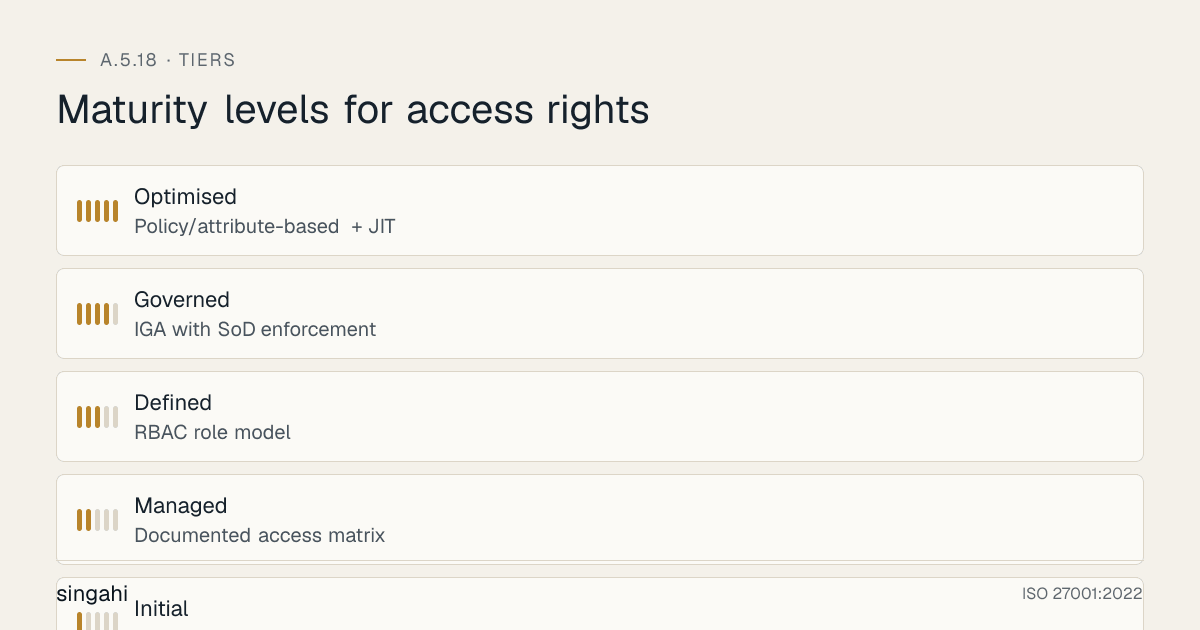
Access Rights Maturity Model (L1–L5)
| Level | Name | Characteristics |
|---|---|---|
| L1 | Initial | Ad-hoc grants; access by copying colleagues; no reviews; broad admin |
| L2 | Managed | Documented access matrix; manual approval; periodic manual review of key systems |
| L3 | Defined | RBAC role model; ticketed requests with owner approval; automated leaver revocation; scheduled reviews |
| L4 | Governed | IGA with SoD enforcement; recertification campaigns; CIEM for cloud; KPIs reported |
| L5 | Optimised | Policy/attribute-based + JIT; near-zero standing privilege; continuous right-sizing |
Target L3 for certification; regulated BFSI is typically expected at L4.
Sector-Specific Notes (India)
- BFSI: RBI expects RBAC, least privilege, maker-checker SoD, and periodic recertification; privileged access via PAM. Inspections sample grants and review evidence directly. Target L4.
- IT/ITeS & SaaS: dominant risks are standing production access and multi-tenant entitlement sprawl; JIT + CIEM are high-value, and client SOC 2 reviews probe access-removal evidence.
- Healthcare: need-to-know on patient records is non-negotiable for DPDP; avoid "everyone sees everything" defaults.
- Manufacturing: keep ERP/financial entitlements separate from plant-operations roles to avoid SoD violations.
- Government/CII: broad administrative entitlements are a serious NCIIPC finding; minimise and review.
Segregation of Duties and Toxic Combinations
ISO 27002 5.18(c) and (f) explicitly tie access rights to segregation of duties (A.5.3). The goal: no single identity can execute and conceal a fraudulent or harmful action end-to-end.
Common Toxic Combinations
| Domain | Toxic combination | Why it's dangerous |
|---|---|---|
| Finance | Create vendor and approve payment | Fabricated-vendor fraud |
| Banking | Maker and checker on same transaction | Unverified transactions |
| IT | Develop and deploy to production unchecked | Unauthorised code to prod |
| IT | Request access and approve own access | Self-granted privilege |
| Procurement | Raise PO and receive goods and approve invoice | Procurement fraud |
| IAM | Administer identities and approve their access | Unchecked entitlement grants |
Implementing SoD
- Define an SoD matrix of incompatible duties/entitlements (with input from finance, ops, and risk).
- Preventive check at request time: block grants that create a violation.
- Detective check continuously: scan existing assignments for violations.
- Mitigating controls where separation is impossible (small teams): compensating monitoring, dual review, logging, documented and approved.
- Separate approval from implementation (27002 (c)), the person who approves access must not be the one who configures it.
Access Reviews and Recertification
The "review" verb in the control, and the most common audit gap.
Review Cadence (risk-based)
This guide is the series reference for access cadences; A.5.15, A.5.16 and A.8.2 use the same schedule. ISO sets no frequency: adjust it to your risk assessment.
| Access type | Review cadence |
|---|---|
| Privileged/administrative | Quarterly (monthly where risk is high) |
| Third-party and vendor access | Quarterly, and at contract change |
| Service/non-human entitlements | Quarterly |
| Access to sensitive/PII systems | Semi-annually (quarterly for high-risk systems) |
| Standard business access | Semi-annually (PCI DSS 7.2.4 requires at least every six months in the cardholder data environment) |
| Mover (role change) | At the change: new access approved, old access removed within 5 working days |
| Leaver | On or before the last working day; immediately for involuntary exits and privileged users |
Running an Effective Campaign
- Reviewers: the asset owner (does this person still need this access?) and/or line manager.
- Scope discipline: keep campaigns small and targeted so they are not rubber-stamped.
- Close the loop: revocations identified must actually be executed and evidenced, an uncompleted revocation is worse than no review (it shows you knew and didn't act).
- Micro-certifications: trigger a focused review on role change rather than waiting for the cycle.
- Evidence: retain reviewer, decisions, date, and revocation confirmations.
Why Reviews Catch What Automation Misses
Automation handles clean joiner/leaver events; reviews catch the messy middle, the analyst who moved teams but kept old access, the "temporary" grant that never expired, the entitlement added for a one-off project. Recertification is the safety net under your provisioning process.
Running Campaigns Without Rubber-Stamping
The failure mode of access reviews is the 500-line spreadsheet a manager approves wholesale in five minutes. Counter it:
- Right-size the scope: review one application or one team at a time, not everything at once.
- Give context: show the reviewer what each entitlement allows and when it was last used, "unused for 9 months" prompts revocation; a bare permission name does not.
- Default to revoke on no-response: non-response should remove access (after escalation), not retain it.
- Track remediation to closure: a revocation decision is not done until the access is actually gone and confirmed. Maintain a remediation log with owner and due date.
- Separate certifier from implementer: consistent with 27002 (c), the person confirming access should not be the one technically removing it.
Remediation Tracking
Every review produces a list of "remove" decisions. Track each to closure:
Review ID | Identity | Entitlement | Decision | Owner | Target date | Status | Confirmed-removed date
Auditors specifically test whether review decisions became review actions. A campaign that flagged 40 revocations but executed 12 is worse evidence than no campaign, it documents known, unactioned risk.
Tools, Technologies, and Solutions
Access Governance / IGA
| Tool | Best for | India notes |
|---|---|---|
| SailPoint | Enterprise access governance + SoD + certification | Large BFSI/IT |
| Saviynt | Cloud-native IGA, strong SoD | Popular in Indian BFSI |
| Microsoft Entra ID Governance | Access packages, reviews for M365 estates | Common in Indian enterprises |
| Okta Identity Governance | Access requests + reviews on Okta | SaaS-heavy firms |
| One Identity / IBM Verify Governance | Mixed/legacy | Established estates |
Privileged Access & Cloud Entitlements
- PAM: CyberArk, Delinea, BeyondTrust, ARCON (Indian-origin, widely deployed in Indian BFSI).
- CIEM: Entra Permissions Management, AWS IAM Access Analyzer, GCP IAM Recommender, Wiz/Orca (CNAPP with CIEM).
Selection Guidance
| Need | Start with |
|---|---|
| Access requests + reviews for M365/Okta | Native governance (Entra ID Governance / Okta OIG) |
| Strong SoD + audit certification (BFSI) | SailPoint / Saviynt |
| Right-sizing cloud permissions | CIEM / cloud-native analysers |
| Privileged access | PAM (ARCON/CyberArk/Delinea) |
Rule: model roles and run reviews before buying heavy tooling. An IGA suite automates a good access model; it cannot create one.
Access Control Policy and Request Templates
Access Rights Policy (extract)
Access Rights Policy — [Organisation Name]
ISO 27001:2022 Annex A 5.18

1. Purpose
   To ensure access rights to Acme's information and assets are provisioned, reviewed,
   modified and removed on a least-privilege, need-to-know, owner-authorised basis.

2. Scope
   All logical and physical access rights for all identities (human and non-human).

3. Policy Statements
   3.1 Access shall be granted on least privilege and need-to-know.
   3.2 All access requires authorisation by the information/asset owner; sensitive access
       requires additional management approval.
   3.3 The approver of access shall not be the implementer (segregation of duties).
   3.4 Access that would create a segregation-of-duties conflict is prohibited unless a
       documented compensating control is approved.
   3.5 Access shall be re-evaluated on role change and removed when no longer required;
       leaver access shall be revoked on or before the last working day, and immediately
       for involuntary exits and privileged users.
   3.6 Temporary access shall carry an expiry and auto-revoke.
   3.7 Access rights shall be recertified on a risk-based schedule (privileged quarterly;
       standard at least annually).
   3.8 Records of all grants, modifications, reviews and revocations shall be retained.

4. Roles
   Asset owners (authorise), IAM (implement/record), Managers (request/justify),
   CISO (govern), Internal Audit (assure).

5. Review
   Reviewed annually or on significant change.
Access Request Form (fields)
- Requester / Manager:
- Identity (unique ID):
- Resource / system:
- Access level requested: [Read | Write | Admin | Custom]
- Business justification:
- Duration: [Permanent | Temporary until <date>]
- Asset owner approval:
- SoD check result: [Pass | Violation -> mitigation]
- Implemented by (≠ approver) / date:
Risk Assessment and Treatment
Figure · Risk grid
Access rights risks by likelihood and impact
Likelihood across · impact up
- Ex-employee retains accessHigh/High
- Excessive cloud permissionsHigh/High
- Privilege creep across role changesHigh/Medium
- Toxic SoD combination enables fraudMedium/High
- Standing admin rights misusedMedium/High
- Temporary access never revokedMedium/Medium
- Access granted without owner approvalMedium/Medium
| Risk | Likelihood | Impact | Risk Level | Treatment |
|---|---|---|---|---|
| Ex-employee retains access | High | High | Critical | Automated leaver revocation; access review |
| Privilege creep across role changes | High | Medium | High | Mover re-evaluation; periodic recertification |
| Toxic SoD combination enables fraud | Medium | High | High | SoD matrix; preventive + detective checks |
| Excessive cloud permissions | High | High | Critical | CIEM right-sizing; remove unused entitlements |
| Standing admin rights misused | Medium | High | High | Least privilege; PAM; JIT elevation |
| Temporary access never revoked | Medium | Medium | Medium | Auto-expiry on all temporary grants |
| Access granted without owner approval | Medium | Medium | Medium | Enforce owner authorisation in workflow |
Audit and Compliance Checklist
| # | Audit Question | Expected Evidence | Red Flag |
|---|---|---|---|
| 1 | Is access based on least privilege/need-to-know? | Role model, access matrix | Broad default access |
| 2 | Does every grant have owner authorisation? | Approval records | Self-granted/unapproved access |
| 3 | Is approver separated from implementer? | Workflow config | Same person approves & implements |
| 4 | Are SoD conflicts prevented and detected? | SoD matrix + scan results | No SoD control |
| 5 | Are leaver access rights removed to SLA? | Leaver sample + timestamps | Active ex-employee access |
| 6 | Are role/mover changes re-evaluated? | Mover tickets w/ revocations | Privilege creep |
| 7 | Is temporary access time-boxed? | Expiry config | Never-expiring temp access |
| 8 | Are access reviews/recertifications run? | Campaign records | Never reviewed |
| 9 | Are review revocations actually executed? | Revocation confirmations | Reviews with no follow-through |
| 10 | Are privileged rights tightly governed? | PAM/JIT evidence | Standing admin everywhere |
| 11 | Are cloud entitlements right-sized? | CIEM reports | Excessive cloud permissions |
| 12 | Are records of grants/revocations kept? | Access logs | No audit trail |
| 13 | Is access activated only after authorisation? | Provisioning sequence | Access live before approval |
| 14 | Are third-party/service entitlements governed? | Vendor/service access records | Ungoverned external access |
| 15 | Is access aligned to the 5.15 policy? | Policy + sample grants | Grants inconsistent with policy |
| 16 | Is birthright access scoped to least privilege? | Role-to-entitlement mapping | Broad birthright access |
| 17 | Are role definitions owned and maintained? | Role catalogue + owners | Stale/exploded roles |
| 18 | Is JIT used for high-risk/privileged access? | PIM/PAM elevation logs | Standing privileged access |
| 19 | Are emergency/break-glass grants controlled? | Break-glass register + post-use review | Unmonitored emergency access |
| 20 | Are access records retained per policy? | Retention config | Missing/short-retention logs |
| 21 | Are unused entitlements removed? | CIEM/usage reports | Accumulated unused access |
| 22 | Is access for non-human identities least-privilege? | Service-account entitlements | Over-scoped service accounts |
| 23 | Are SoD exceptions documented and approved? | Exception register + compensating controls | Undocumented SoD overrides |
| 24 | Is access-request cycle time within SLA? | Workflow metrics | Backlogs causing shadow grants |
| 25 | Is access-rights scope (incl. cloud/SaaS) explicit in the SoA? | SoA + scope statement | Cloud/SaaS access out of scope |
(The toolkit 04-audit-evidence-checklist.md lists the evidence to prepare for each question.)
What Auditors Actually Probe
- "Show me how this person got admin on this system, request, justification, and who approved it." Tests owner authorisation (27002 (a)) and approver≠implementer (27002 (c)).
- "Run your last access-review campaign and show me what was revoked." Tests that reviews are real and close the loop.
- "Pick a leaver, show their access is gone everywhere, not just the directory." Tests downstream revocation, not just identity disablement.
- "Demonstrate that maker and checker can't be the same person here." Tests SoD enforcement. The organisations that pass are the ones whose access-request workflow and recertification produce clean, owned, actioned evidence on demand.
Metrics and KPIs
Figure · Measures
The measures that show A.5.18 is working
- Leaver access removal SLA≥99%Monthly
- Mean time to revoke≤24hMonthly
- Access reviews on time100%Per campaign
- Revocation follow-through100%Per campaign
- SoD violations0Monthly
| # | KPI | Formula | Target | Frequency |
|---|---|---|---|---|
| 1 | Leaver access removal SLA | % leavers' access revoked within SLA | ≥99% | Monthly |
| 2 | Mean time to revoke | Avg hours exit→revocation | ≤24h (≤4h priv.) | Monthly |
| 3 | Access reviews on time | % certifications completed on schedule | 100% | Per campaign |
| 4 | Revocation follow-through | % review-identified revocations executed | 100% | Per campaign |
| 5 | SoD violations | Count of active toxic combinations | 0 | Monthly |
| 6 | Excessive privilege | % identities with unused/over-broad access | <5% | Quarterly |
| 7 | Owner-authorised grants | % grants with owner approval | 100% | Monthly |
| 8 | Temporary access expiry | % temp grants with enforced expiry | 100% | Monthly |
| 9 | Privilege creep | Avg entitlements per identity trend | Downward | Quarterly |
| 10 | Standing privileged accounts | Count of standing admin accounts | Minimised | Monthly |
| 11 | Orphaned entitlements | Entitlements with no valid owner | 0 | Monthly |
| 12 | Cloud unused permissions | % unused cloud permissions | <10% | Monthly |
| 13 | Access request cycle time | Avg request→provision time | Within SLA | Monthly |
| 14 | Self-approval incidents | Count of self-approved access | 0 | Per event |
Common Pitfalls and Audit Failures
| Pitfall | Root Cause | Fix |
|---|---|---|
| Ex-employees retain access | Manual offboarding | Automated leaver revocation |
| Privilege creep | No mover re-evaluation/reviews | Mover checks + recertification |
| "Reviews" that revoke nothing | Rubber-stamping | Targeted scope; enforce revocation |
| Toxic SoD combinations | No SoD ruleset | SoD matrix + preventive checks |
| Excessive cloud permissions | Copy-paste IAM policies | CIEM right-sizing |
| Standing admin for daily work | Convenience | Separate admin IDs; JIT elevation |
| Temp access becomes permanent | No expiry | Mandatory auto-expiry |
| Access granted on email/verbal | No workflow | Ticketed request + owner approval |
| Approver = implementer | Small-team shortcut | Separate roles or compensating control |
Illustrative Scenarios
Illustrative scenario, a composite example for guidance, not a specific Singahi engagement or a verified outcome.
Illustrative Scenario 1, Indian Private-Sector Bank (5,200 staff): RBAC, SoD and Recertification
Challenge. An RBI IT examination flagged that branch staff had accumulated access across multiple role changes (privilege creep), that some users held both maker and checker rights in a payments application (an SoD violation), and that no periodic access recertification existed. Each was an RBI Cyber Security Framework breach and an ISO 27001 nonconformity.
Solution (14 weeks).
- Built an RBAC role model mapped to job functions; replaced ad-hoc grants with birthright + requestable access.
- Defined an SoD matrix (starting with maker/checker and finance combinations) enforced at request time in Saviynt, with continuous detective scanning.
- Wired mover events to access re-evaluation, removing access not needed in the new role.
- Launched quarterly recertification for privileged and payments access, semi-annual for the rest, with revocations tracked to closure.
Results. Maker/checker SoD violations reduced to 0; average entitlements per user fell ~30% as privilege creep was unwound; the RBI observations were closed at follow-up and the bank passed ISO 27001 recertification with no access findings.
Illustrative Scenario 2, Indian SaaS Company (Bengaluru, 900 staff): Least Privilege in the Cloud
Challenge. A B2B SaaS company found engineers held standing production access across AWS accounts, IAM policies had been copied and broadened over years (massive excess permissions), and several ex-contractors retained access. A prospective enterprise customer's security review flagged this, threatening a major deal.
Solution (10 weeks).
- Deployed CIEM (Entra Permissions Management + AWS IAM Access Analyzer) to baseline and right-size permissions, removing unused entitlements.
- Replaced standing production access with just-in-time elevation via PAM, approved per request and time-boxed.
- Implemented an access request workflow with resource-owner approval and SoD checks for sensitive scopes.
- Wired contractor offboarding to automatic revocation with expiry on all temporary access.
Results. Unused cloud permissions cut by ~75%; standing production access eliminated in favour of JIT; ex-contractor access reduced to 0; the enterprise customer's security review passed and the deal closed. The access-governance evidence became a reusable asset for future customer due diligence.
Illustrative Scenario 3, Indian Manufacturing Enterprise (Chennai, 3,000 staff): Fixing SoD in ERP
Challenge. A discrete-manufacturing group running SAP found, during ISO 27001 implementation, that plant and finance access had blurred: some plant supervisors could raise purchase orders, receive goods, and approve invoices, a classic procurement-fraud toxic combination, and several users retained finance access from prior roles. There was no SoD ruleset and no recertification.
Solution (12 weeks).
- Defined an SoD matrix for the core procure-to-pay and order-to-cash processes with finance and internal audit.
- Remediated existing toxic combinations, splitting roles so PO creation, goods receipt, and invoice approval sat with different identities; documented compensating controls where small teams genuinely required overlap.
- Implemented preventive SoD checks in the access-request workflow and detective scans monthly.
- Ran the first semi-annual recertification, unwinding privilege creep from prior roles.
Results. Procurement-fraud toxic combinations reduced to 0 (with documented, monitored exceptions for two small sites); finance privilege creep unwound; the SoD matrix and recertification evidence satisfied both the ISO 27001 auditor and the group's statutory financial controls (ITGC).
Multi-Framework Mapping
| Framework | Reference | Mapping to A.5.18 |
|---|---|---|
| ISO/IEC 27002:2022 | 5.18 | Access rights (provision, review, modify, remove) |
| NIST SP 800-53 Rev 5 | AC-2, AC-3, AC-5, AC-6 | Account management, access enforcement, SoD, least privilege |
| NIST CSF 2.0 | PR.AA-05 | Access permissions managed, incorporating least privilege & SoD |
| CIS Controls v8 | Control 6 (Access Control Management) | Grant/revoke access, least privilege |
| PCI DSS v4.0.1 | 7.2.1–7.2.3 (access model and approval), 7.2.4 (review user access at least every six months), 7.2.5.1 (review system and application accounts), 8.2.4–8.2.6 (lifecycle, terminated users, inactive accounts) | Need-to-know access and its periodic review |
| SOC 2 (TSC 2017) | CC6.1, CC6.2, CC6.3 | Authorisation, provisioning and removal of access |
| COBIT 2019 | DSS05.04 | Manage user identity and logical access |
| SOX (where applicable) | ITGC access controls | Access provisioning + SoD + reviews |
| DPDP Act 2023 / GDPR Art. 32 | Security safeguards | Need-to-know access to personal data |
Implementation Roadmap
Figure · Timeline
Escalation timeline
- Days 1–15Access matrix for top systems
- Days 16–30Access Rights Policy approved
- Days 31–45RBAC role model for top roles
- Days 46–60Access request workflow live with owner
- Days 61–75SoD matrix enforced
- Days 76–90First recertification campaign
Phase 1, Foundation (Weeks 1–3)
- Confirm/align the access control policy (A.5.15); confirm asset ownership (A.5.9).
- Inventory current access on the most sensitive systems; run a first access review (quick win).
- Draft and approve the Access Rights Policy.
Phase 2, Model & Workflow (Weeks 4–7)
- Build the RBAC role model for top roles/systems; define birthright vs requestable access.
- Stand up the access request + owner-approval workflow with SoD checks.
- Wire automated provisioning and leaver/mover revocation.
Phase 3, SoD & Cloud (Weeks 8–10)
- Define and enforce the SoD matrix (preventive + detective).
- Deploy CIEM to right-size cloud permissions; introduce JIT for privileged access.
Phase 4, Certify & Mature (Weeks 11–12+)
- Launch recertification campaigns; build the KPI dashboard.
- Internal audit dry-run against the audit checklist above; schedule recurring reviews.
Detailed 90-Day Plan
| Window | Milestone | Owner | Evidence produced |
|---|---|---|---|
| Days 1–15 | Access matrix for top systems; first review of most-sensitive system; obvious revocations | IAM + Asset owners | Access matrix, review + revocation log |
| Days 16–30 | Access Rights Policy approved; confirm asset ownership | CISO / IAM | Signed policy, owner list |
| Days 31–45 | RBAC role model for top roles; birthright vs requestable defined | IAM | Role catalogue |
| Days 46–60 | Access request workflow live with owner approval + SoD check; leaver/mover automation | IAM / Platform | Workflow config, revocation logs |
| Days 61–75 | SoD matrix enforced; CIEM right-sizing for cloud; JIT for privileged | Security / IAM | SoD scan, CIEM report |
| Days 76–90 | First recertification campaign; KPI dashboard; internal audit dry-run | Asset owners / Internal Audit | Campaign records, dashboard, dry-run report |
RACI Snapshot
| Activity | Manager | IAM Lead | Asset Owner | CISO | Internal Audit |
|---|---|---|---|---|---|
| Request access (justify) | A/R | C | I | I | I |
| Authorise access | I | C | A/R | I | I |
| Implement/provision (≠approver) | I | A/R | C | I | I |
| Recertify access | C | R | A/R | C | I |
| Enforce SoD | I | R | C | A | I |
| Assure / audit | I | C | I | A | R |
(R = Responsible, A = Accountable, C = Consulted, I = Informed.)
Sustaining the Control
Access drifts continuously. Keep A.5.18 healthy by operationalising leaver/mover automation, running recertification on schedule, maintaining role hygiene (retire/split roles), right-sizing cloud entitlements continuously, and feeding access-related incidents back into the process (link A.5.27). Re-baseline maturity (L1–L5) annually and pair the access dashboard with each ISMS management review (Clause 9.3).
FAQ
Q1: Is A.5.18 mandatory for certification? Not automatically. No Annex A control is mandatory. Under clause 6.1.3 you choose the controls your risk assessment calls for, then record A.5.18 in your Statement of Applicability as included (and how) or excluded (and why). In practice essentially every organisation includes it, and auditors then sample access grants, leaver removals and review evidence.
Q2: What's the difference between A.5.15, A.5.16 and A.5.18? 5.15 is the access control policy; 5.16 is identity (who exists); 5.18 is access rights (what they can do). 5.18 operationalises 5.15 for the identities established by 5.16.
Q3: How is A.5.18 different from A.8.2 Privileged access rights? 5.18 governs all access rights; A.8.2 adds stricter controls for the privileged subset (PAM, JIT, session recording). Implement 5.18 broadly and layer A.8.2 on admin access.
Q4: How often must we run access reviews? Risk-based: privileged quarterly (or monthly), sensitive systems quarterly–semi-annually, standard access at least annually, plus event-driven reviews on role change.
Q5: We're a small team and can't fully separate duties, is that a finding? Not necessarily. Where separation is impractical, document compensating controls (dual review, monitoring, logging) and have them approved. The finding is unmanaged SoD risk, not small size.
Q6: What's the highest-impact quick win? Run an access review of your most sensitive system and revoke everything unjustified, then wire leaver events to automatic revocation. This addresses the two most common findings at once.
Q7: How does 5.18 support DPDP Act compliance? DPDP "reasonable safeguards" include access control. Need-to-know access to personal data, owner authorisation, and timely removal are exactly what demonstrates that safeguard.
Q8: What about access for service accounts and vendors? They get access rights too, governed the same way: owner-authorised, least-privilege, time-bound where possible, reviewed, and revoked on decommission/contract end.
Q9: Isn't removing access the same as disabling the identity (5.16)? No. 5.16 disables the identity; 5.18 removes the entitlements. A leaver needs both: identity disabled and access revoked everywhere downstream. A common gap is disabling the central login while local app entitlements linger.
Q10: How do we do least privilege without blocking the business? Use birthright access for day-one productivity (the access a role genuinely needs), make everything else a quick self-service request with owner approval, and add JIT for occasional high-risk tasks. Least privilege fails when requests are slow, invest in a fast, owner-approved workflow so people don't hoard access "just in case."
Key Takeaways
- A.5.18 governs entitlements across four verbs: provision, review, modify, remove, the last two are the most neglected and most audited.
- Owner authorisation and segregation of duties are what auditors test first: every grant needs an authoriser, the approver must not be the implementer, and toxic combinations must be prevented.
- Least privilege and need-to-know limit blast radius: they are the difference between a contained incident and a full-estate breach.
- Timely removal of leaver access and periodic recertification are the two evidence sets auditors test hardest; reviews must close the loop with actual revocations.
- Cloud is where excess accumulates: use CIEM to right-size continuously, and move high-risk access to just-in-time with near-zero standing privilege.
- In India, A.5.18 addresses the core access expectations of RBI, SEBI, IRDAI and the DPDP Act (least privilege, maker-checker, recertification), though each regime adds its own requirements.
- Quick win: review your most sensitive system now, revoke the unjustified, and automate leaver revocation.
References and Further Reading
Primary standards
- ISO/IEC 27001:2022: Annex A control 5.18.
- ISO/IEC 27002:2022: Clause 5.18, Access rights (provisioning/revocation guidance (a)–(g); access reviews).
- Related: ISO/IEC 27002:2022 §5.15 (Access control), §5.3 (Segregation of duties), §5.9 (Asset ownership).
Supporting frameworks
- NIST SP 800-53 Rev 5: AC-2 (Account Management), AC-3 (Access Enforcement), AC-5 (Separation of Duties), AC-6 (Least Privilege).
- NIST CSF 2.0: PR.AA-05 (access permissions, least privilege, SoD).
- CIS Controls v8: Control 6 (Access Control Management).
- PCI DSS v4.0.1: Requirement 7 (need-to-know) and Requirement 8.
- SOC 2 (TSC 2017): CC6.1–CC6.3.
- COBIT 2019: DSS05.04.
Indian regulations
- Digital Personal Data Protection Act, 2023: Section 8(5) reasonable safeguards.
- RBI: Cyber Security Framework (2016); Master Direction on IT Governance, Risk, Controls and Assurance Practices.
- SEBI: Cybersecurity and Cyber Resilience Framework (CSCRF), 2024.
- IRDAI: Information and Cyber Security Guidelines.
- CERT-In: Directions under Section 70B of the IT Act, 2000 (2022).
- IT Act, 2000: Sections 43A, 72A.
Singahi resources: the A.5.18 toolkit and related guides for A.5.15 Access control, A.5.16 Identity management, A.5.3 Segregation of duties, and A.8.2 Privileged access rights.