
On this page
- Quick Reference (60 Seconds)
- What the Control Asks For
- Why Disciplinary Process Matters
- Scope and Applicability
- Key Definitions and Terminology
- Relationship to Other Controls
- Implementation Roadmap (Week-by-Week)
- Detailed Implementation Guidance
- Tools, Technologies, and Solutions
- Policy and Procedure Templates
- Risk Assessment and Treatment
- Audit and Compliance Checklist
- Metrics and KPIs
- Common Pitfalls and How to Avoid Them
- Illustrative Scenarios
- Multi-Framework Mapping
- Regulatory and Industry Context
- Roles and Responsibilities (RACI)
- Documentation and Evidence Requirements
- Continuous Improvement
- FAQ
- References and Further Reading
Quick Reference (60 Seconds)
| Attribute | Detail |
|---|---|
| Control ID | A.6.4 |
| Title | Disciplinary Process |
| Objective | Ensure a formal disciplinary process is in place for employees who commit information security breaches |
| Domain | People |
| ISO 27001:2022 Clause | Annex A.6.4 |
| What You Must Do | Establish, document, and enforce a fair disciplinary process for information security violations with graduated sanctions and due process |
| Owner | HR / Legal / CISO |
| Maturity Level 1 | Ad-hoc disciplinary action; no formal process |
| Maturity Level 2 | Basic disciplinary policy; informal enforcement |
| Maturity Level 3 | Formal disciplinary process; graduated sanctions; documented investigations; appeal mechanism |
| Maturity Level 4 | Consistent enforcement; automated case tracking; metrics-driven; integrated with HRIS; union-compliant |
| Maturity Level 5 | Fair, consistent, learning-oriented process; outcomes measured and fed back into training and controls; good security behaviour recognised |
| ISO 27002 attributes | Control type: Preventive, Corrective · Properties: Confidentiality, Integrity, Availability · Concepts: Protect, Respond · Capabilities: Human resource security · Domains: Governance and ecosystem |
What the Control Asks For
Do you need this control?
A.6.4 is not mandatory in itself: under clause 6.1.3 you include it if your risk assessment calls for it, and record the decision in your Statement of Applicability. Most organisations with staff include it, usually by linking information security breaches to the existing HR disciplinary process. The process must follow Indian labour law and natural justice.
The Control in Brief
Annex A 6.4 asks organizations to formalise and communicate a disciplinary process so that action can be taken against personnel and other relevant interested parties who violate the information security policy.
Implementation Guidance (ISO 27002:2022, paraphrased)
- The disciplinary process should not start without prior verification that a violation occurred (evidence collected under A.5.28)
- It should provide a graduated response that takes into account: (a) the nature (who, what, when, how) and gravity of the breach and its consequences; (b) whether it was intentional (malicious) or unintentional (accidental); (c) whether it is a first or repeated offence; (d) whether the person was properly trained
- The response should consider legal, statutory, regulatory, contractual and business requirements
- The process should act as a deterrent, and allow immediate action for deliberate violations
- The identity of people subject to disciplinary action should be protected in line with applicable requirements
- Good information security behaviour can be recognised and rewarded
Good practice on top of this: a documented procedure, communication to all staff, consistency, an appeal route and securely kept records.
"Shall" vs "Should" Analysis
- Shall (once you have selected this control): a disciplinary process is formalised and communicated
- Should: Specific sanctions and procedures are flexible based on organizational context and legal requirements
Common Misinterpretations
| Misinterpretation | Reality |
|---|---|
| "Disciplinary process is just HR's job" | Security must define what constitutes a security breach and appropriate sanctions; HR manages the process |
| "We can fire anyone for a security mistake" | Indian labor law requires due process; termination must be for gross misconduct with fair investigation |
| "Disciplinary action is always punitive" | Disciplinary process should also be corrective, retraining, mentoring, and improvement |
| "Only intentional breaches need discipline" | Negligent breaches that cause harm may also require disciplinary action |
| "We don't need a formal process for small companies" | Even startups need basic disciplinary procedures to meet ISO 27001 requirements |
Why Disciplinary Process Matters
The Business Risk Narrative
A formal disciplinary process is essential for maintaining security culture and accountability. Without it, security policies become unenforceable:
- Labour disputes can take years to resolve, and reinstatement with back wages can be ordered if the process was unfair
- DPDP Act 2023: a breach caused by staff misuse is still the fiduciary's breach; failing to take reasonable safeguards can attract penalties of up to ₹250 crore
- Courts in India look at whether the employer followed "principles of natural justice" (fair hearing, opportunity to defend)
Regulatory Landscape in India
| Regulation | Disciplinary Process Requirement | Consequence |
|---|---|---|
| Industrial Relations Code 2020 (in force from 21 Nov 2025; replaced the Industrial Disputes Act 1947 and the Industrial Employment (Standing Orders) Act 1946) | Standing orders (certified, or the model standing orders) set misconduct, suspension and the disciplinary procedure for covered establishments; dismissal must follow due process | Unfair dismissal claims: reinstatement, back wages |
| Code on Wages 2019 (replaced the Payment of Wages Act 1936) | Deductions from wages only on permitted grounds and within limits (s.18), after an opportunity to show cause | Penalties; recovery orders |
| State Shops and Establishments Acts | Conditions of service for shops and offices; some states set notice and termination rules | Penalties under the state Act |
| Companies Act 2013, s.177 | Listed and certain other companies must run a vigil (whistle-blower) mechanism with protection against victimisation, reporting to the Audit Committee | Penalties for non-compliance |
| DPDP Act 2023 | Disciplinary and investigation records are personal data: process them for employment purposes (s.7(i)), protect them (s.8(5)) and erase them when no longer needed (s.8(7)) | Up to ₹250 crore for failing to take reasonable safeguards |
| Principles of natural justice (case law) | Notice of charges, a fair hearing, an unbiased decision-maker and a reasoned decision | Orders set aside if not followed |
Industry-Specific Consequences
| Industry | Disciplinary Process Failure Scenario |
|---|---|
| BFSI | Employee shares customer data without consequence; other employees follow; RBI audit failure; systemic breach |
| Healthtech | Nurse accesses celebrity patient records without authorization; no action taken; media scandal; DPDP exposure |
| SaaS / B2B | Developer repeatedly bypasses security review; no action; vulnerabilities accumulate; customer exodus |
| E-commerce | Warehouse employee steals customer data repeatedly; no formal action; DPDP penalty; class action |
| Government | Employee leaks classified data; no formal disciplinary process; national security breach; Official Secrets Act |
| Manufacturing | Safety violations ignored; no disciplinary process; fatal accident; criminal prosecution |
Cost of Getting It Wrong
- Inconsistent or unfair discipline is challenged before labour authorities and courts, often for years, with possible reinstatement and back wages
- Perceived unfairness damages morale and discourages people from reporting incidents
Scope and Applicability
What the Control Covers
- Formal disciplinary procedure: Documented, step-by-step process for handling violations
- Graduated sanctions: Proportionate consequences based on violation severity
- Investigation process: Fair, evidence-based investigation of alleged violations
- Due process: Show cause, hearing, opportunity to defend, reasoned decision
- Appeal mechanism: Process for challenging disciplinary decisions
- Communication: Employees informed of disciplinary process and consequences
- Record keeping: Secure maintenance of disciplinary records
- Corrective action: Retraining, mentoring, improvement plans alongside sanctions
- Union compliance: Process aligned with collective bargaining agreements and standing orders
- Cross-reference: Linkage to employment terms, security policies, and legal requirements
Who It Applies To
| Role | Responsibility |
|---|---|
| HR | Disciplinary process design, investigation support, employee communication, records management, labor law compliance |
| Legal | Legal compliance, due process review, termination documentation, labour court defense, appeal review |
| CISO | Defining security breach categories, assessing severity, recommending sanctions, investigating technical violations |
| Line Managers | Identifying violations, supporting investigations, enforcing sanctions, monitoring improvement |
| Security Team | Technical investigation, evidence collection, breach assessment, violation documentation |
| Employee | Complying with policies, responding to allegations, participating in hearings, appealing decisions |
| Union Representatives | Representing union members, ensuring fair process, participating in joint committees (if applicable) |
| Compliance Manager | Ensuring process meets regulatory requirements, audit support, evidence preparation |
| Board / Management | Reviewing critical cases, policy approval, risk acceptance, strategic oversight |
What It Does NOT Cover
- General performance management (covered by HR processes)
- Grievance handling by employees against employer (covered by grievance procedures)
- Criminal prosecution (covered by law enforcement)
- Civil litigation (covered by Legal)
- Termination for non-security reasons (covered by general HR/termination procedures)
Size-Based Applicability
| Organization Size | Approach |
|---|---|
| Startups (< 50) | Simple disciplinary procedure (2-3 pages); graduated sanctions (verbal, written, termination); basic documentation |
| SMB (50-500) | Formal disciplinary policy; investigation committee; graduated sanctions; appeal process; basic case tracking |
| Mid-market (500-5000) | Complete disciplinary process; multi-level investigation; automated case tracking; union compliance; performance integration |
| Enterprise (5000+) | Enterprise disciplinary framework; predictive analytics; behavioral forensics; union/works council integration; global consistency |
Key Definitions and Terminology
| Term | Definition | Source |
|---|---|---|
| Disciplinary Process | A formal procedure for addressing violations of organizational policies and rules | HR Management |
| Gross Misconduct | Serious violation that may warrant immediate termination without notice | Industrial Law |
| Show Cause Notice | Written notice requiring an employee to explain why disciplinary action should not be taken | Indian Labour Law |
| Domestic Inquiry | Internal inquiry conducted by the employer before disciplinary action | Standing orders and case law |
| Principles of Natural Justice | Fair hearing, opportunity to present case, impartial decision-maker, reasoned decision | Administrative law and case law (constitutional only for public employment, Art. 311) |
| Graduated Sanctions | Progressive penalties that increase with repeated or severe violations | ISO 27002 |
| Suspension | Temporary removal from duties pending investigation or as punishment | Industrial Law |
| Termination | End of employment relationship, with or without notice | Labour Law |
| Appeal | Process for challenging a disciplinary decision | HR Practice |
| Corrective Action | Non-punitive measures aimed at improving behavior (retraining, mentoring) | HR Practice |
| Standing Orders | Rules of conduct for industrial establishments certified by the labor authority | Industrial Relations Code 2020 |
| Collective Bargaining Agreement (CBA) | Negotiated agreement between employer and union governing employment terms | Labour Law |
| Industrial Tribunal | Adjudicating body for industrial disputes in India | Industrial Relations Code 2020 |
| Labour Court | Court for resolving industrial disputes | Industrial Relations Code 2020 |
| Workman | Employee as defined under the Industrial Relations Code 2020 (generally non-managerial; formerly the Industrial Disputes Act) | Industrial Relations Code 2020 |
| Misconduct | Violation of organizational rules or standards of conduct | Industrial Law |
| Ex-Parte Decision | Decision made without hearing the other party (allowed only after due notice and absence) | Legal Procedure |
| Charge Sheet | Formal document listing allegations against an employee | Industrial Law |
| Enquiry Officer | Person appointed to conduct domestic inquiry | Industrial Law |
| Presenting Officer | Person who presents management's case in domestic inquiry | Industrial Law |
| Defence Representative | Person who assists the employee in defending charges | Industrial Law |
| Witness Examination | Process of questioning witnesses during inquiry | Legal Procedure |
| Findings | Conclusions reached by the enquiry officer after investigation | Industrial Law |
| Order of Punishment | Formal decision imposing sanctions | Industrial Law |
Relationship to Other Controls
Figure · Matrix
Comparison: A.5.1 to A.5.34
Upstream Controls (Prerequisites)
| Control ID | Relationship | Why It Matters |
|---|---|---|
| A.5.1 | Policies for Information Security | Security policy must define violations before they can be disciplined |
| A.6.1 | Screening | Screened employees must be bound by terms that can be enforced |
| A.6.2 | Terms and Conditions of Employment | Contractual terms and sanctions enable disciplinary action |
| A.6.3 | Information Security Awareness | Employees must know rules before being disciplined for breaking them |
| A.5.32 | Intellectual Property Rights | IP violations must be in the disciplinary scope |
| A.5.34 | Privacy and Protection of PII | Privacy violations must be in the disciplinary scope |
Downstream Controls (Enabled By)
| Control ID | Relationship | Why It Matters |
|---|---|---|
| A.6.5 | Responsibilities after Termination | Disciplinary termination triggers exit procedures |
| A.6.6 | Confidentiality Agreements | Breach of NDA is a disciplinary matter |
| A.6.7 | Remote Working | Remote work violations are disciplinary matters |
| A.6.8 | Information Security Event Reporting | Failure to report incidents is a disciplinary matter |
| A.8.15 | Logging | Logs provide evidence for disciplinary investigations |
| A.8.16 | Monitoring Activities | Monitoring detects violations for disciplinary action |
Parallel Controls (Work Alongside)
| Control ID | Relationship | Why It Matters |
|---|---|---|
| A.5.19 | Information Security in Supplier Relationships | Vendor violations may be disciplinary for vendor personnel |
| A.8.30 | Outsourced Development | Developer violations are disciplinary matters |
| A.8.10 | Information Deletion | Unauthorized deletion is a disciplinary matter |
| A.8.12 | Data Leakage Prevention | DLP alerts may trigger disciplinary investigations |
| A.8.24 | Use of Cryptography | Cryptography violations are disciplinary matters |
| A.8.20 | Networks Security | Network security violations are disciplinary matters |
Implementation Roadmap (Week-by-Week)
Phase 1: Discovery & Assessment (Weeks 1-2)
Week 1: Current Disciplinary Process Assessment
- Deliverable: Current disciplinary process maturity assessment
- Owner: HR + Legal + CISO
- Activities:
- Review existing disciplinary policy (if any)
- Assess current handling of security violations (ad-hoc? formal?)
- Interview managers about how they handle security violations
- Review past disciplinary cases (security-related) for consistency and fairness
- Assess current documentation of disciplinary cases
- Identify legal compliance gaps (Industrial Relations Code, standing orders, CBA)
- Survey employees on their understanding of disciplinary process
- Benchmark against industry practices and ISO 27001 requirements
Week 2: Risk and Gap Analysis
- Deliverable: Disciplinary process gap analysis report
- Owner: HR + Legal + CISO + Compliance
- Activities:
- Map security violations to current disciplinary response (or lack thereof)
- Identify violations that have gone undisciplined
- Assess legal risk of current ad-hoc approach (wrongful termination, labor disputes)
- Identify inconsistencies in how different departments handle violations
- Map regulatory requirements for disciplinary process
- Assess union/CBA implications for disciplinary process
- Define target state for disciplinary process maturity
- Create gap closure plan
Phase 2: Design & Planning (Weeks 3-4)
Week 3: Disciplinary Policy and Procedure Design
- Deliverable: Draft Disciplinary Policy + Procedure + Sanctions Matrix
- Owner: HR + Legal + CISO
- Activities:
- Draft formal Disciplinary Policy for Information Security Violations
- Define violation categories (Minor, Moderate, Major, Critical)
- Create graduated sanctions matrix for each category
- Design investigation procedure (who investigates, evidence standards, timeline)
- Design due process procedure (show cause, hearing, defense, decision)
- Design appeal mechanism (who hears appeals, timeline, grounds)
- Define roles (Enquiry Officer, Presenting Officer, Defence Representative, Appellate Authority)
- Create documentation templates (charge sheet, findings, order, appeal)
- Review for labor law compliance (Industrial Relations Code, standing orders, CBA)
- Create union/CBA alignment strategy (if applicable)
Week 4: Communication and Training Design
- Deliverable: Communication Plan + Training Materials + Employee FAQ
- Owner: HR + CISO + Training Team
- Activities:
- Design employee communication strategy (why, what, how, consequences)
- Create disciplinary process FAQ for employees
- Create manager training on identifying and reporting violations
- Create HR training on conducting investigations and inquiries
- Create enquiry officer training on conducting fair inquiries
- Create employee awareness materials (posters, videos, intranet)
- Design case tracking system (HRIS, ticketing, or dedicated tool)
- Create metrics and reporting framework
Phase 3: Implementation (Weeks 5-8)
Week 5: Policy Approval and Publication
- Deliverable: Approved policy published and communicated to all employees
- Owner: HR + Legal + CISO + Management
- Activities:
- Finalize policy and procedure with Legal review
- Obtain management approval (CEO, board if required)
- Align with Standing Orders (if applicable, submit for certification)
- Communicate policy to all employees (email, town hall, intranet)
- Publish policy on employee portal
- Add to employee handbook
- Create acknowledgment requirement (all employees must acknowledge)
- Track acknowledgment completion
Week 6: Training Rollout
- Deliverable: All managers and HR trained; employees aware
- Owner: HR + CISO + Training Team
- Activities:
- Train all managers on violation identification and reporting (2-hour session)
- Train all HR staff on investigation and inquiry procedures (4-hour session)
- Train designated enquiry officers on conducting fair inquiries (1-day session)
- Conduct employee awareness sessions (30 minutes, all hands)
- Create and share disciplinary process video (5 minutes)
- Publish FAQ on intranet
- Create quick reference card for managers
Week 7: Case Tracking and Tools Implementation
- Deliverable: Case tracking system operational; first mock case processed
- Owner: HR + IT + CISO
- Activities:
- Implement case tracking system (HRIS module, ServiceNow, or spreadsheet)
- Create case intake form (violation report, evidence, initial assessment)
- Create case workflow (intake → investigation → inquiry → decision → appeal → close)
- Configure alerts and escalations (SLA, overdue cases, critical cases)
- Create case documentation templates (charge sheet, findings, order)
- Process first mock case end-to-end to test workflow
- Train case managers on system use
Week 8: Union and CBA Alignment (if applicable)
- Deliverable: Union agreement or CBA alignment achieved
- Owner: Legal + HR + Union Representatives
- Activities:
- Present disciplinary process to union representatives
- Negotiate security-related disciplinary terms in CBA
- Establish joint disciplinary committee (management + union) if required
- Align Standing Orders with new disciplinary process
- Obtain union sign-off on security violation definitions and sanctions
- Create union-specific communication materials
- Ensure grievance mechanism integrates with appeal process
Phase 4: Testing & Validation (Weeks 9-10)
Week 9: Process Testing
- Deliverable: Process validation report with mock cases
- Owner: HR + Internal Audit + CISO
- Activities:
- Process mock minor violation case (e.g., unreported lost badge)
- Process mock moderate violation case (e.g., unauthorized software installation)
- Process mock major violation case (e.g., data leakage to wrong party)
- Test investigation procedure (evidence collection, witness interviews)
- Test due process (show cause, hearing, defense, decision)
- Test appeal process (filing, hearing, decision)
- Test case tracking system workflow and documentation
- Test union/CBA compliance (if applicable)
- Verify legal compliance at each step
Week 10: Compliance and Audit Validation
- Deliverable: Compliance validation report
- Owner: Legal + Compliance Manager + HR
- Activities:
- Validate policy against Industrial Relations Code 2020 requirements
- Validate Standing Orders compliance (if applicable)
- Validate CBA compliance (if applicable)
- Verify employee acknowledgment completion
- Test case record security and confidentiality
- Verify DPDP compliance for disciplinary records (personal data)
- Prepare compliance evidence package
- Conduct internal audit of disciplinary process
Phase 5: Documentation & Certification Prep (Weeks 11-12)
Week 11: Documentation
- Deliverable: Complete disciplinary process documentation
- Owner: HR + Compliance Manager
- Activities:
- Document all policies, procedures, and templates
- Create illustrative scenarios and examples (anonymized)
- Create training materials and videos
- Create FAQ and quick reference guides
- Create metrics dashboard and reporting templates
- Create evidence repository for audits
- Document union/CBA agreements (if applicable)
Week 12: Certification Readiness
- Deliverable: Audit-ready evidence package
- Owner: CISO + Compliance Manager
- Activities:
- Conduct internal audit of disciplinary process
- Prepare evidence for external ISO 27001 auditor
- Remediate any gaps found
- Conduct management review
- Make the programme and its records available for internal and certification audits
Detailed Implementation Guidance
Step-by-Step Implementation
Step 1: Define Security Violation Categories
| Category | Definition | Examples | Typical Sanctions |
|---|---|---|---|
| Minor | Unintentional violation with no security impact | Clean desk violation, unreported lost badge, minor password policy violation, unlocked screen, failure to attend training | Verbal warning + retraining; Manager counseling; Improvement plan |
| Moderate | Unintentional or negligent violation with limited impact | Sharing credentials with colleague, unauthorized software installation, unencrypted USB, unreported minor incident, repeated minor violations | Written warning + mandatory training; Restricted access; Suspension (1-3 days); Performance plan |
| Major | Significant violation causing security impact or intentional circumvention | Data leakage (no malicious intent), unauthorized access attempt, policy violation causing incident, intentional bypass of security control, repeated moderate violations | Final written warning; Suspension (3-10 days); Role change; Demotion; Consideration of termination |
| Critical | Intentional, malicious, or catastrophic violation | Data theft, sabotage, unauthorized system modification, fraud, espionage, installation of malware, physical security breach, repeated major violations | Immediate suspension; Investigation; Termination (after due process); Legal action; Regulatory reporting; Criminal referral |
Simulated phishing: a click in a phishing simulation is a learning event, not a violation. It triggers coaching, never sanctions (see A.6.3). Discipline applies to wilful or concealed breaches and to failing to report. ISO 27002 also expects the disciplinary process to consider whether the person was properly trained.
Step 2: Create Graduated Sanctions Matrix
| Offense | First Violation | Second Violation | Third Violation | Fourth Violation |
|---|---|---|---|---|
| Minor | Verbal warning + retraining | Written warning + retraining | Written warning + restricted access | Written warning + suspension (within standing-order limits) |
| Moderate | Written warning + mandatory training | Written warning + restricted access | Final written warning + suspension (within standing-order limits) | Final written warning + termination consideration |
| Major | Final written warning + suspension (within standing-order limits) | Final written warning + suspension + role change | Termination consideration | Termination |
| Critical | Immediate suspension pending inquiry (with subsistence allowance) + investigation; termination if proven | N/A (first offense may result in termination) | N/A | N/A |
Weigh the 27002 factors in every case: nature and gravity, intentional or accidental, first or repeat, and whether the person was properly trained. Suspension as a punishment must stay within your certified or model standing orders (the model standing orders cap it at four days at a time); check with Legal.
Note: For critical violations, the process may skip graduated steps. Immediate termination is possible only after due process, not as a knee-jerk reaction. Suspension pending investigation is appropriate.
Step 3: Design Investigation Procedure
- Violation Detection: Security monitoring, incident report, audit finding, tip, or manager observation
- Initial Assessment: Security team assesses if the incident constitutes a violation and determines category
- Case Assignment: HR assigns case to investigator (Enquiry Officer or investigation team)
- Evidence Collection: Gather logs, emails, witness statements, device analysis, access records
- Employee Notification: Employee informed of alleged violation and invited to respond (show cause)
- Employee Response: Employee provides explanation, evidence, and context
- Investigation Report: Investigator prepares report with findings, evidence, and recommendation
- Sanctions Committee Review: Committee (HR, Legal, CISO, manager) reviews report and recommends sanction
- Decision: Sanction determined and documented
- Communication: Employee notified of decision in writing with appeal rights
- Execution: Sanction implemented (warning, suspension, termination, etc.)
- Appeal: Employee may appeal within specified timeframe
- Close: Case closed, records maintained, lessons learned documented
Step 4: Design Due Process Procedure (For Major and Critical Violations)
Under Indian labor law, for major and critical violations, a formal domestic inquiry must be conducted before termination:
- Charge Sheet: Formal document listing specific charges against the employee with supporting evidence
- Show Cause Notice: Employee given 3-7 days to explain why disciplinary action should not be taken
- Enquiry Officer Appointment: Neutral officer appointed to conduct inquiry (can be internal or external)
- Presenting Officer: Management representative who presents the case
- Defence Representative: Employee may be represented by a colleague or union representative
- Witness Examination: Management and employee examine witnesses; cross-examination allowed
- Employee Defense: Employee presents evidence and defense against charges
- Findings: Enquiry officer prepares findings based on evidence and testimony
- Order of Punishment: Management issues order based on findings; must be proportionate and reasoned
- Appeal: Employee may appeal to appellate authority (higher management)
Note: For minor and moderate violations, a simplified process may be used (manager inquiry, HR review, documented warning) rather than full domestic inquiry. However, for dismissing a "worker" under the Industrial Relations Code 2020 (formerly a "workman" under the ID Act), a full domestic inquiry following natural justice is generally required.
Step 5: Create Documentation Templates
Charge Sheet Template:
Template
CHARGE SHEET
To: [Employee Name], [Designation], [Department], [Employee ID]
Date: [Date]
Subject: Charge Sheet for Information Security Violation
You are hereby charged with the following misconduct:
Charge 1: [Specific violation, e.g., "Unauthorized access to customer database on [date]"] Details: [Specific facts, evidence, dates, times] Policy Violated: [Specific policy clause, e.g., "AUP Section 4.2: Unauthorized Access"] Evidence: [List of evidence: logs, screenshots, witness statements]
Charge 2: [If applicable]
You are hereby required to show cause in writing within [3/5/7] days why disciplinary action should not be taken against you. You may also request an oral hearing.
Enquiry Officer: [Name, Designation] Date of Inquiry: [Date, Time, Location]
You have the right to be represented by a [colleague / union representative] during the inquiry. [Legal representation: allowed only if our standing orders permit it or the presenting officer is legally trained; delete if not applicable.]
Signed: [Authorized Signatory] [Date]
Order of Punishment Template:
Template
ORDER OF PUNISHMENT
To: [Employee Name], [Designation], [Department], [Employee ID]
Date: [Date]
Subject: Order of Punishment for Information Security Violation
Reference: Charge Sheet dated [date]; Show Cause Response dated [date]; Enquiry Report dated [date]
After careful consideration of the charges, your response, the evidence, and the findings of the enquiry officer, the following decision is made:
Findings:
- Charge 1: [Proven / Not Proven / Partially Proven]
- Charge 2: [Proven / Not Proven / Partially Proven]
Decision: [Based on the findings, the following sanction is imposed:]
- [Sanction description, e.g., "Final written warning and suspension for 5 days without pay"]
- [Conditions for improvement, e.g., "Mandatory security retraining within 7 days"]
- [Warning about future violations, e.g., "Any further security violation will result in termination"]
Appeal: You may appeal this order to [Appellate Authority] within [7/15] days of receipt.
Signed: [Authorized Signatory] [Date]
Step 6: Implement Case Tracking System
Use a case tracking system to manage all disciplinary cases:
| Case ID | Employee | Violation Category | Date Reported | Investigator | Status | Sanction | Appeal | Closed Date |
|---|---|---|---|---|---|---|---|---|
| D-2026-001 | [Name] | Minor | 2026-01-15 | [Investigator] | Closed | Verbal warning | None | 2026-01-20 |
| D-2026-002 | [Name] | Moderate | 2026-02-03 | [Investigator] | Under inquiry | Pending | - | - |
| D-2026-003 | [Name] | Major | 2026-02-20 | [Investigator] | Awaiting decision | Pending | - | - |
Case Status Values: Reported → Under Investigation → Awaiting Show Cause → Under Inquiry → Awaiting Decision → Sanction Issued → Appeal Filed → Under Appeal → Closed
Step 7: Create Appeal Mechanism
| Appeal Level | Authority | Timeline | Grounds |
|---|---|---|---|
| Level 1 | Manager's Manager or HR Head | Within 7 days | Procedural error, new evidence, disproportionate sanction, bias |
| Level 2 | VP HR or CEO | Within 15 days of Level 1 decision | Legal error, fundamental unfairness, new significant evidence |
| External | Labour Court / Industrial Tribunal | As per the Industrial Relations Code 2020 | Violation of labor law, principles of natural justice, wrongful termination |
Step 8: Implement Corrective Action alongside Sanctions
For non-termination cases, always include corrective action:
- Retraining: Mandatory security training relevant to the violation
- Mentoring: Pair with security-conscious colleague for guidance
- Shadowing: Observe security procedures before independent work
- Access Review: Restricted or supervised access until improvement demonstrated
- Check-ins: Regular manager check-ins on security behavior
- Improvement Plan: 30/60/90-day plan with specific security goals
- Peer Support: Security champion buddy system
Step 9: Create Manager Training
Managers must be trained on:
- Identifying security violations (what to look for)
- Reporting violations (how, when, to whom)
- Supporting investigations (providing evidence, witness statements)
- Enforcing sanctions fairly and consistently
- Supporting employee improvement (retraining, mentoring)
- Avoiding bias and discrimination in enforcement
- Documenting violations and actions
- When to escalate to HR and Security
Step 10: Implement Union/CBA Compliance
For unionized organizations:
- Include security violation definitions in CBA negotiations
- Establish joint disciplinary committee (management + union)
- Define union representative rights in disciplinary inquiries
- Ensure standing orders reflect security disciplinary process
- Get labor authority certification for updated standing orders
- Ensure grievance mechanism integrates with appeal process
- Conduct union training on security risks and business impact
- Frame security as job protection and worker safety
Step 11: Create Communication Plan
Employees must understand:
- What the disciplinary process is
- What behaviors can lead to disciplinary action
- What the graduated sanctions are
- What their rights are (defense, appeal, representation)
- How to report violations (without fear of retaliation)
- That the process is fair, consistent, and non-discriminatory
- Examples of violations and consequences (anonymized)
Step 12: Maintain Records Securely
- Store all disciplinary records in secure, access-controlled system
- Limit access to HR, Legal, and CISO (need-to-know)
- Maintain confidentiality of records
- Retain records for 7 years or employment duration + 7 years
- Secure disposal after retention period (cryptographic erasure)
- DPDP compliance for all personal data in disciplinary records
- Separate disciplinary records from general personnel files (confidential)
Step 13: Implement Metrics and Reporting
- Track violations by category (minor, moderate, major, critical)
- Track sanctions applied (warning, suspension, termination)
- Track repeat violations (recidivism rate)
- Track investigation timelines (time to resolution)
- Track appeal rates and outcomes
- Track training completion for sanctioned employees
- Track improvement rates (employees who improve after sanctions)
- Report quarterly to management and board
- Benchmark against industry data
Step 14: Integrate with Incident Management
- All security incidents involving employee misconduct should be evaluated for disciplinary action
- Incident response team should notify HR of potential violations
- Disciplinary investigation should be separate from incident investigation (but coordinated)
- Incident findings can be used as evidence in disciplinary inquiry
- Disciplinary outcome should be recorded in incident register
- Learn from incidents to improve disciplinary policy
Step 15: Continuous Improvement
- Annual review of disciplinary policy and sanctions
- Quarterly metrics review
- Annual training for managers and enquiry officers
- Post-incident review of disciplinary process effectiveness
- Benchmark against industry best practices
- Update for regulatory changes (labor law, DPDP, industry-specific)
- Gather feedback from employees and managers on process fairness
- Learn from appeals and legal challenges to improve process
Tools, Technologies, and Solutions
Complete Tool Comparison
| Tool | Category | Best For | Pricing model | Key Features | Integration |
|---|---|---|---|---|---|
| ServiceNow | Case Management | Enterprise case tracking | Commercial | Case workflow, SLA, evidence management, reporting, HRIS integration | Full enterprise |
| BambooHR | HRIS | SMB case tracking | Commercial | Employee records, performance, disciplinary notes, reporting | 100+ integrations |
| Workday | HRIS | Enterprise HR management | Commercial | Disciplinary case management, performance, compliance, analytics | Full enterprise |
| SAP SuccessFactors | HRIS | Enterprise HR | Commercial | Case management, performance, employee relations, compliance | SAP ecosystem |
| Oracle HCM | HRIS | Enterprise HR | Commercial | Case management, performance, legal compliance, global | Oracle ecosystem |
| Zoho People | HRIS | Indian SMB | Commercial | Employee records, performance, case notes, basic disciplinary tracking | Zoho ecosystem |
| GreytHR | HRIS | Indian SMB | Commercial | Employee records, compliance, attendance, basic case tracking | Indian compliance |
| HR Acuity | Employee Relations | Disciplinary investigation | Commercial | Investigation management, case tracking, documentation, analytics | HRIS, legal |
| Case IQ | Investigation | Investigations and case management | Commercial | Investigation workflow, evidence, interviews, reporting, analytics | HRIS, legal |
| Convercent | Ethics | Ethics and compliance reporting | Commercial | Hotline, case management, investigation, analytics, reporting | HRIS, legal |
| Navex Global | Ethics | Enterprise ethics and compliance | Commercial | Hotline, case management, investigation, policy, training | Enterprise |
| EthicsPoint | Hotline | Anonymous reporting | Commercial | Anonymous hotline, case management, investigation workflow | HRIS, legal |
| Document Management | Records | Secure record storage | Varies | Secure storage, access control, version control, audit trail | HRIS, case management |
| DocuSign | E-Signature | Charge sheet, order signing | Commercial | Electronic signatures, workflow, templates, audit trail | HRIS, case management |
| Adobe Sign | E-Signature | Enterprise contract signing | Commercial | E-signatures, workflow, templates, compliance | Adobe, HRIS |
| Microsoft 365 | Productivity | Documentation, communication | Commercial | Word, Teams, SharePoint, email, secure storage | Microsoft ecosystem |
| Google Workspace | Productivity | Documentation, communication | Commercial | Docs, Meet, Drive, email, secure storage | Google ecosystem |
| SIEM | Monitoring | Evidence collection | Commercial | Log aggregation, evidence collection, incident correlation | Security tools |
| DLP | Monitoring | Violation detection | Commercial | Data loss detection, policy violation alerts, evidence | Security, HRIS |
| UEBA | Monitoring | Behavioral evidence | Commercial | User behavior analytics, anomaly detection, evidence | Security, SIEM |
| eDiscovery | Legal | Evidence preservation | Commercial | Legal hold, evidence collection, chain of custody | Legal, case management |
| Vault | Legal | Legal hold and compliance | Commercial | Email hold, evidence collection, legal compliance | Google Workspace |
| Microsoft Purview | Compliance | eDiscovery and compliance | Commercial | eDiscovery, legal hold, compliance, data governance | Microsoft 365 |
Recommendations by Organization Size
| Size | Case Management | HRIS | Investigation | Hotline | Evidence |
|---|---|---|---|---|---|
| Startup (<50) | Spreadsheet + BambooHR | BambooHR or Zoho | Manual | Email/phone | Cloud storage |
| SMB (50-500) | BambooHR + HR Acuity | BambooHR or GreytHR | HR Acuity | EthicsPoint | SharePoint/Drive |
| Mid-market (500-5000) | ServiceNow or Case IQ | Workday or SAP | Case IQ + HR Acuity | Convercent or EthicsPoint | ServiceNow + eDiscovery |
| Enterprise (5000+) | ServiceNow + Navex | Workday or Oracle | Case IQ + Navex | Navex Global | ServiceNow + eDiscovery + legal hold |
Policy and Procedure Templates
Disciplinary Policy for Information Security (Key Sections)
Template
Disciplinary Policy for Information Security Violations
1. Purpose
To establish a fair, consistent, and legally compliant disciplinary process for addressing information security violations by personnel.
2. Scope
This policy applies to all employees, contractors, temporary staff, interns, and vendor personnel with access to [Organization] information or systems.
3. Policy Statements
3.1 Violation Categories
Security violations are categorized as:
- Minor: Unintentional violation with no security impact
- Moderate: Negligent violation with limited impact
- Major: Significant violation causing security impact or intentional circumvention
- Critical: Intentional, malicious, or catastrophic violation
3.2 Graduated Sanctions
Sanctions are graduated based on violation category and history:
- Minor: Verbal warning, retraining, manager counseling
- Moderate: Written warning, mandatory training, restricted access, suspension (1-3 days)
- Major: Final written warning, suspension (3-10 days), role change, demotion, termination consideration
- Critical: Immediate suspension, investigation, termination (after due process), legal action
3.3 Investigation
All violations (except minor) require investigation:
- Security team assesses technical evidence
- HR conducts personnel investigation
- Investigation is completed within defined timelines
- Employee is informed of allegations and given opportunity to respond
- Investigation is documented with evidence and findings
3.4 Due Process
For major and critical violations, a formal domestic inquiry is conducted:
- Charge sheet issued with specific allegations and evidence
- Show cause notice with opportunity to respond
- Enquiry officer appointed to conduct fair inquiry
- Employee has right to defense and representation
- Enquiry report with findings and recommendations
- Order of punishment with reasoned decision
3.5 Appeal
Employees have the right to appeal disciplinary decisions:
- Level 1: Appeal to manager's manager or HR Head within 7 days
- Level 2: Appeal to VP HR or CEO within 15 days of Level 1 decision
- External: Labour Court or Industrial Tribunal as per the Industrial Relations Code 2020
3.6 Corrective Action
Alongside sanctions, corrective action is required:
- Mandatory retraining on relevant security topics
- Mentoring by security-conscious colleague
- Restricted or supervised access until improvement
- Regular check-ins with manager
- Improvement plan with specific goals and timelines
3.7 Record Keeping
All disciplinary cases are documented and maintained securely:
- Case records are confidential and access-controlled
- Retention: 7 years or employment duration + 7 years
- Records are stored separately from general personnel files
- DPDP compliance is maintained for all personal data
3.8 Union Compliance (if applicable)
- Security disciplinary terms are included in CBA
- Union representatives are involved in disciplinary process design
- Joint disciplinary committee may be established
- Standing Orders are updated and certified as required
3.9 Roles and Responsibilities
- CISO: Defining security violations, assessing severity, technical investigation
- HR: Case management, investigation coordination, due process, records management
- Legal: Compliance review, termination documentation, appeal review, labor court defense
- Line Manager: Violation identification, supporting investigation, enforcing sanctions, monitoring improvement
- Enquiry Officer: Conducting fair inquiry for major/critical cases
- Employee: Responding to allegations, participating in process, appealing decisions
3.10 Non-Retaliation
Employees who report violations in good faith are protected from retaliation. False reports made in bad faith may result in disciplinary action against the reporter.
3.11 Review
This policy is reviewed annually by HR, Legal, and CISO.
Disciplinary Procedure
Template
Procedure: Disciplinary Process for Security Violations
1. Objective
To define the step-by-step process for investigating and addressing information security violations.
2. Procedure Steps
Step 1: Violation Detection
- Violation detected by: security monitoring, incident report, audit, manager observation, tip
- Security team logs violation in incident tracking system
- Initial assessment: violation category (minor, moderate, major, critical)
- HR notified of potential disciplinary case
Step 2: Case Assignment
- HR creates disciplinary case in case tracking system
- Case assigned to investigator based on category:
- Minor: Manager investigates, HR reviews
- Moderate: HR investigates, Security supports
- Major: Enquiry Officer appointed, formal inquiry
- Critical: Enquiry Officer appointed, immediate suspension, formal inquiry
Step 3: Evidence Collection
- Investigator collects evidence: logs, emails, screenshots, witness statements, device analysis
- Evidence is preserved with chain of custody
- Evidence is reviewed for relevance and admissibility
- Employee is informed of investigation and their rights
Step 4: Show Cause (for Major and Critical)
- Charge sheet issued with specific allegations and evidence
- Employee given 3-7 days to show cause in writing
- Employee may request oral hearing
- Employee may be represented by colleague or union representative
Step 5: Investigation / Inquiry
- Minor/Moderate: Manager/HR interviews employee, reviews evidence, prepares findings
- Major/Critical: Formal domestic inquiry conducted by Enquiry Officer
- Presenting Officer presents management's case
- Employee/defense representative presents defense
- Witnesses examined and cross-examined
- Enquiry Officer prepares findings report
- Investigation timeline: Minor = 3 days, Moderate = 5 days, Major = 10 days, Critical = 15 days (the KPI targets below cover the whole case, including inquiry, decision and appeal)
Step 6: Sanctions Committee Review
- Committee reviews investigation findings: HR, Legal, CISO, manager
- Committee assesses: violation severity, evidence strength, employee history, mitigating factors
- Committee recommends sanction based on matrix and discretion
- Committee documents decision and rationale
Step 7: Decision Communication
- Employee notified in writing of:
- Violation findings
- Sanction decision
- Effective date
- Corrective action requirements
- Appeal rights and process
- For termination: termination letter with grounds and legal compliance
- For suspension: suspension letter with duration and conditions
Step 8: Appeal (if filed)
- Employee files appeal within 7 days (Level 1) or 15 days (Level 2)
- Appellate authority reviews case, may hear employee
- Appellate decision within 14 days
- Decision is final and communicated to employee
Step 9: Execution and Monitoring
- Sanction executed: warning recorded, suspension served, access changed, termination processed
- Corrective action implemented: retraining scheduled, mentoring assigned, improvement plan created
- Manager monitors improvement and reports progress
- Employee receives support for improvement (not just punishment)
Step 10: Case Closure and Documentation
- Case closed in tracking system
- All documents filed securely: charge sheet, evidence, findings, order, appeal, final decision
- Lessons learned documented and shared with security team
- Case statistics updated for metrics
- Follow-up scheduled for improvement verification
3. Special Cases
3.1 Immediate Suspension
- For critical violations, employee may be suspended immediately pending investigation
- Suspension pending inquiry carries a subsistence allowance at least at the rate the standing orders or law require (or full pay if your policy provides)
- Employee is informed of suspension reason and rights
- Investigation proceeds urgently
- Suspension does not prejudge final outcome
3.2 Termination
- Termination is the most severe sanction and requires:
- Full due process (charge sheet, inquiry, findings, reasoned order)
- Legal review for compliance with the Industrial Relations Code and labour law
- Notice period or payment in lieu (unless gross misconduct)
- Full and final settlement processing
- Exit procedures (A.6.5)
- For gross misconduct, termination may be without notice after due process
3.3 Union Representation
- Union members have the right to union representation during inquiry
- Union representative may assist in defense preparation
- Union may be involved in appeal process
- Joint committee may review cases if established in CBA
Risk Assessment and Treatment
Key Risks Addressed by This Control
| Risk ID | Risk Description | Likelihood | Impact | Risk Level | Treatment |
|---|---|---|---|---|---|
| R-001 | Employee violates security policy without consequence | Medium | High | Medium | Mitigate, Formal disciplinary process, consistent enforcement |
| R-002 | Wrongful termination lawsuit due to lack of due process | Medium | High | Medium | Mitigate, Legal-compliant procedure, documentation, appeal |
| R-003 | Disciplinary action applied inconsistently (discrimination) | Low | High | Medium | Mitigate, Structured procedure, committee review, bias training |
| R-004 | Union resistance to disciplinary action | Medium | High | Medium | Mitigate, CBA alignment, joint committee, fair process |
| R-005 | Disciplinary records not maintained securely | Low | High | Medium | Mitigate, Secure storage, access controls, DPDP compliance |
| R-006 | Employee fear of reporting violations (no whistleblower protection) | Medium | Medium | Low | Mitigate, Non-retaliation policy, anonymous reporting, protection |
| R-007 | Investigation bias or unfairness | Medium | Medium | Low | Mitigate, Neutral enquiry officer, representation, appeal |
| R-008 | Disciplinary process delays create legal risk | Medium | Medium | Low | Mitigate, SLA, automated tracking, escalation |
| R-009 | Sanctions too lenient, repeat violations | Medium | Medium | Low | Mitigate, Graduated sanctions, recidivism tracking, escalation |
| R-010 | Sanctions too severe, morale and retention impact | Medium | Medium | Low | Mitigate, Proportionate sanctions, corrective action, manager training |
Audit and Compliance Checklist
Audit Questions (25 Questions)
| # | Audit Question | Expected Evidence | Red Flags |
|---|---|---|---|
| 1 | Is there a formal disciplinary policy for security violations? | Approved policy | No policy, ad-hoc approach |
| 2 | Are violation categories defined? | Policy document with categories | No categories, all violations treated same |
| 3 | Are graduated sanctions defined? | Sanctions matrix | No graduated sanctions, arbitrary decisions |
| 4 | Is the disciplinary process communicated to employees? | Communication records, acknowledgment | No communication, employees unaware |
| 5 | Is there an investigation procedure? | Investigation procedure | No investigation, immediate action |
| 6 | Is there a due process for major/critical violations? | Due process procedure | No due process, summary action |
| 7 | Is there an appeal mechanism? | Appeal procedure | No appeal, decisions final |
| 8 | Are disciplinary cases documented? | Case records, tracking system | No records, undocumented decisions |
| 9 | Is there a case tracking system? | Tracking system, reports | No tracking, cases lost |
| 10 | Are sanctions applied consistently? | Case records showing consistency | Inconsistent sanctions for same violations |
| 11 | Are minor violations addressed? | Minor case records | Only major violations addressed |
| 12 | Is there a corrective action component? | Improvement plans, retraining records | Punitive only, no corrective action |
| 13 | Are disciplinary records secure? | Access controls, encryption | Open access, no security |
| 14 | Is there union/CBA compliance? | CBA terms, union agreement | No union alignment, labor disputes |
| 15 | Are enquiry officers trained? | Training records | Untrained enquiry officers |
| 16 | Are managers trained on identifying violations? | Training records | No manager training |
| 17 | Is there a non-retaliation policy? | Non-retaliation policy | No protection for reporters |
| 18 | Are termination decisions legally reviewed? | Legal review records | No legal review, wrongful termination risk |
| 19 | Are investigation timelines defined? | Timeline SLA | No timelines, indefinite delays |
| 20 | Are disciplinary metrics tracked? | Metrics dashboard | No metrics, no improvement |
| 21 | Is the process reviewed annually? | Management review minutes | No review, stale process |
| 22 | Are standing orders updated? | Standing orders document | Outdated standing orders |
| 23 | Are charge sheets and orders properly drafted? | Sample charge sheets and orders | Poorly drafted, legally vulnerable |
| 24 | Is there a hotline for reporting violations? | Hotline records | No reporting mechanism |
| 25 | Are lessons learned from cases? | Lessons learned documentation | No learning, repeat violations |
Metrics and KPIs
Figure · Measures
The measures that show A.6.4 is working
- Self-Reported IncidentsRising trendMonthly
- Case Resolution Time<15 daysMonthly
- Sanction Consistency Score>90%Quarterly
- Repeat Violation Rate<15%Quarterly
- Appeal Rate<10%Monthly
Key Metrics Dashboard
| KPI | Formula | Target | Frequency |
|---|---|---|---|
| Self-Reported Incidents | Number of incidents reported by staff themselves (rising early on is healthy) | Rising trend | Monthly |
| Case Resolution Time | Average days from report to close | <15 days (minor), <30 days (moderate), <60 days (major/critical) | Monthly |
| Sanction Consistency Score | Consistency of sanctions for same violation types | >90% | Quarterly |
| Repeat Violation Rate | (Employees with repeat violations / Total sanctioned employees) × 100 | <15% | Quarterly |
| Appeal Rate | (Appeals filed / Total sanctions) × 100 | <10% | Monthly |
| Appeal Outcomes Review | Appeal outcomes reviewed for patterns (inconsistency, weak investigations) | Reviewed each quarter | Quarterly |
| Investigation SLA Compliance | (Cases resolved within SLA / Total cases) × 100 | >95% | Monthly |
| Minor Violation Addressed Rate | (Minor violations with action / Total minor violations) × 100 | 100% | Monthly |
| Corrective Action Completion | (Corrective actions completed / Assigned) × 100 | 100% | Monthly |
| Training Completion (Sanctioned) | (Sanctioned employees completing retraining / Total) × 100 | 100% | Monthly |
| Case Documentation Completeness | (Cases with complete documentation / Total) × 100 | 100% | Monthly |
| Union Dispute Rate | (Union disputes / Total cases in union environment) × 100 | <5% | Quarterly |
| Legal Challenge Rate | (Legal challenges / Total terminations) × 100 | <5% | Quarterly |
| Case Record Security | Security audit score for case records | >95% | Quarterly |
| Employee Understanding | (Employees who understand disciplinary process / Total) × 100 | >90% | Annual |
| Manager Training Completion | (Trained managers / Total managers) × 100 | 100% | Annual |
| Whistleblower Report Rate | Anonymous reports of violations | Trending up | Monthly |
| Improvement Rate | (Employees improving after sanctions / Total sanctioned) × 100 | >80% | Quarterly |
| Case Backlog | Cases open beyond SLA | <5% | Monthly |
Common Pitfalls and How to Avoid Them
| # | Pitfall | Why It Happens | How to Avoid |
|---|---|---|---|
| 1 | No formal disciplinary process | Small company, informal culture | Create simple formal procedure even for small teams |
| 2 | Inconsistent sanctions | Different managers handle violations differently | Sanctions matrix, committee review, training, documentation |
| 3 | No due process for termination | Urgency, assumption of guilt | Follow Industrial Relations Code requirements and natural justice; charge sheet, inquiry, reasoned order |
| 4 | Investigation bias | Preconceived notions, manager influence | Neutral enquiry officer, evidence-based, representation |
| 5 | No appeal mechanism | Efficiency, assumption of fairness | Create appeal process; appellate authority; documented rationale |
| 6 | Disciplinary records not secure | Convenience, lack of awareness | Secure storage, access controls, DPDP compliance |
| 7 | Ignoring minor violations | Focus on major issues only | Address all violations; minor violations escalate if unchecked |
| 8 | Punitive only, no corrective action | Punishment mentality | Include retraining, mentoring, improvement plans |
| 9 | No union/CBA alignment | Unilateral management approach | Engage union early; include in CBA; joint committee |
| 10 | Retaliation against reporters | Manager bias, loyalty conflicts | Non-retaliation policy, anonymous reporting, whistleblower protection |
| 11 | Poor documentation | Rushing, informality | Templates, checklist, case tracking, mandatory documentation |
| 12 | No manager training | Assumption that managers know | Mandatory training on violation identification and handling |
| 13 | Delays in investigation | Workload, complexity | SLA, dedicated resources, automated tracking, escalation |
| 14 | Sanctions too severe for minor first offense | Overreaction, fear | Graduated sanctions, proportionality, context consideration |
| 15 | No learning from cases | Case-by-case approach | Aggregate analysis, trend identification, policy improvement |
| 16 | Discrimination in enforcement | Unconscious bias, favoritism | Structured procedure, diverse committee, bias training, metrics |
| 17 | No employee communication | Assumption that policy is known | Town halls, FAQ, video, intranet, acknowledgment |
| 18 | Hotline not promoted | Fear of misuse | Promote hotline, protect reporters, celebrate reporting culture |
| 19 | Ignoring mental health in sanctions | Focus on behavior only | Consider mental health, offer support, EAP referral |
| 20 | No integration with incident management | Siloed security and HR | Security incidents trigger HR review; coordinated investigation |
Illustrative Scenarios
Illustrative scenario, a composite example for guidance, not a specific Singahi engagement or a verified outcome.
Illustrative Scenario 1: Indian SaaS Company, TechFlow Analytics
Company Profile:
- Size: 180 employees
- Industry: B2B SaaS, Data Analytics Platform
- Location: Gurgaon, India
- Customers: 200 enterprise clients globally
- Regulatory Scope: DPDP Act 2023, SOC 2 Type II, ISO 27001, GDPR
Challenge: TechFlow had no formal disciplinary process for security violations:
- When a developer accidentally committed AWS credentials to GitHub, the CTO "had a chat" with him but no formal action
- When a sales rep emailed customer list to personal Gmail, no action was taken because "sales needs data"
- When a QA engineer repeatedly ignored mandatory security training, the manager just "reminded" him with no documentation
- When a developer intentionally bypassed code review for a critical fix, no investigation was conducted
- No employee understood what would happen if they violated security policies
- Managers were afraid to take action because they didn't know the process
- A developer who was "warned" 3 times for credential leaks finally caused a breach exposing 50,000 customer records
- The breach led to remediation costs, a regulatory inquiry and customer churn
- The developer could not be terminated quickly because there was no formal procedure or documentation
- The company faced a wrongful termination lawsuit when they eventually terminated the developer without due process
Solution:
-
Week 1-2: Emergency Policy Creation
- Engaged an external security consultant for emergency disciplinary process design
- Created formal Disciplinary Policy for Security Violations
- Defined 4 violation categories with specific examples
- Created graduated sanctions matrix
- Created investigation and due process procedure
- Created documentation templates (charge sheet, findings, order)
- Legal review for labor law compliance
- Created anonymous hotline for reporting violations
-
Week 3-4: Manager Training and Communication
- Trained all 25 managers on identifying and reporting violations (2-hour session)
- Created manager quick reference card for violation handling
- Communicated policy to all employees (town hall, email, intranet)
- Created employee FAQ (20 questions)
- Required 100% employee acknowledgment
- Created anonymous reporting hotline (EthicsPoint)
-
Week 5-6: Case Tracking and Implementation
- Implemented case tracking in BambooHR (HRIS module)
- Created case intake workflow (violation → investigation → decision → close)
- Closed the 12 outstanding cases under the rules in force when the conduct happened
- Created enquiry officer roster (5 trained HR and security staff)
- First case processed: minor violation (clean desk) → verbal warning + retraining
- Second case: moderate (unauthorized software) → written warning + retraining + restricted access
-
Week 7-8: Integration and Culture Change
- Integrated disciplinary process with incident management (security incidents auto-flag HR)
- Created security champion program (employees recognized for reporting violations)
- Created monthly security culture report (violations, sanctions, improvements)
- First major case: developer bypassed security review → formal inquiry → final written warning + 5-day suspension + mandatory security training
- Employee accepted sanction without appeal; completed retraining successfully
-
Week 9-12: Metrics and Continuous Improvement
- Created quarterly metrics review with management
- 100% employee acknowledgment achieved
- 25 managers trained and certified
- 5 enquiry officers trained
- Zero appeals in first 10 cases (fairness perceived)
- Created lessons learned documentation from each case
- Policy updated based on first-quarter experience
Results:
- Security violations: 45% reduction in 6 months (deterrence effect)
- Repeat violations: 15% recidivism rate (down from 60% before formal process)
- Employee understanding: 91% of employees understand disciplinary process (survey)
- Reporting: 40% increase in violation reporting (hotline + culture change)
- Case resolution: Average 12 days for minor, 18 days for moderate (within SLA)
- Legal risk: Zero legal challenges; zero wrongful termination risk
- Breach prevention: Zero breaches in 6 months (vs. 3 in previous 6 months)
- Culture: Security compliance became part of organizational culture
Illustrative Scenario 2: Large Manufacturing, Indian Auto Components Ltd. (IACL)
Company Profile:
- Size: 4,500 employees, 3,800 unionized workers
- Industry: Automotive Components Manufacturing
- Location: Chennai, India
- Customers: 15 major automotive OEMs
- Regulatory Scope: DPDP Act 2023, OSH Code 2020, ISO 27001, IATF 16949, ISO 14001
- Union: Strong trade union; CBA renewal every 3 years
Challenge: IACL had a strong union and outdated disciplinary framework:
- Standing Orders from 1995 had no information security provisions
- CBA had no security-related disciplinary terms
- Security violations were handled by "suspending the worker for 3 days" (arbitrary, no process)
- Workers did not understand what constituted a security violation
- A union leader was suspended for 10 days for "computer misuse" without charge sheet or inquiry
- Union filed unfair labor practice claim; labour court ordered reinstatement with back wages
- OT/ICS systems were repeatedly accessed by unauthorized personnel; no disciplinary action because "workers need to do their job"
- A worker stole proprietary CAD designs from shared drive; no formal procedure to investigate
- No formal inquiry for any security violation in 10 years
- Management was afraid to take action due to union power and labor court risk
- ISO 27001 certification was at risk because A.6.4 was not implementable in union environment
Solution:
-
Months 1-2: Union Engagement and Partnership
- Engaged an external security consultant for union-compliant disciplinary process design
- Established Joint Security-Disciplinary Committee (3 management + 3 union representatives)
- Conducted 8 workshops with union leaders on security risks in manufacturing
- Presented data: 1 OT security incident could halt production, affecting 4,500 jobs
- Shared industry examples: competitors with security breaches lost OEM contracts
- Union agreed to security disciplinary terms if:
- Security training is paid work time
- Security equipment is provided by company
- No surveillance of personal activity
- Full due process (charge sheet, inquiry, representation)
- Union representative on every enquiry committee
-
Months 3-4: Standing Orders and CBA Update
- Updated Standing Orders with information security misconduct provisions
- Added 12 security misconduct categories (unauthorized access, data theft, sabotage, credential sharing, etc.)
- Defined graduated sanctions: oral warning → written warning → suspension → dismissal
- Included due process: charge sheet, show cause, enquiry, order, appeal
- Standing Orders submitted to Labor Commissioner for certification
- CBA updated with security terms in appendix (jointly signed by management and union)
- Created joint enquiry committee for security violations (3 management + 3 union)
-
Months 5-6: Training and Communication
- Security training made mandatory and paid (union requirement)
- Created plant-floor security awareness in Tamil and Hindi
- Created visual posters on shop floor: "Security Misconduct = Production Risk"
- Trained 50 supervisors on violation identification and reporting
- Trained 20 enquiry committee members on conducting fair inquiries
- Created worker-friendly FAQ on security and discipline
-
Months 7-9: Implementation and First Cases
- First case: Worker accessed OT system without authorization (minor) → oral warning + safety briefing
- Second case: Supervisor shared OT password with junior worker (moderate) → written warning + 2-day suspension + retraining
- Third case: Worker copied CAD files to USB (major) → formal enquiry → final written warning + 5-day suspension + access restriction
- Union supported all decisions because process was fair and agreed
- Zero union disputes in first 9 cases
-
Months 10-12: Continuous Improvement and Certification
- Quarterly joint committee review of all cases
- Worker suggestion scheme for security improvements (5 suggestions implemented)
- Created case tracking system (shared access for management and union)
- Annual review of Standing Orders security provisions
- ISO 27001 audit raised no findings on A.6.4
- Passed IATF 16949 audit with zero findings on personnel security
Results:
- Union relations: Security disciplinary terms agreed with the union
- Security incidents: 55% reduction in security violations in 12 months
- OT security: Zero unauthorized OT access incidents in 6 months
- Labor disputes: Zero labor disputes related to security discipline
- IP protection: No IP theft incidents after formal process implementation
- Production impact: Zero production stoppages due to security incidents
- OEM contracts: Won 2 new OEM contracts citing security program
- Cost: program cost vs. potential labor court costs ( per case) + production loss + contract loss
- Industry recognition: Featured in CII manufacturing security best practices
Multi-Framework Mapping
The references below genuinely overlap with A.6.4. Use them when one set of evidence must satisfy several frameworks.
| Framework | Reference | How it relates |
|---|---|---|
| NIST SP 800-53 Rev 5 | PS-8 Personnel sanctions | A formal sanctions process for people who break security policies |
| SOC 2 (2017 TSC) | CC1.5 | The organisation holds individuals accountable for their responsibilities |
| COBIT 2019 | APO07 Managed human resources | Performance and conduct management |
| DPDP Act 2023 | s.7(i) employment purposes; s.8(5) safeguards | Investigation and disciplinary records are personal data and must be protected |
| Indian labour law | Industrial Relations Code 2020 (standing orders, misconduct, domestic inquiry); Code on Wages 2019 s.18 (deductions) | The process must follow natural justice and labour law |
Regulatory and Industry Context
India Regulatory Framework
| Regulation | Disciplinary Process Requirement | Consequence |
|---|---|---|
| Industrial Relations Code 2020 (in force from 21 Nov 2025; replaced the Industrial Disputes Act 1947 and the Industrial Employment (Standing Orders) Act 1946) | Standing orders (certified, or the model standing orders) set misconduct, suspension and the disciplinary procedure for covered establishments; dismissal must follow due process | Unfair dismissal claims: reinstatement, back wages |
| Code on Wages 2019 (replaced the Payment of Wages Act 1936) | Deductions from wages only on permitted grounds and within limits (s.18), after an opportunity to show cause | Penalties; recovery orders |
| State Shops and Establishments Acts | Conditions of service for shops and offices; some states set notice and termination rules | Penalties under the state Act |
| Companies Act 2013, s.177 | Listed and certain other companies must run a vigil (whistle-blower) mechanism with protection against victimisation, reporting to the Audit Committee | Penalties for non-compliance |
| DPDP Act 2023 | Disciplinary and investigation records are personal data: process them for employment purposes (s.7(i)), protect them (s.8(5)) and erase them when no longer needed (s.8(7)) | Up to ₹250 crore for failing to take reasonable safeguards |
| Principles of natural justice (case law) | Notice of charges, a fair hearing, an unbiased decision-maker and a reasoned decision | Orders set aside if not followed |
International Regulations
| Regulation | Disciplinary Process Requirement |
|---|---|
| GDPR (EU) | Article 32, security measures including personnel accountability; Article 5, accountability principle |
| HIPAA (US) | §164.308(a)(1)(ii)(C), Sanction policy |
| SOX (US) | Internal controls including personnel accountability and disciplinary procedures |
| UK Employment Rights Act 1996 | Fair dismissal requires reason and procedure |
| EU Whistleblower Directive | Protection for employees reporting violations; anti-retaliation |
| ILO Convention | Worker rights and fair treatment in disciplinary procedures |
Sector-Specific Requirements
| Sector | Disciplinary-Specific Requirements |
|---|---|
| BFSI | RBI expects staff accountability for fraud and security lapses; SEBI regulations for dealers and intermediaries' staff; vigil mechanism (Companies Act s.177) |
| Healthcare | Clinical staff discipline for patient-data misuse (DPDP Act); NABH standards where accredited |
| Telecom | Security clearance revocation; subscriber data misuse; lawful interception misuse |
| Manufacturing | Standing orders under the Industrial Relations Code; union agreements; OT operator accountability |
| Government | Service and conduct rules; CVC guidelines; Official Secrets Act prosecution where relevant |
Roles and Responsibilities (RACI)
| Activity | Accountable | Responsible | Consulted | Informed |
|---|---|---|---|---|
| Disciplinary Policy | HR Head | HR | Legal, CISO | Board |
| Violation Investigation | HR Head | Security Team (fact-finding) | Manager, Legal | Employee |
| Case Management | HR | HR Manager | CISO, Legal | Management |
| Enquiry Officer | HR | Enquiry Officer | Legal, CISO | Employee, Management |
| Sanctions Committee | Disciplinary authority (per standing orders / delegation of powers) | HR Head | Legal, CISO (as adviser) | Board |
| Sanctions Decision | Disciplinary authority (per standing orders / delegation of powers) | HR Head | Legal, CISO (as adviser, not decision-maker) | Employee, Manager |
| Appeal Authority | CEO | VP HR | Legal | Employee, Board |
| Corrective Action | CISO | Training Team | HR, Manager | Employee |
| Union Liaison | Legal | HR Head | CISO | Union, Board |
| Standing Orders Update | Legal | HR | CISO | Labor Commissioner |
| Case Tracking | HR | HR Admin | CISO | Management |
| Record Management | HR | HR Admin | CISO | Compliance |
| Manager Training | CISO | Training Team | HR | All Managers |
| Employee Communication | HR | HR Manager | CISO | All Employees |
| Metrics and Reporting | CISO | HR Analyst | Compliance | Board |
| Audit and Compliance | Internal Audit | HR, CISO | Legal | Board |
| Hotline Management | CISO | Security Team | HR | Management |
| Whistleblower Protection | Audit Committee (vigil mechanism, Companies Act s.177) or Ethics function | Legal | HR | Board |
| Policy Review | CISO | HR Head | Legal | Board |
| Incident-Disciplinary Link | CISO | Security Team | HR | Management |
Documentation and Evidence Requirements
Required Documents
| Document | Owner | Retention Period | Format |
|---|---|---|---|
| Disciplinary Policy | CISO | 7 years | PDF + Word |
| Disciplinary Procedure | HR | 7 years | PDF + Word |
| Violation Categories | CISO | 7 years | Document |
| Sanctions Matrix | CISO | 7 years | Document |
| Charge Sheet Templates | HR | 7 years | Document templates |
| Enquiry Officer Appointment | HR | Per case | Appointment letter |
| Investigation Reports | CISO | 7 years | Reports |
| Enquiry Reports | HR | 7 years | Reports |
| Findings and Orders | HR | 7 years | Orders |
| Appeal Records | Legal | 7 years | Case files |
| Case Tracking Records | HR | 7 years | System records |
| Employee Acknowledgment | HR | 7 years | Signed forms |
| Manager Training Records | HR | 5 years | LMS records |
| Enquiry Officer Training | HR | 5 years | Training records |
| Standing Orders | Legal | 7 years | Certified document |
| CBA Security Terms | Legal | Duration of CBA + 7 years | Agreement |
| Union Negotiation Records | Legal | 7 years | Meeting minutes |
| Hotline Reports | CISO | 3 years | System records |
| Metrics and Reports | HR | 3 years | Dashboard / reports |
| Audit Evidence | Internal Audit | 5 years | Audit reports |
| Lessons Learned | CISO | 3 years | Documentation |
| Corrective Action Plans | HR | 3 years | Improvement plans |
Continuous Improvement
Figure · Tiers
Maturity levels for disciplinary process
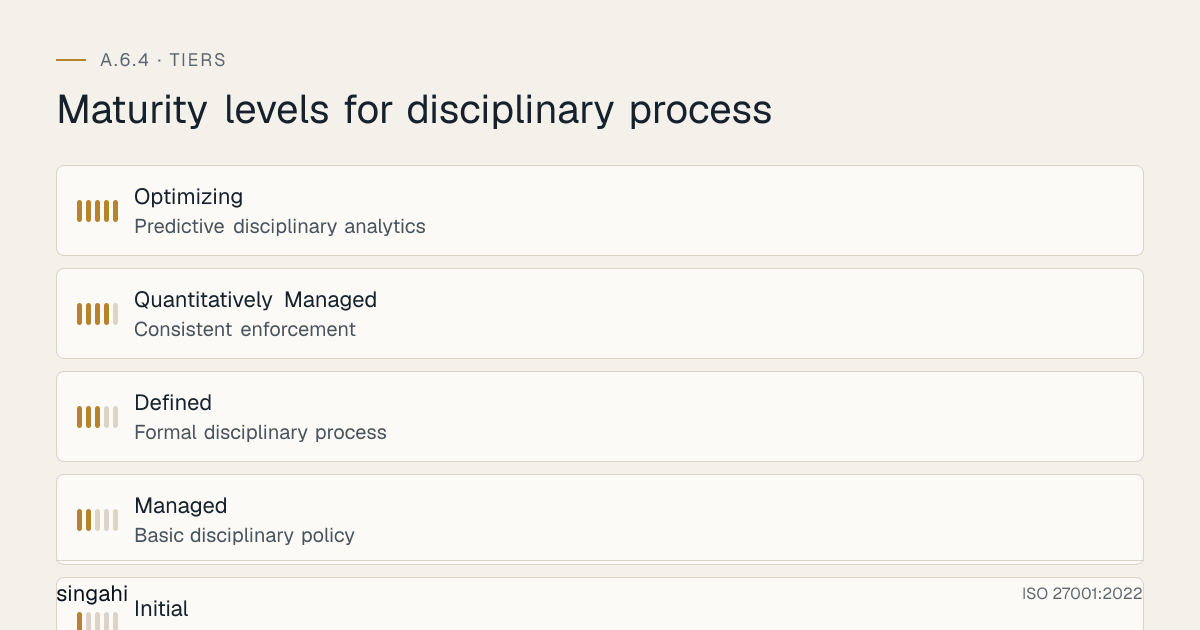
Maturity Model (Level 1-5)
| Level | Name | Description |
|---|---|---|
| 1 | Initial | Ad-hoc disciplinary action; no formal process; no records; inconsistent |
| 2 | Managed | Basic disciplinary policy; informal enforcement; paper records; some consistency |
| 3 | Defined | Formal disciplinary process; graduated sanctions; due process; appeal mechanism; case tracking; union compliance; documentation |
| 4 | Quantitatively Managed | Consistent enforcement; automated case tracking; metrics-driven; manager training; performance integration; corrective action |
| 5 | Optimizing | Fair, consistent and learning-oriented; outcomes feed training and control design; good behaviour recognised; continuous improvement |
Improvement Cycle
- Plan: Annual review of disciplinary policy; quarterly metrics; industry benchmarking; regulatory updates; union feedback
- Do: Deploy new tools; update sanctions; train managers; enhance investigation; improve documentation; corrective action innovation
- Check: Measure fairness; audit consistency; benchmark; gather feedback; review appeals; analyze trends
- Act: Standardize; communicate; update procedures; report to management; share best practices; union collaboration
Technology Trends
- AI Investigation Support: AI analyzing logs and evidence for investigation insights
- Insider-risk monitoring: detecting risky activity for investigation (never pre-emptive discipline: action must follow a verified violation)
- Behavioral Forensics: Analyzing behavior patterns to detect insider threat risk
- Digital Case Management: End-to-end digital case management with blockchain evidence integrity
- Automated Due Process: Workflow automation for charge sheet, inquiry, and order generation
- Real-Time Monitoring: Continuous monitoring triggering automated case creation
- Anonymous Reporting AI: AI-powered anonymous hotline with natural language processing
- Union-Tech Collaboration: Digital platforms for joint management-union case review
FAQ
Frequently Asked Questions (20 Questions)
Q1: Is a formal disciplinary process required for ISO 27001 certification? A: Not automatically. No Annex A control is mandatory. Under clause 6.1.3 you choose the controls your risk assessment calls for, then record A.6.4 in your Statement of Applicability as included (and how) or excluded (and why). Most organisations with employees include it, often by linking information security breaches to their existing HR disciplinary procedure. If you include it, auditors will look for a documented, communicated process and evidence that it is applied fairly.
Q2: Can we terminate an employee immediately for a security breach? A: In India, immediate termination without due process is legally risky, especially for "workers" under the Industrial Relations Code 2020. For gross misconduct, you can suspend immediately pending inquiry, but termination requires a formal inquiry and reasoned order. Consult Legal.
Q3: What is the difference between a minor and major violation? A: Minor: unintentional, no impact (e.g., unlocked screen). Major: significant impact or intentional circumvention (e.g., data leakage, unauthorized access). The distinction determines the investigation depth and sanction severity.
Q4: Do we need a domestic inquiry for every violation? A: No. Minor and moderate violations can be handled through manager inquiry and HR review. Major and critical violations (especially those leading to termination) require a formal domestic inquiry under Indian labor law.
Q5: Can a manager issue a warning without HR involvement? A: For minor verbal warnings, yes, but it should be documented. For written warnings and above, HR should be involved to ensure consistency and legal compliance.
Q6: What is a show cause notice and when is it required? A: A show cause notice is a written document requiring the employee to explain why disciplinary action should not be taken. It is required for moderate and above violations, and mandatory before termination.
Q7: How do we handle a unionized workforce? A: Include security disciplinary terms in the CBA. Establish a joint committee. Ensure union representation in inquiries. Get standing orders certified. Frame security as job protection.
Q8: What is the role of CISO in disciplinary process? A: CISO defines security violations, assesses severity, provides technical evidence, recommends sanctions, and participates in the sanctions committee. CISO does not unilaterally terminate employees.
Q9: Can we discipline an employee for a mistake (not intentional)? A: Yes, if the mistake caused harm or violated a clear policy. Negligence can be a disciplinary matter. However, sanctions should be lighter than for intentional violations. Focus on corrective action.
Q10: What if an employee refuses to attend the inquiry? A: Proceed with the inquiry after due notice. The enquiry officer can make an ex-parte decision based on available evidence. However, ensure the employee was properly notified and given adequate opportunity.
Q11: How do we protect employees from retaliation for reporting violations? A: Create a non-retaliation policy. Protect anonymous reporters. Investigate retaliation claims. Discipline retaliators. Celebrate reporting culture.
Q12: Can we use security monitoring as evidence in disciplinary inquiry? A: Yes, but the evidence must be reliable, relevant, and obtained legally. Monitoring must comply with DPDP Act 2023 and labor law. Employees should be informed of monitoring. Evidence must be preserved with chain of custody.
Q13: What is the maximum suspension period? A: Suspension pending inquiry should not be indefinite and carries a subsistence allowance. Suspension as a punishment must stay within your certified or model standing orders (the model standing orders cap it at four days at a time). Prolonged suspension may be challenged in labor courts. Consult Legal.
Q14: Do contractors have the same disciplinary rights? A: Contractors are not employees under labor law, so Industrial Relations Code protections may not apply to them directly. However, their contracts should include disciplinary terms. The contractor's employer may also take action. Contractual terms govern.
Q15: How do we handle a security violation discovered after the employee has left? A: If the violation is discovered post-employment, legal action may still be possible if the contract has post-employment obligations (NDA, IP assignment). Criminal action is possible for theft, sabotage, or fraud. Consult Legal.
Q16: What is the role of HR in disciplinary process? A: HR manages the disciplinary process: case management, investigation coordination, due process, documentation, records, legal compliance, union liaison, and employee communication. HR ensures fairness and legal compliance.
Q17: Can we reduce salary as a disciplinary sanction? A: Under the Code on Wages 2019 (s.18), deductions from wages are allowed only on listed grounds and within limits, and fines are restricted. Wages due on exit must be paid within two working days (s.17(2)). Consult Legal before imposing financial penalties.
Q18: How do we ensure disciplinary process is not discriminatory? A: Use structured procedure, sanctions matrix, committee review, diverse decision-makers, bias training, metrics analysis, and regular audits. Document rationale for all decisions.
Q19: What is the difference between a disciplinary process and a grievance process? A: Disciplinary process: employer takes action against employee for violation. Grievance process: employee raises complaint against employer or situation. They are different but related. Employees should be able to grieve disciplinary decisions.
Q20: What will an ISO 27001 auditor look for in A.6.4? A: The auditor will verify: (1) formal disciplinary policy exists, (2) process is communicated to employees, (3) violation categories are defined, (4) sanctions are graduated, (5) cases are documented, (6) process is applied consistently, (7) there is evidence of use, (8) appeal mechanism exists, and (9) legal compliance is maintained.
References and Further Reading
ISO Standards
- ISO 27001:2022: Information Security Management Systems
- ISO 27002:2022: Information Security Controls
- ISO/IEC 27701:2025: Privacy information management systems
Indian Law
- Industrial Relations Code 2020 (standing orders; replaced the Industrial Employment (Standing Orders) Act 1946)
- Industrial Relations Code 2020 (from 21 Nov 2025 replaced the Industrial Disputes Act 1947 and the Industrial Employment (Standing Orders) Act 1946)
- OSH Code 2020 (replaced the Factories Act 1948)
- Shops and Establishments Act (state-specific)
- OSH Code 2020 (replaced the Contract Labour Act 1970)
- Code on Wages 2019: Section 18 (permitted deductions; replaced the Payment of Wages Act 1936)
- Code on Wages 2019 (replaced the Minimum Wages Act 1948)
- Companies Act 2013
- DPDP Act 2023
- IT Act 2000
- POSH Act 2013
- Official Secrets Act 1923
International
- GDPR (EU): Articles 5, 32, 28
- HIPAA (US): §164.308(a)(3)**, Workforce security
- SOX (US): Internal controls
- UK Employment Rights Act 1996: Fair dismissal
- EU Whistleblower Directive
- ILO Convention: Worker rights and fair treatment
Industry
- NASSCOM: IT industry employment practices
- ISACA: Security and governance guidance
- CII: Industrial employment and security practices
- FICCI: Business and employment law
- Labour Law Journals: Indian labour court judgments