
On this page
- Quick Reference (60 Seconds)
- What the Control Asks For
- Why NDAs Matter
- Scope and Applicability
- Key Definitions and Terminology
- Relationship to Other Controls
- Implementation Roadmap (Week-by-Week)
- Detailed Implementation Guidance
- Tools, Technologies, and Solutions
- Policy and Procedure Templates
- Risk Assessment and Treatment
- Audit and Compliance Checklist
- Metrics and KPIs
- Common Pitfalls and How to Avoid Them
- Illustrative Scenarios
- Multi-Framework Mapping
- Regulatory and Industry Context
- Roles and Responsibilities (RACI)
- Documentation and Evidence Requirements
- Continuous Improvement
- FAQ
- References and Further Reading
Quick Reference (60 Seconds)
| Attribute | Detail |
|---|---|
| Control ID | A.6.6 |
| Title | Confidentiality or Non-Disclosure Agreements |
| Objective | Protect information through legally binding confidentiality agreements |
| Domain | People |
| ISO 27001:2022 Clause | Annex A.6.6 |
| What You Must Do | Have NDAs in place for all personnel with information access; define scope; enforce them |
| Owner | Legal / CISO / HR |
| Maturity Level 1 | No NDA; verbal confidentiality only |
| Maturity Level 2 | Basic NDA in offer letter; no standalone agreement; no enforcement |
| Maturity Level 3 | Complete standalone NDA; defined scope; all employees signed; annual reminder; enforcement framework |
| Maturity Level 4 | Role-based NDAs; automated NDA management; digital signatures; third-party NDAs; regular training; breach monitoring; legal enforcement |
| Maturity Level 5 | AI-driven NDA analytics; predictive breach detection; automated contract lifecycle; blockchain evidence; zero-defect NDA compliance; industry leadership |
| ISO 27002 attributes | Control type: Preventive · Properties: Confidentiality · Concepts: Protect · Capabilities: Human resource security, Information protection, Supplier relationships security · Domains: Governance and ecosystem |
What the Control Asks For
Do you need this control?
A.6.6 is not mandatory in itself: under clause 6.1.3 you include it if your risk assessment calls for it, and record the decision in your Statement of Applicability. Most organisations include it, because staff, contractors and suppliers see confidential information. You can adapt it with tiered agreements (employee, contractor, supplier, visitor) rather than one template.
The Control in Brief
Annex A 6.6 asks for confidentiality or non-disclosure agreements that reflect the organization's needs for protecting information to be identified, documented, regularly reviewed and signed by personnel and other relevant interested parties.
Implementation Guidance (ISO 27002:2022, paraphrased)
Terms should reflect the type, classification, use and permitted access of the information, and consider:
- (a) a definition of the information to be protected (for example confidential information)
- (b) the expected duration, including cases where confidentiality must last indefinitely or until the information becomes public
- (c) the required actions when the agreement ends
- (d) the responsibilities and actions of signatories to avoid unauthorised disclosure
- (e) ownership of information, trade secrets and intellectual property
- (f) the permitted use of confidential information and the signatory's rights to use it
- (g) the right to audit and monitor activities involving confidential information, for highly sensitive cases
- (h) the process for notifying and reporting unauthorised disclosure or leakage
- (i) return or destruction of information when the agreement ends
- (j) expected actions on non-compliance
Consider the legal requirements of the jurisdictions involved (A.5.31–A.5.34), and review the requirements periodically and when circumstances change. Confidentiality terms inside an employment contract satisfy A.6.6 if they cover these points; a separate NDA is common but not required.
"Shall" vs "Should" Analysis
- Shall (once you have selected this control): agreements are identified, documented, reviewed regularly and signed
- Should: Specific NDA terms, scope, and enforcement mechanisms are flexible based on context
Common Misinterpretations
| Misinterpretation | Reality |
|---|---|
| "NDA is just one paragraph in the offer letter" | One vague paragraph rarely covers 27002's points; a standalone NDA or a full confidentiality section in the contract, with specific scope, duration and enforcement, is far stronger |
| "NDAs are unenforceable in India" | NDAs are enforceable for trade secrets and confidential information; courts enforce reasonable restrictions |
| "Only employees need NDAs" | Contractors, vendors, partners, visitors, and interns also need NDAs |
| "NDA scope is everything the company has" | Scope must be specific and reasonable; overly broad NDAs may be challenged |
| "Once signed, we never need to review the NDA" | Review NDA requirements periodically and when circumstances change (many organisations do it annually) |
| "NDA is just for post-employment" | NDA obligations apply during AND after employment |
| "We can't enforce NDA against ex-employees" | Courts in India enforce NDA breaches with injunctions, damages, and criminal action |
Why NDAs Matter
The Business Risk Narrative
NDAs are the primary legal mechanism for protecting confidential information:
- A 2013 Symantec and Ponemon Institute survey found that about half of employees who left their jobs kept confidential corporate data
- A written NDA makes legal action far easier; without one you must rely on the equitable duty of confidence, which Indian courts recognise (for example John Richard Brady v Chemical Process Equipments, Delhi HC 1987) but which is harder to prove
- DPDP Act 2023: NDA obligations reinforce data protection compliance
Regulatory Landscape in India
| Regulation | NDA Relevance | Consequence |
|---|---|---|
| Indian Contract Act 1872 | NDAs are enforced as contracts (damages under s.73–74; injunctions under the Specific Relief Act); s.27 voids restraints of trade, so an NDA drafted so broadly that it works as a non-compete can fail | Damages, injunctions |
| Equitable duty of confidence (case law) | Protects confidential information even without a contract, but is harder to prove | Injunctions, damages |
| Copyright Act 1957, s.17–19 | Employer owns works made in the course of employment; contractors own what they author unless there is a written assignment (s.18–19) | Ownership disputes |
| DPDP Act 2023 | Processors must be engaged under a valid contract (s.8(2)); staff handling personal data must keep it confidential as part of reasonable safeguards (s.8(5)) | Up to ₹250 crore for failing to take reasonable safeguards |
| IT Act 2000, s.72A | Disclosing personal information in breach of a lawful contract is an offence | Imprisonment up to 3 years, fine up to ₹5 lakh, or both |
| Patents Act 1970 and Designs Act 2000 | Disclosure before filing can destroy novelty | Loss of patent or design rights |
| SEBI (Prohibition of Insider Trading) Regulations 2015 | Unpublished price-sensitive information must be protected; informant mechanism protects whistle-blowers | SEBI penalties |
| Stamp duty (state Stamp Acts) | Agreements must be stamped (e-stamped); an unstamped NDA is inadmissible until duty and penalty are paid (curable, per the Supreme Court in 2023) | Delay in enforcement |
Industry-Specific Consequences
| Industry | NDA Failure Scenario |
|---|---|
| BFSI | Employee shares customer financial data with competitor; no NDA, so the bank must rely on the harder-to-prove duty of confidence; data breach; customer lawsuit |
| SaaS / B2B | Developer takes source code to competitor; no NDA; no IP protection; product cloned; revenue loss; DPDP penalty |
| Healthtech | Doctor shares patient database with competitor; no NDA; personal data breach under the DPDP Act; patient lawsuit |
| E-commerce | Category manager shares vendor pricing with competitor; no NDA; pricing undercut; margin erosion; vendor disputes |
| Manufacturing | Engineer takes proprietary designs to competitor; no NDA; OEM contract loss; patent dispute; revenue loss |
| Pharma | Scientist takes drug formula to competitor; no NDA; patent dispute; clinical trial failure; regulatory action |
| Consulting | Consultant shares client deliverables with competitor; no NDA; client breach; professional liability; reputation loss |
| Government | Officer leaks classified data; no NDA; Official Secrets Act prosecution; national security breach |
| Telecom | Engineer shares network architecture with competitor; no NDA; competitive intelligence loss; DOT action |
| Education | Professor shares research data with competitor institution; no NDA; IP dispute; funding loss |
Scope and Applicability
What the Control Covers
- NDA identification: Defining what NDAs are needed based on information protection needs
- NDA documentation: Creating formal, legally binding NDA agreements
- NDA review: Regular review of NDAs for adequacy and relevance
- NDA signing: Ensuring all relevant parties sign NDAs before information access
- NDA scope: Defining what information is covered by the NDA
- NDA duration: During employment and post-employment obligations
- NDA enforcement: Legal framework for breach detection and action
- NDA storage: Secure storage and accessibility for legal action
- NDA communication: Ensuring signatories understand their obligations
- NDA training: Educating employees on confidentiality obligations
- NDA reminder: Periodic reminders of obligations during employment
- NDA exit reminder: Reminding departing employees of continuing obligations
- Third-party NDAs: NDAs for vendors, contractors, partners, visitors, interns
- Role-based NDAs: Different NDA scopes for different roles (general, technical, executive)
- NDA lifecycle: Creation, signing, review, renewal, enforcement, termination
Who It Applies To
| Role | Responsibility |
|---|---|
| Legal | NDA drafting, legal review, enforceability assessment, litigation, breach action, contract law compliance |
| CISO | Defining information protection needs, NDA scope, technical confidentiality requirements, breach investigation |
| HR | NDA onboarding, signature collection, NDA storage, employee communication, exit reminder, training coordination |
| Line Manager | Ensuring team members sign NDAs, reminding team of obligations, reporting suspected breaches |
| Employee | Signing NDA, understanding obligations, complying with confidentiality, reporting breaches |
| Procurement | Vendor NDAs, contractor NDAs, third-party NDA management, contract terms |
| Compliance | NDA compliance audit, regulatory alignment, evidence preparation, DPDP compliance |
| Board / Management | NDA policy approval, breach escalation, risk acceptance, strategic IP protection |
| Vendor / Contractor | Signing NDA, understanding obligations, complying with confidentiality, returning data at exit |
| Visitor / Intern | Signing short-term NDA, understanding limited obligations, returning access at exit |
What It Does NOT Cover
- General employment terms (covered by employment contract)
- Non-compete clauses (limited enforceability in India; covered by contract law)
- IP assignment (covered by IP assignment agreement, though related)
- Non-solicitation (covered by non-solicitation agreement, though related)
- General data protection (covered by DPDP policy, though NDA reinforces)
- Physical security (covered by physical security controls)
- Technical security controls (covered by technical controls)
Size-Based Applicability
| Organization Size | Approach |
|---|---|
| Startups (< 50) | Simple NDA (1-2 pages); all employees and contractors sign; basic scope; digital signature |
| SMB (50-500) | Complete NDA (3-4 pages); role-based scope; third-party NDAs; annual review; digital signature |
| Mid-market (500-5000) | Detailed NDA (5-6 pages); role-based NDAs; third-party NDAs; automated lifecycle; quarterly review; legal enforcement framework |
| Enterprise (5000+) | Enterprise NDA framework; multiple NDA types; automated contract management; predictive analytics; global consistency; legal enforcement |
Key Definitions and Terminology
| Term | Definition | Source |
|---|---|---|
| Non-Disclosure Agreement (NDA) | A legally binding contract that establishes a confidential relationship between parties | Contract Law |
| Confidential Information | Information that is not public and is protected from disclosure under the NDA | NDA |
| Trade Secret | Information that derives economic value from being kept secret and is subject to reasonable efforts to maintain its secrecy | Trade Secret Law |
| Proprietary Information | Information owned by the organization that is protected from disclosure | IP Law |
| Disclosure | The act of revealing confidential information to unauthorized parties | NDA |
| Permitted Disclosure | Disclosure allowed under the NDA (e.g., to employees with need-to-know, to legal advisors) | NDA |
| Return of Information | Obligation to return or destroy confidential information upon termination or request | NDA |
| Survival Clause | Clause specifying that NDA obligations continue after termination of employment or agreement | NDA |
| Breach | Violation of NDA obligations by unauthorized disclosure or use | NDA |
| Remedies | Legal actions available for NDA breach (injunction, damages, specific performance) | NDA |
| Injunction | Court order preventing a party from doing something (e.g., disclosing trade secrets) | Legal |
| Damages | Monetary compensation for NDA breach | Legal |
| Liquidated Damages | Pre-agreed amount of damages for breach (must be reasonable, not penalty) | Contract Law |
| Governing Law | Law that governs the NDA (Indian law for Indian organizations) | NDA |
| Jurisdiction | Courts that have authority to hear disputes under the NDA | NDA |
| Counterparts | Multiple copies of the NDA, each of which is an original | NDA |
| Electronic Signature | Digital signature that is legally valid under the IT Act 2000 | IT Act |
| Third-Party NDA | NDA signed by external parties (vendors, contractors, partners) | NDA |
| Mutual NDA | NDA where both parties agree to protect each other's confidential information | NDA |
| Unilateral NDA | NDA where only one party agrees to protect the other's confidential information | NDA |
| Role-Based NDA | NDA with scope tailored to specific job roles | NDA |
| NDA Lifecycle | Process of creating, signing, reviewing, renewing, and enforcing NDAs | Contract Management |
| Contract Management System | Software for managing contracts including NDAs | Legal Tech |
| CLM (Contract Lifecycle Management) | Software for managing contract lifecycle | Legal Tech |
Relationship to Other Controls
Upstream Controls (Prerequisites)
| Control ID | Relationship | Why It Matters |
|---|---|---|
| A.5.1 | Policies for Information Security | Security policy must define confidentiality requirements before NDA can be drafted |
| A.6.1 | Screening | Screened employees must sign NDA before access is granted |
| A.6.2 | Terms and Conditions of Employment | Employment terms should reference NDA obligations |
| A.6.3 | Information Security Awareness | Employees must understand NDA obligations |
| A.6.4 | Disciplinary Process | NDA breach is a disciplinary matter |
| A.6.5 | Responsibilities after Termination | NDA obligations continue after termination; must be reminded at exit |
| A.5.32 | Intellectual Property Rights | IP protection is closely related to NDA; often combined in agreements |
| A.5.34 | Privacy and Protection of PII | DPDP obligations are reinforced by NDA |
Downstream Controls (Enabled By)
| Control ID | Relationship | Why It Matters |
|---|---|---|
| A.6.5 | Responsibilities after Termination | NDA is a primary post-employment obligation |
| A.8.12 | Data Leakage Prevention | DLP detects NDA breaches (data exfiltration) |
| A.8.15 | Logging | Logs provide evidence of NDA breaches |
| A.8.16 | Monitoring Activities | Monitoring detects NDA breaches |
| A.8.10 | Information Deletion | NDA requires deletion of confidential information at the end of the agreement |
| A.5.20 | Addressing Security within Supplier Agreements | Supplier NDAs sit inside supplier agreements |
| A.5.12 | Classification of Information | NDA terms follow the classification of the information shared |
| A.5.19 | Information Security in Supplier Relationships | Vendor NDAs enable control over third-party confidentiality |
| A.5.22 | Monitoring and Review | Reviews include NDA compliance and adequacy |
Parallel Controls (Work Alongside)
| Control ID | Relationship | Why It Matters |
|---|---|---|
| A.5.32 | Intellectual Property Rights | IP assignment and NDA are often combined in a single agreement |
| A.5.34 | Privacy and Protection of PII | DPDP obligations and NDA reinforce each other |
| A.6.7 | Remote Working | Remote workers need NDAs with data protection obligations |
| A.8.10 | Information Deletion | NDA requires deletion of confidential information |
| A.8.24 | Use of Cryptography | Encryption supports NDA by protecting confidential data |
| A.8.20 | Networks Security | Network security supports NDA by preventing unauthorized disclosure |
| A.8.30 | Outsourced Development | Developer NDAs are critical for source code protection |
| A.5.19 | Information Security in Supplier Relationships | Supplier NDAs protect shared information |
Implementation Roadmap (Week-by-Week)
Phase 1: Discovery & Assessment (Weeks 1-2)
Week 1: Current NDA Assessment
- Deliverable: Current NDA maturity assessment
- Owner: Legal + CISO + HR
- Activities:
- Review existing NDAs (if any): offer letter clauses, standalone agreements, third-party agreements
- Assess NDA coverage: what percentage of employees have signed NDAs
- Assess NDA scope: what information is covered; is it specific or vague
- Assess NDA duration: during employment only or post-employment too
- Assess NDA enforceability: are terms reasonable under Indian law
- Identify gaps: who has not signed, what information is not covered, what third parties lack NDAs
- Assess NDA storage: where are signed NDAs stored; are they accessible for legal action
- Assess NDA review cycle: when were NDAs last reviewed
- Interview managers about NDA awareness and enforcement
- Benchmark against industry practices and ISO 27001 requirements
Week 2: Risk and Gap Analysis
- Deliverable: NDA gap analysis report
- Owner: Legal + CISO + HR + Compliance
- Activities:
- Map information assets to NDA coverage (what information is protected)
- Identify high-risk roles without adequate NDAs (technical, executive, customer-facing)
- Identify third-party gaps (vendors, contractors, partners without NDAs)
- Assess legal enforceability gaps (overly broad, vague, missing clauses)
- Assess NDA lifecycle gaps (no review, no renewal, no enforcement)
- Map regulatory requirements for NDAs (DPDP, RBI, SEBI, industry-specific)
- Identify trade secrets not covered by NDA
- Define target state for NDA maturity
- Create gap closure plan
Phase 2: Design & Planning (Weeks 3-4)
Week 3: NDA Design
- Deliverable: Draft NDA Templates (Employee, Contractor, Vendor, Visitor, Intern)
- Owner: Legal + CISO + HR
- Activities:
- Draft complete Employee NDA template
- Draft Contractor/Third-Party NDA template
- Draft Vendor/Partner NDA template
- Draft Visitor/Intern Short-Term NDA template
- Define role-based NDA scopes (general, technical, executive, customer-facing)
- Define confidential information categories (trade secrets, customer data, business plans, source code, etc.)
- Define permitted disclosures (employees with need-to-know, legal advisors, regulators)
- Define post-employment obligations (duration, scope, return of information)
- Define breach consequences (injunction, damages, legal action)
- Define governing law (Indian law) and jurisdiction (Indian courts)
- Include electronic signature validity clause (IT Act 2000)
- Include DPDP compliance reference
- Legal review for enforceability under Indian law
- Review against Section 27 of Indian Contract Act (restraint of trade)
Week 4: NDA Lifecycle and Management Design
- Deliverable: NDA Management Framework + CLM Setup Plan + Enforcement Framework
- Owner: Legal + HR + CISO + IT
- Activities:
- Design NDA onboarding workflow (sign before access, no exceptions)
- Design NDA storage and management system (contract repository, digital signatures)
- Design NDA review cycle (annual review, trigger-based review)
- Design NDA renewal process (for third-party NDAs with expiration dates)
- Design NDA training program (employee awareness, manager training)
- Design NDA reminder process (annual email reminder, exit reminder)
- Design NDA breach detection framework (DLP, monitoring, whistleblower)
- Design NDA enforcement framework (breach notice, injunction, litigation, damages)
- Design NDA metrics and reporting framework
- Select contract management system (CLM) or simple repository
- Design integration with HRIS (NDA status in employee record)
Phase 3: Implementation (Weeks 5-8)
Week 5: NDA Rollout to Existing Employees
- Deliverable: 100% of existing employees have signed NDA
- Owner: HR + Legal
- Activities:
- Communicate NDA requirement to all employees (why, what, when, consequences)
- Distribute NDA for signature (digital or physical)
- Track completion rate (target: 100%)
- Follow up with non-responsive employees
- For employees who refuse: escalate to management; consider access restriction
- Store signed NDAs securely (contract repository, access-controlled)
- Update HRIS with NDA status for each employee
- Create NDA dashboard (signed, pending, refused, expired)
Week 6: Third-Party NDA Rollout
- Deliverable: All third parties with information access have signed NDA
- Owner: Legal + Procurement + CISO
- Activities:
- Identify all third parties with access to confidential information (vendors, contractors, partners, consultants)
- Send NDA to all third parties without existing NDA
- Review existing third-party contracts for NDA clauses
- Update procurement process to require NDA before information sharing
- Track third-party NDA completion
- Store third-party NDAs in contract repository
- Create third-party NDA dashboard
Week 7: NDA Training and Communication
- Deliverable: All employees trained on NDA obligations
- Owner: HR + CISO + Legal + Training Team
- Activities:
- Create NDA training module (what is confidential, what can't be shared, examples, consequences)
- Train all employees on NDA obligations (30-minute session or e-learning)
- Train managers on NDA enforcement and breach reporting
- Create NDA awareness materials (posters, videos, intranet)
- Create employee FAQ on NDA (20 questions)
- Create quick reference card for employees
- Conduct NDA awareness campaign (monthly reminder)
Week 8: NDA System and Automation
- Deliverable: NDA management system operational
- Owner: IT + Legal + HR
- Activities:
- Implement contract management system (CLM) or repository
- Upload all signed NDAs to repository
- Configure alerts for NDA review, renewal, and expiration
- Integrate NDA status with HRIS (employee record shows NDA signed)
- Configure automated NDA reminder emails (annual, exit)
- Create NDA reporting dashboard (compliance, gaps, breaches)
- Test system with mock scenarios
Phase 4: Testing & Validation (Weeks 9-10)
Week 9: Process Testing
- Deliverable: Process validation report
- Owner: Legal + Internal Audit + CISO + HR
- Activities:
- Test new hire onboarding with NDA (sign before access)
- Test contractor onboarding with NDA
- Test vendor NDA process (before information sharing)
- Test NDA review process (annual review simulation)
- Test NDA breach detection (DLP alert simulation)
- Test NDA enforcement process (breach notice template)
- Test exit NDA reminder process
- Test NDA storage and retrieval (legal action simulation)
- Verify 100% employee NDA coverage
- Verify 100% third-party NDA coverage
Week 10: Compliance and Audit Validation
- Deliverable: Compliance validation report
- Owner: Legal + Compliance Manager + HR
- Activities:
- Validate NDA enforceability under Indian law (Legal review)
- Verify DPDP compliance for NDA (personal data in NDA, consent)
- Verify electronic signature validity (IT Act compliance)
- Verify NDA coverage for all employees (HRIS check)
- Verify NDA coverage for all third parties (contract repository check)
- Verify NDA review cycle documentation
- Verify NDA training completion
- Verify NDA storage security and accessibility
- Prepare compliance evidence package
- Conduct internal audit of NDA program
Phase 5: Documentation & Certification Prep (Weeks 11-12)
Week 11: Documentation
- Deliverable: Complete NDA documentation
- Owner: Legal + Compliance Manager
- Activities:
- Document all NDA policies, procedures, and templates
- Create illustrative scenarios and examples (anonymized)
- Create training materials and videos
- Create FAQ and quick reference guides
- Create metrics dashboard and reporting templates
- Create evidence repository for audits
- Document NDA system configuration and workflows
Week 12: Certification Readiness
- Deliverable: Audit-ready evidence package
- Owner: CISO + Compliance Manager
- Activities:
- Conduct internal audit of NDA program
- Prepare evidence for external ISO 27001 auditor
- Remediate any gaps found
- Conduct management review
- Present program to certification body
Detailed Implementation Guidance
Step-by-Step Implementation
Step 1: Identify NDA Needs
| Information Category | NDA Scope | Who Needs NDA | NDA Type |
|---|---|---|---|
| Trade Secrets | Proprietary algorithms, formulas, processes, methodologies | All employees with access | Employee NDA (Enhanced) |
| Customer Data | Customer personal data, financial data, contact information | All employees with customer access | Employee NDA (Standard) |
| Business Plans | Strategy, financial projections, M&A plans, investment plans | Senior management, finance, strategy | Employee NDA (Executive) |
| Source Code | Software code, API documentation, architecture | Developers, DevOps, QA | Employee NDA (Technical) |
| Product Roadmap | Future product plans, feature lists, release schedules | Product, engineering, marketing | Employee NDA (Standard) |
| Vendor/Partner Data | Vendor pricing, contracts, terms, partner information | Procurement, sales, partnerships | Employee NDA (Standard) |
| Employee Data | HR records, salary data, performance data | HR, management | Employee NDA (HR) |
| Regulatory Data | RBI reports, SEBI filings, audit reports | Compliance, finance, legal | Employee NDA (Compliance) |
| Intellectual Property | Patents, trademarks, designs, copyrights | R&D, legal, product | Employee NDA + IP Assignment |
| Third-Party Shared Data | Customer data shared with vendors, partner data | Vendors, contractors, partners | Third-Party NDA |
| Visitor Access Data | Any information seen during facility visit | Visitors, interns, auditors | Visitor/Intern NDA |
Step 2: Draft NDA Templates
Employee NDA Template (Key Sections):
Template
NON-DISCLOSURE AGREEMENT
Parties
This Non-Disclosure Agreement ("NDA") is entered into between [Organization Name] ("Company") and [Employee Name] ("Employee") on [Date].
1. Purpose
This NDA protects the Company's confidential information from unauthorized disclosure or use.
2. Definition of Confidential Information
"Confidential Information" means any and all non-public information of the Company, including but not limited to:
- Trade secrets, proprietary algorithms, and methodologies
- Customer data, personal data, and financial information
- Business plans, strategies, and financial projections
- Source code, software architecture, and technical documentation
- Product roadmaps, feature plans, and release schedules
- Vendor and partner information, pricing, and contracts
- Employee data, HR records, and salary information
- Regulatory filings, audit reports, and compliance data
- Intellectual property, patents, trademarks, and designs
- Any information marked as "Confidential" or "Proprietary"
- Any information that should reasonably be understood as confidential
Confidential Information does NOT include information that:
- Is or becomes publicly available through no breach of this NDA
- Was already known to the Employee before employment
- Is independently developed by the Employee without use of Confidential Information
- Is required to be disclosed by law or court order (with prior notice to Company)
3. Obligations of Employee
The Employee agrees to:
- Maintain the confidentiality of all Confidential Information
- Use Confidential Information only for the purpose of employment
- Not disclose Confidential Information to any third party without written consent
- Not use Confidential Information for personal benefit or for any purpose other than employment
Protected disclosures (carve-out): Nothing in this NDA prevents the Employee, without notice to the Company, from reporting suspected wrongdoing through the Company's vigil mechanism (Companies Act s.177), to a regulator or law-enforcement agency (including SEBI's informant mechanism), making a complaint under the POSH Act, or giving evidence when lawfully required.
- Protect Confidential Information with the same care as the Employee protects their own confidential information, but no less than reasonable care
- Not copy, reproduce, or transmit Confidential Information except as required for employment
- Return all Confidential Information upon termination of employment
- Delete all Confidential Information from personal devices and accounts upon termination
- Report any suspected unauthorized disclosure or use of Confidential Information
4. Permitted Disclosures
The Employee may disclose Confidential Information to:
- Other Company employees who have a need-to-know and are bound by confidentiality obligations
- Legal advisors and auditors bound by confidentiality, and regulators or courts as required by law (with prior notice to the Company where the law allows; no notice is needed for protected disclosures below)
- Third parties with the Company's written authorization
5. Post-Employment Obligations
The Employee's confidentiality obligations continue after termination of employment for a period of [2/3/5] years (or indefinitely for trade secrets). The Employee agrees to:
- Continue to maintain confidentiality of all Confidential Information
- Not disclose Confidential Information to any competitor or third party
- Not use Confidential Information for any purpose
- Return all Confidential Information and Company property upon termination
- Delete all Confidential Information from personal devices and accounts
- Notify the Company of any legal requirement to disclose Confidential Information
6. Intellectual Property
Work created by the Employee in the course of employment belongs to the Company (Copyright Act s.17(c)). To the extent any rights do not vest automatically, the Employee hereby assigns them to the Company, worldwide and for the full term of protection, and will cooperate in patent, copyright and design filings. Work created outside the course of employment, without Company resources or Confidential Information, is excluded (list prior inventions in Annex A).
7. Breach and Remedies
In the event of a breach of this NDA:
- The Company may seek injunctive relief to prevent further disclosure or use
- The Company may seek monetary damages for losses caused by the breach
- The Employee may be liable for reasonable compensation for loss caused by the breach (Contract Act ss.73–74)
- The breach may result in disciplinary action, including termination
- The breach may result in criminal prosecution where the law provides (for example IT Act s.72A for personal information, or BNS offences such as theft or criminal breach of trust)
7A. Monitoring and Reporting
- The Company may audit and monitor activities involving highly sensitive Confidential Information, as described in its monitoring notice
- The Employee must report any suspected unauthorised disclosure or leakage immediately to [security@company.com] or the security incident line
8. Governing Law and Jurisdiction
This NDA shall be governed by the laws of India. Any disputes shall be subject to the exclusive jurisdiction of the courts in [City], India.
9. Electronic Signature
This NDA may be signed electronically. Electronic signatures shall be valid and enforceable under the Information Technology Act 2000.
10. Acknowledgment
The Employee acknowledges that they have read, understood, and agree to be bound by this NDA. The Employee acknowledges that breach of this NDA may cause irreparable harm to the Company.
Signed: Employee: _________________ Date: _________ Company: _________________ Date: _________
Third-Party NDA Template (Key Differences):
- Mutual or unilateral depending on information flow
- Specific scope of information being shared
- Purpose limitation (only for specific project or engagement)
- Return or destruction of information upon termination
- IP assignment required for any deliverables (India has no work-for-hire rule for contractors: under Copyright Act s.17 the contractor owns what it authors unless there is a written assignment under ss.18–19)
- No post-employment obligations (engagement-based)
- Audit rights for compliance verification
- Data protection obligations (DPDP compliance)
- Subcontractor NDA requirements
Visitor/Intern NDA Template (Key Differences):
- Short-term (duration of visit/internship)
- Limited scope (only information seen during visit)
- No IP assignment
- No post-employment obligations (engagement-based)
- Immediate return of information and access upon departure
- Supervision requirement
- No digital access (physical observation only, if possible)
Step 3: Implement Role-Based NDAs
| Role | NDA Enhancements | Additional Clauses |
|---|---|---|
| General Employee | Standard NDA | Basic confidentiality, return of information, post-employment obligations |
| Developer / Engineer | Technical NDA | Source code protection, IP assignment, open source restrictions, no side projects clause |
| Sales / Customer-Facing | Customer Data NDA | Customer data protection, non-solicitation, no side business with customers |
| Senior Executive | Executive NDA | Business strategy, M&A, board discussions, enhanced post-employment confidentiality, garden leave during notice (no post-employment non-compete: void under s.27) |
| HR | HR Data NDA | Employee data protection, GDPR/DPDP compliance, no disclosure of sensitive HR information |
| Finance | Financial Data NDA | Financial data protection, audit confidentiality, no trading on non-public information |
| Compliance / Legal | Regulatory NDA | Regulatory data protection, attorney-client privilege, no disclosure of legal strategy |
| Contractor / Consultant | Third-Party NDA | Project-specific scope, written IP assignment for all deliverables, stating the rights, worldwide territory and full term (otherwise s.19(5) limits it to 5 years and s.19(6) to India), data return, audit rights |
| Vendor / Partner | Mutual NDA | Mutual confidentiality, data protection, subcontractor obligations, audit rights |
| Intern | Short-Term NDA | Limited scope, supervision, no digital access, immediate return |
| Visitor | Visitor NDA | No photography, no recording, no disclosure of anything seen, escort requirement |
Step 4: Implement NDA Onboarding Workflow
- Job Offer Stage: NDA is attached to offer letter; candidate must sign NDA before accepting offer
- Pre-Joining Stage: NDA signed and returned before first working day; stored in contract repository
- First Day: HR verifies NDA is signed; provides copy to employee; explains obligations
- Access Granting: No system access until NDA is confirmed signed in HRIS
- Training: NDA training within first week of employment (part of security awareness)
- Annual Reminder: Annual email reminding employee of NDA obligations and any updates
- Exit: Exit interview includes NDA reminder; signed acknowledgment of continuing obligations
- Post-Employment: Monitoring for NDA violations; legal action if breach detected
Step 5: Implement NDA Storage and Management
- Store all NDAs in secure, access-controlled contract repository
- Maintain digital copies with electronic signatures (legally valid under IT Act 2000)
- Maintain version control (NDA v1.0, v2.0, etc.)
- Link NDA to employee record in HRIS (NDA signed: yes/no, date, version)
- Link NDA to vendor record in procurement system
- Ensure legal team has immediate access to NDAs for enforcement
- Backup NDAs securely (encrypted, off-site)
- Retain NDAs for duration of employment + post-employment obligation period + 7 years (for legal action)
Step 6: Implement NDA Review Cycle
- Annual Review: Legal reviews all NDA templates for adequacy, relevance, and legal compliance
- Trigger-Based Review: Review NDAs when:
- New information types are created (new product, new data category)
- Regulatory changes (DPDP Act, new RBI circular)
- Legal precedents change (court decisions on NDA enforceability)
- Breach occurs (lessons learned from breach)
- New role is created (new NDA scope needed)
- Third-party relationship changes (new vendor, new partnership)
- Version Control: When NDA is updated, all new hires sign new version; existing employees may need to sign addendum
- Communication: When NDA is updated, communicate changes to all employees
Step 7: Implement NDA Training and Communication
Employee Training:
- What is confidential information (specific examples for their role)
- What they can and cannot share (social media, personal email, public forums)
- How to handle confidential information (encryption, secure storage, no personal devices)
- Consequences of breach (disciplinary, legal, criminal)
- How to report suspected breaches (whistleblower mechanism)
- Real-world examples of NDA breaches and consequences
Manager Training:
- How to identify NDA breaches in their team
- How to report suspected breaches
- How to enforce NDA obligations
- How to handle employee questions about confidentiality
- How to ensure new hires sign NDAs before access
Communication Materials:
- Posters: "Your NDA: Protect What Matters"
- Videos: 5-minute NDA explainer video
- Intranet: NDA FAQ, examples, contact for questions
- Email: Annual NDA reminder
- Exit: NDA reminder and continuing obligations
Step 8: Implement NDA Breach Detection
- DLP Monitoring: Detect data exfiltration (email, cloud, USB, printing)
- Log Review: Review access logs for unauthorized access or suspicious activity
- Whistleblower Hotline: Anonymous reporting of suspected NDA breaches
- Social Media Monitoring: Monitor for confidential information shared on social media (LinkedIn, Twitter, etc.)
- Competitive Intelligence: Monitor competitor products for signs of trade secret misappropriation
- Employee Reporting: Encourage employees to report suspected breaches
- Exit Monitoring: Monitor departing employees for data exfiltration in 30-90 days before exit
- Third-Party Audit: Audit vendors and contractors for NDA compliance
Step 9: Implement NDA Enforcement
Enforcement Framework:
- Breach Detection: Identify a suspected NDA breach through monitoring, a report or other evidence
- Incident first: If personal or customer data is involved, handle it as a security incident (A.5.24–A.5.26) and decide notifications at once (CERT-In within 6 hours for reportable incidents; DPDP Board and affected people without delay once the Rules' breach duties apply; sector regulators and customers as required)
- Investigation: Gather evidence of breach (logs, documents, witness statements) under A.5.28
- Breach Notice: Send formal breach notice to violating party (cease and desist, return of information, damages)
- Settlement Negotiation: Attempt to resolve without litigation (return of information, damages, commitment)
- Injunction: If urgent, seek court injunction to stop further disclosure or use (ex-parte injunction if necessary)
- Civil Litigation: File civil suit for breach of contract, breach of confidence, or copyright infringement
- Criminal Action: For theft, criminal breach of trust or cheating (BNS), or IT Act s.72A, file a police complaint
- Disciplinary Action: For employees, initiate disciplinary process (A.6.4)
- Contract Termination: For third parties, terminate contract and seek damages
Step 10: Implement NDA Metrics and Reporting
- Track NDA coverage: (Employees with signed NDA / Total employees) × 100
- Track third-party NDA coverage: (Third parties with NDA / Total third parties with access) × 100
- Track NDA signing time: Average days from offer to signed NDA
- Track NDA review cycle: Last review date, next review date
- Track NDA breach incidents: Number, type, severity, resolution
- Track NDA enforcement actions: Breach notices, injunctions, litigation
- Track NDA training completion: (Trained employees / Total employees) × 100
- Track NDA annual reminder completion: (Reminders sent / Total employees) × 100
- Report quarterly to management and board
- Benchmark against industry data
Step 11: Continuous Improvement
- Annual review of NDA templates and program
- Quarterly metrics review
- Post-breach review (lessons learned, NDA improvements)
- Industry benchmarking (best practices, legal trends)
- Regulatory updates (DPDP, labor law, industry-specific)
- Employee feedback on NDA clarity and fairness
- Legal trend analysis (court decisions on NDA enforceability)
- Technology updates (new tools for NDA management, detection, enforcement)
- Union/CBA alignment (if applicable)
Tools, Technologies, and Solutions
Complete Tool Comparison
| Tool | Category | Best For | Pricing model | Key Features | Integration |
|---|---|---|---|---|---|
| DocuSign | E-Signature | Digital NDA signing | Commercial | E-signatures, workflow, templates, audit trail, mobile | HRIS, CRM, CLM |
| Adobe Sign | E-Signature | Enterprise contract signing | Commercial | E-signatures, workflow, templates, compliance, analytics | Adobe, HRIS, CRM |
| HelloSign (Dropbox) | E-Signature | SMB e-signatures | Commercial | Simple e-signatures, templates, basic workflow | Dropbox, Google |
| Zoho Sign | E-Signature | Indian SMB | Commercial | E-signatures, Indian compliance, templates, workflow | Zoho ecosystem |
| Ironclad | CLM | Enterprise contract lifecycle | Commercial | Contract creation, workflow, repository, analytics, NDA automation | Salesforce, HRIS |
| DocuSign CLM | CLM | Contract lifecycle | Commercial | Contract lifecycle, e-signature, repository, workflow | DocuSign, Salesforce |
| Icertis | CLM | Enterprise CLM | Commercial | Contract lifecycle, AI, analytics, compliance, global | ERP, CRM, HRIS |
| Agiloft | CLM | Customizable CLM | Commercial | Customizable workflows, repository, reporting, automation | Multi-platform |
| ContractWorks | CLM | Simple contract management | Commercial | Contract repository, alerts, reporting, simple workflow | Limited |
| PandaDoc | Document | Document creation and e-sign | Commercial | Document templates, e-signature, workflow, CRM integration | CRM, HRIS |
| Microsoft SharePoint | Repository | Document storage | Commercial | Document storage, access control, version control, search | Microsoft 365 |
| Google Drive | Repository | Cloud document storage | Commercial | Document storage, access control, version control, search | Google Workspace |
| ServiceNow | ITSM | Enterprise workflow | Commercial | Workflow automation, case management, integration, reporting | Full enterprise |
| BambooHR | HRIS | Employee NDA tracking | Commercial | Employee records, document storage, onboarding workflow, reporting | 100+ integrations |
| Workday | HRIS | Enterprise HR | Commercial | Employee records, document management, onboarding, compliance | Full enterprise |
| SAP SuccessFactors | HRIS | Enterprise HR | Commercial | Employee records, document management, onboarding, analytics | SAP ecosystem |
| Symantec DLP | DLP | Data exfiltration detection | Commercial | Endpoint, network, cloud DLP, breach detection, monitoring | Enterprise |
| Forcepoint DLP | DLP | Enterprise DLP | Commercial | Endpoint, network, cloud DLP, behavioral analytics, monitoring | Enterprise |
| Microsoft Purview | DLP | Microsoft ecosystem | Commercial | DLP, eDiscovery, compliance, monitoring, insider risk | Microsoft 365 |
| Proofpoint | DLP | Email and cloud DLP | Commercial | Email DLP, cloud DLP, CASB, insider threat detection | Enterprise |
| Splunk | SIEM | Log analysis and monitoring | Commercial | Log analysis, security monitoring, breach detection, forensics | Enterprise |
| Elastic Security | SIEM | Open-source SIEM | Free / + | Log analysis, security monitoring, breach detection | Open-source |
| Teramind | Monitoring | User activity monitoring | Commercial | User activity monitoring, DLP, behavioral analytics, breach detection | Security |
| Convercent | Ethics | Whistleblower hotline | Commercial | Anonymous hotline, case management, investigation, compliance | HRIS, legal |
| Navex Global | Ethics | Enterprise ethics | Commercial | Hotline, case management, investigation, policy, training | Enterprise |
| EthicsPoint | Hotline | Anonymous reporting | Commercial | Anonymous hotline, case management, investigation workflow | HRIS, legal |
| Contract Management | Legal | Contract repository | Varies | Secure storage, access control, version control, audit trail | Legal, HRIS |
| Salesforce | CRM | Customer data management | Commercial | Customer data, contract management, NDA tracking, reporting | CRM ecosystem |
| HubSpot | CRM | SMB CRM | Commercial | Customer data, document management, basic NDA tracking | CRM ecosystem |
| Zoho CRM | CRM | Indian SMB | Commercial | Customer data, document management, Indian compliance | Zoho ecosystem |
| SAP Ariba | Procurement | Vendor contract management | Commercial | Procurement, vendor contracts, NDAs, compliance | SAP ecosystem |
| Coupa | Procurement | Procurement and contracts | Commercial | Procurement, vendor management, contract lifecycle, NDAs | ERP, CRM |
| Ivalua | Procurement | Procurement platform | Commercial | Procurement, vendor management, contracts, compliance | Enterprise |
Recommendations by Organization Size
| Size | E-Signature | CLM | Repository | DLP | HRIS | Monitoring |
|---|---|---|---|---|---|---|
| Startup (<50) | Zoho Sign or HelloSign | PandaDoc or ContractWorks | Google Drive or SharePoint | Microsoft Purview | BambooHR or Zoho | Microsoft Purview |
| SMB (50-500) | DocuSign or Zoho Sign | ContractWorks or Agiloft | SharePoint or Google Drive | Microsoft Purview or Forcepoint | BambooHR or GreytHR | Microsoft Purview or Splunk |
| Mid-market (500-5000) | DocuSign or Adobe Sign | Ironclad or DocuSign CLM | SharePoint + ServiceNow | Symantec or Forcepoint | Workday or SAP | Splunk or Elastic |
| Enterprise (5000+) | DocuSign + Adobe Sign | Icertis or Ironclad | SharePoint + ServiceNow + Legal Hold | Symantec + Forcepoint | Workday or SAP | Splunk + Teramind + Varonis |
Policy and Procedure Templates
NDA Policy (Key Sections)
Template
Non-Disclosure Agreement (NDA) Policy
1. Purpose
To protect [Organization]'s confidential information through legally binding non-disclosure agreements with all personnel and third parties who have access to information.
2. Scope
This policy applies to all employees, contractors, temporary staff, interns, vendors, partners, and any other party with access to [Organization] confidential information.
3. Policy Statements
3.1 NDA Requirement
- Every person with access to confidential information must sign an NDA before access is granted
- No exceptions: access is not granted until NDA is signed and verified
- NDA must be signed before the first working day (for employees) or before information sharing (for third parties)
3.2 NDA Scope
- The NDA covers all confidential information as defined in the agreement
- Scope is specific and reasonable under Indian law
- Scope is tailored to role (general, technical, executive, customer-facing)
- Trade secrets are covered indefinitely; other confidential information for defined period
3.3 NDA Duration
- NDA obligations apply during employment and continue after termination
- Post-employment duration: [2/3/5] years for general confidential information
- Trade secrets: obligations continue indefinitely (as long as information remains confidential)
- Third-party NDAs: duration of engagement + [1/2/3] years
3.4 NDA Review
- All NDA templates are reviewed annually by Legal
- NDAs are reviewed when: new information types created, regulatory changes, legal precedents change, breach occurs, new role created
- Updated NDAs are communicated to all affected parties
- Version control is maintained for all NDA templates
3.5 NDA Signing
- Employee NDAs: signed as part of onboarding; no access until signed
- Third-party NDAs: signed before any information sharing or system access
- Visitor/Intern NDAs: signed before facility access or project start
- Electronic signatures are valid and enforceable under the IT Act 2000
- Signed NDAs are stored securely in the contract repository
3.6 NDA Training
- All employees receive NDA training as part of security awareness (A.6.3)
- Training covers: what is confidential, what can't be shared, how to handle confidential information, consequences of breach
- Managers receive additional training on NDA enforcement and breach reporting
- Training is documented and tracked
3.7 NDA Communication
- Annual email reminder of NDA obligations to all employees
- Exit interview includes NDA reminder and continuing obligations
- New NDA versions are communicated to all affected parties
- Employee FAQ is available on intranet
3.8 NDA Breach Detection
- DLP monitoring detects data exfiltration and unauthorized sharing
- Log review detects unauthorized access and suspicious activity
- Whistleblower hotline enables anonymous reporting of suspected breaches
- Social media monitoring detects confidential information sharing
- Competitive intelligence detects trade secret misappropriation
- Exit monitoring detects data exfiltration by departing employees
3.9 NDA Enforcement
- Suspected breaches are investigated by Security and Legal
- Breach notice is sent to violating party (cease and desist, damages, legal action)
- Legal action is taken if breach is confirmed (injunction, litigation, criminal)
- For employees, breach is a disciplinary matter (A.6.4)
- For third parties, contract may be terminated and damages sought
- All enforcement actions are documented
3.10 NDA Storage
- All signed NDAs are stored in the secure contract repository
- Access is restricted to Legal, HR, and CISO (need-to-know)
- NDAs are backed up securely and retained for legal action period
- Digital signatures are stored with audit trail
- NDA status is linked to employee record in HRIS
3.11 Third-Party NDAs
- All vendors, contractors, and partners with access to confidential information must sign NDA
- NDA is part of procurement process (no contract without NDA)
- Third-party NDAs include data protection obligations (DPDP compliance)
- Third-party NDAs require subcontractor NDA obligations
- Third-party NDA compliance is audited periodically
3.12 Roles and Responsibilities
- Legal: NDA drafting, legal review, enforceability, litigation, breach action
- CISO: Defining confidentiality scope, technical requirements, breach investigation, DLP monitoring
- HR: NDA onboarding, signature collection, storage, employee communication, training coordination
- Line Manager: Ensuring team signs NDAs, reminding team of obligations, reporting breaches
- Procurement: Vendor NDA management, contract terms, third-party compliance
- Compliance: NDA audit, regulatory alignment, evidence preparation, DPDP compliance
- Employee: Signing NDA, understanding obligations, complying with confidentiality, reporting breaches
3.13 Review
This policy is reviewed annually by Legal, CISO, and HR.
NDA Procedure
Template
Procedure: NDA Management
1. Objective
To define the step-by-step process for managing NDAs throughout their lifecycle.
2. Procedure Steps
Step 1: NDA Creation
- Legal drafts NDA template based on information protection needs (CISO input)
- NDA template is reviewed for legal enforceability under Indian law
- NDA template is approved by management
- NDA template is stored in contract repository with version control
- NDA templates are created for: employees, contractors, vendors, visitors, interns
- Role-based NDA variations are created (general, technical, executive, customer-facing)
Step 2: NDA Onboarding (Employee)
- NDA is attached to offer letter
- Candidate must sign NDA before accepting offer
- Signed NDA is returned to HR before first working day
- HR verifies NDA is signed and stores in contract repository
- HR updates HRIS: NDA signed = yes, date, version
- HR provides copy of NDA to employee on first day
- Employee attends NDA training within first week
- No system access is granted until NDA is confirmed signed
Step 3: NDA Onboarding (Third Party)
- Procurement identifies third party with confidential information access
- Procurement sends NDA to third party before any information sharing
- Third party signs NDA and returns to Procurement
- Procurement verifies NDA is signed and stores in contract repository
- Procurement updates vendor record: NDA signed = yes, date, version, scope
- Third party attends security briefing (if applicable)
- No information sharing or system access until NDA is confirmed signed
Step 4: NDA Storage
- All signed NDAs are scanned and stored in contract repository
- Physical copies are stored in secure, locked storage
- Access to repository is restricted to Legal, HR, CISO (need-to-know)
- NDA repository is backed up securely (encrypted, off-site)
- NDA status is linked to employee/vendor record in HRIS/procurement system
- NDA repository has search and retrieval capability for legal action
Step 5: NDA Review
- Legal reviews all NDA templates annually
- Review triggers: new information types, regulatory changes, legal precedents, breaches, new roles
- Updated templates are approved by management
- Updated templates are communicated to all affected parties
- Existing employees may need to sign NDA addendum for significant changes
- Version control is updated
Step 6: NDA Training
- HR coordinates NDA training for all employees (part of security awareness)
- Training covers: confidential information definition, handling, consequences, reporting
- Manager training covers: breach identification, reporting, enforcement
- Training is documented and tracked in LMS
- Annual refresher training is conducted
- New hires receive NDA training within first week
Step 7: NDA Communication
- Annual email reminder of NDA obligations sent to all employees
- Exit interview includes NDA reminder and continuing obligations
- New NDA versions communicated to all affected parties
- Employee FAQ updated and published on intranet
- Quick reference card distributed to all employees
Step 8: NDA Breach Detection
- Security team monitors for NDA breaches through DLP, logs, monitoring
- Whistleblower hotline receives anonymous reports
- Social media monitoring detects confidential information sharing
- Competitive intelligence detects trade secret misappropriation
- Exit monitoring detects data exfiltration by departing employees
- Third-party audits detect vendor NDA compliance issues
- All suspected breaches are logged and investigated
Step 9: NDA Enforcement
- Legal investigates suspected breach with Security team
- Evidence is gathered (logs, screenshots, witness statements, competitive analysis)
- Breach notice is sent to violating party (cease and desist, damages, legal action)
- Settlement is attempted if possible (return of information, damages, commitment)
- If urgent, court injunction is sought (ex-parte if necessary)
- Civil litigation is filed if breach is confirmed and settlement fails
- A police complaint is filed for theft, criminal breach of trust, cheating or IT Act s.72A offences, on legal advice
- Disciplinary action is initiated for employee breaches (A.6.4)
- Contract termination for third-party breaches
- All enforcement actions are documented
Step 10: NDA Metrics and Reporting
- HR/Legal tracks NDA coverage, signing time, review cycle, breaches, enforcement
- Quarterly report to management and board
- Metrics include: coverage rate, breach rate, enforcement rate, training completion
- Benchmark against industry data
- Report used for continuous improvement
Step 11: NDA Termination/Expiration
- Employee NDA obligations continue post-employment (survival clause)
- Third-party NDA expires after engagement + post-engagement period
- Upon expiration, third party must return or destroy confidential information
- Verification of return/destruction is conducted
- NDA status is updated in repository (expired, terminated, active)
3. Special Cases
3.1 Employee Refuses to Sign NDA
- HR explains importance and legal requirement
- If employee still refuses: escalate to management
- Access is not granted until NDA is signed
- If employee continues to refuse: employment may not proceed (or access is severely restricted)
- Consult Legal before terminating employment for NDA refusal
3.2 NDA Breach by Ex-Employee
- Gather evidence of breach
- Send breach notice immediately
- Seek injunction if ongoing breach
- File civil suit for damages
- Consider criminal action if applicable
- Notify regulator if required (RBI, SEBI, etc.)
- Document all actions for legal proceedings
3.3 Third-Party NDA Breach
- Gather evidence of breach
- Send breach notice to third party
- Review contract for termination and damages clauses
- Terminate contract if breach is serious
- Seek damages through contract remedies
- Audit other third parties for similar risks
Risk Assessment and Treatment
Key Risks Addressed by This Control
| Risk ID | Risk Description | Likelihood | Impact | Risk Level | Treatment |
|---|---|---|---|---|---|
| R-001 | Employee discloses confidential information to competitor | Medium | High | High | Mitigate, Complete NDA, training, DLP, monitoring, enforcement |
| R-002 | Third party shares confidential information with unauthorized parties | Medium | High | High | Mitigate, Third-party NDA, audit, data protection, contract terms |
| R-003 | NDA is unenforceable due to poor drafting | Medium | High | Medium | Mitigate, Legal review, reasonable scope, Indian law compliance |
| R-004 | Employee does not understand NDA obligations | Medium | Medium | Low | Mitigate, Training, communication, FAQ, examples, annual reminder |
| R-005 | NDA not signed before access granted | Medium | High | Medium | Mitigate, Onboarding workflow, HRIS gate, no access without NDA |
| R-006 | NDA not reviewed for regulatory changes | Low | Medium | Low | Mitigate, Annual review, trigger-based review, legal oversight |
| R-007 | NDA breach not detected | Medium | High | Medium | Mitigate, DLP, monitoring, whistleblower, social media, competitive intelligence |
| R-008 | NDA breach not enforced | Medium | Medium | Low | Mitigate, Enforcement framework, legal action, disciplinary process, breach notice |
| R-009 | NDA not stored securely | Low | Medium | Low | Mitigate, Secure repository, access controls, encryption, backup |
| R-010 | Visitor/intern accesses confidential information without NDA | Medium | Medium | Low | Mitigate, Visitor NDA, escort, limited access, no digital access |
| R-011 | NDA scope is overly broad and unenforceable | Low | High | Medium | Mitigate, Specific scope, reasonable terms, legal review, role-based |
| R-012 | Post-employment NDA obligations not reminded | Medium | Medium | Low | Mitigate, Exit reminder, signed acknowledgment, monitoring, enforcement |
| R-013 | Third-party subcontractors not bound by NDA | Medium | High | Medium | Mitigate, Subcontractor NDA clause, audit, flow-down obligations |
| R-014 | NDA not integrated with DPDP compliance | Low | Medium | Low | Mitigate, DPDP reference in NDA, data protection obligations, consent |
| R-015 | Electronic signature not legally valid | Low | Medium | Low | Mitigate, IT Act compliance, e-signature platform, audit trail |
Audit and Compliance Checklist
Audit Questions (25 Questions)
| # | Audit Question | Expected Evidence | Red Flags |
|---|---|---|---|
| 1 | Is there a formal NDA policy? | Approved policy | No policy, ad-hoc NDAs |
| 2 | Are NDA templates documented? | NDA templates | No templates, inconsistent NDAs |
| 3 | Do all employees have signed NDAs? | NDA repository, HRIS records | Missing NDAs, gaps in coverage |
| 4 | Are NDAs signed before access is granted? | Onboarding records, access logs | Access granted before NDA signed |
| 5 | Do third parties have signed NDAs? | Vendor NDA records | Third parties without NDAs |
| 6 | Is NDA scope specific and reasonable? | NDA templates | Overly broad or vague scope |
| 7 | Do NDAs include post-employment obligations? | NDA templates | Only during employment |
| 8 | Are NDAs reviewed regularly? | Review records, version history | No review, outdated NDAs |
| 9 | Is NDA training provided? | Training records, LMS | No training, employees unaware |
| 10 | Are NDAs stored securely? | Repository, access controls | No secure storage, lost NDAs |
| 11 | Is there NDA breach detection? | DLP, monitoring, whistleblower | No detection, breaches undetected |
| 12 | Is there NDA enforcement framework? | Legal framework, breach notices | No enforcement, breaches ignored |
| 13 | Are electronic signatures used? | E-signature platform, audit trail | No e-signature, manual only |
| 14 | Are NDAs role-based? | Role-based NDA templates | One-size-fits-all NDA |
| 15 | Are visitor/intern NDAs in place? | Visitor NDA records | Visitors without NDAs |
| 16 | Are NDA annual reminders sent? | Communication records | No reminders, forgotten obligations |
| 17 | Is NDA exit reminder conducted? | Exit interview records | No exit reminder |
| 18 | Are NDA metrics tracked? | Metrics dashboard | No metrics, no improvement |
| 19 | Are subcontractor NDAs required? | Third-party NDA terms | No subcontractor obligations |
| 20 | Is NDA enforceable under Indian law? | Legal review records | Unenforceable terms, legal risk |
| 21 | Are trade secrets covered by NDA? | NDA scope | Trade secrets not covered |
| 22 | Is DPDP compliance referenced in NDA? | NDA template | No DPDP reference |
| 23 | Are NDA versions controlled? | Version history | No version control |
| 24 | Is NDA linked to HRIS/procurement? | System integration | No integration, manual tracking |
| 25 | Are NDA breaches investigated? | Investigation records | No investigation, no action |
Metrics and KPIs
Figure · Measures
The measures that show A.6.6 is working
- NDA Coverage100%Monthly
- NDA Coverage100%Monthly
- NDA Signing Time<3 daysMonthly
- NDA Review Cycle Compliance100%Annual
- NDA Training Completion100%Annual
Key Metrics Dashboard
| KPI | Formula | Target | Frequency |
|---|---|---|---|
| NDA Coverage (Employees) | (Employees with signed NDA / Total employees) × 100 | 100% | Monthly |
| NDA Coverage (Third Parties) | (Third parties with NDA / Total third parties with access) × 100 | 100% | Monthly |
| NDA Signing Time | Average days from offer to signed NDA | <3 days | Monthly |
| NDA Review Cycle Compliance | (NDAs reviewed on schedule / Total NDA templates) × 100 | 100% | Annual |
| NDA Training Completion | (Employees completing NDA training / Total employees) × 100 | 100% | Annual |
| NDA Annual Reminder Completion | (Reminders sent / Total employees) × 100 | 100% | Annual |
| NDA Breach Incidents | Number of confirmed NDA breach incidents | Trending down | Monthly |
| NDA Breach Detection Rate | (Detected breaches / Estimated breaches) × 100 | >80% | Quarterly |
| NDA Enforcement Actions | Number of enforcement actions (notices, injunctions, litigation) | Trending up | Quarterly |
| NDA Enforcement Success Rate | (Successful enforcements / Total enforcement actions) × 100 | >70% | Quarterly |
| NDA Exit Reminder Rate | (Exit reminders sent / Total exits) × 100 | 100% | Per exit |
| NDA Repository Security | Security audit score for NDA repository | >95% | Quarterly |
| NDA Version Control Compliance | (NDAs with version control / Total NDAs) × 100 | 100% | Monthly |
| NDA E-Signature Rate | (NDAs signed electronically / Total NDAs) × 100 | >90% | Monthly |
| Visitor NDA Coverage | (Visitors with NDA / Total visitors with information access) × 100 | 100% | Monthly |
| Contractor NDA Coverage | (Contractors with NDA / Total contractors with access) × 100 | 100% | Monthly |
| NDA Addendum Completion | (Employees signing updated NDA / Total affected employees) × 100 | 100% | Per update |
| Third-Party NDA Audit Compliance | (Third parties passing NDA audit / Total audited) × 100 | >95% | Annual |
| NDA Onboarding SLA | (NDAs signed within SLA / Total new hires) × 100 | >98% | Monthly |
| NDA Storage Accessibility | (NDAs retrievable within 1 hour / Total test retrievals) × 100 | 100% | Quarterly |
| NDA Breach Cost | Average cost of NDA breach (damages, legal, remediation) | Trending down | Annual |
| NDA Program ROI | (Value of prevented breaches / NDA program cost) | >50x | Annual |
| NDA Legal Review Compliance | (NDAs reviewed by Legal / Total NDA templates) × 100 | 100% | Annual |
| NDA Employee Understanding | (Employees who understand NDA / Total) × 100 | >90% | Annual |
Common Pitfalls and How to Avoid Them
| # | Pitfall | Why It Happens | How to Avoid |
|---|---|---|---|
| 1 | No NDA at all | Small company, informal culture, trust-based | Create NDA immediately; even 1-page NDA is better than nothing |
| 2 | NDA only in offer letter | Convenience, lack of legal expertise | Create standalone NDA with specific scope, duration, enforcement |
| 3 | NDA scope is overly broad | Fear of missing something, copying foreign templates | Specific scope, reasonable terms, role-based, legal review for Indian law |
| 4 | NDA not signed before access | HR process gap, urgent need for access, no gate | Onboarding workflow: no access until NDA verified in HRIS |
| 5 | No third-party NDAs | Assumption that vendors are trusted, procurement gap | Procurement process: no contract without NDA; vendor NDA requirement |
| 6 | NDA not reviewed | Set and forget, no process, no legal oversight | Annual review, trigger-based review, version control, legal involvement |
| 7 | No NDA training | Assumption that employees know, no training budget | Mandatory NDA training as part of security awareness, examples, FAQ |
| 8 | NDA not stored securely | Convenience, no repository, lost documents | Secure contract repository, access controls, backup, version control |
| 9 | No enforcement | Cost, effort, assumption of futility | Enforcement framework, breach notice template, legal action budget |
| 10 | No post-employment reminder | Exit process gap, no exit interview, assumption | Exit reminder, signed acknowledgment, monitoring, enforcement |
| 11 | Visitor access without NDA | Convenience, short visit, assumption of low risk | Visitor NDA for any facility access; escort; limited access |
| 12 | Electronic signature not valid | Using non-compliant platform, no IT Act reference | E-signature platform compliant with IT Act 2000; validity clause in NDA |
| 13 | No role-based NDAs | One-size-fits-all approach, no analysis | Role-based NDA scopes (general, technical, executive, customer-facing) |
| 14 | Subcontractors not covered | Assumption that vendor handles it, no flow-down | Subcontractor NDA clause in vendor contracts; audit; verification |
| 15 | No DPDP compliance in NDA | Unawareness, no DPDP program | Include DPDP data protection obligations in NDA; consent; deletion |
| 16 | NDA not linked to HRIS | Manual process, no system integration | HRIS integration: NDA status in employee record; automated gate |
| 17 | No breach detection | No DLP, no monitoring, no whistleblower | DLP, monitoring, whistleblower, social media, competitive intelligence |
| 18 | Trade secrets not covered | Vague scope, no trade secret identification | Specific trade secret definition, indefinite protection, enhanced security |
| 19 | NDA not integrated with exit process | Siloed processes, no coordination | Exit interview NDA reminder, signed acknowledgment, monitoring |
| 20 | No metrics or improvement | Informal approach, no tracking | Metrics dashboard, quarterly review, benchmarking, continuous improvement |
| 21 | Copying foreign NDA templates | No local legal expertise, online templates | Indian law review, Section 27 compliance, reasonable restrictions |
| 22 | No NDA for interns | Short-term, assumption of low risk, no process | Intern NDA (short-term, limited scope, supervision, no digital access) |
| 23 | No competitive intelligence monitoring | No resources, no awareness, no tools | Competitive intelligence program, product monitoring, patent monitoring |
| 24 | No whistleblower protection | Fear of misuse, no policy, no culture | Anonymous hotline, non-retaliation policy, protection for reporters |
| 25 | No NDA for departing employees | Exit process gap, no exit interview | Exit NDA reminder, signed acknowledgment, continuing obligations |
Illustrative Scenarios
Illustrative scenario, a composite example for guidance, not a specific Singahi engagement or a verified outcome.
Illustrative Scenario 1: Indian SaaS Company, DataFlow Analytics
Company Profile:
- Size: 95 employees
- Industry: B2B SaaS, Data Analytics Platform
- Location: Bengaluru, India
- Customers: 150 enterprise clients globally
- Regulatory Scope: DPDP Act 2023, SOC 2 Type II, ISO 27001, GDPR
Challenge: DataFlow had minimal NDA protection:
- Employment offer letters had a vague 2-sentence "confidentiality" clause: "You agree to maintain confidentiality of company information"
- No standalone NDA; no specific scope; no definition of confidential information
- No post-employment obligations; no trade secret protection
- No third-party NDAs for 12 vendors with access to customer data
- No visitor NDA; investors and potential customers toured the office freely
- A senior data scientist left and joined a competitor; he took the entire machine learning model architecture and training data
- DataFlow discovered the competitor's product used the same unique ML approach
- DataFlow's case was weak because the offer letter clause was too vague, leaving only the harder-to-prove duty of confidence
- Legal counsel advised that the "confidentiality" clause was unenforceable for trade secrets because it lacked specificity
- The competitor launched the product and won 3 of DataFlow's customers
- Revenue decline: 20% in 6 months; valuation drop in next funding round
- The company had no NDA training; employees did not understand what was confidential
- No one had ever been reminded of confidentiality obligations
- No exit interview included NDA reminder
Solution:
-
Week 1-2: Emergency NDA Creation
- Engaged an external security consultant for emergency NDA program design
- Created complete standalone Employee NDA (4 pages) with specific scope:
- Trade secrets: ML models, algorithms, training data, feature engineering
- Customer data: all customer data, analytics, reports, dashboards
- Business information: pricing, strategy, financials, roadmaps
- Technical information: source code, architecture, API documentation
- Created post-employment obligations: 3 years for general, indefinite for trade secrets
- Created IP assignment clause (all work product owned by company)
- Created breach remedies: injunction and damages (liquidated-damages clauses are limited to a reasonable amount under Section 74 of the Contract Act)
- Legal review for enforceability under Indian law (Section 27 of Contract Act)
-
Week 3-4: NDA Rollout
- Obtained signed NDA from all 95 existing employees (100% compliance)
- Created digital signature process using DocuSign (legally valid under IT Act)
- Created NDA repository in Google Drive (secure, access-controlled)
- Updated HRIS with NDA status for all employees
- Created third-party NDA template for vendors
- Sent NDAs to all 12 vendors with customer data access; 11 signed immediately, 1 required negotiation
- Created visitor NDA for office tours and meetings
- Created intern NDA for summer interns
-
Week 5-6: NDA Training and Communication
- Created NDA training module (30 minutes, e-learning)
- Training covered: what is confidential, real examples, what can't be shared, consequences
- All 95 employees completed training (100%)
- Created NDA FAQ (20 questions) on intranet
- Created quick reference card for employees
- Created annual NDA reminder email template
- Sent first annual reminder to all employees
-
Week 7-8: NDA Integration and Enforcement
- Integrated NDA with onboarding workflow: no access until NDA signed
- Created exit interview NDA reminder (10 questions, signed acknowledgment)
- Created breach detection framework (DLP, monitoring, whistleblower)
- Created enforcement framework (breach notice, injunction, litigation)
- Created NDA metrics dashboard (coverage, breaches, enforcement)
- Set up Microsoft Purview DLP for data exfiltration detection
- Set up anonymous whistleblower hotline through EthicsPoint
-
Week 9-12: Legal Action and Recovery
- Legal team investigated the ex-data scientist's breach
- Gathered evidence: code similarity, LinkedIn posts, competitive product analysis
- Sent breach notice to ex-employee and competitor (cease and desist, damages)
- Filed for injunction to stop competitor product launch
- Negotiated settlement: ex-employee returned code, paid damages, and gave a written undertaking not to use the code
- Competitor removed the infringing feature
- Won back 2 of the 3 lost customers after demonstrating improved security
- Created illustrative scenario for sales team on NDA importance
Results:
- NDA coverage: 100% of employees and 100% of vendors (from 0% and 0%)
- Training completion: 100% of employees
- Breach detection: DLP detected 2 data exfiltration attempts in first 6 months (prevented)
- Legal enforcement: 1 breach notice, 1 injunction, 1 settlement ( recovered)
- Revenue recovery: Stabilized after initial decline; won back 2 customers
- Customer trust: Restored after demonstrating NDA program
- Funding: Next round closed successfully with NDA program as security differentiator
- Culture: Confidentiality became part of organizational culture
Illustrative Scenario 2: Large Manufacturing, Indian Pharma Ltd. (IPL)
Company Profile:
- Size: 3,200 employees, 2,800 factory workers
- Industry: Pharmaceutical Manufacturing (Generic Drugs)
- Location: Hyderabad and Ahmedabad, India
- Products: 150+ generic drugs; 8 manufacturing facilities
- Regulatory Scope: CDSCO, USFDA, EMA, WHO-GMP, DPDP Act 2023, ISO 27001
- IP: 12 patents, 45+ trade secrets (formulations, processes)
- Union: Factory workers union; CBA every 3 years
Challenge: IPL had a critical IP protection problem:
- Only 200 of 3,200 employees had signed NDAs (6% coverage); mostly senior management
- Factory workers, technicians, and QA staff had no NDAs despite access to proprietary formulations
- NDA was a 1-page document from 2005 with vague language: "You will not disclose company secrets"
- No definition of trade secrets; no specific scope; no post-employment obligations
- No third-party NDAs for 45+ contract manufacturers, API suppliers, and CROs
- No visitor NDA; consultants and customer auditors toured facilities freely (regulatory inspectors are bound by statute and do not sign company NDAs)
- A senior formulation scientist left and joined a competitor in Gujarat
- He took the proprietary formulation for a high-value oncology drug
- The competitor filed a patent on the same formulation (using IPL's trade secret)
- IPL had no NDA with the scientist; the vague 2005 document was unenforceable for trade secrets
- IPL attempted legal action but the court ruled that the NDA was too vague to protect the specific formulation
- The competitor launched the drug at 30% lower price; IPL lost 40% market share in 12 months
- Significant revenue loss in the first year; patent dispute ongoing
- The company had no NDA training; scientists did not understand what constituted a trade secret
- No exit interview included NDA reminder or IP return verification
- The union resisted NDAs, fearing "surveillance" and "unfair restrictions on workers"
Solution:
-
Months 1-2: Union Engagement and NDA Design
- Engaged an external security consultant for union-compliant NDA program design
- Established Joint IP Protection Committee (3 management + 3 union representatives)
- Conducted 6 workshops with union leaders on IP risks and job protection
- Presented data: IP theft could lead to factory closure, affecting 2,800 jobs
- Shared industry examples of IP theft and its effect on jobs
- Union agreed to NDA terms if:
- NDA is reasonable and not overly broad
- NDA does not restrict workers from finding new employment (no non-compete)
- NDA training is paid work time
- NDA is in local language (Telugu and Gujarati) for factory workers
- Union representative on IP committee
- No surveillance or monitoring of personal activity
-
Months 3-4: Complete NDA Rollout
- Created complete NDA for all 3,200 employees:
- Specific definition of trade secrets (formulations, processes, manufacturing methods)
- Specific definition of confidential information (customer data, pricing, regulatory data)
- Post-employment obligations: 5 years for formulations, 3 years for general
- No non-compete (union requirement); focused on non-disclosure and non-use
- IP assignment clause (all inventions during employment owned by company)
- Breach remedies: injunction, damages, criminal action (if applicable)
- In local language (Telugu and Gujarati) for factory workers
- Created third-party NDA for 45+ vendors and contract manufacturers
- Created visitor NDA for USFDA, EMA, auditors, consultants
- Created intern NDA for research interns
- Created role-based NDA variations (scientist, technician, QA, management, factory worker)
- Obtained signed NDA from 3,150 employees (98% compliance; 50 refused initially, later convinced)
- Obtained signed NDA from 43 of 45 vendors (2 required negotiation, later signed)
- Created complete NDA for all 3,200 employees:
-
Months 5-6: NDA Training and Communication
- Created NDA training in English, Telugu, and Gujarati
- Training covered: what is trade secret, real examples, what can't be shared, consequences
- All 3,200 employees completed training (paid work time, as per union agreement)
- Created visual posters on factory floor: "Your Formulation = Your Job Protection"
- Created NDA FAQ in 3 languages (30 questions)
- Created quick reference card for factory workers
- Trained 200 supervisors on NDA enforcement and breach reporting
- Annual NDA reminder system established
-
Months 7-9: NDA Integration and Enforcement
- Integrated NDA with onboarding workflow: no facility access without NDA
- Created exit NDA reminder and IP return verification for all exits
- Implemented DLP across all R&D and manufacturing systems
- Created competitive intelligence program to monitor competitor patents and products
- Created whistleblower hotline (anonymous, with union representative oversight)
- Created legal enforcement framework (breach notice, injunction, litigation, criminal)
- Created IP committee review of all competitive intelligence findings
- USFDA audit: zero findings on IP protection; commendation for NDA program
-
Months 10-12: Legal Action and Recovery
- Legal team investigated the ex-scientist's breach
- Gathered evidence: formulation similarity, patent filing analysis, email forensics
- Sent breach notice to ex-scientist and competitor (cease and desist, damages)
- Filed for patent invalidation (based on prior use/public knowledge)
- Filed civil suit for trade secret misappropriation
- Negotiated settlement: ex-scientist admitted breach, competitor paid damages, patent transferred to IPL
- Won back 30% market share after competitor withdrew infringing product
- Created industry illustrative scenario on IP protection in pharmaceutical manufacturing
Results:
- NDA coverage: 98% of employees (from 6%); 100% of vendors (from 0%)
- Training completion: 100% of 3,200 employees
- Union relations: NDA terms agreed with the union
- Breach detection: DLP detected 5 data exfiltration attempts in first year (prevented)
- Legal enforcement: 1 breach notice; a patent challenge on the ground that the invention was wrongfully obtained (Patents Act s.25 opposition and s.64 revocation); 1 settlement
- Market share: Recovered 30% after initial 40% loss
- Revenue: Stabilized after the initial loss
- Patent protection: 12 patents protected; 1 recovered through settlement
Multi-Framework Mapping
The references below genuinely overlap with A.6.6. Use them when one set of evidence must satisfy several frameworks.
| Framework | Reference | How it relates |
|---|---|---|
| NIST SP 800-53 Rev 5 | PS-6 Access agreements | Signed agreements before access, reviewed when needs change |
| PCI DSS v4.0.1 | 12.8.2 | Written agreements with third-party service providers that handle account data |
| SOC 2 (2017 TSC) | C1.1 (confidential information identified and protected); CC9.2 (vendor and partner risk) | Confidentiality commitments with staff and partners |
| COBIT 2019 | APO07 Managed human resources; APO10 Managed vendors | Agreements for employees and suppliers |
| DPDP Act 2023 | s.8(2) processors engaged under a valid contract; s.8(5) safeguards | Confidentiality terms for anyone processing personal data on your behalf |
| Indian law | Contract Act 1872 s.27 (restraint of trade), ss.73–74 (damages); Copyright Act 1957 ss.17–19 (ownership and assignment) | Enforceability of NDA and IP terms |
Regulatory and Industry Context
India Regulatory Framework
| Regulation | NDA Relevance | Consequence |
|---|---|---|
| Indian Contract Act 1872 | NDAs are enforced as contracts (damages under s.73–74; injunctions under the Specific Relief Act); s.27 voids restraints of trade, so an NDA drafted so broadly that it works as a non-compete can fail | Damages, injunctions |
| Equitable duty of confidence (case law) | Protects confidential information even without a contract, but is harder to prove | Injunctions, damages |
| Copyright Act 1957, s.17–19 | Employer owns works made in the course of employment; contractors own what they author unless there is a written assignment (s.18–19) | Ownership disputes |
| DPDP Act 2023 | Processors must be engaged under a valid contract (s.8(2)); staff handling personal data must keep it confidential as part of reasonable safeguards (s.8(5)) | Up to ₹250 crore for failing to take reasonable safeguards |
| IT Act 2000, s.72A | Disclosing personal information in breach of a lawful contract is an offence | Imprisonment up to 3 years, fine up to ₹5 lakh, or both |
| Patents Act 1970 and Designs Act 2000 | Disclosure before filing can destroy novelty | Loss of patent or design rights |
| SEBI (Prohibition of Insider Trading) Regulations 2015 | Unpublished price-sensitive information must be protected; informant mechanism protects whistle-blowers | SEBI penalties |
| Stamp duty (state Stamp Acts) | Agreements must be stamped (e-stamped); an unstamped NDA is inadmissible until duty and penalty are paid (curable, per the Supreme Court in 2023) | Delay in enforcement |
International Regulations
| Regulation | NDA Requirement |
|---|---|
| GDPR (EU) | Article 32, security measures; Article 28, processor obligations; Article 5, confidentiality |
| HIPAA (US) | §164.308(a)(4), Information access management; confidentiality obligations |
| SOX (US) | Internal controls including confidentiality and information protection |
| UK Employment Rights Act 1996 | Confidentiality obligations; trade secret protection |
| EU Trade Secret Directive | Trade secret protection; NDA enforceability; legal remedies |
| Defend Trade Secrets Act (US) | Federal trade secret protection; civil and criminal remedies |
| Uniform Trade Secrets Act (US) | State-level trade secret protection |
| ILO Convention | Worker rights and fair treatment; confidentiality obligations |
| WIPO | International IP protection; trade secret harmonization |
| UNCITRAL | International contract law; electronic signatures |
Sector-Specific Requirements
| Sector | NDA-Specific Requirements |
|---|---|
| BFSI | RBI-mandated confidentiality; customer data protection; SEBI dealer confidentiality; fraud response; integrity committee; garden leave NDAs |
| Healthcare | Clinical staff confidentiality; patient data protection; CDSCO compliance; HIPAA-style confidentiality; clinical trial data protection |
| Telecom | DOT security clearance; subscriber data confidentiality; network architecture protection; lawful interception confidentiality |
| Manufacturing | OT system confidentiality; process protection; IP protection; standing orders; union CBA confidentiality terms; design protection |
| Government | Service rules confidentiality; classified data; Official Secrets Act; CVC guidelines; conduct rules; security clearance |
| Defence | Security clearance; classified data; Official Secrets Act; export control; foreign contact confidentiality; defence secrets |
| Aviation | DGCA security; airside access confidentiality; safety data protection; substance testing confidentiality; security-critical role NDAs |
| Education | Teacher confidentiality; student data protection; FERPA/GDPR compliance; research data; IP protection; child safety |
| SaaS / B2B | Source code protection; customer data confidentiality; SOC 2 compliance; developer code of conduct; API protection; cloud data NDAs |
| E-commerce | Customer data confidentiality; payment data protection; vendor pricing; warehouse data; delivery personnel NDAs |
| Pharma | Drug formula protection; clinical trial data; CDSCO compliance; patent confidentiality; regulatory data; USFDA compliance |
| Consulting | Client deliverables confidentiality; non-solicitation; professional liability; client relationship protection; proprietary methodology NDAs |
Roles and Responsibilities (RACI)
| Activity | Accountable | Responsible | Consulted | Informed |
|---|---|---|---|---|
| NDA Policy | CISO | Legal | HR | Board |
| NDA Template Drafting | Legal | Legal Team | CISO | Management |
| NDA Legal Review | Legal | Legal Team | CISO | HR |
| NDA Onboarding (Employee) | HR | HR Manager | Legal | Employee |
| NDA Onboarding (Third Party) | Procurement | Procurement Manager | Legal, CISO | Vendor |
| NDA Storage | Legal | HR Admin | IT | CISO |
| NDA Review | Legal | Legal Team | CISO, HR | Board |
| NDA Training | CISO | Training Team | HR, Legal | All Employees |
| NDA Communication | HR | HR Manager | CISO | All Employees |
| NDA Breach Detection | CISO | Security Team | Legal | HR |
| NDA Breach Investigation | CISO | Security Team | Legal | HR |
| NDA Enforcement | Legal | Legal Team | CISO | Board |
| NDA Metrics | CISO | HR Analyst | Legal | Board |
| NDA Audit | Internal Audit | HR, CISO | Legal | Board |
| NDA Exit Reminder | HR | HR Manager | CISO | Employee |
| Third-Party NDA Audit | CISO | Security Team | Procurement | Legal |
| Visitor NDA | HR | HR Admin | CISO | Facilities |
| Intern NDA | HR | HR Manager | CISO | Intern |
| NDA System Management | IT | IT Admin | Legal | CISO |
| NDA Union Liaison | Legal | HR Head | CISO | Union |
| NDA Policy Review | CISO | Legal | HR | Board |
| NDA Breach Notice | Legal | Legal Team | CISO | HR |
| NDA Litigation | Legal | Legal Team | CISO | Board |
| NDA Criminal Action | Legal | Legal Team | CISO | Board |
| NDA Regulatory Reporting | Compliance | Compliance Manager | CISO, Legal | Regulator |
Documentation and Evidence Requirements
Required Documents
| Document | Owner | Retention Period | Format |
|---|---|---|---|
| NDA Policy | CISO | 7 years | PDF + Word |
| NDA Procedure | HR | 7 years | PDF + Word |
| Employee NDA Template | Legal | 7 years | Word |
| Third-Party NDA Template | Legal | 7 years | Word |
| Visitor/Intern NDA Template | Legal | 7 years | Word |
| Role-Based NDA Templates | Legal | 7 years | Word |
| Signed Employee NDAs | HR | Employment + 7 years | PDF (signed) |
| Signed Third-Party NDAs | Procurement | Engagement + 7 years | PDF (signed) |
| Signed Visitor/Intern NDAs | HR | Visit + 3 years | PDF (signed) |
| NDA Repository | Legal | 7 years | Digital repository |
| NDA Version Control | Legal | 7 years | Version history |
| NDA Review Records | Legal | 7 years | Review records |
| NDA Training Records | HR | 5 years | LMS records |
| NDA Communication Records | HR | 3 years | Email, intranet records |
| NDA Annual Reminder Records | HR | 3 years | Email records |
| NDA Exit Reminder Records | HR | 7 years | Exit records |
| NDA Breach Records | CISO | 7 years | Incident records |
| NDA Enforcement Records | Legal | 7 years | Legal records |
| NDA Breach Notice Records | Legal | 7 years | Notices |
| NDA Litigation Records | Legal | 7 years | Case files |
| NDA Criminal Action Records | Legal | 7 years | Case files |
| NDA Metrics and Reports | CISO | 3 years | Dashboard, reports |
| NDA Audit Evidence | Internal Audit | 5 years | Audit reports |
| NDA Onboarding Records | HR | 7 years | Onboarding records |
| NDA E-Signature Audit Trail | IT | 7 years | E-signature platform records |
| NDA DPDP Compliance Records | Legal | 7 years | DPDP records |
| NDA Union Negotiation Records | Legal | 7 years | Meeting minutes |
| NDA Competitive Intelligence | CISO | 3 years | Intelligence reports |
| NDA Whistleblower Records | CISO | 3 years | Hotline records |
| NDA System Configuration | IT | 3 years | Configuration records |
| NDA Lessons Learned | CISO | 3 years | Documentation |
| NDA Improvement Records | CISO | 3 years | Improvements |
| NDA Quick Reference Card | HR | 3 years | Card |
| NDA Employee FAQ | HR | 3 years | FAQ document |
| NDA Tool Comparison | CISO | 3 years | Comparison |
| NDA Vendor Guide | Procurement | 3 years | Guide |
| NDA Assessment Guide | CISO | 3 years | Guide |
| NDA Documentation Template | HR | 3 years | Template |
| NDA KPI Tracker | CISO | 3 years | Tracker |
| NDA Incident Response Guide | CISO | 3 years | Guide |
| NDA Training Plan | HR | 3 years | Plan |
| NDA Communication Template | HR | 3 years | Template |
| NDA Vendor Management Guide | Procurement | 3 years | Guide |
| NDA Risk Assessment Template | CISO | 3 years | Template |
| NDA Compliance Checklist | Compliance | 3 years | Checklist |
| NDA Procedure Template | HR | 3 years | Template |
| NDA Policy Template | CISO | 3 years | Template |
| NDA Audit Checklist | Internal Audit | 3 years | Checklist |
| NDA RACI Matrix | CISO | 3 years | Matrix |
| NDA Maturity Model | CISO | 3 years | Model |
| NDA value Analysis | Finance | 3 years | Analysis |
| NDA Quick Reference Card | HR | 3 years | Card |
Continuous Improvement
Figure · Tiers
Maturity levels for confidentiality or non-disclosure agreements
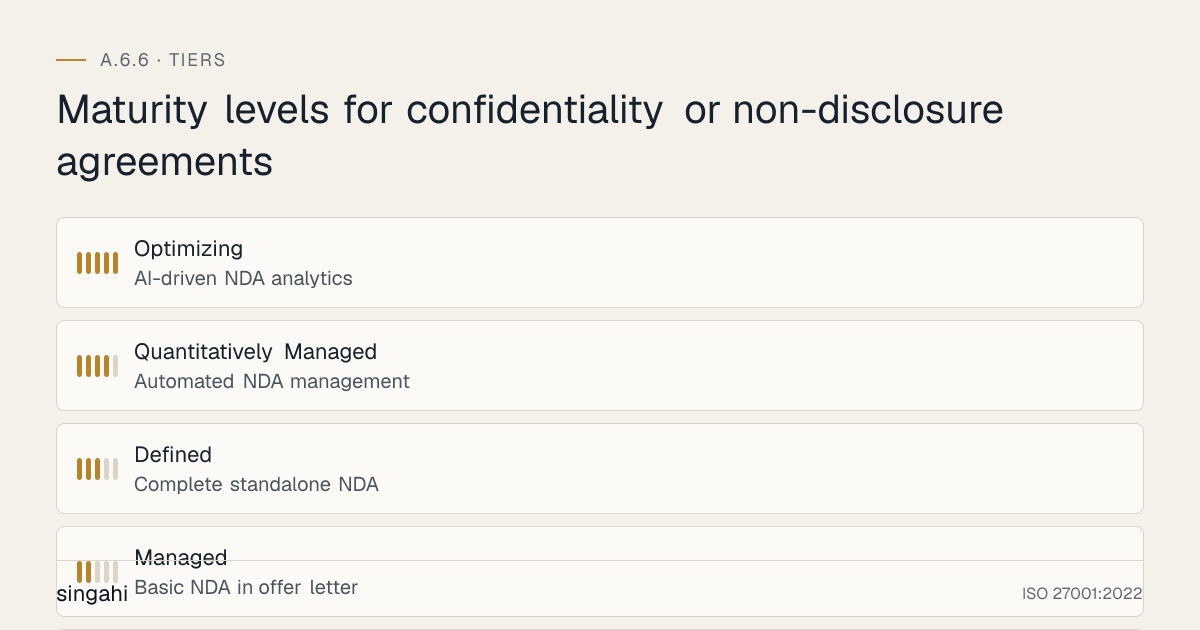
Maturity Model (Level 1-5)
| Level | Name | Description |
|---|---|---|
| 1 | Initial | No NDA; verbal confidentiality only; no enforcement; no records |
| 2 | Managed | Basic NDA in offer letter; some employees signed; no standalone agreement; no enforcement; no training |
| 3 | Defined | Complete standalone NDA; all employees signed; role-based NDAs; third-party NDAs; annual review; training; enforcement framework; exit reminder; metrics |
| 4 | Quantitatively Managed | Automated NDA management; digital signatures; CLM system; DLP monitoring; legal enforcement; competitive intelligence; quarterly metrics; breach detection; union compliance |
| 5 | Optimizing | AI-driven NDA analytics; predictive breach detection; automated contract lifecycle; blockchain evidence; zero-defect NDA compliance; continuous legal trend analysis; industry leadership; integrated IP protection |
Improvement Cycle
- Plan: Annual review of NDA templates; quarterly metrics; industry benchmarking; regulatory updates; employee feedback; legal trend analysis; competitive intelligence
- Do: Deploy new tools; update NDA templates; train employees; enhance detection; improve enforcement; update contracts; refine DLP; competitive monitoring
- Check: Measure coverage; audit enforceability; benchmark; gather feedback; review breaches; analyze legal trends; competitive intelligence review
- Act: Standardize; communicate; update procedures; report to management; share best practices; union collaboration; legal framework refinement; patent monitoring
Technology Trends
- AI Contract Analysis: AI analyzing NDAs for gaps, risks, and enforceability
- Predictive Breach Analytics: AI predicting which employees or third parties are at risk of NDA breach
- Automated NDA Lifecycle: End-to-end automation from creation to enforcement
- Blockchain Evidence: Blockchain for immutable evidence of NDA signing and breach
- Real-Time Breach Detection: Continuous monitoring with AI-driven anomaly detection
- Smart Contracts: Self-executing NDA enforcement through blockchain smart contracts
- Digital Contract Assistants: AI chatbots guiding employees through NDA questions and obligations
- Competitive Intelligence AI: AI monitoring competitor products and patents for NDA breach indicators
- Integrated CLM+HRIS: Single platform managing employee lifecycle and NDA compliance
- Cross-Border NDA Management: Automated NDA management for global organizations with multi-jurisdiction compliance
FAQ
Frequently Asked Questions (20 Questions)
Q1: Is an NDA required for ISO 27001 certification? A: Not automatically. No Annex A control is mandatory. Under clause 6.1.3 you choose the controls your risk assessment calls for, then record A.6.6 in your Statement of Applicability as included (and how) or excluded (and why). Most organisations include it, because staff, contractors and suppliers routinely see confidential information. If you include it, auditors will check that the agreements reflect your actual protection needs, are signed and are reviewed periodically.
Q2: Are NDAs enforceable in India? A: Yes, NDAs are enforceable in India for trade secrets and confidential information. However, Section 27 of the Indian Contract Act prohibits agreements in restraint of trade (which may limit non-compete clauses). Courts enforce reasonable confidentiality restrictions. The key is specificity: vague NDAs may be unenforceable.
Q3: What makes an NDA enforceable in India? A: Specificity of scope (what is confidential), reasonable duration, reasonable restrictions, written agreement, signed by both parties, lawful purpose, and consideration. Trade secrets are protected indefinitely as long as they remain secret. General confidential information is typically protected for 2-5 years post-employment.
Q4: Can we include a non-compete clause in the NDA? A: Post-employment non-compete clauses are generally void under Section 27 of the Indian Contract Act (restraint of trade). However, non-compete during employment is valid. For post-employment, focus on non-disclosure, non-use, and non-solicitation instead. Garden leave (paid notice period without work) is a valid alternative.
Q5: Do contractors and vendors need NDAs? A: Yes. Any third party with access to confidential information must sign an NDA. This includes contractors, vendors, partners, consultants, and even visitors who may see confidential information. Third-party NDAs should include data protection obligations (DPDP compliance).
Q6: What is the difference between an NDA and an IP assignment agreement? A: NDA protects confidential information from disclosure. IP assignment agreement transfers ownership of intellectual property (inventions, code, designs) to the employer. They are often combined in a single agreement but serve different purposes. Both are essential for IP protection.
Q7: How long should post-employment NDA obligations last? A: Trade secrets: indefinitely (as long as information remains secret). General confidential information: 2-5 years is reasonable. Business strategy and customer data: 2-3 years. Technical information: 3-5 years. Duration should be reasonable and justifiable; overly long periods may be challenged.
Q8: Are electronic signatures valid for NDAs in India? A: Yes, under the Information Technology Act 2000, electronic signatures are legally valid. Use a compliant e-signature platform (DocuSign, Adobe Sign, Zoho Sign) that provides audit trails. Include an electronic signature validity clause in the NDA.
Q9: What should we do if an employee refuses to sign the NDA? A: Explain the importance and legal requirement. If the employee still refuses, escalate to management. Do not grant access to confidential information until the NDA is signed. If the employee continues to refuse, employment may not proceed (or access is severely restricted). Consult Legal before terminating for NDA refusal.
Q10: What is the scope of confidential information in an NDA? A: The scope should be specific and reasonable. Include: trade secrets, customer data, business plans, financial data, source code, technical documentation, product roadmaps, vendor information, employee data, regulatory data, and any information marked as confidential. Exclude publicly available information and information known before employment.
Q11: Do we need different NDAs for different roles? A: Yes, role-based NDAs are recommended. Developers need source code protection. Sales need customer data protection. Executives need business strategy protection. Factory workers need process protection. Role-based NDAs are more enforceable because they are specific and reasonable.
Q12: How do we enforce an NDA against an ex-employee? A: (1) Gather evidence of breach, (2) Send breach notice (cease and desist), (3) Attempt settlement, (4) Seek injunction if urgent, (5) File civil suit for damages, (6) Consider criminal action if applicable, (7) Notify regulator if required. The NDA provides the legal basis for all these actions.
Q13: What is the difference between a unilateral and mutual NDA? A: Unilateral NDA: one party agrees to protect the other's confidential information (employee-employer). Mutual NDA: both parties agree to protect each other's confidential information (vendor partnerships, joint ventures). Use mutual NDAs when information flows both ways.
Q14: Do interns and visitors need NDAs? A: Yes, if they have access to confidential information. Intern NDAs should be short-term, limited scope, and supervised. Visitor NDAs should cover what they see during the visit, require escort, and prohibit photography/recording. For short facility tours with no confidential access, a simple visitor acknowledgment may suffice.
Q15: How do we handle NDA for remote workers? A: Remote workers should sign the same NDA as on-site employees, with additional clauses: data protection on home devices, secure home office requirements, no co-working space confidentiality, VPN usage, and remote device return obligations. Include BYOD/MDM requirements if applicable.
Q16: What is a "trade secret" and how is it different from "confidential information"? A: Trade secret: information that derives economic value from being kept secret and is subject to reasonable efforts to maintain secrecy (e.g., proprietary algorithms, drug formulas). Confidential information: broader category including any non-public information (e.g., customer lists, business plans). Trade secrets are protected indefinitely; confidential information for a defined period.
Q17: How do we integrate NDA with DPDP Act 2023? A: Include obligations to protect the personal data the employee handles: protect it, use it only for work, not disclose it, and delete it on exit. Keep this separate from the organisation's own processing of the employee's data, which rests on DPDP s.7(i) and a separate notice, not on the NDA. Ensure NDA scope covers personal data as confidential information. Include DPDP consent and grievance mechanisms.
Q18: What should we do if we suspect an NDA breach but have no evidence? A: Investigate discreetly. Gather evidence through DLP logs, access logs, monitoring, competitive intelligence, and witness interviews. Do not accuse without evidence. If evidence is insufficient, increase monitoring and strengthen controls. Document the suspicion and investigation. Consult Legal before sending breach notice.
Q19: Can we combine NDA, IP assignment, and non-solicitation in one agreement? A: Yes, many organizations combine these into a single "Employee Confidentiality and IP Agreement" or "Proprietary Information and Inventions Agreement" (PIIA). This is efficient and ensures all obligations are covered. However, ensure each clause is specific and enforceable. Legal review is essential.
Q20: What will an ISO 27001 auditor look for in A.6.6? A: The auditor will verify: (1) NDAs are identified based on information protection needs, (2) NDAs are documented in formal agreements, (3) NDAs are regularly reviewed, (4) NDAs are signed by all personnel with information access, (5) third-party NDAs are in place, (6) NDA scope is adequate, (7) NDA duration is defined, (8) there is evidence of NDA signing, (9) NDA storage is secure, (10) there is evidence of NDA training and communication, and (11) there is evidence of NDA enforcement capability.
References and Further Reading
ISO Standards
- ISO 27001:2022: Information Security Management Systems
- ISO 27002:2022: Information Security Controls
- ISO/IEC 27701:2025: Privacy information management systems
Indian Law
- Indian Contract Act 1872: Section 27 (restraint of trade)
- DPDP Act 2023
- IT Act 2000: Section 10A (contracts formed electronically); Section 3A and the Second Schedule (electronic signatures, including Aadhaar eSign and DSC). Use Aadhaar eSign or a DSC for enforcement-critical NDAs, and pay stamp duty
- Copyright Act 1957
- Patents Act 1970
- Designs Act 2000
- Trademarks Act 1999
- Companies Act 2013
- Official Secrets Act 1923
- POSH Act 2013
- Industrial Relations Code 2020 (standing orders; replaced the Industrial Employment (Standing Orders) Act 1946)
- Industrial Relations Code 2020 (replaced the Industrial Disputes Act 1947)
International
- GDPR (EU): Articles 5, 28, 32
- HIPAA (US): §164.308(a)(4)**
- SOX (US): Internal controls
- UK Employment Rights Act 1996
- EU Trade Secret Directive
- Defend Trade Secrets Act (US)
- Uniform Trade Secrets Act (US)
- ILO Convention
- WIPO: International IP protection
- UNCITRAL: International contract law
Industry
- RBI Cyber Security Framework: Confidentiality obligations
- SEBI CSCRF (2024): Market data confidentiality
- IRDAI Guidelines: Insurance data confidentiality
- NASSCOM: IT industry employment practices
- ISACA: Security and governance guidance
- Data Security Council of India: Data protection best practices
- Verizon DBIR: Data breach investigations
- Symantec: Insider threat reports
- Kaspersky: Employee data theft statistics
- OPPI: Pharmaceutical industry best practices