
On this page
- Quick Reference (60 Seconds)
- What the Control Asks For
- Why Physical Security Monitoring Matters
- Scope and Applicability
- Key Definitions and Terminology
- Relationship to Other Controls
- Implementation Roadmap (Week-by-Week)
- Detailed Implementation Guidance
- Tools, Technologies, and Solutions
- Policy and Procedure Templates
- Risk Assessment and Treatment
- Audit and Compliance Checklist
- Metrics and KPIs
- Common Pitfalls and How to Avoid Them
- Illustrative Scenarios
- Multi-Framework Mapping
- Regulatory and Industry Context
- Roles and Responsibilities (RACI)
- Documentation and Evidence Requirements
- Continuous Improvement
- FAQ
- References and Further Reading
Quick Reference (60 Seconds)
| Attribute | Detail |
|---|---|
| Control ID | A.7.4 |
| Title | Physical Security Monitoring |
| Objective | Monitor premises and facilities for unauthorized access and physical security threats |
| Domain | Physical |
| ISO 27001:2022 Clause | Annex A.7.4 |
| What You Must Do | Monitor premises continuously for unauthorised physical access, using guards, alarms, CCTV or a monitoring service in proportion to risk, and protect the monitoring systems themselves |
| Owner | Security / CISO / Facilities |
| Maturity Level 1 | No monitoring; reactive only; no CCTV, no guards, no intrusion detection |
| Maturity Level 2 | Basic monitoring; some CCTV; informal guard patrol; no integration; no analytics |
| Maturity Level 3 | Defined monitoring; CCTV coverage; intrusion detection; guard patrols; access logs; regular testing; environmental monitoring; integrated with security operations |
| Maturity Level 4 | Integrated monitoring; smart CCTV with AI analytics; real-time alerts; integrated with SOC; automated incident response; IoT sensors; predictive analytics |
| Maturity Level 5 | Physical and logical monitoring correlated; coverage and response tested regularly (including red-team exercises); improvements driven by incident and test results |
| ISO 27002 attributes | Control type: Preventive, Detective · Properties: Confidentiality, Integrity, Availability · Concepts: Protect, Detect · Capabilities: Physical security · Domains: Protection, Defence |
What the Control Asks For
Do you need this control?
A.7.4 is not mandatory in itself: under clause 6.1.3 you include it if your risk assessment calls for it, and record the decision in your Statement of Applicability. Include it if you have premises that hold sensitive information or systems. Monitoring should be proportionate: an alarm and access logs for a small office, CCTV and guards for a data centre.
ISO 27001:2022 Control Text
Annex A 7.4 asks organizations to continuously monitor premises for unauthorized physical access.
Implementation Guidance (ISO 27002:2022)
ISO 27002 7.4 (paraphrased): monitor premises with surveillance that suits the risk, such as guards, intruder alarms, CCTV and physical security information management (PSIM) software, run in-house or by a monitoring provider. For buildings housing critical systems, consider:
- (a) CCTV that views and records access to sensitive areas, inside and outside the premises
- (b) intruder detection installed to the relevant standards and tested periodically: contact sensors (which can also serve as panic alarms), infra-red motion detectors and glass-break sensors
- (c) alarms on all external doors and accessible windows; unoccupied areas alarmed at all times; and cover for other areas such as computer and comms rooms
27002 also asks you to:
- keep the design of monitoring systems confidential, because knowing it helps an intruder avoid it
- protect monitoring systems from unauthorised access: so feeds cannot be viewed by the wrong people and systems cannot be disabled remotely
- put the alarm control panel inside an alarmed zone, with an easy exit route for whoever sets it, and make panels and detectors tamper-resistant
- test the system regularly: especially battery-powered parts
- respect local law on data protection and monitoring of personnel, including how long recordings are kept
Environmental monitoring (temperature, water, smoke, power) belongs to A.7.5 and A.7.11; this guide covers it only where the same monitoring centre handles both.
"Shall" vs "Should" Analysis
- Shall (once you have selected this control): premises are monitored for unauthorised physical access
- Should: Specific monitoring methods, technologies, and frequencies are flexible based on context
Common Misinterpretations
| Misinterpretation | Reality |
|---|---|
| "CCTV is enough for monitoring" | CCTV records; it rarely detects in time on its own. Combine it with intruder alarms on doors and windows, someone who responds, and access-log review |
| "Monitoring is only needed for data centers" | Any premises in scope need monitoring proportionate to risk: an alarmed door and access logs may be enough for a small office |
| "Recording is enough; no need for real-time monitoring" | Both real-time monitoring (for immediate response) and recording (for investigation) are necessary |
| "Monitoring is the security guard's job alone" | Monitoring requires coordinated efforts: security team, facilities, IT operations, and management oversight |
| "Monitoring data is for compliance only" | Monitoring data is essential for incident response, investigation, trend analysis, and continuous improvement |
Why Physical Security Monitoring Matters
The Business Risk Narrative
Monitoring is how you find out that a perimeter or entry control has failed. Without it, a break-in, a propped fire exit or a tailgater is discovered the next morning, or never. With it, someone is alerted while it happens and there is a record to investigate.
- Physical intrusions are less common than remote attacks, but they bypass most technical controls: a person in your server room or with a stolen laptop needs no exploit.
- Monitoring also deters, provided it is visible and people believe someone responds.
- Recordings and alarm logs are often the only evidence in an investigation, an insurance claim or a police complaint.
- Poorly protected monitoring systems are a risk themselves: internet-exposed cameras and recorders are a common target.
- Under the DPDP Act 2023, failing to take reasonable security safeguards can attract a penalty of up to ₹250 crore, and CCTV footage is itself personal data that must be protected.
Regulatory Landscape in India
| Source | What it means for monitoring |
|---|---|
| DPDP Act 2023 | CCTV footage of identifiable people is personal data: give notice (signage), use it only for stated purposes, protect it (s.8(5)), and erase it once the purpose is served (s.8(7)). Employee monitoring can rest on the employment legitimate use (s.7(i)); the basis for visitor CCTV is less settled, so take advice |
| IT Act 2000, s.43A and SPDI Rules | Reasonable security practices (until the DPDP provisions replace them) |
| State CCTV laws | Some states require certain establishments to install CCTV and keep footage, for example the Telangana Public Safety (Measures) Enforcement Act 2013. Check the rules for your state and premises |
| PSARA 2005 | Guards must come from licensed private security agencies, with verified staff |
| CERT-In Directions 2022 | Require ICT system logs to be kept for 180 days in India; they do not cover CCTV. A physical intrusion is reportable only if it leads to a listed incident type |
| RBI, SEBI CSCRF (2024), IRDAI (2023) | Expect physical security monitoring of data centres and critical areas for regulated entities; follow your sector's direction |
| PCI DSS v4.0.1 9.2.1.1 | Where you hold card data: cameras and/or access-control records for sensitive areas, kept at least 3 months |
Industry-Specific Consequences
| Industry | Monitoring Failure Scenario |
|---|---|
| BFSI | No monitoring of the strong room or server room; intrusion undetected for hours; loss, supervisory findings and customer impact |
| Healthtech | No monitoring in hospital server room; unauthorized person enters and steals patient data; DPDP breach and patient safety risk |
| SaaS / B2B | No after-hours monitoring; thief enters office and steals servers; no detection until next morning; massive data breach; DPDP penalty |
| E-commerce | No CCTV in warehouse; theft of inventory undetected; revenue loss; customer order delays; brand damage |
| Manufacturing | No monitoring in OT control room; unauthorized person manipulates SCADA; production halt; safety incident |
| Government | No monitoring in classified facility; unauthorized person accesses classified data; national security breach; criminal prosecution |
| Telecom | No monitoring in telecom exchange; equipment theft undetected; service outage; subscriber data breach |
| Education | No monitoring in university server room; student data stolen; privacy breach under the DPDP Act |
| Pharma | No monitoring in R&D facility; drug formula stolen; patent loss; regulatory action |
| Retail | No CCTV in back office; POS data stolen; payment card breach; PCI DSS failure; brand damage |
Scope and Applicability
What the Control Covers
- CCTV monitoring: Video surveillance of premises, entry points, secure areas, and critical infrastructure
- Guard patrol monitoring: Security guard patrols, checkpoints, and incident reporting
- Intrusion detection monitoring: Door/window sensors, motion detectors, glass break sensors, and alarm systems
- Access control monitoring: Logging and monitoring of all physical access events
- Environmental monitoring: Temperature, humidity, water, fire, smoke, and power monitoring
- Real-time monitoring: Live monitoring of security systems for immediate incident detection
- Recorded monitoring: Recording and storage of monitoring data for investigation and audit
- Alarm monitoring: Central monitoring of alarm systems and response coordination
- Integration with security operations: Correlating physical monitoring with cybersecurity operations
- Monitoring of monitoring systems: Ensuring monitoring systems themselves are operational and secure
- After-hours monitoring: Monitoring during non-business hours, weekends, and holidays
- Visitor monitoring: Tracking and monitoring visitor movements within premises
- Remote monitoring: Monitoring of premises from remote locations or SOC
- Analytics and reporting: Analysis of monitoring data for trends, anomalies, and compliance
Who It Applies To
| Role | Responsibility |
|---|---|
| Security Manager | Monitoring operations, CCTV, guards, intrusion detection, alarm response, incident investigation, monitoring analytics |
| CISO | Monitoring strategy, integration with cybersecurity, risk assessment, compliance, audit, SOC integration |
| Facilities Manager | Environmental monitoring, building systems, maintenance of monitoring infrastructure, emergency response coordination |
| IT Manager | IT systems monitoring, server room monitoring, CCTV system maintenance, access log management, SIEM integration |
| SOC Manager | Integration of physical monitoring with SOC, incident response coordination, alert management, 24/7 monitoring |
| Security Guards | Patrol, checkpoint verification, incident reporting, real-time monitoring, access control enforcement, visitor monitoring |
| Compliance Manager | Regulatory compliance for monitoring, audit evidence, DPDP compliance for monitoring data |
| Employees | Reporting suspicious activity, cooperating with monitoring, respecting monitoring policies, not tampering with monitoring systems |
| Procurement | Monitoring equipment procurement, vendor management, contracts |
| Legal | Privacy compliance for monitoring, data retention, liability, insurance, incident response legal support |
What It Does NOT Cover
- General building management (HVAC, cleaning), covered by facilities management
- Employee productivity monitoring, covered by HR policies (though physical monitoring may incidentally capture productivity data)
- General building maintenance, covered by facilities management
- Cybersecurity monitoring (network, endpoints), covered by A.8.16 (Monitoring Activities) and cybersecurity controls
Size-Based Applicability
| Organization Size | Approach |
|---|---|
| Startups (< 50) | Basic monitoring: basic CCTV (4-8 cameras), simple alarm, no guard, manual patrol, basic environmental monitoring, 7-day recording |
| SMB (50-500) | Defined monitoring: CCTV system (10-30 cameras), intrusion detection, alarm with central monitoring, guard patrol, environmental monitoring, 30-day recording, basic integration |
| Mid-market (500-5000) | Integrated monitoring: smart CCTV with analytics, intrusion detection, alarm, guard patrol with verification, environmental monitoring, 60-90 day recording, SIEM integration, SOC monitoring, real-time alerts |
| Enterprise (5000+) | Central or outsourced 24/7 monitoring, PSIM, alarm and CCTV integration with the SOC, regular coverage and response testing |
Key Definitions and Terminology
| Term | Definition | Source |
|---|---|---|
| Physical Security Monitoring | Continuous observation and recording of premises to detect unauthorized access and security threats | ISO 27002 |
| CCTV (Closed Circuit Television) | Video surveillance system for monitoring physical areas | Security |
| IP Camera | Network-connected digital camera for CCTV | Security |
| NVR (Network Video Recorder) | Device recording video from IP cameras | Security |
| DVR (Digital Video Recorder) | Device recording video from analog cameras | Security |
| VMS (Video Management System) | Software managing CCTV cameras, recording, and analytics | Security |
| PSIM (Physical Security Information Management) | Software integrating multiple physical security monitoring systems | Security |
| Intrusion Detection System (IDS) | System detecting unauthorized entry attempts through sensors | Security |
| Alarm System | System alerting security personnel to unauthorized access or environmental threats | Security |
| Central Monitoring Station (CMS) | Facility monitoring alarm systems and dispatching response | Security |
| Guard Patrol | Security guard walking designated routes to check premises | Security |
| Guard Tour System | System tracking security guard patrol routes and times | Security |
| Environmental Monitoring | Monitoring of temperature, humidity, water, smoke, power in secure areas | Facilities |
| Access Log | Record of physical access events (who, when, where, how) | Security |
| Motion Detection | Sensor detecting movement in monitored areas | Security |
| Glass Break Sensor | Sensor detecting breaking glass | Security |
| Door/Window Sensor | Sensor detecting opening of doors or windows | Security |
| Video Analytics | AI analysis of video feeds for behavior detection, facial recognition, anomaly detection | Security |
| Thermal Imaging | Camera detecting heat signatures for night monitoring and anomaly detection | Security |
| Remote Monitoring | Monitoring premises from a remote location or SOC | Security |
| Real-Time Monitoring | Live observation of security feeds for immediate incident detection | Security |
| Recorded Monitoring | Recording and storage of monitoring data for investigation | Security |
| Retention Period | Duration for which monitoring records are kept | Security |
| Privacy Filter | Technology to prevent unauthorized viewing of screens | Security |
| Faraday Cage | Enclosure blocking electromagnetic fields for sensitive monitoring | Security |
| TEMPEST | Standard for preventing electromagnetic eavesdropping | Security |
| SOC (Security Operations Center) | Facility monitoring cybersecurity and physical security incidents | Security |
| SIEM (Security Information and Event Management) | System aggregating and analyzing security logs | Security |
| IoT Sensor | Internet-connected sensor for environmental or security monitoring | Technology |
| Edge Computing | Processing monitoring data at the camera/sensor level for faster response | Technology |
| Cloud VMS | Video management system hosted in the cloud | Technology |
| Mobile Monitoring | Monitoring security feeds via mobile devices | Technology |
| Predictive Analytics | Using AI to predict security incidents before they occur | Technology |
| Behavioral Analytics | Analyzing behavior patterns to detect anomalies | Security |
| License Plate Recognition (LPR) | Camera system reading vehicle license plates | Security |
| Facial Recognition | Technology identifying individuals from video feeds | Security |
| Appearance Search | AI searching video for specific individuals or objects | Security |
| Perimeter Intrusion Detection System (PIDS) | System detecting intrusion at perimeter fence/wall | Security |
| Underground Sensor | Sensor detecting tunneling or digging near perimeter | Security |
| Microwave Sensor | Sensor using microwave signals to detect movement | Security |
| Laser Sensor | Sensor using laser beams to detect intrusion | Security |
| Seismic Sensor | Sensor detecting vibrations from footsteps or vehicles | Security |
| Fibre Optic Sensor | Sensor using fiber optic cable for perimeter detection | Security |
| Radar | System using radio waves to detect movement | Security |
Relationship to Other Controls
| Control | Relationship to A.7.4 |
|---|---|
| A.7.1 Physical security perimeters | Upstream. Monitoring watches the perimeter |
| A.7.2 Physical entry | Parallel. Access-control logs and door alarms feed monitoring |
| A.7.3 Securing offices, rooms and facilities | Parallel. Siting and design decide what needs watching |
| A.7.5 Protecting against physical and environmental threats | Parallel. Environmental monitoring is A.7.5 / A.7.11, often run from the same centre |
| A.7.6 Working in secure areas | Downstream. Monitoring supports supervision in secure areas |
| A.5.34 Privacy and protection of PII | Parallel. CCTV and access logs are personal data |
| A.5.33 Protection of records | Parallel. Recordings and alarm logs are records to protect |
| A.8.16 Monitoring activities | Parallel. Physical alerts can be correlated with network and system monitoring |
| A.5.24–A.5.28 Incident management and evidence | Downstream. Alarms trigger response; recordings become evidence |
| A.8.20 Networks security | Parallel. Cameras and recorders sit on a segmented network |
Implementation Roadmap (Week-by-Week)
Phase 1: Discovery and Assessment (Weeks 1-2)
Week 1: Physical Monitoring Assessment
- Deliverable: Current physical monitoring assessment
- Owner: Security + CISO + Facilities + IT
- Activities:
- Inventory all existing monitoring systems (CCTV, guards, intrusion detection, alarms, environmental monitoring, access logs)
- Assess CCTV coverage (camera locations, blind spots, image quality, recording, retention, analytics)
- Assess guard patrol routes, schedules, verification methods, and effectiveness
- Assess intrusion detection system (sensor types, coverage, alarm response, false alarm rate)
- Assess alarm system (types, monitoring, response time, escalation, testing)
- Assess environmental monitoring (temperature, humidity, water, smoke, power, coverage, alerts)
- Assess access control logging (who, when, where, how, retention, integration)
- Assess monitoring integration with security operations (SOC, SIEM, incident response)
- Assess monitoring data retention and privacy compliance
- Benchmark against ISO 27001 requirements and industry practices
Week 2: Risk Analysis and Gap Assessment
- Deliverable: Physical monitoring gap analysis report
- Owner: CISO + Security + Facilities + Compliance
- Activities:
- Map information assets requiring monitoring protection
- Identify threats to physical monitoring (tampering, bypassing, failure, blind spots, no coverage)
- Assess vulnerability of monitoring systems (easily disabled, no backup, no redundancy, no testing)
- Identify gaps in monitoring coverage (no CCTV in server room, no guard after hours, no intrusion detection on windows)
- Assess compliance with regulatory requirements (RBI, SEBI, DPDP, industry-specific)
- Identify single points of failure in monitoring (one guard, one CCTV system, no backup power)
- Assess monitoring data quality (image quality, retention, accessibility, integrity)
- Define target state for physical monitoring maturity
- Create gap closure plan with priorities
Phase 2: Design and Planning (Weeks 3-4)
Week 3: Monitoring Architecture Design
- Deliverable: Physical Monitoring Architecture + Coverage Plan
- Owner: Security + CISO + Facilities + IT
- Activities:
- Design CCTV coverage (camera types, locations, angles, resolution, night vision, analytics, storage)
- Design guard patrol routes and schedules (frequency, checkpoints, verification, incident response)
- Design intrusion detection system (sensor types, coverage, zones, response, integration)
- Design alarm system (types, monitoring, response, escalation, testing)
- Design environmental monitoring (sensors, coverage, alerts, thresholds, response)
- Design access control logging and monitoring (events, retention, integration, analysis)
- Design real-time monitoring operations (SOC integration, alert management, incident response)
- Design recorded monitoring (retention, storage, accessibility, integrity, privacy)
- Design monitoring integration with cybersecurity (SIEM, SOC, correlation, analytics)
- Design monitoring of monitoring systems (system health, tamper detection, backup, redundancy)
- Design after-hours monitoring (guard, CCTV, alarm, remote monitoring, response)
- Design visitor monitoring (tracking, zones, duration, alerts)
- Create monitoring coverage map and documentation
Week 4: Policy and Procedure Design
- Deliverable: Physical Monitoring Policy + Procedures + Alert Matrix
- Owner: CISO + Security + Facilities + IT + Legal
- Activities:
- Draft Physical Security Monitoring Policy
- Define monitoring zones and sensitivity levels (critical, high, medium, low)
- Create monitoring coverage matrix (what is monitored, how, by whom, frequency)
- Create alert and response matrix (what triggers alert, who responds, how, escalation)
- Design CCTV operation and maintenance procedure
- Design guard patrol procedure
- Design intrusion detection testing procedure
- Design alarm response procedure
- Design environmental monitoring response procedure
- Design monitoring data retention and privacy procedure
- Design monitoring system maintenance and testing procedure
- Design incident response procedure triggered by monitoring
- Legal review for privacy, liability, data retention, and compliance
- Create monitoring training program for security personnel
Phase 3: Implementation (Weeks 5-10)
Week 5-6: CCTV System Implementation
- Deliverable: CCTV system operational with full coverage
- Owner: Security + IT + Facilities
- Activities:
- Install cameras at all entry points (main, emergency, loading dock, service)
- Install cameras in server room and data center (entry, exit, interior, rack aisles)
- Install cameras in office areas (corridors, common areas, reception, meeting rooms if needed)
- Install cameras in document storage and sensitive areas
- Install cameras at perimeter (fencing, gates, parking, exterior walls)
- Configure camera settings (resolution, frame rate, night vision, motion detection, recording triggers)
- Configure recording (continuous, motion-triggered, event-triggered, retention schedules)
- Configure storage (NVR, cloud, hybrid, redundancy, backup)
- Configure remote access (mobile, web, SOC, security office)
- Configure video analytics (if applicable: motion, facial recognition, behavior, anomaly detection)
- Test all cameras (image quality, coverage, night vision, recording, remote access)
- Create CCTV coverage map and documentation
Week 7: Intrusion Detection and Alarm Implementation
- Deliverable: Intrusion detection and alarm system operational
- Owner: Security + Facilities + IT
- Activities:
- Install door sensors on all perimeter and secure area doors
- Install window sensors on all ground-floor and accessible windows
- Install glass break sensors on windows and glass doors
- Install motion detectors in server room, data center, and sensitive areas
- Install vibration sensors on walls and fencing (if needed)
- Install alarm panels and configure zones
- Configure alarm monitoring (central monitoring, SMS, email, guard dispatch, police notification)
- Configure alarm response procedures (who responds, how, escalation, verification)
- Test all sensors (door, window, glass break, motion, vibration)
- Test alarm response (response time, escalation, notification, guard dispatch)
- Test false alarm rate and adjust sensitivity
- Create intrusion detection zone map and documentation
Week 8: Guard Patrol and Real-Time Monitoring Implementation
- Deliverable: Guard patrol and real-time monitoring operational
- Owner: Security + Facilities
- Activities:
- Define guard patrol routes (all zones, all floors, perimeter, secure areas, after-hours)
- Define patrol schedules (frequency: hourly, every 2 hours, every 4 hours based on risk)
- Install guard tour system (RFID checkpoints, GPS tracking, mobile app)
- Configure patrol verification (checkpoints, timestamps, incident reporting, photo evidence)
- Train guards on patrol routes, procedures, incident reporting, and monitoring equipment
- Set up real-time monitoring station (security office, SOC, or remote monitoring center)
- Configure monitoring screens (CCTV feeds, alarm panel, environmental dashboard, access log dashboard)
- Configure alert management (alert routing, escalation, acknowledgment, resolution)
- Configure incident response integration (monitoring alert triggers incident response workflow)
- Test guard patrol (route completion, checkpoint verification, response time, incident reporting)
- Test real-time monitoring (alert detection, response time, escalation, resolution)
- Create guard patrol documentation and monitoring SOP
Week 9: Environmental Monitoring Implementation
- Deliverable: Environmental monitoring system operational
- Owner: Facilities + IT + Security
- Activities:
- Install temperature sensors in server room, data center, network closets, and document storage
- Install humidity sensors in server room and data center
- Install water sensors under raised floors, near plumbing, and in basements
- Install smoke detectors in all areas (server room, data center, office, storage)
- Install heat detectors in server room and kitchen areas
- Install power monitoring (UPS, generator, PDU, circuit monitoring)
- Install air quality sensors (if needed for data center or clean room)
- Configure alert thresholds (temperature: 18-24°C server room; humidity: within the set range (for example ≤ 60% RH); water: immediate; smoke: immediate)
- Configure alert routing (facilities, IT, security, SOC, management)
- Configure automated response (HVAC adjustment, power switching, water shutoff if applicable)
- Test all sensors (threshold breach, alert, response, escalation)
- Create environmental monitoring dashboard and documentation
Week 10: Integration and Automation
- Deliverable: Integrated monitoring system operational
- Owner: Security + IT + CISO + Facilities
- Activities:
- Integrate CCTV with access control (event-triggered recording, access log correlation)
- Integrate CCTV with alarm system (alarm-triggered recording, camera preset to alarm zone)
- Integrate intrusion detection with alarm system (sensor triggers alarm, alarm triggers response)
- Integrate access logs with SIEM (physical access events correlated with IT events)
- Integrate environmental alerts with IT operations (ServiceNow, email, SMS)
- Integrate alarm with SOC (physical alarm appears in SOC dashboard, SOC analyst responds)
- Integrate CCTV with SOC (SOC analyst can view CCTV feeds remotely)
- Configure PSIM (if applicable) for unified monitoring dashboard
- Configure automated incident response (monitoring alert triggers incident ticket, notification, escalation)
- Configure monitoring analytics (trend analysis, anomaly detection, predictive alerts)
- Test all integrations (end-to-end alert, response, resolution, logging)
- Create integration documentation and runbook
Phase 4: Testing and Validation (Weeks 11-12)
Week 11: Monitoring Testing
- Deliverable: Physical monitoring test report
- Owner: Security + Internal Audit + CISO
- Activities:
- Conduct CCTV coverage test (walk all areas, verify camera coverage, check blind spots, image quality, night vision)
- Conduct CCTV recording test (verify recording, playback, export, retention, storage capacity)
- Conduct CCTV analytics test (motion detection, facial recognition, behavior detection if applicable)
- Conduct intrusion detection test (trigger each sensor, verify alarm, response time, escalation)
- Conduct alarm response test (trigger alarm, measure response time, verify guard dispatch, police notification)
- Conduct guard patrol test (verify patrol completion, checkpoint coverage, incident reporting, GPS tracking)
- Conduct environmental monitoring test (simulate temperature/humidity/water breach, verify alert, response, automated action)
- Conduct access log monitoring test (verify logging, retention, integration, analysis)
- Conduct monitoring system security test (tamper detection, backup power, redundancy, failover)
- Conduct integration test (end-to-end alert flow from sensor to SOC to response to resolution)
- Conduct after-hours monitoring test (verify all systems operational after hours, remote monitoring, response)
- Conduct privacy compliance test (verify monitoring data handling, retention, access control, legal compliance)
Week 12: Compliance and Audit Validation
- Deliverable: Compliance validation report
- Owner: Compliance + CISO + Security + Facilities
- Activities:
- Validate monitoring design against ISO 27001 requirements
- Verify DPDP compliance for monitoring data (personal data in CCTV, retention, access rights)
- Verify RBI compliance for banking monitoring (CCTV, guard, alarm, access logs, branch monitoring)
- Verify SEBI compliance for trading infrastructure monitoring
- Verify insurance requirements for monitoring systems
- Verify fire safety compliance for monitoring in server rooms
- Verify building code compliance for monitoring equipment installation
- Verify privacy compliance for employee monitoring (POSH Act, labor laws, DPDP)
- Prepare compliance evidence package
- Conduct internal audit of physical monitoring program
Phase 5: Documentation and Certification Prep (Weeks 13-14)
Week 13: Documentation
- Deliverable: Complete physical monitoring documentation
- Owner: CISO + Security + Facilities
- Activities:
- Document all policies, procedures, and checklists
- Create monitoring coverage maps and diagrams
- Create monitoring zone documentation
- Create alert and response matrix documentation
- Create training materials and videos for monitoring personnel
- Create FAQ and quick reference guides
- Create metrics dashboard and reporting templates
- Create evidence repository for audits
- Document system configurations and integration
- Create monitoring system maintenance schedule
Week 14: Certification Readiness
- Deliverable: Audit-ready evidence package
- Owner: CISO + Compliance Manager
- Activities:
- Conduct internal audit of physical monitoring program
- Prepare evidence for external ISO 27001 auditor
- Remediate any gaps found
- Conduct management review
- Present program to certification body
Detailed Implementation Guidance
Step-by-Step Implementation
Step 1: Define Monitoring Zones and Coverage Requirements
| Zone | Sensitivity | Monitoring Required | Coverage | Retention |
|---|---|---|---|---|
| Building Perimeter | High | CCTV (360°); perimeter intrusion detection; guard patrol; lighting | 100% coverage; no blind spots; night vision | 30-90 days |
| Entry Points | Critical | CCTV (face level); access log; guard; alarm; motion detection | 100% coverage; face recognition capable; no blind spots | 90-180 days |
| Server Room | Critical | CCTV (entry, exit, interior, racks); intrusion detection; environmental monitoring; access log; guard patrol | 100% coverage; motion-triggered; event-triggered; 24/7 | 90-180 days |
| Data Center | Critical | CCTV (360° coverage); intrusion detection; environmental monitoring; access log; guard; mantrap monitoring | 100% coverage; thermal imaging; AI analytics; 24/7 | 90-180 days |
| Network Closet | High | CCTV at door; door sensor; access log; environmental monitoring | Door coverage; no interior needed if no sensitive access | 30-60 days |
| Document Storage | High | CCTV at door; door sensor; access log; environmental monitoring | Door and aisle coverage; no blind spots | 60-90 days |
| General Office | Medium | CCTV (corridors, common areas); no individual desk monitoring (privacy); guard patrol | Corridor coverage; common areas; no privacy invasion | 15-30 days |
| Meeting Rooms | Medium | CCTV at door (if needed); no interior recording (privacy); booking log | Door coverage only; no interior recording for privacy | 15-30 days |
| Executive Office | High | CCTV at door; access log; intrusion detection; no interior recording (privacy) | Door coverage; no interior recording for privacy | 30-60 days |
| Finance/HR Office | High | CCTV at door; access log; intrusion detection; no interior recording (privacy) | Door coverage; no interior recording for privacy | 30-60 days |
| Loading Dock | High | CCTV; guard; access log; vehicle monitoring | Full coverage; vehicle identification; no blind spots | 30-60 days |
| Parking | Medium | CCTV; lighting; guard patrol; LPR (if applicable) | Full coverage; no blind spots; night vision | 15-30 days |
| Emergency Exits | High | CCTV; alarm; door sensor; no propping detection | 100% coverage; alarm integration; no blind spots | 30-60 days |
| Reception | Medium | CCTV; visitor management; guard; access log | Full coverage; face level; no blind spots | 30-60 days |
| Break Room | Low | CCTV (if common area); no individual monitoring (privacy) | Common area only; no privacy invasion | 7-15 days |
Step 2: Implement CCTV Monitoring
| CCTV Element | Implementation | Verification |
|---|---|---|
| Camera Types | IP cameras (4MP+ for general, 8MP+ for critical); IR night vision; weatherproof for exterior; dome or bullet based on location | Camera specification check; image quality test; night vision test |
| Camera Placement | Entry points (face level); corridors (ceiling); server room (corner + door); perimeter (height + angle); parking (wide angle); loading dock (vehicle level) | Coverage test; blind spot analysis; walkthrough test |
| Recording | Continuous for critical areas; motion-triggered for general; event-triggered for alarms; frame rate 15-30 fps; resolution 1080p minimum | Recording test; playback test; export test; frame quality check |
| Storage | NVR or cloud storage; redundancy (RAID or backup); capacity for retention period; offsite backup for critical footage | Storage capacity check; redundancy test; backup test; recovery test |
| Retention | Critical areas: 90-180 days; high areas: 60-90 days; medium areas: 30-60 days; low areas: 7-30 days; legal requirements may extend | Retention policy check; automatic deletion configuration; legal hold capability |
| Remote Access | Secure remote access for SOC, security manager, CISO; mobile app for authorized personnel; multi-factor authentication; encrypted connection | Access test; security test; encryption verification; unauthorized access test |
| Video Analytics | Motion detection; facial recognition (if legal and approved); behavior detection; people counting; license plate recognition; appearance search; thermal imaging | Analytics accuracy test; false positive test; privacy compliance check |
| Privacy Protection | No cameras in restrooms, locker rooms, prayer rooms; no audio recording without consent; privacy filters for sensitive areas; signage notifying CCTV; access controls on footage | Privacy audit; legal review; signage check; access log review |
| Maintenance | Regular lens cleaning; firmware updates; focus adjustment; storage maintenance; camera health monitoring | Maintenance schedule; health check; failure detection; replacement procedure |
Step 3: Implement Guard Patrol Monitoring
| Guard Patrol Element | Implementation | Verification |
|---|---|---|
| Patrol Routes | Defined routes covering all zones, floors, perimeter, secure areas, after-hours; optimized for coverage and time; GPS-tracked | Route map; GPS verification; coverage analysis; time analysis |
| Patrol Schedule | Frequency based on risk: critical areas every 1-2 hours; high areas every 2-4 hours; medium areas every 4-8 hours; after-hours increased frequency | Schedule documentation; patrol log review; completion rate; variance analysis |
| Checkpoints | RFID tags, QR codes, or GPS checkpoints at key locations; guard scans or checks in at each checkpoint; timestamp recorded | Checkpoint verification; scan log review; timestamp accuracy; missed checkpoint tracking |
| Incident Reporting | Guard reports incidents via mobile app or radio; incident details (time, location, description, photo, action taken); immediate notification to security manager | Incident log review; notification test; response time; photo quality; escalation verification |
| Guard Training | Patrol procedures; incident response; monitoring equipment use; emergency procedures; customer service; use of force policy; legal boundaries | Training records; competency test; refresher training; certification |
| Guard Vetting | Background check; reference check; police verification; physical fitness; communication skills; reliability assessment | Vetting records; verification; periodic re-vetting; incident history review |
| Supervision | Security manager supervises patrols; CCTV monitors guard activity; random spot-checks; guard performance review; rotation to prevent collusion | Supervision records; spot-check log; performance review; rotation schedule |
| Response Coordination | Guard responds to alarms, CCTV alerts, and incident reports; coordination with police, fire, and emergency services; escalation procedures; communication protocols | Response time test; coordination test; escalation test; communication test |
Step 4: Implement Intrusion Detection Monitoring
| Sensor Type | Location | Sensitivity | Response | Testing |
|---|---|---|---|---|
| Door Sensor | All perimeter doors, secure area doors, server room doors, data center doors | High; immediate alarm on unauthorized opening | Guard dispatch; CCTV recording; access log; alarm | Monthly |
| Window Sensor | All ground-floor windows, accessible windows, skylights, server room windows | High; immediate alarm on opening or breaking | Guard dispatch; CCTV recording; alarm; police notification | Monthly |
| Glass Break Sensor | All windows, glass doors, glass partitions in secure areas | Medium; alarm on glass breaking sound | Guard dispatch; CCTV recording; alarm; police notification | Monthly |
| Motion Detector | Server room, data center, network closet, document storage, after-hours office areas | Medium; alarm on motion after hours or in restricted areas | Guard dispatch; CCTV recording; alarm; access verification | Monthly |
| Vibration Sensor | Walls, fencing, perimeter barriers, vault walls | Medium; alarm on vibration from cutting, drilling, or impact | Guard dispatch; CCTV recording; alarm; perimeter check | Monthly |
| Perimeter Intrusion Detection System (PIDS) | Perimeter fence, wall, or barrier | High; alarm on climbing, cutting, or tunneling | Guard dispatch; CCTV recording; alarm; perimeter response | Monthly |
| Seismic Sensor | Ground near perimeter, vault, or critical areas | Low; alarm on digging or tunneling | Guard dispatch; CCTV recording; alarm; ground check | Quarterly |
| Fibre Optic Sensor | Buried along perimeter fence or wall | High; alarm on fence disturbance | Guard dispatch; CCTV recording; alarm; perimeter response | Monthly |
| Microwave Sensor | Perimeter or large open areas | Medium; alarm on movement in beam path | Guard dispatch; CCTV recording; alarm; area check | Monthly |
| Laser Sensor | Doorways, corridors, or specific paths | High; alarm on beam interruption | Guard dispatch; CCTV recording; alarm; path check | Monthly |
Step 5: Implement Alarm Monitoring
| Alarm Type | Monitoring Method | Response Time | Escalation | Testing |
|---|---|---|---|---|
| Burglar Alarm | Central monitoring station (CMS) or self-monitoring | <5 minutes for CMS; <10 minutes for self-monitoring | Guard dispatch; police notification; security manager; CISO | Monthly |
| Fire Alarm | Central monitoring; fire brigade notification; building alarm | <2 minutes | Fire brigade; evacuation; security; facilities; management | Monthly |
| Environmental Alarm | Facilities management; IT operations; SOC; SMS/email alerts | <5 minutes | Facilities; IT; security; vendor (if equipment failure) | Monthly |
| Access Control Alarm | Security office; SOC; SMS/email; guard dispatch | <2 minutes | Security; guard; facilities; management | Monthly |
| Duress Alarm | Central monitoring; security office; immediate police notification | <1 minute | Police; security; management; emergency services | Monthly |
| Panic Button | Central monitoring; security office; immediate response | <1 minute | Security; guard; police; management | Monthly |
| Mantrap Alarm | Security office; immediate guard dispatch; CCTV recording | <1 minute | Security; guard; management; incident investigation | Monthly |
| Tailgating Alarm | Security office; guard dispatch; CCTV recording; access log | <2 minutes | Security; guard; management; employee notification | Monthly |
| Equipment Alarm | IT operations; facilities; security; vendor | <10 minutes | IT; facilities; vendor; management | Quarterly |
Step 6: Implement Environmental Monitoring
| Environmental Factor | Sensor Type | Threshold | Alert Method | Response | Testing |
|---|---|---|---|---|---|
| Temperature (Server Room) | Digital temperature sensor | 18-24°C | SMS, email, dashboard, automated HVAC | HVAC adjustment; facilities response; IT notification | Monthly |
| Temperature (Data Center) | Precision temperature sensor | ASHRAE standards (18-27°C) | SMS, email, dashboard, automated HVAC | HVAC adjustment; facilities response; IT notification | Monthly |
| Humidity (Server Room) | Humidity sensor | within the set range (for example ≤ 60% RH) | SMS, email, dashboard | Humidifier/dehumidifier; facilities response | Monthly |
| Humidity (Data Center) | Precision humidity sensor | ASHRAE recommended envelope (dew point −9 °C to 15 °C, ≤ 60% RH) | SMS, email, dashboard, automated HVAC | Humidifier/dehumidifier; facilities response | Monthly |
| Water (Server Room) | Water detection sensor | Any water detected | Immediate SMS, email, alarm, automated shutoff | Water removal; equipment protection; facilities response; IT notification | Monthly |
| Water (Under Raised Floor) | Water detection cable | Any water detected | Immediate SMS, email, alarm | Water removal; pump activation; facilities response | Monthly |
| Smoke (All Areas) | Smoke detector | Smoke detected | Immediate alarm, fire brigade, evacuation, central monitoring | Fire response; evacuation; fire suppression; facilities response | Monthly |
| Heat (Server Room) | Heat detector | Temperature >55°C or rapid rise | Immediate alarm, fire brigade, evacuation, fire suppression | Fire response; evacuation; fire suppression activation | Monthly |
| Power (UPS) | UPS monitoring | Battery low, overload, failure | SMS, email, dashboard, alarm | Generator start; IT graceful shutdown; facilities response | Quarterly |
| Power (Generator) | Generator monitoring | Failure to start, low fuel, overload | SMS, email, dashboard, alarm | Fuel delivery; maintenance; facilities response; IT notification | Quarterly |
| Air Quality (Data Center) | Air quality sensor | Particulate, CO2, VOCs above threshold | SMS, email, dashboard | Filter replacement; ventilation; facilities response | Monthly |
| Seismic (Seismic Zone) | Seismic sensor | Vibration above threshold | SMS, email, alarm | Building inspection; equipment check; evacuation if needed | Quarterly |
Step 7: Implement Access Log Monitoring
| Access Log Element | Implementation | Verification |
|---|---|---|
| Event Logging | All access events logged (who, when, where, how, success/failure, card number, biometric ID) | Log review; event accuracy; completeness; no missing events |
| Real-Time Monitoring | Access events displayed in real-time on security dashboard; unauthorized or anomalous events trigger alerts | Dashboard test; alert test; real-time verification; delay measurement |
| Anomaly Detection | System detects anomalies (after-hours access, multiple failed attempts, tailgating, unusual patterns, terminated employee access) | Anomaly simulation; detection test; alert test; false positive rate |
| Integration with SIEM | Physical access logs sent to SIEM in real-time; correlated with IT access events; unified dashboard | Integration test; correlation test; SIEM dashboard verification; delay measurement |
| Retention | Access logs retained for 1-3 years (minimum); legal hold capability; secure storage; tamper-proof | Retention policy check; storage capacity; backup verification; tamper test |
| Reporting | Daily/weekly/monthly access reports; unauthorized access report; after-hours access report; terminated employee access report; visitor access report | Report generation; accuracy; distribution; action on findings |
| Audit Trail | Access log audit trail (who accessed the log, when, what was viewed/exported); integrity verification; digital signature if applicable | Audit trail review; integrity check; unauthorized access test |
| Privacy Compliance | Access log data subject to DPDP compliance; personal data in logs; retention limits; access rights; deletion rights | DPDP compliance check; data subject access request test; deletion test; retention verification |
Step 8: Implement Real-Time Monitoring Operations
| Monitoring Operation | Implementation | Verification |
|---|---|---|
| Monitoring Center | Dedicated security office, SOC, or remote monitoring center; multiple screens; comfortable environment; 24/7 staffing or automated monitoring | Center inspection; screen configuration; environment; staffing schedule; backup center |
| Monitoring Personnel | Trained security personnel or SOC analysts; competency in monitoring systems, incident response, communication, and escalation; shift rotation; supervision | Training records; competency test; certification; shift log; supervision records |
| Monitoring Schedule | 24/7 for critical areas; business hours for general areas; after-hours automated monitoring with on-call response; holiday coverage | Schedule documentation; coverage verification; gap analysis; on-call test |
| Alert Management | Alert queue; prioritization; acknowledgment; dispatch; escalation; resolution; logging; metrics | Alert flow test; prioritization test; escalation test; resolution test; metrics accuracy |
| Incident Response Integration | Monitoring alert triggers incident response workflow; automatic ticket creation; notification to responders; escalation to management; evidence collection | End-to-end test; ticket creation test; notification test; escalation test; evidence collection test |
| Communication | Radio, phone, SMS, email, or mobile app for communication between monitoring center, guards, responders, and management; backup communication; recording | Communication test; backup test; recording test; coverage test |
| Shift Handover | Formal shift handover procedure; status briefing; incident summary; system status; pending items; documentation; sign-off | Handover procedure; documentation review; sign-off verification; gap analysis |
| Monitoring System Health | Continuous monitoring of monitoring systems themselves (camera health, sensor health, network health, storage health, power health); automatic failure detection; backup activation | Health monitoring dashboard; failure simulation; backup activation test; failover test |
Step 9: Implement Monitoring Data Retention and Privacy
| Data Type | Retention Period | Storage | Access Control | Privacy Measures |
|---|---|---|---|---|
| CCTV Footage (Critical) | 90-180 days | NVR + cloud backup + offsite | Security manager, CISO, SOC, legal (incident); authorized access only; audit trail | Signage; no audio without consent; no sensitive areas; access log; legal hold |
| CCTV Footage (PCI DSS sensitive areas in the CDE) | At least 3 months (9.2.1.1) | NVR with backup | Security manager; audit trail | As for critical footage |
| CCTV Footage (General) | 15-30 days | NVR; cloud if needed | Security manager, CISO; authorized access only; audit trail | Signage; no audio without consent; no privacy invasion; access log |
| Intrusion Detection Logs | 1 year | Alarm panel; central monitoring; SIEM | Security manager, CISO, SOC; authorized access only | No personal data; system logs; access log |
| Alarm Event Logs | 1 year | Alarm panel; central monitoring; SIEM | Security manager, CISO, SOC; authorized access only | No personal data; system logs; access log |
| Guard Patrol Logs | 1 year | Guard tour system; mobile app; database | Security manager, CISO; authorized access only | Guard personal data; access log; retention |
| Environmental Monitoring Logs | 1 year | Environmental monitoring system; SIEM; facilities management | Facilities manager, CISO, IT; authorized access only | No personal data; system logs; access log |
| Access Control Logs | 1-3 years | Access control system; SIEM; database | Security manager, CISO, HR, SOC; authorized access only; audit trail | DPDP compliance; personal data; retention; access rights; deletion |
| Incident Reports | 7 years | Incident management system; secure storage | Security manager, CISO, legal, compliance; authorized access only; legal hold | DPDP compliance; personal data; retention; legal hold |
| Monitoring System Configuration | 3 years | Configuration management; version control | Security manager, IT; authorized access only | No personal data; system configuration |
| Monitoring System Audit Logs | 3 years | System audit log; SIEM | Security manager, CISO; authorized access only; tamper-proof | No personal data; system audit |
Privacy Compliance for Monitoring:
- Signage notifying individuals of CCTV monitoring
- No audio recording: it captures conversations and is rarely proportionate for security
- No cameras in private areas (restrooms, locker rooms, prayer rooms, changing areas)
- No cameras in areas where employees have reasonable expectation of privacy
- Access to monitoring data restricted to authorized personnel
- Monitoring data is personal data under the DPDP Act 2023: notice, purpose limitation, safeguards (s.8(5)) and erasure when the purpose is served (s.8(7))
- Where footage is processed on consent, people can ask for access and erasure (ss.11–12); for employee monitoring under the employment legitimate use (s.7(i)) those rights do not apply, but grievances must still be answered (s.13)
- Keep footage longer only for a specific incident, investigation or legal hold
- Legal hold capability for monitoring data (preserve data for legal proceedings)
- Regular privacy impact assessment for monitoring systems
Step 10: Implement Monitoring System Security
| Security Measure | Implementation | Verification |
|---|---|---|
| Tamper Detection | Cameras and sensors have tamper detection (covering, moving, disabling); tamper triggers alarm and CCTV recording | Tamper simulation; alarm test; recording test; notification test |
| Backup Power | Monitoring systems on UPS and generator; backup power for minimum 4 hours; automatic failover; power monitoring | Power failure simulation; failover test; runtime test; power monitoring test |
| Redundancy | Redundant cameras for critical areas; redundant sensors; redundant storage; redundant network paths; redundant monitoring center | Failure simulation; failover test; coverage maintenance; redundancy verification |
| Network Security | Monitoring systems on isolated VLAN; firewall rules; encryption (TLS 1.3); no internet exposure; VPN for remote access; network segmentation | Network scan; vulnerability test; encryption verification; isolation test; unauthorized access test |
| Access Control | Monitoring system access controlled; multi-factor authentication; role-based access; least privilege; regular access review; audit trail | Access test; role verification; privilege review; audit trail review; unauthorized access test |
| Firmware Security | Regular firmware updates; vulnerability patching; manufacturer security advisories; signed firmware; rollback capability; testing before production | Update schedule; patch test; vulnerability scan; rollback test; signed firmware verification |
| Physical Security | Recorders and alarm panels in alarmed, access-controlled areas; panel placed so the person setting it can exit easily; locked enclosures | |
| Design Confidentiality | Camera and sensor layouts, coverage maps and blind-spot analyses shared only on a need-to-know basis (27002 7.4) | Physical inspection; enclosure security; access control; environmental check; theft test |
| Data Integrity | Monitoring data integrity verification (hash, checksum, digital signature); tamper detection; backup integrity; recovery testing | Integrity check; tamper test; backup verification; recovery test; corruption detection |
| Cybersecurity Integration | Monitoring system logs sent to SIEM; cybersecurity monitoring of monitoring systems; anomaly detection; threat intelligence | Integration test; SIEM dashboard; anomaly detection; threat intelligence correlation |
Step 11: Implement Metrics and Reporting
- Track CCTV uptime (target: >98%)
- Track camera operational status (target: 100% cameras operational)
- Track intrusion detection sensor status (target: 100% sensors operational)
- Track alarm response time (target: <5 minutes for CMS, <10 minutes for self-monitoring)
- Track guard patrol completion (target: 100% routes completed on schedule)
- Track monitoring system uptime (target: >99.5%)
- Track false alarm rate (target: <5% of total alarms)
- Track environmental incident detection time (target: <5 minutes)
- Track access log completeness (target: 100% events logged)
- Track monitoring data retention compliance (target: 100% retention met)
- Track privacy compliance incidents (target: zero)
- Track monitoring system security incidents (target: zero)
- Report monthly to security management; quarterly to CISO; annually to board
Tools, Technologies, and Solutions
Complete Tool Comparison
| Tool | Category | Best For | Pricing model | Key Features | Integration |
|---|---|---|---|---|---|
| Hikvision | CCTV | Enterprise CCTV | Commercial | IP cameras, NVR, AI analytics, face recognition, thermal | Enterprise |
| Dahua | CCTV | Enterprise CCTV | Commercial | IP cameras, NVR, AI, face recognition, efficient | Enterprise |
| Axis Communications | CCTV | High-quality CCTV | Commercial | Premium IP cameras, analytics, cybersecurity, integration | Enterprise |
| Avigilon (Motorola) | CCTV | AI-powered CCTV | Commercial | AI analytics, appearance search, facial recognition, enterprise | Enterprise |
| Hanwha Techwin | CCTV | SMB CCTV | Commercial | IP cameras, NVR, Wisenet analytics, efficient | SMB-Growing companies |
| Bosch | CCTV | Industrial CCTV | Commercial | Rugged, industrial, AI, analytics, high reliability | Industrial |
| Genetec Security Center | PSIM/VMS | Enterprise PSIM | Commercial | Unified security, ACS, CCTV, ALPR, analytics, integration | Enterprise |
| Milestone XProtect | VMS | Enterprise VMS | Commercial | Open platform VMS, multi-site, analytics, integration | Enterprise |
| Avigilon Unity | VMS | Enterprise VMS | Commercial | Integrated VMS, AI analytics, access control, enterprise | Enterprise |
| NX Witness | VMS | SMB VMS | Commercial | Open platform, easy setup, API, efficient | SMB-Growing companies |
| Bosch BIS | PSIM | Integrated security | Commercial | Building integration, fire, intrusion, access, video | Enterprise |
| Honeywell EBI | BMS/PSIM | Building management | Commercial | Building integration, security, energy, HVAC, fire | Enterprise |
| Siemens Desigo CC | BMS | Building management | Commercial | Building automation, security, energy, integration | Enterprise |
| Bosch Intrusion | Intrusion | Intrusion detection | Commercial | Sensors, panels, alarm, monitoring, integration | Enterprise |
| Honeywell Galaxy | Intrusion | Intrusion detection | Commercial | Intrusion panels, sensors, alarm, monitoring, integration | Enterprise |
| Paradox | Intrusion | SMB intrusion | Commercial | Affordable, reliable, sensors, alarm, monitoring | SMB |
| ADT | Monitoring | Alarm monitoring | Commercial | Central monitoring, guard dispatch, police notification | All sizes |
| Secom | Monitoring | Security monitoring | Commercial | Central monitoring, guard dispatch, response, integration | All sizes |
| Tyco (Johnson Controls) | Fire | Fire suppression | Commercial | Fire detection, suppression, FM200, CO2, water mist | Enterprise |
| Siemens Cerberus | Fire | Fire detection | Commercial | Fire detection, suppression, integration, reliability | Enterprise |
| Honeywell FAS | Fire | Fire detection | Commercial | Fire detection, suppression, integration, compliance | Enterprise |
| APC (Schneider) | Environmental | Power/environmental | Commercial | UPS, environmental monitoring, power distribution | All sizes |
| Eaton | Environmental | Power/environmental | Commercial | UPS, power distribution, monitoring, enterprise | Enterprise |
| Vertiv | Environmental | Critical infrastructure | Commercial | UPS, precision HVAC, environmental monitoring, DCIM | Enterprise |
| Rittal | Racks/Environmental | Server racks + monitoring | Commercial | Server racks, cooling, monitoring, security, cable management | All sizes |
| Sensirion | Environmental | Sensor technology | Commercial | Temperature, humidity, air quality sensors, precision | All sizes |
| Aube | Environmental | Water detection | Commercial | Water leak detection, sensors, cable, alarm | All sizes |
| VESDA (Xtralis) | Environmental | Aspirating smoke detection | Commercial | Very early smoke detection, aspirating, data center, server room | Enterprise |
| Guard Tour (Trackforce) | Guard Patrol | Guard tour management | Commercial | RFID checkpoints, GPS tracking, mobile app, incident reporting | All sizes |
| Silvertrac | Guard Patrol | Guard management | Commercial | Guard tour, incident reporting, GPS, client portal | SMB-Growing companies |
| TrackTik | Guard Patrol | Security workforce | Commercial | Guard management, patrol, incident, analytics, integration | Growing companies-Enterprise |
| Deep Sentinel | AI Monitoring | AI-powered security | Commercial | AI cameras, live guards, real-time intervention, residential/SMB | SMB |
| Cisco Meraki | CCTV/Network | Cloud-managed CCTV | Commercial | Cloud cameras, MV series, easy deployment, cloud management | SMB-Growing companies |
| Verkada | CCTV | Cloud CCTV | Commercial | Cloud cameras, AI analytics, easy deployment, enterprise | Growing companies-Enterprise |
| Eagle Eye Networks | CCTV | Cloud VMS | Commercial | Cloud VMS, open platform, AI analytics, integration | SMB-Growing companies |
| Alarm.com | Monitoring | Residential/SMB monitoring | Commercial | Cloud monitoring, cameras, intrusion, automation, mobile | SMB |
| Ring (Amazon) | CCTV | Residential/SMB | Commercial | Door cameras, motion detection, mobile app, cloud | SMB |
| Nest (Google) | CCTV | Residential/SMB | Commercial | Smart cameras, AI detection, mobile app, cloud | SMB |
| Arlo | CCTV | Residential/SMB | Commercial | Wireless cameras, AI detection, mobile app, cloud | SMB |
| Ajax | Intrusion | Wireless intrusion | Commercial | Wireless sensors, mobile app, cloud, no wires, easy install | SMB |
| SimpliSafe | Intrusion | DIY intrusion | Commercial | DIY installation, wireless, mobile app, monitoring, affordable | SMB |
| Ring Alarm | Intrusion | DIY intrusion | Commercial | DIY, wireless, mobile app, monitoring, affordable | SMB |
| Qognify | VMS/PSIM | Enterprise VMS | Commercial | Enterprise VMS, incident management, PSIM, integration | Enterprise |
| AxxonSoft | VMS | Enterprise VMS | Commercial | Enterprise VMS, AI analytics, integration, efficient | Enterprise |
| i-PRO (Panasonic) | CCTV | High-quality CCTV | Commercial | Premium cameras, AI analytics, cybersecurity, integration | Enterprise |
| FLIR (Teledyne) | Thermal | Thermal imaging | Commercial | Thermal cameras, perimeter detection, night vision, analytics | Enterprise |
| PureTech Systems | Perimeter | Perimeter detection | Commercial | PIDS, radar, thermal, analytics, perimeter monitoring | Enterprise |
| Senstar | Perimeter | Perimeter detection | Commercial | PIDS, fiber optic, fence sensors, perimeter monitoring | Enterprise |
| Smarter Technologies | IoT | IoT monitoring | Commercial | IoT sensors, environmental, asset tracking, integration | SMB-Growing companies |
| Cisco IoT | IoT | Enterprise IoT | Commercial | IoT sensors, environmental, security, integration, enterprise | Enterprise |
| Siemens Building X | BMS | Smart building | Commercial | Smart building, IoT, AI, integration, energy, security | Enterprise |
| Schneider EcoStruxure | BMS | Building management | Commercial | IoT, building management, security, energy, integration | Enterprise |
| Johnson Controls OpenBlue | BMS | AI building | Commercial | AI building, IoT, predictive, integration, security, energy | Enterprise |
| Honeywell Forge | BMS | Enterprise building | Commercial | Enterprise building, analytics, AI, integration, security | Enterprise |
Recommendations by Organization Size
| Size | CCTV | Intrusion | Alarm Monitoring | Guard Patrol | Environmental | PSIM/VMS |
|---|---|---|---|---|---|---|
| Startup (<50) | Hikvision or Hanwha | Paradox or Ajax | ADT or self-monitoring | Manual log | APC + basic sensors | None |
| SMB (50-500) | Hikvision or Axis | Bosch or Honeywell | ADT or Secom | Silvertrac or manual | APC + sensors | NX Witness or basic |
| Mid-market (500-5000) | Hikvision or Avigilon | Bosch or Honeywell | Secom or ADT | Trackforce or TrackTik | Eaton + Vertiv + VESDA | Genetec or Milestone |
| Enterprise (5000+) | Avigilon or Axis + Genetec | Bosch or Honeywell | Secom or in-house CMS | TrackTik + in-house | Vertiv + full environmental | Genetec + PSIM + building integration |
Policy and Procedure Templates
Physical Security Monitoring Policy (Key Sections)
Template
Physical Security Monitoring Policy
1. Purpose
To establish continuous monitoring of [Organization] premises to detect unauthorized physical access, security incidents, environmental threats, and to enable timely incident response.
2. Scope
This policy applies to all [Organization] premises, including offices, data centers, server rooms, network closets, document storage, parking, loading docks, and any area containing information or information processing facilities.
3. Policy Statements
3.1 Monitoring Coverage
- All premises are monitored through CCTV, intrusion detection, alarm systems, guard patrols, environmental monitoring, and access logs
- Monitoring coverage is commensurate with the sensitivity of the area being monitored
- Critical areas (server room, data center, entry points) have 100% monitoring coverage with no blind spots
- Monitoring coverage is reviewed quarterly and updated when premises change
3.2 CCTV Monitoring
- CCTV cameras are installed at all entry points, secure areas, perimeter, and critical infrastructure
- CCTV cameras provide clear, high-resolution images suitable for identification and investigation
- CCTV recording is continuous for critical areas and motion-triggered for general areas
- CCTV footage is retained for: critical areas 90-180 days; high areas 60-90 days; medium areas 30-60 days; low areas 15-30 days
- CCTV footage is stored securely with access control, integrity verification, and backup
- CCTV analytics (if used) comply with privacy laws and are approved by management
- CCTV signage is posted at all entry points notifying individuals of monitoring
3.3 Intrusion Detection Monitoring
- Intrusion detection sensors are installed on all doors, windows, glass, and perimeter barriers
- Sensors are tested monthly for functionality and sensitivity
- Alarm response is: <5 minutes for central monitoring; <10 minutes for self-monitoring
- False alarm rate is maintained below 5%
- All alarm events are logged and investigated
3.4 Guard Patrol Monitoring
- Guard patrols cover all zones, floors, perimeter, and secure areas on defined schedules
- Patrols are verified through RFID checkpoints, GPS tracking, or mobile app
- Patrol completion rate is 100%
- Guards report incidents immediately via mobile app or radio
- Guards are trained, vetted, and supervised
3.5 Environmental Monitoring
- Environmental sensors monitor temperature, humidity, water, smoke, and power in server rooms and data centers
- Alert thresholds are defined and configured
- Alerts are sent to facilities, IT, and security teams within 5 minutes
- Automated responses are configured where applicable (HVAC adjustment, power switching, water shutoff)
- Environmental monitoring is tested monthly
3.6 Access Log Monitoring
- All physical access events are logged in real-time
- Access logs are monitored for anomalies (after-hours access, multiple failed attempts, tailgating, terminated employee access)
- Access logs are integrated with SIEM for correlation with IT access events
- Access logs are retained for 1-3 years and subject to DPDP compliance
3.7 Real-Time Monitoring Operations
- Real-time monitoring is conducted 24/7 for critical areas; business hours for general areas; automated after-hours with on-call response
- Monitoring personnel are trained, competent, and supervised
- Alert management follows defined prioritization, escalation, and resolution procedures
- Incident response is triggered automatically by monitoring alerts
- Shift handover follows formal procedures with documentation and sign-off
3.8 Monitoring System Security
- Monitoring systems are protected from tampering, failure, and cyberattack
- Monitoring systems have backup power, redundancy, and failover
- Monitoring systems are on isolated networks with encryption and access control
- Monitoring systems are regularly patched, updated, and tested
- Monitoring system access is controlled and audited
3.9 Privacy and Compliance
- Monitoring complies with DPDP Act 2023, privacy laws, and labor laws
- No cameras in private areas (restrooms, locker rooms, prayer rooms)
- No audio recording without consent
- Monitoring data access is controlled and audited
- Data subject access rights and deletion rights are respected
- Privacy impact assessments are conducted annually
3.10 Roles and Responsibilities
- Security Manager: Monitoring operations, CCTV, guards, intrusion detection, alarm response, incident investigation, monitoring analytics
- CISO: Monitoring strategy, integration with cybersecurity, risk assessment, compliance, audit, SOC integration
- Facilities Manager: Environmental monitoring, building systems, monitoring infrastructure maintenance, emergency response coordination
- IT Manager: IT systems monitoring, server room monitoring, CCTV system maintenance, access log management, SIEM integration
- SOC Manager: Integration of physical monitoring with SOC, incident response coordination, alert management, 24/7 monitoring
- Security Guards: Patrol, checkpoint verification, incident reporting, real-time monitoring, access control enforcement, visitor monitoring
- Compliance Manager: Regulatory compliance for monitoring, audit evidence, DPDP compliance for monitoring data
- Legal: Privacy compliance, data retention, liability, insurance, incident response legal support
3.11 Review
This policy is reviewed annually by CISO, Security Manager, and Facilities Manager.
Physical Monitoring Procedure
Template
Procedure: Physical Security Monitoring Operations
1. Objective
To define the step-by-step process for operating and maintaining physical security monitoring systems.
2. Procedure Steps
Step 1: Monitoring System Health Check
- Security team checks monitoring system health at start of each shift
- Check: camera status, sensor status, alarm status, network status, storage status, power status
- Verify: all cameras operational, all sensors active, no tamper alerts, storage capacity adequate, backup power ready
- Document: health check results, any issues, actions taken
- Escalate: any critical failures to security manager and facilities immediately
Step 2: Real-Time Monitoring
- Monitoring personnel observe CCTV feeds, alarm panel, environmental dashboard, and access log dashboard
- Monitor for: unauthorized access, tailgating, suspicious behavior, environmental anomalies, equipment failures, system alerts
- Respond to alerts according to alert and response matrix
- Document: all incidents, alerts, and responses in monitoring log
- Maintain: situational awareness; know current status of all zones
Step 3: Alert Management
- Alert received from CCTV, intrusion detection, alarm, environmental, or access log system
- Alert is classified by priority: critical (immediate response), high (5-minute response), medium (15-minute response), low (30-minute response)
- Alert is acknowledged by monitoring personnel
- Response is dispatched according to alert type: guard dispatch, facilities response, IT response, management notification, police notification, fire brigade notification
- Alert is tracked through resolution
- Alert is documented and closed with resolution details
- Alert metrics are captured (response time, resolution time, false positive, root cause)
Step 4: Guard Patrol Coordination
- Monitor guard patrol completion through guard tour system
- Verify patrol routes, checkpoints, and timestamps
- Respond to guard incident reports
- Coordinate guard response to monitoring alerts
- Verify guard incident reporting and photo evidence
- Review guard performance and patrol effectiveness
Step 5: CCTV Review and Investigation
- Review CCTV footage for incidents, investigations, and audits
- Export footage for incident evidence, legal proceedings, or compliance
- Maintain chain of custody for footage used as evidence
- Verify footage integrity and quality
- Review footage for trends, patterns, and anomalies
- Report findings to security manager and CISO
Step 6: Environmental Monitoring Response
- Monitor environmental dashboard for temperature, humidity, water, smoke, and power anomalies
- Respond to environmental alerts according to environmental response procedure
- Coordinate with facilities and IT for environmental incidents
- Verify automated responses (HVAC adjustment, power switching, water shutoff)
- Document environmental incidents and responses
- Review environmental trends for preventive action
Step 7: Access Log Monitoring and Analysis
- Monitor access log dashboard for real-time access events
- Review access logs for anomalies (after-hours, multiple failures, tailgating, terminated employees)
- Investigate suspicious access events
- Generate access reports (daily, weekly, monthly)
- Integrate access logs with SIEM for correlation
- Respond to access anomalies according to procedure
Step 8: Monitoring System Maintenance
- Conduct monthly CCTV maintenance (lens cleaning, focus check, firmware update, storage check)
- Conduct monthly intrusion detection test (sensor trigger, alarm response, false alarm check)
- Conduct quarterly alarm system test (response time, escalation, notification, guard dispatch)
- Conduct monthly environmental sensor test (threshold breach, alert, response)
- Conduct monthly monitoring system security test (tamper, backup power, redundancy, network security)
- Conduct quarterly monitoring system firmware update and patch management
- Document all maintenance activities
Step 9: Incident Response from Monitoring
- Monitoring alert triggers incident response workflow
- Automatic incident ticket created in incident management system
- Security team responds to incident
- Incident is investigated, documented, and resolved
- Root cause is identified and corrective action is taken
- Incident is reported to security manager and CISO
- Lessons learned are captured and shared
Step 10: Monitoring Data Management
- Monitor data retention according to policy (critical 90-180 days; general 15-30 days)
- Apply legal holds when required for legal proceedings
- Respond to data subject access requests (DPDP compliance)
- Securely delete data after retention period (except legal holds)
- Maintain monitoring data access log (who accessed, when, what)
- Conduct quarterly privacy compliance review for monitoring data
Step 11: Shift Handover
- Outgoing monitoring personnel brief incoming personnel on current status
- Handover includes: active incidents, pending alerts, system status, patrol status, environmental status, access anomalies, special instructions
- Handover is documented in handover log
- Both personnel sign off on handover
- Any critical issues are escalated to security manager immediately
3. Special Cases
3.1 Monitoring System Failure
- If monitoring system fails, activate backup monitoring (backup cameras, redundant sensors, manual patrol increase)
- Notify security manager and facilities immediately
- Document failure and response
- Investigate root cause and implement corrective action
- Verify system restoration before returning to normal operations
3.2 Privacy Complaint
- If privacy complaint is received, investigate complaint immediately
- Review camera placement, signage, audio recording, and data handling
- Take corrective action if monitoring is not compliant
- Document investigation and corrective action
- Report to legal and compliance
3.3 Legal Hold for Monitoring Data
- If legal hold is required, preserve all relevant monitoring data immediately
- Notify legal, compliance, and security manager
- Suspend automatic deletion for held data
- Document legal hold, scope, and duration
- Ensure data integrity and chain of custody
3.4 After-Hours Monitoring
- After-hours monitoring is automated with on-call response
- Monitoring center is staffed or monitored remotely
- All alerts are routed to on-call security personnel
- Guard patrol is increased for after-hours
- Response time targets are maintained for after-hours alerts
Risk Assessment and Treatment
Key Risks Addressed by This Control
| Risk ID | Risk Description | Likelihood | Impact | Risk Level | Treatment |
|---|---|---|---|---|---|
| R-001 | Unauthorized physical access undetected | Medium | High | High | Mitigate, CCTV, intrusion detection, guard patrol, alarm, real-time monitoring |
| R-002 | Monitoring system failure (camera down, sensor failure) | Medium | High | High | Mitigate, Redundancy, backup power, tamper detection, health monitoring, failover |
| R-003 | Monitoring data tampered or deleted | Low | High | Medium | Mitigate, Access control, audit trail, integrity verification, backup, tamper detection |
| R-004 | Privacy violation from monitoring | Medium | Medium | Low | Mitigate, Privacy policy, no cameras in private areas, no audio without consent, signage, DPDP compliance |
| R-005 | Guard collusion or negligence | Low | High | Medium | Mitigate, Vetting, supervision, rotation, CCTV oversight, performance review, training |
| R-006 | Environmental threat undetected | Low | High | Medium | Mitigate, Environmental sensors, thresholds, alerts, automated response, regular testing |
| R-007 | After-hours breach undetected | Low | High | Medium | Mitigate, After-hours monitoring, guard patrol, alarm, CCTV, remote monitoring, on-call response |
| R-008 | Monitoring system cyberattack | Low | High | Medium | Mitigate, Network security, encryption, access control, patching, isolation, monitoring of monitoring systems |
| R-009 | False alarm overload | Medium | Low | Low | Mitigate, Sensitivity tuning, analytics, verification, alert prioritization, false alarm tracking |
| R-010 | Monitoring data retention failure | Low | Medium | Low | Mitigate, Storage capacity monitoring, backup, retention policy, legal hold capability, deletion procedures |
| R-011 | CCTV blind spots | Medium | Medium | Low | Mitigate, Coverage audit, camera placement review, blind spot testing, analytics for blind spot detection |
| R-012 | No integration between monitoring and incident response | Medium | High | Medium | Mitigate, Automated incident response, SIEM integration, SOC integration, alert-to-ticket workflow |
| R-013 | Monitoring personnel incompetence | Low | High | Medium | Mitigate, Training, certification, competency test, supervision, performance review, refresher training |
| R-014 | Monitoring system not tested | Medium | High | Medium | Mitigate, Monthly testing, quarterly drills, annual penetration test, maintenance schedule, documentation |
| R-015 | Monitoring data not used for improvement | Low | Medium | Low | Mitigate, Metrics, analytics, trend analysis, quarterly review, continuous improvement, benchmarking |
Audit and Compliance Checklist
Audit Questions (25 Questions)
| # | Audit Question | Expected Evidence | Red Flags |
|---|---|---|---|
| 1 | Is there a physical security monitoring policy? | Approved policy | No policy, ad-hoc monitoring |
| 2 | Is CCTV installed and operational? | CCTV records, camera status, coverage map | No CCTV, cameras non-operational, no coverage map |
| 3 | Is CCTV coverage adequate (no blind spots)? | Coverage map, walkthrough test, blind spot analysis | Blind spots, no walkthrough test, inadequate coverage |
| 4 | Is CCTV recording and retention operational? | Recording test, retention records, storage capacity | No recording, no retention, storage full |
| 5 | Is intrusion detection installed and operational? | Sensor status, alarm records, test records | No intrusion detection, sensors non-operational |
| 6 | Is alarm system monitored and responded to? | Alarm monitoring contract, response records, response time | No alarm monitoring, no response, slow response |
| 7 | Are guard patrols conducted and verified? | Patrol logs, checkpoint records, GPS records | No patrols, incomplete patrols, no verification |
| 8 | Is environmental monitoring operational? | Environmental records, sensor status, alert records | No environmental monitoring, sensors non-operational |
| 9 | Are access logs monitored for anomalies? | Access log analysis, anomaly reports, investigation records | No access log monitoring, no anomaly detection |
| 10 | Is real-time monitoring conducted? | Monitoring schedule, shift logs, alert records | No real-time monitoring, no shift coverage, no alert records |
| 11 | Is monitoring integrated with incident response? | Incident response records, alert-to-incident workflow, ticket records | No integration, monitoring alerts not triggering incident response |
| 12 | Is monitoring integrated with cybersecurity? | SIEM integration, SOC integration, correlation records | No integration, siloed monitoring |
| 13 | Is monitoring system security maintained? | System health records, patch records, tamper detection records, access log | No system security, no patching, tamper alerts not investigated |
| 14 | Is monitoring data retained according to policy? | Retention records, storage capacity, deletion records | No retention policy, data deleted early, storage full |
| 15 | Is monitoring privacy compliant? | Privacy policy, signage, no cameras in private areas, DPDP compliance records | No privacy policy, cameras in private areas, no signage, DPDP violations |
| 16 | Is monitoring system tested regularly? | Test records, maintenance records, inspection records | No testing, no maintenance, no inspection |
| 17 | Is monitoring personnel trained and competent? | Training records, certification, competency test, supervision records | No training, no certification, incompetent personnel |
| 18 | Is after-hours monitoring operational? | After-hours monitoring records, on-call records, after-hours patrol logs | No after-hours monitoring, no on-call, no patrol |
| 19 | Is monitoring system backup and redundancy operational? | Backup records, redundancy test, failover records | No backup, no redundancy, no failover |
| 20 | Is monitoring data integrity verified? | Integrity check, hash records, tamper detection | No integrity check, tampered data, no verification |
| 21 | Is monitoring system on isolated network? | Network diagram, VLAN records, firewall rules, isolation test | No isolation, on general network, exposed to internet |
| 22 | Is monitoring system firmware updated? | Firmware records, patch records, vulnerability scan | Outdated firmware, no patching, known vulnerabilities |
| 23 | Is monitoring analytics used effectively? | Analytics reports, trend analysis, improvement records | No analytics, no trend analysis, no improvement |
| 24 | Is monitoring data used for incident learning? | Incident reports, lessons learned, corrective action records | No learning, no corrective action, repeated incidents |
| 25 | Is monitoring policy reviewed annually? | Management review minutes, policy version history | No review, outdated policy |
Metrics and KPIs
Figure · Measures
The measures that show A.7.4 is working
- CCTV Uptime>98%Daily
- Camera Operational Status100%Daily
- Intrusion Detection Sensor Status100%Daily
- Alarm Response Time<5 minutesPer alarm
- Guard Patrol Completion100%Daily
Key Metrics Dashboard
| KPI | Formula | Target | Frequency |
|---|---|---|---|
| CCTV Uptime | (Operational cameras / Total cameras) × 100 | >98% | Daily |
| Camera Operational Status | (Cameras with clear image / Total cameras) × 100 | 100% | Daily |
| Intrusion Detection Sensor Status | (Operational sensors / Total sensors) × 100 | 100% | Daily |
| Alarm Response Time | Average minutes from alarm to guard on-site | <5 minutes (CMS) | Per alarm |
| Guard Patrol Completion | (Completed patrols / Scheduled patrols) × 100 | 100% | Daily |
| Monitoring System Uptime | (Monitoring system operational time / Total time) × 100 | >99.5% | Daily |
| False Alarm Rate | (False alarms / Total alarms) × 100 | <5% | Monthly |
| Environmental Incident Detection Time | Average minutes from threshold breach to alert | <5 minutes | Per incident |
| Access Log Completeness | (Logged access events / Total access events) × 100 | 100% | Daily |
| Monitoring Data Retention Compliance | (Data retained per policy / Total data) × 100 | 100% | Monthly |
| Privacy Compliance Incidents | Number of privacy violations from monitoring | 0 | Monthly |
| Monitoring System Security Incidents | Number of security incidents on monitoring systems | 0 | Monthly |
| Monitoring System Test Completion | (Tests completed on schedule / Scheduled tests) × 100 | 100% | Monthly |
| Alert Response Time | Average minutes from alert to acknowledgment | <2 minutes | Per alert |
| Alert Resolution Time | Average minutes from alert to resolution | <30 minutes (critical) | Per alert |
| After-Hours Monitoring Coverage | (After-hours monitoring hours / Total after-hours) × 100 | 100% | Daily |
| Monitoring Personnel Training | (Trained personnel / Total personnel) × 100 | 100% | Quarterly |
| Monitoring System Patch Compliance | (Patched systems / Total systems) × 100 | 100% | Monthly |
| Monitoring System Backup Success | (Successful backups / Scheduled backups) × 100 | 100% | Daily |
| CCTV Coverage Completeness | (Areas with CCTV coverage / Total areas requiring coverage) × 100 | 100% | Quarterly |
| Monitoring Integration Completeness | (Integrated systems / Total systems) × 100 | 100% | Quarterly |
| Monitoring Analytics Usage | (Analytics features used / Available features) × 100 | >80% | Monthly |
| Monitoring Incident Detection Rate | (Incidents detected by monitoring / Total incidents) × 100 | >95% | Monthly |
| Monitoring Data Integrity | (Integrity-verified data / Total data) × 100 | 100% | Monthly |
Common Pitfalls and How to Avoid Them
| # | Pitfall | Why It Happens | How to Avoid |
|---|---|---|---|
| 1 | No monitoring policy | No formal policy, ad-hoc monitoring, no accountability | Create physical monitoring policy; define coverage, retention, privacy, roles |
| 2 | CCTV blind spots | Poor planning, no coverage analysis, cost cutting, no testing | CCTV coverage audit; walkthrough test; camera placement review; blind spot analysis |
| 3 | No intrusion detection | Cost, assumption that CCTV is enough, no alarm | Install door, window, glass break, motion sensors; test monthly; integrate with alarm |
| 4 | No guard patrol | Cost, no guards, assumption that technology is enough, no policy | Define patrol routes; install guard tour system; verify completion; train guards |
| 5 | No environmental monitoring | Cost, no awareness, assumption of HVAC sufficiency | Install temperature, humidity, water, smoke sensors; configure alerts; test monthly |
| 6 | Monitoring system not tested | Set and forget, no budget, no process, assumption of functionality | Monthly CCTV/IDS tests; quarterly alarm tests; annual penetration test; maintenance schedule |
| 7 | No integration with incident response | Silos, no communication, different teams, no automation | Automated incident response; SIEM integration; alert-to-ticket workflow; SOC integration |
| 8 | No integration with cybersecurity | Silos, no communication, different vendors, no budget | Integrate access logs with SIEM; alarm to SOC; identity integration; PSIM |
| 9 | Monitoring system not secured | No awareness, no budget, assumption that monitoring is secure | Tamper detection; backup power; redundancy; network security; patching; access control |
| 10 | No privacy compliance | No awareness, no legal review, no DPDP compliance, no signage | Privacy policy; no cameras in private areas; no audio without consent; signage; DPDP compliance |
| 11 | Monitoring data not retained | No retention policy, storage full, no backup, cost | Retention policy; storage capacity planning; backup; legal hold capability; automatic deletion |
| 12 | No monitoring analytics | No awareness, no budget, no training, assumption that recording is enough | Video analytics; trend analysis; anomaly detection; predictive analytics; AI |
| 13 | Guard collusion or negligence | Cost cutting, no vetting, no supervision, no rotation, no training | Guard vetting; supervision; CCTV oversight; rotation; training; performance review |
| 14 | No after-hours monitoring | No alarm, no guard, no on-call, no policy, assumption of safety | After-hours monitoring; guard patrol; alarm; CCTV; remote monitoring; on-call response |
| 15 | Monitoring personnel not trained | No budget, no awareness, no training program, assumption of common sense | Training program; certification; competency test; supervision; refresher training |
| 16 | No monitoring system backup | No redundancy, no backup power, no failover, single point of failure | Backup power; redundant cameras; redundant sensors; redundant storage; failover testing |
| 17 | False alarm overload | Poor sensitivity tuning, no analytics, no verification, no prioritization | Sensitivity tuning; analytics; verification; alert prioritization; false alarm tracking; <5% target |
| 18 | No monitoring data used for improvement | No metrics, no dashboard, no analysis, no reporting | Metrics dashboard; quarterly reporting; trend analysis; benchmarking; continuous improvement |
| 19 | Monitoring system on insecure network | No network segmentation, no encryption, internet exposure, no firewall | Isolated VLAN; encryption; firewall; no internet exposure; VPN for remote access; network scan |
| 20 | No monitoring of monitoring systems | No health monitoring, no failure detection, no tamper detection, no alert | Health monitoring dashboard; tamper detection; automatic failure alert; backup activation |
| 21 | No shift handover procedure | Informal handover, no documentation, no sign-off, information loss | Formal handover procedure; documentation; sign-off; status briefing; pending items |
| 22 | No monitoring system firmware updates | No patch management, no vulnerability awareness, no update process, fear of disruption | Patch management; vulnerability scan; scheduled updates; testing; rollback capability; signed firmware |
| 23 | No monitoring data integrity verification | No hash, no checksum, no tamper detection, no backup verification, trust | Integrity verification; hash; tamper detection; backup verification; recovery testing |
| 24 | No legal hold capability | No process, no awareness, no legal review, data deleted during litigation | Legal hold procedure; immediate preservation; scope documentation; integrity maintenance; chain of custody |
| 25 | No monitoring system audit | No audit, no compliance verification, no evidence, no improvement | Quarterly audit; compliance verification; evidence collection; findings remediation; continuous improvement |
Illustrative Scenarios
Illustrative scenario, a composite example for guidance, not a specific Singahi engagement or a verified outcome.
Illustrative Scenario 1: Indian SaaS Company, CloudSync Technologies
Company Profile:
- Size: 45 employees
- Industry: B2B SaaS, Cloud Storage Platform
- Location: Pune, India (co-working space in IT park)
- Customers: 60 enterprise clients globally
- Regulatory Scope: DPDP Act 2023, SOC 2 Type II, ISO 27001, GDPR
Challenge: CloudSync had minimal physical monitoring:
- The co-working space had building CCTV at entry points, but no CCTV inside CloudSync's office suite
- No intrusion detection on the office suite door or windows
- No alarm system; the office was left completely unsecured after hours
- No guard patrol; the co-working space had a building guard but no patrol of individual suites
- No environmental monitoring; the office had basic HVAC but no sensors for temperature, water, or fire
- No access log monitoring; the co-working space had building access logs but no logs for the suite
- One weekend, a water pipe burst in the ceiling above the office suite
- The leak went undetected for 48 hours (Friday night to Sunday evening)
- Water damaged 8 laptops, 2 servers, 1 network switch, and 50 physical customer contracts
- 3 customer contracts were water-damaged beyond recovery; customers had to be notified and documents re-signed
- The company had no environmental monitoring, no after-hours monitoring, no water detection, and no incident response plan for environmental events
- Insurance claim was partially denied because the company had no monitoring systems to detect and prevent the damage
Solution:
-
Week 1-2: Emergency Monitoring Assessment
- Engaged an external security consultant for emergency monitoring redesign
- Conducted complete monitoring assessment
- Found: no CCTV inside suite, no intrusion detection, no alarm, no guard patrol, no environmental monitoring, no access log monitoring, no integration
- Created emergency monitoring plan: install basic CCTV, install water detection, install alarm, implement after-hours monitoring
- Implemented immediate fixes: installed 1 water sensor under the leak area, installed 1 CCTV camera inside suite, activated co-working space alarm for suite, created after-hours check procedure
-
Week 3-4: Complete Monitoring Program
- Created Physical Security Monitoring Policy with coverage requirements for all areas
- Created monitoring coverage matrix (suite entry, server area, document storage, general office, after-hours)
- Created alert and response matrix (who responds to what alert, how, escalation)
- Created CCTV procedure (recording, retention, remote access, privacy)
- Created environmental monitoring procedure (thresholds, alerts, response, automated actions)
- Created guard patrol procedure (co-working space guard patrol of suite after hours)
- Created after-hours monitoring procedure (alarm, CCTV, water detection, on-call response)
- Created incident response procedure triggered by monitoring alerts
- Created monitoring system maintenance and testing schedule
-
Week 5-6: Monitoring System Implementation
- Installed 4 CCTV cameras inside the office suite (entry, server area, document storage, general office)
- Installed cloud-based NVR (VMS) with 60-day retention for critical areas, 30-day for general
- Installed intrusion detection on suite door (door sensor) and windows (window sensors, glass break)
- Installed alarm system with central monitoring (ADT) and mobile app alerts
- Installed environmental monitoring: 3 water sensors (under raised floor, near plumbing, under ceiling leak area), 2 temperature sensors (server area, general office), 1 smoke detector (server area), 1 humidity sensor (server area)
- Configured alert thresholds: water (immediate), temperature (>28°C server area), smoke (immediate), humidity (>70% or <30%)
- Configured alert routing: SMS and email to facilities manager, CISO, and IT manager
- Installed UPS for monitoring equipment and server area
- Integrated monitoring alerts with Slack channel for immediate team notification
-
Week 7-8: Real-Time Monitoring and Integration
- Set up monitoring dashboard (CCTV feeds, environmental dashboard, alert status) on security manager's laptop
- Configured remote access to CCTV and environmental monitoring via mobile app
- Created on-call rotation for after-hours monitoring alerts (3 employees on weekly rotation)
- Integrated monitoring alerts with incident response workflow (alert triggers Slack notification, email to CISO, incident log entry)
- Created automated incident response: water alert triggers immediate facilities call; temperature alert triggers HVAC check; intrusion alert triggers guard dispatch and police notification
- Tested all monitoring systems (CCTV, intrusion, alarm, environmental, access log, integration)
- Verified all alerts received within 3 minutes; all responses within 10 minutes
-
Week 9-12: Compliance, Testing, and Culture
- Implemented monthly monitoring system testing (sensor trigger, alarm response, environmental breach simulation, CCTV review)
- Conducted quarterly monitoring compliance audit (100% sensor operational, 100% CCTV operational, zero false alarms >5%)
- Conducted fire drill with environmental monitoring test (smoke detector triggered alarm; 2-minute response time)
- Conducted water detection test (simulated water breach; 30-second alert time; immediate response)
- Verified DPDP compliance for monitoring data (signage, no audio, no private areas, retention policy, access log)
- Insurance claim for water damage accepted (with monitoring system installed, future claims approved); premium reduced by 10%
- Zero monitoring-related incidents in 6 months
- Customer trust improved; won 1 new customer citing environmental monitoring and security practices
Results:
- Monitoring posture: From 0% to 100% coverage for critical areas with integrated monitoring
- Incidents: Zero undetected incidents in 6 months (vs. 1 major undetected water damage incident before)
- CCTV uptime: 100% (all 4 cameras operational at all times)
- Sensor status: 100% (all 7 sensors operational)
- Alert response time: <3 minutes for all alert types
- Environmental detection: Water detection in 30 seconds (vs. 48 hours undetected before)
- After-hours monitoring: 100% coverage with alarm, CCTV, and on-call response
- Customer trust: Improved; won 1 new customer citing security practices
- Compliance: Passed SOC 2 Type II audit with zero monitoring findings
- Insurance: Claim accepted; premium reduced by 10%
- Culture: Monitoring awareness became part of daily operations; employees check monitoring dashboard weekly
Illustrative Scenario 2: Large BFSI, Bharat National Bank (BNB) Data Center Monitoring
Company Profile:
- Size: 8,500 employees; 3,200 branch staff
- Industry: Retail Banking and Financial Services
- Location: Mumbai, India (Tier III+ data center in Navi Mumbai)
- Customers: 6 million retail customers, 25,000 corporate clients
- Regulatory Scope: RBI, SEBI, IRDAI, DPDP Act 2023, ISO 27001, PCI DSS
- Data Center: 500 racks, 2MW power, 24/7 operations, 99.999% uptime target
Challenge: BNB's data center had critical monitoring deficiencies:
- The data center had CCTV but only 12 cameras for 10,000 sq ft; massive blind spots in rack aisles, under raised floor, and in cable trays
- No intrusion detection on windows or skylights (data center had skylights for natural light but no sensors)
- No environmental monitoring in 40% of rack rows; temperature exceeded 30°C in summer causing server throttling and 2% performance degradation
- No water detection under raised floor; a slow leak from a chilled water pipe went undetected for 3 weeks
- The leak caused corrosion on 15 rack bases and raised floor supports, with costly repairs
- Guard patrol was manual with no verification; guards often skipped checkpoints or falsified patrol logs
- No integration between CCTV, alarm, access control, and environmental monitoring; each system was siloed
- No real-time monitoring operations; CCTV was recorded but not watched live; alarms were sent to a legacy panel that was often ignored
- No routine review of access-control exceptions or alarm trends
- A former contractor (access terminated 6 months prior) attempted to enter the data center using an old access card
- The access was logged but no one reviewed the log for 2 weeks; the anomaly was only discovered during a quarterly access log review
- The contractor had attempted entry 3 times over 2 weeks; he was caught on the 4th attempt by a guard who recognized him
- The RBI inspection found inadequate monitoring coverage, gaps in environmental monitoring, no live monitoring and no access-log review
- The RBI inspection raised supervisory findings and the bank committed to a monitoring overhaul within 90 days
- The data center had no monitoring policy, no monitoring procedures, no testing, no integration, no metrics
Solution:
-
Months 1-2: RBI Compliance and Emergency Monitoring Assessment
- Engaged an external security consultant for RBI-compliant data center monitoring redesign
- Conducted complete monitoring assessment of the data center
- Found: 12 cameras for 10,000 sq ft (need 60+), no intrusion detection on skylights, no environmental monitoring in 40% of rack rows, no water detection, no guard verification, no integration, no real-time monitoring, no analytics
- Created RBI compliance remediation plan with 90-day timeline
- Created emergency fixes: installed 20 additional CCTV cameras in blind spots, installed water detection under raised floor, installed temperature sensors in all rack rows, implemented manual access log review daily, activated guard verification with mobile app
-
Months 3-4: Monitoring Architecture Design
- Created complete data center monitoring architecture
- Designed CCTV coverage: 64 cameras covering 100% of data center (entry, exit, aisles, racks, perimeter, environmental, loading dock, parking)
- Designed intrusion detection: door sensors on all doors, window sensors on all windows and skylights, glass break sensors, motion detectors in all aisles, vibration sensors on walls and fencing
- Designed environmental monitoring: temperature and humidity sensors in every rack row (20 sensors), water detection under entire raised floor (50 sensors), smoke detection (VESDA aspirating system), power monitoring (UPS, generator, PDU), air quality monitoring
- Designed guard patrol: RFID checkpoints (40 checkpoints), GPS tracking, mobile app incident reporting, increased patrol frequency (every 1 hour for critical areas)
- Designed real-time monitoring: 24/7 monitoring center with 4 screens, SOC integration, alert management, automated incident response
- Designed integration: CCTV + access control + alarm + environmental + guard patrol + SIEM + SOC + PSIM
- Designed analytics: AI-powered video analytics (behavior detection, anomaly detection, appearance search), environmental trend analysis, predictive alerting
-
Months 5-6: Advanced Monitoring System Implementation
- Installed 64 CCTV cameras (Avigilon) with 100% coverage, 4K resolution, IR night vision, AI analytics
- Installed intrusion detection system (Bosch) with 120 sensors covering all doors, windows, skylights, aisles, and perimeter
- Installed alarm system (Honeywell Galaxy) with central monitoring, guard dispatch, and police notification
- Installed environmental monitoring system (Vertiv + Sensirion + VESDA) with 20 temperature/humidity sensors, 50 water sensors, VESDA aspirating smoke detection, power monitoring
- Installed guard tour system (Trackforce) with 40 RFID checkpoints, GPS tracking, mobile app, real-time monitoring
- Installed PSIM (Genetec Security Center) integrating all monitoring systems into unified dashboard
- Configured alert management: critical alerts (intrusion, fire, water) trigger immediate response; high alerts (temperature, guard failure) trigger 5-minute response; medium alerts (equipment, environmental) trigger 15-minute response
- Configured automated incident response: monitoring alert triggers automatic ticket, notification, escalation, and evidence collection
- Configured CCTV analytics: motion detection, people counting, appearance search, thermal imaging, behavior detection
-
Months 7-8: Integration, SOC, and Real-Time Operations
- Integrated all monitoring systems with SIEM (Splunk) for correlation and analysis
- Integrated monitoring alerts with SOC (Security Operations Center) for unified incident response
- Integrated environmental alerts with IT operations (ServiceNow) for automated workflow
- Integrated access logs with SIEM for correlation with IT access events and anomaly detection
- Set up 24/7 monitoring center with 4 screens, dedicated monitoring personnel, shift rotation, and formal handover procedures
- Configured remote monitoring for CISO and security manager via mobile app and web portal
- Configured monitoring analytics dashboard (trends, anomalies, predictive alerts, compliance metrics)
- Conducted quarterly monitoring system test (all sensors, cameras, alarms, environmental, integration, analytics)
- All tests passed: 100% sensor operational, 100% camera operational, <2-minute alert response, <5% false alarm rate
-
Months 9-12: Compliance, RBI Certification, and Continuous Improvement
- Implemented quarterly monitoring compliance audits (internal + external)
- First audit: 100% CCTV coverage, 100% sensor operational, 100% guard patrol completion, 100% environmental monitoring coverage, zero blind spots, zero false alarms >5%
- Implemented daily access log review (automated anomaly detection + manual review)
- Implemented weekly monitoring metrics review (response time, resolution time, false alarms, incidents detected)
- Implemented monthly monitoring system maintenance (cleaning, testing, firmware updates, patch management)
- Implemented quarterly monitoring system security audit (tamper detection, network security, access control, backup, redundancy)
- RBI audit: zero findings on data center monitoring; penalty lifted; RBI commendation for monitoring excellence
- PCI DSS audit: zero findings on monitoring of cardholder data environment
- Uptime Institute Tier III assessment: monitoring met all requirements; 99.999% uptime target maintained
- Zero undetected incidents in 12 months
- Predictive analytics detected 3 potential environmental issues before they became incidents (temperature trend, humidity spike, power fluctuation)
- Insurance premium reduced by 18%; claim history improved significantly
- Industry recognition: featured in RBI data center monitoring best practices; presented at NASSCOM data center security summit
Results:
- Monitoring posture: From 12 cameras with blind spots to 64 cameras with 100% coverage; from no integration to fully integrated PSIM; from no analytics to AI-powered analytics
- RBI compliance: Zero findings; penalty lifted; RBI commendation for monitoring excellence
- Incidents: Zero undetected incidents in 12 months (vs. 3 undetected incidents before: leak, temperature, unauthorized access attempts)
- CCTV coverage: 100% (zero blind spots; 64 cameras; 4K resolution; AI analytics)
- Sensor status: 100% (120 intrusion sensors; 20 environmental sensors; 50 water sensors; VESDA)
- Guard patrol: 100% completion (40 RFID checkpoints; GPS tracking; mobile app; every 1 hour for critical areas)
- Alert response time: <2 minutes for critical alerts; <5 minutes for high alerts
- Environmental detection: 100% coverage (all rack rows; all environmental factors; predictive alerts)
- False alarm rate: <2% (vs. 15% before with legacy system)
- Access log review: Daily automated anomaly detection + manual review (zero undetected anomalies in 12 months)
- Predictive analytics: 3 potential issues detected before incidents; zero environmental incidents
- Insurance: Premium reduced by 18%; claim history improved
- Uptime: Tier III assessment passed; 99.999% uptime maintained; zero monitoring-related downtime
- Cost: monitoring investment vs. RBI penalty + leak damage + temperature damage + insurance savings + reputation recovery
- Industry recognition: Featured in RBI best practices; presented at NASSCOM; benchmark for Indian data center monitoring
Multi-Framework Mapping
Figure · Matrix
Comparison: NIST SP 800-53 Rev 5 to Indian regulation
The references below genuinely overlap with A.7.4. Use them when one set of evidence must satisfy several frameworks.
| Framework | Reference | How it relates |
|---|---|---|
| NIST SP 800-53 Rev 5 | PE-6 Monitoring physical access; PE-6(1) Intrusion alarms and surveillance equipment | Monitor premises and respond to alarms |
| PCI DSS v4.0.1 | 9.2.1.1 | Cameras and/or access-control mechanisms monitor sensitive areas; data kept at least 3 months |
| SOC 2 (2017 TSC) | CC6.4; CC7.2 | Physical access restricted and anomalies monitored |
| NIST CSF 2.0 | DE.CM-02 | The physical environment is monitored to find potentially adverse events |
| DPDP Act 2023 | s.5 notice (signage); s.8(5) safeguards; s.8(7) erasure | CCTV footage is personal data |
| Indian regulation | Private Security Agencies (Regulation) Act 2005 | Guards must come from licensed agencies with verified staff |
Regulatory and Industry Context
See Regulatory Landscape in India above for the Indian position. In short:
| Sector | Monitoring expectations to check |
|---|---|
| BFSI | RBI, SEBI CSCRF (2024) and IRDAI (2023) expectations for data centres and critical areas; PCI DSS 9.2.1.1 for card environments |
| IT/ITeS and SaaS | Client contracts often specify CCTV coverage and retention for delivery floors; SOC 2 CC6.4 and CC7.2 |
| Data centres and colocation | Tier-level monitoring expectations (ANSI/TIA-942, Uptime Institute); customer audit rights |
| Healthcare | Records rooms and pharmacy stores; patient privacy in clinical areas |
| Manufacturing | Control rooms and OT spaces; worker privacy in welfare areas |
Outside India, data protection law (for example the GDPR in the EU) applies to CCTV in the same way: purpose, proportionality, notice, retention and security.
Roles and Responsibilities (RACI)
| Activity | Accountable | Responsible | Consulted | Informed |
|---|---|---|---|---|
| Physical Monitoring Policy | CISO | CISO Team | Security, Facilities, IT, Legal | Board |
| Monitoring Architecture | CISO | Security Manager | Facilities, IT, CISO | Management |
| CCTV System | Security | Security Team | IT, Facilities | Management |
| Intrusion Detection System | Security | Security Team | Facilities, IT | Management |
| Alarm System | Security | Security Manager | Facilities, IT | Management, Guards |
| Guard Patrol | Security | Security Manager | Facilities, HR | Management, Guards |
| Environmental Monitoring | Facilities | Facilities Manager | IT, Security, CISO | Management |
| Access Log Monitoring | Security | Security Analyst | IT, CISO | Management |
| Real-Time Monitoring | Security | Security Manager | SOC, IT, Facilities | Management |
| SOC Integration | CISO | SOC Manager | Security, IT, Facilities | Board |
| SIEM Integration | CISO | Security Team | IT, SOC | Management |
| PSIM Implementation | CISO | Security Manager | IT, Facilities | Management |
| Monitoring System Security | CISO | Security Team | IT, Facilities | Management |
| Monitoring System Maintenance | Facilities | Facilities Team | Security, IT | Management |
| Monitoring System Testing | Security | Security Team | Facilities, IT | Management |
| Monitoring Data Retention | CISO | Security Analyst | Legal, Compliance | Management |
| Monitoring Privacy Compliance | Legal | Legal Team | CISO, Security, Compliance | Board |
| DPDP Compliance (Monitoring) | Compliance | Compliance Team | CISO, Security, Legal | DPDP Authority |
| RBI Compliance (Monitoring) | Compliance | Compliance Team | CISO, Security, Facilities | RBI |
| Insurance Compliance | Legal | Legal Team | Facilities, Security, CISO | Insurance |
| Monitoring Analytics | CISO | Security Analyst | Security, IT | Management |
| Monitoring Metrics | CISO | Security Analyst | Compliance | Board |
| Monitoring Training | CISO | Training Team | Security, HR | All Employees |
| Monitoring Incident Response | Security | Security Manager | CISO, IT, HR, Legal | Board |
| Monitoring System Procurement | Procurement | Procurement Manager | CISO, Security, Facilities | Management |
| Monitoring Vendor Management | Procurement | Procurement Manager | Security, Facilities, CISO | Management |
| Monitoring Budget | Finance | Finance Manager | CISO, Security, Facilities | Board |
| Monitoring Policy Review | CISO | CISO Team | Security, Facilities, IT, Legal | Board |
| After-Hours Monitoring | Security | Security Manager | Facilities, HR | Management |
| Monitoring System Audit | Compliance | Compliance Team | CISO, Security, Facilities | Board |
| Shift Handover | Security | Security Manager | Monitoring Personnel | Management |
| Monitoring System Backup | IT | IT Manager | Security, Facilities | Management |
| Monitoring System Redundancy | IT | IT Team | Security, Facilities | Management |
| Monitoring Integration Testing | CISO | Security Team | IT, Facilities, SOC | Management |
| Legal Hold (Monitoring Data) | Legal | Legal Team | Security, CISO, Compliance | Court/Legal |
Documentation and Evidence Requirements
Required Documents
| Document | Owner | Retention Period | Format |
|---|---|---|---|
| Physical Security Monitoring Policy | CISO | 7 years | PDF + Word |
| Physical Monitoring Procedure | CISO | 7 years | PDF + Word |
| CCTV Coverage Map | Security | 7 years | Diagram + PDF |
| CCTV Configuration | Security | 3 years | Configuration |
| CCTV Footage | Security | 15-180 days | Video files |
| CCTV Maintenance Records | Security | 7 years | Maintenance records |
| Intrusion Detection Configuration | Security | 3 years | Configuration |
| Intrusion Detection Logs | Security | 1 year | System logs |
| Intrusion Detection Test Records | Security | 7 years | Test records |
| Alarm System Configuration | Security | 3 years | Configuration |
| Alarm Event Logs | Security | 1 year | System logs |
| Alarm Response Records | Security | 7 years | Response records |
| Guard Patrol Logs | Security | 1 year | Logs |
| Guard Patrol Route Map | Security | 7 years | Diagram + PDF |
| Guard Training Records | Security | 5 years | Training records |
| Guard Vetting Records | Security | 7 years | Vetting records |
| Environmental Monitoring Configuration | Facilities | 3 years | Configuration |
| Environmental Monitoring Logs | Facilities | 1 year | System logs |
| Environmental Alert Records | Facilities | 7 years | Alert records |
| Environmental Sensor Maintenance Records | Facilities | 7 years | Maintenance records |
| Access Log Monitoring Records | Security | 1-3 years | System logs |
| Access Log Anomaly Reports | Security | 3 years | Reports |
| Real-Time Monitoring Schedule | Security | 3 years | Schedule |
| Shift Handover Logs | Security | 3 years | Logs |
| Monitoring Center Records | Security | 3 years | Records |
| Monitoring System Health Records | Security | 3 years | Health records |
| Monitoring System Security Records | Security | 3 years | Security records |
| Monitoring System Patch Records | Security | 3 years | Patch records |
| Monitoring System Backup Records | IT | 3 years | Backup records |
| Monitoring System Redundancy Records | IT | 3 years | Redundancy records |
| Monitoring Integration Documentation | CISO | 3 years | Documentation |
| SIEM Integration Records | CISO | 3 years | Integration records |
| SOC Integration Records | CISO | 3 years | Integration records |
| PSIM Configuration | Security | 3 years | Configuration |
| Monitoring Analytics Reports | CISO | 3 years | Reports |
| Monitoring Metrics Dashboard | CISO | 3 years | Dashboard |
| Monitoring Privacy Policy | Legal | 7 years | PDF + Word |
| Monitoring Privacy Impact Assessment | Legal | 7 years | Assessment |
| DPDP Compliance Records (Monitoring) | Compliance | 5 years | Compliance records |
| RBI Compliance Records (Monitoring) | Compliance | 5 years | Compliance records |
| Incident Response Records (Monitoring) | Security | 7 years | Incident records |
| Monitoring Training Records | CISO | 5 years | LMS records |
| Monitoring Awareness Materials | CISO | 3 years | Materials |
| Monitoring FAQ | CISO | 3 years | FAQ document |
| Monitoring Quick Reference Card | CISO | 3 years | Card |
| Monitoring System Audit Reports | Internal Audit | 5 years | Audit reports |
| Monitoring Vendor Contracts | Procurement | 7 years | Contracts |
| Monitoring Tool Comparison | CISO | 3 years | Comparison |
| Monitoring Vendor Guide | Procurement | 3 years | Guide |
| Monitoring Assessment Guide | CISO | 3 years | Guide |
| Monitoring Documentation Template | CISO | 3 years | Template |
| Monitoring KPI Tracker | CISO | 3 years | Tracker |
| Monitoring Incident Response Guide | CISO | 3 years | Guide |
| Monitoring Training Plan | CISO | 3 years | Plan |
| Monitoring Communication Template | CISO | 3 years | Template |
| Monitoring Vendor Management Guide | Procurement | 3 years | Guide |
| Monitoring Risk Assessment Template | CISO | 3 years | Template |
| Monitoring Compliance Checklist | Compliance | 3 years | Checklist |
| Monitoring Procedure Template | CISO | 3 years | Template |
| Monitoring Policy Template | CISO | 3 years | Template |
| Monitoring Audit Checklist | Internal Audit | 3 years | Checklist |
| Monitoring RACI Matrix | CISO | 3 years | Matrix |
| Monitoring Maturity Model | CISO | 3 years | Model |
| Monitoring value Analysis | Finance | 3 years | Analysis |
| Monitoring Quick Reference Card | CISO | 3 years | Card |
| Monitoring System Health Dashboard | CISO | 3 years | Dashboard |
| Monitoring Data Retention Schedule | CISO | 3 years | Schedule |
| Monitoring Legal Hold Procedure | Legal | 7 years | Procedure |
| Monitoring Privacy Signage | CISO | 3 years | Signage |
Continuous Improvement
Figure · Tiers
Maturity levels for physical security monitoring
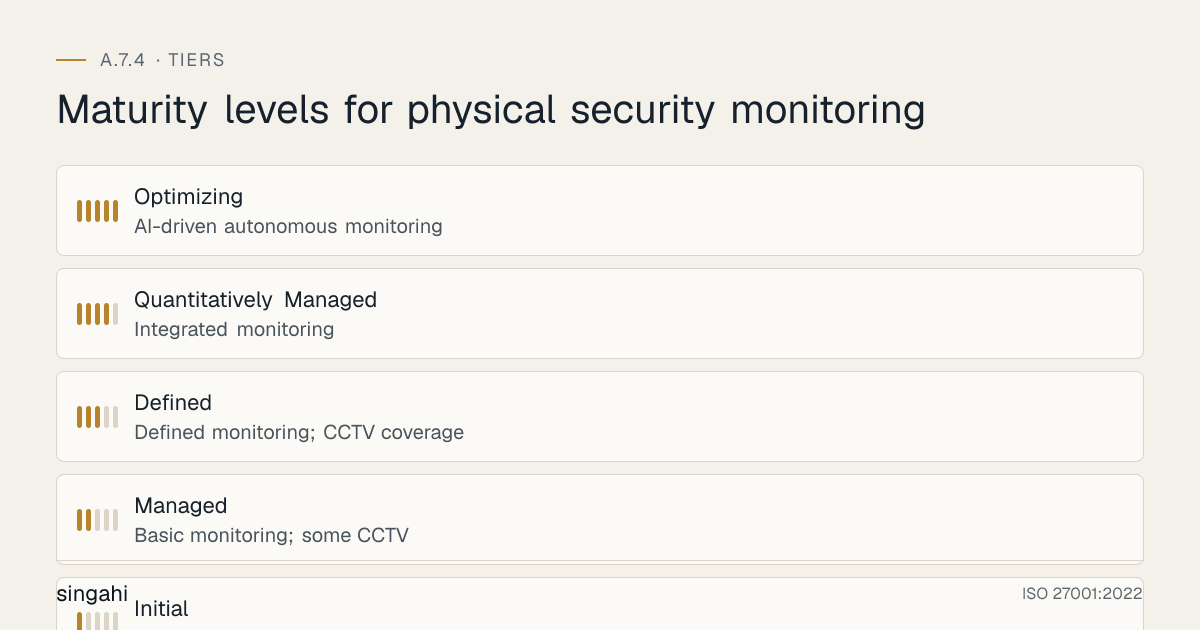
Maturity Model (Level 1-5)
| Level | Name | Description |
|---|---|---|
| 1 | Initial | No monitoring; reactive only; no CCTV, no guards, no intrusion detection, no environmental monitoring |
| 2 | Managed | Basic monitoring; some CCTV; informal guard patrol; no integration; no analytics; no real-time operations |
| 3 | Defined | Defined monitoring; CCTV coverage; intrusion detection; guard patrols; environmental monitoring; access logs; regular testing; integrated with security operations; real-time monitoring |
| 4 | Quantitatively Managed | Integrated monitoring; smart CCTV with AI analytics; real-time alerts; integrated with SOC; automated incident response; IoT sensors; predictive analytics; PSIM; unified dashboard |
| 5 | Optimizing | Physical and logical monitoring correlated; coverage, response and tamper resistance tested regularly, including red-team exercises; improvements driven by incident and test results |
Improvement Cycle
- Plan: Annual review of monitoring policy; quarterly metrics; industry benchmarking; regulatory updates; technology trends; threat intelligence; employee feedback; incident analysis; privacy impact assessment
- Do: Deploy new monitoring technologies; enhance AI analytics; improve integration; update training; refine alert management; enhance environmental monitoring; upgrade predictive capabilities; improve privacy compliance
- Check: Measure monitoring effectiveness; audit compliance; benchmark; test detection capability; gather feedback; review incidents; analyze technology trends; assess privacy impact; verify data integrity
- Act: Standardize; communicate; update procedures; report to management; share best practices; regulatory reporting; industry leadership; continuous improvement; privacy enhancement
Technology Trends
- Video analytics (line crossing, loitering, tailgating detection) can cut false alarms, but face recognition processes biometric data and needs a clear purpose, notice and safeguards under the DPDP Act.
- Cloud video management makes remote access easy; protect it with MFA, least privilege and supplier assurance (A.5.23).
- PSIM platforms bring alarms, access control and CCTV into one console with defined response workflows.
- Camera hardening: India's CCTV security-testing and BIS registration requirements (phased in from 2025) mean only certified models should be bought.
- Drones for perimeter patrol need DGCA Digital Sky permissions and a privacy assessment; they are rarely proportionate for offices.
FAQ
Frequently Asked Questions (20 Questions)
Q1: Is physical security monitoring required for ISO 27001 certification? A: Not automatically. No Annex A control is mandatory. Under clause 6.1.3 you choose the controls your risk assessment calls for, then record A.7.4 in your Statement of Applicability as included (and how) or excluded (and why). Organisations with premises that hold sensitive information or systems usually include it. The monitoring should be proportionate: a small office may rely on an alarm and access logs, while a data centre needs CCTV, guards and intrusion detection.
Q2: Do we need CCTV for ISO 27001? A: CCTV is not explicitly required but is the most common and effective monitoring method. The auditor will look for evidence of monitoring (CCTV, guards, intrusion detection, or alarms). For most organizations, CCTV provides the best evidence and deterrence.
Q3: What is the minimum monitoring for a small office? A: Minimum monitoring for a small office: basic CCTV (2-4 cameras covering entry and server area), door sensor on main door, smoke detector, basic alarm, and a visitor log. Even small offices need some form of monitoring for ISO 27001.
Q4: How do we balance monitoring with employee privacy? A: Never place cameras in private areas (restrooms, locker rooms, prayer rooms). Avoid audio recording without consent. Use signage to notify employees. Position cameras to monitor areas, not individual desks. Comply with DPDP Act 2023 for personal data in monitoring. Conduct privacy impact assessments.
Q5: What is the recommended CCTV retention period? A: Critical areas (server room, data center, entry points): 90-180 days. High areas (document storage, executive offices): 60-90 days. Medium areas (general office, corridors): 30-60 days. Low areas (break room, parking): 15-30 days. Legal requirements may extend these periods.
Q6: Do we need a guard if we have CCTV? A: Guards and CCTV serve different purposes. CCTV provides recording and some deterrence; guards provide immediate response, physical intervention, and verification. For high-risk areas, both are needed. For low-risk areas, CCTV may be sufficient with remote monitoring.
Q7: What is the difference between intrusion detection and alarm monitoring? A: Intrusion detection uses sensors (door, window, motion, glass break) to detect unauthorized entry. Alarm monitoring is the system that receives intrusion alerts and dispatches response (guard, police). Intrusion detection is the sensor; alarm monitoring is the response system. Both are needed.
Q8: How do we integrate physical monitoring with our SOC? A: Send physical alarm events to SOC dashboard. Allow SOC analysts to view CCTV feeds. Correlate physical access logs with IT access events in SIEM. Create unified incident response workflows that handle both physical and cyber incidents. Use PSIM for unified management.
Q9: What is PSIM and do we need it? A: PSIM (Physical Security Information Management) integrates multiple monitoring systems (CCTV, access control, intrusion, alarm, environmental) into a single platform with automated incident response. It is recommended for mid-to-large enterprises with multiple monitoring systems. For small offices, it may be unnecessary.
Q10: How do we prevent false alarms? A: Tune sensor sensitivity properly. Use video analytics for verification before dispatching response. Implement two-factor verification (e.g., sensor + CCTV confirmation). Regularly test and maintain sensors. Train employees on alarm triggers. Track false alarm rate and continuously improve.
Q11: What is the RBI requirement for data center monitoring? A: RBI requires: CCTV with 100% coverage (no blind spots), intrusion detection on all entry points, alarm monitoring with central monitoring, guard patrol with verification, environmental monitoring (temperature, humidity, water, fire, power), access log monitoring, and real-time monitoring operations. RBI inspects data center monitoring.
Q12: Do we need environmental monitoring in offices? A: Environmental monitoring is essential for server rooms and data centers (temperature, humidity, water, fire, power). For general offices, fire detection and comfortable HVAC are sufficient. Water detection is needed near plumbing or in basements.
Q13: How do we monitor after hours? A: After-hours monitoring requires: alarm system activation, CCTV recording, guard patrol (if applicable), environmental monitoring, intrusion detection, and on-call response. Automated alerts should be sent to on-call personnel for immediate response.
Q14: What is the recommended frequency for testing monitoring systems? A: Monthly: CCTV, intrusion detection, environmental sensors. Quarterly: alarm system, monitoring system security, integration tests. Annual: complete monitoring audit, penetration testing of monitoring, privacy impact assessment.
Q15: Can we use cloud-based CCTV? A: Yes, cloud-based CCTV (Verkada, Eagle Eye, Cisco Meraki) is suitable for SMB and growing companies. It offers easy deployment, remote access, and scalability. For high-security data centers, on-premise NVR with cloud backup may be preferred for data sovereignty and latency.
Q16: How do we handle monitoring data for legal proceedings? A: Implement legal hold procedures. Preserve all relevant monitoring data immediately when legal hold is required. Maintain chain of custody for footage used as evidence. Ensure data integrity (hash, checksum). Document legal hold scope and duration. Restrict access to held data.
Q17: What is the DPDP compliance requirement for monitoring data? A: DPDP Act 2023 applies to monitoring data if it captures personal data (e.g., facial images from CCTV, access logs with employee names). Requirements: lawful basis for processing, data minimization, retention limits, data subject access rights, deletion rights, security safeguards, and privacy notices.
Q18: How do we monitor a co-working space? A: Focus on your office suite: install suite-level CCTV, intrusion detection on suite door, environmental monitoring for your server area, and access log monitoring for your suite. You cannot control building monitoring but can control your space. Use cloud-based systems for easy deployment.
Q19: How much monitoring does an organisation of our size need? A: Scale it to risk. Smaller organisations usually need CCTV at entry points and sensitive rooms, an intruder alarm and environmental sensors. Larger organisations add integrated monitoring with analytics and SOC integration. Large multi-site enterprises may add a PSIM platform and centralised monitoring. Get quotes for your own sites; costs vary widely with building size and existing infrastructure.
Q20: What will an ISO 27001 auditor look for in A.7.4? A: The auditor will verify: (1) monitoring policy exists, (2) premises are monitored (CCTV, guards, intrusion, alarm), (3) monitoring coverage is adequate, (4) monitoring systems are operational, (5) monitoring data is retained appropriately, (6) monitoring is integrated with incident response, (7) monitoring systems are tested, (8) privacy compliance exists, (9) there is evidence of monitoring in action, and (10) the policy is reviewed.
References and Further Reading
ISO Standards
- ISO 27001:2022: Information Security Management Systems
- ISO 27002:2022: Information Security Controls
- ISO/IEC 27701:2025: Privacy information management
Indian Law
- Digital Personal Data Protection Act 2023: s.5, s.7(i), s.8(5), s.8(7)
- Information Technology Act 2000: s.43A
- Private Security Agencies (Regulation) Act 2005
- CERT-In Directions of 28 April 2022 (ICT logs; not CCTV)
- State CCTV laws: for example the Telangana Public Safety (Measures) Enforcement Act 2013
- RBI, SEBI CSCRF (2024) and IRDAI (2023) directions for regulated entities
International
- GDPR (EU): Articles 5, 6, 32
- PCI DSS v4.0.1: Requirement 9.2.1.1
- NIST SP 800-53 Rev 5: PE-6
- ANSI/TIA-942 and Uptime Institute tier standards for data centres
Industry
- ASIS International: physical security guidelines
- BICSI: ICT infrastructure design