
On this page
- Quick Reference (60 Seconds)
- What the Standard Actually Requires
- Why Protecting Against Physical and Environmental Threats Matters
- Scope and Applicability
- Key Definitions and Terminology
- Relationship to Other Controls
- Implementation Roadmap (Week-by-Week)
- Detailed Implementation Guidance
- Tools, Technologies, and Solutions
- Policy and Procedure Templates
- Risk Assessment and Treatment
- Audit and Compliance Checklist
- Metrics and KPIs
- Common Pitfalls and How to Avoid Them
- Illustrative Scenarios
- Multi-Framework Mapping
- Regulatory and Industry Context
- Roles and Responsibilities (RACI)
- Documentation and Evidence Requirements
- Continuous Improvement
- FAQ
- References and Further Reading
Quick Reference (60 Seconds)
| Attribute | Detail |
|---|---|
| Control ID | A.7.5 |
| Title | Protecting Against Physical and Environmental Threats |
| Objective | Protect information and information processing facilities from physical and environmental threats |
| Domain | Physical |
| ISO 27001:2022 Clause | Annex A.7.5 |
| What You Must Do | Implement controls to protect against fire, flood, earthquake, explosion, civil unrest, and other physical and environmental threats |
| Owner | Facilities / CISO / Security |
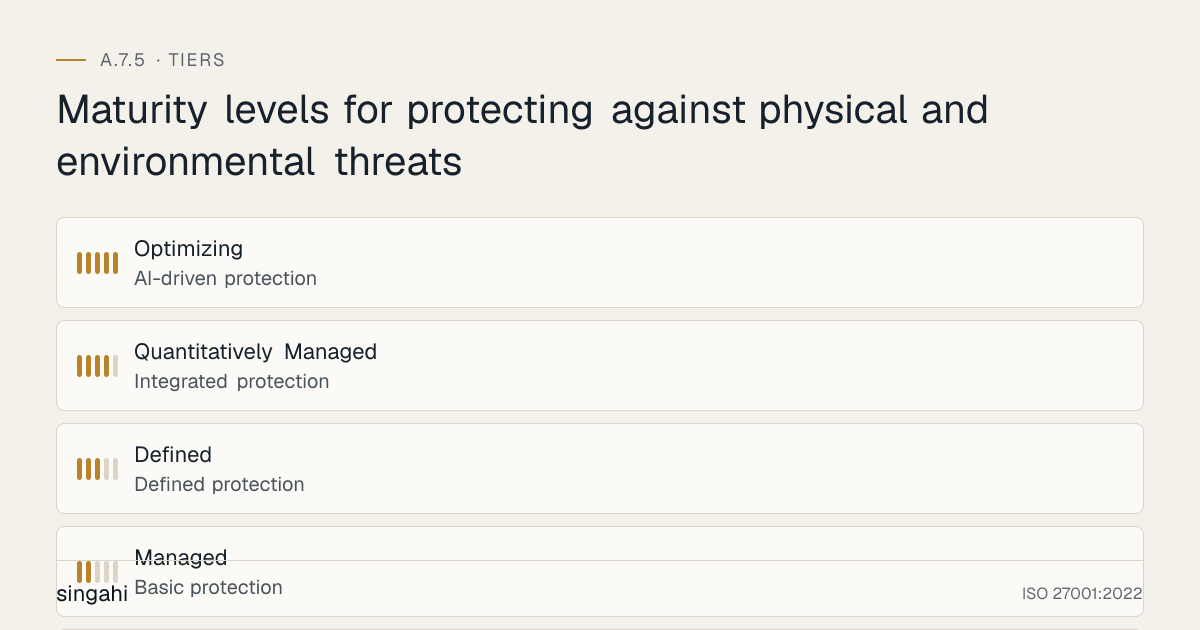
| Maturity Level 1 | No protection; no fire suppression; no water detection; no seismic protection; no environmental controls |
| Maturity Level 2 | Basic protection; basic fire extinguishers; no water detection; no seismic; basic HVAC; informal testing |
| Maturity Level 3 | Defined protection; fire detection/suppression; water detection; environmental monitoring; seismic protection; UPS; regular testing; business continuity |
| Maturity Level 4 | Integrated protection; smart fire suppression; integrated environmental monitoring; predictive analytics; automated response; redundant systems; integrated BMS |
| Maturity Level 5 | AI-driven protection; predictive threat detection; autonomous response; zero-defect environmental protection; integrated cyber-physical resilience; continuous optimization |
What the Standard Actually Requires
ISO 27001:2022 Control Text
Annex A 7.5 asks organizations to design and put safeguards in place against physical and environmental hazards, from fire and flood to natural disasters and other accidental or deliberate risks to facilities.
Implementation Guidance (ISO 27002:2022)
- Physical and environmental threat protection should be designed based on risk assessment
- Protection should consider: fire, flood, water damage, earthquake, explosion, civil unrest, natural disasters, man-made disasters, power failure, extreme temperatures, humidity, dust, electromagnetic interference
- Fire protection should include: detection, suppression, compartmentalization, evacuation, emergency lighting, fire doors
- Flood/water protection should include: water detection, raised floors, sump pumps, waterproofing, location selection
- Earthquake protection should include: seismic bracing, flexible connections, structural assessment, equipment anchoring
- Power protection should include: UPS, generators, surge protection, power monitoring, redundancy
- Environmental controls should include: HVAC, temperature monitoring, humidity monitoring, dust control, air quality
- Protection should be regularly tested and maintained
- Business continuity and disaster recovery should be integrated with physical protection
- Insurance should be considered for residual risks
"Shall" vs "Should" Analysis
- Shall: Designing and applying protection against physical and environmental threats is mandatory
- Should: Specific protection measures, technologies, and frequencies are flexible based on risk assessment and location
Common Misinterpretations
| Misinterpretation | Reality |
|---|---|
| "Fire extinguisher is enough for fire protection" | Complete fire protection includes detection, suppression, compartmentalization, evacuation, emergency lighting, and regular testing |
| "Only data centers need environmental protection" | All areas with information processing facilities need environmental protection, including offices, server rooms, and network closets |
| "Our building is safe from floods/earthquakes" | Threat assessment must be based on actual location risk, not assumptions; even low-risk areas need basic protection |
| "Environmental protection is the facilities team's job alone" | CISO and security team must define requirements; facilities implement; IT monitors equipment impact; all coordinate |
| "UPS is only for power outages" | UPS also provides power conditioning, surge protection, and graceful shutdown capability |
Why Protecting Against Physical and Environmental Threats Matters
The Business Risk Narrative
Physical and environmental threats can destroy information and processing facilities:
- 40% of businesses that experience a disaster without continuity planning never reopen (Source: FEMA)
- 60% of Indian data centers lack adequate environmental protection (Source: DSCI India Report)
- Average impact of fire in server room: -10 crore (equipment, data, business disruption, recovery)
- Average impact of water damage to data center: -5 crore (equipment, data, restoration, mold remediation)
- Average impact of power outage without UPS: ** - 3 crore** (data loss, equipment damage, business disruption)
- impact of earthquake damage to IT equipment: ** - 5 crore** (structural damage, equipment loss, data recovery)
- DPDP Act 2023: Environmental breaches affecting personal data face penalties up to
- impact of implementing complete environmental protection: -15 lakh (SMB) to + (enterprise)
- ROI: 15-30x (disaster prevention + business continuity + insurance + compliance)
- Insurance premium reduction with environmental protection: 10-20%
Regulatory Landscape in India
| Regulation | Environmental Protection Requirement | Penalty for Non-Compliance |
|---|---|---|
| DPDP Act 2023 | Section 8, reasonable security including environmental safeguards for personal data | Up to |
| IT Act 2000 (Section 43A) | Reasonable security practices including environmental protection | Compensation claims |
| RBI Cyber Security Framework | Fire suppression, environmental monitoring, UPS, power backup for banking infrastructure | License restrictions |
| SEBI Cybersecurity Circular | Environmental controls for trading infrastructure; data center protection | Trading restrictions |
| IRDAI Guidelines | Environmental protection for insurance data centers; customer data storage | License suspension |
| Companies Act 2013 | Director responsibility for protection of company assets and facilities | Director liability |
| Factories Act 1948 | Safety and environmental protection for factory premises; fire safety; emergency exits | fine; imprisonment |
| National Building Code | Building safety; fire safety; structural safety; environmental controls; emergency exits | Building permit issues |
| Disaster Management Act 2005 | Disaster preparedness; business continuity; environmental resilience; hazard mitigation | Regulatory action |
| Environment Protection Act 1986 | Environmental protection; hazardous substance management; waste management | - 5 lakh fine; imprisonment |
| Hazardous Waste Rules 2016 | Management of hazardous waste including fire suppression chemicals and electronic waste | - 1 lakh fine |
| Electricity Act 2003 | Electrical safety; power distribution; UPS and generator compliance | License issues; penalties |
| Indian Electricity Rules 1956 | Electrical installation safety; grounding; surge protection; maintenance | Penalties; license suspension |
Industry-Specific Consequences
| Industry | Environmental Threat Failure Scenario |
|---|---|
| BFSI | Fire in bank server room; no suppression; all customer data lost; RBI penalty; business halt; customer panic |
| Healthtech | Flood in hospital data center; patient records destroyed; HIPAA/DPDP penalty; patient safety risk; litigation |
| SaaS / B2B | Power outage without UPS; servers crash; customer data corruption; DPDP penalty; SLA breach; customer exodus |
| E-commerce | Water leak in warehouse; inventory records damaged; order fulfillment halt; revenue loss; customer complaints |
| Manufacturing | Earthquake damages OT control room; SCADA failure; production halt; safety incident; environmental damage |
| Government | Fire in government records room; classified documents destroyed; national security impact; Official Secrets Act |
| Telecom | Power outage at telecom exchange; no generator; service outage; subscriber data loss; DOT action |
| Education | Flood in university server room; student records destroyed; admission disruption; privacy breach; FERPA/DPDP action |
| Pharma | Temperature failure in cold storage; drug batches destroyed; regulatory action; revenue loss; patient safety risk |
| Retail | Fire in back office; POS data destroyed; payment system down; revenue loss; PCI DSS failure |
impact of Non-Compliance Statistics
- Organizations without environmental protection: 5x more likely to suffer facility damage
- Average impact of fire in server room: -10 crore
- Average impact of water damage: -5 crore
- Average impact of power outage without UPS: ** - 3 crore**
- Average impact of earthquake damage: ** - 5 crore**
- impact of implementing environmental protection (SMB): -15 lakh
- impact of implementing environmental protection (enterprise): +
- ROI: 15-30x (disaster prevention + business continuity + insurance + compliance)
- Insurance premium reduction with environmental protection: 10-20%
- Organizations with fire suppression: 70% fewer fire-related equipment losses
- Organizations with UPS: 80% fewer power-related data losses
Scope and Applicability
What the Control Covers
- Fire protection: Detection, suppression, compartmentalization, evacuation, emergency lighting, fire doors, fire drills
- Flood/water protection: Water detection, raised floors, sump pumps, waterproofing, drainage, location selection
- Earthquake/seismic protection: Seismic bracing, flexible connections, equipment anchoring, structural assessment, earthquake drills
- Explosion protection: Blast-resistant design, hazardous material storage, gas detection, explosion venting, safety distances
- Civil unrest protection: Security measures, perimeter hardening, emergency procedures, business continuity, communication plans
- Natural disaster protection: Cyclone, hurricane, tornado, lightning, landslide, volcanic eruption protection based on location
- Power protection: UPS, generators, surge protection, power conditioning, redundancy, power monitoring
- Environmental controls: HVAC, temperature monitoring, humidity monitoring, dust control, air quality, positive pressure
- Extreme temperature protection: Heat wave, cold wave, freezing protection for equipment and facilities
- Electromagnetic protection: EMI shielding, Faraday cages, surge protection, grounding, lightning protection
- Chemical/hazardous material protection: Safe storage, spill containment, ventilation, PPE, emergency response
- Insurance and business continuity: Insurance coverage, disaster recovery, business continuity planning, backup sites
- Regular testing and maintenance: Fire suppression tests, UPS tests, environmental sensor tests, emergency drills, equipment maintenance
Who It Applies To
| Role | Responsibility |
|---|---|
| Facilities Manager | Environmental controls, fire safety, building systems, maintenance, emergency response, structural assessment, hazard mitigation |
| CISO | Security requirements, risk assessment, integration with cybersecurity, compliance, audit, business continuity coordination |
| Security Manager | Security aspects of environmental protection, guard emergency response, incident investigation, evacuation coordination |
| IT Manager | IT equipment protection, server room environmental monitoring, UPS management, disaster recovery, equipment anchoring |
| Compliance Manager | Regulatory compliance, audit evidence, DPDP compliance for environmental protection, insurance compliance |
| HR | Employee safety training, emergency evacuation training, first aid, employee awareness, emergency communication |
| Employees | Following safety procedures, participating in drills, reporting hazards, evacuating during emergencies, using PPE |
| Building Management | Building infrastructure, maintenance, fire safety systems, environmental systems, emergency procedures, structural integrity |
| Procurement | Environmental protection equipment procurement, vendor management, hazardous material procurement |
| Legal | Liability, insurance, contractual terms, regulatory compliance, incident response legal support |
| Insurance | Risk assessment, coverage verification, claims management, loss prevention, premium negotiation |
| Fire Safety Officer | Fire detection, suppression, evacuation, drills, fire safety training, compliance with fire regulations |
| Environmental Officer | Environmental compliance, hazardous material management, waste management, environmental monitoring, sustainability |
What It Does NOT Cover
- General building safety codes, covered by building regulations and National Building Code
- General environmental compliance (pollution, emissions), covered by environmental regulations
- General occupational health and safety, covered by OHS regulations and Factories Act
- General facilities maintenance, covered by facilities management
Size-Based Applicability
| Organization Size | Approach |
|---|---|
| Startups (< 50) | Basic protection: fire extinguisher, smoke detector, basic UPS, no water detection, no seismic, basic HVAC, no formal testing |
| SMB (50-500) | Defined protection: fire detection/suppression, water detection, UPS, generator, environmental monitoring, basic seismic, regular testing, business continuity plan |
| Mid-market (500-5000) | Integrated protection: FM200 fire suppression, complete environmental monitoring, UPS+generator, seismic bracing, integrated BMS, predictive analytics, redundancy, quarterly drills |
| Enterprise (5000+) | Enterprise protection: AI-driven fire suppression, smart environmental monitoring, redundant power, full seismic protection, integrated PSIM, autonomous response, global standards, zero-defect |
Key Definitions and Terminology
| Term | Definition | Source |
|---|---|---|
| Fire Detection | System detecting smoke, heat, or flame | Fire Safety |
| Fire Suppression | System extinguishing or controlling fire | Fire Safety |
| FM200 | Clean agent fire suppressant (HFC-227ea) for IT areas | Fire Safety |
| Novec 1230 | Clean agent fire suppressant for IT areas | Fire Safety |
| CO2 Suppression | Carbon dioxide fire suppression for unoccupied areas | Fire Safety |
| Water Mist | Fine water spray fire suppression for general areas | Fire Safety |
| Sprinkler System | Water-based fire suppression system (NOT for IT areas) | Fire Safety |
| VESDA | Very Early Smoke Detection Apparatus (aspirating smoke detection) | Fire Safety |
| Fire Compartment | Enclosed space with fire-resistant walls and doors to contain fire | Fire Safety |
| Fire Door | Door with fire resistance rating to prevent fire spread | Fire Safety |
| Emergency Lighting | Battery-backed lighting for evacuation during power failure | Fire Safety |
| Emergency Exit | Exit route for safe evacuation during emergencies | Fire Safety |
| Water Detection | Sensor detecting water presence or leak | Environmental |
| Raised Floor | Elevated floor creating space for cables, cooling, and water detection | Facilities |
| Sump Pump | Pump removing water from sump pit or basement | Facilities |
| Waterproofing | Treatment preventing water penetration into building | Facilities |
| Seismic Bracing | Structural support preventing equipment movement during earthquake | Structural |
| Equipment Anchoring | Securing equipment to floor or structure to prevent movement | Structural |
| Flexible Connection | Connection allowing movement without breaking during seismic event | Structural |
| UPS (Uninterruptible Power Supply) | Battery backup system providing power during outages | Power |
| Generator | Engine-powered generator providing extended power backup | Power |
| Surge Protector | Device protecting equipment from voltage spikes | Power |
| Power Distribution Unit (PDU) | Device distributing power to multiple devices | Power |
| HVAC (Heating, Ventilation, Air Conditioning) | System controlling temperature, humidity, and air quality | Environmental |
| Precision HVAC | Specialized HVAC for data centers with precise temperature and humidity control | Environmental |
| Hot Aisle/Cold Aisle | Data center layout with alternating hot and cold aisles for cooling efficiency | Environmental |
| Environmental Monitoring | Continuous monitoring of temperature, humidity, water, smoke, power | Environmental |
| Dust Control | Measures preventing dust accumulation in sensitive areas | Environmental |
| Positive Pressure | Maintaining higher air pressure inside to prevent dust ingress | Environmental |
| EMI (Electromagnetic Interference) | Disturbance affecting electronic equipment | Electrical |
| Faraday Cage | Enclosure blocking electromagnetic fields | Electrical |
| Lightning Protection | System protecting building from lightning strikes | Electrical |
| Grounding | Electrical connection to earth for safety and EMI protection | Electrical |
| Business Continuity | Capability to continue critical operations during and after disaster | Business |
| Disaster Recovery | Process of recovering IT infrastructure and data after disaster | Business |
| Recovery Point Objective (RPO) | Maximum acceptable data loss measured in time | Business |
| Recovery Time Objective (RTO) | Maximum acceptable downtime measured in time | Business |
| Insurance | Risk transfer mechanism providing financial protection against losses | Business |
| Hazardous Material | Substance posing risk to health, safety, or environment | Safety |
| Spill Containment | System preventing spread of spilled hazardous material | Safety |
| PPE (Personal Protective Equipment) | Equipment protecting individuals from hazards | Safety |
| Emergency Response Team | Team trained to respond to emergencies | Safety |
| First Aider | Trained individual providing immediate medical assistance | Safety |
| Cyclone/Hurricane Protection | Measures protecting against wind and rain damage | Disaster |
| Lightning Arrester | Device diverting lightning strikes to ground | Electrical |
| Flood Zone | Area designated by government as prone to flooding | Geographic |
| Seismic Zone | Area designated by government as prone to earthquakes | Geographic |
| Civil Unrest | Public disturbance, riot, protest, or violent conflict | Security |
| Man-Made Disaster | Disaster caused by human action (terrorism, sabotage, accident, war) | Security |
| Natural Disaster | Disaster caused by natural processes (earthquake, flood, cyclone, lightning) | Geographic |
| Business Impact Analysis (BIA) | Process identifying critical business functions and their dependencies | Business |
Relationship to Other Controls
Upstream Controls (Prerequisites)
| Control ID | Relationship | Why It Matters |
|---|---|---|
| A.5.1 | Policies for Information Security | Security policy must define environmental protection requirements |
| A.6.3 | Information Security Awareness | Employees must understand environmental protection and emergency procedures |
| A.7.1 | Physical Security Policies | Physical security policy must address environmental threats |
| A.7.2 | Physical Security Perimeters | Environmental protection is implemented within defined perimeters |
| A.7.3 | Securing Offices, Rooms and Facilities | Secure rooms house environmental protection equipment |
| A.7.4 | Physical Security Monitoring | Environmental monitoring is part of physical security monitoring |
| A.8.9 | Inventory of Assets | Assets protected by environmental controls must be inventoried |
| A.8.13 | Information Backup | Backup is essential for recovery from environmental disasters |
| A.8.14 | Redundancy of Information Processing Facilities | Redundancy protects against environmental threat impact |
Downstream Controls (Enabled By)
| Control ID | Relationship | Why It Matters |
|---|---|---|
| A.7.6 | Working in Secure Areas | Environmental protection enables safe working in secure areas |
| A.7.7 | Clear Desk and Clear Screen | Environmental protection protects information assets |
| A.7.8 | Equipment Siting and Protection | Environmental protection ensures equipment can operate safely |
| A.7.9 | Storage Media | Environmental protection protects storage media from damage |
| A.7.10 | Cabling Security | Environmental protection protects cabling infrastructure |
| A.8.13 | Information Backup | Environmental protection supports backup and recovery strategy |
| A.8.14 | Redundancy of Information Processing Facilities | Redundancy is part of environmental threat mitigation |
| A.8.15 | Logging | Environmental monitoring generates logs |
| A.8.16 | Monitoring Activities | Environmental monitoring is part of overall monitoring |
| A.5.24 | Information Security Incident Management Planning | Environmental incidents trigger incident management |
| A.5.29 | Information Security During Disruption | Environmental threats cause disruptions; this control addresses continuity |
| A.5.30 | ICT Readiness for Continuity | ICT readiness is essential for environmental disaster recovery |
| A.5.31 | Business Continuity | Business continuity planning includes environmental threats |
| A.5.32 | Disaster Recovery | Disaster recovery addresses environmental disaster scenarios |
Parallel Controls (Work Alongside)
| Control ID | Relationship | Why It Matters |
|---|---|---|
| A.7.4 | Physical Security Monitoring | Environmental monitoring is part of physical monitoring |
| A.7.6 | Working in Secure Areas | Environmental protection enables secure area operations |
| A.7.8 | Equipment Siting and Protection | Environmental protection protects equipment |
| A.8.13 | Information Backup | Backup complements environmental protection |
| A.8.14 | Redundancy of Information Processing Facilities | Redundancy complements environmental protection |
| A.5.29 | Information Security During Disruption | Environmental threats cause disruptions |
| A.5.30 | ICT Readiness for Continuity | ICT readiness for environmental disasters |
| A.5.31 | Business Continuity | Business continuity includes environmental threats |
| A.5.32 | Disaster Recovery | Disaster recovery from environmental disasters |
| A.5.22 | Monitoring and Review | Reviews include environmental protection effectiveness |
Implementation Roadmap (Week-by-Week)
Phase 1: Discovery and Assessment (Weeks 1-2)
Week 1: Environmental Threat Assessment
- Deliverable: Current environmental threat assessment
- Owner: Facilities + CISO + Security + IT
- Activities:
- Identify all environmental threats relevant to location (fire, flood, earthquake, cyclone, lightning, extreme temperature, power failure, civil unrest, explosion)
- Assess current fire protection (detection, suppression, compartmentalization, evacuation, emergency lighting, fire doors, fire drills)
- Assess current flood/water protection (water detection, raised floor, sump pumps, waterproofing, drainage, location in flood zone)
- Assess current earthquake protection (seismic bracing, flexible connections, equipment anchoring, structural assessment, seismic zone)
- Assess current explosion protection (hazardous material storage, gas detection, explosion venting, safety distances)
- Assess current civil unrest protection (security measures, perimeter hardening, emergency procedures, communication plan)
- Assess current power protection (UPS, generator, surge protection, power conditioning, redundancy, power monitoring)
- Assess current environmental controls (HVAC, temperature, humidity, dust, air quality, positive pressure)
- Assess current electromagnetic protection (EMI shielding, grounding, lightning protection, surge protection)
- Assess current hazardous material protection (storage, spill containment, ventilation, PPE, emergency response)
- Assess current insurance coverage for environmental threats
- Assess current business continuity and disaster recovery plans for environmental threats
- Benchmark against ISO 27001 requirements and industry practices
Week 2: Risk Analysis and Gap Assessment
- Deliverable: Environmental threat gap analysis report
- Owner: CISO + Facilities + Compliance + IT
- Activities:
- Map information assets and their vulnerability to each environmental threat
- Assess likelihood of each environmental threat based on location and historical data
- Assess impact of each environmental threat on information and processing facilities
- Identify gaps in environmental protection (no fire suppression, no water detection, no seismic bracing, no UPS, etc.)
- Assess compliance with regulatory requirements (RBI, SEBI, National Building Code, Fire Safety, Disaster Management)
- Identify single points of failure in environmental protection (one UPS, no generator, no backup fire suppression)
- Assess business continuity gaps (no disaster recovery plan, no backup site, no tested recovery)
- Assess insurance adequacy for environmental threats
- Define target state for environmental protection maturity
- Create gap closure plan with priorities and budget
Phase 2: Design and Planning (Weeks 3-4)
Week 3: Environmental Protection Architecture Design
- Deliverable: Environmental Protection Architecture + Design Document
- Owner: Facilities + CISO + IT + Security + Fire Safety Officer
- Activities:
- Design fire protection system (detection, suppression, compartmentalization, evacuation, emergency lighting, fire doors)
- Design flood/water protection system (detection, raised floor, sump pumps, waterproofing, drainage)
- Design earthquake/seismic protection system (bracing, flexible connections, equipment anchoring, structural assessment)
- Design explosion protection system (hazardous material storage, gas detection, venting, safety distances)
- Design civil unrest protection system (security measures, perimeter hardening, emergency procedures, communication)
- Design power protection system (UPS, generator, surge protection, power conditioning, redundancy, monitoring)
- Design environmental controls system (HVAC, temperature monitoring, humidity monitoring, dust control, air quality)
- Design electromagnetic protection system (EMI shielding, grounding, lightning protection, surge protection)
- Design hazardous material protection system (storage, containment, ventilation, PPE, emergency response)
- Design business continuity and disaster recovery plan for environmental threats
- Design insurance strategy for environmental threats
- Create environmental protection zone map and documentation
Week 4: Policy and Procedure Design
- Deliverable: Environmental Protection Policy + Procedures + Emergency Plans
- Owner: CISO + Facilities + Security + HR + Legal + Fire Safety Officer
- Activities:
- Draft Environmental Protection Policy
- Draft Fire Safety Procedure (detection, suppression, evacuation, drill, response)
- Draft Flood/Water Protection Procedure (detection, response, mitigation, recovery)
- Draft Earthquake Procedure (response, evacuation, damage assessment, recovery)
- Draft Explosion/Hazardous Material Procedure (detection, response, containment, evacuation)
- Draft Civil Unrest Procedure (security measures, lockdown, evacuation, communication)
- Draft Power Failure Procedure (UPS activation, generator start, graceful shutdown, restoration)
- Draft Environmental Monitoring Procedure (thresholds, alerts, response, automated actions)
- Draft Emergency Evacuation Procedure (routes, assembly points, headcount, communication, re-entry)
- Draft Business Continuity and Disaster Recovery Plan for environmental threats
- Design employee safety training and emergency drill program
- Design emergency communication plan (who, how, when, what, to whom)
- Legal review for liability, insurance, regulatory compliance, and employee safety
- Create emergency contact list and escalation matrix
Phase 3: Implementation (Weeks 5-12)
Week 5-6: Fire Protection Implementation
- Deliverable: Fire protection system operational
- Owner: Facilities + Fire Safety Officer + IT + Security
- Activities:
- Install fire detection (smoke detectors, heat detectors, VESDA aspirating system in server room and data center)
- Install fire suppression (FM200 or Novec for server room/data center; water mist for general areas; NEVER water sprinklers in IT areas)
- Install fire compartmentalization (fire-resistant walls, doors, dampers, seals)
- Install emergency lighting and exit signs
- Install fire extinguishers (ABC type for general areas; CO2 for electrical fires; class K for kitchen)
- Mark evacuation routes and assembly points
- Configure fire alarm system with central monitoring and fire brigade notification
- Configure fire suppression system (pre-discharge alarm, manual override, abort switch, room integrity test)
- Test fire detection and suppression (smoke test, heat test, alarm test, suppression test without discharge)
- Document fire protection system configuration and testing
Week 7: Flood/Water Protection Implementation
- Deliverable: Water protection system operational
- Owner: Facilities + IT + Security
- Activities:
- Install water detection sensors (under raised floor, near plumbing, in basements, in ceiling, around water pipes)
- Install sump pumps in basements and low-lying areas
- Install waterproofing for building envelope (walls, foundation, roof)
- Install drainage systems (gutters, downspouts, drains, French drains)
- Install raised floor in server room and data center (minimum 300mm height for water detection and cable management)
- Install water shutoff valves (automatic if applicable, manual as backup)
- Configure water detection alerts (immediate SMS, email, alarm, facilities notification)
- Test water detection (simulated water breach, alert, response, shutoff)
- Verify building not in flood zone (check government flood maps; consider relocation if in high-risk zone)
- Document water protection system configuration and testing
Week 8: Power Protection Implementation
- Deliverable: Power protection system operational
- Owner: IT + Facilities + Security
- Activities:
- Install UPS for all critical equipment (servers, network, security systems, monitoring; minimum 30-minute runtime)
- Install generator for extended outages (diesel or natural gas; minimum 24-72 hour runtime with fuel storage)
- Install surge protectors and power conditioners for all sensitive equipment
- Install power distribution units (PDUs) with monitoring and circuit breakers
- Install automatic transfer switch (ATS) for smooth UPS-to-generator transition
- Install power monitoring system (voltage, current, frequency, power factor, load balancing)
- Configure UPS monitoring (battery health, runtime, load, temperature, self-test schedule)
- Configure generator monitoring (fuel level, runtime, automatic start, maintenance schedule)
- Test UPS (load test, runtime test, transfer test, battery test, graceful shutdown test)
- Test generator (start test, runtime test, load test, transfer test, fuel consumption test)
- Test surge protection (simulated surge, protection verification)
- Document power protection system configuration and testing
Week 9: Environmental Controls Implementation
- Deliverable: Environmental control system operational
- Owner: Facilities + IT + Security
- Activities:
- Install precision HVAC for server room and data center (N+1 redundancy; hot aisle/cold aisle containment if applicable)
- Install temperature sensors in all critical areas (server room, data center, network closets, document storage)
- Install humidity sensors in server room and data center
- Install dust control measures (positive pressure, air filters, sealed room, regular cleaning)
- Install air quality sensors (if needed for data center or clean room)
- Configure HVAC monitoring and alerts (temperature, humidity, airflow, filter status, compressor status)
- Configure automated HVAC responses (temperature adjustment, humidity control, alert escalation)
- Test HVAC system (temperature control, humidity control, airflow, redundancy, failover)
- Test environmental sensors (threshold breach, alert, response, automated action)
- Document environmental control system configuration and testing
Week 10: Earthquake and Seismic Protection Implementation
- Deliverable: Seismic protection system operational (if in seismic zone)
- Owner: Facilities + Structural Engineer + IT + Security
- Activities:
- Conduct structural assessment of building (seismic vulnerability, structural integrity, retrofit needs)
- Install seismic bracing for all server racks, network racks, and critical equipment
- Install equipment anchoring (bolts, straps, restraints for servers, UPS, generator, HVAC, storage cabinets)
- Install flexible connections for pipes, cables, and conduits (allow movement without breaking)
- Install seismic sensors (if needed for early warning or monitoring)
- Configure seismic alert system (if applicable)
- Test seismic bracing (pull test, movement simulation, structural verification)
- Test equipment anchoring (vibration test, movement simulation, pull test)
- Document seismic protection system configuration and testing
- Note: If not in seismic zone, document risk assessment showing low risk and basic measures are sufficient
Week 11: Electromagnetic and Lightning Protection Implementation
- Deliverable: EMI and lightning protection system operational
- Owner: Facilities + Electrical Engineer + IT + Security
- Activities:
- Install lightning protection system (lightning arrester, down conductors, grounding electrodes, surge protection on all incoming lines)
- Install grounding system (building grounding, equipment grounding, rack grounding, busbar, earth pit)
- Install EMI shielding (if needed for sensitive equipment or classified areas; Faraday cage for highest sensitivity)
- Install surge protection on all power lines, data lines, and communication lines (network, telephone, CCTV, alarm)
- Install power conditioning (voltage regulation, harmonic filtering, noise filtering)
- Test lightning protection (resistance test, continuity test, grounding test)
- Test surge protection (simulated surge, protection verification, clamping voltage test)
- Test grounding (ground resistance test, continuity test, equipotential bonding test)
- Document EMI and lightning protection system configuration and testing
Week 12: Hazardous Material and Business Continuity Implementation
- Deliverable: Hazardous material protection and business continuity plan operational
- Owner: Facilities + Environmental Officer + CISO + HR + Legal
- Activities:
- Identify all hazardous materials in facility (fire suppression chemicals, cleaning chemicals, batteries, fuel, chemicals)
- Install safe storage for hazardous materials (locked cabinets, ventilation, spill containment, secondary containment)
- Install gas detection (if applicable for fire suppression gas or fuel gas leaks)
- Install spill containment kits and PPE (absorbent materials, neutralizing agents, gloves, goggles, respirators)
- Create hazardous material inventory and safety data sheets (SDS)
- Create business continuity plan for environmental threats (fire, flood, earthquake, power outage, civil unrest)
- Create disaster recovery plan for IT infrastructure (backup site, data replication, recovery procedures, RPO, RTO)
- Test business continuity plan (tabletop exercise, walkthrough, simulation)
- Test disaster recovery plan (backup restoration, failover test, recovery time test)
- Verify insurance coverage for environmental threats (property, business interruption, cyber, liability)
- Document hazardous material protection and business continuity plan
Phase 4: Testing and Validation (Weeks 13-14)
Week 13: Environmental Protection Testing
- Deliverable: Environmental protection test report
- Owner: Facilities + Fire Safety Officer + Internal Audit + CISO
- Activities:
- Conduct fire drill (evacuation, headcount, fire brigade notification, fire suppression system test without discharge)
- Conduct water detection test (simulated water breach, alert, response, shutoff, recovery)
- Conduct UPS test (load test, runtime test, transfer test, graceful shutdown test)
- Conduct generator test (start test, runtime test, load test, transfer test)
- Conduct environmental sensor test (temperature, humidity, water, smoke, power threshold breach, alert, response)
- Conduct seismic bracing test (if applicable; vibration test, anchoring test, structural verification)
- Conduct surge protection test (simulated surge, protection verification)
- Conduct lightning protection test (resistance test, continuity test)
- Conduct hazardous material spill response test (spill simulation, containment, cleanup, disposal)
- Conduct business continuity tabletop exercise (fire scenario, flood scenario, earthquake scenario, power outage scenario)
- Conduct disaster recovery test (backup restoration, failover, recovery time measurement)
- Conduct emergency communication test (notification, communication, escalation, information dissemination)
Week 14: Compliance and Audit Validation
- Deliverable: Compliance validation report
- Owner: Compliance + CISO + Facilities + Fire Safety Officer
- Activities:
- Validate environmental protection against ISO 27001 requirements
- Verify National Building Code compliance for fire safety
- Verify Fire Safety Act compliance (if applicable in state)
- Verify RBI compliance for banking environmental protection (if applicable)
- Verify SEBI compliance for trading infrastructure environmental protection (if applicable)
- Verify insurance requirements for environmental protection
- Verify Factory Act compliance for environmental safety (if applicable)
- Verify Disaster Management Act compliance for disaster preparedness
- Verify Environment Protection Act compliance for hazardous material management
- Prepare compliance evidence package
- Conduct internal audit of environmental protection program
Phase 5: Documentation and Certification Prep (Weeks 15-16)
Week 15: Documentation
- Deliverable: Complete environmental protection documentation
- Owner: CISO + Facilities + Fire Safety Officer
- Activities:
- Document all policies, procedures, and emergency plans
- Create environmental threat risk assessment and gap analysis
- Create environmental protection zone map and system diagrams
- Create emergency contact list and escalation matrix
- Create training materials and videos for emergency response
- Create FAQ and quick reference guides
- Create metrics dashboard and reporting templates
- Create evidence repository for audits
- Document system configurations and integration
- Create system maintenance and testing schedule
Week 16: Certification Readiness
- Deliverable: Audit-ready evidence package
- Owner: CISO + Compliance Manager
- Activities:
- Conduct internal audit of environmental protection program
- Prepare evidence for external ISO 27001 auditor
- Remediate any gaps found
- Conduct management review
- Present program to certification body
Detailed Implementation Guidance
Figure · Matrix
Comparison: Temperature to Air Quality
Step-by-Step Implementation
Step 1: Conduct Environmental Threat Risk Assessment
| Threat | Likelihood (Location-Based) | Impact | Risk Level | Priority |
|---|---|---|---|---|
| Fire | High (if no suppression); Medium (if basic suppression); Low (if complete suppression) | Very High (equipment, data, life safety) | High | Critical |
| Flood/Water | High (if in flood zone or poor plumbing); Medium (if in low-risk area); Low (if in high-rise with good plumbing) | High (equipment, data, structural) | Medium-High | High |
| Earthquake | High (if in seismic zone V); Medium (if in zone III-IV); Low (if in zone I-II) | Very High (structural, equipment, life safety) | High (if zone IV-V) | Critical (if zone IV-V) |
| Power Outage | High (if in area with unreliable power); Medium (if in metro with stable power); Low (if in premium location) | High (data loss, equipment damage, business disruption) | Medium-High | High |
| Extreme Temperature | High (if in desert/hot climate); Medium (if in temperate climate); Low (if in controlled environment) | Medium (equipment failure, HVAC overload) | Medium | Medium |
| Lightning | High (if in high-lightning zone); Medium (if in moderate zone); Low (if in low-lightning zone) | High (equipment damage, fire, power surge) | Medium | Medium |
| Civil Unrest | High (if in volatile area); Medium (if in moderate-risk area); Low (if in stable area) | Medium (property damage, business disruption, employee safety) | Medium | Medium |
| Explosion | Low (if no hazardous materials); Medium (if some hazardous materials); High (if manufacturing chemicals) | Very High (structural, life safety, equipment) | Low-Medium | Low-Medium |
| Cyclone/Hurricane | High (if on coast); Medium (if inland); Low (if in protected area) | Very High (structural, equipment, flooding, life safety) | High (if coastal) | Critical (if coastal) |
| Dust/Contamination | High (if in dusty area or construction nearby); Medium (if in urban area); Low (if in clean environment) | Medium (equipment failure, HVAC load) | Medium | Medium |
| Electromagnetic Interference | Low (if in normal environment); Medium (if near industrial equipment); High (if near high-voltage lines) | Medium (equipment malfunction, data corruption) | Low-Medium | Low-Medium |
Step 2: Implement Fire Protection
| Fire Protection Element | Implementation | Verification |
|---|---|---|
| Fire Detection | Smoke detectors in all areas; heat detectors in server rooms and kitchens; VESDA aspirating system in data center; manual call points at exits; central monitoring | Sensitivity test; coverage test; alarm test; response time test; central monitoring test |
| Fire Suppression (Server Room/Data Center) | FM200 or Novec 1230 clean agent; pre-discharge alarm (30 seconds); manual abort switch; room integrity test (door seals, dampers); NO water sprinklers | System test without discharge; pre-discharge alarm test; abort switch test; room integrity test (door fan test); maintenance schedule |
| Fire Suppression (General Office) | Water mist or sprinkler (if building code requires); fire extinguishers (ABC type); CO2 extinguishers for electrical fires; Class K for kitchen | Inspection test; pressure check; accessibility check; training on use; maintenance schedule |
| Fire Compartmentalization | Fire-resistant walls (1-4 hour rating); fire doors with self-closers; fire dampers in ducts; fire seals around cables and pipes; no propping of fire doors | Fire door test; damper test; seal inspection; no propping verification; compartment integrity test |
| Emergency Lighting | Battery-backed emergency lighting along all escape routes; exit signs; minimum 90-minute backup; regular testing | Duration test; coverage test; battery test; bulb replacement; monthly test |
| Emergency Exits | Minimum 2 exits per floor; marked and illuminated; fire-rated doors; panic hardware; clear of obstructions; lead to safe assembly point | Exit route inspection; obstruction check; door test; panic hardware test; assembly point verification |
| Evacuation Plan | Evacuation routes posted; assembly points designated; headcount procedure; fire wardens appointed; evacuation drill schedule; special needs accommodation | Route posting check; warden list; drill schedule; participation rate; headcount accuracy; special needs plan |
| Fire Safety Training | All employees trained on evacuation, fire extinguisher use, alarm response, assembly points; fire wardens receive advanced training; annual refresher | Training records; competency test; fire drill performance; refresher schedule; new employee training |
| Fire Brigade Coordination | Fire brigade notification automatic; building plans provided to fire brigade; hydrant access; fire department access to building; liaison officer | Notification test; plan availability; hydrant check; access check; liaison contact |
| Fire System Maintenance | Quarterly inspection by certified fire contractor; annual full test; 5-year suppression system discharge test (if applicable); daily visual inspection; maintenance log | Inspection records; test records; maintenance schedule; contractor certification; compliance verification |
Fire Suppression System Comparison:
| System | Best For | overhead | Pros | Cons |
|---|---|---|---|---|
| FM200 | Server rooms, data centers, occupied areas | -15 lakh | Clean agent, no residue, safe for occupied spaces, fast suppression | premium-tier, environmental concerns (GWP), limited supply |
| Novec 1230 | Server rooms, data centers, occupied areas | -20 lakh | Clean agent, no residue, very low GWP, safe for occupied spaces, fast suppression | Most premium-tier, limited supply post-3M discontinuation |
| CO2 | Unoccupied electrical rooms, industrial | -10 lakh | Effective, no residue, inexpensive, readily available | Lethal to humans, not for occupied spaces, limited cooling |
| Water Mist | General office, libraries, archives | -8 lakh | Effective, less water damage than sprinklers, safe for occupied spaces, cools fire | Some water damage, not for IT equipment, requires water supply |
| Sprinkler (Wet) | General building, office, warehouse | -5 lakh | Reliable, inexpensive, effective, widely available, code-compliant | Water damage, NOT for IT areas, can cause corrosion, false discharge risk |
| Sprinkler (Pre-Action) | Areas with water-sensitive equipment | -10 lakh | Requires two triggers (fire detection + sprinkler), reduces false discharge | More complex, premium-tier, still water-based risk |
| Inert Gas (IG-541, IG-55) | Server rooms, data centers, occupied areas | -20 lakh | Safe for occupied spaces, no residue, environmentally friendly, no GWP | premium-tier, requires room integrity, large storage cylinders, pressure concerns |
Step 3: Implement Flood/Water Protection
| Water Protection Element | Implementation | Verification |
|---|---|---|
| Water Detection | Sensors under raised floor, near plumbing, in ceiling, around water pipes, in basements, near HVAC condensate pans; cable-type sensors for large areas; point sensors for specific locations | Sensitivity test; coverage test; alert test; response time test; false alarm test |
| Raised Floor | Minimum 300mm height in server room and data center; allows water detection and cable management; perforated tiles for airflow; solid tiles for heavy equipment | Height measurement; water detection placement; cable management; airflow verification; load capacity test |
| Sump Pumps | Installed in basements, low-lying areas, and below raised floor; automatic activation; backup power; high-water alarm; regular maintenance | Activation test; backup power test; flow rate test; maintenance schedule; alarm test |
| Waterproofing | Building envelope waterproofing (walls, foundation, roof, terraces); membrane waterproofing; chemical waterproofing; crystalline waterproofing; proper drainage | Inspection; water penetration test; membrane integrity; drainage flow test; maintenance schedule |
| Drainage | Gutters, downspouts, drains, French drains, stormwater management; regular cleaning; no blockages; proper grading away from building | Flow test; blockage check; cleaning schedule; grading verification; stormwater test |
| Water Shutoff | Automatic shutoff valves (if applicable); manual shutoff valves accessible; valve location marked; shutoff procedure posted; personnel trained on shutoff | Valve location check; accessibility test; automatic shutoff test; manual shutoff test; training verification |
| Flood Zone Assessment | Check government flood maps (CWC - Central Water Commission); assess flood history; consider relocation if in high-risk zone; elevate critical equipment if relocation not possible | Map verification; history assessment; risk rating; elevation plan; relocation plan if needed |
| Plumbing Inspection | Regular plumbing inspection; leak detection; pipe maintenance; pressure testing; valve inspection; water meter monitoring for unexpected usage | Inspection schedule; leak detection; pressure test; maintenance log; meter monitoring |
| Roof Inspection | Regular roof inspection; waterproofing membrane check; drain check; ponding water detection; gutter and downspout maintenance; skylight and vent sealing | Inspection schedule; membrane check; drain flow; ponding detection; maintenance log; sealing verification |
Step 4: Implement Power Protection
| Power Protection Element | Implementation | Verification |
|---|---|---|
| UPS | Online double-conversion UPS for critical equipment; minimum 30-minute runtime; N+1 redundancy for high availability; battery monitoring; bypass capability; maintenance bypass | Runtime test; load test; transfer test; battery health test; bypass test; redundancy test; maintenance schedule |
| Generator | Diesel or natural gas generator; automatic start; minimum 24-72 hour runtime with fuel storage; weekly exercise; load bank testing; maintenance contract; noise control; emissions compliance | Start test; runtime test; load test; fuel capacity test; automatic transfer test; exercise log; maintenance schedule; emissions test |
| Automatic Transfer Switch (ATS) | Automatic switching between utility power, UPS, and generator; smooth transition; manual override; status monitoring; transfer time <10 seconds | Transfer test; manual override test; monitoring test; status verification; transfer time measurement |
| Surge Protection | Surge protectors on all power lines, data lines, and communication lines; Class I (building entrance), Class II (distribution panel), Class III (equipment level); replace after surge event | Clamping voltage test; response time test; grounding test; status indicator check; replacement after surge |
| Power Conditioning | Voltage regulation, harmonic filtering, noise filtering; power conditioners for sensitive equipment; voltage stabilizers for areas with unstable power; power factor correction | Voltage regulation test; harmonic analysis; noise measurement; power factor test; stabilization test |
| Power Distribution | PDUs with monitoring, circuit breakers, remote switching, load balancing; redundant power feeds; color-coded circuits; labeled outlets; load capacity planning | PDU monitoring test; circuit breaker test; load balancing; redundancy test; capacity planning; labeling verification |
| Power Monitoring | Real-time monitoring of voltage, current, frequency, power factor, load, energy consumption; alerts for out-of-range conditions; trend analysis; capacity planning | Monitoring accuracy; alert test; trend analysis; capacity planning; out-of-range response; reporting |
| Grounding | Building grounding system; equipment grounding; rack grounding; busbar; earth pit; ground resistance <5 ohms; equipotential bonding; lightning grounding | Ground resistance test; continuity test; equipotential bonding test; earth pit inspection; corrosion check; maintenance schedule |
| Battery Maintenance | Regular battery testing (quarterly load test, annual capacity test); temperature-controlled battery room; battery replacement schedule; battery monitoring system; ventilation for battery room | Load test; capacity test; temperature check; monitoring system test; replacement schedule; ventilation test |
| Fuel Management | Fuel storage for generator (24-72 hour supply); fuel quality monitoring; fuel rotation; fuel theft prevention; fuel delivery contract; fuel spill containment | Fuel level check; quality test; rotation schedule; theft prevention; delivery contract; spill containment; maintenance schedule |
UPS Selection by Load:
| Load Type | UPS Capacity | Runtime | Features | licensing Range |
|---|---|---|---|---|
| Small Server (1-2 kW) | 3-6 kVA | 30-60 minutes | Line-interactive or online; basic monitoring; surge protection | -1.5L |
| Server Rack (5-10 kW) | 10-20 kVA | 30-60 minutes | Online double-conversion; N+1 redundancy; remote monitoring; hot-swappable batteries | -8L |
| Data Center Row (20-50 kW) | 50-100 kVA | 15-30 minutes | Modular UPS; N+1 or N+N redundancy; advanced monitoring; battery management | -30L |
| Data Center (100-500 kW) | 500-1000 kVA | 5-15 minutes | Modular scalable UPS; 2N redundancy; integrated monitoring; DCIM integration; predictive maintenance | -2Cr |
| Critical Infrastructure (1-2 MW) | 2-5 MVA | 5-10 minutes | High-capacity UPS; 2N redundancy; integrated with generator; advanced DCIM; AI monitoring | -10Cr |
Step 5: Implement Environmental Controls
| Environmental Control | Implementation | Verification |
|---|---|---|
| HVAC (Server Room) | Precision HVAC with N+1 redundancy; temperature control 18-24°C; humidity control 40-60% RH; hot aisle/cold aisle containment; variable speed drives; economizer (if climate permits); regular maintenance | Temperature test; humidity test; airflow test; redundancy test; failover test; maintenance schedule; energy efficiency |
| HVAC (Data Center) | Precision HVAC per ASHRAE standards; N+1 or N+2 redundancy; hot aisle/cold aisle containment; containment pods; free cooling (if climate permits); adiabatic cooling; regular maintenance; DCIM integration | Temperature test; humidity test; airflow test; redundancy test; PUE measurement; maintenance schedule; DCIM integration |
| HVAC (General Office) | Comfortable HVAC (20-26°C); adequate ventilation; air filtration; regular maintenance; filter replacement; energy efficiency | Temperature test; ventilation test; filter check; maintenance schedule; energy efficiency; comfort survey |
| Temperature Monitoring | Sensors in all critical areas; real-time monitoring; alerts for out-of-range; trend analysis; predictive alerting; automated HVAC response | Sensor accuracy test; alert test; response test; trend analysis; predictive accuracy; automated response verification |
| Humidity Monitoring | Sensors in server room and data center; real-time monitoring; alerts for out-of-range; humidifier/dehumidifier control; condensation prevention | Sensor accuracy test; alert test; response test; condensation check; humidifier/dehumidifier test |
| Dust Control | Positive pressure in server room and data center; air filters (MERV 13+); sealed room; no food or drinks; regular cleaning; equipment covers; air quality monitoring | Pressure test; filter check; seal inspection; cleaning schedule; air quality test; particle count |
| Air Quality Monitoring | Sensors for particulate matter, CO2, VOCs, ozone; real-time monitoring; alerts for out-of-range; ventilation adjustment; filter maintenance | Sensor accuracy test; alert test; response test; ventilation adjustment; filter maintenance |
| Positive Pressure | Higher air pressure inside server room than outside; prevents dust ingress; requires sealed room and proper airflow; monitored and maintained | Pressure differential test; seal inspection; airflow verification; dust ingress test; maintenance schedule |
| Environmental Alerts | SMS, email, dashboard, and automated response alerts for out-of-range conditions; escalation to facilities, IT, and security; alert fatigue management; alert prioritization | Alert routing test; response time test; escalation test; fatigue management; prioritization test |
ASHRAE Standards for Data Centers:
| Parameter | Recommended Range | Allowable Range |
|---|---|---|
| Temperature | 18-27°C | 15-32°C |
| Humidity (Dew Point) | 5.5-15°C DP | -12.5°C to 17°C DP |
| Humidity (Relative Humidity) | 40-60% RH | 20-80% RH |
| Max Temperature Change Rate | <5°C/hour | <5°C/hour |
| Air Quality | ISA-71.04 Class G1 | ISA-71.04 Class G2 |
Step 6: Implement Earthquake and Seismic Protection (If Applicable)
| Seismic Protection Element | Implementation | Verification |
|---|---|---|
| Structural Assessment | Professional structural engineer assessment of building seismic vulnerability; identify retrofit needs; assess soil conditions; evaluate building code compliance; seismic zone classification | Engineer report; vulnerability rating; retrofit plan; code compliance; zone classification; re-assessment schedule |
| Seismic Bracing | Bracing for server racks, network racks, cable trays, piping, ducts, and suspended equipment; bracing to withstand design earthquake forces; certified bracing components; professional installation | Bracing specification; installation inspection; pull test; seismic force calculation; professional certification; compliance verification |
| Equipment Anchoring | Anchoring all critical equipment to floor or structure; bolts, straps, or restraints; seismic-rated anchoring; flexible connections for pipes and cables; anti-vibration mounts | Anchoring specification; installation inspection; pull test; seismic rating; flexible connection test; anti-vibration test |
| Flexible Connections | Flexible connections for water pipes, gas pipes, electrical conduits, and cables; allows movement without breaking; expansion joints; seismic loops; flexible couplings | Connection inspection; flexibility test; movement simulation; pressure test; continuity test; maintenance schedule |
| Seismic Sensors | Seismic sensors for early warning (if available in region); automatic shutdown of critical equipment; alert to personnel; structural monitoring; ground motion monitoring | Sensor test; early warning test; automatic shutdown test; alert test; structural monitoring accuracy |
| Earthquake Drills | Annual earthquake drills (drop, cover, hold; evacuation after shaking; headcount; damage assessment); employee training; emergency supply kit; communication plan; post-earthquake inspection | Drill schedule; participation rate; training records; supply kit inspection; communication test; inspection checklist |
| Post-Earthquake Inspection | Immediate structural inspection after earthquake; equipment damage assessment; utilities check; gas leak detection; electrical system check; re-entry authorization; business continuity activation | Inspection checklist; damage assessment; utilities check; re-entry procedure; BCP activation; documentation |
India Seismic Zones (IS 1893):
| Zone | Description | PGA (g) | Protection Required |
|---|---|---|---|
| Zone V | Very High Damage Risk | >0.36 | Full seismic protection; structural retrofit; complete bracing; anchoring; flexible connections; earthquake drills |
| Zone IV | High Damage Risk | 0.24-0.36 | Significant seismic protection; structural assessment; bracing; anchoring; flexible connections; drills |
| Zone III | Moderate Damage Risk | 0.16-0.24 | Moderate seismic protection; basic bracing; anchoring; flexible connections; awareness |
| Zone II | Low Damage Risk | <0.16 | Basic seismic protection; equipment anchoring; awareness; minimal bracing |
| Zone I | Very Low Damage Risk | Minimal | Minimal seismic protection; basic awareness; documentation of low risk |
Step 7: Implement Electromagnetic and Lightning Protection
| EMI/Lightning Element | Implementation | Verification |
|---|---|---|
| Lightning Protection System | Lightning arrester (air terminal) on highest point; down conductors (minimum 2); grounding electrodes (earth pit); bonding of all metal structures; surge protection on all incoming lines; regular inspection | Resistance test; continuity test; bonding test; surge protection test; inspection schedule; maintenance log |
| Grounding System | Building grounding; equipment grounding; rack grounding; busbar grounding; earth pit (minimum 3); ground resistance <5 ohms; equipotential bonding; corrosion protection | Ground resistance test; continuity test; equipotential bonding test; corrosion check; maintenance schedule; earth pit inspection |
| Surge Protection | Class I surge protector at building entrance; Class II at distribution panel; Class III at equipment level; surge protection on power, data, and communication lines; status indication; replacement after surge event | Clamping voltage test; response time test; status check; replacement procedure; surge event log; maintenance schedule |
| Power Conditioning | Voltage regulators; harmonic filters; noise filters; isolation transformers; power conditioners for sensitive equipment; power factor correction; voltage stabilizers | Voltage regulation test; harmonic analysis; noise measurement; isolation test; power factor test; stabilization test |
| EMI Shielding | Shielded cables; shielded enclosures; EMI gaskets; filtered power entry; rack grounding; Faraday cage for highest sensitivity (classified or sensitive R&D) | Shielding effectiveness test; gasket inspection; filter test; grounding test; Faraday cage attenuation test |
| Lightning Arrester | Properly rated arrester for building height and lightning zone; regular inspection; replacement after strike; inspection after severe weather; maintenance log | Rating verification; inspection; replacement after strike; post-storm inspection; maintenance log; resistance test |
Lightning Zones in India (IS/IEC 62305):
| Zone | Lightning Flash Density | Protection Level | Protection Measures |
|---|---|---|---|
| Zone A | Very High (>20 flashes/km²/year) | Level I (Very High) | Full lightning protection; extensive grounding; surge protection; regular inspection; backup systems |
| Zone B | High (10-20 flashes/km²/year) | Level II (High) | Complete lightning protection; good grounding; surge protection; regular inspection |
| Zone C | Moderate (5-10 flashes/km²/year) | Level III (Moderate) | Standard lightning protection; adequate grounding; surge protection; periodic inspection |
| Zone D | Low (<5 flashes/km²/year) | Level IV (Basic) | Basic lightning protection; standard grounding; basic surge protection; minimal inspection |
Step 8: Implement Hazardous Material Protection
| Hazardous Material Element | Implementation | Verification |
|---|---|---|
| Hazardous Material Inventory | Inventory of all hazardous materials (fire suppression chemicals, cleaning chemicals, batteries, fuel, chemicals, paints, solvents); safety data sheets (SDS) for each; quantity tracking; expiration date tracking | Inventory accuracy; SDS availability; quantity check; expiration tracking; audit schedule; disposal records |
| Safe Storage | Locked cabinets or rooms; ventilation; temperature control; secondary containment; incompatible material separation; fire-resistant storage; spill containment trays; labeled containers | Storage inspection; lock check; ventilation test; temperature check; containment test; separation verification; labeling check |
| Spill Containment | Spill kits (absorbent materials, neutralizing agents, PPE); containment booms; drain covers; secondary containment for tanks; spill response procedure; spill training | Kit inspection; absorbent availability; PPE check; drain cover test; containment capacity; response procedure; training records |
| Gas Detection | Gas detectors for fire suppression gas leaks (if inert gas or CO2 used); fuel gas leak detection; battery gas detection; ventilation control; alarm and shutdown; regular calibration | Calibration test; alarm test; response test; ventilation control; shutdown test; maintenance schedule |
| PPE | Personal protective equipment for hazardous material handling (gloves, goggles, respirators, aprons, boots); PPE availability; PPE inspection; PPE training; PPE disposal | PPE availability; inspection; training records; usage; disposal procedure; replacement schedule |
| Emergency Response | Hazardous material emergency response procedure; spill response team; decontamination procedure; evacuation procedure; medical response; environmental reporting; disposal procedure; contractor for hazardous waste disposal | Response procedure; team list; decontamination test; evacuation test; medical response; reporting; disposal records; contractor contract |
| Disposal | Hazardous waste disposal procedure; authorized disposal contractor; manifest tracking; regulatory compliance (Hazardous Waste Rules 2016); disposal records; environmental clearance if applicable | Disposal procedure; contractor authorization; manifest tracking; compliance verification; disposal records; clearance verification |
| Employee Training | Hazardous material safety training; SDS training; spill response training; PPE training; emergency response training; annual refresher; new employee training | Training records; competency test; refresher schedule; new employee training; drill participation |
Step 9: Implement Business Continuity and Disaster Recovery
| BCP/DR Element | Implementation | Verification |
|---|---|---|
| Business Impact Analysis (BIA) | Identify critical business functions; identify dependencies (IT, facilities, personnel, suppliers); define RPO and RTO; assess impact of environmental threats; prioritize recovery | BIA document; function list; dependency map; RPO/RTO definition; threat impact assessment; prioritization matrix |
| Business Continuity Plan (BCP) | Plan for continuing critical operations during environmental disaster; alternate work location; remote work capability; communication plan; resource allocation; decision matrix; activation criteria; escalation procedure | Plan document; alternate location; remote work test; communication test; resource list; activation test; escalation test |
| Disaster Recovery Plan (DRP) | Plan for recovering IT infrastructure after environmental disaster; backup site (hot, warm, cold); data replication; recovery procedures; hardware replacement; network restoration; application recovery; testing schedule | Plan document; backup site; replication test; recovery procedure; hardware inventory; network restoration test; application recovery test; testing schedule |
| Backup Site | Hot site (immediately available); warm site (available within hours); cold site (available within days); cloud backup; co-location; managed DR site; geographic separation from primary site | Site availability; geographic separation; connectivity test; equipment check; contract; access test; failover test |
| Data Backup | Regular backup (daily, hourly, real-time); offsite backup; cloud backup; encrypted backup; backup verification; backup restoration test; retention policy; legal hold | Backup schedule; offsite verification; cloud check; encryption verification; restoration test; retention check; legal hold capability |
| Emergency Communication | Communication plan for environmental disasters; emergency contact list; mass notification system; stakeholder communication; media communication; customer communication; employee communication; escalation matrix | Contact list; notification system test; stakeholder communication test; media plan; customer communication test; employee communication test; escalation test |
| Insurance | Property insurance; business interruption insurance; cyber insurance; liability insurance; natural disaster coverage; flood insurance; earthquake insurance; fire insurance; equipment insurance; review coverage adequacy annually | Policy review; coverage adequacy; premium; claims history; coverage gaps; renewal schedule; risk assessment for insurance |
| Testing and Drills | Quarterly tabletop exercises; annual full-scale drill; backup restoration test; failover test; communication test; evacuation drill; fire drill; earthquake drill; post-drill review and improvement | Drill schedule; participation rate; scenario documentation; test results; improvement records; lessons learned; BCP/DRP update |
Step 10: Implement Insurance and Risk Transfer
| Insurance Type | Coverage | Implementation | Verification |
|---|---|---|---|
| Property Insurance | Building, equipment, furniture, fixtures against fire, water, earthquake, natural disaster | Policy review; coverage adequacy; replacement overhead vs. actual cash value; deductible; exclusions; endorsement for IT equipment | Policy document; coverage limits; deductible; exclusions; endorsement; annual review; claims history |
| Business Interruption Insurance | Lost income, operating expenses, extra expenses during business disruption | Coverage period; waiting period; coverage limits; payroll coverage; utility coverage; supplier interruption; contingent business interruption | Policy document; coverage limits; waiting period; payroll coverage; supplier coverage; contingent coverage; annual review |
| Cyber Insurance | Data breach, cyberattack, ransomware, business interruption from cyber events | Coverage limits; retroactive date; sub-limits; exclusions; waiting period; forensic investigation; legal defense; notification overhead; regulatory fines | Policy document; coverage limits; retroactive date; sub-limits; exclusions; waiting period; annual review; claims history |
| Liability Insurance | Third-party claims for bodily injury, property damage, data breach liability | General liability; professional liability; D&O; E&O; coverage limits; exclusions; defense overhead; regulatory fines | Policy document; coverage limits; exclusions; defense overhead; annual review; claims history |
| Natural Disaster Insurance | Specific coverage for flood, earthquake, cyclone, landslide | Flood insurance (if in flood zone); earthquake insurance (if in seismic zone); cyclone insurance (if on coast); landslide insurance (if in hilly area); coverage limits; deductible; exclusions | Policy document; coverage limits; deductible; exclusions; zone-specific; annual review; claims history |
| Equipment Breakdown Insurance | Mechanical and electrical breakdown of equipment; boiler and machinery | Coverage for HVAC, UPS, generator, server equipment; coverage limits; maintenance requirements; inspection requirements | Policy document; coverage limits; maintenance requirements; inspection requirements; annual review |
| Workers Compensation Insurance | Employee injury during environmental disaster or emergency response | Coverage for all employees; statutory requirements; medical expenses; disability; death benefits; rehabilitation | Policy document; statutory compliance; coverage; annual review; claims history |
| Umbrella Insurance | Excess liability coverage above primary policies | Coverage limits; attachment point; primary policy requirements; exclusions; annual review | Policy document; coverage limits; attachment point; primary requirements; annual review |
Step 11: Implement Testing and Maintenance Program
| Test/Maintenance Type | Frequency | Purpose | Owner |
|---|---|---|---|
| Fire Detection Test | Monthly | Test smoke detectors, heat detectors, manual call points | Fire Safety Officer |
| Fire Suppression Inspection | Quarterly | Inspect suppression system, cylinders, piping, nozzles, room integrity | Fire Safety Officer + Fire Contractor |
| Fire Suppression Discharge Test | Every 5 years (or per manufacturer) | Test actual discharge of suppression system (if safe and permitted) | Fire Contractor |
| Fire Drill | Annual | Test evacuation, headcount, fire brigade notification, response time | Fire Safety Officer + HR |
| Fire Extinguisher Inspection | Monthly | Check pressure, accessibility, condition, expiration | Facilities |
| Water Detection Test | Monthly | Test water sensors, alerts, response, shutoff | Facilities + IT |
| Sump Pump Test | Monthly | Test pump activation, flow, backup power, alarm | Facilities |
| UPS Load Test | Quarterly | Test battery capacity, runtime, transfer, load handling | IT + Facilities |
| UPS Battery Test | Annual | Test battery capacity, replace if below 80% | IT + Facilities |
| Generator Test | Weekly (exercise) | Test automatic start, runtime, load handling | Facilities |
| Generator Load Bank Test | Annual | Test full load capacity, fuel consumption, emissions | Facilities + Generator Contractor |
| HVAC Maintenance | Quarterly | Filter replacement, coil cleaning, refrigerant check, belt check | Facilities + HVAC Contractor |
| Environmental Sensor Test | Monthly | Test temperature, humidity, water sensors, alerts, response | Facilities + IT |
| Seismic Bracing Inspection | Annual | Inspect bracing, anchoring, flexible connections, corrosion | Structural Engineer + Facilities |
| Lightning Protection Test | Annual | Test ground resistance, continuity, bonding, arrester condition | Electrical Engineer + Facilities |
| Surge Protection Test | Annual | Test clamping voltage, response time, status, replacement | Electrical Engineer + Facilities |
| Grounding Test | Annual | Test ground resistance, continuity, equipotential bonding | Electrical Engineer + Facilities |
| Hazardous Material Inspection | Quarterly | Inspect storage, containment, PPE, spill kits, SDS, expiration | Environmental Officer + Facilities |
| Spill Response Drill | Annual | Test spill response, containment, cleanup, disposal, reporting | Environmental Officer + Facilities |
| Business Continuity Tabletop Exercise | Quarterly | Test BCP activation, decision-making, communication, recovery | CISO + Business Continuity Manager |
| Disaster Recovery Test | Annual | Test backup restoration, failover, recovery time, data integrity | IT + CISO |
| Emergency Communication Test | Semi-annual | Test mass notification, stakeholder communication, escalation | HR + CISO |
| Insurance Review | Annual | Review coverage adequacy, gaps, claims, renewal, risk assessment | Legal + Finance + CISO |
| Structural Inspection | Annual | Inspect building structure, foundation, roof, waterproofing | Structural Engineer + Facilities |
| Plumbing Inspection | Quarterly | Inspect pipes, valves, joints, pressure, leaks, corrosion | Facilities + Plumber |
| Roof Inspection | Semi-annual | Inspect roof, waterproofing, drains, gutters, skylights, vents | Facilities + Roofing Contractor |
| Electrical Inspection | Annual | Inspect electrical panels, wiring, grounding, surge protection, load | Electrical Engineer + Facilities |
| Environmental Compliance Audit | Annual | Audit environmental compliance, hazardous material, waste, emissions | Environmental Officer + Compliance |
| Fire Safety Compliance Audit | Annual | Audit fire safety compliance, detection, suppression, evacuation, drills | Fire Safety Officer + Compliance |
| Full Environmental Protection Audit | Annual | Complete audit of all environmental protection systems | Internal Audit + CISO + Facilities |
Step 12: Implement Metrics and Reporting
- Track fire detection system uptime (target: >99.5%)
- Track fire suppression system readiness (target: 100% ready)
- Track water detection system uptime (target: >99.5%)
- Track UPS system uptime (target: >99.5%)
- Track generator readiness (target: 100% ready; weekly exercise)
- Track HVAC system uptime (target: >99.5%)
- Track environmental sensor uptime (target: >99.5%)
- Track seismic protection compliance (target: 100% if in seismic zone)
- Track lightning protection compliance (target: 100% if in lightning zone)
- Track hazardous material compliance (target: 100% compliance)
- Track business continuity plan test completion (target: 100% quarterly tabletop + annual full drill)
- Track disaster recovery test completion (target: 100% annual test)
- Track insurance coverage adequacy (target: 100% coverage for identified risks)
- Track fire drill participation (target: 100% employee participation)
- Track emergency evacuation time (target: <5 minutes for full building evacuation)
- Report monthly to facilities management; quarterly to CISO; annually to board and insurance
Tools, Technologies, and Solutions
Complete Tool Comparison
| Tool | Category | Best For | licensing Range | Key Features | Integration |
|---|---|---|---|---|---|
| VESDA (Xtralis) | Fire Detection | Aspirating smoke detection for data centers | + per year | Very early smoke detection, high sensitivity, multiple alert levels, pipe network | Enterprise |
| Siemens Cerberus | Fire Detection | Enterprise fire detection | + per year | Fire detection, suppression integration, building integration, reliability | Enterprise |
| Honeywell FAS | Fire Detection | Enterprise fire detection | + per year | Fire detection, suppression, integration, compliance | Enterprise |
| Bosch Fire | Fire Detection | Industrial fire detection | + per year | Industrial fire detection, rugged, integration, reliability | Industrial |
| Kidde | Fire Suppression | Fire suppression systems | + per year | Fire suppression, detection, commercial, industrial | All sizes |
| Tyco (Johnson Controls) | Fire Suppression | Fire suppression systems | + per year | Fire suppression, FM200, CO2, water mist, sprinkler, integration | Enterprise |
| Fike | Fire Suppression | Fire suppression systems | + per year | Fire suppression, detection, clean agent, inert gas, integration | Enterprise |
| 3M Novec | Fire Suppression | Clean agent suppression | + per year | Novec 1230 clean agent, low GWP, fast suppression | Enterprise |
| APC (Schneider) | UPS | Power backup | + per year | UPS, battery backup, power distribution, monitoring, enterprise | All sizes |
| Eaton | UPS | Power backup | + per year | UPS, power distribution, monitoring, enterprise | Enterprise |
| Vertiv | UPS/Environmental | Critical infrastructure | + per year | UPS, precision HVAC, environmental monitoring, DCIM, enterprise | Enterprise |
| Riello | UPS | UPS systems | + per year | UPS, battery, power conditioning, industrial, enterprise | Enterprise |
| Cummins | Generator | Generator systems | + per year | Diesel generator, natural gas, power generation, enterprise | Enterprise |
| Kirloskar | Generator | Indian generator | + per year | Diesel generator, Indian made, reliable, service network | All sizes |
| Mahindra Powerol | Generator | Indian generator | + per year | Diesel generator, Indian made, affordable, reliable | SMB-Growing companies |
| Caterpillar | Generator | High-capacity generator | + per year | High-capacity generator, industrial, reliable, global | Enterprise |
| Trane | HVAC | HVAC systems | + per year | HVAC, precision cooling, data center, building, integration | Enterprise |
| Carrier | HVAC | HVAC systems | + per year | HVAC, precision cooling, data center, building, integration | Enterprise |
| Daikin | HVAC | HVAC systems | + per year | HVAC, precision cooling, VRV, data center, energy efficient | Enterprise |
| Blue Star | HVAC | Indian HVAC | + per year | HVAC, precision cooling, Indian made, service network | SMB-Growing companies |
| Hitachi | HVAC | HVAC systems | + per year | HVAC, precision cooling, data center, reliability | Enterprise |
| Stulz | HVAC | Data center cooling | + per year | Precision HVAC, data center, CRAC, CRAH, energy efficient | Enterprise |
| Rittal | Racks/Environmental | Server racks + cooling | + per year | Server racks, cooling, monitoring, security, cable management | All sizes |
| APC NetShelter | Racks | Server racks | + per year | Server racks, PDU, cooling, cable management, security | All sizes |
| Sensirion | Environmental | Sensor technology | + per year | Temperature, humidity, air quality sensors, precision, IoT | All sizes |
| Aube | Environmental | Water detection | + per year | Water leak detection, sensors, cable, alarm, integration | All sizes |
| VESDA (Xtralis) | Environmental | Aspirating smoke detection | + per year | Very early smoke detection, aspirating, data center, server room | Enterprise |
| Bosch BIS | BMS/Integration | Building integration | + per year | Building integration, fire, intrusion, access, video, energy | Enterprise |
| Honeywell EBI | BMS/Integration | Building management | + per year | Building integration, security, energy, HVAC, fire, enterprise | Enterprise |
| Siemens Desigo CC | BMS | Building management | + per year | Building automation, security, energy, integration, enterprise | Enterprise |
| Schneider EcoStruxure | BMS/IoT | Building management | + per year | IoT, building management, security, energy, integration, enterprise | Enterprise |
| Vertiv Trellis | DCIM | Data center infrastructure | + per year | DCIM, environmental monitoring, power monitoring, capacity planning, enterprise | Enterprise |
| Nlyte | DCIM | Data center infrastructure | + per year | DCIM, asset management, environmental monitoring, power, enterprise | Enterprise |
| Sunbird | DCIM | Data center infrastructure | + per year | DCIM, environmental monitoring, power, visual, enterprise | Enterprise |
| Raritan (Legrand) | PDU/Power | Power distribution | + per year | Intelligent PDU, power monitoring, remote switching, enterprise | Enterprise |
| Server Technology | PDU/Power | Power distribution | + per year | Intelligent PDU, power monitoring, high density, enterprise | Enterprise |
| Geist (Legrand) | PDU/Power | Power distribution | + per year | Intelligent PDU, environmental monitoring, power, growing companies | Growing companies |
| Tripp Lite | PDU/Power | SMB power distribution | + per year | PDU, UPS, power distribution, affordable, SMB | SMB |
| APC (Schneider) | PDU/Power | Power distribution | + per year | Intelligent PDU, power monitoring, environmental, enterprise | All sizes |
| Eaton | Power/Power | Power quality | + per year | UPS, power distribution, surge protection, power conditioning, enterprise | Enterprise |
| Mersen | Surge Protection | Surge protection | + per year | Surge protection, fuses, power quality, industrial, enterprise | Enterprise |
| Phoenix Contact | Surge Protection | Surge protection | + per year | Surge protection, industrial, data, communication, power, enterprise | Enterprise |
| DEHN | Lightning Protection | Lightning protection | + per year | Lightning protection, surge protection, grounding, enterprise | Enterprise |
| Ericsson | Lightning Protection | Lightning protection | + per year | Lightning protection, grounding, surge protection, enterprise | Enterprise |
| Cooper B-Line | Seismic Bracing | Seismic protection | + per year | Seismic bracing, equipment anchoring, cable management, structural | Enterprise |
| nVent CADDY | Seismic Bracing | Seismic protection | + per year | Seismic bracing, equipment anchoring, cable management, electrical | Enterprise |
| Garlock | Seismic/Flexible | Flexible connections | + per year | Flexible connections, expansion joints, seismic, industrial | Enterprise |
| Victaulic | Seismic/Flexible | Flexible connections | + per year | Flexible couplings, seismic, piping, industrial, enterprise | Enterprise |
Recommendations by Organization Size
| Size | Fire Detection | Fire Suppression | UPS | Generator | HVAC | Environmental Monitoring | Water Detection | Seismic | Lightning |
|---|---|---|---|---|---|---|---|---|---|
| Startup (<50) | Smoke detectors | Fire extinguishers + water mist (if needed) | APC small UPS | None or small portable | Standard office AC | Basic temperature sensor | 1-2 water sensors | Basic anchoring (if zone III+) | Basic surge protector |
| SMB (50-500) | Smoke + heat detectors | FM200 or Novec for server room; water mist for office | APC or Eaton UPS | Kirloskar or Mahindra generator | Blue Star or standard HVAC | Temperature + humidity sensors | 3-5 water sensors | Seismic bracing (if zone III+) | Surge protector + lightning arrester |
| Mid-market (500-5000) | VESDA + smoke + heat | FM200 or Novec for data center; water mist for office | Eaton or Vertiv UPS | Kirloskar or Cummins generator | Trane or Carrier or Stulz HVAC | Full environmental monitoring (temp, humidity, water, smoke, air quality) | 10-20 water sensors | Full seismic bracing (if zone III+) | Full lightning protection + surge + grounding |
| Enterprise (5000+) | VESDA + full detection | Inert gas or FM200 for data center; water mist for office | Vertiv or Eaton UPS | Cummins or Caterpillar generator | Trane or Carrier + Stulz + free cooling | Full environmental monitoring + DCIM + predictive analytics | Full water detection (cable sensors) | Full seismic protection + structural assessment | Full lightning protection + EMI shielding + Faraday cage (if needed) |
Policy and Procedure Templates
Environmental Protection Policy (Key Sections)
Template
Environmental Protection Policy
1. Purpose
To protect [Organization] information and information processing facilities from physical and environmental threats including fire, flood, earthquake, explosion, civil unrest, and other natural or man-made disasters.
2. Scope
This policy applies to all [Organization] premises, facilities, equipment, and information assets, including offices, data centers, server rooms, network closets, document storage, and all areas containing information or processing facilities.
3. Policy Statements
3.1 Fire Protection
- Fire detection systems (smoke, heat, VESDA) are installed in all areas and tested monthly
- Fire suppression systems (FM200 or Novec for IT areas; water mist for general areas) are installed and maintained
- Water sprinklers are NEVER used in IT areas (server room, data center, network closet)
- Fire compartmentalization (fire-resistant walls, doors, dampers) is maintained
- Emergency lighting and exit signs are installed and tested monthly
- Evacuation routes are marked and kept clear
- Fire extinguishers are accessible, inspected monthly, and maintained
- Fire drills are conducted annually with 100% employee participation
- Fire safety training is provided to all employees and fire wardens
3.2 Flood/Water Protection
- Water detection sensors are installed under raised floors, near plumbing, and in basements
- Raised floors are installed in server rooms and data centers (minimum 300mm)
- Sump pumps are installed in basements and low-lying areas
- Waterproofing is maintained for building envelope
- Drainage systems are maintained and kept clear
- Water shutoff procedures are documented and personnel are trained
- Building location is assessed for flood risk; relocation considered if in high-risk zone
3.3 Earthquake/Seismic Protection
- Seismic bracing is installed for all critical equipment in seismic zones III and above
- Equipment is anchored to floor or structure
- Flexible connections are installed for pipes, cables, and conduits
- Structural assessment is conducted annually in seismic zones
- Earthquake drills are conducted annually in seismic zones
- Post-earthquake inspection procedures are defined
3.4 Power Protection
- UPS is installed for all critical equipment with minimum 30-minute runtime
- Generator is installed for extended outages with minimum 24-hour runtime
- Surge protection is installed on all power, data, and communication lines
- Power conditioning is installed for sensitive equipment
- Grounding system is maintained with resistance <5 ohms
- UPS and generator are tested quarterly and maintained
3.5 Environmental Controls
- Precision HVAC is installed in server rooms and data centers with N+1 redundancy
- Temperature is maintained at 18-24°C in server rooms and per ASHRAE standards in data centers
- Humidity is maintained at 40-60% RH in server rooms and data centers
- Dust control is maintained through positive pressure, air filters, and regular cleaning
- Environmental monitoring is continuous with real-time alerts
- Automated responses are configured for environmental anomalies
3.6 Electromagnetic and Lightning Protection
- Lightning protection system is installed and tested annually
- Grounding system is maintained and tested annually
- Surge protection is installed and tested annually
- EMI shielding is installed if required for sensitive operations
- Power conditioning is installed for sensitive equipment
3.7 Hazardous Material Protection
- Hazardous materials are inventoried, safely stored, and properly labeled
- Safety data sheets (SDS) are available for all hazardous materials
- Spill containment kits and PPE are available and maintained
- Gas detection is installed where applicable
- Hazardous waste is disposed of through authorized contractors per Hazardous Waste Rules 2016
- Employee training is provided for hazardous material handling and spill response
3.8 Business Continuity and Disaster Recovery
- Business continuity plan is developed, tested quarterly, and maintained
- Disaster recovery plan is developed, tested annually, and maintained
- Backup site is identified and contracted (hot, warm, or cold based on RTO/RPO)
- Data backup is conducted regularly with offsite and cloud storage
- Emergency communication plan is defined and tested
- Insurance coverage is adequate and reviewed annually
3.9 Testing and Maintenance
- All environmental protection systems are tested on defined schedules (monthly, quarterly, annual)
- All maintenance is documented and performed by certified personnel
- Test results are documented and reviewed for improvement
- Failures are investigated and corrected immediately
3.10 Roles and Responsibilities
- Facilities Manager: Environmental controls, fire safety, building systems, maintenance, emergency response, structural assessment
- CISO: Security requirements, risk assessment, integration with cybersecurity, compliance, audit, business continuity coordination
- Security Manager: Security aspects of environmental protection, guard emergency response, incident investigation
- IT Manager: IT equipment protection, server room environmental monitoring, UPS management, disaster recovery
- Compliance Manager: Regulatory compliance, audit evidence, DPDP compliance, insurance compliance
- HR: Employee safety training, emergency evacuation training, first aid, emergency communication
- Fire Safety Officer: Fire detection, suppression, evacuation, drills, fire safety training, compliance
- Environmental Officer: Environmental compliance, hazardous material management, waste management, environmental monitoring
- Employees: Following safety procedures, participating in drills, reporting hazards, evacuating during emergencies
- Building Management: Building infrastructure, maintenance, fire safety systems, environmental systems, emergency procedures
- Procurement: Environmental protection equipment procurement, vendor management, hazardous material procurement
- Legal: Liability, insurance, contractual terms, regulatory compliance, incident response legal support
- Insurance: Risk assessment, coverage verification, claims management, loss prevention
3.11 Review
This policy is reviewed annually by CISO, Facilities Manager, and Fire Safety Officer.
Fire Safety Procedure Template
Template
Procedure: Fire Safety and Response
1. Objective
To define the step-by-step process for fire detection, suppression, evacuation, and response.
2. Procedure Steps
Step 1: Fire Detection
- Fire is detected by smoke detector, heat detector, VESDA system, manual call point, or visual observation
- Fire alarm system activates immediately upon detection
- Central monitoring station receives alarm and notifies fire brigade
- Security team receives alarm and initiates response
- Fire alarm panel indicates zone and location of fire
Step 2: Initial Response (First 2 Minutes)
- Security team verifies fire location via CCTV or guard dispatch
- Security team announces evacuation via public address system
- Fire wardens begin evacuation of their zones
- Facilities team activates fire suppression system if safe to do so
- Security team notifies management and CISO
- Emergency services (fire brigade, ambulance) are dispatched
Step 3: Evacuation
- All employees evacuate immediately upon hearing fire alarm
- Employees use nearest emergency exit (do not use elevators)
- Fire wardens check their zones for stragglers
- Employees assemble at designated assembly points
- Headcount is conducted by fire wardens and reported to security
- Missing persons are reported to emergency services immediately
- No one re-enters building until fire brigade clears it
Step 4: Fire Suppression
- Automatic fire suppression system activates if fire is in protected zone (FM200/Novec for IT areas; water mist for general areas)
- Pre-discharge alarm sounds for 30 seconds before clean agent release (if applicable)
- Personnel can abort discharge using abort switch if safe to do so
- Manual fire extinguishers are used for small, contained fires only if safe
- Fire brigade takes over suppression upon arrival
- Fire suppression system is inspected and reset after event
Step 5: Post-Fire Response
- Fire brigade declares building safe or unsafe
- Facilities team assesses damage to building and systems
- IT team assesses damage to IT equipment and data
- Security team investigates cause of fire
- Business continuity team activates BCP if needed
- Insurance claim is filed if damage occurred
- Fire protection system is inspected, repaired, and reset before re-occupancy
- Lessons learned are documented and improvements are implemented
3. Special Cases
3.1 Fire in Server Room/Data Center
- Immediate evacuation of server room
- FM200 or Novec pre-discharge alarm sounds
- Personnel must evacuate within 30 seconds (clean agent is safe but evacuation is mandatory)
- Fire brigade notified immediately
- IT team prepares for disaster recovery if equipment is damaged
- No personnel re-enter until fire brigade and facilities clear the area
- Data recovery from backups if servers are damaged
3.2 False Alarm
- Alarm is verified as false by security team or guard
- Central monitoring station is notified of false alarm
- Fire brigade is notified (if already dispatched) that it is false alarm
- Alarm system is reset
- Cause of false alarm is investigated (sensor sensitivity, dust, steam, maintenance activity)
- Corrective action is taken to prevent future false alarms
- False alarm is documented and tracked for trend analysis
3.3 Fire Suppression System Discharge (Accidental)
- If clean agent discharges accidentally (no fire), personnel evacuate room as precaution
- Ventilation is activated to clear agent (FM200 and Novec are safe but evacuation is good practice)
- System is inspected for cause of accidental discharge
- Cylinders are recharged or replaced
- Room integrity test is conducted before re-arming system
- Incident is investigated and documented
4. Fire Safety Training
- All employees receive fire safety training during onboarding and annual refresher
- Training covers: alarm recognition, evacuation routes, assembly points, fire extinguisher use (if applicable), fire warden roles
- Fire wardens receive advanced training: zone evacuation, headcount, straggler search, communication with security, emergency response
- Training records are maintained for all employees
- Fire drills are conducted annually to test training effectiveness
Emergency Evacuation Procedure Template
Template
Procedure: Emergency Evacuation
1. Objective
To define the step-by-step process for evacuating [Organization] premises during environmental emergencies.
2. Evacuation Triggers
- Fire alarm activation
- Earthquake (during shaking, evacuate after shaking stops if building is unsafe)
- Flood/water emergency (if building is being inundated or structural integrity is compromised)
- Explosion or hazardous material release
- Civil unrest or security threat (lockdown or evacuation depending on threat)
- Structural damage or building collapse risk
- Gas leak or chemical spill
- Power outage with safety implications (elevator entrapment, dark stairwells)
- Terrorism or bomb threat
- Any other threat to life safety determined by security or management
3. Procedure Steps
Step 1: Alarm/Notification
- Emergency is detected or declared by security, facilities, or management
- Alarm is activated (fire alarm, PA announcement, mass notification system, sirens)
- All employees are notified of emergency and evacuation order
- Emergency services are notified (fire brigade, police, ambulance, disaster response)
- Management and CISO are notified
Step 2: Evacuation
- All employees stop work immediately and evacuate
- Employees use nearest emergency exit (do not use elevators)
- Employees assist visitors, contractors, and persons with disabilities
- Employees do not retrieve personal belongings or equipment (unless critical for safety)
- Fire wardens direct evacuation in their zones and check for stragglers
- Security guards assist evacuation and maintain order
- Facilities team shuts off utilities (gas, water, electricity) if safe and if emergency requires
Step 3: Assembly
- Employees assemble at designated assembly points (minimum 50m from building)
- Assembly points are designated for each floor/zone and communicated to all employees
- Fire wardens conduct headcount of their zones
- Headcount is reported to security command center
- Missing persons are identified and reported to emergency services immediately
- No one leaves assembly point without authorization
- No one re-enters building for any reason until cleared by emergency services or management
Step 4: Accountability and Communication
- Security command center maintains accountability list (who is present, who is missing, who was offsite)
- HR verifies employee status and contacts missing persons' emergency contacts
- Management communicates with emergency services, stakeholders, customers, and media as needed
- CISO assesses information security impact and activates BCP/DRP if needed
- Facilities team assesses building damage and safety
- IT team assesses IT equipment and data status
Step 5: Return and Recovery
- Emergency services or management declare building safe for re-entry
- Facilities team inspects building for safety (structural, electrical, gas, water, fire)
- IT team inspects IT equipment and begins recovery if needed
- Environmental team checks for hazardous material contamination
- Security team maintains perimeter and access control during recovery
- Business continuity team coordinates recovery of critical operations
- Employees return to work only when building is declared safe and operations are restored
- Post-incident review is conducted; lessons learned are documented; improvements are implemented
4. Special Needs Accommodation
- Employees with disabilities have personalized evacuation plans
- Buddy system assigns colleagues to assist persons with disabilities during evacuation
- Accessible evacuation routes and exits are available
- Evacuation chairs are available for stairwell evacuation if needed
- Assembly points are accessible
- Communication is available in accessible formats (visual, audible, tactile)
5. Evacuation Drills
- Full evacuation drills are conducted annually for all employees
- Partial drills (floor-specific or scenario-specific) may be conducted quarterly
- Drill scenarios include: fire, earthquake, power outage, hazardous material release, civil unrest
- Drill performance is measured: evacuation time, headcount accuracy, communication effectiveness, fire warden performance
- Drill results are reviewed and improvements are implemented
- Employees who miss drills receive make-up training
6. Roles During Evacuation
- Fire Wardens: Zone evacuation, straggler check, headcount, communication with security
- Security Guards: Maintain order, assist evacuation, perimeter control, communication with emergency services
- Facilities Team: Utility shutoff, building safety assessment, emergency services liaison
- IT Team: Equipment shutdown (if safe), data protection, disaster recovery preparation
- HR: Employee accountability, emergency contact notification, assistance to employees
- Management: Decision-making, stakeholder communication, business continuity activation, media communication
- CISO: Information security assessment, BCP/DRP activation, incident response coordination
- Employees: Evacuate immediately, follow instructions, assemble at assembly point, await further instructions
Risk Assessment and Treatment
Key Risks Addressed by This Control
| Risk ID | Risk Description | Likelihood | Impact | Risk Level | Treatment |
|---|---|---|---|---|---|
| R-001 | Fire destroys server room and data center | Low | Catastrophic | High | Mitigate, Fire detection, FM200 suppression, compartmentalization, evacuation, insurance, backup, DR site |
| R-002 | Water leak damages IT equipment and documents | Medium | High | High | Mitigate, Water detection, raised floor, sump pumps, waterproofing, drainage, insurance, backup |
| R-003 | Earthquake damages building and equipment | Low (if zone III) | Very High | Medium-High | Mitigate, Seismic bracing, equipment anchoring, flexible connections, structural assessment, insurance, backup site |
| R-004 | Power outage corrupts data and damages equipment | Medium | High | Medium-High | Mitigate, UPS, generator, surge protection, power conditioning, graceful shutdown, backup, insurance |
| R-005 | Extreme temperature causes server failure | Medium | High | Medium | Mitigate, Precision HVAC, temperature monitoring, alerts, automated response, redundancy, backup |
| R-006 | Lightning strike damages equipment and causes fire | Low | High | Medium | Mitigate, Lightning protection, surge protection, grounding, insurance, backup |
| R-007 | Civil unrest damages facility and disrupts business | Low | Medium | Low | Mitigate, Security measures, perimeter hardening, emergency procedures, business continuity, insurance, remote work |
| R-008 | Explosion or hazardous material release | Very Low | Very High | Medium | Mitigate, Hazardous material storage, gas detection, spill containment, evacuation, PPE, emergency response, insurance |
| R-009 | Cyclone/hurricane damages building and infrastructure | Low (if inland) | Very High | Medium (if coastal) | Mitigate, Structural reinforcement, shuttering, backup power, business continuity, insurance, remote work, geographic separation |
| R-010 | Dust/contamination causes equipment failure | Medium | Medium | Low | Mitigate, Positive pressure, air filters, sealed room, regular cleaning, air quality monitoring, maintenance |
| R-011 | EMI causes equipment malfunction | Low | Medium | Low | Mitigate, EMI shielding, grounding, surge protection, power conditioning, proper cable management |
| R-012 | Business continuity plan fails during disaster | Low | High | Medium | Mitigate, BCP testing, quarterly drills, backup site, data replication, communication plan, insurance, regular review |
| R-013 | Disaster recovery plan fails; data cannot be recovered | Low | Catastrophic | Medium | Mitigate, DR testing, backup verification, offsite backup, cloud backup, replication, RPO/RPO compliance, regular testing |
| R-014 | Insurance coverage inadequate for environmental loss | Medium | High | Medium | Mitigate, Annual insurance review, coverage adequacy assessment, gap analysis, additional coverage, risk assessment for insurance |
| R-015 | Fire suppression system fails or discharges accidentally | Low | High | Medium | Mitigate, Regular testing, maintenance, room integrity test, certified contractor, pre-discharge alarm, abort switch, personnel training |
Audit and Compliance Checklist
Audit Questions (25 Questions)
| # | Audit Question | Expected Evidence | Red Flags |
|---|---|---|---|
| 1 | Is there an environmental protection policy? | Approved policy | No policy, ad-hoc protection |
| 2 | Is fire detection installed and operational? | Fire detection records, test records, maintenance records | No fire detection, non-operational detectors, no testing |
| 3 | Is fire suppression installed and appropriate for IT areas? | Suppression system records, inspection records, maintenance records | Water sprinklers in IT areas, no suppression, expired cylinders |
| 4 | Is water detection installed and operational? | Water detection records, test records, alert records | No water detection, non-operational sensors, no testing |
| 5 | Is UPS installed and operational for critical equipment? | UPS test records, battery records, maintenance records | No UPS, failed UPS, insufficient runtime, no testing |
| 6 | Is generator installed and operational for extended outages? | Generator test records, exercise records, maintenance records | No generator, failed generator, no fuel, no testing |
| 7 | Is precision HVAC installed in server room/data center? | HVAC records, temperature records, maintenance records | No precision HVAC, temperature out of range, no redundancy |
| 8 | Is environmental monitoring operational? | Environmental records, sensor status, alert records | No environmental monitoring, sensors non-operational, no alerts |
| 9 | Is seismic protection installed (if in seismic zone)? | Seismic bracing records, anchoring records, structural assessment | No seismic protection in zone III+, no bracing, no anchoring |
| 10 | Is lightning protection installed and tested? | Lightning protection test records, grounding records, maintenance records | No lightning protection, failed grounding, no surge protection |
| 11 | Is emergency evacuation plan defined and tested? | Evacuation plan, drill records, training records, assembly point records | No evacuation plan, no drills, no training, no assembly points |
| 12 | Is emergency lighting installed and operational? | Emergency lighting test records, maintenance records | No emergency lighting, failed lights, no testing |
| 13 | Are emergency exits marked and clear? | Exit records, inspection records, obstruction records | Blocked exits, unmarked exits, propped fire doors |
| 14 | Is hazardous material properly stored and managed? | Hazardous material inventory, SDS, storage records, disposal records | No inventory, no SDS, unsafe storage, no disposal records |
| 15 | Is business continuity plan defined and tested? | BCP document, test records, drill records, improvement records | No BCP, no testing, no drills, no improvement |
| 16 | Is disaster recovery plan defined and tested? | DRP document, test records, backup verification, recovery time records | No DRP, no testing, no backup verification, no recovery time measurement |
| 17 | Is insurance coverage adequate for environmental threats? | Insurance policies, coverage review, gap analysis, claims history | No insurance, inadequate coverage, no review, coverage gaps |
| 18 | Is fire safety training provided to all employees? | Training records, attendance records, drill participation records | No training, employees unaware, no drills, no participation |
| 19 | Is environmental protection system tested regularly? | Test records, maintenance records, inspection records, drill records | No testing, no maintenance, no inspection, no drills |
| 20 | Is structural assessment conducted (if in seismic zone)? | Structural engineer report, assessment records, retrofit records | No assessment, no engineer report, no retrofit plan |
| 21 | Is building waterproofing maintained? | Waterproofing records, inspection records, maintenance records | No waterproofing, leaks, no maintenance, water damage |
| 22 | Is grounding system tested and maintained? | Grounding test records, resistance records, maintenance records | No grounding test, high resistance (>5 ohms), no maintenance |
| 23 | Is raised floor installed in server room/data center? | Raised floor records, height measurement, water detection placement | No raised floor, no water detection under floor, insufficient height |
| 24 | Is fire compartmentalization maintained? | Fire door records, damper records, seal records, inspection records | Propped fire doors, missing seals, failed dampers, no inspection |
| 25 | Is environmental protection policy reviewed annually? | Management review minutes, policy version history | No review, outdated policy, no management review |
Metrics and KPIs
Figure · Measures
The measures that show A.7.5 is working
- Fire Detection System Uptime>99.5%Daily
- Fire Suppression System Readiness100%Daily
- Water Detection System Uptime>99.5%Daily
- UPS System Uptime>99.5%Daily
- Generator Readiness100%Weekly
Key Metrics Dashboard
| KPI | Formula | Target | Frequency |
|---|---|---|---|
| Fire Detection System Uptime | (Operational detectors / Total detectors) × 100 | >99.5% | Daily |
| Fire Suppression System Readiness | (Ready suppression systems / Total systems) × 100 | 100% | Daily |
| Water Detection System Uptime | (Operational sensors / Total sensors) × 100 | >99.5% | Daily |
| UPS System Uptime | (Operational UPS time / Total time) × 100 | >99.5% | Daily |
| Generator Readiness | (Ready generator / Total generator time) × 100 | 100% | Weekly |
| HVAC System Uptime | (Operational HVAC time / Total time) × 100 | >99.5% | Daily |
| Environmental Sensor Uptime | (Operational sensors / Total sensors) × 100 | >99.5% | Daily |
| Server Room Temperature Compliance | (Time in range / Total time) × 100 | >99% | Daily |
| Server Room Humidity Compliance | (Time in range / Total time) × 100 | >99% | Daily |
| Seismic Protection Compliance | (Protected equipment / Total critical equipment) × 100 | 100% (if zone III+) | Annual |
| Lightning Protection Compliance | (Tested protection / Required protection) × 100 | 100% | Annual |
| Hazardous Material Compliance | (Compliant materials / Total materials) × 100 | 100% | Quarterly |
| Business Continuity Test Completion | (Tests completed / Scheduled tests) × 100 | 100% (quarterly tabletop + annual full) | Quarterly/Annual |
| Disaster Recovery Test Completion | (Tests completed / Scheduled tests) × 100 | 100% (annual) | Annual |
| Insurance Coverage Adequacy | (Adequately covered risks / Total identified risks) × 100 | 100% | Annual |
| Fire Drill Participation | (Participants / Total employees) × 100 | 100% | Annual |
| Emergency Evacuation Time | Time from alarm to full assembly at assembly point | <5 minutes | Per drill |
| Fire Extinguisher Inspection | (Inspected extinguishers / Total extinguishers) × 100 | 100% | Monthly |
| Emergency Lighting Test | (Functional emergency lights / Total lights) × 100 | 100% | Monthly |
| Fire Door Integrity | (Functional fire doors / Total fire doors) × 100 | 100% | Monthly |
| Grounding System Compliance | (Ground resistance <5 ohms / Total earth pits) × 100 | 100% | Annual |
| Surge Protection Compliance | (Functional surge protectors / Total protectors) × 100 | 100% | Annual |
| Environmental Protection Audit Score | Internal audit score for environmental protection | >95% | Annual |
| Environmental Incident Response Time | Average minutes from detection to response | <5 minutes | Per incident |
| Environmental Incident Recovery Time | Average hours from incident to full recovery | Per RTO target | Per incident |
| Employee Safety Training Completion | (Trained employees / Total employees) × 100 | 100% | Annual |
| Hazardous Waste Disposal Compliance | (Properly disposed waste / Total waste) × 100 | 100% | Quarterly |
| Backup Site Readiness | (Ready backup site / Required backup site) × 100 | 100% | Annual |
| Data Backup Verification | (Verified backups / Total backups) × 100 | 100% | Weekly |
| Environmental Protection Budget Compliance | (Environmental spend / Budget) × 100 | 100% | Annual |
Common Pitfalls and How to Avoid Them
| # | Pitfall | Why It Happens | How to Avoid |
|---|---|---|---|
| 1 | Water sprinklers in IT areas | Building code requires sprinklers, no awareness of IT risk, overhead, no alternative | Use FM200 or Novec for IT areas; no water sprinklers; comply with building code through alternative suppression |
| 2 | No water detection | overhead, no awareness, assumption of good plumbing, no history of leaks | Install water sensors under raised floor, near plumbing, in ceiling; test monthly; alert immediately |
| 3 | No UPS or insufficient UPS | overhead, no awareness, assumption of stable power, no business impact analysis | Install UPS for all critical equipment; minimum 30-minute runtime; test quarterly; replace batteries before failure |
| 4 | No generator | overhead, no awareness, assumption that UPS is enough, no extended outage planning | Install generator for extended outages; minimum 24-hour runtime; test weekly; maintain fuel supply |
| 5 | No precision HVAC in server room | overhead, no awareness, use of standard office AC, no environmental requirement | Install precision HVAC; maintain 18-24°C; 40-60% RH; N+1 redundancy; monitor continuously; maintain regularly |
| 6 | No seismic protection in zone III+ | No awareness, no building code enforcement, overhead, assumption that building is safe | Conduct structural assessment; install seismic bracing; anchor equipment; flexible connections; annual inspection; drills |
| 7 | No fire compartmentalization | Old building, no fire doors, propped doors, missing seals, no maintenance | Install fire doors with self-closers; fire seals; dampers; no propping; regular inspection; maintenance |
| 8 | No emergency lighting | overhead, no awareness, assumption of daylight, no code enforcement | Install emergency lighting along all escape routes; exit signs; 90-minute backup; monthly test; maintenance |
| 9 | No emergency evacuation plan | No awareness, no drills, no training, assumption that everyone knows what to do | Create evacuation plan; mark routes; designate assembly points; appoint fire wardens; conduct annual drills; train all employees |
| 10 | No business continuity plan | No awareness, no BIA, no budget, assumption that disasters won't happen, no management priority | Conduct BIA; create BCP; define RPO/RTO; identify backup site; test quarterly; train team; review annually |
| 11 | No disaster recovery plan | No awareness, no testing, no backup verification, assumption that backups work, no RPO/RTO | Create DRP; test backup restoration annually; verify data integrity; measure recovery time; document procedures; review annually |
| 12 | No insurance for environmental threats | No awareness, no risk assessment, overhead, assumption that insurance covers everything, no review | Assess risks; obtain property, business interruption, cyber, natural disaster insurance; review annually; fill gaps; document |
| 13 | No testing of environmental protection systems | Set and forget, no budget, no process, assumption that systems work, no failures yet | Monthly fire detection test; quarterly suppression inspection; quarterly UPS test; weekly generator exercise; annual full drill; annual structural inspection |
| 14 | No raised floor in server room | overhead, no awareness, no water risk, no cable management need, assumption that floor is fine | Install raised floor (minimum 300mm) in server room; allows water detection and cable management; improves airflow; easier maintenance |
| 15 | No hazardous material management | No inventory, no awareness, no SDS, no training, assumption that materials are safe | Inventory all hazardous materials; obtain SDS; safe storage; spill kits; PPE; training; authorized disposal; compliance with Hazardous Waste Rules |
| 16 | No lightning protection | Low lightning zone, no awareness, overhead, assumption that building is low, no strike history | Install lightning protection if in zone B or above; test annually; maintain grounding; surge protection; inspection after severe weather |
| 17 | No grounding system maintenance | No awareness, no test, assumption that grounding is fine, no electrical issues, no maintenance schedule | Test ground resistance annually; maintain <5 ohms; inspect earth pits; check corrosion; maintain equipotential bonding; document |
| 18 | No environmental monitoring | overhead, no awareness, assumption that HVAC is sufficient, no sensors, no alerts | Install temperature, humidity, water, smoke sensors; configure alerts; integrate with BMS; monitor continuously; respond to anomalies |
| 19 | No emergency communication plan | No awareness, no plan, no mass notification system, assumption that phone/email is enough, no stakeholder list | Create emergency communication plan; mass notification system; contact list; stakeholder communication; media plan; test semi-annually |
| 20 | No employee safety training | No budget, no awareness, no training program, assumption of common sense, no drills | Train all employees on fire safety, evacuation, hazardous material, emergency response; annual refresher; new employee training; drills; records |
| 21 | No fire wardens appointed | No awareness, no plan, no volunteers, no training, no evacuation structure | Appoint fire wardens for each zone; train wardens; assign responsibilities; conduct drills; recognize wardens; rotate if needed |
| 22 | No backup site or inadequate backup site | overhead, no awareness, no BIA, no RTO/RPO, assumption that cloud is enough, no geographic separation | Identify backup site (hot/warm/cold); contract; geographic separation from primary; test failover; test recovery; review annually |
| 23 | No fire suppression room integrity test | No awareness, no test, assumption that room is sealed, leaks, no maintenance, no door seals | Conduct room integrity test (door fan test) annually; maintain door seals; no cable penetrations without seals; maintain dampers; test integrity |
| 24 | No environmental protection system redundancy | overhead, no awareness, single point of failure, no N+1, no backup, assumption that one system is enough | Design N+1 redundancy for critical systems (HVAC, UPS, fire suppression); backup power; redundant sensors; failover testing; maintenance |
| 25 | No environmental protection metrics | No tracking, no dashboard, no improvement, no reporting, no accountability | Create metrics dashboard; track all KPIs; monthly reporting; quarterly review; annual benchmarking; continuous improvement; management reporting |
Illustrative Scenarios
Illustrative scenario, a composite example for guidance, not a specific Singahi engagement or a verified outcome.
Illustrative Scenario 1: Indian SaaS Company, CloudNexus Technologies
Company Profile:
- Size: 55 employees
- Industry: B2B SaaS, Cloud Infrastructure Platform
- Location: Hyderabad, India (leased office in commercial building)
- Customers: 75 enterprise clients globally
- Regulatory Scope: DPDP Act 2023, SOC 2 Type II, ISO 27001, GDPR
- Server Room: 8 racks, 20 servers, 2 network switches, 1 UPS
Challenge: CloudNexus had severe environmental protection gaps:
- Server room had standard office air conditioning (2-ton split AC) with no precision HVAC; temperature reached 32°C in summer causing server throttling and 2 unexpected shutdowns
- No humidity monitoring; humidity fluctuated between 30% (dry season) and 80% (monsoon); static electricity caused 3 network card failures in dry season; condensation caused 1 motherboard failure in monsoon
- No water detection; a leaking water pipe from the floor above dripped into the server room for 2 weeks before being noticed; water damaged 2 servers and 1 switch; repair overhead
- No UPS; power outages from the local grid (common in Hyderabad, 2-3 per month) caused immediate server crashes; data corruption occurred twice requiring 8 hours of recovery each time
- No generator; during a 4-hour outage, all services were down; SLA breach with 3 customers; penalty of
- Fire suppression was a single fire extinguisher at the office entrance; no fire detection in the server room; no smoke detector; no fire suppression system
- No raised floor; cables were on the floor creating trip hazards and blocking airflow; no water detection under floor
- No seismic protection; Hyderabad is in seismic zone II (low risk) but no equipment anchoring or bracing
- No lightning protection; building had no lightning arrester; during a thunderstorm, a power surge damaged the router and 2 switches; replacement overhead
- No business continuity plan; no disaster recovery plan; no backup site; backups were on an external drive in the same server room (vulnerable to same environmental threats)
- Insurance had no coverage for environmental damage; claim for water damage was denied
Solution:
-
Week 1-2: Emergency Environmental Assessment
- Engaged Singahi for emergency environmental protection redesign
- Conducted complete environmental threat assessment
- Found: no precision HVAC, no humidity control, no water detection, no UPS, no generator, no fire detection/suppression, no raised floor, no lightning protection, no BCP/DRP, no insurance coverage
- Created emergency environmental protection plan: install water detection, install UPS, install fire extinguisher in server room, install smoke detector, create BCP/DRP
- Implemented immediate fixes: installed 2 water sensors in server room, installed 1 UPS (6 kVA), installed smoke detector, installed fire extinguisher (CO2) in server room, moved backup external drive to offsite location
-
Week 3-4: Complete Environmental Protection Program
- Created Environmental Protection Policy with all threat categories
- Created fire safety procedure (detection, suppression, evacuation, drill, response)
- Created water protection procedure (detection, response, mitigation, recovery)
- Created power protection procedure (UPS, generator, surge protection, graceful shutdown)
- Created environmental monitoring procedure (temperature, humidity, water, alerts, automated response)
- Created business continuity plan (alternate work location, remote work, communication, RPO/RTO)
- Created disaster recovery plan (backup restoration, recovery time, data integrity, hardware replacement)
- Created insurance strategy (property, business interruption, cyber, environmental)
- Created emergency evacuation procedure (routes, assembly points, headcount, communication)
-
Week 5-8: Environmental Protection System Implementation
- Installed precision HVAC (3-ton precision air conditioner with N+1 redundancy via existing split AC as backup) for server room
- Installed temperature and humidity sensors (4 sensors in server room) with real-time monitoring and alerts
- Installed 5 water detection sensors (under raised floor, near plumbing, in ceiling, near AC condensate pan, near windows)
- Installed raised floor (300mm height) in server room for water detection and cable management
- Installed 6 kVA online double-conversion UPS with 45-minute runtime for all server room equipment
- Installed 15 kVA diesel generator (Kirloskar) with 24-hour fuel storage and automatic transfer switch
- Installed surge protectors (Class I, II, III) on all power, data, and communication lines
- Installed lightning protection system (lightning arrester, down conductors, grounding electrodes)
- Installed grounding system (earth pit, busbar, equipment grounding, rack grounding); ground resistance achieved 3.2 ohms
- Installed fire detection (smoke detector, heat detector) in server room with central monitoring
- Installed fire suppression (FM200 clean agent system) in server room with pre-discharge alarm and abort switch
- Installed emergency lighting and exit signs in office and server room
-
Week 9-10: Business Continuity, Insurance, and Integration
- Identified backup site (co-location facility in Bengaluru with hot site capability)
- Implemented cloud backup (AWS S3) with daily backups and 30-day retention; offsite backup at co-location
- Created BCP with RPO of 4 hours and RTO of 8 hours; tested quarterly tabletop exercise
- Created DRP with backup restoration procedures; tested annual full restoration (successful in 6 hours)
- Obtained property insurance ( coverage), business interruption insurance ( coverage), cyber insurance ( coverage), and natural disaster rider
- Integrated environmental monitoring with Slack alerts and email notifications to facilities and IT teams
- Configured automated responses: temperature alert triggers HVAC adjustment; water alert triggers immediate facilities call; power alert triggers generator check
-
Week 11-12: Testing, Training, and Compliance
- Conducted fire drill (100% participation; 4-minute evacuation time)
- Conducted water detection test (simulated breach; 45-second alert; immediate response)
- Conducted UPS load test (passed; 42-minute runtime achieved; graceful shutdown test successful)
- Conducted generator test (automatic start in 15 seconds; full load test for 2 hours; passed)
- Conducted environmental sensor test (all thresholds breached; all alerts received; all responses within 3 minutes)
- Conducted fire suppression system test (pre-discharge alarm test; abort switch test; room integrity test passed)
- Conducted lightning protection test (ground resistance 3.2 ohms; continuity passed; bonding passed)
- Conducted business continuity tabletop exercise (fire scenario; BCP activated; communication successful; recovery procedures followed)
- Trained all 55 employees on fire safety, evacuation, and emergency response (1-hour session)
- Trained 5 fire wardens on advanced fire safety and evacuation management
- Passed SOC 2 Type II audit with zero environmental protection findings
- Insurance premium increased by 5% but coverage now adequate; claim for water damage accepted with new coverage
Results:
- Environmental protection posture: From 0% to complete protection for all identified threats
- Fire safety: From 1 fire extinguisher to full detection, suppression, and evacuation system
- Water protection: From no detection to 5 sensors with immediate alerts; zero undetected leaks in 12 months
- Power protection: From no UPS to UPS+generator with automatic transfer; zero power-related outages in 12 months
- Environmental control: From standard AC to precision HVAC with monitoring; temperature always 20-22°C; humidity 45-55%
- Lightning protection: From no protection to full system; zero surge damage in 12 months (vs. 1 incident before)
- Business continuity: From no BCP to tested BCP with backup site and cloud backup; RPO 4 hours, RTO 8 hours achieved
- Insurance: From no coverage to complete coverage; claim accepted; adequate protection
- Compliance: Passed SOC 2 Type II audit with zero environmental findings; DPDP compliant
- overhead: investment vs. water damage + SLA penalty + surge damage + prevented future incidents + insurance recovery + customer trust
- Culture: Employee safety awareness improved; fire wardens empowered; emergency procedures practiced
Illustrative Scenario 2: Large BFSI, Bharat National Bank (BNB) Data Center Environmental Protection
Company Profile:
- Size: 8,500 employees; 3,200 branch staff
- Industry: Retail Banking and Financial Services
- Location: Mumbai, India (Tier III+ data center in Navi Mumbai)
- Customers: 6 million retail customers, 25,000 corporate clients
- Regulatory Scope: RBI, SEBI, IRDAI, DPDP Act 2023, ISO 27001, PCI DSS
- Data Center: 500 racks, 2MW power, 24/7 operations, 99.999% uptime target
- Location Risk: Mumbai is in seismic zone III; coastal city with cyclone risk; high humidity; monsoon flooding risk
Challenge: BNB's data center had critical environmental protection deficiencies:
- Fire suppression was water-based sprinkler system (prohibited for IT areas per RBI guidelines); no clean agent suppression; 2 smoke detectors for 10,000 sq ft; no VESDA; no heat detectors
- No water detection under the 500-rack raised floor; during monsoon 2024, rainwater seeped through building foundation and pooled under raised floor; discovered after 5 days when facilities noticed musty smell; 15 rack bases corroded; repair overhead; no early detection
- UPS was 5-year-old with degraded batteries; runtime had dropped from 30 minutes to 8 minutes; no generator for the data center (building had a shared generator for general building but not dedicated for data center); during a 2-hour power outage, data center had to shut down 200 racks gracefully; 45-minute service disruption; customer complaints; RBI inquiry
- HVAC was standard building HVAC with no precision cooling; temperature in summer reached 30°C in some rack rows (vs. 24°C target); server throttling caused 15% performance degradation; 3 server failures due to overheating; replacement overhead
- No humidity control; humidity reached 75% during monsoon; condensation on server surfaces caused 2 short-circuits; replacement overhead
- No seismic bracing for racks or equipment; Mumbai is seismic zone III; no structural assessment; no equipment anchoring; no flexible connections
- No lightning protection on the building; no surge protection on data lines; 1 lightning strike caused surge damage to 8 switches and 2 routers; replacement overhead ; 30-minute outage
- No business continuity plan for data center; no disaster recovery plan; no backup site; backups were in the same building (different floor but same building); no geographic separation
- No insurance for environmental damage; property insurance excluded flood and earthquake; claim for water damage was denied
- RBI audit found: water-based fire suppression in data center, no VESDA, no water detection, inadequate UPS, no dedicated generator, no precision HVAC, no seismic protection, no BCP/DRP for data center
- RBI imposed a penalty and required complete environmental protection overhaul within 120 days
- The data center had no environmental protection policy, no procedures, no testing, no metrics, no insurance strategy
Solution:
-
Months 1-2: RBI Compliance and Emergency Assessment
- Engaged Singahi for RBI-compliant data center environmental protection redesign
- Conducted complete environmental threat assessment for Mumbai location (seismic zone III, coastal, monsoon, high humidity, cyclone risk)
- Found: water-based fire suppression, no VESDA, no water detection, inadequate UPS, no dedicated generator, no precision HVAC, no humidity control, no seismic protection, no lightning protection, no BCP/DRP, no insurance
- Created RBI compliance remediation plan with 120-day timeline
- Implemented emergency fixes: installed temporary water detection, installed portable UPS units, moved backups to offsite location, installed temporary smoke detectors, installed CO2 fire extinguishers in data center
-
Months 3-4: Environmental Protection Architecture Design
- Created complete data center environmental protection architecture for Mumbai location
- Designed fire protection: VESDA aspirating system for early detection; FM200 clean agent suppression; fire compartmentalization; emergency lighting; evacuation routes; fire wardens; fire brigade coordination
- Designed water protection: 50 water detection sensors under entire raised floor; sump pumps; waterproofing; drainage; monsoon-specific protection; water shutoff; daily inspection during monsoon
- Designed power protection: 2MVA modular UPS (2N redundancy); 2MW diesel generator (Caterpillar) with 72-hour fuel storage; automatic transfer switch; surge protection; power conditioning; grounding; lightning protection
- Designed environmental controls: Precision HVAC (N+2 redundancy; hot aisle/cold aisle containment; free cooling; adiabatic cooling; humidity control; DCIM integration)
- Designed seismic protection: Full structural assessment; seismic bracing for all 500 racks; equipment anchoring; flexible connections; earthquake drill; post-earthquake inspection
- Designed lightning protection: Full lightning protection system; surge protection on all lines; grounding system; EMI shielding; annual testing
- Designed hazardous material protection: FM200 storage safety; battery room safety; fuel storage safety; spill containment; gas detection; PPE
- Designed BCP/DRP: Hot backup site in Bengaluru (geographic separation); real-time data replication; RPO 1 hour, RTO 4 hours; quarterly tabletop; annual full DR test
- Designed insurance strategy: Complete property, business interruption, cyber, natural disaster, flood, earthquake, equipment breakdown insurance; coverage
-
Months 5-8: Advanced Environmental Protection Implementation
- Installed VESDA aspirating smoke detection system (VESDA VLP) with 40 sampling points across data center; very early warning capability; 4 alert levels
- Installed FM200 clean agent suppression system with 2 independent systems for redundancy; pre-discharge alarm; abort switches; room integrity test passed
- Removed water-based sprinkler system from data center (building sprinklers remained for general building)
- Installed 50 water detection sensors (cable-type under entire raised floor; point sensors near critical areas; near plumbing; near building perimeter)
- Installed 2 sump pumps with backup power and high-water alarm; installed additional drainage for monsoon
- Installed 2MVA modular UPS (Vertiv) with 2N redundancy; 30-minute runtime at full load; battery monitoring; hot-swappable batteries; maintenance bypass
- Installed 2MW diesel generator (Caterpillar) with 72-hour fuel storage; automatic start; weekly exercise; load bank testing; emissions compliance
- Installed precision HVAC (Stulz) with N+2 redundancy; 20 CRAH units; hot aisle/cold aisle containment; free cooling (economizer); adiabatic cooling; DCIM integration
- Installed full seismic bracing for all 500 racks; equipment anchoring; flexible connections for all pipes and cables; structural assessment passed
- Installed full lightning protection system (lightning arrester, down conductors, 4 earth pits); surge protection on all power, data, and communication lines; grounding system (ground resistance 2.8 ohms)
- Installed environmental monitoring: 40 temperature sensors (1 per rack row); 20 humidity sensors; 50 water sensors; VESDA; power monitoring; air quality monitoring; all integrated with DCIM (Vertiv Trellis)
- Configured automated responses: temperature alert triggers HVAC adjustment; humidity alert triggers humidifier/dehumidifier; water alert triggers immediate facilities response and sump pump activation; power alert triggers generator check and UPS monitoring
-
Months 9-10: BCP/DRP, Insurance, and Integration
- Established hot backup site in Bengaluru (Tier III facility; 200 racks; real-time data replication; 4-hour RTO; 1-hour RPO)
- Implemented data replication (synchronous for critical data; asynchronous for non-critical); tested failover quarterly
- Created complete BCP for data center with monsoon, cyclone, earthquake, fire, and power outage scenarios
- Created DRP with automated failover procedures; tested annual full DR test (successful in 3.5 hours)
- Obtained complete insurance: property (), business interruption (), cyber (), natural disaster (), flood (), earthquake (), equipment breakdown ()
- Integrated all environmental monitoring with DCIM (Vertiv Trellis); real-time dashboard; predictive analytics; automated reporting
- Integrated environmental alerts with SOC (Security Operations Center); unified incident response
- Integrated environmental alerts with IT operations (ServiceNow); automated tickets and workflows
-
Months 11-12: Testing, Compliance, and Continuous Improvement
- Conducted complete fire safety test: VESDA sensitivity test (passed); FM200 pre-discharge test (passed); room integrity test (passed); evacuation drill (100% participation; 3-minute evacuation); fire brigade coordination test (passed)
- Conducted water detection test: simulated water breach under raised floor; all 50 sensors detected; alert in 30 seconds; sump pump activated; facilities response in 5 minutes; zero false alarms
- Conducted UPS test: full load test (2MVA); 32-minute runtime; transfer test; graceful shutdown test; battery health test (all batteries >90% capacity); passed
- Conducted generator test: automatic start in 12 seconds; full load test for 4 hours; load bank test; fuel consumption test; emissions test; passed
- Conducted environmental sensor test: all temperature, humidity, water sensors tested; all thresholds breached; all alerts received; all automated responses triggered; passed
- Conducted seismic bracing test: structural engineer verified all bracing; pull test passed; anchoring test passed; flexible connection test passed
- Conducted lightning protection test: ground resistance 2.8 ohms; continuity passed; bonding passed; surge protection test passed
- Conducted business continuity tabletop exercise: monsoon scenario; cyclone scenario; earthquake scenario; all passed; BCP activation successful; communication successful; recovery procedures followed
- Conducted disaster recovery test: full failover to Bengaluru backup site; 3.5-hour RTO achieved; 1-hour RPO verified; data integrity 100%; passed
- Conducted hazardous material spill response drill: FM200 cylinder leak simulation; containment; cleanup; disposal; reporting; passed
- RBI audit: zero findings on data center environmental protection; penalty lifted; RBI commendation for environmental protection excellence
- PCI DSS audit: zero findings on environmental protection of cardholder data environment
- Uptime Institute Tier III assessment: environmental protection met all requirements; 99.999% uptime maintained
- Zero environmental incidents in 12 months (vs. 5 major incidents before: water, power, temperature, humidity, lightning)
- Predictive analytics detected 2 potential issues before they became incidents (HVAC filter clogging trend; UPS battery degradation trend)
- Insurance premium increased by 8% but coverage now complete; claim for future environmental damage approved; risk transfer effective
- Industry recognition: featured in RBI data center environmental protection best practices; presented at NASSCOM data center summit; benchmark for Indian data center environmental protection
Results:
- Environmental protection posture: From water-based sprinklers and no detection to VESDA + FM200 + 50 water sensors + full environmental monitoring + DCIM + predictive analytics
- RBI compliance: Zero findings; penalty lifted; RBI commendation for environmental protection excellence
- Fire safety: VESDA very early detection; FM200 clean agent; 100% coverage; room integrity maintained; zero fire incidents
- Water protection: 50 sensors; zero undetected leaks; sump pumps; monsoon-specific protection; zero water incidents in 12 months (vs. 1 major incident before)
- Power protection: 2MVA UPS (2N redundancy); 2MW generator; zero power-related outages in 12 months (vs. 1 major outage before)
- Environmental control: Precision HVAC (N+2); 20 CRAH units; temperature always 20-22°C; humidity 45-55%; zero temperature/humidity incidents (vs. 2 before)
- Seismic protection: Full structural assessment; all 500 racks braced; anchored; flexible connections; zero seismic issues (zone III compliance achieved)
- Lightning protection: Full system; ground resistance 2.8 ohms; zero surge damage in 12 months (vs. 1 incident before)
- Business continuity: Hot backup site in Bengaluru; 3.5-hour RTO; 1-hour RPO; quarterly tests; zero BCP failures
- Disaster recovery: Full DR test passed; 3.5-hour recovery; data integrity 100%; zero DR failures
- Insurance: Complete coverage; property; claim approved; risk transfer effective
- Predictive analytics: 2 potential issues detected before incidents; zero environmental surprises
- Uptime: Tier III assessment passed; 99.999% uptime maintained; zero environmental-related downtime
- overhead: environmental protection investment vs. RBI penalty + water damage + temperature damage + humidity damage + lightning damage + power outage SLA penalty + insurance savings + reputation recovery + customer trust
- Industry recognition: Featured in RBI best practices; presented at NASSCOM; benchmark for Indian data center environmental protection; invited to speak at ISACA conference
Multi-Framework Mapping
| ISO 27001:2022 A.7.5 | SOC 2 Trust Services Criteria | PCI DSS v4.0 | NIST 800-53 Rev 5 | CIS Controls v8 | COBIT 2019 | GDPR / DPDP Act 2023 |
|---|---|---|---|---|---|---|
| Protecting Against Physical and Environmental Threats | CC1.1: Management philosophy | 9.1.1: Physical security policies | PE-1: Physical and environmental policy | Control 1.1: Implement and maintain a detailed enterprise asset inventory | APO13.01: Manage security | DPDP S. 8: Security safeguards |
| CC1.2: Board of directors | 9.1.2: Physical security procedures | PE-2: Physical access authorizations | Control 1.2: Address unauthorized assets | APO13.02: Manage security services | DPDP S. 10: Consent | |
| CC1.3: Management oversight | 9.1.3: Physical access controls | PE-3: Physical access control | Control 1.3: Use an active discovery tool | DSS05.02: Manage security | GDPR Art. 32: Security | |
| CC1.4: Integrity and ethical values | 9.1.4: Physical access restrictions | PE-5: Access control for output devices | Control 1.4: Use dynamic discovery tool | DSS05.03: Manage security services | GDPR Art. 5: Principles | |
| CC1.5: Accountability | 9.2.1: Media storage and accessibility | PE-9: Power equipment and cabling | Control 1.5: Use a passive discovery tool | DSS06.01: Manage business controls | DPDP S. 11: Rights | |
| CC2.1: Communication | 9.2.2: Media storage and accessibility | PE-10: Emergency shutoff | Control 2.1: Establish and maintain a software inventory | DSS06.02: Manage business controls | DPDP S. 13: Grievance | |
| 9.3.1: Media storage and accessibility | PE-11: Emergency power | Control 2.2: Ensure authorized software only | DSS06.03: Manage business controls | DPDP S. 14: Nomination | ||
| 9.4.1: Media storage and accessibility | PE-12: Emergency lighting | Control 3.1: Establish and maintain a data inventory | MEA01.02: Monitor and evaluate | DPDP S. 17: Children's data | ||
| PE-13: Fire protection | Control 3.2: Establish and maintain a data flow diagram | DPDP S. 22: SDF | ||||
| PE-14: Temperature and humidity controls | Control 4.1: Establish and maintain a secure configuration process | |||||
| PE-15: Water damage protection | Control 4.2: Establish and maintain a secure configuration process for network infrastructure | |||||
| PE-16: Delivery and removal | Control 5.1: Establish and maintain an inventory of accounts | |||||
| PE-17: Alternate work site | Control 5.2: Use unique passwords | |||||
| PE-18: Location of information system components | Control 5.3: Disable dormant accounts | |||||
| PE-19: Information leakage | Control 5.4: Restrict administrator privileges | |||||
| PE-20: Asset monitoring and tracking | Control 5.5: Establish and maintain an inventory of service accounts | |||||
| PE-21: Inventory of physical devices | Control 5.6: Establish and maintain an inventory of authentication systems | |||||
| PE-22: Inventory of physical devices | Control 6.1: Establish and maintain an inventory of authentication systems | |||||
| PE-23: Inventory of physical devices | Control 6.2: Establish and maintain an inventory of authentication systems | |||||
| Control 6.3: Establish and maintain an inventory of authentication systems |
Regulatory and Industry Context
India Regulatory Framework
| Regulation | Environmental Protection Requirement | Penalty |
|---|---|---|
| DPDP Act 2023 | Section 8, reasonable security including environmental safeguards for personal data | Up to |
| IT Act 2000 (Section 43A) | Reasonable security practices including environmental protection | Compensation claims |
| RBI Cyber Security Framework | Fire suppression (FM200/Novec for IT), environmental monitoring, UPS, generator, power backup, seismic protection for banking infrastructure | License restrictions |
| SEBI Cybersecurity Circular | Environmental controls for trading infrastructure; data center protection; fire safety; power backup | Trading restrictions |
| IRDAI Guidelines | Environmental protection for insurance data centers; fire safety; power backup; customer data storage | License suspension |
| Companies Act 2013 | Director responsibility for protection of company assets and facilities; environmental protection | Director liability |
| Factories Act 1948 | Safety and environmental protection for factory premises; fire safety; emergency exits; hazardous material | fine; imprisonment |
| National Building Code | Building safety; fire safety; structural safety; environmental controls; emergency exits; lightning protection | Building permit issues |
| Disaster Management Act 2005 | Disaster preparedness; business continuity; environmental resilience; hazard mitigation; early warning | Regulatory action |
| Environment Protection Act 1986 | Environmental protection; hazardous substance management; waste management; emissions control | - 5 lakh fine; imprisonment |
| Hazardous Waste Rules 2016 | Management of hazardous waste including fire suppression chemicals, batteries, electronic waste | - 1 lakh fine |
| Electricity Act 2003 | Electrical safety; power distribution; UPS and generator compliance; grounding; surge protection | License issues; penalties |
| Indian Electricity Rules 1956 | Electrical installation safety; grounding; surge protection; maintenance; inspection | Penalties; license suspension |
| Fire Safety Act (State-specific) | Fire safety compliance; fire detection; suppression; evacuation; drills; training; inspection | Penalties; building closure |
| SEISMIC ZONE Classification (IS 1893) | Seismic design requirements; structural assessment; bracing; anchoring; flexible connections | Building code non-compliance |
| Lightning Protection (IS/IEC 62305) | Lightning protection system; grounding; surge protection; testing; maintenance | Building code non-compliance |
International Regulations
| Regulation | Environmental Protection Requirement |
|---|---|
| GDPR (EU) | Article 32, security measures including environmental safeguards; Article 5, accountability; environmental protection for personal data |
| HIPAA (US) | §164.310(a)(2)(i), Facility access controls; §164.310(a)(2)(ii), Facility security plan; §164.310(b), Workstation use; §164.310(c), Workstation security; §164.310(d)(1)**, Device and media controls; physical environmental safeguards for PHI |
| SOX (US) | Internal controls including environmental protection of financial systems and data; business continuity |
| UK Data Protection Act 2018 | Appropriate security including environmental safeguards for personal data; business continuity |
| EU NIS Directive | Environmental protection for critical infrastructure operators; physical and cybersecurity resilience |
| PCI DSS v4.0 | Requirement 9, Physical environmental security of cardholder data environment; fire protection; water protection; power backup; environmental monitoring |
| FISMA (US) | Physical environmental protection for federal information systems; business continuity; disaster recovery |
| NERC CIP (US) | Environmental protection for critical energy infrastructure; fire protection; seismic protection; business continuity |
| ISO 27001:2022 | Annex A.7.1-7.15, Physical environmental security controls; A.5.29-5.32, Business continuity and disaster recovery |
| TIA-942 | Data center environmental standards (Tier I-IV); fire protection; water protection; power; environmental monitoring; seismic |
| Uptime Institute | Tier certification environmental requirements; fire protection; water detection; power redundancy; environmental monitoring |
| ASHRAE | Environmental standards for data centers; temperature; humidity; air quality; energy efficiency |
| NFPA 75 | Fire protection for IT equipment; suppression; detection; room integrity; testing |
| NFPA 70 | National Electrical Code; grounding; surge protection; electrical safety; UPS; generator |
| ISO 22301 | Business continuity management systems; environmental threat assessment; BCP; DRP; testing |
| ISO 14001 | Environmental management systems; hazardous material; waste management; environmental impact |
Sector-Specific Requirements
| Sector | Environmental Protection-Specific Requirements |
|---|---|
| BFSI | RBI-mandated FM200/Novec fire suppression for data centers; VESDA for early detection; UPS+generator; seismic protection (zone III+); water detection; environmental monitoring; RBI inspection compliance; business continuity; insurance; branch fire safety |
| Healthcare | Clinical equipment fire safety; patient area fire protection; HIPAA physical environmental safeguards; CDSCO; pharmacy hazardous material; medical records room environmental protection; no water sprinklers in equipment rooms; patient safety environmental monitoring; clinical trial data environmental protection |
| Telecom | DOT environmental requirements; telecom exchange fire safety; tower lightning protection; cable environmental protection; subscriber data center environmental monitoring; lawful interception facility environmental protection; no unauthorized access; service environmental monitoring; seismic protection for exchanges |
| Manufacturing | OT control room environmental protection; SCADA fire safety; production floor hazardous material; IP protection environmental controls; raw material storage environmental protection; finished goods environmental protection; factory fire safety; seismic protection; chemical spill containment; environmental compliance; safety monitoring |
| Government | Classified facility environmental protection; Official Secrets Act; fire safety; seismic protection; no water in IT areas; multi-layered environmental protection; CVC inspection; file room fire protection; document environmental protection; earthquake preparedness; civil unrest protection |
| Defence | Defence facility environmental protection; fire safety; seismic protection; hazardous material; explosive storage; no water in IT areas; multi-layered; ISI/IB inspection; counter-surveillance; EMI shielding; TEMPEST; classified document environmental protection; earthquake preparedness; civil unrest protection |
| Aviation | DGCA environmental requirements; airport fire safety; airside environmental protection; security restricted area environmental monitoring; ICAO Annex 17; fire safety for critical systems; seismic protection; lightning protection; no unauthorized access to critical systems; environmental monitoring for navigation systems |
| Education | Student data environmental protection; exam paper fire safety; research data environmental protection; lab hazardous material; campus fire safety; no water in IT areas; registrar office environmental protection; library fire protection; FERPA/GDPR physical environmental safeguards; earthquake drills; dormitory fire safety |
| SaaS / B2B | Data center environmental protection; server room fire safety; SOC 2 Type II environmental controls; no water in IT areas; UPS+generator; environmental monitoring; seismic protection (if applicable); co-location environmental verification; cloud provider environmental SLA; office environmental protection; visitor environmental safety |
| E-commerce | Warehouse fire safety; inventory environmental protection; payment terminal environmental protection; delivery vehicle environmental protection; customer data storage environmental protection; back office fire safety; PCI DSS environmental protection; warehouse water detection; warehouse seismic protection; cold chain environmental monitoring |
| Pharma | R&D facility fire safety; drug formula environmental protection; clinical trial data environmental protection; GMP facility environmental controls; USFDA inspection; patent data fire protection; no water in IT areas; lab hazardous material; cold chain environmental monitoring; temperature-controlled storage; clean room environmental monitoring |
| Retail | POS fire safety; payment terminal environmental protection; back office fire safety; inventory environmental protection; customer data environmental protection; PCI DSS physical environmental protection; cash office fire safety; shop floor fire safety; warehouse environmental protection; no water in IT areas; store seismic protection |
Roles and Responsibilities (RACI)
| Activity | Accountable | Responsible | Consulted | Informed |
|---|---|---|---|---|
| Environmental Protection Policy | CISO | CISO Team | Facilities, Fire Safety, Legal, HR | Board |
| Fire Safety | Fire Safety Officer | Fire Safety Team | Facilities, Security, CISO, HR | All Employees |
| Fire Detection | Fire Safety Officer | Fire Contractor | Facilities, IT, Security | Management |
| Fire Suppression | Fire Safety Officer | Fire Contractor | Facilities, IT, Security, Legal | Management, Board |
| Fire Drill | Fire Safety Officer | Fire Safety Team + HR | Facilities, Security, CISO | All Employees |
| Water Protection | Facilities | Facilities Team | IT, Security, CISO | Management |
| Water Detection | Facilities | Facilities Team | IT, Security | Management |
| Sump Pump | Facilities | Facilities Team | IT, Security | Management |
| Waterproofing | Facilities | Facilities Team | Building Management, Security | Management |
| Power Protection | IT | IT Manager | Facilities, CISO, Security | Management |
| UPS | IT | IT Team | Facilities, CISO | Management |
| Generator | Facilities | Facilities Team | IT, CISO, Security | Management |
| Surge Protection | Facilities | Electrical Engineer | IT, CISO | Management |
| Environmental Controls | Facilities | Facilities Manager | IT, CISO, Security | Management |
| HVAC | Facilities | HVAC Contractor | IT, CISO, Security | Management |
| Temperature Monitoring | Facilities | Facilities Team | IT, CISO | Management |
| Humidity Monitoring | Facilities | Facilities Team | IT, CISO | Management |
| Seismic Protection | Facilities | Structural Engineer | IT, CISO, Security, Building Management | Management |
| Seismic Bracing | Facilities | Structural Engineer | IT, CISO | Management |
| Equipment Anchoring | Facilities | Structural Engineer | IT, CISO | Management |
| Lightning Protection | Facilities | Electrical Engineer | IT, CISO, Security | Management |
| Grounding | Facilities | Electrical Engineer | IT, CISO | Management |
| EMI Shielding | CISO | IT Team | Facilities, Electrical Engineer | Management |
| Hazardous Material | Environmental Officer | Environmental Team | Facilities, HR, CISO, Legal | Management |
| Hazardous Material Storage | Environmental Officer | Facilities Team | HR, CISO, Legal | Management |
| Spill Response | Environmental Officer | Environmental Team | Facilities, HR, Security, Legal | Management |
| Business Continuity | CISO | Business Continuity Manager | Facilities, IT, HR, Legal, Management | Board |
| Disaster Recovery | CISO | IT Manager | Facilities, Business Continuity, Legal | Board |
| Backup Site | CISO | IT Manager | Facilities, Business Continuity, Procurement | Management |
| Insurance | Legal | Legal Team | Finance, CISO, Facilities | Management, Board |
| Emergency Evacuation | Fire Safety Officer | Fire Safety Team + HR | Facilities, Security, CISO | All Employees |
| Emergency Communication | CISO | HR + Security | Facilities, IT, Management | All Employees, Stakeholders |
| Structural Assessment | Facilities | Structural Engineer | CISO, Security, Building Management | Management |
| Plumbing Inspection | Facilities | Plumbing Contractor | IT, Security | Management |
| Roof Inspection | Facilities | Roofing Contractor | IT, Security | Management |
| Electrical Inspection | Facilities | Electrical Engineer | IT, CISO | Management |
| Environmental Compliance Audit | Compliance | Compliance Team | CISO, Facilities, Environmental Officer | Board |
| Fire Safety Compliance Audit | Compliance | Compliance Team | Fire Safety Officer, Facilities | Board |
| Internal Audit (A.7.5) | Compliance | Internal Audit | CISO, Facilities, Fire Safety | Board |
| Policy Review | CISO | CISO Team | Facilities, Fire Safety, HR, Legal | Board |
| Metrics and Reporting | CISO | Security Analyst | Facilities, Compliance | Board |
| Testing and Maintenance | Facilities | Facilities Team | Fire Safety, IT, Security, Electrical | Management |
| Employee Training | HR | Training Team | Fire Safety, CISO, Facilities | All Employees |
| Incident Response (Environmental) | CISO | Incident Response Team | Facilities, Fire Safety, Security, Legal | Board |
| Vendor Management | Procurement | Procurement Manager | Facilities, CISO, Fire Safety | Management |
| Budget | Finance | Finance Manager | CISO, Facilities, Fire Safety | Board |
| Legal Hold | Legal | Legal Team | CISO, Facilities, Fire Safety | Court/Legal |
| Claims Management | Legal | Legal Team | Finance, CISO, Facilities | Insurance |
Documentation and Evidence Requirements
Required Documents
| Document | Owner | Retention Period | Format |
|---|---|---|---|
| Environmental Protection Policy | CISO | 7 years | PDF + Word |
| Fire Safety Procedure | Fire Safety Officer | 7 years | PDF + Word |
| Water Protection Procedure | Facilities | 7 years | PDF + Word |
| Power Protection Procedure | IT | 7 years | PDF + Word |
| Environmental Monitoring Procedure | Facilities | 7 years | PDF + Word |
| Seismic Protection Procedure | Facilities | 7 years | PDF + Word |
| Lightning Protection Procedure | Facilities | 7 years | PDF + Word |
| Hazardous Material Procedure | Environmental Officer | 7 years | PDF + Word |
| Emergency Evacuation Procedure | Fire Safety Officer | 7 years | PDF + Word |
| Business Continuity Plan | CISO | 7 years | PDF + Word |
| Disaster Recovery Plan | CISO | 7 years | PDF + Word |
| Insurance Strategy | Legal | 7 years | PDF + Word |
| Environmental Threat Risk Assessment | CISO | 7 years | Risk assessment |
| Fire Detection System Records | Fire Safety Officer | 7 years | System records |
| Fire Suppression System Records | Fire Safety Officer | 7 years | System records |
| Fire Suppression Inspection Records | Fire Safety Officer | 7 years | Inspection records |
| Fire Suppression Test Records | Fire Safety Officer | 7 years | Test records |
| Fire Drill Records | Fire Safety Officer | 5 years | Drill records |
| Fire Safety Training Records | Fire Safety Officer | 5 years | Training records |
| Water Detection Records | Facilities | 7 years | System records |
| Water Detection Test Records | Facilities | 7 years | Test records |
| Sump Pump Records | Facilities | 7 years | Maintenance records |
| Waterproofing Records | Facilities | 7 years | Inspection records |
| Drainage Records | Facilities | 7 years | Maintenance records |
| UPS Records | IT | 7 years | System records |
| UPS Test Records | IT | 7 years | Test records |
| UPS Maintenance Records | IT | 7 years | Maintenance records |
| Generator Records | Facilities | 7 years | System records |
| Generator Test Records | Facilities | 7 years | Test records |
| Generator Maintenance Records | Facilities | 7 years | Maintenance records |
| Surge Protection Records | Facilities | 7 years | Test records |
| Power Conditioning Records | Facilities | 7 years | Test records |
| HVAC Records | Facilities | 7 years | System records |
| HVAC Maintenance Records | Facilities | 7 years | Maintenance records |
| Temperature Monitoring Records | Facilities | 1 year | System records |
| Humidity Monitoring Records | Facilities | 1 year | System records |
| Environmental Sensor Records | Facilities | 1 year | System records |
| Seismic Bracing Records | Facilities | 7 years | Engineering records |
| Structural Assessment Records | Facilities | 7 years | Engineer report |
| Equipment Anchoring Records | Facilities | 7 years | Installation records |
| Flexible Connection Records | Facilities | 7 years | Installation records |
| Lightning Protection Test Records | Facilities | 7 years | Test records |
| Grounding Test Records | Facilities | 7 years | Test records |
| Surge Protection Test Records | Facilities | 7 years | Test records |
| EMI Shielding Records | CISO | 7 years | Test records |
| Hazardous Material Inventory | Environmental Officer | 7 years | Inventory |
| Safety Data Sheets (SDS) | Environmental Officer | 7 years | SDS documents |
| Hazardous Material Storage Records | Environmental Officer | 7 years | Storage records |
| Spill Response Records | Environmental Officer | 7 years | Response records |
| Spill Kit Inspection Records | Environmental Officer | 3 years | Inspection records |
| PPE Records | Environmental Officer | 3 years | Inventory records |
| Hazardous Waste Disposal Records | Environmental Officer | 7 years | Disposal records |
| BCP Test Records | CISO | 5 years | Test records |
| DRP Test Records | CISO | 5 years | Test records |
| Backup Verification Records | IT | 5 years | Verification records |
| Backup Site Records | CISO | 5 years | Site records |
| Insurance Policy Records | Legal | 7 years | Policy documents |
| Insurance Review Records | Legal | 7 years | Review records |
| Emergency Lighting Test Records | Facilities | 7 years | Test records |
| Emergency Exit Inspection Records | Facilities | 7 years | Inspection records |
| Evacuation Route Records | Fire Safety Officer | 7 years | Route maps |
| Assembly Point Records | Fire Safety Officer | 7 years | Point records |
| Fire Warden Records | Fire Safety Officer | 5 years | Warden list |
| Fire Extinguisher Inspection Records | Facilities | 7 years | Inspection records |
| Emergency Communication Plan | CISO | 7 years | Plan document |
| Emergency Contact List | CISO | 3 years | Contact list |
| Mass Notification System Records | CISO | 3 years | System records |
| Structural Inspection Records | Facilities | 7 years | Inspection records |
| Plumbing Inspection Records | Facilities | 7 years | Inspection records |
| Roofing Inspection Records | Facilities | 7 years | Inspection records |
| Electrical Inspection Records | Facilities | 7 years | Inspection records |
| Environmental Compliance Audit | Compliance | 5 years | Audit reports |
| Fire Safety Compliance Audit | Compliance | 5 years | Audit reports |
| Internal Audit (A.7.5) | Internal Audit | 5 years | Audit reports |
| Employee Safety Training Records | HR | 5 years | Training records |
| Earthquake Drill Records | Facilities | 5 years | Drill records |
| Incident Response Records (Environmental) | CISO | 7 years | Incident records |
| Environmental Protection Metrics Dashboard | CISO | 3 years | Dashboard |
| Environmental Protection FAQ | CISO | 3 years | FAQ document |
| Environmental Protection Quick Reference Card | CISO | 3 years | Card |
| Environmental Protection Vendor Contracts | Procurement | 7 years | Contracts |
| Environmental Protection Tool Comparison | CISO | 3 years | Comparison |
| Environmental Protection Vendor Guide | Procurement | 3 years | Guide |
| Environmental Protection Assessment Guide | CISO | 3 years | Guide |
| Environmental Protection Documentation Template | CISO | 3 years | Template |
| Environmental Protection KPI Tracker | CISO | 3 years | Tracker |
| Environmental Protection Incident Response Guide | CISO | 3 years | Guide |
| Environmental Protection Training Plan | CISO | 3 years | Plan |
| Environmental Protection Communication Template | CISO | 3 years | Template |
| Environmental Protection Vendor Management Guide | Procurement | 3 years | Guide |
| Environmental Protection Risk Assessment Template | CISO | 3 years | Template |
| Environmental Protection Compliance Checklist | Compliance | 3 years | Checklist |
| Environmental Protection Procedure Template | CISO | 3 years | Template |
| Environmental Protection Policy Template | CISO | 3 years | Template |
| Environmental Protection Audit Checklist | Internal Audit | 3 years | Checklist |
| Environmental Protection RACI Matrix | CISO | 3 years | Matrix |
| Environmental Protection Maturity Model | CISO | 3 years | Model |
| Environmental Protection value Analysis | Finance | 3 years | Analysis |
| Environmental Protection Quick Reference Card | CISO | 3 years | Card |
Continuous Improvement
Figure · Tiers
Maturity levels for protecting against physical and environmental threats

Maturity Model (Level 1-5)
| Level | Name | Description |
|---|---|---|
| 1 | Initial | No environmental protection; no fire detection; no water detection; no UPS; no seismic protection; no environmental controls |
| 2 | Managed | Basic protection; basic fire extinguishers; no water detection; no seismic; basic HVAC; informal testing; no BCP/DRP |
| 3 | Defined | Defined protection; fire detection/suppression; water detection; environmental monitoring; seismic protection; UPS; generator; regular testing; BCP/DRP; insurance; compliance |
| 4 | Quantitatively Managed | Integrated protection; smart fire suppression; integrated environmental monitoring; predictive analytics; automated response; redundant systems; integrated BMS; DCIM; quarterly drills; tested BCP/DRP; complete insurance |
| 5 | Optimizing | AI-driven protection; predictive threat detection; autonomous response; zero-defect environmental protection; integrated cyber-physical resilience; continuous optimization; self-healing systems; industry leadership; zero incidents |
Improvement Cycle
- Plan: Annual review of environmental protection policy; quarterly metrics; industry benchmarking; regulatory updates; technology trends; threat intelligence; climate change impact; employee feedback; incident analysis; insurance review; BCP/DRP review
- Do: Deploy new environmental protection technologies; enhance fire detection; improve water protection; upgrade power protection; enhance HVAC; improve seismic protection; upgrade lightning protection; enhance hazardous material management; update BCP/DRP; refine insurance; improve training
- Check: Measure environmental protection effectiveness; audit compliance; benchmark; test protection systems; gather feedback; review incidents; analyze technology trends; assess climate change impact; verify insurance adequacy; test BCP/DRP; review metrics
- Act: Standardize; communicate; update procedures; report to management; share best practices; regulatory reporting; industry leadership; continuous improvement; insurance optimization; BCP/DRP refinement; climate adaptation
Technology Trends
- AI-Powered Fire Detection: AI analyzing smoke patterns, heat signatures, and air quality for ultra-early fire detection with minimal false alarms
- Smart Fire Suppression: AI-driven suppression systems that optimize agent discharge based on fire type, room size, and occupancy
- Predictive Water Protection: AI predicting water leak risks based on plumbing age, water pressure trends, and environmental conditions
- Smart UPS and Power Management: AI optimizing UPS battery life, predicting failures, and managing power loads for maximum efficiency and reliability
- Precision Liquid Cooling: Direct-to-chip liquid cooling for high-density data centers; more efficient than air cooling; lower energy consumption
- Immersion Cooling: Submerging servers in dielectric liquid for extreme cooling efficiency; eliminates fans; reduces noise; increases density
- Free Cooling and Economizers: Using outside air for cooling when ambient temperature permits; significant energy savings; environmental sustainability
- Adiabatic Cooling: Evaporative cooling for data centers; water evaporation cools air; energy-efficient; suitable for dry climates
- DCIM with AI: AI-powered Data Center Infrastructure Management optimizing cooling, power, and space in real-time; predictive maintenance; capacity planning
- Digital Twins for Environmental Protection: Virtual replicas of facilities simulating environmental scenarios; optimizing protection; predicting failures; training emergency response
- IoT Environmental Sensors: Smart, wireless, battery-powered sensors for complete environmental monitoring with easy deployment and scalability
- Blockchain for Environmental Compliance: Immutable records of environmental testing, maintenance, and compliance for audit and regulatory purposes
- Climate Change Adaptation: Designing environmental protection for future climate scenarios (higher temperatures, more extreme weather, rising sea levels)
- Sustainable Environmental Protection: Green fire suppression agents; energy-efficient HVAC; renewable energy for backup power; sustainable hazardous material management; carbon-neutral operations
- Autonomous Environmental Response: Self-monitoring and self-correcting environmental systems that detect anomalies and automatically adjust without human intervention
- Drone Inspection for Environmental Protection: Drones inspecting roofs, facades, and hard-to-reach areas for water damage, structural issues, and fire hazards
- Robotics for Hazardous Material Handling: Robots handling hazardous materials, spills, and dangerous environments to protect human safety
- Advanced Seismic Early Warning: AI-powered seismic early warning systems providing seconds to minutes of warning before earthquake shaking; automatic shutdown and protection activation
- Quantum-Safe Environmental Monitoring: Future-proofing environmental monitoring and control systems against quantum computing threats
- 5G for Environmental Monitoring: High-speed, low-latency connectivity for real-time environmental monitoring and remote control of protection systems
FAQ
Frequently Asked Questions (20 Questions)
Q1: Is environmental protection required for ISO 27001 certification? A: Yes. A.7.5 explicitly requires protection against physical and environmental threats including fire, flood, earthquake, explosion, civil unrest, and other natural or man-made disasters. The auditor will verify the existence of environmental protection measures and evidence of implementation.
Q2: Do we need fire suppression in our server room? A: Yes, server rooms and data centers need fire detection and suppression. Water-based sprinklers are prohibited in IT areas because water damages electronic equipment. Use clean agent suppression (FM200, Novec, or inert gas) for IT areas. General office areas can use water mist or sprinklers.
Q3: What is the difference between fire detection and fire suppression? A: Fire detection detects fire (smoke, heat, flame) and triggers an alarm. Fire suppression extinguishes or controls the fire. Both are needed: detection for early warning; suppression for fire control. Detection without suppression means you know about the fire but cannot stop it. Suppression without detection means the fire may be large before suppression activates.
Q4: Do we need water detection if we are not in a flood zone? A: Yes, water detection is needed even if not in a flood zone. Water leaks can come from plumbing, HVAC condensate, roof leaks, bathroom overflows, and neighboring spaces. A water leak in a server room can cause catastrophic damage regardless of flood zone. Install water sensors under raised floors and near plumbing.
Q5: What is the minimum UPS runtime for a server room? A: Minimum 30 minutes is recommended for most server rooms. This provides time for graceful shutdown or generator startup. For critical data centers, 15-30 minutes is standard (generators start within 10-15 seconds). For SMB, 30-60 minutes is adequate. The UPS runtime should match your generator start time and graceful shutdown needs.
Q6: Do we need a generator if we have a UPS? A: Yes, if you need continuous operation beyond UPS runtime. UPS provides short-term power (15-60 minutes). Generator provides long-term power (hours to days). Without a generator, you must shut down gracefully when UPS runtime is exhausted. For 24/7 operations (data centers, banks, hospitals), generator is essential.
Q7: What is the RBI requirement for data center fire suppression? A: RBI Cyber Security Framework requires clean agent suppression (FM200, Novec, or inert gas) for data centers. Water-based sprinklers are prohibited in IT areas. RBI also requires VESDA or equivalent early smoke detection, fire compartmentalization, emergency lighting, evacuation routes, and regular testing. RBI inspects data center fire safety.
Q8: Do we need seismic protection in seismic zone II? A: Seismic zone II is very low risk. Basic equipment anchoring and awareness are sufficient. No complete bracing is needed unless building is structurally vulnerable. Document risk assessment showing zone II low risk. Seismic zone III requires moderate protection; zone IV requires significant protection; zone V requires full protection.
Q9: What is the difference between business continuity and disaster recovery? A: Business Continuity (BCP) focuses on continuing critical business operations during and after a disaster (alternate location, remote work, manual processes). Disaster Recovery (DRP) focuses on recovering IT infrastructure and data after a disaster (backup restoration, hardware replacement, network recovery). BCP is about business operations; DRP is about IT recovery. Both are needed.
Q10: How often should we test our fire suppression system? A: Monthly: fire detection test (smoke, heat, manual call points). Quarterly: fire suppression system inspection (cylinders, piping, nozzles, room integrity). Every 5 years (or per manufacturer): actual discharge test of suppression system (if safe and permitted). Annual: full fire drill with evacuation. Daily: visual inspection of fire extinguishers and exit routes.
Q11: What is VESDA and why is it recommended for data centers? A: VESDA (Very Early Smoke Detection Apparatus) is an aspirating smoke detection system. It continuously draws air samples through pipes and detects smoke particles at very low concentrations. It provides early warning (hours before visible smoke), has multiple alert levels, and is ideal for data centers where early detection is critical. It is more sensitive and reliable than standard smoke detectors.
Q12: Do we need a raised floor in our server room? A: Yes, a raised floor (minimum 300mm height) is recommended for server rooms and data centers. Benefits: allows water detection under floor, provides cable management space, improves airflow and cooling distribution, allows easy access to underfloor infrastructure, and facilitates maintenance. For small server rooms (1-2 racks), raised floor may be optional but water detection is still needed.
Q13: What is the recommended temperature for a server room? A: 18-24°C (64-75°F) is the recommended range for server rooms. ASHRAE allows 18-27°C for data centers. Precision HVAC should maintain temperature within this range consistently. Temperature fluctuations should be <5°C/hour. Higher temperatures reduce equipment life and increase failure risk. Lower temperatures waste energy.
Q14: How do we protect against civil unrest? A: Civil unrest protection includes: perimeter hardening (fences, barriers, security gates), security measures (guards, CCTV, access control), emergency procedures (lockdown or evacuation), business continuity (remote work capability), communication plan (mass notification, stakeholder communication), and insurance (property damage, business interruption). Monitor local news and security advisories.
Q15: What insurance do we need for environmental threats? A: Property insurance (building, equipment, contents); business interruption insurance (lost income, extra expenses); cyber insurance (data breach, business interruption from cyber); natural disaster insurance (flood, earthquake, cyclone); equipment breakdown insurance (mechanical and electrical); liability insurance (third-party claims). Review annually and ensure coverage matches risk assessment.
Q16: Do we need hazardous material management if we only have cleaning supplies? A: Yes, even cleaning supplies are hazardous materials. Requirements: inventory, safety data sheets (SDS), safe storage, spill containment, PPE, training, and authorized disposal. If you have fire suppression chemicals (FM200, CO2), batteries, fuel, or chemicals, hazardous material management is even more critical. Comply with Hazardous Waste Rules 2016.
Q17: What is the National Building Code requirement for fire safety? A: National Building Code (NBC) 2016 requires: fire detection and alarm systems, fire suppression (sprinklers or alternative), fire compartmentalization, emergency exits, emergency lighting, fire doors, fire extinguishers, and fire safety signage for commercial buildings. Compliance with NBC is mandatory for building permits and occupancy.
Q18: How do we handle monsoon season environmental threats? A: Monsoon-specific measures: enhanced water detection, daily roof and drainage inspection, sump pump readiness, waterproofing verification, humidity monitoring and control (dehumidifiers), lightning protection check, generator fuel protection, employee awareness, and emergency preparedness. Monitor weather forecasts and activate pre-monsoon preparedness checklist.
Q19: What is the impact of implementing complete environmental protection? A: SMB (50-500 employees): -15 lakh for fire detection/suppression, water detection, UPS, generator, HVAC, environmental monitoring. Mid-market (500-5000): -80 lakh for integrated environmental protection with redundancy, analytics, and BCP/DRP. Enterprise (5000+): -3 crore for AI-powered environmental protection, full redundancy, DCIM, and global standards.
Q20: What will an ISO 27001 auditor look for in A.7.5? A: The auditor will verify: (1) environmental protection policy exists, (2) fire protection is implemented (detection, suppression, evacuation), (3) water protection exists (detection, mitigation), (4) power protection exists (UPS, generator), (5) environmental controls exist (HVAC, temperature, humidity), (6) seismic protection exists (if applicable), (7) lightning protection exists, (8) hazardous material is managed, (9) BCP/DRP exists and is tested, (10) insurance is adequate, (11) systems are tested and maintained, (12) training is provided, and (13) the policy is reviewed.
References and Further Reading
ISO Standards
- ISO 27001:2022, Information Security Management Systems
- ISO 27002:2022, Information Security Controls
- ISO 27701:2019, Privacy Information Management System
- ISO 22301, Business Continuity Management Systems
- ISO 14001, Environmental Management Systems
Indian Law
- DPDP Act 2023
- IT Act 2000
- RBI Cyber Security Framework, Environmental protection for banking and data centers
- SEBI Cybersecurity Circular, Environmental protection for trading infrastructure
- IRDAI Guidelines, Environmental protection for insurance
- Companies Act 2013
- Factories Act 1948
- National Building Code 2016
- Disaster Management Act 2005
- Environment Protection Act 1986
- Hazardous Waste Rules 2016
- Electricity Act 2003
- Indian Electricity Rules 1956
- Fire Safety Act (State-specific)
- IS 1893, Seismic zone classification
- IS/IEC 62305, Lightning protection
- IS 875, Wind and snow load
- IS 15489, Fire safety in buildings
International
- GDPR (EU), Articles 5, 32
- HIPAA (US), §164.310**, Physical safeguards
- SOX (US), Internal controls
- UK Data Protection Act 2018
- EU NIS Directive
- PCI DSS v4.0, Requirement 9, Physical security
- FISMA (US), Physical security for federal systems
- NERC CIP (US), Physical security for energy infrastructure
- TIA-942, Data center standards
- Uptime Institute, Tier certification requirements
- ASHRAE, Environmental standards for data centers (TC 9.9)
- NFPA 75, Fire protection for IT equipment
- NFPA 70, National Electrical Code
- NFPA 101, Life Safety Code
- NFPA 13, Sprinkler systems
- NFPA 2001, Clean agent suppression
- NFPA 25, Water-based suppression inspection
- ISO 14064, Greenhouse gas accounting
Industry
- NASSCOM, IT industry environmental protection best practices
- ISACA, Environmental protection and controls guidance
- Data Security Council of India, Data center environmental protection
- FEMA, Disaster statistics and business continuity
- BICSI, ICT infrastructure design including environmental protection
- IFSEC Global, Fire safety and environmental protection industry news
- Security Magazine, Environmental protection best practices
- ASIS International, Physical security and environmental protection standards
- Honeywell, Fire safety and environmental protection solutions
- Siemens, Building and environmental protection solutions
- Johnson Controls, Integrated building and environmental protection solutions
- Tyco (Johnson Controls), Fire suppression solutions
- Fike, Fire suppression solutions
- 3M, Novec fire suppression
- APC (Schneider), UPS and environmental monitoring
- Eaton, UPS and power quality
- Vertiv, Critical infrastructure and DCIM
- Trane, HVAC solutions
- Carrier, HVAC solutions
- Stulz, Data center cooling
- Rittal, Server racks and environmental solutions
- VESDA (Xtralis), Aspirating smoke detection
- Cummins, Generator solutions
- Kirloskar, Generator solutions
- Caterpillar, High-capacity generators
- DEHN, Lightning protection
- Phoenix Contact, Surge protection
- Mersen, Surge protection
- Sensirion, Environmental sensors
- Aube, Water detection
- Cooper B-Line, Seismic bracing
- nVent CADDY, Seismic bracing and cable management
- Garlock, Flexible connections
- Victaulic, Flexible couplings
- Nlyte, DCIM
- Sunbird, DCIM
- Vertiv Trellis, DCIM