
On this page
- Quick Reference (60 Seconds)
- What the Control Asks For
- Why Prevention of data leakage Matters
- Scope and Applicability
- Key Definitions and Terminology
- Relationship to Other Controls
- Implementation Roadmap (Week-by-Week)
- Detailed Implementation Guidance
- Tools, Technologies, and Solutions
- Policy and Procedure Templates
- Risk Assessment and Treatment
- Audit and Compliance Checklist
- Metrics and KPIs
- Common Pitfalls and How to Avoid Them
- Illustrative Scenarios
- Multi-Framework Mapping
- Regulatory and Industry Context
- Roles and Responsibilities (RACI)
- Documentation and Evidence Requirements
- Continuous Improvement
- FAQ
- References and Further Reading
Quick Reference (60 Seconds)
Figure · At a glance
A.8.12 at a glance
- Control ID
- A.8.12
- Control Name
- Prevention of data leakage
- ISO 27002:2022 Section
- 8.12
- Primary Purpose
- Prevent unauthorized disclosure, extraction
- Key Activities
- Deploy DLP, monitor egress channels
- Typical Owners
- CISO, DLP Team, IT Security, SOC
| Aspect | Summary |
|---|---|
| Control ID | A.8.12 |
| Control Name | Prevention of data leakage |
| ISO 27002:2022 Section | 8.12 |
| Primary Purpose | Prevent unauthorized disclosure, extraction, or exfiltration of information from the organization |
| Key Activities | Deploy DLP, monitor egress channels, classify data, control endpoints, manage cloud access, train users, respond to incidents |
| Typical Owners | CISO, DLP Team, IT Security, SOC, Data Protection Officer |
| Implementation Effort | High (6–12 weeks) |
| Main cost drivers | DLP features (often included in Microsoft 365 or Google Workspace tiers), CASB or SSE for cloud channels, tuning effort, and staff time to triage alerts lawfully |
| ISO 27002 attributes | Control type: Preventive, Detective · Properties: Confidentiality · Concepts: Protect, Detect · Capabilities: Information protection · Domains: Protection, Defence |
Bottom Line: Data leakage is one of the most common and damaging security incidents. It can happen via email, USB, cloud uploads, screenshots, printing, or even photographs. Prevention of data leakage requires a multi-layered approach: technical controls (DLP), behavioral controls (user training), and procedural controls (policies, incident response). This is not just about stopping malicious insiders, it is also about preventing accidental leaks and careless data handling.
What the Control Asks For
In short:
ISO 27001:2022 Annex A 8.12 asks organizations to apply data leakage prevention measures to systems, networks, and devices that handle sensitive information.
Do you need this control?
A.8.12 is not mandatory in itself: under clause 6.1.3 you include it if your risk assessment calls for it, and record the decision in your Statement of Applicability. Include it if leakage of sensitive information is a real risk, which it is for most organisations. Start with the channels that matter most (email, cloud storage, endpoints) rather than a full DLP suite.
What ISO 27002:2022 Adds
27002 8.12 (paraphrased) suggests:
- (a) identifying and classifying information at risk of leakage (for example personal data, pricing models and product designs)
- (b) monitoring leakage channels (email, file transfer, mobile devices, portable storage)
- (c) acting to prevent leakage (for example quarantining emails with sensitive content)
DLP tools should (a) find and monitor sensitive information at risk, including unstructured data on user systems, (b) detect disclosure (for example uploads to untrusted cloud services or email), and (c) block risky actions or transmissions (for example copying database records into a spreadsheet).
Decide whether to restrict copy-and-paste or uploads to services, devices and media outside your control; where needed, let users view and work with data remotely without copying it out. If export is needed, the data owner approves it and users are accountable. Screenshots and photos of screens are handled through terms of use, training and auditing. Backups holding sensitive data need encryption, access control and physical protection.
27002 also mentions DLP against espionage: confusing an adversary with false information, reverse social engineering or honeypots (in practice, canary tokens and decoy files). And it warns that DLP monitors people's communications and online activity, which raises legal concerns that must be considered before deploying it (see "Deploying DLP lawfully in India" below).
Why Prevention of data leakage Matters
The Data Leakage Threat
Data leakage is the unauthorized transfer of data from within an organization to an external destination. It can be accidental (a user emails a file to the wrong address), negligent (a user uploads sensitive data to a personal cloud), or malicious (an insider copies data to sell to a competitor). Data leakage is responsible for a significant portion of data breaches.
Key Statistics
- The human element was involved in about 60% of breaches in the Verizon DBIR 2025, and misdelivery (sending data to the wrong recipient) remains one of the most common error types
- The average cost of a data breach in India was about ₹19.5 crore in IBM's Cost of a Data Breach Report 2024
- Third-party involvement in breaches doubled to 30% in the DBIR 2025, so data shared with suppliers needs controls too
How It Goes Wrong (hypothetical patterns)
- An employee at a Mumbai-based IT company accidentally attached the wrong file to an email, a spreadsheet containing 50,000 employee salary records instead of the project plan. The email went to a client. The client published the salary data online, causing employee unrest and resignations. The company faced a lawsuit from employees and, once the DPDP Rules apply, would have to intimate the breach to the Data Protection Board.
- A contractor at a Delhi-based fintech copied customer KYC documents to a personal laptop for "offline review." The laptop was stolen from a metro station. The KYC documents (Aadhaar, PAN, photos) of 10,000 customers were exposed. RBI took supervisory action over inadequate controls.
- A salesperson at a Bangalore-based SaaS company took the entire customer database (including contact details, purchase history, and contract values) when leaving to join a competitor. The salesperson used the data to poach customers. The company lost 30% of its enterprise clients within 6 months. The company sued the salesperson and the competitor, but the damage was irreversible.
- A healthcare clinic in Hyderabad had no controls on printing. A receptionist printed 5,000 patient records for "filing" and left them on a desk overnight. The papers were photographed by a visitor and posted on social media. The clinic faced patient complaints and lawsuits, and a breach to intimate under the DPDP Act once the Rules apply.
- An engineer at a Chennai-based manufacturing company uploaded proprietary CAD designs to a personal Google Drive to "work from home." The Google Drive account was compromised, and the designs were sold to a Chinese competitor. The company lost a defence contract because the competitor underbid them with stolen designs.
Regulatory and Business Drivers
- DPDP Act 2023 requires data fiduciaries to implement technical and organizational measures to prevent unauthorized disclosure of personal data. Penalties up to ₹250 crore for failing to take reasonable security safeguards.
- RBI, SEBI CSCRF (2024) and IRDAI (2023) expect regulated entities to protect customer data against leakage; DLP is a common way to meet that
- CERT-In Directions (2022): data breaches and data leaks are reportable within 6 hours of noticing
- IT Act 2000 (Section 43A) requires reasonable security practices to prevent unauthorized disclosure of sensitive personal data.
- PCI DSS v4.0.1 has no DLP requirement as such; 3.4–3.5 (PAN rendering and protection) and 12.5.2 (scoping, which data discovery supports) are the closest
- SOC 2 CC6.7 restricts the transmission, movement and removal of information
- GDPR (for EU data) requires technical and organizational measures to prevent unauthorized disclosure.
- Trade secret protection (under Indian law and common law) requires reasonable measures to prevent disclosure of confidential business information.
Scope and Applicability
What Is Covered
- All data egress channels: email, web uploads, cloud services, USB/removable media, printing, clipboard, screenshots, screen recordings, mobile devices, file sharing, IM/chat, social media
- All endpoints: desktops, laptops, mobile devices, tablets, thin clients, virtual desktops
- All network traffic: internal, external, VPN, cloud, remote access
- All data types: personal data, financial data, health data, confidential business data, intellectual property, trade secrets, customer data, employee data
- All users: employees, contractors, vendors, temporary staff, administrators, executives, third-party users
- All environments: on-premise, cloud, hybrid, remote work, mobile work, BYOD
- All applications: email clients, web browsers, cloud apps, file sync, collaboration tools, messaging apps
What Is Not Covered
- Authorized data sharing per defined policies and procedures (e.g., sharing with approved vendors under DPA)
- Public data intended for external disclosure (e.g., marketing materials, public reports)
- Data subject to legal disclosure requirements (e.g., court orders, regulatory requests)
- Data shared via approved secure channels with proper encryption and access controls
Applicability by Organization Type
| Organization Type | Applicability | Key Leakage Concerns |
|---|---|---|
| IT/Software Services | Critical | Source code, client data, IP, cloud uploads, offshore data sharing, contractor access |
| BFSI | Critical | Customer financial data, KYC documents, transaction records, trading data, cardholder data |
| Healthcare | Critical | Patient records, medical images, prescription data, research data, IP for drugs/devices |
| Manufacturing | High | R&D designs, production plans, supplier data, trade secrets, CAD drawings, process data |
| Government/Defense | Critical | Classified information, citizen data, secure communications, procurement data, defense secrets |
| Education | Medium | Student records, exam data, research data, financial aid, alumni data |
| SaaS/Cloud | Critical | Customer tenant data, multi-tenant isolation, API keys, source code, cloud misconfigurations |
| Retail/E-commerce | High | Customer data, payment info, inventory data, supplier contracts, pricing strategies, marketing data |
Key Definitions and Terminology
| Term | Definition |
|---|---|
| Data Leakage | The unauthorized transfer of data from within an organization to an external destination |
| Data Loss Prevention (DLP) | A set of tools and processes used to ensure that sensitive data is not lost, misused, or accessed by unauthorized users |
| Data Exfiltration | The unauthorized transfer of data from a computer or network, typically by an attacker or malicious insider |
| Egress | Data leaving the organization's network or systems |
| Endpoint DLP | DLP controls applied at the endpoint level (desktop, laptop, mobile) to monitor and control data movement |
| Network DLP | DLP controls applied at the network level to monitor and control data in transit |
| Cloud DLP | DLP controls applied to cloud services and SaaS applications to monitor and control data uploads and shares |
| Email DLP | DLP controls applied to email to prevent unauthorized sending of sensitive data |
| Content Inspection | The analysis of data content to identify sensitive information (keywords, patterns, fingerprints, classification) |
| Fingerprinting | Creating a digital fingerprint (hash) of a file or database to identify it across channels |
| Exact Data Match (EDM) | Matching exact data values (e.g., specific account numbers) across channels |
| Pattern Matching | Detecting data based on patterns (e.g., credit card numbers, Aadhaar numbers, PAN numbers) |
| Machine Learning DLP | Using AI/ML to detect sensitive data and anomalous behavior |
| User and Entity Behavior Analytics (UEBA) | Using behavioral analysis to detect anomalous data access and movement |
| Shadow IT | Unauthorized use of IT systems, devices, software, or services without organizational approval |
| Shadow Data | Data that exists in unknown or unauthorized locations (personal cloud, USB, personal email) |
| CASB (Cloud Access Security Broker) | A security policy enforcement point between cloud service users and cloud applications |
| SASE (Secure Access Service Edge) | A cloud-native security framework combining network security (SD-WAN) with security services (CASB, DLP, ZTNA) |
| Zero Trust Network Access (ZTNA) | A security model that provides access to applications based on identity and context, not network location |
| Data Classification | The process of categorizing data by sensitivity to determine protection requirements |
| Data Flow Mapping | The process of identifying how data moves through an organization (systems, channels, users) |
| Data at Rest | Data stored on devices, servers, or cloud storage |
| Data in Motion | Data moving through a network |
| Data in Use | Data being processed by an application or user |
| Quarantine | The isolation of a file, device, or user to prevent further data leakage |
| Shadow Copy | A copy of data created by a user or system without authorization |
| Air Gap | A security measure that isolates a secure network from unsecured networks physically or logically |
| Egress Filtering | The monitoring and restriction of outbound network traffic |
| Steganography | The practice of hiding data within other files or media to evade detection |
| Data Diode | A hardware device that allows data to flow in only one direction, preventing data leakage |
Relationship to Other Controls
| Control | Relationship |
|---|---|
| A.5.1 Policies for information security | DLP policy aligns with overall security policy |
| A.5.12 Classification of information | Data classification determines DLP rules and sensitivity |
| A.6.3 Information security awareness training | Users must be trained on data handling and leakage risks |
| A.8.3 Information access restriction | Access controls limit who can access and exfiltrate data |
| A.8.10 Information deletion | Deletion reduces data that could be leaked |
| A.8.11 Data masking | Masking reduces sensitivity of data in non-production environments |
| A.8.16 Monitoring activities | DLP is a subset of security monitoring |
| A.8.20 Network security | Network security controls support DLP at the network level |
| A.8.23 Web filtering | Web filtering prevents uploads to unauthorized sites |
| A.8.24 Use of cryptography | Encryption protects data even if leaked |
| A.8.9 Configuration of information systems | System configurations must enforce DLP controls |
| A.7.14 Secure disposal or re-use of equipment | Proper disposal prevents data leakage via hardware |
| A.5.13 Labelling of information | Labels drive DLP rules |
| A.5.14 Information transfer | Approved transfer channels |
| A.5.10 / A.6.2 Acceptable use; terms of employment | Notice of monitoring to staff |
| A.8.13 Information backup | Backups protected against leakage |
| A.8.1 User endpoint devices | Endpoint DLP controls data leakage from devices |
Implementation Roadmap (Week-by-Week)
Week 1: Data Discovery and Classification
- Inventory all data types and classify by sensitivity (Public, Internal, Confidential, Secret, Personal Data)
- Identify where sensitive data resides (servers, databases, file shares, cloud, endpoints, email)
- Map data flows (how data moves: email, web, cloud, USB, printing, mobile, file sharing)
- Identify high-risk users and roles (executives, finance, HR, developers, contractors, offshore teams)
- Identify high-risk channels (email, cloud uploads, USB, personal email, chat apps, social media)
- Assess current DLP state (what controls exist, what gaps remain)
- Document baseline and risk assessment
Week 2: DLP Policy and Strategy Development
- Draft DLP policy
- Define DLP scope (which data, which channels, which users, which environments)
- Define DLP rules by data classification:
- Secret data: Block all unauthorized egress; allow only approved channels with encryption
- Confidential data: Monitor all egress; block unauthorized channels; allow authorized with approval
- Internal data: Monitor egress; allow standard channels; alert on bulk transfers
- Public data: No DLP controls
- Define DLP response actions (block, quarantine, alert, encrypt, require approval)
- Define incident response procedures for DLP alerts
- Define user awareness and training requirements
- Define exception process (authorized data sharing with approval)
- Approve policy by CISO and DPO
Week 3: DLP Tool Selection and Deployment
- Evaluate DLP tools (endpoint, network, cloud, email, integrated suites)
- Select DLP solution based on coverage, accuracy, performance, and integration
- Deploy endpoint DLP agents on all desktops, laptops, and mobile devices
- Deploy network DLP for outbound traffic monitoring
- Deploy cloud DLP (CASB) for cloud service monitoring
- Deploy email DLP for outbound email scanning
- Configure data classification and content inspection (fingerprints, patterns, keywords)
- Test DLP detection accuracy and false positive rate
Week 4: DLP Rule Configuration and Tuning
- Configure DLP rules for each data type and channel:
- Email: Block secret data; alert on confidential data; allow internal data
- Web upload: Block uploads of secret data to personal cloud; alert on confidential
- USB: Block secret data; require approval for confidential; allow internal
- Printing: Block secret data; require approval for confidential; watermark internal
- Clipboard: Block copying of secret data from protected apps; alert on confidential
- Screenshots: Block or watermark sensitive applications
- File sharing: Monitor and block unauthorized sharing of sensitive data
- Configure data classification tags and fingerprints
- Configure Aadhaar, PAN, credit card, and other India-specific pattern detection
- Configure user-based rules (stricter for high-risk users, standard for others)
- Tune false positives (adjust rules to reduce false alerts without missing real leaks)
- Test rules with safe sample data
Week 5: Cloud and Web DLP Implementation
- Deploy CASB for cloud service monitoring (AWS, Azure, GCP, Office 365, Google Workspace, Salesforce)
- Configure cloud DLP policies (block unauthorized uploads, monitor sharing, enforce encryption)
- Implement shadow IT discovery (find unauthorized cloud services being used)
- Configure web DLP (block uploads to personal cloud, social media, file sharing sites)
- Implement cloud access controls (ZTNA, conditional access, MFA)
- Configure API monitoring for cloud data access
- Test cloud DLP with sample uploads and shares
Week 6: Email and Communication DLP
- Configure email DLP for all outbound email (block secret data, alert on confidential, watermark)
- Implement email encryption for sensitive data (TLS, S/MIME, secure email gateway)
- Configure DLP for instant messaging (Teams, Slack, WhatsApp Business)
- Configure DLP for collaboration tools (SharePoint, Google Drive, Box, Dropbox)
- Implement email quarantine for suspicious attachments
- Configure external recipient warnings (alert when sending to external domains)
- Test email DLP with controlled test emails
Week 7: User Training and Awareness
- Develop DLP awareness training program
- Train all users on data handling policies, DLP rules, and safe practices
- Train high-risk users (executives, finance, HR, developers) on additional controls
- Train managers on DLP alert response and incident reporting
- Create quick reference guides for approved data sharing methods
- Conduct phishing and data leakage simulation exercises
- Establish clear reporting channels for suspected data leakage
- Communicate DLP policy and consequences of violations
Week 8: Monitoring, Incident Response, and Audit
- Configure DLP dashboards and alerting (SOC integration, SIEM correlation)
- Define DLP alert triage and response procedures
- Test incident response procedures with simulated data leakage
- Configure DLP reporting for compliance and audit
- Conduct internal audit of DLP implementation
- Verify DLP coverage across all channels and endpoints
- Prepare documentation for external audit
- Plan for continuous improvement
Detailed Implementation Guidance
DLP Architecture
Defense-in-Depth Layers for Data Leakage Prevention:
| Layer | Control | Coverage | Purpose |
|---|---|---|---|
| Layer 1: Data Classification | Data classification and labeling | All data | Know what data is sensitive and where it resides |
| Layer 2: Access Control | RBAC, least privilege, MFA | All systems | Limit who can access sensitive data |
| Layer 3: Endpoint DLP | Endpoint agents, USB control, print control, clipboard monitoring | All endpoints | Prevent data from leaving endpoints |
| Layer 4: Network DLP | Network monitoring, egress filtering, protocol inspection | All network traffic | Prevent data from leaving via network |
| Layer 5: Cloud DLP | CASB, cloud app control, API monitoring | All cloud services | Prevent data from leaving via cloud |
| Layer 6: Email DLP | Email scanning, encryption, quarantine | All email | Prevent data from leaving via email |
| Layer 7: Web DLP | Web filtering, upload blocking, shadow IT discovery | All web traffic | Prevent data from leaving via web uploads |
| Layer 8: Behavioral Analytics | UEBA, anomaly detection, insider threat detection | All users | Detect unusual data access and movement |
| Layer 9: Encryption | Data at rest, data in transit, email encryption | All sensitive data | Protect data even if leakage occurs |
| Layer 10: Human | User training, awareness, reporting culture | All users | Prevent accidental and negligent leakage |
DLP by Channel
Email DLP:
| Data Type | Rule | Action | Exception |
|---|---|---|---|
| Secret data | Detect secret classification or fingerprint | Block + Alert + Notify manager | Pre-approved encrypted email with CISO approval |
| Confidential data | Detect confidential classification or fingerprint | Alert + Require approval | Pre-approved encrypted email with manager approval |
| Internal data | Detect internal classification | Alert on external recipient | None (alert only) |
| Aadhaar numbers | Detect Aadhaar pattern (12 digits) | Block to external + Alert | Approved government submission with encryption |
| PAN numbers | Detect PAN pattern | Block to external + Alert | Approved tax filing with encryption |
| Credit card numbers | Detect PCI patterns | Block to external + Alert + Encrypt | Approved payment processor with encryption |
| Attachments > 10MB | Size-based rule | Alert + Scan for sensitive content | Approved file transfer service |
| External recipient | Any email to external domain | Add warning banner + Log | None |
| Bulk email | >50 recipients or >100 emails/hour | Alert + Rate limit | Approved marketing campaign |
Web/Cloud DLP:
| Channel | Rule | Action |
|---|---|---|
| Personal cloud upload (Google Drive personal, Dropbox personal, OneDrive personal) | Any sensitive data upload | Block + Alert |
| Social media upload (Facebook, Twitter, LinkedIn, Instagram) | Any sensitive data upload | Block + Alert |
| File sharing sites (WeTransfer, SendAnywhere, File.io) | Any sensitive data upload | Block + Alert |
| Personal email (Gmail, Yahoo, Outlook.com) | Any sensitive data upload or email | Block + Alert |
| Unauthorized SaaS | Any sensitive data to unapproved SaaS | Block + Alert + Shadow IT discovery |
| Approved cloud (corporate Google Drive, corporate OneDrive, Box) | Sensitive data upload allowed | Monitor + Log + Encrypt |
| Cloud sharing | Sharing sensitive data externally | Alert + Require approval |
| Cloud download | Bulk download of sensitive data | Alert + Rate limit |
Endpoint DLP:
| Channel | Rule | Action |
|---|---|---|
| USB/Removable media | Secret data copy | Block + Alert |
| USB/Removable media | Confidential data copy | Require approval + Log |
| USB/Removable media | Internal data copy | Log + Watermark |
| Secret data print | Block + Alert | |
| Confidential data print | Require approval + Watermark | |
| Internal data print | Watermark + Log | |
| Clipboard | Copy from protected app to unprotected app | Block + Alert |
| Screenshots | Screenshot of protected app | Block + Alert or Watermark |
| Screen recording | Recording of protected app | Block + Alert |
| File copy | Copy to personal folders | Alert + Log |
| File share | Share to unauthorized users | Block + Alert |
| Remote access | Copy from corporate to personal device | Block + Alert |
Network DLP:
| Protocol | Rule | Action |
|---|---|---|
| HTTP/HTTPS | Sensitive data in web upload | Block + Alert |
| FTP/SFTP | Sensitive data in file transfer | Alert + Require approval |
| SMB/NetBIOS | Sensitive data to external shares | Block + Alert |
| RDP/Remote Desktop | Clipboard transfer of sensitive data | Block + Alert |
| VPN | Bulk transfer via VPN | Alert + Monitor |
| DNS | DNS tunneling (data exfiltration technique) | Alert + Block |
| ICMP | ICMP tunneling | Alert + Block |
| Custom protocols | Any non-standard protocol with sensitive data | Alert + Block |
Data Classification for DLP
Classification-Based DLP Rules:
| Classification | Label | DLP Rule | Channels |
|---|---|---|---|
| Secret | Red label | Block all unauthorized egress; allow only approved encrypted channels with CISO approval | All channels |
| Confidential | Orange label | Monitor all egress; block unauthorized channels; allow authorized with manager approval; watermark | All channels |
| Internal | Yellow label | Monitor egress; allow standard channels; alert on bulk transfers; watermark for print | Email, web, cloud, print |
| Public | Green label | No DLP controls; allow all channels | N/A |
| Personal Data (DPDP Act) | Purple label | Apply rules based on sensitivity level; block external sharing except to approved processors under contract (DPDP s.8(2)); alert on bulk transfer | All channels |
| PCI DSS | Blue label | Block all external sharing; allow only encrypted channels to approved processors; tokenize where possible | All channels |
| Health Data | Teal label | Block all external sharing; allow only encrypted channels with DPO approval; de-identify for analytics | All channels |
Automated Classification Methods:
| Method | Description | Use Case | Accuracy |
|---|---|---|---|
| Manual labeling | Users manually classify documents and emails | Low volume, high sensitivity | High (if enforced) |
| Keyword matching | DLP scans for keywords ("confidential," "secret," "proprietary") | Document classification | Medium |
| Pattern matching | DLP scans for patterns (Aadhaar, PAN, credit card) | Structured data detection | High (for known patterns) |
| Fingerprinting | DLP creates fingerprints of known sensitive files | Protect specific documents | High (for known files) |
| Machine learning | AI/ML models classify data based on content | Large-scale classification | Medium-High |
| Metadata analysis | DLP reads document metadata (author, department, sensitivity) | Document classification | Medium |
| Database classification | Scan databases to identify sensitive columns | Database DLP | High |
Shadow IT and Shadow Data Discovery
Shadow IT Discovery:
- Use CASB to discover unauthorized cloud services being used by employees
- Use network monitoring to identify traffic to unknown cloud services
- Use DNS logs to identify queries to unauthorized SaaS domains
- Use endpoint DLP to detect installation of unauthorized cloud sync tools
- Use web proxy logs to identify frequent access to personal cloud services
- Conduct employee surveys to identify unauthorized tools
- Monitor for new OAuth app authorizations in corporate cloud services
Shadow Data Discovery:
- Scan endpoints for sensitive data in personal folders, temp directories, downloads
- Scan email for sensitive data in personal mailboxes or sent to personal accounts
- Scan cloud services for unauthorized copies of sensitive data
- Scan USB devices for sensitive data (when connected)
- Scan mobile devices for corporate data in personal apps
- Use data discovery tools (BigID, OneTrust) to find shadow data across all locations
Shadow IT Remediation:
- Block unauthorized cloud services at the network level (if not needed for business)
- Offer approved alternatives (corporate Google Drive instead of personal Dropbox)
- Implement ZTNA to control access to cloud services
- Require DLP monitoring for all cloud services
- Educate users on approved tools and risks of shadow IT
- Monitor and enforce via CASB and network DLP
Insider Threat Detection
Insider Threat Indicators:
| Indicator | Description | Detection Method |
|---|---|---|
| Bulk data access | User accesses large volumes of data outside normal pattern | UEBA, DLP logs, database audit logs |
| Off-hours access | User accesses sensitive data at unusual times | UEBA, SIEM, access logs |
| Privilege escalation | User attempts to gain higher access privileges | IAM monitoring, change management logs |
| Data aggregation | User collects data from multiple sources into one location | DLP, file system monitoring |
| Unusual copying | User copies data to USB, personal cloud, or email | Endpoint DLP, CASB, email DLP |
| Resignation/termination | User's data access increases before leaving | HR integration, UEBA, DLP |
| External communication | User communicates with competitors or unknown external parties | Email DLP, web monitoring, chat monitoring |
| Policy violations | User repeatedly violates DLP policies | DLP alert history, disciplinary records |
| Access to unrelated data | User accesses data outside their job role | IAM, access logs, UEBA |
| VPN/remote access anomalies | User accesses from unusual locations or devices | VPN logs, MFA logs, device management |
UEBA Integration:
- Integrate DLP with UEBA for behavioral analysis
- Baseline normal user behavior (what data they access, when, how much)
- Detect deviations from baseline (anomaly detection)
- Correlate DLP alerts with other security events (login anomalies, malware detection)
- Implement risk scoring for users based on behavior
- Use ML to detect subtle patterns that rule-based DLP misses
Tools, Technologies, and Solutions
Enterprise DLP Suites
| Vendor | Product | Key Features | Pricing model |
|---|---|---|---|
| Microsoft | Purview DLP / Endpoint DLP | Integrated with M365, endpoint, cloud, email, native Windows integration | Commercial, per user |
| Symantec (Broadcom) | Data Loss Prevention | Enterprise DLP, endpoint, network, cloud, email, complete | Commercial, per user |
| Forcepoint | DLP | Enterprise DLP, behavioral analytics, cloud, endpoint, email, web | Commercial, per user |
| Digital Guardian | DLP | Endpoint-focused, advanced threat detection, data-centric | Commercial, per user |
| McAfee | Total Protection for DLP | Endpoint, network, cloud, email, integrated with MVISION | Commercial, per user |
| Trend Micro | Integrated DLP | Endpoint DLP, cloud, email, integrated with Apex One | Commercial, per user |
| Proofpoint | Enterprise DLP | Email-focused, advanced threat protection, cloud, integrated with TAP | Commercial, per user |
| Code42 | Incydr | Insider risk detection, data exfiltration detection, cloud-focused | Commercial, per user |
| Teramind | DLP / UEBA | User monitoring, DLP, insider threat detection, behavioral analytics | Commercial, per user |
| Safetica | DLP | Growing companies, endpoint DLP, cloud, email, affordable | Commercial, per user |
| Endpoint Protector (CoSoSys) | DLP | Cross-platform (Windows, Mac, Linux), endpoint-focused, device control | Commercial, per user |
| ManageEngine | Endpoint DLP Plus | Growing companies, endpoint DLP, device control, affordable | Commercial, per user |
Cloud DLP and CASB
| Vendor | Product | Key Features | Pricing model |
|---|---|---|---|
| Microsoft | Defender for Cloud Apps (CASB) | Cloud-native, M365 integration, shadow IT discovery, DLP, API integration | Commercial, per user |
| Netskope | CASB / DLP | Cloud-native, complete CASB, advanced DLP, SASE, shadow IT | Commercial, per user |
| Zscaler | Cloud DLP / CASB | Cloud-native, SASE, DLP, shadow IT, API integration, zero trust | Commercial, per user |
| Palo Alto | Prisma Access / CASB | SASE, CASB, DLP, shadow IT, API monitoring, cloud-native | Commercial, per user |
| Forcepoint | CASB | Cloud DLP, shadow IT, API monitoring, integrated with Forcepoint DLP | Commercial, per user |
| Symantec (Broadcom) | CloudSOC CASB | Cloud DLP, shadow IT, API monitoring, integrated with Symantec DLP | Commercial, per user |
| Bitglass | CASB / DLP | Cloud DLP, shadow IT, real-time access control, encryption | Commercial, per user |
| Skyhigh Security (McAfee) | CASB / DLP | Cloud DLP, shadow IT, API monitoring, integrated with McAfee | Commercial, per user |
| Google Workspace DLP / Cloud DLP | Native Google DLP, cloud data loss prevention, API-driven | Commercial, per user | |
| AWS | Macie | Cloud-native, S3 DLP, ML-based, AWS integration | Commercial, per TB |
Email DLP and Secure Email Gateways
| Vendor | Product | Key Features | Pricing model |
|---|---|---|---|
| Microsoft | Defender for Office 365 | Email DLP, anti-phishing, encryption, shadow IT, integrated with Purview | Commercial, per user |
| Proofpoint | Email Protection / DLP | Advanced email DLP, encryption, TAP, URL defense, attachment defense | Commercial, per user |
| Mimecast | Email Security / DLP | Email DLP, encryption, archiving, shadow IT, awareness training | Commercial, per user |
| Cisco | Secure Email / DLP | Email DLP, encryption, anti-spam, sandboxing, integrated with Umbrella | Commercial, per user |
| Barracuda | Email Security Gateway | Email DLP, anti-phishing, sandboxing, affordable | Commercial, per user |
| Virtru | Email Encryption / DLP | Encryption, DLP, access control, Google/Microsoft integration | Commercial, per user |
| Zix | Email Encryption / DLP | Encryption, DLP, compliance, automated policy enforcement | Commercial, per user |
UEBA and Insider Threat Detection
| Vendor | Product | Key Features | Pricing model |
|---|---|---|---|
| Splunk | UBA / ES | UEBA, SIEM integration, anomaly detection, insider threat detection | Commercial, per user |
| Exabeam | UEBA / SIEM | UEBA, SIEM, behavioral analytics, insider threat detection, timeline analysis | Commercial, per user |
| Securonix | UEBA / SOAR | UEBA, SIEM, SOAR, behavioral analytics, insider threat detection | Commercial, per user |
| Gurucul | UEBA / Insider Threat | UEBA, insider threat detection, behavioral analytics, risk scoring | Commercial, per user |
| Microsoft | Defender for Identity / UEBA | UEBA, identity protection, insider threat detection, integrated with Defender | Commercial, per user |
| Varonis | DatAdvantage / Edge | Data security, UEBA, DLP, insider threat detection, data governance | Commercial, per user |
| Forcepoint | UEBA / Insider Threat | Behavioral analytics, insider threat detection, integrated with DLP | Commercial, per user |
| Teramind | UEBA / DLP | User monitoring, behavioral analytics, insider threat detection, DLP | Commercial, per user |
Policy and Procedure Templates
Data Leakage Prevention Policy Template
Template
Data Leakage Prevention (DLP) Policy
1. Purpose
This policy establishes requirements for preventing unauthorized disclosure, extraction, or exfiltration of the organization's information through technical controls, user awareness, and incident response.
2. Scope
This policy applies to all information, data, systems, endpoints, networks, cloud services, and users within the organization, including employees, contractors, vendors, and third-party users.
3. DLP Principles
3.1 Defense in Depth
- Data leakage prevention is implemented through multiple layers: data classification, access control, endpoint controls, network monitoring, cloud controls, email controls, and user awareness
- No single control is sufficient; multiple overlapping controls are required
3.2 Risk-Based Controls
- DLP controls are applied based on data sensitivity, user risk, and channel risk
- High-sensitivity data and high-risk users receive the strongest controls
- Low-sensitivity data and low-risk users receive lighter controls
3.3 Balance of Security and Usability
- DLP controls shall not prevent legitimate business activities
- Users shall have approved channels for necessary data sharing
- Exceptions are documented and approved
- False positives are minimized through tuning and user feedback
3.4 User Awareness and Accountability
- Users are responsible for handling data securely and preventing leakage
- Users are trained on DLP policies, approved channels, and incident reporting
- Violations of DLP policy may result in disciplinary action
- Accidental leakage is addressed through training, not punishment (unless repeated)
3.5 Monitoring and Response
- All data egress channels are monitored for unauthorized data movement
- DLP alerts are triaged and investigated promptly
- Data leakage incidents are responded to with defined procedures
- Lessons learned are incorporated into policy and controls
4. Data Classification and DLP Rules
4.1 Classification-Based DLP
| Classification | DLP Rule | Web/Cloud | USB | Clipboard | ||
|---|---|---|---|---|---|---|
| Secret | Block all unauthorized egress | Block to external; require CISO approval for encrypted | Block to personal cloud; block to social media | Block | Block | Block |
| Confidential | Monitor and require approval | Alert to external; require manager approval | Alert to personal cloud; require approval | Require approval; log | Require approval; watermark | Alert; log |
| Internal | Monitor and log | Alert on external; log | Log; watermark on share | Log; watermark | Watermark; log | Log |
| Public | No controls | Allow | Allow | Allow | Allow | Allow |
4.2 Special Data Types
| Data Type | DLP Rule | Action |
|---|---|---|
| Personal Data (DPDP Act) | Apply classification-based rules; additional restrictions for bulk transfer | Block external sharing without consent; alert on bulk transfer |
| Aadhaar Numbers | Block all external sharing; alert on any copy | Block + Alert |
| PAN Numbers | Block all external sharing; alert on any copy | Block + Alert |
| Credit Card Numbers | Block all external sharing; encrypt if approved | Block + Alert + Encrypt if approved |
| Health Data | Block all external sharing; require DPO approval | Block + Alert + Require DPO approval |
| Trade Secrets | Block all egress; require CISO approval for any sharing | Block + Alert + CISO approval |
| Customer Lists | Block external sharing; require sales manager approval | Block + Alert + Manager approval |
5. Approved Data Sharing Channels
5.1 Internal Sharing
- Approved corporate file shares (with access controls)
- Approved collaboration tools (SharePoint, Google Drive corporate, Teams, Slack corporate)
- Approved intranet and document management systems
- Approved email (internal recipients)
5.2 External Sharing
- Encrypted email (S/MIME, TLS) with manager approval for confidential data
- Secure file transfer (SFTP, approved managed file transfer) with approval
- Approved vendor portals with access controls and DPA
- Secure cloud sharing (corporate Box, Google Drive with external sharing controls) with approval
- Physical media (encrypted USB) with approval and tracking
5.3 Prohibited Channels
- Personal email (Gmail, Yahoo, Outlook.com)
- Personal cloud storage (Google Drive personal, Dropbox personal, OneDrive personal)
- Social media (Facebook, Twitter, LinkedIn, Instagram) for sensitive data
- Unauthorized file sharing sites (WeTransfer, SendAnywhere)
- Personal USB drives (unless encrypted and approved)
- Personal instant messaging (WhatsApp, Telegram, Signal) for sensitive data
- Unauthorized SaaS applications (shadow IT)
6. DLP Controls by Channel
6.1 Endpoint Controls
- Endpoint DLP agents installed on all corporate devices
- USB device control: block unauthorized devices; require approval for removable storage
- Print control: watermark sensitive documents; require approval for secret data; log all prints
- Clipboard control: block copying from protected apps to unprotected apps for secret data
- Screenshot control: block or watermark screenshots of sensitive applications
- Screen recording control: block recording of sensitive applications
- File copy control: alert on copying sensitive data to personal folders
- Remote access control: block copy from corporate to personal device
6.2 Network Controls
- Network DLP monitors all outbound traffic for sensitive data
- Egress filtering blocks unauthorized protocols and destinations
- DNS/ICMP tunneling detection prevents covert data exfiltration
- Protocol inspection detects sensitive data in non-standard protocols
- VPN monitoring detects bulk transfers and anomalies
6.3 Cloud Controls
- CASB monitors all cloud service usage and data movement
- Shadow IT discovery identifies unauthorized cloud services
- Cloud DLP blocks unauthorized uploads of sensitive data
- Cloud access control (ZTNA) ensures only approved users access approved cloud services
- API monitoring detects bulk data access via cloud APIs
- Cloud encryption ensures data is encrypted in cloud storage
6.4 Email Controls
- Email DLP scans all outbound email for sensitive content
- Email encryption required for confidential data sent externally
- External recipient warnings alert users when sending to external domains
- Attachment scanning detects sensitive data in attachments
- Bulk email monitoring detects mass email of sensitive data
- Email quarantine holds suspicious emails for review
6.5 Web Controls
- Web filtering blocks access to personal cloud, file sharing, and social media for sensitive data
- Upload scanning detects sensitive data in web uploads
- Download monitoring detects bulk downloads of sensitive data
- Shadow IT blocking prevents access to unauthorized SaaS
- SSL/TLS inspection detects sensitive data in encrypted web traffic
7. Incident Response
7.1 DLP Alert Triage
| Alert Severity | Response Time | Action | Escalation |
|---|---|---|---|
| Critical | Immediate | Block action; notify SOC; notify CISO; investigate | CISO + DPO + Legal |
| High | 1 hour | Block action; notify SOC; investigate | Security Manager + DPO |
| Medium | 4 hours | Log action; notify SOC; review | SOC Analyst |
| Low | 24 hours | Log action; review in batch | SOC Analyst |
7.2 Incident Response Procedure
- Detection: DLP alert, user report, or monitoring detects potential data leakage
- Triage: Assess severity, scope, and intent (accidental, negligent, malicious)
- Containment: Block further leakage (quarantine file, revoke access, disable account)
- Investigation: Determine what data was leaked, how, by whom, and to where
- Evidence: Preserve logs, alerts, and artifacts for investigation
- Remediation: Remove leaked data from external location if possible; notify affected parties
- Reporting: Report to leadership, DPO, Legal, and regulators if required
- Post-Incident: Review controls, update policies, implement additional safeguards
8. User Awareness and Training
8.1 Training Requirements
- All users receive DLP awareness training during onboarding
- Annual refresher training for all users
- Quarterly training for high-risk users (executives, finance, HR, developers, contractors)
- Training covers: approved channels, prohibited channels, DLP rules, incident reporting, consequences
8.2 Phishing and Leakage Simulations
- Conduct quarterly data leakage simulation exercises (e.g., test if users will upload sensitive data to personal cloud)
- Conduct quarterly phishing exercises that include data exfiltration scenarios
- Users who fail simulations receive additional training
- No punitive action for users who report suspicious activity
8.3 Reporting Culture
- Users are encouraged to report accidental leakage without fear of punishment
- Reporting channels: email, phone, intranet, manager
- Security team responds to all reports within 1 hour during business hours
- Accidental leakage is addressed through training, not discipline (unless repeated)
9. Roles and Responsibilities
- CISO: DLP policy owner, incident oversight, regulatory liaison, board reporting
- DPO: Privacy oversight, DSR coordination, DPDP Act compliance, incident reporting
- Security Manager: DLP program management, tool administration, rule tuning, reporting
- SOC Analyst: DLP alert monitoring, triage, investigation, incident response
- IT Operations: DLP deployment, maintenance, endpoint management, network configuration
- Legal: Incident legal review, regulatory notification, litigation support, contract review
- HR: Employee training, disciplinary action, termination procedures, insider threat coordination
- All Users: Follow DLP policy, use approved channels, report incidents, participate in training
10. Enforcement
- Violations of DLP policy may result in disciplinary action, including verbal warning, written warning, suspension, or termination
- Malicious data exfiltration may result in legal action and prosecution
- Repeated accidental violations may result in additional training or access restrictions
- Contractors and third parties must comply with DLP policy or face contract termination
11. Review
This policy is reviewed annually or after any significant data leakage incident.
DLP Incident Response Procedure Template
Template
DLP Incident Response Procedure
1. Purpose
This procedure defines the response to data leakage incidents detected by DLP or other monitoring systems.
2. Incident Types
| Severity | Condition | Examples |
|---|---|---|
| Critical | Large-scale data exfiltration; malicious insider; regulated data leaked to public | Employee emails 50,000 customer records to personal account; ransomware exfiltrates data; trade secrets posted online |
| High | Moderate data leakage; sensitive data to unauthorized party; potential regulatory impact | Manager uploads confidential report to personal cloud; contractor copies patient data to USB; customer data sent to wrong vendor |
| Medium | Small-scale leakage; internal data to external party; no regulatory data involved | Employee emails internal memo to personal account; developer copies code to personal GitHub; minor policy violation |
| Low | Near-miss; accidental attempt; policy violation with no data leakage | User attempts to print confidential document but blocked by DLP; user attempts to upload file to personal cloud but blocked |
3. Response Procedure
3.1 Detection and Triage (0–30 minutes)
- DLP alert received via SOC dashboard, email, or SIEM
- SOC analyst assesses alert severity based on data type, volume, destination, and user
- If Critical or High: immediately notify Security Manager and CISO
- If Medium: log and assign for investigation within 4 hours
- If Low: log for batch review
- Document initial assessment in incident tracking system
3.2 Containment (30 minutes–2 hours)
- Critical: Immediately disable user account, quarantine files, block destination IP/domain, revoke access tokens
- High: Block further data transfer, quarantine file, notify user manager, revoke access if needed
- Medium: Log and monitor, notify user, require explanation
- Low: Document and review in batch
- Document all containment actions
3.3 Investigation (2–24 hours)
- Determine what data was involved (type, volume, sensitivity)
- Determine how the leakage occurred (email, USB, cloud, print, screenshot, etc.)
- Determine who was involved (user, account, device)
- Determine where the data went (destination: email address, cloud account, IP address, physical location)
- Determine intent (accidental, negligent, malicious)
- Determine scope (how many records, how many individuals affected, how many systems)
- Preserve evidence (logs, DLP alerts, screenshots, file copies)
- Interview user if necessary (with HR and Legal involvement for serious incidents)
3.4 Remediation (24–72 hours)
- If data was sent to external party, attempt to retrieve or delete data (contact recipient, request deletion, legal notice)
- If data was posted online, request takedown, contact platform, preserve evidence
- If data was on lost/stolen device, remote wipe if possible, report to police if required
- If data was leaked by insider, revoke access, disable accounts, preserve evidence for legal action
- Notify affected parties if required (customers, employees, regulators)
- Implement additional controls to prevent recurrence (tighten DLP rules, add training, revoke access)
- Update incident tracking system with remediation actions
3.5 Reporting (within 72 hours)
- Critical: Report to CISO, DPO, Legal, CIO and the Board within 2 hours; if personal data leaked, start the CERT-In 6-hour report and the DPDP s.8(6) assessment
- High: Report to Security Manager, CISO, DPO, Legal within 24 hours; regulatory notification if required
- Medium: Report to Security Manager within 48 hours
- Low: Report in monthly summary
- Document all reports and decisions
3.6 Post-Incident Review (within 1 week for Critical/High)
- Conduct root cause analysis (why did the leakage occur? What controls failed?)
- Review DLP rules and tuning (did DLP detect it? Was the alert timely?)
- Review user training and awareness (did the user know the policy?)
- Review access controls (should the user have had access to this data?)
- Update DLP policy and procedures based on lessons learned
- Implement additional technical or procedural controls
- Document post-incident review and action items
- Track action items to completion
4. Regulatory Notification
- CERT-In: data breaches and data leaks are reportable within 6 hours of noticing
- DPDP Act 2023 (once the Rules apply): intimate the Data Protection Board and each affected data principal without delay; detailed report to the Board within 72 hours
- RBI, SEBI, IRDAI: within their own windows (RBI typically 2 to 6 hours)
- Customer notification: Notify affected customers if their data was leaked (as required by DPDP Act)
- Legal notification: Notify Legal for potential litigation, regulatory action, or law enforcement involvement
5. Documentation
- All DLP incidents must be documented in the incident management system
- Incident records must include: date/time, data involved, user, destination, intent, severity, actions taken, outcome, lessons learned
- DLP incident trends must be analyzed monthly
- Post-incident reviews must be documented and retained
Risk Assessment and Treatment
Risk Assessment Matrix for Prevention of data leakage
| Risk ID | Threat | Vulnerability | Likelihood | Impact | Risk Level | Treatment |
|---|---|---|---|---|---|---|
| R1 | Malicious insider exfiltrates customer data | No endpoint DLP; no USB control; no monitoring; excessive access | Medium | Critical | Critical | Endpoint DLP; USB control; UEBA; least privilege; monitoring; insider threat program |
| R2 | Accidental email of sensitive data to wrong recipient | No email DLP; no external recipient warning; no encryption | High | High | Critical | Email DLP; external warnings; encryption; user training; send delay |
| R3 | Cloud upload of sensitive data to personal account | No cloud DLP; no CASB; shadow IT; user convenience | High | High | Critical | CASB; cloud DLP; shadow IT discovery; approved alternatives; user training |
| R4 | Data leakage via USB/removable media | No USB control; no endpoint DLP; no encryption | Medium | High | High | USB device control; endpoint DLP; encryption for approved media; monitoring |
| R5 | Data leakage via printing | No print control; no watermarking; no monitoring | Medium | Medium | Medium | Print control; watermarking; monitoring; secure print release |
| R6 | Data leakage via screenshots/screen recording | No screenshot control; no watermarking; no monitoring | Medium | Medium | Medium | Screenshot blocking/watermarking; screen recording control; monitoring |
| R7 | Data leakage via unauthorized SaaS (shadow IT) | No CASB; no shadow IT discovery; no network monitoring | High | High | Critical | CASB; shadow IT discovery; network monitoring; ZTNA; approved app catalog |
| R8 | Data leakage via remote work / BYOD | No endpoint DLP on personal devices; no containerization; no remote access monitoring | High | High | Critical | Endpoint DLP on BYOD; containerization; ZTNA; remote access monitoring; DLP for VPN |
| R9 | Data leakage via third-party contractors | No DLP on contractor devices; no data sharing controls; no monitoring | Medium | High | High | Contractor DLP; data sharing controls; monitoring; contractual clauses; limited access |
| R10 | Data leakage via compromised credentials | No MFA; weak passwords; no UEBA; no monitoring | High | High | Critical | MFA; strong passwords; UEBA; monitoring; credential monitoring; dark web monitoring |
Audit and Compliance Checklist
Internal Audit Checklist (30 Questions)
Policy and Governance (5 Questions)
- Is a DLP policy documented and approved?
- Does the DLP policy cover all channels (email, web, cloud, USB, print, clipboard, screenshots)?
- Are DLP rules defined by data classification?
- Is the policy reviewed annually?
- Are roles and responsibilities for DLP defined?
Endpoint DLP (5 Questions)
- Is endpoint DLP deployed on all corporate devices?
- Is USB device control implemented (block unauthorized, approve authorized)?
- Is print control implemented (watermark, approval, logging)?
- Is clipboard control implemented for sensitive applications?
- Is screenshot/screen recording control implemented for sensitive applications?
Network and Cloud DLP (5 Questions)
- Is network DLP deployed for outbound traffic monitoring?
- Is CASB deployed for cloud service monitoring?
- Is shadow IT discovery implemented?
- Is web DLP implemented (block personal cloud, social media, file sharing)?
- Is email DLP implemented for outbound email scanning?
Monitoring and Response (5 Questions)
- Are DLP alerts monitored by SOC?
- Is DLP alert triage performed within defined SLAs?
- Are DLP incidents investigated and documented?
- Is post-incident review conducted for critical/high incidents?
- Are DLP trends analyzed and reported?
User Awareness (5 Questions)
- Have all users received DLP awareness training?
- Are DLP simulations conducted regularly?
- Is there a clear data leakage reporting channel?
- Are users aware of approved and prohibited data sharing channels?
- Are high-risk users receiving additional training?
Encryption and Access (5 Questions)
- Is sensitive data encrypted at rest on endpoints?
- Is sensitive data encrypted in transit (email, file transfer, cloud)?
- Is MFA required for access to sensitive data?
- Is least privilege implemented for sensitive data access?
- Is UEBA deployed for insider threat detection?
Audit Scoring
- 30–27: Excellent (Green), Full compliance
- 26–22: Good (Yellow), Minor gaps, address within 30 days
- 21–15: Needs Improvement (Orange), Significant gaps, address within 60 days
- 14–0: Critical (Red), Major non-compliance, immediate action required
Metrics and KPIs
Figure · Measures
The measures that show A.8.12 is working
- Endpoint DLP Coverage100%Monthly
- Email DLP Coverage100%Monthly
- Cloud DLP Coverage100%Monthly
- DLP Alert VolumeTrending down…Monthly
- False Positive Rate<= 10%Monthly
Key Performance Indicators
| KPI | Formula | Target | Measurement Frequency |
|---|---|---|---|
| Endpoint DLP Coverage | (Endpoints with DLP / Total endpoints) x 100 | 100% | Monthly |
| Email DLP Coverage | (Outbound emails scanned / Total outbound emails) x 100 | 100% | Monthly |
| Cloud DLP Coverage | (Cloud services monitored / Total cloud services) x 100 | 100% | Monthly |
| DLP Alert Volume | Count of DLP alerts per month | Trending downward | Monthly |
| False Positive Rate | (False positives / Total DLP alerts) x 100 | <= 10% | Monthly |
| Critical Alert Response Time | Average time from critical alert to containment | <= 30 minutes | Per alert |
| High Alert Response Time | Average time from high alert to containment | <= 1 hour | Per alert |
| DLP Incident Count | Count of confirmed data leakage incidents per month | Trending downward | Monthly |
| Data Leakage MTTD | Mean time to detect data leakage | <= 1 hour | Monthly |
| Data Leakage MTTR | Mean time to respond to data leakage | <= 4 hours | Monthly |
| Shadow IT Discovery Rate | (Unauthorized cloud services discovered / Total cloud services) x 100 | >= 90% | Quarterly |
| USB Block Rate | (USB transfers blocked / Total USB transfer attempts) x 100 | >= 95% for secret data | Monthly |
| Email Encryption Rate | (Sensitive emails encrypted / Total sensitive emails sent) x 100 | >= 95% | Monthly |
| User Training Completion | (Users trained / Total users) x 100 | 100% | Quarterly |
| Simulation Pass Rate | (Users who pass DLP simulation / Total users tested) x 100 | >= 80% | Quarterly |
| Policy Review Cycle Adherence | (Reviews on time / Required reviews) x 100 | 100% | Annually |
| Audit Finding Closure Rate | (Closed findings / Total findings) x 100 | 100% within 60 days | Per audit |
Common Pitfalls and How to Avoid Them
Pitfall 1: "DLP Will Block Everything, So Users Can't Work"
Problem: Organizations implement overly aggressive DLP rules that block all data movement, preventing legitimate business activities. Users find workarounds (personal email, USB, screenshots) or simply can't do their jobs. The DLP program is abandoned. Solution: Implement risk-based DLP, not blanket blocking. Allow approved channels for legitimate data sharing. Implement approval workflows for necessary transfers. Tune rules to minimize false positives. Gather user feedback and adjust. Provide easy-to-use approved alternatives. DLP should enable secure work, not prevent work. The goal is to prevent unauthorized leakage, not all data movement.
Pitfall 2: "We Only Need DLP for Email"
Problem: Organizations deploy email DLP and assume they are protected. They ignore USB, cloud, web, print, clipboard, screenshots, and other channels. Attackers and insiders simply switch to unmonitored channels. Solution: Implement complete DLP across all channels: email, web, cloud, USB, print, clipboard, screenshots, mobile, file sharing, chat, and network. Email is just one of many channels. Defense in depth requires monitoring all egress points. A single-channel DLP is like locking the front door but leaving all windows open.
Pitfall 3: No Tuning, DLP Alert Fatigue
Problem: DLP is deployed with default rules that generate thousands of false positives. The SOC is overwhelmed. Alerts are ignored. Real incidents are buried in noise. The DLP program becomes ineffective. Solution: DLP requires continuous tuning: (1) Start with monitoring mode (alert only, no block) for 2–4 weeks to understand normal behavior, (2) Analyze alerts to identify false positives and adjust rules, (3) Implement exceptions for known good behavior (e.g., approved file transfers to a vendor), (4) Use ML-based DLP to reduce false positives, (5) Set alert thresholds to reduce noise, (6) Review and tune rules monthly. DLP is not a "set and forget" tool, it requires ongoing tuning.
Pitfall 4: Ignoring Shadow IT and Personal Cloud
Problem: Organizations focus on corporate cloud services but ignore personal cloud (Google Drive, Dropbox, OneDrive personal). Users upload sensitive data to personal cloud for convenience, backup, or collaboration. The organization has no visibility or control. Solution: Implement CASB with shadow IT discovery. Block or restrict personal cloud services. Offer approved corporate alternatives (e.g., corporate Google Drive with DLP). Monitor for personal cloud uploads via web DLP and endpoint DLP. Educate users on why personal cloud is prohibited. Shadow IT is one of the fastest-growing leakage channels, it cannot be ignored.
Pitfall 5: No User Training, "Users Will Figure It Out"
Problem: Organizations deploy DLP tools but do not train users. Users don't know why DLP is blocking their actions. They don't know approved channels. They don't know how to report incidents. They view DLP as an IT obstruction rather than a security enabler. Solution: Train users on: (1) Why DLP is important (protecting customer data, company data, and their own privacy), (2) What DLP rules are in place and why, (3) Approved channels for data sharing, (4) How to request exceptions, (5) How to report incidents, (6) Consequences of violations. Make training practical and relevant to their job. Use simulations to reinforce learning. Users who understand DLP are allies, not adversaries.
Pitfall 6: DLP Without Encryption
Problem: Organizations monitor for data leakage but do not encrypt sensitive data. When leakage occurs (via a channel not monitored by DLP), the data is exposed in plaintext. DLP detects leakage but does not protect data if leakage happens. Solution: DLP and encryption are complementary. Encrypt sensitive data at rest and in transit. Use email encryption for sensitive emails. Use encrypted USB for approved removable media. Use cloud encryption for cloud storage. If data is encrypted, even if it leaks, it is protected. DLP prevents leakage; encryption protects data if leakage occurs. Use both.
Pitfall 7: No Incident Response for DLP
Problem: DLP generates alerts, but there is no incident response process. Alerts are reviewed, logged, and forgotten. No investigation. No remediation. No lessons learned. The same leakage patterns repeat. Solution: Implement a formal DLP incident response process: (1) Alert triage within defined SLAs, (2) Investigation for critical/high alerts, (3) Containment to stop further leakage, (4) Remediation to recover leaked data and fix root cause, (5) Reporting to leadership and regulators if required, (6) Post-incident review for all critical/high incidents. DLP without incident response is just monitoring without action.
Pitfall 8: Focusing Only on Malicious, Not Accidental
Problem: Organizations design DLP to catch malicious insiders but ignore accidental leakage. Accidental leakage is 3x more common than malicious. A user who accidentally emails a file to the wrong person causes as much damage as a malicious insider. Solution: Design DLP for both accidental and malicious leakage: (1) External recipient warnings for emails ("This email contains sensitive data and is going to an external address, are you sure?"), (2) Send delay for sensitive emails (30-second window to cancel), (3) Approval workflows for bulk transfers, (4) Training on common accidental leakage scenarios, (5) "Report and recover" culture (users can recall emails or report accidental sends). The majority of leakage is accidental, DLP must address this.
Illustrative Scenarios
Illustrative scenario, a composite example for guidance, not a specific Singahi engagement or a verified outcome.
Illustrative Scenario 1: Indian IT Services Company, Complete DLP Implementation (Growing company)
Organization: A 1,000-employee IT services company in Pune with 50 clients across BFSI, healthcare, and retail Challenge: The company had multiple security incidents related to data leakage: (1) A developer accidentally uploaded a client's source code to a personal GitHub repository, (2) A contractor emailed a client's customer database to a personal Gmail account for "backup," (3) A sales executive printed a confidential proposal and left it at a client site, (4) A support engineer copied client credentials to a personal USB drive for "remote troubleshooting." The company had no DLP program. Client audits found no DLP controls, and the company was at risk of losing 3 major clients. The DPDP Act 2023 also required DLP for personal data. The CEO mandated a complete DLP program within 6 months. Before State:
- No DLP policy or procedures
- No DLP tools on endpoints, network, or cloud
- No email DLP (sensitive emails sent without encryption or scanning)
- No USB control (any USB device could be used)
- No print control (any document could be printed without restriction)
- No cloud DLP (users freely uploaded to personal Google Drive, Dropbox)
- No shadow IT discovery (unknown cloud services in use)
- No monitoring of data egress channels
- No incident response for data leakage
- 4 data leakage incidents in 12 months; 3 client audit findings
Implementation: Month 1: Emergency assessment and policy. Conducted data flow assessment. Identified 15 sensitive data types across 50 client projects. Drafted DLP policy. Defined classification-based rules. Approved by CISO and DPO. Month 2: Endpoint DLP deployment. Deployed Microsoft Endpoint DLP (integrated with Microsoft 365 E5) on all 800 corporate devices. Configured USB control (block unauthorized; require approval for encrypted corporate USB). Configured print control (watermark sensitive documents; require approval for secret data). Configured clipboard control (block copy from protected apps to unprotected apps for secret data). Configured screenshot blocking for sensitive applications. Month 3: Email and cloud DLP. Deployed Microsoft Defender for Office 365 for email DLP. Configured rules: block secret data to external, alert on confidential to external, external recipient warnings. Deployed Microsoft Defender for Cloud Apps (CASB) for cloud DLP. Configured rules: block uploads to personal cloud, monitor corporate cloud, shadow IT discovery. Configured email encryption (S/MIME) for confidential external emails. Month 4: Network and web DLP. Deployed network DLP via Microsoft Defender for Endpoint (network monitoring). Configured web filtering: block personal cloud, social media, file sharing sites for sensitive data. Configured shadow IT blocking: block unauthorized SaaS. Configured egress filtering for FTP, DNS, and non-standard protocols. Month 5: UEBA and insider threat detection. Deployed Microsoft Defender for Identity for UEBA. Configured behavioral baselines for 200 high-risk users (developers, contractors, executives). Configured alerts for bulk data access, off-hours access, and unusual data movement. Integrated DLP alerts with SIEM (Azure Sentinel) for correlation. Month 6: Training, incident response, and testing. Conducted company-wide DLP training (1,000 employees). Trained high-risk users on additional controls. Implemented DLP incident response procedures. Conducted DLP simulation exercises (test if users would upload sensitive data to personal cloud). 85% of users passed the simulation. Conducted internal audit. All DLP controls operational. Month 7: Client audit and validation. 3 major clients conducted security audits. All DLP controls passed. Clients praised the DLP program. Company retained all clients and won 2 new clients citing "strong data protection."
Results (After 12 Months):
- 100% endpoint DLP coverage on all 800 corporate devices
- 100% email DLP coverage (all outbound emails scanned)
- 100% cloud DLP coverage (CASB monitoring all cloud services)
- 100% network DLP coverage (all outbound traffic monitored)
- 95% shadow IT discovery rate (identified 25 unauthorized cloud services)
- 100% user training completion (1,000 employees trained)
- 85% DLP simulation pass rate (up from 45% in initial test)
- Zero data leakage incidents in 12 months (down from 4 in previous 12 months)
- Zero client audit findings related to DLP
- 2 new clients won citing security posture
- Client retention: 100% (retained all 50 clients)
- DLP alert volume: 50/month (down from 500/month after tuning)
- False positive rate: 5% (down from 40% after tuning)
Investment: (Microsoft 365 E5, additional DLP licenses, consulting, training, audit)
Key Lesson: For IT services companies, DLP is not just an internal security control, it is a client trust and business retention requirement. Client audits increasingly require DLP as a condition of engagement. The investment in DLP is a business imperative, not just a security expense. Microsoft's integrated DLP suite (Endpoint DLP, Defender for Office 365, Defender for Cloud Apps, Defender for Identity) provided complete coverage at a reasonable cost for growing companies.
Illustrative Scenario 2: Large Indian Bank, DLP for Customer Data Protection
Organization: A large public sector bank with 3,000 branches, 30 million customers, and 15,000 employees Challenge: The bank had experienced multiple data leakage incidents involving customer data: (1) A branch manager printed 2,000 customer KYC documents and left them in a taxi, (2) A call center agent emailed customer account details to a personal account for "filing," (3) An IT contractor uploaded a customer database to a personal cloud for "backup," (4) A bank officer photographed customer Aadhaar cards on a mobile phone for "verification." The RBI had issued a warning letter after the first incident. After the fourth incident, the RBI mandated a complete DLP overhaul and threatened operational restrictions if not implemented within 6 months. The bank's board was under pressure from the Ministry of Finance to resolve the issue. Before State:
- No enterprise DLP program (basic email filtering only)
- No endpoint DLP on 15,000 devices (mix of desktops, laptops, thin clients)
- No USB control (branch staff used personal USB drives freely)
- No print control (no watermarks, no monitoring, no secure print)
- No email DLP (sensitive customer emails sent without encryption)
- No cloud DLP (staff used personal Google Drive, WhatsApp for file sharing)
- No mobile device DLP (officers used personal phones for bank photos)
- No UEBA or insider threat detection
- No incident response for data leakage
- 4 customer data leakage incidents in 18 months
- RBI warning letter; potential operational restrictions
- Public criticism in media; customer trust declining
Implementation: Phase 1 (Months 1–2): Emergency DLP deployment. Deployed Symantec DLP across all 15,000 endpoints. Configured USB device control: all personal USB devices blocked; only encrypted corporate USB devices approved (with logging). Configured print control: all customer documents watermarked with user ID, timestamp, and branch code; secure print release required (user must authenticate at printer). Configured email DLP: all outbound emails scanned; customer data blocked to external addresses; encryption required for inter-branch emails containing customer data. Phase 2 (Months 3–4): Cloud and mobile DLP. Deployed Netskope CASB for cloud DLP. Configured rules: block all customer data uploads to personal cloud; block WhatsApp file sharing for customer data; monitor corporate cloud (Office 365, Google Workspace). Deployed mobile device management (MDM) with DLP for 5,000 bank officers' mobile devices. Configured rules: block screenshots of banking apps; block copy/paste from banking apps to personal apps; block cloud sync of banking data. Phase 3 (Months 5–6): Network and behavioral monitoring. Deployed network DLP for all 3,000 branches. Monitored outbound traffic from branch networks. Configured egress filtering for FTP, DNS tunneling, and non-standard protocols. Deployed UEBA (Splunk UBA) for insider threat detection. Configured behavioral baselines for 500 high-risk roles (branch managers, call center agents, IT staff, contractors). Configured alerts for bulk data access, off-hours access, and unusual data movement. Phase 4 (Months 7–8): Incident response and training. Implemented DLP incident response procedures. Trained all 15,000 employees on DLP policy and customer data handling. Trained branch managers on print security and USB controls. Trained call center agents on email security and customer data protection. Trained IT staff on cloud security and contractor management. Conducted quarterly DLP simulations for high-risk roles. Phase 5 (Months 9–10): Audit and validation. Conducted internal audit of DLP controls across all 3,000 branches. Verified DLP agent coverage, rule effectiveness, and alert response. Conducted RBI-mandated external audit by empanelled auditor. All DLP controls passed. RBI satisfied; no operational restrictions imposed. Phase 6 (Months 11–12): Continuous improvement. Tuned DLP rules to reduce false positives (from 30% to 8%). Implemented automated DLP reporting for branch managers. Implemented DLP metrics dashboard for board reporting. Established monthly DLP review meetings with CISO and board risk committee.
Results (After 18 Months):
- 100% endpoint DLP coverage on 15,000 devices (including 3,000 branch desktops)
- 100% email DLP coverage (all outbound emails scanned)
- 100% cloud DLP coverage (CASB monitoring all cloud services)
- 100% mobile DLP coverage (5,000 officer devices)
- 100% network DLP coverage (3,000 branch networks)
- 100% print control (watermarks, secure release, logging)
- 100% USB control (personal USB blocked; corporate USB encrypted and logged)
- 100% user training completion (15,000 employees)
- Zero customer data leakage incidents in 18 months (down from 4 in 18 months before)
- RBI warning letter resolved; no penalties imposed
- No operational restrictions
- Customer trust restored; customer complaints about data security dropped 90%
- DLP program cited as "best practice" by RBI in industry communication
- Bank received "Customer Data Protection Excellence" award from industry association
Key Lesson: For banks, customer data leakage is not just a security incident, it is a regulatory crisis, a reputational disaster, and a business threat. The RBI's pressure accelerated transformation, but the bank's complete approach (endpoint, cloud, mobile, network, print, USB, email, behavioral) created a resilient data protection posture. DLP for banks is not optional, it is a regulatory mandate and a customer expectation.
Multi-Framework Mapping
ISO 27001:2022 A.8.12 to Other Frameworks
| Framework | Reference | How it relates to A.8.12 |
|---|---|---|
| NIST SP 800-53 Rev 5 | AC-4 Information flow enforcement; SC-7(10) Prevent exfiltration; SI-4 System monitoring; AU-13 Monitoring for information disclosure | Direct |
| CIS Controls v8 | 3.13 Deploy a data loss prevention solution; 3.2 Data inventory; 3.7 Data classification | Direct |
| SOC 2 (2017 TSC) | CC6.7 Restrict transmission, movement and removal of information | Direct |
| PCI DSS v4.0.1 | 3.4–3.5 PAN rendering and protection; 12.5.2 Scoping (data discovery) | Supports |
| COBIT 2019 | DSS05.02 Manage network and connectivity security; APO14 Managed data | Supports |
| NIST CSF 2.0 | PR.DS-01, PR.DS-02, DE.CM-01 | Supports |
Regulatory and Industry Context
India-Specific Regulatory Requirements
Digital Personal Data Protection Act 2023: reasonable security safeguards (s.8(5)) include preventing unauthorised disclosure; leaks must be intimated to the Board and affected people once the Rules apply (s.8(6)); sharing with processors needs a contract (s.8(2)). Penalty for failing to take safeguards: up to ₹250 crore.
CERT-In Directions (2022): data breaches and data leaks are reportable within 6 hours; ICT logs, including DLP logs, must be kept 180 days in India.
IT Act 2000: s.43A (until DPDP s.44(2) commences); s.72A (disclosure in breach of a lawful contract); s.66 offences.
Sector regulators: RBI, SEBI CSCRF (2024) and IRDAI (2023) expect protection of customer data against leakage and timely incident reporting; they set outcomes rather than mandating a particular DLP product.
Deploying DLP Lawfully in India
DLP reads people's emails, files and web activity, so deploy it with care:
- Notice and policy: tell employees what is monitored, why and how, in the acceptable use policy (A.5.10) and employment terms (A.6.2), and get acknowledgement. For employees, the DPDP employment legitimate use (s.7(i)) covers safeguarding the employer against loss and protecting confidential information; give notice anyway (s.5 where applicable).
- Proportionality and scope: focus on corporate data on corporate channels; avoid monitoring purely personal use more than needed.
- TLS inspection exclusions: exclude personal banking, health and government-services sites from decryption.
- Interception limits: inspecting communications on your own systems for security is different from intercepting third parties' communications, which needs lawful authority (IT Act s.69; Telecommunications Act 2023).
- Privacy-preserving triage: first-level analysts see redacted content; full content only for escalated cases, by named people.
- Retention: keep DLP incident data only as long as needed (subject to the 180-day CERT-In log rule), then delete.
- Review: do a privacy impact review before go-live and when rules change.
Industry-Specific Context
BFSI:
- RBI mandates DLP for all banking channels (email, web, cloud, USB, print, mobile)
- Customer data leakage is one of the top RBI audit findings
- DLP is essential for PCI DSS compliance (cardholder data protection)
- KYC document leakage is a critical risk (Aadhaar, PAN, photos)
- UPI and payment data require DLP controls
- Trading data leakage can result in market manipulation charges
- DLP for mobile banking apps is essential (screenshot blocking, copy/paste control)
- Public sector banks face additional scrutiny from RBI and Ministry of Finance
Healthcare:
- NABH requires DLP for patient data in all environments
- DPDP Act 2023 requires DLP for patient personal data
- Medical image leakage (DICOM) is a growing concern
- Patient data leakage to insurance companies, pharmaceutical companies, or media is a major risk
- Telemedicine data requires DLP (video recordings, chat logs, prescriptions)
- Health data shared with research institutions requires DLP and anonymization
- Mobile health apps require DLP for patient data on provider devices
Government/Defense:
- Government data leakage is a national security concern
- Citizen data (Aadhaar, tax, property, voter) requires DLP controls
- Classified data requires air-gapping and physical DLP (no electronic egress)
- Defense systems require DLP for R&D, procurement, and strategic data
- Government portal development requires DLP for test environments
- RTI data must be protected from leakage before official disclosure
- Election data requires DLP to prevent premature leakage
SaaS/Cloud:
- Multi-tenant SaaS must implement DLP to prevent cross-tenant data leakage
- Customer data in dev/test must be masked or protected with DLP
- API data leakage is a growing concern (API keys, customer data via APIs)
- Cloud misconfigurations can cause mass data leakage (public S3 buckets, open databases)
- DLP for cloud-native architectures (containers, serverless, microservices) is complex but essential
- SOC 2 and ISO 27001 require DLP for customer data
- Customer audit rights often require DLP evidence
Retail/E-commerce:
- Customer purchase data, payment data, and PII require DLP
- Payment card data requires PCI DSS DLP controls
- Inventory and supplier data may be confidential (competitive advantage)
- Marketing data (customer lists, segments) must be protected from leakage
- E-commerce platform test environments must use masked or synthetic data with DLP
- Customer service tools require DLP to prevent agent data leakage
- Loyalty program data requires DLP
- Pricing strategies and promotional plans require DLP
Roles and Responsibilities (RACI)
| Activity | CISO | DPO | Security Manager | SOC Analyst | IT Operations | HR | Legal | All Users |
|---|---|---|---|---|---|---|---|---|
| Policy Development | A | R | R | C | C | C | R | I |
| DLP Tool Selection | A | C | R | C | C | I | I | I |
| DLP Deployment | C | C | R | C | R | I | I | I |
| Rule Configuration | C | C | R | R | C | I | I | I |
| Alert Monitoring | C | C | R | R | C | I | I | I |
| Incident Triage | C | C | R | R | C | C | C | I |
| Incident Investigation | A | R | R | R | C | C | R | I |
| Incident Response | A | R | R | R | C | C | R | I |
| User Training | C | A | R | C | C | R | I | R |
| UEBA/Behavioral | C | C | R | R | C | I | I | I |
| Regulatory Reporting | A | R | C | C | I | I | R | I |
| Audit | A | C | R | C | C | I | I | I |
| Continuous Improvement | A | C | R | R | C | I | I | I |
Documentation and Evidence Requirements
| Document | Purpose | Retention Period | Owner |
|---|---|---|---|
| DLP Policy | Defines DLP requirements | Duration + 3 years | CISO |
| DLP Rule Configuration | Documents all DLP rules | Duration + 3 years | Security Manager |
| DLP Alert Logs | Evidence of DLP monitoring | 1 year | SOC |
| DLP Incident Records | Evidence of incidents and response | Duration + 3 years | CISO |
| Post-Incident Reviews | Analysis and improvement | Duration + 3 years | CISO |
| DLP Deployment Records | Evidence of coverage | Duration + 3 years | IT Operations |
| DLP Tuning Records | Evidence of rule adjustments | 1 year | Security Manager |
| User Training Records | Awareness evidence | Duration + 3 years | HR |
| Simulation Results | Training effectiveness | 1 year | Security Manager |
| Shadow IT Discovery | Unauthorized cloud services | 1 year | Security Manager |
| Exception Records | Approved exceptions | Duration + 3 years | DPO |
| Audit Checklist and Results | Audit evidence | Duration + 3 years | Internal Audit |
| Risk Assessment | Risk treatment evidence | Duration + 3 years | CISO |
| Regulatory Notifications | Compliance evidence | Duration + 7 years | Legal |
Continuous Improvement
Figure · Tiers
Maturity levels for data leakage prevention
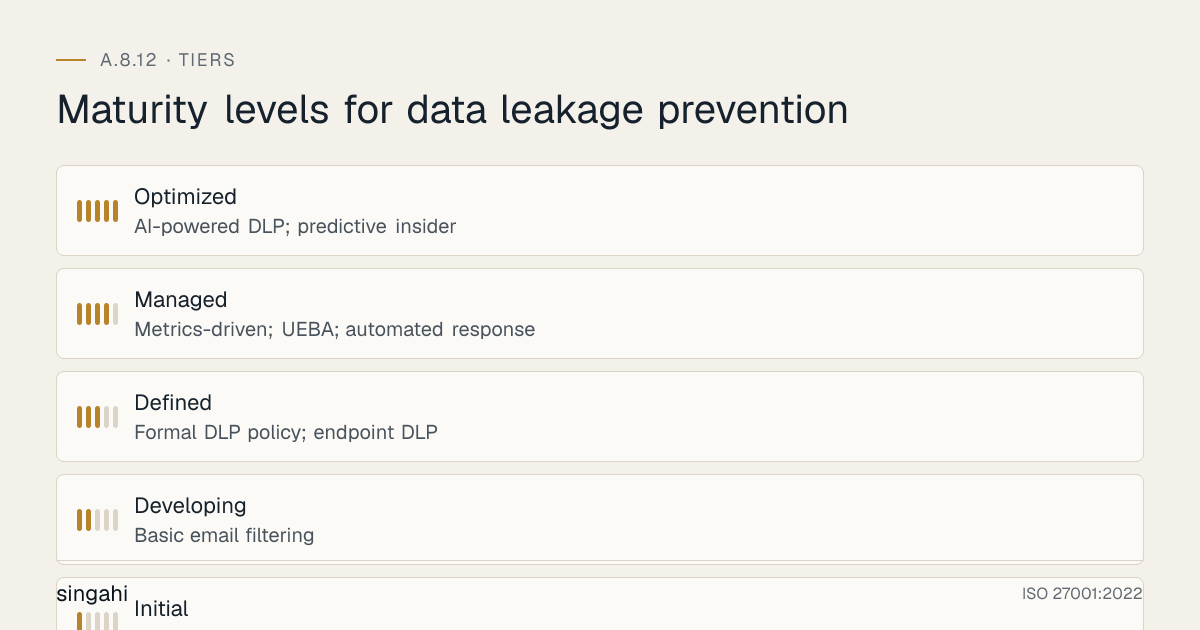
Maturity Model for A.8.12
| Level | Name | Characteristics | Evidence |
|---|---|---|---|
| 1 | Initial | No DLP; no monitoring; no policy; data leaks unmanaged; no awareness | No policy; no tools; no monitoring; incidents unmanaged; no training |
| 2 | Developing | Basic email filtering; ad-hoc USB control; no cloud DLP; no UEBA; informal awareness | Basic email DLP; occasional USB blocking; no cloud; no network; no training |
| 3 | Defined | Formal DLP policy; endpoint DLP; email DLP; cloud DLP; monitoring; incident response; training; tuning | Policy; endpoint; email; cloud; network; CASB; incident response; training; quarterly tuning |
| 4 | Managed | Metrics-driven; UEBA; automated response; complete coverage; low false positives; proactive insider threat detection; integrated SIEM | UEBA; automated response; SIEM integration; metrics; proactive detection; shadow IT management; monthly reporting |
| 5 | Optimized | AI-powered DLP; predictive insider threat detection; self-tuning rules; zero-touch response; fully integrated SASE; zero data leakage incidents; continuous behavioral analytics; autonomous governance | AI DLP; predictive analytics; self-tuning; autonomous response; SASE; zero incidents; continuous behavioral monitoring; autonomous governance |
Continuous Improvement Activities
Monthly:
- DLP alert volume and trend analysis
- False positive rate review and tuning
- DLP incident analysis and remediation tracking
- Shadow IT discovery and remediation
- DLP rule effectiveness review
- User behavior anomaly review (UEBA)
- DLP coverage verification (new endpoints, new channels)
Quarterly:
- DLP policy review
- DLP simulation exercises
- DLP incident response drill
- UEBA model tuning and baseline update
- Third-party DLP compliance review (vendors, contractors)
- Internal audit of DLP controls
- Training refresh for high-risk users
- Metrics and KPI review
- Regulatory change review (DPDP Act, RBI updates)
Annually:
- Full DLP policy review
- Technology evaluation (new DLP tools, new channels)
- Benchmark against industry best practices
- External audit preparation
- Maturity assessment against target level
- Penetration testing of DLP controls (attempt to bypass DLP)
- Vendor security assessment (DLP tool vendors)
- Red team exercise for data exfiltration (test if DLP can be bypassed)
- Complete DLP architecture review
Trigger-Based:
- After any data leakage incident (especially critical/high)
- Upon new channel or technology introduction (new cloud service, new communication tool)
- Upon new data type or classification
- Upon new regulatory requirement
- After significant audit findings
- Upon merger, acquisition, or divestiture
- Upon new cloud adoption or migration
- After industry peer incident ("could this happen to us?")
- Upon DLP vendor update or new capability
FAQ
Q1: What is the difference between DLP and data encryption? A: DLP (Data Loss Prevention) prevents unauthorized data from leaving the organization. It monitors, detects, and blocks data movement. Encryption protects data by making it unreadable without a key. DLP is a preventive control (stops leakage). Encryption is a protective control (protects data if leakage occurs). They are complementary: DLP prevents unauthorized transfer, and encryption protects data if the transfer cannot be prevented. Use both for defense in depth.
Q2: How do we handle DLP for remote workers and BYOD? A: Remote work and BYOD require specialized DLP: (1) Deploy endpoint DLP on corporate devices used remotely, (2) Use ZTNA (Zero Trust Network Access) to control remote access to applications and data, (3) Use CASB to monitor cloud access from remote devices, (4) Use containerization for BYOD (corporate data in a secure container, separate from personal data), (5) Use DLP for VPN traffic (monitor and control data via VPN), (6) Use remote wipe for lost or stolen devices, (7) Use screen watermarking for remote sessions, (8) Require MFA for all remote access. Remote work increases the attack surface, DLP must extend to remote environments.
Q3: What is the most common audit finding for A.8.12? A: The most common findings are: (1) No DLP policy or procedures, (2) No endpoint DLP (USB, print, clipboard uncontrolled), (3) No email DLP (sensitive emails sent without scanning), (4) No cloud DLP (personal cloud uploads unmonitored), (5) No shadow IT discovery (unauthorized cloud services in use), (6) No UEBA or insider threat detection, (7) No incident response for data leakage, (8) No user training on DLP, (9) DLP not covering all channels (only email, no USB/cloud), (10) DLP rules not tuned (high false positives, ignored alerts). Auditors will check endpoint coverage, email scanning, cloud monitoring, shadow IT discovery, and incident response.
Q4: How do we balance DLP security with user privacy? A: DLP monitoring raises privacy concerns, especially for employee monitoring. Balance: (1) Be transparent, communicate what is monitored and why, (2) Monitor data, not personal activity (focus on sensitive data movement, not personal browsing), (3) Use role-based monitoring (stricter for high-risk roles, lighter for standard roles), (4) Do not monitor personal activities (personal email, personal browsing) on corporate devices during breaks (if local laws permit), (5) Protect DLP logs as sensitive data (access-controlled, encrypted), (6) Use DLP for security, not surveillance (focus on data protection, not employee spying), (7) Comply with local labor laws and privacy regulations (DPDP Act, IT Act). Transparent, proportionate, and security-focused DLP is acceptable. Secretive, excessive, or surveillance-focused DLP creates legal and cultural problems.
Q5: What is the cost of implementing A.8.12 for a growing company? A: Often less than expected: many organisations already have DLP features in Microsoft 365 or Google Workspace plans. Extra costs come from CASB or SSE for cloud channels, endpoint DLP for USB and printing, and above all the time to tune rules and triage alerts lawfully.
Q6: How do we handle DLP for encrypted traffic (HTTPS, TLS)? A: Encrypted traffic (HTTPS, TLS) can bypass DLP if not inspected. Solutions: (1) SSL/TLS inspection (decrypt, inspect, re-encrypt) at the web proxy or network DLP, (2) Endpoint DLP inspects data before encryption (at the application level), (3) CASB uses API integration to inspect cloud data (no need to decrypt traffic), (4) Email DLP inspects emails before encryption (at the gateway), (5) Use TLS 1.3 with appropriate key management for inspection. SSL/TLS inspection requires careful implementation: (1) Use trusted certificates, (2) Respect privacy (do not inspect banking, health, or personal sites unless required), (3) Inform users that traffic is inspected, (4) Comply with local laws on traffic inspection. Without SSL inspection, DLP cannot see data in encrypted traffic, creating a significant blind spot.
Q7: How do we handle DLP for contractors and third parties? A: Contractors and third parties require DLP controls: (1) Require DLP on contractor devices (or provide corporate devices with DLP), (2) Include DLP requirements in contracts (DPA, SOW), (3) Monitor contractor access and data movement (UEBA), (4) Limit contractor access to necessary data only (least privilege), (5) Use VDI (Virtual Desktop Infrastructure) for contractors (data stays in corporate environment), (6) Use ZTNA for contractor access (controlled access to specific applications), (7) Monitor and audit contractor data access regularly, (8) Revoke access immediately upon contract end. Contractors are a high-risk group for data leakage, they often have broad access, use personal devices, and may not have the same loyalty as employees. DLP for contractors is essential.
Q8: What is the difference between DLP and CASB? A: DLP (Data Loss Prevention) is a broad discipline that prevents data leakage across all channels (endpoint, network, email, cloud, USB, print). CASB (Cloud Access Security Broker) is a specific technology that sits between users and cloud services to monitor and control cloud access. CASB is a subset of DLP, it provides DLP for cloud services. CASB functions: (1) Visibility (discover shadow IT), (2) Data security (cloud DLP), (3) Threat protection (detect malware in cloud), (4) Compliance (enforce regulatory requirements in cloud). Most organizations need both: DLP for complete coverage, CASB for cloud-specific control. Many modern DLP suites include CASB functionality (Microsoft, Symantec, Forcepoint).
Q9: How do we measure the effectiveness of our DLP program? A: Measure effectiveness through: (1) DLP coverage (percentage of endpoints, email, cloud, network covered), (2) Data leakage incident count (trending downward), (3) DLP alert response time (MTTD and MTTR), (4) False positive rate (should be <10%), (5) Shadow IT discovery rate (percentage of unauthorized services discovered), (6) User training completion and pass rate, (7) DLP simulation results (percentage of users who resist simulated leakage), (8) Insider threat detection rate (anomalies detected and investigated), (9) Audit findings (number of DLP-related findings), (10) Regulatory compliance (no DLP-related penalties). The ultimate measure is: "Have we prevented unauthorized data leakage, and can we detect and respond if it occurs?"
Q10: How do we handle DLP for AI/ML and large language models (LLMs)? A: AI/ML and LLMs create new DLP challenges: (1) Users may paste sensitive data into public LLMs (ChatGPT, Claude, Gemini) for analysis, (2) LLMs may retain and train on sensitive data, (3) AI-generated code may contain hardcoded secrets, (4) ML models may leak training data through inference attacks. DLP for AI: (1) Block or monitor paste of sensitive data into public LLM interfaces, (2) Deploy private/enterprise LLMs for sensitive data, (3) Use DLP to detect hardcoded secrets in AI-generated code, (4) Monitor API calls to LLM services for sensitive data, (5) Implement data governance for AI training datasets, (6) Use differential privacy for ML training data. The rapid adoption of LLMs has created a new DLP channel that many organizations have not addressed.
Q11: Can DLP be bypassed by sophisticated attackers or insiders? A: Yes, DLP can be bypassed by determined and sophisticated actors. Common bypass techniques: (1) Encryption of data before exfiltration (DLP sees encrypted data, not sensitive content), (2) Steganography (hiding data in images, audio, or other files), (3) Data fragmentation (splitting data into small pieces that evade volume thresholds), (4) Protocol tunneling (DNS tunneling, ICMP tunneling, HTTPS tunneling), (5) Physical exfiltration (photographs of screens, handwritten notes, printed documents), (6) Social engineering (convincing others to send data), (7) Using unauthorized devices (personal phones, cameras, unmonitored devices). Defense against bypass: (1) Layered controls (DLP + encryption + access control + monitoring), (2) UEBA for anomaly detection, (3) Physical security (camera monitoring, clean desk policy), (4) Insider threat program, (5) Regular red team exercises to test DLP bypass, (6) Employee screening and trust but verify. DLP is not perfect, but it raises the bar significantly.
Q12: How do we handle DLP for data shared with international partners or subsidiaries? A: Cross-border data sharing requires DLP considerations: (1) DPDP Act 2023 bars transfers only to countries the government restricts (s.16), and safeguards still apply, (2) GDPR requires equivalent protection for EU data, (3) Use DLP to monitor and control cross-border data transfers, (4) Use encryption for all cross-border data sharing, (5) Use tokenization or masking for data that does not need to travel in raw form, (6) Implement DLP rules for specific countries (stricter for high-risk jurisdictions), (7) Include DLP requirements in cross-border data processing agreements, (8) Monitor cross-border data volume and patterns (UEBA), (9) Implement data localization where required (some data must stay in India). Cross-border DLP is about legal compliance as much as security.
Q13: What is the relationship between DLP and data governance? A: DLP and data governance are closely related: (1) Data governance defines what data exists, where it resides, who owns it, and how it should be protected, (2) DLP implements the technical controls to enforce data governance policies, (3) Data governance provides the data inventory and classification that DLP needs to function, (4) DLP provides the monitoring and enforcement that data governance needs to be effective, (5) Data governance tools (Collibra, Alation, Informatica) integrate with DLP tools for unified data protection. Without data governance, DLP lacks the data inventory and classification needed for effective rule configuration. Without DLP, data governance lacks enforcement. Use both together for complete data protection.
Q14: How do we handle DLP for unstructured data (documents, PDFs, images, videos)? A: Unstructured data is challenging for DLP because it does not fit into database rows and columns. Solutions: (1) Use document fingerprinting (create digital fingerprints of sensitive documents and detect them across channels), (2) Use OCR (Optical Character Recognition) to extract text from images and PDFs for DLP scanning, (3) Use ML-based content classification to identify sensitive documents without predefined rules, (4) Use metadata analysis (author, department, creation date, classification tags) to identify sensitive documents, (5) Use DLP for file sharing and collaboration tools (SharePoint, Google Drive, Box) to monitor unstructured data, (6) Use watermarking for sensitive documents to trace leakage. Unstructured data is the majority of organizational data, DLP must address it, not just databases and emails.
Q15: What is the future of DLP? A: DLP is evolving rapidly: (1) AI-powered DLP uses machine learning to detect sensitive data and anomalies without predefined rules, (2) SASE (Secure Access Service Edge) integrates DLP with network security, zero trust, and cloud security in a unified platform, (3) Zero Trust Architecture embeds DLP into every access decision, (4) Cloud-native DLP is built into cloud platforms (AWS Macie, Azure Purview, Google Cloud DLP) rather than bolted on, (5) Privacy-preserving DLP uses techniques like differential privacy and homomorphic encryption to protect data while allowing legitimate use, (6) Autonomous DLP uses AI to self-tune rules, self-respond to incidents, and self-adapt to new threats, (7) Data-centric security focuses on protecting data itself (via encryption, tokenization) rather than protecting networks or endpoints. The future of DLP is AI-driven, cloud-native, zero-trust-embedded, and data-centric.
References and Further Reading
Standards and Frameworks
- ISO/IEC 27001:2022, Information Security, Cybersecurity and Privacy Protection, Information Security Management Systems, Requirements
- ISO/IEC 27002:2022, Information Security, Cybersecurity and Privacy Protection, Information Security Controls
- NIST SP 800-53 Rev 5, Security and Privacy Controls for Information Systems and Organizations
- NIST SP 800-171 Rev 2, Protecting Controlled Unclassified Information in Nonfederal Systems
- PCI DSS v4.0.1, Payment Card Industry Data Security Standard
- CIS Controls v8, CIS Controls Version 8
- COBIT 2019, Control Objectives for Information and Related Technologies
Privacy and Data Protection
- DPDP Act 2023, Digital Personal Data Protection Act (India)
- GDPR, General Data Protection Regulation (EU) 2016/679
- IT Act 2000, Information Technology Act (India)
Books and Publications
- ISO 27001/27002: A Pocket Guide by Alan Calder
- Data Loss Prevention: A Complete Guide by various authors
- Insider Threat: Detection, Mitigation, Deterrence and Prevention by Michael G. Gelles
- The Psychology of Insider Threats by Eric D. Shaw
- NIST SP 800-53: Security and Privacy Controls (NIST)
DLP Resources
- Microsoft Purview DLP: https://docs.microsoft.com/purview/dlp-learn-about-dlp
- Netskope CASB: https://www.netskope.com
- Symantec DLP: https://www.broadcom.com/symantec
- Forcepoint DLP: https://www.forcepoint.com