
On this page
- Quick Reference (60 Seconds)
- What the Control Asks For
- Why Data masking Matters
- Scope and Applicability
- Key Definitions and Terminology
- Relationship to Other Controls
- Implementation Roadmap (Week-by-Week)
- Detailed Implementation Guidance
- Tools, Technologies, and Solutions
- Policy and Procedure Templates
- Risk Assessment and Treatment
- Audit and Compliance Checklist
- Metrics and KPIs
- Common Pitfalls and How to Avoid Them
- Illustrative Scenarios
- Multi-Framework Mapping
- Regulatory and Industry Context
- Roles and Responsibilities (RACI)
- Documentation and Evidence Requirements
- Continuous Improvement
- FAQ
- References and Further Reading
Quick Reference (60 Seconds)
| Aspect | Summary |
|---|---|
| Control ID | A.8.11 |
| Control Name | Data masking |
| ISO 27002:2022 Section | 8.11 |
| Primary Purpose | Protect sensitive information by replacing it with realistic but non-sensitive data, ensuring data utility while preventing unauthorized exposure |
| Key Activities | Define masking requirements, implement masking techniques, test data integrity, manage masking keys, audit masking effectiveness, train users |
| Typical Owners | Data Protection Officer (DPO), Database Administrator, Application Security Lead, Data Engineering Team |
| Implementation Effort | Medium (4–8 weeks) |
| Main cost drivers | Masking or synthetic-data tooling (open-source options exist), engineering time to build masked test data pipelines, and key management for reversible techniques |
| ISO 27002 attributes | Control type: Preventive · Properties: Confidentiality · Concepts: Protect · Capabilities: Information protection · Domains: Protection |
Bottom Line: Data masking replaces real sensitive data with fake but realistic data, so you can use it for testing, development, analytics, and training without exposing actual personal or confidential information. It is the bridge between data utility and data protection, you get the functionality you need without the risk of a breach.
What the Control Asks For
In short:
ISO 27001:2022 Annex A 8.11 asks organizations to use data masking in line with the access control policy to limit exposure of sensitive data, including PII.
Do you need this control?
A.8.11 is not mandatory in itself: under clause 6.1.3 you include it if your risk assessment calls for it, and record the decision in your Statement of Applicability. Include it where masking reduces risk, for example sensitive data in test environments, reports or support tools. If you never expose sensitive data beyond production systems, you may exclude it with that reason.
What ISO 27002:2022 Adds
27002 8.11 (paraphrased): where protecting sensitive data such as PII matters, consider masking, pseudonymisation or anonymisation. Verify that data is adequately pseudonymised or anonymised, considering all elements: a person can still be identified indirectly from other fields.
Masking techniques include (a) encryption, (b) nulling or deleting characters, (c) varying numbers and dates, (d) substitution, (e) replacing values with hashes.
When implementing masking, consider:
- (a) designing queries and masks so each user sees only the minimum data needed
- (b) per-record obfuscation where some records should be hidden (for example a patient who does not want all records visible to staff)
- (c) obfuscation of the obfuscation, so users cannot even see that something was hidden, where the person asks for it
- (d) legal requirements (for example masking payment card data)
When using masking, pseudonymisation or anonymisation, consider:
- the strength of the technique for how the data will be used
- access controls on the processed data
- agreements or restrictions on use of the processed data, including prohibiting collation with other data to re-identify people
- tracking provision and receipt of processed data
Keep the additional information needed to reverse pseudonymisation separate and protected.
Why Data masking Matters
The Non-Production Data Exposure Problem
Organizations routinely copy production data to development, testing, analytics, and training environments. This creates a massive exposure, non-production environments typically have weaker security controls, broader access, and less monitoring than production. A breach in a test environment can expose the same sensitive data as a production breach.
Why It Matters
- Non-production environments (development, testing, analytics, training) usually have weaker controls and many more users than production, so copying real data into them multiplies exposure.
- Truly anonymised data is no longer personal data under the DPDP Act 2023; pseudonymised data still is, so it needs the same safeguards.
- PCI DSS v4.0.1 forbids live card numbers in pre-production (6.5.5) and requires test data to be removed before production (6.5.6).
How It Goes Wrong (hypothetical patterns)
- A bank's development team copied the entire production customer database to a test environment for a new feature rollout. The test environment had no access controls, no encryption, and was accessible to all 200 developers. An intern accidentally published the database connection string on a public forum. The database was downloaded by attackers, exposing 1 million customer records and drawing RBI's supervisory action.
- A healthcare provider's analytics team exported patient records to a cloud analytics platform for research. The data was not masked. The cloud platform had a misconfigured bucket, and the patient data was exposed on the internet. 50,000 patient records were accessible for 6 months before discovery, a personal data breach that must be intimated once the DPDP Rules apply.
- An e-commerce company's marketing team shared customer purchase data with an external analytics vendor for segmentation analysis. The data was not masked. The vendor had a breach, and the customer data was leaked. The e-commerce company was held liable and faced lawsuits from customers.
- A government department's IT contractor took a dump of the citizen database for "troubleshooting purposes." The contractor stored the dump on a personal laptop with no encryption. The laptop was stolen from a coffee shop. The citizen data (Aadhaar numbers, addresses, phone numbers) was exposed. The contractor was prosecuted, and the department faced a CBI investigation.
- A SaaS company's support team had access to the entire customer database for "customer issue resolution." Support staff could see all customer data, including payment information, with no masking. A disgruntled employee copied the data and sold it to a competitor. The company faced a lawsuit.
Regulatory and Business Drivers
- DPDP Act 2023: processing must fit the notice (s.5), the consent given (s.6) or a legitimate use (s.7), with reasonable security safeguards (s.8(5)). Copying real personal data into test or analytics environments is hard to justify under those; anonymised data falls outside the Act.
- RBI, SEBI CSCRF (2024) and IRDAI (2023) expect customer data to be protected in non-production environments; masking or synthetic data is the usual way to meet that
- PCI DSS v4.0.1 3.4.1 (mask PAN when displayed), 6.5.5 (no live PANs in pre-production), 6.5.6 (remove test data before production)
- GDPR (for EU data subjects) requires data protection by design (Article 25), which includes masking in non-production
- PCI DSS v4.0.1 Requirement 3 requires cardholder data not be used in test environments without masking or truncation
- HIPAA (for US healthcare) requires de-identification of patient data in non-production environments
- SOC 2 CC6.1 requires logical access controls, including masking for sensitive data in non-production
- Business efficiency: Masked data enables realistic testing and development without production data exposure risks
Scope and Applicability
What Is Covered
- All non-production environments (development, testing, staging, QA, UAT, pre-production)
- All analytics and reporting environments (data warehouses, data lakes, BI platforms, reporting tools)
- All training environments and datasets (ML training, AI model training, staff training)
- All outsourced development and testing environments (third-party vendors, offshore teams)
- All customer support and help desk tools (if they display sensitive customer data)
- All demo and presentation environments (sales demos, product demonstrations, trade shows)
- All research and data science environments (R&D, research datasets, academic collaborations)
- All backup and recovery test environments (DR drills, backup restoration testing)
- All cloud sandboxes and experimental environments (POC, innovation labs, cloud trials)
- All data shared with third parties (vendors, partners, analytics firms, consultants)
What Is Not Covered
- Production environments (where real data is required for operations)
- Data that is legitimately required in raw form for specific authorized purposes (with proper access controls)
- Data that is already publicly available or non-sensitive
- Data that is anonymized (not just masked) and cannot be re-identified
Applicability by Organization Type
| Organization Type | Applicability | Key Masking Concerns |
|---|---|---|
| IT/Software Services | High | Customer data in dev/test, offshore development, demo environments, third-party sharing |
| BFSI | Critical | Customer financial data in testing, UAT for core banking, analytics, vendor sharing, RBI compliance |
| Healthcare | Critical | Patient data in testing, EMR development, medical research, analytics, NABH compliance |
| Manufacturing | Medium | Employee data, supplier data, R&D data, production data in testing, IP protection |
| Government/Defense | High | Citizen data in testing, classified data in development, analytics, vendor sharing |
| Education | Medium | Student records in testing, research data, alumni data, financial aid data |
| SaaS/Cloud | Critical | Multi-tenant customer data in testing, dev environments, analytics, support tools, third-party sharing |
| Retail/E-commerce | High | Customer purchase data, payment data, inventory data, marketing data, analytics |
Key Definitions and Terminology
| Term | Definition |
|---|---|
| Data Masking | The process of replacing sensitive data with realistic but non-sensitive data to protect privacy while maintaining data utility |
| Static Data Masking (SDM) | Masking data at rest, creating a permanent masked copy of the database for non-production use |
| Dynamic Data Masking (DDM) | Masking data in real-time as it is queried, without modifying the underlying data |
| Deterministic Masking | The same original value always maps to the same masked value (e.g., "Raj" always becomes "Amit") |
| Randomized Masking | The same original value maps to different masked values each time (e.g., "Raj" becomes "Amit" in one instance, "Vikram" in another) |
| Reversible Masking | Masking that can be reversed using a key or algorithm (e.g., encryption-based masking) |
| Irreversible Masking | Masking that cannot be reversed to recover the original data |
| Substitution | Replacing real values with fake but realistic values from a lookup table or synthetic data generator |
| Shuffling | Randomly reordering values within a column (e.g., swapping names between rows) |
| Nulling / Nullification | Replacing sensitive values with NULL or empty values |
| Redaction | Removing or obscuring parts of data (e.g., showing only last 4 digits of a phone number: XXX-XXX-1234) |
| Tokenization | Replacing sensitive data with non-sensitive tokens that can be mapped back to the original via a secure token vault |
| Pseudonymization | Replacing direct identifiers with pseudonyms, while additional information is kept separately to allow re-identification |
| Anonymization | Processing data so that the data subject can no longer be identified, directly or indirectly |
| Format-Preserving Masking | Masking that maintains the original data format (e.g., a masked credit card number still looks like a credit card number) |
| Referential Integrity | Ensuring that relationships between data elements (foreign keys, joins) remain consistent after masking |
| Data Utility | The degree to which masked data remains useful for its intended purpose (testing, analytics, training) |
| Re-identification Risk | The risk that masked or anonymized data can be linked back to the original data subject |
| K-Anonymity | A privacy model where each record is indistinguishable from at least k-1 other records |
| L-Diversity | A privacy model ensuring that sensitive attributes have at least l distinct values within each equivalence class |
| Differential Privacy | A mathematical framework that adds noise to data to prevent identification of individuals while preserving statistical utility |
| Synthetic Data | Artificially generated data that mimics the statistical properties of real data but contains no real individuals |
| Data Subsetting | Creating a smaller, representative subset of data for testing, often combined with masking |
| Masking Rule | A defined transformation applied to a specific data element (e.g., "mask first 12 digits of credit card number") |
| Masking Algorithm | The mathematical or logical method used to perform masking (e.g., AES encryption, hash function, random generation) |
| Masking Key | The cryptographic key used for reversible masking or tokenization |
| Data Classification | The process of categorizing data by sensitivity level to determine masking requirements |
Relationship to Other Controls
| Control | Relationship |
|---|---|
| A.5.1 Policies for information security | Data masking policy aligns with overall security policy |
| A.5.12 Classification of information | Data classification determines which data requires masking |
| A.5.33 Protection of records | Masking protects records in non-production environments |
| A.8.3 Information access restriction | Masking reduces the sensitivity of data accessible to non-production users |
| A.8.10 Information deletion | Masking is an alternative to deletion when data utility is needed |
| A.8.12 Prevention of data leakage | Masking prevents data leakage from non-production environments |
| A.8.13 Information backup | Masked backups may be used for non-production restore testing |
| A.8.24 Use of cryptography | Cryptographic techniques are used for reversible masking and tokenization |
| A.8.31 Separation of development and production | Masking enables safe use of production-like data in dev/test |
| A.8.33 Test data | Test data should be masked or synthetic |
| A.8.33 Test information | Masked or synthetic data for testing |
| A.8.31 Separation of environments | Non-production environments receive masked data |
| A.5.34 Privacy and protection of PII | Pseudonymisation and anonymisation of PII |
| A.8.1 User endpoint devices | Masking may be applied to data on endpoints |
| A.8.5 Secure authentication | Masking may be used for credential protection in logs |
| A.8.16 Monitoring activities | Masking may be applied to sensitive data in logs and monitoring |
Implementation Roadmap (Week-by-Week)
Week 1: Data Classification and Inventory
- Inventory all data types and classify by sensitivity (Public, Internal, Confidential, Secret, Personal Data)
- Identify all systems and environments where data is used (production, dev, test, staging, analytics, training)
- Map data flows from production to non-production environments
- Identify who has access to non-production data and why
- Document current masking practices (if any)
- Identify regulatory requirements for masking (DPDP Act, RBI, PCI DSS, GDPR)
- Document current state and gaps
Week 2: Masking Policy and Strategy Development
- Draft data masking policy
- Define masking scope (which data elements in which environments)
- Define masking requirements by data classification:
- Personal data: Full masking or synthetic data in non-production
- Financial data: Masking or tokenization in non-production
- Health data: Full masking or synthetic data in non-production
- Confidential business data: Masking or subsetting in non-production
- Public data: No masking required
- Define masking techniques by environment:
- Development: Synthetic data or heavily masked data
- Testing: Masked production data or synthetic data
- Staging: Masked production data (with production-like characteristics)
- Analytics: Masked or aggregated data
- Training: Masked or synthetic data
- Define masking key protection requirements (for reversible masking)
- Define data utility requirements (how realistic must masked data be?)
- Define referential integrity requirements
- Approve policy by DPO and CISO
Week 3: Masking Technique Selection and Tool Evaluation
- Evaluate masking tools (Delphix, Informatica, IBM, Microsoft, open-source)
- Select masking techniques for each data type:
- Names: Substitution with fake names
- Phone numbers: Format-preserving randomization
- Email addresses: Substitution with fake emails or domain masking
- Aadhaar numbers: never copy real Aadhaar numbers into non-production; use synthetic values. In production, entities allowed to hold Aadhaar must keep it only in an Aadhaar Data Vault and display it masked (last 4 digits)
- PAN numbers: Full masking or substitution
- Credit card numbers: Tokenization or format-preserving masking
- Bank account numbers: Full masking or substitution
- Addresses: Substitution with fake addresses
- Dates of birth: Date shifting (add/subtract random days)
- Salaries: Range randomization (maintain range but change values)
- Medical diagnoses: Generalization (e.g., "Type 2 Diabetes" → "Diabetes")
- Evaluate static vs. dynamic masking requirements
- Evaluate synthetic data generation options
- Select and procure masking tools
Week 4: Static Masking Implementation
- Implement masking rules for the first database/application
- Configure masking for all sensitive columns
- Ensure referential integrity is maintained (foreign keys, joins, relationships)
- Test masked data for utility (does it work for the intended purpose?)
- Verify that masked data is not reversible without the key
- Document masking rules and transformations
- Create masked data copies for dev/test environments
- Secure masking keys and algorithms (access-controlled, encrypted storage)
Week 5: Dynamic Masking Implementation (if applicable)
- Implement dynamic masking for production databases (for restricted users)
- Configure masking policies based on user roles and privileges
- Test dynamic masking for performance impact
- Configure masking for reporting and analytics tools
- Test that privileged users can see unmasked data when authorized
- Test that unprivileged users see masked data
- Document dynamic masking policies
Week 6: Synthetic Data and Subsetting
- Implement synthetic data generation for development environments
- Generate synthetic data that matches production schema and statistical properties
- Implement data subsetting (create smaller representative datasets for testing)
- Test synthetic data for functional utility (does the application work with it?)
- Document synthetic data generation procedures
- Train developers on using synthetic data
- Establish synthetic data refresh schedule
Week 7: Masking Key Management and Security
- Implement secure storage for masking keys (HSM, KMS, vault)
- Define key access controls (who can access keys, under what conditions)
- Implement key rotation schedule (for reversible masking)
- Implement key backup and recovery procedures
- Audit key access and usage
- Document key management procedures
- Implement separation of duties (key management separate from masking operations)
Week 8: Testing, Verification, and Audit
- Test masked data in all target environments (dev, test, analytics, training)
- Verify that masking is effective (cannot reverse without key)
- Verify that data utility is maintained (applications work, tests pass, analytics run)
- Verify that referential integrity is preserved (database relationships work)
- Conduct re-identification risk assessment (can masked data be linked back to real individuals?)
- Conduct internal audit of masking implementation
- Prepare documentation for external audit
- Plan for continuous improvement
Detailed Implementation Guidance
Figure · Matrix
How the options compare: Rule-based generation to Schema-driven generation
Masking Techniques by Data Type
Personal Data Masking Techniques:
| Data Element | Technique | Example | Reversible? | Notes |
|---|---|---|---|---|
| Full Name | Substitution (fake names) | Rajesh Kumar → Amit Sharma | No | Maintain gender and cultural consistency if needed |
| First Name | Substitution | Rajesh → Amit | No | Use culturally appropriate names |
| Last Name | Substitution | Kumar → Sharma | No | Maintain consistency within a record (same person gets same fake last name) |
| Phone Number | Format-preserving randomization | +91-98765-43210 → +91-87654-32109 | No | Maintain format and country code |
| Email Address | Substitution or domain masking | rajesh@company.com → amit@example.com | No | Maintain domain structure for testing |
| Aadhaar Number | Synthetic replacement in non-production; masked display in production | 1234-5678-9012 → XXXX-XXXX-9012 | No | Aadhaar Act s.29 and the Aadhaar (Data Security) Regulations 2016: store only in an encrypted Aadhaar Data Vault, refer to it elsewhere by a reference key, display only the last 4 digits. Many private entities may not collect Aadhaar at all without a legal basis |
| PAN Number | Format-preserving substitution | ABCDE1234F → PQRST5678K (keep the 4th character, which encodes holder type, if tests validate it) | No | Use synthetic PANs in non-production |
| Passport Number | Full masking | A1234567 → XXXXXXX | No | |
| Address | Substitution (fake addresses) | 123 MG Road, Bangalore → 456 Park Street, Mumbai | No | Maintain city/state consistency if needed |
| Date of Birth | Date shifting | 15-08-1985 → 22-03-1986 | No | Shift by random days; maintain age range |
| Age | Range randomization | 35 → 34 | No | Maintain approximate age range |
| Gender | No masking or substitution | Male → Female | No | Only mask if not needed for testing |
| Marital Status | No masking or substitution | Married → Single | No | Only mask if not needed for testing |
| Photograph | Substitution (synthetic faces) | Real photo → AI-generated face | No | Use AI face generators or stock photos |
| Biometric Data | Hashing or synthetic data | Fingerprint template → Synthetic template | No | Highly sensitive; never use real biometric data in non-production |
Financial Data Masking Techniques:
| Data Element | Technique | Example | Reversible? | Notes |
|---|---|---|---|---|
| Credit Card Number | Tokenization or format-preserving masking | 4111-1111-1111-1111 → 5500-0000-0000-0004 | Tokenization: Yes | Tokenization for analytics; full masking for dev/test |
| Bank Account Number | Full masking or substitution | 12345678901 → 98765432109 | No | |
| IFSC Code | Substitution | HDFC0000123 → ICIC0000456 | No | Maintain bank format |
| Account Balance | Range randomization | → | No | Maintain range and distribution |
| Transaction Amount | Range randomization | → | No | Maintain range and distribution |
| Salary | Range randomization | → | No | Maintain department/role ranges |
| Tax ID (GSTIN) | Substitution | 27AABCU9603R1ZX → 29AAGFG1234R1ZV | No | Maintain format |
| Income | Range randomization | → | No | Maintain range |
| Investment Portfolio | Substitution (fake securities) | Reliance Industries → Tata Consultancy | No | Maintain asset class consistency |
Healthcare Data Masking Techniques:
| Data Element | Technique | Example | Reversible? | Notes |
|---|---|---|---|---|
| Medical Record Number (MRN) | Substitution | MRN123456 → MRN789012 | No | Maintain uniqueness |
| Diagnosis | Generalization | Type 2 Diabetes Mellitus → Diabetes | No | Generalize to broader category |
| ICD Code | Generalization | E11.9 → E11 | No | Generalize to higher-level code |
| Medication | Substitution | Metformin 500mg → Glipizide 5mg | No | Maintain drug class consistency |
| Lab Results | Range randomization | Glucose: 120 mg/dL → 118 mg/dL | No | Maintain normal/abnormal range |
| Vital Signs | Range randomization | BP: 120/80 → BP: 118/78 | No | Maintain physiological range |
| Doctor Name | Substitution | Dr. Sharma → Dr. Gupta | No | |
| Hospital Name | Substitution | Apollo Hospital → Fortis Hospital | No | |
| Insurance ID | Substitution | INS123456789 → INS987654321 | No | Maintain format |
| Appointment Date | Date shifting | 15-08-2024 → 22-03-2024 | No | Maintain relative timing |
| Medical Images | DICOM metadata scrubbing + pixel noise | Real CT scan → CT scan with anonymized metadata | No | Remove all DICOM metadata; add noise to prevent re-identification |
Static vs. Dynamic Masking
Static Data Masking (SDM):
- Creates a permanent masked copy of the database
- Masked data is stored in non-production environments
- One-time masking process; no ongoing performance impact
- Best for: dev/test environments, offline analytics, data sharing
- Requires: storage for masked copy, periodic refresh from production
- Limitation: Data becomes stale; must be refreshed periodically
Dynamic Data Masking (DDM):
- Masks data in real-time as it is queried
- Original data remains unchanged in the database
- Masking applied at query time based on user role
- Best for: production databases with mixed user access, reporting, customer support
- Requires: minimal storage overhead; ongoing performance impact
- Limitation: Requires database support; may impact query performance
Comparison:
| Aspect | Static Masking | Dynamic Masking |
|---|---|---|
| Data modification | Original data is copied and masked | Original data remains unchanged |
| Performance | One-time cost; no ongoing impact | Ongoing impact on query performance |
| Storage | Requires additional storage for masked copy | Minimal additional storage |
| Data freshness | Becomes stale; requires refresh | Always current |
| Use case | Dev/test, analytics, data sharing | Production access control, reporting |
| Reversibility | Can be irreversible (if key is destroyed) | Always reversible (original data intact) |
| Database support | Works with any database | Requires database-native DDM or proxy |
| Complexity | Higher (ETL process, referential integrity) | Lower (policy-based, real-time) |
| Cost | Higher (tooling, storage, refresh) | Lower (database feature or proxy) |
Hybrid Approach (Recommended):
- Use static masking for dev/test environments (permanent masked copies)
- Use dynamic masking for production reporting and analytics (real-time masking)
- Use synthetic data for development (no production data at all)
- Use tokenization for analytics where reversibility is needed
Referential Integrity in Masked Data
Challenge: When masking data, relationships between tables must be preserved. If a customer name is masked in the customer table, the same masked name must appear in the orders table, support tickets table, and billing table. Otherwise, joins will fail, and the database will be functionally useless.
Referential Integrity Solutions:
| Relationship | Solution | Implementation |
|---|---|---|
| Primary Key → Foreign Key | Deterministic masking | Same original value always maps to same masked value across all tables |
| Customer ID linkage | Deterministic masking or tokenization | Customer ID 12345 always becomes 67890 in all tables |
| Name consistency across tables | Deterministic substitution | "Rajesh Kumar" always becomes "Amit Sharma" in all tables |
| Address consistency | Deterministic substitution | Address always maps to same fake address in all tables |
| Phone number consistency | Deterministic randomization | Same phone number always becomes same masked phone |
| Cross-database consistency | Master masking reference table | Maintain a central mapping table across all databases |
| Composite keys | Mask each component deterministically | Each component of composite key is masked deterministically |
| Self-referential tables | Hierarchical deterministic masking | Manager ID maps to masked manager ID, employee ID maps to masked employee ID |
Deterministic Masking Implementation:
- Use a hash function (SHA-256) with a secret salt to map original values to masked values
- The hash output is used to index into a lookup table of fake values
- Same input + same salt = same output (deterministic)
- Different databases use the same salt and lookup table for consistency
- Store the salt and lookup table securely (access-controlled, encrypted)
Synthetic Data Generation
Synthetic Data vs. Masked Data:
- Masked data is derived from real data (transformations of real values)
- Synthetic data is entirely artificial (no real individuals or values)
- Synthetic data has zero re-identification risk (no real data to link back to)
- Synthetic data may have lower utility than masked data (not as realistic)
- Synthetic data is preferred for development environments where no real data is needed
Synthetic Data Generation Techniques:
| Technique | Description | Use Case | Tools |
|---|---|---|---|
| Rule-based generation | Generate data based on rules and constraints (e.g., names from a list, ages within a range) | Simple testing, unit tests | Faker, Mockaroo, Tonic |
| Statistical modeling | Generate data that matches statistical properties of real data (mean, variance, distribution) | Analytics, ML training | Tonic, Synthea, Synthpop |
| Generative AI (GANs, VAEs) | Use neural networks to learn patterns from real data and generate new data | Complex data, images, text | Mostly.ai, Tonic, Gretel |
| Differential privacy | Add noise to real data to create synthetic datasets with privacy guarantees | Statistical analysis, research | Google DP Library, IBM DiffPriv |
| Schema-driven generation | Generate data based on database schema, constraints, and relationships | Database testing, ETL testing | Faker, Tonic, Delphix |
Synthetic Data Best Practices:
- Generate synthetic data that matches the production schema exactly (same tables, columns, data types)
- Maintain referential integrity in synthetic data (foreign keys, relationships)
- Generate data that matches production volume (if testing performance, use production-like volume)
- Generate data with realistic distributions (if 70% of customers are from Tier 1 cities, synthetic data should reflect this)
- Test synthetic data for functional utility (applications should work, queries should return results, tests should pass)
- Label synthetic data clearly so it is not confused with real data
- Do not use real data to train synthetic data generators if the generator could memorize real data (use differential privacy)
Masking Key Management
For Reversible Masking (Encryption, Tokenization):
| Key Management Aspect | Requirement | Implementation |
|---|---|---|
| Key generation | Use cryptographically secure random number generator | HSM, KMS, or secure software RNG |
| Key storage | Store in hardware security module (HSM) or key management service (KMS) | AWS KMS, Azure Key Vault, HashiCorp Vault, Thales HSM |
| Key access | Role-based access; only authorized personnel can use keys | IAM, RBAC, MFA |
| Key rotation | Rotate keys periodically (annually or upon suspected compromise) | Automated key rotation in KMS |
| Key backup | Backup keys to secure, separate location for disaster recovery | HSM backup, KMS multi-region replication |
| Key destruction | Destroy keys securely when no longer needed (for irreversible masking) | HSM key destruction, KMS key deletion |
| Key audit | Log all key access, usage, and management activities | SIEM, KMS audit logs, HSM audit logs |
| Separation of duties | Key management separate from masking operations | Different teams or roles |
| Key escrow | Escrow keys with a trusted third party for business continuity | Legal escrow, HSM split-key |
For Irreversible Masking:
- Destroy lookup tables and salts after masking is complete (if no re-identification is ever needed)
- If lookup tables must be retained for consistency (deterministic masking), protect them as sensitive data
- Access to lookup tables should be restricted to masking administrators only
- Encrypt lookup tables at rest and in transit
Tools, Technologies, and Solutions
Enterprise Data Masking Platforms
| Vendor | Product | Key Features | Pricing model |
|---|---|---|---|
| Delphix | Delphix Data Masking | Enterprise masking, static and dynamic, synthetic data, referential integrity, fast provisioning | Commercial, per user |
| Informatica | Persistent Data Masking | Complete masking, multiple techniques, referential integrity, large-scale enterprise | Commercial, per user |
| IBM | InfoSphere Optim | Data masking, subsetting, test data management, application-aware masking | Commercial, per user |
| Microsoft | Azure SQL Database DDM | Native dynamic data masking for Azure SQL, column-level masking, role-based | Commercial, per database |
| Oracle | Data Masking and Subsetting | Database-native masking, referential integrity, application-aware, large-scale | Commercial, per user |
| Broadcom (CA) | Test Data Manager | Masking, subsetting, synthetic data generation, test data management | Commercial, per user |
| Tonic.ai | Tonic | Synthetic data generation, privacy-preserving, developer-friendly, API-driven | Commercial, per user |
| Mostly.ai | Mostly AI | Synthetic data generation, AI-powered, statistical fidelity, privacy guarantees | Commercial, per user |
| Gretel.ai | Gretel | Synthetic data, differential privacy, API-driven, developer-friendly | Commercial, per user |
| Imperva | Camouflage | Database masking, file masking, application masking, static and dynamic | Commercial, per user |
Database-Native Dynamic Data Masking
| Database | Native DDM Feature | Key Capabilities | Pricing model |
|---|---|---|---|
| Microsoft SQL Server | Dynamic Data Masking | Column-level masking, built-in functions, role-based, minimal performance impact | Included with SQL Server |
| Azure SQL Database | Dynamic Data Masking | Cloud-native, column-level, role-based, Azure portal management | Included with Azure SQL |
| PostgreSQL | pg_anonymizer / custom extensions | Column-level masking via extensions or views | Free (open-source) |
| MySQL / MariaDB | Custom views / proxy solutions | View-based masking, proxy-based masking (MySQL Proxy, MaxScale) | Free / proxy cost |
| Oracle Database | Data Redaction / Real Application Security | Column-level redaction, role-based, fine-grained | Included with Oracle Enterprise |
| MongoDB | Field-level encryption / client-side masking | Client-side field-level encryption, application-level masking | Included with MongoDB Enterprise |
| Amazon Redshift | Dynamic Data Masking | Column-level masking, role-based, SQL-based | Included with Redshift |
| Snowflake | Dynamic Data Masking | Column-level masking, policy-based, role-based | Included with Snowflake |
| Google BigQuery | Column-level security / policy tags | Column-level security, policy tags, row-level security | Included with BigQuery |
Synthetic Data and Test Data Generation
| Tool | Type | Key Features | Pricing model |
|---|---|---|---|
| Faker (Python) | Open-source library | Programmatic fake data generation, multiple locales, extensible | Free (open-source) |
| Mockaroo | Cloud / API | Web-based fake data generation, API, multiple formats, realistic data | Free or Commercial |
| Tonic.ai | Enterprise | Synthetic data generation, privacy-preserving, database-aware, referential integrity | Commercial, per user |
| Mostly.ai | Enterprise | AI-powered synthetic data, statistical fidelity, privacy guarantees, multiple data types | Commercial, per user |
| Gretel.ai | API-driven | Synthetic data, differential privacy, developer-friendly, tabular and text data | Commercial, per user |
| Synthea | Open-source (healthcare) | Realistic synthetic patient data, EHR-compatible, healthcare-specific | Free (open-source) |
| Synthpop (R) | Open-source | Statistical synthetic data generation, differential privacy, research-oriented | Free (open-source) |
| K2View | Enterprise | Test data management, synthetic data, masking, subsetting, real-time provisioning | Commercial, per user |
| GenRocket | Enterprise | Test data generation, synthetic data, rule-based, CI/CD integration | Commercial, per user |
| Benerator | Open-source | Large-volume test data generation, database-aware, performance testing | Free (open-source) |
Tokenization and Format-Preserving Encryption
| Vendor | Product | Key Features | Pricing model |
|---|---|---|---|
| Voltage (OpenText) | SecureData | Format-preserving encryption (FPE), tokenization, vaultless, application-level | Commercial, per user |
| Thales | CipherTrust Tokenization | Tokenization, vault-based, cloud-native, PCI DSS compliance | Commercial, per user |
| TokenEx | Tokenization Platform | Cloud tokenization, vaultless, API-driven, PCI DSS compliance | Commercial, per user |
| Very Good Security (VGS) | VGS Platform | Tokenization, aliasing, secure data collection, PCI DSS compliance | Commercial, per user |
| HPE | SecureData | Format-preserving encryption, tokenization, application integration | Commercial, per user |
| AWS | AWS Payment Cryptography / Tokenization | Cloud-native tokenization, PCI DSS, AWS integration | Commercial |
| Paymetric | Tokenization (now part of OpenText) | Payment tokenization, PCI DSS compliance, e-commerce integration | Commercial |
| Bluefin | PCI P2PE + Tokenization | Point-to-point encryption + tokenization, PCI DSS compliance | Commercial |
Policy and Procedure Templates
Data Masking Policy Template
Template
Data Masking Policy
1. Purpose
This policy establishes requirements for data masking to protect sensitive information in non-production environments, analytics, and other use cases where real data is not required.
2. Scope
This policy applies to all non-production environments, analytics platforms, training datasets, third-party sharing, and any other scenario where sensitive data is used outside of production operations.
3. Data Masking Principles
3.1 Masking by Default
- Sensitive data shall be masked by default when copied to non-production environments
- No sensitive data shall be used in development, testing, or training without masking or synthetic replacement
- Exceptions require DPO approval and documented risk acceptance
3.2 Technique Appropriateness
- Masking techniques shall be selected based on data sensitivity, environment purpose, and data utility requirements
- Irreversible masking is preferred when data reversal is not required
- Reversible masking (tokenization, encryption) requires key management and access controls
3.3 Referential Integrity
- Masked data shall maintain referential integrity across all related tables and databases
- Deterministic masking shall be used for cross-table consistency
- Synthetic data shall maintain referential integrity and schema conformance
3.4 Key Protection
- Masking keys, salts, lookup tables, and algorithms shall be protected as sensitive assets
- Access to masking keys shall be restricted to authorized personnel
- Key management shall follow the organization's cryptographic key management policy
3.5 Verification
- Masking effectiveness shall be verified before masked data is used
- Re-identification risk shall be assessed for masked datasets
- Data utility shall be tested to ensure masked data serves its intended purpose
4. Masking Requirements by Environment
4.1 Development Environments
- Masking requirement: Synthetic data or heavily masked data
- Technique: Synthetic data generation or irreversible masking with high generalization
- Rationale: Developers do not need real data for coding; synthetic data is sufficient
- Exceptions: DPO approval required; documented justification
4.2 Testing Environments (QA, UAT, Integration)
- Masking requirement: Masked production data or synthetic data
- Technique: Irreversible masking with format preservation; deterministic masking for referential integrity
- Rationale: Testers need realistic data for functional testing but not real sensitive data
- Subsetting: Use representative data subsets to reduce volume and risk
- Exceptions: DPO approval required; documented justification
4.3 Staging / Pre-Production
- Masking requirement: Masked production data
- Technique: Irreversible masking with format preservation; deterministic masking
- Rationale: Staging should mirror production closely but without real sensitive data
- Refresh: Masked data refreshed periodically from production (with masking applied during refresh)
4.4 Analytics and Reporting
- Masking requirement: Masked or aggregated data
- Technique: Dynamic masking, tokenization, aggregation, or anonymization
- Rationale: Analysts need patterns and trends, not individual identities
- Exceptions: DPO approval for specific analytics requiring individual-level data
4.5 Training and ML/AI
- Masking requirement: Synthetic data or masked data
- Technique: Synthetic data generation, differential privacy, or irreversible masking
- Rationale: ML models do not need real individual data; synthetic data with same statistical properties is sufficient
- Exceptions: DPO approval; documented privacy impact assessment
4.6 Third-Party Sharing
- Masking requirement: Masked data or synthetic data
- Technique: Irreversible masking or tokenization (with contractual controls)
- Rationale: Third parties should not have access to real sensitive data unless absolutely necessary
- Contracts: Data processing agreements must require masking or specify data protection measures
- Exceptions: DPO and Legal approval; documented risk acceptance; DPA in place
4.7 Customer Support and Help Desk
- Masking requirement: Dynamic masking for support staff
- Technique: Redaction, dynamic masking, or tokenization
- Rationale: Support staff need to see relevant data but not all sensitive data
- Implementation: Show only necessary data (last 4 digits of card, partial name, partial email)
- Exceptions: Manager approval for escalation cases requiring full data access
4.8 Demos and Presentations
- Masking requirement: Synthetic data or fully masked data
- Technique: Synthetic data generation or full substitution
- Rationale: Demo environments must never contain real customer data
- Policy: Use of real data in demos is prohibited without exception
5. Masking Techniques by Data Sensitivity
5.1 Personal Data (DPDP Act)
- All direct identifiers: Full masking or substitution (irreversible)
- Quasi-identifiers: Masking or generalization (k-anonymity, l-diversity)
- Sensitive personal data: Full masking or synthetic replacement
- Biometric data: Never use in non-production; synthetic only
5.2 Financial Data
- Account numbers: Full masking or tokenization
- Credit card numbers: Tokenization or format-preserving masking (PCI DSS compliance)
- Transaction amounts: Range randomization
- Balances: Range randomization
- Tax IDs: Full masking or substitution
5.3 Health Data
- Medical record numbers: Substitution
- Diagnoses: Generalization
- Lab results: Range randomization
- Medications: Substitution (maintain drug class)
- Medical images: DICOM metadata scrubbing + pixel noise
- Doctor/patient names: Substitution
5.4 Confidential Business Data
- Trade secrets: Full masking or synthetic replacement
- Customer lists: Substitution or synthetic generation
- Pricing data: Range randomization or substitution
- Strategic plans: Full masking or synthetic replacement
- R&D data: Full masking or synthetic replacement
6. Masking Key Management
6.1 Key Generation
- Masking keys shall be generated using cryptographically secure random number generators
- Key strength shall be appropriate for the sensitivity of the data (minimum AES-256 for encryption-based masking)
6.2 Key Storage
- Masking keys shall be stored in a Hardware Security Module (HSM) or Key Management Service (KMS)
- Keys shall be encrypted at rest and in transit
- Key storage shall be separate from masked data storage
6.3 Key Access
- Access to masking keys shall be restricted to authorized masking administrators
- Key access shall require multi-factor authentication (MFA)
- Key access shall be logged and audited
- Separation of duties: Key administrators shall not be data users
6.4 Key Rotation
- Masking keys shall be rotated annually or upon suspected compromise
- Key rotation shall not break referential integrity (maintain mapping consistency)
- Old keys shall be securely archived for historical data recovery if needed
6.5 Key Destruction
- When masking is no longer needed, keys shall be securely destroyed
- Key destruction shall be documented and verified
- Destruction shall follow NIST SP 800-88 guidelines for cryptographic erasure
7. Verification and Testing
7.1 Masking Effectiveness Verification
- Before masked data is used, verify that:
- No real sensitive data remains in the masked dataset (sample scan)
- Masked data cannot be reversed to recover original data without the key
- Re-identification risk is acceptable (assessed via k-anonymity, l-diversity, or differential privacy metrics)
7.2 Data Utility Testing
- Test that masked data supports the intended use case:
- Applications function correctly with masked data
- Database queries return expected results
- Tests pass with masked data
- Analytics produce meaningful results
- ML models train effectively on synthetic data
7.3 Referential Integrity Testing
- Verify that all foreign keys, joins, and relationships work correctly after masking
- Verify that cross-table consistency is maintained (same customer has same masked name in all tables)
- Test end-to-end application workflows with masked data
8. Roles and Responsibilities
- DPO: Policy owner, masking approval, exception authorization, privacy impact assessment, regulatory liaison
- Database Administrator: Technical masking implementation, referential integrity, key management, refresh scheduling
- Application Security Lead: Masking technique selection, masking tool evaluation, security validation, re-identification risk assessment
- Data Engineering Team: Synthetic data generation, data pipeline masking, analytics masking, ML data preparation
- Development Team: Use masked/synthetic data, report masking issues, request exceptions with justification
- Testing Team: Validate masked data utility, report referential integrity issues, test with masked data
- IT Operations: Masked environment provisioning, access control, monitoring, backup of masked data
- CISO: Security oversight, audit support, incident response, key management policy approval
9. Enforcement
- Use of real sensitive data in non-production environments without masking is prohibited
- Violations may result in disciplinary action, access revocation, and incident investigation
- Systems found with unmasked sensitive data in non-production shall be quarantined and remediated
- Third parties found with unmasked data shall be subject to contractual penalties and relationship review
10. Review
This policy is reviewed annually or upon any change in applicable law, regulation, or technology.
Masking Implementation Checklist
Template
Data Masking Implementation Checklist
Pre-Implementation
- Data classification completed for all data types
- Data inventory identifies all non-production environments
- Regulatory requirements identified (DPDP Act, RBI, PCI DSS, GDPR)
- Masking policy approved by DPO and CISO
- Masking tool selected and procured
- Masking techniques defined for each data type
- Referential integrity strategy defined
- Key management strategy defined (if reversible masking)
- Data utility requirements documented
- Roles and responsibilities assigned
Implementation
- Masking rules configured for all sensitive data elements
- Deterministic masking applied for cross-table consistency
- Referential integrity verified after masking
- Masked data tested for functional utility
- Dynamic masking configured for production reporting (if applicable)
- Synthetic data generation configured for development (if applicable)
- Masking keys generated and stored securely
- Key access controls configured
- Masking logs configured and enabled
- Masked environment access controls implemented
- Masked data labeled clearly (not to be confused with real data)
Verification
- Sample scan confirms no real sensitive data in masked dataset
- Re-identification risk assessment completed
- Data utility testing passed (applications work, tests pass, analytics run)
- Referential integrity testing passed (all joins, relationships work)
- Performance testing confirms acceptable impact (for dynamic masking)
- Security review confirms masking keys are protected
- Audit trail confirms all masking activities are logged
- Documentation completed (rules, procedures, keys, verification)
Post-Implementation
- Masked data refresh schedule defined
- Monitoring alerts configured for unmasked data in non-production
- Training delivered to developers, testers, and analysts
- Exception process communicated
- Internal audit conducted
- External audit preparation completed
- Continuous improvement plan established
Risk Assessment and Treatment
Risk Assessment Matrix for Data masking
| Risk ID | Threat | Vulnerability | Likelihood | Impact | Risk Level | Treatment |
|---|---|---|---|---|---|---|
| R1 | Data breach from non-production environment | Real production data used in dev/test without masking | High | High | Critical | Mandatory masking for all non-production; synthetic data for dev; monitoring |
| R2 | Re-identification of masked data | Weak masking technique; deterministic without salt; small dataset | Medium | High | High | Strong masking techniques; k-anonymity assessment; add noise; differential privacy |
| R3 | Masking key compromise | Weak key management; shared keys; no access controls | Low | Critical | High | HSM/KMS storage; MFA; access controls; key rotation; audit logging |
| R4 | Application failure due to poor masking | Masking breaks referential integrity; format changes; utility loss | Medium | Medium | Medium | Referential integrity testing; format-preserving masking; utility testing; deterministic masking |
| R5 | Third-party data exposure | Unmasked data shared with vendors; no contractual controls | Medium | High | High | Mandatory masking for third-party sharing; DPA clauses; vendor audit; tokenization |
| R6 | Support staff exposure | Support tools show full sensitive data; no dynamic masking | Medium | Medium | Medium | Dynamic masking for support tools; redaction; role-based access; audit logs |
| R7 | Demo/presentation exposure | Real data used in demos; no masking | Medium | Medium | Medium | Synthetic data only for demos; no exceptions; pre-demo data verification |
| R8 | Masking bypass | Users bypass masking by accessing production directly; copying unmasked data | Medium | High | High | Access controls; DLP monitoring; audit logs; user training; disciplinary action |
| R9 | ML model memorization | Synthetic data generator memorizes real data; differential privacy not applied | Medium | High | High | Differential privacy for synthetic data; privacy impact assessment; model testing for memorization |
| R10 | Regulatory non-compliance | DPDP Act violation; PCI DSS violation; GDPR violation due to unmasked data | High | High | Critical | Policy compliance; automated masking; audit; DPO oversight; legal review |
Audit and Compliance Checklist
Internal Audit Checklist (30 Questions)
Policy and Governance (5 Questions)
- Is a data masking policy documented and approved?
- Does the policy define masking requirements by environment and data type?
- Are masking techniques defined and documented?
- Is the policy reviewed annually?
- Are roles and responsibilities for masking defined?
Environment Coverage (5 Questions)
- Is masking applied to all development environments?
- Is masking applied to all testing environments?
- Is masking applied to all analytics and reporting environments?
- Is masking applied to all training environments?
- Is masking applied to all third-party shared data?
Masking Effectiveness (5 Questions)
- Is masked data verified to contain no real sensitive data?
- Is re-identification risk assessed for masked datasets?
- Is referential integrity maintained after masking?
- Is data utility tested after masking?
- Is masking effectiveness verified before use?
Key Management (5 Questions)
- Are masking keys stored securely (HSM/KMS)?
- Is key access restricted to authorized personnel?
- Is key access logged and audited?
- Is key rotation performed periodically?
- Is key destruction documented and verified?
Monitoring and Enforcement (5 Questions)
- Is unmasked data in non-production environments detected and remediated?
- Are masking violations investigated and addressed?
- Is masking documented in audit trails?
- Are third-party data sharing agreements require masking?
- Are exceptions to masking documented with risk acceptance?
Training and Awareness (5 Questions)
- Are developers trained on using masked/synthetic data?
- Are testers trained on masked data utility?
- Are support staff trained on dynamic masking?
- Are data engineers trained on masking techniques?
- Is the masking policy communicated to all relevant personnel?
Audit Scoring
- 30–27: Excellent (Green), Full compliance
- 26–22: Good (Yellow), Minor gaps, address within 30 days
- 21–15: Needs Improvement (Orange), Significant gaps, address within 60 days
- 14–0: Critical (Red), Major non-compliance, immediate action required
Metrics and KPIs
Figure · Measures
The measures that show A.8.11 is working
- Non-Production Masking Coverage100%Monthly
- Sensitive Data Masking Rate100%Monthly
- Synthetic Data Usage>= 80%Monthly
- Masking Verification Pass Rate100%Per masking j…
- Re-identification Risk ScoreK >= 5, L >= 3Per masked da…
Key Performance Indicators
| KPI | Formula | Target | Measurement Frequency |
|---|---|---|---|
| Non-Production Masking Coverage | (Masked non-production environments / Total non-production environments) x 100 | 100% | Monthly |
| Sensitive Data Masking Rate | (Sensitive data elements masked / Total sensitive data elements) x 100 | 100% | Monthly |
| Synthetic Data Usage | (Synthetic data in dev / Total dev data) x 100 | >= 80% | Monthly |
| Masking Verification Pass Rate | (Masking verifications passed / Total verifications) x 100 | 100% | Per masking job |
| Re-identification Risk Score | K-anonymity, l-diversity, or differential privacy metric | K >= 5, L >= 3 | Per masked dataset |
| Data Utility Score | Percentage of tests/applications that work with masked data | >= 95% | Per masking job |
| Referential Integrity Pass Rate | (Referential integrity checks passed / Total checks) x 100 | 100% | Per masking job |
| Key Management Compliance | (Key management audits passed / Total audits) x 100 | 100% | Quarterly |
| Masking Exception Count | Number of approved exceptions to masking | Trending downward | Monthly |
| Unmasked Data Detection | Incidents of unmasked sensitive data in non-production | 0 | Monthly |
| Third-Party Masking Compliance | (Third parties with masking clauses / Total third parties with data) x 100 | 100% | Quarterly |
| Support Tool Masking Coverage | (Support tools with dynamic masking / Total support tools) x 100 | 100% | Monthly |
| Demo Data Compliance | (Demos using synthetic data / Total demos) x 100 | 100% | Monthly |
| Policy Review Cycle Adherence | (Reviews on time / Required reviews) x 100 | 100% | Annually |
| Training Completion Rate | (Staff trained on masking / Total relevant staff) x 100 | 100% | Quarterly |
| Audit Finding Closure Rate | (Closed findings / Total findings) x 100 | 100% within 60 days | Per audit |
Common Pitfalls and How to Avoid Them
Pitfall 1: "Just Copy Production Data to Test, It's Faster"
Problem: Teams copy production data to test environments without masking because it is faster and "more realistic." This exposes sensitive data to developers, testers, and contractors who should not have access to it. The convenience of unmasked data creates massive risk. Solution: Implement automated masking pipelines that refresh test data from production with masking applied automatically. Use synthetic data for development where possible. Make masked data provisioning as fast and easy as unmasked data. If the process is frictionless, teams will use it. The time "saved" by skipping masking is dwarfed by the time lost in a breach investigation, regulatory response, and remediation.
Pitfall 2: Weak Masking That Can Be Reversed
Problem: Organizations use simple masking techniques (e.g., replacing all names with "John Doe," replacing all phone numbers with "9999999999") that destroy data utility and can be easily reversed by context. Or they use deterministic masking without a salt, making it vulnerable to rainbow table attacks. Or they use masking that preserves too much information, allowing re-identification. Solution: Use strong, format-preserving masking techniques. Add a secret salt to deterministic masking. Assess re-identification risk using k-anonymity, l-diversity, or differential privacy. For small datasets, use synthetic data instead of masking. Test whether you can reverse the masking or re-identify individuals. If you can, attackers can too.
Pitfall 3: Breaking Referential Integrity
Problem: Masking is applied inconsistently across tables. A customer ID is masked to one value in the customer table and a different value in the orders table. Joins fail. Foreign key constraints break. Applications crash. The masked database is useless for testing. Solution: Use deterministic masking for all cross-table references. Maintain a master mapping table. Test all database relationships after masking. Include referential integrity testing in the masking verification process. A masked database that doesn't work is worse than no database at all, teams will go back to using real data.
Pitfall 4: No Masking in Analytics and Reporting
Problem: Organizations mask data in dev/test but forget about analytics platforms, BI tools, and reporting databases. Analysts and data scientists have access to full customer data. The analytics platform is often cloud-based with weaker security than production. Solution: Apply masking or aggregation to analytics data. Use dynamic masking for BI tools. Use tokenization for analytics where individual tracking is needed but identification is not. Use differential privacy for research datasets. Train analysts on privacy-preserving analytics techniques. Analytics is not exempt from data protection requirements.
Pitfall 5: Forgetting About Logs and Monitoring
Problem: Application logs, database logs, and monitoring systems capture sensitive data during processing. Even if the database is masked, the logs contain the real data. An attacker who accesses logs can see everything. Solution: Mask or redact sensitive data in logs. Configure log levels to avoid capturing PII. Use structured logging with field-level masking. Implement log filtering and sanitization pipelines. Review log configurations regularly. Test logs to ensure they don't contain sensitive data. Logs are data too, they need protection.
Pitfall 6: No Masking Key Management
Problem: Organizations use reversible masking (encryption, tokenization) but store the keys in the same database as the masked data, or in a text file, or share the key among the team. The key is compromised, and all masked data is effectively exposed. Solution: Store masking keys in a dedicated HSM or KMS. Implement strict access controls. Use MFA for key access. Rotate keys regularly. Audit all key access. Separate key management from data users. If the key is as easy to access as the data, the masking provides no protection.
Pitfall 7: "We'll Mask Later"
Problem: Organizations plan to mask data but never get around to it. The project is delayed. The budget is cut. The team is busy. Meanwhile, real data is being used in non-production environments for months or years, accumulating exposure. Solution: Make masking a non-negotiable requirement for any non-production environment. Block provisioning of unmasked environments. Implement automated masking pipelines. Include masking in the project plan and budget from the start. Do not allow "we'll do it later", later never comes. Masking is not a nice-to-have; it is a must-have for any non-production data use.
Pitfall 8: No Verification That Masking Works
Problem: Organizations apply masking but never verify that it is effective. They assume the tool works. They don't check if real data remains. They don't test if the masked data can be re-identified. They don't verify that applications work with masked data. The masking is ineffective, and they don't know it. Solution: Implement a verification process: (1) Scan the masked dataset for real data remnants, (2) Test re-identification risk, (3) Test referential integrity, (4) Test application functionality, (5) Test analytics utility, (6) Document verification results. If verification fails, fix the masking and re-verify. Verification is the only way to know that masking actually protects data.
Illustrative Scenarios
Illustrative scenario, a composite example for guidance, not a specific Singahi engagement or a verified outcome.
Illustrative Scenario 1: Indian Bank, Masking for Core Banking Testing (Growing company)
Organization: A 500-branch private bank with 2 million customers, 500 employees, and a core banking system (CBS) running on TCS BaNCS Challenge: The bank's development and testing teams had been using full production customer data in dev/test environments for years. The test environment had 200 users with access, including contractors and offshore developers. The bank had no masking policy. A contractor accidentally uploaded a test database dump to a public cloud storage bucket (intended for personal backup). The dump contained 2 million customer records with names, addresses, phone numbers, Aadhaar numbers, PAN numbers, and account balances. The bucket was discovered by a security researcher who responsibly disclosed it. The bank faced immediate RBI scrutiny, customer panic, and reputational damage. The RBI issued a show-cause notice and required a complete security overhaul. The bank's board mandated that no real customer data be used in non-production environments within 90 days. Before State:
- Full production customer data (2 million records) in dev/test environments
- No masking policy or procedures
- 200 users had access to test environment (including contractors and offshore developers)
- Test database accessible via public internet (no IP restriction)
- No synthetic data generation capability
- No dynamic masking for support tools
- No masking for analytics platform
- No key management (no reversible masking in use, but no controls anyway)
- No verification of test data content
- No DLP monitoring for data exfiltration from test environments
- RBI show-cause notice issued; potential penalty of
Implementation: Month 1: Emergency containment and assessment. Revoked all test environment access. Removed production data from test environment. Deployed Delphix for data masking. Conducted emergency assessment of all non-production environments. Month 2: Masking policy and tool deployment. Drafted data masking policy. Configured Delphix for static masking of the CBS database. Implemented deterministic masking for all customer identifiers (names, Aadhaar, PAN, phone, email, addresses). Implemented range randomization for account balances and transaction amounts. Implemented format-preserving masking for account numbers. Maintained referential integrity across all CBS tables (customers, accounts, transactions, loans, KYC). Month 3: Synthetic data for development. Implemented synthetic data generation for development environments using Faker and custom scripts. Generated 2 million synthetic customer records with realistic statistical properties (age distribution, city distribution, account types). Ensured synthetic data maintained CBS schema and referential integrity. Month 4: Dynamic masking for support and analytics. Implemented dynamic masking for the bank's support tool (Microsoft Dynamics CRM) using field-level security. Support staff could see only last 4 digits of account numbers and redacted names. Implemented aggregation and tokenization for the analytics platform (Power BI). Analysts could see trends and patterns but not individual customer identities. Month 5: Third-party and offshore controls. Implemented masking for all data shared with offshore development partners. Renegotiated contracts with offshore vendors to require masking. Implemented tokenization for data shared with the analytics vendor. Implemented DLP monitoring for all data transfers from the bank. Month 6: Verification and testing. Conducted verification that no real customer data remained in test environments. Tested all CBS applications with masked data (UAT passed). Tested all reports and analytics with masked/tokenized data. Verified referential integrity across 500+ CBS tables. Conducted re-identification risk assessment (k-anonymity > 5 for all masked datasets). Month 7: Training and audit. Trained all 500 employees on masking policy. Trained developers on synthetic data usage. Trained support staff on dynamic masking. Conducted internal audit. All non-production environments compliant. Month 8: RBI re-audit. RBI auditors reviewed masking implementation. All findings cleared. No penalty imposed. Bank passed RBI cyber security audit.
Results (After 12 Months):
- 100% masking coverage for all non-production environments (dev, test, staging, UAT)
- 100% synthetic data usage in development environments
- 100% dynamic masking for support tools (200 support staff)
- 100% tokenization for analytics platform (50 analysts)
- 100% masking for third-party data sharing (5 vendors)
- 0 real customer data in non-production environments (verified via scans)
- K-anonymity > 5 for all masked datasets
- 100% referential integrity maintained across 500+ CBS tables
- All CBS applications and reports function correctly with masked data
- RBI show-cause notice resolved; no penalty
- Customer trust restored; new account openings increased 12% after security messaging
- Offshore development continued without disruption (masked data was sufficient for all development needs)
Key Lesson: For banks, using real customer data in testing is not just a security risk, it is a regulatory violation. The RBI's scrutiny accelerated transformation, but the bank's proactive approach turned a crisis into a competitive advantage. Data masking enabled the bank to continue rapid development and testing while maintaining customer trust and regulatory compliance.
Illustrative Scenario 2: Indian Healthcare Chain, Patient Data Masking for EMR Development and Analytics
Organization: A healthcare chain with 10 hospitals, 500 beds, and 1 million annual patients Challenge: The healthcare chain was implementing a new Electronic Medical Record (EMR) system (Epic) and required extensive testing, training, and analytics. The implementation team had been using real patient data for testing and training because "synthetic patient data is not realistic enough for clinical testing." The EMR test environment was accessible to 150 implementation staff, including Epic consultants, trainers, and IT contractors. The analytics team had built a data warehouse with 5 years of patient data for "population health research." The data warehouse had no masking or anonymization. A journalist investigating data breaches discovered that the analytics data warehouse was accessible via a public API (misconfigured by the vendor). The journalist published a story about patient data exposure, causing public outrage, regulatory scrutiny, and NABH accreditation risk. The DPDP Act 2023 investigation was initiated. The hospital board mandated immediate patient data masking across all non-clinical environments. Before State:
- Real patient data (1 million records) in EMR test environment
- Real patient data in training environment (used for staff training on Epic)
- Real patient data in analytics data warehouse (5 years, no masking)
- 150 implementation staff with access to test/training data
- No masking policy or procedures
- No synthetic data generation for healthcare
- No dynamic masking for clinical support tools
- Analytics vendor had misconfigured public API access
- No DLP monitoring for data warehouse
- NABH accreditation at risk
- DPDP Act investigation initiated
Implementation: Phase 1 (Months 1–2): Emergency containment and masking. Immediately removed real patient data from test and training environments. Implemented Delphix for static masking of the Epic EMR database. Configured masking for all patient identifiers (names, addresses, phone numbers, Aadhaar, insurance IDs). Implemented medical data masking (diagnoses generalized, medications substituted, lab results range-randomized, dates shifted). Maintained clinical referential integrity (patient → encounters → diagnoses → medications → lab results → billing). Phase 2 (Months 3–4): Synthetic data for training. Implemented Synthea (open-source synthetic patient data generator) for training environments. Generated 100,000 synthetic patients with realistic clinical profiles (diagnoses, medications, allergies, vitals). Configured synthetic data to match Epic schema and workflows. Trained clinical staff on Epic using synthetic data. Phase 3 (Months 5–6): Analytics anonymization. Implemented k-anonymity (k=5) and l-diversity (l=3) for the analytics data warehouse. Generalized patient demographics (age ranges instead of exact birth dates, city instead of exact address). Implemented differential privacy for research queries (added calibrated noise to query results). Removed all direct identifiers from the data warehouse. Implemented tokenization for longitudinal tracking (same patient token across records, but not linkable to real identity). Phase 4 (Months 7–8): Dynamic masking for clinical support. Implemented dynamic masking for the hospital's patient portal admin tools (staff see only necessary data). Implemented redaction for billing staff (see only billing-relevant data, not clinical details). Implemented masking for insurance claim processing staff (see only insurance-relevant data). Phase 5 (Months 9–10): Third-party and research controls. Implemented masking for all data shared with research partners. Implemented data use agreements (DUA) with universities and research institutions. Implemented secure data enclaves for research (researchers access data in controlled environments, cannot export raw data). Phase 6 (Months 11–12): Verification and certification. Verified that no real patient data remained in non-clinical environments. Tested all Epic workflows with masked data. Verified analytics with anonymized data. Conducted re-identification risk assessment (k-anonymity confirmed, l-diversity confirmed). Passed NABH re-accreditation audit with no data protection findings. DPDP Act investigation resolved with no penalty.
Results (After 18 Months):
- 100% patient data masking in all non-clinical environments (test, training, analytics, research)
- 100% synthetic data usage in EMR training (500 clinical staff trained on synthetic data)
- 100% k-anonymity (k>=5) and l-diversity (l>=3) for analytics data warehouse
- 100% dynamic masking for clinical support tools (200 staff)
- 100% masking for third-party research data sharing (10 research partners)
- 0 real patient data in non-clinical environments (verified via scans)
- NABH accreditation maintained with no findings
- DPDP Act investigation resolved; no penalty
- Analytics continued without disruption (researchers adapted to anonymized data)
- Patient trust improved; patient satisfaction scores increased 8% after privacy messaging
- New research partnerships established citing "strong data privacy practices"
Key Lesson: For healthcare organizations, patient data masking is not optional, it is required by NABH, the DPDP Act, and patient trust. The challenge of maintaining clinical realism while protecting privacy is solvable with the right tools (Synthea for synthetic data, k-anonymity for analytics, dynamic masking for support). The investment in masking is a fraction of the cost of regulatory penalties, accreditation loss, or reputational damage.
Multi-Framework Mapping
ISO 27001:2022 A.8.11 to Other Frameworks
| Framework | Reference | How it relates to A.8.11 |
|---|---|---|
| NIST SP 800-53 Rev 5 | SI-19 De-identification; PM-25 Minimisation of PII used in testing, training and research; SC-12 Key management (reversible techniques) | Direct |
| NIST SP 800-188 | De-identifying government data sets | Technique guidance |
| ISO/IEC 20889 | Privacy-enhancing data de-identification techniques | Technique guidance |
| PCI DSS v4.0.1 | 3.4.1 PAN masked when displayed; 3.5.1 PAN unreadable where stored (tokenisation, hashing, truncation); 6.5.5 No live PANs in pre-production; 6.5.6 Test data removed | Direct for card data |
| SOC 2 (2017 TSC) | C1.1 Confidential information protected; CC6.1 | Supports |
| CIS Controls v8 | No direct masking safeguard (3.x covers data protection generally) | n/a |
| COBIT 2019 | APO14 Managed data | Supports |
Regulatory and Industry Context
India-Specific Regulatory Requirements
Aadhaar handling rules
- May you collect it at all? Only entities permitted by law (for example AUAs and KUAs, and others where a law allows) may collect Aadhaar numbers; many private businesses may not. Prefer offline verification (e-KYC XML or QR) where allowed.
- Aadhaar Data Vault: entities allowed to store Aadhaar numbers must keep them only in an encrypted Aadhaar Data Vault, referenced elsewhere by a reference key or token (Aadhaar Act s.29 and the Aadhaar (Data Security) Regulations 2016, with UIDAI circulars).
- Masked display everywhere: show only the last four digits in production screens, reports and documents, not just in test environments.
- Never copy real Aadhaar numbers into non-production; use synthetic values that pass format checks.
Digital Personal Data Protection (DPDP) Act 2023:
- Section 8(5): Data fiduciaries must protect personal data through technical and organizational measures, including masking where appropriate
- Section 12: Right to erasure requires deletion of personal data; masking is not a substitute for deletion when erasure is requested
- Sections 5 to 7: processing must fit the notice, the consent or a legitimate use; real personal data in non-production is hard to justify under these
- Anonymised data is outside the Act; pseudonymised data remains personal data
- Penalties up to ₹250 crore for failing to take reasonable security safeguards for personal data
RBI Cyber Security Framework:
- Expects customer data to be protected in non-production environments (masking or synthetic data is the usual approach)
- Payment card data must be masked or tokenized per PCI DSS
SEBI CSCRF (2024):
- Expects protection of client data in test and development environments, scaled by entity category
IRDAI Guidelines:
- Insurance customer data must be masked in non-production environments
- Customer data shared with third parties for analytics must be masked or anonymized
- Data masking must be documented in the information security policy
NABH Accreditation (Healthcare):
- Patient data in test environments must be masked or synthetic
- Analytics and research data must be anonymized
- Staff training on data privacy must include masking requirements
- NABH auditors review data masking practices during accreditation
IT Act 2000 (as amended):
- Section 43A: Reasonable security practices include data masking for sensitive personal data
- Section 72A: Disclosure of personal information in breach of a lawful contract
Industry-Specific Context
BFSI:
- RBI mandates masking of customer data in non-production environments
- PCI DSS requires masking of cardholder data (show only first 6 and last 4 digits)
- UPI transaction data must be masked in test environments
- Core banking test environments must use masked or synthetic data
- Customer data shared with fintech partners must be masked or tokenized
- SWIFT test messages must use masked data
- Trading algorithm test environments must use masked market data
Healthcare:
- NABH requires patient data masking in non-clinical environments
- DPDP Act requires patient data protection, including masking
- Medical research data must be anonymized or de-identified
- Clinical trial data must be pseudonymized
- Medical images (DICOM) must have metadata scrubbed and pixel noise added
- Patient portal development must use synthetic patient data
- Telemedicine test environments must use masked or synthetic data
- Health insurance data shared with insurers must be masked
Government/Defense:
- Citizen data in test environments must be masked or synthetic
- Classified data must never be used in non-classified environments (even masked)
- Government portal development must use synthetic citizen data
- Aadhaar numbers must be stored only in an Aadhaar Data Vault and displayed masked (see the box above)
- Defense systems must use synthetic data for testing
- RTI data must be masked when shared with third parties
- Election data must be anonymized for research
SaaS/Cloud:
- Multi-tenant SaaS must mask customer data in dev/test environments
- Customer data in analytics must be aggregated or tokenized
- API testing must use masked or synthetic data
- Demo environments must use synthetic data (never real customer data)
- Support tools must use dynamic masking
- Cloud provider test environments must use masked data
- SOC 2 and ISO 27001 require data masking for non-production
- Customer audit rights often require evidence of masking
Retail/E-commerce:
- Customer purchase data in test environments must be masked
- Payment data must never be used in test (use test card numbers)
- Marketing data must be masked or aggregated for analytics
- Loyalty program data must be masked for testing
- Inventory data may be masked or synthetic for testing
- Customer service tools must use dynamic masking
- Personalization algorithm testing must use masked or synthetic data
Roles and Responsibilities (RACI)
| Activity | DPO | CISO | Database Admin | App Security Lead | Data Engineering | Development Team | Testing Team | IT Operations |
|---|---|---|---|---|---|---|---|---|
| Policy Development | A | R | C | R | C | C | C | I |
| Technique Selection | C | R | R | R | R | C | C | I |
| Tool Evaluation | C | R | R | R | R | C | C | I |
| Static Masking Implementation | C | C | R | C | R | C | C | C |
| Dynamic Masking Implementation | C | R | R | R | C | I | I | C |
| Synthetic Data Generation | C | C | C | C | R | C | C | I |
| Key Management | C | A | R | C | C | I | I | C |
| Referential Integrity | C | C | R | C | R | C | C | I |
| Verification | C | R | R | R | C | C | C | I |
| Re-identification Assessment | A | R | C | R | R | I | I | I |
| Training | A | C | C | R | C | R | R | I |
| Monitoring | C | R | C | C | C | I | I | R |
| Audit | C | R | C | R | C | I | I | C |
| Exception Approval | A | R | C | C | C | I | I | I |
| Third-Party Data Sharing | A | R | C | R | C | I | I | I |
| Continuous Improvement | A | R | C | R | R | C | C | C |
Documentation and Evidence Requirements
| Document | Purpose | Retention Period | Owner |
|---|---|---|---|
| Data Masking Policy | Defines masking requirements | Duration + 3 years | DPO |
| Masking Rules and Techniques | Documents transformations for each data type | Duration + 3 years | Database Admin |
| Masking Implementation Records | Evidence of masking execution | 1 year | Database Admin |
| Verification Reports | Evidence of masking effectiveness | 1 year | App Security Lead |
| Re-identification Risk Assessment | Privacy impact assessment | Duration + 3 years | DPO |
| Data Utility Test Results | Evidence that masked data works | 1 year | Testing Team |
| Referential Integrity Test Results | Evidence of database consistency | 1 year | Database Admin |
| Key Management Records | Evidence of key protection | Duration + 3 years | CISO |
| Key Access Logs | Evidence of key usage | 1 year | CISO |
| Exception Records | Documented exceptions with approval | Duration + 3 years | DPO |
| Synthetic Data Generation Records | Evidence of synthetic data creation | 1 year | Data Engineering |
| Third-Party Data Sharing Agreements | Contractual masking requirements | Duration + 3 years | Legal |
| Training Records | Awareness evidence | Duration + 3 years | HR |
| Audit Checklist and Results | Audit evidence | Duration + 3 years | Internal Audit |
| Risk Assessment | Risk treatment evidence | Duration + 3 years | CISO |
Continuous Improvement
Figure · Tiers
Maturity levels for data masking
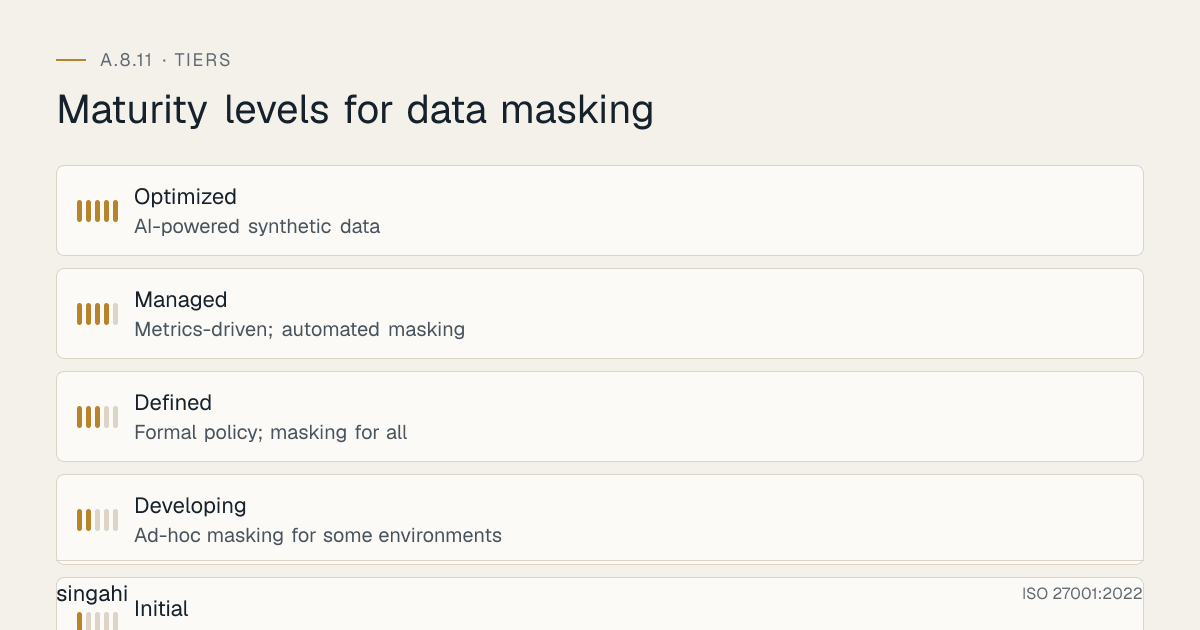
Maturity Model for A.8.11
| Level | Name | Characteristics | Evidence |
|---|---|---|---|
| 1 | Initial | No masking; real production data used everywhere; no policy; no tools; no awareness | No policy; real data in dev/test; no masking; no synthetic data |
| 2 | Developing | Ad-hoc masking for some environments; basic substitution; no key management; no verification; no referential integrity | Some masking; simple techniques; no policy; no tools; manual process; inconsistent |
| 3 | Defined | Formal policy; masking for all non-production; deterministic masking; referential integrity; verification; key management; synthetic data for dev | Policy; all environments masked; tools; deterministic masking; referential integrity; verification; synthetic data |
| 4 | Managed | Metrics-driven; automated masking pipelines; dynamic masking for production; tokenization for analytics; differential privacy for research; automated verification; complete reporting | Automated pipelines; dynamic masking; tokenization; differential privacy; automated verification; metrics; quarterly review |
| 5 | Optimized | AI-powered synthetic data; real-time dynamic masking; self-service masked data provisioning; zero unmasked data in non-production; privacy-preserving analytics by default; continuous re-identification assessment; fully automated governance | AI synthetic data; self-service masking; zero unmasked data; privacy-preserving analytics; continuous assessment; automated governance; no manual exceptions |
Continuous Improvement Activities
Monthly:
- Masking coverage review (all non-production environments)
- Unmasked data detection and remediation
- Masking verification for new datasets
- Key management audit
- Masking exception review
- Synthetic data quality assessment
Quarterly:
- Masking policy review
- Re-identification risk assessment for masked datasets
- Data utility testing for masked data
- Third-party masking compliance review
- New environment masking implementation
- Internal audit of masking controls
- Training refresh
- Metrics and KPI review
Annually:
- Full policy review
- Technology evaluation (new masking tools, new synthetic data generators)
- Benchmark against industry best practices
- External audit preparation
- Maturity assessment against target level
- Regulatory change review (DPDP Act updates, RBI updates)
- Penetration testing of masking controls (attempt to reverse masking)
- Vendor security assessment (masking tool vendors)
Trigger-Based:
- After any unmasked data exposure incident
- Upon new system or environment introduction
- Upon new data type or classification
- Upon new regulatory requirement
- After significant audit findings
- Upon merger, acquisition, or divestiture
- Upon new cloud adoption or migration
- After industry peer incident
- Upon new analytics or ML project
FAQ
Q1: What is the difference between data masking and data anonymization? A: Data masking replaces real values with fake but realistic values, while maintaining data structure and utility. The data is still about "someone", just not the real person. Anonymization removes all identifiers such that the data subject cannot be identified, directly or indirectly. Anonymized data is no longer "about" anyone specific. Masking is a technique; anonymization is a goal. Masked data may still be pseudonymized (can be re-linked with additional information). Anonymized data is irreversibly de-identified. For non-production environments, masking is often sufficient. For public data sharing or research, anonymization is required.
Q2: What is the difference between static masking and dynamic masking? A: Static masking creates a permanent masked copy of the data at rest. The original data is copied, masked, and stored in a new location. Dynamic masking applies masking in real-time when data is queried, without changing the underlying data. Static masking is best for dev/test environments where you need a persistent masked dataset. Dynamic masking is best for production environments where different users need different levels of access. Static masking is irreversible (if the key is destroyed); dynamic masking is always reversible (the original data is intact). Most organizations use both: static for dev/test, dynamic for production reporting.
Q3: Can masked data be reversed to recover the original data? A: It depends on the masking technique. Irreversible masking (substitution, shuffling, randomization with no key) cannot be reversed. Reversible masking (encryption, tokenization with a vault) can be reversed if you have the key. Deterministic masking with a secret salt can be reversed if you have the salt and lookup table. The key question is: who has access to the reversal mechanism? If only authorized personnel with MFA can reverse, and the key is protected in an HSM, then reversal is controlled. If the key is in a text file on the server, reversal is trivial for anyone with access. Use irreversible masking when reversal is not needed. Use reversible masking only when necessary, with strong key protection.
Q4: How do we maintain referential integrity when masking data? A: Use deterministic masking for all cross-table references. Deterministic masking means the same original value always maps to the same masked value. For example, if "Customer ID 12345" becomes "Customer ID 67890" in the customer table, it must also become "Customer ID 67890" in the orders table, the billing table, and the support tickets table. This is achieved by: (1) Using a hash function with a secret salt to map original values to masked values, (2) Using the same salt across all tables and databases, (3) Maintaining a master lookup table, (4) Testing all joins and foreign key constraints after masking. Without deterministic masking, your database relationships break, and the masked data becomes useless for testing.
Q5: What is the most common audit finding for A.8.11? A: The most common findings are: (1) No masking policy or procedures, (2) Real production data used in dev/test environments, (3) No masking for analytics platforms, (4) No masking for third-party data sharing, (5) Weak masking techniques that can be reversed, (6) Broken referential integrity after masking, (7) No masking key management, (8) No verification of masking effectiveness, (9) No synthetic data for development, (10) No dynamic masking for support tools. Auditors will check non-production environments, analytics platforms, third-party contracts, and support tools for evidence of masking.
Q6: How do we handle masking for cloud-native databases (AWS RDS, Azure SQL, Google Cloud SQL)? A: Cloud-native databases offer built-in masking options: (1) Azure SQL Database has native Dynamic Data Masking (DDM), configure column-level masking in the Azure portal, (2) AWS RDS (PostgreSQL, MySQL) can use open-source extensions or proxy-based masking, (3) Google Cloud SQL supports column-level security via IAM and views, (4) Snowflake has native Dynamic Data Masking via policies, (5) Amazon Redshift has Dynamic Data Masking, (6) BigQuery has column-level security via policy tags. For cloud databases, use native features where available. For cross-cloud or multi-cloud, use third-party masking tools (Delphix, Informatica) that support multiple platforms. Ensure that masking is applied consistently across all cloud regions and replicas.
Q7: What is the cost of implementing A.8.11 for a growing company? A: The main costs are a masking or synthetic-data tool (commercial and open-source options exist), engineering time to build a repeatable masked-copy pipeline, and key management if you use reversible techniques. Synthetic data for new systems can avoid masking costs altogether.
Q8: How do we handle masking for real-time streaming data (Kafka, Kinesis, Pub/Sub)? A: Streaming data requires real-time masking: (1) Implement masking in the stream processing layer (Kafka Streams, Flink, Spark Streaming), (2) Use format-preserving masking for streaming fields (maintain schema compatibility), (3) Implement deterministic masking for stream joins (same key across streams), (4) Use tokenization for analytics streams (if downstream needs reversibility), (5) Mask sensitive fields before writing to downstream consumers, (6) Implement schema registry with masked schema versions, (7) Test latency impact of masking (streaming is latency-sensitive). Streaming masking is more complex than batch masking but essential for real-time pipelines that contain sensitive data.
Q9: Can we use AI to generate synthetic data? A: Yes, AI-powered synthetic data generation is increasingly popular: (1) Generative Adversarial Networks (GANs) learn the statistical distribution of real data and generate new data, (2) Variational Autoencoders (VAEs) create synthetic data by learning latent representations, (3) Large language models (LLMs) can generate synthetic text data (emails, notes, descriptions), (4) Diffusion models generate synthetic images and time-series data. AI-generated synthetic data is highly realistic but requires: (1) Differential privacy to prevent memorization of real data, (2) Validation that the synthetic data does not contain real individuals, (3) Testing for functional utility, (4) Transparency about AI generation. Tools like Mostly.ai, Tonic, and Gretel use AI for synthetic data generation. AI synthetic data is excellent for complex datasets (healthcare, finance, customer behavior) but requires careful privacy validation.
Q10: How do we handle masking for data science and machine learning? A: Data science and ML have unique masking requirements: (1) ML models need statistical properties (distributions, correlations, features), simple masking may destroy these, (2) Use synthetic data that preserves statistical properties (Tonic, Mostly.ai, Gretel), (3) Use differential privacy for training data (add noise to prevent memorization of individual records), (4) For feature engineering, use aggregated features instead of individual-level features, (5) For model validation, use a holdout set that is also masked or synthetic, (6) For production inference, ensure the model does not leak training data (membership inference attacks), (7) Document the privacy techniques used in the ML pipeline. ML data privacy is an active research area, use privacy-preserving ML techniques (federated learning, differential privacy, homomorphic encryption) when possible.
Q11: What is format-preserving encryption (FPE) and when should we use it? A: Format-preserving encryption (FPE) encrypts data while preserving its original format. For example, a 16-digit credit card number encrypted with FPE still looks like a 16-digit number (not a random binary blob). This is useful when: (1) Applications expect a specific format (credit card numbers, phone numbers, IDs), (2) Database schemas have format constraints (varchar(16) for card numbers), (3) Legacy systems validate format before processing, (4) You need to encrypt without changing application code. FPE is used for: credit card numbers, national IDs (Aadhaar, PAN), phone numbers, account numbers. FPE is not as strong as standard encryption (smaller key space due to format constraints) but is practical for format-constrained environments. Use FPE when format preservation is essential; use standard encryption when maximum security is needed.
Q12: How do we handle masking for data shared across borders (India to EU, US, etc.)? A: Cross-border data sharing requires additional masking: (1) DPDP Act 2023 bars transfers only to countries the government restricts (s.16), but safeguards must still apply, (2) GDPR requires equivalent protection for EU data transferred to India, (3) Masking or anonymization is often required for cross-border transfers, (4) Use tokenization with the token vault in India (data stays in India; tokens go abroad), (5) Use synthetic data for international research or analytics, (6) Implement data localization requirements (some data must stay in India), (7) Include masking requirements in cross-border data processing agreements, (8) Conduct Data Protection Impact Assessment (DPIA) for cross-border transfers. Cross-border masking is not just about privacy, it is about legal compliance with multiple jurisdictions.
Q13: What is the difference between tokenization and masking? A: Tokenization replaces sensitive data with a non-sensitive token that has no mathematical relationship to the original data. The mapping between token and original data is stored in a secure token vault. Tokenization is reversible (you can look up the original data from the token). Masking replaces sensitive data with a fake value that may or may not be reversible. Tokenization is best for: payment processing (PCI DSS), analytics where you need to track individuals without exposing their data, and scenarios where you need to reverse the data later. Masking is best for: dev/test environments where you don't need to reverse, and scenarios where irreversibility is preferred. Tokenization is a form of masking but with a specific architecture (vault + mapping). Use tokenization when you need reversibility and vault-level security; use masking when irreversibility is acceptable.
Q14: How do we measure the effectiveness of our data masking program? A: Measure effectiveness through: (1) Masking coverage (percentage of non-production environments with masking), (2) Sensitive data masking rate (percentage of sensitive fields masked), (3) Re-identification risk score (k-anonymity, l-diversity, differential privacy metrics), (4) Data utility score (percentage of applications/tests that work with masked data), (5) Referential integrity pass rate (percentage of relationships that work after masking), (6) Unmasked data detection (incidents of real data in non-production), (7) Synthetic data usage (percentage of development environments using synthetic data), (8) Third-party masking compliance (percentage of vendors with masking clauses), (9) Support tool masking coverage (percentage of support tools with dynamic masking), (10) Training completion (percentage of staff trained). The ultimate measure is: "Can we confidently use any non-production environment without exposing real sensitive data?"
Q15: What is the relationship between data masking and data loss prevention (DLP)? A: Data masking and DLP are complementary but distinct. Data masking protects data at rest and in use within non-production environments by replacing sensitive values. DLP prevents data from leaving authorized environments by monitoring, detecting, and blocking unauthorized transfers. Masking is a preventive control (make data less sensitive). DLP is a detective/preventive control (stop data from being exfiltrated). Use both: mask data in non-production to reduce sensitivity, and use DLP to detect if anyone tries to copy unmasked data out of production or masked data out of non-production. Masking reduces the risk of exposure; DLP reduces the likelihood of unauthorized transfer. Together, they provide defense-in-depth for data protection.
References and Further Reading
Standards and Frameworks
- ISO/IEC 27001:2022, Information Security, Cybersecurity and Privacy Protection, Information Security Management Systems, Requirements
- ISO/IEC 27002:2022, Information Security, Cybersecurity and Privacy Protection, Information Security Controls
- NIST SP 800-53 Rev 5, Security and Privacy Controls for Information Systems and Organizations
- NIST SP 800-88 Rev 1, Guidelines for Media Sanitization
- PCI DSS v4.0.1, Payment Card Industry Data Security Standard
- CIS Controls v8, CIS Controls Version 8
- COBIT 2019, Control Objectives for Information and Related Technologies
Privacy and Data Protection
- GDPR, General Data Protection Regulation (EU) 2016/679
- DPDP Act 2023, Digital Personal Data Protection Act (India)
- HIPAA, Health Insurance Portability and Accountability Act (US)
- PCI DSS, Payment Card Industry Data Security Standard
Books and Publications
- ISO 27001/27002: A Pocket Guide by Alan Calder
- Privacy-Preserving Data Mining: Models and Algorithms by Charu C. Aggarwal and Philip S. Yu
- The Algorithmic Foundations of Differential Privacy by Cynthia Dwork and Aaron Roth
- Data Privacy: A Practical Guide by D. C. S. Rao
- K-Anonymity: A Model for Protecting Privacy by Latanya Sweeney
Synthetic Data and Masking Resources
- Synthea (Synthetic Patient Data): https://synthetichealth.github.io/synthea
- Faker (Python Library): https://faker.readthedocs.io
- Mockaroo: https://www.mockaroo.com
- Tonic.ai: https://www.tonic.ai
- Mostly.ai: https://mostly.ai
- Gretel.ai: https://gretel.ai
- Delphix: https://www.delphix.com