
On this page
- Quick Reference (60 Seconds)
- What the Control Asks For
- Why Application Security Requirements Matter
- Scope and Applicability
- Key Definitions and Terminology
- Relationship to Other Controls
- Implementation Roadmap (Week-by-Week)
- Detailed Implementation Guidance
- Tools, Technologies, and Solutions
- Policy and Procedure Templates
- Risk Assessment and Treatment
- Audit and Compliance Checklist
- Metrics and KPIs
- Common Pitfalls and How to Avoid Them
- Illustrative Scenarios
- Multi-Framework Mapping
- Regulatory and Industry Context
- Roles and Responsibilities (RACI)
- Documentation and Evidence Requirements
- Continuous Improvement
- FAQ
- References and Further Reading
Quick Reference (60 Seconds)
Control: A.8.26, Application Security Requirements
Purpose: Define and specify security requirements for applications, ensuring security is built into applications from the start rather than bolted on later.
ISO 27002 attributes: Control type: Preventive · Properties: Confidentiality, Integrity, Availability · Concepts: Protect · Capabilities: Application security, System and network security · Domains: Protection, Defence
Who it applies to: All organizations that develop, acquire, or deploy applications (internal or customer-facing).
Minimum viable actions:
- Establish an application security requirements process (policy + template)
- Define security requirements for every new application or major change
- Review requirements with security stakeholders before development begins
- Maintain a requirements register linked to risk assessments
Key deliverables: Application Security Requirements Document, Security Requirements Traceability Matrix, Approved Requirements Register.
Audit questions you should be able to answer:
- Can you show me the security requirements for [application name]?
- How do you ensure security requirements are defined before development starts?
- Who approves application security requirements?
- How are requirements traced to design, implementation, and testing?
What the Control Asks For
Do you need this control?
A.8.26 is not mandatory in itself: under clause 6.1.3 you include it if your risk assessment calls for it, and record the decision in your Statement of Applicability. Include it if you develop, acquire or configure applications whose security requirements must be defined. Even buyers of SaaS need security requirements for what they procure.
Annex A 8.26 asks organizations to identify, specify and approve information security requirements when developing or acquiring applications.
What ISO 27002:2022 Adds
ISO/IEC 27002:2022 (8.26), paraphrased. Requirements are usually set through a risk assessment, with help from information security specialists. As applicable, they cover:
- (a) how much trust is needed in the identity of users and systems (authentication, 5.17, 8.2, 8.5);
- (b) the type and classification of information the application handles;
- (c) segregation of access and the level of access to data and functions;
- (d) resilience against attacks and accidental disruption (for example injection and buffer overflows);
- (e) legal and regulatory requirements in each jurisdiction where a transaction is generated, processed, completed or stored;
- (f) privacy needs of everyone involved;
- (g) protection of confidential information;
- (h) protection of data while processed, in transit and at rest;
- (i) encrypting communications between all parties;
- (j) input controls, including integrity checks and validation;
- (k) automated controls such as approval limits and dual approval;
- (l) output controls, including who may see outputs;
- (m) limits on free-text fields, which can lead to uncontrolled storage of personal or confidential data;
- (n) requirements from the business process, such as transaction logging, monitoring and non-repudiation;
- (o) requirements set by other controls, such as interfaces to logging, monitoring or data-leakage detection;
- (p) error-message handling.
Transactional services between the organisation and a partner add: the trust each party needs in the other's identity; integrity of exchanged information and how loss of integrity is detected (hashes, signatures); who may approve, issue or sign key documents; confidentiality, integrity, proof of dispatch and receipt, and non-repudiation of key documents; confidentiality and integrity of transactions; how long a transaction must stay confidential; and insurance and other contractual requirements.
Electronic ordering and payment applications add: confidentiality and integrity of order information; how far to verify the customer's payment information; avoiding loss or duplication of transactions; keeping transaction details out of publicly accessible environments; and, where a trusted authority issues certificates or signatures, building security into the whole certificate or signature process.
Cryptography (8.24) addresses many of these, subject to legal requirements (5.31 to 5.36).
In practice you will also want: a repeatable process; requirements written before build or purchase; review and approval; and traceability from requirement to test. These are good practice rather than words in the standard.
What the Standard Does NOT Require
- The standard does not mandate a specific requirements methodology (Waterfall, Agile, DevOps)
- It does not require all requirements to be documented in a single monolithic document
- It does not specify particular security controls, the requirements should reflect your risk assessment
- It does not require security requirements for trivial changes (bug fixes, cosmetic updates)
Why Application Security Requirements Matter
The Cost of Late Security
When security requirements are skipped:
- Architectural flaws are baked into the system and cannot be fixed without redesign
- Compliance gaps are discovered at audit time, requiring expensive rework
- Vulnerability remediation becomes a continuous firefight instead of planned prevention
- Customer trust erodes when security incidents reveal fundamental design weaknesses
The Indian Context
Indian organizations face unique challenges:
- Rapid digital payments growth: UPI passed 10 billion transactions a month in August 2023 (NPCI); payment apps must define requirements for fraud prevention, idempotency, encryption and API security
- DPDP Act 2023: Organizations must define requirements for data principal rights, consent management, and breach notification
- Startup ecosystem: Early-stage companies often skip requirements to ship faster, accumulating technical security debt
- Outsourced development: Offshore development teams need explicit security requirements to avoid assumptions
Scope and Applicability
In Scope
This control applies to:
- All new applications: whether developed in-house, outsourced, or purchased as COTS
- Major enhancements to existing applications that change security posture (new modules, integrations, data handling)
- Application integrations: APIs, middleware, third-party connectors
- Cloud-native applications: serverless, containerized, microservices architectures
- Mobile applications: iOS, Android, cross-platform
- AI/ML applications: models, inference pipelines, training systems
Out of Scope (with caveats)
- Minor bug fixes: patches that don't change security architecture
- Purely cosmetic changes: UI updates with no security impact
- Infrastructure-only changes: network, server, or storage updates (covered by A.8.1, A.8.2)
- End-user configuration changes: settings adjustments within defined parameters
Caveat: When in doubt, document the security impact assessment. A "minor" change that adds a new API endpoint or changes authentication flow IS in scope.
Applicability by Organization Type
| Organization Type | Applicability | Typical Focus Areas |
|---|---|---|
| Software product companies | Critical | Customer-facing apps, SaaS platforms, API security |
| Financial services | Critical | Transaction security, fraud prevention, RBI compliance |
| Healthcare | Critical | PHI protection, HIPAA/DPDP Act alignment, clinical system security |
| E-commerce | Critical | Payment security, customer data protection, PCI DSS |
| Manufacturing | High | OT/IT integration, supply chain applications |
| Government | Critical | Citizen data protection, national security classifications |
| Startups | High | Minimum viable security requirements, cloud-native security |
| NGOs | Moderate | Donor data protection, grant management system security |
Key Definitions and Terminology
| Term | Definition |
|---|---|
| Security Requirement | A condition or capability that must be met or possessed by an application to satisfy a security policy, standard, or regulation |
| Functional Security Requirement | What the system must DO to be secure (e.g., "The system shall authenticate users via multi-factor authentication") |
| Non-Functional Security Requirement | How the system must BEHAVE to be secure (e.g., "The system shall process 1000 authentication requests per second with <200ms latency") |
| Security Requirement Traceability Matrix (SRTM) | A document that maps security requirements to design elements, code modules, test cases, and operational controls |
| Abuse Case | A scenario describing how an attacker might misuse application functionality (the "evil twin" of a use case) |
| Security User Story | In Agile development, a user story that captures a security requirement (e.g., "As a user, I want my password to be encrypted so that my credentials are protected") |
| Security Constraint | A restriction on the development or operation of the application (e.g., "The application shall not store plaintext passwords") |
| Threat Model | A structured analysis of potential threats to an application, used to derive security requirements |
| Security Control | A safeguard or countermeasure that satisfies a security requirement |
| Requirement Elicitation | The process of discovering, analyzing, and documenting security requirements from stakeholders |
Relationship to Other Controls
Directly Related Controls
| Control | Relationship |
|---|---|
| A.5.8, Information security in project management | Requirements are set and checked at project gates |
| A.5.20 / A.5.21 / A.5.23, Supplier agreements, ICT supply chain, cloud services | Requirements for acquired applications and SaaS go into selection and contracts |
| A.5.31, Legal, statutory, regulatory and contractual requirements | Source of the jurisdiction requirements in 27002 8.26(e) |
| A.5.34, Privacy and protection of PII | Privacy requirements (8.26(f), (m)) |
| A.8.5, Secure authentication | Identity trust requirements (8.26(a)) |
| A.8.11 / A.8.12, Data masking; data leakage prevention | Output and free-text controls (8.26(l), (m), (o)) |
| A.8.15 / A.8.16, Logging; monitoring | Transaction logging and monitoring requirements (8.26(n), (o)) |
| A.8.24, Use of cryptography | Encryption, signatures and non-repudiation requirements |
| A.8.25, Secure development life cycle | Requirements are the first SDLC gate |
| A.8.27, Secure system architecture | Architecture must satisfy the requirements |
| A.8.28, Secure coding | Code implements the requirements |
| A.8.29, Security testing | Tests verify the requirements |
| A.8.30, Outsourced development | Requirements go to suppliers and are verified on acceptance |
Framework Mapping
| Framework | Relevant Control / Reference |
|---|---|
| NIST CSF 2.0 | PR.PS-06 (secure software development), ID.RA (risk assessment), GV.SC-05 (requirements in supplier contracts) |
| NIST SP 800-53 Rev 5 | SA-4 (acquisition process), SA-8 (security engineering principles), SA-15 (development process, standards and tools), SA-17 (developer security architecture and design) |
| COBIT 2019 | BAI02.01 (define business functional and technical requirements), BAI03.01 (design high-level solutions), APO12.02 (analyse risk) |
| PCI DSS v4.0.1 | 6.2.1–6.2.4 (bespoke software developed securely), 6.4.1–6.4.3 (public-facing web apps and payment-page scripts) |
| CIS Controls v8 | 16.1 (secure application development process), 16.10 (secure design principles) |
| OWASP SAMM | Design: Threat Assessment, Security Requirements |
| GDPR | Art 25 (data protection by design and by default), Art 32 (security of processing) |
| DPDP Act 2023 | Section 8(4) (appropriate technical and organisational measures), Section 8(5) (reasonable security safeguards) |
Implementation Roadmap (Week-by-Week)
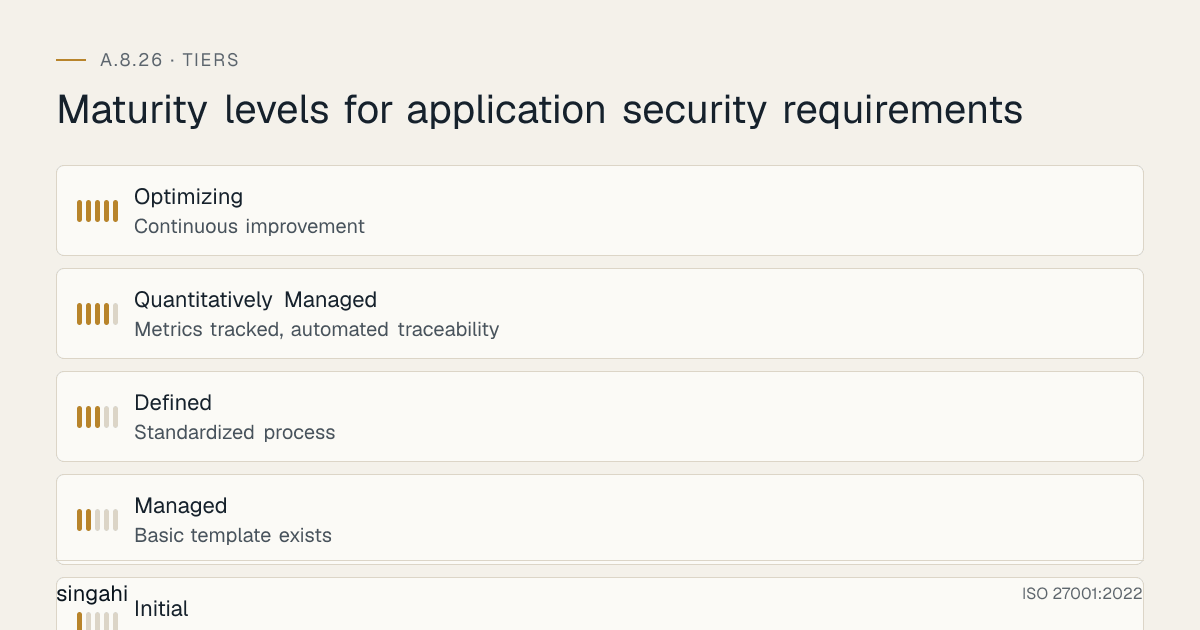
Figure · Tiers
Maturity levels for application security requirements
Phase 1: Foundation (Weeks 1–2)
Week 1: Policy and Governance
- Draft the Application Security Requirements Policy
- Define scope, roles, and approval workflow
- Identify applications in scope (inventory)
- Select requirements methodology (template-based, user stories, or hybrid)
Week 2: Templates and Standards
- Create the Security Requirements Template
- Define the Security Requirements Traceability Matrix format
- Establish the requirement classification scheme (must/should/could)
- Create the abuse case template
Deliverables: Policy draft, Requirements Template, SRTM template, Abuse Case template
Phase 2: Pilot (Weeks 3–4)
Week 3: Pilot Application
- Select one new application or enhancement for pilot
- Conduct threat modeling (e.g., STRIDE, PASTA, or ATT&CK)
- Elicit security requirements from stakeholders
- Document requirements in the template
- Map requirements to risks in the risk register
Week 4: Review and Refinement
- Conduct peer review of requirements
- Validate with development team (feasibility check)
- Validate with security team (risk coverage check)
- Refine templates based on feedback
- Obtain management approval for the requirements document
Deliverables: Pilot application security requirements, Review feedback log, Updated templates
Phase 3: Rollout (Weeks 5–8)
Week 5–6: Process Integration
- Integrate requirements process into SDLC/SDLC gates
- Integrate with project management methodology (Waterfall, Agile, DevOps)
- Train requirements analysts, product managers, and security team
- Create the Security Requirements Register (master list)
Week 7–8: Full Deployment
- Apply to all new applications and major enhancements
- Conduct quality assurance on requirements completeness
- Establish the requirement review board
- Deploy requirements traceability in ALM/SDLC tools
Deliverables: Integrated process, Training records, Requirements Register, Quality assurance report
Phase 4: Optimization (Weeks 9–12)
Week 9–10: Metrics and Monitoring
- Define and collect KPIs (see Section 13)
- Conduct first internal audit of requirements process
- Identify gaps and improvement opportunities
- Update requirements catalog based on new threats and vulnerabilities
Week 11–12: Continuous Improvement
- Update requirements templates with lessons learned
- Automate requirement traceability where possible
- Integrate with vulnerability management (new CVEs trigger new requirements)
- Update training materials
Deliverables: KPI dashboard, Internal audit report, Updated templates, Process improvement plan
Maturity Model
| Level | Description | Typical Timeline |
|---|---|---|
| 1, Initial | Ad-hoc requirements, no formal process, security added after design | Pre-implementation |
| 2, Managed | Basic template exists, used for some projects, manual review | Weeks 1–4 |
| 3, Defined | Standardized process, all new projects covered, traceability established | Weeks 5–8 |
| 4, Quantitatively Managed | Metrics tracked, automated traceability, proactive threat integration | Weeks 9–12 |
| 5, Optimizing | Continuous improvement, AI-assisted requirements generation, real-time threat feed integration | Ongoing |
Detailed Implementation Guidance
The Security Requirements Process
The security requirements process follows this lifecycle:
Identify Application → Classify Risk → Threat Model → Elicit Requirements →
Document Requirements → Review & Approve → Trace to Design → Validate in Testing →
Verify in Operation → Update Requirements
Step 1: Identify the Application
For every new application or major enhancement, document:
- Application name and purpose
- Business owner and technical owner
- Data types processed (public, internal, confidential, restricted)
- User types and volumes
- Regulatory requirements (PCI DSS, HIPAA, DPDP Act, RBI, etc.)
- Technology stack (language, framework, database, infrastructure)
- Integration points (APIs, third-party services, legacy systems)
- Deployment model (on-premise, cloud, hybrid, SaaS)
Step 2: Classify the Risk
Use the organization's risk classification scheme to determine the security rigor:
| Risk Class | Examples | Requirements Depth |
|---|---|---|
| Critical | Banking core, payment processing, government systems | Full threat modeling, 100+ requirements, formal review board |
| High | E-commerce, healthcare records, customer portals | Threat modeling, 50+ requirements, security team review |
| Medium | Internal tools, HR systems, non-public wikis | Basic threat analysis, 20+ requirements, peer review |
| Low | Public website, marketing microsites, internal dashboards | Standard requirements, 10+ requirements, self-review |
Step 3: Threat Modeling
Threat modeling is the foundation of security requirements. Use one of these methodologies:
STRIDE (Microsoft): Identify threats by category:
- Spoofing, Can an attacker impersonate a user or system?
- Tampering, Can data be modified in transit or at rest?
- Repudiation, Can actions be denied without traceability?
- Information Disclosure, Can sensitive data be exposed?
- Denial of Service, Can the system be made unavailable?
- Elevation of Privilege, Can a user gain unauthorized access?
PASTA (Process for Attack Simulation and Threat Analysis; UcedaVélez and Morana, VerSprite): Seven-stage process:
- Define objectives
- Define technical scope
- Application decomposition
- Threat analysis
- Vulnerability analysis
- Attack enumeration
- Risk and impact analysis
ATT&CK (MITRE): Map to known adversary tactics and techniques
Example Threat Model Output (STRIDE):
| Threat ID | Category | Description | Risk Rating | Requirement Derivation |
|---|---|---|---|---|
| T-001 | Spoofing | Attacker steals session token and impersonates user | High | REQ-AUTH-01: Implement MFA; REQ-SESS-01: Short session timeout; REQ-LOG-01: Log all authentication events |
| T-002 | Tampering | Man-in-the-middle modifies API request to change payment amount | Critical | REQ-CRYPT-01: TLS 1.3 for all communications; REQ-API-01: Request signing; REQ-VAL-01: Server-side validation of all inputs |
| T-003 | Information Disclosure | Database backup exposed to internet without encryption | Critical | REQ-CRYPT-02: AES-256 encryption for backups; REQ-ACC-01: Backup storage access restricted to DBA role |
Step 4: Elicit Security Requirements
Requirements come from multiple sources:
Source 1: Threat Models
- Every threat maps to one or more requirements
- Prioritize by risk rating
Source 2: Compliance and Regulatory Obligations
- PCI DSS v4.0.1: "The system shall render stored PAN unreadable using strong cryptography" (REQ-PCI-01, PCI 3.5.1)
- DPDP Act 2023: "The system shall collect only the personal data named in the notice (s.5), process it only within the consent given (s.6), and erase it when the purpose is served or consent is withdrawn (s.8(7))" (REQ-DPDP-01)
- Record keeping: "The system shall retain transaction records for the period law requires, for example five years under PMLA s.12 for reporting entities" (REQ-REC-01)
- GDPR: "The system shall support data subject access requests within one month" (REQ-GDPR-01)
Source 3: Organizational Security Policies
- Password policy: "The system shall enforce minimum password length of 12 characters" (REQ-PWD-01)
- Encryption policy: "The system shall use TLS 1.3 for all external communications" (REQ-CRYPT-03)
- Logging policy: "The system shall log all administrative actions to a centralized SIEM" (REQ-LOG-02)
Source 4: Industry Standards and Best Practices
- OWASP ASVS: "The system shall validate all input on the server side" (REQ-VAL-02)
- OWASP Top 10: "The system shall use parameterized queries to prevent SQL injection" (REQ-INJ-01)
- CWE Top 25: "The system shall sanitize all output to prevent XSS" (REQ-OUT-01)
Source 5: Business Requirements
- Availability: "The system shall maintain 99.9% uptime during business hours" (REQ-AVAIL-01)
- Performance: "The system shall process 10,000 transactions per minute" (REQ-PERF-01)
- Scalability: "The system shall scale to 1 million users without architecture change" (REQ-SCALE-01)
Source 6: Abuse Cases
- Normal use case: "User submits feedback form"
- Abuse case: "Attacker submits feedback form with SQL injection payload to extract database schema"
- Requirement: "The system shall validate and sanitize all form inputs using a whitelist approach" (REQ-VAL-03)
Step 5: Document Requirements
Each requirement must be documented with:
| Field | Description |
|---|---|
| Requirement ID | Unique identifier (e.g., REQ-AUTH-01) |
| Category | Functional / Non-functional / Compliance / Abuse Case |
| Priority | Must / Should / Could (MoSCoW) |
| Risk Reference | Links to threat ID or risk register entry |
| Description | Clear, testable, unambiguous statement |
| Rationale | Why this requirement exists (business justification) |
| Source | Threat model, compliance, policy, standard, etc. |
| Verification Method | Testing, review, demonstration, analysis |
| Acceptance Criteria | Specific, measurable criteria for "done" |
| Owner | Role responsible for implementation |
| Target Date | When the requirement must be satisfied |
| Status | Draft / Approved / Implemented / Verified / Rejected |
Example Requirement Documentation:
Requirement ID: REQ-AUTH-01
Category: Functional Security
Priority: Must
Risk Reference: T-001 (Spoofing), Risk-045 (Unauthorized account access)
Description: The system shall require multi-factor authentication (MFA) for all
administrative users accessing the administration console. MFA shall use TOTP
or hardware token-based authentication.
Rationale: Administrative accounts are high-value targets for attackers,
and stolen passwords are a leading way in (see the Verizon DBIR).
Source: STRIDE threat model, Organizational Authentication Policy v2.3
Verification Method: Functional testing (demonstrate MFA prompt),
Configuration review (verify MFA enforced in policy)
Acceptance Criteria:
  - All admin login attempts require MFA
  - SMS-based MFA is not accepted (NIST SP 800-63B treats SMS as a restricted authenticator)
  - MFA bypass is not possible via API manipulation
  - Failed MFA attempts are logged and alerted
Owner: Development Team Lead
Target Date: 2026-03-15
Status: Approved
Step 6: Review and Approve Requirements
Establish a Security Requirements Review Board with:
- Security Architect (reviews threat coverage)
- Development Lead (reviews feasibility)
- Business Owner (reviews business alignment)
- Compliance Officer (reviews regulatory coverage)
- QA Lead (reviews testability)
Review criteria:
- Are all threats from the threat model addressed?
- Are requirements clear, testable, and unambiguous?
- Are priorities aligned with risk ratings?
- Are requirements feasible within project constraints?
- Are acceptance criteria specific and measurable?
- Are regulatory requirements complete?
Step 7: Trace Requirements to Design, Implementation, and Testing
Create a Security Requirements Traceability Matrix (SRTM):
| Requirement ID | Threat ID | Design Element | Code Module | Test Case | Status |
|---|---|---|---|---|---|
| REQ-AUTH-01 | T-001 | AdminAuthService | auth/admin.py | TC-AUTH-01 | Pass |
| REQ-CRYPT-01 | T-002 | APIGateway | api/gateway.js | TC-CRYPT-01 | Pass |
| REQ-VAL-03 | T-005 | InputValidator | validators/forms.py | TC-VAL-03 | Pass |
Tools for traceability:
- Jira + Xray (test management)
- Azure DevOps (work item linking)
- GitHub + CodeQL (code-to-requirement mapping)
- DOORS (enterprise requirements management)
- Jama Connect (requirements + test management)
- Spreadsheet (small organizations)
Step 8: Validate Requirements in Testing
Security testing must validate that requirements are met:
| Requirement Type | Validation Method |
|---|---|
| Authentication requirements | Penetration testing, authentication flow testing |
| Authorization requirements | Access control testing, role-based testing |
| Input validation requirements | Fuzzing, injection testing, boundary testing |
| Encryption requirements | Cryptographic review, traffic analysis |
| Logging requirements | Log review, SIEM alert testing |
| Availability requirements | Load testing, DDoS simulation |
Step 9: Verify in Operation
After deployment, verify requirements remain satisfied:
- Monitor security metrics (failed logins, input validation errors, encryption compliance)
- Conduct periodic security assessments
- Review requirements when new threats emerge
Step 10: Update Requirements
Security requirements are living documents:
- Update when new CVEs affect the technology stack
- Update when regulations change
- Update when business requirements change
- Update when new threats are identified
- Review annually at minimum
Requirements for Different Application Types
Web Applications
Key security requirement areas:
- Authentication: MFA, password policy, session management, OAuth/OIDC
- Authorization: RBAC, ABAC, least privilege
- Input Validation: Whitelist validation, parameterized queries, output encoding
- Output Encoding: Context-aware encoding (HTML, JavaScript, CSS, URL)
- Session Management: Secure cookies, session timeout, session fixation prevention
- Cryptography: TLS 1.3, certificate pinning, key management
- Error Handling: Generic error messages, no stack traces in production
- Logging: Security event logging, tamper-evident logs
- API Security: Rate limiting, authentication, input validation, CORS
Mobile Applications
Additional requirements:
- Local Storage: Encrypted storage, no sensitive data in device backups
- Code Obfuscation: Anti-tampering, root/jailbreak detection
- Network Security: Certificate pinning, no cleartext traffic
- Biometric Authentication: Fingerprint/face unlock integration
- App Distribution: Code signing, app store security review
- Clipboard Security: Prevent sensitive data in clipboard
- Screenshot Protection: Block screenshots of sensitive screens
- Keyboard Security: Disable custom keyboards on sensitive fields
Cloud-Native Applications
Additional requirements:
- Identity and Access Management: IAM roles, service accounts, least privilege
- Container Security: Image scanning, non-root execution, read-only filesystems
- Orchestration Security: RBAC in Kubernetes, Pod Security Standards (admission control), network policies
- Secrets Management: No hardcoded secrets, vault integration, rotation
- Serverless Security: Function-level permissions, cold start protection, event injection prevention
- Infrastructure as Code: Security scanning of Terraform/CloudFormation templates
- Observability: Distributed tracing, security metrics in cloud monitoring
AI/ML Applications
Additional requirements (see also the OWASP Top 10 for LLM Applications and the NIST AI Risk Management Framework):
- Model Security: Adversarial strength, model poisoning prevention, model extraction protection
- Data Security: Training data privacy, synthetic data generation, data leakage prevention
- Inference Security: Prompt injection prevention (LLMs), input sanitization, output filtering
- Explainability: Security-relevant decision explanations, bias detection
- MLOps Security: Secure pipelines, model versioning, access control to model artifacts
- LLM-Specific: RAG security, vector DB access control, hallucination mitigation
API-First Applications
Additional requirements:
- Authentication: OAuth 2.0, JWT, API keys, mTLS
- Authorization: Scope-based access, fine-grained permissions
- Rate Limiting: Tiered limits, burst handling, DDoS protection
- Input Validation: JSON Schema validation, content-type enforcement
- Versioning: Security considerations in API versioning strategy
- Documentation: Security parameters in OpenAPI specs, no exposed internal endpoints
- Error Handling: Standardized error responses without information leakage
Transactional and Payment Applications (27002 8.26)
For applications that exchange transactions with partners or take orders and payments, add these requirement packs:
| ID | Requirement | 27002 source |
|---|---|---|
| REQ-TXN-01 | Every payment or order request carries an idempotency key; the server rejects or safely replays duplicates so a retry never causes a double debit | Ordering (c) |
| REQ-TXN-02 | Reconcile transactions with the bank, payment gateway or UPI switch daily; investigate breaks | Ordering (c) |
| REQ-TXN-03 | Maker-checker (dual approval) for refunds, limit changes, beneficiary additions and bulk payouts above a set limit | General (k); Transactional (c) |
| REQ-TXN-04 | Requests and callbacks between partners are signed (or HMAC-protected) and verified; reject unsigned or replayed messages | Transactional (b), (d) |
| REQ-TXN-05 | A tamper-evident audit trail records who initiated, approved and signed each transaction | General (n); Transactional (c), (d) |
| REQ-TXN-06 | Transaction and card/UPI details are stored only on internal systems, never on internet-facing storage; PAN is tokenised or encrypted | Ordering (d) |
| REQ-TXN-07 | Verify payment information to a level that matches the risk (for example additional factor of authentication for card-not-present) | Ordering (b) |
| REQ-TXN-08 | Define how long transaction details stay confidential and how long they are retained | Transactional (f) |
India Fintech Requirement Set
- RBI Master Direction on Digital Payment Security Controls (2021) (it applies to banks, small finance banks, payments banks and credit-card-issuing NBFCs; fintechs working with them usually inherit it through contracts): set requirements for device binding, session timeouts, transaction limits set by the customer, real-time alerts, and secure application design for mobile and internet banking.
- Additional factor of authentication: follow the current RBI directions on authentication for digital payment transactions that apply to you.
- UPI and card payments: idempotency and reconciliation (REQ-TXN-01, 02); follow NPCI and card-network rules; card-on-file tokenisation instead of storing card numbers.
- CERT-In: log the events needed to meet the 6-hour incident reporting rule, and keep ICT logs for 180 days in India.
Free-Text Fields (27002 8.26(m))
Comment boxes and notes fields collect data nobody planned for: Aadhaar numbers, PAN, health details, card numbers. Requirements:
- REQ-FT-01: Validate free-text input and block or mask patterns such as Aadhaar (12 digits), PAN (AAAAA9999A) and card numbers (Luhn check).
- REQ-FT-02: Show a hint telling users not to enter personal or financial details.
- REQ-FT-03: Include free-text fields in DLP scanning (A.8.12) and in data-retention rules.
- REQ-FT-04: Limit length and character set where the business allows.
Acquired Applications (COTS and SaaS)
27002 8.26 applies when you acquire applications too. Before buying:
- send a security questionnaire built from your requirement catalogue;
- ask for an ISO 27001 certificate (check the scope) or a SOC 2 Type 2 report;
- confirm data location and residency, encryption, SSO and MFA support, logging and log export, and backup and exit terms;
- record which requirements the product meets, which you will meet by configuration, and which gaps you accept;
- put the key requirements into the contract (A.5.20).
Agile and DevOps Integration
In Agile environments, security requirements must be lightweight but effective:
Security User Stories:
As a [role], I want [security capability], so that [security benefit]

Example: As a customer, I want my payment card details to be encrypted
using AES-256, so that my financial information is protected even if
the database is compromised.
Security Definition of Done:
- All high-risk threats are addressed by implemented requirements
- Security requirements are traced to test cases
- Security tests pass in CI/CD pipeline
- SAST/DAST scan results have no critical/high findings
- Security review is complete in sprint review
Security Spikes:
- Dedicate sprints to security architecture when needed
- Use spikes for threat modeling, security architecture review, or tool evaluation
Security Champions:
- Embed security champions in each development team
- Champions review requirements and participate in threat modeling
- Champions bridge security team and development team
Tools, Technologies, and Solutions
Requirements Management Tools
| Tool | Type | Best For | Pricing model |
|---|---|---|---|
| Jama Connect | Requirements Management | Enterprise, regulated industries | Enterprise pricing |
| IBM DOORS | Requirements Management | Aerospace, defense, critical systems | Enterprise pricing |
| Visure | Requirements Management | Safety-critical systems | Enterprise pricing |
| Spreadsheet | Lightweight | Small organizations, 1-2 applications | Free |
Threat Modeling Tools
| Tool | Methodology | Best For | Pricing model |
|---|---|---|---|
| Microsoft Threat Modeling Tool | STRIDE | Windows-centric, free option | Free |
| OWASP Threat Dragon | STRIDE, LINDDUN | Open source, web-based | Free |
| IriusRisk | Multiple | Enterprise, scalable | Enterprise pricing |
| ThreatModeler | Multiple | Enterprise, CI/CD integration | Enterprise pricing |
| pytm | Python-based | DevOps, automation | Free (open source) |
| Tutamantic | STRIDE | Cloud-native applications | Freemium |
SAST/DAST Tools (for Requirements Validation)
| Tool | Type | Best For | Pricing model |
|---|---|---|---|
| SonarQube | SAST | Code quality + security, multi-language | Free (Community) / Enterprise |
| Checkmarx | SAST | Enterprise, deep analysis | Enterprise pricing |
| Fortify | SAST | Enterprise, compliance reporting | Enterprise pricing |
| OWASP ZAP | DAST | Free, web applications | Free |
Requirements Catalogs and Standards
| Resource | Description | URL |
|---|---|---|
| OWASP ASVS | Application Security Verification Standard | https://owasp.org/www-project-application-security-verification-standard/ |
| OWASP Top 10 | Most critical web application security risks | https://owasp.org/www-project-top-ten/ |
| CWE Top 25 | Most dangerous software weaknesses | https://cwe.mitre.org/top25/ |
| NIST SP 800-53 | Security and privacy controls | https://nvd.nist.gov/800-53 |
| BSIMM | Software security maturity model | https://www.bsimm.com/ |
| SAMM | Software assurance maturity model | https://owasp.org/www-project-samm/ |
| Microsoft SDL | Security Development Lifecycle | https://www.microsoft.com/en-us/securityengineering/sdl |
| PCI DSS | Payment card security requirements | https://www.pcisecuritystandards.org/ |
| GDPR Art 25/32 | Data protection by design | https://gdpr.eu/ |
| DPDP Act 2023 | Indian data protection | https://www.meity.gov.in/ |
Policy and Procedure Templates
Application Security Requirements Policy (Template)
Template
Application Security Requirements Policy
Document ID: POL-APP-SEC-001 Version: 1.0 Effective Date: [DATE] Owner: CISO / Security Architect Approved By: [Name], [Title] Review Cycle: Annual
1. Purpose
This policy establishes the requirement for defining, documenting, and approving security requirements for all applications before development or acquisition begins.
2. Scope
This policy applies to:
- All new applications developed, acquired, or deployed by [Organization]
- Major enhancements to existing applications that change security posture
- Application integrations and APIs
- Cloud-native, mobile, and AI/ML applications
3. Policy Statements
3.1 Security Requirements Process
- All applications in scope must have documented security requirements before development or acquisition begins.
- Security requirements must be derived from threat models, compliance obligations, organizational policies, and industry standards.
- Requirements must be reviewed and approved by the Security Requirements Review Board before development proceeds.
3.2 Requirement Content
- Each requirement must have a unique identifier, description, rationale, priority, and acceptance criteria.
- Requirements must be classified as functional, non-functional, compliance, or abuse-case derived.
- Requirements must be traceable to design elements, code modules, and test cases.
3.3 Threat Modeling
- Critical and high-risk applications must undergo formal threat modeling.
- Threat models must be conducted using an approved methodology (STRIDE, PASTA, or ATT&CK).
- Threat model outputs must be reviewed and approved by the Security Architect.
3.4 Compliance Integration
- Regulatory requirements (PCI DSS, DPDP Act, RBI, GDPR) must be explicitly mapped to security requirements.
- Compliance requirements must be verified by the Compliance Officer before approval.
3.5 Agile and DevOps
- In Agile environments, security requirements must be captured as security user stories or security acceptance criteria.
- Security requirements must be included in the Definition of Done.
- Security spikes must be scheduled for architecture and threat modeling activities.
3.6 Maintenance and Review
- Security requirements must be reviewed and updated when:
- New threats are identified
- Regulations change
- Technology stack changes
- New vulnerabilities affect the application (CVEs)
- Requirements must be reviewed at least annually.
4. Roles and Responsibilities
- CISO: Owns the policy, ensures compliance, reports to board
- Security Architect: Conducts threat modeling, reviews requirement coverage
- Development Lead: Reviews feasibility, implements requirements
- Business Owner: Prioritizes requirements, provides business justification
- Compliance Officer: Reviews regulatory coverage
- QA Lead: Reviews testability, designs security tests
5. Exceptions
Exceptions to this policy require written approval from the CISO with:
- Risk acceptance documentation
- Compensating controls
- Review date for re-assessment
6. Enforcement
Non-compliance with this policy may result in:
- Project delay until requirements are defined
- Security finding in audit
- Disciplinary action for repeated violations
7. Related Documents
- Risk Management Policy (POL-RISK-001)
- Secure Development Life Cycle Policy (POL-SDLC-001)
- Information Security Policy (POL-INFO-001)
- Application Security Testing Policy (POL-APP-TEST-001)
8. Revision History
| Version | Date | Author | Changes |
|---|---|---|---|
| 1.0 | [DATE] | [Name] | Initial version |
Security Requirements Review Procedure (Template)
Template
Security Requirements Review Procedure
Document ID: PROC-APP-SEC-001 Version: 1.0 Effective Date: [DATE] Owner: Security Architect
1. Purpose
To define the procedure for reviewing and approving application security requirements before development or acquisition begins.
2. Scope
All applications classified as medium, high, or critical risk.
3. Procedure Steps
Step 1: Requirements Submission (Day 1)
- Requirements Analyst submits the Security Requirements Document (SRD) and Security Requirements Traceability Matrix (SRTM) to the Review Board.
- Submission must include threat model, risk assessment, and compliance mapping.
Step 2: Pre-Review (Days 2-3)
- Security Architect reviews threat coverage and requirement completeness.
- Development Lead reviews feasibility and technical constraints.
- Compliance Officer reviews regulatory coverage.
- Each reviewer submits feedback via the Review Feedback Form.
Step 3: Review Meeting (Day 4)
- Review Board convenes (60-90 minutes).
- Requirements Analyst presents the requirements.
- Reviewers raise questions and concerns.
- Decisions recorded in the Review Meeting Minutes.
Step 4: Approval or Revision (Day 5)
- If approved: CISO or delegate signs the Approval Form.
- If revision required: Requirements Analyst updates requirements within 5 business days and resubmits for re-review.
- If rejected: Project is delayed until requirements are satisfactory.
Step 5: Communication (Day 6)
- Approved requirements are communicated to development team, QA, and security operations.
- Requirements are added to the Security Requirements Register.
- Traceability is established in the ALM/SDLC tool.
4. Review Criteria Checklist
- All threats from threat model are addressed by requirements
- All regulatory requirements are mapped to requirements
- All organizational policy requirements are included
- Requirements are clear, unambiguous, and testable
- Priorities align with risk ratings
- Acceptance criteria are specific and measurable
- Feasibility is confirmed by development lead
- Traceability to design and test is established
- Abuse cases are documented and addressed
- Timeline is realistic and achievable
5. Roles
- Chair: Security Architect
- Members: Development Lead, Business Owner, Compliance Officer, QA Lead
- Secretary: Requirements Analyst (records minutes)
- Approver: CISO or delegate
6. Records
- Security Requirements Document (SRD)
- Security Requirements Traceability Matrix (SRTM)
- Review Meeting Minutes
- Review Feedback Form
- Approval Form
- Security Requirements Register entry
Risk Assessment and Treatment
Risk Assessment for Security Requirements
| Risk ID | Risk Description | Likelihood | Impact | Risk Level | Mitigation via Requirements |
|---|---|---|---|---|---|
| R-001 | Security requirements are incomplete, leading to vulnerabilities in production | Medium | High | High | Mandatory threat modeling for critical/high apps; standardized template; review board approval |
| R-002 | Requirements are not feasible, causing development delays or bypass | Medium | Medium | Medium | Feasibility review by development lead; phased implementation; priority classification |
| R-003 | Requirements become outdated due to new threats or regulations | High | Medium | High | Annual review; CVE integration; regulatory monitoring; continuous improvement process |
| R-004 | Requirements are not traced to testing, leading to unverified security | Medium | High | High | Mandatory SRTM; automated traceability; security testing in CI/CD |
| R-005 | Agile teams skip requirements in favor of velocity | High | Medium | High | Security Definition of Done; security user stories; champion program; management commitment |
| R-006 | Third-party components lack security requirements | Medium | High | High | Vendor security requirements; SBoM security review; third-party risk assessment |
| R-007 | Business pressure overrides security requirements | High | High | Critical | Executive sponsorship; risk acceptance process; security gates in SDLC; board reporting |
| R-008 | Requirements are not communicated to operations team | Medium | Medium | Medium | Handover documentation; security runbook; operations team involvement in requirements review |
| R-009 | AI/ML applications have unique requirements that are missed | Medium | High | High | Specialized AI/ML security requirements; adversarial testing requirements; model governance |
| R-010 | Cloud-native applications have requirements gaps (container, serverless) | Medium | High | High | Cloud security requirements catalog; container security requirements; serverless security checklist |
Risk Treatment Options
| Risk | Treatment | Residual Risk |
|---|---|---|
| R-001 | Mandatory process + tools + training | Low |
| R-002 | Feasibility review + phased approach | Low |
| R-003 | Annual review + automated monitoring | Low |
| R-004 | SRTM + CI/CD integration | Low |
| R-005 | Culture change + metrics + incentives | Medium |
| R-006 | Vendor management + SBoM + contract terms | Medium |
| R-007 | Executive commitment + governance | Low |
| R-008 | Standard handover + documentation | Low |
| R-009 | Specialized training + AI security framework | Low |
| R-010 | Cloud security expertise + requirements catalog | Low |
Audit and Compliance Checklist
Pre-Audit Self-Assessment
| # | Question | Evidence | Status |
|---|---|---|---|
| 1 | Is there a documented Application Security Requirements Policy? | Policy document | ☐ |
| 2 | Is the policy approved by senior management? | Approval record | ☐ |
| 3 | Is there a defined process for eliciting security requirements? | Procedure document | ☐ |
| 4 | Are security requirements defined before development begins? | Requirements register + project records | ☐ |
| 5 | Is threat modeling conducted for critical/high-risk applications? | Threat model documents | ☐ |
| 6 | Are regulatory requirements mapped to security requirements? | Compliance mapping matrix | ☐ |
| 7 | Are requirements reviewed and approved by a review board? | Review meeting minutes + approval forms | ☐ |
| 8 | Is a Security Requirements Traceability Matrix maintained? | SRTM document / tool records | ☐ |
| 9 | Are requirements traced to design, code, and test cases? | ALM tool records / traceability matrix | ☐ |
| 10 | Are requirements updated when new threats or regulations emerge? | Update records / version history | ☐ |
| 11 | Are Agile teams incorporating security requirements? | Security user stories / sprint records | ☐ |
| 12 | Are abuse cases documented for critical applications? | Abuse case documents | ☐ |
| 13 | Is there a Security Requirements Register? | Register document / database | ☐ |
| 14 | Are requirements reviewed at least annually? | Annual review records | ☐ |
| 15 | Are third-party applications subject to security requirements? | Vendor requirements / contract terms | ☐ |
| 16 | Are AI/ML applications covered by security requirements? | AI/ML requirements documents | ☐ |
| 17 | Are cloud-native applications covered by security requirements? | Cloud security requirements | ☐ |
| 18 | Are requirements tested and validated before deployment? | Test records / security test reports | ☐ |
| 19 | Are requirements communicated to operations team? | Handover documentation | ☐ |
| 20 | Is there evidence of continuous improvement? | Improvement records / metrics | ☐ |
| 21 | Are security requirements included in project management? | Project plans / SDLC records | ☐ |
| 22 | Are requirements aligned with risk assessment findings? | Risk register + requirement mapping | ☐ |
| 23 | Are security requirements trained to relevant staff? | Training records | ☐ |
| 24 | Is there a requirement classification scheme (must/should/could)? | Template / classification records | ☐ |
| 25 | Are acceptance criteria defined for each requirement? | Requirements document | ☐ |
| 26 | Are security requirements considered in change management? | Change records / impact assessments | ☐ |
| 27 | Are exceptions to requirements policy documented and approved? | Exception records | ☐ |
| 28 | Are requirements documented in a consistent format? | Template adherence check | ☐ |
| 29 | Are legacy applications subject to security requirements for enhancements? | Enhancement records | ☐ |
| 30 | Are business stakeholders involved in requirements definition? | Stakeholder sign-off records | ☐ |
Auditor Interview Questions
Be prepared to answer:
- "Show me the security requirements for [specific application]."
- "How do you ensure security is considered before development begins?"
- "Who is responsible for defining security requirements?"
- "How do you trace security requirements through the development lifecycle?"
- "What threat modeling methodology do you use?"
- "How do you handle security requirements in Agile development?"
- "How do you ensure requirements remain current with new threats?"
- "Show me evidence that requirements were reviewed and approved."
- "How do you handle third-party application security requirements?"
- "What happens when security requirements conflict with business deadlines?"
Common Audit Findings and How to Avoid Them
| Finding | Cause | Prevention |
|---|---|---|
| "No security requirements documented for new application" | Process not followed | Enforce requirement gates in SDLC; checklists at project kickoff |
| "Requirements not reviewed before development" | Time pressure | Review board with mandatory approval; no development without sign-off |
| "Traceability not maintained" | Manual process | Automate traceability in ALM tool; SRTM as deliverable |
| "Outdated requirements (2+ years old)" | No review cycle | Annual review calendar; automated reminders |
| "Agile projects lack security requirements" | Agile team resistance | Security champion; Definition of Done; security user stories |
| "Third-party apps lack security requirements" | Procurement gap | Vendor security requirements in RFP; contract terms; SBoM review |
| "No threat modeling for critical app" | Skill gap or oversight | Mandatory threat modeling checklist; training; tool support |
| "Regulatory requirements not mapped" | Compliance gap | Compliance mapping template; compliance officer review |
| "Abuse cases not documented" | Process gap | Abuse case template; mandatory for critical apps |
| "Requirements not tested" | Testing gap | Security test plan linked to requirements; SRTM validation |
Metrics and KPIs
Figure · Measures
The measures that show A.8.26 is working
- Requirements Coverage100%Monthly
- Requirements Review Rate100%Monthly
- Review Cycle Time< 5 daysPer project
- Requirements Completeness> 95%Per review
- Threat Model Coverage100%Quarterly
Process Metrics
| Metric | Formula | Target | Frequency |
|---|---|---|---|
| Requirements Coverage | (# of apps with security requirements / # of new apps) × 100 | 100% | Monthly |
| Requirements Review Rate | (# of apps with approved requirements / # of apps with requirements) × 100 | 100% | Monthly |
| Review Cycle Time | Average days from submission to approval | < 5 days | Per project |
| Requirements Completeness | (# of required fields complete / # of required fields) × 100 | > 95% | Per review |
| Threat Model Coverage | (# of critical/high apps with threat models / # of critical/high apps) × 100 | 100% | Quarterly |
| Traceability Coverage | (# of requirements traced to test / # of total requirements) × 100 | > 95% | Monthly |
| Requirements Update Rate | (# of requirements updated in period / # of total requirements) × 100 | > 20% annually | Quarterly |
| Exception Rate | (# of exceptions granted / # of apps) × 100 | < 5% | Quarterly |
| Agile Security Story Rate | (# of security user stories / # of total user stories) × 100 | > 15% | Per sprint |
| Training Completion Rate | (# of trained staff / # of required staff) × 100 | 100% | Quarterly |
Outcome Metrics
| Metric | Formula | Target | Frequency |
|---|---|---|---|
| Vulnerability Density | Critical/high vulnerabilities per 1000 lines of code | < 0.5 | Per release |
| Security Test Pass Rate | (# of security tests passed / # of security tests) × 100 | > 95% | Per release |
| Requirements-Verified Rate | (# of requirements verified in testing / # of requirements) × 100 | > 90% | Per release |
| Production Security Defects | Security defects found in production per release | < 2 | Per release |
| Time to Remediate | Average days from vulnerability discovery to fix | < 30 days | Monthly |
| Compliance Audit Findings | Number of findings related to requirements | 0 | Per audit |
| Requirements-Driven Prevention | Estimated vulnerabilities prevented by requirements | Track qualitatively | Quarterly |
| Cost of Security Rework | Cost of fixing security issues after requirements phase | Decreasing trend | Quarterly |
| Requirement Stability | (# of requirements changed after approval / # of approved requirements) × 100 | < 10% | Per project |
| Stakeholder Satisfaction | Survey score from development and business teams | > 4.0/5.0 | Quarterly |
Dashboard Sample
┌─────────────────────────────────────────────────────────────────────┐
│           APPLICATION SECURITY REQUIREMENTS DASHBOARD               │
│                    [Organization] — [Month Year]                      │
├─────────────────────────────────────────────────────────────────────┤
│  REQUIREMENTS COVERAGE: 98%  ████████████████████░░  Target: 100%  │
│  REVIEW RATE: 100%         ████████████████████████  Target: 100%  │
│  TRACEABILITY: 92%         ██████████████████░░░░░░  Target: 95%   │
│  THREAT MODEL COVERAGE: 100% ██████████████████████  Target: 100%  │
│  VULNERABILITY DENSITY: 0.3  █░░░░░░░░░░░░░░░░░░░  Target: <0.5  │
│  SECURITY TEST PASS: 97%   ███████████████████░░░  Target: 95%  │
│  PROD DEFECTS: 1           ░░░░░░░░░░░░░░░░░░░░░░  Target: <2    │
│  REVIEW CYCLE TIME: 4.2 days ████████████████████░  Target: <5    │
│  EXCEPTION RATE: 2%        █░░░░░░░░░░░░░░░░░░░░░  Target: <5%   │
└─────────────────────────────────────────────────────────────────────┘
Common Pitfalls and How to Avoid Them
Pitfall 1: "Security Requirements Are Too expensive"
Symptom: Management pushes back on requirements process as a cost center.
Reality: A flaw designed out at the requirements stage costs far less than one found in production, when it may need a redesign.
Solution:
- Show cost comparison: requirements phase vs. production vulnerability remediation
- Show that traceability makes audits and customer security reviews faster
- Start with critical applications only, expand gradually
Pitfall 2: "Agile Teams Can't Do Requirements"
Symptom: Agile teams reject formal requirements as "waterfall."
Reality: Agile requires lightweight requirements, not no requirements. Security user stories and acceptance criteria are Agile-native.
Solution:
- Use security user stories, not formal documents
- Embed security in Definition of Done
- Use security spikes for architecture
- Show that security requirements reduce sprint firefighting
Pitfall 3: "Copy-Paste Requirements from Templates"
Symptom: All applications have identical requirements, regardless of risk or technology.
Reality: Templates are starting points, not final answers. Requirements must be tailored to each application's threat model and context.
Solution:
- Template provides framework; analysts fill in specifics
- Threat modeling drives requirement selection
- Review board checks for appropriateness
- Update templates with organization-specific patterns
Pitfall 4: "Requirements Are Written and Forgotten"
Symptom: Requirements document is created but never referenced again.
Reality: Requirements must be living documents, traced through the entire lifecycle and updated when context changes.
Solution:
- Automate traceability in ALM tools
- Include requirements in sprint reviews
- Review requirements at major milestones
- Trigger updates from CVE feeds and threat intelligence
Pitfall 5: "No One Reviews Requirements"
Symptom: Requirements are written but never reviewed, leading to gaps.
Reality: Review is where quality happens. Multiple perspectives catch what one person misses.
Solution:
- Establish a review board with mandatory attendance
- Use a structured review checklist
- Record review feedback and resolution
- Track review cycle time as a KPI
Pitfall 6: "Third-Party Apps Are Excluded"
Symptom: COTS and SaaS applications have no security requirements.
Reality: Third-party applications are often the weakest link. You must define requirements for vendor selection and configuration.
Solution:
- Include vendor security requirements in RFPs
- Require vendor security documentation (SOC 2, ISO 27001)
- Define configuration security requirements
- Include security requirements in contract SLAs
Pitfall 7: "Business Overrules Security"
Symptom: Security requirements are bypassed to meet deadlines.
Reality: This creates risk that may materialize as breach, compliance failure, or reputational damage.
Solution:
- Risk acceptance process with executive sign-off
- Security gates in SDLC that cannot be bypassed without CISO approval
- Board-level reporting on security requirements adherence
- Metrics that make bypasses visible
Pitfall 8: "AI/ML Security Is Different"
Symptom: AI/ML applications have no security requirements because "AI is new."
Reality: AI/ML applications have additional security requirements (adversarial strength, model security, data privacy) but they still need requirements.
Solution:
- Use the AI/ML requirements in the application-types section above
- Include adversarial testing requirements
- Define model governance and explainability requirements
- Train teams on AI/ML security (OWASP Top 10 for LLM Applications, NIST AI RMF, ISO/IEC 42001)
Illustrative Scenarios
Hypothetical scenarios: composite examples for guidance, not real organisations or verified outcomes.
Scenario 1: Payment Gateway Without Transaction Requirements
Situation. A small Indian payment gateway's API retries timed-out requests from merchants. There is no idempotency requirement, so during a network slowdown some customers are debited twice. Refunds can be issued by any support agent with no approval limit.
What the requirements process adds.
- A STRIDE threat model of the payment flow identifies duplication, tampering with callbacks, and refund abuse.
- Requirements REQ-TXN-01 to REQ-TXN-05 are added: idempotency keys, daily reconciliation, signed callbacks, maker-checker for refunds above a limit, and an audit trail.
- Each requirement gets a test case in the SRTM; the pipeline runs the duplicate-request test on every build.
- The free-text "notes" field on refunds gets the PII guard (REQ-FT-01).
Lesson. 27002's ordering and payment points (loss or duplication, dual approval, non-repudiation) are exactly where payment products fail.
Scenario 2: Bank Enhancement With No Documented Requirements
Situation. A bank is moving parts of a legacy core system to microservices. The original system has no recorded security requirements, and new features are being added without them.
What the requirements process adds.
- A requirements policy and template, with a review board (security architect, development lead, compliance, business owner).
- Threat modelling of the new services and their APIs; requirements for authentication, authorisation between services, encryption, logging, transaction integrity and maker-checker.
- Requirements written only for new and changed components, not retroactively for all legacy code.
- Traceability from each requirement to design, code and test, and automated security tests in CI.
Lesson. Start with what is changing. Requirements for every enhancement, traced to tests, give auditors and regulators a clear trail.
Multi-Framework Mapping
Figure · Matrix
Comparison: Level 1 to Level 3
OWASP ASVS Mapping
| ASVS Level | Use for | How to use it with A.8.26 |
|---|---|---|
| Level 1 | All applications | Baseline catalogue of testable requirements |
| Level 2 | Applications handling sensitive or personal data (most business apps) | Default requirement set |
| Level 3 | Critical applications (payments, health, high-value transactions) | Full set, with deeper verification |
ASVS chapters (authentication, session management, access control, validation, cryptography, error handling and logging, data protection, communications, business logic, files, APIs, configuration) give ready-written, testable requirements. ASVS 5.0 (May 2025) reorganised the chapters; reference the version you use in your requirement IDs.
PCI DSS v4.0.1 Mapping
| PCI DSS Requirement | Security Requirement Focus |
|---|---|
| 6.2.1 | Bespoke and custom software developed securely, based on industry standards |
| 6.2.4 | Engineering techniques prevent common attacks (injection, XSS, access-control flaws, and others) |
| 6.3.2 | Inventory of bespoke and third-party software components |
| 6.4.1–6.4.3 | Public-facing web applications protected; payment-page scripts authorised and integrity-checked |
DPDP Act 2023: Requirements to Build In
| DPDP Act Section | Requirement to build in |
|---|---|
| Section 5 (notice) | Collect only what the notice describes; show the notice in the app |
| Section 6 (consent) | Record consent, its scope and withdrawal; stop processing on withdrawal |
| Section 8(5) | Reasonable security safeguards for systems that process personal data |
| Section 8(6) | Detect personal data breaches and support intimation to the Board and affected people |
| Section 8(7) | Erase data when the purpose is served or consent is withdrawn, unless law requires retention |
NIST SP 800-53 Rev 5 Mapping
| NIST Control | Description | A.8.26 Mapping |
|---|---|---|
| SA-4 | Acquisition process | Security requirements in acquisition contracts |
| SA-8 | Security and privacy engineering principles | Requirements embody design principles |
| SA-15 | Development process, standards and tools | Requirements set the development standards |
| SA-17 | Developer security and privacy architecture and design | Requirements drive the design |
| RA-3 | Risk assessment | Requirements derived from risk assessment |
COBIT 2019 Mapping
| COBIT Practice | Description | A.8.26 Mapping |
|---|---|---|
| APO12.02 | Analyse risk | Requirements derived from risk |
| BAI02.01 | Define and maintain business functional and technical requirements | Security requirements are part of requirements definition |
| BAI03.01 | Design high-level solutions | Security requirements shape the solution design |
| BAI03.03 | Develop solution components | Requirements guide development |
CIS Controls v8 Mapping
| CIS Safeguard | Implementation Group | A.8.26 Mapping |
|---|---|---|
| 16.1 Secure application development process | IG2 | Requirements are part of the process |
| 16.10 Secure design principles | IG2 | Requirements apply the principles |
| 6.x Access control management | IG1 | Access requirements (8.26(c)) |
| 8.x Audit log management | IG1 | Logging requirements (8.26(n), (o)) |
Regulatory and Industry Context
India
| Regulation | Requirement Relevance | Key Mandates |
|---|---|---|
| DPDP Act 2023 | Critical | Section 8(5) (Reasonable security safeguards); Section 8(4) (Appropriate technical and organisational measures) |
| IT Act 2000 (as amended) | High | Section 43A: Compensation for failure to protect data; Section 66C: Identity theft |
| RBI | Critical for financial services | Cyber Security Framework in Banks (2016); MD Digital Payment Security Controls (2021); MD IT Governance, Risk, Controls and Assurance (2023) |
| PMLA 2002 | Reporting entities | Section 12: keep transaction records for five years |
| SEBI Regulations | Critical for capital markets | Cybersecurity and cyber resilience framework |
| IRDAI Guidelines | Critical for insurance | Information and cybersecurity guidelines |
| MeitY CERT-In | High | Incident reporting; security best practices |
International
| Regulation | Relevance | Key Mandates |
|---|---|---|
| GDPR (EU) | High for EU data | Art 25: Data protection by design and by default; Art 32: Security of processing |
| PCI DSS v4.0.1 | Critical for card data | Req 6: Develop and maintain secure systems and software |
| HIPAA (US) | Critical for health data | Security Rule: Administrative, physical, technical safeguards |
| SOX (US) | High for public companies | IT general controls; application security |
| CCPA/CPRA (California) | High for CA residents | Security requirements for personal information |
| LGPD (Brazil) | High for Brazil data | Security, technical, and administrative measures |
| PDPA (Singapore) | High for Singapore data | Protection obligations; security measures |
Roles and Responsibilities (RACI)
RACI Matrix for Application Security Requirements
| Activity | CISO | Security Architect | Dev Lead | Business Owner | Compliance Officer | QA Lead | Requirements Analyst |
|---|---|---|---|---|---|---|---|
| Define requirements policy | A | R | C | C | C | I | I |
| Select threat model methodology | A | R | C | I | I | I | C |
| Conduct threat modeling | I | A/R | C | I | I | C | C |
| Elicit security requirements | I | C | C | C | C | C | R |
| Document requirements | I | C | C | I | C | C | R/A |
| Review feasibility | I | C | R/A | C | I | C | C |
| Review threat coverage | I | R/A | C | I | C | C | C |
| Review compliance coverage | I | C | I | I | R/A | I | C |
| Approve requirements | R/A | C | C | C | C | C | I |
| Trace requirements to design | I | A | R | I | I | C | C |
| Trace requirements to code | I | C | R/A | I | I | C | I |
| Design security tests | I | C | C | I | I | R/A | C |
| Validate requirements in testing | I | A | C | I | I | R | C |
| Communicate to operations | I | R | C | I | I | I | A |
| Update requirements | I | A | C | C | C | C | R |
| Annual review | A | R | C | C | C | C | C |
| Train staff | A | R | C | I | C | C | I |
| Audit requirements process | R/A | C | I | I | C | C | I |
| Tool selection | A | R | C | I | I | C | I |
| Metrics and reporting | R/A | C | I | I | C | I | C |
Legend: R = Responsible, A = Accountable, C = Consulted, I = Informed
Role Descriptions
| Role | Key Responsibilities | Required Skills |
|---|---|---|
| CISO | Policy ownership, governance, board reporting, exception approval | Security leadership, risk management, business acumen |
| Security Architect | Threat modeling, requirement review, architecture alignment, tool selection | Threat modeling, application security, architecture |
| Development Lead | Feasibility review, implementation guidance, technical constraints | Software development, security coding, architecture |
| Business Owner | Business justification, prioritization, resource allocation | Business domain knowledge, risk awareness |
| Compliance Officer | Regulatory mapping, compliance verification, audit support | Regulatory knowledge, compliance frameworks |
| QA Lead | Testability review, security test design, validation planning | Testing methodologies, security testing, automation |
| Requirements Analyst | Requirement elicitation, documentation, traceability, maintenance | Requirements engineering, security domain, communication |
| Security Champion | Team-level security advocacy, requirement review, developer training | Development + security, communication, influence |
Documentation and Evidence Requirements
Recommended Documentation
ISO 27001 does not mandate specific documents for this control. If you select it, keep the documented information you need to show it is planned and working (clause 7.5), and set retention in your own retention schedule. Typical records:
| Document | Purpose | Suggested retention | Owner |
|---|---|---|---|
| Application Security Requirements Policy | Governance framework | Per retention schedule | CISO |
| Security Requirements Template | Standardized format | Current version | Security Architect |
| Security Requirements Document (SRD) | Per-application requirements | Life of application + your retention period | Requirements Analyst |
| Security Requirements Traceability Matrix (SRTM) | Requirement-to-test mapping | Life of application + your retention period | QA Lead |
| Threat Model Document | Threat analysis output | Life of application + your retention period | Security Architect |
| Review Meeting Minutes | Evidence of review | Per retention schedule | Security Architect |
| Approval Form | Management sign-off | Per retention schedule | CISO |
| Security Requirements Register | Master list of all requirements | Ongoing | Security Architect |
| Abuse Case Document | Attack scenarios | Life of application + your retention period | Requirements Analyst |
| Compliance Mapping Matrix | Regulatory requirement mapping | Life of application + your retention period | Compliance Officer |
| Training Records | Staff competency evidence | Per retention schedule | HR / Security |
| Audit Records | Audit findings and remediation | Per retention schedule | CISO |
| Exception Records | Approved deviations | Per retention schedule | CISO |
| Review Cycle Records | Annual review evidence | Per retention schedule | Security Architect |
| Update Records | Requirement change history | Life of application + your retention period | Requirements Analyst |
Evidence for Audit
| Audit Question | Evidence Required |
|---|---|
| "Show me the policy" | Approved Application Security Requirements Policy |
| "Show me requirements for [app]" | SRD for the application, SRTM, threat model |
| "Who approved these?" | Approval form with signatures |
| "How were threats identified?" | Threat model document with methodology |
| "Are requirements traced to tests?" | SRTM showing requirement-to-test mapping |
| "How do you handle Agile?" | Security user stories, sprint records, Definition of Done |
| "Are requirements updated?" | Version history, update records, annual review minutes |
| "Are staff trained?" | Training attendance records, competency assessments |
| "How do you handle exceptions?" | Exception records with risk acceptance and CISO sign-off |
| "Are regulatory requirements covered?" | Compliance mapping matrix, regulatory checklist |
Continuous Improvement
Improvement Cycle
Plan → Implement → Measure → Review → Improve
Plan: Set targets for requirements coverage, review cycle time, vulnerability density.
Implement: Execute requirements process, collect metrics, gather feedback.
Measure: Track KPIs, conduct surveys, analyze audit results.
Review: Monthly metrics review, quarterly process review, annual complete review.
Improve: Update templates, enhance training, adopt new tools, refine threat models.
Improvement Triggers
| Trigger | Action |
|---|---|
| New CVE affecting technology stack | Review and update requirements for affected applications |
| New regulation or guideline | Update compliance mapping and add new requirements |
| Security incident | Root cause analysis; update requirements to prevent recurrence |
| Audit finding | Update process or requirements to address finding |
| New threat intelligence | Update threat models and add new requirements |
| Technology change | Review requirements for new technology stack |
| Business change | Update requirements for new business processes or data types |
| Staff feedback | Refine templates, training, or process based on user experience |
| Industry benchmark | Compare metrics to industry standards and set improvement targets |
| Tool evolution | Evaluate and adopt new requirements management or threat modeling tools |
Maturity Advancement Path
| From Level | To Level | Key Actions | Typical Timeline |
|---|---|---|---|
| 1 (Initial) | 2 (Managed) | Create policy + template; pilot on 2-3 applications | 1–2 months |
| 2 (Managed) | 3 (Defined) | Standardize process; train all teams; deploy to all new apps | 3–4 months |
| 3 (Defined) | 4 (Quantified) | Automate traceability; define KPIs; integrate with CI/CD | 3–4 months |
| 4 (Quantified) | 5 (Optimizing) | AI-assisted requirements; real-time threat feeds; predictive analytics | 6–12 months |
FAQ
Q1: Do we need security requirements for minor bug fixes?
A: No, but you must assess the security impact. If the bug fix changes authentication, authorization, input validation, or any security control, security requirements must be reviewed and updated.
Q2: How do we handle security requirements in Agile/Scrum?
A: Use security user stories, security acceptance criteria, and security Definition of Done. Schedule security spikes for threat modeling and architecture review. Our guide includes Agile-specific templates.
Q3: What if a requirement is not feasible within project constraints?
A: Document the constraint, propose compensating controls, and escalate to the review board. If the risk is acceptable, the CISO can approve an exception with documented risk acceptance.
Q4: How often should security requirements be updated?
A: At minimum, annually. Additionally, update when: new CVEs affect your stack, regulations change, new threats are identified, technology changes, or after a security incident.
Q5: Do COTS/SaaS applications need security requirements?
A: Yes, but the requirements focus on vendor security posture, configuration security, and integration security rather than code-level requirements. See the vendor management guide in the toolkit.
Q6: How do we measure the effectiveness of our security requirements?
A: Track vulnerability density, security test pass rate, production security defects, and audit findings. See Metrics and KPIs above.
Q7: What threat modeling methodology should we use?
A: STRIDE is best for general applications. PASTA is better for risk-driven organizations. ATT&CK is best for threat-intelligence-driven organizations. Start with STRIDE if you're new to threat modeling.
Q8: How do we handle legacy applications that never had security requirements?
A: For legacy applications, conduct a security architecture review and retroactively document requirements for any enhancements or integrations. Do not attempt to retroactively document all legacy code, focus on current risk and future changes.
Q9: Are there security requirements specific to AI/ML applications?
A: Yes, AI/ML applications require additional requirements for adversarial strength, model security, data privacy, explainability, and MLOps security. See the AI/ML section above, the OWASP Top 10 for LLM Applications and the NIST AI Risk Management Framework.
Q10: How do we ensure developers actually read and implement the requirements?
A: Integrate requirements into their tools (Jira, Azure DevOps), make requirements part of sprint planning, conduct security training, use security champions, and verify through code review and security testing.
Q11: What is the difference between a security requirement and a security control?
A: A security requirement is WHAT must be achieved ("The system shall encrypt data at rest"). A security control is HOW it is achieved ("Use AES-256 encryption via the cloud KMS"). Requirements come first; controls implement them.
Q12: How do we prioritize security requirements?
A: Use risk-based prioritization. Critical-risk threats map to "Must" requirements. High-risk threats map to "Must" or "Should." Medium-risk map to "Should" or "Could." Use MoSCoW or similar prioritization.
Q13: Can we use the same requirements for all applications?
A: No. Templates provide a starting point, but each application needs tailored requirements based on its threat model, data classification, technology stack, and regulatory context. Copy-paste requirements lead to gaps and false confidence.
Q14: How do we handle security requirements for outsourced development?
A: Include security requirements in the Statement of Work (SOW), require vendor security documentation, conduct vendor security assessments, and verify requirements through acceptance testing and security testing.
Q15: What is the Security Requirements Traceability Matrix (SRTM)?
A: The SRTM is a document that maps each security requirement to: the threat it addresses, the design element that implements it, the code module that contains it, and the test case that validates it. It provides end-to-end traceability for audit and assurance.
References and Further Reading
Standards and Guidelines
- ISO/IEC 27001:2022: Information Security, Cybersecurity and Privacy Protection, Information Security Management Systems, Requirements. ISO, 2022.
- ISO/IEC 27002:2022: Information Security, Cybersecurity and Privacy Protection, Information Security Controls. ISO, 2022.
- NIST SP 800-53 Rev 5: Security and Privacy Controls for Information Systems and Organizations. NIST, 2020.
- NIST SP 800-218: Secure Software Development Framework (SSDF) v1.1. NIST, 2022. (SP 800-64 Rev 2 was withdrawn in 2019.)
- OWASP Application Security Verification Standard (ASVS) 5.0 (2025); v4.0.3 (2021) is still widely used.
- OWASP Top 10:2025 (final January 2026; the 2021 edition is still widely referenced). OWASP.
- OWASP Software Assurance Maturity Model (SAMM) v2.0. OWASP, 2020.
- BSIMM: Building Security In Maturity Model (use the latest edition).
- PCI DSS v4.0.1: Payment Card Industry Data Security Standard. PCI SSC, 2024.
- CIS Controls v8: CIS Controls and CIS Benchmarks. Center for Internet Security, 2021.
Threat Modeling Resources
- Microsoft Threat Modeling Tool: https://www.microsoft.com/en-us/securityengineering/threatmodeling
- OWASP Threat Dragon: https://owasp.org/www-project-threat-dragon/
- STRIDE: Loren Kohnfelder and Praerit Garg, Microsoft, 1999.
- PASTA: Tony UcedaVélez and Marco M. Morana, Risk Centric Threat Modeling, Wiley, 2015.
- MITRE ATT&CK: https://attack.mitre.org/
Indian Regulatory Resources
- Digital Personal Data Protection Act 2023: Government of India, 2023.
- RBI Master Direction on Information Technology Governance, Risk, Controls and Assurance Practices: Reserve Bank of India, 7 November 2023 (in force from 1 April 2024); and RBI Cyber Security Framework in Banks: circular of 2 June 2016.
- SEBI Cybersecurity and Cyber Resilience Framework (CSCRF) for SEBI Regulated Entities, circular of 20 August 2024.
- IRDAI Information and Cyber Security Guidelines: Insurance Regulatory and Development Authority of India, 2023. Also: RBI Master Direction on Digital Payment Security Controls, Reserve Bank of India, 18 February 2021.
- IT Act 2000 (as amended): Ministry of Electronics and Information Technology, India.
Industry Research
- IBM Cost of a Data Breach Report 2024: IBM Security and Ponemon Institute, 2024.
- Verizon Data Breach Investigations Report 2024: Verizon, 2024.
Books and Training
- "Threat Modeling: Designing for Security": Adam Shostack, Wiley, 2014.
- "The Art of Software Security Assessment": Mark Dowd et al., Addison-Wesley, 2006.
- "Secure Coding in C and C++": Robert Seacord, Addison-Wesley, 2013.
- "Application Security Program Handbook": Derek Fisher, Manning, 2023.