
On this page
- Quick Reference (60 Seconds)
- What the Control Asks For
- Why Secure System Architecture Matters
- Scope and Applicability
- Key Definitions and Terminology
- Relationship to Other Controls
- Implementation Roadmap (Week-by-Week)
- Detailed Implementation Guidance
- Tools, Technologies, and Solutions
- Policy and Procedure Templates
- Risk Assessment and Treatment
- Audit and Compliance Checklist
- Metrics and KPIs
- Common Pitfalls and How to Avoid Them
- Illustrative Scenarios
- Multi-Framework Mapping
- Regulatory and Industry Context
- Roles and Responsibilities (RACI)
- Documentation and Evidence Requirements
- Continuous Improvement
- FAQ
- References and Further Reading
Quick Reference (60 Seconds)
Control: A.8.27, Secure System Architecture and Engineering Principles
Purpose: Ensure information systems are designed and built using security architecture principles and engineering best practices, reducing vulnerabilities at the design level rather than patching them later.
ISO 27002 attributes: Control type: Preventive · Properties: Confidentiality, Integrity, Availability · Concepts: Protect · Capabilities: Application security, System and network security · Domains: Protection
Who it applies to: All organizations that design, develop, acquire, or significantly modify information systems.
Minimum viable actions:
- Adopt and document security architecture principles (defense in depth, least privilege, etc.)
- Review all system architectures for security before development or procurement
- Maintain architecture decision records (ADRs) with security rationale
- Establish an architecture review board with security representation
Key deliverables: Security Architecture Principles Document, Architecture Review Board Charter, Architecture Decision Records (ADRs), Security Architecture Review Report.
Audit questions you should be able to answer:
- What security architecture principles does your organization follow?
- Can you show me the security architecture review for [system name]?
- Who reviews system architectures for security?
- How do you ensure security is designed into systems, not added later?
What the Control Asks For
Do you need this control?
A.8.27 is not mandatory in itself: under clause 6.1.3 you include it if your risk assessment calls for it, and record the decision in your Statement of Applicability. Include it if you design or engineer systems, including cloud architectures. Organisations that only buy packaged systems may meet much of it through supplier requirements.
Annex A 8.27 asks organizations to establish, document, maintain, and apply secure system engineering principles to development activities.
What ISO 27002:2022 Adds
ISO/IEC 27002:2022 (8.27), paraphrased:
- Design security into every architecture layer: business, data, applications and technology. Analyse new technology for security risks and review designs against known attack patterns.
- Engineering principles should guide authentication, secure session control, and data validation and sanitisation.
- Analyse: (a) the full range of controls needed against identified threats; (b) whether controls can prevent, detect or respond; (c) controls specific to business processes (encryption, integrity checks, digital signatures); (d) where and how controls are applied in the architecture and infrastructure; (e) how manual and automated controls work together as one set.
- Take account of: (a) integration with a security architecture; (b) the technical security infrastructure (PKI, IAM, DLP, dynamic access management); (c) the organisation's ability to build and support the chosen technology; (d) the cost, time and complexity of meeting the requirements; (e) current good practice.
- Secure engineering involves: (a) architecture principles such as security by design, defence in depth, security by default, default deny, fail securely, distrust input from external applications, security in deployment, assume breach, least privilege, usability and manageability, and least functionality; (b) a security-oriented design review; (c) documenting and formally acknowledging controls that do not fully meet requirements (for example where safety requirements override them); (d) hardening.
- Consider zero-trust principles: assume breach, never trust and always verify, encrypt requests end to end, treat internal requests as if from an open network, use least privilege and dynamic, context-based access control (5.15, 5.18, 8.2), and always authenticate and authorise requests (5.16, 5.17, 8.5).
- Apply the principles to outsourced development through contracts, and check that suppliers' engineering practice fits your needs.
- Review the principles and engineering procedures regularly so they keep improving security and stay current with new threats and technologies.
In practice you will also want an architecture review gate, architecture decision records and traceability from requirements to design. These are good practice rather than words in the standard.
What the Standard Does NOT Require
- The standard does not mandate a specific architecture framework (TOGAF, SABSA, etc.)
- It does not require all systems to use the same architecture pattern
- It does not specify particular technologies or vendors
- It does not require formal architecture review for trivial changes or maintenance-only systems
Why Secure System Architecture Matters
Architecture Flaws Are the Most expensive to Fix
Architecture-level flaws cost far more to fix after deployment than during design. (A widely quoted "100 times" figure is hard to trace to a primary source, so treat exact multipliers with caution.) The reason is that architecture flaws are structural:
- They require redesigning the system
- They cascade through multiple components
- They may require changes to infrastructure, interfaces, and integrations
- They often require retraining users and updating documentation
Examples of architecture-level security flaws:
- Single point of failure in authentication (all services rely on one identity provider with no fallback)
- No separation of duties in critical workflows (one user can approve and execute financial transactions)
- Hardcoded secrets in architecture (API keys embedded in code rather than managed by a vault)
- No encryption in transit between microservices (internal network assumed "trusted")
- Monolithic design preventing isolation of compromised components
The Security Architecture Mindset
Secure system architecture is not about adding security features. It is about designing the system so that security is an emergent property:
- Defense in depth: No single control is the only line of defense
- Fail secure: When components fail, the system fails to a secure state
- Least privilege: Components have only the minimum access needed
- Separation of duties: Critical functions require multiple actors
- Economy of mechanism: Simplicity reduces attack surface
- Complete mediation: Every access request is checked
- Open design: Security does not rely on secrecy of design
- Least common mechanism: Shared mechanisms are minimized
- Psychological acceptability: Security does not impede legitimate use
The Indian Context
Indian organizations face unique architectural challenges:
- Digital India initiatives: Government services require secure architecture for citizen data (Aadhaar, UPI, DigiLocker)
- UPI ecosystem: more than 10 billion transactions a month since August 2023 (NPCI); payment architecture must handle that scale securely
- Fintech growth: many fintechs must design for RBI expectations from the start
- Cloud migration: Organizations moving from on-premise to cloud need architecture redesign for cloud-native security
- AI/ML adoption: Indian enterprises adopting AI need secure architecture for model serving, data pipelines, and inference
- DPDP Act 2023: architecture must support notice (s.5), consent and its withdrawal (s.6), reasonable security safeguards (s.8(5)) and erasure (s.8(7))
- Data location shapes architecture: RBI's 2018 directive requires payment system data to be stored only in India; Companies (Accounts) Rules 2014, Rule 3(5), require a daily backup of electronic books of account on servers in India; CERT-In's 2022 Directions require ICT logs to be kept within India for 180 days. Design regions, backups and log pipelines with these in mind.
- OT/IT convergence: Manufacturing and critical infrastructure need secure architecture for industrial IoT
Scope and Applicability
In Scope
This control applies to:
- New system architecture: Whether for in-house development, outsourced development, or COTS integration
- Major architecture changes: Refactoring, migration, re-platforming, cloud migration
- Integration architectures: How systems connect and share data
- Cloud-native architectures: Microservices, serverless, container orchestration
- Mobile architectures: Client-server, offline-first, API-driven
- AI/ML architectures: Training pipelines, inference serving, model management
- IoT/OT architectures: Edge computing, device management, industrial control
- API architectures: Gateway patterns, service mesh, event-driven
Out of Scope (with caveats)
- Minor configuration changes: Settings adjustments within existing architecture
- Bug fixes: Patching without architecture impact
- Routine maintenance: Updates that don't change architecture
- End-user changes: Application settings, permissions within defined parameters
Caveat: Cloud migration, microservices decomposition, API introduction, or AI integration are NOT "minor changes", they are architecture changes requiring full security review.
Applicability by Organization Type
| Organization Type | Applicability | Typical Architecture Focus |
|---|---|---|
| Software product companies | Critical | SaaS architecture, multi-tenancy, API security |
| Financial services | Critical | Core banking, payment architecture, fraud detection |
| Healthcare | Critical | PHI protection, clinical system integration, telemedicine |
| E-commerce | Critical | Payment architecture, customer data, supply chain |
| Government | Critical | Citizen services, classified systems, inter-department integration |
| Manufacturing | High | OT/IT architecture, industrial IoT, supply chain |
| Startups | High | Cloud-native architecture, rapid scaling, API-first |
| NGOs | Moderate | Donor data protection, grant management, cloud adoption |
Key Definitions and Terminology
| Term | Definition |
|---|---|
| Security Architecture | The design of security controls, patterns, and structures that protect information systems and data |
| Architecture Principle | A fundamental rule or guideline that guides architecture decisions |
| Architecture Decision Record (ADR) | A document that captures an important architecture decision, its context, and consequences |
| Security Pattern | A reusable solution to a recurring security problem in a specific context |
| Defense in Depth | A security strategy that layers multiple independent controls so that if one fails, others remain |
| Zero Trust Architecture | A security model that assumes no trust by default, regardless of network location |
| Threat Surface | The sum of all possible points where an attacker can attempt to enter or extract data from an environment |
| Security Control Boundary | A logical or physical boundary where security controls are enforced |
| Reference Architecture | A template or blueprint for designing systems with predefined security patterns |
| Architecture Review Board (ARB) | A governance body that reviews and approves architecture designs |
| Secure by Design | An approach where security is built into the system from the initial design phase |
| Security Posture | The overall security status of an organization's systems, networks, and data |
| Architectural Risk | Risk arising from the design or structure of a system |
| Security Domain | A logical grouping of systems and data with similar security requirements |
| Trust Boundary | A boundary where the level of trust changes (e.g., internal to external, user to system) |
Relationship to Other Controls
Directly Related Controls
| Control | Relationship |
|---|---|
| A.5.8, Information security in project management | Architecture review is a project gate |
| A.5.15 / A.5.18 / A.8.2, Access control, access rights, privileged access | Least privilege and dynamic access control in the design |
| A.5.20 / A.8.30, Supplier agreements; outsourced development | Principles applied to suppliers through contracts |
| A.8.5, Secure authentication | Authentication architecture |
| A.8.9, Configuration management | Hardening and security by default |
| A.8.16, Monitoring activities | Detection and response built into the design |
| A.8.20 / A.8.22, Networks security; segregation | Network architecture and zones |
| A.8.24, Use of cryptography | Encryption, signatures and key management in the design |
| A.8.25, Secure development life cycle | Architecture review is an SDLC phase |
| A.8.26, Application security requirements | The architecture must meet the requirements |
| A.8.28, Secure coding | Code implements the design |
| A.8.29, Security testing | Tests check the design works |
| A.8.31, Separation of environments | Environment architecture |
Framework Mapping
| Framework | Relevant Control / Reference |
|---|---|
| NIST CSF 2.0 | PR.PS-06 (secure software development), PR.IR-01 (networks and environments protected), ID.RA (risk assessment) |
| NIST SP 800-53 Rev 5 | SA-8 (security and privacy engineering principles), SA-17 (developer security and privacy architecture and design), SC-2 (separation of system and user functionality), SC-3 (security function isolation), SC-7 (boundary protection) |
| NIST SP 800-160 Vol 1 Rev 1 / SP 800-207 | Systems security engineering; zero trust architecture |
| COBIT 2019 | APO03.02 (define reference architecture), BAI03.01 (design high-level solutions), APO12.02 (analyse risk) |
| PCI DSS v4.0.1 | 1.2–1.4 (network security controls), 2.2 (secure configuration), 6.2.1–6.2.4 (secure bespoke software) |
| CIS Controls v8 | 12.2 (secure network architecture), 16.10 (secure design principles), 4.x (secure configuration) |
| OWASP SAMM | Design: Security Architecture, Threat Assessment |
| TOGAF / SABSA | Enterprise and security architecture methods |
| GDPR | Art 25 (data protection by design), Art 32 (security of processing) |
| DPDP Act 2023 | Section 8(4) (appropriate technical and organisational measures), 8(5) (reasonable security safeguards) |
Implementation Roadmap (Week-by-Week)
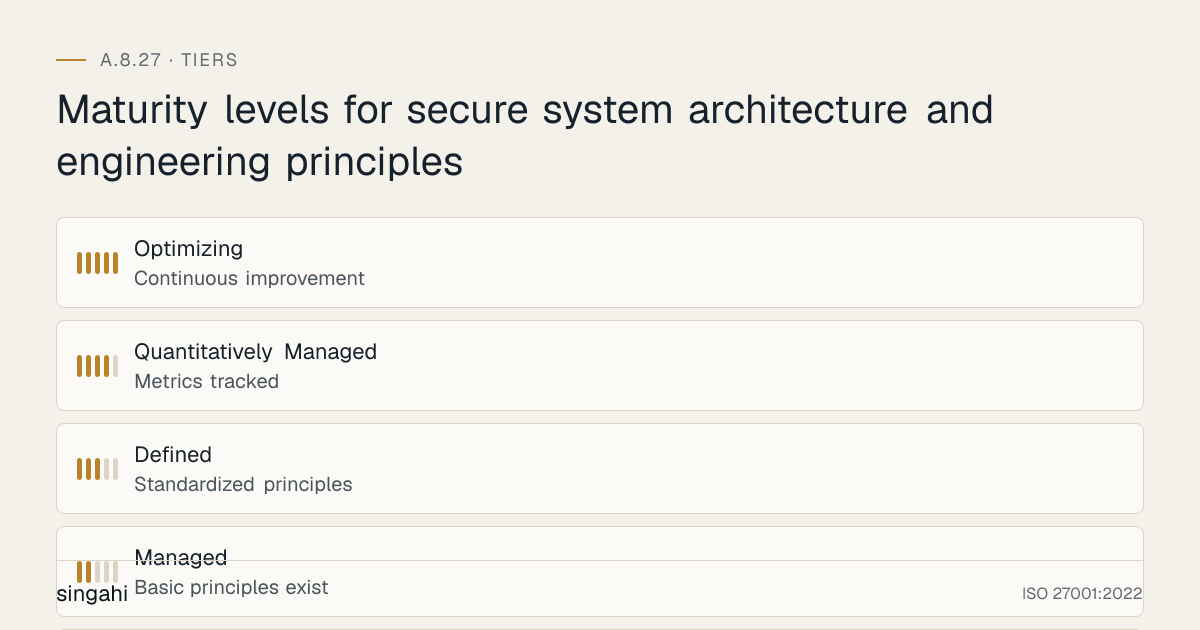
Figure · Tiers
Maturity levels for secure system architecture and engineering principles
Phase 1: Foundation (Weeks 1–3)
Week 1: Architecture Principles Definition
- Define 8-12 security architecture principles for the organization
- Align principles with business strategy and risk appetite
- Document principles with rationale and examples
- Obtain management approval
Week 2: Architecture Review Process
- Define the security architecture review process
- Establish the Architecture Review Board (ARB) with security representation
- Create the architecture review checklist
- Define criteria for when a security architecture review is required
Week 3: Reference Architecture and Patterns
- Develop a secure reference architecture for common system types
- Identify and document security patterns (authentication, authorization, encryption, logging)
- Create Architecture Decision Record (ADR) template
- Establish architecture documentation standards
Deliverables: Security Architecture Principles Document, ARB Charter, Reference Architecture, ADR Template, Review Checklist
Phase 2: Pilot (Weeks 4–6)
Week 4-5: Pilot System Review
- Select 2-3 systems for pilot security architecture review
- Conduct architecture reviews using the checklist and principles
- Document ADRs for major security decisions
- Identify gaps and improvement opportunities
Week 6: Refinement
- Refine principles based on pilot findings
- Update reference architecture with lessons learned
- Improve review process based on feedback
- Update templates and checklists
Deliverables: Pilot review reports, Updated principles, Refined reference architecture, Improved process
Phase 3: Rollout (Weeks 7–10)
Week 7-8: Process Integration
- Integrate security architecture review into SDLC/project management gates
- Train architects, developers, and security team on principles and process
- Deploy reference architecture and patterns to all new projects
- Establish architecture repository
Week 9-10: Full Deployment
- Apply to all new systems and major architecture changes
- Conduct quality assurance on architecture reviews
- Establish metrics collection
- Deploy architecture documentation tools
Deliverables: Integrated process, Training records, Architecture repository, Metrics baseline
Phase 4: Optimization (Weeks 11–14)
Week 11-12: Metrics and Monitoring
- Collect and analyze KPIs (see Section 13)
- Conduct first internal audit of architecture process
- Identify gaps and improvement opportunities
Week 13-14: Continuous Improvement
- Update principles with new threats and technologies
- Automate architecture review where possible (IaC scanning, architecture linting)
- Integrate with CI/CD for architecture validation
- Update training materials
Deliverables: KPI dashboard, Internal audit report, Updated principles, Automated checks
Maturity Model
| Level | Description | Typical Timeline |
|---|---|---|
| 1, Ad-hoc | No architecture principles, no review, security added after design | Pre-implementation |
| 2, Managed | Basic principles exist, some reviews conducted, manual process | Weeks 1–3 |
| 3, Defined | Standardized principles, mandatory reviews for all new systems, ARB established | Weeks 4–8 |
| 4, Quantitatively Managed | Metrics tracked, reference architectures deployed, automated checks | Weeks 9–12 |
| 5, Optimizing | Continuous improvement, real-time architecture validation, AI-assisted design review | Ongoing |
Detailed Implementation Guidance
Core Security Architecture Principles
Organizations should adopt and document 8-12 security architecture principles. Here are the most critical:
Principle 1: Defense in Depth
Statement: No single security control is sufficient. Systems must be designed with multiple independent layers of security so that if one layer is compromised, others remain effective.
Rationale: Attackers will eventually find a way past any single control. Layered defense provides resilience and time for detection and response.
Implementation:
- Network: Firewall + IDS/IPS + network segmentation + endpoint protection
- Application: Authentication + authorization + input validation + output encoding + logging
- Data: Encryption at rest + encryption in transit + access controls + backup encryption
- Identity: Password + MFA + device trust + behavioral analytics
Example: A web application uses WAF (network layer), authentication (application layer), RBAC (application layer), input validation (application layer), database encryption (data layer), and SIEM monitoring (detection layer).
Principle 2: Least Privilege
Statement: Every component, user, and process must operate with the minimum privileges necessary to perform its function. Privileges are granted explicitly and revoked when no longer needed.
Rationale: Excessive privileges increase the damage from compromise (lateral movement, privilege escalation, data exfiltration).
Implementation:
- User accounts: Role-based access control with fine-grained permissions
- Service accounts: One service = one account, minimal permissions
- Database: Application user has only necessary table permissions
- Containers: Run as non-root, read-only filesystems, minimal capabilities
- Cloud: IAM policies with least privilege, temporary credentials
Example: A payment processing service has database access only to the payment_transactions table, not to customer_profiles or audit_logs.
Principle 3: Fail Secure
Statement: When a system or component fails, it must fail to a secure state. No failure should expose data, grant unauthorized access, or disable security controls.
Rationale: Systems will fail. The question is whether failure helps attackers or protects the system.
Implementation:
- Authentication failure: Deny access, log event, alert (not bypass)
- Database connection failure: Queue transactions, do not process without validation
- Encryption failure: Do not transmit data in plaintext
- Firewall failure: Block all traffic (default deny), not allow all
- Service failure: Circuit breaker opens, requests fail fast
Example: If the authentication service is unavailable, the application denies all access rather than allowing anonymous access or using cached credentials indefinitely.
Principle 4: Separation of Duties
Statement: Critical functions must require the involvement of multiple independent actors. No single person should be able to complete a sensitive end-to-end process alone.
Rationale: Insider threats, errors, and compromised accounts are mitigated when multiple people are required for critical actions.
Implementation:
- Financial: Requester approves budget, different person approves payment, third person executes
- Code deployment: Developer writes, reviewer approves, separate person deploys
- Data deletion: Admin requests, manager approves, auditor logs
- System configuration: Engineer changes, security reviews, operations deploys
Example: In a banking system, a teller can initiate a wire transfer, but a supervisor must approve it, and the system automatically logs both actions.
Principle 5: Economy of Mechanism
Statement: Security mechanisms should be as simple and small as possible. Complexity is the enemy of security.
Rationale: Complex systems have more bugs, more attack surface, and are harder to understand, test, and audit.
Implementation:
- Use well-tested libraries instead of custom security code
- Minimize the number of security mechanisms in the system
- Reduce the codebase to the minimum necessary
- Simplify architecture: fewer components, clear interfaces, well-defined responsibilities
- Avoid unnecessary features that increase attack surface
Example: Instead of a custom authentication system with 10 features, use a standard OAuth 2.0 / OIDC implementation with 3 well-tested features.
Principle 6: Complete Mediation
Statement: Every access to every resource must be checked for authorization. No access is granted based on previous checks or assumed trust.
Rationale: Cached permissions, assumed trust, and incomplete checks lead to authorization bypasses.
Implementation:
- Every API request validates the JWT token and permissions
- Every database query checks row-level security
- Every file access checks user permissions
- Every admin action validates admin role (not just "is logged in")
- Session timeouts enforce re-authentication for sensitive actions
Example: A user with a valid session token attempts to access admin functionality. The system checks: (1) Is the token valid? (2) Is the user in the admin role? (3) Is the user's account active? (4) Is the action within the user's scope? All four checks must pass.
Principle 7: Open Design
Statement: Security should not depend on the secrecy of the design or implementation. The system should be secure even if the attacker knows how it works.
Rationale: "Security through obscurity" fails when the design is inevitably leaked or reverse-engineered.
Implementation:
- Use well-known, peer-reviewed cryptographic algorithms (AES, RSA, ECDSA)
- Publish security architecture for review (internal or external)
- Assume attackers know the system design in threat models
- Do not rely on hidden URLs, undocumented APIs, or obfuscated code for security
- Open source security components where possible for community review
Example: The security of a password hashing system relies on the strength of bcrypt/Argon2 and the secrecy of passwords, not on the secrecy of the hashing algorithm.
Principle 8: Least Common Mechanism
Statement: Minimize the amount of mechanisms and resources shared by different users or processes. Shared mechanisms can become single points of failure or compromise.
Rationale: Shared mechanisms create covert channels, privilege escalation paths, and collateral damage from compromise.
Implementation:
- Separate databases per tenant (multi-tenant architecture with isolation)
- Separate service accounts per application
- Separate network segments per security domain
- Separate logging per application (with centralized aggregation)
- Separate encryption keys per data classification level
Example: In a SaaS platform, each customer's data is in a separate database schema with separate encryption keys, not in one shared table with customer_id filtering.
Principle 9: Psychological Acceptability
Statement: Security mechanisms must be user-friendly and not overly burdensome. If security is too difficult, users will circumvent it.
Rationale: Security that users bypass is not security. The system must balance security with usability.
Implementation:
- Single sign-on (SSO) instead of multiple logins
- Context-aware MFA (MFA for high-risk actions, not every action)
- Clear error messages that help users (without information leakage)
- Self-service password reset with secure verification
- Minimal security steps for low-risk actions
Example: A banking app requires password + biometric for login, but only biometric for balance check. Wire transfers require password + biometric + OTP.
Principle 10: Zero Trust
Statement: No user, device, or system is trusted by default, regardless of network location or previous authentication. Trust is continuously verified.
Rationale: Perimeter-based security is obsolete. Attackers who breach the perimeter have unrestricted access inside.
Implementation:
- Verify identity for every request, not just at network entry
- Micro-segmentation: Every service is isolated, every connection is authenticated
- Continuous verification: Re-check trust based on behavior, device health, and risk signals
- Assume breach: Monitor for lateral movement, insider threats, and compromised credentials
- No implicit trust based on IP address, network location, or VPN
Example: A developer on the corporate VPN accessing a production database must still authenticate with MFA, pass device health checks, and have explicit authorization for that specific database.
Mapping These Principles to ISO 27002 8.27
| 27002 8.27 principle | Where this guide covers it |
|---|---|
| Security by design | The whole review process; Principle 1 |
| Defence in depth | Principle 1 |
| Security by default / default deny | Principles 2 and 6; hardening (A.8.9) |
| Fail securely | Principle 3 |
| Distrust input from external applications | Principle 11 (below) |
| Security in deployment | Principle 12 (below) |
| Assume breach | Principle 10 |
| Least privilege | Principle 2 |
| Usability and manageability | Principle 9 and Principle 13 (below) |
| Least functionality | Principle 5; Principle 14 (below) |
Principle 11: Distrust Input from External Applications
Treat every input from another system, partner API, webhook or file as untrusted until validated: check schemas, signatures, sizes and types, and never pass it straight to an interpreter, query or command.
Principle 12: Security in Deployment
Deployment pipelines, infrastructure as code and runtime configuration are part of the design: signed artefacts, least-privilege pipeline identities, hardened images, and configuration checked before release.
Principle 13: Usability and Manageability
A control that users bypass or operators cannot run does not work. Design for single sign-on, sensible defaults, clear errors and manageable key and certificate operations.
Principle 14: Least Functionality
Enable only the services, ports, features and accounts the system needs; remove sample apps, debug endpoints and unused components.
Architecture Exception Register
27002 asks you to document and formally acknowledge controls that do not fully meet requirements. Keep a register:
| System | Requirement or principle not fully met | Why (for example safety, legacy, vendor limit) | Compensating controls | Risk owner approval | Review date |
|---|---|---|---|---|---|
Security Architecture Review Process
The security architecture review follows this lifecycle:
Identify System → Classify Risk → Apply Principles → Design Review →
Threat Model → Architecture Decision → Document ADR → Implement →
Validate → Monitor → Evolve
Step 1: Identify the System and Classify Risk
Document:
- System purpose and business context
- Data types processed (public, internal, confidential, restricted)
- User types and volumes
- Regulatory requirements
- Technology stack
- Integration points
- Deployment model
Risk classification determines review depth:
| Risk Class | Review Depth | Reviewers |
|---|---|---|
| Critical | Full architecture review, formal threat modeling, ARB approval, external expert review | ARB + external security architect |
| High | Full architecture review, threat modeling, ARB approval | ARB |
| Medium | Architecture review, basic threat analysis, peer review | Security architect + lead architect |
| Low | Self-assessment using checklist, peer review | Lead architect + security champion |
Step 2: Apply Security Architecture Principles
For each principle, assess the architecture:
| Principle | Architecture Review Question | Evidence |
|---|---|---|
| Defense in depth | What are the 3+ independent security layers? | Diagram showing layers |
| Least privilege | What are the minimum privileges for each component? | IAM policy, RBAC matrix |
| Fail secure | What happens when [component] fails? | Failure mode analysis |
| Separation of duties | What critical functions require multiple actors? | Workflow diagram |
| Economy of mechanism | How is complexity minimized? | Component count, LOC |
| Complete mediation | How is every access checked? | Access control flow |
| Open design | What security depends on secrecy? | Threat model assumptions |
| Least common mechanism | What resources are shared? | Isolation diagram |
| Psychological acceptability | How is user burden minimized? | UX review, user feedback |
| Zero trust | How is trust continuously verified? | Identity flow diagram |
Step 3: Design Review
Review the architecture against security best practices:
Authentication Architecture:
- Is there a single, well-managed identity provider?
- Is MFA enforced for all administrative and sensitive access?
- Are session management mechanisms secure (secure cookies, timeout, rotation)?
- Is there account lockout and brute-force protection?
- Is password reset secure and not guessable?
Authorization Architecture:
- Is RBAC or ABAC used consistently?
- Are permissions enforced at every layer (API, service, database)?
- Is there a centralized authorization service (e.g., OPA, CASBIN)?
- Are default permissions deny-all?
- Is there regular access review?
Data Architecture:
- Is data classified and labeled?
- Is encryption at rest used for sensitive data?
- Is encryption in transit enforced (TLS 1.3)?
- Is there data loss prevention (DLP) for sensitive data?
- Is there data retention and deletion policy?
- Is there backup encryption and recovery testing?
Network Architecture:
- Is the network segmented by security domain?
- Is there a DMZ for public-facing services?
- Is internal traffic encrypted (east-west traffic)?
- Is there micro-segmentation for cloud-native services?
- Are firewalls configured with least privilege (default deny)?
Logging and Monitoring Architecture:
- Are security events logged from all layers?
- Is there a centralized SIEM or log aggregation?
- Are logs tamper-evident (immutable storage)?
- Is there real-time alerting for critical events?
- Is there log retention for compliance?
Resilience Architecture:
- Is there redundancy for critical components?
- Is there automatic failover?
- Is there disaster recovery with tested recovery procedures?
- Is there DDoS protection?
- Is there rate limiting and circuit breaking?
Integration Architecture:
- Are API gateways used for external access?
- Is there API authentication and rate limiting?
- Is there input validation at integration points?
- Are third-party integrations isolated and monitored?
- Is there a secure webhook/signature verification?
Step 4: Threat Modeling
Use the threat model (from A.8.26) to validate architecture:
- Does the architecture address all identified threats?
- Are there single points of failure that threats could exploit?
- Can the architecture contain a breach (prevent lateral movement)?
- Are there attack paths that the architecture does not mitigate?
Step 5: Architecture Decision Records (ADRs)
Document major security-relevant decisions:
## ADR-001: Authentication Architecture for Customer Portal

## Status
Accepted

## Context
The customer portal needs authentication for 1 million users. We need to choose between:
- Option A: In-house authentication with custom MFA
- Option B: OAuth 2.0 / OIDC with external identity provider (Auth0, Okta)
- Option C: SAML integration with enterprise SSO

## Decision
Chosen Option B: OAuth 2.0 / OIDC with Auth0

## Rationale
- In-house authentication is complex and error-prone (economy of mechanism)
- Auth0 is a well-tested, audited service with SOC 2 and ISO 27001 certification
- OAuth 2.0 / OIDC is an open standard with broad support
- Reduces development time and security risk
- Supports MFA, social login, and passwordless out of the box

## Consequences
Positive:
- Faster time to market
- Reduced security risk
- Built-in compliance features
- Scalable to millions of users

Negative:
- Dependency on third-party service (vendor risk)
- Ongoing subscription cost
- Data residency considerations (Auth0 data in US/EU)

## Mitigations for Negative Consequences
- Vendor risk assessment and contract review
- Disaster recovery plan for Auth0 outage (local fallback authentication)
- Data processing agreement for GDPR/DPDP Act compliance

## Date
2026-01-15

## Decision Makers
CTO, Security Architect, Product Owner
Step 6: Approval and Implementation
- ARB reviews the architecture, ADRs, and threat model
- Approval is granted with conditions or rejected with feedback
- Security architecture is communicated to development, operations, and security teams
- Architecture is added to the architecture repository
Step 7: Validation and Monitoring
- Security testing validates architecture implementation (penetration testing, architecture review)
- Architecture is monitored for drift (unauthorized changes)
- Security metrics validate architecture effectiveness (vulnerability density, incident containment)
- Architecture is reviewed annually or when significant changes occur
Security Patterns Catalog
Organizations should develop a catalog of security patterns for common scenarios:
Pattern 1: Authentication Pattern
Problem: How to authenticate users securely across multiple applications?
Solution: Centralized OAuth 2.0 / OIDC identity provider with MFA, session management, and token refresh.
Components: Identity Provider (IdP), API Gateway (token validation), Application (token consumption), MFA service.
Security Considerations: Token storage, token expiration, refresh token rotation, MFA enforcement, logout/session invalidation.
Pattern 2: Authorization Pattern
Problem: How to enforce access control consistently across services?
Solution: Policy-based access control (OPA/CASBIN) with centralized policy management and distributed enforcement.
Components: Policy Administration Point (PAP), Policy Decision Point (PDP), Policy Enforcement Point (PEP), Policy Information Point (PIP).
Security Considerations: Policy synchronization, policy evaluation performance, policy versioning, audit logging.
Pattern 3: Encryption Pattern
Problem: How to protect data at rest and in transit?
Solution: TLS 1.3 for all communications, AES-256 for data at rest, envelope encryption with key rotation, HSM or KMS for key management.
Components: TLS termination, KMS, application encryption library, key rotation scheduler.
Security Considerations: Key escrow, key rotation frequency, cipher suite selection, certificate management, HSM availability.
Pattern 4: API Security Pattern
Problem: How to secure API endpoints from abuse and attack?
Solution: API Gateway with authentication, rate limiting, input validation, logging, and WAF integration.
Components: API Gateway, WAF, Rate Limiter, Auth Service, API Analytics.
Security Considerations: Rate limit bypass, API key security, OAuth scope enforcement, CORS configuration, payload size limits.
Pattern 5: Microservices Security Pattern
Problem: How to secure communication between microservices?
Solution: Service mesh (Istio/Linkerd) with mTLS, mutual authentication, authorization policies, and observability.
Components: Service mesh control plane, data plane proxies, certificate authority, observability stack.
Security Considerations: Sidecar resource overhead, certificate rotation, policy enforcement, debugging complexity.
Pattern 6: Data Loss Prevention Pattern
Problem: How to prevent sensitive data exfiltration?
Solution: Data classification, DLP agents, network egress filtering, CASB, and data masking.
Components: Data Classification Engine, DLP Scanner, Egress Firewall, CASB, Data Masking Service.
Security Considerations: False positives, data classification accuracy, encrypted traffic inspection, privacy compliance.
Pattern 7: Zero Trust Network Pattern
Problem: How to secure a cloud-native network without a perimeter?
Solution: Identity-aware proxy, micro-segmentation, device trust, continuous authentication, and behavioral analytics.
Components: Identity-Aware Proxy, Device Trust Service, Micro-segmentation Controller, Behavioral Analytics Engine, SIEM.
Security Considerations: User experience impact, device enrollment, latency, false positives in behavioral analytics.
Pattern 8: Secure Logging Pattern
Problem: How to collect and protect security logs?
Solution: Immutable log storage, centralized SIEM, log integrity verification, tamper-evident logging, and real-time alerting.
Components: Log Shipper, Message Queue, SIEM, Immutable Storage, Alerting Engine, Log Integrity Verifier.
Security Considerations: Log volume, storage cost, log parsing complexity, SIEM rule tuning, privacy in logs.
Architecture for Emerging Technologies
Cloud-Native Architecture Security
- Container Security: Non-root containers, read-only filesystems, minimal images, image scanning, runtime protection
- Kubernetes Security: RBAC, network policies, pod security standards, admission controllers, secrets management
- Serverless Security: Function-level permissions, cold start protection, event injection prevention, resource limits
- Infrastructure as Code: Security scanning of Terraform/CloudFormation (Checkov, tfsec), drift detection, policy as code
AI/ML Architecture Security
- Model Serving: API authentication for model endpoints, rate limiting, model versioning, A/B testing security
- Training Pipeline: Data pipeline security, model artifact signing, access control to training data, experiment tracking security
- Inference Security: Input sanitization, output filtering, adversarial detection, model monitoring for drift
- RAG/Vector DB: Vector database access control, prompt injection prevention, retrieval filtering, embedding security
- MLOps: Secure CI/CD for models, model registry security, deployment approval gates, rollback security
IoT/OT Architecture Security
- Edge Security: Edge device authentication, secure boot, firmware signing, over-the-air update security
- Gateway Security: Protocol translation security, data aggregation validation, gateway authentication
- Cloud Integration: Secure telemetry ingestion, command and control authentication, device provisioning security
- OT/IT Segregation: Purdue model alignment, data diode for unidirectional flow, industrial firewall
Tools, Technologies, and Solutions
Architecture Modeling and Documentation Tools
| Tool | Purpose | Best For |
|---|---|---|
| Archi | ArchiMate modeling | Enterprise architecture, TOGAF |
| draw.io / diagrams.net | Diagramming | Free, simple diagrams |
| PlantUML | Text-based UML | Developer-friendly, version control |
Architecture Review and Threat Modeling Tools
| Tool | Purpose | Best For |
|---|---|---|
| IriusRisk | Threat modeling + risk assessment | Enterprise, automated threat modeling |
| OWASP Threat Dragon | Threat modeling | Free, web-based, STRIDE |
| Microsoft Threat Modeling Tool | STRIDE modeling | Windows, free option |
| ThreatModeler | Enterprise threat modeling | Enterprise, CI/CD integration |
| pytm | Python threat modeling | DevOps, automation |
| Pytm | Pythonic threat modeling | Developer-friendly |
Infrastructure as Code Security Tools
| Tool | Purpose | Best For |
|---|---|---|
| Checkov | IaC scanning | Terraform, CloudFormation, Kubernetes |
| tfsec | Terraform security | Terraform-specific |
| Terrascan | IaC scanning | Multiple IaC formats |
| Bridgecrew | IaC security platform | Enterprise, CI/CD integration |
| Snyk IaC | IaC + SCA | Developer-friendly |
| Open Policy Agent (OPA) | Policy as code | Kubernetes, cloud, custom |
Service Mesh and Microsecurity Tools
| Tool | Purpose | Best For | Pricing model |
|---|---|---|---|
| Istio | Service mesh | Kubernetes, enterprise | Free (open source) |
| Linkerd | Lightweight service mesh | Simplicity, performance | Free (open source) |
| Consul Connect | Service mesh | HashiCorp ecosystem | Free / Enterprise |
Policy and Procedure Templates
Security Architecture Principles Policy (Template)
Template
Security Architecture Principles Policy
Document ID: POL-ARCH-SEC-001 Version: 1.0 Effective Date: [DATE] Owner: CISO / Security Architect Approved By: [Name], [Title] Review Cycle: Annual
1. Purpose
This policy establishes the security architecture principles that guide the design, development, and implementation of all information systems at [Organization].
2. Scope
This policy applies to:
- All new information systems and applications
- Major changes to existing system architectures
- Cloud migrations and re-platforming
- Integration architectures and APIs
- AI/ML, IoT, and emerging technology architectures
3. Policy Statements
3.1 Security Architecture Principles
All system architectures must adhere to the following principles:
- Defense in Depth: Multiple independent security layers
- Least Privilege: Minimum access necessary
- Fail Secure: Fail to a secure state
- Separation of Duties: Multiple actors for critical functions
- Economy of Mechanism: Simplicity and minimalism
- Complete Mediation: Every access checked
- Open Design: Security not dependent on secrecy
- Least Common Mechanism: Minimize shared resources
- Psychological Acceptability: User-friendly security
- Zero Trust: No implicit trust, continuous verification
- Distrust External Input: Validate all input from other systems
- Security in Deployment: Secure pipelines, signed artefacts, hardened images
- Usability and Manageability: Controls people can use and run
- Least Functionality: Only what the system needs
- Security by Default / Default Deny: Secure settings out of the box
3.2 Architecture Review Process
- All systems classified as medium, high, or critical risk must undergo a security architecture review before development or procurement.
- Architecture reviews are conducted by the Architecture Review Board (ARB).
- Reviews assess architecture against principles, threat models, and compliance requirements.
- Architecture Decision Records (ADRs) must be maintained for all major security-relevant decisions.
3.3 Reference Architecture
- A secure reference architecture must be maintained for common system types.
- New systems should use the reference architecture where applicable.
- Deviations from the reference architecture require documented justification and ARB approval.
3.4 Architecture Patterns
- A catalog of security patterns must be maintained and updated.
- Development teams must use approved security patterns for common scenarios.
- New patterns require ARB review and approval before adoption.
3.5 Emerging Technologies
- Security architecture for emerging technologies (AI/ML, blockchain, IoT, quantum computing) requires specialized review.
- Emerging technology architectures must undergo external expert review before production deployment.
3.6 Exceptions to Principles
- Controls that do not fully meet requirements are recorded in the architecture exception register with reason, compensating controls and risk-owner approval.
3.7 Suppliers and Review
- These principles are applied to outsourced development through contracts (A.8.30).
- The principles and engineering procedures are reviewed at least annually and after major incidents or technology changes.
3.8 Documentation and Records
- All architecture decisions must be documented in ADRs.
- Architecture diagrams must be maintained in the architecture repository.
- Architecture reviews must be documented with findings, conditions, and approval.
3.9 Training and Awareness
- All architects and senior developers must be trained on security architecture principles.
- Security architecture training must be refreshed annually.
- New hires in architecture roles must complete security architecture training within 30 days.
4. Roles and Responsibilities
- CISO: Owns the policy, ensures governance, reports to board
- Security Architect: Maintains principles, conducts reviews, approves ADRs
- Lead Architect: Designs systems in accordance with principles, documents ADRs
- Architecture Review Board: Reviews and approves architectures
- Development Lead: Implements architecture as designed, escalates deviations
- Compliance Officer: Reviews regulatory compliance in architecture
5. Exceptions
Exceptions to this policy require written approval from the CISO with:
- Risk acceptance documentation
- Compensating controls
- Review date for re-assessment
6. Enforcement
Non-compliance may result in project delay, audit findings, or disciplinary action.
7. Related Documents
- Application Security Requirements Policy (POL-APP-SEC-001)
- Secure Development Life Cycle Policy (POL-SDLC-001)
- Information Security Policy (POL-INFO-001)
- Architecture Review Board Charter (CHART-ARB-001)
8. Revision History
| Version | Date | Author | Changes |
|---|---|---|---|
| 1.0 | [DATE] | [Name] | Initial version |
Architecture Review Procedure (Template)
Template
Security Architecture Review Procedure
Document ID: PROC-ARCH-REV-001 Version: 1.0 Effective Date: [DATE] Owner: Security Architect
1. Purpose
To define the procedure for conducting security architecture reviews for all information systems.
2. Scope
All systems classified as medium, high, or critical risk.
3. Procedure Steps
Step 1: Review Request (Day 1)
- Architect submits Architecture Review Request with:
- Architecture diagram
- Technology stack description
- Data flow diagram
- Threat model (for high/critical systems)
- ADRs for major decisions
- Risk classification
Step 2: Pre-Review (Days 2-3)
- Security Architect reviews against principles, patterns, and threat model
- Compliance Officer reviews regulatory compliance
- Development Lead reviews feasibility
- Reviewers submit feedback via Architecture Review Feedback Form
Step 3: Review Meeting (Day 4)
- ARB convenes (90-120 minutes for critical systems, 60 minutes for high/medium)
- Architect presents the architecture
- Security Architect presents threat analysis and principle compliance
- Reviewers raise questions and concerns
- Decisions recorded in Review Meeting Minutes
Step 4: Approval or Conditions (Day 5)
- Approved: Architecture proceeds as designed
- Approved with Conditions: Architecture proceeds after conditions are met
- Rejected: Architecture must be revised and resubmitted
- Decision recorded in Architecture Review Decision Record
Step 5: Implementation Monitoring (Ongoing)
- Security team monitors architecture implementation for drift
- Quarterly architecture compliance checks
- Annual architecture review for critical systems
4. Review Criteria Checklist
- All 10 security architecture principles are addressed
- Threat model is complete and threats are mitigated by architecture
- Reference architecture is followed or deviation is justified
- Security patterns are used appropriately
- Authentication architecture is secure
- Authorization architecture enforces least privilege
- Data architecture protects sensitive data
- Network architecture is segmented and secure
- Logging and monitoring architecture is complete
- Resilience architecture supports availability and recovery
- Integration architecture is secure
- Compliance requirements are met
- ADRs are complete and justified
- Architecture is feasible and implementable
- Performance and scalability are acceptable
5. Roles
- Chair: Security Architect
- Members: Lead Architect, Development Lead, Compliance Officer, Operations Lead, Security Engineer
- Secretary: Architect (records minutes)
- Approver: ARB consensus (CISO for critical systems)
6. Records
- Architecture Review Request
- Architecture diagrams and documentation
- Threat model document
- ADRs
- Architecture Review Feedback Form
- Review Meeting Minutes
- Architecture Review Decision Record
- Implementation monitoring reports
Risk Assessment and Treatment
Risk Assessment for Security Architecture
| Risk ID | Risk Description | Likelihood | Impact | Risk Level | Mitigation via Architecture |
|---|---|---|---|---|---|
| R-001 | Architecture review is skipped, leading to design flaws | Medium | High | High | Mandatory review gates in SDLC; ARB with enforcement authority; no development without approval |
| R-002 | Architecture principles are not followed, leading to inconsistent security | Medium | High | High | Standardized principles; automated checks (IaC scanning); architecture compliance monitoring |
| R-003 | Architecture documentation is incomplete, leading to operational gaps | High | Medium | High | Mandatory ADRs; documentation standards; repository with governance |
| R-004 | Architecture becomes outdated due to technology evolution | High | Medium | High | Annual architecture review; technology radar; emerging technology assessment |
| R-005 | Cloud migration introduces new architecture risks | High | High | Critical | Cloud security architecture review; cloud-native security patterns; cloud security posture management |
| R-006 | Microservices architecture increases attack surface | Medium | High | High | Service mesh with mTLS; micro-segmentation; API gateway security; zero trust |
| R-007 | AI/ML architecture introduces novel security risks | Medium | High | High | AI/ML security architecture review; adversarial strength patterns; model security controls |
| R-008 | Legacy system integration compromises modern architecture | Medium | High | High | Legacy integration security review; data diode; API gateway isolation; compensating controls |
| R-009 | Architecture drift in production leads to security gaps | Medium | High | High | Architecture drift detection (IaC scanning); change management; quarterly compliance checks |
| R-010 | Third-party components violate architecture principles | Medium | High | High | Vendor architecture review; contract security requirements; SBoM security analysis; third-party risk assessment |
Risk Treatment Options
| Risk | Treatment | Residual Risk |
|---|---|---|
| R-001 | Mandatory process + ARB enforcement | Low |
| R-002 | Automated compliance checks + training | Low |
| R-003 | Documentation standards + repository | Low |
| R-004 | Annual review + technology monitoring | Low |
| R-005 | Cloud security expertise + CSPM tools | Low |
| R-006 | Service mesh + zero trust + API security | Low |
| R-007 | AI/ML security framework + specialized review | Low |
| R-008 | Integration security review + isolation | Low |
| R-009 | Drift detection + change management | Low |
| R-010 | Vendor management + SBoM + contracts | Low |
Audit and Compliance Checklist
Pre-Audit Self-Assessment
| # | Question | Evidence | Status |
|---|---|---|---|
| 1 | Is there a documented Security Architecture Principles Policy? | Policy document | ☐ |
| 2 | Is the policy approved by senior management? | Approval record | ☐ |
| 3 | Are security architecture principles defined and documented? | Principles document | ☐ |
| 4 | Are architecture reviews conducted for new systems? | Review records | ☐ |
| 5 | Is there an Architecture Review Board (ARB)? | ARB charter, meeting records | ☐ |
| 6 | Are architecture reviews documented with findings and decisions? | Review reports | ☐ |
| 7 | Are Architecture Decision Records (ADRs) maintained? | ADR repository | ☐ |
| 8 | Is there a secure reference architecture? | Reference architecture document | ☐ |
| 9 | Is there a catalog of security patterns? | Pattern catalog | ☐ |
| 10 | Are architecture reviews integrated into the SDLC? | SDLC process documentation | ☐ |
| 11 | Are architects trained on security principles? | Training records | ☐ |
| 12 | Are architecture reviews conducted for major changes? | Change records + review records | ☐ |
| 13 | Are cloud migrations subject to architecture review? | Cloud migration review records | ☐ |
| 14 | Are AI/ML systems subject to architecture review? | AI/ML review records | ☐ |
| 15 | Are IoT/OT systems subject to architecture review? | IoT/OT review records | ☐ |
| 16 | Is architecture drift detected and remediated? | Drift detection records | ☐ |
| 17 | Are third-party systems subject to architecture review? | Vendor review records | ☐ |
| 18 | Are architecture reviews aligned with threat models? | Threat model + review mapping | ☐ |
| 19 | Are architecture reviews aligned with risk assessments? | Risk register + review mapping | ☐ |
| 20 | Are compliance requirements addressed in architecture reviews? | Compliance checklist + review records | ☐ |
| 21 | Are architecture diagrams maintained and current? | Architecture repository | ☐ |
| 22 | Are data flow diagrams maintained for systems? | DFD repository | ☐ |
| 23 | Are architecture decisions traceable to requirements? | Requirements + ADR mapping | ☐ |
| 24 | Is there a process for architecture exceptions? | Exception records | ☐ |
| 25 | Are architecture reviews updated annually? | Annual review records | ☐ |
| 26 | Are architecture metrics tracked and reported? | Metrics dashboard | ☐ |
| 27 | Are legacy system integrations reviewed for security? | Integration review records | ☐ |
| 28 | Are architecture principles communicated to all relevant staff? | Communication records | ☐ |
| 29 | Are architecture reviews conducted for outsourced development? | Outsourced review records | ☐ |
| 30 | Are architecture findings remediated and tracked? | Remediation tracking | ☐ |
Auditor Interview Questions
Be prepared to answer:
- "What security architecture principles does your organization follow?"
- "Show me the security architecture review for [system name]."
- "Who is on the Architecture Review Board?"
- "How do you ensure architecture principles are followed?"
- "What happens when a system is deployed without architecture review?"
- "How do you handle cloud migration architecture security?"
- "Are there security patterns for common scenarios?"
- "How do you detect and remediate architecture drift?"
- "How are architecture decisions documented?"
- "How do you ensure third-party systems meet your architecture standards?"
Common Audit Findings and How to Avoid Them
| Finding | Cause | Prevention |
|---|---|---|
| "No architecture principles defined" | Process gap | Define and approve principles as policy |
| "Architecture review not conducted for new system" | Skipped review | Mandatory review gates; no development without approval |
| "No ADRs for major decisions" | Documentation gap | ADR template; mandatory for critical decisions |
| "Architecture diagrams not current" | Maintenance gap | Repository with version control; quarterly updates |
| "Cloud migration without security review" | Process gap | Cloud migration checklist; mandatory review for cloud |
| "No security patterns catalog" | Knowledge gap | Create patterns catalog; require pattern usage |
| "Architecture drift in production" | Monitoring gap | IaC scanning; drift detection; quarterly compliance checks |
| "Third-party systems not reviewed" | Vendor gap | Vendor review process; contract requirements |
| "Architects not trained on security" | Training gap | Mandatory training; annual refresh; competency assessment |
| "Legacy integration not reviewed" | Legacy gap | Integration review process; compensating controls |
Metrics and KPIs
Figure · Measures
The measures that show A.8.27 is working
- Architecture Review Coverage100%Monthly
- ADR Completeness> 95%Monthly
- Review Cycle Time< 7 daysPer review
- Architecture Compliance Rate> 90%Quarterly
- Principle Violation Rate< 10%Quarterly
Process Metrics
| Metric | Formula | Target | Frequency |
|---|---|---|---|
| Architecture Review Coverage | (# of systems reviewed / # of new systems) × 100 | 100% | Monthly |
| ADR Completeness | (# of decisions with ADRs / # of major decisions) × 100 | > 95% | Monthly |
| Review Cycle Time | Average days from request to decision | < 7 days | Per review |
| Architecture Compliance Rate | (# of systems compliant with principles / # of systems reviewed) × 100 | > 90% | Quarterly |
| Principle Violation Rate | (# of violations found / # of reviews) × 100 | < 10% | Quarterly |
| Training Completion Rate | (# of trained architects / # of required architects) × 100 | 100% | Quarterly |
| Pattern Adoption Rate | (# of systems using approved patterns / # of systems) × 100 | > 80% | Quarterly |
| Exception Rate | (# of exceptions / # of systems) × 100 | < 5% | Quarterly |
| Drift Detection Rate | (# of drifts detected / # of systems) × 100 | 100% | Quarterly |
| Cloud Review Rate | (# of cloud systems reviewed / # of cloud systems) × 100 | 100% | Monthly |
Outcome Metrics
| Metric | Formula | Target | Frequency |
|---|---|---|---|
| Vulnerability Density | Critical/high vulnerabilities per system | < 2 | Per release |
| Architecture-Related Incidents | Security incidents caused by architecture flaws | < 1 per quarter | Quarterly |
| Mean Time to Contain | Time to contain breach using architecture | < 2 hours | Per incident |
| Compliance Audit Findings | Architecture-related audit findings | 0 | Per audit |
| Architecture Rework Cost | Cost of fixing architecture issues post-deployment | Decreasing | Quarterly |
| System Availability | Uptime of systems with resilience architecture | > 99.9% | Monthly |
| Lateral Movement Prevention | % of breaches contained to initial entry point | > 90% | Per incident |
| Architecture Review Satisfaction | Stakeholder satisfaction score | > 4.0/5.0 | Quarterly |
| Time to Security Audit Readiness | Time to prepare for audit | < 2 weeks | Per audit |
| Architecture Documentation Coverage | % of systems with current architecture docs | > 95% | Quarterly |
Dashboard Sample
┌─────────────────────────────────────────────────────────────────────┐
│        SECURE SYSTEM ARCHITECTURE & ENGINEERING DASHBOARD           │
│                    [Organization] — [Month Year]                    │
├─────────────────────────────────────────────────────────────────────┤
│  ARCH REVIEW COVERAGE: 100%  ██████████████████████  Target: 100%  │
│  ADR COMPLETENESS: 96%       ████████████████████░░  Target: 95%  │
│  COMPLIANCE RATE: 92%        ███████████████████░░░  Target: 90%  │
│  PATTERN ADOPTION: 85%       ██████████████████░░░░  Target: 80%  │
│  VULN DENSITY: 1.2           ███░░░░░░░░░░░░░░░░░░  Target: <2   │
│  ARCH INCIDENTS: 0           ░░░░░░░░░░░░░░░░░░░░░  Target: <1/q │
│  REVIEW CYCLE TIME: 5.5 days ████████████████████░░  Target: <7   │
│  EXCEPTION RATE: 3%          ██░░░░░░░░░░░░░░░░░░░  Target: <5%  │
└─────────────────────────────────────────────────────────────────────┘
Common Pitfalls and How to Avoid Them
Pitfall 1: "Architecture Review Slows Us Down"
Symptom: Teams skip architecture review to meet deadlines.
Solution:
- Show time-to-market data: secure architecture reduces firefighting
- Streamline review for low-risk systems (self-assessment + spot check)
- Integrate review into existing design review meetings
- Use reference architecture to accelerate review
Pitfall 2: "Principles Are Too Abstract"
Symptom: Architects don't know how to apply principles to real systems.
Reality: Principles need concrete patterns, examples, and checklists to be actionable.
Solution:
- Create a patterns catalog with concrete implementations
- Provide architecture decision guides for common scenarios
- Use reference architecture as a starting point
- Conduct workshops where architects apply principles to real systems
Pitfall 3: "We Bought the Tool, Now We're Secure"
Symptom: Organization invests in architecture tools but doesn't change processes or culture.
Reality: Tools enable the process; they don't replace governance, training, or accountability.
Solution:
- Invest in process and training alongside tools
- Establish ARB with real enforcement authority
- Track metrics to demonstrate value
- Make architecture review a non-bypassable gate
Pitfall 4: "Cloud Changes Everything"
Symptom: Cloud migration proceeds without architecture review because "cloud is secure by default."
Reality: Cloud is secure by default for the provider's infrastructure, not YOUR architecture. Misconfigured S3 buckets, overly permissive IAM policies, and exposed APIs are the leading causes of cloud breaches.
Solution:
- Mandatory cloud security architecture review
- Cloud-native security patterns (container security, IAM best practices)
- CSPM tools for continuous monitoring
- Cloud security training for architects
Pitfall 5: "Legacy Systems Are Exempt"
Symptom: Legacy systems are not reviewed because "they're too old to change."
Reality: Legacy systems often process the most sensitive data and have the weakest security. Integration with legacy systems can compromise modern architecture.
Solution:
- Review legacy integrations for security impact
- Apply compensating controls where legacy cannot be changed
- Plan legacy modernization with security architecture review
- Isolate legacy systems where possible
Pitfall 6: "Architecture Is Done at the Beginning"
Symptom: Architecture is designed once and never revisited.
Reality: Architecture evolves with threats, technology, and business requirements. Annual review and drift detection are essential.
Solution:
- Annual architecture review for critical systems
- Architecture drift detection (IaC scanning)
- Update principles and patterns with new threats
- Architecture review as part of major change management
Pitfall 7: "We Don't Have Architects"
Symptom: Small organizations lack dedicated architects and skip architecture review.
Reality: Security architecture is a mindset, not just a role. Small teams can use reference architecture, patterns, and lightweight reviews.
Solution:
- Use reference architecture and patterns as starting points
- Conduct peer reviews with security champion
- Use cloud-native managed services (reduce architecture burden)
- Outsource architecture review for critical systems (Singahi offers this)
Pitfall 8: "AI/ML Is Different"
Symptom: AI/ML systems are built without security architecture because "AI is a research problem."
Reality: AI/ML systems have unique architecture risks (adversarial strength, model extraction, data poisoning) but they still need secure architecture.
Solution:
- Use AI/ML security architecture patterns
- Include adversarial testing in architecture validation
- Apply zero trust to model serving and training pipelines
- See the NIST AI Risk Management Framework, ISO/IEC 42001 and the OWASP Top 10 for LLM Applications for specialised guidance
Illustrative Scenarios
Hypothetical scenarios: composite examples for guidance, not real organisations or verified outcomes.
Scenario 1: Microservices Migration Without Service-to-Service Trust
Situation. An e-commerce company splits a monolith into microservices on Kubernetes. A penetration test finds that any service can call any other without authentication, secrets sit in environment files, and there are no network policies.
What applying 8.27 looks like.
- Principles agreed for the platform: zero trust between services, least privilege, distrust external input, least functionality.
- A reference architecture: mutual TLS between services, a secrets manager, network policies, an API gateway for external traffic.
- An architecture review gate for every new service, with decisions recorded as ADRs.
- Existing services reviewed and fixed in priority order; gaps that cannot yet be closed go in the exception register with compensating controls.
Lesson. Splitting a system into services multiplies trust boundaries. Without service-to-service authentication, a single compromised service reaches everything.
Scenario 2: Multi-Vendor Government Platform
Situation. A state department's citizen-services platform is built by several vendors, each with its own design. Aadhaar-linked data flows through modules with different controls, and no one reviews the architecture as a whole.
What applying 8.27 looks like.
- A principles policy and a reference architecture covering identity, API security, encryption, logging and data location.
- The principles written into vendor contracts (27002: apply principles to outsourced development).
- An architecture review board that reviews each vendor's design against the reference before build, approving, approving with conditions, or rejecting.
- Drift checks on infrastructure as code, and an annual review of the principles.
Lesson. When many suppliers build one platform, shared principles in the contracts and a single review gate are what keep the security design consistent.
Multi-Framework Mapping
Figure · Matrix
Comparison: APO03.02 to BAI03.02
NIST SP 800-53 Rev 5 Mapping
| NIST Control | Description | A.8.27 Mapping |
|---|---|---|
| SA-8 | Security and privacy engineering principles | Principles applied to design |
| SA-17 | Developer security and privacy architecture and design | Design meets the principles |
| SC-2 | Separation of system and user functionality | Partitioning |
| SC-3 | Security function isolation | Isolate security functions |
| SC-7 | Boundary protection | Boundaries and zones |
| SC-8 | Transmission confidentiality and integrity | Encryption in transit |
| SC-28 | Protection of information at rest | Encryption at rest |
| AC-6 | Least privilege | Least privilege |
| CM-7 | Least functionality | Least functionality |
COBIT 2019 Mapping
| COBIT Practice | Description | A.8.27 Mapping |
|---|---|---|
| APO03.02 | Define reference architecture | Security reference architecture and principles |
| APO12.02 | Analyse risk | Design informed by risk |
| BAI03.01 | Design high-level solutions | Security designed in |
| BAI03.02 | Design detailed solution components | Controls placed in components |
PCI DSS v4.0.1 Mapping
| PCI DSS Requirement | Security Architecture Focus |
|---|---|
| 1.2–1.4 | Network security controls and trusted/untrusted boundaries |
| 2.2 | Secure configuration; only necessary services (least functionality) |
| 6.2.1–6.2.4 | Bespoke software designed and built securely |
DPDP Act 2023: Design Implications
| DPDP Act Section | Security Architecture Implication |
|---|---|
| Section 8(4) | Appropriate technical and organisational measures, architecture must embed data protection |
| Section 8(5) | Reasonable security safeguards, architecture must implement appropriate safeguards |
| Section 6 | Consent management, architecture must support consent workflows |
| Section 8(6) | Personal data breach intimation, architecture must detect and report breaches |
OWASP SAMM Mapping
| SAMM Practice | Maturity Level | A.8.27 Mapping |
|---|---|---|
| Design - Security Architecture | Level 1-3 | Architecture principles, reference architecture, patterns |
| Design - Threat Assessment | Level 1-3 | Threat modeling informing architecture |
| Implementation - Secure Build | Level 1-3 | Architecture enabling secure build |
| Verification - Architecture Assessment | Level 1-3 | Architecture review and validation |
CIS Controls v8 Mapping
| CIS Control | Implementation Group | A.8.27 Mapping |
|---|---|---|
| Control 4 | IG1 | Secure configuration of enterprise assets and software |
| Control 13 | IG2 | Network monitoring and defense |
| Control 16 | IG2 | Application software security |
| Control 12 | IG1 | Network infrastructure management (secure network architecture, 12.2) |
| Control 3 | IG1 | Data protection (data flows and segmentation by sensitivity) |
Regulatory and Industry Context
India
| Regulation | Architecture Relevance | Key Mandates |
|---|---|---|
| DPDP Act 2023 | Critical | Section 8(4) (Appropriate technical and organisational measures); architecture must embed data protection |
| IT Act 2000 | High | Section 43A: Reasonable security practices; architecture must demonstrate reasonable security |
| RBI | Critical for banks and payment firms | Cyber Security Framework in Banks (2016); MD IT Governance (2023); payment data stored only in India (2018 directive) |
| Companies (Accounts) Rules 2014, Rule 3(5) | All companies keeping electronic books | Daily backup on servers in India |
| CERT-In Directions 2022 | All body corporates | ICT logs kept in India for 180 days |
| SEBI CSCRF (2024) | Critical for markets | Cybersecurity and cyber resilience framework for regulated entities |
| IRDAI Guidelines | Critical for insurance | Information security architecture for customer data and claims systems |
| CERT-In | High | Security best practices; architecture guidelines for government systems |
| Digital India | Critical for government | Secure architecture for citizen services, Aadhaar integration, UPI |
International
| Regulation | Relevance | Key Mandates |
|---|---|---|
| GDPR (EU) | High | Art 25: Data protection by design and default; Art 32: Security of processing |
| PCI DSS v4.0.1 | Critical for card data | Req 1, 2, 6: Secure network, configuration, and development architecture |
| HIPAA (US) | Critical for health | Security Rule: Technical safeguards require secure architecture |
| SOX (US) | High for public companies | IT general controls require secure architecture for financial systems |
| NIST CSF 2.0 | High | All functions require architecture alignment (Identify, Protect, Detect, Respond, Recover) |
| CCPA/CPRA | High for CA residents | Security requirements for personal information architecture |
| LGPD (Brazil) | High for Brazil data | Security, technical, and administrative measures in architecture |
| PDPA (Singapore) | High for Singapore data | Protection obligations require secure architecture |
Roles and Responsibilities (RACI)
RACI Matrix for Secure System Architecture
| Activity | CISO | Security Architect | Lead Architect | ARB | Dev Lead | Compliance Officer | Operations Lead |
|---|---|---|---|---|---|---|---|
| Define architecture principles | A | R | C | C | I | C | I |
| Maintain reference architecture | I | R/A | C | C | I | I | C |
| Maintain security patterns | I | R/A | C | C | I | I | C |
| Conduct architecture review | I | R/A | C | C | C | C | C |
| Approve architecture | I | C | C | R/A | I | C | I |
| Document ADRs | I | C | R/A | C | C | I | I |
| Implement architecture | I | C | C | I | R/A | I | C |
| Validate architecture in testing | I | A | C | I | C | I | C |
| Monitor architecture drift | I | A | C | I | I | I | R |
| Review architecture annually | A | R | C | C | I | C | I |
| Train architects | A | R | C | C | I | I | I |
| Audit architecture process | R/A | C | I | I | I | C | I |
| Tool selection | A | R | C | C | I | I | C |
| Emerging technology review | A | R | C | C | I | C | I |
| Metrics and reporting | R/A | C | I | I | I | I | I |
Legend: R = Responsible, A = Accountable, C = Consulted, I = Informed
Role Descriptions
| Role | Key Responsibilities | Required Skills |
|---|---|---|
| CISO | Policy ownership, governance, board reporting, exception approval | Security leadership, risk management, business acumen |
| Security Architect | Maintains principles, conducts reviews, approves ADRs, threat modeling | Security architecture, threat modeling, cloud security, application security |
| Lead Architect | Designs systems, documents ADRs, ensures feasibility, technology selection | System architecture, cloud architecture, security awareness, technology depth |
| Architecture Review Board | Reviews and approves architectures, provides governance, escalation point | Cross-functional expertise, security, business, technology, compliance |
| Development Lead | Implements architecture as designed, escalates deviations, technical feasibility | Software development, architecture implementation, security coding |
| Compliance Officer | Reviews regulatory compliance in architecture, audit support | Regulatory knowledge, compliance frameworks, audit experience |
| Operations Lead | Monitors architecture drift, implements infrastructure, operational security | Infrastructure, cloud operations, monitoring, incident response |
| Security Engineer | Supports architecture review, security testing, tool management | Security tools, testing, automation, vulnerability assessment |
Documentation and Evidence Requirements
Recommended Documentation
ISO 27001 does not mandate specific documents for this control. If you select it, keep the documented information you need to show it is planned and working (clause 7.5), and set retention in your own retention schedule. Typical records:
| Document | Purpose | Suggested retention | Owner |
|---|---|---|---|
| Security Architecture Principles Policy | Governance framework | Per retention schedule | CISO |
| Security Architecture Principles Document | Detailed principles with rationale | Current version | Security Architect |
| Reference Architecture | Blueprint for common system types | Current version + your retention period | Security Architect |
| Security Patterns Catalog | Reusable security solutions | Current version + your retention period | Security Architect |
| Architecture Decision Records (ADRs) | Decision history | Life of system + your retention period | Lead Architect |
| Architecture Review Reports | Review findings and decisions | Per retention schedule | Security Architect |
| Architecture Review Board Minutes | Governance evidence | Per retention schedule | ARB Secretary |
| Architecture Diagrams | System design documentation | Current version + your retention period | Lead Architect |
| Data Flow Diagrams (DFDs) | Data movement documentation | Current version + your retention period | Lead Architect |
| Threat Models | Threat analysis for systems | Life of system + your retention period | Security Architect |
| Architecture Compliance Reports | Drift and compliance status | Per retention schedule | Security Architect |
| Training Records | Staff competency evidence | Per retention schedule | HR / Security |
| Exception Records | Approved deviations | Per retention schedule | CISO |
| Annual Architecture Review | Complete review evidence | Per retention schedule | Security Architect |
| Architecture Repository | Centralized storage | Ongoing | Security Architect |
| Emerging Technology Assessment | New technology security review | Per retention schedule | Security Architect |
| Audit Records | Audit findings and remediation | Per retention schedule | CISO |
Evidence for Audit
| Audit Question | Evidence Required |
|---|---|
| "Show me the architecture principles" | Security Architecture Principles Document |
| "Show me the architecture review for [system]" | Architecture Review Report, ADRs, diagrams |
| "Who is on the ARB?" | ARB Charter, meeting minutes |
| "How do you ensure principles are followed?" | Compliance reports, drift detection, automated checks |
| "Show me the reference architecture" | Reference Architecture Document |
| "How do you handle cloud migration?" | Cloud migration review records, cloud security architecture |
| "Are there security patterns?" | Security Patterns Catalog |
| "How do you detect architecture drift?" | Drift detection reports, IaC scanning results |
| "Are ADRs maintained?" | ADR repository, sample ADRs |
| "How do you handle legacy systems?" | Legacy integration review records, compensating controls |
Continuous Improvement
Improvement Cycle
Plan → Implement → Measure → Review → Improve
Plan: Set targets for architecture review coverage, compliance rate, vulnerability density, incident containment.
Implement: Execute architecture reviews, deploy patterns, train staff, implement automation.
Measure: Track KPIs, conduct surveys, analyze audit results, monitor incidents.
Review: Monthly metrics review, quarterly process review, annual complete review.
Improve: Update principles, refine patterns, adopt new tools, enhance training, integrate emerging technology guidance.
Improvement Triggers
| Trigger | Action |
|---|---|
| New technology adoption (e.g., AI, blockchain, quantum) | Update reference architecture and patterns; conduct emerging technology review |
| New threat intelligence | Update threat models; add new patterns for mitigation |
| Security incident | Root cause analysis; update architecture if architecture flaw contributed |
| Audit finding | Update process, principles, or patterns to address finding |
| New regulation | Update compliance checklist; add regulatory requirements to architecture review |
| Cloud migration | Develop cloud-native security architecture; update review checklist |
| Microservices adoption | Develop microservices security patterns; implement service mesh guidance |
| AI/ML adoption | Develop AI/ML security architecture; add adversarial strength patterns |
| Vendor breach | Review third-party architecture requirements; update vendor assessment |
| Industry benchmark | Compare metrics to industry standards; set improvement targets |
| Tool evolution | Evaluate and adopt new architecture modeling, review, or validation tools |
Maturity Advancement Path
| From Level | To Level | Key Actions | Typical Timeline |
|---|---|---|---|
| 1 (Ad-hoc) | 2 (Managed) | Define principles + reference architecture; conduct pilot reviews | 1–2 months |
| 2 (Managed) | 3 (Defined) | Establish ARB; standardize process; deploy patterns; train all architects | 3–4 months |
| 3 (Defined) | 4 (Quantified) | Automate checks; define KPIs; integrate with CI/CD; drift detection | 3–4 months |
| 4 (Quantified) | 5 (Optimizing) | AI-assisted architecture review; real-time threat feed integration; predictive architecture analysis | 6–12 months |
FAQ
Q1: Do we need architecture review for cloud-native applications?
A: Absolutely. Cloud-native applications have unique architecture risks (container escape, IAM misconfiguration, API exposure, serverless vulnerabilities). Cloud does not eliminate the need for security architecture, it changes the architecture surface.
Q2: What is the difference between A.8.26 (Application Security Requirements) and A.8.27 (Secure System Architecture)?
A: A.8.26 is about WHAT security the application needs (requirements). A.8.27 is about HOW the system is designed to provide that security (architecture). Requirements come first; architecture implements them.
Q3: How do we handle architecture review in Agile/Scrum?
A: Conduct architecture review during sprint 0 or architecture spikes. Use lightweight ADRs for decisions. Review microservice architecture when adding new services. The review doesn't have to be a 2-week process, it can be a 2-hour workshop for small changes.
Q4: What if we don't have a dedicated security architect?
A: Small organizations can: use reference architecture and patterns as starting points; conduct peer reviews with security champion; use cloud-native managed services (reduce architecture burden); or outsource architecture review for critical systems (Singahi offers this).
Q5: Are there security architecture principles specific to AI/ML?
A: Yes, AI/ML systems need additional principles: model isolation (training vs. inference), adversarial strength, data provenance, explainability, and continuous model monitoring. See the NIST AI Risk Management Framework and the OWASP Top 10 for LLM Applications.
Q6: How do we measure architecture security effectiveness?
A: Track vulnerability density, architecture-related incidents, mean time to contain breaches, compliance audit findings, and architecture drift. See Section 13 for a full KPI framework.
Q7: What is a Zero Trust Architecture?
A: Zero Trust assumes no implicit trust based on network location. Every request is authenticated, authorized, and encrypted. Micro-segmentation, identity-aware proxies, and continuous verification are key components. It is particularly relevant for cloud-native and remote work architectures.
Q8: How do we prevent architecture drift in production?
A: Use Infrastructure as Code (IaC) with scanning tools (Checkov, tfsec), implement drift detection, conduct quarterly compliance checks, and enforce change management for architecture changes.
Q9: What is the role of the Architecture Review Board?
A: The ARB is a governance body that reviews and approves system architectures for security. It ensures consistency, compliance with principles, and alignment with organizational risk appetite. It does not replace individual architect judgment but provides oversight and escalation.
Q10: How do we handle architecture security for legacy systems?
A: For legacy systems, focus on integration security (how they connect to modern systems), apply compensating controls where the architecture cannot be changed, and plan modernization with security architecture review. Do not exempt legacy from architecture review entirely.
Q11: What is an Architecture Decision Record (ADR)?
A: An ADR is a document that captures a significant architecture decision, the context in which it was made, the options considered, the decision rationale, and the consequences (positive and negative). ADRs provide traceability and institutional memory.
Q12: Should we adopt a specific architecture framework (TOGAF, SABSA)?
A: TOGAF and SABSA are enterprise architecture frameworks. For security architecture, you can use them as a structure but the principles and patterns in this guide are framework-agnostic. Start with principles and patterns; adopt a framework if your organization needs enterprise-scale architecture governance.
Q13: How do we handle security architecture for third-party systems?
A: Require vendor architecture documentation, conduct security architecture review of vendor designs, include security requirements in contracts, and verify implementation through acceptance testing and penetration testing.
Q14: What is the relationship between security architecture and DevSecOps?
A: Security architecture provides the design principles and patterns that DevSecOps implements. Architecture review happens before development; DevSecOps tools (SAST, DAST, IaC scanning) validate that the architecture is implemented correctly. Architecture drift detection is a DevSecOps activity.
Q15: How often should we update our security architecture principles?
A: Principles should be reviewed annually and updated when: new technologies emerge, new threats are identified, regulations change, or significant security incidents reveal gaps. Patterns and reference architecture should be updated more frequently (quarterly) to reflect technology evolution.
References and Further Reading
Standards and Guidelines
- ISO/IEC 27001:2022: Information Security, Cybersecurity and Privacy Protection, Information Security Management Systems, Requirements. ISO, 2022.
- ISO/IEC 27002:2022: Information Security, Cybersecurity and Privacy Protection, Information Security Controls. ISO, 2022.
- NIST SP 800-53 Rev 5: Security and Privacy Controls for Information Systems and Organizations. NIST, 2020.
- NIST SP 800-160 Vol 1 Rev 1: Engineering Trustworthy Secure Systems. NIST, 2022.
- NIST SP 800-160 Vol 2 Rev 1: Developing Cyber-Resilient Systems: A Systems Security Engineering Approach. NIST, 2021.
- NIST SP 800-207: Zero Trust Architecture. NIST, 2020.
- TOGAF Standard, 10th Edition: The Open Group, 2022.
- SABSA: The SABSA Institute (enterprise security architecture method).
- OWASP Software Assurance Maturity Model (SAMM) v2.0. OWASP, 2020.
- CIS Controls v8: Center for Internet Security, 2021.
Security Architecture Books
- "Security Architecture: Design, Deployment and Operations": Christopher M. King, Curtis E. Dalton and T. Ertem Osmanoglu, McGraw-Hill/Osborne, 2001.
- "Enterprise Security Architecture: A Business-Driven Approach": John Sherwood, Andrew Clark and David Lynas, CMP Books, 2005.
- "Zero Trust Networks": Evan Gilman and Doug Barth, O'Reilly, 2017.
- "Building Secure Software": John Viega and Gary McGraw, Addison-Wesley, 2001.
- "The Art of Software Security Assessment": Mark Dowd et al., Addison-Wesley, 2006.
Threat Modeling and Patterns
- "Threat Modeling: Designing for Security": Adam Shostack, Wiley, 2014.
- "Software Security: Building Security In": Gary McGraw, Addison-Wesley, 2006.
- "Security Patterns in Practice": Eduardo Fernandez-Buglioni, Wiley, 2013.
- OWASP Security Knowledge Framework: https://owasp.org/www-project-security-knowledge-framework/
- MITRE ATT&CK: https://attack.mitre.org/
Indian Regulatory Resources
- Digital Personal Data Protection Act 2023: Government of India, 2023.
- RBI Master Direction on Information Technology Governance, Risk, Controls and Assurance Practices: Reserve Bank of India, 7 November 2023 (in force from 1 April 2024); and RBI Cyber Security Framework in Banks: circular of 2 June 2016.
- SEBI Cybersecurity and Cyber Resilience Framework (CSCRF) for SEBI Regulated Entities, circular of 20 August 2024.
- IRDAI Guidelines on Information and Cybersecurity: Insurance Regulatory and Development Authority of India, 2023.
- Digital India Programme: Ministry of Electronics and Information Technology, Government of India.
Industry Research
- IBM Cost of a Data Breach Report 2024: IBM Security and Ponemon Institute, 2024.
- Verizon Data Breach Investigations Report 2024: Verizon, 2024.