
On this page
- Quick Reference (60 Seconds)
- What the Standard Actually Requires
- Why This Control Matters
- Scope and Applicability
- Key Definitions and Terminology
- Relationship to Other Clauses and Frameworks
- Detailed Implementation Guidance, The Basis-Identification Lifecycle
- Tools, Technologies, and Solutions
- Policy and Procedure Templates
- Risk Assessment and Treatment
- Audit and Compliance Checklist
- Metrics and KPIs
- Common Pitfalls and Audit Failures
- Illustrative Scenario 1: Failure, Taraya Finance and the Wrong-Basis Cascade (Illustrative)
- Illustrative Scenario 2: Success, Meridian Health Re-Bases Its Processing Around a Defensible Basis Register (Illustrative)
- Multi-Framework Mapping
- Implementation Roadmap
- FAQ
- Industry-Specific Requirements
- Maturity Model
- Emerging Trends
- References and Further Reading
Quick Reference (60 Seconds)
| Attribute | Detail |
|---|---|
| Control | ISO/IEC 27701:2025 Control A.1.2.3, Identify lawful basis. Theme A.1.2 (Conditions for collection and processing), Table A.1 (PII-controller controls). The marquee lawful-basis control, the one that decides, per processing activity, on what legal ground the controller stands. |
| What it asks for (paraphrase) | ISO/IEC 27701:2025 control A.1.2.3 asks PII controllers to identify and document the lawful basis on which they process PII for each specified purpose, and to be able to demonstrate that basis. Four load-bearing verbs sit inside the paraphrase, identify (survey each processing activity and name the ground), determine (apply a structured selection methodology, not default to consent), document (record the basis, the rationale, the evidence in a lawful-basis register) and demonstrate (produce the basis, with rationale, on demand to the principal, the regulator, the auditor). |
| The marquee insight competitors miss | Most public commentary treats "lawful basis" as a one-line field in a privacy notice. Three corrections. First, basis selection is a per-activity decision, not a per-organisation one, a controller with thirty processing activities has thirty basis decisions to make, document and be able to demonstrate. Second, the Indian model is structurally different from the European one, DPDP Act 2023 section 4 makes consent the default ground, with the seven section 7 "certain legitimate uses" as narrow exceptions, whereas GDPR Article 6(1) places six bases on an equal footing and expects controllers to pick the most appropriate. Defaulting to "we'll take consent for everything" is the canonical Indian A.1.2.3 failure, consent in an employment context or a statutory-obligation context is not "free" under section 6 and will not withstand scrutiny. Third, the basis is not inert, the basis the controller picks cascades into the notice content (A.1.3.3), the consent capture (A.1.2.4 / A.1.2.5), the rights operation (A.1.3.x), the retention rule (A.1.4.8), the cross-border analysis (A.1.5.2) and the DPIA trigger (A.1.2.6). Wrong basis at source, wrong controls downstream. |
| Domain | Theme A.1.2 of Table A.1 (consolidated 2025 Annex A, A.1 controllers / A.2 processors / A.3 security). The 2025 control continues the 2019 controller-control lineage (the conditions-for-processing objective was 2019's clause 7.2 family); Annex B at B.1.2.3 is normative in 2025, auditors test against it. |
| What you must produce | (a) Lawful-Basis Policy; (b) Basis-Identification Procedure (the six-stage lifecycle in Section 7); (c) Lawful-Basis Register (one row per processing activity, with basis, rationale, evidence, owner, review date); (d) Basis-Selection Decision Tree (DPDP section 6 consent vs section 7 seven legitimate uses; GDPR Article 6(1)(a)–(f)); (e) DPDP Section 7 Legitimate-Use Assessment template (for each non-consent ground the controller relies on); (f) GDPR Article 6(1)(f) Legitimate-Interests Assessment (LIA) template (where the controller processes EU personal data); (g) Basis-to-Notice / Basis-to-Consent / Basis-to-DPIA traceability matrix; (h) Basis-Demonstration Evidence Pack. |
| Typical owner | DPO / Privacy Lead owns the framework (policy, decision tree, register, evidence). Business Process Owners own the per-activity basis proposals. Legal owns the regulatory mapping and the section 7 / Article 6(1)(f) assessments. Engineering and Product own the basis-aware design (the basis the controller picks drives the capture surface, the retention, the deletion). Information Security owns the integrity controls on the register. Internal Audit tests at the Clause 9.2 cycle. |
| Minimum viable actions | (1) Inventory every processing activity (use the ROPA scaffold from A.1.2.9, the activity inventory and the ROPA are the same inventory); (2) classify each activity by PII type, sensitivity, volume, vulnerability of principals, sector rule, jurisdiction; (3) run each activity through the Basis-Selection Decision Tree; (4) record the basis, the rationale, the evidence in the Lawful-Basis Register; (5) wire the basis to the notice, the consent capture and the DPIA trigger; (6) stand up the basis-demonstration evidence pack; (7) schedule the basis-review cadence into the Clause 9.1 monitoring cycle. |
| Maturity floor (L1) | A "policy says consent" basis operation: every processing activity is marked "consent" without analysis; the basis field in the privacy notice is a copy-paste; no register; no section 7 legitimate-use analysis; no LIA for EU data; no basis-to-notice reconciliation; no basis-demonstration evidence. The most common A.1.2.3 audit nonconformity in Indian growing companies. |
| Maturity target (L4 to L5) | A "basis-as-architecture" operation: every processing activity has a documented basis with rationale and evidence; section 7 legitimate uses are used where the controller genuinely meets the statutory ground (and not used where consent is the right basis); Article 6(1)(f) LIAs are run for every EU-data activity that relies on legitimate interests; the basis drives the notice, the consent capture, the rights operation, the retention and the cross-border analysis; the register is reviewed at the Clause 9.1 cadence and on every change trigger; the demonstration pack can be produced within hours of a regulator or auditor request. |
| Audit red flag | A register that does not exist, that lists "consent" for every activity without analysis, that does not reconcile with the privacy notice (notice claims consent, register says contract), that does not reconcile with the ROPA, or that cannot demonstrate the section 7 legitimate use or the Article 6(1)(f) legitimate interest it claims. The auditor picks a recent processing activity and asks: what is the basis, why, where is the analysis, what notice did the principal get, what consent (if any) was captured, what does the retention say, what is the cross-border analysis. |
| Time to implement (first cycle) | Growing companies (50 to 250 staff, 10 to 30 activities): 8 to 12 weeks. Mid-sized (250 to 2,000, 30 to 100 activities): 12 to 20 weeks (full register, LIA for EU data, basis-to-notice reconciliation, basis-driven retention schedule). Multi-entity enterprise or SDF (DPDP section 10, 100+ activities): 4 to 9 months (group basis governance, multi-jurisdiction matrix, SDF DPIA on basis-architecture changes). |
| Related controls | A.1.2.2 purpose (the basis attaches to a defined purpose, no purpose, no basis); A.1.2.4 when-and-how consent (governs the capture surface only where the basis is consent); A.1.2.5 obtain-and-record consent (operates only where the basis is consent); A.1.2.6 PIA (the basis feeds the DPIA trigger; certain bases raise the risk profile); A.1.2.7 processor contracts (the basis must be one the processor can propagate); A.1.2.8 joint controller (the basis must be agreed across the joint controllers); A.1.2.9 ROPA (the register is the per-activity slice of the ROPA); A.1.3.3 information for principals (the notice must state the basis); A.1.3.5 modify-or-withdraw mechanism (only relevant where the basis is consent); A.1.3.6 object-to-processing (the basis determines whether the right to object applies, strong under Article 6(1)(f), weak elsewhere); A.1.4.8 retention (the basis drives the retention rule); A.1.5.2 transfer basis (the domestic-law basis and the cross-border transfer basis are separate analyses). Security side: A.3.14 protection of records against destruction or falsification (register integrity); A.3.25 logging; A.3.9 access rights to the register. |
| Critical Indian context-bearing instruments | DPDP Act 2023 (Act 22/2023, enacted 11 Aug 2023), section 4 grounds for processing (consent + certain legitimate uses; the "lawful purpose" test); section 5 notice (the notice must state the basis); section 6 consent (the seven qualities); section 7 the seven certain legitimate uses (the Indian non-consent grounds); section 8 general obligations (security, breach, erasure); section 9 children (the basis for child data is verifiable parental consent, never the child's own consent); section 10 SDF (DPIA, audit, algorithmic-software review); sections 11–14 rights (the right to know the basis under section 11); section 16 cross-border (the negative-list transfer analysis runs on top of the domestic basis); section 33 + Schedule penalties. DPDP Rules 2025 (notified 13 Nov 2025), notice content (basis stated); verifiable parental consent. CERT-In Directions 20(3)/2022-CERT-In (28 Apr 2022). RBI Digital Lending Guidelines (2 Sep 2022), explicit borrower consent. SEBI KRA Master Circular (May 2024); IRDAI Information and Cyber Security Guidelines (24 Apr 2023). Puttaswamy (2017) 10 SCC 1; Aadhaar (2019) 1 SCC 1. |
If you only read one thing: Control A.1.2.3 is where the conditions-for-processing theme acquires its legal spine. Without a documented, defensible basis for each processing activity, every downstream control, notice, consent, rights, retention, transfer, runs on a faulty premise. The certification auditor picks a processing activity and walks it from the register through the notice into the consent capture (where applicable) and the rights operation; the Data Protection Board of India will, after a complaint, ask on what ground the controller processed the principal's personal data and where the analysis is. Get A.1.2.3 wrong, no register, no analysis, consent as default boilerplate, no section 7 legitimate-use assessment, no Article 6(1)(f) LIA where the controller processes EU data, and however polished the privacy notice is, the controller has no foundation to stand on.
What the Standard Actually Requires
The paraphrased requirement
ISO/IEC 27701:2025 control A.1.2.3 asks PII controllers to identify and document the lawful basis on which they process PII for each specified purpose, and to be able to demonstrate that basis. Four verbs sit inside that paraphrase, and auditors test each separately.
The controller must identify the basis. The verb is analytical, not "have a basis in mind", but "survey the processing activity, examine its purpose, its data types, its principals, its context, and name the specific statutory ground the controller relies on". Identification is per-activity, a controller that processes personal data for marketing, for billing, for fraud-detection, for employee-payroll, for child-safety moderation, is making five separate identification decisions, each documented on its own row of the register. The basis is not transferable: a basis that works for billing (DPDP section 7 employment or contractual necessity; GDPR Article 6(1)(b) contract) does not work for marketing (consent under DPDP section 6 or GDPR Article 6(1)(a); or, in the EU, potentially Article 6(1)(f) legitimate interests subject to a balancing test).
The controller must determine the basis through a structured methodology. The anti-pattern here is the default-to-consent reflex, controllers reach for consent because it feels safer or because the privacy notice already says "we rely on your consent". The standard expects the controller to apply a defensible selection methodology: examine each ground the applicable law provides; test whether the activity meets the conditions for that ground; document why the chosen ground is the most appropriate; document why the rejected grounds are not. In India the choice is between DPDP section 6 consent (the default) and the seven "certain legitimate uses" in section 7 (the exceptions). In the EU the choice is between the six Article 6(1) grounds. In other jurisdictions (Brazil LGPD Article 7 with its ten grounds; Singapore PDPA consent plus the recognised exceptions; Canada PIPEDA consent plus the Schedule 1 principles) the controller applies the local equivalent. Where multiple jurisdictions apply, the controller picks, per activity, the basis that holds across all applicable regimes, or runs parallel bases, with the analysis documented.
The controller must document the basis. The artefact is the Lawful-Basis Register, a structured, version-controlled record that lists every processing activity with its basis, the rationale, the evidence, the owner, the review date, and the linkage to the ROPA (A.1.2.9), the notice (A.1.3.3) and the consent capture (A.1.2.5 where applicable). The register is the canonical A.1.2.3 artefact; auditors expect it to be produced as a matter of course at Stage 1.
The controller must demonstrate the basis. "Demonstrate" is the operational verb that connects A.1.2.3 to the accountability principle (GDPR Article 5(2); DPDP Act 2023 section 8 general obligations; ISO/IEC 27701:2025 Clause 5 leadership and Clause 9.1 monitoring). The controller must be able, on demand, to produce for any activity: the basis, the rationale, the analysis that supports the basis, the consent record (where the basis is consent), the LIA (where the basis is Article 6(1)(f)), the section 7 legitimate-use analysis (where the basis is a DPDP non-consent ground), the notice that was shown to the principal citing the basis, the retention rule that attaches to the basis, and the cross-border transfer analysis that runs on top of the basis. Demonstration is not a one-off; the controller maintains the demonstration pack current at the Clause 9.1 cadence.
The lineage, 2019 to 2025
The 2025 control has a clean ancestor in the 2019 edition. Under 27701:2019, the controller-side conditions-for-processing controls lived in clause 7.2; the "identify the basis" expectation was implicit in the conditions-on-consent and purpose-identification controls. The 2025 consolidation makes the basis identification an explicit, stand-alone control (A.1.2.3) inside theme A.1.2 (conditions for collection and processing), with sibling controls A.1.2.2 (identify and document purpose), A.1.2.4 (determine when and how consent is to be obtained), A.1.2.5 (obtain and record consent), A.1.2.6 (PIA), A.1.2.7 (processor contracts), A.1.2.8 (joint controllers) and A.1.2.9 (records related to processing).
The 2025 edition also makes Annex B (implementation guidance) normative. The B.1.2.3 guidance explains how a controller should identify, determine, document and demonstrate the basis, what the register should contain, how the decision tree should work, how the basis should drive the downstream controls. Auditors now test against B.1.2.3 explicitly; an A.1.2.3 audit that does not also walk through the B.1.2.3 guidance is incomplete. The pre-2025 framing of "list a basis in the privacy notice" is no longer sufficient.
The Indian model, consent primary, seven legitimate uses
The Indian model under DPDP Act 2023 is structurally different from the European model, and the controller that understands the difference has a decisive A.1.2.3 advantage. Section 4 of the DPDP Act sets the framework: any processing of digital personal data must be for a lawful purpose, a purpose that is lawful and that the principal reasonably expects given the context, and must be done either with the principal's consent under section 6 or under one of the "certain legitimate uses" enumerated in section 7. Consent is the default; the legitimate uses are exceptions.
The seven section 7 legitimate uses (paraphrased, the controller should read the notified Act text before relying on any one) cover, in summary: (a) personal data voluntarily provided by the principal where the principal has not indicated objection to processing for the specified purpose (the "voluntary provision" ground); (b) processing necessary for an employer in relation to employment (the employment ground); (c) processing necessary to respond to a medical emergency involving the principal or any other individual, or to take steps to provide medical assistance during an epidemic, outbreak of disease or any other threat to public health (the medical-emergency and public-health ground); (d) processing necessary to provide relief, rescue or rehabilitation during a disaster or to take steps to mitigate the impact of a disaster (the disaster-relief ground); (e) processing necessary for compliance with any judgment, decree, order or direction issued by a court or tribunal under Indian law (the judicial-direction ground); (f) processing necessary for the response to an incident of data breach under section 8(6) (the breach-response ground, the controller processing to investigate, contain and notify its own breach); and (g) such other legitimate uses as the Central Government may notify in the Official Gazette (the open category, to be tracked as the notified list grows).
These seven grounds are markedly narrower than GDPR's six grounds. There is no DPDP equivalent of GDPR Article 6(1)(b) performance of a contract, Indian contract performance typically relies on consent (the "voluntary provision" ground may bite where the principal gave the data voluntarily in the contracting context, but the analysis is more fragile than under GDPR Article 6(1)(b)). There is no DPDP equivalent of GDPR Article 6(1)(f) legitimate interests, the Indian controller cannot run a balancing test to justify processing; the controller must either take consent or fit one of the seven enumerated grounds. There is no DPDP equivalent of GDPR Article 6(1)(c) legal obligation outside the judicial-direction ground in section 7. There is no DPDP equivalent of GDPR Article 6(1)(e) public task in the controller's hands (the Act's state-processing exemptions live elsewhere, in section 17).
The operational consequence is that an Indian controller defaults to consent for the overwhelming majority of processing. The seven legitimate uses are the rare exception, not the design choice. The controller that reaches for a legitimate-use ground must be able to demonstrate, on demand, that the activity squarely fits the ground, the section 7 grounds are interpreted narrowly, and a controller that mis-classifies an activity as a legitimate use when consent was required has, in effect, no lawful basis at all.
The European model, six Article 6(1) bases, equal footing
The European model under GDPR Article 6(1) places six lawful bases on an equal footing and expects the controller to pick the most appropriate for each processing activity. The six bases are public knowledge (they are the legislative text of Article 6(1)): (a) consent of the data subject; (b) performance of a contract to which the data subject is party, or pre-contractual steps taken at the data subject's request; (c) compliance with a legal obligation to which the controller is subject; (d) vital interests of the data subject or another natural person (life-threatening emergency); (e) public interest or the exercise of official authority vested in the controller; (f) legitimate interests of the controller or a third party, subject to the balancing test (the interests must not be overridden by the data subject's interests, rights or freedoms; the controller must run a Legitimate Interests Assessment, LIA, and document it).
The European model expects the controller to not default to consent. The EDPB Guidelines 05/2020 on consent and the Article 29 Working Party commentary are clear that controllers should pick the most appropriate basis, not the safest-sounding one; consent in an employment context (power imbalance), in a public-service context (no real choice) or in a performance-of-contract context (where the processing is genuinely necessary for the contract) is likely invalid. A controller that takes "consent for everything" will, on regulatory scrutiny, find that much of that consent is not valid.
Where the controller relies on Article 6(1)(f) legitimate interests, the controller must run and document a Legitimate Interests Assessment (LIA), a three-step test: (1) identify a legitimate interest (the controller's business interest, the third party's interest, the wider societal interest); (2) test necessity (is the processing necessary for that interest, or is there a less intrusive way?); (3) balance the interests against the data subject's interests, rights and freedoms (would the data subject reasonably expect the processing? Is there a meaningful impact on the data subject's privacy? Are there safeguards that mitigate the impact?). The LIA is a living document, the controller revisits it when the processing changes, when the data subject expectations shift, or at a planned cadence.
Article 9 of the GDPR adds an overlay for special categories, racial or ethnic origin, political opinions, religious or philosophical beliefs, trade-union membership, genetic data, biometric data used for identification, health data, sex life and sexual orientation. For these, the controller must satisfy not only an Article 6(1) basis but also one of the Article 9(2) conditions, explicit consent (Article 9(2)(a)) is the most common in the controller's hands, but the controller may also rely on, among others, employment and social-security law (9(2)(b)), vital interests where consent cannot be given (9(2)(c)), the data manifestly made public (9(2)(e)), legal claims (9(2)(f)), public health (9(2)(i)), or archiving / research / statistics (9(2)(j)). Article 10 separately governs criminal-conviction data.
Demarcations: A.1.2.2 vs A.1.2.3; A.1.2.3 vs A.1.2.5; what is NOT required
Three demarcations matter.
A.1.2.2 vs A.1.2.3, purpose vs basis. A.1.2.2 (identify and document purpose) asks the controller to name what it is doing, the specific, explicit, legitimate purpose for which it processes PII. A.1.2.3 (identify lawful basis) asks the controller to name on what legal ground it does that. The two controls are inseparable, the basis attaches to a defined purpose; there is no "basis in the abstract", but analytically distinct. The register row that documents a processing activity carries both: the purpose identifier (from the A.1.2.2 purpose register) and the basis identifier (from the A.1.2.3 basis register).
A.1.2.3 vs A.1.2.5, basis vs consent operation. A.1.2.3 governs the choice of basis (consent or non-consent). A.1.2.5 governs the operation of consent where the controller has chosen consent as the basis. Where A.1.2.3 picks a non-consent basis (DPDP section 7 legitimate use; GDPR Article 6(1)(b)–(f)), A.1.2.5 is not in scope for that activity. The two controls share the register reference; the auditor traces the same activity across both.
What A.1.2.3 does NOT require. It does not require consent to be the basis (the controller may rely on a non-consent ground where the activity fits; the section 7 legitimate-use ground or the Article 6(1)(b)–(f) basis is conformant). It does not require a specific format for the register (a structured spreadsheet, a GRC tool record, a database table, a JSON document, all conformant if the schema is documented and the register is under Clause 7.5 documented-information control). It does not require zero basis changes (the controller re-bases an activity when the law, the purpose, the technology or the context changes; the re-basing is a planned change under Clause 6.3). It does not require a single basis per activity (the controller may, in some cases, run parallel bases for different aspects of an activity, e.g. consent for marketing and Article 6(1)(f) for fraud-detection within the same customer relationship, but the analysis must be explicit and the bases must not be conflated). It does not require the basis analysis to be visible to the principal in a published document (the right of access under DPDP section 11 / GDPR Article 15 entitles the principal to know the basis, but the internal LIA or section 7 analysis is the controller's working document).
The companion guidance, Annex B is normative in 2025
In 27701:2019 the implementation guidance lived in informative Annex F. In 27701:2025 the guidance lives in Annex B (Implementation Guidance for PII Controllers and Processors), and Annex B is normative. The B.1.2.3 guidance explains how a controller should identify, determine, document and demonstrate the basis; auditors test against it. The five most relevant external anchors (full mapping in Section 16): ISO/IEC 27002:2022 control 5.34 (the only PII-specific control in 27002); ISO/IEC 29100:2011 (Consent & Choice principle; Purpose Legitimacy & Specification principle, the conceptual ancestors); ISO/IEC 27018:2019 (PII in public-cloud processors); GDPR Articles 5(1)(a) (lawfulness), 6 (bases), 9 (special categories) and 24 (accountability); NIST Privacy Framework v1.0 (NIST.CSWP.01162020, 16 January 2020), Control-P; SOC 2 Privacy TSC P2.0 (Choice and consent).
What auditors actually check
The certification auditor's A.1.2.3 examination has six predictable moves (the 26-question checklist is in Section 11). First, open the Lawful-Basis Policy, does it exist, is it signed off, does it commit to the basis-identification lifecycle. Second, ask for the Lawful-Basis Register, it is almost always shorter than reality (the legacy activity, the partner-supplied data, the new AI feature are routinely missed). Third, pick a recent processing activity and walk the basis (purpose, basis, rationale, evidence, notice version, consent record if applicable, retention rule, cross-border analysis). Fourth, test the basis-to-notice reconciliation (the notice the principal actually saw versus the basis the register claims). Fifth, test the basis-to-consent reconciliation where the basis is consent (the consent capture versus the basis claimed). Sixth, test the section 7 legitimate-use analysis (where the controller relies on a non-consent ground under DPDP) or the Article 6(1)(f) LIA (where the controller processes EU data and relies on legitimate interests). The integrity controls on the register (A.3.9, A.3.14, A.3.25) are tested alongside.
Why This Control Matters
The basis as the foundation of every other control
Of the four PII themes that run through Annex A.1 (conditions for processing; obligations to principals; privacy by design; sharing, transfer and disclosure), the conditions theme is the load-bearing one, without a lawful basis, no other control matters. And of the conditions-for-processing controls, A.1.2.3 is the legal foundation. A controller that cannot evidence the basis it claims has no lawful basis in operations, whatever its policy says.
This is why A.1.2.3 is the most-foundational controller control in the 27701 universe, and the most-scrutinised privacy concept in the regulatory universe. The European early GDPR enforcement actions turned on basis selection: the Planet49 CJEU judgment (C-673/17, 1 October 2019) on consent for tracking technologies; the Vodafone Spain, the Orange Romania, the TIM Romania, the WindTre Italy lines of cases on consent validity; the French CNIL's repeated fines on consent-less cookie tracking; the long line of "wrong basis" decisions from the German DPAs on employment monitoring. In India, the DPDP Act's section 4 "lawful purpose" test, the section 6 seven-qualities test for consent, the section 7 narrow enumeration of legitimate uses, and the section 33 + Schedule penalty exposure (up to two hundred and fifty crore rupees for section 8(5) failure; up to two hundred crore for section 9 children's-data failure) make A.1.2.3 the single highest-use controller control.
The Indian regulatory weight
In India, A.1.2.3 has a regulatory weight that goes beyond the ISO standard itself. The DPDP Act 2023 makes lawful basis the test of whether the controller may process at all. Section 4 frames the test in two cumulative limbs, the lawful-purpose limb (the purpose must be lawful and one the principal reasonably expects given the context) and the grounds limb (the processing must rest on consent under section 6 or a section 7 legitimate use). A controller that fails either limb has, by statutory definition, no right to process.
The lawful-purpose limb is the Indian flavour of the European "purpose limitation" and "reasonable expectations" principles. A controller that collects data for one purpose and processes for an unrelated, unexpected purpose fails the limb, regardless of whether the principal "consented" at collection. The section 4 reasonable-expectations test gives the Data Protection Board an analytical tool that the GDPR Article 6 test does not provide in the same form: even where consent is captured, the Board may examine whether the principal could reasonably have expected the processing given the context. Controllers that "re-purpose" data, say, marketing data used to train a profiling model, without re-basing analysis are at risk under this limb.
The grounds limb is the Indian seven-ground model. Section 6 consent is the default; section 7 lists the seven non-consent grounds. The Indian controller's A.1.2.3 operation must be designed around this two-limb structure: for each activity, ask first whether the purpose is lawful and reasonably expected, then ask whether the controller has a section 6 consent or a section 7 legitimate use. The European controller's A.1.2.3 operation, by contrast, asks which of the six Article 6(1) bases fits, a structurally different question.
The dual-limb design has a further consequence: the controller's basis register must capture, per activity, both the lawful-purpose analysis (is the purpose lawful? would the principal reasonably expect it?) and the grounds analysis (which section 7 legitimate use, or section 6 consent, applies?). The Singahi Lawful-Basis Register schema (Section 7.4; toolkit doc 03) carries both fields, with the analysis documented in the controller's own words. A register that lists only the grounds (consent or section 7 legitimate use) without the lawful-purpose analysis is incomplete.
The penalty exposure underscores the operational weight. Section 33 and the Schedule set the maxima: up to two hundred and fifty crore rupees for section 8(5) failure (reasonable security safeguards, applies to the basis register's integrity); up to two hundred crore for section 8(6) failure (breach notification, applies if a basis-register compromise is not notified within the breach clock (intimation without delay; seventy-two-hour report)); up to two hundred crore for section 9 failure (children's data, applies where the controller mis-based a child's processing); up to one hundred and fifty crore for section 10 failure (SDF obligations). The Schedule figures are maxima; the actual penalty, set by the Board, is the Board's determination on the facts. But the maxima frame the risk.
The lineage is the wedge. K.S. Puttaswamy v. Union of India, (2017) 10 SCC 1 (judgment delivered 24 August 2017 by a nine-judge Bench of the Supreme Court) declared the right to privacy, including informational privacy, a fundamental right under Articles 14, 19 and 21 of the Constitution. The Aadhaar judgment, Justice K.S. Puttaswamy (Retd.) v. Union of India, (2019) 1 SCC 1 (26 September 2018, five-judge Bench) set the proportionality test that any basis-selection analysis must implicitly satisfy, the processing must pursue a legitimate state or private aim, be rationally connected to that aim, be necessary in the sense of least-restrictive-means, and be proportionate in the balancing sense (the impact on the principal not outweighing the benefit of the processing). After multiple draft Bills (2019, 2022, 2023), the DPDP Act was enacted on 11 August 2023. The DPDP Rules 2025 were notified on 13 November 2025 with phased commencement. ISO/IEC 27701:2025 was published on 14 October 2025. The two instruments were, in effect, made for each other; the lawful-basis register is where the legal landscape meets the day-to-day work of the privacy function.
The cost of non-compliance
The cost of an A.1.2.3 failure breaks down into four bands.
Direct DPDP penalty exposure for a controller that processed without a valid basis can run to the Schedule maxima, up to two hundred and fifty crore rupees for the section 8(5) failure where the basis register was not adequately maintained; up to two hundred crore for a section 9 children's-data mis-basing; up to one hundred and fifty crore for a section 10 SDF failure where the SDF's DPIA did not properly analyse the basis of a processing activity. The European parallels, under GDPR Article 83(5), up to twenty million euros or four percent of worldwide annual turnover, whichever is higher, frame the cross-border exposure.
Indirect regulatory consequences are larger and slower. A basis failure (consent claimed where the section 7 legitimate-use ground was required; legitimate-interests claimed where the LIA was never run; consent captured in an employment context where it cannot be "free" under DPDP section 6) cascades through every other control, the ROPA (A.1.2.9) carries the wrong basis; the privacy notice (A.1.3.3) misstates the basis; the consent record (A.1.2.5) is either over-collected (where consent was not the right basis) or under-collected (where consent was the right basis but captured invalidly); the retention rule (A.1.4.8) is wrong (because retention turns on the basis); the cross-border analysis (A.1.5.2) is incomplete (because the transfer analysis layers on top of the domestic basis). The Board, once operational, will request the basis analysis after a complaint; the absence of the analysis is itself an aggravating factor in the penalty determination.
Commercial cost is significant. The Indian privacy incidents most cited in board rooms, Juspay (approximately thirty-five million cardholder records in 2021, publicly acknowledged), BigBasket (approximately twenty million records alleged in 2020), Air India / SITA (approximately 4.5 million customers affected by the SITA breach disclosed in 2021), MobiKwik (contested allegations, denied by the company), all carried post-incident examinations that tested whether the controller had a defensible basis for each category of data it held. Holding data the controller had no basis to hold is doubly exposing: the breach is bigger, and the regulator's question, "why did you have this data at all?", has no good answer.
Certification cost is the most immediate. Recoverable; entirely avoidable.
The board-level question
The board-level question for A.1.2.3 is not "do we have a privacy policy that says we process lawfully?", every controller has one. The question is "if the Data Protection Board asked us tomorrow to produce, for any processing activity we have run in the last twelve months, the analysis that supports our claimed basis, the section 7 legitimate-use analysis, the Article 6(1)(f) LIA, the lawful-purpose reasonable-expectations analysis, could we?" If the honest answer is "partially" or "no", the controller has an A.1.2.3 gap regardless of what its privacy policy says.
Scope and Applicability
Who the control applies to
Control A.1.2.3 sits in Table A.1 of the 2025 Annex A, the PII controller control set. It binds every organisation that acts as a controller (DPDP: Data Fiduciary; GDPR: controller) for at least one processing activity. Processors (Table A.2) are bound only indirectly: the controller's basis drives the instructions the controller gives the processor under A.2.2.2 (customer agreement), A.2.2.3 (organisation's purposes), A.2.2.5 (infringing instruction) and A.2.2.6 (customer obligations). A processor that receives an instruction the controller has no basis for should refuse under A.2.2.5; the upstream analysis is the controller's, but the processor's A.2 operation depends on it.
The control applies regardless of organisation size. A two-person startup running a single lead-capture form, a thousand-person fintech running dozens of processing activities across multiple products, and a Significant Data Fiduciary under DPDP section 10 are all bound. The maturity expectations scale with the volume, sensitivity and risk of the processing, see Section 22 (Maturity Model).
When the control applies
A.1.2.3 applies to every processing activity the controller undertakes, every operation or set of operations performed on personal data (collection, recording, organisation, structuring, storage, adaptation, retrieval, consultation, use, disclosure, transmission, alignment, combination, restriction, erasure, destruction). The control applies regardless of:
- The data volume, a single principal's data and a million principals' data both require a basis.
- The data sensitivity, basic contact data and special-category data both require a basis (special-category requires an additional Article 9(2) condition under GDPR or the equivalent sensitivity overlay under DPDP / sector rules).
- The principal category, adult customers, employees, children, vulnerable persons all require a basis; the basis for children is overlaid by DPDP section 9 / GDPR Article 8.
- The duration, one-off processing and indefinite retention both require a basis; the duration is governed by A.1.4.8 retention.
- The technology, paper files, on-prem databases, cloud SaaS, AI inference pipelines all require a basis; the technology is governed by A.3 security.
- The direction of travel, collecting, reading, sharing, deleting all require a basis; "we already had the data" is not a basis for a new purpose.
What is in scope for the basis analysis
The basis analysis covers every processing activity the controller inventories. This includes:
- Customer-facing activities, marketing, sales, onboarding, transactional processing, customer support, loyalty programmes, recommendations, profiling.
- Employee-facing activities, recruitment, payroll, performance management, leave, expense, monitoring, badge access, benefits, termination.
- Vendor and partner activities, vendor onboarding, due diligence, contract management, supplier performance.
- Compliance and risk activities, KYC, AML, fraud-detection, sanctions screening, audit, internal investigations, regulatory reporting.
- Product and engineering activities, product analytics, A/B testing, error logging, telemetry, ML training (where personal data is in the training set), feature experimentation.
- Security activities, log analysis, anomaly detection, incident response (overlaid by the section 7 breach-response ground under DPDP).
- Legacy activities, historical records, archived databases, decommissioned but not-yet-erased systems. The "we don't really use it" defence is not a basis; the controller must either re-base or erase.
- Edge activities, partner-supplied lead data (the A.1.2.8 joint-controller analysis), data scraped from public sources (the DPDP section 7 voluntary-provision ground may bite; the controller's analysis must address it), inferred or derived data (the analysis must address whether inferred personal data is "personal data", under both DPDP and GDPR, it is).
What is out of scope
- Anonymous or effectively anonymised data, if the data does not relate to an identifiable principal, the basis regime does not apply. Pseudonymised data is still personal data under DPDP and GDPR; the basis regime applies. The threshold for effective anonymisation is high, re-identification risk must be negligible given reasonable attacker model and auxiliary information.
- Processing by a processor, A.2.x governs the processor's basis-propagation duties; the processor does not determine the basis in its own right. The processor's customer (the controller) carries the A.1.2.3 obligation.
- Aggregated statistical data, where the controller publishes only aggregate statistics that do not allow re-identification, the basis regime may not apply. The threshold is the same as for anonymisation.
- Processing by joint controllers in their own right, A.1.2.8 (joint PII controller) governs the arrangement; A.1.2.3 governs each controller's own basis analysis for its own processing.
Applicability by organisation size
| Size | Typical activity count | A.1.2.3 scope highlight |
|---|---|---|
| Growing company (50 to 250 staff) | 10 to 30 | Inventory discipline; first-cycle register; top-five basis-mapping; basis-to-notice reconciliation for the public-facing activities; section 7 analysis for the obvious non-consent grounds (employment, breach-response) |
| Mid-sized (250 to 2,000) | 30 to 100 | Full register; LIA for EU data; basis-to-consent reconciliation; basis-driven retention schedule; basis-review cadence; vendor-side basis verification |
| Enterprise (2,000+) | 100 to 500+ | Multi-jurisdiction basis matrix (DPDP plus GDPR plus sector rules plus US state laws); group basis governance; legacy-activity re-basing; AI / ML training-data basis analysis; M&A basis due diligence |
| SDF under DPDP section 10 | n/a | All of the above plus the SDF DPIA on basis-architecture changes, independent audit of the basis register, and the algorithmic-software review on basis-chosen profiling |
Applicability by industry (preview, Section 21 has detail)
- BFSI, RBI digital-lending explicit-consent rule (the controller must capture explicit borrower consent for many lending activities, consent under DPDP section 6 / GDPR Article 6(1)(a) is the default); RBI tokenisation consent; SEBI KYC obligations (legal-obligation-style processing under DPDP section 7 / GDPR Article 6(1)(c)); IRDAI policyholder consent. The most prescriptive Indian sectoral basis rules sit in BFSI.
- Healthcare, sensitive health data (GDPR Article 9 special category; DPDP sensitivity overlay); the basis is typically explicit consent with the additional Article 9(2)(a) overlay where EU data is processed; the section 7 medical-emergency ground for emergency care.
- IT-ITeS and SaaS, multi-jurisdiction basis regimes; processor-side basis verification on customer onboarding; employee monitoring basis (typically section 7 employment ground under DPDP; consent rarely valid in employment context).
- E-commerce and retail, marketing consent; the cookie-tracking basis (consent under GDPR Article 6(1)(a) read with ePrivacy; consent under DPDP section 6); the fraud-detection basis (section 7 breach-response ground or Article 6(1)(f) legitimate interests with LIA).
- Edtech, DPDP section 9 children's data: the basis is verifiable parental consent (never the child's own consent); the section 9 prohibitions on behavioural monitoring and targeted advertising apply regardless of basis.
- Manufacturing, workforce employee data (the section 7 employment ground is typically the right basis, not consent); supplier-contact data (consent or voluntary-provision ground); IoT sensor data on the shop floor (the worker-identification question turns the data personal).
Key Definitions and Terminology
| Term | Working definition (this guide's usage) |
|---|---|
| Lawful basis | The legal ground on which the controller processes personal data for a specific purpose. Under DPDP: consent under section 6 or one of the seven section 7 legitimate uses. Under GDPR: one of the six Article 6(1) grounds. The basis is per-activity, not per-organisation. |
| PII principal / Data Principal / Data subject | The identified or identifiable natural person to whom the personal data relates. ISO/IEC 27701 uses "PII principal"; DPDP uses "Data Principal"; GDPR uses "data subject", interchangeable for A.1.2.3 purposes. |
| PII controller / Data Fiduciary / Controller | The entity that determines the purposes and means of processing. ISO/IEC 27701 uses "PII controller"; DPDP uses "Data Fiduciary"; GDPR uses "controller". |
| PII processor / Data Processor / Processor | The entity that processes personal data on behalf of the controller. ISO/IEC 27701 uses "PII processor"; DPDP uses "Data Processor"; GDPR uses "processor". |
| Processing activity | An operation or set of operations performed on personal data for a defined purpose. The unit of analysis for A.1.2.3, one activity, one basis row. |
| Lawful purpose | Under DPDP Act 2023 section 4, a purpose that is lawful and that the principal reasonably expects given the context. Cumulative with the grounds limb, the controller must satisfy both. |
| Grounds limb | Under DPDP, the requirement that the processing rest on consent under section 6 or one of the seven section 7 legitimate uses. |
| Consent (DPDP section 6) | A signal from the principal meeting the seven DPDP qualities, free, specific, informed, unconditional, unambiguous, signified by a clear affirmative action, capable of being withdrawn as easily as given. |
| Certain legitimate uses (DPDP section 7) | The seven non-consent grounds (voluntary provision; employment; medical emergency and public health; disaster relief; judicial direction; breach response; Central Government notified). Narrowly construed exceptions to the consent default. |
| Performance of a contract (GDPR Article 6(1)(b)) | A basis available where processing is necessary for the performance of a contract with the data subject or for pre-contractual steps at the data subject's request. No DPDP equivalent, Indian controllers typically rely on consent or the voluntary-provision ground. |
| Legal obligation (GDPR Article 6(1)(c)) | A basis available where processing is necessary for compliance with a legal obligation to which the controller is subject. No general DPDP equivalent, the section 7 judicial-direction ground is narrower. |
| Legitimate interests (GDPR Article 6(1)(f)) | A basis available where processing is necessary for the legitimate interests of the controller or a third party, subject to the balancing test. Requires a documented LIA. No DPDP equivalent, Indian controllers cannot run a balancing test to justify processing. |
| Special category data (GDPR Article 9) | Personal data revealing racial or ethnic origin, political opinions, religious or philosophical beliefs, trade-union membership; genetic data; biometric data processed for identification; health data; data concerning sex life or sexual orientation. Requires an Article 9(2) condition in addition to an Article 6(1) basis. |
| Legitimate Interests Assessment (LIA) | The three-step documented analysis supporting a GDPR Article 6(1)(f) basis, (1) legitimate interest identified; (2) necessity tested; (3) balance struck against data subject's interests, rights and freedoms. Living document; revisited on change. |
| Lawful-Basis Register | The structured, version-controlled record that lists every processing activity with its basis, rationale, evidence, owner, review date, and linkages to the ROPA, the notice and the consent capture. The canonical A.1.2.3 artefact. |
| Basis-Selection Decision Tree | The documented methodology by which the controller selects the basis for each activity, the questions asked, the order, the documentation expected. The Singahi tree (toolkit doc 03) is a four-gate tree that handles DPDP and GDPR in parallel. |
| Basis-to-Notice Traceability | The discipline of ensuring that the basis cited in the privacy notice matches the basis recorded in the register for the activity the notice describes. The reconciliation runs at the Clause 9.1 cadence. |
| Basis-to-Consent Traceability | The discipline of ensuring that, where the basis is consent, the consent captured matches the basis claimed, the consent record references the basis row, and the basis row references the consent record schema. |
| Re-basing | The act of changing the basis of an existing processing activity, triggered by a change in law, purpose, technology, context or principal expectations. A planned change under Clause 6.3. |
| Demonstration pack | The evidence pack the controller produces on demand, basis, rationale, LIA (if applicable), section 7 analysis (if applicable), consent record schema (if applicable), notice version, retention rule, cross-border analysis. |
| Significant Data Fiduciary (SDF) | Under DPDP section 10, a Data Fiduciary designated by the Central Government on prescribed thresholds, subject to enhanced obligations, DPO based in India, SDF DPIA every 12 months, periodic independent data audit, algorithmic-software review. |
| Data Protection Board of India (DPBI / the Board) | The independent regulatory authority established under DPDP section 18, the supervisory authority to which breach notifications are made under section 8(6) and Rule 7, and which adjudicates complaints that may examine the controller's basis. |
| Proportionality test | The constitutional test laid down by the Supreme Court in Puttaswamy (2017) and applied in Aadhaar (2019), a legitimate aim, rational connection, necessity (least restrictive means), and proportionality in balancing. Implicitly the test the controller's basis-selection analysis must satisfy. |
| Accountability | The principle (GDPR Article 5(2); DPDP Act 2023 section 8) that the controller must not only comply with the obligations but be able to demonstrate compliance. The "demonstrate" verb in A.1.2.3 is the accountability principle operationalised. |
Relationship to Other Clauses and Frameworks
The sibling-control network inside Annex A.1
A.1.2.3 does not stand alone, it sits inside a tight sibling network, and the audit will trace the network end-to-end.
A.1.2.2, Identify and document purpose. The basis attaches to a defined purpose. The purpose register (A.1.2.2) is the source of truth for purpose labels; the basis register references it. Drift between purpose and basis (the purpose says "marketing", the basis says "contract") is the canonical A.1.2.3 finding.
A.1.2.4, Determine when and how consent is to be obtained. A.1.2.4 is in scope only where A.1.2.3 picks consent. The design choice in A.1.2.4 (which surface, which language, which granularity) is conditional on the basis selection in A.1.2.3.
A.1.2.5, Obtain and record consent. A.1.2.5 is the operation of consent where consent is the basis. Where A.1.2.3 picks a non-consent basis, A.1.2.5 is not in scope for that activity. The two controls share the basis identifier.
A.1.2.6, Privacy impact assessment. The basis feeds the DPIA trigger, large-scale processing, special-category data, children's data, biometric data, systematic profiling with legal or similarly significant effects, public monitoring. Certain bases (Article 6(1)(f) legitimate interests in some EU-DPA views; consent for special-category under Article 9(2)(a)) raise the DPIA risk profile. Where A.1.2.6 fires, the DPIA's recommendations feed back into the basis analysis.
A.1.2.7, Contracts with PII processors. Every processor contract must include the basis the controller relies on (so the processor can refuse instructions that fall outside it), and the propagation terms where the basis is consent. The A.1.2.3 basis row drives the A.1.2.7 contract clauses.
A.1.2.8, Joint PII controller. Where two controllers jointly determine purposes and means, the basis must be agreed across the joint controllers. The A.1.2.8 arrangement specifies which controller owns the basis analysis.
A.1.2.9, Records related to processing PII. The ROPA carries the basis for each processing activity. The ROPA is the macro-level record; the basis register is the per-activity evidentiary slice. The two are reconciled at the Clause 9.1 cadence.
A.1.3.3, Determining information for PII principals. The notice content includes the basis (DPDP section 5; GDPR Articles 12 to 14). The basis register drives the notice content.
A.1.3.4, Providing notice / information to PII principals. The operational rendering of the notice, the basis statement is part of the notice.
A.1.3.5, Providing mechanism to modify or withdraw consent. In scope only where the basis is consent. Where A.1.2.3 picks a non-consent basis, A.1.3.5 is not the relevant mechanism, the principal may still have rights (e.g. objection under GDPR Article 21 / DPDP section 11) but the withdrawal mechanism is not the relevant exercise.
A.1.3.6, Providing mechanism to object to PII processing. The right to object is most muscular where the basis is Article 6(1)(f) legitimate interests; under DPDP, the principal may raise grievances regardless of basis but the statutory machinery differs.
A.1.3.7, Access, correction or erasure. The principal's right to access includes the right to know the basis. The basis register is the source for the access response.
A.1.3.11, Automated decision making. The basis for profiling and automated decisions interacts with the Rule 13(3) algorithmic-software overlay.
A.1.4.8, Retention. The retention rule attaches to the basis, consent-based processing retains as long as consent is active and the retention schedule permits; non-consent processing retains as long as the statutory ground (employment; legal obligation) is in operation.
A.1.5.2, Identify basis for PII transfer between jurisdictions. The domestic-law basis and the cross-border transfer basis are separate analyses. A.1.2.3 governs the domestic-law basis; A.1.5.2 governs the cross-border transfer mechanism (DPDP section 16 negative list; GDPR Chapter V adequacy / SCCs / BCRs / derogations).
A.3.9, Access rights. Who in the controller's organisation can read or write the basis register, strict least-privilege.
A.3.14, Protection of records against destruction or falsification. The integrity control for the basis register, tamper-evidence, version control, retention.
A.3.25, Logging. Every read and write of the register is logged.
The cross-framework map (preview, Section 16 has detail)
| Framework | Anchor | Mapping |
|---|---|---|
| DPDP Act 2023 (India) | Section 4 (lawful purpose + grounds); section 5 (notice must state basis); section 6 (consent); section 7 (seven legitimate uses); section 9 (children); section 11 (right to know the basis) | A.1.2.3 is the controller's per-activity analysis of the section 4 / section 6 / section 7 framework |
| GDPR (EU) | Article 5(1)(a) lawfulness; Article 5(2) accountability; Article 6 (six bases); Article 7 conditions for consent; Article 8 (children); Article 9 (special categories); Article 24 (accountability); Article 15(1)(a) (basis in access response) | A.1.2.3 implements the Article 6 basis-selection analysis |
| UK GDPR + DPA 2018 | Substantively mirrors EU GDPR; Schedule 2 conditions for processing | A.1.2.3 maps identically |
| ISO/IEC 29100:2011 | Consent & Choice principle; Purpose Legitimacy & Specification principle | A.1.2.3 is the operational expression |
| ISO/IEC 27018:2019 | Lawful-basis handling by public-cloud processors | A.1.2.3 governs the controller side; the cloud processor propagates |
| ISO/IEC 29134:2017 | DPIA guidance, basis feeds the trigger | A.1.2.3 + A.1.2.6 |
| NIST Privacy Framework v1.0 | Control-P (data-processing policies, DUA, disassociated processing) | A.1.2.3 = Control-P basis slice |
| SOC 2 Privacy TSC | P2.0 Choice and consent (the choice / consent mechanism only where the basis is consent); P1.0 Notice (basis stated in notice); P3.0 Collection (basis for collection) | A.1.2.3 = P2.0 / P3.0 basis analysis |
| CCPA / CPRA (US-CA) | Cal. Civ. Code 1798.100 et seq., opt-out model with opt-in for sensitive PI and minors; the "business purpose" / "commercial purpose" distinction | A.1.2.3 = the per-purpose basis analysis |
| LGPD (Brazil) | Article 7 ten lawful bases; Article 9 notice; Article 11 sensitive data | A.1.2.3 maps to the Article 7 selection |
| PIPL (China) | Article 13 lawful bases; Article 23 separate consent for third-party sharing; Article 29 sensitive PI; Article 39 cross-border | A.1.2.3 maps with the "separate consent" overlay |
| PDPA (Singapore) | Section 13 consent; Schedule 1 recognised exceptions; the "notification" and "deemed consent" models | A.1.2.3 maps to the consent / exception selection |
| PIPEDA (Canada) | Schedule 1 Principle 3 consent; Principle 4 limiting collection; Principle 5 limiting use, disclosure, retention | A.1.2.3 maps to Principle 4 / Principle 5 |
The lineage from ISO/IEC 29100
ISO/IEC 29100:2011, the privacy framework with the eleven privacy principles, is the conceptual ancestor of the 27701 basis theme. The "Consent & Choice" principle and the "Purpose Legitimacy & Specification" principle in 29100 are exactly mirrored in 27701's split between A.1.2.5 (obtain and record consent, the operational side of Consent & Choice) and A.1.2.2 / A.1.2.3 (purpose and basis, the operational side of Purpose Legitimacy & Specification). A controller that understands the 29100 framework has the conceptual scaffold for the 27701 basis controls.
The lineage from GDPR
The GDPR basis regime is the most-litigated in the world and the source of most of the operational commentary on basis selection. The Article 5(1)(a) lawfulness principle (every processing activity must have a basis), the Article 5(2) accountability principle (the controller must be able to demonstrate compliance), the Article 6 six bases, the Article 7 conditions for consent, the Article 8 children's overlay, the Article 9 special-category overlay, the Article 21 right to object, the Article 24 controller responsibility, and the Article 83(5) penalty maxima, these are the load-bearing anchors. The CJEU jurisprudence (Planet49 C-673/17, 1 October 2019, on pre-ticked checkboxes and consent for tracking technologies; the Schrems II line of cases on transfer, separate from basis but methodologically linked) and the EDPB Guidelines 05/2020 on consent operationalise them. A controller that processes EU personal data must layer these on top of the DPDP framework, taking the stricter of the two where they diverge.
Detailed Implementation Guidance, The Basis-Identification Lifecycle
The Singahi six-stage basis-identification lifecycle (toolkit doc 02) operationalises A.1.2.3. Every conformant controller runs these six stages; some add a seventh (basis-register integrity review) as a separate cadence. The six stages below are the load-bearing minimum.
Stage 1, Inventory (enumerate every processing activity)
The inventory stage is the foundation. The controller cannot analyse what it has not enumerated; the most common A.1.2.3 audit finding is "the register is shorter than the reality". The inventory discipline has five moves.
Reuse the ROPA scaffold. The basis register and the ROPA (A.1.2.9) are the same inventory. Each processing activity the controller inventories for the ROPA is a basis-register row. Building the basis register as a separate inventory is duplicative; building it as a slice of the ROPA is conformant and efficient.
Walk the data flows. For each system, ask: what personal data does the system hold, where did it come from, why was it collected, what is it used for now, who has access, who does it get shared with, when is it deleted. The data-flow walk surfaces activities that the policy documents miss, the legacy marketing database, the partner-supplied lead data, the engineering debugging logs, the AI training corpus.
Walk the business processes. For each business process (marketing, sales, onboarding, billing, support, fraud, audit, HR, payroll, benefits, IT security), ask: what personal data does the process touch, what is the basis for each touch, where is the basis documented. The business-process walk surfaces activities that the system walk misses (paper-based processing, oral processing, ad-hoc spreadsheet processing).
Walk the third-party data. For each third-party that sends the controller personal data (lead-sharing partners, sub-processors, joint controllers, regulated-data sources), ask: what data does the third party send, on what basis did the third party collect it, what is the controller's basis for processing it on receipt. The third-party walk surfaces the joint-controller analysis (A.1.2.8) and the re-basing question.
Walk the edge cases. For each edge activity (legacy data not yet erased, public-source scraped data, inferred or derived data, employee monitoring data, biometric data, children's data), the inventory must capture the activity even where the controller is uncertain of the basis. Uncertainty is a Stage 2 input, not a Stage 1 omission.
The inventory output is the processing-activity list, typically 10 to 30 activities for a growing company, 30 to 100 for mid-sized organisations, 100 to 500+ for enterprise. Each activity is uniquely identified (e.g. ACT-MKTG-001 Email marketing to existing customers; ACT-HR-004 Payroll processing; ACT-PROD-007 Product usage telemetry). The activity identifier is the join key across the ROPA, the basis register, the notice, the consent record, the DPIA and the processor contract.
Stage 2, Classify (activity-level risk profile)
The classify stage attaches a structured risk profile to each activity. The profile drives the basis-selection (Stage 3) and the DPIA-trigger (A.1.2.6) analyses. The Singahi classification schema (toolkit doc 09) has six dimensions.
PII type. What categories of personal data does the activity process? Identifiers (name, email, phone); financial identifiers (PAN, Aadhaar where lawfully processed, account number); contact data; transactional data; location data; biometric data; health data; genetic data; children's data; special-category data under GDPR Article 9; criminal-conviction data under GDPR Article 10.
Sensitivity. Is the data basic personal data, sensitive personal data (SPDI under IT Act / SPDI Rules, passwords, financial info, health, biometric, etc.), special-category under GDPR Article 9, children's data under DPDP section 9, or vulnerable-person data? The sensitivity overlay may require a stronger basis (explicit consent under GDPR Article 9(2)(a) for special categories; verifiable parental consent under DPDP section 9 for children).
Volume. How many principals does the activity affect? Volume triggers the SDF threshold analysis (DPDP section 10) and the DPIA trigger (large-scale processing).
Vulnerability of principals. Are the principals adult customers, employees (power imbalance), children (DPDP section 9 overlay), persons with disability (DPDP section 9 overlay), or other vulnerable categories? Vulnerability may raise the basis threshold.
Sector rule. Does the activity sit inside a sector-specific regime, RBI digital lending, RBI tokenisation, SEBI KRA, IRDAI policyholder, healthcare, telecommunications? Sector rules may prescribe the basis.
Jurisdiction. Which jurisdictions' laws govern the activity? DPDP if processing is in India or of Indian principals; GDPR if processing EU personal data; US state laws (CCPA/CPRA, VCDPA, CPA, CTDPA, UCPA, TDPSA, FDBR, OCPA, MCDPA) if processing US residents' personal data; LGPD if processing Brazil residents' data; PIPL if processing China residents' data; PDPA if processing Singapore residents' data; PIPEDA if processing Canada residents' data. Multi-jurisdiction activities require parallel basis analyses.
The classify output is the activity profile, a structured record attached to the activity identifier. The profile feeds Stage 3.
Stage 3, Select (the Basis-Selection Decision Tree)
The select stage is where the controller applies the Basis-Selection Decision Tree to each activity. The Singahi tree (toolkit doc 03) has four gates, applied in order.
Gate 1, Lawful purpose (DPDP section 4; or equivalent reasonable-expectations test). Is the purpose of the activity lawful, and would the principal reasonably expect it given the context? If the answer is no, the purpose is unlawful, or the principal would not reasonably expect it, the activity cannot proceed. The controller must either re-define the purpose (back to A.1.2.2) or stop the activity. The reasonable-expectations test is powerful: a controller that collects marketing data and re-purposes it for profiling must ask whether the principal reasonably expected the profiling. If not, the basis fails at Gate 1, regardless of what the gate 2 analysis produces.
Gate 2, Grounds (DPDP section 6 consent or section 7 legitimate uses; GDPR Article 6(1)(a)–(f); or the local equivalent). Given the lawful purpose, on what ground does the controller process? The tree runs the controller through each available ground:
- Does the activity fit one of the DPDP section 7 legitimate uses (voluntary provision; employment; medical emergency; disaster relief; judicial direction; breach response; Central Government notified)? If yes, document the analysis (Stage 4).
- Does the activity fit one of the GDPR Article 6(1)(b)–(f) bases (contract; legal obligation; vital interests; public task; legitimate interests) where the controller processes EU data? If yes, run the LIA for Article 6(1)(f) and document.
- Does the activity require consent (the residual basis under DPDP; or the GDPR Article 6(1)(a) basis)? If consent is required, the analysis moves to A.1.2.4 (when and how) and A.1.2.5 (obtain and record).
The gate 2 analysis is per-activity, the controller must walk each activity through each gate. Defaulting to consent without analysis is the canonical failure.
Gate 3, Special-category overlay (GDPR Article 9) or sensitivity overlay (DPDP / sector). If the activity processes special-category data (GDPR Article 9) or sensitive data (DPDP / sector), does the controller have an Article 9(2) condition or the equivalent DPDP / sector rule on top of the Article 6(1) / DPDP basis? For GDPR Article 9 special categories, the most common controller-side condition is Article 9(2)(a) explicit consent. For children's data under DPDP section 9, the basis is verifiable parental consent (never the child's own consent).
Gate 4, Jurisdictional layering. Where the activity processes data of principals in multiple jurisdictions, the controller must run the analysis for each applicable regime and pick the basis that holds across all (or run parallel bases with explicit analysis). The most common pattern: a controller processes both Indian and EU personal data; the DPDP analysis may pick consent, the GDPR analysis may pick Article 6(1)(f) legitimate interests; the controller runs both analyses and documents both.
The select output is the basis-selection record, a structured record per activity, with the gate-by-gate analysis, the basis picked, the basis rejected (with reasons), the analysis date, the analyst, the reviewer. The record is the Stage 4 input.
Stage 4, Document (the Lawful-Basis Register)
The document stage writes the basis-selection record into the Lawful-Basis Register. The Singahi register schema (toolkit doc 03) has the following fields:
- Activity identifier, unique key (e.g.
ACT-MKTG-001). - Activity name, short descriptive name.
- Activity description, one-paragraph summary of the processing.
- Purpose identifier, from the A.1.2.2 purpose register.
- PII categories processed, from the Stage 2 classification.
- Principal categories, customers, employees, children, etc.
- Volume, approximate number of principals affected.
- Jurisdictions, DPDP / GDPR / US state / etc.
- Lawful-purpose analysis, the gate 1 analysis (is the purpose lawful? would the principal reasonably expect it?).
- Grounds analysis, the gate 2 analysis (which DPDP section 7 legitimate use, or section 6 consent, or GDPR Article 6(1) basis applies).
- Special-category analysis, the gate 3 analysis (which Article 9(2) condition, or DPDP sensitivity overlay).
- Basis selected, the consolidated basis statement (e.g. "DPDP section 6 consent; GDPR Article 6(1)(a) consent; GDPR Article 9(2)(a) explicit consent for the special-category slice").
- Basis rationale, one-paragraph summary of why this basis is the most appropriate.
- LIA reference, where the basis is Article 6(1)(f), a reference to the LIA document.
- Section 7 analysis reference, where the basis is a DPDP section 7 legitimate use, a reference to the section 7 analysis document.
- Notice version, the version of the privacy notice that cites this basis for this activity (the basis-to-notice traceability field).
- Consent schema reference, where the basis is consent, a reference to the consent record schema (the basis-to-consent traceability field).
- Retention rule, the retention period for this activity (driven by the basis).
- Cross-border analysis reference, where the activity involves cross-border transfer, a reference to the A.1.5.2 transfer analysis.
- DPIA trigger, does this activity trigger a DPIA under A.1.2.6? Reference to the DPIA if so.
- Owner, the business-process owner responsible for the activity.
- Analyst, who ran the basis analysis.
- Reviewer, who reviewed the analysis.
- Approval date, when the analysis was approved.
- Review date, when the analysis is next due for review.
- Change log, append-only log of basis changes (re-basing events).
- Integrity seal, cryptographic seal over the record.
The register is a controlled-document artefact under Clause 7.5 (Documented Information). It is version-controlled; every change is a planned change under Clause 6.3. The integrity controls (A.3.9, A.3.14, A.3.25) protect it.
Stage 5, Demonstrate (the evidence architecture)
The demonstrate stage builds the evidence pack that the controller can produce on demand. The pack is per-activity; it pulls together the analysis, the rationale, the consent record (where applicable), the LIA (where applicable), the section 7 analysis (where applicable), the notice version, the retention rule, the cross-border analysis, and the DPIA (where triggered). The pack is the controller's answer to "show me the basis for this activity".
The pack is not a separate document set, it is the traceability matrix across the existing artefacts. The Singahi Basis-to-Notice / Basis-to-Consent / Basis-to-DPIA Traceability Matrix (toolkit doc 03) is the index that lets the controller, on demand, produce for any activity the chain of evidence. The matrix is itself a controlled document under Clause 7.5.
The demonstrate stage is the operational expression of the accountability principle (GDPR Article 5(2); DPDP Act 2023 section 8). The controller must not only comply but be able to demonstrate compliance. The pack is the demonstration.
Stage 6, Review (change-trigger and cadence)
The review stage keeps the basis analysis current. Two triggers operate.
Change triggers re-open the analysis for an activity. The change triggers include: a change in law (e.g. the DPDP Rules notify a new section 7 legitimate use; the GDPR is amended; a sector regulator issues a new rule); a change in purpose (the controller re-purposes the data); a change in technology (a new system, a new AI model, a new processor); a change in context (the controller acquires or is acquired; the controller enters a new market); a change in principal expectations (a public incident, a regulator decision, a sector development shifts what is "reasonable"); a Section 9 children's-data trigger; an SDF designation under section 10.
Cadence triggers re-open the analysis at a planned interval. The recommended cadence: annual for high-risk activities (special-category, large-scale, children's, profiling); biennial for medium-risk; triennial for low-risk. The cadence is wired into the Clause 9.1 monitoring cycle.
The review output is either a confirmation (the basis still holds; the analysis is re-affirmed; the review date is rolled forward) or a re-basing event (the basis must change; the controller runs Stages 2 through 5 again; the change is logged in the register's change log; the downstream controls, notice, consent, retention, transfer, are updated under Clause 6.3 change management).
The DPDP section 7 legitimate uses, deep dive
The seven section 7 legitimate uses (paraphrased below) are the Indian non-consent grounds. Each requires a documented analysis; each is narrowly construed. The Singahi DPDP Section 7 Legitimate-Use Assessment template (toolkit doc 03) is the operational scaffold.
Voluntary provision (section 7(a)). Personal data voluntarily provided by the principal where the principal has not indicated objection to processing for the specified purpose. The analysis must address: was the provision voluntary (not coerced, not conditioned)? Was the purpose specified at the time of provision? Has the principal objected? The voluntary-provision ground is fragile, it does not cover data the controller collects by inference, by scraping, or by tracking; it does not cover data the controller repurposes after collection. The EDPB-equivalent guidance under DPDP is expected to be narrow.
Employment (section 7(b)). Processing necessary for an employer in relation to employment. The analysis must address: is the controller the employer (or processing on the employer's behalf)? Is the processing necessary (genuinely, not conveniently) for the employment relationship, recruitment, payroll, performance, benefits, termination, statutory compliance? The employment ground does not cover employee monitoring beyond what is necessary; it does not cover marketing to employees; it does not cover secondary uses.
Medical emergency and public health (section 7(c)). Processing necessary to respond to a medical emergency involving the principal or any other individual, or to take steps to provide medical assistance during an epidemic, outbreak of disease or any other threat to public health. The analysis must address: is there a medical emergency (a real, current emergency, not a hypothetical future one)? Is the processing necessary to respond? The medical-emergency ground is episodic, not continuous, it cannot justify ongoing processing outside the emergency.
Disaster relief (section 7(d)). Processing necessary to provide relief, rescue or rehabilitation during a disaster or to take steps to mitigate the impact of a disaster. The analysis must address: is there a disaster (as defined in the applicable disaster-management law)? Is the processing necessary for relief, rescue, rehabilitation or mitigation? The disaster-relief ground is episodic.
Judicial direction (section 7(e)). Processing necessary for compliance with any judgment, decree, order or direction issued by a court or tribunal under Indian law. The analysis must address: is there a specific judicial direction? Is the processing necessary to comply? The judicial-direction ground does not cover voluntary compliance with law-enforcement requests outside a judicial direction (which may engage a separate analysis under the section 17 state-processing exemptions).
Breach response (section 7(f)). Processing necessary for the response to an incident of data breach under section 8(6). The analysis must address: is there a personal-data breach (as defined)? Is the processing necessary for the response, investigation, containment, notification, remediation? The breach-response ground allows the controller to process personal data to respond to its own breach without re-taking consent.
Central Government notified (section 7(g)). Such other legitimate uses as the Central Government may notify in the Official Gazette. The analysis must address: has the Central Government notified a legitimate use that fits the activity? The notified list grows over time; the controller must monitor the Gazette and update the register accordingly.
The GDPR Article 6(1)(f) Legitimate Interests Assessment (LIA)
Where the controller processes EU personal data and relies on legitimate interests, the controller must run and document an LIA. The Singahi LIA template (toolkit doc 03) follows the three-step EDPB / Article 29 WP248 methodology.
Step 1, Identify the legitimate interest. Whose interest is the processing pursuing, the controller's, a third party's, society's? The interest must be lawful, articulable, and sufficiently specific. "Commercial interest" is too vague; "fraud-prevention across our payment platform" is sufficiently specific. Vague interests fail the test.
Step 2, Test necessity. Is the processing necessary for the identified interest? Necessary does not mean "useful", it means "less restrictive means would not achieve the interest equally effectively". The controller must consider alternative means (anonymisation, aggregation, opt-in, less-intrusive data types) and document why they do not suffice. If a less restrictive means would achieve the interest, the processing fails necessity.
Step 3, Balance. Do the controller's interests override the data subject's interests, rights and freedoms? The balance considers: would the data subject reasonably expect the processing? Is the processing high-impact (special-category data, children, large-scale, profiling, automated decisions)? Are there safeguards (anonymisation, pseudonymisation, opt-out, aggregation, retention limits, access controls) that mitigate the impact? Is there a power imbalance (employer-employee, controller-consumer)? The output of the balancing step is a documented conclusion, the legitimate interests do / do not override the data subject's interests, with the reasoning.
The LIA is a living document. The controller revisits it on change triggers (new processing, new data types, new technology, new principal expectations) and at the planned cadence (typically annual for high-risk processing; biennial for medium-risk). The LIA reference is recorded in the Lawful-Basis Register.
Special-category and sensitivity overlays
Where the activity processes special-category data under GDPR Article 9 (racial or ethnic origin, political opinions, religious or philosophical beliefs, trade-union membership, genetic data, biometric data for identification, health data, sex life, sexual orientation), the controller must satisfy an Article 9(2) condition in addition to the Article 6(1) basis. The most common controller-side conditions: Article 9(2)(a) explicit consent; Article 9(2)(b) employment / social-security law; Article 9(2)(c) vital interests; Article 9(2)(e) data manifestly made public; Article 9(2)(f) legal claims; Article 9(2)(i) public health; Article 9(2)(j) archiving / research / statistics.
Where the activity processes data falling under the DPDP sensitivity overlay (the IT Act / SPDI Rules definition of sensitive personal data or information, passwords, financial information, health, biometric, etc., pending clarification of how DPDP read with the Rules treats these), the controller applies the heightened protection. The notified DPDP Rules and the eventual Board guidance will sharpen the sensitivity analysis; for now the controller should err on the side of treating the SPDI categories as sensitive and applying the heightened basis (explicit consent under DPDP section 6).
Children's data (DPDP section 9; GDPR Article 8) carries its own overlay: the basis is verifiable parental or legitimate guardian consent (DPDP) or the child's consent where the member state has set the age of consent at 13–16 and the child is above that age (GDPR). The controller's analysis must address age-assurance upstream and parental-identity verification at the consent point. The section 9 prohibitions on behavioural monitoring and targeted advertising apply regardless of basis.
The basis-to-obligations cascade
The basis the controller picks is not inert, it cascades into the downstream controls. The cascade is the operational reason basis selection matters; wrong basis at source, wrong controls downstream.
- Notice (A.1.3.3). The notice must state the basis (DPDP section 5; GDPR Articles 12 to 14). The notice content varies by basis: consent-based notice must describe the right to withdraw; section 7 legitimate-use notice must identify the legitimate use and the consequences; Article 6(1)(f) notice must describe the right to object.
- Consent capture (A.1.2.4 / A.1.2.5). In scope only where the basis is consent. The capture surface must be designed to produce a valid consent signal under the basis claimed.
- Rights operation (A.1.3.x). The right to withdraw consent is in scope only where the basis is consent. The right to object (GDPR Article 21 / DPDP section 11) is most muscular where the basis is Article 6(1)(f) or section 7 legitimate use.
- Retention (A.1.4.8). The retention rule attaches to the basis, consent-based processing retains as long as consent is active and the retention schedule permits; section 7 employment-grounded processing retains for the employment relationship plus statutory archival; Article 6(1)(c) legal-obligation processing retains as long as the obligation requires.
- Cross-border analysis (A.1.5.2). The transfer analysis layers on top of the domestic-law basis. A controller that has no domestic basis cannot lawfully transfer, the basis must hold before the transfer analysis even begins.
- DPIA trigger (A.1.2.6). The basis feeds the DPIA risk profile. Special-category data, large-scale processing, children's data, biometric data, systematic profiling with legal or similarly significant effects, public monitoring, all trigger DPIA regardless of basis, but the basis selection affects the residual risk.
The re-basing discipline
Basis selection is not a one-time event. The controller re-bases an activity when the law, the purpose, the technology, the context or the principal expectations change. Re-basing is a planned change under Clause 6.3.
The re-basing discipline has four moves. First, identify the trigger, a change in law, purpose, technology, context or expectations that materially affects the basis analysis. Second, re-run the Basis-Selection Decision Tree (Stage 3) for the activity in its new form. Third, update the register with the new basis, the rationale, the analysis date, the analyst, the reviewer, and the change-log entry linking the old basis to the new. Fourth, propagate the change downstream, update the notice (A.1.3.3), the consent capture (A.1.2.4 / A.1.2.5) where the new basis is consent, the rights operation (A.1.3.x) where the rights change, the retention (A.1.4.8), the cross-border analysis (A.1.5.2). The propagation is logged.
The re-basing discipline is the operational test of whether the controller's A.1.2.3 operation is alive. A register that has not changed in three years, in a controller that has launched new products, entered new markets, and added new processors, is a register that has drifted from reality. The auditor's question, "when did you last re-base an activity, and what triggered it?", is the canonical test.
The basis-register integrity controls
The basis register is a controlled-document artefact; its integrity is protected by the Annex A.3 security controls. The integrity profile has five dimensions.
Access control (A.3.9). Who in the controller's organisation can read or write the register, strict least-privilege. The DPO and the register service have write access; business-process owners propose basis changes through a workflow that the DPO approves; downstream business functions have read access to the slices they need.
Protection against falsification (A.3.14). The register is tamper-evident; every record carries an integrity seal computed using a key accessible only to the register service; modifications are append-only events with their own seals. The change log is itself tamper-evident.
Logging (A.3.25). Every read and write of the register is logged; the logs are retained on the register's schedule; the logs are themselves tamper-evident.
Cryptography (A.3.26). The register is encrypted at rest; the integrity seal is cryptographic; the access API uses TLS in transit.
Backup (A.3.24). The register is in the backup regime; restoration is tested at least annually; the backup and restoration are logged.
The integrity profile is what allows the controller to answer, with technical evidence, the post-incident integrity question, "could an employee have modified this basis analysis?" The register's integrity is the integrity of the controller's privacy posture.
Tools, Technologies, and Solutions
The tooling landscape for A.1.2.3 is less mature than for consent management, most privacy-management platforms treat the lawful-basis register as a field in the ROPA module rather than a stand-alone artefact. The controller must therefore often stand up the basis register as a structured slice of the ROPA, with the basis-specific analyses (LIA, section 7 assessment) as linked documents. Four clusters of tooling support A.1.2.3.
Privacy-management platforms (PMPs). The general-purpose privacy platforms, the ones that run ROPA, DPIA, consent, DSAR and vendor management, typically include a basis field in their ROPA module. The controller's task is to extend the platform's ROPA module to carry the Singahi register schema (Section 7.4): the basis, the rationale, the analysis references, the notice version, the consent schema reference, the retention rule, the cross-border analysis reference, the DPIA trigger, the integrity seal. Some platforms support custom fields; others require the controller to maintain the basis-specific fields in a linked document.
GRC platforms. Governance, risk and compliance platforms, the ones that run risk registers, control registers, audit management, can be configured to carry the basis register as a control register. The advantage is the integration with the risk register (the basis feeds the privacy risk assessment under Clause 8.2) and the audit management (the basis register is audit-evidenced). The disadvantage is that GRC platforms are typically not built for the privacy-specific analyses (LIA, section 7 assessment) and require custom configuration.
Custom registers. For growing companies, a structured spreadsheet or lightweight database is often the most efficient first-cycle implementation. The Singahi register schema (toolkit doc 03) drops cleanly into a spreadsheet; the integrity controls are managed through the platform's own version history and audit log. The spreadsheet implementation is conformant for the first cycle; the controller graduates to a PMP / GRC implementation when the activity count exceeds 50 or the multi-jurisdiction analysis becomes unmanageable.
Document management. The LIA, the section 7 analysis, the DPIA and the demonstration pack are documents; they sit in the controller's document management system (DMS) under Clause 7.5 control. The basis register links to the documents; the documents version-control the analysis. The DMS must support the integrity controls (A.3.14 protection against falsification; A.3.25 logging; A.3.26 cryptography; A.3.24 backup).
The build-vs-buy decision. For growing companies (50 to 250 staff, 10 to 30 activities), the build option (spreadsheet + DMS) is typically the right first-cycle choice. For mid-sized (250 to 2,000, 30 to 100 activities), the buy option (a PMP or GRC with the basis register configured) is typically the right second-cycle choice. For enterprise (2,000+, 100 to 500+ activities), the buy option is necessary; the build option does not scale to the multi-jurisdiction matrix.
What the tools do not do. No tool substitutes for the analytical work of basis selection. The decision tree, the LIA, the section 7 assessment, the lawful-purpose reasonable-expectations analysis, these are human analyses that require legal judgement, business context and privacy expertise. The tool records the analysis; it does not produce it. A controller that buys a PMP expecting the tool to "do" A.1.2.3 will have an empty register.
Policy and Procedure Templates
The A.1.2.3 artefact set is documented in detail in the toolkit (Section 19; the 17 toolkit documents). The headline templates are summarised here.
Lawful-Basis Policy (toolkit doc 01). The controller's commitment to identify, determine, document and demonstrate the basis for each processing activity. The policy sets the four-verb framework, the six-stage lifecycle, the Basis-Selection Decision Tree, the register schema, the integrity controls, the review cadence, and the roles and responsibilities. The policy is approved by top management under Clause 5.1 and reviewed annually.
Basis-Identification Procedure (toolkit doc 02). The step-by-step operating procedure for the six-stage lifecycle (inventory, classify, select, document, demonstrate, review). The procedure includes acceptance criteria, owners, KPIs, cadence. The procedure is the operational expression of the policy.
Lawful-Basis Register and Decision Tree (toolkit doc 03). The register schema (Section 7.4 fields) and the Basis-Selection Decision Tree (the four-gate tree in Section 7.3). The register template is ready to customise; the tree template is ready to apply. The toolkit also includes the DPDP Section 7 Legitimate-Use Assessment template, the GDPR Article 6(1)(f) LIA template, and the Basis-to-Notice / Basis-to-Consent / Basis-to-DPIA Traceability Matrix template.
Sample policy "shall" clauses (Singahi-authored, drafting samples, not quotations from the standard). The controller shall identify, for each processing activity it undertakes, the lawful basis on which it processes personal data, applying the Basis-Selection Decision Tree. The controller shall document each basis decision in the Lawful-Basis Register, with rationale, evidence, owner and review date. The controller shall be able to demonstrate, on demand, the basis for any processing activity, by producing the analysis, the consent record or LIA or section 7 analysis as applicable, the notice version, the retention rule and the cross-border analysis. The controller shall review each basis at the planned cadence and on every change trigger. The controller shall propagate basis changes downstream to the notice, the consent capture, the rights operation, the retention and the cross-border analysis. The controller shall protect the integrity of the Lawful-Basis Register through the Annex A.3 security controls.
The full text of the templates is in the toolkit; the guide carries the structural overview.
Risk Assessment and Treatment
A.1.2.3 is itself a risk-treatment control, the basis-selection analysis reduces the risk of unlawful processing. But A.1.2.3 also has its own risk profile, which the controller must assess and treat under Clause 8.2 (privacy risk assessment) and Clause 6.1 (actions to address risks and opportunities). The Singahi basis-risk-assessment template (toolkit doc 09) covers five risk families.
Basis-absence risk. The risk that an activity has no documented basis, the canonical A.1.2.3 finding. Treatment: inventory (Stage 1) and basis selection (Stage 3) for the activity.
Wrong-basis risk. The risk that an activity has a basis, but the wrong one, consent claimed where section 7 employment ground was required; legitimate interests claimed where consent was necessary. Treatment: re-basing under Stage 6.
Documentation risk. The risk that the basis is right but the documentation is missing or stale, the analysis was never written; the register has not been updated; the LIA is from three years ago. Treatment: the review cadence (Stage 6) and the demonstration pack (Stage 5).
Demonstration risk. The risk that the documentation is right but cannot be produced on demand, the register is in a spreadsheet the DPO cannot find; the LIA is in a former employee's mailbox. Treatment: the traceability matrix (Stage 5) and the DMS integrity controls (Section 7.12).
Cascading risk. The risk that the basis is right at source but the downstream controls have drifted, the notice cites the wrong basis; the consent capture does not match the basis; the retention rule is wrong. Treatment: the basis-to-obligations cascade (Section 7.10) and the basis-to-notice / basis-to-consent reconciliation at the Clause 9.1 cadence.
The risk treatment plan is part of the Clause 8.3 privacy risk treatment record. The plan identifies, per risk, the treatment (typically one of the five families above), the owner, the due date, the residual risk. The risk register and the basis register are reconciled at the Clause 9.1 cadence.
Audit and Compliance Checklist
The certification auditor's A.1.2.3 examination is structured around 26 questions. Each question has expected evidence, red flags, and cross-references to the relevant section of this guide. The full checklist is in toolkit doc 04; the headline questions are below.
Framework and policy
- Is there a Lawful-Basis Policy, approved by top management, that commits to the four-verb framework (identify, determine, document, demonstrate) and the six-stage lifecycle?
- Is the policy communicated to the business-process owners who propose basis decisions?
- Is the policy reviewed annually and on change trigger?
Inventory
- Is there a processing-activity inventory (the ROPA scaffold) that enumerates every processing activity the controller undertakes?
- Does the inventory cover the edge activities (legacy data, partner-supplied data, inferred data, employee monitoring, AI training data)?
- Does the inventory reconcile with the systems inventory, the business-process inventory, the third-party data inventory?
Classification
- Is each activity classified by PII type, sensitivity, volume, vulnerability, sector rule, jurisdiction?
- Does the classification drive the basis-selection analysis (Stage 3)?
Basis selection
- Is there a documented Basis-Selection Decision Tree applied to each activity?
- Does the tree run the four gates (lawful purpose; grounds; special-category overlay; jurisdictional layering)?
- For activities relying on a DPDP section 7 legitimate use, is there a Section 7 Legitimate-Use Assessment document?
- For activities relying on GDPR Article 6(1)(f), is there a documented LIA?
- For activities involving special-category data, is there an Article 9(2) condition analysis?
- For activities involving children's data, is the verifiable parental consent overlay applied?
Register
- Is there a Lawful-Basis Register that lists each activity with basis, rationale, evidence, owner, review date?
- Does the register carry the Singahi 27-field schema (Section 7.4) or equivalent?
- Does the register reconcile with the ROPA (A.1.2.9), the notice (A.1.3.3) and the consent capture (A.1.2.5 where applicable)?
- Is the register under Clause 7.5 documented-information control (version, approval, review)?
Demonstration
- Can the controller produce, on demand, the basis analysis for any activity sampled by the auditor?
- Does the basis-to-notice / basis-to-consent / basis-to-DPIA traceability matrix exist and reconcile?
Review
- Is the register reviewed at the planned cadence and on every change trigger?
- Are re-basing events logged in the register's change log?
- Do re-basing events propagate downstream to the notice, the consent capture, the rights operation, the retention, the cross-border analysis?
Integrity
- Is the register's integrity protected by the Annex A.3 security controls (A.3.9, A.3.14, A.3.25, A.3.26, A.3.24)?
- Is the integrity-seal mechanism tested at the Clause 9.1 cadence?
- Has the register been included in the internal audit (Clause 9.2) scope?
Red flags. The auditor will flag: a register shorter than reality; consent claimed for every activity without analysis; LIA missing where Article 6(1)(f) is claimed; section 7 analysis missing where a DPDP non-consent ground is claimed; notice basis inconsistent with register basis; register not version-controlled; no review cadence documented; no change log; integrity seal absent.
Metrics and KPIs
Figure · Measures
The measures that show Clause A.1.2.3 is working
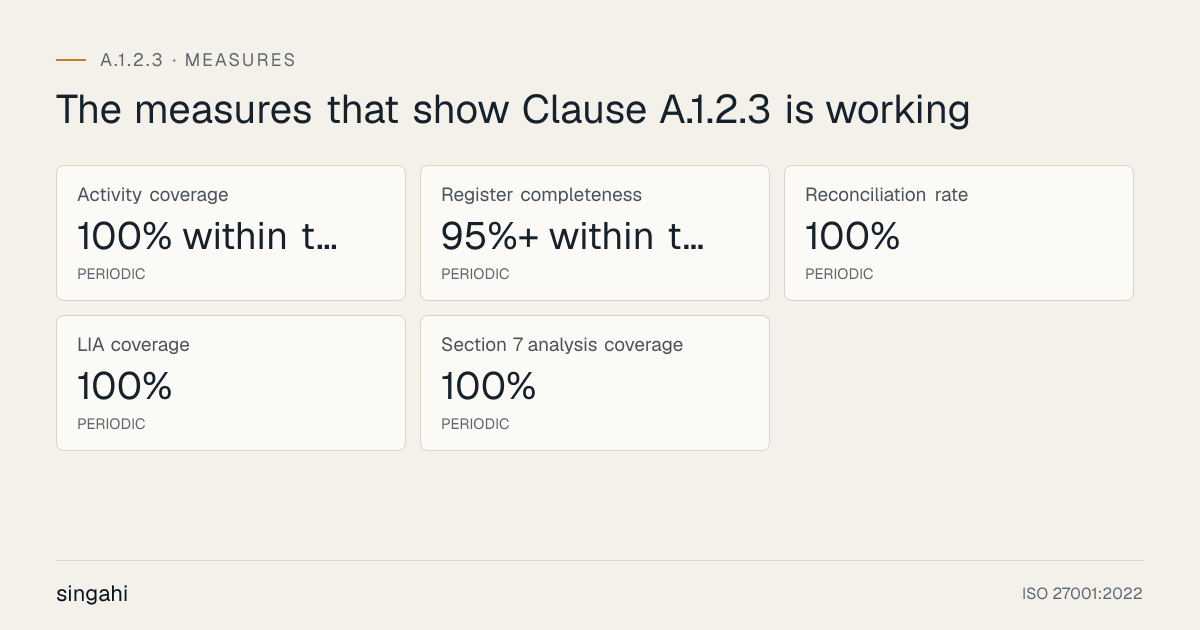
The Singahi A.1.2.3 KPI set has 15 KPIs across four families. The KPIs are documented in detail in toolkit doc 11; the headline KPIs are below.
Coverage KPIs
- Activity coverage, the percentage of inventoried processing activities that have a documented basis. Target: 100% within the first cycle; sustained.
- Register completeness, the percentage of register rows that carry all 27 schema fields. Target: 95%+ within two cycles.
- Reconciliation rate, the percentage of activities where the register basis reconciles with the notice basis, the consent schema (where applicable) and the ROPA row. Target: 100%.
Quality KPIs
- LIA coverage, the percentage of EU-data activities relying on Article 6(1)(f) that have a documented LIA. Target: 100%.
- Section 7 analysis coverage, the percentage of activities relying on a DPDP section 7 legitimate use that have a documented Section 7 Legitimate-Use Assessment. Target: 100%.
- Special-category analysis coverage, the percentage of special-category activities that have an Article 9(2) condition or DPDP sensitivity analysis. Target: 100%.
Currency KPIs
- Review cadence adherence, the percentage of register rows reviewed within the planned cadence. Target: 95%+.
- Change-trigger responsiveness, the median time from a change trigger (new law, new purpose, new technology) to a register update. Target: under 30 days for high-risk; under 90 days for medium-risk.
- Re-basing event volume, the number of re-basing events per cycle. Trend indicator; not a target (zero re-basing suggests drift, not stability).
Demonstration KPIs
- Demonstration-pack production time, the median time from a regulator or auditor request to a complete demonstration pack for a sampled activity. Target: under 4 hours.
- Audit nonconformities, the number of A.1.2.3 nonconformities per audit cycle. Target: zero.
- Principal access requests, the median time to produce the basis statement in a principal access request. Target: under 7 days.
Risk KPIs
- Basis-risk register entries, the number of open basis-risk entries in the privacy risk register. Target: trending to zero.
- Wrong-basis incidents, the number of identified wrong-basis incidents per cycle (whether surfaced by audit, by complaint, by review). Target: trending to zero.
- Basis-driven retention discipline, the percentage of retention rules that are explicitly tied to a basis row. Target: 100%.
The KPIs report into the Clause 9.1 monitoring cycle and the Clause 9.3 management review. The KPI dashboard (toolkit doc 11) is the controller's operational view of A.1.2.3 health.
Common Pitfalls and Audit Failures
The canonical A.1.2.3 audit findings in Indian growing companies, with their root causes.
Pitfall 1, "Consent for everything". The default-to-consent reflex. Every activity is marked "consent" without analysis. Root cause: the privacy notice already says "we rely on consent", and the controller works backwards from the notice. Treatment: run the Basis-Selection Decision Tree on every activity; document the analysis; accept that some activities will be re-based.
Pitfall 2, The register that does not exist. The controller has a privacy notice and a ROPA but no basis register. Root cause: A.1.2.3 has been treated as a one-line field in the notice, not as a per-activity analysis. Treatment: build the register from the ROPA scaffold (Stage 1 of the lifecycle).
Pitfall 3, The register that does not reconcile. The controller has a register, but the register says consent while the notice says contract, or the register says Article 6(1)(f) while the LIA is missing. Root cause: the register, the notice and the consent capture were built separately and have drifted. Treatment: the basis-to-notice and basis-to-consent reconciliation at the Clause 9.1 cadence.
Pitfall 4, The missing LIA. The controller relies on Article 6(1)(f) legitimate interests for fraud-detection, network security or direct marketing, but the LIA was never run. Root cause: the LIA is treated as a one-off rather than a living document. Treatment: stand up the LIA template; run LIAs for all Article 6(1)(f) activities; revisit at the cadence.
Pitfall 5, The missing section 7 analysis. The controller relies on a DPDP section 7 legitimate use (typically employment or breach-response) but the analysis is not documented. Root cause: the section 7 grounds are treated as obvious rather than as narrowly-construed exceptions. Treatment: stand up the Section 7 Legitimate-Use Assessment template; run an assessment for each non-consent ground.
Pitfall 6, The wrong basis in the notice. The privacy notice cites the wrong basis, typically consent for an activity that is actually conducted on a non-consent basis. Root cause: the notice was drafted before the register was built. Treatment: re-draft the notice to cite the register's bases; reconcile at the cadence.
Pitfall 7, The stale register. The register has not been updated in three years despite new products, new markets, new processors. Root cause: the review cadence was set but not enforced. Treatment: wire the review cadence into the Clause 9.1 monitoring cycle; report non-completion as a Clause 10.2 nonconformity.
Pitfall 8, The legacy activity that has no basis. The controller holds data from a decommissioned product, a discontinued market, or a predecessor system; the data has no current basis but is not erased. Root cause: erasure is treated as a project rather than as a discipline. Treatment: legacy-activity re-basing or erasure; the controller must either find a basis or erase.
Pitfall 9, The AI training data that has no basis. The controller uses customer personal data to train a machine-learning model; the basis analysis was never run. Root cause: the basis analysis is upstream of the ML pipeline and is often missed. Treatment: the AI training data is a processing activity; run the basis analysis; document; re-base or take consent as applicable.
Pitfall 10, The "we already had the data" defence. The controller processes data for a new purpose on the basis that the data was already held. Root cause: the controller conflates data retention with basis. Treatment: re-basing on the new purpose; if no basis holds, stop the processing or erase.
Pitfall 11, The mis-claimed Article 9(2) condition. The controller processes special-category data and claims an Article 9(2) condition that does not fit (e.g. Article 9(2)(a) explicit consent where the consent was not explicit). Root cause: the special-category analysis is treated as a check-box rather than a substantive condition. Treatment: re-run the Article 9(2) analysis; document why the chosen condition fits.
Pitfall 12, The cross-border basis confusion. The controller conflates the domestic-law basis (A.1.2.3) with the cross-border transfer basis (A.1.5.2). Root cause: the two analyses are easy to conflate. Treatment: keep them separate in the register; the cross-border analysis is layered on top.
Pitfall 13, The integrity-seal absence. The register exists but has no integrity seal; an employee could modify a basis analysis without detection. Root cause: the integrity controls (A.3.14) were not extended to the register. Treatment: stand up the integrity-seal mechanism (Section 7.12).
Pitfall 14, The un-demonstrable analysis. The controller has the analysis but cannot produce it on demand. Root cause: the analysis is scattered across emails, local drives and former employees' mailboxes. Treatment: the traceability matrix (Stage 5); the DMS integrity controls (Section 7.12).
Pitfall 15, The conflated "certified to 27701 = compliant with law X" assertion. The controller equates ISO/IEC 27701:2025 certification with legal compliance under DPDP / GDPR. Root cause: marketing framing. Treatment: a 27701 certificate evidences a management system; it does not certify legal compliance on a per-activity basis. The controller's basis analysis is the operational compliance; the certificate evidences the framework.
Illustrative Scenario 1: Failure, Taraya Finance and the Wrong-Basis Cascade (Illustrative)
Illustrative scenario, a composite example for guidance, not a specific Singahi engagement or a verified outcome. It is set after 13 May 2027, when the DPDP Act's duties and the Board's inquiry and penalty powers take effect.
Illustrative scenario. The following narrative is a composite drawn from the patterns observed in Indian growing companies. It is not a description of any specific real entity; any resemblance is incidental.
The controller. Taraya Finance is a mid-sized (1,200-staff) digital lender headquartered in Mumbai, with operations across twelve Indian states. Taraya offers personal loans, small-business credit and a buy-now-pay-later product. The controller processes approximately 8 million customer records, 2 million prospective-customer records, and 1,200 employee records. Taraya is in scope for RBI digital-lending guidelines, RBI tokenisation, and (after the phased commencement) DPDP Act 2023.
The setup. Taraya launched in 2018 with a privacy policy drafted by external counsel that said "we process your personal data on the basis of your consent". The policy was treated as the basis statement; no separate basis analysis was conducted. As Taraya grew, the operations team added new processing activities, credit-bureau pulls, alternative-data scoring (using device data, SMS metadata, contacts), fraud-detection network sharing with other lenders, employee monitoring, marketing, each marked "consent" by default because the privacy policy said so.
The trigger. In late 2027, an RBI inspection of the digital-lending portfolio raised questions about the basis for Taraya's alternative-data scoring, specifically, whether the principal had consented to SMS-metadata and contacts processing. The inspection was followed, in early 2028, by a Data Protection Board inquiry (after a principal complaint) about the basis for marketing-email processing.
The findings. When the DPO (a recent hire) opened the privacy file to respond, she found:
- No basis register. The privacy policy was the only "basis statement". There was no per-activity analysis.
- Wrong basis for employment data. Employee monitoring, payroll and benefits processing were marked "consent", but consent in an employment context is rarely "free" under DPDP section 6. The correct basis was the section 7(b) employment legitimate use, which had never been documented.
- Wrong basis for credit-bureau pulls. Credit-bureau data was processed on the basis of "consent" captured at onboarding, but the onboarding consent was bundled with the loan-application consent, failing the DPDP section 6 "specific" quality. The correct basis was consent, but it needed to be re-captured with proper granularity.
- Wrong basis for alternative-data scoring. Device data, SMS metadata and contacts processing relied on consent captured in a long onboarding form, but the consent was not specific to the alternative-data processing and was not informed (the notice did not explain what alternative data was processed). The RBI inspection concluded the basis was not valid.
- Wrong basis for fraud-detection network sharing. Sharing data with other lenders for fraud detection was marked "consent", but the consent capture did not address the network sharing. Under DPDP there is no section 7 ground for inter-lender fraud-detection sharing outside the section 7(f) breach-response ground (which does not apply to ongoing fraud-detection); the controller needed either specific consent or to rely on the Central Government notified legitimate uses if any applied.
- Wrong basis for marketing. Marketing emails were sent on the basis of "consent" that was bundled with the loan-application consent. The DPDP section 6 "specific" quality failed; the marketing basis was not valid.
- No LIA for the EU slice. Taraya served a small but growing number of EU-resident customers (non-resident Indians taking loans for family in India); the controller had not run an Article 6(1)(f) LIA for any of the EU-data activities.
- Stale privacy notice. The privacy notice had not been updated since 2022 despite new products, new processors, new purposes.
- No integrity controls on the basis artefact. The privacy policy was a PDF on the website; no integrity seal; no version control.
The impact. The RBI inspection resulted in a supervisory finding requiring Taraya to remediate the alternative-data scoring within 60 days, Taraya suspended the alternative-data product, took a one-quarter revenue hit estimated at INR 14 crore, and incurred INR 2.5 crore in remediation cost (external counsel, technology rebuild, customer re-communication). The DPBI inquiry continued and resulted in a Board order (illustrative; the actual DPBI cadence and penalty regime were still being established in 2027) requiring Taraya to re-capture consent for marketing within 90 days and to pay a penalty, within the section 33 + Schedule maxima, for the section 8(5) security-safeguard failure (the basis register had not been maintained at all).
The root causes. (1) A.1.2.3 was treated as a privacy-policy statement rather than as a per-activity analysis. (2) The default-to-consent reflex, every activity marked "consent" without analysis. (3) No basis register; no review cadence; no integrity controls. (4) The privacy function was under-resourced; the DPO was hired only after the inspection. (5) The relationship between the basis analysis and the downstream controls (notice, consent capture, retention, cross-border) was not understood.
The lessons. The Taraya scenario illustrates the wrong-basis cascade, a single error at the A.1.2.3 source (defaulting to consent) propagates into every downstream control. The board-level takeaway: the basis register is not a paperwork artefact; it is the legal spine of the entire privacy posture.
Illustrative Scenario 2: Success, Meridian Health Re-Bases Its Processing Around a Defensible Basis Register (Illustrative)
Illustrative scenario. The following narrative is a composite drawn from the patterns observed in Indian growing companies. It is not a description of any specific real entity; any resemblance is incidental.
The controller. Meridian Health is a growing company (280-staff) healthcare provider operating six clinics across Bengaluru, Hyderabad and Pune. Meridian processes approximately 220,000 patient records, including health data (special-category under GDPR Article 9; sensitive under DPDP), and 280 employee records. Meridian is in scope for DPDP, the clinical-establishment regulations of the three states, and (for a small slice of non-resident Indian patients) GDPR.
The challenge. In mid-2026, Meridian's newly hired DPO (an experienced privacy professional) opened the privacy file and found a familiar pattern: a privacy policy drafted in 2020 saying "we process your personal data on the basis of your consent"; no basis register; alternative-data processing (clinic-visit patterns used for capacity planning) running on no documented basis; marketing communications on bundled consent; employee data on consent captured at onboarding; no LIA for the small EU slice. The DPO recognised the wrong-basis cascade risk.
The phased remediation. The DPO ran the Singahi six-stage basis-identification lifecycle over six months.
Months 1–2, Inventory and classify. The DPO and the operations team enumerated 34 processing activities, clinic visits, lab tests, prescriptions, billing, insurance claims, marketing, employee payroll, employee benefits, employee monitoring (badge access and CCTV), vendor due diligence, regulatory reporting, AI-assisted radiology (a recent pilot), research collaboration with an academic medical institution, legacy records from a discontinued telemedicine product. Each activity was classified by PII type, sensitivity (most involving health data), volume, vulnerability, sector rule, jurisdiction.
Months 2–3, Basis selection. The DPO ran each activity through the Singahi Basis-Selection Decision Tree. The output:
- 11 activities re-based on DPDP section 6 consent with the section 9 verifiable-parental-consent overlay for minors (clinic visits, lab tests, prescriptions, marketing, research collaboration).
- 6 activities re-based on DPDP section 7(b) employment legitimate use (employee payroll, benefits, leave, performance, badge access, statutory compliance).
- 4 activities re-based on DPDP section 7(c) medical-emergency ground (emergency care, epidemic response, public-health reporting).
- 3 activities re-based on DPDP section 7(f) breach-response ground (incident response, breach notification, post-breach forensics).
- 4 activities re-based on GDPR Article 6(1)(c) legal obligation for the EU-resident slice (insurance, regulatory, anti-money-laundering, statutory health reporting).
- 2 activities re-based on GDPR Article 6(1)(f) legitimate interests for the EU-resident slice, marketing to existing patients (with an LIA), capacity-planning analytics using aggregated clinic-visit data (with an LIA).
- 4 legacy activities flagged for erasure (the discontinued telemedicine product's data, an old patient-feedback system, a deprecated mobile app's data, an unused marketing database).
Months 3–4, Document. The DPO built the Lawful-Basis Register in a structured spreadsheet (Google Sheets with revision history), with all 27 schema fields per activity. The LIA was documented for the two Article 6(1)(f) activities. The Section 7 Legitimate-Use Assessment was documented for the 13 non-consent-ground activities. The basis-to-notice traceability matrix was built; the privacy notice was re-drafted (with external counsel review) to cite the actual bases; the notice versions were archived with cryptographic hashes.
Months 4–5, Demonstrate. The DPO built the demonstration pack per activity, the basis, the rationale, the LIA or section 7 analysis as applicable, the notice version, the consent schema (for the 11 consent activities), the retention rule, the cross-border analysis. The pack was indexed in the traceability matrix; the index sat in the controller's DMS (Google Drive with version control and access logging).
Months 5–6, Review. The DPO wired the review cadence into the Clause 9.1 monitoring cycle: annual for the high-risk activities (special-category, children's, AI-assisted radiology, research collaboration); biennial for medium-risk; triennial for low-risk. The change-trigger list was documented. The basis register was integrated into the internal-audit scope (Clause 9.2) and the management-review pack (Clause 9.3).
The quantified results (12 months after go-live).
- Audit outcomes. Meridian's first ISO/IEC 27701:2025 Stage 1 audit (Q3 2027) returned zero major nonconformities on A.1.2.3, the only controller control area to achieve this in the audit. The auditor's note: "the basis register is among the most mature we have reviewed for a controller of this size".
- Operating efficiency. Demonstration-pack production time (a regulator or auditor request) dropped from "best-effort, weeks" before the remediation to under 2 hours after.
- Consent volume reduction. The re-basing reduced the volume of consent the controller needed to capture, 13 activities moved off consent to section 7 grounds. The patient onboarding flow was simplified (fewer consent screens); conversion rate at the clinic front-desk improved 8 percent.
- Risk profile. The legacy-activity erasure (4 activities) eliminated an estimated 18,000 principal records Meridian had no basis to hold, a meaningful reduction in breach-exposure surface. Over 24 months, Meridian's CFO tracked the return in five areas: avoided inspection cost, avoided penalty exposure, operating efficiency, conversion improvement and breach-surface reduction.
The lessons. Meridian's success illustrates that A.1.2.3 done well is a value-creating discipline, not a compliance cost centre. The basis register simplified operations (less consent to capture), reduced risk (smaller breach surface), and produced audit results that distinguished Meridian from peers. The phased six-month remediation is replicable for any growing company of similar size; the Singahi toolkit is the scaffold.
Multi-Framework Mapping
The full cross-framework map for A.1.2.3, with real numbers, is below. Each cell is a Tier-1 citation (the framework's own article / section / control number), not a thematic analogy.
| Framework | Anchor | Relationship to A.1.2.3 |
|---|---|---|
| DPDP Act 2023 (India) | Section 4 (lawful purpose + grounds); Section 5 (notice content, basis stated); Section 6 (seven consent qualities); Section 7 (seven legitimate uses); Section 8 (general obligations); Section 9 (children, verifiable parental consent); Section 10 (SDF, DPIA on basis-architecture changes); Section 11 (right to access, basis in the response); Section 16 (cross-border negative list, layered on the domestic basis); Section 33 + Schedule (penalties up to INR 250 crore) | A.1.2.3 implements the section 4 / section 6 / section 7 framework as a per-activity analysis |
| DPDP Rules 2025 | Rule 7 (breach clock); consent notice content rules; verifiable parental consent rules; Consent Manager registration (section 2(1)(g)) | A.1.2.3 wires the Rules' notice-content requirements into the basis-to-notice cascade |
| GDPR (EU) | Article 5(1)(a) lawfulness; Article 5(1)(b) purpose limitation; Article 5(2) accountability; Article 6 (six bases); Article 7 (conditions for consent); Article 8 (children, age of consent); Article 9 (special categories); Article 9(2) (conditions); Article 10 (criminal-conviction data); Article 21 (right to object, basis-dependent); Article 24 (controller responsibility); Article 83(5) (fines up to EUR 20 million or 4 percent of worldwide annual turnover) | A.1.2.3 implements the Article 6 basis-selection analysis for EU-data activities |
| UK GDPR + DPA 2018 | Substantively mirrors EU GDPR; Schedule 2 conditions for processing; ICO Accountability Framework | A.1.2.3 maps identically |
| ISO/IEC 27001:2022 | Clause 6.1 (risk); Clause 6.2 (objectives); Clause 8.1 (operational planning and control); Annex A.5.34 (privacy and protection of PII, the only PII-specific 27002:2022 control) | A.1.2.3 layers on top of the ISMS for controllers running integrated 27001 + 27701 systems |
| ISO/IEC 27002:2022 | Control 5.34 (Privacy and protection of PII), the only PII-specific control | A.1.2.3 implements the basis-analysis slice of 5.34 |
| ISO/IEC 29100:2011 | Consent & Choice principle; Purpose Legitimacy & Specification principle; Openness, Transparency & Notice principle; Accountability principle | A.1.2.3 is the operational expression of Purpose Legitimacy & Specification |
| ISO/IEC 29134:2017 | DPIA guidance (the basis feeds the DPIA trigger and the DPIA's risk analysis) | A.1.2.3 + A.1.2.6 |
| ISO/IEC 27018:2019 | PII in public-cloud processors, basis handling on the processor side | A.1.2.3 governs the controller side; the cloud processor propagates |
| ISO/IEC 27701:2025 (siblings) | A.1.2.2 (purpose); A.1.2.4 (when-and-how consent); A.1.2.5 (obtain-record consent); A.1.2.6 (PIA); A.1.2.7 (processor contracts); A.1.2.8 (joint controller); A.1.2.9 (ROPA); A.1.3.3 (information); A.1.3.5 (withdrawal); A.1.3.6 (object); A.1.3.7 (access); A.1.4.8 (retention); A.1.5.2 (transfer basis) | The sibling network in Section 6.1 |
| NIST Privacy Framework v1.0 (NIST.CSWP.01162020, 16 January 2020) | Identify-P (data-mapping, risk assessment); Govern-P (privacy roles, risk strategy); Control-P (data-processing policies, DUA, disassociated processing) | A.1.2.3 = Control-P basis slice |
| SOC 2 Privacy TSC (AICPA 2017 TSC, 2022 Points of Focus update) | P1.0 Notice (basis stated); P2.0 Choice and consent (the choice mechanism where basis is consent); P3.0 Collection (basis for collection); P8.0 Monitoring and enforcement (basis review) | A.1.2.3 = the per-activity basis analysis underlying P1.0, P2.0, P3.0 |
| CCPA / CPRA (US-CA) | Cal. Civ. Code 1798.100 et seq.; "business purpose" / "commercial purpose" distinction; opt-out for sale/share; opt-in for sensitive PI and minors | A.1.2.3 = the per-purpose basis analysis for California residents' data |
| VCDPA (US-VA) | Va. Code § 59.1-575 et seq.; controller / processor; opt-out; sensitive-data consent; DPIA for profiling | A.1.2.3 maps |
| CPA (US-CO) | C.R.S. § 6-1-1301 et seq.; universal opt-out; sensitive-data consent | A.1.2.3 maps |
| CTDPA (US-CT) | Public Act 22-15; controller / processor; opt-out; sensitive-data consent; DPIA | A.1.2.3 maps |
| LGPD (Brazil) | Article 7 (ten lawful bases, consent, contract, legal obligation, vital interests, public task, legitimate interests, credit-protection, research, statistical, health); Article 9 (notice); Article 11 (sensitive data); Article 18 (rights) | A.1.2.3 maps to the Article 7 basis selection (note: LGPD has more bases than GDPR) |
| PIPL (China) | Article 13 (lawful bases, consent, contract, legal obligation, etc.); Article 23 (separate consent for third-party sharing); Article 24 (automated decisions, separate consent); Article 25 (public-image collection, separate consent); Article 26 (sensitive locations); Article 28–29 (sensitive PI, separate consent); Article 39 (cross-border, separate consent); Article 55 (mandatory PIA) | A.1.2.3 maps with the "separate consent" overlay for the Chinese-specific triggers |
| PDPA (Singapore) | Section 13 (consent); Section 14 (deemed consent); Section 15 (deemed consent by notification); Section 17 (mandatory exceptions); Schedule 1 (recognised exceptions); Section 26 (notification of purpose) | A.1.2.3 maps to the consent / exception selection |
| PIPEDA (Canada) | Schedule 1 Principle 3 (consent); Principle 4 (limiting collection, basis for collection); Principle 5 (limiting use, disclosure, retention); Section 7 (exceptions) | A.1.2.3 maps to Principle 4 / Principle 5 |
| POPIA (South Africa) | Sections 9–11 (conditions for processing); Section 18 (rights); Section 22 (responsible party); Section 23 (operator) | A.1.2.3 maps to the conditions-for-processing analysis |
| PDPL (UAE federal) | Federal Decree-Law No. 45 of 2021; Articles 5–9 (controller / processor / consent / processing grounds); Article 19–21 (cross-border) | A.1.2.3 maps |
| PDPL (KSA) | Royal Decree M/19; Articles 4–7 (processing grounds); Article 8 (consent); Article 17 (sensitive data); Article 14 (children) | A.1.2.3 maps |
| APPI (Japan) | Act No. 57 of 2003 as amended; Articles 16–18 (use purpose); Articles 17–22 (acquisition, notification, etc.) | A.1.2.3 maps |
| APP (Australia) | Privacy Act 1988 Schedule 1; APP 3 (collection); APP 6 (use or disclosure) | A.1.2.3 maps to APP 3 / APP 6 |
| PIPA (South Korea) | Act No. 10469 as amended; Articles 15–22 (collection, notice, use, provision) | A.1.2.3 maps |
| EDPB Guidelines | Guidelines 05/2020 on consent; Guidelines 4/2019 on Article 25; Guidelines 9/2022 on breach notification; Recommendations 01/2020 on supplementary measures; Article 29 WP248 rev.01 (DPIA criteria) | The operational commentary on basis selection |
| ICO (UK) Accountability Framework | Accountability dimension, basis selection as a demonstrable artefact | A.1.2.3 implements |
| CNIL (FR) PIA methodology | Cross-references ISO/IEC 29134; the basis feeds the PIA trigger | A.1.2.3 + A.1.2.6 |
| CERT-In Directions 20(3)/2022-CERT-In (28 Apr 2022) | The 6-hour ICT-incident clock; the section 7(f) breach-response ground under DPDP runs alongside | A.1.2.3 wires the section 7(f) analysis into the dual-clock breach discipline |
| RBI Digital Lending Guidelines (2 Sep 2022) | Explicit borrower consent for lending activities; restrictions on device-data access | A.1.2.3 picks the basis (consent, explicitly) for regulated lending activities |
| RBI Tokenisation (22 Sep 2021; full effect 1 Oct 2022) | Consent for tokenisation | A.1.2.3 picks the basis for card-on-file tokenisation |
| SEBI KRA Master Circular (May 2024) | KYC processing, legal-obligation-style analysis (DPDP section 7 / GDPR Article 6(1)(c)) | A.1.2.3 maps |
| IRDAI Information and Cyber Security Guidelines (24 Apr 2023) | Policyholder-data confidentiality; consent for sensitive processing | A.1.2.3 picks the basis for policyholder processing |
| K.S. Puttaswamy v. Union of India (2017) 10 SCC 1 | Right to privacy as a fundamental right; the proportionality test the basis analysis must implicitly satisfy | The doctrinal foundation |
| Aadhaar judgment, Justice K.S. Puttaswamy (Retd.) v. Union of India (2019) 1 SCC 1 | Proportionality test; section 57 of the Aadhaar Act struck down | The test the basis analysis must implicitly satisfy |
Implementation Roadmap
The Singahi A.1.2.3 implementation roadmap (toolkit doc 05) is structured in four arcs: 30 days, 90 days, 180 days, and 9 to 12 months. The arcs scale by organisation size; the cadence runs continuously after go-live.
30-day arc, foundation.
- Day 1–5: convene the basis-identification team (DPO, Legal, top five business-process owners, Information Security lead). Confirm the scope of the first cycle (typically the top five to ten highest-volume activities).
- Day 6–10: adopt the Singahi Lawful-Basis Policy template (toolkit doc 01); customise to the controller's scope; circulate for executive sign-off.
- Day 11–15: adopt the Basis-Identification Procedure (toolkit doc 02) and the Basis-Selection Decision Tree (toolkit doc 03). Walk the team through the four gates on a sample activity.
- Day 16–25: inventory the top five to ten activities (Stage 1) and classify each (Stage 2). Document the inventory in the processing-activity list.
- Day 26–30: run the first cycle of basis selection (Stage 3) for the top five to ten activities. Document the selection in the draft Lawful-Basis Register.
90-day arc, first-cycle build.
- Day 31–45: extend the inventory to cover all processing activities the controller undertakes (Stage 1 full coverage).
- Day 46–60: classify each activity (Stage 2 full coverage); identify the LIA-trigger activities (GDPR Article 6(1)(f)); identify the section 7 legitimate-use activities (DPDP).
- Day 61–75: run the Basis-Selection Decision Tree on every activity (Stage 3 full coverage). Document the LIA for Article 6(1)(f) activities; document the Section 7 Legitimate-Use Assessment for non-consent-ground activities.
- Day 76–90: build the Lawful-Basis Register (Stage 4) with the 27-field schema. Build the basis-to-notice / basis-to-consent / basis-to-DPIA traceability matrix (Stage 5). Re-draft the privacy notice to cite the actual bases.
180-day arc, operational integration.
- Day 91–120: integrate the basis register with the ROPA (A.1.2.9), the notice (A.1.3.3), the consent capture (A.1.2.4 / A.1.2.5), the retention schedule (A.1.4.8) and the cross-border analysis (A.1.5.2). Reconcile at the cadence.
- Day 121–150: stand up the integrity controls on the register (A.3.9, A.3.14, A.3.25, A.3.26, A.3.24). Test the integrity-seal mechanism.
- Day 151–165: wire the review cadence into the Clause 9.1 monitoring cycle. Wire the basis register into the internal-audit scope (Clause 9.2) and the management-review pack (Clause 9.3).
- Day 166–180: train the business-process owners, the engineering team and the customer-support team on the basis register (toolkit doc 07 training materials). Run the first basis-register review meeting; capture the first round of change-trigger events.
9 to 12-month arc, maturity.
- Months 7–9: run the first internal audit (Clause 9.2) of the basis register. Close any findings under Clause 10.2.
- Months 10–12: stand up the KPI dashboard (toolkit doc 11); report into the Clause 9.1 and Clause 9.3 cycles. Run the first re-basing event (typically triggered by a new product, a new market, or a new law); document the propagation downstream.
- Months 9–12 (SDF only): for a controller designated as SDF under DPDP section 10, run the SDF DPIA on the basis-architecture changes; commission the independent data audit; run the algorithmic-software review on basis-chosen profiling activities.
Ongoing cadence. Annual review for high-risk activities; biennial for medium-risk; triennial for low-risk. Change-trigger reviews as they arise. Reconciliation with the notice, the consent capture, the retention and the cross-border analysis at the Clause 9.1 cadence. Internal-audit coverage at the Clause 9.2 cycle.
FAQ
Q1. We are an Indian controller. Do we always need consent?
Almost always, but not literally always. DPDP Act 2023 section 4 makes consent under section 6 the default ground, with the seven section 7 "certain legitimate uses" as narrow exceptions. The exceptions are real (employment, medical emergency, disaster relief, judicial direction, breach response, voluntary provision, Central Government notified) but they are narrowly construed. The default for an Indian controller is consent; the analysis for each activity must consider whether a section 7 ground genuinely fits before defaulting to consent.
Q2. We are an Indian controller that also serves EU customers. Which framework applies?
Both, in parallel. The DPDP framework applies to the Indian slice (Indian principals, Indian processing). The GDPR framework applies to the EU slice (EU residents' personal data). For each activity, the controller runs two analyses, DPDP and GDPR, and picks the basis that holds for each slice. The basis may differ across slices (e.g. DPDP section 6 consent for the Indian slice; GDPR Article 6(1)(f) legitimate interests for the EU slice) provided the analysis is documented.
Q3. We use a "voluntary provision" ground under DPDP section 7(a) for our lead-capture form. Is that enough?
The voluntary-provision ground requires (i) the personal data was voluntarily provided by the principal, (ii) for a specified purpose, (iii) the principal has not objected to processing for that purpose. The analysis must address each. The ground is fragile, it does not cover data the controller collects by inference, by scraping, or by tracking; it does not cover data the controller repurposes after collection; it does not cover processing the principal would not reasonably expect. For a lead-capture form, the ground may fit if the principal explicitly filled the form for the controller's specified purpose; it will not fit for inherited or re-purposed leads.
Q4. Can we run employee monitoring on consent?
Generally no, consent in an employment context is rarely "free" under DPDP section 6 (the power imbalance between employer and employee invalidates the freeness quality) or under GDPR Article 7 (the EDPB Guidelines 05/2020 on consent are explicit). The correct basis for employee monitoring is typically DPDP section 7(b) employment ground (where the monitoring is necessary for the employment relationship) or, in the EU, Article 6(1)(b) contract, Article 6(1)(c) legal obligation, Article 6(1)(f) legitimate interests (with LIA), depending on the monitoring's purpose, scope and intrusiveness.
Q5. Our privacy notice says "we rely on consent for everything". Is that compliant?
Almost certainly not. Defaulting to consent for every activity, including activities where consent is the wrong basis (employment, statutory compliance, performance of contract in the EU sense), produces invalid consent. The notice must cite the actual bases the register documents; if the register says section 7(b) employment ground for an activity, the notice must say so.
Q6. Do we need a Lawful-Basis Register separate from the ROPA?
No, the basis register is best built as a slice of the ROPA (A.1.2.9). The ROPA carries the basis for each activity; the basis-specific analyses (LIA, section 7 assessment) sit in linked documents. Building the basis register as a separate inventory is duplicative and creates drift.
Q7. We have an AI/ML model trained on customer data. What is the basis?
The same as any other processing activity, the controller runs the Basis-Selection Decision Tree. AI/ML training is not a special category; it is a processing activity that requires a basis like any other. Most AI/ML training on customer personal data will require consent (DPDP section 6 / GDPR Article 6(1)(a)) or, in the EU, potentially Article 6(1)(f) legitimate interests subject to a documented LIA and rigorous safeguards. The Rule 13(3) algorithmic-software overlay applies where the controller is an SDF; the section 9 children's-data overlay applies where the training set includes children's data.
Q8. How often should we review the basis register?
At the planned cadence (annual for high-risk activities; biennial for medium-risk; triennial for low-risk) and on every change trigger (new law, new purpose, new technology, new market, new principal expectations). The cadence is wired into the Clause 9.1 monitoring cycle.
Q9. What if the auditor picks an activity we have not analysed?
The auditor will record a nonconformity. The corrective action under Clause 10.2 is to run the Basis-Selection Decision Tree on the missed activity, document the analysis, and update the register. The nonconformity is recoverable; the prevention discipline is the Stage 1 inventory coverage.
Q10. What is the relationship between A.1.2.3 (basis) and A.1.5.2 (transfer basis)?
They are separate analyses. A.1.2.3 governs the domestic-law basis for processing. A.1.5.2 governs the cross-border transfer mechanism, DPDP section 16 negative list (transfer permitted to any country except those the Central Government notifies as restricted); GDPR Chapter V (Article 45 adequacy, Article 46 SCCs / BCRs / codes, Article 47 BCRs, Article 49 derogations). The transfer analysis layers on top of the domestic-law basis, a controller with no domestic basis cannot lawfully transfer.
Q11. Our legacy system has data we no longer have a basis for. What do we do?
Either find a basis (re-base under Stage 6 of the lifecycle) or erase the data under A.1.4.9 (disposal). Holding data the controller has no basis to hold is itself a nonconformity, the controller cannot "wait and see"; the controller must act.
Q12. What is the role of the Consent Manager (DPDP section 2(1)(g)) in A.1.2.3?
The Consent Manager is the principal-side intermediary through which consent is given, managed, reviewed and withdrawn. The Consent Manager does not change the basis-selection analysis (A.1.2.3), it operationalises the consent capture (A.1.2.4 / A.1.2.5) where consent is the basis. Where the controller relies on a section 7 legitimate use, the Consent Manager is not in scope.
Q13. Can the basis change over time?
Yes, re-basing is a planned change under Clause 6.3. The re-basing event is logged in the register's change log; the downstream controls (notice, consent, retention, cross-border) are updated. Re-basing is expected; the absence of re-basing events in a controller that has launched new products is a sign of register drift.
Q14. Do we need to publish the basis analysis on our website?
No. The basis analysis (the LIA, the section 7 assessment, the register) is the controller's internal working document. The privacy notice cites the bases (per DPDP section 5; GDPR Articles 12–14); the analysis is produced on demand to the regulator or the auditor, or to the principal through the right-of-access mechanism.
Q15. Is certification to ISO/IEC 27701:2025 the same as DPDP compliance?
No. A 27701 certificate evidences that the controller has a management system (the PIMS) that meets the standard's requirements; it does not certify legal compliance on a per-activity basis. The controller's basis analysis is the operational DPDP compliance; the certificate evidences the framework that produces and maintains that analysis.
Industry-Specific Requirements
The A.1.2.3 operating model varies significantly by industry. The headline variations for the Indian growing-company sectors are below.
BFSI (banking, financial services, insurance)
BFSI carries the most prescriptive Indian sectoral basis rules, RBI, SEBI and IRDAI layer specific basis requirements on top of the DPDP framework.
- RBI Digital Lending Guidelines (2 Sep 2022). Explicit borrower consent is required for many lending activities; restrictions on device-data access (contacts, location, media) by lending apps; data minimisation; mandatory privacy policy; grievance redressal. The basis for digital-lending processing is typically DPDP section 6 consent captured with the granularity the Guidelines require. A controller that defaults to "consent" without the granularity fails both the DPDP section 6 "specific" quality and the RBI rule.
- RBI Tokenisation (22 Sep 2021; full effect 1 Oct 2022). Consent required for tokenisation; card-on-file replaced by tokens; merchants and payment aggregators may not store raw card data. The basis for tokenisation is DPDP section 6 consent captured at the tokenisation moment.
- RBI Storage of Payment System Data (6 Apr 2018). End-to-end storage of payment-system data in India only; cross-border processing only for foreign-leg transactions with a copy in India. The basis is overlaid by the data-localisation requirement; A.1.5.2 (transfer basis) is in tension with the data-locality rule and must be reconciled.
- SEBI KRA Master Circular (May 2024). Uniform KYC; KRA stores KYC data; consent for processing; data retention; confidentiality. The basis for KYC processing is typically DPDP section 7 (judicial-direction or Central Government notified grounds may bite) or GDPR Article 6(1)(c) legal obligation in the EU slice.
- SEBI Cybersecurity and Cyber Resilience Framework (CSCRF, 20 Aug 2024). Incident reporting (6 hours to SEBI/CERT-In); data-locality expectations; PII in logging and monitoring; third-party data handling. The basis for incident-response processing is typically DPDP section 7(f) breach-response ground.
- IRDAI Information and Cyber Security Guidelines (24 Apr 2023). Policyholder-data confidentiality; data locality for policyholder data; incident reporting to IRDAI + CERT-In; ICT-outsourcing data-protection clauses. The basis for policyholder processing is typically DPDP section 6 consent with the sensitivity overlay for health and financial data.
- Credit Information Companies (Regulation) Act 2005. Governs collection, processing, privacy/confidentiality and sharing of credit information; data-subject rights to access and correct credit reports. The basis for credit-information processing is typically the Central Government notified ground under section 7(g) (the CICRA-regulated industry is a candidate for a notified legitimate use) or DPDP section 6 consent read with the CICRA regime.
The BFSI controller's A.1.2.3 operation must map each regulated activity to both the DPDP basis and the sector rule. The Singahi register schema (Section 7.4) carries a "sector rule" field for this purpose.
Healthcare
Healthcare carries the highest sensitivity overlay, health data is special-category under GDPR Article 9 and sensitive under DPDP / IT Act SPDI Rules.
- Special-category analysis. Health data triggers GDPR Article 9, the controller must satisfy an Article 9(2) condition (typically explicit consent under 9(2)(a)) in addition to the Article 6(1) basis. The DPDP sensitivity overlay applies; the notified Rules will sharpen the analysis.
- Children's data. Pediatric healthcare triggers DPDP section 9 verifiable parental consent, the basis is never the child's own consent.
- Emergency care. DPDP section 7(c) medical-emergency and public-health ground applies for emergency care where the principal cannot consent.
- Clinical research. The basis for clinical-research processing typically relies on consent (with explicit consent for special-category data) read with the clinical-research regulations (the ICMR bioethics framework; the Drugs and Cosmetics Act). The Article 9(2)(j) archiving/research/statistics condition is an alternative basis in the EU slice.
- AI-assisted diagnostics. AI/ML training on patient data is a processing activity requiring its own basis, typically explicit consent with the Article 9(2)(a) overlay. The Rule 13(3) algorithmic-software overlay applies where the provider is an SDF.
- Sector rules. The Clinical Establishments (Registration and Regulation) Act, the state-level clinical-establishment rules (where applicable), the Indian Medical Council (Professional Conduct, Etiquette and Ethics) Regulations, the Drugs and Cosmetics Act, each layer additional confidentiality and consent obligations on top of the DPDP framework.
IT-ITeS and SaaS
IT-ITeS and SaaS controllers process both customer data (often as a processor for the customer's controller activity) and employee data; the basis analysis splits along this line.
- Customer data. Where the controller is a processor for the customer's controller activity, A.2.x governs; A.1.2.3 is not in scope for the processor's activity (the customer carries the A.1.2.3 obligation). Where the controller is a controller for its own activity (product analytics, billing, support), A.1.2.3 applies.
- Employee data. The basis for employee data is typically DPDP section 7(b) employment ground (or GDPR Article 6(1)(b) contract / 6(1)(f) legitimate interests with LIA in the EU slice). Consent is rarely the right basis in the employment context.
- Employee monitoring. The basis for employee monitoring (badge access, CCTV, email and chat monitoring for security, productivity monitoring) is typically DPDP section 7(b) employment ground read with the proportionality test from Puttaswamy / Aadhaar. In the EU slice, Article 6(1)(f) legitimate interests with a documented LIA, layered on the relevant member-state employment law.
- Multi-jurisdiction. SaaS controllers typically process personal data of multiple jurisdictions, DPDP, GDPR, US state laws, and others. The basis register carries a per-jurisdiction basis analysis.
- Vendor / sub-processor side. The SaaS controller's own processors (cloud, analytics, support tooling) must propagate the controller's basis (A.1.2.7). The controller's processor inventory (A.2.5.7 sub-processor chain) is wired to the basis register.
E-commerce and retail
E-commerce and retail controllers face intense scrutiny on marketing, tracking and profiling activities, the basis selection is high-visibility.
- Marketing. The basis for direct marketing is typically DPDP section 6 consent (or GDPR Article 6(1)(a) consent in the EU slice; or GDPR Article 6(1)(f) legitimate interests with LIA in some member states, the ePrivacy Directive may layer additional consent for electronic marketing). The "soft opt-in" for existing-customer marketing under PECR (UK) / ePrivacy (EU) has no direct DPDP equivalent.
- Cookie tracking. The basis for tracking-technology processing is DPDP section 6 consent (the ePrivacy consent under the EU regime). The Planet49 CJEU judgment (C-673/17, 1 October 2019) established that pre-ticked checkboxes are not valid consent for tracking.
- Profiling. The basis for profiling is typically consent (DPDP / GDPR Article 6(1)(a)) or, in the EU slice, Article 6(1)(f) legitimate interests with LIA. Where profiling produces legal or similarly significant effects, GDPR Article 22 applies and Rule 13(3) algorithmic-software overlay applies for SDFs.
- Loyalty programmes. The basis for loyalty-programme processing is typically DPDP section 6 consent with granularity per purpose (points, redemption, marketing, analytics).
- RBI tokenisation. E-commerce payment processing is overlaid by the RBI tokenisation rule, consent for tokenisation; merchants may not store raw card data.
Edtech
Edtech controllers processing children's data carry the heaviest DPDP section 9 overlay.
- Verifiable parental consent. The basis for processing children's data is verifiable parental or legitimate guardian consent, never the child's own consent. The age-assurance mechanism (self-declaration for low-risk; probabilistic for moderate-risk; verified for high-risk) sits upstream.
- Section 9 prohibitions. Regardless of basis: no behavioural monitoring of children; no targeted advertising directed at children; no processing likely to cause harm. The section 9 prohibitions override any consent captured, the controller cannot "consent away" the prohibition.
- Profiling. Profiling of children is high-risk under GDPR Article 35(1) and triggers a DPIA; the basis is typically explicit parental consent with heightened safeguards.
- Content personalisation. Educational content personalisation may fit the section 9 framework if it does not amount to behavioural monitoring or targeted advertising and is not likely to cause harm; the analysis must be explicit.
Manufacturing
Manufacturing controllers face a different basis landscape, workforce data, supplier data, IoT sensor data.
- Workforce data. The basis for workforce data is typically DPDP section 7(b) employment ground. Workforce monitoring (shop-floor cameras, badge access, productivity tracking) is overlaid by the proportionality test from Puttaswamy / Aadhaar.
- Supplier-contact data. The basis for supplier-contact data is typically DPDP section 6 consent or the voluntary-provision ground under section 7(a). The analysis must address the principal's reasonable expectations.
- IoT sensor data on the shop floor. The basis depends on whether the sensor data identifies workers, many shop-floor sensor data types (machine telemetry, ambient temperature) are not personal data; biometric worker data (fatigue monitoring, gaze tracking) is personal data and typically requires explicit consent.
- Cross-border transfer. Manufacturing groups with multinational operations face cross-border transfer analyses, the basis for the transfer layers on top of the domestic-law basis.
Maturity Model
The Singahi A.1.2.3 maturity model has five levels.
Level 1, Initial (ad-hoc).
- Operating state. No basis register. The privacy notice is the only "basis statement". Default to consent for every activity. No LIA; no section 7 assessment; no review cadence.
- Artefact set. Privacy notice (stale); no register; no analysis documents.
- Audit outcome. Major nonconformity at Stage 1; remediation effort of 80 to 200 person-hours before Stage 2.
Level 2, Reactive (compliance-driven).
- Operating state. A basis register exists for the public-facing activities. LIA and section 7 assessment are run only when prompted (audit, complaint, regulator inquiry). The register is partially reconciled with the notice.
- Artefact set. Basis register (partial); LIA (partial, run on demand); section 7 assessment (partial); privacy notice (updated); traceability matrix (informal).
- Audit outcome. Minor nonconformities at Stage 1 and Stage 2; corrective actions under Clause 10.2.
Level 3, Defined (systematic).
- Operating state. The basis register covers all inventoried activities. LIA and section 7 assessment are run proactively for new activities. The register is reconciled with the notice, the consent capture and the ROPA at the Clause 9.1 cadence. The review cadence is wired in.
- Artefact set. Lawful-Basis Policy (Clause 5.2); Basis-Identification Procedure; full Lawful-Basis Register; LIA for Article 6(1)(f) activities; section 7 assessment for non-consent-ground activities; traceability matrix; review-cadence record.
- Audit outcome. Zero major nonconformities at Stage 1 and Stage 2; minor findings closed under Clause 10.2.
Level 4, Managed (measured).
- Operating state. The basis register is integrity-sealed, version-controlled, integrated with the PMP / GRC. The KPI dashboard reports into the Clause 9.1 and Clause 9.3 cycles. Re-basing events propagate downstream through automated workflows. The demonstration pack is producible within hours of a regulator request.
- Artefact set. All Level 3 artefacts plus the integrity-sealed register; the KPI dashboard; the propagation workflow; the demonstration pack.
- Audit outcome. Zero major nonconformities; auditor commendation; the basis register cited as a strength.
Level 5, Optimising (continually improving).
- Operating state. The basis operation is a strategic input to product design, new products and features are basis-analysed at the design stage (privacy by design under A.1.4). The basis operation is benchmarked against industry peers; the controller participates in industry discussions on basis-edge cases (AI training, anonymisation threshold, the DPDP / GDPR interplay). The SDF algorithmic-software overlay (where the controller is an SDF) is integrated with the basis analysis.
- Artefact set. All Level 4 artefacts plus the privacy-by-design integration; the benchmarking record; the industry-engagement log.
- Audit outcome. Zero nonconformities; the basis operation cited as a leading practice.
The maturity path is non-linear, a growing company typically goes from Level 1 to Level 3 in the first 12-month cycle (the Singahi 30 / 90 / 180-day roadmap plus the 9-to-12-month arc) and from Level 3 to Level 4 in the second cycle (12 to 24 months). Level 5 is the multi-year aspirational state for the leading privacy-mature controllers.
Emerging Trends
The A.1.2.3 operating model is shifting under four pressures the controller must track.
AI and machine learning. AI training on personal data is a processing activity requiring a basis; the regulatory landscape is rapidly evolving. The EU AI Act (Regulation (EU) 2024/1689) layers additional obligations on AI systems that process personal data; the Indian AI governance framework (under development) will likely layer similar obligations. The controller's A.1.2.3 operation must include an explicit AI-training-data basis analysis, with the LIA (where applicable) addressing the AI-specific risks. The Rule 13(3) algorithmic-software overlay applies to SDFs.
Anonymisation and pseudonymisation. The threshold for effective anonymisation is contested, re-identification risk is a moving target as auxiliary information grows. The controller that processes anonymised data must document the anonymisation methodology and the re-identification risk analysis; data that is merely pseudonymised is still personal data and requires a basis. The EDPB Guidelines 05/2020 on data protection by design and the Article 29 WP216 opinion on anonymisation are the operational commentary; the Indian position will sharpen as the Board issues guidance.
Cross-border transfer fluidity. The DPDP section 16 negative-list model is fundamentally different from the GDPR Chapter V adequacy / SCCs model. The Indian controller's transfer analysis (A.1.5.2) is currently simpler than the European analysis, transfer is permitted except to notified-restricted countries, but the negative list will grow, and the controller must monitor the notifications. The Schrems II line of cases (C-311/18, 16 July 2020) and the EU–US Data Privacy Framework adequacy decision (10 July 2023) are the European developments that affect the EU slice.
Consent Manager ecosystem emergence. The DPDP Consent Manager (section 2(1)(g)) ecosystem will emerge through 2026 and 2027 as the Rules phase in and the Board registers Consent Managers. The Consent Manager reshapes the consent-capture architecture (A.1.2.4 / A.1.2.5) but does not change the basis-selection analysis (A.1.2.3), where consent is the basis, the Consent Manager is the capture channel; where consent is not the basis, the Consent Manager is not in scope.
The 2028 transition deadline. The ISO/IEC 27701:2025 organisation transition deadline is 31 October 2028, the controller certified to 27701:2019 must transition by that date or lose its certificate. The A.1.2.3 operation under the 2025 edition is more demanding than under 2019 (the basis identification is now explicit; the Annex B guidance is normative); the transition window is the planning horizon for the controller that has not yet moved.
Board-level privacy governance. Boards are increasingly asking for privacy performance indicators, not just "are we certified?" but "what is our basis-coverage rate? what is our wrong-basis incident rate? how quickly can we produce the demonstration pack for an activity?". The A.1.2.3 KPI set (Section 12; toolkit doc 11) is the operational answer; the maturity model (Section 22) is the strategic answer.
Sectoral overlay growth. The Central Government's power under DPDP section 7(g) to notify additional legitimate uses will grow the section 7 list over time. Sector-specific notifications (financial services, healthcare, telecommunications) may expand the controller's basis options. The controller must monitor the Gazette and update the register accordingly.
References and Further Reading
The references below are the primary sources, standards and regulations cited in this guide. URLs are to the issuing body's official domain where one exists.
Standards
- ISO/IEC 27701:2025, Privacy information management system, Requirements and guidance. ISO/IEC JTC 1/SC 27. Published 14 October 2025.
- ISO/IEC 27001:2022, Information security management systems, Requirements. ISO/IEC JTC 1/SC 27.
- ISO/IEC 27002:2022, Information security controls. ISO/IEC JTC 1/SC 27. (Only control 5.34 is PII-specific.)
- ISO/IEC 29100:2011, Information technology, Security techniques, Privacy framework.
- ISO/IEC 29134:2017, Information technology, Security techniques, Guidelines for privacy impact assessment.
- ISO/IEC 27018:2019, Code of practice for protection of personally identifiable information (PII) in public clouds acting as PII processors.
- ISO/IEC 27017:2015, Code of practice for information security controls based on ISO/IEC 27002 for cloud services.
- ISO/IEC 27706:2025, Requirements for bodies providing audit and certification of privacy information management systems. (Ed 1; publication date subject to iso.org confirmation.)
- ISO/IEC 17021-1:2015, Conformity assessment, Requirements for bodies providing audit and certification of management systems.
- ISO/IEC 27006, Requirements for bodies providing audit and certification of information security management systems.
India, primary legislation and rules
- Digital Personal Data Protection Act, 2023 (Act No. 22 of 2023). Enacted 11 August 2023. MeitY / eGazette. https://www.meity.gov.in/static/uploads/2024/06/2bf1f0e9f04e6fb4f8fef35e82c42aa5.pdf
- Digital Personal Data Protection Rules, 2025. Notified 13 November 2025. MeitY. https://www.meity.gov.in/documents/act-and-policies/digital-personal-data-protection-rules-2025-gDOxUjMtQWa
- Information Technology Act, 2000 (Act No. 21 of 2000), sections 43A and 72A. https://www.indiacode.nic.in/bitstream/123456789/13116/1/it_act_2000_updated.pdf
- Information Technology (Reasonable Security Practices and Procedures and Sensitive Personal Data or Information) Rules, 2011. MeitY.
- CERT-In Directions No. 20(3)/2022-CERT-In, 28 April 2022. https://www.cert-in.org.in/PDF/CERT-In_Directions_70B_28.04.2022.pdf
- RBI, Storage of Payment System Data. RBI circular DPSS.CO.OD.No.1098/06.08.005/2017-18, 6 April 2018. https://www.rbi.org.in/Scripts/NotificationUser.aspx?Id=11215
- RBI, Digital Lending Guidelines. RBI circular DOID.CO.PPG.SEC.09/14.14.001/2022-23, 2 September 2022. https://www.rbi.org.in/Scripts/NotificationUser.aspx?Id=12408
- RBI, Tokenisation of Card transactions. RBI circular DPSS.CO.RPPD.No.S-35/07.01.005/2021-22, 22 September 2021.
- SEBI, KRA Master Circular, May 2024. https://www.sebi.gov.in/legal/regulations/may-2024/master-circular-for-kyc-registration-agencies-agencies-kras-_82606.html
- SEBI, Cybersecurity and Cyber Resilience Framework (CSCRF), 20 August 2024. https://www.sebi.gov.in/legal/circulars/aug-2024/cybersecurity-and-cyber-resilience-framework-cscrf-for-sebi-regulated-entities-res-_85964.html
- IRDAI, Information and Cyber Security Guidelines, 2023, 24 April 2023.
- Credit Information Companies (Regulation) Act, 2005.
India, jurisprudence
- K.S. Puttaswamy v. Union of India, (2017) 10 SCC 1 (nine-judge Bench, judgment delivered 24 August 2017).
- Justice K.S. Puttaswamy (Retd.) v. Union of India (Aadhaar), (2019) 1 SCC 1 (five-judge Bench, judgment delivered 26 September 2018).
Global privacy regulations
- Regulation (EU) 2016/679 (GDPR). OJ L 119, 4.5.2016, p. 1. Application: 25 May 2018. https://eur-lex.europa.eu/eli/reg/2016/679/oj
- Regulation (EU) 2024/1689 (EU AI Act).
- European Commission Implementing Decision (EU) 2021/914 (modernised SCCs), 4 June 2021.
- EU–US Data Privacy Framework adequacy decision, 10 July 2023.
- Case C-311/18, Data Protection Commissioner v. Facebook Ireland and Maximillian Schrems (Schrems II), CJEU Grand Chamber, 16 July 2020.
- Case C-673/17, Planet49, CJEU, 1 October 2019.
- UK GDPR; Data Protection Act 2018; UK International Data Transfer Agreement (IDTA) / UK Addendum to EU SCCs.
- California Consumer Privacy Act / California Privacy Rights Act, Cal. Civ. Code 1798.100 et seq.
- Virginia Consumer Data Protection Act, Va. Code § 59.1-575 et seq.
- Colorado Privacy Act, C.R.S. § 6-1-1301 et seq.
- Connecticut Data Privacy Act, Public Act 22-15.
- Utah Consumer Privacy Act, Utah Code § 13-61-101 et seq.
- Texas, Florida, Oregon, Montana complete privacy laws (2024).
- Brazil, Lei Geral de Proteção de Dados, Lei nº 13.709/2018.
- China, Personal Information Protection Law, effective 1 November 2021.
- Singapore, Personal Data Protection Act 2012 (No. 26 of 2012), as amended 2020.
- Canada, Personal Information Protection and Electronic Documents Act, S.C. 2000, c. 5.
- Japan, Act on the Protection of Personal Information, Act No. 57 of 2003, as amended 2020.
- Australia, Privacy Act 1988, Schedule 1 (Australian Privacy Principles).
- South Korea, Personal Information Protection Act, Act No. 10469 (2011), as amended 2023.
- South Africa, Protection of Personal Information Act, Act 4 of 2013.
- UAE, Federal Decree-Law No. 45 of 2021.
- Saudi Arabia, Personal Data Protection Law, Royal Decree No. M/19.
Operational guidance (Tier-2)
- EDPB Guidelines 05/2020 on consent under Regulation 2016/679.
- EDPB Guidelines 4/2019 on Article 25, Data Protection by Design and by Default.
- EDPB Guidelines 9/2022 on personal data breach notification under Regulations 2016/679 and 2018/1725.
- EDPB Recommendations 01/2020 on supplementary measures for transfer tools.
- Article 29 Working Party WP248 rev.01, Guidelines on Data Protection Impact Assessment (DPIA).
- Article 29 Working Party WP216, Opinion 05/2014 on anonymisation techniques.
- ICO (UK) Accountability Framework.
- CNIL (France) PIA methodology (cross-references ISO/IEC 29134).
Frameworks
- NIST Privacy Framework v1.0: A Tool for Improving Privacy Through Enterprise Risk Management. NIST.CSWP.01162020. 16 January 2020. https://nvlpubs.nist.gov/nistpubs/CSWP/NIST.CSWP.01162020.pdf
- AICPA 2017 Trust Services Criteria for Security, Availability, Processing Integrity, Confidentiality and Privacy (TSC 2017; 2022 Points of Focus update).
This guide is published by Singahi and is current as of the Last Updated date above. The guide is paraphrased from ISO/IEC 27701:2025 control A.1.2.3; it does not reproduce the standard's official text. The Indian regulatory citations are drawn from the official .gov.in / eGazette sources; the global regulatory citations are drawn from the issuing bodies' official publications. Scenarios in Sections 14 and 15 are illustrative and labelled as such. The Singahi-authored "shall" clauses in Section 9 are drafting samples for the controller to adopt, customise and own. For the editable working set that operationalises this control, the Lawful-Basis Policy template, the Basis-Identification Procedure, the Register schema, the LIA and section 7 assessment templates, the audit-evidence checklist and the rest of the 17-document toolkit, reach out through the Singahi website.