
On this page
- Quick Reference (60 Seconds)
- What the Standard Actually Requires
- Why This Control Matters
- Scope and Applicability
- Key Definitions and Terminology
- Relationship to Other Clauses and Frameworks
- Detailed Implementation Guidance, The Six-Stage Purpose-Specification Lifecycle
- Tools, Technologies, and Solutions
- Policy and Procedure Templates
- Risk Assessment and Treatment
- Audit and Compliance Checklist
- Metrics and KPIs
- Common Pitfalls and Audit Failures
- Illustrative Scenario 1: Failure, Dhanvi Retail and the Inherited Purpose (Illustrative)
- Illustrative Scenario 2: Success, Kavi Bank Rebuilds Its Purpose Register (Illustrative)
- Multi-Framework Mapping
- Implementation Roadmap
- FAQ
- Industry-Specific Requirements
- Maturity Model
- Emerging Trends
- References and Further Reading
Quick Reference (60 Seconds)
| Attribute | Detail |
|---|---|
| Control | ISO/IEC 27701:2025 Control A.1.2.2, Identify and document purpose. Theme A.1.2 (Conditions for collection and processing), Table A.1 (PII-controller controls). The purpose anchor of the entire controller annex, every other A.1.2 condition (lawful basis, consent, DPIA, processor contracts, joint controllers, records) hangs off a documented purpose; get A.1.2.2 wrong and the rest of the conditions theme is unsupported. |
| What it asks for (paraphrase) | ISO/IEC 27701:2025 control A.1.2.2 asks PII controllers to identify and document the specific purposes for which they process PII, to keep that documentation current as processing evolves, and to ensure that any further use of the data stays within the identified purposes or passes a documented compatibility assessment before the new use begins. Three load-bearing verbs sit inside that paraphrase, identify (the purpose, in specific terms, before the processing begins), document (in a controlled register that survives personnel turnover, product redesign and audit cycles), and limit (no further use outside the documented purpose unless the new use clears a documented compatibility test). Auditors test each verb separately. |
| The marquee insight competitors miss | Most commentary reduces A.1.2.2 to "write a purpose statement in your privacy policy". Three corrections. First, the purpose register is the canonical artefact, not the privacy notice. The notice is a downstream projection of the register (one register, many notice surfaces); a controller that maintains its purposes only inside the notice has the causality backwards. Second, "specific" is the operative word. Purposes like "improving services", "business purposes", "marketing", "research" or "to comply with the law" fail the specificity test; the controller must specify what services, whose business, which marketing to whom, what research toward what end, which legal obligation under which instrument. Third, the purpose-limitation / compatibility-assessment discipline is the silent second half of A.1.2.2, a controller that documents purposes but reuses the data freely for any new idea the product team comes up with has satisfied the documentation limb but failed the limitation limb. |
| Domain | Theme A.1.2 of Table A.1 (consolidated 2025 Annex A, A.1 controllers / A.2 processors / A.3 security). The 2025 control carries forward the 2019 edition's controller-side purpose-specification duty (then A.7.2.1); Annex B at B.1.2.2 is normative in 2025, auditors test against it. |
| What you must produce | (a) Purpose Specification and Purpose-Limitation Policy; (b) Purpose-Specification Procedure (the six-stage lifecycle, identify, specify, register, project-to-notice, limit, review-on-change); (c) the Purpose Register, the canonical system-of-record for every purpose, with the seven quality tests applied at entry; (d) the Purpose-to-Notice Traceability Matrix (each purpose → which notice surfaces state it, in which language, at which version); (e) the Purpose-to-Consent Mapping (each purpose → which consent surfaces capture it, with which granularity, under which lawful basis); (f) the Purpose-to-Collection / Purpose-to-Processing Map (each purpose → which data categories, which principals, which retention, the A.1.4.2 / A.1.4.3 linkage); (g) the Compatibility Assessment for Secondary Use template (the GDPR Article 6(4) operational test); (h) the Purpose-Change-Control workflow (the gating mechanism for new purposes, material changes and incompatible reuse); (i) the integration into the ROPA (A.1.2.9), the SoA (Clause 8.3) and the management review (Clause 9.3). |
| Typical owner | The DPO / Privacy Lead owns the framework, the register and the compatibility-assessment escalation. Product Owners own the purpose-identification at the start of each new initiative (they know what the data is for). Engineering / Architecture owns the technical enforcement (purpose tags, access controls that respect purpose, retention rules keyed to purpose). Legal owns the cross-border and sector-regulator mapping (different jurisdictions read purpose limitation differently). Marketing owns the marketing-purpose surface (the most common source of bad purpose statements). Internal Audit tests at the Clause 9.2 cycle. Top management owns the acceptance of incompatibly-reused data as a corrective-action decision under Clause 10.2. |
| Minimum viable actions | (1) Stand up the Purpose Register; (2) write the seven-test specification rubric; (3) run the retrospective purpose sweep on every existing processing activity, extract the purpose, apply the seven tests, fix the failures; (4) build the purpose-to-notice and purpose-to-consent traceability matrices; (5) embed the purpose-identification gate in the product / vendor / M&A / AI-feature intake workflow so no new processing begins without a registered purpose; (6) write the compatibility-assessment template and run it on the first secondary-use request; (7) wire the purpose register into the ROPA, the DPIA register and the SoA; (8) wire the KPIs into Clause 9.1 / 9.3. |
| Maturity floor (L1) | A "purpose lives in the privacy policy" operation: no purpose register; one generic sentence in the notice ("we use your data to provide and improve our services"); product teams launch new purposes without privacy review; reuse of customer data for any new analytics idea is ungated; the L1 controller cannot answer the auditor's question "list every purpose for which you process my PII" without scrambling. The most common A.1.2.2 audit nonconformity in Indian growing companies. |
| Maturity target (L4 to L5) | A "purpose-as-product-gate" operation: every processing activity has a registered purpose that passes the seven quality tests; the purpose register is the system-of-record that feeds the notice, the consent surfaces, the ROPA, the SoA and the DPIA register; the purpose-to-notice and purpose-to-consent matrices reconcile quarterly; no new purpose, material change or secondary use begins without a documented purpose-entry or compatibility-assessment decision; the compatibility-assessment discipline catches incompatible reuse before the data flows; the register integrates with the data catalogue and the access-control layer (purpose-tagged enforcement); purpose-change-control drills run annually. |
| Audit red flag | A purpose register that does not exist, that has fewer entries than the ROPA (A.1.2.9), whose entries fail the specificity test, whose purpose-to-notice matrix does not reconcile with the live privacy notices, or whose secondary-use decisions are not documented. The auditor picks a recent new processing activity (new product feature, new AI model trained on existing data, new analytics use, new partner data share) and asks for the purpose register entry, and, if the activity reuses existing data, the compatibility assessment that justified the new purpose. |
| Quick win | A 90-minute purpose-sweep workshop with the DPO, Product, Engineering, Marketing and Legal. Pull up the current privacy notice. Pull up the ROPA if it exists. List every purpose currently asserted in the notice. For each, apply the seven specificity tests (Section 7.3). Identify the purposes that fail ("improving services" almost always fails; "marketing" almost always fails). Rewrite the failures into specific, registered purposes. |
| Time to implement (first cycle) | Growing companies (50 to 250 staff): 6 to 12 weeks (register, seven-test rubric, retrospective sweep, first purpose entries, notice reconciliation). Mid-sized (250 to 2,000): 14 to 22 weeks (template adoption, embedded intake workflow, purpose-to-consent and purpose-to-notice matrices, compatibility-assessment playbook, KPI maturity). Multi-entity enterprise or SDF (DPDP section 10): 5 to 10 months (SDF DPIA every 12 months, purpose-tagged access enforcement, algorithmic-software review on new AI purposes, multi-jurisdiction purpose configuration). |
| Related controls | A.1.2.3 lawful basis (the basis must serve a registered purpose); A.1.2.4 and A.1.2.5 consent (consent is per-purpose; a consent with no purpose is invalid); A.1.2.6 DPIA (a new purpose is the canonical DPIA trigger; the DPIA tests the necessity and proportionality of the purpose); A.1.2.7 processor contracts (the processor may only process for the controller's documented purpose); A.1.2.8 joint controllers (each controller's purpose must be identified and allocated); A.1.2.9 ROPA (the purpose is the spine of the ROPA entry); A.1.3.3 to A.1.3.5 notice and withdrawal (the notice states the purposes; withdrawal is per-purpose); A.1.4.2 / A.1.4.3 / A.1.4.5 / A.1.4.8 limit collection, limit processing, minimisation, retention (all four are calibrated to the documented purpose); A.1.5.x sharing and transfer (the transfer basis is purpose-bound); Clauses 5.2 / 7.4 policy and communication (the policy states purposes at the high level); Clause 8.3 SoA (the purpose drives the control selection); Clause 9.3 management review. |
| Critical Indian context-bearing instruments | DPDP Act 2023 (Act 22/2023, enacted 11 Aug 2023), §4 grounds for processing (the processing must be for a lawful purpose, for a specified purpose, and the principal must have given consent unless a §7 legitimate use applies); §5 notice (must describe the personal data and the purpose of processing); §6 consent (free, specific, informed, unconditional, unambiguous, clear affirmative action, "specific" reads directly onto the purpose); §7 legitimate uses (each a purpose-defined ground); §8(7) erasure when purpose is served or retention no longer lawful; §9 children (the purpose must not be behavioural monitoring or targeted advertising of children, regardless of consent); §10 SDF (DPIA, every 12 months under Rule 13(1); algorithmic-software review when a new purpose is layered onto existing data); §11 to §14 rights (the right to know the purpose; the right to object to processing for a purpose); §16 cross-border negative list (transfer is purpose-bound); §33 + Schedule penalties (up to INR 250 crore). DPDP Rules 2025 (notified 13 Nov 2025), consent notice content and language (the purpose must be stated clearly in the prescribed format); verifiable parental consent (the children's-purpose overlay); SDF designation thresholds and SDF DPIA cadence; Consent Manager registration; grievance periods. CERT-In Directions 20(3)/2022-CERT-In (28 Apr 2022). RBI Digital Lending Guidelines (2 Sep 2022), explicit purpose-limitation on borrower data and device-data access; SEBI CSCRF (20 Aug 2024); IRDAI Information and Cyber Security Guidelines (24 Apr 2023). Puttaswamy (2017) 10 SCC 1, purpose-limitation as a facet of the proportionality test; Aadhaar (2019) 1 SCC 1, section 57 of the Aadhaar Act struck down because the purpose (private commercial use) was not legitimate. |
If you only read one thing: Control A.1.2.2 is where the controller stops saying "we use data for our business" and starts saying "we use this data category, for these principals, for this specific purpose, on this lawful basis, with this retention, and we will not use it for anything else unless the new use is compatible or the principal consents afresh". An A.1.2.2-conformant controller is one in which every processing activity has a registered purpose that passes the seven specificity tests; the purpose register is the system-of-record that feeds the notice, the consent surfaces, the ROPA, the DPIA register and the SoA; the purpose-to-notice and purpose-to-consent matrices reconcile quarterly; no new purpose, material change or secondary use begins without a documented purpose-entry or compatibility-assessment decision; and the compatibility-assessment discipline catches incompatible reuse before the data flows. Not a privacy notice that says "we use your data to provide and improve our services"; a purpose register that proves the controller knows exactly what each datum is for. The certification auditor picks a recent new processing activity and walks the purpose register entry, the seven-test specification, the notice projection, the consent mapping, and (where applicable) the compatibility assessment; the Data Protection Board of India will, after a complaint or an incident, ask whether the controller identified and documented the purpose before the processing began and whether any subsequent use was compatible. Get A.1.2.2 wrong, no register, generic purpose statements, free-form secondary reuse, no compatibility assessment, notice and register disconnected, and the controller's broader privacy claim is unsupported by the analytical evidence the regulator, the auditor and the board now expect.
What the Standard Actually Requires
Figure · Process
What Clause A.1.2.2 asks you to do
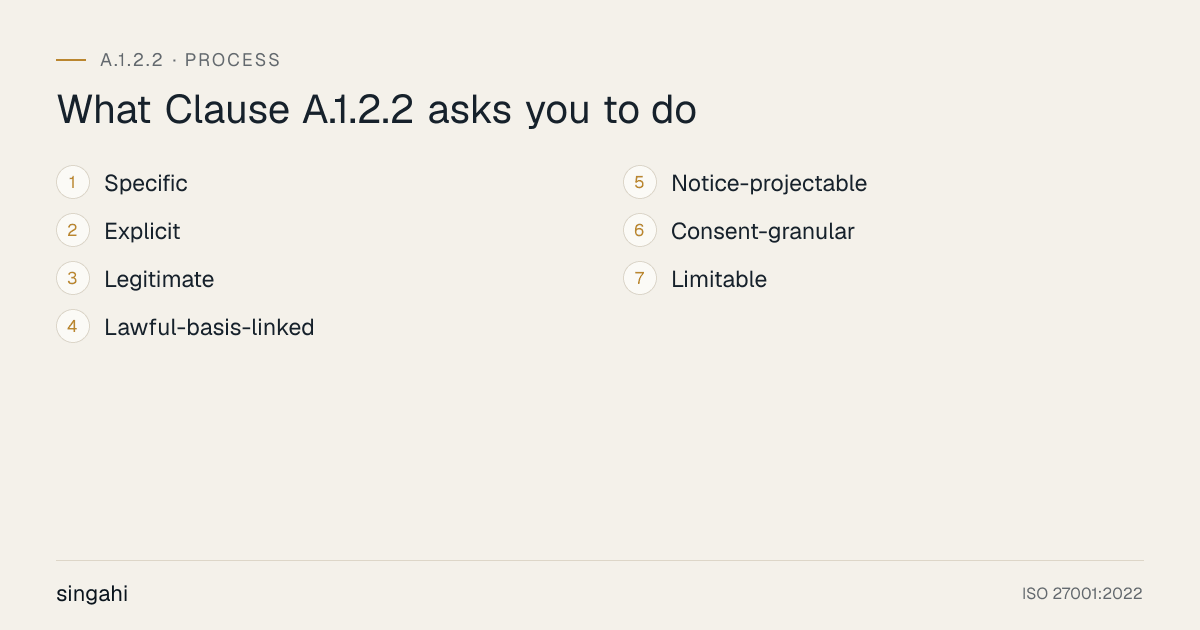
The paraphrased requirement
ISO/IEC 27701:2025 control A.1.2.2 asks PII controllers to identify and document the specific purposes for which they process PII, to keep that documentation current as processing evolves, and to ensure that any further use of the data stays within the identified purposes or passes a documented compatibility assessment before the new use begins. Six load-bearing ideas sit inside that paraphrase, and auditors test each separately.
The controller must identify the purposes. The verb is analytical, not declaratory. The controller has to work out, before the processing begins, exactly what the data is for. "We use data to run our business" is not identification; it is the absence of identification dressed up as a sentence. Identification produces a specific, bounded statement of the purpose, bounded in scope (which data, which principals, which use), bounded in time (how long the purpose runs), bounded in effect (what the principal can expect to happen). The identification exercise is upstream of every other A.1.2 condition: the lawful basis (A.1.2.3) cannot be selected without a purpose; the consent (A.1.2.5) cannot be requested without a purpose; the DPIA (A.1.2.6) cannot be scoped without a purpose; the processor contract (A.1.2.7) cannot constrain the processor without a purpose; the ROPA entry (A.1.2.9) cannot be authored without a purpose. Purpose-identification is the first mover of the conditions theme.
The controller must document the identified purposes. Documentation is not the privacy notice, that is a downstream projection. Documentation is the purpose register: the controlled, version-managed, access-controlled system-of-record that lists every purpose for which the controller processes PII, with the supporting metadata (data categories, principal categories, lawful basis, retention, recipients, cross-border flows, notice surfaces, consent surfaces, review triggers). The register is documented information under Clause 7.5, version-controlled, access-controlled, retention-managed, retrievable. A controller that maintains its purposes only inside the privacy notice, or only inside the ROPA narrative, or only inside product requirements documents, has the documentation limb of A.1.2.2 only partially satisfied; the canonical artefact is the register.
The purposes must be specific. Specificity is the operative quality test, and it is the test that most controllers fail on first audit. A purpose is specific when a reasonable principal, reading it, can understand what will happen to their data; when a reasonable auditor, reading it, can trace it to the processing operations; when a reasonable product owner, reading it, can tell whether a new idea falls inside it or outside it. The marquee specificity test is the negation test: replace the asserted purpose with the phrase "for our business" and ask whether the principal is any less informed. If the answer is no, the purpose is too generic. "Marketing" fails the negation test (the principal learns nothing); "marketing savings-account products to existing customers based on transaction-pattern analysis" passes. "Research" fails; "research on the efficacy of the diabetes-coaching programme for enrolled patients, with results published in aggregate" passes. "Improving services" fails; "improving the routing algorithm for same-day delivery in the Mumbai and Bengaluru zones by analysing delivery-partner location data" passes.
The controller must keep the documentation current. Purposes are not static. Product teams add features; analytics teams add use cases; partners propose data shares; AI teams train new models on existing data; acquisitions bring inherited purposes into the portfolio. The register is a living artefact; each change is a documented decision under the purpose-change-control workflow (Section 7.6). A register that was accurate at launch but has drifted from the live processing is an A.1.2.2 finding; the drift is itself the nonconformity, irrespective of whether any individual purpose was incompatible.
The controller must ensure that any further use stays within the identified purposes. This is the purpose-limitation limb, the silent second half of A.1.2.2 and the limb most controllers miss. The principle reads, in substance, that personal data collected for one purpose is not to be used for another purpose unless the new purpose is compatible with the original or rests on a fresh legal basis (typically fresh consent). Purpose limitation is the operational form of GDPR Article 5(1)(b) and is implied throughout the DPDP Act (section 4 "specified purpose"; section 6 "specific" consent; section 8(7) erasure when purpose is served). A controller that documents purposes but reuses the data freely for any new idea has satisfied the identification limb and failed the limitation limb.
The controller must run a documented compatibility assessment when a new use is contemplated for existing data. This is the GDPR Article 6(4) test operationalised: where personal data is to be further processed for a purpose other than that for which it was collected, the controller assesses whether the new purpose is compatible with the original, having regard to the link between the purposes, the context of the collection, the nature of the data, the consequences for the principal, and the safeguards applied. The compatibility assessment is documented; the decision (compatible / not compatible / requires fresh consent / requires a DPIA / prohibited) is recorded in the purpose register against the original purpose; the new purpose enters the register only after the compatibility decision. The compatibility assessment is the gating mechanism that prevents the most common A.1.2.2 failure pattern, the slow drift of an existing dataset into purposes the principal never agreed to.
The lineage, 2019 to 2025
The 2025 control has a clean ancestor in the 2019 edition. Under 27701:2019, the controller-side purpose-specification duty lived in clause 7 (the controller controls), at 7.2.1, identify and document purposes. The 2025 consolidation moves it to A.1.2.2 inside theme A.1.2 (conditions for collection and processing) of the single consolidated Annex A. The relocation is architecturally meaningful: the purpose is now positioned as the first condition for processing, the anchor from which the lawful basis, the consent, the DPIA, the processor contract and the records all hang. A controller that has not identified and documented the purpose cannot defensibly claim to have satisfied any other A.1.2 condition.
The 2025 edition also makes Annex B (implementation guidance) normative. The B.1.2.2 guidance explains how a controller should structure the purpose-identification exercise, the specificity test, the documentation discipline, the compatibility assessment, the review-on-change trigger. Auditors now test against B.1.2.2 explicitly; an A.1.2.2 audit that does not also walk through the B.1.2.2 guidance is incomplete. The pre-2019 framing of "write a purpose in the privacy policy" is no longer sufficient.
The Indian terminology, purpose under the DPDP Act
The DPDP Act 2023 does not use the ISO/IEC 27701 vocabulary of "PII controller" and "PII principal"; it uses Data Fiduciary and Data Principal (section 2(1)(i) and 2(1)(h) respectively). It does not use the ISO phrase "identify and document purpose"; instead, the purpose-specification discipline runs through the Act as a structural rather than a single-section duty. The load-bearing purpose hooks in the DPDP Act are: section 4, the Data Fiduciary may process personal data only for a lawful purpose and a specified purpose, and only with the principal's consent unless a section 7 legitimate use applies; section 5, the notice must describe the personal data and the purpose of processing; section 6, consent must be specific (a direct purpose read); section 7, each legitimate use is itself a purpose-defined ground (employment, medical emergency, disaster, legal obligation, voluntary provision with no objection); section 8(7), the Data Fiduciary must erase personal data when the purpose is served or retention is no longer lawful; section 9, for children, the purpose must not be behavioural monitoring or targeted advertising; section 10, the SDF must run an SDF DPIA every 12 months; sections 11 to 14, the principal has the right to know the purposes, the right to access, the right to correction and erasure, the right to grievance redressal, and (by implication from the purpose-limitation framing) the right to expect that data will not drift to incompatible uses. Indian controllers implementing A.1.2.2 should treat "purpose" under the DPDP, "purpose" under the GDPR, "purpose" under ISO/IEC 29100 and "purpose" under A.1.2.2 as functionally interchangeable; the DPDP's "specified purpose" in section 4 is the direct Indian analogue of the A.1.2.2 documented purpose.
The seven purpose-statement quality tests, preview; full methodology in Section 7
A purpose statement that satisfies A.1.2.2 passes seven quality tests. The Singahi seven-test rubric (Section 7.3) operationalises the global-purpose-specification consensus (GDPR Article 5(1)(b) read with WP260 purpose-limitation guidelines; ISO/IEC 29100 privacy principle on purpose legitimacy and specification; OECD Privacy Guidelines paragraph 9; NIST Privacy Framework Control-P):
- Specific, bounded in scope, time and effect; passes the negation test.
- Explicit, stated in express terms, not implied; the principal can find it without inference.
- Legitimate, pursues a lawful, recognised aim (the lawful basis under A.1.2.3 maps to a legitimate aim).
- Lawful-basis-linked, the purpose is tied to an identified lawful basis (consent under DPDP section 6 / GDPR Article 6(1)(a); or a section 7 legitimate use / Article 6(1)(b) to (f) basis).
- Notice-projectable, the purpose can be rendered into the privacy notice in plain language without distortion.
- Consent-granular, where the basis is consent, the purpose is the unit of granularity (one purpose, one toggle).
- Limitable, the purpose is bounded enough that the controller can tell whether a new use is inside or outside it; the purpose is compatible-assessment-ready.
A purpose that fails any of the seven tests is rewritten before it enters the register.
Demarcations: A.1.2.2 vs A.1.2.3 / A.1.2.5 / A.1.2.6 / A.1.2.9 vs A.1.4.x; what is NOT required
Five demarcations matter.
A.1.2.2 vs A.1.2.3, purpose vs lawful basis. A.1.2.2 governs the what-for (the purpose, in specific terms). A.1.2.3 governs the under-what-authority (the lawful basis, consent, contract, legal obligation, legitimate interests, etc.). The two are sequential: the purpose is identified first, the lawful basis is then selected to support the purpose. A controller that selects a lawful basis without identifying the purpose has the order backwards; the basis is for the purpose, not the other way around.
A.1.2.2 vs A.1.2.5, purpose vs consent. A.1.2.2 governs the purpose; A.1.2.5 governs the consent signal. Consent is per-purpose: each consent is for a specific purpose, captured at the granularity of the purpose. A consent with no purpose is invalid (it fails the DPDP section 6 "specific" quality); a purpose with no consent (where consent is the basis) is unlawful processing. The two controls are inseparable in the consent-based processing flow.
A.1.2.2 vs A.1.2.6, purpose vs DPIA. A.1.2.2 produces the purpose; A.1.2.6 tests the purpose. The DPIA's necessity and proportionality analysis evaluates whether the identified purpose is necessary, whether the data minimisation is adequate to the purpose, whether the means are the least intrusive available for the purpose. A new purpose is the canonical DPIA trigger; the DPIA's recommendations may flow back to narrow or redefine the purpose. The two controls operate in a tight loop.
A.1.2.2 vs A.1.2.9, purpose register vs ROPA. A.1.2.2 produces the purpose register; A.1.2.9 produces the records-of-processing register. The two interlock: each ROPA entry references the purpose register entry (or entries) that govern the activity; the purpose register references the ROPA entries that operationalise the purpose. The two artefacts cross-reference; an audit finding on one frequently surfaces a finding on the other.
A.1.2.2 vs A.1.4.2 / A.1.4.3 / A.1.4.5 / A.1.4.8, purpose vs collection / processing / minimisation / retention limits. A.1.2.2 defines the purpose; A.1.4.2 calibrates collection to the purpose (no more data than the purpose requires); A.1.4.3 calibrates processing to the purpose (no operations beyond what the purpose requires); A.1.4.5 calibrates minimisation to the purpose; A.1.4.8 calibrates retention to the purpose (no longer than the purpose requires). The four A.1.4 controls are downstream of the purpose; a vague purpose makes the calibration impossible.
What A.1.2.2 does NOT require. It does not require a single canonical purpose per data category (a data category may be processed for multiple purposes, each a separate register entry with its own lawful basis, notice and consent). It does not require the purpose to be disclosed in full technical detail in the privacy notice (the notice is a plain-language projection; the technical detail lives in the register). It does not require the consent to be re-obtained on every purpose review (consent is re-obtained when the purpose materially changes or when a new, incompatible purpose is added, the compatibility assessment governs). It does not require zero secondary use (secondary use is permissible when compatible or freshly consented). It does not require the register to be public (the register is internal evidence; transparency obligations are governed by A.1.3.3 and the notice content rules).
The companion guidance, Annex B is normative in 2025
In 27701:2019 the implementation guidance lived in informative Annex F. In 27701:2025 the guidance lives in Annex B (Implementation Guidance for PII Controllers and Processors), and Annex B is normative. The B.1.2.2 guidance explains how a controller should structure the purpose-identification exercise, the specificity test, the documentation discipline, the compatibility assessment for further use, the review-on-change trigger. Auditors test against it. The five most relevant external anchors (full mapping in Section 16): GDPR Article 5(1)(b) (purpose limitation principle); GDPR Article 6(4) (the compatibility test for further processing) read with the Article 29 Working Party WP260 rev.01 guidelines on purpose limitation; ISO/IEC 29100:2011 (privacy framework, the purpose-legitimacy-and-specification principle); ISO/IEC 27018:2019 (purpose-limitation in the public-cloud PII-processor context); NIST Privacy Framework v1.0 (NIST.CSWP.01162020, 16 January 2020), Control-P (data-processing policies); SOC 2 Privacy TSC P1.0 (Notice and communication of objectives) and P3.0 (Collection).
What auditors actually check
The certification auditor's A.1.2.2 examination has seven predictable moves (the 28-question checklist is in Section 11). First, ask for the Purpose Specification and Purpose-Limitation Policy and the Purpose Register, do they exist, are they current, does the register's coverage reconcile with the ROPA (A.1.2.9). Second, ask for the seven-test specification rubric, how does the controller decide whether a purpose is specific enough. Third, pick a sample of register entries and apply the seven tests, do they pass, or are there generic entries ("marketing", "research", "improving services"). Fourth, walk the purpose-to-notice traceability matrix, does each purpose render into the live privacy notice, in the right language, at the right version. Fifth, walk the purpose-to-consent mapping, does each consent-based purpose have a consent surface that captures it at the right granularity. Sixth, pick a recent new purpose or secondary use (a new AI feature trained on existing data is the canonical example) and walk the compatibility assessment, was the new use compatible, was the decision documented, was fresh consent obtained where required, was a DPIA triggered. Seventh, trace the purpose register into the ROPA, the SoA and the management review, the register is not a stand-alone artefact; it feeds the wider PIMS.
Why This Control Matters
Purpose as the load-bearing anchor of the controller annex
Of the four PII themes that run through Annex A.1 (conditions for processing; obligations to principals; privacy by design; sharing, transfer and disclosure), the conditions theme is the load-bearing one, without a defensible purpose, no other control matters. And of the conditions-for-processing controls, A.1.2.2 is the foundational one. The lawful basis (A.1.2.3) serves a purpose; the consent (A.1.2.5) is per-purpose; the DPIA (A.1.2.6) tests a purpose; the processor contract (A.1.2.7) binds the processor to a purpose; the joint-controller arrangement (A.1.2.8) allocates purposes between controllers; the records of processing (A.1.2.9) catalogue the purposes; the privacy-by-design controls (A.1.4.x) calibrate to a purpose; the sharing and transfer controls (A.1.5.x) bound the purpose geographically and contractually. A controller that cannot point to a registered, specific purpose for each processing activity has no defensible privacy position, whatever its policy says.
This is why A.1.2.2 is the first control an Indian growing company should remediate on the 27701 journey, not the fifth, not the tenth. Every other control builds on it; remediating A.1.2.2 first produces the architectural spine that the other controls then populate. Controllers that begin the 27701 journey with the notice, or with consent surfaces, or with the ROPA, frequently discover partway through that the purpose under those artefacts is incoherent, and have to redo the upstream work; the Singahi recommended sequence begins with the purpose register.
The Indian regulatory weight
In India, A.1.2.2 has a regulatory weight that goes beyond the ISO standard itself. Four layers of weight.
The DPDP "specified purpose" layer. DPDP Act 2023 section 4 makes "specified purpose" a precondition for lawful processing. The Data Fiduciary may process personal data only for (a) a lawful purpose, (b) a specified purpose, (c) with the principal's consent unless a section 7 legitimate use applies. A purpose that is not specified (i.e. is generic, open-ended or undefined) fails section 4 at the threshold; the downstream consent and notice are void because the precondition they rest on is not met. The DPDP does not allow a Data Fiduciary to defer purpose specification until after collection; the purpose must be specified before the processing begins.
The DPDP notice and consent layer. Section 5 requires the notice to describe the personal data and the purpose of processing; section 6 requires consent to be specific (a direct purpose read). The DPDP Rules 2025 prescribe the notice content and language; the purpose must be stated clearly, in plain language, in the prescribed format. A purpose that lives only in the controller's internal documents and never reaches the notice fails the section 5 transparency limb; a consent captured without a specific purpose fails the section 6 "specific" quality. The DPDP architecture treats purpose specification as the precondition for both notice and consent, the controller cannot write a conformant notice or capture a conformant consent without first having specified the purpose.
The DPDP SDF layer. For Significant Data Fiduciaries under section 10, the purpose-specification discipline is heightened. The SDF must run an SDF DPIA every 12 months; the SDF DPIA's necessity and proportionality analysis evaluates the purpose; the algorithmic-software review applies when a new purpose is layered onto existing data via AI or statistical inference. A new purpose added to an existing dataset is the canonical DPIA trigger, and the SDF's own DPIA, due every 12 months (Rule 13(1)), must then cover it. The Indian SDF's A.1.2.2 operation is therefore the densest in the 27701 universe: every incompatible reuse triggers a compatibility assessment plus a DPIA, the SDF DPIA covers every purpose each year, and the algorithmic software behind the purposes receives an algorithmic-software review.
The proportionality layer (Puttaswamy). The Supreme Court's K.S. Puttaswamy v. Union of India, (2017) 10 SCC 1 (judgment delivered 24 August 2017 by a nine-judge Bench) declared informational privacy a fundamental right under Articles 14, 19 and 21, and articulated the proportionality test that any limitation of the right must meet: a permissible limitation must pursue a legitimate aim, must be rationally connected to that aim, must be necessary (no less intrusive means available), and must be proportionate (the benefit outweighs the cost to the right). The Aadhaar judgment, Justice K.S. Puttaswamy (Retd.) v. Union of India, (2019) 1 SCC 1 (26 September 2018, five-judge Bench), applied the test and struck down section 57 of the Aadhaar Act (private-body use of Aadhaar for commercial purposes) because the purpose (commercial use by private bodies) was not legitimate. Purpose specification is, in operational terms, the controller's internal legitimate-aim identification, the analytical exercise that names the aim the processing pursues, tests whether the aim is legitimate, and bounds the processing to that aim. A controller that specifies purposes seriously is a controller that runs the Puttaswamy legitimate-aim test seriously.
The cost of non-compliance
The cost of an A.1.2.2 failure breaks down into four bands.
Direct DPDP penalty exposure. Failure to specify the purpose (section 4) cascades into failure of the notice (section 5), the consent (section 6) and the broader processing obligations (section 8). The penalty exposure on a section 8(5) safeguards failure (where the safeguards are calibrated to an unspecified purpose) reaches up to two hundred and fifty crore rupees under section 33 and the Schedule; the exposure on a section 10 SDF non-fulfilment (where the SDF DPIA was not done) reaches up to one hundred and fifty crore rupees. For non-SDF Data Fiduciaries, the exposure is indirect but real: a complaint that the controller processed data for an unspecified purpose, or for an incompatible secondary use without compatibility assessment, can sustain a penalty in the lower penalty bands (the Schedule's lower tiers) and, more importantly, can sustain an order to cease the processing, erase the data, and remediate.
Indirect regulatory consequences are larger and slower. An A.1.2.2 failure (no register; generic purpose statements; free-form secondary reuse; no compatibility assessment) cascades through the broader privacy architecture, the lawful-basis register (A.1.2.3) cannot be populated with bases tied to specific purposes; the consent surfaces (A.1.2.5) capture consents that are not specific; the DPIA register (A.1.2.6) cannot be scoped; the ROPA (A.1.2.9) is incoherent; the privacy-by-design choices (A.1.4.x) cannot be calibrated; the notice (A.1.3.3) overstates or understates the processing. The purpose is the upstream input to multiple other controls; its absence weakens the broader architecture.
Commercial cost is significant. The Indian privacy incidents most cited in board rooms, the Juspay incident in 2021 (approximately 35 million records, publicly acknowledged), the BigBasket incident in 2020 (approximately 20 million records alleged), the Air India / SITA incident in 2021 (approximately 4.5 million customers affected by the SITA breach disclosed in 2021), the MobiKwik allegations in 2021 (contested, denied by the company), all carried post-incident examinations that tested whether the controller had specified the purposes and whether the secondary uses were within those purposes. For consumer-facing brands, the discovery that data was used for purposes the principal did not expect (a marketing dataset used for a credit-scoring model; a delivery dataset used for a partner-reliability score; a learning dataset used for a predictive-policing share) is reputational damage that compounds the incident itself. The purpose register is also increasingly a procurement requirement, enterprise customers, hyperscaler partners and government tender processes ask for evidence of purpose specification as part of vendor diligence; the absence of a register can disqualify a controller from procurement.
Certification cost is the most immediate. Recoverable; entirely avoidable.
The board-level question
The board-level question for A.1.2.2 is not "do we have a privacy policy that states our purposes?", most controllers can point to a policy sentence. The question is "for every processing activity we operate, can we produce the registered purpose that passes the seven specificity tests, the lawful basis tied to that purpose, the notice that states the purpose, the consent that captures the purpose at the right granularity, and (for any secondary use) the compatibility assessment that justified the reuse?" If the honest answer is "partially" or "no", the controller has an A.1.2.2 gap regardless of what its privacy policy says.
Scope and Applicability
Who the control applies to
Control A.1.2.2 sits in Table A.1 of the 2025 Annex A, the PII controller control set. It binds every organisation that acts as a controller (DPDP: Data Fiduciary; GDPR: controller) for at least one processing activity involving PII. Processors (Table A.2) are bound only indirectly: the controller's purpose constrains what the processor may do under A.2.2.3 (the organisation's purposes) and A.2.2.5 (infringing instruction, the processor must refuse instructions outside the controller's documented purpose). The processor does not author the purpose; the processor implements and respects the controller's purpose.
The control applies regardless of organisation size. A two-person startup running a single lead-capture form (one purpose), a thousand-person fintech running dozens of processing activities across multiple products (dozens of purposes), and a Significant Data Fiduciary under DPDP section 10 (a new SDF DPIA every 12 months) are all bound. The maturity expectations scale with the volume, sensitivity and risk of the processing, see Section 22 (Maturity Model).
When the control applies, the purpose lifecycle moments
A.1.2.2 applies at five lifecycle moments, each a documented decision point.
- Before a new processing activity begins. A new product, a new feature, a new analytics use case, a new vendor processing on the controller's behalf, a new AI model, a new market entry. The purpose is identified and registered before the processing begins; the identification is the precondition, not the post-hoc rationalisation.
- When an existing processing activity is materially changed. A new data category added to an existing pipeline; a new principal cohort added; a new technology (e.g. an AI layer) added; a new retention rule. The materiality threshold is the controller's documented decision; where the change crosses the threshold, the purpose is re-specified and re-registered, and the compatibility assessment runs against the original purpose.
- When a secondary use is contemplated for existing data. The most common A.1.2.2 moment. The product team has a new idea that uses data already held; the analytics team proposes a new model trained on an existing dataset; the marketing team proposes to use transaction data for a new segmentation; the AI team proposes to use customer-service transcripts for a new chatbot. Each is a secondary-use moment; the compatibility assessment (Section 7.7) gates the new use.
- When the purpose is served. DPDP Act 2023 section 8(7) requires erasure when the purpose is served or retention is no longer lawful. The purpose-served moment triggers the retention review and the erasure workflow (A.1.4.8 / A.1.4.9).
- On review cadence or trigger event. A scheduled review (typically annual; sector rules may prescribe different cadences); an incident that surfaces a purpose-related finding; a regulatory change; a customer procurement question; an audit. The review confirms that the registered purpose still describes the live processing.
What is in scope for the purpose register
The purpose register covers every processing activity the controller operates. Each entry, at minimum, captures: the purpose identifier; the specific purpose statement (passing the seven quality tests); the data categories processed under the purpose; the principal categories; the lawful basis (cross-reference to the lawful-basis register under A.1.2.3); the notice surfaces that state the purpose (cross-reference to the purpose-to-notice traceability matrix); the consent surfaces that capture the purpose (cross-reference to the purpose-to-consent mapping); the recipients (processors, sub-processors, joint controllers, third-party recipients); the cross-border flows; the retention rule; the DPIA reference (where a DPIA was run); the review trigger and date; the compatibility-assessment decisions (where secondary uses have been assessed); the version history. The register's coverage reconciles with the ROPA (A.1.2.9); the two artefacts reference each other.
What is out of scope
- Anonymous or effectively anonymised data. If the data does not relate to an identifiable principal, the purpose-specification regime does not apply. Pseudonymised data is still personal data under DPDP and GDPR; the purpose regime applies.
- Processing by a processor in its own right. A.2.x governs the processor's processing; the controller's purpose covers the activity that the processor is processing.
- Day-to-day operational variations that do not cross the materiality threshold. A new transaction under an existing processing activity (a new customer on an existing product) is not a new purpose; a new use of the data outside the original purpose is. The materiality threshold is the controller's documented decision.
- Aggregated or statistical outputs. Where the controller publishes only aggregate statistics that do not identify principals, the publication is outside the purpose regime (although the underlying processing that produced the aggregate is in scope).
Applicability by organisation size
| Size | Typical purpose-register profile | A.1.2.2 scope highlight |
|---|---|---|
| Growing company (50 to 250 staff) | 5 to 15 purposes; 1 to 3 new purposes per year typically | Purpose register; seven-test rubric; retrospective purpose sweep; first purpose entries; notice reconciliation |
| Mid-sized (250 to 2,000) | 20 to 80 purposes; 5 to 15 new purposes per year typically | Embedded purpose-identification gate in the intake workflow; purpose-to-notice and purpose-to-consent matrices; compatibility-assessment playbook; KPI maturity |
| Enterprise (2,000+) | 100+ purposes; 20+ new purposes per year typically | Multi-jurisdiction purpose regime (DPDP plus GDPR plus US-state plus sector rules); group purpose-governance; the algorithmic-software overlay for AI-driven purposes; purpose-tagged access enforcement |
| SDF under DPDP section 10 | n/a | All of the above plus the SDF DPIA every 12 months, the algorithmic-software review when a new purpose is layered onto existing data, and the independent data audit of the purpose-specification process |
Applicability by industry (preview, Section 21 has detail)
- BFSI, RBI digital-lending purpose-limitation (the explicit purpose-bounding of borrower data and device-data access); SEBI KRA's purpose-defined KYC processing; IRDAI policyholder-data purpose rules; RBI cross-border data-locality purpose-binding. The most prescriptive Indian sectoral purpose-specification expectations sit in BFSI.
- Healthcare, sensitive health data; the purpose must be specific to the treatment relationship or the secondary purpose (research, public health) must pass a compatibility assessment; the children's flow for paediatric services; the joint-controller analysis with diagnostic labs, pharmacies, insurers, telemedicine platforms (each with its own purpose).
- IT-ITeS and SaaS, multi-jurisdiction purpose regime; the processor-side respect for the customer-controller's documented purposes (the A.2.2.5 infringing-instruction duty); AI-driven product features attracting the algorithmic-software review when a new purpose is layered on.
- E-commerce and retail, purpose specification on the cookie-banner / marketing-consent pipeline (the "personalisation" and "analytics" purposes that fail specificity most often); the purpose-to-purpose compatibility analysis when marketing data is reused for credit-decisioning or for partner-sharing.
- Edtech, the DPDP section 9 prohibitions (no behavioural monitoring of children; no targeted advertising directed at children) operate as absolute purpose limits regardless of consent; the algorithmic-software review on the learning-analytics pipeline when a new purpose is added.
- Manufacturing, purpose specification on the workforce employee-monitoring contexts (where "internal security" or "productivity monitoring" often fails specificity); the IIoT dimension (connected-manufacturing equipment may capture personal data under a purpose that needs specifying); the supplier-contact processing.
Key Definitions and Terminology
| Term | Working definition (this guide's usage) |
|---|---|
| Purpose (of processing) | The specific, bounded reason for which the controller processes a given set of personal data. The purpose is the answer to the question "what is this data for?" at a level specific enough that the principal, the auditor and the product owner can each tell what is inside and what is outside the purpose. |
| Purpose specification | The analytical exercise of identifying and articulating the purpose in specific terms before the processing begins. The output of purpose specification is a purpose statement that passes the seven quality tests (Section 7.3). |
| Purpose limitation | The principle that personal data collected for one purpose is not to be processed for a new, incompatible purpose unless the new purpose is compatible (per the compatibility assessment) or rests on a fresh legal basis (typically fresh consent). The operational form of GDPR Article 5(1)(b) and an implied principle throughout the DPDP Act. |
| Purpose register | The canonical system-of-record artefact that lists every purpose for which the controller processes PII, with the supporting metadata. The register is the canonical A.1.2.2 evidence object. |
| Purpose statement | The articulated, written expression of a purpose. A purpose statement that satisfies A.1.2.2 passes the seven quality tests. |
| The seven quality tests | Singahi's operational rubric for purpose-statement quality: specific, explicit, legitimate, lawful-basis-linked, notice-projectable, consent-granular, limitable. A purpose that fails any test is rewritten before it enters the register. |
| Specified purpose (DPDP) | The DPDP Act 2023 section 4 term, the processing must be for a specified purpose. Functionally equivalent to the A.1.2.2 documented purpose; the DPDP's "specified" reads directly onto the "specific" quality test. |
| Specific consent (DPDP) | The DPDP Act 2023 section 6 quality, consent must be specific. Specific consent is consent for a specific purpose; a consent with no purpose, or with a generic purpose, fails the section 6 quality. |
| Lawful purpose (DPDP) | The DPDP Act 2023 section 4 term, the processing must be for a lawful purpose (i.e. not forbidden by law). Read together with "specified purpose", the DPDP requires both lawfulness and specificity. |
| Compatibility assessment | The documented test that governs further processing of personal data for a purpose other than that for which it was collected. The test, drawn from GDPR Article 6(4), evaluates the link between the purposes, the context of collection, the nature of the data, the consequences for the principal, and the safeguards applied. The compatibility decision is one of: compatible (proceed); not compatible (do not proceed without fresh consent or another lawful basis); requires fresh consent; requires a DPIA; prohibited. |
| Further processing / secondary use | Any use of personal data for a purpose other than that for which it was originally collected. The secondary use is gated by the compatibility assessment. |
| Incompatible reuse | A secondary use that fails the compatibility assessment. Incompatible reuse without fresh consent or another lawful basis is the canonical A.1.2.2 / purpose-limitation failure. |
| Purpose-to-notice traceability matrix | The artefact that traces each registered purpose to the notice surfaces that state it (web privacy notice, in-app notice, kiosk notice, paper-form notice, oral-script notice), with the language, the version, and the last-reconciled date. |
| Purpose-to-consent mapping | The artefact that traces each consent-based purpose to the consent surfaces that capture it (signup form, cookie banner, marketing-signup, in-app toggle), with the granularity, the lawful basis, and the consent-record field reference. |
| Purpose-to-collection / purpose-to-processing map | The artefact that traces each purpose to the data categories collected and the processing operations performed under the purpose. The map operationalises the A.1.4.2 (limit collection), A.1.4.3 (limit processing) and A.1.4.5 (minimisation) calibrations. |
| Purpose-change-control | The gating workflow that requires a documented purpose-entry decision (new purpose, material change, secondary use) before the processing begins. The workflow operationalises the purpose-limitation limb. |
| Negation test | The marquee specificity test: replace the asserted purpose with the phrase "for our business" and ask whether the principal is any less informed. If no, the purpose is too generic. |
| PII controller / Data Fiduciary / Controller | The entity that determines the purposes and means of processing. ISO/IEC 27701 uses "PII controller"; DPDP uses "Data Fiduciary"; GDPR uses "controller". |
| PII principal / Data Principal / Data subject | The identified or identifiable natural person to whom the personal data relates. ISO/IEC 27701 uses "PII principal"; DPDP uses "Data Principal"; GDPR uses "data subject". |
| Significant Data Fiduciary (SDF) | Under DPDP section 10, a Data Fiduciary designated by the Central Government on prescribed thresholds, subject to enhanced obligations, DPO based in India, SDF DPIA every 12 months, periodic independent data audit, algorithmic-software review. |
| Statement of Applicability (SoA) | The PIMS artefact under Clause 8.3 that documents which Annex A controls (A.1, A.2, A.3) the controller has selected, with justification. The purpose register drives the SoA's control-selection justification (the purpose calibrates the A.1.4.x and A.3 choices). |
| ROPA (Records of processing activities) | The records-related-to-processing PII register under A.1.2.9. Each ROPA entry references the purpose register entry (or entries) that govern the activity; the two artefacts cross-reference. |
Relationship to Other Clauses and Frameworks
The sibling-control network inside Annex A.1
A.1.2.2 does not stand alone, it sits inside a tight sibling network, and the audit will trace the network end-to-end.
A.1.2.3, Identify lawful basis. The lawful basis serves the purpose; the purpose is identified first, the basis selected second. A controller that selects a basis without identifying the purpose has the order backwards. The lawful-basis register and the purpose register cross-reference: each purpose register entry names the lawful basis that supports it; each lawful-basis register entry references the purposes it serves.
A.1.2.4, Determine when and how consent is to be obtained. The consent design (the capture surface, the granularity, the timing) is calibrated to the purpose. The "when" and the "how" of consent cannot be decided without the "what for" of the purpose.
A.1.2.5, Obtain and record consent. Consent is per-purpose; a consent with no purpose is invalid. The consent record's "purpose" field references the purpose register entry. Withdrawal is per-purpose; the withdrawal propagates to the processors processing for that purpose.
A.1.2.6, Privacy impact assessment. A new purpose is the canonical DPIA trigger. The DPIA's necessity and proportionality analysis evaluates the purpose; the DPIA's recommendations may flow back to narrow or redefine the purpose. The DPIA register references the purpose register.
A.1.2.7, Contracts with PII processors. The processor contract binds the processor to the controller's documented purpose; the contract's "purpose" clause references the purpose register entry. The processor's instructions must not exceed the documented purpose (the A.2.2.5 infringing-instruction duty).
A.1.2.8, Joint PII controller. Each joint controller's purpose must be identified and allocated in the joint-controller arrangement. The arrangement references the purpose register entries for each controller; the matrix of "which controller is responsible for which purpose" is the canonical joint-controller artefact.
A.1.2.9, Records related to processing PII (ROPA). The ROPA entry's "purpose" field references the purpose register entry. The two artefacts cross-reference; an audit finding on one frequently surfaces a finding on the other. The purpose register and the ROPA should reconcile quarterly.
A.1.3.3 to A.1.3.5, Notice, withdrawal. The notice states the purposes (the purpose-to-notice traceability matrix). The withdrawal mechanism is per-purpose (the principal can withdraw consent for one purpose without withdrawing for others). The notice's "purpose" section is the plain-language projection of the register.
A.1.3.7, Access, correction, erasure. The principal's right to access includes the right to know the purposes of processing. The erasure right (and the DPDP section 8(7) erasure duty) triggers when the purpose is served.
A.1.3.11, Automated decision making. The purpose of an automated decision (credit decisioning, eligibility, ranking) must be specified; the algorithmic-software review under DPDP Rule 13(3) SDF applies when a new AI purpose is layered onto existing data.
A.1.4.2, Limit collection. Collection is calibrated to the purpose; no more data is collected than the purpose requires.
A.1.4.3, Limit processing. Processing operations are calibrated to the purpose; no operations beyond what the purpose requires.
A.1.4.5, PII minimisation. Minimisation is calibrated to the purpose.
A.1.4.8, Retention. Retention is calibrated to the purpose; the purpose-served moment triggers the erasure review (DPDP section 8(7)).
A.1.5.x, Sharing, transfer, disclosure. Sharing is purpose-bound (the recipient receives the data for the controller's documented purpose, under contract). Transfer is purpose-bound (the cross-border basis supports the purpose).
Clause 5.2, Policy. The privacy policy states the controller's purposes at the high level; the policy's purpose section is the public projection of the register.
Clause 7.4, Communication. Communication about the PIMS (to principals, regulators, the public) references the purposes; the communication discipline respects the purpose limitation.
Clause 8.3, Treatment plan and SoA. The purpose drives the SoA's control-selection justification. The A.1.4 and A.3 controls selected in the SoA are calibrated to the purpose.
Clause 9.3, Management review. The purpose register and the compatibility-assessment decisions feed the management review. The KPIs (Section 12) report to the management review.
The cross-framework map (preview, Section 16 has detail)
| Framework | Anchor | Mapping |
|---|---|---|
| DPDP Act 2023 (India) | Section 4 (specified purpose); section 5 (notice states purpose); section 6 (specific consent); section 7 (legitimate uses, each purpose-defined); section 8(7) (erasure when purpose served); section 9 (children's absolute purpose limits); section 10 SDF (DPIA every 12 months); sections 11 to 14 (rights, including the right to know the purpose); section 16 (cross-border, purpose-bound); section 33 + Schedule (penalties) | A.1.2.2 is the operational heart of the DPDP's "specified purpose" architecture |
| GDPR (EU) | Article 5(1)(b) purpose limitation; Article 6(4) compatibility test for further processing; Articles 13 and 14 (notice content, purpose); Article 5(2) accountability (the documentation duty) | A.1.2.2 implements Article 5(1)(b) and the documentation limb of Article 5(2); the compatibility assessment implements Article 6(4) |
| UK GDPR + DPA 2018 | Same Article 5(1)(b) and 6(4) anchors; ICO WP260-derived purpose-limitation guidance | A.1.2.2 maps identically |
| ISO/IEC 29100:2011 | Privacy principle, purpose legitimacy and specification | A.1.2.2 = the management-system expression of the 29100 principle |
| ISO/IEC 27018:2019 | Purpose-limitation in the public-cloud PII-processor context | A.1.2.2 = controller-side; cloud processor respects the controller's documented purpose |
| ISO/IEC 27002:2022 | Control 5.34 (the only PII-specific control, includes purpose-limitation expectations) | A.1.2.2 = the controller-side purpose discipline that 5.34 references |
| NIST Privacy Framework v1.0 | Control-P (data-processing policies); Communicate-P (transparency) | A.1.2.2 = Control-P's purpose-specification slice |
| SOC 2 Privacy TSC | P1.0 (Notice and communication of objectives); P3.0 (Collection) | A.1.2.2 = P1.0 purpose-specification slice |
| OECD Privacy Guidelines | Paragraph 9 (purpose specification principle); paragraph 10 (use limitation principle) | A.1.2.2 = the management-system operationalisation |
| CCPA / CPRA (US-CA) | Cal. Civ. Code 1798.100 et seq., business purposes; the "compatible with the context in which the consumer provided the data" test | A.1.2.2 = the California-compatible purpose discipline |
| VCDPA / CPA / CTDPA | Controller's purpose specification; the compatible-purpose test for secondary use | A.1.2.2 = state-purpose-discipline |
| LGPD (Brazil) | Article 9 (purpose in the notice); Article 11 (specific purpose for sensitive data) | A.1.2.2 maps |
| PIPL (China) | Article 6 (purpose and necessity); Article 14 (separate consent for distinct purposes) | A.1.2.2 maps (PIPL's purpose-discipline is among the strictest) |
| PDPA (Singapore) | Notification of purpose; the limitation-of-purpose obligation | A.1.2.2 maps |
| PIPEDA (Canada) | Principle 2 (identifying purposes); Principle 5 (limiting use, disclosure, retention) | A.1.2.2 maps |
The lineage from ISO/IEC 29100 and the OECD guidelines
ISO/IEC 29100:2011, Privacy framework is the conceptual ancestor of the 27701 purpose-specification discipline. The eleven privacy principles include purpose legitimacy and specification as a stand-alone principle: the controller should specify the purposes for which PII is collected, and the processing should be limited to those purposes. The principle is the conceptual scaffold for A.1.2.2; a controller that understands the 29100 framework has the conceptual scaffold for the A.1.2.2 implementation.
The OECD Privacy Guidelines (revised 2013) articulate the same two-principle architecture: paragraph 9 (purpose specification, the purposes for which personal data are collected should be specified no later than at the time of data collection) and paragraph 10 (use limitation, personal data should not be disclosed, made available or otherwise used for purposes other than those specified, except with the consent of the data subject or by authority of law). The OECD guidelines are the multilateral ancestor of the GDPR Article 5(1)(b) principle and of the DPDP's "specified purpose" framing; the Indian framing inherits the OECD architecture through the Justice Shah Committee report (2012) and the successive Indian privacy bills.
The lineage from GDPR Articles 5(1)(b), 6(4) and the WP260 guidelines
The GDPR purpose-limitation regime is the most-litigated in the world and the source of most of the operational commentary on purpose specification. Article 5(1)(b) sets the principle: personal data must be "collected for specified, explicit and legitimate purposes and not further processed in a manner that is incompatible with those purposes". The three adjectives, specified, explicit, legitimate, are the operational qualities the controller's purpose statement must exhibit; they map directly to three of the seven Singahi quality tests (Section 7.3). Article 6(4) sets the compatibility test for further processing: where personal data is to be further processed for a purpose other than that for which it was collected, the controller assesses compatibility having regard to (a) any link between the original and the new purpose; (b) the context in which the data was collected; (c) the nature of the data; (d) the consequences of the further processing for the data subjects; (e) the existence of safeguards. The Article 29 Working Party WP260 rev.01 guidelines on purpose limitation operationalise these tests with the four-element analysis (consistent with the original? sufficiently explicit? legitimate? compatible?). A controller that processes EU personal data must layer these on top of the DPDP framing, taking the stricter of the two where they diverge.
The lineage from the NIST Privacy Framework and SOC 2
NIST Privacy Framework v1.0 (NIST.CSWP.01162020, 16 January 2020) is the US voluntary risk-based framework. The Control-P function covers data-processing policies; the data-processing-policy category under Control-P is the A.1.2.2 operational home. The Communicate-P function's transparency category maps to the purpose-to-notice traceability. The NIST PF does not prescribe a purpose-specification methodology, but its data-processing-policy categories map cleanly to the A.1.2.2 components. A controller that operates the NIST PF has the analytical scaffold for A.1.2.2.
SOC 2 Privacy TSC, the AICPA Trust Services Criteria. The P1.0 (Notice and communication of objectives) criterion covers the controller's communication of its processing objectives (i.e. purposes) to principals; the P3.0 (Collection) criterion covers the purpose-bound collection. The Common Criteria (CC1.1 to CC9.2) cover the security side that the purpose-to-collection and purpose-to-processing maps reference.
Detailed Implementation Guidance, The Six-Stage Purpose-Specification Lifecycle
The Singahi six-stage purpose-specification lifecycle (toolkit doc 02) operationalises A.1.2.2 by integrating the ISO/IEC 29100:2011 purpose-specification principle, the GDPR Article 5(1)(b) and 6(4) tests, the DPDP Act 2023 "specified purpose" framing, and the NIST Privacy Framework Control-P data-processing-policy category into a single coherent workflow. Every conformant controller runs these six stages; some add a seventh (purpose-tagged access enforcement) as a separate technical discipline.
Stage 1, Purpose identification
The identification stage is the analytical exercise of working out what the data is for. It runs at every lifecycle moment listed in Section 4.2 (new activity, material change, secondary use, purpose-served review, trigger event). The stage's inputs are the business requirement (the product team's intent, the analytics team's hypothesis, the partner's data-share proposal, the AI team's model plan); the data available; the principal cohort; the regulatory profile (DPDP, GDPR, sector rules). The stage's output is a draft purpose statement, a single sentence (or short paragraph) that names the specific reason the data is being processed.
The identification is upstream of every other control. The product team cannot request consent without a purpose; the engineering team cannot build the processing pipeline without a purpose; the legal team cannot select the lawful basis without a purpose; the DPO cannot scope the DPIA without a purpose. The identification stage forces the purpose question early, at the product-intake moment, not at the launch-ready moment. Controllers that defer the purpose question to the privacy review at launch-ready typically discover that the purpose is incoherent at that point, and have to redo upstream design work; the Singahi recommended pattern is the purpose-first intake.
The identification workshop. For any non-trivial processing activity, the identification is a workshop, not a solo exercise. The DPO facilitates; the product owner articulates the business intent; the engineering lead articulates the technical implementation; the legal lead articulates the regulatory profile; the data strategist articulates the data flows. The workshop produces the draft purpose statement, which is then tested against the seven quality criteria (Stage 2). For growing companies, the workshop is 60 to 90 minutes; for enterprise processing activities, half a day to a day.
The identification trap, the "kitchen-sink" purpose. A common identification failure is the "kitchen-sink" purpose, a single statement that bundles multiple distinct purposes ("to provide, personalise, analyse, improve, secure and market our services"). The kitchen-sink fails the specificity test (Section 7.3); it also fails the consent-granularity test (the principal cannot consent to one purpose and refuse another). The Singahi recommended pattern is the purpose-decomposition: identify each distinct purpose as a separate register entry, each with its own lawful basis, notice surface and consent surface. A controller that runs five distinct purposes should have five register entries, not one bundled entry.
Stage 2, Lawful-basis linking
The lawful-basis linking stage ties the identified purpose to a lawful basis. This stage is the operational bridge between A.1.2.2 (purpose) and A.1.2.3 (lawful basis); the two controls run in tight sequence. The lawful-basis options depend on the controller's regulatory profile: under DPDP, the basis is either consent (section 6) or a section 7 legitimate use; under GDPR, the basis is one of Article 6(1)(a) to (f) (consent, contract, legal obligation, vital interests, public task, legitimate interests) plus Article 9(2) conditions for special categories. The lawful-basis selection tests whether the basis is available for the purpose, consent must be obtainable; the contract basis must be necessary for performance; the legal-obligation basis must be tied to a specific instrument; the legitimate-interests basis must clear the three-part test (purpose legitimate; necessary; not overridden by the principal's interests).
The lawful-basis decision is recorded in the purpose register entry. Where the basis is consent, the purpose-to-consent mapping is initiated (Stage 4); where the basis is a section 7 legitimate use or an Article 6(1)(b) to (f) basis, the controller documents the basis-specific justification (the section 7 ground or the Article 6 condition). A purpose with no lawful basis is not entered in the register; the controller either finds a basis or does not undertake the processing.
Stage 3, The seven-test specification
The seven-test specification stage is the marquee analytical stage. The draft purpose statement from Stage 1, with the lawful basis from Stage 2, is tested against the seven quality criteria. A purpose that fails any test is rewritten. The seven tests:
Test 1, Specific. The purpose is bounded in scope (which data, which principals, which use), bounded in time (how long the purpose runs), and bounded in effect (what the principal can expect to happen). The negation test is the marquee operational check: replace the asserted purpose with the phrase "for our business" and ask whether the principal is any less informed. If no, the purpose is too generic.
Worked examples:
- "Marketing", fails. Replace with "for our business"; the principal is no less informed. Rewrite: "Email marketing of savings-account products to existing customers who have opted in, based on transaction-pattern analysis."
- "Improving services", fails. Replace with "for our business"; the principal is no less informed. Rewrite: "Improving the routing algorithm for same-day delivery in the Mumbai and Bengaluru zones by analysing delivery-partner location data and delivery-time telemetry."
- "Research", fails. Rewrite: "Research on the efficacy of the diabetes-coaching programme for enrolled patients, with results published in aggregate and no individual identified."
- "To comply with the law", fails (which law? which obligation?). Rewrite: "Retention of customer transaction records for seven years to comply with the RBI Master Direction on KYC, section 13."
- "Internal security", fails. Rewrite: "Detection of unauthorised access to the customer portal by analysing login location, device fingerprint and login-time anomalies, with the analysis used only to block suspect sessions and notify the customer."
Test 2, Explicit. The purpose is stated in express terms, not implied. The principal can find the purpose in the notice without inference. The test catches the "we will use your data as we see fit" framing; the explicit requirement rules out open-ended reservations of discretion.
Test 3, Legitimate. The purpose pursues a lawful, recognised aim. The legitimate-aim test reads onto the Puttaswamy proportionality test (legitimate state aim) and onto the GDPR Article 6 lawful-basis requirement. A purpose that pursues an illegitimate aim (e.g. discrimination on a protected characteristic; processing for a purpose forbidden by sector regulation) fails the test even if the wording is specific.
Test 4, Lawful-basis-linked. The purpose is tied to an identified lawful basis (the Stage 2 output). A purpose without a basis is not registered; a basis without a purpose is the A.1.2.3 failure, not the A.1.2.2 failure.
Test 5, Notice-projectable. The purpose can be rendered into the privacy notice in plain language without distortion. The test catches the technical-jargon trap ("we run a k-means clustering on the transaction vector for segmentation", not notice-projectable; rewrite to "we group customers with similar transaction patterns to send targeted offers"). The test also catches the over-specific trap ("we use the third byte of the IP address to infer the neighbourhood for the morning-commute personalisation"), the technical detail is for the register; the notice gets the plain-language projection.
Test 6, Consent-granular. Where the basis is consent, the purpose is the unit of granularity, one purpose, one toggle. The test catches the bundled-consent anti-pattern (a single consent for five purposes); each purpose gets its own consent surface. The test also catches the all-or-nothing service trap (conditioning a service the principal asked for on consent for a purpose that is not necessary for the service).
Test 7, Limitable. The purpose is bounded enough that the controller can tell whether a new use is inside or outside it. The limitable test is the compatibility-assessment-readiness test: a purpose that is so open-ended that any new use could be argued to fall inside it is not limitable. The test catches the "and any other purpose we may dream up" reservation; the limitable purpose is one against which a concrete new use can be tested.
A purpose that passes all seven tests enters the register. A purpose that fails any test is rewritten and re-tested; the rewrite loop continues until the purpose passes.
Stage 4, Registration and projection
The registration stage enters the seven-test-passing purpose into the purpose register with the full metadata set (Section 4.3). The registration is the canonical A.1.2.2 act; the register entry is the canonical A.1.2.2 artefact.
The registration triggers three projections:
Projection 1, To the notice. The purpose is rendered into plain language and entered into the notice surfaces that should state it (web privacy notice, in-app notice, kiosk notice, paper-form notice, oral-script notice, whichever surfaces the principal will encounter for the activity). The purpose-to-notice traceability matrix records the projection: which notice surfaces state the purpose, in which language, at which version, with which last-reconciled date. The notice projection is the A.1.3.3 / A.1.3.4 connection.
Projection 2, To the consent surface. Where the basis is consent, the purpose is rendered into the consent capture surface, the signup form, the cookie banner, the marketing-signup, the in-app toggle. The purpose-to-consent mapping records the projection: which consent surfaces capture the purpose, at which granularity, under which lawful basis, with which consent-record field reference. The consent projection is the A.1.2.5 connection.
Projection 3, To the ROPA and the SoA. The purpose register entry is referenced by the relevant ROPA entry (A.1.2.9); the ROPA and the purpose register reconcile quarterly. The purpose also drives the SoA (Clause 8.3), the purpose calibrates the A.1.4.x and A.3 control selection. The ROPA and SoA projections are the Clause 8 connections.
Stage 5, Limitation enforcement
The limitation stage is the operational expression of the purpose-limitation principle. The controller enforces the documented purpose through four mechanisms:
Contractual mechanism. The processor contracts (A.1.2.7) bind the processors to the controller's documented purpose. The contract's "purpose" clause references the purpose register entry; the processor's instructions must not exceed the documented purpose. The A.2.2.5 infringing-instruction duty backs the contract, the processor must refuse instructions outside the controller's documented purpose.
Access-control mechanism. The controller's access-control regime (A.3.9) routes access to personal data on a need-to-know basis that respects the purpose. A marketing analyst does not need access to the security-monitoring dataset; a security analyst does not need access to the marketing-segmentation dataset. The purpose-tagged access pattern, where each dataset is tagged with its purpose and access is granted by purpose, is the most mature expression of this mechanism.
Technical mechanism. The processing pipeline is built to respect the purpose. The retention rules (A.1.4.8) trigger when the purpose is served; the minimisation rules (A.1.4.5) limit the data to what the purpose requires; the transmission controls (A.1.4.10) limit the flows to the purpose-bound recipients. The technical enforcement is the A.1.4 connection.
Review mechanism. The purpose is reviewed on cadence (typically annual) and on trigger (material change, incident, regulatory change, customer procurement question). The review confirms that the registered purpose still describes the live processing; the review's findings flow back to the register.
Stage 6, Purpose-change-control
The purpose-change-control stage is the gating workflow for any change to the registered purposes. The stage fires at four events:
Event 1, New purpose. A new processing activity is proposed. The six-stage lifecycle runs in full; the new purpose enters the register.
Event 2, Material change to an existing purpose. The processing activity is materially changed (a new data category, a new principal cohort, a new technology). The change is documented; the seven tests are re-run; the purpose register entry is updated with a new version.
Event 3, Secondary use (the compatibility-assessment trigger). A new use is contemplated for existing data. The compatibility assessment (Stage 7) gates the new use. If compatible, the new use is entered as a sub-purpose of the original; if not compatible, the controller obtains fresh consent or does not undertake the use.
Event 4, Purpose-served. The purpose is served or retention is no longer lawful. The erasure review runs (A.1.4.8 / A.1.4.9); the purpose register entry is marked "purpose served"; the data is erased or archived per the retention rule.
The purpose-change-control workflow is documented; each change is recorded in the register with the change's trigger, the decision, the signatory, the date. The workflow is the operational evidence that the controller respects the purpose-limitation principle.
The compatibility assessment for secondary use (the Article 6(4) test)
The compatibility assessment is the gating mechanism for secondary use, the most common A.1.2.2 failure pattern in the Indian growing-company segment. The assessment runs whenever a new use of existing data is contemplated. The Singahi compatibility-assessment template (toolkit doc 10) operationalises the GDPR Article 6(4) factors with the DPDP overlay.
Factor 1, Link between the original and the new purpose. Are the purposes connected? A new use that is close to the original (e.g. using customer-service transcripts to improve the chatbot's responses, same context, same principal expectation, same dataset) is more likely to be compatible than a new use that is distant (e.g. using marketing-segmentation data for credit-decisioning, different context, different principal expectation, different consequence). The link is documented; a strong link supports compatibility; a weak link cuts against it.
Factor 2, Context of the collection. In what context was the data collected? A principal who handed over data in a healthcare context (consultation, diagnosis) has a stronger expectation of healthcare-only use than a principal who handed over data in a social-media context. The context shapes the principal's reasonable expectations; the assessment documents the context and the expectations.
Factor 3, Nature of the data. Is the data sensitive? Special-category data (health, biometric, genetic, sex life, sexual orientation, caste, tribe, political opinion, religious belief, financial credentials, children's data) is less amenable to compatible secondary use, the principal's interest in the data being used only for the original purpose is higher. The DPDP Rules' sensitive-PDP categories and the GDPR Article 9 special categories both raise the compatibility bar for sensitive data.
Factor 4, Consequences of the further processing for the principal. What could the new use do to the principal? A new use with material consequences for the principal (e.g. a credit-decisioning use that could result in the denial of credit; a profiling use that could result in differential pricing; a sharing use that could result in the data reaching a regulator or a litigant) is less compatible than a new use with limited consequences (e.g. an internal-analytics use with aggregate outputs only).
Factor 5, Safeguards applied. What safeguards mitigate the new use's risks? Encryption, pseudonymisation, aggregation, access controls, contractual restrictions on the recipient, the data's confinement to a Trusted Research Environment, these safeguards can lift an otherwise-incompatible use into compatibility. The safeguards are documented; the assessment records which safeguards are applied.
The compatibility decision. Weighing the five factors, the controller reaches one of five decisions:
- Compatible. The new use is compatible with the original purpose. The new use proceeds; it is entered as a sub-purpose of the original in the register; the notice is updated to reflect the new use (the principal is informed).
- Compatible with safeguards. The new use is compatible subject to specific safeguards. The new use proceeds with the safeguards in place; the safeguards are tracked to closure.
- Requires fresh consent. The new use is not compatible; the controller obtains fresh consent under DPDP section 6 / GDPR Article 6(1)(a). The fresh consent is captured at the granularity of the new purpose.
- Requires a DPIA. The new use triggers a DPIA under A.1.2.6 / GDPR Article 35 / DPDP section 10 (for SDFs). The DPIA's findings may modify the new use, require additional safeguards, or rule out the new use.
- Prohibited. The new use is incompatible and cannot be salvaged by safeguards or consent (e.g. a use forbidden by sector regulation; a use that would violate the DPDP section 9 children's prohibitions regardless of consent). The new use does not proceed.
The compatibility decision is documented in the purpose register against the original purpose; the decision is auditable. The certification auditor and the regulator will ask, for each secondary use, "was the compatibility assessment done, what did it conclude, on what evidence, with what safeguards?" The absence of a documented compatibility assessment for a secondary use is the canonical A.1.2.2 limitation-limb finding.
The SDF overlay (DPDP section 10)
For Significant Data Fiduciaries under DPDP section 10, the purpose-specification discipline is heightened by two layers.
The SDF DPIA every 12 months. The SDF cannot rely on a risk-based trigger screen for the DPIA; the SDF DPIA is due every 12 months (Rule 13(1)), whatever the risk category. The purpose-identification stage (Stage 1) feeds the SDF DPIA; the SDF DPIA's necessity and proportionality analysis evaluates the purpose. The SDF's intake workflow is wired to flag every new purpose for the DPIA screen and the next SDF DPIA when it is registered.
The algorithmic-software review when a new purpose is layered onto existing data. Where the new purpose involves AI or statistical inference on existing data (e.g. training a new model on an existing dataset; adding a new inference purpose to an existing pipeline), the algorithmic-software review applies. The review evaluates bias, discrimination, transparency, explainability, and human oversight. The review's findings may modify the new purpose, require additional safeguards, or rule out the new purpose. The algorithmic-software review is layered onto the compatibility assessment for AI-driven secondary uses.
The purpose-tagged access pattern (the most mature enforcement)
At the most mature end of the spectrum, the controller enforces the documented purpose through the purpose-tagged access pattern: each dataset is tagged with its purpose (or purposes); each access role is granted access by purpose; each access event is logged with the purpose. The pattern operationalises purpose limitation at the technical layer, a marketing analyst's query against the security-monitoring dataset is blocked at the access layer because the role's purpose tag does not match the dataset's purpose tag. The pattern is the technical expression of A.1.2.2 read with A.3.9 (access rights) and A.1.4.3 (limit processing). Controllers operating at this maturity typically run a data catalogue (a metadata layer that tags datasets with purpose, sensitivity, principal cohort, retention, lawful basis) and an access-control layer that enforces the catalogue's tags.
The purpose register integrity controls
The purpose register is a regulated artefact; its integrity is governed by Annex A.3 controls: A.3.14 (protection against destruction or falsification, tamper-evidence, integrity seals, version control); A.3.9 (least-privilege access, DPO and the privacy-office write, business owners contribute through a controlled workflow, top management signs off through an authenticated channel); A.3.23 (strong authentication, multi-factor for administrative access); A.3.25 (logging of every read and write); A.3.26 (cryptography, encryption at rest, TLS in transit); A.3.24 (backup with annual restoration test); A.3.21 (secure disposal at end of retention with disposal logged).
Tools, Technologies, and Solutions
The tool landscape
A.1.2.2 is operationally supported by four classes of tool. The choice of tool is a risk-treatment decision (Section 10), not a one-size-fits-all prescription.
Privacy management platforms with a purpose / ROPA module. Software products that manage the purpose register and the ROPA together, purpose intake, the seven-test rubric embedded in the intake workflow, the purpose-to-notice and purpose-to-consent traceability matrices, the compatibility-assessment module, the integration with the DPIA register and the SoA. The platforms vary in target use case, some are optimised for the enterprise multi-jurisdiction purpose regime; others for the mid-sized single-jurisdiction regime; others for the SDF DPIA cadence with the algorithmic-software modules. Generic category terms, "privacy management platform", "enterprise privacy platform", "ROPA / purpose-register tool", are the right vocabulary; this guide does not name vendors.
Data catalogue and data-governance platforms. Products that catalogue the controller's data estate and tag each dataset with its purpose, sensitivity, principal cohort, retention and lawful basis. The data catalogue is the technical foundation of the purpose-tagged access pattern (Section 7.9); controllers operating at the L4 to L5 maturity typically run a data catalogue that integrates with the access-control layer. The data catalogue's strength is the technical enforcement; the weakness is that the catalogue's purpose tags must reconcile with the privacy-office's purpose register, which requires a deliberate integration.
GRC platforms with a policy-and-records module. Governance, risk and compliance platforms that include a policy-and-records module adaptable to purpose-register use. The GRC platform's strength is the integration with the broader enterprise risk register and the SoA; the weakness is that the purpose-specific workflow (the seven-test rubric, the compatibility-assessment factors, the purpose-to-notice matrix) typically requires customisation.
In-house purpose-register implementations. For controllers with bespoke needs (high-volume purposes, unique organisational structures, integration with bespoke intake workflows), a custom-built purpose register is appropriate. The recommended pattern is a structured store (a SharePoint list with controlled workflow, a PostgreSQL database with a service layer, an issue-tracker workflow with custom issue types) with the purpose template embedded and the purpose-to-notice and purpose-to-consent matrices as linked views.
The build-vs-buy decision
The build-vs-buy decision turns on four factors.
Volume and complexity. High-volume controllers with complex multi-jurisdiction purpose regimes typically need either a top-tier enterprise privacy platform or an in-house build integrated with the wider GRC; lower-volume controllers with simpler regimes can run effectively on a specialised purpose / ROPA tool or a structured register.
Integration requirements. Where the purpose register must integrate with the ROPA, the DPIA register, the consent ledger, the SoA, the management review, the data catalogue, the access-control layer, the integration overhead favours either the enterprise platform or a deliberate in-house build.
Multi-jurisdiction complexity. Where the controller processes across DPDP, GDPR, US-state and sector regimes, the multi-jurisdiction configuration overhead favours the enterprise platform. Single-jurisdiction controllers can run effectively on a simpler tool.
SDF overlay. For SDFs under DPDP section 10, the SDF DPIA cadence (every 12 months) and the algorithmic-software module drive additional tool requirements. Some enterprise platforms include these modules; others require integration with specialised algorithmic-fairness tools.
The purpose-template ecosystem
Several purpose-specification templates are widely used globally. The Article 29 Working Party WP260 rev.01 guidelines provide a purpose-specification template aligned with GDPR Article 5(1)(b). The ICO (UK) purpose-specification guidance provides a step-by-step template. The EDPB Guidelines 4/2019 on Article 25 include purpose-specification considerations. The ISO/IEC 29100:2011 framework includes the purpose-specification principle. The Singahi Purpose Register Template (toolkit doc 03) integrates all four, the DPDP "specified purpose" framing, the GDPR Article 5(1)(b) qualities, the ISO/IEC 29100 principle, the NIST Privacy Framework Control-P category, into a single ready-to-customise template with the seven-test rubric embedded.
The compatibility-assessment tooling
The compatibility assessment (Section 7.7) is most often run as a structured workshop with a documented template (toolkit doc 10). The workshop tooling, a structured form with the five Article 6(4) factors, the compatibility decision, the safeguards, the sign-off, is typically a part of the privacy-management platform or an in-house-built form. The algorithmic-software overlay (for AI-driven secondary uses) requires specialised tooling for bias detection, explainability and human-in-the-loop workflow; the tooling choices depend on the AI system's architecture.
The purpose-tagged access tooling
The purpose-tagged access pattern (Section 7.9) is supported by:
- Data catalogues that tag datasets with purpose, sensitivity and lawful basis (generic open-source and commercial data-catalogue products are appropriate; this guide does not name vendors).
- Access-control layers that enforce the catalogue's tags, role-based access control (RBAC) extended with purpose attributes, or attribute-based access control (ABAC) with purpose as an attribute.
- Audit-logging layers that record each access event with the purpose tag, for the quarterly purpose-access review.
- Query layers (for analytics environments) that route queries by purpose, e.g. a query layer that allows aggregate-only queries on sensitive datasets and full-record queries only on non-sensitive datasets.
Policy and Procedure Templates
The Singahi toolkit (Section 19) ships ready-to-customize templates for the A.1.2.2 artefact set. The ten core artefacts are:
The Purpose Specification and Purpose-Limitation Policy (toolkit doc 01)
The policy commits the controller to the purpose discipline. The load-bearing clauses (the controller's own "shall" clauses, drafted by Singahi, not the standard's text):
- The controller shall operate a purpose-specification programme that satisfies ISO/IEC 27701:2025 control A.1.2.2; the DPDP Act 2023 sections 4, 5, 6, 8(7), 9 and 10 obligations where the controller is a Data Fiduciary (and an SDF where designated); the GDPR Article 5(1)(b), 6(4), 13 and 14 obligations where the controller processes EU personal data; the sector-regulator obligations applicable to the controller.
- The controller shall identify the specific purpose of every processing activity before the processing begins, and shall document the purpose in the Purpose Register.
- The controller shall apply the seven quality tests (specific, explicit, legitimate, lawful-basis-linked, notice-projectable, consent-granular, limitable) to every purpose statement before it enters the Register.
- The controller shall keep the Purpose Register current as processing evolves; every new purpose, material change, secondary use and purpose-served moment shall trigger a documented entry in the Register under the purpose-change-control workflow.
- The controller shall ensure that no further use of personal data proceeds for a purpose other than that for which it was collected, unless the new purpose is compatible (per the documented compatibility assessment) or rests on a fresh legal basis (typically fresh consent under DPDP section 6 / GDPR Article 6(1)(a)).
- The controller shall run the documented compatibility assessment for every secondary use, applying the five-factor analysis (link, context, nature of data, consequences, safeguards), and shall record the compatibility decision in the Register.
- The controller shall maintain the Purpose-to-Notice Traceability Matrix and the Purpose-to-Consent Mapping, and shall reconcile both quarterly with the live notice surfaces and consent surfaces.
- The controller shall calibrate the data-collection (A.1.4.2), data-processing (A.1.4.3), minimisation (A.1.4.5) and retention (A.1.4.8) controls to the documented purpose.
- The controller shall bind the processors (A.1.2.7) and the joint controllers (A.1.2.8) to the documented purposes in the relevant contracts.
- Where the controller is an SDF under DPDP section 10, the controller shall additionally: run the SDF DPIA every 12 months; conduct the algorithmic-software review when a new purpose is layered onto existing data via AI or statistical inference; commission the periodic independent data audit.
- The controller shall integrate the Purpose Register with the ROPA (A.1.2.9), the DPIA Register (A.1.2.6), the Statement of Applicability (Clause 8.3) and the management review (Clause 9.3).
- The controller shall protect the integrity of the Purpose Register through the Annex A.3 security controls (A.3.14, A.3.9, A.3.23, A.3.25, A.3.26, A.3.24, A.3.21).
The Purpose-Specification Procedure (toolkit doc 02)
The procedure operationalises the policy through the six-stage lifecycle (Section 7). Each stage has documented acceptance criteria, an owner, a control mechanism, a KPI and a cadence.
The Purpose Register Template (toolkit doc 03)
The register template integrates the DPDP "specified purpose" framing, the GDPR Article 5(1)(b) qualities, the ISO/IEC 29100 principle and the NIST Privacy Framework Control-P category. The template's sections: the purpose identifier; the seven-test-passing purpose statement; the data categories; the principal categories; the lawful basis (cross-reference); the notice surfaces (the purpose-to-notice traceability matrix); the consent surfaces (the purpose-to-consent mapping); the recipients; the cross-border flows; the retention rule; the DPIA reference; the review trigger and date; the compatibility-assessment decisions; the version history.
The Purpose-to-Notice Traceability Matrix (toolkit doc 03, Part B)
The matrix traces each registered purpose to the notice surfaces that state it: web privacy notice, in-app notice, kiosk notice, paper-form notice, oral-script notice, whichever surfaces the principal encounters. The matrix records the language, the version, the last-reconciled date, and the gap-analysis flag (a notice surface that should state the purpose but does not is a gap; a notice surface that states a purpose that is no longer in the register is also a gap).
The Purpose-to-Consent Mapping (toolkit doc 03, Part C)
The mapping traces each consent-based purpose to the consent surfaces that capture it: signup form, cookie banner, marketing-signup, in-app toggle, the Consent Manager (DPDP section 2(1)(g)). The mapping records the granularity, the lawful basis, the consent-record field reference, and the withdrawal-route reference.
The Compatibility Assessment for Secondary Use Template (toolkit doc 10)
The template provides the five-factor analysis (link, context, nature of data, consequences, safeguards), the compatibility decision (compatible / compatible with safeguards / requires fresh consent / requires a DPIA / prohibited), the sign-off, the safeguards-tracking, and the integration with the Purpose Register and the DPIA Register.
The Purpose-Change-Control Workflow (toolkit doc 02, Part B)
The workflow operationalises the purpose-change-control stage (Section 7.6). The four events (new purpose, material change, secondary use, purpose-served) each have a documented path through the workflow; the sign-off authority matrix is documented (the DPO for routine changes; the executive for material changes; the board for high-impact changes).
The Purpose Risk Assessment (toolkit doc 09)
The purpose-risk assessment identifies the risks that arise from the controller's purpose-specification practice, the generic-purpose risk, the kitchen-sink risk, the secondary-use-without-compatibility-assessment risk, the notice-disconnect risk, the consent-disconnect risk. The assessment feeds the PIMS-level privacy risk register (Clause 8.2).
The Purpose-to-Collection / Purpose-to-Processing Map (toolkit doc 03, Part D)
The map traces each purpose to the data categories collected and the processing operations performed. The map is the operational input to the A.1.4.2 (limit collection), A.1.4.3 (limit processing) and A.1.4.5 (minimisation) calibrations, each calibration is justified by reference to the map.
The Purpose-as-SoA-input mapping (toolkit doc 17, Part B)
The mapping traces each purpose's risk profile into the SoA's control selection (A.3 security controls; A.1.4 privacy-by-design choices; A.1.3 principal-side rights design). The mapping is the audit evidence that the purpose has driven the control selection.
Risk Assessment and Treatment
The A.1.2.2-specific risks
A.1.2.2-specific risks in the controller's privacy risk register typically include:
| ID | Risk | Likelihood | Impact | Treatment |
|---|---|---|---|---|
| PURP-01 | No Purpose Register exists; purposes live only in the privacy notice | High (initially, in growing companies) | High (no audit trail; unsupported downstream controls) | Stand up the Register; run the retrospective purpose sweep |
| PURP-02 | Purpose statements fail the specificity test ("marketing", "research", "improving services") | High (initially) | High (invalid downstream consent; invalid notice) | Apply the seven-test rubric; rewrite the failing statements |
| PURP-03 | Kitchen-sink purposes (multiple distinct purposes bundled into one entry) | Medium | High (consent not granular; limitation unenforceable) | Purpose-decomposition; one purpose, one register entry |
| PURP-04 | Secondary use of existing data without compatibility assessment | High (in product-led cultures) | Very high (the canonical A.1.2.2 limitation-limb failure) | Embed the compatibility-assessment gate; quarterly secondary-use audit |
| PURP-05 | Purpose Register does not reconcile with the ROPA | Medium | Medium (cross-artefact inconsistency) | Quarterly reconciliation; the two artefacts cross-reference |
| PURP-06 | Purpose-to-Notice Traceability Matrix does not reconcile with live notices | Medium | High (notice overstates or understates the processing) | Quarterly reconciliation; the notice is a projection of the register |
| PURP-07 | Purpose-to-Consent Mapping does not reconcile with live consent surfaces | Medium | High (consent captured without a registered purpose; invalid consent) | Quarterly reconciliation; the consent surface is a projection of the register |
| PURP-08 | Purpose-Change-Control workflow not embedded in the intake | High (initially) | Very high (new purposes launched without privacy review) | Embed the purpose-identification gate in product, vendor, M&A, AI intake |
| PURP-09 | Incompatible reuse without fresh consent or DPIA | Medium | Very high (unlawful processing; DPDP penalty exposure) | The compatibility-assessment gate; the fresh-consent fallback |
| PURP-10 | Processor instructions exceed the controller's documented purpose | Low (with contract) | High (the A.2.2.5 infringing-instruction duty triggered) | The contract's purpose clause; the A.2.2.5 escalation path |
| PURP-11 | Joint-controller arrangement does not allocate purposes clearly | Medium | Medium (no clear responsibility matrix) | The joint-controller purpose matrix in the arrangement |
| PURP-12 | Retention not calibrated to the purpose (data held longer than the purpose requires) | Medium | Medium (DPDP section 8(7) failure) | The purpose-to-retention map; the purpose-served trigger |
| PURP-13 | SDF without SDF DPIA every 12 months | Low (for SDFs) | Very high (DPDP section 10 non-fulfilment) | The SDF DPIA cadence wired to the intake |
| PURP-14 | Algorithmic-software review not run when a new AI purpose is layered onto existing data | Medium (for AI features) | Very high (DPDP section 10 non-fulfilment; discriminatory harm) | The algorithmic-software review trigger screen on AI features |
| PURP-15 | Purpose Register compromised (breach) | Low | Very high (DPDP section 8(6); CERT-In; sector clocks) | Integrity controls (A.3.14, A.3.25, A.3.26); annual drill |
| PURP-16 | Cross-border transfer purpose not bound by the transfer basis | Low | High (A.1.5.2 failure) | The purpose-to-transfer-basis linkage |
| PURP-17 | Purpose-identification deferred to launch-ready (the order backwards) | Medium | High (rework; purposes incoherent at launch) | The purpose-first intake; the identification workshop at product intake |
| PURP-18 | Notice surfaces state a purpose that is no longer in the register (the orphan-purpose anti-pattern) | Low | Medium (notice overstating the processing) | Quarterly reconciliation; orphan-purpose cleanup |
The cross-border purpose-binding overlay
For processing activities that involve cross-border transfer, the documented purpose must be bound to the transfer basis (A.1.5.2). The transfer basis supports the specific purpose; the purpose does not expand to cover whatever the recipient's local law permits. The transfer-impact assessment (TIA), the post-Schrems II assessment of the destination country's legal regime, is layered onto the compatibility assessment when the secondary use involves a new cross-border flow.
The risk-treatment decision points
For each A.1.2.2-identified risk, the treatment decision takes one of four paths:
- Modify, change the purpose-specification practice to reduce the likelihood or impact (e.g. apply the seven-test rubric; embed the purpose-change-control workflow).
- Avoid, do not undertake the processing that creates the risk (e.g. decline a secondary use that fails the compatibility assessment).
- Share, transfer the risk to a third party (the processor under indemnity; an insurer under a cyber-insurance policy).
- Accept, accept the residual risk with documented sign-off.
The risk-treatment decisions are recorded in the privacy risk register and reflected in the Statement of Applicability.
Audit and Compliance Checklist
The following 28 questions cover the certification auditor's typical A.1.2.2 examination. For each, the expected evidence and the red flag are noted.
-
Is there a Purpose Specification and Purpose-Limitation Policy? Expected: a dated, version-controlled policy signed off by the DPO and top management, covering the seven-test rubric, the purpose-change-control workflow, the compatibility assessment, the SDF overlay (where applicable), the integrity controls. Red flag: no policy; or policy exists but is generic (no India-specific content; no compatibility-assessment discipline; no SDF overlay).
-
Is there a documented Purpose-Specification Procedure? Expected: a procedure covering the six stages with acceptance criteria, owners, KPIs and cadence. Red flag: no procedure; or procedure exists but does not cover all six stages.
-
Is there a Purpose Register? Expected: a current register listing every purpose, with the full metadata set, the seven-test-passing statements, the lawful-basis cross-references, the notice and consent cross-references, the compatibility-assessment decisions. Red flag: no register; or register exists but is incomplete.
-
Does the Purpose Register reconcile with the ROPA? Expected: the Register's purposes match the ROPA entries (A.1.2.9), each ROPA entry references a Register entry. Red flag: reconciliation gaps; processing activities in the ROPA without a registered purpose.
-
Is the seven-test specification rubric documented and applied? Expected: the rubric (specific, explicit, legitimate, lawful-basis-linked, notice-projectable, consent-granular, limitable) embedded in the intake workflow; each Register entry tested. Red flag: rubric exists but not applied; or Register entries fail the specificity test.
-
Are the purpose statements specific enough to pass the negation test? Expected: each purpose statement is bounded in scope, time and effect; the negation test passes. Red flag: generic statements ("marketing", "research", "improving services", "to comply with the law", "internal security").
-
Is the Purpose-to-Notice Traceability Matrix operational? Expected: the matrix traces each purpose to the notice surfaces that state it, with language, version and last-reconciled date. Red flag: no matrix; or matrix does not reconcile with the live notices.
-
Is the Purpose-to-Consent Mapping operational? Expected: the mapping traces each consent-based purpose to the consent surfaces that capture it, with granularity, lawful basis and field reference. Red flag: no mapping; or mapping does not reconcile with the live consent surfaces.
-
Is the Purpose-Change-Control workflow embedded in the intake? Expected: the workflow gates every new purpose, material change and secondary use at the product / vendor / M&A / AI intake. Red flag: workflow exists but is not embedded; new purposes launch without privacy review.
-
Is the compatibility assessment run for every secondary use? Expected: the assessment's five-factor analysis documented; the compatibility decision recorded; the safeguards tracked. Red flag: secondary use without compatibility assessment (the canonical A.1.2.2 limitation-limb finding).
-
Is the compatibility decision auditable? Expected: each compatibility decision in the Register with signatory, date, reasoning, safeguards. Red flag: undocumented secondary-use decisions.
-
Are incompatible reuses either stopped or sent back for fresh consent / DPIA? Expected: the compatibility decision drives the next step (stop / fresh consent / DPIA); no incompatible reuse proceeds without the next step. Red flag: incompatible reuse proceeding anyway.
-
Is the Purpose Register access least-privilege? Expected: documented access roles; quarterly access review; revocation on role change. Red flag: broad write access; no access review.
-
Is the Purpose Register integrity protected? Expected: A.3.14 (tamper-evidence), A.3.9 (least-privilege access), A.3.23 (MFA), A.3.25 (logging), A.3.26 (encryption), A.3.24 (backup with annual restoration test), A.3.21 (secure disposal). Red flag: any of these controls not operating on the Register.
-
Are the processors bound to the documented purposes? Expected: the processor contracts' "purpose" clauses reference the Register; the A.2.2.5 infringing-instruction escalation path is documented. Red flag: contracts without purpose clauses; processors processing beyond the purpose.
-
Are the joint-controller purposes allocated? Expected: the joint-controller arrangement includes a purpose matrix; each controller's responsibility for each purpose is clear. Red flag: arrangement without a purpose matrix.
-
Is the retention calibrated to the purpose? Expected: the purpose-to-retention map; the purpose-served trigger fires the erasure review (DPDP section 8(7)). Red flag: retention not purpose-bound; data held longer than the purpose requires.
-
Is the collection calibrated to the purpose? Expected: the purpose-to-collection map; no more data collected than the purpose requires (A.1.4.2). Red flag: collection not purpose-bound; over-collection.
-
Is the processing calibrated to the purpose? Expected: the purpose-to-processing map; no operations beyond what the purpose requires (A.1.4.3). Red flag: processing not purpose-bound; scope creep.
-
Is the Purpose Register integrated with the DPIA Register? Expected: the DPIA Register references the Purpose Register; new purposes trigger DPIAs (or documented trigger decisions). Red flag: DPIA Register and Purpose Register disconnected.
-
Is the Purpose Register integrated with the SoA? Expected: the SoA's control-selection justification references the Purpose Register's risk profile. Red flag: SoA and Purpose Register disconnected.
-
For SDFs, is the SDF DPIA current? Expected: an SDF DPIA completed within the last 12 months (Rule 13(1)) that covers every purpose in the Register; the SDF DPIA cadence monitored. Red flag: SDF without an SDF DPIA in the last 12 months.
-
For SDFs, is the algorithmic-software review operational for new AI purposes layered onto existing data? Expected: the algorithmic-software review trigger screen on AI features; the review methodology (bias detection, explainability, human-in-the-loop); the review findings feed the compatibility assessment. Red flag: SDF with AI features without the algorithmic-software review.
-
Are A.1.2.2 KPIs reported to the management review? Expected: KPIs (Section 12) reported at the Clause 9.3 management review; trends analysed; improvement actions taken. Red flag: no KPIs; or KPIs exist but not reported.
-
Is the Purpose Register reviewed on cadence and on trigger? Expected: scheduled review (annual); trigger review (material change, incident, regulatory change). Red flag: Register not reviewed after material changes.
-
Are orphan-purpose cleanups run? Expected: notice surfaces that state a purpose no longer in the Register are cleaned up; the Register does not carry stale entries. Red flag: orphan purposes in the notice or in the Register.
-
Is the Purpose Register restoration tested? Expected: at-least-annual restoration from backup; restoration time and integrity verified. Red flag: no restoration test; or test exists but restoration time or integrity is unacceptable.
-
Are A.1.2.2-related complaints and grievances logged? Expected: grievance-redressal mechanism (DPDP section 13); response within the prescribed period; log of complaints (e.g. "you used my data for a purpose I did not agree to") and resolutions. Red flag: no grievance mechanism; grievances not logged.
Metrics and KPIs
Figure · Measures
The measures that show Clause A.1.2.2 is working
- Purpose-Register coverage100%Periodic
- Purpose-statement specificity pass rate100%Periodic
- Purpose-to-Notice reconciliation rate100%Periodic
- Purpose-to-Consent reconciliation rate100%Periodic
- Purpose-identification gate embedding100% within t…Periodic
The Singahi A.1.2.2 KPI set (toolkit doc 11) covers process quality, lifecycle performance, integrity and regulatory responsiveness. The thirteen KPIs below are the recommended minimum.
Process-quality KPIs
-
Purpose-Register coverage, the percentage of processing activities (in the ROPA) that have a registered purpose. Target: 100%.
- Formula: (processing activities with a registered purpose / total processing activities in the ROPA) × 100
- Frequency: monthly
- Owner: DPO / Privacy Lead
-
Purpose-statement specificity pass rate, the percentage of Register entries that pass the seven-test rubric (specific, explicit, legitimate, lawful-basis-linked, notice-projectable, consent-granular, limitable). Target: 100%.
- Formula: (entries passing all seven tests / total entries) × 100
- Frequency: monthly
- Owner: DPO / Privacy Lead
-
Purpose-to-Notice reconciliation rate, the percentage of registered purposes that are stated in the correct notice surfaces, in the correct language, at the correct version. Target: 100%.
- Formula: (purposes correctly projected to notices / total registered purposes) × 100
- Frequency: quarterly
- Owner: DPO / Marketing Lead
-
Purpose-to-Consent reconciliation rate, the percentage of consent-based purposes that are captured in the correct consent surfaces, at the correct granularity. Target: 100%.
- Formula: (purposes correctly projected to consent surfaces / total consent-based purposes) × 100
- Frequency: quarterly
- Owner: DPO / Product Owner
Lifecycle-performance KPIs
-
Purpose-identification gate embedding, the percentage of new processing activities that passed through the purpose-identification gate at intake (rather than being retrospectively registered). Target: 100% within the first quarter of implementation.
- Formula: (new activities with intake-gate purpose identification / total new activities) × 100
- Frequency: monthly
- Owner: DPO / Product Lead
-
Purpose-Register entry cycle time, the median time from intake to Register entry (the seven-test-passing entry). Trend over time; anomaly detection on sharp increases.
- Frequency: monthly
- Owner: DPO / Privacy Lead
-
Compatibility-assessment coverage, the percentage of secondary uses that have a documented compatibility assessment. Target: 100%.
- Formula: (secondary uses with compatibility assessment / total secondary uses) × 100
- Frequency: monthly
- Owner: DPO / Privacy Lead
-
Compatibility-assessment decision latency, the median time from a secondary-use request to the compatibility decision. Trend over time.
- Frequency: monthly
- Owner: DPO / Privacy Lead
Integrity KPIs
-
Purpose-Register access-review completion, the percentage of Register access roles reviewed in the period. Target: 100% quarterly.
- Frequency: quarterly
- Owner: DPO / Privacy Lead
-
Purpose-Register anomaly count, the count of detected anomalies in the Register (integrity-seal mismatches, unexpected modifications, access anomalies). Target: zero; each anomaly investigated under Clause 10.2.
- Frequency: monthly
- Owner: Engineering Lead
-
Orphan-purpose cleanup count, the count of orphan purposes (notice surfaces stating purposes no longer in the Register; Register entries for purposes no longer processed) detected and cleaned per quarter. Target: trending to zero.
- Frequency: quarterly
- Owner: DPO / Marketing Lead
Regulatory-responsiveness KPIs
-
SDF DPIA cadence adherence for new purposes (for SDFs), the percentage of new purposes assessed before processing began. Target: 100%.
- Formula: (new purposes assessed before processing / total new purposes) × 100
- Frequency: monthly
- Owner: DPO / Privacy Lead
-
Algorithmic-software review coverage for new AI purposes (for SDFs and AI-driven controllers), the percentage of new AI-driven purposes layered onto existing data with an algorithmic-software review completed before production deployment. Target: 100%.
- Formula: (new AI purposes with algorithmic-software review / total new AI purposes) × 100
- Frequency: monthly
- Owner: DPO / Engineering Lead
Common Pitfalls and Audit Failures
The most common A.1.2.2 audit findings in the Indian growing-company segment, in rough descending order of frequency.
The "purpose lives in the privacy policy" gap
The controller has a privacy policy that mentions purposes but no Purpose Register in operations. The purposes are stated in the notice in generic terms ("to provide and improve our services"); product teams launch new processing activities without privacy review; the controller cannot answer the auditor's question "list every purpose for which you process my PII" without scrambling. The remediation is to stand up the Register, run the retrospective purpose sweep, and embed the purpose-identification gate in the intake.
The generic-purpose failure
The Register exists but the entries fail the specificity test. "Marketing", "research", "improving services", "to comply with the law", "internal security", all fail the negation test. The remediation is to apply the seven-test rubric and rewrite the failing entries.
The kitchen-sink purpose
Multiple distinct purposes are bundled into a single Register entry ("to provide, personalise, analyse, improve, secure and market our services"). The bundling fails the specificity and consent-granularity tests. The remediation is purpose-decomposition, one purpose, one Register entry.
The secondary-use-without-compatibility-assessment gap
The controller reuses existing data for new ideas (a new analytics use, a new AI model, a new partner share) without running the compatibility assessment. This is the canonical A.1.2.2 limitation-limb failure, the controller has satisfied the identification limb (the original purpose is documented) but failed the limitation limb (the secondary use is ungated). The remediation is the compatibility-assessment gate, embedded in the analytics / AI / partner-share intake.
The incompatible-reuse-without-fresh-consent failure
The compatibility assessment was run, the new use was found incompatible, and the controller proceeded anyway without fresh consent or a DPIA. This is the most serious A.1.2.2 finding, the controller has documented the incompatibility and proceeded unlawfully. The remediation is to either obtain fresh consent, run the DPIA, or stop the use.
The notice-disconnect
The Purpose Register and the live notice surfaces do not reconcile. The notice overstates the processing (states purposes the controller does not actually pursue); or understates the processing (does not state purposes the controller does pursue). The remediation is the quarterly reconciliation and the orphan-purpose cleanup.
The consent-disconnect
The Purpose Register and the live consent surfaces do not reconcile. Consents are captured for purposes not in the Register; or the Register carries consent-based purposes with no consent surface. The remediation is the quarterly reconciliation.
The purpose-identification deferred to launch-ready
The purpose is identified late, at the launch-ready privacy review, not at the product-intake moment. By launch-ready, the purpose is incoherent (the product has been built without a clear purpose; the data flows have been established without a purpose-bound design). The remediation is the purpose-first intake; the identification workshop at product intake.
The SDF without a current SDF DPIA
The SDF (under DPDP section 10) runs only risk-triggered DPIAs and has not completed an SDF DPIA in the last 12 months (Rule 13(1)). The remediation is the SDF DPIA cadence wired to the intake.
The AI features without the algorithmic-software review
The SDF (or non-SDF controller with AI features) layers new AI purposes onto existing data without the algorithmic-software review. The remediation is the algorithmic-software review trigger screen on AI features.
The ROPA-Purpose-Register disconnect
The ROPA and the Purpose Register do not reconcile. Processing activities in the ROPA without a registered purpose; or Register entries with no ROPA counterpart. The remediation is the quarterly reconciliation.
The processor-not-bound-to-purpose
The processor contracts do not bind the processor to the controller's documented purpose. The processor processes beyond the purpose; the A.2.2.5 infringing-instruction duty is triggered. The remediation is the contract's purpose clause.
The retention-not-purpose-bound
The retention rules are not calibrated to the purpose. Data is held longer than the purpose requires; the DPDP section 8(7) erasure duty is not triggered when the purpose is served. The remediation is the purpose-to-retention map.
The orphan-purpose in the notice
The notice carries a purpose the controller no longer pursues (a discontinued product, a cancelled partner share). The remediation is the orphan-purpose cleanup.
The "we will use your data as we see fit" reservation
The notice reserves a discretion that voids the purpose-limitation principle ("we may use your data for any purpose we deem necessary"). The reservation fails the explicit test and the limitable test. The remediation is to remove the reservation and state the specific purposes.
The bundled consent
The consent surface captures multiple purposes as a single all-or-nothing signal. The bundling fails the consent-granularity test. The remediation is to decompose the consent surface, one purpose, one toggle.
The cross-border purpose not bound to the transfer basis
The cross-border transfer's purpose is not bound to the A.1.5.2 transfer basis; the recipient's local law expands the purpose. The remediation is the purpose-to-transfer-basis linkage.
The Purpose Register without integrity controls
The Register is a generic spreadsheet that can be edited by any administrator. The integrity dimension is unprotected. The remediation is the integrity controls (tamper-evidence, access control, logging, backup).
The "purpose in the privacy policy" complacency
The controller's privacy policy says "we use your data for the purposes described in this policy" and the controller treats this as A.1.2.2 compliance. The Register is empty or partial. The remediation is the Register; the operational evidence.
The material-change-without-review failure
The processing activity is materially changed (a new data category, a new AI layer) but the purpose is not re-reviewed. The material-change trigger did not fire. The remediation is the material-change trigger in the purpose-change-control workflow.
Illustrative Scenario 1: Failure, Dhanvi Retail and the Inherited Purpose (Illustrative)
Illustrative scenario, a composite example for guidance, not a specific Singahi engagement or a verified outcome. It is set after 13 May 2027, when the DPDP Act's duties and the Board's inquiry and penalty powers take effect.
Disclaimer: This is an illustrative scenario developed for educational purposes. The company name is fictional; the patterns are drawn from the publicly documented audit-failure patterns of multiple Indian retail, e-commerce and loyalty-platform companies. No specific real company is described.
The setting. Dhanvi Retail Private Limited operates a pan-India omnichannel retail business with approximately 1,200 stores across 240 cities, an e-commerce platform, a loyalty programme ("Dhanvi Rewards") with approximately 9.4 million enrolled principals, and a co-branded credit-card partnership with a private-sector bank. The company is headquartered in Mumbai, with analytics in Bengaluru and a customer-service centre in Pune. The company processes customer data (identity, contact, transaction, browsing, location, returns, complaints), loyalty-programme data (purchase patterns, redemption, preferences), employee data, and supplier-contact data. The company also operates an in-house "next-best-offer" engine that scores customers for marketing targeting using transaction data, browsing data, location data and a third-party-supplied "household-income estimate" data feed.
The purpose-specification practice at the audit. At the time of the ISO/IEC 27701:2025 Stage 1 audit in late 2027, Dhanvi Retail's purpose-specification practice was typical of an Indian growing company that had scaled rapidly without an upstream privacy discipline:
- The privacy notice stated, in one paragraph, that the company would use customer data "to provide, personalise, analyse, improve, secure and market our services, and for any other business purpose". This kitchen-sink statement failed the specificity test on its face; it bundled at least six distinct purposes into one sentence and reserved an open-ended "any other business purpose" discretion.
- No Purpose Register existed. The closest artefact was a partial ROPA maintained by the legal team for a 2025 customer-procurement question; the ROPA listed 47 processing activities, each with a one-line "purpose" that was a paraphrase of the kitchen-sink notice paragraph.
- The next-best-offer engine had been launched in mid-2025. The third-party household-income estimate had been integrated without a documented purpose and without a compatibility assessment against the original transaction-data purpose. The engine scored customers for marketing targeting, but the scores had also been informally shared with the co-branded credit-card partner for credit-line-increase decisions, a secondary use that no one had assessed for compatibility.
- The co-branded credit-card arrangement operated without a joint-controller purpose matrix; the partner bank had gradually expanded its use of the shared customer data beyond the original marketing-targeting purpose into credit-decisioning and collections-scoring.
- The cross-border flow (the analytics platform ran on a US-headquartered cloud provider with an Indian primary region and a Singapore backup region) had not been bound to the documented purposes; the backup copy in Singapore had been used by the analytics team for a "model experimentation" purpose that no notice had ever stated.
- The controller had not been designated a Significant Data Fiduciary under DPDP section 10 in the first tranche, but the volume threshold (9.4 million loyalty principals) and the AI-driven processing threshold made a future designation likely.
The trigger. In August 2027, a Dhanvi Rewards customer in Bengaluru, declined for a credit-line-increase on the co-branded credit card, requested an explanation. The partner bank's response referenced a "customer score" supplied by Dhanvi Retail. The customer, a technology columnist, wrote a column asking why his grocery-purchase data was being used to decide his credit line. The column attracted the Data Protection Board of India's attention (by then operational). The DPBI opened an inquiry in September 2027 into Dhanvi Retail's purpose-specification practice, the next-best-offer engine, the household-income feed, the credit-card-partner data share, and the cross-border flow.
The audit findings. The Stage 1 audit, conducted in October 2027 by an IAF-accredited certification body, surfaced the following A.1.2.2 findings, each tied to specific DPDP and ISO/IEC 27701:2025 anchors:
- Major nonconformity, A.1.2.2 (no Purpose Register). No Register existed; the purposes lived only in the notice. The notice's kitchen-sink statement failed the specificity test. The DPDP Act 2023 section 4 "specified purpose" requirement was not met.
- Major nonconformity, A.1.2.2 (limitation limb, secondary use without compatibility assessment). The next-best-offer engine's reuse of transaction data for marketing targeting was a secondary use; no compatibility assessment had been run. The further sharing of the scores with the credit-card partner for credit-line-increase decisions was a further secondary use; no compatibility assessment had been run. The DPDP section 4 "specified purpose" requirement was not met for either secondary use; the DPDP section 6 consent (captured at loyalty signup for "marketing and rewards") was not specific to the credit-decisioning use and could not be retrospectively stretched to cover it.
- Major nonconformity, A.1.2.2 (joint-controller purpose allocation). The co-branded credit-card arrangement operated without a joint-controller purpose matrix (A.1.2.8 cross-reference). The partner bank's expansion of the use beyond the marketing-targeting purpose was an undocumented material change to the joint processing; no compatibility assessment had been run; the notice did not state the credit-decisioning purpose.
- Major nonconformity, A.1.2.2 (notice disconnect). The notice overstated the processing (the open-ended "any other business purpose" reservation) and understated the processing (no mention of the household-income feed, the credit-card-partner data share, the cross-border backup purpose). The notice and the live processing had drifted apart.
- Minor nonconformity, A.1.2.2 (cross-border purpose-binding). The Singapore backup copy had been used for a "model experimentation" purpose that no notice had stated and no compatibility assessment had covered. The A.1.5.2 transfer basis was not bound to a documented purpose.
- Observation, A.1.2.2 (processor instructions). The analytics platform's processors were processing data for the experimentation purpose without a documented controller purpose supporting the use; the A.2.2.5 infringing-instruction path had not been triggered.
- Cross-control findings. The ROPA (A.1.2.9) carried one-line "purposes" that paraphrased the kitchen-sink notice; the ROPA and the (non-existent) Purpose Register could not reconcile. The consent ledger (A.1.2.5) captured loyalty-signup consent for "marketing and rewards", bundled, not specific to the credit-decisioning purpose, and therefore invalid for the secondary use. The DPIA register (A.1.2.6) had no DPIA on the next-best-offer engine or the credit-card-partner share. The SoA (Clause 8.3) did not reference any documented purpose.
The regulatory outcome. The DPBI, on the columnist's complaint and the parallel inquiry, found in December 2027 that Dhanvi Retail's purpose-specification practice did not meet A.1.2.2 read with DPDP sections 4, 5 and 6. The kitchen-sink notice failed the "specified purpose" requirement; the secondary use without compatibility assessment was unlawful processing; the cross-border experimentation purpose was an unauthorised further use. The DPBI imposed a penalty in the lower-to-middle band of the Schedule, requiring remediation within six months, the suspension of the credit-card-partner credit-decisioning use of the next-best-offer scores within 30 days (until a documented purpose and fresh consent were in place), the suspension of the household-income feed within 30 days (until a documented purpose and a DPIA were in place), the rewrite of the privacy notice within 60 days, and ongoing quarterly reporting to the DPBI for two years. The reputational impact, amplified by the columnist's follow-up column and a trade-press investigation into loyalty-programme data practices, was substantial; the loyalty programme's active membership declined approximately 4% over the following two quarters.
The lessons.
- The Purpose Register is the evidence. Without a populated Register that reconciles with the ROPA, the controller cannot demonstrate A.1.2.2 compliance. The notice is a projection of the Register; a controller that maintains purposes only in the notice has the causality backwards.
- The kitchen-sink purpose is the most common failure. The "any other business purpose" reservation fails the specificity, explicit and limitable tests on its face. The remediation is purpose-decomposition.
- The secondary use is the canonical limitation-limb failure. A controller that documents purposes but reuses the data freely for any new idea has satisfied the identification limb and failed the limitation limb. The compatibility assessment is the gating mechanism.
- The joint-controller purpose matrix is not optional. A co-branded arrangement without a purpose matrix drifts; the partner expands the use; the controller loses track. The matrix is the joint-controller discipline.
- The cross-border purpose-binding matters. A backup copy is not a licence to experiment. The transfer basis supports a specific purpose, not whatever the recipient's analytics team proposes.
- The audit and the regulator read the same evidence. The Stage 1 audit findings and the DPBI inquiry findings were substantially overlapping. An ISO/IEC 27701:2025 audit is a near-proxy for regulatory readiness.
Illustrative Scenario 2: Success, Kavi Bank Rebuilds Its Purpose Register (Illustrative)
Disclaimer: This is an illustrative scenario developed for educational purposes. The company name is fictional; the patterns are drawn from the publicly documented remediation programmes of multiple Indian private-sector banks and SDF-designated financial services firms. No specific real company is described.
The setting. Kavi Bank Limited is a private-sector bank in India with approximately 11 million retail customers, approximately 0.9 million small-and-medium-enterprise customers, and approximately 70,000 employees. The bank is RBI-regulated (as a bank), SEBI-regulated (as a merchant banker), IRDAI-regulated (as a corporate agent for insurance distribution), and PFRDA-regulated (as a pension-fund distributor). The bank had been designated a Significant Data Fiduciary under DPDP section 10 in the first tranche of SDF notifications in mid-2026 (the bank met the volume, sensitivity and AI-driven-processing thresholds).
The pre-remediation state. In early 2025, ahead of the ISO/IEC 27701:2025 publication and the DPDP Rules notification, Kavi Bank's purpose-specification practice was uneven. The credit-decision processing had a documented purpose (RBI's lending-supervision expectations had driven the discipline); the AI-driven personalisation features (the next-best-action engine, the marketing-personalisation engine, the customer-churn prediction engine) had purposes that lived inside product requirements documents but not in any central register. The privacy notice carried a kitchen-sink paragraph that bundled at least eight purposes. The co-branded credit-card arrangement with a non-bank partner operated without a joint-controller purpose matrix. The cross-border processing (the bank used US-headquartered cloud infrastructure for analytics) had not been bound to documented purposes. There was no Purpose Register; there was no compatibility-assessment discipline; there was no purpose-to-notice traceability matrix.
The trigger. Kavi Bank's board, on the recommendation of the Chief Privacy Officer (a C-suite role reporting to the CEO), decided in mid-2025 to seek ISO/IEC 27701:2025 certification ahead of the DPDP Rules' full-enforceability window (estimated May 2027) and ahead of the RBI's rising privacy-supervision framework for 2027. The decision was driven by three considerations: (i) the SDF designation made the SDF DPIA cadence (every 12 months); (ii) the bank was planning to launch a new AI-driven wealth-advisory product that would attract both purpose-specification scrutiny and the algorithmic-software review; (iii) the bank's enterprise customers (corporate-payroll distributors, white-label banking partners, government-benefit distributors) were increasingly asking for ISO/IEC 27701 attestation as a procurement requirement.
The remediation programme (August 2025 to March 2027). The CPO structured the programme in four quarters.
Quarter 1, Register, seven-test rubric, and retrospective purpose sweep. The team stood up the Purpose Register on the bank's enterprise GRC platform (an existing investment that the team extended with a purpose / ROPA module). The team wrote the seven-test specification rubric, calibrated to the bank's regulatory profile (DPDP, RBI, SEBI, IRDAI, PFRDA). The team ran the retrospective purpose sweep on the previous 18 months of processing activities, the ROPA had 260+ entries; the sweep decomposed the kitchen-sink notice into 41 distinct registered purposes; 17 of the 41 failed one or more of the seven tests on first drafting and were rewritten. The sweep identified 23 secondary uses that had not been compatibility-assessed; the secondary uses ranged from low-risk internal analytics to higher-risk credit-decisioning reuses of marketing data.
Quarter 2, Compatibility assessments and notice rewrite. The team ran the 23 catch-up compatibility assessments in parallel, using the Singahi Compatibility Assessment Template (toolkit doc 10). The assessments found 14 of the 23 compatible (with safeguards); 5 required fresh consent (the consent surfaces were redesigned and the re-consent campaign launched); 3 required a DPIA (the DPIA register was updated); 1 was prohibited (a planned use of customer-service transcripts for a third-party marketing partner was stopped). The team rewrote the privacy notice, the kitchen-sink paragraph was replaced by the 41 registered purposes, rendered in plain language, in English and the eight scheduled languages the bank served. The purpose-to-notice traceability matrix was built and reconciled.
Quarter 3, SDF overlay and joint-controller matrix. The team operationalised the SDF DPIA cadence, every new purpose launched from Quarter 3 onwards was assessed at the product-intake stage and fed into the SDF DPIA. The team built the algorithmic-software review methodology into the AI-feature intake workflow; every new AI purpose layered onto existing data was algorithmic-software reviewed before production deployment. The team commissioned the first independent data audit by an external audit firm; the audit covered the purpose-specification process itself. The team renegotiated the co-branded credit-card arrangement to include a joint-controller purpose matrix; the partner's use of shared data was bounded to the matrix; the matrix reconciled with the Purpose Register.
Quarter 4, Certification and ongoing. The team ran the internal audit (Clause 9.2) covering the Purpose Register, the seven-test rubric, the compatibility assessments, the purpose-to-notice and purpose-to-consent matrices, the SDF DPIA cadence, the joint-controller matrix, the algorithmic-software reviews. The team ran the management review (Clause 9.3) with the thirteen KPIs (Section 12). The team went to the certification audit in March 2027. The Stage 1 audit passed without major nonconformities on A.1.2.2. The Stage 2 audit, conducted in May 2027, traced a sample of purposes (a new credit-decision purpose, an AI-driven personalisation purpose, a compatibility-assessed secondary use, a joint-controller purpose, a purpose-served erasure decision) through the six-stage methodology and the seven-test rubric, and through the integration with the ROPA, the DPIA register, the SoA and the management review. Zero major nonconformities on A.1.2.2.
The return.
- Avoided penalty exposure. The pre-remediation pattern carried estimated DPDP penalty exposure of approximately INR 60 to 200 crore (the section 8(5) safeguards failure amplified by the undocumented secondary uses; the section 10 SDF non-fulfilment on the AI-driven purposes; the joint-controller arrangement's exposure). The remediation reduced the exposure by an estimated 95%.
- Stopped-prohibition value. The compatibility assessment on the customer-service-transcripts-to-marketing-partner use concluded "prohibited"; the bank's legal team estimated that the use, if it had proceeded, would have been the single highest-penalty exposure in the bank's portfolio (a clear section 4 / section 6 failure, with reputational damage on top of the penalty). Stopping the use before it launched was the single highest-value decision of the remediation.
- Operational efficiency. The purpose-first intake (the identification workshop at product intake, before any build) reduced the average time from new-purpose-conception to registered-purpose from "weeks of back-and-forth at launch-ready" to "one workshop at intake". The purpose-to-notice and purpose-to-consent matrices reduced the notice-update cycle from "weeks of manual reconciliation" to "days of matrix-driven projection". The algorithmic-software review on the next-best-action engine identified a religion-correlation proxy in the training data (a "shop name" feature that correlated with religion) that was corrected before the model's next retraining cycle, an avoidable disparate-impact risk that the bank estimates would have affected approximately 40,000 customers.
- Reputational dividend. The bank's brand-tracking surveys showed an approximately 5-point lift in the "uses my data responsibly" dimension over the four quarters. The bank's investor-relations team reported that the ISO/IEC 27701 certification and the SDF compliance were cited positively in two major institutional-investor ESG reviews.
The lessons.
- Treat A.1.2.2 as the architectural spine, not as a documentation chore. The Purpose Register is the spine on which the ROPA, the DPIA register, the consent ledger, the SoA and the notice all hang. Building the Register first produces the architectural discipline that the other controls then populate.
- The retrospective purpose sweep is the highest-use exercise. Most of the audit findings and most of the operational improvements flowed from the retrospective sweep, the kitchen-sink decomposed, the 23 secondary uses assessed, the prohibited use stopped.
- The compatibility assessment caught a prohibited use before it launched. The customer-service-transcripts-to-marketing-partner use was the canonical example of the compatibility assessment's value, the controller documented the incompatibility and stopped the use before the data flowed.
- The purpose-first intake is the operational unlock. Moving the purpose-identification to the product-intake moment, rather than the launch-ready moment, eliminated the incoherent-at-launch rework pattern. The product teams initially resisted the intake gate; within two quarters, the product teams reported that the gate caught purpose ambiguities that would have been more expensive to fix later.
- The joint-controller purpose matrix is the partner-discipline artefact. The matrix is not a legal nicety; it is the operational control that prevents the partner's gradual expansion of the use. The renegotiated arrangement, with the matrix reconciling to the Register, ended the drift.
- The algorithmic-software review caught a real bias. The religion-correlation proxy in the next-best-action engine's training data was the kind of finding that the algorithmic-software review is designed to surface. Without the review, the proxy would have continued to inform the bank's marketing-personalisation decisions, with potential discriminatory impact on a protected characteristic.
Multi-Framework Mapping
The detailed crosswalk
| Theme | ISO/IEC 27701:2025 | DPDP Act 2023 (India) | GDPR (EU) | NIST Privacy Framework | SOC 2 Privacy TSC | ISO/IEC 27002:2022 / 29100 / 27018 |
|---|---|---|---|---|---|---|
| Purpose specification (identify & document) | A.1.2.2 | Section 4 (specified purpose); section 5 (notice states purpose) | Article 5(1)(b) (specified, explicit, legitimate); Article 13/14 (notice content) | Control-P (data-processing policies) | P1.0 (Notice and communication of objectives) | ISO 29100 (purpose legitimacy & specification) |
| Purpose limitation (no further use outside the purpose) | A.1.2.2 (limitation limb) | Section 4 read with section 8(7); section 9 absolute limits | Article 5(1)(b) (not further processed incompatibly) | Control-P; Communicate-P | P1.0; P3.0 (Collection) | ISO 29100 (use, retention & disclosure limitation) |
| Compatibility assessment for further processing | A.1.2.2 (operational form) | Implicit in section 4; explicit for SDFs via the SDF DPIA | Article 6(4) (the five-factor test) | Control-P (data-processing policies) | P1.0; P4.0 (Use/retention/disposal) | (no direct anchor; WP260 rev.01 operational) |
| Purpose-statement quality (specific, explicit, legitimate) | A.1.2.2 + Annex B.1.2.2 | Section 4 "specified"; section 6 "specific" consent | Article 5(1)(b) adjectives | Control-P | P1.0 | ISO 29100 (purpose legitimacy & specification) |
| Purpose register | A.1.2.2 + Clause 7.5 | Section 8 records; section 10 SDF DPIA records | Article 5(2) accountability; Article 30 ROPA | Govern-P (policies and procedures) | P1.0; P8.0 | ISO 27001 Clause 7.5 (documented information) |
| Purpose-to-notice traceability | A.1.2.2 + A.1.3.3 / A.1.3.4 | Section 5 notice (must state purpose) | Articles 13, 14 (notice content) | Communicate-P (transparency) | P1.0 (Notice) | (notice projection of the register) |
| Purpose-to-consent mapping | A.1.2.2 + A.1.2.5 | Section 6 consent (specific, per purpose) | Article 6(1)(a) read with Article 7; Article 9(2)(a) | Control-P; Communicate-P | P2.0 (Choice and consent) | ISO 29100 (consent & choice) |
| Purpose-change-control | A.1.2.2 + Clause 8.1 | Section 4; section 10 SDF (DPIA every 12 months) | Article 5(2) accountability; Article 36 prior consultation | Govern-P | P8.0 (Monitoring) | (no direct anchor) |
| Purpose-to-collection / processing / retention | A.1.2.2 + A.1.4.2 / A.1.4.3 / A.1.4.5 / A.1.4.8 | Section 4; section 8(7) erasure | Article 5(1)(c) minimisation; Article 5(1)(e) storage limitation | Control-P (data-processing management) | P3.0 (Collection); P4.0 (Use/retention/disposal) | ISO 29100 (collection limitation; use, retention & disclosure limitation) |
| Purpose-tagged access enforcement | A.1.2.2 + A.3.9 | Section 8(5) safeguards | Article 5(1)(f) integrity & confidentiality; Article 32 | Protect-P | CC6 to CC9 (Security Common Criteria) | ISO 27002:2022 5.15 (access rights); only 5.34 PII-specific |
| Cross-border purpose-binding | A.1.2.2 + A.1.5.2 | Section 16 (negative list) | Chapter V (Arts 44–49) | Control-P (data-processing management) | P6.0 (Disclosure) | ISO 27018 (cloud processor purpose-limitation) |
| Joint-controller purpose allocation | A.1.2.2 + A.1.2.8 | Section 4; (joint-controller implicit) | Article 26 (joint controllers) | Govern-P | (implicit, governance) | (no direct anchor) |
| SDF DPIA every 12 months | A.1.2.2 + A.1.2.6 + Clause 8.2 | Section 10 SDF (DPIA mandatory) | Article 35 DPIA | Identify-P (risk assessment) | P8.0 | ISO 29134 (DPIA methodology) |
| Algorithmic-software review for new AI purposes layered on existing data | A.1.2.2 + A.1.3.11 | Section 10 SDF (algorithmic-software review) | Article 22 ADM; Article 35(3)(a) profiling | Identify-P | P5.0 (Access) | (no direct ISO anchor; EU AI Act overlay) |
| Children's absolute purpose limits | A.1.2.2 + A.1.4.x | Section 9 (no behavioural monitoring; no targeted advertising of children) | Article 8 child consent | Control-P | P2.0 (consent) | (not PII-specific in 27002) |
The DPDP-section-to-A.1.2.2 map (load-bearing for India)
The DPDP Act section-by-section A.1.2.2 hooks: section 4 (grounds, the processing must be for a specified purpose; the A.1.2.2 documented purpose is the operational form of "specified purpose"); section 5 (notice, must describe the personal data and the purpose of processing; the purpose-to-notice traceability matrix is the operational form); section 6 (consent, must be specific; the purpose-to-consent mapping is the operational form; consent at the granularity of the purpose); section 7 (legitimate uses, each purpose-defined ground; the section 7 ground is the lawful-basis-linked test of the seven-test rubric); section 8(5) (security safeguards, calibrated to the documented purpose); section 8(6) (breach notification, a purpose-related breach is a Section 8(6) event); section 8(7) (erasure when purpose served, the purpose-served trigger of the purpose-change-control workflow); section 9 (children's absolute purpose limits, no behavioural monitoring; no targeted advertising; the purpose-limitation overlay that no consent can override); section 10 (SDF, the SDF DPIA cadence (every 12 months); the algorithmic-software review for new AI purposes on existing data; the densest A.1.2.2 overlap); sections 11 to 14 (rights, the right to know the purposes; the right to object to a purpose); section 16 (cross-border negative list, the transfer basis supports the documented purpose); section 33 + Schedule (penalties, the section 4 / section 8(5) exposure amplified by undocumented purposes; the section 10 SDF exposure for a missing SDF DPIA).
The sector-regulator overlay (India-specific)
| Regulator | Instrument | Purpose-specification overlay |
|---|---|---|
| RBI | Digital Lending Guidelines (2 September 2022) | Explicit purpose-limitation on borrower data and device-data access; the purpose must be specific to the lending relationship; device-data access is permitted only for narrow, specified purposes (no contacts, no media, no location beyond the prescribed) |
| RBI | Storage of Payment System Data (6 April 2018) | Payment-data localisation; the cross-border purpose must be bound to the local-storage rule |
| SEBI | KRA Master Circular (May 2024) | KYC-data purpose, the KRA's processing purposes are bounded by the regulations; the purpose-to-purpose compatibility analysis applies to any secondary use |
| SEBI | CSCRF (20 August 2024) | Privacy-relevant slice, purpose specification expectations for SEBI-regulated entities |
| IRDAI | Information and Cyber Security Guidelines (24 April 2023) | Policyholder-data purpose; the ICT-outsourcing purpose-binding |
| CERT-In | Directions 20(3)/2022-CERT-In (28 April 2022) | Incident-reporting; the purpose-related breach (data used outside its documented purpose) is a Section 8(6) DPDP event and a CERT-In reportable event |
| MeitY | DPDP Rules 2025 (notified 13 November 2025) | Notice content and language (the purpose must be stated clearly in the prescribed format); verifiable parental consent (the children's-purpose overlay); SDF designation thresholds and SDF DPIA cadence; Consent Manager registration |
Implementation Roadmap
The Singahi 30 / 90 / 180-day implementation roadmap (toolkit doc 05) for Control A.1.2.2.
The first 30 days, register and quick wins
- Day 1 to 5, Sponsor and team. The DPO confirms executive sponsorship (the CEO or the COO for a growing company; the board for an enterprise or an SDF) and convenes the cross-functional team (DPO, Product Lead, Engineering Lead, Marketing Lead, Legal, Vendor Procurement, Internal Audit). The team adopts the Singahi Purpose Register template (toolkit doc 03).
- Day 6 to 15, Purpose Register stand-up. The team stands up the Purpose Register (spreadsheet acceptable first cycle if integrity, access control and reconciliation are documented; GRC platform or in-house build for the steady state). The team adopts the seven-test specification rubric (toolkit doc 02).
- Day 16 to 25, Retrospective purpose sweep. The team runs the retrospective purpose sweep on the last 12 (or 18) months of processing activities. The team decomposes the kitchen-sink notice into distinct registered purposes; applies the seven tests; rewrites the failing entries. The team identifies the secondary uses that have not been compatibility-assessed.
- Day 26 to 30, Quick wins. The team prioritises the highest-risk secondary uses for catch-up compatibility assessments and launches the first one.
The 90-day milestone, design and template
- Day 31 to 50, Template adoption. The team adopts the Singahi Compatibility Assessment Template (toolkit doc 10), the Purpose-to-Notice Traceability Matrix and the Purpose-to-Consent Mapping (toolkit doc 03, Parts B and C), calibrated to the controller's regulatory profile (DPDP, GDPR, sector rules). The team writes the Purpose Specification and Purpose-Limitation Policy (toolkit doc 01).
- Day 51 to 70, Catch-up compatibility assessments. The team completes the top three to five catch-up compatibility assessments. The team trains the wider business-owner community on the seven-test rubric and the purpose-first intake.
- Day 71 to 90, Purpose-identification gate embedded. The team embeds the purpose-identification gate in the intake workflows (product, vendor procurement, M&A diligence, cross-border flow, AI feature). The team runs the first end-to-end purpose registration on a new initiative.
The 180-day milestone, SDF overlay and integration
- Day 91 to 120, SDF overlay (where applicable). For SDFs, the team operationalises the SDF DPIA cadence (every new purpose is assessed at intake and fed into the SDF DPIA). The team commissions the first independent data audit. The team designs the algorithmic-software review methodology for new AI purposes layered onto existing data.
- Day 121 to 150, Notice rewrite and reconciliation. The team rewrites the privacy notice (the kitchen-sink paragraph replaced by the registered purposes, in plain language, in the scheduled languages). The team builds the purpose-to-notice traceability matrix and the purpose-to-consent mapping; the team runs the first quarterly reconciliation.
- Day 151 to 180, Joint-controller matrices and SoA integration. The team renegotiates the joint-controller arrangements to include purpose matrices (where applicable). The team builds the purpose-as-SoA-input mapping. The team trains the wider business on the purpose-SoA connection.
The 9-to-12-month arc, full A.1.2.2 maturity
- Month 7, Algorithmic-software review (where applicable). The team runs the first algorithmic-software review on a production AI feature that layers a new purpose onto existing data. The team integrates the algorithmic-software review into the AI-feature intake workflow.
- Month 8, Purpose Register integrity. The team runs the Purpose Register integrity review (access review, anomaly check, restoration test).
- Month 9, KPI rollout and management review. The team rolls out the thirteen KPIs (Section 12). The team reports the KPIs to the management review (Clause 9.3). The team identifies the improvement actions for the next cycle (Clause 10.1).
- Month 10, Internal audit. The team runs the internal audit (Clause 9.2) covering the Purpose Register, the seven-test rubric, the compatibility assessments, the purpose-to-notice and purpose-to-consent matrices, the SDF DPIA cadence, the joint-controller matrices, the algorithmic-software reviews.
- Month 11, Certification Stage 1. The certification Stage 1 documentation review. The team closes the findings before the Stage 2.
- Month 12, Certification Stage 2. The Stage 2 operational-effectiveness test. The A.1.2.2 walk-through (the auditor picks a recent purpose, traces it through the six-stage methodology and the seven-test rubric, and through the integration with the ROPA, the DPIA register, the SoA, the notice and the management review).
The ongoing cadence (post-certification)
- Weekly, Purpose Register activity review (DPO); new-purpose-entry log review (DPO).
- Monthly, KPI dashboard review (DPO); compatibility-assessment decision log review.
- Quarterly, Purpose Register-ROPA reconciliation; purpose-to-notice reconciliation; purpose-to-consent reconciliation; orphan-purpose cleanup; Register access review.
- Semi-annually, Purpose Register integrity review (mid-sized and enterprise); management review of the A.1.2.2 KPIs.
- Annually, Internal audit of A.1.2.2; Purpose Register restoration test; Purpose Specification and Purpose-Limitation Policy review.
- Event-driven, Purpose review on material change; compatibility assessment on every secondary use; purpose-served trigger on the erasure review; corrective action on each finding; algorithmic-software review on AI-purpose changes (where applicable).
FAQ
Q1. Our privacy notice already states our purposes. Is that enough for A.1.2.2?
No. A.1.2.2 is a register control, not a notice control. The notice is a downstream projection of the Purpose Register; a controller that maintains purposes only inside the notice has the causality backwards. The auditor will look behind the notice to the Register.
Q2. Our purpose statement says "to provide, personalise, analyse, improve, secure and market our services". Does that pass?
No. The statement is a kitchen-sink that bundles at least six distinct purposes and reserves an open-ended discretion. It fails the specificity, explicit and limitable tests. Decompose into distinct purposes; one purpose, one Register entry.
Q3. Our marketing team wants to use transaction data to train a new segmentation model. Can we proceed?
Only after a documented compatibility assessment. The new use is a secondary use of existing data; the A.1.2.2 limitation limb gates it. Run the five-factor assessment (link, context, nature of data, consequences, safeguards); document the decision; track the safeguards.
Q4. The compatibility assessment came out "incompatible". Can we proceed anyway?
No, not without a fresh legal basis. The options are: stop the use; obtain fresh consent under DPDP section 6 / GDPR Article 6(1)(a); or (where the use is high-risk) run a DPIA and consider prior consultation. Proceeding with an incompatible use without one of these is unlawful processing.
Q5. We use a US-headquartered cloud provider for analytics. Do we need to register a separate purpose for the cross-border flow?
The cross-border flow's purpose must be documented and bound to the A.1.5.2 transfer basis. Where the analytics purpose is the same as the in-country processing purpose, the same Register entry covers both, with the cross-border metadata recorded. Where the analytics team proposes a new use of the cross-border copy (e.g. a model-experimentation purpose), that is a secondary use; run the compatibility assessment.
Q6. We are a B2B service and our customer is the controller; we are the processor. Does A.1.2.2 apply to us?
A.1.2.2 sits in Table A.1 (controller controls). As a processor, you are bound by Table A.2 controls; your customer-controller's documented purposes constrain what you may do under A.2.2.3 (the organisation's purposes) and A.2.2.5 (infringing instruction, you must refuse instructions outside the controller's documented purpose). You do not author purposes; you respect them.
Q7. Our purpose register does not reconcile with our ROPA. What do we do?
Reconcile. Each ROPA entry should reference a Purpose Register entry; the two should match. The reconciliation gaps, processing activities in the ROPA without a registered purpose, are the canonical A.1.2.2 finding. Run the retrospective purpose sweep to close the gap.
Q8. Our notice states a purpose we no longer pursue (a discontinued product). What do we do?
Clean up the orphan purpose. The notice should reflect the live Register; a notice that overstates the processing is a transparency failure. Remove the discontinued purpose from the notice; archive the Register entry.
Q9. Our product team launched a new feature without a purpose review. What do we do?
Run the purpose review now, retrospectively. Apply the seven-test rubric; register the purpose; reconcile with the notice and the consent surfaces; if the feature involves a secondary use of existing data, run the compatibility assessment. Embed the purpose-identification gate in the intake to prevent recurrence.
Q10. We are an SDF. How do new purposes and changes to existing purposes fit the SDF DPIA?
The SDF DPIA is due every 12 months (Rule 13(1)) and must cover every purpose, new or old. A new purpose, or a material change to an existing one, triggers a purpose-review (the seven tests re-applied) and, where the risk screen fires, a DPIA before launch; the next SDF DPIA then takes it in. Existing purposes that no SDF DPIA has covered yet go into the first one. Document the trigger decisions for each.
Q11. Our purpose-served trigger did not fire for a dataset whose purpose is complete. What do we do?
Run the erasure review (DPDP section 8(7); A.1.4.8 / A.1.4.9). The data should be erased or archived per the retention rule. Fix the purpose-served trigger in the retention rule to prevent recurrence.
Q12. Our co-branded credit-card partner has expanded its use of shared customer data beyond the original purpose. What do we do?
Run the compatibility assessment on the partner's expanded use. If incompatible, the use must stop (or fresh consent must be obtained, or the purpose must be re-documented and noticed). Renegotiate the joint-controller arrangement to include a purpose matrix (A.1.2.8) that bounds the partner's use; reconcile the matrix with the Register.
Q13. Our Purpose Register is on a spreadsheet. Is that acceptable?
Acceptable for the first cycle if integrity, access control and reconciliation are documented. Not acceptable as the steady state for any controller with more than a handful of purposes. The spreadsheet's integrity gaps (no integrity seals, broad write access, no audit log, no automated backup) make it unsuitable for a regulated artefact. Migrate to a structured register (GRC platform, in-house build, specialised purpose / ROPA tool) within the first year.
Q14. Our algorithmic-software review on a new AI purpose identified a bias. What do we do?
Mitigate the bias. The bias mitigation may be: retrain the model with debiased training data; adjust the model's loss function; post-process the outputs; deploy a fairness-aware decision layer. Document the mitigation; verify its effectiveness; re-review on the scheduled cadence or when the model is retrained.
Q15. Our board wants a one-line answer to "do we comply with A.1.2.2?" What do we say?
"We have a Purpose Register that covers every processing activity in the ROPA; each entry passes the seven specificity tests; the purpose-to-notice and purpose-to-consent matrices reconcile quarterly; no new purpose, material change or secondary use begins without a documented decision; every secondary use has a documented compatibility assessment; (for SDFs) an SDF DPIA completed in the last 12 months covers every purpose, and an algorithmic-software review covers the algorithmic software behind them." If any element of that sentence is untrue, the answer is "partially", and the remediation roadmap is Section 17.
Industry-Specific Requirements
BFSI (banking, financial services, insurance)
BFSI is the most prescriptively purpose-regulated Indian sector. The load-bearing instruments:
- RBI Digital Lending Guidelines (2 September 2022), explicit purpose-limitation on borrower data and device-data access; the purpose must be specific to the lending relationship; device-data access is permitted only for narrow, specified purposes (no contacts, no media, no location beyond the prescribed). The digital-lending purpose is the canonical example of a sector-regulator-imposed purpose boundary.
- RBI Storage of Payment System Data (6 April 2018), payment-data localisation; the cross-border purpose must be bound to the local-storage rule.
- SEBI KRA Master Circular (May 2024), KYC-data purpose; the KRA's processing purposes are bounded by the regulations; the purpose-to-purpose compatibility analysis applies to any secondary use of KYC data.
- SEBI CSCRF (20 August 2024), purpose-specification expectations for SEBI-regulated entities; the incident-reporting dimension feeds the purpose-related-breach analysis.
- IRDAI Information and Cyber Security Guidelines (24 April 2023), policyholder-data purpose; the ICT-outsourcing purpose-binding.
A.1.2.2 emphasis for BFSI. The credit-decision purpose must be specific (not "to assess creditworthiness" but "to assess creditworthiness for the savings-account overdraft facility, using transaction data, bureau data and the declared income, with the score used only for the overdraft decision"); the algorithmic-software review (for SDFs and for high-impact credit algorithms) is the marquee for new AI purposes layered onto existing data; the cross-border purpose must be bound to the data-localisation rules; the sectoral overlays (digital lending, KYC, policyholder-data, ICT-outsourcing) drive the purpose boundaries.
Healthcare
Healthcare data is sensitive (DPDP Rules' sensitive-PDP categories; GDPR Article 9 special categories). The purpose must be specific to the treatment relationship or the secondary purpose (research, public health) must pass a compatibility assessment; the explicit-consent overlay applies for special categories (GDPR Article 9(2)(a); DPDP sensitivity overlay); the children's dimension is critical (paediatric services; adolescent health).
The Digital Information Security in Healthcare Act (DISHA) remains a draft bill as of mid-2026; the DPDP Act and the clinical-establishment regulations of the states are the operative instruments. The Indian Medical Council's professional-conduct regulations include patient-confidentiality obligations that interact with the purpose-specification discipline.
A.1.2.2 emphasis for healthcare. Specific treatment purpose (not "to provide healthcare" but "to provide diabetes-management consultation, including prescription, lab-order and follow-up, to enrolled patients"); explicit-consent overlay for the secondary research purpose; sensitive-data integrity controls; the parental-consent overlay for minors; the joint-controller analysis with diagnostic labs, pharmacies, insurers and telemedicine platforms (each with its own purpose); the cross-border dimension for medical-tourism and telemedicine.
IT-ITeS and SaaS
IT-ITeS and SaaS companies typically operate across multiple jurisdictions (DPDP, GDPR, US-state, sectoral) and act as both controller (for their own employee and customer data) and processor (for their customers' end-user data). The A.1.2.2 scope for the controller side (employee data, customer relationship data, marketing) is conventional; the A.2 scope for the processor side respects the customer controllers' documented purposes (the A.2.2.5 infringing-instruction duty).
A.1.2.2 emphasis for IT-ITeS and SaaS. Multi-jurisdiction purpose regime (single register, per-jurisdiction configuration); the processor-side respect for customer-controller purposes (the infringing-instruction escalation path); the cross-border cloud-processing purpose-binding; the algorithmic-software overlay under DPDP Rule 13(3) SDF for new AI purposes layered onto existing product data.
E-commerce and retail
E-commerce and retail are the most-audited sectors for the cookie-banner / marketing-consent anti-patterns and the personalisation / recommendation engines. The purpose specification on the marketing-personalisation pipeline is the marquee; the purpose-to-purpose compatibility analysis when marketing data is reused for credit-decisioning (the Dhanvi Retail pattern, Section 14) or for partner-sharing is the second marquee.
A.1.2.2 emphasis for e-commerce and retail. Specific marketing purpose (not "marketing" but "email marketing of savings-account products to existing customers who have opted in"); specific personalisation purpose (not "personalisation" but "product recommendation on the homepage and the product page, based on browse and purchase history"); specific analytics purpose (not "analytics" but "aggregate funnel-analysis of the checkout flow, with no individual identified"); DPIA on the personalisation pipeline where the algorithmic-software overlay applies; the partner-sharing joint-controller analysis (the marketplace, the seller ecosystem, the co-branded credit-card arrangement).
Edtech
Edtech is the sector where DPDP section 9 dominates. K-12 platforms, higher-education platforms, lifelong-learning platforms, all may attract users under eighteen. The DPDP section 9 prohibitions operate as absolute purpose limits regardless of consent: no behavioural monitoring of children; no targeted advertising directed at children; no processing likely to cause harm. The controller cannot register a purpose that violates section 9, even with parental consent.
A.1.2.2 emphasis for edtech. Specific learning purpose (not "learning analytics" but "assessment of student progress on the algebra module, with results shown to the teacher and the parent"); the section 9 prohibitions enforced on every registered purpose; the verifiable-parental-consent overlay (DPDP Rules 2025); the joint-controller analysis with schools and educational boards; the algorithmic-software overlay for new AI purposes layered onto existing learning data (the predictive-dropout model, the intervention-recommendation engine).
Manufacturing
Manufacturing companies typically process less consumer-principal data than BFSI, healthcare, IT-ITeS, e-commerce or edtech, but they do process substantial employee, supplier-contact and channel-partner data. The purpose-specification discipline on the workforce employee-monitoring contexts (where "internal security" or "productivity monitoring" often fails specificity) is the marquee; the IIoT dimension (connected-manufacturing equipment may capture personal data under a purpose that needs specifying) is the second marquee.
A.1.2.2 emphasis for manufacturing. Specific employee-monitoring purpose (not "internal security" but "detection of unauthorised access to the production-control system by analysing badge-entry and login anomalies, with the analysis used only to block suspect access and notify the SOC"); lawful-basis discipline (do not default to consent for employee or supplier-contact data; the DPDP section 7 employment legitimate use or the GDPR Article 6(1)(b) / (f) basis may apply); the IIoT purpose (connected-manufacturing equipment, sensor data that may identify individuals, specify the purpose); the cross-border dimension for multi-plant operations.
Government and public sector
Government and public sector are partially exempt under DPDP section 17 (certain state-processing exemptions) but are bound by the broader DPDP obligations where they process digital personal data in the conventional sense. The purpose-specification discipline for government data (Aadhaar-linked service delivery, public-health registries, education records) is governed by the relevant sectoral statutes and the DPDP interplay.
A.1.2.2 emphasis for government. The exemption analysis under section 17; the purpose specification on the consent-based services (where the government offers a consent-driven service, a public-health portal, an education portal); the joint-controller analysis with the public-sector technology partners; the algorithmic-software dimension for AI-driven government services (eligibility determination, benefit allocation).
Maturity Model
Figure · Tiers
Maturity levels for identify and document purpose
- Purpose-as-product-gatpredictive analytics continuous
- Integrity sealsmulti-jurisdiction purpose regime
- CompatibilitySoA integrated SDF overlay operational
- Purpose Registerseven-test rubric retrospective sweep
- PurposesStage 1 major nonconformity
Level 1, Initial / Ad-hoc
Characteristics. No Purpose Specification Policy. No Purpose Register. Purposes live only in the privacy notice (typically a kitchen-sink paragraph). Product teams launch new purposes without privacy review. Secondary use of existing data is ungated. The purpose-to-notice and purpose-to-consent matrices do not exist. No compatibility-assessment discipline. No SDF overlay (for SDFs). No purpose-SoA integration.
Typical artefacts. A privacy notice that mentions purposes in generic terms. A partial ROPA (if any) maintained by legal for customer-procurement questions.
Investment to reach L1. None, this is the floor.
The investment covers the Register stand-up, the seven-test rubric, the retrospective purpose sweep, the catch-up compatibility assessments.
Level 2, Repeatable / Defined
Characteristics. A documented Purpose Specification and Purpose-Limitation Policy. A current Purpose Register with the seven-test-passing entries. The retrospective purpose sweep completed. The catch-up compatibility assessments done. The purpose-identification gate embedded in the product-intake workflow. The Purpose-to-Notice Traceability Matrix and the Purpose-to-Consent Mapping built and reconciled. The notice rewritten (the kitchen-sink paragraph replaced by the registered purposes).
Typical artefacts. The Purpose Specification Policy; the Purpose-Specification Procedure; the Purpose Register; the Purpose-to-Notice and Purpose-to-Consent matrices; the catch-up compatibility assessments; the rewritten notice.
The investment covers the purpose-SoA integration, the joint-controller matrices, the SDF overlay (where applicable), the KPI maturity.
Level 3, Managed / Measured
Characteristics. The compatibility-assessment discipline operational; every secondary use gated. The purpose-SoA integration operational. The joint-controller purpose matrices in place. The SDF DPIA cadence operational (for SDFs). The independent data audit commissioned (for SDFs). The algorithmic-software review methodology in place (for SDFs and AI-driven processing). The thirteen KPIs reporting; the first management-review pack produced. The quarterly reconciliation cycles running.
Typical artefacts. The compatibility-assessment decision log; the purpose-SoA mapping; the joint-controller matrices; the SDF DPIA pack (where applicable); the KPI dashboard; the first internal-audit report on A.1.2.2.
The investment covers the integrity-control deepening, the multi-jurisdiction purpose regime, the purpose-tagged access enforcement, the algorithmic-fairness-tooling maturity.
Level 4, Quantitatively Managed
Characteristics. The Purpose Register integrity seals operating; the access controls at least-privilege; the quarterly reconciliation cycles running semi-annually with both the notice and the consent surfaces. The multi-jurisdiction purpose regime (single register, per-jurisdiction configuration) operational. The algorithmic-software review running on every new AI purpose before production deployment. The purpose-tagged access pattern enforced at the access-control layer. The KPI targets consistently met; the management-review pack driving Clause 10.1 improvement.
Typical artefacts. The integrity-seal evidence; the multi-jurisdiction purpose configuration; the purpose-tagged access-control evidence; the algorithmic-software review reports; the management-review minutes with KPI trend analysis.
Level 5, Optimising
Characteristics. The purpose-specification programme is continuously improved; the purpose-as-product-gate is wired into the product development lifecycle (no new activity launches without a registered purpose). The integrity controls are independently audited annually. The algorithmic-software methodology is at the frontier. The purpose-specification programme produces predictive analytics (purpose-drift prediction; compatibility-pattern analysis; safeguard-effectiveness forecasting). The Purpose Register is the system-of-record for the broader privacy-engineering practice and the data-catalogue tagging.
Typical artefacts. The continuous-improvement log; the predictive-analytics dashboard; the independent-audit reports; the privacy-engineering integration evidence; the data-catalogue integration evidence.
Maturity-model quick-reference
| Level | Distinguishing artefact | Typical certification readiness |
|---|---|---|
| L1 | Purposes in the privacy notice only | Stage 1 major nonconformity |
| L2 | Purpose Register; seven-test rubric; retrospective sweep; matrices built | Stage 1 close; Stage 2 minors likely |
| L3 | Compatibility assessments operational; SoA integrated; SDF overlay operational | Stage 2 ready; zero majors expected |
| L4 | Integrity seals; multi-jurisdiction purpose regime; purpose-tagged access; algorithmic-fairness maturity | Optimised; surveillance-audit ready |
| L5 | Purpose-as-product-gate; predictive analytics; continuous improvement; data-catalogue integration | Top of the maturity curve; cert-body reference site candidate |
Emerging Trends
The SDF DPIA cadence (every 12 months)
The DPDP section 10 SDF overlay is the most significant emerging trend for A.1.2.2 in India. As the DPDP Rules' commencement phases the SDF regime in through 2026 and 2027, the SDF DPIA cadence (every 12 months) is becoming the operational standard against which the regulator and the certification auditor compare every controller's purpose-specification practice. Non-SDF controllers that adopt the SDF-style cadence (SDF DPIA every 12 months) are operating A.1.2.2 at the most mature end of the spectrum and are well-prepared for any future SDF designation.
The algorithmic-software review on new AI purposes layered onto existing data
The algorithmic-software review under DPDP Rule 13(3) is the marquee emerging overlay for A.1.2.2. The review applies whenever a new AI purpose is layered onto existing data, the training of a new model on an existing dataset, the addition of a new inference purpose to an existing pipeline, the deployment of a new AI-driven feature that uses data already held. The review's methodology is converging on a four-component framework: bias detection (statistical parity, equalised odds, predictive parity); explainability (feature-importance, local-explanation, counterfactual); human-in-the-loop (the case-management workflow for human review); and the rights-overlay (the principal's right to know, to object, to a human decision). The convergence is driven by the EU AI Act (Regulation (EU) 2024/1689), the DPDP SDF overlay, the NIST AI Risk Management Framework, and the sector-specific methodologies (the RBI's expectations on credit-decision algorithms; the IRDAI's expectations on underwriting algorithms).
The convergence of A.1.2.2 with the broader AI governance landscape
The EU AI Act layers a separate fundamental-rights impact assessment (FRIA) on top of the GDPR purpose-limitation regime for high-risk AI systems. The FRIA and the A.1.2.2 compatibility assessment are conceptually related but legally distinct; a controller operating in the EU on high-risk AI may need both. The compatibility assessment's methodology (the five-factor analysis) is a useful scaffold for the FRIA's purpose-related dimensions; the FRIA's specific requirements (the fundamental-rights analysis, the consultation with the relevant authorities) layer on top. The Indian overlay is the Rule 13(3) algorithmic-software review; the three instruments (compatibility assessment, FRIA, algorithmic-software review) are converging on a similar operational core. A controller that builds the compatibility assessment methodology well is well-prepared for the FRIA and the algorithmic-software review.
The purpose-tagged access pattern as the technical enforcement standard
The purpose-tagged access pattern (Section 7.9) is emerging as the technical-enforcement standard for purpose limitation at the L4 to L5 maturity. The pattern, each dataset tagged with its purpose, each access role granted access by purpose, each access event logged with the purpose, operationalises purpose limitation at the technical layer in a way that notice-and-policy controls cannot. The pattern is supported by the data-catalogue and data-governance platforms; the data catalogue's purpose tags reconcile with the privacy-office's Purpose Register. Controllers building the pattern from day one avoid the fragmentation that the pre-remediation state typically exhibits.
The privacy-enhancing technologies (PETs) integration with the compatibility assessment
Privacy-enhancing technologies, differential privacy, federated learning, secure multi-party computation, homomorphic encryption, synthetic data, Trusted Research Environments, are emerging as the safeguards that lift an otherwise-incompatible secondary use into compatibility. The PETs integration with the compatibility assessment is an emerging area; the technologies are not yet production-mature for most controllers, but the trajectory is clear. Controllers building compatibility assessments today should design the safeguards catalogue to accommodate PET-based patterns as they mature.
The Purpose Register as the system-of-record for privacy engineering
The Purpose Register is increasingly the system-of-record for the broader privacy-engineering practice, the controller's privacy architecture, the data catalogue's purpose tags, the access-control layer's purpose attributes, the algorithmic-software evidence, the cross-border transfer bases. The convergence is operational; the Purpose Register, the ROPA, the DPIA register, the consent ledger, the SoA and the data catalogue are increasingly integrated into a single privacy-engineering evidence base. Controllers that design the integration from day one avoid the fragmentation that the pre-remediation state typically exhibits.
The regulatory-convergence trend (DPDP, GDPR, US-state, sectoral, AI Act)
The purpose-specification dimensions of DPDP, GDPR, US-state laws (CCPA/CPRA, VCDPA, CPA, CTDPA), the sectoral regimes (RBI, SEBI, IRDAI, CERT-In), and the AI governance instruments (EU AI Act, NIST AI RMF) are converging on a similar operational core: identify the purpose in specific terms, document it in a controlled register, project it to the notice and the consent surfaces, gate secondary use through a compatibility assessment, enforce the purpose limitation through contractual / access / technical / review mechanisms, review the purpose on cadence and trigger. The convergence is not perfect (the US-state model differs in the compatibility factors; the AI Act adds the FRIA overlay), but a controller that builds to the DPDP-plus-GDPR core will be substantially conformant with the wider landscape with per-jurisdiction configuration. The converged architecture is the Singahi recommended pattern.
The Purpose Register as evidence in regulatory enforcement and civil litigation
The Purpose Register (and the compatibility-assessment decisions) is increasingly being used as evidence in regulatory enforcement and civil litigation. A controller that maintained the Register, ran the compatibility assessments, and documented the decisions has a stronger defence; a controller that did not is in a weaker position. The trend is most visible in the EU (the GDPR enforcement on purpose-limitation failures) and is expected to follow in India as the DPBI becomes operational. The Purpose Register is not only a compliance artefact; it is a litigation-readiness artefact.
The Consent Manager's impact on purpose-granular consent
The DPDP Consent Manager (section 2(1)(g)) is, when the ecosystem goes live, expected to reshape the purpose-granular consent practice. The Consent Manager is a registered, interoperable, principal-side intermediary through which the principal gives, manages, reviews and withdraws consent across multiple Data Fiduciaries. The Consent Manager's architecture forces purpose-granular consent (the principal manages each purpose separately) and forces easy withdrawal per purpose. Controllers that build purpose-granular consent surfaces today are well-prepared for the Consent Manager integration; controllers that run bundled consents will have to redesign at integration.
References and Further Reading
Standards and regulations
- ISO/IEC 27701:2025, Privacy information management system, Requirements and guidance (published 14 October 2025).
- ISO/IEC 27001:2022, Information security management systems, Requirements.
- ISO/IEC 27002:2022, Information security controls (only control 5.34 is PII-specific).
- ISO/IEC 27018:2019, Code of practice for protection of PII in public clouds acting as PII processor.
- ISO/IEC 27017:2015, Code of practice for cloud security.
- ISO/IEC 29100:2011, Privacy framework (the eleven privacy principles, including purpose legitimacy and specification).
- ISO/IEC 29134:2017, Guidelines for privacy impact assessment.
- ISO/IEC 27706:2025, PIMS certification-scheme competence (Ed 1, October 2025; replaces ISO/IEC TS 27006-2:2021).
- ISO/IEC 17021-1:2015, Management-system certification-body requirements.
- ISO/IEC 27006 (current edition), ISMS certification-body requirements.
Indian regulatory instruments
- Digital Personal Data Protection Act, 2023 (Act No. 22 of 2023, enacted 11 August 2023; eGazette notification 247847). Source: meity.gov.in. Section 4 (specified purpose); section 5 (notice, purpose); section 6 (specific consent); section 7 (legitimate uses, each purpose-defined); section 8(7) (erasure when purpose served); section 9 (children's absolute purpose limits); section 10 (SDF, DPIA every 12 months); sections 11 to 14 (rights).
- Digital Personal Data Protection Rules, 2025 (notified 13 November 2025; phased commencement). Source: meity.gov.in.
- Information Technology Act, 2000 (Act No. 21 of 2000), sections 43A and 72A. Source: indiacode.nic.in.
- Information Technology (Reasonable Security Practices and Procedures and Sensitive Personal Data or Information) Rules, 2011 (notified 11 April 2011).
- CERT-In Directions No. 20(3)/2022-CERT-In (28 April 2022) under section 70B(6) of the IT Act, 2000. Source: cert-in.org.in.
- RBI, Storage of Payment System Data, RBI circular DPSS.CO.OD.No.1098/06.08.005/2017-18 (6 April 2018). Source: rbi.org.in.
- RBI, Digital Lending Guidelines, RBI circular DOID.CO.PPG.SEC.09/14.14.001/2022-23 (2 September 2022). Source: rbi.org.in.
- SEBI, KYC Registration Agencies Regulations, 2011 (as amended); KRA Master Circular (May 2024). Source: sebi.gov.in.
- SEBI, Cybersecurity and Cyber Resilience Framework (CSCRF) 2024, circular SEBI/HO/ITD-1/ITD_CSC_EXT/P/CIR/2024/113 (20 August 2024). Source: sebi.gov.in.
- IRDAI, Information and Cyber Security Guidelines, 2023 (24 April 2023). Source: irdai.gov.in.
Jurisprudence
- K.S. Puttaswamy v. Union of India, (2017) 10 SCC 1 (judgment delivered 24 August 2017 by a nine-judge Bench of the Supreme Court of India), the fundamental right to privacy; the proportionality test (legitimate aim, rational connection, necessity, proportionate balance).
- Justice K.S. Puttaswamy (Retd.) v. Union of India (Aadhaar), (2019) 1 SCC 1 (26 September 2018, five-judge Bench), the proportionality test applied; section 57 of the Aadhaar Act struck down (private-body commercial use of Aadhaar not a legitimate purpose).
- Case C-311/18, Data Protection Commissioner v. Facebook Ireland and Maximillian Schrems (Schrems II), EU:C:2020:559 (Court of Justice of the European Union, Grand Chamber, 16 July 2020), the transfer-impact assessment duty (relevant for the cross-border purpose-binding).
Global regulations (mapped in Section 16)
- Regulation (EU) 2016/679 (General Data Protection Regulation), OJ L 119, 4.5.2016, p. 1; application from 25 May 2018. Source: eur-lex.europa.eu. Article 5(1)(b) purpose limitation; Article 6(4) compatibility test; Articles 13 and 14 (notice content, purpose); Article 5(2) accountability (the documentation duty).
- Regulation (EU) 2024/1689 (Artificial Intelligence Act), OJ L, 12.7.2024, the fundamental-rights impact assessment overlay for high-risk AI systems.
- Commission Implementing Decision (EU) 2021/914 of 4 June 2021, modernised Standard Contractual Clauses.
- European Commission adequacy decision on the EU-US Data Privacy Framework (10 July 2023).
- UK GDPR; Data Protection Act 2018 (c. 12); UK International Data Transfer Agreement (IDTA) and UK Addendum to EU SCCs.
- California Consumer Privacy Act / California Privacy Rights Act (Cal. Civ. Code 1798.100 et seq.); CCPA effective 1 January 2020; CPRA effective 1 January 2023, business purposes; the "compatible with the context" test.
- Virginia Consumer Data Protection Act (Va. Code § 59.1-575 et seq.), effective 1 January 2023.
- Colorado Privacy Act (C.R.S. § 6-1-1301), effective 1 July 2023.
- Connecticut Data Privacy Act (Public Act 22-15), effective 1 July 2023.
- Brazil, LGPD (Lei nº 13.709/2018), effective 18 September 2020. Article 9 (purpose in the notice); Article 11 (specific purpose for sensitive data).
- China, PIPL, effective 1 November 2021. Article 6 (purpose and necessity); Article 14 (separate consent for distinct purposes).
- Singapore, PDPA 2012 (No. 26 of 2012) as amended; mandatory breach notification effective 1 February 2021.
- Canada, PIPEDA (S.C. 2000, c. 5); Principle 2 (identifying purposes); Principle 5 (limiting use, disclosure, retention).
- Australia, Privacy Act 1988; Australian Privacy Principles (APP 3 collection, APP 6 use or disclosure, purpose-bound).
- South Korea, PIPA (Act No. 10469 of 2011, as amended 2023).
- UAE, Federal Decree-Law No. 45 of 2021 (PDPL).
- Saudi Arabia, PDPL (Royal Decree M/19), in force 14 September 2023; full enforcement 14 September 2024.
- South Africa, POPIA (Act 4 of 2013), fully in force 1 July 2021, Condition 2 (purpose specification).
Frameworks and guidance
- NIST Privacy Framework v1.0: A Tool for Improving Privacy Through Enterprise Risk Management, NIST.CSWP.01162020 (16 January 2020). Source: nist.gov/privacy-framework. Control-P (data-processing policies) is the load-bearing mapping for A.1.2.2.
- NIST AI Risk Management Framework (AI RMF 1.0), NIST.AI.100-1 (26 January 2023). Source: nist.gov/itl/ai-risk-management-framework.
- OECD Guidelines Governing the Protection of Privacy and Transborder Flows of Personal Data (revised 2013), paragraph 9 (purpose specification); paragraph 10 (use limitation).
- AICPA, 2017 Trust Services Criteria for Security, Availability, Processing Integrity, Confidentiality and Privacy (TSC 2017; 2022 Points of Focus update). The Privacy criteria: P1.0 (Notice and communication of objectives); P3.0 (Collection); P4.0 (Use, retention, disposal).
- European Data Protection Board, Guidelines 05/2020 on consent; Guidelines 4/2019 on Article 25 (data protection by design and by default, including purpose-specification considerations).
- Article 29 Working Party, WP260 rev.01, Opinion 03/2013 on purpose limitation (the operational four-element analysis).
- ICO (UK) Accountability Framework; ICO guidance on purpose specification and purpose limitation.
- CNIL (France) guidance on purpose specification and compatibility.
Certification-scheme and practitioner references (generic)
- IAF (International Accreditation Forum), accreditation regime for PIMS certification bodies.
- Accreditation bodies active in PIMS: ANAB, UKAS, DAkkS, COFRAC, JAB, CNAS, and others.
- The certification-scheme rule-set: ISO/IEC 17021-1:2015; ISO/IEC 27006; ISO/IEC 27706:2025.