
On this page
- Quick Reference (60 Seconds)
- What the Standard Actually Requires
- Why This Control Family Matters
- Scope and Applicability
- Key Definitions and Terminology
- Relationship to Other Controls
- Detailed Implementation Guidance, Control by Control
- Tools, Technologies, and Solutions
- Policy and Procedure Templates
- Risk Assessment and Treatment
- Audit and Compliance Checklist
- Metrics and KPIs
- Common Pitfalls and Audit Failures
- Illustrative Scenario 1: Failure, Northpoint Lending and the Honour-System DPA (Illustrative)
- Illustrative Scenario 2: Success, Saburi Health Rebuilds the Controller Backbone (Illustrative)
- Multi-Framework Mapping
- Implementation Roadmap
- FAQ
- Industry-Specific Requirements
- Maturity Model
- Emerging Trends
- References and Further Reading
Quick Reference (60 Seconds)
| Attribute | Detail |
|---|---|
| Control family | ISO/IEC 27701:2025 control family A.1.2 (remaining), Conditions for Collection and Processing. Table A.1 (PII-controller controls). One of the four themes that run through Annex A.1 (conditions for collection and processing; obligations to PII principals; privacy by design; sharing, transfer and disclosure). This is a theme-grouped Singahi guide covering the four A.1.2 controls not given their own flagship: A.1.2.4, A.1.2.7, A.1.2.8 and A.1.2.9. The companion flagship guides cover A.1.2.2 (purpose), A.1.2.3 (lawful basis), A.1.2.5 (obtain and record consent) and A.1.2.6 (PIA). |
| Controls covered | A.1.2.4 Determine when and how consent is to be obtained; A.1.2.7 Contracts with PII processors; A.1.2.8 Joint PII controller; A.1.2.9 Records related to processing PII. |
| What the family asks for (paraphrase) | ISO/IEC 27701:2025 controls A.1.2.4, A.1.2.7, A.1.2.8 and A.1.2.9 ask PII controllers, in the conditions-for-processing part of the controller control set, to (a) decide and document up front the specific situations in which consent will be the lawful basis and the way in which a valid consent will be requested from the principal (A.1.2.4, the design of the consent moment, sitting upstream of the obtain-and-record operation in A.1.2.5); (b) put in place a written contract with every PII processor that binds the processor to the controller's documented instructions, security duties, sub-processor controls, breach-cooperation duties, deletion-at-end obligations and audit rights, with the mandatory contract content aligned to GDPR Article 28(3) and DPDP Act 2023 section 8 (A.1.2.7); (c) where two or more controllers jointly determine the purposes and means of processing, put in place a joint-controller arrangement that allocates responsibilities between them and makes the essence of the arrangement available to the principals (A.1.2.8, the GDPR Article 26 analogue); and (d) maintain a record of processing activities (a ROPA) covering the purposes, the data categories, the recipients, the cross-border transfers, the retention periods and the general description of technical and organisational measures, and make that record available to the regulator on demand (A.1.2.9, the GDPR Article 30 analogue). |
| The marquee insight competitors miss | Most commentary treats the four A.1.2 controls in this guide as four small unrelated duties. Three corrections. First, the four together form the controller-side accountability backbone of the entire PIMS, the consent design (A.1.2.4), the processor chain (A.1.2.7), the joint-controller relationships (A.1.2.8) and the records of all of it (A.1.2.9). The A.1.2.9 ROPA is the spine that links them; the A.1.2.7 DPA and the A.1.2.8 joint-controller arrangement are the propagation instruments; the A.1.2.4 consent design is the upstream choice that drives the whole consent track that lives in A.1.2.5 and A.1.3.5. Second, the design-versus-operation demarcation between A.1.2.4 and A.1.2.5 is load-bearing: A.1.2.4 is the upstream design control (when, where, in which language, at which granularity, with which withdrawal route, with which re-consent triggers), A.1.2.5 is the downstream operation control (capture, record, lifecycle, propagate). Drift between the two is the most common A.1.2 audit finding in Indian growing companies. Third, the A.1.2.8 joint-controller control is the most-over-marked control in 27701 Statements of Applicability: it is routinely declared applicable on a hypothetical future partner, and that premature declaration is one of the five canonical certification problems flagged by tier-1 certification bodies for 27701:2025 audits. |
| Domain | Theme A.1.2 of Table A.1 (consolidated 2025 Annex A, A.1 controllers / A.2 processors / A.3 security). The 2025 edition renumbers the 2019 controller conditions controls (which lived in clause 7.2) into the A.1.2.2 to A.1.2.9 sequence inside the standalone PIMS structure. Annex B at B.1.2.4 / B.1.2.7 / B.1.2.8 / B.1.2.9 is normative in 2025, auditors test against it. The processor-side analogues live at A.2.2.x (customer agreement; the processor's record of processing is A.2.2.7); they are referenced here where the controller-view propagation trail ends in a processor-side duty. |
| What you must produce | (a) Conditions-for-Processing Policy (toolkit doc 01); (b) Consent Design Procedure (doc 02), the A.1.2.4 artefact covering the when-and-how design decisions for every consent capture surface; (c) ROPA template and Procedure (doc 09), the A.1.2.9 artefact; (d) Processor DPA Clause Library (doc 10), the A.1.2.7 artefact, organised around the mandatory Article 28(3) / section 8 content; (e) Joint-Controller Agreement Template (doc 03), the A.1.2.8 artefact, including the principal-transparency schedule; (f) Implementation Roadmap (doc 05); (g) Audit Evidence Checklist (doc 04); (h) KPI dashboard (doc 11); (i) RACI (doc 13); (j) Industry overlays for BFSI, healthcare, IT-ITeS, e-commerce, edtech and manufacturing (Section 21). |
| Typical owner | DPO / Privacy Lead owns the framework across all four controls, the policy, the consent-design register, the ROPA, the DPA template and the joint-controller template. Legal owns the DPA and joint-controller negotiation and signature. Procurement / Vendor Management owns the processor inventory and the DPA lifecycle (issuance, renewal, breach of terms, termination). Product Owner owns the consent capture surfaces (the A.1.2.4 design customer). Engineering owns the consent-record ledger, the ROPA automation, the processor-flows that the DPAs govern. Information Security owns the security schedule of the DPA (the A.3 control cross-reference). Internal Audit tests at the Clause 9.2 cycle. |
| Minimum viable actions | (1) Inventory every consent capture surface; for each, document the when-and-how design choice (A.1.2.4); (2) inventory every processor with the contract status (signed DPA / missing DPA / expired DPA); close the gaps in priority order (A.1.2.7); (3) for every joint-controller relationship (real or planned), document the arrangement and the principal-transparency mechanism (A.1.2.8); (4) stand up the ROPA, purpose, data categories, recipients, transfers, retention, TOMs, and reconcile it with the live processing (A.1.2.9); (5) wire the KPIs into Clause 9.1 / 9.3; (6) run the table-top on the dual-clock breach pattern with the processor-cooperation overlay. |
| Maturity floor (L1) | A "policy-on-the-wall" conditions operation: a privacy policy mentions consent, processors and records; the actual consent design is whatever the email tool or growth team decides; the DPA is a one-page NDA-style document with no security schedule; joint-controller is marked applicable in the SoA without any live relationship; the ROPA is a partial spreadsheet last updated two years ago. The most common A.1.2 (remaining) audit nonconformity pattern in Indian growing companies. |
| Maturity target (L4 to L5) | A "controller-backbone-as-product" operation: every consent capture surface has a documented when-and-how design decision reviewed annually; every processor has a current DPA with the full Article 28(3) / section 8 mandatory content and a security schedule that cross-walks to the controller's SoA; every joint-controller relationship has a signed arrangement with the principal-transparency schedule live; the ROPA is a continuously-reconciled living document fed by the consent ledger, the processor inventory and the disclosure logs. The auditor picks any processing activity and can walk it from the consent design through the DPA, the joint-controller arrangement (where relevant) and the ROPA in a single session. |
| Audit red flag | A ROPA that does not exist, that does not reconcile with the live processing activities, or that does not list the cross-border transfers and the retention periods; a processor inventory that is shorter than the actual vendor list; a DPA template that lacks the mandatory Article 28(3) content (subject matter, duration, nature and purpose, data types, principal categories, obligations); a joint-controller arrangement that exists only in the SoA without a signed contract; a consent design that has no documented when-and-how decision for at least one capture surface. The auditor picks a recent processing activity and asks for the ROPA entry, the processor DPA, the joint-controller arrangement (if any) and the consent design record. |
| Time to implement (first cycle) | Growing companies (50 to 250 staff): 10 to 18 weeks (the consent-design register, the top-ten ROPA entries, the top-ten DPAs, the joint-controller review). Mid-sized (250 to 2,000): 18 to 32 weeks (full ROPA, full processor-DPA refresh, joint-controller arrangements documented, consent design for every surface). Multi-entity enterprise or SDF (DPDP section 10): 6 to 12 months (multi-jurisdiction DPA regime, group-level joint-controller arrangements, ROPA automation, Consent Manager integration feeding the ROPA). |
| Related controls | A.1.2.2 purpose (drives the ROPA purpose column); A.1.2.3 lawful basis (the A.1.2.4 design decision is which basis to pick when consent is one of the candidates); A.1.2.5 obtain and record consent (the operation that A.1.2.4 governs); A.1.2.6 PIA (the trigger for high-risk processing that needs a deeper A.1.2.4 design and a more elaborate A.1.2.9 record); A.1.3.5 modify-or-withdraw mechanism (the principal-side counterpart of the A.1.2.4 withdrawal-route design); A.1.3.7 access, correction or erasure (the principal-side counterpart of the A.1.2.9 ROPA's principal-facing summary); A.1.3.10 handling requests (the operational workflow that consumes the ROPA); A.1.4.x privacy by design (the A.1.2.4 surface design and the A.1.2.9 retention schedule both intersect with the A.1.4 lifecycle); A.1.5.2 transfer basis (the cross-border dimension of the A.1.2.9 ROPA's transfer column and the A.1.2.7 DPA's transfer clauses); A.1.5.5 records of disclosure (a sister record set to the A.1.2.9 ROPA); A.2.2.2 / A.2.2.6 / A.2.2.7 processor-side analogues (customer agreement, customer obligations, processor's records of processing). Security side: A.3.10 supplier agreements (the A.1.2.7 security-side counterpart); A.3.14 protection of records against falsification (the integrity control for the ROPA and the consent ledger); A.3.25 logging; A.3.26 cryptography. ISO/IEC 27002:2022 controls 5.19 to 5.23 (supplier relationships, the security-side backdrop for A.1.2.7); 5.34 (PII protection, the only PII-specific 27002 control). |
| Critical Indian context-bearing instruments | DPDP Act 2023 (Act 22/2023, enacted 11 Aug 2023), §4 grounds for processing; §5 notice; §6 the seven consent qualities (drives the A.1.2.4 design); §7 certain legitimate uses (the non-consent grounds that A.1.2.4 must distinguish from consent); §8(5) reasonable security safeguards (the statutory hook for the processor's security duties in the A.1.2.7 DPA); §8(6) breach notification (intimation without delay and a 72-hour report, the cooperation clause in the A.1.2.7 DPA and the A.1.2.8 joint-controller arrangement); §11 to §14 rights (the principal-side data the ROPA must support); §2(1)(g) Consent Manager (the registered Indian mechanism through which consent may be given, managed and withdrawn, the A.1.2.4 design must accommodate the Consent Manager route); §10 SDF (DPIA, DPO, independent audit, overlay on the A.1.2.9 records); §33 + Schedule penalties (up to INR 250 crore for §8(5) failure that may flow from a defective A.1.2.7 DPA). DPDP Rules 2025 (notified 13 Nov 2025), consent notice content and language; verifiable parental consent; Consent Manager registration conditions; SDF thresholds; grievance redressal periods. CERT-In Directions 20(3)/2022-CERT-In (28 Apr 2022), the 6-hour clock that the A.1.2.7 DPA's incident-cooperation clause must operationalise alongside the DPDP breach clock (intimation without delay; 72-hour report). RBI Digital Lending Guidelines (2 Sep 2022), the LSP-as-processor DPA requirements. SEBI KRA Master Circular (May 2024); SEBI CSCRF (20 Aug 2024); IRDAI Information and Cyber Security Guidelines (24 Apr 2023). Puttaswamy (2017) 10 SCC 1; Aadhaar (2019) 1 SCC 1. |
If you only read one thing: the four controls in this guide are the controller-side accountability backbone of the PIMS. An A.1.2 (remaining)-conformant controller is one in which every consent capture surface has a documented when-and-how design decision (A.1.2.4); every processor is bound by a contract with the mandatory content (A.1.2.7); every joint-controller relationship is governed by a signed arrangement whose essence is available to the principals (A.1.2.8); and the entire processing landscape is reflected in a current ROPA that the regulator can request on demand (A.1.2.9). The certification auditor picks a recent processing activity and walks it from the consent design through the DPA, into the joint-controller arrangement where relevant, and back to the ROPA entry; the Data Protection Board of India will, after a complaint or a breach, ask for the ROPA, the controller's processor contracts, and the consent design that justified the processing. Get these four controls wrong, a missing DPA on a critical processor; a joint-controller control marked applicable on a hypothetical; a ROPA that does not list the cross-border transfers or the retention periods; a consent design that has no documented withdrawal route, and however strong the privacy policy is, the controller cannot evidence the conditions for processing it claims.
What the Standard Actually Requires
The paraphrased family-level requirement
ISO/IEC 27701:2025 controls A.1.2.4, A.1.2.7, A.1.2.8 and A.1.2.9 ask PII controllers, in the conditions-for-processing part of the controller control set, to decide and document up front the specific situations in which consent will be the lawful basis and the way in which a valid consent will be requested from the principal (A.1.2.4); to put in place a written contract with every PII processor that binds the processor to the controller's documented instructions, security duties, sub-processor controls, breach-cooperation duties, deletion-at-end obligations and audit rights, with the mandatory contract content aligned to GDPR Article 28(3) and DPDP Act 2023 section 8 (A.1.2.7); where two or more controllers jointly determine the purposes and means of processing, to put in place a joint-controller arrangement that allocates responsibilities between them and makes the essence of the arrangement available to the principals (A.1.2.8); and to maintain a record of processing activities (a ROPA) covering the purposes, the data categories, the recipients, the cross-border transfers, the retention periods and the general description of technical and organisational measures, and to make that record available to the regulator on demand (A.1.2.9).
The four controls share a common architectural posture: they are all accountability instruments, documented artefacts that the controller produces and maintains so that, months or years later, the controller can demonstrate that the conditions for processing were satisfied. They sit downstream of the substantive conditions (A.1.2.2 purpose; A.1.2.3 lawful basis) and upstream of the operational evidence (the consent records of A.1.2.5; the disclosure records of A.1.5.5). Together with A.1.2.5 (consent capture and record) and A.1.2.6 (PIA), the four controls in this guide complete the controller's conditions-for-processing accountability set.
The lineage, 2019 to 2025
The four controls have clean ancestors in the 2019 edition. Under 27701:2019, the controller-side conditions-for-processing duties lived in clause 7.2 (the controller controls), spread across controls on consent conditions, processor agreements, joint controllers, and records of processing. The 2025 consolidation regroups them inside the A.1.2 theme of Table A.1 as controls A.1.2.4, A.1.2.7, A.1.2.8 and A.1.2.9 (the ".1" position in each family is reserved for the objective statement, which is why the controls start at .2). The renumbering is mechanical; no substantive requirement has been deleted or added. The 2025 edition's contribution is structural, a standalone PIMS (no longer an extension of 27001/27002) with Annex B made normative, so the B.1.2.4, B.1.2.7, B.1.2.8 and B.1.2.9 guidance is now an audit-testable benchmark.
The 2025 edition's B guidance (normative in 2025; informative in 2019 as Annex F) explains how a controller should evidence each of the four controls. Auditors now test against B.1.2.4 (the when-and-how consent design artefact), B.1.2.7 (the DPA mandatory content), B.1.2.8 (the joint-controller arrangement and the principal-transparency mechanism) and B.1.2.9 (the ROPA) explicitly. The pre-2019 framing of "have a DPA, have a ROPA" is no longer sufficient; the auditor wants the DPA with the mandatory content, the ROPA with all the prescribed fields, and evidence that both are current.
The four-control accountability backbone
The four controls form an accountability backbone that links the substantive conditions to the operational evidence. The Singahi backbone framing (toolkit doc 01) is the load-bearing mental model:
| Layer | Control | The artefact | The question |
|---|---|---|---|
| Design | A.1.2.4 | Consent Design Specification per surface | When is consent the basis, and how is it captured? |
| Propagation (processor) | A.1.2.7 | Data Processing Agreement per processor | What does the contract bind the processor to do? |
| Propagation (co-controller) | A.1.2.8 | Joint-Controller Arrangement per relationship | Who is responsible for which principal-facing duty? |
| Records | A.1.2.9 | Records of Processing Activities (ROPA) | What is the macro-level evidence of all the above? |
The ROPA (A.1.2.9) is the spine. Each ROPA entry references the consent design (A.1.2.4) where consent is the basis, the processor DPAs (A.1.2.7) for the processors involved, and the joint-controller arrangements (A.1.2.8) where the processing is joint. The ROPA's retention column drives the A.1.4.8 retention schedule; the ROPA's transfer column drives the A.1.5.2 transfer-basis analysis. A controller that holds the backbone framing in mind will find the four controls coherent rather than four disjoint duties.
The Indian statutory anchors
In India, the four controls are statutorily anchored in the DPDP Act 2023 and the DPDP Rules 2025. The load-bearing hooks:
DPDP Act 2023 section 6, consent with the seven qualities. Section 6 is the substantive consent validity test. A.1.2.4 is the controller-side design control that operationalises section 6, the design decision of when consent is the basis (vs the section 7 legitimate uses), of which surface captures it, of which language, of which granularity, of which withdrawal route, of which re-consent triggers. A controller that has not made these design decisions explicitly defaults to whatever the growth team or the email tool decides; that default typically fails one or more of the seven qualities (the pre-ticked box fails "clear affirmative action"; the bundled "agree to all" fails "specific"; the English-only notice for a Tamil-speaking principal fails "informed"). A.1.2.4 is the control that prevents those defaults from ever shipping.
DPDP Act 2023 section 2(1)(g), the Consent Manager. The Consent Manager is a distinctive Indian construct, a registered person that acts as a single point of contact through which a Data Principal gives, manages, reviews and withdraws consent across multiple Data Fiduciaries. The A.1.2.4 design must accommodate the Consent Manager route: where the controller offers the principal the option to consent through a Consent Manager, the design specifies the Consent Manager integration, the consent-dashboard handoff, the withdrawal propagation, and the interoperability requirements. The Consent Manager regime is phased in through 2026 and 2027; the controller's A.1.2.4 design today must have a Consent Manager integration roadmap even if the integration itself is not yet live.
DPDP Act 2023 section 8(5), reasonable security safeguards. The section 8(5) safeguards duty is the Indian statutory hook for the security schedule of the A.1.2.7 DPA. The processor is the controller's agent; the controller's section 8(5) duty flows downstream through the DPA. The DPA's security schedule must operationalise the safeguards, the access controls, the encryption, the logging, the breach response, the audit rights. Section 8(5) failure exposes the controller to penalty up to two hundred and fifty crore rupees; the controller cannot deflect that exposure to the processor without a contractually binding indemnity and an enforceable security schedule.
DPDP Act 2023 section 8(6), breach notification. The breach clock (intimation without delay; 72-hour report) to the Data Protection Board (operationalised by DPDP Rules 2025 Rule 7) is the central timeline that the A.1.2.7 DPA's incident-cooperation clause must operationalise. The processor's duty to notify the controller "without undue delay" (the typical DPA phrasing) feeds the controller's 72-hour clock to the Board. The DPA must specify the processor's notification clock (typically 24 to 48 hours from the processor's awareness), the notification content, and the cooperation duties (investigation, mitigation, evidence preservation). The DPA's incident clause is the single most-tested DPA clause after the security schedule.
DPDP Act 2023 section 7, certain legitimate uses. The A.1.2.4 design must distinguish consent from the section 7 legitimate uses (employment context; medical emergency; disaster; legal obligation; voluntary provision with no objection; state processing; research). For each processing activity, the design records the chosen basis; where the basis is a section 7 legitimate use, the design records why consent is not required. A controller that defaults to consent for employment-context processing (where the section 7 employment legitimate use is the cleaner basis) or defaults to legitimate use for marketing (where consent is required) fails the A.1.2.4 design.
DPDP Act 2023 section 10, Significant Data Fiduciary. For controllers designated as SDF, the A.1.2.9 ROPA is the macro-evidence base that the independent data audit (under section 10) tests. The ROPA must reconcile with the consent ledger (A.1.2.5), the processor inventory (A.1.2.7), the joint-controller arrangements (A.1.2.8) and the disclosure logs (A.1.5.5). The independent data audit's first request is typically the ROPA; the controller that cannot produce a current, reconciled ROPA is exposed to a section 10 penalty up to one hundred and fifty crore rupees.
Demarcations: A.1.2.4 vs A.1.2.5; A.1.2.7 vs A.1.2.8; A.1.2.9 vs A.1.5.5; what is NOT required
Four demarcations matter.
A.1.2.4 vs A.1.2.5, design vs operation. A.1.2.4 is the design control, the Consent Design Specification: when consent is asked (which surface, which moment in the user journey), how it is asked (which language, which granularity, which affirmative action), how it is withdrawn (which route, which propagation), when it is re-requested (which triggers). A.1.2.5 is the operation control, the running of that design: the actual capture, the record, the lifecycle, the propagation. The two share the surface inventory and the notice; the auditor traces the same consent event across both. Drift between design and operation (the design says "separate toggles for marketing and analytics"; the operation captures them as a single bundled consent) is the canonical A.1.2 finding.
A.1.2.7 vs A.1.2.8, processor vs joint controller. A.1.2.7 governs the controller-to-processor relationship, the processor processes on the controller's documented instructions, has no autonomous purpose determination, and is bound by the DPA. A.1.2.8 governs the controller-to-controller relationship, two or more controllers jointly determine the purposes and means, and the arrangement allocates responsibilities between them. The distinction is substantive, not formal: the same counterparty can be a processor in one relationship and a joint controller in another. The marquee example is a co-branded credit card: the card-issuer bank and the co-brand partner may be joint controllers for the marketing-analytics dimension of the programme, while the card network is a processor for the transactional-processing dimension. Misclassifying a joint controller as a processor (and governing the relationship with a DPA instead of a joint-controller arrangement) is a substantive conformity failure.
A.1.2.9 vs A.1.5.5, ROPA vs disclosure records. A.1.2.9 governs the macro-level ROPA, the controller's register of processing activities. A.1.5.5 governs the disclosure-level records, the per-event log of disclosures to third parties (recipients, dates, categories, legal basis). The two are complementary: the ROPA carries the processor and the joint-controller as recipients; the disclosure records carry the per-event evidence. The auditor traces a disclosure from the ROPA entry into the disclosure log.
What the four controls do NOT require. A.1.2.4 does not require consent to be the basis (a controller may rely on section 7 legitimate uses or GDPR Article 6(1)(b)–(f); A.1.2.3 governs the choice). A.1.2.7 does not require a specific DPA template (the standard sets the mandatory content; the template is the controller's drafting decision). A.1.2.8 does not require every controller relationship to be joint (most are processor relationships; joint-controller relationships are the exception, not the rule, and marking A.1.2.8 applicable on a hypothetical future relationship is a canonical audit-failure pattern). A.1.2.9 does not require a specific ROPA technology (spreadsheet acceptable first cycle; database or privacy-management platform later; the standard sets the content, not the format).
What auditors actually check
The certification auditor's examination of the four controls has six predictable moves (the 25-question checklist is in Section 11). First, open the Conditions-for-Processing Policy, does it exist, is it signed off, does it cover the four controls coherently. Second, ask for the consent-design register (A.1.2.4), is there a documented when-and-how decision for at least the highest-risk surfaces. Third, ask for the processor inventory (A.1.2.7) cross-referenced to the vendor management system, is it complete, does every processor have a current DPA, does the DPA template include the mandatory Article 28(3) content. Fourth, ask for the joint-controller arrangements (A.1.2.8), for every relationship declared applicable in the SoA, is there a signed arrangement, and is the principal-transparency mechanism live. Fifth, ask for the ROPA (A.1.2.9), does it cover the prescribed fields, does it reconcile with the live processing activities, is it current. Sixth, pick a recent processing activity and walk it across the four controls: the consent design (where consent is the basis), the DPA with the processors, the joint-controller arrangement (where relevant), the ROPA entry. The integrity controls (A.3.10, A.3.14, A.3.25, A.3.26) are tested alongside.
Why This Control Family Matters
The accountability backbone of the PIMS
Of the four PII themes that run through Annex A.1, the conditions-for-processing theme (A.1.2) is the load-bearing one, without a lawful basis, no other control matters. And of the eight controls in A.1.2, the four covered in this guide (A.1.2.4, A.1.2.7, A.1.2.8, A.1.2.9) are the accountability backbone that links the substantive conditions (purpose, lawful basis) to the operational evidence (consent records, disclosure records). The marquee insight is that these four controls are not isolated duties; together they form the controller's documented proof that the conditions for processing were satisfied across the entire processing landscape.
This is why the four controls are jointly the second-most-audited controller theme (after the privacy-by-design family A.1.4). The early GDPR enforcement actions on Article 28 (processor DPAs), the CNIL's line of DPA-failure fines, the Italian Garante's processor-chain decisions, the Spanish AEPD's vendor-management actions, all turned on the controller's failure to put in place a contract with the mandatory content. The Article 26 joint-controller enforcement, the recent German and Dutch supervisory-authority decisions on co-branded services and shared loyalty programmes, turned on the failure to put in place an arrangement. The Article 30 ROPA enforcement, the CNIL's 2020 line of ROPA-failure fines on small and medium businesses, turned on the failure to maintain the records. In India, the DPDP Act's section 6 consent qualities, section 8(5) safeguards duty, section 8(6) breach-notification clock, and section 10 SDF overlay together make the four controls the operational heart of the Indian privacy obligation.
The Indian regulatory weight
In India, the four controls have a regulatory weight that goes beyond the ISO standard itself. The DPDP Act 2023 makes the consent design, the processor chain, the joint-controller arrangements and the records of processing statutory duties under sections 6, 8(5), 8(6) and 10, not merely contractual or certification commitments.
The section 6 consent qualities are the load-bearing Indian anchor for A.1.2.4. The controller's design choice, when consent is asked, how it is captured, which language, which granularity, is the upstream decision that determines whether the captured consent meets the seven qualities. A pre-ticked checkbox fails "clear affirmative action" by design; no amount of operational discipline can recover the design failure. A.1.2.4 is the control where the design failure is prevented, before the operation begins.
The section 8(5) safeguards duty is the load-bearing Indian anchor for A.1.2.7. The Data Fiduciary must implement reasonable security safeguards; the duty flows downstream through the processor chain. The DPA is the instrument. A controller that onboarded a processor without a DPA, or with a DPA lacking the security schedule, has a section 8(5) failure waiting to happen, and section 8(5) failure exposes the controller to penalty up to two hundred and fifty crore rupees.
The section 8(6) breach-notification clock is the load-bearing Indian anchor for both A.1.2.7 (the processor's duty to notify the controller, which feeds the 72-hour Board clock) and A.1.2.8 (the joint-controller arrangement's allocation of breach-notification responsibility). The dual-clock pattern (CERT-In six hours; DPDP without delay plus a seventy-two-hour detailed report) is operationalised through the DPA and the joint-controller arrangement; without these propagation instruments, the clocks cannot be met.
The section 10 SDF overlay is the load-bearing Indian anchor for A.1.2.9. The independent data audit tests the ROPA; the SDF DPIA every 12 months feeds the ROPA; the algorithmic-software review for ADM pipelines references the ROPA's processing-activity description. An SDF without a current, reconciled ROPA has a section 10 failure.
The cost of non-compliance
The cost of a failure across the four controls breaks down into four bands.
Direct DPDP penalty exposure. A section 8(5) failure that flows from a defective A.1.2.7 DPA can run to two hundred and fifty crore rupees. A section 8(6) failure (the breach clock missed because the processor's incident-cooperation clause was missing or weak) can run to two hundred crore rupees. A section 9 failure (children's data processed without the A.1.2.4 design overlay for verifiable parental consent) can run to one hundred and fifty crore rupees. A section 10 SDF failure (the SDF DPIA not run, the independent audit obstructed) can run to one hundred and fifty crore rupees.
Indirect regulatory consequences are larger and slower. An A.1.2.9 ROPA that does not reconcile with the live processing cascades through every other control, the consent records (A.1.2.5) reference activities not in the ROPA; the processor DPAs (A.1.2.7) reference processors not in the ROPA's recipient column; the disclosure records (A.1.5.5) reference disclosures not in the ROPA's transfer column. The DPBI, once operational, will request the ROPA after a complaint; the absence of a current ROPA is itself an aggravating factor in the penalty determination.
Commercial cost is significant. The Indian privacy incidents most cited in board rooms, the 2020 e-commerce-platform exposure; the 2021 payment-processor exposure (approximately 35 million card tokens); the 2021 airline/SITA breach; the 2021 healthcare-portal exposure; the contested 2021 fintech exposure, all carried post-incident examinations that tested the controller's DPA with the processor, the ROPA entry for the affected processing activity, the consent design for the affected surfaces. For consumer-facing brands, a public failure on A.1.2.7 (the missing DPA on the cloud-telephony vendor that lost the call-recordings) erodes the trust signal that the brand spent years building; recovery costs are typically an order of magnitude larger than the prevention cost.
Certification cost is the most immediate. Recoverable; entirely avoidable.
The board-level question
The board-level question for the four controls is not "do we have a privacy policy?", every controller has one. The question is "if the Data Protection Board asked us tomorrow to produce, for any processing activity we operate, the documented consent design (A.1.2.4), the DPA with every processor involved (A.1.2.7), the joint-controller arrangement (A.1.2.8) where applicable, and the ROPA entry (A.1.2.9), could we?" If the honest answer is "partially" or "no", the controller has an A.1.2 (remaining) gap regardless of what its privacy policy says.
Scope and Applicability
Who the family applies to
The four controls sit in Table A.1 of the 2025 Annex A, the PII controller control set. They bind every organisation that acts as a controller (DPDP: Data Fiduciary; GDPR: controller) for at least one processing activity. Processors (Table A.2) are bound by their own narrower family, A.2.2.2 (customer agreement), A.2.2.5 (infringing instruction), A.2.2.6 (customer obligations) and A.2.2.7 (processor's records of processing), which mirror the controller-side propagation duties. The processor does not have the controller's full A.1.2.7 DPA duty (the processor's customer agreement is its DPA equivalent); the processor does not have the controller's A.1.2.8 joint-controller duty (joint-controller relationships are between controllers); the processor's A.1.2.9-equivalent is A.2.2.7 (the processor's records of processing, narrower than the controller's ROPA because the processor's purposes are bounded by the controller's instructions).
The four controls apply regardless of organisation size. A two-person startup running a single lead-capture form with one cloud vendor, a thousand-person fintech running dozens of processing activities across multiple processors, and a Significant Data Fiduciary under DPDP section 10 are all bound. The maturity expectations scale with the volume, sensitivity and risk of the processing, see Section 22 (Maturity Model).
When the family applies
The four controls apply at different points in the processing lifecycle. A.1.2.4 (consent design) applies at the design stage of every processing activity where consent is the chosen basis. A.1.2.7 (processor DPA) applies at the onboarding of every processor and remains in force throughout the processor relationship (and beyond, the deletion-at-end obligation survives termination). A.1.2.8 (joint-controller arrangement) applies at the formation of every joint-controller relationship and remains in force throughout. A.1.2.9 (ROPA) applies continuously, the ROPA is a living document, updated whenever a processing activity is added, modified or retired; the regulator can request it at any time.
What is in scope
The four controls' artefact set covers every processing activity the controller operates. This includes:
- Customer-facing processing (sign-up, transactions, marketing, support, product analytics), A.1.2.4 for every consent surface; A.1.2.7 for every processor (cloud, CRM, marketing-automation, analytics, support-tool); A.1.2.8 for co-branded products, loyalty programmes, partner-supplied lead forms; A.1.2.9 for the macro-record.
- Employee and HR processing (payroll, performance, recruitment, leave, benefits), A.1.2.4 typically not engaged (the section 7 employment legitimate use is the cleaner basis); A.1.2.7 for the payroll processor, the benefits provider, the background-check vendor; A.1.2.8 for parent-subsidiary HR sharing; A.1.2.9 for the macro-record.
- B2B contact processing (CRM, marketing to corporate contacts, supplier management), A.1.2.4 for the marketing-consent surfaces; A.1.2.7 for the CRM, the marketing-automation, the event-management tool; A.1.2.9 for the macro-record.
- Marketing and analytics pipelines (CDP, warehouse, marketing-automation, ad-tech), A.1.2.4 for the marketing-consent surfaces (granularity matters); A.1.2.7 for every processor in the pipeline (the CDP, the warehouse, the ad-tech); A.1.2.9 for the macro-record.
- Cross-border processing, A.1.2.7 for the cross-border processor (with the A.1.5.2 transfer-basis clause); A.1.2.9 for the ROPA's transfer column (destination country, transfer basis, recipients).
What is out of scope
- Anonymous data, if the data does not relate to an identifiable principal (true anonymisation, not pseudonymisation), the four controls do not apply. Pseudonymised data is still personal data under DPDP and GDPR; the controls apply in full.
- Pure processor activity, the controller-side A.1.2.7 DPA is signed between controller and processor; the processor's side is governed by A.2.2.x.
- Public-sector exemptions under DPDP section 17 (state-processing) where the exemption applies, note the exemption is narrow.
- Hypothetical future relationships, A.1.2.8 applies to actual joint-controller relationships, not to hypothetical future ones. Marking A.1.2.8 applicable in the SoA on a hypothetical is the canonical audit-failure pattern flagged by tier-1 certification bodies.
Applicability by organisation size
| Size | Typical processing-activity count | A.1.2 (remaining) scope highlight |
|---|---|---|
| Growing company (50 to 250 staff) | 8 to 25 processing activities | Top-10 consent surfaces with documented design; top-10 processor DPAs with the mandatory content; ROPA covering the top-10 activities; joint-controller review for actual relationships |
| Mid-sized (250 to 2,000) | 25 to 100 processing activities | Full consent-design register; full processor-DPA refresh; full ROPA with reconciliation; signed joint-controller arrangements for every relationship declared applicable |
| Enterprise (2,000+) | 100 to 500+ processing activities | Multi-jurisdiction DPA regime (DPDP plus GDPR plus US-state); group-level joint-controller arrangements; ROPA automation via privacy management platform; Consent Manager integration feeding the ROPA |
| SDF under DPDP section 10 | n/a | All of the above plus the independent data audit of the ROPA; the SDF DPIA integration; the algorithmic-software review references |
Applicability by industry (preview, Section 21 has detail)
- BFSI, RBI digital-lending LSP-as-processor DPAs; RBI storage-of-payment-data localisation flowing into the A.1.2.7 transfer clauses; SEBI KRA retention in the A.1.2.9 ROPA; IRDAI policyholder-data processor obligations; the co-branded credit-card joint-controller analysis.
- Healthcare, sensitive health data triggering deeper consent design (A.1.2.4); the joint-controller analysis with diagnostic labs, pharmacies, insurers and telemedicine platforms (A.1.2.8); the healthcare-specific retention in the ROPA (A.1.2.9).
- IT-ITeS and SaaS, multi-jurisdiction processing; processor-side A.2.2.x as the customer-facing contract; the controller-side A.1.2.7 for the SaaS company's own HR/payroll/benefits processors; the joint-controller analysis with platform-integration partners.
- E-commerce and retail, high-volume marketing-consent surfaces (A.1.2.4); the partner-feed processor chain (A.1.2.7); the loyalty-programme joint-controller analysis (A.1.2.8); the marketing-data ROPA entries with shorter retention (A.1.2.9).
- Edtech, DPDP section 9 verifiable-parental-consent design (A.1.2.4); the school-district joint-controller analysis (A.1.2.8); the children's-data ROPA entries with the section 9 retention overlay (A.1.2.9).
- Manufacturing, workforce employee data on the section 7 legitimate-use basis (A.1.2.4 distinguishes this from consent); the supplier-contact processor chain (A.1.2.7); the parent-subsidiary joint-controller analysis for global HR data (A.1.2.8); the long-tail retention for safety and product-liability records (A.1.2.9).
Key Definitions and Terminology
| Term | Working definition (this guide's usage) |
|---|---|
| PII controller / Data Fiduciary / Controller | The entity that determines the purposes and means of processing. 27701 uses "PII controller"; DPDP uses "Data Fiduciary"; GDPR uses "controller". |
| PII processor / Data Processor / Processor | The entity that processes personal data on behalf of the controller. 27701 uses "PII processor"; DPDP uses "Data Processor"; GDPR uses "processor". The processor does not determine the purposes; the processor's instructions come from the controller. |
| PII principal / Data Principal / Data subject | The identified or identifiable natural person to whom the personal data relates. 27701 uses "PII principal"; DPDP uses "Data Principal"; GDPR uses "data subject". |
| Joint controllers | Two or more controllers that jointly determine the purposes and means of processing. The relationship is governed by an arrangement (GDPR Article 26) that allocates responsibilities. Each joint controller remains individually liable to the principal for the obligations under the law. |
| Sub-processor | A processor engaged by another processor to process all or part of the personal data. The sub-processor chain is governed by the controller-to-processor DPA's sub-processor clauses (typically: prior authorisation; the flow-down of equivalent obligations; breach-cooperation; audit rights). |
| Consent capture surface | The user-facing mechanism through which consent is captured, the web form, the mobile-app onboarding, the call-centre script, the event-booth iPad, the paper form, the Consent Manager handoff. The unit of analysis for A.1.2.4. |
| Consent Design Specification | The per-surface documented design decision covering when consent is asked, how it is asked, which language, which granularity, which affirmative action, which withdrawal route, which re-consent triggers. The A.1.2.4 artefact; the upstream design that the A.1.2.5 operation runs. |
| Data Processing Agreement (DPA) | The written contract between the controller and the processor governing the processing. The DPA must include the mandatory content under GDPR Article 28(3) (subject matter, duration, nature and purpose, data types, principal categories, obligations and liabilities) and the operational obligations under DPDP Act 2023 section 8 (security safeguards; breach cooperation; sub-processor controls; deletion at end). The A.1.2.7 artefact. |
| Joint-controller arrangement | The written arrangement between two or more controllers that jointly determine the purposes and means. The arrangement allocates responsibilities (who provides the notice; who handles the rights requests; who maintains the ROPA; who notifies the breach), and makes the essence of the arrangement available to the principals. The A.1.2.8 artefact; the GDPR Article 26(2) analogue. |
| Records of Processing Activities (ROPA) | The controller's documented register of processing activities. The ROPA carries, per processing activity, the purposes, the data categories, the principal categories, the recipients (processors, joint controllers, third parties), the cross-border transfers (destination, basis), the retention periods, and the general description of technical and organisational measures. The A.1.2.9 artefact; the GDPR Article 30(1) analogue. |
| Conditions-for-Processing Policy | The controller's documented policy that sets the commitments across all four controls, the consent-design discipline, the processor-DPA discipline, the joint-controller-arrangement discipline, the ROPA discipline. The toolkit doc 01 artefact. |
| Consent Manager | Under DPDP Act 2023 section 2(1)(g), a person registered with the Data Protection Board that acts as a single point of contact through which a Data Principal gives, manages, reviews and withdraws consent across multiple Data Fiduciaries. A distinctive Indian construct; the A.1.2.4 design must accommodate the Consent Manager route. |
| Significant Data Fiduciary (SDF) | Under DPDP section 10, a Data Fiduciary designated by the Central Government on prescribed thresholds, subject to enhanced obligations, DPO based in India, SDF DPIA every 12 months, periodic independent data audit, algorithmic-software review. The SDF overlay tests the A.1.2.9 ROPA through the independent audit. |
| Section 7 legitimate uses | The DPDP Act 2023 section 7 grounds for processing without consent, voluntary provision with no objection; employment context; medical emergency; disaster; legal obligation; state processing; research. The non-consent grounds that A.1.2.4 must distinguish from consent. |
| Mandatory DPA content | The minimum content a controller-processor DPA must include under GDPR Article 28(3): the subject matter and duration of the processing; the nature and purpose of the processing; the type of personal data; the categories of principals; the obligations and liabilities of the controller and the processor. Plus the operational clauses under Article 28(3)(a)–(h): documented instructions; confidentiality; security; sub-processor controls; data-subject assistance; deletion or return at end; audit and inspection rights; cooperation with the controller's compliance duties. |
| Principal-transparency mechanism | The mechanism by which the joint-controller arrangement's essence is made available to the principals (GDPR Article 26(2)). The arrangement itself is between the controllers; the principals see the essence, who is responsible for the notice, the rights requests, the breach notification. |
| Infringing instruction | A controller instruction to a processor that would cause the processor to infringe the law, the DPA, or the principal's rights. The processor's duty to refuse or report infringing instructions is governed by A.2.2.5; the controller's A.1.2.7 DPA must reference the infringing-instruction workflow. |
| Reconciliation | The quarterly or annual exercise of comparing the documented artefact (the ROPA, the processor inventory, the consent-design register) against the operational reality (the live processing activities, the live vendor list, the live consent surfaces). Drift between the documented and the operational is the canonical A.1.2 audit finding. |
Relationship to Other Controls
The sibling-control network inside Annex A.1
The four controls sit inside a tight sibling network, and the audit will trace the network end-to-end.
A.1.2.2, Identify and document purpose. Every ROPA entry (A.1.2.9) references a documented purpose (A.1.2.2). The purpose is the substantive anchor; the ROPA entry is the macro-record of the purpose in operation. Every consent design (A.1.2.4) references a documented purpose, the consent must be specific (DPDP section 6; GDPR Article 4(11)), and specificity requires a defined purpose.
A.1.2.3, Identify lawful basis. Every ROPA entry (A.1.2.9) references a lawful basis (A.1.2.3). The A.1.2.4 design decision is downstream of the A.1.2.3 basis choice, where consent is the basis, A.1.2.4 designs the consent moment; where a section 7 legitimate use or Article 6(1)(b)–(f) basis applies, A.1.2.4 records why consent is not the basis.
A.1.2.5, Obtain and record consent. A.1.2.4 (design) and A.1.2.5 (operation) are inseparable. The Consent Design Specification (A.1.2.4) is the acceptance criteria against which the A.1.2.5 operation is controlled. Drift between design and operation is the canonical finding.
A.1.2.6, Privacy impact assessment. Every high-risk processing activity triggers a PIA; the PIA references the A.1.2.4 design, the A.1.2.7 DPA, the A.1.2.8 arrangement (where joint), and the A.1.2.9 ROPA entry. The PIA's recommendations feed back into the A.1.2.4 design.
A.1.3.5, Modify or withdraw consent mechanism. The principal-side counterpart of the A.1.2.4 withdrawal-route design. The two interlock: a clean A.1.2.4 design with a missing A.1.3.5 mechanism fails the principal-side; a one-click A.1.3.5 mechanism with no A.1.2.4 design fails the controller-side.
A.1.3.7, Access, correction or erasure. The principal-side rights consume the ROPA. When a principal exercises the right of access, the controller uses the ROPA to identify every processing activity, every processor, every joint controller, every disclosure recipient that holds the principal's data.
A.1.3.10, Handling requests. The request-handling workflow consumes the ROPA and the consent ledger; the SLA runs from intake to response.
A.1.4.x, Privacy by design. The A.1.2.4 surface design and the A.1.2.9 retention schedule both intersect with the A.1.4 lifecycle (collection, processing, accuracy, retention, disposal, transmission). The A.1.2.4 design is the consent-dimension of the A.1.4.5 minimisation objective.
A.1.5.2, Identify basis for PII transfer between jurisdictions. The cross-border dimension of the A.1.2.7 DPA (the transfer clauses) and the A.1.2.9 ROPA (the transfer column). Every cross-border processor engagement triggers an A.1.5.2 transfer-basis analysis; the DPA's transfer clauses must reflect that analysis.
A.1.5.5, Records of PII disclosure to third parties. The disclosure-level sister record set to the A.1.2.9 ROPA. The ROPA carries the macro-level disclosure recipients; the A.1.5.5 records carry the per-event evidence.
A.2.2.2 / A.2.2.5 / A.2.2.6 / A.2.2.7, Processor-side analogues. The processor's customer agreement (A.2.2.2) is the DPA equivalent from the processor's side; the infringing-instruction workflow (A.2.2.5); the customer-obligations record (A.2.2.6); the processor's records of processing (A.2.2.7, narrower than the controller's A.1.2.9 ROPA because the processor's purposes are bounded by the controller's instructions).
A.3.10, Supplier agreements. The security-side counterpart of A.1.2.7. The DPA's security schedule must operationalise the A.3 security controls (the A.3 control cross-reference is part of the security schedule).
A.3.14, Protection of records against destruction or falsification. The integrity control for the ROPA, the consent ledger, the DPA repository, the joint-controller arrangement repository.
A.3.25, Logging. Every consent event, every processor-flow event, every disclosure event is logged; the logs feed the ROPA's evidence base.
A.3.26, Use of cryptography. Encryption for the processor-flows; integrity for the records.
The cross-framework map (preview, Section 16 has detail)
| Framework | Anchor | Mapping |
|---|---|---|
| DPDP Act 2023 (India) | Section 6 (consent, drives A.1.2.4); section 7 (legitimate uses, distinguishes from A.1.2.4); section 8(5) (safeguards, the A.1.2.7 security schedule hook); section 8(6) (breach, the A.1.2.7 and A.1.2.8 incident clauses); section 10 (SDF, tests the A.1.2.9 ROPA); section 2(1)(g) (Consent Manager, A.1.2.4 must accommodate) | A.1.2 (remaining) is the controller-side backbone of sections 6, 8 and 10 |
| GDPR (EU) | Article 7 (consent conditions, A.1.2.4); Article 26 (joint controllers, A.1.2.8); Article 28 (processor / DPA, A.1.2.7); Article 30 (ROPA, A.1.2.9) | The four controls map one-to-one with the GDPR accountability articles |
| UK GDPR + DPA 2018 | Same as EU GDPR; the UK IDTA / Addendum is the transfer-clause overlay for A.1.2.7 | Maps identically |
| ISO/IEC 29100:2011 | Consent and choice; purpose legitimacy and specification; openness, transparency and notice; accountability | The conceptual ancestors of the four controls |
| ISO/IEC 27018:2019 | Cloud-processor handling, relevant for A.1.2.7 when the processor is a public cloud | The cloud-processor reference |
| ISO/IEC 27002:2022 | Control 5.34 (PII protection, the only PII-specific control); controls 5.19 to 5.23 (supplier relationships, the security-side backdrop for A.1.2.7) | A.1.2.7 ↔ 5.19 to 5.23; A.1.2.9 ↔ 5.34 |
| NIST Privacy Framework v1.0 | Control-P (data-processing policies, data-use agreements, the A.1.2.7 hook); Identify-P (data-mapping, the A.1.2.9 hook); Govern-P (privacy roles) | A.1.2 (remaining) = Control-P + Identify-P + Govern-P |
| SOC 2 Privacy TSC | P1.0 (Notice, A.1.2.4 design); P2.0 (Choice and consent, A.1.2.4 design); P3.0 (Collection); P6.0 (Disclosure and notification, A.1.2.7 and A.1.2.8); P8.0 (Monitoring, A.1.2.9) | The four controls map across the SOC 2 Privacy TSC |
| CCPA / CPRA (US-CA) | Cal. Civ. Code 1798.100, controller / service-provider / contractor / third-party roles; 1798.130, privacy-policy content | A.1.2.7 maps to the service-provider contract; A.1.2.8 maps to the third-party sharing |
| LGPD (Brazil) | Article 7 (lawful bases); Article 26 (joint controllers); Article 33 (transfer); Article 37 (processor); Article 18 (rights) | A.1.2 (remaining) maps |
| PIPL (China) | Article 20 (joint processing, A.1.2.8); Article 21 (processor, A.1.2.7); Article 13 (lawful bases, A.1.2.4) | Maps with the "separate consent" overlay |
| PDPA (Singapore) | First Schedule (notice); Part V (transfer); Section 9 (processor duty) | A.1.2 (remaining) maps |
| PIPEDA (Canada) | Schedule 1 Principle 1 (accountability); Principle 3 (consent); Principle 5 (limiting use, disclosure, retention) | A.1.2 (remaining) maps |
The lineage from ISO/IEC 29100
ISO/IEC 29100:2011, the privacy framework with the eleven privacy principles, is the conceptual ancestor. Three 29100 principles map directly onto the four controls:
- Consent and choice → A.1.2.4 (the consent design) and A.1.2.5 (the consent operation).
- Openness, transparency and notice → A.1.2.4 (notice content and language) and A.1.3.x (obligations to principals).
- Accountability → A.1.2.7 (the DPA propagation), A.1.2.8 (the joint-controller arrangement), A.1.2.9 (the ROPA).
A controller that understands the 29100 framework has the conceptual scaffold for the four controls.
The lineage from GDPR
The GDPR accountability articles, Articles 7, 26, 28 and 30, are the most-litigated accountability regime in the world. The four controls map one-to-one: A.1.2.4 ↔ Article 7 (consent conditions); A.1.2.7 ↔ Article 28 (processor / DPA); A.1.2.8 ↔ Article 26 (joint controllers); A.1.2.9 ↔ Article 30 (ROPA). The CJEU jurisprudence and the EDPB Guidelines operationalise them. A controller that processes EU personal data must layer the GDPR articles on top of the DPDP anchors, taking the stricter of the two where they diverge.
Detailed Implementation Guidance, Control by Control
This section walks through each of the four controls with a consistent five-part structure: (a) the paraphrased requirement; (b) what it means in practice; (c) the DPDP and GDPR mapping; (d) the implementation discipline; (e) the audit evidence the certification auditor will expect. The four controls together form the accountability backbone framed in Section 2.3.
A.1.2.4, Determine when and how consent is to be obtained
(a) The paraphrased requirement. ISO/IEC 27701:2025 control A.1.2.4 asks PII controllers to determine, document and apply the specific situations in which consent is to be obtained from PII principals and the way in which that consent is to be obtained, including, where consent is not the chosen basis, the documented rationale for the basis chosen instead.
(b) What it means in practice. A.1.2.4 is the design control that sits upstream of the obtain-and-record operation in A.1.2.5. The controller designs, per processing activity per capture surface, the consent moment: when consent is asked (the moment in the user journey); how it is asked (the surface, the language, the granularity); how it is recorded (the schema, the integrity, the retention, handed off to A.1.2.5); how it is withdrawn (the route, the propagation); when it is re-requested (the re-consent triggers, change of purpose; change of controller; periodic refresh; principal-initiated change). Where consent is not the chosen basis, the design records the basis chosen instead (a DPDP section 7 legitimate use; a GDPR Article 6(1)(b)–(f) basis) and the rationale.
The design decision is documented in the Consent Design Specification, the A.1.2.4 artefact. The specification is set at design time, before the surface ships, by the controller's privacy function working with the product, engineering and marketing teams. A controller that retro-fits a Consent Design Specification to an already-shipped surface has the specification on paper but not in the operation. The most common A.1.2.4 finding is the surface that has no documented design at all, the consent capture defaulted to whatever the email tool, the growth team or the legacy app decided.
(c) DPDP and GDPR mapping. DPDP Act 2023 section 6 (the seven consent qualities, drives the design); section 7 (the legitimate uses that A.1.2.4 must distinguish from consent); section 5 (notice, the A.1.2.4 design must operationalise the section 5 notice requirements); section 2(1)(g) (Consent Manager, the A.1.2.4 design must accommodate the Consent Manager route). GDPR Article 7 (conditions for consent); Article 4(11) (definition); Article 6 (lawful bases, A.1.2.4 records which is chosen); Article 8 (children's consent); Article 9 (special categories); Articles 12 to 14 (transparency and notice, the A.1.2.4 design must operationalise these). ISO/IEC 29100:2011 Consent and Choice principle; Openness, Transparency and Notice principle. NIST Privacy Framework v1.0 Control-P and Communicate-P. SOC 2 Privacy TSC P1.0 (Notice), P2.0 (Choice and consent).
(d) The implementation discipline. Six sub-disciplines drive conformant consent design:
- Per-surface Consent Design Specification. For each capture surface, document: the basis decision (consent or alternative); the surface (web form, mobile app, call-centre, event booth, paper); the trigger (when in the user journey the consent is asked); the language(s) and the language-selection mechanism; the granularity (one toggle per purpose, not a single bundled "agree to all"); the affirmative action (unticked box that the principal ticks; not a pre-ticked box); the notice content (the section 5 / Article 13 elements) and the notice version; the withdrawal route (where in the product the principal withdraws, one click away); the re-consent triggers (change of purpose; change of controller; periodic refresh; principal-initiated change); the children's overlay (DPDP section 9 verifiable parental consent; GDPR Article 8 age threshold); the Consent Manager handoff (where applicable).
- Basis-decision register. For each processing activity, the documented decision of which basis applies. Where consent is the basis, the register references the Consent Design Specification. Where a section 7 legitimate use or Article 6(1)(b)–(f) basis applies, the register records the rationale. The register prevents the two canonical basis failures: defaulting to consent where the section 7 legitimate use is cleaner (employment context); defaulting to legitimate use where consent is required (marketing).
- Granularity matrix. For each surface, the per-purpose toggles documented. The bundled "agree to all" anti-pattern is explicitly prohibited; the matrix is the artefact that demonstrates the granularity discipline.
- Withdrawal-route register. For each surface, the documented withdrawal route, the in-product mechanism (one click), the propagation trail (to processors, sub-processors, joint controllers), the clock (typically 24 to 72 hours to propagate), the principal-side confirmation. The withdrawal route is the A.1.2.4 design input to the A.1.3.5 mechanism.
- Children's overlay. Where the surface may attract users under the applicable age threshold (DPDP under eighteen; GDPR Article 8 sixteen, member states may lower to thirteen; CCPA/CPRA under sixteen for opt-in consent), the design includes age-assurance upstream and the verifiable-parental-consent flow. The DPDP section 9 prohibitions (no behavioural monitoring of children; no targeted advertising to children) are layered on the design.
- Consent Manager integration roadmap. Where the controller offers the principal the option to consent through a Consent Manager (DPDP section 2(1)(g)), the design specifies the integration, the consent-dashboard handoff, the withdrawal propagation, and the interoperability requirements. Even where the integration is not yet live, the design has a documented roadmap.
(e) Audit evidence. (i) The Consent Design Specification per surface, version-controlled; (ii) the basis-decision register; (iii) the granularity matrix; (iv) the withdrawal-route register; (v) the children's overlay documents where applicable; (vi) the Consent Manager integration roadmap; (vii) sample walks of three to five surfaces against the specifications; (viii) the change log showing how specifications are updated (the trigger-based re-design).
A.1.2.7, Contracts with PII processors
(a) The paraphrased requirement. ISO/IEC 27701:2025 control A.1.2.7 asks PII controllers to put in place a written contract with each PII processor that sets out the processor's obligations, including the subject matter and duration of the processing, the nature and purpose of the processing, the type of personal data and the categories of PII principals, and the obligations and liabilities of each party, and that binds the processor to the controller's documented instructions, security duties, sub-processor controls, breach-cooperation duties, deletion-at-end obligations, and audit rights.
(b) What it means in practice. A.1.2.7 is the controller-side instrument that propagates the controller's privacy obligations to the processor. The processor is the controller's agent; the controller's DPDP section 8(5) safeguards duty and GDPR Article 32 security duty flow downstream through the DPA. The DPA is not a one-page NDA-style document; it is a substantive privacy-and-security contract with mandatory content (GDPR Article 28(3)) and operational clauses (Article 28(3)(a)–(h)). The Singahi DPA Clause Library (toolkit doc 10) covers the mandatory content; the controller's drafting decision is the template, customised per processor.
The DPA lifecycle is the operational discipline: every processor is onboarded with a signed DPA before processing begins; the DPA is renewed on its term; the DPA's schedule (security schedule, sub-processor list, transfer schedule) is updated as the processing evolves; the DPA survives termination for the deletion-at-end obligation. The canonical A.1.2.7 failures are the missing DPA (the processor is processing without a contract); the partial DPA (the contract exists but lacks the security schedule or the sub-processor clauses); the stale DPA (the contract is from 2019 and has not been refreshed to reflect the GDPR modernised SCCs of 2021 or the DPDP Act of 2023).
(c) DPDP and GDPR mapping. DPDP Act 2023 section 8(5) (reasonable security safeguards, the A.1.2.7 security-schedule hook); section 8(6) (breach notification, the A.1.2.7 incident-cooperation clause); section 2(1)(k) (Data Processor definition); section 8 generally (the controller's obligations that flow downstream). GDPR Article 28 (processor / DPA, the A.1.2.7 anchor; Article 28(3) the mandatory content; Article 28(3)(a)–(h) the operational clauses); Article 32 (security, the substantive duty); Article 33 (breach, the cooperation duty); Chapter V (cross-border, the A.1.2.7 transfer clauses). ISO/IEC 29100:2011 Accountability principle. ISO/IEC 27018:2019 (PII in public-cloud processors, the cloud-processor reference). ISO/IEC 27002:2022 controls 5.19 to 5.23 (supplier relationships). NIST Privacy Framework v1.0 Control-P (data-use agreements). SOC 2 Privacy TSC P6.0 (Disclosure and notification).
(d) The implementation discipline. Six sub-disciplines drive conformant DPA management:
- Processor inventory. The complete list of every processor the controller uses, with the processor's role, the processing activity, the data categories, the principal categories, the transfer dimension (in-jurisdiction; cross-border), the DPA status (signed / missing / expired), the sub-processor list. The inventory is the A.1.2.7 master register and the audit's primary walk-through document.
- DPA template with mandatory content. The controller's DPA template with the GDPR Article 28(3) mandatory content (subject matter and duration; nature and purpose; type of personal data; categories of principals; obligations and liabilities) and the operational clauses (documented instructions; confidentiality; security; sub-processor controls; data-subject assistance; deletion or return at end; audit and inspection rights; cooperation with the controller's compliance duties). The Singahi DPA Clause Library (toolkit doc 10) is the ready-to-customise reference.
- Security schedule. The schedule that operationalises the controller's DPDP section 8(5) safeguards duty through the processor. The schedule cross-walks the A.3 security controls (the controls the controller selected in its SoA) to the processor's implementation. The schedule includes: access controls; encryption (in transit, at rest); logging and monitoring; breach response; incident-cooperation clock (the processor's notification clock feeding the controller's 72-hour DPDP / Article 33 clock); audit rights; certificate-of-destruction chain.
- Sub-processor flow-down. The DPA's sub-processor clauses, the controller's prior authorisation right; the flow-down of equivalent obligations to the sub-processor; the breach-cooperation duty; the audit right; the change-notification duty (the processor notifies the controller of sub-processor changes; the controller has the right to object). The sub-processor chain is the propagation trail downstream of the controller-to-processor DPA.
- Transfer clauses. Where the processor is in another jurisdiction, the DPA's transfer clauses, the transfer basis (DPDP section 16 negative-list screen; GDPR Chapter V adequacy / safeguards / derogations); the transfer-impact assessment (Schrems II); the supplementary measures; the modernised SCCs (Implementing Decision (EU) 2021/914) or the UK IDTA / Addendum. The A.1.5.2 transfer-basis analysis cross-references the DPA's transfer clauses.
- DPA lifecycle discipline. The onboarding (DPA signed before processing begins); the renewal (the DPA's term tracked; renewal before expiry); the schedule updates (the security schedule refreshed as the processing evolves; the sub-processor list updated); the termination (the deletion-at-end obligation survives; the certificate-of-destruction chain). The lifecycle discipline is the operational dimension that turns the DPA from a piece of paper into a controlled artefact.
(e) Audit evidence. (i) The processor inventory; (ii) the DPA template with the mandatory content; (iii) the signed DPAs for every processor in the inventory; (iv) the security schedule per DPA; (v) the sub-processor flow-down clauses; (vi) the transfer clauses where applicable; (vii) the DPA lifecycle records (renewal, schedule updates, termination with the deletion certificate); (viii) sample walks of three to five processors showing the DPA, the security schedule, the sub-processor list, the transfer clauses.
A.1.2.8, Joint PII controller
(a) The paraphrased requirement. ISO/IEC 27701:2025 control A.1.2.8 asks PII controllers, where two or more controllers jointly determine the purposes and means of processing PII, to put in place a joint-controller arrangement that sets out their respective responsibilities for compliance with the applicable privacy obligations, and to make the essence of the arrangement available to the PII principals.
(b) What it means in practice. A.1.2.8 is the controller-to-controller counterpart of A.1.2.7 (controller-to-processor). Joint-controller relationships arise where two or more controllers jointly determine the purposes and means, co-branded products, loyalty-programme joint ventures, partner-supplied lead forms with shared marketing analytics, parent-subsidiary HR data sharing, collaborative research with shared data pools. The arrangement (GDPR Article 26) allocates responsibilities, who provides the notice, who handles the rights requests, who maintains the ROPA, who notifies the breach, who is the principal's primary contact. The arrangement's essence is made available to the principals; the principals see who is responsible for what, in clear language.
The most common A.1.2.8 audit failure, flagged by tier-1 certification bodies as one of the canonical certification problems, is marking A.1.2.8 applicable in the SoA on a hypothetical future relationship without a live joint-controller arrangement. The SoA's A.1.2.8 row must reflect actual relationships; a hypothetical is either a non-applicability justification or a future-state commitment, not an applicability declaration. The second most common failure is misclassifying a joint controller as a processor (and governing the relationship with a DPA instead of a joint-controller arrangement). The third is the arrangement without the principal-transparency mechanism (the arrangement exists between the controllers but the principals have not been informed of the essence).
(c) DPDP and GDPR mapping. DPDP Act 2023 does not have a dedicated joint-controller provision; the controller's general obligations under section 8 apply, and the contractual allocation between joint controllers is a private-law arrangement. GDPR Article 26 (joint controllers, the A.1.2.8 anchor); Recital 79 (the allocation of responsibilities). The EDPB Guidelines 07/2020 on the concepts of controller and processor in the GDPR are the operational commentary. ISO/IEC 29100:2011 Accountability principle. NIST Privacy Framework v1.0 Govern-P (privacy roles). SOC 2 Privacy TSC P1.0 (Notice, the principal-transparency dimension), P6.0 (Disclosure and notification).
(d) The implementation discipline. Five sub-disciplines drive conformant joint-controller management:
- Joint-controller inventory. The complete list of every joint-controller relationship the controller is party to, with the counterparty, the processing activity, the data categories, the principal categories, the arrangement status (signed / missing / expired), the principal-transparency mechanism status (live / pending).
- Joint-controller arrangement template. The controller's arrangement template, allocating responsibilities: who provides the notice (and in which language); who handles the rights requests (and the SLA); who maintains the ROPA; who notifies the breach (and the clock); who is the principal's primary contact; how the costs and liabilities are allocated; how the arrangement is terminated; how the deletion-at-end operates. The Singahi Joint-Controller Agreement Template (toolkit doc 03) is the ready-to-customise reference.
- Principal-transparency mechanism. The mechanism by which the arrangement's essence is made available to the principals (GDPR Article 26(2)). The mechanism is typically a section in the privacy notice, "we jointly process your data with [Counterparty] for [purpose]; [Counterparty] is responsible for [duties]; we are responsible for [duties]; you can exercise your rights with either of us". The mechanism is the A.1.2.8 principal-facing dimension.
- Relationship classification. For every controller-counterparty relationship, the documented classification: processor (governed by A.1.2.7 / DPA); joint controller (governed by A.1.2.8 / arrangement); independent controller (no contractual privacy relationship, each controller processes in its own right). The classification drives which control applies. The marquee classification traps: the partner that is nominally a "processor" but determines purposes in its own right (a joint controller misclassified as a processor); the partner that is nominally a "joint controller" but processes only on the controller's instructions (a processor misclassified as a joint controller).
- SoA discipline. The Statement of Applicability's A.1.2.8 row reflects actual relationships, not hypothetical futures. A controller with no live joint-controller relationship marks A.1.2.8 not applicable (with the rationale: "the controller has no current joint-controller relationships; should one arise, the arrangement will be put in place before processing begins"). A controller with one or more live relationships marks A.1.2.8 applicable and lists the arrangements.
(e) Audit evidence. (i) The joint-controller inventory; (ii) the arrangement per relationship; (iii) the principal-transparency mechanism (the privacy-notice section, the in-product disclosure, the rights-request routing); (iv) the relationship-classification register; (v) the SoA's A.1.2.8 row with the rationale; (vi) sample walks of one to three relationships showing the arrangement, the principal-transparency mechanism, the classification.
A.1.2.9, Records related to processing PII
(a) The paraphrased requirement. ISO/IEC 27701:2025 control A.1.2.9 asks PII controllers to maintain records of processing activities, a ROPA, that document, for each processing activity, the purposes of the processing, the categories of personal data and PII principals, the recipients (including the processors and the joint controllers), the cross-border transfers (destination, basis, recipients), the retention periods, and the general description of the technical and organisational measures, and to make those records available to the regulator on demand.
(b) What it means in practice. A.1.2.9 is the macro-evidence spine of the controller's accountability. The ROPA carries, per processing activity, the entire accountability backbone, the purposes (A.1.2.2), the lawful basis (A.1.2.3), the consent design (A.1.2.4) where consent is the basis, the processors and their DPAs (A.1.2.7), the joint controllers and their arrangements (A.1.2.8), the retention schedule (A.1.4.8), the transfer basis (A.1.5.2), the disclosure recipients (A.1.5.5). The ROPA is the document the regulator asks for first; the controller's ROPA is the macro-level demonstration that the conditions for processing are satisfied across the entire processing landscape.
The ROPA's content is prescribed, the GDPR Article 30(1) fields are the canonical reference. The ROPA must include: the controller's identity and contact (and the DPO's contact); the purposes of the processing; the categories of personal data; the categories of principals; the categories of recipients (processors, joint controllers, third parties); the cross-border transfers (destination country, transfer basis, recipient); the retention periods (per processing activity, per data category); the general description of the technical and organisational measures. The ROPA is in writing (including electronic form); the controller must produce it on the regulator's demand.
The canonical A.1.2.9 failures are: the ROPA that does not exist (the controller has no documented record of its processing activities); the partial ROPA (the controller has a record but it covers only some activities, the legacy app, the marketing pipeline, the HR system are routinely missed); the stale ROPA (the record exists but was last updated two years ago, before several new processing activities launched); the ROPA that does not reconcile (the documented record does not match the live processing, activities in the ROPA that no longer run; activities running that are not in the ROPA).
(c) DPDP and GDPR mapping. DPDP Act 2023 does not have a dedicated ROPA provision; the controller's records duty flows from section 8 (general obligations) and section 10 (SDF, the independent data audit tests the records). GDPR Article 30 (ROPA, the A.1.2.9 anchor; Article 30(1) the controller's record; Article 30(2) the processor's record; Article 30(3) the form; Article 30(4) the in-writing requirement; Article 30(5) the small-organisation carve-out). The EDPB and predecessor Article 29 WP guidance on ROPA content. ISO/IEC 29100:2011 Accountability principle. ISO/IEC 27002:2022 control 5.34 (PII protection). NIST Privacy Framework v1.0 Identify-P (data-mapping, the A.1.2.9 hook). SOC 2 Privacy TSC P3.0 (Collection), P7.0 (Quality), P8.0 (Monitoring and enforcement).
(d) The implementation discipline. Six sub-disciplines drive conformant ROPA management:
- ROPA template. The controller's ROPA template with the prescribed fields: processing-activity ID; purpose; lawful basis; data categories; principal categories; recipients (processors with DPA references; joint controllers with arrangement references; third parties); cross-border transfers (destination, basis, recipients); retention periods; technical and organisational measures (the A.3 control cross-reference). The Singahi ROPA Template (toolkit doc 09) is the ready-to-customise reference.
- ROPA population. For each processing activity, the populated ROPA entry. The population discipline: every processing activity is in the ROPA; every field is populated; the cross-references (DPA references, arrangement references, A.1.5.5 disclosure-record references) are live. The ROPA is the macro-record; the per-control artefacts are the per-control evidence.
- Reconciliation. Quarterly or annual reconciliation of the ROPA against the live processing activities. Drift between the ROPA and the live processing is the canonical A.1.2.9 finding. The reconciliation covers: new processing activities added to the ROPA; retired processing activities marked as such; modified processing activities updated; the live vendor list cross-referenced to the ROPA's recipient column.
- Cross-references. The ROPA's cross-references, to the consent ledger (A.1.2.5) for the per-principal evidence; to the processor inventory (A.1.2.7) for the DPA references; to the joint-controller inventory (A.1.2.8) for the arrangement references; to the retention schedule (A.1.4.8) for the retention periods; to the transfer-basis analysis (A.1.5.2) for the cross-border dimension; to the disclosure records (A.1.5.5) for the per-event evidence. The cross-references make the ROPA the macro-spine of the accountability backbone.
- Regulator-on-demand production. The ROPA must be available on the regulator's demand. The production discipline: the ROPA is in a single, current, authoritative version (not scattered across multiple spreadsheets); the ROPA's integrity is protected (A.3.14); the ROPA's production does not require months of assembly (the regulator's clock is typically short, days to weeks, not months).
- SDF overlay. For controllers designated as SDF under DPDP section 10, the ROPA is the macro-evidence base that the independent data audit tests. The ROPA must reconcile with the consent ledger, the processor inventory, the joint-controller arrangements, the disclosure logs. The SDF overlay adds the SDF DPIA references (the SDF DPIA cross-references each ROPA entry it covers) and the algorithmic-software review references (each ADM pipeline's algorithmic-software review cross-references the ROPA entry).
(e) Audit evidence. (i) The ROPA in a single, current, authoritative version; (ii) the reconciliation reports (quarterly or annual); (iii) the cross-references (to the consent ledger, the processor inventory, the joint-controller arrangements, the retention schedule, the transfer-basis analysis, the disclosure records); (iv) sample walks of three to five ROPA entries showing the population, the cross-references, the reconciliation; (v) the SDF DPIA references where applicable; (vi) the algorithmic-software review references where applicable; (vii) the production-on-demand evidence (the regulator's request and the controller's response, where one has occurred; otherwise the documented production procedure).
The end-to-end walk, bringing the four controls together
The certification auditor's end-to-end A.1.2 (remaining) walk picks a recent processing activity and traces it across the four controls. A representative walk for an Indian digital-lending platform's customer-onboarding-plus-cross-sell processing activity:
- A.1.2.4 (consent design). The onboarding surface's Consent Design Specification documents: the basis is consent (DPDP section 6) for the marketing-cross-sell dimension, layered on the section 7 legitimate-use basis for the credit-decision dimension; the surface is the mobile-app onboarding screen; the trigger is the principal's first loan application; the languages are the eight Indian languages supported; the granularity is four separate toggles (marketing by email; marketing by SMS; product-analytics; third-party-offer-sharing); the affirmative action is unticked boxes the principal ticks; the notice content is the section 5 notice, version 2.4; the withdrawal route is the in-app consent dashboard; the re-consent triggers are change-of-purpose and annual refresh; the children's overlay is the date-of-birth validation gating under-eighteens out; the Consent Manager integration is on the roadmap for Q4.
- A.1.2.7 (processor DPA). The processors for this activity, the credit bureau (signed DPA, security schedule v3.2, in-jurisdiction); the SMS-OTP gateway (signed DPA, security schedule v2.1, in-jurisdiction); the cloud-hosting provider (signed DPA with the modernised SCCs Module 2 processor transfer clauses, security schedule v4.0, cross-border to the provider's Mumbai region with backup to Singapore, transfer-impact assessment completed, supplementary measures documented); the analytics provider (signed DPA, security schedule v1.8, in-jurisdiction); the marketing-automation provider (signed DPA, security schedule v2.5, cross-border to the provider's US region, modernised SCCs Module 2, transfer-impact assessment completed, supplementary measures documented).
- A.1.2.8 (joint-controller arrangement). The co-branded credit-card partnership with a card-issuer bank, the marketing-analytics dimension is joint-controller (the bank and the platform jointly determine the marketing purposes); the arrangement is signed, allocating: the bank provides the notice for the bank-branded communications; the platform provides the notice for the platform-branded communications; both handle the rights requests for their respective communications; both maintain their own ROPA entries; both notify breaches within 24 hours of awareness. The principal-transparency mechanism is a section in the privacy notice describing the co-branded relationship.
- A.1.2.9 (ROPA). The ROPA entry for this processing activity: the purpose (loan underwriting and marketing cross-sell); the lawful basis (DPDP section 7 for underwriting; section 6 consent for cross-sell); the data categories (identity; financial; contact; transactional); the principal categories (loan applicants); the recipients (the five processors with DPA references; the card-issuer bank joint controller with arrangement reference); the cross-border transfers (the cloud-hosting provider's Singapore backup with the modernised SCCs; the marketing-automation provider's US region with the modernised SCCs); the retention periods (underwriting data, 10 years post-loan-closure per the RBI rule; marketing-cross-sell data, post-withdrawal period of 2 years; the consent ledger entries, life of the relationship plus the limitation period); the technical and organisational measures (the A.3 control cross-reference, A.3.9 access rights; A.3.23 secure authentication; A.3.25 logging; A.3.26 cryptography; A.3.24 backup; A.3.14 records integrity).
The walk closes with the audit evidence: the Consent Design Specification, the five signed DPAs with their security schedules and transfer clauses, the joint-controller arrangement with the principal-transparency section, and the ROPA entry with the cross-references. A controller that can produce this walk for any processing activity is operating at A.1.2 (remaining) L4 or L5. A controller that cannot produce this walk for any processing activity is operating at L1 or L2.
Tools, Technologies, and Solutions
The tool landscape
The four A.1.2 (remaining) controls are operationally supported by five classes of tool. The choice is a risk-treatment decision (Section 10), not a one-size-fits-all prescription.
Privacy management platforms (PMPs). Software products that manage the ROPA, the consent ledger, the DPIA register, the DSAR / rights-request queue, the processor inventory, the DPA repository, the joint-controller arrangement repository, the cross-border-transfer register. The A.1.2 (remaining)-relevant slice is the ROPA module (A.1.2.9), the processor-inventory-and-DPA module (A.1.2.7), and the consent-design register (A.1.2.4, sometimes integrated with the consent ledger, sometimes a separate module). Generic category terms, "enterprise privacy management platform", "privacy operations platform", "data governance platform", are the right vocabulary; this guide does not name vendors.
Contract lifecycle management (CLM) platforms. Software products that manage the DPA lifecycle, the template, the negotiation, the signature, the schedule updates, the renewal tracking, the termination. The A.1.2.7-relevant slice is the privacy-and-security clause library, the security-schedule management, the sub-processor-list updates, the transfer-clause tracking. CLM platforms are typically integrated with the PMP via the processor-inventory cross-reference.
Consent management platforms (CMPs), for A.1.2.4. Software products that operationalise the Consent Design Specification, the surface-level consent capture (the toggles, the affirmative action, the notice rendering), the consent ledger (the per-event record), the withdrawal mechanism, the propagation to processors, the language switching, the granularity matrix, the children's overlay. The Indian market is at the early-adopter stage for DPDP-native CMPs (those that handle the seven section 6 qualities explicitly and accommodate the Consent Manager route); the global market is more mature.
Data discovery and mapping tools. Products that scan the data estate (databases, file shares, cloud storage, endpoints, SaaS apps) and produce the data-flow map that feeds the A.1.2.9 ROPA. The output reconciles the documented ROPA with the operational reality; the drift detection is the canonical A.1.2.9 finding prevention.
Vendor risk management (VRM) platforms. Software products that manage the processor onboarding (the security questionnaire, the DPA negotiation, the schedule updates, the renewal tracking, the off-boarding with the deletion-at-end obligation). The A.1.2.7-relevant slice is the DPA workflow and the security-schedule management.
The build-vs-buy decision
The build-vs-buy decision turns on four factors.
Volume and diversity. High-volume, multi-jurisdiction, multi-product controllers typically benefit from a top-tier PMP plus a CLM plus a CMP; lower-volume controllers can run effectively on a mid-tier PMP and manual processes for the rest.
Existing stack integration. The privacy tooling must integrate with the controller's existing data stores, identity provider, ITSM, CRM, document store, contract repository and engineering pipeline. Tools that do not integrate produce shadow artefacts (the privacy team's ROPA spreadsheet does not match the procurement system's vendor list).
Cost and capability. For growing companies, the cost of a top-tier PMP can exceed the value; a focused combination of a mid-tier PMP, an in-house ROPA-and-consent-design spreadsheet, and a disciplined manual cadence can be conformant. For mid-sized and enterprise, the volume of processing activities and the multi-jurisdiction dimension typically justify the tooling investment.
DPDP-native features. The Consent Manager integration (DPDP section 2(1)(g)) and the DPDP Rules' operational features (the verifiable-parental-consent mechanism; the SDF DPIA format; the breach-notification the Rule 7 intimation) are not yet standard features in all global PMPs. Controllers should evaluate the DPDP-native capability of any PMP under consideration; many will need supplementary configuration or in-house modules for the DPDP-specific features through 2026 and 2027.
The Indian-specific tool dimension
The Indian-specific tool dimension is the DPDP-native slice, the Consent Manager integration (covered in the A.1.2.5 guide and the A.1.2.4 design roadmap here), the DPDP Rules' operational features, and the dual-clock incident pattern (CERT-In six hours; DPDP without delay plus a seventy-two-hour detailed report). As of mid-2026, the Indian PMP market is at the early-adopter stage; most controllers run on a combination of global PMPs (with Indian-jurisdiction configuration), in-house built ROPA-and-consent-design tools, and manual processes for the DPDP-specific features. The market is expected to mature through 2026 and 2027 as the DPDP Rules' commencement phases in.
The cloud-hyperscaler India regions (the major cloud providers' Mumbai / Hyderabad / Pune regions) provide the in-India data-residency backdrop for the RBI storage-of-payment-data rule and the broader Indian data-locality expectation. The hyperscalers' standard DPA templates accommodate the DPDP and the modernised SCCs; the controller's responsibility is to negotiate the controller-specific schedules (the security schedule; the sub-processor list; the transfer clauses) and to evidence the configuration.
The joint-controller and DPA template sourcing
For A.1.2.7 and A.1.2.8, the controller's DPA and joint-controller-arrangement templates are the load-bearing instruments. Three sourcing paths exist:
- External counsel drafting. Engage external privacy counsel (typically an Indian law firm with a privacy practice; or a global firm with Indian-jurisdiction capability) to draft the templates. The cost is in the range in the table above; the benefit is the counsel's liability for the drafting.
- Industry-association templates. Some industry associations (the association of Indian software companies; the banking-association templates; the chamber-of-commerce model clauses) publish model DPA templates. These are starting points, not turnkey contracts, they require controller-specific customisation.
- In-house drafting with the Singahi library. The Singahi DPA Clause Library (toolkit doc 10) and the Joint-Controller Agreement Template (toolkit doc 03) are ready-to-customise references. The controller's in-house counsel (or the DPO with legal support) customises the templates; external counsel reviews where the risk profile justifies. The most cost-effective path for growing companies.
Policy and Procedure Templates
The Singahi toolkit (Section 19) ships ready-to-customize templates for the A.1.2 (remaining) artefact set. The seven core artefacts are:
The Conditions-for-Processing Policy (toolkit doc 01)
The policy commits the controller to the conditions-for-processing discipline. The load-bearing clauses (the controller's own "shall" clauses, drafted by Singahi, not the standard's text):
- The controller shall decide and document, for each processing activity where consent is the chosen basis, the specific situations in which consent will be obtained and the way in which it will be obtained, through a per-surface Consent Design Specification (A.1.2.4).
- The controller shall put in place a written DPA with every PII processor before processing begins, with the mandatory content aligned to GDPR Article 28(3) and the operational clauses aligned to DPDP Act 2023 section 8 (A.1.2.7).
- The controller shall, where it jointly determines the purposes and means of processing with another controller, put in place a joint-controller arrangement allocating responsibilities, and shall make the essence of the arrangement available to the principals (A.1.2.8).
- The controller shall maintain a ROPA covering the prescribed fields for every processing activity, shall reconcile the ROPA with the live processing quarterly or annually, and shall make the ROPA available to the regulator on demand (A.1.2.9).
- The controller shall apply the DPDP Act 2023 sections 4, 5, 6, 7, 8 and 10; the GDPR Articles 7, 26, 28 and 30 where EU personal data is processed; and the sector rules applicable to the controller's regulated activities.
- The controller shall run the table-top on the dual-clock incident pattern (CERT-In six hours; DPDP without delay plus a seventy-two-hour detailed report) at the cadence in doc 08, with the processor-cooperation overlay.
- The controller shall report the A.1.2 (remaining) KPIs (doc 11) to the management review (Clause 9.3) on cadence and act on the trends.
The Consent Design Procedure (toolkit doc 02)
The procedure operationalises A.1.2.4 through the per-surface Consent Design Specification. Each surface has documented acceptance criteria, an owner, a control mechanism, a KPI and a cadence.
The Joint-Controller Agreement Template (toolkit doc 03)
The template covering the arrangement, the parties; the processing activity; the responsibilities allocation (notice, rights requests, ROPA, breach notification, principal contact); the costs and liabilities; the termination; the deletion-at-end; the principal-transparency mechanism.
The Audit Evidence Checklist (toolkit doc 04)
The 25-question checklist (Section 11 of this guide) with the expected evidence, the red flags and the cross-references.
The ROPA Template (toolkit doc 09)
The template covering the prescribed fields, the processing-activity ID; the purpose; the lawful basis; the data categories; the principal categories; the recipients (processors with DPA references; joint controllers with arrangement references; third parties); the cross-border transfers; the retention periods; the technical and organisational measures.
The Processor DPA Clause Library (toolkit doc 10)
The library covering the mandatory Article 28(3) content and the operational clauses, documented instructions; confidentiality; security; sub-processor controls; data-subject assistance; deletion or return at end; audit and inspection rights; cooperation with the controller's compliance duties; the security schedule; the transfer clauses; the incident-cooperation clause with the dual-clock overlay.
The Incident Response Playbook (toolkit doc 08)
The playbook covering the incident scenarios that touch the four controls, the processor-side breach (the DPA's incident-cooperation clause fires; the dual-clock pattern runs); the joint-controller-arrangement dispute (the responsibilities allocation is invoked); the ROPA discrepancy (the reconciliation surfaces a missing activity); the consent-design failure (a surface ships without a Consent Design Specification).
Risk Assessment and Treatment
The risk register entries that touch A.1.2 (remaining)
A.1.2 (remaining)-specific risks in the controller's privacy risk register typically include:
| ID | Risk | Likelihood | Impact | Treatment |
|---|---|---|---|---|
| Cond-01 | Consent capture surface ships without a Consent Design Specification (A.1.2.4) | High (initially) | High (DPDP section 6 quality failure; penalty up to INR 200 crore for children's-data dimension) | Surface-launch gate; Consent Design Specification template; quarterly surface audit |
| Cond-02 | Default to consent where the section 7 legitimate use is the cleaner basis | Medium | Medium (operational inefficiency; basis-of-processing complaint) | Basis-decision register; per-activity documented rationale |
| Cond-03 | Bundled consent ("agree to all") on a capture surface | High | High (DPDP section 6 "specific" quality failure) | Granularity matrix; surface audit; design-stage gate |
| Cond-04 | Pre-ticked box on a capture surface | Medium | High (DPDP section 6 "clear affirmative action" failure; GDPR Planet49 analogue) | Default-off discipline; surface audit |
| Cond-05 | Processor onboarded without a signed DPA (A.1.2.7) | Medium | Very High (DPDP section 8(5) failure; penalty up to INR 250 crore) | Onboarding gate; processor inventory reconciliation; DPA template |
| Cond-06 | DPA missing the security schedule | Medium | Very High (DPDP section 8(5) failure; Article 32 failure) | DPA template with the security schedule as a mandatory annex; legal review on signature |
| Cond-07 | DPA missing the sub-processor flow-down clauses | Medium | High (sub-processor chain outside the controller's control) | DPA template with the sub-processor clauses; sub-processor-list tracking |
| Cond-08 | DPA missing the transfer clauses for cross-border processor | Medium | High (DPDP section 16 breach; GDPR Chapter V breach) | DPA template with the transfer-clause schedule; transfer-basis analysis |
| Cond-09 | Joint-controller relationship misclassified as processor (A.1.2.8) | Low | High (the relationship is governed by the wrong instrument; principal transparency missing) | Relationship-classification register; legal review of the classification |
| Cond-10 | A.1.2.8 marked applicable in the SoA on a hypothetical future relationship | Medium | Medium (canonical certification failure) | SoA discipline; reflect actual relationships; hypothetical as a non-applicability or a future-state commitment |
| Cond-11 | Joint-controller arrangement missing the principal-transparency mechanism | Medium | High (GDPR Article 26(2) failure; principal cannot exercise rights effectively) | Arrangement template with the principal-transparency schedule; privacy-notice update on arrangement signature |
| Cond-12 | ROPA does not exist (A.1.2.9) | Low (post-awareness) | Very High (Article 30 failure; section 8 records failure; SDF section 10 failure) | ROPA template; population discipline; quarterly reconciliation |
| Cond-13 | ROPA partial (legacy app, marketing pipeline, HR system missing) | High | High (Article 30 partial failure) | Full processing-activity inventory; reconciliation against the live processing |
| Cond-14 | ROPA stale (not updated for new activities) | Medium | High (Article 30 stale-record failure) | ROPA update on every new processing activity; quarterly reconciliation |
| Cond-15 | ROPA does not reconcile with the live processing | High | High (drift between documented and operational) | Reconciliation discipline; drift detection wired to Clause 9.1 |
| Cond-16 | Processor inventory incomplete | High | Very High (the unaudited processor chain) | Vendor-management reconciliation; quarterly processor-inventory audit |
| Cond-17 | DPA stale (2019 DPA; pre-DPDP; pre-modernised-SCCs) | Medium | High (the DPA does not reflect current law) | DPA refresh programme; renewal-cycle trigger |
| Cond-18 | Consent Manager integration not on the roadmap | Medium (where DPDP applies) | Medium (DPDP section 2(1)(g) compliance gap) | Consent Manager integration roadmap; Q4 milestone |
| Cond-19 | SDF DPIA not covering a new high-risk processing activity | Low (where controller is SDF) | High (DPDP section 10; SDF failure) | SDF DPIA gating at the design-stage gate |
| Cond-20 | Children's overlay missing on a service likely to be accessed by children | Medium | Very High (DPDP section 9; penalty up to INR 200 crore) | Age-assurance upstream; verifiable parental consent; section 9 prohibitions enforced |
The DPIA trigger analysis for A.1.2 (remaining)
A.1.2.6 (privacy impact assessment) and DPDP section 10 (SDF DPIA) trigger DPIAs for several A.1.2 (remaining) patterns:
- New processing activities that introduce a new processor with cross-border transfer (the transfer-basis analysis is part of the DPIA; the DPA's transfer clauses are validated)
- New joint-controller relationships (the arrangement is part of the DPIA; the principal-transparency mechanism is validated)
- New consent surfaces for sensitive or large-scale processing (the Consent Design Specification is part of the DPIA; the seven DPDP qualities are validated)
- New processing activities that involve children's data (the children's overlay is part of the DPIA; the section 9 prohibitions are validated)
- ROPA changes that materially alter the controller's processing landscape (a major new processing activity; a major new processor; a major new transfer)
The DPIA's recommendations feed back into the A.1.2.4 design, the A.1.2.7 DPA, the A.1.2.8 arrangement, and the A.1.2.9 ROPA entry.
The risk-treatment decision points
For each A.1.2 (remaining)-related risk, the treatment decision takes one of four paths:
- Modify, change the design (the Consent Design Specification; the DPA template; the joint-controller arrangement template; the ROPA template) to reduce the likelihood or impact.
- Avoid, do not deploy the processing activity that creates the risk (do not onboard the processor without a DPA; do not enter the joint-controller relationship without an arrangement; do not launch the new processing activity without the ROPA entry).
- Share, transfer the risk to a third party (the processor under the DPA's indemnity; the joint controller under the arrangement's liability allocation; the cyber-insurer under a cyber-insurance policy).
- Accept, accept the residual risk with documented sign-off (typically a top-management decision under Clause 6.1.3 / 6.1.4).
The risk-treatment decisions are recorded in the privacy risk treatment plan (Clause 8.3) and reflected in the Statement of Applicability (the A.3 controls selected to mitigate the A.1.2 (remaining) risks).
Audit and Compliance Checklist
The following 25 questions cover the certification auditor's typical A.1.2 (remaining) family examination. For each, the expected evidence and the red flag are noted.
-
Is there a Conditions-for-Processing Policy? Expected: a dated, version-controlled policy signed off by the DPO and top management, covering the four controls coherently. Red flag: no policy; or policy exists but is generic (no India-specific content; no GDPR overlay; no sector-rule integration).
-
Is there a per-surface Consent Design Specification register (A.1.2.4)? Expected: the register documenting, per capture surface, the basis decision, the surface, the trigger, the language(s), the granularity, the affirmative action, the notice version, the withdrawal route, the re-consent triggers, the children's overlay where applicable, the Consent Manager integration status. Red flag: no register; or register is shorter than the live surfaces.
-
Is the basis-decision register operational? Expected: per processing activity, the documented decision of which basis applies, with the rationale where consent is not the basis. Red flag: no register; or defaulting to consent across the board without analysis.
-
Does the consent design meet the seven DPDP section 6 qualities? Expected: the design, per surface, explicitly addresses each of the seven qualities (free, specific, informed, unconditional, unambiguous, clear affirmative action, as-easy-to-withdraw). Red flag: design that does not address the qualities; surfaces with bundled consent or pre-ticked boxes.
-
Is the withdrawal route designed for each surface (A.1.2.4 input to A.1.3.5)? Expected: per surface, the documented withdrawal route (in-product mechanism; one click; propagation clock). Red flag: surfaces with no withdrawal route; or withdrawal route is "email the DPO".
-
Is the Consent Manager integration on the roadmap (DPDP section 2(1)(g))? Expected: a documented roadmap with milestones for the Consent Manager integration, even where the integration is not yet live. Red flag: no roadmap; or no awareness of the Consent Manager construct.
-
Is there a processor inventory (A.1.2.7)? Expected: the complete list of every processor with the role, the processing activity, the data categories, the principal categories, the transfer dimension, the DPA status, the sub-processor list. Red flag: no inventory; or inventory is shorter than the live vendor list.
-
Does every processor have a signed DPA with the mandatory Article 28(3) content? Expected: per processor, the signed DPA with the subject matter and duration, the nature and purpose, the type of personal data, the categories of principals, the obligations and liabilities. Red flag: missing DPAs; or DPAs lacking the mandatory content (the one-page NDA-style failure).
-
Does every DPA include the operational clauses (Article 28(3)(a) to (h))? Expected: documented instructions; confidentiality; security; sub-processor controls; data-subject assistance; deletion or return at end; audit and inspection rights; cooperation. Red flag: DPAs with the mandatory content but missing the operational clauses.
-
Does every DPA include a security schedule that operationalises DPDP section 8(5)? Expected: the schedule cross-walking the A.3 security controls to the processor's implementation; the access controls; the encryption; the logging; the breach response; the audit rights. Red flag: DPA without a security schedule; or schedule is generic without the A.3 cross-walk.
-
Does every DPA include the sub-processor flow-down clauses? Expected: the controller's prior authorisation right; the flow-down of equivalent obligations; the breach-cooperation duty; the audit right; the change-notification duty. Red flag: DPA without the sub-processor clauses (the sub-processor chain is outside the controller's control).
-
Does every cross-border DPA include the transfer clauses? Expected: the transfer basis (DPDP section 16 negative-list screen; GDPR Chapter V adequacy / safeguards / derogations); the transfer-impact assessment; the supplementary measures; the modernised SCCs (Implementing Decision (EU) 2021/914) or the UK IDTA / Addendum. Red flag: cross-border DPAs without the transfer clauses.
-
Does the DPA's incident-cooperation clause operationalise the dual-clock pattern? Expected: the processor's notification clock (typically 24 to 48 hours from awareness) feeding the controller's DPDP clock (intimation without delay; 72-hour report) and the 6-hour CERT-In clock. Red flag: DPA with the clause but the clock is unspecified; or the clause is missing.
-
Is the DPA lifecycle disciplined (onboarding, renewal, schedule updates, termination)? Expected: the onboarding gate (DPA signed before processing begins); the renewal tracking; the schedule updates; the termination with the deletion-at-end obligation. Red flag: missing lifecycle discipline; stale DPAs.
-
Is there a joint-controller inventory (A.1.2.8)? Expected: the complete list of every joint-controller relationship with the counterparty, the processing activity, the arrangement status, the principal-transparency mechanism status. Red flag: no inventory; or inventory does not reconcile with the live relationships.
-
Does every joint-controller relationship have a signed arrangement? Expected: per relationship, the signed arrangement allocating responsibilities (notice, rights requests, ROPA, breach notification, principal contact). Red flag: relationships without an arrangement; or arrangement is from a different relationship.
-
Does every joint-controller arrangement have the principal-transparency mechanism live? Expected: the privacy-notice section describing the arrangement's essence; the in-product disclosure; the rights-request routing. Red flag: arrangement without the principal-transparency mechanism (the GDPR Article 26(2) failure).
-
Is the relationship classification (processor vs joint controller vs independent controller) documented? Expected: per counterparty, the documented classification with the rationale. Red flag: no classification register; or misclassification (joint controller governed as processor; processor governed as joint controller).
-
Does the SoA's A.1.2.8 row reflect actual relationships? Expected: applicable only where a live relationship exists; non-applicable with rationale where no relationship exists. Red flag: A.1.2.8 marked applicable on a hypothetical future relationship (the canonical certification-failure pattern).
-
Is there a ROPA (A.1.2.9)? Expected: the ROPA in a single, current, authoritative version, covering the prescribed fields. Red flag: no ROPA; or ROPA scattered across multiple spreadsheets.
-
Does the ROPA cover the prescribed fields? Expected: per processing activity, the purpose, the lawful basis, the data categories, the principal categories, the recipients (processors with DPA references; joint controllers with arrangement references), the cross-border transfers (destination, basis, recipients), the retention periods, the technical and organisational measures. Red flag: partial ROPA (fields missing; cross-references not live).
-
Is the ROPA reconciled with the live processing? Expected: quarterly or annual reconciliation; new activities added; retired activities marked; modified activities updated; the live vendor list cross-referenced. Red flag: stale ROPA; drift between documented and operational.
-
Is the ROPA production-ready on regulator demand? Expected: the ROPA in a single authoritative version; the production procedure documented; the integrity protected (A.3.14). Red flag: ROPA requires months of assembly on demand; or no production procedure.
-
Is the SDF overlay integrated with the ROPA (DPDP section 10)? Expected: where the controller is an SDF, the SDF DPIA references and the algorithmic-software review references cross-referenced; the independent data audit tests the ROPA. Red flag: SDF without the overlay.
-
Are the A.1.2 (remaining) KPIs (Section 12) reported to the management review? Expected: the KPIs reported at the Clause 9.3 management review; trends analysed; improvement actions taken. Red flag: no KPIs; or KPIs exist but not reported.
Metrics and KPIs
Figure · Measures
The measures that show Clause A.1.2 is working
- Consent-design coverage100%Periodic
- Bundled-consent anti-pattern countzeroPeriodic
- Pre-ticked-box anti-pattern countzeroPeriodic
- Basis-decision register completeness100%Periodic
- DPA coverage100%Periodic
The Singahi A.1.2 (remaining) KPI set (toolkit doc 11) covers consent design, processor management, joint-controller management and ROPA discipline. The thirteen KPIs below are the recommended minimum.
Consent-design KPIs (A.1.2.4)
-
Consent-design coverage, the percentage of capture surfaces with a documented Consent Design Specification. Target: 100%.
- Formula: (surfaces with a current Consent Design Specification / total surfaces) × 100
- Frequency: quarterly
- Owner: DPO / Privacy Lead
-
Bundled-consent anti-pattern count, the count of surfaces with bundled "agree to all" consents detected in the quarterly audit. Target: zero; trend downward from baseline.
- Frequency: quarterly
- Owner: DPO / Privacy Lead
-
Pre-ticked-box anti-pattern count, the count of surfaces with pre-ticked boxes. Target: zero.
- Frequency: quarterly
- Owner: DPO / Privacy Lead
-
Basis-decision register completeness, the percentage of processing activities with a documented basis decision. Target: 100%.
- Frequency: quarterly
- Owner: DPO / Privacy Lead
Processor-management KPIs (A.1.2.7)
-
DPA coverage, the percentage of processors with a signed DPA with the mandatory content. Target: 100%.
- Formula: (processors with signed DPA / total processors) × 100
- Frequency: quarterly
- Owner: Procurement / Vendor Management
-
DPA-staleness count, the count of DPAs older than the controller's threshold (typically 3 years; or pre-DPDP / pre-modernised-SCCs). Target: zero; trend downward.
- Frequency: quarterly
- Owner: Legal / DPO
-
Security-schedule completeness, the percentage of DPAs with a security schedule cross-walking the A.3 controls. Target: 100%.
- Frequency: quarterly
- Owner: Security Lead
Joint-controller KPIs (A.1.2.8)
-
Arrangement coverage, the percentage of joint-controller relationships with a signed arrangement. Target: 100%.
- Frequency: quarterly
- Owner: Legal / DPO
-
Principal-transparency mechanism live rate, the percentage of joint-controller arrangements with the principal-transparency mechanism live. Target: 100%.
- Frequency: quarterly
- Owner: DPO / Privacy Lead
ROPA KPIs (A.1.2.9)
-
ROPA completeness, the percentage of live processing activities with a populated ROPA entry. Target: 100%.
- Formula: (activities in the ROPA / activities in the live processing) × 100
- Frequency: quarterly
- Owner: DPO / Privacy Lead
-
ROPA reconciliation drift, the count of drift items detected in the quarterly reconciliation (activities in the ROPA that no longer run; activities running that are not in the ROPA). Target: zero.
- Frequency: quarterly
- Owner: DPO / Privacy Lead
-
ROPA production-on-demand readiness, the time required to produce the ROPA on regulator demand. Target: under five business days.
- Frequency: annual (test the procedure)
- Owner: DPO / Privacy Lead
Lifecycle KPI
- Surface-launch-gate sign-off-before-launch rate (cross-control with A.1.4.5), the percentage of new processing activities launched in the period that passed the design-stage gate before launch (covering the A.1.2.4 design and the A.1.2.9 ROPA entry). Target: 100%.
- Formula: (gate-passed-before-launch / total-launched) × 100
- Frequency: monthly
- Owner: DPO / Privacy Lead
Common Pitfalls and Audit Failures
The most common A.1.2 (remaining) family audit findings in the Indian growing-company segment, in rough descending order of frequency.
The "consent design defaults to whatever the growth team decides" gap
The controller's privacy policy commits to consent discipline, but the actual capture surfaces are designed by the growth or marketing team without DPO input, the bundled "agree to all", the pre-ticked boxes, the English-only notice for a Tamil-speaking principal, the "email the DPO to withdraw" friction. Fails A.1.2.4 read with DPDP section 6. Remediation: build the per-surface Consent Design Specification register; gate surface launches on the DPO sign-off.
The "missing DPA on the critical processor" failure
The controller onboarded a critical processor (the cloud-telephony vendor that holds the call-recordings; the analytics vendor that holds the user-behaviour data; the marketing-automation vendor that holds the contact database) without a signed DPA, or with a one-page NDA-style document that lacks the mandatory Article 28(3) content and the security schedule. Fails A.1.2.7 read with DPDP section 8(5). Remediation: processor inventory reconciliation; DPA template; close the gaps in priority order.
The "DPA without a security schedule" failure
The DPA exists with the mandatory Article 28(3) content but lacks the security schedule that operationalises section 8(5). The processor's security duties are unspecified; the controller cannot demonstrate that the safeguards flow downstream. Fails A.1.2.7. Remediation: DPA template with the security schedule as a mandatory annex; legal review on signature.
The "stale DPA" failure
The DPA is from 2019, pre-DPDP, pre-modernised-SCCs, pre-section-8(5)-safeguards. The controller has not refreshed the DPA to reflect the current law. Fails A.1.2.7 read with DPDP / GDPR. Remediation: DPA refresh programme; renewal-cycle trigger.
The "joint-controller marked applicable on a hypothetical" failure
The SoA's A.1.2.8 row is marked applicable because the controller "might" enter a joint-controller relationship in the future. The hypothetical is the canonical certification problem flagged by tier-1 certification bodies. Fails A.1.2.8 SoA discipline. Remediation: reflect actual relationships; hypothetical as a non-applicability with rationale or a future-state commitment.
The "joint controller misclassified as processor" failure
The counterparty is nominally a "processor" but determines purposes in its own right (the partner that uses the shared data for its own marketing; the platform-integration partner that uses the shared data for its own analytics). The relationship is governed by a DPA instead of a joint-controller arrangement; the principal-transparency mechanism is missing. Fails A.1.2.8 read with GDPR Article 26. Remediation: relationship-classification register; legal review.
The "joint-controller arrangement without principal-transparency" failure
The arrangement exists between the controllers but the principals have not been informed of the essence. Fails GDPR Article 26(2) read with A.1.2.8. Remediation: principal-transparency mechanism (the privacy-notice section; the in-product disclosure; the rights-request routing).
The "ROPA does not exist" failure
The controller has no documented record of its processing activities. The most serious A.1.2.9 failure. Fails A.1.2.9 read with GDPR Article 30 and DPDP section 8. Remediation: build the ROPA; populate for every processing activity; quarterly reconciliation.
The "partial ROPA" failure
The ROPA covers the marquee activities (the customer-facing app; the marketing pipeline) but misses the legacy app, the HR system, the BI-tool extracts, the ad-hoc analyst queries. Fails A.1.2.9. Remediation: full processing-activity inventory; reconciliation against the live processing.
The "stale ROPA" failure
The ROPA was last updated two years ago, before several new processing activities launched. The drift between documented and operational is the canonical A.1.2.9 finding. Fails A.1.2.9. Remediation: ROPA update on every new processing activity; quarterly reconciliation.
The "ROPA without cross-references" failure
The ROPA exists but the cross-references (DPA references, arrangement references, disclosure-record references) are not live. The ROPA is an island; the auditor cannot trace a ROPA entry to the DPA or the arrangement. Fails A.1.2.9 operational discipline. Remediation: build the cross-references; reconcile the ROPA to the consent ledger, the processor inventory, the joint-controller arrangements, the disclosure records.
The "default to consent for employment data" failure
The controller defaults to consent for employment-context processing (HR; payroll; performance), where the DPDP section 7 employment legitimate use is the cleaner basis. The consent is rarely "free" in the employment context (the power gradient). Fails A.1.2.4 basis decision. Remediation: basis-decision register; document the section 7 rationale for employment-context processing.
The "consent design without the withdrawal route" failure
The Consent Design Specification covers the capture but not the withdrawal. The principal's only withdrawal route is "email the DPO". Fails the DPDP section 6 "as-easy-to-withdraw" quality read with A.1.2.4. Remediation: design the in-product one-click withdrawal route; the propagation trail.
The "DPA's incident-cooperation clause is unspecified" failure
The DPA says the processor "shall notify the controller of any breach without undue delay" but does not specify the clock. The controller cannot demonstrate that the processor's notification feeds the controller's DPDP clock (intimation without delay; 72-hour report). Fails A.1.2.7 read with DPDP section 8(6). Remediation: specify the clock (typically 24 to 48 hours from the processor's awareness); the notification content; the cooperation duties.
The "cross-border DPA without transfer clauses" failure
The processor is in another jurisdiction; the DPA does not include the transfer clauses (the transfer basis; the transfer-impact assessment; the supplementary measures; the modernised SCCs or the UK IDTA / Addendum). Fails A.1.2.7 read with DPDP section 16 and GDPR Chapter V. Remediation: DPA template with the transfer-clause schedule; transfer-basis analysis.
The "sub-processor chain outside the controller's control" failure
The DPA lacks the sub-processor flow-down clauses. The processor engages sub-processors without the controller's prior authorisation; the sub-processor chain is opaque. Fails A.1.2.7. Remediation: DPA template with the sub-processor clauses; sub-processor-list tracking; change-notification discipline.
The "consent capture without Consent Manager plan" failure
The DPDP Consent Manager regime is phased in through 2026 and 2027; the controller's A.1.2.4 design has no Consent Manager integration roadmap. Fails A.1.2.4 read with DPDP section 2(1)(g). Remediation: documented Consent Manager integration roadmap with milestones.
The "ROPA produced on regulator demand takes months" failure
The controller's ROPA exists but is scattered across multiple spreadsheets, several of which are out of date. The production procedure is undocumented. The regulator's request triggers months of assembly. Fails A.1.2.9 production-on-demand discipline. Remediation: single authoritative ROPA version; documented production procedure; annual production-on-demand test.
The "children's-data surface without the section 9 overlay" failure
The service is likely to be accessed by children, but the A.1.2.4 design has no age-assurance, no verifiable-parental-consent, no section 9 prohibitions. Fails A.1.2.4 read with DPDP section 9. Remediation: age-assurance upstream; verifiable parental consent; section 9 prohibitions enforced.
The "SDF without the SDF DPIA integration" failure
Where the controller is an SDF, an SDF DPIA is due every 12 months (Rule 13(1)) (DPDP section 10). The SDF DPIA is run sporadically; some high-risk processing activities launch without it. Fails DPDP section 10 read with A.1.2.9 (the ROPA references the SDF DPIA). Remediation: integrate the SDF DPIA into the design-stage gate.
Illustrative Scenario 1: Failure, Northpoint Lending and the Honour-System DPA (Illustrative)
Illustrative scenario, a composite example for guidance, not a specific Singahi engagement or a verified outcome. It is set after 13 May 2027, when the DPDP Act's duties and the Board's inquiry and penalty powers take effect.
Disclaimer: This is an illustrative scenario developed for educational purposes. The company name is fictional; the patterns are drawn from the publicly documented audit-failure patterns of multiple Indian digital-lending and consumer-fintech platforms. No specific real company is described.
The setting. Northpoint Lending Private Limited operates a digital lending platform in India, personal loans, consumer-durable financing, BNPL, with approximately 1.4 million registered users across the country. The company is headquartered in Gurugram, with engineering in Hyderabad and a customer-support centre in Jaipur. The platform processes identity data (PAN, Aadhaar last-4-digits, address proof), financial data (income, credit-history, bank-account details), contact data (mobile, email) and device data (the RBI digital-lending rule restricts device-data access).
The A.1.2 (remaining) architecture at the audit. At the time of the ISO/IEC 27701:2025 Stage 1 audit in mid-2028, Northpoint's A.1.2 (remaining) architecture was typical of an Indian growing company that had prioritised product velocity over the controller-backbone discipline:
- The consent capture surfaces (the mobile-app onboarding; the marketing-cross-sell page; the partner-offer page; the recovery-agent script) had no documented Consent Design Specifications. The onboarding surface captured a single bundled "I agree to the privacy policy and terms", a clear DPDP section 6 "specific" quality failure. The marketing-cross-sell page had a pre-ticked box. The recovery-agent script captured an oral "yes" recorded without the seven-quality analysis. The Consent Manager integration was not on any roadmap.
- The processor inventory listed 14 processors. The actual vendor-management system showed 41 vendors processing personal data. The signed DPAs on file covered 9 of the 14 listed processors; for the remaining 5 (including the cloud-telephony vendor holding the call-recordings; the SMS gateway holding the OTP logs; the location-intelligence vendor holding the device-location pings, a RBI digital-lending violation), the "DPA" was a one-page NDA-style document with no Article 28(3) content and no security schedule. None of the 27 unlisted vendors had any contract.
- The DPA template in use was from 2019, pre-DPDP, pre-modernised-SCCs. The template lacked the security schedule entirely; the sub-processor flow-down clauses were limited to "the processor shall not engage sub-processors without the controller's consent" with no operational mechanism; the incident-cooperation clause said the processor "shall notify the controller of any breach without undue delay" with no specified clock; the cross-border transfers to the analytics provider's US region and the cloud-provider's Singapore backup region had no transfer clauses.
- The co-branded credit-card partnership with a card-issuer bank was governed by a one-page memorandum of understanding that did not allocate responsibilities, did not address the joint-controller nature of the marketing-analytics dimension, and did not include any principal-transparency mechanism. The SoA's A.1.2.8 row was marked applicable on the basis of this MoU plus a second "potential future" partnership with a logistics provider that did not yet exist.
- The ROPA was a single spreadsheet with 7 rows. The live processing-activity inventory, when run by the audit team, identified 23 activities. The ROPA lacked the retention periods for any activity; the cross-border transfer column was empty; the technical-and-organisational-measures column said "industry-standard security" with no A.3 cross-reference; the recipient column listed vendor categories (the "cloud provider") rather than the specific recipient entities. The spreadsheet was last updated 19 months before the audit.
The trigger. In May 2028 a Northpoint customer in Pune, exercising his DPDP section 11 right of access, requested a copy of his data. Northpoint's customer-support team produced the customer-facing record. The customer, comparing it with the call-recordings and SMS logs he separately subpoenaed in a civil suit, identified: a recovery-agent call he had not been informed about (the recovery-agent script's oral "consent" was outside the consent ledger); marketing text messages sent after he had withdrawn marketing consent (the withdrawal had not propagated to the SMS gateway, the DPA lacked the propagation clause); a credit-bureau pull for a co-branded credit-card offer he had not consented to (the joint-controller MoU's scope was ambiguous). He filed a complaint with the Data Protection Board of India.
The DPBI's inquiry surfaced the architecture. Northpoint faced the dual exposure: the DPDP section 8(5) safeguards failure for the unmanaged processor chain (penalty exposure up to two hundred and fifty crore rupees); the section 6 consent-quality failures across the surfaces (penalty exposure for the children's-data dimension up to two hundred crore rupees, given that some of the affected customers were under eighteen at sign-up and the section 9 overlay was missing); the section 8(6) breach-notification failure (the recovery-agent call recording was a personal-data breach waiting to be reported, and the processor-cooperation clause did not exist to feed the 72-hour clock).
The Stage 1 outcome. The certification auditor issued four major nonconformities (A.1.2.4, A.1.2.7, A.1.2.8, A.1.2.9) and two minor nonconformities (A.1.4.5 minimisation, A.1.5.2 transfer basis). The Stage 2 dates were postponed by 12 weeks. The DPBI inquiry was pending at the time of the audit; the eventual penalty, if any, was separate from the certification outcome.
The lessons. Five lessons crystallised for Northpoint and for the Indian growing-company segment more broadly:
- The A.1.2 (remaining) controls are the controller's accountability backbone; their absence is not a documentation gap but a substantive compliance failure that surfaces in the regulator's first inquiry.
- The processor inventory is almost always shorter than the actual vendor list; the reconciliation is the canonical prevention.
- The DPA template is the load-bearing instrument; a 2019 template without the DPDP and modernised-SCCs overlay is a stale template.
- The joint-controller relationship that "feels informal" is the relationship that produces the highest dispute exposure; the arrangement must be in writing with the principal-transparency mechanism live.
- The ROPA is the document the regulator asks for first; a partial or stale ROPA is an aggravating factor in the penalty determination.
Illustrative Scenario 2: Success, Saburi Health Rebuilds the Controller Backbone (Illustrative)
Disclaimer: This is an illustrative scenario developed for educational purposes. The company name is fictional; the patterns are drawn from the publicly documented remediation journeys of multiple Indian consumer-health platforms. No specific real company is described.
The setting. Saburi Health Private Limited operates a digital health-services platform, online pharmacy, tele-consultation, chronic-disease management, with approximately 780,000 registered users across the country. The company is headquartered in Bengaluru, with engineering in Bengaluru and a customer-support centre in Kochi. The platform processes sensitive health data (prescription histories, chronic-disease flags, diagnostic-test results), financial data (payments, insurance-premium deductions) and identity data.
The starting point. In January 2026 Saburi's board, reviewing the DPDP Rules' notified full-enforceability window and the company's ISO/IEC 27701:2025 certification roadmap, commissioned a controller-backbone rebuild. The starting state was typical of an Indian growing company: the consent surfaces had no documented design; the processor inventory listed 11 of the actual 27 vendors; the DPAs were a mix of one-page NDA-style documents and a 2019 template; the joint-controller relationships with three diagnostic-lab partners were governed by service agreements that did not address the joint-controller dimension; the ROPA was a partial spreadsheet with 6 of the actual 19 processing activities.
The phased remediation. Saburi ran the rebuild in four phases over 22 weeks.
Phase 1 (weeks 1 to 4), the inventory and the policy. The DPO and the Singahi support team ran the full processing-activity inventory (19 activities); the full vendor inventory (27 vendors); the full joint-counterparty inventory (5 joint-controller relationships, the three diagnostic labs, the telemedicine platform, the insurance partner). The Conditions-for-Processing Policy was drafted and signed off by the board.
Phase 2 (weeks 5 to 12), the consent design and the DPA refresh. The 14 consent capture surfaces were each given a Consent Design Specification; the bundled "agree to all" was unbundled into per-purpose toggles; the pre-ticked boxes were removed; the children's overlay (age-assurance upstream; verifiable parental consent; the section 9 prohibitions) was implemented; the Consent Manager integration roadmap was documented with a Q4 milestone. The DPA template was refreshed to the post-DPDP, post-modernised-SCCs version with the mandatory Article 28(3) content, the security schedule cross-walking the A.3 controls, the sub-processor flow-down clauses, the transfer-clause schedule, and the dual-clock incident-cooperation clause. The 27 vendors were each re-papered on the new template.
Phase 3 (weeks 13 to 18), the joint-controller arrangements and the ROPA. The 5 joint-controller relationships were each given an arrangement with the responsibilities allocation and the principal-transparency mechanism. The privacy notice was updated to describe the arrangements' essence. The ROPA was rebuilt from scratch, 19 entries covering the prescribed fields, with the cross-references (DPA references; arrangement references; retention schedule references; transfer-basis references) live. The quarterly reconciliation cadence was set; the first reconciliation surfaced two drift items (a retired marketing pipeline still in the ROPA; a new feature launched without the ROPA entry) which were closed.
Phase 4 (weeks 19 to 22), the audit and the operational cadence. The internal audit (Clause 9.2) tested the A.1.2 (remaining) evidence base; the management review (Clause 9.3) reviewed the KPI dashboard. The first table-top on the dual-clock incident pattern with the processor-cooperation overlay was run; the gap (the SMS gateway's notification clock was unspecified) was closed.
The Stage 1 audit in October 2026 produced zero major nonconformities on A.1.2 (remaining) and one minor (a stale sub-processor list for one processor) closed in three weeks. The Stage 2 audit in December 2026 produced zero major nonconformities on A.1.2 (remaining) and one minor (the consent-design register for one legacy surface) closed in two weeks. Certification was awarded in January 2027.
The return. The largest financial return was avoided regulatory exposure:
- Avoided regulatory exposure. The pre-rebuild state had the same architecture pattern as the publicly documented Indian fintech enforcement actions; the DPDP section 8(5) safeguards exposure alone (for the unaudited processor chain) was in the range of INR 50 to 250 crore at the Schedule maxima.
The lessons. Five lessons crystallised for Saburi and for the Indian growing-company segment more broadly:
- The controller-backbone rebuild is a 16 to 24-week programme for a mid-sized Indian controller; the cost is significant but recoverable through avoided certification delays, avoided regulatory exposure, and commercial wins.
- The phased approach (inventory and policy first; consent design and DPA refresh next; joint-controller arrangements and ROPA next; audit and operational cadence last) is the natural sequence.
- The DPA template refresh is the load-bearing Phase 2 deliverable; the template propagates downstream to every processor.
- The ROPA cross-references are the spine; without them, the ROPA is an island.
- The operational cadence (quarterly reconciliation; annual table-top; the KPI dashboard at the management review) is what sustains the conformity beyond the certification moment.
Multi-Framework Mapping
The four A.1.2 (remaining) controls map cleanly across the major privacy and security frameworks. The mapping below is the load-bearing cross-reference; the cells with clause/article/section numbers are direct cross-references (Tier 1); the cells with names only are methodological analogues.
The control-by-control framework map
| 27701:2025 control | DPDP Act 2023 (India) | GDPR (EU) | UK GDPR / DPA 2018 | ISO/IEC 29100 | ISO/IEC 27002:2022 | NIST Privacy Framework | SOC 2 Privacy TSC |
|---|---|---|---|---|---|---|---|
| A.1.2.4 Determine when and how consent is to be obtained | §6 (seven consent qualities); §7 (legitimate uses); §5 (notice); §2(1)(g) (Consent Manager); §9 (children) | Art 7 (consent conditions); Art 4(11) (definition); Art 6 (lawful bases); Art 8 (children); Art 9 (special categories); Arts 12–14 (transparency) | Same as EU GDPR + UK-specific guidance | Consent and Choice; Openness, Transparency and Notice | 5.34 (PII protection, the only PII-specific 27002 control) | Control-P; Communicate-P | P1.0 (Notice); P2.0 (Choice and consent) |
| A.1.2.7 Contracts with PII processors | §8(5) (safeguards); §8(6) (breach); §2(1)(k) (processor definition) | Art 28 (DPA; Art 28(3) mandatory content; Art 28(3)(a)–(h) operational clauses); Art 32 (security); Art 33 (breach); Chapter V (transfer) | Same as EU GDPR + UK IDTA / Addendum | Accountability | 5.19 to 5.23 (supplier relationships); 5.34 | Control-P (data-use agreements) | P6.0 (Disclosure and notification) |
| A.1.2.8 Joint PII controller | No dedicated provision; §8 general obligations apply; contractual allocation is private law | Art 26 (joint controllers; Art 26(1) arrangement; Art 26(2) principal-transparency); Recital 79 | Same as EU GDPR | Accountability | 5.34 | Govern-P (privacy roles) | P1.0 (Notice, principal-transparency); P6.0 (Disclosure and notification) |
| A.1.2.9 Records related to processing PII | §8 (records duty); §10 (SDF, independent audit tests records) | Art 30 (ROPA; Art 30(1) controller; Art 30(2) processor; Art 30(5) small-org carve-out) | Same as EU GDPR | Accountability | 5.34 | Identify-P (data-mapping) | P3.0 (Collection); P7.0 (Quality); P8.0 (Monitoring and enforcement) |
The marquee one-to-one mappings
The densest one-to-one mappings are at:
- A.1.2.4 ↔ GDPR Article 7 ↔ DPDP section 6, the consent-conditions article and the seven-qualities section. The most-litigated consent provision globally (the Planet49 line; the EDPB Guidelines 05/2020) and the most-load-bearing Indian consent validity test.
- A.1.2.7 ↔ GDPR Article 28 ↔ DPDP section 8(5), the processor-DPA article and the safeguards section. The Article 28(3) mandatory content is the canonical reference for the DPA template; the section 8(5) safeguards duty is the substantive obligation that flows downstream.
- A.1.2.8 ↔ GDPR Article 26, the joint-controller article. DPDP does not have a dedicated provision; the contractual allocation between joint controllers is a private-law arrangement under Indian contract law, with the section 8 obligations applying to each controller individually.
- A.1.2.9 ↔ GDPR Article 30 ↔ DPDP section 8, the ROPA article and the records duty. The Article 30(1) fields are the canonical ROPA content; the section 8 records duty (and the section 10 SDF independent audit) is the Indian testing mechanism.
The cross-framework consolidation
A controller implementing the four controls to the 27701:2025 standard simultaneously satisfies (or substantially satisfies) the corresponding obligations under DPDP, GDPR, UK GDPR, the ISO siblings (29100, 27018), the NIST Privacy Framework, and the SOC 2 Privacy TSC. The four controls are the consolidation layer, the 27701:2025 operationalisation that makes the multi-framework compliance tractable. A controller that builds the four controls to 27701:2025 is, in effect, building the controller-backbone that the DPDP, the GDPR and the adjacent frameworks all require.
The transfer dimension overlay
The A.1.2.7 DPA's transfer clauses are the cross-framework hinge for the cross-border dimension. A controller whose processor is in the EU (or processes EU personal data) implements the modernised SCCs (Implementing Decision (EU) 2021/914); a controller whose processor is in the UK implements the UK IDTA or the UK Addendum to the EU SCCs; a controller whose processor is in the US implements the EU-US Data Privacy Framework adequacy mechanism (where the processor is DPF-certified) or the modernised SCCs with a transfer-impact assessment. The DPDP section 16 negative-list overlay applies on top. The A.1.2.7 transfer clauses are the contract instrument that operationalises the A.1.5.2 transfer-basis analysis.
The India statutory anchors in summary
For an Indian Data Fiduciary, the four controls map onto the DPDP Act 2023 as follows:
| 27701 control | DPDP Act 2023 anchor | The Indian-specific overlay |
|---|---|---|
| A.1.2.4 | §6 (consent qualities); §7 (legitimate uses); §2(1)(g) (Consent Manager); §9 (children) | The Consent Manager is the Indian-native mechanism; the section 9 verifiable-parental-consent overlay; the seven-qualities test |
| A.1.2.7 | §8(5) (safeguards); §8(6) (breach); §2(1)(k) (processor) | The breach clock (intimation without delay; 72-hour report); the dual-clock pattern with CERT-In six hours; the SDF section 10 independent audit tests the DPA evidence |
| A.1.2.8 | §8 (general obligations apply; no dedicated joint-controller provision) | The contractual allocation is private law; the section 8 obligations apply to each controller individually; the section 8(6) breach notification duty is allocated by the arrangement |
| A.1.2.9 | §8 (records); §10 (SDF, independent audit tests records) | The SDF section 10 independent audit's first request is typically the ROPA; the algorithmic-software review references the ROPA's ADM pipeline entries |
Implementation Roadmap
The Singahi A.1.2 (remaining) implementation roadmap (toolkit doc 05) is structured in five time horizons.
The 30-day quick-start
The first 30 days focus on the inventory and the policy. The deliverables: the full processing-activity inventory; the full vendor inventory; the full joint-counterparty inventory; the Conditions-for-Processing Policy signed off; the appointment of the DPO (where not already in place); the scoping decision (controller-only; controller-plus-processor; multi-entity). The 30-day milestone is the board's go/no-go decision on the rebuild.
The 90-day foundation
Days 31 to 90 focus on the consent design and the DPA template. The deliverables: the Consent Design Specification register (covering at least the highest-risk surfaces); the basis-decision register; the children's overlay for any service likely to be accessed by children; the refreshed DPA template with the mandatory Article 28(3) content, the security schedule, the sub-processor clauses, the transfer clauses and the dual-clock incident clause; the top-ten processor DPAs re-papered on the new template.
The 180-day build-out
Days 91 to 180 focus on the joint-controller arrangements and the ROPA. The deliverables: the joint-controller arrangements in place for every relationship declared applicable; the principal-transparency mechanism live (the privacy-notice section; the in-product disclosure); the full ROPA covering every processing activity with the cross-references live; the quarterly reconciliation cadence operational; the first internal-audit cycle complete.
The 9-to-12-month maturity arc
Months 9 to 12 focus on the operational maturity. The deliverables: the KPI dashboard at the management review; the table-top on the dual-clock incident pattern run; the Consent Manager integration designed and contracted (where applicable); the SDF DPIA integration (where the controller is or may be designated SDF); the algorithmic-software review on the ADM pipelines (where applicable).
The ongoing cadence
The ongoing cadence (post-certification): quarterly ROPA reconciliation; quarterly processor-inventory reconciliation; quarterly consent-design audit; annual DPA template refresh (or on material legal change, e.g., a new DPDP Rules amendment, a new SCCs update); annual joint-controller arrangement review; annual table-top on the dual-clock pattern; annual Consent Manager integration review; the SDF independent data audit on the prescribed cadence (where applicable).
The roadmap by organisation size
| Size | 30-day | 90-day | 180-day | 9-to-12-month |
|---|---|---|---|---|
| Growing company (50 to 250) | Inventory + policy | Top-3 consent surfaces; top-10 DPAs; ROPA seed | Top-3 joint-controller arrangements (where applicable); full ROPA | KPI dashboard; first table-top |
| Mid-sized (250 to 2,000) | Inventory + policy + DPO | Full consent-design register; full DPA refresh; ROPA build | Full joint-controller arrangements; full ROPA with cross-references | KPI dashboard; table-top; Consent Manager design; (SDF DPIA if applicable) |
| Enterprise (2,000+) | Inventory + policy + DPO + group scope | Full consent-design register; multi-jurisdiction DPA regime; ROPA automation | Group-level joint-controller arrangements; multi-jurisdiction ROPA | KPI dashboard; table-top; Consent Manager integration; SDF DPIA |
| SDF under DPDP section 10 | All of the above plus the SDF readiness assessment | All of the above plus the SDF DPIA template | All of the above plus the first SDF DPIA cycle | All of the above plus the first independent data audit |
FAQ
Q1. Do we need a Consent Design Specification for every capture surface, or only for the high-risk ones?
Every surface. The seven DPDP section 6 qualities apply regardless of the surface's risk profile; a low-volume call-centre script and a high-volume mobile-app onboarding are both in scope. The depth of the specification varies with the risk profile (a low-volume paper form at an event booth has a simpler specification than a high-volume cross-sell page), but every surface has a specification. The quarterly surface audit is the canonical prevention of the "default to whatever the growth team decides" gap.
Q2. We process employment-context data (HR, payroll, performance). Should we capture consent or rely on the section 7 legitimate use?
Rely on the section 7 legitimate use. The DPDP Act 2023 section 7 expressly lists "employment context" as a legitimate use, and the consent quality of "free" is rarely met in the employment context because of the power gradient. Document the basis decision in the basis-decision register (A.1.2.4 artefact). For sub-purposes that are not pure employment (a marketing dimension that uses employee contact data for non-employment marketing; a research dimension that uses employee performance data for academic publication), pick the basis that fits each sub-purpose and document the rationale.
Q3. What is the difference between A.1.2.4 (this guide) and A.1.2.5 (the obtain-and-record-consent flagship)?
A.1.2.4 is the design control, the per-surface Consent Design Specification covering the when-and-how. A.1.2.5 is the operation control, the actual capture, the per-event record, the lifecycle, the propagation. The two interlock: a clean A.1.2.4 design with a missing A.1.2.5 operation produces nothing; a clean A.1.2.5 operation with no A.1.2.4 design defaults to whatever the operation decides. Drift between the two is the canonical A.1.2 finding.
Q4. Our DPA is from 2019 and uses the predecessor SCCs. Do we need to refresh?
Yes. The European Commission's modernised SCCs (Implementing Decision (EU) 2021/914 of 4 June 2021) replaced the predecessor SCCs; contracts relying on the predecessor SCCs had to transition by 27 December 2022. The DPDP Act 2023 and the DPDP Rules 2025 (notified 13 November 2025) overlay further mandatory content. A 2019 DPA without the modernised-SCCs overlay and the DPDP overlay is stale. The refresh programme is the canonical remediation.
Q5. Our processor is a cloud-hyperscaler with a standard DPA template. Can we accept the template as-is?
Often yes, but with two reservations. First, the standard DPA template typically covers the mandatory Article 28(3) content but may need a controller-specific schedule (the security schedule with the A.3 cross-walk; the sub-processor-list agreement; the transfer clauses). Second, the standard template may not reflect the controller's sector rules (the RBI storage-of-payment-data rule; the SEBI CSCRF data-locality expectations; the IRDAI policyholder-data rules). The controller's legal review should compare the standard template against the controller's mandatory content list and add schedules where there are gaps.
Q6. We have a co-branded credit card with a bank. Is the bank a joint controller or a processor?
It depends on the dimension. For the transactional-processing dimension (the card-network transaction flow), the bank and the card network are typically processors or independent controllers. For the marketing-analytics dimension (the co-branded programme's shared customer-analytics; the joint marketing campaigns), the bank and the brand partner are typically joint controllers, they jointly determine the purposes and means of the marketing-analytics processing. The relationship-classification register (A.1.2.8 artefact) documents the classification per dimension; the arrangement covers the joint-controller dimensions; the DPA covers the processor dimensions.
Q7. We marked A.1.2.8 applicable in our SoA because we are "exploring" a future joint-controller partnership. Is that conformant?
No. The SoA's A.1.2.8 row should reflect actual relationships, not hypothetical futures. The canonical certification-failure pattern flagged by tier-1 certification bodies is exactly this, marking A.1.2.8 applicable on a hypothetical. The conformant pattern is: A.1.2.8 marked applicable only where a live relationship exists; A.1.2.8 marked not applicable (with rationale: "the controller has no current joint-controller relationships; should one arise, the arrangement will be put in place before processing begins") where none exists. The hypothetical future partnership is a future-state commitment, not an applicability declaration.
Q8. We have only a partial ROPA. Should we hold off on certification until the full ROPA is in place?
No, the ROPA can be staged, but the partial ROPA at Stage 1 will draw a major nonconformity. The conformant pattern is to have the full ROPA in place before Stage 1 (the A.1.2.9 control is examined at Stage 1). The full ROPA is typically a 4-to-8-week build for a mid-sized controller; the build should complete before Stage 1.
Q9. Our ROPA is a spreadsheet. Is that acceptable, or do we need a privacy management platform?
A spreadsheet is acceptable as long as it covers the prescribed fields and the cross-references, and as long as the reconciliation discipline is operational. The choice between a spreadsheet and a PMP is a risk-treatment decision (volume of processing activities; multi-jurisdiction dimension; SDF overlay; integration with the consent ledger and the disclosure records). Growing companies typically start with a spreadsheet; mid-sized and enterprise typically graduate to a PMP.
Q10. We have a Consent Manager integration plan but no live integration yet. Is that conformant under A.1.2.4?
Yes, today (mid-2026). The Consent Manager regime is phased in through 2026 and 2027 as the DPDP Rules' commencement progresses; the controller's A.1.2.4 design needs a Consent Manager integration roadmap with milestones, not necessarily a live integration. As the Rules' full-enforceability window approaches (estimated May 2027), the live integration becomes a conformity expectation for controllers in the Consent Manager's registered scope.
Q11. Our processor engages sub-processors. What clauses do we need in the DPA?
The sub-processor flow-down clauses. At minimum: the controller's prior authorisation right (the processor shall not engage a sub-processor without the controller's prior written authorisation, except for sub-processors on an approved list the controller has signed off); the flow-down of equivalent obligations (the sub-processor DPA shall impose substantively equivalent obligations as the controller-processor DPA); the breach-cooperation duty (the sub-processor's breach-notification clock flows up through the processor to the controller); the audit right (the controller's right to audit the sub-processor, directly or through the processor); the change-notification duty (the processor shall notify the controller of sub-processor changes; the controller has the right to object).
Q12. Our joint-controller arrangement is a one-page MoU. Is that sufficient?
Probably not. The MoU may not allocate responsibilities with the specificity the standard requires. The conformant arrangement covers: the parties; the processing activity; the responsibilities allocation (who provides the notice; who handles the rights requests; who maintains the ROPA; who notifies the breach; who is the principal's primary contact); the costs and liabilities; the termination; the deletion-at-end; the principal-transparency mechanism (the GDPR Article 26(2) dimension). The Singahi Joint-Controller Agreement Template (toolkit doc 03) is the ready-to-customise reference.
Q13. Do we need the children's overlay (DPDP section 9) for every consent surface?
For every surface that may attract users under eighteen. The age-assurance tier varies with the service's children's risk profile (self-declaration for low-risk; probabilistic age estimation for moderate-risk; verified age for high-risk or regulatory-age-gated services). The verifiable-parental-consent flow applies to users identified as under eighteen. The section 9 prohibitions (no behavioural monitoring of children; no targeted advertising to children) apply regardless of parental consent.
Q14. Our DPA's incident clause says the processor "shall notify without undue delay". Is that enough?
No, the clock must be specified. "Without undue delay" is too vague to operationalise the dual-clock pattern. The conformant clause specifies the processor's notification clock (typically 24 to 48 hours from the processor's awareness of the incident) and the notification content (the categories of personal data affected; the approximate number of principals; the likely consequences; the measures taken or proposed). The controller's DPDP clock (intimation without delay; 72-hour report) and the 6-hour CERT-In clock run from awareness; the processor's clock feeds both.
Q15. Our SDF designation under DPDP section 10 is pending. Should we start the SDF DPIA now?
Yes. The SDF designation, once made, covers the processing activities already running, not only new ones; the DPIA method and the 12-month cycle should be in place from the moment the controller anticipates the SDF designation. Assessing new activities at the design-stage gate and feeding them into the SDF DPIA is the conformant pattern; running the SDF DPIA late, or over only some processing activities, is the canonical section 10 failure.
Industry-Specific Requirements
BFSI (banking, financial services, insurance)
BFSI is the most prescriptively processor-and-records-regulated Indian sector. The load-bearing instruments:
- RBI Digital Lending Guidelines (2 September 2022), the LSP-as-processor DPA requirements; the data-collection minimisation; the restriction on device-data access; the explicit borrower consent. The digital-lending DPA is the canonical A.1.2.7 sectoral instance.
- RBI Storage of Payment System Data (6 April 2018), payment-data localisation; the A.1.2.7 transfer-clause backdrop for payment-data processors.
- RBI Tokenisation (22 September 2021; full effect 1 October 2022), the canonical PII-minimisation-by-design control; the A.1.2.4 design input for tokenisation-consent surfaces.
- SEBI KRA Master Circular (May 2024), KYC data retention; the A.1.2.9 ROPA retention column for KYC data.
- SEBI CSCRF (20 August 2024), incident reporting (6 hours); data-locality expectations; the A.1.2.7 incident-cooperation clause overlay for SEBI-regulated entities.
- IRDAI Information and Cyber Security Guidelines (24 April 2023), policyholder-data confidentiality; ICT-outsourcing data-protection clauses; the A.1.2.7 DPA content overlay for insurers.
A.1.2 (remaining) emphasis for BFSI. The DPA content discipline is non-negotiable (the RBI, SEBI and IRDAI retention and processor rules are prescriptive); the joint-controller analysis is non-trivial (co-branded credit cards; bancassurance; the platform-lender-bank triangle); the ROPA retention column reflects the sector retention rules (typical SEBI retention for KYC: life of the relationship plus a defined post-termination period; typical IRDAI retention for policyholder records: 5 to 7 years post-policy-termination; typical RBI retention for digital-lending data: per the LSP-lender-Borrower flow).
Healthcare
Healthcare data is sensitive (DPDP Rules' sensitive-PDP categories; GDPR Article 9 special categories). The A.1.2.4 consent design must be tighter (the seven DPDP qualities applied to sensitive data; the explicit-consent overlay where the GDPR applies; the section 9 children's overlay where paediatric services are involved). The A.1.2.7 DPA chain is non-trivial, the diagnostic labs, the pharmacies, the insurers, the telemedicine platforms are each a processor or joint-controller relationship. The A.1.2.8 joint-controller analysis is the canonical healthcare complexity, the diagnostic-lab-and-clinic relationship; the telemedicine-platform-and-doctor relationship; the pharmacy-and-platform relationship; the insurer-and-hospital relationship. The A.1.2.9 ROPA's retention column reflects the clinical-establishment regulations of the states (typically 5 to 7 years for adult patients; longer for minors; indefinitely for some categories).
A.1.2 (remaining) emphasis for healthcare. Explicit per-surface Consent Design Specifications (every consent surface documents the seven qualities; the explicit-consent overlay where applicable); the joint-controller arrangement per healthcare-counterparty relationship (with the principal-transparency mechanism live); the ROPA with the clinical-retention cross-reference.
IT-ITeS and SaaS
IT-ITeS and SaaS companies typically operate across multiple jurisdictions (DPDP, GDPR, US-state, sectoral) and act as both controller (for their own employee and customer data) and processor (for their customers' end-user data). The A.1.2 scope for the controller side (employee data, customer relationship data, marketing) is conventional; the A.2 scope for the processor side is governed by the customer controllers' instructions. The marquee A.1.2 (remaining) issues for the IT-ITeS-and-SaaS segment: the multi-jurisdiction DPA regime (the SaaS company's own DPAs with its sub-processors must satisfy DPDP, GDPR, US-state, and the customer-controller's instructions); the joint-controller analysis with platform-integration partners (where the integration involves shared data and joint purpose-determination); the cross-border dimension for the SaaS company's global customers (the transfer clauses in the customer DPA must reflect the customer's jurisdictions); the algorithmic-software overlay under DPDP Rule 13(3) SDF for AI-driven SaaS products.
A.1.2 (remaining) emphasis for IT-ITeS and SaaS. Multi-jurisdiction DPA template (single template with per-jurisdiction schedules); the joint-controller analysis with platform-integration partners (documented per integration); the ROPA with the per-jurisdiction processing-activity columns; the Consent Manager integration roadmap (the SaaS company's enterprise customers increasingly ask for the Consent Manager handoff).
E-commerce and retail
E-commerce and retail are the most-audited sectors for the consent-design and the marketing-data processor-chain dimensions. The high-volume marketing-consent surfaces (the sign-up form; the cart-abandonment email; the recommendation engine; the loyalty programme); the partner-feed processor chain (the logistics partner; the marketing partner; the recommendation-engine partner; the ad-tech partner); the loyalty-programme joint-controller analysis (the brand and the programme operator); the cross-border dimension for international shipping, all live here.
A.1.2 (remaining) emphasis for e-commerce and retail. The Consent Design Specification for the marketing surfaces (per-purpose granularity; default-off; the seven qualities); the DPA chain for the partner-feed processors (the marketing-automation DPA; the ad-tech DPA; the logistics DPA); the joint-controller arrangement for the loyalty programme (with the principal-transparency mechanism); the ROPA with the marketing-data retention column (typically post-withdrawal period of 1 to 2 years for marketing data; longer for transactional data).
Edtech
Edtech is the sector where DPDP section 9 dominates the consent design. K-12 platforms, higher-education platforms, lifelong-learning platforms, all may attract users under eighteen. The verifiable-parental-consent overlay is the load-bearing A.1.2.4 requirement; the section 9 prohibitions (no behavioural monitoring of children; no targeted advertising to children) override the controller's commercial incentives. The A.1.2.8 joint-controller analysis with schools and educational boards is the canonical edtech complexity; the A.1.2.9 ROPA retention column for student records (typically 5 to 7 years post-programme-completion; longer for transcript-grade records).
A.1.2 (remaining) emphasis for edtech. Age-assurance upstream (verified age for the higher-children's-risk services); verifiable parental consent for users under eighteen; the section 9 prohibitions enforced on the platform; the A.1.2.4 Consent Design Specification for the parental-consent flow (the seven DPDP qualities applied to the parent's consent); the A.1.2.8 joint-controller arrangement with the school or board (with the principal-transparency mechanism live for both the student and the parent); the A.1.2.9 ROPA with the children's-data overlay.
Manufacturing
Manufacturing companies typically process less consumer-principal data than BFSI, healthcare, IT-ITeS, e-commerce or edtech, but they do process substantial employee, supplier-contact and channel-partner data. The consent basis for employee data is rarely the right choice (the section 7 legitimate-use / Article 6(1)(b) basis is typically cleaner). The A.1.2.4 basis-decision register documents the section 7 rationale for employee-context processing; the A.1.2.7 DPA chain covers the payroll provider, the benefits provider, the background-check vendor, the occupational-health provider; the A.1.2.8 joint-controller analysis covers the parent-subsidiary HR data sharing; the A.1.2.9 ROPA retention column reflects the long-tail retention for safety and product-liability records (typically 10 to 15 years).
A.1.2 (remaining) emphasis for manufacturing. Lawful-basis discipline (do not default to consent for employee or supplier-contact data); the DPA chain for the workforce-data processors; the joint-controller arrangement for parent-subsidiary HR data sharing; the ROPA with the long-tail retention column for safety and product-liability records; the IIoT dimension (connected-manufacturing equipment may capture personal data, operator-identification; shift-rotation; safety-incident records, that goes into the ROPA).
Government and public sector
Government and public sector are partially exempt under DPDP section 17 (certain state-processing exemptions) but are bound by the broader DPDP obligations where they process digital personal data in the conventional sense. The A.1.2 (remaining) dimension for government data (Aadhaar-linked service delivery; public-health registries; education records; welfare schemes) is governed by the relevant sectoral statutes and the DPDP interplay. The A.1.2.7 DPA chain for government's outsourcing (the IT-ITeS vendors that operate the citizen-services platforms) is the load-bearing instance; the A.1.2.9 ROPA is governed by the relevant record-retention rules for government records.
A.1.2 (remaining) emphasis for government. The exemption analysis under section 17; the DPA chain for the IT-ITeS outsourcing (with the sector-rule overlay); the joint-controller analysis between ministries and agencies; the ROPA with the government-record-retention cross-reference; the algorithmic-software overlay for government ADM (welfare-eligibility decisions; benefit-calculation decisions).
Maturity Model
Figure · Tiers
Maturity levels for conditions for collection and processing (remaining)
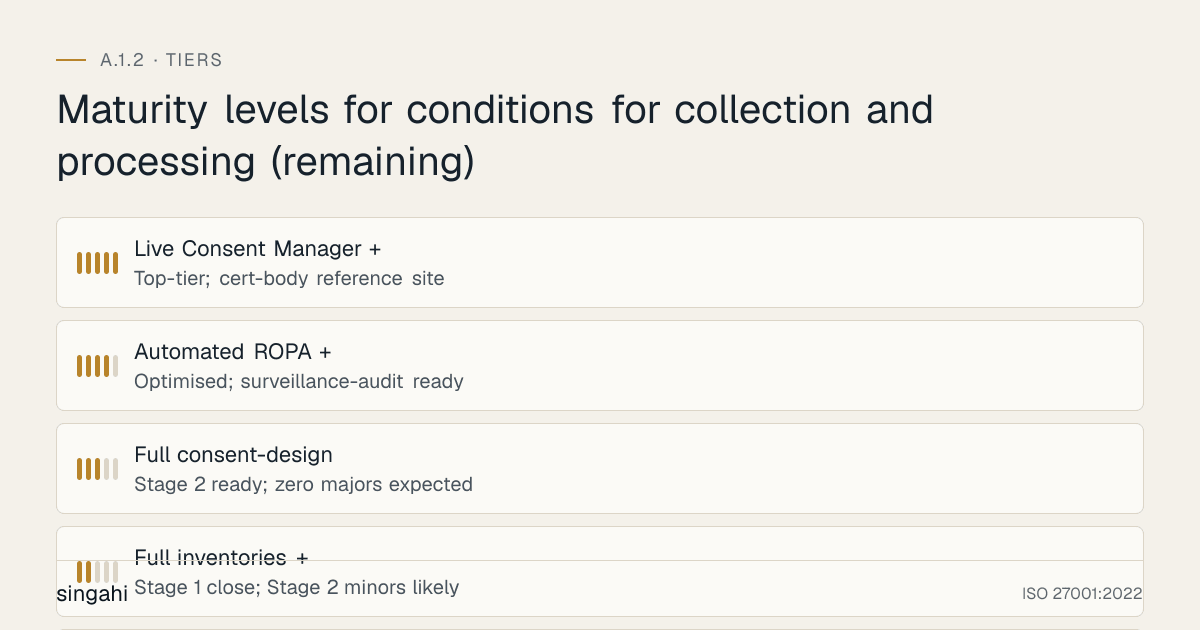
Level 1, Initial / Ad-hoc
Characteristics. No Conditions-for-Processing Policy. No Consent Design Specifications (the surfaces default to whatever the growth team decides). No basis-decision register. No processor inventory (or a partial one). No DPA template (or a one-page NDA-style document). No joint-controller arrangements (or service agreements that do not address the joint-controller dimension). No ROPA (or a partial spreadsheet last updated years ago). No quarterly reconciliation. No table-top on the dual-clock pattern.
Typical artefacts. A privacy policy. A vendor list in the procurement system. A partial ROPA spreadsheet.
Investment to reach L1. None, this is the floor.
The investment covers the inventory, the policy, the top-ten ROPA entries, the top-ten DPAs, the top-three Consent Design Specifications.
Level 2, Repeatable / Defined
Characteristics. A documented Conditions-for-Processing Policy. The full processing-activity inventory, vendor inventory and joint-counterparty inventory. The Consent Design Specification register covering at least the highest-risk surfaces. The basis-decision register. The refreshed DPA template with the mandatory content and the security schedule. The joint-controller arrangement template. The ROPA covering the prescribed fields. The quarterly reconciliation cadence designed but not yet enforced for every cycle.
Typical artefacts. The policy; the inventories; the register; the refreshed DPA template; the ROPA template (populated for the top activities).
The investment covers the full consent-design register, the full DPA refresh, the joint-controller arrangements in place, the full ROPA with cross-references.
Level 3, Managed / Measured
Characteristics. The full Consent Design Specification register. The full DPA refresh (every processor on the post-DPDP / post-modernised-SCCs template). The joint-controller arrangements in place for every relationship declared applicable; the principal-transparency mechanism live. The full ROPA with the cross-references. The quarterly reconciliation operational. The first table-top on the dual-clock pattern. The KPI dashboard at the management review. The first internal-audit report on A.1.2 (remaining).
Typical artefacts. The full register; the refreshed DPAs; the arrangements; the live ROPA; the reconciliation reports; the table-top report; the KPI dashboard; the first internal-audit report.
The investment covers the SDF DPIA integration (where applicable), the algorithmic-software review (where ADM in scope), the Consent Manager integration design (where applicable), the ROPA automation.
Level 4, Quantitatively Managed
Characteristics. The ROPA automation (single authoritative version; quarterly reconciliation automated; cross-references live). The Consent Manager integration contracted and on the implementation roadmap (where applicable). The SDF DPIA integrated into the design-stage gate (where the controller is an SDF). The algorithmic-software review operating for every ADM pipeline. The table-top running semi-annually with the dual-clock pattern and the processor-cooperation overlay. The drift-detection discipline firing quarterly; each drift feeding Clause 10.2 corrective action. The KPI targets consistently met; the management-review pack driving Clause 10.1 improvement.
Typical artefacts. The automated ROPA; the Consent Manager integration design; the SDF DPIA records; the algorithmic-software review reports; the drift-detection log; the management-review minutes with KPI trend analysis.
Level 5, Optimising
Characteristics. The Consent Manager integration is live and interoperable; the principal's consent choices propagate across Data Fiduciaries through the Consent Manager. The DPA regime is integrated with the broader third-party-risk-management programme (the privacy dimension, the security dimension, the resilience dimension, the AI-governance dimension in a single vendor-evaluation framework). The ROPA is the system-of-record for the entire data estate (databases, file systems, cloud storage, SaaS apps, backups, archives). The joint-controller-relationship discipline extends to the algorithmic-software dimension (joint controllers jointly review the fairness of ADM pipelines that use the shared data). The table-top is run quarterly with multi-incident scenarios. The KPI programme produces predictive analytics (drift prediction; processor-risk prediction; basis-of-processing complaint prediction from consent-dynamics).
Typical artefacts. The Consent Manager integration; the integrated third-party-risk framework; the ROPA-as-system-of-record; the algorithmic-fairness joint review; the predictive-analytics dashboard.
Maturity-model quick-reference
| Level | Distinguishing artefact | Typical certification readiness |
|---|---|---|
| L1 | Privacy policy; partial ROPA | Stage 1 major nonconformity |
| L2 | Full inventories + refreshed DPA template + ROPA template (top activities) | Stage 1 close; Stage 2 minors likely |
| L3 | Full consent-design register + full DPA refresh + arrangements + full ROPA with cross-references | Stage 2 ready; zero majors expected |
| L4 | Automated ROPA + Consent Manager design + SDF DPIA + algorithmic-software review | Optimised; surveillance-audit ready |
| L5 | Live Consent Manager + integrated third-party-risk + ROPA-as-system-of-record + predictive analytics | Top-tier; cert-body reference site candidate |
Emerging Trends
The DPDP Rules' phased commencement and the controller-backbone rebuild window
The DPDP Rules 2025 (notified 13 November 2025) phase in through 2026 and 2027. The Consent Manager registration conditions, the SDF designation thresholds, the breach-notification the Rule 7 intimation, the verifiable-parental-consent mechanism, and the retention-and-erasure timelines are the A.1.2 (remaining)-relevant slices. Controllers that build the consent-design discipline, the DPA refresh, the joint-controller arrangements and the ROPA ahead of the full-enforceability window (estimated May 2027) will have a two-to-three-year advantage over those that retrofit in 2027 and 2028.
The Consent Manager's emergence as the Indian-native consent dimension
The Consent Manager (DPDP section 2(1)(g)) is the distinctive Indian construct that has no clean analogue in GDPR or the US state laws. As the Consent Manager regime phases in through 2026 and 2027, the A.1.2.4 design will need to accommodate the Consent Manager handoff, the interoperable consent-dashboard, the cross-Fiduciary withdrawal, and the Consent Manager's own DPA with the controller (the Consent Manager is itself a Data Fiduciary under the Act). The Consent Manager's emergence is the most-watched A.1.2 (remaining) trend in the Indian market.
The convergence of A.1.2.7 DPA practice with AI governance
The DPA's mandatory content (Article 28(3)) is being extended in 2026 and 2027 to address the AI-governance dimension, the processor's use of the controller's personal data for AI model training; the algorithmic-software review; the model-weights dimension; the cross-border AI-processing dimension. The emerging practice is to extend the DPA's security schedule with an AI-governance schedule (the permitted AI uses; the model-training data lineage; the algorithmic-software review cooperation; the model-weights disposal at end). The Rule 13(3) algorithmic-software overlay is the Indian statutory hook; the 27701:2025 A.1.2.7 control is the contract instrument.
The joint-controller construct's expansion beyond the traditional co-branded card
The joint-controller construct (A.1.2.8 / GDPR Article 26) was traditionally applied to the co-branded credit card, the loyalty programme, the partner-supplied lead form. In 2026 and 2027 the construct is expanding, the platform-integration partner in the SaaS stack; the AI-model-training partner; the federated-learning collaboration; the data-clean-room arrangement; the open-data initiative. Each new joint-controller pattern requires the arrangement allocation of responsibilities and the principal-transparency mechanism. The emerging practice is to treat the joint-controller analysis as a per-integration exercise, not a one-time MoU.
The ROPA's evolution into the live data-flow map
The A.1.2.9 ROPA was traditionally a static document, the spreadsheet updated quarterly or annually. In 2026 and 2027 the ROPA is evolving into the live data-flow map, fed by the consent ledger, the processor inventory, the disclosure logs, the data-discovery tools, the cloud-flow monitors. The live ROPA reconciles continuously with the operational reality; drift is detected in near-real-time. The privacy-management platforms are building the live-ROPA capability; the controllers that adopt it gain a step-change in accountability and a reduction in the manual reconciliation effort.
The cross-border DPA's intersection with the DPDP negative-list and the modernised SCCs
The A.1.2.7 DPA's transfer clauses are the cross-framework hinge for the cross-border dimension. The DPDP section 16 negative-list overlay (transfer permitted to any country except those notified as restricted) is the Indian-specific overlay on top of the GDPR Chapter V regime (adequacy / safeguards / derogations). As the Central Government notifies the restricted countries through 2026 and 2027, the controllers' cross-border DPAs need to be updated; the affected flows need to be re-architected; the transfer-impact assessments need to be refreshed. The cross-border DPA is the most-dynamic A.1.2.7 dimension in 2026 and 2027.
The Consent Design Specification's convergence with the user-experience discipline
The A.1.2.4 Consent Design Specification is converging with the broader user-experience (UX) discipline, the consent moment is increasingly seen as a UX decision (when, where, how the consent is asked), not just a compliance decision. The dark-pattern legislation (the EU's Digital Services Act; the FTC's dark-patterns enforcement; the Indian Consumer Protection Act dimensions) reinforces the convergence. The emerging practice is to design the consent moment with the UX team and the privacy team jointly, with the design documented in the Consent Design Specification.
The convergence of A.1.2.7 with the ESG and the third-party-risk programmes
The A.1.2.7 DPA discipline is converging with the broader third-party-risk-management (TPRM) programme and the environmental-social-governance (ESG) programme. The vendor's privacy posture, the vendor's security posture, the vendor's resilience posture, the vendor's AI-governance posture, and the vendor's ESG posture are increasingly evaluated in a single framework. The A.1.2.7 DPA is the privacy dimension of the broader vendor-evaluation; the controller's TPRM programme is the operational dimension; the ESG reporting is the disclosure dimension.
References and Further Reading
Standards and regulations
- ISO/IEC 27701:2025, Privacy information management system, Requirements and guidance (published 14 October 2025).
- ISO/IEC 27001:2022, Information security management systems, Requirements.
- ISO/IEC 27002:2022, Information security controls (only control 5.34 is PII-specific; controls 5.19 to 5.23 are the supplier-relationship backdrop for A.1.2.7).
- ISO/IEC 27018:2019, Code of practice for protection of PII in public clouds acting as PII processor (clause 7 minimisation; clause 10 cross-border).
- ISO/IEC 27017:2015, Code of practice for cloud security.
- ISO/IEC 29100:2011, Privacy framework (eleven privacy principles, Consent and Choice; Openness, Transparency and Notice; Accountability).
- ISO/IEC 29134:2017, Guidelines for privacy impact assessment.
- ISO/IEC 27706:2025, PIMS certification-scheme competence (Ed 1, October 2025; replaces ISO/IEC TS 27006-2:2021).
- ISO/IEC 17021-1:2015, Management-system certification-body requirements.
- ISO/IEC 27006 (current edition), ISMS certification-body requirements.
Indian regulatory instruments
- Digital Personal Data Protection Act, 2023 (Act No. 22 of 2023, enacted 11 August 2023; eGazette notification 247847). Source: meity.gov.in.
- Digital Personal Data Protection Rules, 2025 (notified 13 November 2025; phased commencement). Source: meity.gov.in.
- Information Technology Act, 2000 (Act No. 21 of 2000), sections 43A and 72A. Source: indiacode.nic.in.
- Information Technology (Reasonable Security Practices and Procedures and Sensitive Personal Data or Information) Rules, 2011 (notified 11 April 2011).
- CERT-In Directions No. 20(3)/2022-CERT-In (28 April 2022) under section 70B(6) of the IT Act, 2000. Source: cert-in.org.in.
- RBI, Storage of Payment System Data, RBI circular DPSS.CO.OD.No.1098/06.08.005/2017-18 (6 April 2018). Source: rbi.org.in.
- RBI, Digital Lending Guidelines, RBI circular DOID.CO.PPG.SEC.09/14.14.001/2022-23 (2 September 2022). Source: rbi.org.in.
- RBI, Tokenisation of Card transactions, RBI circular DPSS.CO.RPPD.No.S-35/07.01.005/2021-22 (22 September 2021; full effect 1 October 2022).
- SEBI, KYC Registration Agencies Regulations, 2011 (as amended); KRA Master Circular (May 2024). Source: sebi.gov.in.
- SEBI, Cybersecurity and Cyber Resilience Framework (CSCRF) 2024, circular SEBI/HO/ITD-1/ITD_CSC_EXT/P/CIR/2024/113 (20 August 2024). Source: sebi.gov.in.
- IRDAI, Information and Cyber Security Guidelines, 2023 (24 April 2023). Source: irdai.gov.in.
- Consumer Protection (E-Commerce) Rules, 2020.
- The Limitation Act, 1963 (Act No. 36 of 1963).
- Indian Contract Act, 1872 (Act No. 9 of 1872), the contract-law backdrop for the A.1.2.7 DPA and the A.1.2.8 arrangement.
Jurisprudence
- K.S. Puttaswamy v. Union of India, (2017) 10 SCC 1 (judgment delivered 24 August 2017 by a nine-judge Bench of the Supreme Court of India).
- Justice K.S. Puttaswamy (Retd.) v. Union of India (Aadhaar), (2019) 1 SCC 1 (26 September 2018, five-judge Bench).
- Case C-673/17, Planet49 v. Bundesverband der Verbraucherzentralen (Planet49), EU:C:2019:801 (Court of Justice of the European Union, 1 October 2019), the pre-ticked-box consent judgment.
- Case C-311/18, Data Protection Commissioner v. Facebook Ireland and Maximillian Schrems (Schrems II), EU:C:2020:559 (Court of Justice of the European Union, Grand Chamber, 16 July 2020).
Global regulations (mapped in Section 16)
- Regulation (EU) 2016/679 (General Data Protection Regulation), OJ L 119, 4.5.2016, p. 1; application from 25 May 2018. Source: eur-lex.europa.eu.
- Article 7 (conditions for consent), Article 26 (joint controllers), Article 28 (processor / DPA), Article 30 (ROPA), Article 32 (security), Article 33 (breach), Articles 12 to 14 (transparency and notice), Article 8 (children).
- Commission Implementing Decision (EU) 2021/914 of 4 June 2021, modernised Standard Contractual Clauses.
- European Commission adequacy decision on the EU-US Data Privacy Framework (10 July 2023).
- UK GDPR; Data Protection Act 2018 (c. 12); UK International Data Transfer Agreement (IDTA) and UK Addendum to EU SCCs.
- California Consumer Privacy Act / California Privacy Rights Act (Cal. Civ. Code 1798.100 et seq.); CCPA effective 1 January 2020; CPRA effective 1 January 2023.
- Virginia Consumer Data Protection Act (Va. Code § 59.1-575 et seq.), effective 1 January 2023.
- Colorado Privacy Act (C.R.S. § 6-1-1301), effective 1 July 2023.
- Brazil, LGPD (Lei nº 13.709/2018), effective 18 September 2020. Article 7 (lawful bases); Article 26 (joint controllers); Article 33 (transfer); Article 37 (processor).
- China, PIPL, effective 1 November 2021. Article 13 (lawful bases); Article 20 (joint processing); Article 21 (processor).
- Singapore, PDPA 2012 (No. 26 of 2012) as amended; mandatory breach notification effective 1 February 2021.
- Canada, PIPEDA (S.C. 2000, c. 5); mandatory breach notification since 1 November 2018.
- Australia, Privacy Act 1988; Australian Privacy Principles; Notifiable Data Breaches scheme effective 22 February 2018.
- South Korea, PIPA (Act No. 10469 of 2011, as amended 2023).
- UAE, Federal Decree-Law No. 45 of 2021 (PDPL).
- Saudi Arabia, PDPL (Royal Decree M/19), in force 14 September 2023; full enforcement 14 September 2024.
- South Africa, POPIA (Act 4 of 2013), fully in force 1 July 2021.
Frameworks and guidance
- NIST Privacy Framework v1.0: A Tool for Improving Privacy Through Enterprise Risk Management, NIST.CSWP.01162020 (16 January 2020). Source: nist.gov/privacy-framework.
- AICPA, 2017 Trust Services Criteria for Security, Availability, Processing Integrity, Confidentiality and Privacy (TSC 2017; 2022 Points of Focus update). The Privacy criteria: P1.0 (Notice), P2.0 (Choice and consent), P3.0 (Collection), P4.0 (Use, retention, and disposal), P5.0 (Access), P6.0 (Disclosure and notification), P7.0 (Quality), P8.0 (Monitoring and enforcement).
- European Data Protection Board, Guidelines 05/2020 on consent under Regulation 2016/679; Guidelines 07/2020 on the concepts of controller and processor in the GDPR; Guidelines 4/2019 on Article 25 (data protection by design and by default); Guidelines 9/2022 on personal data breach notification; Recommendations 01/2020 on supplementary measures.
- Article 29 Working Party, WP248 rev.01, Guidelines on Data Protection Impact Assessment (DPIA criteria).
- ICO (UK) Accountability Framework; CNIL (FR) PIA methodology.
Certification-scheme and practitioner references (generic)
- IAF (International Accreditation Forum), note: no PIMS-specific IAF MD identified as of mid-2026.
- Accreditation bodies active in PIMS: ANAB, UKAS, DAkkS, COFRAC, JAB, CNAS, and others.
- The certification-scheme rule-set: ISO/IEC 17021-1:2015; ISO/IEC 27006; ISO/IEC 27706:2025.