
On this page
- Quick Reference (60 Seconds)
- What the Standard Actually Requires
- Why This Control Matters
- Scope and Applicability
- Key Definitions and Terminology
- Relationship to Other Clauses and Frameworks
- Detailed Implementation Guidance, The Worked BIA
- Tools, Technologies, and Solutions
- Policy and Procedure Templates
- Risk Assessment and Treatment
- Audit and Compliance Checklist
- Metrics and KPIs
- Common Pitfalls and Audit Failures
- Illustrative Scenario 1: Failure, AIIMS Delhi Ransomware
- Illustrative Scenario 2: Success, Cognizant in the Chennai Floods
- Multi-Framework Mapping
- Implementation Roadmap
- FAQ
- Industry-Specific Requirements
- Maturity Model
- Emerging Trends
- References and Further Reading
Quick Reference (60 Seconds)
| Attribute | Detail |
|---|---|
| Clause | ISO 22301:2019 Clause 8.2, Business Impact Analysis and Risk Assessment |
| What it asks for (paraphrase) | ISO 22301 Clause 8.2 asks organizations to run a systematic Business Impact Analysis (BIA) to identify priorities and the consequences of disruption over time, and a risk assessment of disruption risks to the prioritised activities, and to maintain both as living, documented outputs. |
| Domain | Operations (Clause 8), the analytic core of the BCMS; everything in 8.3–8.6 depends on its outputs. |
| What you must produce | (a) A documented, repeatable BIA methodology; (b) an impact-over-time assessment per prioritised activity; (c) derived RTO/RPO/MBCO (and the MTPD ceiling that caps RTO); (d) a dependency map (upstream suppliers, downstream customers, shared services, people, facilities, technology, information); (e) a risk assessment of disruption scenarios; (f) a refresh cadence (event-triggered and scheduled). |
| Typical owner | Business Continuity Manager / BCM lead, with activity owners in each business unit. Accountable: executive sponsor (COO / CRO / CIO depending on sector). |
| Minimum viable actions | (1) Define scope and method; (2) run the first BIA across priority products/services; (3) capture impact-over-time; (4) set RTO/RPO/MBCO/MTPD per activity; (5) map dependencies; (6) complete the risk assessment; (7) get the BIA signed off by top management; (8) schedule the next review. |
| Maturity floor (L1) | Spreadsheet BIA for top 5–10 activities; RTO/RPO recorded; reviewed yearly. |
| Maturity target (L4–L5) | Tooling-integrated BIA fed by CMDB and risk register; quarterly impact re-validation; quantitative loss modelling; Board-level RTO/RPO/MTPD dashboard. |
| Audit red flag | RTO and RPO set in a meeting room without an impact-over-time trace, or BIA last updated more than 12 months ago. |
| Quick win | Convert your existing BIA spreadsheet into an impact-over-time matrix (rows = activities, columns = 4h / 24h / 3d / 1w / 2w / 1m / 3m, cells = impact score 1–4) and use the matrix to derive MTPD per row. Most Indian firms can do this in 2–4 weeks for ₹3–8 lakh of internal effort. |
| Time to implement (first cycle) | Growing companies (50–250 staff): 8–12 weeks. Mid-market (250–2,000): 12–20 weeks. Enterprise: 4–9 months, often rolled by business unit. |
| Related clauses | 4.1/4.2 (context drives prioritisation), 6.1 (risks/opportunities), 8.1 (operational planning), 8.3 (strategy consumes BIA), 8.4 (plans encode BIA outputs), 8.5 (exercises validate them), 8.6 (post-disruption review loops back), 9.1 (monitor BIA KPIs). |
If you only read one thing: Clause 8.2 is the spine of ISO 22301. Get this clause right and 8.3–8.6 fall into place; get it wrong and the rest of the BCMS is built on sand. The BIA is also where the regulator will look first when something breaks, RBI, SEBI, IRDAI and CERT-In all expect evidence that you understood, in advance, which of your activities matter most and how quickly they must come back.
What the Standard Actually Requires
Figure · Process
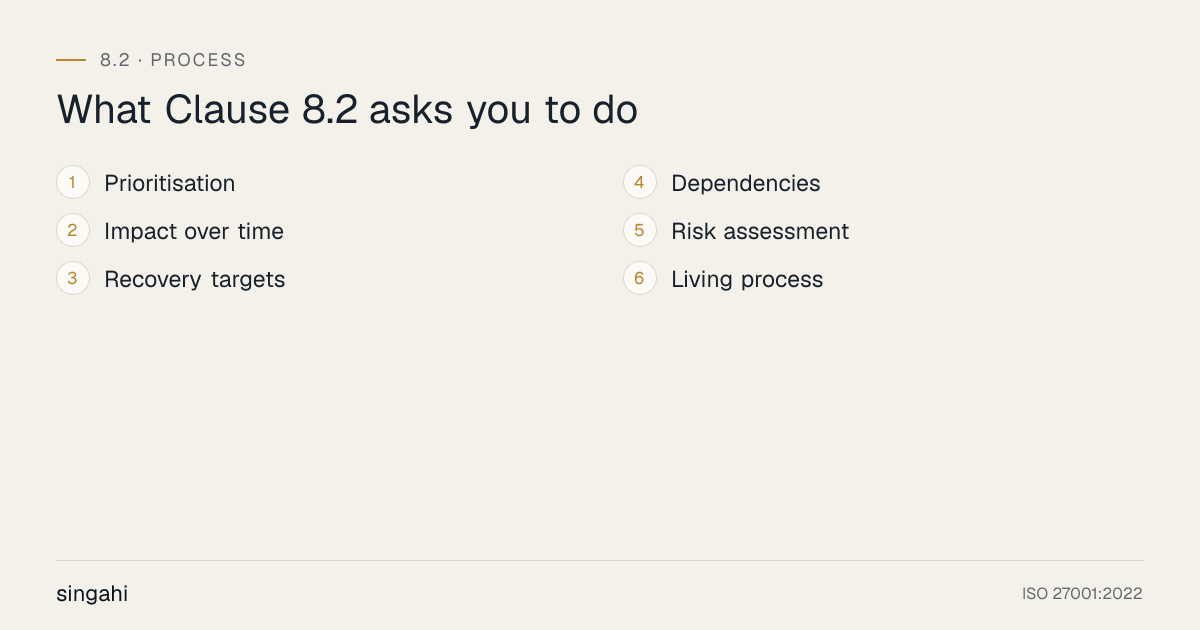
What Clause 8.2 asks you to do
The paraphrased requirement
ISO 22301 Clause 8.2 asks organizations to run a systematic Business Impact Analysis to identify priorities and the consequences of disruption over time, and a risk assessment of disruption risks to the prioritised activities, and to document, maintain and use both as the analytic base for the rest of the BCMS. The clause does not exist in isolation; it sits at the centre of Clause 8 (Operation) and is the bridge between the management-system clauses (4–7) and the strategy/plan/exercise clauses (8.3–8.5).
In practical terms, this means an organisation has to be able to answer six questions in writing:
- Prioritisation, Of everything we do, which products, services and the activities that deliver them matter most, and in what order?
- Impact over time, For each priority activity, what happens if it is disrupted for 4 hours, 24 hours, 3 days, 1 week, 2 weeks, 1 month, 3 months? When does impact become intolerable?
- Recovery targets, From that, what is our RTO (when must we resume), our RPO (how much data can we lose) and our MBCO (what minimum level must we resume at)?
- Dependencies, What upstream suppliers, downstream customers, shared services, people, facilities, technology and information does each priority activity rely on?
- Risk assessment, What disruption scenarios (cyber, natural, people, supplier, utility, regulatory, geopolitical) could plausibly hit these activities, how likely are they, and what is the current control gap?
- Living process, When and how will we re-do this, annually, on trigger (major change, M&A, new product, post-incident), and after every Clause 8.5 exercise that exposes drift?
What the standard does NOT require (the demarcation competitors miss)
Clause 8.2 is often conflated with downstream clauses. It is helpful to be explicit about what is out of scope for 8.2 itself, because auditors test the boundary:
- It does not require selecting continuity strategies. That is Clause 8.3. The BIA feeds strategy selection; it is not the strategy.
- It does not require writing BC plans. That is Clause 8.4. RTO and RPO derived under 8.2 become runbook targets under 8.4.
- It does not require exercising plans. That is Clause 8.5. Exercises validate the BIA's RTO/RPO/MBCO assumptions, which loop back to 8.2 for revision.
- It does not require a particular tool. A spreadsheet is acceptable evidence at lower maturity; integrated BIA tooling is needed only at higher scale or under regulatory pressure.
- It does not require quantitative financial loss modelling to the dollar or rupee. Qualitative scales (1–4) are acceptable if they are applied consistently and traceably. Quantification becomes the norm for BFSI, listed manufacturers, and other regulated sectors.
- It does not require a separate BIA per IT system. ISO 22301 is organisation-centric: the unit of analysis is the prioritised activity, not the server. IT-system-level analysis (the NIST SP 800-34 framing) feeds in but is not the primary view.
The companion guidance (ISO 22313:2020 and ISO/TS 22317:2021)
The clause text is short; the method lives in two companion documents. Both are paywalled, and citing the current edition matters, the on-disk 2015 editions of ISO/TS 22317 are withdrawn:
- ISO 22313:2020, Security and resilience, Business continuity management systems, Guidance on the use of ISO 22301. The clause-by-clause companion. Use it as the authoritative explanation of what 8.2 evidence should look like.
- ISO/TS 22317:2021, Security and resilience, Business continuity management systems, Guidelines for business impact analysis (BIA). The dedicated BIA methodology. Second edition; supersedes the withdrawn 2015 first edition. Defines the structured BIA process: identify/prioritise products and services; assess impact over time across categories (customer, legal/regulatory, financial, reputational, people, environmental, operational/contractual); determine RTO/RPO/MBCO; map dependencies; validate with activity owners; feed strategy selection.
- ISO 22300:2021, Security and resilience, Vocabulary. Third edition. The normative source of the definitions of RTO, RPO, MTPD, MBCO, prioritised activity, disruption and (in legacy/BCI usage) MAO. A fourth edition (ISO/DIS 22300) is under development (enquiry stage) and will replace the 2021 edition when published; not yet published, re-confirm the year before quoting.
- ISO/TS 22331:2018, Guidelines for business continuity strategy. The downstream counterpart that consumes the BIA's outputs to select continuity solutions.
What auditors actually check
Certification auditors (BSI, DNV, SGS, TÜV, Bureau Veritas, NQA, Intertek, plus Indian CBs like TQCS, DNV India, BSI India) test Clause 8.2 by triangulating three things:
- The BIA document itself, methodology, scope, activity register, impact-over-time analysis, derived RTO/RPO/MBCO/MTPD, dependency map, validation evidence (sign-offs by activity owners), version history.
- Traceability downstream, does the Clause 8.3 strategy actually deliver against the RTO/RPO/MBCO from the BIA? Do the Clause 8.4 plans encode those same numbers? Does Clause 8.5 exercise reporting compare achieved-vs-target RTO?
- Traceability upstream, does the prioritisation in the BIA reflect the Clause 4 context, Clause 5 leadership direction, and Clause 6 objectives? A BIA that prioritises activities no executive recognises is an immediate finding.
Common observations you should be ready for: (a) "your BIA lists RTO and RPO but no MTPD or MBCO" (an L2 finding); (b) "your BIA was done 18 months ago and has not been reviewed" (an L1 non-conformity); (c) "your BIA does not include the third-party cloud/SaaS dependencies for your core banking stack" (a sectoral non-conformity under RBI MD IT Governance, eff. 1 April 2024).
Why This Control Matters
The business case
Every other clause in ISO 22301 consumes the outputs of Clause 8.2. Get the analysis right and your continuity strategy is justified, your plans are correctly prioritised, your exercises validate the right numbers, and your board can see, in rupees and hours, what is at stake. Get it wrong and you will spend recovery budget on the wrong systems, exercise the wrong scenarios, and discover, during a real disruption, that the activity you rated "low impact" was actually load-bearing.
The BIA is also the translation layer between the business and the technologists. When the COO asks "what is our RTO?" the answer is meaningless unless it traces back to an impact-over-time analysis that the COO and the CIO can both see. The BIA is the artefact that lets a business owner say "we cannot tolerate more than 6 hours of payment outage" and lets the architect respond "then we need active-active across two data centres with sub-minute replication." Without that translation, RTO and RPO become folklore.
The regulatory case (the part competitors omit)
In India, the BIA is no longer just an ISO artefact; it is a regulatory deliverable. Three recent instruments make it so:
- RBI Master Direction on IT Governance, Risk, Controls and Assurance Practices (issued 7 November 2023, effective 1 April 2024). Applies to Scheduled Commercial Banks (excluding Payments Banks, LABs, RRBs), NBFCs with asset base ≥ ₹500 crore, All-India Financial Institutions, and Credit Information Companies. The IT Service Continuity / BCM chapter expects a board-approved BCP/DR policy, documented RTO/RPO for critical systems, a Disaster Recovery Site with defined failover, periodic live/parallel drills, and outsourcer/cloud continuity controls that inherit the RE's BIA assumptions.
- SEBI Cybersecurity and Cyber Resilience Framework (CSCRF), circular
SEBI/HO/ITD-1/ITD_CSC_EXT/P/CIR/2024/113, 20 August 2024, with phased 2025 deadlines (some reset by the March 2025 extension circular). Structured as 5 Cyber Resilience Goals × 6 Operational Functions (Identify, Protect, Detect, Respond, Recover, Learn). The Recover function embeds BIA-derived RTO/RPO and DR testing expectations for all SEBI Regulated Entities, not just MIIs. - SEBI BCP/DR Guidelines for Market Infrastructure Institutions, circular
SEBI/HO/MRD1/DTCS/CIR/P/2021/33, 22 March 2021, with modifications through 12 September 2024. Requires Near Site + DRS architecture, RTO ≤ 2 hours for critical MII systems, defined RPO, live failover drills, geographic separation, and dependency/vendor BCP. - IRDAI Information and Cyber Security Guidelines, 2023 (24 April 2023). Requires a board-approved Information & Cyber Security Policy that includes BCP/DR, CISO, 180-day log retention (aligned with CERT-In), DR drills, ICT outsourcing continuity oversight, and annual compliance reporting.
- CERT-In Directions
No. 20(3)/2022-CERT-In, 28 April 2022. Six obligations, the most consequential being the 6-hour incident reporting clock for the ~20 categories of prescribed incidents. The BIA feeds the incident-severity matrix that decides what triggers the 6-hour clock. - DPDP Act 2023 (Act 22 of 2023). Section 8(5) imposes a statutory duty on Data Fiduciaries to protect the availability of personal data, continuity is now a data-protection obligation. Section 8(6) + the Schedule impose breach notification to the Data Protection Board and affected Data Principals; the DPDP Rules 2025 (final notified November 2025) prescribe the 72-hour notification form. Schedule penalties reach ₹250 crore for failure to take adequate security safeguards and ₹200 crore for failure to notify a breach.
The board-level hooks: Companies Act 2013 §134(3)(n) requires the Board's Report to disclose risk management policy including risks that may threaten the existence of the company; §177 and SEBI LODR Regulation 21 require a Risk Management Committee for listed companies that explicitly covers cyber, operational and continuity risk.
Indian Context (why this hits harder here)
India has five structural conditions that make a defensible BIA more valuable here than in most markets:
- Concentration risk in delivery geography. A large share of Indian IT/BFSI back-office capacity sits in a handful of corridors, Bengaluru (Electronic City, Whitefield, ORR-Marahalli), Hyderabad (HITEC City, Madhapur, Gachibowli), Chennai (OMR, Velachery, Tidel Park), Pune (Hinjewadi, Magarpatta), NCR (Gurgaon Cyber City, Noida SEZs). A single monsoon flood, civic event, or regional power-grid failure can hit several million square feet of delivery at once. The Chennai floods of December 2015 are the canonical lesson, Cognizant publicly disclosed 11 affected delivery/operations centres; multi-site geo-diversification became board-mandated afterwards.
- Power and infrastructure dependency. The Mumbai grid blackout of 12 October 2020 left ~6.5 million consumers without power for hours and halted local trains, hospitals and the BSE. Attribution of the outage is contested, Maharashtra's then Home Minister cited State Cyber Cell findings of possible cyber sabotage linked to the RedEcho group, while the Union Power Ministry attributed it to human error and grid load. The honest position is that both explanations have been publicly asserted and neither has been definitively disproven. For BIA purposes the attribution does not matter; what matters is that grid power is upstream of every other continuity plan, and a credible BIA models a multi-hour, multi-region power loss as a scenario.
- Ecosystem and payment-rail dependency. UPI processes well over 20 billion transactions a month and is the world's largest real-time retail payment rail. The 12 April 2025 outage (~5 hours, the longest in recent memory) hit Google Pay, PhonePe and Paytm and was attributed by NPCI to participating banks over-polling "check transaction status" APIs. For any Indian consumer business, UPI is a critical dependency that must appear in the BIA upstream of every retail activity.
- Skills and key-person concentration. Indian growth firms routinely run lean on senior talent; the Akasa Air pilot exodus of 2023 (~43 pilots resigning in one month, ~600–800+ flights cancelled, reported losses of ~₹3 crore per day at peak) is the canonical example of people-resilience as a first-class BIA scenario, not just a cyber or natural-hazard one.
- Sector regulator as BC enforcer. Indian regulators now treat repeated digital outages as governance failures. HDFC Bank was barred by RBI on 2 December 2020 from issuing new digital products and fresh credit cards after repeated outages (including the 21–22 November 2020 data-centre power failure that took net banking and cards dark for ~half a day). The partial lift came in August 2021; full lift only in March 2022, a ~15-month business constraint traceable to inadequate continuity engineering and an under-tested BIA.
The cost of getting Clause 8.2 wrong in India is therefore not just an audit finding. It is a regulatory action that constrains your ability to launch products, a CERT-In notice on the 6-hour clock, an IRDAI inspection, a SEBI show-cause on MII dependencies, or, for a fiduciary of personal data, a DPDP penalty of up to ₹250 crore.
Scope and Applicability
Applies to whom
Clause 8.2 applies to every organisation in scope of ISO 22301:2019. There is no size threshold, no sector carve-out, no waiver for SaaS or services firms. A 40-person fintech, a 400-employee hospital, a 40,000-staff IT services major and a 4,00,000-customer public-sector bank all owe the same analytic discipline, scaled to their reality. What changes is the depth and tooling, not the obligation.
Scaled expectations by organisation size
| Size band | Reasonable Clause 8.2 scope | Typical artefacts | Indicative internal-effort cost (INR) |
|---|---|---|---|
| Small (10–50) | All products/services in one BIA cycle. One-page methodology. 8–15 prioritised activities. | BIA spreadsheet, dependency list, simple risk register. | ₹1.5–4 lakh of internal time over 4–6 weeks. |
| Growing (50–250) | Department- or product-line-segmented BIA. 20–60 activities. | BIA workbook + dependency map + RTO/RPO/MBCO register + risk register. | ₹4–12 lakh over 8–12 weeks. |
| Mid-market (250–2,000) | Per business-unit BIA rolled to enterprise view. 60–250 activities. Vendor and shared-service dependency map. | BIA tooling or structured workbook; dependency map; risk treatment plan; KPI dashboard. | ₹15–50 lakh over 12–20 weeks; tooling ₹8–25 lakh/yr. |
| Large enterprise (2,000+) | Per BU / per jurisdiction / per critical-service BIAs. Hundreds to low-thousands of activities. Quantitative loss modelling. | Integrated BIA/CMDB/risk tooling (enterprise IRM/BCM suite); Board-level dashboard. | ₹50 lakh–several crore one-time; ₹25 lakh–₹2 crore/yr licence + ops. |
Cost ranges are illustrative third-party/internal-effort estimates, not Singahi pricing. Vendor quotes vary widely.
Scaled expectations by industry
- BFSI (banks, NBFCs, insurers, payment system operators, MIIs). The most demanding BIA environment in India. RBI MD IT Governance (eff. 1 Apr 2024) and SEBI CSCRF (Aug 2024) and SEBI MII BCP-DR (Mar 2021, modified Sep 2024) impose near-zero RTO/RPO for payment rails and core banking, near-zero data loss for trading systems (RTO ≤ 2 hr for critical MII systems per SEBI), board-approved BCP/DR policy, live/parallel DR drills, and third-party/cloud continuity that inherits the RE's standards. For BFSI the BIA is also a regulatory deliverable, not just an ISO one.
- Healthcare (hospitals, pharma, medtech, diagnostics). Patient safety makes some activities near-zero-RTO by definition (EMR, ICU monitoring, imaging, dispatch of emergency services). The AIIMS Delhi ransomware of 23 November 2022, five physical servers hosting the NIC-built e-Hospital application encrypted, primary and backup servers both hit, OPD/admissions/billing/labs reverting to paper for ~6–15 days,
50 servers compromised, NIA opening a cyberterrorism probe, is the canonical illustration of why hospital ransomware is a patient-safety event, not an IT-ops one. Reported ransom figures (₹200 cr / ~US$25m) were not confirmed by AIIMS or Delhi Police; treat as [UNVERIFIED]. - IT/ITeS and SaaS. Two BIA flavours: (i) services firms running delivery centres for global clients, Chennai-floods-type geographic concentration is the dominant scenario, and contractual SLAs to clients are the RTO/RPO floor; (ii) SaaS / product firms where multi-tenancy, single-cloud blast radius, and update-rollback are the dominant risks (Code Spaces 2014, attacker deleted EC2/EBS/AMIs including backups in the same AWS account; business wiped out within ~24 hours; maps to 8.2 because backups in the same auth domain as production are a BIA dependency failure).
- Manufacturing (discrete, process, pharma, automotive, electronics). OT/IT boundary is the BIA frontier; the Colonial Pipeline ransomware of 7 May 2021, DarkSide encrypted billing IT, the OT pipeline itself was not directly compromised but Colonial proactively shut down all 5,500+ miles for
6 days because it could not bill or invoice, is the global lesson that IT/OT dependency must be modelled even when OT is technically separate. The Maruti Suzuki Manesar violence and fire of 18 July 2012 (₹1,400 cr lockout loss, ~65,000 vehicles lost, GM-HR Awanish Kumar Dev killed) is the Indian lesson that workplace-violence and industrial-relations scenarios belong in the BIA, not just fire/flood/cyber. - Government and PSUs. NDMA's Guidelines for Preparation of Disaster Management Plans (Ministries/Departments/PSUs) provides the canonical Indian DMP template (Prevention/Mitigation/Preparedness/Response/Relief/Recovery & Reconstruction/Capacity Building); ISO 22301 Clause 8.2 is the analytic engine that produces the priority-activity list those DMPs require. The Disaster Management Act 2005 casts statutory duties and penalties (Sections 51–60) on entities that fail to comply with DM authority directions during a disaster.
Out of scope for the BIA itself
It is worth restating the boundary so you do not over-build: the BIA does not have to model every IT system, every supplier, every employee. It has to model every prioritised activity and the dependencies that those activities rely on. A 5,000-person organisation might have 600 applications in its CMDB but only 60 prioritised activities; the BIA covers the 60, then traces to the applications each one depends on.
Key Definitions and Terminology
Clause 8.2 is the most terminology-dense clause in ISO 22301. Getting the definitions precisely right matters, they drive every downstream contract, runbook, drill report and audit answer. The normative source for these definitions is ISO 22300:2021 (vocabulary); ISO 22301:2019 imports them by normative reference. Where industry and regulator usage diverges, the divergence is flagged.
Prioritised activity
An activity that delivers a product or service to an internal or external customer, and that the organisation has determined must be continued or resumed promptly after a disruption to protect its objectives, reputation, legal and regulatory standing, customers, and people. Prioritised activities are the unit of BIA analysis, not servers, not departments, not suppliers. Identifying them is the first output of Clause 8.2; the FEMA FCD-2 equivalent concept is the Mission Essential Function (MEF) / Primary Mission Essential Function (PMEF).
RTO, Recovery Time Objective
The target time set for the resumption of an activity (or restoration of the resources that support it) after a disruptive incident. Plain English: RTO answers how quickly must we be back up and running? measured forward from T=0 of the disruption. RTO is a target the organisation commits to and engineers toward.
- Where it appears: ISO 22300:2021; ISO/TS 22317:2021; NIST SP 800-34 Rev 1 (May 2010); DORA Art 12(6) (entities determine RTO per function, taking criticality into account). Note that APRA CPS 230 para 38(a) sets the disruption-tolerance ceiling (= MTPD) that RTO must satisfy; RTO itself is a distinct, committed target that must be ≤ MTPD.
- Common misuse: RTO is not "how long it takes us to recover", that is observed recovery time. RTO is the commitment; observed recovery is the outcome audited against it.
RPO, Recovery Point Objective
The point in time to which information used by an activity must be restored after a disruption. Plain English: RPO answers how much data can we afford to lose? measured backward from T=0. An RPO of 1 hour means "we can lose at most the last hour of data."
- What it drives: RPO drives backup frequency, replication design, and journaling. RPO is fundamentally a data axis, not a duration axis; it is independent of the RTO/MTPD timeline. RPO = 0 means synchronous, zero-data-loss replication (expensive); RPO = 24 hours means nightly backups are sufficient.
- Where it appears: ISO 22300:2021; NIST SP 800-34 Rev 1; DORA Art 12(6); APRA CPS 230 para 38(b) ("the maximum extent of data loss the entity would accept as a result of a disruption").
MTPD, Maximum Tolerable Period of Disruption
The duration of time following a disruptive incident after which the activity's tolerable level of impact is exceeded. Plain English: MTPD answers when does disruption become intolerable, i.e. when do we lose the company?
- How it is used: MTPD is the ceiling. The BIA assesses impact over time; the moment at which impact becomes intolerable (unrecoverable financial, legal, reputational or regulatory damage, or loss of life) IS the MTPD. It is a discovered quantity, derived from the impact-over-time analysis, not chosen by committee.
- Where it appears: ISO 22301:2019; ISO 22300:2021; ISO/TS 22318:2021; APRA CPS 230 para 38(a) (expressed as "the maximum period of time the entity would tolerate a disruption to the operation", the cleanest regulatory restatement of the MTPD concept).
- The relationship that makes or breaks the BIA: RTO must be ≤ MTPD, ideally with a safety margin. If RTO > MTPD, your plan resumes the activity after the point of unacceptable impact, i.e. the plan fails by construction. Mature practice sets RTO at roughly half of MTPD to leave room for execution failure, surprise dependencies, and human factors during a real crisis.
MAO, Maximum Acceptable Outage (terminology variant of MTPD)
MAO and MTPD describe the same concept. MAO is the legacy / BCI practitioner guidance label, used through ISO 22301:2012 and the earlier BCI practitioner guidance editions; MTPD is the current ISO 22301:2019 / ISO 22300:2021 preferred label, and the BCI practitioner guidance (launched 31 October 2023) uses both. Treat them as interchangeable; in your documents pick one (recommend MTPD for current-ISO alignment) and footnote the other on first use: "MTPD (also called MAO in BCI practitioner guidance / pre-2019 literature)." Do not present them as different concepts and do not state that ISO "officially renamed" one to the other, both coexist in the vocabulary.
MBCO, Minimum Business Continuity Objective
The minimum level of activity or service that must be maintained or restored during a disruption. Plain English: MBCO answers what is the minimum acceptable delivery we can limp along on while recovering?, e.g. claims handling at 50% of normal throughput, payments capped at ₹X per hour, a trading venue running in read-only mode.
- MBCO is the quality dimension of recovery, complementing RTO's when with a how much. A plan that resumes in 2 hours but only at 5% throughput has met RTO and missed MBCO.
- Where it appears: ISO 22300:2021; ISO/TS 22317:2021; APRA CPS 230 para 38(c) ("minimum service levels the entity would maintain while operating under alternative arrangements during a disruption"), the cleanest regulatory restatement; UK FCA/PRA/CB and HKMA OR-2 (2022) express the same idea as "impact tolerance" for Important Business Services.
The logical chain, the spine of Clause 8.2
            [Disruption T=0]
                  |
                  |  <- recovery & resumption work (RTO budget)
                  v
       [Resumption of activity at RTO, at MBCO service level]
                  |
                  |  <- RTO <= MTPD (with safety margin)
                  v
       [MTPD = the intolerable-impact ceiling]

   Data dimension:  RPO measures max data loss backward from T=0.
                    RPO is independent of the RTO/MTPD axis;
                    it governs backup/replication design, not recovery timing.
In one line: MTPD is discovered; RTO, RPO and MBCO are committed to; the BIA's job is to discover the first and derive the other three. Strategy (Clause 8.3) then selects continuity solutions whose delivery actually satisfies the committed RTO/RPO/MBCO inside the discovered MTPD. Plans (Clause 8.4) execute that strategy. Exercises (Clause 8.5) validate the whole chain and feed corrections back into the BIA (Clause 8.2 + 8.6 + 10.1).
Disruption, hazard, threat, scenario, ancillary terms
- Disruption, an event that interrupts an activity (planned or unplanned; cyber, natural, people, supplier, utility, error, malice).
- Hazard / threat, the potential cause of disruption (a flood is a hazard; a ransomware actor is a threat).
- Scenario, a specific, plausible instantiation used for BIA impact modelling and Clause 8.5 exercise design. Severe-but-plausible is the FFIEC BCM Booklet (November 2019) test for scenario credibility.
Relationship to Other Clauses and Frameworks
Inside ISO 22301:2019
Clause 8.2 is the analytic hinge of the standard. Everything upstream feeds it; everything downstream consumes it.
- Upstream (feeds 8.2): Clause 4.1/4.2 (context, stakeholders, legal/regulatory requirements) set the priority lens; Clause 5.1/5.2/5.3 (leadership, policy, roles) authorise the analysis; Clause 6.1 (risks/opportunities) frames disruption scenarios at the management-system level; Clause 7.1–7.5 (resources, competence, awareness, communication, documented information) provide the people, skills and document control the BIA needs.
- Downstream (consumes 8.2): Clause 8.1 (operational planning) sets controls based on the BIA; Clause 8.3 (strategy) selects continuity solutions whose delivery satisfies the BIA-derived RTO/RPO/MBCO inside MTPD; Clause 8.4 (plans and procedures) encodes RTO/RPO as runbook targets; Clause 8.5 (exercise programme) validates them and reports achieved-vs-target; Clause 8.6 (evaluation of documentation and capabilities) reviews them post-disruption; Clauses 9.1/9.2/9.3 monitor, audit and review; Clause 10.1/10.2 take corrective and improvement action.
The auditor will look for this traceability in both directions. A BIA whose outputs do not appear in the BC plans is a finding; BC plans whose RTO numbers do not appear in the BIA is the same finding.
The cross-framework map (Clause 8.2 row)
Clause 8.2 is the densest convergence point in global BCM frameworks, RTO, RPO, MTPD/MAO and MBCO appear, with varying terminology, in nearly every operational-resilience instrument. Use this map to drop real article/paragraph numbers into any guide section.
| Framework | Provision | What it requires | How it maps to 8.2 |
|---|---|---|---|
| ISO 27001:2022 | A.5.29 Information security during disruption; A.5.30 ICT readiness for business continuity; A.8.13 Information backup; A.8.14 Redundancy of information processing | ISMS must ensure security in disruption, ICT readiness to meet BC requirements (i.e. RTO/RPO), backups, redundancy | 8.2 defines the RTO/RPO that A.5.30 ICT readiness must meet |
| SOC 2 (AICPA) | Availability criteria (CC7.5 in the 2017 TSP, plus the Availability category in the description criteria) | Processing and accessibility commitments under SLA | 8.2-derived RTO/RPO/MBCO are the SLA floor for Availability |
| NIST SP 800-34 Rev 1 (May 2010) | Step 2 of the 7-step ISCP process | BIA per information system (system-centric, not activity-centric) | Same definitions, different unit of analysis; bridge by mapping prioritised activities to supporting systems |
| NIST CSF 2.0 (26 Feb 2024) | Recover function (RC.RP, RC.CO, RC.IM); Identify (ID.AM asset management) | Restoration activities, recovery comms, lessons learned | 8.2 anchors RC.RP targets; ID.AM is the asset inventory that feeds dependency mapping |
| FFIEC BCM Booklet (November 2019; OCC 2019-57 / FRB SR 19-13 / FDIC FIL-19071-2019) | Risk & impact understanding principle; resilience as design goal; severe-but-plausible scenario testing | BIA, dependency mapping, third-party risk in continuity | One-to-one with 8.2; the booklet is structurally a US-banking restatement of ISO 22301 Clauses 5–8 |
| DORA, Regulation (EU) 2022/2554 | Art 8 (identification of ICT-supported functions/assets/dependencies); Art 11(5) explicitly requires a BIA with quantitative and qualitative criteria, scenario analysis, criticality of functions/processes/third-party dependencies/info assets; Art 12(6) requires per-function RTO and RPO | BIA + RTO/RPO mandated for EU financial entities (and indirectly for any Indian IT/BPO serving them) | The most consequential BCM-adjacent instrument globally for fintech serving the EU; applies from 17 January 2025 |
| APRA CPS 230 (Australia, effective 1 July 2025) | Para 38, for each critical operation, the entity must set tolerance for: (a) max period of disruption (= MTPD); (b) max extent of data loss (= RPO); (c) minimum service levels (= MBCO) | The BIA triple in binding prudential text | The cleanest regulatory restatement of the BIA triple in any global instrument; cite para 38(a)(b)(c) directly |
| MAS TRM Guidelines (18 January 2021) | System availability & resilience; critical-system unscheduled downtime ≤ 4 hours in any rolling 12-month period; RTO ≤ 4 hours validated by testing at least annually (widely cited; exact paragraph number to confirm against the live PDF before quoting) | RTO/RPO expectations for Singapore FIs | Same definitions, sectoral application |
| HKMA SPM | TM-G-2 (revised 31 May 2022) Business Continuity Planning; OR-2 (31 May 2022) Operational Resilience, Important Business Services, impact tolerances | BIA, RTO/RPO per critical function, impact tolerance for IBS | Same definitions; OR-2 shifts focus from continuity-of-operations to operational resilience |
| FEMA FCD-1 / FCD-2 (17 Jan 2017 / 13 Jun 2017) under PPD-40 | Mission Essential Functions (MEFs), PMEFs, ESAs; four phases (Readiness, Activation/Relocation, Continuity Operations, Reconstitution) | US-federal COOP equivalent of prioritised activities | Structural reference only; not a private-sector obligation |
What this means in practice
If your organisation serves multiple regulatory regimes, a Bengaluru fintech serving RBI in India, MAS in Singapore, and EU financial entities post-DORA, your BIA has to satisfy the strictest of: RBI MD IT Governance (documented RTO/RPO for critical systems), MAS TRM (≤ 4-hour critical-system RTO), DORA Art 11(5)/12(6) (per-function RTO/RPO from a formal BIA), and APRA CPS 230 para 38 (if you have Australian prudential customers). In practice the cleanest move is to build one BIA whose MTPD/RTO/RPO/MBCO columns satisfy all of them, then map per-jurisdiction in the regulatory crosswalk (Clause 8.2 toolkit doc 17).
Detailed Implementation Guidance, The Worked BIA
This is the technical centrepiece of the guide. Competitors stop at definitions; the rest of this section walks through an end-to-end BIA you can copy, adapt and audit.
The BIA lifecycle (ISO/TS 22317:2021 process, paraphrased)
- Define scope and methodology, which BUs/products/services are in, what time buckets you will use, what impact categories you will score, what scale (1–4 or 1–5), who signs off.
- Identify and prioritise products/services, top-management agreement on the priority list (the deliverables that, if absent, threaten the organisation's objectives).
- Identify prioritised activities, the activities that deliver each priority product/service.
- Assess impact over time, score impact of disrupting each activity at each time bucket.
- Determine recovery requirements, derive MTPD (from the impact curve), then RTO (≤ MTPD, with margin), RPO (from data-loss tolerance), and MBCO (minimum acceptable level).
- Map dependencies, people, facilities, technology, information, suppliers/partners, upstream and downstream.
- Validate with activity owners, face-to-face or workshop sign-off; no row in the BIA goes to the auditor without an owner signature.
- Document, approve, and feed strategy, top-management approval; outputs flow into Clause 8.3 strategy selection and Clause 8.4 plans.
- Maintain, annual refresh + event-triggered refresh (post-incident, post-major-change, post-exercise, post-M&A).
Scoping, getting the activity list right
Most failed BIAs fail here. Two failure modes dominate. The first is the IT-first BIA: the team starts with a server inventory and tries to back into business impact, ending with an "application BIA" that has no business owner. The second is the kitchen-sink BIA: every activity in the company is scored and the analysis collapses under its own weight.
The fix is to start with products and services the customer or regulator cares about, work backward to the activities that deliver them, and only then drop to the systems and suppliers those activities depend on. For an Indian retail bank, the priority products/services include: retail payments (UPI/IMPS/NEFT/RTGS), card authorisation, ATM network, internet/mobile banking, deposit and lending transactions, regulatory and statutory reporting. The activities that deliver them include: payment switching, core banking transaction processing, card authorisation, ATM driving, digital channel serving, fraud screening, AML screening, end-of-day settlement. Each becomes a BIA row.
Aim for 20–60 prioritised activities at the growing-company scale (50–2,000 staff), 60–250 at mid-market, several hundred at enterprise. Too few means you have under-scoped; too many means you have not prioritised.
The impact-over-time matrix, the BIA's core artefact
This is the single most useful piece of BCM documentation you will produce, and it is the artefact the auditor will want to see first. Build it as a grid: rows = prioritised activities; columns = time buckets; cells = impact score per category, with the highest across categories recorded as the row score for that bucket.
Recommended time buckets (adapt to your sector): 4 hours, 24 hours, 3 days, 7 days, 14 days, 30 days, 90 days. Some sectors compress (hospitals: 30 min, 1 hr, 2 hr, 4 hr, 8 hr, 24 hr, 72 hr); some extend (defence, long-cycle manufacturing).
Recommended impact categories: Customer/service recipient; Legal/regulatory; Financial (direct revenue + indirect margin); Reputational/brand; People (safety, wellbeing); Environmental; Operational/contractual. BFSI adds: financial-market integrity; systemic risk. Healthcare adds: patient safety; clinical outcome.
Recommended scoring scale: 1 = negligible; 2 = minor; 3 = significant; 4 = severe/critical. Anchored definitions per category per score make inter-rater reliability realistic. Some firms extend to a 1–5 scale; either works if applied consistently.
Worked example, illustrative impact-over-time matrix for "Priya Bank" (a mid-market private bank)
Illustrative scenario. Priya Bank is a fictional mid-market Indian bank (~3,200 staff, ~₹84,000 crore assets). Numbers below are illustrative anchoring points for teaching, not actual figures from any real institution.
| Prioritised activity | 4h | 24h | 3d | 7d | 14d | 30d | 90d | MTPD (derived) | RTO (committed) | RPO (committed) | MBCO (committed) |
|---|---|---|---|---|---|---|---|---|---|---|---|
| UPI/IMPS payment switching | 2 | 3 | 4 | 4 | 4 | 4 | 4 | <24h (regulator + customer tolerance exhausted by 24h) | 1h | 0 (synchronous, no data loss) | 70% of normal throughput |
| Card authorisation (POS/e-com) | 2 | 3 | 4 | 4 | 4 | 4 | 4 | <24h | 1h | ≤15 sec (auth stream) | 90% auth throughput |
| ATM driving | 1 | 2 | 3 | 4 | 4 | 4 | 4 | ~3 days | 4h | ≤5 min | 80% of terminal base live |
| Internet & mobile banking | 2 | 3 | 4 | 4 | 4 | 4 | 4 | <24h | 2h | ≤1 min | 60% of normal txns |
| Core deposit & lending | 1 | 2 | 3 | 4 | 4 | 4 | 4 | ~7 days | 4h | ≤5 min | 50% of branch txn load |
| End-of-day settlement (T+0) | 2 | 3 | 4 | 4 | 4 | 4 | 4 | <24h (RBI settlement windows) | same-day | 0 | Mandatory full settle |
| Regulatory & statutory reporting | 1 | 1 | 1 | 2 | 3 | 4 | 4 | ~14 days | 5 days | ≤24h | All filings on time |
| Loan origination (retail) | 1 | 1 | 2 | 3 | 3 | 4 | 4 | ~30 days | 3 days | ≤1 hr | Manual fallback acceptable |
| Customer care (call + digital) | 1 | 2 | 3 | 3 | 4 | 4 | 4 | ~7 days | 12h | ≤15 min | 40% of normal capacity |
| Internal HR & payroll | 1 | 1 | 1 | 2 | 2 | 3 | 4 | ~30 days | 7 days | ≤24h | Statutory pay-runs must complete |
How to read the row. Score = the highest across the seven impact categories for that activity at that time bucket. The cell at which the score hits 4 (severe) is the moment of intolerable impact; MTPD is set before that moment, with margin. The RTO is committed inside MTPD, typical practice is RTO ≈ 0.25–0.5 × MTPD to leave room for execution failure. RPO is set from data-loss tolerance (regulated real-time payment rails demand RPO = 0; back-office loan origination can tolerate RPO ≤ 1 hour). MBCO is the minimum level of throughput or service quality that the resumed activity must deliver.
How the auditor reads it. They look for (a) the traceability from impact-over-time → MTPD → RTO, (b) realistic RPO numbers driven by the data axis, (c) MBCO numbers that actually describe a usable minimum service (not "100%", which is not a minimum), and (d) sectoral regulatory alignment, for Priya Bank, payment-rail RTO/RPO must satisfy RBI MD IT Governance and the SEBI CSCRF equivalent for any MII-adjacent activity.
Sector RTO/RPO benchmarks (India-first, illustrative)
These are illustrative sector anchoring points derived from regulatory expectations and practitioner usage. Use them as a sanity check, not as a substitute for your own impact-over-time analysis. Mark in your BIA which numbers are derived from your own impact analysis (preferred) versus aligned to a regulatory minimum.
| Sector / activity | Typical MTPD | Typical RTO | Typical RPO | MBCO floor | Regulatory anchor |
|---|---|---|---|---|---|
| BFSI, UPI/IMPS switching | <24h | ≤30 min–1h | 0 (synchronous) | 70–80% throughput | RBI MD IT Governance (2023); NPCI operating circulars |
| BFSI, core banking (deposits, lending) | 1–7 days | ≤2–4h | ≤5 min | 50% branch txn load | RBI MD IT Governance (2023) |
| BFSI, card authorisation | <24h | ≤1h | ≤15 sec (auth) | 90% auth throughput | RBI Cyber Security Framework (2016) |
| BFSI, MII trading/clearing (SEBI) | <2h | ≤2h for critical systems | Near-zero (near-site + DRS) | Trading halt if not met | SEBI BCP/DR for MIIs (2021, mod. 2024) |
| BFSI, general insurance claims handling | 7–14 days | ≤24–48h | ≤15 min | 50% claim-handling capacity | IRDAI Info & Cyber Guidelines (2023) |
| Healthcare, EMR / clinical systems | <1–2h (patient safety) | ≤1–2h | Near-zero | Read-only access + paper fallback | NDMA; DPDP §8(5) availability duty |
| Healthcare, pharmacy/labs | <24h | ≤4–8h | ≤15 min | Manual-mode fallback | IRDAI (for insured services); NMC |
| IT-ITeS, services delivery (per-client SLA) | Per contract | ≤4–8h typical | ≤15 min–1h | Per client SLA | Contractual; RBI/SEBI for regulated clients |
| SaaS, multi-tenant platform | <4–8h | ≤4h | ≤15 min | Degraded mode acceptable | SOC 2 Availability; contractual SLA |
| Manufacturing, discrete line (auto, electronics) | 1–3 days | ≤8–24h | ≤1h | Single-shift operation | NDMA; Companies Act §134(3)(n) |
| Manufacturing, process (pharma, chemicals) | <24h (safety) | ≤4–8h | ≤5 min | Safe-state shutdown | NDMA Chemical Disasters Guidelines (2007) |
| Government / PSU, citizen services | Per GFR / NDMA | ≤24–72h | ≤1h | Manual-mode fallback | NDMA DMP template (2014); DM Act 2005 |
Deriving MTPD, RTO, RPO and MBCO from the matrix
This is the part competitors describe but never demonstrate. Using the Priya Bank "Internet & mobile banking" row as the worked example:
Step 1, Read the impact curve. The scores go 2 → 3 → 4 → 4 → 4. Impact becomes severe (4) by the 3-day bucket. The category driving the 4 is "Customer/service recipient" (depositors cannot transact) reinforced by "Reputational" (social media amplification) and "Legal/regulatory" (RBI's scrutiny of digital channel availability post-HDFC 2020).
Step 2, Set MTPD. MTPD is the latest tolerable disruption duration. By 3 days the impact is severe; by 7 days it is unrecoverable in reputational terms. MTPD is therefore set at less than 24 hours, by 24 hours the score is already 3 (significant) and trending to 4 rapidly with media/social-media amplification.
Step 3, Set RTO inside MTPD. With MTPD at <24h, RTO at 24h would leave zero margin for execution failure. Mature practice is RTO ≈ 0.25–0.5 × MTPD; set RTO = 2 hours (≈8% of MTPD). That gives a 22-hour buffer for failover errors, dependency surprises, and human factors.
Step 4, Set RPO from data axis. Internet/mobile banking transactions are time-critical customer-facing data; losing the last hour of transactions is a regulatory and customer-trust event. Set RPO ≤ 1 minute via synchronous database replication to the DRS.
Step 5, Set MBCO. The resumed service must be usable, not just "up". For Priya Bank mobile banking, MBCO is set at 60% of normal transaction throughput, enough to keep UPI, IMPS and balance enquiries running while non-critical services (in-app marketing, analytics, personalisation) stay deferred.
Dependency mapping, the BIA's most-overlooked output
If impact-over-time is the spine, dependency mapping is the circulatory system, and it is the part most often skipped. Auditors look for it explicitly because every real disruption involves a dependency surprise.
For each prioritised activity, document:
- Upstream dependencies (inputs the activity needs). For retail banking: payment-switch vendor (e.g., the switch software), NPCI/UPI rail, card-network connections (Visa/Mastercard/RuPay), core banking system, deposit and lending engines, ATM/POS driving, internet/mobile banking stack, IAM, customer data store, fraud and AML screening, settlement gateways (RBI settlement), telecom links (primary + redundant), cloud and hosting providers, SIEM and SOC, identity providers, support tooling (CRM, ticketing), payment to third-party service providers.
- Downstream dependencies (who depends on the activity). For retail banking: customers (retail + corporate), merchant acquirers, NPCI and card networks, RBI settlement, regulatory reporting, internal finance and treasury, business-intelligence and analytics.
- Shared services (cross-cutting dependencies to map once, reuse everywhere). Active Directory / IAM, DNS, time synchronisation (CERT-In mandates sync to NIC NTP / traceable time source), email, collaboration and messaging, VPN/remote access, SIEM/SOC, backup infrastructure, payment hubs, SWIFT (for cross-border), HR systems, payroll, finance and ERP.
- People dependencies. Named role owners, succession, cross-training depth, key-person risk, third-party staffing, geographic concentration of key staff (do 70% of the experts on the core banking system live within 10 km of one office?).
- Facility dependencies. Data centres (primary + DRS), work-area recovery sites, branch network, geographic concentration (the Chennai-2015 lesson), power (grid + UPS + DG + fuel for X hours), cooling, physical security.
- Supplier dependencies. Cloud providers (AWS, Azure, GCP, OCI, India-meitY-empanelled clouds), SaaS providers (CRM, HR, ERP, MFT, observability), payment-switch vendors, network providers (telco, IPLC), hardware OEMs and their support SLAs, managed-service providers, MSPs (note: Wipro phishing 2019, attackers pivoted through the vendor to target Wipro's MSP customers, is the canonical Indian example of supplier dependency as a BC risk).
A complete dependency map is a graph, not a list. Mature organisations maintain it in a CMDB-style tool (an ITSM-platform CMDB or a dedicated discovery/mapping tool) with explicit up/down edges; growing companies can start with a spreadsheet per prioritised activity and roll up to an enterprise view.
Dependency-mapping pitfall: "single cloud, single credential" concentration
The Code Spaces (June 2014) case is the canonical global lesson: a code-hosting SaaS was DDoS'd; on logging into the AWS console staff found it hijacked via stale credentials from a prior intrusion; the attacker, on a regain-control attempt, systematically deleted EC2/EBS/AMIs/snapshots including offsite backups in the same account; the business ceased operations within ~24 hours. The BIA failure: backups in the same account / same auth domain as production. Single cloud account = single blast radius. The fix appears in your dependency map: 3-2-1 backup rule with out-of-band, separate-credential, immutable copies; assume the production control plane is hostile.
Resources-over-time worksheet
The BIA also has to answer what resources are needed to resume, and when. This is a worksheet layered on the impact-over-time matrix:
- T=0 to RTO: crisis response team (named roles), incident commander, comms lead, technical recovery team, supplier escalation contacts, war-room or virtual bridge, runbook access (offline copy!), DR site activation, backup integrity check.
- RTO to 4h post-RTO: minimum staffing (MBCO-level), key application teams, customer-facing teams, vendor support, regulator notification (RBI/SEBI/IRDAI/CERT-In/DPDP per sector and clock).
- 4h to 24h: full shift rotation, second-line support, business stakeholders, communications escalation, mutual-aid partners, alternate-site staffing.
- 24h to 7 days: work-area recovery, vendor SLA invocation, hardware replacement, sustained comms, payroll and people logistics, customer remediation (waivers, compensation, Indian precedent: ICICI/HDFC/SBI/Canara/Axis waived EMI-delay penalties during Chennai 2015).
- 7 days +: return-to-normal planning, post-incident review (Clause 8.6), corrective action (Clause 10.1), regulator follow-up, Board reporting (Clause 9.3).
The prioritised-activities register
Roll the BIA's outputs into a single register, one row per prioritised activity with: priority tier (P1/P2/P3); RTO; RPO; MBCO; MTPD; named owner; named alternate; key dependencies; recovery strategy reference (to Clause 8.3); plan reference (to Clause 8.4); last review date; next review date. This register is the executive-facing summary of Clause 8.2, the document that goes to the Audit/Risk Committee and the Board.
The risk assessment (the second half of Clause 8.2)
Clause 8.2 bundles two analytic streams: the BIA (impact) and the risk assessment (likelihood and controls). They are conceptually distinct, impact asks what would happen, risk asks how likely is it and how well are we controlling it.
For each prioritised activity, document:
- Threats/hazards, cyber (ransomware, wiper, DDoS, supply-chain compromise, insider), natural (flood, cyclone, earthquake, heatwave, pandemic), people (key-person loss, mass attrition, industrial action, workplace violence), supplier (cloud/SaaS outage, vendor insolvency, single-source dependency), utility (power, cooling, telecom), regulatory/legal (enforcement action, license suspension, sanctions), geopolitical (nation-state activity, regional conflict, Mumbai 2020 attribution contested; present both positions).
- Likelihood, 1 (rare) to 5 (almost certain), with explicit anchoring (cyber-attack likelihood in Indian financial services is high; earthquake likelihood depends on seismic zone, Zone II vs Zone IV/V).
- Current controls, preventive, detective, corrective, recovery; control owner; last test date.
- Inherent vs residual risk, before and after controls.
- Risk treatment, accept / mitigate / transfer (insurance) / avoid. Maps to Clause 6.1 risk treatment and Clause 8.3 strategy selection.
The risk register is a live document; it should not be the same artefact as the enterprise risk register (different granularity), but it should reconcile to it.
Top-management approval and the version cycle
A BIA without top-management sign-off is not conformant to Clause 8.2. Document: who approved (Board / Audit & Risk Committee / CEO / COO / CRO), when, what version, what next-review date. ISO 22301 does not specify the refresh interval, but regulator practice and certification-body expectation converge on:
- Scheduled: at least annually for the full BIA; quarterly for the priority tier-1 activities in volatile sectors (BFSI, payments).
- Event-triggered: after any major disruption (Clause 8.6 post-incident review feeds back), after any major change (M&A, new product, new geography, new core system, new outsourcing arrangement, new regulator), after any Clause 8.5 exercise that reveals RTO/RPO drift, after any significant organisational restructuring, after a significant supplier change.
Common BIA methodological errors (and how the auditor catches them)
- RTO set in the meeting room, not the BIA. A working group picks RTO = 4 hours because it sounds plausible; the impact-over-time analysis later shows MTPD is 8 hours. RTO > MTPD by construction is the worst BIA failure.
- RPO confused with RTO. "Our RPO is 4 hours" stated as a duration that mirrors RTO. RPO is a data point, not a duration; an RPO of 4 hours means you can lose 4 hours of data, which drives backup frequency, not recovery timing.
- MBCO omitted. The BIA has RTO and RPO but no minimum service level. A plan that resumes in 2 hours at 5% throughput meets RTO and fails the customer.
- No impact-over-time trace. A table of RTO/RPO per activity with no underlying matrix. The auditor's first question: show me how you derived 2 hours.
- Dependencies skipped. RTO is committed for an activity without identifying the suppliers, cloud services, or shared services it depends on. The downstream Clause 8.3 strategy then has nothing to bite on.
- IT-system-as-activity. "Activity: SAP ERP" is not an activity; it is a system. The activity is "statutory financial close" or "payroll", SAP is a dependency.
- BIA frozen. Last update > 12 months ago, no version history, no event-triggered review post-incident. Auditors consider this an L1 non-conformity.
Tools, Technologies, and Solutions
A spreadsheet is acceptable evidence for Clause 8.2 at lower maturity; integrated tooling becomes the norm at mid-market and above, and is effectively mandatory for BFSI under regulator expectations.
Tool categories
- BCM suites with dedicated BIA modules. Integrated platforms that host the BIA, dependency map, RTO/RPO/MBCO register, strategies, plans and exercises in one system. Enterprise IRM suites (with a BCM module) and specialist BCM SaaS platforms both fit here; the latter often have deeper BIA depth, the former broader integration.
- BIA-point tools and resilience platforms. Cloud-native resilience-hub tools (RTO/RPO assessment for cloud workloads), hypervisor-level near-zero-RPO replication, and backup/DR tech (including immutable-backup platforms for ransomware resilience). These complement, not replace, a BCM suite.
- CMDB / dependency-mapping tools. An ITSM-platform CMDB or a dedicated discovery/mapping tool. Critical because dependency mapping is the BIA's most-overlooked output and the place where most audit findings appear.
- Risk-register / IRM platforms. The BIA risk-assessment half can live in the same platform as the enterprise risk register (an enterprise IRM platform or an India-origin GRC platform with strong BFSI references).
Selecting tooling, practical guidance
For a growing company (50–250 staff), start with a structured BIA workbook in a spreadsheet; add a BCM SaaS when you have 25+ prioritised activities, multi-BU operations, or a regulated client. For mid-market (250–2,000), a BCM suite pays back when you also need Clause 8.4 plan automation, Clause 8.5 exercise tracking, and Clause 9.1 dashboards. For enterprise and BFSI, the BCM suite is effectively mandatory because of regulator expectations (RBI MD IT Governance expects documented evidence that is auditable end-to-end).
Avoid the "tool-first BIA" trap: do not buy the suite and then try to back-fill methodology. Pick a methodology first (ISO/TS 22317:2021), run a manual pilot, then tool it. The tool accelerates a working process; it does not invent one.
Policy and Procedure Templates
The full ready-to-customise toolkit (17 numbered documents) sits behind the gate. The essentials you should expect to have in your own draft form, paraphrased and adapted to your organisation, are:
BIA Policy (sample clauses, your own drafting, not ISO text)
ISO 22301:2019 Clause 8.2 asks organizations to run a systematic BIA to identify priorities and impacts over time, and a risk assessment of disruption risks to prioritized activities.
That is a sample policy clause drafted by Singahi for you to adapt; the ISO 22301:2019 clause text itself is copyrighted and is not reproduced in this guide.
BIA Procedure (the operating steps)
- Initiate. BCM lead confirms scope with sponsor; identifies activity owners; schedules BIA cycle.
- Prepare. Distribute methodology, templates, examples; train owners on impact categories and scoring.
- Collect. Activity owners complete impact-over-time and dependency sections; BCM lead workshops ambiguous rows.
- Derive. BCM lead derives MTPD/RTO/RPO/MBCO from the impact curve; documents rationale.
- Validate. Activity owners sign off;BCM lead consolidates.
- Approve. Executive sponsor / Risk Committee / Board approves the prioritised-activities register.
- Cascade. Outputs flow to Clause 8.3 strategy selection, Clause 8.4 plans, Clause 8.5 exercise design, Clause 8.6 evaluation.
- Maintain. Annual refresh + event-triggered refresh; version history.
Embedded templates in this guide
Three templates are embedded in the guide itself (so readers can use them even without downloading the pack): the impact-over-time matrix (§7.3.1), the dependency map structure (§7.5), and the prioritised-activities register (§7.7). The full 17-document toolkit (BIA methodology, BIA questionnaire, RTO/RPO/MTPD/MBCO worksheet, prioritised-activities register, dependency map, resources-over-time worksheet, BIA report template, BIA RACI, BIA metrics dashboard, vendor BIA questionnaire, regulatory crosswalk, and more) sits behind the gate.
Risk Assessment and Treatment
Clause 8.2's risk assessment is not the same as Clause 6.1's organisation-level risk assessment, though they reconcile. Clause 6.1 is the management-system view; Clause 8.2 is the activity-level view that feeds continuity strategy.
Risk scenarios to model
- Cyber disruption: ransomware (AIIMS 2022, AIIMS-scale primary+backup encryption; Maersk NotPetya 2017, rebuilt network in 10 days; Change Healthcare 2024, $22M ransom, ~$3B+ full-year impact, ~100M individuals' PHI exposed), wiper malware (NotPetya global ~$10B damage per White House estimate), DDoS (Code Spaces 2014 business-ending), supply-chain compromise (SolarWinds SUNBURST 2020, up to ~18,000 customers downloaded compromised update; MOVEit 2023, ~2,559 orgs, ~66M+ individuals; Kaseya VSA 2021, ~1,500+ downstream SMBs), insider (Target 2013 via Fazio Mechanical HVAC vendor credentials).
- IT/OT dependency: Colonial Pipeline 2021, billing IT outage forced OT shutdown for ~6 days across 5,500+ miles because Colonial could not operate without billing (the BIA failure is the absence of an "operate-without-billing" plan). Critical for manufacturing, energy, utilities, healthcare facilities.
- Critical-internal-app brittleness: Delta Air Lines 19–28 July 2024, single internally-hosted crew-tracking/scheduling app failed and recovered slowly; ~7,000+ flights cancelled; ~$500M+ impact. The lesson: the most-coupled internal system can be the critical-path BC dependency even when the trigger (CrowdStrike Falcon update) is external.
- Natural / civic: Chennai floods Dec 2015, record monsoon flooding submerged a major IT/BFSI delivery hub; Cognizant publicly disclosed 11 delivery centres affected; economic losses est. ~US$3bn; insured-loss est. ~£840m–£1.5bn [UNVERIFIED]. Kerala floods 2018, worst since 1924, ~400+ killed, ~1m displaced; Cochin airport (CIAL) shut ~2 weeks, ~₹250 cr (~US$35M) income loss. Mumbai grid blackout 12 Oct 2020, hours-long outage hitting trains, hospitals, BSE; cyber link contested.
- People / workforce: Akasa Air pilot exodus 2023 (~43 pilots resigned in one month, ~600–800+ flights cancelled, reported losses ~₹3 cr/day at peak); Maruti Suzuki Manesar violence & fire 18 July 2012 (GM-HR killed, ~₹1,400 cr lockout loss); key-person risk in founder-led firms; mass attrition in skill-concentrated teams.
- Supplier / single-source: Go First insolvency filed 2 May 2023, Pratt & Whitney PW1100G engine failures (contaminated powdered-metal) grounded ~half the A320neo fleet, ~100% flights cancelled from 3 May 2023 and never resumed; refund liability ₹597 cr owed to ~15.5 lakh (1.55M) passengers per airline disclosure 31 July 2023; CoC moved toward liquidation by April 2025.
- Cloud / SaaS concentration: CDK Global ransomware 18 June 2024 (BlackSuit), SaaS backbone for ~15,000 US/Canada auto dealerships down ~2 weeks; second breach during recovery; JPMorgan called it disarray for the $1.2tn dealership economy. India operations impact inferred (CDK has substantial Hyderabad/Pune captives) but not publicly confirmed.
- Regulatory / licence: RBI HDFC action 2 Dec 2020 (barred new digital products + fresh credit cards; partial lift Aug 2021, full lift Mar 2022); SpiceJet DGCA 27 July 2022 (50% of approved Summer Schedule flights for 8 weeks, extended to 29 Oct 2022); MAS DBS 6.5-hour May 2023 outage → 6-month pause on non-essential IT changes + ~1.8x multiplier on operational-risk capital.
Risk-treatment options (maps to Clause 8.3)
- Mitigate, reduce likelihood or impact (segmentation, immutable backups, MFA on all remote access, dual DC, geo-diverse delivery).
- Transfer, insurance (cyber, BI, parametric natural-catastrophe cover); contractual indemnity from suppliers.
- Accept, explicit, documented, owner-signed, with monitoring.
- Avoid, exit the activity, the geography, the supplier, the single-point-of-failure technology.
Document the choice per risk; the auditor checks that accept/mitigate/transfer/avoid is explicit, not implicit.
Audit and Compliance Checklist
Pre-audit self-assessment (10 questions, score 0–2 each: 0 absent, 1 partial, 2 mature)
- Is there a documented BIA methodology approved by top management?
- Is the BIA scope explicit and aligned to the BCMS scope (Clause 4.3)?
- Is the prioritised-activities register complete, owner-signed, and board/risk-committee-approved?
- Does every priority activity have an impact-over-time matrix that traces to its MTPD?
- Does every priority activity have RTO, RPO and MBCO derived from the impact analysis?
- Is RTO ≤ MTPD with safety margin for every priority activity?
- Are upstream, downstream, shared-service, people, facility, technology and supplier dependencies documented per activity?
- Has the risk assessment been completed (likelihood × impact, inherent and residual, with treatment decisions)?
- Is there a refresh schedule (annual + event-triggered) and a version history?
- Do the BIA outputs flow traceably into Clause 8.3 strategy, Clause 8.4 plans, and Clause 8.5 exercise design?
Score: 0–10 serious gap; 11–15 partial; 16–20 audit-ready.
Auditor interview questions (25 expected, organised by theme)
Scope and methodology:
- Show me the BIA methodology document. When was it last reviewed and who approved it?
- How did you define the scope of the BIA? How does it reconcile with the BCMS scope under Clause 4.3?
- What time buckets do you use, and why those?
- What impact categories do you score, and what is the scoring scale?
- How do you ensure inter-rater reliability across activity owners?
Prioritisation: 6. Walk me through how you identified the prioritised activities. 7. Who agreed the priority list, top management, and how is that documented? 8. How do new products/services get added to the BIA? 9. Show me where the prioritised-activities register is approved by the Risk Committee or Board.
Impact-over-time: 10. Show me the impact-over-time matrix for your most critical activity. 11. Walk me through how you derived the MTPD for that activity. 12. How did you derive RTO from MTPD? 13. How did you derive RPO, and how does it drive your backup/replication design? 14. What is MBCO for that activity, and how do you validate that the resumed service meets it during exercises?
Dependencies: 15. Show me the dependency map for your top activity, upstream, downstream, shared services. 16. Who is the named owner for that activity, and who is the named alternate? 17. How do cloud and SaaS suppliers appear in the dependency map, and how do their SLAs reconcile to your BIA-derived RTO/RPO? 18. How is single-point-of-failure analysis documented?
Risk assessment: 19. Show me the risk register for prioritised activities. 20. How do you decide likelihood for cyber scenarios versus natural-hazard scenarios? 21. Walk me through a recent risk-treatment decision, mitigate/transfer/accept/avoid.
Maintenance and traceability: 22. When was the BIA last refreshed, and what triggered that refresh? 23. How do Clause 8.5 exercise reports feed back into the BIA? 24. How does the Clause 8.6 post-disruption review feed back? 25. Show me where the BIA's RTO/RPO numbers appear in the Clause 8.4 BC plans, and where the achieved-vs-target comparison appears in the last exercise report.
Common findings and nonconformities
- L1 (major nonconformity): No documented BIA methodology; BIA last refreshed > 12 months ago with no version history; BIA scope does not include a critical regulated activity; prioritised-activities register has no top-management approval.
- L2 (minor nonconformity): RTO set without MTPD derivation; MBCO omitted; dependency map missing third-party/cloud dependencies; risk assessment likelihood not anchored; event-triggered refresh not defined.
- L3 (observation): BIA and enterprise risk register not reconciled; CMDB out of sync with dependency map; impact-scoring anchors not documented; sectoral regulatory RTO/RPO (e.g., SEBI MII ≤ 2h) not explicitly mapped.
Evidence the auditor will ask to see
- BIA methodology document (with approval and version history)
- Prioritised-activities register (with owner sign-offs and Board/Risk-Committee approval)
- Impact-over-time matrix for at least a sample of activities (auditor will pick a sample)
- MTPD/RTO/RPO/MBCO derivation rationale per sampled activity
- Dependency map (with single-points-of-failure marked)
- Risk register and risk-treatment decisions
- Refresh schedule and last-refresh evidence (annual + event-triggered)
- Traceability links to Clause 8.3 strategy, Clause 8.4 plans, Clause 8.5 exercise reports
- Top-management approval minutes (Clause 5.1 + Clause 9.3 management review)
Metrics and KPIs
Figure · Measures
The measures that show Clause 8.2 is working
- BIA coverage100%Monthly
- BIA freshness≥ 95%Monthly
- Activity-owner sign-off rate100%Per BIA cycle
- Dependency-map completeness≥ 95%Quarterly
- Event-triggered refresh compliance100%Per trigger
A defensible Clause 8.2 programme produces both process metrics (is the BIA being maintained?) and outcome metrics (is the organisation actually recovering to its committed targets?). The KPI set below is the recommended minimum.
Process KPIs
| KPI | Formula | Target | Frequency |
|---|---|---|---|
| BIA coverage | Prioritised activities with current BIA / total prioritised activities | 100% | Monthly |
| BIA freshness | % of prioritised activities refreshed within last 12 months | ≥ 95% | Monthly |
| Activity-owner sign-off rate | Activities with current owner sign-off / total | 100% | Per BIA cycle |
| Dependency-map completeness | Activities with full upstream + downstream + shared-service dependencies / total | ≥ 95% | Quarterly |
| Event-triggered refresh compliance | Triggers fired and refreshes completed / triggers fired | 100% | Per trigger |
| Methodology review cadence | Months since last methodology review | ≤ 12 | Annual |
| Top-management approval currency | Months since last Risk Committee / Board approval | ≤ 12 | Annual |
Outcome KPIs
| KPI | Formula | Target | Frequency |
|---|---|---|---|
| RTO achievement rate (per exercise) | Activities achieving committed RTO in last exercise / total exercised | ≥ 95% P1; ≥ 90% P2 | Per exercise |
| RPO achievement rate (per exercise) | Activities achieving committed RPO in last exercise / total exercised | ≥ 95% P1; ≥ 90% P2 | Per exercise |
| MBCO achievement rate | Activities achieving MBCO service level within RTO / total | ≥ 90% | Per exercise |
| RTO drift since last BIA | Activities whose achieved RTO in exercise exceeded committed RTO by > 25% | 0 P1; < 5% P2 | Per exercise |
| MTPD margin use | Achieved RTO / committed MTPD | < 50% | Per exercise |
| Real-disruption RTO achievement | Activities restored within RTO in actual disruptions / total disrupted | 100% P1 | Per incident |
| Real-disruption data loss vs RPO | Incidents where actual data loss ≤ committed RPO / total incidents | 100% P1 | Per incident |
| Dependency surprise rate (real incidents) | Incidents where an unmapped dependency was discovered / total incidents | Trend toward 0 | Per incident |
Dashboard sample (for the Board Risk Committee)
A board-ready Clause 8.2 dashboard has five panels: (1) coverage donut (BIA coverage % by BU); (2) freshness heatmap (BU × last-refresh date); (3) RTO/RPO achievement bar chart (per exercise, trended over 4 quarters); (4) top-10 priority-activities register with committed vs achieved RTO/RPO/MBCO; (5) open audit findings and corrective-action status (Clause 10.1).
Frequency discipline
Process KPIs report monthly to the BCM steering committee; outcome KPIs report per exercise and per real disruption, with quarterly trends to the Risk Committee; the full Clause 8.2 dashboard reports annually to the Board (Clause 9.3 management review input).
Common Pitfalls and Audit Failures
These are the named anti-patterns the auditor has seen before. Naming them in your own BIA review helps internal teams spot them.
"RTO set in the meeting room"
A working group picks round numbers, "RTO = 4 hours", without an impact-over-time trace. The BIA is then back-filled to justify the number. The auditor's first question (show me how you derived 4 hours) cannot be answered. Fix: never write an RTO without the impact-over-time matrix that justifies it.
"MBCO amnesia"
The BIA records RTO and RPO but not the minimum service level. Plans are exercised against timing but not throughput, so a "successful" 2-hour recovery at 5% throughput passes the drill and fails the customer. Fix: every priority activity has a quantitative MBCO (a throughput, a transaction rate, a headcount, a percentage of normal) that the exercise measures.
"Dependency blind spot"
The BIA has activity-level RTO/RPO but no dependency map. During the real disruption, an unmapped supplier or shared service fails (the AWS region, the SaaS provider, the SIEM, the IAM, the DNS, the time-sync server) and the recovery stalls. The Code Spaces 2014 case is the global extreme; most Indian firms fail at smaller scale (the SaaS provider, the cloud region, the telco circuit). Fix: a complete dependency graph per priority activity, with single-points-of-failure explicitly flagged.
"Frozen BIA"
Last refresh > 12 months ago; no version history; no event-triggered refresh despite a major change (new product, M&A, new outsourcing arrangement, post-incident). Auditors treat this as a major non-conformity. Fix: annual scheduled refresh + event-triggered refresh; calendar reminders; BCM steering committee review of upcoming refreshes.
"IT-system-as-activity"
The BIA lists "SAP ERP", "the data warehouse", "the cloud" as activities. These are systems, not activities. The activity is "statutory financial close" or "payroll" or "regulatory reporting", the system is a dependency. Fix: start with products/services customers and regulators care about; work backward to activities; only then drop to systems.
"RPO = RTO confusion"
RPO stated as a duration that mirrors RTO ("RTO = 4h, RPO = 4h"). RPO is a data point (you can lose 4 hours of data); it drives backup frequency, not recovery timing. The two are independent and should not coincidentally match. Fix: state RPO in terms of "maximum data loss"; design backup/replication from RPO; design recovery runbooks from RTO.
"Single-vendor everything"
All critical activities depend on one cloud, one SI, one telco, one switch vendor. The BIA does not flag the concentration; the Clause 8.3 strategy inherits it; the real disruption takes everything down at once (CrowdStrike 19 July 2024 global outage, ~8.5M Windows devices disabled; insurer Parametrix estimated Fortune 500 direct losses ~$5.4B, only 10–20% insured). Fix: concentration risk flagged per priority activity; Clause 8.3 strategy must address it (multi-cloud, dual SI, alternate telco, diverse supplier).
"RTO > MTPD"
The plan resumes the activity after the point of unacceptable impact. This is structural failure: even if every runbook executes perfectly, the company is lost. Fix: RTO ≤ 50% of MTPD as default practice; reconcile in the prioritised-activities register.
"Paper-only BIA"
The BIA exists only because the certification audit needs it; nobody uses it for strategy, plans, or exercises. The numbers in the BC plan do not match the BIA. Fix: traceability test in every internal audit (Clause 9.2), pick a sample of activities and confirm RTO/RPO appears identically in BIA → strategy → plan → exercise report.
"Excluded scenarios"
BIA only models cyber and natural-hazard; people, supplier, regulator and utility scenarios are missing. The AIIMS 2022 ransomware case is partly a scenario-exclusion failure (no model for primary-and-backup encryption by the same actor). The Mumbai 2020 grid blackout is a utility scenario often under-modelled. Fix: scenario library spans cyber, natural, people, supplier, utility, regulatory, geopolitical; severe-but-plausible per FFIEC BCM Booklet.
Illustrative Scenario 1: Failure, AIIMS Delhi Ransomware
Illustrative scenario, a composite example for guidance, not a specific Singahi engagement or a verified outcome.
Illustrative scenario. The following is a paraphrased account drawn from public reporting (The Hindu; Indian Journal of Information Management illustrative scenario) and used here for teaching. Some figures (ransom demand) were not confirmed by AIIMS or Delhi Police and are flagged.
What happened
On 23 November 2022, ransomware (suspected LockBit; Chinese-origin actors suspected by Indian agencies) hit five physical servers hosting the NIC-built e-Hospital application at the All India Institute of Medical Sciences, New Delhi. Both primary and backup servers were encrypted. OPD, admissions, billing, laboratory, and prescription systems reverted to paper. The National Investigation Agency opened a cyberterrorism probe. e-Hospital was down for an estimated 6 to 15 days, with restoration substantially complete by 6 December 2022. Around 50 servers were compromised. A ransom figure of approximately ₹200 crore (~US$25 million) was widely reported in the media; AIIMS and Delhi Police did not confirm this number, so treat it as [UNVERIFIED].
Why it is a Clause 8.2 failure
AIIMS Delhi is a textbook Clause 8.2 failure across four dimensions:
- Impact-over-time not modelled for life-critical records. Hospital EMR/clinical systems for an institute of AIIMS Delhi's scale (millions of patients registered, thousands of daily OPD/inpatient transactions) have an MTPD measured in minutes to a few hours for life-critical workflows (ICU monitoring, allergies, active prescriptions, recent lab results). The disruption ran days. The mismatch is the BIA failure: the institute's continuity design did not start from a defensible MTPD for life-critical records.
- Dependency mapping missed primary+backup concentration. Both primary and backup servers were encrypted. This is the Code Spaces pattern (single auth domain, single blast radius) but in a hospital: a single compromised credential or propagation path took out both copies. The dependency map should have flagged primary-and-backup-as-single-failure-domain and required offline/immutable backups out of the same control plane.
- RPO effectively unbounded. Without usable backups, the institute faced unbounded data loss, the worst-case RPO. The BIA should have set RPO at near-zero for life-critical records and engineered synchronous replication plus immutable snapshots plus offline copies to satisfy it.
- No tested manual fallback at MBCO. The reversion to paper was real and unscripted, heroic workarounds by clinicians rather than a pre-tested manual-mode fallback at a defined MBCO. The lesson for any hospital doing Clause 8.2: MBCO must include a tested manual clinical workflow (paper records, downtime forms, downtime procedures per department) with a defined maximum duration the manual mode can sustain.
What "good" would have looked like
A defensible BIA for a tertiary-care hospital would have produced, for each life-critical clinical activity:
- MTPD of under 1 hour for ICU/allergy/active-prescription lookups (after which patient safety is directly at risk).
- RTO of under 30 minutes, with MBCO of "paper-mode clinical operations, with read-only access to the last 90 days of critical records via an isolated viewer".
- RPO of zero to 15 minutes via synchronous replication plus immutable hourly snapshots plus offline daily backups.
- A dependency map flagging primary-and-backup-as-single-failure-domain and requiring offline/air-gapped backups out of the production auth domain.
- A tested manual clinical workflow with defined triggers, roles, forms, and a sustainable maximum duration.
Lessons for Indian hospitals, pharma, and medtech
The AIIMS case is now widely cited in Indian healthcare BCM. IRDAI's Information & Cyber Security Guidelines 2023 (24 April 2023) embed equivalent expectations for insured services; NDMA's industrial-continuity framework applies to pharma and chemical manufacturing; DPDP Act 2023 §8(5) makes availability of personal data (including health data) a statutory duty. The lesson the auditor will draw: hospital ransomware is a patient-safety event, not an IT-ops event, and the BIA has to model it as such.
Illustrative Scenario 2: Success, Cognizant in the Chennai Floods
Illustrative scenario. Paraphrased from Cognizant's public statements (news.cognizant.com) and secondary reporting. Cognizant's own Maze ransomware incident (April 2020) is a separate event and is mentioned for completeness.
What happened
In December 2015, record monsoon flooding submerged Chennai, a major Indian IT and BFSI delivery hub. Cognizant publicly disclosed that 11 of its delivery and operations centres in the region were affected. Bank branches and back-offices across the corridor were closed for days; server connectivity and supply networks were disrupted; insurance claims spiked. Economic losses for the region were estimated at ~US$3 billion; 4 million+ people were affected; insured-loss estimates ranged ~£840 million–£1.5 billion [UNVERIFIED for the upper end].
What Cognizant did, and why it worked
Despite the breadth of impact, Cognizant reaffirmed its FY2015 revenue guidance of at least US$12.41 billion, stating publicly that the BCP invocation largely mitigated the financial impact. The success factors were straight out of a well-built Clause 8.2:
- Geo-diverse delivery model already in place. Chennai workloads failed over to other Cognizant delivery centres, Pune, Hyderabad, Bengaluru, Kolkata, and overseas sites. The BIA's dependency map identified alternate sites per priority activity; the Clause 8.3 strategy had pre-positioned capacity; the Clause 8.4 plans existed and had been exercised.
- Work-from-anywhere invoked at scale. Where physical sites were inaccessible, employees with power and connectivity worked from home or alternate locations. The BIA had modelled people dependencies (employee access, not just systems), a lesson many firms had to relearn in COVID-19 five years later.
- Customer communication continuity. Affected clients were notified, SLA adjustments were negotiated, and continuity was demonstrated rather than merely asserted. Around 47 rain-affected bank branches were targeted to reopen by 6 December; ICICI, HDFC, SBI, Canara and Axis publicly waived EMI-delay penalties for affected retail-loan customers, a market-wide customer-continuity gesture.
- Financial impact bounded. By invoking BCP across multiple sites, Cognizant contained the financial impact to a level that did not move annual guidance, a clean demonstration that the BIA-derived MTPD for client-delivery activities had been respected.
The ROI of the BCP investment
Cognizant had invested, over years, in the things Clause 8.2 demands: an explicit prioritised-activities register, RTO/RPO commitments per client service line, multi-site dependency mapping, exercised failover, and a workforce-continuity plan. The Chennai floods converted that investment into preserved revenue, retained client trust, and a public proof-point that competitors could not match. The return on the BCM investment, in this single event, was orders of magnitude above its cumulative cost.
Contrast: CIAL during the Kerala floods 2018
The contrast case is Cochin International Airport (CIAL) during the Kerala floods of June–August 2018, worst since 1924, ~400+ killed, ~1m displaced across all 14 districts. CIAL shut for ~2 weeks, with reported income loss of ~₹250 crore (~US$35 million). Same hazard class as Chennai 2015, different BC posture: a single-site operation with no alternate-site strategy for runway/terminal operations (physically difficult for an airport), and an infrastructure-failure outcome rather than a service-continuity one. The lesson is not that CIAL failed, airports are uniquely site-bound, but that the BIA's MTPD for a site-bound activity is shorter than for a service that can be distributed. For distributed services (IT, BFSI back-office), geo-diversity works; for site-bound services (runways, factories, hospitals, mines), Clause 8.3 strategy must lean on prevention, physical resilience, and insurance, because failover is not physically possible.
The wider lesson: BCP investment as insurance with a public ROI
The Chennai 2015 success case and the AIIMS 2022 failure case teach the same lesson from opposite directions: the BIA is where you decide, in advance, what kind of disruption you are willing to be the company that had. Cognizant was the company whose BCP held in the worst Chennai flood in a century; AIIMS was the company whose primary and backups were both encrypted. Both outcomes were designed, by what was or was not in the BIA years earlier.
Multi-Framework Mapping
The cross-framework map in §6.2 is the operational version. This section adds the why, the conceptual alignment and the practical integration questions an auditor or a customer will ask.
ISO 22301 Clause 8.2 ↔ ISO 27001:2022
ISO 27001:2022 controls A.5.29 (Information security during disruption), A.5.30 (ICT readiness for business continuity), A.8.13 (Information backup) and A.8.14 (Redundancy of information processing) form the ISMS-side mirror of Clause 8.2. The two standards share the same definitions (RTO, RPO) and the same logic: ICT readiness must meet the BC requirements derived from the BIA. In practice, the BIA lives under 22301 and is consumed by 27001, the ISMS asks "what RTO/RPO must our ICT meet?" and the answer comes from the BCMS's BIA. Dual-certified organisations (a growing segment in Indian BFSI and SaaS) maintain a single BIA that feeds both.
ISO 22301 Clause 8.2 ↔ SOC 2 Availability
SOC 2's Availability criteria (the 2017 Trust Services Criteria CC7.5 plus the Availability category in the description criteria) require that the entity processes and accesses information consistent with its commitments. The BIA-derived RTO/RPO/MBCO are the SLA floor for the Availability criteria; the BIA's dependency map is the input to change management, incident response and recovery testing evidence. Indian SaaS firms pursuing SOC 2 alongside ISO 22301 reuse the same BIA.
ISO 22301 Clause 8.2 ↔ NIST SP 800-34 Rev 1
NIST SP 800-34 Rev 1 (May 2010) defines the seven-step contingency planning process for US federal Information System Contingency Plans (ISCPs). Step 2 is the BIA. The unit of analysis differs, SP 800-34 is system-centric, ISO 22301 is activity-centric, but the definitions of RTO/RPO/MTPD align. Indian IT services firms serving US federal clients bridge by mapping prioritised activities to supporting systems and producing both an enterprise BIA (22301) and per-system ISCPs (800-34).
ISO 22301 Clause 8.2 ↔ FFIEC BCM Booklet
The FFIEC IT Examination Handbook, Business Continuity Management Booklet (November 2019; issued via OCC Bulletin 2019-57, FRB SR 19-13, FDIC FIL-19071-2019) is structurally a US-banking restatement of ISO 22301 Clauses 5–8. Its "risk and impact understanding" principle is the BIA; its "resilience as design goal" is Clause 8.3; its "severe-but-plausible scenario testing" is Clause 8.5. Indian banks with US operations or US correspondent banking relationships map cleanly.
ISO 22301 Clause 8.2 ↔ DORA (EU)
DORA, Regulation (EU) 2022/2554, applies from 17 January 2025 to EU financial entities and indirectly to any third-party ICT provider (including Indian IT/BPO/SaaS firms) serving them. Article 11(5) explicitly requires a BIA assessing severe-business-disruption impacts (quantitative and qualitative criteria, scenario analysis, criticality of functions/processes/third-party dependencies/information assets, interdependencies). Article 12(6) requires per-function RTO and RPO. For an Indian fintech serving EU banks, your 22301 BIA satisfies DORA's Art 11(5) mandate; you map the two in your regulatory crosswalk. (There is no "June 2025" DORA date, that mid-2025 date is APRA CPS 230, effective 1 July 2025.)
ISO 22301 Clause 8.2 ↔ APRA CPS 230 para 38
APRA CPS 230 (Australia; effective 1 July 2025) paragraph 38 is the cleanest regulatory restatement of the BIA triple in any global instrument: for each critical operation, the entity must set tolerance for (a) the maximum period of disruption (MTPD), (b) the maximum extent of data loss (RPO), and (c) the minimum service levels under alternative arrangements (MBCO). For Indian firms with Australian prudential customers, citing para 38(a)(b)(c) maps your BIA's MTPD/RPO/MBCO columns to binding prudential text.
ISO 22301 Clause 8.2 ↔ NIST CSF 2.0 Recover
NIST CSF 2.0 (26 February 2024; CSWP 29) added a Recover function (RC.RP, recovery plan execution; RC.CO, recovery communication; RC.IM, recovery improvement). The BIA-derived RTO/RPO are the targets RC.RP must hit; RC.IM is the Clause 8.6/10.1 feedback loop into the BIA.
The integrated compliance move
For an Indian growth company serving multiple regimes, one BIA, structured to satisfy the strictest, maps to all of them:
| Output | 22301 | 27001:2022 | SOC 2 | NIST 800-34 | FFIEC | DORA | APRA CPS 230 | NIST CSF 2.0 |
|---|---|---|---|---|---|---|---|---|
| Prioritised activities | 8.2 | A.5.30 | Availability | Step 2 | Risk & impact | Art 8/11 | Critical ops (para 35) | RC.RP |
| RTO per activity | 8.2 | A.5.30 | Availability | Step 2 | Strategies | Art 12(6) | RTO ≤ para 38(a) | RC.RP |
| RPO per activity | 8.2 | A.8.13 | Availability | Step 2 | Strategies | Art 12(6) | Para 38(b) | RC.RP |
| MBCO per activity | 8.2 | A.5.30 | Availability | (implied) | Resilience | Art 11(5) | Para 38(c) | RC.RP |
| Dependency map | 8.2 | A.5.29/.30 | CC7.5 | Step 2 | Third-party risk | Art 8/11(5) | Para 35–37 | ID.AM |
| Risk assessment | 8.2 | 6.1.2 | Risk assessment | (RA family) | Risk understanding | Art 6/8 | Para 26–27 | ID.RA |
Build the BIA once; satisfy eight frameworks.
Implementation Roadmap
Phase A, Foundation (Weeks 0–4)
- Confirm executive sponsor (COO / CRO / CIO).
- Confirm BIA scope aligned to Clause 4.3 BCMS scope.
- Adopt a methodology (ISO/TS 22317:2021 alignment; adapt to your sector).
- Define time buckets, impact categories, scoring scale.
- Identify activity owners per BU; train them on the method.
- Stand up the BIA workbook (or tool).
Phase B, First BIA cycle (Weeks 4–12)
- Identify and prioritise products/services (top-management workshop).
- Identify prioritised activities per product/service.
- Collect impact-over-time data (workshops + questionnaires).
- Derive MTPD/RTO/RPO/MBCO per activity.
- Map dependencies (upstream, downstream, shared services).
- Validate with activity owners (face-to-face sign-off).
- Complete the Clause 8.2 risk assessment.
- Approve the prioritised-activities register at executive / Risk Committee level.
Phase C, Cascade (Weeks 12–20)
- Feed BIA outputs into Clause 8.3 strategy selection.
- Encode RTO/RPO/MBCO in Clause 8.4 BC plans and DR runbooks.
- Design Clause 8.5 exercises against committed targets.
- Stand up the metrics dashboard (process + outcome KPIs).
- Train internal audit (Clause 9.2) on traceability tests.
Phase D, Maintain and improve (ongoing)
- Annual full BIA refresh; quarterly Tier-1 refresh in volatile sectors.
- Event-triggered refresh (post-incident per Clause 8.6; post-major-change; post-exercise if drift observed; post-M&A).
- Internal-audit traceability test annually.
- Management review (Clause 9.3) of BIA KPIs.
- Continuous improvement (Clause 10.2): tighten MBCO, narrow RTO, deepen dependency map, add quantitative loss modelling.
Sequencing for the certification-bound
If you are heading to ISO 22301:2019 certification, the BIA has to be in defensible shape before Stage 1 (documentation review). Most Indian certification bodies (BSI India, DNV India, SGS India, TÜV SÜD, TÜV Rheinland, Bureau Veritas, Intertek India, NQA India, TQCS) will issue a Stage 1 finding if the BIA is missing RTO/RPO/MBCO traceability, has no top-management approval, or is more than 12 months stale. Plan to land Phase A–C at least 8 weeks before your Stage 1 date.
FAQ
Do we need to do the BIA before the risk assessment, or can we run them in parallel?
You can collect them in parallel, but the analysis is sequential: the BIA defines the prioritised activities and their impact curves; the risk assessment then evaluates disruption scenarios for those activities. Doing risk assessment first risks assessing activities that the BIA later deprioritises.
Our RTO numbers were set years ago and nobody has revisited them. Is that a finding?
Almost certainly yes. The certification bodies treat a stale BIA (typically > 12 months without review) as a major non-conformity. The fix is to run a structured refresh: confirm scope, revalidate impact-over-time with activity owners, re-derive MTPD/RTO/RPO/MBCO, re-confirm dependencies and the risk register, document version history, get top-management re-approval.
We are a SaaS company. Do we still need a BIA, or is DR enough?
You need a BIA. DR is the technology recovery discipline; BIA is the business impact discipline. A SaaS firm needs to know, per tenant or per service tier, what the impact of disruption is over time, what the contractual SLA implies for RTO/RPO, and what MBCO looks like for multi-tenant degradation. The Code Spaces 2014 case is the cautionary tale of a SaaS firm whose backups were in the same auth domain as production.
We use ISO 27001:2022 A.5.29/A.5.30 already. Do we still need ISO 22301 Clause 8.2?
For ISO 27001 certification, A.5.30 ICT readiness for BC is satisfied by referencing your BC requirements, but those requirements come from a BIA. If you are dual-certified, the BIA lives under 22301 and is consumed by 27001. If you are only 27001-certified, you still need a BIA-style analysis to satisfy A.5.29/A.5.30 properly; you just do not call it Clause 8.2.
Our auditors asked for MBCO and we only have RTO/RPO. What is MBCO and how do we derive it?
MBCO is the Minimum Business Continuity Objective, the minimum level of service that must be maintained or restored during a disruption. For a payments rail, MBCO might be "70% of normal throughput within 1 hour". For a hospital EMR, "read-only access to last 90 days of critical records, plus paper-mode for new entries". Derive MBCO from the impact analysis: what is the minimum service level below which the impact becomes intolerable within MTPD?
How do we set RTO against MTPD if our MTPD itself is uncertain?
Start conservative. If the impact-over-time analysis suggests MTPD is "between 1 and 3 days", pick the lower bound (1 day) and set RTO inside it. Tighten later as evidence accumulates. The structural rule is RTO ≤ MTPD; err on the side of a tighter RTO.
Our Board does not understand RTO/RPO. How do we present the BIA?
Use the prioritised-activities register (§7.7) as the Board view, one row per priority activity, with RTO/RPO/MBCO/MTPD, named owner, last review date. Frame the conversation around the four illustrative scenarios in this guide (Cognizant Chennai success, AIIMS failure, HDFC regulatory action, UPI ecosystem dependency). Boards respond to peer-and-incident anchors more than to metric definitions.
What is the relationship between MAO and MTPD?
Same concept, two labels. MAO (Maximum Acceptable Outage) is the legacy / BCI practitioner guidance term; MTPD (Maximum Tolerable Period of Disruption) is the current ISO 22301:2019 / ISO 22300:2021 preferred term. Use MTPD as your primary label, footnote "(also called MAO)" on first use. Do not present them as different concepts.
How often should the BIA be refreshed?
At least annually (scheduled). Event-triggered refresh on: major disruption (per Clause 8.6 post-incident review); major change (M&A, new product, new geography, new core system, new outsourcing arrangement); Clause 8.5 exercise that reveals RTO/RPO drift; significant supplier change; significant regulatory change (e.g., a new RBI/SEBI/IRDAI circular that affects prioritised activities).
Do we need a separate BIA per regulator we serve?
No. Build one BIA whose MTPD/RTO/RPO/MBCO columns satisfy the strictest regime you serve, then map per-jurisdiction in the regulatory crosswalk (toolkit doc 17). A Bengaluru fintech serving RBI, MAS and EU financial entities has one BIA; the crosswalk shows how it satisfies RBI MD IT Governance, MAS TRM, and DORA Art 11(5)/12(6) respectively.
How does Clause 8.2 link to the CERT-In 6-hour incident reporting clock?
The BIA's prioritisation and impact-over-time analysis feeds the incident-severity matrix that decides what triggers the 6-hour CERT-In clock. A disruption to a Tier-1 prioritised activity is almost certainly a reportable incident; the BIA-derived severity tier tells the incident-response team whether to start the 6-hour clock.
Our cloud provider says they are "ISO 22301 certified". Does that satisfy our Clause 8.2 for the workloads we host on them?
No. The cloud provider's certification covers their BIA for their services. Your Clause 8.2 obligation is to analyse your activities that depend on their services, including the SLA they commit to, the concentration risk if you are single-cloud, the exit strategy if they fail, and the contractual right of audit. RBI MD Outsourcing of IT Services (10 April 2023) and the equivalent SEBI/IRDAI outsourcing frameworks make this explicit for regulated entities.
What is the biggest single mistake we should avoid?
Setting RTO and RPO in a meeting room without an impact-over-time analysis. Everything else in the BIA can be imperfect; the impact-over-time trace is the one artefact the auditor will not waive.
Industry-Specific Requirements
BFSI (banks, NBFCs, insurers, payment system operators, MIIs)
The most demanding Clause 8.2 environment in India. Specifics:
- RBI Master Direction IT Governance (issued 7 Nov 2023, eff. 1 Apr 2024), IT Service Continuity chapter expects documented RTO/RPO for critical systems, DRS with defined failover, periodic live/parallel drills, third-party/cloud continuity that inherits the RE's standards. Applies to SCBs (excl. Payments Banks, LABs, RRBs), NBFCs (asset base ≥ ₹500 cr), AIFIs, CICs.
- RBI Cyber Security Framework in Banks (2 June 2016,
DBS.CO/OC.No.114/33.01.001/2015-16), board-approved cyber security policy, Cyber Crisis Management Plan, 24x7 SOC, incident reporting to RBI within 2–6 hours, periodic drills. - RBI Master Directions on Outsourcing of IT Services (10 April 2023), outsourcer/cloud BCP and DR must meet the RE's own standards; concentration-risk monitoring; exit/termination continuity plans; right of RBI access.
- SEBI CSCRF (
SEBI/HO/ITD-1/ITD_CSC_EXT/P/CIR/2024/113, 20 Aug 2024), 5 Cyber Resilience Goals × 6 Operational Functions including Recover; phased 2025 implementation, partially extended by March 2025 circular. - SEBI MII BCP-DR (
SEBI/HO/MRD1/DTCS/CIR/P/2021/33, 22 Mar 2021; modifications 12 Sep 2024), Near Site + DRS, RTO ≤ 2 hours for critical MII systems, defined RPO, live failover drills, geographic separation, vendor/dependency BCP. - IRDAI Info & Cyber Guidelines 2023 (24 April 2023), board-approved Information & Cyber Security Policy including BCP/DR, CISO, 180-day log retention, DR drills, ICT outsourcing continuity oversight.
For BFSI the BIA is not just an ISO artefact; it is a regulatory deliverable that the supervisor will ask to see during on-site inspections.
Healthcare (hospitals, pharma, medtech, diagnostics)
- Patient safety is the floor. MTPD for life-critical records (ICU, allergies, active prescriptions, recent labs, imaging) is measured in minutes to a few hours. The AIIMS 2022 case is the cautionary tale.
- DPDP Act 2023 §8(5) makes availability of personal data (including health data) a statutory duty for Data Fiduciaries. Health data is Sensitive under DPDP and likely Significant Data Fiduciary obligations apply to large hospitals.
- IRDAI (for insured services) and NDMA (for industrial pharma/chemical) overlay their own expectations.
- Manual-mode fallback must be tested. Paper records, downtime forms, downtime procedures per department, practised, not just documented.
IT-ITeS and SaaS
- Services firms, geographic concentration is the dominant scenario (Chennai 2015; Bengaluru civic events; Hyderabad monsoon; Pune-Pune civic events). The BIA must model multi-site failover and workforce continuity. Contractual SLAs to clients are the RTO/RPO floor.
- SaaS firms, multi-tenancy, single-cloud blast radius, update-rollback, and identity/IAM blast radius are the dominant scenarios. The BIA must model the Code Spaces pattern (backups in the same auth domain as production) and require out-of-band, separate-credential, immutable copies.
- Concentration risk, single-vendor everything (single cloud, single SI, single telco, single switch vendor) must be flagged per priority activity. The CrowdStrike 19 July 2024 global outage (~8.5M Windows devices disabled; Parametrix estimated Fortune 500 direct losses ~$5.4B) is the canonical single-vendor concentration event.
Manufacturing (discrete, process, pharma, automotive, electronics)
- OT/IT boundary is the BIA frontier. Colonial Pipeline 2021 (billing IT outage forced OT shutdown for ~6 days across 5,500+ miles) is the global lesson. Tata Technologies, Tata Electronics, Sun Pharmaceutical, Bajaj Auto ransomware incidents (2023 onwards) are the Indian evidence that manufacturing is now a routine ransomware target.
- LG Polymers Vizag styrene gas leak, 7 May 2020 (12–13 fatalities; hundreds–thousands exposed; ~2,500–3,000 evacuated 3km radius; NGT interim penalty ₹50 cr in OA 73/2020, deposited; LG Chem ₹730 cr relief package; plant permanently closed) is the cautionary tale for process safety continuity. The BIA must integrate with on-site and off-site emergency plans per NDMA Chemical Disasters Guidelines (2007).
- Maruti Suzuki Manesar 18 July 2012 (~₹1,400 cr lockout loss) is the cautionary tale for workplace-violence / industrial-relations scenarios, these belong in the BIA, not just fire/flood/cyber.
Government and PSUs
- NDMA guidelines (Chemical Disasters 2007; DMP template 2014) and the Disaster Management Act 2005 set the statutory frame for Indian government and PSU continuity.
- MeitY Cloud First / Government Cloud policy and the MeitY Empanelment of Cloud scheme mandate DR/BCP disclosures for cloud providers serving GoI.
- TRAI Quality-of-Service regulations require telecom operators to maintain network availability and DR for switching/transmission, intersects with enterprise BIA where telecom is a critical dependency.
- The Companies Act 2013 §134(3)(n) board-risk-oversight hook applies to PSUs and listed government enterprises.
Maturity Model
The maturity model below uses a five-level scale (L1–L5). The INR figures are indicative cumulative investment ranges (one-time + ongoing) for a growing-company-scale organisation (50–2,000 staff); they scale up for enterprise.
Level 1, Initial / Ad hoc
- BIA exists as a spreadsheet; RTO/RPO set for top 5–10 activities; reviewed yearly.
- No MTPD derivation; no MBCO.
- Dependency map informal.
- No top-management approval trace.
- Indicative investment: ₹1.5–8 lakh of internal effort. Tooling: spreadsheet.
- Audit posture: Stage 1 finding; not conformant.
Level 2, Repeatable
- BIA methodology documented and approved.
- 20–60 prioritised activities with impact-over-time and RTO/RPO.
- MBCO starting to appear; MTPD informally derived.
- Dependency map maintained for top activities.
- Annual refresh in place; event-triggered refresh informal.
- Indicative investment: ₹8–25 lakh cumulative. Tooling: structured workbook + risk register.
- Audit posture: Stage 1 pass with L2 minor findings on MBCO/dependency completeness.
Level 3, Defined
- Full ISO/TS 22317:2021-aligned methodology.
- All prioritised activities have impact-over-time, MTPD, RTO/RPO/MBCO, dependency map.
- Risk assessment integrated with treatment decisions.
- Top-management approval and quarterly Tier-1 refresh.
- BCM tooling introduced (SMB BCM SaaS or structured CMDB-backed workbook).
- Indicative investment: ₹25 lakh–₹1 crore cumulative. Tooling: ₹10–35 lakh/yr.
- Audit posture: Stage 2 certifiable.
Level 4, Managed (measured)
- Integrated BIA/CMDB/risk tooling (enterprise IRM/BCM suite).
- Quarterly impact re-validation; quantitative loss modelling for top activities.
- Full traceability to Clause 8.3/8.4/8.5.
- Board-level dashboard with RTO/RPO achievement trends.
- Indicative investment: ₹1–3 crore cumulative. Tooling: ₹35 lakh–₹2 crore/yr.
- Audit posture: Mature certified; surveillance audits clean.
Level 5, Optimising (continuous improvement)
- BIA fed by real-time telemetry (DR drills, incident actuals, supplier SLA reports).
- Predictive analytics on dependency health; quantitative RTO confidence intervals.
- Cross-framework integrated (22301 + 27001 + SOC 2 + DORA + APRA + MAS + RBI/SEBI/IRDAI).
- Continuous improvement loop with Clause 8.6 and 10.1 tightly coupled.
- Indicative investment: ₹3 crore+ cumulative. Tooling: ₹1–8 crore/yr.
- Audit posture: Exemplar; the auditor cites your practice to other clients.
Advancing levels, the typical moves
- L1→L2: Document the methodology; train activity owners; introduce MBCO; formalise dependency mapping.
- L2→L3: Adopt ISO/TS 22317:2021 explicitly; introduce tooling; complete the dependency map; quarterly Tier-1 refresh; Board approval pack.
- L3→L4: Integrate BIA with CMDB; quantitative loss modelling; cross-framework mapping; board dashboard; full traceability.
- L4→L5: Real-time telemetry; predictive dependency analytics; continuous-improvement loop; cross-jurisdictional integrated compliance.
Emerging Trends
Operational resilience over business continuity
The global supervisor community (Basel Committee, UK FCA/PRA/BoE, HKMA, MAS, APRA, EU under DORA) is shifting the regulatory frame from continuity of operations to operational resilience, the ability to remain within tolerance for Important Business Services even under severe-but-plausible disruption. The BIA remains the analytic engine, but the framing evolves: from "how quickly can we recover?" to "can we stay within tolerance?". APRA CPS 230 para 38 and HKMA OR-2 (31 May 2022) are the leading regulatory expressions of this shift.
Climate-change adaptation in ISO 22301:2024 Amendment 1
ISO 22301:2019 Amendment 1:2024 adds climate-change adaptation to Clause 4.1 (context) and 4.2 (interested parties). The BIA inherits the change: climate scenarios (heatwave, flood, cyclone, sea-level rise, water scarcity) now have to be modelled alongside cyber and natural-hazard scenarios. For Indian firms, especially those with coastal delivery centres (Chennai, Mumbai, Vizag, Kochi, Bhubaneswar) or water-stressed operations (Bengaluru, Pune, Hyderabad), this is not academic. Chennai 2015, Kerala 2018, and Mumbai 2020 are the recent anchors; climate scenario modelling is becoming a BIA standard input.
Quantitative loss modelling
The shift from 1–4 impact scores to rupee-denominated loss estimates (annualised loss expectancy, single-loss expectancy, value at risk) is maturing. FAIR (Factor Analysis of Information Risk) and OpenFAIR are the most-cited quantitative frameworks; integration with the BIA gives defensible financial-loss numbers per scenario per activity. For BFSI, listed manufacturers, and Significant Data Fiduciaries under DPDP, quantitative loss modelling is becoming the audit expectation.
Concentration risk and systemic third-party dependencies
The CrowdStrike 2024 global outage, the CDK 2024 SaaS-backbone incident, the MOVEit 2023 file-transfer cascade, and the Change Healthcare 2024 clearinghouse collapse have put third-party concentration risk at the top of supervisor agendas globally. DORA Arts 28–30 (key contractual provisions, exit strategies, concentration risk) and APRA CPS 230 paras 47–60 (service-provider management) are the regulatory responses. For the BIA, the implication is explicit: model third-party concentration as a first-class scenario, not a footnote.
AI and automation in BIA
BCM tooling is increasingly using AI for dependency discovery (mining CMDB, ticketing, network flow, IAM logs to auto-build the dependency graph), impact-scoring assistance (suggesting scores based on historical incidents), and continuous BIA monitoring (drift detection between refreshes). The maturity of these features varies; treat AI outputs as accelerators, not replacements, for activity-owner validation.
Indian regulatory tightening
The pace of Indian BCM-relevant regulation has accelerated sharply: RBI MD IT Governance (Nov 2023), SEBI CSCRF (Aug 2024), IRDAI 2023, DPDP 2023 + Rules 2025, CERT-In Directions (2022) and the steadily-expanding supervisory expectations around them. The trajectory is toward more explicit BIA/RTO/RPO demands, more frequent supervisory inspection, and tighter incident-notification clocks. A defensible Clause 8.2 programme is the single best hedge against this trajectory.
References and Further Reading
Standards (cite current editions)
- ISO 22301:2019/Amd 1:2024, Security and resilience, BCMS, Requirements (with climate-change adaptation amendment).
- ISO 22313:2020, Guidance on the use of ISO 22301.
- ISO 22300:2021, Security and resilience, Vocabulary (3rd ed.; ISO/DIS 22300 (4th ed.) is under development and will replace the 2021 edition; not yet published before quoting a year).
- ISO/TS 22317:2021, Guidelines for business impact analysis (2nd ed.; supersedes the withdrawn 2015 first edition).
- ISO/TS 22318:2021, Guidelines for supply chain continuity (2nd ed.).
- ISO/TS 22331:2018, Guidelines for business continuity strategy.
- ISO/TS 22330, Guidelines for people aspects of BC.
- ISO 22316, Guidelines for organisational resilience.
Practitioner bodies of knowledge
- BCI practitioner guidance (launched 31 October 2023; six Professional Practices).
- DRI professional-practice framework (10 practices; living framework at drii.org).
- BCI Horizon Scan 2025, "Complex and Interconnected Risk", the single most-citable BCM industry dataset.
Global frameworks
- NIST SP 800-34 Rev 1 (May 2010), Contingency Planning Guide for Federal Information Systems.
- NIST SP 800-160 Vol 1 (Nov 2016) + Vol 2 Rev 1 (Sept 2021), Systems Security Engineering & Cyber Resilience.
- NIST CSF 2.0 (26 February 2024; CSWP 29), Recover function.
- FFIEC IT Examination Handbook, Business Continuity Management Booklet (November 2019; OCC 2019-57, FRB SR 19-13, FDIC FIL-19071-2019).
- FEMA FCD-1 (17 Jan 2017) + FCD-2 (13 Jun 2017) under PPD-40, US federal COOP.
- DORA, Regulation (EU) 2022/2554 (applies 17 January 2025), Art 8, Art 11(5), Art 12(6), Art 19, Art 26.
- APRA CPS 230 (effective 1 July 2025), Operational Risk Management, para 38 (the BIA triple).
- MAS TRM Guidelines (18 January 2021).
- HKMA SPM TM-G-2 (revised 31 May 2022) + OR-2 (31 May 2022).
Indian regulatory
- RBI Master Direction on IT Governance, Risk, Controls and Assurance Practices (7 November 2023, eff. 1 April 2024).
- RBI Cyber Security Framework in Banks (2 June 2016).
- RBI Master Directions on Outsourcing of IT Services (10 April 2023).
- SEBI CSCRF (
SEBI/HO/ITD-1/ITD_CSC_EXT/P/CIR/2024/113, 20 August 2024) + March 2025 extension. - SEBI BCP/DR for MIIs (
SEBI/HO/MRD1/DTCS/CIR/P/2021/33, 22 March 2021; modified 12 September 2024). - IRDAI Information and Cyber Security Guidelines, 2023 (24 April 2023).
- CERT-In Directions
No. 20(3)/2022-CERT-In(28 April 2022). - DPDP Act 2023 (Act 22 of 2023) + DPDP Rules 2025 (final notified November 2025).
- Disaster Management Act 2005 + NDMA Guidelines (Chemical Disasters 2007; DMP template 2014).
- Companies Act 2013 §134(3)(n) (board risk disclosure) and §177 (Audit Committee).
- SEBI LODR Regulation 21 (Risk Management Committee for listed companies).
- IT Act 2000 §43/65/66/70/70A/70B/72/84A.
Incident anchors (primary-sourced)
- AIIMS Delhi ransomware, 23 November 2022, The Hindu; Indian Journal of Information Management illustrative scenario (peer-reviewed).
- HDFC Bank RBI action, 2 December 2020, RBI order; Finextra; LiveMint.
- Cognizant Chennai floods response, December 2015, Cognizant official statement (news.cognizant.com).
- Cognizant Maze ransomware, April 2020, SEC 10-Q/K (CTS Holdings, ctsh-20201231), Q2 2020 impact US$50–70M.
- Go First insolvency, 2 May 2023, NCLT filings; refund liability ₹597 cr per airline disclosure 31 July 2023.
- SpiceJet DGCA action, 27 July 2022, DGCA order (50% of approved Summer Schedule for 8 weeks).
- Yes Bank moratorium, 5–18 March 2020, Yale Journal of Financial Compliance case.
- Air India/SITA breach, disclosed May 2021, Reuters (4.5M customers).
- LG Polymers Vizag, 7 May 2020, NGT Joint Monitoring Committee report (greentribunal.gov.in); OA 73/2020 (₹50 cr interim penalty).
- Maruti Suzuki Manesar violence, 18 July 2012, The Hindu; commercial-court damages references.
- Mumbai grid blackout, 12 October 2020, Western Regional Power Committee report; attribution contested (Maharashtra State Cyber Cell vs Union Power Ministry).
- CrowdStrike global IT outage, 19 July 2024, CrowdStrike preliminary post-incident report; Parametrix $5.4B Fortune 500 estimate; Microsoft impact estimate.
- Delta Air Lines disruption, 19–28 July 2024, Reuters; CNBC.
- Change Healthcare / UnitedHealth, 21 February 2024, UnitedHealth Group Q3 2024 filings (>$3B full-year impact).
- Maersk NotPetya, 27 June 2017, Wired; CNBC; FT.
- Colonial Pipeline ransomware, 7 May 2021, DOJ seizure; CISA.
- Code Spaces, June 2014, Ars Technica; The Hacker News.
- DBS/POSB outages, 2018/2021/2023, MAS (six-month pause Nov 2023 to May 2024); Reuters.
- Tokyo Stock Exchange, 1 October 2020, Reuters; JPX.
- NPCI/UPI outages (12 April 2025; Jan 2022), Times of India; ORF.
Singahi publishes this guide as practitioner-grade reference content for the Indian compliance community. The guide paraphrases ISO 22301:2019 Clause 8.2 in accordance with ISO copyright; it does not reproduce the standard's clause text. All illustrative scenarios marked "illustrative scenario" are paraphrased from public reporting and used for teaching; figures not verified against primary sources are marked [UNVERIFIED]. Brand names, standards references and regulatory citations are the property of their respective owners.