
On this page
- Quick Reference (60 Seconds)
- What the Standard Actually Requires
- Why This Control Matters
- Scope and Applicability
- Key Definitions and Terminology
- Relationship to Other Clauses and Frameworks
- Detailed Implementation Guidance, The Operational Control Loop
- Tools, Technologies, and Solutions
- Policy and Procedure Templates
- Risk Assessment and Treatment
- Audit and Compliance Checklist
- Metrics and KPIs
- Common Pitfalls and Audit Failures
- Illustrative Scenario 1: Failure, Vyom Cloud Services Private Limited (Illustrative)
- Illustrative Scenario 2: Success, Saanjhfin NBFC Limited (Illustrative, with ROI)
- Multi-Framework Mapping
- Implementation Roadmap
- FAQ
- Industry-Specific Requirements
- Maturity Model
- Emerging Trends
- References and Further Reading
Quick Reference (60 Seconds)
| Attribute | Detail |
|---|---|
| Clause | ISO 22301:2019 Clause 8.1, Operational Planning and Control. Sits at the head of Clause 8 (Operation) as the orchestration layer for everything that follows, 8.2 Business Impact Analysis and Risk Assessment, 8.3 Business Continuity Strategies and Solutions, 8.4 Business Continuity Plans and Procedures, 8.5 Exercise Programme, and 8.6 Evaluation of Business Continuity Documentation and Capabilities. Where 8.2 discovers, 8.3 decides, 8.4 documents, 8.5 validates and 8.6 evaluates, 8.1 is the discipline that keeps the operational engine of the BCMS running day to day. The Harmonized Structure places an identically numbered clause in ISO/IEC 27001:2022, ISO 9001:2015, ISO 14001:2015 and ISO 45001:2018, so an integrated management system treats operational planning and control once across quality, environment, safety, information security and business continuity. |
| What it asks for (paraphrase) | ISO 22301 Clause 8.1 asks organizations to plan, run, and control the processes needed to meet BC requirements, including outsourced ones and change management. Four obligations do the work in that paraphrase. Plan means the organisation determines the processes the BCMS needs to deliver its outcomes, the BIA process, the strategy-selection process, the plan-maintenance process, the exercise programme, the post-disruption review process, the supplier-continuity process, the crisis-communications process, and for each, defines the criteria by which the process is run (the inputs, the steps, the decision points, the outputs, the owners, the cadence, the quality bar) and the controls that keep the process on those criteria. Run means the organisation actually operates those processes, the BIA is refreshed on its cadence, the exercise programme runs its calendar, the supplier reviews happen on schedule, the crisis-communications tree is kept current, rather than treating the documented procedures as paperwork filed and forgotten. Control means the organisation monitors the processes against their criteria, takes corrective action when a process drifts, keeps the documented information that gives confidence the processes are being run as designed, and terminates or re-tenders a process that cannot be brought back into control. Including outsourced ones means the same planning, running and controlling discipline extends to processes the organisation has placed in a third party's hands, the cloud-hosted core banking stack, the outsourced SOC, the third-party payment switch, the managed print room, the contract manufacturing line, through contract clauses, service-level alignment, exit plans and right-of-audit. And change management means the organisation makes changes to its BC processes deliberately, through a controlled workflow that assesses purpose, consequences, resources and responsibilities before the change is made, and that reviews the change after it is implemented. The clause is therefore the operational spine of the BCMS: it is what turns Clause 4 context, Clause 5 leadership, Clause 6 planning and Clause 7 support into processes that actually run. |
| Domain | Operation (Clause 8). 8.1 is the orchestration layer of the BCMS's operational core. Where Clause 7 supplies the resources, competence, awareness, communication and documented information the BCMS needs, Clause 8.1 is where those inputs are organised into running processes whose outputs satisfy the business-continuity requirements the rest of Clause 8 produces. A BCMS whose Clause 8.1 is weak has the right policy (5.2), the right scope (4.3), the right resources (7.1) and the right BIA (8.2) but no disciplined way to keep the operational engine running, the BIA is two years stale, the exercise calendar slipped, the supplier BCP clauses were never enforced, and the change to the core banking stack went live without a continuity-impact check. 8.1 is the clause that prevents that decay. |
| What you must produce | (a) An Operational Planning and Control Policy (the apex 8.1 artefact) approved by top management, linked to the BCMS Policy (Clause 5.2) and the enterprise operational-risk and supplier-risk functions; (b) an Operational Planning and Control Procedure defining the plan-run-control-terminate lifecycle for every BCMS process; (c) a Process Control Matrix naming every BCMS process, its inputs, its criteria, its outputs, its owner, its cadence, its controls, its documented information, its review trigger and its current state; (d) an Outsourced Process Register naming every BCMS-relevant outsourced process, its tier, its supplier, its contractual continuity clauses, its exit plan, its concentration-risk classification and its last-audit date; (e) a Change Management Workflow governing changes to BC processes, initiation, impact assessment (including BIA/strategy touchpoint check), approval, implementation, post-implementation review, communication and training; (f) a Supplier Continuity Clause Library of sample MSA, SOW and cloud-TOU "shall" clauses flowing the 8.1 obligation to suppliers (right-of-audit, sub-processor disclosure, exit assistance, step-in rights, breach-notification SLAs, RTO/RPO alignment); (g) an Exit and Step-In Plan for each tier-1 outsourced process covering source-code escrow, data-portability formats, knowledge transfer, transitional staffing, parallel-run design and reverse-clause flow; (h) a Process-Confidence Evidence Framework that decides, for each BCMS process, what record proves the process was run as designed; (i) an Operational Planning KPI Dashboard feeding Clause 9.1 monitoring and Clause 9.3 management review; (j) the Integration Touchpoints Map showing where 8.1 plugs into Clause 4 context, Clause 5 leadership, Clause 6 planning, Clause 7 support, Clauses 8.2 to 8.6 operation, Clause 9 evaluation and Clause 10 improvement. |
| Typical owner | The BCM Manager / BCM Lead owns the Operational Planning and Control Policy, the Procedure, the Process Control Matrix, the Outsourced Process Register, the Change Management Workflow and the KPI Dashboard. Top management (CEO, MD, Board) retains accountability for the operational posture of the BCMS, the decision to treat BC processes as governed processes rather than informal practice, the decision to enforce supplier-continuity clauses, and the decision to halt a change that puts continuity at risk. The CIO / Head of IT co-owns the outsourced-process regime because most tier-1 outsourced BC processes in an Indian growing company are ICT processes (cloud, managed services, SaaS, DR-as-a-Service), and the change-management workflow because most changes to BC processes are IT changes. The CISO co-owns the security dimension of supplier continuity and the change-control of security-relevant processes. The Head of Procurement / Vendor Management owns the contractual instruments, the MSA, the cloud TOU, the SOW, through which the 8.1 obligation flows to suppliers, and the supplier-tiering framework. The Company Secretary / Head of Legal owns the enforcement of supplier-continuity clauses, the exit-plan legal scaffolding, and the regulatory-defensibility of the change record. The DPO (Data Protection Officer) owns the personal-data dimension of outsourced processing, where a supplier processes personal data on the organisation's behalf, the DPDP Act 2023 flow-down applies. Process owners (BIA owner, strategy owner, plan owners, exercise owner, audit owner) own the processes they run. Internal Audit independently tests the process-control discipline annually per Clause 9.2. The BCM Manager is the custodian of the operational-control system, not the universal executor, a RACI where every line item reads "delivered by BCM Manager" with no IT, Procurement, Legal or CISO traceability is the single most common 8.1 non-conformity in the Indian growing-company segment. |
| Minimum viable actions | (1) Charter the operational-planning programme with top management, the process inventory, the control matrix, the outsourced-process register, the change workflow, the authority levels; (2) write the Operational Planning and Control Procedure mapping the plan-run-control-terminate lifecycle to roles, criteria and evidence; (3) build the Process Control Matrix naming every BCMS process with its owner, criterion, cadence, control and review trigger; (4) build the Outsourced Process Register, tiered by criticality, with the contractual-continuity status of each entry; (5) build the Change Management Workflow with the BIA/strategy touchpoint check built into the impact-assessment step; (6) build the Supplier Continuity Clause Library and apply it to all new and renewing tier-1 contracts; (7) build the Exit and Step-In Plan for the top three to five tier-1 outsourced processes; (8) run the first process-control self-assessment, sample ten BCMS processes, walk each end-to-end against its criteria; (9) capture evidence, every process-run event logged; (10) measure effectiveness, processes current, controls firing, changes controlled, suppliers audited; (11) wire the operational-planning workflow into Clause 5.3 role assignment, Clause 6.2 objective setting, Clause 7.4 communication, Clause 8.5 exercise schedule, Clause 9.1 KPI dashboard, Clause 9.3 management review and Clause 10.1 corrective action. |
| Maturity floor (L1) | A "BC-plan-in-a-folder" regime, the BCMS is a set of documents filed at the last audit, the BIA was done two years ago, the exercise programme is "we did a tabletop once", the supplier contracts contain no continuity clauses, the cloud TOU was signed without a continuity review, the change that moved the core stack to a new region went live without a BIA touchpoint check, and when a supplier outage cascades into the organisation's service the Crisis Management Team discovers that nobody knows the supplier's RTO or who is allowed to invoke the exit plan. The most common 8.1 failure mode in the Indian growing-company segment: the BCMS policy commits to operational planning and control, the procedure exists, but on the day a supplier fails, the contract has no continuity clause, the exit plan does not exist, the change that introduced the supplier was never continuity-reviewed, and the BIA that should have named the supplier as a dependency is two refresh cycles out of date, the BCMS is non-conformant by construction; it just has not been tested yet. |
| Maturity target (L4 to L5) | A "process-control-as-discipline" BCMS, every BCMS process has a named owner, a documented criterion, a cadence, a control and a review trigger; every tier-1 outsourced process is governed by a contract whose continuity clauses are explicit, monitored and annually audited; every change to a BC process is logged, impact-assessed (including the BIA/strategy touchpoint), approved, implemented, reviewed and communicated; the Exit and Step-In Plans are tested at least annually; the Process Control Matrix is the live operational dashboard of the BCMS; and the organisation can demonstrate, in a Stage 2 audit, that a randomly selected BCMS process from the last twelve months can be reconstructed end-to-end, plan, run, control, change, evidence, from the operational record. |
| Audit red flag | A BCMS where the policy commits to operational planning and control, the procedure exists, but there is no Process Control Matrix, no Outsourced Process Register, no Change Management Workflow with a BIA touchpoint check, no exit plan for any tier-1 supplier, and the BIA is two refresh cycles out of date. The 8.1 audit test is always the same: show me the Process Control Matrix, walk me through one process's last run end-to-end, show me the Outsourced Process Register, show me a tier-1 supplier contract with continuity clauses, show me the last change to a BC process and its impact assessment, ask a randomly sampled process owner to describe their criteria and their last review. If the matrix is missing, if the last run cannot be walked end-to-end, if the supplier register does not exist, if the contracts have no continuity clauses, if the change was made without an impact assessment, or if the process owner cannot describe their criteria, that is a major non-conformity regardless of how clean the rest of the documentation looks. |
| Quick win | Run a 90-minute process-control back-fill workshop with the BCM Manager, the CIO, the Head of Procurement, the CISO and the Company Secretary. List every BCMS process and every tier-1 outsourced process, and for each rate the coverage against the six control dimensions (criterion, owner, cadence, control, evidence, review trigger) on a 1-4 scale. Most Indian growing companies surface 15 to 25 distinct 8.1 gaps in this exercise; many will turn out to have no continuity clauses in their top-five supplier contracts, no exit plan for their primary cloud region, and no change-impact check that touches the BIA. Cost: less than two lakh rupees of internal effort. It is the single artefact most likely to convert a Stage 1 major non-conformity on 8.1 into a Stage 1 pass. |
| Time to implement (first cycle) | Growing companies (50 to 250 staff): 6 to 10 weeks for the policy, procedure, Process Control Matrix, Outsourced Process Register, Change Management Workflow, the Supplier Continuity Clause Library applied to the top-five suppliers, the Exit and Step-In Plans for the top three, and the first 90 days of evidence capture. Mid-market (250 to 2,000): 10 to 16 weeks, usually requiring integration with an enterprise GRC platform, a procurement platform, a contract-lifecycle-management workflow, and a multi-tier supplier base. Multi-entity enterprise: 4 to 6 months, integrated with group procurement, group legal, group IT, multi-jurisdiction supplier obligations (RBI MD Outsourcing for banks/NBFCs, SEBI CSCRF for MIIs and brokers, IRDAI for insurers, CERT-In for all ICT operators, DORA for EU-financial exposure, APRA CPS 230 for AU exposure) and multi-location, multi-language delivery. |
| Related clauses | 4.1 (context shapes the process inventory, sector, size, geography, regulatory regime), 4.2 (interested-party expectations carry process implications, regulator, customer, insurer, certifier, auditor), 4.3 (scope determines which processes are BCMS-relevant), 4.4 (the BCMS is the system whose processes 8.1 governs), 5.1 (top management ensures the BCMS operates, non-delegable for the policy-approval and resourcing decisions), 5.2 (the BC policy is the apex decision 8.1 operationalises), 5.3 (the named role-holders whose process responsibilities 8.1 operationalises), 6.1 (BCMS-level risk and opportunities, the demarcation line: 6.1 governs risks to the BCMS itself, 8.1 governs the operational processes that deliver the BC outcomes), 6.2 (objectives and their plans are inputs to the operational plan), 6.3 (planned changes to the BCMS, the demarcation line: 6.3 governs changes to the BCMS itself, 8.1 governs changes to the BC processes), 7.1 (resources, operational planning requires budget; 7.1 funds it, 8.1 spends it), 7.2 (competence, process owners must be competent), 7.3 (awareness, process participants must be aware), 7.4 (communication, process communication is operational communication), 7.5 (documented information, the Process Control Matrix, the Outsourced Process Register and the change log are documented information under 7.5 control), 8.2 (BIA, the analysis 8.1 operationalises; the BIA is itself a process under 8.1 control), 8.3 (strategies, the strategy-selection process is under 8.1 control; the strategies are implemented through processes 8.1 governs), 8.4 (plans, the plan-maintenance process is under 8.1 control), 8.5 (exercises, the exercise programme is a process under 8.1 control), 8.6 (evaluation, the post-disruption review process is under 8.1 control), 9.1 (monitoring, the 8.1 KPI dashboard feeds 9.1), 9.2 (internal audit, the audit programme tests 8.1), 9.3 (management review, the 8.1 dashboard is a 9.3 input), 10.1 (corrective action, process drift triggers corrective action), 10.2 (continual improvement, process maturity advances). 8.1 is the layer that makes the BCMS operate; without it, every other clause is a decision without execution. |
| Critical Indian regulatory hooks | RBI MD IT Governance (7 Nov 2023, eff 1 Apr 2024), board-approved BCP and DR policy, documented RTO/RPO, IT-readiness, third-party continuity controls, IT Service Continuity chapter operationalised through processes 8.1 governs; RBI Cyber Security Framework (2 Jun 2016), board-approved cyber-security policy, CCMP, incident reporting, periodic drills, all run as processes; RBI MD Outsourcing of IT Services (10 Apr 2023), regulated entities must ensure outsourcer/cloud BCP and DR meets the RE's own continuity standards, concentration-risk monitoring, exit/termination continuity plans, right of RBI access, this is the Indian instrument that most directly operationalises ISO 22301 8.1's outsourced-process control; SEBI CSCRF (20 Aug 2024), Recover domain operationalised through processes, six-hour incident-reporting process, SOC process, drill process; SEBI MII BCP-DR (22 Mar 2021), documented RTO/RPO, Near Site + DRS architecture, BCP drills, vendor/dependency BCP, all as processes; IRDAI Information and Cyber Security Guidelines (24 Apr 2023), board-approved Information and Cyber Security Policy including BCP/DR, 180-day log retention aligned with CERT-In, DR drills, ICT-outsourcing continuity oversight, annual compliance reporting; CERT-In Directions (28 Apr 2022), 6-hour incident reporting as a process, 180-day log retention as a process, NTP clock-sync as a process, PoC liaison as a process; DPDP Act 2023 Section 8(5), availability of personal data as a process obligation; Section 8(6), 72-hour breach-notification process; DPDP Rules 2025, breach-notification form and timelines as a process; Companies Act 2013 Section 134(3)(n), board risk statement as a process output; Section 177, Audit Committee evaluation of internal financial controls and risk management systems as a process; IT Act 2000 Section 43, civil compensation for damage to data including availability; Section 70B, CERT-In as the national incident-response authority; NDMA DM Act 2005, Disaster Management Plan processes, integration of industrial plans with District DMPs as a process. Every one of these instruments implies or states a process-control expectation, a well-built 8.1 evidence set satisfies all of them at once. |
If you only read one thing: Clause 8.1 is where the BCMS is treated as a set of running, governed, controlled processes rather than a folder of documents. A 8.1-conformant BCMS is one in which the organisation has decided, in writing, what processes the BCMS needs, defined the criteria by which each is run, actually runs them on their cadence, monitors them against their criteria, controls the changes made to them, extends the same discipline to outsourced processes through contracts and audit, and keeps the evidence that gives confidence the whole engine is running as designed. The certification auditor will examine this discipline ruthlessly, and so will a regulator after a disruption, when a BCMS fails, the third question after "what happened?" and "who knew?" is always "which process was supposed to prevent this, when was it last run, who owns it, and where is the record?". Get 8.1 wrong and however strong the policy, the BIA and the plans, the BCMS will fail on the day it is activated because the BIA is stale, the exercise calendar slipped, the supplier had no continuity clause, and the change that introduced the failure mode was never continuity-reviewed. Get it right and the BCMS becomes a system whose operational discipline is as resilient as its strategy, current, controlled, evidenced and improvable, on the worst day and on every ordinary day.
What the Standard Actually Requires
The paraphrased requirement
ISO 22301 Clause 8.1 asks organizations to plan, run, and control the processes needed to meet BC requirements, including outsourced ones and change management. The clause sits at the head of Clause 8 (Operation) and forms the operational engine of the BCMS. Four obligations flow from the paraphrase, each of which an auditor will test independently, and the clause is structured so that each obligation produces its own evidence trail.
Obligation 1, Plan. The organisation must determine the processes the BCMS needs in order to deliver its outcomes, the outcomes being the ability to continue prioritised activities within defined tolerances during a disruption, to recover them within RTO, and to resume normal operations. The processes that produce those outcomes are themselves the subject of Clause 8.1. They include the BIA process (8.2), the strategy-selection process (8.3), the plan-development and maintenance process (8.4), the exercise programme (8.5), the post-disruption evaluation process (8.6), the crisis-communications process (7.4 in support, operationalised in 8.4), the supplier-continuity process, the change-management process for BC processes, the awareness and training process (7.2 and 7.3 in support, operationalised here), the monitoring process (9.1), the internal-audit process (9.2) and the management-review process (9.3). For each, the organisation must define the criteria by which the process is run, its inputs, its steps, its decision points, its outputs, its owner, its cadence (how often it runs), its quality bar (what "good" looks like) and its review trigger (when it must be re-examined out of cadence). The criteria are the operational specification of the process; without them, "running" the process is indistinguishable from "doing the work informally".
Obligation 2, Run. The organisation must actually operate the processes it has planned. This is the obligation competitors most often miss: a BCMS can have a perfectly documented procedure for the BIA, the exercise programme and the supplier review, but if the BIA is two years stale, the exercise calendar slipped by six months and the supplier review never happened, the BCMS is non-conformant. The "run" obligation is the difference between a procedure and a practice. Evidence that the process ran, the BIA refresh record, the exercise report, the supplier-audit report, the change log, the crisis-communications tree update, is what an auditor looks for. The run obligation also implies that the process is run by a competent, named owner (Clause 5.3 and 7.2) with the resources to run it (Clause 7.1) and the awareness that they run it (Clause 7.3).
Obligation 3, Control. The organisation must control the processes against their criteria, monitor whether each process is producing its outputs to its quality bar on its cadence, take corrective action when a process drifts (Clause 10.1), and keep the documented information that gives confidence the process is being run as designed (Clause 7.5). Control also means terminating or re-tendering a process that cannot be brought back into control, and where the process is outsourced, terminating the arrangement without loss of continuity (the exit and step-in discipline). The control obligation is where the operational loop closes: the criteria set in "plan", the running in "run", and the monitoring and correction in "control" together form a PDCA cycle at the process level.
Obligation 4, Including outsourced ones and change management. Two specific extensions widen the obligation. First, the same plan-run-control discipline extends to processes the organisation has placed in a third party's hands, the cloud-hosted core banking stack, the outsourced SOC, the third-party payment switch, the managed print room, the contract manufacturing line, the logistics partner whose depot is the organisation's only dispatch route. The organisation cannot outsource its accountability for continuity; it extends its 8.1 discipline into the supplier through contract clauses (right-of-audit, sub-processor disclosure, exit assistance, step-in rights, breach-notification SLAs, RTO/RPO alignment), service-level alignment, periodic audit, concentration-risk monitoring and exit planning. Second, the organisation makes changes to its BC processes deliberately, through a controlled change-management workflow that assesses purpose, consequences, resources and responsibilities before the change is made, and that reviews the change after it is implemented. This is the change discipline that sits at the process level; Clause 6.3 sits at the BCMS level (the demarcation is treated in section 6 below).
What the standard does NOT require (the demarcation competitors miss)
Clause 8.1 is often conflated with neighbouring clauses and with broader operational disciplines. It is helpful to be explicit about what is out of scope for 8.1 itself, because auditors test the boundary:
- It does not require the BIA itself. The BIA is a Clause 8.2 obligation. 8.1 requires that there be a process for running the BIA, defined, owned, cadenced, controlled, but the analysis itself, the impact-over-time matrix, the RTO and MTPD derivations, the dependency mapping, are 8.2 outputs. The demarcation matters: an auditor who finds a stale BIA flags a 8.2 non-conformity; an auditor who finds no process for refreshing the BIA flags an 8.1 non-conformity. Both are real, but they require different corrective actions.
- It does not require the BCMS-level risk assessment. The BCMS-level risk assessment, risks and opportunities that could affect the BCMS achieving its outcomes, is a Clause 6.1 obligation. 8.1 requires that there be a process for running the BCMS operations, including a process for treating risks identified at the BCMS level, but the risk identification itself is 6.1. The demarcation: 6.1 governs risks to the BCMS (the management system); 8.1 governs the operational processes that deliver the BC outcomes. A change in the threat landscape that reveals a new BCMS-level risk is a 6.1 event; a process that drifts off its criteria is an 8.1 event.
- It does not require changes to the BCMS itself. Planned changes to the BCMS, its scope, its policy, its objectives, its structure, are a Clause 6.3 obligation. 8.1 requires a change-management workflow for changes to the BC processes, the BIA cadence, the exercise calendar, the supplier-review cycle, the crisis-communications tree, the plan-maintenance schedule. The demarcation: 6.3 governs changes to the system (the BCMS as a whole); 8.1 governs changes to the processes the system runs. A decision to expand the BCMS scope to a new business unit is a 6.3 event; a decision to move the BIA cadence from annual to semi-annual is an 8.1 event.
- It does not require a specific technology. The clause is outcome-based: the processes must be planned, run, controlled. A BCM-specialist SaaS platform, an enterprise IRM suite, an ITSM platform with a BCM extension, a project-management workflow tool, a collaboration platform with a controlled process library, or even a well-disciplined spreadsheet with a clear register and a change log can all satisfy the requirement at appropriate scale. An auditor who insists on a particular product is over-specifying; the right test is "is there a process, is it run, is it controlled, is the evidence retrievable". The choice of technology is a Clause 7.1 resourcing decision.
- It does not require all processes to be documented to the same depth. The depth of process documentation scales with criticality. A tier-1 process (the BIA, the exercise programme, the plan maintenance) deserves a full procedure, a defined cadence, an explicit criterion and a quarterly control review. A tier-3 process (the awareness refresh for non-critical staff) may be documented more lightly. The criterion is operational necessity, not uniformity.
- It does not require the supplier's BCP to be the organisation's BCP. The organisation cannot contract away its accountability for continuity, but it can and should require suppliers to operate to continuity standards aligned with its own. The supplier's BCP is evidence that the outsourced process can be run with continuity; the organisation's 8.1 control is the governance that ensures that evidence is current, audited and aligned. The test an auditor applies is alignment: does the supplier's RTO/RPO support the organisation's RTO/RPO for the dependent activity?
- It does not require the change-management workflow to be the ITIL change-management process. ITIL change management is one well-established process design, but 8.1 is outcome-based: changes to BC processes must be planned, impact-assessed, approved, implemented, reviewed and communicated. An ITSM-platform change workflow, a project-management gating process, a quality-management change-control process, or a lightweight BCM-Steering-Committee approval cycle can all satisfy the requirement at appropriate scale. The test is whether the workflow prevents uncontrolled change, not whether it conforms to a specific methodology.
- It does not require the organisation to own the outsourced process. The clause requires that the organisation control the outsourced process, not that it operate it. Cloud-hosted core banking is operated by the cloud provider; the organisation's 8.1 obligation is to control that operation through contract, audit, exit plan and concentration-risk monitoring. The control obligation is the same whether the process is in-house or outsourced; the instruments differ.
The companion guidance and adjacent standards
The clause text is short; the method lives in companion and adjacent standards. Both are paywalled; cite the current edition:
- ISO 22313:2020, Security and resilience, Business continuity management systems, Guidance on the use of ISO 22301. The clause-by-clause companion. Use it as the authoritative explanation of what 8.1 evidence should look like and how the operational-planning discipline interlocks with the rest of the BCMS.
- ISO/IEC 27001:2022 Clause 8.1, the Information Security Management System analogue, with the same Harmonized Structure. Useful for integrated audits and for evidencing operational planning across the ISO 27001 / 22301 stack. The control statements are structurally identical at the clause level; the difference is in the kinds of operational processes each system prioritises.
- ISO/IEC 27001:2022 Annex A control 5.29 (information security during disruption), 5.30 (ICT readiness for business continuity), 8.13 (information backup), 8.14 (redundancy of information processing), 5.19 (information security in supplier relationships), 5.20 (addressing information security within supplier agreements), 5.23 (information security for use of cloud services), 8.32 (change management). The 27001 / 22301 overlap is densest here, 8.1's outsourced-process control is the BCM mirror of 27001's supplier-security controls, and 8.1's change management is the BCM mirror of 27001's change-management control.
- ISO/IEC 27031:2011, Guidelines for information and communication technology readiness for business continuity. Somewhat dated but still the canonical reference for ICT readiness, including the readiness of the ICT processes 8.1 governs.
- ISO/TS 22318:2021, Business continuity management systems, Guidelines for supply chain continuity. The second edition (the 2015 edition is withdrawn); the canonical reference for extending BCM discipline into the supply chain, directly relevant to 8.1's outsourced-process control. Cite the 2021 edition, not the withdrawn 2015 edition.
- ISO/TS 22331:2018, Guidelines for business continuity strategy. The strategy-selection method; the strategy-selection process is itself a process under 8.1 control.
- ISO 22300:2021, Security and resilience, Vocabulary. The normative source for definitions of process, criterion, control, change, outsourced process, exit. A fourth edition (ISO/DIS 22300) is under development (enquiry stage) and will replace the 2021 edition when published; not yet published, re-confirm the year before quoting.
- ISO 31000:2018, Risk management, Guidelines. The canonical reference for the risk discipline that feeds the BCMS-level risk assessment (Clause 6.1) and the operational-risk discipline that underpins 8.1's process control.
- ISO/IEC 27036 series, Information security for supplier relationships. The multi-part standard for supplier-risk management, including the cloud-services part (27036-4). Directly relevant to 8.1's outsourced-process control for ICT suppliers.
- NIST SP 800-34 Rev 1, Contingency Planning Guide for Federal Information Systems. The seven-step contingency planning process includes plan maintenance (Step 7) and plan testing (Step 6), the process-control dimension of contingency planning.
- NIST SP 800-161 Rev 1, Supply Chain Risk Management Practices for Systems and Organizations. The canonical US-federal reference for supply-chain risk management, directly relevant to 8.1's outsourced-process control and concentration-risk monitoring.
- SOC 2 (Trust Services Criteria), the Availability and Confidentiality categories include controls for process operation, change management and supplier oversight that map closely to 8.1.
Recognised professional disciplines (citable, mapped TO)
Operational planning and control is not invented by ISO 22301; it draws on established management-system and operational-risk disciplines. The most relevant for an Indian growing-company BCMS:
- Process design and management as practised under ISO 9001 and the wider quality-management discipline, the lifecycle of defining a process, documenting it, running it, measuring it, improving it.
- Operational risk management as practised under Basel principles and the RBI's operational-risk guidance, the discipline of identifying, assessing, monitoring and controlling the risks that arise from inadequate or failed internal processes, people and systems, or from external events.
- Third-party risk management (TPRM) as practised under ISO/IEC 27036 and the RBI Master Direction on Outsourcing of IT Services, the lifecycle of supplier tiering, due diligence, contracting, monitoring, audit and exit.
- Change management as practised under ITIL and the IT-service-management discipline, the controlled workflow for proposing, assessing, approving, implementing and reviewing changes to production services.
- Recognised BCM professional practices, the operational-planning thread that runs through recognised practitioner bodies of knowledge and certification curricula (the BCI and DRI certifications are recognised credentials in the Indian market; their professional practices cover the operational discipline a BCM practitioner is expected to master). These are routes to practitioner competence; they are not the clause itself.
- CERT-In advisories and the CERT-In PoC network, the active channel through which Indian ICT operators receive and acknowledge incident-response process obligations, including the 6-hour reporting clock that the incident-response process must meet.
- NDMA Do's-and-Don'ts public-communication material, freely reusable process artefacts for natural-hazard scenarios, available in Indian languages from ndma.gov.in; usable in the BCM process set for the workforce and the surrounding community.
These disciplines are routes to operational-planning competence; they are not the clause. An auditor will ask: "Is your Process Control Matrix defined, are your processes running on cadence, are your outsourced processes governed by contract, are your changes controlled, is your evidence retrievable?", not "which process-design school do you follow?".
Why This Control Matters
The business risk of an unoperated BCMS
A BCMS is, at its core, a set of decisions made in advance and written down so they can be executed under stress. But decisions written down are not decisions executed. The documented information that Clause 7.5 governs is the substrate; Clause 8.1 is the engine that turns the substrate into running processes. When that engine is absent or weak, four failure modes follow.
Failure mode 1, the BIA is stale. When the BIA was done once, two or three years ago, and never refreshed, the RTO/RPO figures the strategy was built on no longer reflect the current business. A new product line has been launched. A critical activity has been outsourced that was in-house when the BIA was done. A dependency has been added, a new SaaS, a new payment processor, a new cloud region, that the BIA does not name. The plans built on the stale BIA are plans for a different organisation. This is the single most common 8.1 failure in the Indian growing-company segment: the BIA exists (so 8.2 is technically conformant at the moment of the audit), but there is no process to refresh it (so 8.1 is non-conformant), and by the time a disruption arrives, the BIA is two years stale and the plans fail because the organisation they describe no longer exists.
Failure mode 2, the exercise calendar slipped. When the exercise programme was designed (Clause 8.5), the calendar was set, tabletop in March, simulation in July, full failover in November. But March's tabletop was postponed because of quarter-close, July's simulation was cancelled because of a key-person departure, November's failover was deferred because "we are migrating to the new cloud region next quarter and we will exercise then". A year passes without a single exercise. The plans have never been tested against a live disruption. The Crisis Management Team has never rehearsed together. The supplier's failover has never been invoked. The first time the plan is run is the day of the real event, and that is the day the gaps are discovered. This is the failure pattern that turned the Tokyo Stock Exchange's 1 October 2020 full-day halt from a recoverable incident into a historic outage: the failover existed but was never validated, the standby config had silently drifted, and the first time the failover was invoked was the moment it failed.
Failure mode 3, the supplier had no continuity clause. When the cloud TOU was signed, the procurement team focused on price, uptime SLA and data residency. Nobody inserted the right-of-audit clause. Nobody aligned the supplier's RTO with the organisation's RTO. Nobody specified the exit assistance obligations. Nobody asked about the supplier's sub-processors. The supplier's own BCP is unknown. When the supplier has an outage, and outages cascade, as the global CrowdStrike 19 July 2024 event showed, the organisation discovers that its tier-1 supplier's RTO is 24 hours, the supplier's incident-notification SLA is 4 hours, and the organisation's own regulator (RBI, SEBI, IRDAI) requires notification within 6 hours. The organisation cannot notify its regulator because it has not been notified by its supplier. This is the failure pattern that turned the Change Healthcare 21 February 2024 ransomware event into a US healthcare-system-wide disruption: the supplier's incident-response and recovery were opaque to the dependent organisations, and the concentration risk was not modelled.
Failure mode 4, the change was never continuity-reviewed. When the core banking stack was migrated to a new cloud region, the change went through the IT change-management process, the architecture review, the security review, the performance review. But nobody asked the BCM question: does this change affect the BIA, the strategy, the plans? The new region has different flood exposure, different power-grid dependency, different cross-border data-flow implications, different supplier-sub-processor chain. The BIA still names the old region. The strategy still assumes the old region's failover characteristics. The plans still invoke the old region's runbooks. The BCMS now describes an organisation that does not exist, because the change-management workflow did not include the BIA/strategy touchpoint check. This is the failure pattern that turned the British Airways 27 May 2017 outage into a £80 million event: a contractor's power work at the data centre cascaded into a "redundant" infrastructure that shared a failure domain, and the change that introduced that shared failure domain was never continuity-reviewed.
The Indian regulatory context, why 8.1 is now load-bearing
For Indian growing companies, the regulatory stakes on Clause 8.1 have risen sharply in the last three years. Four developments make 8.1 a load-bearing clause rather than a procedural nicety.
The RBI Master Direction on IT Governance, Risk, Controls and Assurance Practices (7 November 2023, effective 1 April 2024). This consolidated instrument requires every scheduled commercial bank, NBFC with asset base above ₹500 crore, All-India Financial Institution and Credit Information Company to operate an IT Service Continuity / Business Continuity Management programme as a set of running processes, board-approved BCP and DR policy, documented RTO/RPO for critical systems, DRS with defined failover, periodic BCP drills including live/parallel DR drills, third-party / outsourcing continuity controls, incident management, and IT readiness for crisis events. The Master Direction is process-centric: it does not merely require that these things exist; it requires that they be operated. That is the 8.1 obligation in regulatory language. A bank whose BCP policy exists but whose DR drills have not been run, whose third-party continuity controls have not been audited, and whose incident-management process has not been tested against the 6-hour RBI reporting clock is non-conformant with the Master Direction, and the RBI has shown, in the HDFC Bank action of 2 December 2020 (barring new digital products and fresh credit cards pending external IT audit), that it treats repeated digital outages as board-level governance failures, not IT-ops issues.
The RBI Master Direction on Outsourcing of IT Services (10 April 2023). This instrument most directly operationalises ISO 22301 8.1's outsourced-process control for the Indian BFSI sector. It requires Regulated Entities to ensure outsourcer and cloud-provider BCP and DR meet the RE's own continuity standards, to monitor concentration risk, to maintain exit and termination continuity plans, and to grant the RBI right of access to outsourcer controls. The Master Direction is explicit: the RE cannot outsource its accountability for continuity. The 8.1 obligation to plan, run and control outsourced processes is, for an Indian bank or NBFC, not just a certification requirement; it is a regulatory requirement with supervisory consequences.
The SEBI Cybersecurity and Cyber Resilience Framework (CSCRF, 20 August 2024). CSCRF structures the obligation as five Cyber Resilience Goals across six Operational Functions, Identify, Protect, Detect, Respond, Recover, Learn, each of which is operationalised through processes SEBI Regulated Entities must run. The Recover function, in particular, requires DRS, backups, recovery testing, incident reporting within 6 hours to SEBI and CERT-In, SOC operations, threat-intel sharing, and cyber drills, all as running processes with evidence. For an MII (stock exchange, clearing corporation, depository), the older but still-effective SEBI BCP-DR circular (22 March 2021) adds Near Site + DRS architecture, RTO of ≤ 2 hours for critical systems, defined RPO, live failover drills, vendor/dependency BCP, and document-review cadence, all process obligations.
The CERT-In Directions (28 April 2022). The six headline obligations, 6-hour incident reporting, 180-day log retention, NTP clock sync, 5-year KYC for VPN/data-centre/cloud customers, PoC appointment, cooperation with investigations, are process obligations. Each requires a running process, an owner, a cadence, a control and an evidence trail. A body corporate that has a CERT-In PoC on paper but no process for the PoC to receive and escalate a 6-hour-clock incident is non-conformant with the Directions, and the Directions carry penalties under the IT Act 2000.
The DPDP Act 2023 (effective in stages, with Rules finalised 2025). Section 8(5) imposes a statutory duty on the Data Fiduciary to maintain the accuracy, integrity, confidentiality and availability of personal data. Section 8(6) and the Schedule impose a breach-notification duty, notify the Data Protection Board and each affected Data Principal in the prescribed form and manner, with the DPDP Rules 2025 specifying a 72-hour notification window. These are process obligations. A Data Fiduciary that has no process for detecting a personal-data breach, no process for assessing whether it is notifiable, no process for notifying within 72 hours, and no process for recording the notification is non-conformant with the DPDP Act, and the Schedule penalties reach up to ₹250 crore for failure to take adequate security safeguards.
The IRDAI Information and Cyber Security Guidelines (24 April 2023). Insurers must operate a board-approved Information and Cyber Security Policy that includes BCP/DR, must retain logs for 180 days (aligned with CERT-In), must run DR drills, must oversee ICT-outsourcing continuity, and must report annually within 90 days of financial-year end. Each is a process obligation.
The Companies Act 2013, Section 134(3)(n) and Section 177. The board's report must include a statement on the development and implementation of a risk-management policy, including identification of elements of risk that may threaten the existence of the company. The Audit Committee must evaluate internal financial controls and risk-management systems. These are governance obligations that depend on the underlying operational processes, the risk-management process, the control-evaluation process, being run. A board that signs a Section 134(3)(n) statement based on a risk register that was last reviewed two years ago is making a statement the operational process does not support.
The cost of non-compliance, Indian examples
The Indian regulatory record shows that the cost of an unoperated BCMS is no longer hypothetical:
- HDFC Bank (2 December 2020). The RBI barred HDFC from new digital products and fresh credit cards pending external IT audit, after repeated digital outages (November 2018, December 2019, 21 to 22 November 2020). The credit-card ban was partially lifted only around August 2021; the full digital-initiatives ban was lifted around March 2022, fifteen months of supervisory constraint on India's largest private-sector bank. The RBI's action was not about the existence of a BCP policy; it was about the operational processes that should have prevented repeated outages not running.
- AIIMS Delhi ransomware (23 November 2022). The suspected LockBit ransomware encrypted five physical servers hosting the NIC-built e-Hospital application, and the primary and backup servers were encrypted together. OPD, admissions, billing and labs reverted to paper for approximately six to fifteen days. The NIA opened a cyberterrorism probe. The reported ransom figure of approximately ₹200 crore was not confirmed by AIIMS or Delhi Police. The lesson that is load-bearing for 8.1: the backup process existed on paper but had not been operated with discipline, primary and backup in the same blast radius, no offline immutable copy, no tested clinical failover.
- Go First insolvency (filed 2 May 2023). The Wadia Group filed NCLT voluntary insolvency blaming Pratt and Whitney PW1100G engine failures (contaminated powdered-metal) for grounding approximately half the A320neo fleet. One hundred per cent of flights were cancelled from 3 May 2023 and never resumed. The refund liability reached ₹597 crore owed to approximately 15.5 lakh passengers (airline disclosure, 31 July 2023). The lesson that is load-bearing for 8.1: the supplier-concentration process did not exist, a single-source engine supplier with no continuity clause, no exit plan, no alternate-engine strategy, and the organisation's most critical asset (fleet availability) was entirely dependent on a supplier whose failure cascade the organisation could not absorb.
- SpiceJet DGCA cap (27 July 2022). The DGCA ordered SpiceJet to operate at 50 per cent of approved Summer Schedule flights for eight weeks, extended to 29 October 2022, after multiple in-flight snags. The show-cause notice referred to the airline having "failed to establish safe, efficient and reliable air services". The lesson that is load-bearing for 8.1: chronic under-resourcing of asset integrity is itself a continuity failure that regulators escalate, the operational process (MRO, spares, surveillance response) had drifted off its criteria and the corrective-action loop did not close.
The financial cost of these events, supervisory constraints, refund liabilities, fleet groundings, regulatory caps, is large. The reputational cost is larger. And the cost that does not appear in any disclosure is the cost of the BCMS that should have prevented the cascade but did not, because the operational processes were not run.
The opportunity, why 8.1 is also a value-creation clause
A well-operated 8.1 regime is not just a defensive control; it is a value-creation discipline. The same Process Control Matrix that satisfies the auditor also gives the BCM Manager a live operational dashboard. The same Outsourced Process Register that satisfies the RBI MD Outsourcing also gives the procurement team a negotiation lever, the supplier whose BCP-DR clauses are aligned to the organisation's RTO/RPO is a supplier whose contract can be renewed with confidence, and the supplier whose clauses are not is a supplier whose renewal is a risk event. The same Change Management Workflow that prevents continuity drift also gives the IT team a cleaner change record, the audit committee a clearer control narrative, and the board a more defensible Section 134(3)(n) statement.
For Indian growing companies seeking investment or acquisition, a well-operated 8.1 regime is also a due-diligence asset. The acquirer's legal and risk teams will ask: do your BCP processes run on cadence, are your critical suppliers continuity-governed, are your BC-relevant changes continuity-reviewed, is your evidence retrievable? A BCMS that can answer "yes" to all four is a BCMS that supports a higher valuation. A BCMS that cannot is a BCMS that surfaces as a risk finding in the due-diligence report and a price reduction in the term sheet.
Scope and Applicability
What falls inside 8.1's scope
Clause 8.1's scope is the set of processes the BCMS needs in order to deliver its outcomes. In practice, this means every process that produces, maintains or operates the BCMS's deliverables. A working inventory for an Indian growing company typically includes:
- The BIA process, the cadenced refresh of the BIA, the dependency map, the RTO/RPO/MBCO/MTPD register, the prioritised-activity list (an 8.2 obligation, operated as an 8.1 process).
- The strategy-selection process, the cadenced review and re-selection of continuity strategies and solutions (an 8.3 obligation, operated as an 8.1 process).
- The plan-development and maintenance process, the cadenced review and update of the BC plan set, the crisis-communications tree, the contact lists, the invocation procedures (an 8.4 obligation, operated as an 8.1 process).
- The exercise programme, the calendar of tabletops, simulations and full failovers; the post-exercise review; the corrective-action track (an 8.5 obligation, operated as an 8.1 process).
- The post-disruption evaluation process, the trigger and the method for reviewing the BCMS after a disruption or a significant change (an 8.6 obligation, operated as an 8.1 process).
- The supplier-continuity process, the tiering, due diligence, contracting, monitoring, audit and exit of BC-relevant outsourced processes (an 8.1 obligation in its own right).
- The change-management workflow for BC processes, the controlled process for proposing, impact-assessing, approving, implementing, reviewing and communicating changes to BC processes (an 8.1 obligation in its own right).
- The crisis-communications process, the cadenced update of the communications tree, the stakeholder lists, the regulator-notification templates (a 7.4 obligation, operationalised here).
- The awareness and training process, the cadenced refresh of BCMS awareness across the workforce, the role-specific training for the Crisis Management Team, the induction for new joiners (a 7.2 and 7.3 obligation, operationalised here).
- The monitoring process, the cadenced capture and reporting of BCMS KPIs (a 9.1 obligation, operated as an 8.1 process).
- The internal-audit process, the annual programme that tests the BCMS (a 9.2 obligation, operated as an 8.1 process).
- The management-review process, the cadenced review by top management (a 9.3 obligation, operated as an 8.1 process).
- The corrective-action process, the workflow for raising, investigating, root-causing, correcting and closing nonconformities (a 10.1 obligation, operated as an 8.1 process).
- The continual-improvement process, the cadenced review of the BCMS for improvement opportunities (a 10.2 obligation, operated as an 8.1 process).
The inventory is not exhaustive; it is illustrative. The test an auditor applies is: is every process the BCMS needs to operate identified, owned, cadenced, controlled and evidenced? If a process is missing from the inventory, it is non-conformant by omission.
What falls outside 8.1's scope
To prevent the over-scoping that bedevils many Indian BCMS implementations, the following are explicitly outside 8.1's scope (though they interact with it):
- The BIA analysis itself (Clause 8.2). 8.1 governs the process by which the BIA is produced and refreshed; the content of the BIA, the impact-over-time matrix, the RTO and MTPD derivations, the dependency map, is an 8.2 output.
- The BCMS-level risk assessment (Clause 6.1). 8.1 governs the process by which BCMS risks are treated; the identification of those risks is a 6.1 output.
- Planned changes to the BCMS itself (Clause 6.3). 8.1 governs changes to the BC processes; 6.3 governs changes to the BCMS as a system, its scope, policy, objectives, structure.
- Documented information control (Clause 7.5). 8.1 governs the processes that produce documented information; 7.5 governs the documented information itself, its format, versioning, retention, protection, retrieval.
- Resource allocation (Clause 7.1). 8.1 governs the processes that consume resources; 7.1 governs the provision of those resources.
- Competence (Clause 7.2). 8.1 governs the processes that require competent people; 7.2 governs the demonstration of that competence.
- Awareness (Clause 7.3). 8.1 governs the processes that require aware participants; 7.3 governs the awareness itself.
The demarcation matters because an over-scoped 8.1 implementation ends up duplicating the work of Clauses 6.1, 6.3, 7.1 to 7.5 and 8.2, producing a heavier, less focused, less auditable BCMS. The right mental model is: 8.1 is the orchestration layer that ensures the processes governed by other clauses actually run.
Applicability by organisation size
- Small (10 to 50 staff). The Process Control Matrix may be a one-page register with eight to twelve processes. The Outsourced Process Register may have three to five entries (cloud, payroll, accounting, possibly a payment processor). The Change Management Workflow may be a simple BCM-Steering-Committee approval cycle. The Exit and Step-In Plan may be documented lightly for the top two suppliers. The discipline matters more than the documentation depth.
- Growing companies (50 to 250 staff). The Process Control Matrix typically grows to fifteen to twenty-five processes. The Outsourced Process Register reaches eight to fifteen entries. The Change Management Workflow integrates with the IT change-management process. The Exit and Step-In Plan is documented for the top three to five suppliers. This is the segment where the discipline typically first fails, the company has outgrown the small-company informality but has not yet built the mid-market discipline.
- Mid-market (250 to 2,000 staff). The Process Control Matrix typically reaches twenty-five to forty processes. The Outsourced Process Register reaches fifteen to thirty entries, with tiered due diligence. The Change Management Workflow integrates with the enterprise change-advisory board. The Exit and Step-In Plan is documented for all tier-1 suppliers and tested annually.
- Enterprise (2,000+ staff). The Process Control Matrix may exceed forty processes, with sub-processes for each business unit. The Outsourced Process Register may exceed fifty entries, with concentration-risk monitoring across the portfolio. The Change Management Workflow integrates with the enterprise architecture review, the security review and the regulatory-change-impact assessment. The Exit and Step-In Plan is documented, tested and audited for every tier-1 and tier-2 supplier.
Applicability by industry
- BFSI (banks, NBFCs, insurers, payment system operators). 8.1 is the clause that most directly maps to the RBI MD IT Governance, RBI MD Outsourcing of IT Services, SEBI CSCRF, SEBI MII BCP-DR, and IRDAI Information and Cyber Security Guidelines. The Process Control Matrix must include the regulator-mandated processes (DR drills, incident reporting, SOC, threat-intel sharing). The Outsourced Process Register must include the RBI-right-of-audit clauses. The Change Management Workflow must include the regulator-notification trigger for material changes.
- Healthcare. 8.1 is the clause that most directly maps to the NDMA chemical-disaster guidelines (for industrial-pharma sites) and the DPDP Act (for patient-data processors). The Process Control Matrix must include the clinical-failover process, the manual-mode fallback process, the patient-safety-escalation process. The Outsourced Process Register must include the EHR-hosting supplier, the diagnostic-equipment supplier, the clinical-supply supplier.
- IT/ITeS and SaaS. 8.1 is the clause that most directly maps to the DPDP Act (for SaaS processing personal data), the CERT-In Directions (for ICT operators), and DORA (for IT/BPO serving EU financial entities). The Process Control Matrix must include the customer-facing incident-communication process, the multi-tenant isolation process, the release-management process. The Outsourced Process Register must include the cloud-infrastructure supplier, the sub-processor chain, the managed-service providers.
- Manufacturing. 8.1 is the clause that most directly maps to the NDMA chemical-disaster guidelines and the Factories Act 1948 (for industrial sites). The Process Control Matrix must include the OT/IT segmentation process, the supply-chain-continuity process, the industrial-relations escalation process. The Outsourced Process Register must include the contract manufacturer, the raw-material supplier, the logistics partner.
- Government and public sector. 8.1 is the clause that most directly maps to the NDMA DM Act 2005 and the National Policy on Disaster Management 2009. The Process Control Matrix must include the District-DMP integration process, the mutual-aid arrangement process, the public-communication process. The Outsourced Process Register must include the system-integrator, the cloud-mepanelled provider, the network-operator.
Key Definitions and Terminology
The vocabulary of Clause 8.1 is grounded in ISO 22300:2021 (Security and resilience, Vocabulary) and the Harmonized Structure shared across ISO management-system standards. The following definitions are the load-bearing ones for an 8.1 implementation; each is paraphrased from the standard's published structure rather than reproduced.
- Process. A set of interrelated or interacting activities that transforms inputs into outputs. A BCMS process is a process whose outputs serve the BCMS's outcomes, the BIA process, the exercise programme, the supplier-review cycle, the change-management workflow. 8.1 requires that these processes be planned, run, controlled and changed through a defined discipline.
- Criterion (plural: criteria). The statement of what "good" looks like for a process, the inputs it expects, the steps it follows, the decision points it includes, the outputs it produces, the quality bar it meets, the cadence on which it runs. The criterion is the operational specification of the process; without it, "running" the process is indistinguishable from "doing the work informally".
- Control. The set of mechanisms by which the organisation monitors the process against its criterion and takes corrective action when the process drifts. Control includes measurement (does the process produce its outputs to its quality bar on its cadence?), review (is the criterion still right?), correction (what happens when the criterion is not met?), and termination (what happens when the process cannot be brought back into control?).
- Outsourced process. A process that the organisation has placed in a third party's hands, the third party operates the process, but the organisation remains accountable for the outcome. The cloud-hosted core banking stack is an outsourced process; the managed SOC is an outsourced process; the contract manufacturing line is an outsourced process. 8.1's outsourced-process control obligation extends the plan-run-control discipline into the supplier through contract, audit, exit and concentration-risk monitoring.
- Change management (8.1 sense). The controlled workflow for making changes to BC processes, proposing, impact-assessing (including the BIA/strategy touchpoint check), approving, implementing, reviewing and communicating. Distinct from Clause 6.3 (planned changes to the BCMS itself) and from ITIL change management (the IT-service-management discipline, which is one well-established process design 8.1 may adopt but does not require).
- Exit plan. The pre-defined course of action for terminating an outsourced arrangement without loss of continuity, source-code escrow, data-portability formats, knowledge transfer, transitional staffing, parallel-run design, reverse-clause flow. Required by the RBI MD Outsourcing of IT Services (10 April 2023) for regulated entities; an 8.1 obligation for all organisations.
- Step-in right. The contractual right for the organisation (or a designated third party) to take direct control of an outsourced process in defined circumstances, supplier failure, supplier breach, supplier insolvency, regulator direction. A step-in right without an exit plan is a paper right; an exit plan without a step-in right is an unenforceable plan.
- Concentration risk. The risk that arises when a critical activity depends on a single supplier, a single region, a single data centre, a single sub-processor, a single transport route, or any other single point of failure. 8.1 requires that concentration risk be monitored across the Outsourced Process Register; the RBI MD Outsourcing of IT Services and DORA Article 29 both require concentration-risk monitoring.
- Process owner. The named, accountable individual responsible for the process, its design, its operation, its control, its improvement. Distinct from the process operator (who runs the process day to day) and the process customer (who consumes the output). The process owner is the person an auditor will interview.
- Documented information. The information the BCMS requires to be controlled, the Process Control Matrix, the Outsourced Process Register, the Change Management Workflow, the Supplier Continuity Clause Library, the Exit and Step-In Plans, the KPI Dashboard. Documented information is governed by Clause 7.5; 8.1 governs the processes that produce it.
- Cadence. The rhythm on which a process runs, daily, weekly, monthly, quarterly, annually, on-trigger. The cadence is part of the criterion; a process without a cadence is a process that does not run.
- Review trigger. The event that causes a process to be re-examined out of cadence, a disruption, a significant change, a regulatory amendment, an audit finding, a supplier change, a key-person departure, a BIA refresh. The review trigger is part of the criterion; a process without a review trigger is a process that goes stale.
- Plan-Run-Control-Terminate. The four-phase operational lifecycle 8.1 implies: Plan (define the process and its criteria), Run (operate the process on its cadence), Control (monitor against the criteria and take corrective action), Terminate (retire or re-tender the process when it can no longer be brought into control). The lifecycle is the operational expression of the PDCA cycle at the process level.
- RTO (Recovery Time Objective). The target time set for the resumption of a prioritised activity after a disruptive incident, or for the restoration of resources. Defined in ISO 22300:2021; the same concept is used in NIST SP 800-34 and DORA Article 12(6). RTO is distinct from MTPD: RTO is a committed target that must be ≤ MTPD (with safety margin). 8.1 requires that the RTO be operationalised, the supplier's RTO must support the organisation's RTO for the dependent activity.
- RPO (Recovery Point Objective). The point in time to which information used by an activity must be restored. Defined in ISO 22300:2021; the same concept is used in NIST SP 800-34, DORA Article 12(6), and APRA CPS 230 paragraph 38(b). 8.1 requires that the RPO be operationalised, the backup process must run on a cadence that supports the RPO.
- MTPD (Maximum Tolerable Period of Disruption). The duration of time following a disruptive incident after which the activity's tolerable level of impact is exceeded. Defined in ISO 22301:2019 and ISO 22300:2021; the same concept is expressed as "the maximum period of time the entity would tolerate a disruption to the operation" in APRA CPS 230 paragraph 38(a), the tolerance ceiling that caps RTO. The same concept is called MAO (Maximum Acceptable Outage) in pre-2019 ISO usage and recognised BCM practitioner guidance; present both labels neutrally. 8.1 requires that the MTPD be operationalised, the strategy, plans and exercises must demonstrably deliver resumption within the MTPD, with safety margin.
- MBCO (Minimum Business Continuity Objective). The minimum level of activity or service that must be maintained or restored during a disruption. Defined in ISO 22300:2021; the same concept appears as "minimum service levels" in APRA CPS 230 paragraph 38(c). 8.1 requires that the MBCO be operationalised, the manual-mode fallback, the degraded-service design, the throttling rules must demonstrably deliver the MBCO.
Relationship to Other Clauses and Frameworks
The three demarcations that matter most
The single most common source of 8.1 non-conformities in the Indian growing-company segment is not a failure to do 8.1; it is a failure to distinguish 8.1 from its neighbours. Three demarcations matter most.
Demarcation 1, 8.1 vs 8.2 (BIA). 8.2 requires that the organisation conduct a BIA, identify prioritised activities, assess impact over time, determine MTPD/RTO/RPO/MBCO, identify dependencies and resources. 8.1 requires that there be a process for running the BIA, a defined cadence (typically annual, plus on-trigger), a defined owner (the BCM Manager), a defined method (ISO/TS 22317:2021), a defined quality bar (peer-reviewed, signed off by activity owners), a defined output (the BIA document), and a defined review trigger (significant change, post-disruption, regulatory amendment). The test: ask the BCM Manager when the BIA was last refreshed, when it is next due, and what would trigger an out-of-cadence refresh. If the answer is "we did it once, two years ago, and we will redo it when the auditor asks", the BCMS is 8.2-conformant (a BIA exists) but 8.1-non-conformant (no process to refresh it). Both findings are real; the corrective actions are different.
Demarcation 2, 8.1 vs 6.1 (BCMS risks and opportunities). 6.1 requires that the organisation plan actions to address risks and opportunities that could affect the BCMS achieving its outcomes, the BCMS-level risk assessment. 8.1 requires that those actions be operationalised through running processes. The test: ask the BCM Manager to walk through a BCMS-level risk that was identified in the last 6.1 cycle, the treatment action that was planned, and the process by which that treatment is being executed and monitored. If the answer is "we identified the risk, we wrote down the treatment, and then we did nothing because nobody owns the operational process", the BCMS is 6.1-conformant (the risk was identified and a treatment was planned) but 8.1-non-conformant (no process to execute the treatment). The 6.1 risk register and the 8.1 Process Control Matrix must reconcile: every 6.1 treatment action should map to an 8.1 process that executes it.
Demarcation 3, 8.1 vs 6.3 (planned changes to the BCMS). 6.3 requires that changes to the BCMS itself, its scope, policy, objectives, structure, be planned, considering purpose, consequences, resources and responsibilities. 8.1 requires that changes to the BC processes, the BIA cadence, the exercise calendar, the supplier-review cycle, the crisis-communications tree, the plan-maintenance schedule, be made through a controlled change-management workflow. The test: ask the BCM Manager to walk through the last change to a BC process (e.g. moving the BIA from annual to semi-annual) and the last change to the BCMS itself (e.g. expanding the scope to a new business unit). If the two changes went through the same workflow with no demarcation, the BCMS is overloading 8.1 (treating BCMS-level changes as if they were process-level) or underloading 6.3 (treating process-level changes as if they were BCMS-level). The two clauses are complementary: 6.3 governs the system; 8.1 governs the processes the system runs.
The relationship inside Clause 8
Within Clause 8, 8.1 is the orchestration layer; 8.2 to 8.6 are the processes it orchestrates.
- 8.1 → 8.2 (BIA). 8.1 requires that the BIA be run as a process; 8.2 specifies what the BIA must produce. The 8.1 process ensures the 8.2 output is current.
- 8.1 → 8.3 (Strategy). 8.1 requires that the strategy-selection process be run on cadence; 8.3 specifies what the strategy must address. The 8.1 process ensures the 8.3 strategy is reviewed and re-selected when the BIA changes.
- 8.1 → 8.4 (Plans). 8.1 requires that the plan-maintenance process be run on cadence; 8.4 specifies what the plans must contain. The 8.1 process ensures the 8.4 plans are current, the contact trees are accurate, the invocation authorities are unambiguous.
- 8.1 → 8.5 (Exercises). 8.1 requires that the exercise programme be run on calendar; 8.5 specifies what the exercises must validate. The 8.1 process ensures the 8.5 exercises happen, the post-exercise reviews are conducted, the corrective actions are tracked.
- 8.1 → 8.6 (Evaluation). 8.1 requires that the post-disruption evaluation process be triggered; 8.6 specifies what the evaluation must cover. The 8.1 process ensures the 8.6 evaluation happens after a disruption or a significant change, not just at the audit.
The five downstream clauses (8.2 to 8.6) are the substance of business continuity; 8.1 is the discipline that keeps that substance alive between audits.
The relationship to Clauses 4, 5, 6, 7, 9 and 10
- Clause 4 (Context). 4.1 (internal and external issues), 4.2 (interested-party needs) and 4.3 (scope) define what the BCMS must address; 8.1 ensures the processes that address those issues are run. A change in context (a new market, a new regulator, a new product line) should trigger an 8.1 process review.
- Clause 5 (Leadership). 5.1 (leadership and commitment), 5.2 (policy) and 5.3 (roles, responsibilities, authorities) provide the authority structure 8.1 operationalises. A BCMS without 5.1 leadership is a BCMS whose 8.1 processes will not be resourced; a BCMS without 5.3 role assignment is a BCMS whose 8.1 processes will not be owned.
- Clause 6 (Planning). 6.1 (BCMS risks and opportunities), 6.2 (BC objectives) and 6.3 (planned changes to the BCMS) define what the BCMS must achieve; 8.1 ensures the processes that achieve those things are run. The 6.2 objectives are the targets the 8.1 processes must deliver.
- Clause 7 (Support). 7.1 (resources), 7.2 (competence), 7.3 (awareness), 7.4 (communication) and 7.5 (documented information) provide the inputs 8.1 processes consume. A BCMS whose 7.1 resourcing is inadequate is a BCMS whose 8.1 processes will not run on cadence; a BCMS whose 7.5 documented information is uncontrolled is a BCMS whose 8.1 evidence will be irretrievable.
- Clause 9 (Performance evaluation). 9.1 (monitoring, measurement, analysis and evaluation), 9.2 (internal audit) and 9.3 (management review) are the processes by which the 8.1 processes are themselves controlled. The 9.1 KPI dashboard includes the 8.1 process-control KPIs; the 9.2 internal audit tests the 8.1 processes; the 9.3 management review reviews the 8.1 dashboard.
- Clause 10 (Improvement). 10.1 (nonconformity and corrective action) and 10.2 (continual improvement) are the processes by which the 8.1 processes are improved. A 10.1 corrective action raised against an 8.1 process is the operational expression of the PDCA cycle closing.
The relationship to other frameworks
The 8.1 obligation, plan, run, control the processes needed to meet BC requirements, including outsourced ones and change management, is not unique to ISO 22301. It appears, with different vocabulary and different emphasis, across the major BCM, operational-resilience and information-security frameworks. The cross-framework mapping is treated in detail in section 16; the headline anchors are:
- ISO/IEC 27001:2022 Clause 8.1, the ISMS analogue, structurally identical at the clause level. Annex A controls 5.29 (information security during disruption), 5.30 (ICT readiness for business continuity), 8.13 (information backup), 8.14 (redundancy of information processing), 5.19, 5.20, 5.23 (supplier relationships, including cloud) and 8.32 (change management) are the control-level mirrors.
- NIST SP 800-34 Rev 1, the seven-step contingency planning process includes Step 5 (develop the ISCP) and Step 7 (plan maintenance), which are the 8.1 analogues for US federal information systems.
- NIST CSF 2.0, the Govern function (new in 2.0) and the Recover function (RC.RP, RC.CO, RC.IM) are the 8.1 analogues at the cybersecurity-framework level.
- FFIEC BCM Booklet (November 2019), the BCM Booklet's themes (governance, risk and impact understanding, resilience, continuity strategies, plan development, testing, third-party risk, communication) map almost one-to-one with ISO 22301 Clauses 5 and 8; the 8.1 obligation is the operational discipline the Booklet expects.
- DORA (Regulation (EU) 2022/2554, applies 17 January 2025), Article 7 (ICT systems and protocols), Article 9 (protection and prevention, including change management), Article 11 (response and recovery, including the BIA mandate at Article 11(5)), Article 28 (third-party risk), Article 29 (concentration risk), Article 30 (contractual provisions, including exit strategies) and Article 35 (oversight penalties, up to 1 per cent of average daily worldwide turnover) are the 8.1 analogues for EU financial entities.
- APRA CPS 230 (effective 1 July 2025), paragraphs 24 to 25 (operational risk controls), paragraphs 29 to 31 (op risk controls), paragraphs 34 to 46 (business continuity, including the tolerance-levels triple at paragraph 38) and paragraphs 47 to 60 (service-provider arrangements, including exit and BCP continuity at paragraph 56) are the 8.1 analogues for APRA-regulated entities.
- RBI Master Direction on Outsourcing of IT Services (10 April 2023), the most direct Indian regulatory operationalisation of 8.1's outsourced-process control for BFSI.
- RBI Master Direction on IT Governance (7 November 2023, effective 1 April 2024), the most direct Indian regulatory operationalisation of 8.1's process-control obligation for BFSI.
- SEBI CSCRF (20 August 2024), the five Cyber Resilience Goals across six Operational Functions (Identify, Protect, Detect, Respond, Recover, Learn) are structured as processes 8.1 governs.
- IRDAI Information and Cyber Security Guidelines (24 April 2023), the board-approved Information and Cyber Security Policy including BCP/DR, the 180-day log retention, the DR drills, the ICT-outsourcing continuity oversight, the annual compliance reporting, all process obligations 8.1 governs.
- CERT-In Directions (28 April 2022), the six headline obligations, each operationalised as a process 8.1 governs.
- DPDP Act 2023, the Section 8(5) availability duty and the Section 8(6) breach-notification duty, each operationalised as a process 8.1 governs.
- SOC 2 (Trust Services Criteria), the Availability and Confidentiality categories include controls for process operation, change management and supplier oversight that map closely to 8.1.
The cross-framework mapping is not a one-to-one equivalence; it is a structural correspondence. An Indian growing company that operates a 8.1-conformant BCMS can satisfy most of the operational expectations of all of these frameworks simultaneously, which is the strategic value of building the 8.1 discipline once and well.
Detailed Implementation Guidance, The Operational Control Loop
This section is the operational heart of the guide. It walks through the four-phase Plan-Run-Control-Terminate lifecycle, the Process Control Matrix, the Outsourced Process Register, the Change Management Workflow, the Exit and Step-In Plan, and the Process-Confidence Evidence Framework, the six artefacts an auditor will examine most closely.
The Plan-Run-Control-Terminate lifecycle
Every BCMS process moves through four phases. The lifecycle is the operational expression of the PDCA cycle at the process level; an auditor will look for evidence of each phase.
Phase 1, Plan. For each BCMS process, the organisation defines: (a) the purpose, what outcome the process produces; (b) the inputs, what the process needs to start (the previous BIA, the risk register, the exercise calendar, the supplier list); (c) the steps, the sequence of activities that transform inputs to outputs; (d) the decision points, where the process can branch (e.g. a BIA finding that triggers a strategy review); (e) the outputs, what the process produces (the BIA document, the exercise report, the supplier-audit report, the change log); (f) the owner, the named, accountable individual; (g) the operator, who runs the process day to day (often the BCM Manager, but the BIA process may be operated by activity owners with the BCM Manager as facilitator); (h) the customer, who consumes the output (the BCM Steering Committee, top management, the regulator); (i) the cadence, how often the process runs; (j) the quality bar, what "good" looks like (a BIA that is peer-reviewed and signed off by activity owners, an exercise report that includes corrective actions, a supplier-audit report that includes findings and remediation dates); (k) the review trigger, what causes an out-of-cadence refresh; (l) the documented information, what the process produces and what proves it ran.
Phase 2, Run. The process is operated on its cadence, by its operator, under its owner's accountability, producing its outputs to its quality bar. Evidence is captured at the point of origin, the BIA refresh is logged with date, owner, participants, method, outputs, sign-off; the exercise is logged with date, scenario, participants, observations, corrective actions, due dates; the supplier audit is logged with date, scope, findings, remediation, follow-up date. The "run" phase is the difference between a procedure and a practice; an auditor will look for the evidence that the process actually ran, not just that the procedure exists.
Phase 3, Control. The process is monitored against its criteria. The BCM Manager (or a delegated process-control function) reviews each process's last run: did it produce its outputs? Did it meet its quality bar? Did it run on cadence? Were the review triggers fired when they should have been? Where the process drifted, late, incomplete, below quality bar, a corrective action is raised (Clause 10.1) and tracked to closure. The control phase produces the 8.1 KPI dashboard that feeds Clause 9.1 monitoring and Clause 9.3 management review.
Phase 4, Terminate. When a process cannot be brought back into control, the operator has left and cannot be replaced, the inputs are no longer available, the output is no longer needed, the regulatory environment has changed, the process is retired or re-tendered. Retirement is itself a controlled event: the documented information is archived per Clause 7.5, the dependencies are re-routed, the replacement process (if any) is planned and run. For outsourced processes, termination is the exit-plan event (see section 7.4 below).
The Process Control Matrix
The Process Control Matrix is the apex artefact of an 8.1 implementation. It is the live operational dashboard of the BCMS, every process, its owner, its cadence, its last run, its next run, its current state, its review trigger, its documented information, its control evidence. A working matrix for a growing Indian company typically has twenty-five to forty rows. The columns are:
| Column | Content |
|---|---|
| Process ID | A unique identifier (e.g. BCM-PROC-001) |
| Process name | The name of the process (e.g. BIA refresh, exercise programme, supplier-continuity review) |
| Purpose | One-sentence outcome statement |
| Owner | The named, accountable individual |
| Operator | Who runs the process day to day |
| Customer | Who consumes the output |
| Cadence | How often the process runs (annual, semi-annual, quarterly, monthly, on-trigger) |
| Last run | Date of the most recent run |
| Next run | Date of the next scheduled run |
| Quality bar | What "good" looks like for this process |
| Review trigger | What causes an out-of-cadence refresh |
| Documented information | What the process produces and what proves it ran |
| Control evidence | Where the evidence is stored (document reference, system of record) |
| Current state | Green / Amber / Red, with brief explanation |
| Related clauses | The clauses this process supports (e.g. 8.2, 8.3, 8.5, 9.1) |
The matrix is reviewed monthly by the BCM Manager, quarterly by the BCM Steering Committee, and annually by top management in the Clause 9.3 management review. It is the single artefact most likely to convert a Stage 1 major non-conformity on 8.1 into a Stage 1 pass, because it demonstrates at a glance that the organisation knows what processes it runs, who runs them, when they last ran, and whether they are in control.
The Outsourced Process Register
The Outsourced Process Register is the second apex artefact. It extends the Process Control Matrix discipline to every BC-relevant outsourced process. The columns are:
| Column | Content |
|---|---|
| Outsourced process ID | A unique identifier (e.g. OUTS-PROC-001) |
| Process name | The outsourced process (e.g. core banking SaaS, managed SOC, payment switch, contract manufacturing) |
| Tier | Tier 1 (critical, directly supports a prioritised activity), Tier 2 (important, supports a prioritised activity indirectly), Tier 3 (routine) |
| Supplier | The supplier name |
| Sub-processors | The supplier's own critical sub-processors (fourth parties) |
| Contract reference | The MSA / SOW / cloud TOU reference |
| Continuity clauses | The contractual continuity clauses (right-of-audit, sub-processor disclosure, exit assistance, step-in rights, breach-notification SLA, RTO/RPO alignment), present / absent / partial |
| Supplier RTO | The supplier's contractual RTO for the service |
| Supplier RPO | The supplier's contractual RPO for the service |
| Organisation RTO | The organisation's RTO for the dependent activity (from the BIA) |
| Alignment | Whether the supplier's RTO/RPO supports the organisation's RTO/RPO (Yes / No / Not assessed) |
| Concentration risk | Whether this supplier is a single point of failure (Yes / No / Mitigated) |
| Exit plan | Whether an exit plan exists (Yes / No / In progress) |
| Last audit date | The date of the last supplier BCP-DR audit |
| Next audit date | The date of the next scheduled audit |
| Regulatory hooks | The regulatory instruments that apply (RBI MD Outsourcing, SEBI CSCRF, IRDAI, DORA, DPDP) |
| Current state | Green / Amber / Red, with brief explanation |
The register is the operational expression of the RBI Master Direction on Outsourcing of IT Services (10 April 2023) for BFSI, the SEBI CSCRF (20 August 2024) third-party-risk requirements for MIIs and brokers, the IRDAI Information and Cyber Security Guidelines (24 April 2023) ICT-outsourcing oversight for insurers, and the DORA Articles 28 to 30 third-party-risk regime for EU-financial exposure. A well-built register satisfies all of them at once.
The Exit and Step-In Plan
For each Tier 1 outsourced process, an Exit and Step-In Plan documents the course of action for terminating the arrangement without loss of continuity. The plan covers:
- Trigger conditions, supplier failure, supplier breach, supplier insolvency, regulator direction, material SLA breach, concentration-risk threshold breach, strategic decision to re-tender.
- Step-in rights, the contractual right for the organisation (or a designated third party) to take direct control of the process in defined circumstances. The step-in right must be operationalisable, the organisation must have (or be able to rapidly procure) the people, the access credentials, the runbooks and the authority to actually step in.
- Source-code escrow, for software supplied under licence, the escrow arrangement that gives the organisation access to the source code in defined circumstances.
- Data portability, the formats, the cadence, the test process by which the organisation can extract its data from the supplier's environment. Data portability that has never been tested is a paper right.
- Knowledge transfer, the documentation, the training, the shadow-running that ensures the organisation (or a replacement supplier) can operate the process. Knowledge transfer that exists only in the supplier's heads is not transferable.
- Transitional staffing, the people the organisation will deploy (or a replacement supplier will inherit) to operate the process during the transition. Transitional staffing that has not been identified is a gap.
- Parallel-run design, the period during which the outgoing supplier and the incoming supplier (or the organisation itself) operate the process in parallel, to validate that the transition is lossless. A parallel run that is not designed in advance cannot be improvised under the stress of a supplier failure.
- Reverse-clause flow, the contractual mechanism by which the outgoing supplier is obliged to cooperate with the transition, including the notice periods, the cooperation duties, the data-return obligations and the non-solicitation of staff.
- Regulator notification, the trigger and the process for notifying the regulator (RBI, SEBI, IRDAI, CERT-In, the Data Protection Board) of a material outsourcing change. For BFSI under the RBI MD Outsourcing, this is explicit; for SEBI MIIs under the CSCRF, this is explicit; for DORA-regulated entities, this is explicit.
The Exit and Step-In Plan is tested at least annually for Tier 1 outsourced processes, a tabletop walkthrough at minimum, a simulation for the most critical. The test produces evidence that satisfies the auditor, the regulator and the board.
The Change Management Workflow for BC processes
The Change Management Workflow governs changes to BC processes, the BIA cadence, the exercise calendar, the supplier-review cycle, the crisis-communications tree, the plan-maintenance schedule. The workflow has seven steps:
- Initiation. The change is proposed, by the BCM Manager, by a process owner, by top management, by an audit finding, by a regulatory amendment, by a post-disruption review. The proposal states the purpose, the scope, the expected benefits and the proposed implementation date.
- Impact assessment. The change is assessed for its impact on the BCMS, does it affect the BIA? Does it affect the strategy? Does it affect the plans? Does it affect the exercise programme? Does it affect the supplier-continuity regime? Does it affect the regulatory obligations? The impact assessment must include the BIA/strategy touchpoint check, the question "does this change require a BIA refresh or a strategy review?" This is the single most important step in the workflow; it is the step that prevents the BCMS from drifting out of alignment with the operational reality.
- Approval. The change is approved by the appropriate authority, the BCM Manager for routine changes, the BCM Steering Committee for material changes, top management for changes that affect the BCMS policy or objectives. The approval is recorded.
- Implementation. The change is implemented, the procedure is updated, the Process Control Matrix is updated, the documented information is version-controlled per Clause 7.5, the training is updated, the awareness is refreshed.
- Post-implementation review. The change is reviewed after a defined period, did it produce the expected benefits? Did it introduce any new risks? Did it affect the BIA, the strategy, the plans, the exercise programme, the supplier-continuity regime? The post-implementation review is the operational expression of the PDCA cycle closing.
- Communication. The change is communicated to the affected stakeholders, the process owners, the process operators, the process customers, the BCM Steering Committee, top management, the regulator where required.
- Evidence. The change is recorded in the change log, the proposal, the impact assessment, the approval, the implementation, the post-implementation review, the communication. The change log is the evidence an auditor will examine.
The workflow integrates with the IT change-management process where the change affects ICT systems, with the quality-management change-control process where the change affects quality processes, and with the procurement change process where the change affects supplier contracts. The integration is bidirectional, an IT change that affects a BC process triggers the BC change-management workflow, and a BC change that affects an IT system triggers the IT change-management process.
The Process-Confidence Evidence Framework
The Process-Confidence Evidence Framework decides, for each BCMS process, what record proves the process was run as designed. The framework is the operational expression of the 8.1 obligation to keep documented information that gives confidence the processes are being run as designed. For each process, the framework specifies:
- What evidence, the document, the record, the log entry, the report, the sign-off that proves the process ran.
- Where the evidence is stored, the system of record (the BCM SaaS, the GRC platform, the document-management system, the shared drive with controlled naming).
- Who captures the evidence, the process operator, the process owner, an automated system.
- When the evidence is captured, at the point of origin (preferred) or retrospectively (less preferred, more error-prone).
- How long the evidence is retained, per the retention schedule (Clause 7.5), aligned to the Indian regulatory clocks (CERT-In 180-day logs, IRDAI 180-day logs, Companies Act 8-year books, DPDP erasure).
- How the evidence is retrieved, the search method, the access control, the retrieval time. An auditor will test retrieval; evidence that cannot be retrieved within a reasonable time is evidence that is not available.
The framework is the bridge between 8.1 and 7.5, 8.1 governs the processes that produce the evidence; 7.5 governs the evidence itself. The two clauses must reconcile: every 8.1 process should produce evidence that 7.5 controls, and every 7.5-controlled document that supports the BCMS should trace to an 8.1 process that produced it.
Tiered implementation by organisation size
The depth of the 8.1 implementation scales with organisation size, but the discipline does not.
- Small (10 to 50 staff). The Process Control Matrix may be a spreadsheet with eight to twelve rows. The Outsourced Process Register may be a second spreadsheet with three to five rows. The Change Management Workflow may be a BCM-Steering-Committee approval cycle documented in a one-page procedure. The Exit and Step-In Plan may be documented lightly for the top two suppliers. The Evidence Framework may be a simple register. The discipline, plan, run, control, terminate, must still be present.
- Growing companies (50 to 250 staff). The Process Control Matrix typically grows to fifteen to twenty-five rows. The Outsourced Process Register reaches eight to fifteen rows. The Change Management Workflow integrates with the IT change-management process. The Exit and Step-In Plan is documented for the top three to five suppliers. The Evidence Framework may move to a BCM-specialist SaaS or a mid-market GRC platform.
- Mid-market (250 to 2,000 staff). The Process Control Matrix reaches twenty-five to forty rows. The Outsourced Process Register reaches fifteen to thirty rows, with tiered due diligence. The Change Management Workflow integrates with the enterprise change-advisory board. The Exit and Step-In Plan is documented, tested and audited for all Tier 1 suppliers. The Evidence Framework typically lives in an enterprise IRM platform or a BCM-specialist SaaS with workflow automation.
- Enterprise (2,000+ staff). The Process Control Matrix may exceed forty rows, with sub-processes for each business unit. The Outsourced Process Register may exceed fifty rows, with concentration-risk monitoring across the portfolio and sub-processor (fourth-party) mapping. The Change Management Workflow integrates with the enterprise architecture review, the security review and the regulatory-change-impact assessment. The Exit and Step-In Plan is documented, tested, audited and refreshed annually for every Tier 1 and Tier 2 supplier. The Evidence Framework is integrated with the enterprise GRC platform, the ITSM platform, the contract-lifecycle-management platform and the document-management platform.
The operational rhythm
A well-operated 8.1 regime has a rhythm, daily, weekly, monthly, quarterly, annual. The rhythm is what makes the BCMS a living system rather than a folder of documents.
- Daily. The BCM Manager (or a delegate) reviews the operational dashboard, incidents logged, supplier SLA breaches, change requests raised, CERT-In PoC availability. Anything amber or red is escalated per the communication procedure.
- Weekly. The BCM Manager reviews the change log, what BC-relevant changes were proposed, impact-assessed, approved, implemented, reviewed. Anything overdue is escalated.
- Monthly. The BCM Manager reviews the Process Control Matrix, what processes ran, what processes are due, what processes are overdue. The 8.1 KPI dashboard is updated. Anything amber or red is escalated to the BCM Steering Committee.
- Quarterly. The BCM Steering Committee reviews the 8.1 dashboard, the Outsourced Process Register status, the change log, the corrective-action track. Material issues are escalated to top management.
- Annually. Top management reviews the 8.1 dashboard in the Clause 9.3 management review. The Process Control Matrix is refreshed. The Outsourced Process Register is refreshed. The Change Management Workflow is reviewed. The Exit and Step-In Plans are tested. The Evidence Framework is audited by Internal Audit (Clause 9.2).
The rhythm is what makes 8.1 a discipline rather than a documentation exercise. An auditor will look for the rhythm in the evidence, the monthly review minutes, the quarterly Steering Committee pack, the annual management review input. A BCMS whose evidence is all dated the week before the audit is a BCMS whose rhythm does not exist.
Tools, Technologies, and Solutions
Tool categories for 8.1
The 8.1 tooling landscape spans four categories. The selection is a Clause 7.1 resourcing decision, not a Clause 8.1 requirement, an auditor who insists on a particular product is over-specifying.
- BCM-specialist SaaS platforms. Purpose-built BCM suites with modules for the BIA, the strategy register, the plan library, the exercise programme, the supplier register and the change log. These are the system of record for the Process Control Matrix and the Outsourced Process Register. Strong on BCM depth; weaker on integration with enterprise risk, IT service management and procurement.
- Enterprise IRM suites. Integrated governance, risk and compliance platforms with BCM as one module among many (operational risk, audit management, third-party risk, policy management, regulatory change). Strong on integration and on enterprise-wide risk view; the BCM module is often lighter than a specialist's.
- ITSM platforms with a BCM extension. IT-service-management platforms whose change-management, configuration-management and supplier-management modules can be extended to cover the 8.1 obligations. Strong on the IT change-management integration; weaker on the BCM-specific depth (BIA, exercise programme, plan library).
- Collaboration and document-management platforms with a controlled process library. A collaboration platform (with versioning, access control, workflow) plus a well-disciplined process library. Suitable for small and growing companies; the discipline matters more than the platform.
- India-origin GRC platforms. Several India-headquartered GRC platforms serve the BFSI and manufacturing segments with strong local delivery and BFSI references. Suitable where Indian data residency, local support and BFSI-domain depth are decision factors.
For most Indian growing companies, the right answer is one of three: a BCM-specialist SaaS for the BCM depth, an enterprise IRM platform for the integration, or a well-disciplined collaboration-platform-plus-process-library for the early stage. The wrong answer is two or three of these overlaid without integration, that produces a BCMS whose evidence is scattered across platforms and whose 8.1 discipline cannot be audited end-to-end.
Category-level cost bands (India, growing companies)
Illustrative third-party estimates, not Singahi pricing; verify with vendors.
| Tool class | Indicative annual cost (INR) | Notes |
|---|---|---|
| SMB BCM SaaS | ₹10 to 35 lakh per year | Per-user; lighter BIA and supplier modules; quick to deploy. |
| Mid-market BCM suite | ₹35 lakh to ₹2 crore per year | Enterprise quote-based; integration drives cost. |
| Enterprise IRM platform | ₹1 to 8 crore per year licence, plus ₹50 lakh to ₹3 crore implementation | Platform play; BCM is one module; existing platform footprint lowers TCO. |
| ITSM-platform BCM extension | ₹6 to 40 lakh per year | Often bundled with the ITSM licence; BCM depth varies. |
| India-origin GRC platform | ₹15 lakh to ₹1 crore per year | Strong India delivery; BFSI references. |
| Collaboration-platform-plus-process-library | ₹3 to 15 lakh per year | For small and growing companies; the discipline is the differentiator. |
Selection criteria
The criteria below are the ones that matter most for an 8.1 implementation. Weight them to the organisation's context.
| Criterion | Why it matters for 8.1 |
|---|---|
| Process Control Matrix support | The system of record for the apex 8.1 artefact. |
| Outsourced Process Register support | Tiering, contractual-clause tracking, exit-plan linkage. |
| Change-management workflow with BIA touchpoint check | The single most important 8.1 workflow feature. |
| Supplier audit and findings tracking | For the operational control of outsourced processes. |
| Integration with the IT change-management system | Bidirectional integration; IT changes that affect BC processes must trigger the BC workflow. |
| Integration with the contract-lifecycle-management system | For supplier-clause tracking and renewal-trigger alerts. |
| Integration with the enterprise risk register | For the 6.1 / 8.1 reconciliation. |
| India data residency | For BFSI under RBI MD Outsourcing; for DPDP compliance. |
| India delivery and support | For local-language, local-timezone, local-regulatory-knowledge support. |
| Reporting and dashboards (board-ready) | For the 9.3 management review input. |
| Ease of use (process-owner self-service) | Adoption depends on UX; a tool nobody uses produces no evidence. |
| Pricing and TCO (3-year) | Licence + implementation + ongoing; watch for platform fees on top. |
What to avoid
- The "GRC-platform-as-a-silver-bullet" trap. A GRC platform without the underlying discipline produces well-formatted non-conformities. The discipline comes first; the platform operationalises it.
- The "two-platform overlay" trap. A BCM-specialist SaaS for the BCM depth and an enterprise IRM for the integration, without reconciliation, produces a BCMS whose evidence is scattered and whose 8.1 discipline cannot be audited end-to-end.
- The "shared-drive-as-a-system" trap. A shared drive with a folder structure and a naming convention can work for a small company, but only with the discipline enforced. Without the discipline, the shared drive becomes the place where BC plans go to die, versioned by filename, retained forever, retrievable by nobody.
- The "spreadsheet-as-a-system" trap. A spreadsheet Process Control Matrix is fine for a small company, but a spreadsheet that has been emailed around, edited by multiple people, and saved as multiple versions is not a system of record, it is a non-conformity waiting to be found.
Policy and Procedure Templates
The toolkit that accompanies this guide includes the full templates; the headlines are below so the reader can see what an 8.1-conformant documentation set looks like.
The Operational Planning and Control Policy (apex)
The apex policy, approved by top management, commits the organisation to:
- Operate a BCMS whose processes are planned, run, controlled and changed through a defined discipline.
- Maintain a Process Control Matrix naming every BCMS process, its owner, its cadence, its criterion and its review trigger.
- Maintain an Outsourced Process Register naming every BC-relevant outsourced process, its tier, its supplier, its continuity clauses, its exit plan and its last-audit date.
- Operate a Change Management Workflow that includes the BIA/strategy touchpoint check.
- Maintain Exit and Step-In Plans for every Tier 1 outsourced process.
- Maintain a Process-Confidence Evidence Framework that gives confidence the processes are being run as designed.
- Report the 8.1 dashboard to the BCM Steering Committee quarterly and to top management annually.
- Align with the Indian regulatory instruments (RBI MD IT Governance, RBI MD Outsourcing of IT Services, SEBI CSCRF, SEBI MII BCP-DR, IRDAI Information and Cyber Security Guidelines, CERT-In Directions, DPDP Act, Companies Act, IT Act, NDMA DM Act).
- Review this Policy annually and on trigger.
Sample "shall" clauses (the organisation's own drafting for its own policy; appropriate and remain):
- "The Organisation shall maintain a Process Control Matrix that names every BCMS process, its owner, its cadence, its criterion, its review trigger and its current state."
- "The Organisation shall maintain an Outsourced Process Register that names every BC-relevant outsourced process, its tier, its supplier, its contractual continuity clauses, its exit plan and its last-audit date."
- "The Organisation shall operate a Change Management Workflow that includes, for every proposed change to a BC process, an impact assessment that explicitly asks whether the change requires a BIA refresh or a strategy review."
- "The Organisation shall maintain an Exit and Step-In Plan for every Tier 1 outsourced process, and shall test each Plan at least annually."
The Operational Planning and Control Procedure
The procedure operationalises the policy. It documents the Plan-Run-Control-Terminate lifecycle, the Process Control Matrix columns, the Outsourced Process Register columns, the Change Management Workflow steps, the Exit and Step-In Plan contents, the Evidence Framework structure, the operational rhythm (daily, weekly, monthly, quarterly, annual), and the integration touchpoints with Clauses 4 to 10.
The Supplier Continuity Clause Library
A library of sample MSA, SOW and cloud-TOU "shall" clauses that flow the 8.1 obligation to suppliers:
- Right-of-audit (the organisation's right to audit the supplier's BCP-DR, including the right to commission a third-party audit).
- Sub-processor disclosure (the supplier's obligation to disclose sub-processors and to flow the continuity obligation down).
- Exit assistance (the supplier's obligation to cooperate with the transition, including data return, knowledge transfer, parallel run).
- Step-in rights (the organisation's right to take direct control in defined circumstances).
- Breach-notification SLA (the supplier's obligation to notify the organisation within a defined window, typically shorter than the regulator's clock, to give the organisation time to notify the regulator).
- RTO/RPO alignment (the supplier's RTO and RPO for the service, aligned to the organisation's RTO and RPO for the dependent activity).
- Concentration-risk disclosure (the supplier's obligation to disclose other material customers whose failure could affect the supplier's ability to serve the organisation).
- Data portability (the supplier's obligation to maintain and test data-export capabilities in defined formats).
- Source-code escrow (for software supplied under licence).
- Regulatory-cooperation (the supplier's obligation to cooperate with the regulator, including the RBI's right of access under the MD Outsourcing).
The Change Management Workflow
A one-page workflow diagram plus a procedure, documenting the seven steps (initiation, impact assessment, approval, implementation, post-implementation review, communication, evidence) and the BIA/strategy touchpoint check.
Risk Assessment and Treatment
The 8.1 risk register
The 8.1 risk register is the operational-risk view of the BCMS processes themselves, what could go wrong with the way the processes are planned, run, controlled and changed. It is distinct from the Clause 6.1 BCMS-level risk register (which addresses risks to the BCMS as a system) and from the Clause 8.2 disruption-risk register (which addresses risks of disruption to prioritised activities). The 8.1 register addresses risks to the operation of the BCMS.
A working 8.1 risk register for a growing Indian company typically includes:
| Risk | Description | Treatment |
|---|---|---|
| Process-drift risk | A BCMS process drifts off its criteria, late, incomplete, below quality bar. | Process Control Matrix monitoring; monthly BCM Manager review; corrective action per Clause 10.1. |
| Process-owner departure risk | A named process owner leaves and the process is not reassigned. | Deputy assignment in the RACI; succession planning; documentation that survives the owner. |
| Supplier-concentration risk | A critical activity depends on a single supplier, region or data centre. | Outsourced Process Register concentration-risk monitoring; multi-source or alternate-supplier strategy; exit plan. |
| Supplier-opacity risk | The supplier's BCP-DR is unknown, unaudited or misaligned. | Annual supplier BCP-DR audit; contractual RTO/RPO alignment; step-in rights. |
| Change-drift risk | A change to a BC process is made without the BIA/strategy touchpoint check. | Change Management Workflow with mandatory impact assessment; audit of the change log. |
| Evidence-loss risk | The evidence that a process ran is lost, irretrievable or non-current. | Evidence Framework with defined system of record; 7.5 retention and protection regime; offline copy for critical evidence. |
| Cadence-decay risk | A process's cadence slips, the BIA is not refreshed, the exercise calendar slips, the supplier audit is deferred. | Process Control Matrix monitoring; Steering Committee escalation; top-management review. |
| Review-trigger failure risk | A review trigger fires (significant change, post-disruption, regulatory amendment) and is not acted on. | Trigger-to-review mapping in the Process Control Matrix; Steering Committee oversight. |
| Exit-plan unenforceability risk | An exit plan exists on paper but is unenforceable, the step-in right is not operationalisable, the data portability is untested, the transitional staffing is unidentified. | Annual exit-plan test; legal review of step-in rights; operational dry-run of data portability. |
| Sub-processor (fourth-party) risk | A supplier's own sub-processor fails, cascading into the supplier and the organisation. | Sub-processor disclosure in the Outsourced Process Register; fourth-party risk assessment; concentration-risk monitoring across the supply chain. |
| Regulatory-amendment risk | A regulatory amendment changes a process obligation and the BCMS is not updated. | Regulatory-change-impact assessment in the Change Management Workflow; legal/compliance monitoring of RBI, SEBI, IRDAI, CERT-In, MeitY. |
| Tool-vendor-lock-in risk | The BCM tool vendor's data model, formats or workflow cannot be exported, creating an exit barrier. | Tool-vendor exit assessment; data-portability clauses in the tool contract; parallel-system test before renewal. |
Treatment patterns
The treatment patterns for 8.1 risks are mostly procedural, process-control monitoring, contract clauses, workflow gates, audit cadences. A few warrant specific mention:
- For supplier-concentration risk, the treatment is rarely "eliminate the concentration" (which may be commercially infeasible); it is usually "mitigate the concentration", an alternate-supplier strategy (documented, tested, not necessarily contracted), an exit plan, a step-in right, a contractual obligation on the supplier to maintain its own BCP-DR, and a concentration-risk disclosure in the organisation's own risk reporting.
- For change-drift risk, the treatment is the Change Management Workflow with the mandatory BIA/strategy touchpoint check. The touchpoint check is a single question on the impact-assessment form: "Does this change affect the BIA, the strategy, the plans, the exercise programme, the supplier-continuity regime, or the regulatory obligations? If yes, describe the effect and the action taken." A "no" answer is auditable; a "yes" without an action is a finding.
- For evidence-loss risk, the treatment is the Evidence Framework with a defined system of record, a 7.5 retention regime, and an offline copy for critical evidence. The offline copy is the precondition for the BCMS to function during a disruption, the evidence that the plans work must survive the disruption the plans are designed to manage.
- For exit-plan unenforceability risk, the treatment is the annual exit-plan test. A plan that has never been tested is a paper plan; a plan that has been tested, even by tabletop walkthrough, is an operational plan.
Risk treatment integration
The 8.1 risk register reconciles with the Clause 6.1 BCMS-level risk register (every 6.1 treatment should map to an 8.1 process that executes it), the Clause 8.2 disruption-risk register (every 8.2 risk that arises from a supplier or a process should map to an 8.1 control), and the Clause 10.1 corrective-action log (every 8.1 process-drift finding should raise a 10.1 corrective action). The reconciliation is the operational expression of the BCMS's coherence, a BCMS whose risk registers do not reconcile is a BCMS whose parts do not know about each other.
Audit and Compliance Checklist
The 8.1 audit examines whether the BCMS is operated as a set of running, governed, controlled processes. The checklist below is the instrument the certification auditor (and the Clause 9.2 internal auditor) will use. Each question is paired with the expected evidence and a red-flag indicator.
Process Control Matrix
- Show me the Process Control Matrix., Expected: a controlled document naming every BCMS process with owner, cadence, criterion, review trigger, documented information, current state., Red flag: the matrix does not exist, or is a folder of unconsolidated files.
- Walk me through one process's last run end-to-end., Expected: the proposal, the planning, the operation, the output, the review, the evidence., Red flag: the process cannot be walked end-to-end; the "last run" was two years ago.
- How do you decide what processes the BCMS needs?, Expected: a defined inventory method, derived from the scope (Clause 4.3), the BIA outputs (Clause 8.2) and the strategy (Clause 8.3)., Red flag: "we wrote down what we could think of".
- How do you monitor the processes against their criteria?, Expected: the monthly BCM Manager review, the quarterly Steering Committee review, the annual top-management review., Red flag: no monitoring; "we review when the auditor asks".
- What is your process-owner departure policy?, Expected: deputy assignment in the RACI, succession planning, documentation that survives the owner., Red flag: no deputy; "the BCM Manager does everything".
- What is your process-review-trigger policy?, Expected: a defined list of triggers (significant change, post-disruption, regulatory amendment, audit finding, supplier change, key-person departure, BIA refresh)., Red flag: no triggers; the processes are reviewed only on cadence.
Outsourced Process Register
- Show me the Outsourced Process Register., Expected: a controlled document naming every BC-relevant outsourced process with tier, supplier, contractual clauses, exit plan, last-audit date., Red flag: the register does not exist, or excludes ICT suppliers.
- How do you tier your outsourced processes?, Expected: a defined tiering method, Tier 1 (critical, directly supports a prioritised activity), Tier 2 (important, indirectly supports), Tier 3 (routine)., Red flag: no tiering; all suppliers treated the same.
- Show me a Tier 1 supplier contract with continuity clauses., Expected: the MSA / SOW / cloud TOU with right-of-audit, sub-processor disclosure, exit assistance, step-in rights, breach-notification SLA, RTO/RPO alignment., Red flag: no continuity clauses; the contract covers price and uptime only.
- Walk me through the exit plan for your largest outsourced IT provider., Expected: the trigger conditions, the step-in rights, the data portability, the knowledge transfer, the transitional staffing, the parallel-run design, the regulator-notification process., Red flag: no exit plan; "we will figure it out if it happens".
- How do you monitor supplier performance against BC requirements?, Expected: the supplier-audit programme, the SLA monitoring, the concentration-risk monitoring, the sub-processor disclosure review., Red flag: no supplier audit; "we trust the supplier's SOC 2 report".
- How do you re-evaluate outsourced processes when their scope changes?, Expected: the Change Management Workflow includes outsourced-process changes; the BIA/strategy touchpoint check fires., Red flag: no re-evaluation; the supplier's scope change does not trigger a BC review.
- What is your process for terminating an outsourced arrangement without continuity loss?, Expected: the Exit and Step-In Plan, tested annually, with reverse-clause flow and regulator notification., Red flag: no process; the termination is treated as a procurement event, not a continuity event.
- How are fourth-party (sub-outsourcer) dependencies mapped?, Expected: the Outsourced Process Register includes sub-processor disclosure; the concentration-risk monitoring covers the supply chain., Red flag: no fourth-party mapping; "the supplier manages its own sub-processors".
Change Management Workflow
- Show me the Change Management Workflow for BC processes., Expected: a controlled document with the seven steps and the BIA/strategy touchpoint check., Red flag: the workflow does not exist, or has no touchpoint check.
- Walk me through the last change to a BC process and its impact assessment., Expected: the proposal, the impact assessment (with the touchpoint check), the approval, the implementation, the post-implementation review, the communication, the evidence., Red flag: no impact assessment; the change was made informally.
- How do you control emergency changes?, Expected: a defined emergency-change path with retrospective review within a defined window., Red flag: no emergency-change path; all changes are retrospective.
- What is your change-induced-incident rate?, Expected: a KPI on the dashboard, with a target and a trend., Red flag: the KPI is not measured; "we don't have change-induced incidents".
- How do changes to BC processes differ from changes to the BCMS itself (Clause 6.3)?, Expected: a clear demarcation, 6.3 for the system, 8.1 for the processes., Red flag: no demarcation; all changes go through the same workflow.
Demarcation and integration
- Where do you draw the line between 8.1 operational planning and 8.2 BIA?, Expected: 8.1 governs the process by which the BIA is produced and refreshed; 8.2 governs the content of the BIA., Red flag: the demarcation is not understood; the two clauses are conflated.
- Where do you draw the line between 8.1 and 6.1 (BCMS risks)?, Expected: 6.1 governs risks to the BCMS; 8.1 governs the processes that deliver the BC outcomes., Red flag: the demarcation is not understood; the 6.1 risk register and the 8.1 process-control matrix do not reconcile.
- How does operational planning feed into the BIA refresh?, Expected: the BIA is a process under 8.1 control; the cadence and the review triggers are defined., Red flag: the BIA is a one-off document; there is no refresh process.
- How does 8.1 integrate with the IT change-management process?, Expected: bidirectional integration; IT changes that affect BC processes trigger the BC workflow., Red flag: no integration; the two workflows operate in parallel without reconciliation.
- How does 8.1 integrate with the procurement process?, Expected: the supplier-tiering, the continuity-clause library, the exit-plan obligation are built into the procurement workflow., Red flag: no integration; the procurement team signs contracts without BCM review.
Evidence and review
- Show me the documented information that demonstrates process control is effective., Expected: the Process Control Matrix, the change log, the supplier-audit reports, the exit-plan tests, the KPI dashboard., Red flag: the documentation is missing, out of date, or irretrievable.
- What KPIs does top management review for 8.1?, Expected: the 8.1 KPI dashboard with process-control coverage, cadence adherence, supplier-clause coverage, exit-plan coverage, change-touchpoint-check rate, evidence-retrieval success., Red flag: no KPIs; top management does not review 8.1.
- Show me the most recent management-review input for 8.1., Expected: the annual 9.3 management-review pack with the 8.1 dashboard, the findings, the actions., Red flag: 8.1 is not on the management-review agenda.
- Walk me through a post-exercise corrective action that affected a process., Expected: the corrective action, the root cause, the process change, the verification., Red flag: no corrective actions have affected processes; the corrective-action loop does not close.
- How are cloud-provider BCP-DR clauses negotiated and monitored?, Expected: the Supplier Continuity Clause Library applied to cloud contracts; the cloud-provider BCP-DR audited annually., Red flag: the cloud TOU was signed without BCM review; the cloud-provider BCP-DR is unknown.
- What evidence shows top management oversight of 8.1?, Expected: the BCM Steering Committee minutes, the management-review minutes, the policy approval, the resourcing decisions., Red flag: no top-management oversight; 8.1 is treated as a BCM-Manager-only matter.
Metrics and KPIs
Figure · Measures
The measures that show Clause 8.1 is working
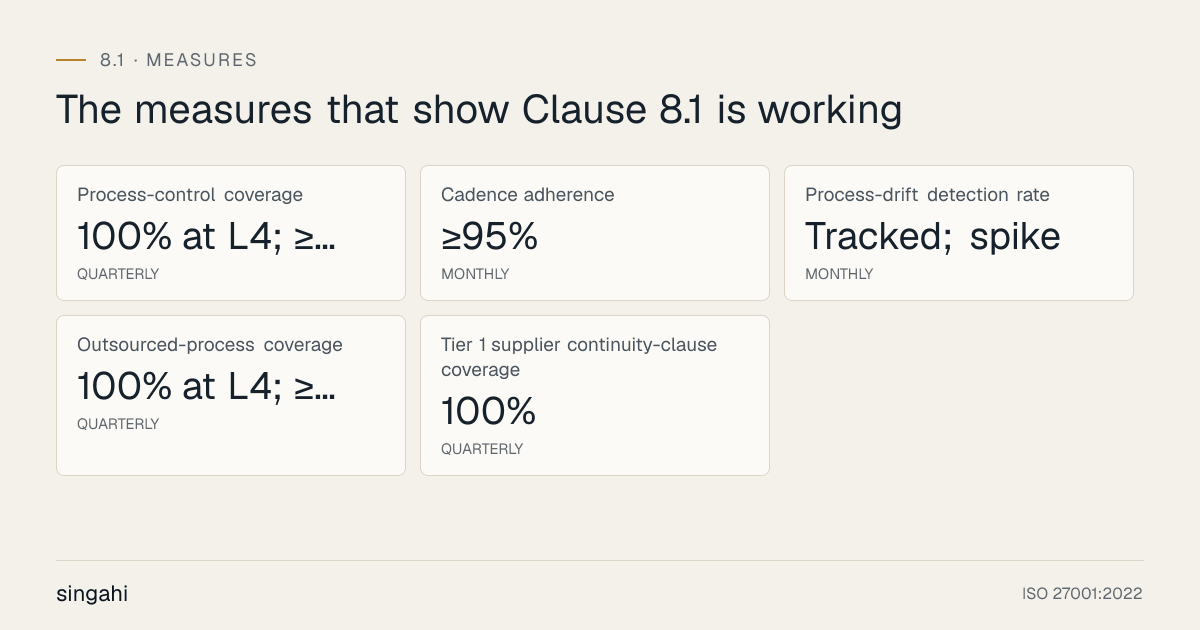
The 8.1 KPI dashboard feeds Clause 9.1 monitoring and Clause 9.3 management review. The 14 KPIs below are the working set for a growing Indian company; adapt the targets to the organisation's maturity.
| # | KPI | Formula | Target | Frequency |
|---|---|---|---|---|
| 1 | Process-control coverage | (Number of BCMS processes in the Process Control Matrix with all six control dimensions populated) / (Total BCMS processes) × 100 | 100% at L4; ≥80% at L3 | Quarterly |
| 2 | Cadence adherence | (Number of processes that ran on cadence in the period) / (Number of processes due in the period) × 100 | ≥95% | Monthly |
| 3 | Process-drift detection rate | (Number of processes flagged amber or red in the period) / (Total processes) × 100 | Tracked; spike = investigate | Monthly |
| 4 | Outsourced-process coverage | (Number of BC-relevant outsourced processes in the Register) / (Total BC-relevant outsourced processes identified) × 100 | 100% at L4; ≥90% at L3 | Quarterly |
| 5 | Tier 1 supplier continuity-clause coverage | (Number of Tier 1 supplier contracts with all six continuity clauses) / (Total Tier 1 supplier contracts) × 100 | 100% | Quarterly |
| 6 | Exit-plan coverage | (Number of Tier 1 outsourced processes with a tested exit plan) / (Total Tier 1 outsourced processes) × 100 | 100% at L4; ≥80% at L3 | Annually |
| 7 | Supplier BCP-DR audit pass rate | (Number of Tier 1 supplier audits passed) / (Total Tier 1 supplier audits conducted) × 100 | ≥95% | Annually |
| 8 | Change-touchpoint-check rate | (Number of BC-process changes with the BIA/strategy touchpoint check completed) / (Total BC-process changes) × 100 | 100% | Monthly |
| 9 | Emergency-change ratio | (Number of emergency changes) / (Total changes) × 100 | ≤5%; spike = investigate | Monthly |
| 10 | Change-induced incidents | (Number of incidents caused by a change) / (Total incidents) × 100 | ≤10%; trend down | Monthly |
| 11 | Critical-supplier concentration index | (Number of prioritised activities dependent on a single Tier 1 supplier) / (Total prioritised activities) × 100 | Tracked; mitigation plan if >30% | Quarterly |
| 12 | Evidence-retrieval success | (Number of evidence items retrieved within the SLA on audit request) / (Total evidence items requested) × 100 | 100% | Per audit |
| 13 | Process-failure MTTR | Mean time to recover a BCMS process that failed (drifted off criteria and could not be corrected within the cadence) | ≤30 days | Quarterly |
| 14 | 8.1 audit findings (major NCs) | Number of major non-conformities raised against 8.1 in the last audit | 0 | Per audit |
Dashboard design
The dashboard is the operational expression of the 8.1 discipline. A working dashboard shows: (a) the Process Control Matrix at a glance, with green/amber/red status per process; (b) the Outsourced Process Register at a glance, with tier, clause coverage, exit-plan status, last-audit date; (c) the change log, with touchpoint-check completion; (d) the KPI trends; (e) the corrective-action track. The dashboard is reviewed monthly by the BCM Manager, quarterly by the BCM Steering Committee, and annually by top management in the 9.3 management review.
Reporting cadence
- Daily. Operational dashboard reviewed by the BCM Manager (or delegate). Amber and red items escalated per the communication procedure.
- Weekly. Change log reviewed by the BCM Manager. Overdue items escalated.
- Monthly. Process Control Matrix and KPI dashboard reviewed by the BCM Manager. Material issues to the BCM Steering Committee.
- Quarterly. BCM Steering Committee reviews the full dashboard. Material issues to top management.
- Annually. Top management reviews the dashboard in the 9.3 management review. The Process Control Matrix and the Outsourced Process Register are refreshed.
Common Pitfalls and Audit Failures
The 8.1 audit findings that recur across the Indian growing-company segment are predictable and avoidable. The most common:
Pitfall 1, "The plan-on-a-shelf". The BCMS documentation exists, the BIA was done, the plans were written, the exercise was run once, and then the BCMS was filed. Two years later, the auditor finds a BIA that names an organisation that no longer exists, plans that reference systems that have been migrated, a contact tree with the wrong phone numbers, and an exercise calendar that has not run since the last audit. The BCMS is 8.2-conformant (a BIA exists) but 8.1-non-conformant (no process to keep it current). Treatment: build the Process Control Matrix, assign owners, set cadences, monitor monthly, escalate drift.
Pitfall 2, "The supplier with no continuity clause". The cloud TOU was signed by procurement without BCM review. The contract covers price, uptime SLA and data residency, but contains no right-of-audit, no sub-processor disclosure, no exit assistance, no step-in rights, no breach-notification SLA, no RTO/RPO alignment. The supplier's own BCP is unknown. When the supplier has an outage, the organisation discovers that its Tier 1 supplier's RTO is 24 hours and the supplier's incident-notification SLA is 4 hours, while the organisation's regulator requires notification within 6 hours. Treatment: build the Outsourced Process Register, tier the suppliers, apply the Supplier Continuity Clause Library to all new and renewing Tier 1 contracts, audit annually.
Pitfall 3, "The change that wasn't continuity-reviewed". The core banking stack was migrated to a new cloud region. The IT change-management process ran, architecture review, security review, performance review. But the BCM question was never asked. The BIA still names the old region; the strategy still assumes the old region's failover characteristics; the plans still invoke the old region's runbooks. The BCMS now describes an organisation that does not exist. Treatment: build the Change Management Workflow with the mandatory BIA/strategy touchpoint check; integrate with the IT change-management process; audit the change log.
Pitfall 4, "The exit plan that doesn't exist". The supplier is critical, the core banking SaaS, the payment switch, the managed SOC. The contract is renewable annually. But there is no exit plan. No step-in rights. No source-code escrow. No data portability test. No transitional staffing. No parallel-run design. When the supplier fails (or when the organisation decides to re-tender), the organisation discovers that it cannot operate the process without the supplier, and the supplier cannot be replaced without a transition that has not been designed. Treatment: build the Exit and Step-In Plan for every Tier 1 outsourced process; test annually; review at renewal.
Pitfall 5, "The RACI where the BCM Manager does everything". The RACI matrix shows the BCM Manager as Accountable for the BIA, the strategy, the plans, the exercises, the supplier reviews, the change workflow, the monitoring, the audit, the management review. Every other role is "Consulted" or "Informed". This is the single most common 8.1 non-conformity in the Indian growing-company segment, the BCM Manager is the custodian of the system, not the universal executor. Treatment: assign real ownership to IT, Procurement, Legal, CISO, process owners; the BCM Manager is the facilitator and the custodian, not the only accountable party.
Pitfall 6, "The evidence that is irretrievable". The evidence exists, somewhere. The BIA refresh was logged, in someone's email. The exercise report was filed, on the shared drive. The supplier audit was documented, in a spreadsheet that was emailed and edited by three people. The change log is, well, it is somewhere. When the auditor asks for the evidence, the BCM Manager spends three days assembling it, and the versions do not reconcile. Treatment: build the Evidence Framework with a defined system of record, a 7.5 retention regime, and an offline copy for critical evidence.
Pitfall 7, "The 8.1/8.2/6.1/6.3 conflation". The organisation has one big "BCM process" that covers everything. The auditor cannot tell where 8.1 ends and 8.2 begins, where 6.1 ends and 8.1 begins, where 6.3 ends and 8.1 begins. The findings cross-contaminate, a 8.2 finding on the BIA content is raised against 8.1 because there is no separate 8.1 process; a 6.3 finding on a BCMS scope change is raised against 8.1 because there is no separate 6.3 workflow. Treatment: demarcate the clauses explicitly; the Process Control Matrix names the processes by the clause they support; the Change Management Workflow distinguishes BC-process changes (8.1) from BCMS-level changes (6.3).
Pitfall 8, "The tool-as-a-silver-bullet". The organisation bought a BCM-specialist SaaS, expecting it to operate the BCMS. The tool is configured but under-populated, the Process Control Matrix has five rows, the Outsourced Process Register has three, the change log is empty. The tool produces well-formatted dashboards of an empty system. Treatment: the discipline comes first, the tool operationalises it; populate the matrix and the register before the dashboard matters.
Pitfall 9, "The exercise that doesn't test the supplier". The annual exercise tests the internal response, the Crisis Management Team, the plan invocation, the communications. But it does not test the supplier's failover, the supplier's notification SLA, the step-in rights, the exit plan. When a real supplier outage arrives, the organisation discovers that the supplier's failover does not work, the notification SLA is not met, and the step-in rights are unenforceable. Treatment: the exercise programme (Clause 8.5) must include supplier-failover tests and exit-plan tabletops for Tier 1 suppliers; the 8.1 process ensures the exercise calendar includes them.
Pitfall 10, "The regulator-clock mismatch". The CERT-In 6-hour clock, the DPDP 72-hour clock, the RBI 2-to-6-hour clock, the SEBI 6-hour clock, the IRDAI reporting clock, the organisation has not mapped its supplier-notification SLAs against its own regulator-notification clocks. The supplier's 24-hour notification SLA cannot support the organisation's 6-hour regulator clock. Treatment: the Supplier Continuity Clause Library specifies breach-notification SLAs that are shorter than the regulator clocks; the Outsourced Process Register records the alignment; the 8.1 process monitors compliance.
Illustrative Scenario 1: Failure, Vyom Cloud Services Private Limited (Illustrative)
Illustrative scenario, a composite example for guidance, not a specific Singahi engagement or a verified outcome.
Disclaimer: This is an illustrative scenario. The company, the people and the events are composite and fictional, drawn from the patterns of real Indian incidents (including the AIIMS Delhi 2022 ransomware, the HDFC Bank 2020 RBI action, the Go First 2023 supplier-concentration failure, and the global CrowdStrike 2024 outage) but not representing any specific organisation. Any resemblance to a real company is coincidental.
The organisation
Vyom Cloud Services Private Limited is a Bengaluru-based SaaS company founded in 2018, providing a workforce-management platform to mid-market Indian customers in the logistics, retail and facility-management sectors. At the time of the incident (illustrative: Q3 2024), Vyom had approximately 280 employees, ₹85 crore in annual recurring revenue, and approximately 1,200 customers. The company had achieved ISO 27001 certification in 2022 and was pursuing ISO 22301 certification as a customer requirement. The BCM Manager was Priya Sharma, a capable but under-resourced practitioner who also held the information-security lead role.
The setup
Vyom's SaaS platform ran on a single cloud region (Mumbai) of a single hyperscale cloud provider. The DR strategy was "the cloud provider's regional resilience", no multi-region failover, no alternate-cloud strategy, no offline backups (the cloud provider's snapshot service was treated as the backup). The platform's database was hosted on a managed database service, with point-in-time recovery configured to a 24-hour retention. The platform's authentication was handled by a single identity provider (a SaaS), with no fallback. The platform's payment processing was handled by a single payment aggregator. The platform's email and SMS notifications were handled by a single communications-API provider.
Vyom's BCM documentation was ISO 27001-derived, a BCP policy, an incident-response plan, a contact tree. The BIA was conducted once, in 2022, in support of the ISO 27001 certification. The BIA named the cloud provider as a dependency but did not name the region, the identity provider, the payment aggregator or the communications-API provider. The RTO was set at 8 hours; the RPO at 24 hours. The plans invoked the cloud provider's regional failover, which had never been tested.
Vyom's supplier contracts were standard, the cloud provider's click-through terms of use, the identity provider's MSA, the payment aggregator's MSA, the communications-API provider's MSA. None contained right-of-audit, sub-processor disclosure, exit assistance, step-in rights, breach-notification SLAs or RTO/RPO alignment. The procurement team had signed them without BCM review.
The change-management process was the IT change-management process, architecture review, security review, performance review. There was no BCM touchpoint check. A change in Q2 2024 had migrated the database to a new managed-database tier; the change was approved without a BIA touchpoint check, and the BIA still named the old tier.
The incident
On a Tuesday morning in Q3 2024 (illustrative), the cloud provider's Mumbai region suffered a multi-zone outage, a rare but documented event. The platform went dark. Vyom's customers could not log in, could not track their workforce, could not process payroll. The crisis-communications tree was activated, but the contact list was the version from Q1 2024, before two key engineers had left and the on-call rotation had changed. The Crisis Management Team convened, but the BCM Manager (Priya Sharma) was the only person who knew the cloud provider's incident-response portal credentials, and she was in a hospital with a family emergency.
The incident-response plan invoked the cloud provider's regional failover. The failover did not work, the configuration had drifted, and the failover target was in a zone that was also degraded. The platform's database could not be promoted to a readable state in another region, the cross-region replication had not been configured. The point-in-time recovery could not be invoked because the managed-database service was unavailable. The platform's authentication could not fall back to a local store, the identity provider was the only authentication path, and the identity provider was reachable but the platform's callback to the identity provider could not complete because the platform's endpoint was in the degraded region.
The payment aggregator continued to attempt to charge customers' saved instruments for subscriptions due that day; the attempts failed because the platform's webhook endpoint was unreachable; the aggregator's retry logic queued the attempts, but the customers' banks began to flag the failed attempts as suspicious, and several customers' cards were blocked.
The communications-API provider continued to attempt to deliver SMS and email notifications to workforce-management end-users (shift confirmations, leave approvals); the attempts failed because the platform's webhook endpoint was unreachable; the provider's retry logic queued the attempts; the queue grew; the provider's rate limits began to throttle the platform's account.
The cascade
The cloud provider restored the Mumbai region after approximately 11 hours. Vyom's platform came back online, but the recovery was not clean. The database had been restored to a snapshot from 23 hours before the outage, which meant the last hour of transactions (approximately 4,200 payroll-processing entries, approximately 850 shift confirmations, approximately 220 leave approvals) was lost. The identity provider's session tokens had expired during the outage, and the platform's token-refresh logic failed on the first attempt for approximately 60 per cent of concurrent users, producing a second-wave outage of approximately 90 minutes. The payment aggregator's queued attempts processed in a burst, but several customers' cards had been blocked, and the manual reconciliation took 6 days. The communications-API provider's queued notifications delivered in a burst, but the rate-limit throttling had pushed the platform's account into a suspended state, requiring manual reactivation that took 18 hours.
The total customer-facing downtime was approximately 13 hours (11 hours of cloud-region outage plus 90 minutes of token-refresh second-wave plus 18 hours of degraded notifications). The data loss was approximately 1 hour of transactions. The customer impact was approximately 1,200 customers, of whom approximately 60 had cards blocked, approximately 200 had payroll delayed, and approximately 850 had workforce-management notifications delayed.
The regulatory and commercial fallout
Vyom's customers included two BFSI-adjacent entities (a non-banking financial company and a payments bank) for whom the workforce-management platform was a dependency in their BCP-DR. Under the CERT-In Directions, these customers were obliged to report the incident within 6 hours of becoming aware. They became aware when their own workforce-management workflows failed; they reported to CERT-In within 6 hours; CERT-In's reporting form asked for the root cause, the affected systems, the data loss, the recovery actions and the supplier's identity. Vyom was named as the supplier.
The DPDP Act 2023 was engaged because the lost transactions included personal data (employee names, shift assignments, leave records). Vyom, as a Data Fiduciary, was obliged to notify the Data Protection Board and each affected Data Principal of the personal-data breach within 72 hours of becoming aware. Vyom became aware at the start of the outage; the notification was due 72 hours later; Vyom's legal team was not informed until 18 hours into the outage, leaving 54 hours to assess, draft and notify, a tight window for a company with no pre-existing breach-notification process.
The commercial fallout was severe. Three enterprise customers churned within 60 days, citing the outage and the data loss. Two prospects in the sales pipeline deferred their decisions. The ISO 22301 certification pursuit was paused. The company's Series B fundraising round, which had been in progress, was re-priced downward by approximately 15 per cent, with the lead investor citing "operational-resilience concerns". The total cost of the incident was estimated internally at approximately ₹14 crore (lost revenue, customer churn, remediation, legal, fundraising re-pricing), against an annual recurring revenue of ₹85 crore, approximately 16 per cent of ARR.
The 8.1 root causes
The post-incident review, conducted by an external consultant, identified the following 8.1 root causes:
- The BIA was stale. The 2022 BIA did not name the region, the identity provider, the payment aggregator or the communications-API provider. There was no process to refresh the BIA. 8.1 non-conformity: no BIA-refresh process.
- The plans were untested. The cloud provider's regional failover had never been invoked. The cross-region replication had not been configured. The token-refresh logic had not been tested under a region-outage scenario. 8.1 non-conformity: no exercise programme that tested the supplier failover.
- The supplier contracts had no continuity clauses. The cloud provider's TOU, the identity provider's MSA, the payment aggregator's MSA and the communications-API provider's MSA contained no right-of-audit, no sub-processor disclosure, no exit assistance, no step-in rights, no breach-notification SLAs, no RTO/RPO alignment. 8.1 non-conformity: no outsourced-process control regime.
- The change-management workflow had no BCM touchpoint check. The Q2 2024 database migration was approved without a BIA refresh. 8.1 non-conformity: no change-management workflow for BC processes.
- The crisis-communications tree was stale. The contact list was from Q1 2024. The BCM Manager was the single point of knowledge for the cloud provider's incident-response portal. 8.1 non-conformity: no process-control monitoring of the contact tree.
- The breach-notification process did not exist. The legal team was not informed until 18 hours into the outage. The DPDP 72-hour clock was nearly missed. 8.1 non-conformity: no breach-notification process.
- The RACI was a single point of failure. The BCM Manager held the BCM, IS and legal-liaison roles; her hospitalisation cascaded into the response failure. 8.1 non-conformity: no deputy assignment, no succession planning.
The lessons
The Vyom scenario is the canonical 8.1 failure pattern in the Indian growing-company segment: a technically capable company whose BCMS was a folder of documents, whose supplier contracts had no continuity clauses, whose change-management workflow had no BCM touchpoint check, whose exercise programme did not test the supplier failover, and whose crisis-communications and breach-notification processes were not operated. The ISO 27001 certification had given the company a false sense of operational resilience; the ISO 22301 pursuit had not yet been completed. The lessons are:
- The BIA is not a one-off document; it is a process that must be refreshed on cadence and on trigger.
- The plans are not paper; they must be exercised, including the supplier failover.
- The supplier contracts are not procurement artefacts; they are continuity instruments.
- The change-management workflow is not an IT-only process; it must include the BCM touchpoint check.
- The crisis-communications tree is not a static document; it is a process that must be kept current.
- The breach-notification process is not a legal-only matter; it is a BC process that must be operated.
- The BCM Manager is not the universal executor; the RACI must distribute accountability.
Illustrative Scenario 2: Success, Saanjhfin NBFC Limited (Illustrative, with ROI)
Disclaimer: This is an illustrative scenario. The company, the people and the events are composite and fictional, drawn from the patterns of real Indian NBFC operational-resilience programmes (including the RBI MD Outsourcing of IT Services compliance programmes, the HDFC Bank corrective-action programme, and the SEBI CSCRF implementation programmes) but not representing any specific organisation. Any resemblance to a real company is coincidental.
The organisation
Saanjhfin NBFC Limited is a Mumbai-based non-banking financial company founded in 2015, providing secured business loans and working-capital finance to small and medium enterprises in Maharashtra, Gujarat and Karnataka. At the start of the programme (illustrative: Q1 2024), Saanjhfin had approximately 650 employees, ₹1,800 crore in assets under management, 42 branches, and approximately 28,000 active loan accounts. The company was RBI-regulated under the RBI Master Direction on IT Governance (7 November 2023, effective 1 April 2024) and the RBI Master Direction on Outsourcing of IT Services (10 April 2023). The CIO was Rahul Sharma; the BCM Manager was Anjali Desai; the Head of Procurement was Vikram Patel.
The challenge
Saanjhfin's BCMS had been built for the 2018 RBI inspection and had not been refreshed. The BIA was from 2019. The plans referenced systems that had been migrated. The supplier contracts, the core banking SaaS, the loan-origination SaaS, the KYC verification API, the credit-bureau API, the SMS gateway, the cloud hosting provider, the DR-as-a-Service provider, were standard vendor paper with no continuity clauses. The DR-as-a-Service provider had never been failover-tested. The RBI's April 2024 compliance deadline for the MD IT Governance was approaching. The board, advised by the Company Secretary, had flagged the BCMS as a material risk under Section 134(3)(n) of the Companies Act 2013.
The programme
The CEO chartered a 9-month 8.1 operationalisation programme, sponsored by the board's Risk Management Committee, with a budget of ₹85 lakh and a target of L4 maturity on the 8.1 components. The programme had five workstreams.
Workstream 1, The Process Control Matrix. The BCM Manager (Anjali Desai) led a series of workshops with the CIO, the Head of Operations, the Head of Credit, the Head of Customer Service, the Head of HR, the Head of Legal and the Head of Procurement. Twenty-nine BCMS processes were identified, each with a named owner, a cadence, a criterion, a review trigger, a documented-information specification and a control evidence reference. The matrix was populated in the company's existing GRC platform (a growing BCM-specialist SaaS), with workflow automation for the cadence and the review triggers. The matrix was approved by the BCM Steering Committee in Q2 2024.
Workstream 2, The Outsourced Process Register. The Head of Procurement (Vikram Patel) led a supplier-mapping exercise. Twenty-two BC-relevant outsourced processes were identified, tiered (7 Tier 1, 9 Tier 2, 6 Tier 3), and entered into the register. For each Tier 1 supplier, the contractual continuity clauses were assessed against the Supplier Continuity Clause Library. The gaps were documented. The renewal calendar was mapped to the gap-closure plan.
Workstream 3, The Supplier Continuity Clause Library and the contract refresh. The Head of Legal (with external counsel) drafted a Supplier Continuity Clause Library, twelve clauses covering right-of-audit, sub-processor disclosure, exit assistance, step-in rights, breach-notification SLA, RTO/RPO alignment, concentration-risk disclosure, data portability, source-code escrow, regulatory cooperation, incident-response cooperation and termination continuity. The library was applied to all new and renewing Tier 1 contracts. Over the 9-month programme, 5 of the 7 Tier 1 contracts were renewed with the full clause set; the remaining 2 were amended by side-letter.
Workstream 4, The Change Management Workflow. The CIO (Rahul Sharma) led the integration of the BCM touchpoint check into the existing IT change-management process. A single question was added to the change-request form: "Does this change affect the BIA, the strategy, the plans, the exercise programme, the supplier-continuity regime, or the regulatory obligations? If yes, describe the effect and the action taken." The question was mandatory; a "yes" without an action blocked the change. The BCM Manager was added to the Change Advisory Board for changes flagged "yes". The change log was migrated to the GRC platform.
Workstream 5, The Exit and Step-In Plans. For each Tier 1 outsourced process, an Exit and Step-In Plan was documented. The plans covered the trigger conditions, the step-in rights, the data portability, the knowledge transfer, the transitional staffing, the parallel-run design and the regulator-notification process. The plans were tested by tabletop walkthrough in Q3 2024; the cloud hosting provider's plan was tested by a partial simulation in Q4 2024.
The DR-as-a-Service failover test
The most consequential single event in the programme was the DR-as-a-Service failover test in Q4 2024. The DR provider had been contracted in 2021 with a contracted RTO of 4 hours and a contracted RPO of 15 minutes. The failover had never been tested. The test was planned over 6 weeks, with the DR provider, the core banking SaaS provider, the loan-origination SaaS provider and the internal IT team. The test scenario was a total loss of the primary cloud region.
The test revealed:
- The contracted RTO of 4 hours was achievable, but only if the runbook was followed exactly; the first run took 6 hours and 20 minutes because two steps in the runbook were ambiguous.
- The contracted RPO of 15 minutes was not achievable; the actual RPO was 47 minutes because the database replication lag had drifted over the preceding 18 months and had not been monitored.
- The DR provider's incident-notification SLA was 30 minutes, but the notification did not include the root-cause analysis; the Saanjhfin team had to chase the root-cause separately, taking an additional 2 hours.
- The core banking SaaS provider's failover was independent of Saanjhfin's DR failover; the SaaS provider's failover took 3 hours and 15 minutes, which was within the SaaS provider's RTO but longer than Saanjhfin had assumed.
- The KYC verification API and the credit-bureau API had no DR arrangement; they were single-region services. In a real failover, the loan-origination workflow would have been unable to verify KYC or pull credit bureau data.
The findings were fed back into the 8.1 risk register, the BIA was refreshed (the RPO was re-negotiated with the business to 30 minutes, with a compensating manual-process design for the 15-to-30-minute window), the DR provider's contract was amended to include the root-cause-analysis SLA, the core banking SaaS provider's failover was added to the Saanjhfin runbook, and the KYC and credit-bureau APIs were added to the Outsourced Process Register with a Tier 2 classification and a mitigation plan (an alternate KYC provider and an offline credit-bureau-lookup cache).
The ROI
The programme cost was ₹85 lakh (the budgeted amount), comprising approximately ₹40 lakh for the GRC platform configuration and integration, approximately ₹20 lakh for external consulting (legal, BCM, DR-test facilitation), approximately ₹15 lakh for the DR-as-a-Service failover test (including the DR provider's test fees and the internal team's time), and approximately ₹10 lakh for the contract refresh (external counsel, internal legal time).
The quantified benefits over the 18 months following the programme completion (illustrative: Q1 2025 to Q2 2026):
- RBI inspection finding avoided. The RBI's 2025 inspection under the MD IT Governance found no material findings on the BCMS or the outsourcing regime. The company's internal estimate, based on the precedent of comparable NBFCs that received material findings, was that a material finding would have cost approximately ₹3 to 5 crore in remediation, external-audit fees, and management time, plus an indeterminate supervisory constraint. Estimated saving: ₹4 crore (mid-point).
- DR-cost optimisation. The failover test revealed that the contracted RPO of 15 minutes was commercially unnecessary; the business accepted a 30-minute RPO with a manual-process compensating control. The DR contract was re-tendered with the relaxed RPO, reducing the annual DR cost from ₹62 lakh to ₹38 lakh. Annual saving: ₹24 lakh; 18-month saving: ₹36 lakh.
- Insurance premium reduction. The cyber-insurance underwriter, presented with the 8.1 evidence set (the Process Control Matrix, the Outsourced Process Register, the exit plans, the DR-test report, the change-management workflow), reduced the premium by approximately 12 per cent. Annual saving: ₹18 lakh; 18-month saving: ₹27 lakh.
- Customer-win enablement. Two large enterprise customers (a public-sector bank's SME lending partnership and a large fintech's co-lending arrangement) required ISO 22301 alignment as a contractual condition. The 8.1 evidence set satisfied the due-diligence; both deals closed. New-business revenue: approximately ₹4.2 crore in the 18 months.
- Audit-cost reduction. The internal-audit cycle for the BCMS (Clause 9.2) was completed in 60 per cent of the previous year's hours, because the evidence was retrievable and the matrix was current. Saving: ₹8 lakh.
- Change-induced-incident reduction. The change-management workflow with the BCM touchpoint check reduced the change-induced-incident rate from approximately 14 per cent to approximately 6 per cent over the 18 months. The avoided incidents (estimated 8 incidents at an average cost of ₹4 lakh each) saved approximately ₹32 lakh.
The total quantified benefit over 18 months was approximately ₹5.23 crore (₹4 crore + ₹36 lakh + ₹27 lakh + ₹4.2 crore + ₹8 lakh + ₹32 lakh), against a programme cost of ₹85 lakh, a return on investment of approximately 6.2x over 18 months. The RBI-inspection-finding avoided (₹4 crore) and the customer-win enablement (₹4.2 crore) were the largest components; both were direct consequences of the 8.1 discipline, the Process Control Matrix, the Outsourced Process Register, the exit plans, the DR-test report and the change-management workflow.
The lessons
The Saanjhfin scenario is the canonical 8.1 success pattern in the Indian growing-company segment: a regulated NBFC whose 8.1 operationalisation was driven by a regulatory deadline (the RBI MD IT Governance), sponsored by the board (under Section 134(3)(n)), executed by a cross-functional team (BCM, IT, Procurement, Legal), evidenced by a GRC platform, and validated by a DR-as-a-Service failover test that produced real findings. The lessons are:
- The 8.1 discipline is a value-creation discipline, not just a defensive control. The ROI came from the RBI inspection avoided, the customer wins enabled, the DR-cost optimised, the insurance premium reduced, and the change-induced incidents avoided, not just from the audit passed.
- The cross-functional sponsorship is non-negotiable. The BCM Manager cannot operationalise 8.1 alone; the CIO, the Head of Procurement, the Head of Legal and the CEO must be accountable.
- The DR-test is the most consequential single event. A DR test that has never been run is a paper RTO; a DR test that produces findings is an operational RTO.
- The Supplier Continuity Clause Library is the highest-use artefact. The clauses applied to the Tier 1 contracts produced the regulatory compliance, the customer-win enablement, and the insurance-premium reduction.
- The change-management touchpoint check is the cheapest control with the largest preventive effect. A single mandatory question on the change-request form, backed by a CAB gate, prevented approximately 8 change-induced incidents over 18 months.
Multi-Framework Mapping
The table below maps ISO 22301 Clause 8.1 to the major BCM, operational-resilience and information-security frameworks. Each cell is a real, verifiable control number or article. Where a mapping is approximate (analogy, not equivalence), the cell notes it.
| Framework | What it requires that maps to 8.1 | Real control / article |
|---|---|---|
| ISO 22301:2019 | Operational planning and control of BCMS processes, including outsourced and change management | Clause 8.1 (the subject of this guide) |
| ISO 22313:2020 | Guidance on the use of ISO 22301, clause-by-clause companion | Clause 8.1 guidance |
| ISO/IEC 27001:2022 | Operational planning and control of the ISMS; supplier relationships; change management | Clause 8.1; Annex A 5.19, 5.20, 5.23, 5.29, 5.30, 8.13, 8.14, 8.32 |
| ISO/IEC 27031:2011 | ICT readiness for business continuity | Full standard (the ICT-readiness analogue) |
| ISO/TS 22318:2021 | Supply chain continuity (the outsourced-process control method) | Full technical specification (2021 edition; 2015 withdrawn) |
| ISO/IEC 27036 series | Information security for supplier relationships (including 27036-4 for cloud) | Multi-part standard |
| NIST SP 800-34 Rev 1 | Contingency planning, plan development and maintenance | Step 5 (develop ISCP), Step 7 (plan maintenance) |
| NIST SP 800-160 Vol 2 Rev 1 | Cyber-resilience techniques and objectives | Full volume (anticipate, withstand, recover, adapt) |
| NIST SP 800-161 Rev 1 | Supply chain risk management practices | Full revision |
| NIST CSF 2.0 | Govern function (new in 2.0); Recover function | GV, RC.RP, RC.CO, RC.IM |
| FFIEC BCM Booklet (Nov 2019) | Governance, risk understanding, strategies, plan development, testing, third-party risk, communication | BCM Booklet (OCC 2019-57, FRB SR 19-13, FDIC FIL-19071) |
| DORA (Reg (EU) 2022/2554, applies 17 Jan 2025) | ICT risk management; ICT third-party risk; concentration risk; change management; exit strategies | Art 7 (ICT systems), Art 9 (protection and prevention, change management), Art 11 (response and recovery, BIA), Art 28 (third-party risk), Art 29 (concentration risk), Art 30 (contractual provisions, exit), Art 35 (oversight penalties) |
| APRA CPS 230 (eff 1 Jul 2025) | Operational risk controls; business continuity; service-provider arrangements | Paras 24-25 (op risk controls), 29-31 (controls), 34-46 (BC, including para 38 tolerance triple), 47-60 (service-provider arrangements, including para 56 exit and BCP continuity) |
| MAS TRM Guidelines (18 Jan 2021) | Technology risk management; system availability and resilience; DR; third-party continuity | TRM Section 8 (governance), Section 10 (system and processing resilience), Section 11 (BC and DR), verify exact paragraph numbers against the live PDF |
| HKMA SPM TM-G-2 (31 May 2022) and SA-2 | BCP; outsourcing continuity | TM-G-2 (BCP), SA-2 (outsourcing), OR-2 (operational resilience) |
| SOC 2 (Trust Services Criteria) | Availability; Confidentiality; processing integrity; change management; supplier oversight | A1.2 (change management), A1.3 (incident detection and response), CC9.2 (vendor and business-partner risk management), A1.1 (capacity and environmental protections) |
| RBI MD IT Governance (7 Nov 2023, eff 1 Apr 2024) | IT Service Continuity / BCM; documented RTO/RPO; DRS; BCP drills; third-party continuity; incident management; IT readiness | MD chapters on IT Service Continuity and BCM (portal id 12562) |
| RBI Cyber Security Framework (2 Jun 2016) | Board-approved cyber policy; CCMP; SOC; incident reporting; drills | Full framework (DBS.CO/OC.No.114/33.01.001/2015-16) |
| RBI MD Outsourcing of IT Services (10 Apr 2023) | Outsourcer/cloud BCP-DR inheritance; concentration-risk monitoring; exit/termination continuity plans; RBI right of access | Full Master Direction |
| SEBI CSCRF (20 Aug 2024) | Five Cyber Resilience Goals across six Operational Functions (Identify, Protect, Detect, Respond, Recover, Learn); six-hour incident reporting; SOC; drills; threat-intel sharing | SEBI/HO/ITD-1/ITD_CSC_EXT/P/CIR/2024/113 |
| SEBI MII BCP-DR (22 Mar 2021) | Near Site + DRS; RTO ≤ 2 hours for critical systems; RPO; live failover drills; vendor/dependency BCP; document review cadence; board approval | SEBI/HO/MRD1/DTCS/CIR/P/2021/33 |
| IRDAI Information and Cyber Security Guidelines (24 Apr 2023) | Board-approved Information and Cyber Security Policy including BCP/DR; 180-day log retention; DR drills; ICT-outsourcing continuity oversight; annual compliance reporting | Full guidelines |
| CERT-In Directions (28 Apr 2022) | Six-hour incident reporting; 180-day log retention; NTP clock sync; 5-year KYC; PoC appointment; investigation cooperation | No. 20(3)/2022-CERT-In |
| DPDP Act 2023 | Section 8(5) availability duty; Section 8(6) breach notification; DPDP Rules 2025, 72-hour notification window | Act 22 of 2023; DPDP Rules 2025 |
| Companies Act 2013 | Section 134(3)(n) board risk statement; Section 177 Audit Committee evaluation of internal financial controls and risk management | Sections 134(3)(n), 177 |
| IT Act 2000 | Section 43 (civil compensation for damage including availability); Section 70B (CERT-In statutory basis) | Sections 43, 65, 66, 70, 70B |
| NDMA DM Act 2005 | Disaster Management Plan processes; integration of industrial plans with District DMPs | Act 53 of 2005 |
How to read this mapping
The mapping shows that 8.1 is one of the most broadly anchored clauses in the ISO 22301 standard, operational planning and control, supplier continuity, change management, and the operational rhythm of the BCMS are themes that appear in every major BCM, operational-resilience, and information-security framework. An Indian growing company that operates a 8.1-conformant BCMS can satisfy most of the operational expectations of all of these frameworks simultaneously. The strategic value of building the 8.1 discipline once and well is that it produces a single evidence set that serves the ISO 22301 certification audit, the RBI inspection, the SEBI inspection, the IRDAI inspection, the CERT-In compliance check, the DPDP audit, the SOC 2 audit, and (for EU-financial exposure) the DORA compliance programme.
The strongest anchors
- RBI MD Outsourcing of IT Services (10 April 2023) is the most direct Indian regulatory operationalisation of 8.1's outsourced-process control for BFSI. Cite it for every BFSI 8.1 implementation.
- DORA Articles 28 to 30 are the most direct EU regulatory operationalisation of 8.1's outsourced-process control for financial entities. Cite it for any Indian organisation with EU-financial exposure (IT/BPO serving EU banks, PSPs, MIIs).
- APRA CPS 230 paragraphs 47 to 60 are the most direct AU regulatory operationalisation of 8.1's service-provider management, including the exit-plan obligation at paragraph 56. Cite it for any Indian organisation with AU exposure.
- ISO/TS 22318:2021 is the most direct ISO-method operationalisation of 8.1's supply-chain continuity dimension. Cite the 2021 edition, not the withdrawn 2015 edition.
- NIST SP 800-161 Rev 1 is the most direct US-federal operationalisation of supply-chain risk management. Cite it for US-exposure organisations.
Implementation Roadmap
The roadmap below is calibrated to a growing company (50 to 250 staff) pursuing ISO 22301 certification. Compress or extend the milestones to fit the organisation's size and maturity.
The first 30 days, charter and inventory
- Week 1. Charter the 8.1 programme with top management. Name the sponsor (the CEO or the COO), the BCM Manager, the cross-functional team (CIO, CISO, Head of Procurement, Head of Legal, Head of Operations). Approve the budget.
- Week 2. Inventory the BCMS processes. Run a workshop with the cross-functional team. List every process the BCMS needs to operate, the BIA, the strategy, the plans, the exercises, the supplier reviews, the change workflow, the crisis communications, the monitoring, the audit, the management review, the corrective action. Expect 15 to 25 processes for a growing company.
- Week 3. Inventory the outsourced processes. Run a workshop with Procurement and IT. List every BC-relevant outsourced process, the cloud hosting, the SaaS dependencies, the managed services, the payment processors, the communications APIs, the KYC/credit-bureau APIs. Expect 8 to 15 entries for a growing company.
- Week 4. Build the first version of the Process Control Matrix and the Outsourced Process Register. Populate the columns you can; mark the gaps. Approve the documents as controlled documents per Clause 7.5.
Days 31 to 90, build the workflow and the clause library
- Month 2. Build the Change Management Workflow. Add the BCM touchpoint check to the change-request form. Add the BCM Manager to the Change Advisory Board for changes flagged "yes". Migrate the change log to the system of record.
- Month 2. Build the Supplier Continuity Clause Library. Draft the twelve clauses with legal counsel. Apply the library to the top-five Tier 1 contracts that are due for renewal in the next 12 months.
- Month 3. Build the Exit and Step-In Plans for the top three Tier 1 outsourced processes. Document the trigger conditions, the step-in rights, the data portability, the knowledge transfer, the transitional staffing, the parallel-run design, the regulator-notification process.
- Month 3. Build the Process-Confidence Evidence Framework. For each process, specify the evidence, the system of record, the capturer, the capture timing, the retention period, the retrieval method.
Days 91 to 180, operate, test, evidence
- Month 4. Operate the Process Control Matrix. Run the monthly BCM Manager review. Escalate amber and red items to the BCM Steering Committee.
- Month 5. Conduct the first DR-as-a-Service failover test (or the supplier-failover tabletop) for the top Tier 1 supplier. Capture the findings. Feed them back into the 8.1 risk register, the BIA (if appropriate), the strategy (if appropriate), and the Outsourced Process Register.
- Month 6. Conduct the first internal audit of the 8.1 regime (Clause 9.2). Use the audit-evidence checklist (toolkit document 04). Capture the findings. Raise corrective actions per Clause 10.1.
Days 181 to 365, maturity, integration, certification
- Months 7 to 9. Integrate the 8.1 regime with the enterprise risk register (Clause 6.1), the BIA process (Clause 8.2), the strategy (Clause 8.3), the plans (Clause 8.4), the exercise programme (Clause 8.5), the monitoring (Clause 9.1), and the management review (Clause 9.3). Reconcile the registers.
- Months 10 to 12. Mature the regime. Move from L2 to L3 (or from L3 to L4) on the maturity model. Conduct the Stage 1 certification audit. Address the findings. Conduct the Stage 2 certification audit.
Beyond year one, continual improvement
- Annual. Refresh the Process Control Matrix, the Outsourced Process Register, the Change Management Workflow, the Exit and Step-In Plans, the Evidence Framework.
- Annual. Test every Tier 1 exit plan (tabletop at minimum; simulation for the most critical).
- Annual. Conduct the DR-as-a-Service failover test.
- Annual. Conduct the internal audit and the management review.
- On-trigger. Refresh the BIA, the strategy, the plans when a significant change, a post-disruption review, a regulatory amendment, an audit finding, a supplier change, or a key-person departure occurs.
FAQ
Q1. Is Clause 8.1 the same as Clause 8.1 in ISO 27001?
Structurally, yes. Both follow the Harmonized Structure of ISO management-system standards, and both place "Operational planning and control" at clause 8.1. The difference is in the kinds of operational processes each system prioritises. ISO 27001's 8.1 is about the operational planning and control of information-security processes; ISO 22301's 8.1 is about the operational planning and control of business-continuity processes. An integrated ISMS/BCMS organisation can operate a single 8.1 discipline that serves both, with the process inventory covering both information-security and business-continuity processes.
Q2. How is 8.1 different from 8.2?
8.2 requires that the organisation conduct a BIA, identify prioritised activities, assess impact over time, determine MTPD/RTO/RPO/MBCO, identify dependencies. 8.1 requires that there be a process for running the BIA on a defined cadence, with a defined owner, a defined method, a defined quality bar and a defined review trigger. The BIA content is an 8.2 output; the BIA-refresh process is an 8.1 control. An organisation can be 8.2-conformant (a BIA exists) and 8.1-non-conformant (no process to refresh it) at the same time.
Q3. How is 8.1 different from 6.1?
6.1 requires that the organisation plan actions to address risks and opportunities that could affect the BCMS achieving its outcomes, the BCMS-level risk assessment. 8.1 requires that those actions be operationalised through running processes. The 6.1 risk register and the 8.1 Process Control Matrix must reconcile: every 6.1 treatment action should map to an 8.1 process that executes it. An organisation can be 6.1-conformant (risks identified, treatments planned) and 8.1-non-conformant (no process to execute the treatments) at the same time.
Q4. How is 8.1 different from 6.3?
6.3 requires that changes to the BCMS itself, its scope, policy, objectives, structure, be planned. 8.1 requires that changes to the BC processes, the BIA cadence, the exercise calendar, the supplier-review cycle, the crisis-communications tree, be made through a controlled change-management workflow. A decision to expand the BCMS scope to a new business unit is a 6.3 event; a decision to move the BIA from annual to semi-annual is an 8.1 event.
Q5. Does 8.1 require a specific tool?
No. 8.1 is outcome-based. A BCM-specialist SaaS, an enterprise IRM platform, an ITSM platform with a BCM extension, a collaboration platform with a controlled process library, or a well-disciplined spreadsheet with a clear register and a change log can all satisfy the requirement at appropriate scale. The discipline comes first; the tool operationalises it.
Q6. Does 8.1 require the supplier's BCP to be the organisation's BCP?
No. The organisation cannot contract away its accountability for continuity, but it can and should require suppliers to operate to continuity standards aligned with its own. The supplier's BCP is evidence that the outsourced process can be run with continuity; the organisation's 8.1 control is the governance that ensures that evidence is current, audited and aligned.
Q7. What is the BIA/strategy touchpoint check?
A single mandatory question on the change-request form: "Does this change affect the BIA, the strategy, the plans, the exercise programme, the supplier-continuity regime, or the regulatory obligations? If yes, describe the effect and the action taken." A "no" answer is auditable; a "yes" without an action is a finding. The touchpoint check is the single most important 8.1 workflow feature.
Q8. How often should the BIA be refreshed?
Typically annually, plus on-trigger. The triggers include significant change (a new product, a new supplier, a new geography, a new regulation), post-disruption review, regulatory amendment, audit finding, supplier change, key-person departure. The cadence and the triggers are part of the BIA process's criterion (an 8.1 obligation); the BIA content is an 8.2 obligation.
Q9. How often should the DR test be run?
Typically annually for a full failover, semi-annually for a simulation, quarterly for a tabletop. The RBI MD IT Governance requires periodic BCP drills including live/parallel DR drills; SEBI MII BCP-DR requires live failover drills; IRDAI requires DR drills; DORA Article 25 requires annual vulnerability and penetration testing, and Article 26 requires TLPT every 3 years for systemic entities. The cadence is part of the exercise programme's criterion (an 8.1 obligation); the exercise content is an 8.5 obligation.
Q10. What is the CERT-In 6-hour clock?
Under the CERT-In Directions (28 April 2022), Indian ICT operators must report prescribed cyber incidents to CERT-In within 6 hours of noticing. The 6-hour clock is a process obligation, the organisation must have a process that detects, escalates, assesses and reports within 6 hours. The process is an 8.1 obligation; the reporting content is a regulatory obligation.
Q11. What is the DPDP 72-hour clock?
Under the DPDP Act 2023 Section 8(6) and the DPDP Rules 2025, a Data Fiduciary must notify the Data Protection Board and each affected Data Principal of a personal-data breach within 72 hours of becoming aware. The 72-hour clock is a process obligation, the organisation must have a process that detects, assesses, drafts and notifies within 72 hours. The process is an 8.1 obligation; the notification content is a regulatory obligation.
Q12. How does 8.1 apply to cloud providers?
Cloud providers are outsourced processes under 8.1. The organisation's 8.1 obligation is to control the cloud arrangement through contract (the Supplier Continuity Clause Library), audit (the annual cloud-provider BCP-DR audit), exit (the Exit and Step-In Plan), concentration-risk monitoring (the multi-region or multi-cloud assessment), and the change-management touchpoint check (the BCM review of cloud-architecture changes). The RBI MD Outsourcing of IT Services (10 April 2023) and the SEBI CSCRF (20 August 2024) both have specific cloud-continuity expectations for regulated entities.
Q13. What is the difference between a step-in right and an exit plan?
A step-in right is the contractual right for the organisation (or a designated third party) to take direct control of an outsourced process in defined circumstances. An exit plan is the pre-defined course of action for terminating the arrangement without loss of continuity. A step-in right without an exit plan is a paper right; an exit plan without a step-in right is an unenforceable plan. Both are needed; both are 8.1 obligations.
Q14. Does 8.1 apply to a small company?
Yes. The discipline scales down. A small company (10 to 50 staff) may have a one-page Process Control Matrix with eight to twelve processes, a one-page Outsourced Process Register with three to five entries, a simple BCM-Steering-Committee approval cycle for changes, and a lightweight exit plan for the top two suppliers. The discipline matters more than the documentation depth.
Q15. How long does it take to implement 8.1?
For a growing company (50 to 250 staff), 6 to 10 weeks for the first cycle (the policy, the procedure, the Process Control Matrix, the Outsourced Process Register, the Change Management Workflow, the Supplier Continuity Clause Library applied to the top-five suppliers, the Exit and Step-In Plans for the top three, and the first 90 days of evidence capture). For a growing company (250 to 2,000 staff), 10 to 16 weeks. For a multi-entity enterprise, 4 to 6 months.
Industry-Specific Requirements
BFSI (Banks, NBFCs, Insurers, Payment System Operators)
For BFSI, 8.1 is the clause that most directly maps to the RBI MD IT Governance (7 November 2023, effective 1 April 2024), the RBI MD Outsourcing of IT Services (10 April 2023), the SEBI CSCRF (20 August 2024), the SEBI MII BCP-DR (22 March 2021), and the IRDAI Information and Cyber Security Guidelines (24 April 2023). The Process Control Matrix must include the regulator-mandated processes: the DR drills (live/parallel), the incident reporting (6-hour RBI/SEBI/CERT-In clock), the SOC operations, the threat-intel sharing, the cyber drills, the board reporting. The Outsourced Process Register must include the RBI-right-of-audit clauses, the concentration-risk monitoring, the exit-plan obligations, and the cloud-continuity expectations. The Change Management Workflow must include the regulator-notification trigger for material changes (the RBI's prior-permission requirements for material IT changes, the SEBI's prior-approval requirements for MII changes).
Specific BFSI considerations:
- Banks under RBI MD IT Governance. The board-approved BCP and DR policy, the documented RTO/RPO for critical systems, the DRS with defined failover, the periodic BCP drills including live/parallel DR drills, the third-party continuity controls, the incident management, the IT readiness for crisis events, all as running processes.
- NBFCs under RBI MD Outsourcing of IT Services. The outsourced-process regime must ensure the outsourcer/cloud BCP-DR meets the NBFC's own continuity standards, with concentration-risk monitoring, exit/termination continuity plans, and the RBI right of access.
- Insurers under IRDAI Information and Cyber Security Guidelines. The board-approved Information and Cyber Security Policy including BCP/DR, the 180-day log retention aligned with CERT-In, the DR drills, the ICT-outsourcing continuity oversight, the annual compliance reporting within 90 days of financial-year end.
- MIIs under SEBI BCP-DR. The Near Site + DRS architecture, the RTO of ≤ 2 hours for critical systems, the defined RPO, the live failover drills, the vendor/dependency BCP, the document-review cadence, the board approval.
- Payment System Operators. The cyber-resilience framework with BCP/DR, the secure SDLC, the monitoring, the incident response for the payment ecosystem.
Healthcare
For healthcare, 8.1 is the clause that most directly maps to the NDMA chemical-disaster guidelines (for industrial-pharma sites), the DPDP Act (for patient-data processors), and the clinical-governance discipline. The Process Control Matrix must include the clinical-failover process (the manual-mode fallback for the EHR, the clinical-workflow continuity for the ICU, the patient-safety-escalation process), the diagnostic-equipment-continuity process, the clinical-supply-continuity process. The Outsourced Process Register must include the EHR-hosting supplier, the diagnostic-equipment supplier, the clinical-supply supplier, the medical-device software supplier. The Change Management Workflow must include the clinical-change-impact assessment (the patient-safety dimension).
The AIIMS Delhi ransomware (23 November 2022) is the canonical Indian healthcare-continuity failure: primary and backup servers encrypted together, OPD/admissions/billing/labs reverted to paper for approximately 6 to 15 days, the NIA opened a cyberterrorism probe, the reported ransom figure of approximately ₹200 crore was not confirmed. The 8.1 root cause: the backup process existed on paper but had not been operated with discipline, primary and backup in the same blast radius, no offline immutable copy, no tested clinical failover.
IT/ITeS and SaaS
For IT/ITeS and SaaS, 8.1 is the clause that most directly maps to the DPDP Act (for SaaS processing personal data), the CERT-In Directions (for ICT operators), and DORA (for IT/BPO serving EU financial entities). The Process Control Matrix must include the customer-facing incident-communication process, the multi-tenant isolation process, the release-management process, the customer-incident-notification process (aligned to the customer's own regulator clocks). The Outsourced Process Register must include the cloud-infrastructure supplier, the sub-processor chain, the managed-service providers, the SaaS dependencies. The Change Management Workflow must include the customer-notification trigger for material changes.
The Cognizant Maze ransomware (18 to 20 April 2020) is the canonical Indian-IT-services continuity failure: the SEC-filed 10-Q/10-K disclosed Q2 2020 impact of US$50 to 70 million in lost revenue and margin. The 8.1 root cause: globally federated network, insufficient segmentation, the backup and recovery process not designed for a destructive-wiper scenario.
Manufacturing
For manufacturing, 8.1 is the clause that most directly maps to the NDMA chemical-disaster guidelines (for industrial sites), the Factories Act 1948, and the operational-technology (OT) security discipline. The Process Control Matrix must include the OT/IT segmentation process, the supply-chain-continuity process, the industrial-relations escalation process, the mutual-aid arrangement process, the on-site and off-site emergency-plan process. The Outsourced Process Register must include the contract manufacturer, the raw-material supplier, the logistics partner, the OT-systems supplier. The Change Management Workflow must include the OT-change-impact assessment.
The Maruti Suzuki Manesar violence (18 July 2012) is the canonical Indian manufacturing continuity failure: a wage dispute escalated to a mob smashing the assembly line and setting fire; Awanish Kumar Dev (GM-HR) was killed; 91 were arrested; the direct damage was approximately ₹10 crore; the production loss was approximately ₹70 to 75 crore per day, accumulating to approximately ₹1,400 crore in lockout losses; approximately 65,000 vehicles were lost. The 8.1 root cause: the industrial-relations-escalation process did not exist, the workplace-violence scenario was not in the BIA, the mutual-aid arrangement with the local administration was inadequate.
Government and Public Sector
For government and public sector, 8.1 is the clause that most directly maps to the NDMA DM Act 2005 and the National Policy on Disaster Management 2009. The Process Control Matrix must include the District-DMP integration process, the mutual-aid arrangement process, the public-communication process, the inter-agency coordination process. The Outsourced Process Register must include the system-integrator, the cloud-mepanelled provider, the network-operator, the managed-service provider. The Change Management Workflow must include the regulatory-change-impact assessment (the MeitY-cloud-policy changes, the CERT-In direction changes, the NDMA guideline changes).
Maturity Model
The 8.1 maturity model below is calibrated to the Indian growing-company segment. The INR estimates are illustrative third-party estimates of the cumulative investment required to reach each level from L1; they are not Singahi pricing and vary widely by organisation size, sector and starting point.
Level 1, Initial (the "plan-on-a-shelf")
- Characteristics. The BCMS is a folder of documents filed at the last audit. The BIA is two years stale. The plans reference systems that have been migrated. The exercise calendar slipped. The supplier contracts have no continuity clauses. The cloud TOU was signed without BCM review. The change-management workflow has no BCM touchpoint check. The crisis-communications tree is out of date. The breach-notification process does not exist. The BCM Manager is the single point of knowledge.
- Typical evidence. A BCP policy, a BIA document, a plan, an exercise report, all dated the week before the last audit.
- Cumulative investment to reach L1. ₹0 to ₹2 lakh (the cost of the last audit's documentation effort).
- Risk posture. High. The BCMS will fail on the day it is activated.
Level 2, Reactive (the "documented but unoperated")
- Characteristics. The BCMS documentation exists and is more current than L1, but the operational discipline is absent. The Process Control Matrix does not exist. The Outsourced Process Register does not exist. The Change Management Workflow has no BCM touchpoint check. The supplier contracts have no continuity clauses. The Exit and Step-In Plans do not exist. The DR test has not been run. The 8.1 KPI dashboard does not exist.
- Typical evidence. A BCP policy, a BIA document, a plan, an exercise report, an incident-response plan, all reasonably current, but no operational evidence of running processes.
- Cumulative investment to reach L2. ₹3 to ₹8 lakh (the cost of a part-time BCM Manager and a documentation refresh).
- Risk posture. High. The BCMS will pass a documentation audit but fail on the day it is activated.
Level 3, Defined (the "operated but not integrated")
- Characteristics. The Process Control Matrix exists and is populated. The Outsourced Process Register exists and is populated. The Change Management Workflow includes the BCM touchpoint check. The Supplier Continuity Clause Library is applied to the Tier 1 contracts. The Exit and Step-In Plans exist for the Tier 1 suppliers. The DR test has been run at least once. The 8.1 KPI dashboard exists. The processes are run on cadence. But the integration is incomplete, the 8.1 risk register does not fully reconcile with the 6.1 risk register; the BIA process does not fully reconcile with the supplier-review process; the exercise programme does not fully test the supplier failover.
- Typical evidence. The Process Control Matrix, the Outsourced Process Register, the Change Management Workflow, the Supplier Continuity Clause Library, the Exit and Step-In Plans, the DR test report, the KPI dashboard, all reasonably current and reasonably operated.
- Cumulative investment to reach L3. ₹15 to ₹45 lakh (the cost of a full-time BCM Manager, a mid-market GRC platform or a BCM-specialist SaaS, the contract refresh, the first DR test, the external consulting).
- Risk posture. Moderate. The BCMS will probably work on the day it is activated, but with gaps.
Level 4, Managed (the "integrated and measured")
- Characteristics. The 8.1 regime is fully integrated with the BCMS. The Process Control Matrix, the Outsourced Process Register, the Change Management Workflow, the Supplier Continuity Clause Library, the Exit and Step-In Plans, the Evidence Framework, the KPI Dashboard, all are operated on cadence, with monitoring, escalation, and corrective action. The 8.1 risk register reconciles with the 6.1 risk register, the 8.2 disruption-risk register, and the 10.1 corrective-action log. The DR test is run annually. The Exit and Step-In Plans are tested annually. The 8.1 KPI dashboard is reviewed monthly by the BCM Manager, quarterly by the Steering Committee, and annually by top management.
- Typical evidence. All L3 artefacts, plus the reconciliation evidence, the DR-test trend, the exit-plan test reports, the management-review packs.
- Cumulative investment to reach L4. ₹45 lakh to ₹1.5 crore (the cost of an integrated GRC platform, a full-time BCM team, the annual DR-test programme, the annual exit-plan test programme, the internal-audit programme).
- Risk posture. Low. The BCMS will work on the day it is activated, with minor gaps.
Level 5, Optimimising (the "continually improved and externally benchmarked")
- Characteristics. The 8.1 regime is continually improved. The processes are benchmarked against external benchmarks (BCI Horizon Scan, industry peers, regulator expectations). The Supplier Continuity Clause Library is updated to reflect emerging risks (DORA, APRA CPS 230, the DPDP Rules). The Exit and Step-In Plans are tested by simulation, not just tabletop. The 8.1 KPI dashboard is integrated with the enterprise risk dashboard and the enterprise performance dashboard. The BCM function is a strategic input to business decisions, not a compliance afterthought.
- Typical evidence. All L4 artefacts, plus the benchmarking evidence, the simulation-test reports, the strategic-decision inputs, the continual-improvement log.
- Cumulative investment to reach L5. ₹1.5 to ₹4 crore (the cost of a mature BCM function, an enterprise GRC platform, a regular simulation programme, the external benchmarking).
- Risk posture. Low and decreasing. The BCMS is a strategic asset, not just a defensive control.
Maturity advancement
The maturity advancement path is not linear. Most Indian growing companies are at L1 or L2. The leap from L2 to L3 is the hardest, it requires the cross-functional sponsorship, the budget, and the willingness to treat the BCMS as a running system rather than a folder of documents. The leap from L3 to L4 is more mechanical, it requires the integration, the reconciliation, and the monitoring discipline. The leap from L4 to L5 is strategic, it requires the benchmarking, the simulation programme, and the integration with enterprise decision-making.
The most common advancement failure is the "L2.5 trap", the organisation invests in the documentation (the Process Control Matrix, the Outsourced Process Register) but not in the operation (the cadence, the monitoring, the corrective action). The documentation exists; the discipline does not. The result is a BCMS that passes a documentation audit but fails on the day it is activated, the worst of both worlds, because the organisation believes it is resilient when it is not.
Emerging Trends
The shift from continuity to operational resilience
The global regulatory conversation is shifting from "business continuity" (the ability to recover from a disruption) to "operational resilience" (the ability to continue delivering critical operations through a disruption). The APRA CPS 230 (effective 1 July 2025) and the HKMA OR-2 (31 May 2022) are the most explicit expressions of this shift, they require entities to identify important business services, set impact tolerances, and test against severe-but-plausible scenarios. For 8.1, this means the Process Control Matrix is increasingly expected to include the operational-resilience processes, the important-business-service identification process, the impact-tolerance-setting process, the severe-but-plausible-scenario testing process, alongside the traditional BC processes.
The DORA effect on Indian IT/BPO
DORA (Regulation (EU) 2022/2554, applies 17 January 2025) directly affects Indian IT and BPO firms serving EU financial entities. Articles 28 to 30 require the EU financial entity to flow its ICT-third-party-risk obligations into its contracts with Indian providers, including the right-of-audit, the sub-processor disclosure, the exit assistance, the concentration-risk monitoring, and the incident-reporting cooperation. For 8.1, this means the Indian IT/BPO firm's Outsourced Process Register must include the DORA-flow-down clauses; the Exit and Step-In Plans must be DORA-aligned; the Change Management Workflow must include the EU-financial-customer notification trigger for material changes.
The DPDP Act and the breach-notification process
The DPDP Act 2023 and the DPDP Rules 2025 make the breach-notification process a statutory obligation. The 72-hour notification window, the prescribed form, the affected-individual notification, all are process obligations under 8.1. The breach-notification process must be designed, operated, evidenced and tested. The Data Protection Board's enforcement is expected to be active; the Schedule penalties (up to ₹250 crore for failure to take adequate security safeguards, up to ₹200 crore for failure to notify a breach) are large enough to be board-level concerns.
The cloud-concentration-risk conversation
The CrowdStrike 19 July 2024 global outage (approximately 8.5 million Windows devices disabled, insurer Parametrix estimated US Fortune 500 direct losses at approximately US$5.4 billion, only 10 to 20 per cent insured) has accelerated the conversation about cloud-concentration risk, the risk that a single supplier, a single region, a single SaaS, a single identity provider, a single content-update channel can cascade into a systemic outage. For 8.1, this means the Outsourced Process Register's concentration-risk monitoring is no longer a nice-to-have; it is a board-level expectation. The multi-region or multi-cloud assessment, the alternate-supplier strategy, the exit plan, all are increasingly expected by regulators, customers, insurers and boards.
The AI-and-BC conversation
The use of artificial intelligence in business-continuity management is emerging. AI-assisted BIA (automated dependency mapping from network traffic and application logs), AI-assisted exercise scenario generation (synthetic scenarios trained on incident databases), AI-assisted change-impact assessment (predictive models of change-induced-incident risk), all are appearing in BCM-specialist SaaS platforms. For 8.1, this means the Process Control Matrix may soon include AI-assisted processes, with their own criteria, controls and evidence. The governance of AI in the BCMS is itself an emerging 8.1 consideration, the AI is a tool that supports the process, not a substitute for the process owner's accountability.
The climate-change adaptation thread
ISO 22301:2019 Amendment 1:2024 added climate-change adaptation to Clause 4.1 (context) and Clause 4.2 (interested parties). The amendment does not directly amend Clause 8.1, but the operational consequence is real: the BCMS processes must account for climate-change-driven disruption scenarios, flooding, heatwaves, cyclones, supply-chain climate exposure, in the BIA, the strategy, the plans, the exercises. For 8.1, this means the Process Control Matrix's BIA process must include the climate-change scenarios; the exercise programme must include the climate-change scenarios; the supplier-continuity process must include the climate-change exposure of the supplier's sites.
The regulator-data-sharing conversation
CERT-In, the RBI, SEBI and IRDAI are increasingly sharing incident data and threat intelligence with regulated entities. The CERT-In Cyber Situational Awareness and Response (CSAR) platform, the RBI's Cyber Crime Prevention Against Women and Children (CCPWC) initiative, the SEBI cyber-threat-intel sharing under CSCRF, all are operationalising the regulator-to-regulatee data flow. For 8.1, this means the Process Control Matrix must include the threat-intel ingestion process, the regulator-advisory response process, and the cross-regulator coordination process.
The convergence of BCM, ISMS and operational-risk management
The convergence of BCM (ISO 22301), information security (ISO 27001) and operational-risk management (Basel principles, RBI operational-risk guidance) is accelerating. The integrated GRC platform is the operational expression of this convergence, a single system of record for the BIA, the risk register, the supplier register, the change log, the audit programme, the management review. For 8.1, this means the Process Control Matrix is increasingly expected to span the three disciplines, with the 8.1 obligation (operational planning and control) applying to BCM, ISMS and operational-risk processes alike.
References and Further Reading
The references below are the Tier-1 sources that support this guide. Each is cited by its real document identifier; verify the current edition on the issuing body's official domain before quoting verbatim.
The standard and its companions
- ISO 22301:2019, Security and resilience, Business continuity management systems, Requirements (the standard; second edition; paraphrased, not reproduced).
- ISO 22301:2019/Amd 1:2024, Amendment 1 (climate change adaptation, Clauses 4.1 and 4.2).
- ISO 22313:2020, Security and resilience, Business continuity management systems, Guidance on the use of ISO 22301.
- ISO 22300:2021, Security and resilience, Vocabulary (third edition; ISO 22300:2018 is withdrawn; note that ISO/DIS 22300 (4th ed.) is under development at iso.org/standard/85749 and not yet published.html).
- ISO/TS 22317:2021, Security and resilience, Business continuity management systems, Guidelines for business impact analysis (second edition; ISO/TS 22317:2015 is withdrawn).
- ISO/TS 22318:2021, Business continuity management systems, Guidelines for supply chain continuity (second edition; ISO/TS 22318:2015 is withdrawn).
- ISO/TS 22331:2018, Security and resilience, Business continuity management systems, Guidelines for business continuity strategy.
- ISO/TS 22330, Security and resilience, Business continuity management systems, Guidelines for people aspects of business continuity.
- ISO 22316, Security and resilience, Organizational resilience, Principles and attributes.
- ISO/IEC 27001:2022, Information security, cybersecurity and privacy protection, Information security management systems, Requirements (Clause 8.1 and Annex A controls 5.19, 5.20, 5.23, 5.29, 5.30, 8.13, 8.14, 8.32).
- ISO/IEC 27031:2011, Information technology, Security techniques, Guidelines for information and communication technology readiness for business continuity.
- ISO/IEC 27036 series, Information security for supplier relationships (including 27036-4 for cloud services).
- ISO 31000:2018, Risk management, Guidelines.
- ISO/IEC 17021-1:2015, Conformity assessment, Requirements for bodies providing audit and certification of management systems.
Indian regulatory instruments
- RBI Master Direction on Information Technology Governance, Risk, Controls and Assurance Practices (7 November 2023, effective 1 April 2024; portal id 12562).
- RBI Cyber Security Framework in Banks (2 June 2016; DBS.CO/OC.No.114/33.01.001/2015-16).
- RBI Master Direction on Outsourcing of Information Technology Services (10 April 2023).
- RBI Complete Cyber Security Framework for Primary (Urban) Cooperative Banks (31 December 2019).
- SEBI Cybersecurity and Cyber Resilience Framework (CSCRF) for SEBI Regulated Entities (20 August 2024; SEBI/HO/ITD-1/ITD_CSC_EXT/P/CIR/2024/113).
- SEBI Guidelines for Business Continuity Plan (BCP) and Disaster Recovery (DR) of Market Infrastructure Institutions (22 March 2021; SEBI/HO/MRD1/DTCS/CIR/P/2021/33).
- IRDAI Information and Cyber Security Guidelines, 2023 (24 April 2023).
- CERT-In Directions under Section 70B(6) of the IT Act, 2000 (28 April 2022; No. 20(3)/2022-CERT-In).
- Digital Personal Data Protection Act, 2023 (Act 22 of 2023; enacted 11 August 2023; Sections 8(5) and 8(6)).
- Digital Personal Data Protection Rules, 2025 (MeitY notification; draft 3 January 2025; final November 2025, verify exact final notification date on meity.gov.in).
- Disaster Management Act, 2005 (Act 53 of 2005; Sections 35, 37, 40, 51 to 60).
- NDMA Guidelines, Chemical Disasters (Industrial), 2007.
- NDMA Guidelines, Preparation of Disaster Management Plans, 2014.
- Companies Act, 2013 (Act 18 of 2013; Sections 134(3)(n) and 177; SEBI LODR Regulation 21).
- Information Technology Act, 2000 (Act 21 of 2000; Sections 43, 65, 66, 70, 70A, 70B, 72, 84A).
Global frameworks and regulations
- NIST SP 800-34 Rev 1, Contingency Planning Guide for Federal Information Systems (May 2010, updated 11 November 2010; DOI 10.6028/NIST.SP.800-34r1).
- NIST SP 800-160 Vol 1, Systems Security Engineering (November 2016, Update 2).
- NIST SP 800-160 Vol 2 Rev 1, Developing Cyber-Resilient Systems (September 2021).
- NIST SP 800-161 Rev 1, Supply Chain Risk Management Practices for Systems and Organizations.
- NIST CSF 2.0, Cybersecurity Framework (26 February 2024; NIST.CSWP.29).
- FEMA FCD-1, Federal Executive Branch Continuity Program Management (17 January 2017).
- FEMA FCD-2, Federal Executive Branch Mission Essential Functions Identification and Management (13 June 2017).
- FFIEC IT Examination Handbook, Business Continuity Management Booklet (November 2019; OCC Bulletin 2019-57, FRB SR 19-13, FDIC FIL-19071-2019).
- DORA, Regulation (EU) 2022/2554 of the European Parliament and of the Council of 14 December 2022 on digital operational resilience for the financial sector (OJ L 333, 27.12.2022, p. 1; applies 17 January 2025).
- APRA CPS 230, Prudential Standard CPS 230 Operational Risk Management (effective 1 July 2025; paragraph 38 is the BIA triple).
- MAS TRM Guidelines, Technology Risk Management Guidelines (18 January 2021, revised edition).
- MAS Guidelines on Business Continuity Management.
- HKMA SPM TM-G-2, Business Continuity Planning (31 May 2022, revised).
- HKMA SPM OR-2, Operational Resilience (31 May 2022).
- HKMA SPM SA-2, Outsourcing (verify current issue date on hkma.gov.hk).
- UK Civil Contingencies Act 2004 (c.36; Sections 1, 2, 4, 6 to 13; Schedule 1).
- UK Government Resilience Framework (December 2022).
Practitioner bodies of knowledge (citable, mapped TO)
- Recognised BCM professional practices and certification curricula (BCI and DRI certifications are recognised credentials in the Indian market; their professional practices cover the operational-planning discipline a BCM practitioner is expected to master). These are routes to practitioner competence; they are not the clause itself.
- BCI Horizon Scan 2025, "Complex and Interconnected Risk" (the most-citable BCM industry dataset).
- BCI Horizon Scan 2024 (IT/telecom outages most-disruptive; 69.5 per cent productivity loss).
Incident anchors (primary-sourced)
- AIIMS Delhi ransomware (23 November 2022), peer-reviewed IJIM illustrative scenario (jim.imibh.edu.in); thehindu.com (NIA takeover).
- HDFC Bank RBI action (2 December 2020), RBI order; finextra.com; livemint.com.
- Cognizant Maze ransomware (18 to 20 April 2020), SEC-filed 10-Q/10-K (ctsh-20201231); ciodive.com.
- Cognizant Chennai floods response (December 2015), Cognizant official statement (news.cognizant.com); reaffirmed FY2015 revenue guidance ≥ US$12.41 billion.
- Go First insolvency (filed 2 May 2023), NCLT; ₹597 crore refund liability (airline disclosure 31 July 2023).
- SpiceJet DGCA cap (27 July 2022), DGCA order; indiatoday.in; thehindu.com.
- Air India / SITA data breach (February 2021, disclosed May 2021), Reuters; bbc.com.
- LG Polymers Vizag styrene gas leak (7 May 2020), NGT interim penalty ₹50 crore (OA 73/2020); thehindu.com; AIChE illustrative scenario.
- Mumbai power grid blackout (12 October 2020), Western Regional Power Committee report; Recorded Future / RedEcho attribution (contested; Maharashtra vs Union government positions).
- Maruti Suzuki Manesar violence (18 July 2012), dealbook; henricodolfing.ch illustrative scenario.
- CrowdStrike global IT outage (19 July 2024), crowdstrike.com preliminary post-incident report; theguardian.com (Parametrix US$5.4 billion estimate).
- Maersk NotPetya (27 June 2017), cnbc.com; wired.com.
- Change Healthcare ransomware (21 February 2024), aha.org; unitedhealthgroup.com Q3 2024.
- Tokyo Stock Exchange outage (1 October 2020), reuters.com; jpx.co.jp.
- DBS / POSB digital-banking outages (2018, 2021, 2023), mas.gov.sg (six-month pause, 1.8x operational-risk capital multiplier).
- Knight Capital (1 August 2012), dealbook.nytimes.com; henricodolfing.ch.
- Code Spaces (June 2014), arstechnica.com; thehackernews.com.
- British Airways IT outage (27 May 2017), theguardian.com; bbc.com.
- Colonial Pipeline ransomware (7 May 2021), justice.gov; cisa.gov.
- SolarWinds SUNBURST (December 2020), gao.gov/blog/gao-21-414; cisa.gov joint statement; CERT-In CIAD-2020-0084 advisory.
A note on the references
The references above are the Tier-1 sources that support the claims in this guide. Where a number or date could not be independently verified against an official primary source, it is flagged in the underlying research as [UNVERIFIED]; the published guide cites only the verified items. The Indian regulatory instruments are cited by their real document identifiers (circular numbers, portal ids, dates); verify the current text on the issuing body's official domain (rbi.org.in, sebi.gov.in, irdai.gov.in, cert-in.org.in, meity.gov.in, ndma.gov.in, mca.gov.in) before quoting verbatim. The ISO standards are paywalled; the standard's clause text is copyrighted and is not reproduced in this guide, the paraphrase from inputs/manifest.md is the only sanctioned requirement statement, attributed as "ISO 22301 Clause 8.1 asks organizations to plan, run, and control the processes needed to meet BC requirements, including outsourced ones and change management."
Singahi, the ISO 22301 specialists for growing companies in India.