
On this page
- Quick Reference (60 Seconds)
- What the Control Asks For
- Why Supporting Utilities Matters
- Scope and Applicability
- Key Definitions and Terminology
- Relationship to Other Controls
- Implementation Roadmap (Week-by-Week)
- Detailed Implementation Guidance
- Tools, Technologies, and Solutions
- Policy and Procedure Templates
- Risk Assessment and Treatment
- Audit and Compliance Checklist
- Metrics and KPIs
- Common Pitfalls and How to Avoid Them
- Illustrative Scenarios
- Multi-Framework Mapping
- Regulatory and Industry Context
- Roles and Responsibilities (RACI)
- Documentation and Evidence Requirements
- Continuous Improvement
- FAQ
- Industry-Specific Utility Requirements
- Maturity Model for A.7.11
- Additional FAQ
- Utility Cost Optimization and Energy Efficiency
- Illustrative Scenario (hypothetical): Mumbai Financial Services Firm, Utility Resilience Transformation
- References and Further Reading
Quick Reference (60 Seconds)
Figure · At a glance
A.7.11 at a glance
- Control ID
- A.7.11
- Control Name
- Supporting Utilities
- ISO 27002:2022 Section
- 7.11
- Primary Purpose
- Ensure availability of essential utilities
- Key Activities
- Provide adequate capacity
- Typical Owners
- Facility Management, IT Operations
| Aspect | Summary |
|---|---|
| Control ID | A.7.11 |
| Control Name | Supporting Utilities |
| ISO 27002:2022 Section | 7.11 |
| Primary Purpose | Ensure availability of essential utilities (power, HVAC, water, telecommunications) for information processing |
| Key Activities | Provide adequate capacity, monitor utility quality, plan for redundancy, prepare for failures, maintain continuity |
| Typical Owners | Facility Management, IT Operations, Data Center Manager |
| Implementation Effort | High (6–12 weeks) |
| Main cost drivers | UPS and battery replacement, generator and fuel contracts, cooling capacity, a second network provider with diverse routing, and monitoring |
| ISO 27002 attributes | Control type: Preventive, Detective · Properties: Integrity, Availability · Concepts: Protect, Detect · Capabilities: Physical security · Domains: Protection |
Bottom Line: Information systems cannot run without power, cooling, and connectivity. Supporting utilities are the lifeblood of your digital infrastructure. This control ensures they are reliable, redundant, and resilient.
What the Control Asks For
In short:
ISO 27001:2022 Annex A 7.11 asks organizations to protect IT facilities from outages when supporting utilities such as power, cooling, or water fail.
Do you need this control?
A.7.11 is not mandatory in itself: under clause 6.1.3 you include it if your risk assessment calls for it, and record the decision in your Statement of Applicability. Include it if you run equipment that depends on power, cooling or other utilities, which applies to your own server rooms and offices. Cloud-only organisations rely largely on their providers.
What ISO 27002:2022 Adds
27002 7.11 (paraphrased): organisations depend on utilities such as electricity, telecommunications, water, gas, sewage, ventilation and air conditioning. It suggests that you:
- (a) configure, operate and maintain utility equipment to the manufacturer's specifications
- (b) regularly appraise capacity for business growth and for interactions between utilities (for example cooling load rising with power density)
- (c) inspect and test utility equipment regularly
- (d) where needed, raise alarms for malfunctions
- (e) where needed, provide multiple feeds with diverse physical routing
- (f) keep networked utility equipment (BMS, UPS cards, generator controllers, CRAC units) on a separate network from information processing systems
- (g) connect utility equipment to the internet only when needed, and securely
It also asks for emergency lighting and communications, emergency switches and valves to cut power, water and gas near exits or equipment rooms, and emergency contact details available to staff during an outage. Using more than one network provider over different routes adds resilience.
Why Supporting Utilities Matters
The Foundation of Availability
The most advanced cybersecurity measures, the most strong applications, and the most valuable data are all meaningless if the power goes out, the servers overheat, or the network connection fails. Supporting utilities are the foundation of information system availability.
Typical Ways Utilities Fail
Power-related failures are consistently among the leading causes of significant data-centre outages in the Uptime Institute's annual outage analyses, and cooling and network failures follow closely. In India, voltage fluctuations, summer heat waves and monsoon flooding add to the risk. Hypothetical patterns to plan for:
- A UPS with batteries never load-tested fails on the first real outage.
- Cooling designed for last year's load cannot cope with new high-density racks in a heat wave.
- Both "redundant" network links run through the same duct and are cut together.
- A generator starts but runs out of fuel because refuelling was not arranged for a festival weekend or a flooded road.
- An internet-exposed UPS or building-management interface lets an attacker switch off power or cooling.
Regulatory and Business Drivers
- Business continuity directions: RBI's Master Direction on IT Governance (2023) covers business continuity and DR for regulated entities; SEBI CSCRF (2024) and SEBI's business continuity and DR circulars for market infrastructure institutions set resilience expectations; IRDAI's 2023 guidelines do the same for insurers
- DPDP Act 2023: reasonable security safeguards (s.8(5)) aim to prevent personal data breaches, which include loss of access to personal data
- Uptime Institute Tier Standards define availability requirements for data centers based on utility redundancy
- TIA-942 specifies utility requirements for telecommunications infrastructure
- National Building Code 2016 provides standards for electrical, fire, and plumbing systems
Scope and Applicability
What Is Covered
- Electrical power supply (mains, UPS, generators, solar, battery banks)
- Heating, ventilation, and air conditioning (HVAC)
- Water supply and plumbing (including fire suppression water supply)
- Telecommunications infrastructure (voice, data, internet connectivity)
- Fuel supply (for generators, UPS, vehicles)
- Waste management and drainage (to prevent equipment damage)
- Compressed air and other process utilities (if supporting information processing)
What Is Not Covered
- General office utilities not supporting information processing (e.g., cafeteria kitchen, gym)
- Utilities outside organizational control (though contractual SLAs are relevant)
- Personal home utilities (though remote work policies may address this)
Applicability by Organization Type
| Organization Type | Applicability | Key Utility Concerns |
|---|---|---|
| IT/Software Services | High | Data center power and cooling, office UPS, internet redundancy |
| BFSI | Critical | Core banking power (N+1), trading floor cooling, WAN redundancy |
| Healthcare | Critical | Medical equipment power, patient data center cooling, emergency power |
| Manufacturing | High | SCADA/ICS power, production floor cooling, control system connectivity |
| Government/Defense | Critical | Classified facility power, redundant connectivity, emergency systems |
| Education | Medium | Campus network power, lab cooling, student system connectivity |
| SaaS/Cloud | Critical | Data center Tier III+ utilities, multi-region redundancy, SLA compliance |
| Retail/E-commerce | High | POS power, warehouse cooling, store-to-HQ connectivity, peak season resilience |
Key Definitions and Terminology
| Term | Definition |
|---|---|
| UPS (Uninterruptible Power Supply) | A device that provides emergency power to a load when the main power source fails, using batteries or flywheels |
| Generator | A machine that converts mechanical energy into electrical energy, typically powered by diesel, natural gas, or gasoline |
| HVAC (Heating, Ventilation, and Air Conditioning) | Systems that control temperature, humidity, and air quality in buildings and equipment rooms |
| ATS (Automatic Transfer Switch) | A device that automatically transfers a load between two sources, typically between mains power and generator power |
| N+1 Redundancy | A redundancy approach where there is one more component than the minimum required, providing a single backup |
| 2N Redundancy | A redundancy approach where there are two completely independent systems, each capable of handling the full load |
| PDU (Power Distribution Unit) | A device that distributes electrical power to multiple outputs, typically used in data centers to distribute power to racks |
| PUE (Power Usage Effectiveness) | A metric that measures the energy efficiency of a data center, calculated as total facility power divided by IT equipment power |
| CRAC (Computer Room Air Conditioner) | A precision air conditioning unit designed specifically for data centers and server rooms |
| Humidity Control | The management of relative humidity within specified ranges to prevent condensation and static electricity |
| Dew Point | The temperature at which air becomes saturated with water vapor and condensation begins; important for preventing condensation on equipment |
| Load Bank | A device that generates an electrical load to test power sources such as generators and UPS systems |
| Sump Pump | A pump used to remove accumulated water from a sump basin, commonly in basements to prevent flooding |
| BMS (Building Management System) | A computer-based system that monitors and controls a building's mechanical and electrical equipment, including HVAC, lighting, power, and security |
Relationship to Other Controls
| Control | Relationship |
|---|---|
| A.5.29 Information security during disruption | Keeping security in place during utility outages |
| A.5.30 ICT readiness for business continuity | Utility resilience underpins ICT recovery objectives |
| A.7.5 Protecting against physical and environmental threats | Site threats that affect utilities (flood, heat, lightning) |
| A.7.8 Equipment siting and protection | Equipment placed where utilities can support it |
| A.7.12 Cabling security | Power and telecom cabling routes |
| A.7.13 Equipment maintenance | Maintenance of UPS, generators and cooling |
| A.8.6 Capacity management | Utility capacity as part of capacity planning |
| A.8.14 Redundancy of information processing facilities | Redundant facilities need redundant utilities |
| A.8.20 / A.8.22 Network security; segregation | Separate network for utility control systems (27002 (f)) |
Implementation Roadmap (Week-by-Week)
Week 1: Utility Inventory and Assessment
- Inventory all utility systems: power, HVAC, water, telecommunications, fuel, drainage
- Map utility infrastructure to building layout and critical equipment
- Assess current capacity vs. current and projected load
- Identify single points of failure (single power feed, single HVAC unit, single ISP)
- Review utility quality history (power outage frequency, voltage fluctuations, HVAC failures)
- Document current state and gaps
Week 2: Policy and Standard Development
- Draft supporting utilities policy
- Define utility capacity requirements (power: kW, HVAC: tons/BTU, telecom: bandwidth/redundancy)
- Define redundancy requirements (N+1, 2N for critical systems)
- Define utility quality standards (voltage range, temperature, humidity, water pressure)
- Define testing and maintenance schedules
- Develop contingency plans for utility failures
Week 3: Power System Design and Implementation
- Assess UPS capacity and adequacy; upgrade if needed
- Assess generator capacity and adequacy; upgrade if needed
- Install or upgrade ATS (Automatic Transfer Switch)
- Install surge protection at main distribution and equipment levels
- Install power monitoring (voltage, current, frequency, power factor)
- Test power failover and redundancy paths
Week 4: HVAC System Design and Implementation
- Assess HVAC capacity vs. equipment heat load; upgrade if needed
- Install precision air conditioning for data centers and server rooms
- Install temperature and humidity monitoring with alerting
- Implement redundant HVAC for critical areas (N+1)
- Install airflow management (hot aisle/cold aisle, blanking panels, cable management)
- Test HVAC failover and redundancy
Week 5: Water and Plumbing Protection
- Inspect all plumbing near equipment rooms for leaks and corrosion
- Install water leak detection sensors in equipment rooms
- Install automatic shutoff valves for water supply to equipment areas
- Ensure drainage is adequate and clear of blockages
- Install sump pumps in basement equipment rooms (if applicable)
- Test water leak detection and response
Week 6: Telecommunications Redundancy
- Assess current telecom connectivity (ISPs, MPLS, leased lines, fiber)
- Implement redundant internet connectivity (primary + secondary ISP)
- Implement redundant WAN links (MPLS + backup)
- Implement automatic failover for telecom links
- Test telecom failover and redundancy
- Document telecom paths and diversity
Week 7: Monitoring, Testing, and Maintenance
- Deploy centralized utility monitoring (BMS, DCIM, or custom dashboard)
- Configure alerting thresholds and notification paths
- Test all utility failover scenarios (power, HVAC, telecom)
- Develop and document maintenance schedules
- Train operations staff on monitoring and response
- Create emergency response procedures for utility failures
Week 8: Documentation, Training, and Audit
- Document all utility systems, configurations, and procedures
- Train facilities and IT staff on utility management and emergency procedures
- Conduct internal audit of utility controls
- Verify all documentation is complete and accurate
- Prepare for external audit
- Plan for continuous improvement
Detailed Implementation Guidance
Figure · Matrix
Comparison: Mains power to Surge protection
Power System Design
Power Architecture for Critical Facilities:
Mains Power (Grid) → ATS → PDU → UPS → Equipment
                    ↓
               Generator (Backup)
Power System Components:
| Component | Purpose | Minimum Standard for Critical Systems |
|---|---|---|
| Mains power | Primary power source | Dual feed from different substations (if available); voltage regulation |
| ATS | Automatic transfer between mains and generator | <10-second transfer time; tested monthly |
| UPS | Short-term battery backup during transfer | N+1 redundancy; 30-minute run-time at full load; online double-conversion for critical systems |
| Generator | Long-term backup power | N+1 redundancy; 24-hour fuel capacity; monthly start test; quarterly load bank test |
| PDU | Power distribution to equipment | Metered, monitored PDUs; redundant feeds per rack (A and B side) |
| Surge protection | Protection from voltage spikes | Class B at main distribution; Class C at sub-distribution; Class D at equipment |
Power Quality Standards for India:
| Parameter | Acceptable Range | Preferred Range |
|---|---|---|
| Voltage | 230V +/- 10% | 230V +/- 5% |
| Frequency | 50 Hz +/- 0.5 Hz | 50 Hz +/- 0.2 Hz |
| THD (Voltage) | < 8% | < 5% |
| THD (Current) | < 10% | < 8% |
| Power Factor | > 0.85 | > 0.90 |
| Surge (transient) | < 1 kV | < 500 V |
HVAC Design for Data Centers
HVAC Capacity Calculation:
-
Calculate total heat load (kW or BTU/hr):
- IT equipment load (from nameplate or measured)
- Lighting load
- Personnel load (200W per person)
- External heat gain (through walls, windows, roof)
-
Add 20% margin for future growth
-
Convert to tons of cooling (1 ton = 3.517 kW = 12,000 BTU/hr)
-
Select HVAC units with N+1 redundancy for critical facilities
HVAC Configuration:
| Facility Type | Recommended HVAC | Redundancy | Temperature Target | Humidity Target |
|---|---|---|---|---|
| Small server room (<5 racks) | Split AC or precision AC (3–5 tons) | N+1 if critical | 22–24°C | 45–50% |
| Medium data center (5–20 racks) | Precision AC (10–30 tons) | N+1 | 20–24°C | 45–50% |
| Large data center (20+ racks) | Chilled water or DX precision AC | N+1 or 2N | 18–24°C | 40–50% |
| Edge data center | Mini-split or rack-mounted cooling | N+1 if critical | 20–24°C | 45–50% |
Airflow Management:
- Hot aisle/cold aisle configuration for data centers
- Blanking panels in unused rack spaces
- Cable management to prevent airflow obstruction
- Raised floor with perforated tiles for underfloor cooling
- Return air plenum for hot air extraction
- Containment (hot aisle or cold aisle containment) for large data centers
Water and Plumbing Protection
Risk Areas for Water Damage:
- Equipment rooms under restrooms, kitchens, or water tanks
- Basement equipment rooms (flood risk)
- Areas with aging plumbing
- External walls with plumbing runs
- Roof-mounted equipment near drainage
Protection Measures:
| Measure | Implementation | Cost Range (INR) |
|---|---|---|
| Water leak detection | Sensors under raised floors, in ceiling spaces, near equipment | Commercial |
| Automatic shutoff valves | Electric valves that close on leak detection | Commercial |
| Sump pumps | Pumps in basement sump basins | Commercial |
| Flood barriers | Removable barriers for doorways during flood risk | Commercial |
| Elevated equipment | Racks and equipment raised 15–30 cm above floor | Included in rack design |
| Plumbing inspection | Annual inspection of all pipes near equipment rooms | Commercial |
| Waterproofing | Sealing walls and floors in basement equipment rooms | Commercial |
Telecommunications Redundancy
Connectivity Architecture:
| Layer | Primary | Secondary | Tertiary (if needed) |
|---|---|---|---|
| Internet | ISP A (fiber) | ISP B (different technology, e.g., microwave or different fiber path) | 4G/5G backup |
| WAN | MPLS Provider A | MPLS Provider B (different path) | IPsec VPN over internet |
| Voice | PRI/SIP Provider A | SIP Provider B | Mobile/VoIP failover |
| Data Center Interconnect | Dark fiber or DWDM | MPLS or IPsec VPN | Physical media (tape) courier |
Diversity Requirements:
- Physical path diversity: primary and secondary cables enter the building from different directions
- Provider diversity: use different ISPs/carriers for primary and secondary
- Technology diversity: fiber primary, microwave or copper secondary
- Geographic diversity: data centers in different cities or seismic zones
Failover Testing:
- Test primary-to-secondary failover quarterly
- Measure failover time (target: <60 seconds for critical systems)
- Verify failover does not cause data loss or corruption
- Document failover procedures and train staff
- Test tertiary failover annually
Fuel and Generator Management
Generator Requirements:
| Parameter | Minimum Standard | Preferred Standard |
|---|---|---|
| Capacity | 125% of total critical load | 150% of total critical load |
| Fuel capacity | 8 hours | 24 hours (or refueling contract) |
| Start time | <10 seconds (with ATS) | <5 seconds |
| Testing | Monthly no-load start | Monthly load test (load bank or building load) |
| Maintenance | Quarterly service | Monthly inspection |
| Redundancy | N+1 for critical facilities | N+1 for all facilities with generators |
Fuel Management:
- Store diesel in approved tanks with spill containment
- Test fuel quality quarterly (water contamination, degradation)
- Maintain fuel level at minimum 75% capacity
- Contract with fuel supplier for emergency refueling (4-hour response)
- Rotate fuel annually (or use fuel polishing system)
- Ensure fuel storage complies with local fire safety regulations
Building Management System (BMS) / Data Center Infrastructure Management (DCIM)
Secure the control systems first (27002 7.11 (f) and (g)): BMS, DCIM, UPS network cards, generator controllers and smart PDUs are networked devices that can switch off power or cooling. Put them on a separate, segmented network; never expose their web or management interfaces to the internet; use vendor remote access only through a controlled, logged, MFA-protected path that is enabled when needed; change default passwords; and keep firmware current.
BMS/DCIM Functions:
- Centralized monitoring of all utilities (power, HVAC, water, fire, security)
- Real-time alerting and escalation
- Historical trend analysis and reporting
- Capacity planning and forecasting
- Energy efficiency optimization (PUE monitoring)
- Integration with IT systems (CMDB, ITSM, monitoring tools)
BMS/DCIM Solutions:
| Vendor | Product | Best For | Pricing model |
|---|---|---|---|
| Schneider Electric | EcoStruxure | Enterprise data centers | Commercial |
| Vertiv | Trellis | Data centers, telecom | Commercial |
| Raritan | DC Track | Growing-company data centers | Commercial |
| Niagara Framework | Tridium | Building management, BMS | Commercial |
| Citect (Schneider) | CitectSCADA | Industrial, manufacturing | Commercial |
Tools, Technologies, and Solutions
UPS Systems
| Vendor | Product Range | Best For | Pricing model |
|---|---|---|---|
| APC by Schneider | Smart-UPS, Symmetra | Small to enterprise | Commercial |
| Eaton | 9PX, 93PM | Enterprise, high-efficiency | Commercial |
| Vertiv | Liebert GXT, EXL | Telecom, critical infrastructure | Commercial |
| Luminous | Zelio, Cruze | Indian budget, small office | Commercial |
| Microtek | Jumbo, Pure Sine Wave | Indian home/small office | Commercial |
Generators
| Vendor | Product Range | Best For | Pricing model |
|---|---|---|---|
| Cummins | C Series, QSK | Enterprise, data centers | Commercial |
| Kirloskar | Green, Silent | Indian market, commercial | Commercial |
| Mahindra | Powerol | Indian market, growing companies | Commercial |
| Caterpillar | C Series, D Series | Large enterprise, industrial | Commercial |
| Ashok Leyland | Genset | Indian market, budget | Commercial |
Precision Air Conditioning (PAC)
| Vendor | Product | Best For | Pricing model |
|---|---|---|---|
| Carrier | AquaEdge, WeatherMaker | Large data centers | Commercial |
| Blue Star | Precision AC | Indian data centers, growing companies | Commercial |
| Daikin | VRV, SkyAir | Commercial, precision cooling | Commercial |
| Hitachi | Set Free VRF | Commercial buildings | Commercial |
| Rittal | TS 8, Blue e+ | Rack cooling, edge data centers | Commercial |
Water Leak Detection
| Vendor | Product | Best For | Pricing model |
|---|---|---|---|
| APC by Schneider | NetBotz Leak Sensor | Data centers, equipment rooms | Commercial |
| RLE Technologies | SeaHawk | Large facilities, multiple zones | Commercial |
| Sensaphone | IMS-4000 + leak sensors | Multi-sensor monitoring | Commercial |
| Monnit | Wireless leak detection | Wireless, scalable | Commercial |
Power Monitoring
| Vendor | Product | Best For | Pricing model |
|---|---|---|---|
| Schneider Electric | PowerLogic | Enterprise, power quality | Commercial |
| Eaton | Power Xpert | Power quality, metering | Commercial |
| Fluke | Power Quality Analyzer | Testing, troubleshooting | Commercial |
| Raritan | Dominion PX | PDU-level monitoring | Commercial |
Policy and Procedure Templates
Supporting Utilities Policy Template
Template
Supporting Utilities Policy
1. Purpose
This policy establishes requirements for the availability, capacity, quality, and resilience of utilities that support information processing facilities.
2. Scope
This policy applies to all utilities supporting information processing: power, HVAC, water, telecommunications, fuel, and drainage.
3. Utility Capacity Requirements
3.1 Power
- All critical information processing facilities must have UPS with minimum 30-minute run-time at full load
- Critical facilities must have generator backup with minimum 24-hour fuel capacity
- UPS and generator must be tested monthly
- Power capacity must exceed current load by 30% (growth margin)
3.2 HVAC
- HVAC capacity must exceed equipment heat load by 20%
- Critical facilities must have N+1 HVAC redundancy
- Temperature: 18–27°C (20–24°C preferred)
- Humidity: 40–60% (45–50% preferred)
- HVAC must be maintained quarterly
3.3 Telecommunications
- Critical facilities must have redundant internet connectivity (different ISPs, different paths)
- WAN must have redundant links (different carriers, different technologies)
- Failover must be tested quarterly
- Failover time must be <60 seconds for critical systems
3.4 Water and Drainage
- Equipment rooms must have water leak detection
- Basement equipment rooms must have sump pumps
- Plumbing near equipment rooms must be inspected annually
- Water shutoff valves must be accessible and tested annually
4. Utility Quality Monitoring
- Power quality (voltage, frequency, THD) must be monitored continuously for critical facilities
- Temperature and humidity must be monitored continuously in equipment rooms
- Water leak detection must be monitored 24/7
- Telecom link quality must be monitored continuously
- Alerting must be configured for all quality thresholds
5. Testing and Maintenance
| Utility | Test Frequency | Maintenance Frequency |
|---|---|---|
| UPS | Monthly (battery test) | Annually (full service) |
| Generator | Monthly (start test) | Quarterly (service) |
| ATS | Monthly (transfer test) | Annually (inspection) |
| HVAC | Quarterly (performance check) | Quarterly (filter, service) |
| Water leak detection | Quarterly (sensor test) | Annually (calibration) |
| Telecom failover | Quarterly (failover test) | As needed |
| Fuel quality | Quarterly (test) | Annually (rotation) |
6. Contingency Planning
- Contingency plans must exist for utility failures (power, HVAC, water, telecom)
- Plans must define response procedures, escalation paths, and communication protocols
- Plans must be tested annually via tabletop exercises or simulations
- Plans must account for extended outages (>4 hours) and site-wide disasters
7. Roles and Responsibilities
- Facility Management: Utility operation, maintenance, testing, monitoring
- IT Operations: IT equipment load management, power requirements, failover procedures
- CISO: Policy approval, risk acceptance, audit
- All Staff: Report utility anomalies immediately
8. Enforcement
- Failure to maintain utilities will result in operational review and corrective action
- Utility failures caused by negligence will be investigated
- Non-compliance with testing schedules will be escalated to management
9. Review
This policy is reviewed annually or after any utility-related incident.
Utility Failure Response Procedure Template
Template
Utility Failure Response Procedure
1. Power Failure
1.1. UPS automatically provides backup power; verify UPS is carrying load 1.2. Generator starts automatically within 10 seconds; verify generator output 1.3. If generator fails, initiate graceful shutdown of non-critical systems to conserve UPS battery 1.4. Notify facility management and IT operations 1.5. If outage exceeds UPS run-time, initiate orderly shutdown of critical systems 1.6. Document incident timeline and actions taken 1.7. After power restoration, verify all systems restart correctly 1.8. Conduct post-incident review
2. HVAC Failure
2.1. Identify failed unit and notify facilities 2.2. If redundant unit available, verify failover; if not, initiate emergency cooling (portable AC, fans) 2.3. Monitor temperature continuously; if temperature exceeds 30°C, initiate orderly shutdown of non-critical systems 2.4. If temperature exceeds 35°C, initiate shutdown of critical systems to prevent damage 2.5. Notify IT operations and facility management 2.6. Document temperature profile and actions taken 2.7. After HVAC restoration, verify all systems before restarting 2.8. Conduct post-incident review
3. Water Leak
3.1. Water leak detection system alerts; verify location and severity 3.2. Activate automatic shutoff valve (if installed) or manually shut off water supply 3.3. Notify facilities and security 3.4. If water threatens equipment, initiate shutdown of affected systems and relocate if possible 3.5. Deploy sump pumps and water extraction equipment 3.6. Document damage and actions taken 3.7. After water is removed, inspect equipment before restarting 3.8. Conduct post-incident review and plumbing inspection
4. Telecommunications Failure
4.1. Identify failed link (primary or secondary) 4.2. Verify automatic failover to secondary link 4.3. If failover fails, initiate manual failover procedures 4.4. Notify telecom provider and IT operations 4.5. If both links fail, initiate contingency procedures (VPN over mobile, offline mode, etc.) 4.6. Document incident and actions taken 4.7. After restoration, verify all systems and links 4.8. Conduct post-incident review
Risk Assessment and Treatment
Risk Assessment Matrix for Supporting Utilities
| Risk ID | Threat | Vulnerability | Likelihood | Impact | Risk Level | Treatment |
|---|---|---|---|---|---|---|
| R1 | Extended power outage | Single power feed; no generator | High | High | Critical | Generator + dual feed + UPS + monthly testing |
| R2 | UPS failure | Aging batteries; no redundancy | Medium | High | High | N+1 UPS; battery replacement schedule; monitoring |
| R3 | HVAC failure | Single AC unit; no redundancy | High | High | Critical | N+1 HVAC; portable AC backup; temperature monitoring |
| R4 | Water leak/flood | Equipment under pipes; no detection | Medium | High | High | Leak detection; shutoff valves; sump pumps; elevation |
| R5 | Telecom outage | Single ISP; no redundancy | High | High | Critical | Dual ISP; failover testing; 4G/5G backup |
| R6 | Generator failure | Poor maintenance; old fuel | Medium | High | High | Monthly testing; quarterly service; fuel rotation |
| R7 | Fuel shortage | Insufficient fuel storage; no refueling contract | Medium | High | High | 24-hour fuel; refueling contract; fuel monitoring |
| R8 | Voltage fluctuation | Poor grid quality; no conditioning | High | Medium | High | Online UPS; voltage regulators; surge protection |
| R9 | HVAC undersized | Capacity < heat load + growth | Medium | High | High | Right-size HVAC; 20% margin; heat load calculation |
| R10 | Single point of failure | One utility path; no redundancy | High | High | Critical | N+1 or 2N redundancy for all critical utilities |
Audit and Compliance Checklist
Internal Audit Checklist (30 Questions)
Policy and Documentation (5 Questions)
- Is a supporting utilities policy documented and approved?
- Are utility capacity requirements defined?
- Are testing and maintenance schedules documented?
- Are contingency plans documented?
- Is the policy reviewed annually?
Power (5 Questions)
- Is UPS installed for all critical equipment?
- Is UPS run-time adequate (minimum 30 minutes)?
- Is UPS tested monthly?
- Is generator backup available for critical facilities?
- Is generator tested monthly and maintained quarterly?
HVAC (5 Questions)
- Is HVAC operational and adequately sized for the load?
- Is HVAC maintained quarterly?
- Is temperature within specified range?
- Is humidity within specified range?
- Is redundant HVAC available for critical facilities (N+1)?
Water and Plumbing (5 Questions)
- Is water leak detection installed in equipment rooms?
- Are automatic shutoff valves installed (if applicable)?
- Are sump pumps installed in basement equipment rooms?
- Is plumbing near equipment rooms inspected annually?
- Are drainage systems clear and functional?
Telecommunications (5 Questions)
- Is redundant internet connectivity available?
- Is redundant WAN connectivity available?
- Is failover tested quarterly?
- Is failover time documented and within target (<60 seconds)?
- Is 4G/5G backup available for critical systems?
Monitoring and Testing (5 Questions)
- Is utility quality monitored continuously?
- Are alerts configured and tested?
- Are all utility tests conducted on schedule?
- Are test results documented and reviewed?
- Are contingency plans tested annually?
Audit Scoring
- 30–27: Excellent (Green), Full compliance
- 26–22: Good (Yellow), Minor gaps, address within 30 days
- 21–15: Needs Improvement (Orange), Significant gaps, address within 60 days
- 14–0: Critical (Red), Major non-compliance, immediate action required
Metrics and KPIs
Figure · Measures
The measures that show A.7.11 is working
- Power Availability>= 99.99%Continuous
- UPS Availability>= 99.9%Continuous
- UPS Run-Time Adequacy>= 100%Monthly
- Generator Test Compliance100%Monthly
- HVAC Availability>= 99.5%Continuous
Key Performance Indicators
| KPI | Formula | Target | Measurement Frequency |
|---|---|---|---|
| Power Availability | (Available hours / Total hours) x 100 | >= 99.99% | Continuous |
| UPS Availability | (Available hours / Total hours) x 100 | >= 99.9% | Continuous |
| UPS Run-Time Adequacy | (Actual run-time / Required run-time) x 100 | >= 100% | Monthly |
| Generator Test Compliance | (Tests completed / Tests scheduled) x 100 | 100% | Monthly |
| HVAC Availability | (Operational hours / Total hours) x 100 | >= 99.5% | Continuous |
| Temperature Compliance | (Hours within range / Total hours) x 100 | >= 99.5% | Continuous |
| Humidity Compliance | (Hours within range / Total hours) x 100 | >= 99.5% | Continuous |
| Water Leak Detection Coverage | (Protected areas / Total risk areas) x 100 | 100% | Monthly |
| Telecom Failover Compliance | (Tests completed / Tests scheduled) x 100 | 100% | Quarterly |
| Failover Time | Average time from primary failure to secondary activation | <= 60 seconds | Quarterly |
| Fuel Level Adequacy | (Current fuel / Required minimum) x 100 | >= 75% | Weekly |
| Utility-Related Downtime | Hours of downtime caused by utility failures | <= 4 hours/year | Annually |
| Policy Review Cycle Adherence | (Reviews on time / Required reviews) x 100 | 100% | Annually |
| Audit Finding Closure Rate | (Closed findings / Total findings) x 100 | 100% within 60 days | Per audit |
| Contingency Plan Test Compliance | (Tests completed / Tests scheduled) x 100 | 100% | Annually |
Common Pitfalls and How to Avoid Them
Pitfall 1: Undersized Generator
Problem: Generator is sized for current load but cannot handle inrush currents during startup, or does not account for cooling load when power is restored. Solution: Size generator at 125–150% of total critical load. Include cooling load in sizing (HVAC may need to restart simultaneously). Use soft starters for large motors to reduce inrush. Test generator under actual load conditions, not just no-load.
Pitfall 2: No Load Testing of Generator
Problem: Generator is tested monthly by starting it, but never under actual load. When a real outage occurs, the generator fails under load or cannot handle the transfer. Solution: Conduct load bank testing quarterly (or at least semi-annually). Use the building load for testing where possible. Monitor voltage, frequency, and temperature under load. Document test results and address anomalies.
Pitfall 3: Aging UPS Batteries
Problem: UPS batteries are not replaced on schedule. Battery capacity degrades over time (typically 3–5 years). During an outage, the UPS fails much sooner than expected. Solution: Monitor battery health continuously (voltage, internal resistance, temperature). Replace batteries every 3–4 years (or per manufacturer recommendation). Test UPS run-time under load annually. Keep spare batteries for critical UPS units. Budget for battery replacement in advance.
Pitfall 4: Single Point of Failure in Telecom
Problem: Organization has "redundant" internet but both connections come from the same ISP, same physical path, or same building entry point. A single fiber cut or ISP failure takes down both connections. Solution: Use different ISPs for primary and secondary. Ensure physical path diversity (cables enter from different directions). Use different technologies (fiber + microwave/4G). Verify diversity with ISP documentation and physical inspection. Test failover quarterly.
Pitfall 5: Ignoring Monsoon and Seasonal Risks
Problem: Utility planning does not account for India's extreme seasonal variations. Monsoons cause flooding, power outages, and humidity spikes. Summer heat overwhelms HVAC. Winter (North India) brings low humidity and static electricity. Solution: Plan for seasonal extremes. Monsoon: flood-proofing, sump pumps, dehumidification, surge protection, generator fuel waterproofing. Summer: oversized HVAC, redundant cooling, power grid stress planning. Winter: humidification, static control. Monitor seasonal trends and adjust.
Pitfall 6: No Utility Monitoring
Problem: Utility systems operate without continuous monitoring. Problems are discovered only after failure occurs. Voltage fluctuations slowly damage equipment. HVAC performance degrades unnoticed. Water leaks go undetected until major damage occurs. Solution: Deploy continuous monitoring for all critical utilities. Power: voltage, current, frequency, THD. HVAC: temperature, humidity, airflow. Water: leak detection. Telecom: link quality, latency, packet loss. Configure real-time alerting. Monitor trends for predictive maintenance.
Pitfall 7: Contingency Plans That Are Not Tested
Problem: Contingency plans exist on paper but are never tested. Staff do not know the procedures. When a real incident occurs, confusion and delay amplify the impact. Solution: Test contingency plans at least annually. Conduct tabletop exercises for utility failures. Conduct live simulations where safe (e.g., scheduled generator test with building load). Train staff on their roles. Update plans based on lessons learned. Document test results and improvements.
Pitfall 8: Vendor Dependency Without SLAs
Problem: The organization relies on utility vendors (ISP, power company, fuel supplier) without contractual SLAs or contingency plans. When the vendor fails, the organization has no recourse or alternative. Solution: Negotiate SLAs with all critical utility vendors. Include penalty clauses for SLA breaches. Maintain alternative vendors where possible. Have contingency plans for vendor failures. Monitor vendor performance against SLAs. For power, consider on-site generation as primary protection rather than relying on grid reliability.
Illustrative Scenarios
Illustrative scenario, a composite example for guidance, not a specific Singahi engagement or a verified outcome.
Illustrative Scenario 1: Indian E-commerce Platform, Utility Resilience During Peak Season (Growing company)
Organization: A 400-employee e-commerce platform in Delhi with a fulfillment center and data center Challenge: The platform experienced explosive growth during festival sales. The data center, originally designed for 50 racks, was running 80 racks with inadequate power and cooling. During a Diwali sale, the HVAC failed under peak load, causing servers to overheat and shut down. The platform was offline for 6 hours during the peak shopping window, losing revenue and customer trust. The UPS was also undersized, providing only 8 minutes of run-time, insufficient for generator startup. Before State:
- Data center: 80 racks; HVAC designed for 50 racks
- UPS: 15-minute run-time at 50% load; insufficient for full load
- Generator: 8-hour fuel capacity; no refueling contract; tested monthly no-load only
- Single ISP; no redundant internet
- No water leak detection (despite water pipes in ceiling)
- No centralized monitoring; alerts went to a generic email inbox that was rarely checked
Implementation: Month 1: Emergency assessment and quick fixes. Installed portable AC units. Reduced load by moving non-critical systems to cloud. Month 2: Upgraded HVAC to precision AC with N+1 redundancy (2 x 30-ton units). Month 3: Upgraded UPS to N+1 configuration with 60-minute run-time at full load. Month 4: Installed additional generator with 24-hour fuel and refueling contract. Implemented monthly load testing. Month 5: Deployed redundant internet (dual ISP + 4G backup). Month 6: Installed water leak detection and automatic shutoff valves. Month 7: Deployed centralized DCIM monitoring (Schneider EcoStruxure) with real-time alerting to operations team. Month 8: Documented all procedures, trained staff, conducted contingency drills.
Results (After 12 Months):
- Data center: 99.99% uptime (up from 99.2%)
- HVAC: temperature within range 99.8% of the time; N+1 redundancy verified monthly
- UPS: 60-minute run-time verified quarterly; N+1 failover tested monthly
- Generator: 24-hour fuel; load tested monthly; 10-second start time
- Internet: dual ISP with automatic failover; 4G backup; zero internet outages
- Water leak detection: 100% coverage; 2 minor leaks detected and resolved without damage
- Monitoring: real-time alerts; 15-minute average response time
- Next Diwali season: handled 3x traffic with zero utility incidents
Investment: (HVAC, UPS, generator, ISP, monitoring, leak detection, training) Outcome: The platform handled the next peaks without utility-related downtime.
Key Lesson: Growth without utility investment is a disaster waiting to happen. E-commerce platforms must scale their infrastructure (including utilities) in anticipation of peak demand, not reactively after a failure.
Illustrative Scenario 2: Large Indian Hospital Chain, Life-Critical Utility Resilience
Organization: A hospital chain with 10 hospitals across India, 5,000+ beds, 15,000+ employees Challenge: Hospitals are unique in that utility failures directly impact patient safety. The chain had grown through acquisition, resulting in 10 hospitals with varying utility standards. The flagship hospital in Mumbai had excellent utilities (2N power, N+1 HVAC, redundant telecom). A smaller hospital in Tier-2 city had a single power feed, a 10-year-old generator with no maintenance contract, window AC units in the server room, and a single internet connection. A power outage during a critical surgery caused the patient monitoring system to fail, forcing staff to rely on manual monitoring. The incident was contained but highlighted severe risk. Before State:
- 10 hospitals with varying utility standards
- Mumbai: excellent; Tier-2 city: inadequate
- 3 hospitals with no generator; 4 with generators >10 years old and no maintenance
- 5 hospitals with window AC in server rooms
- 6 hospitals with single ISP; no redundancy
- No centralized monitoring; no standardized testing
- No contingency plans for utility failures during surgery or emergency care
Implementation: Phase 1 (Months 1–2): Standardized minimum utility requirements for all hospitals. Defined "life-critical" standards for patient care areas. Phase 2 (Months 3–4): Assessed all 10 hospitals. Prioritized by risk and patient volume. Phase 3 (Months 5–10): Implemented upgrades in waves (2 hospitals per month). Installed generators, UPS, precision AC, redundant internet, water leak detection. Phase 4 (Months 11–12): Deployed centralized monitoring across all hospitals. Trained local IT and facilities staff. Phase 5 (Months 13–14): Developed and tested contingency plans for utility failures during patient care. Phase 6 (Month 15): Conducted internal audit. NABH accreditation re-assessment.
Results (After 18 Months):
- 100% of hospitals compliant with minimum utility standards
- 100% of hospitals with UPS for critical systems
- 100% of hospitals with generator backup (tested monthly)
- 100% of hospitals with redundant internet
- 100% of hospitals with precision AC in server rooms
- Zero utility-related patient safety incidents
- NABH accreditation maintained across all hospitals
- Insurance premiums reduced by 8% due to demonstrated risk reduction
Investment: (across 10 hospitals: generators, UPS, HVAC, internet, monitoring, training)
Key Lesson: In healthcare, utility failures are not just IT problems, they are patient safety problems. Standardization across a distributed hospital chain is challenging but essential. The "weakest hospital" determines the risk for the entire brand.
Multi-Framework Mapping
ISO 27001:2022 A.7.11 to Other Frameworks
| Framework | Reference | How it relates to A.7.11 |
|---|---|---|
| NIST SP 800-53 Rev 5 | PE-9 Power equipment and cabling; PE-10 Emergency shutoff; PE-11 Emergency power; PE-12 Emergency lighting; PE-14 Environmental controls; PE-15 Water damage protection; CP-8 Telecommunications services | Direct |
| SOC 2 (2017 TSC) | A1.2 Environmental protections and recovery infrastructure | Direct for availability commitments |
| COBIT 2019 | DSS01.04 Manage the environment; DSS01.05 Manage facilities | Direct |
| NIST CSF 2.0 | PR.IR-02 (environmental threats); PR.IR-03 (resilience mechanisms) | Direct |
| ANSI/TIA-942; Uptime Institute | Data-centre power, cooling and telecom redundancy | Design reference |
| IEC 62443 | Zones and conduits for industrial and building control systems | Securing utility control networks |
Regulatory and Industry Context
India-Specific Regulatory Requirements
National Building Code of India 2016: Part 4 (fire and life safety, including emergency lighting and exits) and Part 8 (building services, including electrical installations) set the building-level baseline.
CEA (Measures relating to Safety and Electric Supply) Regulations 2023: electrical installation safety, earthing and periodic inspection.
Petroleum Rules 2002: storing diesel for generators above set quantities needs a PESO licence; check the thresholds for your tanks.
Environmental rules: diesel generator sets must meet CPCB emission and noise norms; state pollution control boards may restrict running hours.
Sector regulators: RBI (Master Direction on IT Governance 2023, including business continuity and DR), SEBI CSCRF (2024) and SEBI business continuity and DR circulars for market infrastructure institutions, and IRDAI (2023) set resilience expectations. They do not prescribe specific UPS run-times; design to your recovery objectives.
Telecom: the Telecommunications Act 2023 governs providers; for you, the practical point is contracts with two providers over physically diverse routes.
Industry-Specific Context
- BFSI: design utilities to recovery objectives agreed with the business and expected by RBI, SEBI or IRDAI; branches and ATMs need UPS and connectivity backup.
- Healthcare: life-safety power for ICUs and operating theatres follows the hospital electrical standards you adopt (for example NBC Part 8 and IS 732, or NFPA 99 and 110 where specified) and accreditation requirements.
- Manufacturing: control systems need clean, protected power and segmented control networks (IEC 62443).
- SaaS and cloud: most utility resilience sits with the provider; check their assurance (A.5.23) and protect your own offices and network links.
Roles and Responsibilities (RACI)
| Activity | CISO | Facility Mgmt | IT Operations | Data Center Mgr | Telecom Mgr | Finance |
|---|---|---|---|---|---|---|
| Policy Development | A | R | C | C | C | I |
| Utility Capacity Planning | C | R | R | A | C | C |
| Power System Design | C | R | C | A | I | C |
| HVAC Design | C | A | C | R | I | C |
| Water Protection | C | A | C | R | I | I |
| Telecom Redundancy | C | I | C | C | A | C |
| Monitoring Deployment | C | R | C | A | C | I |
| Testing and Maintenance | C | A | C | R | C | I |
| Contingency Planning | A | R | R | C | C | I |
| Incident Response | A | R | R | C | C | I |
| Audit and Compliance | A | C | C | C | C | I |
| Vendor Management | C | R | C | C | A | C |
| Budget Approval | C | R | C | C | I | A |
| Continuous Improvement | A | R | C | C | C | I |
Documentation and Evidence Requirements
| Document | Purpose | Retention Period | Owner |
|---|---|---|---|
| Supporting Utilities Policy | Defines requirements | Duration + 3 years | CISO |
| Utility Capacity Assessment | Current and projected load | Duration + 3 years | Facility |
| Power System Diagrams | Electrical infrastructure | Duration + 3 years | Facility |
| HVAC Design Documents | Cooling system design | Duration + 3 years | Facility |
| Telecom Architecture | Connectivity design | Duration + 3 years | Telecom |
| Test Records (UPS, Generator, HVAC) | Evidence of testing | 1 year | Facility |
| Maintenance Records | Evidence of maintenance | 1 year | Facility |
| Monitoring Logs | Utility quality data | 1 year | Data Center |
| Incident Reports | Utility failure documentation | Duration + 3 years | Security |
| Contingency Plans | Response procedures | Duration + 3 years | CISO |
| Contingency Test Results | Plan verification | Duration + 3 years | CISO |
| Audit Checklist and Results | Audit evidence | Duration + 3 years | Internal Audit |
| Risk Assessment | Risk treatment | Duration + 3 years | CISO |
| Vendor SLAs | Contractual requirements | Duration + 3 years | Procurement |
Continuous Improvement
Figure · Tiers
Maturity levels for supporting utilities
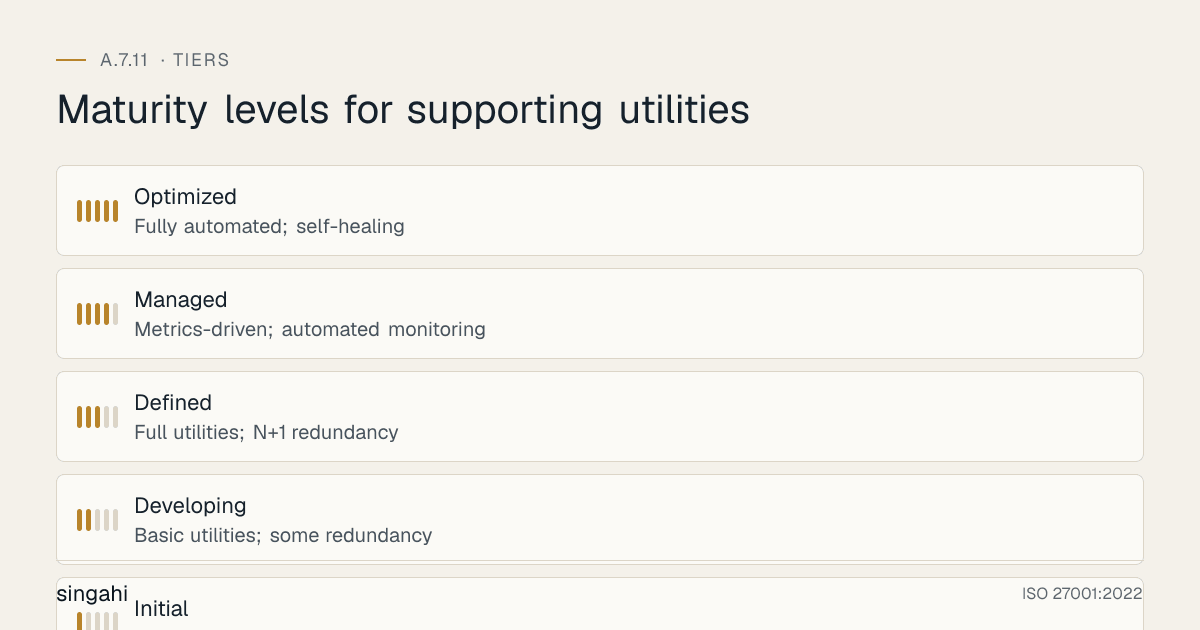
Maturity Model for A.7.11
| Level | Name | Characteristics | Evidence |
|---|---|---|---|
| 1 | Initial | Ad-hoc utilities; no redundancy; frequent failures; reactive response | No UPS; no generator; standard office AC; no monitoring |
| 2 | Developing | Basic utilities; some redundancy; reactive maintenance; basic testing | UPS for some systems; old generator; basic HVAC; monthly testing |
| 3 | Defined | Full utilities; N+1 redundancy; proactive maintenance; scheduled testing | All critical systems protected; N+1 HVAC; monthly testing; documented procedures |
| 4 | Managed | Metrics-driven; automated monitoring; predictive maintenance; trend analysis | Continuous monitoring; automated alerts; quarterly load testing; capacity forecasting |
| 5 | Optimized | Fully automated; self-healing; integrated with enterprise systems; dynamic optimization | AI-powered predictive maintenance; dynamic load balancing; automated failover; zero incidents; PUE optimization |
Continuous Improvement Activities
Monthly:
- UPS and generator testing
- Fuel level monitoring
- Utility monitoring trend review
- Maintenance schedule adherence
Quarterly:
- HVAC maintenance and performance review
- Telecom failover testing
- Load bank testing (generator)
- Water leak detection testing
- Internal audit of utility controls
Annually:
- Full policy review
- Complete capacity planning review
- Risk assessment refresh
- Contingency plan testing (tabletop or live)
- Technology and tool review
- Benchmark against Uptime/TIA-942 standards
- External audit preparation
- Maturity assessment against target level
Trigger-Based:
- After any utility-related incident
- Upon capacity threshold breach (e.g., load approaching 80% of capacity)
- Upon new equipment addition that increases utility demand
- When regulatory requirements change
- After significant audit findings
- Upon vendor SLA breach
FAQ
Q1: Do all offices need a generator? A: Not all. For small offices with non-critical operations, a UPS providing 15–30 minutes of run-time may be sufficient to allow graceful shutdown. For organizations with critical operations (BFSI, healthcare, SaaS, large data centers), generators are essential. The decision should be based on business impact analysis: how long can you afford to be down? If the answer is "not more than a few minutes," you need a generator.
Q2: What is the difference between N+1 and 2N redundancy? A: N+1 means you have one more unit than you need. For example, if you need 2 HVAC units, you have 3. If one fails, the remaining 2 can handle the load. 2N means you have two completely independent systems, each capable of handling the full load. For example, two power feeds (A and B side), each with its own UPS, each capable of powering everything. 2N is more expensive but provides higher availability. N+1 is suitable for most growing companies. 2N is required for Tier III/IV data centers and life-critical applications.
Q3: How do we handle utility failures in a remote office with no IT staff? A: Remote offices need autonomous utility resilience. Use UPS with sufficient run-time for graceful shutdown (if no generator). Use cloud-based monitoring so headquarters can see utility status. Use automatic failover for telecom (4G/5G backup). Train local staff on basic response procedures. Consider managed services for remote infrastructure. Have a remote hands vendor for physical intervention.
Q4: What is PUE and why does it matter? A: PUE (Power Usage Effectiveness) = Total facility power / IT equipment power. It measures how efficiently a data center uses energy. A PUE of 1.0 would mean all power goes to IT equipment (impossible). Typical data centers have PUE of 1.5–2.0. Efficient data centers achieve 1.2–1.4. PUE matters because: (1) Lower PUE means lower electricity costs, (2) It reflects environmental sustainability, (3) It indicates efficient utility design, (4) Many customers and regulators now ask for PUE.
Q5: How do we test contingency plans without disrupting operations? A: Use tabletop exercises (discuss scenarios without touching systems) for initial testing. Use scheduled maintenance windows for live testing (e.g., test generator during a planned power shutdown). Use simulation tools for complex scenarios. Test components individually (UPS test, generator test, failover test) rather than full system tests. Always have rollback procedures. Document lessons learned.
Q6: What about renewable energy (solar) for backup power? A: Solar is excellent for reducing electricity costs and environmental impact, but it is not a reliable backup power source on its own because it depends on sunlight. Solar can be part of a hybrid solution: solar + battery + grid + generator. The battery (large-scale energy storage) can provide short-term backup. Solar reduces generator fuel consumption during extended outages. In India, where sunlight is abundant, solar is increasingly efficient for primary power supplementation.
Q7: How do we protect against voltage fluctuations common in India? A: Voltage fluctuations are a major issue in India. Use online double-conversion UPS for critical equipment (isolates equipment from grid fluctuations). Install voltage stabilizers for non-critical equipment. Use surge protectors at multiple levels (main distribution, sub-distribution, equipment). Monitor power quality with power analyzers. Consider power conditioning for sensitive equipment. Work with your electricity provider to report persistent issues.
Q8: What is the ideal fuel storage duration for a generator? A: Minimum 8 hours for standard commercial facilities. Minimum 24 hours for critical facilities (hospitals, data centers, BFSI). 72 hours or more for facilities in remote areas or areas with unreliable fuel supply. Maintain a refueling contract with 4-hour response time. Store fuel in approved tanks with spill containment. Test fuel quality quarterly. Rotate fuel annually.
Q9: How do we ensure telecom redundancy in a small town with limited ISP options? A: If multiple ISPs are not available, use diverse technologies: primary fiber + secondary wireless (4G/5G, microwave, satellite). Use VPN over the secondary link. Consider SD-WAN for intelligent path selection. If even wireless is limited, consider periodic data synchronization to a remote location (physical media courier). Document the limitation and risk acceptance. Work with telecom providers to expand options.
Q10: What is the most common audit finding for A.7.11? A: Inadequate testing and documentation. Common findings: generator not tested under load, UPS run-time not verified, no documented failover procedures, HVAC not maintained, no water leak detection, no telecom redundancy testing, and no contingency plans. Auditors will ask for test records and will verify them. They may also request live demonstrations of failover.
Q11: How do we manage utility costs while maintaining security? A: Utility resilience does not have to be expensive. Prioritize based on risk: protect critical systems first. Use cloud services to reduce on-site infrastructure needs. Use virtualization to consolidate servers and reduce power/cooling load. Use energy-efficient equipment (lower PUE). Use solar to reduce electricity costs. Use managed services for specialized systems. Right-size utilities (oversized systems waste money). Phase investments over time.
Q12: What is the role of a BMS or DCIM? A: BMS (Building Management System) or DCIM (Data Center Infrastructure Management) provides centralized monitoring and control of all utilities. It monitors power, cooling, water, fire, and security. It provides real-time alerts, historical trends, capacity planning, and energy optimization. For any organization with a data center or significant IT infrastructure, a BMS/DCIM is essential for operational efficiency and audit compliance. It provides the evidence auditors require.
Q13: How do we handle utility failures during construction or renovation? A: Construction and renovation are high-risk periods for utilities. Plan for planned outages (schedule during low-impact windows). Use temporary power (portable generators) during mains outages. Use temporary cooling (portable AC) during HVAC work. Protect cables and pipes from construction damage. Monitor for dust, vibration, and water intrusion. Have emergency procedures specific to construction-related risks.
Q14: How much does implementing A.7.11 cost for a growing company? A: It depends on how much you run on-site. The main items are a correctly sized UPS with battery replacement every few years, generator access (often through the landlord), precision cooling for a server room, leak and temperature monitoring, and a second network provider over a different route. Many small companies cut cost by moving servers to the cloud or a colocation facility and protecting only network and endpoint power in the office.
Q15: Do we need to test utilities during business hours? A: Testing should be conducted during both business hours and off-hours. No-load generator tests can be done anytime. Load tests are best done during business hours to verify real-world performance, but schedule them during low-impact windows and have rollback procedures. UPS tests can be done during business hours (they are designed for smooth transfer). HVAC failover tests should be done during moderate weather, not extreme heat. Always notify stakeholders before live tests.
Industry-Specific Utility Requirements
See Industry-Specific Context above. Avoid copying "standard" numbers (72-hour fuel, a fixed number of ISPs, five-nines uptime) unless your recovery objectives, contracts or your regulator actually require them. Derive generator fuel, UPS run-time and network redundancy from your business impact analysis, and test them.
Maturity Model for A.7.11
| Level | Name | Power | Cooling | Network | Testing | Documentation |
|---|---|---|---|---|---|---|
| 1 | Initial | Basic UPS, no generator | Standard office AC | Single ISP | None | None |
| 2 | Managed | UPS + small generator | Precision AC | 2 ISPs | Annual | Basic procedures |
| 3 | Defined | N+1 UPS + N+1 generator | N+1 precision AC | 2 ISPs + SD-WAN | Quarterly | Full SOPs |
| 4 | Quantitative | 2N UPS + 2N generator | 2N precision AC | 3 ISPs + SD-WAN | Monthly | Automated reports |
| 5 | Optimized | Redundancy matched to recovery objectives, proven by tests | Capacity planned with power and cooling together | Diverse providers and routes, failover tested | Continuous monitoring plus periodic full-load tests | Lessons fed into BCP |
Progression Guidance:
- Level 1 → 2: Add generator, second ISP, precision AC. Annual testing.
- Level 2 → 3: Add redundancy (N+1), SD-WAN, quarterly testing, full documentation.
- Level 3 → 4: Add 2N configuration, third ISP, monthly testing, automated monitoring.
Additional FAQ
Q16: How do we handle utility management in a leased office without control over building infrastructure? A: Include utility resilience requirements in your lease agreement (generator access, UPS rights, cooling guarantees). Verify building infrastructure before signing. Consider colocation for critical servers. Document what you control vs. what the landlord controls. Add service level agreements (SLAs) for utility uptime.
Q17: What is the impact of climate change on utility resilience in India? A: India faces increasing heat waves, floods, and cyclones. Heat waves strain power grids and HVAC systems. Floods threaten data centers in low-lying areas (Mumbai, Chennai, Kolkata). Cyclones disrupt coastal infrastructure. Plan for climate-adapted resilience: higher cooling capacity, elevated equipment, flood barriers, and geographic diversification.
Q18: How do we manage utilities in a remote or rural location? A: Rural locations face challenges: unreliable grid power, limited ISP options, difficulty sourcing fuel. Solutions: larger solar + battery systems, satellite internet backup, larger fuel storage, on-site water, and pre-positioned spare equipment. Consider cloud services to reduce on-site infrastructure needs.
Q19: What is the role of renewable energy in utility resilience? A: Solar reduces grid dependence. Wind complements solar in windy regions. Battery storage (lithium-ion, flow batteries) provides backup power. Hybrid systems (solar + grid + battery + generator) offer maximum resilience. Government subsidies (MNRE) can reduce solar installation costs by 30-40%.
Q20: How do we demonstrate A.7.11 compliance to auditors? A: Provide: utility inventory list, redundancy architecture diagrams, maintenance contracts, test records (last 12 months), incident records, contingency plans, training records, and monitoring dashboards. Walk the auditor through your facility. Show live demonstrations if possible. Be prepared to explain any gaps and compensating controls.
Utility Cost Optimization and Energy Efficiency
Reducing Utility overhead Without Compromising Security
Utility costs can be a significant part of IT operating costs, especially for data centres. Some ways to optimise without reducing resilience:
Power Efficiency:
- PUE Optimization: Power Usage Effectiveness (PUE) = Total facility power / IT equipment power. Industry average: 1.5. Best practice: < 1.3. Reduce PUE by improving cooling efficiency, using free cooling, and eliminating energy waste.
- Server Virtualization: Consolidate physical servers to reduce power consumption. Typical savings: 30-50% reduction in server power.
- Energy-Efficient Equipment: Use 80 PLUS Titanium/Platinum power supplies, LED lighting, and Energy Star rated equipment.
- Right-Sizing: Avoid over-provisioning. Size UPS, generator, and cooling to actual load + 30% growth, not theoretical maximum.
- Solar Power: Install rooftop solar to offset grid consumption. MNRE subsidies reduce payback period to 3-4 years. Typical Indian solar potential: 4-7 kWh/m²/day.
Cooling Efficiency:
- Hot/Cold Aisle Containment: Prevents mixing of hot and cold air. Improves cooling efficiency by 20-30%.
- Free Cooling: Use ambient air when outside temperature is below set point (effective in North India during winter, hill stations year-round).
- Liquid Cooling: For high-density racks (> 15 kW per rack), liquid cooling is more efficient than air cooling.
- Cooling controls: Tune set points and airflow from measured inlet temperatures; analytics-based control can help at larger sites.
- Thermal Management: Use blanking panels, cable management, and raised floors to improve airflow.
Network Optimization:
- SD-WAN: Can reduce MPLS costs and improve resilience by using several internet links with policy-based routing.
- Bandwidth Right-Sizing: Monitor actual usage and right-size links. Avoid paying for unused capacity.
- Peering and CDN: Use local internet exchanges (NIXI) and CDN nodes to reduce international bandwidth costs.
- Compression and Caching: Reduce bandwidth needs through WAN optimization, compression, and caching.
Measure your own baseline (PUE, fuel use, link costs) before and after changes; savings vary widely by site.
Illustrative Scenario (hypothetical): Mumbai Financial Services Firm, Utility Resilience Transformation
Background
A mid-sized mutual fund company in Mumbai (150 employees) experienced three power outages in a year, each causing 2-4 hours of downtime. Their existing infrastructure had a single UPS (5 years old, degraded batteries) and no generator. Cooling was a single split AC unit. Internet was a single fiber connection.
Incident Impact
- Outage 1: Power failure during market hours caused trading platform downtime. Lost 3 hours of trading window. Customer complaints: 200+. Regulatory notice from SEBI.
- Outage 2: UPS failure during a scheduled maintenance window corrupted a database. Recovery time: 6 hours. Data loss: 2 hours of transactions.
- Outage 3: Cooling failure during a heat wave caused server shutdown. Downtime: 4 hours. Hardware damage: 2 hard drives.
- Total cost: lost revenue, recovery, hardware replacement, regulatory attention and reputational damage.
Key Lessons
- Do not delay utility investment: The cost of one major outage often exceeds the cost of proper infrastructure.
- Phased approach works: Immediate portable solutions can bridge the gap while permanent infrastructure is installed.
- Testing is critical: The company had a UPS that appeared functional but failed under load because batteries were never tested.
- Documentation matters: SEBI required documented test records, maintenance contracts, and contingency plans. Without these, compliance was impossible.
- ROI is measurable: Quantify downtime costs, customer impact, and regulatory risk to justify investment to leadership.
References and Further Reading
Standards and Frameworks
- ISO/IEC 27001:2022, Information Security, Cybersecurity and Privacy Protection, Information Security Management Systems, Requirements
- ISO/IEC 27002:2022, Information Security, Cybersecurity and Privacy Protection, Information Security Controls
- NIST SP 800-53 Rev 5, Security and Privacy Controls for Information Systems and Organizations
- TIA-942, Telecommunications Infrastructure Standard for Data Centers
- Uptime Institute Tier Standard: Topology
- National Building Code 2016 (India)
- IS 732, Electrical Installations
- IS 3043, Code of Practice for Earthing
Books and Publications
- Data Center Handbook by Hwaiyu Geng
- The Green and Virtual Data Center by Greg Schulz
- ISO 27001/27002: A Pocket Guide by Alan Calder
- Uptime Institute Data Center Standards (Tier I–IV)