
On this page
- Quick Reference (60 Seconds)
- What the Control Asks For
- Why Information deletion Matters
- Scope and Applicability
- Key Definitions and Terminology
- Relationship to Other Controls
- Implementation Roadmap (Week-by-Week)
- Detailed Implementation Guidance
- Tools, Technologies, and Solutions
- Policy and Procedure Templates
- Risk Assessment and Treatment
- Audit and Compliance Checklist
- Metrics and KPIs
- Common Pitfalls and How to Avoid Them
- Illustrative Scenarios
- Multi-Framework Mapping
- Regulatory and Industry Context
- Roles and Responsibilities (RACI)
- Documentation and Evidence Requirements
- Continuous Improvement
- FAQ
- References and Further Reading
Quick Reference (60 Seconds)
Figure · At a glance
A.8.10 at a glance
- Control ID
- A.8.10
- Control Name
- Information deletion
- ISO 27002:2022 Section
- 8.10
- Primary Purpose
- Ensure that information is deleted when no
- Key Activities
- Define retention schedules
- Typical Owners
- Data Protection Officer (DPO), IT Operations
| Aspect | Summary |
|---|---|
| Control ID | A.8.10 |
| Control Name | Information deletion |
| ISO 27002:2022 Section | 8.10 |
| Primary Purpose | Ensure that information is deleted when no longer required, in accordance with data retention policies and legal/regulatory requirements |
| Key Activities | Define retention schedules, delete data when required, verify deletion, manage backup deletion, handle media sanitization, document deletion |
| Typical Owners | Data Protection Officer (DPO), IT Operations, Legal/Compliance, Records Management |
| Implementation Effort | Medium (4–8 weeks) |
| Main cost drivers | Data discovery and mapping, retention configuration in each system, deletion and sanitisation tools or vendors, and staff time for requests and evidence |
| ISO 27002 attributes | Control type: Preventive · Properties: Confidentiality · Concepts: Protect · Capabilities: Information protection, Legal and compliance · Domains: Protection |
Bottom Line: Information deletion is not just about freeing up storage space. It is a legal requirement, a privacy obligation, and a security control. Keeping data longer than necessary increases breach impact, regulatory risk, and storage costs. Proper deletion ensures data is removed when it should be, from all locations, in a verifiable manner.
What the Control Asks For
In short:
ISO 27001:2022 Annex A 8.10 asks organizations to delete information stored in systems, devices, or elsewhere when it is no longer needed.
Do you need this control?
A.8.10 is not mandatory in itself: under clause 6.1.3 you include it if your risk assessment calls for it, and record the decision in your Statement of Applicability. Include it if you store information that must be deleted when no longer needed, which is nearly everyone given DPDP erasure duties and retention rules. Cloud and SaaS deletion needs particular attention.
What ISO 27002:2022 Adds
27002 8.10 (paraphrased): do not keep sensitive information longer than needed. When deleting from systems, applications and services:
- (a) choose a deletion method (for example overwriting or cryptographic erasure) to fit business needs and relevant law
- (b) record the results of deletion as evidence
- (c) get evidence of deletion from deletion service suppliers
Put deletion requirements into agreements with third parties that store your information, during the service and at termination.
Deletion methods: in line with your retention policy and the law:
- (a) configure systems to delete information when it is no longer needed (after the retention period, or on a request)
- (b) delete obsolete versions, copies and temporary files wherever they are
- (c) use approved secure deletion software
- (d) use approved, certified disposal providers
- (e) use disposal methods suited to the media type
Cloud: check the provider's deletion method is acceptable and use it, or ask the provider to delete; automate where possible.
27002 also suggests removing storage before equipment goes back to suppliers (for example under warranty), handling smartphones by factory reset or destruction according to classification, and points to ISO/IEC 27017 (cloud) and ISO/IEC 27555 (deletion of PII).
Why Information deletion Matters
The Data Retention Problem
Organizations accumulate data at an exponential rate. Without disciplined deletion, data grows indefinitely, creating storage costs, compliance risks, and security exposure. Every file, record, and backup that is kept beyond its required retention period is a potential liability.
Key Statistics
- Data you no longer need is pure risk: it adds to breach impact and storage cost without adding value
- DPDP Act 2023 in India mandates data deletion when purpose is fulfilled or consent is withdrawn
- GDPR Article 5(1)(e) requires data not be kept longer than necessary
- Indian IT Act 2000 requires reasonable security practices including data retention and deletion
- Data mapping is the hard part: personal data typically sits in production, backups, analytics, email, logs and SaaS tools, so deletion requests fail without a map
How It Goes Wrong (hypothetical patterns)
- A bank kept customer transaction records for 20 years despite regulatory requirements of 7 years. A breach exposed 15 years of unnecessary data. The RBI penalty was doubled because the bank had kept data beyond the required period, increasing the breach impact.
- A hospital kept patient records of deceased patients for 30 years in an archive. A ransomware attack encrypted all records, including the historical ones. The hospital paid a larger ransom because the attacker threatened to publish all 30 years of data. The historical data had no clinical or legal value.
- A SaaS company kept customer data in 15 different systems (production, staging, backup, analytics, data warehouse, email, logs). When a customer requested deletion under GDPR, the company could only delete from 3 systems. The customer sued, and the company faced a €2 million fine for incomplete deletion.
- A government department sold old computers at auction without wiping hard drives. The drives contained citizen tax records, Aadhaar numbers, and property details. The department faced public scandal, CBI investigation, and lawsuits.
- An employee found a spreadsheet with 5,000 customer records in a "temp" folder that was supposed to be deleted 3 years ago. The spreadsheet was accidentally emailed to a vendor, causing a data breach. The temp folder was never cleaned up.
Regulatory and Business Drivers
- DPDP Act 2023 requires data fiduciaries to delete personal data when the purpose is fulfilled, consent is withdrawn, or a deletion request is made (Section 8(7) and Section 12). Breaches not covered by a specific penalty attract up to ₹50 crore.
- IT Act 2000 (Section 43A) requires reasonable security practices for sensitive personal data, including retention and deletion
- Indian retention floors constrain deletion: for example PMLA records (5 years), Companies Act books of account (8 years, s.128), GST records (72 months), and CERT-In ICT logs (180 days); RBI, SEBI and IRDAI set further record-keeping rules for regulated entities
- DPDP Rules 2025 (once in force) add a minimum one-year retention of certain processing logs and fixed erasure schedules for some large fiduciaries
- GDPR (for EU data subjects) requires data deletion under the "right to erasure" (Article 17)
- PCI DSS v4.0.1 3.2.1 keeps account data storage to a minimum with retention and disposal policies
- SOC 2 CC6.5 and the privacy criterion P4.3 cover secure disposal and deletion
- Legal hold requirements may require suspension of deletion during litigation or investigation
- Cost optimization through storage reduction and efficient data lifecycle management
Scope and Applicability
What Is Covered
- All electronic information (files, databases, emails, documents, records, logs, backups, archives)
- All physical records (paper documents, printed reports, microfilm, physical media)
- All storage media (hard drives, SSDs, tapes, USB drives, CDs/DVDs, mobile devices, cloud storage)
- All systems and applications that store or process information (databases, file servers, cloud services, email systems, CRM, ERP, HRIS)
- All backups and disaster recovery copies (on-site, off-site, cloud, tape archives)
- All development, test, and staging environments that contain production data
- All log files and audit trails (with retention requirements)
- All email archives and communication records
- All third-party systems that store organizational data (SaaS, outsourced processors)
- All data copies, replicas, and synchronized copies (CDP, snapshots, mirrors)
What Is Not Covered
- Information subject to legal hold (must be preserved during litigation or investigation)
- Information with statutory retention requirements that exceed operational needs (e.g., tax records, employment records, legal contracts)
- Information required for ongoing business operations or contractual obligations
- Information in organizational memory or human knowledge (not enforceable through technology)
Applicability by Organization Type
| Organization Type | Applicability | Key Deletion Concerns |
|---|---|---|
| IT/Software Services | High | Customer data, source code, project files, logs, cloud storage, multi-tenant data |
| BFSI | Critical | Customer transaction records, KYC data, loan records, trading data, audit logs, RBI retention requirements |
| Healthcare | Critical | Patient records, medical images, lab results, prescription data, DPDP Act compliance, NABH requirements |
| Manufacturing | High | R&D data, production plans, supplier contracts, employee records, IP protection |
| Government/Defense | Critical | Citizen records, classified information, RTI responses, legal hold requirements, statutory retention |
| Education | Medium | Student records, exam data, research data, alumni records, financial aid information |
| SaaS/Cloud | Critical | Customer tenant data, multi-tenant deletion, backup consistency, cross-region replication, GDPR/DPDP requests |
| Retail/E-commerce | High | Customer purchase data, payment information, cart data, returns, marketing data, loyalty program data |
Key Definitions and Terminology
| Term | Definition |
|---|---|
| Data Retention | The policy of retaining data for a specific period before deletion, based on legal, regulatory, and business requirements |
| Data Retention Schedule | A documented schedule defining how long different categories of data must be retained and when they must be deleted |
| Data Deletion | The process of removing data from systems and storage media such that it is no longer accessible or recoverable through normal means |
| Secure Deletion | The process of deleting data in a manner that makes it unrecoverable, even with forensic tools |
| Data Sanitization | The process of permanently removing data from storage media to ensure it cannot be recovered, often involving overwriting, degaussing, or physical destruction |
| Cryptographic Erasure | The deletion of encryption keys to render encrypted data permanently unrecoverable |
| Overwriting | The process of writing new data (typically random patterns or zeros) over existing data to prevent recovery |
| Degaussing | The process of using a strong magnetic field to erase data from magnetic media (hard drives, tapes) |
| Physical Destruction | The physical destruction of storage media (shredding, crushing, incineration) to prevent data recovery |
| Legal Hold | A suspension of normal deletion procedures when data is required for litigation, investigation, or regulatory inquiry |
| Right to Erasure | The right of data subjects to request deletion of their personal data (GDPR Article 17, DPDP Act 2023 Section 12) |
| Data Lifecycle | The stages of data from creation to deletion: creation, active use, archival, retention, deletion |
| Archiving | The process of moving data to long-term storage for retention purposes, distinct from active operational storage |
| Backup | A copy of data created for recovery purposes, often with separate retention requirements |
| Disposal | The final process of discarding storage media or records after data deletion and sanitization |
| Data Mapping | The process of identifying where data resides across all systems, applications, and storage locations |
| Data Inventory | A complete catalog of data types, locations, owners, and retention requirements |
| Retention Period | The length of time data must be kept before deletion, defined by policy, law, or contract |
| Data Subject Request (DSR) | A request from an individual regarding their personal data (access, deletion, correction, portability) |
| Deletion Certificate | A document certifying that data has been deleted from specified systems and storage media |
| Chain of Custody | The documented handling and transfer of storage media to ensure data integrity and accountability during deletion/disposal |
Relationship to Other Controls
| Control | Relationship |
|---|---|
| A.5.1 Policies for information security | Information deletion policy aligns with overall security policy |
| A.5.9 Inventory of information and other assets | Asset inventory identifies where data resides for deletion |
| A.5.12 Classification of information | Classification determines retention requirements and deletion sensitivity |
| A.5.33 Protection of records | Records protection requires defined retention and deletion schedules |
| A.5.37 Documented operating procedures | Deletion procedures must be documented and followed |
| A.6.3 Information security awareness training | Users must be trained on data retention and deletion requirements |
| A.8.3 Information access restriction | Access controls ensure only authorized personnel can delete data |
| A.8.11 Data masking | Data masking may be used as an alternative to deletion in some cases |
| A.8.12 Prevention of data leakage | Proper deletion prevents data leakage through abandoned data |
| A.8.13 Information backup | Backup deletion must be synchronized with primary deletion |
| A.8.24 Use of cryptography | Cryptographic erasure can be used for secure deletion |
| A.8.31 Separation of development and production | Test data must be deleted when no longer needed |
| A.8.33 Test data | Test data requires deletion controls and schedules |
| A.7.14 Secure disposal or re-use of equipment | Physical media disposal requires data sanitisation |
| A.7.10 Storage media | Sanitisation matrix for media |
| A.5.34 Privacy and protection of PII | Deletion of personal data on request or when the purpose ends |
| A.8.15 Logging | Deletion activities must be logged for audit |
Implementation Roadmap (Week-by-Week)
Week 1: Data Inventory and Classification Mapping
- Inventory all data types and categories (personal data, financial data, customer data, employee data, operational data, logs)
- Map data locations (systems, applications, databases, file servers, cloud storage, email, backups, archives)
- Identify data owners for each data category
- Document current retention practices (how long is data currently kept?)
- Identify legal and regulatory retention requirements for each data type
- Identify contractual retention requirements (customer contracts, SLA requirements)
- Identify business operational retention requirements
- Document data flow and copies (where is data replicated, backed up, archived?)
Week 2: Retention Schedule Development
- Draft data retention schedule with retention periods for each data category
- Align retention periods with legal/regulatory requirements (DPDP Act, RBI, SEBI, IT Act, tax laws)
- Align retention periods with business requirements and contractual obligations
- Define deletion triggers (time-based, event-based, request-based)
- Define archival rules (when data moves from active to archive)
- Define backup retention and deletion rules (how long backups are kept, when deleted)
- Define log retention and deletion rules (security logs, application logs, access logs)
- Validate retention schedule with Legal, Compliance, and Business stakeholders
- Approve retention schedule by DPO and executive leadership
Week 3: Deletion Policy and Procedure Development
- Draft information deletion policy
- Define deletion procedures for each data type and system
- Define secure deletion methods (overwriting, cryptographic erasure, degaussing, physical destruction)
- Define deletion verification methods (how to confirm deletion is effective)
- Define backup deletion procedures (ensure data is deleted from backups when deleted from primary)
- Define legal hold procedures (how to suspend deletion when required)
- Define data subject request (DSR) deletion procedures (for DPDP Act and GDPR)
- Define roles and responsibilities for deletion
- Define deletion logging and audit requirements
Week 4: Technical Deletion Implementation
- Implement automated deletion for time-based retention (scripts, database jobs, DLM tools)
- Implement data subject request deletion workflow (web form, approval, execution, verification)
- Implement secure deletion tools for endpoints (secure erase, file shredder)
- Implement database deletion procedures (secure row deletion, table truncation, database deletion)
- Implement email deletion policies (retention tags, automatic archival, automatic deletion)
- Implement file server deletion policies (lifecycle management, automatic deletion)
- Implement cloud storage lifecycle policies (S3 lifecycle, Azure Blob lifecycle, GCP lifecycle)
- Implement backup deletion synchronization (when primary data is deleted, flag for backup deletion)
Week 5: Backup and Archive Deletion
- Inventory all backup systems and their retention periods
- Align backup retention with primary data retention schedule
- Implement backup deletion procedures (tape rotation, cloud backup deletion, snapshot deletion)
- Implement archive deletion procedures (when archived data reaches retention limit, delete from archive)
- Implement log deletion procedures (security logs, application logs, system logs)
- Test backup deletion to ensure it does not affect recovery capability
- Document backup and archive deletion procedures
- Configure backup system alerts for deletion failures
Week 6: Media Sanitization and Physical Disposal
- Implement media sanitization procedures for hard drives, SSDs, tapes, USB drives, mobile devices
- Define sanitization methods based on media type (overwriting, degaussing, cryptographic erasure, physical destruction)
- Implement secure disposal procedures for physical records (shredding, incineration, pulping)
- Identify and contract certified media disposal vendors (for physical destruction)
- Implement chain of custody documentation for media disposal
- Implement disposal certificates and records
- Implement re-use procedures (how to sanitize media before re-use within the organization)
- Train IT staff on media sanitization procedures
Week 7: Legal Hold and Exception Management
- Implement legal hold procedures (identify triggers, suspend deletion, notify stakeholders)
- Define legal hold documentation requirements (what data is on hold, why, for how long)
- Implement legal hold tracking system (spreadsheet, legal hold management tool)
- Define exception process for retention period extensions (approval, documentation, review)
- Train legal and compliance teams on legal hold procedures
- Train IT on legal hold implementation (how to suspend automated deletion)
- Test legal hold process with a mock scenario
- Document all legal hold procedures and exception processes
Week 8: Verification, Testing, and Audit
- Test deletion procedures on sample data (verify deletion is effective and complete)
- Test data subject request deletion workflow end-to-end
- Test backup deletion synchronization
- Test media sanitization procedures (verify data is unrecoverable on sample media)
- Test legal hold process (ensure automated deletion is suspended correctly)
- Conduct internal audit of information deletion implementation
- Verify deletion logging and audit trails
- Prepare documentation for external audit
- Plan for continuous improvement
Detailed Implementation Guidance
Data Retention Schedule Framework
Data Categories and Retention Periods:
| Data Category | Legal/Regulatory Retention | Business Retention | Total Retention | Deletion Trigger |
|---|---|---|---|---|
| Customer personal data (DPDP Act) | As per DPDP Act (purpose fulfilled or consent withdrawn) | Customer relationship duration + 1 year | Max of legal or business | Consent withdrawal, account closure, or purpose fulfillment |
| Financial transaction records (RBI) | 7 years (RBI Cyber Security Framework) | 7 years for reconciliation | 7 years | 7 years from transaction date |
| KYC documents (RBI) | 5 years after account closure (RBI KYC norms) | 5 years | 5 years | 5 years after account closure |
| Employee records (tax/EPF) | 7 years (Income Tax Act) | 7 years + employment period | 7 years after termination | 7 years after termination |
| Patient records (healthcare) | 3 years after death or 7 years after last visit (varies by state) | Clinical need + legal | Max of legal or clinical | As per state medical council rules |
| Email communication | 3–7 years (depending on content and legal requirements) | 1 year for operational | 1–7 years based on content | 1 year general; 7 years legal/financial |
| System logs (security) | 1 year (RBI/SEBI) | 1 year for incident analysis | 1 year | 1 year from log date |
| Application logs | 90 days – 1 year | 90 days for troubleshooting | 90 days – 1 year | 90 days general; 1 year for critical apps |
| Backup data | Align with primary data retention | Align with primary + recovery needs | Primary retention + 30 days | After primary data deletion + 30 days |
| Test data | None (unless contains production data) | Duration of test project | Project duration | End of test project |
| Marketing data | DPDP Act (consent-based) | Campaign duration + 1 year | 1 year after campaign end | 1 year after campaign end or consent withdrawal |
| CCTV footage | 30–90 days (depending on regulatory requirements) | 30 days for security | 30–90 days | 30 days general; 90 days for incidents |
| Audit records | 7 years (RBI/SEBI/Company Act) | 7 years | 7 years | 7 years from audit date |
| Contract documents | 7 years after contract termination (Limitation Act) | 7 years | 7 years | 7 years after contract termination |
| Tax records | 7 years (Income Tax Act) | 7 years | 7 years | 7 years from assessment year |
| Research data | 5 years (UGC/ICMR guidelines) | Research duration + 5 years | 5–10 years | 5 years after publication |
| Student records | 7 years after graduation (UGC) | 7 years | 7 years | 7 years after graduation |
Deletion Triggers:
| Trigger Type | Description | Examples |
|---|---|---|
| Time-based | Data is deleted after a defined retention period | 7 years after transaction, 1 year after email, 90 days after log |
| Event-based | Data is deleted after a specific event | Account closure, contract termination, employee resignation, project completion |
| Request-based | Data is deleted upon request from data subject or authority | DPDP Act deletion request, GDPR right to erasure, legal order |
| Purpose-based | Data is deleted when the purpose for collection is fulfilled | Marketing campaign ends, research project completes, loan is repaid |
| Consent-based | Data is deleted when consent is withdrawn | DPDP Act Sections 6(4) and 8(7), GDPR Article 7 withdrawal |
Secure Deletion Methods
Electronic Data Deletion by Media Type:
| Media Type | Secure Deletion Method | Verification Method | Standard |
|---|---|---|---|
| Hard Disk Drive (HDD) | A single verified overwrite (Clear), sanitize command or crypto-erase (Purge), or destruction | Sample verification | NIST SP 800-88 Rev. 2 (Clear/Purge/Destroy) |
| Solid State Drive (SSD) | Cryptographic erasure (delete encryption keys), ATA Secure Erase, or physical destruction | Verify ATA Secure Erase completion; attempt recovery | NIST SP 800-88 Rev. 2 (Purge/Destroy) |
| Magnetic Tape | Degaussing with approved degausser, or physical destruction (shredding) | Verify degaussing strength; attempt recovery | NIST SP 800-88 Rev. 2 (Purge/Destroy) |
| USB Flash Drive | Overwriting is unreliable on flash: use the device's sanitize function if it has one, otherwise destroy | Sample verification | NIST SP 800-88 Rev. 2 (Purge/Destroy) |
| CD/DVD/Optical Media | Physical destruction (shredding, incineration) | Visual verification of destruction | NIST SP 800-88 Rev. 2 (Destroy) |
| Mobile Device | Factory reset + encryption key deletion + physical destruction for high-risk | Attempt recovery; verify reset | NIST SP 800-88 Rev. 2 (Purge/Destroy) |
| Cloud Storage | Cryptographic erasure (delete keys), or cloud provider deletion + verification | Verify deletion via API; attempt recovery from cloud | Cloud provider SLA + NIST SP 800-88 |
| Database | Secure row deletion with audit trail, or table/database deletion with verification | Database scan for residual data; verify deletion logs | Organizational policy + NIST SP 800-88 |
| Virtual Machine | VM deletion + storage reclamation + overwrite of underlying storage | Verify VM deletion; check storage for residual data | Cloud provider tools + NIST SP 800-88 |
| Container | Container deletion + image deletion + registry cleanup | Verify container and image deletion | Container platform tools |
NIST SP 800-88 Rev. 2 Sanitization Levels:
| Level | Description | Method | Use Case |
|---|---|---|---|
| Clear | Protects against simple recovery methods | A single overwrite pass (HDD), factory reset with encryption (mobile) | Reuse within organisation, low-risk data |
| Purge | Protects against advanced recovery techniques (laboratory attacks) | Degaussing, cryptographic erasure, ATA Secure Erase, block erase | Reuse outside organization, medium-risk data |
| Destroy | Renders media physically unusable | Shredding, crushing, incineration, disintegration | High-risk data, media at end-of-life, regulatory requirement |
Data Subject Request (DSR) Deletion Workflow
DPDP Act 2023 Section 12, Right to Erasure:
| Step | Action | Timeline | Responsible | Evidence |
|---|---|---|---|---|
| 1. Receipt | Receive deletion request from data principal (user) | Day 0 | DPO / Privacy Team | Request log, email, web form record |
| 2. Identity Verification | Verify the identity of the data principal before processing | Day 1 | DPO / Privacy Team | Identity verification record |
| 3. Data Mapping | Identify all systems and locations where the data principal's data resides | Day 2–3 | IT Operations / Data Owners | Data mapping report, system inventory |
| 4. Legal Hold Check | Check if data is subject to legal hold or statutory retention | Day 2–3 | Legal / Compliance | Legal hold check, retention assessment |
| 5. Scope Confirmation | Confirm scope of deletion with data principal (if clarification needed) | Day 3 | DPO / Privacy Team | Communication record |
| 6. Deletion Execution | Delete data from all identified systems (primary, secondary, backups, archives) | Day 4–7 | IT Operations | Deletion logs, execution records |
| 7. Backup Synchronization | Ensure data is flagged for deletion from backups or deleted if within retention | Day 7–10 | IT Operations | Backup deletion records |
| 8. Third-Party Notification | Notify third-party processors to delete data | Day 7 | DPO / Procurement | Notification records, acknowledgments |
| 9. Verification | Verify deletion is complete across all systems | Day 10–12 | IT Operations / DPO | Verification report, scan results |
| 10. Response | Respond to data principal confirming deletion (or explaining retention if applicable) | Day 12–15 | DPO / Privacy Team | Response letter/email |
| 11. Documentation | Document the entire request, execution, and verification process | Day 15 | DPO / Privacy Team | Case file, audit trail |
| 12. Appeal Handling | If the data principal is not satisfied with your grievance response, they may complain to the Data Protection Board (Section 13(3)) | As required | DPO / Legal | Appeal record, resolution |
DPDP deletion rules (applying from the commencement of the relevant provisions, about May 2027):
- s.8(7): the fiduciary must erase personal data (and have its processors erase it) when consent is withdrawn or the specified purpose is no longer being served, unless law requires retention
- s.12: the principal's right to correction and erasure for data processed on consent
- DPDP Rules 2025: grievances must be answered within 90 days; large e-commerce, online gaming and social media fiduciaries (above the Rules' user thresholds) must erase data after a set period of inactivity (generally three years) and warn the principal at least 48 hours before; certain personal data, traffic data and processing logs must be kept for at least one year, which sets a deletion floor
- Respond to requests promptly; 15–30 days is a practical target within the 90-day grievance limit
- If deletion is not possible due to legal retention, the data fiduciary must explain the reason and retention period
- Data principals have the right to appeal to the Board if unsatisfied with the response
Backup Deletion Synchronization
Backup Deletion Challenge: When data is deleted from primary systems, it often remains in backups for months or years. This creates a compliance risk and a security risk.
Backup Deletion Strategies:
| Backup Type | Deletion Approach | Implementation |
|---|---|---|
| Snapshot/Point-in-Time | Delete snapshots that contain the deleted data; retain snapshots that do not | Automated snapshot lifecycle management; manual deletion for specific requests |
| Incremental Backup | Flag for exclusion from future restores; delete specific incremental backups if policy allows | Backup software flags; retention policy adjustment |
| Full Backup | Delete full backup if it exclusively contains deleted data; otherwise flag for exclusion | Backup software management; manual review for specific requests |
| Tape Archive | Mark tape for destruction when retention expires; do not recall for specific deletion unless required | Tape management system; retention tracking |
| Cloud Backup | Use cloud provider deletion API; verify deletion across regions | Cloud backup console; API verification |
| Disaster Recovery (DR) | Synchronize deletion with DR site; verify DR data consistency | DR replication monitoring; manual sync for specific requests |
| Off-site Backup | Coordinate with off-site vendor for specific deletion if required | Off-site vendor SLA; manual request process |
Best Practices for Backup Deletion:
- Align backup retention with primary data retention (don't keep backups longer than primary data unless required)
- Implement backup lifecycle policies (automatic deletion after retention period)
- For DSR deletion, document that backups will be deleted when they reach end-of-life (if immediate deletion is not feasible)
- If immediate backup deletion is required, implement procedures to identify and delete specific backups
- Test backup deletion to ensure it does not compromise recovery capability
- Include backup deletion in DSR deletion workflow
Legal Hold Management
Legal Hold Triggers:
- Litigation or anticipated litigation (notice of claim, lawyer's advice, subpoena)
- Regulatory investigation (RBI inspection, SEBI inquiry, police FIR, CBI investigation)
- Government order or RTI request
- Internal investigation (fraud, misconduct, whistleblower complaint)
- Audit or compliance review requiring specific data retention
Legal Hold Process:
| Step | Action | Timeline | Responsible |
|---|---|---|---|
| 1. Trigger | Identify legal hold trigger (litigation, investigation, order) | Immediate | Legal / Compliance |
| 2. Notification | Notify IT, data owners, and relevant stakeholders of legal hold | Within 24 hours | Legal / DPO |
| 3. Scope | Define scope of legal hold (which data, which systems, which time period, which custodians) | Within 48 hours | Legal / Data Owners |
| 4. Suspension | Suspend automated deletion for data within scope | Within 48 hours | IT Operations |
| 5. Preservation | Preserve data in place or collect to legal hold repository | Within 72 hours | IT Operations / Legal |
| 6. Tracking | Track legal hold status, scope, and duration | Ongoing | Legal / DPO |
| 7. Review | Periodically review legal hold necessity (is it still required?) | Quarterly | Legal |
| 8. Release | When legal hold is no longer required, release hold and resume normal deletion | Upon legal approval | Legal / DPO |
| 9. Documentation | Document the entire legal hold process, from trigger to release | Throughout | Legal / DPO |
Legal Hold Documentation:
- Legal hold notice (date, trigger, scope, custodians, systems, data types, time period)
- Acknowledgment of receipt by custodians and IT
- Preservation log (what was preserved, where, how)
- Release notice (date, reason for release, resumption of normal deletion)
- Legal hold register (all active and historical holds)
Tools, Technologies, and Solutions
Data Lifecycle Management (DLM) and Deletion Tools
| Vendor | Product | Key Features | Pricing model |
|---|---|---|---|
| Microsoft | Purview / Compliance Center | Retention labels, DSR workflow, deletion policies, eDiscovery, legal hold | Commercial, per user |
| Vault / DLP | Retention policies, deletion, eDiscovery, legal hold for Google Workspace | Commercial, per user | |
| Veritas | Enterprise Vault / Data Insight | Email archiving, retention, deletion, eDiscovery, legal hold | Commercial, per user |
| Commvault | Complete Data Protection | Backup lifecycle management, retention, deletion, archiving | Commercial, per user |
| Veeam | Backup & Replication | Backup retention, deletion, lifecycle management, immutability | Commercial, per user |
| AWS | S3 Lifecycle / Glacier | Automated storage tiering, lifecycle policies, object deletion | Commercial, per TB |
| Azure | Blob Lifecycle / Purview | Automated tiering, deletion, retention policies, data governance | Commercial, per TB |
| GCP | Cloud Storage Lifecycle | Object lifecycle management, automatic deletion, retention | Commercial, per TB |
| Box | Governance / Retention | Retention policies, legal hold, deletion for cloud content | Commercial, per user |
| BigID | Data Intelligence | Data discovery, classification, retention, deletion, privacy | Commercial, per user |
| Exterro | Legal Hold / eDiscovery | Legal hold management, eDiscovery, retention, deletion | Commercial, per user |
| ZL Technologies | Unified Archive | Email archiving, retention, deletion, eDiscovery, compliance | Commercial, per user |
Secure Deletion and Data Sanitization Tools
| Tool | Type | Key Features | Pricing model |
|---|---|---|---|
| Blancco | Enterprise Data Erasure | Certified data erasure, verification, certificates, audit trail, multiple standards | Commercial, per device |
| WhiteCanyon | WipeDrive | Secure wiping, certified erasure, multiple overwrite standards | Commercial, per device |
| Darik's Boot and Nuke (DBAN) | Open-source | Free hard drive wiping, multiple overwrite passes | Free (open-source) |
| Parted Magic | Disk Utility | Secure erase, partition management, disk cloning | Commercial |
| Eraser | Windows | Secure file deletion, scheduled deletion, multiple overwrite methods | Free (open-source) |
| SDelete | Microsoft Sysinternals | Secure file deletion, free, command-line | Free (Microsoft) |
| Certus | Mobile Device Erasure | Mobile device wiping, certified erasure, verification | Commercial, per device |
| Iron Mountain | Physical Destruction | Certified media destruction, chain of custody, certificates | Commercial, per device |
| Shred-it | Physical Destruction | On-site and off-site shredding, certificates, compliance | Commercial, per device |
| Stellar Data Recovery | Forensic Verification | Data recovery attempt to verify deletion effectiveness | Commercial |
Privacy and DSR Management Platforms
| Vendor | Product | Key Features | Pricing model |
|---|---|---|---|
| BigID | Privacy Suite | Data discovery, DSR automation, deletion, risk assessment | Commercial, per user |
| TrustArc | Privacy Management | DSR workflow, assessment, deletion, compliance reporting | Commercial, per user |
| Privacera | Data Privacy | Data governance, access control, deletion, privacy automation | Commercial, per user |
| Collibra | Data Intelligence | Data catalog, lineage, governance, retention, deletion | Commercial, per user |
| Informatica | Data Privacy | Data discovery, masking, deletion, DSR, governance | Commercial, per user |
| Securiti | PrivacyOps | AI-powered DSR automation, data mapping, deletion, consent | Commercial, per user |
| DataGrail | Privacy Platform | DSR automation, data mapping, deletion, consent management | Commercial, per user |
| WireWheel | Privacy Management | DSR workflow, data mapping, deletion, vendor management | Commercial, per user |
| Ketch | Privacy Automation | DSR automation, consent, deletion, data mapping | Commercial, per user |
Policy and Procedure Templates
Information Deletion Policy Template
Template
Information Deletion Policy
1. Purpose
This policy establishes requirements for the deletion of information when it is no longer required, in accordance with the organization's data retention schedule, legal obligations, and the rights of data subjects.
2. Scope
This policy applies to all electronic and physical information, records, and storage media owned or managed by the organization, including all systems, applications, databases, backups, archives, and physical records.
3. Data Retention Principles
3.1 Minimum Necessary Retention
- Information shall be retained only for as long as necessary for legal, regulatory, and business purposes
- Data shall not be retained indefinitely without defined retention periods
- Retention periods shall be based on the longest applicable requirement (legal, regulatory, or business)
3.2 Data Minimization
- The organization shall collect and retain only the information necessary for defined purposes
- When the purpose is fulfilled, data shall be deleted unless a longer retention is required by law
3.3 Legal Compliance
- Deletion practices shall comply with the DPDP Act 2023, IT Act 2000, and other applicable laws
- Data subject deletion requests (right to erasure) shall be honored within defined timelines
- Statutory retention requirements shall take precedence over operational preferences
3.4 Secure Deletion
- Data shall be deleted in a manner that renders it unrecoverable through normal means
- Secure deletion methods shall be appropriate for the sensitivity of the data and the type of storage media
- Deletion shall be verified to ensure effectiveness
4. Data Retention Schedule
4.1 Retention Schedule Overview
| Data Category | Retention Period | Legal Basis | Deletion Trigger | Archival Rule |
|---|---|---|---|---|
| Customer personal data | Purpose duration + 1 year / consent withdrawal | DPDP Act 2023 | Account closure, consent withdrawal, purpose fulfillment | Archive after 1 year of inactivity |
| Financial transactions | 7 years | RBI Cyber Security Framework, Income Tax Act | 7 years from transaction date | Archive after 2 years |
| KYC documents | 5 years after account closure | RBI KYC norms | 5 years after account closure | Archive after account closure |
| Employee records | 7 years after termination | Income Tax Act, Code on Social Security 2020 | 7 years after termination | Archive after 2 years of termination |
| Email communication | 1–7 years (based on content) | Company Act, legal requirements | 1 year general; 7 years legal/financial | Auto-archive after 1 year |
| System security logs | 1 year | RBI/SEBI | 1 year from log date | No archive |
| Application logs | 90 days | Operational | 90 days from log date | No archive |
| Backup data | Align with primary + 30 days | Business continuity | After primary deletion + 30 days | No archive |
| Test data | Project duration | None | End of test project | Delete immediately after project |
| Marketing data | 1 year after campaign | DPDP Act 2023 | 1 year after campaign or consent withdrawal | No archive |
| CCTV footage | 30 days | Operational | 30 days from recording | Extend to 90 days for incidents |
| Audit records | 7 years | RBI/SEBI/Company Act | 7 years from audit date | Archive after 1 year |
| Contract documents | 7 years after termination | Limitation Act | 7 years after contract termination | Archive after contract execution |
4.2 Retention Schedule Review
- The retention schedule is reviewed annually by Legal, Compliance, and DPO
- Changes in law or regulation trigger immediate review of affected categories
- Business stakeholders may request retention period changes with business justification
- All changes to the retention schedule are documented and approved
5. Deletion Procedures
5.1 Automated Deletion
- Time-based deletion is automated where technically feasible (database jobs, lifecycle policies, scripts)
- Automated deletion schedules are configured based on the retention schedule
- Automated deletion failures are alerted and investigated
- Automated deletion logs are retained for audit purposes
5.2 Manual Deletion
- Manual deletion is performed for data subject requests, legal holds, and exceptional cases
- Manual deletion requires approval from the data owner or DPO
- Manual deletion is performed by authorized personnel only
- Manual deletion is documented with date, data description, reason, and executor
5.3 Secure Deletion Methods
| Media Type | Method | Verification |
|---|---|---|
| HDD | Overwriting (3 passes) or degaussing | Forensic recovery attempt |
| SSD | Cryptographic erasure or ATA Secure Erase | Verify key deletion |
| Tape | Degaussing or physical destruction | Degaussing verification |
| USB/Flash | Overwriting or physical destruction | Recovery attempt |
| Optical Media | Physical destruction | Visual verification |
| Mobile Device | Factory reset + encryption key deletion | Recovery attempt |
| Cloud Storage | API deletion + verification | API confirmation |
| Database | Secure row deletion + audit trail | Database scan |
| Physical Paper | Shredding (cross-cut) or incineration | Visual verification |
5.4 Deletion Verification
- All deletion must be verified to ensure data is unrecoverable
- Verification methods include: rescanning, forensic recovery attempt, database query, API verification
- Verification results are documented
- Failed deletion is re-attempted with alternative methods
6. Data Subject Request (DSR) Deletion
6.1 Request Receipt
- DSR deletion requests are received via: email, web form, postal mail, or in-person
- All requests are logged with date, time, requestor identity, and data principal details
- Identity verification is performed before processing any deletion request
6.2 Request Processing
- DSR deletion requests are processed within 15–30 days of receipt
- The DPO oversees all DSR deletion requests
- Data is deleted from all systems, including primary, secondary, backups, and third-party systems
- If deletion is not possible due to legal retention, the data principal is informed with explanation
6.3 Response
- Data principals receive written confirmation of deletion (or explanation of retention)
- Response includes: scope of deletion, systems affected, date of deletion, any exceptions
- Appeals are handled as per DPDP Act Section 13
7. Backup Deletion
7.1 Backup Retention Alignment
- Backup retention periods align with primary data retention schedule
- Backups are not retained longer than primary data unless required for business continuity
- When primary data is deleted, backups are flagged for deletion at the next retention cycle
7.2 Backup Deletion for DSR
- For DSR deletion, if immediate backup deletion is not feasible, the organization commits to deletion when backups reach end-of-life
- If immediate backup deletion is required, procedures are followed to identify and delete specific backups
- Backup deletion is documented and verified
8. Legal Hold Management
8.1 Legal Hold Triggers
- Legal hold is initiated upon: litigation, anticipated litigation, regulatory investigation, government order, internal investigation
- Legal hold is initiated by Legal or Compliance upon advice of counsel
8.2 Legal Hold Process
- Legal hold notice is issued to relevant custodians and IT within 24 hours
- Automated deletion is suspended for data within the scope of the legal hold
- Data is preserved in place or collected to a legal hold repository
- Legal hold is tracked and reviewed quarterly
- Legal hold is released upon written approval from Legal
- Upon release, normal deletion resumes
8.3 Legal Hold Documentation
- All legal holds are documented in a legal hold register
- Documentation includes: trigger, scope, custodians, systems, data types, duration, release date
- Legal hold records are retained for the duration of the hold plus 7 years
9. Media Sanitization and Disposal
9.1 Media Sanitization
- All storage media must be sanitized before disposal or reuse
- Sanitization method is based on media type and data sensitivity (per Section 5.3)
- Sanitization is performed by trained personnel or certified vendors
- Sanitization is verified and documented
9.2 Physical Disposal
- Physical records are disposed of via cross-cut shredding, pulping, or incineration
- Electronic media is disposed of via certified destruction vendors for high-risk data
- Chain of custody is maintained from sanitization to final disposal
- Disposal certificates are obtained and retained
10. Roles and Responsibilities
- DPO: Policy owner, DSR oversight, legal hold oversight, regulatory liaison, retention schedule approval
- Legal/Compliance: Legal hold initiation, retention schedule legal validation, regulatory guidance, litigation support
- IT Operations: Technical deletion execution, backup deletion, media sanitization, system configuration, deletion verification
- Data Owners: Retention period input, deletion approval, DSR coordination, legal hold support
- Records Management: Physical records retention, archival management, disposal coordination
- CISO: Security oversight, deletion verification, audit support, incident response
- All Employees: Follow retention and deletion policies, report retention violations, participate in DSR process
11. Enforcement
- Failure to delete data per retention schedule may result in policy violation and disciplinary action
- Unauthorized deletion of data under legal hold is a serious offense and may result in legal consequences
- Data retention violations (keeping data too long) are reported to DPO and may result in corrective action
- Systems that fail automated deletion are investigated and remediated
12. Review
This policy is reviewed annually or upon any change in applicable law or regulation.
Data Subject Request Deletion Procedure Template
Template
Data Subject Request (DSR) Deletion Procedure
1. Purpose
This procedure defines the process for handling data subject requests for deletion of personal data under the DPDP Act 2023 and other applicable privacy laws.
2. Scope
This procedure applies to all requests from data principals (individuals) for deletion of their personal data.
3. Procedure
Step 1: Request Receipt and Logging
- Receive request via designated channel (email, web form, mail, in-person)
- Log request in DSR tracking system with: date, time, requestor name, contact details, data principal details, description of request
- Assign unique DSR ID
- Acknowledge receipt within 24 hours
Step 2: Identity Verification
- Verify the identity of the data principal
- Acceptable verification methods: government ID, account credentials, OTP to registered contact, in-person verification
- If identity cannot be verified, request additional information and pause processing
- Document verification method and result
- If request is made by authorized representative, verify authorization (power of attorney, legal guardian documentation)
Step 3: Data Mapping and Scope Identification
- Identify all systems, applications, databases, and storage locations where the data principal's data resides
- Use data inventory, data mapping, and system queries to locate data
- Include: primary systems, backups, archives, third-party processors, email, logs, marketing systems, analytics
- Document all identified locations
- Estimate scope of data (volume, types, locations)
Step 4: Legal Hold and Retention Check
- Check if data is subject to legal hold or statutory retention
- Consult Legal/Compliance for legal hold status
- If data is under legal hold, inform data principal that deletion is suspended pending legal hold release
- Document legal hold status and rationale
- If statutory retention applies, inform data principal of retention period and deletion timeline
Step 5: Scope Confirmation and Communication
- If scope is unclear, communicate with data principal to confirm what data should be deleted
- Provide data principal with summary of identified data locations and types
- Confirm data principal's intent to proceed
- Document communication
Step 6: Deletion Execution
- Delete data from all identified primary systems
- Delete data from secondary systems (replicas, caches, CDP, snapshots)
- Flag data for deletion from backups (if immediate deletion not feasible, document deletion timeline)
- Notify third-party processors to delete data
- Use secure deletion methods appropriate for each system
- Document all deletion actions with system names, dates, and methods
Step 7: Backup and Archive Deletion
- Delete data from backups if within backup retention window
- If backup deletion is not feasible, document the backup deletion schedule (when backup reaches end-of-life)
- Delete data from archives if within archive retention window
- Document backup and archive deletion actions
Step 8: Third-Party Notification
- Notify all third-party processors and vendors who hold the data principal's data
- Provide DSR ID, data principal details, and deletion deadline
- Request acknowledgment of deletion completion
- Track third-party responses
- Follow up on non-responsive third parties
Step 9: Verification
- Verify deletion from all primary systems (query databases, search file systems, check application records)
- Verify deletion from secondary systems (replicas, caches)
- Attempt recovery test for sample data to verify unrecoverability
- Document verification results
- If verification fails, re-execute deletion and re-verify
Step 10: Response to Data Principal
- Prepare response letter/email confirming deletion
- Include: DSR ID, scope of deletion, systems affected, date of deletion, any exceptions (legal hold, statutory retention)
- If deletion is not possible, explain reason with legal basis and retention period
- Tell the data principal they can complain to the Data Protection Board if not satisfied (Section 13(3) of the DPDP Act)
- Send response within 15–30 days of original request
- Document response in DSR tracking system
Step 11: Documentation and Closure
- Compile DSR case file: request, identity verification, data mapping, legal hold check, deletion logs, verification results, third-party acknowledgments, response to data principal
- Retain case file for 7 years (or as per DPDP Act requirements)
- Close DSR in tracking system
- Update metrics and KPIs
Step 12: Appeal Handling (if applicable)
- If the data principal complains to the Board (DPDP Act Section 13(3)), provide all documentation
- Cooperate with Board investigation
- Implement Board's decision
- Document appeal resolution
4. Escalation
- Requests that cannot be completed within 15 days escalate to DPO
- Requests involving legal hold escalate to Legal immediately
- Requests involving large data volumes or complex systems escalate to IT Operations Manager
- Requests from high-profile individuals (celebrities, politicians, executives) escalate to CISO and DPO
5. SLA
- Acknowledgment: Within 24 hours
- Identity verification: Within 48 hours
- Deletion execution: Within 7–15 days
- Response to data principal: Within 15–30 days
- Complex requests (large scope, multiple systems): Up to 45 days with communication to data principal
Risk Assessment and Treatment
Risk Assessment Matrix for Information deletion
| Risk ID | Threat | Vulnerability | Likelihood | Impact | Risk Level | Treatment |
|---|---|---|---|---|---|---|
| R1 | Regulatory penalty for over-retention | No retention schedule; data kept indefinitely | High | High | Critical | Define retention schedule; implement automated deletion; audit compliance |
| R2 | Data breach impact amplified | Excessive data retention increases breach scope | High | High | Critical | Reduce retention to minimum necessary; delete when purpose fulfilled |
| R3 | DPDP Act violation for non-deletion | No DSR deletion process; cannot locate data | High | High | Critical | Implement DSR workflow; data mapping; deletion capability; SLA compliance |
| R4 | Legal hold violation | Deletion of data under legal hold | Low | Critical | High | Legal hold procedures; suspension of deletion; training; legal review |
| R5 | Data recovery from disposed media | Improper media sanitization; data recoverable | Medium | High | High | Implement secure deletion; use certified vendors; verification; certificates |
| R6 | Incomplete deletion across systems | Data exists in copies, backups, shadow IT | High | Medium | High | Data mapping; backup synchronization; shadow IT discovery; verification |
| R7 | Unauthorized deletion | Insufficient access controls; malicious deletion | Low | High | Medium | Access controls; approval workflows; logging; monitoring; backup retention |
| R8 | Storage cost overrun | No deletion; data grows indefinitely | High | Medium | Medium | Automated deletion; lifecycle management; storage optimization; archiving |
| R9 | Third-party data retention | Vendors retain data after contract end | Medium | Medium | Medium | Contractual deletion clauses; vendor audits; DSR notification; data processing agreements |
| R10 | Deletion audit failure | No deletion logs; no verification evidence | Medium | Medium | Medium | Logging; verification; documentation; audit trail; retention of deletion records |
Audit and Compliance Checklist
Internal Audit Checklist (30 Questions)
Policy and Governance (5 Questions)
- Is an information deletion policy documented and approved?
- Is a data retention schedule defined and approved?
- Are deletion procedures documented for each data type and system?
- Is the policy reviewed annually?
- Are roles and responsibilities for deletion defined?
Retention Schedule (5 Questions)
- Is the retention schedule aligned with legal and regulatory requirements?
- Does the retention schedule cover all data types in the organization?
- Are retention periods documented with legal basis and business justification?
- Is the retention schedule communicated to relevant stakeholders?
- Is the retention schedule reviewed and updated when laws change?
Deletion Execution (5 Questions)
- Is data deleted according to the retention schedule?
- Is automated deletion configured for time-based retention?
- Are deletion failures alerted and investigated?
- Is secure deletion used for sensitive data?
- Is deletion verified for effectiveness?
DSR Deletion (5 Questions)
- Is a DSR deletion procedure documented and followed?
- Are DSR requests acknowledged within 24 hours?
- Are DSR requests processed within 15–30 days?
- Is data deleted from all systems (primary, backup, third-party) for DSR?
- Are data principals notified of deletion completion or retention exceptions?
Backup and Archive (5 Questions)
- Is backup retention aligned with primary data retention?
- Are backups deleted when primary data is deleted (or flagged for deletion)?
- Are archives deleted when retention expires?
- Is backup deletion verified?
- Are backup deletion failures investigated?
Legal Hold and Media Sanitization (5 Questions)
- Is a legal hold procedure documented and followed?
- Is automated deletion suspended when legal hold is active?
- Is media sanitization performed before disposal?
- Are sanitization methods appropriate for media type and data sensitivity?
- Are disposal certificates retained?
Audit Scoring
- 30–27: Excellent (Green), Full compliance
- 26–22: Good (Yellow), Minor gaps, address within 30 days
- 21–15: Needs Improvement (Orange), Significant gaps, address within 60 days
- 14–0: Critical (Red), Major non-compliance, immediate action required
Metrics and KPIs
Figure · Measures
The measures that show A.8.10 is working
- Data Retention Compliance>= 95%Monthly
- DSR Acknowledgment Time<= 24 hoursPer DSR
- DSR Completion Time<= 15 daysPer DSR
- DSR SLA Compliance>= 90%Monthly
- DSR Verification Rate100%Per DSR
Key Performance Indicators
| KPI | Formula | Target | Measurement Frequency |
|---|---|---|---|
| Data Retention Compliance | (Data deleted per schedule / Data required to be deleted) x 100 | >= 95% | Monthly |
| DSR Acknowledgment Time | Average hours from request to acknowledgment | <= 24 hours | Per DSR |
| DSR Completion Time | Average days from request to completion | <= 15 days | Per DSR |
| DSR SLA Compliance | (DSRs completed within SLA / Total DSRs) x 100 | >= 90% | Monthly |
| DSR Verification Rate | (DSRs verified complete / Total DSRs) x 100 | 100% | Per DSR |
| Backup Deletion Synchronization | (Backups deleted with primary / Total deletions) x 100 | >= 95% | Monthly |
| Legal Hold Compliance | (Legal holds with suspended deletion / Total active holds) x 100 | 100% | Per hold |
| Media Sanitization Compliance | (Media sanitized before disposal / Total disposed media) x 100 | 100% | Monthly |
| Storage Cost per TB | Total storage cost / Total storage capacity | Trending downward | Quarterly |
| Data Growth Rate | Month-over-month data volume growth | Controlled per retention schedule | Monthly |
| Shadow IT Data Discovery | (Shadow IT data locations discovered / Estimated shadow IT) x 100 | >= 80% | Quarterly |
| Retention Schedule Coverage | (Data types with defined retention / Total data types) x 100 | 100% | Annually |
| Policy Review Cycle Adherence | (Reviews on time / Required reviews) x 100 | 100% | Annually |
| Audit Finding Closure Rate | (Closed findings / Total findings) x 100 | 100% within 60 days | Per audit |
| DSR Customer Satisfaction | (Satisfied data principals / Total DSRs) x 100 | >= 90% | Quarterly |
Common Pitfalls and How to Avoid Them
Pitfall 1: "We Keep Everything Just in Case"
Problem: Organizations hoard data indefinitely with no retention schedule, fearing they might need it someday. This creates massive storage costs, compliance violations, and breach impact. "Just in case" is not a valid retention reason. Solution: Define a retention schedule based on legal requirements and business need. Delete data when the retention period expires. Implement automated deletion. Document the rationale for each retention period. If you genuinely need data for a specific purpose, define that purpose and retention period. If you cannot articulate a need, delete it. Data is a liability, not an asset, when kept beyond its useful life.
Pitfall 2: "We Deleted It from the Database, We're Done"
Problem: Organizations delete data from the primary database but forget about copies in backups, archives, data warehouses, email, logs, spreadsheets, third-party systems, and shadow IT. The data "lives on" in multiple locations, making the primary deletion meaningless. Solution: Implement data mapping to identify all locations where data resides. Delete from all locations: primary systems, replicas, backups, archives, data warehouses, analytics platforms, email, logs, third-party systems, and cloud storage. Verify deletion across all locations. For DSR requests, provide a complete response that covers all systems. Deletion is not complete until data is removed from all copies.
Pitfall 3: No Legal Hold Process
Problem: Organizations have no legal hold process. Data that should be preserved for litigation is accidentally deleted. Or data under legal hold is kept indefinitely after the hold is released, violating retention policies. Both scenarios create legal risk. Solution: Implement a formal legal hold process: (1) Legal identifies the trigger and scope, (2) Legal notifies IT and data owners within 24 hours, (3) IT suspends automated deletion for affected data, (4) Data is preserved in place or collected, (5) Legal tracks the hold and reviews it quarterly, (6) When the hold is released, IT resumes normal deletion, (7) All actions are documented. Legal hold is a critical intersection of legal and IT, it requires collaboration and clear procedures.
Pitfall 4: Improper Media Disposal
Problem: Organizations sell, donate, or discard old computers, hard drives, and mobile devices without proper data sanitization. The data is recoverable by anyone with basic tools. This is a common cause of data breaches and regulatory penalties. Solution: Implement a media sanitization program: (1) Define sanitization methods for each media type (overwriting, degaussing, cryptographic erasure, physical destruction), (2) Use certified tools (Blancco, WipeDrive) or certified vendors (Iron Mountain, Shred-it), (3) Verify sanitization before disposal, (4) Maintain chain of custody from sanitization to disposal, (5) Obtain and retain disposal certificates, (6) Never sell or donate media without sanitization. A single unsanitized hard drive can expose thousands of records.
Pitfall 5: "Backups Are Immutable, We Can't Delete"
Problem: Organizations implement immutable backups (to protect against ransomware) and then claim they cannot delete data from backups for DSR requests. This creates a compliance conflict: immutable backups protect against ransomware but may violate DPDP Act deletion requirements. Solution: Design backup retention with deletion in mind: (1) Define backup retention periods that align with primary data retention (don't keep backups longer than necessary), (2) Implement tiered backup retention (short-term mutable backups for operational recovery, long-term immutable backups for disaster recovery), (3) For DSR, document that backups will be deleted at end-of-life (if immediate deletion is not feasible), (4) If immediate deletion is required, implement procedures to delete from backups, (5) Consider cryptographic erasure for backup data (delete encryption keys to render backup data unrecoverable), (6) Include backup deletion capability in backup architecture design. Immutable backups and deletion rights are not mutually exclusive, they require thoughtful architecture.
Pitfall 6: No DSR Workflow
Problem: When a customer or employee requests deletion of their data under DPDP Act, the organization has no process. They don't know who handles it, how to find the data, or how to verify deletion. The request sits unanswered for months, leading to regulatory complaints and penalties. Solution: Implement a DSR workflow: (1) Designated intake channel (email, web form), (2) Identity verification procedure, (3) Data mapping to locate all instances, (4) Deletion execution across all systems, (5) Verification of deletion, (6) Response to data principal within 15–30 days, (7) Documentation and audit trail. Train staff on DSR handling. Use DSR management tools if volume is high. A well-defined DSR process is a DPDP Act compliance requirement, not optional.
Pitfall 7: Forgetting Logs and Email
Problem: Organizations delete data from databases and file servers but forget about logs and email archives that contain the same data. Application logs may contain PII. Email archives contain customer communications. These are often overlooked in deletion procedures. Solution: Include logs and email in your deletion scope: (1) Define log retention periods (security logs: 1 year, application logs: 90 days, access logs: 1 year), (2) Implement log rotation and deletion, (3) Configure email retention policies (auto-delete after 1 year unless tagged for retention), (4) Include logs and email in DSR deletion workflow, (5) Use log management tools (SIEM, ELK, Splunk) with retention policies, (6) Anonymize or pseudonymize logs to reduce PII exposure. Logs and email are data too, they must be managed in the deletion program.
Pitfall 8: No Verification of Deletion
Problem: Organizations claim they deleted data but never verify. The deletion failed. The script had an error. The database query missed rows. The backup wasn't deleted. The verification step is skipped, and the organization assumes deletion worked. Solution: Implement deletion verification: (1) After deletion, query the system to confirm data is gone, (2) For media sanitization, attempt recovery with forensic tools, (3) For DSR, verify deletion across all mapped locations, (4) Document verification results, (5) If verification fails, re-execute deletion and re-verify, (6) Include verification in deletion procedures as a mandatory step. "Trust but verify" applies to deletion, assumption is not evidence.
Illustrative Scenarios
Illustrative scenario, a composite example for guidance, not a specific Singahi engagement or a verified outcome.
Illustrative Scenario 1: Indian FinTech Startup, DPDP Act Deletion Compliance (Growing company)
Organization: A 400-employee FinTech startup in Bengaluru offering digital lending and payments Challenge: The company had grown rapidly and accumulated massive customer data (2 million customers, 50 million transactions). They had no data retention schedule and no deletion policy. Data was kept indefinitely. When the DPDP Rules 2025 were notified, the company faced compliance pressure to be ready before the fiduciary duties apply (about May 2027). They received 500+ DSR deletion requests in the first month from customers who had closed their accounts or withdrawn consent. The company had no process to handle these requests. Their database had customer records, but they also had copies in: data warehouse, analytics platform, email system, CRM, backup tapes, cloud storage, and third-party marketing platforms. They could not locate all instances of customer data. The DPO (newly appointed) was overwhelmed. The company faced potential DPDP Act penalties once the fiduciary duties commence, for failing to erase data when required. Before State:
- No data retention schedule
- No deletion policy or procedures
- No DSR workflow
- No data mapping or inventory
- Customer data kept indefinitely (even for closed accounts)
- Data existed in 12+ systems with no deletion coordination
- Backups retained for 3 years with no deletion from backups
- No legal hold process
- No media sanitization procedures
- Old laptops and servers disposed of without data wiping
- Third-party vendors had customer data with no contractual deletion clauses
Implementation: Month 1: Emergency DSR response. Hired temporary staff to process the 500+ backlog requests. Manually deleted data from primary systems. Sent interim responses to customers explaining delay. Month 2: Data inventory and mapping. Deployed BigID for data discovery and mapping. Identified all 15 systems containing customer data. Documented data flows and copies. Month 3: Retention schedule development. Defined retention periods: active customer data (account duration + 1 year), closed account data (1 year), transaction data (7 years per RBI), KYC data (5 years per RBI), logs (1 year), marketing data (1 year or consent withdrawal). Approved by Legal and DPO. Month 4: Automated deletion implementation. Implemented database deletion jobs for closed accounts (delete after 1 year). Implemented email retention policies (delete after 1 year). Implemented data warehouse partitioning (delete customer partitions after retention). Implemented cloud storage lifecycle policies (S3 lifecycle for automatic deletion). Month 5: DSR workflow implementation. Implemented OneTrust DSR automation. Created web form for requests. Automated identity verification. Automated data mapping and deletion across 10 systems. Manual handling for complex cases. Month 6: Backup and third-party deletion. Implemented backup flagging (when customer deleted, flag for backup deletion at next cycle). Renegotiated vendor contracts to include deletion clauses. Implemented vendor DSR notification process. Month 7: Legal hold and media sanitization. Implemented legal hold procedure with Legal team. Implemented media sanitization program (Blancco for laptops, certified destruction for servers). Trained IT staff. Month 8: Verification and audit. Implemented deletion verification procedures. Conducted internal audit. All DSRs processed within 15 days. Zero backlog.
Results (After 12 Months):
- 100% DSR processing within 15 days (down from 60+ days)
- 100% data retention schedule coverage for all data types
- 80% automated deletion (reduced manual effort by 80%)
- 50% reduction in storage costs (deleted 200 TB of unnecessary data)
- 100% backup deletion synchronization implemented
- 100% vendor contracts with deletion clauses
- 100% media sanitization for all disposed devices
- 100% legal hold process implemented and tested
- Zero DPDP Act complaints or penalties
- DPO received "Best Privacy Practice" award at industry conference
Investment: (BigID, OneTrust, Blancco, automated deletion scripts, consulting, training, legal review)
Key Lesson: For organizations with large customer bases, DPDP Act deletion compliance is not optional, it is a legal requirement with severe penalties. The investment in data mapping, automated deletion, and DSR workflow is essential. The side benefit of significant storage cost reduction makes the business case even stronger.
Illustrative Scenario 2: Large Indian Hospital, Patient Data Deletion and Retention
Organization: A 1,000-bed multi-specialty hospital chain with 5 hospitals, 50,000 annual admissions, and 2 million patient records Challenge: The hospital had patient records dating back 40 years, stored in a mix of paper files, electronic medical records (EMR), PACS (medical imaging), lab systems, and billing systems. There was no retention schedule. Paper records were kept in basement storage that was flooding during monsoons. Electronic records were backed up to tape with no deletion. The hospital faced a ransomware attack that encrypted all electronic records, including 40 years of historical data. The attacker demanded a ransom. The hospital had no legal need for most of the historical data, state medical council rules required 3 years after death or 7 years after last visit. The hospital had 33 years of unnecessary data that amplified the ransomware impact. The DPDP Act 2023 also required deletion of patient data when no longer needed. The hospital board mandated a complete information deletion program. Before State:
- 40 years of patient records with no retention schedule
- Paper records in basement storage (flood risk, no inventory, no access control)
- Electronic records in EMR, PACS, lab, billing systems with no deletion
- Backup tapes retained for 10 years with no deletion or rotation
- No data mapping (did not know where all patient data resided)
- No DSR deletion process (patients could not request deletion)
- No legal hold process (litigation records mixed with general records)
- No media sanitization (old computers disposed of without wiping)
- Ransomware encrypted 40 years of data; backup also encrypted
- No disaster recovery for historical data (wasn't needed for operations)
Implementation: Phase 1 (Months 1–2): Emergency retention schedule and historical data purge. Defined retention schedule: active patients (duration of care + 7 years), discharged patients (7 years after last visit or 3 years after death), deceased patients (3 years after death), billing records (7 years), lab records (7 years), imaging (7 years or as clinically needed). Identified 30+ years of records beyond retention. Initiated secure disposal of paper records beyond retention (certified shredding vendor). Implemented electronic deletion for records beyond 7 years. Phase 2 (Months 3–4): EMR and PACS deletion automation. Implemented EMR retention policies (auto-delete records beyond 7 years). Implemented PACS image lifecycle management (delete images beyond 7 years unless clinically flagged). Implemented lab system retention (delete lab results beyond 7 years). Implemented billing system retention (archive then delete after 7 years). Phase 3 (Months 5–6): Backup and archive deletion. Implemented backup rotation with deletion (retain backups for 1 year, then delete). Implemented tape archive deletion for historical backups. Tested backup deletion to ensure operational recovery was not affected. Phase 4 (Months 7–8): DSR and legal hold implementation. Implemented DSR deletion workflow for patient requests. Trained patient relations staff on DSR handling. Implemented legal hold process with hospital legal team. Created legal hold register for ongoing litigation. Phase 5 (Months 9–10): Media sanitization and physical records. Implemented media sanitization for all disposed devices (Blancco for computers, certified shredding for paper, degaussing for tapes). Cleared basement storage of 25 years of paper records (certified shredding). Implemented inventory and access control for remaining physical records. Phase 6 (Months 11–12): Verification and audit. Verified deletion of 30+ years of historical data. Conducted internal audit. All records within retention; no records beyond retention. Disaster recovery plan updated to reflect current retention. NABH accreditation audit passed with no data retention findings.
Results (After 18 Months):
- 30+ years of unnecessary patient records deleted (2 million records)
- 100% compliance with state medical council retention rules
- 100% DPDP Act compliance for patient data deletion
- 100% DSR processing within 15 days
- 80% automated deletion for EMR, PACS, and lab systems
- 100% paper record inventory and secure storage for retained records
- 100% media sanitization for all disposed devices
- Basement storage cleared; flood risk eliminated
- Backup storage reduced by 70% (deleted old backups)
- Ransomware attack surface reduced (less data to encrypt)
- NABH accreditation maintained with no retention findings
- DPDP Act compliance demonstrated to regulators
Investment: (EMR retention modules, PACS lifecycle management, certified shredding, media sanitization, consulting, legal review, DSR implementation, staff training) ROI: Ransomware attack surface reduced by 75% (30 years of unnecessary data deleted). Basement storage cleared, reducing flood risk and real estate costs. Storage costs reduced by per year. Legal risk from over-retention eliminated. The hospital's data governance became a model for other healthcare institutions. The board's mandate was achieved with 3 months to spare.
Key Lesson: For healthcare organizations, data retention is not just about storage, it is about patient privacy, regulatory compliance, and risk reduction. Keeping 40 years of patient data "just in case" created massive risk. The DPDP Act 2023 and ransomware threats make data deletion a healthcare imperative. The transformation required clinical, legal, and IT collaboration to define what data is truly needed and what can be safely deleted.
Multi-Framework Mapping
ISO 27001:2022 A.8.10 to Other Frameworks
| ISO 27001:2022 A.8.10 | NIST 800-53 Rev 5 | PCI DSS v4.0 | SOC 2 CC6.1 | CIS Controls v8 | COBIT 2019 |
|---|---|---|---|---|---|
| Information deletion | MP-6 (Media Sanitization) | Req 3.1 (Data Retention and Disposal) | CC6.1 (Data Retention) | CIS 3.10 (Encrypt Sensitive Data) | DSS05.04 (Manage Physical Security) |
| Retention schedule | MP-5 (Media Transport) | Req 3.1 | CC6.1 | CIS 3.11 (Encrypt Sensitive Data) | DSS05.04 |
| Secure deletion | MP-6 (a) | Req 3.1 | CC6.1 | CIS 3.12 (Encrypt Sensitive Data) | DSS05.04 |
| DSR deletion | SI-12 (Information Handling) | Req 3.1 | CC6.1 | CIS 3.13 (Encrypt Sensitive Data) | DSS05.04 |
| Legal hold | MP-6 (b) | Req 3.1 | CC6.1 | CIS 3.14 (Encrypt Sensitive Data) | DSS05.04 |
| Media disposal | MP-6 (c) | Req 3.1 | CC6.1 | CIS 3.15 (Encrypt Sensitive Data) | DSS05.04 |
NIST 800-53 Rev 5:
- MP-6: Media Sanitization, Maps to secure deletion and media disposal
- MP-5: Media Transport, Maps to media handling and chain of custody
- SI-12: Information Handling, Maps to data handling and deletion procedures
PCI DSS v4.0.1:
- Requirement 3.1: Data retention and disposal policies for cardholder data
- Requirement 3.2: Data disposal procedures for cardholder data
SOC 2 CC6.1:
- Data retention and disposal controls for personal information
CIS Controls v8:
- CIS Control 3: Data Protection, Encryption, retention, and deletion
Regulatory and Industry Context
India-Specific Regulatory Requirements
Digital Personal Data Protection (DPDP) Act 2023:
- Section 8(5): Data fiduciaries must delete personal data when the purpose is fulfilled
- Section 12: Data principals have the right to erasure (deletion) of personal data
- Data fiduciaries must respond to deletion requests within a reasonable time
- If deletion is not possible due to legal requirements, data fiduciaries must explain the reason
- Penalties up to ₹250 crore for failing to take reasonable security safeguards, and up to ₹50 crore for other breaches such as failing to erase data
- Data fiduciaries must maintain records of processing activities, including deletion
Information Technology Act 2000 (as amended):
- Section 43A: Reasonable security practices include data retention and deletion
- Section 72: Penalty for breach of confidentiality (applies to unauthorized data retention)
- Section 79: Intermediaries must comply with data retention and deletion requirements
RBI Cyber Security Framework:
- Banks must define data retention and deletion schedules for customer data
- Transaction records must be retained for 7 years
- KYC data must be retained for 5 years after account closure
- Data must be deleted when retention period expires
- Annual cyber audit must review data retention and deletion practices
SEBI CSCRF (2024):
- Trading data must be retained and deleted per SEBI regulations
- Client data must be deleted when client relationship ends (per retention rules)
- Annual compliance audit must include data retention review
IRDAI Guidelines:
- Insurance customer data must be retained and deleted per IRDAI regulations
- Customer data must be deleted when no longer required for insurance purposes
- Claims data must be retained for defined periods and then deleted
Income Tax Act 1961:
- Tax records must be retained for 7 years from the end of the assessment year
- Financial records must be retained for 7 years for audit purposes
Company Act 2013:
- Company records must be retained for defined periods (varies by record type)
- Financial records must be retained for 8 years
- Board meeting minutes must be retained permanently
Bharatiya Sakshya Adhiniyam, 2023 (replaced the Indian Evidence Act from 1 July 2024):
- Electronic records may be required as evidence in litigation; Section 63 sets the certificate needed for their admissibility
- Legal hold procedures must preserve relevant electronic records
Industry-Specific Context
BFSI:
- RBI mandates 7-year retention for transaction records
- KYC retention: 5 years after account closure
- DPDP Act requires deletion when purpose is fulfilled (may conflict with RBI retention, follow the longer requirement)
- Customer data in multiple systems (CBS, CRM, marketing, analytics) must be deleted consistently
- DSR deletion requests must be handled for all banking customers
- Credit bureau data has specific retention and deletion rules
- ATM transaction logs, UPI logs, and SWIFT messages have retention requirements
Healthcare:
- State medical council rules require 3 years after death or 7 years after last visit
- NABH accreditation requires data retention and deletion policies
- DPDP Act requires patient data deletion when no longer needed
- Medical images (PACS) have large storage requirements; deletion is critical for cost management
- Research data has specific retention requirements (UGC/ICMR guidelines)
- Patient data in lab systems, pharmacy systems, billing systems, and insurance systems must be coordinated for deletion
- Deceased patient data must be deleted after statutory retention
Government/Defense:
- Government records have specific retention periods per the Public Records Act
- RTI Act requires certain records to be retained and accessible
- Citizen portal data must be deleted per DPDP Act
- Classified information has specific retention and destruction requirements (Ministry of Home Affairs guidelines)
- Government exam data must be retained for appeal periods and then deleted
- Aadhaar data has specific retention and deletion rules (UIDAI guidelines)
- Defense systems require secure destruction of classified data
SaaS/Cloud:
- Multi-tenant SaaS must delete customer data when subscription ends
- GDPR and DPDP Act require cross-border data deletion compliance
- Cloud providers (AWS, Azure, GCP) have data deletion SLAs that must be verified
- Customer data in logs, analytics, backups, and support tickets must be deleted consistently
- API logs, webhook logs, and integration logs must be managed for retention
- Data localization requirements may affect deletion timing and location
- SOC 2 and ISO 27001 require data retention and deletion controls
Retail/E-commerce:
- Customer purchase data must be deleted per DPDP Act and business retention
- Payment data (PCI DSS) must not be retained beyond necessary time
- Marketing data must be deleted when consent is withdrawn
- Cart data, browse data, and session data must be deleted after short retention
- Loyalty program data must be deleted when program membership ends
- Return and refund records must be retained for audit and then deleted
Roles and Responsibilities (RACI)
| Activity | DPO | Legal | IT Operations | Data Owner | Records Management | CISO | Compliance | Executive |
|---|---|---|---|---|---|---|---|---|
| Policy Development | A | R | C | C | C | C | R | C |
| Retention Schedule | A | R | C | R | R | C | R | C |
| Deletion Execution | C | C | R | C | R | C | I | I |
| DSR Processing | A | C | R | C | I | C | C | I |
| Backup Deletion | C | I | R | C | C | C | I | I |
| Legal Hold | C | A | R | C | R | C | R | I |
| Media Sanitization | C | I | R | I | C | R | I | I |
| Physical Disposal | C | I | C | I | R | C | I | I |
| Verification | C | I | R | C | C | R | I | I |
| Audit | C | C | C | C | C | R | R | I |
| Training | A | C | R | C | R | C | C | I |
| Regulatory Reporting | A | C | C | I | I | C | R | C |
| Continuous Improvement | A | C | R | C | R | R | C | C |
Documentation and Evidence Requirements
| Document | Purpose | Retention Period | Owner |
|---|---|---|---|
| Information Deletion Policy | Defines deletion requirements | Duration + 3 years | DPO |
| Data Retention Schedule | Defines retention periods | Duration + 3 years | DPO |
| Deletion Procedures | Documents deletion methods | Duration + 3 years | IT Operations |
| DSR Request Log | Tracks all deletion requests | 7 years | DPO |
| DSR Case Files | Documents each DSR execution | 7 years | DPO |
| Deletion Logs | Evidence of deletion execution | 1 year | IT Operations |
| Deletion Verification Records | Evidence of verification | 1 year | IT Operations |
| Backup Deletion Records | Evidence of backup deletion | 1 year | IT Operations |
| Legal Hold Register | Tracks all legal holds | Duration + 7 years | Legal |
| Legal Hold Documentation | Evidence of hold and release | Duration + 7 years | Legal |
| Media Sanitization Records | Evidence of sanitization | 3 years | IT Operations |
| Disposal Certificates | Certificates from disposal vendors | 3 years | Records Management |
| Exception Records | Documented exceptions | Duration + 3 years | DPO |
| Audit Checklist and Results | Audit evidence | Duration + 3 years | Internal Audit |
| Risk Assessment | Risk treatment evidence | Duration + 3 years | CISO |
| Training Records | Awareness evidence | Duration + 3 years | HR |
Continuous Improvement
Figure · Tiers
Maturity levels for information deletion
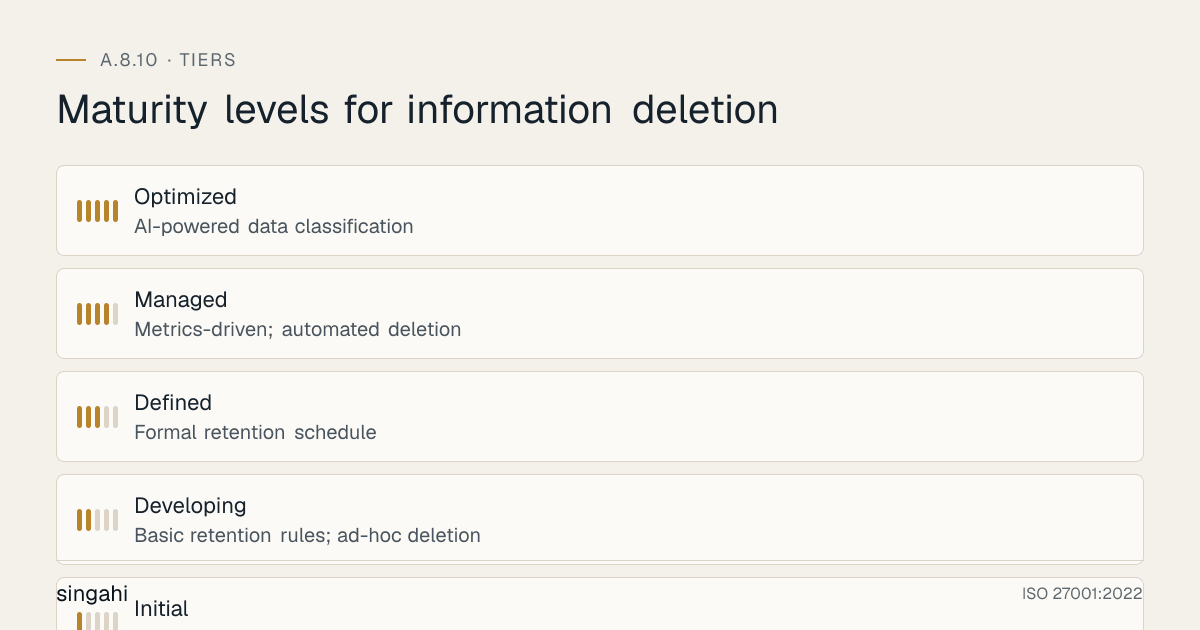
Maturity Model for A.8.10
| Level | Name | Characteristics | Evidence |
|---|---|---|---|
| 1 | Initial | No retention schedule; no deletion; data kept indefinitely; no DSR process; no legal hold; no media sanitization | No policy; no schedule; no deletion; indefinite retention; no DSR; no sanitization |
| 2 | Developing | Basic retention rules; ad-hoc deletion; manual DSR handling; informal legal hold; basic media disposal | Some retention rules; occasional deletion; spreadsheet DSR tracking; no automation; basic shredding |
| 3 | Defined | Formal retention schedule; documented deletion procedures; DSR workflow; legal hold process; media sanitization; verification | Policy; schedule; automated deletion for some systems; DSR workflow; legal hold; sanitization; verification |
| 4 | Managed | Metrics-driven; automated deletion for most systems; automated DSR workflow; integrated legal hold; certified disposal; complete verification; backup synchronization | Automated deletion; DSR automation; legal hold tracking; certified vendors; metrics; quarterly review; backup sync |
| 5 | Optimized | AI-powered data classification; predictive retention; fully automated deletion across all systems; self-service DSR; real-time legal hold; blockchain-verified deletion; zero manual deletion | AI classification; predictive retention; full automation; self-service DSR; blockchain audit; zero manual deletion; real-time compliance |
Continuous Improvement Activities
Monthly:
- Deletion execution review (was data deleted per schedule?)
- DSR processing review (timeliness, completeness, customer satisfaction)
- Storage cost analysis and trend
- Deletion failure investigation
- Backup deletion synchronization review
Quarterly:
- Retention schedule review and update
- Legal hold review and release assessment
- Media sanitization program review
- Third-party deletion compliance review
- DSR workflow optimization
- Internal audit of deletion controls
- Shadow IT data discovery and deletion
- Metrics and KPI review
Annually:
- Full policy review
- Complete data retention schedule review
- Technology evaluation (new DLM tools, new deletion methods)
- Benchmark against industry best practices
- External audit preparation
- Maturity assessment against target level
- Legal and regulatory change review
- Vendor security assessment (deletion vendors)
- Disaster recovery plan update (reflecting current retention)
Trigger-Based:
- After any DSR complaint or regulatory inquiry
- Upon new data type or system introduction
- Upon merger, acquisition, or divestiture
- Upon new law or regulation (DPDP Act updates, new RBI guidelines)
- After significant audit findings
- Upon storage capacity threshold breach
- After data breach (review if over-retention contributed to impact)
- Upon new cloud adoption or migration
FAQ
Q1: What is the difference between deletion and archiving? A: Deletion is the permanent removal of data with the intent that it is no longer recoverable. Archiving is the movement of data to long-term storage for retention purposes, with the intent that it can be retrieved if needed. Data is archived when it is no longer actively needed but must be retained for legal, regulatory, or historical reasons. Data is deleted when it no longer needs to be retained at all. Archiving is "store for later"; deletion is "remove forever." Both require defined retention periods and deletion at the end of the archive period.
Q2: How do we handle deletion requests when the data is also needed for legal or regulatory retention? A: Legal and regulatory retention takes precedence over deletion requests. When a DSR deletion request conflicts with statutory retention: (1) Inform the data principal that deletion is suspended due to legal retention requirement, (2) Explain the specific law and retention period, (3) Delete the data when the statutory retention period expires, (4) Document the exception and legal basis, (5) If the data principal disagrees, they may appeal to the Data Protection Board of India under DPDP Act Section 27. The DPDP Act itself recognizes this exception, Section 8(7) allows retention where necessary for compliance with any law. Be transparent with data principals about why deletion is delayed.
Q3: Can we use encryption instead of deletion? A: Cryptographic erasure (deleting encryption keys to render encrypted data unrecoverable) is an acceptable deletion method for encrypted data, but it is not a substitute for deletion in all cases. Cryptographic erasure is effective when: (1) The data is encrypted with strong encryption, (2) The encryption keys are securely deleted and unrecoverable, (3) The encryption was applied to the entire data set, (4) There are no unencrypted copies. Cryptographic erasure is not sufficient when: (1) Data exists in unencrypted copies, (2) Keys are backed up or recoverable, (3) Encryption is weak or compromised, (4) Metadata or fragments remain unencrypted. For most cases, actual data deletion (overwriting, secure erase) is preferred. Cryptographic erasure is a valid method but requires careful implementation.
Q4: How do we delete data from third-party SaaS applications? A: Third-party SaaS deletion requires contractual and procedural controls: (1) Include data deletion clauses in SaaS contracts (require deletion within 30 days of contract termination or request), (2) Maintain an inventory of all SaaS applications and their data, (3) Include SaaS in DSR deletion workflow (notify vendor to delete), (4) Verify deletion by requesting confirmation from vendor, (5) For critical SaaS, conduct exit audit to verify deletion, (6) Use SaaS applications that provide data export and deletion APIs, (7) Avoid SaaS applications that claim "we cannot delete data." Third-party deletion is your responsibility, not just the vendor's, contractually enforce it and verify it.
Q5: What is the most common audit finding for A.8.10? A: The most common findings are: (1) No data retention schedule, (2) No deletion policy or procedures, (3) No DSR deletion workflow, (4) Data kept indefinitely beyond retention periods, (5) No backup deletion synchronization, (6) No media sanitization before disposal, (7) No legal hold process, (8) No deletion verification, (9) No data mapping (cannot locate all data instances), (10) Shadow IT not included in deletion scope. Auditors will check retention schedules, deletion logs, DSR records, backup deletion, and media disposal certificates.
Q6: How do we handle deletion in big data environments (data lakes, data warehouses)? A: Big data environments require specialized deletion approaches: (1) Partition data by customer or data subject to enable selective deletion, (2) Use data governance tools (Apache Atlas, Collibra) to track data lineage and copies, (3) Implement column-level or row-level deletion (not just table-level), (4) For immutable data lakes, implement metadata tagging that excludes deleted data from queries, (5) Use data masking or anonymization for analytics if deletion is not feasible, (6) Implement data lifecycle policies in the data lake (auto-delete old partitions), (7) Ensure ETL pipelines do not re-create deleted data from upstream sources, (8) For Hadoop/HDFS, use file-level deletion with replication factor management. Big data deletion is complex but essential, design for deletion from the start.
Q7: What is the cost of implementing A.8.10 for a growing company? A: The main costs are data discovery and mapping (tools or staff time), configuring retention in each system, a deletion request workflow, and sanitisation tools or certified disposal vendors. Built-in retention features in Microsoft 365, Google Workspace and cloud storage cover much of the need at no extra cost.
Q8: How do we verify that data has been truly deleted? A: Verification methods depend on the system and media: (1) For databases: Run queries to confirm rows are gone; check for orphaned records, (2) For file systems: Search for files by name, content, or hash; check for copies in temp directories, (3) For backups: Verify backup deletion via backup console; attempt restore to confirm absence, (4) For media: Attempt forensic recovery with tools like PhotoRec, TestDisk, or professional forensic services, (5) For cloud: Use cloud APIs to verify object deletion; check cross-region replication, (6) For logs: Review deletion logs and audit trails, (7) For DSR: Conduct sample verification on a subset of systems. Verification should be proportional to risk, critical data requires rigorous verification; low-risk data may require less.
Q9: How do we handle deletion in microservices and distributed systems? A: Distributed systems require distributed deletion: (1) Implement an event-driven deletion architecture (when a deletion event occurs, propagate to all microservices), (2) Use a central deletion service that coordinates deletion across services, (3) Ensure eventual consistency (all services will delete, but may take time), (4) Implement deletion idempotency (deleting twice is the same as deleting once), (5) Use distributed tracing to track deletion propagation, (6) Implement compensation for failed deletions (retry, alert, manual intervention), (7) Ensure message queues and event logs do not retain deleted data indefinitely, (8) Test deletion end-to-end across all services. Distributed deletion is complex but essential for microservices architectures.
Q10: What is the relationship between data deletion and data masking? A: Data masking (A.8.11) is the process of hiding or replacing sensitive data with non-sensitive equivalents. It is an alternative to deletion in some cases: (1) When data is needed for analytics but PII is not needed (mask instead of delete), (2) When data must be retained for legal reasons but PII is not needed (mask PII, retain rest), (3) When test environments need data but real PII should not be used (mask for testing). However, masking is not a substitute for deletion when: (1) The data subject requests deletion (DPDP Act), (2) The retention period has expired, (3) The data is no longer needed for any purpose. Masking reduces sensitivity; deletion removes existence. Use masking when you need the data but not the sensitivity; use deletion when you no longer need the data at all.
Q11: How do we handle deletion of data in blockchain or distributed ledger systems? A: Blockchain and distributed ledgers are designed to be immutable, data cannot be deleted once recorded. This creates a fundamental conflict with DPDP Act deletion requirements. Solutions: (1) Do not store personal data directly on blockchain; store hashes or references, (2) Use off-chain storage for personal data with on-chain pointers; delete off-chain data and invalidate pointers, (3) Use permissioned blockchains with governance mechanisms for data removal, (4) Implement key deletion for encrypted data on blockchain (cryptographic erasure), (5) Avoid blockchain for use cases that require deletion of personal data, (6) If personal data must be on blockchain, use anonymized or pseudonymized data. Blockchain immutability and privacy deletion rights are fundamentally in tension, design around this from the start.
Q12: How do we handle deletion of data in AI/ML training datasets? A: AI/ML training datasets require special deletion considerations: (1) Training data may be derived from multiple sources; deletion requires identifying which model was trained on which data, (2) Model retraining may be required after data deletion (if the model was trained on now-deleted data), (3) Model weights and embeddings may contain traces of training data; complete removal may require model retraining, (4) Data lineage tracking is essential (know which data was used to train which model), (5) For federated learning, deletion requires coordination across multiple nodes, (6) Implement data provenance tracking for all training data, (7) For DSR, consider whether model retraining is required or if data subject's impact on the model is minimal. AI/ML deletion is an emerging area, track data lineage, design for retraining, and document your approach.
Q13: What is the difference between logical deletion and physical deletion? A: Logical deletion (soft delete) marks data as deleted but retains it in the database (e.g., setting a "deleted" flag). The data is hidden from users but remains in storage and can be recovered. Physical deletion (hard delete) removes the data from storage entirely, making it unrecoverable through normal means. For DPDP Act compliance and security, physical deletion is required. Logical deletion is acceptable only for: (1) Short-term recovery (recycle bin before permanent deletion), (2) Legal hold (mark as deleted but preserve for litigation), (3) Audit trail (log the deletion without retaining the data). Logical deletion alone does not satisfy DPDP Act deletion requirements, physical deletion must follow.
Q14: How do we handle deletion of data in collaborative environments (SharePoint, Google Drive, Slack)? A: Collaborative environments have distributed copies: (1) Shared documents have multiple owners and copies; deletion requires coordination, (2) Version history retains previous versions; delete all versions, (3) Comments, annotations, and chat may contain data; delete associated content, (4) Notifications and emails may reference the data; delete notifications, (5) Shared links may provide access; revoke links, (6) Offline sync copies exist on user devices; delete from synced devices, (7) Third-party integrations may have copies; notify integrations. Collaborative deletion requires: version management, link revocation, sync management, and third-party coordination. The "share" nature of collaborative tools makes deletion more complex, plan for it.
Q15: How do we measure the effectiveness of our information deletion program? A: Measure effectiveness through: (1) Retention compliance (percentage of data deleted per schedule), (2) DSR timeliness (average days to complete DSR), (3) DSR completeness (percentage of DSRs with verified complete deletion), (4) Storage cost reduction (efficiency gains from deletion), (5) Audit findings (number of deletion-related audit findings), (6) Legal hold compliance (percentage of holds with suspended deletion), (7) Media sanitization compliance (percentage of media sanitized before disposal), (8) Data growth rate (is data growth controlled by retention?), (9) Shadow IT discovery (percentage of unknown data locations discovered), (10) Customer satisfaction (data principal satisfaction with DSR handling). The ultimate measure is: "Can we confidently delete any data when required, from all locations, in a verifiable manner?"
References and Further Reading
Standards and Frameworks
- ISO/IEC 27001:2022, Information Security, Cybersecurity and Privacy Protection, Information Security Management Systems, Requirements
- ISO/IEC 27002:2022, Information Security, Cybersecurity and Privacy Protection, Information Security Controls
- NIST SP 800-88 Rev. 2, Guidelines for Media Sanitization
- NIST SP 800-53 Rev 5, Security and Privacy Controls for Information Systems and Organizations
- PCI DSS v4.0.1, Payment Card Industry Data Security Standard
- CIS Controls v8, CIS Controls Version 8
- COBIT 2019, Control Objectives for Information and Related Technologies
Indian Regulations
- Digital Personal Data Protection Act, 2023 (India)
- Information Technology Act, 2000 (as amended)
- RBI Cyber Security Framework for Banks
- SEBI Cybersecurity and Cyber Resilience Framework (CSCRF) for SEBI Regulated Entities, circular of 20 August 2024
- Income Tax Act, 1961
- Company Act, 2013
- Bharatiya Sakshya Adhiniyam, 2023 (replaced the Indian Evidence Act, 1872)
- Public Records Act, 1993
Books and Publications
- ISO 27001/27002: A Pocket Guide by Alan Calder
- NIST SP 800-88: Guidelines for Media Sanitization (NIST)
- The Data Retention and ePrivacy Directive by various authors
- Data Privacy: A Practical Guide by D. C. S. Rao
- DPDP Act 2023: A Complete Guide by Indian legal publishers