
On this page
- Quick Reference (60 Seconds)
- What the Control Asks For
- Why Management of technical vulnerabilities Matters
- Scope and Applicability
- Key Definitions and Terminology
- Relationship to Other Controls
- Implementation Roadmap (Week-by-Week)
- Detailed Implementation Guidance
- Tools, Technologies, and Solutions
- Policy and Procedure Templates
- Risk Assessment and Treatment
- Audit and Compliance Checklist
- Metrics and KPIs
- Common Pitfalls and How to Avoid Them
- Illustrative Scenarios
- Multi-Framework Mapping
- Regulatory and Industry Context
- Roles and Responsibilities (RACI)
- Documentation and Evidence Requirements
- Continuous Improvement
- FAQ
- References and Further Reading
Quick Reference (60 Seconds)
| Aspect | Summary |
|---|---|
| Control ID | A.8.8 |
| Control Name | Management of technical vulnerabilities |
| ISO 27002:2022 Section | 8.8 |
| Primary Purpose | Identify, assess, and remediate technical vulnerabilities in information systems to reduce the risk of exploitation by attackers |
| Key Activities | Vulnerability scanning, patch management, risk assessment, prioritization, remediation, verification, continuous monitoring |
| Typical Owners | CISO, Vulnerability Management Team, IT Operations, Patch Management Team, Security Operations |
| Implementation Effort | Medium (6–10 weeks) |
| Main cost drivers | Vulnerability scanning and patching tools, penetration tests, and engineering time to remediate and test |
| ISO 27002 attributes | Control type: Preventive · Properties: Confidentiality, Integrity, Availability · Concepts: Identify, Protect · Capabilities: Threat and vulnerability management · Domains: Governance and ecosystem, Protection, Defence |
Bottom Line: Every system has vulnerabilities. Attackers find and exploit them. Vulnerability management is the process of finding your weaknesses before attackers do, fixing them systematically, and continuously monitoring for new ones. This is not just about patching, it is about a complete, risk-based approach to managing technical weaknesses across your entire technology stack.
What the Control Asks For
In short:
ISO 27001:2022 Annex A 8.8 asks organizations to obtain information about technical vulnerabilities, assess the organization's exposure, and take appropriate action.
Do you need this control?
A.8.8 is not mandatory in itself: under clause 6.1.3 you include it if your risk assessment calls for it, and record the decision in your Statement of Applicability. Almost every organisation includes it, because all software has vulnerabilities. Scale scanning and patch timelines to your exposure and risk.
What ISO 27002:2022 Adds
27002 8.8 (paraphrased):
Prerequisite: an accurate software inventory (vendor, product, version, where it is deployed and who is responsible).
Identifying vulnerabilities:
- (a) define roles: monitoring, risk assessment, updating, asset tracking, coordination
- (b) keep a list of information sources for each technology, updated as the inventory changes
- (c) require suppliers to handle and disclose vulnerabilities, written into contracts (5.20)
- (d) use scanning tools suited to your technologies, and to verify patches worked
- (e) plan penetration tests and assessments by competent, authorised people, carefully
- (f) track third-party libraries and source code (8.28)
- have procedures to detect vulnerabilities in your own products and services and to receive reports, with a public point of contact under a vulnerability disclosure policy, reporting forms, information-sharing forums and, if useful, a bug bounty
Evaluating: verify reports, then decide the risk and the action (update or other controls).
Acting:
- a software update management process for approved patches; test and document changes
- (a) act promptly, with a defined reaction timeline
- (b) route by urgency through change management (8.32) or incident response (5.26)
- (c) use updates only from legitimate sources; (h) verify their authenticity
- (d) test updates and weigh the risk of installing against the risk of the vulnerability
- (e) fix high-risk systems first; (f)–(g) develop and test remediation
- (i) if no patch is possible: vendor workarounds, turning off affected services, border access controls, virtual patching with traffic filters, more monitoring, and awareness
- decide whether to use vendors' automatic updates
Also: keep an audit log of all vulnerability management steps; monitor and evaluate the process; align it with incident management; and for cloud, make the provider's responsibilities part of the cloud agreement (5.23), while you manage your own assets in the cloud.
Why Management of technical vulnerabilities Matters
The Vulnerability Exploitation Landscape
Technical vulnerabilities are the entry points that attackers use to compromise systems. Every unpatched vulnerability is a potential door for an attacker. The speed at which attackers exploit vulnerabilities has dramatically increased, from months to days to hours.
Key Statistics
- Vulnerability exploitation is a leading way in: the Verizon DBIR 2025 found exploitation of vulnerabilities as the initial access vector in 20% of breaches, close behind credential abuse, with edge devices and VPNs a growing share
- Exploits arrive quickly: Mandiant's time-to-exploit research has found the average time between disclosure and exploitation shrinking to days for many vulnerabilities
- Tens of thousands of new CVEs are published every year (over 40,000 in 2024), so prioritisation by exploitability and exposure (for example the CISA KEV catalogue and EPSS) matters more than raw CVSS
How It Goes Wrong (hypothetical patterns, with real vulnerabilities)
- A hospital still running Windows XP is hit by WannaCry (EternalBlue). Microsoft's March 2017 patch (MS17-010) covered supported Windows versions; XP was unsupported and received an emergency patch only after the May 2017 outbreak. The lesson is about unsupported operating systems: if a system cannot be patched, isolate it, add compensating controls or replace it.
- A bank's internet-facing web server had a known Apache Struts vulnerability (CVE-2017-5638). The vulnerability was exploited by attackers who gained access to the bank's internal network, stole customer data, and initiated fraudulent transactions. The bank had scanned quarterly, but the scan scope missed the web server; RBI's supervisory review followed.
- A manufacturing company's SCADA system had an unpatched vulnerability in its HMI software. An attacker exploited it to gain control of the production line, causing a 2-day shutdown. The vulnerability was 3 years old and had a public exploit available. The company had no vulnerability scanning for OT systems.
- A SaaS company runs containers on an unpatched runtime with a container-escape flaw (for example the runc vulnerability CVE-2019-5736). An attacker used it to access other tenants' data. The vulnerability was known but the company had no cloud vulnerability scanning process. The company faced lawsuits from affected customers.
- A government department's website had a SQL injection vulnerability that was discovered in a public vulnerability scan. The vulnerability exposed 1 million citizen records. The department had no vulnerability scanning program and no patch management process. The Chief Secretary ordered an immediate security overhaul.
Regulatory and Business Drivers
- RBI (Cyber Security Framework 2016; Master Direction on IT Governance 2023) and SEBI CSCRF (2024) expect regular vulnerability assessment and penetration testing and timely patching, with frequencies set by entity type and system criticality: check the direction that applies to you
- CERT-In issues advisories (an information source under 27002 (b)) and runs coordinated vulnerability disclosure; exploitation of a vulnerability is an incident reportable within 6 hours
- DPDP Act 2023 requires reasonable security safeguards, including vulnerability management for systems processing personal data
- IT Act 2000 requires organizations to protect systems from exploitation; failure to patch known vulnerabilities can be considered negligence
- PCI DSS v4.0.1 6.3.1–6.3.3 (identify vulnerabilities; inventory components; critical patches within one month) and 11.3 (quarterly internal and external scans)
- SOC 2 CC7.1 requires system operations to include vulnerability management
- NIST 800-53 Rev 5 RA-5 (Vulnerability Scanning) and SI-2 (Flaw Remediation) map directly to A.8.8
- Cyber Insurance policies increasingly require evidence of vulnerability management as a condition of coverage
Scope and Applicability
What Is Covered
- All operating systems (Windows, Linux, macOS, iOS, Android, embedded)
- All applications (web applications, desktop applications, mobile apps, middleware, databases)
- All network infrastructure (firewalls, routers, switches, load balancers, VPNs, wireless access points)
- All cloud resources (IaaS, PaaS, SaaS, containers, serverless functions)
- All virtual machines and hypervisors
- All databases and database management systems
- All web servers and application servers
- All APIs and microservices
- All IoT/OT devices (if applicable and scannable)
- All source code and third-party libraries (code vulnerabilities)
- All network services and protocols
- All hardware firmware (BIOS, BMC, iLO, iDRAC, network device firmware)
- All wireless networks and wireless devices
- All remote access tools and VPN concentrators
- All virtualization platforms and container orchestration systems
What Is Not Covered
- Physical security vulnerabilities (covered by A.7 controls)
- Human vulnerabilities (covered by A.6 awareness training)
- Business process vulnerabilities (covered by A.5 risk management)
- Third-party vendor vulnerabilities (covered by A.5.20 supplier relationships)
- Environmental vulnerabilities (covered by A.7 facilities security)
Applicability by Organization Type
| Organization Type | Applicability | Key Vulnerability Concerns |
|---|---|---|
| IT/Software Services | Critical | Web app vulnerabilities, code vulnerabilities, cloud misconfigurations, third-party library CVEs |
| BFSI | Critical | Core banking vulnerabilities, web banking, payment systems, ATM software, SWIFT, mobile banking |
| Healthcare | Critical | EMR vulnerabilities, medical device vulnerabilities, web portals, patient data systems, IoT devices |
| Manufacturing | High | SCADA/ICS vulnerabilities, ERP systems, industrial IoT, network segmentation, HMI software |
| Government/Defense | Critical | Citizen portals, critical infrastructure, classified systems, legacy systems, APT-targeted CVEs |
| Education | Medium | Student portals, LMS, exam platforms, research data, open networks, BYOD |
| SaaS/Cloud | Critical | Cloud misconfigurations, container vulnerabilities, API vulnerabilities, multi-tenant isolation, serverless |
| Retail/E-commerce | High | POS systems, e-commerce platforms, payment gateways, customer databases, inventory systems, Magecart |
Key Definitions and Terminology
| Term | Definition |
|---|---|
| Vulnerability | A weakness in an information system, security procedure, internal control, or implementation that could be exploited by a threat source |
| CVE (Common Vulnerabilities and Exposures) | A standardized identifier for publicly known cybersecurity vulnerabilities (e.g., CVE-2021-44228) |
| CVSS (Common Vulnerability Scoring System) | A standardized scoring system for rating the severity of vulnerabilities (0.0–10.0) |
| CVSS Base Score | The intrinsic characteristics of a vulnerability (exploitability, impact) |
| CVSS Threat metrics (v4.0) | Adjust the base score for current exploit maturity (called Temporal metrics in CVSS v3.x) |
| CVSS Environmental Score | Adjusts base score based on the specific organization's environment (asset criticality, mitigations) |
| CVE Severity | Critical (9.0–10.0), High (7.0–8.9), Medium (4.0–6.9), Low (0.1–3.9), None (0.0) |
| Exploit | A piece of software, data, or sequence of commands that takes advantage of a vulnerability to cause unintended behavior |
| Proof of Concept (PoC) | A demonstration that a vulnerability exists and can be exploited, typically published by security researchers |
| Zero-Day Vulnerability | A vulnerability that is unknown to the vendor and for which no patch exists; exploited before the vendor knows about it |
| N-Day Vulnerability | A known vulnerability (N days since disclosure) that has a patch available but may not be applied |
| Patch | A software update that fixes a vulnerability or bug |
| Hotfix | A quick patch for a critical issue, typically released outside the normal patch cycle |
| Workaround | A temporary measure to mitigate a vulnerability without patching (e.g., configuration change, firewall rule, disabling feature) |
| Compensating Control | A security control that reduces the risk of a vulnerability when patching is not feasible |
| Vulnerability Scanning | The process of using automated tools to identify vulnerabilities in systems |
| Vulnerability Assessment | The process of evaluating and prioritizing identified vulnerabilities based on risk |
| Penetration Testing | A simulated attack on a system to identify vulnerabilities that scanning might miss |
| Vulnerability Management Lifecycle | The continuous process of identification, assessment, prioritization, remediation, and verification |
| EPSS (Exploit Prediction Scoring System) | A data-driven model that estimates the probability of a vulnerability being exploited in the wild |
| CISA KEV (Known Exploited Vulnerabilities) | A catalog of vulnerabilities that are known to be actively exploited by threat actors, maintained by CISA |
| Vulnerability Disclosure | The process of responsibly reporting a vulnerability to the vendor or public |
| Bug Bounty | A program that rewards security researchers for finding and responsibly disclosing vulnerabilities |
| Attack Surface | The total number of points (vulnerabilities, interfaces, services) where an attacker could try to enter or extract data |
| Shadow IT | Technology systems and solutions built and used within an organization without explicit organizational approval |
| Virtual Patching | A security policy that blocks exploitation of a vulnerability at the network or application layer without modifying the vulnerable code |
| Patch Management | The process of acquiring, testing, and applying patches to systems in a controlled manner |
| Remediation SLA | The defined time limit for fixing a vulnerability based on its severity |
| Mean Time to Patch (MTTP) | The average time from vulnerability disclosure to patch application |
| Vulnerability Scanning Frequency | How often vulnerability scans are performed (continuous, daily, weekly, monthly, quarterly) |
| Authenticated Scanning | Vulnerability scanning that uses credentials to log in to systems for deeper inspection |
| Unauthenticated Scanning | Vulnerability scanning from the outside without credentials, simulating an attacker |
Relationship to Other Controls
| Control | Relationship |
|---|---|
| A.5.1 Policies for information security | Vulnerability management policy aligns with overall security policy |
| A.5.7 Threat intelligence | Threat intelligence informs vulnerability prioritization and exploitability assessment |
| A.5.20 Supplier relationships | Supplier vulnerabilities must be managed through vendor security assessments |
| A.6.3 Information security awareness training | Users must be trained on vulnerability risks and safe practices |
| A.8.5 Secure authentication | Vulnerability management ensures authentication mechanisms are not compromised |
| A.8.7 Protection against malware | Malware exploits vulnerabilities; patching reduces malware attack surface |
| A.8.9 Configuration management | Secure configurations reduce vulnerabilities; misconfigurations are a major vulnerability class |
| A.8.15 Logging | Logs help detect exploitation attempts and vulnerability scanning activities |
| A.8.16 Monitoring activities | Monitoring detects exploitation of vulnerabilities |
| A.8.20 Network security | Network vulnerabilities (firewalls, routers) must be managed |
| A.8.25 Secure development | Secure development reduces code vulnerabilities |
| A.8.26 Application security | Application security testing identifies vulnerabilities |
| A.8.29 Security testing | Penetration testing finds vulnerabilities that scanners miss |
| A.8.9 Configuration management | Secure baselines reduce vulnerabilities |
| A.8.19 Installation of software on operational systems | Controlled installation of updates |
| A.8.28 Secure coding | Tracking third-party libraries (27002 8.8 (f)) |
| A.8.32 Change management | Routine patches go through change management |
| A.5.23 Cloud services | Provider vulnerability responsibilities in the cloud agreement |
| A.5.26 Response to incidents | Urgent vulnerabilities and exploitation handled as incidents |
| A.8.33 Test data | Test environments must be vulnerability-scanned and patched |
Implementation Roadmap (Week-by-Week)
Week 1: Asset Inventory and Scanning Scope Definition
- Inventory all assets (servers, endpoints, network devices, cloud resources, applications, databases)
- Categorize assets by criticality (critical, high, medium, low)
- Identify all IP ranges, domains, and cloud accounts to scan
- Identify authentication requirements for authenticated scanning
- Identify scanning exclusions and maintenance windows
- Document scanning scope and asset inventory
- Identify shadow IT assets (unauthorized cloud services, unknown devices)
Week 2: Vulnerability Management Policy and SLA Development
- Draft vulnerability management policy
- Define remediation SLAs based on severity:
- Critical (CVSS 9.0–10.0): Patch within 24–72 hours
- High (CVSS 7.0–8.9): Patch within 7–14 days
- Medium (CVSS 4.0–6.9): Patch within 30–60 days
- Low (CVSS 0.1–3.9): Patch within 90 days or next maintenance window
- Define scanning frequency:
- Critical assets: Weekly or continuous
- High-value assets: Weekly
- Standard assets: Monthly
- Low-priority assets: Quarterly
- Define vulnerability assessment and prioritization methodology
- Define exception process for unpatched vulnerabilities (compensating controls, risk acceptance)
- Define roles and responsibilities
Week 3: Vulnerability Scanning Tool Selection and Deployment
- Evaluate vulnerability scanning tools (Qualys, Tenable, Rapid7, Nessus, OpenVAS)
- Select tool based on coverage, accuracy, reporting, and integration capabilities
- Deploy vulnerability scanner for internal network scanning
- Deploy vulnerability scanner for external (internet-facing) scanning
- Deploy cloud vulnerability scanner (cloud-native or agent-based)
- Deploy container vulnerability scanner (if applicable)
- Deploy web application vulnerability scanner (if applicable)
- Configure authenticated scanning with appropriate credentials
- Schedule initial scans for all asset categories
Week 4: Initial Scanning and Baseline Assessment
- Conduct initial vulnerability scans across all scoped assets
- Aggregate and deduplicate scan results
- Correlate vulnerabilities with asset criticality and exposure
- Calculate risk scores (CVSS + asset criticality + exposure + exploitability)
- Identify top 20 most critical vulnerabilities
- Create vulnerability baseline report
- Present findings to IT leadership and stakeholders
- Develop remediation plan for critical and high vulnerabilities
Week 5: Remediation Workflow and Change Management Integration
- Establish vulnerability remediation workflow (ticket creation, assignment, tracking, verification)
- Integrate with ITSM/change management system (ServiceNow, Jira, ManageEngine)
- Define patch testing procedures (test in dev/staging before production)
- Define emergency patching procedures for critical vulnerabilities (out-of-band patching)
- Define rollback procedures in case patch causes issues
- Configure automated ticket creation from scan results
- Define escalation procedures for missed SLAs
Week 6: Critical and High Vulnerability Remediation
- Prioritize critical vulnerabilities (CISA KEV, active exploits, internet-facing)
- Apply patches, workarounds, or compensating controls for critical vulnerabilities
- Verify remediation effectiveness (rescan to confirm vulnerability is closed)
- Document any exceptions with compensating controls and risk acceptance
- Track remediation progress in vulnerability management dashboard
- Communicate progress to leadership
- Conduct emergency patching for any newly disclosed critical vulnerabilities
Week 7: Continuous Scanning and Monitoring Setup
- Configure continuous/automated scanning schedules
- Set up alerting for new critical/high vulnerability discoveries
- Integrate threat intelligence feeds (CISA KEV, exploit databases, vendor advisories)
- Configure vulnerability trend dashboards and reporting
- Set up SLA monitoring and alerting for missed remediation deadlines
- Implement vulnerability scanning for CI/CD pipelines (container scanning, code scanning)
- Configure cloud security posture management (CSPM) for cloud misconfigurations
Week 8: Reporting, Training, and Audit Preparation
- Create vulnerability management dashboard for stakeholders
- Establish weekly vulnerability status reports for IT leadership
- Establish monthly vulnerability reports for executive leadership
- Train IT operations staff on patch management and vulnerability remediation
- Train security team on vulnerability scanning, assessment, and prioritization
- Conduct internal audit of vulnerability management implementation
- Prepare documentation for external audit
- Plan for continuous improvement
Detailed Implementation Guidance
Figure · Tiers
Maturity levels for management of technical vulnerabilities
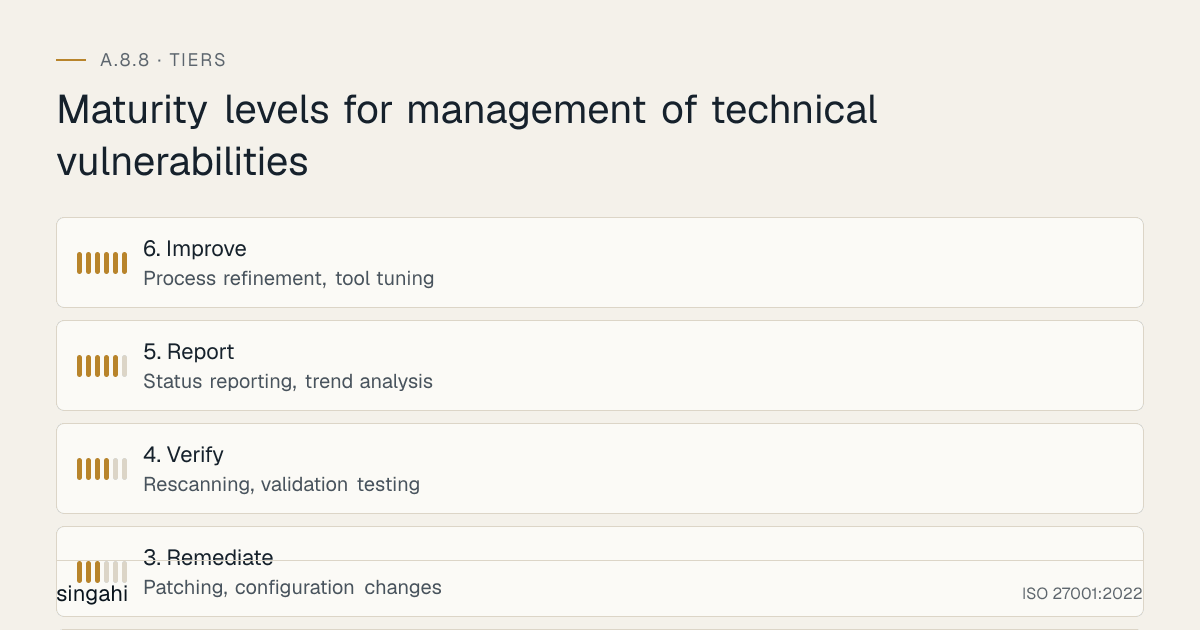
Figure · Matrix
How the options compare: CVSS Base Score to Compensating Controls
Vulnerability Management Lifecycle
The Vulnerability Management Lifecycle is a continuous process:
| Stage | Activities | Outputs | Frequency |
|---|---|---|---|
| 1. Discover | Asset inventory, scanning, threat intelligence, vendor advisories | List of identified vulnerabilities | Continuous |
| 2. Assess | Risk scoring, prioritization, exploitability analysis, impact assessment | Prioritized vulnerability list | Per scan cycle |
| 3. Remediate | Patching, configuration changes, workarounds, compensating controls | Closed vulnerabilities, exceptions | Per SLA |
| 4. Verify | Rescanning, validation testing, confirmation of closure | Verified closure evidence | Per remediation |
| 5. Report | Status reporting, trend analysis, metrics, leadership communication | Vulnerability reports, KPIs | Weekly/Monthly |
| 6. Improve | Process refinement, tool tuning, SLA adjustment, coverage expansion | Updated procedures, policies | Quarterly/Annually |
Vulnerability Prioritization Framework
Risk-Based Prioritization (Recommended):
Vulnerability Risk Score = (CVSS Base Score × Asset Criticality × Exploitability × Exposure) / Compensating Controls
| Factor | Weight | Description | Scoring |
|---|---|---|---|
| CVSS Base Score | 30% | Intrinsic vulnerability severity | 0–10 |
| Asset Criticality | 25% | Importance of the vulnerable asset to business | 1–5 (1=low, 5=critical) |
| Exploitability | 25% | Availability of exploit code, ease of exploitation | 1–5 (1=theoretical, 5=active exploitation) |
| Exposure | 15% | Accessibility of the asset (internet-facing, internal, isolated) | 1–5 (1=isolated, 5=internet-facing) |
| Compensating Controls | 5% | Presence of mitigating controls | 0.5–1.0 (0.5=strong controls, 1.0=no controls) |
Priority Matrix:
| Risk Score | Priority | Remediation SLA | Escalation |
|---|---|---|---|
| 90–100 | P1, Critical | 24–72 hours | CISO + CIO notified immediately |
| 70–89 | P2, High | 7–14 days | IT Security Manager + IT Operations Manager |
| 40–69 | P3, Medium | 30–60 days | IT Operations Team |
| 10–39 | P4, Low | 90 days or next maintenance | IT Operations Team |
| CISA KEV | P1, Critical | 24–48 hours regardless of score | CISO + CIO |
| Active Exploit | P1, Critical | 24–48 hours regardless of score | CISO + CIO |
| Ransomware-Associated | P1, Critical | 24–48 hours regardless of score | CISO + CIO |
CISA Known Exploited Vulnerabilities (KEV) Catalog:
- Vulnerabilities in the CISA KEV catalog are known to be actively exploited by threat actors
- These must be patched within 24–48 hours regardless of CVSS score
- Subscribe to CISA KEV feed and integrate with vulnerability management system
- CISA KEV is the gold standard for exploitability, prioritize these above all else
EPSS (Exploit Prediction Scoring System):
- EPSS provides a probability (0–1) that a vulnerability will be exploited in the next 30 days
- Use EPSS to supplement CVSS for prioritization
- High EPSS + High CVSS = Immediate action
- High EPSS + Low CVSS = Still prioritize (exploitability matters more than severity)
- EPSS data is available from FIRST (Forum of Incident Response and Security Teams)
Vulnerability Scanning Types and Coverage
Scanning Types:
| Scan Type | Purpose | Coverage | Frequency | Authenticated |
|---|---|---|---|---|
| External Network Scan | Identify vulnerabilities visible from internet | Internet-facing IPs, web apps, APIs, VPNs | Weekly | No (unauthenticated) |
| Internal Network Scan | Identify vulnerabilities on internal network | Internal servers, endpoints, network devices | Weekly/Monthly | Yes (preferred) |
| Cloud Infrastructure Scan | Identify cloud misconfigurations and vulnerabilities | Cloud instances, storage, IAM, containers | Weekly/Continuous | Yes (cloud APIs) |
| Web Application Scan | Identify web app vulnerabilities (OWASP Top 10) | Web apps, APIs, mobile backends | Weekly/Monthly | Yes (if possible) |
| Container Scan | Identify vulnerabilities in container images | Docker images, Kubernetes pods, registries | Per build/deployment | N/A |
| Code Scan (SAST/SCA) | Identify vulnerabilities in source code and dependencies | Application code, libraries, frameworks | Per commit/PR | N/A |
| Database Scan | Identify database vulnerabilities and misconfigurations | Databases, database servers | Monthly | Yes |
| Wireless Network Scan | Identify wireless vulnerabilities | Wi-Fi networks, access points, clients | Quarterly | No |
| Configuration Scan | Identify security misconfigurations (CIS benchmarks) | Servers, network devices, cloud resources | Monthly | Yes |
| Penetration Test | Find vulnerabilities that automated scanning misses | Critical systems, web apps, APIs | Annually | N/A |
| Red Team Exercise | Simulate advanced attacker to find vulnerabilities | Entire organization | Annually | N/A |
Authenticated vs. Unauthenticated Scanning:
- Authenticated scanning provides more accurate results (finds internal vulnerabilities, missing patches, configuration issues)
- Unauthenticated scanning simulates an external attacker but misses many vulnerabilities
- Best practice: Use authenticated scanning for internal assets; use unauthenticated scanning for external-facing assets to simulate attacker perspective
- Create dedicated scanning accounts with minimal privileges; rotate credentials regularly; monitor scanning account usage
Patch Management Process
Patch Management Workflow:
| Step | Action | Responsible | Timeline |
|---|---|---|---|
| 1. Notification | Vendor releases patch or vulnerability disclosed | Vendor / Security Team | Day 0 |
| 2. Assessment | Evaluate patch criticality, applicability, and compatibility | Security Team + IT Operations | Day 0–1 |
| 3. Testing | Test patch in non-production environment | IT Operations | Day 1–3 (critical: 0–1) |
| 4. Approval | Approve patch for production deployment | Change Advisory Board (CAB) or Emergency CAB | Day 1–3 (critical: 0–1) |
| 5. Deployment | Deploy patch to production systems | IT Operations | Per SLA |
| 6. Verification | Verify patch installed successfully and system functioning | IT Operations | Post-deployment |
| 7. Rescanning | Rescan to confirm vulnerability is closed | Security Team | Post-deployment |
| 8. Documentation | Document patch deployment, any issues, and exceptions | IT Operations | Post-deployment |
| 9. Reporting | Report patch status to stakeholders | Security Team | Weekly/Monthly |
Emergency Patching (Out-of-Band):
- Triggered by: CISA KEV, active exploitation, ransomware association, zero-day disclosure
- Emergency CAB approves patch without full testing cycle
- Patch deployed to critical systems immediately
- Testing occurs in parallel with deployment or immediately after
- Rollback procedure ready in case of issues
- All actions documented and reviewed post-incident
Patch Testing Requirements:
- Test patches in a non-production environment that mirrors production
- Verify application functionality after patching (smoke tests, regression tests)
- Check for compatibility with custom applications and configurations
- Test rollback procedure before deployment
- For critical systems, consider blue-green deployment or canary deployment
- Document any issues found during testing and escalate if patch cannot be applied
Patch Rollback Procedure:
- Identify systems with patch-related issues
- Isolate affected systems from production if necessary
- Uninstall or revert the patch using vendor-provided rollback mechanism
- Restore from backup if rollback fails
- Verify system functionality after rollback
- Document issue and notify vendor
- Develop alternative remediation plan (different patch, workaround, compensating control)
- Communicate status to stakeholders
Compensating Controls and Exceptions
When Patching Is Not Possible:
| Scenario | Compensating Control | Duration | Approval Required |
|---|---|---|---|
| Legacy system cannot be patched | Network segmentation, WAF rules, virtual patching, application control, monitoring | Until system is replaced or decommissioned | CISO + CIO + Business Owner |
| Patch breaks critical application | Virtual patching (WAF/IPS), network isolation, enhanced monitoring, temporary workaround | Until application is fixed or alternative patch available | CISO + IT Operations Manager |
| Vendor patch not yet available | Workaround (disable feature, restrict access), virtual patching, enhanced monitoring | Until vendor patch is released | CISO + Security Manager |
| Maintenance window unavailable | Virtual patching, temporary access restrictions, enhanced monitoring | Until next maintenance window | IT Operations Manager |
| Embedded/IoT device cannot be patched | Network segmentation, access control, monitoring, replacement planning | Until device is replaced | CISO + Business Owner |
| Cloud service vulnerability (managed by vendor) | Monitor vendor patch status, implement own compensating controls, consider vendor SLA | Until vendor patches | CISO + Cloud Architect |
Exception Documentation:
- Vulnerability ID (CVE)
- Affected asset(s)
- Reason for exception (why patch cannot be applied)
- Compensating controls implemented
- Risk assessment (residual risk after compensating controls)
- Risk acceptance by business owner and CISO
- Review date (exceptions must be reviewed at least quarterly)
- Remediation plan (long-term solution to eliminate the vulnerability)
Cloud and Container Vulnerability Management
Cloud-Specific Vulnerabilities:
| Cloud Service | Vulnerability Types | Management Approach |
|---|---|---|
| IaaS (VMs) | OS vulnerabilities, application vulnerabilities, misconfigurations | Agent-based scanning, cloud-native scanning, CIS benchmarks |
| PaaS (managed services) | Service-level vulnerabilities, IAM misconfigurations, data exposure | CSPM, cloud-native security tools, vendor patch monitoring |
| SaaS (applications) | Application vulnerabilities, configuration issues, integration risks | SaaS security assessment, vendor security reviews, API monitoring |
| Containers (Docker/K8s) | Image vulnerabilities, runtime vulnerabilities, misconfigurations | Container scanning (Aqua, Snyk, Twistlock), runtime monitoring, CIS benchmarks |
| Serverless (Lambda/Functions) | Function code vulnerabilities, IAM misconfigurations, dependency vulnerabilities | SAST/SCA, IAM review, dependency scanning |
| Storage (S3/Buckets) | Public access misconfigurations, encryption gaps, versioning issues | CSPM, bucket policies, access reviews, encryption verification |
| IAM (Identity) | Excessive permissions, inactive credentials, lack of MFA | IAM reviews, access analytics, privilege analysis |
| Network (VPC/Security Groups) | Overly permissive rules, lack of segmentation, exposed ports | Network scanning, security group review, flow log analysis |
Cloud Security Posture Management (CSPM):
- Continuously monitors cloud environments for misconfigurations and vulnerabilities
- Maps cloud configurations to security best practices (CIS benchmarks, NIST, PCI DSS)
- Provides automated remediation for common misconfigurations
- Examples: Prisma Cloud, Orca Security, Wiz, Lacework, Microsoft Defender for Cloud
- Integrates with vulnerability management for complete cloud security
Container Vulnerability Management:
- Scan container images in CI/CD pipeline before deployment (shift-left security)
- Scan registries for existing image vulnerabilities
- Monitor running containers for runtime vulnerabilities and anomalous behavior
- Use minimal base images (Alpine, Distroless) to reduce attack surface
- Implement image signing and verification
- Regularly update base images and rebuild containers
- Use container-native security tools (Falco, Aqua, Sysdig, Twistlock)
Tools, Technologies, and Solutions
Vulnerability Scanning Platforms
| Vendor | Product | Key Features | Pricing model |
|---|---|---|---|
| Tenable | Nessus / Tenable.sc / Tenable.io | Industry standard, complete scanning, web app scanning, cloud, container | Commercial, per asset |
| Qualys | VMDR (Vulnerability Management, Detection, Response) | Cloud-native, complete, agent-based and scan-based, CMDB integration | Commercial, per asset |
| Rapid7 | InsightVM / Nexpose | Risk-based prioritization, live dashboards, remediation workflows, integrations | Commercial, per asset |
| Microsoft | Defender Vulnerability Management | Built-in with Microsoft Defender, risk-based, integrated with Endpoint Protection | Commercial, per asset |
| OpenVAS | Greenbone Vulnerability Management | Open-source, complete, free but requires self-hosting | Free (self-hosted) |
| Nuclei | Nuclei | Open-source, fast, template-based, community-driven, great for web app scanning | Free (open-source) |
| Burp Suite | Burp Suite Enterprise | Web application vulnerability scanning, manual and automated | Commercial, per app |
| Acunetix | Acunetix | Web application vulnerability scanning, fast, accurate, detailed reporting | Commercial, per app |
| Detectify | Detectify | Crowdsourced web app scanning, continuous monitoring, external surface | Commercial, per app |
Cloud and Container Security
| Vendor | Product | Key Features | Pricing model |
|---|---|---|---|
| Palo Alto | Prisma Cloud | CSPM, CWPP, container security, compliance, IaC scanning | Commercial, per resource |
| Wiz | Wiz | Agentless CSPM, vulnerability scanning, prioritization, fast deployment | Commercial, per resource |
| Orca Security | Orca | Agentless cloud security, vulnerability scanning, compliance, side-scanning | Commercial, per resource |
| Lacework | Lacework | Cloud-native security, behavioral analytics, anomaly detection, compliance | Commercial, per resource |
| Aqua Security | Aqua | Container security, image scanning, runtime protection, registry scanning | Commercial, per resource |
| Snyk | Snyk Container | Container image scanning, developer-friendly, CI/CD integration | Commercial |
| Sysdig | Sysdig Secure | Container runtime security, Falco-based, compliance, forensics | Commercial, per resource |
| Microsoft | Defender for Cloud | Cloud-native security, CSPM, vulnerability scanning, integrated with Azure | Commercial, per resource |
| Trend Micro | Cloud One | Cloud security, container security, workload security, network security | Commercial, per resource |
Patch Management Tools
| Vendor | Product | Key Features | Pricing model |
|---|---|---|---|
| Microsoft | WSUS / SCCM / Intune | Windows patch management, Microsoft products, endpoint management | Commercial, per endpoint |
| Ivanti | Ivanti Patch Management | Multi-platform patch management, third-party patching, automation | Commercial, per endpoint |
| ManageEngine | Patch Manager Plus | Growing companies, multi-platform, third-party patching, affordable | Commercial, per endpoint |
| SolarWinds | Patch Manager | Windows and third-party patching, SCCM integration, reporting | Commercial, per endpoint |
| Kaseya | VSA / Patch Management | MSP-focused, multi-platform, automation, scripting | Commercial, per endpoint |
| Automox | Automox | Cloud-native, multi-platform, automated patching, API-driven | Commercial, per endpoint |
| Tanium | Tanium Patch | Enterprise, real-time visibility, rapid patching, complete | Commercial, per endpoint |
| BigFix (HCL) | BigFix | Enterprise, multi-platform, patch compliance, automation | Commercial, per endpoint |
| Canonical | Landscape | Ubuntu-specific patch management, monitoring, compliance | Commercial, per server |
| Red Hat | Satellite | Red Hat-specific patch management, compliance, automation | Commercial, per server |
Web Application Security
| Vendor | Product | Key Features | Pricing model |
|---|---|---|---|
| Burp Suite | Burp Suite Enterprise | Web app scanning, manual tools, automated scanning, CI/CD integration | Commercial, per app |
| Acunetix | Acunetix | Fast web app scanning, accurate detection, detailed reporting, CI/CD | Commercial, per app |
| Detectify | Detectify | Crowdsourced, continuous external scanning, quick setup, OWASP coverage | Commercial, per app |
| Qualys | WAS (Web Application Scanning) | Cloud-based, complete, integrated with VMDR, API scanning | Commercial, per app |
| Tenable | Tenable.io Web App Scanning | Integrated with VM platform, complete, API scanning | Commercial, per app |
| Invicti | Invicti (formerly Netsparker) | Proof-based scanning, automated verification, accurate, CI/CD | Commercial, per app |
| OWASP ZAP | ZAP | Open-source, manual and automated, community-driven, free | Free (open-source) |
| Snyk | Snyk Code / Snyk Container | Developer-friendly, code scanning, container scanning, CI/CD | Commercial |
| SonarQube | SonarQube | Code quality and security, SAST, CI/CD integration, developer-friendly | Free or Commercial |
Policy and Procedure Templates
Vulnerability Management Policy Template
Template
Vulnerability Management Policy
1. Purpose
This policy establishes requirements for identifying, assessing, prioritizing, and remediating technical vulnerabilities in the organization's information systems to reduce security risk.
2. Scope
This policy applies to all information systems, networks, applications, cloud resources, and infrastructure owned or managed by the organization.
3. Vulnerability Management Principles
3.1 Continuous Discovery
- Vulnerabilities shall be discovered through regular scanning, threat intelligence, and vendor advisories
- All assets shall be scanned according to defined frequency based on criticality
- Shadow IT and unauthorized assets shall be discovered and brought into management
3.2 Risk-Based Prioritization
- Vulnerabilities shall be prioritized based on risk to the organization, not just CVSS score
- Exploitability, asset criticality, and exposure shall be considered in prioritization
- CISA Known Exploited Vulnerabilities (KEV) and actively exploited vulnerabilities receive highest priority
3.3 Timely Remediation
- Vulnerabilities shall be remediated within defined SLAs based on severity
- Critical vulnerabilities shall be remediated within 24–72 hours
- Exceptions shall be documented with compensating controls and risk acceptance
3.4 Verification and Closure
- All remediated vulnerabilities shall be verified through rescanning
- No vulnerability is considered closed without verification
- False positives shall be documented and excluded from future reports
3.5 Continuous Improvement
- Vulnerability management processes shall be reviewed and improved regularly
- Scanning coverage, accuracy, and remediation effectiveness shall be measured and optimized
- Lessons learned from incidents shall be incorporated into vulnerability management
4. Vulnerability Scanning Requirements
4.1 Scanning Coverage
- All assets (servers, endpoints, network devices, cloud resources, web applications, databases) shall be scanned
- Internal and external scanning shall be performed
- Authenticated scanning shall be used where possible for deeper inspection
- Cloud resources shall be scanned using cloud-native or agent-based scanning
- Container images shall be scanned before deployment and in registries
- Web applications shall be scanned for OWASP Top 10 and other vulnerabilities
4.2 Scanning Frequency
| Asset Type | Scanning Frequency | Authentication |
|---|---|---|
| Internet-facing systems | Weekly | Unauthenticated (external) + Authenticated (internal) |
| Critical internal systems | Weekly | Authenticated |
| Standard internal systems | Monthly | Authenticated |
| Cloud resources | Weekly/Continuous | Cloud API |
| Web applications | Weekly/Monthly | Yes (if possible) |
| Containers | Per build + Weekly | N/A |
| Databases | Monthly | Authenticated |
| Network infrastructure | Monthly | Authenticated |
| Wireless networks | Quarterly | No |
| Development environments | Weekly | Authenticated |
4.3 Scanning Tools
- Approved vulnerability scanning tools shall be used for all scanning activities
- Scanning tools shall be kept updated with latest vulnerability definitions
- Scanning results shall be validated for accuracy and false positives
- Scanning tools shall be secured (access-controlled, encrypted, audited)
5. Remediation SLAs
| Severity | CVSS Score | Remediation SLA | Escalation |
|---|---|---|---|
| Critical | 9.0–10.0 | 72 hours internet-facing; 7 days internal (PCI DSS 6.3.3 sets one month as the external maximum) | CISO + CIO notified immediately |
| High | 7.0–8.9 | 7–14 days | Security Manager + IT Operations Manager |
| Medium | 4.0–6.9 | 30–60 days | IT Operations Team |
| Low | 0.1–3.9 | 90 days or next maintenance | IT Operations Team |
| CISA KEV | Any | 24–48 hours | CISO + CIO regardless of score |
| Active Exploit | Any | 24–48 hours | CISO + CIO regardless of score |
| Ransomware-Associated | Any | 24–48 hours | CISO + CIO regardless of score |
5.1 Emergency Patching
- Critical vulnerabilities with active exploitation may be patched without full testing cycle
- Emergency CAB approves out-of-band patching
- Testing occurs in parallel with or immediately after deployment
- Rollback procedure must be ready before deployment
- All emergency patching is documented and reviewed post-incident
5.2 Patch Testing
- All patches shall be tested in a non-production environment before production deployment
- Testing shall verify functionality, compatibility, and security
- Custom applications and configurations shall be tested for compatibility
- Rollback procedure shall be tested before patch deployment
6. Exceptions and Compensating Controls
6.1 Exception Conditions
Exceptions to remediation SLAs may be granted when:
- Patching is not technically feasible (legacy system, vendor patch unavailable)
- Patching would break a critical business application
- Asset is isolated and risk is acceptably low
- Compensating controls provide equivalent or better protection
6.2 Exception Process
- Exception request submitted by IT Operations or system owner
- Risk assessment conducted by Security Team
- Compensating controls identified and implemented
- Residual risk evaluated and documented
- Exception approved by CISO and business owner
- Exception reviewed quarterly (minimum)
- Remediation plan documented for long-term resolution
6.3 Compensating Controls
Acceptable compensating controls include:
- Network segmentation or isolation
- Web Application Firewall (WAF) rules or virtual patching
- Intrusion Prevention System (IPS) signatures
- Application control / allowlisting
- Enhanced monitoring and alerting
- Access restrictions (reduce exposure)
- Data encryption (reduce impact of exploitation)
7. Roles and Responsibilities
- CISO: Policy owner, exception approval, risk acceptance, regulatory reporting, executive communication
- Security Manager: Vulnerability scanning program, threat intelligence integration, risk assessment, prioritization, reporting
- SOC Analyst: Vulnerability monitoring, alert triage, threat intelligence analysis, IoC integration
- IT Operations Manager: Patch management, deployment coordination, testing, change management, SLA tracking
- System Owners: Asset criticality input, testing support, business impact assessment, risk acceptance
- Application Owners: Application testing, compatibility verification, deployment approval, exception requests
- IT Leadership: Budget allocation, strategic decisions, resource prioritization, exception approval for high-risk cases
- All Users: Report suspected vulnerabilities, participate in awareness training, follow secure practices
8. Reporting and Metrics
8.1 Operational Reports
- Weekly vulnerability scan results and status
- Weekly remediation progress and SLA compliance
- Monthly vulnerability trend analysis
- Monthly patch deployment status
8.2 Executive Reports
- Monthly vulnerability risk dashboard for IT leadership
- Quarterly vulnerability risk report for executive leadership and board
- Quarterly vulnerability management program effectiveness
- Annual vulnerability management program review
8.3 Metrics
- Vulnerability scanning coverage (percentage of assets scanned)
- Mean Time to Detect (MTTD) vulnerabilities
- Mean Time to Patch (MTTP) by severity
- SLA compliance rate (percentage of vulnerabilities patched within SLA)
- Critical vulnerability open count (trending downward)
- Vulnerability recurrence rate (percentage of vulnerabilities that reappear after patching)
- False positive rate (percentage of scan findings that are false positives)
9. Enforcement
- Failure to remediate vulnerabilities within SLA may result in escalation to IT leadership
- Systems with critical unpatched vulnerabilities may be isolated from the network
- Repeated SLA violations may result in performance management for responsible teams
- Exceptions without proper documentation and approval are not permitted
10. Review
This policy is reviewed annually or after any significant vulnerability-related incident.
Vulnerability Remediation Tracking Template
Template
Vulnerability Remediation Tracking
Vulnerability Information
- CVE ID: _______________
- CVSS Score: _______________
- Severity: _______________ (Critical / High / Medium / Low)
- CISA KEV: _______________ (Yes / No)
- Active Exploit: _______________ (Yes / No)
- Description: _______________
- Vendor Advisory: _______________
Affected Assets
- Asset Name(s): _______________
- Asset IP/Hostname: _______________
- Asset Criticality: _______________ (Critical / High / Medium / Low)
- Exposure: _______________ (Internet-facing / Internal / Isolated)
- Number of Affected Assets: _______________
Risk Assessment
- Exploitability: _______________ (High / Medium / Low)
- Business Impact if Exploited: _______________
- Risk Score: _______________
- Priority: _______________ (P1 / P2 / P3 / P4)
Remediation Plan
- Remediation Type: _______________ (Patch / Workaround / Compensating Control / Risk Acceptance)
- Remediation Action: _______________
- Assigned To: _______________
- Start Date: _______________
- Target Completion Date: _______________
- SLA: _______________
Testing
- Test Environment: _______________
- Test Date: _______________
- Test Results: _______________
- Issues Found: _______________
- Approved for Production: _______________
Deployment
- Deployment Date: _______________
- Deployment Method: _______________
- Verification Date: _______________
- Verification Result: _______________ (Vulnerability Closed / Still Open / False Positive)
- Rescan Date: _______________
- Rescan Result: _______________
Exception (if applicable)
- Exception Reason: _______________
- Compensating Controls: _______________
- Residual Risk: _______________
- Risk Accepted By: _______________ Date: _______________
- Review Date: _______________
- Remediation Plan for Long-Term Resolution: _______________
Closure
- Closure Date: _______________
- Closed By: _______________
- Verification Evidence: _______________
- Lessons Learned: _______________
Risk Assessment and Treatment
Risk Assessment Matrix for Management of technical vulnerabilities
| Risk ID | Threat | Vulnerability | Likelihood | Impact | Risk Level | Treatment |
|---|---|---|---|---|---|---|
| R1 | Ransomware via unpatched vulnerability | Critical vulnerability with public exploit, no patch applied | High | Critical | Critical | Immediate patching; CISA KEV monitoring; virtual patching; network segmentation |
| R2 | Data breach via web app vulnerability | SQL injection, XSS, or RCE in public web application | High | High | Critical | Web app scanning; WAF; code review; secure coding; penetration testing |
| R3 | Credential theft via unpatched system | Kerberos vulnerability, privilege escalation, or credential leak | Medium | High | High | Patch management; credential rotation; monitoring; EDR; privileged access management |
| R4 | Lateral movement via network vulnerability | Unpatched network device, weak SNMP, or management interface | Medium | High | High | Network scanning; patch network devices; network segmentation; disable unnecessary services |
| R5 | Cloud data breach via misconfiguration | Public S3 bucket, exposed database, or over-permissive IAM | High | High | Critical | CSPM; cloud scanning; IAM review; encryption; access controls |
| R6 | Supply chain attack via vulnerable dependency | Known CVE in third-party library or open-source component | Medium | High | High | SCA scanning; dependency management; SBOM; vendor security assessment |
| R7 | APT exploitation of zero-day | Unknown vulnerability in critical system with no patch | Low | Critical | High | Threat intelligence; EDR; network monitoring; deception technology; incident response readiness |
| R8 | Legacy system vulnerability | Unpatched legacy system that cannot be updated | Medium | High | High | Network segmentation; virtual patching; application control; monitoring; replacement planning |
| R9 | Shadow IT vulnerability | Unauthorized cloud service or device with unknown vulnerabilities | Medium | Medium | Medium | Shadow IT discovery; asset inventory; cloud security; DLP; network monitoring |
| R10 | Vulnerability scanning blind spots | Incomplete scanning coverage or missed assets | Medium | High | High | Complete asset inventory; continuous scanning; authenticated scanning; cloud scanning; shadow IT detection |
Audit and Compliance Checklist
Internal Audit Checklist (30 Questions)
Policy and Governance (5 Questions)
- Is a vulnerability management policy documented and approved?
- Are remediation SLAs defined and documented?
- Are exception and compensating control procedures documented?
- Is the policy reviewed annually?
- Are roles and responsibilities for vulnerability management defined?
Scanning Coverage (5 Questions)
- Is vulnerability scanning performed for all assets (servers, endpoints, network, cloud, web apps)?
- Is external scanning performed for internet-facing systems?
- Is internal scanning performed for internal systems?
- Is authenticated scanning used where possible?
- Are scanning schedules defined and followed based on asset criticality?
Vulnerability Assessment (5 Questions)
- Are vulnerabilities assessed and prioritized based on risk (not just CVSS)?
- Is CISA KEV catalog integrated into prioritization?
- Are actively exploited vulnerabilities identified and prioritized?
- Is asset criticality considered in vulnerability prioritization?
- Are false positives identified and documented?
Remediation (5 Questions)
- Are critical vulnerabilities remediated within 24–72 hours?
- Are high vulnerabilities remediated within 7–14 days?
- Are medium vulnerabilities remediated within 30–60 days?
- Is remediation tracked and reported against SLAs?
- Are exceptions documented with compensating controls and risk acceptance?
Verification and Reporting (5 Questions)
- Are remediated vulnerabilities verified through rescanning?
- Are vulnerability reports produced and distributed regularly?
- Is vulnerability trend analysis performed and reported?
- Is SLA compliance tracked and reported?
- Are vulnerability metrics defined and measured?
Patch Management (5 Questions)
- Is a patch management process documented and followed?
- Are patches tested before production deployment?
- Is emergency patching defined and practiced?
- Is rollback capability tested before patch deployment?
- Are patch deployments documented and tracked?
Audit Scoring
- 30–27: Excellent (Green), Full compliance
- 26–22: Good (Yellow), Minor gaps, address within 30 days
- 21–15: Needs Improvement (Orange), Significant gaps, address within 60 days
- 14–0: Critical (Red), Major non-compliance, immediate action required
Metrics and KPIs
Figure · Measures
The measures that show A.8.8 is working
- Vulnerability Scanning Coverage>= 98%Monthly
- Critical Vulnerability CountTrending down…Weekly
- High Vulnerability CountTrending down…Weekly
- Mean Time to Detect<= 7 daysMonthly
- Mean Time to Patch (MTTP), Critical<= 72 hoursMonthly
Key Performance Indicators
| KPI | Formula | Target | Measurement Frequency |
|---|---|---|---|
| Vulnerability Scanning Coverage | (Scanned assets / Total assets) x 100 | >= 98% | Monthly |
| Critical Vulnerability Count | Number of open critical vulnerabilities | Trending downward | Weekly |
| High Vulnerability Count | Number of open high vulnerabilities | Trending downward | Weekly |
| Mean Time to Detect (MTTD) | Average time from vulnerability disclosure to detection | <= 7 days | Monthly |
| Mean Time to Patch (MTTP), Critical | Average time from detection to remediation for critical | <= 72 hours | Monthly |
| Mean Time to Patch (MTTP), High | Average time from detection to remediation for high | <= 14 days | Monthly |
| SLA Compliance, Critical | (Critical vulns patched within SLA / Total critical vulns) x 100 | >= 95% | Monthly |
| SLA Compliance, High | (High vulns patched within SLA / Total high vulns) x 100 | >= 90% | Monthly |
| SLA Compliance, Medium | (Medium vulns patched within SLA / Total medium vulns) x 100 | >= 85% | Monthly |
| Vulnerability Recurrence Rate | (Vulnerabilities that reappear / Total remediated) x 100 | <= 5% | Monthly |
| False Positive Rate | (False positives / Total scan findings) x 100 | <= 10% | Monthly |
| CISA KEV Remediation Rate | (CISA KEV vulns remediated within 48h / Total CISA KEV) x 100 | 100% | Per KEV |
| Patch Deployment Success Rate | (Successful patches / Total patch deployments) x 100 | >= 98% | Monthly |
| Exception Review Compliance | (Exceptions reviewed on schedule / Total exceptions) x 100 | 100% | Quarterly |
| Shadow IT Discovery Rate | (Shadow IT assets discovered / Estimated shadow IT) x 100 | >= 80% | Quarterly |
| Cloud Misconfiguration Count | Number of open cloud misconfigurations | Trending downward | Weekly |
| Container Image Vulnerability Count | Number of vulnerabilities in deployed container images | Trending downward | Weekly |
| Web Application Vulnerability Count | Number of open web app vulnerabilities | Trending downward | Monthly |
| Policy Review Cycle Adherence | (Reviews on time / Required reviews) x 100 | 100% | Annually |
| Audit Finding Closure Rate | (Closed findings / Total findings) x 100 | 100% within 60 days | Per audit |
Common Pitfalls and How to Avoid Them
Pitfall 1: "CVSS Is Everything"
Problem: Organizations prioritize vulnerabilities solely by CVSS score, ignoring exploitability, asset criticality, and exposure. A CVSS 9.0 vulnerability on an isolated internal printer gets priority over a CVSS 7.5 vulnerability on an internet-facing payment gateway that has an active exploit. This leads to wasted effort on low-risk vulnerabilities while high-risk ones remain unpatched. Solution: Use risk-based prioritization, not just CVSS. Consider: CISA KEV status (is it actively exploited?), EPSS score (probability of exploitation), asset criticality (what business function does this asset support?), exposure (is it internet-facing or internal?), compensating controls (are mitigations in place?). A CVSS 7.0 vulnerability with an active exploit on an internet-facing critical server is more urgent than a CVSS 9.0 on an isolated internal device. Context matters.
Pitfall 2: "Scanning Is Vulnerability Management"
Problem: Organizations run quarterly vulnerability scans, produce a report, and consider their job done. The report sits on a shelf. Vulnerabilities are not remediated, tracked, or verified. Scanning is an activity; vulnerability management is a program. Solution: Vulnerability management requires: (1) Continuous scanning, (2) Risk-based prioritization, (3) Timely remediation with defined SLAs, (4) Verification through rescanning, (5) Exception management with compensating controls, (6) Reporting and metrics, (7) Continuous improvement. Scanning is the first step, not the last. If you scan but don't fix, you have only created evidence of negligence.
Pitfall 3: No Patch Testing, "Patch and Pray"
Problem: Organizations apply patches directly to production without testing, causing application failures, system crashes, and business disruption. Or they never patch because they are afraid of breaking something. Both extremes are problematic. Solution: Implement a balanced patch testing process: (1) Test patches in a non-production environment that mirrors production, (2) For critical vulnerabilities with active exploitation, use emergency patching with parallel testing and rollback capability, (3) For standard patches, follow normal testing cycle, (4) Document which patches caused issues and why, (5) Work with application owners to test compatibility, (6) Use blue-green or canary deployment for critical systems. Testing prevents patch failures; emergency patching prevents exploitation. Balance both.
Pitfall 4: Ignoring Legacy Systems
Problem: Legacy systems (Windows XP, old SCADA, unsupported software) cannot be patched. Organizations ignore them because "they can't be fixed." Attackers target these systems precisely because they know they are unpatched and ignored. Solution: Legacy systems require enhanced protection: (1) Network segmentation (isolate legacy systems from the rest of the network), (2) Virtual patching (WAF/IPS rules to block exploitation), (3) Application control (allowlisting to prevent unauthorized execution), (4) Enhanced monitoring (EDR, network monitoring, FIM), (5) Access restrictions (limit who can access legacy systems), (6) Replacement or upgrade planning (document the business case and timeline for replacement). Legacy systems are not "unprotectable", they require compensating controls and isolation.
Pitfall 5: Shadow IT Blindness
Problem: Organizations scan their known assets but miss 30% of their actual attack surface. Shadow IT (unauthorized cloud services, personal devices, unknown applications) creates vulnerabilities that are never scanned, never patched, and never monitored. Attackers find these blind spots easily. Solution: Implement shadow IT discovery: (1) Network discovery scanning (find unknown devices on the network), (2) Cloud security posture management (find unauthorized cloud resources), (3) DNS and certificate monitoring (find unknown domains and services), (4) DLP and network monitoring (detect data flows to unauthorized services), (5) Employee surveys and application inventory (find unknown applications), (6) Bring shadow IT into management or shut it down. You cannot protect what you don't know exists.
Pitfall 6: No Cloud Vulnerability Management
Problem: Organizations have strong on-premise vulnerability management but no cloud vulnerability scanning. Cloud resources (VMs, containers, storage, serverless) are invisible to traditional vulnerability scanners. Cloud misconfigurations (public S3 buckets, over-permissive security groups) are the #1 cloud vulnerability class. Solution: Implement cloud-native vulnerability management: (1) Deploy cloud vulnerability scanners (Prisma Cloud, Wiz, Orca, Lacework), (2) Use Cloud Security Posture Management (CSPM) for misconfiguration detection, (3) Scan container images in CI/CD and registries, (4) Monitor cloud APIs and IAM configurations, (5) Use cloud-native SIEM for cloud security monitoring, (6) Include cloud resources in your asset inventory and scanning scope. Cloud is not "someone else's responsibility", it is your responsibility to manage cloud vulnerabilities.
Pitfall 7: No Verification, "We Patched It, Trust Us"
Problem: Organizations report that vulnerabilities are patched but never verify. The patch failed to install. The wrong system was patched. The vulnerability was misidentified. The patch addressed a different vulnerability. The system was reimaged and the vulnerability returned. Without verification, vulnerability management is based on assumptions, not facts. Solution: Require rescanning for every remediated vulnerability. No vulnerability is closed without verification. Use automated verification where possible (rescan after patch deployment, compare results). Track verification status in vulnerability management dashboard. Report unverified remediations as "pending verification." Verification is the only way to prove that vulnerability management works.
Pitfall 8: No Executive Reporting
Problem: Vulnerability management reports are technical, detailed, and incomprehensible to leadership. Executives don't understand CVSS scores, CVE IDs, or scanning configurations. They don't see the business risk. Vulnerability management remains underfunded and understaffed because leadership doesn't understand its value. Solution: Create executive-level vulnerability reports that focus on business risk: (1) Number of critical vulnerabilities that could cause business impact, (2) SLA compliance rate (are we fixing things on time?), (3) Trend over time (are we getting better or worse?), (4) Comparison to industry benchmarks, (5) Risk of not patching (potential breach cost, regulatory penalty, reputation damage), (6) Investment required to maintain/improve program, (7) Success stories (critical vulnerability patched before exploitation). Translate technical metrics into business language. Executives care about risk, cost, and compliance, not CVEs.
Illustrative Scenarios
Illustrative scenario, a composite example for guidance, not a specific Singahi engagement or a verified outcome.
Illustrative Scenario 1: Indian E-commerce Platform, Vulnerability Management Transformation (Growing company)
Organization: A 300-employee e-commerce platform in Hyderabad selling electronics and consumer goods Challenge: The platform had grown rapidly from a WordPress site to a complex multi-service architecture (web, API, mobile, payment, logistics). They had never implemented vulnerability management. A security researcher discovered a critical SQL injection vulnerability in their payment API (CVE-equivalent severity: 9.8) and responsibly disclosed it. The vulnerability allowed access to all customer payment records (200,000 customers). The company had no vulnerability scanning, no patch management process, and no incident response plan. They had 6 months of unpatched critical CVEs across their stack. The PCI DSS audit was scheduled in 2 months, and they would certainly fail. The CTO was given 90 days to implement vulnerability management. Before State:
- No vulnerability scanning program
- No patch management process; ad-hoc patching when something broke
- 45 unpatched critical/high CVEs across web servers, databases, and APIs
- No web application security scanning; no code scanning
- No cloud security scanning (AWS environment was misconfigured)
- Shadow IT: 3 unknown cloud instances running production services
- No vulnerability prioritization; no risk-based approach
- No remediation SLAs; no tracking
- No exception process; no compensating controls
- PCI DSS audit imminent; certain failure
Implementation: Week 1–2: Emergency vulnerability assessment. Deployed Qualys for network and web app scanning. Conducted emergency scan. Found 67 critical/high vulnerabilities. Week 3–4: Immediate critical remediation. Patched 15 critical vulnerabilities (web server RCE, database SQL injection, API auth bypass). Implemented WAF rules for unpatched vulnerabilities. Segmented payment network from general network. Week 5–6: Policy and process development. Drafted vulnerability management policy. Defined SLAs. Integrated with Jira for remediation tracking. Established weekly vulnerability review meetings. Week 7–8: Cloud and container scanning. Deployed Wiz for cloud security posture management. Found 12 cloud misconfigurations (public S3 bucket, over-permissive IAM, unencrypted databases). Fixed all within 2 weeks. Implemented container scanning in CI/CD. Week 9–10: Web application and code scanning. Deployed Snyk for SCA and SAST. Found 30 vulnerable dependencies. Implemented automated scanning in CI/CD pipeline. Conducted penetration testing for critical APIs. Week 11–12: Shadow IT discovery and remediation. Discovered 3 unknown cloud instances and 2 unauthorized SaaS services. Brought into management or shut down. Implemented cloud asset inventory. Month 4: Continuous monitoring and reporting. Established weekly vulnerability dashboards. Automated scanning schedules. Implemented CISA KEV monitoring. Trained development team on secure coding and vulnerability remediation. Month 5: PCI DSS preparation. Conducted pre-audit vulnerability assessment. All critical/high vulnerabilities closed. Documentation prepared. Compensating controls documented for any remaining medium/low issues. Month 6: PCI DSS audit. Passed with no critical findings. Vulnerability management was praised as a strength.
Results (After 12 Months):
- 100% vulnerability scanning coverage (all assets scanned weekly)
- 100% critical/high vulnerability remediation within SLA (up from 0%)
- 0 critical vulnerabilities open (down from 45)
- 100% cloud resource scanning with CSPM
- 100% container image scanning in CI/CD
- 100% code scanning (SAST/SCA) in CI/CD
- 0 shadow IT assets (all discovered and managed)
- PCI DSS audit passed on first attempt
- Security researcher engagement improved (now has responsible disclosure program)
- Customer trust improved; security posture cited in marketing
- Zero vulnerability-exploitation incidents since implementation
Investment: (Qualys, Wiz, Snyk, penetration testing, training, consulting, audit)
Key Lesson: Vulnerability management is not just about compliance, it is about preventing breaches that can destroy a business. For e-commerce platforms handling payment data, vulnerability management is a survival requirement. The 90-day transformation was intense but essential. The alternative was catastrophic.
Illustrative Scenario 2: Large Indian Government Department, Critical Infrastructure Vulnerability Management
Organization: A state government department managing citizen services portals, tax collection systems, and public records databases for 10 million citizens Challenge: The department had 200+ systems, many of them legacy (Windows Server 2008, Oracle 11g, Apache 2.2), with no vulnerability management program. A national newspaper published a story about a security researcher who found 15 critical vulnerabilities in the department's citizen portal, including an unpatched Apache Struts vulnerability (CVE-2017-5638) that allowed remote code execution. The researcher demonstrated that the vulnerability could be used to access citizen records (Aadhaar numbers, tax data, property records). The story created a political scandal. The Chief Minister ordered an immediate security audit and mandated vulnerability management for all government systems within 6 months. The department faced potential suspension of digital services, public criticism, and legal action. Before State:
- No vulnerability scanning program across 200+ systems
- No patch management process; patches applied manually when issues arose
- 120+ unpatched critical/high vulnerabilities across web servers, databases, and network devices
- Legacy systems (Windows 2008, Oracle 11g, Apache 2.2) that could not be easily patched or replaced
- No web application security scanning; citizen portal had multiple OWASP Top 10 vulnerabilities
- No cloud security scanning (some services were on cloud with misconfigurations)
- No vulnerability prioritization; no risk-based approach
- No remediation tracking; no SLAs
- No incident response plan for vulnerability exploitation
- Security researcher found RCE vulnerability in 4 hours of testing
Implementation: Phase 1 (Months 1–2): Emergency vulnerability assessment. Deployed Tenable.sc for complete scanning. Conducted emergency scans of all 200+ systems. Found 150 critical/high vulnerabilities. Immediately isolated the citizen portal and applied emergency patches for the Apache Struts vulnerability. Implemented WAF rules for unpatched web vulnerabilities. Hired external security firm for independent validation. Phase 2 (Months 3–4): Policy, process, and governance. Developed vulnerability management policy aligned with government IT security guidelines. Defined remediation SLAs (critical: 48 hours, high: 7 days, medium: 30 days). Established change management integration. Created vulnerability management team (3 FTEs). Implemented weekly vulnerability review meetings with IT leadership. Phase 3 (Months 5–6): Legacy system remediation. For systems that could not be patched (Windows 2008, Oracle 11g): Implemented network segmentation (isolated from general network). Deployed virtual patching via WAF/IPS. Implemented application control (allowlisting) to prevent unauthorized execution. Enhanced monitoring (EDR, network monitoring, FIM). Developed replacement plans and budgets for legacy systems. Implemented compensating controls with documented risk acceptance. Phase 4 (Months 7–8): Web application and cloud security. Deployed web application vulnerability scanning (Acunetix). Found and fixed 25 web app vulnerabilities (SQL injection, XSS, CSRF). Deployed cloud security scanning (Microsoft Defender for Cloud). Fixed 8 cloud misconfigurations. Implemented CSPM for ongoing monitoring. Conducted penetration testing for citizen portals. Phase 5 (Months 9–10): Continuous monitoring and reporting. Implemented automated vulnerability scanning schedules (weekly for critical, monthly for standard). Established vulnerability dashboard for leadership. Integrated CISA KEV and threat intelligence feeds. Implemented shadow IT discovery. Trained all IT staff on vulnerability management. Phase 6 (Months 11–12): External audit and validation. Independent security audit conducted by CERT-In empanelled auditor. All critical vulnerabilities closed. Legacy systems had documented compensating controls. Vulnerability management program certified as compliant with government security standards.
Results (After 18 Months):
- 100% vulnerability scanning coverage across 200+ systems
- 100% critical/high vulnerability remediation within SLA
- 150 critical/high vulnerabilities closed (down from 150 open)
- Legacy systems: 20 systems with documented compensating controls and quarterly review
- 100% web application scanning for all citizen portals
- 100% cloud security scanning with CSPM
- 0 shadow IT assets (all discovered and managed)
- Zero vulnerability exploitation incidents since implementation
- Citizen portal security independently validated by 3 security firms
- Government digital services continued without disruption
Outcome: The department reduced the risk of a breach of citizen data and kept digital services running.
Key Lesson: For government departments managing citizen data, vulnerability management is not just an IT security control, it is a public trust and national security imperative. Legacy systems, political pressure, and public scrutiny make government vulnerability management uniquely challenging, but the consequences of failure are catastrophic. The transformation from "no vulnerability management" to "government model program" was achieved through leadership mandate, external expertise, and persistent execution.
Multi-Framework Mapping
ISO 27001:2022 A.8.8 to Other Frameworks
| Framework | Reference | How it relates to A.8.8 |
|---|---|---|
| NIST SP 800-53 Rev 5 | RA-5 Vulnerability monitoring and scanning; SI-2 Flaw remediation; CA-8 Penetration testing; SI-5 Security alerts and advisories; RA-5(11) Public disclosure program | Direct |
| PCI DSS v4.0.1 | 6.3.1 Identify and rank vulnerabilities; 6.3.2 Software component inventory; 6.3.3 Critical patches within one month; 11.3.1–11.3.2 Internal and external scans; 11.4 Penetration testing | Direct for card environments |
| CIS Controls v8 | 7.1–7.7 Continuous vulnerability management; 16.2 Process to accept and address software vulnerabilities | Direct |
| SOC 2 (2017 TSC) | CC7.1 Detect configuration changes and newly discovered vulnerabilities | Direct |
| COBIT 2019 | DSS05.01, BAI03.10 | Supports |
| ISO/IEC 29147 and 30111 | Vulnerability disclosure and handling | VDP and internal handling |
Regulatory and Industry Context
India-Specific Regulatory Requirements
CERT-In: publishes vulnerability notes and advisories (use them as an information source) and runs coordinated vulnerability disclosure for products. Under the 2022 Directions, exploitation of a vulnerability resulting in a listed incident (for example unauthorised access, data breach, attack on critical systems) is reportable within 6 hours. Government organisations and many regulated entities use CERT-In empanelled auditors for VA/PT.
RBI: the Cyber Security Framework (2016) and Master Direction on IT Governance (2023) expect periodic VA/PT, timely patching and tracking of remediation; follow the frequencies in the direction that applies to your entity.
SEBI CSCRF (2024): VA/PT and patching requirements scaled by entity category, with reporting of findings and closure.
IRDAI (2023): periodic VA/PT and remediation tracking for insurers.
NCIIPC: guidance and advisories for protected systems in critical sectors.
DPDP Act 2023: leaving known exploitable vulnerabilities on systems that process personal data undermines reasonable security safeguards (s.8(5)); penalty up to ₹250 crore.
IT Act 2000: s.43A (negligence with sensitive personal data, until DPDP s.44(2) commences); s.72A (disclosure in breach of a lawful contract).
Industry-Specific Context
BFSI:
- RBI expects periodic VA/PT and defined patching timelines
- Internet banking, mobile banking, and UPI systems must be scanned for OWASP Top 10 vulnerabilities
- Core banking systems must be scanned for legacy vulnerabilities (Oracle, Windows, IBM)
- SWIFT systems must be scanned and patched according to SWIFT CSP requirements
- ATM software must be patched regularly to prevent jackpotting and malware
- Payment gateways must undergo vulnerability scanning and penetration testing for PCI DSS
- Trading systems must be scanned during market hours and after hours with different schedules
Healthcare:
- Medical devices (MRI, CT, pacemakers, infusion pumps) are often unpatched and vulnerable
- WannaCry and NotPetya demonstrated healthcare vulnerability to ransomware via unpatched systems
- NABH accreditation requires vulnerability management for hospital systems
- Patient data systems must be scanned for web application vulnerabilities
- IoT medical devices require specialized vulnerability management (often agentless)
- HIPAA-equivalent (DPDP Act) requires vulnerability management for ePHI systems
Manufacturing:
- SCADA/ICS systems have long patch cycles (months or years) due to operational requirements
- Industrial malware (Stuxnet, TRITON, Industroyer) exploits unpatched ICS vulnerabilities
- IS/IEC 62443 requires vulnerability management for industrial control systems
- OT networks often lack vulnerability scanning due to fear of disrupting operations
- Network segmentation and virtual patching are essential for OT vulnerability management
- Supplier vulnerabilities (PLC firmware, HMI software) must be managed
Government/Defense:
- Government websites are frequent targets for defacement and data theft via unpatched vulnerabilities
- Citizen portals (tax, passport, voter registration) must be scanned for OWASP vulnerabilities
- Ministry of Home Affairs guidelines require vulnerability management for government IT
- Defense systems require air-gapping and specialized vulnerability management
- NCIIPC mandates vulnerability management for critical infrastructure (power, telecom, transport, banking)
- Government exam portals have been repeatedly compromised via unpatched vulnerabilities
SaaS/Cloud:
- Cloud-native vulnerabilities (container escape, IAM misconfiguration, S3 bucket exposure) are unique to cloud
- API vulnerabilities (broken authentication, excessive data exposure, rate limiting) are top cloud risks
- Multi-tenant SaaS must manage vulnerabilities that could affect multiple customers
- Supply chain vulnerabilities (npm, PyPI, Docker Hub) are common in SaaS development
- Cloud security posture management (CSPM) is essential for cloud vulnerability management
- Customer audit rights often require vulnerability scanning reports and evidence
- SOC 2 and ISO 27001 require vulnerability management for cloud services
Roles and Responsibilities (RACI)
| Activity | CISO | Security Manager | SOC Analyst | IT Operations Manager | System Owner | Application Owner | IT Leadership | External Auditor |
|---|---|---|---|---|---|---|---|---|
| Policy Development | A | R | C | C | I | I | R | I |
| Vulnerability Scanning | C | R | R | C | I | I | I | I |
| Risk Assessment | C | R | R | C | C | C | I | I |
| Prioritization | C | R | R | C | C | C | I | I |
| Patch Management | C | C | C | R | C | C | I | I |
| Remediation | C | C | C | R | R | R | I | I |
| Testing | C | C | C | R | R | R | I | I |
| Deployment | C | C | C | R | R | R | I | I |
| Verification | C | R | R | C | C | C | I | I |
| Exception Management | A | R | C | C | R | R | C | I |
| Reporting | A | R | C | C | I | I | R | I |
| Incident Response | A | R | R | C | C | C | I | I |
| Audit Preparation | A | R | C | C | I | I | R | R |
| External Audit | C | R | C | C | I | I | R | R |
| Continuous Improvement | A | R | R | C | I | I | R | I |
Documentation and Evidence Requirements
| Document | Purpose | Retention Period | Owner |
|---|---|---|---|
| Vulnerability Management Policy | Defines vulnerability management requirements | Duration + 3 years | CISO |
| Asset Inventory | Lists all assets and their criticality | Duration + 3 years | IT Operations |
| Scanning Configuration | Documents scan schedules, scope, and authentication | Duration + 3 years | Security Manager |
| Vulnerability Scan Results | Evidence of identified vulnerabilities | 1 year | Security Manager |
| Vulnerability Assessment Report | Risk assessment and prioritization | 1 year | Security Manager |
| Remediation Tracking | Evidence of vulnerability closure | Duration + 3 years | IT Operations |
| Patch Deployment Records | Evidence of patch application | Duration + 3 years | IT Operations |
| Verification Rescan Results | Evidence of vulnerability closure | Duration + 3 years | Security Manager |
| Exception Records | Documented exceptions with compensating controls | Duration + 3 years | CISO |
| SLA Compliance Report | Evidence of SLA adherence | 1 year | Security Manager |
| Penetration Test Reports | Manual vulnerability discovery evidence | Duration + 3 years | Security Manager |
| Cloud Security Scan Results | Cloud vulnerability evidence | 1 year | Security Manager |
| Web Application Scan Results | Web app vulnerability evidence | 1 year | Security Manager |
| Container Scan Results | Container vulnerability evidence | 1 year | Security Manager |
| Code Scan Results | Code vulnerability evidence | 1 year | Security Manager |
| Audit Checklist and Results | Audit evidence | Duration + 3 years | Internal Audit |
| Risk Assessment | Risk treatment evidence | Duration + 3 years | CISO |
| Training Records | Awareness evidence | Duration + 3 years | HR |
Continuous Improvement
Maturity Model for A.8.8
| Level | Name | Characteristics | Evidence |
|---|---|---|---|
| 1 | Initial | No vulnerability scanning; no patch management; ad-hoc fixes; no tracking; no policy | No policy; no scanning; no patching; no documentation; incidents unmanaged |
| 2 | Developing | Occasional scanning; ad-hoc patching; no SLAs; basic tracking; no prioritization; no verification | Quarterly scanning; manual patching; no SLAs; spreadsheet tracking; no risk assessment |
| 3 | Defined | Regular scanning; defined SLAs; risk-based prioritization; documented process; tracking system; verification; exceptions documented | Policy; weekly/monthly scanning; SLAs; risk scoring; ITSM integration; rescanning; exception process; reporting |
| 4 | Managed | Continuous scanning; automated prioritization; threat intelligence integration; automated ticketing; metrics-driven; cloud/container scanning; penetration testing; complete reporting | Continuous scanning; CISA KEV integration; automated workflows; dashboards; cloud scanning; container scanning; code scanning; quarterly pen testing; monthly reporting |
| 5 | Optimized | AI-powered prioritization; predictive vulnerability management; automated remediation; self-healing systems; integrated red teaming; attack surface management; continuous pen testing; zero unpatched criticals | AI risk scoring; EPSS integration; automated patching; attack surface management; continuous pen testing; bug bounty program; purple team exercises; zero critical backlog; predictive threat modeling |
Continuous Improvement Activities
Monthly:
- Vulnerability scan results review and trend analysis
- Critical/high vulnerability remediation tracking
- SLA compliance review
- Scanning coverage and accuracy assessment
- Cloud and container vulnerability review
- Patch deployment success review
- Exception review and renewal
Quarterly:
- Vulnerability management policy review
- Threat landscape update and defense adjustment
- Penetration testing for critical systems
- Vulnerability scanning tool evaluation and tuning
- Shadow IT discovery and assessment
- Internal audit of vulnerability management
- Legacy system compensating control review
- Executive vulnerability report
- Maturity assessment
Annually:
- Full vulnerability management policy review
- Complete risk assessment
- Technology evaluation (new scanning tools, new detection methods)
- Benchmark against industry best practices
- External audit preparation
- Maturity assessment against target level
- Red team exercise or purple team exercise
- Vendor security assessment (vulnerability scanning vendors)
- Penetration testing for all critical systems
- Bug bounty program evaluation (if applicable)
Trigger-Based:
- After any vulnerability exploitation incident
- Upon new critical vulnerability disclosure (Log4j, Spring4Shell, etc.)
- Upon new CISA KEV addition
- Upon new regulatory requirement
- After significant audit findings
- Upon merger, acquisition, or divestiture
- Upon new technology or cloud adoption
- After industry peer incident
FAQ
Q1: What is the difference between vulnerability scanning and penetration testing? A: Vulnerability scanning uses automated tools to identify known vulnerabilities (CVEs, misconfigurations, missing patches). It is broad, fast, and repeatable. Penetration testing is a manual, simulated attack by security experts to find vulnerabilities that scanners miss (logic flaws, business logic vulnerabilities, chained exploits, zero-days). It is deep, creative, and human-driven. Both are essential: scanning provides continuous coverage of known vulnerabilities; pen testing finds the unknown and validates real-world exploitability. Scanning is prevention; pen testing is validation.
Q2: How often should we scan for vulnerabilities? A: The frequency depends on asset criticality and exposure: Internet-facing critical systems: weekly or continuous. Internal critical systems: weekly. Standard internal systems: monthly. Cloud resources: weekly or continuous. Web applications: weekly or monthly. Containers: per build/deployment + weekly. Databases: monthly. Network infrastructure: monthly. Wireless: quarterly. Development environments: weekly. At minimum, all systems should be scanned at least monthly. Internet-facing systems should be scanned weekly or continuously. After any significant change (deployment, upgrade, configuration change), rescan immediately.
Q3: What is a "zero-day" vulnerability and how do we protect against it? A: A zero-day vulnerability is a vulnerability that is unknown to the vendor and for which no patch exists. Attackers may discover and exploit it before the vendor knows about it. Protection: (1) EDR with behavioral detection (detects exploitation behavior even without signature), (2) Network monitoring for C2 communication, (3) Threat intelligence for early warning, (4) Application control (allowlisting) to prevent unauthorized execution, (5) Network segmentation to limit blast radius, (6) Deception technology (honeypots) to detect early intrusion, (7) Incident response readiness. You cannot patch a zero-day, but you can detect and respond to its exploitation.
Q4: Should we patch everything immediately? A: No. Patching everything immediately is impossible and risky. Patching can break applications, cause downtime, and introduce new issues. Best practice: Patch critical vulnerabilities (CISA KEV, active exploits, ransomware-associated) within 24–72 hours. Patch high vulnerabilities within 7–14 days. Patch medium vulnerabilities within 30–60 days. Patch low vulnerabilities within 90 days or during maintenance windows. Use risk-based prioritization, not "patch everything now." Test patches before deployment. Have rollback procedures ready. Emergency patching is for true emergencies, not routine updates.
Q5: What is the difference between a vulnerability, a threat, and a risk? A: A vulnerability is a weakness in a system (e.g., unpatched software, misconfiguration). A threat is something that could exploit the vulnerability (e.g., a hacker, malware, natural disaster). Risk is the likelihood and impact of a threat exploiting a vulnerability. Risk = Threat × Vulnerability × Impact. Vulnerability management reduces risk by reducing vulnerabilities. Threat intelligence helps understand the threat. Risk assessment combines both to prioritize action. You manage vulnerabilities; you assess risk; you mitigate threats.
Q6: How do we handle vulnerabilities in third-party software or cloud services? A: For third-party software: (1) Monitor vendor security advisories and subscribe to notification lists, (2) Include vulnerability patching requirements in vendor contracts, (3) Assess vendor security posture before procurement, (4) Use software composition analysis (SCA) to track third-party dependencies, (5) Maintain Software Bill of Materials (SBOM) for all applications. For cloud services: (1) Monitor vendor security bulletins (AWS, Azure, GCP), (2) Use CSPM to identify misconfigurations, (3) Implement your own compensating controls if vendor patching is slow, (4) Consider vendor security in cloud procurement decisions, (5) Have a vendor incident response plan. You cannot patch the vendor's code, but you can pressure them, monitor them, and protect yourself.
Q7: What is the most common audit finding for A.8.8? A: The most common findings are: (1) No vulnerability scanning program (or scanning only quarterly/annually), (2) Critical vulnerabilities unpatched for months or years, (3) No risk-based prioritization (prioritizing by CVSS only), (4) No remediation SLAs or tracking, (5) No verification of remediated vulnerabilities, (6) No cloud or container scanning, (7) No web application scanning, (8) Shadow IT not scanned, (9) Legacy systems ignored, (10) No exception documentation for unpatched vulnerabilities. Auditors will check scanning coverage, currency of scans, remediation SLAs, exception documentation, and verification evidence.
Q8: How do we manage vulnerabilities in a DevOps/CI/CD environment? A: DevOps requires "shift-left" vulnerability management: (1) Scan container images in CI/CD before deployment (break build if critical vulnerabilities found), (2) Scan code dependencies (SCA) in CI/CD (Snyk, Mend, OWASP Dependency-Check), (3) Run SAST on code commits, (4) Scan infrastructure-as-code (Terraform, CloudFormation) for misconfigurations, (5) Use automated security gates in CI/CD (block deployment if vulnerabilities exceed threshold), (6) Deploy runtime protection for production containers, (7) Integrate vulnerability scanning with developer tools (IDE plugins, PR checks). Vulnerability management in DevOps is about preventing vulnerabilities from reaching production, not just finding them after deployment.
Q9: What is the cost of implementing A.8.8 for a growing company? A: The main costs are a vulnerability scanner (open-source and commercial options exist; many cloud and endpoint platforms include scanning), web application scanning, an annual penetration test, and engineering time to remediate and test. Prioritising by exploitability (KEV, EPSS) saves more effort than buying more tools.
Q10: How do we measure vulnerability management effectiveness? A: Measure effectiveness through: (1) Coverage (percentage of assets scanned), (2) Detection speed (MTTD from disclosure to detection), (3) Remediation speed (MTTP by severity), (4) SLA compliance (percentage patched within SLA), (5) Backlog trend (critical/high vulnerabilities decreasing over time), (6) Recurrence rate (vulnerabilities that reappear after patching), (7) Verification rate (percentage of remediated vulnerabilities verified), (8) Exception count (number of unpatched vulnerabilities with exceptions), (9) Incident correlation (percentage of incidents caused by known unpatched vulnerabilities, target: 0%). The ultimate measure is: "Did we prevent a breach by fixing vulnerabilities before attackers exploited them?"
Q11: What is a Software Bill of Materials (SBOM) and why does it matter? A: An SBOM is a detailed inventory of all software components, libraries, and dependencies in an application. It is like an ingredients list for software. SBOMs matter because: (1) They help identify vulnerable components quickly when CVEs are disclosed, (2) They support supply chain security (know what you're using), (3) They are required by US Executive Order 14028 for software vendors, (4) They help with license compliance, (5) They support incident response ("do we use Log4j?"). Generate SBOMs using tools like Syft, CycloneDX, SPDX. Store them with each application release. Update them when dependencies change. SBOMs are becoming a standard requirement for enterprise software procurement.
Q12: How do we handle vulnerability management for IoT and OT devices? A: IoT/OT devices are challenging: (1) Many cannot be scanned with traditional tools (proprietary OS, limited resources), (2) Patching is often impossible or requires vendor intervention, (3) Devices may be safety-critical and cannot be taken offline for scanning. Solutions: (1) Use network-based vulnerability scanning (passive scanning, traffic analysis), (2) Use IoT security platforms (Armis, Claroty, Nozomi) for agentless discovery, (3) Segment IoT/OT networks from IT networks, (4) Monitor network behavior for anomalies (unexpected traffic, C2 communication), (5) Implement virtual patching at the network level, (6) Work with vendors for patch timelines and compensating controls, (7) Plan for device replacement if security cannot be maintained. IoT/OT vulnerability management requires a different approach than IT, it is network-centric and vendor-dependent.
Q13: What is the difference between a vulnerability scan and a configuration assessment? A: A vulnerability scan identifies security weaknesses (missing patches, known CVEs, misconfigurations). A configuration assessment evaluates systems against security best practices (CIS benchmarks, DISA STIGs, vendor hardening guides). Configuration assessments find security gaps that are not vulnerabilities per se (e.g., unnecessary services, weak password policies, audit logging gaps). Both are important: vulnerability scans find known weaknesses; configuration assessments find security gaps that make vulnerabilities more likely or more impactful. Run both: vulnerability scanning for CVEs, configuration assessment for hardening.
Q14: How do we handle vulnerability disclosure from external security researchers? A: External vulnerability disclosure is increasingly common. Handle it well: (1) Have a vulnerability disclosure policy (VDP) on your website explaining how to report, (2) Provide a secure reporting channel (security@company.com, HackerOne, Bugcrowd), (3) Respond to reports within 24–48 hours, (4) Do not threaten legal action against researchers who report responsibly, (5) Acknowledge the researcher and fix the vulnerability promptly, (6) Consider a bug bounty program to incentivize responsible disclosure, (7) Thank the researcher publicly (with permission). Poor handling of vulnerability disclosure leads to public disclosure, reputation damage, and regulatory scrutiny. Good handling turns researchers into allies.
Q15: What is the relationship between vulnerability management and attack surface management? A: Attack surface management (ASM) is the continuous discovery and monitoring of all external-facing assets and their vulnerabilities. It is a subset of vulnerability management focused on the external attack surface. ASM discovers: unknown domains, cloud resources, APIs, shadow IT, partner connections, and subsidiary assets. ASM tools (Assetnote, Cortex Xpanse, Randori, Bugcrowd ASM) continuously monitor the internet for your organization's assets. Vulnerability management is broader (internal and external, all assets). ASM is specific (external only, discovery-focused). Use ASM to discover unknown assets, then use vulnerability management to secure them. ASM answers "what do we have?"; vulnerability management answers "what is wrong with it?"
References and Further Reading
Standards and Frameworks
- ISO/IEC 27001:2022, Information Security, Cybersecurity and Privacy Protection, Information Security Management Systems, Requirements
- ISO/IEC 27002:2022, Information Security, Cybersecurity and Privacy Protection, Information Security Controls
- NIST SP 800-53 Rev 5, Security and Privacy Controls for Information Systems and Organizations
- NIST SP 800-40 Rev 4, Guide to Enterprise Patch Management
- PCI DSS v4.0.1, Payment Card Industry Data Security Standard
- CIS Controls v8, CIS Controls Version 8
- COBIT 2019, Control Objectives for Information and Related Technologies
- CVSS v3.1 Specification (FIRST)
- EPSS (Exploit Prediction Scoring System) (FIRST)
- CISA KEV Catalog (Cybersecurity and Infrastructure Security Agency)
Indian Regulations
- CERT-In Guidelines for Information Security Practices
- RBI Cyber Security Framework for Banks
- SEBI Cybersecurity and Cyber Resilience Framework (CSCRF) for SEBI Regulated Entities, circular of 20 August 2024
- Information Technology Act, 2000 (as amended)
- Digital Personal Data Protection Act, 2023 (India)
- NCIIPC Guidelines for Critical Information Infrastructure Protection
Books and Publications
- ISO 27001/27002: A Pocket Guide by Alan Calder
- The Vulnerability Management Handbook by various authors
- NIST 800-40: Guide to Enterprise Patch Management (NIST)
- The Tangled Web: A Guide to Securing Modern Web Applications by Michal Zalewski
- The Web Application Hacker's Handbook by Dafydd Stuttard and Marcus Pinto
- Hacking: The Art of Exploitation by Jon Erickson
Threat Intelligence and Vulnerability Resources
- CISA KEV Catalog: https://www.cisa.gov/known-exploited-vulnerabilities-catalog
- NVD (National Vulnerability Database): https://nvd.nist.gov
- CERT-In: https://www.cert-in.org.in
- EPSS (FIRST): https://www.first.org/epss
- CVE Details: https://www.cvedetails.com
- Exploit Database: https://www.exploit-db.com
- VulnDB (Risk Based Security): https://vulndb.cyberriskanalytics.com