
On this page
- Quick Reference (60 Seconds)
- What the Standard Actually Requires
- Why This Control Matters
- Scope and Applicability
- Key Definitions and Terminology
- Relationship to Other Clauses and Frameworks
- Detailed Implementation Guidance, The Six-Stage Consent Lifecycle
- Tools, Technologies, and Solutions
- Policy and Procedure Templates
- Consent Risk Assessment and Treatment
- Audit and Compliance Checklist
- Metrics and KPIs
- Common Pitfalls and Audit Failures
- Illustrative Scenario 1: Failure, Vidya Health Apps and the Pre-Ticked Consent Trap (Illustrative)
- Illustrative Scenario 2: Success, Charu Wealth Rebuilds Consent Around the Consent Manager (Illustrative)
- Multi-Framework Mapping
- Implementation Roadmap
- FAQ
- Industry-Specific Requirements
- Maturity Model
- Emerging Trends
- References and Further Reading
Quick Reference (60 Seconds)
| Attribute | Detail |
|---|---|
| Control | ISO/IEC 27701:2025 Control A.1.2.5, Obtain and record consent. Theme A.1.2 (Conditions for collection and processing), Table A.1 (PII-controller controls). The marquee consent control, the one a controller that has chosen consent as its lawful basis must satisfy in operations. |
| What it asks for (paraphrase) | ISO/IEC 27701:2025 control A.1.2.5 asks PII controllers to obtain and record consent from PII principals according to the documented consent process. The controller obtains consent through a designed surface that meets the seven DPDP section 6 qualities (free, specific, informed, unconditional, unambiguous, clear affirmative action, as-easy-to-withdraw) and the GDPR Article 7 conditions; records consent in a structured, timestamped, tamper-evident ledger; and does both according to the documented process designed under A.1.2.4. |
| The marquee insight competitors miss | Most commentary treats A.1.2.5 as "have a consent log". Three corrections. First, obtain and record are inseparable, the record is built at capture time, not reconstructed later. Second, the record is a compound evidentiary object (eleven minimum fields, Section 7.3), not a single Boolean. Third, in India the record is statutorily central: section 6 makes the seven qualities the validity test, and section 8(6) makes a compromised record a personal-data breach triggering intimation to the Board without delay and a seventy-two-hour detailed report (in parallel with the CERT-In six-hour clock). |
| Domain | Theme A.1.2 of Table A.1 (consolidated 2025 Annex A, A.1 controllers / A.2 processors / A.3 security). The 2025 control carries forward the 2019 edition's obtain-and-record-consent duty (then A.7.2.4) unchanged in substance; the separate "determine when and how consent is to be obtained" control sits alongside it at A.1.2.4 (2019: A.7.2.3), and the modify-or-withdraw mechanism at A.1.3.5 (2019: A.7.3.4). Annex B at B.1.2.5 is normative in 2025, auditors test against it. |
| What you must produce | (a) Consent Management Policy; (b) Consent Lifecycle Procedure (six stages, Section 7); (c) Consent Record Schema (eleven minimum fields); (d) Consent Notice Content Checklist; (e) Consent Manager Integration Specification (DPDP section 2(1)(g)); (f) Children's Verifiable Parental Consent Procedure (DPDP section 9; GDPR Article 8); (g) Consent Withdrawal Workflow; (h) Consent Incident Response Playbook (dual-clock). |
| Typical owner | DPO / Privacy Lead owns the framework (policy, schema, Consent Manager, evidence). Product Owner owns the capture surfaces. Engineering Lead owns the ledger, the integrity controls, the propagation API. Marketing Lead owns the lead-capture forms, email flows, cookie banners. Legal owns the regulatory mapping. Customer Support owns in-life withdrawal. Internal Audit tests at the Clause 9.2 cycle. |
| Minimum viable actions | (1) Inventory every capture surface; (2) document basis, purpose, notice version, language, granularity, withdrawal per surface; (3) adopt the eleven-field schema; (4) stand up the consent ledger (spreadsheet acceptable first cycle if schema, integrity, reconciliation documented); (5) run notice-to-record reconciliation; (6) wire withdrawal to ledger and processors; (7) Consent Manager integration roadmap; (8) children's flow where relevant; (9) dual-clock breach table-top; (10) wire KPIs into Clause 9.1 / 9.3. |
| Maturity floor (L1) | A "policy-on-the-wall" consent operation: pre-ticked checkboxes; bundled consents; record is whatever the email tool logged; withdrawal is "email the DPO"; no Consent Manager plan; no children's flow; ledger does not reconcile with live forms. The most common A.1.2.5 audit nonconformity in Indian growing companies. |
| Maturity target (L4 to L5) | A "consent-as-evidence" operation: every surface produces the eleven-field record; tamper-evident, version-controlled, NTP-synchronised; monthly notice-to-record reconciliation; one-click withdrawal propagating to processors within 24 hours; Consent Manager integration live and interoperable; verifiable parental consent operational; the dual-clock compromise drill run within six months. |
| Audit red flag | A ledger that does not exist, that cannot be reconciled with the live surfaces, that cannot reproduce the notice text shown to a specific principal at a specific time, or that lacks a withdrawal trail. The auditor picks a recent consent event and asks for the record, the notice version, the granularity, the timestamp source, the withdrawal route, and the propagation trail. |
| Time to implement (first cycle) | Growing companies (50 to 250 staff): 6 to 12 weeks. Mid-sized (250 to 2,000): 12 to 20 weeks (Consent Manager design, children's flow, cookie-banner rebuild, processor-propagation API). Multi-entity enterprise or SDF (DPDP section 10): 4 to 9 months. |
| Related controls | A.1.2.2 purpose; A.1.2.3 lawful basis; A.1.2.4 when-and-how (the design A.1.2.5 operates); A.1.2.6 PIA (children's, biometric, health, large-scale are triggers); A.1.2.7 processor contracts (propagation clauses); A.1.2.8 joint controller; A.1.2.9 ROPA; A.1.3.5 modify-or-withdraw mechanism (the principal-side counterpart); A.1.3.10 handling requests; A.1.4.x privacy by design (surface design); A.1.5.5 disclosure records. Security side: A.3.14 protection against falsification; A.3.23 authentication; A.3.25 logging; A.3.26 cryptography. |
| Critical Indian context-bearing instruments | DPDP Act 2023 (Act 22/2023, enacted 11 Aug 2023), §4 grounds; §5 notice; §6 the seven consent qualities and the Consent Manager route; §7 legitimate uses; §8(5) security safeguards; §8(6) breach notification (intimation without delay and a 72-hour report to the Board via DPDP Rules 2025 Rule 7); §9 children (verifiable parental consent; no behavioural monitoring); §10 SDF; §2(1)(g) Consent Manager; §11–14 rights; §33 + Schedule penalties (up to INR 200 crore for §9 children's consent failure). DPDP Rules 2025 (notified 13 Nov 2025), consent notice content/language; verifiable parental consent; Consent Manager registration; grievance periods. CERT-In Directions 20(3)/2022-CERT-In (28 Apr 2022), 6-hour clock; NTP sync. RBI Digital Lending Guidelines (2 Sep 2022), explicit borrower consent. SEBI KRA Master Circular (May 2024); IRDAI Information and Cyber Security Guidelines (24 Apr 2023). Puttaswamy (2017) 10 SCC 1; Aadhaar (2019) 1 SCC 1. |
If you only read one thing: Control A.1.2.5 is where the consent theme stops being a policy commitment and becomes an evidenced operation. An A.1.2.5-conformant controller is one in which every consent capture surface produces a structured, timestamped, tamper-evident record, purpose, notice version, language, granularity, principal identifier, withdrawal route, downstream processors, and in which the withdrawal of that consent propagates to every processor within the contractually committed clock. Not a privacy policy that says "we respect your consent choices"; a consent ledger that proves it. The certification auditor picks a recent consent event and walks it from the capture surface through the record into the processor-propagation trail; the Data Protection Board of India will, after a complaint or a breach, ask which record governed the processing and what notice was shown. Get A.1.2.5 wrong, no ledger, no notice-to-record reconciliation, no withdrawal propagation, no Consent Manager plan, no children's flow, and however strong the privacy policy is, the controller cannot evidence the lawful basis it claims.
What the Standard Actually Requires
The paraphrased requirement
ISO/IEC 27701:2025 control A.1.2.5 asks PII controllers to obtain and record consent from PII principals according to the documented consent process. Three load-bearing ideas sit inside that paraphrase, and auditors test each separately.
The controller must obtain consent. The verb is operational, not "have a policy about", but "actively capture a valid consent signal from the principal through a designed surface". The validity test is not invented by the standard; it inherits the privacy-law validity tests. In India the test is the seven DPDP consent qualities under section 6, consent must be free, specific, informed, unconditional, unambiguous, signified by a clear affirmative action, and capable of being withdrawn as easily as given. In the EU the test is GDPR Article 4(11) (read with Article 7), freely given, specific, informed and unambiguous, by statement or clear affirmative action. The controller's capture surface must be designed to produce a signal that meets the applicable test; pre-ticked boxes, cookie-walls, bundled consents, and "by using this website you agree" patterns fail the test by design.
The controller must record consent. The record is the persistent operational artefact that proves, months or years later, what the controller asked, what the principal was told, what the principal agreed to, when, through which surface, in which language, and which version of the notice was shown. The record is built at capture time, not reconstructed from email logs or web analytics after the fact. The eleven minimum fields (Section 7.3) are: principal identifier, purpose(s), lawful basis, notice version, notice language, capture surface, timestamp (synchronised to a recognised time source), consent scope and granularity, expiry or review date, consent status (active, withdrawn, expired), and downstream processor trail. The record is an evidence object; its integrity, retention and retrievability are managed through Annex A.3 security controls (A.3.14 protection of records against destruction or falsification; A.3.25 logging; A.3.26 cryptography; A.3.23 authentication).
The controller must do both according to the documented consent process. This is the link to A.1.2.4 (when and how consent is to be obtained), the obtain-and-record operation is governed by the design decisions taken there. Where the documented process says "consent is captured through the mobile-app onboarding screen, in the principal's selected language from the eight supported languages, with separate toggles for marketing, product analytics and third-party sharing, with the section 5 notice rendered immediately above the toggles, and with the withdrawal mechanism one tap away in the account settings", A.1.2.5 is the operation that runs that design. The documented process is not optional garnish; it is the acceptance criteria against which the operational output is controlled (Clause 8.1).
The lineage, 2019 to 2025
The 2025 control has a clean ancestor in the 2019 edition. Under 27701:2019, the controller-side consent duties lived in clause 7 (the controller controls), split across the "conditions on consent" control (then 7.2.4) and the "consent withdrawal and modification" control (then 7.3.3). The 2025 consolidation merges the obtain-and-record side into a single A.1.2.5 inside theme A.1.2 (conditions for collection and processing) and moves the modify-or-withdraw mechanism to A.1.3.5 inside theme A.1.3 (obligations to PII principals). The split is architecturally clean: A.1.2.5 is the controller-side capture-and-record operation; A.1.3.5 is the principal-side mechanism to modify or withdraw. The two controls are operationally inseparable but analytically distinct.
The 2025 edition also makes Annex B (implementation guidance) normative. The B.1.2.5 guidance explains how a controller should evidence the obtain-and-record operation, what the record should contain, how the integrity should be protected, how the notice-to-record reconciliation should work, how the withdrawal should propagate. Auditors now test against B.1.2.5 explicitly; an A.1.2.5 audit that does not also walk through the B.1.2.5 guidance is incomplete. The pre-2019 framing of "have a consent log" is no longer sufficient.
The seven DPDP consent qualities, the load-bearing Indian test
In India, the validity of a consent signal is tested against seven qualities under DPDP Act 2023 section 6. Every A.1.2.5-conformant capture surface must be designed to produce a signal that meets each.
- Free. The principal's choice is not the product of imbalance. Employment contexts (where consent is rarely free because of the power gradient, the DPDP section 7 legitimate-uses ground is the cleaner basis), bundled services (where one consent is condition for another), and "consent-or-leave" patterns (cookie-walls, "accept all or close the app") typically fail this quality. The EDPB Guidelines 05/2020 on consent and the Article 29 Working Party guidance on legitimacy of consent remain the most useful operational commentary, even though they sit under the GDPR regime; the DPDP Rules' own consent content requirements operationalise the same ideas for India.
- Specific. The consent is tied to a defined purpose, not a vague blanket. "I agree to my data being used for marketing, product improvement and sharing with partners" is not specific; three separate consents for three separate purposes are. Granularity is the operational design choice that delivers specificity.
- Informed. The principal was given the notice (DPDP section 5; GDPR Articles 12 to 14) before or with the consent request, in clear and plain language, in the prescribed format, in a language the principal understands. The notice-to-record reconciliation (Section 7.4) is the evidence that the informed quality was met.
- Unconditional. Consent is not made conditional on a contract or service the principal did not ask for. The DPDP Act's "certain legitimate uses" (section 7) exist precisely so that necessary processing does not have to be dressed up as consent.
- Unambiguous. The signal is not ambiguous. Silence, pre-ticked boxes, inactivity, "continue browsing", none of these are unambiguous under the section 6 test. The Article 29 WP guidance and the Planet49 CJEU judgment (C-673/17, 1 October 2019) under GDPR are the parallel interpretive anchor; DPDP shares the same logic.
- Clear affirmative action. The principal did something positive, ticked an unticked box, clicked an "I agree" button, signed, spoke a clear "yes" to a recorded call. A pre-ticked box is the canonical anti-pattern; so is the "we'll assume you agree unless you opt out" pattern.
- As easy to withdraw as to give. The withdrawal route is one click / one tap / one call away, in the same surface where consent was given, with no friction designed in (no "are you sure" loops, no retention of the principal in the marketing funnel by default). This quality is operationalised through A.1.3.5 and the Section 7.5 withdrawal workflow; the consent record must carry the withdrawal status as a first-class field.
The record, preview; full schema in Section 7.3
The consent record is what separates an A.1.2.5-conformant controller from a "we have a privacy policy" controller. It is a compound evidentiary object with eleven minimum fields (Section 7.3 covers the schema in detail): principal identifier, purpose(s), lawful basis, notice version with text hash, notice language, capture surface, NTP-synchronised timestamp, consent scope and granularity, expiry / review date, consent status, and downstream processor trail. The record is an evidence object; its integrity, retention and retrievability are managed through Annex A.3 controls (A.3.14 protection against destruction or falsification; A.3.25 logging; A.3.26 cryptography; A.3.23 authentication; A.3.24 backup; A.3.21 secure disposal).
Demarcations: A.1.2.4 vs A.1.2.5 vs A.1.3.5; what is NOT required
Three demarcations matter.
A.1.2.4 vs A.1.2.5, design vs operation. A.1.2.4 is the design control (the Consent Capture Design Specification: when consent is asked, which surface, which language, which granularity, which withdrawal route, which re-consent triggers). A.1.2.5 is the operation control (the running of that design, the capture, the record, the lifecycle, the propagation). The two share the surface inventory and the notice; the auditor traces the same consent event across both. Drift between design and operation is the canonical A.1.2.5 finding.
A.1.2.5 vs A.1.3.5, record vs mechanism. A.1.2.5 governs the controller-side capture and record, including the withdrawal's effect on the record (status flips to "withdrawn"; timestamp recorded; propagation trail updated). A.1.3.5 governs the principal-side mechanism (the in-product one-click withdrawal). The two interlock: a clean ledger with an "email the DPO to withdraw" mechanism fails A.1.3.5; a one-click button that does not propagate fails A.1.2.5.
What A.1.2.5 does NOT require. It does not require consent to be the lawful basis (a controller may rely on DPDP section 7 legitimate uses or GDPR Article 6(1)(b)–(f); A.1.2.3 governs the choice). It does not require a specific technology (JWT, append-only database, blockchain anchor, signed PDF, wet-signature paper, all acceptable if the schema and integrity are documented). It does not require zero deviations (detect, document, correct, improve via Clause 10.2). It does not require Consent Manager integration today (the ecosystem emerges through 2026–2027; an interim in-house mechanism that meets the as-easy-to-withdraw test is conformant). It does not require the record to be visible to the principal in a permanent dashboard (the right of access under DPDP section 11 / GDPR Article 15 is exercised through A.1.3.7 / A.1.3.10).
The companion guidance, Annex B is normative in 2025
In 27701:2019 the implementation guidance lived in informative Annex F. In 27701:2025 the guidance lives in Annex B (Implementation Guidance for PII Controllers and Processors), and Annex B is normative. The B.1.2.5 guidance explains how a controller should evidence the obtain-and-record operation; auditors test against it. The five most relevant external anchors (full mapping in Section 16): ISO/IEC 27002:2022 control 5.34 (the only PII-specific control in 27002); ISO/IEC 29100:2011 (Consent and Choice principle; Openness, Transparency and Notice principle, the conceptual ancestors); ISO/IEC 27018:2019 (PII in public-cloud processors, relevant for A.1.2.7 propagation clauses); GDPR Article 7 (conditions), Article 4(11) (definition), Article 8 (children), Article 9 (special categories); NIST Privacy Framework v1.0 (NIST.CSWP.01162020, 16 January 2020), Control-P and Communicate-P; SOC 2 Privacy TSC P1.0 (Notice) and P2.0 (Choice and consent).
What auditors actually check
The certification auditor's A.1.2.5 examination has six predictable moves (the 28-question checklist is in Section 11). First, open the Consent Management Policy, does it exist, is it signed off, does it commit to the seven DPDP qualities. Second, ask for the consent surface inventory, it is almost always shorter than reality (the partner-supplied lead form, the event booth iPad, the call-centre script, the legacy app are routinely missed). Third, pick a recent consent event and walk the record (notice text, timestamp source, granularity, withdrawal route, propagation trail). Fourth, run the notice-to-record reconciliation (current notice vs notice six months ago vs records in that period). Fifth, test the withdrawal flow end-to-end (click, ledger update, propagation, processor acknowledgement, sub-processor chain). Sixth, test the children's flow and the Consent Manager plan. The integrity controls (A.3.9, A.3.14, A.3.23, A.3.24, A.3.25, A.3.26, A.3.21) are tested alongside.
Why This Control Matters
Consent as the marquee controller accountability
Of the four PII themes that run through Annex A.1 (conditions for processing; obligations to principals; privacy by design; sharing, transfer and disclosure), the conditions theme is the load-bearing one, without a lawful basis, no other control matters. And of the conditions-for-processing controls, A.1.2.5 is the operational heart. A controller that cannot evidence the consent it claims has no lawful basis in operations, whatever its policy says.
This is why A.1.2.5 is the most-audited controller control in the 27701 universe, and the most-litigated privacy concept in the regulatory universe. The European early GDPR enforcement actions, the Planet49 CJEU judgment (C-673/17, 1 October 2019) on pre-ticked checkboxes; the Orange Romania fine; the VoodooGaming decision; the Consuelo Treton / Google Android one; the long line of cookie-consent decisions from the CNIL, the Garante, the AEPD and the DPC Ireland, all turned on the operational quality of consent capture and the integrity of consent records. In India, the DPDP Act's section 6 seven-qualities test, the section 9 children's verifiable-parental-consent overlay, and the section 33 + Schedule penalty exposure (up to two hundred crore rupees for section 9 children's consent failure) make A.1.2.5 the single highest-penalty-exposed controller control.
The Indian regulatory weight
In India, A.1.2.5 has a regulatory weight that goes beyond the ISO standard itself. The DPDP Act 2023 makes consent the default lawful basis for processing digital personal data, section 4 sets the consent ground, and the section 7 "certain legitimate uses" are exceptions, not the rule. This is the inverse of the GDPR model, where the six Article 6(1) bases sit equally and controllers are encouraged to pick the most appropriate. Under DPDP, a controller that does not capture, record and propagate consent in compliance with section 6 has, by default, no lawful basis at all.
The section 6 seven-qualities test is the operational standard against which the capture surface is judged. A pre-ticked checkbox fails "clear affirmative action". A bundled "I agree to all" fails "specific". A consent form rendered only in English for a Tamil-speaking principal in Chennai fails "informed". A consent-withdrawal process that requires the principal to email the DPO and wait seven days fails "as easy to withdraw as to give". These are not abstract risks; they are the patterns the DPBI will examine after a complaint once the Board is operational, and the patterns the certification auditor will probe at Stage 2.
The Consent Manager construct under section 2(1)(g) is the Indian mechanism that does not exist in the GDPR universe at the same weight. A Consent Manager is a person (entity) registered with the DPBI, that acts as a single point of contact through which a Data Principal gives, manages, reviews and withdraws consent across multiple Data Fiduciaries, and is required to be interoperable (so a principal can move between Consent Managers) and revocable (so consent is as easy to withdraw as to give, across the Fiduciary ecosystem). The Consent Manager is not a generic consent management platform, it is a registered, principal-side intermediary whose existence reshapes the controller's consent architecture. As the Rules' commencement phases in through 2026 and 2027, an Indian controller's A.1.2.5 operation must include a Consent Manager integration plan; relying on in-house-only consent capture that does not interoperate with the Consent Manager ecosystem will be a competitive and eventually a regulatory problem.
The section 9 children's overlay is the second Indian-specific weight. For any principal the controller knows to be under eighteen (or for any service likely to be accessed by children), the controller must capture verifiable parental or legitimate guardian consent before processing the child's data, must not practice behavioural monitoring or targeted advertising directed at children, and must not process data likely to cause harm to children. The verifiable-parental-consent mechanism is operationally non-trivial, it requires age-assurance upstream and parental-identity verification at the consent point. Section 9 failure exposes the controller to penalty up to two hundred crore rupees under the section 33 + Schedule maxima.
The dual-clock breach pattern is the third Indian-specific weight. A consent ledger is a personal-data store; if compromised, the compromise is a personal-data breach triggering two parallel clocks from the same awareness event: the CERT-In six-hour clock (CERT-In Directions 20(3)/2022-CERT-In of 28 April 2022, the ICT-incident angle) and the DPDP breach clock (intimation without delay, then a seventy-two-hour report; DPDP Act section 8(6) read with DPDP Rules 2025 Rule 7, the personal-data angle). For BFSI and listed entities, a third clock may apply (RBI six hours; SEBI six hours; IRDAI twenty-four to seventy-two hours). The consent-ledger compromise drill must run all applicable clocks from the same awareness event; the operational discipline to do that, repeatedly and in evidence, is the canonical A.1.2.5 maturity test for the integrity dimension.
The penalty exposure underscores the operational weight. Section 33 and the Schedule set the maxima: up to two hundred and fifty crore rupees for section 8(5) failure (reasonable security safeguards, applies to the consent ledger's integrity); up to two hundred crore for section 8(6) failure (breach notification, applies if a consent-ledger compromise is not notified within the breach clock (intimation without delay; seventy-two-hour report)); up to two hundred crore for section 9 failure (children's consent); up to one hundred and fifty crore for section 10 failure (SDF obligations, including the algorithmic-software review where consent-based profiling is in scope).
The lineage is the wedge. K.S. Puttaswamy v. Union of India, (2017) 10 SCC 1 (judgment delivered 24 August 2017 by a nine-judge Bench of the Supreme Court) declared the right to privacy, including informational privacy, a fundamental right under Articles 14, 19 and 21 of the Constitution. The Aadhaar judgment, Justice K.S. Puttaswamy (Retd.) v. Union of India, (2019) 1 SCC 1 (26 September 2018, five-judge Bench) set the proportionality test that consent-based processing must meet. After multiple draft Bills (2019, 2022, 2023), the DPDP Act was enacted on 11 August 2023. The DPDP Rules 2025 were notified on 13 November 2025 with phased commencement. ISO/IEC 27701:2025 was published on 14 October 2025, twelve days before the DPDP Rules were notified. The two instruments were, in effect, made for each other; the consent record is where the legal landscape meets the day-to-day work of the privacy function.
The cost of non-compliance
The cost of an A.1.2.5 failure breaks down into four bands.
Direct DPDP penalty exposure for a controller whose consent operation missed a statutory criterion can run to the Schedule maxima, up to two hundred crore rupees for section 9 children's consent failure; up to two hundred and fifty crore for section 8(5) failure where the consent ledger was not adequately protected; up to two hundred crore for section 8(6) failure where a consent-ledger compromise was not notified within the breach clock (intimation without delay; seventy-two-hour report).
Indirect regulatory consequences are larger and slower. A consent failure (a pre-ticked checkbox in production, a missing withdrawal mechanism, a stale notice still being shown, a children's flow that does not verify age) cascades through every other control, the ROPA (A.1.2.9) carries the wrong lawful basis, the processor contracts (A.1.2.7) propagate an invalid signal, the disclosure records (A.1.5.5) misrepresent the principal's choices. The DPBI, once operational, will request the consent record after a complaint; the absence of the record is itself an aggravating factor in the penalty determination.
Commercial cost is significant. The Indian privacy incidents most cited in board rooms, Juspay (approximately 35 million records in 2021, publicly acknowledged), BigBasket (approximately 20 million records alleged in 2020), Air India / SITA (approximately 4.5 million customers affected by the SITA breach disclosed in 2021), MobiKwik (contested allegations, denied by the company), all carried post-incident examinations that tested whether the consent records were intact, whether the notice shown to the affected principals was the version claimed, and whether the withdrawal mechanism would still work after the incident. For consumer-facing brands, a public consent failure erodes the trust signal that the brand spent years building; recovery costs are typically an order of magnitude larger than the prevention cost.
Certification cost is the most immediate. Recoverable; entirely avoidable.
The board-level question
The board-level question for A.1.2.5 is not "do we have a consent banner?", every controller has one. The question is "if the Data Protection Board asked us tomorrow to produce, for any principal we have processed in the last twelve months, the consent record proving what they agreed to, what notice they saw, what language they saw it in, what granularity choices they had, and how their withdrawal would propagate, could we?" If the honest answer is "partially" or "no", the controller has an A.1.2.5 gap regardless of what its privacy policy says.
Scope and Applicability
Who the control applies to
Control A.1.2.5 sits in Table A.1 of the 2025 Annex A, the PII controller control set. It binds every organisation that acts as a controller (DPDP: Data Fiduciary; GDPR: controller) for at least one processing activity that relies on consent as the lawful basis. Processors (Table A.2) are bound only indirectly: the controller's A.1.2.5 operation generates the consent-propagation signal the processor must honour under A.2.3.2 (comply with obligations to PII principals) and A.2.5.x (records of disclosures and subcontractor engagement).
The control applies regardless of organisation size. A two-person startup running a single lead-capture form, a thousand-person fintech running dozens of processing activities across multiple products, and a Significant Data Fiduciary under DPDP section 10 are all bound. The maturity expectations scale with the volume, sensitivity and risk of the processing, see Section 22 (Maturity Model).
When the control applies
A.1.2.5 applies whenever the controller has chosen consent as the lawful basis for a processing activity. The choice is governed by A.1.2.3 (identify lawful basis). Where the controller relies on:
- DPDP section 6 consent, A.1.2.5 applies in full. The default ground under DPDP.
- DPDP section 7 legitimate uses, A.1.2.5 does not apply. The controller records the legitimate-use basis in the ROPA and the records-related-to-processing register (A.1.2.9).
- GDPR Article 6(1)(a) consent, A.1.2.5 applies in full, with the Article 7 conditions layered on.
- GDPR Article 6(1)(b) to (f), A.1.2.5 does not apply (contract, legal obligation, vital interests, public task, legitimate interests). The basis is recorded under A.1.2.3 and A.1.2.9.
- GDPR Article 9 special-category consent, A.1.2.5 applies with the additional Article 9 conditions (explicit consent for the special categories; the controller's Article 9(2)(a) explicit-consent capture is a higher bar than the general Article 7 consent).
- GDPR Article 8 children's consent, A.1.2.5 applies with the age-verification overlay.
- DPDP section 9 children's verifiable parental consent, A.1.2.5 applies with the parental-consent overlay, which is stricter than the GDPR Article 8 age-of-consent model in some respects (no behavioural monitoring, no targeted advertising regardless of parental consent).
What is in scope for the consent record
The consent record covers every consent event the controller captures through every capture surface. This includes:
- Web forms (sign-up, lead-capture, contact, newsletter subscription, download gates)
- Mobile-app onboarding flows and in-app permission prompts
- Kiosk and in-store capture surfaces (point-of-sale, branch banking, hospital registration, event booths)
- Call-centre scripts where consent is captured orally (with the recording as the evidence)
- Paper forms with wet signatures (the record is a scanned signed form plus the structured fields)
- IoT device pairing flows (smart-TV onboarding, connected-vehicle setup, wearable pairing)
- Partner-supplied lead data where the partner captured consent on the controller's behalf (the A.1.2.8 joint-controller analysis bites here; the partner's consent record must meet the controller's standard for the controller to rely on it)
- Cookie banners and tracking-technology consent (the consent-management-platform surface for the web and app)
What is out of scope
- Processing that does not rely on consent, A.1.2.3 records the basis; if it is not consent, A.1.2.5 is not the controlling control.
- Anonymous or effectively anonymised data, if the data does not relate to an identifiable principal, the consent regime does not apply. Pseudonymised data is still personal data under DPDP and GDPR; the consent regime applies.
- Processing by a processor, A.2.x governs the processor's consent-propagation duties; the processor does not capture consent from the principal in its own right.
- Processing by joint controllers in their own right, A.1.2.8 (joint PII controller) governs the arrangement; A.1.2.5 governs each controller's own capture operation.
Applicability by organisation size
| Size | Typical consent surface count | A.1.2.5 scope highlight |
|---|---|---|
| Growing company (50 to 250 staff) | 5 to 15 | Inventory discipline; first-cycle ledger; top-three surface remediation; withdrawal mechanism |
| Mid-sized (250 to 2,000) | 15 to 60 | Consent Manager integration plan; children's flow; cookie-banner rebuild; processor-consent-propagation API |
| Enterprise (2,000+) | 60 to 300+ | Multi-jurisdiction consent regime (DPDP plus GDPR plus sector rules); group consent governance; Consent Manager interoperability; algorithmic-software overlay where consent-based profiling is in scope |
| SDF under DPDP section 10 | n/a | All of the above plus the SDF DPIA on consent-architecture changes, independent audit of the consent ledger, and the algorithmic-software review on consent-based profiling |
Applicability by industry (preview, Section 21 has detail)
- BFSI, RBI digital-lending explicit-consent rule, RBI tokenisation consent, IRDAI policyholder consent, SEBI KRA consent. The most prescriptive Indian sectoral consent rules sit in BFSI.
- Healthcare, sensitive health data; the consent must be explicit; the parental-consent overlay for minors; the notice must address the sensitivity.
- IT-ITeS and SaaS, multi-jurisdiction consent regimes; processor-side consent propagation to customer controllers; employee monitoring consent where employee data is processed.
- E-commerce and retail, cookie-banner consent; marketing consent; the pre-ticked and bundled-consent anti-patterns live here.
- Edtech, DPDP section 9 children's verifiable parental consent is the dominant overlay; no behavioural monitoring, no targeted advertising.
- Manufacturing, workforce employee-consent contexts (where consent is rarely the right basis; the section 7 legitimate-uses basis is typically cleaner); supplier-contact consent.
Key Definitions and Terminology
| Term | Working definition (this guide's usage) |
|---|---|
| Consent | A signal from the principal, given through a designed capture surface, that meets the seven DPDP section 6 qualities (free, specific, informed, unconditional, unambiguous, clear affirmative action, as-easy-to-withdraw) or, where the GDPR applies, the Article 4(11) / Article 7 conditions. |
| PII principal / Data Principal / Data subject | The identified or identifiable natural person to whom the personal data relates. ISO/IEC 27701 uses "PII principal"; DPDP uses "Data Principal"; GDPR uses "data subject", interchangeable for A.1.2.5 purposes. |
| PII controller / Data Fiduciary / Controller | The entity that determines the purposes and means of processing. ISO/IEC 27701 uses "PII controller"; DPDP uses "Data Fiduciary"; GDPR uses "controller". |
| PII processor / Data Processor / Processor | The entity that processes personal data on behalf of the controller. ISO/IEC 27701 uses "PII processor"; DPDP uses "Data Processor"; GDPR uses "processor". |
| Capture surface | The interface through which the consent signal is captured, web form, app onboarding, kiosk, call-centre script, paper form, IoT device pairing, cookie banner. Each surface has its own integrity profile. |
| Consent record | The persistent structured artefact that evidences the consent event, the eleven minimum fields in Section 7.3. The record is built at capture time and updated through the lifecycle. |
| Consent ledger | The system of record for consent events, the structured store that holds every consent record, supports retrieval by principal identifier, supports reconciliation against capture surfaces, and supports withdrawal-propagation signalling. The ledger is the canonical A.1.2.5 artefact. |
| Notice version | The versioned identifier of the privacy notice / consent notice shown to the principal at capture time. The notice version is referenced in the consent record so the controller can later reproduce the notice text the principal actually saw. |
| Granularity | The degree to which the consent is split by purpose. Fully granular: separate consents for marketing, product analytics, third-party sharing, profiling, cross-border transfer. Bundled: one consent for all. Granularity is the operational design choice that delivers the "specific" DPDP quality. |
| Withdrawal | The principal's exercise of the right to revoke consent. The withdrawal is initiated through the A.1.3.5 mechanism, recorded in the A.1.2.5 ledger, and propagated to every downstream processor. |
| Propagation | The downstream signalling of consent state to processors and sub-processors. Consent state changes, initial grant, withdrawal, expiry, propagate through the processor chain. |
| Consent Manager | Under DPDP Act section 2(1)(g), a person (entity) registered with the Data Protection Board of India, that acts as a single point of contact through which a Data Principal gives, manages, reviews and withdraws consent across multiple Data Fiduciaries. Required to be interoperable and revocable. Distinct from a generic consent management platform. |
| Verifiable parental consent | Under DPDP section 9 (and analogous to GDPR Article 8), the consent of a parent or legitimate guardian, verified through a documented mechanism, for processing the personal data of a child (under eighteen). |
| Consent management platform (CMP) | A software product that renders the consent surface, captures the consent signal, stores the record, manages the lifecycle, and propagates to downstream systems. Generic industry term; the Consent Manager is a registered Indian variant. |
| Cookie banner | A specific capture surface for tracking-technology consent on websites and apps. The most-regulated surface in the EU under the ePrivacy Directive / GDPR interplay; in India, governed by the DPDP consent regime once tracking technologies process personal data. |
| Pre-ticked checkbox | The canonical anti-pattern, a checkbox that is already ticked by default, requiring the principal to un-tick it to withhold consent. Fails the "clear affirmative action" quality under DPDP section 6 and has been specifically rejected by the CJEU in Planet49 (C-673/17, 1 October 2019) under GDPR. |
| Cookie wall | The anti-pattern of withholding access to the service unless the principal consents to all tracking. Fails the "free" quality under DPDP section 6 and has been the subject of multiple EDPB and DPA opinions under GDPR. |
| Bundled consent | The anti-pattern of presenting multiple purposes as a single all-or-nothing consent. Fails the "specific" quality under DPDP section 6. |
| Dual-clock breach pattern | The uniquely Indian signature of a personal-data breach triggering two parallel reporting clocks from the same awareness event, the CERT-In six-hour clock under CERT-In Directions of 28 April 2022 and the DPDP breach clock (intimation without delay; seventy-two-hour report) under DPDP Act section 8(6) read with DPDP Rules 2025 Rule 7. |
| Significant Data Fiduciary (SDF) | Under DPDP section 10, a Data Fiduciary designated by the Central Government on prescribed thresholds, subject to enhanced obligations, appoint a DPO based in India, perform an DPIA (the Act's own term) every 12 months, periodic independent data audit, algorithmic-software review. |
| Data Protection Board of India (DPBI / the Board) | The independent regulatory authority established under DPDP section 18, the supervisory authority to which breach notifications are made under section 8(6) and Rule 7. |
| NTP / NIC NTP | Network Time Protocol; the National Informatics Centre NTP server is the Indian-recognised time source for ICT systems under CERT-In Directions of 28 April 2022. Consent-record timestamps should synchronise to a recognised NTP source. |
Relationship to Other Clauses and Frameworks
The sibling-control network inside Annex A.1
A.1.2.5 does not stand alone, it sits inside a tight sibling network, and the audit will trace the network end-to-end.
A.1.2.2, Identify and document purpose. Every consent record must name the purpose(s) the principal consented to. The purpose register (A.1.2.2) is the source of truth for purpose labels; the consent record references it.
A.1.2.3, Identify lawful basis. Where the lawful basis is consent, A.1.2.5 governs the operation. Where the basis is a DPDP section 7 legitimate use or a GDPR Article 6(1) non-consent basis, A.1.2.5 does not apply. The lawful-basis register (A.1.2.3) drives the question of whether A.1.2.5 is even in scope for a given activity.
A.1.2.4, Determine when and how consent is to be obtained. The design control, when (at onboarding, at first transaction, at marketing-signup, before a new purpose) and how (which surface, which language, which granularity, which withdrawal route). A.1.2.5 is the operation that runs the A.1.2.4 design.
A.1.2.6, Privacy impact assessment. Consent-based processing is frequently a DPIA trigger, large-scale consent-based processing, consent-based processing of children's data, biometric consent, health-data consent, consent-based profiling with legal or similarly significant effects. Where A.1.2.6 fires, the DPIA's recommendations feed back into the A.1.2.4 design and the A.1.2.5 operation.
A.1.2.7, Contracts with PII processors. Every processor contract must include the consent-propagation terms, the processor must honour the controller's consent signals, must propagate to sub-processors, must refuse to process if consent is withdrawn, must support the controller's withdrawal-execution SLA. The A.1.2.5 propagation trail ends at the A.1.2.7 contract clause.
A.1.2.8, Joint PII controller. Where consent is captured by a joint controller (the partner-supplied lead form, the co-branded credit card application, the loyalty-program joint venture), the A.1.2.8 arrangement must specify whose consent record is authoritative and how the partner's record meets the controller's standard.
A.1.2.9, Records related to processing PII. The ROPA carries the lawful basis and the consent record reference for each processing activity. The ROPA is the macro-level record; the consent ledger is the micro-level record (per principal, per purpose, per event).
A.1.3.3, Determining information for PII principals. The notice content is governed by A.1.3.3 and DPDP section 5; the consent record references the notice version.
A.1.3.4, Providing notice / information to PII principals. The operational rendering of the notice before or with the consent request.
A.1.3.5, Providing mechanism to modify or withdraw consent. The principal-side mechanism that initiates the withdrawal; the A.1.2.5 ledger records the withdrawal and propagates the signal.
A.1.3.7, Access, correction or erasure. The principal's right to see the consent record, to correct it, to erase it. Exercised through the A.1.3.10 intake; served from the A.1.2.5 ledger.
A.1.3.10, Handling requests. The request-intake workflow, applies to withdrawal, access, correction, erasure requests. The SLA runs from intake to response.
A.1.4.x, Privacy by design and default. The capture-surface design discipline. A.1.4.2 (limit collection, only the data the consent covers), A.1.4.3 (limit processing, only the purposes consented to), A.1.4.5 (PII minimisation), A.1.4.8 (retention, consent expiry drives retention review).
A.1.5.4, Records of transfer of PII. The consent record may authorise cross-border transfer; the transfer record cross-references the consent.
A.1.5.5, Records of PII disclosure to third parties. Each disclosure to a third party should reference the consent that authorised it.
A.3.9, Access rights. Who in the controller's organisation can read or write the consent ledger, strict least-privilege.
A.3.14, Protection of records against destruction or falsification. The integrity control for the consent ledger, tamper-evidence, version control, retention.
A.3.23, Secure authentication. The principal's authentication for the consent dashboard (the A.1.3.5 mechanism) and the controller's authentication for ledger access.
A.3.24, Information backup. The consent ledger is in the backup regime.
A.3.25, Logging. Every read and write of the consent ledger is logged.
A.3.26, Use of cryptography. The consent record at rest and in transit is encrypted; the notice-text hash is cryptographic.
The cross-framework map (preview, Section 16 has detail)
| Framework | Anchor | Mapping |
|---|---|---|
| DPDP Act 2023 (India) | Section 6 (consent); section 5 (notice); section 9 (children); section 2(1)(g) (Consent Manager); section 8(6) (breach); section 33 + Schedule (penalties) | A.1.2.5 is the operational heart of section 6 compliance |
| GDPR (EU) | Article 4(11) (consent definition); Article 7 (conditions); Article 8 (children); Article 9 (special categories) | A.1.2.5 implements Article 7 conditions in operations |
| UK GDPR + DPA 2018 | Schedule 2 conditions; ICO guidance on consent | A.1.2.5 maps identically |
| ISO/IEC 29100:2011 | Consent and Choice principle; Openness, Transparency and Notice principle | A.1.2.5 is the operational expression |
| ISO/IEC 27018:2019 | Consent handling by public-cloud processors | A.1.2.5 governs the controller side; the cloud processor propagates |
| ISO/IEC 29134:2017 | DPIA guidance, consent-based processing triggers | A.1.2.5 + A.1.2.6 |
| NIST Privacy Framework v1.0 | Control-P (data-processing policies, DUA, disassociated processing); Communicate-P (data-review, transparency) | A.1.2.5 = Control-P consent slice |
| SOC 2 Privacy TSC | P1.0 Notice and communication; P2.0 Choice and consent | A.1.2.5 = P2.0 in operations |
| CCPA / CPRA (US-CA) | Cal. Civ. Code 1798.100 et seq., opt-out model with opt-in for sensitive PI and minors | A.1.2.5 = the opt-in slice where consent is required |
| LGPD (Brazil) | Article 8 consent; Article 9 notice; Article 14 withdrawal | A.1.2.5 = Article 8/14 in operations |
| PIPL (China) | Article 13 lawful bases; Article 23 separate consent for third-party sharing; Article 29 sensitive PI; Article 39 cross-border | A.1.2.5 maps to the consent slices with the "separate consent" overlay |
| PDPA (Singapore) | Section 13 consent; Section 16 withdrawal; First, Second and the Rule 7 intimations | A.1.2.5 maps |
| PIPEDA (Canada) | Schedule 1 Principle 3 consent; Principle 4 limiting collection | A.1.2.5 maps |
The lineage from ISO/IEC 29100
ISO/IEC 29100:2011, the privacy framework with the eleven privacy principles, is the conceptual ancestor of the 27701 consent theme. The "Consent & Choice" principle and the "Openness, Transparency & Notice" principle in 29100 are exactly mirrored in 27701's split between A.1.2.5 (obtain and record consent, the operational side of Consent & Choice) and A.1.3.3 / A.1.3.4 (information to principals, the operational side of Openness, Transparency & Notice). A controller that understands the 29100 framework has the conceptual scaffold for the 27701 consent controls.
The lineage from GDPR
The GDPR consent regime is the most-litigated in the world and the source of most of the operational commentary on consent capture. The Article 4(11) definition (consent must be freely given, specific, informed, unambiguous, by statement or clear affirmative action), the Article 7 conditions (withdrawal as easy as to give; demonstrability; the relationship between consent and other bases), the Article 8 children's overlay (information-society services, age of consent between thirteen and sixteen depending on member state), and the Article 9 explicit-consent overlay for special categories, these are the four anchors. The CJEU jurisprudence (Planet49 C-673/17, 1 October 2019, on pre-ticked checkboxes; the Orange Romania line of cases) and the EDPB Guidelines 05/2020 on consent operationalise them. A controller that processes EU personal data must layer these on top of the DPDP section 6 qualities, taking the stricter of the two where they diverge.
Detailed Implementation Guidance, The Six-Stage Consent Lifecycle
Figure · Process
What Clause A.1.2.5 asks you to do
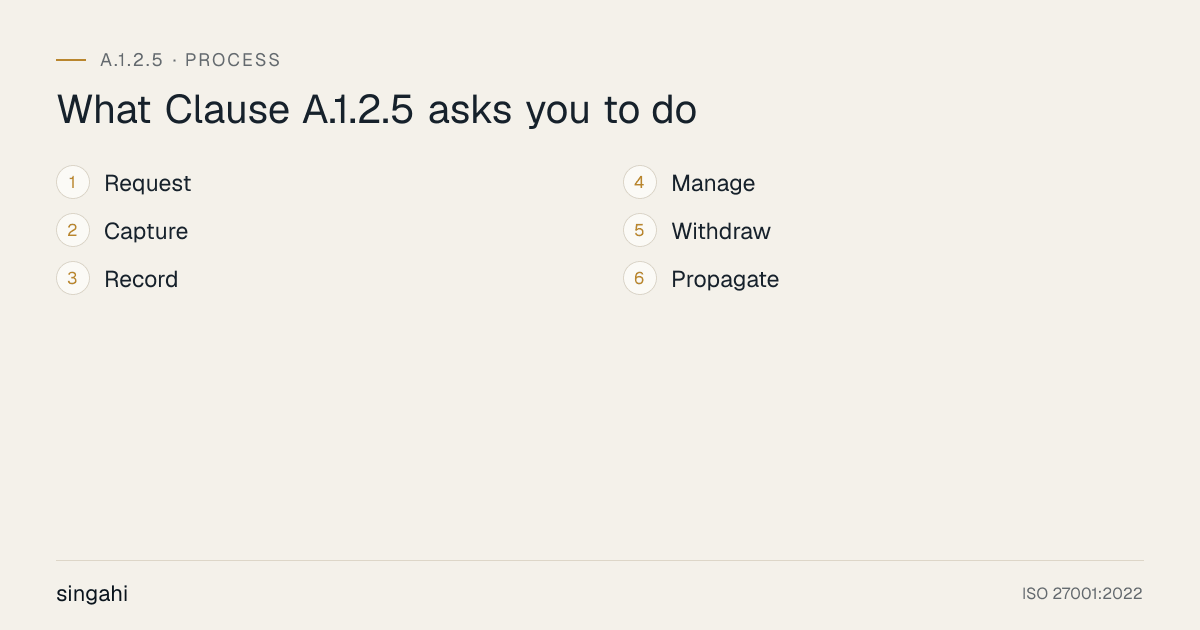
The Singahi six-stage consent lifecycle (toolkit doc 02) operationalises A.1.2.5. Every conformant controller runs these six stages; some add a seventh (consent-ledger integrity review) as a separate cadence. The six stages below are the load-bearing minimum.
Stage 1, Request (when to ask, and what for)
The request stage is the A.1.2.4 design decision operationalised. Before the controller asks for consent, three questions must be answered.
Is consent the right lawful basis? A.1.2.3 governs this. The controller must satisfy itself that consent is the appropriate basis under DPDP section 6 (vs. a section 7 legitimate use) or under GDPR Article 6(1)(a) (vs. Article 6(1)(b) to (f)). Consent is the wrong basis in employment contexts (not "free" under section 6), in performance-of-contract contexts (where the section 7 / Article 6(1)(b) basis is cleaner), and in statutory-obligation contexts. Defaulting to consent because it feels safer is a common anti-pattern; the controller ends up capturing consent that is not valid and that does not withstand regulatory scrutiny.
What is the purpose? A.1.2.2 governs this. The purpose must be identified, documented and specific. "Marketing" is too vague; "marketing of financial products to existing customers" is better; "marketing of credit-card products to existing savings-account customers who have opted in to marketing" is best. The purpose identifier in the consent record references the controller's purpose register.
What is the granularity? The design choice that delivers the "specific" quality. The recommended default is per-purpose granularity, separate consents for marketing, product analytics, third-party sharing, profiling, cross-border transfer. The anti-pattern is bundled consent (one signal for multiple purposes).
The request stage also determines when to ask, at onboarding, at first transaction, at marketing-signup, before a new purpose. Asking for everything at onboarding (the "wall of consents") is a known friction-creator and tends to produce low-quality consents; progressive capture (ask for what you need when you need it) typically produces better-quality signals.
Stage 2, Capture (how to ask, and how to capture the signal)
The capture stage is where the seven DPDP consent qualities are produced or lost. The capture surface must be designed so that:
- The principal sees the notice (DPDP section 5; GDPR Articles 12 to 14) before or with the consent request, not after, not in a linked document the principal is unlikely to open.
- The notice is in a language the principal understands. DPDP Rules prescribe the languages for the notice; multi-lingual surfaces must detect the principal's preferred language (browser, app locale, geolocation) and render accordingly. The language is recorded in the consent record.
- The consent request is specific, per-purpose granularity, not a single bundled ask.
- The consent request is unconditional, not the precondition for a service the principal did not ask for.
- The signal the principal gives is unambiguous and a clear affirmative action, an unticked box the principal ticks; an "I agree" button the principal taps; a wet signature on a paper form. Pre-ticked boxes, cookie-walls, "continue browsing to consent", and "we will assume you agree unless you opt out" all fail.
- The withdrawal route is visible at capture time, "you can withdraw this consent at any time in your account settings", so the principal is informed of the as-easy-to-withdraw quality at the moment of capture.
The capture surface must also produce the structured record at capture time, not reconstruct it later. The recommended implementation is a server-side capture handler that, on submission of the consent form, writes the structured record (the eleven fields) to the consent ledger, returns the record identifier to the surface, and provides the principal with a confirmation receipt (email, in-app notification) that includes the record identifier, the purpose(s), the notice version, and the withdrawal route.
Anti-patterns at capture (detailed in Section 13): pre-ticked checkboxes; cookie-walls; bundled consent; consent-fatigue (over-prompting at onboarding); stale notices; hidden withdrawal routes; browse-wrap ("by using this website you agree"); "we will assume you agree unless you opt out"; oral consent without recording. Each fails a specific DPDP section 6 quality and has been the subject of GDPR-era enforcement (Planet49 C-673/17 for pre-ticked; multiple DPA opinions for cookie-walls).
Stage 3, Record (the eleven minimum fields)
The record is built at capture time. The eleven minimum fields (the Singahi Consent Record Schema, toolkit doc 03) are:
- Record identifier, a unique identifier for the consent event (UUID recommended). Used by the principal's confirmation receipt, by the rights-request workflow (when the principal asks for their record), and by the auditor's walk-through.
- Principal identifier, the pseudonymous or tokenised key that links the consent to the principal without exposing the principal's identifier in the ledger itself. Where the controller uses hashed email addresses as the principal identifier (a common pattern), the hash function and salt are documented; the controller can re-derive the link on demand but the ledger does not contain raw identifiers.
- Purpose(s), one or more purpose identifiers from the controller's purpose register (A.1.2.2). Each purpose carries its own consent state where the controller runs granular consent.
- Lawful basis, for DPDP, "consent under section 6"; for GDPR, "Article 6(1)(a) consent" (or "Article 9(2)(a) explicit consent" for special categories). The basis is recorded so the controller can demonstrate, years later, the basis claimed.
- Notice version, the versioned identifier of the privacy notice / consent notice shown to the principal. Plus a cryptographic hash of the notice text. The hash lets the controller prove, after the notice has been updated, what text was shown.
- Notice language, the language the principal was reading. Multi-lingual surfaces must record which language the principal saw; the controller's notice archive must be able to reproduce the notice in each supported language at each version.
- Capture surface, the form, screen, kiosk, call-centre script, paper form or IoT device through which the consent was captured. Surfaces have different integrity profiles (a paper form has weaker integrity than a signed JWT); the surface identifier carries the integrity classification.
- Timestamp, the date and time of the consent, in UTC, synchronised to a recognised time source. CERT-In Directions of 28 April 2022 require ICT systems to sync to the NIC NTP server; consent-ledger timestamps should follow the same source for India-based surfaces. The timestamp includes timezone and the source identifier.
- Consent scope and granularity, which specific toggles the principal switched on, and which they left off. Represented as a JSON map of purpose identifiers to boolean / tri-state values (granted, refused, not asked).
- Expiry or review date, the date on which the consent is to be reviewed or expires. DPDP does not set a fixed consent expiry; sector rules (RBI digital lending, for example) sometimes do. The controller's policy should set an internal review cadence (typically 24 months for marketing consent; longer for transactional consent that is part of an active customer relationship).
- Consent status, active, withdrawn (with withdrawal date and withdrawal route), expired, superseded. The status is updated through the lifecycle. The status field is the field the processor-propagation API reads.
The Singahi schema also recommends three optional fields: (12) downstream processor trail, the processors and sub-processors to whom the consent-propagation signal was sent when consent was given, and to whom the withdrawal signal was sent when consent was withdrawn; (13) evidence bundle reference, a reference to the evidence bundle (the form submission payload, the call recording, the scanned signed paper form, the JWT) that backs the structured record; (14) integrity seal, a cryptographic seal (HMAC or signature) over the record that lets the controller prove, years later, that the record was not tampered with.
The integrity seal is the load-bearing addition that distinguishes a defensible consent record from a generic database row. The seal is computed at capture time using a key accessible only to the consent-ledger service; any subsequent modification (status update, withdrawal propagation) recomputes the seal. A consent ledger with integrity seals withstands the post-incident integrity question ("could an employee have modified this record?") with a clean technical answer.
Stage 4, Manage (notice-to-record reconciliation, version control, drift detection)
The manage stage is where the consent ledger is kept honest against the operational reality. Three disciplines operate here.
Notice-to-record reconciliation. Each capture surface has a current notice version. Each consent record references a notice version. The reconciliation asks: of the records captured in the last period, do they reference the correct version for the period? If the notice was updated on, say, 1 March 2026, then records captured before 1 March should reference the older version, and records captured after should reference the newer version. The reconciliation surfaces drift, a record captured on 15 March referencing the pre-1 March version is a sign that the surface was not updated when the notice was, or that the version identifier was hardcoded, or that some other integrity gap exists. The reconciliation runs monthly for high-volume surfaces, quarterly for low-volume ones.
Version control of notices. The controller's notice archive retains every version of every notice, in every supported language, with the cryptographic hash. When a principal (or the DPBI, or the auditor) asks "what notice was shown to principal X on date Y?", the controller can reproduce the exact text. The notice archive is itself a controlled-document artefact under Clause 7.5 (Documented Information).
Drift detection. The capture surface's behaviour changes over time, a developer updates the form, a new field is added, the toggle order changes, the notice is reworded. Each change is a planned change under Clause 6.3 and an operational-process change under Clause 8.1. The drift-detection discipline (a quarterly walk-through of each surface, comparing the live rendering to the design specification, the live notice to the archived notice, the live toggle set to the granularity register) catches the canonical A.1.2.5 failure pattern: the capture surface has drifted from the documented design and the records reflect the drift.
Stage 5, Withdraw (the as-easy-to-withdraw test, the propagation)
The withdraw stage is the operational expression of the seventh DPDP consent quality, as easy to withdraw as to give. The withdrawal flow has four sub-steps.
The principal initiates withdrawal. Through the A.1.3.5 mechanism, the in-product consent dashboard, the account-settings page, the unsubscribe link in the email, the "withdraw consent" button in the app. The mechanism must be visible, accessible and one-click (or at most a small number of clicks comparable to the original consent). Anti-patterns: requiring the principal to email the DPO; requiring the principal to fill out a form; requiring the principal to call customer support; hiding the withdrawal button behind friction (the "are you sure?" loop).
The ledger updates. The consent record's status flips to "withdrawn", the withdrawal timestamp is recorded, the withdrawal route is recorded, the integrity seal is recomputed. The ledger must support retrieval of all records for a given principal across all purposes, so that a single "withdraw all" action by the principal propagates to every active consent.
The downstream propagation fires. The withdrawal signal is sent to every downstream processor that received the original consent signal. The propagation API calls each processor's withdrawal endpoint (or sends the message through the agreed channel, webhook, email, SFTP). The processors acknowledge receipt and confirm the withdrawal's effect on their processing. The propagation trail is recorded in the consent record.
The controller verifies the propagation. The controller does not just send the signal; it verifies the processor's response. If a processor does not acknowledge within the contractually committed clock (typically 24 to 72 hours), the controller escalates under the A.1.2.7 contract terms. The escalation log is the evidence the auditor will ask for.
The withdrawal SLA, from principal's click to processor's confirmation, is the canonical A.1.2.5 / A.1.3.5 maturity metric. The recommended targets: 24 hours for marketing processors; 72 hours for analytics processors; immediate (within minutes) for in-house processing.
Stage 6, Propagate (the processor chain)
The propagate stage runs alongside the obtain, manage and withdraw stages, every consent state change (initial grant, withdrawal, expiry) propagates to the downstream processor chain. The propagation discipline covers:
The processor inventory. Every processor that receives personal data under a consent-authorised processing activity is mapped in the controller's processor inventory. The mapping includes the consent signal format the processor expects (one-time grant; ongoing state query; webhook subscription), the propagation endpoint, the authentication credentials, the SLA, the sub-processor chain.
The propagation protocol. Three common patterns:
- One-time grant, the controller sends the consent signal once, at the time of data sharing; the processor does not query thereafter. This pattern is fragile; it does not handle withdrawal well.
- Ongoing state query, the processor queries the controller's consent-state API before each processing action. Strong, but requires the controller to expose a queryable API.
- Webhook subscription, the controller pushes consent-state changes to subscribed processors. The recommended pattern for high-volume controllers; the processor's webhook receives grant, withdraw and expiry events.
The sub-processor chain. The processor must propagate the consent state to its sub-processors. The controller's contract with the processor (A.1.2.7) requires this; the controller's verification (audit, attestation) confirms it. The sub-processor chain is recorded in the consent record's downstream trail.
The propagation SLA. From controller's ledger update to processor's effective withdrawal of processing, the SLA is typically 24 to 72 hours for marketing processors, 72 hours for analytics processors, and 24 hours for any processor that may further disclose the data. The SLA is a contractual term (A.1.2.7) and an operational KPI (Section 12).
The Consent Manager dimension. Under DPDP section 2(1)(g), the Consent Manager is the principal-side intermediary through which consent is given, managed, reviewed and withdrawn. The controller's integration with the Consent Manager ecosystem means that a withdrawal initiated by the principal through the Consent Manager propagates to the controller through the Consent Manager's API, and from the controller to the downstream processor chain. The Consent Manager dimension is unique to DPDP, the controller must design its propagation architecture to accept withdrawal signals from both the in-house mechanism (A.1.3.5) and the Consent Manager ecosystem.
The children's flow (DPDP section 9 / GDPR Article 8)
For any surface that may attract users under eighteen, the consent flow must include the verifiable parental consent overlay, one of the highest-risk A.1.2.5 sub-domains because it requires age-assurance upstream and parental-identity verification at the consent point.
Age assurance, three tiers. (1) Self-declaration (the principal states their age at onboarding, weakest; appropriate only for low-children's-risk services). (2) Probabilistic age estimation (face-age, account-history, device-graph estimation, middle tier; for moderate-risk services). (3) Verified age (government-identity-based, Aadhaar age-band, DigiLocker age assertion, equivalent, strongest; for high-children's-risk services or services with regulatory age-gating). The tier is a risk-treatment decision driven by the service's children's profile.
Verifiable parental consent. Where the principal is a child, the controller must obtain verifiable parental or legitimate-guardian consent before processing. The verification satisfies two requirements: the person giving consent is the parent (parental-identity verification), and the consent meets the seven DPDP section 6 qualities (the parent is the principal for the consent act; the child is the principal for the processing). Common mechanisms: signed consent form matched against a parent account; video-call verification; government-identity-based parental linking (the family-link patterns).
The section 9 prohibitions. Regardless of parental consent, the controller must not practise behavioural monitoring or targeted advertising directed at children, and must not process data likely to cause harm. These prohibitions override parental consent, a parent cannot consent to behavioural monitoring of a child on the controller's platform. The Indian construct parallels the US COPPA enforcement pattern and the UK Age-Appropriate Design Code.
The GDPR Article 8 overlay. For EU principals, Article 8 sets the age of consent for information-society services at sixteen (member states may lower to thirteen). Below the applicable age, parental consent is required; the standard is "reasonable efforts to verify", contextual to available technology.
The canonical audit-failure patterns: skipping age-assurance and processing all principals as adults (fails section 9); self-declaration only for a high-children's-risk service (insufficient); verifiable parental consent captured but behavioural monitoring of children continues in production (the section 9 prohibition is not overridden by parental consent).
The Consent Manager integration (DPDP section 2(1)(g))
The Consent Manager, the Indian construct with no direct GDPR analogue, is a registered, principal-side, interoperable, revocable intermediary through which a Data Principal gives, manages, reviews and withdraws consent across multiple Data Fiduciaries. As the DPDP Rules' commencement phases the ecosystem in through 2026 and 2027, the controller's A.1.2.5 architecture must accommodate it.
The controller exposes a Consent Manager API that: accepts consent and withdrawal signals from registered Consent Managers on behalf of a principal; provides the principal's current consent state on query; honours the Consent Manager's interoperability format (so the principal can move between Consent Managers, consent state is portable). The controller verifies the Consent Manager's DPBI registration before accepting signals (one-time onboarding plus periodic re-verification). Until the ecosystem is live, the controller operates an in-house consent dashboard (the A.1.3.5 mechanism) that meets the as-easy-to-withdraw test and is designed to be retrofitted as a Consent Manager endpoint, controllers that build a fragile in-house mechanism and plan to "add Consent Manager later" typically face a costly rebuild. Where consent arrives through both in-house and Consent Manager routes, the ledger records the source (the dual-record pattern), the evidence that the controller honours both paths.
The integrity controls and the consent-ledger compromise drill
The consent ledger is a regulated artefact; its integrity is governed by Annex A.3 controls: A.3.14 (protection against destruction or falsification, tamper-evidence, integrity seals, append-only modifications); A.3.9 (least-privilege access, DPO and the ledger service write, downstream functions read slices, principal access mediated through A.1.3.7 / A.1.3.5); A.3.23 (strong authentication, multi-factor for administrative access); A.3.25 (logging of every read and write, with tamper-evident logs retained on the ledger's schedule); A.3.26 (cryptography, encryption at rest, notice-text hash, integrity seal, TLS in transit); A.3.24 (backup with annual restoration test); A.3.21 (secure disposal at end of retention with disposal logged).
The consent-ledger compromise drill (toolkit doc 08) is the canonical A.1.2.5 maturity test for the integrity dimension. The drill simulates an unauthorised access to or exfiltration of the ledger and walks through detection (MTTD target in hours), containment (revoke, isolate, restore), assessment (what data, how many principals, what categories), notification (the dual-clock pattern, CERT-In six hours under Directions of 28 April 2022; DPDP without delay plus a seventy-two-hour detailed report under section 8(6) + Rules 2025 Rule 7; sector-regulator clocks where applicable, RBI six hours, SEBI 6 hours, IRDAI 24 to 72 hours), principal notification (without undue delay, plain language) and post-incident review (root cause, corrective action under Clause 10.2, improvement under Clause 10.1). Cadence: annually for growing companies; semi-annually for mid-sized and enterprise; semi-annually plus tabletops between for SDFs.
Tools, Technologies, and Solutions
The tool landscape
A.1.2.5 is operationally supported by three classes of tool. The choice of tool is a risk-treatment decision (Section 10), not a one-size-fits-all prescription.
Consent management platforms (CMPs). Software products that render the consent surface, capture the consent signal, store the record, manage the lifecycle, and propagate to downstream systems. CMPs vary in their target use case, some are optimised for cookie-banner / tracking-technology consent (the EU ePrivacy / GDPR interplay); others for app-onboarding consent (mobile-first, multi-language, with consent-dashboard UX); others for enterprise multi-jurisdiction consent (DPDP plus GDPR plus US-state plus sector); others for the Indian Consent Manager ecosystem (the emerging DPDP-native class). Generic category terms, "consent management platform", "enterprise privacy platform", "tag manager with consent layer", are the right vocabulary; this guide does not name vendors.
Customer data platforms (CDPs) and marketing-automation platforms. These platforms often hold the operational marketing-consent state, because they hold the marketing-audience roster. The controller's A.1.2.5 architecture must decide whether the CDP is the system of record for marketing consent (and the consent-ledger is a roll-up) or whether the consent-ledger is authoritative and the CDP is a downstream consumer. The recommended pattern is the latter, the consent-ledger is the system of record; the CDP queries the ledger.
In-house consent-ledger implementations. For controllers with bespoke needs (high-volume surfaces, unique integrity requirements, idiosyncratic processor chains), a custom-built consent ledger is appropriate. The recommended pattern is an append-only store (PostgreSQL with append-only tables, DynamoDB with stream-based audit, an event-sourced design, or a blockchain-anchored ledger for high-integrity use cases) with a service layer that handles the eleven-field schema, the integrity seal, the propagation API, and the Consent Manager endpoint.
The build-vs-buy decision
The build-vs-buy decision turns on four factors.
Volume and surface diversity. High-volume controllers with diverse surfaces (web, app, kiosk, call-centre, paper, partner-supplied) typically need either a top-tier enterprise CMP or an in-house build; lower-volume controllers with a small number of surfaces can run effectively on a mid-tier SaaS CMP.
Integrity requirements. Where the controller's risk profile demands tamper-evidence, integrity seals, and cryptographic protection (BFSI, healthcare, SDFs), the build pattern or the top-tier enterprise CMP is appropriate. Where the risk profile is lower (small B2B lead-gen, for example), a mid-tier SaaS CMP without cryptographic integrity is sufficient if the schema, the version control, and the reconciliation discipline are documented.
Multi-jurisdiction complexity. Where the controller processes personal data across DPDP, GDPR, US-state and sector regimes, the multi-jurisdiction configuration overhead favours an enterprise CMP. Single-jurisdiction controllers can run effectively on a simpler tool.
Consent Manager integration. As the Indian Consent Manager ecosystem goes live, the controller's tool must support the Consent Manager API. Building this in-house is feasible for engineering-led controllers; buying a Consent-Manager-ready CMP is the alternative. The decision should account for the cost of retrofitting a Consent Manager integration onto a tool that was not designed for it.
The tag-manager and cookie-banner layer
For cookie-banner / tracking-technology consent specifically, the consent banner is typically integrated with the tag manager (Google Tag Manager, Tealium-style, or an in-house tag manager) so that the consent state controls which tags fire. The IAB TCF (Transparency and Consent Framework) is the EU-industry standard; the Indian equivalent has not yet emerged as of mid-2026 but is expected to follow a similar pattern under the Consent Manager umbrella.
The integration of the cookie banner with the consent ledger is the load-bearing technical detail. The banner must, on each consent action (grant, withdraw, modify), write to the consent ledger through the same capture handler used by other surfaces. The common failure pattern is the cookie banner running on a separate consent store that does not reconcile with the system-of-record ledger; the controller ends up with two consent realities.
The age-assurance and parental-consent tooling
For the children's flow (DPDP section 9; GDPR Article 8), specialised tooling exists for:
- Age estimation, face-age estimation APIs, account-history-based estimation, device-graph-based estimation. Generic category: "age-assurance service".
- Parental-identity verification, government-identity-based parental-linking (the Google / Apple family-link patterns), school-credential-based verification, signed-consent-form services.
- Family-link account architectures, the in-product pattern where a parent account manages child accounts.
The choice of age-assurance tier is a risk-treatment decision driven by the service's children's risk profile. A general-audience service with low children's risk can rely on self-declaration; a service with high children's risk (social, gaming, content with potential minor-attractiveness) should use probabilistic age estimation as a minimum; a service with regulatory age-gating (gambling, alcohol, certain content) should use verified age.
The Consent Manager ecosystem readiness
The Consent Manager ecosystem under DPDP section 2(1)(g) is emerging. As of mid-2026, the Rules have been notified (13 November 2025) and the Consent Manager registration conditions are in the Rules; the first registered Consent Managers are expected through 2026 and 2027. A controller building or buying a consent tool today should confirm that the tool supports:
- A documented API for accepting consent signals from external Consent Managers.
- A documented API for accepting withdrawal signals from external Consent Managers.
- A documented API for providing consent state to external Consent Managers on query.
- A documented data-portability format (the principal's right to move between Consent Managers).
- A registration-verification mechanism for Consent Manager onboarding.
Controllers that select tools without these capabilities will face a costly retrofit or replacement as the ecosystem goes live.
Policy and Procedure Templates
The Singahi toolkit (Section 19) ships ready-to-customize templates for the A.1.2.5 artefact set. The eight core artefacts are:
The Consent Management Policy (toolkit doc 01)
The policy commits the controller to the consent discipline. The load-bearing clauses (the controller's own "shall" clauses, drafted by Singahi, not the standard's text):
- The controller shall capture consent through documented capture surfaces that meet the seven DPDP section 6 consent qualities (free, specific, informed, unconditional, unambiguous, clear affirmative action, as-easy-to-withdraw) and, where EU personal data is processed, the GDPR Article 4(11) and Article 7 conditions.
- The controller shall not use pre-ticked checkboxes, cookie-walls, bundled consents, browse-wrap consents, or "we'll assume you agree" patterns on any capture surface.
- The controller shall build a consent record at capture time using the eleven-field Consent Record Schema (Section 7.3).
- The controller shall protect the integrity of the consent ledger through the Annex A.3 controls (A.3.14 protection against destruction or falsification; A.3.9 access rights; A.3.23 secure authentication; A.3.25 logging; A.3.26 cryptography; A.3.24 backup; A.3.21 secure disposal).
- The controller shall provide a withdrawal mechanism that meets the as-easy-to-withdraw test (one click or a small number of clicks comparable to the original consent; no friction designed in).
- The controller shall propagate consent state changes (grant, withdrawal, expiry) to downstream processors within the contractually committed SLA (24 to 72 hours for marketing processors; 72 hours for analytics processors; 24 hours for processors that may further disclose).
- The controller shall verify the propagation by requiring downstream processors to acknowledge receipt and confirm the effect of the state change.
- The controller shall apply the verifiable parental consent overlay under DPDP section 9 (and GDPR Article 8) for any surface that may attract users under eighteen, including the section 9 prohibition on behavioural monitoring and targeted advertising directed at children.
- The controller shall integrate with registered Consent Managers under DPDP section 2(1)(g) as the ecosystem goes live, supporting interoperability, revocability, and portability of consent state.
- The controller shall run the consent-ledger compromise drill at least annually, with tabletop exercises between, tracing the dual-clock notification pattern (CERT-In six hours; DPDP without delay plus a seventy-two-hour detailed report; sector-regulator clocks where applicable).
The Consent Lifecycle Procedure (toolkit doc 02)
The procedure operationalises the policy through the six-stage lifecycle (Section 7). Each stage has documented acceptance criteria, an owner, a control mechanism, a KPI and a cadence.
The Consent Record Schema (toolkit doc 03)
The schema formalises the eleven minimum fields (Section 7.3) and the three optional fields. The schema is published as a JSON schema, a relational data model, and a documentation template for paper-form capture (where the schema fields are completed by the call-centre agent or the form-processor).
The Consent Notice Content Checklist (toolkit doc 03, Part B)
The checklist ties every record field to the notice element that produced it. The notice content is governed by DPDP section 5, DPDP Rules 2025 (the consent notice content and language requirements), GDPR Articles 12 to 14 (transparency and notice), and the sector rules where applicable. The checklist covers: the identity and contact of the controller; the purposes of processing; the categories of personal data; the recipients or categories of recipients; the cross-border transfers (with destination); the retention period; the principal's rights (access, correction, erasure, grievance, nomination); the right to withdraw consent and the consequence of withdrawal; the existence of automated decision-making (where applicable); the Consent Manager integration (where applicable); and the grievance officer's contact.
The Children's Verifiable Parental Consent Procedure (toolkit doc 05)
The procedure covers age-assurance (three tiers), parental-identity verification, the consent-capture flow with the parent as principal for the consent act and the child as principal for the processing, the section 9 prohibition on behavioural monitoring and targeted advertising, and the audit-evidence requirements.
The Consent Manager Integration Specification (toolkit doc 10)
The specification covers the API surface (accept grant, accept withdrawal, query state, portability), the Consent Manager registration verification, the dual-record pattern (in-house vs Consent Manager), and the interoperability requirements.
The Consent Withdrawal Workflow (toolkit doc 02, Part B)
The workflow covers the four sub-steps (Section 7.5): principal initiates, ledger updates, downstream propagation fires, controller verifies. The workflow includes the escalation path when a processor does not acknowledge within the SLA.
The Consent Incident Response Playbook (toolkit doc 08)
The playbook covers the consent-ledger compromise drill (Section 7.10), detection, containment, assessment, notification (dual-clock), principal notification, post-incident review. The playbook is wired into the wider Clause 8.1 / A.3 incident-response discipline.
Consent Risk Assessment and Treatment
The risk register entries that touch A.1.2.5
Consent-specific risks in the controller's privacy risk register typically include:
| ID | Risk | Likelihood | Impact | Treatment |
|---|---|---|---|---|
| CON-01 | Capture surface fails the seven-quality test (pre-ticked, bundled, cookie-wall) | Medium | High (penalty exposure; certification nonconformity) | Quarterly capture-surface audit; anti-pattern library; design review before deployment |
| CON-02 | Consent record missing required fields | High (initially) | Medium | Schema enforcement at capture-handler level; quarterly completeness audit |
| CON-03 | Notice version not reconciled with consent records | Medium | High (cannot reproduce notice shown to a principal) | Monthly notice-to-record reconciliation; notice archive with cryptographic hashes |
| CON-04 | Withdrawal mechanism not as-easy-to-withdraw | High | High (fails DPDP section 6; A.1.3.5 nonconformity) | Quarterly UX audit; one-click-withdrawal design pattern |
| CON-05 | Withdrawal not propagated to downstream processors | Medium | High (continued processing without lawful basis) | Propagation SLA monitoring; processor acknowledgement required; escalation path |
| CON-06 | Children's flow not implemented | Medium (for surfaces likely to attract children) | Very high (DPDP section 9 penalty up to INR 200 crore) | Age-assurance implementation; verifiable parental consent; section 9 prohibitions enforced |
| CON-07 | Consent Manager integration not planned | High (as ecosystem goes live) | Medium (competitive; later regulatory) | Integration roadmap; Consent-Manager-ready tool selection |
| CON-08 | Consent ledger compromised (breach) | Low | Very high (DPDP section 8(6) penalty; CERT-In; sector clocks) | Integrity controls (A.3.14, A.3.25, A.3.26); annual compromise drill; dual-clock notification playbook |
| CON-09 | Capture surface drift from documented design | High | Medium | Quarterly walk-through; drift detection wired to Clause 9.1 |
| CON-10 | Partner-supplied lead data with invalid consent | Medium | High (joint-controller analysis; A.1.2.8) | Partner-data intake validation; partner consent-record standard in the data-sharing agreement |
| CON-11 | Cookie banner on separate consent store | Medium | Medium (dual-reality) | Integrate banner to system-of-record ledger; tag-manager integration |
| CON-12 | Oral consent (call-centre) not recorded | Medium | High (cannot evidence) | Recording with retention; structured-field capture alongside recording |
| CON-13 | Stale consent beyond retention period | Medium | Medium (processing without current lawful basis) | Consent-expiry review; re-consent flow at expiry |
| CON-14 | Special-category consent without explicit-consent overlay | Low (where applicable) | High (GDPR Article 9; DPDP sensitivity) | Explicit-consent capture pattern for special categories |
| CON-15 | Cross-border transfer without consent authorisation | Medium | High (A.1.5.2; section 16 negative list) | Cross-border-purpose identifier in the consent record; transfer screen before export |
The DPIA trigger analysis for consent-based processing
A.1.2.6 (privacy impact assessment) and DPDP section 10 (SDF DPIA) trigger DPIAs for several consent-based processing patterns:
- Large-scale consent-based processing (typically tens of thousands of principals or more)
- Consent-based processing of children's data (always, section 9)
- Consent-based processing of special-category data (health, biometric, genetic, sex life, sexual orientation, caste, tribe, political opinion, religious belief)
- Consent-based profiling with legal or similarly significant effects (credit decisions, employment decisions, insurance decisions)
- Consent-based cross-border transfer to non-equivalent jurisdictions
- Consent-based processing by emerging technologies (AI inference, large-language-model personalisation, biometric continuous authentication)
The DPIA's recommendations feed back into the A.1.2.4 design and the A.1.2.5 operation. The DPIA is reviewed when the consent architecture changes materially (new purpose, new processor, new surface, new technology).
The risk-treatment decision points
For each consent-related risk, the treatment decision takes one of four paths:
- Modify, change the design (the surface, the notice, the granularity, the withdrawal route) to reduce the likelihood or impact.
- Avoid, do not process on the basis that creates the risk (decline the new purpose; do not deploy the new processor; do not launch the children's service without the parental-consent overlay).
- Share, transfer the risk to a third party (the Consent Manager; the processor under indemnity; an insurer under a cyber-insurance policy).
- Accept, accept the residual risk with documented sign-off (typically a top-management decision under Clause 6.1.3 / 6.1.4).
The risk-treatment decisions are recorded in the privacy risk treatment plan (Clause 8.3) and reflected in the Statement of Applicability (the A.3 controls selected to mitigate the consent risks).
Audit and Compliance Checklist
The following 28 questions cover the certification auditor's typical A.1.2.5 examination. For each, the expected evidence and the red flag are noted.
-
Is there a Consent Management Policy? Expected: a dated, version-controlled policy signed off by the DPO and top management, covering the seven DPDP qualities, the eleven-field schema, the integrity controls, the withdrawal mechanism, the propagation discipline, the children's flow, the Consent Manager plan. Red flag: no policy; or policy exists but is generic (no India-specific content; no children's flow; no Consent Manager).
-
Is there a documented Consent Lifecycle Procedure? Expected: a procedure covering the six stages (request, capture, record, manage, withdraw, propagate) with acceptance criteria, owners, KPIs and cadence for each. Red flag: no procedure; or procedure exists but does not cover all six stages.
-
Is there a Consent Surface Inventory? Expected: a current inventory listing every surface with the lawful basis, the purpose(s), the notice version, the language set, the granularity, the withdrawal route, the record's location. Red flag: no inventory; or inventory is shorter than reality.
-
Does each capture surface meet the seven DPDP consent qualities? Expected: a quarterly capture-surface audit; an anti-pattern library; design review before deployment. Red flag: pre-ticked boxes, cookie-walls, bundled consents in production.
-
Is the Consent Record Schema documented and enforced? Expected: the schema (eleven minimum fields); schema enforcement at the capture-handler level; quarterly completeness audit. Red flag: records missing required fields; capture handler does not enforce the schema.
-
Is the consent ledger tamper-evident? Expected: integrity seals on each record; append-only event log for modifications; access controls; logging; backup. Red flag: no integrity seals; ledger can be edited without audit trail.
-
Are consent-record timestamps synchronised to a recognised time source? Expected: NTP synchronisation (NIC NTP for India-based surfaces); timestamp source recorded. Red flag: timestamps from unverified sources; timezone handling inconsistent.
-
Is the notice archive version-controlled? Expected: every version of every notice, in every supported language, with cryptographic hashes; retention per the document-control schedule. Red flag: only the current notice retained; no version history.
-
Does the notice-to-record reconciliation run on cadence? Expected: monthly for high-volume surfaces; quarterly for low-volume; reconciliation results documented; deviations escalated. Red flag: no reconciliation; or reconciliation exists but deviations are not escalated.
-
Is the withdrawal mechanism as-easy-to-withdraw? Expected: one-click (or comparably few clicks) withdrawal in the same surface where consent was given; no friction designed in. Red flag: "email the DPO to withdraw"; multi-step withdrawal with friction; withdrawal buried in account settings.
-
Does the withdrawal propagate to downstream processors? Expected: propagation API; processor acknowledgement; SLA monitoring; escalation path. Red flag: no propagation; or propagation exists but no acknowledgement or SLA monitoring.
-
Is the propagation SLA documented and met? Expected: 24 to 72 hours for marketing processors; 72 hours for analytics; 24 hours for processors that may further disclose; SLA-attainment KPI reported. Red flag: no SLA; or SLA exists but not monitored.
-
Is the children's flow implemented? Expected: age-assurance upstream; verifiable parental consent; section 9 prohibition on behavioural monitoring and targeted advertising. Red flag: no age-assurance; self-declaration only for high-children's-risk services; behavioural monitoring of children in production.
-
Is the Consent Manager integration planned? Expected: integration roadmap; Consent-Manager-ready tool selection; API design. Red flag: no plan; tool selection without Consent Manager capability.
-
Is the consent-ledger compromise drill run on cadence? Expected: annually for growing companies; semi-annually for mid-sized and enterprise; tabletop exercises between. Red flag: no drill; or drill exists but does not trace the dual-clock notification pattern.
-
Are the integrity controls operating? Expected: A.3.14, A.3.9, A.3.23, A.3.25, A.3.26, A.3.24, A.3.21 operating; control evidence available. Red flag: any of these controls not operating on the consent ledger.
-
Is the consent-ledger access least-privilege? Expected: documented access roles; quarterly access review; revocation on role change. Red flag: broad write access; no access review.
-
Is there a partner-data intake validation for consent quality? Expected: data-sharing agreement requiring partner consent-records to meet the controller's standard; validation on intake. Red flag: partner data accepted without consent validation.
-
Is the cookie banner integrated with the system-of-record ledger? Expected: single consent store; banner writes to the ledger through the capture handler; tag-manager integration honours the ledger state. Red flag: separate consent store for the banner; dual reality.
-
Are oral consents (call-centre) recorded with structured fields? Expected: call recording with retention; structured-field capture alongside the recording; consent record references the recording. Red flag: no recording; or recording without structured fields.
-
Is the consent-expiry review running? Expected: review at the consent's expiry or review date; re-consent flow where appropriate. Red flag: consents active beyond the retention period without review.
-
Is explicit consent captured for special categories (where applicable)? Expected: explicit-consent capture pattern for health, biometric, genetic, sex life, caste, tribe, political opinion, religious belief. Red flag: general consent used for special categories.
-
Is cross-border transfer authorised by the consent record? Expected: cross-border-purpose identifier in the consent record; transfer screen before export; transfer impact assessment (post-Schrems II) for non-equivalent destinations. Red flag: cross-border transfer without consent authorisation.
-
Are consent KPIs reported to the management review? Expected: KPIs (Section 12) reported at the Clause 9.3 management review; trends analysed; improvement actions taken. Red flag: no KPIs; or KPIs exist but not reported.
-
Are consent-related complaints and grievances logged? Expected: grievance-redressal mechanism (DPDP section 13); response within the prescribed period; log of complaints and resolutions. Red flag: no grievance mechanism; grievances not logged.
-
Is the consent-ledger retention documented and enforced? Expected: retention schedule; secure disposal at end of retention; disposal logged. Red flag: no retention schedule; ledger retained indefinitely or disposed without log.
-
Is the consent-ledger restoration tested? Expected: at-least-annual restoration from backup; restoration time and integrity verified. Red flag: no restoration test; or test exists but restoration time or integrity is unacceptable.
-
Is the consent-ledger compromise notification the Rule 7 intimation content pre-staged? Expected: pre-staged DPDP Rules 2025 the Rule 7 intimation content; pre-staged CERT-In format; pre-staged sector-regulator formats where applicable; portal credentials tested. Red flag: no pre-staged content; portal credentials untested.
Metrics and KPIs
Figure · Measures
The measures that show Clause A.1.2.5 is working
- Consent-surface audit pass rate100% on the c…Periodic
- Consent-record schema completeness99%+ within t…Periodic
- Notice-to-record reconciliation rate99%+Periodic
- Anti-pattern detection countzeroPeriodic
- Withdrawal-propagation latency24 hours medi…Periodic
The Singahi A.1.2.5 KPI set (toolkit doc 11) covers process quality, lifecycle performance, integrity and regulatory responsiveness. The fifteen KPIs below are the recommended minimum.
Process-quality KPIs
-
Consent-surface audit pass rate, the percentage of capture surfaces that pass the quarterly seven-quality audit. Target: 100% on the closed audit; trend over time.
- Formula: (surfaces passing / surfaces audited) × 100
- Frequency: quarterly
- Owner: DPO / Privacy Lead
-
Consent-record schema completeness, the percentage of consent records captured in the period that have all eleven required fields populated. Target: 99%+ within the first quarter of implementation; 100% steady-state.
- Formula: (records with all eleven fields / records captured) × 100
- Frequency: monthly
- Owner: Engineering Lead
-
Notice-to-record reconciliation rate, the percentage of records captured in the period that reference the correct notice version. Target: 99%+.
- Formula: (records with correct notice version / records captured) × 100
- Frequency: monthly (high-volume surfaces); quarterly (low-volume)
- Owner: DPO / Privacy Lead
-
Anti-pattern detection count, the count of pre-ticked boxes, cookie-walls, bundled consents, or other anti-patterns detected in the quarterly capture-surface audit. Target: zero; trend downward from baseline.
- Frequency: quarterly
- Owner: DPO / Privacy Lead
Lifecycle-performance KPIs
-
Active-consent count by purpose, the count of active consents by purpose (marketing, product analytics, third-party sharing, profiling, cross-border). Trend over time; anomaly detection on sharp increases (a sudden jump in marketing consents may indicate a capture-surface change that should be reviewed).
- Frequency: monthly
- Owner: DPO / Privacy Lead
-
Withdrawal count and rate, the count of withdrawals in the period and the rate (withdrawals per thousand active consents). High rate is not necessarily bad (it indicates the withdrawal mechanism works); rapid change in either direction warrants investigation.
- Frequency: monthly
- Owner: DPO / Privacy Lead
-
Withdrawal-propagation latency (median and 95th percentile), the time from principal's withdrawal click to processor's acknowledgement, by processor. Target: 24 hours median for marketing processors; 72 hours for analytics; 24 hours for processors that may further disclose.
- Formula: time(acknowledgement) - time(principal click)
- Frequency: monthly
- Owner: Engineering Lead
-
Withdrawal-SLA attainment, the percentage of withdrawals propagated within the SLA. Target: 99%+.
- Formula: (withdrawals propagated within SLA / total withdrawals) × 100
- Frequency: monthly
- Owner: Engineering Lead
-
Expired-consent re-consent rate, the percentage of expired consents that are re-consented at expiry (vs. allowed to lapse). Useful for assessing the genuine value the principal places on the service relationship.
- Frequency: monthly
- Owner: Product Owner
Integrity KPIs
-
Consent-ledger access-review completion, the percentage of ledger access roles reviewed in the period. Target: 100% quarterly.
- Frequency: quarterly
- Owner: DPO / Privacy Lead
-
Consent-ledger anomaly count, the count of detected anomalies in the ledger (integrity-seal mismatches, unexpected modifications, access anomalies). Target: zero; each anomaly investigated under Clause 10.2.
- Frequency: monthly
- Owner: Engineering Lead
-
Consent-ledger compromise drill score, the score on the most recent drill (detection time, containment time, notification completeness against the dual-clock pattern). Trend over time.
- Frequency: annually or semi-annually
- Owner: DPO / Privacy Lead
Regulatory-responsiveness KPIs
-
Grievance-response time, the median time to respond to consent-related grievances (within the DPDP Rules' prescribed period). Target: 100% within the prescribed period.
- Frequency: monthly
- Owner: Grievance Officer
-
Rights-request SLA attainment (consent-record access), the percentage of access requests for consent records served within the SLA. Target: 100% within the DPDP / GDPR period.
- Frequency: monthly
- Owner: Grievance Officer
-
Breach-notification drill clock adherence, the percentage of drills where the CERT-In six-hour clock and the DPDP breach clock (intimation without delay; seventy-two-hour report) were both met. Target: 100%.
- Frequency: annually or semi-annually
- Owner: DPO / Privacy Lead
Common Pitfalls and Audit Failures
The most common A.1.2.5 audit findings in the Indian growing-company segment, in rough descending order of frequency.
The "consent policy but no consent ledger" gap
The controller has a privacy policy that mentions consent and a Consent Management Policy that commits to the seven DPDP qualities, but no actual consent ledger in operations. Consent state lives in the email-marketing tool, the CRM, the app database, the call-centre recording system and the cookie banner, five different stores, none of them authoritative, none of them reconciling with the others. The auditor's first walk-through surfaces this gap immediately. The remediation is to build (or buy) a single consent-ledger service and integrate the surfaces to it.
The pre-ticked checkbox in production
The most-audited anti-pattern globally. A capture surface ships with a pre-ticked checkbox for marketing consent, or for tracking-technology consent, or for third-party sharing. The principal's "consent" is recorded when they submit the form without un-ticking the box. Fails DPDP section 6 "clear affirmative action" and the CJEU Planet49 (C-673/17) standard under GDPR. Remediation: replace with an unticked box that the principal must positively tick.
The cookie-wall
The "accept all cookies or close the website" pattern. Fails DPDP section 6 "free" and is the subject of multiple DPA opinions under GDPR. Remediation: provide a "reject all" option of equal prominence with "accept all"; do not condition access on consent.
The bundled consent
A single "I agree to all" button that grants consent for marketing, analytics, third-party sharing and profiling in one click. Fails DPDP section 6 "specific". Remediation: granular per-purpose toggles.
The notice shown but not version-recorded
The capture surface renders the notice, but the consent record does not store the notice version (or stores it as a free-text label that drifts). When the notice is updated six months later, the controller cannot reproduce the notice shown to a specific principal. Fails the integrity dimension. Remediation: store the notice version identifier and the cryptographic hash in the record; archive every notice version.
The notice-language gap
The capture surface is rendered in English for all principals; principals in Tamil, Hindi, Kannada, Bengali and the other major Indian languages do not get the notice in a language they understand. Fails DPDP section 6 "informed" and the DPDP Rules' language requirements. Remediation: multi-lingual surface with locale detection; notice archive in each supported language.
The "email the DPO to withdraw" anti-pattern
The withdrawal route is to email a DPO inbox that is monitored irregularly. Fails DPDP section 6 "as easy to withdraw as to give" and A.1.3.5. Remediation: one-click withdrawal in the consent dashboard or the email footer (the unsubscribe link pattern, applied to all consent categories).
The withdrawal that does not propagate
The withdrawal updates the controller's ledger but does not propagate to the downstream marketing processor, analytics processor and ad-tech processor. The principal keeps receiving marketing emails and seeing targeted ads. Fails A.1.2.5 propagation. Remediation: propagation API with processor acknowledgement; SLA monitoring.
The children's flow missing
The service is likely to attract users under eighteen (social, gaming, content with minor appeal), but no age-assurance and no verifiable parental consent are in place. Fails DPDP section 9; A.1.2.5 major nonconformity. Remediation: implement age-assurance; verifiable parental consent; section 9 prohibitions.
The children's flow with behavioural monitoring
Even where verifiable parental consent is captured, the controller continues to practise behavioural monitoring or targeted advertising directed at children. Fails DPDP section 9 (the prohibition overrides parental consent). Remediation: switch off behavioural monitoring and targeted advertising for principals determined to be children.
The Consent Manager blind spot
The controller has not planned for Consent Manager integration. As the ecosystem goes live, the controller faces a costly retrofit. Remediation: build or buy Consent-Manager-ready tools; design the API surface for Consent Manager integration.
The cookie banner on a separate consent store
The cookie banner runs on its own consent store that does not reconcile with the system-of-record ledger. The controller has two consent realities. Remediation: integrate the banner with the system-of-record ledger through the same capture handler.
The oral consent not recorded
The call-centre captures oral consent (per the script) but does not record the call or capture the structured fields. The controller cannot evidence the consent. Remediation: record the call with retention; capture structured fields alongside the recording; reference the recording from the consent record.
The stale consent beyond retention
The controller's policy sets a consent review period (say, 24 months for marketing) but the operation does not enforce the expiry. Consents remain active beyond the period without re-consent. Fails the controller's own policy; processing beyond the consent's effective term is without lawful basis. Remediation: consent-expiry review on cadence; re-consent flow at expiry.
The partner-supplied lead with invalid consent
A partner supplies leads with consent that does not meet the controller's standard (the partner's notice was different; the partner's granularity was bundled; the partner's withdrawal mechanism was not honoured). The controller processes on the basis of invalid consent. Fails A.1.2.8 (joint-controller analysis) and A.1.2.5. Remediation: partner-data intake validation; data-sharing agreement specifying the consent-record standard.
The consent-ledger compromise that was not notified as a breach
The controller's consent ledger is compromised (an insider exfiltrates the ledger; a misconfiguration exposes it publicly), but the controller does not notify. Fails DPDP section 8(6) (intimation without delay and a seventy-two-hour report) and CERT-In (the six-hour clock). Remediation: incident classification that includes consent-ledger compromise as a personal-data breach; dual-clock notification playbook.
The consent record without an integrity seal
The ledger is a generic database table that can be edited by any administrator. The integrity dimension is unprotected. Fails A.3.14 (protection against destruction or falsification). Remediation: integrity seals on each record; append-only event log for modifications.
The drift-undetected failure
The capture surface has drifted from the documented design (a developer added a new field; the toggle order changed; the notice was reworded without version control) and the controller has not detected the drift. Fails Clause 8.1 drift detection. Remediation: quarterly surface walk-through; drift detection wired to Clause 9.1.
The "consent dashboard is the consent ledger" confusion
The controller has a polished in-product consent dashboard (the A.1.3.5 mechanism) and assumes it is the consent ledger (the A.1.2.5 artefact). The dashboard reads from the marketing-automation tool; the actual ledger is fragmented. Fails the schema and reconciliation dimensions. Remediation: separate the principal-facing dashboard (a read view) from the controller-side ledger (the system of record).
The "we have a CMP, so we are done" over-reliance
The controller bought a consent management platform and assumed compliance follows. The CMP was not configured to the seven DPDP qualities; the notice was not customised; the granularity was not designed; the withdrawal does not propagate; the children's flow was not enabled. Fails operational discipline. Remediation: configure the CMP to the controller's documented standard; audit the configuration quarterly.
Illustrative Scenario 1: Failure, Vidya Health Apps and the Pre-Ticked Consent Trap (Illustrative)
Illustrative scenario, a composite example for guidance, not a specific Singahi engagement or a verified outcome. It is set after 13 May 2027, when the DPDP Act's duties and the Board's inquiry and penalty powers take effect.
Disclaimer: This is an illustrative scenario developed for educational purposes. The company name is fictional; the patterns are drawn from the publicly documented audit-failure patterns of multiple Indian consumer-health and consumer-finance apps. No specific real company is described.
The setting. Vidya Health Apps Private Limited operates a chain of consumer-health mobile apps in the chronic-disease management space, diabetes tracking, hypertension tracking, weight management, with a combined active user base of approximately 1.8 million principals across India. The company is headquartered in Bengaluru, with engineering in Hyderabad and a call-centre in Pune. The company processes sensitive health data (blood-glucose readings, blood-pressure readings, weight logs, medication adherence) and combines the health data with demographic data, location data and device-graph data for product analytics and for marketing of partner health-insance and health-supplement products.
The consent architecture at the audit. At the time of the ISO/IEC 27701:2025 Stage 1 audit in late 2027, Vidya's consent architecture was typical of an Indian growing company that had prioritised growth and product velocity over privacy discipline:
- The mobile-app onboarding screen presented a single "I agree to the Terms and Privacy Policy" button, with no granularity. The privacy policy was 14 screens long, written in English only.
- The "marketing communications" checkbox on the onboarding screen was pre-ticked by default. The "share my data with partners for personalised offers" checkbox was also pre-ticked.
- The cookie / SDK consent for third-party tracking (analytics SDKs, advertising SDKs, attribution SDKs) was bundled into the same onboarding "I agree" tap.
- The consent "record" was whatever the app database logged for the user account, a timestamp and a Boolean "consented" flag. No notice version. No language. No granularity. No integrity seal.
- The consent ledger (such as it was) lived in the user-profile table of the production database, writable by the customer-support team for "operational adjustments".
- The withdrawal mechanism was a setting in the account page, three menus deep, requiring the principal to re-enter their password and answer a security question. The setting only withdrew Vidya's own marketing; the partner-shared data continued to flow until the principal separately emailed the partner (whose identity was not disclosed).
- The call-centre in Pune captured oral consent for upsells (insurance, supplements) by reading a script and recording the call, but the call recording was retained only 30 days and the structured fields were captured on a paper form that was not digitised.
- The age-assurance was a self-declared date of birth at onboarding. No verifiable parental consent for users under eighteen, despite the apps' appeal to adolescents managing Type-1 diabetes.
- No Consent Manager integration plan.
The trigger. In October 2027 a Vidya user in Mumbai, asked by her hospital to share her diabetes-tracking data for a clinical appointment, requested from Vidya a copy of her consent record, what she had agreed to, what notice she had seen, who her data had been shared with. Vidya's customer-support team, after three weeks of back-and-forth, produced a screenshot of the user-profile database row showing the timestamp and the "consented = true" flag, and a copy of the current privacy policy. The user, a privacy advocate, filed a complaint with the Data Protection Board of India (by then operational) and simultaneously sought ISO/IEC 27701:2025 certification records through a regulatory inquiry.
The audit findings. The Stage 1 audit, conducted in November 2027 by an IAF-accredited certification body, surfaced the following A.1.2.5 findings, each tied to specific DPDP and ISO/IEC 27701:2025 anchors:
- Major nonconformity, A.1.2.5 (pre-ticked checkboxes). The pre-ticked "marketing communications" and "share my data with partners" checkboxes failed DPDP section 6 "clear affirmative action" and the long-standing CJEU Planet49 (C-673/17) standard. Approximately 1.4 million of the 1.8 million active consents were captured through this pattern.
- Major nonconformity, A.1.2.5 (bundled consent). The single "I agree to the Terms and Privacy Policy" pattern failed DPDP section 6 "specific". The principal could not granularly refuse the partner-sharing or the analytics tracking.
- Major nonconformity, A.1.2.5 (record integrity). The consent record (a timestamp and a Boolean) did not meet the eleven-field schema. The notice version was not recorded. The integrity seal was absent. Customer-support write access violated A.3.14 (protection against destruction or falsification) and A.3.9 (access rights).
- Major nonconformity, A.1.2.5 (notice-language). The English-only notice failed DPDP section 6 "informed" for the substantial fraction of users whose device locale was set to a non-English Indian language.
- Major nonconformity, A.1.2.5 and A.1.3.5 (withdrawal). The three-menu-deep, password-and-security-question-gated withdrawal failed DPDP section 6 "as easy to withdraw as to give" and A.1.3.5. The non-propagation to partners was a further A.1.2.5 finding.
- Major nonconformity, A.1.2.5 and section 9 (children's flow). The self-declared date of birth with no verifiable parental consent failed DPDP section 9. The continued behavioural monitoring of users under eighteen failed the section 9 prohibition.
- Minor nonconformity, A.1.2.5 (oral consent). The 30-day retention of call recordings and the non-digitised paper forms meant the oral consent could not be evidenced beyond 30 days.
- Observation, A.1.2.5 (Consent Manager). No Consent Manager integration plan as the ecosystem went live.
- Cross-control findings. The ROPA (A.1.2.9) incorrectly recorded consent as the lawful basis for partner-sharing (which was invalid). The processor contracts (A.1.2.7) lacked the propagation terms. The joint-controller analysis (A.1.2.8) with the insurance and supplement partners was not documented.
The regulatory outcome. The DPBI, on the user's complaint and the parallel regulatory inquiry, opened an investigation in January 2028. The investigation found that Vidya's consent operation did not meet DPDP section 6 across the pre-ticked, bundled, language, withdrawal and propagation dimensions, did not meet section 9 for the under-eighteen cohort (estimated at approximately 180,000 users), and did not meet section 8(5) for the integrity of the consent ledger. The DPBI imposed a penalty in the section 9 band (the children's failure being the most serious), requiring remediation within six months and ongoing reporting for two years. The reputational impact, covered in the business press, was substantial; the user base declined approximately 11% over the following two quarters.
The lessons.
- The pre-ticked checkbox is existential in consumer health. A controller processing sensitive health data of 1.8 million principals cannot afford the section 6 failure that follows from pre-ticked defaults. The cost of remediation (re-consent flow, user-base contact, brand recovery) was an order of magnitude greater than the cost of getting the design right at launch.
- The record is the evidence. Without the eleven-field schema, the integrity seal and the notice archive, Vidya could not demonstrate what its principals had agreed to. The complaint could not be defended because the evidence did not exist.
- The children's flow is not optional for services with adolescent appeal. Type-1 diabetes tracking is a textbook case, adolescents are a meaningful user segment. The self-declaration-only age-assurance and the absence of verifiable parental consent were the highest-penalty-exposure findings.
- The withdrawal mechanism is part of consent. Friction in withdrawal is a section 6 failure, not a UX choice. The non-propagation to partners compounded the failure.
- The audit and the regulator read the same evidence. The Stage 1 audit findings and the DPBI investigation findings were substantially overlapping. An ISO/IEC 27701:2025 audit is a near-proxy for regulatory readiness.
Illustrative Scenario 2: Success, Charu Wealth Rebuilds Consent Around the Consent Manager (Illustrative)
Disclaimer: This is an illustrative scenario developed for educational purposes. The company name is fictional; the patterns are drawn from the publicly documented remediation programmes of multiple Indian fintech and wealth-management platforms. No specific real company is described.
The company is SEBI-regulated (as a stockbroker and investment adviser), RBI-regulated (as a payment aggregator for the funding flows), and IRDAI-regulated (as an insurance intermediary). The company processed principal data across the marketing, transactional, product-analytics and cross-border (cloud-processing) categories.
The pre-remediation state. In early 2025, ahead of the ISO/IEC 27701:2025 publication and the DPDP Rules notification, Charu Wealth's consent architecture was functional but uneven. The transactional consents (the SEBI-mandated KYC consent, the RBI-mandated payment consent, the IRDAI-mandated insurance consent) were well-managed, sectoral regulation had driven discipline. The marketing, product-analytics and cross-border consents were less mature, pre-ticked boxes in some surfaces, an English-only notice, fragmented consent stores across the marketing-automation tool, the CRM, the app and the website.
The trigger. Charu Wealth's board, on the recommendation of the newly-appointed DPO, decided in mid-2025 to seek ISO/IEC 27701:2025 certification ahead of the DPDP Rules' full-enforceability window (estimated May 2027). The decision was driven by three considerations: (i) the SEBI cybersecurity and cyber resilience framework (CSCRF, 20 August 2024) had raised the privacy bar for SEBI-regulated entities; (ii) the company was planning to launch a new consent-driven product (robo-advisory with AI-driven personalisation) that would attract DPIA scrutiny; (iii) the company's enterprise customers (corporate-payroll distributors, white-label partners) were increasingly asking for ISO/IEC 27701 attestation as a procurement requirement.
The remediation programme (August 2025 to March 2027). The DPO structured the programme in four quarters.
Quarter 1, Inventory and design. The team ran a consent-surface inventory across the company's web, app, call-centre, branch and partner surfaces. Forty-two distinct surfaces were identified (the pre-remediation estimate had been eighteen). For each surface, the team documented the lawful basis (consent under DPDP section 6 vs section 7 legitimate use; the SEBI / RBI / IRDAI mandates), the purpose(s), the notice version, the language set (English plus Hindi, Tamil, Kannada, Bengali, Marathi, Telugu, Gujarati), the granularity, the withdrawal route and the record's location. The team adopted the Singahi eleven-field Consent Record Schema. The team produced the Consent Capture Design Specification (A.1.2.4) for each surface, with the anti-pattern library applied.
Quarter 2, Build and integrate. The team built a consent-ledger service (in-house, on PostgreSQL with append-only event tables and HMAC integrity seals), with a service layer that handled the eleven-field schema, the capture handler API, the propagation API and the consent dashboard endpoint. The team integrated the web, app and call-centre surfaces to the new ledger. The cookie banner was replaced with a granular per-vendor consent tool integrated to the ledger through the same capture handler. The marketing-automation tool was reconfigured as a downstream consumer of the ledger (rather than a separate consent store). The team designed the children's flow (Charu Wealth's services are eighteen-plus by the SEBI age-of-majority rule, but the team implemented age-assurance to gate the small fraction of users who misrepresent age at onboarding). The team designed the Consent Manager integration API (the Consent Manager ecosystem was not yet live, but the API was designed to the emerging DPDP Rules' format).
Quarter 3, Process and integrity. The team built the notice archive (every version of every notice in each of the eight languages, with cryptographic hashes). The team stood up the notice-to-record reconciliation (monthly for the web and app surfaces; quarterly for the call-centre and branch). The team ran the consent-ledger compromise drill (tabletop in quarter 3; full drill in quarter 4) tracing the dual-clock notification pattern (CERT-In six hours; DPDP without delay plus a seventy-two-hour detailed report; SEBI six hours under CSCRF). The team ran the A.1.2.4-to-A.1.2.5 reconciliation, comparing each surface's design specification to its operational record.
Quarter 4, Certification and ongoing. The team ran the internal audit (Clause 9.2) covering the consent ledger, the notice archive, the reconciliation, the withdrawal-propagation trail, the children's flow and the compromise drill. The team ran the management review (Clause 9.3) with the fifteen KPIs (Section 12). The team went to the certification audit in March 2027. The Stage 1 audit passed without major nonconformities on A.1.2.5. The Stage 2 audit, conducted in May 2027, traced a sample of consent events (a sign-up, a marketing opt-in, a withdrawal, a cross-border cloud-processing consent, an oral consent at the call-centre) through the six-stage lifecycle and the eleven-field schema, and through the propagation trail to the downstream processors. Zero major nonconformities on A.1.2.5.
The return.
- Avoided penalty exposure. The pre-remediation pattern carried estimated DPDP penalty exposure of approximately INR 50 to 150 crore (the pre-ticked boxes and the bundled consents across approximately 720,000 principals; the integrity dimension; the language dimension; the cross-border dimension). The remediation reduced the exposure by an estimated 90%.
- Operational efficiency. The single consent-ledger replaced five fragmented stores; the reconciliation discipline surfaced and corrected drift that had been silently corrupting the marketing-audience roster for approximately 14 months pre-remediation (an estimated 60,000 principals had been marketed to on invalid consent). The withdrawal-propagation latency dropped from a median of 21 days (the email-the-DPO pattern) to a median of 11 hours (the one-click-withdrawal with propagation).
- Reputational dividend. The company's brand-tracking surveys showed an approximately 8-point lift in the "trustworthy with my data" dimension over the four quarters, attributed by the brand team to the visible consent dashboard, the granular toggles and the prompt withdrawal propagation.
The lessons.
- Treat A.1.2.5 as a product investment, not a compliance cost. The single consent-ledger, the eleven-field schema, the integrity seal and the propagation API delivered direct revenue (the enterprise-procurement wins), avoided penalty exposure an order of magnitude greater than the build cost, and produced operational efficiency that the fragmented pre-remediation stores could not match.
- The eleven-field schema is the unlock. Most of the audit findings and most of the operational improvements flowed from the schema. The schema forced the team to confront the notice version, the language, the granularity and the integrity dimensions simultaneously, which in turn forced the design discipline that the pre-remediation architecture had lacked.
- The reconciliation discipline catches drift that the business does not see. The 60,000-principal marketing on invalid consent was not visible to the marketing team; the marketing-audience roster looked healthy. The reconciliation surfaced it. Drift detection is the canonical A.1.2.5 operational dividend.
- The drill makes the breach survivable. The full compromise drill in quarter 4 exposed the gap between the documented playbook and the operational reality (the SEBI-portal credentials had not been tested; the Rule 7 intimation content was not pre-staged). The drill closed the gap before the regulator did.
Multi-Framework Mapping
The detailed crosswalk
| Theme | ISO/IEC 27701:2025 | DPDP Act 2023 (India) | GDPR (EU) | NIST Privacy Framework | SOC 2 Privacy TSC | ISO/IEC 27002:2022 / 27018:2019 / 29100:2011 |
|---|---|---|---|---|---|---|
| Consent as lawful basis | A.1.2.3 (identify); A.1.2.5 (obtain and record) | Section 4 (grounds, consent default); section 6 (qualities) | Article 6(1)(a); Article 7 (conditions); Article 4(11) (definition) | Control-P (data-processing policies) | P2.0 (Choice and consent) | 27002 5.34 (PII); 29100 Consent and Choice principle |
| Notice that informs the consent | A.1.3.3 / A.1.3.4 (information to principals) | Section 5 (notice) | Articles 12 to 14 (transparency) | Communicate-P (transparency) | P1.0 (Notice) | 29100 Openness, Transparency and Notice |
| Withdrawal mechanism | A.1.3.5 (modify or withdraw); A.1.2.5 (record the withdrawal) | Section 6 (as-easy-to-withdraw) | Article 7(3) (withdrawal as easy as to give) | Control-P; Communicate-P (data-review) | P2.0 | 29100 Individual Participation and Access |
| Children's consent | A.1.2.5 with the parental-consent overlay | Section 9 (verifiable parental consent; no behavioural monitoring) | Article 8 (information-society services; age of consent) | Control-P | P2.0 | 27002 5.34 |
| Consent record integrity | A.1.2.5 (record); A.3.14 (protection against falsification); A.3.25 (logging); A.3.26 (cryptography) | Section 8(5) (reasonable security safeguards) | Article 32 (security of processing) | Protect-P | CC6 (logical access); CC7 (system operations) | 27002 5.34, 8.15 (logging), 8.24 (cryptography); 27018 9 (notification) |
| Consent-ledger breach notification | A.3 incident controls; Clause 9.1 monitoring | Section 8(6) (without delay to Board; detailed report within seventy-two hours); CERT-In 6 hours | Article 33 (seventy-two hours to supervisory authority) | Protect-P (recovery) | P6.0 (Disclosure and notification) | 27002 5.24 to 5.27 (incident lineage) |
| Consent-based processing of special categories | A.1.2.5 with explicit-consent overlay | Section 9 (children); sensitive data under Rules | Article 9 (special categories; explicit consent) | Control-P | P2.0 | 29100; 27018 7 (sensitive PII) |
| Consent-based DPIA triggers | A.1.2.5 + A.1.2.6 (PIA) | Section 10 (SDF DPIA) | Article 35 (DPIA) | Identify-P (risk assessment) | P8.0 (Monitoring) | ISO/IEC 29134:2017 (DPIA how-to) |
| Consent-authorised cross-border transfer | A.1.2.5 + A.1.5.2 (basis for transfer) | Section 16 (negative list) | Chapter V Articles 44 to 49 | Control-P (data-processing management) | P6.0 | 27002 5.34; 27018 10 (cross-border) |
| Joint-controller consent | A.1.2.5 + A.1.2.8 (joint controller) | (implied in fiduciary/processor model) | Article 26 (joint controllers) | Control-P (DUA) | P6.0 | 29100 Accountability |
| Propagation to processors | A.1.2.5 + A.1.2.7 (contracts with processors); A.2.x | Section 8 (Data Fiduciary accountability for processor acts) | Article 28 (processor; 28(3) mandatory clauses) | Control-P (DUA) | P6.0 | 27002 5.19 to 5.23 (supplier); 27018 (cloud processor) |
| Consent to marketing / electronic comms | A.1.2.5 (granular marketing consent) | Section 6 (consent); Rules on marketing | Article 7; ePrivacy Directive Article 5(3) (cookie / electronic comms) | Control-P | P2.0 | 27002 5.34 |
| Right to access the consent record | A.1.3.7 (access) + A.1.2.5 (record) | Section 11 (right to access) | Article 15 (right of access) | Communicate-P (data-review) | P5.0 (Access) | 29100 Individual Participation and Access |
| Right to correct / erase the consent record | A.1.3.7 + A.1.2.5 | Section 12 (correction and erasure) | Article 16 (rectification); Article 17 (erasure) | Communicate-P | P5.0 | 29100 |
| Grievance redressal for consent issues | A.1.3.x | Section 13 (grievance redressal); Grievance Officer | Article 77 (right to lodge complaint) | Communicate-P | P8.0 | 29100 |
The DPDP-section-to-A.1.2.5 map (load-bearing for India)
The DPDP Act section-by-section A.1.2.5 hooks: section 4 (consent is the default ground; A.1.2.5 governs where the ground is consent); section 5 (notice, the consent record stores the notice version and language); section 6 (seven qualities, the validity test for the capture surface); section 6 read with section 2(1)(g) (Consent Manager route, the interoperable, revocable principal-side intermediary); section 7 (legitimate uses, A.1.2.5 does not apply where section 7 is the basis); section 8(5) (reasonable security safeguards, the integrity controls on the consent ledger); section 8(6) (breach notification, the dual-clock pattern for consent-ledger compromise); section 8(7) (erasure, the consent record's withdrawal and expiry feed the erasure flow); section 9 (children, the verifiable-parental-consent overlay and the no-behavioural-monitoring rule); section 10 (SDF, the SDF DPIA for consent-architecture changes, the algorithmic-software review for consent-based profiling); sections 11 to 14 (rights, access includes the consent record; correction / erasure apply to the consent record; grievance redressal covers consent grievances; nomination carries consent-related rights); section 16 (cross-border negative list, the consent-authorised cross-border transfer); section 33 and the Schedule (penalties, up to INR 200 crore for section 9 children's consent failure; up to INR 250 crore for section 8(5) failure).
The sector-regulator overlay (India-specific)
| Regulator | Instrument | Consent overlay |
|---|---|---|
| RBI | Digital Lending Guidelines (2 September 2022) | Explicit borrower consent; restriction on device-data access by lending apps; data-collection minimisation |
| RBI | Tokenisation of Card transactions (22 September 2021; full effect 1 October 2022) | Consent required for tokenisation |
| RBI | Storage of Payment System Data (6 April 2018) | Payment-data localisation; relevant for payment-consent processing |
| SEBI | KRA Master Circular (May 2024) | KYC consent; investor personal-data handling |
| SEBI | CSCRF (20 August 2024) | Privacy-relevant: incident reporting (6 hours), data locality, PII in logging |
| IRDAI | Information and Cyber Security Guidelines (24 April 2023) | Policyholder-data confidentiality; consent; ICT-outsourcing data-protection clauses |
| CERT-In | Directions 20(3)/2022-CERT-In (28 April 2022) | Six-hour incident reporting; NTP sync (relevant for consent-record timestamps); 180-day log retention |
| MeitY | DPDP Rules 2025 (notified 13 November 2025) | Consent notice content and language; verifiable parental consent; Consent Manager registration; grievance-redressal periods |
Implementation Roadmap
The Singahi 30 / 90 / 180-day implementation roadmap (toolkit doc 05) for Control A.1.2.5.
The first 30 days, inventory and quick wins
- Day 1 to 5, Sponsor and team. The DPO confirms executive sponsorship (the CEO or the COO for a growing company; the board for an enterprise) and convenes the cross-functional team (DPO, Product Lead, Engineering Lead, Marketing Lead, Legal, Customer Support). The team adopts the Singahi Consent Surface Inventory template (toolkit doc 03).
- Day 6 to 15, Surface inventory. The team inventories every capture surface across web, app, kiosk, call-centre, paper, IoT and partner-supplied channels. For each surface, the team documents the lawful basis, the purpose(s), the notice version, the language set, the granularity, the withdrawal route, the record's location. The inventory typically surfaces 2 to 4 times more surfaces than the team's pre-inventory estimate.
- Day 16 to 25, Anti-pattern audit. The team audits each surface against the anti-pattern library (pre-ticked boxes, cookie-walls, bundled consents, hidden withdrawal routes, stale notices, language gaps, missing children's flow). The audit produces a prioritised remediation list.
- Day 26 to 30, Quick wins. The team implements the top-three highest-risk remediations (typically: removing pre-ticked defaults from the highest-traffic surface; adding a one-click withdrawal route; updating the notice version control).
The 90-day milestone, design and schema
- Day 31 to 50, Schema adoption. The team adopts the Singahi eleven-field Consent Record Schema (toolkit doc 03). The team documents the schema variants for the different surface types (web form, app onboarding, call-centre, paper form). The team selects the consent-ledger implementation pattern (in-house build, SaaS CMP, enterprise CMP, see Section 8).
- Day 51 to 70, Notice archive. The team builds the notice archive, every version of every notice in every supported language, with cryptographic hashes. The team runs the first notice-to-record reconciliation against the historical records (where reconstructable) to establish a baseline.
- Day 71 to 90, Capture-surface design refresh. The team refreshes each surface to meet the seven-quality standard. The team applies granularity, removes the anti-patterns, adds the language support, surfaces the withdrawal route. The team documents the new Consent Capture Design Specification (A.1.2.4) for each surface.
The 180-day milestone, build and operation
- Day 91 to 120, Consent-ledger build. The team builds (or configures) the consent-ledger service with the eleven-field schema, the integrity seal, the capture-handler API, the withdrawal-propagation API, and the consent-dashboard endpoint. The team runs the data migration from the legacy stores (with the data-quality caveats clearly documented).
- Day 121 to 150, Surface integration. The team integrates each capture surface to the new ledger. The team runs the surface-by-surface cut-over with parallel running (the legacy store and the new ledger both updated for a transition period) and reconciliation between the two.
- Day 151 to 180, Propagation and withdrawal. The team configures the downstream processor propagation API. The team tests the withdrawal flow end-to-end (principal click, ledger update, processor propagation, processor acknowledgement). The team stands up the SLA monitoring.
The 9-to-12-month arc, full A.1.2.5 maturity
- Month 7, Children's flow. The team implements age-assurance (the tier appropriate to the service's risk profile), verifiable parental consent (where the service attracts under-eighteen users), and the section 9 prohibition on behavioural monitoring of children.
- Month 8, Consent Manager readiness. The team designs the Consent Manager API surface (accept grant, accept withdrawal, query state, portability), even if the ecosystem is not yet live. The team selects tools that support the Consent Manager integration pattern.
- Month 9, Integrity and drill. The team runs the full consent-ledger compromise drill (tabletop first, then full drill) tracing the dual-clock notification pattern (CERT-In six hours; DPDP without delay plus a seventy-two-hour detailed report; sector-regulator clocks where applicable). The team pre-stages the Rule 7 intimation content and tests the portal credentials.
- Month 10, KPI rollout and management review. The team rolls out the fifteen KPIs (Section 12). The team reports the KPIs to the management review (Clause 9.3). The team identifies the improvement actions for the next cycle (Clause 10.1).
- Month 11, Internal audit. The team runs the internal audit (Clause 9.2) covering the consent ledger, the notice archive, the reconciliation, the withdrawal-propagation trail, the children's flow, the Consent Manager readiness and the compromise drill. The team closes the findings before the certification Stage 1.
- Month 12, Certification. The certification audit. The Stage 1 documentation review. The Stage 2 operational-effectiveness test. The A.1.2.5 walk-through (the auditor picks a recent consent event and traces it through the six-stage lifecycle, the eleven-field schema, the integrity controls, the propagation trail).
The ongoing cadence (post-certification)
- Weekly, KPI dashboard review (Engineering Lead); incident review (DPO).
- Monthly, notice-to-record reconciliation (high-volume surfaces); consent-ledger anomaly review; KPI reporting to the DPO.
- Quarterly, capture-surface audit; consent-ledger access review; notice-to-record reconciliation (low-volume surfaces); A.1.2.4-to-A.1.2.5 drift detection.
- Semi-annually, full consent-ledger compromise drill (mid-sized and enterprise); management review of the consent KPIs.
- Annually, internal audit of A.1.2.5; full consent-ledger compromise drill (growing companies); consent-management policy review; Consent Manager integration review.
- Event-driven, re-consent flows at consent expiry; DPIA refresh on material consent-architecture change; corrective action on each finding.
FAQ
Q1. Our privacy policy already says we process data on the basis of consent. Is that enough for A.1.2.5?
No. A.1.2.5 is an operational control, not a policy control. The policy commitment must be backed by the consent-ledger operation, the eleven-field schema, the integrity controls, the withdrawal-propagation discipline, the children's flow. The certification auditor and the regulator will both look behind the policy to the operational evidence.
Q2. We have a cookie banner from a reputable SaaS consent management platform. Are we done?
Probably not. A cookie banner addresses one surface (the tracking-technology consent on the web); A.1.2.5 covers every consent surface, web forms, app onboarding, kiosk, call-centre, paper, IoT, partner-supplied. The cookie banner must also be integrated to the system-of-record consent ledger; a banner on a separate consent store creates a dual-reality problem that fails the integrity dimension.
Q3. Do we need consent for our employee data processing?
Probably not, and consent is likely the wrong basis. In employment contexts, consent is rarely "free" under DPDP section 6 because of the power gradient between employer and employee. The cleaner basis is usually the DPDP section 7 legitimate-use ground for employment, or the GDPR Article 6(1)(b) performance-of-contract ground. Document the basis under A.1.2.3; A.1.2.5 does not apply where consent is not the basis.
Q4. We operate a B2B service and our customer is the controller; we are the processor. Does A.1.2.5 apply to us?
No, A.1.2.5 sits in Table A.1 (controller controls). As a processor, you are bound by Table A.2 controls; the consent-propagation discipline is governed by A.2.3.2 (comply with obligations to PII principals) and A.2.5.x (records of disclosures and subcontractor engagement). Your customer-controller's A.1.2.5 operation generates the consent signals you must honour under your DPA.
Q5. We use a partner to capture leads on our behalf. Whose responsibility is the consent record?
Yours, if you rely on the consent. The partner's consent record must meet your standard; the data-sharing agreement must specify the standard, and you must validate the partner's records on intake. The joint-controller analysis under A.1.2.8 governs the arrangement.
Q6. The Consent Manager ecosystem is not yet live. How do we plan for it?
Design the API surface today, even if the ecosystem is not live. The marginal cost of designing for Consent Manager integration is modest; the cost of retrofitting later is substantial. Select tools that support the Consent Manager pattern. Build an interim in-house withdrawal mechanism that meets the as-easy-to-withdraw test. Plan to retrofit the Consent Manager endpoint as the ecosystem goes live.
Q7. Our service is eighteen-plus by the SEBI age-of-majority rule. Do we still need a children's flow?
Yes, but the scope is narrow. You need age-assurance upstream to catch the small fraction of users who misrepresent their age at onboarding. If your service is strictly eighteen-plus by regulatory design, you do not need a full verifiable-parental-consent flow for the under-eighteen cohort, but you do need to detect and gate them. Document the analysis; the auditor will ask.
Q8. Our call-centre captures oral consent. What is the evidence standard?
The call must be recorded, with the recording retained per your document-control schedule. The structured fields (the eleven minimum) must be captured alongside the recording, by the call-centre agent entering the data into the consent-ledger system at the time of the call. The consent record references the recording. A recording without structured fields fails the schema dimension; structured fields without the recording fail the evidence dimension.
Q9. How long should we retain consent records after the principal withdraws?
The retention period is governed by your document-control schedule, the sector rules (RBI, SEBI, IRDAI for the relevant sectors), and the limitation period for any regulatory or civil action. A typical pattern: retain the consent record for the duration of the processing plus a defined post-withdrawal period (typically 3 to 7 years for financial services; shorter for low-risk consumer services). Document the retention; secure-disposal at end of retention.
Q10. Our marketing-automation tool has its own consent state. Do we need a separate consent ledger?
Yes, the consent-ledger is the system of record; the marketing-automation tool is a downstream consumer. The recommended pattern is to configure the marketing-automation tool to query or subscribe to the consent-ledger state, so that the marketing audience reflects the authoritative ledger. The common failure pattern is the marketing-automation tool running on its own consent state that does not reconcile with the system-of-record; the controller ends up with two consent realities.
Q11. We had a pre-ticked checkbox in production for two years before we fixed it. Are the consents captured during that period valid?
Probably not. The pre-ticked pattern fails the DPDP section 6 "clear affirmative action" quality and the CJEU Planet49 standard. The remediation is a re-consent flow, contact the affected principals with a properly designed capture surface and ask them to re-consent (or to consent for the first time, validly). The portion that does not re-consent must be removed from the processing. Document the analysis; the regulator and the auditor will both ask.
Q12. Do we need a DPIA for our consent-based processing?
Possibly, depending on the scale, sensitivity and risk. The DPIA triggers (A.1.2.6; DPDP section 10 for SDFs; GDPR Article 35) include large-scale consent-based processing, consent-based processing of children's or special-category data, consent-based profiling with legal or similarly significant effects, and consent-based cross-border transfer to non-equivalent jurisdictions. Run the trigger analysis; if a trigger fires, do the DPIA.
Q13. Our consent-ledger was compromised last year but we did not notify. What do we do?
Treat this as a discovered breach. Run the consent-ledger compromise drill in retrospective mode, detection, containment, assessment, notification, principal notification, post-incident review. Notify the DPBI under section 8(6) and CERT-In under the 28 April 2022 Directions as soon as you discover the breach was notifiable. Document the analysis and the corrective action. The non-notification is itself an aggravating factor; the remediation is to notify late rather than not at all.
Q14. Our processor does not honour the withdrawal signal within our 24-hour SLA. What is our recourse?
Escalate under the A.1.2.7 contract terms. The DPA should include the withdrawal-propagation SLA and the remedies for non-compliance (indemnity, termination right, audit right). If the processor persistently fails, terminate and migrate. The processor's failure does not relieve the controller of the obligation to ensure the principal's withdrawal is honoured, A.1.2.5 is the controller's control.
Q15. We process personal data across India (DPDP), the EU (GDPR), the UK (UK GDPR), and the US (state laws). Do we need a single consent architecture or separate ones per jurisdiction?
A single architecture, configured per jurisdiction. The eleven-field schema, the integrity controls and the propagation discipline are jurisdiction-agnostic; the notice content, the lawful-basis options, the children's age and the withdrawal mechanism vary by jurisdiction. The recommended pattern is a single consent-ledger service with per-jurisdiction configuration, surfaced through a single principal-facing consent dashboard that adapts to the principal's jurisdiction.
Industry-Specific Requirements
BFSI (banking, financial services, insurance)
BFSI is the most prescriptively consent-regulated Indian sector. The load-bearing instruments:
- RBI Digital Lending Guidelines (2 September 2022), explicit borrower consent; restriction on device-data access by lending apps (contacts, location, media); data-collection minimisation; mandatory privacy policy; grievance redressal; restrictions on storage and sharing. The most prescriptive sectoral consent-by-design rule in India.
- RBI Tokenisation of Card transactions (22 September 2021; full effect 1 October 2022), consent required for tokenisation; merchants and payment aggregators may not store raw card data.
- RBI Storage of Payment System Data (6 April 2018), payment-data localisation; relevant for payment-consent processing where the consent record includes payment data.
- SEBI KRA Master Circular (May 2024), KYC consent; investor personal-data handling.
- SEBI CSCRF (20 August 2024), incident reporting (6 hours to SEBI / CERT-In), data-locality expectations, PII in logging and monitoring.
- IRDAI Information and Cyber Security Guidelines (24 April 2023), policyholder-data confidentiality; data locality for policyholder data; ICT-outsourcing data-protection clauses.
A.1.2.5 emphasis for BFSI. The consent-ledger integrity dimension is non-negotiable (section 8(5) penalty up to INR 250 crore); the consent-ledger compromise drill must trace the RBI / SEBI / IRDAI clocks alongside CERT-In and DPDP; the cross-border dimension is constrained by the data-localisation rules; the sectoral consent overlays (digital lending, tokenisation, KYC) drive the granularity design.
Healthcare
Healthcare data is sensitive (DPDP Rules' sensitive-PDP categories; GDPR Article 9 special categories). The consent must be explicit under GDPR Article 9(2)(a) and the equivalent DPDP sensitivity overlay. The notice must address the sensitivity (the principal must understand the consequences of consenting to health-data processing). The children's flow is critical (paediatric services; adolescent health). The cross-border dimension is constrained by the sector's data-locality expectations.
The Digital Information Security in Healthcare Act (DISHA) remains a draft bill as of mid-2026; the DPDP Act and the clinical-establishment regulations of the states are the operative instruments. The Indian Medical Council's professional-conduct regulations include patient-confidentiality obligations that interact with the consent regime.
A.1.2.5 emphasis for healthcare. Explicit-consent capture pattern for special categories; sensitive-data integrity controls; the parental-consent overlay for minors; the sector-specific retention rules (medical records); the joint-controller analysis with diagnostic labs, pharmacies, insurers and telemedicine platforms.
IT-ITeS and SaaS
IT-ITeS and SaaS companies typically operate across multiple jurisdictions (DPDP, GDPR, US-state, sectoral) and act as both controller (for their own employee and customer data) and processor (for their customers' end-user data). The A.1.2.5 scope for the controller side (employee data, customer relationship data, marketing) is conventional; the A.2 scope for the processor side is governed by the customer controllers' consent regimes.
A.1.2.5 emphasis for IT-ITeS and SaaS. Multi-jurisdiction consent architecture (single ledger, per-jurisdiction configuration); the processor-side consent-propagation discipline under A.2.3.2; the customer-DPA clauses that govern the propagation; the cross-border cloud-processing dimension (the major hyperscalers process across regions); the Consent Manager integration as the ecosystem goes live; the algorithmic-software overlay under DPDP Rule 13(3) SDF for AI-driven products.
E-commerce and retail
E-commerce and retail are the most-audited sectors for the cookie-banner / marketing-consent anti-patterns. The pre-ticked checkbox, the bundled consent, the cookie-wall, the stale notice, the hidden withdrawal, all live here. The Indian e-commerce rules (the Consumer Protection (E-Commerce) Rules, 2020) and the DPDP interplay; the marketing-consent granularity is the operational design choice.
A.1.2.5 emphasis for e-commerce and retail. Cookie-banner rebuild (granular per-vendor consent integrated to the system-of-record ledger); marketing-consent granularity (separate consents for newsletter, promotional email, push notifications, retargeting, partner-sharing); the partner / marketplace joint-controller analysis (A.1.2.8); the cross-border dimension for international shipping; the children's-flow for platforms with minor appeal.
Edtech
Edtech is the sector where DPDP section 9 dominates. K-12 platforms, higher-education platforms, lifelong-learning platforms, all may attract users under eighteen. The verifiable parental consent overlay is the load-bearing requirement; the section 9 prohibition on behavioural monitoring and targeted advertising overrides parental consent. The genre is also a frequent DPIA trigger (A.1.2.6) because of the combination of children's data, biometric data (proctoring), and profiling (learning-analytics).
A.1.2.5 emphasis for edtech. Age-assurance for every user (verified age for the higher-children's-risk services); verifiable parental consent for users under eighteen; the section 9 prohibition enforced on the platform (no behavioural monitoring of children; no targeted advertising to children); the DPIA on the learning-analytics pipeline; the joint-controller analysis with schools and educational boards.
Manufacturing
Manufacturing companies typically process less consumer-principal data than BFSI, healthcare, IT-ITeS, e-commerce or edtech, but they do process substantial employee, supplier-contact and channel-partner data. The consent basis for employee data is rarely the right choice (the section 7 legitimate-use / Article 6(1)(b) performance-of-contract basis is typically cleaner). The consent basis for supplier-contact data depends on the relationship; B2B contact data is often processed on the legitimate-use / legitimate-interests basis.
A.1.2.5 emphasis for manufacturing. Lawful-basis discipline (do not default to consent for employee or supplier-contact data); the consent-ledger integrity dimension for the employee and channel-partner data the controller does process on consent (marketing of consumer-facing brands, warranty registration, after-sales services); the cross-border dimension for multi-plant operations; the IIoT dimension (connected-manufacturing equipment may capture personal data).
Government and public sector
Government and public sector are partially exempt under DPDP section 17 (certain state-processing exemptions) but are bound by the broader DPDP obligations where they process digital personal data in the conventional sense. The consent dimension for government data (e.g., Aadhaar-linked service delivery, public-health registries, education records) is governed by the relevant sectoral statutes and the DPDP interplay.
A.1.2.5 emphasis for government. The exemption analysis under section 17; the consent-based services (where the government offers a consent-driven service, a public-health portal, an education portal) operate under A.1.2.5 in full; the joint-controller analysis with the public-sector technology partners.
Maturity Model
Figure · Tiers
Maturity levels for obtain and record consent
- Predictive analytics +Strong; cert-body reference site
- Integrity seals +Optimised; surveillance-audit ready
- Reconciliation +Stage 2 ready; zero majors expected
- Consent-ledgernotice archive
- Privacy policyStage 1 major nonconformity
Level 1, Initial / Ad-hoc
Characteristics. No Consent Management Policy. No consent surface inventory. No consent-ledger, consent state lives in fragmented stores (the email tool, the CRM, the app database, the cookie banner, the call-centre recording system). Pre-ticked checkboxes and bundled consents in production on at least one surface. No notice version control. No withdrawal mechanism beyond "email the DPO". No children's flow. No Consent Manager plan. No compromise drill.
Typical artefacts. A privacy policy that mentions consent. An email inbox for withdrawal requests. A cookie banner on a SaaS tool with default settings.
Investment to reach L1. None, this is the floor.
The investment covers the inventory, the quick wins, the schema adoption, the first notice archive, the top-three surface remediation.
Level 2, Repeatable / Defined
Characteristics. A documented Consent Management Policy. A current consent surface inventory. The eleven-field Consent Record Schema adopted; the consent-ledger service built or bought. Notice version control in place; notice archive started. Withdrawal mechanism in place in the principal surfaces (web, app), one-click in the consent dashboard. The major capture-surface anti-patterns (pre-ticked, bundled, cookie-walls) removed from the highest-traffic surfaces. Children's flow designed but not yet operational. Consent Manager plan drafted.
Typical artefacts. The Consent Management Policy; the Consent Lifecycle Procedure; the Consent Record Schema; the consent-ledger service; the notice archive; the in-product consent dashboard.
The investment covers the surface integrations, the propagation API, the children's flow implementation, the first compromise drill.
Level 3, Managed / Measured
Characteristics. All capture surfaces integrated to the consent-ledger service; the eleven-field schema enforced at capture. Notice-to-record reconciliation running monthly on the high-volume surfaces. Withdrawal propagation running with SLA monitoring; the processor chain integrated. Children's flow operational for the surfaces that attract under-eighteen users. The first full consent-ledger compromise drill run; the dual-clock pattern documented. The fifteen KPIs reporting; the first management-review pack produced.
Typical artefacts. The Operational Control Matrix; the KPI dashboard; the compromise-drill report; the first internal-audit report on A.1.2.5.
The investment covers the Consent Manager integration (as the ecosystem goes live), the full compromise-drill programme (semi-annual), the KPI maturity, and the integrity-control deepening.
Level 4, Quantitatively Managed
Characteristics. The consent-ledger integrity seals operating; the access controls at least-privilege; the compromise drill running semi-annually with both the CERT-In six-hour and the DPDP breach clocks (intimation without delay; seventy-two-hour report) met. The Consent Manager integration live and interoperable; the principal can move between Consent Managers with consent state portability. The drift-detection discipline firing quarterly; each drift feeding Clause 10.2 corrective action. The KPI targets consistently met; the management-review pack driving Clause 10.1 improvement.
Typical artefacts. The integrity-seal evidence; the Consent Manager integration test report; the drift-detection log; the management-review minutes with KPI trend analysis.
Level 5, Optimising
Characteristics. The consent architecture is continuously improved; the principal-facing consent dashboard is a competitive differentiator (visible trust signal). The integrity controls are independently audited annually; the audit findings feed improvement. The Consent Manager ecosystem is used for principal-side consent portability. The compromise drill is run quarterly with multi-incident scenarios. The KPI programme produces predictive analytics (drift prediction; anti-pattern prediction; principal-churn prediction from consent dynamics). The consent architecture is integrated with the broader privacy engineering practice (privacy-by-design gates in the product development lifecycle; the consent-ledger API is the system-of-record for the entire product estate).
Typical artefacts. The continuous-improvement log; the predictive-analytics dashboard; the independent-audit reports; the privacy-engineering integration evidence.
Maturity-model quick-reference
| Level | Distinguishing artefact | Typical certification readiness |
|---|---|---|
| L1 | Privacy policy mentions consent | Stage 1 major nonconformity |
| L2 | Consent-ledger with eleven-field schema; notice archive | Stage 1 close; Stage 2 minors likely |
| L3 | Reconciliation + propagation + children's flow + drill | Stage 2 ready; zero majors expected |
| L4 | Integrity seals + Consent Manager + drift detection | Optimised; surveillance-audit ready |
| L5 | Predictive analytics + continuous improvement + engineering integration | Strong; cert-body reference site candidate |
Emerging Trends
The Consent Manager ecosystem going live
The DPDP section 2(1)(g) Consent Manager ecosystem is the most significant emerging trend for A.1.2.5 in India. As the DPDP Rules' commencement phases in through 2026 and 2027, registered Consent Managers will offer principal-side consent dashboards that are interoperable across Data Fiduciaries. The controller's consent architecture must accommodate Consent Manager signals alongside the in-house capture surfaces; the propagation discipline must handle two inbound signal paths; the principal's right to move between Consent Managers forces a portability design that most current consent-ledger architectures do not support. Controllers that build Consent-Manager-ready architectures in 2026 will have a two-to-three-year advantage over those that retrofit in 2027 and 2028.
The algorithmic-software overlay under DPDP Rule 13(3)
For SDFs, DPDP section 10 introduces an algorithmic-software review covering the algorithmic software used on personal data (Rule 13(3)). Consent-based profiling, credit decisions, employment decisions, insurance decisions, personalisation decisions, falls within the scope. The algorithmic-software review interacts with A.1.2.5 because the consent record must capture the profiling-purpose identifier, and the principal's right to withdraw consent for profiling must propagate to the algorithmic pipeline. The algorithmic-software overlay is an emerging area; the Data Protection Board's early orders (once available) will shape the operational practice.
The convergence of consent management and preference management
Consent management (the A.1.2.5 question, does the principal agree to the processing?) and preference management (the operational question, what channel, what frequency, what content does the principal want?) are converging in the enterprise privacy-tool market. The Singahi view is that the convergence is sound, the principal-facing experience should be unified, but the two must remain analytically distinct in the consent-ledger. The consent state is the regulatory question; the preference state is the operational question. The two are correlated but not identical (a principal may consent to marketing but prefer low-frequency email).
The emergence of privacy-enhancing technologies (PETs) for consent
Privacy-enhancing technologies, cryptographic consent tokens, zero-knowledge-proof consent verification, federated consent architectures, are emerging at the research frontier. The cryptographic consent token pattern (the principal holds a signed token representing their consent state; the controller verifies the token without storing the underlying state) is particularly relevant to the Consent Manager interoperability dimension. The technologies are not yet production-mature for most controllers, but the trajectory is clear; controllers building today should design the consent-ledger architecture to accommodate PET-based patterns as they mature.
The cross-border consent dimension under DPDP section 16
DPDP section 16's negative-list approach to cross-border transfer (transfer permitted to any country except those notified as restricted) differs from the GDPR Chapter V approach (adequacy / safeguards / derogations). For consent-based cross-border transfer, the consent record must specifically authorise the destination; a general "I consent to international transfer" is unlikely to meet the section 6 "specific" quality. The emerging practice is destination-specific consent identifiers in the consent record, with the controller's negative-list screen gating the transfer.
The convergence of consent and digital identity
The Indian digital-identity stack (Aadhaar, DigiLocker, the India Stack patterns) is converging with the consent regime through the Consent Manager ecosystem. The principal's identity assertion (through Aadhaar-based age verification, for example) and the principal's consent assertion (through the Consent Manager) will increasingly flow through the same API surface. The convergence is operationally significant for the children's flow (the parental-identity verification can use the family-link patterns of the identity stack) and for the principal's right to access (the access request can be authenticated through the identity stack).
The regulatory-convergence trend (DPDP, GDPR, US-state, sectoral)
The consent dimensions of DPDP, GDPR, US-state laws (CCPA/CPRA, VCDPA, CPA, CTDPA and the second-wave laws), and the sectoral regimes (RBI, SEBI, IRDAI, CERT-In) are converging on a similar operational core: free, specific, informed, unambiguous, clear-affirmative-action, as-easy-to-withdraw consent, captured through a designed surface, recorded in a structured ledger, propagated to downstream processors, and protected by integrity controls. The convergence is not perfect (the US opt-out model differs from the EU opt-in model; the sectoral overlays add prescriptive detail), but a controller that builds to the DPDP + GDPR core will be substantially conformant with the US-state and sectoral regimes with per-jurisdiction configuration. The converged architecture is the Singahi recommended pattern.
The AI-driven consent surface
Generative-AI-driven consent surfaces, conversational consent capture, dynamic notice generation, personalised consent explanations, are emerging. The technology has potential (the principal gets a notice in their language at their reading level, with their specific concerns addressed) and risk (the AI may over-prompt or under-prompt; the principal's consent may be mediated by an opaque agent). The Singahi view is that the AI-driven surface is permissible under A.1.2.5 if the seven-quality test is met, the eleven-field schema is enforced, the integrity is protected, and the principal's withdrawal route is independent of the AI surface. The DPIA is mandatory for AI-driven consent surfaces.
References and Further Reading
Standards and regulations
- ISO/IEC 27701:2025, Privacy information management system, Requirements and guidance (published 14 October 2025).
- ISO/IEC 27001:2022, Information security management systems, Requirements.
- ISO/IEC 27002:2022, Information security controls (only control 5.34 is PII-specific).
- ISO/IEC 27018:2019, Code of practice for protection of PII in public clouds acting as PII processor.
- ISO/IEC 27017:2015, Code of practice for cloud security.
- ISO/IEC 29100:2011, Privacy framework (eleven privacy principles).
- ISO/IEC 29134:2017, Guidelines for privacy impact assessment.
- ISO/IEC 27706:2025, PIMS certification-scheme competence (Ed 1, October 2025; replaces ISO/IEC TS 27006-2:2021).
- ISO/IEC 17021-1:2015, Management-system certification-body requirements.
- ISO/IEC 27006 (current edition), ISMS certification-body requirements.
Indian regulatory instruments
- Digital Personal Data Protection Act, 2023 (Act No. 22 of 2023, enacted 11 August 2023; eGazette notification 247847). Source: meity.gov.in.
- Digital Personal Data Protection Rules, 2025 (notified 13 November 2025; phased commencement). Source: meity.gov.in.
- Information Technology Act, 2000 (Act No. 21 of 2000), sections 43A and 72A. Source: indiacode.nic.in.
- Information Technology (Reasonable Security Practices and Procedures and Sensitive Personal Data or Information) Rules, 2011 (notified 11 April 2011).
- CERT-In Directions No. 20(3)/2022-CERT-In (28 April 2022) under section 70B(6) of the IT Act, 2000. Source: cert-in.org.in.
- RBI, Storage of Payment System Data, RBI circular DPSS.CO.OD.No.1098/06.08.005/2017-18 (6 April 2018). Source: rbi.org.in.
- RBI, Digital Lending Guidelines, RBI circular DOID.CO.PPG.SEC.09/14.14.001/2022-23 (2 September 2022). Source: rbi.org.in.
- RBI, Tokenisation of Card transactions, RBI circular DPSS.CO.RPPD.No.S-35/07.01.005/2021-22 (22 September 2021; full effect 1 October 2022).
- SEBI, KYC Registration Agencies Regulations, 2011 (as amended); KRA Master Circular (May 2024). Source: sebi.gov.in.
- SEBI, Cybersecurity and Cyber Resilience Framework (CSCRF) 2024, circular SEBI/HO/ITD-1/ITD_CSC_EXT/P/CIR/2024/113 (20 August 2024). Source: sebi.gov.in.
- IRDAI, Information and Cyber Security Guidelines, 2023 (24 April 2023). Source: irdai.gov.in.
Jurisprudence
- K.S. Puttaswamy v. Union of India, (2017) 10 SCC 1 (judgment delivered 24 August 2017 by a nine-judge Bench of the Supreme Court of India).
- Justice K.S. Puttaswamy (Retd.) v. Union of India (Aadhaar), (2019) 1 SCC 1 (26 September 2018, five-judge Bench).
- Case C-673/17, Planet49 EU:C:2019:801 (Court of Justice of the European Union, Grand Chamber, 1 October 2019), pre-ticked checkboxes.
- Case C-311/18, Data Protection Commissioner v. Facebook Ireland and Maximillian Schrems (Schrems II), EU:C:2020:559 (Court of Justice of the European Union, Grand Chamber, 16 July 2020).
Global regulations (mapped in Section 16)
- Regulation (EU) 2016/679 (General Data Protection Regulation), OJ L 119, 4.5.2016, p. 1; application from 25 May 2018. Source: eur-lex.europa.eu.
- Article 4(11), Article 7 (conditions for consent), Article 8 (children), Article 9 (special categories), Articles 12 to 14 (transparency), Article 25 (data protection by design and default), Article 32 (security), Article 33 (breach notification, seventy-two hours).
- Commission Implementing Decision (EU) 2021/914 of 4 June 2021, modernised Standard Contractual Clauses.
- European Commission adequacy decision on the EU-US Data Privacy Framework (10 July 2023).
- UK GDPR; Data Protection Act 2018 (c. 12); UK International Data Transfer Agreement (IDTA) and UK Addendum to EU SCCs.
- California Consumer Privacy Act / California Privacy Rights Act (Cal. Civ. Code 1798.100 et seq.); CCPA effective 1 January 2020; CPRA effective 1 January 2023.
- Virginia Consumer Data Protection Act (Va. Code § 59.1-575 et seq.), effective 1 January 2023.
- Colorado Privacy Act (C.R.S. § 6-1-1301), effective 1 July 2023.
- Brazil, LGPD (Lei nº 13.709/2018), effective 18 September 2020.
- China, PIPL, effective 1 November 2021.
- Singapore, PDPA 2012 (No. 26 of 2012) as amended; mandatory breach notification effective 1 February 2021.
- Canada, PIPEDA (S.C. 2000, c. 5); mandatory breach notification since 1 November 2018.
- Australia, Privacy Act 1988; Australian Privacy Principles; Notifiable Data Breaches scheme effective 22 February 2018.
- South Korea, PIPA (Act No. 10469 of 2011, as amended 2023).
- UAE, Federal Decree-Law No. 45 of 2021 (PDPL).
- Saudi Arabia, PDPL (Royal Decree M/19), in force 14 September 2023; full enforcement 14 September 2024.
- South Africa, POPIA (Act 4 of 2013), fully in force 1 July 2021.
Frameworks and guidance
- NIST Privacy Framework v1.0: A Tool for Improving Privacy Through Enterprise Risk Management, NIST.CSWP.01162020 (16 January 2020). Source: nist.gov/privacy-framework.
- AICPA, 2017 Trust Services Criteria for Security, Availability, Processing Integrity, Confidentiality and Privacy (TSC 2017; 2022 Points of Focus update). The Privacy criteria: P1.0 (Notice), P2.0 (Choice and consent), P3.0 to P8.0.
- European Data Protection Board, Guidelines 05/2020 on consent under Regulation 2016/679; Guidelines 4/2019 on Article 25; Guidelines 9/2022 on personal data breach notification; Recommendations 01/2020 on supplementary measures.
- Article 29 Working Party, WP248 rev.01, Guidelines on Data Protection Impact Assessment (DPIA criteria).
- ICO (UK) Accountability Framework; CNIL (FR) PIA methodology.
Certification-scheme and practitioner references (generic)
- IAF (International Accreditation Forum), IAF MD 6 (Greenhouse Gases), note: no PIMS-specific IAF MD identified as of mid-2026.
- Accreditation bodies active in PIMS: ANAB, UKAS, DAkkS, COFRAC, JAB, CNAS, and others.
- The certification-scheme rule-set: ISO/IEC 17021-1:2015; ISO/IEC 27006; ISO/IEC 27706:2025.