
On this page
- Quick Reference (60 Seconds)
- What the Standard Actually Requires
- Why Security of Network Services Matters
- Scope and Applicability
- Key Definitions
- Relationship to Other Controls
- Implementation Roadmap
- Detailed Implementation Guidance
- Tools and Technologies
- Policy Templates
- Risk Assessment
- Audit Checklist
- Metrics and KPIs
- Common Pitfalls and How to Avoid Them
- Illustrative Scenarios
- Multi-Framework Mapping
- Regulatory and Industry Context
- RACI Matrix
- Documentation and Evidence Requirements
- Continuous Improvement
- FAQ
- References
Quick Reference (60 Seconds)
Figure · At a glance
A.8.21 at a glance
- Control ID
- A.8.21
- Control Name
- Security of network services
- Primary Purpose
- Ensure that network services
- Key Activities
- Secure DNS, email security
- Typical Owners
- Network Administrator, Security Engineer
- Implementation Effort
- Medium-High
| Aspect | Summary |
|---|---|
| Control ID | A.8.21 |
| Control Name | Security of network services |
| Primary Purpose | Ensure that network services (DNS, email, web, file sharing, remote access, etc.) are secured, monitored, and aligned with organizational security policies |
| Key Activities | Secure DNS, email security, web services security, file sharing controls, remote access hardening, service authentication, encryption, monitoring, and logging |
| Typical Owners | Network Administrator, Security Engineer, System Administrator, CISO, Cloud Architect |
| Implementation Effort | Medium-High (6–12 weeks) |
| Annual overhead | INR 1,50,000 – INR 6,00,000 for growing companies |
Bottom Line: Network services are the doors and windows of your digital infrastructure. DNS, email, web, file sharing, and remote access are all critical services that attackers target daily. A.8.21 requires organizations to secure these services with proper configuration, authentication, encryption, monitoring, and access controls. A single misconfigured service, an open DNS resolver, an unauthenticated SMTP relay, a public file share, can be the entry point for a devastating breach.
What the Standard Actually Requires
Figure · Process
What A.8.21 asks you to do

ISO 27001:2022 Annex A.8.21 states:
ISO 27001:2022 Annex A 8.21 asks organizations to identify, implement, and monitor the security mechanisms, service levels, and requirements of network services.
ISO 27002:2022 expands this into practical guidance covering:
- Service identification, Identify all network services and their security requirements
- Security mechanisms, Define authentication, encryption, access control, and monitoring for each service
- Service levels, Define availability, performance, and recovery requirements for each service
- Management requirements, Define who manages the service, how changes are controlled, and how incidents are handled
- Service agreements, Document security requirements in service agreements, whether internal or external
- DNS security, Secure DNS infrastructure against poisoning, hijacking, and amplification attacks
- Email security, Protect email services against spam, phishing, malware, and unauthorized relay
- Web services security, Secure web servers, APIs, and web applications
- File sharing security, Control access to file shares and prevent unauthorized data exposure
- Remote access services, Secure VPN, remote desktop, and other remote access services
- Monitoring and logging, Monitor network services for anomalies, attacks, and misuse
Why Security of Network Services Matters
The Network Services Threat Landscape
Network services are the most attacked components of any infrastructure. DNS is used for command-and-control (C2) communication. Email is the primary vector for phishing and malware delivery. Web services are constantly scanned for vulnerabilities. File shares are a common target for data exfiltration. Remote access services are brute-forced daily. Every network service that is exposed, misconfigured, or poorly secured is an open door for attackers.
Key Statistics
- 91% of cyber attacks begin with email (phishing, malware attachment) (Verizon DBIR)
- DNS is used in 85% of malware for C2 communication (Cisco Talos)
- Open SMB/file shares are involved in 40% of ransomware attacks (CISA)
- 70% of web applications have at least one critical vulnerability (OWASP)
- RDP brute force attacks increased 300% in recent years (ESET)
- India ranks 2nd globally in phishing attacks (APWG)
- CERT-In reports 1,500+ DNS and email security incidents annually
- RBI mandates email security, DNS security, and secure remote access for banking systems
- PCI DSS requires secure network services for cardholder data environments
Real-World Consequences
- A Mumbai bank (2024): Had an unauthenticated SMTP relay on their email server. An attacker discovered the open relay and used it to send phishing emails impersonating the bank to 50,000 customers. The emails directed customers to a fake banking portal that stole credentials. The bank had no email authentication (SPF, DKIM, DMARC), no SMTP relay restrictions, and no email filtering. RBI imposed a penalty of INR 1.5 crore and required the bank to implement email security controls within 30 days.
- A Delhi IT company (2023): Had an open DNS resolver on their public-facing DNS server. The attacker used the open resolver in a DNS amplification DDoS attack against a third-party target. The company's DNS server was flooded with 100 Gbps of traffic, causing a complete outage of their DNS-dependent services (website, email, VPN). The company had no DNS rate limiting, no DNSSEC, and no monitoring. The incident caused a 12-hour outage, affecting 200 client projects. The company faced SLA penalties of INR 20 lakh.
- A Bangalore e-commerce company (2024): Had an S3 bucket (file sharing) misconfigured with public read access. The bucket contained customer order data, including names, addresses, and phone numbers for 2 million customers. An attacker discovered the bucket using automated scanning tools and exfiltrated all data. The company had no cloud security monitoring, no bucket policy review, and no data classification. The company faced DPDP Act penalties and a class-action lawsuit.
- A Hyderabad healthcare provider (2023): Had a web-based file sharing portal for doctors to share patient reports. The portal had no MFA, weak password policy, and no session timeouts. An attacker brute-forced a doctor's account, accessed all patient reports, and sold them on the dark web. The provider had no web application firewall, no access logging, and no intrusion detection. The incident was reported to the National Human Rights Commission and the Ministry of Health.
- A Chennai logistics company (2024): Had an FTP server for vendor file exchange with anonymous access enabled. The FTP server contained shipping manifests, customer invoices, and financial data. An attacker accessed the FTP server anonymously, downloaded all data, and used the information to target customers with social engineering attacks. The company had no file transfer security, no access controls, and no monitoring. The company lost 3 major clients and faced legal action.
Regulatory and Business Drivers
- RBI Cyber Security Framework mandates email security, DNS security, and secure remote access for banking systems
- SEBI Cybersecurity Circular requires secure network services for trading systems and market infrastructure
- PCI DSS v4.0 requires secure network services for cardholder data environments (Requirements 1.x, 2.x, 4.x, 8.x)
- CERT-In Guidelines recommend email security, DNS security, and secure file sharing for critical infrastructure
- DPDP Act 2023 requires data fiduciaries to protect systems, including network services handling personal data
- IT Act 2000 requires reasonable security practices for systems handling sensitive data
- ISO 27001 requires A.8.21 as part of the ISMS
- SOC 2 requires secure network services as part of system operations (CC6.1, CC6.6, CC7.1)
- Cyber Insurance increasingly requires secure email, DNS, and remote access as a condition of coverage
Scope and Applicability
What Is Covered
- DNS services: Internal DNS, external DNS, recursive DNS, authoritative DNS, DNSSEC, DNS filtering, DoH/DoT
- Email services: SMTP, POP3, IMAP, webmail, email gateways, email security (SPF, DKIM, DMARC, ARC), email filtering, email archiving
- Web services: HTTP/HTTPS web servers, reverse proxies, load balancers, CDNs, web APIs, web sockets, web application firewalls (WAF)
- File sharing services: SMB/CIFS, NFS, FTP/SFTP, cloud file sharing (S3, Azure Blob, Google Cloud Storage), enterprise file sync and share (EFSS), document management systems
- Remote access services: VPN (IPsec, SSL/TLS, WireGuard), remote desktop (RDP, VNC), SSH, Telnet (should be disabled), bastion hosts, jump servers, ZTNA
- Directory services: LDAP, Active Directory, Kerberos, RADIUS, TACACS+, NIS, NIS+
- Time services: NTP, NTS (Network Time Security), see A.8.17
- Certificate services: PKI, CA, certificate management, ACME (Let's Encrypt), HSM-backed certificate services
- Network management services: SNMP, syslog, NetFlow, sFlow, IPFIX, network monitoring protocols
- Collaboration services: VoIP, video conferencing, instant messaging, team collaboration platforms
- Database services: SQL, NoSQL, database access protocols, database proxies
- API services: REST, GraphQL, gRPC, SOAP, API gateways, API security
- Cloud services: IaaS, PaaS, SaaS network services, cloud-native networking (AWS, Azure, GCP)
- Container services: Kubernetes API, container registries, service meshes
- IoT services: MQTT, CoAP, LoRaWAN, Zigbee, Z-Wave, Bluetooth services
- Multicast and streaming services: IPTV, RTSP, RTP, RTMP, HLS, DASH
Applicability by Organization Type
| Organization Type | Applicability | Key Network Services Concerns |
|---|---|---|
| BFSI | Critical | SWIFT messaging, payment gateways, core banking APIs, secure email, DNS security |
| Healthcare | Critical | PACS web services, EMR APIs, telemedicine video, patient portal security, file sharing |
| IT/Software Services | Critical | Cloud APIs, CI/CD services, container registries, remote developer access, DNS |
| SaaS/Cloud | Critical | Multi-tenant APIs, customer portals, CDN security, cloud DNS, API rate limiting |
| Retail/E-commerce | High | E-commerce web services, payment APIs, POS APIs, customer data sharing, email marketing |
| Manufacturing | High | SCADA web services, IoT MQTT services, vendor file exchange, OT remote access |
| Government/Defense | Critical | Citizen service portals, classified file sharing, secure email, DNS, remote access |
| Telecom | Critical | 5G core services, signaling services (SS7, Diameter), BSS/OSS APIs, customer portals |
| Education | Medium | LMS web services, student portals, exam platforms, research file sharing, video lectures |
| Media/OTT | Medium | Streaming services, DRM services, CDN, subscriber APIs, content distribution |
Key Definitions
| Term | Definition |
|---|---|
| DNS (Domain Name System) | The hierarchical system that translates human-readable domain names into IP addresses |
| DNSSEC (DNS Security Extensions) | Extensions to DNS that add authentication and integrity protection using digital signatures |
| DoH (DNS over HTTPS) | A protocol that encrypts DNS queries using HTTPS to prevent eavesdropping and tampering |
| DoT (DNS over TLS) | A protocol that encrypts DNS queries using TLS to prevent eavesdropping and tampering |
| SPF (Sender Policy Framework) | An email authentication mechanism that specifies which mail servers are allowed to send email for a domain |
| DKIM (DomainKeys Identified Mail) | An email authentication mechanism that uses digital signatures to verify email integrity and sender identity |
| DMARC (Domain-based Message Authentication, Reporting, and Conformance) | An email authentication protocol that uses SPF and DKIM to prevent email spoofing and provides reporting |
| ARC (Authenticated Received Chain) | A protocol that preserves email authentication results across forwarding and mailing lists |
| SMTP (Simple Mail Transfer Protocol) | The protocol for sending email between servers |
| Open SMTP Relay | An SMTP server that forwards email from any source to any destination without authentication, a major security risk |
| Email Gateway | A security appliance or service that filters inbound and outbound email for spam, malware, and data loss |
| DLP (Data Loss Prevention) | A system that prevents sensitive data from leaving the organization via email, file sharing, or other channels |
| WAF (Web Application Firewall) | A firewall that filters, monitors, and blocks HTTP/HTTPS traffic to and from web applications |
| API Gateway | A server that acts as an API front-end, receiving API requests, enforcing throttling and security policies, and routing requests to back-end services |
| Reverse Proxy | A server that sits between clients and web servers, forwarding client requests to the appropriate back-end server |
| Load Balancer | A device or service that distributes network traffic across multiple servers to ensure availability and performance |
| CDN (Content Delivery Network) | A geographically distributed network of proxy servers that cache content closer to end users |
| SMB (Server Message Block) | A network file sharing protocol used primarily by Windows |
| NFS (Network File System) | A distributed file system protocol used primarily by Unix/Linux |
| SFTP (SSH File Transfer Protocol) | A secure file transfer protocol that runs over SSH |
| FTPS (FTP over SSL/TLS) | A secure file transfer protocol that uses SSL/TLS encryption |
| Anonymous FTP | An FTP server that allows access without authentication, a major security risk |
| S3 Bucket | An object storage container in Amazon Web Services (AWS) that can be misconfigured for public access |
| Cloud Storage Misconfiguration | Incorrectly configured cloud storage that allows unauthorized public access to data |
| Bucket Policy | A JSON-based access policy that controls access to S3 buckets and objects |
| VPN (Virtual Private Network) | An encrypted connection over a less secure network that provides secure remote access |
| Bastion Host / Jump Server | A hardened server that provides controlled access to internal systems from external sources |
| Telnet | An unencrypted remote access protocol that should never be used due to security risks |
| LDAP (Lightweight Directory Access Protocol) | A protocol for accessing and maintaining distributed directory information services |
| LDAPS (LDAP over SSL) | A secure version of LDAP that uses SSL/TLS encryption |
| Active Directory | Microsoft's directory service for Windows domain networks |
| Kerberos | A network authentication protocol that uses tickets to allow nodes to prove their identity over a non-secure network |
| RADIUS (Remote Authentication Dial-In User Service) | A networking protocol that provides centralized authentication, authorization, and accounting |
| TACACS+ (Terminal Access Controller Access-Control System Plus) | A Cisco-developed protocol for authentication, authorization, and accounting |
| NTP (Network Time Protocol) | A protocol for synchronizing clocks across network devices (see A.8.17) |
| PKI (Public Key Infrastructure) | A system of digital certificates, certificate authorities, and registration authorities that verify and authenticate the validity of parties involved in electronic transactions |
| CA (Certificate Authority) | An entity that issues digital certificates certifying the ownership of a public key |
| ACME (Automatic Certificate Management Environment) | A protocol for automating certificate issuance (e.g., Let's Encrypt) |
| SNMP (Simple Network Management Protocol) | A protocol for monitoring and managing network devices, use SNMPv3 with encryption |
| VoIP (Voice over IP) | Technology for delivering voice communications over IP networks |
| SIP (Session Initiation Protocol) | A signaling protocol for initiating, maintaining, and terminating real-time sessions including VoIP |
| SIP ALG (Application Layer Gateway) | A feature on routers/firewalls that can cause VoIP issues and should be disabled in most cases |
| MQTT (Message Queuing Telemetry Transport) | A lightweight messaging protocol for IoT devices |
| API Rate Limiting | A technique to control the rate of API requests to prevent abuse and ensure availability |
| API Authentication | Methods for verifying the identity of API clients (API keys, OAuth, JWT, mTLS) |
| API Authorization | Methods for controlling what authenticated API clients can access (RBAC, ABAC) |
| CORS (Cross-Origin Resource Sharing) | A mechanism that allows restricted resources on a web page to be requested from another domain |
| HSTS (HTTP Strict Transport Security) | A web security policy mechanism that helps protect websites against man-in-the-middle attacks by enforcing HTTPS |
| CSP (Content Security Policy) | A security standard that prevents cross-site scripting (XSS) and data injection attacks |
| SRI (Subresource Integrity) | A security feature that verifies that fetched resources are delivered without unexpected manipulation |
| Clickjacking Protection | Security headers (X-Frame-Options, CSP frame-ancestors) that prevent clickjacking attacks |
| Certificate Pinning | A technique that hard-codes a certificate or public key in an application to prevent man-in-the-middle attacks |
| OCSP (Online Certificate Status Protocol) | A protocol for checking the revocation status of digital certificates |
| OCSP Stapling | A mechanism that allows the server to include a time-stamped OCSP response in the TLS handshake |
| Expect-CT | A header that prevents the use of misissued certificates for a site |
| Referrer-Policy | A header that controls how much referrer information is included with requests |
| Permissions-Policy | A header that allows websites to control browser features and APIs |
| NEL (Network Error Logging) | A mechanism that allows websites to collect client-side network error reports |
| Reporting API | A standard that allows websites to collect various types of reports (CSP, NEL, etc.) |
| MTA-STS (SMTP MTA Strict Transport Security) | A mechanism that enforces TLS for email delivery between mail servers |
| TLS-RPT (TLS Report) | A reporting mechanism for TLS failures in email delivery |
| BIMI (Brand Indicators for Message Identification) | A standard that allows organizations to display their brand logo in email clients |
| RBL (Real-time Blackhole List) | A DNS-based list of IP addresses that are known to be sources of spam |
| Greylisting | An email anti-spam technique that temporarily rejects email from unknown senders |
| Email Authentication | The collective term for SPF, DKIM, and DMARC |
| Email Encryption | Methods for encrypting email content (S/MIME, PGP, TLS) |
| Secure Email Gateway (SEG) | A complete email security solution that combines filtering, encryption, and DLP |
| CASB (Cloud Access Security Broker) | A security policy enforcement point between cloud service consumers and providers |
| ZTNA (Zero Trust Network Access) | A security model that provides secure remote access based on identity and context |
| mTLS (Mutual TLS) | A method of TLS authentication where both client and server present certificates |
| OAuth 2.0 | An authorization framework for delegated access to resources |
| OpenID Connect | An identity layer on top of OAuth 2.0 for authentication |
| JWT (JSON Web Token) | A compact, URL-safe means of representing claims to be transferred between two parties |
| SAML (Security Assertion Markup Language) | An XML-based standard for exchanging authentication and authorization data |
| WS-Security | A standard for securing web services using SOAP |
| SOAP (Simple Object Access Protocol) | A protocol for exchanging structured information in web services |
| REST (Representational State Transfer) | An architectural style for designing networked applications |
| GraphQL | A query language for APIs that allows clients to request exactly the data they need |
| gRPC | A high-performance RPC framework that uses Protocol Buffers and HTTP/2 |
| WebSocket | A protocol providing full-duplex communication channels over a single TCP connection |
| Server-Sent Events (SSE) | A technology for pushing real-time data from server to client over HTTP |
| Webhook | A method of augmenting or altering the behavior of a web page or application with custom callbacks |
| Service Mesh | A dedicated infrastructure layer for service-to-service communication in microservices |
| Ingress Controller | A Kubernetes component that manages external access to services in a cluster |
| Egress Controller | A component that controls outbound traffic from a cluster or network |
| DLP (Data Loss Prevention) | A strategy for preventing users from sending sensitive information outside the corporate network |
| CASB (Cloud Access Security Broker) | A security policy enforcement point between cloud service consumers and providers |
| ZTNA (Zero Trust Network Access) | A security model that provides secure remote access based on identity and context |
| SASE (Secure Access Service Edge) | A converged network and security architecture |
| SSE (Security Service Edge) | The security component of SASE |
| SD-WAN (Software-Defined WAN) | A technology that uses software to manage and optimize wide-area network connections |
| MPLS (Multiprotocol Label Switching) | A routing technique used in telecommunications networks |
| VXLAN (Virtual Extensible LAN) | A network virtualization technology for overlay networks |
| GRE (Generic Routing Encapsulation) | A tunneling protocol for encapsulating a wide variety of network layer protocols |
| IPsec (Internet Protocol Security) | A protocol suite for secure IP communications |
| SSL/TLS (Secure Sockets Layer / Transport Layer Security) | Cryptographic protocols for secure communication over a computer network |
| QUIC (Quick UDP Internet Connections) | A transport protocol that provides multiplexed connections over UDP with TLS 1.3 |
| HTTP/3 | The third version of HTTP, based on QUIC |
| HTTP/2 | The second version of HTTP, providing multiplexing and header compression |
| HTTP/1.1 | The most widely used version of HTTP |
| WebDAV (Web Distributed Authoring and Versioning) | An extension of HTTP for collaborative editing and file management |
| CalDAV | A protocol for accessing scheduling information on a remote server |
| CardDAV | A protocol for accessing contact information on a remote server |
| SFTP (SSH File Transfer Protocol) | A secure file transfer protocol that runs over SSH |
| SCP (Secure Copy Protocol) | A protocol for securely transferring files between hosts |
| RSYNC | A utility for efficiently transferring and synchronizing files |
| TFTP (Trivial File Transfer Protocol) | A simple, unauthenticated file transfer protocol, should not be used for sensitive data |
| NFS (Network File System) | A distributed file system protocol |
| SMB/CIFS (Server Message Block / Common Internet File System) | A network file sharing protocol |
| AFP (Apple Filing Protocol) | A network file sharing protocol for macOS |
| WebDAV | An extension of HTTP for remote file management |
| iSCSI (Internet Small Computer Systems Interface) | A protocol for block-level storage over IP networks |
| FC (Fibre Channel) | A high-speed network technology for storage networking |
| FCoE (Fibre Channel over Ethernet) | A protocol for transporting Fibre Channel frames over Ethernet |
| NVMe-oF (NVMe over Fabrics) | A protocol for accessing NVMe storage over a network |
| SRP (SCSI RDMA Protocol) | A protocol for SCSI over RDMA |
| iSER (iSCSI over RDMA) | A protocol for iSCSI over RDMA |
| RoCE (RDMA over Converged Ethernet) | A protocol for RDMA over Ethernet |
| InfiniBand | A high-performance computing networking standard |
| OmniPath | Intel's high-performance computing networking fabric |
| Slingshot | Cray's high-performance computing networking fabric |
| Myrinet | A high-performance computing networking technology |
| Quadrics | A high-performance computing networking technology |
| Dolphin Interconnect | A high-performance computing networking technology |
| Bull BXI | A high-performance computing networking technology |
| Atos BXI | A high-performance computing networking technology |
| Glenfly | A high-performance computing networking technology |
Relationship to Other Controls
| Control | Relationship |
|---|---|
| A.5.1 Policies | Network services policy is part of the ISMS policy framework |
| A.5.9 Inventory | Network services are part of the asset inventory |
| A.5.18 Access rights | Network service access is controlled through access rights |
| A.5.37 Documented ops | Network service procedures must be documented |
| A.8.2 Privileged access | Administrators have privileged access to network services |
| A.8.7 Malware | Email and web services are primary malware vectors |
| A.8.8 Vulnerabilities | Network services must be patched for vulnerabilities |
| A.8.15 Logging | Network service events must be logged |
| A.8.16 Monitoring | Network services are monitored for anomalies |
| A.8.17 Clock sync | Service logs need synchronized timestamps |
| A.8.18 Privileged utilities | Diagnostic tools for network services are privileged |
| A.8.19 Software installation | Service software must be controlled |
| A.8.20 Network security | Network services run on networks secured by A.8.20 |
| A.8.22 Segregation in networks | Network services may be segregated by network segment |
| A.8.23 Web filtering | Web filtering protects web services users |
| A.8.25 Secure development | Custom network services must be securely developed |
| A.8.31 Separation of environments | Dev/test/prod services must be separated |
| A.8.34 Intellectual property | Network services protect IP from exfiltration |
Implementation Roadmap
Phase 1: Service Inventory and Assessment (Weeks 1–2)
- Week 1: Inventory all network services (DNS, email, web, file sharing, remote access, APIs, etc.) using automated discovery and manual verification
- Week 2: Assess each service for security gaps (authentication, encryption, access control, logging, patching). Create a risk-ranked list of services to secure
- Deliverables: Service inventory, risk assessment, prioritized remediation plan
Phase 2: Core Service Security (Weeks 3–6)
- Week 3: Secure DNS (DNSSEC, DoH/DoT, rate limiting, filtering). Implement email security (SPF, DKIM, DMARC, email gateway, DLP)
- Week 4: Secure web services (HTTPS enforcement, HSTS, CSP, WAF, security headers). Secure APIs (authentication, rate limiting, gateway)
- Week 5: Secure file sharing (access controls, encryption, DLP, cloud storage hardening). Remove anonymous FTP and open SMB shares
- Week 6: Secure remote access (VPN hardening, MFA, bastion hosts, disable Telnet, restrict RDP/SSH)
- Deliverables: Secured DNS, email, web, file sharing, and remote access
Phase 3: Advanced Controls (Weeks 7–10)
- Week 7: Implement certificate management (PKI, Let's Encrypt, certificate monitoring, expiry alerts)
- Week 8: Deploy CASB/SWG for cloud service security. Implement cloud storage monitoring and misconfiguration detection
- Week 9: Harden directory services (LDAP/Kerberos/RADIUS). Implement centralized authentication with MFA
- Week 10: Secure collaboration services (VoIP, video conferencing, messaging). Implement eavesdropping protection and access controls
- Deliverables: Certificate management, CASB, directory hardening, secure collaboration
Phase 4: Monitoring and Documentation (Weeks 11–12)
- Week 11: Integrate service logs with SIEM. Configure alerts for anomalies, unauthorized access, and misuse
- Week 12: Document all service configurations, security policies, and procedures. Create service agreements for internal and external services
- Deliverables: Service monitoring, SIEM integration, complete documentation, service agreements
Ongoing: Operations and Improvement
- Monthly: Review service logs, update security configurations, patch service software
- Quarterly: Service security assessments, penetration testing, vulnerability scanning
- Annually: Full service architecture review, policy update, disaster recovery testing
Detailed Implementation Guidance
DNS Security
Objective: Secure DNS infrastructure against poisoning, hijacking, amplification, and eavesdropping.
Key Controls:
- DNSSEC: Deploy DNSSEC on all domains to prevent DNS spoofing and cache poisoning. Sign zones with proper key management (ZSK/KSK rollover). Validate DNSSEC on recursive resolvers
- Rate Limiting: Implement DNS response rate limiting (RRL) to prevent DNS amplification DDoS attacks. Limit queries per IP and per second
- Query Logging: Log DNS queries for analysis and threat detection. Monitor for suspicious query patterns (excessive queries, tunneling patterns, C2 domains)
- DNS Filtering: Block known malicious domains, phishing sites, and C2 infrastructure at the DNS level. Use threat intelligence feeds (OpenDNS, Quad9, Cloudflare Gateway)
- Encrypted DNS: Deploy DNS over HTTPS (DoH) or DNS over TLS (DoT) to prevent eavesdropping and tampering. Configure clients to use encrypted DNS resolvers
- Split DNS: Use internal DNS for intranet resources and external DNS for public-facing services. Prevent internal resource exposure
- Recursive Resolver Security: Restrict recursive queries to authorized networks only. Do not allow open recursive resolvers (they can be used for amplification attacks)
- Anycast: Use Anycast DNS for redundancy and DDoS resilience. Distribute DNS servers across multiple locations
Tools: BIND, Unbound, PowerDNS, Knot DNS, Cloudflare DNS, Google Cloud DNS, AWS Route 53, Azure DNS, Infoblox, BlueCat, DNSFilter, Quad9, NextDNS, Pi-hole
Indian Context: Many Indian organizations use their ISP's DNS or Google DNS (8.8.8.8) without filtering. Implementing DNS filtering with Quad9 or Cloudflare Gateway (free) blocks malicious domains before connections are established. For BFSI, DNSSEC is mandatory under RBI guidelines.
Email Security
Objective: Protect email services from spam, phishing, malware, unauthorized relay, and data exfiltration.
Key Controls:
- Email Authentication (SPF, DKIM, DMARC):
- SPF: Publish SPF records for all domains to specify authorized mail servers. Use
-all(hard fail) for strong protection - DKIM: Sign all outgoing email with DKIM signatures. Verify incoming DKIM signatures. Rotate keys regularly
- DMARC: Publish DMARC policy with
p=reject(after monitoring phase). Review DMARC reports weekly to identify unauthorized senders - ARC: Implement ARC for forwarded email to preserve authentication results
- SPF: Publish SPF records for all domains to specify authorized mail servers. Use
- Email Gateway / Filtering:
- Deploy a secure email gateway (SEG) for inbound and outbound filtering
- Block spam, phishing, malware, and malicious attachments
- Use sandboxing for suspicious attachments
- Implement URL rewriting and click-time protection for links
- Implement greylisting for unknown senders
- SMTP Relay Security:
- Disable open SMTP relay. Require authentication for all outgoing email
- Implement SMTP TLS (STARTTLS) for all server-to-server communication
- Implement MTA-STS to enforce TLS for inbound email
- Monitor for relay abuse and unauthorized email sending
- Email Encryption:
- Enforce TLS 1.2+ for all email transmission
- Use S/MIME or PGP for sensitive email content encryption
- Implement DLP for outbound email to prevent data exfiltration
- Webmail Security:
- Enforce MFA for all webmail access
- Implement session timeouts and IP restrictions
- Use HTTPS with HSTS and secure cookies
- Monitor for brute force and credential stuffing attacks
- Email Archiving:
- Archive all email for compliance and legal hold
- Encrypt archives and restrict access
- Implement retention policies per regulatory requirements
Tools: Microsoft Defender for Office 365, Proofpoint, Mimecast, Barracuda, Fortinet FortiMail, Cisco Email Security, Trend Micro, Sophos Email, Virtru, Zix, OpenSMTPD, Postfix, Exim, Mailcow
Indian Context: Indian organizations are heavily targeted by phishing. Implementing DMARC with p=reject prevents domain spoofing, a common tactic used in BEC (Business Email Compromise) attacks against Indian companies. For value-focused organizations, Postfix with OpenDKIM, OpenDMARC, and SpamAssassin provides enterprise email security free.
Web Services Security
Objective: Secure web servers, applications, and APIs against attacks, data breaches, and misuse.
Key Controls:
- HTTPS Enforcement:
- Enforce HTTPS for all web services. Redirect HTTP to HTTPS
- Implement HSTS (HTTP Strict Transport Security) with
max-ageof at least 1 year andincludeSubDomains - Implement
preloadfor HSTS to be included in browser preload lists - Use TLS 1.2+ only. Disable SSL, TLS 1.0, and TLS 1.1
- Security Headers:
- Content-Security-Policy (CSP): Define allowed sources for scripts, styles, images, etc. Start with
report-onlymode, then enforce - X-Frame-Options: Set to
DENYorSAMEORIGINto prevent clickjacking - X-Content-Type-Options: Set to
nosniffto prevent MIME-type sniffing - Referrer-Policy: Set to
strict-origin-when-cross-originor stricter - Permissions-Policy: Restrict browser features (camera, microphone, geolocation) as needed
- X-XSS-Protection: Deprecated; rely on CSP instead
- Expect-CT: Enforce Certificate Transparency
- Content-Security-Policy (CSP): Define allowed sources for scripts, styles, images, etc. Start with
- Web Application Firewall (WAF):
- Deploy WAF for all public-facing web applications
- Configure OWASP Core Rule Set (CRS) or vendor-specific rules
- Implement virtual patching for known vulnerabilities
- Monitor WAF logs for blocked attacks and false positives
- API Security:
- Implement API authentication (API keys, OAuth 2.0, JWT, mTLS)
- Implement API rate limiting to prevent abuse and DDoS
- Implement API authorization (RBAC, ABAC) for fine-grained access control
- Use API gateways for centralized security, logging, and throttling
- Validate all API inputs (schema validation, parameter validation, type checking)
- Implement API versioning to manage changes securely
- Reverse Proxy and Load Balancer:
- Use reverse proxies to hide back-end servers and provide additional security layers
- Implement load balancing for availability and DDoS resilience
- Use health checks to remove failed servers from rotation
- Implement SSL/TLS termination at the load balancer with secure backend communication
- CDN Security:
- Use CDN for DDoS protection, caching, and geographic distribution
- Implement origin authentication to prevent direct origin access bypassing CDN
- Configure CDN security features (WAF, DDoS protection, bot management)
- Use signed URLs/cookies for restricted content access
- Session Management:
- Use secure, HttpOnly, SameSite cookies for session management
- Implement short session timeouts (15–30 minutes for sensitive applications)
- Implement session invalidation on logout and password change
- Use CSRF tokens for state-changing operations
Tools: Cloudflare, AWS WAF, Azure WAF, GCP Cloud Armor, ModSecurity, Nginx, Apache, HAProxy, F5, Imperva, Akamai, Fastly, KeyCDN, AWS CloudFront, Azure CDN, Google Cloud CDN, Kong, Apigee, AWS API Gateway, Azure API Management, Tyk, Zuul, Envoy
Indian Context: Many Indian e-commerce and fintech companies use cloud-native WAFs (AWS WAF, Cloudflare) for efficient protection. For on-premise applications, ModSecurity with Nginx or Apache provides free WAF capabilities. The Bangalore e-commerce case (see Section 3) demonstrates the critical need for WAF and API security.
File Sharing Security
Objective: Control access to file shares and prevent unauthorized data exposure or exfiltration.
Key Controls:
- Access Controls:
- Implement principle of least privilege for all file shares (SMB, NFS, cloud storage)
- Use NTFS/ACL permissions in combination with share permissions
- Regularly review and audit access permissions (quarterly access reviews)
- Remove anonymous access, guest access, and everyone access from all shares
- Encryption:
- Encrypt data at rest on file servers (BitLocker, LUKS, EFS)
- Encrypt data in transit (SMB 3.0+ encryption, NFSv4 with Kerberos, SFTP, FTPS)
- Use cloud-native encryption (AWS SSE, Azure Storage Service Encryption, GCP CMEK)
- DLP Integration:
- Integrate file shares with DLP to prevent sensitive data exfiltration
- Monitor file access patterns for anomalies (unusual download volumes, off-hours access)
- Block or alert on sensitive file transfers to external locations
- Cloud Storage Security:
- Implement bucket policies with least privilege (no public access unless explicitly required)
- Use IAM policies for fine-grained access control to cloud storage
- Enable versioning and logging for all cloud storage buckets
- Implement object lock / legal hold for compliance
- Use CSPM tools to detect misconfigurations (public buckets, overly permissive policies)
- Secure File Transfer:
- Replace FTP with SFTP or FTPS for all file transfers
- Use managed file transfer (MFT) solutions for enterprise file exchange
- Implement PGP encryption for sensitive file transfers
- Audit all file transfer activities with logging and monitoring
- Shadow IT Discovery:
- Scan for unauthorized file sharing services (personal cloud storage, peer-to-peer sharing)
- Implement CASB to monitor and control cloud file sharing usage
- Block unauthorized file sharing services at the network level (firewall, proxy)
Tools: Varonis, Netwrix, Stealthbits, Microsoft SharePoint, Box, Dropbox Business, Google Drive for Work, AWS S3, Azure Blob, Google Cloud Storage, IBM Aspera, GoAnywhere, GlobalSCAPE, SolarWinds Serv-U, WinSCP, FileZilla, Cyberduck, rclone, Mountain Duck
Indian Context: The Bangalore e-commerce case (S3 bucket misconfiguration) is a textbook example of cloud storage risk. Indian organizations must implement CSPM tools (Prisma Cloud, Orca, open-source alternatives) to detect public buckets and misconfigurations. For on-premise file shares, regular access reviews with tools like Varonis or Netwrix are essential.
Remote Access Service Security
Objective: Secure VPN, remote desktop, SSH, and other remote access services.
Key Controls:
- VPN Security:
- Use strong encryption (AES-256, SHA-256, DH Group 14+)
- Implement MFA for all VPN connections
- Use full tunneling (not split tunneling) to ensure all traffic is inspected
- Implement client posture checks (antivirus, patches, encryption) before VPN access
- Use certificate-based authentication where possible
- Limit VPN session duration and implement idle timeouts
- RDP/SSH Security:
- Never expose RDP or SSH directly to the internet
- Use bastion hosts or jump servers for remote access
- Implement MFA for all RDP and SSH access
- Use SSH keys (not passwords) for SSH authentication
- Implement session recording for privileged SSH/RDP sessions
- Disable RDP on systems that don't need it
- Telnet and Legacy Protocols:
- Disable Telnet everywhere. Replace with SSH
- Disable FTP. Replace with SFTP or FTPS
- Disable SNMPv1/v2c. Use SNMPv3 with encryption
- Disable legacy web management interfaces (HTTP, unencrypted web UIs)
- ZTNA Implementation:
- Consider ZTNA (Zero Trust Network Access) as a replacement for traditional VPN
- Implement application-level access control (not network-level)
- Use identity-aware proxies for web application access
- Implement continuous verification and session monitoring
Tools: Palo Alto GlobalProtect, Cisco AnyConnect, Fortinet FortiClient, WireGuard, OpenVPN, Zscaler Private Access, Cloudflare Access, Microsoft Azure AD App Proxy, AWS Client VPN, Teleport, StrongDM, BastionZero, AWS Systems Manager Session Manager, Azure Bastion, Google Cloud IAP, CyberArk, Delinea (formerly Thycotic), BeyondTrust
Indian Context: Post-pandemic remote work is permanent in India. Many organizations still use basic VPNs without MFA. Implementing MFA (Duo, Microsoft Authenticator, Google Authenticator) is the single most impactful remote access security improvement. For cloud-first organizations, ZTNA (Cloudflare Access, Azure AD App Proxy) is often more efficient than traditional VPN appliances.
Directory and Authentication Service Security
Objective: Secure LDAP, Active Directory, Kerberos, RADIUS, and other authentication services.
Key Controls:
- LDAP Security:
- Use LDAPS (LDAP over SSL/TLS) on port 636. Disable unencrypted LDAP (port 389)
- Implement certificate validation for LDAPS connections
- Restrict LDAP queries to authorized users and systems
- Monitor LDAP logs for unauthorized queries and brute force attempts
- Active Directory Security:
- Implement tiered administration model (Tier 0, Tier 1, Tier 2)
- Secure Domain Controllers with restricted access and hardened configurations
- Implement PAM (Privileged Access Management) for AD admin accounts
- Use ADAudit Plus or similar tools for AD change monitoring
- Implement password policies with complexity, history, and expiration
- Regularly review and clean up stale accounts, unused groups, and excessive permissions
- Kerberos Security:
- Protect Kerberos tickets (TGT) with AES encryption. Disable RC4 and DES
- Monitor for Kerberoasting attacks (service ticket requests for SPNs)
- Implement PAC validation and constrained delegation where possible
- Use Windows Defender Credential Guard to protect credentials
- RADIUS/TACACS+ Security:
- Use strong shared secrets (minimum 20 characters, complex)
- Implement RADIUS over TLS (RadSec) where supported
- Use TACACS+ for device administration with encryption enabled
- Centralize authentication and implement MFA for all administrative access
Tools: Microsoft Active Directory, OpenLDAP, FreeIPA, Red Hat IDM, JumpCloud, Okta, Azure AD, Google Workspace, Cisco ISE, Aruba ClearPass, Fortinet FortiAuthenticator, Duo Security, RSA SecurID, YubiKey, Ping Identity, OneLogin, Auth0
Certificate and PKI Security
Objective: Secure certificate infrastructure to prevent man-in-the-middle attacks and ensure trust.
Key Controls:
- Certificate Management:
- Maintain an inventory of all certificates (web, email, VPN, API, code signing)
- Implement automated certificate renewal (ACME/Let's Encrypt for public, internal CA for internal)
- Monitor certificate expiry and alert before expiration (30, 14, 7, 1 days)
- Use HSMs or cloud KMS for private key protection
- Certificate Validation:
- Validate certificate chains on all TLS connections
- Implement OCSP stapling for real-time revocation checking
- Monitor for certificate transparency logs for unauthorized certificates issued for your domains
- Implement certificate pinning for mobile applications where appropriate
- Internal CA:
- Secure internal CA with offline root and online subordinate CAs
- Implement strict certificate issuance policies and approval workflows
- Monitor and audit all certificate issuance and revocation
- Implement CRL and OCSP responder with high availability
Tools: Let's Encrypt, Certbot, ACME clients, DigiCert, Sectigo, GlobalSign, AWS Certificate Manager, Azure Key Vault, Google Cloud Certificate Manager, HashiCorp Vault, Smallstep, OpenSSL, Easy-RSA, Dogtag, EJBCA, AD CS (Active Directory Certificate Services), Venafi, Keyfactor, AppViewX
Collaboration and Communication Services
Objective: Secure VoIP, video conferencing, messaging, and team collaboration platforms.
Key Controls:
- VoIP Security:
- Use SIP/TLS (SIPS) and SRTP for encrypted signaling and media
- Disable SIP ALG on firewalls (it often causes more problems than it solves)
- Implement strong authentication for SIP trunks and endpoints
- Monitor for toll fraud, unauthorized registrations, and eavesdropping
- Segment VoIP traffic on a separate VLAN or network segment
- Video Conferencing Security:
- Require passwords or waiting rooms for all meetings
- Restrict screen sharing to hosts only (or authorized users)
- Disable "join before host" for external meetings
- Implement end-to-end encryption where available (Zoom E2EE, Teams E2EE)
- Monitor for meeting bombing and unauthorized participants
- Messaging and Collaboration:
- Implement data loss prevention (DLP) for chat messages and file sharing
- Control guest access and external sharing permissions
- Retain and archive messages for compliance (legal hold, regulatory)
- Monitor for unauthorized data sharing and sensitive data exposure
- Implement eDiscovery capabilities for investigations
Tools: Cisco Webex, Microsoft Teams, Zoom, Slack, Google Meet, Jitsi, Mattermost, Rocket.Chat, 3CX, Asterisk, FreePBX, Avaya, Genesys, Twilio, Vonage, RingCentral, Mitel, Ribbon Communications
Tools and Technologies
DNS Security
| Tool | Type | overhead | Best For |
|---|---|---|---|
| BIND | Open source | Free | Self-hosted DNS with DNSSEC |
| Unbound | Open source | Free | Recursive resolver with DoH/DoT |
| PowerDNS | Open source | Free | Authoritative DNS with API |
| Cloudflare DNS | Cloud | Free/Paid | DNS hosting, DNSSEC, DoH/DoT |
| AWS Route 53 | Cloud | Usage-based | AWS-integrated DNS |
| Azure DNS | Cloud | Usage-based | Azure-integrated DNS |
| Google Cloud DNS | Cloud | Usage-based | GCP-integrated DNS |
| Infoblox | Enterprise | High | Enterprise DNS/DHCP/IPAM |
| BlueCat | Enterprise | High | Enterprise DNS/DHCP/IPAM |
| DNSFilter | Cloud | Subscription | DNS filtering and security |
| Quad9 | Public | Free | Secure recursive DNS resolver |
| NextDNS | Cloud | Freemium | Personal/team DNS filtering |
| Pi-hole | Open source | Free | Network-level ad/malware blocking |
Email Security
| Tool | Type | overhead | Best For |
|---|---|---|---|
| Microsoft Defender for Office 365 | Cloud | Subscription | Microsoft 365 environments |
| Proofpoint | Enterprise | High | Enterprise email security |
| Mimecast | Enterprise | High | Enterprise email security and archiving |
| Barracuda | Growing companies | Medium | Growing-company email security |
| Fortinet FortiMail | Appliance/Cloud | Medium | Fortinet-integrated email security |
| Cisco Email Security | Enterprise | High | Cisco-centric environments |
| Trend Micro | Enterprise | Medium | Integrated endpoint and email security |
| Sophos Email | Growing companies | Medium | Sophos-integrated security |
| Virtru | Cloud | Subscription | Email encryption and DLP |
| Zix | Cloud | Subscription | Email encryption and DLP |
| Postfix | Open source | Free | Self-hosted mail server |
| OpenSMTPD | Open source | Free | Secure self-hosted mail server |
| Mailcow | Open source | Free | Complete mail server suite |
| SpamAssassin | Open source | Free | Spam filtering |
| OpenDKIM | Open source | Free | DKIM signing and verification |
| OpenDMARC | Open source | Free | DMARC verification and reporting |
Web Services Security
| Tool | Type | overhead | Best For |
|---|---|---|---|
| Cloudflare | Cloud | Freemium | CDN, WAF, DDoS protection |
| AWS WAF | Cloud | Usage-based | AWS web application firewall |
| Azure WAF | Cloud | Usage-based | Azure web application firewall |
| GCP Cloud Armor | Cloud | Usage-based | GCP web application firewall |
| ModSecurity | Open source | Free | Open source WAF |
| Nginx | Open source | Free | Reverse proxy, load balancer, WAF |
| Apache | Open source | Free | Web server with ModSecurity |
| HAProxy | Open source | Free | Load balancer and proxy |
| F5 | Enterprise | High | Enterprise ADC and WAF |
| Imperva | Enterprise | High | Enterprise WAF and DDoS protection |
| Akamai | Enterprise | High | Enterprise CDN and security |
| Fastly | Cloud | Usage-based | Edge cloud platform |
| Kong | Open source | Free | API gateway |
| Apigee | Enterprise | High | Enterprise API management |
| AWS API Gateway | Cloud | Usage-based | AWS API management |
| Azure API Management | Cloud | Usage-based | Azure API management |
| Tyk | Open source | Free | Open source API gateway |
| Envoy | Open source | Free | Service proxy and API gateway |
File Sharing and DLP
| Tool | Type | overhead | Best For |
|---|---|---|---|
| Varonis | Enterprise | High | File access monitoring and DLP |
| Netwrix | Enterprise | Medium | File access auditing and security |
| Stealthbits | Enterprise | High | Data access governance |
| Microsoft SharePoint | Enterprise | License | Enterprise document management |
| Box | Cloud | Subscription | Enterprise cloud file sharing |
| Dropbox Business | Cloud | Subscription | SMB cloud file sharing |
| Google Drive for Work | Cloud | Subscription | Google Workspace file sharing |
| AWS S3 | Cloud | Usage-based | Object storage |
| Azure Blob | Cloud | Usage-based | Object storage |
| Google Cloud Storage | Cloud | Usage-based | Object storage |
| IBM Aspera | Enterprise | High | High-speed file transfer |
| GoAnywhere | Enterprise | Medium | Managed file transfer |
| GlobalSCAPE | Enterprise | Medium | Managed file transfer |
| WinSCP | Open source | Free | SFTP/SCP client |
| rclone | Open source | Free | Cloud storage sync and backup |
| Cyberduck | Open source | Free | Multi-protocol file transfer client |
| Mountain Duck | Commercial | Low | Cloud storage as local drive |
Remote Access and VPN
| Tool | Type | overhead | Best For |
|---|---|---|---|
| Palo Alto GlobalProtect | VPN | Medium | Palo Alto customers |
| Cisco AnyConnect | VPN | Medium | Cisco-centric environments |
| Fortinet FortiClient | VPN | Medium | Fortinet customers |
| WireGuard | Open source | Free | Modern, high-performance VPN |
| OpenVPN | Open source | Free | Flexible VPN solution |
| Zscaler Private Access | ZTNA | High | Cloud-first ZTNA |
| Cloudflare Access | ZTNA | Medium | Cloud-native zero trust |
| Microsoft Azure AD App Proxy | ZTNA | Subscription | Microsoft/Azure environments |
| AWS Client VPN | VPN | Usage-based | AWS remote access |
| Teleport | Open source | Free | Infrastructure access gateway |
| StrongDM | Access control | Medium | Database and server access |
| BastionZero | Zero trust | Medium | Zero trust infrastructure access |
| AWS Systems Manager Session Manager | Cloud | Usage-based | AWS instance access without SSH |
| Azure Bastion | Cloud | Usage-based | Azure RDP/SSH without public IP |
| CyberArk | PAM | High | Enterprise privileged access management |
| Delinea (Thycotic) | PAM | High | Enterprise secret server and PAM |
| BeyondTrust | PAM | High | Enterprise privileged access management |
Certificate Management
| Tool | Type | overhead | Best For |
|---|---|---|---|
| Let's Encrypt | Public CA | Free | Automated public certificates |
| Certbot | Open source | Free | Let's Encrypt client |
| DigiCert | Commercial CA | Paid | Enterprise SSL/TLS certificates |
| Sectigo | Commercial CA | Paid | Enterprise SSL/TLS certificates |
| GlobalSign | Commercial CA | Paid | Enterprise SSL/TLS certificates |
| AWS Certificate Manager | Cloud | Free | AWS-integrated certificates |
| Azure Key Vault | Cloud | Usage-based | Azure certificate and key management |
| Google Cloud Certificate Manager | Cloud | Usage-based | GCP certificate management |
| HashiCorp Vault | Open source | Free | Secrets and certificate management |
| Smallstep | Open source | Free | Internal CA and certificate management |
| OpenSSL | Open source | Free | Certificate generation and management |
| Easy-RSA | Open source | Free | Simple CA for VPNs |
| Dogtag | Open source | Free | Enterprise PKI |
| EJBCA | Open source | Free | Enterprise PKI |
| AD CS | Windows | License | Microsoft Active Directory Certificate Services |
| Venafi | Enterprise | High | Enterprise certificate lifecycle management |
| Keyfactor | Enterprise | High | Enterprise PKI and certificate management |
| AppViewX | Enterprise | High | Certificate and key lifecycle management |
CASB and Cloud Security
| Tool | Type | overhead | Best For |
|---|---|---|---|
| Microsoft Defender for Cloud Apps | CASB | Subscription | Microsoft 365 and Azure |
| Netskope | CASB/SSE | High | Enterprise CASB and SSE |
| Zscaler | CASB/SSE | High | Enterprise CASB and ZTNA |
| McAfee MVISION Cloud | CASB | High | Enterprise CASB |
| Bitglass | CASB | High | Enterprise CASB |
| Symantec CloudSOC | CASB | High | Enterprise CASB |
| Palo Alto Prisma Cloud | CSPM | High | Cloud security posture management |
| Orca Security | CSPM | Medium | Cloud security platform |
| Wiz | CSPM | Medium | Cloud security platform |
| Lacework | CSPM | Medium | Cloud security platform |
| ScoutSuite | Open source | Free | Cloud security auditing |
| Prowler | Open source | Free | AWS security best practices |
| CloudSploit | Open source | Free | Cloud security scanning |
| Cloud Custodian | Open source | Free | Cloud governance and compliance |
| Resoto | Open source | Free | Cloud inventory and security |
Policy Templates
Network Services Security Policy (Template)
1. PURPOSE
To establish requirements for securing all network services (DNS, email, web,
file sharing, remote access, APIs, etc.) against unauthorized access, misuse,
and attacks.
2. SCOPE
This policy applies to all network services provided in-house or outsourced,
including DNS, email, web services, file sharing, remote access, directory
services, APIs, and collaboration services.
3. POLICY STATEMENTS
3.1 All network services shall be identified, documented, and included in the
asset inventory.
3.2 Security requirements (authentication, encryption, access control, monitoring)
shall be defined for each network service.
3.3 Service level agreements (SLAs) shall define availability, performance, and
recovery requirements for each service.
3.4 DNS services shall be secured with DNSSEC, rate limiting, and encrypted queries.
3.5 Email services shall implement SPF, DKIM, and DMARC with a reject policy.
3.6 Web services shall enforce HTTPS, security headers, and WAF protection.
3.7 APIs shall implement authentication, rate limiting, and input validation.
3.8 File sharing services shall enforce least privilege access, encryption, and DLP.
3.9 Remote access services shall require MFA and encrypted connections.
3.10 Directory services shall use encrypted protocols (LDAPS, Kerberos) and MFA.
3.11 Certificate management shall be automated with expiry monitoring.
3.12 All network services shall be monitored for anomalies and security incidents.
3.13 Changes to network services shall follow the change management process.
4. ROLES AND RESPONSIBILITIES
4.1 CISO: Owns the policy, ensures compliance, reports to management.
4.2 Network Administrator: Configures and maintains network services securely.
4.3 Security Engineer: Implements security controls for network services.
4.4 System Administrator: Manages service availability, patching, and backups.
4.5 Security Operations: Monitors service security events and responds to incidents.
5. ENFORCEMENT
Violations of this policy may result in disciplinary action. Security incidents
caused by policy violations may result in legal action.
6. REVIEW
This policy shall be reviewed annually or after any significant security incident
or service architecture change.
Risk Assessment
Risk Scenarios
| Risk ID | Threat | Vulnerability | Impact | Likelihood | Risk Level | Mitigation |
|---|---|---|---|---|---|---|
| R1 | Phishing via email | No SPF/DKIM/DMARC | Credential theft, data breach | High | Critical | Implement email authentication, email gateway, user training |
| R2 | DNS hijacking | No DNSSEC | Traffic redirection, data theft | Medium | High | Deploy DNSSEC, monitor DNS changes |
| R3 | Open SMTP relay | Unauthenticated relay | Spam, reputation damage, blacklisting | High | Critical | Disable open relay, require authentication |
| R4 | DNS amplification | Open recursive resolver | DDoS participation, service outage | Medium | High | Restrict recursive queries, implement rate limiting |
| R5 | Web application attack | No WAF, weak input validation | Data breach, defacement, compromise | High | Critical | Deploy WAF, implement secure coding, regular pen testing |
| R6 | API abuse | No rate limiting, weak auth | Data exfiltration, service abuse | High | High | Implement API gateway, rate limiting, strong auth |
| R7 | Cloud storage breach | Public bucket misconfiguration | Data exposure, regulatory penalties | High | Critical | Implement CSPM, bucket policies, access reviews |
| R8 | Open file share | Anonymous SMB/NFS access | Data exfiltration, ransomware | Medium | High | Remove anonymous access, implement access controls |
| R9 | Remote access compromise | Weak VPN, no MFA | Network infiltration, lateral movement | High | Critical | Enforce MFA, strong encryption, client posture checks |
| R10 | Certificate expiry | No certificate monitoring | Service outage, man-in-the-middle | Medium | High | Automate certificate renewal, implement expiry monitoring |
| R11 | VoIP toll fraud | Weak SIP authentication | Financial loss, fraud | Medium | Medium | Implement SIP/TLS, SRTP, strong auth |
| R12 | Collaboration data leak | Weak DLP, guest access | Sensitive data exposure | Medium | Medium | Implement DLP, control guest access, archiving |
| R13 | Directory service attack | Unencrypted LDAP | Credential theft, unauthorized access | Medium | High | Enforce LDAPS, MFA, monitor queries |
| R14 | Third-party service breach | Weak vendor controls | Supply chain attack, data breach | Medium | High | Vendor security assessment, contractual controls, monitoring |
| R15 | Legacy protocol exploitation | Telnet, FTP, SNMPv1 in use | Credential theft, unauthorized access | Medium | High | Disable legacy protocols, upgrade to secure alternatives |
Audit Checklist
Internal Audit Questions (20 Questions)
- Is there a documented network services security policy? (A.8.21)
- Is there an inventory of all network services? (A.8.21)
- Are security requirements defined for each network service? (A.8.21)
- Are service level agreements in place for critical services? (A.8.21)
- Is DNSSEC deployed for all domains? (A.8.21)
- Are DNS queries encrypted (DoH/DoT) where appropriate? (A.8.21)
- Is SPF, DKIM, and DMARC implemented for all domains? (A.8.21)
- Is the DMARC policy set to reject? (A.8.21)
- Is an email gateway deployed for spam and malware filtering? (A.8.21)
- Are SMTP relays secured and not open? (A.8.21)
- Is HTTPS enforced for all web services with HSTS? (A.8.21)
- Are security headers (CSP, X-Frame-Options, etc.) implemented? (A.8.21)
- Is a WAF deployed for public-facing web applications? (A.8.21)
- Are APIs authenticated and rate-limited? (A.8.21)
- Are file shares secured with least privilege access? (A.8.21)
- Is cloud storage monitored for misconfigurations? (A.8.21)
- Is remote access protected with MFA and encryption? (A.8.21)
- Are legacy protocols (Telnet, FTP, SNMPv1) disabled? (A.8.21)
- Are certificates managed and monitored for expiry? (A.8.21)
- Are network services monitored for anomalies and security incidents? (A.8.21)
Evidence to Review
- Network services security policy (documented, approved, dated)
- Network services inventory (current, complete, risk-ranked)
- Service agreements and SLAs (for internal and external services)
- DNS configuration (DNSSEC, rate limiting, query logs)
- Email authentication records (SPF, DKIM, DMARC, ARC)
- Email gateway configuration and logs
- SMTP relay configuration and access logs
- Web server configuration (HTTPS, HSTS, security headers)
- WAF configuration and alert logs
- API gateway configuration (authentication, rate limiting, throttling)
- File share access control lists and permission reviews
- Cloud storage configuration (bucket policies, IAM, public access)
- CSPM scan reports (misconfigurations, compliance)
- Remote access configuration (VPN, MFA, encryption, session logs)
- Directory service configuration (LDAP/Kerberos/RADIUS, encryption)
- Certificate inventory and expiry monitoring records
- Service monitoring logs (SIEM, service-specific logs)
- Change management records for service modifications
- Penetration test reports for web services and APIs
- Vulnerability scan reports for service software
Metrics and KPIs
Figure · Measures
The measures that show A.8.21 is working
- DNSSEC Deployment100%Quarterly
- DMARC Policy Compliance100%Quarterly
- SPF/DKIM Deployment100%Quarterly
- Email Gateway Coverage100%Monthly
- Phishing Email Block Rate≥ 95%Monthly
| KPI | Formula | Target | Frequency |
|---|---|---|---|
| DNSSEC Deployment | (Domains with DNSSEC / Total domains) × 100 | 100% | Quarterly |
| DMARC Policy Compliance | (Domains with DMARC reject / Total domains) × 100 | 100% | Quarterly |
| SPF/DKIM Deployment | (Domains with SPF and DKIM / Total domains) × 100 | 100% | Quarterly |
| Email Gateway Coverage | (Email through gateway / Total email) × 100 | 100% | Monthly |
| Phishing Email Block Rate | (Phishing emails blocked / Total phishing attempts) × 100 | ≥ 95% | Monthly |
| HTTPS Enforcement | (Services with HTTPS / Total web services) × 100 | 100% | Quarterly |
| Security Header Compliance | (Services with required headers / Total services) × 100 | 100% | Quarterly |
| WAF Deployment | (Public apps with WAF / Total public apps) × 100 | 100% | Quarterly |
| API Authentication Coverage | (APIs with auth / Total APIs) × 100 | 100% | Quarterly |
| API Rate Limiting | (APIs with rate limiting / Total APIs) × 100 | 100% | Quarterly |
| File Share Access Review | (Shares reviewed on schedule / Total shares) × 100 | 100% | Quarterly |
| Cloud Storage Misconfigurations | (Misconfigured buckets / Total buckets) × 100 | 0% | Monthly |
| Remote Access MFA Coverage | (Remote access with MFA / Total remote access) × 100 | 100% | Monthly |
| Legacy Protocol Elimination | (Legacy protocols disabled / Total legacy protocols) × 100 | 100% | Quarterly |
| Certificate Expiry Incidents | Incidents caused by expired certificates | 0 | Monthly |
| Service Vulnerability Patching | (Services patched within SLA / Total services) × 100 | ≥ 95% | Monthly |
| Service Incident Response Time | Average time from detection to resolution | ≤ 4 hours | Monthly |
| Service Availability | (Service uptime / Total time) × 100 | ≥ 99.9% | Monthly |
| Unauthorized Service Access | Detected unauthorized access attempts | Trending down | Monthly |
| Service Security Training | (Staff trained / Total staff) × 100 | 100% | Annually |
Common Pitfalls and How to Avoid Them
Pitfall 1: "SPF is Enough for Email Security"
Mistake: Implementing only SPF and thinking email is secure.
Reality: SPF can be bypassed, doesn't verify the "From" header, and doesn't prevent domain spoofing. DKIM and DMARC are essential.
Solution: Implement SPF, DKIM, and DMARC together. Set DMARC policy to p=reject after a monitoring phase. Review DMARC reports weekly.
Pitfall 2: "HTTPS is Only for Login Pages"
Mistake: Using HTTPS only for login pages and authentication, not for the entire site.
Reality: Mixed content (HTTP and HTTPS) is vulnerable to man-in-the-middle attacks. Session cookies can be stolen over HTTP.
Solution: Enforce HTTPS for the entire site. Implement HSTS with includeSubDomains and preload. Redirect all HTTP to HTTPS.
Pitfall 3: "Our Cloud Storage is Secure by Default"
Mistake: Assuming cloud storage is secure out of the box. Reality: Cloud storage defaults often allow public access, permissive policies, and weak encryption. Misconfigurations are the #1 cloud security issue. Solution: Implement CSPM tools. Regularly audit bucket policies and IAM. Use least privilege access. Enable encryption and logging.
Pitfall 4: "APIs Are Internal, So They Don't Need Security"
Mistake: Assuming internal APIs are safe because they're not publicly exposed. Reality: Internal APIs are often targeted by attackers who have gained initial access. They may have weak authentication because they were "internal only." Solution: Implement authentication and authorization for all APIs, internal and external. Use API gateways for centralized security. Monitor API traffic for anomalies.
Pitfall 5: "Let's Encrypt is Not Enterprise-Grade"
Mistake: Avoiding Let's Encrypt because it's free. Reality: Let's Encrypt certificates are trusted by all major browsers and operating systems. The ACME protocol enables automated renewal, which is actually more secure than manual renewal. Solution: Use Let's Encrypt for public-facing services. Use an internal CA (AD CS, Smallstep) for internal services. Automate certificate management with monitoring.
Pitfall 6: "We Can Skip Certificate Monitoring"
Mistake: Not monitoring certificate expiry. Reality: Certificate expiry causes service outages, man-in-the-middle vulnerabilities, and loss of trust. Even large organizations have experienced outages from expired certificates. Solution: Implement automated certificate expiry monitoring. Alert at 30, 14, 7, and 1 days before expiry. Use ACME for automated renewal where possible.
Pitfall 7: "Guest Wi-Fi Doesn't Need Security"
Mistake: Leaving guest Wi-Fi open or with a simple password. Reality: Guest Wi-Fi can be used to attack the corporate network if not properly isolated. It can also be used for illegal activities that are traced to the organization. Solution: Use WPA2-Enterprise or WPA3-Enterprise for guest Wi-Fi with captive portals. Isolate guest traffic on a separate VLAN with no access to corporate resources. Implement bandwidth limits and terms of service.
Pitfall 8: "We Don't Need to Monitor Internal Services"
Mistake: Only monitoring external-facing services. Reality: Internal services are often the target of lateral movement, insider threats, and advanced persistent threats. Monitoring internal services is essential for detecting breaches. Solution: Integrate all service logs (DNS, email, web, file sharing, remote access) into the SIEM. Configure alerts for anomalies, unauthorized access, and misuse. Monitor east-west traffic.
Pitfall 9: "Split Tunneling Saves Bandwidth"
Mistake: Using VPN split tunneling to reduce bandwidth overhead. Reality: Split tunneling allows malware on the home network to access the corporate VPN. It bypasses corporate security controls for internet traffic. Solution: Use full tunneling for all VPN connections. If split tunneling is required, implement strict endpoint security and DNS security.
Pitfall 10: "We Can Use the Same Password for All Service Accounts"
Mistake: Reusing passwords across multiple service accounts. Reality: A breach of one service can lead to compromise of all services that share the same credentials. Service accounts are often targeted because they have elevated privileges. Solution: Use unique, complex passwords for each service account. Implement PAM (Privileged Access Management) for service account management. Rotate service account passwords regularly. Use managed service accounts where possible.
Illustrative Scenarios
Illustrative scenario, a composite example for guidance, not a specific Singahi engagement or a verified outcome.
Illustrative Scenario 1: Indian NBFC, "From Email Chaos to Email Fortress"
Organization: A 250-employee NBFC in Mumbai providing vehicle loans and microfinance. ISO 27001 certified but with weak email security.
Challenge: The NBFC had no email authentication (SPF, DKIM, DMARC). Their email server had an open SMTP relay that allowed anyone to send email through their domain. An attacker discovered the open relay and sent phishing emails to 30,000 customers impersonating the NBFC. The emails directed customers to a fake loan portal that harvested credentials and banking information. The attacker used the stolen credentials to access the NBFC's customer portal and modify loan repayment accounts, diverting INR 50 lakh in customer payments to the attacker's accounts. RBI imposed a penalty of INR 1.5 crore and required the NBFC to implement email security controls within 30 days. The NBFC's domain was also blacklisted by major email providers, causing legitimate emails to be marked as spam.
Solution: The NBFC engaged Singahi to implement email security controls:
- Week 1: Closed the open SMTP relay. Implemented authenticated SMTP with username/password required for all outbound email. Deployed an email gateway (Fortinet FortiMail) for inbound and outbound filtering.
- Week 2: Implemented SPF with
-all(hard fail) for all domains. Implemented DKIM signing for all outgoing email. Implemented DMARC withp=quarantine(monitoring phase) and reviewed reports daily. - Week 3: Implemented DMARC with
p=rejectafter confirming legitimate senders. Implemented email DLP to prevent sensitive customer data from leaving via email. Implemented email encryption for sensitive communications. - Week 4: Trained all staff on email security, phishing awareness, and incident reporting. Implemented email archiving for compliance. Monitored DMARC reports and email gateway logs continuously.
Results:
- Email authentication: None → SPF, DKIM, DMARC reject for all 5 domains
- Open SMTP relay: Open → Closed with authenticated relay only
- Phishing emails blocked: 0 → 500+ per month
- Customer complaints about spam: 200+ → 0
- Domain blacklisting: Blacklisted on 12 RBLs → Cleared from all RBLs
- RBI compliance: Penalty and 30-day requirement → Zero non-conformities
- overhead: INR 2,50,000 for email gateway and consulting. ROI: The fraud overhead INR 50 lakh + RBI penalty of INR 1.5 crore = INR 2 crore. The email security investment paid for itself 8x in the first year.
Quote from the CTO: "We thought email was 'just email' and didn't need special security. The incident proved that email is the most critical security control in our organization. Singahi helped us implement enterprise email security in 4 weeks, and we haven't had a single email-related incident since."
Illustrative Scenario 2: Indian SaaS Company, "Securing the Cloud-Native Stack"
Organization: A 150-employee SaaS company in Bangalore providing HR management software to 500+ Indian enterprises. Cloud-native architecture on AWS.
Challenge: The company had grown rapidly without formal security controls. Their AWS environment had 47 S3 buckets, 12 of which were publicly accessible. Their APIs had no authentication for some legacy endpoints. Their web application had no WAF. Their DNS was managed through a basic registrar without DNSSEC. An attacker used automated scanning tools to discover the public S3 buckets, which contained customer HR data (salaries, PAN numbers, bank account details) for 200,000 employees across 50 companies. The attacker exfiltrated the data and demanded INR 1 crore ransom. The company had no CSPM, no WAF, no API security, and no cloud monitoring. The incident was reported to CERT-In and caused the company to lose 30% of its customers.
Solution: The company engaged Singahi to secure their cloud-native stack:
- Phase 1 (Cloud Storage): Implemented AWS Macie for data classification and Prowler for security scanning. Secured all 47 S3 buckets with private access, bucket policies, and IAM least privilege. Removed 12 public buckets and implemented versioning and logging.
- Phase 2 (API Security): Implemented AWS API Gateway for all APIs with authentication (OAuth 2.0), rate limiting, and input validation. Removed legacy unauthenticated endpoints. Implemented AWS WAF for API protection.
- Phase 3 (Web Security): Deployed AWS WAF with OWASP CRS for the web application. Implemented HTTPS enforcement, HSTS, CSP, and security headers. Implemented CloudFront CDN with DDoS protection.
- Phase 4 (DNS Security): Migrated DNS to AWS Route 53 with DNSSEC. Implemented DNS filtering with AWS Shield for DDoS protection. Implemented DoH for internal DNS queries.
- Phase 5 (Monitoring): Implemented AWS GuardDuty for threat detection. Integrated CloudTrail, VPC Flow Logs, and WAF logs into AWS Security Lake. Configured alerts for anomalies, unauthorized access, and data exfiltration.
- Phase 6 (Compliance): Implemented automated compliance checks with AWS Config rules. Generated compliance reports for SOC 2 and ISO 27001. Conducted quarterly penetration testing of APIs and web applications.
Results:
- Public S3 buckets: 12 → 0
- APIs without authentication: 8 → 0
- WAF deployment: None → AWS WAF on all public endpoints
- DNSSEC: None → Deployed on all domains
- Cloud security incidents: 3 per quarter → 0 (ongoing)
- Customer retention: 70% → 95% (recovered customers after security improvements)
- SOC 2 Type II: None → Achieved in 6 months
- overhead: INR 4,50,000 for cloud security tools and consulting. ROI: The data breach overhead INR 1 crore (ransom) + INR 2 crore (lost customers, legal, remediation) = INR 3 crore. The cloud security investment paid for itself 7x in the first year.
Quote from the CEO: "We were a 'move fast and break things' startup. We learned that in B2B SaaS, security is not a feature, it's a prerequisite. Singahi helped us transform our cloud security posture from 'default open' to 'default secure' without slowing down our product development."
Multi-Framework Mapping
| ISO 27001:2022 A.8.21 | NIST CSF 2.0 | CIS Controls v8 | PCI DSS v4.0 | SOC 2 CC | COBIT 2019 | ITIL 4 |
|---|---|---|---|---|---|---|
| DNS security | PR.DS-6 | CIS 9.1 | Req 1.1 | CC6.1 | DSS05.01 | Information Security Management |
| Email security | PR.DS-6 | CIS 9.2 | Req 4.1 | CC6.1 | DSS05.01 | Information Security Management |
| Web services security | PR.DS-6 | CIS 9.3 | Req 1.2 | CC6.1 | DSS05.01 | Information Security Management |
| API security | PR.DS-6 | CIS 9.4 | Req 6.5 | CC6.1 | DSS05.01 | Information Security Management |
| File sharing security | PR.DS-6 | CIS 9.5 | Req 3.1 | CC6.1 | DSS05.01 | Information Security Management |
| Remote access security | PR.AC-5 | CIS 9.6 | Req 1.4 | CC6.6 | DSS05.03 | Information Security Management |
| Directory security | PR.AC-5 | CIS 9.7 | Req 8.1 | CC6.1 | DSS05.04 | Information Security Management |
| Certificate management | PR.DS-6 | CIS 9.8 | Req 4.1 | CC6.1 | DSS05.01 | Information Security Management |
| Service monitoring | DE.CM-1 | CIS 9.9 | Req 10.2 | CC7.2 | DSS05.07 | Monitoring and Event Management |
| Service agreements | PR.IP-3 | CIS 9.10 | Req 12.1 | CC7.1 | BAI03.02 | Supplier Management |
Regulatory and Industry Context
Indian Regulatory Requirements
| Regulation | Relevant Requirements | A.8.21 Application |
|---|---|---|
| RBI Cyber Security Framework | Email security, DNS security, secure remote access for banking systems | Critical for all banks, NBFCs, and payment processors |
| SEBI Cybersecurity Circular | Secure network services for trading systems and market infrastructure | Critical for capital market participants |
| IRDAI Cybersecurity Guidelines | Network service security for insurance systems and customer data | High for insurers and TPAs |
| CERT-In Guidelines | Email security, DNS security, secure file sharing for critical infrastructure | Critical for CII sectors |
| IT Act 2000 (Section 43A) | Reasonable security practices for systems handling sensitive data | Network service security protects systems processing sensitive data |
| DPDP Act 2023 | Data fiduciary must protect systems and services | Network service controls prevent unauthorized access to personal data |
| MeitY Security Guidelines | Network service security for government systems and e-governance | Critical for all government departments |
| PCI DSS v4.0 | Requirements 1.x, 2.x, 4.x, 8.x for secure network services | Critical for all cardholder data environments |
| TRAI Regulations | Network service security for telecom infrastructure and 5G | Critical for telecom operators |
| National Cyber Security Strategy | Service resilience and security for national security | Critical for defense and strategic sectors |
Industry-Specific Context
Banking (RBI):
- SWIFT messaging requires secure email and file transfer with encryption and authentication
- Payment gateways (UPI, NPCI) require secure APIs with rate limiting and input validation
- Customer portals require HTTPS, WAF, and session security
- RBI mandates email authentication (SPF, DKIM, DMARC) for all banking domains
Healthcare (NABH):
- Patient portals require secure web services with HTTPS, MFA, and WAF
- PACS web services require DICOM-specific security controls and access logging
- Telemedicine platforms require secure video conferencing with encryption and access controls
- Medical device APIs require authentication and data integrity protection
Manufacturing (Make in India / Industry 4.0):
- IoT MQTT services require authentication, encryption, and topic-level access control
- SCADA web services require industrial WAF and protocol-specific security
- Vendor file exchange requires secure file transfer (SFTP, MFT) with encryption
- OT remote access requires vendor-specific secure access with session recording
Telecom (TRAI):
- 5G core services require secure APIs with mTLS and service mesh security
- Signaling services (SS7, Diameter, GTP) require signaling firewalls and intrusion detection
- BSS/OSS APIs require authentication, rate limiting, and fraud detection
- Customer portals require WAF, DDoS protection, and API security
RACI Matrix
| Activity | CISO | Network Admin | Security Engineer | SecOps | System Admin | Cloud Architect |
|---|---|---|---|---|---|---|
| Policy ownership | A | C | C | I | I | I |
| Service inventory | I | R | C | I | A | I |
| Security requirements | A | C | R | I | C | C |
| DNS security | I | A/R | C | I | I | I |
| Email security | I | A/R | C | I | I | I |
| Web services security | I | A/R | C | I | I | C |
| API security | A | I | R | I | C | R |
| File sharing security | I | A/R | C | I | C | I |
| Remote access security | I | A/R | C | I | I | I |
| Directory security | I | A/R | C | I | C | I |
| Certificate management | I | C | R | I | A | I |
| CASB/CSPM | A | I | C | I | I | R |
| Service monitoring | A | I | C | R | I | I |
| Incident response | A | C | R | R | C | I |
| Service change control | C | R | C | I | A | R |
| Penetration testing | A | C | R | I | I | I |
| Audit | A | R | C | C | I | I |
| Training | A | C | R | I | I | I |
A = Accountable, R = Responsible, C = Consulted, I = Informed
Documentation and Evidence Requirements
Documents Required
- Network Services Security Policy, Approved by management
- Network Services Inventory, Complete list of all services with owners, users, and security requirements
- Service Agreements/SLAs, For internal and external services
- DNS Configuration Documentation, DNSSEC, zone files, resolver configuration
- Email Authentication Records, SPF, DKIM, DMARC records and reports
- Email Gateway Configuration, Filtering rules, DLP policies, encryption settings
- Web Server Configuration, HTTPS, HSTS, security headers, WAF rules
- API Gateway Configuration, Authentication, rate limiting, throttling policies
- File Share Access Control Documentation, Permissions, access reviews, DLP policies
- Cloud Storage Configuration, Bucket policies, IAM, encryption, logging
- Remote Access Configuration, VPN settings, MFA, session policies
- Directory Service Configuration, LDAP/Kerberos/RADIUS settings, encryption
- Certificate Inventory, All certificates with expiry dates, owners, and renewal procedures
- Service Monitoring Configuration, SIEM integration, alert rules, dashboards
- Service Change Records, All changes with approval and testing
- Service Penetration Test Reports, Annual or bi-annual testing
- Service Vulnerability Scan Reports, Quarterly scanning
- Incident Records, Security incidents related to network services
- Training Records, Staff training on service security policies
- Vendor Security Assessments, For outsourced network services
Evidence Retention
- Policies and procedures: Retain current version + all previous versions for 7 years
- Service inventory: Update monthly; retain historical snapshots for 3 years
- Service agreements: Retain for 7 years after termination
- Email logs: Retain for 1 year (or as per regulatory requirements)
- DNS logs: Retain for 1 year
- Web access logs: Retain for 1 year
- API logs: Retain for 1 year
- File access logs: Retain for 3 years
- Remote access logs: Retain for 3 years
- Certificate records: Retain for the lifetime of the certificate + 3 years
- Incident records: Retain for 7 years
- Training records: Retain for 3 years after employee departure
- Audit reports: Retain for 7 years
Continuous Improvement
Figure · Tiers
Maturity levels for security of network services
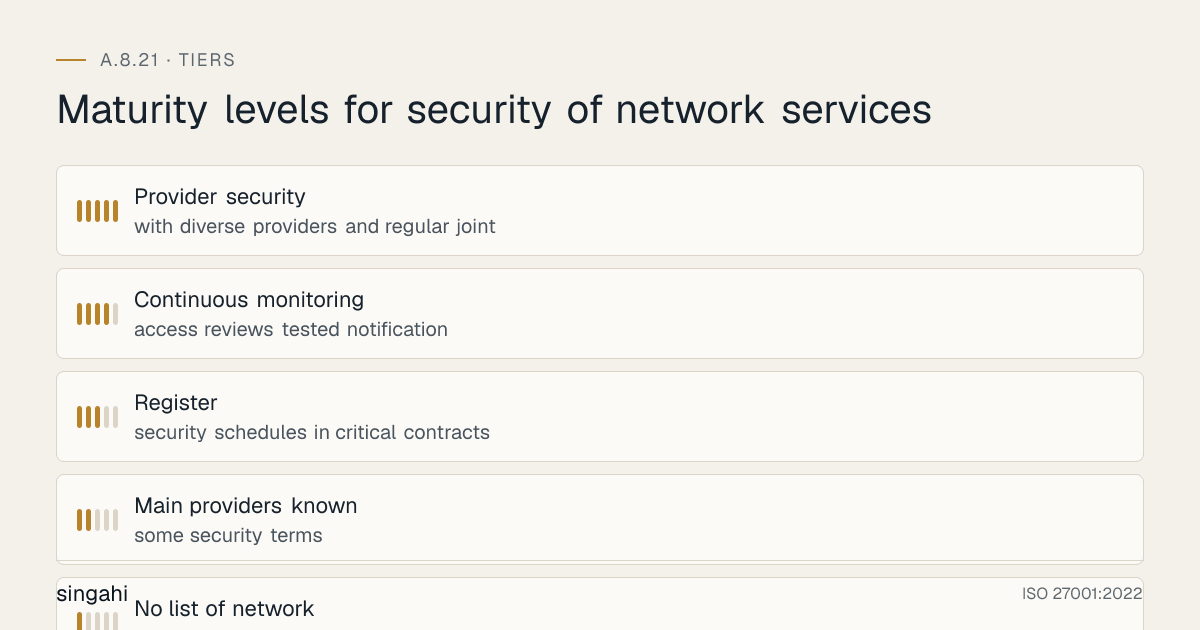
- Level 5: OptimizingAdvanced, adaptive
- Level 4: ManagedMeasured, monitored
- Level 3: DefinedFormal process
- Level 2: DevelopingBasic controls
- Level 1: InitialAd hoc, reactive
Maturity Model for A.8.21
| Level | Description | Characteristics |
|---|---|---|
| Level 1: Initial | Ad hoc, reactive | No formal service inventory, basic email and web, no authentication, no monitoring |
| Level 2: Developing | Basic controls | Basic service inventory, some SPF, basic HTTPS, some access controls, basic logging |
| Level 3: Defined | Formal process | Complete service inventory, SPF/DKIM/DMARC, HTTPS everywhere, WAF, MFA for remote access, documented policies |
| Level 4: Managed | Measured, monitored | Automated certificate management, CASB/CSPM, API security, DLP, behavioral monitoring, regular pen testing |
| Level 5: Optimizing | Advanced, adaptive | AI-powered email security, automated threat response, full zero-trust services, predictive analytics, SASE, self-healing services |
Improvement Roadmap
- From Level 1 to 2: Create basic service inventory. Implement SPF. Enable HTTPS on main sites. Implement basic access controls. Enable logging.
- From Level 2 to 3: Implement complete SPF/DKIM/DMARC. Deploy WAF. Implement MFA for all remote access. Remove legacy protocols. Document policies and SLAs.
- From Level 3 to 4: Implement CASB/CSPM. Deploy API security gateway. Implement DLP for email and file sharing. Automate certificate management. Conduct regular pen testing.
- From Level 4 to 5: Implement AI-powered email security and anomaly detection. Deploy SASE architecture. Implement full zero-trust for all services. Use predictive analytics for threat prevention. Implement self-healing service recovery.
FAQ
Q1: Does A.8.21 require DMARC with p=reject?
A: While the standard doesn't explicitly mandate p=reject, it requires email security mechanisms that prevent spoofing. DMARC with p=reject is the industry best practice and is required by many regulators (RBI, SEBI). Start with p=none to monitor, then move to p=quarantine, and finally p=reject.
Q2: How do we secure legacy APIs that don't support modern authentication? A: Implement an API gateway in front of legacy APIs to add authentication, rate limiting, and logging. Use the API gateway as a security proxy. Plan to modernize the APIs over time. Consider network segmentation to limit legacy API exposure.
Q3: Is DNSSEC really necessary? A: Yes, DNSSEC prevents DNS spoofing and cache poisoning, which are common attack vectors. It is mandatory for banking domains under RBI guidelines. It is also increasingly required for government domains under MeitY guidelines. Implementation is straightforward with modern DNS providers.
Q4: What is the minimum email security for a small organization?
A: At minimum: SPF with -all, DKIM signing, DMARC with p=reject, an email gateway for spam/malware filtering, and TLS for all email transmission. For cloud email (Microsoft 365, Google Workspace), enable all built-in security features ( Defender for Office 365, Google Workspace security).
Q5: How do we monitor cloud storage misconfigurations? A: Use CSPM tools (Prisma Cloud, Orca, Prowler, ScoutSuite) to continuously scan cloud storage for public access, weak policies, and encryption gaps. Implement automated alerts for misconfigurations. Conduct manual audits quarterly.
Q6: Can we use Let's Encrypt for internal services? A: No, Let's Encrypt issues public certificates for public domains only. For internal services, use an internal CA (AD CS, Smallstep, Easy-RSA) or a commercial CA with private trust. Some organizations use public certificates for internal services with public DNS records (split-horizon DNS).
Q7: What is the difference between CASB and CSPM? A: CASB (Cloud Access Security Broker) monitors and controls user access to cloud services (SaaS). CSPM (Cloud Security Posture Management) monitors and secures cloud infrastructure (IaaS, PaaS) configurations. Both are needed for complete cloud security.
Q8: How do we handle third-party APIs that don't support strong authentication? A: Use an API gateway or integration platform to add authentication and logging. Use IP whitelisting and mutual TLS where possible. Document the risk and implement compensating controls (monitoring, rate limiting, data validation). Consider alternative vendors if the risk is unacceptable.
Q9: Is MTA-STS necessary if we already have TLS? A: Yes, MTA-STS enforces TLS for email delivery and prevents downgrade attacks. It complements TLS by ensuring that TLS is always used, even if the connecting server attempts to use plaintext. It is recommended by NIST and is becoming a standard requirement.
Q10: How do we measure the effectiveness of our network service security? A: Key metrics: DMARC pass rate, phishing simulation click rate, WAF block rate, API abuse attempts, cloud storage misconfigurations, certificate expiry incidents, unauthorized service access attempts, and service-related security incidents.
The following toolkit assets are available for this control:
| # | Toolkit File | Description |
|---|---|---|
| 1 | 01-security-of-network-services-policy-template.md | Policy Template |
| 2 | 02-security-of-network-services-procedure.md | Procedure |
| 3 | 03-security-of-network-services-checklist.md | Checklist |
| 4 | 04-audit-evidence-checklist.md | Audit Evidence Checklist |
| 5 | 05-implementation-roadmap.md | Implementation Roadmap |
| 6 | 06-quick-reference-card.md | Quick Reference Card |
| 7 | 07-training-materials.md | Training Materials |
| 8 | 08-incident-response-playbook.md | Incident Response Playbook |
| 9 | 09-risk-assessment-template.md | Risk Assessment Template |
| 10 | 10-vendor-security-template.md | Vendor Security Template |
| 11 | 11-metrics-and-kpi-dashboard.md | Metrics and KPI Dashboard |
| 12 | 12-gap-analysis-template.md | Gap Analysis Template |
| 13 | 13-raci-matrix.md | RACI Matrix |
| 14 | 14-tool-comparison-matrix.md | Tool Comparison Matrix |
| 15 | 15-communication-plan.md | Communication Plan |
| 16 | 16-roles-and-responsibilities.md | Roles and Responsibilities |
| 17 | 17-regulatory-mapping.md | Regulatory Mapping |
References
- ISO/IEC 27001:2022, Information security, cybersecurity and privacy protection, Information Security Management Systems, Requirements
- ISO/IEC 27002:2022, Information security, cybersecurity and privacy protection, Information security controls
- NIST Cybersecurity Framework 2.0, Identify, Protect, Detect, Respond, Recover, Govern
- CIS Controls v8, Control 9: Email and Web Browser Protections
- PCI DSS v4.0, Requirements 1.x, 2.x, 4.x, 8.x
- RBI Cyber Security Framework, Email and DNS security requirements for banking
- CERT-In Guidelines, Network service security for critical infrastructure
- NIST SP 800-177, Trustworthy Email
- NIST SP 800-52 Rev 2, Guidelines for TLS Implementation
- OWASP API Security Top 10, API security risks and mitigations
- M3AAWG, Messaging, Malware and Mobile Anti-Abuse Working Group best practices
- CISA Cloud Security Guidance, Cloud storage and service security
- Internet Society DNSSEC Deployment Guide, DNSSEC implementation guidance
This guide is part of the Singahi ISO 27001:2022 Annex A Control Guide Series.
Contact: security@singahi.com | singahi.com """
path = 'guide.md'
with open(path, 'w') as f:
f.write(content)
return {"path": path, "bytes": len(content), "lines": content.count(chr(10))}