
On this page
- Quick Reference (60 Seconds)
- What the Control Asks For
- Why Network Segregation Matters
- Scope and Applicability
- Key Definitions and Terminology
- Relationship to Other Controls
- Segmentation Models and Network Domains
- Physical vs Logical Segregation and Micro-Segmentation
- Detailed Implementation Guidance
- Cloud and OT Segregation
- Network Segregation Policy (Template)
- Risk Assessment and Treatment
- Audit and Compliance Checklist
- Metrics and KPIs
- Common Pitfalls and Audit Failures
- Illustrative Scenarios
- 16A. Advanced Implementation Guidance
- Key Takeaways
- Multi-Framework Mapping
- Implementation Roadmap
- FAQ
- References and Further Reading
Quick Reference (60 Seconds)
ISO 27001:2022 Annex A 8.22 requires that groups of information services, users and information systems be segregated on the organization's networks, splitting the network into security domains and controlling traffic between them based on business need.
| Element | What You Need to Know |
|---|---|
| Control Number | A.8.22 |
| Control Name | Segregation of Networks |
| Standard Reference | ISO/IEC 27001:2022, Annex A, Control 8.22 |
| 27002 Guidance | ISO/IEC 27002:2022, Clause 8.22 |
| Control Type | Preventive |
| Objective | Split the network into security boundaries and control traffic between them by business need |
| What You Must Do | Define network domains by trust/sensitivity; separate from the internet; control inter-domain traffic at gateways |
| Owner | Network/Infrastructure Security (with CISO) |
| Maturity L1 → L5 | Flat network → DMZ + VLANs → role/sensitivity domains → least-privilege inter-zone rules → micro-segmentation/Zero Trust |
| Audit Red Flag | Flat network where a phished laptop can reach the database/CBS directly; no DMZ; OT on the office LAN |
| Quick Win | Put servers/databases on their own segment with default-deny from the user VLAN this week |
| Time to Implement | 4–12 weeks for core segmentation (longer for OT/legacy) |
| Related Controls | A.8.20 Networks security · A.8.21 Network services · A.8.23 Web filtering · A.8.16 Monitoring · A.5.15 Access control |
| ISO 27002 attributes | Control type: Preventive · Properties: Confidentiality, Integrity, Availability · Concepts: Protect · Capabilities: System and network security · Domains: Protection |
The Bottom Line: Segregation is what limits an attacker's lateral movement. On a flat network, one compromised laptop can reach everything; with segmentation, the same compromise is contained to one zone. It is among the most effective controls against ransomware spread and data-centre compromise.
What the Control Asks For
The ISO 27001:2022 Text
In short:
ISO 27001:2022 Annex A 8.22 asks organizations to split networks into segments that isolate different services, user groups, and systems.
Do you need this control?
A.8.22 is not mandatory in itself: under clause 6.1.3 you include it if your risk assessment calls for it, and record the decision in your Statement of Applicability. Include it if your network has groups of services, users or systems that should be separated, which is most networks of any size. Small flat networks may need only a few segments, for example guest Wi-Fi and production.
What ISO 27002:2022 Adds
ISO/IEC 27002:2022 (8.22) gives this guidance, paraphrased:
- Divide large networks into separate domains and separate them from the public internet.
- Choose domains by level of trust, criticality and sensitivity (for example public access, desktop, server, low- and high-risk systems), by organisational unit (HR, finance, marketing), or a mix of the two.
- Segregation can use physically separate networks or separate logical networks (VLANs, virtual networks, cloud VPCs).
- Define each domain's perimeter clearly. Where traffic between domains is allowed, control it at the perimeter with a gateway such as a firewall or filtering router.
- Base the criteria on an assessment of each domain's security requirements. Take into account the access control policy (5.15), access requirements, the value and classification of the information, and the relative cost and performance impact of the gateway technology.
- Wireless needs special treatment because its perimeter is poorly defined:
- consider adjusting radio coverage to help segregate wireless networks;
- in sensitive environments, treat all wireless access as an external connection that must pass a gateway (8.20) before it reaches internal systems;
- keep guest wireless separate from staff wireless where staff use only managed, compliant devices;
- give guest Wi-Fi at least the same restrictions as staff Wi-Fi, so that staff are not tempted to use guest Wi-Fi to get around controls.
- Networks extend to business partners. Interconnections with partners raise the risk of unauthorised access, so partner links need their own controlled segment.
The "shall vs should" Analysis
| Phrase | Force | Meaning |
|---|---|---|
| "shall be segregated" (Annex A wording) | Required once the control is selected in your SoA | The network must be divided into controlled domains, not flat |
| Gateway control of inter-domain traffic | Expected by auditors (27002 guidance) | Firewalls/ACLs between zones with default-deny |
| Physical vs logical; micro-segmentation | Recommended | Design choice proportionate to risk |
What Auditors Actually Check
- A documented segmentation design (zones/domains, not a flat network).
- Server/database and sensitive systems separated from user and public networks.
- Gateways (firewalls) with default-deny controlling inter-zone traffic, reviewed periodically.
- Wireless/guest separated from internal networks, with guest Wi-Fi no less restricted than staff Wi-Fi.
- Partner and vendor connections terminated in a controlled segment, not on the internal LAN.
- For PCI/regulated scope: the in-scope environment (e.g. CDE) is segmented, and segmentation is tested.
Why Network Segregation Matters
Figure · Matrix
Comparison: BFSI to Healthcare
The Business Risk Narrative
Most serious intrusions involve lateral movement (MITRE ATT&CK lists it as its own tactic, TA0008): the attacker lands on one device and then moves across the network to the crown jewels. A flat network is an open plain: one foothold reaches everything. Segregation builds internal walls so that a compromise of a marketing laptop cannot reach the core banking system or the customer database. It is one of the most effective architectural controls against ransomware, which spreads fastest on flat networks.
How It Goes Wrong (hypothetical patterns)
- Flat office network. A phished laptop in marketing can reach the database servers and domain controllers directly, so one click becomes an estate-wide incident.
- Guest Wi-Fi looser than staff Wi-Fi. Staff move to the guest network to reach blocked sites, and their laptops leave the protection of the corporate controls.
- Vendor VPN lands on the internal LAN. A support supplier's account is compromised and the attacker arrives inside, with no filtering between the vendor link and production.
- "Temporary" any-any rule. A rule added during an outage is never removed; segmentation exists on the diagram but not on the firewall.
- OT on the IT network. Ransomware on an office PC reaches the plant historians and stops production.
Indian Regulatory Context
- RBI: the Cyber Security Framework in Banks (2016) baseline expects network management and security, including segmentation and protection of critical systems such as core banking. The Master Direction on IT Governance, Risk, Controls and Assurance Practices (2023) applies to banks, NBFCs and other regulated entities.
- SEBI: the Cybersecurity and Cyber Resilience Framework (CSCRF, 2024) covers network security and segmentation for regulated entities in the securities market.
- IRDAI: the Information and Cyber Security Guidelines (2023) apply to insurers and intermediaries.
- NCIIPC: systems notified as protected systems (critical information infrastructure) are expected to be isolated from general and internet-facing networks.
- DPDP Act 2023: segregating systems that hold personal data supports the reasonable security safeguards required by section 8(5).
- PCI DSS v4.0.1 (card data): segmenting the cardholder data environment (CDE) reduces scope. Where segmentation is used, it must be tested by penetration testing at least every 12 months (11.4.5), and every six months for service providers (11.4.6).
Industry-Specific Consequences
| Sector | Failure mode | Consequence |
|---|---|---|
| BFSI | CBS reachable from the office LAN | RBI finding; catastrophic breach potential |
| Retail/e-commerce | Flat network reaching the CDE | PCI failure; card-data breach |
| Manufacturing | OT on the IT network | Ransomware halts production; safety risk |
| Healthcare | Medical devices on the general LAN | Patient-data and safety exposure |
Impact of Non-Compliance
A flat network turns a containable incident into a company-wide one. The 2017 wave of self-propagating ransomware demonstrated that segmentation is the difference between "we lost a department" and "we lost everything." Segmentation is an architecture investment that pays for itself the first time it stops a breach at a zone boundary.
Scope and Applicability
What the Control Covers
- The organisation's networks, on-premises (LAN/WLAN/data centre), cloud (VPC/VNet), and OT, and the domains/zones into which they are divided and the gateways controlling traffic between them.
Who It Applies To
Every organisation with a network beyond a trivial size. SMEs segment at least servers/databases, users, and guest/wireless; enterprises run multi-tier segmentation and increasingly micro-segmentation.
Size-Based Applicability
| Size | Realistic implementation |
|---|---|
| Micro/SME | DMZ for internet-facing services; separate server VLAN; guest Wi-Fi isolated; default-deny from user to server VLAN |
| Growing companies | Domains by trust/sensitivity and/or org unit; firewalled inter-zone rules; reviewed ACLs |
| Enterprise | Multi-tier + micro-segmentation; Zero Trust networking; IT/OT separation; cloud security groups/NSGs |
Key Definitions and Terminology
Figure · At a glance
A.8.22 at a glance
- Network domain / zone /
- A bounded part of the network with a defined
- DMZ
- Demilitarised zone
- VLAN
- Virtual LAN, logical segregation
- Micro-segmentation
- Fine-grained segmentation down
- East-west traffic
- Traffic between systems inside the network
- Default-deny
- Block all inter-zone traffic except
| Term | Definition |
|---|---|
| Network domain / zone / segment | A bounded part of the network with a defined trust level |
| DMZ | Demilitarised zone, a buffer segment for internet-facing services |
| VLAN | Virtual LAN, logical segregation within shared hardware |
| Micro-segmentation | Fine-grained segmentation down to workload/host level |
| East-west traffic | Traffic between systems inside the network (vs north-south to/from internet) |
| Default-deny | Block all inter-zone traffic except explicitly allowed |
| CDE | Cardholder Data Environment (PCI) |
| OT | Operational Technology (industrial control/plant systems) |
| Zero Trust networking | No implicit trust by location; verify every flow |
Relationship to Other Controls
| Control | Relationship to A.8.22 |
|---|---|
| A.8.20 Networks security | Upstream. Overall network management/protection |
| A.8.21 Security of network services | Parallel. Securing the services that run across segments |
| A.8.23 Web filtering | Parallel. Controls north-south (outbound web) traffic |
| A.8.16 Monitoring activities | Parallel. Monitoring inter-zone/east-west traffic |
| A.5.15 Access control | Upstream. Segregation enforces the access control policy at the network layer |
| A.7.4 Physical monitoring / A.8.1 endpoints | Parallel. Defence in depth around segmented assets |
Where Segregation Fits
Network controls layer: 8.20 manages and protects the network overall; 8.21 secures network services and their agreements; 8.22 divides the network into trust domains and controls traffic between them; 8.23 filters outbound web access. A.8.22 is the structural control, it shapes the battlefield so that the other controls (and incident response) operate on a contained, defensible architecture rather than an open plain.
Segmentation Models and Network Domains
Choose a model (or combination) per ISO 27002:
| Model | Basis | Example domains |
|---|---|---|
| Trust/sensitivity | Levels of trust & data sensitivity | Public-access, DMZ, desktop, server, high-risk/critical |
| Organisational unit | Business function | HR, finance, R&D, marketing |
| System tier | Application architecture | Web tier, app tier, database tier |
| Environment | Lifecycle | Production, test, development (link 8.31) |
| IT vs OT | Technology type | Corporate IT vs plant/control networks |
A common baseline: DMZ (internet-facing), user/desktop domain, server domain (further split into app/database tiers), management network (for admin/out-of-band), guest/wireless, and, where relevant, a strictly separated OT zone. Each boundary is controlled by a gateway with default-deny.
Physical vs Logical Segregation and Micro-Segmentation
- Physical segregation: separate physical networks/hardware, strongest isolation, used for the most critical/OT systems; higher cost.
- Logical segregation: VLANs, virtual networks, cloud VPC/subnets, flexible and efficient; relies on correct configuration of switches/firewalls.
- Micro-segmentation: fine-grained, often identity/workload-aware policies controlling east-west traffic down to the host. Reduces lateral movement dramatically and underpins Zero Trust networking, every flow is explicitly allowed, nothing is trusted by location alone.
Most organisations use logical segregation for the bulk of the network and physical for the highest-criticality/OT systems, evolving toward micro-segmentation at higher maturity.
Detailed Implementation Guidance
Map Flows, Then Define Domains
Inventory systems and map current traffic flows (who talks to what). Define domains by trust/sensitivity/org unit, and place sensitive systems (databases, CBS, CDE, domain controllers) in protected domains.
Separate from the Internet (DMZ)
Internet-facing services go in a DMZ, never directly on the internal network. Internal systems reach the internet through controlled egress (with web filtering, A.8.23).
Control Inter-Domain Traffic at Gateways (Default-Deny)
Place firewalls/filtering routers at domain perimeters; configure default-deny and allow only explicitly justified flows. Document the criteria and the rule justifications.
Protect the Crown Jewels
Put databases, core systems and management interfaces in tightly-controlled segments reachable only from where business requires, never directly from the user VLAN or the internet. This single step stops most lateral-movement-to-data paths.
Segregate Wireless, Guest and Untrusted Devices
Isolate guest Wi-Fi and untrusted/BYOD devices from internal networks; treat wireless as untrusted unless strongly authenticated; segment IoT. Give guest Wi-Fi at least the same restrictions (web filtering, blocked categories, rate limits) as staff Wi-Fi, so staff gain nothing by using it. Adjust access-point power and placement so radio coverage does not spill far beyond the premises.
Put Partner and Vendor Connections in Their Own Segment
Terminate business-partner links, vendor VPNs and support access in a dedicated extranet or partner segment. Allow only the specific systems and ports each partner needs, log the sessions, and review the access when the contract changes (A.5.19, A.8.21).
Review Rules and Test Segmentation
Periodically review inter-zone firewall rules (remove stale/over-broad rules) and test segmentation to confirm zones are actually isolated; configuration drift silently erodes segmentation. A simple test: from a host in each zone, scan the other zones for open ports and compare the results with the approved flow list. Record the source zone, target zone, ports found open, whether each was expected, and the fix.
Monitor East-West Traffic
Monitor inter-zone and east-west traffic (link A.8.16) to detect lateral movement and policy violations; segmentation plus monitoring is far stronger than either alone.
Cloud and OT Segregation
Cloud. Segregation in cloud uses VPCs/VNets, subnets, security groups/NSGs, and network policies. Apply the same principles: separate tiers (web/app/db), restrict east-west with security groups, isolate management, and default-deny. Cloud-native micro-segmentation (security groups per workload, service mesh policies) is often easier than on-prem.
OT (Operational Technology). IT/OT convergence without segregation is a top critical-infrastructure risk. Apply a zoned model (e.g. the Purdue model): strictly separate plant/control networks from corporate IT via a controlled DMZ/conduit, allow only essential, inspected flows, and never let OT sit on the office LAN. Ransomware crossing from IT to OT can halt production and create safety hazards.
Network Segregation Policy (Template)
Illustrative extract (the Control Pack has the full policy):
Network Segregation Policy — [Organisation Name] (A.8.22)

1. The network shall be divided into security domains based on trust, criticality and
   sensitivity, and shall be separated from the public internet.

2. Internet-facing services shall reside in a DMZ, never on internal networks.

3. Sensitive systems (databases, core/financial systems, domain controllers, management
   interfaces) shall reside in protected domains not directly reachable from user or public
   networks.

4. Traffic between domains shall be controlled at gateways (firewalls) on a default-deny
   basis; flows shall be allowed only on documented business justification.

5. Guest and wireless networks shall be isolated from internal networks. Guest Wi-Fi shall
   have at least the same restrictions as staff Wi-Fi. OT networks shall be segregated from
   corporate IT via a controlled conduit/DMZ.

6. Partner, vendor and support connections shall terminate in a dedicated partner segment
   and reach only the systems they need.

7. Inter-domain rules shall be reviewed at least [quarterly]; segmentation shall be tested at
   least [annually] (segmentation penetration testing).

8. Inter-zone and east-west traffic shall be monitored (A.8.16).
Risk Assessment and Treatment
Figure · Risk grid
Segregation of networks risks by likelihood and impact
Likelihood across · impact up
- Flat network enables estate-wideMedium/High
- Database/CBS reachable from user VLANMedium/High
- Internet-facing service on internalMedium/High
- OT on corporate IT networkMedium/High
- Stale/over-broad firewall rulesHigh/Medium
- Partner or vendor link onto the internalMedium/High
- Guest/BYOD on internal networkMedium/Medium
- Segmentation drift over timeMedium/Medium
| Risk | Likelihood | Impact | Risk Level | Treatment |
|---|---|---|---|---|
| Flat network enables estate-wide ransomware | Medium | High | Critical | Segment; default-deny; protect crown jewels |
| Database/CBS reachable from user VLAN | Medium | High | High | Isolate sensitive systems behind gateways |
| Internet-facing service on internal network | Medium | High | High | DMZ for all internet-facing services |
| OT on corporate IT network | Medium | High | High | IT/OT segregation via conduit/DMZ |
| Stale/over-broad firewall rules | High | Medium | High | Periodic rule review; default-deny |
| Guest/BYOD on internal network | Medium | Medium | Medium | Isolate guest/wireless |
| Partner or vendor link onto the internal LAN | Medium | High | High | Dedicated partner segment; least-privilege rules |
| Segmentation drift over time | Medium | Medium | Medium | Segmentation testing; change control |
Audit and Compliance Checklist
| # | Audit Question | Expected Evidence | Red Flag |
|---|---|---|---|
| 1 | Is there a documented segmentation design? | Network diagram/zones | Flat network |
| 2 | Are internet-facing services in a DMZ? | Architecture | Services on internal LAN |
| 3 | Are sensitive systems isolated from user/public networks? | Firewall rules/topology | DB reachable from user VLAN |
| 4 | Is inter-domain traffic default-deny at gateways? | Firewall config | Any-any rules |
| 5 | Are inter-zone rules justified and reviewed? | Rule base + review records | Stale/unjustified rules |
| 6 | Are guest/wireless networks isolated? | WLAN config | Guest on internal network |
| 7 | Is OT segregated from IT? | OT architecture | OT on office LAN |
| 8 | Is segmentation tested? | Segmentation pen-test report | Never tested |
| 9 | Is east-west traffic monitored? | Monitoring (link 8.16) | No internal visibility |
| 10 | Is management/admin traffic on a separate segment? | Management network | Admin over user VLAN |
| 11 | For PCI scope, is the CDE segmented? | CDE segmentation evidence | Unsegmented CDE |
| 12 | Are cloud networks segmented (subnets/SGs)? | Cloud network config | Flat VPC |
| 13 | Is segregation aligned to the access control policy? | Policy mapping | Ad-hoc zoning |
| 14 | Are changes to segmentation change-controlled? | Change records | Uncontrolled rule changes |
| 15 | Is the segmentation design reviewed periodically? | Review records | Stale design |
| 16 | Is guest Wi-Fi at least as restricted as staff Wi-Fi? | WLAN and filtering config | Open guest network used by staff |
| 17 | Do partner and vendor connections land in a controlled segment? | Partner segment rules | Vendor VPN on the internal LAN |
(The Control Pack's audit evidence checklist (04) lists where to find the evidence for each question.)
Metrics and KPIs
Figure · Measures
The measures that show A.8.22 is working
- Sensitive systems segmented100%Quarterly
- Default-deny coverage100%Quarterly
- Internet-facing in DMZ100%Quarterly
- Inter-zone rule review currency100%Quarterly
- Over-broad rules0Monthly
| # | KPI | Formula | Target | Frequency |
|---|---|---|---|---|
| 1 | Sensitive systems segmented | % critical systems in protected zones | 100% | Quarterly |
| 2 | Default-deny coverage | % zone boundaries with default-deny | 100% | Quarterly |
| 3 | Internet-facing in DMZ | % such services in DMZ | 100% | Quarterly |
| 4 | Inter-zone rule review currency | % rules reviewed on schedule | 100% | Quarterly |
| 5 | Over-broad rules | Count of any-any/over-broad rules | 0 | Monthly |
| 6 | Guest/wireless isolation | % guest networks isolated | 100% | Quarterly |
| 7 | IT/OT segregation | % OT segregated from IT | 100% | Quarterly |
| 8 | Segmentation test findings | Count from segmentation pen-test | Trend ↓ | Per test |
| 9 | East-west monitoring coverage | % inter-zone traffic monitored | ≥90% | Quarterly |
| 10 | Cloud segmentation coverage | % cloud workloads with restrictive SGs | ≥95% | Quarterly |
| 11 | Time to contain lateral movement | Drill metric | Trend ↓ | Per exercise |
| 12 | Segmentation change-control compliance | % changes via change mgmt | 100% | Monthly |
Common Pitfalls and Audit Failures
| Pitfall | Root Cause | Fix |
|---|---|---|
| Flat internal network | Legacy/convenience | Segment by trust/sensitivity; default-deny |
| Database reachable from user VLAN | No tiering | Isolate sensitive systems behind gateways |
| any-any firewall rules | Quick fixes never tightened | Default-deny; justify and review rules |
| Internet-facing service on LAN | No DMZ | Move to DMZ |
| OT on the IT network | IT/OT convergence unmanaged | Conduit/DMZ separation (Purdue) |
| Guest Wi-Fi bridged to internal | Misconfiguration | Isolate guest networks |
| Segmentation never tested | "Set and forget" | Periodic segmentation pen-testing |
| Rule sprawl/drift | No review/change control | Periodic review; change-controlled rules |
Illustrative Scenarios
Illustrative scenario, a composite example for guidance, not a specific Singahi engagement or a verified outcome.
Illustrative Scenario 1, Indian Private-Sector Bank: Isolating Core Banking
Challenge. An RBI examination and an ISO 27001 audit found that the bank's core banking system (CBS) and customer database were reachable, via a largely flat internal network, from general office VLANs, meaning a single phished employee laptop could reach the crown jewels. Firewall rules between segments were riddled with any-any entries accreted over years.
Solution (12 weeks).
- Mapped flows and re-architected into trust domains: DMZ, user, server (app/db tiers), management, and a strictly-isolated CBS zone.
- Implemented default-deny at all zone gateways; allowed only documented, justified flows to the CBS and database tiers.
- Moved internet-facing services into the DMZ; isolated guest Wi-Fi.
- Instituted quarterly rule review and an annual segmentation penetration test, with east-west monitoring (A.8.16).
Results. The CBS and database are no longer reachable from user networks; any-any rules eliminated; lateral-movement paths to core systems closed. The RBI observation and ISO nonconformity were both resolved, and a subsequent red-team confirmed containment at the zone boundaries.
Illustrative Scenario 2, Indian Manufacturing Enterprise: IT/OT Segregation
Challenge. A manufacturer running SAP and plant control systems had its OT (PLCs/SCADA) on the same network as corporate IT. A ransomware incident at a peer (which halted production for days by crossing from IT to OT) prompted an urgent review; ISO 27001 flagged the lack of segregation as a critical risk.
Solution (14 weeks).
- Applied a Purdue-model zoning: separated OT/control networks from corporate IT via a controlled DMZ/conduit, allowing only essential, inspected flows.
- Placed plant historians and jump hosts in the conduit DMZ; blocked direct IT→OT traffic.
- Segmented corporate IT (DMZ, user, server) with default-deny; isolated engineering workstations.
- Added OT-aware monitoring and a segmentation test.
Results. A compromise of corporate IT can no longer propagate to plant control systems; production-halting ransomware risk dramatically reduced; the segregation satisfied the ISO 27001 auditor and became the template for the group's other plants.
16A. Advanced Implementation Guidance
Figure · Tiers
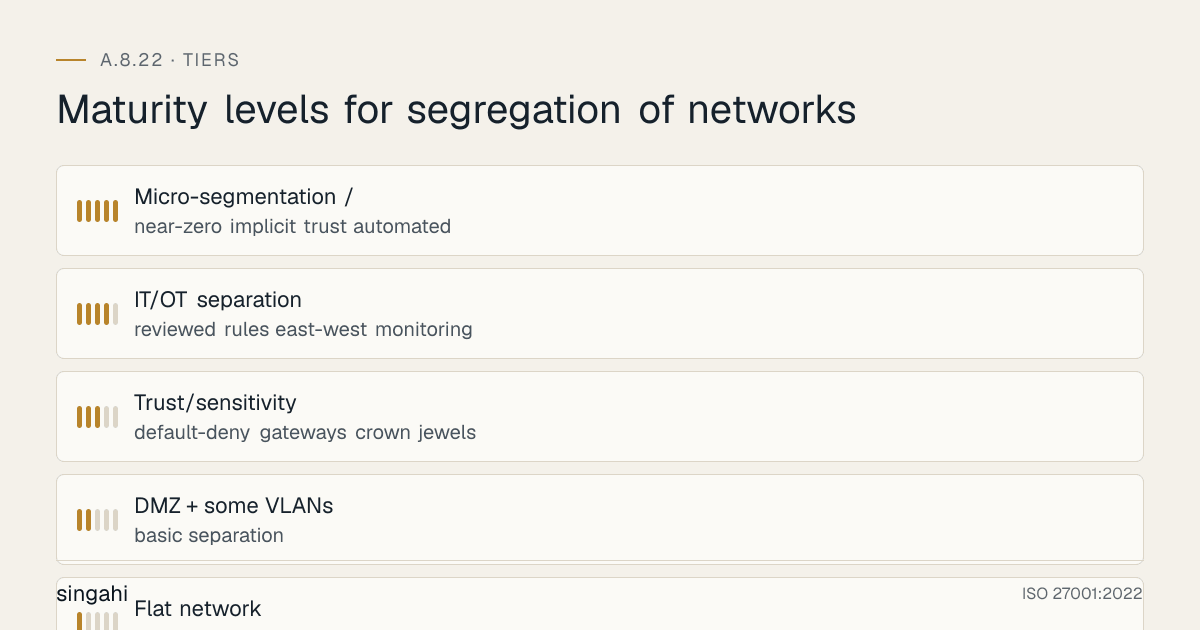
Maturity levels for segregation of networks
16A.1 Micro-Segmentation and Zero-Trust Networking
Traditional zone segmentation controls north-south traffic (between zones) but often leaves east-west traffic (between systems in the same zone) wide open, which is exactly where ransomware and attackers move. Micro-segmentation pushes policy down to the workload/host level: each workload only accepts the specific flows it needs, identity- or tag-based rather than IP-based. This is the network foundation of Zero Trust, no implicit trust from network location; every flow explicitly allowed. Implement incrementally: start by isolating the crown jewels and the highest-risk segments, then expand. Tools: host-based micro-segmentation agents, cloud-native security groups and network policies, and service-mesh policies for containerised workloads.
16A.2 Cloud Segmentation in Depth
In cloud, segmentation is built from VPCs/VNets, subnets, security groups/NSGs, network ACLs, and network policies (Kubernetes). Apply the same tiering: separate web/app/database tiers into subnets; restrict east-west with tight security groups (default-deny, allow only required ports/sources); isolate the management plane; and use private endpoints so data services aren't internet-exposed. A "flat VPC" with permissive security groups is the cloud equivalent of a flat LAN. Use CSPM/CNAPP tooling to detect over-permissive rules and exposure, and infrastructure-as-code so segmentation is version-controlled and reviewable.
16A.3 OT/ICS Segmentation (Purdue Model)
For manufacturing, utilities and critical infrastructure, IT/OT segregation is a top control. The Purdue model layers the environment (Levels 0–5) and inserts a controlled IDMZ (industrial DMZ) between enterprise IT (Levels 4–5) and operations/control (Levels 0–3). Only essential, inspected flows cross the IDMZ (via jump hosts, data diodes for one-way flows, and brokered protocols); direct IT→OT traffic is blocked. This prevents ransomware or an IT compromise from reaching, and halting or endangering, physical processes. Align with IEC 62443 zones-and-conduits.
16A.4 Segmentation Testing and Rule Lifecycle
Segmentation drifts: rules accrete, "temporary" any-any entries become permanent, and new systems land in the wrong zone. Counter with (1) segmentation penetration testing: actively attempting to cross zone boundaries to prove isolation (PCI DSS 11.4.5 requires this at least every 12 months where segmentation reduces CDE scope; 11.4.6 requires every six months for service providers); (2) a firewall-rule lifecycle, every rule has a justification, owner and review date; stale and overly-broad rules are removed at periodic review; and (3) change control (A.8.32) for all segmentation changes. Pair with east-west monitoring (A.8.16) to detect lateral movement and policy violations in real time.
16A.5 Network Segregation Maturity Model (L1–L5)
| Level | Characteristics |
|---|---|
| L1 | Flat network; minimal/no internal boundaries |
| L2 | DMZ + some VLANs; basic separation |
| L3 | Trust/sensitivity domains; default-deny gateways; crown jewels isolated; guest/wireless separated |
| L4 | IT/OT separation; reviewed rules; east-west monitoring; cloud segmentation; segmentation testing |
| L5 | Micro-segmentation / Zero-Trust networking; near-zero implicit trust; automated, continuously-validated policy |
Certification does not require a set maturity level. Most organisations aim for L3; regulated BFSI and critical-infrastructure operators usually need L4 practices such as tested segmentation and east-west monitoring.
16A.6 Anatomy of a Flat-Network Breach
An attacker phishes a marketing employee and lands on their laptop. On a flat network, the laptop can reach the file servers, the database tier, and the domain controllers directly, so the attacker harvests credentials, moves laterally to the domain controller, and deploys ransomware estate-wide within hours. On a segmented network, the same laptop sits in a user zone with default-deny to the server and database tiers; the attacker hits a wall at the first zone boundary, the lateral movement is blocked and detected by east-west monitoring, and the incident is contained to one segment. Segmentation is the single architectural control that most reduces blast radius.
Key Takeaways
- Segmentation limits lateral movement: the difference between losing a segment and losing the estate.
- Divide by trust/sensitivity, separate from the internet (DMZ), and isolate the crown jewels behind default-deny gateways.
- East-west traffic is the gap: micro-segmentation and monitoring close it.
- IT/OT separation (Purdue/IEC 62443) is essential for manufacturing/critical infrastructure.
- Segmentation drifts: test it (segmentation pen-testing), review rules, and change-control changes.
- In India, A.8.22 supports RBI critical-system isolation, PCI CDE scoping, and DPDP exposure-limitation.
Multi-Framework Mapping
| Framework | Reference | Mapping to A.8.22 |
|---|---|---|
| ISO/IEC 27002:2022 | 8.22 | Segregation of networks |
| NIST SP 800-53 Rev 5 | SC-7 Boundary Protection, SC-7(21) isolation of system components, SC-7(22) separate subnets for different security domains; AC-4 information flow enforcement | Boundary protection and isolation |
| NIST CSF 2.0 | PR.IR-01 | Networks and environments protected from unauthorised logical access and usage |
| CIS Controls v8 | 12.2 secure network architecture; 13.4 traffic filtering between network segments | Segmentation and filtering |
| PCI DSS v4.0.1 | Requirement 1 (network security controls); 11.4.5 and 11.4.6 segmentation testing | CDE segmentation to reduce scope, tested |
| SOC 2 (TSC 2017) | CC6.1, CC6.6 | Logical access and boundary protection |
| IEC 62443 | Zones and conduits | OT network segmentation |
| COBIT 2019 | DSS05.02 | Manage network and connectivity security |
| DPDP Act 2023 | Section 8(5) | Segregation limits personal-data exposure |
Implementation Roadmap
Phase 1, Discover & Design (Weeks 1–3)
- Inventory systems; map current traffic flows; identify crown jewels.
- Design the domain model (DMZ, user, server tiers, management, guest, OT).
Phase 2, Build Core Segmentation (Weeks 4–7)
- Stand up DMZ; isolate sensitive systems; implement default-deny gateways with justified flows.
- Isolate guest/wireless.
Phase 3, OT/Cloud & Hardening (Weeks 8–10)
- IT/OT separation (conduit/DMZ); cloud subnet/security-group segmentation.
- Separate management network.
Phase 4, Assure (Weeks 11–12+)
- Rule review + change control; east-west monitoring (8.16).
- Segmentation penetration test; KPI dashboard; internal audit dry-run.
FAQ
Q1: Is A.8.22 mandatory for certification? Not automatically: it is selected through risk treatment (clause 6.1.3) and recorded in your Statement of Applicability. Any organisation with a network of meaningful size will normally include it, and auditors then look for a real segmentation design and isolated sensitive systems, not a flat network.
Q2: VLANs or physical separation? Logical (VLAN/virtual) segregation is sufficient and efficient for most domains, provided switches/firewalls are correctly configured. Use physical separation for the highest-criticality and OT systems.
Q3: What's the single most valuable step? Isolate the crown jewels (databases, core systems, domain controllers) so they are not directly reachable from the user VLAN or the internet, this closes the most common lateral-movement path.
Q4: How does A.8.22 relate to PCI DSS? PCI uses segmentation to reduce scope: properly segmenting the CDE means fewer systems are in scope. Where you rely on segmentation, PCI DSS 11.4.5 requires penetration testing of the segmentation controls at least every 12 months (every six months for service providers, 11.4.6).
Q5: We're fully in the cloud, does this apply? Yes. Use VPCs/VNets, subnets, security groups/NSGs and network policies to segment tiers and restrict east-west traffic; a flat VPC is the cloud equivalent of a flat LAN.
Q6: Should guest Wi-Fi be more open than staff Wi-Fi? No. ISO 27002 recommends that guest Wi-Fi has at least the same restrictions as staff Wi-Fi. If the guest network is more open, staff will use it to get around controls, and their devices leave your monitored network.
Q7: How is this different from A.8.20? 8.20 is overall network security/management; 8.22 is specifically dividing the network into controlled trust domains. 8.22 is one of the most important measures within 8.20.
References and Further Reading
Primary standards
- ISO/IEC 27001:2022: Annex A control 8.22.
- ISO/IEC 27002:2022: Clause 8.22 (network domains, gateways, physical/logical segregation); related §8.20, §8.21, §8.23.
Supporting frameworks
- NIST SP 800-53 Rev 5: SC-7 (Boundary Protection) and enhancements; AC-4.
- NIST CSF 2.0: PR.IR-01.
- CIS Controls v8: Safeguards 12.2 and 13.4.
- PCI DSS v4.0.1: Requirement 1; 11.4.5 and 11.4.6 (segmentation testing).
- IEC 62443: Zones and conduits (OT segmentation).
- SOC 2 (TSC 2017): CC6.6; COBIT 2019: DSS05.02.
Indian regulations
- RBI: Cyber Security Framework in Banks (2016); Master Direction on IT Governance, Risk, Controls and Assurance Practices (2023).
- SEBI: Cybersecurity and Cyber Resilience Framework (2024). IRDAI: Information and Cyber Security Guidelines (2023).
- Digital Personal Data Protection Act, 2023: Section 8(5).
- NCIIPC: guidance for protected systems (critical information infrastructure).
Singahi resources: the A.8.22 toolkit and related guides for A.8.20 Networks security, A.8.21 Security of network services, A.8.23 Web filtering, and A.8.16 Monitoring activities.