
On this page
- Quick Reference (60 Seconds)
- What the Standard Actually Requires
- Why This Control Matters
- Scope and Applicability
- Key Definitions and Terminology
- Relationship to Other Clauses and Frameworks
- Detailed Implementation Guidance, The Five-Stage Awareness Programme Lifecycle
- Tools, Technologies, and Solutions
- Policy and Procedure Templates
- Risk Assessment and Treatment
- Audit and Compliance Checklist
- Metrics and KPIs
- Common Pitfalls and Audit Failures
- Illustrative Scenario 1: Failure, Coromandel Formulations Private Limited (Illustrative)
- Illustrative Scenario 2: Success, Dakshta Paytech Private Limited (Illustrative, with ROI)
- Multi-Framework Mapping
- Implementation Roadmap
- FAQ
- Industry-Specific Requirements
- Maturity Model
- Emerging Trends
- References and Further Reading
Quick Reference (60 Seconds)
| Attribute | Detail |
|---|---|
| Clause | ISO 22301:2019 Clause 7.3, Awareness. Sits inside Clause 7 (Support) as the third of the five support sub-clauses, 7.1 Resources, 7.2 Competence, 7.3 Awareness, 7.4 Communication, 7.5 Documented Information. The Harmonized Structure places "Awareness" at the same number in ISO/IEC 27001:2022, ISO 9001:2015, ISO 14001:2015, ISO 45001:2018 and ISO/IEC 20000-1, so an integrated management system treats awareness once across quality, environment, occupational health and safety, information security, IT service and business continuity. |
| What it asks for (paraphrase) | ISO 22301 Clause 7.3 asks organizations to ensure people know the BC policy, their role in disruptions, and what happens if they don't follow BCMS requirements. Three things do the work in that paraphrase. Ensure people know shifts awareness from a one-time training event to a continuing state of the workforce, the organisation must take active steps so that knowledge is present, current, and demonstrable; it cannot passively assume awareness exists because a course was delivered once. The BC policy, their role in disruptions, and the consequences of non-compliance names three specific objects of awareness, first, the business continuity policy itself (Clause 5.2), so that every person understands why continuity matters for the organisation and the commitments the leadership has made; second, the role the individual plays when a disruption happens, ranging from "follow your floor marshal and exit via the South stairwell" for a frontline worker to "convene the Crisis Management Team and authorise DRS invocation" for the CEO; and third, the consequences of not following BCMS requirements, which spans disciplinary, regulatory, contractual, financial, reputational, safety and (in regulated industries) personal liability outcomes. The clause does not require a single format; it requires a result, a workforce that knows the policy, knows its role, and knows what is at stake if it does not comply. |
| Domain | Support (Clause 7). 7.3 is the workforce-wide valve of the BCMS. Where Clause 7.2 builds role-specific capability for the people who run the BCM programme and execute the plans, Clause 7.3 builds workforce-wide understanding for everyone whose actions during a disruption, from evacuation to escalation, from clicking a phishing link to invoking the IR runbook, shape whether the plans actually work. Every other clause that depends on workforce behaviour (8.4 plan invocation, 8.5 exercise participation, 9.1 reporting, 10.1 corrective action) is downstream of 7.3; a BCMS whose plans are written for a workforce that does not know the plans exist is non-conformant by construction. |
| What you must produce | (a) A BCM Awareness Policy (the apex 7.3 artefact) approved by top management, linked to the BCMS Policy (Clause 5.2), the enterprise HR framework, the enterprise learning-and-development strategy and the information-security awareness programme; (b) a BCM Awareness Procedure that defines the five-stage lifecycle, design the awareness portfolio, deliver the interventions, capture the evidence, evaluate effectiveness, improve; (c) an Audience Tier Model segmenting the workforce into Tier 1 (general workforce), Tier 2 (BCM-adjacent roles), Tier 3 (BCM team / Crisis Management Team / DR team) and Tier 4 (board, suppliers, contractors, visitors, customers); (d) an Awareness Curriculum with learning objectives per tier mapped to the three duties (policy, role, consequences) and to disruption classes (fire, flood, cyclone, earthquake, ransomware, phishing, data breach, power outage, civil unrest, pandemic, supplier failure, key-person loss); (e) a Channel Matrix combining induction, refresher cadence, micro-learning, leadership briefings, exercise participation, phishing simulation, town halls, posters/digital signage, intranet/portal content, and multilingual voice-SMS for frontline and field staff; (f) an Onboarding Awareness Pack delivered to every new joiner on day one and refreshed within 30 days; (g) a Multilingual Adaptation Plan for the Indian workforce covering Hindi and the relevant regional languages at each work location; (h) a Board and Top-Management Awareness Briefing delivered at least annually (BFSI, listed, healthcare and critical-infrastructure firms: at least half-yearly); (i) a Contractor, Vendor and Outsourced-Staff Awareness Pack flowing the awareness obligation contractually to suppliers under Clause 7.4 of the master agreement; (j) a Phishing-Simulation and Social-Engineering Programme calibrated to the threat landscape (frequency, scenario, follow-up coaching); (k) an Awareness Effectiveness Evaluation Design specifying, per channel and per tier, how awareness will be measured (knowledge check, behaviour observation, drill performance, incident telemetry); (l) an Awareness Evidence Record per individual captured under Clause 7.5 document control; (m) an Awareness KPI Dashboard feeding the Clause 9.1 monitoring and Clause 9.3 management review; (n) a Post-Incident and Post-Exercise Awareness Reinforcement Loop so that every real or simulated disruption becomes a teaching event; (o) the Integration Touchpoints Map showing where 7.3 plugs into Clause 4 context, Clause 5 leadership, Clause 6 planning, Clause 7.1 to 7.5 support, Clause 8 operation, Clause 9 evaluation and Clause 10 improvement. |
| Typical owner | The BCM Manager / BCM Lead owns the BCM Awareness Policy, the Awareness Procedure, the Audience Tier Model, the Awareness Curriculum, the Channel Matrix, the Onboarding Awareness Pack, the Board Briefing, the Contractor Pack, the Effectiveness Evaluation Design, the Evidence Record framework, and the KPI Dashboard. Top management (CEO, MD, Board) retains accountability for ensuring that the workforce is aware, this is non-delegable, because visible top-management communication of the BC policy is the single most powerful awareness lever and is itself a Clause 5.1 leadership commitment. The Head of HR / CHRO owns the HR spine that the awareness system hangs on, induction, performance management, disciplinary framework (where the consequences of non-compliance are operationalised), the learning management system and the multilingual training infrastructure. The Head of Learning and Development owns the delivery mechanism for digital and classroom awareness, the trainer pool, the LMS, and the effectiveness evaluation methodology. The Head of Communications owns the town-hall, intranet, signage and crisis-communications channels that carry awareness messages and that activate during a disruption. The CISO / Head of Information Security co-owns phishing simulations, social-engineering drills, and the cyber-awareness overlap with ISO/IEC 27001:2022 Clause 7.3 and Annex A control 6.3. Functional heads and line managers own awareness in their teams, they are the people who translate the curriculum into team-specific role clarity. Internal Audit independently tests the awareness discipline, sampling individuals and walking a sample end-to-end through the lifecycle annually per Clause 9.2. The BCM Manager is the custodian of the awareness system, not the universal awareness deliverer, a curriculum where every line item reads "delivered by BCM Manager" with no HR, L&D, Comms or functional-head traceability is the single most common 7.3 non-conformity in the Indian growing-company segment. |
| Minimum viable actions | (1) Charter the awareness programme with top management, awareness principles, the three duties, the four tiers, channel mix, cadence, authority levels; (2) write the BCM Awareness Procedure mapping the five stages to roles, channels and evidence; (3) build the Audience Tier Model listing the workforce segmented by awareness requirements; (4) for each tier, profile the learning objectives across the three duties and the disruption classes; (5) design the curriculum and the Channel Matrix; (6) build the Onboarding Awareness Pack and the Board Briefing; (7) deliver the first wave, induction refresh, role-specific briefings, first phishing simulation, first town-hall; (8) capture evidence, attendance, completion, assessment scores, exercise ratings, simulated and real incident behaviours; (9) measure effectiveness, did awareness translate into correct behaviour in drills and real events?, and feed the loop; (10) wire the awareness workflow into the Clause 5.3 role-assignment process, the Clause 6.2 objective-setting cycle, the Clause 7.5 document-control update flow, the Clause 8.5 exercise schedule, the Clause 9.1 KPI dashboard, the Clause 9.3 management-review inputs, the Clause 10.1 corrective-action pipeline and the enterprise HR transitions (onboarding, internal mobility, exit); (11) define the periodic reinforcement cadence (typically quarterly micro-learning for Tier 1, monthly for Tier 2, weekly or sub-weekly for Tier 3) and the trigger-based reinforcement events (new hire, role change, post-incident, post-exercise, regulatory change, new threat intelligence). |
| Maturity floor (L1) | A "policy-on-the-intranet" awareness regime, the BC policy is somewhere on the intranet, an induction deck exists but is not consistently delivered, there is no audience segmentation, the only awareness evidence is sign-off sheets from a one-hour induction, no one has measured whether the workforce understood the content, the last phishing simulation was never run, the board has not been briefed on BCM in 24 months, the BCM team cannot answer the question "what would your workforce do in the first 30 minutes of a ransomware attack?" with any confidence, and the contractors and outsourced staff are not in scope at all. The most common 7.3 failure mode in the Indian growing-company segment: the BCMS policy commits to an aware workforce, the BIA "confirms" workforce readiness, the plans describe the response, but the workforce cannot articulate the policy, cannot describe their role, and cannot state the consequences of non-compliance, the BCMS is non-conformant by construction; it just has not been tested yet. |
| Maturity target (L4 to L5) | An "awareness-as-first-class-citizen" BCMS, every workforce segment has a documented awareness profile; every individual has been inducted and refreshed within the cadence; every gap is a documented action with a date and an owner; the evidence file per individual is complete, current and controlled per Clause 7.5; effectiveness is measured through behaviour (not just attendance); reinforcement is scheduled and trigger-driven; phishing simulations and social-engineering drills run on a published cadence; multilingual delivery is a design feature not a patch; contractors and outsourced staff are in scope; the board has been briefed within the cadence; and the organisation can demonstrate, in a Stage 2 audit, that a randomly sampled worker at any location can describe the BC policy in their own words, can describe their role in at least two disruption classes, and can state at least one consequence of not following BCMS requirements. |
| Audit red flag | A BCMS where the policy commits to an aware workforce, the BIA "confirms" workforce readiness, the plans describe the response, but there is no Audience Tier Model, no Awareness Curriculum, no Channel Matrix, no Effectiveness Evaluation, no phishing simulation evidence, no board briefing record, and the only evidence is induction sign-off sheets. The 7.3 audit test is always the same: show me the audience model, walk me through one individual's awareness record end-to-end, show me the evidence that awareness translated into behaviour, show me the last phishing simulation results, and ask a randomly sampled worker to describe the BC policy and their role. If the audience model is missing, if the curriculum is aspirational, if the evidence is attendance-only, if no one has measured effectiveness, if phishing simulations have never run, if the board has not been briefed, or if contractors are out of scope, that is a major non-conformity regardless of how clean the rest of the documentation looks. The second-most-common red flag is an awareness programme where every worker has been "inducted" once and never touched again, induction without reinforcement is awareness theatre. |
| Quick win | Run a 90-minute awareness-back-fill workshop with the BCM Manager, the Head of HR, the Head of Communications, the CISO and the Head of Operations. Take every workforce segment from the existing org chart, identify the awareness interventions actually delivered in the last 12 months, and rate the coverage against the three duties (policy / role / consequences) using a 1–4 scale. Most Indian growing companies surface 4 to 8 distinct workforce segments in this exercise; many will turn out to have no awareness evidence beyond a one-time induction, no phishing simulation history, no board briefing record, and no multilingual delivery for frontline and field staff. Cost: less than one lakh rupees of internal effort. It is the single artefact most likely to convert a Stage 1 major non-conformity on 7.3 into a Stage 1 pass. |
| Time to implement (first cycle) | Growing companies (50 to 250 staff): 6 to 10 weeks for the policy, procedure, audience model, curriculum, channel matrix, onboarding pack, first wave of delivery and the first 90 days of evidence capture. Mid-market (250 to 2,000): 10 to 16 weeks, usually requiring HR system integration, LMS configuration, multilingual content build, a phishing-simulation tool deployment and a leadership and board briefing cycle. Multi-entity enterprise: 4 to 6 months, integrated with group HR, group L&D, group communications, multi-jurisdiction regulator-specific awareness expectations (RBI for banks, SEBI for MIIs and brokers, IRDAI for insurers, CERT-In for all ICT operators, NDMA for industrial sites) and multi-language, multi-location, multi-shift delivery. |
| Related clauses | 4.1 (context shapes the awareness footprint, sector, size, geography, regulatory regime, language mix), 4.2 (interested-party expectations carry awareness implications, regulator, customer, insurer, certifier, employee union), 4.3 (scope determines which workforce segments are BCM-relevant), 4.4 (the BCMS is the system whose workforce must be aware), 5.1 (top management ensures the workforce is aware, non-delegable for the visibility decision), 5.2 (the BC policy that 7.3 makes the workforce aware of), 5.3 (the named role-holders whose awareness 7.3 reinforces, distinct from the competence requirement of 7.2), 6.1 (risk treatment may require new awareness interventions), 6.2 (objectives imply awareness targets, an objective without an aware workforce to deliver it is a wish), 6.3 (changes to the BCMS have awareness implications), 7.1 (resources, awareness requires budget; 7.1 funds it, 7.3 spends it), 7.2 (competence, the role-specific capability regime that complements the workforce-wide 7.3 awareness regime), 7.4 (communication, the discipline that delivers awareness and activates during disruption; closely linked but distinct in purpose), 7.5 (documented information, the system of record for awareness evidence), 8.1 (operational planning, staff executing operations must be aware of the continuity implications), 8.2 (BIA, awareness is needed so the workforce understands the priority activities they support), 8.3 (strategy, staff must be aware of the strategies in place), 8.4 (plans, the entire workforce must be aware the plans exist and where they fit), 8.5 (exercises, every exercise is a high-use awareness event), 8.6 (evaluation, post-disruption awareness reinforcement), 9.1 (monitoring, awareness KPIs), 9.2 (internal audit tests the awareness discipline), 9.3 (management review receives the awareness portfolio), 10.1 (corrective action is itself an awareness event, incident-driven re-training), 10.2 (continual improvement of awareness). 7.3 is the valve that keeps the BCMS a system the workforce understands rather than a document set locked in the BCM Manager's drive. |
| Critical Indian regulatory hooks | RBI MD IT Governance (7 Nov 2023, eff 1 Apr 2024), board and senior-management IT and BCM awareness, workforce cyber-hygiene training, customer-communication awareness, SOC-staff awareness; RBI Cyber Security Framework (2 Jun 2016), board cyber-literacy, workforce cyber-hygiene, customer awareness against phishing and social engineering; RBI MD Outsourcing of IT Services (10 Apr 2023), outsourcer-staff awareness must meet RE standards; SEBI CSCRF (20 Aug 2024), REs graded into 5 categories with awareness programmes, cyber-drill participation, board and senior-management awareness; SEBI MII BCP-DR (22 Mar 2021), mandatory drill participation as awareness evidence, awareness of Near Site + DRS architecture among operations staff; IRDAI Information and Cyber Security Guidelines (24 Apr 2023), board-approved awareness programme, CISO qualifications, DR-drill awareness, 180-day log discipline, ICT-outsourcing oversight awareness; CERT-In Directions (28 Apr 2022), PoC awareness, 24x7 incident-response contactability, workforce awareness of the six-hour reporting clock and the categories of reportable incident; DPDP Act 2023 Section 8(5) availability duty is partly an awareness duty, the workforce must know how their actions affect personal-data availability; Section 8(6) breach notification is partly an awareness duty, the workforce must know how to recognise and report a breach; Companies Act 2013 Section 134(3)(n), board risk statement implies the board has the awareness to oversee the risk-management system; NDMA DM Act 2005, public-awareness, Do's-and-Don'ts guidance, industrial-emergency awareness for hazardous-industry workforce and surrounding community. Every one of these instruments implies or states an awareness expectation, a well-built 7.3 evidence set satisfies all of them at once. |
If you only read one thing: Clause 7.3 is where the BCMS is treated as a workforce-understanding system rather than a documentation set. A 7.3-conformant BCMS is one in which the organisation has segmented its workforce by awareness needs, has built a curriculum that addresses policy awareness, role-in-disruption awareness and consequence awareness across the disruption classes the BIA identifies, has delivered the curriculum through channels matched to the audience (language, shift, location, role), has captured the evidence under Clause 7.5 control, has measured whether the curriculum translated into behaviour in drills and real events, and feeds the awareness portfolio into the management review every cycle. The certification auditor will examine this discipline ruthlessly, and so will a regulator after a disruption, when a BCMS fails, the third question after "what happened?" and "were the people who executed the plan actually competent?" is always "did the broader workforce know what to do, where to go, who to call, and what was at stake?". Get 7.3 wrong and however strong the policy, the BIA and the plans, the BCMS will fail on the day it is activated because the workforce that the plans assume will be present, will report, will evacuate, will escalate, and will not click the link, will not be those people. Get it right and the BCMS becomes a system whose plans are matched by a workforce that knows the plans exist, knows its part in them, and knows what is at stake.
What the Standard Actually Requires
The paraphrased requirement
ISO 22301 Clause 7.3 asks organizations to ensure people know the BC policy, their role in disruptions, and what happens if they don't follow BCMS requirements. The clause sits inside Clause 7 (Support) and forms the workforce-understanding spine of the BCMS. Three duties flow from the paraphrase, each of which an auditor will test independently.
Duty 1, Make the workforce aware of the BC policy. The organisation must ensure that every person doing work under its control understands, at a level appropriate to their role, what the business continuity policy says, why it exists, who issued it, and what it commits the organisation to. "Aware" is a higher bar than "has been told", it requires that the workforce can recognise the policy as authoritative, can describe its purpose in their own words, and can connect it to the work they do every day. The policy is the apex artefact of the BCMS (Clause 5.2), and Clause 5.2 itself requires that the policy be communicated within the organisation. Clause 7.3 makes that communication requirement operational and verifiable: the organisation must design awareness interventions so that policy communication actually lands, and must capture evidence that it has landed. The auditor's test is "show me how you know your workforce knows the policy", and the answer cannot be "we sent an email".
Duty 2, Make the workforce aware of their role in disruptions. Every person doing work under the organisation's control, employee, contractor, trainee, intern, supplier-staff on site, visitor with system access, has a role when a disruption happens. For most of the workforce that role is bounded and specific: know how to recognise that a disruption is happening, know who to tell, know what to do in the first minutes (evacuate, log out, switch to manual mode, contact a customer, secure a hazardous process), and know what not to do (do not talk to the press, do not pay a ransom, do not switch on a flooded device, do not send personal data over an unverified channel). For Tier 2 and Tier 3 audiences the role is more substantive: the BCM Coordinator knows how to cascade an activation call tree, the IT DR engineer knows how to invoke failover, the Crisis Communications lead knows how to hold a regulator briefing. The organisation must work out, in writing, what each tier's role is, and must design awareness interventions so that individuals can describe their role and execute it. The auditor's test is "pick a role at random and tell me what you would do if a disruption started now", and the answer must be specific, immediate, and correct.
Duty 3, Make the workforce aware of the consequences of not following BCMS requirements. This is the duty Indian growing companies most often omit. The organisation must ensure that the workforce understands what is at stake if BCMS requirements are not followed, for the organisation (regulatory penalty, contractual breach, customer loss, reputational damage, operational loss, in regulated industries a restriction on business), for the individual (disciplinary action up to termination, in some cases civil or criminal liability, personal safety risk, professional-reputation damage), and for third parties (customers, patients, depositors, passengers, the public, the environment). The duty is not to threaten the workforce; it is to make the consequences legible so that individuals can make good decisions under stress. A workforce that does not understand that paying a ransom without authorisation can breach RBI guidance, can void cyber-insurance cover, and can attract SEBI disclosure obligations will, under stress, make exactly that mistake. A workforce that does not understand that clicking a phishing link can take a hospital dark for two weeks will, under pressure of a busy inbox, click the link. The auditor's test is "tell me one consequence of not following the BCMS requirements", and the answer must be substantive, not "I'd get told off".
What the standard does NOT require (the demarcation competitors miss)
Clause 7.3 is often conflated with neighbouring clauses. It is helpful to be explicit about what is out of scope for 7.3 itself, because auditors test the boundary:
- It does not require role-specific competence. That is Clause 7.2. 7.2 builds the deep capability the BCM team, the CMT, the DR engineer and the BCM-adjacent functions need to do their work. 7.3 builds the broad awareness the wider workforce needs to recognise a disruption, respond appropriately, and not become part of the problem. A useful test: if the role appears in the BCM Role Taxonomy of Clause 7.2 with a competence profile, that role is in scope for both clauses, but the awareness intervention it receives under 7.3 is the same as the rest of its tier; the role-specific depth is the 7.2 competence system. A BCM Manager who is 7.2-competent still needs the 7.3 awareness that everyone else gets, plus more, because their role places them in Tier 3.
- It does not require the communication discipline that activates during a disruption. That is Clause 7.4. 7.4 governs what is communicated, when, to whom, by whom, and through which channel, the communication management discipline. 7.3 governs the workforce's state of awareness as a continuing condition. The two clauses overlap operationally (an awareness town-hall is a Clause 7.4 communication event that builds 7.3 awareness) but the audit tests differ: 7.4 asks "do you have a communication plan, did you execute it, is it current"; 7.3 asks "is the workforce aware, can you prove it, when did you last measure it".
- It does not require a specific delivery channel. The clause is outcome-based: the workforce must be aware. Classroom training, e-learning, micro-learning, signage, town-halls, phishing simulations, drill participation, voice-SMS broadcasts, augmented-reality evacuation briefings, all are valid channels. The organisation chooses channels matched to its audience, language mix, shift patterns, locations and digital maturity. An auditor who insists on "annual classroom training" is over-specifying; the right test is "did awareness land, did it stick, is it current".
- It does not require a specific assessment format. Multiple-choice quizzes, role-play exercises, drill observations, simulated phishing outcomes, manager attestation, all are valid evidence forms. What the clause requires is evidence that the awareness exists; the format is the organisation's choice.
- It does not require a learning management system (LMS). An LMS is one tool that helps deliver and document awareness at scale; it is not a requirement. At lower maturity, a spreadsheet-based Awareness Evidence Record under Clause 7.5 document control is sufficient for a small organisation.
- It does not require an annual training calendar. A calendar is the operational expression of the awareness programme, but the clause requires the workforce to be aware, the cadence is refresh-and-reinforce driven, not calendar-driven. Mature organisations run both: a calendar for the recurring baseline (induction, refresher, drill cycle) and an event-driven pipeline for emerging needs (post-incident, post-exercise, post-breach, new threat intelligence, regulatory change).
- It does not require the workforce to be experts in BCM. The clause sets the bar at "aware", not "competent". An accounts-payable clerk needs to know that a disruption exists, who to call, what to do with the invoices they are processing, and that paying a "vendor" who is actually a ransomware actor is forbidden and consequential. They do not need to know the BIA, the strategy, or the contents of the IT DR runbook.
- It does not require the awareness programme to be owned by the BCM function alone. A well-built awareness programme is co-delivered by BCM, HR, L&D, Communications, Information Security and functional heads. The BCM function is the custodian of the curriculum and the evidence; delivery is a shared enterprise responsibility.
The companion guidance and adjacent standards
The clause text is short; the method lives in companion and adjacent standards. Both are paywalled; cite the current edition:
- ISO 22313:2020, Security and resilience, Business continuity management systems, Guidance on the use of ISO 22301. The clause-by-clause companion. Use it as the authoritative explanation of what 7.3 evidence should look like and how awareness interlocks with the rest of the BCMS.
- ISO/TS 22330:2018, Security and resilience, Guidelines for people resilience. The dedicated people-resilience guidance: roles, responsibilities, competency, awareness, training, succession, welfare, and the people dimension of crisis response. Useful when designing the Audience Tier Model and the curriculum.
- ISO/IEC 27001:2022 Clause 7.3, the Information Security Management System analogue, with the same Harmonized Structure. Useful for integrated audits and for evidencing awareness across the ISO 27001 / 22301 stack. The control statements differ in detail (27001 emphasises information-security awareness including social engineering and reporting; 22301 emphasises BC policy, role in disruption, and consequences); in an integrated programme both stances are taught together.
- ISO/IEC 27001:2022 Annex A control 6.3 ("Information security awareness, education and training") and control 7.2.2 (information relating to physical entry and visitor awareness), relevant where the BCM awareness programme and the IS awareness programme are integrated (which is the right design for most growing companies).
- ISO 9001:2015 Clause 7.3, "Awareness" in the Quality Management System. Useful where the organisation has an integrated QMS/BCMS.
- ISO 45001:2018 Clause 7.3, occupational health and safety awareness. Highly relevant for industrial and manufacturing contexts where life-safety awareness (evacuation, hazardous-process response, lockdown) overlaps heavily with BCM awareness.
- ISO 14001:2015 Clause 7.3, environmental awareness. Relevant for chemical, pharma and manufacturing firms where environmental emergency response is a BCM scenario.
- ISO 22300:2021, Security and resilience, Vocabulary. The normative source for definitions of awareness, competence, training, role, prioritised activity, disruption and recovery. A fourth edition (ISO/DIS 22300) is under development (enquiry stage) and will replace the 2021 edition when published; not yet published, re-confirm the year before quoting.
- ISO/TS 22318:2021, Supply chain continuity. Relevant to the Contractor and Outsourced-Staff Awareness Pack for organisations with material ICT or manufacturing supplier dependencies.
- NIST SP 800-50 Rev 1, Building an Information Technology Security Awareness and Training Program. Useful for the awareness programme architecture (the NIST model of needs assessment, awareness material development, implementation, and post-implementation).
- NIST SP 800-181 Rev 1, Workforce Framework for Cyber Security (NCWF). Useful for segmenting the workforce by cyber-awareness tier.
Recognised professional awareness vehicles (citable, mapped TO)
Professional awareness vehicles are one evidentially clean route to demonstrating awareness under Duty 1. They are not mandated by the clause, but they are widely recognised by Indian regulators and global frameworks. The most relevant for an Indian growing-company BCMS:
- BCI Awareness workshops and webinars, the Business Continuity Institute offers short awareness sessions (CBRA, CMBLCP awareness tracks) and publishes the annual BCI Horizon Scan report (the 2025 edition is "Complex and Interconnected Risk") which is itself a usable awareness artefact for boards and BCM teams.
- DRI International, Introduction to BCM (IBCMP) awareness module, a half-day orientation useful for Tier 2 and Tier 3 audiences.
- ISC2 Security Awareness, short awareness modules for the cyber-awareness overlap with ISO 27001.
- ISACA awareness programmes, short awareness briefings mapped to ISACA's risk-and-control framework.
- NCSIH (clinical-continuity) awareness briefings, NABH-aligned awareness for healthcare workforce.
- NCFM / NISM capital-markets awareness modules, useful for the SEBI-regulated workforce.
- IRDAI-mandated insurance awareness modules, for insurance-intermediary workforce.
- NDMA Do's-and-Don'ts public-awareness material, freely reusable awareness artefacts for natural-hazard scenarios (earthquake, flood, cyclone, chemical, industrial, fire, tsunami, landslide), available in Indian languages from ndma.gov.in; usable in the BCM curriculum for the frontline and field workforce.
- CERT-In awareness advisories, periodic cyber-awareness notes usable as refreshers for the cyber-awareness overlap.
- MeitY / Digital India cyber-awareness material, useful for citizen- and customer-facing workforce.
- Sector-skilling council awareness content, for example, SSC NASSCOM cyber-awareness content for IT-ITeS workforce; Auto SSC content for manufacturing workforce.
These vehicles are routes to awareness; they are not awareness itself. An auditor will ask: "Did this module map to a tier in your Audience Tier Model? Did the workforce complete it? Is it current? Did the awareness transfer into behaviour?" A lapsed or irrelevant module is weaker evidence than a current exercise-evaluator rating of awareness in role.
What auditors actually check
Certification auditors (BSI, DNV, SGS, TÜV, Bureau Veritas, NQA, Intertek, plus Indian certification bodies such as TQCS, DQC and DNV India) test Clause 7.3 by triangulating three things:
- The awareness documentation set, BCM Awareness Policy and Procedure, Audience Tier Model, Awareness Curriculum, Channel Matrix, Onboarding Pack, Board Briefing record, Contractor Pack, Phishing-Simulation and Effectiveness Evaluation Designs, Awareness Evidence Records.
- Traceability to the work, does each workforce segment in the org chart map to a tier in the Audience Tier Model? Does the tier's awareness profile reflect the actual decisions the individual must make in a disruption? Does the Evidence Record contain dated, sign-off-bearing artefacts rather than a single induction tick?
- Traceability from the events, exercise reports (Clause 8.5), post-incident reviews (Clause 8.6), phishing-simulation results, internal-audit findings (Clause 9.2), corrective-action records (Clause 10.1) and management-review minutes (Clause 9.3) should each show awareness being measured, gaps being identified, actions being taken, and effectiveness being evaluated. A BCMS where the exercise report says "the workforce was unclear on the activation call tree" but the awareness programme contains no action to fix it is non-conformant.
Common observations you should be ready for: (a) "your Audience Tier Model lists tiers but no per-individual assessment" (an L2 finding); (b) "your induction deck has not been updated in 24 months and does not reflect the current BC policy" (an L1 non-conformity); (c) "your frontline workforce has no awareness evidence in the last 12 months and no awareness of the CERT-In 6-hour clock" (a non-conformity magnified in BFSI and regulated sectors); (d) "your awareness records are attendance-only; you have not measured whether awareness transferred into behaviour" (an L2 finding); (e) "your contractor and outsourced-staff awareness is not in scope" (a non-conformity under RBI MD Outsourcing of IT Services 10 April 2023 and DPDP Act 2023 Section 8(5)); (f) "your board has not received a BCM awareness briefing in the last 12 months" (an L1 non-conformity in BFSI where RBI MD IT Governance and SEBI LODR Reg. 21 explicitly require board awareness).
Why This Control Matters
The business risk of an unaware workforce
A BCMS is, on the day it is activated, a human system. The plans describe what should happen; the workforce makes what happens happen. An unaware workforce is not a passive risk, it is an active source of failure modes that the plans did not anticipate and the auditors did not test:
- Failure to recognise. Many disruptions begin ambiguously. A slow core-banking system can be a capacity issue or a precursor to ransomware. A smell of smoke can be a HVAC fault or an electrical fire. An unfamiliar login prompt can be a config change or a phishing payload. An unaware workforce does not recognise the early signal, does not report it, and the disruption grows. The AIIMS Delhi ransomware of November 2022 (a peer-reviewed case in International Journal of Information Management) is illustrative of how a clinical workforce's first signals, slow systems, failed logins, were not in real time recognised as a cyber incident; by the time the SOC and NIC engaged, multiple servers were encrypted.
- Failure to report. CERT-In's 28 April 2022 Direction (No. 20(3)/2022-CERT-In) makes the six-hour reporting clock a statutory obligation. The clock starts when the organisation "notices" the incident. An unaware workforce that does not understand what counts as a reportable incident, does not know who the internal PoC is, and does not escalate, exposes the organisation to the six-hour breach and to enforcement under Section 70B of the IT Act 2000.
- Failure to act. In the first minutes of a disruption, the workforce's individual actions compound. The clerk who switches on a water-damaged device destroys forensic evidence and can short the building power. The cashier who keeps a queue waiting during an evacuation triggers a safety event. The IT engineer who tries to "fix" a ransomware-encrypted system without involving IR destroys recoverable data. The manager who pays a ransom to look decisive breaches RBI cyber-insurance guidance and can attract SEBI disclosure obligations. Each of these is an awareness failure as much as a competence failure.
- Failure to not-act. Some actions are explicitly forbidden during a disruption and the workforce must know it: do not talk to the press, do not post on social media, do not pay a ransom without board authorisation, do not delete logs, do not use personal email for business communication, do not click on unverified links in disruption-themed phishing. The workforce that does not know what not to do will, under stress, do those things.
- Failure to recover. Recovery is itself a workforce behaviour. The branch that does not know to switch to manual ledgers during a core-banking outage does not recover. The factory that does not know to invoke the mutual-aid arrangement does not recover. The hospital that does not know to revert to paper prescriptions does not recover. Awareness is the precondition for the manual-mode fallback that Clause 8.3 strategies assume.
The Indian context
India's growing companies face a set of awareness-specific conditions that make 7.3 more demanding, not less:
- Multilingual workforce. A manufacturing site in Pune may have Marathi, Hindi and English on the shop floor; a textile cluster in Tiruppur may have Tamil, Telugu and Hindi; a packaging plant in Sonipat may have Haryanvi, Hindi and Punjabi. Awareness content delivered in English only has not, in any meaningful sense, reached the workforce. NDMA's Do's-and-Don'ts material is available in Indian languages and is a usable starting point for natural-hazard awareness in the local language.
- Shift operations. A BPO in Bengaluru, a steel plant in Jamshedpur, a hospital in Mumbai, a payments NOC in Hyderabad, all run multi-shift operations. Awareness delivered on a 10 a.m. Monday in the corporate office misses the night-shift workforce by design. Awareness programmes built for daylight-hour office staff are systematically non-conformant for shift-based operations.
- Distributed and field workforce. A logistics firm has drivers on the road; a pharma firm has medical representatives in tier-3 cities; a bank has field-collection agents and business correspondents in rural India; an agri-input firm has field officers in villages. The field workforce is rarely reached by classroom or intranet content. Voice-SMS, WhatsApp (where compliant with the relevant DPDP and IT Act requirements), short videos and physical pocket-cards become primary channels.
- High contractor and outsourced-staff ratio. Indian manufacturing, logistics, retail, hospitality and IT-ITeS run on a substantial contractor population, security guards, housekeeping, canteen staff, driver partners, delivery partners, guest workers, managed-services staff. These populations are typically not on the corporate HR system, are not on the corporate email, and are not on the corporate LMS. Excluding them from the awareness programme is a non-conformity under RBI MD Outsourcing of IT Services (10 April 2023) for regulated entities, and under DPDP Act 2023 Section 8(5) for any entity whose contractors can affect the availability of personal data.
- High customer-facing exposure. India's BFSI, retail, healthcare, telecom and education firms have workforces that interact directly with depositors, customers, patients, subscribers and parents. These workforces are simultaneously BCM channels (they communicate during disruption) and BCM failure modes (they are the target of social-engineering attacks that exploit disruption themes). Customer-awareness programmes (RBI's repeated customer-awareness circulars, including the RBI Cyber Security Framework 2 June 2016 customer-awareness expectation) overlap with workforce awareness.
- Regulatory density and pace. RBI, SEBI, IRDAI, CERT-In and MeitY have all issued BCM-relevant instruments in 2022-2025 (the RBI Master Direction on IT Governance of 7 November 2023, the SEBI CSCRF of 20 August 2024, the IRDAI Guidelines of 24 April 2023, the CERT-In Directions of 28 April 2022, the DPDP Act 2023, the DPDP Rules 2025). Each instrument has implicit or explicit awareness obligations. The workforce must be made aware of these obligations as they change, the awareness programme must be a living system, not an annual event.
- Sectoral concentration of disruption risk. India has high exposure to monsoon flooding (Chennai 2015, Kerala 2018), cyclones (east and west coasts), industrial accidents (LG Polymers Visakhapatnam 2020, NGT interim penalty ₹50 crore), ransomware (AIIMS 2022, Sun Pharmaceutical 2023, Tata Technologies 2023), payment-rail outages (UPI nationwide, including the 12 April 2025 event), and grid events (the Mumbai blackout of 12 October 2020, where the cyber-link attribution is contested and must be presented both ways). Awareness programmes must be calibrated to the disruption classes the BIA identifies as plausible for the specific organisation.
- Skills shortage and key-person concentration. The BCM profession in India is shallower than the regulator-implied demand; many growing companies have a BCM Manager who is dual-hatted and a BCM team of one. Awareness programmes that depend on the BCM Manager to deliver every intervention are non-conformant by construction, the BCM Manager cannot reach every individual, every shift, every language. Mature programmes co-deliver through HR, L&D, Comms, functional heads, and the CISO.
- Founding-family and owner-led governance. Many Indian growing companies are founder- or family-led, with decision-making concentrated at the top. Awareness starts at the top in these organisations: if the founder is not visibly aware, the workforce will not be either. The Board and Top-Management Awareness Briefing (an annual minimum, half-yearly for regulated firms) is the single highest-use awareness intervention in the founder-led context.
The cost of non-compliance
The cost of getting 7.3 wrong shows up in five places, each of which an Indian growing company can price:
- Regulatory penalty. RBI penalties under the Banking Regulation Act routinely run ₹1 crore to ₹10 crore per case for IT-governance and cyber-resilience failures; SEBI penalties under the SEBI Act for MII and RE cyber-resilience failures run similar orders; IRDAI penalties under the IRDAI Act for information-and-cyber-security non-compliance can reach ₹1 crore per breach; DPDP Act 2023 penalties run up to ₹250 crore for failure to take adequate security safeguards and up to ₹200 crore for failure to notify a breach. Awareness failures are not the only cause of these penalties, but they are a recurring root cause, the workforce did not know it was a reportable incident, did not know the clock, did not know who to call.
- Operational loss. An unaware workforce extends the duration of a disruption. The HDFC digital outages of November 2020 (which led to RBI's 2 December 2020 restriction on new digital products and fresh credit cards, partially lifted 17 August 2021, fully lifted March 2022) illustrate how repeated outages compound into regulatory action, and awareness of the post-mortem, awareness of the corrective actions, and awareness of the new resilience controls are the connective tissue that closes the loop. Without awareness, the loop stays open and the regulator escalates.
- Customer and revenue loss. For customer-facing firms, an unaware workforce does lasting brand damage. The SBI YONO outages (a nationwide outage of YONO/YONO Lite/net banking/SBI-routed UPI in April 2023) caused customer-impact events that SBI's ~50 crore customer base felt directly; the absence of clear in-branch awareness of the outage and the workaround amplified the customer experience failure.
- Cyber-insurance and recovery cost. Cyber-insurance policies typically exclude losses from actions outside policy conditions, and an unauthorised ransom payment by an unaware employee is one of the clearest examples. The Cognizant Maze ransomware of April 2020 (SEC-filed 10-Q/K disclosing Q2 2020 impact of US$50–70 million) is illustrative of the scale of impact from a single event in which workforce awareness (or its absence) is a material contributing factor.
- Certification loss. A Stage 1 or Stage 2 non-conformity on Clause 7.3 is a certification show-stopper. The cost of a delayed certification, re-audit fees, lost customer-contract value, lost regulator-relief, typically runs into eight or nine figure INR for an Indian growing company whose customers require ISO 22301 certification as a contract condition.
Scope and Applicability
Who Clause 7.3 applies to
Clause 7.3 applies to every person doing work under the organisation's control, a deliberately broader population than "employees":
- Permanent employees, full-time and part-time, across every location and every function.
- Fixed-term and contract employees on the establishment's rolls.
- Trainees, apprentices, interns, including management trainees, IT trainees on the floor, nursing interns in a hospital.
- Contractors and outsourced staff on site, security guards, housekeeping, canteen, facilities, maintenance, IT managed-services staff, DR-engineering staff, cloud-operations staff, work-area-recovery staff. RBI MD Outsourcing of IT Services (10 April 2023) explicitly extends the awareness obligation to outsourcer staff for regulated entities.
- Contractors and outsourced staff off site but BCM-relevant, including the off-site DR engineering team, the managed SOC, the off-site backup operator, the off-site captive of an IT services supplier.
- Field and distributed workforce, drivers, delivery partners, field-collection agents, medical representatives, field-service engineers, business correspondents.
- Visitors with system or site access, including auditors, consultants, vendor engineers with privileged access; awareness for visitors is bounded (what to do in an evacuation, who to call, what not to photograph) but real.
- Board members and top management, Tier 4 in the Audience Tier Model; their awareness obligations are non-trivial and frequently overlooked. RBI MD IT Governance and SEBI LODR Reg. 21 make board BCM and cyber awareness an explicit supervisory expectation.
- Joint-venture and partner staff where the organisation controls the work; subsidiary staff where the parent controls the BCMS.
The auditor's test is "show me the population your awareness programme reaches", and the answer must be a defensible population list, not "all employees".
Where Clause 7.3 applies
The clause applies everywhere the BCMS scope (Clause 4.3) applies. For a multi-location organisation this is non-trivial:
- Each physical site (corporate office, factory, warehouse, branch, hospital, data centre, DR site, distribution centre, retail outlet) has its own disruption profile (flood, fire, earthquake, cyclone, civil unrest, power, telecom) and its own awareness requirements.
- Each business unit has its own prioritised activities (from the BIA, Clause 8.2) and therefore its own role-in-disruption profile.
- Each shift has its own awareness delivery challenge, the night shift is not the day shift; the weekend crew is not the weekday crew.
- Each language community has its own awareness delivery challenge, content must reach the individual in a language they understand.
- Remote and hybrid workforces have specific awareness requirements, home-office continuity, secure connectivity, family-aware evacuation, IT-brought-from-home hygiene.
What Clause 7.3 applies to
The clause applies to awareness of the BCMS, broadly construed:
- The BC Policy (Clause 5.2) itself, its existence, purpose, scope, commitments.
- The organisation's prioritised activities (from the BIA, Clause 8.2) at a level appropriate to the audience, most of the workforce does not need the BIA document, but they need to know that their activity is (or is not) priority, and what that means in a disruption.
- The continuity strategies and solutions (Clause 8.3) at a level appropriate to the audience, the workforce does not need the strategy document, but they need to know, for example, that the recovery site is in Pune, that the workaround is manual ledgers, that the backup is offline.
- The BC plans and procedures (Clause 8.4) at a level appropriate to the audience, the workforce does not need the plan set, but they need to know that plans exist, where the assembly point is, who the floor marshal is, who the BCM Coordinator is, what the activation notification looks like.
- The exercise programme (Clause 8.5) at the level of participation, every exercise is itself an awareness intervention and an awareness evidence channel.
- The consequences of non-compliance with any BCMS requirement, at a level appropriate to the audience.
The clause does not apply to awareness of unrelated subjects, the clause is not a vehicle for general compliance training, general safety training, or general security training, though in mature programmes these are integrated.
By organisation size
- Small (10 to 50 staff). The awareness programme is a documented induction, a quarterly refresher, a published BC policy on the notice board in the local language, a named BCM Coordinator, an annual evacuation drill, and an attendance-and-acknowledgement record. A spreadsheet Evidence Record is sufficient.
- Growing company (50 to 250). The programme adds a tiered curriculum, a phishing-simulation cycle, an annual board briefing, contractor onboarding, multilingual content, an LMS or learning channel, and an effectiveness measure. A basic LMS or HR-platform awareness module is typically deployed.
- Mid-market (250 to 2,000). The programme is a formal LMS-supported curriculum, a published phishing-simulation and social-engineering calendar, a board and senior-leadership briefing cycle, contractor and outsourced-staff packs flowing through master service agreements, multilingual content across the language communities present in the workforce, an effectiveness dashboard, an annual drill programme (Clause 8.5), and integration with HR, Comms, Information Security and Internal Audit.
- Multi-entity enterprise (2,000+). The programme is a group-wide curriculum with local adaptation, a GRC-platform awareness module, a year-round phishing and social-engineering programme, a sector-aware board briefing cycle, a regulator-grade evidence system, multi-language multi-shift multi-location delivery, contractor-population coverage at scale, and integration with the enterprise HR, L&D, Comms, and Security Awareness functions.
Key Definitions and Terminology
The vocabulary below is drawn from ISO 22300:2021 (the current vocabulary; a fourth edition is under development as ISO/DIS 22300 (4th ed., enquiry stage) and will replace the 2021 edition; not yet published, re-confirm the year before quoting) and from BCM practice. The paraphrased definitions are the author's own wording; the standard's exact text is paraphrased.
- Awareness. A continuing state in which an individual recognises the existence and purpose of the BCMS, understands their role within it, and understands the consequences of not following its requirements. Awareness is not a one-time event; it is a condition that must be established, refreshed, and measured.
- Awareness programme. The organised set of interventions through which the organisation establishes and maintains workforce awareness. Includes induction, refresher training, drills, simulations, briefings, signage, communications and reinforcements.
- Audience tier. A grouping of the workforce by awareness requirement. A four-tier model is used in this guide: Tier 1 (general workforce), Tier 2 (BCM-adjacent roles, HR, Facilities, Procurement, Legal, Comms, line managers), Tier 3 (BCM team, CMT, DR team, BCM Coordinators), Tier 4 (board, top management, key suppliers, regulators).
- Curriculum. The structured set of learning objectives, content modules, channels, durations, and assessments that the awareness programme delivers to each tier.
- Channel. The medium through which an awareness intervention is delivered, classroom, e-learning, micro-learning, voice-SMS, signage, town hall, drill, simulation, infographic, podcast, AR/VR.
- Onboarding awareness. The awareness intervention delivered to a new joiner on or before day one of employment, and refreshed within a defined window (typically 30 days).
- Refresher cadence. The scheduled frequency with which an individual re-receives awareness content, quarterly micro-learning for Tier 1, monthly for Tier 2, weekly or sub-weekly for Tier 3 are typical defaults.
- Phishing simulation. A controlled exercise in which simulated phishing payloads are sent to the workforce to measure click-rate, report-rate, and the effectiveness of the awareness programme. Overlaps with ISO 27001 A.6.3.
- Social-engineering drill. A controlled exercise testing workforce behaviour against voice (vishing), text (smishing), in-person (tailgating, impersonation) and physical (USB drop) social-engineering attacks.
- Effectiveness evaluation. The discipline of measuring whether an awareness intervention changed behaviour, typically using a four-level model adapted from training evaluation (Level 1 reaction, Level 2 learning, Level 3 behaviour, Level 4 outcomes).
- Awareness Evidence Record. The Documented Information (controlled per Clause 7.5) showing, per individual, the awareness interventions received, the assessment results, and the dates and sign-offs.
- Consequence communication. The deliberate communication to the workforce of the consequences of not following BCMS requirements, disciplinary, regulatory, contractual, financial, reputational, safety, and (in regulated industries) personal-liability consequences.
- Crisis Management Team (CMT). The team that leads the organisation's response to a disruption. Tier 3 audience.
- BCM Coordinator. A designated individual, typically in a business unit or function, who coordinates BCM activities locally, the cascade node for activation, the local face of the awareness programme. Tier 3 audience.
- Floor marshal / evacuation marshal. A designated individual responsible for the safe evacuation of a physical area. Tier 2 audience; trained to a higher competence standard under Clause 7.2.
- Manual-mode fallback. The procedural workaround (paper ledgers, manual prescriptions, offline registers) used when digital systems are unavailable. Awareness of the manual mode is a Tier 1 and Tier 2 obligation for priority activities.
- Activation notification. The standardised message that informs the workforce a BC plan has been invoked. Awareness of what an activation notification looks like, and how to respond, is a Tier 1 and Tier 2 obligation.
- CERT-In PoC. The point of contact designated under CERT-In Direction 28 April 2022 for incident reporting liaison. Tier 3 audience; awareness of the PoC and the six-hour clock is a Tier 2 obligation for any role likely to detect an incident.
- RTO / RPO / MTPD / MBCO. Recovery Time Objective, Recovery Point Objective, Maximum Tolerable Period of Disruption, Minimum Business Continuity Objective, the four core metrics of the BIA (Clause 8.2). Tier 3 audiences must understand these; Tier 2 audiences must understand the ones relevant to their unit; Tier 1 audiences do not need the metrics but must understand the urgency they imply.
Relationship to Other Clauses and Frameworks
Inside ISO 22301:2019
Clause 7.3 is the workforce-awareness valve of the BCMS. It is downstream of the clauses that create what must be aware'd (5.2 policy, 5.3 roles, 4.3 scope, 8.2 priorities, 8.3 strategies, 8.4 plans) and upstream of the clauses that depend on workforce behaviour (8.4 invocation, 8.5 exercises, 9.1 reporting, 10.1 corrective action).
- Clause 5.1 (Leadership). Visible top-management communication of the BC policy is the single most powerful awareness lever and is itself a Clause 5.1 commitment. The CEO who opens the awareness town hall makes awareness credible; the CEO who does not show makes awareness an HR chore.
- Clause 5.2 (Policy). The policy is the apex artefact the workforce must be aware of. The policy itself must be communicated (a 5.2 requirement); Clause 7.3 operationalises that communication and makes it measurable.
- Clause 5.3 (Roles). The named role-holders of 5.3 are the audience for Tier 2 and Tier 3 awareness. Without 5.3, the Audience Tier Model has no names; without 7.3, the names have no awareness.
- Clause 7.1 (Resources). Awareness requires budget, content, channels, trainers, LMS, simulation tooling. 7.1 funds the programme; 7.3 spends it.
- Clause 7.2 (Competence). 7.2 is the role-specific deep capability regime; 7.3 is the workforce-wide awareness regime. They are distinct clauses with distinct audit tests but are operated as one programme in mature organisations (an integrated HR/L&D/BCM learning system).
- Clause 7.4 (Communication). 7.4 governs communication discipline, what is communicated, when, to whom, by whom, through which channel. 7.3 governs the workforce's continuing awareness state. The clauses overlap in delivery (a town hall is a 7.4 event that builds 7.3 awareness) but differ in test.
- Clause 7.5 (Documented Information). The Awareness Evidence Record per individual is itself documented information controlled under 7.5. Awareness without evidence is assertion.
- Clause 8.1 (Operational Planning). Operations staff must be aware of the continuity implications of their work, prioritised activities, dependencies, manual-mode options.
- Clause 8.2 (BIA). Awareness of prioritised activities is needed so the workforce understands the urgency implied by the RTO and the MBCO.
- Clause 8.3 (Strategy). The workforce must be aware of the strategies in place, alternate site, manual fallback, supplier failover, at a level appropriate to their role.
- Clause 8.4 (Plans and Procedures). The workforce must be aware that plans exist, must recognise an activation notification, and must know their part of the plan. The plans describe what should happen; 7.3 ensures the workforce knows the plans exist.
- Clause 8.5 (Exercise Programme). Every exercise is a high-use awareness intervention. A mature awareness programme uses the exercise calendar as the backbone of the practical-awareness curriculum; an exercise is also the single best effectiveness measure of awareness (Level 3 behaviour evidence).
- Clause 8.6 (Evaluation). Post-disruption evaluation feeds awareness reinforcement, every real disruption becomes a teaching event.
- Clause 9.1 (Monitoring). Awareness KPIs (coverage, currency, effectiveness, behaviour) are part of the BCMS monitoring dashboard.
- Clause 9.2 (Internal Audit). Internal audit tests the awareness discipline, sampling individuals, walking evidence end-to-end, checking effectiveness.
- Clause 9.3 (Management Review). The awareness portfolio is a standing input to management review.
- Clause 10.1 (Nonconformity and Corrective Action). Awareness gaps surfaced in incidents, exercises and audits drive corrective action; corrective action is itself an awareness event.
- Clause 10.2 (Continual Improvement). The awareness programme is continually improved, new content, new channels, new effectiveness measures, new languages.
Cross-framework mapping (summary)
A full cross-framework table is at Section 16. The headline anchors:
- ISO/IEC 27001:2022 Clause 7.3 and Annex A control 6.3, the ISMS awareness analogue. An integrated IS/BC awareness programme is the standard design for growing companies.
- NIST CSF 2.0, the Govern function (GV.OC, GV.RR, GV.RM) and the awareness elements within Identify and Protect; the RC.CO Recover-Communication sub-category overlaps with 7.3 for incident awareness.
- NIST SP 800-34 Rev 1, step 6 (training and exercises) of the seven-step contingency planning process.
- NIST SP 800-50 Rev 1, the awareness-and-training programme architecture.
- DORA (Reg EU 2022/2554), Article 5(4) management-body awareness and training; Article 13(6) specific awareness training. DORA applies from 17 January 2025 to EU financial entities and their critical ICT service providers (including Indian firms serving EU customers).
- APRA CPS 230 (effective 1 July 2025), paragraphs 20 to 23, senior-manager accountability awareness; the awareness implications of the para 38 tolerance levels and the para 42 24-hour breach notification.
- FFIEC BCM Booklet (November 2019), awareness elements within governance and testing.
- MAS TRM Guidelines, awareness expectations for FI board and workforce.
- HKMA TM-G-2 and SA-2, awareness expectations for authorised institutions.
- SOC 2 (TSC 2017, with 2022 Description Criteria), Availability principle, awareness of incident response and continuity procedures as a control activity supporting the Availability principle.
Adjacent Indian regulatory anchors
(Section 16 carries the full mapping; the anchors are flagged here for context.)
- RBI Master Direction IT Governance (7 November 2023, effective 1 April 2024), board, senior-management and workforce awareness of IT and BCM expectations.
- RBI Cyber Security Framework (2 June 2016), board cyber-literacy; workforce cyber-hygiene; customer awareness.
- RBI Master Direction Outsourcing of IT Services (10 April 2023), outsourcer-staff awareness must inherit the RE's standards.
- SEBI CSCRF (20 August 2024), graded awareness programmes per category of RE; cyber-drill participation; board awareness.
- SEBI MII BCP-DR (22 March 2021), mandatory drill participation as awareness evidence.
- IRDAI Information and Cyber Security Guidelines (24 April 2023), board-approved awareness programme; CISO awareness; DR-drill awareness.
- CERT-In Directions (28 April 2022), PoC awareness; 24x7 contactability; workforce awareness of reportable categories and the six-hour clock.
- DPDP Act 2023 Sections 8(5) and 8(6), availability and breach-notification awareness obligations on Data Fiduciaries and the workforce that handles personal data.
- Companies Act 2013 Sections 134(3)(n) and 177, board awareness of risk-management system including BCM.
- SEBI LODR Regulation 21, board Risk Management Committee awareness of cyber, operational and continuity risks.
- NDMA Disaster Management Act 2005 and the NDMA Do's-and-Don'ts public-awareness series, natural-hazard and industrial-emergency awareness material in Indian languages.
Detailed Implementation Guidance, The Five-Stage Awareness Programme Lifecycle
Figure · Process
What Clause 7.3 asks you to do
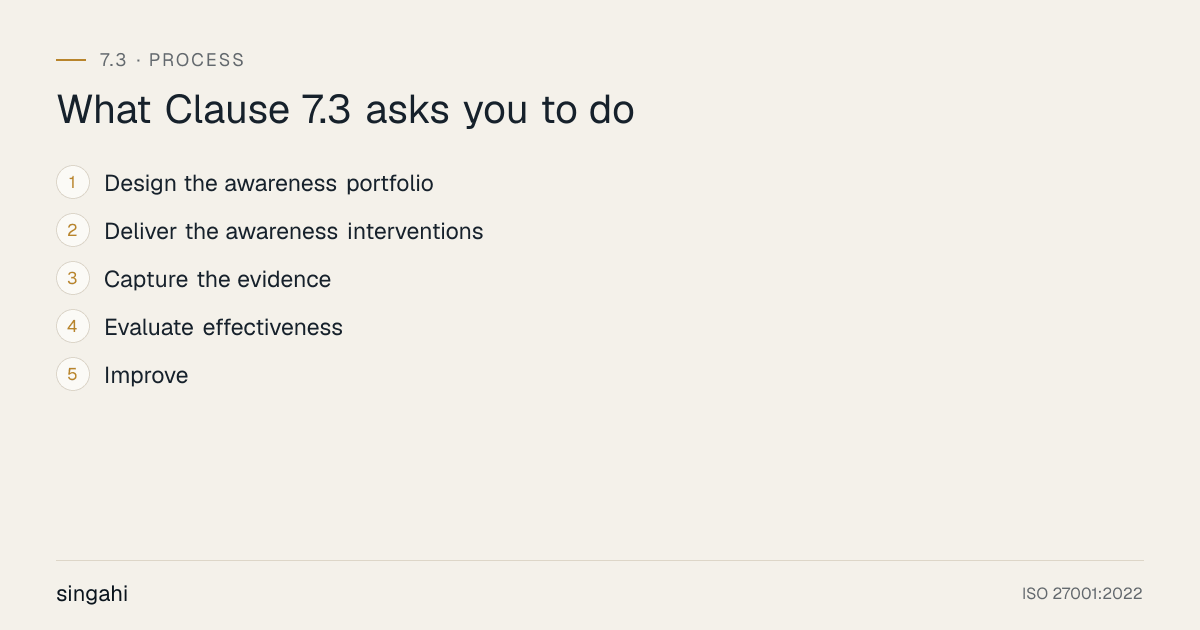
A working 7.3 system operates a continuing five-stage lifecycle. Each stage has its own evidence and its own audit test; the lifecycle is operated year-round, not as an annual event.
Stage 1, Design the awareness portfolio
The first stage is design. The output of Stage 1 is a documented awareness portfolio: the Audience Tier Model, the Awareness Curriculum, the Channel Matrix, the cadence schedule, the multilingual adaptation plan, and the integration touchpoints map.
Step 1.1, Build the Audience Tier Model. Take the org chart and the contractor list (and the field-force roster, the supplier-staff list, the visitor protocol), and segment the population into four tiers. A defensible tiering:
- Tier 1, General workforce. All permanent and contract employees whose role does not include BCM-specific responsibilities. Typical awareness content: the BC policy at a glance; what counts as a disruption; how to recognise and report; the activation notification; evacuation and assembly; the floor marshal and BCM Coordinator; manual-mode awareness for their activity; what not to do (do not talk to press, do not pay ransoms, do not click suspicious links, do not switch on water-damaged devices, do not delete logs); the consequences of non-compliance.
- Tier 2, BCM-adjacent roles. Functional heads, line managers, HR, Facilities, Procurement, Legal, Communications, Internal Audit, customer-facing leads, the floor marshals and the crisis-communications deputies. Typical awareness content: all of Tier 1, plus their role in activation, the call-tree cascade they own, their part in the manual fallback, the contractor and supplier-awareness they cascade, the customer-communication playbook, the regulatory notification expectations (CERT-In six-hour clock; RBI, SEBI, IRDAI reporting routes).
- Tier 3, BCM team and execution roles. The BCM Manager and BCM Coordinators, the CMT members (CEO, COO, CFO, CIO, CISO, Heads of Operations), the IT DR team, the SOC lead, the IR lead, the work-area-recovery team, the crisis-comms lead, the CERT-In PoC. Typical awareness content: all of Tier 1 and Tier 2, plus the BIA priorities and RTO/RPO/MBCO per prioritised activity, the BC strategy, the plan set, the exercise calendar, the regulator relationship, the post-incident process.
- Tier 4, Board, top management, key suppliers, regulators. The board, the audit and risk committees, the CEO and direct reports, the key supplier account leads, the regulator-relationship owners. Typical awareness content: the BC policy and leadership commitments, the organisation's continuity posture, the regulator's expectations, the board's risk-oversight role (Companies Act §134(3)(n), §177; SEBI LODR Reg. 21), the BCM investment profile, the major-risk register, the exercise and incident portfolio.
Step 1.2, Profile the curriculum. For each tier, profile the awareness requirements across the three duties (policy, role, consequences) and the disruption classes the BIA identifies as plausible. The disruption classes typically include: fire, flood, cyclone, earthquake, landslide, heatwave, civil unrest, terrorist incident, industrial accident (chemical release, explosion), pandemic, power outage, telecom outage, ICT outage, ransomware, phishing, data breach, insider error, supplier failure, key-person loss, financial-liquidity event, regulatory action, reputational event. The BIA (Clause 8.2) is the authoritative source for the disruption classes relevant to the organisation; the awareness curriculum must cover all plausible classes, calibrated to the audience.
Step 1.3, Build the Channel Matrix. Map each tier × each learning objective to the channel(s) that will deliver it. The nine channels used in mature Indian programmes:
- Induction / onboarding pack, day-one and within-30-day for every new joiner, contractor, intern.
- Refresher cadence, quarterly micro-learning for Tier 1, monthly for Tier 2, weekly or sub-weekly for Tier 3, half-yearly for Tier 4.
- Town halls and leadership briefings, quarterly for the workforce; half-yearly board briefing.
- Exercise programme (Clause 8.5), at least one evacuation drill per site per year; at least one tabletop per CMT per year; at least one full failover exercise per prioritised activity per year (or per regulatory cadence, SEBI MII, RBI MD, IRDAI).
- Phishing simulation and social-engineering drills, monthly to quarterly for Tier 1; targeted for Tier 2 and Tier 3.
- Post-incident and post-exercise reinforcement, within 30 days of any real incident or major exercise.
- Signage and digital displays, permanent signage at every site (evacuation routes, assembly points, emergency contacts); digital-signage rotation for current messages.
- Intranet / portal / LMS, the persistent reference content (the BC policy, the BCM Coordinator list, the activation notification template, the manual-mode procedures, the FAQs).
- Voice-SMS, WhatsApp business, short videos, pocket cards, for the field and distributed workforce, the channels that actually reach them.
The Channel Matrix makes the design explicit, every tier × every objective × every channel × every cadence. It is also the single most useful budgeting artefact: it makes clear what is being spent where.
Step 1.4, Build the multilingual adaptation plan. For each site and workforce segment, identify the languages in use (typically from HR records, contractor-roster language data, or a quick workforce survey). For each tier × objective × channel combination, identify the language(s) required. NDMA's Do's-and-Don'ts material is a usable starting point for natural-hazard content in Indian languages. Mature programmes use professional translation (not machine-only) for the core content and validate with native-speaker line managers.
Step 1.5, Build the integration touchpoints map. Document where the awareness programme plugs into the wider BCMS and HR system: Clause 5.3 role assignment, Clause 6.2 objective setting, Clause 7.5 document control, Clause 8.5 exercise schedule, Clause 9.1 KPI dashboard, Clause 9.3 management review, Clause 10.1 corrective action, and the HR transitions (onboarding, internal mobility, exit, contractor onboarding and offboarding). The integration map prevents the awareness programme from becoming an island.
Step 1.6, Charter the programme with top management. A formal chartering session with the CEO (or the executive sponsor named under Clause 5.1) is the foundation. The charter covers: the three duties; the four tiers; the channel mix; the cadence; the authority levels (who approves content, who signs off evidence, who accepts an awareness risk); the budget under Clause 7.1; the integration with HR, L&D, Comms, Information Security, functional heads and Internal Audit; and the management-review interface.
Stage 2, Deliver the awareness interventions
The second stage is delivery. The output of Stage 2 is a portfolio of executed interventions with captured evidence.
Step 2.1, Deliver the onboarding awareness pack. Every new joiner (and contractor, and intern) receives, on or before day one: a one-page summary of the BC policy in the local language; the activation-notification sample; the evacuation procedure for their work location; the name and contact of their floor marshal and BCM Coordinator; the manual-mode summary for their activity (where applicable); the Do's-and-Don'ts; and the consequences of non-compliance. Delivery is verified by a knowledge check (short quiz, manager attestation, or sign-off). The pack is re-delivered within 30 days in a longer format (typically an instructor-led or e-learning module of 30 to 60 minutes).
Step 2.2, Deliver the refresher cadence. The refresher content is calibrated to the tier. For Tier 1, micro-learning (5 to 10 minute modules) on the disruption classes the BIA identifies as most plausible, delivered quarterly. For Tier 2, a monthly update on the BCM posture (recent incidents, recent exercises, regulatory changes, recent phishing campaigns). For Tier 3, a weekly or sub-weekly cycle of plan-walks, call-tree tests, and tabletop micro-scenarios. For Tier 4, a half-yearly briefing that includes the BCM dashboard, the regulator's recent communications, and the BCM investment profile.
Step 2.3, Deliver the leadership briefings. A quarterly town hall by the BCM Manager (or sponsor) for the workforce; an annual or half-yearly briefing for the board and the audit and risk committees. The leadership briefing is the single most powerful awareness intervention, visible top-management communication signals that BCM is the organisation's commitment, not a compliance chore.
Step 2.4, Deliver the exercise programme as awareness. Every exercise (Clause 8.5) is an awareness intervention. The evacuation drill for the factory; the tabletop for the CMT; the full-failover for the core-banking system; the phishing simulation for the workforce, each builds awareness that classroom content cannot. The exercise calendar is therefore a core component of the awareness curriculum, not a separate activity.
Step 2.5, Deliver the phishing and social-engineering programme. A published calendar of phishing simulations (typically monthly or quarterly, calibrated by tier and by role), with click-rate, report-rate and repeat-offender tracking. Social-engineering drills (vishing, smishing, tailgating, USB drop) at lower frequency. Every simulation is followed by just-in-time coaching for clickers, not public shaming, the culture is "report, don't fear".
Step 2.6, Deliver the post-incident and post-exercise reinforcement. Within 30 days of any real disruption or major exercise, the awareness programme delivers a reinforcement intervention targeted to the lessons. AIIMS-style ransomware? A refresher on recognising the early signals and the escalation route. CrowdStrike-style IT outage? A refresher on the manual-mode fallback and the customer-communication playbook. The reinforcement is itself a documented awareness intervention, with attendance and effectiveness captured.
Step 2.7, Deliver the contractor and outsourced-staff pack. The pack flows through the master service agreement and the contractor-onboarding process. It includes the same onboarding pack delivered to employees, plus the contractor-specific awareness (who to call, what not to do, what the contract requires). For RBI-regulated entities, this is non-negotiable under the RBI MD Outsourcing of IT Services (10 April 2023). For DPDP-covered Data Fiduciaries, awareness of contractors that handle personal data is a Section 8(5) availability safeguard.
Step 2.8, Deliver the multilingual content. Content in the languages of the workforce, delivered through channels that reach the workforce. Voice-SMS for the field workforce; signage for the shop floor; pocket cards for the delivery partners; classroom in the local language for the contractor onboarding.
Step 2.9, Capture the evidence. Every delivered intervention generates evidence: attendance records, completion records, knowledge-check scores, simulation telemetry, exercise-evaluator ratings, manager attestations, sign-offs. Evidence is captured into the Awareness Evidence Record per individual under Clause 7.5 document control. The discipline is non-negotiable: awareness without evidence is assertion, and assertion is non-conformant.
Stage 3, Capture the evidence
The third stage is evidence. The output of Stage 3 is a complete, current, controlled Awareness Evidence Record per individual, plus aggregated evidence for management review.
Per individual. The Awareness Evidence Record contains, at minimum: the interventions received (induction, refreshers, drills, simulations, briefings) with dates and durations; the assessment results (quiz scores, simulation outcomes, exercise-evaluator ratings); the manager attestations; the sign-offs; the languages of delivery; the channels used; the gaps identified; the corrective actions. The Record is controlled per Clause 7.5, version control, access control, retention aligned with DPDP and the enterprise retention schedule, secure disposition.
Per tier. Aggregated evidence per tier: coverage %, currency %, effectiveness measures, behaviour evidence, trend over time.
Per programme. Aggregated evidence for the awareness programme as a whole: total interventions delivered, total population reached, total cost, total gap-closures, total effectiveness measures, total integration touchpoints exercised. This evidence feeds the Clause 9.1 dashboard and the Clause 9.3 management review.
Evidence forms that work in the Indian growing-company context:
- Attendance and sign-in sheets, minimum acceptable evidence; sufficient for L1 but inadequate for L3+.
- LMS completion records, the standard evidence form for digital content; supports automated coverage reporting.
- Knowledge-check scores, multiple-choice or short-answer; a quick effectiveness measure (Level 2 learning).
- Simulation telemetry, phishing click-rate, report-rate; the most objective behaviour evidence (Level 3).
- Exercise-evaluator ratings, for Tier 2 and Tier 3, the evaluator's rating of the individual's performance in the last exercise; high-use Level 3 evidence.
- Manager attestation, the line manager's signed statement that the individual is aware; a Level 3 evidence form when supported by observation.
- Self-assessment, useful for refreshers and gap-checks, but weak as a sole evidence form.
- Pocket-card possession, for field workforce, the physical pocket card with key contacts and Do's-and-Don'ts; observable possession is a basic evidence form.
Stage 4, Evaluate effectiveness
The fourth stage is evaluation. The output of Stage 4 is a documented assessment of whether the awareness programme is working.
Level 1 (Reaction). Did the workforce find the intervention useful? Captured through post-intervention surveys, typically 1 to 5 ratings. Useful for content iteration; weak as a measure of awareness itself.
Level 2 (Learning). Did the workforce learn what was taught? Captured through knowledge-check scores, pre/post comparisons, end-of-module assessments. A meaningful measure of awareness; the auditor will look for trends.
Level 3 (Behaviour). Did the awareness transfer into behaviour? Captured through phishing-simulation click-rate trends, exercise-evaluator ratings, manager observations, simulated and real incident telemetry. This is the most consequential measure; an awareness programme that produces Level 1 and Level 2 success but no Level 3 change is failing.
Level 4 (Outcomes). Did the awareness programme move the needle on the BCMS outcomes the organisation cares about, fewer reportable incidents, faster detection, faster recovery, fewer audit findings, lower regulator scrutiny, fewer customer-impacting events? Captured through the BCMS KPI dashboard. Hardest to attribute but most meaningful for the board.
The Effectiveness Evaluation Design specifies, per intervention type (induction, refresher, drill, simulation, briefing, reinforcement), which levels are captured and how. Mature programmes capture Level 1 and Level 2 routinely, Level 3 for material interventions, Level 4 quarterly through the dashboard.
Stage 5, Improve
The fifth stage is improvement. The output of Stage 5 is the next-cycle awareness portfolio.
Triggers for improvement:
- A real incident (Clause 10.1 corrective action).
- A major exercise finding (Clause 8.5).
- An internal or external audit finding (Clause 9.2).
- A regulatory change (RBI, SEBI, IRDAI, CERT-In, DPDP, NDMA).
- A new threat (ransomware campaign, social-engineering trend, supply-chain compromise).
- An organisational change (M&A, new site, new product, new supplier, restructure).
- A workforce change (new language community, new shift, new contractor population).
- A measurement cycle (quarterly effectiveness review, annual programme review, triennial maturity review).
- A management-review input (Clause 9.3).
Improvement actions:
- Add new content (new scenario, new threat, new regulation).
- Remove obsolete content (superseded regulation, retired plan, old policy version).
- Change channels (move from classroom to micro-learning for a segment; add voice-SMS for a field force).
- Change cadence (increase frequency for a high-risk segment; decrease for a stable one).
- Change languages (add a language for a new workforce segment).
- Change evidence forms (move from attendance to simulation for a tier).
- Change the curriculum (re-tier a segment; re-prioritise the disruption classes).
- Change the integration (add a new HR transition; add a new supplier onboarding hook).
The improvement loop is closed when: the action is documented (in the corrective-action log or the improvement log); the action is executed; the action is verified (effectiveness re-measured); the action is reviewed (in the management review); and the action is reflected in the next-cycle portfolio. An awareness programme that improves on paper but not in measured behaviour is not improving.
Audience-tier delivery patterns (worked examples)
The five-stage lifecycle is the same for every tier; the delivery differs. The patterns below illustrate how each tier is treated in a typical Indian growing-company programme.
Tier 1, General workforce. Day-one onboarding pack in the local language; 30-day e-learning module; quarterly micro-learning (5 to 10 minute) on the most plausible disruption class for the season (flood micro-learning in monsoon, heatwave in May, phishing in the festival season); one evacuation drill per site per year; one organisation-wide phishing simulation per quarter; signage at every site; pocket card for field staff; town-hall touchpoints quarterly. Effectiveness: phishing click-rate trend, drill participation rate, manager-attestation rate.
Tier 2, BCM-adjacent roles. All of Tier 1, plus a monthly briefing (recent incidents, exercises, regulatory changes); a one-page "BCM this month" from the BCM Manager; a designated role in the next exercise; participation in the call-tree cascade test; a refresher on the CERT-In six-hour clock and the regulator reporting routes; for line managers, the cascade-on-to-their-team responsibility. Effectiveness: call-tree cascade time, exercise participation, regulator-reporting accuracy in drills.
Tier 3, BCM team and execution roles. All of Tier 1 and Tier 2, plus a weekly plan-walk (a 15-minute walk-through of one BC plan section); a monthly tabletop micro-scenario (15 to 30 minutes); participation in every exercise (Clause 8.5) as controller, evaluator, or participant; a quarterly external briefing (regulator, peer, conference); a half-yearly refresher on the BIA priorities and the RTO/RPO/MBCO per prioritised activity; a current awareness of the supplier landscape and the regulator landscape. Effectiveness: exercise performance against RTO/RPO, post-exercise action closure, internal-audit findings.
Tier 4, Board and top management. A half-yearly board briefing (the BCM dashboard, the major-risk register, the regulator's recent communications, the BCM investment profile, the exercise and incident portfolio, the maturity advancement plan); an annual board-level exercise (typically a 90-minute tabletop on a board-relevant scenario, ransomware impact on the financials, regulatory action, supply-chain compromise, key-person loss); an annual self-assessment of board BCM literacy. Effectiveness: board engagement (questions asked, decisions taken), self-assessment trend, time-to-decision in the board-level exercise.
Multilingual and field-force delivery (the Indian design)
The Indian workforce is multilingual, distributed, and partly field-based. The awareness programme must be designed for these realities, not retrofitted.
Multilingual design. Start from the languages of the workforce (HR records, contractor-roster data, a short workforce survey). For each tier × objective × channel, identify the language(s) required. Use professional translation for the core content; validate with native-speaker line managers. Use NDMA's Do's-and-Don'ts material as a starting point for natural-hazard content. Use voice-SMS and short videos for the workforce that does not read the working language fluently. Measure the coverage by language community, not just by total population, a 95% coverage that excludes a regional-language community is non-conformant for that community.
Field-force design. For drivers, delivery partners, field-collection agents, medical representatives, field-service engineers, business correspondents: use voice-SMS for time-sensitive awareness (the latest phishing pattern, the current heatwave alert, the festival-season safety reminder); use short videos (3 to 5 minutes, in the local language) for refresher content; use physical pocket cards for the always-available reference (key contacts, Do's-and-Don'ts, activation-notification sample); use the regional office or area-manager cascade for in-person refreshers (at least half-yearly). Measure coverage by individual, not by region, a 95% coverage that misses 50 field staff is non-conformant for those 50.
Shift design. For night-shift, weekend and rotational workforces: schedule classroom and instructor-led interventions across all shifts (do not deliver only on the day shift); use asynchronous channels (e-learning, voice-SMS, video) for the workforce that cannot attend synchronous sessions; pay attention to the night-shift BCM Coordinator, they are often the most-overlooked node in the cascade.
Contractor design. For security guards, housekeeping, canteen staff, facilities, maintenance, IT managed-services staff: deliver the onboarding pack through the contractor onboarding process (not the corporate HR onboarding); flow the awareness obligation through the master service agreement; verify delivery through contractor-provided evidence (attendance, sign-offs, photos of briefings) and through spot-checks; cascade refresher content through the contractor's site supervisor; include the contractor population in drills.
Integration with the wider learning system
The awareness programme does not stand alone. It integrates with:
- The information-security awareness programme (ISO/IEC 27001:2022 Clause 7.3 and Annex A control 6.3). For most growing companies, the IS awareness programme and the BC awareness programme are one programme with two reporting lines. Phishing simulations, social-engineering drills, and incident-reporting awareness are shared content; the BC-specific content (policy, role in disruption, manual-mode, exercise participation) is layered on.
- The occupational health and safety awareness programme (ISO 45001:2018 Clause 7.3, where adopted). Evacuation drills, life-safety briefings, hazardous-process awareness are shared content with OHS; the BCM-specific content (continuity of prioritised activities, manual-mode workarounds, recovery awareness) is layered on.
- The environmental awareness programme (ISO 14001:2015 Clause 7.3, where adopted). For chemical, pharma and manufacturing firms, environmental emergency response overlaps heavily with BCM.
- The quality awareness programme (ISO 9001:2015 Clause 7.3, where adopted). For firms with an integrated QMS/BCMS, the awareness programme serves both.
- The data-protection awareness programme (DPDP Act 2023). Privacy awareness, breach-recognition awareness, and the workforce's role in protecting personal data are shared content with the DPDP programme; the availability-angle is BCM-specific.
- The HR onboarding and offboarding system. Onboarding is the moment of greatest awareness use; offboarding is the moment of greatest awareness risk (the departing insider). Both are wired into the awareness lifecycle.
Tools, Technologies, and Solutions
The 7.3 toolkit ranges from spreadsheet and intranet to enterprise GRC platforms. The choice depends on organisation size, digital maturity, language mix, and the regulatory regime. The categories below describe the tooling landscape in neutral terms; named brands are not endorsed.
Channel-delivery tools
- Learning Management Systems (LMS). Standard for digital content delivery, completion tracking, and basic knowledge-check. Indian and global LMS platforms are widely deployed. For a small organisation, an LMS may be overkill; for a mid-market or enterprise, it is typically the backbone. Look for: multilingual content support, mobile access (for field workforce), offline capability (for low-connectivity sites), integration with HR systems, and assessment/reporting features.
- Micro-learning platforms. Short-form content delivery (5 to 10 minute modules), often mobile-first, with push-notification cadence. Useful for refresher content; complementary to (not a replacement for) the LMS.
- Communication platforms. Town-hall tools (video-conferencing, webinar platforms), intranet platforms, internal social platforms. Useful for leadership briefings, town halls, and persistent reference content.
- Digital-signage platforms. Networked displays at sites for rotating awareness messages (evacuation routes, emergency contacts, current campaigns). Useful for the workforce that does not sit at a desk.
- Voice-SMS and SMS gateways. Bulk voice-SMS for the field workforce; the channel that reaches drivers, delivery partners, and field staff. Important for the Indian field-force context.
- WhatsApp Business / enterprise messaging. Where compliant with DPDP and IT Act requirements, a useful channel for short awareness pushes to field workforce. Audit carefully, the regulator's view of WhatsApp for business communication is not uniform (RBI has restricted its use for certain banking communication).
- Augmented-reality / virtual-reality. Emerging channel for evacuation briefings, hazardous-environment simulations, and immersive scenario training. Mature programmes may use AR/VR for high-risk, high-consequence scenarios (fire, chemical release, active shooter).
Simulation and drill tools
- Phishing-simulation platforms. Send simulated phishing payloads to the workforce; track click-rate, report-rate, repeat-offender rate; deliver just-in-time coaching to clickers. Standard tool in most mid-market programmes; aligns with ISO 27001 A.6.3 and 22301 7.3 simultaneously.
- Social-engineering drill tooling. Vishing platforms, USB-drop frameworks, in-person impersonation protocols. Less standard than phishing simulation; used by mature programmes.
- Exercise-management platforms. Plan, schedule, conduct, evaluate exercises; capture evidence; track action closure. Useful for programmes with a heavy exercise calendar (Clause 8.5).
Evidence and reporting tools
- GRC / IRM platforms. Integrated governance, risk and compliance platforms with an awareness module, coverage dashboards, evidence aggregation, KPI reporting, integration with HR, audit, and risk. The category is described at the category level; vendor selection is the reader's procurement exercise. Indian firms often use a global GRC platform with a local system integrator; category-level Indian and global options exist across the mid-market and enterprise band.
- HR-platform awareness modules. Modern HR platforms (HR-information system, HR-learning system, HR-information system, Zoho People, Keka, GreytHR) increasingly offer awareness-module features, content delivery, completion tracking, basic reporting. Sufficient for small and growing-company programmes; typically augmented by an LMS or micro-learning platform for richer content.
- Spreadsheet-based Evidence Records. For small organisations and for low-population segments in larger organisations, a well-designed spreadsheet Evidence Record (one row per individual, columns per intervention, controlled per Clause 7.5) is sufficient. The auditor accepts spreadsheet evidence at L1–L2; L3+ typically requires LMS or HR-platform evidence.
Content-development tools
- Authoring tools. For organisations building their own content: Articulate, Captivate, dominKnow, and open-source alternatives (Adapt, exeLearning). For multilingual content, professional translation (not machine-only) is recommended; native-speaker validation is essential.
- Stock content libraries. NDMA's Do's-and-Don'ts material (freely reusable, Indian languages) is a usable starting point for natural-hazard awareness. CERT-In advisories are usable for cyber-awareness refreshers. BCI and DRI publish awareness materials usable under licence.
Cost ranges (illustrative, India market)
- LMS deployment (mid-market). ₹4 lakh to ₹20 lakh per year subscription, plus implementation. Higher for enterprise deployments with multilingual content and integration.
- Phishing-simulation platform. ₹50 to ₹300 per user per year (volume-discounted), depending on features and population.
- Micro-learning platform. ₹80 to ₹400 per user per year.
- Content development. ₹1 lakh to ₹5 lakh per hour of finished learning content, depending on production quality and language count. NDMA material is free; CERT-In advisories are free.
- GRC platform awareness module. Part of a wider GRC investment (₹25 lakh to ₹2 crore per year, category-level).
- Voice-SMS. ₹0.30 to ₹1.50 per message (volume-discounted).
- Translation (professional). ₹0.50 to ₹2 per word, depending on language and complexity.
- External BCM awareness consultant. ₹1.5 lakh to ₹3 lakh per day (Indian market, mid-market specialists).
These ranges are illustrative third-party cost ranges (not Singahi pricing), drawn from category-level public information; actual costs vary by vendor, volume, scope, and year.
Selection criteria
When selecting tools, prioritise:
- Multilingual capability, content in the languages of the workforce, not just English.
- Mobile and offline, for the field and shift workforce.
- Integration with HR systems, for population data, onboarding triggers, internal-mobility triggers, offboarding triggers.
- Evidence capture, completion, assessment, simulation telemetry, exportable to the GRC platform and to the Clause 7.5 document-control system.
- Reporting, coverage by tier, by language, by location, by shift; trend; effectiveness measures.
- Cost discipline, proportionate to the size of the awareness programme; not the most expensive platform the vendor can sell.
- Data-protection compliance, DPDP Act 2023 compliance for any tool that processes workforce personal data; data localisation where required by sector regulator.
Policy and Procedure Templates
BCM Awareness Policy (apex artefact), sample structure
The sample policy structure below is the author's own drafting; the policy is the organisation's apex 7.3 artefact, linked to the BCMS Policy (Clause 5.2).
- Purpose and scope. Why the policy exists; who it applies to (every person doing work under the organisation's control); what it covers (the BCMS awareness portfolio).
- Policy statement. The sanctioned requirement, a paraphrase of the clause's intent (the organisation commits to ensuring the workforce is aware of the BC policy, their role in disruptions, and the consequences of not following BCMS requirements).
- The three duties. Policy awareness, role-in-disruption awareness, consequence awareness.
- The four tiers. Tier 1 to Tier 4 with definitions.
- The nine channels. Induction, refresher, town halls, exercises, simulations, reinforcements, signage, intranet/LMS, field channels.
- The five-stage lifecycle. Design, deliver, evidence, evaluate, improve.
- Multilingual commitment. Content delivered in the languages of the workforce.
- Field-force commitment. Channels matched to the field-force reality.
- Contractor and outsourced-staff commitment. Awareness flowing through the master service agreement.
- Roles and authorities. BCM Manager (custodian), Top management (accountable), Head of HR (HR spine), Head of L&D (delivery), Head of Comms (comms channels), CISO (cyber overlap), Functional heads (team cascade), Internal Audit (independent test).
- Consequence framework. The disciplinary, regulatory, contractual, financial, reputational, safety and personal-liability consequences of non-compliance, and the mechanism for the workforce to be made aware of them.
- Review cadence. Annual policy review minimum; trigger-based review on regulatory or organisational change.
The sample "shall" clauses below (author's drafting; appropriate for the policy template) illustrate the policy commitment language:
- "The Organisation shall ensure that every person doing work under its control is aware of the business continuity policy, their role in the event of a disruption, and the consequences of not following BCMS requirements."
- "The Organisation shall deliver the awareness programme through channels matched to the language, location, shift and role of the workforce."
- "The Organisation shall capture, per individual, the Documented Information of awareness interventions received, and shall control that evidence under the document-control system."
- "The Organisation shall measure the effectiveness of the awareness programme at the reaction, learning, behaviour and outcome levels, and shall feed the results into the management review."
- "The Organisation shall extend the awareness programme to contractors, outsourced staff, field workforce, and any other person doing work under its control."
- "The Organisation shall brief the board and top management on BCM at planned intervals, not less than annually for non-regulated entities and not less than half-yearly for RBI-, SEBI-, IRDAI-regulated entities."
BCM Awareness Procedure (operating procedure), sample structure
- Purpose, scope, ownership.
- The five-stage lifecycle, design, deliver, evidence, evaluate, improve; with stages, owners, evidence forms.
- The Audience Tier Model, definitions, tiering criteria, re-tiering triggers.
- The Curriculum Matrix, tier × objective × disruption-class matrix.
- The Channel Matrix, tier × objective × channel × cadence.
- The Onboarding Pack, content, delivery, evidence.
- The Refresher Cadence, content, channels, evidence.
- The Leadership Briefing, content, frequency, evidence.
- The Exercise Integration, how Clause 8.5 exercises generate awareness evidence.
- The Phishing and Social-Engineering Programme, calendar, scenarios, telemetry, coaching.
- The Post-Incident and Post-Exercise Reinforcement Loop, triggers, content, evidence.
- The Multilingual and Field-Force Delivery, languages, channels, evidence by community.
- The Contractor and Outsourced-Staff Pack, flow through the MSA, evidence.
- The Evidence Record per Individual, content, control, retention.
- The Effectiveness Evaluation, Level 1 to Level 4, captured per intervention type.
- The Improvement Loop, triggers, actions, verification, review.
- The Integration Touchpoints, HR transitions, BCM clauses, audit, management review.
- Review of the Procedure, annual review; trigger-based review.
The Onboarding Awareness Pack (sample one-pager)
(For the full pack, see toolkit 07-training-materials.md and 08-awareness-onboarding-pack.md.)
- The BC policy in one paragraph (paraphrased; the workforce does not need the policy verbatim).
- The prioritised activity the new joiner's work supports (in plain language).
- How to recognise that a disruption is happening.
- Who to tell, the floor marshal, the BCM Coordinator, the IR line.
- The activation notification, what it looks like, where it comes from.
- The evacuation procedure, routes, assembly point, marshal.
- The manual-mode fallback for the activity (where applicable).
- What not to do, do not talk to press, do not pay ransoms, do not click suspicious links, do not switch on water-damaged devices, do not delete logs.
- The consequences of not following BCMS requirements, disciplinary, regulatory, safety, customer-impact, personal-liability.
- Where to find more, the intranet BCM page, the BCM Coordinator, the LMS.
The Board Briefing Pack (sample structure)
- The BCM dashboard, coverage, currency, effectiveness, behaviour measures.
- The major-risk register, the top BCM risks and the treatments.
- The regulator's recent communications, RBI, SEBI, IRDAI, CERT-In, DPDP, as applicable.
- The exercise and incident portfolio, recent exercises, recent incidents, lessons, corrective actions.
- The BCM investment profile, spend, budget, ROI measures.
- The maturity advancement plan, current maturity, target maturity, the actions to close the gap.
- The decisions sought from the board, investment, policy change, organisational change, regulatory engagement.
Risk Assessment and Treatment
The 7.3 risk register
A 7.3 risk register captures the awareness-specific risks, the failure modes of the awareness programme itself. Typical risks:
- R-01 Awareness coverage gap (by tier). Some tier (typically Tier 4 or the contractor population) has coverage below target. Treatment: targeted intervention; channel redesign; cadence adjustment.
- R-02 Awareness coverage gap (by language). A language community has coverage below the overall coverage. Treatment: translation; native-speaker delivery; channel matched to the community.
- R-03 Awareness coverage gap (by location or shift). A site or shift has coverage below target. Treatment: location-specific delivery; shift-spanning schedule; on-site BCM Coordinator.
- R-04 Awareness currency gap. Coverage is high but currency is low (the workforce was inducted years ago and never refreshed). Treatment: refresher cadence enforcement; trigger-based re-induction.
- R-05 Effectiveness gap. Awareness is delivered but not transferred into behaviour (phishing click-rate flat or rising; exercise performance poor). Treatment: content redesign; channel redesign; consequence communication; manager-engagement programme.
- R-06 Consequence-awareness gap. The workforce cannot articulate the consequences of non-compliance. Treatment: explicit consequence communication; case-study briefings; embedded in onboarding and refresher.
- R-07 Role-in-disruption gap. The workforce cannot describe their role. Treatment: role-specific briefings; pocket cards; manager attestation; exercise participation.
- R-08 Policy-awareness gap. The workforce cannot describe the BC policy. Treatment: policy summary on the intranet; signage; town-hall touchpoints; onboarding reinforcement.
- R-09 Leadership-visibility gap. Top management does not visibly champion BCM. Treatment: board briefing; leadership town hall; CEO communication.
- R-10 Contractor gap. Contractors are out of scope. Treatment: contractor pack; MSA flow; evidence sharing.
- R-11 Phishing and social-engineering exposure. Phishing click-rate above benchmark; social-engineering drill results poor. Treatment: increased simulation cadence; targeted coaching; consequence communication.
- R-12 Regulatory-change gap. Recent regulatory change (e.g., a new RBI or SEBI circular, a DPDP Rules update) not reflected in the curriculum. Treatment: regulatory monitoring; curriculum update; refresher delivery.
- R-13 Single-point-of-failure awareness. Awareness depends on one person (the BCM Manager) for delivery. Treatment: co-delivery through HR, L&D, Comms, functional heads.
- R-14 Evidence-system gap. Awareness is delivered but evidence is not captured (or not controlled per Clause 7.5). Treatment: LMS or HR-platform evidence capture; Clause 7.5 document-control integration.
- R-15 Cultural gap. The workforce does not feel safe to report incidents or near-misses. Treatment: psychological-safety programme; consequence-of-reporting clarification; leadership behaviour; recognition for reporting.
Risk-rating methodology
A simple, defensible methodology: rate each risk on likelihood (1 to 5) and impact (1 to 5), giving a 1–25 risk score; plot on a heat map; prioritise treatments by score and by tier-criticality. Review the register quarterly; re-rate on triggers (incident, exercise, audit, regulatory change, organisational change).
Risk-treatment patterns
- Avoid. Redesign the curriculum so the risk cannot arise (e.g., remove a language gap by mandatory translation).
- Reduce. Increase the cadence, broaden the channel, deepen the consequence communication.
- Transfer. Flow the awareness obligation contractually to the supplier (under Clause 7.4 of the master agreement), the supplier becomes responsible for delivering the awareness pack to its staff.
- Accept. A low-likelihood, low-impact risk in a stable environment may be accepted, with the acceptance documented and reviewed.
Integration with the BCMS risk register
The 7.3 risk register feeds the wider BCMS risk register maintained under Clause 6.1. Awareness risks that affect the BCMS outcomes (e.g., a phishing-exposure risk that affects the recovery-time outcome) are escalated to the BCMS risk register for top-management attention.
Audit and Compliance Checklist
The 30-question audit checklist below is the working audit instrument for a 7.3 certification or surveillance audit. Each question is paired with the expected evidence and a red flag.
A. Policy and chartering (3 questions)
- Is there a BCM Awareness Policy approved by top management? Expected: the Policy document with top-management signature; alignment with Clause 5.2 BCMS Policy; the three duties; the four tiers; the channels; the cadence; the consequence framework. Red flag: Policy is a one-page "we will train the workforce" with no operationalisation.
- Does the Policy state the sanctioned requirement (the 7.3 paraphrase) and the consequence framework? Expected: paraphrase quoted; consequences (disciplinary, regulatory, contractual, financial, reputational, safety, personal-liability) named. Red flag: Policy asserts awareness commitment without operationalising consequence communication.
- Is the Policy linked to the BCMS Policy (Clause 5.2), the HR policy, the L&D strategy, the information-security awareness programme, and (where applicable) the OHS and environmental-awareness programmes? Expected: cross-references in the Policy; aligned terminology; consistent roles. Red flag: Policy is a stand-alone document that contradicts HR, IS, or OHS awareness.
B. Audience Tier Model (3 questions)
- Is there an Audience Tier Model covering all persons doing work under the organisation's control? Expected: the Model document; coverage of Tier 1, Tier 2, Tier 3, Tier 4; named populations per tier (employees, contractors, outsourced staff, field force, board). Red flag: Model covers only permanent employees.
- Are contractors, outsourced staff, field workforce, and visitors with system access in scope? Expected: explicit inclusion; delivery and evidence for these populations. Red flag: contractor population out of scope (a non-conformity under RBI MD Outsourcing of IT Services for BFSI and DPDP Section 8(5) for personal-data processors).
- Is the Model reviewed at planned intervals and on trigger events (restructure, M&A, new site, new product, new supplier, new language community)? Expected: review schedule; trigger-event reviews; revision history. Red flag: Model out of date vs the current workforce.
C. Curriculum (3 questions)
- Is there a Curriculum covering the three duties (policy, role, consequences) for each tier? Expected: Curriculum document; tier × duty matrix. Red flag: Curriculum exists only for Tier 1 or covers only the policy duty.
- Does the Curriculum cover the disruption classes identified in the BIA (Clause 8.2)? Expected: tier × duty × disruption-class matrix. Red flag: Curriculum covers generic "disruption" without scenario-specific content.
- Is the Curriculum reviewed on regulatory change (RBI, SEBI, IRDAI, CERT-In, DPDP, NDMA) and on organisational change? Expected: review schedule; trigger-event reviews; revision history. Red flag: Curriculum out of sync with the current regulatory landscape.
D. Channel Matrix (3 questions)
- Is there a Channel Matrix matching tier × objective × channel × cadence? Expected: the Matrix; rationale for channel choice. Red flag: Matrix is implicit (in someone's head); every tier is "classroom annual".
- Are multilingual channels in the Matrix for the language communities present? Expected: language identification per community; content per language; delivery per language. Red flag: English-only delivery for a multilingual workforce.
- Are field-force channels (voice-SMS, video, pocket cards) in the Matrix for the distributed workforce? Expected: field-force channel row; coverage by individual. Red flag: intranet/LMS only for a field-heavy workforce.
E. Delivery evidence (4 questions)
- Is there an Onboarding Awareness Pack delivered on or before day one and refreshed within 30 days? Expected: the Pack; delivery evidence; knowledge-check evidence. Red flag: Pack exists but delivery is patchy.
- Is there a refresher cadence executed for each tier (quarterly Tier 1, monthly Tier 2, weekly/sub-weekly Tier 3, half-yearly Tier 4)? Expected: cadence schedule; delivery evidence; completion records. Red flag: cadence schedule exists but execution is below target.
- Is there an exercise programme (Clause 8.5) integrated into the awareness curriculum? Expected: exercise calendar; participation records; evaluator ratings feeding back to awareness evidence. Red flag: exercises and awareness operated as separate programmes.
- Is there a phishing-simulation and social-engineering programme with a published cadence? Expected: simulation calendar; click-rate, report-rate, repeat-offender telemetry; coaching for clickers. Red flag: phishing simulation never run, or run without consequence or coaching.
F. Consequence awareness (2 questions)
- Is the consequence framework communicated to the workforce? Expected: explicit consequence content in onboarding and refreshers; case-study briefings; manager attestation. Red flag: consequence content absent or buried.
- Can a randomly sampled worker describe at least one consequence of non-compliance? Expected: sample-test result; corrective actions on gaps. Red flag: workers cannot name a single consequence.
G. Evidence and document control (3 questions)
- Is there an Awareness Evidence Record per individual, controlled per Clause 7.5? Expected: Record per individual in the document-control system; access controls; retention rules. Red flag: evidence scattered across HR files, BCM team files, contractor records with no aggregation.
- Does each Record contain the full evidence set, interventions, assessments, simulation telemetry, exercise ratings, attestations? Expected: complete Record per individual. Red flag: Record contains attendance and quiz scores but no behaviour evidence.
- Are Records retained per DPDP Act 2023 requirements and the enterprise retention schedule? Expected: retention policy aligned with DPDP and Clause 7.5; secure disposition records. Red flag: no retention policy; Records retained indefinitely without basis.
H. Effectiveness evaluation (3 questions)
- Is there an Effectiveness Evaluation Design specifying, per intervention type, how effectiveness will be measured (Level 1 to Level 4)? Expected: Design document; per-intervention evaluation plan. Red flag: no Design; ad-hoc evaluation.
- Are Level 3 (Behaviour) measures captured for material interventions (phishing simulations, exercises)? Expected: telemetry, evaluator ratings, manager observations. Red flag: only Level 1 and Level 2 captured.
- Do effectiveness results feed back into the curriculum, the channels, and the cadence? Expected: post-intervention curriculum updates; revised cadence; channel changes. Red flag: effectiveness measured but not used.
I. Leadership and board awareness (2 questions)
- Is there a board and top-management BCM briefing delivered at least annually (or at least half-yearly for regulated entities)? Expected: briefing record; attendance; decisions taken; the BCM dashboard. Red flag: board has not been briefed on BCM in 24 months.
- Is there a leadership-visibility mechanism (CEO town hall, leadership communications, sponsor role)? Expected: town-hall cadence; CEO communication; sponsor identification. Red flag: leadership is invisible on BCM; awareness is treated as an HR chore.
J. Multilingual, field-force, and contractor delivery (2 questions)
- Is multilingual delivery measured by language community, not just by total population? Expected: coverage report disaggregated by language community. Red flag: aggregate coverage hides a community gap.
- Is contractor and outsourced-staff awareness flowed through the master service agreement and verified? Expected: MSA clauses; contractor-provided evidence; spot-check evidence. Red flag: MSA is silent on awareness; contractor evidence unaudited.
K. Management review and continual improvement (2 questions)
- Is the awareness portfolio reported to top management at every Clause 9.3 management review? Expected: management-review input; coverage, currency, effectiveness, behaviour, gap-closure, integration metrics; signed-off decisions. Red flag: awareness not on the management-review agenda.
- Are continual-improvement actions tracked and executed? Expected: improvement log; maturity-advancement targets (Section 22); trend analysis. Red flag: no improvement actions; static programme year-over-year.
Scoring guide. A clean run on all 30 is the L4–L5 target. 25–29 conformities with minor observations is the L3 norm. 20–24 conformities indicates L2 with multiple minor non-conformities. Below 20 indicates a Stage 1 major non-conformity on 7.3, likely showstopper for certification.
Metrics and KPIs
Figure · Measures
The measures that show Clause 7.3 is working
- Awareness coverage %100% within 12monthly
- Coverage % by tier100% per tiermonthly
- Coverage % by language community100% per comm…monthly
- Coverage % by location and shift100% per loca…monthly
- Coverage % for contractor population100%monthly
A working 7.3 system reports a balanced set of metrics, coverage, currency, effectiveness, behaviour, integration. The 15 KPIs below cover the full set; the auditor will look for at least 10 reported consistently with trends.
Coverage metrics
- Awareness coverage % (overall), (individuals with current awareness evidence ÷ total individuals in scope) × 100. Target: 100% within 12 months of joining; sustained at 100%. Frequency: monthly.
- Coverage % by tier, (individuals with current awareness evidence ÷ total individuals in tier) × 100, per tier. Target: 100% per tier. Frequency: monthly.
- Coverage % by language community, (individuals with current awareness evidence in the language ÷ total individuals in the language community) × 100. Target: 100% per community; gap < 5 percentage points vs overall. Frequency: monthly.
- Coverage % by location and shift, (individuals with current awareness evidence ÷ total individuals at location/shift) × 100. Target: 100% per location and shift. Frequency: monthly.
- Coverage % for contractor population, (contractor individuals with current awareness evidence ÷ total contractor individuals) × 100. Target: 100%. Frequency: monthly.
Currency metrics
- Currency %, (individuals whose last awareness intervention is within the cadence ÷ total individuals in scope) × 100. Target: ≥ 95%. Frequency: monthly.
- Onboarding-within-30-days %, (new joiners receiving the onboarding pack within 30 days ÷ new joiners in the period) × 100. Target: 100%. Frequency: monthly.
Effectiveness metrics (Level 2 learning)
- Knowledge-check pass rate, (individuals passing the knowledge check ÷ individuals taking it) × 100. Target: ≥ 90% on first attempt; ≥ 95% after re-take. Frequency: per intervention.
- Average knowledge-check score, mean score across the workforce per intervention. Target: trend improvement; ≥ 85% average. Frequency: per intervention.
Behaviour metrics (Level 3)
- Phishing-simulation click-rate, (individuals clicking a simulated phishing payload ÷ individuals receiving it) × 100. Target: < 5% (mature); < 10% (mid-market); trend reduction. Frequency: per simulation.
- Phishing-simulation report-rate, (individuals reporting a simulated phishing payload ÷ individuals receiving it) × 100. Target: ≥ 40% (mature); trend improvement. Frequency: per simulation.
- Exercise participation rate, (individuals participating in the last exercise cycle ÷ individuals in scope for the exercise) × 100. Target: ≥ 95% for site evacuation drills; ≥ 100% for CMT and BCM-team exercises. Frequency: per exercise.
- Exercise-evaluator awareness rating, evaluator's rating of workforce awareness in the last exercise (1 to 5). Target: ≥ 4 average; trend improvement. Frequency: per exercise.
Outcome and integration metrics (Level 4)
- Time-to-report an incident, median time from incident onset to internal report, by incident type. Target: trend reduction; aligned to the CERT-In six-hour clock (the workforce's report should be well within the clock; the regulator-report follows). Frequency: per incident; quarterly trend.
- Audit findings on awareness, number and severity of internal and external audit findings specifically on 7.3. Target: zero major non-conformities; trend reduction in minor findings. Frequency: per audit.
Dashboard design
A working awareness KPI dashboard presents the 15 metrics with: current value, trend (vs prior period and vs target), commentary (what changed, why, what's next), owner, and link to the underlying evidence. The dashboard is reviewed at every Clause 9.3 management review and reported to the board Risk Committee for BFSI/listed firms. For a growing company, a quarterly PDF dashboard is sufficient at L2–L3; an integrated GRC-platform dashboard is the L4–L5 target.
Cost-of-awareness metrics (advanced)
At L4–L5, mature organisations add cost-of-awareness metrics:
- Cost per aware individual, total 7.3 spend ÷ individuals with current awareness. Useful for benchmarking across business units.
- Cost per gap-closure, total 7.3 spend ÷ awareness gaps closed. Useful for evaluating intervention efficiency.
- ROI of the awareness programme, (avoided cost of awareness-driven incidents + audit-pass value + regulator-relationship value + customer-trust value) ÷ awareness spend. Directional rather than precise; the AIIMS-style case (a peer-reviewed example of a clinical workforce's first signals not being recognised in time) and the Cognizant-Maze-style case (an SEC-filed example of US$50–70 million Q2 impact) give a sense of the orders of magnitude at stake.
Common Pitfalls and Audit Failures
The 7.3 system is where many growing companies stumble in certification. The patterns below are named, memorable, and recur across sectors.
The "policy-on-the-intranet" anti-pattern
The BC policy is on the intranet and that is the awareness programme. No induction pack, no refresher cadence, no measurement, no evidence. The auditor's test is "show me how the workforce knows the policy beyond its existence on the intranet"; the answer "it's on the intranet" is a finding. Fix: build the Audience Tier Model, the Curriculum, and the Channel Matrix; deliver through channels matched to the audience; capture evidence per individual.
The "induction-once" anti-pattern
Every new joiner is inducted once and never touched again. The auditor's test is "show me the refresher cadence and the last refresher delivered to this individual hired 24 months ago"; the absence is a finding. Fix: quarterly Tier 1 micro-learning; monthly Tier 2; weekly/sub-weekly Tier 3; half-yearly Tier 4; trigger-based re-induction on role change, regulatory change, post-incident.
The "awareness-as-attendance" anti-pattern
Awareness records show attendance at sessions but no measurement of whether the awareness changed behaviour. The auditor's test is "what evidence do you have that the awareness translated into behaviour?"; the answer "everyone attended" is a finding. Fix: add Level 3 (Behaviour) measures to material interventions, phishing-simulation telemetry, exercise-evaluator ratings, manager observations, incident telemetry.
The "consequence-blind" anti-pattern
The workforce cannot articulate a single consequence of non-compliance. The auditor's test is "tell me one consequence of not following the BCMS requirements"; the answer "I'd get told off" or "I'm not sure" is a finding. Fix: explicit consequence content in onboarding and refreshers; case-study briefings; manager attestation; culture of "consequences are made legible, not hidden".
The "English-only" anti-pattern
The awareness content is in English; the workforce is multilingual. The auditor's test (in a multilingual site) is "explain your evacuation procedure in your working language"; if the worker cannot, the awareness has not landed. Fix: multilingual content delivery; native-speaker validation; voice-SMS and short video for the workforce that does not read the working language fluently; coverage measured by language community.
The "day-shift-only" anti-pattern
The awareness programme runs on the day shift; the night shift and weekend crews are systematically excluded. The auditor's test is "show me the awareness evidence for the night-shift workforce"; the absence is a finding. Fix: shift-spanning schedule; asynchronous channels for the workforce that cannot attend synchronous sessions; a designated night-shift BCM Coordinator.
The "intranet-only" anti-pattern
The awareness programme is delivered through the intranet; the field workforce does not have intranet access. The auditor's test is "show me the awareness evidence for your field force"; the absence is a finding. Fix: voice-SMS, short video, pocket cards, regional cascade for the field workforce; coverage measured by individual, not by region.
The "contractor-blind" anti-pattern
Contractors are out of scope; they have no awareness evidence. The auditor's test is "show me the awareness evidence for your security-guard, housekeeping, and managed-services contractor population"; the absence is a finding, and a serious one for BFSI (RBI MD Outsourcing of IT Services) and DPDP-covered Data Fiduciaries. Fix: contractor pack flowed through the MSA; contractor-provided evidence; spot-checks; inclusion in drills.
The "board-blind" anti-pattern
The board has not been briefed on BCM in 24 months. The auditor's test is "show me the last board BCM briefing record"; the absence is a finding, and a serious one for BFSI (RBI MD IT Governance) and listed firms (SEBI LODR Reg. 21). Fix: half-yearly board briefing (annual minimum for non-regulated firms); annual board-level exercise; documented board literacy self-assessment.
The "phishing-blind" anti-pattern
Phishing simulation has never been run; or has been run once with no follow-up. The auditor's test is "show me your phishing-simulation telemetry and the trend"; the absence is a finding. Fix: published phishing-simulation calendar; click-rate, report-rate, repeat-offender tracking; just-in-time coaching for clickers (not public shaming).
The "exercise-without-awareness-evidence" anti-pattern
Exercises (Clause 8.5) are run but the exercise-evaluator ratings are not captured as awareness evidence. The auditor's test is "show me how the exercise performance is reflected in the Awareness Evidence Record per individual"; the absence is a finding. Fix: link exercise-evaluator ratings to the individual's Record; the exercise is the highest-use evidence channel, use it.
The "single-BCM-Manager" anti-pattern (awareness variant)
The entire awareness programme is delivered by the BCM Manager. The auditor's test is "show me the delivery rota for the awareness programme and the alternates"; the absence is a finding, and an operational resilience risk. Fix: co-delivery through HR, L&D, Comms, CISO, functional heads; alternates identified; the BCM Manager is the custodian, not the universal deliverer.
The "audit-as-the-annual-event" anti-pattern (awareness variant)
Internal audit (Clause 9.2) looks at 7.3 once a year. Between audits, the programme drifts. The auditor's test is "show me the mid-year self-assessment"; the absence is a finding. Fix: quarterly BCM-team self-assessment against the 30-question audit checklist (Section 11); trend reporting to the BCM Steering Committee.
The "evidence-without-effectiveness" anti-pattern (awareness variant)
The Awareness Evidence Record is thick with attendance sheets and quiz scores but the effectiveness measures are missing. The auditor's test is "show me the Level 3 (Behaviour) evidence for this material intervention"; the absence is a finding. Fix: bake effectiveness into every material intervention from the design stage; capture Level 3 evidence at the next simulation or exercise.
The "DPDP-blind" anti-pattern (awareness variant)
The Awareness Evidence Record contains personal data (attendance, quiz scores, simulation telemetry, manager attestations) but is managed as if DPDP Act 2023 does not apply. The auditor's test (especially in BFSI, healthcare, and government sectors) is "show me your retention policy and consent basis for processing this personal data"; the absence is a finding, and a DPDP exposure. Fix: align Evidence Record retention with DPDP Act 2023 and Clause 7.5; minimise the personal data collected; role-based access; secure disposition.
The "always-aware-never-exercised" anti-pattern
Individuals have multiple awareness interventions in their Record but have never participated in an exercise under Clause 8.5. The auditor's test is "show me the last three exercises this individual participated in and the evaluator's rating"; the absence is a finding. Classroom awareness and crisis-room behaviour are different things. Fix: mandatory annual exercise participation for Tier 2 and Tier 3; exercise participation as a gating condition for awareness currency.
The "everything-is-priority" anti-pattern (awareness variant)
The curriculum treats every disruption class and every tier as equally important, exhausting the budget on lower-criticality content while high-risk gaps persist. The auditor's test is "show me your prioritisation rationale"; "everything is priority" is a finding because it indicates no prioritisation. Fix: prioritise by BIA criticality (high-priority activities first), by tier (Tier 3 first, then Tier 2, then Tier 1), by plausibility (top disruption classes from the BIA first), by trigger urgency (regulatory deadline first); document the rationale.
The "cultural-silencer" anti-pattern
The workforce is afraid to report incidents, near-misses, or awareness gaps because the cultural response is punitive. The auditor's test is "walk me through the last near-miss reported by a non-manager"; the absence is a finding, and a serious one for psychological-safety-dependent awareness programmes. Fix: psychological-safety programme; recognition for reporting; consequence-of-reporting clarification; leadership behaviour; "report, don't fear" as the stated culture.
Illustrative Scenario 1: Failure, Coromandel Formulations Private Limited (Illustrative)
Illustrative scenario, a composite example for guidance, not a specific Singahi engagement or a verified outcome.
Illustrative scenario. This case is illustrative. It does not report any specific real company, incident, or regulatory action. The characters are composites; the numbers are realistic mid-market India ranges. Use it to understand the failure dynamics, not as a factual account.
The organisation
Coromandel Formulations Private Limited (CFPL; illustrative name) is a Hyderabad-based mid-market pharmaceutical formulations manufacturer with ₹640 crore in annual revenue, two formulation plants (Hyderabad and Visakhapatnam), a corporate office in Hyderabad, 1,420 staff (820 permanent, 600 contract), and a regulatory footprint spanning the Central Drugs Standard Control Organization (CDSCO), the state Drug Control Administrations, the US FDA (for one ANDA-filled product), the EU EMA (for two CE-marked medical devices produced in a separate unit), the Drugs and Cosmetics Act 1940, the NDMA Chemical Disasters Guidelines 2007, and, since it handles personal data of patients in clinical-trial samples, the DPDP Act 2023.
The BCM and awareness posture before the event
CFPL had achieved ISO 22301:2019 certification 18 months before the event. The BCMS documentation was clean, a board-approved BCMS policy, a documented BIA with RTO of 24 hours for production and 8 hours for QC release, a strategy document committing to a managed-DRS in Hyderabad, BC plans for the CMT and IT DR, an annual exercise calendar, and an enterprise GRC platform with an awareness module.
The awareness posture, however, was thin. The BC policy was on the intranet in English only. The onboarding pack existed as a 22-slide deck delivered once by HR on day one; the deck had not been updated in two years. There was no Audience Tier Model; the entire 1,420-person population was treated as one tier. There was no refresher cadence, the workforce was inducted once and never touched again. The contractor population of 600 was excluded from the awareness programme because they were "not on the rolls". The two plants ran three-shift operations; awareness sessions were held on the day shift at the corporate office, missing the night-shift and Visakhapatnam populations. The Telugu-speaking shop-floor workforce received content in English; the Hindi-speaking contract workforce received content in English; the handful of Tamil-speaking QC chemists received content in English.
The BCM Manager, Priya Reddy (illustrative name), had flagged these gaps in the previous two management reviews under Clause 9.3. Each time, the action was deferred: "next quarter", "after the FDA inspection", "when the new HR system is live". The CEO had not attended an awareness town hall in 14 months. The board had not been briefed on BCM since certification.
The event
On a Tuesday in late July, monsoon flooding hit the Visakhapatnam plant. The plant sits on the Gajuwaka industrial belt; the flood was a 1-in-20-year event but well within the BIA's plausibility envelope. Water entered the ground-floor warehouse where ₹38 crore of finished formulation was staged for export shipment, rose to 60 cm within 90 minutes, and shorted the ground-floor electricals.
The night-shift supervisor on duty, Suresh Patel (illustrative name), had been with CFPL for three years. He had been inducted in 2022 with the 22-slide deck, in English, by an HR officer who had since left the company. He had never received a refresher. He had never participated in a flood-related evacuation drill (the last evacuation drill, eight months earlier, had been a fire evacuation on the day shift at the corporate office; he had not been in attendance). He did not know the plant's flood-specific BC plan existed; he had never seen the activation notification template; he did not know who the BCM Coordinator for the Visakhapatnam plant was (the role was held by the Hyderabad-based Plant Director, dual-hatted, with no on-site deputy).
His first action, on seeing the water rise, was to attempt to start the backup diesel generator on the ground floor, which had been installed there for noise reasons. The generator shorted. He then attempted to call the Plant Director; the Plant Director was in Hyderabad, in a meeting, with his phone on silent. He called the corporate office reception, which was unmanned at that hour. He did not call the BCM Manager because he did not know who she was. He did not call the crisis line because there was no signage indicating one. He did not evacuate the ground floor because the evacuation procedure he had been shown (in English, three years ago) was for fire, not for flood.
The water continued to rise. The ground-floor warehouse inventory was submerged. The ground-floor electrical panel was submerged. The QC lab on the first floor lost power. The night-shift workforce of 84 was, eventually, evacuated by the fire brigade called by a neighbouring unit. Two workers sustained minor injuries in the evacuation; one required hospitalisation.
The BCM Manager, Priya Reddy, was alerted by a call from the Visakhapatnam plant security guard at 04:18, three hours and 12 minutes after the water entered the warehouse. The Plant Director was alerted at 06:40. The CEO was alerted at 07:15. The CMT was convened at 08:30. The board was briefed at 14:00, nearly 14 hours after the event onset.
The event was reported to CDSCO and the state Drug Control Administration at 18:00 the following day. It was reported to NDMA and the District Disaster Management Authority 36 hours after onset. It was reported to the customer (a US-headquartered generic-drugs distributor) at the 48-hour mark. The CDSCO-expected notification window had been missed; the contractual customer-notification window of 24 hours had been missed; the customer invoked a contractual penalty clause and suspended the next purchase order.
The consequences
The financial and operational impact:
- Inventory loss: ₹38 crore of finished formulation submerged; insurance recovery ₹24 crore (after a 12-month claims process); net loss ₹14 crore.
- Production downtime: the Visakhapatnam plant was down for 19 days against a 24-hour RTO. Production loss: ₹11 crore (revenue) and ₹3.4 crore (cleanroom re-qualification, raw-material re-test, environmental monitoring re-baseline).
- Customer penalty: the US-headquartered customer invoked a 5% of contract value penalty for late notification, ₹2.1 crore, and suspended the next purchase order, causing a further ₹7 crore revenue slippage in the next quarter.
- FDA inspection: the US FDA, on notification by the customer, conducted a For-Cause inspection of the Visakhapatnam plant. The inspection resulted in a Form 483 with seven observations, two of which were repeat observations from the previous FDA inspection (a Clause 10.1 corrective-action failure, out of scope for this guide but relevant). The FDA did not issue a Warning Letter, but the next ANDA filing from the plant was deferred by 9 months pending observation closure.
- NDMA action: the District Disaster Management Authority issued a show-cause notice under Section 33 of the Disaster Management Act 2005 for late notification; the notice was resolved with a written response and a commitment to update the on-site emergency plan, with no monetary penalty.
- ISO 22301 certification action: the certification body conducted a special surveillance audit; a major non-conformity was raised on Clause 7.3 (awareness) and a minor non-conformity on Clause 8.4 (BC plans). The certification was suspended for 5 months pending corrective action.
- Insurance: the cyber-insurance and property-insurance policies were renewed at a 22% loading; the marine cargo policy was not affected.
- Reputational: two Indian trade publications carried the story; one US trade publication carried the customer-notification angle. No mainstream coverage.
The root-cause analysis through the 7.3 lens
The root cause was not the flood (an act of nature within the BIA envelope), not the BC plan (which existed and was adequate on paper), not the strategy (the DRS was operational). The root cause was awareness-system failure:
- Duty 2 (role-in-disruption awareness) failed. Suresh Patel did not know what to do in a flood. He had been inducted once, in English, three years ago, with content designed for fire. He did not know the flood-specific plan, the activation notification, or the cascade. The auditor's question, "would a randomly sampled night-shift supervisor at the Visakhapatnam plant describe their role in a flood?", would have predicted this failure mode at any point in the previous 18 months.
- Duty 1 (policy awareness) failed. The BC policy was an English intranet document. The Telugu and Hindi workforce had no meaningful policy awareness. The board and CEO had not been briefed in 14 months. The corporate-office day-shift workforce had patchy awareness; the night-shift and plant workforce had effectively none.
- Duty 3 (consequence awareness) failed. Suresh Patel did not know that late notification would trigger CDSCO and customer-penalty consequences. He did not know that attempting to start a flooded generator was an unsafe action with safety consequences. He did not know that the FDA would treat the event as reportable.
- The contractor population was excluded. The 600-strong contractor population, including the security guards who were the first alert channel, were out of scope. The security guard who called Priya Reddy did so on personal initiative, not because he had been trained.
- The refresher cadence did not exist. Induction-once meant that the workforce's awareness currency was effectively zero within 12 months of joining.
- The exercise programme did not generate awareness evidence. The fire-evacuation drill on the day shift at the corporate office did not reach the night-shift, the plant, or the contractor population. The exercise-evaluator ratings were not captured as awareness evidence per individual.
- The leadership was invisible. The CEO had not attended an awareness event in 14 months; the board had not been briefed since certification. The workforce correctly inferred that BCM was a compliance chore, not an organisational commitment.
The corrective action through the 7.3 lens
CFPL's corrective action plan (implemented over the next 5 months to lift the certification suspension) addressed each of the root causes:
- The Audience Tier Model was built; the four tiers were defined; the contractor population was brought in scope.
- The Curriculum was rebuilt around the three duties × the disruption classes in the BIA, including flood-specific content for the Visakhapatnam plant and cyclone-specific content for the Hyderabad plant.
- The Channel Matrix was rebuilt: multilingual delivery (Telugu, Hindi, English; Tamil for QC); shift-spanning schedule; field channels for the medical-representative population.
- The refresher cadence was set: quarterly Tier 1 micro-learning; monthly Tier 2; weekly Tier 3; half-yearly Tier 4 (board).
- The contractor pack was flowed through the master service agreement; contractor-provided evidence was required; spot-checks were scheduled.
- The exercise calendar was redesigned: per-site evacuation drills twice a year; per-plant flood and cyclone tabletops; CMT full simulation twice a year; exercise-evaluator ratings captured as awareness evidence.
- The board briefing was reinstated at half-yearly cadence; the CEO sponsored the first town hall after the event.
- The consequence framework was rewritten and embedded in onboarding and refreshers.
- The Effectiveness Evaluation Design was built; Level 3 measures (phishing telemetry, exercise-evaluator ratings) were captured for material interventions.
- The Awareness Evidence Record was moved to the GRC platform's awareness module; Clause 7.5 document control was applied.
The 7.3 major non-conformity was closed at the next surveillance audit. The total cost of the corrective action programme was ₹85 lakh, small in comparison with the ₹40+ crore of direct losses, but real money for a growing firm. The deeper cost, the FDA ANDA deferral, the customer-relationship damage, the certification suspension, was much larger and is harder to price.
Lessons for the Indian growing-company segment
- The Awareness Evidence Record is not the awareness. The certification-body acceptance of an evidence record is not a predictor of behaviour in a real disruption. Only measurement of behaviour, through exercises, simulations, and (in the worst case) real incidents, gives a true picture.
- The Audience Tier Model is the foundation. Treating the entire workforce as one tier is the surest way to miss the populations that matter most (the night-shift supervisor, the contractor security guard, the field medical representative).
- The contractor population is in scope whether or not the BCMS team wishes it were. RBI MD Outsourcing of IT Services, DPDP Act 2023 Section 8(5), and plain operational logic require it.
- Multilingual delivery is a design feature, not a patch. The workforce that does not read the working language fluently is the workforce that the plan assumes will be present.
- Leadership visibility is the cheapest and most powerful awareness lever. A CEO who shows up at the town hall is worth a hundred e-learning modules.
- Awareness is the precondition for the BC plans to work. A plan that depends on a workforce that does not know the plan exists is non-conformant by construction.
Illustrative Scenario 2: Success, Dakshta Paytech Private Limited (Illustrative, with ROI)
Illustrative scenario. This case is illustrative. It does not report any specific real company, incident, or regulatory action. The characters are composites; the numbers are realistic mid-market India ranges. Use it to understand the success dynamics, not as a factual account.
The organisation
Dakshta Paytech Private Limited (DPPL; illustrative name) is a Bengaluru-based digital-payments and fintech-infrastructure company with ₹310 crore in annual revenue, 480 staff (380 permanent, 100 contract), a 24x7 NOC in Bengaluru, a DRS in Mumbai, and a regulatory footprint spanning the RBI (as a non-bank Payment System Operator authorised under the Payment and Settlement Systems Act 2007), the RBI Master Direction on IT Governance (7 November 2023, effective 1 April 2024), the RBI Cyber Security Framework in Banks (where applicable as a PSO), the RBI Cyber Resilience and Digital Payment Security Controls for non-bank PSOs, the CERT-In Directions (28 April 2022), the DPDP Act 2023 (for the personal data of customers and merchants), and the SEBI CSCRF (where it provides technology services to SEBI-regulated entities).
The starting posture
DPPL had achieved ISO 22301:2019 certification 24 months before the success event. The awareness programme was, however, at L1.5, the typical "induction-once, English-only, intranet-only, contractor-blind" posture. A readiness review by an external consultant, Anita Krishnan (illustrative name), engaged after DPPL's largest customer (a SEBI-regulated custodian) demanded evidence of ISO 22301 effectiveness, surfaced 19 of the 30 audit-checklist items as non-conformant or partially conformant. The CEO, Rahul Sharma (illustrative name), approved a 12-month, ₹65-lakh awareness-programme uplift, sponsored at the executive level and chaired by Anita's team.
The uplift (the 12-month programme)
The uplift followed the five-stage lifecycle of Section 7.
Stage 1, Design. The Audience Tier Model was built: Tier 1 (the 300-odd operations, customer-support, finance, HR, and engineering staff not in BCM-specific roles); Tier 2 (the BCM-adjacent roles, shift leads, customer-support managers, vendor-relationship leads, the 100 contractor NOC staff); Tier 3 (the BCM team, the BCM Manager, the CMT members, the IT DR team, the SOC lead, the IR lead, the CERT-In PoC); Tier 4 (the board, the CEO and direct reports, the key-supplier account leads, the RBI and SEBI relationship owners). The Curriculum was profiled: tier × duty × disruption-class matrix, with cyber (ransomware, phishing, account-takeover), payment-rail outage, power, telecom, and key-person loss as the priority disruption classes. The Channel Matrix was built: multilingual (English, Hindi, Kannada, Tamil); shift-spanning; field channels (voice-SMS for the on-field merchant-onboarding team); signage at the Bengaluru NOC and the corporate office. The integration touchpoints map was documented.
Stage 2, Deliver. The onboarding pack was rebuilt, a one-page summary in four languages; the activation-notification sample; the evacuation procedure; the floor marshal and BCM Coordinator contact card; the manual-mode summary for customer-support and operations; the Do's-and-Don'ts; the consequence framework. The pack was delivered on day one and refreshed within 30 days. The refresher cadence was set: quarterly Tier 1 micro-learning (5 to 10 minutes, in the worker's chosen language); monthly Tier 2 briefing (a one-page "BCM this month" from the BCM Manager); weekly Tier 3 plan-walk; half-yearly Tier 4 board briefing. The exercise programme (Clause 8.5) was rebuilt: per-site evacuation drills twice a year; CMT tabletop quarterly; full DRS failover annually; ransomware-specific simulation annually; phishing simulation monthly with telemetry. The contractor pack was flowed through the master service agreement with the NOC managed-services vendor; contractor-provided evidence was required and spot-checked. The leadership briefing was reinstated: the CEO opened every quarterly town hall; the board received a half-yearly briefing with the BCM dashboard.
Stage 3, Evidence. The Awareness Evidence Record was moved from the HR spreadsheet to the GRC platform's awareness module; Clause 7.5 document control was applied. Coverage, currency, effectiveness, and behaviour were captured per individual. The dashboard was built: 15 KPIs from Section 12, reported monthly.
Stage 4, Evaluate. The Effectiveness Evaluation Design was built. Level 1 (reaction) for every intervention; Level 2 (learning) for every material intervention; Level 3 (behaviour) for phishing simulations, exercises, and a sample of real incidents; Level 4 (outcome) reported quarterly through the dashboard.
Stage 5, Improve. The improvement loop was closed quarterly: every measurement cycle fed curriculum, channel, and cadence updates. Trigger-based improvements were added: post-incident reinforcement, post-exercise reinforcement, regulatory-change updates (the SEBI CSCRF August 2024 update and the RBI MD IT Governance April 2024 effective date each triggered curriculum updates within 30 days).
The success event
Eight months into the uplift, on a Saturday afternoon, a sophisticated ransomware actor, using a phishing payload themed as an RBI circular, compromised a customer-support engineer's laptop, pivoted through a misconfigured admin share to the corporate network, and began encrypting the production payment-switch infrastructure. The encryption started at 14:32 IST.
The customer-support engineer, Lakshmi Iyer (illustrative name), had clicked the phishing payload at 09:14 that morning (she was one of the 7% click-rate in the previous month's simulation, within the target band). She had, however, received the consequence-communication content in the previous quarter's micro-learning; she had received the in-line "report-suspicious" button training; she had been recognised the previous quarter for reporting a different phishing payload. Within 4 minutes of her laptop beginning to behave anomalously (an unusual encryption-attempt telemetry alert), she clicked the "report-suspicious" button and called the SOC lead.
The SOC lead, Arjun Mehta (illustrative name), had been in role for 18 months. He had participated in the ransomware-specific simulation 90 days earlier (the simulation had used the same MITRE ATT&CK technique the actor now used). He recognised the telemetry, activated the IR runbook, and invoked the DRS failover procedure within 12 minutes of Lakshmi's report. The CMT was convened within 18 minutes; the BCM Manager, the CEO (Tier 4 awareness current), the CISO, the head of customer-support, and the head of communications attended. The CERT-In PoC was alerted within 22 minutes.
The DRS failover to Mumbai completed at 15:41 IST, 69 minutes after encryption onset, against an RTO of 4 hours. Personal-data exposure was held to 14,200 customer records (a partial breach, notifiable under DPDP Act 2023 Section 8(6) and the DPDP Rules 2025 72-hour clock). The breach was reported to the Data Protection Board within 48 hours (well within the 72-hour clock); affected customers were notified within 5 days; CERT-In was notified at the 92-minute mark (well within the six-hour clock); RBI was notified at the 4-hour mark (within the RBI Cyber Security Framework expectation); the SEBI-regulated custodian customer was notified at the 3-hour mark (within the contractual 4-hour window).
Payment-switch service was restored at 96% within 90 minutes and at 100% within 4 hours. No customer transaction was lost. No ransom was paid (the board, briefed within the hour, supported the no-ransom decision; the workforce had been briefed on the no-ransom policy in the consequence-communication module).
The quantified results
The financial and operational impact:
- Direct loss: ₹85 lakh, incident-response cost (₹35 lakh), forensic cost (₹20 lakh), customer-notification cost (₹12 lakh), regulatory-response cost (₹8 lakh), additional DR cost (₹10 lakh).
- Avoided loss (estimated, conservative): ₹14 crore to ₹22 crore, payment-switch downtime at the 4-hour RTO vs the plausible 19-to-48-hour downtime without awareness-driven detection and response; customer-transaction loss; customer-churn; RBI and SEBI enforcement; reputational damage. (The comparator is the AIIMS Delhi case, a clinical workforce's first signals not being recognised in time, leading to ~6 to 15 days of e-Hospital downtime, extrapolated to a payment-switch context.)
- Regulatory outcome: RBI conducted a thematic inspection; one observation (on admin-share hardening) was raised, with no monetary penalty. CERT-In acknowledged the notification within clock and requested the post-incident report. The DPDP breach notification was accepted as timely. The SEBI-regulated custodian customer, on review of the incident report, retained DPPL as a preferred supplier and expanded the contract.
- Insurance outcome: the cyber-insurance policy responded; the ₹85 lakh direct loss was reimbursed within 60 days (minus the ₹10 lakh retention). The policy renewal premium was held flat (no loading), the insurer's loss adjuster specifically cited the workforce's rapid detection and reporting as the loss-mitigation factor.
- Certification outcome: the certification body conducted a Surveillance 2 audit two months later; the audit found the BCMS effective, no non-conformities on 7.3, and a single observation (on admin-share hardening, same as RBI). The awareness programme was cited as a strength in the audit report.
The ROI
The uplift cost ₹65 lakh over 12 months. The avoided loss in the single event was conservatively ₹14 crore. The simple ROI of the awareness programme in the single event: 21.5× (₹14 crore ÷ ₹65 lakh). The annual run-rate cost of the awareness programme after uplift: ₹22 lakh per year (content maintenance, LMS subscription, simulation platform, half-yearly board briefing, consultant support). The annual run-rate value, even if the next event is 5 years out and the avoided loss is half the conservative estimate: a return that any CFO would describe as obvious.
The non-financial returns were larger. The SEBI-regulated custodian customer expanded the contract by 18%. The RBI relationship, always consequential for a PSO, improved measurably (the thematic inspection was conducted on a collaborative footing, not an adversarial one). The workforce's confidence in the BCM programme was, by the BCM Manager's report to the next management review, materially higher: in the post-incident reinforcement session, 92% of the workforce rated their understanding of their role in a ransomware event as "high" or "very high", up from 41% at the readiness review 12 months earlier.
Lessons for the Indian growing-company segment
- The ROI of an awareness programme is realised in the single event the programme was built for. The programme is not insurance against the event; it is the workforce's ability to recognise, report, and respond within the windows the BCMS depends on.
- The first link in the chain is a Tier 1 worker (Lakshmi, the customer-support engineer). The awareness programme that reaches Tier 1 in language, in cadence, and in the right channel is the awareness programme that catches the event in the first minutes.
- The second link is a Tier 3 worker (Arjun, the SOC lead) who has been exercised against the same scenario 90 days earlier. The exercise programme (Clause 8.5) is the single most powerful awareness intervention.
- The third link is a Tier 4 leadership (the CEO, briefed and visible) who supports the no-ransom decision within the hour. The board briefing is not a box-tick; it is the moment that determines whether the BCMS will be allowed to do what it was designed to do.
- The fourth link is the regulator relationships (RBI, CERT-In, the SEBI-regulated customer) maintained by current awareness of the regulatory landscape. The 72-hour and six-hour clocks are not abstractions; they are the workforce's working clock.
- The programme cost (₹65 lakh over 12 months; ₹22 lakh per year run-rate) is small relative to the avoided loss (₹14 crore in a single event). The ROI of an awareness programme is not theoretical; it is observable, in INR, in a single event.
Multi-Framework Mapping
ISO 22301:2019 Clause 7.3 to other frameworks (real control numbers)
The table below maps ISO 22301:2019 Clause 7.3 to the awareness-related requirements of major frameworks and regulations. Cells with a clause/article/paragraph number are direct cross-references; cells with a name only are methodological analogues. Use the table to satisfy multiple frameworks with one well-built 7.3 evidence set.
| Framework / Regulation | Reference | What it asks (paraphrased, brief) |
|---|---|---|
| ISO 22301:2019 Clause 7.3 | The clause itself | Ensure the workforce knows the BC policy, their role in disruptions, and the consequences of non-compliance with BCMS requirements. |
| ISO 22313:2020 | §7 (clause 7.3 guidance) | How to operationalise 7.3: the awareness portfolio, audience tiers, channels, evidence, effectiveness evaluation. |
| ISO/TS 22330:2018 | People resilience (awareness section) | Workforce awareness, training, succession, welfare; the people dimension of crisis awareness. |
| ISO/IEC 27001:2022 Clause 7.3 | Awareness (ISMS) | Ensure the workforce is aware of the ISMS policy, their contribution to it, the implications of not following it, and the benefits of improved information-security performance. |
| ISO/IEC 27001:2022 Annex A 6.3 | "Information security awareness, education and training" | Awareness programme covering all workforce; relevance to role; update for changes. |
| ISO/IEC 27001:2022 Annex A 7.2.2 | Information relating to physical entry (visitor awareness) | Awareness for visitors and contractors with physical access, overlaps with BCM evacuation and life-safety awareness. |
| ISO 9001:2015 Clause 7.3 | Quality awareness | Workforce awareness of the quality policy, their contribution, the implications of non-conformity. |
| ISO 45001:2018 Clause 7.3 | OHS awareness | Workforce awareness of the OHS policy, hazards, incident-response, participation. Overlaps heavily with BCM life-safety awareness. |
| ISO 14001:2015 Clause 7.3 | Environmental awareness | Workforce awareness of the environmental policy, significant environmental aspects, emergency-response. Overlaps with chemical/industrial-emergency BCM. |
| NIST SP 800-34 Rev 1 | Step 6, Testing, training and exercises | Train the workforce on the contingency plan; test and exercise to validate awareness and capability. |
| NIST SP 800-50 Rev 1 | Awareness-and-training programme architecture | The four-stage model (needs assessment, awareness material development, implementation, post-implementation). |
| NIST SP 800-181 Rev 1 | Workforce framework (NCWF) | Tier the workforce by awareness and competence requirements; the basis for the Audience Tier Model. |
| NIST CSF 2.0 | GV.OC, GV.RR, GV.RM (Govern); RC.CO (Recover Communication) | Governance awareness of the organisation's objectives, roles, risk; recovery-communication awareness. |
| FFIEC BCM Booklet (Nov 2019) | Awareness elements within Governance and Testing | Board and management oversight awareness; workforce participation in BCM testing; awareness as a control activity. |
| DORA (Reg EU 2022/2554) | Art 5(4) management body training; Art 13(6) specific training | The management body follows training to gain and maintain the knowledge necessary to understand and assess ICT-risk; specific training for the workforce on ICT-risk awareness. Applies to EU financial entities and their critical ICT service providers (including Indian firms serving EU customers). |
| APRA CPS 230 (eff 1 Jul 2025) | Paras 20–23 senior-manager accountability; awareness implications of para 38 tolerance and para 42 notification | Senior managers accountable for operational risk; workforce awareness of the tolerance levels and the 24-hour breach notification. |
| MAS TRM Guidelines | Awareness expectations | Board and workforce awareness of technology risk management and BCM. |
| HKMA TM-G-2, SA-2 | Awareness expectations | Awareness for authorised institutions' board and workforce on BCM and operational resilience. |
| SOC 2 (TSC 2017, with 2022 Description Criteria), Availability | Control activities supporting Availability | Awareness of incident response and continuity procedures as a control activity supporting the Availability principle. |
| RBI Master Direction IT Governance (7 Nov 2023, eff 1 Apr 2024) | Board, senior-management and workforce awareness (IT and BCM chapters) | Board and senior-management IT and BCM awareness; workforce cyber-hygiene training; customer-communication awareness. |
| RBI Cyber Security Framework (2 Jun 2016) | Board cyber-literacy; workforce awareness; customer awareness | Board cyber-literacy; workforce awareness; customer awareness against phishing and social engineering. |
| RBI MD Outsourcing of IT Services (10 Apr 2023) | Outsourced-staff awareness | Outsourcer staff awareness must inherit the RE's standards; flow through the MSA. |
| RBI Cyber Resilience and Digital Payment Security Controls for non-bank PSOs | Workforce awareness | Board-approved cyber-resilience framework with workforce awareness, secure SDLC, monitoring, incident response. |
| SEBI CSCRF (20 Aug 2024) | Awareness programmes; board and senior-management awareness; drill participation | REs graded into 5 categories with awareness programmes; cyber-drill participation; board and senior-management awareness; alignment with the Recover and Learn functions. |
| SEBI MII BCP-DR (22 Mar 2021) | Mandatory drill participation | Drill participation as awareness evidence; awareness of Near Site + DRS architecture among operations staff. |
| IRDAI Information and Cyber Security Guidelines (24 Apr 2023) | Board-approved awareness programme; CISO awareness; DR-drill awareness | Board-approved awareness programme; CISO qualifications; DR-drill awareness; 180-day log discipline; ICT-outsourcing oversight awareness. |
| CERT-In Directions (28 Apr 2022) | PoC awareness; workforce awareness of the six-hour clock | Point-of-contact awareness; 24x7 contactability; workforce awareness of reportable incident categories and the six-hour reporting clock. |
| DPDP Act 2023 Sections 8(5) and 8(6) | Availability-awareness and breach-notification-awareness | The workforce must know how their actions affect the availability of personal data; the workforce must know how to recognise and report a personal-data breach. DPDP Rules 2025 72-hour notification. |
| Companies Act 2013 Sections 134(3)(n) and 177; SEBI LODR Reg. 21 | Board risk-oversight awareness | Board risk statement implies the board has the awareness to oversee the risk-management system including BCM. |
| NDMA DM Act 2005 and the Do's-and-Don'ts series | Public and workforce awareness | Public-awareness material; industrial-emergency awareness for hazardous-industry workforce and surrounding community; chemical, flood, cyclone, earthquake, fire, tsunami, landslide, heatwave content in Indian languages. |
How to use the mapping
A single 7.3 evidence set, the Audience Tier Model, the Curriculum, the Channel Matrix, the Onboarding Pack, the Board Briefing, the Contractor Pack, the Phishing-Simulation Programme, the Effectiveness Evaluation Design, the Awareness Evidence Records, and the KPI Dashboard, satisfies multiple frameworks at once. The integrated programme is more efficient than running parallel programmes for ISO 22301, ISO 27001, RBI, SEBI, IRDAI, CERT-In, DPDP, and SOC 2; and it produces more consistent behaviour in the workforce, because the workforce receives one set of messages in one cadence rather than competing messages from compliance silos.
Mapping caveats
- Frameworks and regulations change; the mapping reflects the published editions at the time of writing (RBI MD 7 Nov 2023 eff 1 Apr 2024; SEBI CSCRF 20 Aug 2024; IRDAI 24 Apr 2023; CERT-In 28 Apr 2022; DPDP Act 2023 and Rules 2025; DORA applies from 17 Jan 2025; APRA CPS 230 eff 1 Jul 2025; NIST CSF 2.0 of 26 Feb 2024). Re-confirm against the issuing body before relying on a specific article or paragraph.
- The mapping is methodological, not legal; in a regulated context, the regulator's specific requirement (RBI, SEBI, IRDAI, CERT-In, DPDP) takes precedence over the framework mapping.
- The BCI practitioner guidance and the DRI professional-practice framework are practitioner frameworks (not regulations) that provide methodological depth; the awareness sections of each align with the ISO 22301:2019 Clause 7.3 architecture and can be cited as such.
Implementation Roadmap
The roadmap below is calibrated to Indian growing-company realities: limited budget, limited BCM-team capacity, multilingual workforce, and a regulatory landscape that has changed materially in 2022 to 2025. The roadmap is structured into 30-day, 90-day, 180-day, and 12-month horizons.
First 30 days, the foundations
Week 1, Charter and quick-win workshop.
- Run the 90-minute awareness-back-fill workshop (Section 1, "Quick win").
- Identify the executive sponsor (the CEO or a direct report).
- Stand up a working group: BCM Manager, Head of HR, Head of L&D, Head of Communications, CISO, Head of Internal Audit, two to three functional heads.
Week 2, The Audience Tier Model.
- Build the four-tier model from the org chart, the contractor roster, and the field-force roster.
- Identify the language communities present.
- Identify the locations and shifts.
- Identify the contractor population and the MSA flow.
Week 3, The Curriculum Matrix (MVP).
- Profile the three duties (policy, role, consequences) for each tier.
- Identify the top 5 disruption classes from the BIA (or from a quick risk-refresh if the BIA is not current).
- Build the tier × duty × disruption-class matrix at MVP depth.
Week 4, The Channel Matrix (MVP) and the Onboarding Pack (MVP).
- Choose channels matched to the audience (multilingual, shift-spanning, field-force-aware).
- Build the onboarding pack (one-pager in the working languages, activation-notification sample, evacuation procedure, floor-marshal and BCM-Coordinator contact card, Do's-and-Don'ts, consequence summary).
- Begin delivery to all new joiners.
30 to 90 days, first wave of delivery
- Deliver the first quarterly town hall with executive-sponsor presence.
- Run the first phishing simulation (calibrated; with just-in-time coaching for clickers).
- Run the first evacuation drill at the corporate office and one operational site.
- Build the Awareness Evidence Record on the LMS or HR platform; apply Clause 7.5 document control.
- Brief the board (Tier 4) for the first time in the cycle.
- Begin the contractor pack rollout through the MSA flow.
- Build the KPI dashboard (the 15 KPIs of Section 12, MVP depth).
- Run the first effectiveness evaluation (Level 1 and Level 2 for the first interventions).
90 to 180 days, depth and currency
- Move the refresher cadence to full operation: quarterly Tier 1, monthly Tier 2, weekly Tier 3.
- Run the second phishing simulation; begin click-rate trend reporting.
- Run the first ransomware-specific tabletop for the CMT.
- Run the first DRS-failover exercise for one prioritised activity (with awareness evidence captured).
- Move the contractor population to full coverage.
- Add the multilingual content rollout for the top two languages per site.
- Add the field-force channels (voice-SMS, video, pocket cards) for the distributed workforce.
- Begin Level 3 (Behaviour) capture: phishing telemetry, exercise-evaluator ratings.
- Begin the post-incident and post-exercise reinforcement loop (operating on the first events and exercises).
- Run the first internal-audit self-assessment against the 30-question audit checklist.
180 days to 12 months, integration and effectiveness
- Integrate with the HR system: onboarding, internal mobility, offboarding triggers automated.
- Integrate with the exercise programme: every exercise generates awareness evidence per individual.
- Integrate with the corrective-action pipeline: every incident generates awareness reinforcement within 30 days.
- Build the Effectiveness Evaluation Design (Level 1 to Level 4, per intervention type).
- Mature the KPI dashboard: trend reporting, by tier, by language, by location, by shift.
- Run the first board-level exercise (90-minute tabletop).
- Mature the contractor pack: spot-checks, joint exercises, evidence sharing.
- Run the second board briefing (half-yearly cadence established).
- Begin the maturity advancement planning (Section 22).
- Prepare for the first surveillance audit under the uplifted programme.
Beyond 12 months, continual improvement
- Operate the five-stage lifecycle as the steady state.
- Track maturity advancement; target L4 within 24 months of the uplift start.
- Re-baseline the Curriculum annually; trigger-based updates on regulatory change.
- Add channels and content for new workforce segments (new sites, new languages, new contractor populations, new geographies).
- Deepen the Effectiveness Evaluation: Level 4 outcome reporting through the dashboard.
- Engage with the regulator (RBI, SEBI, IRDAI, CERT-In) proactively on awareness-programme good practice.
Critical-path items
- Executive sponsor presence at the first town hall is the highest-use action in the first 90 days. Without it, the programme is read as a compliance chore; with it, as an organisational commitment.
- The first phishing simulation is the highest-use action in the first 180 days. The telemetry is the first objective behaviour measure; the click-rate is the awareness programme's most concrete KPI.
- The first exercise that captures per-individual awareness evidence is the highest-use action in the 180-day to 12-month horizon. It is the moment the awareness programme and the exercise programme become one.
- The first board briefing is the highest-use Tier 4 action. It changes the conversation from "are we compliant?" to "are we resilient?".
FAQ
Q1. Is Clause 7.3 the same as Clause 7.2 (Competence)?
No. Clause 7.2 is the role-specific deep-capability regime for the people doing BCMS work, the BCM Manager, the CMT, the DR engineer, the BCM Coordinators, the BCM-adjacent functions. It operates a five-dimension competence model (education, training, experience, certification, behaviour) with per-role profiles, per-individual assessment, training-and-development plans, and documented evidence. Clause 7.3 is the workforce-wide awareness regime, every person doing work under the organisation's control knows the BC policy, their role in a disruption, and the consequences of not following BCMS requirements. They overlap in audience (everyone in 7.2 is also in 7.3 Tier 3) but they are distinct clauses with distinct audit tests.
Q2. Is Clause 7.3 the same as Clause 7.4 (Communication)?
No. Clause 7.4 governs the discipline of communication, what is communicated, when, to whom, by whom, through which channel. Clause 7.3 governs the workforce's continuing awareness state. A town hall is a 7.4 event that builds 7.3 awareness; an intranet article is a 7.4 artefact that reinforces 7.3 awareness. But the audit tests differ: 7.4 asks "do you have a communication plan, did you execute it, is it current"; 7.3 asks "is the workforce aware, can you prove it, when did you last measure it".
Q3. Do we need an LMS to satisfy Clause 7.3?
No. An LMS is one tool that helps deliver and document awareness at scale; it is not a requirement. At lower maturity, a spreadsheet-based Awareness Evidence Record under Clause 7.5 document control is sufficient. At mid-market and enterprise scale, an LMS or HR-platform awareness module is typically the backbone of evidence capture.
Q4. How often should we deliver awareness interventions?
The cadence is tier-driven, not calendar-driven. A typical default: quarterly micro-learning for Tier 1; monthly briefing for Tier 2; weekly or sub-weekly plan-walks for Tier 3; half-yearly board briefing for Tier 4. Trigger-based interventions add to the cadence: post-incident, post-exercise, regulatory change, role change.
Q5. Do contractors really need to be in scope?
Yes. The clause applies to every person doing work under the organisation's control. Contractors, outsourced staff, and field workforce are in scope. For RBI-regulated entities, this is non-negotiable under the RBI MD Outsourcing of IT Services (10 April 2023). For DPDP-covered Data Fiduciaries, awareness of contractors that handle personal data is a Section 8(5) availability safeguard.
Q6. How do we handle the multilingual workforce?
Design for it from day one. Identify the languages of the workforce (HR records, contractor-roster data, a short survey). For each tier × objective × channel, identify the language(s) required. Use professional translation (not machine-only) for the core content; validate with native-speaker line managers. Use NDMA's Do's-and-Don'ts material as a starting point for natural-hazard content. Use voice-SMS and short video for the workforce that does not read the working language fluently. Measure coverage by language community, not just by total population.
Q7. Do we have to run phishing simulations?
The clause does not mandate phishing simulations by name. However, in an integrated IS/BC awareness programme (the standard design for most growing companies), phishing simulations are the single most objective behaviour measure of awareness, and are widely expected by auditors, regulators, and customers. A programme without phishing simulations is harder to defend than one with them. The recommendation: run them on a published cadence (monthly or quarterly), with click-rate, report-rate, and repeat-offender tracking.
Q8. How do we brief the board on BCM?
The board briefing covers: the BCM dashboard (coverage, currency, effectiveness, behaviour measures); the major-risk register (top BCM risks and treatments); the regulator's recent communications; the exercise and incident portfolio (recent exercises, recent incidents, lessons, corrective actions); the BCM investment profile; the maturity advancement plan; and the decisions sought from the board. Frequency: annual minimum for non-regulated firms; half-yearly for BFSI, listed, healthcare and critical-infrastructure firms.
Q9. What is the most common Clause 7.3 audit finding?
The most common finding is the "induction-once" anti-pattern: the workforce was inducted once and never touched again. The auditor's test is "show me the last refresher delivered to an individual hired 24 months ago"; the absence is a finding. The fix is the refresher cadence (quarterly Tier 1, monthly Tier 2, weekly Tier 3, half-yearly Tier 4) and the trigger-based re-induction on role change, regulatory change, and post-incident.
Q10. How do we measure effectiveness?
Use a four-level model (adapted from training evaluation): Level 1 reaction (post-intervention surveys), Level 2 learning (knowledge-check scores), Level 3 behaviour (phishing-simulation telemetry, exercise-evaluator ratings, manager observations), Level 4 outcomes (incident-telemetry, audit findings, regulator outcomes). Mature programmes capture Level 1 and Level 2 routinely; Level 3 for material interventions; Level 4 quarterly through the dashboard. An awareness programme that produces Level 1 and Level 2 success but no Level 3 change is failing.
Q11. How do we handle the field and distributed workforce?
Use channels that actually reach them: voice-SMS for time-sensitive awareness; short videos (3 to 5 minutes, in the local language) for refresher content; physical pocket cards for the always-available reference; the regional-office or area-manager cascade for in-person refreshers (at least half-yearly). Measure coverage by individual, not by region, a 95% coverage that misses 50 field staff is non-conformant for those 50.
Q12. What is the relationship between Clause 7.3 and the CERT-In six-hour clock?
The CERT-In Directions (28 April 2022) require reporting of prescribed cyber incidents within six hours of noticing. The clock starts when the organisation notices, and "the organisation" includes the workforce that detects the incident. An unaware workforce that does not recognise a reportable incident, does not know who the internal PoC is, and does not escalate, exposes the organisation to the six-hour breach. Awareness of the reportable categories, the PoC, and the clock is a Tier 2 obligation for any role likely to detect an incident; it is a Tier 3 obligation for the CERT-In PoC.
Q13. Can we integrate Clause 7.3 with our ISO 27001 awareness programme?
Yes, and you should. The two clauses use the same Harmonized Structure (Clause 7.3 in both standards); an integrated awareness portfolio satisfies both, and the cyber-awareness content (phishing, social engineering, incident reporting, secure behaviour) is shared. Add the BCM-specific content (BC policy, role in disruption, manual-mode, exercise participation) as a layer. Mature programmes operate one awareness portfolio with two reporting lines (to the BCM Manager and to the CISO).
Q14. How much does an awareness programme cost?
For a growing Indian growing company, the first-year uplift is typically ₹25 lakh to ₹85 lakh (L1 to L2/3 maturity advancement). Annual run-rate cost after uplift: ₹15 lakh to ₹30 lakh (content maintenance, LMS subscription, simulation platform, board briefing, consultant support). The ROI is realised in the single event the programme was built for, the Section 15 success case shows a 21.5× ROI in a single ransomware event, with avoided loss conservatively estimated at ₹14 crore against a ₹65-lakh uplift.
Q15. How long does it take to be audit-ready on Clause 7.3?
For a growing company starting from L1, the first audit-ready state (L2 to L3) is typically 4 to 6 months of focused uplift. For a growing firm integrating with existing HR, L&D, and Information Security functions, 6 to 10 months. For a multi-site, multi-language, contractor-heavy enterprise, 10 to 14 months. The certification-body surveillance cadence typically allows the uplift to be demonstrated at the next surveillance audit.
Industry-Specific Requirements
BFSI, Banks, NBFCs, Payment System Operators
The awareness programme in a BFSI firm carries the heaviest regulatory load. The relevant instruments include the RBI Master Direction IT Governance (7 Nov 2023, eff 1 Apr 2024), the RBI Cyber Security Framework in Banks (2 Jun 2016), the RBI MD Outsourcing of IT Services (10 Apr 2023), the RBI Cyber Resilience and Digital Payment Security Controls for non-bank PSOs, the SEBI CSCRF (20 Aug 2024) where the firm is SEBI-regulated, the CERT-In Directions (28 Apr 2022), and the DPDP Act 2023 for depositor, customer and merchant data.
Awareness-specific obligations: board and senior-management IT and BCM awareness; workforce cyber-hygiene training; customer-awareness programmes (against phishing, vishing, social engineering); outsourcer-staff awareness flowing through the MSA; SOC-staff awareness; awareness of the six-hour CERT-In clock and the RBI incident-reporting route. The phishing-simulation programme is, in practice, mandatory, the regulator examines click-rate trends in thematic inspections.
Specific BFSI patterns: branch-network awareness (in-branch signage, periodic branch-staff refreshers, customer-awareness material distribution); NOC awareness (24x7 shift coverage, escalation drills, joint exercises with the DRS); customer-support awareness (scripted responses, recognition of social-engineering attempts against customers); treasury and payments awareness (manual-mode fallback for payment-switch outages, escalation routes for fraud events).
Healthcare, Hospitals, Diagnostic Chains, Health-Tech
The awareness programme in a healthcare firm carries the patient-safety dimension that other sectors do not. The relevant instruments include the Clinical Establishments (Registration and Regulation) Act 2010 (where applicable), the DPDP Act 2023 for patient health data, the NDMA Hospital-Safety guidelines, the IRDAI Guidelines (where the firm is insurer-facing), and, for hospital-attached IT, the CERT-In Directions. NABH accreditation carries awareness expectations for clinical-continuity.
Awareness-specific obligations: clinical-workforce awareness of manual-mode fallback (paper prescriptions, manual registers, alternative imaging and lab workflows); patient-safety awareness in disruption scenarios (evacuation of immobile patients, continuity of critical care, pharmaceutical continuity); administrative-workforce awareness of breach-recognition and breach-notification (DPDP Act 2023 Section 8(6) and the DPDP Rules 2025 72-hour clock); on-call workforce awareness of the escalation route for IT outage during clinical hours.
Specific healthcare patterns: shift-awareness for nursing and resident medical officers; awareness of the AIIMS Delhi 2022 case (a peer-reviewed International Journal of Information Management example of a clinical workforce's first signals not being recognised in time) as a teaching case; awareness of the ransomware-as-patient-safety-event framing.
IT/ITeS and SaaS
The awareness programme in an IT/ITeS or SaaS firm carries the customer-contract dimension, most enterprise customers require evidence of BCM awareness as a contract condition. The relevant instruments include the CERT-In Directions, the DPDP Act 2023 for end-customer data, the SEBI CSCRF where the firm is SEBI-regulated, the RBI Master Direction on Outsourcing of IT Services where the firm is a regulated-entity outsourcer, and DORA where the firm serves EU financial-services customers.
Awareness-specific obligations: engineering-workforce awareness of secure-SDLC, incident-reporting, and continuity of customer-facing services; on-call workforce awareness of the escalation route; customer-success workforce awareness of the customer-notification playbook; delivery-workforce (project-based) awareness of the customer-specific BC expectations.
Specific IT/ITeS patterns: 24x7 NOC awareness; offshore-onsite coordination awareness; tool-chain awareness (the workforce's awareness of the BCM implications of the tooling they use, the CrowdStrike 19 July 2024 global outage is an illustrative example of how an upstream tooling failure cascades into the IT-ITeS workforce's awareness gap).
Manufacturing, Process, Discrete, Pharma, Chemical
The awareness programme in a manufacturing firm carries the industrial-emergency dimension. The relevant instruments include the NDMA Chemical Disasters Guidelines 2007, the Factories Act 1948 (state Factories Rules), the Environment (Protection) Act 1986 and the Chemical Accidents (Emergency Planning, Preparedness, and Response) Rules 1996, the DPDP Act 2023 where personal data is processed, and, for SEZ units, the SEZ rules.
Awareness-specific obligations: shop-floor workforce awareness of on-site emergency procedures (the Section 135 of the Factories Act and the NDMA Chemical Disasters framework require documented on-site emergency plans, with workforce awareness of their content); contractor-workforce awareness (typically the majority of the shop-floor headcount); awareness of MUTUAL-AID arrangements with neighbouring units; awareness of off-site emergency coordination with the District Disaster Management Authority; shift-awareness (three-shift operations are the norm).
Specific manufacturing patterns: awareness of the LG Polymers Visakhapatnam 2020 case (NGT interim penalty ₹50 crore, ₹730 crore relief package, plant permanently closed) as a teaching case for chemical-release awareness; awareness of the Maruti Suzuki Manesar 2012 case (workplace violence as a disruption scenario); the high contractor-population ratio; the multilingual shop floor.
Government, Public Sector, Critical Information Infrastructure
The awareness programme in a government, public-sector, or Critical Information Infrastructure operator carries the national-security dimension. The relevant instruments include the Disaster Management Act 2005, the NDMA guidelines, the IT Act 2000 Sections 70 (protected systems), 70A (NCIIPC), 70B (CERT-In), the CERT-In Directions, the DPDP Act 2023 for citizen data, and the sector-specific regulator (RBI for public-sector banks, IRDAI for public-sector insurers, TRAI for telecom, MCA for CPSEs).
Awareness-specific obligations: workforce awareness of the protected-systems regime; awareness of the NCIIPC reporting route (for CII operators); awareness of the CERT-In PoC and six-hour clock; awareness of the citizen-data handling obligations under DPDP; multilingual citizen-facing awareness programmes (where the organisation serves citizens directly).
Specific government patterns: hierarchical decision-making (awareness interventions must respect the hierarchy); political-leadership changes (awareness content must be re-baselined on government change); high citizen-facing exposure; high public-scrutiny of failures.
Other sectors, Retail, Logistics, Education, Hospitality, Telecom
The awareness programme in retail, logistics, education, hospitality, and telecom carries the field-force and customer-facing dimensions. The relevant instruments are sector-specific (FSSAI for food retail; the Motor Vehicles Act and state transport rules for logistics; the UGC and AICTE regulations for education; the HRPC and state tourism guidelines for hospitality; the TRAI QoS regulations for telecom) and the horizontal instruments (CERT-In, DPDP, NDMA, IT Act).
Awareness-specific obligations in these sectors: field-force awareness (drivers, delivery partners, store staff, faculty, hospitality staff, tower-field engineers); customer-facing awareness (the workforce that interacts with customers during disruption is the BCM channel); contractor-awareness (the contract workforce is large in retail, logistics, and hospitality); shift-awareness (24x7 operations in retail, logistics, hospitality, and telecom NOCs).
Maturity Model
The five-level maturity model below is calibrated to Indian growing-company realities. The INR estimates are illustrative third-party cost ranges (not Singahi pricing) for a 250-2,000-staff growing firm.
L1, Initial / Ad-hoc
State. The awareness programme is "policy-on-the-intranet". The BC policy is somewhere on the intranet in English. An induction deck exists but is inconsistently delivered. There is no Audience Tier Model; the population is treated as one tier. There is no refresher cadence; the workforce is inducted once and never touched again. No phishing simulation has been run. The contractor population is out of scope. The board has not been briefed in 24 months. The Awareness Evidence Record is an HR spreadsheet with attendance sheets.
Typical finding in audit. Major non-conformity on Clause 7.3 across multiple sub-tests.
Cost to operate (annual). ₹2 lakh to ₹8 lakh, mostly HR and BCM-Manager effort.
Cost to advance to L2. ₹25 lakh to ₹85 lakh uplift over 6 to 10 months (consulting, content build, LMS or HR-platform module deployment, first phishing-simulation programme, board-briefing cycle, contractor-pack rollout, multilingual content for the top two languages per site).
L2, Defined / Repeatable
State. The Audience Tier Model exists. The Curriculum and Channel Matrix exist. The Onboarding Pack is delivered consistently. The refresher cadence is set (quarterly Tier 1, monthly Tier 2, weekly Tier 3, half-yearly Tier 4) and partially executed. The phishing-simulation programme is running. The contractor pack is rolled out. The board is briefed annually. The Awareness Evidence Record is on the LMS or HR platform. Level 1 and Level 2 effectiveness measures are captured; Level 3 is captured for some interventions. The KPI dashboard exists but is reported quarterly.
Typical finding in audit. Conformity on most sub-tests; minor non-conformities on a few (typically contractor-evidence completeness, multilingual coverage, Level 3 capture).
Cost to operate (annual). ₹12 lakh to ₹25 lakh, content maintenance, LMS subscription, simulation platform, board briefing, consulting support.
Cost to advance to L3. ₹15 lakh to ₹40 lakh uplift over 6 to 9 months (effectiveness evaluation maturity, multilingual depth, contractor-evidence automation, KPI dashboard integration with the GRC platform, exercise-evidence integration).
L3, Managed / Measured
State. The programme is operated against the five-stage lifecycle as designed. Coverage, currency, effectiveness, and behaviour measures are reported monthly. Level 3 (Behaviour) is captured for material interventions. The exercise programme generates per-individual awareness evidence. The contractor pack is MSA-flowed with spot-checks. The multilingual content covers the top three languages per site. The field-force channels are operational. The post-incident and post-exercise reinforcement loop is closed. Internal audit tests the programme annually with the 30-question checklist.
Typical finding in audit. Conformity across the board; occasional minor observations on continuous improvement.
Cost to operate (annual). ₹18 lakh to ₹40 lakh.
Cost to advance to L4. ₹25 lakh to ₹60 lakh uplift over 9 to 12 months (GRC-platform integration, Level 4 outcome reporting, board-level exercise programme, regulator-grade evidence system, sector-aware content depth).
L4, Optimised / Integrated
State. The programme is integrated with HR, L&D, Communications, Information Security, OHS, Environmental, and Data-Protection awareness programmes, one portfolio with multiple reporting lines. The KPI dashboard is part of the enterprise GRC platform. Level 4 outcome measures are reported quarterly through the dashboard. The board briefing cycle includes an annual board-level exercise. The programme is benchmarked against sector peers. The regulator relationship is informed by the programme's evidence.
Typical finding in audit. Strong conformity; the programme is cited as a strength in the audit report.
Cost to operate (annual). ₹30 lakh to ₹75 lakh.
Cost to advance to L5. ₹20 lakh to ₹50 lakh uplift over 12 to 18 months (sector-leadership content depth, advanced-behaviour-analytics, AI-driven personalisation, immersive-scenario channels).
L5, Leading / Continually Improving
State. The programme is a sector-leadership capability. The workforce's awareness behaviour is measured continuously through telemetry, simulation, and real-incident performance. The programme is benchmarked and externally recognised. The board and top management are visibly engaged. The programme contributes to the organisation's customer-relationship, regulator-relationship, and brand value. The programme is continually improved through measurement, benchmarking, and external engagement.
Typical finding in audit. Best-practice observations; the programme is referenced in the certification body's good-practice notes.
Cost to operate (annual). ₹45 lakh to ₹1.2 crore.
Maturity-advancement principles
- Move one level at a time. Skipping levels (typically trying to jump from L1 to L4 by buying an expensive platform) is the most common maturity-advancement failure mode; the platform does not substitute for the design discipline.
- Design before tooling. Choose the Audience Tier Model and the Curriculum before choosing the LMS or the GRC platform. The design drives the tooling, not the other way round.
- Measure behaviour early. The single biggest maturity accelerator is the move from Level 1/2 measurement to Level 3 measurement. Phishing simulation, exercise-evaluator ratings, and incident telemetry are the accelerators.
- Engage leadership early. The single biggest maturity accelerator at the top is the move from "compliance chore" to "organisational commitment". The first town-hall with the CEO present is the moment.
- Benchmark externally. Sector peers, the regulator's thematic findings, the BCI Horizon Scan reports, and the BCI practitioner guidance are usable benchmarks. Mature programmes use them.
Emerging Trends
AI-driven personalisation of awareness content
Mature programmes are beginning to use AI-driven content-personalisation: the worker receives content calibrated to their role, language, prior click-behaviour, and exercise performance. The technology is in early-adopter phase; the privacy and DPDP implications are material and must be designed in from the start. The opportunity is real, a programme that reaches the worker with content matched to their actual awareness profile is more effective than a one-size-fits-all programme. The risk is also real, personalisation based on personal data is itself a DPDP-regulated activity.
Immersive-scenario channels (AR/VR)
Augmented-reality and virtual-reality channels are emerging for high-consequence awareness scenarios: evacuation of a complex facility, response to a chemical release, response to an active-shooter event, ransomware-attack crisis-room decision-making. The technology is in early-adopter phase; the cost is significant (₹10 lakh to ₹50 lakh per scenario for a mid-quality build; substantially more for high-fidelity builds). The evidence for behaviour-change effectiveness is building.
Behavioural-analytics-driven awareness
Mature programmes are beginning to use behavioural analytics, patterns in login, printing, data-transfer, email-clicking, and badge-tap behaviour, to identify workforce segments whose awareness profile suggests elevated risk. The technology is in early-adopter phase; the privacy implications are material. The opportunity is targeted intervention; the risk is surveillance creep.
Integration with the employee-experience platform
The awareness programme is being integrated with the employee-experience platform (employee-experience module, HR-learning system, HR-information system, HR-service-delivery platform), awareness content delivered through the platform the workforce already uses, with measurement built into the platform. This is the natural integration path for organisations with an existing employee-experience platform investment.
Regulator-grade evidence and real-time reporting
Regulators (RBI, SEBI, IRDAI, CERT-In, DPDP) are increasingly expecting real-time or near-real-time evidence of awareness-programme effectiveness. Mature programmes are building regulator-grade evidence systems, automated coverage reporting, behaviour-telemetry dashboards, audit trails, that can be shared with the regulator on request, without a separate evidence-collection exercise.
Climate-change and ESG-driven awareness
Climate-change adaptation is now a Clause 4.1 and 4.2 requirement of ISO 22301:2019 (via Amendment 1:2024). The awareness implications are real, the workforce must be aware of the climate-driven disruption scenarios (heatwave, flood, cyclone, wildfire, sea-level rise for coastal sites) that the BIA identifies as plausible. ESG-driven awareness (sustainability, social, governance) is overlapping with BCM awareness, particularly for listed firms and for firms with ESG-linked financing.
AI-supply-chain awareness
The AI supply chain (foundation models, AI APIs, AI-infused SaaS) is creating new awareness requirements, the workforce must be aware of the continuity implications of AI dependencies, the awareness of AI-vendor outage scenarios, and the awareness of AI-specific security threats (prompt injection, model-data-poisoning). The category is emerging; the awareness content is being built.
Resilience culture as a board-level topic
Resilience culture, the workforce's shared assumptions, values, and behaviours around continuity and disruption, is becoming a board-level topic, particularly in regulated sectors. The board's awareness of resilience culture, and its role in shaping culture through visible commitment, is a Tier 4 awareness obligation that mature programmes are addressing directly.
Cyber-insurance and awareness-linked underwriting
Cyber-insurance underwriters are increasingly asking for evidence of awareness-programme effectiveness as a condition of coverage and pricing. The phishing-simulation click-rate, the exercise-participation rate, and the incident-detection time are becoming underwriting inputs. Mature programmes are building the evidence to support favourable underwriting outcomes.
Cross-border workforce awareness
For Indian firms serving global customers (BFSI, healthcare, IT-ITeS), the awareness programme must address cross-border workforce segments, offshore-onsite, captive operations, multi-jurisdiction contractor populations. The awareness content must respect the local regulatory regime (DORA for EU financial services, APRA CPS 230 for Australian financial services, MAS TRM for Singapore, HKMA for Hong Kong) and the language mix.
References and Further Reading
The standard and its companions
- ISO 22301:2019 + Amendment 1:2024, Security and resilience, Business continuity management systems, Requirements. The standard itself. Paraphrase only; never reproduce the clause text verbatim.
- ISO 22313:2020, Security and resilience, Business continuity management systems, Guidance on the use of ISO 22301. The clause-by-clause companion.
- ISO 22300:2021, Security and resilience, Vocabulary. The normative vocabulary (RTO, RPO, MTPD, MBCO, prioritised activity, disruption, recovery). A fourth edition is under development (ISO/DIS 22300, 4th ed.) and not yet published; verify on iso.org before quoting a year.
- ISO/TS 22330:2018, Security and resilience, Guidelines for people resilience. The people-resilience companion, including awareness.
- ISO/TS 22331:2018, Security and resilience, Guidelines for business continuity strategy. Strategy companion.
- ISO/TS 22318:2021, Security and resilience, Guidelines for supply chain continuity. Supply-chain companion.
- ISO 22316:2017, Security and resilience, Guidelines for organizational resilience. Resilience companion.
- ISO/IEC 27001:2022, Information security, cybersecurity and privacy protection, Information security management systems, Requirements. The ISMS analogue, including Clause 7.3 and Annex A control 6.3.
- ISO/IEC 27002:2022, Information security controls. The companion for IS-awareness controls.
- ISO 9001:2015, ISO 14001:2015, ISO 45001:2018, ISO/IEC 20000-1:2018, the Harmonized Structure family with Clause 7.3 analogues.
Indian regulatory instruments
- RBI Master Direction on Information Technology Governance, Risk, Controls and Assurance Practices (7 November 2023, effective 1 April 2024), rbi.org.in.
- RBI Cyber Security Framework in Banks (2 June 2016), rbi.org.in.
- RBI Complete Cyber Security Framework for Urban Cooperative Banks (31 December 2019), rbi.org.in.
- RBI Master Direction on Outsourcing of Information Technology Services (10 April 2023), rbi.org.in.
- RBI Cyber Resilience and Digital Payment Security Controls for non-bank Payment System Operators, rbi.org.in.
- SEBI Cybersecurity and Cyber Resilience Framework (CSCRF) for SEBI Regulated Entities, SEBI/HO/ITD-1/ITD_CSC_EXT/P/CIR/2024/113 (20 August 2024), sebi.gov.in.
- SEBI Guidelines for Business Continuity Plan and Disaster Recovery of Market Infrastructure Institutions, SEBI/HO/MRD1/DTCS/CIR/P/2021/33 (22 March 2021), sebi.gov.in.
- IRDAI Information and Cyber Security Guidelines, 2023 (24 April 2023), irdai.gov.in.
- CERT-In Directions under Section 70B(6) of the IT Act 2000, No. 20(3)/2022-CERT-In (28 April 2022), cert-in.org.in.
- Digital Personal Data Protection Act, 2023 (Act 22 of 2023) and Digital Personal Data Protection Rules, 2025, meity.gov.in.
- Disaster Management Act, 2005 (Act 53 of 2005) and NDMA guidelines (Chemical Disasters 2007; Do's-and-Don'ts series), ndma.gov.in.
- Companies Act, 2013, Sections 134(3)(n) and 177 (board risk oversight); SEBI LODR Regulation 21 (Risk Management Committee), mca.gov.in, sebi.gov.in.
- Information Technology Act, 2000, Sections 43, 65, 66, 70, 70A, 70B, 72, 84A, indiacode.nic.in.
Global frameworks
- NIST SP 800-34 Rev 1, Contingency Planning Guide for Federal Information Systems (May 2010), nist.gov.
- NIST SP 800-50 Rev 1, Building an Information Technology Security Awareness and Training Program, nist.gov.
- NIST SP 800-181 Rev 1, Workforce Framework for Cyber Security (NCWF), nist.gov.
- NIST CSF 2.0 (26 February 2024), the Govern function (GV.OC, GV.RR, GV.RM) and the Recover-Communication (RC.CO) sub-category, nist.gov.
- FFIEC BCM Booklet (November 2019), ffiec.gov.
- DORA, Regulation (EU) 2022/2554; Article 5(4) management body training; Article 13(6) specific training; applies from 17 January 2025, eur-lex.europa.eu.
- APRA CPS 230, Operational Risk Management (effective 1 July 2025); paragraphs 20 to 23 (senior-manager accountability) and the awareness implications of paragraphs 38 (tolerance levels) and 42 (24-hour breach notification), apra.gov.au.
- MAS TRM Guidelines, mas.gov.sg.
- HKMA TM-G-2 and SA-2, hkma.gov.hk.
- FEMA FCD-1 and FCD-2 (Continuity of Operations) under PPD-40, fema.gov.
Practitioner frameworks and reports
- BCI practitioner guidance (31 October 2023), thebci.org.
- DRI professional-practice framework, drii.org/resources/professionalpractices.
- BCI Horizon Scan 2025, Complex and Interconnected Risk, thebci.org.
- BCI Horizon Scan 2024, thebci.org.
Incident anchors used in this guide (illustrative; cited for teaching purposes, with contested attributions presented both ways)
- AIIMS Delhi ransomware (November 2022), peer-reviewed case in International Journal of Information Management; the Hindu reporting on the NIA takeover. Used as a teaching case for clinical-workforce awareness of early cyber-incident signals.
- Cognizant Maze ransomware (April 2020), SEC-filed 10-Q and 10-K disclosing Q2 2020 impact of US$50–70 million. Used as a teaching case for awareness-driven loss-magnitude.
- HDFC Bank digital outages (2018 to 2020) and RBI action (2 December 2020). Used as a teaching case for awareness-loop closure under regulator action.
- LG Polymers Visakhapatnam styrene release (7 May 2020), NGT interim penalty ₹50 crore (OA 73/2020); ₹730 crore relief package; plant permanently closed. Used as a teaching case for industrial-emergency workforce and community awareness.
- CrowdStrike global IT outage (19 July 2024), used as a teaching case for upstream-tooling awareness and manual-mode fallback.
- Mumbai power grid blackout (12 October 2020), Maharashtra "cyber sabotage" attribution versus Union Power Ministry "human error" attribution (the cyber link is contested; both positions are presented). Used as a teaching case for awareness of upstream-infrastructure dependencies.
Closing note on paraphrase validation
The 7.3 paraphrase used in this guide, "ISO 22301 Clause 7.3 asks organizations to ensure people know the BC policy, their role in disruptions, and what happens if they don't follow BCMS requirements", is the own-words paraphrase drawn from the standard's inputs/manifest.md. It has not yet been re-validated by direct comparison with the official ISO 22301:2019 PDF text in inputs/00-official-standard/; this validation should be performed before the guide is published, as an accuracy check only (never copy the clause wording). The paraphrase is the only sanctioned requirement statement appearing in this guide; the official clause text is not reproduced in any form.