
On this page
- Quick Reference (60 Seconds)
- What the Standard Actually Requires
- Why This Control Matters
- Scope and Applicability
- Key Definitions and Terminology
- Relationship to Other Clauses and Frameworks
- Detailed Implementation Guidance, The Review-Input-to-Decision-Output Chain
- Tools, Technologies, and Solutions
- Policy and Procedure Templates
- Review-Risk and Treatment
- Audit and Compliance Checklist
- Metrics and KPIs
- Common Pitfalls and Audit Failures
- Illustrative Scenario 1: Failure, Saffron Logistics and the Perfunctory Review (Illustrative)
- Illustrative Scenario 2: Success, Triton Health Insurance Builds the Board-Grade PIMS Review (Illustrative)
- Multi-Framework Mapping
- Implementation Roadmap
- FAQ
- Industry-Specific Requirements
- Maturity Model
- Emerging Trends
- References and Further Reading
Quick Reference (60 Seconds)
| Attribute | Detail |
|---|---|
| Clause | ISO/IEC 27701:2025 Clause 9.3, Management Review. The third sub-clause of the PIMS Performance Evaluation block (Clause 9), structurally aligned to the Harmonized Structure shared by ISO/IEC 27001:2022 Clause 9.3, ISO 22301:2019 Clause 9.3, ISO 9001:2015 Clause 9.3 and ISO/IEC 42001:2023 Clause 9.3. Clause 9.1 produces the privacy-performance data; Clause 9.2 produces the independent assurance; Clause 9.3 is where top management takes a position on what the data and the assurance mean. The 9.3 output, the decisions on continuing suitability, adequacy and effectiveness, the changes to the PIMS, the resource needs and the improvement opportunities, is the marquee Plan-Do-Check-Act check-point that connects the Clause 9 evaluation block to the Clause 10 improvement block. Without 9.3, the data and the assurance go nowhere. |
| What it asks for (paraphrase) | ISO/IEC 27701:2025 Clause 9.3 asks organizations to have top management review the PIMS at planned intervals. Four load-bearing ideas sit inside that paraphrase, and auditors test each separately. The organisation ensures top management, not the DPO, not the CISO, not a delegate, reviews the PIMS. The review happens at planned intervals, a documented cadence (typically annual, semi-annual for Significant Data Fiduciaries and listed entities), with the agenda, the input pack and the minutes predefined. The review covers the prescribed input set, the eleven input families enumerated in Section 7, sourced from the Clause 9.1 outputs, the Clause 9.2 audit results, the DPDP section 10 SDF independent-data-audit findings, the privacy incidents, the principal complaints, the processor performance, the legal and regulatory changes, the prior action status, the opportunities for improvement, the customer and supplier feedback and the changing context. The review produces the prescribed outputs, the documented decisions on continuing suitability, adequacy and effectiveness; the changes to the PIMS; the resource needs; the improvement opportunities, and routes them through clauses 10.2, 10.1, 5.x, 6.x, 7.x and 8.x as appropriate. |
| The marquee insight competitors miss | Most practitioner commentary treats Clause 9.3 as a thin "hold an annual privacy meeting and minute it" obligation. That under-uses the clause for a PIMS in four ways. First, in a PIMS the review-input set is not generic, it is the eleven privacy-flavoured inputs that translate the Clause 9.1 measurement families, the Clause 9.2 audit findings and the DPDP-specific data flows into a board-grade discussion. Second, the review-output routing is the load-bearing 9.3 design decision that almost no competitor discusses, every output (a decision, an action, an improvement) must be wired to a downstream clause (10.2 for corrective action, 10.1 for improvement, 8.3 for treatment change, 6.x for re-planning, 5.x for leadership commitment, 7.1 for resource allocation), with the action tracker closing the loop. Third, the 9.1 / 9.2 / 9.3 demarcation is the most-confused clause triplet in the standard: 9.1 generates the data, 9.2 provides the independent assurance, 9.3 is where top management decides. The three are sequential, not duplicative. Fourth, the board-level accountability overlay is the Indian signature: for a DPDP section 10 Significant Data Fiduciary, the DPO is statutorily accountable to the board of directors or governing body, the section 10 independent-data-audit findings feed the board, and the Companies Act 2013 section 134(3)(n) board report and section 177 Audit Committee expectations link the PIMS review to the formal corporate-governance apparatus. |
| Domain | Performance Evaluation (Clause 9). 9.3 sits beside 9.1 (Monitoring, Measurement, Analysis and Evaluation) and 9.2 (Internal Audit). The Clause 9 block is where the PIMS is held to account against its own commitments; 9.3 is where top management takes a position on the result and commits the organisation to the next cycle's direction. The 9.3 output is the canonical Plan-Do-Check-Act "Check" that drives the "Act" in Clause 10. |
| What you must produce | (a) A PIMS Management Review Charter, the terms-of-reference that names the review body, the cadence, the quorum, the input set, the output set, the routing rules, the minute-keeping convention and the archive; (b) the Management Review Input Pack, the eleven-section artefact compiled per cycle by the DPO function; (c) the Management Review Agenda, the time-boxed discussion plan; (d) the Management Review Minutes, the dated, signed record of attendance, inputs, discussions, decisions, dissents; (e) the Management Review Action Tracker, the decision-to-action register that routes each output to the downstream clause (10.2, 10.1, 8.x, 6.x, 5.x, 7.x) with owner, due date, closeout evidence; (f) the Board Reporting Pack, for SDFs and listed entities, the board-level extract aligned to the Companies Act 2013 section 134(3)(n) / section 177 overlay; (g) the Improvement-Opportunity Register, the live log of opportunities surfaced at 9.3, fed into the Clause 10.1 programme. |
| Typical owner | Top management owns the review itself, the chief executive or managing director chairs the meeting; the board, the Audit Committee or the Risk Committee receives the Board Reporting Pack for SDFs and listed entities. The DPO / Privacy Lead owns the Input Pack compilation, the agenda design, the minute drafting, the Action Tracker maintenance, the board-pack extract. The CISO / Security Lead co-owns the security-overlay inputs (the breach lessons, the Annex A.3 effectiveness). The Head of Legal owns the regulatory-change input. The Head of Internal Audit owns the 9.2 audit-result input and is a standing attendee. The Head of Customer Support owns the grievance-trend input under DPDP section 13. The Head of Procurement / Vendor Management owns the processor-performance input. The Company Secretary owns the board-governance linkage. The action-tracker owners are the named individuals accountable per decision. |
| Minimum viable actions | (1) Issue the PIMS Management Review Charter and have top management sign it; (2) fix the cadence (annual minimum; semi-annual for SDFs and listed entities; quarterly for early-cycle organisations or post-incident); (3) define the eleven input families with a source and owner per family; (4) compile the first Input Pack (toolkit doc 04); (5) design the Agenda to time-box the eleven inputs; (6) hold the review with top management present (quorum met); (7) draft the Minutes the same week; route for sign-off; (8) stand up the Action Tracker; route every decision; (9) for SDFs and listed entities, compile the Board Reporting Pack under the Companies Act 134(3)(n) / section 177 overlay; (10) close out the prior-cycle actions before the next review and report the closeout rate as a 9.3 KPI. |
| Maturity floor (L1) | A "five-minute-AOB-at-the-end-of-the-quarterly-meeting" review: the DPO is handed ten minutes at the end of a quarterly executive meeting; the privacy policy is noted; the count of breaches is mentioned; no Input Pack, no minutes, no decisions, no action tracker. The single most common Clause 9.3 audit nonconformity in the Indian growing-company segment, and a frequently cited PIMS surveillance-audit finding in tier-1 cert-body practitioner commentary. |
| Maturity target (L4 to L5) | A "board-grade PIMS review": the Charter is in place; the cadence is annual (semi-annual for SDFs); the eleven-section Input Pack is compiled with the documented evidence per family; the review is chaired by the chief executive with the quorum met; the minutes are dated and signed; every decision routes through the Action Tracker to the downstream clause with a named owner and a due date; the closeout rate is tracked as a 9.3 KPI; the SDF board-reporting pack is delivered to the Audit Committee and the board under the Companies Act overlay; the Improvement-Opportunity Register feeds the Clause 10.1 programme; the certification auditor can pick any of the last three review cycles and walk the input-to-decision-to-action-to-closeout chain end-to-end. |
| Audit red flag | A Management Review that did not happen, or that happened without top management present, or whose minutes cannot be found, or whose Input Pack is a single slide, or whose decisions are not in the Action Tracker, or whose prior-cycle actions have not been closed out. The 9.3 audit test is always the same: the auditor opens the last review's minutes and asks "show me the input that drove this decision, the action that came out of it, and the closeout evidence." If the answer is "the review was deferred" or "the minutes are with the CEO's office" or "the actions are tracked informally," the PIMS has a 9.3 finding. The second-most-common red flag is the DPO-only review, the DPO held the review alone or with the CISO; top management was not in the room; the 9.3 top-management requirement is not met. The third is the stale-action failure, the prior-cycle actions are carried forward unchanged year after year. |
| Time to implement (first cycle) | Growing companies (50 to 250 staff): 8 to 14 weeks. Mid-sized (250 to 2,000): 12 to 20 weeks, usually requiring the full eleven-section Input Pack, the first formal top-management review meeting, the Action Tracker wiring and the board-reporting extract for the Audit Committee. Multi-entity enterprise or Significant Data Fiduciary under DPDP section 10: 6 to 10 months, integrated with the enterprise governance calendar, the group privacy function, the multi-jurisdiction processor ecosystem and the section 10 board-reporting cadence. |
| Related clauses | 4.1 (context appraised), 4.2 (interested-party expectations reconciled), 4.3 (scope test for continuing suitability), 4.4 (the PIMS appraised), 5.1 (top management owns the review, 9.3 is the operational test of 5.1), 5.2 (policy appraisal for continuing adequacy), 5.3 (roles confirmed or changed), 6.1 (planning refreshed), 6.2 (objectives evaluated; the objective-reset is a canonical 9.3 output), 6.3 (planned changes directed), 7.1 (resource allocation committed), 7.2 / 7.3 (competence and awareness evaluated), 7.4 (communication directed), 7.5 (Documented Information, the Charter, the Agenda, the Minutes, the Action Tracker, the Input Pack archive), 8.1 (operational-process performance evaluated), 8.2 (residual-risk trajectory considered), 8.3 (treatment changes directed), 9.1 (the eleven-input spine), 9.2 (the audit-result input; 9.2 findings drive 9.3 decisions), 10.2 (corrective-action routing), 10.1 (continual-improvement routing), Annex A.1 / A.2 / A.3 (controls appraised). 9.3 is the PDCA check-point every Clause 10 decision hangs from. |
| Critical Indian context-bearing instruments the review must reflect | DPDP Act 2023 (Act 22/2023, enacted 11 August 2023), section 8(5) safeguards, section 8(6) breach notification (intimation without delay and a seventy-two-hour report via DPDP Rules 2025 Rule 7, the source of the incident-lessons input), section 8(7) erasure, section 9 children and persons with disability, section 10 SDF (DPO based in India accountable to the board; SDF DPIA; independent data audit; algorithmic-software review, the source of the SDF-overlay inputs and the board-reporting overlay), sections 11 to 14 rights (access, correction/erasure, grievance redressal, nomination, the source of the rights-fulfilment trend), section 13 grievance-redressal response period (the Grievance Officer SLA input and the complaint-volume trend), section 16 cross-border negative list (the transfer-screening input), section 18 DPBI (the regulator-engagement input), section 33 + Schedule penalty maxima (up to ₹250 crore for section 8(5) failure; ₹200 crore for sections 8(6) and 9; 150 crore for section 10, the penalty-exposure input). DPDP Rules 2025 (notified 13 November 2025, phased commencement through approximately 2027), Rule 7; consent-notice content and language; verifiable parental consent; SDF thresholds; retention and erasure timelines (including the 48-hour pre-erasure notice); Consent Manager registration; grievance-redressal response periods, the source of the regulatory-change input as the phased commencement progresses. Puttaswamy v. Union of India (2017) 10 SCC 1; Aadhaar judgment (2019) 1 SCC 1. CERT-In Directions 20(3)/2022-CERT-In (28 April 2022), the six-hour clock (the dual-clock incident-lessons input). Companies Act 2013, section 134(3)(n) (the board-report discloses the risk-management framework, which the PIMS is part of for a Data Fiduciary) and section 177 (the Audit Committee's risk-management oversight remit), the board-governance overlay for listed entities and SDFs. SEBI LODR Regulation 21 (Risk Management Committee for listed entities). RBI Storage of Payment System Data (6 April 2018); RBI Digital Lending Guidelines (2 September 2022); SEBI CSCRF (20 August 2024); IRDAI Information and Cyber Security Guidelines 2023 (24 April 2023), sector-regulator inputs. Every input in the Input Pack must name the instrument and the section it derives from. |
If you only read one thing: Clause 9.3 is where top management takes a position on whether the PIMS is still suitable, adequate and effective, and commits the organisation to the next cycle's direction. A 9.3-conformant PIMS is one in which top management, on a documented cadence, with a quorum met, considers the eleven input families, issues documented decisions, routes every decision through an Action Tracker to the downstream clause (10.2, 10.1, 8.x, 6.x, 5.x, 7.x) with a named owner and a due date, and archives the Charter, the Agenda, the Minutes, the Input Pack and the Action Tracker as the audit-trail evidence. Not a "we discussed privacy at the QBR"; a Management Review that proves itself in the minutes and the action closeout. The certification auditor will walk a decision from the input through the action to the closeout; the DPBI will, after a complaint or a breach, ask whether the board had sight of the relevant trend and what direction it issued. Get 9.3 wrong, no top-management review, no Input Pack, no minutes, no action routing, no closeout, and however strong the Clause 9.1 measurement and the Clause 9.2 audit are, the PIMS cannot demonstrate that top management is steering it, which under DPDP section 10 SDF board accountability and Article 24(1) GDPR "ongoing basis" controller responsibility is itself a nonconformity.
What the Standard Actually Requires
The paraphrased requirement
ISO/IEC 27701:2025 Clause 9.3 asks organizations to have top management review the PIMS at planned intervals. Four load-bearing ideas sit inside that paraphrase, and the certification auditor tests each separately.
The organisation must ensure top management reviews the PIMS. "Top management" has the harmonized-structure meaning: the person or group of people who directs and controls the organisation at the highest level. For an Indian growing company this is typically the chief executive or managing director plus the executive committee; for a Significant Data Fiduciary under DPDP section 10 it includes the board of directors or the governing body to which the DPO is statutorily accountable; for a listed entity it includes the board, the Audit Committee and the Risk Management Committee under SEBI LODR Regulation 21. The DPO is the standing presenter at the review; the DPO is not the reviewer. The 9.3 requirement is that the people who own the organisation's direction are the people who take a position on the PIMS.
The review must happen at planned intervals. "Planned" means documented in the Charter with a cadence (typically annual; semi-annual for SDFs and listed entities; quarterly for early-cycle organisations, post-incident remediation or pre-certification); a quorum; a fixed agenda; an input pack circulated ahead of time; minutes drafted and signed within a defined window after the meeting. The intervals are not negotiable; deferring a review because "the CEO is travelling" is a 9.3 nonconformity. The Charter fixes the cadence and the discipline to hold the review on that cadence.
The review must consider the prescribed input set. The eleven input families (detailed in Section 7) are the canonical PIMS review set; an organisation may add sector-specific or maturity-specific inputs but may not omit any of the eleven without a documented justification. The certification auditor's first 9.3 test is "open the last Input Pack and show me each of the eleven inputs." Missing inputs are the most common 9.3 finding.
The review must produce documented outputs. The outputs are: (a) the documented decisions on the PIMS's continuing suitability, adequacy and effectiveness; (b) the decisions on changes to the PIMS (scope, policy, objectives, SoA, procedures, treatments, resources); (c) the decisions on resource needs; (d) the decisions on improvement opportunities routed to Clause 10.1. The outputs are not the minutes alone; they are the decisions the minutes record, the actions the decisions generate, the routing of the actions to the downstream clause, the closeout of the actions within the due date, and the verification that the action had its intended effect.
The eleven management-review input families
The Singahi eleven-input catalog (toolkit doc 04 Section 2) operationalises the "what to consider" question. Every 9.3-conformant PIMS review considers these eleven inputs; some add others (a privacy-by-design effectiveness input, an algorithmic-software review input for SDFs, a sub-processor change-volume input for cloud processors), but the eleven below are the load-bearing minimum. Section 7 details each with source, owner, cadence, discussion question and the decision it drives.
Input 1, The Clause 9.1 monitoring and measurement results. The seven-family Dashboard, the Trend Log, the Evaluation Verdicts, the KPI Deviation Report. The 9.1 Dashboard is the spine of the 9.3 input pack.
Input 2, The Clause 9.2 internal-audit findings. The audit report, the findings, the management response, the closeout plan. The 9.2 audit is the independent assurance that 9.3 consumes; the findings drive 9.3 decisions on corrective action (10.2), treatment change (8.3), policy change (5.2) and objective reset (6.2).
Input 3, The DPDP section 10 SDF independent-data-audit findings (for SDFs). The independent data auditor's report, the nonconformities, the observations, the recommendations, the closeout trajectory, the recurring-finding rate. Mandatory for SDFs; the SDF-specific 9.3 layer that almost no competitor discusses.
Input 4, Privacy incidents and breaches. The breach register for the cycle, the actual events with the dual-clock adherence (CERT-In six-hour, DPDP intimation without delay and seventy-two-hour report, sector clocks, GDPR clock where applicable), the table-top drill results, the root-cause analyses, the corrective actions, the regulator and principal notifications dispatched, the lessons learned. The most operationally consequential 9.3 input.
Input 5, Data-principal complaints and grievances. The grievance volume and trend under DPDP section 13, the Grievance Officer response SLA adherence, the rights-request volume under sections 11 to 14, the rights-response SLA adherence, the nomination-handling turnaround, the access and correction-and-erasure trends. The principal-voice input.
Input 6, Processor and sub-processor performance. The processor due-diligence coverage, the DPA-terms coverage, the sub-processor change-notification adherence, the audit-cooperation cycle adherence, the deletion-certification intake, the infringing-instruction drill cadence, the processor-side incident lessons. Drives the processor-portfolio decisions (re-tiering, offboarding, contractual change).
Input 7, Legal and regulatory changes. The DPDP Rules 2025 phased commencement (the SDF thresholds, the breach-notification clock mechanics, the Consent Manager registration, the verifiable parental consent mechanism, the retention and erasure timelines), the CERT-In advisory stream, the sector-regulator (RBI / SEBI / IRDAI) instrument stream, the cross-border regime changes (EU-US Data Privacy Framework, UK IDTA, China PIPL), the customer-contract changes that bind the PIMS. Drives the policy refresh, the SoA refresh and the objective reset.
Input 8, Prior management-review action status. The Action Tracker at the cycle boundary: actions open, closed within the due date, overdue, recurring-overdue pattern, closeout rate, effectiveness-verification results. The test of whether the review loop is actually closing, the certification auditor's most revealing 9.3 question.
Input 9, Opportunities for improvement. The trend patterns from 9.1 that indicate systemic improvement potential (recurring KPI deviations with a common root cause), the audit observations that suggest a treatment change, the regulatory-engagement learnings, the customer-audit learnings, the workforce-awareness survey findings, the AI-driven-processing algorithmic-software review findings (for SDFs). Drives the Clause 10.1 programme.
Input 10, Customer and supplier feedback. The enterprise-customer privacy audits in the cycle, the customer-DPA monitoring signals (contractual-change requests, breach-notification-clock compliance), the supplier-risk-assessment findings, the Consent Manager feedback. Drives the customer and supplier portfolio decisions.
Input 11, Changing context and interested-party expectations. The Clause 4.1 context refresh (the internal and external issues, the SDF trajectory, the AI-driven processing expansion), the Clause 4.2 interested-party refresh (the principal, regulator, customer and workforce expectations), the Clause 4.3 scope test. Drives the scope, the policy and the objective decisions.
The eleven inputs are not mutually exclusive. A single operational event, say, a sub-processor breach that exposes the controller's principals, generates inputs in 4, 5, 6, 10 and the underlying 9.1 Dashboard entries simultaneously. The 9.3 discipline is that each input is governed in its own right, so that when an event engages several at once, each produces a clean review-paper.
The Management Review Charter, the load-bearing 9.3 artefact
The Charter (toolkit doc 03) is the artefact almost no competitor discusses. It is the terms-of-reference document that fixes the review body, the cadence, the quorum, the input set, the output set, the routing rules, the minute-keeping convention and the archive. The Singahi Charter template has the following sections:
- Purpose and scope, the PIMS-review remit, the link to Clause 5.1 leadership commitment, the link to the broader corporate-governance apparatus.
- The review body, the named attendees (the chief executive or managing director as chair; the DPO as standing presenter; the CISO; the Head of Legal; the Head of Internal Audit; the standing business-process owners; the Company Secretary for the board-governance linkage); the named quorum (the chief executive or designated alternate plus two of the three core-function heads).
- The cadence, the planned-interval commitment (annual minimum; semi-annual for SDFs and listed entities; quarterly for early-cycle organisations, post-incident remediation or pre-certification).
- The input set, the eleven input families with the named source and the named owner per family.
- The output set, the decisions on continuing suitability / adequacy / effectiveness; the changes to the PIMS; the resource needs; the improvement opportunities.
- The routing rules, every decision routes to a downstream clause (10.2 corrective action; 10.1 continual improvement; 8.3 treatment change; 6.1 / 6.2 / 6.3 re-planning; 5.2 policy; 7.1 resources; 7.4 communication) with a named owner, a due date and a verification method.
- The minute-keeping convention, the dated, signed minutes template (toolkit doc 06); the circulation window (within two weeks of the meeting); the sign-off window (within four weeks of the meeting); the archive location and the retention period.
- The board-governance linkage, for SDFs and listed entities, the board reporting pack (toolkit doc 08) under the Companies Act 2013 section 134(3)(n) and section 177 overlay; the Audit Committee / Risk Management Committee engagement cadence.
- The certification-audit linkage, the Charter is the document the certification auditor opens to answer "show me the planned-interval commitment" and the document the company secretary opens to confirm the corporate-governance alignment.
The Charter is signed by the chief executive or managing director and is itself archived per Clause 7.5. A typical Charter for an Indian growing company runs six to ten pages; for an SDF, ten to fifteen pages with the board-governance overlay.
The line between 9.1, 9.2 and 9.3, the most-confused clause triplet
The Clause 9 block has three sub-clauses that practitioners constantly conflate. The demarcation is load-bearing; getting it wrong produces an empty 9.3.
9.1 is the organisation measuring itself. The DPO function (or the Privacy Operations Lead) runs the Privacy Monitoring Plan, publishes the Dashboard, runs the trend analysis, issues the Evaluation Verdicts, routes threshold breaches into Clause 10.2. The work is first-party, the people who run the privacy operation also measure it.
9.2 is Internal Audit independently testing the PIMS. Internal Audit is structurally independent of the line being audited; the auditor cannot have run the work being tested. 9.2 tests whether the PIMS is conforming to the standard and to the organisation's own documented arrangements, which includes testing whether 9.1 is well-designed and operating. The 9.2 output is an audit report with findings, routed to management for action under Clause 10.2.
9.3 is top management reviewing the PIMS. The 9.3 input set includes the 9.1 dashboard (the privacy-performance profile), the 9.2 audit results, the SDF independent-data-audit findings (for SDFs), the incident lessons, the principal complaint trend, the processor performance, the regulatory-change log, the prior-action status, the improvement opportunities, the customer and supplier feedback, the context and interested-party update. The 9.3 output is the documented decisions on continuing suitability / adequacy / effectiveness, the changes to the PIMS, the resource needs, the improvement opportunities. 9.3 is where top management takes a position on what the 9.1 data and the 9.2 assurance mean.
The three operate sequentially and on different cadences. 9.1 runs continuously and on the KPI cadence (monthly / quarterly). 9.2 runs at planned intervals (typically annual, plus event-triggered). 9.3 runs at planned intervals (typically annual; semi-annual for SDFs and listed entities). The 9.2 audit consumes the 9.1 dashboard as an input; the 9.3 review consumes the 9.1 dashboard, the 9.2 audit results, the SDF independent-data-audit findings and the operational data. The 9.1 DPO function does not write the 9.2 audit report; the 9.2 auditor does not chair the 9.3 review; the 9.3 top-management review does not perform the 9.2 audit. The three roles are distinct.
The review output routing, the design decision competitors miss
The 9.3 outputs are not "minutes that everyone files and forgets." Every output (a decision, an action, an improvement) must route to a downstream clause with a named owner, a due date and a verification method. The canonical routing is:
- A decision on a nonconformity → Clause 10.2 corrective action. The named owner runs the root-cause analysis and the corrective action; the verification is at the next 9.1 measurement cycle; the closeout is recorded in the Action Tracker.
- An improvement opportunity → Clause 10.1 continual improvement. The named owner designs the improvement project; the verification is the KPI improvement at the next review; the closeout is in the Improvement-Opportunity Register.
- A treatment change → Clause 8.3 privacy risk treatment. The named owner updates the treatment plan and the SoA; the verification is the residual-risk trajectory; the closeout is in the SoA change log.
- A policy or objective change → clauses 5.2 (policy) or 6.2 (objectives). The named owner drafts the change; the verification is the communication and the operational roll-out; the closeout is the published version.
- A scope change → Clause 4.3. The named owner updates the scope statement; the verification is the SoA and the audit-programme reconciliation.
- A resource allocation → Clause 7.1. The named owner commits the resource; the verification is the operational impact at the next review.
- A communication direction → Clause 7.4. The named owner drafts the communication plan; the verification is the audience reach and the comprehension survey.
- A regulatory-change response → the relevant clause (often 5.2 policy, 6.1 re-planning, 7.2 competence, 8.1 process, 8.3 treatment). The named owner runs the change-impact analysis; the verification is the SoA / policy / procedure refresh.
The Action Tracker (toolkit doc 07) is the artefact that closes the loop. Every output has a Tracker entry with the decision, the downstream clause, the owner, the due date, the closeout evidence and the effectiveness verification. The closeout rate is a 9.3 KPI (target 100 percent within the due date; amber 80 to 99 percent; red below 80 percent).
The board-governance overlay, the Indian signature
For a Significant Data Fiduciary under DPDP section 10, the DPO is statutorily based in India and accountable to the board of directors or the governing body. The section 10 board-accountability overlay means the management review under Clause 9.3 is the operational vehicle by which the DPO delivers the privacy-programme account to the board. The board reporting pack (toolkit doc 08) is the SDF-specific artefact.
For listed entities, the Companies Act 2013 section 134(3)(n) requires the board's annual report to include a statement on the development and implementation of a risk-management policy, including the identification of internal and external risks. The PIMS is part of the risk-management framework for any Data Fiduciary; the 9.3 review's outputs are the board-reportable material. The section 177 Audit Committee's remit covers risk management (read with the SEBI LODR Regulation 21 Risk Management Committee composition and remit); the Audit Committee receives the board reporting pack and the 9.3 outputs feed the Committee's oversight.
The board-governance overlay is the Indian signature because no other jurisdiction matches the DPDP section 10 board-DPO accountability with the Companies Act board-reporting overlay. For an Indian SDF, the 9.3 review is not just an ISO requirement; it is the statutory governance mechanism by which the board discharges its privacy oversight duty.
What the standard does NOT require (the demarcation)
- 9.3 does not require a board-level review for every organisation. Top management for a small growing company may be the chief executive and the executive team; the board overlay applies where the corporate-governance regime (Companies Act, SEBI LODR) or the DPDP SDF designation requires it.
- 9.3 does not require a fixed number of review cycles per year. The cadence is the organisation's commitment in the Charter, calibrated to its size, complexity and SDF status.
- 9.3 does not require every decision to be unanimous. Dissent is recorded in the minutes; the dissent is itself a review output.
- 9.3 does not require the review body to perform the 9.2 audit. The opposite, 9.2 independence requires that the review body receives the audit findings but does not perform the audit.
- 9.3 does not require the DPO to chair the review. The opposite, the DPO is the presenter; the chair is top management (the chief executive or managing director).
- 9.3 does not require every action to be closed within the cycle. The discipline is to track every action, route it correctly, and report the closeout rate; multi-cycle actions are valid where the action requires longer.
- 9.3 does not require a single physical meeting. Virtual or hybrid reviews are acceptable where the Charter permits; the discipline is the quorum, the agenda, the minutes, the Input Pack.
The companion guidance, Annex B is normative in 2025
In 27701:2019 the implementation guidance lived in informative Annex F. In 27701:2025 the guidance lives in Annex B (Implementation Guidance for PII Controllers and Processors), and Annex B is normative. For Clause 9.3 specifically, the Annex B guidance (numbered to mirror the clause) explains how the review should be planned, what the input set should include, how the outputs should be evidenced and how the review should be wired into the broader PDCA loop. Auditors test against Annex B, not just against the clause text.
Five external anchors are most relevant for Clause 9.3.
- ISO/IEC 27001:2022 Clause 9.3 (Management review) is structurally identical on the infosec side; the integrated-with-distinction posture uses the shared structure. A combined ISMS + PIMS management review is the default for Indian growing companies running both certifications.
- ISO/IEC 27002:2022 is the source of the operational security controls whose effectiveness the review appraises; only control 5.34 (Privacy and protection of PII) is PII-specific.
- GDPR Article 24(1) "ongoing basis" controller responsibility makes ongoing top-management oversight a statutory obligation for EU-relevant processing. Article 5(2) accountability principle reinforces the demonstrability duty. Article 32(1)(d) "regular testing, assessing and evaluating the effectiveness" is the explicit effectiveness-evaluation anchor that 9.3 discharges. The EDPB Guidelines on DPO tasks under Article 39 (especially Article 39(1)(b) awareness and training, Article 39(1)(c) audits, Article 39(1)(d) cooperation with the supervisory authority, Article 39(1)(e) advice on the DPIA) describe the DPO inputs that flow into the review.
- NIST Privacy Framework v1.0 (NIST.CSWP.01162020, 16 January 2020), the Govern-P function (Governance Structure, Risk Management Strategy, Monitoring and Review) is the closest cross-framework analogue of the 9.3 review discipline.
- SOC 2 Privacy TSC (AICPA 2017 Trust Services Criteria with 2022 Points of Focus update), CC1.1 – CC1.5 (Control Environment, board and management oversight) is the cross-framework anchor; P8.0 (Monitoring for Compliance) closes the loop. The SOC 2 board-oversight expectation mirrors the 9.3 top-management requirement.
What auditors actually check
The certification auditor's Clause 9.3 examination has seven predictable moves.
First, the auditor opens the Charter. Is there one? Is it signed by the chief executive or managing director? Does it name the review body, the cadence, the quorum, the input set, the output set, the routing rules, the minute-keeping convention? If the artefact does not exist, major nonconformity.
Second, the auditor opens the Input Pack for the last review. Are all eleven inputs present? Each with a named source, a named owner, a date? If any input is missing or generic, minor or major nonconformity.
Third, the auditor opens the Minutes. Was top management present (the chief executive or designated alternate; the quorum met)? Were the inputs discussed? Were decisions taken? Or was the review a five-minute AOB? The "DPO-only review" pattern, the DPO held the review alone, is a major nonconformity.
Fourth, the auditor walks a decision end-to-end. From the input (e.g., the 9.2 audit finding on the DPIA-coverage KPI) → to the discussion → to the decision (a corrective action on the change-intake wiring) → to the action (the named owner, the due date) → to the closeout (the evidence that the change was wired) → to the effectiveness verification (the next 9.1 measurement cycle showing the DPIA-coverage KPI on track). If any link is missing, the loop is not closing; the finding cascades.
Fifth, the auditor checks the prior-action closeout rate. Are the prior-cycle actions closed within the due date? Are the recurring-overdue actions escalating? Is the closeout rate tracked as a 9.3 KPI? A pattern of "carried forward unchanged year after year" is a major nonconformity.
Sixth, the auditor checks the SDF overlay (if applicable). For a Significant Data Fiduciary, the independent-data-audit findings must be a review input; the board-reporting pack under the Companies Act overlay must be evidenced; the algorithmic-software review must be in the improvement input. The absence is a 9.3 finding specific to SDFs.
Seventh, the auditor tests the cadence against the Charter. Were the planned reviews held on the planned dates? Are the deferrals (if any) evidenced and remediated? A pattern of deferral is a 9.3 nonconformity; the certification body may also report it under Clause 5.1 leadership commitment.
Why This Control Matters
The review as the PDCA check-point connecting Clause 9 to Clause 10
Without Clause 9.3, the PIMS is a system that generates data and assurance without ever taking a position on what they mean. The Clause 9.1 Dashboard shows the dual-clock adherence at 82 percent; the Clause 9.2 audit raises a nonconformity on the rights-response SLA; the SDF independent-data-audit raises a recurring finding on the algorithmic-fairness metric. Without Clause 9.3, none of these inputs becomes a decision. The Dashboard sits unread; the audit finding is filed without a response; the recurring finding recurs next cycle. The Plan-Do-Check-Act loop is broken at "Check"; "Act" never happens.
The 9.3 review is the operational check-point that closes the loop. Top management considers the inputs, takes a position on each material one, issues a decision, routes the action to the downstream clause, and tracks the closeout. The Clause 10 improvement block (10.2 corrective action, 10.1 continual improvement) is where the actions land; the Clause 9.3 review is where the actions are commissioned. The two are sequential; without 9.3, Clause 10 has no programme.
This is why 9.3 is the most consequential Clause 9 sub-clause from a governance standpoint. The 9.1 measurement discipline and the 9.2 audit discipline are necessary but not sufficient; without the 9.3 review, the data and the assurance go nowhere. The 9.3 review is where the organisation commits to the next cycle's direction, the policy changes, the objective resets, the resource allocations, the treatment changes, the improvement projects.
The Indian regulatory weight behind 9.3
In India, Clause 9.3 has a regulatory weight that goes beyond the ISO standard itself. The DPDP Act 2023 (Act 22/2023) and the DPDP Rules 2025 (notified 13 November 2025) make top-management oversight a statutory necessity for several operational obligations.
The DPDP section 10 SDF board-DPO accountability is the load-bearing Indian statutory anchor. For a Significant Data Fiduciary, the DPO is based in India and accountable to the board of directors or the governing body; the section 10 independent data audit findings are themselves a review input; the Rule 13(3) algorithmic-software review is itself an improvement input. The 9.3 review is the operational mechanism by which the board discharges its privacy oversight duty under section 10. The absence of the review is evidence the SDF cannot demonstrate compliance with section 10.
The Companies Act 2013 section 134(3)(n) board-reporting duty requires the board's annual report to disclose the risk-management framework; for an Indian Data Fiduciary of any size, the PIMS is part of that framework. The 9.3 review outputs are the board-reportable material. The section 177 Audit Committee remit covers risk management (read with the SEBI LODR Regulation 21 Risk Management Committee for listed entities); the Audit Committee receives the board reporting pack and the 9.3 outputs feed the Committee's oversight.
The DPDP section 8(6) breach-notification duty is operationalised through the incident-lessons input; the absence of the input is evidence the Fiduciary cannot demonstrate the board-level awareness of breach posture that the DPBI will expect after a major breach. The section 13 grievance-redressal duty is operationalised through the complaint-trend input; the absence is evidence the Fiduciary cannot demonstrate the principal-voice trend that the DPBI will expect after a complaint spike. The section 16 cross-border duty is operationalised through the transfer-screening input; the absence is evidence the Fiduciary cannot demonstrate the negative-list screening posture.
The penalty exposure underscores the review weight. The DPDP Schedule maxima, up to two hundred and fifty crore rupees for section 8(5) failure; up to two hundred crore for section 8(6) (breach notification); up to two hundred crore for section 9 (children's data); up to one hundred and fifty crore for section 10 (SDF obligations), attach to operational failures that the 9.3 review's trend-aware decisions can prevent. The DPBI, in determining the penalty under section 33, will consider whether the Fiduciary's top management had sight of the relevant trend and what direction it issued; the absence of the review is an aggravating factor.
The lineage is the wedge. K.S. Puttaswamy v. Union of India, (2017) 10 SCC 1 (judgment delivered 24 August 2017 by a nine-judge Bench) declared the right to privacy a fundamental right. The Aadhaar judgment, (2019) 1 SCC 1 (26 September 2018) set the proportionality test. The DPDP Act was enacted 11 August 2023; the DPDP Rules 2025 notified 13 November 2025; ISO/IEC 27701:2025 published 14 October 2025. The right to privacy, having been declared fundamental, is delivered through the operational obligations of the DPDP Act, which are in turn demonstrated through ISO/IEC 27701:2025, and Clause 9.3 is the board-level demonstration instrument.
The cost of non-compliance
The cost of a Clause 9.3 failure breaks down into four bands.
The certification band. A 9.3 major nonconformity, typically the missing-review pattern, the DPO-only-review pattern or the no-closeout pattern, triggers surveillance-audit remediation. The certification body requires the organisation to hold a conformant review within a defined window (typically 60 to 90 days), produce the full Input Pack and Action Tracker, and evidence the closeout. Repeated 9.3 findings cascade into certificate suspension.
The regulatory band. After a personal-data breach or a principal-complaint spike, the DPBI (under section 18) and the sector regulators will examine whether the Fiduciary's top management had sight of the relevant trend. The absence of the 9.3 review, or the absence of the relevant input (the breach trend; the complaint trend), is treated as an aggravating factor in the penalty determination under section 33. The Schedule maxima (up to ₹250 crore for section 8(5) failure; up to ₹200 crore for section 8(6) or section 9, and up to ₹150 crore for section 10) make the aggravation material.
The customer band. Enterprise customers run privacy audits of their Indian vendors; the 9.3 review evidence (the Charter, the last review's Minutes, the Action Tracker, the closeout rate) is a standard ask. The absence is a red flag in the vendor risk score; the consequence is the customer's remediation request, the contractual change, or, in the high-stakes enterprise segment, the offboarding.
The board band. For an SDF or a listed entity, the absence of the 9.3 review is a board-governance failure under the Companies Act 134(3)(n) / section 177 overlay. The board, the Audit Committee and the Risk Management Committee are exposed to the corporate-governance consequences; in the worst case, the directors face the section 166 directors'-duty exposure and the SEBI LODR Accountability Matrix implications.
Scope and Applicability
Organisational scope
Clause 9.3 applies to every organisation that has scoped a PIMS under Clause 4.3, controller, processor, or both; BFSI, healthcare, IT-ITeS, e-commerce, edtech, manufacturing; growing company, mid-sized, enterprise, SDF. The review discipline scales with the organisation but does not disappear for any size. A 50-person organisation can run the review as a 90-minute executive meeting with a five-section Input Pack on a spreadsheet; a 2,000-person growing firm typically runs a half-day review with the full eleven-section Input Pack on the privacy-management platform; an SDF runs a board-grade review with the section 10 overlay, the board reporting pack and the Audit Committee engagement.
Scope of the review
The 9.3 scope covers the entire PIMS, the context and scope (clauses 4.1 to 4.3), the leadership and policy (clauses 5.1 to 5.3), the planning (clauses 6.1 to 6.3), the support (clauses 7.1 to 7.5), the operation (clauses 8.1 to 8.3), the performance evaluation (clauses 9.1 to 9.2), the improvement (clauses 10.2 to 10.1), and the applicable Annex A.1 / A.2 / A.3 controls. The "what to review" is therefore not a free choice; it is the full PIMS. The eleven input families in Section 2 are the operational decomposition of that scope.
What is NOT in 9.3 scope
- Information-security performance unrelated to privacy is partially in 9.3 scope where it overlaps with the Annex A.3 security controls the PIMS depends on. The ISMS Clause 9.3 covers the rest; the integrated-with-distinction posture from Clause 6.1 carries through.
- Operational performance unrelated to the PIMS is not in 9.3 scope.
- Financial performance is not in 9.3 scope unless the organisation has set a privacy objective tied to a financial metric.
- AI / algorithmic performance unrelated to privacy is in 9.3 scope only where the AI processes personal data and the algorithmic-software review under DPDP Rule 13(3) applies (for SDFs). The ISO/IEC 42001:2023 AI Management System Clause 9.3 covers the broader AI-performance review.
The DPDP and sector-regulator scope overlay
For Indian organisations, the 9.3 scope is overlaid by the DPDP Act (every Data Fiduciary and Data Processor) and by the sector regulators (RBI for banks / NBFCs / payment aggregators; SEBI for market intermediaries; IRDAI for insurers; CERT-In for every ICT operator). The sector-regulator review obligations, the RBI quarterly Risk Management Committee, the SEBI LODR Regulation 21 Risk Management Committee, the IRDAI board oversight, must be reconciled with the 9.3 review to avoid duplicative meetings; the integrated-with-distinction posture runs a single privacy-and-security review with sector-regulator labelling. The DPDP section 10 SDF overlay adds the board-DPO accountability and the section 10 independent-data-audit-findings input.
Key Definitions and Terminology
- Management Review, the planned-interval top-management review of the PIMS under Clause 9.3.
- Top Management, the person or group of people who directs and controls the organisation at the highest level (the harmonized-structure definition). For a typical Indian growing company, the chief executive or managing director plus the executive committee.
- Planned Intervals, the documented cadence fixed in the Charter; typically annual, semi-annual for SDFs and listed entities, quarterly for early-cycle organisations.
- Management Review Charter, the terms-of-reference document that fixes the review body, the cadence, the quorum, the input set, the output set, the routing rules, the minute-keeping convention and the archive.
- Management Review Input Pack, the artefact compiled for each cycle by the DPO function, packaging the eleven input families.
- Management Review Agenda, the time-boxed discussion plan for the review meeting.
- Management Review Minutes, the dated, signed record of attendance, inputs presented, discussions held, decisions taken and dissents recorded.
- Management Review Action Tracker, the decision-to-action register that routes each output to the downstream clause with the owner, the due date, the closeout evidence, the effectiveness verification.
- Board Reporting Pack, for SDFs and listed entities, the board-level extract of the management review aligned to the Companies Act 2013 section 134(3)(n) and section 177 overlay.
- Improvement-Opportunity Register, the live log of opportunities surfaced at 9.3, fed into the Clause 10.1 programme.
- Quorum, the minimum attendees for the review to be valid; the Charter fixes this (typically the chief executive or designated alternate plus two of the three core-function heads).
- Continuing Suitability, whether the PIMS still fits the organisation's context (Clause 4.1) and scope (Clause 4.3).
- Adequacy, whether the PIMS is still sufficient to meet the privacy objectives (Clause 6.2) and the legal / regulatory requirements (Clause 4.2).
- Effectiveness, whether the PIMS is achieving its intended outcomes (the privacy-policy commitments under Clause 5.2; the objectives under Clause 6.2).
- Decision, the documented management-review output; every decision routes to a downstream clause.
- Action, the operational step that delivers on a decision; every action has an owner, a due date, a closeout evidence, a verification method.
- Closeout, the documented completion of an action with the effectiveness verified.
- Closeout Rate, the share of actions closed within the due date; a 9.3 KPI (target 100 percent).
- Routing, the wiring of a decision to a downstream clause (10.2 corrective action; 10.1 continual improvement; 8.3 treatment; 6.x planning; 5.2 policy; 7.1 resources; 7.4 communication).
- SDF Overlay, the additional inputs and outputs for a Significant Data Fiduciary under DPDP section 10 (the DPO accountability, the independent-data-audit findings, the board reporting pack, the algorithmic-software review).
- Dual-Clock Lessons, the breach-lessons input derived from actual events and table-top drills, with the CERT-In six-hour clock and the DPDP breach clock adherence (intimation without delay; seventy-two-hour report).
- Grievance Trend, the data-principal complaint-volume and Grievance Officer response SLA adherence under DPDP section 13.
- PDCA Check-Point, the role of 9.3 in the Plan-Do-Check-Act cycle; the review is the "Check" that commissions the "Act" in Clause 10.
Relationship to Other Clauses and Frameworks
Within ISO/IEC 27701:2025
9.3 derives its inputs from 9.1 (the Privacy Performance Dashboard, the Trend Log, the Evaluation Verdicts, the KPI Deviation Report) and 9.2 (the audit findings). The review considers the live status of clauses 4.1 to 4.3 (context, interested parties, scope), 5.1 to 5.3 (leadership, policy, roles), 6.1 to 6.3 (planning), 7.1 to 7.5 (support), 8.1 to 8.3 (operation) and the applicable Annex A.1 / A.2 / A.3 controls. The review's outputs route to clauses 5.2 (policy), 6.1 / 6.2 / 6.3 (re-planning), 7.1 (resources), 7.4 (communication), 8.3 (treatment), 10.2 (corrective action) and 10.1 (continual improvement).
ISO/IEC 27001:2022 Clause 9.3
Structurally identical on the infosec side. For organisations running both certifications, the combined 9.3 review has a single Charter, a single cadence, a single meeting (or a back-to-back ISMS and PIMS block), a single Action Tracker with clearly labelled ISMS and PIMS actions. The DPO and the CISO jointly present; the chief executive or managing director chairs.
GDPR
GDPR Article 24(1) "ongoing basis" controller responsibility is the closest statutory analogue. Article 5(2) accountability principle reinforces the demonstrability duty. Article 32(1)(d) "regular testing, assessing and evaluating the effectiveness" is the explicit effectiveness-evaluation anchor. The EDPB Guidelines on DPO tasks under Article 39 (awareness and training, audits, cooperation with the supervisory authority, advice on the DPIA) describe the DPO inputs that flow into the review.
DPDP Act 2023 + DPDP Rules 2025
Section 8 (general obligations; the section 8(6) breach clock (intimation without delay; seventy-two-hour report), the incident-lessons input). Section 10 (SDF, the DPO based in India accountable to the board; the SDF DPIA cadence; the independent data audit findings; the algorithmic-software review, the SDF-overlay inputs). Sections 11 to 14 (rights turnaround, the principal-voice input). Section 13 (grievance-redressal response period, the Grievance Officer SLA input). Section 16 (cross-border negative list, the transfer-screening input). Section 18 (DPBI engagement, the regulator-engagement input). Section 33 + Schedule (penalty maxima, the penalty-exposure input).
Companies Act 2013
Section 134(3)(n) (board-report discloses the risk-management framework, the PIMS is part of it). Section 177 (Audit Committee's risk-management oversight remit). Read with the SEBI LODR Regulation 21 (Risk Management Committee composition and remit for listed entities). The 9.3 board reporting pack is the operational vehicle by which the board discharges the privacy-oversight duty under these provisions.
NIST Privacy Framework v1.0
The Govern-P function (Governance Structure; Risk Management Strategy; Monitoring and Review) is the closest cross-framework analogue. The Governance Structure subcategory maps to the Charter; the Risk Management Strategy maps to the input-pack design; the Monitoring and Review maps to the Action Tracker and the closeout verification.
SOC 2 Privacy TSC + Common Criteria
CC1.1 – CC1.5 (Control Environment, board and management oversight; commitment to integrity and ethical values; board independence; organisational structure; commitment to competence; accountability). P8.0 (Monitoring for Compliance). The SOC 2 board-oversight expectation mirrors the 9.3 top-management requirement; a combined PIMS + SOC 2 review discipline is common in the Indian SaaS / ITeS segment.
ISO/IEC 27002:2022
Only 5.34 (Privacy and protection of PII) is PII-specific. The information-security review lineage (5.35 Independent review of information security) feeds the SDF independent-data-audit input. 5.36 Compliance with policies, rules and standards and 5.37 Documented operating procedures feed the policy-currency and the procedure-currency review inputs.
Other ISO siblings
ISO/IEC 29134:2017 (DPIA guidelines), the source of the DPIA-cadence review input. ISO/IEC 27018:2019 (cloud PII processor), the source of the sub-processor chain review input. ISO 31000:2018 (risk management), Clause 6 Monitoring and Review is the structural analogue. ISO/IEC 42001:2023 (AI Management System), Clause 9.3 alignment for AI-driven processing review overlap.
Detailed Implementation Guidance, The Review-Input-to-Decision-Output Chain
The 9.3 implementation is the four-step chain: design the review (the Charter); compile the inputs (the Input Pack); hold the review (the Agenda and the Minutes); route the outputs (the Action Tracker). Section 7 walks each in turn, with the eleven input families, the canonical Agenda, the decision-routing rules and the closeout discipline.
Step 1, Design the review (the Charter)
The Charter is the load-bearing 9.3 design artefact. Drafting it is the first 9.3 implementation step. The Charter answers eight questions.
(a) Who is the review body? The Charter names the standing attendees: the chief executive or managing director (the chair); the DPO (the standing presenter); the CISO (the security-overlay presenter); the Head of Legal (the regulatory-change presenter); the Head of Internal Audit (the 9.2 audit-result presenter); the Head of Customer Support (the principal-complaint presenter); the Head of Procurement (the processor-performance presenter); the Company Secretary (the board-governance linkage); the standing business-process owners (the product owner for the consent-quality and the consent-revocation; the customer-support lead for the rights-response; the procurement lead for the processor-coverage; the engineering lead for the breach-detection-to-notification). For SDFs and listed entities, the Charter names the board / Audit Committee / Risk Management Committee linkage.
(b) What is the quorum? The Charter fixes the minimum attendees, typically the chief executive or designated alternate plus two of the three core-function heads (DPO / CISO / Head of Legal). Without the quorum, the review cannot proceed; rescheduling is mandatory.
(c) What is the cadence? The Charter fixes the planned intervals. The Singahi calibration: annual minimum for all organisations; semi-annual for SDFs and listed entities; quarterly for early-cycle organisations (the first 18 months after PIMS go-live), post-incident remediation, or pre-certification. The cadence is reconciled with the corporate-governance calendar (the board meetings, the Audit Committee cycle, the SEBI LODR quarter-close) to avoid duplicative meetings.
(d) What is the input set? The eleven input families (Section 2.2). The Charter names the source and the owner per family.
(e) What is the output set? The decisions on continuing suitability / adequacy / effectiveness; the changes to the PIMS; the resource needs; the improvement opportunities.
(f) What are the routing rules? The downstream-clause routing per decision type (Section 2.5). The Charter fixes the rule that every decision routes within 14 days of the review, the named owner is assigned, the due date is set, the closeout is recorded in the Action Tracker.
(g) What is the minute-keeping convention? The Minutes template (toolkit doc 06); the circulation window (within 14 days of the meeting); the sign-off window (within 28 days of the meeting); the archive location; the retention period (typically seven years for an SDF, aligned with the DPDP penalty limitation period and the Companies Act books-and-records discipline).
(h) What is the board-governance linkage? For SDFs and listed entities, the Board Reporting Pack (toolkit doc 08); the Audit Committee / Risk Management Committee engagement cadence; the Companies Act 134(3)(n) and section 177 overlay.
The Charter is signed by the chief executive or managing director, counter-signed by the DPO and the Company Secretary, and archived per Clause 7.5.
Step 2, Compile the inputs (the Input Pack)
The Input Pack (toolkit doc 04) is the artefact the DPO function compiles for each cycle. The eleven-section Pack is the load-bearing 9.3 evidence; the certification auditor opens it first. Each section follows the same structure: the input description (what the section is); the source (the system-of-record); the owner (the named compiler); the data window (the cycle the input covers); the headline (the single sentence that captures the input's verdict); the trend (the year-on-year and quarter-on-quarter movement); the discussion question (the question the review needs to answer on this input); the decisions sought (the routing the input implies).
Section 1, The 9.1 Privacy Performance Dashboard. The seven-family Dashboard with the trend per KPI, the threshold breaches, the Evaluation Verdicts. Headline: the Dashboard's overall verdict. Discussion question: "what does the trend tell us about continuing effectiveness?"
Section 2, The 9.2 Internal Audit findings. The audit report, the findings, the management response, the closeout plan. Headline: Conforming / Nonconforming with the count. Discussion question: "what do the findings tell us about continuing adequacy?"
Section 3, The SDF independent-data-audit findings (for SDFs). The independent data auditor's report, the trajectory, the recurring-finding rate. Headline: Improving / Flat / Worsening. Discussion question: "is the SDF-overlay operationally conforming to DPDP section 10?"
Section 4, Privacy incidents and breaches. The breach register with the dual-clock adherence per event and drill, the root-cause analyses, the corrective actions, the regulator and principal notifications dispatched, the lessons learned. Headline: No-events / Events-with-full-clocks / Events-with-clock-misses. Discussion question: "are the dual-clock and the principal-notification operations effective?"
Section 5, Data-principal complaints and grievances. The grievance volume and trend under DPDP section 13, the Grievance Officer SLA adherence, the rights-request volume and SLA adherence. Headline: Stable / Rising / Falling. Discussion question: "is the principal-relationship operationally effective?"
Section 6, Processor and sub-processor performance. The processor-chain integrity KPIs, the processor-side incident lessons. Headline: Conforming / Patchy / At-risk. Discussion question: "are processor-portfolio decisions (re-tiering, offboarding, contractual change) needed this cycle?"
Section 7, Legal and regulatory changes. The DPDP Rules 2025 phased-commencement tracker, the CERT-In advisories, the sector-regulator instruments, the cross-border regime changes, the customer-contract changes. Headline: Materially-changed / Stable / Watchlist. Discussion question: "what policy / SoA / procedure / objective refresh do the changes require?"
Section 8, Prior management-review action status. The Action Tracker closeout rate, the recurring-overdue pattern, the escalation sought. Headline: the closeout rate (100% / 80–99% / below 80%). Discussion question: "is the review loop actually closing?"
Section 9, Opportunities for improvement. The trend patterns from 9.1, the audit observations, the regulatory-engagement learnings, the customer-audit learnings, the awareness survey findings, the algorithmic-software review findings. Headline: the improvement portfolio (count and priority). Discussion question: "which Clause 10.1 projects to commission?"
Section 10, Customer and supplier feedback. The enterprise-customer privacy audits, the customer-DPA monitoring signals, the supplier-risk-assessment findings, the Consent Manager feedback. Headline: Constructive / Mixed / Adverse. Discussion question: "what portfolio decisions are needed?"
Section 11, Changing context and interested-party expectations. The Clause 4.1 / 4.2 refresh, the Clause 4.3 scope test. Headline: Materially-changed / Stable / Watchlist. Discussion question: "is the PIMS scope still suitable?"
The eleven sections are sequenced for review-meeting flow: Sections 1–3 (performance and assurance); 4–6 (operational events); 7–8 (regulatory environment and prior-action closeout); 9–10 (improvement and feedback); 11 (context and scope). The Pack is circulated at least five working days before the review; the standing attendees are expected to have read it.
Step 3, Hold the review (the Agenda and the Minutes)
The Agenda (toolkit doc 05) is the time-boxed discussion plan. The Singahi default for an annual review of an Indian growing firm is a half-day meeting (180 minutes); for a quarterly review of an early-cycle organisation, 90 minutes; for an SDF semi-annual review with the board overlay, a half-day meeting plus the Audit Committee extract. The canonical Agenda:
- Opening (5 minutes), the chair confirms the quorum; the Charter is referenced; conflicts-of-interest are declared.
- Section 1, the 9.1 Dashboard (20 minutes), the DPO presents the Dashboard, the headline, the trend, the Evaluation Verdicts, the KPI Deviations. The chair tests a sample of Verdicts with the question "show me the data and the method."
- Section 2, the 9.2 Internal Audit findings (15 minutes), the Head of Internal Audit presents the audit report, the findings, the management response, the closeout plan. The chair tests the closeout trajectory.
- Section 3, the SDF independent-data-audit findings (10 minutes, SDFs only), the DPO presents the independent data auditor's report, the trajectory, the recurring-finding rate.
- Section 4, incidents and breaches (20 minutes), the CISO and the DPO present the breach register, the dual-clock adherence per event and drill, the root-cause analyses, the corrective actions.
- Section 5, complaints and grievances (15 minutes), the Head of Customer Support presents the complaint volume and trend, the Grievance Officer SLA adherence.
- Section 6, processor performance (10 minutes), the Head of Procurement presents the chain-integrity KPIs and the portfolio decisions sought.
- Section 7, regulatory changes (15 minutes), the Head of Legal presents the DPDP Rules phased-commencement tracker, the CERT-In advisories, the sector-regulator instruments, the refresh required.
- Section 8, prior-action closeout (10 minutes), the DPO presents the Action Tracker closeout rate, the recurring-overdue pattern, the escalation sought.
- Section 9, opportunities for improvement (15 minutes), the DPO presents the improvement portfolio, the Clause 10.1 commissioning sought.
- Section 10, customer and supplier feedback (10 minutes), the DPO and the Head of Procurement present the feedback trend.
- Section 11, context and scope (10 minutes), the DPO presents the Clause 4.1 / 4.2 / 4.3 refresh and the scope-continuing-suitability verdict.
- Decisions and routing (15 minutes), the chair confirms the decisions taken, the routing per decision, the owners, the due dates.
- Closing (5 minutes), the chair confirms the next-cycle date; the DPO confirms the Minutes circulation window; the board-reporting-pack deadline (for SDFs and listed entities).
The Minutes (toolkit doc 06) are the dated, signed record. The Singahi Minutes template has: the date and venue; the attendees and the quorum confirmation; the conflicts-of-interest declarations; the agenda items with the inputs presented; the discussion summary per item; the decisions taken per item (the decision, the downstream clause, the owner, the due date); the dissents recorded if any; the next-cycle date; the sign-off block (the chair, the DPO, the Company Secretary). The Minutes are circulated within 14 days and signed within 28 days.
Step 4, Route the outputs (the Action Tracker)
The Action Tracker (toolkit doc 07) is the artefact that closes the loop. Every decision becomes a Tracker entry with: the decision; the source input (which of the eleven sections); the downstream clause (10.2 corrective action; 10.1 continual improvement; 8.3 treatment change; 6.x re-planning; 5.2 policy; 7.1 resources; 7.4 communication); the named owner; the due date; the closeout evidence; the effectiveness verification method.
The Tracker is maintained by the DPO function; it is reviewed at every cycle's Section 8 (the prior-action closeout). The closeout rate is the 9.3 KPI. The recurring-overdue pattern is escalated to the chair between cycles; the chair decides whether an out-of-cycle review is needed.
The SDF overlay, the section 10 board-reporting operation
For a Significant Data Fiduciary under DPDP section 10, the 9.3 review is overlaid by the SDF-specific operations. The DPO is statutorily based in India and accountable to the board of directors or the governing body; the section 10 independent-data-audit findings are a load-bearing review input (Input 3); the Rule 13(3) algorithmic-software review is an improvement input (in Input 9); the section 10 SDF DPIA cadence is monitored in Input 1 (Family 4 of the 9.1 Dashboard).
The Board Reporting Pack (toolkit doc 08) is the SDF-specific artefact that extracts the management-review outputs into the board-grade format aligned to the Companies Act 134(3)(n) and section 177 overlay. The Pack has: the PIMS performance headline; the SDF-overlay summary (the independent-audit trajectory; the SDF DPIA cadence; the algorithmic-software review; the DPO-operation resourcing); the risk posture (the residual-risk trajectory; the penalty exposure); the regulatory-engagement summary; the decisions sought from the board (the strategic-direction commitments; the resource commitments; the risk-acceptance decisions). The Pack is delivered to the Audit Committee and the board on the SEBI LODR quarterly cycle (for listed entities) or the board-meeting cycle (for unlisted SDFs).
The board-of-directors vs the executive-committee review
A frequent implementation question: does the 9.3 review have to be the board of directors, or is the executive committee sufficient? The answer depends on the organisation's corporate-governance regime.
For a typical Indian growing company (not listed, not an SDF), the 9.3 review is the executive-committee review, the chief executive or managing director plus the executive team. The board is informed via the annual report but is not the review body.
For a Significant Data Fiduciary under DPDP section 10, the DPO is statutorily accountable to the board of directors or the governing body; the 9.3 review must include the board-level engagement. The Singahi SDF-pattern: the executive-committee review (the half-day operational review) is held first; the board reporting pack is then delivered to the Audit Committee / Risk Management Committee and the board on the SEBI LODR cycle. The two are sequential, not duplicative.
For a listed entity (whether or not an SDF), the SEBI LODR Regulation 21 Risk Management Committee is the canonical review body for the privacy-and-security overlay; the 9.3 review is integrated with the RMC cycle. The board reporting pack is delivered to the board on the quarterly cycle.
The integrated-with-distinction posture
For organisations running an ISMS (ISO/IEC 27001:2022) alongside the PIMS, the integrated 9.3 review is the default. The integrated posture: a single Charter that fixes the combined review body, the combined cadence, the combined quorum; a single Input Pack with clearly labelled ISMS and PIMS sections; a single Agenda with the ISMS block and the PIMS block; a single Minutes record; a single Action Tracker with the ISMS and PIMS labels. The DPO and the CISO jointly present; the chief executive or managing director chairs.
The integrated-with-distinction discipline does not mean the two systems are conflated. The PIMS-specific inputs (the consent family; the rights family; the DPIA-cadence; the processor-chain; the SDF overlay) are presented in their own right; the ISMS-specific inputs (the vulnerability management; the patch latency; the security-operations throughput) are presented in their own right. The shared inputs (the breach family; the training family; the records-currency family) are presented once, with the ISMS and PIMS dimensions labelled.
The certification-cycle alignment
The 9.3 cadence is reconciled with the certification cycle. The Singahi default: the annual review is held 60 to 90 days before the surveillance audit, with the Input Pack covering the full year; the surveillance-audit-ready state is the Action Tracker closeout verified before the audit. For the Stage 1 / Stage 2 cycle, the first 9.3 review is held after the first full Clause 9.1 cycle and the first Clause 9.2 audit (per the practitioner framing that has become the cert-body standard, "at least three months of operational evidence, a full internal-audit cycle and a full management review before Stage 2"). For the recertification cycle, the 9.3 review is held 60 to 90 days before the recertification audit.
Tools, Technologies, and Solutions
The tool categories
Privacy management platforms (the GRC-with-privacy flavour). These are the platforms that host the Charter, the Input Pack, the Agenda, the Minutes, the Action Tracker, the Board Reporting Pack, the Improvement-Opportunity Register. Selection criteria: India-DPDP coverage (most global platforms are GDPR-heavy and DPDP-thin); the eleven-input support as first-class artefacts rather than free-form text fields; the SDF-overlay support for the board-reporting pack; the integrated-with-distinction support for the PIMS + ISMS combined review.
Meeting-management and minute-taking platforms. The publishing layer for the Agenda and the Minutes. Selection criteria: the agenda template; the minute template; the circulation-and-sign-off workflow; the archive integration with the GRC platform.
Action-tracker platforms. The routing-and-closeout layer. Selection criteria: the downstream-clause routing rules; the closeout-evidence attachment; the effectiveness-verification record; the recurring-overdue alert.
Board-reporting platforms. For SDFs and listed entities, the board-grade pack delivery layer. Selection criteria: the Audit Committee / board distribution; the SEBI LODR alignment; the confidentiality and the access controls.
Independent data audit providers (SDFs). For SDFs under DPDP section 10, the independent data auditor. Selection criteria: the auditor's independence (DPDP section 10(2)(b)); the scope coverage (the DPDP section 10 obligations); the findings format (the review-input quality).
Selection criteria + build vs buy
Select on: India-DPDP coverage (the eleven-input support; the SDF-overlay support; the board-reporting-pack support); the integrated-with-distinction posture (PIMS and ISMS review in one platform with role-tagging); integration with the existing GRC / ITSM / board-portal stack; the Action Tracker quality; the audit-trail integrity; the cost-to-value for the Indian growing-company segment.
Most growing companies should buy the GRC-with-privacy platform and the board-portal platform; build the Charter, the Input Pack design and the routing rules in-house (these are organisation-specific and too strategically load-bearing to outsource); use external advisory for the first-cycle construction; and migrate the Input Pack compilation and the Action Tracker maintenance to in-house operation by year two.
Indicative effort (growing company, per cycle)
- Internal effort for the DPO function compilation per cycle: 80 to 200 person-hours.
Policy and Procedure Templates
PIMS Management Review Policy (sample of our own drafting)
The organisation ensures that top management reviews the PIMS at planned intervals, in accordance with the PIMS Management Review Charter. The review considers the eleven input families: the Clause 9.1 monitoring and measurement results; the Clause 9.2 internal-audit findings; the DPDP section 10 SDF independent-data-audit findings (for SDFs); privacy incidents and breaches; data-principal complaints and grievances; processor and sub-processor performance; legal and regulatory changes; prior management-review action status; opportunities for improvement; customer and supplier feedback; the changing context and interested-party expectations. The review produces documented decisions on the PIMS's continuing suitability, adequacy and effectiveness, on the changes to the PIMS, on the resource needs, and on the improvement opportunities. Every decision routes through the Action Tracker to the downstream clause with a named owner, a due date, a closeout evidence and an effectiveness-verification method. For Significant Data Fiduciaries under DPDP section 10, the DPO is accountable to the board of directors or the governing body, and the Board Reporting Pack is delivered on the corporate-governance cadence.
Management Review Charter Policy (sample of our own drafting)
The PIMS Management Review Charter fixes the review body (the chief executive or managing director as the chair; the DPO as the standing presenter; the CISO; the Head of Legal; the Head of Internal Audit; the standing business-process owners; the Company Secretary for the board-governance linkage); the quorum (the chief executive or designated alternate plus two of the three core-function heads); the cadence (annual minimum; semi-annual for SDFs and listed entities; quarterly for early-cycle organisations); the eleven-section input set; the output set; the routing rules; the minute-keeping convention; the board-governance linkage. The Charter is signed by the chief executive or managing director and is archived per Clause 7.5.
Action Tracker Routing Policy (sample of our own drafting)
Every management-review decision routes within 14 days of the review to the downstream clause (10.2 corrective action for nonconformities; 10.1 continual improvement for improvement opportunities; 8.3 treatment change for risk-treatment decisions; 6.x re-planning for objective or scope changes; 5.2 policy for policy changes; 7.1 resources for resource-allocation decisions; 7.4 communication for communication-direction decisions). The named owner runs the action; the due date is set; the closeout evidence is attached; the effectiveness verification is recorded. The closeout rate is reported at the next cycle's Section 8 of the Input Pack. Recurring-overdue patterns escalate to the chair between cycles.
Board-Reporting Policy (sample of our own drafting, for SDFs and listed entities)
For Significant Data Fiduciaries under DPDP section 10 and for listed entities, the DPO compiles the Board Reporting Pack within 28 days of the management review. The Pack is aligned to the Companies Act 2013 section 134(3)(n) (the board-report discloses the risk-management framework) and section 177 (the Audit Committee's risk-management oversight remit) and, for listed entities, the SEBI LODR Regulation 21 (the Risk Management Committee composition and remit). The Pack is delivered to the Audit Committee / Risk Management Committee and the board on the quarterly cycle (listed entities) or the board-meeting cycle (unlisted SDFs).
The four procedure structures (sample, of our own drafting)
The 9.3 procedure set follows the same structure: (1) purpose and scope; (2) the Charter; (3) the Input Pack compilation; (4) the review conduct; (5) the outputs and the routing; (6) the closeout and the effectiveness verification; (7) the SDF overlay; (8) the Documented Information control per Clause 7.5. The full text is in toolkit docs 02 (the operational procedure), 04 (the Input Pack), 05 (the Agenda), 06 (the Minutes), 07 (the Action Tracker), 08 (the Board Reporting Pack).
Review-Risk and Treatment
This section is the operational complement to the Clause 6.1 risk methodology. Where 6.1 builds the framework and 8.2 applies it per processing activity, the review-risk layer (the 9.3 contribution) assesses the risk that the review discipline fails, that the review misleads, that the decisions are not taken, that the actions are not closed out.
The review-risk dimensions
For the review discipline as a whole, the review-risk assessment evaluates four dimensions:
Dimension 1, Input completeness and integrity. The risk that the eleven-section Input Pack is incomplete, partial, or populated with manipulated data. The grievance trend missing the escalating volume; the breach register missing the events that were never recorded; the processor-coverage KPI computed from a stale processor inventory.
Dimension 2, Top-management engagement. The risk that the review body is perfunctory, the chief executive sends a delegate; the quorum is barely met; the discussion is shallow; the decisions are not taken; the minutes are drafted by the DPO alone.
Dimension 3, Decision routing. The risk that the decisions are taken but not routed, the Action Tracker is not maintained; the owners are not named; the due dates are not set; the closeout is not recorded.
Dimension 4, Effectiveness verification. The risk that the closeout is recorded but the effectiveness is not verified, the action is marked closed without testing whether the underlying KPI deviation is resolved; the recurring-overdue pattern is missed.
The review-risk register
The Singahi review-risk register (folded into toolkit doc 09 Section 4) records, per risk: the dimension, the risk description, the integrity control (the Audit Committee challenge; the Internal Audit's 9.2 test of the 9.3 discipline; the certification auditor's walk-through; the peer-reviewer challenge), the residual risk, the risk owner, the review date.
The 12 canonical 9.3 review-risks
| Risk | Dimension | Treatment |
|---|---|---|
| Charter missing or unsigned | All | Draft and sign the Charter; archive per Clause 7.5 |
| Review not held on the cadence | Top-management engagement | Re-schedule within 30 days; escalate; report the deferral in the next Input Pack |
| Quorum not met | Top-management engagement | Re-schedule; the Charter fixes the quorum rule |
| DPO-only review (no top management) | Top-management engagement | Reconstitute the review; major nonconformity pattern; escalate to the Audit Committee |
| Input Pack incomplete (missing sections) | Input integrity | Compile the Pack with the eleven sections; the DPO function owns the compilation; the Head of Internal Audit spot-tests the Pack |
| Breach register missing actual events | Input integrity | Wire the breach register as the single source of truth; ban the back-channel "we handled it informally" pattern |
| Grievance trend under-reported | Input integrity | Wire the Grievance Officer platform as the source; the DPO cannot manually adjust the volume |
| Decisions not recorded in the Minutes | Decision routing | The Minutes template fixes the decision-block per agenda item; the DPO drafts; the chair signs |
| Action Tracker not maintained | Decision routing | Stand up the Action Tracker (toolkit doc 07); the DPO function maintains it; report the closeout rate at every cycle |
| Closeout recorded without effectiveness verification | Effectiveness verification | Add the effectiveness-verification field; the verification is the next-cycle KPI trend |
| Recurring-overdue pattern | Effectiveness verification | Escalate to the chair between cycles; the chair decides on the out-of-cycle review |
| SDF board-reporting pack absent (for SDFs) | SDF overlay | Stand up the Board Reporting Pack (toolkit doc 08); align to the Companies Act 134(3)(n) / section 177 overlay |
The high-impact, high-likelihood risks to treat first are: the DPO-only review risk; the Input Pack incompleteness risk; the Action Tracker not maintained risk; the closeout-without-effectiveness risk. These four account for most of the 9.3 audit nonconformities in the Indian growing-company segment.
Audit and Compliance Checklist
The 26 questions below cover the audit-evidence surface for Clause 9.3. Expected evidence and red flags noted. Most can be answered from the toolkit doc 09 audit-evidence checklist.
- Is there a PIMS Management Review Charter? Expected: dated, version-controlled, signed by the chief executive or managing director, counter-signed by the DPO and the Company Secretary; covers the review body, the quorum, the cadence, the eleven-section input set, the output set, the routing rules, the minute-keeping convention, the board-governance linkage. Red flag: missing or unsigned.
- Was the last review held on the cadence-fixed date? Is the Minutes document dated, signed and archived per Clause 7.5?
- Was top management present (the chief executive or designated alternate)? Was the quorum met? Red flag: the DPO-only review pattern.
- Does the Input Pack contain all eleven sections, each with a named source, owner, data window, headline, trend, discussion question, decisions sought?
- Section 1 (the 9.1 Dashboard), is the seven-family Dashboard attached? Are the trend, threshold, Evaluation Verdict per KPI visible?
- Section 2 (the 9.2 audit findings), is the audit report attached? Findings, management response, closeout plan recorded?
- Section 3 (SDF independent-data-audit findings), for SDFs, is the independent data auditor's report attached? Trajectory? Recurring-finding rate?
- Section 4 (incidents and breaches), is the breach register for the cycle attached? Dual-clock adherence per event and per drill recorded?
- Section 5 (complaints and grievances), is the grievance volume and trend under DPDP section 13 recorded? Grievance Officer SLA adherence?
- Section 6 (processor performance), is the processor-chain integrity KPI set recorded? Portfolio decisions sought?
- Section 7 (regulatory changes), is the DPDP Rules 2025 phased-commencement tracker recorded? CERT-In advisories? Sector-regulator instruments?
- Section 8 (prior-action closeout), is the Action Tracker closeout rate recorded? Recurring-overdue pattern? Escalation sought?
- Section 9 (improvement opportunities), is the improvement portfolio recorded? Clause 10.1 commissioning sought?
- Section 10 (customer and supplier feedback), is the feedback trend recorded? Portfolio decisions sought?
- Section 11 (context and scope), is the Clause 4.1 / 4.2 / 4.3 refresh recorded? Scope-continuing-suitability verdict?
- Are the decisions taken at the review recorded in the Minutes? Each with the downstream clause, named owner, due date?
- Is the Action Tracker maintained? Is the closeout evidence attached per action? Is the effectiveness verification recorded?
- Is the closeout rate tracked as a 9.3 KPI (target 100 percent within the due date)?
- Are the recurring-overdue actions escalated between cycles? Is the escalation recorded?
- Is the 9.3 / 9.2 independence maintained? Internal Audit owns the 9.2 audit; the DPO function owns the Input Pack; the Internal Auditor may not write the Pack.
- For SDFs and listed entities, is the Board Reporting Pack delivered to the Audit Committee / Risk Management Committee / board? Aligned to the Companies Act 134(3)(n) / section 177 overlay? On the SEBI LODR cycle (for listed entities)?
- Is the integrated-with-distinction posture evidenced (for organisations running an ISMS alongside the PIMS)? Combined Charter; combined Input Pack with ISMS / PIMS labels; combined Action Tracker?
- Is the certification-cycle alignment evidenced? The annual review held 60 to 90 days before the surveillance audit? Closeout verified before the audit?
- Has the Internal Audit function (under Clause 9.2) tested the 9.3 discipline? The Charter; the Input Pack completeness; the Minutes; the Action Tracker; the closeout; the SDF overlay?
- Are the Minutes circulated within 14 days and signed within 28 days? Is the archive retrievable for the audit period?
- Are the SDF overlay inputs (the independent-data-audit findings; the algorithmic-software review; the SDF DPIA cadence) wired into the Input Pack Sections 3 and 9 (for SDFs)?
Common Stage-1 nonconformities the auditor will write up
- NC pattern 1: Charter missing or unsigned. Major NC. Remediation: draft and sign the Charter, 4 to 8 weeks.
- NC pattern 2: Review not held on the cadence / not held at all. Major NC. This is the "missing review" nonconformity, one of the most frequently cited PIMS surveillance-audit findings in tier-1 cert-body practitioner commentary. Remediation: hold a conformant review within 60 to 90 days, 4 to 8 weeks.
- NC pattern 3: DPO-only review (no top management). Major NC. Remediation: reconstitute the review body, 4 to 8 weeks.
- NC pattern 4: Input Pack incomplete (missing sections). Minor or major NC. Remediation: rebuild the Pack with all eleven sections, 6 to 12 weeks.
- NC pattern 5: Decisions not recorded or not routed. Major NC. Remediation: stand up the Action Tracker; back-fill the routing for the last cycle, 6 to 12 weeks.
- NC pattern 6: Closeout-without-effectiveness verification. Minor or major NC. Remediation: add the effectiveness-verification field; re-verify the closed actions, 4 to 10 weeks.
- NC pattern 7: SDF overlay absent (for SDFs). Major NC. Remediation: stand up the SDF overlay (the independent-data-audit-findings input; the board-reporting pack), 8 to 16 weeks.
- NC pattern 8: Recurring-overdue pattern. Minor or major NC. Remediation: escalate to the chair; the out-of-cycle review, 4 to 8 weeks.
Metrics and KPIs
Figure · Measures
The measures that show Clause 9.3 is working
- Review-on-cadence rate100%per cycle
- Quorum-met rate100%per cycle
- Input Pack completeness rate100%per cycle
- Decision count per cycletrend insightper cycle
- Decision-routing timeliness100%per cycle
The 12 KPIs below are the load-bearing measurement set for the 9.3 review discipline. Each has a formula, a target, a threshold (green / amber / red), a frequency and a downstream consumer.
- Review-on-cadence rate, Formula: share of planned reviews held on the Charter-fixed cadence. Target: 100%. Threshold: green 100%, amber 80 to 99%, red below 80%. Frequency: per cycle. Downstream: 10.2 corrective action; the Audit Committee.
- Quorum-met rate, Formula: share of reviews with the quorum met. Target: 100%. Threshold: green 100%, amber 80 to 99%, red below 80%. Frequency: per cycle. Downstream: 10.2; the Charter refresh.
- Input Pack completeness rate, Formula: share of the eleven sections present and populated per cycle. Target: 100%. Threshold: green 100%, amber 90 to 99%, red below 90%. Frequency: per cycle. Downstream: 10.2.
- Decision count per cycle, Formula: count of decisions taken at the review. Target: trend insight, too few (under 3) suggests a perfunctory review; too many (over 20) suggests the review is absorbing operational decisions that belong elsewhere. Frequency: per cycle. Downstream: 10.1 (the calibration).
- Decision-routing timeliness, Formula: share of decisions routed to the Action Tracker within 14 days of the review. Target: 100%. Threshold: green 100%, amber 80 to 99%, red below 80%. Frequency: per cycle. Downstream: 10.2.
- Action closeout rate, Formula: share of actions closed within the due date. Target: 100%. Threshold: green 100%, amber 80 to 99%, red below 80%. Frequency: per cycle. Downstream: 10.2; 10.1.
- Action effectiveness-verification rate, Formula: share of closed actions with the effectiveness verification recorded. Target: 100%. Threshold: green 100%, amber 90 to 99%, red below 90%. Frequency: per cycle. Downstream: 10.2.
- Recurring-overdue pattern rate, Formula: share of overdue actions that recurred across two or more cycles. Target: 0%. Threshold: green 0%, amber 1 to 10%, red above 10%. Frequency: per cycle. Downstream: 10.2; the chair escalation.
- Top-management attendance rate, Formula: share of reviews attended by the chief executive or designated alternate. Target: 100%. Threshold: green 100%, amber 80 to 99%, red below 80%. Frequency: per cycle. Downstream: 5.1 leadership commitment; the Charter refresh.
- Board Reporting Pack delivery rate (for SDFs and listed entities), Formula: share of Audit Committee / board cycles with the Pack delivered within 28 days of the management review. Target: 100%. Threshold: green 100%, amber 80 to 99%, red below 80%. Frequency: per cycle. Downstream: 10.2; the SDF overlay.
- Minutes circulation timeliness, Formula: share of reviews with the Minutes circulated within 14 days and signed within 28 days. Target: 100%. Threshold: green 100%, amber 80 to 99%, red below 80%. Frequency: per cycle. Downstream: 10.2.
- Clause 10.1 commissioning rate, Formula: count of improvement projects commissioned at the review that landed in the Clause 10.1 programme. Target: trend upward. Frequency: per cycle. Downstream: 10.1.
For SDFs, the additional KPIs:
- SDF independent-data-audit-finding trajectory, Formula: count of nonconformities per cycle, with the closeout rate and the recurring-finding rate. Target: trend downward. Frequency: per audit cycle. Downstream: 10.2; 10.1.
- Algorithmic-software review findings (per AI-driven activity), Formula: count and trajectory of fairness-metric breaches per AI-driven processing activity. Target: trend toward the documented band. Frequency: per review cycle. Downstream: 8.3; 10.2.
- Board engagement quality, Formula: count of board / Audit Committee / Risk Management Committee decisions on the PIMS per cycle (the board-level decisions, not just the Pack delivery). Target: at least one substantive decision per cycle for SDFs. Frequency: per cycle. Downstream: 5.1.
Common Pitfalls and Audit Failures
Pitfall 1, The missing-review failure. The review is deferred year after year; the Charter exists but is not operated. Treatment: hold a conformant review within 60 to 90 days; archive the Minutes.
Pitfall 2, The perfunctory-review failure. The review happens but is a five-minute AOB at the end of a quarterly executive meeting; no Input Pack; no Minutes; no decisions. Treatment: hold the conformant half-day review; compile the eleven-section Input Pack.
Pitfall 3, The DPO-only-review failure. The DPO held the review alone or with the CISO; top management was not in the room. Treatment: reconstitute the review body; the Charter fixes the quorum with top management.
Pitfall 4, The vanity-Input-Pack failure. The Input Pack is a single slide; the eleven sections are not present; the data is generic. Treatment: rebuild the Pack with the eleven sections, each populated with the source, the headline, the trend, the discussion question.
Pitfall 5, The decisions-not-routed failure. The decisions are taken but not entered in the Action Tracker; the routing does not happen; the actions do not close. Treatment: stand up the Action Tracker; route every decision within 14 days.
Pitfall 6, The closeout-without-effectiveness failure. The actions are marked closed without testing whether the underlying KPI deviation is resolved. Treatment: add the effectiveness-verification field; the verification is the next-cycle KPI trend.
Pitfall 7, The recurring-overdue failure. The same actions carry forward unchanged year after year; the closeout rate is chronically below 80 percent. Treatment: escalate to the chair between cycles; the out-of-cycle review; the root-cause analysis on the closeout discipline.
Pitfall 8, The minute-keeping failure. The Minutes are drafted weeks after the meeting; the decisions are vague; the routing is not captured. Treatment: the Minute template fixes the decision-block per agenda item; the chair signs within 28 days.
Pitfall 9, The 9.3 / 9.2 conflation. The Internal Audit function wrote the Input Pack; the DPO function wrote the 9.2 audit report. Treatment: re-establish the independence; the Internal Auditor tests, does not operate, the 9.3 review.
Pitfall 10, The SDF-overlay-absent failure. The organisation has crossed the SDF threshold but the independent-data-audit-findings input is not in the Pack; the board reporting pack is not delivered. Treatment: stand up the SDF overlay; commission the first independent data audit under DPDP section 10; deliver the board reporting pack under the Companies Act overlay.
Pitfall 11, The breach-lessons-absent failure. The breach register is in the Pack but the dual-clock lessons are not extracted; the table-top drill results are absent. Treatment: rebuild the Section 4 (incidents and breaches) with the dual-clock adherence per event and per drill; the root-cause analyses; the corrective actions.
Pitfall 12, The grievance-trend-under-reported failure. The grievance volume is manually adjusted; the Grievance Officer SLA adherence is not computed from the platform timestamps. Treatment: wire the Grievance Officer platform as the single source; the DPO cannot manually adjust.
Pitfall 13, The regulatory-change-blindness failure. The Pack does not reflect the DPDP Rules 2025 phased commencement; the CERT-In advisories are not tracked; the sector-regulator instruments are absent. Treatment: stand up the regulatory-change log; the Head of Legal owns Section 7.
Pitfall 14, The prior-action-invisible failure. The Action Tracker is not maintained; the closeout rate is not reported; the recurring-overdue pattern is not escalated. Treatment: stand up the Action Tracker; report the closeout rate at every cycle; escalate the recurring-overdue pattern.
Pitfall 15, The integrated-review-conflation failure. The combined PIMS + ISMS review conflates the two systems; the PIMS-specific inputs (consent, rights, DPIA, processor chain) are lost. Treatment: maintain the integrated-with-distinction discipline; the PIMS and ISMS sections are clearly labelled.
Pitfall 16, The board-overlay-absent failure (for SDFs and listed entities). The 9.3 review is held at the executive-committee level; the board reporting pack is not delivered; the Companies Act 134(3)(n) / section 177 / SEBI LODR overlay is not evidenced. Treatment: deliver the board reporting pack on the corporate-governance cadence; the Company Secretary owns the linkage.
Pitfall 17, The certification-cycle-misalignment failure. The 9.3 review is held immediately before the surveillance audit; the closeout is not verified; the Action Tracker is not reconciled. Treatment: hold the review 60 to 90 days before the surveillance audit; verify the closeout; reconcile the Tracker.
Pitfall 18, The no-internal-audit-test failure. The Internal Audit function (under 9.2) has not tested the 9.3 discipline; the certification auditor is the first to walk the review evidence. Treatment: schedule the 9.2 test of 9.3 ahead of the surveillance audit.
Pitfall 19, The cadence-too-thin failure. The annual review is held but the operational cadence (the monthly KPI cycle, the quarterly Dashboard cycle) does not feed the review; the Pack is compiled manually the week before. Treatment: wire the operational cadence into the Input Pack; the compilation is a continuous activity.
Illustrative Scenario 1: Failure, Saffron Logistics and the Perfunctory Review (Illustrative)
Illustrative scenario, a composite example for guidance, not a specific Singahi engagement or a verified outcome. It is set after 13 May 2027, when the DPDP Act's duties and the Board's inquiry and penalty powers take effect.
Illustrative scenario. Saffron Logistics is a fictional Mumbai-based supply-chain technology firm with 620 staff and approximately 1.4 million registered users on its shipper-and-carrier platform; the facts are composite from publicly reported sector patterns and should not be attributed to any real organisation.
Saffron Logistics built its PIMS in 2024 ahead of an ISO/IEC 27701:2019 certification. The 9.3 review discipline was an afterthought: the Charter did not exist; the review was a ten-minute AOB at the end of each quarterly executive committee meeting; the DPO brought a single slide showing the count of breaches in the quarter, the count of DSARs received, and a green verdict; the Minutes were drafted by the DPO's office and circulated informally; the Action Tracker did not exist. The chief executive attended some of the quarterly meetings and sent the Chief Operating Officer as a delegate to others.
In Q3 2027 the engineering team launched a carrier-rating engine that processed the location data of the approximately 1.4 million users for performance scoring. The launch went through the product workflow without the privacy review (a Clause 8.1 failure). The processing triggered a DPIA under DPDP section 10 (Saffron was approaching the SDF thresholds on volume) and under WP248 criteria, but no DPIA was run (a Clause 8.2 failure). In November 2027 a carrier-side API misconfiguration exposed approximately 740,000 users' trip-history and shipment-data for an estimated 11 days before a customer flagged it. The breach-response cell convened in 7 hours; the CERT-In notification was dispatched at 14 hours (missing the six-hour clock); the DPDP notification was dispatched at 60 hours (inside the seventy-two-hour window for the detailed report, but not the intimation without delay that Rule 7 expects, and with the Rule 7 intimation content partially complete); the principal notification was dispatched on day 16.
The DPBI preliminary inquiry under section 18 and a parallel CERT-In investigation identified the operational-process failure as the root cause. The certification body issued a major nonconformity on Clause 9.3 at the next surveillance audit, the review had not been operated as a Charter-fixed discipline, the Input Pack did not exist, the Action Tracker did not exist, the breach trend had never been considered by top management, the DPIA-coverage gap had never been surfaced. The nonconformity cascaded into findings on 5.1 (leadership commitment), 6.1 / 6.2 (planning), 8.1 / 8.2 (operation), 9.1 (the vanity Dashboard), 9.2 (the audit had not been operated either), Annex A.1.2.x, A.1.3.x, A.2.x and A.3.x. The certificate was suspended pending remediation.
Commercial cost: an 8-month freeze on the enterprise-sales pipeline (the corporate-account programme paused), brand damage in a competitive market, a 10-month remediation programme costing approximately 3.6 crore rupees, and a section 33 penalty exposure approaching the section 8(6) two hundred crore ceiling on the breach-notification-lag component. The remediation stood up the full 9.3 discipline: the Charter was drafted and signed; the eleven-section Input Pack was compiled; the Action Tracker was stood up; the board reporting pack was delivered to the Audit Committee (Saffron was designated an SDF in early 2028); the first conformant review was held with the chief executive present and the quorum met; the prior-action closeout rate was reported at the second review.
The lessons: a perfunctory review is not a 9.3 discipline; the Input Pack and the Action Tracker are the load-bearing artefacts; the chief executive's personal attendance is the operational test of 5.1 leadership commitment; the SDF overlay is not optional once the designation attaches.
Illustrative Scenario 2: Success, Triton Health Insurance Builds the Board-Grade PIMS Review (Illustrative)
Illustrative scenario. Triton Health Insurance is a fictional Bengaluru-based health insurer with 3,400 staff, 14 offices, and approximately 2.8 million policyholder records under management; the facts are composite from publicly reported sector patterns and should not be attributed to any real organisation.
Triton Health Insurance ran an integrated ISO/IEC 27001:2022 + ISO/IEC 27701:2019 programme with a strong ISMS governance culture (the ISMS Clause 9.3 review was mature, the board-level quarterly review was in place) but a thin PIMS review layer. The PIMS review was folded into the ISMS review as a 10-minute item; the eleven input families were not enumerated; the Action Tracker was the ISMS Action Tracker with a privacy label; the SDF overlay was absent (Triton was clearly above the SDF thresholds on volume of sensitive health data).
In Q4 2025 the DPO commissioned a 9.3 refresh ahead of the 27701:2025 transition, the imminent SDF designation analysis and the IRDAI 2023 framework's board-oversight expectations. The framing workshop surfaced five material shifts: (1) the Charter was redrafted as a standalone PIMS Charter with the Audit Committee as the canonical review body, the chief executive as the chair, the DPO as the standing presenter, the Company Secretary as the board-governance link; the cadence was fixed at semi-annual (annual for the operational review; semi-annual for the board overlay); (2) the eleven-section Input Pack was built from scratch, each section with the named source, the named owner, the headline, the trend, the discussion question, the decisions sought; (3) the SDF overlay was stood up, the independent data audit was commissioned (the first cycle delivered in Q1 2026), the algorithmic-software review was run on the AI-driven claims-triage engine and the AI-driven chronic-care management engine, the SDF DPIA was put on its 12-month cycle; (4) the Board Reporting Pack was designed for the SEBI LODR quarterly cycle (Triton was a listed entity), aligned to the Companies Act 134(3)(n) / section 177 overlay; the Company Secretary owned the linkage; (5) the Action Tracker was rebuilt with the downstream-clause routing rules; the closeout rate was wired as a 9.3 KPI with the 100 percent target.
The avoided costs were substantial, the first review's Section 7 (regulatory changes) surfaced the IRDAI Information and Cyber Security Guidelines 2023 expectations on board oversight that had been operationally under-attended; the policy and procedure refresh that followed removed the IRDAI exposure; the first review's Section 4 (incidents and breaches) surfaced a table-top drill in which the IRDAI twenty-four-to-seventy-two-hour clock had been missed; the dual-clock / triple-clock playbook was re-engineered; the remediation removed the DPDP section 8(6) and IRDAI exposure; the first review's Section 3 (SDF independent-data-audit) surfaced a recurring finding on the consent-bundle design for the telemedicine overlay that would have produced a section 6 / section 10 exposure if untreated; the corrective action removed the exposure. The first independent-data-audit cycle produced 5 nonconformities and 11 observations; the closeout programme ran to 100 percent within 90 days; the recurring-finding rate at the second cycle was zero.
The lessons: the eleven-section Input Pack is the highest-use 9.3 move for most Indian growing companies; the SDF overlay is the regulatory hedge for health-data-heavy organisations approaching the section 10 thresholds; the board reporting pack under the Companies Act overlay is the corporate-governance instrument that turns the PIMS into a board-grade discipline; the Action Tracker closeout rate is the operational test that the review loop is closing.
Multi-Framework Mapping
| 27701:2025 9.3 theme | GDPR article | DPDP Act (India) section | NIST Privacy Framework | SOC 2 TSC + Common Criteria | ISO 27001 / 27002 / 27018 / 27017 / 29100 / 29134 / 31000 / 42001 | Companies Act / SEBI LODR |
|---|---|---|---|---|---|---|
| Top-management review (9.3 umbrella) | Art 24(1) "ongoing basis"; Art 5(2) accountability | s.8 general obligations; s.10 SDF (DPO accountable to board) | Govern-P (Risk Management Strategy; Monitoring and Review) | CC1.1 to CC1.5 (Control Environment, board oversight); P8.0 (Monitoring for Compliance) | 27001 Clause 9.3 (infosec structural twin); 31000 Clause 6 (Monitoring and Review); 27002 5.35 (independent review lineage) | Companies Act 2013 s.134(3)(n); s.177; SEBI LODR Reg. 21 (RMC) |
| The 9.1 input | Art 32(1)(d) "regular testing, assessing, evaluating" | s.8(5) safeguards (the data the review appraises) | Govern-P; Communicate-P (Reporting) | CC4.1 / CC4.2 (Monitoring); P8.0 | 27001 Clause 9.1 (infosec structural twin) | (implicit, risk-management framework) |
| The 9.2 input | Art 32(1)(d); Art 29 (processor cooperation lineage) | s.8 general obligations; s.10 SDF audit | Govern-P (Monitoring and Review) | CC4 (Monitoring); P8.0 | 27001 Clause 9.2 (infosec structural twin); 27002 5.35 (independent review) | (the Audit Committee remit under s.177) |
| SDF independent-data-audit input (SDFs) | (no direct EU SDF-analogue at the designation level) | s.10 SDF (DPIA + independent data audit + algorithmic-software review) | Govern-P (Risk Management Strategy) | CC4 (Monitoring); P8.0 | 27002 5.35 (independent review lineage); 42001:2023 Clause 9.3 (AI Management review overlap) | (board-oversight duty under s.134(3)(n) / s.177) |
| Incidents-and-breaches input | Art 33 (72h to SA); Art 34 (to data subjects) | s.8(6) (without delay to Board; detailed report within 72 hours); CERT-In 6h; sector clocks | (implicit, Protect-P recovery) | CC7.3 (Incident Response); CC7.4 (Recovery); P6.0 (Disclosure); P8.0 | 27002 5.24 to 5.27 (incident-management lineage); 27001 Clause 9.3 | (the board-reporting overlay for material incidents) |
| Complaints-and-grievances input | Arts 12 to 14 (transparency); Art 77 (right to lodge a complaint) | s.13 grievance redressal; ss.11 to 14 rights | Communicate-P (Data Review, Authorisation) | P5.0 (Access); P6.0 (Disclosure); P8.0 | (none PII-specific beyond 5.34) | (board-oversight of customer complaints) |
| Processor-performance input | Art 28(3)(h) (audit cooperation); Art 33(2) (breach-to-controller) | s.8 (Fiduciary's accountability for processor) | Control-P (DUA); Govern-P | CC9.2 (Vendor Risk); P6.0; P8.0 | 27002 5.19 to 5.23 (supplier relationships); 27018:2019 (cloud processor); 27017:2015 (cloud security) | (the risk-management framework) |
| Regulatory-change input | (the GDPR evolution, SCCs 2021/914; DPF 10 Jul 2023; EDPB guidelines) | DPDP Rules 2025 phased commencement; CERT-In advisories; sector-regulator instruments | Govern-P (Business Environment) | CC3.1 (Risk assessment, changes); CC5.2 (Change management) | 27001 Clause 6.3 (change planning); 27002 5.36 (compliance) | (the board-reporting overlay) |
| Action-routing + closeout | Art 5(2) accountability; Art 24(2) (review and update) | s.8 general obligations | Govern-P (Monitoring and Review) | CC4 (Monitoring); CC8 (Information and Communication) | 27001 Clause 10.2 (corrective action); 10.1 (continual improvement) | (the Audit Committee follow-up) |
| Board-governance overlay (SDFs and listed entities) | (no direct EU-analogue, the DPO reports to highest management level under Art 38(2)) | s.10 SDF (DPO accountable to board); ss.18, 33 | Govern-P (Governance Structure) | CC1.3 (Board establishment and oversight); CC1.5 (Accountability) | (the governance apparatus) | Companies Act 2013 s.134(3)(n) (risk-management disclosure); s.177 (Audit Committee); SEBI LODR Reg. 21 (RMC) |
The densest cross-framework mappings are at the top-management review row (GDPR Art 24 / DPDP s.8 + s.10 / NIST Govern-P / SOC 2 CC1 + P8 / Companies Act 134(3)(n) + s.177), the SDF independent-data-audit input row (DPDP s.10 / SOC 2 CC4 + P8 / Companies Act board-oversight), and the board-governance overlay row (GDPR Art 38(2) DPO reporting line / DPDP s.10 SDF DPO board accountability / NIST Govern-P Governance Structure / SOC 2 CC1.3 + CC1.5 / Companies Act 134(3)(n) + s.177 + SEBI LODR Reg. 21). The unique-to-India row is the Companies Act + SEBI LODR overlay, no other jurisdiction matches the DPDP section 10 board-DPO accountability with the Companies Act board-reporting overlay and the SEBI LODR Risk Management Committee apparatus.
Implementation Roadmap
30 days
- Convene the management-review framing workshop (the chief executive, the DPO, the CISO, the Head of Legal, the Head of Internal Audit, the Company Secretary, the standing attendees). Walk the eleven input families with one real input per family. For each, decide: what is the source; what is the owner; what is the discussion question; what is the decision the review needs to take; what is the downstream clause?
- Draft the PIMS Management Review Charter (toolkit doc 03). Confirm the review body, the quorum, the cadence, the input set, the output set, the routing rules, the minute-keeping convention.
- Issue the Charter for top-management sign-off. Archive per Clause 7.5.
- Assign the input owners per family. Record in the Charter.
- Stand up the Action Tracker skeleton (toolkit doc 07).
90 days
- Compile the first Input Pack (toolkit doc 04) with the eleven sections. Tag each input to its regulatory anchor.
- Design the Agenda (toolkit doc 05). Time-box the eleven inputs and the decision-discussion.
- Hold the first conformant review (the chief executive present; the quorum met). Draft the Minutes (toolkit doc 06) within 14 days; sign within 28 days.
- Route every decision to the Action Tracker within 14 days of the review. Assign the owners; set the due dates.
- Stand up the Board Reporting Pack (toolkit doc 08) for SDFs and listed entities. Deliver to the Audit Committee / Risk Management Committee.
- Reconcile the cadence with the certification cycle (the surveillance-audit date).
180 days
- Hold the second review (or the first quarterly if the cadence is quarterly). Confirm the closeout rate. Escalate the recurring-overdue pattern if any.
- Run the first internal-audit (Clause 9.2) test of the 9.3 discipline. The Internal Auditor tests the Charter, the Input Pack completeness, the Minutes, the Action Tracker, the closeout, the SDF overlay.
- For SDFs (or organisations approaching the SDF thresholds), commission the first independent data audit under DPDP section 10. Wire the findings into Input Pack Section 3 for the next review.
- Run the first board engagement cycle (for SDFs and listed entities). The Board Reporting Pack delivered; the Audit Committee / Risk Management Committee engaged; the Companies Act 134(3)(n) / section 177 overlay evidenced.
- Calibrate the eleven sections against the first cycle's experience. Refresh the Charter if material changes are needed.
12 months
- Hold the third review (or the annual review, if the cadence is annual). Report the full year's closeout rate. Calibrate the closeout KPI threshold.
- Refresh the eleven sections to reconcile with the 6.2 objectives refresh, the SoA refresh, the 8.1 process refresh, the changing DPDP Rules 2025 phased-commencement state.
- Reassess the SDF designation analysis in light of the data-volume growth.
- For SDFs, run the second independent-data-audit cycle; the second algorithmic-software review; the second board engagement cycle.
- Run the certification-audit readiness check: the Charter, the Input Pack, the Minutes, the Action Tracker, the Board Reporting Pack, the SDF overlay, the integrated-with-distinction posture, the certification-cycle alignment.
FAQ
Q1. Our chief executive delegates the management review attendance to the COO. Is that 9.3-conformant?
It depends on the Charter. If the Charter names the chief executive as the chair and designates the COO as the alternate, and if the quorum is met with the COO present, the review is conformant. The discipline is that top management (in the harmonized-structure sense, the person or group of people who directs and controls the organisation at the highest level) is in the room. A pattern of permanent delegation, however, is a 9.3 finding, the certification auditor will challenge a chief executive who never attends.
Q2. We already have an ISMS Clause 9.3 review. Can we fold the PIMS review into it?
Yes, with the integrated-with-distinction posture. The combined review has a single Charter, a single cadence, a single meeting (or a back-to-back ISMS and PIMS block), a single Minutes record, a single Action Tracker with the ISMS / PIMS labels. The PIMS-specific inputs (the consent family; the rights family; the DPIA-cadence; the processor-chain; the SDF overlay) are presented in their own right; the ISMS-specific inputs (vulnerability management; patch latency; security operations) are presented in their own right. The shared inputs (breach; training; records currency) are presented once, with the ISMS and PIMS dimensions labelled.
Q3. Our last review was a 30-minute meeting with a five-slide pack. The certification auditor wrote it up as a major nonconformity. How do we remediate?
Six-to-fourteen-week programme: draft and sign the Charter; compile the eleven-section Input Pack; design the Agenda; hold the conformant review with the chief executive present and the quorum met; draft the Minutes; route every decision to the Action Tracker; report the closeout at the next cycle. The Singahi review-discipline sprint is calibrated to this timeline.
Q4. We are a processor for overseas customers. Does the eleven-input set apply to us?
Yes, with the processor-side load. The consent family is replaced by the instruction-handling family (the infringing-instruction drill cadence); the rights family is the cooperation-with-the-controller family; the DPIA family cooperates with the controller's DPIAs; the processor-chain family is the sub-processor-management family; the breach family is the breach-notification-to-controller clock family. Your review inputs derive from the customer DPAs and from Annex A.2.
Q5. How is 9.3 different from 9.1 and 9.2?
9.1 is the organisation measuring itself, the DPO function running the Privacy Monitoring Plan, publishing the Dashboard, issuing the Evaluations. 9.2 is Internal Audit independently testing the PIMS (including whether 9.1 is well-designed and operating); the auditor cannot have operated the 9.1 work. 9.3 is top management reviewing the PIMS using the 9.1 outputs, the 9.2 audit results and the operational data. The three are sequential and on different cadences; 9.1 runs continuously and on the KPI cadence; 9.2 runs at planned intervals (typically annual); 9.3 runs at planned intervals (typically annual; semi-annual for SDFs and listed entities).
Q6. We are an SDF under DPDP section 10. What does the 9.3 review need to do that a non-SDF review does not?
The SDF overlay: the section 10 independent-data-audit findings are a load-bearing review input (Input Pack Section 3); the Rule 13(3) algorithmic-software review is an improvement input (in Section 9); the section 10 SDF DPIA cadence is monitored in Section 1 (Family 4 of the 9.1 Dashboard). The Board Reporting Pack (toolkit doc 08) is delivered to the Audit Committee / Risk Management Committee and the board on the SEBI LODR cycle (for listed entities) or the board-meeting cycle (for unlisted SDFs). The DPO is statutorily accountable to the board; the 9.3 review is the operational mechanism by which the board-accountability is discharged.
Q7. Our company is unlisted and not an SDF. Do we need a board-level review?
No, the executive-committee review (the chief executive or managing director plus the executive team) is sufficient for top management in the harmonized-structure sense. The board is informed via the annual report (the Companies Act 134(3)(n) disclosure of the risk-management framework) but is not the review body. The board overlay applies where the SDF designation attaches or where the entity is listed.
Q8. Our Action Tracker shows a 60 percent closeout rate. What should we do?
Treat it as a 9.3 KPI deviation (the target is 100 percent within the due date). Three layers: (a) the root-cause analysis, are the actions under-resourced, under-owned, under-tracked, or genuinely time-consuming? (b) the escalation, escalate the recurring-overdue pattern to the chair between cycles; the chair decides on the out-of-cycle review; (c) the re-calibration, if the due dates are systematically unrealistic, reset them with the documented rationale.
Q9. Our Internal Audit team tested the 9.3 discipline under Clause 9.2 and found the Input Pack incomplete. Can the Internal Auditor help the DPO compile the Pack?
No, the 9.2 / 9.3 independence requires that the Internal Auditor does not operate the 9.3 review. The Internal Auditor tests; the DPO function compiles. If the Pack is incomplete, the Internal Audit finding routes through Clause 10.2 corrective action; the DPO function remediates; the Internal Auditor verifies the closeout.
Q10. Our board reporting pack is identical to the management review Minutes. Is that enough?
Not for an SDF or a listed entity. The Board Reporting Pack is a separate artefact, the board-grade extract aligned to the Companies Act 134(3)(n) / section 177 overlay and, for listed entities, the SEBI LODR Reg. 21 cycle. The Pack is shorter, more strategically framed, and focused on the board-decision asks; the Minutes are the operational record. The two are complementary, not duplicative.
Q11. Our review cadence is biennial. Is that conformant?
No, "planned intervals" in the harmonized structure typically means annual or more frequent. A biennial cadence is a 9.3 finding; the Charter must fix at least an annual review (or semi-annual for SDFs and listed entities; quarterly for early-cycle organisations).
Q12. Our last review was held three weeks before the surveillance audit, with the Action Tracker showing only 30 percent closeout. How do we evidence the discipline to the certification auditor?
Three weeks is tight. The Singahi pattern: hold the review 60 to 90 days before the surveillance audit; verify the closeout before the audit; reconcile the Action Tracker with the operational evidence. If the review is three weeks out, the certification auditor will likely write a 9.3 nonconformity (the closeout is not verified), remediate before the next surveillance cycle.
Q13. Our DPO presents the review and the chief executive signs off without attending. Is that conformant?
No, the chief executive's signature without attendance is not 9.3-conformant. Top management must be in the room. The Charter fixes the quorum; the quorum must be met; the chief executive's signature on the Minutes evidences attendance (not after-the-fact sign-off).
Industry-Specific Requirements
BFSI
Banks, NBFCs, payment aggregators, payment gateways, insurers. The eleven inputs carry the heaviest regulatory load: the DPDP section 8(5) safeguards, section 8(6) breach notification (intimation without delay and a seventy-two-hour report), section 10 SDF obligations (most large BFSI players are likely SDFs); the RBI Storage of Payment System Data directive (6 April 2018), payment-system data stored end-to-end in India; the RBI Digital Lending Guidelines (2 September 2022), borrower consent, device-data minimisation; the RBI Cybersecurity Directions 2026 (31 July 2026), incident reporting within six hours; the RBI CICRA Master Direction for credit-information handling; the SEBI Cybersecurity and Cyber Resilience Framework (20 August 2024); the IRDAI Information and Cyber Security Guidelines 2023 (24 April 2023). The 9.3 review must surface the triple-clock pattern (CERT-In six hours, DPDP without delay plus a seventy-two-hour detailed report, RBI and SEBI six hours, IRDAI per its own guidelines) per actual event and per drill in Input Pack Section 4; the algorithmic-fairness metric in Section 9 for credit-scoring, fraud-detection and collections engines; the Payment Aggregator / Payment Gateway / card-network / core-banking / CRM / analytics / cloud provider chain in Section 6. The board-governance overlay is mandatory (most BFSI entities are listed or SDFs); the Board Reporting Pack (doc 08) is delivered to the Audit Committee and the Risk Management Committee on the SEBI LODR cycle.
Healthcare
Hospitals, telemedicine platforms, healthtech, insurers processing health data. The review must flag the heightened sensitivity of health data (the DPDP section 9 analog for vulnerable data subjects; the SPDI Rules' explicit inclusion of health data; clinical-data-confidentiality expectations; the IRDAI framework where insurance is involved). The DPIA-coverage KPI threshold is low, most material processing activities require DPIA treatment; the DPIA-cadence and the residual-risk trajectory are load-bearing Section 1 inputs. The breach family carries the dual-clock pattern plus the IRDAI clock for insurers. The consent family must measure the Consent Manager integration for patient-facing services; the rights family must measure the access-to-medical-records turnaround. The algorithmic-fairness metric in Section 9 is critical for AI-driven diagnostic engines, the AI-driven chronic-care management engines, the AI-driven triage engines. The board-governance overlay applies for listed hospital chains and health insurers; the Board Reporting Pack addresses the health-data-specific risks and the IRDAI 2023 board-oversight expectations.
IT-ITeS and SaaS
IT services firms, BPOs, SaaS providers, cloud processors. The eleven inputs are almost always "both", the customer's principals reached through the organisation's processing (processor-side risks), and the organisation's own employees, marketing-lead contacts and beta-test users (controller-side risks). The cross-border transfer KPI is central in Section 1; the standalone-PIMS scoping decision lets SaaS firms scope a PIMS to the customer-data plane only. The sub-processor change-notification adherence KPI is the load-bearing Section 6 control (cloud SaaS firms often run hundreds of sub-processors). The infringing-instruction drill cadence KPI is exercised more frequently than in other sectors. The breach-notification-to-controller clock KPI (typically twenty-four to seventy-two hours in the customer DPA) is the processor-side analogue of the dual-clock in Section 4. The customer-feedback Section 10 is particularly load-bearing, the enterprise-customer privacy audits are frequent and detailed.
E-commerce and Retail
D2C brands, marketplaces, e-commerce platforms, omni-channel retailers. The review must address consumer-privacy expectations at scale, the children's-data regime where minors are in the user base, the marketing-lead consent regime, the supplier-ecosystem processor chains, the payment-data overlays (RBI Tokenisation, the Payment Aggregator obligations). The Consent Manager integration KPI is particularly relevant in Section 1; the consent-quality KPI is a frequent finding. The breach family must handle large-scale consumer notifications, often in multiple languages, the principal-notification-dispatch latency KPI is the load-bearing Section 4 sub-KPI. The grievance Section 5 is high-volume for consumer-facing brands; the Grievance Officer SLA adherence is operationally tested.
Edtech
K-12 platforms, higher-edtech, skilling platforms, test-prep. The children's-data regime (DPDP section 9) is the central operational issue, the principal is a minor, the consent dynamic is parental, the section 9 verifiable-parental-consent plus no-behavioural-monitoring-or-targeted-advertising regime is load-bearing. The consent family in Section 1 must measure the verifiable-parental-consent rate and the no-behavioural-monitoring enforcement. The DPIA-coverage threshold is low; the DPIA-cadence is a critical input. The breach family for children's data is high-sensitivity, the section 9 penalty exposure (up to two hundred crore) demands a particularly rigorous review discipline; the Section 4 dual-clock adherence is operationally tested.
Manufacturing
Discrete and process manufacturing, automotive, chemicals, pharma manufacturing. The review must address the OT-IT convergence (operational technology systems increasingly connected, with PII exposure in HR, contractor and visitor data), the supply-chain processor ecosystem, the geopolitical context for cross-border manufacturing data flows. The principal set includes employees, contractors, visitors, customers (where D2C), and patients (for pharma manufacturing with patient-level pharmacovigilance data). The processor-chain Section 6 typically includes the ERP / MES / SCADA / CRM / HR / cloud providers; the OT-IT convergence increases the security-overlay density. The breach family must address the operational-technology angle (the OT breach can have physical-safety consequences, not just data consequences).
Cross-sector patterns
Three patterns recur across sectors and are worth flagging in any 9.3 review architecture regardless of industry.
The SDF-designation trajectory. Indian ITeS, BPO, SaaS, BFSI and healthcare firms typically process personal data at volumes that easily cross the DPDP SDF thresholds. The SDF-designation analysis must be on the Section 11 (context) agenda every cycle; the SDF overlay (the board-reporting pack; the independent-data-audit-findings input; the algorithmic-software review) must be in the discipline even if the consumer brand is small.
The dual-regulator pattern. BFSI and listed entities carry dual-regulator exposure, DPDP via the Data Protection Board plus the sector regulator (RBI, SEBI, IRDAI). The review's Section 4 must capture both regulatory streams and the dual-clock / triple-clock pattern they create; the Section 7 must reflect both regulatory-change streams.
The board-governance overlay pattern. For listed entities, the SEBI LODR Regulation 21 Risk Management Committee is the canonical review body; for unlisted SDFs, the board reporting pack under the Companies Act 134(3)(n) / section 177 overlay is the board-engagement instrument. The two patterns converge on the same discipline, the 9.3 review must produce a board-grade output for the Audit Committee / Risk Management Committee / board consumption.
Maturity Model
Figure · Tiers
Maturity levels for management review
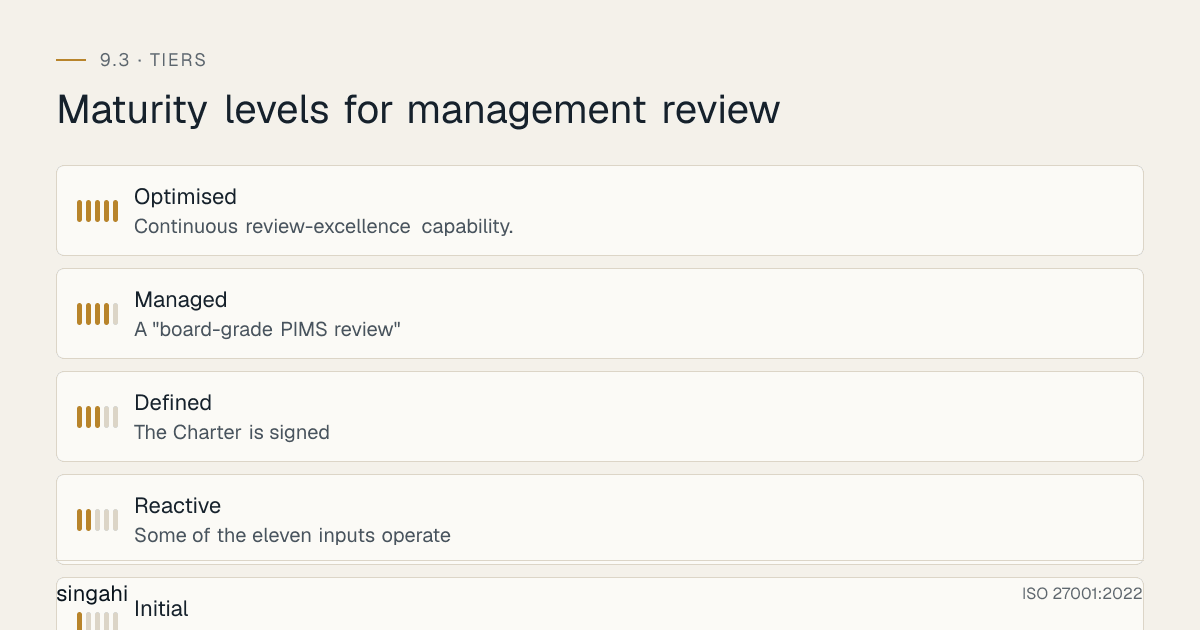
| Level | Description |
|---|---|
| L1, Initial | A "five-minute-AOB" review: the DPO is handed ten minutes at the end of a quarterly executive meeting; the privacy policy is noted; the count of breaches is mentioned; no Charter, no Input Pack, no Minutes, no Action Tracker. The single most common Clause 9.3 audit nonconformity in the Indian growing-company segment. |
| L2, Reactive | Some of the eleven inputs operate but the Input Pack is thin; the Minutes are drafted informally; the Action Tracker is partial; the closeout rate is not tracked; the board overlay is absent. The Internal Audit (9.2) tests the 9.3 discipline and finds gaps. The DPO may be the de-facto reviewer if the chief executive is intermittent. |
| L3, Defined | The Charter is signed; the eleven-section Input Pack is compiled each cycle; the review is held with top management present and the quorum met; the Minutes are dated and signed; the Action Tracker routes every decision; the closeout rate is tracked; the SDF overlay is in design. The integrated-with-distinction posture is evidenced for ISMS organisations. |
| L4, Managed | A "board-grade PIMS review": every input has documented source, owner, headline, trend, discussion question, decisions sought; the Action Tracker closeout rate is at 100 percent or trending toward it; the recurring-overdue pattern is escalated; the SDF overlay is operational (for SDFs); the Board Reporting Pack is delivered on the SEBI LODR cycle (for listed entities); the Internal Audit's 9.2 test of 9.3 has zero major findings. Cross-framework reconciliation (DPDP / GDPR / NIST / SOC 2 / ISO 27001 / 27002 / 27018 / 27017 / 29100 / 29134 / 31000 / 42001 / Companies Act / SEBI LODR). |
| L5, Optimised | Continuous review-excellence capability. The review cycle is wired into the operational cadence (the monthly KPI cycle, the quarterly Dashboard cycle, the semi-annual / annual review, the SEBI LODR board cycle). The Board Reporting Pack is the single source of truth for the Audit Committee / Risk Management Committee / board. The Action Tracker is consumed by the board, the regulators (on request), and the enterprise customers (under NDA) as the single source of truth. The 9.3 outputs demonstrably drive every downstream clause and are the spine of the PIMS. For SDFs, the DPO is statutorily accountable to the board and the board-reporting cadence is fully operational. The Audit Committee tests a sample of decisions every cycle. |
Emerging Trends
DPBI operational emergence and the enforcement layer. The Data Protection Board of India (under DPDP section 18) is emerging through 2026 and 2027. Its early orders, its interpretation of the Schedule penalty maxima, its engagement patterns on DPIA consultations, its precedent on the breach-notification clock, and its operational portal for section 8(6) notifications will reshape the 9.3 review's Section 7 (regulatory changes) and Section 4 (incidents and breaches). The Board Reporting Pack must add the DPBI-engagement summary (the count of DPBI interactions; the count of complaints; the count of orders; the closeout rate) as the Board's enforcement activity scales.
SDF designations and the board overlay. The first SDF designations are expected through 2026 and 2027 as the DPDP Rules phased commencement completes; designated SDFs must operationalise the independent-data-audit / SDF DPIA / algorithmic-software review cadence under section 10. The Board Reporting Pack (doc 08) becomes the default SDF artefact; the board-DPO accountability under section 10 is the load-bearing Indian governance construct.
Consent Manager ecosystem emergence. The DPDP Rules 2025 prescribe Consent Manager registration conditions; the first Consent Managers are expected to be registered through 2026 and 2027. The Consent Manager integration metric (the share of consent signals correctly received, honoured and reconciled) becomes a default Section 1 KPI for consumer-facing Data Fiduciaries as the ecosystem emerges. The review must surface the Consent Manager integrity trend.
AI-driven processing and the algorithmic-fairness input. The Rule 13(3) algorithmic-software review, the parallel development of ISO/IEC 42001:2023 (AI Management System), and the growing customer and regulator focus on AI-driven processing are reshaping Section 9 (improvement opportunities) and adding the algorithmic-fairness KPI as a load-bearing Section 1 metric for AI-driven SDFs. The use of generative AI inside the privacy function itself (ROPA automation, DPIA drafting, rights-request triage, breach-notification drafting, Input Pack compilation) is a 9.3 risk in its own right, the review must consider the generative-AI-specific risks (training-data leakage, prompt-injection-driven disclosure, model hallucination) and the integrity of AI-generated review inputs.
Integrated management systems. The harmonized structure enables integrated 27001 + 27701 + 42001 + 22301 governance. The Clause 9.3 review is the natural point of integration, a single combined Charter, a single combined Input Pack with the system labels, a single combined Action Tracker. The integrated-with-distinction posture from Clause 6.1 carries through to 9.3. The combined Board Reporting Pack addresses the ISMS / PIMS / AIMS / BCMS risks in a single board-grade artefact.
Cross-border transfer regime evolution. The DPDP negative list under section 16, the EU-US Data Privacy Framework adequacy decision (10 July 2023), the UK IDTA / Addendum, the China PIPL cross-border mechanisms, and the geopolitical risk environment are all in flux. The transfer-screening Section 7 input becomes a load-bearing review concern; the multi-jurisdiction processor-portfolio Section 6 decisions are operationally tested every cycle.
Sector-regulator convergence. RBI, SEBI and IRDAI are each tightening their privacy-adjacent rules (RBI Digital Lending; SEBI CSCRF; IRDAI ICS 2023). The DPDP Act sits as a horizontal layer above these sectoral instruments; the Section 7 input must monitor both streams. The triple-clock Section 4 pattern becomes the default for BFSI. The board-governance overlay under the SEBI LODR Regulation 21 Risk Management Committee is the convergence point for listed entities.
Privacy as a board-level discipline. The 9.3 Board Reporting Pack is increasingly the board's instrument for privacy oversight, the Audit Committee / Risk Management Committee / the board receives the Pack on the SEBI LODR cadence. The board-engagement Section (for SDFs and listed entities) is the load-bearing output. The maturity target for Indian growing companies is the L4 Pack consumed by the board on the quarterly cadence.
References and Further Reading
Primary instruments (India). DPDP Act 2023 (Act 22/2023, enacted 11 August 2023), MeitY, sections 4 (grounds), 5 (notice), 6 (consent, the seven qualities), 7 (legitimate uses), 8 (general obligations; 8(5) safeguards; 8(6) breach notification, intimation without delay and a seventy-two-hour report; 8(7) erasure), 9 (children and persons with disability), 10 (SDF, DPO based in India accountable to the board; SDF DPIA; independent data audit; algorithmic-software review), 11 to 14 (rights), 16 (cross-border negative list), 18 (DPBI), 33 + Schedule (penalty maxima up to ₹250 crore for section 8(5) failure; ₹200 crore for sections 8(6) and 9; 150 crore for section 10). DPDP Rules 2025 (notified 13 November 2025), MeitY, Rule 7; consent-notice content and language; verifiable parental consent; SDF thresholds and the SDF DPIA cadence; retention and erasure timelines (including the 48-hour pre-erasure notice); Consent Manager registration; grievance-redressal response periods. Information Technology Act, 2000, sections 43A, 72A, 70B. IT (Reasonable Security Practices and Procedures and Sensitive Personal Data or Information) Rules, 2011 (notified 11 April 2011). CERT-In Directions 20(3)/2022-CERT-In (28 April 2022), the six-hour clock. Companies Act 2013, section 134(3)(n) (the board-report discloses the risk-management framework); section 166 (directors' duties); section 177 (Audit Committee remit). SEBI LODR Regulation 21 (Risk Management Committee composition and remit). RBI Storage of Payment System Data (6 April 2018); RBI Digital Lending Guidelines (2 September 2022); RBI Tokenisation (22 September 2021); RBI Cybersecurity Directions 2026 (31 July 2026). SEBI Cybersecurity and Cyber Resilience Framework (20 August 2024). IRDAI Information and Cyber Security Guidelines 2023 (24 April 2023).
Primary jurisprudence (India). K.S. Puttaswamy v. Union of India, (2017) 10 SCC 1 (nine-judge Bench, 24 August 2017). Justice K.S. Puttaswamy (Retd.) v. Union of India (Aadhaar), (2019) 1 SCC 1 (five-judge Bench, 26 September 2018).
Primary instruments (global). Regulation (EU) 2016/679 (GDPR), OJ L 119, 4.5.2016, p. 1; application from 25 May 2018, Article 5(2) accountability; Article 24(1) "ongoing basis"; Article 24(2) review and update; Article 28(3)(h) processor audit cooperation; Article 29; Article 32(1)(d) "regular testing, assessing and evaluating the effectiveness"; Articles 33 to 34 breach; Article 35(11) DPIA review; Article 36 prior consultation; Article 38(2) DPO reporting line (the DPO reports to the highest management level); Article 39 DPO tasks. European Commission Implementing Decision (EU) 2021/914 (modernised SCCs, 4 June 2021). EU-US Data Privacy Framework adequacy decision (10 July 2023). EDPB Guidelines on DPO tasks under Article 39. NIST Privacy Framework v1.0, NIST.CSWP.01162020, 16 January 2020, Govern-P. AICPA, 2017 Trust Services Criteria (with 2022 Points of Focus update), CC1.1 to CC1.5 (Control Environment); CC4.1 / CC4.2 (Monitoring); CC7.3, CC7.4 (Incident Response and Recovery); CC9.2 (Vendor Risk); P8.0 (Monitoring for Compliance). Brazil LGPD, Lei no 13.709/2018. China PIPL, Article 38 (cross-border mechanisms), Article 55 (mandatory PIA).
ISO/IEC standards. ISO/IEC 27701:2025 (2nd ed., published 14 October 2025), Clause 9.3 (management review), Clause 9.1 (the eleven-input spine), Clause 9.2 (the audit-result input), Clause 10.2 / 10.1 (the downstream-clause routing for the review's decisions), Annex A.1 / A.2 / A.3 (the controls whose effectiveness the review appraises), Annex B (normative in 2025, the implementation guidance, including the 9.3 review-discipline guidance). ISO/IEC 27701:2019 (1st ed., for transition reference, Annex F review guidance). ISO/IEC 27001:2022 Clause 9.3 (infosec management review, structurally identical). ISO/IEC 27002:2022, only 5.34 is PII-specific; 5.35 (independent review lineage, the SDF-independent-audit analogue); 5.36 (compliance); 5.37 (documented procedures). ISO/IEC 27018:2019 (cloud PII processor). ISO/IEC 27017:2015 (cloud security). ISO/IEC 29100:2011 (privacy framework, 11 principles). ISO/IEC 29134:2017 (DPIA guidelines). ISO 31000:2018 (risk management, Clause 6 Monitoring and Review). ISO/IEC 42001:2023 (AI Management System, Clause 9.3 alignment for AI-driven processing review overlap). ISO/IEC 27706:2025 (PIMS cert-scheme competence).
Edition-transition sources (practitioner commentary used as research input). ANAB Heads Up #550 (transition timeline, certification-body deadline 31 October 2026; organisation transition deadline 31 October 2028). The 2025 edition's structure, the harmonized-structure Clause 9.3 alignment, the Annex A.1 / A.2 / A.3 consolidation, the normative-Annex-B change, and the management-review emphasis are confirmed from the official 2025 PDF (OCR) and corroborated by tier-1 cert-body practitioner commentary. The common-nonconformity patterns (the missing review; the perfunctory review; the DPO-only review; the Input Pack incompleteness; the Action Tracker not maintained; the SDF overlay absent) are drawn from tier-1 cert-body practitioner commentary on the most frequently cited PIMS surveillance-audit nonconformities. All clause text in this guide is paraphrased; the official text is copyrighted by ISO/IEC and has not been reproduced.
Singahi references. The Singahi Clause 9.3 toolkit (17 docs + README) accompanies this guide. The Singahi 27701:2025 series covers all MSS clauses (4 to 10) and Annex A.1 / A.2 / A.3 controls; sibling guides for 4.1, 4.2, 4.3, 4.4, 5.x, 6.x, 7.x, 8.x, 9.1, 9.2 and the rest of the standard are available.
This guide is published by Singahi. The ISO/IEC 27701:2025 clause text is copyrighted by ISO/IEC and has not been reproduced; all requirements are paraphrased. Brand names of competitors, cert bodies, and reference books are intentionally omitted. Scenarios are illustrative and should not be attributed to any real organisation.