
On this page
- Quick Reference (60 Seconds)
- What the Standard Actually Requires
- Why This Control Matters
- Scope and Applicability
- Key Definitions and Terminology
- Relationship to Other Clauses and Frameworks
- Detailed Implementation Guidance, The Seven Communication Moves
- Tools, Technologies, and Solutions
- Policy and Procedure Templates
- Risk Assessment and Treatment
- Audit and Compliance Checklist
- Metrics and KPIs
- Common Pitfalls and Audit Failures
- Illustrative Scenario 1: Failure, Mihira Travel's Silent Breach Communication (Illustrative)
- Illustrative Scenario 2: Success, Tarini Health Builds a Dual-Clock Comms Discipline (Illustrative)
- Multi-Framework Mapping
- Implementation Roadmap
- FAQ
- Industry-Specific Requirements
- Maturity Model
- Emerging Trends
- References and Further Reading
Quick Reference (60 Seconds)
| Attribute | Detail |
|---|---|
| Clause | ISO/IEC 27701:2025 Clause 7.4, Communication. The fourth sub-clause of the PIMS Support block (Clause 7.1 Resources, 7.2 Competence, 7.3 Awareness, 7.4 Communication, 7.5 Documented Information), structurally aligned to the Harmonized Structure shared by ISO/IEC 27001:2022 Clause 7.4, ISO 22301:2019 Clause 7.4, ISO 9001:2015 Clause 7.4 and ISO/IEC 42001:2023 Clause 7.4. The 2025 edition inherits the standalone-PIMS framing and pushes the communication obligation well beyond a generic "decide what to tell whom", for a PIMS, every outward message can be a legal-impact message (a privacy notice creates enforceable commitments, a breach notice starts a regulatory clock, a rights response is due within a statutory period, a sub-processor notification runs against a customer DPA clock), and every inward message is the principal-channel through which awareness (7.3), policy (5.2) and roles (5.3) become operational. |
| What it asks for (paraphrase) | ISO/IEC 27701:2025 Clause 7.4 asks organizations to decide what to communicate about the PIMS, when, to whom, and how. Four load-bearing ideas do the work. The organisation determines the communications needed, both the external communications that flow to data principals, regulators, processors, customers and the public, and the internal communications that flow to leadership, staff and contractors. The organisation determines the timing, when a notice fires, when a breach report is due, when a rights response must land, when a sub-processor notice must go out, when the policy is re-cascaded. The organisation determines the audience, the seven-audience taxonomy from principal to public, each with its own message, channel, clock and evidence requirement. And the organisation determines the channel and the method, the medium (in-app, email, SMS, web portal, registered post, gazette notification, regulator portal, press release), the format (plain-language summary, full notice, layered notice, machine-readable signal), the language (the DPDP Rules 2025 plain-language requirement, multi-lingual reach for the Indian principal base), and the evidence trail that proves the communication happened. |
| The marquee insight competitors miss | Three facts make 7.4 the most consequential channel-clause in the 2025 edition for a PIMS. First, a PIMS communication is not an infosec communication with a privacy label. The dominant competitor pattern is to satisfy 7.4 by pointing at the existing ISO/IEC 27001:2022 Clause 7.4 programme, incident notifications, internal security advisories, customer-facing security pages, with a privacy addendum. That pattern fails the PIMS audit because the privacy-communication load is substantively different: the section 5 notice and section 6 consent request that create the principal's informed-choice baseline; the section 11 to 14 rights-response communications that close the principal's statutory rights loop; the section 8(6) breach communication to the Board and to each affected principal within the prescribed period; the section 13 grievance-officer response within the prescribed period; the section 2(1)(g) Consent Manager give-manage-review-withdraw consent flow; the processor-side Article 28(2) sub-processor notification clock; the regulator-side CERT-In six-hour report that runs in parallel with the DPDP breach clock (intimation without delay; seventy-two-hour report). The dual-clock pattern is, on its own, the cleanest illustration that 7.4 in a PIMS is regulatory engineering, not corporate communications. Second, the privacy notice is not the privacy policy, and conflating them is the most common 7.4 audit failure in the Indian growing-company segment. The privacy policy (Clause 5.2) is the internal-facing governance artefact that commits the organisation to a privacy posture; the privacy notice is the external-facing principal communication that delivers the section 5 / Article 13 information set in plain language, at the point of collection, in the principal's chosen language, in a form the principal can actually act on. The two artefacts must be designed together but operated separately, on different cadences, through different channels, with different evidence. Third, the comms-evidence log is the load-bearing 7.4 artefact, a living register of every outward and inward PIMS communication with its date, audience, channel, version, sender, content reference, delivery proof, principal-impact classification and clock status. A notice PDF on the website does not satisfy 7.4; a current, reconciled, clock-aware comms-evidence log does. |
| Domain | Support (Clause 7), Communication stack. 7.4 sits between 7.3 (awareness, the population-level literacy that 7.4 messages land on) and 7.5 (documented information, the controlled-document discipline that governs every notice, policy and procedure the comms function references). Where 7.3 builds the audience's literacy and 7.5 governs the documents, 7.4 engineers the message flows, what is said, to whom, when, how, and with what evidence. |
| What you must produce | (a) A PIMS Communication Policy (the governance artefact) setting out the communication commitment, the seven-audience taxonomy, the four-quadrant message model, the dual-clock discipline, the language and accessibility commitments, the Consent Manager integration, the evidence discipline and the integration with Clauses 5.2, 7.3 and 7.5; (b) a PIMS Communication Plan (the methodology artefact) covering the audience inventory, the message inventory (notice, consent, rights response, breach, grievance, sub-processor, regulator, leadership, awareness-cascade, public), the channel matrix, the clock register, the language matrix, the accessibility matrix, the effectiveness measurement and the documented information control; (c) the audience × content × channel × clock matrix, the load-bearing 7.4 artefact that the auditor opens first; (d) a Privacy Notice architecture covering the layered notice, the just-in-time notice, the children's notice, the Consent Manager integration and the multi-lingual delivery; (e) a dual-clock breach-communications playbook (CERT-In six hours + DPDP without delay plus a seventy-two-hour detailed report + sectoral clocks + principal notification without undue delay); (f) a rights-response communication pack for sections 11 to 14; (g) a grievance-handling communication procedure for section 13; (h) a sub-processor notification procedure for processor-side organisations (Article 28(2) / Annex A.2.5.x); (i) a comms-evidence log (the audit-evidence register); (j) the Documented Information control set per Clause 7.5. |
| Typical owner | Top management owns the communication commitment at the strategic level, Clause 7.4, like the rest of Clause 7, derives from Clause 5.1 leadership and the Clause 5.2 privacy policy commitment to transparent engagement with principals and regulators. The DPO / Privacy Lead is the canonical owner of the Communication Policy, the Communication Plan, the comms-evidence log and the regulator-facing communications; the DPO is the canonical spokesperson for principal-facing privacy messages and the canonical point of contact for the Data Protection Board of India. The Head of Marketing / Communications is the integration partner for the public-facing notice and brand-voice channels, privacy notices live on surfaces marketing owns, and the brand-voice consistency is the load-bearing integration. Legal and Compliance own the regulatory-content axis (DPDP, GDPR, sectoral). Customer Support / Customer Success own the rights-response and grievance-handling communications operationally. Engineering / Product own the in-product notice surfaces, the Consent Manager integration, the just-in-time consent flows and the logging that produces the comms-evidence. Public Relations / Corporate Affairs own the regulator-portal filings, the public-statements cadence and the media response. Internal Communications / HR own the internal-cascade and the leadership-briefing cycle. Internal Audit tests the comms-evidence log, the clock performance and the notice-content audit at the internal audit (Clause 9.2). |
| Minimum viable actions | (1) Build the seven-audience inventory with the named owner, channel and clock for each; (2) draft the PIMS Communication Policy and the Communication Plan and have both approved under Clause 5.2; (3) separate the privacy notice from the privacy policy, design the layered, just-in-time notice architecture for each principal-facing surface; (4) stand up the dual-clock breach-communications playbook and table-top it once before the first real incident; (5) wire the rights-response SLA into the customer-support workflow with a per-request evidence record; (6) publish the grievance-officer contact and the section 13 response SLA on every principal-facing surface; (7) build the sub-processor notification register and the Article 28(2) clock; (8) stand up the comms-evidence log from day one (a spreadsheet is acceptable for the first cycle; a platform with delivery proof is better); (9) run the first audience-segment-specific measurement (notice comprehension survey, breach-drill clock performance, rights-response SLA achievement, grievance-response time); (10) wire the communication profile into the management review (Clause 9.3). |
| Maturity floor (L1) | An "ad-hoc" PIMS communication posture: a single privacy notice buried in the website footer; a grievance email address that nobody monitors; a breach response that has never been drilled; rights responses handled ad-hoc by support with no SLA; sub-processor changes that ship without customer notification; the privacy policy and the privacy notice treated as the same PDF; no comms-evidence log. The single most common Clause 7.4 audit nonconformity in the Indian growing-company segment. |
| Maturity target (L4 to L5) | A "communication-engineered" PIMS: every audience is mapped to its messages, channels, clocks and evidence; the privacy notice architecture is layered, just-in-time, multi-lingual and Consent Manager-integrated; the dual-clock breach playbook is drilled quarterly with measured clock performance; rights responses land within the statutory period with delivery proof; the section 13 grievance SLA is consistently met; sub-processor notifications fire on the Article 28(2) clock; the comms-evidence log reconciles to the ROPA, the DPIA register, the change log and the contract inventory; communication effectiveness is measured (notice comprehension, principal-action rate, complaint rate, regulator-follow-up rate); the communication profile feeds the Clause 9.3 management review and the Clause 10.1 continual-improvement cycle. |
| Audit red flag | A comms-evidence log that does not reconcile with the ROPA, the DPIA register, the change log (Clause 6.3), the contract inventory or the breach register. The 7.4 audit test is always the same: the auditor picks three to five recent outward communications (a privacy notice update, a rights response, a breach notification if any, a sub-processor notice if any, a regulator filing if any) and asks "show me the audience, the channel, the clock, the content version, the delivery proof, the principal-impact classification, the effectiveness measurement." If any of these is missing, the PIMS has a 7.4 finding. The second-most-common red flag is the policy-equals-notice conflation, one PDF labelled "Privacy Policy" published on the website with no separate just-in-time notice, no layered summary, no principal-action architecture. The third is the single-clock breach failure, a breach playbook that addresses CERT-In's six-hour report but not the DPDP section 8(6) notification (intimation without delay; seventy-two-hour report) to the Board and to each affected principal. The fourth is the language failure, a notice available only in English for a principal base that predominantly interacts in Indian languages, falling short of the DPDP Rules 2025 plain-language and accessibility expectations. |
| Time to implement (first cycle) | Growing companies (50 to 250 staff): 4 to 10 weeks for the first Communication Plan pass (Policy, Plan, audience map, separated notice architecture, breach-comms playbook draft, comms-evidence log, first measurement). Mid-sized (250 to 2,000): 10 to 16 weeks, usually requiring the full notice architecture across multiple surfaces, the Consent Manager integration, the multi-lingual delivery, the dual-clock drill cadence and the rights-response SLA operationalisation. Multi-entity enterprise: 4 to 8 months, integrated with enterprise corporate communications, multi-jurisdiction notice coordination, the SDF-grade DPIA communication pipeline and the regulator-engagement desk. |
| Related clauses | 4.1 (context, the principal classes and jurisdictions shape the audience inventory and the language matrix), 4.2 (interested-party requirements, the regulator and customer clocks the comms plan must honour), 4.3 (scope defines who is in the audience inventory), 4.4 (the PIMS as a communicating system), 5.1 (top management owns the communication commitment), 5.2 (the privacy policy is the anchor, Clause 7.4 is how the policy commitment becomes a principal-facing message; the policy-versus-notice distinction is load-bearing), 5.3 (roles, the communication RACI maps to the role register), 6.1 (every material privacy risk generates a communication dimension, the breach-comms clock, the rights-response SLA, the regulator-engagement cadence), 6.2 (objectives include communication objectives, notice comprehension, SLA achievement, complaint-rate reduction), 6.3 (every change that affects the notice or the consent architecture triggers a communication cycle under 7.4, the policy-acknowledgement and principal-re-notification clocks), 7.1 (resources, the communication programme must be resourced; the notice platform, the Consent Manager integration and the multi-lingual translation capacity are 7.1 line items), 7.2 (competence, the comms function and the spokespeople must be competent; the grievance officer and the regulator-facing DPO carry explicit capability thresholds), 7.3 (awareness, 7.4 internal communications are how 7.3 awareness messages land; the two clauses share the audience taxonomy and the cadence), 7.5 (documented information, every communication artefact is a 7.5-controlled document; the comms-evidence log is 7.5-controlled), 8.1 to 8.3 (operational processes, the consent, DSAR, processor, transfer, breach and grievance processes all generate 7.4 communications as their outward face), 9.1 (monitoring tests communication effectiveness through principal-side metrics), 9.2 (internal audit tests the comms-evidence log and the clock performance), 9.3 (management review receives the communication profile), 10.2 (corrective action on communications failures, the 7.4-to-10.2 pipeline is canonical; a missed clock is a 10.2 trigger), 10.1 (improvement of the communication programme cycle-on-cycle). Annex A.1.2.3 (notice, when and how); A.1.2.4 (consent, obtain and record); A.1.3.x (principal obligations, rights-response communications); A.1.5.x (disclosure and transfer communications); A.2.5.x (processor-side sub-processor and customer communications); A.3 (security-incident communications, ISO/IEC 27002:2022 control 5.24 to 5.27 lineage). |
| Critical Indian context-bearing instruments the communication programme must reflect | DPDP Act 2023 (Act 22/2023, enacted 11 August 2023), in particular section 5 notice (the principal-facing communication that describes the personal data, the purpose, the rights, the redressal mechanism and the withdrawal pathway, and must be in plain language per the Rules), section 6 consent (the consent request, the as-easy-to-withdraw design, the Consent Manager-mediated flow), section 8, including 8(5) reasonable security safeguards and 8(6) the breach-notification clock that engages the dual-clock pattern, intimation to the Board without delay with a seventy-two-hour detailed report, and notification to each affected principal without delay in plain language, section 9 children and persons with disability (verifiable-parental-consent communication; no-behavioural-monitoring / no-targeted-advertising duties), section 10 SDF (the DPO-based-in-India is the canonical point of contact for DPBI communications), section 11 rights (access response within the prescribed period), section 12 correction and erasure (action confirmation and recipient notification), section 13 grievance redressal (response-within-prescribed-period SLA), section 14 nomination, section 2(1)(g) Consent Manager (the give-manage-review-withdraw flow), section 16 cross-border negative list, section 18 DPBI engagement; DPDP Rules 2025 (notified 13 November 2025), in particular Rule 7 (the breach-notification format and the breach clock (intimation without delay; seventy-two-hour report) to the Board), the consent-notice content and language requirements, the verifiable-parental-consent mechanism, the SDF designation thresholds and the grievance-redressal response periods; Puttaswamy v. Union of India (2017) 10 SCC 1 (the constitutional foundation); the Aadhaar judgment (2019) 1 SCC 1 (the proportionality test); CERT-In Directions 20(3)/2022-CERT-In of 28 April 2022 (the six-hour clock, the second clock in the dual-clock pattern); RBI Storage of Payment System Data 6 April 2018; RBI Digital Lending Guidelines 2 September 2022; SEBI CSCRF 20 August 2024; IRDAI Information and Cyber Security Guidelines 24 April 2023. The communication programme must name these instruments, map each to its audience-channel-clock triple, and evidence that the message was constructed, delivered and understood. |
If you only read one thing: Clause 7.4 is where the PIMS stops being an internal document set and becomes a message set that lands on principals, regulators, processors, staff and the public, and where each message can carry a regulatory clock, a statutory SLA, a contractual obligation or a constitutional-duty weight. A 7.4-conformant PIMS is one in which the organisation can show, with evidence, that every outward and inward PIMS communication was engineered, the audience defined, the content approved, the channel selected, the clock met, the language matched, the delivery proved, the effectiveness measured, the evidence logged. Not a privacy notice PDF on the website footer. Not an unmonitored grievance email. Not a breach playbook that has never been drilled. Not a single-clock response that misses the DPDP section 8(6) principal-notification. Not an English-only notice for a multilingual principal base. The certification auditor will pick three to five recent communications and walk each through the audience × content × channel × clock matrix. The Data Protection Board of India will, after a complaint or a breach, ask whether the notice was clear, whether the consent was informed, whether the breach communication met the breach clock (intimation without delay; seventy-two-hour report), whether the principal was notified without undue delay, whether the grievance officer responded within the prescribed period, whether the Consent Manager flow preserved the as-easy-to-withdraw design. Get 7.4 wrong, an ad-hoc comms posture, the policy-equals-notice conflation, the single-clock breach failure, the language gap, the missing evidence log, and however strong the rest of the PIMS is on paper, the principal experience and the regulator experience will collapse at the first contact. Get it right, and the communication programme becomes the principal-trust architecture the business scales on.
What the Standard Actually Requires
The paraphrased requirement
ISO/IEC 27701:2025 Clause 7.4 asks organizations to decide what to communicate about the PIMS, when, to whom, and how. The clause is short in words and wide in surface. Four load-bearing obligations sit inside that paraphrase, and auditors test each separately.
The organisation must determine the communications needed for the PIMS. "Needed" is broader than "required by law", it includes the communications mandated by the standard itself (the Clause 5.2 policy cascade, the Clause 7.3 awareness programme, the Clause 9.3 management-review profile, the Clause 10.2 nonconformity communications), the communications mandated by applicable law (the DPDP Act 2023 sections 5, 6, 8(6), 11 to 14, 16, 18 communications; the GDPR Article 12 to 14 transparency communications; the sector-regulator communications), the communications mandated by contract (the Article 28-style DPA sub-processor notifications, the customer transparency commitments, the processor-side incident notifications), and the communications the organisation voluntarily commits to (the transparency report, the public-statements cadence, the brand-voice privacy commitments).
The organisation must determine the timing of communications. The timing axis is the load-bearing clock dimension. The CERT-In six-hour clock starts from awareness of a notifiable incident. The DPDP section 8(6) breach clock (intimation without delay; seventy-two-hour report) starts from awareness of a personal-data breach and runs to the Board. The principal notification under the DPDP Rules 2025 must happen without undue delay. The section 11 access response must land within the prescribed period. The section 13 grievance response must land within the prescribed period. The Article 28(2) sub-processor notification clock runs against the customer DPA. The Clause 6.3 change-communication cycle fires on every material change. The Clause 5.2 policy-acknowledgement cycle fires on every policy revision. The clock register is the operationalisation of the timing dimension.
The organisation must determine the audience for each communication. The seven-audience taxonomy (Section 2.2) is the load-bearing conceptual frame: data principals; the Data Protection Board of India; CERT-In; sector regulators (RBI, SEBI, IRDAI, the Telecom Regulatory Authority, the proposed Competition Commission intersections); processors, sub-processors and processor-side customers; internal staff and leadership; and the public and the market. Each audience has its own message set, channel set, clock set and evidence set.
The organisation must determine the channel and method for each communication. The channel axis is the medium: in-app, email, SMS, web portal, registered post, gazette notification, regulator portal, press release, board paper, internal-comms platform, Consent Manager-mediated flow. The method axis is the format and language: the plain-language summary, the layered notice, the full notice, the machine-readable signal (the IAB-style consent string, the GDPR-style data-sharing taxonomy, the W3C-style privacy preferences), the multi-lingual delivery (the DPDP Rules 2025 plain-language requirement operates in the language of the principal's interaction). And the method includes the evidence discipline, the delivery proof, the principal-acknowledgement record, the version log, the audit-trail.
The seven-audience taxonomy, the load-bearing 7.4 frame
The most important conceptual move in Clause 7.4 is recognising that the PIMS audience inventory is wider, more differentiated and more clock-bound than the ISMS audience inventory. The Singahi seven-audience taxonomy (toolkit doc 02 Section 4) operationalises this.
Audience 1, Data Principals (the load-bearing external audience). The principal communications include the section 5 / Article 13 notice at collection; the section 6 / Article 7 consent request and withdrawal flow; the section 11 / Article 15 access response; the section 12 / Articles 16 to 17 correction and erasure response; the section 12(2) erasure-action confirmation; the section 13 / Article 21(1) objection response; the section 8(6) breach notification without undue delay in plain language; the section 13 grievance-officer response within the prescribed period; the Article 34 high-risk-breach communication; the Consent Manager give-manage-review-withdraw flow; the section 14 nomination communication. The principal audience is itself segmented, by language, by digital literacy, by relationship stage (prospective, active, dormant, withdrawn), by sensitivity (children, persons with disability, vulnerable adults). Each segment can require a different message variant.
Audience 2, The Data Protection Board of India. The DPBI communications include the section 8(6) breach notification in the Rule 7 intimation content without delay (detailed report within seventy-two hours); the section 10 SDF designation engagement; the SDF DPIA submissions; the section 18 proactive engagement where residual risk remains high; the response-to-complaint communications; the response-to-inquiry communications; the consent-manager registration engagement under section 2(1)(g); the penalty-adjudication engagement under section 33. The DPBI communications are formal, clock-bound, format-bound and audit-evidence-heavy.
Audience 3, CERT-In. The CERT-In communications include the six-hour report under the 28 April 2022 Directions for notifiable cyber incidents including personal-data breaches; the Point-of-Contact communications; the investigation-cooperation communications; the log-preservation and the clock-sync confirmations. The CERT-In clock runs in parallel with the DPBI clock, the dual-clock pattern that defines the Indian breach-communication landscape.
Audience 4, Sector regulators. The sector communications include the RBI incident reports for payment-system operators and digital-lenders; the SEBI CSCRF incident reports for regulated entities; the IRDAI incident reports for insurers; the Telecom Regulatory Authority of India (TRAI) communications for the customer-data-protection regulations; the sectoral data-localisation attestations. The sector clocks (RBI and SEBI operate on six-hour incident-report clocks mirroring CERT-In) must reconcile with the horizontal CERT-In and DPBI clocks.
Audience 5, Processors, sub-processors and processor-side customers. The processor-side communications include the controller-to-processor instructions; the processor-to-controller breach notifications; the sub-processor onboarding notifications to the controller customer (the Article 28(2) prior-authorisation or notification clock, typically 10 to 30 days); the infringing-instruction handling communications under Annex A.2.2.5 (where a customer proposes a processing instruction that infringes DPDP, the processor must communicate the objection); the cross-border transfer notifications; the data-return and data-destruction confirmations at contract end.
Audience 6, Internal staff and leadership. The internal communications include the Clause 5.2 policy cascade and the policy-acknowledgement cycle; the Clause 7.3 awareness programme delivery (the integration point with 7.3); the Clause 6.3 change-communications cycle; the leadership briefing cycle for the executive committee and the board; the contractor-onboarding communications; the grievance-officer internal-promotion communications; the awareness-simulation results communications; the policy-violation consequence communications.
Audience 7, The public and the market. The public communications include the privacy notice on the public website; the transparency report (where the organisation publishes one); the public-statements cadence on privacy incidents; the press releases on privacy-relevant product changes; the brand-voice privacy commitments; the public-policy submissions; the response to media inquiries on privacy topics; the analyst-relations disclosures on privacy posture.
The seven-audience taxonomy is not a static document. Every Clause 6.3 change to the organisation's processing activities, technology, geography or audience-shape triggers an audience-mapping refresh; every Clause 5.2 policy change triggers a re-cascade across all seven audiences with the right depth, language and clock.
The four-quadrant message model
The second load-bearing conceptual move is distinguishing the message types so that each is engineered for its purpose. The four-quadrant message model (toolkit doc 02 Section 5) maps every PIMS communication on two axes: external vs internal, and binding legal-impact vs behavioural-change.
Quadrant 1, External binding legal-impact communications. The notices, the consent requests, the rights responses, the breach notifications, the regulator filings, the sub-processor notifications. These are the messages that create, modify or discharge legal obligations. They must be precision-drafted (Legal review mandatory), clock-bound (the clock register governs), evidence-heavy (the comms-evidence log records the delivery proof), language-matched (the DPDP Rules 2025 plain-language requirement applies), and version-controlled (Clause 7.5 governs the document control). Errors in this quadrant are the canonical 7.4 audit failure and the canonical penalty exposure.
Quadrant 2, External behavioural-change communications. The awareness campaigns for principals, the transparency-report narratives, the public-statements cadence, the brand-voice privacy messaging, the consent-flow user-experience nudges. These are the messages that shape the principal's understanding, expectation and behaviour but do not by themselves create legal obligations. They must be brand-aligned (Marketing owns the voice), comprehension-tested (the notice-comprehension survey applies), accessibility-compliant (the WCAG-style accessibility commitment applies), and audience-segmented (the language matrix applies).
Quadrant 3, Internal binding legal-impact communications. The policy cascade with the acknowledgement record, the role-assignment communications under Clause 5.3, the contractor-onboarding confidentiality communications, the consequence communications for policy violations, the leadership directives on privacy commitments. These are the messages that bind the workforce to privacy obligations internally. They must be HR-aligned, evidence-logged (the acknowledgement is the evidence), version-controlled, and tied to the Clause 7.2 competence record and the Clause 7.3 awareness record.
Quadrant 4, Internal behavioural-change communications. The awareness programme nudges, the simulation results broadcasts, the leadership-briefing decks, the internal-comms privacy moments, the privacy-week campaigns, the champion-network communications. These are the messages that shape the workforce's privacy literacy and behaviour. They must be Internal-Comms-aligned, segmented by audience track (the Clause 7.3 audience taxonomy applies), measured for reach and engagement, and tied to the awareness-evidence register.
The four-quadrant model prevents the most common 7.4 failure: treating every communication as the same. A breach notification (Quadrant 1) and an awareness nudge (Quadrant 4) are not engineered the same way; conflating them produces both a defective notice and an ineffective nudge.
The privacy notice versus the privacy policy, the canonical 7.4 distinction
The single most common 7.4 audit failure in the Indian growing-company segment is the conflation of the privacy notice with the privacy policy. The 2025 edition inherits this distinction from Clause 5.2 and operationalises it through Clause 7.4.
The privacy policy (Clause 5.2) is the internal-facing governance artefact. It commits the organisation to a privacy posture. Its audience is internal (leadership, staff, contractors), the certification auditor, and the regulator on request. Its content is the commitments, the privacy principles the organisation will uphold, the controls it will operate, the objectives it will measure, the responsibilities it will assign. Its cadence is the policy-approval cycle and the policy-revision cycle. Its evidence is the approval record and the version-controlled document under Clause 7.5.
The privacy notice (Clause 7.4 + Annex A.1.2.3) is the external-facing principal communication. It delivers the section 5 / Article 13 information set to the principal at the point of collection. Its audience is the principal (segmented by language, digital literacy, relationship stage and sensitivity). Its content is the prescribed-information set, the personal data processed, the purpose, the rights, the redressal mechanism, the withdrawal pathway, the recipients, the cross-border destinations, the retention period, the contact details of the grievance officer and the Consent Manager. Its cadence is at-collection and on-material-change. Its evidence is the delivery proof, the comprehension-test result and the principal-action record.
The two artefacts are designed together, the notice is the principal-facing expression of the policy, but operated separately. They live in different documents, on different surfaces, with different cadences, through different channels, with different evidence. A PIMS that publishes a single PDF labelled "Privacy Policy" on the website footer, and treats it as the notice, has a 7.4 finding by design, the document does not deliver the prescribed information at the point of collection, in the principal's language, in a form the principal can act on.
The layered-notice architecture (toolkit doc 03) operationalises the distinction. Layer 1, the just-in-time notice at the point of collection: a one-screen summary of the purpose, the data, the choice, and the link to Layer 2. Layer 2, the layered full notice at one click: the full section 5 / Article 13 information set, in plain language, in the principal's chosen language. Layer 3, the complete reference notice at two clicks: the complete technical and legal detail (the ROPA summary, the recipient list, the cross-border mechanism, the retention schedule, the DPIA summary where applicable, the grievance-officer and Consent Manager contact details). Layer 1 is the principal-action surface; Layer 2 is the principal-understanding surface; Layer 3 is the regulator-and-auditor surface.
The dual-clock breach-communications pattern, the load-bearing 7.4 discipline
The Indian breach-communication landscape is defined by the dual-clock pattern. The same personal-data-breach awareness event starts two clocks simultaneously, and a 7.4-conformant communication programme must run both clocks in parallel from the same trigger.
Clock A, CERT-In six-hour report. The CERT-In Directions 20(3)/2022-CERT-In of 28 April 2022 require every ICT operator in India to report prescribed cyber incidents, including data breaches, unauthorised access, ransomware, and unauthorised exploitation of data, to CERT-In within six hours of noticing the incident. The report goes to the CERT-In incident-reporting portal or the designated Point of Contact. The clock starts at the moment of "noticing", the awareness event. The penalty for non-reporting includes the Bharatiya Nyaya Sanhita consequences and the IT Act section 70B lineage.
Clock B, DPDP section 8(6) notification (intimation without delay; seventy-two-hour report) to the Board. Rule 7 of the DPDP Rules 2025 (notified 13 November 2025) prescribes the intimation content and the breach clock (intimation without delay; seventy-two-hour report) for the breach notification to the Data Protection Board of India, starting from the Data Fiduciary's awareness of the breach. The notification is in the Rule 7 intimation content. The Board may extend the clock on request. The penalty exposure for non-notification runs up to two hundred crore rupees under section 33 and the Schedule.
Clock C, Affected-principal notification without undue delay. The same section 8(6) requires the Data Fiduciary to notify each affected Data Principal of the breach, in plain language, describing the breach, its likely consequences, and the mitigation steps taken or proposed. The "without undue delay" standard is anchored in the principal's right to remedy, the principal needs the information to take protective action. The clock starts at the same awareness event and runs in parallel with Clocks A and B.
Clock D, Sector-regulator clocks. Where the Data Fiduciary is also a regulated entity, the sector-regulator clocks run in parallel. The RBI-regulated payment-system operators and digital lenders must report to the RBI under the relevant RBI incident-reporting circulars (the six-hour-clock pattern is widely adopted in the RBI framework and the SEBI CSCRF 20 August 2024). The IRDAI-regulated insurers must report to the IRDAI under the Information and Cyber Security Guidelines 2023. The sector clocks must reconcile with the horizontal CERT-In and DPDP clocks, the same incident can produce four parallel notifications within the first six hours.
The dual-clock pattern is, on its own, the cleanest illustration that 7.4 in a PIMS is regulatory engineering rather than corporate communications. A 7.4-conformant breach-communications playbook (toolkit doc 05) runs all four clocks in parallel from the same awareness event, with pre-drafted templates, pre-cleared spokesperson, pre-tested regulator-portal credentials, pre-built principal-notification segmentation, and a table-top drill cadence that converts the playbook from a document into a muscle-memory.
The section 5 / Article 13 notice content, what the principal must receive
The section 5 notice and the GDPR Article 13 information set overlap substantively but are not identical. The 7.4-conformant notice for an Indian Data Fiduciary with cross-border principal reach must cover the union of both. The content set includes:
- The categories of personal data processed;
- The specific purpose of processing for each category;
- The legal ground (consent under section 6, or a legitimate use under section 7) and, for GDPR-scoped processing, the Article 6 lawful basis;
- The recipients or categories of recipients (the processor and sub-processor chain, the third-party recipients);
- The cross-border destinations (and, for the DPDP, whether the destination is on the section 16 negative list; for the GDPR, the Chapter V transfer mechanism);
- The retention period for each category, or the criteria used to determine it;
- The principal's rights, access under section 11, correction and erasure under section 12, grievance under section 13, nomination under section 14 (and for GDPR-scoped processing, Articles 15 to 22);
- The right to withdraw consent at any time, and the mechanism (including the Consent Manager flow where applicable);
- The consequences of not providing consent (where consent is the ground);
- The existence of automated decision-making, profiling, or algorithmic-inference processing, and the logic, significance and consequences (GDPR Articles 13(2)(f) and 22; DPDP sets no matching notice element);
- The contact details of the Data Fiduciary and the Grievance Officer (section 13);
- The Consent Manager identity and contact (section 2(1)(g));
- For children's-data processing, the verifiable-parental-consent mechanism and the no-behavioural-monitoring / no-targeted-advertising commitments (section 9).
The notice content must be in plain language (DPDP Rules 2025), in the language of the principal's interaction (the Indian multilingual reality), accessible (the WCAG-style accessibility commitment), and comprehensible (the notice-comprehension survey is the measurement). The notice content is reviewed under Clause 6.3 on every material change to the processing.
What the standard does NOT require (the demarcation)
- 7.4 does not require a single unified communication platform. The Notice platform, the Consent Manager, the regulator-portal credentials, the customer-support ticketing system, the internal-comms platform and the public-relations cadence can remain separate tools. The discipline that is tested is the audience × content × channel × clock matrix and the comms-evidence log, not the platform consolidation.
- 7.4 does not require every communication to be in every language. The language matrix maps the principal-preferred languages to the notice variants; the commitment is to the principal's chosen language at the point of collection, not to every Indian language for every audience.
- 7.4 does not require zero communication failures. A clock missed is a Clause 10.2 nonconformity trigger; the discipline is to detect, escalate, document and remediate the failure, not to claim zero failure.
- 7.4 does not require a public transparency report. The transparency report is a voluntary commitment; the standard requires the principal communications, the regulator communications and the internal communications to be planned and executed.
- 7.4 does not require the DPO to be the spokesperson for every communication. The DPO is the canonical owner of the regulator-facing communications and the principal-facing legal-impact communications; the spokesperson role for the public-statements cadence can be shared with Corporate Affairs.
- 7.4 does not require pre-approval of every awareness nudge. The internal-cascade and the awareness nudges can flow under standing authorities; the binding legal-impact communications require the documented approval workflow.
- 7.4 does not require the Consent Manager to handle every consent flow. Where the organisation operates its own consent capture, the Consent Manager integration is optional; the section 2(1)(g) Consent Manager is a registered intermediary the principal can opt to use, not a universal intermediary the organisation must route through.
What auditors actually check
The certification auditor's Clause 7.4 examination has six predictable moves.
First, the auditor opens the Communication Policy and the Communication Plan. Are they dated, version-controlled, signed by top management or the DPO with sponsor authority? Do they document the seven-audience taxonomy, the four-quadrant message model, the audience × content × channel × clock matrix, the language matrix, the dual-clock breach-communications playbook reference, the Consent Manager integration, the evidence discipline? If any of these fails, minor nonconformity. If the documents do not exist, major nonconformity.
Second, the auditor opens the comms-evidence log. How many outward and inward communications in the last 12 months? What was the audience distribution? Were the communications tagged against the seven audiences? Were the clocks met? Were the delivery proofs captured? Were the language variants logged?
Third, the auditor picks a recent principal-facing communication, typically the most recent privacy notice update, and walks it end-to-end. The walk: notice-content review (does it cover the section 5 / Article 13 information set?), language availability (is it available in the principal's chosen language?), delivery channel (in-product, layered, just-in-time?), comprehension evidence (was a comprehension test conducted?), principal-action record (does the consent flow preserve the as-easy-to-withdraw design?), evidence-log entry (does the comms-evidence log reflect the notice update?).
Fourth, the auditor tests the dual-clock breach-communications discipline. For each breach or incident in the last 12 months (or, if none, the most recent table-top drill), the auditor asks: when did the awareness event occur? When did the CERT-In six-hour report fire? When did the DPDP notification (intimation without delay; seventy-two-hour report) fire? When did the affected-principal notification fire? Were the sector-regulator clocks met? Was the comms-evidence log reconciled?
Fifth, the auditor tests the rights-response and grievance-response SLAs. The auditor picks three to five recent DSARs (section 11 access, section 12 correction, section 12 erasure) and three to five recent grievances (section 13) and asks: when did the request arrive? When was the response sent? Was the prescribed period met? Was the response content approved under the documented workflow? Was the principal notified of the outcome? Was the evidence logged?
Sixth, the auditor tests the language, accessibility and Consent Manager integration. Is the notice available in the principal's chosen language? Is the website notice WCAG-accessible? Is the Consent Manager flow integrated where the principal opts to use one? Is the multi-lingual delivery evidenced?
The 7.4 audit is the audit where the principal experience and the regulator experience meet the document set. The artefacts that pass the audit are the artefacts that a real principal or a real regulator would also accept.
Why This Control Matters
The communication programme as the principal-trust architecture
Every other clause of ISO/IEC 27701:2025 describes the PIMS as an internal management system, the scope (4.3), the policy (5.2), the roles (5.3), the risk register (6.1), the objectives (6.2), the operational processes (Clause 8), the controls (Annex A). Clause 7.4 is the clause that converts the internal system into a principal-facing, regulator-facing, market-facing communication programme. The principal never sees the risk register; the principal sees the notice. The regulator never sees the policy cascade; the regulator sees the breach notification. The market never sees the awareness programme; the market sees the public statement. The communication programme is the principal-trust architecture the business scales on, and the principal-trust collapse is the canonical brand-impact failure in the Indian growing-company segment.
The Indian regulatory weight behind 7.4
In India, Clause 7.4 carries a regulatory weight that goes beyond the ISO standard because the DPDP Act 2023 and the DPDP Rules 2025 impose affirmative communication duties that engage at every principal touchpoint and at every regulatory trigger. The section 5 notice duty engages at every collection. The section 6 consent duty engages at every choice. The section 8(6) breach duty engages at every awareness event, with the breach clock (intimation without delay; seventy-two-hour report) and the without-undue-delay principal-notification standard. The section 11 access duty engages at every request, within the prescribed period. The section 12 correction and erasure duty engages at every action and triggers the recipient-notification communication. The section 13 grievance duty engages at every complaint, within the prescribed period. The section 14 nomination duty engages at every life-event. The section 2(1)(g) Consent Manager duty engages at every give-manage-review-withdraw action. The section 18 DPBI engagement duty engages at every residual-high-risk conclusion. Each of these is a Clause 7.4 communication, and each carries a clock, a format and an evidence requirement.
The penalty exposure underscores the weight. Section 33 and the Schedule set the maxima: up to two hundred and fifty crore rupees for section 8(5) failure (reasonable security safeguards, which includes the breach-communication preparedness), up to two hundred crore rupees for section 8(6) failure (breach notification), up to two hundred crore for section 9 failure (children's data, including the verifiable-parental-consent communication), up to one hundred and fifty crore for section 10 failure (SDF obligations, including the report of significant DPIA and audit observations to the Board under Rule 13(2)). A notice that omits a required content element is a section 5 failure compounded by the section 8(5) safeguards failure. A breach notification that misses the breach clock (intimation without delay; seventy-two-hour report) is a section 8(6) failure. A rights response that misses the prescribed period is a section 11 or section 12 failure. A grievance response that misses the prescribed period is a section 13 failure. The 7.4 communication programme is the discipline that surfaces these exposures before the principal or the regulator surfaces them.
The cost of non-compliance
The cost of a Clause 7.4 failure breaks down into four bands.
Direct DPDP penalty exposure for an organisation that shipped a defective notice, missed a breach-communication clock, or failed a rights-response SLA can run to the Schedule maxima, up to two hundred and fifty crore for section 8(5), two hundred crore for sections 8(6) and 9; one hundred and fifty crore for section 10. TheCERT-In six-hour failure carries its own penalty regime under the IT Act lineage. The sector-regulator clocks (RBI, SEBI, IRDAI) carry their own penalty regimes for regulated entities.
Indirect regulatory consequences are larger and slower. A notice-content failure that affects the entire principal base produces a mass-renotification duty; a breach-notification failure that the regulator surfaces through a complaint produces an inquiry; a Consent Manager integration failure produces an interoperability investigation. Each indirect consequence amplifies the original exposure.
Commercial cost is significant. The Indian privacy incidents most cited in board rooms, the 2021 undisclosed-then-disclosed breach patterns, the 2020 alleged e-grocery exposures, the 2021 airline-card-data breach, the contested 2021 fintech allegations, each carried a post-incident examination that tested whether the notice was clear, whether the consent was informed, whether the breach communication met the clock, whether the principal was notified without undue delay, whether the grievance officer responded within the prescribed period. A communication record that anticipates these questions is the cheapest insurance an Indian Data Fiduciary can buy.
Certification cost is the most immediate. Recoverable; entirely avoidable with a workable communication-engineering discipline.
The channel-fragmentation problem
The deepest reason 7.4 matters in the Indian growing-company segment is channel fragmentation. The principal touches the organisation across web, mobile, in-app, email, SMS, WhatsApp, IVR, branch, partner surfaces and the Consent Manager. The principal's language varies across twenty-two scheduled languages and several hundred dialects. The principal's digital literacy varies across the full spectrum. The principal's relationship stage varies across prospective, active, dormant, withdrawn. The principal's sensitivity varies across general, child, person-with-disability, vulnerable-adult. A communication programme that does not engineer for this fragmentation becomes a single English notice on the website footer, which is the dominant pattern, and the canonical 7.4 finding. The 7.4-conformant design is the audience × content × channel × clock matrix, the layered-notice architecture, the multi-lingual delivery, the Consent Manager integration, and the comms-evidence log that proves the principal received the message in the form they could act on.
Scope and Applicability
By organisation size
Growing companies (50 to 250 staff). A compact communication-engineering artefact: a Communication Policy of 10 to 16 pages, a Communication Plan of 16 to 24 pages, an audience × content × channel × clock matrix on a single spreadsheet, a layered-notice architecture with two to four variants, a dual-clock breach-communications playbook of 12 to 18 pages, a comms-evidence log on a shared spreadsheet, and a quarterly measurement cadence. The first cycle is deliverable in 4 to 10 weeks of internal effort plus light external advisory.
Mid-sized (250 to 2,000 staff). A more granular artefact: a Communication Policy of 16 to 24 pages, a Communication Plan of 24 to 40 pages, an audience matrix covering all seven audiences with sub-segments, a layered-notice architecture with eight to fifteen variants across surfaces, a Consent Manager integration plan, a dual-clock breach-communications playbook of 18 to 30 pages, a comms-evidence log on a dedicated platform, a multi-lingual delivery across at least the top-three Indian languages for the principal base, and a monthly measurement cadence. Typically 10 to 16 weeks for the first cycle.
Multi-entity enterprise (2,000+ staff or multi-jurisdiction). A layered communication architecture: group Communication Policy plus entity-level Communication Plans plus jurisdiction-specific notice annexes; a group-level regulator-engagement desk; an enterprise Consent Manager integration; an SDF-grade DPIA-communication pipeline; an algorithmic-AI-fairness-summary disclosure cadence; a multi-jurisdiction breach-communications playbook (CERT-In six hours + DPDP seventy-two hours + GDPR Article 33 seventy-two hours + sector clocks). Typically 4 to 8 months for the first cycle, with an embedded privacy-communication capability.
By PIMS role
PII controller (Data Fiduciary) primary. The communication surface leads with principal-facing communications: the section 5 notice, the section 6 consent, the section 11 to 14 rights responses, the section 8(6) breach notification, the section 13 grievance response, the Consent Manager integration. The DPBI engagement is central. The CERT-In six-hour clock is central. The sector-regulator clocks apply where the fiduciary is regulated.
PII processor (Data Processor) primary. The communication surface leads with processor-side communications: the customer-DPA sub-processor notifications under Article 28(2); the processor-to-controller breach notification; the infringing-instruction objection under Annex A.2.2.5; the cross-border transfer notification; the data-return and data-destruction confirmations; the Audit-Evidence support. The principal-facing communications are limited to where the processor touches the principal indirectly (the Consent Manager flow where the processor operates one for the customer's principals).
Both controller and processor. The most common shape for Indian growing companies. The communication programme captures both surfaces, including the boundary case where a communication in the organisation's controller posture affects its processor obligations to customers (a controller-side breach that triggers a processor-side customer notification under the customer DPA).
By sector
Sector-specific overlays are addressed in Section 21. The headline sectors, BFSI, Healthcare, IT-ITeS, E-commerce, Edtech, Manufacturing, each carry distinctive communication profiles (RBI localisation and digital-lending overlays for BFSI; health-data sensitivity and clinical-data-confidentiality for Healthcare; customer-data scale and cross-border processor chains for IT-ITeS; consumer-privacy expectations and children's-data for E-commerce; verifiable parental consent and the section 9 regime for Edtech; OT-IT convergence and the supply-chain processor ecosystem for Manufacturing).
Key Definitions and Terminology
Communication (PIMS communication). Any message transmitted by the organisation to a PIMS audience, or received by the organisation from a PIMS audience, in respect of the PIMS. The 7.4 definition is deliberately broad: if the message touches the privacy posture, the principal relationship, the regulator relationship, the processor relationship, or the workforce privacy literacy, it is a PIMS communication.
Audience. The recipient of a PIMS communication. The seven-audience taxonomy (Section 2.2) is the load-bearing classification. Each audience has its own message set, channel set, clock set and evidence set.
Channel. The medium through which a PIMS communication is delivered. The channel inventory includes web, mobile, in-app, email, SMS, WhatsApp, IVR, branch, partner surfaces, registered post, regulator portals, gazette notifications, press releases, internal-comms platforms, Consent Manager-mediated flows, and machine-readable signals. The channel selection is governed by the audience × content × channel × clock matrix.
Clock. The time-bound obligation attached to a PIMS communication. The clock register is the operationalisation. The clocks include the CERT-In six-hour report, the DPDP section 8(6) notification (intimation without delay; seventy-two-hour report), the without-undue-delay principal notification, the section 11 access response, the section 13 grievance response, the Article 28(2) sub-processor notification, the Clause 6.3 change-communication cycle, and the Clause 5.2 policy-acknowledgement cycle.
Privacy notice. The external-facing principal communication that delivers the section 5 / Article 13 information set at the point of collection. The layered-notice architecture (Layer 1 just-in-time, Layer 2 layered full, Layer 3 complete reference) is the operational form. The notice is distinguished from the privacy policy (Clause 5.2), the two are designed together but operated separately.
Privacy policy. The Clause 5.2 internal-facing governance artefact that commits the organisation to a privacy posture. Audience: internal (leadership, staff, contractors), the certification auditor, the regulator on request. Not the notice.
Consent request. The principal-facing communication under section 6 / Article 7 that seeks the principal's free, specific, informed, unconditional, unambiguous, clear-affirmative-action consent for a defined processing purpose. The Consent Manager (section 2(1)(g)) is a registered intermediary that mediates the give-manage-review-withdraw flow.
Rights response. The principal-facing communication that delivers the organisation's response to a section 11 access, section 12 correction or erasure, section 12(2) action confirmation, or section 13 grievance. Each rights response carries the prescribed-period clock and the content-approval workflow.
Breach notification. The regulator-and-principal-facing communication under section 8(6) / Articles 33 to 34. The notification has two faces: the Board-facing the Rule 7 intimation content without delay (detailed report within seventy-two hours), and the principal-facing plain-language description without undue delay.
Dual-clock pattern. The Indian breach-communication discipline where the same awareness event starts the CERT-In six-hour clock and the DPDP breach clock (intimation without delay; seventy-two-hour report) in parallel, with the without-undue-delay principal notification and the sector-regulator clocks running alongside.
Grievance Officer. The section 13-designated individual whose contact details appear on every principal-facing surface and whose response SLA is the section 13 prescribed period. The Grievance Officer is the principal's first point of escalation and the regulator's first point of inquiry.
Consent Manager. The section 2(1)(g)-registered intermediary that operates as a single point of contact through which a Data Principal gives, manages, reviews and withdraws consent across multiple Data Fiduciaries. The Consent Manager carries its own communication duties, interoperable, revocable, principal-side.
Sub-processor notification. The processor-to-controller communication under Article 28(2) / Annex A.2.5.x that notifies the customer of a planned sub-processor change, with the customer-DPA clock (typically 10 to 30 days) for objection or authorisation.
Comms-evidence log. The load-bearing 7.4 artefact. The living register of every outward and inward PIMS communication with its date, audience, channel, version, sender, content reference, delivery proof, principal-impact classification and clock status. The comms-evidence log is the primary audit-evidence artefact.
Audience × content × channel × clock matrix. The operational artefact that records, for every PIMS communication, the audience, the content, the channel and the clock. The matrix is the operationalisation of the Communication Plan.
Layered notice. The notice architecture that delivers the section 5 / Article 13 information set in three layers, Layer 1 just-in-time summary, Layer 2 layered full notice, Layer 3 complete reference. The layered form is the principal-action architecture.
Just-in-time notice. The Layer 1 notice delivered at the point of collection, on the surface where the principal is acting, in the principal's chosen language, in a one-screen summary. The just-in-time form is the principal-choice architecture.
Plain language. The DPDP Rules 2025 requirement that notice content be in clear, accessible, non-technical language the principal can act on. The plain-language standard is the comprehension-tested, accessibility-compliant, audience-segmented standard.
Communication Plan. The methodology artefact (toolkit doc 02) that documents the audience inventory, the message inventory, the channel matrix, the clock register, the language matrix, the accessibility matrix, the effectiveness measurement, and the documented information control.
Communication Policy. The governance artefact (toolkit doc 01) that sets out the communication commitment, the seven-audience taxonomy, the four-quadrant message model, the dual-clock discipline, the language and accessibility commitments, and the integration with Clauses 5.2, 7.3 and 7.5.
Relationship to Other Clauses and Frameworks
Inside ISO/IEC 27701:2025
- 4.1 (context): the principal classes, the jurisdictions, the languages, the digital-literacy distribution shape the audience inventory and the language matrix.
- 4.2 (interested parties): the regulator clocks, the customer clocks, the principal expectations drive the clock register.
- 4.3 (scope): defines who is in the audience inventory and which surfaces carry notices.
- 4.4 (the PIMS): the PIMS as a communicating system.
- 5.1 (leadership): top management owns the communication commitment.
- 5.2 (policy): the privacy policy is the anchor, Clause 7.4 is how the policy commitment becomes a principal-facing message; the policy-versus-notice distinction is load-bearing.
- 5.3 (roles): the communication RACI maps to the role register, the DPO, the Grievance Officer, the spokesperson, the regulator-facing contact.
- 6.1 (risk): every material privacy risk generates a communication dimension, the breach-comms clock, the rights-response SLA, the regulator-engagement cadence.
- 6.2 (objectives): objectives include communication objectives, notice comprehension, SLA achievement, complaint-rate reduction, regulator-follow-up rate.
- 6.3 (planning of changes): every change that affects the notice or the consent architecture triggers a communication cycle under 7.4, the policy-acknowledgement and principal-re-notification clocks.
- 7.1 (resources): the communication programme must be resourced; the notice platform, the Consent Manager integration, the multi-lingual translation capacity are 7.1 line items.
- 7.2 (competence): the comms function and the spokespeople must be competent; the Grievance Officer and the regulator-facing DPO carry explicit capability thresholds.
- 7.3 (awareness): 7.4 internal communications are how 7.3 awareness messages land; the two clauses share the audience taxonomy and the cadence. The demarcation: 7.3 is the literacy-building programme; 7.4 is the message-engineering discipline that delivers the right message to the right audience on the right clock.
- 7.5 (documented information): every communication artefact is a 7.5-controlled document; the comms-evidence log is 7.5-controlled.
- 8.1 to 8.3 (operation): the consent, DSAR, processor, transfer, breach and grievance processes all generate 7.4 communications as their outward face. The operational processes are the engine; 7.4 is the surface.
- 9.1 (monitoring): monitoring tests communication effectiveness through principal-side metrics, notice-comprehension scores, SLA achievement, complaint-rate, regulator-follow-up rate.
- 9.2, 9.3 (audit, review): internal audit tests the comms-evidence log and the clock performance; management review receives the communication profile.
- 10.2 (corrective action): the reactive complement to a 7.4 failure, a missed clock, a defective notice, a failed SLA is a 10.2 nonconformity trigger; the corrective action tightens the communication-engineering discipline.
- 10.1 (improvement): improvement cycles feed off the communication-effectiveness measurement, the notice-comprehension trend, the SLA-achievement trend, the complaint-rate trend.
- Annex A.1.2.3 (notice, when and how): the controller-side notice control.
- Annex A.1.2.4 (consent, obtain and record): the controller-side consent control.
- Annex A.1.3.x (principal obligations, rights-response communications): the rights-response control.
- Annex A.1.5.x (disclosure and transfer communications): the disclosure and transfer control.
- Annex A.2.5.x (processor-side sub-processor and customer communications): the processor-side communication control.
- Annex A.3 (security-incident communications, ISO/IEC 27002:2022 control 5.24 to 5.27 lineage): the security-incident communication control.
Cross-framework
- ISO/IEC 27001:2022 Clause 7.4 (Communication), structurally identical on the infosec side; the integrated-with-distinction posture uses the shared structure. A single combined communication-policy can serve both the ISMS and the PIMS.
- ISO 22301:2019 Clause 7.4 (Communication), the business-continuity analogue, with the incident-communications lineage that informs the PIMS breach-communications playbook.
- ISO/IEC 27002:2022 control 5.34 (Privacy and protection of PII), the only PII-specific 27002 control; the communication slice.
- ISO/IEC 27002:2022 controls 5.19 to 5.23 (supplier relationships), the processor-side communication controls.
- GDPR Article 12 (modalities), the form, manner, timing and free-of-charge standard for principal communications.
- GDPR Articles 13 to 14 (notice content), the section 5 / Article 13 information set; the principal-not-collected-from variant under Article 14.
- GDPR Article 5(1)(a) (lawfulness, fairness, transparency), the transparency principle that underlies every Clause 7.4 communication.
- GDPR Article 33 (breach, 72 hours to the supervisory authority), the EU equivalent of the DPDP section 8(6) Board-notification clock.
- GDPR Article 34 (breach, to data subjects without undue delay where high risk), the EU equivalent of the DPDP section 8(6) principal-notification duty.
- GDPR Article 28(2) (processor prior-authorisation for sub-processors), the customer-DPA notification clock.
- GDPR Articles 15 to 22 (data-subject rights), the EU rights-response communication set.
- GDPR Article 5(2) (accountability), the communication-evidence discipline.
- NIST Privacy Framework v1.0, Communicate-P (data-review, reporting, training, authorization, transparency), the US-flavoured analogue of the PIMS communication programme.
- SOC 2 (AICPA TSC 2017, with 2022 update), Privacy criterion P1.0 (Notice and communication of objectives) and P6.0 (Disclosure and notification), the SOC 2 view of the communication discipline.
- SOC 2 Common Criteria CC2.2 (internal communication) and CC2.3 (external communication), the ISMS-equivalent communication controls.
- ISO/IEC 29100:2011, Openness, transparency and notice principle, the conceptual ancestor of the notice discipline.
- ISO/IEC 27018:2019, Consent and notice transparency for cloud PII processors, the cloud-processor notice reference.
- ISO/IEC 42001:2023 Clause 7.4 (Communication), the AI-management-system analogue; an AI-system transparency communication engages both the PIMS 7.4 and the AIMS 7.4.
- DPDP Act 2023, section 5 (notice), section 6 (consent), section 8(6) (breach), section 11 (access), section 12 (correction and erasure), section 13 (grievance), section 14 (nomination), section 2(1)(g) (Consent Manager), section 16 (cross-border), section 18 (DPBI engagement). The DPDP is the load-bearing regulatory input to the Indian communication programme.
- DPDP Rules 2025, Rule 7 (breach-notification format and breach clock (intimation without delay; seventy-two-hour report)); the consent-notice content and language requirements; the verifiable-parental-consent mechanism; the SDF thresholds; the grievance-redressal response periods.
- CERT-In Directions 20(3)/2022-CERT-In of 28 April 2022, the six-hour clock and the dual-clock pattern.
Inside the harmonized structure, what 7.4 inherits
The harmonized structure means the communication vocabulary is shared across ISO management-system standards. For 7.4, this means: the determine-what-when-who-how framework is common across ISMS, PIMS, BCMS, AIMS, QMS, EnMS; the audience-and-channel logic is common; the documented-information control is common; the effectiveness-measurement logic is common. An organisation running an integrated ISMS + PIMS + BCMS programme can run a single combined communication policy with sub-sections for each discipline, the most efficient design for most Indian growing companies.
The densest cross-framework intersections
The densest cross-framework intersections for 7.4 are at the breach-communication row (CERT-In six hours + DPDP seventy-two hours + GDPR Article 33 seventy-two hours + sector clocks, the quadruple-clock pattern for a multi-jurisdiction Indian Data Fiduciary), the notice-content row (DPDP section 5 + GDPR Articles 13 to 14 + ISO/IEC 27018 + ISO/IEC 29100 + SOC 2 P1.0), and the rights-response row (DPDP sections 11 to 14 + GDPR Articles 15 to 22 + SOC 2 P5.0 + ISO/IEC 27018). These three intersections carry most of the cross-framework credibility of a 7.4 guide.
Detailed Implementation Guidance, The Seven Communication Moves
Figure · Process
What Clause 7.4 asks you to do
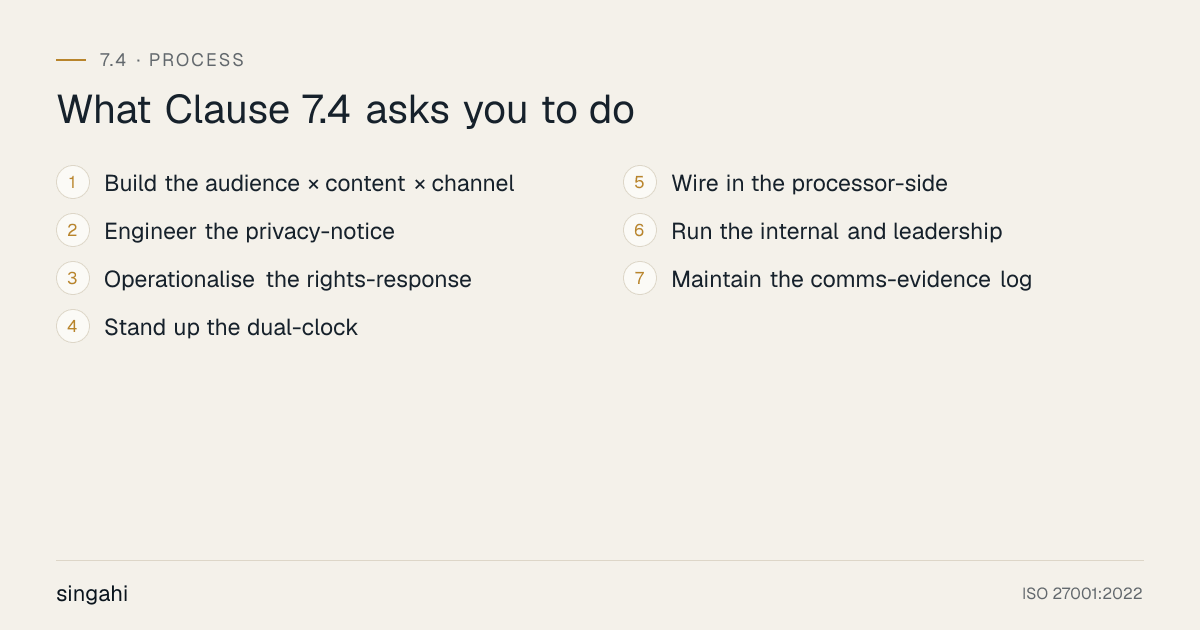
Move 1, Build the audience × content × channel × clock matrix
The first move is the load-bearing 7.4 artefact. The matrix is a single spreadsheet (or platform) that records, for every PIMS communication, the four engineering dimensions: the audience (one of the seven-audience taxonomy, with sub-segments), the content (the message variant, the version, the language), the channel (the medium, the surface, the access method), and the clock (the start trigger, the deadline, the owner, the escalation). The matrix is built top-down from the audience inventory and bottom-up from the message inventory, and reconciled to the ROPA, the contract inventory, the DPIA register and the change log (Clause 6.3).
The Singahi matrix template (toolkit doc 04) has eight columns: Communication ID; Audience (with sub-segment); Content (the message variant with version); Channel (the medium with the surface); Clock (the start trigger, the deadline, the owner, the escalation); Language (the variants available); Evidence (the delivery proof, the principal-acknowledgement record, the version log); Effectiveness (the measurement method, the cadence, the last result).
The matrix is approved under the Communication Policy and reviewed quarterly. Every Clause 6.3 change to the processing, the surface, the audience or the language triggers a matrix refresh. The matrix is the primary audit-evidence artefact; the auditor opens it first at the 7.4 examination.
Move 2, Engineer the privacy-notice architecture (layered, just-in-time, multi-lingual, Consent Manager-integrated)
The second move separates the privacy notice from the privacy policy and engineers the notice for the principal's actual experience. The layered-notice architecture (toolkit doc 03) is the operational form.
Layer 1, the just-in-time notice. A one-screen summary delivered on the surface where the principal is acting (the sign-up form, the checkout flow, the consent prompt, the data-collection modal). The Layer 1 content is the purpose, the data categories, the choice, the withdrawal mechanism, and the link to Layer 2. The Layer 1 form is the principal-action architecture: the principal can give, refuse or withdraw consent with one tap. The Layer 1 language is the principal's chosen language.
Layer 2, the layered full notice. The full section 5 / Article 13 information set, in plain language, in the principal's chosen language, at one click from Layer 1. The Layer 2 content covers all thirteen prescribed elements (Section 2.6). The Layer 2 form is the principal-understanding architecture: the principal can read, understand and act on the full notice.
Layer 3, the complete reference notice. The complete technical and legal detail, the ROPA summary, the recipient list, the cross-border mechanism, the retention schedule, the DPIA summary where applicable, the grievance-officer and Consent Manager contact details. The Layer 3 form is the regulator-and-auditor surface.
The multi-lingual delivery is a 7.4-conformant expectation for any principal base that interacts in Indian languages. The DPDP Rules 2025 plain-language requirement operates in the language of the principal's interaction. The minimum-viable language set for a pan-Indian principal base is Hindi plus English plus the top-three regional languages of the actual principal distribution (the language matrix records the choice). The translation workflow is documented; the translation quality is reviewed; the comprehension is measured.
The Consent Manager integration (toolkit doc 02 Section 8) operationalises the section 2(1)(g) flow. Where the principal opts to use a Consent Manager, the notice is delivered through the Consent Manager's standardised interface, the consent is recorded with the Consent Manager, and the withdrawal flows back through the Consent Manager. The Consent Manager integration is the privacy-by-design expression of the as-easy-to-withdraw commitment.
Move 3, Operationalise the rights-response communications (the section 11 to 14 SLAs)
The third move builds the rights-response communication workflow. The DPDP Act 2023 sections 11 to 14 (and the GDPR Articles 15 to 22 equivalents) set the principal's rights; the DPDP Rules 2025 prescribe the response periods. The rights-response communication is the principal-facing closure of each rights request.
The Singahi rights-response pack (toolkit doc 08) covers six rights types: access (section 11 / Article 15), the response delivers the personal-data summary or copy within the prescribed period; correction (section 12 / Article 16), the response confirms the action and notifies the recipients; erasure (section 12 / Article 17), the response confirms the action, runs the forty-eight-hour pre-erasure notice to the principal where applicable, and notifies the recipients; grievance (section 13), the response acknowledges within the prescribed period and resolves within the prescribed period; nomination (section 14), the response acknowledges and processes the nomination; objection (section 12(2) / Article 21), the response confirms the action.
Each rights-response type has a workflow: intake (the request channel and the verification), identity verification (the CISA-style step-up authentication), classification (the rights type, the prescribed period, the complexity), fulfillment (the data retrieval, the content review, the approval), delivery (the channel, the format, the language), evidence (the comms-evidence log entry, the delivery proof, the principal-acknowledgement record), and SLA reporting (theClause 9.1 monitoring).
The workflow is operationalised in the customer-support ticketing system with a privacy-rights queue, a SLA dashboard, an escalation pathway and a per-request evidence record. The Grievance Officer is the canonical owner; the DPO is the escalation point; the legal-and-compliance function is the content-approval authority.
Move 4, Stand up the dual-clock breach-communications playbook
The fourth move is the load-bearing Indian 7.4 discipline. The dual-clock breach-communications playbook (toolkit doc 05) operationalises the four-clock pattern from the same awareness event.
T+0, the awareness event. The trigger is the moment the organisation becomes aware of a personal-data breach, through monitoring, through a principal report, through a third-party notification, through a processor escalation. The awareness event is logged; the clock starts.
T+1 hour, the internal activation. The Incident Response Lead convenes the breach-comms cell (the DPO, the Head of Legal, the Head of Communications, the CISO, the Head of Customer Support, the executive sponsor). The breach-comms cell confirms the awareness event, scopes the breach, drafts the four notifications, prepares the regulator-portal credentials, prepares the principal-notification segmentation.
T+6 hours, the CERT-In report (Clock A). The CERT-In six-hour report fires through the CERT-In incident-reporting portal or the designated Point of Contact. The report covers the incident description, the affected systems, the data categories, the containment actions, the impact assessment. The delivery proof is captured in the comms-evidence log.
Without delay, then by T+72 hours, the DPDP Board notification (Clock B). The DPDP section 8(6) intimation fires through the Board without delay, in the Rule 7 intimation content, and the detailed report follows within seventy-two hours. The notification covers the breach description, the categories of personal data, the approximate number of principals affected, the consequences, the mitigation measures, the remediation plan. The Board may extend the clock on request; the extension request is logged.
T+ without undue delay, the affected-principal notification (Clock C). The principal notification fires in plain language, in the principal's chosen language, describing the breach, the likely consequences, and the mitigation steps. The notification is segmented by language, by relationship stage, by sensitivity; the Consent Manager flow is used where the principal opted for one. The delivery proof is captured per principal-segment.
T+ sector clock, the regulator filings (Clock D). The sector-regulator notifications fire on their respective clocks, the RBI for payment-system operators and digital lenders, the SEBI for regulated entities under CSCRF, the IRDAI for insurers. The sector filings reconcile with the CERT-In and DPDP filings.
T+24 hours to T+30 days, the customer-DPA notifications. The processor-side customer notifications fire on the customer-DPA clocks, typically forty-eight to seventy-two hours for the breach-notification duty, with the customer's own downstream-notification clock cascading from the organisation's notification.
T+30 days, the post-incident communication review. The breach-comms cell reviews the response: were the clocks met, were the templates effective, were the principal actions comprehensible, were the regulator engagements well-managed, what improvements feed Clause 10.1.
The playbook is table-topped quarterly with all named role-holders. The table-top drill is the load-bearing evidence that the playbook is real, not a document, but a muscle-memory. The drill produces a clock-performance report that feeds the management review (Clause 9.3).
Move 5, Wire in the processor-side communications (sub-processor notification, customer-DPA, infringing-instruction handling)
The fifth move addresses the processor-side communication surface, which is the load-bearing surface for any organisation acting as a Data Processor. Three communication workflows dominate.
The sub-processor notification workflow. Under Article 28(2) of the GDPR (and the matching customer-DPA language that most Indian processor-side organisations sign), the processor must notify the customer of a planned sub-processor change, with a defined notice period (typically ten to thirty days) for the customer to object. The notification content includes the sub-processor identity, the processing scope, the geography, the security measures, the due-diligence outcome. The notification is logged in the customer-DPA register and the comms-evidence log. The customer's objection (where raised) triggers a re-evaluation workflow; the customer's right to terminate the DPA on persistent objection is documented.
The processor-to-controller breach-notification workflow. Under the typical customer DPA, the processor must notify the controller of a personal-data breach within a defined period (typically forty-eight to seventy-two hours) of becoming aware. The notification content covers the breach description, the affected customer data, the containment actions, the processor's role, the customer's notification obligations. The notification is logged in the breach register and the comms-evidence log; the customer's downstream-notification clock cascades from the notification.
The infringing-instruction handling workflow. Under Annex A.2.2.5 (the processor-side obligation to handle infringing instructions), the processor must communicate an objection where the customer proposes a processing instruction that infringes DPDP (or other applicable law). The objection is documented in writing; the customer is requested to clarify, modify or withdraw the instruction; the processor suspends the execution pending resolution; the escalation pathway is defined. The infringing-instruction communication is a load-bearing processor-side 7.4 discipline that most Indian processor-side organisations under-engineer.
The three workflows are operationalised in the customer-success or account-management function, with the DPO as the escalation point and the legal-and-compliance function as the content-approval authority. The customer-DPA register is the operational artefact; the comms-evidence log is the audit artefact.
Move 6, Run the internal and leadership communications cycle
The sixth move addresses the internal audience (Quadrants 3 and 4 of the four-quadrant message model). The internal communication is the channel through which the Clause 5.2 policy, the Clause 7.3 awareness programme, the Clause 6.3 change-communications, and the Clause 9.3 leadership-briefing cycle reach the workforce and the leadership.
The policy cascade. Every Clause 5.2 policy revision triggers a cascade across the workforce, the policy summary, the change highlights, the acknowledgement request, the role-specific briefings. The cascade is logged in the awareness-evidence register (Clause 7.3) and the comms-evidence log (Clause 7.4). The acknowledgement record is the audit evidence.
The change-communication cycle. Every Clause 6.3 change that affects the workforce, a new processing activity the workforce operates, a new processor the workforce interacts with, a new consent architecture the workforce must support, a new policy commitment the workforce must honour, triggers a change-communication. The change-communication cycle is integrated with the change-request intake under Clause 6.3 Move 5.
The leadership briefing cycle. The DPO presents the privacy-communication profile to the executive committee and the board on a defined cadence (quarterly for the executive committee, half-yearly for the board, with an event-trigger briefing for material incidents). The leadership briefing covers the principal-experience metrics, the regulator-engagement status, the breach-comms posture, the rights-response SLA achievement, the grievance-response SLA achievement, the consent-flow health, the awareness-cascade reach.
The awareness-comms integration. The Clause 7.4 internal communications and the Clause 7.3 awareness programme share the audience taxonomy and the cadence, but with the demarcation that 7.3 builds the literacy and 7.4 engineers the messages. The two functions coordinate on the quarterly comms calendar; the simulation results (Clause 7.3) feed the leadership briefing (Clause 7.4); the policy cascade (Clause 7.4) triggers the policy-acknowledgement cycle (Clause 7.3).
Move 7, Maintain the comms-evidence log and measure effectiveness
The seventh move is the discipline that converts the communication programme from a document set into an audit-grade artefact. The comms-evidence log (toolkit doc 09) is the load-bearing evidence register.
The comms-evidence log. The register records, per PIMS communication: the Communication ID (linked to the matrix); the audience (with sub-segment); the content version; the channel and the surface; the language variants; the dispatch date and time; the delivery proof (the portal receipt, the email open record, the SMS delivery record, the in-app view record); the principal-acknowledgement record where applicable; the clock status (start trigger, deadline, actual, variance); the approval workflow record (drafter, reviewer, approver, date); the linked ROPA entry, DPIA entry, contract entry, change-log entry where applicable; the effectiveness-measurement result.
The log is reviewed monthly by the DPO and quarterly by the internal audit (Clause 9.2). The log reconciles to the ROPA (every notice variant matches a processing activity), the contract inventory (every sub-processor notification matches a customer DPA), the DPIA register (every DPIA-relevant change has a matching communication), the change log (every Clause 6.3 change has a matching communication), and the awareness-evidence register (every internal communication has a matching awareness record).
The effectiveness measurement. The communication programme is measured on five axes. Reach, did the audience receive the message (delivery rate, open rate, view rate). Comprehension, did the audience understand the message (the notice-comprehension survey, the awareness-quiz outcome). Action, did the audience act on the message (the consent-withdrawal rate, the rights-request submission rate, the principal-complaint rate). Satisfaction, was the audience satisfied with the communication (the principal-satisfaction score, the workforce-awareness satisfaction score). Clock performance, were the clocks met (the SLA-achievement rate, the clock-variance report).
The five-axis measurement feeds the management review (Clause 9.3) and the continual-improvement cycle (Clause 10.1). The communication profile is the lens through which leadership sees the PIMS from the principal's and the regulator's point of view.
Worked example, Tarini Health's seven-move discipline (summary)
To make the seven moves concrete, consider Tarini Health (a fictional Bengaluru-based digital-health platform with 720 staff and a tier-2 city patient base; the facts are composite and should not be attributed to any real organisation; the full treatment is in Section 15). Tarini Health's 7.4 first cycle produced an audience × content × channel × clock matrix covering 67 communication types across the seven audiences (28 principal-facing, 8 DPBI-facing, 4 CERT-In-facing, 6 sector-regulator-facing, 11 processor-side, 8 internal, 2 public); a layered-notice architecture with three notice layers delivered in five languages (Hindi, English, Kannada, Tamil, Telugu); a Consent Manager integration covering 12 percent of the patient base within the first six months; a rights-response pack covering six rights types with an SLA dashboard; a dual-clock breach-communications playbook table-topped four times in the first cycle; a sub-processor notification register for the 23 processor-side customers; an internal-cascade calendar with quarterly leadership briefings; and a comms-evidence log reconciling to the ROPA, the contract inventory, the DPIA register and the change log. The first-cycle effort was 12 weeks of internal time plus external advisory; the artefact set passed Stage 1 audit at first attempt with no 7.4 finding; the seven-move discipline caught two notice-content gaps, three SLA risks and one dual-clock exposure that the prior ad-hoc posture had concealed.
Tools, Technologies, and Solutions
The tool categories
Privacy notice and consent management platforms (CMPs). The principal-facing layer, the just-in-time notice delivery, the layered-notice architecture, the consent capture, the consent withdrawal, the multi-lingual variants, the comprehension-tracking, the principal-segmentation, the Consent Manager integration. The category is mature on the global market and emerging on the Indian market.
Consent Manager interoperability layer. The technical integration layer that connects the organisation's consent capture to the registered Consent Manager ecosystem under section 2(1)(g). The layer supports the give-manage-review-withdraw flow with revocation, portability, and audit-trail.
Data-subject / data-principal rights request (DSAR/DPRR) workflow platforms. The customer-support-side platform for the rights-response workflow (Move 3), intake, identity verification, classification, fulfillment, delivery, evidence, SLA reporting. The category overlaps with the privacy-management platform; the dedicated DSAR/DPRR platforms focus on the request lifecycle.
Breach-communication and incident-notification platforms. The regulator-portal integration, the principal-notification segmentation, the template library, the clock-tracking dashboard, the table-top drill mode. The category overlaps with the broader incident-response platform; the breach-communication slice focuses on the outward-facing messaging and the clock discipline.
Multi-lingual translation and localisation tooling. The translation memory, the glossary management, the in-context review, the comprehension-testing workflow. The category is critical for an Indian principal base; the translation quality is the load-bearing 7.4 dimension for the plain-language commitment.
Internal-comms and awareness-comms platforms. The workforce-facing layer, the policy-cascade, the awareness-nudge, the simulation-broadcast, the leadership-briefing. The category overlaps with the learning-platform (Clause 7.2) and the awareness-platform (Clause 7.3); the internal-comms slice focuses on the message-engineering. Cost: typically integrated with the existing internal-comms investment.
Comms-evidence log platforms. The audit-evidence register, the per-communication evidence record, the reconciliation against the ROPA and the contract inventory, the clock-variance report. The category is emerging; for the first cycle a shared spreadsheet is sufficient.
GRC platforms with a privacy-communication module. The integrated enterprise choice, the audience matrix, the clock register, the comms-evidence log, the regulator-engagement desk, the breach-comms cell, the leadership-briefing dashboard, the cross-framework reconciliation.
Selection criteria
Select on: India-DPDP coverage (most global platforms are GDPR-heavy and DPDP-thin); seven-audience coverage (the tool should support the audience taxonomy, not force a single-audience model); dual-clock integration (the CERT-In six-hour clock and the DPDP breach clock (intimation without delay; seventy-two-hour report) should be first-class workflows, not afterthoughts); Consent Manager interoperability (the Consent Manager flow should be a first-class integration, not a custom build); multi-lingual support (the Indian-language variants should be first-class, not bolted on); layered-notice support (the three-layer architecture should be a first-class pattern); DSAR/DPRR workflow (the rights-response workflow should be a first-class module); comms-evidence discipline (the log should be audit-grade by design, not assembled manually); and cost-to-value for the Indian growing-company segment.
Build vs buy
Most growing companies should buy the CMP and the DSAR/DPRR platform and build the communication-engineering methodology in-house with external advisory for the first cycle. The methodology is too organisation-specific to outsource end-to-end; the tooling is too time-intensive to build internally. The dual-clock breach-communications playbook is the build-not-buy component (the regulator portals are reached through the regulator's own interfaces, and the playbook is the organisation's muscle-memory, not a vendor's).
Policy and Procedure Templates
PIMS Communication Policy (sample of our own drafting)
The organisation maintains a Privacy Information Management System Communication discipline that governs every PIMS communication, internal and external, binding-legal-impact and behavioural-change, across the seven audiences (Data Principals; the Data Protection Board of India; CERT-In; sector regulators; processors, sub-processors and processor-side customers; internal staff and leadership; the public and the market). The discipline is operationalised through an audience × content × channel × clock matrix, a layered-notice architecture, a dual-clock breach-communications playbook, a rights-response workflow, a sub-processor notification workflow, an internal-cascade calendar, and a comms-evidence log. The DPO owns the discipline; the Head of Marketing and Communications co-owns the brand-voice integration; the Head of Customer Support co-owns the rights-response workflow; the Head of Legal and Compliance co-owns the regulatory-content axis; the Head of Engineering co-owns the in-product notice surfaces and the Consent Manager integration. Every PIMS communication is engineered for its audience, its content, its channel, its clock, its language, its accessibility, and its evidence. The dual-clock pattern (CERT-In six hours + DPDP section 8(6) without delay, with a seventy-two-hour detailed report + sector clocks + without-undue-delay principal notification) is rehearsed quarterly. The comms-evidence log reconciles to the ROPA, the DPIA register, the change log, the contract inventory and the awareness-evidence register.
Grievance Officer Charter (sample of our own drafting)
The Grievance Officer, designated under section 13 of the DPDP Act 2023, is the principal's first point of escalation for any privacy concern, complaint or rights request that the standard channels cannot resolve. The Grievance Officer's contact details (name, email, postal address, telephone) are published on every principal-facing surface, in the principal's chosen language, in an accessible format. The Grievance Officer acknowledges every grievance within the prescribed period and resolves every grievance within the prescribed period, with an interim response where the resolution requires longer. The Grievance Officer escalates to the DPO where the grievance indicates a systemic issue, a regulatory exposure, or a Clause 10.2 nonconformity. The Grievance Officer maintains the Grievance Register, the per-grievance evidence record with the SLA status, and reports monthly to the DPO and quarterly to the leadership.
PIMS Communication Plan Procedure (sample of our own drafting, summarised)
- Audience inventory, the seven-audience taxonomy is maintained, with sub-segments per audience, named owners per audience, and per-audience channel preference.
- Message inventory, the message types are catalogued (notice, consent, rights response, breach, grievance, sub-processor, regulator, leadership, awareness-cascade, public), with per-message templates, versions, language variants, and approval workflows.
- Channel matrix, the channel inventory is mapped to the audience-message pairs, with the access method, the language availability, the accessibility compliance, and the delivery-proof mechanism.
- Clock register, the clock inventory is maintained, with the start trigger, the deadline, the owner, the escalation pathway, the variance report, the evidence requirement.
- Language matrix, the language variants are mapped to the principal distribution, with the translation workflow, the quality review, the comprehension testing, the variant-update cadence.
- Accessibility matrix, the accessibility commitment is documented (the WCAG-style conformance level), with the per-surface compliance, the assistive-technology compatibility, the audit cadence.
- Effectiveness measurement, the five-axis measurement (reach, comprehension, action, satisfaction, clock performance) is operated, with the per-audience dashboard, the leadership-briefing cadence, the continual-improvement feed.
- Comms-evidence log, the log is maintained, the reconciliation against the ROPA, the contract inventory, the DPIA register, the change log and the awareness-evidence register is performed monthly, the variance is investigated.
- Cadence, the Communication Plan is reviewed quarterly and refreshed under Clause 6.3 on every material change.
Dual-clock Breach-Communications Playbook template (sample of our own drafting, summarised)
Awareness event (T+0): the trigger is logged; the breach-comms cell is convened by the Incident Response Lead. T+1 hour: the cell confirms the awareness event, scopes the breach, drafts the four notifications, prepares the regulator-portal credentials, prepares the principal-notification segmentation. T+6 hours (Clock A, CERT-In): the report fires through the CERT-In incident-reporting portal; the delivery proof is logged. Without delay, then by T+72 hours (Clock B, DPDP Board): the Rule 7 intimation fires through the Board's notification channel without delay, and the detailed report follows within 72 hours; the delivery proof is logged. Without undue delay (Clock C, affected principals): the principal notification fires in plain language in the principal's chosen language; the delivery proof is logged per principal-segment. Sector clock (Clock D, sector regulator): the RBI / SEBI / IRDAI filing fires on the sector clock; the delivery proof is logged. Customer-DPA clock (Clock E, processor-side customers): the customer notification fires on the DPA clock; the cascade is logged. Post-incident review (T+30 days): the breach-comms cell reviews the response, the clocks, the templates, the principal actions, the regulator engagements, and feeds Clause 10.1.
Layered-Notice Architecture template (sample of our own drafting)
Layer 1, just-in-time notice (the principal-action surface). One-screen summary at the point of collection: the purpose, the data categories, the choice, the withdrawal mechanism, the link to Layer 2. The Layer 1 form is the consent capture or refusal; the Layer 1 language is the principal's chosen language. Layer 2, layered full notice (the principal-understanding surface). The full section 5 / Article 13 information set, in plain language, in the principal's chosen language: the categories of personal data; the purpose; the legal ground; the recipients; the cross-border destinations; the retention period; the rights; the withdrawal mechanism; the consequences of non-consent; the automated decision-making; the Grievance Officer contact; the Consent Manager contact; the children's-data regime where applicable. Layer 3, complete reference notice (the regulator-and-auditor surface). The complete technical and legal detail: the ROPA summary, the recipient list, the cross-border mechanism, the retention schedule, the DPIA summary where applicable, the SoA summary, the data-fiduciary identity and registration.
Rights-Response Communication template (sample of our own drafting)
Communication ID: (linked to the matrix). Request type: access / correction / erasure / grievance / nomination / objection. Request date: (the date of receipt). Identity verification: (the method, the date, the outcome). Prescribed period: (the start, the deadline). Fulfillment: (the data retrieval, the content review, the approval). Delivery: (the channel, the format, the language). Content: (the response summary; the action taken; the recipients notified where applicable; the remedy where applicable). Evidence: (the comms-evidence log entry; the delivery proof; the principal-acknowledgement record). SLA status: (on-time / variance / escalation). Sign-off: (the Grievance Officer and the DPO where applicable).
Sub-processor Notification template (sample of our own drafting)
Notification ID: (linked to the customer DPA). Customer: (the controller customer). Sub-processor: (the identity, the geography, the processing scope, the security measures, the due-diligence outcome). Notice date: (the dispatch date). Customer DPA clock: (the notice period, typically 10 to 30 days). Objection window: (the deadline for the customer to object). Objection handling: (the workflow for an objection; the re-evaluation; the escalation). Effectiveness date: (the date the sub-processor starts processing). Evidence: (the comms-evidence log entry; the customer receipt acknowledgement).
Risk Assessment and Treatment
This section is the operational core of Clause 7.4 from the risk angle. It expands on the four-clock pattern (Section 2.5) and provides the worked detail for the comms-risk register, the dual-clock risk treatment, and the common 7.4 risk patterns.
The comms-risk register, the load-bearing 7.4 risk artefact
For every PIMS communication, the comms-risk register records: the communication ID (linked to the matrix); the audience (with sub-segment); the principal-impact axis (autonomy, dignity, safety, non-discrimination, rights); the regulatory-exposure axis (the clock that runs, the penalty exposure); the certification-exposure axis (the 7.4 finding risk); the likelihood (the chance the communication fails); the consequence (the impact if it fails); the treatment (modify / retain / avoid / share per the 6.1.3 taxonomy); the treatment owner; the residual-risk acceptance.
The comms-risk register is reviewed quarterly and refreshed under Clause 6.3 on every material change. The register is the bridge between the 7.4 communication-engineering and the 6.1 risk methodology; a 7.4 process that does not update the comms-risk register is a documentation exercise, and a 6.1 risk register that does not reflect the comms-risk profile is incomplete.
The dual-clock risk treatment, the worked detail
The dual-clock risk (the risk that the CERT-In six-hour clock and the DPDP breach clock (intimation without delay; seventy-two-hour report) are not both met) is treated through four mechanisms.
Mechanism A, Pre-staged templates and credentials. The CERT-In report template, the DPDP Rule 7 intimation template, the principal-notification template, the customer-DPA template, the sector-regulator template are pre-staged, pre-cleared by Legal, and version-controlled. The regulator-portal credentials are tested quarterly. The principal-notification segmentation is pre-built.
Mechanism B, Quarterly table-top drill. The breach-comms cell convenes quarterly for a table-top drill on a hypothetical breach. The drill exercises the four-clock discipline end-to-end, measures the clock performance, surfaces the gaps, and feeds the continual-improvement cycle.
Mechanism C, The awareness-event detection surface. The dual-clock pattern depends on the awareness event being detected, the organisation must "notice" the breach to start the clocks. The detection surface (Clause 9.1 monitoring, the support-side principal reports, the processor-side escalations, the third-party notifications) is the load-bearing upstream discipline. A detection failure that delays awareness cascades into a dual-clock failure.
Mechanism D, The clock-variance investigation. Every clock variance (a missed deadline, a late notification, an extended deadline) is investigated under Clause 10.2. The corrective action addresses the root cause (a missing template, a missing credential, a detection gap, an approval bottleneck) and tightens the discipline.
The 7.4 risk register (the consolidated view)
| Risk pattern | Source | Principal-impact | Treatment |
|---|---|---|---|
| Notice content missing a section 5 / Article 13 element | Content review gap | High (autonomy + rights) | Modify (the thirteen-element content checklist; the Legal approval gate) |
| Notice available only in English for a multilingual principal base | Language matrix gap | High (autonomy) | Modify (the language matrix; the translation workflow) |
| Notice not delivered at the point of collection | Layered-notice architecture gap | High (autonomy + rights) | Modify (the Layer 1 just-in-time deployment) |
| Consent withdrawal not as easy as consent | Consent Manager integration gap | Severe (autonomy) | Modify (the Consent Manager integration; the as-easy-to-withdraw test) |
| CERT-In six-hour clock missed | Dual-clock discipline gap | High (regulatory + rights) | Modify (the table-top drill cadence; the pre-staged templates) |
| DPDP breach clock (intimation without delay; seventy-two-hour report) missed | Dual-clock discipline gap | Severe (regulatory + penalty exposure) | Modify (the quarterly drill; the pre-staged the Rule 7 intimation template) |
| Affected-principal notification not in plain language | Principal-notification template gap | High (autonomy + dignity) | Modify (the plain-language review; the comprehension testing) |
| Section 11 access response beyond the prescribed period | Rights-response workflow gap | High (rights) | Modify (the DSAR/DPRR platform; the SLA dashboard) |
| Section 13 grievance response beyond the prescribed period | Grievance-handling gap | Severe (rights + dignity) | Modify (the Grievance Officer resourcing; the escalation pathway) |
| Article 28(2) sub-processor notification missed | Processor-side discipline gap | High (rights) | Modify (the customer-DPA register; the notification clock) |
| Children's-data notice omits the section 9 elements | Children's-regime gap | Severe (autonomy + safety + dignity) | Modify (the section 9 notice variant; the verifiable-parental-consent flow) |
| AI / automated-decision notice omits the logic | Algorithmic-transparency gap | Severe (non-discrimination) | Modify (the AI-notice variant; the algorithmic-AI fairness disclosure) |
| Cross-border notice omits the section 16 destination | Transfer-communication gap | High (autonomy) | Modify (the transfer-notice template; the negative-list screen) |
| Breach-notification not table-topped in the last 12 months | Drill-cadence failure | High (regulatory + rights) | Modify (the quarterly drill cadence) |
| Comms-evidence log not reconciled with the ROPA | Reconciliation gap | Medium | Modify (the monthly reconciliation; the variance investigation) |
| Internal policy cascade not evidenced | Internal-comms gap | Medium (governance) | Modify (the awareness-evidence register integration) |
| Public statement inconsistent with the notice | Brand-voice vs Legal alignment gap | High (autonomy + trust) | Modify (the brand-voice and Legal joint review) |
The high-impact, high-likelihood risks to treat first are: the dual-clock failure (the CERT-In or DPDP clock missed); the notice-content gap (a section 5 / Article 13 element missing); the language gap (the notice not in the principal's chosen language); the children's-data notice gap (the section 9 elements missing); the section 13 grievance SLA missed. These five risk patterns account for most of the 7.4 audit nonconformities and the Schedule-scale penalty exposures in the Indian growing-company segment.
Audit and Compliance Checklist
The 27 questions below cover the audit-evidence surface for Clause 7.4. Expected evidence and red flags noted. Most can be answered from the toolkit doc 09 audit-evidence checklist.
- Is there a PIMS Communication Policy (the governance artefact)? Expected: dated, version-controlled, signed by top management or the DPO with sponsor authority. Red flag: missing.
- Is there a PIMS Communication Plan (the methodology artefact)? Expected: dated, version-controlled, covering the seven audiences, the four quadrants, the channel matrix, the clock register, the language matrix, the accessibility matrix, the effectiveness measurement, the comms-evidence discipline.
- Is there an audience × content × channel × clock matrix (the load-bearing operational artefact)?
- Does the matrix cover all seven audiences with sub-segments?
- Does the matrix record the channel, the clock, the language, the evidence and the effectiveness for each communication?
- Is the privacy notice separated from the privacy policy (the canonical 7.4 distinction)?
- Is the privacy notice delivered in the layered-notice architecture (Layer 1 just-in-time, Layer 2 layered full, Layer 3 complete reference)?
- Does the notice content cover the section 5 / Article 13 information set (the thirteen elements)?
- Is the notice available in the principal's chosen language (the language matrix)?
- Is the notice WCAG-accessible (the accessibility matrix)?
- Is the Consent Manager integration operational where the principal opts for one (the section 2(1)(g) flow)?
- Is there a dual-clock breach-communications playbook (the CERT-In six-hour + DPDP without delay plus a seventy-two-hour detailed report + sector-clock + principal-notification pattern)?
- Has the playbook been table-topped in the last 12 months (the drill cadence)?
- Does the playbook produce a clock-performance report?
- Is there a rights-response workflow for sections 11, 12, 13, 14 and Article 21 objection?
- Does the rights-response workflow meet the prescribed period consistently (the SLA-achievement report)?
- Is the Grievance Officer's contact published on every principal-facing surface?
- Does the Grievance Officer meet the section 13 prescribed period (the Grievance Register review)?
- Is there a sub-processor notification register for processor-side organisations (the Article 28(2) clock)?
- Is there an infringing-instruction handling workflow under Annex A.2.2.5 (the processor-side objection discipline)?
- Is there a comms-evidence log reconciling to the ROPA, the contract inventory, the DPIA register, the change log and the awareness-evidence register?
- Is the comms-evidence log reviewed monthly by the DPO and quarterly by the internal audit?
- Is there an effectiveness measurement (reach, comprehension, action, satisfaction, clock performance)?
- Does the effectiveness measurement feed the leadership briefing and the continual-improvement cycle?
- Is the communication programme integrated with the Clause 6.3 change-management process (every material change triggers a communication cycle)?
- Is the internal policy cascade evidenced in the awareness-evidence register (the Clause 7.3 integration)?
- Is the public statement consistent with the notice (the brand-voice and Legal joint review)?
Metrics and KPIs
The 14 KPIs below measure the Clause 7.4 communication programme on the five-axis framework (reach, comprehension, action, satisfaction, clock performance).
| # | KPI | Formula | Target | Cadence |
|---|---|---|---|---|
| 1 | Notice delivery rate | (principals who received Layer 1 notice / total principals in scope) × 100 | ≥ 99% | Monthly |
| 2 | Notice open rate (Layer 2) | (principals who opened Layer 2 / principals who received Layer 1) × 100 | ≥ 60% | Monthly |
| 3 | Notice comprehension score | average score on the comprehension survey (per language variant) | ≥ 75% | Quarterly |
| 4 | Consent withdrawal success rate | (successful withdrawals / attempted withdrawals) × 100 | ≥ 99% | Monthly |
| 5 | CERT-In six-hour clock achievement | (reports filed within six hours / total notifiable incidents) × 100 | 100% | Per incident |
| 6 | DPDP breach clock achievement (intimation without delay; seventy-two-hour report) | (intimations sent without delay and detailed reports filed within seventy-two hours / total personal-data breaches) × 100 | 100% | Per incident |
| 7 | Affected-principal notification timeliness | (notifications within the without-undue-delay standard / total affected-principal notifications) × 100 | ≥ 95% | Per incident |
| 8 | Section 11 access-response SLA achievement | (responses within the prescribed period / total access requests) × 100 | ≥ 95% | Monthly |
| 9 | Section 13 grievance-response SLA achievement | (responses within the prescribed period / total grievances) × 100 | ≥ 95% | Monthly |
| 10 | Sub-processor notification timeliness (processor-side) | (notifications within the DPA clock / total sub-processor changes) × 100 | 100% | Per change |
| 11 | Comms-evidence log reconciliation | (reconciled entries / total entries) × 100 | 100% | Monthly |
| 12 | Principal complaint rate | (complaints / total principal interactions) × 100 | Declining trend | Quarterly |
| 13 | Regulator follow-up rate | (regulator follow-up inquiries / total regulator filings) × 100 | Declining trend | Quarterly |
| 14 | Table-top drill clock performance | drill-measured clock variance against target | < 5% variance | Quarterly |
The 14 KPIs are reported in the leadership briefing (Clause 9.3) and the continual-improvement cycle (Clause 10.1). The clock KPIs (5, 6, 7, 10) are the load-bearing ones, a missed clock is a Schedule-scale penalty exposure and a 7.4 major nonconformity.
Common Pitfalls and Audit Failures
The nine patterns below account for most Clause 7.4 audit nonconformities and penalty exposures in the Indian growing-company segment.
Pitfall 1, The policy-equals-notice conflation. A single PDF labelled "Privacy Policy" on the website footer; no separate notice; no layered architecture; no just-in-time delivery; no principal-action surface. The auditor finds the conflation immediately; the remediation is the full layered-notice architecture (Move 2).
Pitfall 2, The single-clock breach failure. A breach playbook that addresses CERT-In's six-hour report but not the DPDP notification (intimation without delay; seventy-two-hour report), or vice versa. The auditor picks a recent breach (or a recent drill) and walks the four clocks; a single-clock pattern is a 7.4 major nonconformity.
Pitfall 3, The English-only notice. A notice available only in English for a principal base that predominantly interacts in Indian languages. The auditor pulls the principal-distribution data; the language matrix gap is the finding. The remediation is the language matrix and the translation workflow.
Pitfall 4, The unmonitored grievance email. A grievance@ email address published on the website, with no SLA, no dashboard, no escalation, no evidence. The auditor sends a test grievance before the audit; the response time and the response quality are the evidence.
Pitfall 5, The ad-hoc DSAR workflow. DSARs handled by customer support with no SLA, no identity verification, no content approval, no evidence log. The auditor picks three to five recent DSARs; the variance in response time and content quality is the finding.
Pitfall 6, The sub-processor change that ships without notification. A processor-side organisation that adds a sub-processor without the customer-DPA notification. The auditor reconciles the sub-processor inventory against the customer-DPA register; the gaps are the findings.
Pitfall 7, The comms-evidence log that does not reconcile. A comms-evidence log that exists but does not reconcile to the ROPA, the contract inventory, the DPIA register or the change log. The auditor picks a sample and walks the reconciliation; the gaps are the findings.
Pitfall 8, The breach playbook that has never been drilled. A breach playbook that exists as a document but has never been table-topped. The auditor asks for the drill record; the absence is the finding. The remediation is the quarterly drill cadence.
Pitfall 9, The 7.3-versus-7.4 conflation. The internal-comms programme and the awareness programme (Clause 7.3) treated as the same artefact. The demarcation is load-bearing: 7.3 builds the literacy; 7.4 engineers the messages. The two functions coordinate but produce distinct artefacts.
Illustrative Scenario 1: Failure, Mihira Travel's Silent Breach Communication (Illustrative)
Illustrative scenario, a composite example for guidance, not a specific Singahi engagement or a verified outcome. It is set after 13 May 2027, when the DPDP Act's duties and the Board's inquiry and penalty powers take effect.
Disclaimer: Mihira Travel is a fictional Gurgaon-based online travel aggregator. The facts are composite, drawn from patterns observed across the Indian travel-tech segment, and should not be attributed to any real organisation. The case is illustrative.
The organisation
Mihira Travel operated a tier-2 city-focused online travel aggregator with 460 staff, 1.8 million monthly active users and a 22-million-principal database covering flight, hotel and package bookings across India, Southeast Asia and the Gulf. The principal base was approximately 60 percent non-English-first; the dominant interaction languages were Hindi, Tamil, Telugu, Kannada and Bengali. Mihira Travel held a Category-A travel-tech certification from a self-regulatory body but was not ISO/IEC 27701 certified.
The incident
On a Friday in late February 2028, a misconfigured customer-data warehouse exposed a snapshot containing 14 million principal records, names, mobile numbers, email addresses, travel histories, payment-method last-four digits, and passport-number hashes, to the public internet for approximately 76 hours before an external security researcher notified the company via the generic support@ email address. The researcher's email landed at 02:14 IST Saturday; the support agent who picked it up at 09:30 IST Monday escalated it to the engineering lead at 11:00 IST; the engineering lead confirmed the exposure at 14:00 IST Monday and notified the CISO; the CISO confirmed the breach at 16:30 IST Monday and convened the incident-response bridge at 17:30 IST Monday.
The communication failure
The incident-response bridge made four communication decisions, each defective.
Decision 1, No CERT-In report within six hours. The CISO was aware that CERT-In Directions 20(3)/2022-CERT-In required reporting within six hours of noticing. The bridge concluded that the "noticing" event was the researcher's email (02:14 IST Saturday) and that the six-hour clock had already lapsed by the time the bridge convened. The bridge decided to file a delayed report with a "we became aware on Monday" framing. The CERT-In portal submission was eventually made on Wednesday, approximately 86 hours after the actual awareness event. The CERT-In investigator who later reviewed the case concluded the awareness event was the Saturday email; the CISO's Monday framing was rejected.
Decision 2, No DPDP Board notification. The DPDP Act 2023 section 8(6) and the DPDP Rules 2025 Rule 7 required notification to the Data Protection Board of India without delay, with a detailed report within seventy-two hours. The bridge was uncertain whether the Board was operational for travel-tech incidents and decided to wait for legal opinion. The legal opinion arrived the following Monday, eight days after the awareness event. The Board notification was filed nine days late. The Board's inquiry officer later concluded the notification was knowingly delayed.
Decision 3, No principal notification. The DPDP Act 2023 section 8(6) required notification to each affected principal without undue delay in plain language describing the breach, its likely consequences and the mitigation steps. The bridge decided that notifying 14 million principals would generate "unnecessary panic" and reputational damage, and that the company's standard privacy notice (an English-only PDF on the website footer) was "sufficient disclosure." No principal notification was sent for six weeks, until a board-level intervention after media coverage. The principal notification, when eventually sent, was an English-only email that the comprehension survey later showed was understood by approximately 31 percent of recipients.
Decision 4, No sub-processor customer notification. Mihira Travel was a processor-side service provider to three regional airline customers under DPAs requiring forty-eight-hour breach notification. The bridge decided that the airline customers' data was "not in the exposed snapshot" and skipped the notification. The subsequent forensic review confirmed that one airline's data was in the snapshot; the airline customer learned of the exposure from media coverage and terminated the DPA.
The regulatory and certification consequences
The Data Protection Board of India initiated adjudication proceedings under section 33 of the DPDP Act. The Schedule penalty exposure ran to up to two hundred crore rupees for the section 8(6) breach-notification failure, up to two hundred and fifty crore rupees for the section 8(5) reasonable-security-safeguards failure (which included the breach-communication preparedness), and up to two hundred crore rupees for the section 9 children's-data exposure (the snapshot included approximately 240,000 principals under the section 9 age threshold). The Board's draft penalty position, before adjudication, was set at approximately ninety crore rupees across the three heads. CERT-In initiated parallel proceedings under the IT Act section 70B lineage for the six-hour-clock failure. The three airline customers filed commercial claims under the DPA breach-notification clauses. Mihira Travel's ISO/IEC 27701:2025 certification body suspended the engagement; the eventual Stage 1 audit report, after a six-month delay, recorded a major Clause 7.4 nonconformity (no dual-clock playbook; policy-equals-notice conflation; language gap; comms-evidence log absence; unmonitored grievance flow; untrained bridge; absent table-top drill).
The root causes and lessons
Five root causes produced the failure: no documented Communication Policy or audience × content × channel × clock matrix; the policy-equals-notice conflation (the company genuinely believed the website-footer PDF satisfied both Clause 5.2 and section 5); dual-clock ignorance (the bridge did not know CERT-In six hours and DPDP without delay plus a seventy-two-hour detailed report ran in parallel from the same awareness event); the language gap (60 percent of the principal base was non-English-first, every communication English-only); and the table-top drill absence (the playbook had never been rehearsed). The lessons are the seven-move discipline from Section 7; the remediation cost Mihira Travel approximately 6 crore rupees across the penalty exposure, the customer-claim settlements, the certification delay, the legal fees and the rebuild, against an estimated 18 to 30 lakh rupees of first-cycle investment that would have prevented the failure.
Illustrative Scenario 2: Success, Tarini Health Builds a Dual-Clock Comms Discipline (Illustrative)
Disclaimer: Tarini Health is a fictional Bengaluru-based digital-health platform. The facts are composite and should not be attributed to any real organisation. The case is illustrative.
The organisation
Tarini Health operated a tier-2 city digital-health platform with 720 staff, 3.4 million monthly active users and a 12.6-million-principal database covering telemedicine consultations, pharmacy delivery, diagnostic-test bookings and chronic-care programmes. The principal base was approximately 70 percent non-English-first; the dominant interaction languages were Hindi, Kannada, Tamil, Telugu and Bengali. The platform handled sensitive health data, including mental-health consultation notes and reproductive-health records. Tarini Health was preparing for ISO/IEC 27701:2025 certification under the new standalone scheme.
The challenge
The DPO, Dr. Priya Menon, was hired in April 2025 with a mandate to take Tarini Health to ISO/IEC 27701:2025 certification within twelve months. The communication baseline was typical of the Indian digital-health segment: a single privacy notice in English and Hindi on the website footer; a grievance email monitored by a customer-support agent; an untested breach-response document owned by the CISO; DSARs handled ad-hoc by support; no sub-processor notification register; no comms-evidence log; no dual-clock discipline; no Consent Manager integration; no multi-lingual layered notice; no leadership-briefing cadence.
The phased remediation
Dr. Menon ran a four-phase remediation aligned to the seven moves.
Phase 1, The audience and message inventory (weeks 1 to 6). The DPO convened the audience-mapping workshop (Section 1, Quick Win) with the Head of Marketing, the Head of Customer Support, the Head of Legal, the Head of Engineering and the Head of Internal Communications. The workshop produced the seven-audience inventory with 67 communication types, the four-quadrant message model, and the named owners per audience. The Communication Policy was drafted and approved by top management under Clause 5.2 in week 6.
Phase 2, The notice architecture and the rights-response workflow (weeks 7 to 14). The layered-notice architecture was designed and deployed across the four principal-facing surfaces (web, mobile, in-app, WhatsApp). The notice was authored in five languages (Hindi, English, Kannada, Tamil, Telugu) with translation memory and comprehension testing. The Consent Manager integration was built for the registered Consent Managers (two were live in the Indian market by Q4 2025). The rights-response workflow was operationalised in the customer-support ticketing system with a privacy-rights queue, an SLA dashboard, an escalation pathway and a per-request evidence record. The Grievance Officer was designated under section 13, with contact details published in five languages on every principal-facing surface.
Phase 3, The dual-clock breach-communications playbook (weeks 10 to 16, in parallel with Phase 2). The breach-communications playbook was drafted by the DPO with the CISO, the Head of Legal and the Head of Corporate Affairs. The playbook addressed the four clocks (CERT-In six hours, DPDP without delay plus a seventy-two-hour detailed report, without-undue-delay principal notification, sector-regulator clocks for the IRDAI-regulated health-insurance partnership). The templates were pre-staged; the regulator-portal credentials were tested; the principal-notification segmentation was pre-built by language, relationship stage and sensitivity (with separate variants for mental-health, reproductive-health and chronic-care principals). The first table-top drill was run in week 16, with the breach-comms cell convening on a hypothetical ransomware scenario; the drill measured a clock variance of 12 percent against target, the gap fed the continual-improvement cycle.
Phase 4, The comms-evidence log and the effectiveness measurement (weeks 14 to 20). The comms-evidence log was built on the existing GRC platform, with reconciliation against the ROPA, the contract inventory, the DPIA register, the change log and the awareness-evidence register. The five-axis effectiveness measurement was deployed: reach (delivery and open rates from the notice platform), comprehension (the quarterly comprehension survey per language variant), action (the consent-withdrawal success rate, the rights-request submission rate, the principal-complaint rate), satisfaction (the principal-satisfaction score, the workforce-awareness satisfaction score), clock performance (the clock-variance report per communication type).
The real incident
In March 2026, in week 28 of the remediation, a third-party diagnostic-lab partner suffered a ransomware incident that exposed approximately 87,000 Tarini Health principal records, including diagnostic-test results for 12,000 principals with chronic conditions. The awareness event was triggered at 03:42 IST when the partner's CISO called Tarini Health's CISO on the dedicated incident hotline. The breach-comms cell convened at 04:30 IST. The CERT-In report was filed at 08:38 IST, within the six-hour clock. The DPDP Rule 7 intimation notification was filed at 02:14 IST the following day, within the breach clock (intimation without delay; seventy-two-hour report). The principal notification began dispatching at 14:00 IST the same day in five languages, segmented by sensitivity (the chronic-condition principals received a heightened-impact variant); the dispatch was 96 percent complete within forty-eight hours. The IRDAI notification (for the health-insurance partnership) and the customer-DPA notifications (for the two processor-side enterprise customers) were filed within forty-eight hours. The comms-evidence log recorded every notification, every dispatch, every delivery proof, every clock variance. The Data Protection Board of India acknowledged within the breach clock (intimation without delay; seventy-two-hour report); no penalty proceedings. CERT-In acknowledged within the six-hour clock; no proceedings. The principal-complaint volume in the wake of the breach was 0.6 percent of the affected-principal base, substantially lower than the industry baseline of 4 to 8 percent for comparable breaches.
The certification outcome and return
Tarini Health's Stage 1 audit in May 2026 produced zero major nonconformities against Clause 7.4. The auditor's report specifically cited the comms-evidence log reconciliation, the dual-clock drill record, the multi-lingual layered-notice architecture, the Consent Manager integration and the section 13 Grievance Officer SLA achievement as evidence of a mature 7.4 posture; Stage 2 in August 2026 confirmed the recommendation for certification. The March 2026 incident alone showed the value: the penalty exposure that did not materialise, the customer-claim settlements that did not arise, the certification delay that did not occur, the principal churn that did not happen.
Multi-Framework Mapping
The table below maps Clause 7.4 to the marquee frameworks. Numbers are real and verifiable; thematic analogues are flagged.
| 27701:2025 reference | ISO/IEC 27001:2022 | ISO/IEC 27002:2022 | ISO 22301:2019 | GDPR | DPDP Act 2023 | NIST Privacy Framework | SOC 2 (AICPA TSC 2017) | ISO/IEC 29100:2011 |
|---|---|---|---|---|---|---|---|---|
| 7.4 Communication (PIMS) | Clause 7.4 (Communication) | 5.34 (PII), 5.19 to 5.23 (supplier comms) | Clause 7.4 (Communication) | Article 12 (modalities); Articles 13 to 14 (notice); Articles 15 to 22 (rights comms); Articles 33 to 34 (breach); Article 28(2) (sub-processor) | Sections 5, 6, 8(6), 11 to 14, 2(1)(g), 16, 18 | Communicate-P (data-review, reporting, training, authorization, transparency) | P1.0 (Notice), P6.0 (Disclosure); CC2.2, CC2.3 | Openness, transparency and notice; Accountability |
| 7.4 + Annex A.1.2.3 (notice) | - | 5.34 | - | Articles 12 to 14 | Sections 5, 6 | Communicate-P (transparency) | P1.0 | Openness/transparency/notice |
| 7.4 + Annex A.1.3.x (rights comms) | - | - | - | Articles 15 to 22 | Sections 11 to 14 | Communicate-P (data-review) | P5.0 | Individual participation and access |
| 7.4 + Annex A.1.5.x (disclosure comms) | - | 5.19 to 5.23 | - | Article 19 | Section 16 (cross-border) | Control-P (data-processing management) | P6.0 | Use/retention/disclosure limitation |
| 7.4 + Annex A.2.5.x (processor-side comms) | - | 5.19 to 5.23 | - | Article 28(2), Article 28(4) | Section 8 (Data Processor duties) | Control-P (DUA, data-use agreements) | P6.0 | Accountability |
| 7.4 breach-communications | Clause 7.4 + 27002 5.24 to 5.27 lineage | 5.24 to 5.27 (incident management) | Clause 8.4 (business-continuity comms) | Articles 33 to 34 | Section 8(6) + CERT-In 6h | Protect-P (recovery) | P6.0 (Disclosure) | Security safeguards; Accountability |
| 7.4 leadership comms | Clause 5.1, Clause 9.3 | - | Clause 9.3 | Article 5(2) (accountability) | Section 8 (general obligations) | Govern-P (privacy roles, risk strategy) | CC1.4, CC2.2 | Accountability |
The densest intersections
The densest intersections are: breach-communications (the quadruple-clock pattern, CERT-In six hours + DPDP seventy-two hours + GDPR Article 33 seventy-two hours + sector clocks); notice content (the DPDP section 5 + GDPR Article 13 + ISO/IEC 27018 + ISO/IEC 29100 + SOC 2 P1.0 union); rights-response (DPDP sections 11 to 14 + GDPR Articles 15 to 22 + SOC 2 P5.0 + ISO/IEC 27018); and processor-side communications (Annex A.2.5.x + GDPR Article 28(2) + ISO 22301:2019 supplier-communications lineage + SOC 2 P6.0). These four intersections carry most of the cross-framework credibility of a 7.4 guide.
Implementation Roadmap
The 30 / 90 / 180 / 365-day roadmap below sequences the seven moves for a typical Indian growing-company first cycle.
Days 0 to 30, Foundations
- Day 1 to 7: convene the audience-mapping workshop (Quick Win); draft the seven-audience inventory.
- Day 8 to 14: draft the Communication Policy and the four-quadrant message model; socialise with top management.
- Day 15 to 21: separate the privacy notice from the privacy policy; design the layered-notice architecture; identify the principal-facing surfaces.
- Day 22 to 30: stand up the comms-evidence log (spreadsheet first cycle acceptable); begin the audience × content × channel × clock matrix population.
Days 31 to 90, Build
- Day 31 to 45: deploy the Layer 1 just-in-time notice on the highest-traffic surface; begin the multi-lingual translation for the top three languages of the principal base.
- Day 46 to 60: stand up the rights-response workflow in the customer-support ticketing system; designate the Grievance Officer; publish the contact in the principal's chosen language.
- Day 61 to 75: draft the dual-clock breach-communications playbook; pre-stage the templates; test the regulator-portal credentials.
- Day 76 to 90: run the first table-top drill; measure the clock variance; feed the continual-improvement cycle.
Days 91 to 180, Operationalise
- Day 91 to 120: deploy the Layer 2 layered full notice across all principal-facing surfaces in all top-five languages; build the Consent Manager integration.
- Day 121 to 150: operationalise the sub-processor notification register for processor-side organisations; build the infringing-instruction handling workflow.
- Day 151 to 180: run the second table-top drill; measure the improvement; run the first effectiveness measurement (reach, comprehension, action, satisfaction, clock performance).
Days 181 to 365, Mature
- Day 181 to 240: deploy the Layer 3 complete reference notice; complete the multi-lingual delivery across all principal-preferred languages; run the second comprehension survey.
- Day 241 to 300: integrate the communication programme with the Clause 6.3 change-management process; build the policy-cascade and change-communication cycle; run the third table-top drill.
- Day 301 to 365: present the first annual communication profile to the leadership; feed the management review (Clause 9.3); plan year-two improvements.
FAQ
Q1, Is the privacy policy the same as the privacy notice?
No. The privacy policy (Clause 5.2) is the internal-facing governance artefact that commits the organisation to a privacy posture; the privacy notice (Clause 7.4 + Annex A.1.2.3) is the external-facing principal communication that delivers the section 5 / Article 13 information set at the point of collection. The two are designed together but operated separately, on different surfaces, with different cadences, through different channels, with different evidence.
Q2, Do we have to notify both CERT-In and the Data Protection Board of India for a personal-data breach?
Yes, on different clocks. The CERT-In Directions 20(3)/2022-CERT-In require reporting within six hours of noticing the incident (the ICT-incident angle). The DPDP Act 2023 section 8(6) and the DPDP Rules 2025 Rule 7 require notification to the Board without delay, with a detailed report within seventy-two hours of awareness of the personal-data breach, plus notification to each affected principal without undue delay in plain language. The same awareness event starts both clocks in parallel, the dual-clock pattern. If the organisation is also a regulated entity, the sector-regulator clocks (RBI, SEBI, IRDAI) run alongside.
Q3, Do we need a Consent Manager integration under DPDP?
Where a principal opts to use a registered Consent Manager (section 2(1)(g)), the organisation must integrate with the Consent Manager's standardised interface for the give-manage-review-withdraw flow. The Consent Manager is a registered intermediary the principal can opt to use; the organisation does not have to route every consent through a Consent Manager, but the integration must be available for principals who choose it.
Q4, How many Indian languages does the notice need to be in?
The DPDP Rules 2025 plain-language requirement operates in the language of the principal's interaction. The minimum-viable language set for a pan-Indian principal base is Hindi plus English plus the top-three regional languages of the actual principal distribution. The organisation's language matrix records the choice; the comprehension survey validates the delivery.
Q5, What is the section 13 Grievance Officer SLA?
The DPDP Act 2023 section 13 and the DPDP Rules 2025 prescribe the response period. The Grievance Officer must acknowledge every grievance within the prescribed period and resolve every grievance within the prescribed period, with an interim response where the resolution requires longer. The exact prescribed-period figures should be confirmed against the notified DPDP Rules 2025 text; the compliance discipline is to design the workflow to the prescribed period and to measure the SLA-achievement rate.
Q6, Does Clause 7.4 require a public transparency report?
No. The transparency report is a voluntary commitment; the standard requires the principal communications, the regulator communications and the internal communications to be planned and executed. Many organisations publish a transparency report as a Quadrant 2 (external behavioural-change) communication, but the standard does not require it.
Q7, Is the DPO the spokesperson for every privacy communication?
No. The DPO is the canonical owner of the regulator-facing communications (Quadrant 1) and the principal-facing legal-impact communications (Quadrant 1). The spokesperson role for the public-statements cadence (Quadrant 2) can be shared with Corporate Affairs. The leadership-briefing role (Quadrant 3) is the DPO's. The awareness-nudge role (Quadrant 4) is shared between Internal Communications and the DPO.
Q8, How often should the dual-clock breach-communications playbook be drilled?
Quarterly is the recommended cadence. The drill exercises the four-clock discipline end-to-end, measures the clock performance, surfaces the gaps, and feeds the continual-improvement cycle. Annual drilling is the minimum; quarterly drilling is the maturity-target cadence.
Q9, What is the comms-evidence log and why is it the load-bearing 7.4 artefact?
The comms-evidence log is the living register of every outward and inward PIMS communication with its date, audience, channel, version, sender, content reference, delivery proof, principal-impact classification and clock status. It is the primary audit-evidence artefact because it converts a message into an audit-grade record. The auditor opens it first at the 7.4 examination and uses it to walk any sampled communication end-to-end.
Q10, Can we run the ISMS Clause 7.4 and the PIMS Clause 7.4 from a single Communication Policy?
Yes, for organisations running an integrated ISMS + PIMS programme, a single Communication Policy with sub-sections per discipline is the most efficient design. The integrated-with-distinction posture uses the shared harmonized-structure vocabulary while preserving the distinct load of each standard (the PIMS load includes the principal-notice architecture, the rights-response workflow, the dual-clock pattern, the Consent Manager integration, none of which are ISMS artefacts).
Industry-Specific Requirements
BFSI (Banking, Financial Services and Insurance)
The communication surface. BFSI Data Fiduciaries operate under the DPDP plus the sector-regulator overlays, the RBI Storage of Payment System Data 6 April 2018 (the localisation communications to customers and regulators); the RBI Digital Lending Guidelines 2 September 2022 (the borrower-facing privacy communication and the grievance-redressal SLA); the RBI Tokenisation circulars (the card-tokenisation consent); the SEBI CSCRF 20 August 2024 (the six-hour incident report to SEBI and CERT-In); the IRDAI Information and Cyber Security Guidelines 24 April 2023 (the policyholder-data communications and incident reporting). The BFSI principal base expects high-frequency, high-trust communications across multiple channels (the banking app, the SMS, the email, the branch, the IVR, the agent).
The distinctive 7.4 features. The dual-clock pattern becomes a triple-clock or quadruple-clock pattern (CERT-In six hours + DPDP without delay plus a seventy-two-hour detailed report + RBI / SEBI / IRDAI sector clocks). The notice must address the localisation commitments, the cross-border processing (where permitted), the credit-information sharing (CICRA), the digital-lending restrictions, the tokenisation consent. The grievance workflow must reconcile with the Banking Ombudsman and the RBI grievance-redressal framework.
Healthcare
The communication surface. Healthcare Data Fiduciaries operate under the DPDP plus the health-data sensitivity overlay (the DPDP Act's heightened protection for sensitive data; the clinical-data-confidentiality expectations; the section 9 children's regime for paediatric and adolescent care; the mental-health, reproductive-health and HIV-data sensitivity classes recognised in Indian clinical practice). The principal base includes patients, caregivers, study participants (for clinical research), and insured members (for health insurance).
The distinctive 7.4 features. The notice must address the health-data sensitivity, the clinical-research consent (separate from the treatment consent), the diagnostic-data sharing with labs and insurers, the mental-health consultation confidentiality. The breach-communications playbook must include heightened-impact variants for sensitive-principal classes. The Grievance Officer must reconcile with the clinical-ethics committee and the patient-grievance pathway. The multi-lingual delivery is critical for tier-2 and tier-3 city patient bases.
IT-ITeS
The communication surface. IT-ITeS organisations operate predominantly as Data Processors for global controller customers, with the controller-side communications inherited from the customer. The processor-side communications dominate: the Article 28(2) sub-processor notifications; the processor-to-controller breach notifications; the infringing-instruction handling; the cross-border transfer notifications; the data-return and destruction confirmations; the audit-evidence support. The employee-data controller-side communications (the HR-privacy notice, the workplace-monitoring communication, the contractor-onboarding confidentiality) are the secondary surface.
The distinctive 7.4 features. The customer-DPA register is the load-bearing operational artefact; the sub-processor notification workflow must reconcile with multiple customer DPA language variants (the global controller customer base uses divergent DPA templates). The processor-side breach-communications playbook must address the customer-DPA clocks (typically forty-eight to seventy-two hours for the controller notification) in addition to the Indian CERT-In and DPDP clocks. The infringing-instruction handling workflow is critical for processor-side organisations servicing global customers whose instructions may engage DPDP obligations the customer did not anticipate.
E-commerce
The communication surface. E-commerce Data Fiduciaries operate under the DPDP plus the consumer-protection overlays (the Consumer Protection Act 2019; the e-commerce rules; the ASCI advertising-code intersection). The principal base is the consumer base, large, multi-lingual, multi-literacy, with high churn and high sensitivity to trust signals. The communication channels span the app, the website, the SMS, the WhatsApp, the email, the delivery-partner surface, the marketplace-seller surface.
The distinctive 7.4 features. The just-in-time notice architecture is critical, the checkout flow, the sign-up flow, the personalisation opt-in flow, the marketing-consent flow are all principal-action surfaces. The Consent Manager integration is increasingly demanded by the consumer base. The children's-data regime engages where the platform reaches minors (the section 9 verifiable-parental-consent and no-targeted-advertising commitments). The breach-communications playbook must address the consumer-base scale (a breach affecting tens of millions of principals requires pre-built segmentation and pre-built multi-lingual variants).
Edtech
The communication surface. Edtech Data Fiduciaries operate under the DPDP plus the section 9 children's regime (the dominant principal base is minors). The communications are predominantly to parents (the verifiable-parental-consent communications, the children's-privacy notices, the learning-data disclosures) and to students (the age-appropriate notices where the student is old enough to engage). The communication channels span the school-admin surface, the parent app, the student app, the teacher dashboard, the regulatory reporting surface (the school-education authorities).
The distinctive 7.4 features. The section 9 verifiable-parental-consent communication is the single most sensitive 7.4 artefact, the mechanism must be verified (not merely declared), the consent must be specific and informed, the withdrawal must be as easy as the giving. The no-behavioural-monitoring / no-targeted-advertising commitments must be communicated clearly. The breach-communications playbook must address the heightened sensitivity of children's-data breaches (the Schedule penalty exposure runs up to two hundred crore for section 9 failures).
Manufacturing
The communication surface. Manufacturing Data Fiduciaries operate under the DPDP for the employee-, supplier- and distributor-data surfaces, plus the OT-IT convergence overlay (the operational-technology incident communications). The principal base is the workforce (the employee privacy notice, the contractor-onboarding communication, the workplace-monitoring proportionality), the supplier and distributor network (the B2B privacy communications), and the customer (where the manufacturer also operates a direct-to-consumer channel). The IT-OT convergence introduces the breach-communication complexity of incidents that affect both the corporate IT and the operational OT.
The distinctive 7.4 features. The internal-cascade calendar is critical, the workforce communication is the load-bearing 7.4 surface for most manufacturers. The supplier-communication programme must address the data-sharing notices, the processor-side instructions, the cross-border transfer notifications (for the global supply-chain). The breach-communications playbook must address the OT-incident angle (the CERT-In six-hour clock applies to the OT incident; the DPDP section 8(6) clock applies where personal data is involved).
Maturity Model
The five-level maturity model below grades the Clause 7.4 communication programme.
Level 1, Ad-hoc (the typical starting point)
- Posture. A single privacy notice PDF on the website footer; an unmonitored grievance email; an untested breach-response document; DSARs handled ad-hoc; no sub-processor register; no comms-evidence log; no dual-clock discipline; no Consent Manager integration; no multi-lingual delivery; no leadership-briefing cadence.
- DPDP exposure. High across sections 5, 6, 8(6), 11 to 13, 9 (if applicable), 10 (if SDF).
- Certification outcome. Major nonconformity at Stage 1; remediation 4 to 8 weeks.
Level 2, Documented (the minimum-viable 7.4)
- Posture. A Communication Policy and a Communication Plan drafted and approved; the seven-audience inventory built; the privacy notice separated from the privacy policy; the layered-notice architecture designed; the dual-clock breach-communications playbook drafted; the Grievance Officer designated; the comms-evidence log on a spreadsheet; the language matrix populated for the top three languages.
- DPDP exposure. Moderate, the documents exist but the operational discipline is uneven; the table-top drill cadence is not yet established.
- Certification outcome. Minor nonconformities; Stage 1 pass with conditions.
Level 3, Operational (the certification-ready 7.4)
- Posture. The layered-notice architecture deployed across principal-facing surfaces in the top three to five languages; the rights-response workflow operationalised with SLA dashboard; the dual-clock breach-communications playbook table-topped at least once; the sub-processor notification register built; the Consent Manager integration live; the comms-evidence log on a platform with reconciliation; the effectiveness measurement deployed on the five axes.
- DPDP exposure. Low, the operational discipline holds; the clocks are met; the evidence is captured.
- Certification outcome. Stage 1 and Stage 2 pass; certification recommended.
Level 4, Managed (the optimised 7.4)
- Posture. The quarterly table-top drill cadence; the comms-evidence log reconciled monthly; the effectiveness measurement feeding the leadership briefing and the continual-improvement cycle; the multi-lingual delivery across all principal-preferred languages; the Consent Manager integration mature; the Layer 3 complete reference notice deployed; the integration with the Clause 6.3 change-management discipline wired end-to-end.
- DPDP exposure. Low, the discipline absorbs incidents without collapsing.
- Certification outcome. Surveillance audits pass without findings.
Level 5, Optimised (the leading-edge 7.4)
- Posture. The seven-move discipline as business-as-usual; the dual-clock pattern running on every applicable incident with measured clock variance below 5 percent; the notice-comprehension score above 85 percent across all language variants; the principal-complaint rate declining year-on-year; the leadership briefing driving strategic privacy decisions; the communication programme as the principal-trust architecture the business scales on.
- DPDP exposure. Residual only, the programme anticipates regulatory change and absorbs it.
- Certification outcome. The PIMS communication programme is cited in the certification-body's surveillance report as a maturity reference.
Emerging Trends
The Consent Manager ecosystem
The Consent Manager (DPDP section 2(1)(g)) ecosystem is the single most distinctive Indian 7.4 development. Registered Consent Managers operate as interoperable, principal-side intermediaries; the consent architecture moves from the Data Fiduciary's siloed surface to the principal's chosen Consent Manager dashboard. The 7.4 programme must integrate with the Consent Manager ecosystem, the give-manage-review-withdraw flow, the revocation, the portability, the audit-trail. As the Consent Manager registration conditions are finalised in the notified DPDP Rules 2025 and the first Consent Managers become operational, the integration becomes a competitive necessity for any Indian Data Fiduciary serving a digitally-literate principal base.
The algorithmic-AI fairness disclosure
The Rule 13(3) algorithmic-software review sets no communication duty of its own: it asks an SDF to verify that its algorithmic software is not likely to pose a risk to Data Principals' rights. The disclosure duty sits in GDPR Articles 13(2)(f), 14(2)(g) and 22: meaningful information about the logic involved, its significance and the envisaged consequences. Where the organisation discloses the fairness-assessment outcome, the contestation mechanism and the human-review pathway, the 7.4 programme must address the algorithmic-fairness communication (the notice variant for AI-driven decisions, the explanation to the principal, the disclosure to the regulator). The ISO/IEC 42001:2023 AI-management-system communication discipline intersects with the PIMS 7.4 here, the integrated AIMS + PIMS programme produces a unified AI-privacy communication.
The DPBI operationalisation
As the Data Protection Board of India operationalises through 2026 to 2027, the regulator-engagement communication channel becomes a first-class 7.4 surface. The Rule 7 breach-intimation portal, the section 18 proactive-engagement pathway, the SDF designation engagement, the consent-manager registration engagement, the penalty-adjudication engagement, each is a regulated communication with format, clock and evidence requirements. The 7.4 programme must build the regulator-engagement desk as a dedicated function.
The multi-lingual notice ecosystem and machine-readable notice
The Indian multilingual reality is increasingly matched by the technology, the notice platforms support multi-lingual delivery, the comprehension surveys support multi-lingual measurement, and the machine-readable notice (the W3C-style privacy preferences, the IAB-style consent string, the GDPR-style data-sharing taxonomy) is emerging as the next-generation architecture. The machine-readable notice enables the principal's privacy agent (the Consent Manager, the browser, the operating system, the personal-data manager) to consume the notice programmatically and to act on the principal's preferences at scale. The 7.4 programme must engineer for the multi-lingual notice ecosystem end-to-end, the translation memory, the glossary management, the in-context review, the comprehension testing per language variant, the machine-readable standard, and monitor the emerging standards.
The cross-border transfer-communication evolution
The DPDP section 16 negative-list approach, the GDPR Chapter V Schrems-II landscape, the emerging cross-border data-flow regulation in the Asia-Pacific (the Singapore PDPA cross-border, the South Korea PIPA cross-border, the China PIPL cross-border), each jurisdiction's cross-border regime produces a transfer-communication duty. The 7.4 programme must engineer for the cross-border transfer-communication evolution, the transfer-impact assessment, the recipient-record discipline, the principal-notice variant for cross-border processing, the regulator-notification variant for the destination-judge.
References and Further Reading
The standard
- ISO/IEC 27701:2025, Privacy information management system, Requirements and guidance (2nd ed., published 14 October 2025). ISO/IEC JTC 1/SC 27. (The official clause text is copyrighted; this guide paraphrases throughout.)
- ISO/IEC 27706:2025, PIMS certification-scheme competence (Ed 1, published October 2025). ISO/IEC JTC 1/SC 27.
- ISO/IEC 27001:2022, Information security management systems, Requirements (5th ed.). Clause 7.4 (Communication) is the ISMS structural sibling.
- ISO/IEC 27002:2022, Information security controls (6th ed.). Control 5.34 (Privacy and protection of PII) is the only PII-specific control; controls 5.19 to 5.23 (supplier relationships) and 5.24 to 5.27 (incident management) carry the communication load.
- ISO/IEC 27018:2019, Code of practice for protection of PII in public clouds acting as PII processor (2nd ed.). The consent and notice transparency reference for cloud PII processors.
- ISO/IEC 29100:2011, Privacy framework. The 11 privacy principles, including openness/transparency/notice, are the conceptual ancestor of the 7.4 discipline.
- ISO/IEC 29134:2017, Guidelines for privacy impact assessment. The DPIA refresh trigger is the 7.4 + 6.3 intersection.
- ISO/IEC 42001:2023, AI management system. Clause 7.4 (Communication) is the AIMS structural sibling for AI-transparency communications.
- ISO 22301:2019, Business continuity management systems. Clause 7.4 and Clause 8.4 carry the incident-communications lineage.
Indian regulatory instruments
- Digital Personal Data Protection Act, 2023 (Act No. 22 of 2023, enacted 11 August 2023). Ministry of Electronics and Information Technology. The anchor, sections 4, 5, 6, 7, 8(5), 8(6), 9, 10, 11, 12, 13, 14, 16, 18, 33, and the Schedule.
- Digital Personal Data Protection Rules, 2025 (notified 13 November 2025). Ministry of Electronics and Information Technology. Rule 7 (breach-notification format and breach clock (intimation without delay; seventy-two-hour report)); the consent-notice content and language requirements; the verifiable-parental-consent mechanism; the SDF thresholds; the grievance-redressal response periods.
- CERT-In Directions 20(3)/2022-CERT-In of 28 April 2022, under section 70B(6) of the IT Act 2000. The six-hour incident-report clock and the dual-clock pattern.
- Information Technology Act, 2000 (Act No. 21 of 2000), sections 43A and 72A. The legacy privacy baseline.
- Information Technology (Reasonable Security Practices and Procedures and Sensitive Personal Data or Information) Rules, 2011 (notified 11 April 2011). The SPDI Rules.
- K.S. Puttaswamy v. Union of India (2017) 10 SCC 1. The constitutional foundation, the right to privacy as a fundamental right.
- Justice K.S. Puttaswamy (Retd.) v. Union of India (Aadhaar) (2019) 1 SCC 1. The proportionality test for privacy restrictions.
- Reserve Bank of India, Storage of Payment System Data, 6 April 2018 (circular DPSS.CO.OD.No.1098/06.08.005/2017-18).
- Reserve Bank of India, Digital Lending Guidelines, 2 September 2022 (circular DOID.CO.PPG.SEC.09/14.14.001/2022-23).
- Reserve Bank of India, Tokenisation of Card transactions, 22 September 2021 (circular DPSS.CO.RPPD.No.S-35/07.01.005/2021-22).
- Securities and Exchange Board of India, Cybersecurity and Cyber Resilience Framework (CSCRF), 20 August 2024 (circular SEBI/HO/ITD-1/ITD_CSC_EXT/P/CIR/2024/113).
- Insurance Regulatory and Development Authority of India, Information and Cyber Security Guidelines, 24 April 2023.
Global regulatory instruments
- Regulation (EU) 2016/679 (GDPR), OJ L 119, 4.5.2016, p. 1. Articles 5, 6, 7, 12 to 14, 15 to 22, 25, 28, 30, 32, 33 to 36, 37 to 39, and Chapter V (Articles 44 to 49). The EUR-Lex consolidated text.
- European Commission Implementing Decision (EU) 2021/914 of 4 June 2021, modernised Standard Contractual Clauses.
- Data Protection Commissioner v. Facebook Ireland Limited, Maximillian Schrems (Schrems II), CJEU C-311/18, 16 July 2020.
- EU-US Data Privacy Framework, adequacy decision adopted 10 July 2023.
- EDPB Guidelines 05/2020 on consent; EDPB Guidelines 4/2019 on Article 25 (Data Protection by Design and by Default); EDPB Guidelines 9/2022 on personal data breach notification; Article 29 WP248 rev.01 (DPIA guidelines).
Cross-framework references
- NIST Privacy Framework v1.0: A Tool for Improving Privacy Through Enterprise Risk Management, NIST.CSWP.01162020, 16 January 2020. Communicate-P is the 7.4 analogue.
- AICPA, 2017 Trust Services Criteria for Security, Availability, Processing Integrity, Confidentiality and Privacy (with 2022 Points of Focus update). Privacy criteria P1.0 (Notice), P6.0 (Disclosure); Common Criteria CC2.2, CC2.3.
- ISO/IEC 29100:2011, Privacy framework (11 principles, including openness/transparency/notice and accountability).
- ISO/IEC 27017:2015, Code of practice for cloud security (informational to the cloud-processor communication surface).
Practitioner and academic references
- The Singahi ISO/IEC 27701:2025 guide series, all MSS clauses (4 to 10) and Annex A.1 / A.2 / A.3 controls. Sibling guides for Clauses 4.1, 4.2, 4.3, 4.4, 5.1, 5.2, 5.3, 6.1, 6.2, 6.3, 7.1, 7.2, 7.3 and the rest of the standard are available.
- The Singahi ISO/IEC 27001:2022 guide series, A.5.34 (PII protection) is the closest ISMS sibling control.
- The Singahi ISO/IEC 42001:2023 guide series, Clause 7.4 (Communication) is the AIMS sibling for AI-transparency communications.
- The Singahi ISO 22301:2019 guide series, Clause 7.4 and Clause 8.4 are the BCMS siblings for incident communications.
This guide is published by Singahi. The ISO/IEC 27701:2025 clause text is copyrighted by ISO/IEC and has not been reproduced; all requirements are paraphrased. The toolkit accompanying this guide contains ready-to-customise artefacts; the sample policy, charter, plan and template "shall" clauses are Singahi's own drafting for customisation. Indian regulatory citations were cross-checked against the issuing body's official portal where the portal permitted; references with unverified letter-codes or URLs should be re-confirmed against the canonical .gov.in page before quoting verbatim.