
On this page
- Quick Reference (60 Seconds)
- What the Standard Actually Requires
- Why This Control Matters
- Scope and Applicability
- Key Definitions and Terminology
- Relationship to Other Clauses and Frameworks
- Detailed Implementation Guidance, The Seven-Stage DPIA Lifecycle
- Tools, Technologies, and Solutions
- Policy and Procedure Templates
- Risk Assessment and Treatment
- Audit and Compliance Checklist
- Metrics and KPIs
- Common Pitfalls and Audit Failures
- Illustrative Scenario 1: Failure, Aarav Logistics and the Skipped DPIA (Illustrative)
- Illustrative Scenario 2: Success, Mira Bank Embeds SDF DPIA Into Product Development (Illustrative)
- Multi-Framework Mapping
- Implementation Roadmap
- FAQ
- Industry-Specific Requirements
- Maturity Model
- Emerging Trends
- References and Further Reading
Quick Reference (60 Seconds)
| Attribute | Detail |
|---|---|
| Control | ISO/IEC 27701:2025 Control A.1.2.6, Privacy impact assessment. Theme A.1.2 (Conditions for collection and processing), Table A.1 (PII-controller controls). The marquee risk-assessment control of the controller annex, the one that forces the controller to ask, before and during processing, "what could this do to the people whose data we hold?" |
| What it asks for (paraphrase) | ISO/IEC 27701:2025 control A.1.2.6 asks PII controllers to assess the need for a privacy impact assessment, and to carry one out where appropriate, whenever new processing of PII, or a change to existing processing, is planned, and to act on the findings. The controller identifies the processing activities that warrant a DPIA (the trigger screen), conducts a structured assessment (necessity, proportionality, risks to principals, mitigation), records the assessment in a DPIA register, acts on the findings (modify the design, accept residual risk with sign-off, or escalate via prior consultation), and reviews the DPIA when the processing changes materially or on a defined cadence. |
| The marquee insight competitors miss | Most commentary reduces A.1.2.6 to "do a DPIA when you process sensitive data". Three corrections. First, the DPIA is risk to principals, not risk to the organisation, a controller that frames a DPIA as a security risk assessment has missed the point. Second, the trigger screen is itself a control, the documented decision that a DPIA is, or is not, required is auditable evidence; the absence of a trigger screen is the most common A.1.2.6 finding in Indian growing companies. Third, in India the DPIA is a statutory duty only for Significant Data Fiduciaries: DPDP Act 2023 section 10 requires a periodic DPIA, and Rule 13(1) sets it at once every 12 months whatever the risk category, where GDPR Article 35 is triggered by high-risk processing. |
| Domain | Theme A.1.2 of Table A.1 (consolidated 2025 Annex A, A.1 controllers / A.2 processors / A.3 security). The 2025 control carries forward the 2019 edition's controller-side DPIA control (then A.7.2.5); Annex B at B.1.2.6 is normative in 2025, auditors test against it. |
| What you must produce | (a) DPIA Policy; (b) DPIA Trigger Screening Procedure with the controller's risk-threshold matrix; (c) DPIA Register (every DPIA, every trigger decision, every review); (d) DPIA Template integrating DPDP section 10 SDF DPIA, GDPR Article 35(7) content and ISO/IEC 29134:2017 methodology; (e) Risk-to-Principals Assessment framework (impact × likelihood, on the principal); (f) Mitigation and Residual Risk Register; (g) Prior Consultation Playbook (DPBI analogue + GDPR Article 36); (h) SDF DPIA Pack for section 10 SDFs (independent data audit and algorithmic-software review); (i) DPIA-as-SoA-input mapping (Clause 8.3 treatment and Statement of Applicability). |
| Typical owner | DPO / Privacy Lead owns the framework, the register and the prior-consultation relationship. Product Owner owns the trigger screen at the start of each new initiative. Engineering / Architecture owns the technical mitigation evidence. Legal owns the cross-border and sector-regulator mapping. Information Security owns the threat and vulnerability inputs (Clause 8.2 information-security risk feed). Internal Audit tests at the Clause 9.2 cycle. Top management owns the residual-risk acceptance decision (Clause 6.1.3 / 6.1.4). |
| Minimum viable actions | (1) Stand up the DPIA Register; (2) write the trigger screening checklist with the controller's thresholds; (3) embed the trigger screen in the intake workflow (product, engineering, vendor procurement, M&A diligence); (4) run the first DPIA on the highest-risk processing activity; (5) record the residual-risk decision with documented sign-off; (6) wire the DPIA output into Clause 8.3 treatment and the Statement of Applicability; (7) for SDFs, layer the SDF DPIA / independent audit / algorithmic-software reviews on top; (8) wire the KPIs into Clause 9.1 / 9.3. |
| Maturity floor (L1) | A "DPIA when something goes wrong" operation: no DPIA register; ad-hoc assessments after an incident or a regulator inquiry; trigger screen exists in nobody's memory; the trigger word "DPIA" surfaces only in the privacy policy. The most common A.1.2.6 audit nonconformity in Indian growing companies. |
| Maturity target (L4 to L5) | A "DPIA-as-product-gate" operation: every new processing activity passes a documented trigger screen; DPIAs run on a defined risk threshold; risk-to-principals assessed with impact and likelihood; mitigation tracked to closure; residual risk signed off at the appropriate authority level; DPIA register integrates with the SoA; prior-consultation playbook tested annually; SDF DPIA cadence operational. |
| Audit red flag | A DPIA register that does not exist, that has only one entry (the "show" DPIA), that does not map to the ROPA (A.1.2.9), that has no trigger decisions recorded, or whose residual risks are signed off without documented authority. The auditor picks a recent new processing activity (new product, new processor, new AI feature, new cross-border flow) and asks for the DPIA, or, if no DPIA, for the documented trigger decision that none was required. |
| Time to implement (first cycle) | Growing companies (50 to 250 staff): 6 to 12 weeks (register, trigger screen, first DPIA, SoA linkage). Mid-sized (250 to 2,000): 14 to 22 weeks (template adoption, embedded intake workflow, prior-consultation playbook, KPI maturity). Multi-entity enterprise or SDF (DPDP section 10): 5 to 10 months (SDF DPIA every 12 months, independent-audit cadence, algorithmic-software review, prior-consultation drills). |
| Related controls | A.1.2.2 purpose (the DPIA's first input); A.1.2.3 lawful basis (the DPIA tests the basis); A.1.2.5 consent (the DPIA tests the consent capture); A.1.3.7 rights (the DPIA tests the rights operation); A.1.3.11 automated decision-making (the DPIA includes the algorithmic-software review); A.1.4.x privacy by design (the DPIA's recommendations feed back); A.1.5.2 cross-border transfer (TIA layered on the DPIA); Clauses 6.1.2 / 6.1.3 PIMS-level risk and treatment; Clause 8.2 detailed privacy risk assessment; Clause 8.3 treatment plan and SoA; A.3 security controls (the DPIA's mitigation catalogue); Clause 9.3 management review. |
| Critical Indian context-bearing instruments | DPDP Act 2023 (Act 22/2023, enacted 11 Aug 2023), §10 SDF (DPIA, every 12 months under Rule 13(1) + independent data audit + algorithmic-software review); §4 grounds; §5 notice; §6 consent; §8(5) security safeguards; §8(6) breach notification (intimation without delay and a 72-hour report to the Board via DPDP Rules 2025 Rule 7, relevant for DPIA-identified breach risks); §9 children (always a DPIA trigger); §11–14 rights (the "impact on principals" test); §16 cross-border negative list (transfer-impact assessment feeds the DPIA); §33 + Schedule penalties (up to INR 150 crore for section 10 SDF non-fulfilment; up to INR 250 crore for section 8(5) failure). DPDP Rules 2025 (notified 13 Nov 2025), SDF designation thresholds and SDF DPIA cadence; consent notice content/language; verifiable parental consent; Consent Manager registration; grievance periods. CERT-In Directions 20(3)/2022-CERT-In (28 Apr 2022). RBI Digital Lending Guidelines (2 Sep 2022), explicit DPIA expectations for digital-lending apps; SEBI CSCRF (20 Aug 2024); IRDAI Information and Cyber Security Guidelines (24 Apr 2023). Puttaswamy (2017) 10 SCC 1, proportionality test; Aadhaar (2019) 1 SCC 1. |
If you only read one thing: Control A.1.2.6 is where the controller stops asking "are we compliant?" and starts asking "what could this processing do to the people whose data we hold, and is that justified?" An A.1.2.6-conformant controller is one in which every new processing activity passes a documented trigger screen; DPIAs are run on the activities that trigger; the assessment evaluates impact and likelihood on the principal (not on the controller); mitigation is tracked to closure; residual risk is signed off at the appropriate authority level (or escalated via prior consultation where it remains high); and the DPIA register integrates with the ROPA, the SoA and the management review. Not a privacy policy that says "we conduct DPIAs"; a DPIA register that proves it. The certification auditor picks a recent new processing activity and walks the trigger decision, the DPIA, the risk-to-principals analysis, the mitigation trail and the sign-off; the Data Protection Board of India will, after a complaint or an incident, ask whether the controller carried out an SDF DPIA under section 10 before the processing began. Get A.1.2.6 wrong, no trigger screen, no DPIA register, no risk-to-principals analysis, no documented sign-off, no SoA linkage, and the controller's broader privacy claim is unsupported by the analytical evidence the regulator, the auditor and the board now expect.
What the Standard Actually Requires
Figure · Process
What Clause A.1.2.6 asks you to do
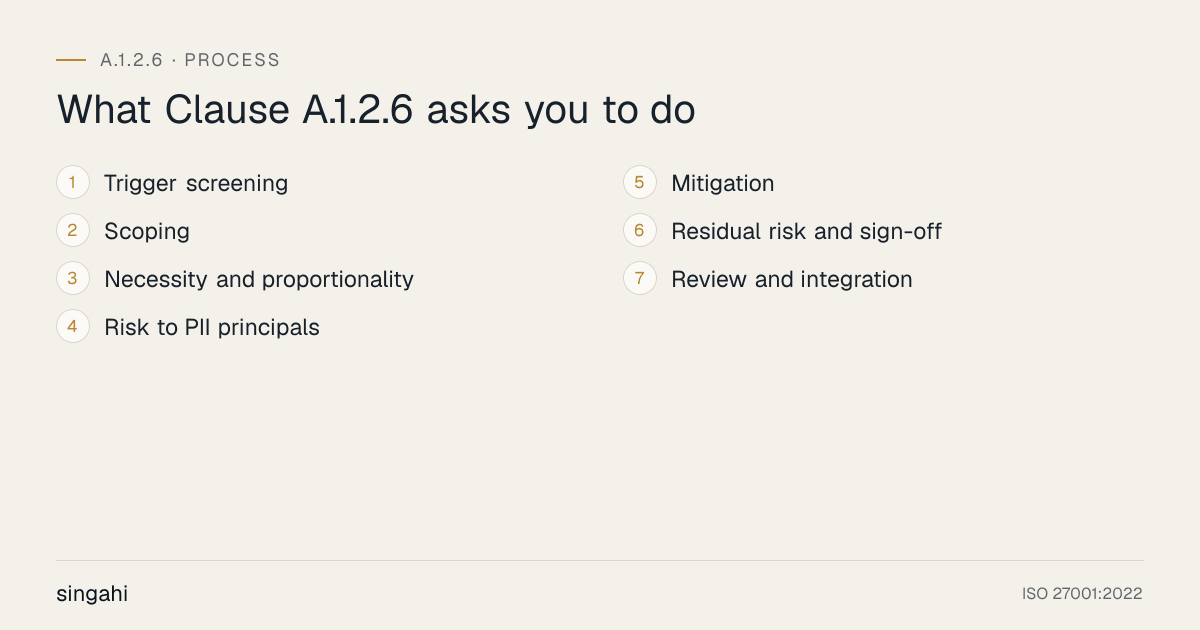
The paraphrased requirement
ISO/IEC 27701:2025 control A.1.2.6 asks PII controllers to assess the need for a privacy impact assessment, and to carry one out where appropriate, whenever new processing of PII, or a change to existing processing, is planned, and to act on the findings. Five load-bearing ideas sit inside that paraphrase, and auditors test each separately.
The controller must carry out privacy impact assessments. The verb is operational, not declaratory. A policy that says "we conduct DPIAs" does not satisfy A.1.2.6; a register of completed DPIAs, each with a documented scope, methodology, evidence base and signed-off conclusion, does. The DPIA is a structured analytical exercise, not a checklist tick, not a one-page summary, not a risk register entry that says "PII risk: medium, mitigation: encryption". The depth and rigour of the assessment scale with the risk of the processing activity (a small-scale contact-form processing requires a lighter DPIA than a large-scale AI-driven credit-scoring system), but every DPIA must address the same core analytical questions: what is the processing, why is it necessary, is it proportionate, what could go wrong for the principal, what are we doing about it, what residual risk remains, and who has signed off on that residual risk.
The controller must do this whenever new processing of PII, or a change to existing processing, is planned. Note that the 27701 trigger is wider than the GDPR Article 35 trigger: Article 35 engages only where processing is "likely to result in a high risk", whereas A.1.2.6 asks the controller to assess the need at every new or changed processing activity and then to run the assessment where it is warranted. The screen itself is the control, and it runs on every change, not only on the high-risk ones. This is the trigger screen, the documented decision that a DPIA is, or is not, required for a given activity. The screen is itself a control; the absence of a documented trigger decision is the most common A.1.2.6 finding in Indian growing companies. The trigger criteria are not invented by ISO/IEC 27701; they inherit from the privacy-law trigger lists. In India, DPDP Act 2023 section 10 sets the SDF trigger, for Significant Data Fiduciaries, the SDF DPIA is due every 12 months (Rule 13(1)); for non-SDF Data Fiduciaries, the trigger is risk-based (the controller's own threshold, calibrated to the DPDP's broader risk-to-principals framing). In the EU, GDPR Article 35(3) and 35(4) set the trigger list, systematic and extensive evaluation including profiling, large-scale processing of special categories, systematic monitoring of publicly accessible areas on a large scale, and the supervisory-authority-published lists of likely-high-risk processing. The Article 29 Working Party WP248 rev.01 nine-criteria trigger list is the most-used operational screen: evaluation or scoring, automated-decision-making with legal or similar significant effect, systematic monitoring, sensitive data or data of highly personal nature, large-scale processing, matching or merging datasets, data concerning vulnerable data subjects, innovative use or technological/organisational solutions, and preventing data subjects from exercising a right or using a service. Two or more criteria typically trigger a DPIA; one high-magnitude criterion may.
The controller must consider the impact on PII principals. This is the analytical turn that most controllers miss. The DPIA is not the controller's information-security risk assessment (Clause 8.2 of ISO/IEC 27001 or Clause 8 of 27701:2025); it is not the operational risk assessment; it is not the enterprise risk register's "regulatory compliance" row. The DPIA evaluates what the processing could do to the principal, to the principal's privacy, dignity, autonomy, financial interests, reputation, freedom of movement, access to services, or ability to exercise rights. A controller whose DPIA lists "reputational risk to the company" or "regulatory penalty exposure" as the primary impacts has framed the assessment from the wrong direction; those are the controller's risks, and they belong in a different register. The DPIA's analytical direction is principal-ward.
The controller must act on the findings. Three acting paths: modify the processing design to reduce the risk (the recommendation flows back into A.1.2.4 consent design, A.1.4.x privacy-by-design choices, or A.3 security-control selection); accept the residual risk with documented sign-off at the authority level commensurate with the risk (Clause 6.1.3 / 6.1.4); or escalate via prior consultation (GDPR Article 36, supervisory-authority consultation when residual risk remains high despite mitigation; the DPDP analogue is consultation with the Data Protection Board of India in advance of the processing, which the DPDP Rules are expected to operationalise for SDFs). Acting on the findings also means tracking the mitigation to closure, recording the residual-risk decision in the DPIA register, and reviewing the DPIA when the processing changes materially or on the defined cadence.
The controller must do this through a documented assessment. The DPIA is documented information under Clause 7.5, version-controlled, access-controlled, retention-managed, retrievable. The DPIA register is the canonical artefact; the individual DPIA records are its entries. Documentation is not optional garnish; it is the evidence base against which the certification auditor and the regulator test the controller's risk decision-making.
The lineage, 2019 to 2025
The 2025 control has a clean ancestor in the 2019 edition. Under 27701:2019, the controller-side DPIA duty lived in clause 7 (the controller controls), at 7.2.5, privacy impact assessment. The 2025 consolidation moves it to A.1.2.6 inside theme A.1.2 (conditions for collection and processing) of the single consolidated Annex A. The relocation is architecturally meaningful: the DPIA is now positioned as a condition for processing, not merely a risk-assessment exercise. A controller that has identified a likely-high-risk processing activity is expected to resolve the DPIA before the processing begins (or before the material change is implemented), in the same way that the controller is expected to identify the lawful basis before processing begins under A.1.2.3. The DPIA is a precondition for the higher-risk processing activities, not a parallel exercise.
The 2025 edition also makes Annex B (implementation guidance) normative. The B.1.2.6 guidance explains how a controller should structure the DPIA, the trigger screen, the scoping, the necessity and proportionality assessment, the risk-to-principals evaluation, the mitigation catalogue, the residual-risk decision, the prior-consultation trigger. Auditors now test against B.1.2.6 explicitly; an A.1.2.6 audit that does not also walk through the B.1.2.6 guidance is incomplete. The pre-2019 framing of "do a DPIA for sensitive data" is no longer sufficient.
The DPIA and the SDF DPIA, the Indian position
The DPDP Act 2023 uses the same term as GDPR: section 10(2)(c)(i) requires a Significant Data Fiduciary to carry out a periodic Data Protection Impact Assessment (DPIA), a process that describes the rights of Data Principals and the purpose of the processing, and assesses and manages the risk to those rights. It is the same exercise as the DPIA under ISO/IEC 27701 A.1.2.6 or GDPR Article 35. Indian controllers implementing A.1.2.6 can therefore run one DPIA method for both, with the SDF's DPIA as the stricter variant in two ways: (i) for SDFs, a DPIA is due every 12 months (Rule 13(1)), whatever the risk-triggered screen finds; (ii) the SDF must also commission an independent data audit every 12 months and verify, with due diligence, that its algorithmic software is not likely to pose a risk to Data Principals' rights (Rule 13(3)). The SDF DPIA, the independent audit and the algorithmic-software review together are the SDF-specific overlay on top of A.1.2.6.
The seven DPIA components, preview; full methodology in Section 7
The ISO/IEC 29134:2017 methodology and the GDPR Article 35(7) mandatory content together define the seven components of a conformant DPIA. The Singahi seven-stage DPIA lifecycle (Section 7) operationalises them:
- Trigger screening, is a DPIA required? Documented decision with reference to the controller's trigger criteria (DPDP section 10 for SDFs; GDPR Article 35(3) and (4) criteria; the WP248 nine-criteria list).
- Scoping, the processing activity's description (purposes, personal data categories, principals, retention, technologies, recipients, cross-border flows); the DPIA's stakeholders (DPO, business owner, engineering, legal, security, the principal or principal-representative where consulted).
- Necessity and proportionality, is the processing necessary for the stated purpose? Is the data minimisation adequate? Is the retention proportionate? Are the means the least intrusive available?
- Risk to PII principals, the impact × likelihood assessment, framed on the principal (not on the controller). The risk taxonomy covers privacy harm, dignity harm, autonomy harm, financial harm, reputational harm, discrimination harm, and rights-exercise harm.
- Mitigation, the controls (technical, organisational, legal) that reduce the impact or the likelihood. The mitigation catalogue draws from A.3 security controls, A.1.4 privacy-by-design choices, A.1.3 principal-side rights, and Clause 8.3 treatment.
- Residual risk and sign-off, the risk that remains after mitigation; the sign-off decision (accept at the appropriate authority level, escalate via prior consultation, or decline to process).
- Review and integration, review triggers (material change, scheduled cadence, incident); integration with the DPIA register, the ROPA (A.1.2.9), the SoA (Clause 8.3), the management review (Clause 9.3) and the continual-improvement cycle (Clause 10.1).
Demarcations: A.1.2.6 vs Clauses 6.1.2 / 8.2 / 8.3 vs A.1.4.x; what is NOT required
Four demarcations matter.
A.1.2.6 vs Clause 6.1.2 / Clause 8.2, PIMS-level risk vs activity-level risk. Clauses 6.1.2 and 8.2 govern the PIMS-level privacy risk assessment, the controller's enterprise-wide privacy risk profile, the risk-register entries that span multiple processing activities, the treatment plan that drives the SoA. A.1.2.6 governs the activity-level DPIA, the per-processing-activity assessment. The two interlock: the PIMS-level risk register identifies the activities that warrant a DPIA; the DPIAs produce the treatment recommendations that flow into the PIMS-level risk register and the SoA. The two are not interchangeable; a controller that has only an enterprise-wide privacy risk register has not satisfied A.1.2.6.
A.1.2.6 vs Clause 8.2 (information-security risk assessment), principal-ward vs controller-ward. Clause 8.2 of the 2025 edition includes both a privacy risk assessment and an information-security risk assessment. The information-security risk assessment evaluates the threats and vulnerabilities to the controller's information assets (and the security controls in Annex A.3 that mitigate them); the analytical direction is controller-ward. The privacy risk assessment evaluates the impact of processing on the principal's rights and interests; the analytical direction is principal-ward. A.1.2.6 is the operational control that delivers the privacy risk assessment for individual processing activities.
A.1.2.6 vs A.1.4.x, assessment vs design. A.1.2.6 produces the recommendations; A.1.4.x (privacy by design and default) operationalises them in the processing design. The DPIA's "modify the design" recommendation flows into A.1.4.2 (limit collection), A.1.4.3 (limit processing), A.1.4.5 (PII minimisation), A.1.4.6 (de-identification), A.1.4.8 (retention), A.1.4.9 (disposal), A.1.4.10 (transmission controls). The two controls operate in a tight loop: the DPIA's findings drive the A.1.4.x design choices; the A.1.4.x design is the operational expression of the DPIA's risk treatment.
What A.1.2.6 does NOT require. It does not require a DPIA for every processing activity (the trigger screen is risk-based; only the SDF overlay under DPDP section 10 makes a DPIA mandatory, once every 12 months). It does not require a specific methodology (ISO/IEC 29134:2017, CNIL's PIA methodology, the ICO's DPIA toolkit, a national DPA's published PIA methodology, all acceptable if the seven components are addressed). It does not require zero residual risk (residual risk is acceptable with documented sign-off at the appropriate authority level). It does not require consultation with the DPBI for every DPIA (the prior-consultation trigger is high residual risk after mitigation, not the existence of a DPIA). It does not require the DPIA to be published (the DPIA is the controller's internal evidence; transparency obligations on the processing itself are governed by A.1.3.3 and the notice content rules).
The companion guidance, Annex B is normative in 2025
In 27701:2019 the implementation guidance lived in informative Annex F. In 27701:2025 the guidance lives in Annex B (Implementation Guidance for PII Controllers and Processors), and Annex B is normative. The B.1.2.6 guidance explains how a controller should structure the DPIA, the trigger screen, the scoping, the necessity and proportionality assessment, the risk-to-principals evaluation, the mitigation catalogue, the residual-risk decision, the prior-consultation trigger. Auditors test against it. The five most relevant external anchors (full mapping in Section 16): ISO/IEC 29134:2017 (DPIA methodology, the conceptual scaffold); ISO/IEC 27002:2022 control 5.34 (the only PII-specific control in 27002, frequently referenced in the mitigation catalogue); ISO/IEC 29100:2011 (privacy framework principles, the risk taxonomy); GDPR Article 35 (DPIA triggers and Article 35(7) content), Article 36 (prior consultation); NIST Privacy Framework v1.0 (NIST.CSWP.01162020, 16 January 2020), Identify-P (risk assessment); SOC 2 Privacy TSC P8.0 (Monitoring and enforcement).
What auditors actually check
The certification auditor's A.1.2.6 examination has seven predictable moves (the 26-question checklist is in Section 11). First, ask for the DPIA Policy and the DPIA Register, do they exist, are they current, does the register's coverage reconcile with the ROPA (A.1.2.9). Second, ask for the trigger screening procedure, what criteria trigger a DPIA, how is the trigger decision documented. Third, pick a recent new processing activity (a new product, a new AI feature, a new processor, a new cross-border flow) and walk the trigger decision, was a DPIA done, or, if not, why not. Fourth, walk a sample DPIA through the seven components, scoping, necessity/proportionality, risk-to-principals, mitigation, residual risk, sign-off, review. Fifth, ask for the prior-consultation playbook and the most recent drill (or the documented decision that prior consultation was not required). Sixth, for SDFs, ask for the SDF DPIA cadence, the independent-audit report and the algorithmic-software review. Seventh, trace the DPIA's recommendations into the SoA (Clause 8.3) and the management review (Clause 9.3), the DPIA is not a stand-alone artefact; it feeds the wider PIMS.
Why This Control Matters
The DPIA as the marquee controller accountability
Of the four PII themes that run through Annex A.1 (conditions for processing; obligations to principals; privacy by design; sharing, transfer and disclosure), the conditions theme is the load-bearing one, without a lawful basis and a defensible processing design, no other control matters. And of the conditions-for-processing controls, A.1.2.6 is the analytical heart. A controller that cannot show its working, that cannot demonstrate, for the higher-risk processing activities, why the processing is necessary, why it is proportionate, what could go wrong for the principal, and what was done about it, has no defensible privacy position, whatever its policy says.
This is why A.1.2.6 is the second-most-audited controller control in the 27701 universe (after A.1.2.5 consent), and the most-cited control in regulatory enforcement on the risk-based side. The European early GDPR enforcement actions on DPIAs, the CNIL's Saints-Innocents hospital case, the Garante's clearing-house decisions, the AEPD's facial-recognition cases, the CNIL's facial-recognition school-entry cases, the series of cookie-banner-and-tracking decisions where the DPIA's absence was an aggravating factor, the data-breach enforcement where the absence of a DPIA on the breached processing was treated as evidence of accountability failure, all turned on whether the controller had done the analytical work the DPIA requires. In India, the DPDP Act's section 10 SDF overlay (SDF DPIA, every 12 months under Rule 13(1)) and the section 33 + Schedule penalty exposure (up to one hundred and fifty crore rupees for section 10 non-fulfilment) make A.1.2.6 the highest-penalty-exposed analytical control in the Indian privacy landscape.
The Indian regulatory weight
In India, A.1.2.6 has a regulatory weight that goes beyond the ISO standard itself. Three layers of weight.
The DPDP section 10 SDF layer. Where the Central Government designates a Data Fiduciary as Significant (on the prescribed thresholds, volume and sensitivity of personal data processed, risk to data principals, impact on sovereignty, integrity and electoral democracy, etc.), the SDF must: (i) appoint a Data Protection Officer based in India, accountable to the board (maps to Clause 5.3); (ii) carry out a Data Protection Impact Assessment (DPIA) every 12 months (Rule 13(1)); (iii) commission a periodic independent data audit; (iv) conduct an algorithmic-software review covering the algorithmic software used on personal data (Rule 13(3)). The SDF DPIA-plus-audit-plus-algorithmic-software-review package is the SDF-specific overlay on A.1.2.6. The Indian SDF's A.1.2.6 operation is therefore the densest in the 27701 universe, an SDF DPIA is due every 12 months (Rule 13(1)), the SDF DPIA is independently audited on a cadence, and the AI dimensions receive a separate algorithmic-software review. A controller that operates an SDF DPIA cadence under section 10 is, in effect, operating A.1.2.6 at the most mature end of the spectrum.
The risk-based DPIA layer (non-SDF). For non-SDF Data Fiduciaries, the DPDP Act does not mandate a DPIA at all, but the broader DPDP framing, the section 4 grounds, the section 6 consent qualities, the section 8(5) reasonable-security-safeguards duty, the section 8(7) erasure obligation, the section 9 children's overlay, the section 16 cross-border negative list, the rights in sections 11 to 14, implicitly requires the controller to assess the privacy impact of its processing. A controller that processes sensitive data, processes children's data, processes at scale, engages in profiling with significant effects, transfers data across borders, or uses AI-driven inference, cannot satisfy the broader DPDP obligations without the analytical exercise the DPIA provides. ISO/IEC 27701 A.1.2.6 is the management-system control that operationalises this implicit duty.
The proportionality layer (Puttaswamy). The Supreme Court's K.S. Puttaswamy v. Union of India, (2017) 10 SCC 1 (judgment delivered 24 August 2017 by a nine-judge Bench) declared informational privacy a fundamental right under Articles 14, 19 and 21, and articulated the proportionality test that any limitation of the right must meet: a permissible limitation must pursolve a legitimate state aim, must be rationally connected to that aim, must be necessary (no less intrusive means available), and must be proportionate (the benefit outweighs the cost to the right). The Aadhaar judgment, Justice K.S. Puttaswamy (Retd.) v. Union of India, (2019) 1 SCC 1 (26 September 2018, five-judge Bench), applied the test and struck down section 57 of the Aadhaar Act (private-body use of Aadhaar for commercial purposes) as failing it. The DPIA is, in operational terms, the controller's internal proportionality test, the analytical exercise that asks, of a proposed processing activity, whether it pursues a legitimate aim, is rationally connected, is necessary, and is proportionate. A controller that runs DPIAs seriously is a controller that runs the Puttaswamy test seriously.
The cost of non-compliance
The cost of an A.1.2.6 failure breaks down into four bands.
Direct DPDP penalty exposure. For SDFs, failure to fulfil the section 10 SDF DPIA obligation exposes the SDF to a Board-imposed penalty of up to one hundred and fifty crore rupees under section 33 and the Schedule. For non-SDFs, the exposure is indirect but real: the absence of a DPIA on a processing activity that subsequently causes harm is an aggravating factor in any penalty determination; the controller cannot demonstrate that it exercised due diligence. The section 8(5) failure exposure (up to two hundred and fifty crore rupees) is amplified where the controller's safeguards were not informed by a DPIA, the reasonable-security-safeguards duty implies an assessment of the risks.
Indirect regulatory consequences are larger and slower. A DPIA failure (no DPIA done on a high-risk processing activity; a DPIA done but the recommendations not implemented; a DPIA done but the residual risk not signed off) cascades through the broader privacy architecture, the A.1.2.2 purpose is not adequately justified; the A.1.2.3 lawful basis is not adequately tested; the A.1.2.5 consent design is not adequately informed; the A.1.4.x privacy-by-design choices are not adequately calibrated; the A.3 security controls are not adequately scoped. The DPIA is the analytical input to multiple other controls; its absence weakens the broader architecture.
Commercial cost is significant. The Indian privacy incidents most cited in board rooms, Juspay (approximately 35 million records in 2021, publicly acknowledged), BigBasket (approximately 20 million records alleged in 2020), Air India / SITA (approximately 4.5 million customers affected by the SITA breach disclosed in 2021), MobiKwik (contested allegations, denied by the company), all carried post-incident examinations that tested whether the controller had assessed the risks before the incident. For consumer-facing brands, the absence of a DPIA on a processing activity that caused an incident is reputational damage that compounds the incident itself. The DPIA is also increasingly a procurement requirement, enterprise customers, hyperscaler partners and government tender processes ask for evidence of DPIA processes as part of vendor diligence; the absence of a DPIA register can disqualify a controller from procurement.
Certification cost is the most immediate. Recoverable; entirely avoidable.
The board-level question
The board-level question for A.1.2.6 is not "do we do DPIAs?", most controllers can point to at least one DPIA they have done. The question is "for every new processing activity we launched in the last twelve months, every new product, every new AI feature, every new processor, every new cross-border flow, can we produce the documented trigger decision that said a DPIA was or was not required, and, where one was required, the DPIA itself, with the risk-to-principals analysis, the mitigation trail and the sign-off?" If the honest answer is "partially" or "no", the controller has an A.1.2.6 gap regardless of what its privacy policy says.
Scope and Applicability
Who the control applies to
Control A.1.2.6 sits in Table A.1 of the 2025 Annex A, the PII controller control set. It binds every organisation that acts as a controller (DPDP: Data Fiduciary; GDPR: controller) for at least one processing activity that meets the controller's DPIA trigger criteria. Processors (Table A.2) are bound only indirectly: the controller's DPIA produces the mitigation requirements the processor must implement under A.2.3.2 (comply with obligations to PII principals) and A.2.5.x (records of disclosures and subcontractor engagement). The processor does not run its own DPIA on the controller's processing; the processor supports the controller's DPIA with information about its sub-processor chain, its security controls, its cross-border flows.
The control applies regardless of organisation size. A two-person startup running a single lead-capture form (no trigger), a thousand-person fintech running dozens of processing activities across multiple products (multiple triggers), and a Significant Data Fiduciary under DPDP section 10 (SDF DPIA every 12 months) are all bound. The maturity expectations scale with the volume, sensitivity and risk of the processing, see Section 22 (Maturity Model).
When the control applies, the trigger analysis
A.1.2.6 applies whenever a processing activity meets the controller's trigger criteria. The trigger criteria are not invented by the standard; they inherit from the controller's regulatory profile. The seven most common trigger categories:
- New processing activity, a new product, a new purpose for an existing dataset, a new technology deployed in production. For SDFs, an SDF DPIA is due every 12 months under DPDP section 10 (Rule 13(1)). For non-SDFs, the trigger is risk-based (the controller's documented threshold).
- Material change to an existing processing activity, a new sub-processor added to the chain, a new cross-border flow enabled, a new AI feature layered onto an existing product, a new data category ingested into an existing pipeline, a new retention rule. The materiality threshold is the controller's documented decision.
- Large-scale processing, typically tens of thousands of principals or more (the GDPR WP248 "large-scale" guidance is the operational anchor; sector rules may set specific thresholds). The RBI's digital-lending thresholds, SEBI's KRA volumes, the IRDAI policyholder volumes are sector-specific scales.
- Special-category or sensitive data, health, biometric, genetic, sex life, sexual orientation, caste, tribe, political opinion, religious belief, financial credentials, children's data. Under DPDP, the controller's processing of children's data (section 9) is always a DPIA trigger; under GDPR Article 9, special-category processing is always a DPIA trigger.
- Children and vulnerable data subjects, DPDP section 9 (always a trigger); GDPR Article 8 and the recital-38 vulnerable-subjects overlay; the sector rules for vulnerable categories (elder-care, disability-services, mental-health).
- Automated decision-making and profiling, credit decisions, employment decisions, insurance decisions, eligibility decisions, content-moderation decisions, personalisation decisions with legal or similarly significant effects. The DPIA here includes the algorithmic-software review (the SDF overlay under DPDP section 10).
- Cross-border transfer, transfer to a destination without equivalent protection (post-Schrems II transfer-impact assessment layered onto the DPIA); transfer to a destination on the DPDP section 16 negative list (prohibited; no DPIA needed, the controller does not transfer).
The controller's trigger screening checklist (toolkit doc 09) operationalises these categories. The screening is itself a control, the documented decision that a DPIA is, or is not, required. The decision is recorded in the DPIA register even where the decision is "no DPIA required"; the negative decisions are evidence the controller has thought about the trigger.
What is in scope for the DPIA
The DPIA covers the processing activity end-to-end: the personal-data categories, the principal categories, the purposes, the technologies, the recipients (processors, sub-processors, joint controllers, third-party recipients), the cross-border flows, the retention rules, the security controls, the rights-operation design. The DPIA's scope is the same as the ROPA (A.1.2.9) entry for the activity, the two artefacts reference each other. Where the controller has multiple processing activities that share infrastructure (the same app, the same database, the same processor chain), the controller may run a single DPIA that covers the cluster, with a per-activity risk analysis inside the DPIA, but the cluster approach requires a documented justification (the cluster shares risk characteristics).
What is out of scope
- Processing activities that have been screened out at trigger stage. The trigger decision that no DPIA was required is recorded in the DPIA register with the reasoning; the activity is not subsequently DPIA'd unless the trigger changes.
- Anonymous or effectively anonymised data. If the data does not relate to an identifiable principal, the DPIA regime does not apply. Pseudonymised data is still personal data under DPDP and GDPR; the DPIA regime applies.
- Processing by a processor in its own right. A.2.x governs the processor's processing; the controller's DPIA covers the activity that the processor is processing.
- Day-to-day operational changes that do not meet the materiality threshold. A new transaction under an existing processing activity (a new customer on an existing product) is not a material change; a new purpose for the existing dataset is. The materiality threshold is the controller's documented decision.
Applicability by organisation size
| Size | Typical DPIA-relevant activity profile | A.1.2.6 scope highlight |
|---|---|---|
| Growing company (50 to 250 staff) | 5 to 15 processing activities; 1 to 3 DPIAs per year typically | DPIA register; trigger screen; first-cycle DPIAs on the highest-risk activities; SoA linkage |
| Mid-sized (250 to 2,000) | 20 to 80 processing activities; 5 to 15 DPIAs per year typically | Embedded trigger screen in the intake workflow; DPIA template adopted; prior-consultation playbook; KPI maturity; the cluster-DPIA approach where appropriate |
| Enterprise (2,000+) | 100+ processing activities; 20+ DPIAs per year typically | Multi-jurisdiction DPIA regime (DPDP plus GDPR plus US-state plus sector rules); group DPIA governance; the algorithmic-software overlay for AI-driven processing; the cross-border transfer-impact assessment layered on |
| SDF under DPDP section 10 | n/a | All of the above plus the SDF DPIA cadence (every 12 months), the independent data audit, and the algorithmic-software review |
Applicability by industry (preview, Section 21 has detail)
- BFSI, RBI digital-lending DPIA expectations, SEBI CSCRF privacy-relevant slice, IRDAI policyholder-data DPIA, RBI cross-border data-locality TIA. The most prescriptive Indian sectoral DPIA expectations sit in BFSI.
- Healthcare, sensitive health data; explicit-consent overlay; the children's flow for paediatric services; the joint-controller analysis with diagnostic labs, pharmacies, insurers, telemedicine platforms.
- IT-ITeS and SaaS, multi-jurisdiction DPIA regime; processor-side support for customer-controller DPIAs; AI-driven product features attracting the algorithmic-software review.
- E-commerce and retail, DPIA on the cookie-banner / marketing-consent pipeline, the personalisation / recommendation engine, the partner-sharing joint-controller arrangements, the cross-border fulfilment dimension.
- Edtech, DPIA mandatory for any platform likely to attract users under eighteen; the section 9 prohibitions enforced on the platform; the algorithmic-software review on the learning-analytics pipeline.
- Manufacturing, DPIA on the workforce employee-monitoring contexts (where the processing is on employee data); the IIoT dimension (connected-manufacturing equipment may capture personal data); the supplier-contact processing.
Key Definitions and Terminology
| Term | Working definition (this guide's usage) |
|---|---|
| Privacy impact assessment (PIA / DPIA) | A structured assessment of the impact of a processing activity on the rights and interests of PII principals. ISO/IEC 27701 uses "privacy impact assessment"; GDPR uses "data protection impact assessment (DPIA)"; ISO/IEC 29134 uses "privacy impact assessment (PIA)". Interchangeable for A.1.2.6 purposes. |
| SDF DPIA (Data Protection Impact Assessment) | The DPDP Act 2023 section 10 term for the SDF-specific DPIA. Conceptually the same exercise as the DPIA; under section 10 and Rule 13(1), an SDF must carry it out once every 12 months. |
| PII principal / Data Principal / Data subject | The identified or identifiable natural person to whom the personal data relates. ISO/IEC 27701 uses "PII principal"; DPDP uses "Data Principal"; GDPR uses "data subject". Interchangeable for A.1.2.6 purposes. |
| PII controller / Data Fiduciary / Controller | The entity that determines the purposes and means of processing. ISO/IEC 27701 uses "PII controller"; DPDP uses "Data Fiduciary"; GDPR uses "controller". |
| PII processor / Data Processor / Processor | The entity that processes personal data on behalf of the controller. |
| DPIA register | The system-of-record artefact that lists every DPIA the controller has conducted, every trigger decision (including the "no DPIA required" decisions), every review, every residual-risk sign-off. The register is the canonical A.1.2.6 evidence object. |
| Trigger screening | The documented decision that a DPIA is, or is not, required for a given processing activity. The screening references the controller's trigger criteria (the seven categories in Section 4.2). The trigger decision is recorded in the DPIA register. |
| Necessity and proportionality | The DPIA component that asks: is the processing necessary for the stated purpose? Is the data minimisation adequate? Is the retention proportionate? Are the means the least intrusive available? The Puttaswamy proportionality test, operationalised. |
| Risk to PII principals | The DPIA component that evaluates the impact × likelihood of the processing on the principal. The risk taxonomy: privacy harm (disclosure, exposure), dignity harm (degradation, humiliation), autonomy harm (manipulation, coercion), financial harm (loss, fraud, discrimination), reputational harm (stigma, shaming), discrimination harm (bias, exclusion), rights-exercise harm (loss of access to rights). |
| Impact | The magnitude of the harm to the principal if the risk materialises. Rated low / medium / high / very high (or equivalent). |
| Likelihood | The probability of the harm materialising. Rated rare / unlikely / possible / likely / almost certain (or equivalent). |
| Inherent risk | The risk before mitigation is applied. The DPIA's starting analytical position. |
| Mitigation | The controls (technical, organisational, legal) that reduce the impact or the likelihood. The mitigation catalogue draws from A.3 security controls, A.1.4 privacy-by-design choices, A.1.3 principal-side rights, and Clause 8.3 treatment. |
| Residual risk | The risk that remains after mitigation. The DPIA's closing analytical position. |
| Prior consultation | The escalation path when residual risk remains high despite mitigation. GDPR Article 36 requires prior consultation with the supervisory authority before the processing begins; the DPDP analogue is consultation with the Data Protection Board of India, which the DPDP Rules are expected to operationalise for SDFs. |
| Significant Data Fiduciary (SDF) | Under DPDP section 10, a Data Fiduciary designated by the Central Government on prescribed thresholds, subject to enhanced obligations, DPO based in India, SDF DPIA every 12 months, periodic independent data audit, algorithmic-software review. |
| Independent data audit | Under DPDP section 10 SDF, the periodic audit by an independent data auditor of the SDF's data-processing practices, including the SDF DPIA process. |
| Algorithmic-software review | Under DPDP Rule 13(3), the SDF's due diligence that the algorithmic software it uses on personal data is not likely to pose a risk to Data Principals' rights. Evaluates bias, discrimination, transparency, explainability, and human oversight. Layered onto the DPIA under A.1.2.6 and the A.1.3.11 automated-decision-making control. |
| Transfer-impact assessment (TIA) | The post-Schrems II assessment of the risks to personal data exported to a third country, layered onto the DPIA for processing activities that involve cross-border transfer. |
| Statement of Applicability (SoA) | The PIMS artefact under Clause 8.3 that documents which Annex A controls (A.1, A.2, A.3) the controller has selected, with justification. The DPIA's recommendations flow into the SoA. |
| ROPA (Records of processing activities) | The records-related-to-processing PII register under A.1.2.9. The DPIA's scope is the same as the ROPA entry for the activity; the two artefacts reference each other. |
| Proportionality test (Puttaswamy) | The constitutional test articulated in K.S. Puttaswamy v. Union of India, (2017) 10 SCC 1, legitimate aim, rational connection, necessity, proportionate balance. The DPIA is the controller's internal operationalisation of the test. |
Relationship to Other Clauses and Frameworks
The sibling-control network inside Annex A.1
A.1.2.6 does not stand alone, it sits inside a tight sibling network, and the audit will trace the network end-to-end.
A.1.2.2, Identify and document purpose. Every DPIA's necessity analysis tests whether the stated purpose is sufficiently identified and documented. A vague purpose ("improving services") fails the necessity test; a specific purpose ("personalising marketing of credit-card products to existing savings-account customers based on transaction-pattern analysis") passes. The DPIA's necessity finding flows back to A.1.2.2.
A.1.2.3, Identify lawful basis. Every DPIA's lawfulness analysis tests the chosen basis. Where the basis is consent (A.1.2.5), the DPIA tests the consent capture's quality and the consent-propagation discipline. Where the basis is a DPDP section 7 legitimate use or a GDPR Article 6(1)(b) to (f) basis, the DPIA tests whether the basis applies (the section 7 / Article 6 conditions) and the proportionality of the basis.
A.1.2.4, Determine when and how consent is to be obtained. Where the controller's consent design is informed by a DPIA (typically for higher-risk consent-based processing), the DPIA's recommendations flow into A.1.2.4.
A.1.2.5, Obtain and record consent. The DPIA's findings on consent quality (the seven DPDP qualities), consent-record integrity, withdrawal propagation, the children's flow, the Consent Manager integration. The DPIA's recommendations flow back into the consent design.
A.1.2.7, Contracts with PII processors. The DPIA's analysis of the processor chain (sub-processors, cross-border flows, security controls) drives the contract requirements. The DPIA's mitigation catalogue includes the contractual controls.
A.1.2.8, Joint PII controller. The DPIA's analysis of the joint-controller arrangement (the partner-supplied lead, the co-branded product), which controller is responsible for which processing step, and how the DPIA's findings are shared between the joint controllers.
A.1.2.9, Records related to processing PII (ROPA). The DPIA's scope references the ROPA entry for the activity. The two artefacts cross-reference; an audit finding on one frequently surfaces a finding on the other.
A.1.3.3 to A.1.3.10, Obligations to PII principals. The DPIA's analysis of the notice content, the rights-operation design, the grievance-handling mechanism. The DPIA tests whether the rights operation is adequate to the risk.
A.1.3.11, Automated decision making. The DPIA's analysis of profiling, automated decisions, AI inference. The algorithmic-software review is layered onto the DPIA for AI-driven processing. The DPIA's findings drive the A.1.3.11 design (the human-in-the-loop, the explanation, the right to object).
A.1.4.x, Privacy by design and default. The DPIA's recommendations flow into A.1.4.2 (limit collection), A.1.4.3 (limit processing), A.1.4.5 (minimisation), A.1.4.6 (de-identification), A.1.4.8 (retention), A.1.4.9 (disposal), A.1.4.10 (transmission). The two controls operate in a tight loop.
A.1.5.2, Identify basis for PII transfer. The DPIA includes the transfer-impact assessment (TIA) for cross-border flows. The DPIA's TIA findings drive the A.1.5.2 transfer basis.
Clause 6.1.2 / Clause 8.2, PIMS-level privacy risk assessment. The PIMS-level risk register identifies the activities that warrant a DPIA; the DPIAs produce the treatment recommendations that flow into the PIMS-level risk register. The two interlock.
Clause 8.3, Treatment plan and SoA. The DPIA's mitigation recommendations flow into the treatment plan and the Statement of Applicability. The DPIA is a primary input to the SoA's control-selection justification.
Clause 9.3, Management review. The DPIA register and the residual-risk decisions feed the management review. The KPIs (Section 12) report to the management review.
A.3, Information security controls. The DPIA's mitigation catalogue draws from the A.3 controls (A.3.9 access rights, A.3.14 protection of records, A.3.23 secure authentication, A.3.25 logging, A.3.26 cryptography, A.3.24 backup, A.3.21 secure disposal, and the others). The DPIA's risk-to-principals analysis identifies the security gaps that drive the A.3 selection.
The cross-framework map (preview, Section 16 has detail)
| Framework | Anchor | Mapping |
|---|---|---|
| DPDP Act 2023 (India) | Section 10 SDF (DPIA, independent audit, algorithmic-software review); section 4 grounds; section 8(5) safeguards; section 9 children; section 16 cross-border; section 33 + Schedule penalties | A.1.2.6 is the operational heart of section 10 SDF compliance |
| GDPR (EU) | Article 35 DPIA (triggers in 35(3) and 35(4); content in 35(7)); Article 36 prior consultation | A.1.2.6 implements Article 35 in operations; escalation under Article 36 |
| UK GDPR + DPA 2018 | Same Article 35 / 36 anchors; ICO DPIA guidance | A.1.2.6 maps identically |
| ISO/IEC 29134:2017 | DPIA methodology, the conceptual scaffold | A.1.2.6 = ISO 29134 in operations |
| ISO/IEC 29100:2011 | Privacy principles, risk taxonomy | A.1.2.6 = the risk-assessment expression of the principles |
| ISO/IEC 27018:2019 | DPIA expectations for public-cloud PII processors | A.1.2.6 = controller-side; cloud processor supports |
| ISO/IEC 27002:2022 | Control 5.34 (the only PII-specific control) | A.1.2.6 mitigation catalogue references 5.34 |
| NIST Privacy Framework v1.0 | Identify-P (risk assessment) | A.1.2.6 = Identify-P in operations |
| SOC 2 Privacy TSC | P8.0 (Monitoring and enforcement) | A.1.2.6 = P8.0 risk-assessment slice |
| CCPA / CPRA (US-CA) | Cal. Civ. Code 1798.100 et seq., DPIA for high-risk processing, sensitive PI, profiling | A.1.2.6 = the DPIA slice where California-style processing applies |
| VCDPA / CPA / CTDPA | DPIA for targeted advertising, sales, profiling | A.1.2.6 = state-DPIA triggers |
| LGPD (Brazil) | Article 38 DPIA (for high-risk processing, ANPD may require) | A.1.2.6 = Article 38 in operations |
| PIPL (China) | Article 55 mandatory PIA before sensitive processing, cross-border, automated decision-making | A.1.2.6 = Article 55 mapping (PIPL's PIA is the strictest analogue) |
| PDPA (Singapore) | DPIA mandatory under PDPC's advisory guidelines for high-risk | A.1.2.6 = DPIA slice |
| PIPEDA (Canada) | Privacy impact assessment expectations under OPC guidance | A.1.2.6 maps |
The lineage from ISO/IEC 29134 and 29100
ISO/IEC 29134:2017, Guidelines for privacy impact assessment is the conceptual scaffold for A.1.2.6. The standard defines the DPIA as a structured process for assessing the impacts of processing on PII principals, with a defined methodology: the trigger, the scoping, the stakeholder consultation, the risk identification, the risk analysis, the risk treatment, the documentation, the review. The ISO 29134 methodology is the most-used DPIA methodology globally; controllers that adopt it are operating A.1.2.6 in the way the wider privacy community expects. The CNIL PIA methodology (France), the ICO DPIA toolkit (UK), the German federal DPA's PIA methodology, all are national operationalisations of the same conceptual scaffold.
ISO/IEC 29100:2011, Privacy framework is the conceptual ancestor of the 27701 risk taxonomy. The eleven privacy principles (consent and choice; purpose legitimacy and specification; collection limitation; data minimisation; use, retention and disclosure limitation; accuracy and quality; openness, transparency and notice; individual participation and access; accountability; security safeguards; privacy compliance) are the principles against which the DPIA's necessity and proportionality analysis tests the processing. A controller that understands the 29100 framework has the conceptual scaffold for the DPIA's risk taxonomy.
The lineage from GDPR Articles 35 and 36
The GDPR DPIA regime is the most-litigated in the world and the source of most of the operational commentary on DPIA practice. Article 35(1) sets the basic trigger (likely high risk to the rights and freedoms of natural persons). Article 35(3) sets the three categorical triggers (systematic and extensive evaluation including profiling; large-scale special-category processing; systematic monitoring of publicly accessible areas on a large scale). Article 35(4) authorises supervisory authorities to publish lists of processing types subject to DPIA. The WP248 rev.01 nine-criteria trigger list (the Article 29 Working Party guidelines) is the most-used operational screen. Article 35(7) sets the mandatory DPIA content: systematic description of the processing; assessment of necessity and proportionality; assessment of risks to rights and freedoms; mitigation measures. Article 35(9) prefers consultation with data subjects or their representatives where appropriate. Article 36(1) sets the prior-consultation trigger (high residual risk despite mitigation). Article 36(2) to (5) sets the prior-consultation procedure. The EDPB guidance and the national DPA guidelines operationalise these anchors. A controller that processes EU personal data must layer these on top of the DPDP section 10 SDF overlay, taking the stricter of the two where they diverge.
The lineage from the NIST Privacy Framework and SOC 2
NIST Privacy Framework v1.0 (NIST.CSWP.01162020, 16 January 2020) is the US voluntary risk-based framework. The Identify-P function covers privacy risk to systems, data and people; the data-mapping category under Identify-P is the DPIA's scoping step; the risk assessment category under Identify-P is the DPIA's risk-to-principals analysis. The NIST PF does not prescribe a DPIA methodology, but its risk-assessment categories map cleanly to the A.1.2.6 components. A controller that operates the NIST PF has the analytical scaffold for A.1.2.6.
SOC 2 Privacy TSC, the AICPA Trust Services Criteria. The P8.0 (Monitoring and enforcement) criterion covers the controller's monitoring of privacy commitments and the enforcement of privacy controls; the DPIA is the analytical input to the monitoring design. The Common Criteria (CC1.1 to CC9.2) cover the security side that the DPIA's mitigation catalogue references.
Detailed Implementation Guidance, The Seven-Stage DPIA Lifecycle
The Singahi seven-stage DPIA lifecycle (toolkit doc 02) operationalises A.1.2.6 by integrating the ISO/IEC 29134:2017 methodology, the GDPR Article 35(7) mandatory content, and the DPDP Act 2023 section 10 SDF DPIA requirements into a single coherent workflow. Every conformant controller runs these seven stages; some add an eighth (DPIA-register integrity review) as a separate cadence.
Stage 1, Trigger screening
The trigger screen is the documented decision that a DPIA is, or is not, required for a given processing activity. The screen is itself a control, the absence of a documented trigger decision is the most common A.1.2.6 finding in Indian growing companies. The screen operates at five points in the controller's intake workflow:
- Product intake, every new product, every new product feature, every material change to an existing product. The product team's intake form includes the trigger screen (the Singahi DPIA Trigger Screening Checklist, toolkit doc 09).
- Vendor / processor procurement, every new processor, every new sub-processor added to a chain, every material change to a processor's scope. The procurement workflow includes the trigger screen.
- M&A diligence, every acquisition, every investment where personal data is acquired. The diligence workflow includes the trigger screen on the target's processing activities.
- Cross-border flow, every new cross-border flow, every new destination country, every material change to an existing flow. The cross-border workflow includes the trigger screen.
- AI / algorithmic feature, every new AI-driven feature, every material change to an existing AI system. The AI intake workflow includes the trigger screen and (for SDFs) the algorithmic-software review trigger.
The trigger criteria are the seven categories from Section 4.2 (new processing; material change; large-scale; special-category or sensitive data; children and vulnerable subjects; automated decision-making and profiling; cross-border transfer). For each, the controller's risk-threshold matrix defines what counts as a trigger, for example, "large-scale" might be defined as 50,000 principals or more for a consumer service, or 5,000 principals for a sensitive-data processing. The matrix is calibrated to the controller's regulatory profile (DPDP, GDPR, US-state, sector).
The trigger decision is recorded in the DPIA register, even where the decision is "no DPIA required". The negative decisions are evidence the controller has thought about the trigger; the audit trail of negative decisions is as important as the DPIAs themselves. The register's trigger-decision log answers the audit question "for every new processing activity you launched in the last twelve months, did you make a documented trigger decision?"
For SDFs under DPDP section 10, the trigger screen still applies to new processing activities, and on top of it the SDF DPIA is due every 12 months (Rule 13(1)). The trigger screen still operates for material changes to existing activities and for existing activities that have not previously been SDF DPIA'd (the retrospective SDF DPIA sweep).
Stage 2, Scoping
The scoping stage defines the processing activity under assessment and the DPIA's stakeholders.
The processing activity description. A systematic description of the processing, the purposes (from A.1.2.2), the personal-data categories, the principal categories (with attention to children and vulnerable subjects), the technologies (with attention to AI, profiling, biometric, location-tracking), the recipients (processors, sub-processors, joint controllers, third-party recipients), the cross-border flows, the retention rules, the security controls. The description references the ROPA entry (A.1.2.9) for the activity; the two artefacts cross-reference. GDPR Article 35(7)(a) requires the "systematic description of the processing operations and purposes", this is the scoping stage's output.
The context. The broader context in which the processing sits, the controller's wider processing portfolio, the sector's regulatory profile, the technology's maturity, the principal cohort's expectations. The context shapes the risk analysis; a processing activity that is unremarkable in one sector may be high-risk in another.
The DPIA's stakeholders. The DPIA is not a solo exercise by the DPO. The stakeholders include: the DPO (framework and methodology); the business owner of the processing activity (the purpose, the operational design); engineering / architecture (the technical implementation); legal (the lawful basis, the cross-border rules, the contracts); information security (the threat and vulnerability inputs, the security controls); the data strategist / analyst (the data flows, the retention); and, where appropriate, the principal or principal-representative (the consultation dimension, GDPR Article 35(9)). For DPIAs on AI-driven processing, the algorithmic-software reviewer joins the stakeholder set.
The consultation dimension. GDPR Article 35(9) prefers consultation with data subjects or their representatives where appropriate. ISO/IEC 29134:2017 includes stakeholder consultation as a methodology step. The DPDP does not expressly require consultation, but the broader DPDP framing (sections 11 to 14 rights; section 13 grievance redressal) implies that the controller's processing should be informed by the principal's perspective. The consultation can take several forms: direct consultation (a survey, a focus group, a co-design session with the principal cohort); representative consultation (civil-society organisations, consumer-protection groups, sector-specific advocacy bodies); or published-guidance consultation (the DPBI's published guidance, the EDPB's guidelines, the ICO's codes of practice). The consultation's findings feed into the risk analysis.
Stage 3, Necessity and proportionality
The necessity and proportionality stage is the Puttaswamy proportionality test, operationalised as a DPIA component. The stage asks four questions.
Is the processing necessary for the stated purpose? The necessity test, is there a less intrusive way to achieve the purpose? If the purpose can be achieved without processing personal data (for example, by processing aggregated or anonymised data), the personal-data processing is not necessary. If the purpose can be achieved with less data (a narrower category, a smaller cohort, a shorter retention), the broader processing is not necessary. The necessity test references A.1.2.2 (purpose) and A.1.4.x (privacy by design, limit collection, limit processing, minimisation, retention, disposal).
Is the data minimisation adequate? A.1.4.2 (limit collection), A.1.4.5 (PII minimisation). The DPIA tests whether the controller is collecting more data than the purpose requires, processing more data than the purpose requires, retaining data longer than the purpose requires.
Is the retention proportionate? A.1.4.8 (retention). The DPIA tests whether the retention period is justified by the purpose and the legal / regulatory / contractual requirements (RBI, SEBI, IRDAI retention rules where applicable).
Are the means the least intrusive available? The "least intrusive means" test, given the available technologies and operational designs, is the controller's choice the one that minimises the impact on the principal? For example: a controller that deploys facial recognition where a card-based authentication would achieve the same purpose without biometric processing fails the least-intrusive-means test. A controller that uses probabilistic age estimation where a self-declaration would suffice for the service's risk profile fails the inverse test (the more intrusive means is not necessary).
GDPR Article 35(7)(b) requires "an assessment of the necessity and proportionality of the processing operations in relation to the purposes", this is the necessity and proportionality stage's output. The DPDP section 10 SDF DPIA requires the equivalent analysis as part of the SDF DPIA's documented content.
Stage 4, Risk to PII principals
The risk-to-principals stage is the analytical core of the DPIA. It evaluates the impact × likelihood of the processing on the principal, framed principal-ward (not controller-ward). The stage has three sub-steps.
Risk identification. The structured enumeration of the risks the processing poses to principals. The risk taxonomy covers seven harm categories:
- Privacy harm, disclosure of personal data, exposure of private facts, loss of confidentiality.
- Dignity harm, degradation, humiliation, objectification.
- Autonomy harm, manipulation, coercion, exploitation of vulnerabilities, loss of meaningful choice.
- Financial harm, direct loss, fraud, discriminatory pricing, exclusion from financial services.
- Reputational harm, stigma, shaming, social exclusion, public exposure.
- Discrimination harm, bias, exclusion, differential treatment on protected characteristics (caste, religion, gender, disability, sexual orientation, age).
- Rights-exercise harm, loss of access to rights, friction in exercising rights, retaliation for exercising rights.
For each harm category, the DPIA identifies the specific risks the processing poses. The identification draws on the controller's risk register (Clause 8.2), the threat-and-vulnerability inputs from information security, the published incident patterns (the sector's breach history, the regulator's published enforcement), and the stakeholder consultation findings.
Risk analysis. The impact × likelihood assessment for each identified risk. The impact is rated on the principal (not the controller), what is the magnitude of the harm to the principal if the risk materialises? The likelihood is the probability of the harm materialising, given the processing's design, the threats, the vulnerabilities, and the proposed mitigation. The risk-rating matrix is typically a 5×5 (impact low/medium/high/very high/catastrophic × likelihood rare/unlikely/possible/likely/almost certain), producing a residual-risk rating (low / medium / high / very high).
The inherent risk. The risk before mitigation is applied. The DPIA's starting analytical position. The inherent risk is the honest assessment of what the processing could do to the principal in the absence of the controller's safeguards.
GDPR Article 35(7)(c) requires "an assessment of the risks to the rights and freedoms of data subjects", this is the risk-to-principals stage's output. The DPDP section 10 SDF DPIA requires the equivalent analysis.
Stage 5, Mitigation
The mitigation stage is where the DPIA's recommendations are formed. The stage identifies the controls (technical, organisational, legal) that reduce the impact or the likelihood of each risk. The mitigation catalogue draws from four sources:
A.3 security controls (the Annex A.3 controls aligned to ISO/IEC 27002:2022): A.3.9 access rights; A.3.14 protection against destruction or falsification; A.3.23 secure authentication; A.3.24 backup; A.3.25 logging; A.3.26 cryptography; A.3.21 secure disposal; A.3.22 endpoint devices; A.3.27 secure development lifecycle; A.3.30 outsourced development. The DPIA identifies the security gaps that drive the A.3 selection in the SoA.
A.1.4 privacy-by-design controls: A.1.4.2 limit collection; A.1.4.3 limit processing; A.1.4.4 accuracy and quality; A.1.4.5 PII minimisation; A.1.4.6 de-identification and deletion at end of processing; A.1.4.7 temporary files; A.1.4.8 retention; A.1.4.9 disposal; A.1.4.10 PII transmission controls. The DPIA's recommendations flow into the A.1.4 design choices.
A.1.3 principal-side rights: A.1.3.5 modify or withdraw consent; A.1.3.6 object to processing; A.1.3.7 access, correction, erasure; A.1.3.10 handling requests; A.1.3.11 automated decision-making (the human-in-the-loop, the right to object). The DPIA tests whether the rights operation is adequate to the risk.
Clause 8.3 treatment: the broader treatment-plan mechanisms, the contractual controls (A.1.2.7 processor contracts), the cross-border safeguards (A.1.5.2), the retention and erasure discipline, the incident-response readiness, the awareness and training (Clause 7.2 / 7.3).
For each mitigation, the DPIA records: the mitigation's identifier; the risk(s) it addresses; the residual-impact and residual-likelihood after the mitigation; the residual-risk rating; the owner; the implementation timeline; the verification evidence. The mitigation is tracked to closure, the DPIA's recommendations are not aspirational; they are operational commitments.
GDPR Article 35(7)(d) requires "the measures envisaged to address the risks", this is the mitigation stage's output. The DPDP section 10 SDF DPIA requires the equivalent.
Stage 6, Residual risk and sign-off
The residual-risk stage closes the analytical exercise. Three acting paths.
Modify. Where the residual risk remains high after the proposed mitigation, the controller modifies the processing design to reduce the risk further. The modification may be: a narrower purpose; a smaller principal cohort; a less intrusive technology; additional A.3 security controls; additional A.1.4 privacy-by-design choices; a different cross-border basis. The modification feeds back into the DPIA's scoping, necessity and proportionality stages, the DPIA is iterated until the residual risk is at an acceptable level or the controller escalates.
Accept. Where the residual risk is acceptable (typically low or medium; for high risk, with documented justification), the controller accepts the risk with documented sign-off at the authority level commensurate with the risk. The sign-off authority matrix is the controller's documented decision: low risk accepted at the DPO level; medium risk at the executive level (the COO or the CFO); high risk at the board level (or the top-management committee). The sign-off is recorded in the DPIA register with the signatory, the date, the reasoning and the conditions (the periodic review triggers).
Escalate via prior consultation. Where the residual risk remains high despite mitigation (the typical Article 36 trigger), the controller escalates via prior consultation. Under GDPR Article 36, the controller must consult the supervisory authority before processing begins; the supervisory authority may authorise the processing (with conditions), refuse it, or suggest further mitigation. The DPDP analogue is consultation with the Data Protection Board of India, which the DPDP Rules are expected to operationalise for SDFs and, in cases of high residual risk, for non-SDFs. The prior-consultation playbook (toolkit doc 08) covers the consultation's trigger, scope, content, timeline and follow-up.
The sign-off decision is recorded in the DPIA register. The decision is auditable, the certification auditor and the regulator will ask, for each DPIA, "who signed off on the residual risk, on what date, on what reasoning, with what conditions?" The absence of a documented sign-off is the second-most-common A.1.2.6 finding.
Stage 7, Review and integration
The review and integration stage ensures the DPIA is not a one-off exercise but a living part of the PIMS.
Review triggers. The DPIA is reviewed when: the processing changes materially (a new purpose, a new processor, a new technology, a new cross-border flow, the materiality threshold is the controller's documented decision); an incident occurs that affects the processing (the DPIA's risk analysis is revisited in light of the incident); a regulatory change affects the processing (a new DPDP Rule, a new sector regulation, a new supervisory-authority guideline); the DPIA's scheduled review date arrives (typically 12 to 24 months; sector rules may prescribe different cadences, the RBI digital-lending cadence, the IRDAI policyholder-data cadence). The review is recorded in the DPIA register with the trigger, the scope of the review, the changes made, and the new sign-off.
Integration with the DPIA register. The DPIA register is the canonical artefact. Every DPIA is recorded with: the identifier; the processing activity (ROPA reference); the trigger decision; the scope; the stakeholders; the necessity and proportionality findings; the risk-to-principals findings; the mitigation plan; the residual risk; the sign-off (signatory, date, reasoning, conditions); the review trigger and date; the integration with the SoA and the ROPA. The register is itself controlled documented information under Clause 7.5, version-controlled, access-controlled, retention-managed, retrievable.
Integration with the SoA (Clause 8.3). The DPIA's mitigation recommendations flow into the Statement of Applicability, the A.3 security controls selected, the A.1.4 privacy-by-design choices, the A.1.3 principal-side rights design. The SoA's justification references the DPIA; the DPIA's findings drive the SoA's control selection. The two artefacts cross-reference.
Integration with the ROPA (A.1.2.9). The DPIA's scope is the same as the ROPA entry for the activity. The two artefacts reference each other. An audit finding on one frequently surfaces a finding on the other.
Integration with the management review (Clause 9.3). The DPIA register and the residual-risk decisions feed the management review. The KPIs (Section 12) report to the management review. The improvement actions (Clause 10.1) flow from the management review's analysis of the DPIA programme.
The SDF overlay (DPDP section 10)
For Significant Data Fiduciaries under DPDP section 10, the DPIA becomes the SDF DPIA with three additional layers.
The SDF DPIA cadence (every 12 months). The SDF cannot rely on a risk-based trigger screen; the SDF DPIA is due every 12 months (Rule 13(1)). The DPIA Trigger Screening Checklist (toolkit doc 09) is bypassed for new activities; the SDF DPIA is launched at the product-intake stage. The SDF's intake workflow is wired to flag every new activity for the DPIA screen and the next SDF DPIA when it is registered.
The periodic independent data audit. Under DPDP section 10, the SDF must commission a periodic data audit by an independent data auditor (section 10(2)(b)). The audit covers the SDF's data-processing practices, including the SDF DPIA process, the audit is not just of the technical controls but of the analytical work the SDF DPIA represents. The audit's findings feed the management review (Clause 9.3) and the continual-improvement cycle (Clause 10.1). Rule 13(1) of the DPDP Rules, 2025 sets the cadence: a Data Protection Impact Assessment and an audit once in every twelve months, counted from the date the organisation is notified as an SDF. Rule 13(2) requires the person who carried them out to furnish the Board with a report of the significant observations. Rule 13 comes into force in May 2027, eighteen months after the Rules were published.
The algorithmic-software review. Rule 13(3) requires the SDF to verify that the algorithmic software it uses on personal data is not likely to pose a risk to Data Principals' rights. For AI or statistical inference, that means an algorithmic-software review. The review evaluates: bias in the training data and the model outputs; discrimination on protected characteristics (caste, religion, gender, disability, sexual orientation, age); transparency (the principal's right to know they are subject to AI); explainability (the principal's right to an explanation of the decision); human oversight (the human-in-the-loop, the right to a human review); the impact on the principal's autonomy and rights. The algorithmic-software review is layered onto the DPIA; the DPIA's risk-to-principals analysis includes the algorithmic-fairness risks; the DPIA's mitigation plan includes the fairness controls.
The SDF DPIA Pack (toolkit doc 10) covers the three layers, the SDF DPIA cadence, the independent-audit preparation, the algorithmic-software review methodology.
The prior-consultation drill
The prior-consultation playbook (toolkit doc 08) is the operational expression of the escalate path. The playbook covers:
The trigger. High residual risk despite mitigation. The controller's documented residual-risk threshold for prior consultation (typically "high" or "very high" residual risk).
The consultation's scope and content. The processing activity's description; the DPIA's findings; the residual risk; the proposed mitigation; the specific question to the supervisory authority / DPBI. The GDPR Article 36(3) minimum content (the residual risk, the mitigation, the controller's specific question) is the operational template.
The timeline. Under GDPR Article 36(2), the supervisory authority responds within eight weeks (extendable by six weeks). DPDP has no prior-consultation step and sets no Board response time. The nearest equivalent is Rule 13(2) of the DPDP Rules, 2025, under which an SDF's annual DPIA and audit report of significant observations goes to the Board.
The follow-up. The supervisory authority's response may authorise (with conditions), refuse, or suggest further mitigation. The controller's processing decision follows the response.
The drill. The prior-consultation playbook is tested annually via a tabletop exercise. The drill simulates a high-residual-risk DPIA, the consultation preparation, the submission, the follow-up. The drill's findings feed the playbook's continuous improvement.
The DPIA register integrity controls
The DPIA register is a regulated artefact; its integrity is governed by Annex A.3 controls: A.3.14 (protection against destruction or falsification, tamper-evidence, integrity seals, version control); A.3.9 (least-privilege access, DPO and the DPIA service write, business owners contribute through a controlled workflow, top management signs off through an authenticated channel); A.3.23 (strong authentication, multi-factor for administrative access); A.3.25 (logging of every read and write); A.3.26 (cryptography, encryption at rest, TLS in transit); A.3.24 (backup with annual restoration test); A.3.21 (secure disposal at end of retention with disposal logged).
Tools, Technologies, and Solutions
The tool landscape
A.1.2.6 is operationally supported by four classes of tool. The choice of tool is a risk-treatment decision (Section 10), not a one-size-fits-all prescription.
Privacy management platforms with a DPIA module. Software products that manage the DPIA workflow, trigger intake, scoping, stakeholder collaboration, risk analysis, mitigation tracking, residual-risk sign-off, register maintenance, integration with the ROPA and the SoA. The platforms vary in target use case, some are optimised for the enterprise multi-jurisdiction DPIA regime; others for the mid-sized single-jurisdiction regime; others for the SDF DPIA cadence with the independent-audit and algorithmic-software review modules. Generic category terms, "privacy management platform", "enterprise privacy platform", "DPIA / PIA tool", are the right vocabulary; this guide does not name vendors.
GRC platforms with a risk-assessment module. Governance, risk and compliance platforms that include a risk-assessment module adaptable to DPIA use. The GRC platform's strength is the integration with the broader enterprise risk register and the SoA; the weakness is that the DPIA-specific workflow (the Article 35(7) content, the WP248 trigger criteria, the principal-ward risk framing) typically requires customisation.
Specialised DPIA / PIA tools. Products focused specifically on the DPIA workflow, the trigger screen, the Article 35(7) content, the risk-rating matrix, the mitigation tracking. These tools are typically lighter-weight than the enterprise platforms and are appropriate for growing companies and growing firms.
In-house DPIA register implementations. For controllers with bespoke needs (high-volume DPIAs, unique risk taxonomies, integration with bespoke intake workflows), a custom-built DPIA register is appropriate. The recommended pattern is a structured store (a SharePoint list with controlled workflow, a PostgreSQL database with a service layer, an issue-tracker workflow with custom issue types) with the DPIA template embedded.
The build-vs-buy decision
The build-vs-buy decision turns on four factors.
Volume and complexity. High-volume controllers with complex multi-jurisdiction DPIA regimes typically need either a top-tier enterprise privacy platform or an in-house build integrated with the wider GRC; lower-volume controllers with simpler regimes can run effectively on a specialised DPIA tool or a structured register.
Integration requirements. Where the DPIA register must integrate with the ROPA, the SoA, the management review, the incident-response workflow, the procurement workflow, the product-intake workflow, the integration overhead favours either the enterprise platform or a deliberate in-house build.
Multi-jurisdiction complexity. Where the controller processes across DPDP, GDPR, US-state and sector regimes, the multi-jurisdiction configuration overhead favours the enterprise platform. Single-jurisdiction controllers can run effectively on a simpler tool.
SDF overlay. For SDFs under DPDP section 10, the independent-audit and algorithmic-software review modules drive additional tool requirements. Some enterprise platforms include these modules; others require integration with specialised algorithmic-fairness tools.
The DPIA template ecosystem
Several DPIA templates are widely used globally. The Article 29 Working Party WP248 rev.01 guidelines provide a template aligned with GDPR Article 35(7). The CNIL PIA methodology (France) provides a detailed template with the Article 35(7) content and a risk-rating matrix. The ICO DPIA toolkit (UK) provides a step-by-step template. The ISO/IEC 29134:2017 methodology provides a template aligned with the international standard. The Singahi DPIA Template (toolkit doc 03) integrates all four, the DPDP section 10 SDF DPIA content, the GDPR Article 35(7) content, the ISO/IEC 29134:2017 methodology, the WP248 trigger criteria, into a single ready-to-customise template.
The algorithmic-software review tooling
For the algorithmic-software review under DPDP Rule 13(3) SDF, specialised tooling exists for:
- Bias detection, statistical bias metrics (demographic parity, equalised odds, predictive parity); fairness libraries (generic open-source statistical-fairness libraries are appropriate; this guide does not name specific libraries).
- Model explainability, feature-importance analysis, local explainability (SHAP-style), counterfactual explanations, surrogate-model explanations.
- Human-in-the-loop workflow, the case-management workflow for human review of AI-driven decisions, including escalation, override, audit trail.
The choice of tooling depends on the AI system's architecture, the controller's risk profile, and the regulator's evolving guidance on algorithmic fairness.
The DPIA register integrity tooling
The DPIA register's integrity is governed by Annex A.3 controls. The minimum tooling requirements:
- Tamper-evident storage, version-controlled (Git-style, SharePoint with version history, or a database with append-only event tables).
- Access control, least-privilege, role-based, with quarterly access review.
- Authentication, multi-factor for administrative access.
- Audit logging, every read and write logged; logs retained on the register's schedule.
- Backup and restoration, annual restoration test.
- Cryptography, encryption at rest; TLS in transit.
Policy and Procedure Templates
The Singahi toolkit (Section 19) ships ready-to-customize templates for the A.1.2.6 artefact set. The nine core artefacts are:
The DPIA Policy (toolkit doc 01)
The policy commits the controller to the DPIA discipline. The load-bearing clauses (the controller's own "shall" clauses, drafted by Singahi, not the standard's text):
- The controller shall operate a DPIA programme that satisfies ISO/IEC 27701:2025 control A.1.2.6; the DPDP Act 2023 section 10 obligations where the controller is an SDF; the GDPR Article 35 and 36 obligations where the controller processes EU personal data; the sector-regulator obligations applicable to the controller.
- The controller shall apply the trigger screening checklist to every new processing activity, every material change to an existing activity, every new processor and sub-processor, every new cross-border flow, and every new AI / algorithmic feature.
- The controller shall record every trigger decision (positive and negative) in the DPIA register.
- The controller shall conduct a DPIA on every processing activity for which the trigger decision is positive, following the seven-stage methodology (scope, necessity, proportionality, risk, mitigation, residual, review).
- The controller shall evaluate the impact on PII principals (not on the controller), the analytical direction is principal-ward.
- The controller shall act on the DPIA's findings: modify the design, accept residual risk with documented sign-off at the appropriate authority level, or escalate via prior consultation.
- The controller shall integrate the DPIA's findings with the ROPA (A.1.2.9), the SoA (Clause 8.3), the management review (Clause 9.3) and the continual-improvement cycle (Clause 10.1).
- The controller shall review the DPIA when the processing changes materially, when an incident occurs, when a regulatory change affects the processing, or on the scheduled review date.
- Where the controller is an SDF under DPDP section 10, the controller shall additionally: carry out the SDF DPIA every 12 months; commission the periodic independent data audit; conduct the algorithmic-software review for processing involving AI or statistical inference.
- The controller shall run the prior-consultation playbook at least annually via a tabletop exercise, and the DPIA register integrity review at the same cadence.
- The controller shall protect the integrity of the DPIA register through the Annex A.3 security controls (A.3.14, A.3.9, A.3.23, A.3.25, A.3.26, A.3.24, A.3.21).
The DPIA Lifecycle Procedure (toolkit doc 02)
The procedure operationalises the policy through the seven-stage lifecycle (Section 7). Each stage has documented acceptance criteria, an owner, a control mechanism, a KPI and a cadence.
The DPIA Template (toolkit doc 03)
The template integrates the DPDP section 10 SDF DPIA content, the GDPR Article 35(7) content, and the ISO/IEC 29134:2017 methodology into a single ready-to-customise template. The template's sections: processing activity description; trigger decision; scoping; necessity and proportionality; risk to PII principals (impact × likelihood, on the principal, with the seven harm categories); mitigation (from the A.3, A.1.4, A.1.3, Clause 8.3 catalogue); residual risk; sign-off (authority level, signatory, date, reasoning, conditions); review triggers; integration with ROPA, SoA, management review.
The DPIA Trigger Screening Checklist (toolkit doc 09)
The checklist operationalises the trigger screen. For each new initiative, the screening covers: the seven trigger categories (Section 4.2); the controller's risk-threshold matrix; the documented trigger decision (positive / negative) with reasoning; the register reference.
The Risk-to-Principals Assessment Framework (toolkit doc 03, Part B)
The framework provides the risk taxonomy (the seven harm categories), the impact and likelihood rating scales, the risk-rating matrix (the 5×5 grid), the inherent-vs-residual-risk discipline, and the residual-risk sign-off authority matrix.
The Mitigation and Residual Risk Register (toolkit doc 03, Part C)
The register template: each mitigation's identifier, the risks it addresses, the residual-impact and residual-likelihood, the residual-risk rating, the owner, the timeline, the verification evidence.
The Prior Consultation Playbook (toolkit doc 08)
The playbook covers the trigger, scope, content, timeline and follow-up of the prior consultation (GDPR Article 36; the DPDP analogue for SDFs). Includes the tabletop exercise template.
The SDF DPIA Pack (toolkit doc 10)
The pack covers the three SDF-specific layers: the SDF DPIA cadence (every 12 months); the independent-data-audit preparation; the algorithmic-software review methodology.
The DPIA-as-SoA-input mapping (toolkit doc 17, Part B)
The mapping that traces each DPIA's mitigation recommendations into the SoA's control selection (A.3 security controls; A.1.4 privacy-by-design choices; A.1.3 principal-side rights design). The mapping is the audit evidence that the DPIA's findings have been operationalised.
Risk Assessment and Treatment
The DPIA-specific risks that touch A.1.2.6
DPIA-specific risks in the controller's privacy risk register typically include:
| ID | Risk | Likelihood | Impact | Treatment |
|---|---|---|---|---|
| DPIA-01 | Trigger screen not applied to a new processing activity | High (initially) | High (unmanaged high-risk processing) | Embed the trigger screen in the intake workflow; quarterly register audit |
| DPIA-02 | DPIA conducted but the Article 35(7) / ISO 29134 content incomplete | Medium | Medium | Template enforcement; DPO review of each DPIA |
| DPIA-03 | Risk analysis framed controller-ward, not principal-ward | High (initially) | High (analytical miss) | Training; DPO review; the seven-harm taxonomy |
| DPIA-04 | Mitigation recommendations not implemented | Medium | High (DPIA-implementation gap) | Mitigation-tracking with owner, timeline, evidence; closure verification |
| DPIA-05 | Residual risk signed off at inappropriate authority level | Low | High (governance failure) | Documented sign-off authority matrix |
| DPIA-06 | DPIA not reviewed when processing changes materially | High | Medium | Review-trigger monitoring; register integrity review |
| DPIA-07 | DPIA register does not reconcile with ROPA | Medium | Medium | Quarterly reconciliation; the two artefacts cross-reference |
| DPIA-08 | DPIA does not feed the SoA | Medium | High (control-selection unjustified) | The DPIA-as-SoA-input mapping |
| DPIA-09 | Prior consultation not triggered when residual risk remains high | Low | Very high (processing without authorisation) | The residual-risk threshold for prior consultation |
| DPIA-10 | Algorithmic-software review not conducted for AI-driven processing (SDF) | Medium (for AI features) | Very high (section 10 SDF non-fulfilment) | The algorithmic-software trigger screen; the AI intake workflow |
| DPIA-11 | Independent data audit not commissioned (SDF) | Low | Very high (section 10 SDF non-fulfilment) | The audit-cadence calendar; the independent data auditor onboarding |
| DPIA-12 | DPIA register compromised (breach) | Low | Very high (DPDP section 8(6); CERT-In; sector clocks) | Integrity controls (A.3.14, A.3.25, A.3.26); annual drill |
| DPIA-13 | DPIA's consultation dimension missing (no principal perspective) | High | Medium | The consultation methodology; civil-society engagement |
| DPIA-14 | DPIA's review cadence not aligned with sector rules | Medium | Medium | Sector-rule mapping in the DPIA register |
| DPIA-15 | Cluster-DPIA approach applied without justification | Low | Medium | Documented justification for cluster DPIAs |
The cross-border transfer-impact assessment overlay
For processing activities that involve cross-border transfer, the DPIA includes the transfer-impact assessment (TIA), the post-Schrems II assessment of the risks to personal data exported to a third country. The TIA's components: the destination country's legal regime (does it provide equivalent protection? what are the surveillance and government-access powers?); the supplementary measures (technical: encryption, pseudonymisation, split processing; contractual: the SCCs, the BCRs, the supplementary contractual clauses; organisational: the internal governance, the challenge-of-government-access procedures). The TIA's findings drive the A.1.5.2 transfer basis and the A.2.5.x processor-side controls.
The risk-treatment decision points
For each DPIA-identified risk, the treatment decision takes one of four paths:
- Modify, change the processing design to reduce the likelihood or impact.
- Avoid, do not undertake the processing (or the part that creates the risk).
- Share, transfer the risk to a third party (the processor under indemnity; an insurer under a cyber-insurance policy).
- Accept, accept the residual risk with documented sign-off.
The risk-treatment decisions are recorded in the DPIA register and reflected in the Statement of Applicability.
Audit and Compliance Checklist
The following 26 questions cover the certification auditor's typical A.1.2.6 examination. For each, the expected evidence and the red flag are noted.
-
Is there a DPIA Policy? Expected: a dated, version-controlled policy signed off by the DPO and top management, covering the trigger screen, the seven-stage methodology, the principal-ward risk framing, the sign-off authority matrix, the prior-consultation trigger, the SDF overlay (where applicable). Red flag: no policy; or policy exists but is generic (no India-specific content; no SDF overlay; no prior-consultation).
-
Is there a documented DPIA Lifecycle Procedure? Expected: a procedure covering the seven stages with acceptance criteria, owners, KPIs and cadence. Red flag: no procedure; or procedure exists but does not cover all seven stages.
-
Is there a DPIA Register? Expected: a current register listing every DPIA, every trigger decision (positive and negative), every review, every residual-risk sign-off. Red flag: no register; or register exists but is incomplete.
-
Does the DPIA register reconcile with the ROPA? Expected: the DPIA register's processing activities match the ROPA entries (A.1.2.9). Red flag: reconciliation gaps; activities in the ROPA without a DPIA trigger decision.
-
Is the DPIA Trigger Screening Checklist operational? Expected: the checklist integrated in the product intake, vendor procurement, M&A diligence, cross-border flow, AI feature workflows. Red flag: checklist exists but is not embedded in the intake workflows.
-
Is the trigger decision recorded for every new processing activity? Expected: every new activity in the last 12 months has a documented trigger decision in the DPIA register. Red flag: activities without a trigger decision.
-
Is the DPIA's risk analysis framed principal-ward? Expected: the risk analysis evaluates the impact on the principal (not on the controller); the seven-harm taxonomy is applied. Red flag: analysis framed controller-ward (regulatory-penalty exposure; reputational risk to the company).
-
Is the DPIA's necessity and proportionality assessment documented? Expected: the necessity test, the data minimisation test, the retention proportionality test, the least-intrusive-means test, with documented findings. Red flag: necessity analysis absent or generic.
-
Is the DPIA's mitigation plan tracked to closure? Expected: each mitigation's identifier, owner, timeline, residual-impact, residual-likelihood, residual-risk rating, verification evidence. Red flag: mitigation plan aspirational (no owner, no timeline, no closure verification).
-
Is the residual-risk sign-off at the appropriate authority level? Expected: documented sign-off authority matrix (DPO for low risk; executive for medium; board for high); each DPIA signed off at the appropriate level. Red flag: high residual risk signed off at the DPO level.
-
Is the DPIA's recommendation integrated with the SoA? Expected: the DPIA-as-SoA-input mapping; the SoA's control selection references the DPIA's findings. Red flag: DPIA and SoA disconnected.
-
Is the prior-consultation playbook operational? Expected: the playbook with the trigger, scope, content, timeline, follow-up; the tabletop exercise run annually. Red flag: no playbook; or playbook exists but no drill.
-
For SDFs, is the SDF DPIA current? Expected: an SDF DPIA completed within the last 12 months (Rule 13(1)) that covers every processing activity in the register; the SDF DPIA cadence monitored. Red flag: SDF without an SDF DPIA cadence.
-
For SDFs, is the independent data audit commissioned? Expected: an independent data auditor commissioned; the audit report on file; the audit findings feed the management review. Red flag: SDF without the independent audit.
-
For SDFs, is the algorithmic-software review operational? Expected: the review trigger screen on AI features; the review methodology (bias detection, explainability, human-in-the-loop); the review findings feed the DPIA. Red flag: SDF with AI features without the algorithmic-software review.
-
Is the DPIA's consultation dimension addressed? Expected: documented consultation with the principal cohort or representative (where appropriate); the consultation findings in the DPIA. Red flag: no consultation dimension.
-
Is the DPIA reviewed on trigger? Expected: review triggers monitored (material change, incident, regulatory change, scheduled review); each DPIA's review history in the register. Red flag: DPIAs not reviewed after material changes.
-
Is the DPIA register integrity protected? Expected: A.3.14 (tamper-evidence), A.3.9 (least-privilege access), A.3.23 (MFA), A.3.25 (logging), A.3.26 (encryption), A.3.24 (backup with annual restoration test), A.3.21 (secure disposal). Red flag: any of these controls not operating on the register.
-
Is the DPIA register access least-privilege? Expected: documented access roles; quarterly access review; revocation on role change. Red flag: broad write access; no access review.
-
Are DPIA KPIs reported to the management review? Expected: KPIs (Section 12) reported at the Clause 9.3 management review; trends analysed; improvement actions taken. Red flag: no KPIs; or KPIs exist but not reported.
-
Is the DPIA's cross-border dimension covered (where applicable)? Expected: TIA layered on the DPIA for cross-border processing; the destination country's legal regime assessed; supplementary measures identified. Red flag: cross-border processing without TIA.
-
Is the DPIA's joint-controller dimension covered (where applicable)? Expected: the joint-controller analysis (A.1.2.8) integrated; each controller's responsibility for the DPIA defined. Red flag: joint-controller arrangements without DPIA clarity.
-
Are DPIA-related complaints and grievances logged? Expected: grievance-redressal mechanism (DPDP section 13); response within the prescribed period; log of complaints and resolutions. Red flag: no grievance mechanism; grievances not logged.
-
Is the DPIA register retention documented and enforced? Expected: retention schedule; secure disposal at end of retention; disposal logged. Red flag: no retention schedule; register retained indefinitely or disposed without log.
-
Is the DPIA register restoration tested? Expected: at-least-annual restoration from backup; restoration time and integrity verified. Red flag: no restoration test; or test exists but restoration time or integrity is unacceptable.
-
Is the prior-consultation / high-residual-risk escalation pre-staged? Expected: the pre-staged content for the DPBI consultation; the GDPR Article 36 minimum content template; the eight-week timeline awareness. Red flag: no pre-staged content; no escalation path.
Metrics and KPIs
Figure · Measures
The measures that show Clause A.1.2.6 is working
- Trigger-screen coverage100% within t…Periodic
- DPIA completion rate100%Periodic
- DPIA register-ROPA reconciliation rate100%Periodic
- DPIA template completeness100%Periodic
- Mitigation closure rate90%+Periodic
The Singahi A.1.2.6 KPI set (toolkit doc 11) covers process quality, lifecycle performance, integrity and regulatory responsiveness. The thirteen KPIs below are the recommended minimum.
Process-quality KPIs
-
Trigger-screen coverage, the percentage of new processing activities (and material changes) that have a documented trigger decision in the DPIA register. Target: 100% within the first quarter of implementation.
- Formula: (activities with documented trigger decision / new activities launched) × 100
- Frequency: monthly
- Owner: DPO / Privacy Lead
-
DPIA completion rate, the percentage of trigger-positive activities for which a DPIA was completed before the processing began. Target: 100% (the DPIA is a precondition for high-risk processing).
- Formula: (DPIAs completed before processing / trigger-positive activities) × 100
- Frequency: monthly
- Owner: DPO / Privacy Lead
-
DPIA register-ROPA reconciliation rate, the percentage of DPIA-register entries that match ROPA entries. Target: 100%.
- Formula: (DPIA entries matching ROPA / total DPIA entries) × 100
- Frequency: quarterly
- Owner: DPO / Privacy Lead
-
DPIA template completeness, the percentage of DPIAs completed with all seven components (scope, necessity, risk, mitigation, residual, sign-off, review). Target: 100%.
- Formula: (DPIAs with all seven components / DPIAs completed) × 100
- Frequency: monthly
- Owner: DPO / Privacy Lead
Lifecycle-performance KPIs
-
DPIA cycle time, the median time from trigger decision to DPIA sign-off. Trend over time; anomaly detection on sharp increases (a sudden jump may indicate a complex DPIA or a process bottleneck).
- Frequency: monthly
- Owner: DPO / Privacy Lead
-
Mitigation closure rate, the percentage of mitigation recommendations closed within the committed timeline. Target: 90%+.
- Formula: (mitigations closed on time / total mitigations) × 100
- Frequency: monthly
- Owner: Engineering / Architecture Lead
-
DPIA review on-time rate, the percentage of DPIAs reviewed on the scheduled review date or on a trigger event. Target: 95%+.
- Formula: (DPIAs reviewed on time / DPIAs due for review) × 100
- Frequency: quarterly
- Owner: DPO / Privacy Lead
Integrity KPIs
-
DPIA register access-review completion, the percentage of register access roles reviewed in the period. Target: 100% quarterly.
- Frequency: quarterly
- Owner: DPO / Privacy Lead
-
DPIA register anomaly count, the count of detected anomalies in the register (integrity-seal mismatches, unexpected modifications, access anomalies). Target: zero; each anomaly investigated under Clause 10.2.
- Frequency: monthly
- Owner: Engineering Lead
-
Prior-consultation drill score, the score on the most recent prior-consultation tabletop exercise (trigger identification, content preparation, timeline adherence, follow-up). Trend over time.
- Frequency: annually
- Owner: DPO / Privacy Lead
Regulatory-responsiveness KPIs
-
SDF DPIA cadence adherence (for SDFs), the percentage of new processing activities assessed before processing began. Target: 100%.
- Formula: (new activities assessed before processing / total new activities) × 100
- Frequency: monthly
- Owner: DPO / Privacy Lead
-
Independent-audit findings closure (for SDFs), the percentage of independent-audit findings closed within the committed timeline. Target: 90%+.
- Frequency: per audit cycle
- Owner: DPO / Privacy Lead
-
Algorithmic-software review coverage (for SDFs), the percentage of AI-driven features with an algorithmic-software review completed before production deployment. Target: 100%.
- Formula: (AI features with algorithmic-software review / total AI features deployed) × 100
- Frequency: monthly
- Owner: DPO / Engineering Lead
Common Pitfalls and Audit Failures
The most common A.1.2.6 audit findings in the Indian growing-company segment, in rough descending order of frequency.
The "DPIA when something goes wrong" gap
The controller has a privacy policy that mentions DPIAs but no DPIA programme in operations. DPIAs are run ad-hoc after an incident, a regulator inquiry, or a customer procurement question, never proactively. The auditor's first walk-through surfaces this gap immediately. The remediation is to stand up the DPIA register and the trigger screen, embed the screen in the intake workflows, and run the first proactive DPIAs.
The trigger screen that does not exist
The controller has done one or two DPIAs (typically for a customer-procurement question), but no documented trigger screen. New processing activities launch without a trigger decision; the DPIA register's coverage does not reconcile with the ROPA. The remediation is to write the trigger screening checklist, embed it in the intake workflows, and run the retrospective trigger sweep on the last 12 months.
The risk framed controller-ward
The DPIA exists but the risk analysis is framed on the controller, "regulatory-penalty exposure", "reputational risk to the company", "operational risk". The principal-ward framing (the seven harm categories) is absent. The DPIA does not satisfy the analytical requirement. Remediation: training; DPO review of each DPIA; the seven-harm taxonomy enforced in the template.
The DPIA that does not feed the SoA
The DPIA's mitigation recommendations are recorded but not implemented in the SoA. The DPIA and the SoA are disconnected artefacts. The auditor's walkthrough of the SoA's control selection does not reference the DPIA's findings. Remediation: the DPIA-as-SoA-input mapping; the SoA's control selection justification references the DPIA.
The residual risk signed off at the wrong level
The DPIA's residual risk is signed off at the DPO level when it should be at the executive or board level. The sign-off authority matrix is undocumented or unenforced. Remediation: the documented sign-off authority matrix; the sign-off recorded in the register with signatory, date, reasoning.
The DPIA that is never reviewed
The DPIA was done once at launch and never reviewed. The processing has changed materially (a new sub-processor, a new AI feature, a new cross-border flow) but the DPIA's review trigger did not fire. Remediation: review-trigger monitoring; the register integrity review.
The SDF without the SDF DPIA cadence
The SDF (under DPDP section 10) does not run the SDF DPIA every 12 months. Only risk-triggered DPIAs are run; no SDF DPIA has been completed in the last 12 months (Rule 13(1)). Remediation: the SDF DPIA cadence wired into the intake workflow; the retrospective SDF DPIA sweep on existing activities.
The SDF without the independent audit
The SDF has not commissioned the periodic independent data audit. The audit is treated as optional or deferred. Remediation: the independent data auditor onboarding; the audit-cadence calendar.
The AI features without the algorithmic-software review
The SDF (or non-SDF controller with AI features) deploys AI-driven processing without the algorithmic-software review. The algorithmic-software review is treated as a "nice to have" or as a marketing claim rather than a documented analytical exercise. Remediation: the algorithmic-software review trigger screen on AI features; the review methodology (bias detection, explainability, human-in-the-loop).
The prior-consultation gap
The controller has a DPIA with high residual risk but does not escalate to prior consultation. The prior-consultation playbook does not exist or is not operational. Remediation: the playbook; the annual tabletop exercise; the residual-risk threshold for prior consultation.
The cluster-DPIA without justification
The controller applies a cluster-DPIA approach (one DPIA covering multiple activities) without documented justification. The cluster's risk characteristics differ; the cluster DPIA does not adequately address each activity. Remediation: documented justification for each cluster DPIA; per-activity risk analysis within the cluster.
The DPIA's consultation dimension missing
The DPIA is conducted entirely in-house, without consultation with the principal cohort or representative. The principal's perspective is absent. Remediation: the consultation methodology; civil-society engagement; published-guidance consultation.
The DPIA register without integrity controls
The DPIA register is a generic SharePoint list or a Google Sheet that can be edited by any administrator. The integrity dimension is unprotected. Remediation: integrity seals; access controls; logging; backup.
The cross-border processing without TIA
The controller's DPIA covers a cross-border processing activity but does not include the transfer-impact assessment (TIA). The destination country's legal regime is not assessed. Remediation: the TIA layered onto the DPIA for cross-border processing.
The "we did a DPIA" over-reliance
The controller did one DPIA (typically for a marquee product launch) and treats it as evidence of programme-wide compliance. The DPIA register has one entry; the trigger screen has not been applied to other activities. Remediation: the retrospective trigger sweep; the DPIA programme.
The DPIA template that is not enforced
The DPIA template exists but is not enforced. DPIAs are completed with sections missing (no necessity analysis; no principal-ward risk; no residual-risk sign-off). Remediation: template enforcement at the DPIA-service level; DPO review of each DPIA.
The DPIA and the incident-response disconnect
The controller's incident-response workflow does not trigger a DPIA review when an incident occurs. The DPIA's risk analysis is not revisited in light of the incident. Remediation: the incident-response workflow wired to the DPIA register; the post-incident DPIA review.
The DPIA's mitigation not tracked to closure
The DPIA's mitigation recommendations are recorded but not tracked to closure. The owner, the timeline, the closure evidence are absent. Remediation: the mitigation-tracking with owner, timeline, evidence; closure verification.
The DPIA's sign-off authority matrix not documented
The DPIA's sign-off authority levels are not documented. Different DPIAs are signed off at different levels without a consistent matrix. Remediation: the documented sign-off authority matrix.
The "DPIA in the privacy policy" complacency
The controller's privacy policy says "we conduct DPIAs" and the controller treats this as A.1.2.6 compliance. The DPIA register is empty or partial. Remediation: the DPIA register; the operational evidence.
Illustrative Scenario 1: Failure, Aarav Logistics and the Skipped DPIA (Illustrative)
Illustrative scenario, a composite example for guidance, not a specific Singahi engagement or a verified outcome. It is set after 13 May 2027, when the DPDP Act's duties and the Board's inquiry and penalty powers take effect.
Disclaimer: This is an illustrative scenario developed for educational purposes. The company name is fictional; the patterns are drawn from the publicly documented audit-failure patterns of multiple Indian logistics, mobility and field-services companies. No specific real company is described.
The setting. Aarav Logistics Private Limited operates a pan-India logistics and last-mile-delivery network with approximately 22,000 delivery partners and approximately 4.8 million end-customer principals served annually. The company is headquartered in Gurugram, with engineering in Bengaluru and operations hubs in Mumbai, Hyderabad and Kolkata. The company processes partner data ( Know-Your-Partner KYC data, location data, performance data, financial-credential data) and end-customer data (delivery addresses, contact details, payment preferences). The company also operates an in-house AI-driven "partner reliability score" that uses partner performance data, location data and a third-party-supplied "behavioural indicator" data feed to score partners for allocation to high-value deliveries.
The DPIA programme at the audit. At the time of the ISO/IEC 27701:2025 Stage 1 audit in late 2027, Aarav Logistics's DPIA programme was typical of an Indian growing company that had prioritised operational scale over privacy discipline:
- A DPIA was named in the privacy policy ("we conduct data protection impact assessments for high-risk processing"). The DPIA register had one entry: a DPIA done in 2024 for a customer-procurement question (an enterprise customer's vendor-diligence questionnaire had asked for a DPIA on the customer-data processing). The DPIA was a 6-page document with a security-risk framing (the controller-ward framing, not the principal-ward).
- The trigger screen did not exist. New products, new processors, new AI features and new cross-border flows were launched without a documented trigger decision.
- The partner reliability score had been launched in mid-2025 without a DPIA. The third-party "behavioural indicator" data feed had been integrated without a DPIA. The AI-driven allocation algorithm had been deployed without an algorithmic-software review.
- The cross-border flow (the company processed end-customer data through a US-headquartered cloud provider with a Singapore-region primary and an EU-region backup) had not been assessed through a transfer-impact assessment.
- The controller had been designated a Significant Data Fiduciary under DPDP section 10 in mid-2027 (the designation came through in the first tranche of SDF notifications; the company met the volume threshold of end-customer principals and the AI-driven processing threshold). The SDF DPIA cadence (every 12 months) had not been operationalised. The independent data audit had not been commissioned. The algorithmic-software review had not been conducted.
The trigger. In September 2027, an Aarav delivery partner in Mumbai, deactivated from the platform after the partner reliability score dropped below the threshold, requested an explanation of the deactivation. The company's customer-support team responded with a generic "performance reasons" reply. The partner, a trade-union member, filed a complaint with the Data Protection Board of India (by then operational) and simultaneously with the Ministry of Labour (the gig-worker classification question). The DPBI, on the complaint and the parallel regulatory inquiry, opened an investigation in October 2027 into Aarav's partner-data processing, the reliability-score algorithm, the third-party data feed, and the cross-border flow.
The audit findings. The Stage 1 audit, conducted in November 2027 by an IAF-accredited certification body, surfaced the following A.1.2.6 findings, each tied to specific DPDP and ISO/IEC 27701:2025 anchors:
- Major nonconformity, A.1.2.6 (trigger screen). No documented trigger screen for new processing activities. The partner reliability score, the third-party data feed, and the cross-border flow had all been launched without a documented trigger decision. The DPIA register did not reconcile with the ROPA (A.1.2.9), the register had one entry, the ROPA had 38 processing activities.
- Major nonconformity, A.1.2.6 (principal-ward risk). The single DPIA in the register (the 2024 customer-procurement DPIA) framed the risk controller-ward (regulatory-penalty exposure; reputational risk). The seven-harm taxonomy was absent. The principal-ward analysis was missing.
- Major nonconformity, A.1.2.6 + DPDP section 10 SDF (DPIA cadence). As an SDF, the controller was required to run an SDF DPIA every 12 months. The SDF DPIA cadence had not been operationalised. The partner reliability score (launched after the SDF designation, even by the most generous reading) had not been SDF DPIA'd.
- Major nonconformity, A.1.2.6 + DPDP section 10 SDF (independent audit). The independent data audit had not been commissioned. The audit cadence was absent.
- Major nonconformity, A.1.2.6 + DPDP Rule 13(3) (algorithmic-software review). The algorithmic-software review on the partner reliability score had not been conducted. The AI-driven allocation had been deployed without documented bias detection, explainability analysis, or human-in-the-loop review.
- Major nonconformity, A.1.2.6 + A.1.3.11 (automated decision-making). The partner reliability score produced automated decisions with significant effects (deactivation, allocation). A.1.3.11 required the human-in-the-loop, the explanation, the right to object. The complaint's underlying finding, the generic "performance reasons" reply to the partner's explanation request, was the operational evidence of the A.1.3.11 failure, downstream of the A.1.2.6 failure (no DPIA had identified the algorithmic-decision risk).
- Minor nonconformity, A.1.2.6 (cross-border TIA). The cross-border flow had not been assessed through a transfer-impact assessment. The destination country (the US, the Singapore region, the EU region) had not been analysed for equivalent protection.
- Observation, A.1.2.6 (consultation dimension). No consultation with the principal cohort (the delivery partners) had been conducted on the reliability-score processing.
- Cross-control findings. The ROPA (A.1.2.9) had 38 entries but only one DPIA. The SoA (Clause 8.3) did not reference the DPIA's findings (because there was only one DPIA, and it did not connect to the SoA). The lawful-basis register (A.1.2.3) did not identify a basis for the reliability-score processing specifically, the controller had defaulted to "consent under section 6" without testing whether consent was free or specific in the gig-worker context (the power gradient between platform and partner raises the "free" question).
The regulatory outcome. The DPBI, on the partner's complaint and the parallel inquiry, found in January 2028 that Aarav Logistics's DPIA programme did not meet A.1.2.6 read with DPDP section 10 SDF. The SDF DPIA cadence was absent; the independent audit was absent; the algorithmic-software review was absent. The DPBI imposed a penalty in the section 10 band (SDF non-fulfilment), requiring remediation within six months, the commissioning of the independent audit within three months, the algorithmic-software review on the reliability score within three months (with the score suspended pending the review), and ongoing quarterly reporting to the DPBI for two years. The reputational impact, covered in the business press and amplified by the trade-union campaign, was substantial; the partner base declined approximately 6% over the following two quarters (a portion of the partner attrition was attributed to the reliability-score suspension that disrupted allocation patterns).
The lessons.
- The DPIA register is the evidence. Without a populated register that reconciles with the ROPA, the controller cannot demonstrate A.1.2.6 compliance. A single DPIA in a register that should have 38 entries is the canonical A.1.2.6 finding.
- The SDF overlay is not optional. Once designated, the SDF must operationalise the SDF DPIA cadence, the independent audit, and the algorithmic-software review. The risk of treating these as deferred is the section 10 penalty exposure (up to one hundred and fifty crore rupees).
- The algorithmic-software review is a board-level question for AI-driven processing. The partner reliability score produced automated decisions with significant effects on partners' livelihoods. The absence of documented bias detection, explainability, and human-in-the-loop review was both an A.1.2.6 failure (no DPIA identified the algorithmic-decision risk) and an A.1.3.11 failure (no human-in-the-loop design).
- The trigger screen is the most common gap. New processing activities launched without a documented trigger decision are the canonical A.1.2.6 finding. The retrospective trigger sweep is the canonical remediation.
- The audit and the regulator read the same evidence. The Stage 1 audit findings and the DPBI investigation findings were substantially overlapping. An ISO/IEC 27701:2025 audit is a near-proxy for regulatory readiness.
Illustrative Scenario 2: Success, Mira Bank Embeds SDF DPIA Into Product Development (Illustrative)
Disclaimer: This is an illustrative scenario developed for educational purposes. The company name is fictional; the patterns are drawn from the publicly documented remediation programmes of multiple Indian private-sector banks and SDF-designated financial services firms. No specific real company is described.
The setting. Mira Bank Limited is a private-sector bank in India with approximately 14 million retail customers, approximately 1.2 million small-and-medium-enterprise customers, and approximately 90,000 employees. The bank is RBI-regulated (as a bank), SEBI-regulated (as a merchant banker and a registrar), IRDAI-regulated (as a corporate agent for insurance distribution), and PFRDA-regulated (as a pension-fund distributor). The bank had been designated a Significant Data Fiduciary under DPDP section 10 in the first tranche of SDF notifications in mid-2026 (the bank met the volume, sensitivity and AI-driven-processing thresholds).
The pre-remediation state. In early 2025, ahead of the ISO/IEC 27701:2025 publication and the DPDP Rules notification, Mira Bank's DPIA programme was uneven. The credit-decision processing had a DPIA (RBI's lending-supervision expectations had driven the discipline). The AI-driven personalisation features (the next-best-action engine, the marketing-personalisation engine, the customer-churn prediction engine) had not been DPIA'd. The cross-border processing (the bank used US-headquartered cloud infrastructure for analytics) had not been assessed through a TIA. The DPIA register had 14 entries, mostly older; the ROPA had 240+ processing activities.
The trigger. Mira Bank's board, on the recommendation of the Chief Privacy Officer (a C-suite role reporting to the CEO), decided in mid-2025 to seek ISO/IEC 27701:2025 certification ahead of the DPDP Rules' full-enforceability window (estimated May 2027) and ahead of the RBI's rising privacy expectations (the RBI had indicated an enhanced privacy-supervision framework for 2027). The decision was driven by three considerations: (i) the SDF designation made the SDF DPIA cadence mandatory; (ii) the bank was planning to launch a new AI-driven wealth-advisory product that would attract DPIA scrutiny; (iii) the bank's enterprise customers (corporate-payroll distributors, white-label banking partners, government-benefit distributors) were increasingly asking for ISO/IEC 27701 attestation as a procurement requirement.
The remediation programme (August 2025 to March 2027). The CPO structured the programme in four quarters.
Quarter 1, Register, trigger screen, and gap analysis. The team stood up the DPIA register on the bank's enterprise GRC platform (an existing investment that the team extended with a DPIA module). The team wrote the DPIA Trigger Screening Checklist calibrated to the bank's regulatory profile (DPDP, RBI, SEBI, IRDAI, PFRDA). The team ran the retrospective trigger sweep on the previous 18 months of new initiatives, 96 new processing activities were identified; 32 were trigger-positive (a DPIA should have been done); 6 had been DPIA'd; 26 had not. The gap analysis produced the remediation roadmap.
Quarter 2, The catch-up DPIAs. The team ran the 26 catch-up DPIAs in parallel, using a structured DPIA template (the Singahi DPIA Template) that integrated the DPDP section 10 SDF DPIA content, the GDPR Article 35(7) content and the ISO/IEC 29134:2017 methodology. The team trained 40 internal DPIA practitioners (privacy, security, legal, business owners) on the seven-stage methodology and the principal-ward risk framing. The team's DPO review caught the controller-ward framing in early DPIAs and corrected it. The team's first algorithmic-software review was conducted on the next-best-action engine (the bank commissioned a specialised algorithmic-software review consulting engagement for this).
Quarter 3, The SDF overlay. The team operationalised the SDF DPIA cadence, every new processing activity launched from Quarter 3 onwards was assessed at the product-intake stage and fed into the SDF DPIA. The team commissioned the first independent data audit by an external audit firm; the audit covered the SDF DPIA process itself (the audit was not just of the technical controls). The team built the algorithmic-software review methodology into the AI-feature intake workflow; every new AI feature was algorithmic-software reviewed before production deployment. The team ran the first prior-consultation tabletop exercise (a hypothetical high-residual-risk DPIA on a new biometric-authentication feature).
Quarter 4, Certification and ongoing. The team ran the internal audit (Clause 9.2) covering the DPIA register, the trigger screen, the catch-up DPIAs, the SDF DPIA cadence, the independent audit, the algorithmic-software reviews, the prior-consultation drill. The team ran the management review (Clause 9.3) with the thirteen KPIs (Section 12). The team went to the certification audit in March 2027. The Stage 1 audit passed without major nonconformities on A.1.2.6. The Stage 2 audit, conducted in May 2027, traced a sample of DPIAs (a new credit-decision processing DPIA, an AI-personalisation DPIA, a cross-border-TIA-layered DPIA, an algorithmic-software reviewed DPIA, a prior-consultation-tabletop DPIA) through the seven-stage methodology and the Article 35(7) content, and through the integration with the SoA and the management review. Zero major nonconformities on A.1.2.6.
The return.
- Avoided penalty exposure. The pre-remediation pattern carried estimated DPDP penalty exposure of approximately INR 80 to 150 crore (the SDF non-fulfilment exposure on section 10, particularly the SDF DPIA cadence and the algorithmic-software review on AI-driven processing affecting 14 million retail customers). The remediation reduced the exposure by an estimated 95%.
- Operational efficiency. The trigger screen embedded in the product-intake workflow reduced the average time from new-activity-launch to DPIA-trigger-decision from "never" to 3 days. The SDF DPIA cadence produced a structured intake that surfaced 14 new processing activities in Quarter 3 alone that the pre-remediation workflow would have missed. The algorithmic-software review on the next-best-action engine identified a caste-correlation bias in the training data that was corrected before the model's next retraining cycle (an avoidable disparate-impact risk that the bank estimates would have affected approximately 80,000 customers).
- Reputational dividend. The bank's brand-tracking surveys showed an approximately 6-point lift in the "trustworthy with my data" dimension over the four quarters. The bank's investor-relations team reported that the ISO/IEC 27701 certification and the SDF compliance were cited positively in two major institutional-investor ESG reviews.
The lessons.
- Treat A.1.2.6 as a product investment, not a compliance cost. The DPIA programme delivered direct revenue (the enterprise-procurement wins), avoided penalty exposure two orders of magnitude greater than the build cost, and produced operational efficiency that the pre-remediation ad-hoc approach could not match.
- The trigger screen embedded in the intake workflow is the operational unlock. Most of the audit findings and most of the operational improvements flowed from the trigger screen's embedding. The trigger screen at product intake ensures no new activity launches without a documented trigger decision.
- The algorithmic-software review caught a real bias. The caste-correlation bias in the next-best-action engine's training data was the kind of finding that the algorithmic-software review is designed to surface. Without the review, the bias would have continued to inform the bank's marketing-personalisation decisions, with potential discriminatory impact on a protected characteristic.
- The SDF DPIA-as-precondition design is the SDF's most valuable discipline. Requiring the SDF DPIA before the processing begins forces the privacy-by-design conversation earlier in the product development lifecycle. The bank's product teams initially resisted the SDF DPIA gate; within two quarters, the product teams reported that the SDF DPIA caught design flaws that would have been more expensive to fix later.
- The independent audit improves the SDF DPIA process itself. The independent data auditor's findings on the SDF DPIA process (the template, the trigger screen, the sign-off authority) drove improvements that internal review had missed.
Multi-Framework Mapping
The detailed crosswalk
| Theme | ISO/IEC 27701:2025 | DPDP Act 2023 (India) | GDPR (EU) | NIST Privacy Framework | SOC 2 Privacy TSC | ISO/IEC 27002:2022 / 29134 / 29100 |
|---|---|---|---|---|---|---|
| DPIA trigger (when is a DPIA required) | A.1.2.6 (with Clause 6.1.2) | Section 10 SDF (DPIA every 12 months); risk-based for non-SDF | Article 35(1) general trigger; 35(3) categorical; 35(4) SA lists | Identify-P (risk assessment) | P8.0 (Monitoring) | ISO 29134 (DPIA methodology) |
| DPIA content (what the DPIA must contain) | A.1.2.6 (with Annex B.1.2.6) | Section 10 SDF (DPIA content per DPDP Rules) | Article 35(7), description, necessity/proportionality, risks, mitigation | Identify-P (data-mapping, risk assessment) | P8.0 | ISO 29134 (PIA components) |
| DPIA methodology (how to conduct) | A.1.2.6 + Annex B.1.2.6 | (SDF DPIA methodology, Rules-driven) | Article 35(7) read with WP248 rev.01 | Identify-P | P8.0 | ISO 29134:2017 (the conceptual scaffold) |
| Risk to PII principals | A.1.2.6 (principal-ward risk) | Section 10 (SDF DPIA risk to principals); section 8(5) safeguards | Article 35(7)(c) | Identify-P (risk assessment) | P8.0 | ISO 29100 (privacy principles, harm taxonomy) |
| Necessity and proportionality | A.1.2.6 + A.1.2.2 + A.1.4.x | Section 4 grounds; section 8(7) erasure | Article 35(7)(b); Article 5(1)(b)/(c) | Identify-P; Control-P (data-processing policies) | P3.0 (Collection); P4.0 (Use/retention/disposal) | ISO 29100 (purpose legitimacy, collection limitation) |
| Mitigation | A.1.2.6 + A.3 + A.1.4 + A.1.3 + Clause 8.3 | Section 8(5) safeguards; A.3 controls | Article 35(7)(d); Article 32 security | Protect-P | CC6 to CC9 (Security Common Criteria) | ISO 27002:2022 (only 5.34 PII-specific); ISO 29134 mitigation catalogue |
| Residual risk and sign-off | A.1.2.6 + Clause 6.1.3 / 6.1.4 | Section 10 SDF (DPIA sign-off) | Article 35 governance | Identify-P (risk-management strategy) | P8.0 (Monitoring and enforcement) | ISO 29134 (residual-risk discipline) |
| Prior consultation | A.1.2.6 (Annex B.1.2.6) | Section 10 SDF (DPBI consultation analogue, Rules-driven) | Article 36(1) to (5) | Identify-P (risk treatment) | P8.0 | (no direct anchor) |
| DPIA register | A.1.2.6 + Clause 7.5 | Section 10 SDF (DPIA records) | Article 35(7) documentation; Article 5(2) accountability | Govern-P (policies and procedures) | P8.0 | ISO 27001 Clause 7.5 (documented information) |
| Review triggers | A.1.2.6 + Clause 8.1 | Section 10 SDF (DPIA cadence) | Article 35(11) review on material change | Identify-P (continuous) | P8.0 | ISO 29134 (PIA review) |
| DPIA-SoA integration | A.1.2.6 + Clause 8.3 | (SDF DPIA feeds safeguards) | Article 35(7)(d) read with Article 32 | Control-P; Protect-P | CC (Security) | ISO 27001 Clause 6.1.3 (SoA) |
| Algorithmic-software review (AI-driven processing) | A.1.2.6 + A.1.3.11 | Section 10 SDF (algorithmic-software review) | Article 22 ADM; Article 35(3)(a) profiling | Identify-P (risk assessment) | P5.0 (Access) | (no direct ISO anchor; EU AI Act overlay) |
| Independent data audit | A.1.2.6 + Clause 9.2 | Section 10 SDF (independent data audit) | (no direct anchor) | Govern-P (accountability) | P8.0 (Monitoring) | ISO 27001 Clause 9.2 (internal audit) |
| Transfer-impact assessment (TIA) | A.1.2.6 + A.1.5.2 | Section 16 negative list | Chapter V; Schrems II (C-311/18) | Identify-P | P6.0 (Disclosure) | ISO 27002:2022 5.34; ISO 27018 (cloud processor) |
| DPIA-as-product-gate | A.1.2.6 + Clause 8.1 | Section 10 SDF (DPIA-as-precondition) | Article 35 governance | Govern-P (privacy-by-design) | P4.0 (Use/retention/disposal) | ISO 29134 (PIA-in-design) |
The DPDP-section-to-A.1.2.6 map (load-bearing for India)
The DPDP Act section-by-section A.1.2.6 hooks: section 4 (grounds, the DPIA tests the lawfulness); section 5 (notice, the DPIA tests the notice adequacy); section 6 (consent, the DPIA tests the consent design); section 7 (legitimate uses, the DPIA tests the basis); section 8(5) (security safeguards, the DPIA identifies the gaps the safeguards must close); section 8(6) (breach notification, the DPIA identifies the breach risks; a DPIA-identified breach risk that materialises is the canonical post-incident finding); section 8(7) (erasure, the DPIA's retention proportionality drives the erasure design); section 9 (children, always a DPIA trigger; the DPIA's verifiable-parental-consent overlay); section 10 (SDF, the SDF DPIA cadence, the independent audit, the algorithmic-software review; the densest A.1.2.6 overlap); section 11 to 14 (rights, the DPIA tests the rights-operation adequacy); section 16 (cross-border negative list, the TIA layered on the DPIA); section 33 and the Schedule (penalties, up to INR 150 crore for section 10 SDF non-fulfilment; up to INR 250 crore for section 8(5) safeguards failure where the safeguards were not informed by a DPIA).
The sector-regulator overlay (India-specific)
| Regulator | Instrument | DPIA overlay |
|---|---|---|
| RBI | Digital Lending Guidelines (2 September 2022) | DPIA expectations for digital-lending apps; algorithmic-fairness considerations on credit-decision algorithms; the device-data-access restrictions drive the DPIA's necessity analysis |
| RBI | Storage of Payment System Data (6 April 2018) | Payment-data localisation; the DPIA's TIA dimension |
| SEBI | KRA Master Circular (May 2024) | KYC-data DPIA; investor personal-data DPIA |
| SEBI | CSCRF (20 August 2024) | Privacy-relevant: DPIA expectations for SEBI-regulated entities |
| IRDAI | Information and Cyber Security Guidelines (24 April 2023) | Policyholder-data DPIA; the ICT-outsourcing DPIA dimension |
| CERT-In | Directions 20(3)/2022-CERT-In (28 April 2022) | Incident-reporting (6 hours); the DPIA's breach-risk identification feeds the incident-response design |
| MeitY | DPDP Rules 2025 (notified 13 November 2025) | SDF designation thresholds; SDF DPIA cadence; Consent Manager registration; the TIA dimension for cross-border |
Implementation Roadmap
The Singahi 30 / 90 / 180-day implementation roadmap (toolkit doc 05) for Control A.1.2.6.
The first 30 days, register and quick wins
- Day 1 to 5, Sponsor and team. The DPO confirms executive sponsorship (the CEO or the COO for a growing company; the board for an enterprise or an SDF) and convenes the cross-functional team (DPO, Product Lead, Engineering Lead, Legal, Information Security, Vendor Procurement, Internal Audit). The team adopts the Singahi DPIA Register template (toolkit doc 03).
- Day 6 to 15, DPIA Register stand-up. The team stands up the DPIA Register (spreadsheet acceptable first cycle if integrity, access control and reconciliation are documented; GRC platform or in-house build for the steady state). The team loads the existing DPIAs (even if the register starts with one entry, it starts).
- Day 16 to 25, Retrospective trigger sweep. The team runs the retrospective trigger sweep on the last 12 (or 18) months of new initiatives, products launched, processors onboarded, AI features shipped, cross-border flows enabled. The team identifies the trigger-positive activities that were not DPIA'd.
- Day 26 to 30, Quick wins. The team prioritises the top three trigger-positive activities for catch-up DPIAs and launches the first one.
The 90-day milestone, design and template
- Day 31 to 50, Template adoption. The team adopts the Singahi DPIA Template (toolkit doc 03), calibrated to the controller's regulatory profile (DPDP, GDPR, sector rules). The team writes the DPIA Trigger Screening Checklist (toolkit doc 09) and the DPIA Policy (toolkit doc 01).
- Day 51 to 70, Catch-up DPIAs. The team completes the top three catch-up DPIAs. The team trains the wider business-owner community on the seven-stage methodology and the principal-ward risk framing.
- Day 71 to 90, Trigger screen embedded. The team embeds the trigger screen in the intake workflows (product, vendor procurement, M&A diligence, cross-border flow, AI feature). The team runs the first end-to-end DPIA on a new initiative.
The 180-day milestone, SDF overlay and integration
- Day 91 to 120, SDF overlay (where applicable). For SDFs, the team operationalises the SDF DPIA cadence (every new activity is assessed at intake and fed into the SDF DPIA). The team commissions the first independent data audit. The team designs the algorithmic-software review methodology.
- Day 121 to 150, SoA integration. The team builds the DPIA-as-SoA-input mapping. The DPIA's mitigation recommendations flow into the SoA's control selection. The team trains the wider business on the DPIA-SoA connection.
- Day 151 to 180, Prior-consultation drill. The team runs the first prior-consultation tabletop exercise. The team pre-stages the DPBI consultation content and the GDPR Article 36 minimum content template.
The 9-to-12-month arc, full A.1.2.6 maturity
- Month 7, Algorithmic-software review (where applicable). The team runs the first algorithmic-software review on a production AI feature. The team integrates the algorithmic-software review into the AI-feature intake workflow.
- Month 8, DPIA register integrity. The team runs the DPIA register integrity review (access review, anomaly check, restoration test).
- Month 9, KPI rollout and management review. The team rolls out the thirteen KPIs (Section 12). The team reports the KPIs to the management review (Clause 9.3). The team identifies the improvement actions for the next cycle (Clause 10.1).
- Month 10, Internal audit. The team runs the internal audit (Clause 9.2) covering the DPIA register, the trigger screen, the catch-up DPIAs, the SDF DPIA cadence, the independent audit, the algorithmic-software reviews, the prior-consultation drill.
- Month 11, Certification Stage 1. The certification Stage 1 documentation review. The team closes the findings before the Stage 2.
- Month 12, Certification Stage 2. The Stage 2 operational-effectiveness test. The A.1.2.6 walk-through (the auditor picks a recent DPIA and traces it through the seven-stage methodology and the Article 35(7) content, and through the integration with the SoA, the ROPA and the management review).
The ongoing cadence (post-certification)
- Weekly, DPIA register activity review (DPO); new-trigger-decision log review (DPO).
- Monthly, KPI dashboard review (DPO); mitigation closure review (Engineering); DPIA cycle-time review.
- Quarterly, DPIA register-ROPA reconciliation; DPIA register access review; DPIA template completeness audit.
- Semi-annually, DPIA register integrity review (mid-sized and enterprise); management review of the DPIA KPIs.
- Annually, Internal audit of A.1.2.6; prior-consultation tabletop exercise; DPIA register restoration test; DPIA Policy review.
- Event-driven, DPIA review on material change; DPIA refresh on regulatory change; corrective action on each finding; algorithmic-software review on AI-feature changes (where applicable).
FAQ
Q1. Our privacy policy already says we conduct DPIAs. Is that enough for A.1.2.6?
No. A.1.2.6 is an operational control, not a policy control. The policy commitment must be backed by the DPIA register, the trigger screen, the seven-stage methodology, the principal-ward risk framing, the sign-off authority matrix, the SoA integration. The certification auditor and the regulator will both look behind the policy to the operational evidence.
Q2. We did a DPIA when we launched our marquee product two years ago. Are we done?
Probably not. The DPIA register needs to cover every trigger-positive processing activity, not only the marquee. Run the retrospective trigger sweep on the last 18 months; identify the trigger-positive activities that were not DPIA'd; prioritise the catch-up DPIAs.
Q3. Our DPIA is a one-page risk assessment that says "PII risk: medium; mitigation: encryption". Are we done?
No. The DPIA must address the seven components, scope, necessity, proportionality, principal-ward risk, mitigation, residual risk, sign-off. A one-page risk assessment that frames the risk controller-ward (regulatory-penalty exposure) and proposes generic mitigation (encryption) does not satisfy A.1.2.6.
Q4. We use a US-headquartered cloud provider. Do we need a DPIA on the cross-border flow?
Yes. The cross-border flow is a trigger (Section 4.2). The DPIA includes the transfer-impact assessment (TIA), the destination country's legal regime, the supplementary measures. The TIA's findings drive the A.1.5.2 transfer basis.
Q5. We deploy AI-driven features. Do we need a DPIA on every AI feature?
Yes, typically. The AI-feature trigger fires for new AI features and material changes. For SDFs under DPDP section 10, the algorithmic-software review is additionally mandatory.
Q6. We are not an SDF. Do we still need to run DPIAs?
Yes, where the trigger fires. The risk-based trigger screen applies to non-SDFs; the DPIA is required for trigger-positive activities. The SDF overlay (SDF DPIA every 12 months, independent audit, algorithmic-software review) is the stricter SDF-specific layer on top.
Q7. Our DPIA's residual risk came out high. What do we do?
Three paths. Modify the processing design to reduce the risk further (the preferred path). Accept the residual risk with documented sign-off at the appropriate authority level (the board level for high residual risk). Escalate via prior consultation with the supervisory authority / DPBI (the path when the residual risk remains high despite mitigation).
Q8. Our DPIA register does not reconcile with our ROPA. What do we do?
Reconcile. The DPIA register's processing activities should match the ROPA entries (A.1.2.9). The reconciliation gaps, activities in the ROPA without a DPIA trigger decision, are the canonical A.1.2.6 finding. Run the retrospective trigger sweep to close the gap.
Q9. Our DPIA's mitigation recommendations were not implemented. What do we do?
Implement them, or document the decision not to. The mitigation-tracking with owner, timeline, evidence, closure verification is the canonical A.1.2.6 operational discipline. Unimplemented mitigation recommendations are an audit finding; they suggest the DPIA is not feeding the wider PIMS.
Q10. Our SDF independent audit identified findings on the SDF DPIA process. What do we do?
Close the findings, and improve the SDF DPIA process. The independent audit is designed to surface improvements; the findings are not just technical-control findings, they are findings on the analytical work the SDF DPIA represents. Feed the findings into the management review (Clause 9.3) and the continual-improvement cycle (Clause 10.1).
Q11. We are a B2B service and our customer is the controller; we are the processor. Does A.1.2.6 apply to us?
A.1.2.6 sits in Table A.1 (controller controls). As a processor, you are bound by Table A.2 controls; your customer-controller's DPIA covers the processing. You support the customer's DPIA with information about your sub-processor chain, your security controls, your cross-border flows. Your customer's DPIA's mitigation recommendations may flow into your A.2.3.2 obligations.
Q12. We are an SDF. Do we need an SDF DPIA for changes to existing processing activities, or only for new ones?
The SDF DPIA is due every 12 months (Rule 13(1)) and covers every processing activity. For material changes to existing activities, the trigger screen applies (the change is screened; an SDF DPIA may be triggered). For existing activities that have not previously been SDF DPIA'd, the retrospective SDF DPIA sweep covers them. Document the trigger decisions for each.
Q13. Our DPIA identified a risk that is hard to mitigate. Can we accept it?
You can accept the residual risk with documented sign-off at the appropriate authority level. The sign-off is a governance decision, not an operational one. For high residual risk, the sign-off is at the board level (or the top-management committee). For very high residual risk that remains despite mitigation, escalate via prior consultation.
Q14. Our DPIA's algorithmic-software review identified a bias. What do we do?
Mitigate the bias. The bias mitigation may be: retrain the model with debiased training data; adjust the model's loss function; post-process the outputs; deploy a fairness-aware decision layer. Document the mitigation; verify its effectiveness; re-review on the scheduled cadence or when the model is retrained.
Q15. Our DPIA register is on a spreadsheet. Is that acceptable?
Acceptable for the first cycle if integrity, access control and reconciliation are documented. Not acceptable as the steady state for any controller with more than a handful of DPIAs. The spreadsheet's integrity gaps (no integrity seals, broad write access, no audit log, no automated backup) make it unsuitable for a regulated artefact. Migrate to a structured register (GRC platform, in-house build, specialised DPIA tool) within the first year.
Industry-Specific Requirements
BFSI (banking, financial services, insurance)
BFSI is the most prescriptively DPIA-regulated Indian sector. The load-bearing instruments:
- RBI Digital Lending Guidelines (2 September 2022), DPIA expectations for digital-lending apps; algorithmic-fairness considerations on credit-decision algorithms; the device-data-access restrictions drive the DPIA's necessity analysis; the explicit-borrower-consent overlay drives the DPIA's consent-design analysis.
- RBI Storage of Payment System Data (6 April 2018), payment-data localisation; the DPIA's TIA dimension for cross-border payment-data flows.
- SEBI KRA Master Circular (May 2024), KYC-data DPIA; investor personal-data DPIA.
- SEBI CSCRF (20 August 2024), DPIA expectations for SEBI-regulated entities; the incident-reporting dimension feeds the DPIA's breach-risk analysis.
- IRDAI Information and Cyber Security Guidelines (24 April 2023), policyholder-data DPIA; the ICT-outsourcing DPIA dimension.
A.1.2.6 emphasis for BFSI. The DPIA's necessity analysis on credit-decision algorithms is non-negotiable; the algorithmic-software review (for SDFs and for high-impact credit algorithms) is the marquee; the cross-border TIA dimension is constrained by the data-localisation rules; the sectoral overlays (digital lending, KYC, policyholder-data, ICT-outsourcing) drive the DPIA's scope.
Healthcare
Healthcare data is sensitive (DPDP Rules' sensitive-PDP categories; GDPR Article 9 special categories). The DPIA is mandatory for processing health data; the necessity and proportionality analysis is the load-bearing component; the consent-design analysis includes the explicit-consent overlay (GDPR Article 9(2)(a); DPDP sensitivity overlay); the children's dimension is critical (paediatric services; adolescent health).
The Digital Information Security in Healthcare Act (DISHA) remains a draft bill as of mid-2026; the DPDP Act and the clinical-establishment regulations of the states are the operative instruments. The Indian Medical Council's professional-conduct regulations include patient-confidentiality obligations that interact with the DPIA's necessity analysis.
A.1.2.6 emphasis for healthcare. Explicit-consent overlay for special categories; sensitive-data integrity controls; the parental-consent overlay for minors; the joint-controller analysis with diagnostic labs, pharmacies, insurers and telemedicine platforms; the cross-border dimension for medical-tourism and telemedicine.
IT-ITeS and SaaS
IT-ITeS and SaaS companies typically operate across multiple jurisdictions (DPDP, GDPR, US-state, sectoral) and act as both controller (for their own employee and customer data) and processor (for their customers' end-user data). The A.1.2.6 scope for the controller side (employee data, customer relationship data, marketing) is conventional; the A.2 scope for the processor side supports the customer controllers' DPIAs.
A.1.2.6 emphasis for IT-ITeS and SaaS. Multi-jurisdiction DPIA regime (single register, per-jurisdiction configuration); the processor-side support for customer-controller DPIAs (sub-processor chain information, security-control evidence, cross-border flow details); the cross-border cloud-processing dimension; the algorithmic-software overlay under DPDP Rule 13(3) SDF for AI-driven products.
E-commerce and retail
E-commerce and retail are the most-audited sectors for the cookie-banner / marketing-consent anti-patterns and the personalisation / recommendation engines. The DPIA on the marketing-personalisation pipeline is the marquee; the DPIA on the partner-sharing joint-controller arrangements (the marketplace, the seller ecosystem) is the second marquee.
A.1.2.6 emphasis for e-commerce and retail. DPIA on the personalisation / recommendation engine (the algorithmic-software dimension for pricing, ranking, recommendation); DPIA on the cookie-banner / marketing-consent pipeline; DPIA on the partner-sharing joint-controller arrangements (A.1.2.8); the cross-border dimension for international fulfilment; the children's-flow for platforms with minor appeal.
Edtech
Edtech is the sector where DPDP section 9 dominates. K-12 platforms, higher-education platforms, lifelong-learning platforms, all may attract users under eighteen. The DPIA is mandatory for edtech processing; the verifiable parental consent overlay drives the consent-design analysis; the section 9 prohibition on behavioural monitoring and targeted advertising drives the design analysis. The genre is also a frequent algorithmic-software review trigger (the learning-analytics pipeline, the assessment-modelling pipeline, the recommendation engine for content).
A.1.2.6 emphasis for edtech. DPIA on the learning-analytics pipeline (the algorithmic-software dimension for assessment, recommendation, intervention); DPIA on the proctoring pipeline (biometric data; large-scale monitoring); the section 9 prohibitions enforced on the platform; the joint-controller analysis with schools and educational boards; the children's-flow for every user.
Manufacturing
Manufacturing companies typically process less consumer-principal data than BFSI, healthcare, IT-ITeS, e-commerce or edtech, but they do process substantial employee, supplier-contact and channel-partner data. The DPIA's necessity analysis on employee-monitoring contexts (where the processing is on employee data, the consent is rarely the right basis) is the marquee; the IIoT dimension (connected-manufacturing equipment may capture personal data) is the second marquee.
A.1.2.6 emphasis for manufacturing. Lawful-basis discipline (do not default to consent for employee or supplier-contact data); the DPIA on the employee-monitoring contexts (location tracking, performance monitoring, fatigue detection); the DPIA on the IIoT dimension (connected-manufacturing equipment, sensor data that may identify individuals); the cross-border dimension for multi-plant operations.
Government and public sector
Government and public sector are partially exempt under DPDP section 17 (certain state-processing exemptions) but are bound by the broader DPDP obligations where they process digital personal data in the conventional sense. The DPIA dimension for government data (Aadhaar-linked service delivery, public-health registries, education records) is governed by the relevant sectoral statutes and the DPDP interplay.
A.1.2.6 emphasis for government. The exemption analysis under section 17; the DPIA on the consent-based services (where the government offers a consent-driven service, a public-health portal, an education portal); the joint-controller analysis with the public-sector technology partners; the algorithmic-software dimension for AI-driven government services (eligibility determination, benefit allocation).
Maturity Model
Figure · Tiers
Maturity levels for privacy impact assessment
- DPIA-as-product-gatepredictive analytics continuous
- Integrity sealsmulti-jurisdiction DPIA
- Mitigation trackedSoA integrated SDF overlay operational
- DPIA registertrigger screen embedded template
- Privacy policyStage 1 major nonconformity
Level 1, Initial / Ad-hoc
Characteristics. No DPIA Policy. No DPIA Register. DPIAs are run ad-hoc after an incident, a regulator inquiry, or a customer procurement question, never proactively. No trigger screen. The risk framed controller-ward (regulatory-penalty exposure; reputational risk). No prior-consultation playbook. No SDF overlay (for SDFs). No DPIA-SoA integration.
Typical artefacts. A privacy policy that mentions DPIAs. One or two DPIAs done for customer-procurement questions.
Investment to reach L1. None, this is the floor.
The investment covers the register stand-up, the trigger screen, the catch-up DPIAs, the template adoption.
Level 2, Repeatable / Defined
Characteristics. A documented DPIA Policy. A current DPIA Register. The seven-stage DPIA Template adopted. The Trigger Screening Checklist integrated in the product-intake workflow. The retrospective trigger sweep completed. The catch-up DPIAs done. The principal-ward risk framing enforced in the template. The sign-off authority matrix documented. The DPIA-SoA integration mapped.
Typical artefacts. The DPIA Policy; the DPIA Lifecycle Procedure; the DPIA Register; the DPIA Template; the Trigger Screening Checklist; the catch-up DPIAs.
The investment covers the SoA integration, the prior-consultation playbook, the SDF overlay (where applicable), the KPI maturity.
Level 3, Managed / Measured
Characteristics. The DPIA's mitigation recommendations implemented and tracked to closure. The DPIA-SoA integration operational. The prior-consultation playbook tested annually. The SDF DPIA cadence operational (for SDFs). The independent data audit commissioned (for SDFs). The algorithmic-software review methodology in place (for SDFs and AI-driven processing). The thirteen KPIs reporting; the first management-review pack produced.
Typical artefacts. The mitigation-tracking register; the DPIA-SoA mapping; the prior-consultation drill report; the SDF DPIA pack (where applicable); the KPI dashboard; the first internal-audit report on A.1.2.6.
The investment covers the integrity-control deepening, the multi-jurisdiction DPIA regime, the algorithmic-fairness-tooling maturity.
Level 4, Quantitatively Managed
Characteristics. The DPIA register integrity seals operating; the access controls at least-privilege; the prior-consultation drill running semi-annually with both the DPBI analogue and the GDPR Article 36 path tested. The multi-jurisdiction DPIA regime (single register, per-jurisdiction configuration) operational. The algorithmic-software review running on every AI feature before production deployment. The KPI targets consistently met; the management-review pack driving Clause 10.1 improvement.
Typical artefacts. The integrity-seal evidence; the multi-jurisdiction DPIA configuration; the algorithmic-software review reports; the management-review minutes with KPI trend analysis.
Level 5, Optimising
Characteristics. The DPIA programme is continuously improved; the DPIA-as-product-gate is wired into the product development lifecycle (no new activity launches without a DPIA). The integrity controls are independently audited annually. The algorithmic-software methodology is at the frontier (the team contributes to the sector's methodology; publishes anonymised lessons). The DPIA programme produces predictive analytics (risk-trend prediction; trigger-pattern analysis; mitigation-effectiveness forecasting). The DPIA register is the system-of-record for the broader privacy-engineering practice.
Typical artefacts. The continuous-improvement log; the predictive-analytics dashboard; the independent-audit reports; the privacy-engineering integration evidence.
Maturity-model quick-reference
| Level | Distinguishing artefact | Typical certification readiness |
|---|---|---|
| L1 | Privacy policy mentions DPIAs | Stage 1 major nonconformity |
| L2 | DPIA register; trigger screen embedded; template adopted | Stage 1 close; Stage 2 minors likely |
| L3 | Mitigation tracked; SoA integrated; SDF overlay operational | Stage 2 ready; zero majors expected |
| L4 | Integrity seals; multi-jurisdiction DPIA; algorithmic-software review maturity | Optimised; surveillance-audit ready |
| L5 | DPIA-as-product-gate; predictive analytics; continuous improvement | Top of the maturity curve; cert-body reference site candidate |
Emerging Trends
The SDF DPIA cadence as the operational standard
The DPDP section 10 SDF overlay is the most significant emerging trend for A.1.2.6 in India. As the DPDP Rules' commencement phases the SDF regime in through 2026 and 2027, the SDF DPIA cadence (every 12 months) is becoming the operational standard against which the regulator and the certification auditor compare every controller's DPIA programme. Non-SDF controllers that adopt the SDF-style cadence (SDF DPIA every 12 months) are operating A.1.2.6 at the most mature end of the spectrum and are well-prepared for any future SDF designation.
The algorithmic-software review methodology convergence
The algorithmic-software review under DPDP Rule 13(3) is an emerging area; the methodology is converging on a four-component framework: bias detection (statistical parity, equalised odds, predictive parity); explainability (feature-importance, local-explanation, counterfactual); human-in-the-loop (the case-management workflow for human review); and the rights-overlay (the principal's right to know, to object, to a human decision). The convergence is driven by the EU AI Act (which came into force in 2024 with phased application through 2026 to 2027), the DPDP SDF overlay, the US-sector-specific guidance (the NIST AI Risk Management Framework; the EEOC algorithmic-fairness guidance for employment), and the sector-specific methodologies (the RBI's expectations on credit-decision algorithms; the IRDAI's expectations on underwriting algorithms). The convergence is not yet complete; controllers should monitor the methodology evolution.
The DPIA's role in the AI Act and the broader AI governance landscape
The EU AI Act (Regulation (EU) 2024/1689) layers a separate fundamental-rights impact assessment (FRIA) on top of the GDPR DPIA for high-risk AI systems. The FRIA and the DPIA are conceptually related but legally distinct; a controller operating in the EU on high-risk AI may need both. The DPIA's methodology (the seven-stage lifecycle) is a useful scaffold for the FRIA; the FRIA's specific requirements (the fundamental-rights analysis, the consultation with the relevant authorities) layer on top. The Indian overlay is the Rule 13(3) algorithmic-software review; the three instruments (DPIA, FRIA, algorithmic-software review) are converging on a similar operational core. A controller that builds the DPIA methodology well is well-prepared for the FRIA and the algorithmic-software review.
The convergence of DPIA and privacy-by-design
The DPIA's "modify the design" recommendation flows into A.1.4.x (privacy by design and default). The two controls are converging in practice, the DPIA is increasingly being run at the design stage (the "DPIA-as-product-gate" pattern), with the recommendations informing the privacy-by-design choices. The convergence is sound; the analytical work is upstream of the design, and the design is downstream of the analysis. Controllers that run the DPIA at the design stage are operating the two controls in the tightest possible loop.
The privacy-enhancing technologies (PETs) integration with the DPIA
Privacy-enhancing technologies, differential privacy, federated learning, secure multi-party computation, homomorphic encryption, synthetic data, Trusted Research Environments, are emerging as the mitigation options in the DPIA's catalogue. The PETs integration with the DPIA is an emerging area; the technologies are not yet production-mature for most controllers, but the trajectory is clear. Controllers building DPIAs today should design the mitigation catalogue to accommodate PET-based patterns as they mature.
The DPIA register as the system-of-record for privacy engineering
The DPIA register is increasingly the system-of-record for the broader privacy-engineering practice, the controller's privacy architecture, the privacy-by-design choices, the algorithmic-software evidence, the cross-border transfer bases. The convergence is operational; the DPIA register, the ROPA, the SoA and the consent ledger are increasingly integrated into a single privacy-engineering evidence base. Controllers that design the integration from day one avoid the fragmentation that the pre-remediation state typically exhibits.
The regulatory-convergence trend (DPDP, GDPR, US-state, sectoral, AI Act)
The DPIA dimensions of DPDP, GDPR, US-state laws (CCPA/CPRA, VCDPA, CPA, CTDPA), the sectoral regimes (RBI, SEBI, IRDAI, CERT-In), and the AI governance instruments (EU AI Act, NIST AI RMF) are converging on a similar operational core: trigger screen, structured methodology, principal-ward risk framing, mitigation, residual risk, sign-off, prior-consultation escalation, review on trigger. The convergence is not perfect (the US-state model differs in the DPIA trigger thresholds; the AI Act adds the FRIA overlay), but a controller that builds to the DPDP-plus-GDPR core will be substantially conformant with the wider landscape with per-jurisdiction configuration. The converged architecture is the Singahi recommended pattern.
The DPIA as evidence in regulatory enforcement and civil litigation
The DPIA is increasingly being used as evidence in regulatory enforcement and civil litigation. A controller that conducted a DPIA and implemented its recommendations has a stronger defence; a controller that did not is in a weaker position. The trend is most visible in the EU (the GDPR enforcement on DPIA failures) and is expected to follow in India as the DPBI becomes operational. The DPIA is not only a compliance artefact; it is a litigation-readiness artefact.
References and Further Reading
Standards and regulations
- ISO/IEC 27701:2025, Privacy information management system, Requirements and guidance (published 14 October 2025).
- ISO/IEC 27001:2022, Information security management systems, Requirements.
- ISO/IEC 27002:2022, Information security controls (only control 5.34 is PII-specific).
- ISO/IEC 27018:2019, Code of practice for protection of PII in public clouds acting as PII processor.
- ISO/IEC 27017:2015, Code of practice for cloud security.
- ISO/IEC 29100:2011, Privacy framework (eleven privacy principles).
- ISO/IEC 29134:2017, Guidelines for privacy impact assessment.
- ISO/IEC 27706:2025, PIMS certification-scheme competence (Ed 1, October 2025; replaces ISO/IEC TS 27006-2:2021).
- ISO/IEC 17021-1:2015, Management-system certification-body requirements.
- ISO/IEC 27006 (current edition), ISMS certification-body requirements.
Indian regulatory instruments
- Digital Personal Data Protection Act, 2023 (Act No. 22 of 2023, enacted 11 August 2023; eGazette notification 247847). Source: meity.gov.in.
- Digital Personal Data Protection Rules, 2025 (notified 13 November 2025; phased commencement). Source: meity.gov.in.
- Information Technology Act, 2000 (Act No. 21 of 2000), sections 43A and 72A. Source: indiacode.nic.in.
- Information Technology (Reasonable Security Practices and Procedures and Sensitive Personal Data or Information) Rules, 2011 (notified 11 April 2011).
- CERT-In Directions No. 20(3)/2022-CERT-In (28 April 2022) under section 70B(6) of the IT Act, 2000. Source: cert-in.org.in.
- RBI, Storage of Payment System Data, RBI circular DPSS.CO.OD.No.1098/06.08.005/2017-18 (6 April 2018). Source: rbi.org.in.
- RBI, Digital Lending Guidelines, RBI circular DOID.CO.PPG.SEC.09/14.14.001/2022-23 (2 September 2022). Source: rbi.org.in.
- SEBI, KYC Registration Agencies Regulations, 2011 (as amended); KRA Master Circular (May 2024). Source: sebi.gov.in.
- SEBI, Cybersecurity and Cyber Resilience Framework (CSCRF) 2024, circular SEBI/HO/ITD-1/ITD_CSC_EXT/P/CIR/2024/113 (20 August 2024). Source: sebi.gov.in.
- IRDAI, Information and Cyber Security Guidelines, 2023 (24 April 2023). Source: irdai.gov.in.
Jurisprudence
- K.S. Puttaswamy v. Union of India, (2017) 10 SCC 1 (judgment delivered 24 August 2017 by a nine-judge Bench of the Supreme Court of India), the fundamental right to privacy; the proportionality test.
- Justice K.S. Puttaswamy (Retd.) v. Union of India (Aadhaar), (2019) 1 SCC 1 (26 September 2018, five-judge Bench), the proportionality test applied; section 57 of the Aadhaar Act struck down.
- Case C-311/18, Data Protection Commissioner v. Facebook Ireland and Maximillian Schrems (Schrems II), EU:C:2020:559 (Court of Justice of the European Union, Grand Chamber, 16 July 2020), the transfer-impact assessment duty.
Global regulations (mapped in Section 16)
- Regulation (EU) 2016/679 (General Data Protection Regulation), OJ L 119, 4.5.2016, p. 1; application from 25 May 2018. Source: eur-lex.europa.eu. Article 35 DPIA (triggers in 35(1), 35(3), 35(4); content in 35(7); consultation in 35(9)); Article 36 prior consultation (36(1) trigger; 36(2) to (5) procedure).
- Regulation (EU) 2024/1689 (Artificial Intelligence Act), OJ L, 12.7.2024, the fundamental-rights impact assessment overlay for high-risk AI systems.
- Commission Implementing Decision (EU) 2021/914 of 4 June 2021, modernised Standard Contractual Clauses.
- European Commission adequacy decision on the EU-US Data Privacy Framework (10 July 2023).
- UK GDPR; Data Protection Act 2018 (c. 12); UK International Data Transfer Agreement (IDTA) and UK Addendum to EU SCCs.
- California Consumer Privacy Act / California Privacy Rights Act (Cal. Civ. Code 1798.100 et seq.); CCPA effective 1 January 2020; CPRA effective 1 January 2023.
- Virginia Consumer Data Protection Act (Va. Code § 59.1-575 et seq.), effective 1 January 2023.
- Colorado Privacy Act (C.R.S. § 6-1-1301), effective 1 July 2023.
- Connecticut Data Privacy Act (Public Act 22-15), effective 1 July 2023.
- Brazil, LGPD (Lei nº 13.709/2018), effective 18 September 2020. Article 38 DPIA.
- China, PIPL, effective 1 November 2021. Article 55 mandatory PIA.
- Singapore, PDPA 2012 (No. 26 of 2012) as amended; mandatory breach notification effective 1 February 2021.
- Canada, PIPEDA (S.C. 2000, c. 5); mandatory breach notification since 1 November 2018.
- Australia, Privacy Act 1988; Australian Privacy Principles; Notifiable Data Breaches scheme effective 22 February 2018.
- South Korea, PIPA (Act No. 10469 of 2011, as amended 2023).
- UAE, Federal Decree-Law No. 45 of 2021 (PDPL).
- Saudi Arabia, PDPL (Royal Decree M/19), in force 14 September 2023; full enforcement 14 September 2024.
- South Africa, POPIA (Act 4 of 2013), fully in force 1 July 2021.
Frameworks and guidance
- NIST Privacy Framework v1.0: A Tool for Improving Privacy Through Enterprise Risk Management, NIST.CSWP.01162020 (16 January 2020). Source: nist.gov/privacy-framework.
- NIST AI Risk Management Framework (AI RMF 1.0), NIST.AI.100-1 (26 January 2023). Source: nist.gov/itl/ai-risk-management-framework.
- AICPA, 2017 Trust Services Criteria for Security, Availability, Processing Integrity, Confidentiality and Privacy (TSC 2017; 2022 Points of Focus update). The Privacy criteria: P1.0 (Notice), P2.0 (Choice and consent), P3.0 to P8.0; P8.0 (Monitoring and enforcement) is the load-bearing mapping for A.1.2.6.
- European Data Protection Board, Guidelines 05/2020 on consent under Regulation 2016/679; Guidelines 4/2019 on Article 25; Guidelines 9/2022 on personal data breach notification; Recommendations 01/2020 on supplementary measures.
- Article 29 Working Party, WP248 rev.01, Guidelines on Data Protection Impact Assessment (DPIA and criteria for assessing data protection harm).
- ICO (UK) Accountability Framework; ICO DPIA guidance.
- CNIL (France) PIA methodology (the open-source PIA tool and the methodology guide).
Certification-scheme and practitioner references (generic)
- IAF (International Accreditation Forum), IAF MD 6 (Greenhouse Gases), note: no PIMS-specific IAF MD identified as of mid-2026.
- Accreditation bodies active in PIMS: ANAB, UKAS, DAkkS, COFRAC, JAB, CNAS, and others.
- The certification-scheme rule-set: ISO/IEC 17021-1:2015; ISO/IEC 27006; ISO/IEC 27706:2025.