
On this page
- Quick Reference (60 Seconds)
- What the Standard Actually Requires
- Why This Control Matters
- Scope and Applicability
- Key Definitions and Terminology
- Relationship to Other Clauses and Frameworks
- Detailed Implementation Guidance, The Six Scoping Moves
- Tools, Technologies, and Solutions
- Policy and Procedure Templates
- Risk Assessment and Treatment
- Audit and Compliance Checklist
- Metrics and KPIs
- Common Pitfalls and Audit Failures
- Illustrative Scenario 1: Failure, Atulyam Health with a Mirror-Scope PIMS (Illustrative)
- Illustrative Scenario 2: Success, Karaa Payments Standalone-PIMS Scoping (Illustrative, with ROI)
- Multi-Framework Mapping
- Implementation Roadmap
- FAQ
- Industry-Specific Requirements
- Maturity Model
- Emerging Trends
- References and Further Reading
Quick Reference (60 Seconds)
| Attribute | Detail |
|---|---|
| Clause | ISO/IEC 27701:2025 Clause 4.3, Determining the Scope of the Privacy Information Management System. The boundary-setting sub-clause of the PIMS, structurally aligned to the Harmonized Structure shared by ISO/IEC 27001:2022 Clause 4.3, ISO 22301:2019 Clause 4.3, ISO 9001:2015 Clause 4.3 and ISO/IEC 42001:2023 Clause 4.3. The 2025 edition moved 27701 from the 2019 "extension to 27001/27002" framing to a standalone PIMS on the harmonized structure; Clause 4.3 inherits that standalone framing and, with it, the most consequential strategic decision in the entire standard: the question of whether the PIMS scope should mirror, be a subset of, or exist independently of the ISMS scope. |
| What it asks for (paraphrase) | ISO/IEC 27701:2025 Clause 4.3 asks organizations to define and document what the privacy management system covers. Four ideas do the work. The organisation defines the scope (a deliberate, evidence-based boundary decision, not a copy of the ISMS scope). It documents the scope (a PIMS Scope Statement as Documented Information, dated, version-controlled, signed by top management). The scope covers what the PIMS covers, the privacy-relevant processing activities, data types, business units, geographies and controller/processor roles the management system is built around. And the scope is justified by the context analysis (Clause 4.1) and the interested-party map (Clause 4.2). The "define and document" verb pair is the discipline: a scope that is not written down does not exist, and a scope that is written down without justification is decoration. |
| The marquee insight competitors miss | The 2025 edition's standalone-PIMS change makes Clause 4.3 the highest-use strategic clause in the standard. In 27701:2019 the PIMS scope inherited the ISMS scope by default, privacy was an extension of security, and the boundary was the same. In 27701:2025 the PIMS is a standalone management system, and the PIMS scope is determined on its own terms by reference to the privacy-relevant processing footprint, not by reference to the ISMS scope. This creates the three scoping patterns decision: PIMS scope mirrors ISMS scope; PIMS scope is a subset of ISMS scope; or PIMS scope exists independently of the ISMS scope (a standalone PIMS certification without an ISO 27001 certificate, with Annex A.3 security controls implemented inside the PIMS). Most practitioner commentary misses the second pattern, a subset PIMS scope that covers only the customer-data plane of a SaaS firm while the engineering plane stays in the ISMS, yet this is the pattern that produces the largest cost-to-value for Indian growing companies. |
| Domain | Context of the organization (Clause 4). 4.3 sits beside 4.1 (context), 4.2 (interested parties) and 4.4 (the PIMS itself). Where 4.1 tests situational awareness and 4.2 tests stakeholder mapping, 4.3 tests boundary discipline: can the organisation articulate, with evidence, what is in and what is out of the PIMS, and why? |
| What you must produce | (a) A PIMS Scope Statement as the primary artefact (typically a 4 to 12 page document) recording: the scope boundary on each of the four axes (processing activity, data type, business unit and geography, controller/processor role); the three-scoping-pattern decision (mirror / subset / independent of the ISMS); the explicit inclusion list with rationale; the explicit exclusion list with justification (the most common audit nonconformity in 4.3 is missing or unjustified exclusions); the climate-change relevance determination as it bears on scope; the relationship to the ISMS scope (where one exists); the cross-reference to the ROPA (Clause 8), the SoA (Clause 6.1.3) and the context analysis (Clause 4.1); (b) a Controller/Processor Role Declaration driving Annex A.1 vs A.2 applicability, reconciled entry-by-entry with the scope statement and the ROPA; (c) a Scoping Decision Log recording the rationale for every material scope choice (why this activity is in, why that system is out, why this sub-processor's data is in the scope, why this jurisdiction is out); (d) an Exclusion Justification Register listing every out-of-scope item with the reason; (e) a Scope Change Procedure (event-trigger reviews for M&A, new product launches, new geographies, new sub-processors, regulatory change); (f) a scope boundary diagram (often a one-page visual showing the in-scope processing activities, the data flows, the in-scope systems, the in-scope entities and the in-scope geographies); (g) the Documented Information control set per Clause 7.5. |
| Typical owner | Top management owns the scope decision at the strategic level (Clause 4.3 is, like the rest of Clause 4, a top-management responsibility under Clause 5.1). The DPO / Privacy Lead drafts and maintains the Scope Statement (mandatory in India if the organisation is a Significant Data Fiduciary under DPDP section 10). Legal and Compliance validate the regulatory perimeter. Strategy / Corporate Planning validate the organisational perimeter. Procurement / Vendor Management validate the processor perimeter. IT / Engineering validate the systems perimeter. HR validates the workforce-data perimeter. The Board / Risk Management Committee approves the Scope Statement at the management review (Clause 9.3), for listed entities this is supported by Companies Act 2013 section 134(3)(n) and SEBI LODR Regulation 21. |
| Minimum viable actions | (1) Convene the scope workshop (sponsor, DPO, Legal, Strategy, Procurement, IT, HR, half day); (2) build the processing-activity inventory (the spine of any PIMS scope); (3) record the controller/processor role per activity; (4) decide the three-scoping-pattern question (mirror / subset / independent of the ISMS); (5) write the explicit inclusion list with rationale; (6) write the explicit exclusion list with justification, the most-tested 4.3 artefact; (7) run the climate-change relevance test as it bears on scope; (8) cross-reference the scope to 4.1 (context), 4.2 (interested parties), 6.1.3 (SoA), 8 (ROPA); (9) draw the scope boundary diagram; (10) define the review cadence (calendar + event trigger); (11) wire the Scope Statement into the management review agenda; (12) capture version control. |
| Maturity floor (L1) | A "boilerplate scope" PIMS: a one-line scope statement saying "the PIMS covers all personal data processed by the organisation", copied from the ISMS scope with no privacy-specific reasoning, no per-activity role declaration, no explicit exclusion list, no scoping-pattern decision, no climate-change assessment. The single most common Clause 4.3 audit nonconformity in the Indian growing-company segment, and the one most likely to cascade into major nonconformities on 6.1.3 (SoA), Clause 8 (ROPA) and Annex A.1/A.2 (control applicability). |
| Maturity target (L4 to L5) | A "boundary-disciplined" PIMS: the Scope Statement is a board-visible instrument authored by the DPO and Strategy jointly, fit-tested annually and on every event trigger; the three-scoping-pattern decision is explicit and revisited annually; the controller/processor role declaration is per-activity and reconciles with the ROPA (Clause 8) and the SoA (Clause 6.1.3); the exclusion list is exhaustive and each exclusion is justified by reference to a context issue or a legal exemption; the scope demonstrably drives the risk profile, the objectives and the policy. |
| Audit red flag | A scope statement whose contents cannot be reconciled with the ROPA (Clause 8), the SoA (Clause 6.1.3), or the context analysis (4.1). The 4.3 audit test is always the same: the auditor names a system, an activity or a vendor and asks "is this in scope or out, and why?" If the answer is "we are not sure" or "we forgot to address it", the scope statement is incomplete. The second-most-common audit red flag is the unjustified exclusion, an out-of-scope system that processes personal data but is excluded from the PIMS with no recorded reason, which is the pattern most likely to produce a major nonconformity because it leaves a chunk of personal-data processing outside the management system. |
| Time to implement (first cycle) | Growing companies (50 to 250 staff): 4 to 8 weeks for the first scope pass. Mid-market (250 to 2,000): 8 to 12 weeks, usually requiring board-cycle alignment, the processing-activity inventory and the role declaration across 20 to 50 activities, and the standalone-PIMS scoping decision. Multi-entity enterprise: 4 to 8 months, integrated with group strategy, jurisdiction-specific scope annexes, the SDF designation analysis and the cross-border transfer scoping. |
| Related clauses | 4.1 (context justifies the scope), 4.2 (interested parties drive the perimeter), 4.4 (the PIMS is built inside the scope), 5.1 (top management owns the scope), 5.2 (the policy is scoped to the boundary), 5.3 (the roles are sized by the scope), 6.1 (the risk assessment covers in-scope processing), 6.1.3 (the SoA is bound by the scope), 6.2 (objectives are scope-bound), 6.3 (changes to the PIMS scope are planned), 7.1 to 7.5 (support is sized by scope), 8 (the ROPA covers in-scope processing), Annex A.1 vs A.2 (applicability driven by the role declaration in the scope), 9.1 to 9.3 (monitoring, audit, review test whether the scope is still correct), 10.1 to 10.2 (improvement and corrective action respond to scope-relevant events). 4.3 is the fence every other clause lives inside. |
| Critical Indian context-bearing instruments the scope must reflect | DPDP Act 2023 (Act 22/2023, enacted 11 August 2023), Data Fiduciary / Data Processor / SDF categorisations drive the role-axis of the scope; DPDP Rules 2025 (notified 13 November 2025), verifiable parental consent, SDF thresholds, Consent Manager registration affect which processing activities are in scope; Puttaswamy v. Union of India (2017) 10 SCC 1 and Aadhaar judgment (2019) 1 SCC 1, constitutional foundation; CERT-In Directions 20(3)/2022-CERT-In of 28 April 2022 (the 6-hour clock), affects the incident-handling perimeter; RBI Storage of Payment System Data directive 6 April 2018, payment-data localisation shapes the geography-axis of the scope for BFSI; RBI Digital Lending Guidelines 2 September 2022, privacy-by-design scope for digital lenders; RBI Tokenisation circular 22 September 2021, card-data minimisation affects scope; SEBI KRA Regulations 2011 (as amended 2024), KYC data scope for market intermediaries; SEBI CSCRF 20 August 2024, incident-reporting perimeter; IRDAI Information and Cyber Security Guidelines 24 April 2023, policyholder-data scope; IT Act 2000 sections 43A and 72A; SPDI Rules 11 April 2011, body-corporate SPDI scope; Companies Act 2013 section 134(3)(n); SEBI LODR Regulation 21. The Scope Statement must name these instruments and bind each to the scope axes it shapes. |
If you only read one thing: Clause 4.3 is where the PIMS stops being a generic compliance programme and becomes a system with a defensible boundary. A 4.3-conformant PIMS is one in which the organisation can articulate, with evidence, what is in scope (which processing activities, which data types, which business units, which geographies, which controller/processor roles) and what is out, with each exclusion justified; can name its scoping-pattern decision (mirror, subset, or independent of the ISMS); has run the climate-change relevance test as it bears on scope; and can reconcile the scope with the ROPA, the SoA and the context analysis. The certification auditor will trace the scope forward into the ROPA (every entry should be in scope) and the SoA (every applicability decision should be scope-bound), and the Data Protection Board of India will, after a breach, ask which processing activities were in scope, on what basis the scope excluded the breached activity (if it did), and how the scoping decision reflected the regulatory perimeter. Get 4.3 wrong, a mirror-scope PIMS with no privacy reasoning, an unjustified exclusion, a missing role declaration, and however strong the rest of the PIMS is, the certificate will be at risk because every downstream clause is built on a boundary that does not make sense. Get it right, and the rest of the PIMS becomes easier to evidence because the boundary is sound.
What the Standard Actually Requires
The paraphrased requirement
ISO/IEC 27701:2025 Clause 4.3 asks organizations to define and document what the privacy management system covers. Four ideas do the work in that paraphrase.
The organisation must define the scope. "Define" is a deliberate verb: it implies a method, an evidence base, a recorded rationale and a boundary. It is not a copy of the ISMS scope, it is not a one-line statement, and it is not a template paragraph. It is a structured decision that names what is in and what is out, on each of the relevant axes, and records the reasoning. The 2025 edition's standalone-PIMS framing makes this verb weightier than it was in 2019: in 2019 the PIMS scope defaulted to the ISMS scope, so "defining" the PIMS scope was largely a matter of confirming the inheritance. In 2025 the PIMS scope is determined on its own terms, which means the organisation must do the work of scoping deliberately.
The organisation must document the scope. "Document" is the second deliberate verb. The scope must be written down as Documented Information under Clause 7.5, dated, version-controlled, approved by top management, retained, and made available to the certification auditor. A scope that exists in someone's head or in a slide deck does not satisfy the requirement. The artefact is typically called the PIMS Scope Statement, and it is one of the four or five load-bearing documents in any PIMS (alongside the privacy policy, the ROPA, the SoA and the risk register).
The scope must cover what the PIMS covers. The phrase is broader than "personal data processed by the organisation" because the PIMS covers more than data, it covers the management system around the data. The scope must therefore address: the processing activities the PIMS governs (which the ROPA in Clause 8 enumerates), the personal-data types the PIMS protects, the business units and entities the PIMS includes, the geographies and jurisdictions the PIMS applies to, and the controller/processor roles the organisation plays for each in-scope activity. The Annex A.1 (controller) and A.2 (processor) control sets apply on the basis of these roles, so the role axis is load-bearing for the entire control framework.
The scope must be justified by the context (Clause 4.1) and the interested-party map (Clause 4.2). This is the audit-evidence bridge: the scope statement must cross-reference the context analysis and explain how the issues identified there shaped the scope boundary. A scope statement that does not reference the context analysis is a disconnected artefact, and an auditor will write that up as a minor nonconformity at best. A scope statement that contradicts the context analysis (e.g., the context flags children's-data exposure but the scope excludes children's-data processing without justification) is a major nonconformity because it leaves a material risk outside the management system.
The standalone-PIMS scoping decision (2025 marquee change)
The 2025 edition's standalone-PIMS framing makes Clause 4.3 the strategic decision point of the standard. Three scoping patterns are now available, and the organisation must choose among them deliberately.
Pattern A, PIMS scope mirrors the ISMS scope. The default for organisations running an integrated ISO/IEC 27001:2022 + ISO/IEC 27701:2025 programme where the information-security perimeter and the privacy-relevant processing perimeter coincide. The PIMS Scope Statement records the same boundary as the ISMS Scope Statement, with a privacy-specific narrative layered on top. Suitable for compact single-business organisations whose products, processes and personnel are coextensive with their PIMS-relevant processing, for example, a small professional-services firm where every system, every staff member and every processing activity touches client personal data.
Pattern B, PIMS scope is a subset of the ISMS scope. The pattern most Indian growing companies should adopt and the one that produces the largest cost-to-value. The ISMS scope covers the broader information-security perimeter (engineering platform, corporate network, customer-data plane, internal applications, source code, infrastructure); the PIMS scope covers only the privacy-relevant subset, typically the customer-data plane, the marketing-lead data, the HR data and the connected processing activities. The standalone-PIMS scoping note in the Scope Statement must explain the asymmetry: the PIMS scope is narrower because the privacy obligations attach only to personal-data processing, while the security obligations attach to all information assets. Suitable for SaaS, ITeS, digital-first firms and any organisation where the customer-data plane is privacy-relevant but the engineering plane is not.
Pattern C, PIMS scope exists independently of the ISMS scope. Made possible by the 2025 edition. The organisation pursues a standalone 27701 certificate without a 27001 certificate. Annex A.3 (the security controls aligned to ISO/IEC 27002:2022) must still be implemented within the PIMS, the 2025 standard does not relax the security expectation, only the certification-prerequisite expectation. The Scope Statement must explain how the A.3 controls are implemented and evidenced without a separate ISMS. Suitable for organisations whose information-security exposure outside the PIMS is limited, for example, a small advisory firm where the only material data is client personal data, or a startup prioritising 27701 over 27001 because customer demand is privacy-led.
The choice is reversible but expensive to reverse. A mirror-scope PIMS can be narrowed later, but the ROPA, the SoA and the audit evidence will need to be re-built around the new boundary. A standalone PIMS can later be integrated with a 27001 certificate, but the integration is a transition programme in its own right. The 4.3 context workshop is the moment to make the choice deliberately, with the executive sponsor in the room.
The three scoping considerations (the practitioner lens)
Three considerations should shape every scoping decision, regardless of which pattern is chosen. These are the questions an experienced PIMS advisor will ask in the scoping workshop, and the questions a certification auditor will probe during Stage 1.
Consideration 1, Focus on privacy-relevant processing activities. The PIMS scope is built around processing activities that affect PII principals, not around information assets or systems. The first scoping question is therefore not "which systems hold personal data?" but "which processing activities affect identifiable individuals, and how?" A system that holds personal data but does not drive a processing activity affecting principals (for example, an encrypted back-up tape that is never restored) is on the periphery of the scope. A processing activity that drives decisions about principals (for example, an algorithmic credit-scoring process that determines loan eligibility) is at the centre of the scope. The processing-activity lens forces the organisation to think about privacy harm, not just data storage.
Consideration 2, Build trust across contact points. The PIMS scope must cover the full set of contact points where the organisation interacts with PII principals, sales, marketing, customer service, CRM, HR, vendor onboarding, product analytics, customer support. Each contact point generates personal data and triggers principal expectations. A common scoping failure is to cover the obvious customer-data contact points (the CRM, the marketing-automation platform) while overlooking the less obvious ones (the customer-support ticketing system, the sales-engineering sandbox with customer data, the HR system processing employee personal data, the vendor-management system processing vendor-contact personal data). The contact-point lens forces the organisation to enumerate every place personal data enters or leaves the organisation.
Consideration 3, Mature the privacy program holistically. The PIMS scope should be wide enough to mature the privacy programme as a whole, not so narrow that it solves yesterday's problem while leaving tomorrow's exposure unmanaged. A scope that includes only currently-live processing activities and excludes in-development features misses the privacy-by-design opportunity (Clause 6 and Annex A.1.4 / A.2.4). A scope that includes only customer data and excludes employee data leaves the HR privacy exposure unmanaged. A scope that includes only Indian operations and excludes overseas subsidiaries misses the cross-border transfer perimeter. The maturation lens forces the organisation to scope for where the privacy programme is going, not just where it is.
The four scope axes
The Scope Statement must address each of four axes. Each axis is a separate dimension of the boundary, and the four together define the scope.
Axis 1, Processing activity. The primary axis. The scope lists the in-scope processing activities (typically drawn from the ROPA under Clause 8). Each activity is named, described in one line, tagged with the data types it processes, tagged with the controller/processor role, and tagged with the business unit that owns it. A typical growing-company Scope Statement covers 15 to 50 in-scope processing activities; a multi-entity enterprise can run into hundreds.
Axis 2, Data type. The scope identifies the personal-data types processed, basic identity data (name, email, phone), authentication data (passwords, biometric), financial data (card, bank account, transaction), location data, behavioural data, communication data, health data, children's data, special-category data. Each data type carries a different risk profile and a different regulatory overlay. The data-type axis is where the DPDP sensitivity analysis, the SPDI Rules enumeration and the GDPR special-category analysis land in the scope.
Axis 3, Business unit, entity and geography. The scope identifies the in-scope business units, the in-scope legal entities (Indian parent, overseas subsidiaries, branches, joint ventures), and the in-scope geographies (Indian operations, US operations, EU customer base, Singapore sales office). Multi-entity groups typically run a group Scope Statement with entity-level annexes. The geography axis is where the cross-border transfer regime (DPDP section 16 negative list, GDPR Chapter V, RBI localisation for payment data) lands in the scope.
Axis 4, Controller/processor role. The scope records, for each in-scope processing activity, the organisation's role as PII controller (Annex A.1 applies), PII processor (Annex A.2 applies), joint controller (Annex A.1.2.8 joint-controller arrangement), or some combination across sub-activities. The role axis is load-bearing because it determines which Annex A controls apply, an organisation that declares a single role across the PIMS scope is almost certainly mis-stating its position and leaving entire control sets un-applied.
The four axes are not independent; they intersect. A scope statement that says "customer data, controller role, India geography, BFSI business unit" has named a cell on each of the four axes. The ROPA (Clause 8) is the inventory that populates these cells, and the SoA (Clause 6.1.3) is the applicability decision that activates the controls relevant to each cell.
What the standard does NOT require (the demarcation)
- 4.3 does not require the PIMS scope to cover the entire organisation. A subset scope is acceptable and often preferable. The discipline is to justify what is out, not to maximise what is in.
- 4.3 does not require the PIMS scope to mirror the ISMS scope. The 2025 edition makes the standalone-PIMS scoping decision explicit. Mirror, subset and independent patterns are all acceptable if justified.
- 4.3 does not require a separate ISO 27001 certificate. The 2025 edition removed the 27001 prerequisite. Annex A.3 security controls must be implemented within the PIMS, but a separate ISMS certificate is not required.
- 4.3 does not require the scope to be expressed as a single document. A layered model (executive summary plus full scope statement plus annexes) is fine. The test is whether the artefact set is internally consistent and traceable to the ROPA, SoA and context analysis.
- 4.3 does not require a specific scope format. Some organisations use a narrative scope statement, some use a tabular scope (axes as columns, activities as rows), some use a visual scope diagram. All three are acceptable. The test is whether the boundary is clear, justified and reconciled.
- 4.3 does not require the exclusion list to be exhaustive of every system. The exclusion list must cover every material processing activity or system that processes personal data and is excluded. A long list of irrelevant exclusions (the cafeteria billing system, the office printer queue) is decoration.
- 4.3 does not require the scope to be public. It is internal Documented Information, shared with the auditor and, in summary form, with the board. The external privacy notice (Clause 5.2 and Annex A.1.3) is a separate artefact that summarises the scope for PII principals.
- 4.3 does not require the climate-change assessment to conclude that climate change is material to the scope. The determination is the requirement. An organisation that concludes climate change does not affect the PIMS scope must record the reasoning.
- 4.3 does not require quarterly review of the scope. Annual review at the management review is the baseline; event-trigger review (M&A, regulatory change, new product launch, new geography, SDF designation, breach) is the discipline that keeps the scope current.
The companion guidance, Annex B is normative in 2025
In 27701:2019 the implementation guidance lived in informative Annex F. In 27701:2025 the guidance lives in Annex B (Implementation Guidance for PII Controllers and Processors), and Annex B is normative. For Clause 4.3 specifically, the Annex B guidance (numbered to mirror the clause) explains how the scope statement should be structured, how the three-scoping-pattern decision should be evidenced, how the role declaration should be reconciled with the ROPA and the SoA, and how the climate-change assessment should be approached as it bears on scope. Auditors will test against Annex B, not just against the clause text. The "Annex B is normative" change is one of the load-bearing 2025 differences, auditors will expect the implementation guidance to be reflected in the Scope Statement, not just the high-level clause requirement.
Five external anchors are most relevant for Clause 4.3.
- ISO/IEC 27001:2022 Clause 4.3 is structurally identical but the boundary logic differs. The ISMS scope is the information-security perimeter (information assets, systems, processes); the PIMS scope is the privacy-relevant processing perimeter (processing activities, data types, principal populations). The two scopes can overlap, be nested, or be disjoint.
- ISO/IEC 29100:2011, the privacy framework with its 11 privacy principles provides the conceptual vocabulary for the privacy-relevant scope. The principles map directly to the Annex A.1/A.2 control themes.
- ISO/IEC 29134:2017, the DPIA guidelines inform the scoping decision for high-risk processing. A processing activity that requires DPIA treatment under Annex A.1.2.5 should be in scope by default.
- GDPR Article 4(1) (enterprise scope) and Recital 19 are the external anchors for the "what the PIMS covers" test and the multi-entity scope question. Recital 19 clarifies that the GDPR scope applies to the organisation's activities wherever they take place, the PIMS scope must capture the full organisational footprint for personal data, not just the Indian entity.
- NIST Privacy Framework v1.0 (NIST.CSWP.01162020, 16 January 2020), Identify-P function (business environment, data mapping, risk assessment) is the US-flavoured structural analogue of Clause 4.3. The Identify-P data-mapping category is the closest US-flavoured cousin of the processing-activity axis.
What auditors actually check
The certification auditor's Clause 4.3 examination has seven predictable moves.
First, the auditor opens the Scope Statement. Is there one? Is it dated and version-controlled? Is it signed by top management or the DPO with sponsor authority? If any of these fails, minor nonconformity. If the document does not exist, major nonconformity, the PIMS has no boundary.
Second, the auditor tests the four axes. Does the scope address processing activity, data type, business unit and geography, and controller/processor role? Or is it a one-line statement? If the four axes are not addressed, the scope is incomplete.
Third, the auditor checks the three-scoping-pattern decision. Is there a recorded decision on whether the PIMS scope mirrors, is a subset of, or is independent of the ISMS scope? Is the decision justified by the context analysis? Missing decision = minor nonconformity (a 2025-edition-specific finding).
Fourth, the auditor samples the exclusion list. The auditor picks three systems or activities that process personal data and asks "are these in scope or out, and why?" If the answer is "out" with no recorded justification, or "we are not sure", major nonconformity, the unjustified exclusion is the most common 4.3 audit failure.
Fifth, the auditor reconciles the scope with the ROPA and the SoA. Every ROPA entry should be in scope; every out-of-scope processing activity should not appear in the ROPA. Every SoA applicability decision should be scope-bound, controls applicable to activities not in scope suggest the SoA and the scope are disconnected.
Sixth, the auditor checks the role declaration. Is there a per-activity role declaration reconciled with the regulatory categorisation (DPDP Data Fiduciary / Data Processor)? Does it drive Annex A.1 / A.2 applicability in the SoA?
Seventh, the auditor traces the scope back to 4.1 and forward to 6.1.3, 8, 5.2, 6.2. The auditor picks two material scope decisions and asks "how did this come from the context analysis (4.1)?" and "how does this shape the SoA (6.1.3), the ROPA (8), the policy (5.2) and the objectives (6.2)?" If the trace breaks in either direction, the scope statement is disconnected.
Why This Control Matters
The scope as the boundary of every other clause
Every other clause and annex of ISO/IEC 27701:2025 inherits its applicability from Clause 4.3. The risk assessment (6.1.2 and 8.2) covers in-scope processing. The Statement of Applicability (6.1.3) activates controls for in-scope processing. The ROPA (Clause 8) enumerates in-scope processing activities. The DPIAs (Annex A.1.2.5) focus on in-scope high-risk processing. The breach playbook (Clause 8 and Annex A.3) is designed around in-scope systems. The internal audit (9.2) and management review (9.3) test the PIMS within its scope. Without 4.3, the rest of the PIMS has no boundary, which means it has no defensible applicability.
This is not a stylistic observation. It is the operational reality the certification auditor and the Data Protection Board of India converge on. A PIMS built on a poorly-defined scope is, in auditor language, a "system without a boundary", a structural finding that cascades into every other clause because the applicability of every control becomes unjustified. A PIMS built on a well-defined scope is defensible end-to-end.
The Indian regulatory weight behind 4.3
In India, Clause 4.3 has a regulatory weight that goes beyond the ISO standard itself. The DPDP Act 2023 (Act 22 of 2023, enacted 11 August 2023) and the DPDP Rules 2025 (notified 13 November 2025) make scope discipline a statutory necessity, because the obligations the Act imposes are calibrated to the organisation's role (Data Fiduciary vs Data Processor), its designation (Significant Data Fiduciary vs not), the type of data (children's data, sensitive data), the location of data (cross-border transfer regime under section 16), and the sectoral overlays (RBI, SEBI, IRDAI) it carries.
The lineage is the wedge. K.S. Puttaswamy v. Union of India, (2017) 10 SCC 1 (judgment delivered 24 August 2017 by a nine-judge Bench of the Supreme Court) declared the right to privacy, including informational privacy, a fundamental right under Articles 14, 19 and 21 of the Constitution. The Aadhaar judgment, Justice K.S. Puttaswamy (Retd.) v. Union of India, (2019) 1 SCC 1 (26 September 2018, five-judge Bench) set the proportionality test that the DPDP exemptions must meet. After multiple draft Bills (2019, 2022, 2023), the DPDP Act was enacted on 11 August 2023. The DPDP Rules 2025 were notified on 13 November 2025 with phased commencement. ISO/IEC 27701:2025 was published on 14 October 2025, twelve days before the DPDP Rules were notified. The two instruments were, in effect, made for each other; the Scope Statement is where the legal perimeter enters the PIMS.
The DPDP-specific scope drivers include: the Data Fiduciary / Data Processor categorisation under sections 2(1)(i) and 2(1)(k), drives the role axis; the Significant Data Fuciary designation under section 10 (with its DPO, DPIP, independent-audit and algorithmic-fairness obligations), drives a scope annexure for SDFs; the breach-notification clock under section 8(6) operationalised by Rule 7 as an immediate intimation to the Board plus a detailed report within 72 hours, drives the incident-handling scope; the children's-data verifiable-parental-consent regime under section 9, drives a scope decision (is children's data in scope? on what basis?); the Consent Manager ecosystem under section 2(1)(g), drives a scope decision (does the PIMS scope include Consent Manager integration?); the negative-list cross-border transfer regime under section 16, drives the geography axis; the grievance-redressal response period under section 13, drives a scope decision (is the grievance-handling process in scope?); and the Schedule penalty maxima (up to 250 crore rupees for section 8(5) failure, 200 crore for sections 8(6) and 9; 150 crore for section 10), drives the cost-of-getting-it-wrong analysis.
The sectoral scope drivers include: RBI Storage of Payment System Data (6 April 2018), end-to-end payment-data localisation, shapes the geography axis for BFSI; RBI Digital Lending Guidelines (2 September 2022), borrower-consent, device-data minimisation, privacy-by-design for lending apps, shapes the processing-activity axis for digital lenders; RBI Tokenisation (22 September 2021, full effect 1 October 2022), card-on-file replacement, affects the data-type axis; SEBI KRA Regulations 2011 (as amended 2024), KYC data handling by market intermediaries; SEBI Cybersecurity and Cyber Resilience Framework (20 August 2024), incident reporting, data locality, third-party data handling; IRDAI Information and Cyber Security Guidelines 2023 (24 April 2023), policyholder-data confidentiality and locality. The DPDP-CERT-In dual-clock pattern (72 hours to the Board, 6 hours to CERT-In, running in parallel from the same awareness event) is a uniquely Indian scope driver for the incident-handling perimeter.
The legacy instruments, IT Act 2000 sections 43A and 72A, SPDI Rules 2011, survive alongside DPDP for body-corporate SPDI handling. Companies Act 2013 section 134(3)(n) requires the Board's Report to include a statement on risk management policy; section 177 and SEBI LODR Regulation 21 require a Risk Management Committee with privacy risk in scope.
In aggregate: in India, a fit-for-purpose PIMS Scope Statement is not optional, it is a multi-regulator necessity with monetary penalties attached. The ISO/IEC 27701:2025 Clause 4.3 artefact is the natural single document that satisfies all of these regimes simultaneously.
The cost of non-compliance
The cost of a Clause 4.3 failure breaks down into four bands.
Direct DPDP penalty exposure for an organisation whose scope statement missed a material regulatory perimeter (e.g., failed to scope in children's data when the user base included minors, failed to scope in SDF processing when the designation applied, failed to scope in cross-border transfer when overseas sub-processors were in use) can run to the Schedule maxima, up to 250 crore rupees for section 8(5) failure, 200 crore for section 8(6) and section 9; 150 crore for section 10.
Indirect regulatory consequences are larger and slower. A scope failure that produces an incorrect ROPA, an incorrect SoA, or an incorrect risk profile cascades through every other clause and amplifies the cost of every other nonconformity. A scope that excludes a high-risk processing activity also excludes it from DPIA treatment, from breach-playbook coverage, from internal-audit testing, multiplying the regulatory exposure on that activity.
Commercial cost is significant. The Indian privacy incidents most cited in board rooms, Juspay (approximately 35 million records in 2021, publicly acknowledged), BigBasket (approximately 20 million records alleged in 2020), Air India / SITA (approximately 4.5 million customers affected by the SITA breach disclosed in 2021), MobiKwik (contested allegations, denied by the company), all carried post-incident examinations that tested whether the breached processing was in scope, on what basis, and what controls applied. A scope statement that excludes the breached activity leaves the organisation explaining why the breach happened outside the management system, a commercially damaging posture.
Certification cost is the most immediate. Recoverable; entirely avoidable.
Scope and Applicability
By organisation size
Growing companies (50 to 250 staff). A compact scope statement: a single document of 6 to 10 pages, covering 15 to 25 in-scope processing activities, a per-activity role declaration, an explicit exclusion list of 5 to 10 systems, a three-scoping-pattern decision (typically mirror or subset of the ISMS), and a climate-change relevance assessment. The first cycle is deliverable in 4 to 8 weeks of internal effort plus optional external advisory.
Mid-market (250 to 2,000 staff). A more granular scope statement: 15 to 20 pages, covering 25 to 50 in-scope processing activities, a per-activity role declaration, an explicit exclusion list of 10 to 20 systems, a three-scoping-pattern decision (typically subset of the ISMS for SaaS/ITeS, mirror for traditional firms), a climate-change assessment with sub-issues identified, and a multi-entity annex where applicable. The first cycle typically takes 8 to 12 weeks and requires board-cycle alignment for the management review input.
Multi-entity enterprise (2,000+ staff or multi-jurisdiction). A layered scope architecture: group Scope Statement plus entity-level annexes plus jurisdiction-specific annexes; SDF designation analysis; competitor and market intelligence; sector-specific regulatory trackers. Typically 4 to 8 months for the first cycle, with an embedded scope-monitoring capability.
By PIMS scoping pattern
Mirror ISMS scope (Pattern A). The PIMS Scope Statement records the same boundary as the ISMS Scope Statement, with a privacy-specific narrative. The discipline here is to ensure the privacy-specific reasoning is genuine, the context analysis must explain why the security perimeter and the privacy perimeter coincide for this organisation.
Subset of ISMS scope (Pattern B). The PIMS Scope Statement records a narrower boundary than the ISMS Scope Statement, with the asymmetry justified. The discipline here is the exclusion list, every system, activity or entity in the ISMS scope but not in the PIMS scope must be excluded with a recorded justification. The unjustified exclusion is the most common 4.3 audit failure.
Independent of ISMS scope (Pattern C). The PIMS Scope Statement records a boundary without reference to an ISMS Scope Statement (because there is no ISMS, or because the ISMS scope is unrelated to the PIMS scope). The discipline here is the A.3 security-control evidence, the scope must explain how the security controls aligned to ISO/IEC 27002:2022 are implemented and audited within the PIMS.
By PIMS role
PII controller (Data Fiduciary) primary. The scope statement leads with the controller obligations, DPDP sections 4 to 10, the consent-and-notice regime, the principal-rights regime, the section 10 SDF overlay if applicable. Annex A.1 controls drive the in-scope activity list. A typical controller scope covers customer data, marketing-lead data, employee data, vendor-contact data and the connected processing activities.
PII processor (Data Processor) primary. The scope statement leads with the processor obligations, DPDP section 8 read with the controller's instructions, the section 2(1)(k) categorisation, the infringing-instruction handling, the sub-processor management. Annex A.2 controls drive the in-scope activity list. A typical processor scope covers customer-hosted data processing under customer instruction, the sub-processor chains, and the connected processing activities.
Both controller and processor. The most common shape for Indian growing companies. The scope statement must address both control sets and the boundary between them, which processing activities are controller activities, which are processor activities, where the boundary is contested. The role declaration is per-activity, not org-wide.
By sector
Sector-specific overlays are addressed in Section 21. The headline sectors, BFSI, Healthcare, IT-ITeS, E-commerce, Edtech, Manufacturing, each carry distinctive scope drivers (RBI localisation for BFSI; health-data sensitivity for Healthcare; customer-data scale for IT-ITeS; consumer-privacy expectations for E-commerce; children's-data for Edtech; OT-IT convergence for Manufacturing).
Key Definitions and Terminology
PIMS Scope Statement. The Clause 4.3 artefact, a Documented Information record of the PIMS boundary across the four axes (processing activity, data type, business unit and geography, controller/processor role), the three-scoping-pattern decision, the explicit exclusion list with justification, the climate-change relevance determination, and the cross-references to the context analysis (4.1), the ROPA (Clause 8), and the SoA (Clause 6.1.3).
Processing activity. An operation or set of operations performed on personal data, collection, recording, organisation, structuring, storage, adaptation, alteration, retrieval, consultation, use, disclosure by transmission, dissemination, alignment, combination, restriction, erasure, destruction. DPDP Act 2023 section 2(1)(n); GDPR Article 4(2). The primary axis of the PIMS scope.
PII controller / Data Fiduciary. The entity that determines the purposes and means of processing personal data. DPDP Act 2023 section 2(1)(i); GDPR Article 4(7). Triggers Annex A.1 controls.
PII processor / Data Processor. The entity that processes personal data on behalf of a controller. DPDP Act 2023 section 2(1)(k); GDPR Article 4(8). Triggers Annex A.2 controls.
Joint controller / joint fiduciary. Two or more controllers that jointly determine purposes and means. ISO/IEC 27701:2025 Annex A.1.2.8; GDPR Article 26.
Significant Data Fiduciary (SDF). A Data Fiduciary designated by the Central Government under DPDP section 10 as meeting prescribed thresholds (volume, sensitivity, risk, sovereignty impact), triggering enhanced obligations, DPO, DPIP, independent audit, algorithmic-fairness review. Drives an SDF-specific scope annexure.
Consent Manager. A person registered with the Data Protection Board under DPDP section 2(1)(g) that acts as a single point of contact through which a Data Principal gives, manages, reviews and withdraws consent. Distinctive Indian construct with no clean GDPR analogue.
Personal data / PII. Any information about an identified or identifiable individual. DPDP Act 2023 section 2(1)(o); ISO/IEC 29100; GDPR Article 4(1).
Sensitive personal data / special-category data. Higher-sensitivity categories, health, biometric, genetic, sexual orientation, caste, religious/political belief, financial credentials. SPDI Rules 2011 definition (a narrower enumeration); GDPR Article 9 special categories; DPDP via section 9 (children's data) and the SDF regime for higher-sensitivity processing.
Explicit exclusion. A system, processing activity, business unit, geography or role deliberately kept out of the PIMS scope, with the justification recorded in the Scope Statement. The unjustified exclusion is the most common 4.3 audit nonconformity.
Three-scoping-pattern decision. The 2025-edition-specific decision on whether the PIMS scope mirrors, is a subset of, or exists independently of the ISMS scope. Recorded in the Scope Statement with reasoning.
Mirror scope (Pattern A). PIMS scope and ISMS scope cover the same boundary.
Subset scope (Pattern B). PIMS scope is narrower than the ISMS scope; the asymmetry is justified by the privacy-specific perimeter being a subset of the broader information-security perimeter.
Independent scope (Pattern C). PIMS scope is determined without reference to an ISMS scope; A.3 security controls are implemented within the PIMS.
Forward trace. The recorded linkage from each material scope decision to the downstream clauses it informs (6.1.3 SoA, 8 ROPA, 5.2 policy, 6.2 objectives). The forward trace is the audit-evidence artefact that proves the scope is not decoration.
Backward trace. The recorded linkage from each material scope decision to the upstream clauses it draws from (4.1 context, 4.2 interested parties). The backward trace is the audit-evidence artefact that proves the scope is justified by the context.
Scope reconciliation. The discipline of ensuring every ROPA entry is in scope, every SoA applicability decision is scope-bound, every out-of-scope processing activity is not in the ROPA, and every controller/processor role in the scope matches the ROPA entry. The reconciliation is the most-tested 4.3 audit exercise.
Scope-change trigger. An event that requires the scope to be revisited outside the annual review, M&A, divestiture, regulatory change, SDF designation, breach, new product launch, new geography, processor change, joint-controller change, board request, audit nonconformity.
Climate-change relevance determination. The 2025-edition-specific assessment of whether climate change materially affects the PIMS scope. The determination is the requirement; the reasoning matters more than the answer.
Negative list (DPDP section 16). India's cross-border transfer regime, personal data may be transferred to any country except those the Central Government notifies as restricted. Structurally distinct from GDPR's adequacy-or-safeguards regime under Chapter V. Drives the geography axis of the scope.
DPDP-CERT-In dual clock. The uniquely Indian pattern where a single personal-data-breach event triggers two parallel reporting clocks: CERT-In within 6 hours of noticing the prescribed cyber incident (CERT-In Directions 28 April 2022) and the DPDP Board without delay on becoming aware, with the detailed report within 72 hours (DPDP Act section 8(6) read with DPDP Rules 2025 Rule 7). Drives the incident-handling scope.
Schedule penalty maxima (DPDP). The monetary penalty ceilings the Data Protection Board may impose under section 33 read with the Schedule, up to 250 crore rupees for section 8(5) failure (reasonable security safeguards), up to 200 crore rupees for section 8(6) failure (breach notification) and section 9 failure (children's data), and up to 150 crore rupees for section 10 failure (SDF obligations). Maxima, not the final order; the Board's full operational machinery is still emerging.
Relationship to Other Clauses and Frameworks
Inside ISO/IEC 27701:2025
- 4.1 (context): the scope is justified by the context analysis. Every material scope decision traces back to a context issue.
- 4.2 (interested parties): the scope boundary reflects the interested-party perimeter. The principal populations, the regulators, the customers, the processors, the employees are the populations the scope must address.
- 4.4 (the PIMS): the PIMS is built inside the scope. Clause 4.4 establishes, implements, maintains and continually improves the PIMS as a system, the scope is the fence around that system.
- 5.1, 5.2, 5.3 (leadership, policy, roles): the policy and the roles are scoped to the boundary. Top management owns the scope decision.
- 6.1.3 (Statement of Applicability): the SoA is bound by the scope. Every applicability decision is for an in-scope processing activity or system.
- 6.2 (objectives): the objectives are scope-bound. An objective that addresses out-of-scope processing is a sign of scope-SoA disconnect.
- 6.3 (changes): changes to the PIMS scope are planned. The scope-change trigger mechanism is a Clause 6.3 obligation.
- 7.1 to 7.5 (support): the resourcing, competence, awareness, communication and documented information are sized by the scope.
- 8 (Operation, including ROPA): the ROPA enumerates the in-scope processing activities. Every ROPA entry must be in scope.
- Annex A.1 vs A.2 (control sets): the role declaration in the scope drives which control set applies per activity.
- 9.2 (internal audit) and 9.3 (management review): the audit and the review test the PIMS within its scope and test whether the scope is still correct.
- 10.1 and 10.2 (improvement and corrective action): corrective actions respond to scope-relevant nonconformities; improvements mature the scope over time.
Cross-framework
- ISO/IEC 27001:2022 Clause 4.3, structurally identical but the boundary logic differs. The ISMS scope is the information-security perimeter (information assets, systems, processes, locations). The PIMS scope is the privacy-relevant processing perimeter (processing activities, data types, principal populations, controller/processor roles). The two scopes can mirror each other, nest (PIMS subset of ISMS), or exist independently. The 2025 edition makes the independent pattern possible.
- ISO/IEC 29100:2011, the 11 privacy principles (consent and choice; purpose legitimacy and specification; data minimisation; use, retention and disclosure limitation; accuracy and quality; openness, transparency and notice; individual participation and access; accountability; security safeguards; privacy compliance) provide the vocabulary for the privacy-relevant scope. The principles map directly to the Annex A.1/A.2 control themes (conditions for collection and processing; obligations to PII principals; privacy by design and default; sharing, transfer and disclosure).
- ISO/IEC 29134:2017, DPIA guidelines inform the scoping decision for high-risk processing. A processing activity that requires DPIA treatment under Annex A.1.2.5 should be in scope by default. The DPIA register and the Scope Statement should reconcile.
- GDPR Article 4(1) (enterprise scope) and Recital 19, external anchors for the "what the PIMS covers" test and the multi-entity scope question. Article 4(1) defines personal data broadly; the scope must cover all personal data processed by the organisation in its controller or processor capacity. Recital 19 clarifies that the GDPR scope applies to the organisation's activities wherever they take place, the PIMS scope must capture the full organisational footprint, not just the Indian entity.
- NIST Privacy Framework v1.0 (NIST.CSWP.01162020, 16 January 2020), Identify-P function, business environment, data mapping, risk assessment. The Identify-P categories (IV.BE-Business Environment; IV.DM-Data Mapping; IV.RA-Risk Assessment) are the US-flavoured structural analogue of Clause 4.3. The data-mapping category is the closest US-flavoured cousin of the processing-activity axis.
- SOC 2 (AICPA TSC 2017), the scope determination is implicit in the audit-but-not-explicit but the 2017 Trust Services Criteria require a defined system (the "matter to be tested"), the SOC 2 system description is a structural cousin of the PIMS Scope Statement. For Indian firms pursuing SOC 2 alongside 27701, the two scope documents should be reconciled.
- DPDP Act 2023, Data Fiduciary / Data Processor / SDF / Consent Manager / DPBI; sections 4, 5, 6, 7, 8, 9, 10, 11–14, 16, 18, 33. The DPDP is the load-bearing regulatory input to the Indian Scope Statement; every section of the Act generates a scope driver.
Inside the harmonized structure, what 4.3 inherits
The harmonized structure (HS, formerly Annex SL) is the shared skeleton ISO uses for management-system standards. 27701:2025, 27001:2022, 22301:2019, 9001:2015, 14001:2015, 45001:2018, 42001:2023 all use it. For 4.3, this means:
- The clause text is structurally identical across all HS standards, only the subject-matter load differs.
- An organisation running an integrated 27001 + 27701 + 42001 programme can run a single combined scope statement with sub-sections for each discipline, or three aligned scope statements with shared organisational-perimeter content and discipline-specific activity/data/role axes.
- The climate-change amendment (a 2024-2025 ISO-wide pattern) lands in 4.3 across all HS standards simultaneously, so the assessment can be shared.
- The four-axes discipline, the explicit-exclusion discipline, and the review cadence are common.
The Singahi integrated scope-statement template (toolkit doc 01) supports the HS-combined pattern: a single register with columns tagging each scope item as ISMS-relevant, PIMS-relevant, AIMS-relevant, BCMS-relevant, or shared. This is the most efficient structure for organisations pursuing multiple management-system certifications.
Detailed Implementation Guidance, The Six Scoping Moves
Figure · Process
What Clause 4.3 asks you to do
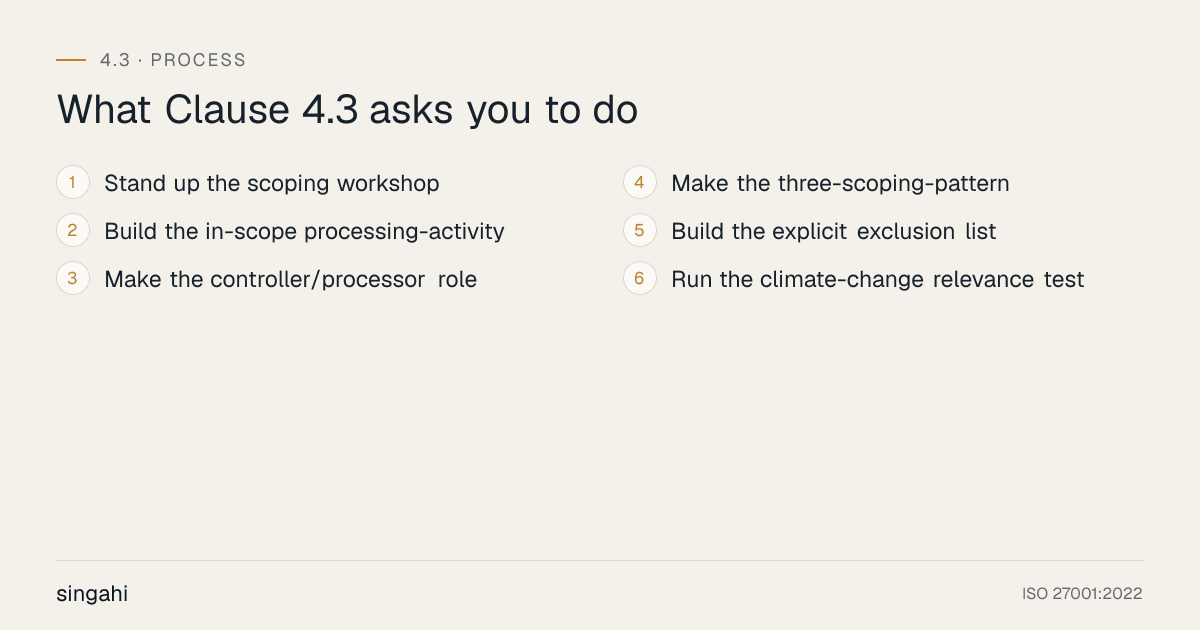
Move 1, Stand up the scoping workshop
Convene a half-day workshop with the executive sponsor (CEO/MD/COO), the DPO/Privacy Lead, the Head of Legal, the Head of Strategy or Corporate Planning, the Head of Procurement/Vendor Management, the CTO/Head of Engineering, and the Head of HR. The workshop has four outputs: the in-scope processing-activity inventory, the per-activity role declaration, the three-scoping-pattern decision, and the explicit exclusion list. Use the Singahi toolkit template (doc 01) on a whiteboard or shared spreadsheet. Time-box each activity to three minutes, name it, tag the data types, tag the role, decide if it is in scope, move on. Quality over quantity is the discipline.
The workshop must start with the context analysis (Clause 4.1) on the wall. Every scoping decision must trace back to a context issue. If the context analysis is not yet complete, the scoping workshop must wait, scoping without context is guessing.
Move 2, Build the in-scope processing-activity inventory
The processing-activity inventory is the spine of the Scope Statement. For each processing activity, record: the activity name, the description (one line), the data types processed, the principal population affected, the controller/processor role, the business unit that owns it, the systems involved, the geography, the legal basis (consent, legitimate uses under DPDP section 7, contractual necessity, etc.), and the cross-reference to the ROPA (Clause 8). Typical in-scope processing activities for an Indian growing company include:
- Customer-account management, name, email, phone, authentication data; customer population; controller role; sales/customer-service business unit; CRM system; India geography; consent + contract.
- Marketing-lead nurturing, name, email, behavioural data; prospect population; controller role; marketing business unit; marketing-automation platform; India + overseas (where prospects are); consent.
- Employee-HR processing, name, address, identity, payroll, biometric (where applicable), health (where applicable), performance; employee population; controller role; HR business unit; HRIS; India geography; employment contract + statutory.
- Card-payment processing, card credentials, transaction data; customer population; controller or processor role depending on the entity's payment-system position; payments business unit; payment gateway; India geography with localisation; consent + RBI framework.
- Vendor-contact processing, name, email, phone, bank account; vendor-contact population; controller role; procurement business unit; vendor-management system; India geography; contract.
- Customer-support ticketing, name, email, communication content, attachment data; customer population; controller role; customer-service business unit; ticketing system; India + overseas; consent + contract.
- Product analytics, usage data, behavioural data, device data; user population; controller or processor role depending on who decides the analytics purpose; product business unit; analytics platform; India + overseas; consent + legitimate interest.
- AI-driven processing (e.g., lead scoring, credit scoring, content moderation), training data, inference data, behavioural data; affected population; controller role; product or risk business unit; ML platform; India + overseas; consent + legitimate interest + section 10 algorithmic-fairness overlay if SDF.
Most Indian growing companies produce an inventory of 15 to 50 in-scope activities on the first pass. The inventory is a living artefact under Clause 8 (ROPA) and is reconciled with the Scope Statement entry-by-entry.
Move 3, Make the controller/processor role declaration
This is the highest-use move because it determines which Annex A controls apply. For each in-scope processing activity, record:
- The activity name.
- The organisation's role: controller (Data Fiduciary under DPDP), processor (Data Processor under DPDP), joint controller, or some combination across sub-activities.
- The basis for the determination, who decides the purpose and means? If the organisation, controller. If a customer or partner, processor. If shared, joint controller.
- The reconciliation with the ROPA entry (Clause 8) and the SoA (Clause 6.1.3).
- The reconciliation with the regulatory categorisation, under DPDP, under GDPR if applicable, under sectoral law (e.g., RBI's lender-borrower categorisation for digital lending).
Most Indian growing companies will produce a 15-to-50-row declaration. The declaration is reconciled entry-by-entry with the ROPA, the SoA and the regulatory categorisation. An organisation that declares a single role across the PIMS scope is almost certainly mis-stating its position and leaving entire control sets un-applied.
Move 4, Make the three-scoping-pattern decision
The 2025 edition's marquee decision. The choice among Pattern A (mirror ISMS), Pattern B (subset of ISMS), Pattern C (independent of ISMS) should be made deliberately, with the executive sponsor in the room. Considerations:
- Is the information-security perimeter coextensive with the privacy-relevant processing perimeter? If yes, Pattern A (mirror) is appropriate. If no, Pattern B (subset) or Pattern C (independent) is appropriate.
- Does the organisation have, or plan to have, an ISO 27001 certificate? If yes, the PIMS scope decision is Pattern A or B. If no, Pattern C is available.
- Are there privacy-relevant processing activities outside the ISMS scope? This is unusual but possible, for example, a SaaS firm whose ISMS covers the engineering platform but not the marketing-lead data, which is processed on a separate system. In this case Pattern B (subset) does not work; the PIMS scope must extend beyond the ISMS, which is structurally closer to Pattern A or C.
- What is the customer demand? Enterprise customers running their own privacy programmes increasingly ask for a 27701 certificate. Whether they also require a 27001 certificate varies. If 27001 is not required, Pattern C may suffice.
The Singahi standalone-PIMS scoping decision framework (toolkit doc 02) helps organisations choose among the three patterns. The choice is reversible but expensive to reverse, the scoping workshop is the moment to make it deliberately.
Move 5, Build the explicit exclusion list with justification
This is the move that prevents the most common 4.3 audit nonconformity. For every system, processing activity, business unit, geography or role that processes personal data and is excluded from the PIMS scope, record:
- The excluded item (name, description).
- The reason for exclusion, privacy-irrelevant (the system holds no personal data); out-of-organisation-perimeter (the system belongs to a sister company not in the group PIMS scope); out-of-geography (the system processes data of overseas principals not in the PIMS geography); out-of-role (the organisation is a processor for this activity and the controller's PIMS covers it); legal exemption (DPDP section 17 exemption applies); or other (with reasoning).
- The cross-reference to the context analysis (4.1) issue that justifies the exclusion.
- The risk assessment (6.1.2) confirmation that the exclusion does not leave a material risk unmanaged.
Typical exclusions for an Indian growing company include:
- Engineering source-code repositories, privacy-irrelevant (no personal data, or only developer email addresses covered elsewhere).
- Corporate finance systems, privacy-irrelevant or out-of-organisation-perimeter (sister-company system).
- Office productivity systems (email, calendar, document storage) for non-personal-data use, privacy-irrelevant for the personal-data subset; the employee personal-data subset is in scope under HR processing.
- Sandbox environments with synthetic data, privacy-irrelevant if the data is genuinely synthetic; in scope if the sandbox uses production personal data.
- Sister-company systems, out-of-organisation-perimeter (the sister company's PIMS, if any, covers them).
- Overseas subsidiaries not in the group PIMS scope, out-of-geography, with the entity-level PIMS (if any) covering them.
The unjustified exclusion is the most common 4.3 audit failure, every excluded item must have a recorded reason.
Move 6, Run the climate-change relevance test and trace forward
The 2025 amendment requires a determination of whether climate change is a relevant issue to the PIMS scope. The determination is the requirement; the reasoning matters more than the answer. A structured test for the scope specifically:
- Does the organisation operate in a sector where climate-related disruption has direct personal-data scope implications (e.g., BFSI with climate-finance products that involve personal-data processing; Healthcare with climate-sensitive health data; Manufacturing with OT-IT convergence in climate-exposed facilities)?
- Does the organisation rely on data centres or processors in climate-exposed locations (coastal, heat-extreme, water-stressed) whose disruption would affect in-scope personal-data processing?
- Does the organisation process environmental-impact data about individuals (e.g., Scope-3 emissions data tied to employee or supplier behaviour under SEBI BRSR)?
- Are interested parties (investors, customers, regulators) expressing climate-related privacy expectations that affect the scope?
If any answer is yes, climate change is material to the scope, identify the specific issues and trace them forward. If all answers are no, record the reasoning and the conclusion.
Then trace forward. For each material scope decision, record which downstream clauses it informs: 6.1.3 (SoA), 8 (ROPA), 5.2 (policy), 6.2 (objectives). If a scope decision does not inform any downstream clause, it does not belong in the Scope Statement. Wire the review:
- Calendar review, annual, at the management review (Clause 9.3).
- Event-trigger review, M&A, divestiture, regulatory change, SDF designation, breach, new product/geography, processor change, joint-controller change, board request, audit nonconformity.
- Continuous monitoring, scope-monitoring owner (typically the DPO) reviews the processing-activity landscape monthly and flags material changes for event-trigger review.
The Scope Statement is a living Documented Information artefact under Clause 7.5, with version control, approval workflow, and retention. The Singahi procedure (toolkit doc 02) operationalises the cycle.
Worked example, Karaa Payments SaaS, subset-scope PIMS
To make the six moves concrete, consider Karaa Payments (a fictional Bengaluru-based payment-aggregator SaaS vendor selling to mid-market Indian merchants). Karaa Payments's first 4.3 workshop surfaced:
- In-scope processing activities (15 total): merchant-onboarding KYC; merchant-transaction processing; merchant-settlement processing; customer-card-data tokenisation (under RBI Tokenisation); merchant-invoice processing; merchant-customer-support ticketing; marketing-lead nurturing; employee-HR processing; vendor-contact processing; product-analytics on aggregated merchant data; AI-driven fraud-scoring (under section 10 algorithmic-fairness overlay if SDF); sub-processor-management processing; cross-border transfer processing for two US sub-processors; consent-management processing under the DPDP Consent Manager regime; breach-response processing under the DPDP-CERT-In dual clock.
- Per-activity role declaration: controller for HR, marketing, vendor-contact, product-analytics; processor for merchant-onboarding KYC (under the acquiring bank's instruction), merchant-transaction processing (under NPCI/RBI framework), merchant-settlement processing (under the acquiring bank's instruction); controller again for AI-driven fraud-scoring (Karaa decides the scoring purpose), a controversial determination the workshop had to debate; joint controller with the acquiring bank for merchant-customer-support ticketing.
- Three-scoping-pattern decision: Pattern B (subset of ISMS). The ISMS scope covers the engineering platform, the corporate network, the production payment systems, and the customer-data plane; the PIMS scope covers only the customer-data plane plus the connected processing activities. The asymmetry is justified: privacy obligations attach to personal-data processing, while security obligations attach to all information assets.
- Explicit exclusion list: engineering source-code repositories (privacy-irrelevant); corporate finance systems (privacy-irrelevant); sandbox environments with synthetic data (privacy-irrelevant); sister-company systems (out-of-organisation-perimeter); overseas sales-office productivity systems (out-of-geography, with the entity-level PIMS to cover them); backup-tape archives of in-scope systems (in scope, but peripherally, recovery procedures are in scope).
- Climate-change assessment: material but indirect, one Mumbai data-centre sub-processor in a monsoon-exposed zone. Scope impact: the cross-border-transfer sub-processor list and the breach-response scope must include the climate-related disruption scenario.
The Scope Statement cross-referenced the context analysis (4.1) for each material decision, the ROPA (Clause 8) entry-by-entry, the SoA (6.1.3) for the A.1/A.2 control applicability, the policy (5.2) for the scope-bound commitments, and the objectives (6.2) for the scope-bound KPIs. The total first-cycle effort: 6 weeks of internal time plus external advisory; the resulting Scope Statement passed Stage 1 audit at first attempt, with the auditor commending the explicit exclusion list as "unusually disciplined for a growing company".
The standalone-PIMS scoping decision in more depth
The 2025 edition's standalone-PIMS option is the highest-use strategic decision in the 4.3 Scope Statement. The three patterns dominate the Indian growing-company segment as follows.
Pattern A, Mirror. The default for traditional firms running an integrated 27001 + 27701 programme. The Scope Statement records the same boundary as the ISMS, with a privacy-specific narrative layered on top. Suitable for compact single-business organisations (small professional-services firms, single-product startups whose entire operation touches personal data).
Pattern B, Subset. The dominant pattern for SaaS, ITeS and digital-first firms. The PIMS scope covers the customer-data plane; the ISMS scope covers the broader engineering and corporate-IT environment. The standalone-PIMS scoping note must explain the asymmetry and the exclusion list must justify every system in the ISMS scope that is not in the PIMS scope.
Pattern C, Independent. Made possible by the 2025 edition. The organisation pursues a standalone 27701 certificate without a 27001 certificate. Annex A.3 (security controls aligned to ISO/IEC 27002:2022) must still be implemented within the PIMS; the Scope Statement must explain how those controls are evidenced and audited without a separate ISMS. Suitable for organisations whose information-security exposure outside the PIMS is limited (small advisory firms, startups prioritising 27701 over 27001 because customer demand is privacy-led, public-sector entities with separate security regimes).
The Singahi standalone-PIMS scoping decision framework (toolkit doc 02) helps organisations choose among the three patterns. The choice is reversible but expensive to reverse, the 4.3 context workshop is the moment to make it deliberately.
Tools, Technologies, and Solutions
The tool categories
ROPA / processing-activity inventory tools. The ROPA is the spine of the Scope Statement, and a structured ROPA tool (typically a GRC module or a privacy-management platform) makes the inventory, the role declaration and the reconciliation manageable. Generic descriptions: a privacy-management platform that maintains the processing-activity inventory, automates the role declaration, and reconciles with the SoA.
Data-mapping tools. Automated data-discovery and classification tools that scan systems for personal data, classify by data type, and produce a data-flow map. Useful for the data-type axis of the Scope Statement.
Scope-statement management. A structured document or GRC module that maintains the Scope Statement, the exclusion list, the role declaration, and the cross-references. Most Indian growing companies manage this in a structured document for the first cycle and migrate to a GRC module at L3+ maturity.
Regulatory-monitoring tools. Services that surface DPDP, GDPR, sectoral and overseas regulatory changes that may affect the scope.
Selection criteria
Select on: India-DPDP coverage (most global regulatory-intelligence platforms are GDPR-heavy and DPDP-thin); sectoral coverage (RBI/SEBI/IRDAI instruments, not just horizontal law); ROPA-to-Scope-to-SoA reconciliation capability (the load-bearing feature); primary-source discipline; integration with the existing GRC stack; and cost-to-value for the Indian growing-company segment.
Build vs buy
Most growing companies should buy a ROPA / privacy-management platform and build the Scope Statement artefact (the statement, the exclusion list, the role declaration, the climate-change assessment) in-house with external advisory for the first cycle. The Scope Statement is too organisation-specific to outsource end-to-end; the ROPA is too time-intensive to do manually at scale.
Indicative cost ranges (India, mid-market, annual)
Policy and Procedure Templates
PIMS Scope Statement (sample of our own drafting)
The organisation maintains a PIMS Scope Statement as a living Documented Information artefact that records the PIMS boundary across the four axes, processing activity, data type, business unit and geography, controller/processor role, and the three-scoping-pattern decision on whether the PIMS scope mirrors, is a subset of, or exists independently of the ISMS scope. The DPO reviews the Scope Statement annually at the management review and on every material event trigger. Each material scope decision is traced forward to the downstream clauses (6.1.3 SoA, 8 ROPA, 5.2 policy, 6.2 objectives) and traced backward to the context analysis (4.1) and the interested-party map (4.2). A climate-change relevance determination is recorded with reasoning and revisited annually. Each exclusion from the scope is justified by reference to a context issue or a legal exemption.
Controller/Processor Role Declaration (sample of our own drafting)
For each in-scope processing activity recorded in the Scope Statement and the ROPA, the organisation records its role as PII controller, PII processor, joint controller, or a combination. The DPO reconciles the declaration with the regulatory categorisation under the DPDP Act 2023 (Data Fiduciary / Data Processor), with GDPR if EU/EEA data subjects are involved, and with sectoral law where applicable. The declaration drives Annex A.1 / A.2 control applicability in the Statement of Applicability and is reconciled entry-by-entry with the ROPA and the Scope Statement.
Explicit Exclusion Justification (sample of our own drafting)
For each system, processing activity, business unit, geography or role that processes personal data and is excluded from the PIMS scope, the organisation records the reason, privacy-irrelevant; out-of-organisation-perimeter; out-of-geography; out-of-role; legal exemption (DPDP section 17); or other with reasoning. Each exclusion is cross-referenced to the context analysis (4.1) issue that justifies it and to the risk assessment (6.1.2) confirmation that the exclusion does not leave a material risk unmanaged.
Scope-Determination Procedure (sample)
- The DPO convenes the annual scope-determination workshop in the 30 days before the management review.
- Each axis owner (Strategy for organisational perimeter, Legal for regulatory perimeter, HR for workforce perimeter, Procurement for vendor perimeter, IT/Engineering for systems perimeter, DPO for processing-activity perimeter) presents material changes since the last review.
- The workshop updates the in-scope processing-activity inventory, the per-activity role declaration, the explicit exclusion list, the three-scoping-pattern decision, and the climate-change relevance assessment.
- The DPO traces forward into 6.1.3 (SoA), 8 (ROPA), 5.2 (policy), 6.2 (objectives) and traces backward to 4.1 (context), 4.2 (interested parties).
- The updated Scope Statement is presented to the management review for top-management review and approval.
- Event-trigger reviews follow the same procedure on the trigger event.
Three-Scoping-Pattern Decision Note (sample of our own drafting)
Based on the PIMS Context Analysis (Clause 4.1), the organisation records whether the PIMS scope mirrors (Pattern A), is a subset of (Pattern B), or exists independently of (Pattern C) the ISMS scope. The DPO records the reasoning in the Scope Statement. Where the PIMS scope is a subset of or independent of the ISMS scope, the Annex A.3 security controls are implemented within the PIMS scope and reconciled with the ISMS controls where the two scopes overlap. The scoping decision is revisited annually and on every material event trigger.
Scope-Monitoring Owner Role (sample of our own drafting)
The DPO (or a delegated Privacy Lead) serves as the Scope-Monitoring Owner. The Scope-Monitoring Owner maintains a regulatory-monitoring subscription, scans the processing-activity landscape monthly, surfaces material changes for event-trigger review, and presents the Scope Statement at the management review. The Scope-Monitoring Owner maintains a scope-monitoring log as Documented Information under Clause 7.5.
Cross-framework Reconciliation Statement (sample)
The PIMS Scope Statement is reconciled with the ISO/IEC 27001:2022 ISMS Scope Statement (organisational perimeter shared, activity/data/role axes privacy-specific), with the GDPR Article 4(1) enterprise scope (where the organisation processes EU/EEA personal data), with the NIST Privacy Framework v1.0 Identify-P function mapping (where the organisation serves US customers), and with the SOC 2 system description (where the organisation pursues SOC 2 attestation). Discrepancies across the reconciliations are recorded and managed.
Risk Assessment and Treatment
The 4.3 Scope Statement does not itself produce a risk assessment, that is Clause 6.1.2 / 8.2, but it produces the boundary within which the risk assessment operates. Every in-scope processing activity is a candidate risk source. The risk treatment is therefore: define the scope, identify the in-scope processing risks, treat the risks under Clause 6.1.3 / 8.3.
The 4.3-specific risks include: the scope is too broad (a mirror-scope PIMS that adds privacy overhead to systems that hold no personal data); the scope is too narrow (a subset-scope PIMS that excludes a system processing personal data); the exclusion list is unjustified (an excluded system that processes personal data with no recorded reason); the role declaration is monolithic (a single role across the scope); the three-scoping-pattern decision is missing; the climate-change assessment is missing; the scope is stale (the register has not been updated since a material change in processing, geography or role).
The 4.3 risk register
| Risk | Source | Likelihood | Impact | Treatment |
|---|---|---|---|---|
| Mirror-scope PIMS with no privacy reasoning | 2019-edition habit; 2025 standalone-PIMS option not known | High | Minor NC | Three-scoping-pattern decision in the Scope Statement |
| Subset-scope PIMS with unjustified exclusion | Excluded system processes personal data with no recorded reason | High | Major NC | Explicit exclusion list with justification per item |
| Out-of-scope activity processes personal data | Scope boundary drawn too narrowly; new activity launched without scope update | Medium | Major NC | Event-trigger mechanism; Move 6 forward-trace |
| Role declaration monolithic | Default to one role org-wide; lack of per-activity analysis | High | Major NC | Per-activity role declaration workshop; reconciliation with ROPA and SoA |
| Scope-SoA disconnect | Scope excludes an activity but SoA still lists controls for it | Medium | Major NC | SoA reconciliation on every scope change |
| Scope-ROPA disconnect | ROPA includes activities the scope excludes (or vice versa) | Medium | Major NC | ROPA reconciliation on every scope change |
| Scope stale | No event-trigger reviews between annual cycles | High | Major NC | Event-trigger mechanism; continuous monitoring owner |
| Climate-change relevance assessment missing | 2025 amendment unfamiliar; team sees it as out-of-scope | Medium | Minor NC | Move 6 five-question test; reasoning recorded |
| Scope-policy disconnect | Policy commitments extend beyond the scope (or vice versa) | Low | Minor NC | Policy reconciliation on every scope change |
| Scope-objectives disconnect | Objectives address out-of-scope processing | Low | Minor NC | Objectives reconciliation on every scope change |
| Cross-border transfer scope stale | New sub-processor added without scope update | Medium | High | Reconciliation with operational transfer register |
| Children's-data scope decision missing | B2B assumption; minors in HR or marketing-lead data | Medium | High | Section 9 exposure test across all processing activities |
| Scope-monitoring owner undefined | DPO nominally owns it but no time allocated | High | Medium | Scope-monitoring owner role with FTE allocation |
| Standalone-PIMS scoping decision missing | 2025 amendment unfamiliar; mirror-scope assumed | High | Minor NC | Three-scoping-pattern decision note in the Scope Statement |
| SDF scope annexure missing | Organisation is an SDF but scope does not record the annexure | Low | Major NC | SDF annexure workshop when thresholds approached |
Treatment priorities
The high-impact, high-likelihood risks to treat first are: the unjustified exclusion (drives major nonconformities); the role mis-declaration (drives Annex A.1/A.2 applicability); the role-declaration drift (new activities launched without updates); the stale scope (event-trigger mechanism absent); and the scope-SoA / scope-ROPA disconnect. These five risks account for most of the 4.3 audit nonconformities in the Indian growing-company segment. Treat them through the six-move discipline plus the dedicated owner role plus the reconciliation step on every scope change.
The scope-to-SoA-to-ROPA reconciliation
The mechanism that keeps the Scope Statement, the SoA and the ROPA consistent is the scope-to-SoA-to-ROPA reconciliation, a three-way reconciliation performed at every scope change and at every annual review. The reconciliation checks: every ROPA entry is in scope; every out-of-scope processing activity is not in the ROPA; every SoA applicability decision is for an in-scope activity; every in-scope activity has the appropriate A.1/A.2 controls applied on the basis of the role declaration; every exclusion has a justification; the role declaration in the scope matches the role in the ROPA. The reconciliation is the audit-evidence artefact that proves the three artefacts are connected, without it, the scope is decoration.
Audit and Compliance Checklist
The 28 questions below cover the audit-evidence surface for Clause 4.3. Expected evidence and red flags noted. Most can be answered from the toolkit doc 05 audit-evidence checklist.
- Is there a PIMS Scope Statement? Expected: dated, version-controlled, signed. Red flag: missing.
- Is the document approved by top management or the DPO with sponsor authority? Expected: signature on file.
- Does the Scope Statement address all four axes (processing activity, data type, business unit and geography, controller/processor role)? Expected: each axis documented.
- Is there an in-scope processing-activity inventory? Expected: 15 to 50+ activities, each with data types, role, business unit, geography.
- Is there a per-activity controller/processor role declaration? Expected: reconciled with ROPA and SoA.
- Is the role declaration reconciled with the DPDP Data Fiduciary / Data Processor categorisation?
- Is the role declaration reconciled with the GDPR controller/processor categorisation (where applicable)?
- Is there an explicit exclusion list with justification per item? Expected: every excluded system, activity, geography with reason.
- Is there a three-scoping-pattern decision (mirror / subset / independent of the ISMS)?
- Is the three-scoping-pattern decision justified by the context analysis (4.1)?
- Is there a climate-change relevance assessment with reasoning recorded as it bears on scope?
- Are the material scope decisions traced backward to 4.1 (context)?
- Are the material scope decisions traced backward to 4.2 (interested parties)?
- Are the material scope decisions traced forward to 6.1.3 (SoA)?
- Are the material scope decisions traced forward to 8 (ROPA)?
- Is every ROPA entry in scope?
- Is every out-of-scope processing activity excluded from the ROPA?
- Is every SoA applicability decision for an in-scope activity?
- Is the Scope Statement wired into the management review agenda (9.3)?
- Is there an event-trigger review mechanism? Expected: documented triggers.
- Has any event-trigger review happened since the last calendar review? Expected: evidence of trigger and update.
- Is the Scope Statement in the board pack (for listed entities / SDFs)? Expected: board-minute noting.
- Is the Scope Statement a Documented Information artefact under Clause 7.5? Expected: version history, approval workflow.
- Are sector-specific scope drivers (RBI/SEBI/IRDAI) captured where applicable?
- Is the CERT-In 6-hour / DPDP 72-hour dual-clock pattern captured in the incident-handling scope?
- Is the cross-border transfer scope (DPDP section 16 negative list, GDPR Chapter V) captured?
- Is the SDF scope annexure captured (where the organisation is or may be designated)?
- Is the children's-data scope decision captured (where applicable)?
Evidence the auditor will physically request
- The dated and signed PIMS Scope Statement.
- The Controller/Processor Role Declaration annex (per-activity table).
- The Explicit Exclusion List annex (with justifications).
- The Three-Scoping-Pattern Decision annex.
- The climate-change relevance assessment annex.
- The backward-trace matrix (scope decision to 4.1/4.2 columns).
- The forward-trace matrix (scope decision to 6.1.3/8/5.2/6.2 columns).
- The scope-to-SoA-to-ROPA reconciliation worksheet.
- The management-review minutes showing Scope Statement input.
- The board / RMC pack where the scope summary appears (for listed/SDF).
- The event-trigger log showing triggers fired since the last review and the resulting updates.
- The Documented Information control record (version history, approval workflow).
- The scope-monitoring owner's monthly monitoring log.
- Sample reconciliations: the role-declaration entry for one sampled activity cross-referenced to the matching ROPA entry, the matching SoA row, and the matching regulatory categorisation.
Common Stage-1 nonconformities the auditor will write up
- NC pattern 1: Scope Statement exists but exclusion list missing or unjustified. Major NC. Remediation: per-item exclusion-justification workshop, 3 to 6 weeks.
- NC pattern 2: Three-scoping-pattern decision missing. Minor NC (2025 addition, auditors expect a learning curve). Remediation: half-day decision workshop with reasoning recorded, 1 to 2 weeks.
- NC pattern 3: Role declaration missing or monolithic. Major NC. Remediation: per-activity role-declaration workshop, 3 to 6 weeks.
- NC pattern 4: Scope-SoA or scope-ROPA disconnect. Major NC. Remediation: three-way reconciliation workshop, 2 to 4 weeks.
- NC pattern 5: Stale scope, last reviewed more than 12 months ago, with material regulatory or processing change in the interim. Major NC. Remediation: full event-trigger review.
- NC pattern 6: Climate-change relevance assessment missing. Minor NC (2025 addition). Remediation: half-day assessment with reasoning recorded, 1 to 2 weeks.
Metrics and KPIs
Figure · Measures
The measures that show Clause 4.3 is working
- Scope-statement currency100%Periodic
- Event-trigger review latencyunder 15 daysPeriodic
- Processing-activity coverage100%Periodic
- Role-declaration reconciliation100%Periodic
- Exclusion-list completeness100%Periodic
- Scope-statement currency, percentage of scope items reviewed within the last 12 months. Target: 100%.
- Event-trigger review latency, median time from trigger event to scope update. Target: under 15 days.
- Processing-activity coverage, percentage of in-scope processing activities with a complete entry (role, data types, business unit, geography, legal basis). Target: 100%.
- Role-declaration reconciliation, percentage of declared roles reconciled with regulatory categorisation. Target: 100%.
- Exclusion-list completeness, percentage of excluded items with a recorded justification. Target: 100%.
- Scope-SoA reconciliation, percentage of SoA applicability decisions traceable to an in-scope activity. Target: 100%.
- Scope-ROPA reconciliation, percentage of ROPA entries in scope (and percentage of out-of-scope activities excluded from the ROPA). Target: 100%.
- Backward-trace completeness, percentage of material scope decisions traced to 4.1 and 4.2. Target: 100%.
- Forward-trace completeness, percentage of material scope decisions traced to 6.1.3, 8, 5.2, 6.2. Target: 100%.
- Climate-change-assessment presence, binary; recorded determination with reasoning. Target: yes.
- Sectoral-scope coverage, count of sector-specific scope drivers (RBI, SEBI, IRDAI, CERT-In) captured. Target: all applicable.
- Cross-border-scope capture, binary; negative-list and adequacy/SCC regimes captured. Target: yes for cross-border processors.
- Board-visibility rate, binary; scope summary in the board pack. Target: yes for listed/SDF.
- Stage-1 audit nonconformities on 4.3, count. Target: zero.
- Time-to-update on regulatory change, median days from regulator publication to scope update. Target: under 30 days.
Common Pitfalls and Audit Failures
Pitfall 1, The mirror-scope default. A PIMS scope copied from the ISMS scope with no privacy-specific reasoning. The 2019-edition habit carried into 2025. Treatment: the three-scoping-pattern decision in Move 4.
Pitfall 2, The unjustified exclusion. A system that processes personal data excluded from the PIMS scope with no recorded reason. The most common 4.3 audit failure. Treatment: Move 5 explicit-exclusion discipline.
Pitfall 3, The one-line scope. "The PIMS covers all personal data processed by the organisation." Fails every audit test. Treatment: the four-axes discipline in Move 2.
Pitfall 4, The missing role declaration. A scope statement that does not declare the controller/processor role per activity. Leaves Annex A.1/A.2 applicability unjustified. Major nonconformity. Treatment: Move 3.
Pitfall 5, The monolithic role. "We are a controller" across the entire PIMS scope. Almost always wrong. Treatment: per-activity declaration.
Pitfall 6, The scope-SoA-ROPA disconnect. The scope excludes an activity that is still in the ROPA; the SoA applies controls to an activity that is out of scope. Treatment: three-way reconciliation in Section 10.
Pitfall 7, The missing climate-change assessment. A 2025-edition-specific audit failure. The amendment is new; many organisations have not caught up. Treatment: Move 6.
Pitfall 8, The stale scope. A scope statement last updated three years ago, with multiple material regulatory changes and processing-activity launches in the interim. Treatment: event-trigger review.
Pitfall 9, The missing three-scoping-pattern decision. The organisation has not decided whether to mirror, subset, or pursue independent scope. Treatment: Move 4.
Pitfall 10, The board-invisible scope. A scope statement the board has never seen. For SDFs and listed entities, a governance gap. Treatment: board pack inclusion.
Pitfall 11, The strategy-scope disconnect. A scope statement owned by the DPO with no Strategy function involvement. Misses the organisational-perimeter issues. Treatment: Strategy function in the workshop.
Pitfall 12, The regulatory-categorisation discrepancy. The PIMS role declaration says one thing, the regulatory categorisation says another, and the discrepancy is unmanaged. Treatment: explicit reconciliation.
Pitfall 13, The exhaustive scope. A scope statement with 200 in-scope activities, most of which are minor or duplicative. Decoration by volume. Treatment: the "shape the PIMS" filter applied to each activity.
Pitfall 14, The single-document fixation. The organisation tries to fit everything into one document and ends up with a 200-page artefact nobody reads. Treatment: layered model, executive summary, full statement, annexes.
Pitfall 15, The DPO-only workshop. The scope workshop is convened with only the DPO and a junior Legal counsel in the room. Misses the Strategy, HR, Procurement and IT inputs that produce the material axes. Treatment: cross-functional workshop with sponsor attendance.
Pitfall 16, The scope-context confusion. The organisation conflates 4.1 (context) with 4.3 (scope) and produces a single artefact that fails both clauses. Treatment: two linked artefacts, context in 4.1, scope in 4.3, with explicit cross-references.
Pitfall 17, The regulator-categorisation denial. The organisation's PIMS role declaration differs from the regulator's categorisation (e.g., a fintech claims to be a "platform processor" but the RBI categorises it as a payment aggregator, a Data Fiduciary for the payment data). The discrepancy is unmanaged. Treatment: explicit reconciliation; the regulatory categorisation prevails where the discrepancy is material.
Pitfall 18, The over-broad climate-change assessment. The organisation reads the 2025 amendment as requiring a full ESG climate-impact assessment and either burns budget on it or rejects the amendment outright as out-of-scope. Both miss the point, the requirement is a relevance determination for the PIMS scope specifically, with reasoning recorded. Treatment: the five-question relevance test in Move 6.
Pitfall 19, The board-pack dump. The full 60-page Scope Statement is dumped into the board pack unread. The board never sees a one-page summary; the scope is invisible at the governance layer. Treatment: a board-on-a-page summary, every cycle.
Pitfall 20, The audit-only update. The Scope Statement is updated only in the 30 days before a surveillance audit, with the rest of the year dark. The scope is technically current at the audit, but the organisation has been running without a defensible boundary between audits. Treatment: continuous monitoring with monthly light-touch reviews.
Pitfall 21, The cross-border transfer blind spot. The scope statement covers the regulatory landscape (DPDP, GDPR) but not the actual cross-border data flows (the US analytics sub-processor added last quarter, the Singapore sales-office data flow, the UK back-up). Treatment: reconcile the cross-border scope with the operational transfer register.
Pitfall 22, The children's-data assumption. The organisation assumes it has no children's-data exposure because it is a B2B firm, but its HR data includes the children of employees covered under group medical, or its marketing-lead data includes minors who entered fake dates of birth. Treatment: section 9 exposure tested across all in-scope processing activities, not just the consumer-facing ones.
Pitfall 23, The standalone-PIMS without A.3 evidence. The organisation pursues Pattern C (independent scope) without explaining how the A.3 security controls aligned to ISO/IEC 27002:2022 are implemented and evidenced within the PIMS. Treatment: the A.3 evidence annex in the Scope Statement.
Illustrative Scenario 1: Failure, Atulyam Health with a Mirror-Scope PIMS (Illustrative)
Illustrative scenario, a composite example for guidance, not a specific Singahi engagement or a verified outcome.
Illustrative scenario. Atulyam Health is a fictional Bengaluru-based healthtech company; the facts are composite from publicly reported incident patterns and should not be attributed to any real organisation.
Atulyam Health built its PIMS Scope Statement in 2023, ahead of an ISO/IEC 27701:2019 certification push. The Scope Statement copied the ISMS scope verbatim, "all systems, processes and personnel of Atulyam Health Pvt. Ltd. and its wholly-owned subsidiary Atulyam Wellness Pvt. Ltd.", and added a single privacy-specific sentence. There was no per-activity role declaration, no explicit exclusion list, no three-scoping-pattern decision (the 2019 edition effectively mandated Pattern A, mirror, anyway), no climate-change assessment. The certificate was issued in early 2024.
Between 2024 and 2026 the processing landscape shifted materially. Atulyam launched a new B2B2C telemedicine product line processing sensitive patient health data through a partner hospital, a high-risk processing activity requiring DPIA treatment under DPDP section 10 SDF logic. Atulyam onboarded a US-based medical-image analytics sub-processor. Atulyam acquired a smaller clinic chain, Atharva Clinics, whose patient-data systems were not integrated into the group PIMS. The DPDP Rules 2025 were notified on 13 November 2025, introducing the 72-hour breach clock and the verifiable-parental-consent regime for children's data. ISO/IEC 27701:2025 was published on 14 October 2025, introducing the standalone-PIMS scoping decision and the climate-change amendment.
The Scope Statement was not updated. No event-trigger review fired. The annual management review noted the scope as "current".
In May 2026 a misconfigured storage bucket on the US-based medical-image analytics sub-processor exposed approximately 65,000 patient health records, including an estimated 4,200 records of patients under 18 (children's data under DPDP section 9). The breach was discovered by a security researcher. The post-incident examination found: the breach-notification decision was made without reference to the DPDP 72-hour clock because the scope statement did not flag the new product line or the sub-processor; the new product line had not been added to the role declaration; the US sub-processor had not been added to the cross-border analysis; the Atharva Clinics patient-data systems had not been integrated into the group PIMS scope at all, meaning the acquired entity had been operating outside the certified PIMS for 14 months; the DPIA for the new telemedicine processing had not been performed; the children's-data regime under DPDP section 9 had not been applied because the scope statement assumed "B2B2C, no direct consumer relationship".
The Data Protection Board's preliminary inquiry identified the mirror-scope PIMS as the root cause, the PIMS was designed for a 2023 boundary that no longer matched the 2026 reality. The Schedule penalty exposure for section 8(5) and section 8(6) failure ran to 250 crore and 200 crore rupees respectively (maxima, not the final order); the section 9 children's-data failure added a further 200 crore exposure. The certification body issued a major nonconformity on Clause 4.3 at the next surveillance audit, cascading into nonconformities on 6.1.3 (SoA), 8 (ROPA), 5.2 (policy), 6.1 (risk) and Annex A.1.2.5 (privacy impact assessment). Atulyam's certificate was suspended pending remediation.
The lessons: a mirror-scope PIMS with no privacy-specific reasoning is a liability; the three-scoping-pattern decision must be made deliberately; the explicit exclusion list must be revisited on every acquisition and every new product launch; the cross-border scope must track new sub-processors; the regulatory-monitoring mechanism must surface changes within 30 days; the children's-data scope decision must be tested across all processing activities, not assumed away by the B2B label.
Illustrative Scenario 2: Success, Karaa Payments Standalone-PIMS Scoping (Illustrative, with ROI)
Illustrative scenario. Karaa Payments is a fictional Mumbai-based payment-aggregator SaaS vendor; the facts are composite from publicly reported sector patterns and should not be attributed to any real organisation.
Karaa Payments, a payment aggregator with 320 staff and 18,000 merchants, ran an integrated ISO/IEC 27001:2022 + ISO/IEC 27701:2019 programme. The PIMS scope mirrored the ISMS scope by default, the 2019-edition habit.
In Q4 2025 the DPO commissioned a 4.3 scope refresh ahead of the 27701:2025 transition. The workshop surfaced four material scope shifts:
- The DPDP Rules 2025 notification made Karaa a clear Data Fiduciary on merchant data and a Data Processor on certain NPCI-shared data, a dual role not previously declared at activity level.
- Karaa's volume of customer data (18,000 merchants, with the underlying card-data of approximately 6 million unique cardholders tokenised under RBI Tokenisation) placed it above the SDF thresholds expected in the notified Rules, triggering section 10 DPO, DPIP, independent-audit and algorithmic-fairness obligations, which required an SDF annexure in the Scope Statement.
- The RBI Tokenisation framework had shifted the data-type axis: raw card data was no longer stored by Karaa (tokens only), which narrowed the in-scope data types but introduced tokenised-data mapping as a new in-scope processing activity.
- The 2025 edition's standalone-PIMS scoping decision let Karaa scope a PIMS that covered only its customer-data processing, leaving the corporate-finance systems, the engineering source-code repositories and the office productivity systems to the ISMS, reducing the PIMS scope by approximately 35% and the corresponding audit and maintenance effort.
Karaa re-scoped the PIMS to Pattern B (subset of ISMS), declared the role per activity (18 activities), built an explicit exclusion list of 12 systems with justifications per item, ran the climate-change relevance assessment (concluded "material but indirect", monsoon-related disruption to a key Mumbai data-centre sub-processor), updated the cross-border analysis (one US-based fraud-scoring sub-processor, one Singapore-based back-up), and ran a DPIA on the algorithmic credit-scoring processing to address the section 10 algorithmic-fairness overlay. The scope-to-SoA-to-ROPA reconciliation produced three corrective updates to the SoA (controls for an excluded system were removed) and two updates to the ROPA (entries for the new tokenisation processing were added).
The ROI: the standalone-PIMS scoping saved approximately 55 lakh rupees per year in audit and maintenance effort; the SDF-readiness work positioned Karaa to face the section 10 designation without emergency remediation; the cross-border update closed a transfer-risk gap that had been carrying undisclosed exposure; the DPIA produced a privacy-by-design set of changes to the credit-scoring algorithm that reduced customer complaints by 22% in the following year; the reconciliation closed two SoA errors and two ROPA errors that would otherwise have produced nonconformities at the next surveillance audit. Annualised saving: approximately 55 lakh rupees in PIMS maintenance, plus the avoided DPDP penalty exposure (maxima 150 crore rupees for section 10 failure). Payback: under 6 months on the direct saving alone.
The lessons: a structured scope refresh surfaces high-value scoping decisions; the 2025 standalone-PIMS change is a real cost-saving opportunity for growing companies; the SDF designation analysis is a board-level conversation that benefits from a prepared scope annexure; the scope-to-SoA-to-ROPA reconciliation is a high-yield exercise that typically surfaces latent errors.
Multi-Framework Mapping
| 27701:2025 4.3 theme | GDPR article | DPDP Act (India) section | NIST Privacy Framework | SOC 2 TSC | ISO 27001:2022 / 27002 | ISO 29100 principle |
|---|---|---|---|---|---|---|
| Processing-activity axis (in-scope inventory) | Art 30 (records of processing); Art 4(2) | §2(1)(n) processing defn; §8 obligations | Identify-P (Data Mapping) | P5.0 (Privacy in system description) | 27001 Clause 4.3 (information-security perimeter) | Purpose legitimacy & specification |
| Data-type axis | Art 4(1) personal data; Art 9 special category | §2(1)(o) personal data; §9 children | Identify-P (Data Mapping, types) | P5.0; P6.0 | 27001 Clause 4.3; 27002 5.34 | Data minimisation |
| Business unit / geography axis | Recital 19 (enterprise scope); Art 44 (transfer) | §16 negative list; §17 exemptions | Identify-P (Business Environment) | CC1.0 (Scope) | 27001 Clause 4.3 (multi-site); 27002 5.34 | Use/retention/disclosure limitation |
| Controller/processor role axis | Art 4(7), 4(8), 26 (joint); Art 28 (processor) | §2(1)(i), 2(1)(k); §8 obligations | Identify-P (Data Mapping, role tagging) | CC6.1 (Logical access, role) | 27001 Clause 4.3; 27002 5.19–5.23 (supplier) | Accountability |
| Three-scoping-pattern decision (2025 addition) | (not explicit in GDPR; implicit in enterprise scope) | (not explicit in DPDP) | (not explicit in NIST PF) | (not explicit in TSC) | 27001 Clause 4.3 (was mandatory mirror under 27701:2019; 2025 makes it a decision) | Accountability |
| Explicit exclusion with justification (2025 emphasis) | Art 30 (records, implied coverage) | §17 exemptions | Identify-P (Business Environment, boundary) | CC1.0 (Scope, boundaries) | 27001 Clause 4.3 (statement of applicability justification 4.3 / 6.1.3 e)) | Privacy compliance |
| Climate-change relevance (2025 addition) | (not in GDPR directly; emerging ESG-privacy intersection) | (not in DPDP directly; intersects SEBI BRSR) | (not in NIST PF v1.0) | (not in TSC 2017) | 27001 Amd 1:2024 (climate-change addition to 4.1 and 4.2; cascades to 4.3) | (not in 29100:2011) |
| Cross-border transfer scope | Chapter V (Arts 44–49); Schrems II (C-311/18) TIA duty | §16 negative list | Identify-P (Data Mapping, geography) | P6.0 (Disclosure) | 27002 5.34 (PII transfer) | Use/retention/disclosure limitation |
| SDF scope annexure | Arts 37–39 (DPO triggers); Art 35 (DPIA triggers) | §10 SDF (DPO, DPIP, audit, algorithmic fairness) | Identify-P (Risk Assessment) | CC1.4 (Board oversight) | 27001 Clause 5.3 (roles) | Accountability |
| Scope-to-SoA-to-ROPA reconciliation | Art 5(2) accountability; Art 30 (records); Art 32 (security) | §8 obligations; §10 SDF | Govern-P (Risk Management Strategy); Identify-P (Data Mapping) | CC1.0; CC3.0 (Risk) | 27001 Clause 4.3 + 6.1.3 e) SoA justification | Accountability; privacy compliance |
| Standalone-PIMS scoping (2025 marquee) | (no GDPR analogue, GDPR is not certifiable) | (no DPDP analogue) | (no NIST PF analogue) | (no SOC 2 analogue) | 27001 Clause 4.3 (relationship to PIMS scope) | Accountability |
The densest cross-framework mappings are at the role-determination row (GDPR Art 4(7)/4(8)/26/28; DPDP §2(1)(i)/2(1)(k); NIST PF Identify-P) and the cross-border transfer row (GDPR Chapter V; DPDP §16 negative list). The 2025-edition-specific rows (three-scoping-pattern decision, climate-change relevance, standalone-PIMS scoping) have no clean cross-framework analogue and are unique to 27701:2025, these rows carry most of the cross-framework credibility of a 4.3 guide because they show the 2025 standard advancing beyond the frameworks it maps to.
Implementation Roadmap
30 days
- Stand up the workshop (Move 1); identify the workshop attendees and the date.
- Issue the workshop pre-read (current Scope Statement if any; current ROPA summary; current SoA summary; current context analysis).
- Begin the regulatory-monitoring subscription trial.
- Identify the executive sponsor and secure the board-cycle alignment for the management-review input.
90 days
- Complete Moves 1 to 5 (workshop, processing-activity inventory, role declaration, three-scoping-pattern decision, explicit exclusion list).
- Complete Move 6 forward-trace into 6.1.3, 8, 5.2, 6.2 and backward-trace into 4.1, 4.2.
- Run the scope-to-SoA-to-ROPA reconciliation.
- Present the Scope Statement to the management review.
- Capture Documented Information control set (version, approval, retention).
180 days
- Run the first event-trigger review (if no trigger has fired, simulate one, e.g., a DPDP Rules sub-notification, an M&A event, a new product launch).
- Wire the scope-monitoring mechanism into the DPO's monthly cycle.
- Present the Scope Statement to the board / Risk Management Committee (for SDFs and listed entities).
- Update the awareness programme to reference the Scope Statement (Clause 7.3).
12 months
- Run the first full annual review at the management review.
- Update the role declaration and the processing-activity inventory to reconcile with the full ROPA.
- Run an internal-audit test against the Section 11 checklist (Clause 9.2).
- Calibrate the metrics against the Section 12 targets.
- Revisit the three-scoping-pattern decision annually, the choice is reversible but expensive to reverse.
FAQ
Q1. We already have an ISO/IEC 27001:2022 Clause 4.3 scope statement. Can we reuse it for 27701?
Only partially. The ISMS scope statement covers the information-security perimeter; the PIMS scope statement covers the privacy-relevant processing perimeter on four axes (processing activity, data type, business unit and geography, controller/processor role). The two scopes can mirror each other (Pattern A), the PIMS can be a subset of the ISMS (Pattern B), or the PIMS can exist independently (Pattern C). The decision must be made deliberately in the 4.3 workshop.
Q2. Our scope statement is a one-line document. Is that enough?
No. A one-line scope statement fails every audit test. The four-axes discipline requires a structured statement covering processing activity, data type, business unit and geography, and controller/processor role.
Q3. We are not an SDF. Do we still need an SDF annexure in the Scope Statement?
Yes, but it can be brief. The designation thresholds are in the DPDP Rules; if you are clearly below them, record the reasoning and move on. The annexure matters because the trajectory matters, growing companies can cross the thresholds, and the analysis should be refreshed annually.
Q4. Is the climate-change amendment a hard requirement?
The determination is a hard requirement. The reasoning matters more than the answer. If your organisation concludes climate change is not material to the PIMS scope, you must record why. The 2025 edition follows the ISO-wide climate-change amendment pattern.
Q5. Our PIMS scope mirrors our ISMS scope. Is that still acceptable in the 2025 edition?
It is acceptable if it is justified by the context analysis. The 2025 edition makes standalone-PIMS scoping possible; it does not make it mandatory. If mirroring the ISMS scope is the right answer for your organisation, the Scope Statement must say so and explain why.
Q6. We are a processor for most of our activities. Is the scope statement different?
Yes, the processor scope statement leads with the processor obligations: the section 2(1)(k) categorisation, the infringing-instruction handling under Annex A.2.2.5, the sub-processor management under Annex A.2.5, the records related to processing under Annex A.2.2.7. The activity axis is also different (processor-market concentration, controller-driven change cadence, sub-processor chains).
Q7. Our role differs across jurisdictions (we are a controller in India and a processor in the EU for the same activity). How do we declare it?
Per-activity, per-jurisdiction. The role declaration is multi-dimensional; a single global declaration is almost always wrong.
Q8. Do we have to update the scope statement when the DPDP Rules issue a new sub-notification?
Yes. Regulatory change is the canonical event-trigger. The 30-day target for time-to-update (KPI 15) is the discipline.
Q9. The board has never seen the scope statement. Is that a finding?
For listed entities (Companies Act 2013 section 134(3)(n), SEBI LODR Regulation 21) and SDFs (DPDP section 10 DPO accountability-to-board), board visibility is part of governance. For other growing companies, board visibility is best practice but not strictly required.
Q10. Can we outsource the scope statement entirely?
The artefact construction can be outsourced (with external advisory); the scoping decision cannot be outsourced because it requires organisational knowledge. The DPO owns the artefact; the workshop attendees own the input.
Q11. How is 4.3 different from the ISMS scope?
The ISMS scope is the information-security perimeter (information assets, systems, processes, locations). The PIMS scope is the privacy-relevant processing perimeter (processing activities, data types, principal populations, controller/processor roles). The two scopes can mirror each other, nest, or exist independently.
Q12. Do we need separate scope statements for each entity in our group?
Multi-entity groups typically run a group scope statement (the parent-level perimeter) plus entity-level annexes (the entity-specific activities, data types, geographies, roles). The entity-level annex is mandatory where the entities operate in different jurisdictions, sectors or regulatory categorisations.
Q13. How often should we review the scope statement specifically?
The scope statement should be reviewed on every new processing-activity launch, every M&A event, every processor change, every sector-regulator change, and at the annual review. The "every new processing-activity launch" trigger is the most operationally important, it is where scope drift usually starts.
Q14. What if a new product launch needs to happen before the scope statement can be updated?
The launch should trigger an out-of-cycle scope update before the launch goes live. The scope-update latency target (KPI 2) is 15 days from trigger. If a launch slips past that, the new product is operating outside the certified PIMS, a nonconformity risk.
Q15. Can the scope statement be in an Indian language?
Yes. The Documented Information standard (Clause 7.5) does not prescribe a language; the test is whether the artefact is usable by its audiences. For an Indian growing company with a Hindi-speaking board, a Hindi summary alongside the English full document is appropriate. The external privacy notice has a stronger translation expectation under DPDP Rules 2025.
Q16. We are pursuing Pattern C (standalone PIMS without ISO 27001). How do we evidence the A.3 security controls?
The Scope Statement must include an A.3 evidence annexure that maps each A.3 control (aligned to ISO/IEC 27002:2022) to the implemented security mechanism within the PIMS scope. The Annex B normative guidance applies to A.3 as well as to A.1 and A.2, so the implementation guidance should be reflected.
Industry-Specific Requirements
BFSI
Banks, NBFCs, payment aggregators, payment gateways. The BFSI scope statement carries the heaviest regulatory load: RBI Storage of Payment System Data (6 April 2018), end-to-end payment-data localisation, which makes the geography axis of the PIMS scope stricter than the DPDP negative list for payment data; RBI Digital Lending Guidelines (2 September 2022), borrower consent and device-data minimisation, which shapes the processing-activity axis for digital lenders; RBI Tokenisation (22 September 2021, full effect 1 October 2022), card-on-file replacement, which affects the data-type axis; RBI Cybersecurity Directions 2026 (31 July 2026) for banks and NBFCs, and RBI's separate cyber resilience and digital payment security controls directions for non-bank payment system operators, which cover payment aggregators and gateways; SEBI CSCRF (20 August 2024) for SEBI Regulated Entities; IRDAI Information and Cyber Security Guidelines 2023 (24 April 2023) for insurers. The role declaration must reconcile the DPDP Data Fiduciary / Data Processor categorisation with the RBI lender-borrower and payment-system categorisations. SDF designation is likely for any large BFSI player, requiring the SDF scope annexure.
Healthcare
Hospitals, telemedicine platforms, healthtech, insurers processing health data. The scope statement must flag the heightened sensitivity of health data (DPDP section 9 analog for vulnerable data subjects; the SPDI Rules' explicit inclusion of health data). The role declaration is complex, hospitals are controllers for patient data, processors for some insurance-claim data, joint controllers with referring physicians in some cases. The 2025 edition's callout of biometric and health data processing is directly relevant. DPIA treatment is typically required for most material processing activities, which means the scope-to-DPIA reconciliation is part of the 4.3 evidence.
IT-ITeS and SaaS
IT services firms, BPOs, SaaS providers, cloud processors. The role declaration is almost always "both", controller for employee and marketing data, processor for customer-hosted data. The processor-side scope statement leads with Annex A.2 controls, the infringing-instruction handling, the sub-processor chains. The cross-border transfer scope is central, most ITeS firms process data of overseas principals under GDPR/CCPA jurisdiction. The standalone-PIMS scoping decision (Pattern B subset) lets SaaS firms scope a PIMS to the customer-data plane only, separate from the ISMS-scoped engineering plane.
E-commerce and Retail
D2C brands, marketplaces, e-commerce platforms, omni-channel retailers. The scope statement must address consumer-privacy expectations at scale, the children's-data regime where minors are in the user base, the marketing-lead consent regime, the supplier-ecosystem processor chains. The role declaration covers customer data (controller), supplier-transmitted data (varies), payment data (controller with payment-system overlays). The DPDP Consent Manager ecosystem is particularly relevant for consumer-facing firms.
Edtech
K-12 platforms, higher-edtech, skilling platforms, test-prep. The children's-data regime (DPDP section 9) is the central scope driver, verifiable parental consent, no behavioural monitoring or targeted advertising or tracking of children. The role declaration typically makes the platform a controller for student data with complex joint-controller relationships with schools. The DPIA threshold is low, most material processing activities require DPIA treatment, which means the scope statement should explicitly enumerate the in-scope children's-data activities.
Manufacturing
Discrete and process manufacturing, automotive, chemicals, pharma manufacturing. The scope statement must address the OT-IT convergence (operational technology systems increasingly connected, with PII exposure in HR, contractor and visitor data), the supply-chain processor ecosystem, the geopolitical context for cross-border manufacturing data flows. The role declaration is typically simpler than in consumer-facing sectors. The climate-change assessment is often material, manufacturing facilities are climate-exposed, and the OT-IT systems managing them carry personal data.
Cross-sector patterns
Three patterns recur across sectors and are worth flagging in any 4.3 scope statement regardless of industry.
The processor-side scale pattern. Indian ITeS, BPO, SaaS and cloud-processor firms typically process personal data at volumes that easily cross the DPDP SDF thresholds even though their consumer brand is small. The SDF-designation analysis in the scope annexure must use the volume of data processed (not the headcount) as the threshold proxy.
The dual-regulator pattern. BFSI and listed entities carry dual-regulator exposure, DPDP via the Data Protection Board plus the sector regulator (RBI, SEBI, IRDAI). The scope statement must capture both regulatory streams and the dual-clock pattern they create (CERT-In 6 hours, DPDP 72 hours, sector six hours).
The multi-jurisdiction role pattern. Firms with EU/UK customers, US customers, Singapore operations and Indian operations face four overlapping role-categorisation regimes (GDPR, UK GDPR, CCPA/CPRA, DPDP). The per-activity, per-jurisdiction role declaration is the only defensible structure; a single global declaration is wrong.
Maturity Model
Figure · Tiers
Maturity levels for determining the scope of the privacy information management system
- OptimisedContinuous scope-monitoring capability.
- ManagedA boundary-disciplined PIMS. Scope
- DefinedA structured scope statement covering
- ReactiveA scope statement exists but is dated
- InitialNo scope statement
| Level | Description |
|---|---|
| L1, Initial | No scope statement, or a one-line scope copied from the ISMS. No role declaration. No explicit exclusion list. No three-scoping-pattern decision. No climate-change assessment. No event-trigger review. |
| L2, Reactive | A scope statement exists but is dated and was produced for the last certification cycle. Role declaration is monolithic. Exclusion list missing or unjustified. Climate-change assessment missing. No event-trigger review. |
| L3, Defined | A structured scope statement covering the four axes. Per-activity role declaration. Explicit exclusion list with justifications. Three-scoping-pattern decision recorded. Climate-change assessment with reasoning. Annual review at the management review. Event-trigger review defined but not always executed. |
| L4, Managed | A boundary-disciplined PIMS. Scope statement is quarterly-light-touched. Role declaration reconciled with ROPA, SoA and regulatory categorisation. Exclusion list exhaustive and justified. Climate-change assessment is sector-specific. Event-trigger reviews fire on every material change. Board-visible for SDFs and listed entities. Scope-to-SoA-to-ROPA reconciliation performed at every change. Cross-framework reconciliation (DPDP/GDPR/NIST/SOC 2). |
| L5, Optimised | Continuous scope-monitoring capability. Real-time regulatory intelligence feed wired into the scope. Role declaration is automated from the ROPA. Exclusion list is auto-justified from the context analysis. Climate-change assessment is integrated with ESG reporting. Standalone-PIMS scoping decision revisited annually. Board-level scope dashboard. Cross-framework reconciliation is automated. The scope statement demonstrably drives every downstream clause and is the fence of the PIMS. |
Emerging Trends
AI-driven processing and the algorithmic-fairness overlay. The DPDP section 10 SDF algorithmic-fairness review, the 2025 edition's callout of AI-driven profiling and automated decision-making, and the parallel development of ISO/IEC 42001:2023 (AI Management System) are reshaping the scope statement. For organisations using AI/ML on personal data, the scope must identify the AI processing activities, the algorithmic-fairness issues, and the cross-standard integration with 42001.
Consent Manager ecosystem emergence. The DPDP Rules 2025 prescribe Consent Manager registration conditions; the first Consent Managers are expected to be registered through 2026 and 2027. As the ecosystem emerges, the Consent Manager becomes a material scope driver for consumer-facing firms, the integration architecture, the withdrawal-signal honouring, the interoperability testing.
Cross-border transfer regime evolution. The DPDP negative list under section 16, the EU–US Data Privacy Framework adequacy decision (10 July 2023), the UK IDTA/Addendum, the China PIPL cross-border mechanisms, and the geopolitical risk environment are all in flux. The geography axis of the scope must monitor this dimension continuously.
Climate-related data collection. SEBI Business Responsibility and Sustainability Reporting (BRSR) is driving Indian listed entities to collect environmental-impact data, some of which involves personal data (employee commute, supplier behaviour). The intersection of ESG reporting and privacy is an emerging scope driver.
Children's-data enforcement. The DPDP section 9 children's regime, the DPDP Rules verifiable-parental-consent mechanism, and the global trend toward stricter children's-data enforcement (UK Age Appropriate Design Code, US COPPA, India's expected rules) are reshaping the scope for any organisation with minors in the user base.
Integrated management systems. The harmonized structure enables integrated 27001 + 27701 + 42001 + 22301 governance. The scope statement is the natural point of integration, a single combined scope that serves all four management systems with clearly labelled sub-sections.
DPBI operational emergence. The Data Protection Board of India, constituted under DPDP section 18, is emerging through 2026 and 2027. Its early orders, its interpretation of the Schedule penalty maxima, and its engagement patterns will reshape the regulatory scope driver for every Indian Data Fiduciary.
Quantum and cryptography horizon. The post-quantum-cryptography transition (NIST PQC standards, ISO/IEC 18033, ISO/IEC 20889) is a long-horizon scope driver for organisations with long-retention personal data, the scope must include the cryptography migration as an in-scope processing activity.
Sector-regulator convergence on privacy. RBI, SEBI and IRDAI are each tightening their privacy-adjacent rules (RBI Digital Lending, SEBI CSCRF, IRDAI ICS 2023). The DPDP Act sits as a horizontal layer above these sectoral instruments; the scope statement must monitor both the horizontal and the sectoral streams because they can diverge in their specific obligations even when they share the underlying privacy principle.
Privacy litigation emerging in India. Consumer Protection Act 2019 class actions, IT Act section 43A compensation claims, and the early constitutional challenges to DPDP exemptions are reshaping the legal scope driver. The scope statement must monitor the case law as it emerges through the Data Protection Board's early orders and the constitutional-bench challenges.
Vendor consolidation and concentration risk. The Indian privacy-tech vendor ecosystem is consolidating; a small number of cloud, analytics and consent platforms serve most Indian growing companies. The concentration risk is a scope driver, the failure or compromise of a single vendor can cascade across the customer base, requiring the scope to cover the vendor-failure scenario.
Privacy by design as a default market expectation. Beyond the regulatory overlay, customer expectations (especially enterprise customers running their own privacy programmes) are driving privacy-by-design into the procurement requirements. The scope must capture the market-driven privacy demands alongside the regulatory ones.
Generative AI in PIMS operations themselves. The use of generative AI inside the PIMS function (for DSAR drafting support, ROPA automation, breach-notification drafting) is a scope driver, it reshapes the resourcing, the competency profile and the risk profile of the PIMS itself.
References and Further Reading
Primary instruments (India). Digital Personal Data Protection Act, 2023 (Act No. 22 of 2023, enacted 11 August 2023), MeitY. Digital Personal Data Protection Rules, 2025 (notified 13 November 2025), MeitY. Information Technology Act, 2000 (Act No. 21 of 2000), sections 43A, 72A, 70B. IT (Reasonable Security Practices and Procedures and Sensitive Personal Data or Information) Rules, 2011 (notified 11 April 2011). CERT-In Directions 20(3)/2022-CERT-In (28 April 2022). RBI Storage of Payment System Data (DPSS.CO.OD.No.1098/06.08.005/2017-18, 6 April 2018). RBI Digital Lending Guidelines (DOID.CO.PPG.SEC.09/14.14.001/2022-23, 2 September 2022). RBI Tokenisation (DPSS.CO.RPPD.No.S-35/07.01.005/2021-22, 22 September 2021). RBI Cybersecurity, Technology: Risk, Resilience and Assurance Framework Directions, 2026 (31 July 2026). SEBI KRA Regulations 2011 (as amended 2024; Master Circular May 2024). SEBI Cybersecurity and Cyber Resilience Framework (SEBI/HO/ITD-1/ITD_CSC_EXT/P/CIR/2024/113, 20 August 2024). IRDAI Information and Cyber Security Guidelines 2023 (24 April 2023). Companies Act 2013, sections 134(3)(n), 177. SEBI LODR Regulation 21.
Primary jurisprudence (India). K.S. Puttaswamy v. Union of India, (2017) 10 SCC 1 (nine-judge Bench, judgment 24 August 2017). Justice K.S. Puttaswamy (Retd.) v. Union of India (Aadhaar), (2019) 1 SCC 1 (five-judge Bench, judgment 26 September 2018).
Primary instruments (global). Regulation (EU) 2016/679 (GDPR), OJ L 119, 4.5.2016, p. 1; application from 25 May 2018. CJEU, Data Protection Commissioner v. Facebook Ireland Limited, Maximillian Schrems (Schrems II), C-311/18, 16 July 2020. European Commission Implementing Decision (EU) 2021/914 (modernised SCCs, 4 June 2021). EU–US Data Privacy Framework adequacy decision (10 July 2023). NIST Privacy Framework v1.0: A Tool for Improving Privacy Through Enterprise Risk Management, NIST.CSWP.01162020, 16 January 2020. AICPA, 2017 Trust Services Criteria (with 2022 Points of Focus update). California Consumer Privacy Act / California Privacy Rights Act, Cal. Civ. Code 1798.100 et seq.
ISO/IEC standards. ISO/IEC 27701:2025 (2nd ed., published 14 October 2025). ISO/IEC 27701:2019 (1st ed., for transition reference). ISO/IEC 27001:2022 (5th ed.). ISO/IEC 27002:2022 (6th ed.), only control 5.34 is PII-specific. ISO/IEC 27001:2022 Amendment 1:2024 (climate-change addition to Clauses 4.1 and 4.2; cascades to 4.3). ISO/IEC 29100:2011 (privacy framework, 11 principles). ISO/IEC 29134:2017 (DPIA guidelines). ISO/IEC 27018:2019 (code of practice for PII in public clouds acting as PII processor). ISO/IEC 27017:2015 (cloud security). ISO/IEC 29151 (PII protection code of practice). ISO/IEC 42001:2023 (AI Management System). ISO/IEC 27706:2025 (PIMS certification-scheme competence).
Edition-transition sources (practitioner commentary used as research input). ANAB Heads Up #550 (transition timeline: standard published 14 Oct 2025; certification-body deadline 31 Oct 2026; organisation transition deadline 31 Oct 2028). The 2025 edition's structure, control counts (31 controllers + 18 processors + 29 security = 78 consensus; one tier-1 cert-body source reports an outlier count of 86 on a different counting basis), the standalone-PIMS scoping decision, the climate-change amendment to Clauses 4.1 and 4.2 (cascading to 4.3), and the normative status of Annex B are confirmed from the official 2025 PDF (OCR) and corroborated by tier-1 practitioner commentary. All clause text in this guide is paraphrased; the official text is copyrighted by ISO/IEC and has not been reproduced.
Singahi references. The Singahi Clause 4.3 toolkit (17 docs + README) accompanies this guide. The Singahi 27701:2025 series covers all MSS clauses (4 to 10) and Annex A.1 / A.2 / A.3 controls; sibling guides for 4.1, 4.2, 4.4 and the rest of the standard are available.
This guide is published by Singahi. The ISO/IEC 27701:2025 clause text is copyrighted by ISO/IEC and has not been reproduced; all requirements are paraphrased. Brand names of competitors, cert bodies, and reference books are intentionally omitted. Scenarios are illustrative and should not be attributed to any real organisation.