
On this page
- Quick Reference (60 Seconds)
- What the Standard Actually Requires
- Why This Control Matters
- Scope and Applicability
- Key Definitions and Terminology
- Relationship to Other Clauses and Frameworks
- Detailed Implementation Guidance, The Six Objective-Setting Moves
- Tools, Technologies, and Solutions
- Policy and Procedure Templates
- Risk Assessment and Treatment
- Audit and Compliance Checklist
- Metrics and KPIs
- Common Pitfalls and Audit Failures
- Illustrative Scenario 1: Failure, Atulyam Health with Aspirational Objectives (Illustrative)
- Illustrative Scenario 2: Success, Karaa Payments Builds a Cascaded Privacy-Objectives Set (Illustrative, with ROI)
- Multi-Framework Mapping
- Implementation Roadmap
- FAQ
- Industry-Specific Requirements
- Maturity Model
- Emerging Trends
- References and Further Reading
Quick Reference (60 Seconds)
| Attribute | Detail |
|---|---|
| Clause | ISO/IEC 27701:2025 Clause 6.2, Privacy Objectives and Planning to Achieve Them. The objective-setting sub-clause of the PIMS, structurally aligned to the Harmonized Structure shared by ISO/IEC 27001:2022 Clause 6.2, ISO 22301:2019 Clause 6.2, ISO 9001:2015 Clause 6.2 and ISO/IEC 42001:2023 Clause 6.2. The 2025 edition moved 27701 from the 2019 "extension to 27001/27002" framing to a standalone PIMS on the harmonized structure; Clause 6.2 inherits that standalone framing and, with it, the obligation to set privacy objectives that are measurable, principal-protective and tied to a concrete plan, not aspirational slogans bolted on for the audit. |
| What it asks for (paraphrase) | ISO/IEC 27701:2025 Clause 6.2 asks organizations to set measurable privacy objectives and plan how to achieve them. Two ideas do the work. Set measurable privacy objectives, the organisation establishes privacy objectives at relevant functions and levels, the objectives are consistent with the privacy policy (Clause 5.2), the objectives are measurable (where practicable) and monitored, the objectives take account of applicable requirements and the results of the privacy risk assessment (Clause 6.1.2) and risk treatment (Clause 6.1.3), and the objectives are communicated and updated as appropriate. Plan how to achieve them, the organisation settles the actions, the resourcing, the accountable owner, the completion date and the evaluation method for each objective. The two halves collapse into the canonical Clause 6.2 quartet: objective → plan → KPI → review loop. |
| The marquee insight competitors miss | Most practitioner commentary treats Clause 6.2 as the generic ISO management-system objective clause, identical to 27001 6.2 and 9001 6.2, set SMART objectives, plan, monitor, done. That reading under-uses the clause. Privacy objectives are different from security or quality objectives because they are principal-protective by construction: an information-security objective ("reduce critical vulnerabilities to zero") measures an internal state, but a privacy objective ("DSAR turnaround under 30 days") measures an outcome experienced by a data principal. The measurability surface for privacy is therefore wider, the cascade from board to principal-facing process is deeper, and the regulatory exposure for missing an objective is concrete (the DPDP section 13 grievance clock, the section 8(6) breach clock, the section 9 children's-data regime). A 6.2-conformant privacy-objective set is one in which every objective traces forward to a principal-protective outcome and backward to a policy commitment (Clause 5.2) and a risk-treatment decision (Clause 6.1.3 SoA). |
| Domain | Planning (Clause 6). 6.2 sits beside 6.1 (risk and opportunities) and 6.3 (planning of changes). Where 6.1.2 inventories the risks and 6.1.3 produces the Statement of Applicability, 6.2 converts that risk picture into measurable privacy objectives with named owners and timelines. Where 6.3 governs planned changes to the PIMS, 6.2 governs planned outcomes. 6.2 is the bridge between the privacy policy (Clause 5.2, what the organisation commits to) and the operational processes (Clause 8, what the organisation does); without 6.2, the policy is unmoored from delivery and the operations are unmoored from intent. |
| What you must produce | (a) A Privacy Objectives Register (the primary artefact), typically a 6 to 15 page document recording each objective with: a unique ID, the objective statement (SMART), the owning policy commitment, the owning risk-treatment decision, the Process Owner, the cascade level (board / DPO / Process Owner), the baseline metric, the target, the unit, the data source, the measurement cadence, the threshold, the triggered action on threshold breach, the plan (what will be done, what resources, who is responsible, when completed, how evaluated), the KPIs, the review cycle, the version history; (b) an Objective-to-KPI Cascade, the visual that maps each board-level objective to the DPO-level and Process-Owner-level sub-objectives and the underlying KPIs; (c) an Objective-Planning Worksheet per objective, the Clause 6.2 "what / resources / who / when / how-evaluated" quintet recorded for each objective; (d) a Review-Cadence Schedule, the calendar of monthly, quarterly, annual and event-trigger objective reviews with named attendees; (e) an Objective-Change Log, the version-controlled record of objective updates and the triggers behind them; (f) a Cross-Reference Map tracing each objective backward to the policy (Clause 5.2), the risk treatment (Clause 6.1.3), the SoA and the relevant Annex A.1 / A.2 control, and forward to the KPI dashboard (Clause 9.1) and the management-review input (Clause 9.3); (g) the Documented Information control set per Clause 7.5. |
| Typical owner | Top management owns the board-level privacy objectives at the strategic level, Clause 6.2 is, like the rest of Clause 6, a top-management responsibility under Clause 5.1. The DPO / Privacy Lead owns the DPO-level objectives and the Privacy Objectives Register as an artefact, and convenes the objective-setting workshop (mandatory in India if the organisation is a Significant Data Fiduciary under DPDP section 10, where the DPIP and the algorithmic-fairness review generate objective-bearing obligations). Process Owners, typically the Heads of Customer Operations (rights objective), Marketing (consent objective), Procurement (processor objective), IT/Security (breach objective), Legal (DPIA objective), HR (training objective), Product (privacy-by-design objective), own the operational-level objectives and the underlying KPIs. Internal Audit (Clause 9.2) tests the objectives and the cascade. The Board / Risk Management Committee receives the objective-performance summary at the management review (Clause 9.3), for listed entities supported by Companies Act 2013 section 134(3)(n) and SEBI LODR Regulation 21. |
| Minimum viable actions | (1) Convene the objective-setting workshop (sponsor, DPO, Process Owners, half day); (2) confirm the privacy-policy commitments (Clause 5.2) the objectives must operationalise; (3) confirm the risk-treatment decisions (Clause 6.1.3) the objectives must implement; (4) write three to seven board-level privacy objectives (one per policy commitment family); (5) cascade each board objective to one to three DPO-level sub-objectives and one to four Process-Owner-level sub-objectives; (6) for each leaf objective, write the SMART statement, the baseline, the target, the KPI, the threshold, the triggered action; (7) for each leaf objective, write the Clause 6.2 plan (what / resources / who / when / how evaluated); (8) wire the objective reviews into the calendar (monthly metrics, quarterly light-touch, annual management-review); (9) seed the Objective-Change Log; (10) brief Process Owners on the cascade and their ownership. |
| Maturity floor (L1) | An "aspirational" privacy-objective set: a one-page list of privacy commitments copied from the privacy policy (Clause 5.2) and labelled "privacy objectives", no SMART statements, no baselines, no targets, no plans, no KPIs, no cascade, no review cadence. The single most common Clause 6.2 audit nonconformity in the Indian growing-company segment, and the one most likely to cascade into major nonconformities on Clause 9.1 (Monitoring), Clause 9.3 (Management Review) and Clause 10.1 (Continual Improvement) because the PIMS has no measurable performance story to feed them. |
| Maturity target (L4 to L5) | A "cascaded-and-closed-loop" privacy-objective set: the Privacy Objectives Register is a board-visible instrument authored by the DPO and signed by top management; every objective traces backward to the policy and the SoA and forward to the KPI dashboard and the management-review input; the cascade from board to DPO to Process Owner is explicit and reconciled; the Clause 6.2 plan quintet (what / resources / who / when / how evaluated) is complete per objective; thresholds trigger actions automatically; the review cadence is wired into the calendar; the Objective-Change Log captures version history with triggers. |
| Audit red flag | A privacy-objective set that cannot be reconciled with the privacy policy (Clause 5.2), the SoA (Clause 6.1.3) or the KPI dashboard (Clause 9.1). The 6.2 audit test is always the same: the auditor picks an objective at random and asks "show me the KPI this objective is measured by, the threshold, the action triggered when the threshold is breached, and the management-review input this objective feeds." If any of these is missing, the objective is aspirational, not measurable, a major nonconformity on 6.2. The second-most-common audit red flag is the missing plan, the objective has a target but no Clause 6.2 quintet (what / resources / who / when / how evaluated), so the objective is a wish, not a plan. |
| Time to implement (first cycle) | Growing companies (50 to 250 staff): 4 to 8 weeks for the first Register pass. Mid-market (250 to 2,000): 8 to 14 weeks, usually requiring board-cycle alignment, the cascade through three to five Process Owners, the KPI baseline collection and the review-cadence wiring. Multi-entity enterprise: 3 to 6 months, integrated with group governance, the entity-level cascade and the harmonized-structure integration with ISO 27001 / 42001 / 22301 objective cascades. |
| Related clauses | 4.1 (context justifies the objective portfolio), 4.2 (interested parties drive the principal-protective outcomes), 4.3 (scope bounds which objectives apply where), 4.4 (the PIMS as a system carries the objective cascade), 5.1 (top management owns the board objectives), 5.2 (the policy commits to what the objectives operationalise), 5.3 (the roles cascade the objectives), 6.1 (risk drives the objective priorities and the SoA), 6.3 (changes to the PIMS trigger objective reviews), 7.1 to 7.5 (support sizes the objective achievement), 8 (Operation, the processes whose performance the objectives measure), Annex A.1 / A.2 / A.3 (controls implemented to meet the objectives), 9.1 (monitoring measures the objectives), 9.2 (internal audit tests the objectives), 9.3 (management review closes the loop on the objectives), 10.2 (corrective action on missed-objective nonconformities), 10.1 (continual improvement upgrades the objectives). 6.2 is the planning pivot every other clause hangs from. |
| Critical Indian context-bearing instruments the objectives must operationalise | DPDP Act 2023 (Act 22/2023, enacted 11 August 2023), sections 4 to 10 (Data Fiduciary obligations), 11 to 14 (Data Principal rights), 16 (transfer), 18 (Board), 33 (penalties) drive the objective portfolio; DPDP Rules 2025 (notified 13 November 2025), verifiable parental consent, SDF thresholds, Consent Manager registration, 72-hour breach clock, grievance response periods shape the objective targets; Puttaswamy v. Union of India (2017) 10 SCC 1 and Aadhaar judgment (2019) 1 SCC 1, constitutional foundation; CERT-In Directions 20(3)/2022-CERT-In of 28 April 2022 (the 6-hour clock), shapes the breach objective target; RBI Storage of Payment System Data directive 6 April 2018, payment-data localisation shapes the BFSI transfer objective; RBI Digital Lending Guidelines 2 September 2022; RBI Tokenisation circular 22 September 2021; SEBI KRA Regulations 2011 (as amended 2024); SEBI CSCRF 20 August 2024; IRDAI Information and Cyber Security Guidelines 24 April 2023; IT Act 2000 sections 43A and 72A; SPDI Rules 11 April 2011; Companies Act 2013 section 134(3)(n); SEBI LODR Regulation 21. The Privacy Objectives Register must name these instruments and bind each to the objective it operationalises. |
If you only read one thing: Clause 6.2 is where the PIMS stops being a collection of policy commitments and becomes a measurable programme with a plan. A 6.2-conformant privacy-objective set is one in which the organisation can articulate, with evidence, what its privacy objectives are (three to seven at board level, cascaded to DPO and Process Owner levels), how each objective is measured (a named KPI with a baseline, a target, a threshold and a triggered action), what the plan to achieve each objective is (the what / resources / who / when / how-evaluated quintet), how the objectives cascade from the board down to the principal-facing processes, how the objectives trace backward to the privacy policy (Clause 5.2) and the risk treatment (Clause 6.1.3), and how the review loop is wired (monthly metrics, quarterly light-touch, annual management-review, event-trigger). The certification auditor will pick a random objective and walk it forward to the management-review input and backward to the policy commitment; the Data Protection Board of India will, after an incident, ask which objective measured the failed outcome and what the threshold action was. Get 6.2 wrong, a list of aspirations with no measurability, no cascade, no plan, and however strong the rest of the PIMS is, the management-review cycle has nothing to evaluate and the continual-improvement loop has nothing to feed on. Get it right, and every other clause becomes easier to evidence because the objectives tie the system together.
What the Standard Actually Requires
The paraphrased requirement
ISO/IEC 27701:2025 Clause 6.2 asks organizations to set measurable privacy objectives and plan how to achieve them. Two phrases do the work in that paraphrase. Each carries a specific design and operational load, and auditors test each separately.
The organisation must set measurable privacy objectives. The phrase carries six load-bearing ideas. Relevant functions and levels, the objectives are not a single flat list; they cascade across the organisational structure (board, DPO, Process Owner) and across the in-scope functions (operations, marketing, IT, HR, legal, product). Consistency with the privacy policy, each objective operationalises a Clause 5.2 policy commitment; an objective that does not trace to the policy is an orphan. Measurability (where practicable), the qualifier matters because some privacy objectives are categorical (zero unnotified breaches) rather than continuous (DSAR turnaround time), but the bulk of an Indian growing company's objectives should be measurable in the literal sense, with a numeric KPI. Take account of applicable requirements, the DPDP Act, the sectoral instruments (RBI, SEBI, IRDAI, CERT-In), the GDPR (for firms processing EU/EEA personal data), the contractually assumed obligations (customer DPAs) all shape the objective targets. Take account of risk assessment and risk treatment, the Clause 6.1.2 privacy risk assessment and the Clause 6.1.3 SoA drive which objectives are material and which targets are defensible. Communicated and updated as appropriate, the objectives are visible to staff, Process Owners and (where relevant) the board, and they are updated on the annual cycle and on event triggers.
The organisation must plan how to achieve them. The Clause 6.2 planning quintet is the most-tested element of the clause. The organisation determines what will be done, the concrete actions that move the baseline to the target. The organisation determines what resources will be required, the people, the tools, the budget, the time. The organisation determines who will be responsible, the named Process Owner, not "the DPO" as a generic placeholder. The organisation determines when it will be completed, a milestone date, not "Q3" as a vague horizon. The organisation determines how the results will be evaluated, the measurement method, the data source, the comparison logic.
The two halves collapse into the canonical Clause 6.2 quartet: objective → plan → KPI → review loop. The objective states the outcome. The plan states the actions to reach it. The KPI measures whether the actions are working. The review loop closes the learning cycle by feeding results back into the next objective update.
What "measurable" means for privacy
The single most-asked question in Clause 6.2 workshops is: what does "measurable" actually mean for a privacy objective? The Singahi answer is that measurable privacy objectives fall into seven families, each with a canonical KPI surface. The seven families are the load-bearing structure of the Privacy Objectives Register.
Family 1, Data-principal-rights turnaround. The objective measures the time from a DSAR (access, correction, erasure, restriction, portability, objection, nomination, grievance) to the response. Canonical KPI: median DSAR turnaround in days, against the DPDP section 13 grievance clock and the 30-day general expectation. Stretch KPIs: 90th-percentile turnaround, DSAR-rejection rate with reasons, grievance redressal first-response time. This family operationalises Annex A.1.3 obligations to PII principals and DPDP sections 11 to 14.
Family 2, Consent-revocation latency. The objective measures the time from a consent withdrawal to the downstream-system propagation of that withdrawal. Canonical KPI: median consent-revocation latency in hours. Stretch KPIs: consent-record completeness percentage, Consent Manager interoperability test pass rate, opt-out honour rate for marketing channels. This family operationalises Annex A.1.2.3 / A.1.2.4 consent controls, DPDP sections 5 and 6, and the Consent Manager ecosystem under DPDP section 2(1)(g).
Family 3, Breach-detection-to-notification. The objective measures the time from breach awareness to the regulatory notification. Canonical KPI: median time-to-notify in hours, against the CERT-In 6-hour clock and the DPDP 72-hour clock. Stretch KPIs: time-to-detect (the dwell time), time-to-contain, recurrence rate, tabletop-exercise cycle time. This family operationalises Clause 8 (Operation), Annex A.3 incident controls, DPDP section 8(6) and CERT-In Directions 20(3)/2022-CERT-In.
Family 4, DPIA coverage. The objective measures the percentage of high-risk processing activities with a current DPIA. Canonical KPI: DPIA coverage of high-risk processing in percent. Stretch KPIs: DPIA cycle time, DPIA-finding closure rate, AI-processing DPIA coverage specifically. This family operationalises Clause 6.1.2 / 8.2 privacy risk assessment, Annex A.1.2.5 privacy impact assessment, DPDP section 10 SDF DPIP, GDPR Article 35.
Family 5, Training completion. The objective measures the percentage of staff (and where relevant, contractors and processors) who have completed the privacy training appropriate to their role. Canonical KPI: training completion in percent. Stretch KPIs: role-specific completion (engineers vs marketing vs HR), assessment pass rate, phishing-test click-through rate on privacy-themed lures. This family operationalises Clauses 7.2 (competence) and 7.3 (awareness) and Annex B normative guidance on training.
Family 6, Subprocessor coverage. The objective measures the percentage of in-scope processors and sub-processors under a current DPA with the Annex A.2 mandatory terms. Canonical KPI: DPA coverage in percent. Stretch KPIs: sub-processor change-notification latency, processor-audit finding closure rate, infringing-instruction test pass rate. This family operationalises Annex A.2 controls, DPDP section 8 processor obligations, GDPR Article 28.
Family 7, Retention currency. The objective measures the percentage of in-scope personal data whose retention is consistent with the published retention schedule. Canonical KPI: retention currency in percent. Stretch KPIs: erasure cycle time, end-of-purpose erasure completion rate, backup-data retention reconciliation. This family operationalises Clause 8 retention, Annex A.1.5 obligations, DPDP section 8(7) erasure.
These seven families cover the bulk of an Indian growing company's measurable privacy outcomes. Additional families, privacy-by-design coverage of new features, regulatory-change implementation latency, cross-border transfer register currency, board-reporting cadence, appear as the maturity rises.
The objective-to-policy-to-risk triangle
A Clause 6.2 objective that floats free of the privacy policy (Clause 5.2) and the risk treatment (Clause 6.1.3) is not a 6.2 objective; it is a wish. The triangle is the discipline. Objective ↔ policy: every objective operationalises a Clause 5.2 policy commitment. If the policy commits to "responding to data principals within the prescribed periods", the objective is the measurable shape of that commitment, median DSAR turnaround under X days. If the policy commits to "appropriate security safeguards", the objective is the measurable shape, median time-to-notify under 72 hours. The policy commits; the objective measures. Objective ↔ risk: every objective implements a Clause 6.1.3 risk-treatment decision. If the privacy risk assessment identified "delayed DSAR handling" as a high-likelihood, high-impact risk and the SoA selected "DSAR workflow tool with 30-day target" as the treatment, the objective is the measurable proof that the treatment is working, DSAR turnaround under 30 days. The risk-treatment selects the control; the objective measures the control's effect. Policy ↔ risk: the privacy policy and the risk treatment are themselves reconciled (the policy commits to outcomes the risk treatment is designed to achieve). 6.2 sits at the apex of this triangle, producing the measurable objective that ties policy to risk treatment to operational evidence.
The cascade, board → DPO → Process Owner
The Clause 6.2 phrase "at relevant functions and levels" is the cascade discipline. A flat list of ten objectives owned by the DPO is not a cascade; it is a backlog. The cascade distributes the objective across the organisational structure so that each level has an objective it can act on.
Board level. Three to seven objectives owned by top management. These are strategic and policy-aligned: "Achieve and maintain ISO/IEC 27701:2025 certification across the in-scope perimeter through the next surveillance cycle"; "Zero material personal-data breaches with delayed regulator notification in the calendar year"; "Maintain DSAR turnaround within the DPDP section 13 clock across all in-scope jurisdictions". Board objectives are reviewed annually at the management review (Clause 9.3) and on event triggers.
DPO level. Eight to fifteen sub-objectives owned by the DPO, each cascaded from a board objective. These are programme-level and cross-process: "Median DSAR turnaround under 30 days across the in-scope perimeter"; "DPIA coverage of high-risk processing at 100 percent"; "Breach time-to-notify under 6 hours CERT-In and under 72 hours DPDP across all in-scope breach scenarios". DPO objectives are reviewed quarterly with the Process Owners and annually at the management review.
Process Owner level. Twenty to forty leaf objectives owned by the named Process Owners, each cascaded from a DPO objective. These are operational and KPI-bound: "Customer Operations: identity-verification step of the DSAR workflow completed within 2 business days for 95 percent of requests"; "IT/Security: tabletop exercise for the breach process run twice per year with 100 percent attendance"; "Procurement: DPA coverage of in-scope processors at 100 percent with sub-processor change-notification latency under 10 business days". Process Owner objectives are reviewed monthly through the metrics dashboard (Clause 9.1) and quarterly through the Process Owner check-ins.
The cascade is reconciled: every leaf objective traces to a DPO objective which traces to a board objective. The Singahi Objective-to-KPI Cascade template (toolkit doc 03) is the visual that proves the cascade is wired.
What the standard does NOT require (the demarcation)
- 6.2 does not require a specific number of objectives. Three to seven board objectives is the Singahi practitioner pattern for Indian growing companies; some organisations will need more (a BFSI with multi-jurisdiction operations), some fewer (a compact advisory firm). The test is whether the portfolio covers the policy commitments and the material risks, not whether it matches a template.
- 6.2 does not require every objective to be quantitative. The "where practicable" qualifier in the clause acknowledges that some privacy objectives are categorical (zero unnotified breaches; zero children's-data processing without verifiable parental consent). The bulk of the portfolio should be quantitative, but categorical objectives are conformant where they are board-level commitments.
- 6.2 does not require a specific cascade structure. The board-to-DPO-to-Process-Owner cascade is the Singahi practitioner pattern; some organisations use a flatter structure (board → Process Owner) or a deeper structure (board → business-unit head → DPO → Process Owner → team lead). The test is whether each relevant function and level has an objective it can act on.
- 6.2 does not require a separate artefact. The Privacy Objectives Register can be a section of the PIMS Charter (Clause 4.4) or a section of the management-review pack (Clause 9.3) or a standalone document. The test is whether the artefact records the SMART statement, the plan, the KPI, the threshold, the review cadence and the version history.
- 6.2 does not require objectives to be achieved. The clause requires objectives to be set and plans to be made; achievement is a Clause 9.1 (monitoring) and Clause 10.1 / 10.2 (continual improvement and corrective action) matter. A missed objective is not a 6.2 nonconformity; a missed objective with no documented corrective action is a Clause 10.2 nonconformity, and an objective that is missed repeatedly with no revision is a Clause 10.1 nonconformity.
- 6.2 does not require real-time objective tracking. "Continually" means ongoing with a defined cadence, monthly metrics review, quarterly light-touch objective review, annual management-review-driven revision, event-trigger revision. Real-time is L5 territory.
- 6.2 does not require the DPO to own every objective. The DPO owns the Register as an artefact; the Process Owners own the operational objectives. The RACI is objective-specific, not DPO-centric.
The companion guidance, Annex B is normative in 2025
In 27701:2019 the implementation guidance lived in informative Annex F. In 27701:2025 the guidance lives in Annex B (Implementation Guidance for PII Controllers and Processors), and Annex B is normative. For Clause 6.2 specifically, the Annex B guidance explains how the SMART privacy objective pattern should be applied, how the cascade should be structured, how the plan quintet should be recorded, and how the threshold-triggered action should fire. Auditors test against Annex B, not just against the clause text. The "Annex B is normative" change is one of the load-bearing 2025 differences, auditors expect the implementation guidance to be reflected in the Privacy Objectives Register, not just the high-level clause requirement.
What auditors actually check
The certification auditor's Clause 6.2 examination has seven predictable moves.
First, the auditor opens the Privacy Objectives Register. Is there one? Is it dated, version-controlled, signed by top management? If any of these fails, minor nonconformity. If the document does not exist, major nonconformity, the PIMS has no measurable performance story.
Second, the auditor tests the SMART structure. Does each objective have a Specific statement, a Measurable target, an Achievable plan, a Relevant trace to the policy and the risk treatment, a Time-bound milestone? Vague or unmeasurable objectives = minor to major nonconformity.
Third, the auditor walks an objective backward. The auditor picks an objective and asks "which Clause 5.2 policy commitment does this operationalise?" and "which Clause 6.1.3 risk-treatment decision does this implement?" If the trace is broken, the objective is an orphan, minor nonconformity.
Fourth, the auditor walks an objective forward. The auditor picks an objective and asks "what KPI measures this objective, what is the current value, what is the threshold, what action fires when the threshold is breached, which Clause 9.3 management-review input does this feed?" If the chain is broken, the objective is not closed-loop, major nonconformity on the Clause 6.2 plan quintet.
Fifth, the auditor tests the cascade. Does the Register include board, DPO and Process Owner objectives? Does each leaf trace upward? If the cascade is missing or flat, the "at relevant functions and levels" requirement is not met, minor nonconformity.
Sixth, the auditor tests the plan quintet. For a sampled objective, is the what / resources / who / when / how-evaluated quintet recorded? Is the named owner a real person with FTE allocation? Is the milestone date specific? If the quintet is incomplete or generic, the "plan how to achieve them" requirement is not met, minor to major nonconformity.
Seventh, the auditor traces the review loop. Are objectives reviewed monthly (metrics), quarterly (light-touch), annually (management review), on event triggers? Is the Objective-Change Log populated with revisions and triggers? If the loop is broken, the "communicated and updated as appropriate" requirement is not met, minor nonconformity.
Why This Control Matters
The load-bearing planning clause
Clause 6.2 is the load-bearing planning clause of ISO/IEC 27701:2025 because it converts the policy commitment (Clause 5.2) and the risk-treatment decision (Clause 6.1.3) into measurable operational reality. Without 6.2, the policy is a brochure and the risk treatment is a paper exercise. With 6.2, every privacy commitment becomes a number that the management review can examine, the auditor can test, and the Data Protection Board can ask about.
This is not a stylistic observation. It is the operational reality the certification auditor and the Data Protection Board of India converge on. A PIMS built on a Register of aspirations is, in auditor language, a "policy without delivery", a structural finding that cascades into Clause 9.1 (Monitoring, nothing to monitor), Clause 9.3 (Management Review, nothing to evaluate) and Clause 10.1 (Continual Improvement, nothing to improve). A PIMS built on a Register of measurable, cascaded, planned objectives is defensible end-to-end.
The Indian regulatory weight behind 6.2
In India, Clause 6.2 has a regulatory weight that goes beyond the ISO standard itself. The DPDP Act 2023 and the DPDP Rules 2025 make measurable privacy outcomes a statutory necessity, because the obligations the Act imposes are calibrated to specific clocks, specific percentages and specific design properties that only a measurable objective can capture.
The DPDP-specific objective drivers include: the section 4 to 6 consent and notice regime, drives the consent-revocation latency objective and the consent-record completeness objective; the section 8(5) reasonable security safeguards obligation, drives the breach-detection-to-notification objective and the time-to-detect objective; the section 8(6) breach-notification clock (72 hours under Rule 7), drives the time-to-notify objective; the section 8(7) erasure obligation, drives the retention-currency objective and the erasure-cycle-time objective; the section 9 children's-data regime, drives the verifiable-parental-consent coverage objective and the no-targeted-advertising objective; the section 10 SDF overlay, drives the DPO-reporting-to-board objective, the DPIP-coverage objective, the independent-audit-cadence objective, and the algorithmic-fairness-review objective; the section 11 to 14 data-principal rights, drive the DSAR-turnaround objective and the grievance-response-time objective; the section 16 cross-border negative list, drives the transfer-register-currency objective and the negative-list-screening objective.
The sectoral objective drivers include: RBI Storage of Payment System Data (6 April 2018), drives the payment-data-localisation objective and the BFSI transfer objective; RBI Digital Lending Guidelines (2 September 2022), drives the device-data-minimisation objective and the borrower-consent objective; RBI Tokenisation (22 September 2021, full effect 1 October 2022), drives the card-data-minimisation objective; SEBI KRA Regulations 2011 (as amended 2024), drives the KYC-data-handling objective; SEBI CSCRF (20 August 2024), drives the incident-reporting-perimeter objective; IRDAI Information and Cyber Security Guidelines 2023 (24 April 2023), drives the policyholder-data objective. The CERT-In Directions 20(3)/2022-CERT-In (the 6-hour clock), drives the dual-clock breach objective; the parallel DPDP 72-hour clock makes the breach objective uniquely Indian in shape.
The legacy instruments, IT Act 2000 sections 43A and 72A, SPDI Rules 2011, survive alongside DPDP for body-corporate SPDI handling. Companies Act 2013 section 134(3)(n) requires the Board's Report to include a statement on risk management policy; section 177 and SEBI LODR Regulation 21 require a Risk Management Committee with privacy risk, and therefore privacy objectives, in scope.
In aggregate: in India, a measurable privacy-objective set is not optional, it is the operational face of a multi-regulator obligation set with monetary penalties attached. The ISO/IEC 27701:2025 Clause 6.2 Privacy Objectives Register is the natural single instrument that operationalises all of these regimes simultaneously.
The cost of non-compliance
The cost of a Clause 6.2 failure breaks down into four bands.
Direct DPDP penalty exposure for an organisation whose Register lacked an objective the statute required (e.g., no breach-time-to-notify objective when a breach occurred; no DSAR-turnaround objective when a section 13 grievance was escalated; no verifiable-parental-consent objective when a children's-data incident occurred) can run to the Schedule maxima, up to 250 crore rupees for section 8(5) failure, 200 crore for section 8(6) failure, 200 crore for section 9 failure, 150 crore for section 10 failure.
Indirect regulatory consequences are larger and slower. A 6.2 failure that produces a Register with no measurable outcomes also produces a management-review cycle with nothing to evaluate, the Loop is broken at Check and Act, which compounds the regulatory exposure on the underlying obligation because the organisation cannot demonstrate learning over time.
Commercial cost is significant. The Indian privacy incidents most cited in board rooms, Juspay (approximately 35 million records in 2021, publicly acknowledged), BigBasket (approximately 20 million records alleged in 2020), Air India / SITA (approximately 4.5 million customers affected by the SITA breach disclosed in 2021), MobiKwik (contested allegations, denied by the company), all carried post-incident examinations that tested which objective measured the failed outcome and what the threshold action was. A Register in which no objective measured the failed outcome leaves the organisation explaining, after the fact, why the management-review cycle never saw the drift.
Certification cost is the most immediate. Recoverable; entirely avoidable.
Scope and Applicability
By organisation size
Growing companies (50 to 250 staff). A compact Privacy Objectives Register: a single document of 6 to 10 pages, covering three to five board objectives, eight to twelve DPO objectives and fifteen to twenty-five Process Owner objectives. The seven measurable-privacy families are represented; the cascade is two-level (board to Process Owner with the DPO as facilitator); the review cadence is monthly metrics, quarterly light-touch, annual management-review. The first cycle is deliverable in 4 to 8 weeks of internal effort plus optional external advisory.
Mid-market (250 to 2,000 staff). A more granular Register: 10 to 18 pages, covering five to seven board objectives, twelve to eighteen DPO objectives and twenty-five to forty Process Owner objectives. The seven measurable-privacy families are represented with stretch KPIs; the cascade is three-level (board to DPO to Process Owner); the review cadence is monthly metrics, quarterly Process Owner check-ins, semi-annual DPO reviews, annual management-review. The first cycle typically takes 8 to 14 weeks and requires board-cycle alignment.
Multi-entity enterprise (2,000+ staff or multi-jurisdiction). A layered Register architecture: group board objectives plus entity-level sub-objectives plus jurisdiction-specific objectives (the Indian-entity breach objective runs the dual clock; the EU-entity breach objective runs the GDPR 72-hour clock alone); the SDF designation analysis; the harmonized-structure integration with ISO 27001 / 42001 / 22301 objective cascades. Typically 3 to 6 months for the first cycle, with an embedded objective-management capability.
By integration pattern
The 2025 edition's standalone-PIMS framing (Clause 4.4) makes 6.2 a strategic integration-decision point as well. The three patterns from Clause 4.4 shape the Register.
Pattern A, Integrated PIMS inside the ISMS. The Register is a privacy-specific layer on top of the ISMS objectives register. The discipline here is to ensure the privacy objectives are genuine (principal-protective, not security objectives re-labelled). The shared objectives (e.g., a security-awareness objective that also covers privacy awareness) are tagged to both systems.
Pattern B, Parallel PIMS alongside the ISMS. The Register is a standalone document that cross-references the ISMS objectives register at the shared elements (risk, audit, management-review cadence). The discipline here is the interaction, the PIMS objectives and the ISMS objectives must not duplicate or contradict, but rather complement.
Pattern C, Standalone PIMS without an ISMS. The Register is the sole management-system objectives document. The discipline here is the A.3 security-control evidence, the Register must include objectives that measure the A.3 controls (aligned to ISO/IEC 27002:2022) implemented within the PIMS scope, without a separate ISMS to lean on.
By PIMS role
PII controller (Data Fiduciary) primary. The Register leads with the controller objectives, consent, rights, DPIA, breach notification to principals, transfer decisions, privacy-by-design for new products. Annex A.1 controls drive the objective portfolio. A typical controller Register has 30 to 50 leaf objectives across the seven families.
PII processor (Data Processor) primary. The Register leads with the processor objectives, records-related-to-processing currency, infringing-instruction test pass rate, sub-processor change-notification latency, processor-side transfer coverage. Annex A.2 controls drive the objective portfolio. A typical processor Register has 20 to 35 leaf objectives; the controller-only objectives (consent capture, DSAR handling, DPIA ownership) sit with the controller.
Both controller and processor. The most common shape for Indian growing companies. The Register must address both objective portfolios and the boundary between them, which objectives are controller objectives, which are processor objectives, where the boundary is contested.
By sector
Sector-specific overlays are addressed in Section 21. The headline sectors, BFSI, Healthcare, IT-ITeS, E-commerce, Edtech, Manufacturing, each carry distinctive objective drivers (RBI localisation for the BFSI transfer objective; health-data sensitivity for the Healthcare DPIA objective; customer-data scale for the IT-ITeS DSAR objective; consumer-privacy expectations for the E-commerce consent objective; children's-data for the Edtech parental-consent objective; OT-IT convergence for the Manufacturing breach objective).
Key Definitions and Terminology
Privacy objective. A statement of a privacy outcome the organisation commits to achieve, expressed in a SMART form (Specific, Measurable, Achievable, Relevant, Time-bound), owned at a relevant function and level, traced backward to the privacy policy (Clause 5.2) and the risk treatment (Clause 6.1.3), and traced forward to the KPI dashboard (Clause 9.1) and the management-review input (Clause 9.3).
Privacy Objectives Register. The Clause 6.2 primary artefact, a Documented Information record of the privacy objectives at board, DPO and Process Owner levels, with SMART statements, baselines, targets, KPIs, thresholds, triggered actions, plan quintets, review cadences and version history.
SMART. The acronym that captures the measurability properties of a conformant objective: Specific (the statement names the outcome unambiguously); Measurable (the objective has a numeric KPI, or, where categorical, a binary test); Achievable (the objective is realistic given the resources and the plan); Relevant (the objective traces to the policy and the risk treatment); Time-bound (the objective has a milestone date or cadence).
Measurability (where practicable). The clause qualifier that acknowledges some privacy objectives are categorical (zero unnotified breaches; zero children's-data processing without verifiable parental consent) rather than continuous. The bulk of an Indian growing company's objectives should be measurable in the literal sense; categorical objectives are conformant where they capture board-level commitments that resist numeric expression.
Cascade. The Clause 6.2 "at relevant functions and levels" discipline: the objective portfolio is distributed across the organisational structure (board → DPO → Process Owner) so that each level has an objective it can act on. The cascade is reconciled: every leaf objective traces to a DPO objective which traces to a board objective.
Plan quintet. The Clause 6.2 "plan how to achieve them" requirement, recorded for each objective as five elements: the actions, the resourcing, the accountable owner, the completion date and the evaluation method.
KPI (Key Performance Indicator). The metric that measures an objective. A conformant KPI has: a definition, a unit, a data source, a measurement cadence, a baseline, a target, a threshold, a triggered action on threshold breach, and a reporting channel.
Threshold. The KPI value at which a triggered action fires. A threshold is the operational mechanism by which the review loop is closed: drift is detected, action is triggered, learning is captured, the objective is updated.
Triggered action. The Clause 10.2 corrective-action or Clause 10.1 continual-improvement event that fires when a KPI threshold is breached. The triggered action is named in advance, with an owner, a target date and a closure criterion.
Baseline. The KPI value at the start of the objective cycle. Without a baseline, the target is uncalibrated and the trend is unreadable. The baseline is captured before the objective is approved.
Target. The KPI value the objective commits to achieve. The target is set with reference to the baseline, the regulatory clock (where applicable), the industry benchmark (where available), and the resources the plan commits.
Objective-Change Log. The Documented Information artefact recording every revision to the Register, with the date, the trigger (annual cycle, event trigger, regulatory change, audit finding, breach), the change, and the authorising person.
Board objective. A Clause 6.2 objective owned at the top-management level, typically three to seven in number, strategic in scope, aligned to the privacy policy (Clause 5.2), reviewed annually at the management review (Clause 9.3).
DPO objective. A Clause 6.2 objective owned at the DPO level, typically eight to fifteen in number, programme-level in scope, cascaded from a board objective, reviewed quarterly with Process Owners and annually at the management review.
Process Owner objective. A Clause 6.2 objective owned at the Process Owner level, typically twenty to forty in number across the in-scope functions, operational in scope, cascaded from a DPO objective, KPI-bound, reviewed monthly through the metrics dashboard (Clause 9.1).
Objective-to-KPI Cascade. The one-page visual mapping each board objective to its DPO-level sub-objectives and its Process Owner-level leaf objectives, with the KPI for each leaf objective. The artefact that proves the cascade is wired.
Objective-Planning Worksheet. The Clause 6.2 plan quintet (what / resources / who / when / how-evaluated) recorded per objective. The artefact that proves the "plan how to achieve them" requirement is met.
Review-Cadence Schedule. The calendar of objective reviews, monthly metrics, quarterly light-touch, annual management-review, event-trigger. The artefact that proves the "communicated and updated as appropriate" requirement is met.
Measurable-privacy family. The Singahi practitioner pattern for categorising measurable privacy objectives into seven families: DSAR turnaround, consent-revocation latency, breach-detection-to-notification, DPIA coverage, training completion, subprocessor coverage, retention currency.
Principal-protective outcome. The defining property of a privacy objective (as distinct from a security or quality objective): the outcome is experienced by a data principal, a faster DSAR response, a cleaner consent withdrawal, an earlier breach notification. The measurability surface for privacy is wider than for security because the unit of measurement is the principal's experience, not the system's internal state.
Objective-to-policy trace. The backward trace from a Clause 6.2 objective to the Clause 5.2 policy commitment it operationalises. An orphan objective (no policy trace) is a 6.2 nonconformity.
Objective-to-risk-treatment trace. The backward trace from a Clause 6.2 objective to the Clause 6.1.3 risk-treatment decision it implements. An orphan objective (no risk-treatment trace) is a 6.2 nonconformity.
Closed loop. The architecture by which a Clause 6.2 objective ties the policy (Clause 5.2), the risk treatment (Clause 6.1.3), the operational process (Clause 8), the measurement (Clause 9.1), the audit (Clause 9.2), the management review (Clause 9.3), the corrective action (Clause 10.2) and the continual improvement (Clause 10.1) into a single learning cycle. The closed loop is the system property the Privacy Objectives Register produces.
Relationship to Other Clauses and Frameworks
Inside ISO/IEC 27701:2025
- 4.1 (context): the objectives portfolio is shaped by the context analysis. Every board objective traces to a context issue.
- 4.2 (interested parties): the objectives serve the interested-party populations, principals (rights, consent), regulators (breach, transfer), processors (DPA coverage), customers (security), employees (training).
- 4.3 (scope): the objectives operate within the PIMS scope. A Process Owner objective applies only to the in-scope perimeter.
- 4.4 (the PIMS): the Register is the planning pivot of the PIMS as a system. The PIMS Charter references the Register as the planning input.
- 5.1 (leadership): top management owns the board objectives. The Register is the leadership-commitment artefact for Clause 6.2.
- 5.2 (policy): the policy commits; the objectives operationalise. The objective-to-policy trace is the discipline.
- 5.3 (roles): the Process Owners and the DPO own the objectives. The RACI is objective-specific.
- 6.1 (risk): the privacy risk assessment (6.1.2) and the SoA (6.1.3) drive which objectives are material and which targets are defensible. The objective-to-risk-treatment trace is the discipline.
- 6.3 (changes): planned changes to the PIMS trigger objective reviews. A new product launch, a new sub-processor, a new geography, each is an event trigger for the Register.
- 7.1 to 7.5 (support): the resources, competence, awareness, communication and documented information that the objectives' plan quintets need to be delivered.
- 8 (Operation): the operational processes whose performance the objectives measure. The DSAR-turnaround objective measures the rights process; the consent-revocation latency objective measures the consent process; the breach-time-to-notify objective measures the breach process.
- Annex A.1 / A.2 / A.3 (controls): the controls are implemented to meet the objectives. The SoA (6.1.3) maps the controls to the risks; the Register (6.2) maps the objectives to the outcomes.
- 9.1 (monitoring): the metrics dashboard measures the KPIs. The dashboard is the Check-phase evidence that the objectives are being tracked.
- 9.2 (internal audit): the audit tests the Register. The audit sampling picks objectives at random and walks them backward to policy and forward to KPI.
- 9.3 (management review): the management review closes the loop on the objectives. Board and DPO objectives are reviewed annually; Process Owner objectives feed the review through the dashboard.
- 10.2 (corrective action): missed objectives with documented corrective action are conformant; missed objectives with no corrective action are a 10.2 nonconformity.
- 10.1 (continual improvement): the Register upgrades over time. The Objective-Change Log captures the improvements and the triggers.
Cross-framework
- ISO/IEC 27001:2022 Clause 6.2 is structurally identical (the HS clause for ISMS objectives) but the objective portfolio is security-shaped (vulnerability counts, incident counts, patch latency, phishing-test results, access-review completion). The PIMS adds principal-protective objectives on top. The two systems can share the board-level objectives (the board's privacy and security commitments often coincide) and diverge at the DPO and Process Owner levels.
- ISO/IEC 42001:2023 Clause 6.2 (AI Management System objectives) is structurally aligned. For organisations running AI/ML on personal data, the AI-risk objectives and the privacy objectives overlap, the algorithmic-fairness objective, the AI-DPIA coverage objective, the model-governance objective live in both systems.
- ISO 22301:2019 Clause 6.2 (BCMS objectives) is structurally aligned. For organisations running an integrated PIMS + BCMS programme, the breach objective (PIMS) and the recovery-time objective (BCMS) overlap, a breach that disrupts operations triggers both.
- GDPR Article 24(1) (controller responsibility), "the controller shall implement appropriate technical and organisational measures to ensure and to be able to demonstrate that processing is performed in accordance with this Regulation" and "those measures shall be reviewed and updated as necessary", is the regulatory anchor for the Clause 6.2 review loop. The objectives are the measures; the review-and-update is the loop.
- GDPR Article 5(2) (accountability), "the controller shall be responsible for, and be able to demonstrate compliance with" the Article 5(1) principles, is the regulatory anchor for the measurable-objective discipline. The Register is the demonstration artefact.
- GDPR Article 32(1)(d) (testing and evaluating the effectiveness of security measures) is the regulatory anchor for the breach-time-to-notify and the time-to-detect objectives, tested through exercises.
- ISO/IEC 29100:2011, the 11 privacy principles (consent and choice; purpose legitimacy and specification; collection limitation; data minimisation; use, retention and disclosure limitation; accuracy and quality; openness, transparency and notice; individual participation and access; accountability; security safeguards; privacy compliance) provide the conceptual vocabulary for the objective portfolio. Each principle suggests an objective family.
- ISO/IEC 29134:2017, DPIA guidelines shape the DPIA-coverage objective target (which processing activities are "high-risk" and require DPIA).
- ISO/IEC 27018:2019, code of practice for PII protection in public clouds acting as PII processor shapes the subprocessor-coverage objective target for cloud sub-processors.
- NIST Privacy Framework v1.0 (NIST.CSWP.01162020, 16 January 2020), Govern-P and Identify-P functions is the US-flavoured structural analogue of Clause 6.2. Govern-P "Risk Management Strategy" and Identify-P "Risk Assessment" together produce the equivalent of the objective portfolio. The NIST PF goal-setting language maps cleanly to the SMART privacy objective pattern.
- SOC 2 (AICPA TSC 2017), Common Criteria CC3.2 (risk-and-objective setting) and CC4.0 (Monitoring) are the structural cousins of Clause 6.2. For Indian firms pursuing SOC 2 alongside 27701, the objectives register should be reconciled, the SOC 2 control objectives map to the privacy objectives.
- DPDP Act 2023, sections 4 to 10 (Data Fiduciary obligations), 11 to 14 (Data Principal rights), 16 (transfer), 18 (Board), 33 (penalties), is the load-bearing regulatory input to the Indian objective portfolio; every section of the Act generates an objective family.
Inside the harmonized structure, what 6.2 inherits
The harmonized structure (HS, formerly Annex SL) is the shared skeleton ISO uses for management-system standards. 27701:2025, 27001:2022, 22301:2019, 9001:2015, 14001:2015, 45001:2018, 42001:2023 all use it. For 6.2, this means:
- The clause text is structurally identical across all HS standards, only the subject-matter load differs. The "establish objectives at relevant functions and levels; objectives are consistent with the policy; objectives are measurable; objectives take account of requirements and risk; objectives are communicated and updated; the organisation plans how to achieve them with what / resources / who / when / how-evaluated" formulation is the shared HS Clause 6.2 language.
- An organisation running an integrated 27001 + 27701 + 42001 programme can run a single combined Register with sub-sections for each discipline, or three aligned Registers with shared board-level objectives and discipline-specific cascades.
- The cascade discipline is common. The plan quintet is common. The review cadence is common.
The Singahi integrated Register template (toolkit doc 01) supports the HS-combined pattern: a single Register with each objective tagged as ISMS-relevant, PIMS-relevant, AIMS-relevant, BCMS-relevant, or shared. This is the most efficient structure for organisations pursuing multiple management-system certifications.
Detailed Implementation Guidance, The Six Objective-Setting Moves
Figure · Process
What Clause 6.2 asks you to do
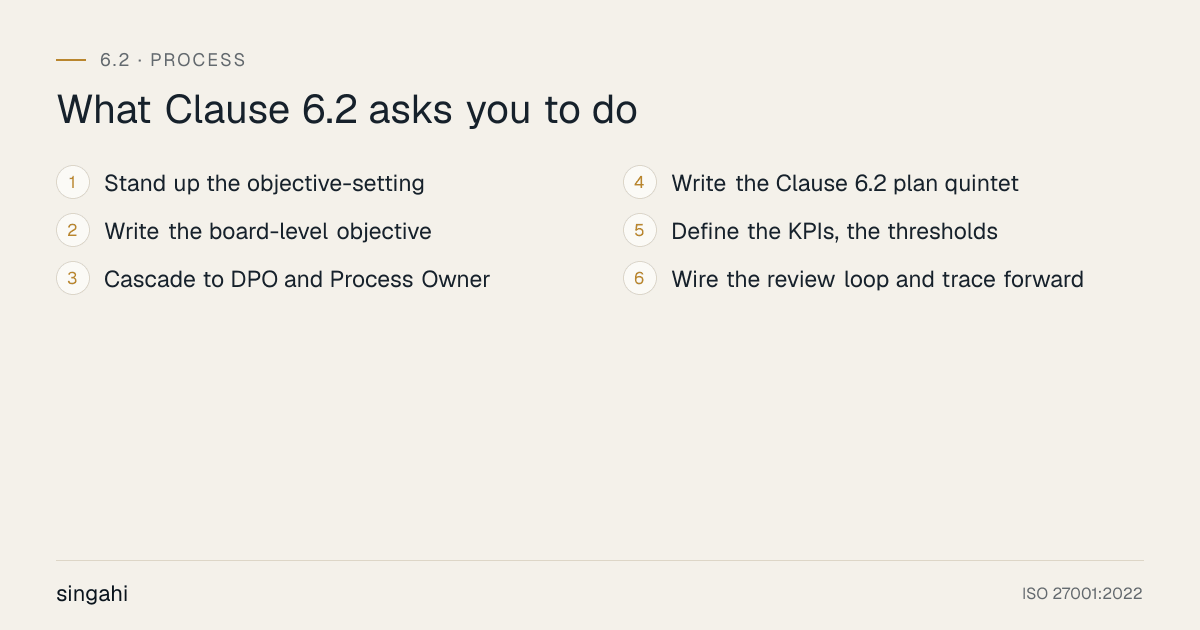
Move 1, Stand up the objective-setting workshop
Convene a half-day workshop with the executive sponsor (CEO/MD/COO), the DPO/Privacy Lead, and the Process Owners (typically the Heads of Customer Operations, HR, Procurement, IT/Engineering, Legal and Product). The workshop has four outputs: the board-level objective portfolio, the cascade architecture, the plan quintet for each board objective, and the review-cadence schedule. Use the Singahi toolkit template (doc 01) on a whiteboard or shared spreadsheet. Time-box each objective to ten minutes, name it, write the SMART statement, name the owner, identify the policy commitment and the risk-treatment decision it traces to, write the target, identify the KPI, move on. Quality over quantity is the discipline.
The workshop must start with the privacy policy (Clause 5.2), the privacy risk assessment (Clause 6.1.2) and the SoA (Clause 6.1.3) on the wall. Every objective must trace to a policy commitment and a risk-treatment decision. If the upstream clauses are not yet complete, the workshop must wait, setting objectives without policy and risk is guessing.
Move 2, Write the board-level objective portfolio
Three to seven objectives owned by top management. The Singahi practitioner pattern for Indian growing companies is to derive the board portfolio from the seven measurable-privacy families, picking the three to seven that carry the highest regulatory exposure or commercial weight. A typical compact portfolio:
- Breach-notification objective. "Achieve and maintain median breach-time-to-notify under 6 hours to CERT-In and under 72 hours to the DPDP Board across all in-scope breach scenarios through the calendar year." Traces to: DPDP section 8(6); CERT-In Directions 20(3)/2022-CERT-In; Clause 5.2 policy commitment to "reasonable security safeguards"; Clause 6.1.3 SoA row for the breach controls.
- DSAR-turnaround objective. "Achieve and maintain median DSAR turnaround under 30 days across all in-scope Data Principal rights categories through the calendar year." Traces to: DPDP sections 11 to 14 and section 13 grievance clock; Clause 5.2 policy commitment to "honouring Data Principal rights within prescribed periods"; Clause 6.1.3 SoA row for the rights controls.
- Consent-integrity objective. "Achieve and maintain median consent-revocation latency under 48 hours across all in-scope consent categories through the calendar year." Traces to: DPDP sections 5 and 6; Consent Manager ecosystem under DPDP section 2(1)(g); Clause 5.2 policy commitment to "consent as easy to withdraw as to give"; Clause 6.1.3 SoA row for the consent controls.
- DPIA-coverage objective. "Achieve and maintain 100 percent DPIA coverage of high-risk processing activities through the calendar year." Traces to: DPDP section 10 SDF DPIP; Clause 6.1.2 / 8.2 privacy risk assessment; Annex A.1.2.5 privacy impact assessment; Clause 5.2 policy commitment to "privacy by design and by default".
- Training-completion objective. "Achieve and maintain 100 percent privacy-training completion across in-scope staff and contractors through the calendar year, with role-specific modules for engineering, marketing, HR, customer operations and procurement." Traces to: Clauses 7.2 (competence) and 7.3 (awareness); Annex B normative guidance on training; Clause 5.2 policy commitment to "a trained workforce".
- Processor-coverage objective. "Achieve and maintain 100 percent DPA coverage of in-scope processors and sub-processors, with sub-processor change-notification latency under 10 business days, through the calendar year." Traces to: Annex A.2 processor controls; DPDP section 8 processor obligations; Clause 5.2 policy commitment to "accountable processing relationships".
- Retention-currency objective. "Achieve and maintain 100 percent retention-schedule currency across in-scope personal data through the calendar year, with end-of-purpose erasure cycle time under 30 days." Traces to: DPDP section 8(7) erasure; Clause 8 retention; Annex A.1.5 obligations; Clause 5.2 policy commitment to "data minimisation and purpose limitation".
The portfolio is approved by top management at the management-review input and signed by the sponsor.
Move 3, Cascade to DPO and Process Owner
For each board objective, the workshop produces one to three DPO-level sub-objectives and one to four Process Owner-level leaf objectives per DPO sub-objective. Take the breach-notification objective as the canonical example.
Board objective. "Achieve and maintain median breach-time-to-notify under 6 hours to CERT-In and under 72 hours to the DPDP Board across all in-scope breach scenarios through the calendar year."
DPO-level sub-objectives.
- DPO-1: "Maintain the dual-clock breach process documented and tested through two tabletop exercises per year, with 100 percent attendance by the breach-response team."
- DPO-2: "Maintain the breach register current with 100 percent of incidents logged within 24 hours of awareness."
- DPO-3: "Maintain the breach-notification template aligned to the DPDP Rules 2025 Rule 7 and the CERT-In format."
Process Owner-level leaf objectives.
- IT/Security-1: "Maintain median breach-detection time under 14 days across in-scope detection mechanisms."
- IT/Security-2: "Maintain median breach-containment time under 4 hours from awareness."
- IT/Security-3: "Maintain tabletop-exercise cycle time at two per year, with 100 percent attendance by the breach-response team and post-exercise action closure within 30 days."
- Legal-1: "Maintain the breach-notification template version-controlled, with annual review and event-trigger review on regulatory change."
- Customer Operations-1: "Maintain the affected-principal notification cycle under 7 days from awareness for incidents triggering principal notification."
Each leaf objective has a KPI, a baseline, a target, a threshold, a triggered action, and the Clause 6.2 plan quintet. The cascade reconciles: the leaf objectives feed the DPO sub-objectives which feed the board objective.
Move 4, Write the Clause 6.2 plan quintet per objective
For each leaf objective, the workshop records the Clause 6.2 plan quintet: the actions, the resourcing, the accountable owner, the completion date and the evaluation method. Take IT/Security-1 (median breach-detection time under 14 days) as the example.
- What will be done. Deploy a security-information-and-event-management (SIEM) platform with personal-data-aware use cases; integrate the SIEM with the in-scope data sources (database audit logs, application logs, network logs, endpoint detection and response); tune the use cases for personal-data-exfiltration patterns; configure alerting with a 30-minute escalation clock.
- Who will be responsible. Head of IT/Security (Process Owner); Security Engineering Lead (technical lead); DPO (privacy-requirements lead).
- When it will be completed. Deployment: end of Q2. Tuning: end of Q3. Steady-state operation: Q4 onward.
- How the results will be evaluated. Monthly metrics dashboard reporting median time-to-detect, percentage of in-scope data sources integrated, alert-to-action cycle time; quarterly DPO review of the metrics; annual management-review input.
The quintet is recorded on the Objective-Planning Worksheet (toolkit doc 03). The quintet is the artefact that converts the objective from a wish into a plan.
Move 5, Define the KPIs, the thresholds, the triggered actions
For each leaf objective, define the KPI (the metric), the threshold (the value at which a triggered action fires), and the triggered action (the Clause 10.2 / 10.1 event). Take IT/Security-1 as the example.
- KPI. Median breach-detection time in days, calculated as the median of the dwell times (time from breach occurrence to breach awareness) of detected incidents over the rolling 90-day window. Data source: the breach register.
- Baseline. Captured at the start of the cycle: median dwell time 21 days (typical Indian growing-company baseline in 2026, drawing on industry reporting).
- Target. Median dwell time under 14 days by end of Q3, sustained through Q4.
- Threshold. Median dwell time exceeds 14 days for two consecutive monthly readings.
- Triggered action. The DPO convenes a Clause 10.2 corrective-action review with the Head of IT/Security; the root-cause analysis identifies the detection gap; a corrective action is recorded with a target date and a closure criterion.
- Reporting channel. Monthly metrics dashboard (Clause 9.1); quarterly DPO review; annual management-review input (Clause 9.3).
The Singahi Metrics-and-KPI Dashboard template (toolkit doc 11) captures the KPIs, the baselines, the targets, the thresholds and the triggered actions for the entire Register.
Move 6, Wire the review loop and trace forward
The review loop is wired into the calendar through specific events. Monthly: the metrics dashboard is produced and the thresholds are tested; breached thresholds fire the triggered actions. Quarterly: the DPO reviews the Register with the Process Owners in a light-touch check-in; drift is discussed; corrective actions are tracked. Annually: the Register is the management-review input (Clause 9.3); board objectives are reviewed by top management; DPO and Process Owner objectives are reviewed for relevance; targets are recalibrated against the year's baselines and the regulatory landscape; the cascade is reconciled.
The event-trigger reviews fire between the calendar reviews. Material event triggers include: a material breach or incident; a material regulatory change (DPDP Rules sub-notification, sector-regulator circular); a material operational change (M&A, new product, new geography, new processor); a major nonconformity from internal or external audit; a board request. Each event-trigger review produces a Register update recorded in the Objective-Change Log (toolkit doc 12).
The review loop is documented in the Singahi Review-Cadence Schedule template (toolkit doc 04, with cadence embedded). Each event is tagged to its PDCA phase; the loop is closed at the annual management review with explicit Register updates. Trace forward: each Register update traces to a metric change; each metric change traces to a cascade reconciliation; each cascade reconciliation traces to a board communication. The Register is the loop, not the static list.
Worked example, Karaa Payments SaaS, cascaded objectives
To make the six moves concrete, consider Karaa Payments (a fictional Mumbai-based payment-aggregator SaaS vendor selling to mid-market Indian merchants). Karaa Payments's first 6.2 workshop surfaced:
- Board portfolio (5 objectives). Breach-notification (dual-clock); DSAR-turnaround (under 30 days); consent-integrity (revocation under 48 hours); DPIA-coverage (100 percent of high-risk); processor-coverage (100 percent DPA, 10-day change-notification). The training-completion and retention-currency objectives were added in year 2.
- DPO-level cascade (12 sub-objectives). Each board objective cascaded to two to three DPO sub-objectives (process, register, template).
- Process Owner-level cascade (28 leaf objectives). IT/Security (7); Customer Operations (5); Marketing (4); Procurement (4); Legal (4); HR (2); Product (2). Each leaf objective had a KPI, a baseline, a target, a threshold, a triggered action and the Clause 6.2 plan quintet.
- Review cadence. Monthly metrics (DPO-produced dashboard); quarterly light-touch (DPO with Process Owners); semi-annual DPO review; annual management-review; event-trigger reviews for regulatory change, audit findings and incidents.
- Cross-references. The Register cross-referenced the privacy policy (Clause 5.2), the risk register (6.1.2), the SoA (6.1.3), the operational records (Clause 8), the metrics dashboard (9.1) and the management-review pack (9.3). Every objective traced backward and forward.
The total first-cycle effort: 8 weeks of internal time plus external advisory; the resulting Register passed Stage 1 audit at first attempt, with the auditor commending the cascade as "unusually disciplined for a growing company."
The DPDP-first emphasis in more depth
The Singahi DPDP-first emphasis for Clause 6.2 means that the seven measurable-privacy families are calibrated to the DPDP clocks and design properties, not to generic privacy best-practice. Specific load-bearing calibrations:
- The DSAR-turnaround objective target is set with reference to the DPDP section 13 grievance response clock (prescribed period in the Rules) and the 30-day general expectation, not to a generic "industry benchmark".
- The breach-time-to-notify objective target is set with reference to the CERT-In 6-hour clock and the DPDP 72-hour clock, not to a generic "72 hours" that ignores the Indian dual-clock pattern.
- The consent-revocation latency objective target is set with reference to the DPDP Consent Manager interoperability design (consent as easy to withdraw as to give), not to a generic opt-out honour rate.
- The DPIA-coverage objective target is set with reference to the DPDP section 10 SDF DPIP obligation, not to a generic "high-risk processing" definition.
- The training-completion objective target is set with reference to the DPDP Rules 2025 awareness expectations and the Annex B normative training guidance, not to a generic "annual privacy training".
- The processor-coverage objective target is set with reference to the Annex A.2 mandatory DPA terms and the DPDP section 8 processor obligations, not to a generic "vendor due diligence".
- The retention-currency objective target is set with reference to the DPDP section 8(7) erasure obligation and the Rules' 48-hour pre-erasure notice, not to a generic "data minimisation".
The DPDP-first calibration is the wedge. An Indian Data Fiduciary's Privacy Objectives Register that is calibrated to the DPDP clocks and design properties is more defensible than a generic globalised Register that ignores the Indian regulatory reality.
Tools, Technologies, and Solutions
The tool categories
Privacy-management platforms (PMP). The category that operationalises most of the seven measurable-privacy families, DSAR workflow, consent management, DPIA workflow, processor management, breach workflow, retention. A single PMP can produce the data for four to six of the seven families directly. Generic descriptions: a privacy-management platform that runs the DSAR workflow, captures and honours consent, supports the DPIA workflow, manages the processor register, runs the breach workflow, automates the retention schedule, and produces the metrics for the dashboard.
GRC (Governance, Risk, Compliance) platforms. Broader than a PMP; covers risk register, audit management, policy management, corrective-action tracking, management-review input, objectives and KPI tracking. A GRC platform can host the Privacy Objectives Register as a structured artefact and run the review-cadence calendar.
OKR (Objectives and Key Results) platforms. A focused tool for the cascade discipline, board to DPO to Process Owner, with KPI tracking, threshold alerts, and review-cadence scheduling. Some organisations use a general-purpose OKR platform (the same one used for sales, engineering and finance OKRs) to host the privacy objectives; the discipline here is to ensure the privacy objectives are tagged as privacy-specific and reviewed by the DPO.
Business-intelligence (BI) dashboards. A general-purpose tool (spreadsheet, BI platform) for the metrics dashboard (Clause 9.1). Most Indian growing companies start with a spreadsheet and graduate to a BI platform as the volume of KPIs grows.
Consent-management platforms (CMP). A focused tool for the consent family, capture, record, version, propagate, honour withdrawal, integrate with the DPDP Consent Manager ecosystem. Produces the data for the consent-revocation latency KPI.
DSAR workflow tools. A focused tool for the rights family, receive, verify, route, retrieve, review, fulfil, document. Produces the data for the DSAR-turnaround KPI.
Incident-response and breach-notification platforms. A focused tool for the breach family, detect, contain, eradicate, assess, notify (with the dual-clock template), recover, post-incident review. Produces the data for the breach-time-to-notify KPI.
Learning-management systems (LMS). A focused tool for the training family, deliver, track, assess, report on training completion. Produces the data for the training-completion KPI.
Selection criteria
Select on: India-DPDP coverage (most global platforms are GDPR-heavy and DPDP-thin); Consent Manager integration readiness (the ecosystem is emerging through 2026/2027); dual-clock breach-notification template (6-hour CERT-In and 72-hour DPDP Board); Register-to-SoA reconciliation capability (the load-bearing feature for the cascade); OKR platform flexibility (the privacy cascade is not a generic sales OKR pattern); primary-source discipline; integration with the existing GRC stack; and cost-to-value for the Indian growing-company segment.
Build vs buy
Most growing companies should buy a PMP (or a GRC platform with PMP features) and build the Register artefact (the Register, the cascade, the plan quintets, the review-cadence schedule) in-house with external advisory for the first cycle. The Register is too organisation-specific to outsource end-to-end; the operational data is too time-intensive to capture manually at scale.
Indicative cost ranges (India, mid-market, annual)
Policy and Procedure Templates
Privacy Objectives Policy (sample of our own drafting)
The organisation establishes, maintains and continually improves a Privacy Objectives Register as the primary artefact for ISO/IEC 27701:2025 Clause 6.2. The Register records privacy objectives at the board, DPO and Process Owner levels, with SMART statements, baselines, targets, KPIs, thresholds, triggered actions, Clause 6.2 plan quintets, review cadences and version history. Each objective traces backward to the privacy policy (Clause 5.2) and the privacy risk treatment (Clause 6.1.3) and forward to the metrics dashboard (Clause 9.1) and the management-review input (Clause 9.3). The Register is approved by top management at the annual management-review input and updated on the calendar cycle and on event triggers. The DPO owns the Register as an artefact; the Process Owners own the operational objectives end-to-end. The Register operationalises the organisation's commitments as a Data Fiduciary and/or Data Processor under the DPDP Act 2023, the DPDP Rules 2025, and other applicable privacy and data-protection instruments.
Objective-setting and planning procedure (sample of our own drafting)
The DPO convenes the objective-setting workshop annually in Q1, with the executive sponsor, the DPO and the Process Owners in attendance. The workshop reviews the privacy policy (Clause 5.2), the privacy risk register (Clause 6.1.2) and the SoA (Clause 6.1.3); reviews the previous cycle's performance; revises the board-level portfolio; cascades to DPO and Process Owner levels; records the Clause 6.2 plan quintet per objective; defines the KPIs, the thresholds and the triggered actions; wires the review cadence. The workshop output is the Privacy Objectives Register v.YY, approved by the sponsor and communicated to the Process Owners. The Register is updated on the calendar cycle (monthly metrics, quarterly light-touch, annual management-review) and on event triggers (material breach, regulatory change, M&A, audit nonconformity, board request). Each update is recorded in the Objective-Change Log.
Process Owner accountability for objectives (sample of our own drafting)
Each Process Owner is accountable for the end-to-end achievement of the leaf objectives assigned to them. The accountability includes: the SMART statement of the objective; the Clause 6.2 plan quintet (what / resources / who / when / how-evaluated); the operational execution of the plan; the documented information the plan generates; the KPI measurement (data source, cadence, reporting); the threshold monitoring and the triggered action; the audit-evidence the objective produces; and the cascade reconciliation upward to the DPO objective and the board objective. The Process Owner reports to the DPO on objective performance monthly through the metrics dashboard and quarterly through the Process Owner check-in, and to top management at the management review annually. The Process Owner is resourced with the people, tools and budget the plan quintet commits.
Cascade management (sample of our own drafting)
Each board objective has a documented cascade to one to three DPO sub-objectives and one to four Process Owner leaf objectives per DPO sub-objective. Each leaf objective traces upward through the cascade to the board objective. The DPO maintains the cascade map as part of the Register and reconciles the cascade at every Register update. Cascade changes (a new sub-objective added, an existing leaf retired, a cascade relationship revised) are recorded in the Objective-Change Log with the trigger and the rationale. The cascade is tested at the annual management-review by sampling: pick a board objective, walk the cascade down to the leaf objectives and confirm each leaf is being measured; pick a leaf objective, walk the cascade up to the board objective and confirm the trace is intact.
Threshold-triggered action procedure (sample of our own drafting)
Each leaf objective has a documented threshold and a documented triggered action. When a KPI breaches its threshold for the prescribed duration (typically two consecutive monthly readings), the triggered action fires: the DPO convenes a Clause 10.2 corrective-action review with the Process Owner; the root-cause analysis identifies the underlying cause; a corrective action is recorded with a target date and a closure criterion; the corrective action is tracked to closure; the closure is recorded in the Register with the measured effect on the KPI. The threshold-triggered action is the operational mechanism by which the Clause 6.2 review loop is closed.
Objective-Change Log entry template (sample of our own drafting)
For each Register update, the DPO records: the date; the trigger (annual cycle, event trigger, regulatory change, audit finding, breach, board request); the change (objective added, revised, retired; SMART statement edited; target revised; threshold revised; owner reassigned; cascade revised); the authorising person (DPO, sponsor, board); the cross-reference to the management-review minute (where the change was approved). The Log is reviewed monthly by the DPO, quarterly by the Process Owners, annually at the management review. The Log is the Documented Information record of the "communicated and updated as appropriate" requirement.
Register review and update (sample of our own drafting)
The DPO reviews the Register annually at the management review (Clause 9.3) and on every material event trigger (Clause 6.3), including: a material change in context (Clause 4.1); a material change in scope (Clause 4.3); a material regulatory change (DPDP Rules sub-notification, sector-regulator circular); a material operational change (M&A, new product, new geography, new processor); a major nonconformity from internal or external audit; a major incident. Each Register update is version-controlled under Clause 7.5 and communicated to the Process Owners and top management under Clause 7.4. The Register is the load-bearing Documented Information artefact of Clause 6.2.
Cross-framework reconciliation statement (sample)
The Privacy Objectives Register is reconciled with the ISO/IEC 27001:2022 ISMS objectives register (where one exists, at the shared board-level objectives and the shared review cadence); with the GDPR Article 24(1) review-and-update cycle (where the organisation processes EU/EEA personal data); with the NIST Privacy Framework v1.0 Govern-P goal-setting pattern (where the organisation serves US customers); and with the SOC 2 Common Criteria CC3.2 (where the organisation pursues SOC 2 attestation). Discrepancies across the reconciliations are recorded and managed.
Risk Assessment and Treatment
The 6.2 Register does not itself produce a risk assessment, that is Clause 6.1.2 / 8.2, but it produces the measurable performance dimension by which the risk-treatment effectiveness is judged. Every Clause 6.2 objective is a measurement of a Clause 6.1.3 risk-treatment decision; every KPI is a window into whether the control is working. The risk treatment is therefore: design the system (Clause 4.4), identify the in-system risks (Clause 6.1.2), treat the risks under Clause 6.1.3 / 8.3, measure the treatment's effect through Clause 6.2 objectives, learn through Clause 10.2 / 10.1.
The 6.2-specific risks include: the Register is a list of aspirations (no SMART, no baselines, no targets); the cascade is missing or flat (no DPO or Process Owner level); the plan quintet is incomplete (no what / resources / who / when / how-evaluated); the KPIs are not wired to thresholds and triggered actions (the loop is open); the trace backward to policy and risk treatment is broken (orphan objectives); the review cadence is not wired (no monthly, quarterly, annual, event-trigger); the Objective-Change Log is empty (the Register is not learning); the cross-references to Clause 5.2, 6.1.3, 8, 9.1, 9.3 are missing (the Register is an island).
The 6.2 risk register
| Risk | Source | Likelihood | Impact | Treatment |
|---|---|---|---|---|
| Register is a list of aspirations | No SMART discipline; objectives copied from the policy | High | Major NC | Move 2; the SMART template (doc 01) |
| Cascade missing or flat | DPO-only workshop; Process Owners not consulted | High | Major NC | Move 3 with all Process Owners in the workshop |
| Plan quintet incomplete | Workshop produced objectives but not plans | High | Major NC | Move 4; the Objective-Planning Worksheet (doc 03) |
| KPIs not wired to thresholds | Metrics exist but no triggered actions | High | Major NC | Move 5; the Metrics-KPI Dashboard (doc 11) |
| Trace backward broken | Objectives do not trace to policy or risk treatment | Medium | Major NC | Move 1 backward trace; the cross-reference map (doc 01) |
| Review cadence not wired | Calendar not blocked for monthly / quarterly / annual | High | Major NC | Move 6; the Review-Cadence Schedule |
| Objective-Change Log empty | The Register is not being updated | Medium | Major NC | Move 6; the Objective-Change Log (doc 12) |
| Trace forward broken | Objectives do not feed the dashboard or the management review | High | Major NC | Move 6 forward trace; the management-review pack |
| Cross-references missing | The Register is an island | Medium | Minor NC | The cross-reference map (doc 01) |
| DPDP clocks not reflected | Generic globalised targets; Indian dual-clock ignored | High | Major NC | Move 2 DPDP-first calibration |
| Cascade not reconciled | Leaf objectives do not add up to the board objective | Medium | Minor NC | Move 3 reconciliation step |
| Process Owner lacks resources | Quintet names resources the Process Owner does not have | Medium | Major NC | Resourcing per objective; the FTE allocation review |
| Categorical objective misused | Categorical (zero-event) objective used where continuous is feasible | Low | Minor NC | The seven-family discipline |
| Stretch target unachievable | Aspirational target with no plan to reach it | Medium | Minor NC | The Achievable test in SMART |
| Threshold too loose or too tight | Drift not detected, or false positives | Medium | Minor NC | The threshold calibration workshop |
| Event-trigger reviews not fired | Register stale between annual cycles | High | Major NC | The event-trigger mechanism |
| Register-SoA disconnect | Register objectives not aligned with the SoA | Low | Minor NC | SoA reconciliation on every Register update |
| Register-Charter disconnect | Register does not reflect the PIMS Charter architecture | Low | Minor NC | Charter reconciliation on every Register update |
Treatment priorities
The high-impact, high-likelihood risks to treat first are: the list-of-aspirations Register (drives major nonconformities); the missing plan quintet (objectives are wishes, not plans); the unwired KPI thresholds (the loop is open); the broken forward trace (the management review has nothing to evaluate); the missing DPDP calibration (targets are generic). These five risks account for most of the 6.2 audit nonconformities in the Indian growing-company segment. Treat them through the six-move discipline plus the dedicated Process Owner role plus the cross-reference map.
The Register-to-operation reconciliation
The mechanism that keeps the Register (design) and the operational records (implementation) consistent is the Register-to-operation reconciliation, performed at every Register review and at every annual review. The reconciliation checks: every objective in the Register has an operational Process Owner with FTE allocation; every objective in the Register has operational data feeding the KPI; every operational privacy process has a Register objective measuring it; every cascade trace is intact (leaf to DPO to board); every review event has been run on schedule. The reconciliation is the audit-evidence artefact that proves the Register is not fiction, without it, the Register is designed but not implemented.
Audit and Compliance Checklist
The 28 questions below cover the audit-evidence surface for Clause 6.2. Expected evidence and red flags noted. Most can be answered from the toolkit doc 04 audit-evidence checklist.
- Is there a Privacy Objectives Register? Expected: dated, version-controlled, signed by top management. Red flag: missing.
- Is the Register approved under Clause 5.1 leadership? Expected: top-management signature on file.
- Does each objective have a SMART statement (Specific, Measurable, Achievable, Relevant, Time-bound)?
- Does the Register cover the relevant functions and levels (board, DPO, Process Owner)?
- Does the Register include three to seven board objectives, eight to fifteen DPO objectives, twenty to forty Process Owner objectives?
- Does each objective trace backward to a Clause 5.2 privacy-policy commitment? Expected: the cross-reference recorded per objective.
- Does each objective trace backward to a Clause 6.1.3 risk-treatment decision? Expected: the SoA row recorded per objective.
- Does each objective trace forward to a Clause 9.1 metrics-dashboard KPI? Expected: the KPI recorded per objective.
- Does each objective trace forward to a Clause 9.3 management-review input? Expected: the review pack cross-reference.
- Is the cascade documented (board to DPO to Process Owner)? Expected: the cascade visual.
- Is the cascade reconciled at every Register update? Expected: reconciliation evidence in the version history.
- For each leaf objective, is the Clause 6.2 plan quintet recorded (what / resources / who / when / how-evaluated)?
- Is the named owner a real person with FTE allocation? Expected: the RACI per objective.
- Is the milestone date specific (not "Q3" but "30 September")? Expected: the date per objective.
- Does each leaf objective have a baseline, a target, a threshold and a triggered action?
- Does the triggered action fire on threshold breach? Expected: the corrective-action records.
- Is the review cadence wired (monthly metrics, quarterly light-touch, annual management-review)?
- Is the event-trigger review mechanism defined and operational? Expected: triggers fired since the last review.
- Is the Objective-Change Log populated with real revisions and triggers?
- Does the Log capture trigger, change, authoriser, cross-reference to the management-review minute?
- Are DPDP clocks and design properties reflected in the targets? Expected: CERT-In 6-hour, DPDP 72-hour, section 13 grievance, Consent Manager, SDF DPIP.
- Are sector-specific targets reflected where applicable (RBI, SEBI, IRDAI, CERT-In)?
- Is the Register reconciled with the SoA (Clause 6.1.3)? Expected: every objective traces to an SoA row.
- Is the Register reconciled with the PIMS Charter (Clause 4.4)? Expected: every objective traces to a process.
- Is the Register reconciled with the ISO/IEC 27001 ISMS objectives (where one exists)? Expected: shared board-level objectives.
- Are categorical objectives used appropriately (zero-event, board-level)? Expected: the seven-family discipline.
- Is the Register in the board pack (for listed entities / SDFs)? Expected: board-minute noting.
- Is the Register a Documented Information artefact under Clause 7.5? Expected: version history, approval workflow.
Evidence the auditor will physically request
- The dated and signed Privacy Objectives Register.
- The cascade diagram (the one-page visual).
- The Objective-Planning Worksheet for a sampled objective (the Clause 6.2 plan quintet).
- The Objective-Change Log.
- The Review-Cadence Schedule with calendar invites / minutes from past reviews.
- The metrics-dashboard extracts for the last 12 months (Clause 9.1 evidence).
- The management-review pack where the Register summary appears.
- The board / RMC pack where the Register summary appears (for listed / SDF).
- The cross-reference map (objective to policy, to SoA, to dashboard, to management-review).
- The threshold-triggered action records (Clause 10.2 evidence).
- The Documented Information control record (version history, approval workflow).
- The Process Owner RACI per objective.
Common Stage-1 nonconformities the auditor will write up
- NC pattern 1: Register exists but is a list of aspirations with no SMART statements. Major NC. Remediation: six-move refresh, 4 to 8 weeks.
- NC pattern 2: Cascade missing or flat. Major NC. Remediation: workshop with all Process Owners, 2 to 4 weeks.
- NC pattern 3: Plan quintet incomplete. Major NC. Remediation: quintet workshop, 2 to 4 weeks.
- NC pattern 4: KPIs not wired to thresholds and triggered actions. Major NC. Remediation: the Metrics-KPI Dashboard, 2 to 3 weeks.
- NC pattern 5: Trace backward broken (orphan objectives). Minor to major NC. Remediation: the cross-reference map, 1 to 3 weeks.
- NC pattern 6: Review cadence not wired. Minor NC. Remediation: calendar wiring and event scheduling, 1 to 2 weeks.
- NC pattern 7: Register-operation disconnect. Major NC. Remediation: reconciliation workshop, 3 to 6 weeks.
Metrics and KPIs
Figure · Measures
The measures that show Clause 6.2 is working
- Register currency100%Periodic
- Event-trigger review latencyunder 15 daysPeriodic
- Objective coverage100%Periodic
- Risk-treatment coverage100%Periodic
- Cascade completeness100%Periodic
The 15 KPIs below cover the measurable surface of Clause 6.2 itself (i.e., how well the Register is operating as a Clause 6.2 artefact) plus the seven measurable-privacy families (the substantive KPIs the Register measures).
Meta-KPIs (the Register as a system):
- Register currency, percentage of objectives reviewed within the last 12 months. Target: 100%.
- Event-trigger review latency, median time from trigger event to Register update. Target: under 15 days.
- Objective coverage, percentage of Clause 5.2 policy commitments with at least one operational objective. Target: 100%.
- Risk-treatment coverage, percentage of Clause 6.1.3 SoA rows with at least one objective measuring the control. Target: 100%.
- Cascade completeness, percentage of board objectives with a documented cascade to DPO and Process Owner levels. Target: 100%.
- Plan quintet completeness, percentage of leaf objectives with the full Clause 6.2 plan quintet recorded. Target: 100%.
- KPI-threshold wiring, percentage of leaf objectives with a threshold and a triggered action. Target: 100%.
- Objective-Change Log volume, count of Register updates per quarter. Target: trend upward; at least 4 per quarter for a growing firm.
- Threshold-triggered action closure rate, percentage of triggered actions closed within target. Target: above 80%.
Substantive KPIs (the seven measurable-privacy families):
- DSAR turnaround, median days from DSAR receipt to response. Target: under 30 days (DPDP section 13).
- Consent-revocation latency, median hours from consent withdrawal to downstream-system update. Target: under 48 hours.
- Breach time-to-notify (CERT-In clock), median hours from awareness to CERT-In notification. Target: under 6 hours.
- Breach time-to-notify (DPDP clock), median hours from awareness to DPDP Board notification. Target: under 72 hours.
- DPIA coverage of high-risk processing, percentage of high-risk processing activities with a current DPIA. Target: 100%.
- Training completion, percentage of in-scope staff and contractors with current privacy training. Target: 100%.
Additional family-level KPIs (subprocessor coverage, retention currency, privacy-by-design coverage) are tracked at the Process Owner level and roll up to the DPO level for the management-review summary.
Common Pitfalls and Audit Failures
Pitfall 1, The list-of-aspirations Register. A Register that copies the privacy-policy commitments and labels them "privacy objectives" without SMART statements, baselines or targets. The single most common 6.2 audit failure. Treatment: the six-move method; the SMART template (toolkit doc 01).
Pitfall 2, The DPO-only workshop. The objective-setting workshop is convened with only the DPO and a junior Legal counsel in the room. Misses the Process Owner inputs that produce the leaf objectives. Treatment: cross-functional workshop with sponsor attendance.
Pitfall 3, The missing cascade. The Register has ten objectives all owned by the DPO at the same level. The "at relevant functions and levels" requirement is not met. Treatment: the three-level cascade (board → DPO → Process Owner).
Pitfall 4, The missing plan quintet. Each objective has a target but no Clause 6.2 plan (what / resources / who / when / how-evaluated). The objective is a wish, not a plan. Treatment: the Objective-Planning Worksheet (doc 03) per leaf objective.
Pitfall 5, The unwired KPI threshold. The Register has KPIs but no thresholds and no triggered actions. The loop is open; drift is not detected. Treatment: the Metrics-KPI Dashboard (doc 11) with thresholds and triggered actions per KPI.
Pitfall 6, The orphan objective. An objective that does not trace backward to the policy or the risk treatment. Treatment: the cross-reference map (doc 01); the backward-trace test in Move 1.
Pitfall 7, The orphan KPI. A KPI on the metrics dashboard that is not linked to an objective. The dashboard has data but no planning context. Treatment: the forward-trace test; every KPI traces to an objective.
Pitfall 8, The unwired review cadence. The Register has a review-cadence section but the calendar events have not been scheduled. Treatment: calendar wiring with named events and invitees.
Pitfall 9, The empty Objective-Change Log. The Log exists but has no entries. The Register is not learning. Treatment: seed the Log from the previous 12 months of regulatory changes, audit findings, incidents, metric-threshold breaches.
Pitfall 10, The generic globalised target. A breach-time-to-notify target of "72 hours" that ignores the CERT-In 6-hour clock. Treatment: DPDP-first calibration; the seven families calibrated to the Indian regulatory reality.
Pitfall 11, The unachievable stretch target. A target set without reference to the baseline or the resources. Treatment: the Achievable test in SMART; the plan quintet resources review.
Pitfall 12, The categorical-misuse objective. A categorical (zero-event) objective used where a continuous objective is feasible (and would produce richer learning). Treatment: the seven-family discipline; categorical objectives reserved for genuine zero-event commitments.
Pitfall 13, The unresourced Process Owner. The plan quintet names resources the Process Owner does not have. Treatment: the FTE allocation review per objective.
Pitfall 14, The un-exercised threshold. A threshold has been set but has never been breached (or has been breached silently without triggering the action). Treatment: drills that simulate threshold breaches; the threshold-triggered action tested.
Pitfall 15, The Register-SoA disconnect. The Register's objectives do not align with the SoA's controls. Treatment: SoA reconciliation on every Register update.
Pitfall 16, The Register-Charter disconnect. The Register's objectives do not align with the PIMS Charter's processes. Treatment: Charter reconciliation on every Register update.
Pitfall 17, The stale Register. The Register has not been updated since a material change in context, scope, risk or regulation. Treatment: the event-trigger review mechanism.
Pitfall 18, The unrecorded Register decisions. Material Register decisions are made in meetings and emails but not recorded in the version history. Treatment: the Documented Information discipline of Clause 7.5 applied to the Register.
Pitfall 19, The board-invisible Register. The Register has never been seen by the board. For SDFs and listed entities, a governance gap. Treatment: board pack inclusion of the board-level objectives and the cascade summary.
Pitfall 20, The metric-without-trend trap. The Register reports the current KPI value but not the trend. The management review cannot judge drift. Treatment: trend reporting on every KPI; the dashboard shows baseline, current, target and trend.
Pitfall 21, The improvement-without-closure trap. The Log has open entries but no closures. The Register generates opportunities but does not deliver improvements. Treatment: closure-rate KPI (KPI 9).
Pitfall 22, The Consent Manager integration gap. The consent-revocation latency objective is designed for an in-house consent platform but not for the DPDP Consent Manager ecosystem. Treatment: Consent Manager integration readiness review.
Pitfall 23, The AI-processing DPIA gap. The DPIA-coverage objective does not fire on AI/ML deployment because the high-risk inventory predates the AI wave. Treatment: AI-processing inventory and DPIA-trigger review.
Pitfall 24, The dual-clock blind spot. The breach-time-to-notify objective references the 72-hour DPDP clock but not the 6-hour CERT-In clock (or vice versa). Treatment: the dual-clock target in the breach family.
Illustrative Scenario 1: Failure, Atulyam Health with Aspirational Objectives (Illustrative)
Illustrative scenario, a composite example for guidance, not a specific Singahi engagement or a verified outcome.
Illustrative scenario. Atulyam Health is a fictional Bengaluru-based healthtech company; the facts are composite from publicly reported incident patterns and should not be attributed to any real organisation.
Atulyam Health built its PIMS in 2023, ahead of an ISO/IEC 27701:2019 certification push. The Privacy Objectives Register was a one-page document attached to the privacy policy. It contained six objectives, all phrased as commitments: "maintain the privacy of patient data"; "honour Data Principal rights"; "notify breaches as required"; "perform DPIAs where appropriate"; "train staff on privacy"; "manage processors appropriately". The Register had no SMART statements, no baselines, no targets, no thresholds, no triggered actions, no plan quintets, no cascade. The certification body's Stage 1 audit in 2023 wrote a minor nonconformity on Clause 6.2 for the lack of measurability; the organisation closed the minor with a Commitment that the Register would be "refreshed before the next surveillance"; the certificate was issued in early 2024.
Between 2024 and 2026 the operational landscape shifted materially. Atulyam launched a new B2B2C telemedicine product line processing sensitive patient health data through a partner hospital, a high-risk processing activity requiring DPIA treatment. Atulyam onboarded a US-based medical-image analytics sub-processor. Atulyam acquired a smaller clinic chain, Atharva Clinics, whose patient-data processes were not integrated into the group PIMS. The DPDP Rules 2025 were notified on 13 November 2025, introducing the 72-hour breach clock, the verifiable-parental-consent regime for children's data, the prescribed SDF thresholds, and the section 13 grievance response period. ISO/IEC 27701:2025 was published on 14 October 2025, making Annex B normative and aligning Clause 6.2 to the harmonized structure.
The Register was not updated. No event-trigger review fired. The annual management review noted the Register as "current" because none of the Process Owners surfaced the operational changes to the DPO.
In May 2026 a misconfigured storage bucket on the US-based medical-image analytics sub-processor exposed approximately 65,000 patient health records, including an estimated 4,200 records of patients under 18. The breach was discovered by a security researcher at 02:00 IST on a Saturday. The post-incident examination found: there was no documented breach-time-to-notify objective, only a generic commitment; the duty manager did not know whether to call CERT-In, the DPDP Board, both, or neither; the CERT-In notification was made on Monday morning, 56 hours after awareness; the DPDP Board notification was made on Tuesday, 96 hours after awareness, missing the 72-hour clock; the affected principals were not notified for three weeks. The DSAR turnaround for the affected principals stretched to 45 days because the rights process had no measurable target. The DPIA for the new telemedicine processing had not been performed, so the DPIA-coverage objective (had it existed) would have shown zero. The training-completion for the customer-operations team handling the incident response was 67 percent, with no target on record.
The Data Protection Board's preliminary inquiry identified the aspirational Register as the root cause, the PIMS had no measurable performance story to drive the operational discipline. The Schedule penalty exposure for section 8(5) and section 8(6) failure ran to 250 crore and 200 crore rupees respectively (maxima); the section 9 children's-data failure added a further 200 crore exposure. The certification body issued a major nonconformity on Clause 6.2 at the next surveillance audit, cascading into nonconformities on 9.1 (Monitoring, no measurable outcomes), 9.3 (Management Review, nothing to evaluate), 10.2 (Corrective Action, no corrective actions triggered by missed objectives), and 10.1 (Continual Improvement, empty Log). Atulyam's certificate was suspended pending remediation.
The lessons: an aspirational Register is a liability; the SMART statement is the cure; the cascade is the discipline; the plan quintet is the proof; the threshold-triggered action is the loop; the DPDP-first calibration is the wedge; the cross-references to the policy, the SoA, the dashboard and the management review are the system property.
Illustrative Scenario 2: Success, Karaa Payments Builds a Cascaded Privacy-Objectives Set (Illustrative, with ROI)
Illustrative scenario. Karaa Payments is a fictional Mumbai-based payment-aggregator SaaS vendor; the facts are composite from publicly reported sector patterns and should not be attributed to any real organisation.
Karaa Payments, a payment aggregator with 320 staff and 18,000 merchants, ran an integrated ISO/IEC 27001:2022 + ISO/IEC 27701:2019 programme. The Clause 6.2 Register in 2024 was a list of seven aspirations, all DPO-owned. The DPO (a former Big-4 privacy consultant hired in 2024) had been pushing for a cascaded, measurable Register since joining; the 27701:2025 transition was the lever.
In Q4 2025 the DPO commissioned a 6.2 Register refresh ahead of the 27701:2025 transition. The workshop surfaced six material Register shifts:
- The Register was re-constituted as a cascade of 5 board objectives, 12 DPO sub-objectives and 28 Process Owner leaf objectives, each with a SMART statement, a baseline, a target, a threshold, a triggered action and the Clause 6.2 plan quintet.
- The seven measurable-privacy families were represented at the board level, DSAR turnaround (under 30 days), consent-revocation latency (under 48 hours), breach-time-to-notify (under 6 hours CERT-In and 72 hours DPDP), DPIA coverage (100 percent of high-risk), training completion (100 percent), subprocessor coverage (100 percent with 10-day change-notification), retention currency (100 percent with 30-day erasure).
- The cascade was reconciled at every update: pick a board objective, walk down to the leaves; pick a leaf, walk up to the board.
- The review cadence was wired: monthly metrics dashboard produced by the DPO; quarterly Process Owner check-ins; semi-annual DPO review; annual management-review; event-trigger reviews for regulatory change, audit findings and incidents.
- The Objective-Change Log was seeded with 11 entries from the previous 12 months (3 regulatory changes, 4 metric-threshold breaches that would have fired triggered actions if the thresholds had existed, 2 audit findings, 1 incident, 1 board request).
- The breach family was exercised through a tabletop drill, the drill exposed two gaps (the duty-manager escalation chain was unclear for weekend incidents; the CERT-In notification template predated the April-2022 Directions) that were closed within 30 days.
The ROI: the cascaded Register saved approximately 18 lakh rupees per year in audit-effort through the single integrated surveillance cycle (the auditor sampled objectives at random and walked them forward and backward without a single disconnect); the SDF-readiness work (Karaa's volume of customer data placed it above the SDF thresholds expected in the notified Rules) positioned Karaa to face the section 10 designation with the DPIP-coverage objective already at 100 percent; the breach drill closed two gaps that would have produced major nonconformities on Clause 8 and Clause 6.2 at the next surveillance audit; the DSAR drill produced a self-service DSAR portal design that reduced the median DSAR turnaround from 35 days to 12 days; the cascaded Register gave top management a visible PIMS-learning artefact that had never existed before. Annualised saving: approximately 18 lakh rupees in audit-effort, plus the avoided DPDP penalty exposure (maxima 250 crore rupees for section 8(5) failure, 200 crore for section 8(6) failure). Payback: under 16 months on the direct saving alone.
The lessons: a structured Register refresh surfaces high-value cascade decisions; the seven-family portfolio is the dominant pattern for SaaS / ITeS firms; the dual-clock breach drill is the single highest-yield exercise in the Register; the Objective-Change Log is the most visible Register artefact for top management; the cascaded Register is the difference between a wish-list and a programme.
Multi-Framework Mapping
| 27701:2025 6.2 theme | GDPR article | DPDP Act (India) section | NIST Privacy Framework | SOC 2 TSC | ISO 27001:2022 / 27002 | ISO 29100 principle |
|---|---|---|---|---|---|---|
| Set measurable privacy objectives | Art 5(2) accountability; Art 24(1) measures reviewed and updated | §8 obligations; §10 SDF | Govern-P (Risk Management Strategy; goal-setting) | CC3.2 (risk-and-objective setting) | 27001 Clause 6.2 (ISMS objectives) | Accountability |
| Objectives consistent with the policy | Art 5(1) principles; Art 5(2) accountability | §4–§8 obligations framework | Govern-P (Governance Structure; policies) | CC1.1; CC3.1 | 27001 Clause 5.2 (policy) | Privacy compliance |
| Objectives measurable (where practicable) | Art 5(2) demonstration | §8 ongoing obligations | Govern-P; Identify-P (Data Mapping) | CC4.0 (Monitoring) | 27001 Clause 6.2 (measurable); Clause 9.1 (monitoring) | Accountability |
| Objectives take account of risk | Art 24, 32 (measures, given risk) | §8(5) safeguards | Identify-P (Risk Assessment); Govern-P | CC3.0 (Risk); CC3.2 | 27001 Clause 6.1 (risk) | Privacy compliance |
| Objectives at relevant functions and levels | Art 24(1) (controller organisation) | §8 (fiduciary); §10 SDF DPO cascade | Govern-P (Roles) | CC1.5 (Board oversight) | 27001 Clause 5.3 (roles); Clause 6.2 (cascade) | Accountability |
| Plan: what will be done | Art 24, 25, 32 (technical and organisational measures) | §8(5) safeguards; §10 SDF | Govern-P; Control-P | CC5.0 (Control activities) | 27001 Clause 6.2; 27002 controls | Privacy compliance |
| Plan: what resources | Art 24(1), 32 (resourcing) | §8(5); §10 SDF resourcing | Govern-P (Budget) | CC2.2 (resources) | 27001 Clause 7.1 (resources) | Accountability |
| Plan: who is responsible | Arts 24, 37–39 (controller, DPO) | §10 SDF DPO based in India | Govern-P (Roles) | CC1.5 | 27001 Clause 5.3 | Accountability |
| Plan: when completed | Art 24(1) review cycle | §10 SDF periodic review | Govern-P (Risk Management Strategy) | CC4.0 (Monitoring) | 27001 Clause 9.1, 9.3 | Privacy compliance |
| Plan: how evaluated | Art 32(1)(d) testing | §10 SDF independent audit | Govern-P; Identify-P | CC4.0; CC4.1 | 27001 Clause 9.1, 9.2 | Accountability |
| Cascade (board → DPO → owner) | Art 5(2); Arts 37–39 | §10 SDF DPO accountability to board | Govern-P (Roles; Board oversight) | CC1.5 (Board) | 27001 Clause 5.3 (roles) | Accountability |
| DSAR turnaround objective | Arts 12(3), 15 (one-month access response) | §§11, 13 (access; grievance clock) | Communicate-P (Data Subject Requests) | P5.0; CC6.1 | 27002 5.34 | Individual participation |
| Consent-revocation latency objective | Art 7(3) withdrawal as easy as to give | §§5, 6 (notice, consent); §2(1)(g) Consent Manager | Control-P (Data Processing) | P6.0; CC6.1 | 27002 5.34 | Consent and choice |
| Breach-detection-to-notification objective | Arts 33, 34 (breach; 72 hours to SA) | §8(6) (72 hours to Board); CERT-In 6 hours | Communicate-P (Communication of breaches) | CC7.0 (Incident handling) | 27002 5.24–5.28 | Security safeguards |
| DPIA coverage objective | Art 35 (DPIA); Art 36 (prior consultation) | §10 SDF (DPIP) | Identify-P (Risk Assessment) | CC3.0; CC3.3 | 27001 Clause 6.1; 27002 5.34 | Privacy compliance |
| Training completion objective | Art 24, 29 (training; processor training) | §8 (awareness implied); Rules 2025 awareness expectations | Communicate-P (Training and Awareness) | CC1.4 (competence) | 27001 Clause 7.2, 7.3 | Privacy compliance |
| Subprocessor coverage objective | Art 28 (processor; DPA; Art 28(3) mandatory clauses) | §8 (processor on behalf of fiduciary); §2(1)(k) | Control-P (Data Processing, third parties) | CC9.2 (Vendor risk) | 27002 5.19–5.23 | Accountability |
| Retention currency objective | Art 5(1)(e) storage limitation; Art 17 erasure | §8(7) erasure | Control-P (Data Processing); Communicate-P | P4.0; CC6.1 | 27002 5.34 | Use/retention/disclosure limitation |
| Threshold-triggered action | Art 5(2); Art 32(1)(d) testing | §8 ongoing; §10 SDF independent audit | Govern-P (Improving) | CC4.2 (Corrective action) | 27001 Clause 10.2 (corrective action) | Accountability |
| Review loop | Art 24(1) review and update; Art 5(2) | §8 ongoing; §10 SDF review | Govern-P (Improving); the cycle | CC4.0; CC4.2 | 27001 Clauses 9, 10 (the cycle) | Privacy compliance |
The densest cross-framework mappings are at the SMART row (GDPR Art 5(2) / Art 24; DPDP §8; NIST PF Govern-P; ISO 27001 Clause 6.2) and the seven-family rows (each canonical privacy objective family has a GDPR article, a DPDP section, a NIST PF function, a SOC 2 criterion and a 27002 control). The 2025-edition-specific standalone-PIMS integration decision (Clause 4.4) carries forward to 6.2, the Register's integration pattern with the ISMS objectives register is the 6.2 face of the integration decision.
Implementation Roadmap
30 days
- Stand up the objective-setting workshop (Move 1); identify attendees and date.
- Issue the workshop pre-read (current privacy policy; current risk register summary; current SoA summary; previous cycle's objectives if any; previous cycle's metrics; previous cycle's audit findings).
- Begin the policy-commitment inventory (each Process Owner prepares a one-page list of the policy commitments their processes operationalise).
- Identify the executive sponsor and secure the board-cycle alignment for the management-review input.
- Stand up the Objective-Change Log with the previous 12 months of regulatory changes, audit findings and incidents seeded.
90 days
- Complete Moves 1 to 4 (workshop, board portfolio, cascade, plan quintet).
- Complete Move 5 (KPIs, thresholds, triggered actions).
- Complete Move 6 (review cadence and trace forward).
- Run the Register-to-operation reconciliation (Section 10.3).
- Present the Privacy Objectives Register to the management review.
- Capture the Documented Information control set (version, approval, retention).
180 days
- Run the first event-trigger review (if no trigger has fired, simulate one, e.g., a DPDP Rules sub-notification, an M&A event, a new product launch).
- Run the first breach tabletop exercise (test the breach-family objectives through the dual-clock drill).
- Run the first DSAR drill (test the DSAR-turnaround objective).
- Wire the Register into the management-review agenda.
- Present the Register cascade to the board / Risk Management Committee (for SDFs and listed entities).
- Update the awareness programme to reference the Register (Clause 7.3).
12 months
- Run the first full annual review at the management review.
- Update the Register to reconcile with the full year of operational records, the refreshed risk register and the refreshed SoA.
- Run an internal-audit test against the Section 11 checklist (Clause 9.2).
- Calibrate the metrics against the Section 12 targets.
- Revisit the integration-with-ISMS-objectives decision annually, the choice is reversible but expensive to reverse.
- Recalibrate the targets against the year's baselines and the regulatory landscape.
FAQ
Q1. We already have a privacy policy. Do we need separate objectives?
Yes. The policy (Clause 5.2) commits; the objectives (Clause 6.2) measure. Without measurable objectives, the policy is a brochure. The Register operationalises the policy into measurable outcomes with named owners, baselines, targets and review cadences.
Q2. We have a set of "privacy commitments" in our annual report. Are those objectives?
Probably not. A commitment phrased as "we respect customer privacy" is an aspiration, not an objective. A Clause 6.2 objective is SMART (Specific, Measurable, Achievable, Relevant, Time-bound) and is traced backward to the policy and the risk treatment and forward to the KPI dashboard and the management review.
Q3. How many objectives should our Register have?
Three to seven board objectives, eight to fifteen DPO objectives, twenty to forty Process Owner objectives is the Singahi practitioner pattern. The test is whether the portfolio covers the policy commitments and the material risks, not whether it matches a template.
Q4. Our Process Owners say they are too busy to own objectives. What do we do?
The Clause 5.3 roles clause (and the sponsor's leadership-commitment under Clause 5.1) require that the Process Owners own the objectives of their processes. If a Process Owner is too busy to own a measurable privacy objective for the process they own, the process is unowned. The cure is resourcing, not avoidance, the plan quintet's "what resources" element forces the resourcing conversation.
Q5. Do we need to drill the breach-time-to-notify objective?
Yes. The 6.2 audit will sample an objective and ask "show me the drill that tested this objective." For the breach-family objective, the drill is the breach tabletop exercise that runs the dual-clock pattern. For the DSAR-family objective, the drill is the DSAR drill that runs the section 13 clock.
Q6. Is the dual-clock breach objective mandatory?
In India, yes. The CERT-In 6-hour clock (Directions 20(3)/2022-CERT-In, 28 April 2022) applies to prescribed cyber incidents including personal-data breaches; the DPDP 72-hour clock (section 8(6) read with DPDP Rules 2025 Rule 7) applies to personal-data breaches. The breach-family objective must target both clocks.
Q7. Our Objective-Change Log is empty. Is that a finding?
Yes, a major nonconformity on the "communicated and updated as appropriate" requirement. An empty Log means the Register is not being updated on the calendar cycle or on event triggers. Seed the Log from the previous 12 months of regulatory changes, audit findings, incidents and metric-threshold breaches.
Q8. Our DPO owns every objective. Is that a finding?
Yes, a cascade failure. The DPO owns the Register as an artefact; the Process Owners own the operational objectives. The DPO with a 1-FTE allocation cannot own 30 leaf objectives; the RACI must name Process Owners with FTE allocations.
Q9. We are a processor for most of our activities. Is the Register different?
Yes, the processor Register leads with the processor objectives: records-related-to-processing currency, infringing-instruction test pass rate, sub-processor change-notification latency, processor-side transfer coverage. The controller-only objectives (consent capture, DSAR handling, DPIA ownership) sit with the controller.
Q10. We are pursuing a standalone PIMS (Pattern C under Clause 4.4). How does that affect the Register?
The Register must include objectives that measure the A.3 security controls (aligned to ISO/IEC 27002:2022) implemented within the PIMS scope, without a separate ISMS objectives register to lean on. The Register is the sole management-system objectives document.
Q11. Can the Register be in an Indian language?
Yes. The Documented Information standard (Clause 7.5) does not prescribe a language; the test is whether the artefact is usable by its audiences. For an Indian growing company with a Hindi-speaking board, a Hindi summary alongside the English full document is appropriate.
Q12. How often should the Register be reviewed?
The Register should be reviewed at the annual management review (Clause 9.3) and on every material event trigger, M&A, divestiture, regulatory change, SDF designation, breach, new product/geography, processor change, joint-controller change, board request, audit nonconformity. The "every new product launch" trigger is the most operationally important.
Q13. Our board has never seen the Register. Is that a finding?
For listed entities (Companies Act 2013 section 134(3)(n), SEBI LODR Regulation 21) and SDFs (DPDP section 10 DPO accountability-to-board), board visibility of the board-level objectives is part of governance. For other growing companies, board visibility of the cascade is best practice but not strictly required.
Q14. Can we outsource the Register entirely?
The artefact construction can be outsourced (with external advisory); the objective-setting decisions cannot be outsourced because they require organisational and Process Owner knowledge. The DPO owns the artefact; the workshop attendees own the inputs.
Q15. What if a new product launch needs to happen before the Register can be updated?
The launch should trigger an out-of-cycle Register update before the launch goes live. The Register-update latency target (KPI 2) is 15 days from trigger. If a launch slips past that, the new product is operating outside the measurable objectives set, a nonconformity risk.
Q16. Our metrics dashboard has lots of KPIs but they are not linked to objectives. Is that a finding?
Yes, an orphan-KPI finding. Every KPI on the dashboard should trace to a Clause 6.2 objective. The forward-trace test in Move 6 is the cure.
Industry-Specific Requirements
BFSI
Banks, NBFCs, payment aggregators, payment gateways. The BFSI Register carries the heaviest regulatory load: RBI Storage of Payment System Data (6 April 2018), drives the payment-data-localisation objective; RBI Digital Lending Guidelines (2 September 2022), drives the borrower-consent and device-data-minimisation objectives; RBI Tokenisation (22 September 2021, full effect 1 October 2022), drives the card-data-minimisation objective; RBI Cybersecurity Directions 2026 (31 July 2026); SEBI CSCRF (20 August 2024), drives the incident-reporting-perimeter objective for SEBI Regulated Entities; IRDAI Information and Cyber Security Guidelines 2023 (24 April 2023), drives the policyholder-data objective for insurers. The breach-family objective runs a triple-clock pattern (6 hours CERT-In, 72 hours DPDP Board, plus the sector regulator's clock, typically six hours for RBI/SEBI/IRDAI). SDF designation is likely for any large BFSI player, requiring the SDF objectives (DPO-reporting, DPIP-coverage, independent-audit cadence, algorithmic-fairness-review).
Healthcare
Hospitals, telemedicine platforms, healthtech, insurers processing health data. The Register must flag the heightened sensitivity of health data through DPIA-coverage objectives (most material processing requires DPIA treatment) and consent objectives that reflect the heightened consent expectations. The role declaration is complex, hospitals are controllers for patient data, processors for some insurance-claim data, joint controllers with referring physicians in some cases; the Register must address each role with role-specific objectives. The breach-family objective must cover the sector-specific health-data breach expectations; the rights-family objective must handle sensitive access requests with appropriate verification.
IT-ITeS and SaaS
IT services firms, BPOs, SaaS providers, cloud processors. The role declaration is almost always "both", controller for employee and marketing data, processor for customer-hosted data. The processor-side objectives lead: records-related-to-processing currency, infringing-instruction test pass rate, sub-processor change-notification latency, processor-side transfer coverage. The transfer-family objective is central, most ITeS firms process data of overseas principals under GDPR/CCPA jurisdiction, so the transfer register currency objective and the negative-list-screening objective are board-level. The standalone-PIMS scoping decision (Pattern B parallel under Clause 4.4) lets SaaS firms scope a Register to the customer-data plane only.
E-commerce and Retail
D2C brands, marketplaces, e-commerce platforms, omni-channel retailers. The Register must address consumer-privacy objectives at scale, the children's-data regime where minors are in the user base, the marketing-lead consent regime, the supplier-ecosystem processor chains. The consent-family objective is central, the Consent Manager ecosystem is particularly relevant for consumer-facing firms; the consent-revocation latency objective and the consent-record completeness objective are board-level. The rights-family objective must handle high-volume DSARs; the breach-family objective must handle large-scale breach notification.
Edtech
K-12 platforms, higher-edtech, skilling platforms, test-prep. The children's-data regime (DPDP section 9) is the central Register driver, verifiable-parental-consent coverage objective, no-behavioural-monitoring objective, no-targeted-advertising objective. The DPIA-family objective is typically required for most material processing activities. The consent-family objective must integrate the verifiable-parental-consent workflow; the rights-family objective must handle parental rights requests.
Manufacturing
Discrete and process manufacturing, automotive, chemicals, pharma manufacturing. The Register must address the OT-IT convergence (operational technology systems with PII exposure in HR, contractor and visitor data), the supply-chain processor ecosystem, the geopolitical context for cross-border manufacturing data flows. The role declaration is typically simpler than in consumer-facing sectors. The breach-family objective must cover the OT-side incidents; the rights-family objective is typically lower-volume but must handle employee and contractor data. The climate-change assessment (Clause 4.1 cascading to 6.2) is often material, manufacturing facilities are climate-exposed, and the OT-IT systems managing them carry personal data.
Cross-sector patterns
Three patterns recur across sectors and are worth flagging in any 6.2 Register regardless of industry.
The processor-side scale pattern. Indian ITeS, BPO, SaaS and cloud-processor firms typically process personal data at volumes that easily cross the DPDP SDF thresholds. The SDF objectives (DPO-reporting, DPIP-coverage, independent-audit cadence, algorithmic-fairness-review) should be in the Register early.
The triple-clock breach pattern. BFSI and listed entities carry triple-clock exposure, CERT-In 6 hours, DPDP 72 hours, sector regulator six hours. The breach-family objective must target all three clocks; the breach tabletop exercise must test all three.
The multi-jurisdiction role pattern. Firms with EU/UK customers, US customers, Singapore operations and Indian operations face four overlapping role-categorisation regimes (GDPR, UK GDPR, CCPA/CPRA, DPDP). The per-jurisdiction objective targets are different; a single globalised target is wrong.
Maturity Model
Figure · Tiers
Maturity levels for privacy objectives and planning to achieve them
- OptimisedContinuous Register-monitoring
- ManagedA cascaded-and-closed-loop Register.
- DefinedA structured Register covering three
- ReactiveA Register exists but is dated
- InitialNo Privacy Objectives Register. A list
| Level | Description |
|---|---|
| L1, Initial | No Privacy Objectives Register. A list of privacy commitments copied from the policy. No SMART statements, no baselines, no targets, no thresholds, no triggered actions, no cascade, no plan quintets, no review cadence. |
| L2, Reactive | A Register exists but is dated and was produced for the last certification cycle. Aspirational objectives, no SMART discipline. Cascade missing or flat. Plan quintets incomplete. KPIs exist but no thresholds. Review cadence partially wired. Objective-Change Log empty or stale. |
| L3, Defined | A structured Register covering three to seven board objectives, eight to fifteen DPO objectives and twenty to forty Process Owner leaf objectives. SMART statements, baselines, targets, thresholds and triggered actions per leaf. Plan quintet per leaf. Review cadence wired. Cross-references to the policy, the SoA, the dashboard and the management review. Annual review at the management review. Event-trigger review defined but not always executed. |
| L4, Managed | A cascaded-and-closed-loop Register. Three-level cascade (board → DPO → Process Owner) reconciled at every update. KPI thresholds tested through drills. Triggered actions closing within target. Register reconciled with the operational records entry-by-entry. Register-SoA-Charter reconciliation performed at every change. Cross-framework reconciliation (DPDP/GDPR/NIST/SOC 2). Board-visible for SDFs and listed entities. |
| L5, Optimised | Continuous Register-monitoring capability. Real-time regulatory intelligence feed wired into the Register through event triggers. Cascade automated through workflow tools. Objective-Change Log is closed-loop with metric-driven triggers. Review cadence wired with continuous-improvement events. Board-level PIMS dashboard with real-time KPI tracking. Cross-framework reconciliation is automated. The Register demonstrably drives every operational process and is the system that converts the data-fiduciary duties into measurable outcomes. |
Emerging Trends
AI-driven processing and the algorithmic-fairness objective. The DPDP section 10 SDF algorithmic-fairness review, the 2025 edition's callout of AI-driven profiling and automated decision-making, and the parallel development of ISO/IEC 42001:2023 (AI Management System) are reshaping the Register. For organisations using AI/ML on personal data, the Register must include AI-specific objectives, algorithmic-fairness-review coverage, model-governance cadence, AI-DPIA coverage, training-data-provenance audit. The AI-risk objectives and the privacy objectives overlap; the integrated PIMS+AIMS Register is the emerging pattern.
Consent Manager ecosystem emergence. The DPDP Rules 2025 prescribe Consent Manager registration conditions; the first Consent Managers are expected to be registered through 2026 and 2027. As the ecosystem emerges, the Consent Manager becomes a material driver of the consent-family objective, the interoperability test pass rate, the withdrawal-signal honour rate, the cross-fiduciary portability rate. The Register must be Consent Manager-ready.
Cross-border transfer regime evolution. The DPDP negative list under section 16, the EU–US Data Privacy Framework adequacy decision (10 July 2023), the UK IDTA/Addendum, the China PIPL cross-border mechanisms, and the geopolitical risk environment are all in flux. The transfer-family objectives must monitor this dimension continuously through event-trigger reviews.
Climate-related data collection. SEBI Business Responsibility and Sustainability Reporting (BRSR) is driving Indian listed entities to collect environmental-impact data, some of which involves personal data (employee commute, supplier behaviour). The intersection of ESG reporting and privacy is an emerging Register driver; the retention-family and the rights-family objectives must address ESG-data processing.
Children's-data enforcement. The DPDP section 9 children's regime, the DPDP Rules verifiable-parental-consent mechanism, and the global trend toward stricter children's-data enforcement are reshaping the Register for any organisation with minors in the user base. The verifiable-parental-consent coverage objective, the no-behavioural-monitoring objective and the no-targeted-advertising objective are emerging across sectors.
Integrated management systems. The harmonized structure enables integrated 27001 + 27701 + 42001 + 22301 governance. The Register is the natural point of integration, a single combined Register that serves all four management systems with clearly tagged objectives per discipline.
DPBI operational emergence. The Data Protection Board of India, constituted under DPDP section 18, is emerging through 2026 and 2027. Its early orders, its interpretation of the Schedule penalty maxima, and its engagement patterns will reshape the regulatory input to the Register for every Indian Data Fiduciary. The event-trigger mechanism in the Register is the operational vehicle for capturing DPBI-driven updates.
Quantum and cryptography horizon. The post-quantum-cryptography transition is a long-horizon driver for the breach-family and the security-family objectives. The Register must include the cryptography migration as an in-scope objective set.
Sector-regulator convergence on privacy. RBI, SEBI and IRDAI are each tightening their privacy-adjacent rules. The DPDP Act sits as a horizontal layer above these sectoral instruments; the Register must monitor both the horizontal and the sectoral streams because they can diverge in their specific obligations even when they share the underlying privacy principle.
Privacy litigation emerging in India. Consumer Protection Act 2019 class actions, IT Act section 43A compensation claims, and the early constitutional challenges to DPDP exemptions are reshaping the legal Register driver. The Register must monitor the case law as it emerges through the Data Protection Board's early orders and the constitutional-bench challenges.
Generative AI in PIMS operations themselves. The use of generative AI inside the PIMS function (for DSAR drafting support, ROPA automation, breach-notification drafting, objective-drafting support) is a Register driver, it reshapes the resourcing, the competency profile and the risk profile of the PIMS itself. The privacy-by-design objective applies to the PIMS's own AI use.
Outcome-based privacy regulation. The trajectory of global privacy regulation (GDPR enforcement emphasising demonstrable outcomes; DPDP Schedule penalties calibrated to specific failure modes; sectoral regulators tightening the outcome expectations) is making measurable privacy objectives a regulatory necessity, not a best practice. The Register is the operational vehicle for outcome-based privacy.
Process mining and Register telemetry. The use of process-mining tools is an emerging L5 Register capability. The Register can be wired into the workflow telemetry; the KPIs become real-time; the Objective-Change Log becomes machine-augmented.
References and Further Reading
Primary instruments (India). Digital Personal Data Protection Act, 2023 (Act No. 22 of 2023, enacted 11 August 2023), MeitY. Digital Personal Data Protection Rules, 2025 (notified 13 November 2025), MeitY. Information Technology Act, 2000 (Act No. 21 of 2000), sections 43A, 72A, 70B. IT (Reasonable Security Practices and Procedures and Sensitive Personal Data or Information) Rules, 2011 (notified 11 April 2011). CERT-In Directions 20(3)/2022-CERT-In (28 April 2022). RBI Storage of Payment System Data (DPSS.CO.OD.No.1098/06.08.005/2017-18, 6 April 2018). RBI Digital Lending Guidelines (DOID.CO.PPG.SEC.09/14.14.001/2022-23, 2 September 2022). RBI Tokenisation (DPSS.CO.RPPD.No.S-35/07.01.005/2021-22, 22 September 2021). RBI Cybersecurity, Technology: Risk, Resilience and Assurance Framework Directions, 2026 (31 July 2026). SEBI KRA Regulations 2011 (as amended 2024; Master Circular May 2024). SEBI Cybersecurity and Cyber Resilience Framework (SEBI/HO/ITD-1/ITD_CSC_EXT/P/CIR/2024/113, 20 August 2024). IRDAI Information and Cyber Security Guidelines 2023 (24 April 2023). Companies Act 2013, sections 134(3)(n), 177. SEBI LODR Regulation 21.
Primary jurisprudence (India). K.S. Puttaswamy v. Union of India, (2017) 10 SCC 1 (nine-judge Bench, judgment 24 August 2017). Justice K.S. Puttaswamy (Retd.) v. Union of India (Aadhaar), (2019) 1 SCC 1 (five-judge Bench, judgment 26 September 2018).
Primary instruments (global). Regulation (EU) 2016/679 (GDPR), OJ L 119, 4.5.2016, p. 1; application from 25 May 2018. CJEU, Data Protection Commissioner v. Facebook Ireland Limited, Maximillian Schrems (Schrems II), C-311/18, 16 July 2020. European Commission Implementing Decision (EU) 2021/914 (modernised SCCs, 4 June 2021). EU–US Data Privacy Framework adequacy decision (10 July 2023). NIST Privacy Framework v1.0: A Tool for Improving Privacy Through Enterprise Risk Management, NIST.CSWP.01162020, 16 January 2020. AICPA, 2017 Trust Services Criteria (with 2022 Points of Focus update). California Consumer Privacy Act / California Privacy Rights Act, Cal. Civ. Code 1798.100 et seq.
ISO/IEC standards. ISO/IEC 27701:2025 (2nd ed., published 14 October 2025). ISO/IEC 27701:2019 (1st ed., for transition reference). ISO/IEC 27001:2022 (5th ed.). ISO/IEC 27002:2022 (6th ed.), only control 5.34 is PII-specific. ISO/IEC 27001:2022 Amendment 1:2024 (climate-change addition to Clauses 4.1 and 4.2; cascades to Clause 6 planning). ISO/IEC 29100:2011 (privacy framework, 11 principles). ISO/IEC 29134:2017 (DPIA guidelines). ISO/IEC 27018:2019 (code of practice for PII in public clouds acting as PII processor). ISO/IEC 27017:2015 (cloud security). ISO/IEC 29151 (PII protection code of practice). ISO/IEC 42001:2023 (AI Management System). ISO/IEC 27706:2025 (PIMS certification-scheme competence).
Edition-transition sources (practitioner commentary used as research input). ANAB Heads Up #550 (transition timeline: standard published 14 Oct 2025; certification-body deadline 31 Oct 2026; organisation transition deadline 31 Oct 2028). The 2025 edition's structure, control counts (31 controllers + 18 processors + 29 security = 78 consensus; one tier-1 cert-body source reports an outlier count of 86 on a different counting basis), the standalone-PIMS scoping decision, the climate-change amendment to Clauses 4.1 and 4.2 (cascading to 6.2), the normative status of Annex B and the harmonized-structure Clause 6.2 architecture are confirmed from the official 2025 PDF (OCR) and corroborated by tier-1 practitioner commentary. All clause text in this guide is paraphrased; the official text is copyrighted by ISO/IEC and has not been reproduced.
Singahi references. The Singahi Clause 6.2 toolkit (17 docs + README) accompanies this guide. The Singahi 27701:2025 series covers all MSS clauses (4 to 10) and Annex A.1 / A.2 / A.3 controls; sibling guides for 4.1, 4.2, 4.3, 4.4, 5.1, 5.2, 5.3, 6.1, 6.3 and the rest of the standard are available.
This guide is published by Singahi. The ISO/IEC 27701:2025 clause text is copyrighted by ISO/IEC and has not been reproduced; all requirements are paraphrased. Brand names of competitors, cert bodies, and reference books are intentionally omitted. Scenarios are illustrative and should not be attributed to any real organisation.