
On this page
- Quick Reference: A.5.36 in 60 Seconds
- What the Control Asks For
- Why Compliance Monitoring Matters
- Scope and Applicability
- Key Definitions and Terminology
- Relationship to Other Controls
- Detailed Implementation Guidance
- Tools, Technologies, and Solutions
- Policy and Procedure Templates
- Risk Assessment and Treatment
- Audit and Compliance Checklist
- Metrics and KPIs
- Common Pitfalls / Audit Failures & How to Avoid Them
- Illustrative Scenarios
- Multi-Framework Mapping
- Implementation Roadmap
- FAQ
- References and Further Reading
Quick Reference: A.5.36 in 60 Seconds
| Attribute | Detail |
|---|---|
| Control ID | A.5.36 |
| Title | Compliance with policies, rules and standards for information security |
| Objective | Ensure that personnel, processes, and systems actually follow the information security policies, rules, and standards the organization has defined. |
| Domain | Organizational controls |
| ISO 27001:2022 Clause | Annex A.5.36 |
| What You Must Do | Establish a recurring compliance-review programme, detect non-compliance, investigate root causes, apply corrective and disciplinary action, and report status to management. |
| Owner | CISO / Information Security Manager (with HR, Legal, and IT support) |
| Maturity Level 1 | Ad-hoc spot checks; non-compliance handled informally when discovered. |
| Maturity Level 2 | Annual self-assessments; simple checklists; basic issue logging. |
| Maturity Level 3 | Quarterly compliance reviews; automated technical controls; formal exception process; disciplinary process linked to HR. |
| Maturity Level 4 | Continuous automated compliance monitoring; risk-based sampling; integration with GRC/SIEM; trend analysis and predictive reporting. |
| Maturity Level 5 | AI-driven behavioural anomaly detection; real-time policy adherence dashboards; automated remediation workflows; benchmarked against industry peers. |
| Audit Red Flag | No evidence that compliance is reviewed; non-compliance found but not acted upon; missing disciplinary records; policies exist but no one follows them. |
| Quick Win | Run a 30-day "policy health check" using the toolkit checklist; log the top 10 non-compliances and assign owners. |
| Time to Implement | 4–8 weeks for a baseline programme; continuous thereafter. |
| Related Controls | A.5.1 (Policies), A.5.2 (Roles), A.5.35 (Independent Review), A.6.3 (Awareness), A.6.4 (Disciplinary Process), A.8.15 (Logging), A.8.16 (Monitoring), A.8.32 (Change Management) |
| ISO 27002 attributes | Control type: Preventive · Properties: Confidentiality, Integrity, Availability · Concepts: Identify, Protect · Capabilities: Legal and compliance, Information security assurance · Domains: Governance and ecosystem |
What the Control Asks For
The Control in Brief
A.5.36 Compliance with policies, rules and standards for information security
ISO 27001:2022 Annex A 5.36 asks organizations to regularly review compliance with their information security policy, topic-specific policies, rules and standards.
Do you need this control?
A.5.36 is not mandatory in itself: under clause 6.1.3 you include it if your risk assessment calls for it, and record the decision in your Statement of Applicability. Almost always included, because managers need to check that policies are actually followed. A small organisation can combine these compliance checks with internal audit and management review.
This single sentence contains a deep operational obligation. It is not enough to publish policies. The standard demands an active, planned, repeatable process that verifies whether the workforce and systems are behaving in accordance with the documented rules, and that acts on the findings.
ISO 27002:2022 Implementation Guidance
ISO 27002 5.36 guidance (paraphrased): managers, service, product or information owners should be able to identify how to review that requirements in policies, rules and standards are met, and should consider automatic measurement and reporting tools. Where non-compliance is found, they should:
- (a) identify the causes of the non-compliance
- (b) evaluate the need for corrective action
- (c) implement appropriate corrective action
- (d) review the corrective action to check its effectiveness and find any weaknesses
Results of reviews and corrective actions should be recorded and reported to the people carrying out independent reviews (A.5.35). Corrective action should be completed in a time frame appropriate to the risk, and anything not finished should be addressed at the next planned review.
In practice this means:
- Compliance reviews should be performed: both through management oversight and independent checks.
- Consider automated measurement and reporting tools to validate configuration and behaviour against policies and standards.
- Non-compliance should be identified, evaluated, and acted upon through corrective action, disciplinary process, or risk acceptance.
- Records of compliance reviews should be maintained as evidence for audits and management review.
- Reviews should be triggered at planned intervals and when significant changes occur (new technology, M&A, new regulation, major incident).
"Shall" vs "Should" Analysis
| Term | Where Used | Implication |
|---|---|---|
| Shall | Compliance with the information security policy, topic-specific policies, rules and standards is regularly reviewed | Required once A.5.36 is included in your SoA: a scheduled, documented compliance-review process. |
| Should | 27002 guidance: consider automatic measurement and reporting tools | Recommended. Auditors expect automation for technical standards, but manual sampling may be acceptable for small/low-risk environments. |
| Should | "Compliance reviews should be performed by managers." | Recommended. Management accountability is expected; absence will raise concerns. |
| Should | "Non-compliance should be acted upon." | Recommended. A policy with no enforcement mechanism is ineffective and will fail audit. |
What Auditors Actually Check
| Auditor Action | What They Want to See |
|---|---|
| Review compliance-review schedule | Annual/quarterly plan with scope, method, owner, and sample size |
| Inspect compliance-review records | Signed reports, evidence of review, non-compliance log |
| Test non-compliance handling | Root-cause analysis, corrective actions, closure evidence |
| Verify disciplinary process | HR policy referencing security non-compliance; anonymized case evidence |
| Interview managers | Managers can explain how they check policy compliance in their teams |
| Interview employees | Staff know where policies are and consequences of non-compliance |
| Check exception register | Approved exceptions with risk acceptance and expiry dates |
| Check automated evidence | SIEM/MDM/config audit reports showing technical compliance |
| Review management-review inputs | Compliance status reported to top management |
| Cross-check against A.5.1 | Policies exist and are mapped; A.5.36 proves they are enforced |
Common Misinterpretations
| Misinterpretation | Reality |
|---|---|
| "We have policies, so we comply with A.5.36." | A.5.36 is about proving people follow the policies, not just that they exist. |
| "Compliance review is the same as internal audit." | Internal audit (A.5.35) is independent; A.5.36 is ongoing management review and operational verification. |
| "Only IT needs to check compliance." | HR, Legal, Facilities, Procurement, and department heads all own policy areas. |
| "Non-compliance always means punishment." | Many non-compliances reflect unclear policy or missing training; the goal is correction, not blame. |
| "One annual self-assessment is enough." | A single annual check rarely satisfies auditors; risk-based frequency and change-triggered reviews are expected. |
Why Compliance Monitoring Matters
The Business Risk Narrative
An information security policy that nobody follows is worse than no policy at all. It creates false assurance, liability, and audit failure. A.5.36 is the control that closes the loop between "we wrote the rules" and "people actually follow them."
In Indian organizations, compliance failures can escalate quickly:
- Regulatory action: CERT-In, RBI, SEBI, IRDAI, and the DPDP Board can impose penalties, suspend licences, or bar directors when policy violations lead to breaches.
- Contractual loss: Enterprise customers and global partners increasingly require evidence that policies are not merely documented but enforced through reviews and remediation.
- Operational disruption: A single unchecked exception, a privileged account without MFA, a development team shipping code without review, a supplier accessing systems without a contract, can cascade into a breach.
- Culture decay: When employees see policies ignored by leadership, security awareness collapses and shadow IT flourishes.
- Litigation exposure: Courts and regulators treat documented but unenforced policies as evidence of negligence.
Indian Regulatory Context
| Regulation / Authority | How A.5.36 Relates | Consequence of Non-Compliance |
|---|---|---|
| DPDP Act 2023 | Data Fiduciaries must implement reasonable safeguards and demonstrate compliance through technical and organisational measures (Section 8). Compliance reviews are core evidence. | Penalties up to ₹250 crore for failure to take reasonable security safeguards. |
| IT Act 2000 + IT Rules 2011 | Section 43A and Rule 8 require reasonable security practices; A.5.36 reviews prove those practices are maintained. | Compensation to affected parties; regulatory scrutiny by MeitY. |
| CERT-In Directions (2022) | Mandatory incident reporting, log retention, and synchronization require ongoing verification of policy compliance. | Failure to comply with CERT-In directions is punishable under IT Act s.70B(7) (imprisonment up to 1 year, fine up to ₹1 lakh, or both). |
| RBI Cyber Security Framework | Banks/NBFCs must conduct periodic cyber-security assessments and compliance checks; board-level reporting expected. | Restrictions on business, fines, downgrade in rating. |
| SEBI CSCRF (2024) | Listed entities/registered intermediaries must assure compliance with cyber policies and report to board/SEBI. | Monetary penalty, trading restrictions, censure. |
| IRDAI Cyber Security Guidelines | Insurers must monitor compliance with information security policies and report exceptions. | Regulatory action, licence conditions. |
| Companies Act 2013 | Directors' duties include ensuring internal controls; unenforced security policies expose officers to liability. | Disqualification, fines, shareholder action. |
Industry-Specific Consequences
| Industry | A.5.36 Failure Scenario |
|---|---|
| BFSI | Loan officers bypass dual-control policy; unauthorized write-offs; RBI inspection finds no compliance reviews. |
| Healthtech | Clinicians share patient credentials; no review of access policy compliance; DPDP Act breach. |
| SaaS / B2B Tech | Engineers push secrets to GitHub despite secure-development policy; no automated scanning or remediation; SOC 2 audit failure. |
| E-commerce | Customer-service agents download order databases without approval; no DLP compliance review; data leak. |
| Manufacturing | OT network segmentation policy ignored; maintenance vendor connects laptop directly to PLC; ransomware. |
| Government / PSU | Records retention policy not enforced; RTI response missing documents; CAG objection. |
| Legal / CA / Consulting | Confidential client files stored on personal drives; no clean-desk compliance check; professional misconduct claim. |
Cost of Non-Compliance
- IBM Cost of a Data Breach Report (India): average breach cost ₹19.5 crore in 2024; non-compliance with policies and regulations is among the factors IBM reports as raising breach costs.
- A common audit finding: policies exist but there is no evidence that compliance with them is reviewed or enforced.
- Regulatory penalty growth: DPDP Act penalties can reach ₹250 crore; SEBI has also penalised intermediaries for cyber-security lapses.
Board and Investor Perspective
For boards, investors, and acquirers, A.5.36 is a governance signal. A company with beautifully written policies but no compliance monitoring is like a company with financial statements that were never reconciled, the numbers might be right, but nobody has checked.
Boards should ask management:
- How do we know our security policies are being followed?
- What is our compliance score by department and by control domain?
- How many exceptions are active, and who approved them?
- Are repeated findings indicating a systemic control weakness?
- Have we linked compliance status to executive and manager objectives?
Investors and acquirers increasingly conduct cybersecurity due diligence. A mature A.5.36 programme reduces transaction risk, accelerates due diligence, and can increase valuation. Conversely, evidence of unenforced policies is a red flag that may trigger deeper audits, indemnity clauses, or deal discounts.
In the Indian context, where DPDP Act liability attaches to the Data Fiduciary and its board, directors cannot claim ignorance of security practices. A.5.36 reviews provide the board-level assurance that reasonable safeguards are not only designed but also operating.
Scope and Applicability
What the Control Covers
A.5.36 applies to every information security requirement the organization has formally defined:
- Information security policy: the master policy approved by top management.
- Topic-specific policies: access control, acceptable use, data classification, supplier security, etc.
- Rules: specific mandatory statements such as "MFA is required for all privileged access" or "laptops must be encrypted."
- Standards: technical baselines such as minimum TLS version, approved cryptographic algorithms, baseline firewall rules, secure configuration benchmarks.
- Procedures: step-by-step processes such as onboarding, termination, incident response, change management.
- Guidelines: while guidelines are advisory, where the organization has declared them mandatory, they fall under A.5.36.
Who It Applies To
| Role | Compliance Responsibility |
|---|---|
| Top Management / Board | Ensure compliance review programme is resourced; review outcomes at management review. |
| CISO / Information Security Manager | Own the compliance-review programme; coordinate reviews; report metrics and exceptions. |
| Department Heads / Managers | Check compliance within their teams; enforce local policy requirements; escalate non-compliance. |
| HR | Maintain disciplinary process; support investigations; record training completion and policy acknowledgments. |
| Legal / Compliance | Ensure regulatory and contractual requirements are reflected in compliance checks. |
| IT / Operations | Implement automated compliance checks; remediate technical non-compliance. |
| Internal Audit | Provide independent assurance (A.5.35); feed findings into A.5.36 programme. |
| All Employees | Follow policies, rules, and standards; report non-compliance; complete required training. |
| Contractors / Suppliers | Comply with contractual security obligations subject to review by the organization. |
Size-Based Applicability
| Organization Size | Recommended Approach |
|---|---|
| Startups (< 50) | Lightweight quarterly self-assessment; automated device and access checks; simple non-compliance log. |
| SMB (50–500) | Semi-annual management reviews; quarterly technical compliance scans; formal exception process. |
| Mid-market (500–5000) | Quarterly reviews by policy owner; continuous automated monitoring; integrated GRC tool; annual independent review. |
| Enterprise (5000+) | Continuous control monitoring; risk-based sampling; automated remediation workflows; board-level compliance dashboards. |
| Regulated (BFSI, Health, SaaS) | Monthly technical reviews; quarterly management attestation; regulatory reporting; evidence retention for 6+ years. |
What Is Out of Scope
- Informal advice or unwritten expectations, A.5.36 requires documented policy/rule/standard.
- Personal conduct unrelated to information security, handled under general HR policies.
- Physical safety rules not tied to information security, covered by A.7 physical controls.
- Purely financial or operational compliance, unless linked to information security policy.
Key Definitions and Terminology
| Term | Definition |
|---|---|
| Policy | High-level statement of management intent, direction, and principles for information security. |
| Topic-Specific Policy | Detailed policy addressing a particular security domain (e.g., Access Control Policy). |
| Rule | A specific, mandatory requirement derived from a policy (e.g., "All laptops must have full-disk encryption."). |
| Standard | A documented technical or operational baseline that must be applied consistently (e.g., CIS Benchmark for Windows Server 2022). |
| Procedure | A step-by-step method for performing a task or process in compliance with policy. |
| Compliance Review | A planned evaluation of whether personnel, processes, or systems conform to policies, rules, and standards. |
| Non-Compliance | A failure to meet a policy, rule, standard, or procedure requirement. |
| Corrective Action | Action taken to eliminate the cause of a non-compliance and prevent recurrence. |
| Disciplinary Process | Formal HR process for addressing violations of policy by personnel. |
| Exception | A documented, risk-accepted deviation from a policy, rule, or standard with an expiry date. |
| Risk Acceptance | A deliberate decision to accept a risk, documented and approved by an authorized person. |
| Control Monitoring | Ongoing observation of security controls to verify they continue to operate as intended. |
| Continuous Compliance Monitoring | Automated, real-time or near-real-time validation of controls against standards. |
| Evidence | Records demonstrating that a compliance review was performed and non-compliances were addressed. |
| Attestation | A formal statement by a manager or control owner confirming compliance status. |
| Management Review | A formal review by top management of the ISMS, including compliance status. |
| Governance, Risk & Compliance (GRC) | Integrated platform or programme for managing policies, risk, and compliance activities. |
| Configuration Drift | Unauthorised or unintended deviation from a secure baseline over time. |
| Security Baseline | A documented minimum secure configuration for a system or service. |
| Audit Trail | A chronological record of activities that enables reconstruction and review. |
Relationship to Other Controls
A.5.36 is a cross-cutting control. It depends on other controls for the rules to exist, and it provides the enforcement loop that makes the entire ISMS credible.
Upstream Controls (Provide the Rules)
| Control | Relationship |
|---|---|
| A.5.1 Policies for information security | Supplies the policies that A.5.36 verifies. If policies are unclear, compliance reviews fail. |
| A.5.2 Information security roles and responsibilities | Defines who owns policy compliance at each level. |
| A.5.4 Management responsibilities | Top management must ensure compliance with policy and integrate security into business processes. |
| A.5.9 Inventory of information and other associated assets | Asset inventory determines scope for technical compliance checks. |
Parallel Controls (Participate in Compliance)
| Control | Relationship |
|---|---|
| A.5.35 Independent review of information security | Internal audit provides independent assurance; A.5.36 provides management-led operational review. |
| A.6.3 Information security awareness, education and training | Training increases the likelihood of compliance; non-compliance may signal training gaps. |
| A.6.4 Disciplinary process | The consequence mechanism for personnel non-compliance. |
| A.8.15 Logging | Logs provide evidence of compliance (and non-compliance) for technical controls. |
| A.8.16 Monitoring activities | Generates alerts that feed into compliance-review processes. |
| A.8.32 Change management | Changes must be assessed for policy compliance before approval. |
Downstream Controls (Depend on A.5.36)
| Control | Relationship |
|---|---|
| A.5.37 Documented operating procedures | Procedures are subject to compliance checks under A.5.36. |
| A.8.8 Management of technical vulnerabilities | Patch-compliance reviews rely on A.5.36 methodology. |
| A.8.9 Configuration management | Configuration standards are enforced through A.5.36. |
| A.8.22 Segregation of networks | Network-segmentation rules are verified through A.5.36. |
Rationale
A.5.36 transforms the ISMS from a "paperwork exercise" into a living system. Without it, A.5.1 policies gather dust, A.6.4 disciplinary processes are never invoked, and A.8 technical controls drift out of compliance. Auditors treat A.5.36 as a litmus test for ISMS maturity.
Detailed Implementation Guidance
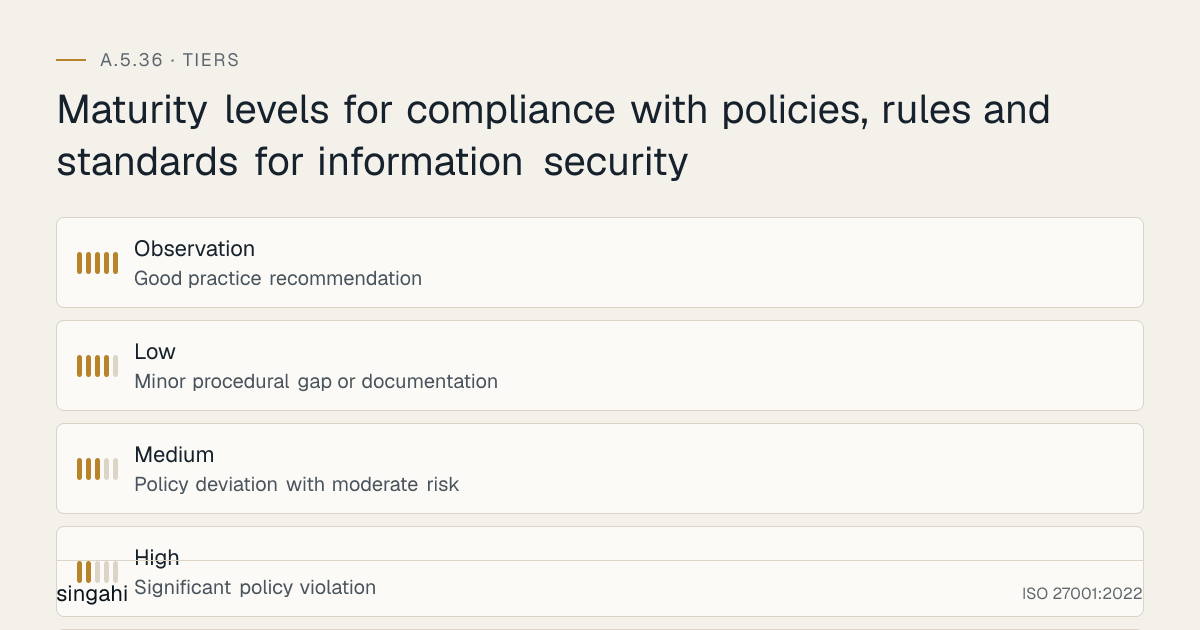
Figure · Tiers
Maturity levels for compliance with policies, rules and standards for information security
The Compliance Review Lifecycle
A sustainable A.5.36 programme follows a closed-loop lifecycle:
┌─────────────────────────────────────────────────────────────┐
│  1. DEFINE                                                  │
│  • Identify policies, rules, standards, and procedures      │
│  • Map each to owners, controls, and evidence sources       │
│  • Define review frequency based on risk                    │
└─────────────────────────────────────────────────────────────┘
                              │
                              ▼
┌─────────────────────────────────────────────────────────────┐
│  2. PLAN                                                    │
│  • Build annual compliance-review schedule                  │
│  • Define sampling approach and review methods              │
│  • Allocate resources and set deadlines                     │
└─────────────────────────────────────────────────────────────┘
                              │
                              ▼
┌─────────────────────────────────────────────────────────────┐
│  3. EXECUTE                                                 │
│  • Conduct reviews (manual, automated, or hybrid)           │
│  • Collect evidence and record findings                     │
│  • Classify non-compliance by severity                      │
└─────────────────────────────────────────────────────────────┘
                              │
                              ▼
┌─────────────────────────────────────────────────────────────┐
│  4. REMEDIATE                                               │
│  • Assign owners and due dates                              │
│  • Apply corrective actions                                 │
│  • Involve HR/legal where disciplinary action is needed     │
└─────────────────────────────────────────────────────────────┘
                              │
                              ▼
┌─────────────────────────────────────────────────────────────┐
│  5. VERIFY & CLOSE                                          │
│  • Confirm remediation is effective                         │
│  • Update risk register if residual risk remains            │
│  • Close findings with evidence                             │
└─────────────────────────────────────────────────────────────┘
                              │
                              ▼
┌─────────────────────────────────────────────────────────────┐
│  6. REPORT & IMPROVE                                        │
│  • Report to management review                              │
│  • Analyse trends and root causes                           │
│  • Update policies, training, or controls                   │
└─────────────────────────────────────────────────────────────┘
Building the Compliance Register
The compliance register is the single source of truth for A.5.36. It should contain:
| Field | Purpose |
|---|---|
| Policy / Rule / Standard ID | Unique reference to the requirement |
| Requirement statement | Plain-language description of what must be checked |
| Owner | Person accountable for the review |
| Method | Automated scan, manual check, interview, document review, sampling |
| Frequency | Annual, quarterly, monthly, continuous, or event-triggered |
| Evidence type | Report, screenshot, log export, attestation, ticket |
| Last review date | When the review was last performed |
| Next review date | When the next review is due |
| Status | Compliant, Non-compliant, Partial, Not Applicable, Exception |
| Non-compliance reference | Link to issue log or exception register |
Review Methods
| Method | When to Use | Example |
|---|---|---|
| Automated technical scan | Large IT estate; configuration standards | CIS benchmark scan via Tenable / Qualys |
| SIEM query / dashboard | Continuous monitoring of access and events | Query for privileged accounts without MFA |
| Manual checklist | Small teams; behavioural / procedural checks | Clean-desk inspection, onboarding file review |
| Sampling | Large population; cannot review 100% | Review 25 random access requests per quarter |
| Self-attestation | Manager confirmation of team compliance | Department head signs quarterly attestation |
| Interview | Verify understanding and awareness | Ask developers about secure-code policy |
| Document review | Verify policy existence, approval, and version | Check latest Access Control Policy approval |
| Mystery-shopper / red-team | Test enforcement of sensitive rules | Attempt tailgating or social engineering |
Frequency Guidance
| Control Area | Small Org | Medium Org | Large / Regulated |
|---|---|---|---|
| Master policy review | Annually | Annually | Annually + on change |
| Access control compliance | Quarterly | Monthly | Continuous |
| MFA / privileged access | Quarterly | Monthly | Weekly / continuous |
| Patch compliance | Monthly | Weekly | Continuous |
| Backup verification | Quarterly | Monthly | Weekly |
| Supplier security | Annually | Annually | Quarterly |
| Clean desk / clear screen | Quarterly | Quarterly | Monthly |
| Security awareness | Annually | Annually | Semi-annually |
| Incident response readiness | Annually | Semi-annually | Quarterly |
| Change management | Quarterly | Monthly | Per change |
| Mobile device compliance | Quarterly | Monthly | Continuous |
Non-Compliance Severity Model
Classify every finding so resources are allocated correctly:
| Severity | Definition | Response Time | Escalation |
|---|---|---|---|
| Critical | Active breach, imminent data loss, regulatory violation, or high-risk control failure | 24–48 hours | CISO + CEO / Board |
| High | Significant policy violation with material risk; privileged access or customer data involved | 1 week | CISO + Department Head |
| Medium | Policy deviation with moderate risk; no immediate compromise | 30 days | Control Owner + Manager |
| Low | Minor procedural gap or documentation issue | 60–90 days | Control Owner |
| Observation | Good practice recommendation; not a strict non-compliance | Best-effort | Control Owner |
Handling Non-Compliance
Every non-compliance must follow a consistent workflow:
- Detect: Through review, monitoring, audit, or report.
- Record: Log in issue tracker with evidence, date, finder, and affected policy.
- Assess: Determine severity, scope, and root cause.
- Assign: Allocate owner and due date for remediation.
- Contain: If active risk, apply immediate compensating controls.
- Remediate: Implement corrective action.
- Verify: Confirm remediation is effective and sustained.
- Close: Document closure with evidence.
- Report: Include in management review and metrics.
- Learn: Update policy, training, or automation to prevent recurrence.
Exception Management
Exceptions are not a way to ignore policy. A valid exception requires:
- Business justification
- Risk assessment
- Compensating controls
- Time-bound expiry date
- Approval by authorized person (based on risk level)
- Entry in exception register
- Review at expiry or when circumstances change
Exception approval matrix:
| Risk Level | Approver |
|---|---|
| Low | Control Owner |
| Medium | CISO |
| High | CISO + Risk Committee |
| Critical | CEO / Board |
Integrating with HR Disciplinary Process
A.5.36 and A.6.4 are closely linked. The organization should:
- Reference information security policy compliance in the employee handbook and code of conduct.
- Train managers on how to identify and escalate security violations.
- Apply proportional discipline: coaching for first-time minor violations; written warning; termination for wilful misconduct or data theft.
- Maintain confidentiality and due process.
- Track anonymized disciplinary statistics for trend analysis.
Evidence Management
Evidence must be trustworthy:
- Stored in a tamper-evident location (GRC tool, document management system, or WORM storage).
- Version-controlled with date, owner, and review period.
- Retained for at least the certification cycle plus one year (minimum 4 years; regulated entities often need 6–8 years).
- Cross-referenced to policies and controls.
- Available to auditors without modification.
Compliance Sampling Methodology
When full population review is impractical, a documented sampling methodology ensures your A.5.36 evidence remains defensible to auditors and regulators.
Sampling Approaches
| Approach | When to Use | Example |
|---|---|---|
| Random sampling | Large, homogeneous population; need statistical defensibility | Select 30 random user accounts from 500 for access review |
| Risk-based sampling | Higher-risk items deserve more scrutiny | Review all privileged accounts plus 10% of standard accounts |
| Stratified sampling | Population has distinct subgroups | Sample 20% of finance users, 10% of marketing users, 5% of admin users |
| Judgmental sampling | Known risk indicators or previous issues | Review all accounts belonging to users with prior violations |
| 100% review | Small or critical populations | Review all firewall rules, all production secrets, all supplier contracts |
Sample Size Guidance
| Population Size | Low-Risk Sample | Medium-Risk Sample | High-Risk Sample |
|---|---|---|---|
| 1–25 | 25–100% | 50–100% | 100% |
| 26–100 | 10–15 | 15–25 | 25–50 |
| 101–500 | 20–30 | 30–60 | 60–100 |
| 501–2000 | 30–50 | 50–100 | 100–200 |
| 2000+ | Use statistical sampling or 100% automation |
Documenting Sampling
For every sampled review, record:
- Population definition and size.
- Sampling method and rationale.
- Sample size and selection criteria.
- List of sampled items (or reference to selection output).
- Review results and extrapolation to population.
Auditors are more likely to accept sampling when it is risk-based, repeatable, and documented. For Critical/High-risk controls, prefer 100% review or automated continuous monitoring over sampling.
Compliance by Control Domain
A.5.36 must cover every domain where your organization has defined policy. Below are control-specific compliance checks mapped to common ISO 27001 topic areas.
Access Control (A.5.15–A.5.18, A.8.2–A.8.5)
- Verify that all user accounts are unique and attributable.
- Confirm MFA is enforced for privileged, remote, and customer-facing access.
- Sample access requests for documented approval and business justification.
- Review terminated-user access revocation against HR exit records.
- Validate quarterly access reviews are completed and signed off.
Data Protection (A.5.12–A.5.14, A.8.10–A.8.12)
- Confirm data classification labels are applied to repositories and documents.
- Verify encryption at rest for Confidential/Restricted data.
- Verify encryption in transit (TLS 1.2 minimum; TLS 1.3 preferred).
- Check DLP policies are active and generating alerts.
- Review data retention and secure disposal records.
Network and Infrastructure (A.8.20–A.8.23)
- Review firewall rule sets against the approved baseline.
- Verify network segmentation between production, development, and guest networks.
- Confirm wireless networks use enterprise authentication.
- Validate VPN is required for remote administrative access.
Secure Development (A.8.25–A.8.32)
- Confirm security requirements are documented for projects.
- Verify SAST/SCA/DAST tools are integrated into CI/CD.
- Scan repositories for secrets and credentials.
- Validate change approvals for production deployments.
- Check that security training is completed before production access.
Supplier Security (A.5.19–A.5.23)
- Verify security clauses exist in all high-risk supplier contracts.
- Confirm annual supplier security reviews are completed.
- Check supplier access is reviewed and least-privilege enforced.
- Validate supplier incident notification requirements.
Incident Management (A.5.24–A.5.28, A.6.8, A.8.15–A.8.17)
- Confirm incident response plan is tested annually or semi-annually.
- Verify incident logs are retained and reviewed.
- Check post-incident reviews include corrective actions.
- Validate reporting channels are known to staff.
Human Resources (A.6.1–A.6.6)
- Verify employment contracts include security clauses.
- Confirm background checks for sensitive roles.
- Validate onboarding and termination security checklists.
- Check security awareness training completion rates.
Building a Compliance-First Culture
Technology alone cannot enforce compliance. Culture determines whether people follow rules when nobody is watching.
Leadership Modelling
- Executives must complete the same training and acknowledge the same policies as staff.
- Leaders should visibly support compliance decisions, including unpopular ones like revoking legacy access.
- Board and committee meetings should discuss compliance status, not just incidents.
Positive Reinforcement
- Recognize teams and individuals with strong compliance records.
- Share anonymized success stories: "Engineering reduced secrets in code to zero."
- Make compliance metrics visible on team dashboards.
Proportional Enforcement
- Distinguish mistakes from negligence and malice.
- Use coaching and retraining for first-time minor issues.
- Reserve disciplinary action for repeated or serious violations.
- Communicate enforcement decisions fairly to maintain trust.
Psychological Safety
- Protect reporters of non-compliance from retaliation.
- Frame compliance reviews as improvement, not punishment.
- Encourage employees to suggest policy clarifications.
Integrating Compliance into Change Management
Changes are a primary source of configuration drift and policy violations. Embed compliance checks into A.8.32 change management.
Change Advisory Board (CAB) Compliance Gate
Before approving changes, the CAB should verify:
- Does the change affect a security control or policy requirement?
- Has a security impact assessment been completed?
- Are new configurations aligned with baseline standards?
- Have required approvals been obtained?
- Will the change be monitored for compliance post-implementation?
Post-Implementation Compliance Verification
Within 48–72 hours of a major change:
- Re-run configuration scans.
- Verify logs are flowing.
- Confirm access controls remain intact.
- Update compliance register if the change alters a control.
Remote and Hybrid Work Compliance
Remote work expands the attack surface and makes physical and behavioural compliance harder to observe.
Remote Work Compliance Checks
- Verify VPN/MFA usage for remote access.
- Confirm home-router security baseline where applicable.
- Check that corporate devices are enrolled in MDM and encrypted.
- Validate that sensitive documents are not printed or stored in insecure home locations.
- Confirm screen privacy and family-member access restrictions.
Monitoring Without Surveillance
- Monitor technical compliance (encryption, patch status, access logs), not personal behaviour.
- Use DLP to protect company data, not to spy on employees.
- Communicate clearly what is monitored and why.
Compliance Maturity Self-Assessment
Use the following questions to gauge your current A.5.36 maturity. Score each area from 1 (ad-hoc) to 5 (optimised).
| Maturity Area | Score (1–5) | Evidence |
|---|---|---|
| Governance: policy/programme exists and is approved | ||
| Planning: compliance register and schedule maintained | ||
| Automation: technical controls monitored automatically | ||
| Behavioural checks: managers review team compliance | ||
| Remediation: findings tracked to closure with SLAs | ||
| Exceptions: documented, approved, time-bound | ||
| Discipline: HR process linked to security violations | ||
| Reporting: regular management reporting | ||
| Continuous improvement: trends analysed and addressed |
Scoring interpretation:
- 9–45: Wide variation; focus on lowest-scoring areas first.
- Average score 1–2: Ad-hoc; build foundation urgently.
- Average score 3: Defined programme; work on automation and integration.
- Average score 4: Quantitatively managed; focus on predictive analytics and benchmarking.
- Average score 5: Optimised; maintain and share best practices.
Use the gap-analysis toolkit file to document target state and improvement actions.
Re-assess maturity every six months. The goal is not a perfect score on day one, but measurable improvement in coverage, automation, remediation speed, and cultural adoption. Use the trend to justify investment in tools, training, and headcount. A maturity score that improves over time is one of the strongest audit signals you can provide. Regular reassessment drives continuous improvement and keeps the programme aligned with evolving risks.
Tools, Technologies, and Solutions
Tool Categories for A.5.36
| Category | Purpose | Indian Examples | Global Examples |
|---|---|---|---|
| GRC / Compliance Management | Compliance register, attestation, workflow, reporting | StandardFusion, VComply, MetricStream | ServiceNow GRC, RSA Archer, OneTrust |
| Vulnerability & Configuration Management | Validate secure baselines and detect drift | SecPod, Qualys (India operations), Tenable | Tenable.sc, Rapid7 InsightVM, Qualys |
| SIEM / SOAR | Continuous monitoring and automated response | DNIF, ManageEngine Log360, IBM QRadar (India) | Splunk, Microsoft Sentinel, Chronicle |
| MDM / UEM | Enforce device policies and compliance | Scalefusion, Hexnode, ManageEngine | Microsoft Intune, Jamf, Omnissa Workspace ONE (formerly VMware) |
| Cloud Security Posture Management (CSPM) | Monitor cloud configuration compliance | Palo Alto Prisma Cloud | Wiz, Orca, Prisma Cloud, CrowdStrike |
| Identity & Access Management | Verify access policy compliance | miniOrange, Simeio, Okta India | Okta, Azure AD, SailPoint |
| Policy Management | Policy distribution, acknowledgment, version control | Confluence + plugins, Zoho, VComply | NAVEX One (formerly PolicyTech), NAVEX, Convercent |
| Ticketing / Workflow | Track non-compliance remediation | Freshservice, ServiceNow, Jira | Jira, ServiceNow, Zendesk |
Vendor Comparison Matrix
| Vendor | Category | Best For | Pricing Indicator (India) |
|---|---|---|---|
| VComply | GRC + Policy | SMBs and growing Indian companies | Commercial |
| MetricStream | Enterprise GRC | Banks, large enterprises | Custom (+) |
| ServiceNow GRC | Enterprise GRC / workflow | Large enterprises with existing ServiceNow | Custom (+) |
| ManageEngine Log360 | SIEM + compliance | Growing companies, on-premise preference | Commercial |
| DNIF | SIEM / SOAR | Indian MSSP, data-sovereignty needs | Custom |
| Tenable.sc | Vulnerability management | Technical compliance scanning | Commercial |
| Microsoft Sentinel | Cloud SIEM | Microsoft-first organizations | Pay-as-you-scale |
| Scalefusion | MDM/UEM | Indian SMEs, BYOD compliance | Commercial |
| miniOrange | IAM / MFA | Indian SaaS, value-focused | Commercial |
Build-vs-Buy Guidance
| Scenario | Recommendation |
|---|---|
| Startup (< 50), cloud-first | Use Microsoft/Google native tools + spreadsheet register + Scalefusion/Hexnode |
| SMB (50–500) | VComply or StandardFusion + Tenable/Qualys + Freshservice |
| Mid-market (500–5000) | Integrated GRC + SIEM + MDM + CSPM; consider managed SOC |
| Enterprise / BFSI | MetricStream / ServiceNow GRC + enterprise SIEM + dedicated compliance team |
Free / lightweight Starter Stack
- Compliance register: Google Sheets / Excel with version control in SharePoint / Google Drive.
- Technical checks: OpenSCAP, Lynis, CIS-CAT Lite.
- Cloud posture: AWS Config / Azure Policy / GCP Asset Inventory.
- Ticketing: Jira Free or GitHub Issues.
- Policy distribution: Confluence / Notion / SharePoint.
- Device compliance: Microsoft Intune (included in many M365 licences) or Scalefusion trial.
Implementation Considerations
Before purchasing or deploying A.5.36 tools, evaluate the following:
Data Residency and Sovereignty
For Indian organizations, especially BFSI, government, and healthtech, data residency can be a hard requirement where sector rules or client contracts demand it. Ensure the vendor offers Indian data-centre hosting or contractual guarantees that compliance data does not leave the country. This is particularly important under DPDP Act 2023 and CERT-In directions.
Integration Architecture
A.5.36 tools should not become another silo. Prioritise integrations with:
- Identity provider (IdP) for user and access data.
- SIEM/SOAR for security event correlation.
- Ticketing system for remediation tracking.
- Cloud provider APIs for posture data.
- HR system for onboarding/termination triggers.
- Document management for evidence storage.
Tuning and False Positives
New automation tools often generate a flood of alerts. Plan a 30–60 day tuning period where security analysts review findings, adjust thresholds, and create exception workflows. Without tuning, teams ignore alerts and compliance monitoring loses credibility.
Skill Requirements
| Tool Type | Skills Needed |
|---|---|
| GRC platform | Compliance, workflow configuration, reporting |
| SIEM | Log analysis, query language, alerting |
| Vulnerability/config scanner | System administration, scripting |
| CSPM | Cloud architecture, IAM, API familiarity |
| MDM/UEM | Endpoint management, policy packaging |
If these skills are unavailable, consider a managed service or phased rollout starting with the highest-risk areas.
Integrating Tools into the Compliance Workflow
Tools only create value when embedded into the compliance lifecycle:
- Define control checks in the GRC tool and map them to policies and risks.
- Configure automated tools to produce evidence that matches each check.
- Push findings into a ticketing system with severity, owner, and SLA.
- Use dashboards to monitor open findings, overdue items, and trends.
- Archive evidence in the document repository with version control.
- Report metrics to management review quarterly and annually.
Avoid the trap of buying tools and then manually copying data into spreadsheets. Automation should reduce manual effort, not increase it.
Policy and Procedure Templates
Information Security Compliance Policy (Extract)
INFORMATION SECURITY COMPLIANCE POLICY
[Organization Name]
Version: 1.0
Approved by: [CISO / CEO]
Date: [Date]
Review Date: [Date + 12 months]
Classification: Internal

1. PURPOSE
This policy establishes the framework for reviewing and enforcing compliance
with the organization's information security policies, topic-specific policies,
rules, standards, and procedures.

2. SCOPE
This policy applies to all employees, contractors, temporary staff, suppliers,
and third parties who access, process, store, or transmit [Organization Name]
information assets.

3. POLICY STATEMENTS
3.1 Compliance with information security policies, rules, and standards is
    mandatory for all personnel.
3.2 Compliance reviews shall be performed at planned intervals and when
    significant changes occur.
3.3 Non-compliance shall be recorded, investigated, remediated, and reported.
3.4 Repeated or wilful non-compliance may result in disciplinary action.
3.5 Exceptions to policy requirements must be documented, risk-assessed,
    approved, and time-bound.
3.6 Evidence of compliance reviews shall be retained for [X] years.

4. REVIEW FREQUENCY
4.1 Master information security policy: annually
4.2 Topic-specific policies: annually or on significant change
4.3 Technical configuration standards: monthly / continuous
4.4 Access control rules: quarterly
4.5 Supplier security obligations: annually (high-risk quarterly)

5. ROLES AND RESPONSIBILITIES
5.1 CISO: Own the compliance programme, report to management review.
5.2 Department Heads: Ensure team compliance and escalate violations.
5.3 HR: Maintain disciplinary process and support investigations.
5.4 IT / Operations: Execute automated technical compliance checks.
5.5 All Employees: Comply with policies and report non-compliance.

6. NON-COMPLIANCE HANDLING
6.1 Findings are logged in the compliance issue register.
6.2 Severity is assessed as Critical, High, Medium, Low, or Observation.
6.3 Owners and due dates are assigned.
6.4 Corrective actions are verified before closure.
6.5 Disciplinary action is applied in accordance with HR policy.

7. EXCEPTIONS
7.1 Exceptions require documented justification and risk acceptance.
7.2 Low-risk exceptions: approved by Control Owner.
7.3 Medium-risk exceptions: approved by CISO.
7.4 High/Critical exceptions: approved by Risk Committee / CEO.

8. REPORTING
8.1 Compliance status is reported quarterly to the Information Security
    Committee and annually to top management.
8.2 Critical non-compliances are escalated immediately.

9. REVIEW
This policy is reviewed annually and when significant changes occur.
Compliance Review Procedure (Extract)
PROCEDURE: INFORMATION SECURITY COMPLIANCE REVIEW
Reference: A.5.36
Owner: CISO
Frequency: Quarterly + event-triggered

1. PREPARATION
   1.1 Review the compliance register and identify reviews due this quarter.
   1.2 Notify policy owners and technical teams of upcoming reviews.
   1.3 Gather required evidence: logs, scan reports, access lists, policy
       versions, training records.

2. EXECUTION
   2.1 Perform automated technical scans for configuration standards.
   2.2 Conduct manual checks using the approved checklist.
   2.3 Interview sample personnel where behavioural compliance is assessed.
   2.4 Review exception register for expired or unreviewed exceptions.

3. FINDINGS
   3.1 Record each finding in the issue tracker with:
       - Policy / rule / standard reference
       - Description and evidence
       - Severity
       - Affected area and owner
   3.2 Validate false positives before logging.

4. REMEDIATION
   4.1 Assign owner and due date.
   4.2 For Critical/High findings, apply immediate containment.
   4.3 Track remediation to closure.
   4.4 Verify effectiveness through re-test or evidence review.

5. REPORTING
   5.1 Compile quarterly compliance report.
   5.2 Present to Information Security Committee.
   5.3 Include summary in management review input.

6. CONTINUOUS IMPROVEMENT
   6.1 Analyse trends and recurring findings.
   6.2 Update policies, training, or automation as needed.
Exception Request Template
| Field | Input |
|---|---|
| Exception ID | EXC-YYYY-NNN |
| Date raised | |
| Requester | |
| Policy / Rule / Standard | |
| Justification | |
| Risk assessment | Likelihood / Impact / Risk level |
| Compensating controls | |
| Proposed expiry date | |
| Approver | |
| Approval date | |
| Review trigger | |
| Status | Open / Approved / Rejected / Expired |
Risk Assessment and Treatment
Risk Scenario Table
| Risk ID | Risk Scenario | Likelihood | Impact | Risk Level | Treatment | Owner |
|---|---|---|---|---|---|---|
| R1 | Policies exist but are not reviewed for compliance; undetected violations persist. | High | High | Critical | Implement quarterly compliance-review programme with automated monitoring. | CISO |
| R2 | Technical configurations drift from secure baselines after deployment. | High | High | Critical | Deploy CSPM/config management with automated drift detection and remediation. | IT Operations |
| R3 | Employees are unaware of policy requirements due to poor training. | Medium | High | High | Mandatory awareness training with comprehension testing and role-specific modules. | HR / CISO |
| R4 | Non-compliance is detected but not remediated due to unclear ownership. | Medium | High | High | Define RACI, assign owners, and track in ticketing system with escalation. | CISO |
| R5 | Managers do not enforce policy consistently, creating a culture of exception. | Medium | Medium | Medium | Include security compliance in manager objectives; report department-level metrics. | CEO / CISO |
| R6 | Supplier fails to meet contractual security obligations but no review is performed. | Medium | High | High | Annual supplier compliance review; high-risk suppliers quarterly. | Procurement / CISO |
| R7 | Over-reliance on manual reviews; sample misses critical violations. | Medium | High | High | Automate high-risk technical controls; manual reviews focus on behaviour and process. | CISO |
| R8 | Evidence of compliance reviews is lost or tampered with. | Low | High | Medium | Store evidence in version-controlled, tamper-evident repository. | Compliance Manager |
| R9 | Disciplinary process is not linked to security policy, weakening enforcement. | Medium | Medium | Medium | Update employee handbook and code of conduct; train managers. | HR |
| R10 | Regulatory change makes existing policy non-compliant before next scheduled review. | Low | High | Medium | Monitor regulatory changes; trigger event-based review within 30 days. | Legal / Compliance |
Risk Treatment Plan Summary
- Mitigate: Implement compliance-review programme, automation, training, and exception management.
- Transfer: Cyber insurance for residual regulatory and breach costs.
- Accept: Low-severity, low-likelihood residual risks documented with management approval.
- Avoid: Discontinue high-risk practices that cannot be brought into compliance.
Audit and Compliance Checklist
Auditor Questions with Expected Evidence
| # | Question | Expected Evidence | Red Flag |
|---|---|---|---|
| 1 | Is there a documented compliance-review programme? | Programme charter, schedule, scope document | No programme exists |
| 2 | Are reviews planned at appropriate intervals? | Annual/quarterly schedule with frequency rationale | Only ad-hoc reviews |
| 3 | Are reviews triggered by significant changes? | Change-trigger review records (M&A, new tech, incident) | No event-triggered reviews |
| 4 | Is there a compliance register mapping policies to checks? | Register with owners, methods, frequencies | No register or incomplete mapping |
| 5 | Are managers performing compliance checks? | Manager attestation forms, review records | Managers unaware of responsibility |
| 6 | Are technical controls checked automatically? | Scan reports, SIEM dashboards, CSPM outputs | All checks are manual |
| 7 | Are findings logged and tracked? | Issue tracker, non-compliance log | Findings discussed orally only |
| 8 | Are corrective actions verified? | Closed tickets with re-test evidence | Findings closed without evidence |
| 9 | Is there a disciplinary process for violations? | HR policy, anonymized case evidence | No link to HR disciplinary process |
| 10 | Are exceptions documented and approved? | Exception register with risk acceptance | Verbal exceptions accepted |
| 11 | Is compliance status reported to management? | Management-review minutes, compliance report | Never reported to top management |
| 12 | Are expired exceptions reviewed? | Exception register with expiry dates and renewals | Expired exceptions remain active |
| 13 | Are all topic-specific policies included in scope? | Policy-to-control mapping matrix | Only master policy reviewed |
| 14 | Are suppliers included in compliance reviews? | Supplier review records, contract clauses | Supplier compliance never checked |
| 15 | Is sampling methodology defensible? | Sampling plan, population size, sample size | Arbitrary or no sampling |
| 16 | Is evidence retained and protected? | Evidence repository with retention labels | Evidence stored on personal drives |
| 17 | Are reviewers independent where needed? | Independence statement for internal audit | Same person writes policy and checks compliance |
| 18 | Are trends analysed for continuous improvement? | Trend report, recurring issue analysis | Same findings appear every quarter |
| 19 | Is training updated based on non-compliance? | Training update records after repeated findings | Training never changes |
| 20 | Are high-severity non-compliances escalated? | Escalation records, board/CISO notifications | Critical issues buried |
Pre-Audit Self-Check
- Compliance policy approved and published.
- Compliance register current and complete.
- Last 4 quarters of review records available.
- All Critical/High findings closed or risk-accepted.
- Exception register reviewed for expired items.
- Management review includes compliance status.
- Training records show policy awareness.
- Automated tool outputs saved as evidence.
- Disciplinary process references security policy.
- Supplier compliance reviews performed.
Metrics and KPIs
Figure · Measures
The measures that show A.5.36 is working
- Compliance Review Coverage≥ 95%Quarterly
- On-Time Review Rate≥ 95%Quarterly
- Non-Compliance RateTrending downQuarterly
- Critical/High Finding Closure Time≤ 7 daysMonthly
- Medium/Low Finding Closure Time≤ 30 days / 60Monthly
Recommended Compliance Metrics
| # | KPI | Formula | Target | Frequency |
|---|---|---|---|---|
| 1 | Compliance Review Coverage | (Policies/rules reviewed / Total in scope) × 100 | ≥ 95% | Quarterly |
| 2 | On-Time Review Rate | (Reviews completed on schedule / Reviews due) × 100 | ≥ 95% | Quarterly |
| 3 | Non-Compliance Rate | (Findings / Total checks) × 100 | Trending down | Quarterly |
| 4 | Critical/High Finding Closure Time | Average days to close Critical/High findings | ≤ 7 days | Monthly |
| 5 | Medium/Low Finding Closure Time | Average days to close Medium/Low findings | ≤ 30 days / 60 days | Monthly |
| 6 | Overdue Findings | Count of findings past due date | 0 Critical/High | Weekly |
| 7 | Exception Count | Total active exceptions | ≤ 5% of control set | Quarterly |
| 8 | Expired Exceptions | Exceptions past expiry date without renewal | 0 | Monthly |
| 9 | Policy Acknowledgment Rate | (Staff acknowledged / Total staff) × 100 | ≥ 98% | Monthly |
| 10 | Training Completion Rate | (Completed / Assigned) × 100 | ≥ 95% | Quarterly |
| 11 | Automated Control Check Coverage | (Automated checks / Total technical checks) × 100 | ≥ 80% | Quarterly |
| 12 | Recurring Finding Rate | (Findings repeated >2 cycles / Total closed findings) × 100 | ≤ 10% | Quarterly |
| 13 | Supplier Compliance Rate | (Compliant suppliers / Total suppliers reviewed) × 100 | ≥ 90% | Annually |
| 14 | Management Review Compliance Reporting | Reports submitted / Reports required | 100% | Annually |
| 15 | Disciplinary Action Rate | Security-related disciplinary actions per 1,000 employees | Benchmark only | Annually |
Dashboard Layout
┌──────────────────────────────────────────────────────────────┐
│  COMPLIANCE DASHBOARD — Q2 2026                              │
├──────────────────────────────────────────────────────────────┤
│  Overall Compliance Score: 87%                               │
│  ████████████████████████████████░░░░                        │
├──────────────────────────────────────────────────────────────┤
│  Reviews Due: 24    Completed: 22 (92%)    Overdue: 2        │
│  Critical Findings: 1    High: 3    Medium: 8    Low: 12     │
│  Overdue Critical/High: 0                                    │
├──────────────────────────────────────────────────────────────┤
│  Top Non-Compliance Areas                                    │
│  1. MFA not enabled on 6 admin accounts (Critical)           │
│  2. Patch compliance 82% on Windows servers (High)           │
│  3. Clean-desk violations in 3 departments (Medium)          │
├──────────────────────────────────────────────────────────────┤
│  Active Exceptions: 7    Expiring This Month: 2              │
│  Policy Acknowledgment: 99%    Training: 96%                 │
└──────────────────────────────────────────────────────────────┘
Common Pitfalls / Audit Failures & How to Avoid Them
| Pitfall | Cause | Fix |
|---|---|---|
| Policies exist but no one checks compliance | Policy team and operations team are siloed | Create a compliance-review owner and schedule; tie to management objectives |
| Only master policy is reviewed | Narrow interpretation of A.5.36 | Map every topic-specific policy, rule, and standard into the compliance register |
| All checks are manual | Lack of tooling or automation skills | Start with free tools (OpenSCAP, AWS Config) and automate high-risk areas first |
| Findings logged but never closed | No owner, no due date, no escalation | Use a ticketing system with automated reminders and escalation |
| Exceptions become permanent | No expiry dates or renewal process | Enforce time-bound exceptions with automated expiry alerts |
| No evidence retention | Evidence saved locally or in email | Centralise evidence in version-controlled repository |
| Managers unaware of responsibility | Roles not defined or communicated | Include compliance checks in RACI and manager job descriptions |
| Disciplinary process not linked | HR policy silent on security violations | Update employee handbook and train managers |
| Sampling is arbitrary | No documented sampling plan | Define population, sample size, and selection method (random / risk-based) |
| Audit panic, scramble for evidence | Reviews not performed on schedule | Maintain rolling programme with quarterly reporting |
| Automation generates false positives | Rules not tuned | Review and tune automated checks monthly; validate findings |
| Culture of exception | Leadership bypasses policy | Executive modelling; exception transparency in dashboards |
Illustrative Scenarios
Illustrative scenario, a composite example for guidance, not a specific Singahi engagement or a verified outcome.
Illustrative Scenario 1: Indian NBFC, From Audit Failure to Clean ISO 27001 Certification
Organization: A mid-sized NBFC in Mumbai with 800 employees, offering personal and business loans.
Challenge: The NBFC had invested heavily in drafting 22 information security policies and had implemented a core banking system, firewall, and antivirus. However, during its first ISO 27001 stage-2 audit, the auditor raised four major non-conformities under A.5.36:
- No evidence that topic-specific policies were reviewed for compliance.
- The Access Control Policy required quarterly access reviews, but only one review had been performed in 18 months.
- Multiple expired exceptions allowed legacy integrations without MFA.
- Several branch managers could not explain how they checked compliance in their branches.
The audit was suspended, and the NBFC risked losing enterprise partnerships.
Solution: The consultant designed a 90-day A.5.36 remediation programme:
- Compliance Register: Mapped all 22 policies to 68 specific checks, owners, methods, and frequencies.
- Automation: Deployed a configuration audit tool to verify Windows baseline, firewall rules, and privileged account MFA weekly.
- Branch Compliance Kit: Provided branch managers with a monthly 15-point checklist covering clean desk, visitor logs, access cards, and password hygiene.
- Exception Clean-Up: Reviewed all 14 exceptions; closed 9, renewed 4 with compensating controls, and escalated 1 to the board.
- Management Rhythm: Established a monthly Information Security Committee meeting and quarterly board report on compliance status.
- HR Integration: Updated the code of conduct to explicitly reference information security policy compliance and trained all managers.
Results:
- Re-audit passed with zero major non-conformities.
- Achieved ISO 27001:2022 certification within 4 months.
- Access review completion improved from 12% to 100%.
- Critical findings reduced from 18 to 2 per quarter.
- RBI cyber-security inspection rated the NBFC "satisfactory."
Illustrative Scenario 2: Indian Healthtech SaaS, Preventing a Breach Through Compliance Monitoring
Organization: A Bangalore-based healthtech SaaS provider with 220 employees, processing personal health data for hospitals and clinics.
Challenge: The company had a documented Secure Development Policy and Data Classification Policy. However, a routine compliance review (the first in 12 months) discovered:
- 34 production API keys and database credentials stored in private GitHub repositories.
- 12 developers had not completed secure-coding training despite policy requiring it before production access.
- The Data Classification Policy required encryption of "Restricted" data, but 6 S3 buckets containing patient reports were publicly readable.
- No supplier security reviews had been performed for 3 critical cloud vendors.
The company was 60 days from a SOC 2 Type II audit and risked a DPDP Act violation.
Solution: The consultant implemented a continuous compliance-monitoring programme:
- Secret Scanning: Integrated GitHub Advanced Security and TruffleHog into CI/CD; blocked commits with secrets and scanned all historical repositories.
- CSPM: Deployed a Cloud Security Posture Management tool to enforce S3 encryption and public-access blocks.
- Training Gate: Linked production access in the identity system to completion of role-specific secure-coding training.
- Supplier Reviews: Conducted security questionnaires and evidence reviews for the 3 critical vendors; one vendor was replaced, two signed remediation plans.
- Compliance Dashboard: Built a real-time dashboard showing policy compliance by team, with weekly leadership reviews.
- DPDP Readiness: Mapped compliance checks to DPDP Act obligations and added data-principle rights verification to the review cycle.
Results:
- Zero critical findings in the SOC 2 Type II audit.
- Secrets in repositories reduced to zero within 30 days.
- Public S3 buckets eliminated; encryption enforced at 100%.
- Training completion reached 98%.
- The company successfully positioned its compliance monitoring as a competitive differentiator in hospital RFPs.
Multi-Framework Mapping
| ISO 27001:2022 A.5.36 | SOC 2 Trust Services Criteria | PCI DSS v4.0 | NIST SP 800-53 Rev 5 | CIS Controls v8 | COBIT 2019 | GDPR / DPDP Act 2023 |
|---|---|---|---|---|---|---|
| Compliance with information security policies, rules, and standards | CC1.1, COSO principle on integrity and ethical values; CC2.1, communication; CC7.2, system monitoring | 12.4, maintain a security policy; 12.10.4, monitor and control critical security controls; 12.11.1, security policy reviews | CA-7, Continuous Monitoring; PM-10, Authorization Process; CM-4, Security Impact Analysis; IR-5, Incident Monitoring | Control 3, Data Protection; Control 4, Secure Configuration of Enterprise Assets and Software; Control 8, Audit Log Management; Control 13, Network Monitoring and Defence | APO12.06, Manage risk; BAI01.10, Maintain configurations; DSS05.04, Manage security incidents; MEA01, Monitor, evaluate and assess performance | GDPR Art 5(2), accountability; Art 32, security of processing; DPDP Act 2023 Section 8, reasonable safeguards and compliance obligations |
Mapping Commentary
- SOC 2: A.5.36 directly supports COSO monitoring activities and the common criteria for communication, monitoring, and system operations.
- PCI DSS: Requirements in section 12 expect policy maintenance, monitoring, and review, A.5.36 supplies the mechanism.
- NIST 800-53: CA-7 (Continuous Monitoring) and PM-10 are the closest mappings; A.5.36 operationalises these controls.
- CIS Controls: Secure configuration, data protection, and audit-log management all require compliance verification.
- COBIT: MEA01 is essentially the governance expression of A.5.36.
- GDPR / DPDP Act 2023: Both frameworks require organisations to demonstrate compliance; A.5.36 reviews produce the evidence.
Implementation Roadmap
Figure · Timeline
Rollout in order
- Phase 1: Disc…Week 1–2
- Phase 2: BuildWeek 3–4
- Phase 3: Auto…Week 5–7
- Phase 4: Oper…Week 8–10
- Phase 5: Repo…Week 11–12
- Phase 6: Cont…Ongoing
Phase-Based Roadmap
| Phase | Duration | Activities | Deliverables |
|---|---|---|---|
| Phase 1: Discover & Plan | Week 1–2 | Inventory policies, rules, standards, and owners; define scope and frequency; build RACI | Compliance programme charter, policy-to-control mapping, annual schedule |
| Phase 2: Build Register & Baseline | Week 3–4 | Create compliance register; select tools; perform first baseline review | Compliance register v1.0, baseline report, tool procurement |
| Phase 3: Automate High-Risk Checks | Week 5–7 | Deploy config scanning, SIEM queries, MDM compliance, CSPM | Automated scan reports, dashboards, alert rules |
| Phase 4: Operationalise Remediation | Week 8–10 | Integrate findings into ticketing; define escalation; train managers | Non-compliance workflow, closed pilot findings, manager training |
| Phase 5: Report & Improve | Week 11–12 | First quarterly report to management; trend analysis; update policies | Quarterly compliance report, management-review input, improvement plan |
| Phase 6: Continuous Maturity | Ongoing | Monthly metrics, quarterly reviews, annual independent assurance, automation expansion | Maturity score improvement, reduced findings, certification readiness |
12-Week Detailed Plan
Week 1:
- Form compliance-review working group (CISO, Legal, HR, IT, Operations).
- Gather all current policies, standards, and procedures.
- Define risk-based review frequencies.
Week 2:
- Build policy-to-control mapping matrix.
- Identify evidence sources for each check.
- Draft compliance policy and procedure.
Week 3:
- Create compliance register in GRC tool or spreadsheet.
- Assign owners and due dates.
- Baseline current compliance state.
Week 4:
- Conduct first round of manual reviews.
- Run technical baseline scans.
- Log findings and assign severities.
Week 5:
- Evaluate and procure automation tools.
- Configure first automated checks (MFA, patch, encryption).
Week 6:
- Integrate automated findings into ticketing.
- Tune alert thresholds to reduce noise.
Week 7:
- Expand automation to cloud posture and device compliance.
- Validate scan results against manual samples.
Week 8:
- Train managers on compliance responsibilities.
- Update HR disciplinary process.
Week 9:
- Run exception clean-up exercise.
- Enforce time-bound approvals.
Week 10:
- Verify closure of pilot findings.
- Refine remediation workflow.
Week 11:
- Compile first quarterly compliance report.
- Prepare management-review presentation.
Week 12:
- Present to Information Security Committee and top management.
- Document lessons learned and update roadmap.
Critical Success Factors
In practice, the following factors determine whether an A.5.36 programme succeeds or becomes a documentation exercise:
Executive Sponsorship
Compliance monitoring requires authority to ask tough questions and enforce unpopular decisions. Without visible executive sponsorship, findings get buried, exceptions become permanent, and the programme loses credibility. Ensure the CISO or equivalent has direct access to the CEO or board for Critical/High escalations.
Start with High-Risk Areas
Do not try to monitor every policy perfectly from day one. Prioritise areas with the highest risk and audit visibility:
- Access control and MFA.
- Patch and vulnerability management.
- Cloud configuration compliance.
- Supplier security for critical vendors.
Early wins in these areas build confidence and demonstrate value.
Make Compliance Everyone's Job
A common failure mode is making compliance a "security team job." Department heads must own team-level compliance, IT must own technical checks, HR must own discipline, and Legal must own regulatory alignment. Use the RACI matrix to make ownership explicit.
Automate Early, But Validate
Automation scales compliance monitoring, but only if outputs are trusted. Always validate automated findings with manual samples during the tuning phase. Untrusted automation leads to alert fatigue and ignored findings.
Close the Loop
Every finding must have an owner, due date, verification, and closure evidence. A finding that is "logged but not closed" is worse than no finding at all because it proves the organization knows about a problem and has not fixed it.
Communicate Transparently
Share compliance status, trends, and improvement actions with employees. When people understand why policies exist and see that violations are addressed fairly, compliance becomes part of the culture rather than a checkbox.
FAQ
Q1: Is A.5.36 the same as internal audit?
No. A.5.36 is the operational compliance-review process owned by management. Internal audit (A.5.35) is an independent assurance activity. A.5.36 should happen continuously; A.5.35 is periodic and independent.
Q2: How often must compliance be reviewed?
There is no fixed interval in ISO 27001. The frequency must be "planned" and based on risk. Most organizations review technical controls monthly or continuously, access controls quarterly, and policies annually. Significant changes trigger additional reviews.
Q3: Do we need automated tools to pass audit?
Not strictly, but auditors expect automation for technical controls in all but the smallest organizations. Manual checks alone for 500+ endpoints will raise doubts about coverage and reliability.
Q4: What counts as "significant change" requiring a review?
Examples include mergers or acquisitions, launch of a new product, migration to cloud, new regulation, major security incident, changes to the ISMS scope, or substantial restructuring.
Q5: Can a department head approve their own exceptions?
Only for low-risk exceptions. Medium and high-risk exceptions require CISO or higher approval. Critical exceptions should go to the risk committee or board.
Q6: How do we handle non-compliance by senior management?
Senior leaders must be held to the same or higher standard. Escalate through the board or audit committee. A policy that leadership ignores will rapidly undermine the entire ISMS.
Q7: What evidence should we retain?
Retain review schedules, checklists, scan reports, attestation forms, finding logs, corrective-action evidence, exception registers, management-review minutes, and training records. Minimum 4 years; regulated sectors 6–8 years.
Q8: How do we prove compliance without over-documenting?
Use a risk-based approach. Automate evidence collection where possible. Keep a single compliance register that links to underlying evidence rather than duplicating everything.
Q9: Should supplier compliance be included in A.5.36?
Yes. Supplier obligations are part of your security framework. Review supplier compliance at least annually, more frequently for high-risk suppliers.
Q10: How does A.5.36 relate to DPDP Act 2023?
DPDP Act Section 8 requires Data Fiduciaries to implement reasonable safeguards. A.5.36 reviews of access control, data classification, encryption, and training provide direct evidence that safeguards are operating.
Q11: Who should own A.5.36 in a small organization without a CISO?
The most senior person responsible for information security, often the IT Manager or CTO, should own A.5.36. HR and Legal should support disciplinary and regulatory aspects. As the organization grows, a dedicated CISO or Compliance Manager should take over.
Q12: Can we use internal audit as the compliance-review function?
Internal audit (A.5.35) provides independent assurance and should not be the primary operational compliance-review function. Management must demonstrate its own compliance-monitoring activities. Internal audit can then independently evaluate whether those activities are effective.
Q13: How do we balance automation with privacy and employee trust?
Automate technical controls (configurations, patches, encryption status) and use monitoring for security purposes only. Be transparent about what is monitored. Avoid surveillance of personal communications or behaviour unrelated to security. Document monitoring scope in the Acceptable Use Policy and Privacy Notice.
Q14: What is the minimum evidence needed for A.5.36?
At minimum, maintain: a compliance register, a review schedule, evidence that reviews were performed, a non-compliance log with corrective actions, exception register, and management-review inputs. The more mature your organization, the more automated and granular your evidence should be.
Q15: How do we handle a policy that everyone is violating because it is impractical?
This signals a policy or control failure, not a workforce failure. Analyse root causes: is the policy unclear, is training inadequate, is the control too burdensome, or is tooling missing? Revise the policy, improve controls, retrain, and then re-verify compliance. Do not simply ignore widespread non-compliance.
Q16: Should we review compliance with guidelines or only mandatory policies?
A.5.36 applies to policies, rules, and standards. Guidelines are typically advisory, so they do not require the same enforcement. However, if your organization has declared a guideline mandatory or if auditors/customers expect adherence, include it in your compliance register.
Q17: How do we demonstrate A.5.36 compliance to customers?
Provide a summary compliance report (sanitized of sensitive findings), evidence that reviews are scheduled and performed, and metrics such as review coverage, finding closure rates, and exception counts. Many enterprise customers will ask for this during vendor security assessments.
Q18: What is the relationship between A.5.36 and management review?
A.5.36 produces inputs for management review (Clause 9.3). The compliance report should inform top management about whether the ISMS is effective, where risks are emerging, and what resources or decisions are needed. Without this link, A.5.36 is isolated from governance.
References and Further Reading
Standards
- ISO/IEC 27001:2022, Information security, cybersecurity and privacy protection, Information security management systems, Requirements
- ISO/IEC 27002:2022, Information security, cybersecurity and privacy protection, Information security controls
- ISO/IEC 27003:2017, Information security management system implementation guidance
- ISO 15489, Information and documentation, Records management
Indian Regulations
- Digital Personal Data Protection Act, 2023
- Information Technology Act, 2000 and Information Technology (Reasonable Security Practices and Procedures and Sensitive Personal Data or Information) Rules, 2011
- CERT-In Directions, 2022
- Reserve Bank of India, Master Direction on Information Technology Framework for the NBFC Sector; Cyber Security Framework in Banks
- Securities and Exchange Board of India, Cyber Security and Cyber Resilience Framework
- Insurance Regulatory and Development Authority of India, Cyber Security Guidelines
- Companies Act, 2013
Frameworks
- NIST SP 800-53 Rev 5, Security and Privacy Controls for Information Systems and Organizations
- CIS Controls v8, Centre for Internet Security
- COBIT 2019, ISACA
- SOC 2 Trust Services Criteria, AICPA
- PCI DSS v4.0.1, PCI Security Standards Council
Additional Resources
- CIS Benchmarks, https://www.cisecurity.org/cis-benchmarks
- NIST Cybersecurity Framework
- OWASP Top 10 and OWASP ASVS
- Singahi ISO 27001 Blog, /
Recommended Further Reading
For organizations serious about A.5.36 maturity, the following resources provide deeper guidance:
- ISO/IEC 27007:2020: Guidelines for information security management systems auditing. Useful for aligning internal audit and compliance-review activities.
- ISO/IEC TS 27008:2019: Guidance for the assessment of information security controls. Directly supports the technical assessment aspect of A.5.36.
- NIST SP 800-137: Information Security Continuous Monitoring (ISCM) for Federal Information Systems and Organizations. Excellent for organizations building continuous compliance monitoring.
- NIST SP 800-53A Rev 5: Assessing Security and Privacy Controls in Federal Information Systems and Organizations. Provides assessment procedures that can be adapted to ISO 27001.
- CSA Cloud Controls Matrix (CCM): For cloud-native organizations mapping compliance checks to cloud security domains.
- ISACA Compliance Principles: Guidance on designing and operating compliance programmes within the COBIT framework.
- India's DPDP Rules 2025 (notified 13–14 November 2025; most fiduciary duties apply from about May 2027): specify operational requirements for reasonable safeguards and compliance evidence.
- RBI's Master Direction on IT Governance, Risk, Controls and Assurance Practices (2023) and Cyber Security Framework in Banks (2016), and SEBI CSCRF (2024) for SEBI-regulated entities: essential for financial services compliance reviewers.
- SEBI CSCRF (20 August 2024): Required reading for market intermediaries and listed companies.
How to Stay Current
- Subscribe to ISO updates through your national standards body (BIS in India).
- Monitor CERT-In advisories and directions.
- Follow RBI, SEBI, and IRDAI circulars relevant to your sector.
- Review customer security questionnaires annually, they often reveal emerging compliance expectations.
- Attend industry forums such as ISACA chapters, DSCI events, and OWASP meetups in India.
End of guide.