
On this page
- Quick Reference: A.5.27 in 60 Seconds
- What the Control Asks For
- Why This Control Matters
- Scope and Applicability
- Key Definitions and Terminology
- Relationship to Other Controls
- The Learning Lifecycle: A Structured Model
- Detailed Implementation Guidance
- Tools, Technologies, and Solutions
- Policy and Procedure Templates
- Risk Assessment and Treatment
- Audit and Compliance Checklist
- Metrics and KPIs
- Common Pitfalls / Audit Failures & How to Avoid Them
- Illustrative Scenarios
- Multi-Framework Mapping
- Implementation Roadmap
- FAQ
- References and Further Reading
Quick Reference: A.5.27 in 60 Seconds
| Attribute | Detail |
|---|---|
| Control ID | A.5.27 |
| Control Title | Learning from Information Security Incidents |
| ISO 27001:2022 Objective | To ensure knowledge gained from information security incidents is used to strengthen the ISMS and prevent recurrence. |
| Domain | Organizational controls, Incident management (A.5.24–A.5.28) |
| Control Type | Preventive (27002 concepts: Identify, Protect) |
| What You Must Do | Capture, analyze, disseminate, and act on lessons learned from every information security incident; update controls, policies, procedures, risk assessments, and awareness programs based on findings. |
| Primary Owner | CISO / Information Security Manager |
| Secondary Owners | Incident Response Lead, Risk Manager, Compliance Officer, HR, IT Operations, Legal |
| Maturity Level 1 | Ad-hoc post-incident discussions; no formal documentation. |
| Maturity Level 2 | Basic incident closure checklist includes a "lessons learned" field. |
| Maturity Level 3 | Formal post-incident review (PIR) within 72 hours for all High/Critical incidents; findings logged and assigned. |
| Maturity Level 4 | Trend analysis, root-cause taxonomy, knowledge base, and quarterly improvement reports; learnings linked to risk register and training plan. |
| Maturity Level 5 | Predictive learning, incident intelligence feeds threat modeling, control design, vendor selection, and board-level risk decisions. |
| Audit Red Flag | Incidents closed without a lessons-learned review, repeated root causes, no evidence of corrective actions implemented. |
| Quick Win | Add five mandatory questions to every incident closure form and review them in the next security committee meeting. |
| Time to Implement | 2–4 weeks for a basic PIR process; 3–6 months for a mature learning program. |
| Related Controls | A.5.24 (Planning and Preparation), A.5.25 (Assessment and Decision), A.5.26 (Response), A.5.30 (ICT Readiness), A.6.3 (Awareness), A.6.4 (Disciplinary Process), A.8.32 (Change Management), A.5.35 (Independent Review), A.5.36 (Compliance with Policies) |
| ISO 27002 attributes | Control type: Preventive · Properties: Confidentiality, Integrity, Availability · Concepts: Identify, Protect · Capabilities: Information security event management · Domains: Defence |
What the Control Asks For
The Control in Brief
ISO 27001:2022 Annex A 5.27 asks organizations to use the knowledge gained from incidents to reduce the likelihood or impact of future ones.
Do you need this control?
A.5.27 is not mandatory in itself: under clause 6.1.3 you include it if your risk assessment calls for it, and record the decision in your Statement of Applicability. Included by most organisations, because learning from incidents is how controls improve. It links closely to clause 10.2, which separately requires action on nonconformities.
This is a short, powerful control: once included in your Statement of Applicability, it requires a closed loop in which incident knowledge becomes corrective and preventive action.
ISO 27002:2022 Implementation Guidance (Section 5.27)
ISO 27002 5.27 asks you to establish procedures to quantify and monitor the types, volumes and costs of incidents, and to use what you learn to enhance the incident management plan (scenarios and procedures), to identify recurring or serious incidents and their causes so the risk assessment can be updated and extra controls added, and to improve awareness and training with examples of what happened and how to respond. The practical steps below build on this:
- Collection of evidence and information: Capture facts, timelines, root causes, impact, response actions, and decisions made during and after an incident.
- Analysis: Determine what happened, why it happened, how it was detected, how it was contained, and what could have been done better.
- Identification of corrective actions: Define changes to controls, processes, technologies, or behaviors required to prevent recurrence.
- Communication of lessons learned: Share relevant findings with personnel, management, suppliers, and other interested parties where appropriate.
- Monitoring and review: Verify that corrective actions are implemented and effective, and that knowledge is reflected in the ISMS.
Shall / Should / May Analysis
| Term | Meaning for A.5.27 | Evidence Required |
|---|---|---|
| Shall | The organization must use incident knowledge to reduce future likelihood or impact. | Documented PIR process, closure criteria, corrective action tracking. |
| Should | ISO 27002 recommends analysis, communication, and monitoring. | Review records, communication logs, effectiveness checks. |
| May | Some activities (e.g., sharing anonymized lessons with industry groups) are optional. | Records of voluntary sharing where applicable. |
What Auditors Actually Check
| Auditor Action | What They Want to See |
|---|---|
| Review incident records | Every High/Critical incident has a documented PIR or lessons-learned entry. |
| Check closure criteria | Incidents cannot be closed until learning actions are identified, assigned, and scheduled. |
| Verify root cause analysis | Root causes are specific and validated, not generic (e.g., "human error" without context). |
| Trace corrective actions | Actions are linked to the risk register, change management, policy updates, or training plan. |
| Test for recurring issues | Same root cause does not appear repeatedly without escalation. |
| Interview staff | Employees can describe how incident learnings changed procedures or awareness. |
| Review management review minutes | Incident trends and learning outcomes are reported to top management. |
| Check knowledge retention | Lessons are stored in a searchable, accessible repository. |
| Verify supplier feedback | Incidents involving third parties result in supplier contract or assessment updates. |
| Examine metrics | KPIs demonstrate that learning is measured and improving over time. |
Why This Control Matters
The Business Risk Narrative
Every information security incident is expensive. The average cost of a data breach in India reached ₹19.5 crore (INR 195 million) in 2024 according to the IBM Cost of a Data Breach Report, with the mean time to identify and contain an incident extending to 278 days. Organizations that do not learn from incidents pay that cost twice: once for the breach, and again when the same failure recurs.
A.5.27 is the control that converts incident pain into institutional memory and lasting resilience. It ensures that:
- The same vulnerability is not exploited repeatedly.
- The same misconfiguration is not reintroduced during change.
- The same employee mistake is not repeated because awareness was never updated.
- The same supplier weakness is not re-engaged without contractual correction.
- The same detection gap is not left unmonitored.
Without A.5.27, incident response becomes a firefighting loop. With A.5.27, it becomes a continuous improvement engine that protects revenue, reputation, and regulatory standing.
Indian Regulatory Context
Indian organizations operate under a tightening regulatory environment where learning from incidents is increasingly mandatory, not optional.
Digital Personal Data Protection Act, 2023 (DPDP Act)
- Section 8(5) requires data fiduciaries to implement reasonable security safeguards.
- Section 9 imposes enhanced obligations on children's data.
- Breach intimation to the Data Protection Board and affected data principals is required.
- While the Act does not explicitly mandate "lessons learned," the Board's expectations in enforcement will include evidence that breaches were analyzed and preventive actions taken.
CERT-In Directions, 2022
- Mandatory reporting of specified cyber incidents within 6 hours.
- Organizations must maintain ICT asset inventories, user details, and logs for 180 days.
- These records are the raw material for post-incident learning.
RBI Cyber Security Framework in Banks, 2016 (and updates)
- Cyber Security Policy must include incident response and learning.
- Banks must conduct root cause analysis for serious incidents and report to RBI.
- Cyber crisis management plans must be tested and updated based on incident learnings.
- For NBFCs, the RBI Master Direction on Information Technology Governance, Risk, Controls and Assurance Practices (2023, in force from 1 April 2024) sets similar expectations (it replaced the 2017 IT Framework for NBFCs).
SEBI Cybersecurity and Cyber Resilience Framework (CSCRF) for SEBI Regulated Entities, circular of 20 August 2024
- Market Infrastructure Institutions (MIIs) and intermediaries must report incidents and conduct post-incident reviews.
- Quarterly reports to SEBI must include incident trends and remediation status.
IRDAI Information and Cyber Security Guidelines, 2023 (which replaced the 2017 guidelines)
- Insurers must establish incident response mechanisms and update controls based on incidents.
- Board-level reporting includes cyber incidents and corrective measures.
IT Act, 2000 (Section 43A, Section 66, etc.)
- Reasonable security practices and procedures (RSPP) are required for handling sensitive personal data.
- Failure to demonstrate post-incident improvement can be used as evidence of negligence in litigation.
MeitY and NCIIPC Guidelines for Critical Information Infrastructure (CII)
- CII organizations must report incidents to NCIIPC and CERT-In.
- Post-incident reviews are expected to feed into CII resilience plans.
- Sector-specific guidelines (power, telecom, transport, finance) require periodic updates based on incident learnings.
Industry-Specific Regulators
- Telecom: DoT License Agreement conditions on cybersecurity and incident reporting.
- Payments: NPCI guidelines for payment system operators require incident analysis and corrective action.
- Pharmaceuticals: Data integrity guidelines from CDSCO expect documented investigation and CAPA for data-related incidents.
Industry-Specific Consequences
| Industry | Consequence of Not Learning from Incidents |
|---|---|
| BFSI | Repeated RBI/SEBI penalties, customer fraud rings exploiting the same weakness, loss of banking license eligibility. |
| Healthcare | Re-infection of hospital networks, repeated leakage of patient records, NABH accreditation risk. |
| SaaS / IT/ITeS | Churn of enterprise customers, breach of SLAs, loss of SOC 2 or ISO 27001 certification, inability to sell to regulated clients. |
| E-commerce / Retail | Recurring payment card fraud, PCI DSS failure, brand damage, customer lawsuits. |
| Manufacturing / OT | Repeated production stoppages from ransomware, safety incidents, IP theft. |
| Government / Public Sector | Citizen data leaks, national security concerns, CAG audit findings, RTI disclosures. |
Cost of Not Learning
- Repeated breaches: without root-cause remediation, the same weakness is often exploited again; repeat incidents are a common finding in post-incident reviews.
- Downtime: unplanned downtime at large plants is costly, and repeat outages multiply the cost.
- Audit findings: where incidents are recorded but nothing changes as a result, auditors may raise a nonconformity against A.5.27 and clause 10.2 (corrective action); whether it is graded major or minor depends on the certification body's assessment of the impact.
- Regulatory fines: RBI has imposed monetary penalties on banks for non-compliance with its cyber security directions, including incident reporting requirements.
Scope and Applicability
What A.5.27 Covers
A.5.27 applies to the learning system surrounding information security incidents, including:
- Post-incident reviews (PIRs) and lessons-learned meetings.
- Root cause analysis (RCA) methodologies.
- Corrective and preventive action (CAPA) tracking.
- Knowledge management and repository maintenance.
- Trend analysis and pattern recognition.
- Communication of lessons to stakeholders.
- Integration of learnings into risk assessments, policies, procedures, training, architecture, and supplier management.
- Verification that implemented actions are effective.
What A.5.27 Does Not Cover
A.5.27 is distinct from:
- A.5.24: Planning and preparation for incident management.
- A.5.25: Assessment and decision on information security events.
- A.5.26: Response to information security incidents.
- A.5.30: ICT readiness for continuity.
While these controls happen during or before incidents, A.5.27 happens after the immediate response, ensuring the organization improves from the experience.
Who It Applies To
| Stakeholder | Role in A.5.27 |
|---|---|
| Top Management / Board | Reviews incident trends, approves major investments in corrective actions, ensures learning is embedded in culture. |
| CISO / Information Security Manager | Owns the learning program, chairs PIRs, reports trends. |
| Incident Response Lead | Facilitates PIRs, ensures evidence is preserved and accessible. |
| Risk Manager | Updates risk register with incident-driven risks and treatment plans. |
| IT Operations / Engineering | Implements technical corrective actions, updates runbooks. |
| HR / L&D | Updates awareness training, handles disciplinary or coaching actions. |
| Legal / Compliance | Ensures regulatory reporting and evidence retention requirements are met. |
| Procurement / Vendor Management | Updates supplier contracts and assessments based on third-party incidents. |
| All Employees | Apply lessons learned in daily work; report near-misses and recurring issues. |
Size-Based Applicability
| Organization Size | Minimum Expectation |
|---|---|
| Small (1–50) | Simple lessons-learned log; PIR for all significant incidents; actions tracked in a spreadsheet. |
| Medium (50–500) | Formal PIR process; RCA for High/Critical incidents; quarterly trend report; linkage to risk register. |
| Large (500–5000) | Dedicated learning repository; automated CAPA tracking; integration with GRC/SIEM; role-based communication. |
| Enterprise (5000+) | Predictive analytics; cross-business-unit learning; external intelligence sharing; board-level learning dashboards. |
Key Definitions and Terminology
| Term | Definition |
|---|---|
| Post-Incident Review (PIR) | A structured meeting held after an incident to review response effectiveness, identify root causes, and define improvements. |
| Root Cause Analysis (RCA) | A method for identifying the underlying reason an incident occurred, rather than only addressing symptoms. |
| Corrective Action | Action taken to eliminate the cause of a detected nonconformity or incident to prevent recurrence. |
| Preventive Action | Action taken to eliminate the cause of a potential nonconformity or incident to prevent occurrence. |
| Lessons Learned | Knowledge derived from experience (positive or negative) that improves future performance. |
| Knowledge Base / Lessons Repository | A centralized, searchable store of incident analyses, findings, and recommendations. |
| Trend Analysis | Examination of incident data over time to identify recurring themes, attack patterns, or control weaknesses. |
| Near-Miss | A security event that did not result in impact but had the potential to do so; a rich source of learning. |
| CAPA (Corrective and Preventive Action) | A quality management approach to tracking and closing actions that address root causes. |
| 5 Whys | A simple iterative RCA technique that asks "why?" repeatedly until a root cause is reached. |
| Fishbone / Ishikawa Diagram | A visual RCA tool that categorizes potential causes into groups such as people, process, technology, and environment. |
| Fault Tree Analysis (FTA) | A top-down, deductive failure analysis that maps pathways from an undesired event to root causes. |
| Chronology / Timeline | A sequenced record of events leading up to, during, and after an incident. |
| Evidence Preservation | Secure retention of logs, images, communications, and artifacts for analysis and potential legal proceedings. |
| Management Review | A formal review by top management of the ISMS, including incident trends and learning outcomes. |
| Continuous Improvement | The ongoing enhancement of the ISMS based on audit findings, incidents, changes, and feedback. |
Relationship to Other Controls
Upstream Controls (Inputs to A.5.27)
| Control | Relationship |
|---|---|
| A.5.24 Planning and preparation | Defines the incident management plan, roles, and classification criteria that shape how learning is captured. |
| A.5.25 Assessment and decision | Determines which events become incidents; classification drives the depth of learning required. |
| A.5.26 Response to incidents | Produces the response logs, timelines, and evidence that feed the PIR. |
| A.8.15 Logging | Provides the audit trail needed for accurate RCA. |
| A.8.16 Monitoring activities | Generates alerts and detection data used to understand how incidents were found. |
Downstream Controls (Outputs from A.5.27)
| Control | Relationship |
|---|---|
| A.5.35 Independent review | Audit findings may trigger new incident learnings; PIRs may identify gaps for audit focus. |
| A.5.36 Compliance with policies | Lessons often result in policy changes that must be communicated and enforced. |
| A.6.3 Awareness, education, and training | Training content is updated based on incident patterns (phishing, misconfiguration, social engineering). |
| A.6.4 Disciplinary process | Repeated violations identified through incident learning inform HR actions. |
| A.8.32 Change management | Changes to controls, systems, and configurations must follow formal change management. |
| A.5.37 Documented operating procedures | Procedures are updated based on incident learnings. |
Parallel Controls (Co-dependent)
| Control | Relationship |
|---|---|
| A.5.30 ICT readiness for continuity | Business continuity tests and real incidents both generate learning. |
| A.8.14 Redundancy of information processing facilities | Failover events and redundancy tests provide learning opportunities. |
| A.5.29 Information security during disruption | Disruption events and exercises are a source of lessons even when no real incident occurs. |
| A.5.19–A.5.22 Supplier relationships | Supplier-related incidents drive updates to contracts, assessments, and monitoring. |
The Learning Lifecycle: A Structured Model
A.5.27 is best implemented as a closed-loop lifecycle with six phases:
┌─────────────────────────────────────────────────────────────────────────┐
│                    SINGAHI INCIDENT LEARNING LIFECYCLE                  │
├─────────────────────────────────────────────────────────────────────────┤
│                                                                         │
│   ┌─────────────┐    ┌─────────────┐    ┌─────────────┐              │
│   │   CAPTURE   │───▶│   ANALYZE   │───▶│   DECIDE    │              │
│   │  Evidence,  │    │  Root cause,│    │ Corrective  │              │
│   │  timeline,  │    │  impact,    │    │ & preventive│              │
│   │  decisions  │    │  response   │    │ actions     │              │
│   └─────────────┘    └─────────────┘    └──────┬──────┘              │
│         ▲                                      │                       │
│         │                                      ▼                       │
│   ┌─────┴─────┐                          ┌─────────────┐              │
│   │  MEASURE  │◀─────────────────────────│  IMPLEMENT  │              │
│   │ Effectiveness│                        │  Changes to │              │
│   │  metrics, │                          │  controls,  │              │
│   │  trends   │                          │  policies,  │              │
│   │           │                          │  training   │              │
│   └───────────┘                          └─────────────┘              │
│                                                                         │
│   ┌─────────────────────────────────────────────────────────────────┐  │
│   │  COMMUNICATE ──▶ Share lessons with stakeholders, suppliers,    │  │
│   │  and industry peers (anonymized) to magnify value.             │  │
│   └─────────────────────────────────────────────────────────────────┘  │
│                                                                         │
└─────────────────────────────────────────────────────────────────────────┘
Phase 1, Capture
Capture begins the moment an incident is declared. The goal is to preserve the facts before memory fades and logs rotate.
What to capture:
- Initial detection method and source.
- Incident classification and severity.
- Timeline of attacker/ failure progression.
- Systems, data, and users involved.
- Response actions and who performed them.
- Communications (Slack, email, bridge calls, war-room notes).
- Business impact (downtime, data loss, financial, reputational, regulatory).
- Evidence hashes and chain of custody.
Capture tools:
- Incident ticket / case management system.
- War-room notes template.
- Automated log retention and SIEM correlation.
- Evidence vault with immutable storage.
Phase 2, Analyze
Analysis transforms raw facts into understanding. It must be blame-aware but not blame-focused.
Analysis dimensions:
- Technical: Vulnerability exploited, misconfiguration, missing control, detection gap.
- Process: Was the procedure followed? Was it adequate? Was it known?
- People: Was training adequate? Was workload a factor? Was authorization clear?
- Environment: Third-party dependency, supply chain, physical, geopolitical.
- Management: Was risk accepted? Was investment denied? Was oversight absent?
Analysis methods:
- 5 Whys.
- Fishbone diagram.
- Fault tree analysis.
- Timeline reconstruction.
- Attack tree mapping.
- Human factors analysis.
Phase 3, Decide
Decide what must change. Every High/Critical incident should produce at least one corrective action and one preventive action.
Decision criteria:
- Does the action address the root cause?
- Is it feasible within risk appetite and budget?
- Who owns it?
- What is the deadline?
- How will effectiveness be verified?
- Does it require change management, policy update, or training?
Phase 4, Implement
Implementation turns decisions into changes.
Common implementation targets:
- Technical controls: patch, configuration, monitoring rule, segmentation.
- Policies: update incident response policy, acceptable use policy, access control policy.
- Procedures: revise runbooks, escalation paths, evidence handling.
- Training: phishing simulations, secure coding, vendor security awareness.
- Architecture: redesign network, retire legacy system, add redundancy.
- Suppliers: amend contract, conduct audit, add monitoring, terminate relationship.
Phase 5, Measure
Measurement answers: "Did the learning work?"
Measurement methods:
- Repeat incident check: same root cause does not recur within 12 months.
- Control effectiveness testing: e.g., phishing simulation click rate after training.
- Audit findings: no repeat findings in next audit.
- Metrics: MTTD, MTTR, incident count by category, cost per incident.
Phase 6, Communicate
Communication amplifies learning beyond the immediate response team.
Internal communication:
- Incident summary (anonymized) in security newsletter.
- Lessons added to onboarding and annual training.
- Management review presentation.
- Security committee updates.
External communication (where appropriate):
- Anonymized sharing with ISACs (Information Sharing and Analysis Centers).
- Vendor feedback loops.
- Regulatory reporting enhancements.
- Customer transparency reports.
Detailed Implementation Guidance
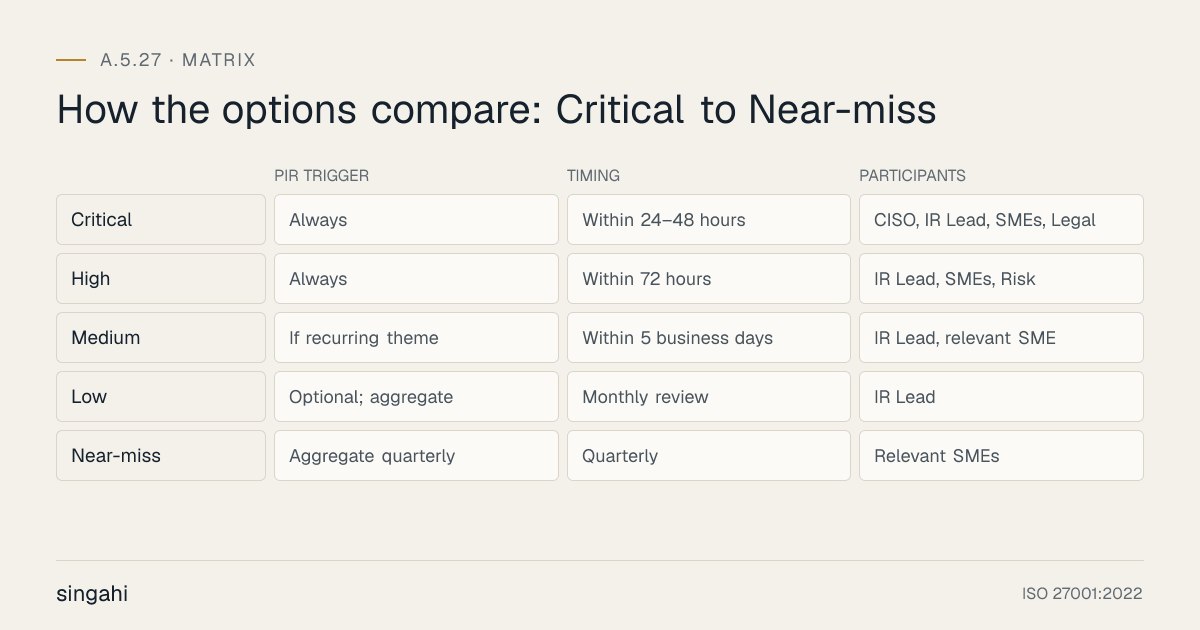
Figure · Matrix
How the options compare: Critical to Near-miss
Establishing the Learning Program
Step 1: Define the Learning Policy
Document a formal policy that mandates learning from incidents. The policy should state:
- Every confirmed incident shall undergo a PIR.
- Severity determines the depth and timing of the review.
- Root cause analysis is mandatory for High and Critical incidents.
- Corrective and preventive actions shall be tracked to closure.
- Lessons shall be stored in a central repository.
- Learning outcomes shall be communicated and integrated into the ISMS.
- Retaliation for good-faith incident reporting is prohibited.
Step 2: Define Roles and Responsibilities
| Role | Responsibility |
|---|---|
| CISO | Owns the learning program; reviews PIR outputs; reports to management. |
| Incident Response Lead | Facilitates PIRs within defined timelines; ensures evidence integrity. |
| PIR Facilitator | Neutral party who guides the review without assigning blame. |
| Root Cause Analyst | Applies RCA methodology; documents findings. |
| Action Owners | Implement assigned corrective/preventive actions by deadline. |
| Risk Manager | Updates risk register and treatment plan. |
| Training Owner | Updates awareness and role-based training. |
| Quality / Compliance | Verifies actions closed with evidence; maintains records. |
Step 3: Define PIR Triggers and Timing
| Incident Severity | PIR Trigger | Timing | Participants |
|---|---|---|---|
| Critical | Always | Within 24–48 hours of containment | CISO, IR Lead, SMEs, Legal, Communications, Business Owner |
| High | Always | Within 72 hours of containment | IR Lead, SMEs, Risk Manager, Business Owner |
| Medium | If recurring theme or significant impact | Within 5 business days | IR Lead, relevant SME |
| Low | Optional; aggregate monthly | Monthly review | IR Lead |
| Near-miss | Aggregate quarterly | Quarterly | Relevant SMEs |
Step 4: Select RCA Methodology
For A.5.27, we recommend a tiered approach:
| Incident Severity | Recommended RCA Method | Rationale |
|---|---|---|
| Low / Medium | 5 Whys + simple timeline | Fast, sufficient for straightforward issues. |
| High | Fishbone diagram + 5 Whys | Structures multiple cause categories. |
| Critical | Fault tree analysis + timeline reconstruction + external forensic support | Required for complex, multi-factor incidents. |
Step 5: Create the Lessons Repository
The repository should be:
- Searchable by incident type, root cause, system, business unit, and date.
- Access-controlled (internal use, legal privilege where applicable).
- Linked to incident tickets, risk register, and change records.
- Retained per legal and regulatory requirements (typically 3–7 years).
Minimum repository fields:
- Incident ID and title.
- Date and severity.
- Summary.
- Root cause(s).
- Corrective actions (owner, deadline, status).
- Preventive actions.
- Lessons learned statement.
- Communication record.
- Effectiveness verification.
The Post-Incident Review Process
Pre-PIR Preparation
Before the PIR meeting:
- Ensure incident is contained and eradicated.
- Preserve evidence (logs, disk images, memory dumps, network captures).
- Compile timeline.
- Gather response records.
- Send agenda and ground rules to participants.
- Appoint a neutral facilitator.
Ground rules:
- No blame; focus on systems and processes.
- Speak with data, not assumptions.
- All participants are expected to contribute.
- What is said in PIR stays in PIR (except required reporting).
- Action items must have owners and deadlines.
PIR Agenda Template
POST-INCIDENT REVIEW AGENDA
Incident ID: [INC-YYYY-NNNN]
Date: [Date]
Facilitator: [Name]

1. OPENING (5 min)
   • Ground rules
   • Scope of review

2. INCIDENT SUMMARY (10 min)
   • What happened
   • Impact assessment
   • Detection and response timeline

3. WHAT WENT WELL (10 min)
   • Effective controls, decisions, or actions

4. WHAT COULD BE IMPROVED (15 min)
   • Detection gaps
   • Response delays
   • Communication issues
   • Process failures

5. ROOT CAUSE ANALYSIS (20 min)
   • Present 5 Whys / Fishbone / Fault Tree
   • Validate root cause(s)

6. CORRECTIVE AND PREVENTIVE ACTIONS (20 min)
   • Identify actions
   • Assign owners and deadlines
   • Define success criteria

7. COMMUNICATION PLAN (5 min)
   • Who needs to know what
   • Training updates
   • Management reporting

8. CLOSURE CRITERIA (5 min)
   • Evidence required to close incident
   • Review date for actions

9. ACTION ITEMS (5 min)
   • Read back all actions
   • Schedule follow-up
Documenting the PIR
The PIR report should include:
- Executive summary.
- Incident chronology.
- Impact assessment.
- Response evaluation.
- Root cause analysis.
- Findings and recommendations.
- Corrective and preventive action plan.
- Communication plan.
- Closure checklist.
- Appendices (evidence list, diagrams, logs).
Integration with the ISMS
A.5.27 only delivers value when learning is integrated into the ISMS. The following integration points are mandatory for maturity:
Risk Register
Every root cause that represents an uncontrolled or under-controlled risk must be added to the risk register:
| Field | Example |
|---|---|
| Risk ID | RSK-2026-089 |
| Description | Insufficient logging on critical APIs enables undetected lateral movement. |
| Source | Post-incident review INC-2026-0142 |
| Likelihood | Medium |
| Impact | High |
| Risk Level | High |
| Treatment | Mitigate |
| Controls to implement | API gateway logging, SIEM correlation, anomaly detection |
| Owner | CISO |
| Target date | 2026-08-15 |
Policies and Procedures
Incident learnings should trigger updates to:
- Incident response plan.
- Acceptable use policy.
- Access control policy.
- Monitoring and logging policy.
- Change management procedure.
- Vendor security policy.
- Business continuity plan.
Each policy update must follow the organization's document control process.
Training and Awareness
Update training based on incident trends:
- If 40% of incidents start with phishing, increase phishing simulation frequency.
- If misconfigurations recur, add secure configuration training for DevOps.
- If supplier incidents increase, train procurement on security clauses.
Architecture and Design
Major incidents may require architecture changes:
- Network segmentation.
- Zero-trust redesign.
- API gateway deployment.
- SIEM/SOAR upgrade.
- Backup immutability.
These must go through formal change management and security architecture review.
Supplier Management
For incidents involving third parties:
- Update security questionnaires.
- Add incident notification and root cause clauses to contracts.
- Conduct enhanced due diligence.
- Adjust monitoring or access privileges.
- Escalate to supplier management committee.
Tiered Implementation by Organization Size
Small Organizations (1–50 Employees)
- Use a simple spreadsheet for incident tracking and lessons learned.
- Conduct a 30-minute PIR for every significant incident.
- Use the 5 Whys technique.
- Track actions in the same project management tool used for IT tasks.
- Review trends quarterly in management meetings.
Medium Organizations (50–500 Employees)
- Implement a formal PIR template and schedule.
- Use a ticket/system for CAPA tracking.
- Introduce Fishbone RCA for High incidents.
- Build a lessons-learned repository in the document management system.
- Link findings to risk register and training plan.
Large and Enterprise Organizations (500+)
- Deploy a GRC platform with integrated incident, risk, and CAPA modules.
- Conduct facilitated PIRs with pre-reads and neutral facilitators.
- Use advanced RCA (Fault Tree, Attack Trees, Human Factors Analysis).
- Perform trend analysis using SIEM/GRC analytics.
- Report learning metrics to board and external stakeholders.
- Participate in industry ISACs for external learning.
Cultural Enablers and Barriers to Learning
Organizations fail at A.5.27 more often because of culture than because of process. A blame-oriented culture turns PIRs into inquisitions, which drives information underground and guarantees repeated incidents.
Enablers of a learning culture:
- Executive messaging that treats incidents as learning opportunities.
- Protection of good-faith reporters and responders from retaliation.
- Recognition for teams that identify systemic weaknesses before they cause impact.
- Transparent sharing of anonymized incident summaries.
- Psychological safety in PIR meetings.
Common barriers:
- Fear of disciplinary action.
- Time pressure to close incidents quickly.
- Silos between IT, security, risk, and HR.
- Lack of management follow-through on actions.
- Viewing incidents as purely technical failures rather than system failures.
How to change culture:
- Start every PIR by reading the ground rules, including the no-blame principle.
- Train managers on just culture, distinguish acceptable human error, at-risk behavior, and reckless behavior.
- Share positive stories of how a near-miss or incident led to a major improvement.
- Include learning metrics in leadership scorecards.
- Hold management accountable for action closure, not just incident count.
Evidence Preservation for Learning and Legal Defense
Evidence is the raw material of learning. If logs are deleted or images are overwritten, the organization cannot perform credible RCA and may face legal or regulatory sanctions.
Preservation requirements:
- Define retention periods aligned with CERT-In (180 days minimum for logs), legal hold requirements, and contractual obligations.
- Use write-once storage or immutable backups for critical evidence.
- Maintain chain-of-custody records for forensic artifacts.
- Separate evidence storage from production systems.
- Document who accessed evidence and when.
Evidence types for learning:
- System and application logs.
- Network traffic captures.
- Disk and memory images.
- Configuration snapshots before and after the incident.
- Email and chat transcripts from response activities.
- PIR meeting recordings or minutes (with legal review).
- External forensic reports.
Supplier and Third-Party Learning Loops
Modern breaches often begin with a supplier. A.5.27 requires that supplier incidents are learned from, not just endured.
Supplier learning process:
- Contractual right to notification and RCA within defined timeframes.
- Joint PIR with supplier for critical incidents.
- Review of supplier's own corrective actions and evidence.
- Update supplier risk rating and monitoring intensity.
- Contract amendment where necessary (security clauses, audit rights, liability).
- Share anonymized internal lessons with procurement and legal teams.
Supplier-specific root cause categories:
- Inadequate due diligence at onboarding.
- Overly permissive access granted to supplier.
- Weak contractual security requirements.
- Lack of ongoing monitoring.
- Supplier sub-contracting without approval.
Incident Learning in Agile and DevOps Environments
Modern software teams ship frequently, and incidents are often tied directly to deployments. Learning must keep pace with release velocity and delivery cadence.
Practices for DevOps teams:
- Add a "learning" item to every incident postmortem in Jira or PagerDuty.
- Use blameless postmortems aligned with A.5.27 PIR requirements.
- Automate the creation of CAPA tickets from incident records.
- Link incidents to deployment records to identify bad releases quickly.
- Include incident learnings in sprint retrospectives when relevant.
- Maintain a "snackable" lessons wiki that developers can search before coding.
Integration with CI/CD:
- If an incident reveals a code pattern vulnerability, add a SAST rule or pre-commit hook.
- If misconfiguration caused impact, add infrastructure-as-code scanning.
- If secrets leakage occurred, enhance secret detection in pipelines.
Tools, Technologies, and Solutions
Categories of Tools
| Category | Purpose | Examples |
|---|---|---|
| Incident Management / SOAR | Track incidents, automate response, preserve evidence. | Splunk SOAR, Palo Alto XSOAR, ServiceNow SecOps, Swimlane, Rapid7 InsightConnect |
| Case Management | Document PIRs, actions, and evidence. | ServiceNow, Jira Service Management, TheHive, CORTEX |
| GRC Platforms | Link incidents to risks, controls, policies, and audits. | RSA Archer, MetricStream, LogicGate, ServiceNow IRM |
| SIEM / Log Management | Provide data for RCA and trend analysis. | Splunk, IBM QRadar, Microsoft Sentinel, Elastic Security, Wazuh |
| Knowledge Management | Store and search lessons learned. | Confluence, Notion, SharePoint, Guru, BookStack |
| Collaboration | War rooms, PIR meetings, async updates. | Slack, Microsoft Teams, Zoom, Google Meet |
| RCA Diagramming | Visual root cause analysis. | Lucidchart, Miro, draw.io, Visio |
| Survey / Training | Measure comprehension and update training. | KnowBe4, Proofpoint, SANS, Docebo, custom LMS |
Vendor Comparison Matrix
| Vendor / Tool | Best For | Strengths | Limitations |
|---|---|---|---|
| ServiceNow SecOps | Large enterprises | Deep workflow, GRC integration | Complex, expensive |
| Jira Service Management + Confluence | Growing companies, tech teams | Flexible, developer-friendly | Requires customization |
| TheHive + CORTEX | Security teams, SOCs | efficient, integrates with MISP | Needs technical expertise |
| Microsoft Sentinel + Purview | Microsoft-centric orgs | Native integration, cloud scale | Can become damaging |
| Wazuh (open source) | Cost-conscious organizations | Strong log analysis, agent-based | Self-managed effort |
| KnowBe4 | Security awareness | Excellent phishing simulations | Training localization limited |
| Lucidchart / Miro | RCA diagrams | Visual collaboration | Not integrated with IR tools |
Build vs. Buy Guidance
| Factor | Build (Spreadsheets + Docs) | Buy (GRC/SOAR) |
|---|---|---|
| Cost | Low upfront | Higher upfront but scalable |
| Best for | Small orgs, low incident volume | Medium/large orgs, regulated industries |
| Audit evidence | Manual | Automated, reportable |
| Integration | Limited | Rich (SIEM, ITSM, IAM, etc.) |
| Trend analysis | Manual | Automated dashboards |
| Time to value | Days | Weeks to months |
Practitioner tip: Start with Jira Service Management + Confluence for growing Indian organizations. For regulated BFSI/healthcare, evaluate ServiceNow SecOps or MetricStream.
Selecting the Right Tool Stack
When selecting tools for A.5.27, evaluate the following criteria:
| Criterion | Why It Matters | Questions to Ask |
|---|---|---|
| Integration with existing IR tools | Reduces manual data entry and preserves context. | Does it pull incident data from SIEM/SOAR automatically? |
| CAPA tracking | Ensures actions are not lost. | Can it assign owners, deadlines, and status with reminders? |
| Risk register linkage | Closes the loop between incidents and risk. | Can findings be converted into risk records? |
| Knowledge management | Makes lessons discoverable. | Is there full-text search, tagging, and access control? |
| Reporting and dashboards | Enables management oversight. | Can we build KPI dashboards without coding? |
| Audit trail | Required for ISO 27001 evidence. | Does it record who changed what and when? |
| Indian deployment | Data residency and support. | Is data hosted in India? Is local support available? |
| Cost scalability | Fits budget as the organization grows. | What is the per-user or per-incident pricing? |
Open-Source and lightweight Stack for Indian SMEs
For organizations with limited budgets, the following stack works well:
- Incident tracking: TheHive or Jira Service Management.
- Knowledge base: Confluence, Notion, or BookStack.
- CAPA tracking: Jira Work Management or Airtable.
- SIEM for logs: Wazuh or Elastic Security.
- Diagrams: draw.io or Excalidraw.
- Training: Moodle or custom quizzes.
This stack can be operational within two weeks and provides a strong evidence base for ISO 27001 audits.
Policy and Procedure Templates
Learning from Information Security Incidents Policy
LEARNING FROM INFORMATION SECURITY INCIDENTS POLICY
[Organization Name]
Version: 1.0
Approved by: [CISO / CEO]
Date: [Date]
Review Date: [Date + 12 months]
Classification: Internal

1. PURPOSE
   This policy establishes the requirement to capture, analyze, and act on
   knowledge gained from information security incidents in order to reduce
   the likelihood or impact of future incidents.

2. SCOPE
   This policy applies to all information security incidents, near-misses,
   and significant security events across all business units, systems,
   suppliers, and personnel.

3. POLICY STATEMENTS
   3.1 Every confirmed information security incident shall be reviewed to
       identify lessons learned.
   3.2 High and Critical incidents shall undergo a formal Post-Incident
       Review (PIR) within 72 hours of containment.
   3.3 Root Cause Analysis (RCA) shall be performed for all High and
       Critical incidents and for Medium incidents showing a recurring
       pattern.
   3.4 Corrective and preventive actions shall be documented, assigned,
       and tracked to closure.
   3.5 Lessons learned shall be stored in a central repository and made
       accessible to authorized personnel.
   3.6 Findings shall be integrated into the risk register, policies,
       procedures, training, and architecture as appropriate.
   3.7 Incident learnings shall be reported at management review and
       security committee meetings.
   3.8 Personnel involved in incidents shall be treated fairly; good-faith
       reporting and participation in PIRs shall not result in retaliation.

4. ROLES AND RESPONSIBILITIES
   4.1 CISO: Owns this policy and the learning program.
   4.2 Incident Response Lead: Facilitates PIRs and ensures evidence
       preservation.
   4.3 Risk Manager: Updates risk register based on findings.
   4.4 Training Owner: Updates awareness and training content.
   4.5 All Employees: Apply lessons learned and report near-misses.

5. DEFINITIONS
   (Refer to Section 5 of the implementation guide.)

6. COMPLIANCE
   Non-compliance with this policy may result in disciplinary action
   under the organization's disciplinary process.

7. RELATED DOCUMENTS
   • Information Security Incident Management Policy (A.5.24–A.5.26)
   • Risk Assessment and Treatment Policy (A.5.35, A.6.1)
   • Corrective Action Procedure
   • Training and Awareness Policy (A.6.3)
   • Change Management Procedure (A.8.32)

8. REVIEW
   This policy is reviewed annually and after any major incident that
   reveals gaps in the learning process.

APPROVED BY:
[CISO Name]                    Date: ___________
[CEO Name]                     Date: ___________
Post-Incident Review Procedure
PROCEDURE: CONDUCTING A POST-INCIDENT REVIEW
Document ID: SEC-PIR-001
Owner: Incident Response Lead
Effective Date: [Date]

1. TRIGGER
   A PIR is triggered when:
   • An incident is classified as High or Critical, OR
   • A Medium incident is part of a recurring pattern, OR
   • A near-miss reveals a systemic risk.

2. SCHEDULING
   2.1 Critical: Within 24–48 hours of containment.
   2.2 High: Within 72 hours of containment.
   2.3 Medium: Within 5 business days.
   2.4 Send calendar invite, agenda, and pre-read materials.

3. PREPARATION
   3.1 Confirm incident containment and evidence preservation.
   3.2 Compile timeline of events.
   3.3 Gather logs, alerts, response notes, and communications.
   3.4 Appoint a neutral facilitator.

4. CONDUCT REVIEW
   4.1 Review ground rules (no blame, data-driven).
   4.2 Present incident summary and impact.
   4.3 Identify what went well.
   4.4 Identify what could be improved.
   4.5 Perform RCA using approved methodology.
   4.6 Define corrective and preventive actions.
   4.7 Assign owners and deadlines.
   4.8 Agree communication plan.

5. DOCUMENTATION
   5.1 Complete PIR report within 3 business days of the meeting.
   5.2 Store report in lessons repository.
   5.3 Link to incident ticket, risk register, and change records.

6. ACTION TRACKING
   6.1 Enter all actions in CAPA tracker.
   6.2 Review status weekly until closure.
   6.3 Verify effectiveness before closing.

7. COMMUNICATION
   7.1 Share anonymized lessons with relevant teams.
   7.2 Update training content if needed.
   7.3 Report to security committee and management review.

8. CLOSURE
   8.1 Incident can be formally closed only when:
       • PIR report is complete.
       • Actions are assigned and scheduled.
       • Evidence is archived.
       • Communication is completed.
Corrective Action Register Template
| Action ID | Incident ID | Description | Type (C/P) | Owner | Due Date | Status | Evidence | Verified By | Closed Date |
|---|---|---|---|---|---|---|---|---|---|
| CA-2026-001 | INC-2026-0142 | Deploy API gateway logging on all critical APIs | Corrective | DevOps Lead | 2026-08-15 | Open | - | - | - |
| PA-2026-002 | INC-2026-0142 | Add API security module to developer training | Preventive | L&D Manager | 2026-09-01 | Open | - | - | - |
Risk Assessment and Treatment
Risk Scenario: Inability to Learn from Incidents
| Risk ID | RSK-A527-001 |
|---|---|
| Risk Statement | Failure to capture and act on incident learnings results in repeated breaches, regulatory penalties, and eroded customer trust. |
| Threat | Recurring vulnerabilities, misconfigurations, human errors, and process gaps. |
| Vulnerability | No PIR process, no root cause analysis, no action tracking, no knowledge repository. |
| Likelihood | High (if no formal learning program exists). |
| Impact | High (repeated incidents, audit failure, regulatory action). |
| Risk Level | High |
| Treatment | Mitigate |
Incident-Driven Risk Register
| Risk ID | Source Incident | Description | Likelihood | Impact | Level | Treatment | Controls |
|---|---|---|---|---|---|---|---|
| RSK-2026-101 | INC-2026-0012 | Phishing bypasses email gateway due to lack of DMARC enforcement | Medium | High | High | Mitigate | Enforce DMARC, enhanced phishing training |
| RSK-2026-102 | INC-2026-0023 | Privileged access misuse due to shared admin accounts | Medium | High | High | Mitigate | Implement PAM, break-glass procedure |
| RSK-2026-103 | INC-2026-0034 | Backup recovery fails due to untested restore process | Low | Critical | High | Mitigate | Quarterly restore tests, immutable backups |
| RSK-2026-104 | INC-2026-0045 | Supplier breach exposes customer data due to weak contract clauses | Medium | High | High | Mitigate | Update DPAs, supplier audit, monitoring |
Risk Treatment Plan
| Risk ID | Treatment | Action | Owner | Deadline | Residual Risk |
|---|---|---|---|---|---|
| RSK-2026-101 | Mitigate | Enforce DMARC reject policy; simulate phishing monthly | Email Admin / CISO | 2026-07-30 | Medium |
| RSK-2026-102 | Mitigate | Deploy PAM; eliminate shared accounts | IAM Lead | 2026-08-31 | Medium |
| RSK-2026-103 | Mitigate | Implement quarterly backup restore tests | IT Operations | 2026-07-15 | Low |
| RSK-2026-104 | Mitigate | Revise supplier DPA; conduct security audit | Vendor Manager | 2026-09-30 | Medium |
Audit and Compliance Checklist
Internal Audit Checklist for A.5.27
| # | Audit Question | Expected Evidence | Priority |
|---|---|---|---|
| 1 | Is there a documented policy/procedure for learning from incidents? | Policy, procedure, approved records | 🔴 Critical |
| 2 | Are all High/Critical incidents subject to a PIR? | PIR reports, incident closure records | 🔴 Critical |
| 3 | Are PIRs conducted within defined timeframes? | Meeting invites, reports with dates | 🔴 Critical |
| 4 | Is root cause analysis performed and documented? | RCA diagrams, 5 Whys records | 🔴 Critical |
| 5 | Are corrective/preventive actions assigned and tracked? | CAPA register, ticket system | 🔴 Critical |
| 6 | Are actions closed with evidence of effectiveness? | Closure records, re-test results | 🔴 Critical |
| 7 | Are lessons stored in a searchable repository? | Repository access, sample records | 🟡 High |
| 8 | Are incident learnings integrated into the risk register? | Risk register updates | 🔴 Critical |
| 9 | Are policies/procedures updated based on incidents? | Document change records | 🟡 High |
| 10 | Is training updated based on incident trends? | Training records, updates | 🟡 High |
| 11 | Are recurring root causes escalated? | Trend reports, escalation records | 🟡 High |
| 12 | Is learning reported at management review? | Management review minutes | 🔴 Critical |
| 13 | Are near-misses captured and analyzed? | Near-miss log | 🟢 Medium |
| 14 | Is there evidence of supplier learning loops? | Supplier incident records, contract updates | 🟡 High |
| 15 | Are PIRs conducted without retaliation? | Policy statement, HR records | 🟡 High |
| 16 | Is evidence preserved for learning and legal needs? | Evidence retention records | 🟡 High |
| 17 | Are metrics tracked for the learning program? | KPI dashboard | 🟢 Medium |
| 18 | Is there a process to verify action effectiveness? | Verification records | 🔴 Critical |
| 19 | Are lessons communicated to relevant personnel? | Communication records | 🟡 High |
| 20 | Does the process comply with DPDP Act, CERT-In, RBI/SEBI requirements? | Regulatory mapping, reporting records | 🔴 Critical |
Auditor Interview Questions
Auditors may ask staff:
- "Walk me through how your organization learns from a security incident."
- "Show me the last PIR report for a High/Critical incident."
- "How do you ensure the same incident does not happen again?"
- "Can you show me where incident lessons are stored?"
- "How are incident learnings reflected in training?"
- "What happens if a corrective action is overdue?"
- "How does top management know about incident trends?"
Metrics and KPIs
Figure · Measures
The measures that show A.5.27 is working
- PIR Completion Rate100%Monthly
- PIR Timeliness≥95%Monthly
- RCA Quality Score≥4/5Per PIR
- CAPA Closure Rate≥90%Monthly
- Repeat Incident Rate<5%Quarterly
Learning Program KPIs
| KPI | Formula | Target | Frequency | Owner |
|---|---|---|---|---|
| PIR Completion Rate | (Incidents with PIR / Total High/Critical incidents) × 100 | 100% | Monthly | IR Lead |
| PIR Timeliness | (PIRs completed on time / Total PIRs) × 100 | ≥95% | Monthly | IR Lead |
| RCA Quality Score | Average score from RCA review checklist | ≥4/5 | Per PIR | CISO |
| CAPA Closure Rate | (Actions closed on time / Total actions) × 100 | ≥90% | Monthly | Quality |
| Repeat Incident Rate | (Incidents with same root cause within 12 mo / Total incidents) × 100 | <5% | Quarterly | CISO |
| Lessons Repository Usage | Number of searches/views per month | Trending up | Monthly | KM Owner |
| Training Update Rate | (Training modules updated from incidents / Total modules) × 100 | ≥80% of relevant | Quarterly | L&D |
| Risk Register Update Rate | (Incident-driven risks added / Incidents reviewed) × 100 | 100% for High/Critical | Monthly | Risk Manager |
| Management Review Coverage | Incidents/learning items reviewed in management review | 100% of Critical, summary of others | Quarterly | CISO |
| Mean Time to Contain (MTTC) | Average time from detection to containment | Trending down | Monthly | SOC |
| Mean Time to Remediate (MTTR) | Average time from containment to full remediation | Trending down | Monthly | SOC |
| Cost per Incident | Total incident cost / Number of incidents | Trending down | Quarterly | CFO/CISO |
| Near-Miss Capture Rate | Near-misses reported / Total events | ≥20% of events | Monthly | Security Culture Lead |
| Action Effectiveness Rate | (Actions verified effective / Actions closed) × 100 | ≥95% | Quarterly | Quality |
| Employee Awareness Score | Post-training quiz average on incident lessons | ≥80% | Quarterly | L&D |
| PIR Participant Satisfaction | Survey score from PIR participants | ≥4.0/5 | Per PIR | Facilitator |
| Lessons Communicated Rate | (PIRs with documented communication / Total PIRs) × 100 | 100% | Monthly | IR Lead |
| Incident-to-Risk Conversion Rate | (High/Critical incidents added as risks / Total High/Critical incidents) × 100 | 100% | Monthly | Risk Manager |
| Mean Time to PIR | Average hours from containment to PIR completion | ≤72 hrs for High/Critical | Monthly | IR Lead |
| Regulatory Reporting Accuracy | (Incident reports accepted by regulator / Total reports) × 100 | 100% | Per report | Compliance |
KPI Dashboard Layout
┌─────────────────────────────────────────────────────────────────────────┐
│           INCIDENT LEARNING DASHBOARD — Q2 2026                         │
├─────────────────────────────────────────────────────────────────────────┤
│  PIR Completion Rate        100% ██████████████████████                │
│  PIR Timeliness              92% ████████████████████░░                  │
│  CAPA Closure Rate           88% ██████████████████░░░░                  │
│  Repeat Incident Rate         4% █░░░░░░░░░░░░░░░░░░░░                  │
│  Action Effectiveness        97% █████████████████████░                  │
├─────────────────────────────────────────────────────────────────────────┤
│  TOP ROOT CAUSES THIS QUARTER                                           │
│  1. Phishing / social engineering (28%)                                 │
│  2. Misconfiguration (22%)                                              │
│  3. Unpatched vulnerability (18%)                                       │
│  4. Supplier weakness (12%)                                             │
│  5. Access control failure (10%)                                        │
├─────────────────────────────────────────────────────────────────────────┤
│  ACTIONS OVERDUE                                                        │
│  • CA-2026-014: Deploy DMARC — 5 days overdue — Email Admin             │
│  • CA-2026-019: PAM rollout — 2 days overdue — IAM Lead                 │
├─────────────────────────────────────────────────────────────────────────┤
│  TRAINING UPDATES                                                       │
│  • Phishing awareness module updated (INC-2026-0021)                    │
│  • Secure configuration training added (INC-2026-0029)                  │
└─────────────────────────────────────────────────────────────────────────┘
Common Pitfalls / Audit Failures & How to Avoid Them
| # | Pitfall / Audit Finding | Cause | Fix | Timeline |
|---|---|---|---|---|
| 1 | Incidents closed without PIR | No closure criteria, pressure to move on | Add PIR as mandatory closure gate in incident procedure | 1 week |
| 2 | Generic root causes | Lazy analysis, fear of blame | Require validated root cause using 5 Whys or Fishbone | 2 weeks |
| 3 | Actions assigned but never closed | No tracking mechanism, no owner follow-up | Implement CAPA tracker with weekly review | 2 weeks |
| 4 | Same incident repeats | Actions not effective, no verification | Add effectiveness verification before closure | 1 month |
| 5 | Lessons not communicated | Knowledge siloed in IR team | Build communication plan for every PIR | 2 weeks |
| 6 | No linkage to risk register | IR and risk teams operate separately | Mandate risk register update for High/Critical incidents | 2 weeks |
| 7 | Training never updated | L&D not part of PIR | Include L&D owner in PIR for relevant incidents | 1 week |
| 8 | Evidence destroyed | Short log retention, lack of preservation process | Define evidence preservation requirements in IR plan | 1 week |
| 9 | Blame culture suppresses learning | Management uses incidents punitively | Publish no-retaliation policy and train managers | 1 month |
| 10 | No metrics | Learning treated as ad-hoc activity | Implement learning KPIs and dashboard | 1 month |
| 11 | Supplier incidents not learned from | Procurement excluded from PIR | Include vendor management in third-party incident PIRs | 2 weeks |
| 12 | Management never sees trends | Reports too tactical | Create quarterly executive incident learning report | 1 month |
| 13 | No learning from tabletop exercises | Exercises treated as compliance theater | Conduct hot-wash after every drill and update plans | 2 weeks |
| 14 | PIRs become complaint sessions | Poor facilitation | Train neutral facilitators and enforce ground rules | 1 month |
| 15 | Actions lack effectiveness criteria | Rush to close | Require effectiveness evidence before action closure | 2 weeks |
| 16 | Legal privilege not considered | PIR notes discoverable in litigation | Consult legal on privilege, use separate forensic notes | 2 weeks |
| 17 | No learning from minor incidents | Only major incidents reviewed | Aggregate low/medium incidents monthly for pattern analysis | 2 weeks |
| 18 | Change management not informed | Fixes deployed informally | Route all control changes through change advisory board | 1 month |
Illustrative Scenarios
Illustrative scenario, a composite example for guidance, not a specific Singahi engagement or a verified outcome.
Illustrative Scenario 1: Mumbai NBFC, Breaking the Ransomware Loop
Background A mid-sized Non-Banking Financial Company (NBFC) in Mumbai with 400 employees and AUM suffered a ransomware incident in January 2024. The attack encrypted 120 endpoints and several file servers. The organization paid a partial ransom and restored from backups over 11 days.
Initial Response Failure After containment, the incident was marked "closed" with a one-line note: "Restored from backup; user clicked phishing link." No PIR was conducted. No technical controls were changed. No training was updated.
The Recurrence Eight months later, a similar ransomware strain encrypted 40 endpoints. The root cause was the same: an unpatched Remote Desktop Protocol (RDP) server exposed to the internet, combined with a phishing email that harvested credentials.
Root Cause of the Failure to Learn
- No formal PIR process in the incident management policy.
- No closure criteria requiring lessons learned.
- Blame culture, the employee who clicked the phishing link was suspended, discouraging reporting.
- IT team was too busy firefighting to implement preventive controls.
- Management did not track incident trends.
Intervention by an external consultant The consultant implemented a full A.5.27 learning program:
- Week 1: Updated incident management policy to mandate PIRs for all High/Critical incidents.
- Week 2: Trained IR team on 5 Whys and Fishbone RCA; conducted a retrospective PIR on both ransomware incidents.
- Week 3: Implemented CAPA tracker and assigned 18 corrective/preventive actions, including:
- Disable all internet-facing RDP or place behind VPN with MFA.
- Deploy EDR on all endpoints.
- Implement immutable backups with quarterly restore tests.
- Conduct monthly phishing simulations.
- Add incident learning module to annual training.
- Month 2: Integrated incident findings into the risk register; updated access control and backup policies.
- Month 3: Presented incident learning dashboard to the board.
Results After 12 Months
- Zero ransomware incidents.
- Phishing simulation click rate dropped from 34% to 8%.
- Backup restore tests achieved 100% success rate.
- Estimated avoided cost: (based on previous downtime and recovery expenses).
- The CISO was invited to present the learning program at an industry forum, enhancing the organization's reputation.
- Employee confidence in reporting suspicious emails increased by 60% based on internal survey.
Key Lessons
- Paying a ransom is not closure, learning is.
- A blame culture guarantees repeated incidents because people hide signals.
- Management attention and metrics are essential to sustain learning.
- PIRs must be a closure gate, not an optional activity.
Illustrative Scenario 2: Bengaluru Healthtech Startup, From Data Leak to Product Security
Background A Bengaluru-based healthtech startup with 80 employees offered a teleconsultation platform. In March 2025, a security researcher reported that patient consultation records were accessible via an unauthenticated API endpoint. The exposure affected approximately 25,000 patient records.
The Incident Response The startup fixed the endpoint within 48 hours and reported the breach to the Data Protection Board and affected users as required under the DPDP Act, 2023. However, the founder viewed the incident as a "one-off coding mistake" and did not conduct a structured review.
Missed Learning Signals
- The same developer had previously introduced similar issues in two other APIs.
- Code review did not include security checks.
- There was no API security testing in the CI/CD pipeline.
- The DPDP Act compliance training was theoretical and not role-specific.
The Wake-Up Call A large hospital chain evaluating the platform for a large annual contract requested evidence of security improvements. The startup could not demonstrate a learning loop, and the deal was delayed by four months.
Improvement Programme The startup designed an A.5.27-centric improvement program:
- PIR: Conducted a facilitated review with engineering, product, legal, and compliance. Root cause: absence of secure API design standards and security gates in SDLC.
- CAPA:
- Introduce API security standard (authentication, authorization, input validation, rate limiting).
- Add SAST/DAST and API security scanning to CI/CD.
- Implement mandatory security code review for all API changes.
- Create developer training on OWASP API Security Top 10.
- Update privacy by design checklist.
- Knowledge Management: Created a lessons repository with anonymized illustrative scenarios.
- Integration: Linked findings to risk register; updated secure development policy and vendor DPA.
- Communication: Shared anonymized lessons in engineering all-hands; added module to onboarding.
Results After 9 Months
- Passed the hospital chain security assessment and closed the contract.
- Zero API security incidents in subsequent releases.
- Security code review compliance reached 100%.
- DPDP Act readiness improved; data principal rights process documented.
- Achieved ISO 27001:2022 certification 10 months after engagement.
- The secure API standard was adopted as a reference by two partner organizations.
- Developer onboarding time for security practices reduced by 40%.
Key Lessons
- A single incident can reveal a systemic engineering weakness.
- Customer due diligence increasingly evaluates learning maturity, not just incident count.
- Developer training must be tied to actual incident patterns.
- A.5.27 is a certification and revenue enabler, not a checkbox.
Illustrative Scenario 3: Chennai Manufacturing Firm, Supplier Breach Teaches Procurement
Background A Chennai-based manufacturing company with 1,200 employees used a third-party payroll processor. In 2024, the payroll provider suffered a breach that exposed employee salary and bank details. The manufacturer had no contractual right to a root cause analysis and no process to update supplier controls after the incident.
Learning Loop Implemented After engaging an external security consultant, the manufacturer:
- Added a supplier incident clause requiring notification within 24 hours and RCA within 72 hours.
- Updated vendor security questionnaire to include incident history and learning practices.
- Created a supplier incident PIR template.
- Added supplier incidents to the quarterly risk committee agenda.
- Conducted enhanced due diligence on all critical suppliers.
Results
- Two additional suppliers with weak incident histories were replaced.
- Contractual incident response clauses were added to 100% of critical vendor agreements.
- No repeat supplier-related data exposures in 18 months.
- The procurement team now includes a security learning review in every quarterly business review with critical vendors.
- The organization shared anonymized lessons with its industry association, strengthening sector-wide resilience.
Key Lesson Supplier incidents must trigger learning loops in procurement and contract management, not just IT.
Multi-Framework Mapping
| ISO 27001:2022 | SOC 2 | PCI DSS v4.0.1 | NIST 800-53 Rev 5 | CIS Controls v8 | COBIT 2019 | DPDP Act / GDPR |
|---|---|---|---|---|---|---|
| A.5.27 | CC7.5 (recovery and lessons), CC4.2 (deficiencies communicated and corrected) | 12.10.6 (plan updated from lessons learned and industry developments) | IR-4 (incident handling: lessons learned), IR-8 (plan update), CA-7 | 17.8 (post-incident reviews) | DSS02.06/DSS02.07 (resolve and track incidents), DSS03 (managed problems: root cause) | DPDP s.8(5) safeguards improved after breaches; GDPR Art. 32 |
| A.5.24 | CC7.3, CC7.4 | 12.10.1, 12.10.2 | IR-4, IR-8 | 17.4, 17.5 | DSS02 | DPDP s.8(6) readiness |
| A.5.25 | CC7.3 | 12.10.5 | IR-4, IR-5 | 17.9 | DSS02.02 | - |
| A.5.26 | CC7.4 | 12.10.1 | IR-4, IR-6 | 17.6 | DSS02.05 | DPDP s.8(6); GDPR Art. 33–34 |
| A.6.3 | CC2.2 | 12.6.1–12.6.3 | AT-2, AT-3 | 14.1 | APO07.03 | - |
| A.8.32 | CC8.1 | 6.5.1, 6.5.2 | CM-3, CM-4 | 4.1 | BAI06.01 | - |
Mapping Notes
- SOC 2: CC7.4 covers responding to incidents and CC7.5 recovering from them, including lessons learned; CC4.2 covers correcting deficiencies.
- PCI DSS v4.0.1: 12.10.2 requires the plan to be reviewed and tested at least annually, and 12.10.6 requires it to be updated from lessons learned and industry developments.
- NIST 800-53 Rev 5: IR-4 (Incident Handling), IR-6 (Reporting), IR-7 (Response Assistance), and IR-8 (Plan) all embed learning. CA-2 and CA-7 support continuous assessment.
- CIS Controls v8: Control 17 (Incident Response Management) includes lessons learned and plan updates.
- COBIT 2019: DSS02 (managed service requests and incidents) and DSS03 (managed problems, including root cause analysis) are the direct matches.
- GDPR / DPDP Act 2023: Security safeguards and breach notification obligations implicitly require organizations to learn from incidents to maintain "reasonable security."
Implementation Roadmap
90-Day Implementation Roadmap
| Phase | Week | Focus | Key Activities | Deliverable |
|---|---|---|---|---|
| Foundation | 1 | Policy & Governance | Draft Learning from Incidents policy; define PIR triggers and roles; gain CISO/CEO approval | Approved policy |
| 2 | Templates & Tools | Create PIR template, RCA checklist, CAPA tracker, lessons repository | Toolkit v1 | |
| 3 | Pilot | Run pilot PIR on last 2 High/Critical incidents; refine process | Pilot PIR reports | |
| 4 | Training | Train IR team, IT leads, risk manager, L&D on PIR and RCA | Training completion records | |
| Build | 5–6 | Integration | Link PIR outputs to risk register, policies, procedures, change management | Integration map |
| 7 | Metrics | Define KPIs, build dashboard, establish reporting cadence | KPI dashboard | |
| 8 | Supplier Loop | Add supplier incident learning clauses and process | Updated vendor template | |
| Embed | 9–10 | Scale | Roll out to all business units; conduct PIRs for new incidents | Full coverage |
| 11 | Review | Internal audit of A.5.27; fix gaps | Audit report | |
| 12 | Optimize | Present learning dashboard to management; plan next quarter | Management review input |
Quick-Start Checklist (First 30 Days)
- Approve Learning from Incidents policy.
- Identify PIR facilitator and core participants.
- Create PIR template and CAPA tracker.
- Define severity-based PIR triggers.
- Add PIR as incident closure gate.
- Conduct at least one PIR on a recent High/Critical incident.
- Update risk register with at least one incident-driven risk.
- Communicate anonymized lessons to relevant staff.
- Report progress to security committee.
FAQ
Does every incident require a full PIR?
No. Severity and pattern determine depth. All incidents should produce at least a brief lessons-learned note. High and Critical incidents require a formal PIR. Medium incidents require a PIR if recurring. Low incidents can be reviewed in aggregate. The goal is proportional learning without creating unnecessary overhead.
How soon after containment should the PIR happen?
Critical incidents: within 24–48 hours. High incidents: within 72 hours. Medium: within 5 business days. Delaying beyond these windows causes memory decay and evidence loss.
Who should facilitate the PIR?
A neutral facilitator who was not directly involved in the incident response. This reduces defensiveness and improves objectivity. In small organizations, the CISO may facilitate, but should remain impartial.
How do we avoid blame in PIRs?
Set ground rules upfront: focus on systems, processes, and controls, not individuals. Investigate "how" and "why," not "who." Use systemic cause categories (people, process, technology, environment). Protect good-faith reporters from retaliation.
What is the difference between corrective and preventive action?
Corrective action addresses the cause of an incident that already happened. Preventive action addresses a potential cause to stop a similar incident from happening elsewhere.
How do we know a corrective action is effective?
Define effectiveness criteria before implementation. Examples: no repeat incident with the same root cause for 12 months; phishing click rate drops by 50%; backup restore test passes; vulnerability scan shows zero reoccurrence.
What if we don't have budget for expensive tools?
Start with spreadsheets, Confluence, and Jira. A.5.27 is about discipline and process, not software. Many Indian SMEs pass ISO 27001 audits with simple but well-maintained learning logs.
How does A.5.27 relate to DPDP Act breach reporting?
The DPDP Act requires breach intimation to the Board and affected data principals. A.5.27 ensures you also analyze the breach internally, update controls, and document preventive actions, evidence that supports your "reasonable security safeguards" position.
Can near-misses be used for learning?
Yes. Near-misses are often the best learning opportunities because they reveal weaknesses before impact. Capture and review them quarterly.
How do we handle lessons involving third parties?
Include vendor management in PIRs for supplier-related incidents. Update contracts, security questionnaires, monitoring, and risk assessments. Escalate repeat failures to procurement and legal.
Should we share lessons externally?
Anonymized sharing with industry groups or ISACs is valuable but optional. Never share identifiable information, legal privilege, or regulator-restricted details without approval.
How often should the learning policy be reviewed?
Annually at minimum, and after any major incident that exposes weaknesses in the learning process itself.
What if an incident was caused by a third party but impacted our data?
Treat it as your own incident from a learning perspective. Conduct a PIR focusing on why the third party had access, whether monitoring was adequate, and whether contractual controls were strong enough. Update vendor risk assessments and contracts.
How do we balance speed of closure with depth of learning?
Close the immediate incident response quickly to restore operations, but keep the learning track open until actions are verified. Use separate statuses: "Incident Closed" and "Learning Actions Open." Do not confuse operational closure with learning closure.
Should we record PIR meetings?
Recording can help accuracy but may create legal discovery risk. If recorded, store securely with access limited to authorized personnel and define retention. Many organizations prefer detailed written minutes approved by participants.
How do we handle incidents that are still under legal investigation?
Coordinate with legal counsel. PIR can proceed with facts that are not privileged or subject to litigation hold, but legal should review scope and documentation. Preserve all evidence per legal advice.
What is a "just culture" and why does it matter for A.5.27?
A just culture distinguishes between acceptable human error, at-risk behavior, and reckless behavior. It encourages reporting and honest participation in PIRs. Without it, employees hide mistakes and the organization loses the chance to learn.
Can A.5.27 help with cyber insurance renewals?
Yes. Insurers increasingly look for evidence of incident response maturity and continuous improvement. A documented learning program with metrics can reduce premiums or improve coverage terms.
What should be included in a quarterly incident learning report to the board?
- Number and severity of incidents.
- PIR completion and timeliness rates.
- Top root causes and trends.
- Status of corrective/preventive actions.
- Repeat incident analysis.
- Key lessons and policy/procedure changes.
- Recommended investments.
- Regulatory reporting status.
How do we learn from incidents at suppliers we cannot control?
Request RCA and evidence through contract clauses. If the supplier refuses, escalate to procurement and legal. Consider alternative suppliers. At minimum, update your own monitoring, access controls, and incident response plan to assume supplier compromise.
What is the role of the Data Protection Officer in incident learning?
Under the DPDP Act, the DPO oversees breach intimation, data principal communication, and records of personal data breaches. The DPO should participate in PIRs for incidents involving personal data to ensure regulatory obligations are met and learnings are embedded into privacy controls.
References and Further Reading
Standards and Frameworks
- ISO/IEC 27001:2022, Annex A, Control 5.27, Learning from information security incidents.
- ISO/IEC 27002:2022, Section 5.27, Implementation guidance.
- ISO/IEC 27035, Information security incident management (all parts).
- NIST SP 800-61 Rev. 2, Computer Security Incident Handling Guide.
- NIST SP 800-53 Rev. 5, Incident Response (IR) and Assessment (CA) controls.
- CIS Controls v8, Control 17: Incident Response Management.
Indian Regulations
- Digital Personal Data Protection Act, 2023.
- CERT-In Directions, 2022 (Cyber Security Directions).
- RBI Cyber Security Framework in Banks, 2016 and updates.
- RBI Master Direction on Information Technology Governance, Risk, Controls and Assurance Practices (2023, in force from 1 April 2024).
- SEBI Cybersecurity and Cyber Resilience Framework (CSCRF) for SEBI Regulated Entities, circular of 20 August 2024.
- IRDAI Information and Cyber Security Guidelines, 2023 (which replaced the 2017 guidelines).
- Information Technology Act, 2000 (Sections 43A, 66, 72A).
- Information Technology (Reasonable Security Practices and Procedures and Sensitive Personal Data or Information) Rules, 2011.
Industry Reports
- IBM Cost of a Data Breach Report 2024, India segment.
- Verizon Data Breach Investigations Report (DBIR) 2024.
- SANS Incident Response Survey.
- Ponemon Institute research on cost of repeated breaches.
Methodologies
- 5 Whys (Sakichi Toyoda, Toyota Production System).
- Fishbone / Ishikawa Diagram.
- Fault Tree Analysis (IEC 61025).
- Bow-Tie Analysis for risk and incident learning.