
On this page
- Quick Reference: A.5.26 in 60 Seconds
- What the Control Asks For
- Why This Control Matters
- Scope and Applicability
- Key Definitions and Terminology
- Relationship to Other Controls
- The Incident Response Lifecycle
- Detailed Implementation Guidance
- Tools, Technologies, and Solutions
- Policy and Procedure Templates
- Risk Assessment and Treatment
- Audit and Compliance Checklist
- Metrics and KPIs
- Common Pitfalls / Audit Failures & How to Avoid Them
- Illustrative Scenarios: Indian Incident Response Failures and Recoveries
- Multi-Framework Mapping
- Implementation Roadmap: 6 Weeks
- FAQ
- References and Further Reading
Quick Reference: A.5.26 in 60 Seconds
| Attribute | Details |
|---|---|
| Control ID | A.5.26 |
| Control Title | Response to information security incidents |
| Objective | Ensure information security incidents are responded to in a timely, consistent, and effective manner using documented procedures. |
| Domain | Organisational controls, Information security incident management |
| What You Must Do | Define, approve, publish, and maintain documented incident response procedures; respond to every information security incident according to those procedures; preserve evidence; learn from incidents. |
| Typical Owner | CISO / Information Security Manager / Incident Response Lead |
| Maturity Level 1 | Ad-hoc response; no documented procedure; incidents handled informally by IT. |
| Maturity Level 2 | Basic incident reporting process exists; some documentation; escalation is inconsistent. |
| Maturity Level 3 | Documented incident response procedures; defined roles; classification and escalation; evidence preservation; post-incident reviews. |
| Maturity Level 4 | Integrated response with SIEM, SOAR, and threat intelligence; tabletop exercises; metrics-driven improvement; automated containment. |
| Maturity Level 5 | Proactive, adaptive incident response; predictive analytics; continuous red-team validation; industry threat sharing; zero-repeat-incident culture. |
| Audit Red Flag | No incident response procedure; missing incident records; no evidence preservation; failure to classify or escalate; no lessons learned. |
| Quick Win | Create a one-page incident escalation matrix and a 24x7 contact list for the incident response team today. |
| Time to Implement | 4–8 weeks for a foundational capability; 3–6 months for a mature, automated programme. |
| Related Controls | A.5.24 (Information security incident management planning and preparation), A.5.25 (Assessment and decision on information security events), A.5.27 (Learning from information security incidents), A.5.28 (Collection of evidence), A.5.29 (Information security during disruption), A.5.30 (ICT readiness for continuity), A.6.8 (Information security event reporting), A.8.15 (Logging), A.8.16 (Monitoring activities) |
| ISO 27002 attributes | Control type: Corrective · Properties: Confidentiality, Integrity, Availability · Concepts: Respond, Recover · Capabilities: Information security event management · Domains: Defence |
What the Control Asks For
The Control in Brief
ISO 27001:2022 Annex A 5.26 asks organizations to respond to security incidents in line with documented procedures.
Do you need this control?
A.5.26 is not mandatory in itself: under clause 6.1.3 you include it if your risk assessment calls for it, and record the decision in your Statement of Applicability. Almost always included alongside A.5.24 and A.5.25. The depth of the response procedures should match your threats and size; small organisations often combine planning and response in one document.
ISO 27002:2022 Implementation Guidance (Section 5.26)
ISO 27002 5.26 asks that response procedures be established and communicated to all relevant interested parties, and that incidents be handled by a designated team with the required competency. Paraphrased, the response should cover: containing systems affected by the incident; collecting evidence as soon as possible (A.5.28); escalating, including crisis management and possibly business continuity plans; logging all response activities; communicating the incident to internal and external parties on a need-to-know basis; coordinating with authorities, external interest groups and forums, suppliers and clients to reduce the consequences for others; formally closing and recording the incident once handled; root cause analysis; and identifying lessons learned.
The elements below organise this into practice:
-
Activation of the response process: Once an information security event has been assessed and classified as an incident (per A.5.25), the documented response procedures must be activated without delay. Activation criteria, triggers, and authority should be pre-defined.
-
Timely response: Response actions should be commensurate with the classification and potential business impact of the incident. Critical incidents (e.g., ransomware, data breach, active adversary in the network) demand immediate response; set your own response targets by severity (27002 sets no timings).
-
Containment, eradication, and recovery: The response should follow a structured approach: contain the incident to prevent further damage, eradicate the root cause, and recover affected systems and services to normal operations.
-
Evidence preservation: Evidence should be collected and preserved in a manner that supports forensic analysis, legal proceedings, and regulatory reporting. Chain of custody must be maintained (see also A.5.28).
-
Communication and reporting: Internal stakeholders, customers, regulators, law enforcement, and other interested parties should be informed according to legal, regulatory, and contractual obligations.
-
Coordination with business continuity: For incidents that cause significant disruption, response activities should interface with business continuity and ICT continuity plans (A.5.29, A.5.30).
-
Documentation and logging: All response actions, decisions, and outcomes should be documented. Logs should be protected from tampering.
-
Post-incident review and learning: After the incident is resolved, lessons learned should be documented and used to improve the ISMS (see A.5.27).
Shall / Should / May Analysis
| Term | Count in A.5.26 / ISO 27002 | Implication |
|---|---|---|
| Shall | The A.5.26 control statement (Annex A) | Required once A.5.26 is included in your Statement of Applicability: respond to incidents according to documented procedures. |
| Should | ISO 27002 guidance (27002 contains no requirements) | Good practice. Apply what your risk assessment calls for; there is no formal deviation process for guidance. |
| May | Occasional in ISO 27002 | Optional. Use where appropriate based on risk assessment and context. |
What Auditors Actually Check
| Auditor Action | What They Want to See |
|---|---|
| Review incident response procedure | Documented, approved, current, version-controlled, and mapped to A.5.26 |
| Sample incident records | Evidence that actual incidents were handled according to the procedure |
| Check classification and prioritisation | Incidents classified by severity; response times match SLAs |
| Verify escalation records | Evidence that high-severity incidents were escalated to management and relevant authorities |
| Review evidence handling | Chain of custody, log integrity, forensic images, preserved artefacts |
| Interview response team | Team members can articulate roles, contacts, and steps without referencing documents for every detail |
| Check communication records | Internal notifications, customer breach notifications, regulator reports (CERT-In, RBI, SEBI, IRDAI, etc.) |
| Verify lessons learned | Post-incident review records; corrective actions tracked to closure |
| Test integration with business continuity | Incidents causing disruption invoked BCP/DR plans |
| Review metrics and KPIs | MTTD, MTTR, containment times, re-opened incidents, exercise results |
Why This Control Matters
The Business Risk Narrative
An information security incident is not a technical glitch, it is a business crisis. Whether it is a ransomware attack encrypting your finance servers, a developer leaking API keys to a public repository, or an insider exfiltrating customer data, the organisation's ability to respond determines whether the event becomes a manageable disruption or a catastrophic failure.
A.5.26 sits at the heart of the incident management cluster (A.5.24–A.5.28). While A.5.24 requires you to plan and prepare, A.5.25 requires you to assess and decide, and A.5.27 requires you to learn, A.5.26 is the moment of truth: how you actually respond when the alarm goes off.
Without documented response procedures, organisations fall into chaos:
- No one knows who is in charge.
- Critical containment steps are skipped while teams debate.
- Evidence is overwritten or deleted.
- Customers and regulators are informed too late or inconsistently.
- The same incident type repeats because no one captured lessons learned.
The cost of poor incident response is measurable. IBM's "Cost of a Data Breach Report" consistently shows that organisations with formal incident response teams and tested incident response plans save millions of dollars per breach compared to those without. More importantly, they preserve customer trust, regulatory standing, and operational continuity.
Indian Regulatory Context
India's regulatory landscape makes incident response a legal obligation, not merely an ISO 27001 requirement.
CERT-In Directions, 2022
The Indian Computer Emergency Response Team (CERT-In) issued Directions under Section 70B(6) of the IT Act, 2000 on 28 April 2022; they took effect 60 days later, in late June 2022. These Directions mandate that service providers, intermediaries, data centres, body corporates, and government organisations must report the following cyber incidents to CERT-In within six hours of noticing or being brought to notice:
- Targeted scanning or probing of critical networks and systems
- Compromise of critical systems or information
- Unauthorised access to IT systems or data
- Defacement of website or intrusion into a website
- Malicious code attacks (ransomware, spyware, worms, trojans)
- Attacks on servers including database, mail, and DNS
- Identity theft, spoofing, and phishing attacks
- Denial of Service (DoS) and Distributed Denial of Service (DDoS) attacks
- Attacks on critical infrastructure, SCADA systems, and IoT devices
- Data breaches, leaks, and unauthorised data disclosure
Failure to report can result in penalties under the IT Act, 2000, and may expose senior management to liability.
Digital Personal Data Protection (DPDP) Act, 2023
Under the DPDP Act, 2023, a Data Fiduciary that suffers a personal data breach must give intimation to the Data Protection Board of India and each affected Data Principal in the manner prescribed. The DPDP Rules 2025, notified in November 2025, set the manner; the breach duties apply once the transition ends (about May 2027). Prepare for:
- Intimation to the Board and each affected Data Principal without delay, followed by a detailed report to the Board within 72 hours (no harm threshold)
- Detailed breach assessment and documentation
- Demonstration of reasonable security safeguards and prompt response
- Potential penalties up to ₹250 crore for failure to take reasonable security safeguards and up to ₹200 crore for failure to notify a breach
Your A.5.26 response procedures are the operational mechanism that enables DPDP Act compliance.
Reserve Bank of India (RBI) Guidelines
RBI-regulated entities (banks, NBFCs, payment system operators, fintechs) must comply with:
- RBI Cyber Security Framework: mandatory incident reporting to RBI, cyber crisis management plan, and prompt corrective action.
- Master Direction on Information Technology Framework for NBFCs: incident classification and reporting timelines.
- Digital Payment Security Controls: requirements for incident response and fraud monitoring.
Incident response failures in the financial sector can lead to restrictions on business operations, fines, and reputational damage.
Securities and Exchange Board of India (SEBI)
SEBI's CSCRF (2024) for regulated entities, including market infrastructure institutions (MIIs), stock brokers, depository participants, and mutual funds requires:
- Cyber crisis management plan
- Incident reporting to SEBI within specified timelines
- Annual cyber audit and tabletop exercises
- Business continuity and disaster recovery testing
Insurance Regulatory and Development Authority of India (IRDAI)
IRDAI's cybersecurity guidelines for insurers mandate:
- Cyber incident response team
- Reporting of cyber incidents to IRDAI
- Cyber crisis management plan
- Regular vulnerability assessments and penetration testing
Information Technology Act, 2000
Sections 43, 43A, 66, and 72A of the IT Act create liability for:
- Failure to implement reasonable security practices
- Compensation for failure to protect sensitive personal data or information
- Criminal penalties for hacking, data theft, and identity fraud
A documented, tested incident response capability is strong evidence of "reasonable security practices" under Section 43A read with the Information Technology (Reasonable Security Practices and Procedures and Sensitive Personal Data or Information) Rules, 2011.
Industry-Specific Consequences
| Industry | Consequence of Poor Incident Response |
|---|---|
| Banking & Fintech | Loss of customer funds, RBI enforcement, loss of licence, erosion of depositor trust |
| SaaS / Technology | Customer churn, contractual penalties, loss of enterprise deals, SOC 2 audit failures |
| Healthcare | Patient safety risk, data breach penalties, loss of clinical system availability |
| E-commerce / Retail | Payment card data theft, PCI DSS non-compliance, revenue loss during downtime |
| Manufacturing | Production line shutdown, OT/ICS compromise, supply chain disruption |
| Government / Public Sector | National security implications, citizen data exposure, media scrutiny |
Cost of Non-Compliance: By the Numbers
- Average cost of a data breach in India (2024): about ₹19.5 crore (INR 195 million; IBM Cost of a Data Breach Report 2024), with the majority of costs driven by detection, escalation, notification, and lost business.
- Regulatory fine exposure: DPDP Act penalties can reach ₹250 crore for failure to take reasonable security safeguards.
- Customer churn after breach: lost business (customer turnover and reputational damage) is consistently one of the largest breach cost components in IBM's annual reports.
The Trust Argument
In the Indian B2B technology market, enterprise buyers increasingly demand proof of incident response maturity before signing contracts. A mature A.5.26 capability, complete with documented procedures, trained responders, regular exercises, and measurable outcomes, becomes a competitive differentiator. It signals that your organisation can be trusted with customer data and critical business processes.
Scope and Applicability
What This Control Covers
A.5.26 applies to the response phase of information security incident management. It covers:
- All events that have been assessed and classified as information security incidents under A.5.25.
- The documented procedures used to guide response actions.
- The people, processes, and technologies involved in detecting, analysing, containing, eradicating, recovering from, and communicating about incidents.
- Preservation of evidence for forensic, legal, and regulatory purposes.
- Coordination with business continuity, disaster recovery, legal, HR, communications, and third parties.
- Post-incident activities that feed into A.5.27 (learning from incidents).
What This Control Does NOT Cover
- Planning and preparation: primarily A.5.24.
- Assessment and decision on whether an event is an incident, primarily A.5.25.
- Collection of evidence as a standalone discipline: primarily A.5.28.
- Long-term learning and corrective action: primarily A.5.27.
That said, these controls are deeply interrelated, and a mature implementation will reference them continuously.
Who This Applies To
| Role Category | Applicability |
|---|---|
| All employees | Must know how to report incidents and cooperate with response activities. |
| IT / SOC team | First responders; technical containment and analysis. |
| CISO / Information Security Manager | Incident commander or senior advisor; escalation owner. |
| Incident Response Team (IRT) | Core responders with defined roles and contact details. |
| Legal / Compliance | Regulatory reporting, privilege, evidence handling, contractual notifications. |
| HR | Insider threat response, disciplinary actions, employee communications. |
| PR / Corporate Communications | External messaging, media, customer communications. |
| Business Unit Leaders | Impact assessment, resource allocation, continuity decisions. |
| Senior Management / Board | Strategic decisions, major regulatory notifications, crisis management. |
| Third-party vendors / MSPs / MDR providers | Must follow your incident response procedures and notify you of incidents. |
Size-Based Applicability
| Organisation Size | A.5.26 Implementation Approach |
|---|---|
| Micro / Startup (1–20 employees) | One-page incident response runbook; founder/CISO as incident commander; shared on-call roster; basic logging. |
| Small (21–100 employees) | Documented procedure; defined IRT; simple classification matrix; 24x7 contact list; monthly review of alerts. |
| Medium (101–500 employees) | Formal incident response policy and procedures; dedicated or shared SOC; SIEM; quarterly tabletop exercises; integration with BCP. |
| Large (501–2,000 employees) | Full CSIRT/SOC; SOAR automation; threat intelligence; defined playbooks for major incident types; red-team validation. |
| Enterprise (2,000+ employees) | Global SOC; dedicated incident commander rotation; forensic lab; legal hold processes; automated evidence collection; industry ISAC participation. |
Incident Types in Scope
| Category | Examples |
|---|---|
| Malware and ransomware | Ransomware, wipers, trojans, spyware, adware |
| Phishing and social engineering | Spear phishing, BEC, credential harvesting, vishing |
| Network intrusions | APT activity, lateral movement, C2 beaconing |
| Data breaches | Unauthorised access, exfiltration, accidental disclosure |
| Insider threats | Malicious insider, negligent data handling, theft |
| Denial of service | DDoS, application-layer DoS, resource exhaustion |
| Web application attacks | SQL injection, XSS, IDOR, API abuse |
| Cloud security incidents | Misconfiguration exposure, IAM compromise, crypto-mining |
| Physical security incidents | Unauthorised access, device theft, tailgating |
| Supply chain incidents | Compromised vendor, malicious update, third-party breach |
| Operational technology (OT) | ICS/SCADA compromise, manufacturing disruption |
Key Definitions and Terminology
| Term | Definition | Source / Context |
|---|---|---|
| Information security event | An identified occurrence of a system, service, or network state indicating a possible breach of information security policy or failure of safeguards. | ISO 27000 |
| Information security incident | A single or series of unwanted or unexpected information security events that have a significant probability of compromising business operations and threatening information security. | ISO 27000 |
| Incident response | The process of detecting, analysing, containing, eradicating, recovering from, and documenting information security incidents. | ISO 27002 / NIST SP 800-61 |
| Incident Response Team (IRT) | The group of individuals responsible for managing and executing the incident response process. | ISO 27002 |
| Computer Security Incident Response Team (CSIRT) | A formal, often dedicated, team responsible for responding to computer security incidents. | FIRST / NIST |
| Incident Commander (IC) | The individual with overall authority and responsibility for managing an incident. | NIMS / NIST |
| Containment | Actions taken to limit the scope, impact, or spread of an incident. | NIST SP 800-61 |
| Eradication | Actions taken to remove the root cause of an incident and eliminate threats from the environment. | NIST SP 800-61 |
| Recovery | Actions taken to restore affected systems and services to normal operation. | NIST SP 800-61 |
| Chain of custody | A documented trail that records the seizure, custody, control, transfer, analysis, and disposition of evidence. | Forensics / Legal |
| Forensic image | A bit-for-bit copy of digital storage media created in a forensically sound manner. | Digital forensics |
| Mean Time to Detect (MTTD) | The average time between the start of an incident and its detection. | Security operations metric |
| Mean Time to Respond (MTTR) | The average time between detection and effective containment of an incident. | Security operations metric |
| Mean Time to Contain (MTTC) | The average time between detection and containment of an incident. | Security operations metric |
| Security Operations Centre (SOC) | A centralised function responsible for monitoring, detecting, analysing, and responding to security events and incidents. | Industry standard |
| Security Orchestration, Automation and Response (SOAR) | Technologies that automate incident response workflows and orchestrate tools and people. | Industry standard |
| Managed Detection and Response (MDR) | Outsourced service providing threat detection, investigation, and response. | Industry standard |
| Breach notification | The legal or contractual obligation to inform affected individuals, regulators, or other parties of a data breach. | DPDP Act, GDPR, IT Act |
| Tabletop exercise | A discussion-based exercise where participants walk through incident scenarios to validate plans and procedures. | Crisis management |
| War room | A physical or virtual space where the incident response team coordinates response activities during a major incident. | Incident management |
Relationship to Other Controls
Upstream Controls (Inputs to A.5.26)
| Control | Relationship to A.5.26 |
|---|---|
| A.5.1, Policies for information security | Provides the master policy framework under which the incident response policy is approved and maintained. |
| A.5.2, Information security roles and responsibilities | Defines incident response roles such as incident commander, SOC analyst, forensic analyst, and communications lead. |
| A.5.24, Information security incident management planning and preparation | Establishes the incident management process, resources, and competencies needed before response can occur. |
| A.5.25, Assessment and decision on information security events | Determines whether an event is an incident and how it should be prioritised before A.5.26 response procedures are activated. |
| A.6.8, Information security event reporting | Defines how employees and third parties report events that may trigger the response process. |
| A.8.15, Logging | Generates the audit trails and logs that enable incident detection, analysis, and evidence preservation. |
| A.8.16, Monitoring activities | Provides the detection and alerting capabilities that surface incidents for response. |
Parallel Controls (Executed Concurrently)
| Control | Relationship to A.5.26 |
|---|---|
| A.5.28, Collection of evidence | Evidence collection runs in parallel with response; chain of custody must be maintained from the earliest stages. |
| A.5.29, Information security during disruption | For disruptive incidents, response and business continuity activities run in parallel. |
| A.5.30, ICT readiness for continuity | Recovery of IT systems may invoke ICT continuity plans during incident response. |
| A.8.7, Protection against malware | Malware incidents trigger both response procedures and malware protection controls. |
| A.8.8, Management of technical vulnerabilities | Vulnerability exploitation incidents feed back into vulnerability management. |
Downstream Controls (Outputs from A.5.26)
| Control | Relationship to A.5.26 |
|---|---|
| A.5.27, Learning from information security incidents | Post-incident reviews and lessons learned from response activities feed into improvement. |
| A.5.35, Independent review of information security | Audit findings may identify gaps in incident response maturity. |
| A.5.36, Compliance with policies, rules and standards for information security | Incident response procedures are a key policy that must be complied with. |
| A.6.3, Information security awareness, education and training | Training content is updated based on incident trends and lessons learned. |
| A.5.15–A.5.18, Access control, identity, authentication and access rights | Compromised credentials and accounts identified during incidents lead to access remediation. |
Why This Mapping Matters
Auditors do not assess A.5.26 in isolation. They trace an incident from detection (A.8.16), through reporting (A.6.8), assessment (A.5.25), response (A.5.26), evidence handling (A.5.28), learning (A.5.27), and improvement (clause 10.1). Gaps in any of these controls undermine the effectiveness of A.5.26.
The Incident Response Lifecycle
Figure · Tiers
Maturity levels for response to information security incidents
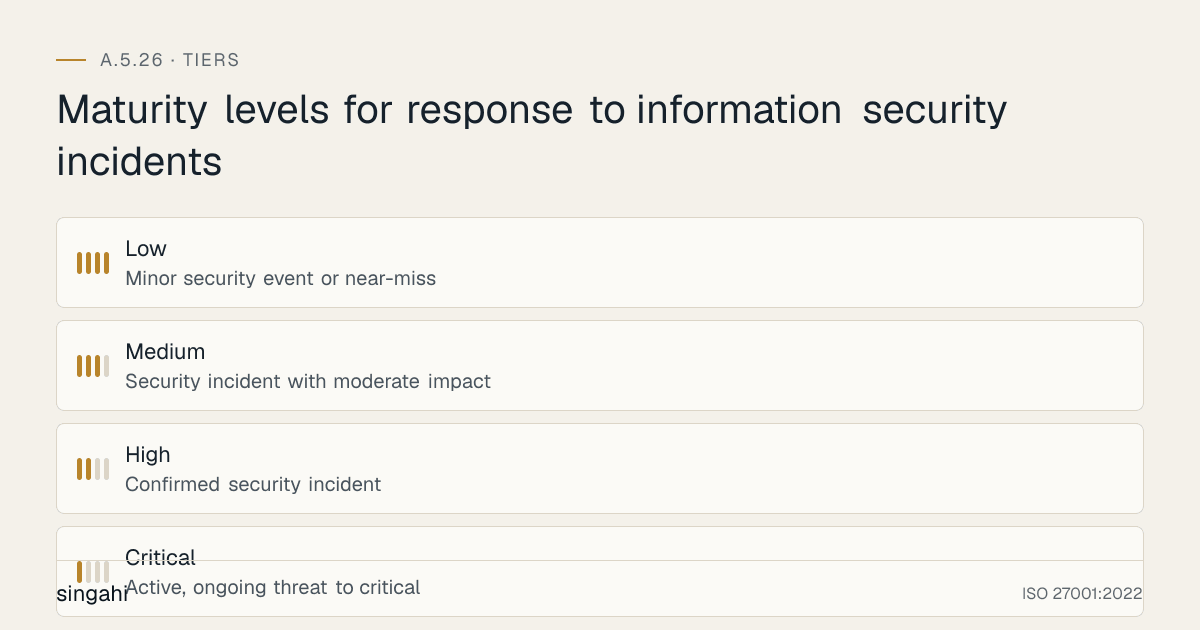
A.5.26 is best understood through the lens of a structured incident response lifecycle. While A.5.24 covers preparation, A.5.26 focuses on detection/analysis, containment, eradication, recovery, and post-incident activity.
NIST SP 800-61 Lifecycle (Applied to A.5.26)
┌─────────────────────────────────────────────────────────────────────┐
│  PREPARATION                                                        │
│  (Primarily A.5.24 — but procedures are reviewed and ready)         │
└─────────────────────────────────────────────────────────────────────┘
                                  │
                                  ▼
┌─────────────────────────────────────────────────────────────────────┐
│  DETECTION & ANALYSIS                                               │
│  • Validate alerts                                                  │
│  • Determine scope and impact                                       │
│  • Classify the incident                                            │
│  • Activate the IRT                                                 │
└─────────────────────────────────────────────────────────────────────┘
                                  │
                                  ▼
┌─────────────────────────────────────────────────────────────────────┐
│  CONTAINMENT                                                        │
│  • Short-term containment (isolate affected systems)                │
│  • Long-term containment (segment network, block IOCs)              │
│  • Preserve evidence                                                │
└─────────────────────────────────────────────────────────────────────┘
                                  │
                                  ▼
┌─────────────────────────────────────────────────────────────────────┐
│  ERADICATION                                                        │
│  • Remove malware and backdoors                                     │
│  • Patch vulnerabilities                                            │
│  • Reset compromised credentials                                    │
│  • Remove persistence mechanisms                                    │
└─────────────────────────────────────────────────────────────────────┘
                                  │
                                  ▼
┌─────────────────────────────────────────────────────────────────────┐
│  RECOVERY                                                           │
│  • Restore systems from clean backups                               │
│  • Validate integrity and security                                  │
│  • Monitor for recurrence                                           │
│  • Resume normal operations                                         │
└─────────────────────────────────────────────────────────────────────┘
                                  │
                                  ▼
┌─────────────────────────────────────────────────────────────────────┐
│  POST-INCIDENT ACTIVITY                                             │
│  • Document timeline and actions                                    │
│  • Conduct post-incident review                                     │
│  • Update procedures and controls                                   │
│  • Report to regulators and stakeholders                            │
└─────────────────────────────────────────────────────────────────────┘
Incident Severity Classification
| Severity | Definition | Response Time | Escalation | Examples |
|---|---|---|---|---|
| P1, Critical | Active, ongoing threat to critical systems, data, or business operations; potential regulatory or safety impact. | Immediate (< 15 min) | CISO + CEO + Board (if needed) | Ransomware on core servers, active data exfiltration, critical system compromise |
| P2, High | Confirmed security incident with significant impact but contained or limited in scope. | < 1 hour | CISO + Legal + Business Head | Phishing campaign with compromised admin account, malware outbreak on endpoints |
| P3, Medium | Security incident with moderate impact; no active threat but requires investigation and remediation. | < 4 hours | Security Manager + IT Manager | Single compromised user account, suspicious login from new location |
| P4, Low | Minor security event or near-miss; limited or no business impact. | < 24 hours | Security Team | Spam email reported, failed brute-force attempt, policy violation |
Response SLA Framework
| Metric | P1 Critical | P2 High | P3 Medium | P4 Low |
|---|---|---|---|---|
| Initial acknowledgement | 5 minutes | 15 minutes | 1 hour | 4 hours |
| Incident commander assigned | 15 minutes | 30 minutes | 2 hours | 8 hours |
| Initial triage complete | 30 minutes | 2 hours | 8 hours | 24 hours |
| Containment target | 1 hour | 4 hours | 24 hours | 72 hours |
| Management notification | 30 minutes | 2 hours | 24 hours | Next business day |
| Customer / regulator notification | Per legal timeline | Per legal timeline | As required | Not required |
| Post-incident review | 72 hours | 1 week | 2 weeks | 1 month |
Detailed Implementation Guidance
This section provides step-by-step guidance for implementing A.5.26, organised by phase of the incident response lifecycle.
Phase 0: Preparation and Readiness Review
Before any incident occurs, verify that the prerequisites for effective response are in place:
-
Approve the incident response policy and procedures.
- Owner: CISO
- Approver: CEO or delegated senior executive
- Frequency: Annual review and after significant changes or incidents
-
Define and document the Incident Response Team (IRT).
- Core members: Incident Commander, Technical Lead, Forensic Analyst, Communications Lead, Legal/Compliance Advisor, Business Continuity Representative
- Contact details: 24x7 phone, email, Slack/Teams, escalation paths
- Backup coverage for each role
-
Create and maintain playbooks.
- Ransomware response playbook
- Phishing / business email compromise playbook
- Data breach response playbook
- Insider threat playbook
- DDoS response playbook
- Cloud compromise playbook
- Third-party / supply chain incident playbook
-
Establish a secure incident management system.
- Dedicated ticketing system (e.g., Jira Service Management, ServiceNow, TheHive)
- Restricted access to incident tickets
- Encrypted storage for sensitive incident data
- Integration with SIEM, SOAR, and communication tools
-
Prepare communication templates.
- Internal status update template
- Customer breach notification template
- Regulatory notification template (CERT-In, RBI, SEBI, IRDAI, DPDP Board)
- Media statement template
- All-hands employee notification template
-
Build evidence handling capability.
- Forensic workstation or jump host
- Write blockers and imaging tools
- Secure evidence storage with chain-of-custody tracking
- Pre-approved forensic vendor contacts
-
Test the capability.
- Tabletop exercises quarterly
- Technical simulations twice yearly
- Red team / purple team exercises annually
- BCP/DR integration tests annually
Phase 1: Detection and Analysis
When an alert or report is received, the response process begins.
Step 1.1, Receive and log the event.
- Record source (SIEM alert, employee report, threat intel, vendor notification, customer complaint)
- Create an incident ticket immediately
- Assign a unique incident ID
- Record date/time in IST (India Standard Time) and UTC
Step 1.2, Perform initial triage.
- Verify the alert is not a false positive
- Identify affected systems, users, data, and locations
- Determine if the event is ongoing or historical
- Assess potential business impact
Step 1.3, Classify the incident.
- Apply the severity classification matrix (P1–P4)
- Confirm classification with incident commander
- Reclassify as new information emerges
Step 1.4, Activate the IRT.
- For P1/P2: convene war room (physical or virtual) within 15–30 minutes
- For P3/P4: assign to appropriate analyst and schedule review
- Notify stakeholders per the communication plan
Step 1.5, Preserve evidence.
- Capture volatile memory where relevant
- Preserve logs (firewall, DNS, endpoint, cloud, application)
- Take forensic images of affected systems before remediation
- Document chain of custody
- Prevent log rotation or deletion
Phase 2: Containment
Containment limits damage and buys time for thorough analysis.
Step 2.1, Choose containment strategy.
- Short-term containment: Isolate affected endpoints, disable compromised accounts, block malicious IPs/domains, revoke sessions
- Long-term containment: Apply interim fixes (firewall rules, patching, credential resets, network segmentation) while planning eradication
Step 2.2, Implement containment.
- Use automation where possible (SOAR playbooks, EDR isolation, cloud IAM revocation)
- Document every action with timestamp and rationale
- Verify containment effectiveness (e.g., stop C2 beaconing, halt data exfiltration)
Step 2.3, Assess business impact.
- Identify affected business processes
- Estimate downtime, data exposure, financial impact
- Determine whether to invoke business continuity plans
Step 2.4, Notify internal stakeholders.
- Management notification per SLA
- Legal/compliance notification if regulatory reporting is likely
- HR notification for insider threat incidents
- PR/communications notification if external disclosure is likely
Phase 3: Eradication
Eradication removes the threat from the environment.
Step 3.1, Identify root cause.
- Analyse logs, forensic images, malware samples
- Determine initial access vector (phishing, vulnerability, credential compromise, supply chain)
- Map attacker activity and persistence mechanisms
Step 3.2, Remove malicious artefacts.
- Delete malware, backdoors, and unauthorised accounts
- Revoke compromised credentials and certificates
- Reset API keys, service accounts, and privileged passwords
- Remove unauthorised rules, policies, or configurations
Step 3.3, Close vulnerabilities.
- Apply patches or compensating controls
- Harden configurations
- Update detection rules and IOCs
- Improve email filters and web proxies
Step 3.4, Validate eradication.
- Re-scan affected systems
- Hunt for residual persistence
- Confirm no active C2 communication
- Validate identity hygiene (no unknown admins, no stale credentials)
Phase 4: Recovery
Recovery restores systems and services safely.
Step 4.1, Plan recovery.
- Identify recovery priority order based on business impact
- Choose recovery source: clean rebuild, known-good backup, or failover site
- Verify integrity of recovery source (ensure backup is not compromised)
Step 4.2, Restore systems.
- Rebuild from gold images where possible
- Restore data from clean backups
- Re-enable systems in a segmented, monitored environment first
- Validate functionality and security before reconnecting to production
Step 4.3, Enhance monitoring.
- Deploy additional detection rules for the specific threat
- Increase log retention and monitoring on affected systems
- Run EDR hunts and network traffic analysis for 30–90 days
Step 4.4, Resume operations.
- Obtain sign-off from system owners and business stakeholders
- Communicate service restoration to users and customers
- Close war room and stand down extended IRT
Phase 5: Post-Incident Activity
Post-incident activity ensures the organisation learns and improves.
Step 5.1, Create final incident report.
- Executive summary
- Timeline of events
- Root cause and attack vector
- Impact assessment (systems, data, business, regulatory)
- Response actions taken
- Evidence collected
- Regulatory notifications made
Step 5.2, Conduct post-incident review.
- Within 72 hours for P1, within 2 weeks for P2, within 1 month for P3/P4
- Attendees: IRT members, affected business units, legal, compliance
- Use blameless post-mortem approach
- Identify what worked, what did not, and what to improve
Step 5.3, Update risk register and controls.
- Add or update risks based on root cause
- Implement corrective actions
- Update incident response procedures and playbooks
- Update detection rules and threat hunting queries
Step 5.4, Close the incident.
- Obtain formal sign-off from incident commander and CISO
- Archive incident records per retention policy
- Update metrics and KPIs
Tiered Implementation by Organisation Size
Small Organisations (1–100 employees)
| Element | Implementation |
|---|---|
| Procedure | Single incident response runbook (5–10 pages) |
| Team | 2–3 person IRT; founder/CISO as incident commander |
| Tools | Basic EDR/AV, email security, cloud admin console logs |
| Response | Shared mobile group for alerts; phone tree for escalation |
| Testing | Quarterly tabletop exercise |
| Reporting | Manual templates for CERT-In / regulator reporting |
Medium Organisations (101–500 employees)
| Element | Implementation |
|---|---|
| Procedure | Full incident response policy + 5–8 playbooks |
| Team | Dedicated security analyst + on-call IT manager + external MDR |
| Tools | SIEM, EDR, ticketing system, SOAR-lite automation |
| Response | Defined IRT roster; war room via video conference |
| Testing | Quarterly tabletops + one technical simulation per year |
| Reporting | Pre-approved templates; legal review before submission |
Large Organisations (501+ employees)
| Element | Implementation |
|---|---|
| Procedure | Complete IR plan + 10+ playbooks + crisis management framework |
| Team | Dedicated CSIRT / SOC with 24x7 coverage; incident commander rotation |
| Tools | Enterprise SIEM, SOAR, threat intelligence platform, forensic lab |
| Response | Physical and virtual war rooms; automated containment; executive crisis team |
| Testing | Monthly tabletops; bi-annual technical simulations; annual red team exercise |
| Reporting | Automated reporting workflows; dedicated compliance team; external counsel on retainer |
Tools, Technologies, and Solutions
Category Overview
| Category | Purpose | Example Tools |
|---|---|---|
| SIEM | Centralised log collection, correlation, alerting | Splunk, Microsoft Sentinel, IBM QRadar, Wazuh, LogRhythm |
| EDR / XDR | Endpoint detection, isolation, forensic collection | CrowdStrike Falcon, Microsoft Defender for Endpoint, SentinelOne, Sophos Intercept X, Kaspersky |
| SOAR | Automation of response workflows | Palo Alto Cortex XSOAR, Splunk SOAR, Swimlane, Tines, Siemplify |
| Ticketing / Case Management | Incident tracking and collaboration | ServiceNow, Jira Service Management, TheHive, RTIR |
| Threat Intelligence | IOC enrichment, threat actor context | Mandiant, Recorded Future, MISP, Anomali, ThreatConnect |
| Forensics | Disk imaging, memory forensics, malware analysis | FTK, EnCase, SANS SIFT, Velociraptor, KAPE, Autopsy |
| Network Detection | Network traffic analysis and IDS/IPS | Darktrace, Vectra AI, ExtraHop, Suricata, Zeek |
| Email Security | Phishing detection, BEC prevention | Proofpoint, Mimecast, Microsoft Defender for Office 365, Ironscales |
| Cloud Security | Cloud workload protection, CSPM | Wiz, Orca, Prisma Cloud, CrowdStrike Cloud Security, Lacework |
| Backup and Recovery | Clean recovery from ransomware / data loss | Veeam, Commvault, Rubrik, Cohesity, Acronis |
| Communication | Secure incident coordination | Slack Enterprise, Microsoft Teams (with retention policies), Signal, Wire |
Vendor Comparison Matrix: SIEM
| Vendor | Deployment | Strengths | Pricing model | Best For |
|---|---|---|---|---|
| Microsoft Sentinel | Cloud-native | Native Azure/365 integration; pay-per-ingestion | Usage-based | Microsoft-heavy organisations |
| Splunk Enterprise / Cloud | On-prem / cloud | Powerful SPL; large ecosystem | Usage-based | Large enterprises with mature SOC |
| IBM QRadar | On-prem / cloud | Strong correlation; regulated industries (QRadar SaaS was sold to Palo Alto Networks in 2024; check the migration path) | Usage-based | Financial services, government |
| Wazuh | Open-source / managed | efficient; agent-based | Free or Commercial | Startups and SMEs |
| LogRhythm | On-prem / cloud | Strong compliance reporting | Usage-based | Growing regulated firms |
Vendor Comparison Matrix: EDR / XDR
| Vendor | Deployment | Strengths | Pricing model | Best For |
|---|---|---|---|---|
| CrowdStrike Falcon | Cloud-native | Industry-leading threat hunting; fast response | Commercial | Enterprises and high-risk orgs |
| Microsoft Defender for Endpoint | Cloud-native | Integrated with Microsoft stack | Commercial | Microsoft 365 environments |
| SentinelOne | Cloud-native | Strong ransomware rollback; autonomous response | Commercial | Growing companies to enterprise |
| Sophos Intercept X | Cloud / on-prem | Easy management; good SMB fit | Commercial | SMEs and distributed workforces |
| Kaspersky Endpoint Security | Cloud / on-prem | Strong in APAC; competitive pricing | Commercial | Cost-conscious organisations |
Vendor Comparison Matrix: MDR Services (India-Focused)
| Vendor | Model | Coverage | Strengths |
|---|---|---|---|
| SISA Information Security | India-based MDR | 24x7 | PCI DSS expertise; Indian regulator relationships |
| Seqrite (Quick Heal) | MDR + EDR | Business hours / 24x7 | Strong Indian channel; SMB-friendly |
| Paladion (Atos) | Managed security services | 24x7 | Global SOC; enterprise focus |
Tool Selection Guidance
| Organisation Profile | Recommended Stack |
|---|---|
| Microsoft-first SME | Microsoft Sentinel + Defender for Endpoint + Defender for Office 365 + Jira Service Management |
| Cloud-native startup | Wazuh / Elastic SIEM + SentinelOne + Tines/SOAR-lite + Slack + Veeam |
| Growing regulated firm | Splunk / QRadar + CrowdStrike + Palo Alto Cortex XSOAR + ServiceNow |
| Large enterprise | Splunk/Sentinel + CrowdStrike + Cortex XSOAR + ServiceNow + Recorded Future + in-house CSIRT |
| OT/ICS environment | Claroty/Nozomi + Splunk + CrowdStrike + specialised OT IR retainer |
Free and Open-Source Tools
| Tool | Use Case | Notes |
|---|---|---|
| TheHive + Cortex | Case management + IOC analysis | Excellent for smaller SOCs |
| MISP | Threat intelligence sharing | Free; requires community participation |
| Wazuh | SIEM + EDR-lite | Open-source; scalable |
| Suricata / Zeek | Network IDS/NSM | Powerful but requires expertise |
| Velociraptor | Endpoint visibility and forensics | Free; agent-based |
| KAPE | Windows forensic collection | Free from Kroll |
| Autopsy / Sleuth Kit | Disk forensics | Free; good for basic investigations |
| REMnux / SIFT | Malware analysis and forensics | Free Linux distributions |
Policy and Procedure Templates
Template 1: Information Security Incident Response Policy
INFORMATION SECURITY INCIDENT RESPONSE POLICY
[Organization Name]
Version: 1.0
Approved by: [CEO / Managing Director]
Date: [Date]
Review Date: [Date + 12 months]
Classification: Internal

---

1. PURPOSE

This policy defines the framework for responding to information security
incidents at [Organization Name]. It ensures consistent, timely, and
effective response actions that minimise business impact, preserve evidence,
and support regulatory compliance.

2. SCOPE

This policy applies to all information security incidents affecting
[Organization Name]'s information assets, systems, networks, data, people,
and third-party services. It applies to all employees, contractors,
vendors, and other relevant interested parties.

3. OBJECTIVES

• Respond to all information security incidents in accordance with documented
  procedures.
• Minimise business disruption, data loss, and regulatory exposure.
• Preserve evidence in a forensically sound manner.
• Ensure timely internal and external communication.
• Learn from incidents and continuously improve the ISMS.

4. DEFINITIONS

• Information security event — identified occurrence indicating a possible
  breach of information security policy.
• Information security incident — unwanted or unexpected event that has a
  significant probability of compromising business operations or information
  security.
• Incident Response Team (IRT) — group responsible for managing incidents.

5. POLICY STATEMENTS

5.1 All information security incidents must be responded to using the
    documented incident response procedures and playbooks.

5.2 The IRT is activated for all confirmed P1 (Critical) and P2 (High)
    incidents, and for any P3/P4 incident at the discretion of the
    Information Security Manager.

5.3 Incidents must be classified and prioritised based on severity,
    impact, and regulatory exposure.

5.4 Response actions must preserve evidence and maintain chain of custody
    for forensic, legal, and regulatory purposes.

5.5 Regulatory notifications (CERT-In, RBI, SEBI, IRDAI, DPDP Board, etc.)
    must be made within applicable legal timelines.

5.6 Post-incident reviews must be conducted for all P1 and P2 incidents,
    and for P3/P4 incidents where lessons can be captured.

5.7 Incident response procedures must be reviewed annually and after any
    significant incident or organisational change.

6. ROLES AND RESPONSIBILITIES

• CEO / Board — strategic oversight; crisis decisions; major regulatory
  notifications.
• CISO / Information Security Manager — owns this policy; leads the IRT;
  ensures regulatory compliance.
• Incident Commander — manages the response to a specific incident.
• SOC / IT Team — detection, containment, eradication, recovery.
• Legal / Compliance — regulatory advice; privilege; evidence handling.
• HR — insider threat response; employee disciplinary actions.
• PR / Communications — internal and external communications.
• All Employees — report incidents promptly; cooperate with the IRT.

7. CLASSIFICATION AND ESCALATION

See the Incident Severity Classification Matrix and Response SLA Framework
maintained in the Incident Response Procedure.

8. COMMUNICATION

Internal and external communication during incidents must follow the
Incident Communication Plan. Only authorised spokespersons may communicate
externally.

9. EVIDENCE HANDLING

Evidence must be collected, stored, and transferred in accordance with the
Evidence Handling Procedure to maintain admissibility and chain of custody.

10. TRAINING AND AWARENESS

All employees must complete annual information security awareness training
that includes incident reporting. IRT members must receive role-specific
training and participate in regular exercises.

11. NON-COMPLIANCE

Failure to report incidents, interference with response activities, or
unauthorised disclosure of incident information may result in disciplinary
action.

12. REVIEW

This policy is reviewed annually and after significant incidents or changes.

---

APPROVED BY:

[CEO Name]
Managing Director
Date: [Date]

[CISO Name]
Chief Information Security Officer
Date: [Date]
Template 2: Incident Response Procedure
INCIDENT RESPONSE PROCEDURE
[Organization Name]
Version: 1.0
Owner: CISO
Review Date: [Date + 12 months]

---

1. PURPOSE

To provide step-by-step instructions for responding to information security
incidents at [Organization Name].

2. SCOPE

All information security incidents.

3. TRIGGER

This procedure is triggered when:
  • A security event is confirmed and classified as an incident, or
  • A relevant authority (e.g., CERT-In, customer, vendor) reports an
    incident involving [Organization Name], or
  • The CISO declares an incident.

4. PROCEDURE STEPS

Step 1: Detection and Reporting
  • Log the event in the incident management system with a unique ID.
  • Record date/time, reporter, source, initial description, and affected
    assets.

Step 2: Triage and Classification
  • Verify the event is not a false positive.
  • Classify severity as P1, P2, P3, or P4 using the severity matrix.
  • Assign an incident commander.

Step 3: Notification
  • Notify IRT members based on severity.
  • Notify management within defined SLAs.
  • Notify legal/compliance if regulatory reporting may be required.

Step 4: Containment
  • Implement short-term containment to stop immediate damage.
  • Implement long-term containment to prevent recurrence during analysis.
  • Preserve evidence before remediation.

Step 5: Eradication
  • Identify root cause.
  • Remove malware, backdoors, unauthorised accounts, and persistence.
  • Patch vulnerabilities and reset compromised credentials.

Step 6: Recovery
  • Restore systems from clean backups or rebuild from gold images.
  • Validate integrity before reconnecting to production.
  • Enhance monitoring on recovered systems.

Step 7: Post-Incident Activity
  • Prepare final incident report.
  • Conduct post-incident review.
  • Update procedures, playbooks, and controls based on lessons learned.
  • Track corrective actions to closure.

Step 8: Closure
  • Obtain sign-off from incident commander and CISO.
  • Archive records per retention policy.
  • Update metrics.

5. RECORDS

Records to be maintained:
  • Incident ticket
  • Timeline of events
  • Evidence inventory and chain-of-custody forms
  • Communication log
  • Final incident report
  • Post-incident review minutes
  • Corrective action tracker

6. REVIEW

This procedure is reviewed annually and after every P1/P2 incident.
Template 3: Ransomware Response Playbook (Extract)
RANSOMWARE RESPONSE PLAYBOOK
[Organization Name]
Version: 1.0
Owner: Incident Response Lead

---

1. DETECTION INDICATORS
  • Mass file encryption across multiple systems
  • Ransom notes appearing on desktops or file shares
  • Endpoint alerts for suspicious encryption activity
  • User reports of inaccessible files
  • Network alerts for suspicious lateral movement

2. IMMEDIATE ACTIONS (FIRST 15 MINUTES)
  • Declare P1 incident and activate IRT.
  • Do NOT pay the ransom. Contact legal and law enforcement first.
  • Isolate affected systems from the network (unplug cable / disable Wi-Fi
    / EDR isolation).
  • Preserve evidence: capture memory, preserve logs, take disk images if
    feasible before wiping.
  • Identify the ransomware variant (use ID Ransomware, VirusTotal, or
    forensic analysis).

3. CONTAINMENT (15–60 MINUTES)
  • Identify patient zero and initial access vector.
  • Block known C2 domains/IPs at firewall and DNS.
  • Disable compromised accounts and revoke active sessions.
  • Segment network to prevent further spread.
  • Take affected systems offline if they cannot be isolated individually.

4. ASSESSMENT (1–4 HOURS)
  • Determine scope: number of systems, data sets, and locations affected.
  • Identify backups: last known-good backup, location, integrity, air-gap
    status.
  • Assess whether data was exfiltrated (review logs, dark web monitoring).
  • Determine regulatory and customer notification obligations.

5. ERADICATION (4–24 HOURS)
  • Wipe affected systems and rebuild from gold images or clean backups.
  • Reset all privileged credentials, API keys, and service accounts.
  • Patch vulnerabilities exploited by the attacker.
  • Remove persistence mechanisms (scheduled tasks, registry entries,
    WMI event subscriptions).

6. RECOVERY (24–72 HOURS)
  • Restore data from clean backups in priority order.
  • Validate integrity of restored systems.
  • Reconnect to production only after security validation.
  • Implement enhanced monitoring for 30–90 days.

7. COMMUNICATION
  • Internal: status updates every 2–4 hours during active response.
  • Customers: breach notification if data was affected.
  • Regulators: CERT-In within 6 hours; others per applicable timelines.
  • Law enforcement: report to local cyber crime cell / CBI cyber crime.

8. POST-INCIDENT
  • Conduct blameless post-mortem within 72 hours.
  • Update backup strategy, network segmentation, and detection rules.
  • Provide ransomware-specific training to employees.
Template 4: CERT-In Incident Report Template (India-Specific)
CERT-IN INCIDENT REPORT
[Organization Name]
Report Date/Time (IST): [DD-MM-YYYY HH:MM]
Incident ID: [Internal ID]

1. ORGANISATION DETAILS
   Name: [Organization Name]
   Sector: [Banking / IT / Healthcare / etc.]
   Contact Person: [Name, Designation, Phone, Email]

2. INCIDENT SUMMARY
   Type of incident: [Ransomware / Data Breach / Phishing / DDoS / etc.]
   Date and time of detection: [IST]
   Date and time of occurrence (if known): [IST]
   Affected systems / services: [Description]

3. IMPACT ASSESSMENT
   Data affected: [Yes/No; type and volume]
   Business impact: [Description]
   Number of users / customers affected: [Count]

4. CONTAINMENT ACTIONS TAKEN
   [Describe containment steps]

5. ROOT CAUSE (PRELIMINARY)
   [Initial root cause if known]

6. EVIDENCE PRESERVATION
   [Yes/No; brief description]

7. NOTIFICATIONS MADE
   [Internal / external notifications]

8. ADDITIONAL INFORMATION
   [Any other relevant details]

Submitted by:
[Name]
[Title]
[Signature / Digital Approval]
Risk Assessment and Treatment
Risk Identification
| Risk ID | Risk Description | Likely Source |
|---|---|---|
| R-IR-01 | Ransomware encrypts critical business systems and data | Phishing, unpatched vulnerabilities, RDP exposure |
| R-IR-02 | Business email compromise leads to financial fraud | Spear phishing, weak MFA, invoice fraud |
| R-IR-03 | Insider exfiltrates customer data | Disgruntled employee, excessive access, poor DLP |
| R-IR-04 | Supply chain compromise introduces backdoor | Compromised vendor update, weak supplier security |
| R-IR-05 | Cloud misconfiguration exposes sensitive data | Public S3 bucket, over-permissive IAM |
| R-IR-06 | Advanced persistent threat remains undetected for months | Weak monitoring, insufficient logging, no threat hunting |
| R-IR-07 | Denial of service disrupts customer-facing services | DDoS attack, resource exhaustion |
| R-IR-08 | Regulatory reporting deadline missed due to poor IR process | Lack of documented procedure, unclear roles |
| R-IR-09 | Evidence contamination or loss during response | Improper handling, no chain of custody |
| R-IR-10 | Reputational damage from poor incident communication | No communication plan, unauthorised statements |
Risk Assessment Matrix
| Risk ID | Likelihood (1–5) | Impact (1–5) | Risk Score | Risk Level |
|---|---|---|---|---|
| R-IR-01 | 4 | 5 | 20 | Critical |
| R-IR-02 | 4 | 4 | 16 | High |
| R-IR-03 | 2 | 5 | 10 | Medium |
| R-IR-04 | 2 | 5 | 10 | Medium |
| R-IR-05 | 3 | 4 | 12 | High |
| R-IR-06 | 3 | 5 | 15 | High |
| R-IR-07 | 2 | 3 | 6 | Low |
| R-IR-08 | 3 | 4 | 12 | High |
| R-IR-09 | 2 | 4 | 8 | Medium |
| R-IR-10 | 3 | 4 | 12 | High |
Risk Treatment Plan
| Risk ID | Treatment Option | Controls / Actions | Owner | Target Date |
|---|---|---|---|---|
| R-IR-01 | Mitigate | Deploy EDR, air-gapped backups, network segmentation, phishing training | CISO | Q1 |
| R-IR-02 | Mitigate | Enforce MFA on email, finance process verification, DMARC/DKIM/SPF | CISO + CFO | Q1 |
| R-IR-03 | Mitigate | DLP, least privilege, user behaviour analytics, exit procedures | CISO + HR | Q2 |
| R-IR-04 | Mitigate | Supplier security assessments, SBOM, vendor incident notification clauses | CISO + Procurement | Q2 |
| R-IR-05 | Mitigate | CSPM, cloud IAM review, automated misconfiguration scanning | Cloud Security Lead | Q1 |
| R-IR-06 | Mitigate | SIEM, threat hunting, MDR retainer, regular red team exercises | CISO | Ongoing |
| R-IR-07 | Mitigate | DDoS protection service, rate limiting, CDN | Network Lead | Q2 |
| R-IR-08 | Mitigate | Documented IR procedure, regulatory reporting templates, training | CISO + Legal | Q1 |
| R-IR-09 | Mitigate | Forensic training, evidence handling procedure, secure evidence storage | CISO | Q1 |
| R-IR-10 | Mitigate | Communication plan, spokesperson training, pre-approved templates | PR + CISO | Q1 |
Residual Risk Acceptance
Any residual risks scored Medium or above must be reviewed by the CISO and accepted by the Risk Acceptance Committee. Low residual risks may be accepted by the Information Security Manager with documented justification.
Audit and Compliance Checklist
Use this checklist to prepare for internal audits, certification audits, and regulator examinations.
Documentation
| # | Audit Question | Evidence Expected | Status |
|---|---|---|---|
| 1 | Is there an approved Information Security Incident Response Policy? | Signed policy with version history | ☐ |
| 2 | Are documented incident response procedures available? | Current procedure document | ☐ |
| 3 | Are incident response playbooks defined for major incident types? | Ransomware, phishing, data breach, insider threat, DDoS playbooks | ☐ |
| 4 | Is there a documented incident classification matrix? | Severity definitions and criteria | ☐ |
| 5 | Are response SLAs defined and approved? | SLA document | ☐ |
| 6 | Is there a communication plan for incidents? | Communication plan and templates | ☐ |
| 7 | Is there an evidence handling procedure? | Evidence handling SOP | ☐ |
| 8 | Are roles and responsibilities documented? | RACI matrix, contact list | ☐ |
| 9 | Is there a regulatory reporting matrix? | Matrix of reporting obligations and timelines | ☐ |
Process Effectiveness
| # | Audit Question | Evidence Expected | Status |
|---|---|---|---|
| 10 | Are all reported security events logged and tracked? | Incident ticket samples | ☐ |
| 11 | Are incidents classified consistently? | Classification records | ☐ |
| 12 | Are response actions documented in real time? | Incident timeline and activity log | ☐ |
| 13 | Are containment actions taken within SLA? | Incident records with timestamps | ☐ |
| 14 | Is evidence preserved with chain of custody? | Evidence inventory and custody forms | ☐ |
| 15 | Are regulatory notifications made within required timelines? | CERT-In / RBI / SEBI / DPDP notifications | ☐ |
| 16 | Are post-incident reviews conducted? | Meeting minutes and reports | ☐ |
| 17 | Are corrective actions tracked to closure? | Corrective action register | ☐ |
| 18 | Are lessons learned incorporated into the ISMS? | Updated procedures, training, controls | ☐ |
Competence and Testing
| # | Audit Question | Evidence Expected | Status |
|---|---|---|---|
| 19 | Are IRT members trained on their roles? | Training records and certificates | ☐ |
| 20 | Are tabletop exercises conducted regularly? | Exercise schedules, scenarios, reports | ☐ |
| 21 | Are technical simulations or red team exercises performed? | Reports and remediation evidence | ☐ |
| 22 | Are all employees aware of how to report incidents? | Awareness training records; random interviews | ☐ |
Common Audit Red Flags
| Red Flag | Why It Matters | How to Fix |
|---|---|---|
| No documented incident response procedure | Direct non-conformance to A.5.26 | Draft, approve, and publish procedure immediately |
| Incidents handled informally outside the ticketing system | No audit trail; evidence lost | Mandate ticket creation for all incidents |
| No classification or prioritisation | Response is inconsistent and delayed | Implement severity matrix and train responders |
| Missing post-incident reviews | No learning or improvement | Schedule mandatory reviews for all P1/P2 incidents |
| Evidence not preserved | Cannot support legal/regulatory action | Implement evidence handling SOP and secure storage |
| Regulatory notifications late or missing | Legal and reputational risk | Create regulatory reporting matrix and automate reminders |
| IRT roles unclear | Delayed response; missed steps | Document RACI and maintain 24x7 contact list |
| No testing of incident response | Procedures may fail under pressure | Conduct quarterly tabletops and annual simulations |
Metrics and KPIs
Figure · Measures
The measures that show A.5.26 is working
- Mean Time to Detect< 8 hoursMonthly
- Mean Time to Respond< 30 minutesMonthly
- Mean Time to Contain< 1 hourMonthly
- Mean Time to Recover< 24 hoursMonthly
- Incident Escalation Rate< 15%Monthly
Operational Metrics
| KPI | Formula | Target | Frequency | Owner |
|---|---|---|---|---|
| Mean Time to Detect (MTTD) | Average time from incident start to detection | < 8 hours | Monthly | SOC Manager |
| Mean Time to Respond (MTTR) | Average time from detection to initial response | < 30 minutes for P1; < 2 hours for P2 | Monthly | SOC Manager |
| Mean Time to Contain (MTTC) | Average time from detection to containment | < 1 hour for P1; < 4 hours for P2 | Monthly | Incident Response Lead |
| Mean Time to Recover (MTTRc) | Average time from containment to full recovery | < 24 hours for P1; < 72 hours for P2 | Monthly | IT Manager |
| Incident Escalation Rate | (Escalated incidents / Total incidents) × 100 | < 15% | Monthly | CISO |
| False Positive Rate | (False positives / Total alerts) × 100 | < 20% | Monthly | SOC Manager |
| Evidence Preservation Rate | (Incidents with preserved evidence / Total incidents requiring evidence) × 100 | 100% | Monthly | Forensic Lead |
| Regulatory Reporting On-Time Rate | (Reports submitted on time / Total reports required) × 100 | 100% | Quarterly | Compliance Manager |
Quality Metrics
| KPI | Formula | Target | Frequency | Owner |
|---|---|---|---|---|
| Post-Incident Review Completion Rate | (Reviews completed on time / Required reviews) × 100 | 100% | Monthly | CISO |
| Corrective Action Closure Rate | (Actions closed on time / Total actions) × 100 | ≥ 95% | Monthly | Risk Manager |
| Repeat Incident Rate | (Incidents of same type within 12 months / Total incidents) × 100 | < 5% | Quarterly | CISO |
| Playbook Accuracy | (Incidents where playbook was followed without major deviation / Total incidents) × 100 | ≥ 90% | Quarterly | Incident Response Lead |
| Training Completion Rate | (Employees trained / Total employees) × 100 | 100% | Quarterly | HR + CISO |
| Tabletop Exercise Completion | Number of exercises completed vs planned | 100% | Quarterly | CISO |
Business and Compliance Metrics
| KPI | Formula | Target | Frequency | Owner |
|---|---|---|---|---|
| Incident-Related Downtime | Total hours of downtime caused by incidents | < 4 hours/year | Quarterly | Operations |
| Cost per Incident | Total incident response cost / Number of incidents | Trending down | Quarterly | CFO + CISO |
| Customer Notification Accuracy | (Accurate notifications / Total notifications) × 100 | 100% | Per incident | Legal |
| Regulator Feedback Score | Number of regulator observations or penalties | Zero | Annually | Compliance |
| Incident Trend by Category | Count of incidents by type over time | Decreasing in high-risk categories | Monthly | CISO |
Reporting Dashboard Template
MONTHLY INCIDENT RESPONSE DASHBOARD
[Organization Name] — [Month, Year]

Operational Performance
• Total incidents: [X]
• P1 Critical: [X] | P2 High: [X] | P3 Medium: [X] | P4 Low: [X]
• MTTD: [X hours]
• MTTR: [X hours]
• MTTC: [X hours]
• MTTRc: [X hours]

Quality
• Post-incident reviews completed: [X/Y]
• Corrective actions closed on time: [X/Y]
• Repeat incidents: [X]
• Evidence preservation rate: [X%]

Compliance
• Regulatory reports submitted on time: [X/Y]
• Incidents requiring customer notification: [X]
• Training completion: [X%]

Trends
• Top incident categories: [Phishing, Malware, Insider, etc.]
• Top root causes: [Credential compromise, unpatched systems, misconfiguration]
• Improvement actions: [List]
Common Pitfalls / Audit Failures & How to Avoid Them
| Pitfall | Root Cause | Impact | How to Avoid |
|---|---|---|---|
| No documented incident response procedure | Treating incident response as ad-hoc IT troubleshooting | Direct A.5.26 non-conformance; chaotic response | Draft, approve, and maintain a formal procedure with defined playbooks |
| Failure to classify incidents | Lack of severity matrix or inconsistent application | Delayed escalation; under- or over-response | Implement mandatory classification at triage; train all responders |
| No 24x7 coverage or contact list | Assuming incidents occur only during business hours | Missed critical incidents; delayed containment | Maintain on-call roster with primary and backup contacts |
| Evidence destruction during containment | Remediating before preserving evidence | Inability to perform forensics or support legal action | Preserve evidence before remediation; use forensic images and memory capture |
| Poor communication during incidents | No communication plan; unauthorised spokespeople | Rumours, regulatory penalties, customer churn | Pre-approve templates and spokespersons; follow communication plan |
| Missing regulatory deadlines | Unawareness of reporting timelines; slow decision-making | Fines under IT Act, DPDP Act, RBI, SEBI, IRDAI | Maintain regulatory reporting matrix with automated reminders |
| No post-incident reviews | Rush to close incidents and move on | Repeated incidents; no improvement | Mandate reviews for P1/P2; track corrective actions |
| Untested procedures | Procedures exist only on paper | Failure under pressure; missed steps | Conduct quarterly tabletops and annual simulations |
| Siloed response | IT, security, legal, and business do not coordinate | Delayed decisions; incomplete response | Use war room model; define RACI; practise together |
| Over-reliance on automated tools | Believing SOAR/EDR will handle everything | Automation failures; missed sophisticated attacks | Maintain human expertise and manual fallback procedures |
| Ignoring third-party incidents | No supplier incident notification requirements | Supply chain breaches discovered late | Include incident notification clauses in all vendor contracts |
| No executive involvement | Leadership not engaged until too late | Delayed crisis decisions; reputational damage | Define escalation thresholds and conduct executive briefings |
Illustrative Scenarios: Indian Incident Response Failures and Recoveries
Illustrative scenario, a composite example for guidance, not a specific Singahi engagement or a verified outcome.
Illustrative Scenario 1: Indian NBFC Ransomware Recovery
Organisation: A mid-sized non-banking financial company (NBFC) in Mumbai with 400 employees, lending operations across Maharashtra and Gujarat.
The Incident: On a Sunday evening, attackers deployed ransomware across the NBFC's file servers, database servers, and virtual desktop infrastructure. The ransomware encrypted approximately 60% of production systems. Initial access was traced to a phishing email received by an accounts executive on Thursday. The user had clicked a link and entered credentials on a fake Microsoft login page. The attacker remained dormant for 72 hours, then moved laterally using compromised admin credentials and deployed ransomware via Group Policy.
Challenges:
- The NBFC had no documented incident response procedure.
- Backups were connected to the network and were also encrypted.
- No one knew who should declare an incident or contact regulators.
- The IT team attempted to recover by paying a partial ransom, which failed to produce working decryptors.
- Customer loan servicing was disrupted for 11 days.
Response Actions: After engaging an external security consultant and a forensic partner, the NBFC:
- Declared a P1 incident and activated a temporary IRT.
- Isolated all affected systems and rebuilt the network from scratch.
- Engaged RBI and CERT-In within the required timelines.
- Restored operations from a six-month-old offline backup, losing some transaction data.
- Implemented offline, immutable backups with weekly restore tests.
- Deployed EDR, MFA, network segmentation, and phishing-resistant authentication.
- Created and trained staff on incident response procedures and playbooks.
Results:
- Operations fully restored in 18 days.
- The regulator raised supervisory concerns about delayed reporting and weak controls.
- Customer churn increased by 12% in the following quarter.
- Within 12 months, the NBFC achieved a mature incident response capability with MTTD under 4 hours and MTTC under 2 hours.
- Passed the next RBI cyber audit with no major observations.
Lessons Learned:
- Network-connected backups are not backups.
- Documented procedures and trained responders save days of downtime.
- Early regulator engagement is better than delayed reporting.
- Executive sponsorship is essential for funding recovery and resilience investments.
Illustrative Scenario 2: Indian SaaS Company Data Breach Response
Organisation: A Bengaluru-based B2B SaaS company providing HR analytics to 800 enterprise customers, processing employee data for over 2 million individuals.
The Incident: A security researcher discovered that a cloud storage bucket containing customer export files was publicly accessible due to a misconfiguration introduced during a feature release. The bucket contained names, email addresses, employee IDs, and salary ranges. The researcher reported the issue through the company's bug bounty programme. Internal investigation confirmed the bucket had been exposed for approximately 47 days.
Challenges:
- The company had no data breach response playbook.
- Legal and security teams disagreed on whether the exposure constituted a "breach" requiring notification.
- There was no pre-approved customer communication template.
- The DPDP Act, 2023 was newly enacted, creating uncertainty about notification obligations.
- Several enterprise customers demanded detailed forensic evidence and root cause analysis within 48 hours.
Response Actions: The company engaged an external security consultant to:
- Classify the incident as P2 High and activate the IRT.
- Immediately revoke public access and audit all access logs.
- Engage a forensic firm to determine whether unauthorised access occurred.
- Draft customer notifications, regulator intimation, and FAQ documents.
- Conduct a blameless post-incident review.
- Implement CSPM, IAM governance, and automated misconfiguration scanning.
- Update the incident response procedure with a dedicated data breach playbook.
Results:
- Forensic analysis found no evidence of unauthorised download or exfiltration.
- Customers were notified transparently within 72 hours.
- No regulatory penalty was imposed, although a voluntary intimation was filed.
- The company retained 95% of affected customers due to prompt and honest communication.
- SOC 2 Type II audit passed six months later with no incident management exceptions.
Lessons Learned:
- A data breach playbook must be ready before the breach occurs.
- Transparent, timely communication preserves trust better than silence.
- Cloud misconfigurations require automated, continuous detection.
- Legal and security alignment before an incident prevents decision paralysis.
Illustrative Scenario 3: Indian Manufacturing Firm Insider Threat Containment
Organisation: A Pune-based automotive component manufacturer with 1,200 employees and Intellectual Property (IP) critical to global OEM supply contracts.
The Incident: A departing senior design engineer downloaded over 5,000 CAD drawings and technical specifications to a personal cloud storage account during the 30-day notice period. The activity was detected by the Data Loss Prevention (DLP) system after the engineer had already uploaded 80% of the data.
Response Actions:
- The SOC analyst escalated the DLP alert as a P2 insider threat incident.
- The IRT immediately suspended the user's access and preserved endpoint logs and DLP records.
- HR and Legal were notified within one hour.
- A forensic image of the user's laptop and cloud upload logs were collected as evidence.
- The company filed a complaint with the local cyber crime police station.
- The former employee was contacted by legal counsel and compelled to delete the data and sign an undertaking.
Results:
- No evidence of data sharing with competitors was found.
- The company avoided litigation by securing a signed undertaking and settlement.
- Access review and offboarding processes were strengthened.
- User behaviour analytics was deployed to detect abnormal data access patterns.
Lessons Learned:
- Offboarding access must be tightly controlled during notice periods.
- DLP alerts must be integrated into the incident response process.
- HR, legal, and security must coordinate quickly on insider threats.
- Evidence preservation is critical for both criminal and civil action.
Multi-Framework Mapping
| ISO 27001:2022 Control | SOC 2 | PCI DSS | NIST SP 800-53 | CIS Controls | COBIT 2019 | GDPR / DPDP Act 2023 |
|---|---|---|---|---|---|---|
| A.5.26, Response to information security incidents | CC7.3, System operators monitor system components to detect anomalies; CC7.4, Anomalies are analysed to detect security events; CC7.5, System components are evaluated for anomalies | Requirement 12.10, Implement an incident response plan; 12.10.1, Incident response procedures; 12.10.4, Intrusion detection; 12.10.5, Incident response coverage; 12.10.6, Notification to payment brands | IR-4, Incident Handling; IR-5, Incident Monitoring; IR-6, Incident Reporting; IR-7, Incident Response Assistance; IR-8, Incident Response Plan; IR-9, Information Spillage Response | CIS Control 17, Incident Response Management; 17.1, Designate personnel; 17.2, Establish incident response process; 17.3, Test incident response; 17.4, Conduct post-incident reviews; 17.5, Establish SOC | BAI03, Managed Change; BAI06, Managed IT Change; DSS01, Managed Operations; DSS04, Managed Continuity; DSS05, Managed Security Services; MEA01, Managed Performance and Conformance Monitoring | GDPR Article 33, Notification of personal data breach to supervisory authority (72 hours); Article 34, Communication to data subjects; DPDP Act 2023, Intimation to Data Protection Board and affected Data Principals in case of personal data breach |
Framework-Specific Implementation Notes
SOC 2 Trust Services Criteria (CC7.3–CC7.5)
- Document how monitoring tools detect anomalies.
- Show that anomalies are triaged and incidents are declared.
- Demonstrate that response actions are documented and reviewed.
PCI DSS v4.0.1 (Requirement 12.10)
- Maintain an incident response plan covering all system components.
- Test the plan at least annually and after significant changes.
- Include payment brand notification procedures.
NIST SP 800-53 Rev. 5
- Develop an Incident Response Plan (IR-8) with roles, procedures, and reporting.
- Monitor incidents (IR-5) and report to designated authorities (IR-6).
- Coordinate with external incident response assistance (IR-7).
CIS Controls v8
- Control 17 explicitly covers incident response management.
- Focus on designated personnel, established processes, testing, reviews, and SOC capability.
COBIT 2019
- Map incident response to DSS05 (Managed Security Services) and DSS01 (Managed Operations).
- Ensure governance and management objectives support incident management.
GDPR / DPDP Act 2023
- Personal data breaches must be reported to supervisory authorities within 72 hours under GDPR.
- Under the DPDP Act, 2023, intimation to the Data Protection Board and affected Data Principals is required.
- A.5.26 procedures must include breach assessment and notification workflows.
Implementation Roadmap: 6 Weeks
Week 1: Foundation
| Day | Activity | Owner | Deliverable |
|---|---|---|---|
| 1 | Assign A.5.26 project owner and form working group | CISO | Project charter |
| 2 | Review existing incident management capabilities | CISO + IT | Gap assessment |
| 3 | Draft incident response policy | CISO | Policy draft |
| 4 | Define incident severity matrix and SLAs | IRT Lead | Classification matrix |
| 5 | Identify IRT members and create contact list | CISO | IRT roster |
| 6 | Map regulatory reporting obligations (CERT-In, RBI, SEBI, IRDAI, DPDP) | Legal + Compliance | Regulatory matrix |
| 7 | Review draft with stakeholders | CISO | Feedback log |
Week 2: Documentation
| Day | Activity | Owner | Deliverable |
|---|---|---|---|
| 8 | Finalise and approve incident response policy | CEO / CISO | Approved policy |
| 9 | Draft incident response procedure | CISO | Procedure draft |
| 10 | Develop playbooks for top 5 incident types | IRT Lead | Playbooks |
| 11 | Create communication templates | PR + Legal | Template pack |
| 12 | Create evidence handling procedure | Forensic Lead | Evidence SOP |
| 13 | Develop RACI matrix and role descriptions | HR + CISO | RACI matrix |
| 14 | Review all documents with IRT | CISO | Review minutes |
Week 3: Tools and Integration
| Day | Activity | Owner | Deliverable |
|---|---|---|---|
| 15 | Configure or procure incident management / ticketing system | IT / SOC | Ticketing system configured |
| 16 | Integrate SIEM / EDR alerts with ticketing | SOC | Alert-to-ticket workflows |
| 17 | Build on-call roster and escalation automation | SOC | On-call schedule |
| 18 | Set up secure war room / communication channel | IRT Lead | War room protocol |
| 19 | Configure evidence storage and chain-of-custody tracking | Forensic Lead | Evidence repository |
| 20 | Validate alert quality and reduce false positives | SOC | Tuning report |
| 21 | Document tool configurations | SOC | Configuration guide |
Week 4: Training and Awareness
| Day | Activity | Owner | Deliverable |
|---|---|---|---|
| 22 | Train IRT members on roles and procedures | CISO | Training completion records |
| 23 | Conduct organisation-wide incident reporting awareness | HR + CISO | Awareness campaign |
| 24 | Train executives on crisis communication | PR + Legal | Executive briefing |
| 25 | Distribute incident reporting wallet cards / intranet page | HR | Communication assets |
| 26 | Conduct first tabletop exercise | CISO | Exercise report |
| 27 | Capture lessons learned and update procedures | CISO | Updated documents |
| 28 | Plan second exercise and simulation schedule | CISO | Exercise calendar |
Week 5: Testing and Refinement
| Day | Activity | Owner | Deliverable |
|---|---|---|---|
| 29 | Conduct technical simulation (ransomware scenario) | IRT Lead | Simulation report |
| 30 | Test regulatory reporting workflow with mock report | Compliance | Mock report |
| 31 | Validate evidence handling with forensic vendor | Forensic Lead | Evidence handling validation |
| 32 | Review SOC metrics and SLA baselines | SOC Manager | Metrics baseline |
| 33 | Update playbooks based on testing | IRT Lead | Revised playbooks |
| 34 | Conduct management review of incident response capability | CISO | Review minutes |
| 35 | Address gaps identified during testing | Project team | Remediation plan |
Week 6: Go-Live and Continuous Improvement
| Day | Activity | Owner | Deliverable |
|---|---|---|---|
| 36 | Publish final documents and notify organisation | CISO | Publication record |
| 37 | Activate incident response capability | IRT | Go-live announcement |
| 38 | Establish monthly incident review cadence | CISO | Review calendar |
| 39 | Define quarterly tabletop exercise schedule | CISO | Exercise calendar |
| 40 | Schedule annual red team / purple team exercise | CISO | Red team plan |
| 41 | Integrate incident metrics into management review | CISO | Dashboard |
| 42 | Conduct project retrospective | Project team | Lessons learned |
Ongoing Activities
| Activity | Frequency | Owner |
|---|---|---|
| Incident ticket review | Daily | SOC Manager |
| IRT operational meeting | Weekly | Incident Response Lead |
| Incident metrics review | Monthly | CISO |
| Post-incident review | Per incident (P1 within 72h, P2 within 1 week) | Incident Commander |
| Tabletop exercise | Quarterly | CISO |
| Technical simulation / red team | Annually | CISO |
| Policy and procedure review | Annually + after major incident | CISO |
| Regulatory reporting matrix review | Quarterly | Legal / Compliance |
FAQ
Q1: What is the difference between an information security event and an incident?
An event is any observable occurrence in a system or network. An incident is an event that has been assessed as having a significant probability of compromising business operations or information security. A.5.25 covers the assessment and decision process; A.5.26 covers the response to confirmed incidents.
Q2: Does A.5.26 require a dedicated incident response team?
ISO 27001 does not mandate a dedicated team, but it requires that incidents be responded to in accordance with documented procedures. For most organisations, this means defining an IRT with clear roles. Larger or regulated organisations typically need a dedicated CSIRT or SOC.
Q3: How quickly must we respond to an incident?
ISO 27001 does not specify fixed timelines. Your organisation must define response SLAs based on risk. Critical incidents (P1) should be acknowledged within minutes and contained within hours. Regulatory timelines (e.g., CERT-In's 6-hour reporting) are legally binding.
Q4: Do we need to report every incident to CERT-In?
No. Only the categories of cyber incidents listed in the CERT-In Directions, 2022 must be reported, and only by the entities covered by those Directions. However, all significant incidents should be assessed for reporting obligations.
Q5: How does the DPDP Act, 2023 affect incident response?
The DPDP Act requires Data Fiduciaries to give intimation of personal data breaches to the Data Protection Board of India and affected Data Principals. Your A.5.26 procedures must include a breach assessment and notification workflow that satisfies these requirements.
Q6: What evidence must be preserved during an incident?
Preserve any data that may support investigation, legal action, or regulatory reporting. This includes system logs, network logs, endpoint telemetry, memory dumps, disk images, emails, screenshots, and chain-of-custody records. See A.5.28 for detailed evidence collection guidance.
Q7: Should we pay a ransom?
Paying a ransom is generally discouraged by law enforcement and regulators. It does not guarantee data recovery and may expose the organisation to legal and reputational risk. Decisions should involve legal counsel, law enforcement, and senior management.
Q8: How often should we test incident response procedures?
At a minimum, conduct tabletop exercises quarterly and a technical simulation or red team exercise annually. Regulators such as RBI and SEBI may require more frequent testing for regulated entities.
Q9: What should be included in a post-incident review?
A post-incident review should include: timeline of events, root cause, impact assessment, response effectiveness, what worked well, what did not work, corrective actions, and updates to procedures, training, and controls.
Q10: Can we outsource incident response?
Yes. Many organisations use Managed Detection and Response (MDR) services or incident response retainers. However, accountability remains with the organisation. Contracts must define response SLAs, notification obligations, evidence handling, and escalation procedures.
Q11: How do we ensure incident response integrates with business continuity?
Define escalation criteria in your IR procedure that trigger invocation of BCP/DR plans. Include BCP/DR representatives in the IRT for P1/P2 incidents. Test integrated response during annual BCP exercises.
Q12: What are the most common A.5.26 audit findings?
Common findings include: missing documented procedures, no incident classification, untested procedures, no post-incident reviews, missing evidence preservation, delayed regulatory reporting, and unclear IRT roles.
References and Further Reading
Standards and Frameworks
- ISO/IEC 27001:2022, Information security, cybersecurity and privacy protection, Information security management systems, Requirements
- ISO/IEC 27002:2022, Information security, cybersecurity and privacy protection, Information security controls
- ISO/IEC 27035, Information security incident management (all parts)
- ISO/IEC 27037, Guidelines for identification, collection, acquisition and preservation of digital evidence
- NIST SP 800-61 Rev. 2, Computer Security Incident Handling Guide
- NIST Cybersecurity Framework Version 1.1 / 2.0
- CIS Controls Version 8, Control 17: Incident Response Management
- COBIT 2019, Governance and Management Objectives
Indian Regulations and Guidelines
- Information Technology Act, 2000 (as amended)
- Information Technology (The Indian Computer Emergency Response Team and Manner of Performing Functions and Duties) Rules, 2013
- CERT-In Directions, 2022 (under Section 70B of the IT Act, 2000)
- Digital Personal Data Protection Act, 2023
- Reserve Bank of India, Master Direction on Information Technology Framework for the NBFC Sector
- Reserve Bank of India, Cyber Security Framework in Banks
- SEBI, SEBI Cybersecurity and Cyber Resilience Framework (CSCRF) for SEBI Regulated Entities, circular of 20 August 2024.
- IRDAI, Guidelines on Information and Cyber Security for Insurers
Industry Resources
- FIRST, Forum of Incident Response and Security Teams: https://www.first.org
- CERT-In, Indian Computer Emergency Response Team: https://www.cert-in.org.in
- NCIIPC, National Critical Information Infrastructure Protection Centre: https://nciipc.gov.in
- MeitY, Ministry of Electronics and Information Technology: https://www.meity.gov.in