
On this page
- Quick Reference (60 Seconds)
- What the Standard Actually Requires
- Why This Control Matters
- Scope and Applicability
- Key Definitions and Terminology
- Relationship to Other Clauses and Frameworks
- Detailed Implementation Guidance, The Eight-Stage ADM Lifecycle
- Tools, Technologies, and Solutions
- Policy and Procedure Templates
- Risk Assessment and Treatment
- Audit and Compliance Checklist
- Metrics and KPIs
- Common Pitfalls and Audit Failures
- Illustrative Scenario 1: Failure, Nirmaan Credit and the Unexplained Reject (Illustrative)
- Illustrative Scenario 2: Success, Saathi Health Embeds a Human-in-the-Loop on its Triage Model (Illustrative)
- Multi-Framework Mapping
- Implementation Roadmap
- FAQ
- Industry-Specific Requirements
- Maturity Model
- Emerging Trends
- References and Further Reading
Quick Reference (60 Seconds)
| Attribute | Detail |
|---|---|
| Control | ISO/IEC 27701:2025 Control A.1.3.11, Automated decision making. Theme A.1.3 (Obligations to PII principals), Table A.1 (PII-controller controls). The principal-side control that addresses decisions made about a person by a machine, and the only Annex A control that explicitly intersects with artificial-intelligence governance. |
| What it asks for (paraphrase) | ISO/IEC 27701:2025 control A.1.3.11 asks PII controllers to identify, document and provide PII principals with meaningful information about automated decision-making and profiling that produces legal or similarly significant effects on them, and to give the principal the means to obtain human intervention, to express their point of view, and to contest such decisions, except where the decision is necessary to enter into or perform a contract, is authorised by law, or is based on the principal's explicit consent, and in each case only with suitable safeguards in place. Eight load-bearing ideas sit inside that paraphrase: identification, documentation, the principal-facing information duty, the legal-or-similarly-significant-effect threshold, the three exceptions, the safeguards (human intervention, express view, contest), the meaningful-information standard, and the boundary between solely-automated and human-assisted decisions. |
| The marquee insight competitors miss | Most commentary collapses A.1.3.11 into "GDPR Article 22 in a 27701 wrapper". Four corrections. First, the control triggers only on legal-or-similarly-significant-effect decisions, a recommendation engine that suggests a shirt is not in scope; a credit-scoring model that declines a loan is. The threshold question is the gate, and most controllers have never audited their model portfolio against it. Second, ADM is not just profiling, a non-profiling automated decision (a deterministic eligibility rule, a hard-coded threshold, a queue-prioritisation algorithm) is in scope if the effect threshold is met. Third, in India the principal right to object to solely-automated decisions is thinner than under GDPR (the DPDP Act does not codify an Article 22 equivalent), but the Rule 13(3) algorithmic-software review is the structural Indian ADM lever, for designated SDFs it makes the bias and explainability assessment mandatory, and the Data Protection Board of India's remedial powers under sections 18 and 33 backstop the principal. Fourth, ADM is a DPIA trigger under A.1.2.6, a controller operating solely-automated decisions with significant effects without a DPIA has compounded the A.1.3.11 gap with an A.1.2.6 gap. |
| Domain | Theme A.1.3 of Table A.1 (consolidated 2025 Annex A, A.1 controllers / A.2 processors / A.3 security). The 2025 control carries forward the 2019 edition's controller-side ADM obligation (then A.7.3.10); Annex B at B.1.3.11 is normative in 2025, auditors test against it. Sits in the same family as A.1.3.2 (determining and fulfilling obligations), A.1.3.3 (information to principals), A.1.3.5 (withdraw consent), A.1.3.6 (object to processing), A.1.3.7 (access, correction, erasure), A.1.3.8 (inform third parties of corrections/erasure), A.1.3.9 (copy of PII), A.1.3.10 (handling requests). |
| What you must produce | (a) ADM and Profiling Register (every ADM system, every profiling model, every decision with legal or similar significant effect); (b) ADM Policy committing to identification, documentation, information, safeguards and contest-handling; (c) ADM Lifecycle Procedure (identify → classify → exceptions → safeguards → deploy → monitor → review → retire); (d) Legal-or-Similarly-Significant-Effect Classification Matrix (the controller's own threshold test); (e) Human-in-the-Loop Procedure (the human reviewer's authority, decision criteria, override record); (f) Explanation and Contest-Handling Procedure (the principal's request intake, the explanation artefact, the contest workflow, the SLA); (g) Bias and Fairness Testing Methodology (the algorithmic-software review under DPDP Rule 13(3) for SDFs; the voluntary equivalent for non-SDFs); (h) ADM-DPIA Bridge Procedure (every ADM system DPIA'd under A.1.2.6 before deployment); (i) ADM Monitoring Dashboard (the Clause 9.1 KPI feed on decision volumes, override rates, contest outcomes, fairness-drift signals). |
| Typical owner | DPO / Privacy Lead owns the framework, the register, the principal-facing information and the contest-handling workflow. The model owner (typically a product manager or a data-science lead) owns the model card, the bias-and-fairness testing evidence and the explainability artefact. The human reviewer (the human-in-the-loop) owns the per-decision override record. Engineering / ML platform owns the audit logs of model invocations and the version-control of model binaries and training data. Legal owns the exception analysis (contract / law / explicit consent) and the cross-border ADM dimension. Information Security owns the integrity of the ADM register under A.3 controls. Internal Audit tests at the Clause 9.2 cycle. Top management owns the residual-risk acceptance decision (Clause 6.1.3 / 6.1.4) for high-effect ADM systems. |
| Minimum viable actions | (1) Stand up the ADM and Profiling Register; (2) run the ADM identification sweep across the model portfolio (every production model, every marketing personalisation rule, every eligibility rule, every prioritisation algorithm, every queue-management system); (3) classify each system against the legal-or-similarly-significant-effect threshold; (4) for in-scope systems, document the exception (contract / law / explicit consent); (5) for in-scope systems, deploy the safeguards (human intervention, expression of view, contest); (6) run the bias-and-fairness baseline test on each in-scope model; (7) publish the principal-facing ADM notice (in the privacy policy and at the decision point); (8) wire the contest-handling workflow into the existing grievance-redressal channel under DPDP section 13; (9) for SDFs, layer the Rule 13(3) algorithmic-software review on top; (10) wire the KPIs into Clause 9.1 / 9.3. |
| Maturity floor (L1) | A "we have a credit-scoring model and we hope it works" operation: no ADM register; no threshold analysis; the principal is told nothing about the existence of automated decisions; contest-handling is folded into the generic grievance inbox with no ADM-specific SLA; no bias testing; the human-in-the-loop is nominal (the human rubber-stamps the model's output). The most common A.1.3.11 audit nonconformity in Indian growing companies. |
| Maturity target (L4 to L5) | A "ADM-as-product-gate" operation: every model passes the threshold gate before deployment; the ADM register reconciles with the model registry and the DPIA register; safeguards operational (the human reviewer has real authority and real time); the principal-facing explanation is meaningful and produced automatically; the contest workflow has a defined SLA and produces a documented outcome; bias and fairness testing runs on every model and on every material retrain; the monitoring dashboard detects drift; for SDFs, the algorithmic-software review is an auditor-grade exercise. |
| Audit red flag | An ADM register that does not exist; an ADM register that omits a model the auditor finds in the production model registry; in-scope systems without a documented exception; in-scope systems without the safeguards; the human-in-the-loop with no documented authority to override; the principal-facing ADM notice missing or generic ("we may use automated means"); the contest-handling workflow absent from the grievance-redressal procedure; no bias-testing evidence for a credit, employment, insurance, eligibility or content-moderation model; an SDF without the Rule 13(3) algorithmic-software review; an ADM system DPIA'd as "low risk" when its effect on principals is high. |
| Time to implement (first cycle) | Growing companies (50 to 250 staff): 8 to 14 weeks (register, identification sweep, threshold classification, exceptions documentation, safeguards stand-up on the top in-scope systems, principal-facing notice, contest-handling workflow wired in). Mid-sized (250 to 2,000): 16 to 24 weeks (the full lifecycle, bias-testing methodology, explanation-artefact generation, monitoring dashboard, KPI maturity). Multi-entity enterprise or SDF (DPDP section 10): 6 to 12 months (the algorithmic-software review across the model portfolio, the auditor-grade independent assessment, the AIMS intersection with ISO/IEC 42001, the multi-jurisdiction ADM dimension for GDPR / EU AI Act / US-state overlap). |
| Related controls | A.1.2.2 purpose (the ADM's purpose must be documented); A.1.2.3 lawful basis (the ADM's basis, typically contract, legal obligation or explicit consent); A.1.2.5 consent (the explicit-consent exception requires A.1.2.5-quality capture); A.1.2.6 DPIA (ADM is a high-risk DPIA trigger; the algorithmic-software review is layered here); A.1.3.3 information to principals (the ADM notice is a sub-artefact); A.1.3.5 modify or withdraw consent (the explicit-consent exception preserves the withdrawal right); A.1.3.6 object to processing (the right to object intersects with the contest right); A.1.3.7 access, correction, erasure (the principal's right to access the input data and contest its accuracy); A.1.3.10 handling requests (the contest-handling workflow is a specialised request-handling channel); A.1.4.4 accuracy and quality (the training-data and inference-data accuracy); A.1.4.5 PII minimisation (the model's input minimisation); A.1.4.6 de-identification (the training-data de-identification); Clauses 6.1.2 / 6.1.3 PIMS-level risk and treatment; Clause 8.2 detailed privacy risk assessment; Clause 8.3 treatment plan and SoA; Clause 9.1 monitoring of ADM outcomes; A.3 security controls (the ADM register's integrity; the model-binary and training-data access controls); Clause 9.3 management review. |
| Critical Indian context-bearing instruments | DPDP Act 2023 (Act 22/2023, enacted 11 Aug 2023), Rule 13(3) algorithmic-software review (the principal India ADM lever); §4 grounds for processing (the lawful basis for the ADM); §6 consent (the explicit-consent overlay for sensitive ADM); §8(5) reasonable security safeguards (the model and training data); §8(6) breach notification (a model-driven decision causing widespread harm may be a notifiable incident under the DPDP Rules' the Rule 7 intimation); §13 grievance redressal (the contest-handling workflow's statutory backstop); §14 nomination; §18 + §33 + Schedule penalties (the DPBI's remedial powers and the penalty exposure, up to INR 150 crore for section 10 SDF non-fulfilment; up to INR 250 crore for section 8(5) safeguards failure); §17 exemptions (state-processing ADM). DPDP Rules 2025 (notified 13 Nov 2025), SDF designation thresholds; algorithmic-software review cadence; grievance response periods. CERT-In Directions 20(3)/2022-CERT-In (28 Apr 2022), the ADM-driven incident angle. RBI Digital Lending Guidelines (2 Sep 2022), algorithmic-fairness expectations on credit-decision algorithms. SEBI CSCRF (20 Aug 2024); IRDAI Information and Cyber Security Guidelines (24 Apr 2023), algorithmic underwriting expectations. Puttaswamy (2017) 10 SCC 1, proportionality; Aadhaar (2019) 1 SCC 1. |
If you only read one thing: Control A.1.3.11 is where the controller stops asking "is our model accurate?" and starts asking "what could this model do to the person on the receiving end of its decision, can we explain it, can a human intervene, and can the person contest it?" An A.1.3.11-conformant controller is one in which every model or rule that makes a decision with a legal or similarly significant effect on a person is identified in a register, classified against the threshold, mapped to a documented exception (contract, law, explicit consent), wrapped in the four safeguards (human intervention, expression of view, contest, and, for the explicit-consent exception at minimum, periodic review), explained to the principal in meaningful terms, monitored for accuracy drift and bias drift, and re-reviewed on a defined cadence. Not a privacy policy that says "we may use automated decision-making"; an ADM register that proves it, with a model card for every in-scope system, a human-in-the-loop with the authority and the time to override, and a contest workflow with a defined SLA. The certification auditor picks an in-scope ADM system (a credit-scoring model, an eligibility rule, an insurance-underwriting model, a content-moderation algorithm, a CV-screening tool, a fraud-scoring model) and walks the register entry, the threshold classification, the exception analysis, the safeguards, the explanation artefact, the bias-testing evidence and the contest-handling record; the Data Protection Board of India will, after a complaint or an algorithmic-harm incident, ask whether the SDF carried out its Rule 13(3) algorithmic-software review before the model was deployed. Get A.1.3.11 wrong, no register, no threshold analysis, no safeguards, no explanation, no contest, no bias testing, and the controller's broader privacy claim is unsupported at the exact point where AI meets the principal.
What the Standard Actually Requires
Figure · Process
What Clause A.1.3.11 asks you to do
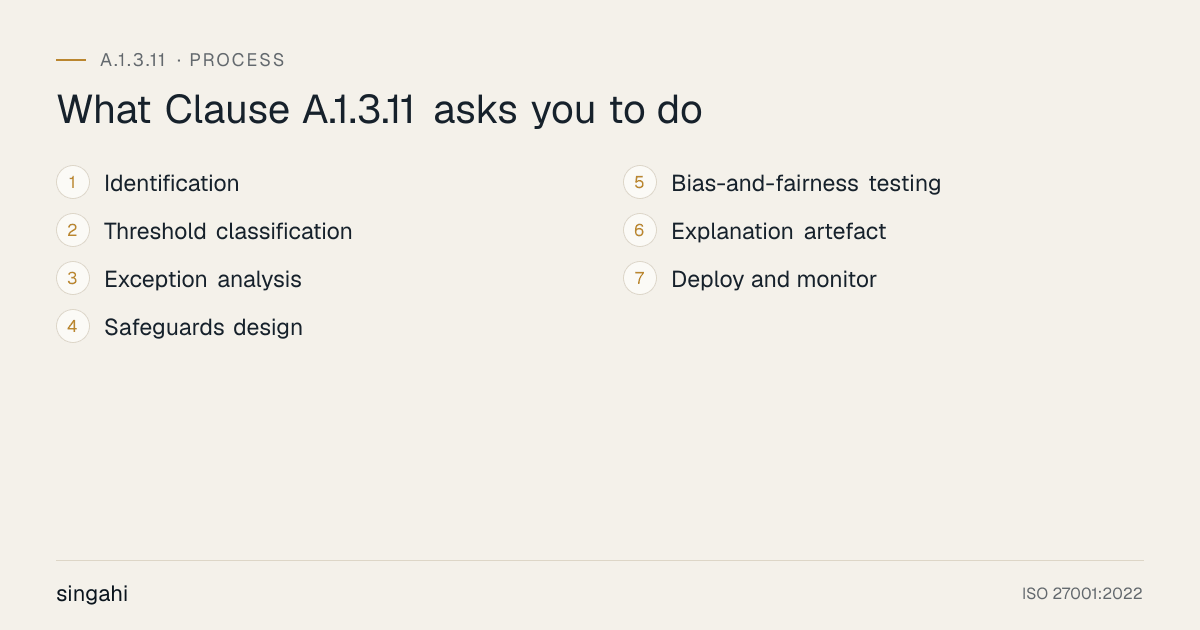
The paraphrased requirement
ISO/IEC 27701:2025 control A.1.3.11 asks PII controllers to identify, document and provide PII principals with meaningful information about automated decision-making and profiling that produces legal or similarly significant effects on them, and to give the principal the means to obtain human intervention, to express their point of view, and to contest such decisions, except where the decision is necessary to enter into or perform a contract, is authorised by law, or is based on the principal's explicit consent, and in each case only with suitable safeguards in place. Eight load-bearing ideas sit inside that paraphrase, and auditors test each separately.
The controller must identify the ADM and profiling it operates. The verb is analytical: the controller cannot comply with A.1.3.11 by drafting a policy that says "we may use automated decision-making"; the controller must produce an inventory of every automated system that makes a decision about a principal or that profiles principals. The inventory's scope is broader than "machine-learning models": it covers deterministic rule engines, hard-coded thresholds, queue-prioritisation algorithms, content-moderation filters, fraud-scoring systems, eligibility rules, recommender systems with significant effects, pricing personalisation engines, biometric identification systems, and the full taxonomy of profiling. A controller whose ADM register contains only the machine-learning models and omits the deterministic rules has under-scoped the control.
The controller must document the ADM and profiling. The documentation is the ADM and Profiling Register (toolkit doc 03) and, for each in-scope system, a model card or rule card, the system's purpose, the data inputs, the decision logic at a meaningful level of detail, the output space, the exception basis, the safeguards deployed, the human reviewer's role, the contest-handling channel, the bias-and-fairness testing evidence, the version history, the retirement plan. The register is itself controlled documented information under Clause 7.5, version-controlled, access-controlled, retention-managed, retrievable.
The controller must provide PII principals with meaningful information about the logic involved. The "meaningful information" standard is the operational heart of A.1.3.11's transparency dimension. The information must be intelligible to a non-technical principal, not the model's weights or the gradient-boosting hyperparameters, but the categories of data used, the decision logic at the level of "we use your repayment history, your income, your existing credit exposure and your transaction patterns to produce a credit score, and a score below [threshold] results in an automatic decline", the consequences of the decision, and the principal's rights (intervention, expression of view, contest). The information is provided at two points: in the privacy policy or ADM notice (the ex-ante layer) and at the decision point or in the decision communication (the ex-post layer). The information rights in GDPR Articles 13(2)(f), 14(2)(g) and 15(1)(h), "the existence of automated decision-making, including profiling, referred to in Article 22(1) and (4) and, at least in those cases, meaningful information about the logic involved, as well as the importance and the envisaged consequences of such processing for the data subject", are the operational template; ISO/IEC 27701:2025 inherits the template.
The controller must restrict the legal-or-similarly-significant-effect threshold. The control triggers only on decisions that produce such effects. The threshold is the gate; a controller that has not classified its model portfolio against the threshold cannot demonstrate the scope of its A.1.3.11 programme. The threshold has two limbs: legal effect (the decision affects the principal's legal rights, a termination of a contract, a refusal of a statutory benefit, an adverse immigration decision) and similarly significant effect (the decision affects the principal in a comparably weighty non-legal sphere, creditworthiness, employability, access to education, access to healthcare, access to housing, access to essential services). The EDPB Guidelines 01/2020 on the interplay of Article 22 with Article 4(4) GDPR and the recital-71 overlay on profiling provide the operational test; sectoral regulators (RBI on digital lending; IRDAI on algorithmic underwriting; the National Financial Reporting Authority where ADM touches reporting; the relevant employment-law regulators on CV screening) layer additional sector-specific thresholds on top.
The controller must rely on one of the three exceptions where the decision is solely automated. The exceptions, drawn directly from GDPR Article 22(2), are: (a) necessary for the entry into or the performance of a contract between the principal and the controller (a credit-scoring model necessary to decide whether to lend; an insurance-underwriting model necessary to decide whether to underwrite; a fraud-detection model necessary to perform a payment-processing contract); (b) authorised by Union or Member-State law applicable to the controller (a law that expressly authorises the ADM and provides suitable safeguards, in the Indian context, the analogue is a law or regulation that authorises the ADM, such as an RBI rule on credit-bureau scoring or a SEBI rule on algorithmic trading); (c) based on the principal's explicit consent (the principal's specific, informed and unambiguous consent to the solely-automated decision, captured at A.1.2.5 quality). The exception analysis is documented per in-scope system; an in-scope system without a documented exception is non-conformant.
The controller must deploy the safeguards. The four safeguards under A.1.3.11 / Article 22(3): (i) human intervention, a human reviewer with the authority, the time, the information and the training to override the automated decision; (ii) the principal's ability to express their point of view, a channel through which the principal can submit additional information, contest the input data, or challenge the decision logic; (iii) the right to contest the decision, a defined workflow through which the principal requests a re-decision, with a documented outcome and a defined SLA; (iv) (under GDPR Article 22(4), for special-category processing) additional safeguards to protect the principal's rights, freedoms and legitimate interests, frequency of review, precision of the profile, ex-post redress. The "human intervention" safeguard is the most commonly faked: a controller with a nominal human reviewer who rubber-stamps the model's output (the "human-in-name-only" anti-pattern) has not deployed the safeguard.
The controller must operate the boundary discipline between solely-automated and human-assisted decisions. A.1.3.11 applies to solely-automated decisions, decisions produced without meaningful human involvement. A decision that is produced by a model but reviewed and confirmed (or overridden) by a human exercising genuine independent judgement is "human-assisted", not "solely-automated", and the principal's right to object under Article 22(1) does not apply (though other controls do, A.1.3.6 object to processing; the fairness principle in A.1.2.2 and Clause 4.4). The boundary turns on the meaningfulness of the human involvement: a human who has the authority, the time, the information and the training to override is meaningful; a human who signs off on every model output without examination is not. The EDPB 01/2020 guidelines draw this line carefully; controllers should document the human-in-the-loop design per in-scope system.
The controller must operate the rights-overlay continuously. A.1.3.11 is not a one-off identification exercise; it is an ongoing operational discipline. The ADM register is reconciled with the model registry on a cadence; the threshold classification is re-tested when the model's purpose, data inputs or output space changes; the exception analysis is re-documented when the regulatory or contractual basis changes; the safeguards are audited for effectiveness; the explanation artefact is updated when the model is retrained; the contest-handling workflow is tested; the bias-and-fairness testing is repeated on each material retrain and on a defined cadence; the monitoring dashboard detects accuracy drift and fairness drift; the principal-facing ADM notice is reviewed for accuracy.
The lineage, 2019 to 2025
The 2025 control has a clean ancestor in the 2019 edition. Under 27701:2019, the controller-side ADM duty lived in clause 7.3 (obligations to PII principals), at 7.3.7, automated decision making. The 2025 consolidation moves it to A.1.3.11 inside theme A.1.3 (obligations to PII principals) of the single consolidated Annex A. The relocation is architecturally meaningful: the ADM duty is now positioned alongside the principal's other rights (access, correction, erasure, objection, grievance redressal) rather than as a stand-alone analytical exercise. The ADM control is the principal's right-side counterpart to the controller's A.1.2.6 DPIA duty, the DPIA analyses the risks; A.1.3.11 gives the principal the tools to participate in, contest and obtain human review of the decision.
The 2025 edition also makes Annex B (implementation guidance) normative. The B.1.3.11 guidance explains how a controller should structure the ADM programme, the identification, the threshold classification, the exception analysis, the safeguards design, the explanation artefact, the contest-handling workflow, the bias-and-fairness testing, the monitoring, the review triggers. Auditors now test against B.1.3.11 explicitly; an A.1.3.11 audit that does not also walk through the B.1.3.11 guidance is incomplete. The pre-2019 framing of "the principal has a right not to be subject to solely-automated decisions" is no longer sufficient, the controller must operate the full lifecycle, not merely acknowledge the right.
ADM and the SDF algorithmic-software review, the Indian position
The DPDP Act 2023 does not codify an express right of the data principal against solely-automated decisions of the kind GDPR Article 22 recognises. Instead, the Indian framework addresses ADM indirectly through three structural mechanisms: (i) DPDP Act 2023 section 10 and Rule 13(3) of the DPDP Rules 2025, every Significant Data Fiduciary must observe due diligence to verify that the algorithmic software it uses on personal data is not likely to pose a risk to Data Principals' rights (the algorithmic-software review); (ii) DPDP Act 2023 section 13, the principal's right of grievance redressal, which provides the channel through which the principal can complain about an ADM outcome (the section 13 route is the Indian analogue of the contest right, dressed as a grievance rather than a stand-alone ADM right); (iii) DPDP Act 2023 sections 18 and 33 + Schedule, the Data Protection Board of India's remedial powers, which allow the Board to dispose of a complaint by directing the SDF (or any Data Fiduciary) to remediate the harm caused by an ADM outcome, with penalty exposure up to one hundred and fifty crore rupees for section 10 non-fulfilment and up to two hundred and fifty crore rupees for section 8(5) safeguards failure.
Indian controllers implementing A.1.3.11 should treat the GDPR Article 22 right and the Rule 13(3) algorithmic-software review as complementary levers: the GDPR-style right applies to the controller's EU-principal cohort; the DPDP algorithmic-software review applies to the controller's India-principal cohort; and for SDFs the algorithmic-software review is the operational discipline that produces the evidence the controller needs to defend any ADM-related complaint (whether from a principal, from the Board, or from a sector regulator). A non-SDF Indian controller has weaker statutory hooks but is still bound by the sector-regulator ADM expectations (RBI on credit algorithms; IRDAI on underwriting; the broader Puttaswamy proportionality discipline) and by ISO/IEC 27701:2025 control A.1.3.11 itself.
The eight ADM components, preview; full methodology in Section 7
The ISO/IEC 27701:2025 control, the GDPR Article 22 framework, the EDPB 01/2020 guidelines and the DPDP section 10 SDF overlay together define the components of a conformant ADM programme. The Singahi eight-stage ADM lifecycle (Section 7) operationalises them:
- Identification, every ADM system, every profiling model, every decision rule with legal or similarly significant effect is identified and entered in the ADM Register.
- Threshold classification, each system is classified against the legal-or-similarly-significant-effect threshold; the classification is documented with reasoning.
- Exception analysis, for solely-automated in-scope systems, the controller documents the exception (contract / law / explicit consent).
- Safeguards design, the four safeguards (human intervention, expression of view, contest, additional safeguards for special-category processing) are designed and documented.
- Bias-and-fairness testing, the model is tested for bias on protected characteristics; the fairness methodology is documented; the evidence is in the model card.
- Explanation artefact, the meaningful-information explanation is produced in the principal's language and tested for intelligibility.
- Deploy and monitor, the model is deployed with the safeguards live; the monitoring dashboard tracks decision volumes, override rates, contest outcomes, accuracy drift, fairness drift.
- Review and retire, the model is reviewed on a defined cadence and on trigger events; the retirement plan is documented and executed.
Demarcations: A.1.3.11 vs A.1.2.6 vs A.1.3.6 vs Clause 9.1; what is NOT required
Five demarcations matter.
A.1.3.11 vs A.1.2.6, rights vs assessment. A.1.2.6 (DPIA) is the controller's analytical duty, the assessment of the ADM's risks to principals before deployment. A.1.3.11 is the principal's rights framework, the in-life operation of the safeguards, the explanation and the contest-handling workflow after deployment. The two interlock: the A.1.2.6 DPIA identifies the risks the A.1.3.11 safeguards must address; the A.1.3.11 contest-handling workflow produces the evidence that feeds back into the A.1.2.6 review cycle. The two are not interchangeable; a controller that has only an ADM-DPIA has not satisfied A.1.3.11.
A.1.3.11 vs A.1.3.6, ADM contest vs general objection. A.1.3.6 (object to processing) is the principal's general right to object to processing; A.1.3.11 is the ADM-specific right to obtain human intervention, express the view and contest the decision. The two intersect where the principal objects to the ADM processing itself (not just the outcome); in that case, both controls apply. The two are not interchangeable; a controller that handles an ADM-related complaint only under A.1.3.6 has under-treated the principal's A.1.3.11 rights.
A.1.3.11 vs A.1.3.7, ADM explanation vs access and correction. A.1.3.7 (access, correction, erasure) is the principal's general right to access the input data the controller holds and to correct inaccurate data. A.1.3.11 includes the principal's right to obtain meaningful information about the logic of the ADM. The two intersect where the principal's input data is inaccurate and the inaccuracy drove the ADM outcome; in that case, the principal exercises both rights (correction under A.1.3.7; contest-and-redecision under A.1.3.11). The two are not interchangeable; a controller that provides access to the input data without explaining the ADM's logic has under-treated the principal's A.1.3.11 rights.
A.1.3.11 vs Clause 9.1, safeguards vs monitoring. A.1.3.11 is the safeguards framework, the rights, the explanation, the contest workflow. Clause 9.1 is the controller's monitoring, measurement, analysis and evaluation of the PIMS, including monitoring of ADM outcomes. The two interlock: Clause 9.1's monitoring produces the KPIs that demonstrate the A.1.3.11 safeguards are operating effectively (override rates, contest outcomes, fairness-drift signals). The two are not interchangeable; a controller with KPI dashboards but no safeguards has not satisfied A.1.3.11.
What A.1.3.11 does NOT require. It does not require a blanket prohibition on solely-automated decisions (the three exceptions permit solely-automated ADM with safeguards). It does not require human review of every model output (the safeguard is the ability to obtain human intervention on request, not a mandatory human check of every decision, though sector rules, e.g. the RBI's expectations on certain credit decisions, may mandate per-decision human review). It does not require disclosure of the model's source code, weights or training data (the meaningful-information standard is principal-intelligible, not technical disclosure; the controller's intellectual-property and security interests are balanced). It does not require zero bias (bias to a documented threshold is acceptable; the controller must demonstrate that the threshold is justified and that the residual bias does not produce discriminatory outcomes on protected characteristics). It does not require the principal's consent to every solely-automated decision (only the explicit-consent exception requires consent; the contract and law exceptions do not).
The companion guidance, Annex B is normative in 2025
In 27701:2019 the implementation guidance lived in informative Annex F. In 27701:2025 the guidance lives in Annex B (Implementation Guidance for PII Controllers and Processors), and Annex B is normative. The B.1.3.11 guidance explains how a controller should structure the ADM programme, the identification sweep, the threshold classification, the exception analysis, the safeguards design, the explanation methodology, the contest-handling workflow, the bias-and-fairness testing, the monitoring, the review triggers. Auditors test against it. The five most relevant external anchors (full mapping in Section 16): GDPR Article 22 (solely-automated individual decisions, including profiling, the rights, the exceptions, the safeguards); EDPB Guidelines 01/2020 on the interplay of Article 22 with Article 4(4) (the operational interpretation); ISO/IEC 42001:2023 (AI management system, the PIMS↔AIMS boundary at Clause 5.2 policy and Clause 6.1 risk); NIST AI Risk Management Framework NIST.AI.100-1 (the AI-risk overlay); ISO/IEC 27002:2022 control 5.34 (the only PII-specific 27002 control, frequently referenced in the ADM-DPIA mitigation catalogue).
What auditors actually check
The certification auditor's A.1.3.11 examination has eight predictable moves (the 28-question checklist is in Section 11). First, ask for the ADM Policy and the ADM and Profiling Register, do they exist, are they current, does the register reconcile with the production model registry and the rule-engine configuration. Second, ask for the threshold classification methodology, how does the controller decide what counts as "legal or similarly significant effect", and where is that documented. Third, pick an in-scope ADM system from the register and walk the model card, purpose, data inputs, decision logic, exception basis, safeguards, human-in-the-loop design, contest channel, bias testing. Fourth, walk the exception analysis, for solely-automated decisions, on which exception does the controller rely, and where is it documented. Fifth, ask for the human-in-the-loop procedure, the reviewer's authority, decision criteria, override record, time allocation, training. Sixth, ask for the explanation artefact, show the principal-facing ADM notice (privacy policy and at the decision point); show a sample explanation produced for a contesting principal; test the explanation for intelligibility. Seventh, ask for the contest-handling workflow, the intake channel, the SLA, the re-decision procedure, the outcome record, the escalation to the DPDP section 13 grievance channel. Eighth, for SDFs, ask for the Rule 13(3) algorithmic-software review, the methodology, the cadence, the most recent review report, the findings closure. Each of the eight moves corresponds to a stage in the eight-stage ADM lifecycle (Section 7); a controller that cannot evidence each stage has an A.1.3.11 gap.
Why This Control Matters
The ADM control as the principal's AI-rights backbone
Of the four PII themes that run through Annex A.1 (conditions for processing; obligations to principals; privacy by design; sharing, transfer and disclosure), the obligations theme is where the principal's in-life relationship with the controller lives, the rights the principal can exercise once the processing is underway. And of the obligations-to-principals controls, A.1.3.11 is the AI-age heart. A controller that deploys machine-learning models, rule engines, recommender systems or content-moderation algorithms that make decisions with legal or similarly significant effects on principals, without identifying those systems, without explaining them, without a human-in-the-loop, without a contest workflow, has no defensible privacy position in the AI age, whatever its policy says.
This is why A.1.3.11 is the most-watched Annex A control of the 2025 edition. The control sits at the intersection of three of the most active global policy debates: the regulation of artificial intelligence (the EU AI Act; the NIST AI RMF; ISO/IEC 42001:2023; the Bletchley and Seoul AI-safety declarations); the operationalisation of privacy as a fundamental right (Puttaswamy; the GDPR Article 22 enforcement record; the DPDP section 10 SDF overlay); and the sectoral governance of automated decisions (the RBI's expectations on credit algorithms; the IRDAI's expectations on algorithmic underwriting; the SEBI expectations on algorithmic trading and robo-advisory; the US-sector-specific guidance on employment-related algorithms including the New York City Local Law 144 on automated employment-decision tools and the Colorado AI Act). A controller that gets A.1.3.11 right signals, to the regulator, to the auditor, to the board, to the principal, that it has thought carefully about the human consequences of its AI. A controller that gets it wrong exposes itself to enforcement under each of these overlapping regimes simultaneously.
The Indian regulatory weight
In India, A.1.3.11 has a regulatory weight that combines the DPDP's structural ADM levers, the sector-regulator ADM expectations, and the constitutional proportionality discipline. Four layers of weight.
The DPDP section 10 SDF layer, the principal Indian ADM lever. Where the Central Government designates a Data Fiduciary as Significant on the prescribed thresholds (volume and sensitivity of personal data processed, risk to data principals, impact on sovereignty, integrity and electoral democracy, etc.), the SDF must, under section 10, conduct an algorithmic-software review covering the algorithmic software used on personal data (Rule 13(3)). The algorithmic-software review is the principal Indian ADM lever: Rule 13(3) requires designated SDFs to verify, with due diligence, that the algorithmic software they use on personal data is not likely to pose a risk to Data Principals' rights, whether or not anyone has complained or harm has materialised. The independent data audit (also under section 10) covers the algorithmic-software review process itself, and the Board's remedial powers under sections 18 and 33 + Schedule backstop the principal (penalty exposure up to one hundred and fifty crore rupees for section 10 non-fulfilment). An Indian SDF's A.1.3.11 programme is therefore the densest in the 27701 universe, the algorithmic-software review operates across the model portfolio, is independently audited on a cadence, and feeds the Board's remedial jurisdiction.
The DPDP section 13 grievance-redressal layer, the principal's contest channel. DPDP section 13 requires every Data Fiduciary and every Consent Manager to provide a readily available means of grievance redressal and to respond within the prescribed period. The section 13 channel is the Indian operational equivalent of the A.1.3.11 contest right, the principal who has been refused credit by an algorithm, declined insurance by a model, denied a service by a rule engine, or had their content removed by a moderation algorithm, lodges a grievance under section 13 and the controller must respond within the prescribed period. The DPDP Rules 2025 prescribe the response periods (the exact periods to be confirmed against the notified text, broadly in the range of 21 to 30 days for the substantive response, with shorter periods for the acknowledgement). The controller's A.1.3.11 contest-handling workflow is, in the Indian context, the ADM-specialised sub-channel of the section 13 grievance operation.
The sector-regulator layer. Indian sector regulators have, even before the DPDP, imposed ADM expectations on regulated entities. The RBI Digital Lending Guidelines (2 September 2022) require explicit borrower consent, restrict device-data access, and imply algorithmic-fairness considerations on credit-decision algorithms, a digital lender whose algorithm produces discriminatory outcomes on caste, religion or gender lines invites RBI enforcement. The IRDAI Information and Cyber Security Guidelines (24 April 2023) embed algorithmic-underwriting expectations; the IRDAI's wider regulatory stance treats algorithmic insurance decisions as reviewable by the regulator. The SEBI CSCRF (20 August 2024) addresses the algorithmic-trading and robo-advisory dimension for SEBI-regulated entities. The sector-regulator layer does not displace A.1.3.11; it adds sector granularity, a controller operating in BFSI must operate A.1.3.11 plus the sector-specific ADM expectations.
The proportionality layer (Puttaswamy). The Supreme Court's K.S. Puttaswamy v. Union of India, (2017) 10 SCC 1 (judgment delivered 24 August 2017 by a nine-judge Bench) declared informational privacy a fundamental right under Articles 14, 19 and 21, and articulated the proportionality test that any limitation of the right must meet. The Aadhaar judgment, Justice K.S. Puttaswamy (Retd.) v. Union of India, (2019) 1 SCC 1 (26 September 2018, five-judge Bench), applied the test and struck down section 57 of the Aadhaar Act. The proportionality test applies to ADM: a controller that deploys a solely-automated decision affecting a principal's rights must be able to demonstrate that the decision pursues a legitimate aim, is rationally connected to that aim, is necessary (no less intrusive means available, including a human-assisted alternative), and is proportionate (the benefit outweighs the cost to the principal). The A.1.3.11 safeguards (human intervention, expression of view, contest) are, in operational terms, the controller's internal operationalisation of the proportionality test for ADM.
The cost of non-compliance
The cost of an A.1.3.11 failure breaks down into four bands.
Direct DPDP penalty exposure. For SDFs, failure to fulfil the Rule 13(3) algorithmic-software review exposes the SDF to a Board-imposed penalty of up to one hundred and fifty crore rupees under section 33 and the Schedule. For non-SDFs, the exposure is indirect but real: the absence of a bias-and-fairness assessment on a model that subsequently produces a discriminatory outcome is an aggravating factor in any penalty determination under section 33 + Schedule. The section 8(5) failure exposure (up to two hundred and fifty crore rupees) is amplified where the model's safeguards were not informed by an ADM-DPIA, the reasonable-security-safeguards duty implies an assessment of the model-driven risks. Where the ADM-driven decision affects a child (section 9), the section 9 penalty band (up to two hundred crore rupees) is engaged.
Sector-regulator enforcement. The RBI, IRDAI and SEBI have their own penalty and supervisory powers, and the sector-regulator dimension of an A.1.3.11 failure can be more immediate than the DPDP dimension. A digital lender whose credit algorithm produces discriminatory outcomes faces RBI supervisory action (restrictions on onboarding new borrowers; restrictions on the lending platform; in the limit, cancellation of the lending licence). An insurer whose underwriting algorithm produces exclusionary outcomes faces IRDAI supervisory action. A market intermediary whose algorithmic-trading model produces market-disruption outcomes faces SEBI enforcement. The sector-regulator dimension is the most-operationally-consequential layer for BFSI controllers.
Commercial cost is significant and rising. Consumer-facing brands that deploy opaque credit-scoring, insurance-underwriting, content-moderation or personalisation algorithms face increasing reputational exposure when the algorithm's outcomes are perceived as unfair. The Indian press and the consumer-protection bodies have, since 2023, begun to report on algorithmic-harm incidents with the same intensity as data-breach incidents. A controller whose algorithmic-harm incident becomes a news cycle faces customer churn, app-store rating degradation, and, for B2B controllers, procurement disqualification. The A.1.3.11 programme is also increasingly a procurement requirement, enterprise customers, hyperscaler partners and government tender processes ask for evidence of ADM governance as part of vendor diligence; the absence of an ADM register can disqualify a controller from procurement. The EU AI Act's high-risk classification layer adds a further commercial dimension for Indian controllers selling into the EU market, a controller whose system falls within the AI Act's high-risk ADM categories faces conformity-assessment, registration and post-market-monitoring obligations that, if unmet, exclude the controller from the EU market.
Certification cost is the most immediate. Recoverable; entirely avoidable.
The board-level question
The board-level question for A.1.3.11 is not "do we have any automated decision-making?", almost every controller that operates a digital service has at least one. The question is "for every model and rule we operate that produces a decision with a legal or similarly significant effect on a person, every credit-scoring model, every insurance-underwriting model, every eligibility rule, every fraud-scoring model, every CV-screening tool, every content-moderation algorithm, every personalisation engine with significant effects, every queue-prioritisation algorithm, can we produce the ADM register entry, the threshold classification, the exception analysis, the safeguards design, the explanation artefact, the bias-and-fairness testing evidence, the contest-handling record, and (for SDFs) the Rule 13(3) algorithmic-software review?" If the honest answer is "partially" or "no", the controller has an A.1.3.11 gap regardless of what its privacy policy says. The board's follow-up question, "and where is the human who has the authority to override each in-scope model?", distinguishes the controller that operates the safeguards in form only from the controller that operates them in fact.
Scope and Applicability
Who the control applies to
Control A.1.3.11 sits in Table A.1 of the 2025 Annex A, the PII controller control set. It binds every organisation that acts as a controller (DPDP: Data Fiduciary; GDPR: controller) for at least one processing activity that involves automated decision-making or profiling with legal or similarly significant effects on PII principals. Processors (Table A.2) are bound only indirectly: the controller's ADM programme produces the safeguards and the explanation the processor must support under A.2.3.2 (comply with obligations to PII principals) and the processor's operational role in the contest-handling workflow (providing the input-data extracts, the model invocation logs, the override channel). The processor does not run its own ADM programme on the controller's processing; the processor supports the controller's ADM programme with information about its model-serving infrastructure, its logs, its version control of model binaries and training data.
The control applies regardless of organisation size. A two-person startup running a single eligibility rule (no in-scope effect), a thousand-person fintech running dozens of in-scope models across multiple products, and a Significant Data Fiduciary under DPDP section 10 (algorithmic-software review across the model portfolio) are all bound. The maturity expectations scale with the volume, sensitivity and risk of the ADM portfolio, see Section 22 (Maturity Model).
When the control applies, the threshold analysis
A.1.3.11 applies whenever the controller operates an automated system that produces a decision with legal or similarly significant effect on a principal. The threshold analysis is the gate; a controller that has not classified its model and rule portfolio against the threshold cannot demonstrate the scope of its A.1.3.11 programme. The threshold has two limbs.
Legal effect. The decision affects the principal's legal rights, a termination of a contract, a refusal of a statutory benefit, an adverse immigration decision, a court-enforceable decision, a denial of a regulatory entitlement. The legal-effect limb is the more easily identified: the decision either engages a legal right or it does not. Examples include a credit-bureau scoring that affects the principal's access to credit under the relevant credit-bureau regulations; an insurance-underwriting decision that affects the principal's insurance rights under the insurance contract; an employment-related decision (hiring, termination, promotion) under the relevant labour-law framework; an eligibility decision for a government benefit scheme.
Similarly significant effect. The decision affects the principal in a comparably weighty non-legal sphere, creditworthiness (even outside a contractual credit decision); employability; access to education; access to healthcare; access to housing; access to essential services; access to financial infrastructure; the principal's freedom of movement (an algorithmic risk-score that prevents travel); the principal's ability to communicate or publish (a content-moderation algorithm that removes or down-ranks the principal's content at scale); the principal's reputation at scale (a public-rating algorithm that publishes the principal's score). The EDPB Guidelines 01/2020 interpret the similarly-significant-effect limb broadly: a decision that has the potential to significantly affect a person's circumstances, behaviour or choices is in scope. Recital 71 GDPR adds the examples of "e-recruitment" practices and "credit institutions or financial institutions" evaluating creditworthiness, both of which are commonly operated by Indian fintechs, lenders and credit bureaus.
The threshold test is documented per system in the controller's Legal-or-Similarly-Significant-Effect Classification Matrix (toolkit doc 09). The matrix is calibrated to the controller's regulatory profile (DPDP, GDPR, sector rules) and to the principal cohort (consumer, employee, borrower, policyholder, investor, patient, student). The classification is binary at the top level (in scope / out of scope) with a four-tier risk rating inside the "in scope" limb (low effect, medium effect, high effect, very high effect) that calibrates the safeguards' intensity.
The seven categories of in-scope ADM
The seven categories of ADM that most commonly meet the threshold:
- Credit and lending decisions, credit-scoring models, loan-eligibility rules, credit-limit algorithms, debt-collection prioritisation. The RBI Digital Lending Guidelines apply; the controller's principal cohort includes both consumer and small-business borrowers; the effect is the principal's access to credit.
- Insurance decisions, underwriting models, claims-triage models, fraud-scoring models, premium-personalisation models. IRDAI's regulatory expectations apply; the effect is the principal's access to insurance and the principal's premium burden.
- Employment decisions, CV-screening tools, candidate-ranking models, performance-evaluation algorithms, workforce-reduction selection algorithms, biometric attendance and fatigue-detection systems. The effect is the principal's employment, employability and work conditions; the New York City Local Law 144 (effective July 2023) on automated employment-decision tools and the analogous EU and Colorado frameworks are the cross-jurisdictional anchors.
- Eligibility and benefit decisions, government-benefit eligibility algorithms, subsidy-allocation algorithms, ration-card eligibility, education-admission algorithms, scholarship-allocation algorithms. The effect is the principal's access to public benefits and services; DPDP section 17 exemptions may apply for certain state-processing but the algorithmic-fairness discipline still operates.
- Content moderation and platform decisions, content-removal algorithms, account-suspension algorithms, down-ranking algorithms, recommendation-limiting algorithms. The effect is the principal's freedom of expression, freedom of association and access to the platform; the EU Digital Services Act's layered expectations apply for controllers operating in the EU.
- Fraud and security decisions, transaction-blocking algorithms, account-freezing algorithms, fraud-scoring models, anti-money-laundering scoring models. The effect is the principal's access to financial infrastructure; the RBI's and SEBI's expectations apply; the exception basis is typically contract (the principal's account contract permits fraud-prevention measures) or law (the relevant AML statute authorises the blocking).
- Health and care decisions, triage algorithms, diagnostic-assistance models, treatment-recommendation models, priority-list algorithms for limited healthcare resources. The effect is the principal's access to healthcare and the principal's health outcomes; the DPDP's heightened expectations for sensitive data apply; the controller's principal cohort includes vulnerable subjects (DPDP section 9 overlay for minors).
A controller operating in any of these seven categories should expect an in-scope ADM portfolio; the identification sweep should produce at least one register entry per category. A controller whose identification sweep produces zero in-scope ADM systems across these categories is either genuinely not operating ADM at the threshold, or (more commonly) has under-scoped the sweep, the most common A.1.3.11 audit finding in Indian growing companies.
What is in scope for the ADM programme
The ADM programme covers each in-scope system end-to-end: the model or rule's purpose; the data inputs (training data, inference-time inputs, derived features); the decision logic at a meaningful level of detail; the output space (the decisions the system can produce); the exception basis (contract / law / explicit consent); the safeguards (human intervention, expression of view, contest); the human-in-the-loop design (authority, time, information, training); the bias-and-fairness testing (methodology, evidence, threshold); the explanation artefact (the principal-facing notice and the per-contest explanation); the contest-handling workflow (intake, SLA, re-decision, outcome record); the monitoring dashboard (decision volumes, override rates, contest outcomes, accuracy drift, fairness drift); the retirement plan. The ADM programme's scope is the same as the A.1.2.6 DPIA's scope for the same system, the two artefacts cross-reference.
What is out of scope
- Models or rules that do not meet the threshold. A recommender system that suggests a shirt does not produce a legal or similarly significant effect; the principal's "decision" to buy the shirt is not constrained by the recommendation. The threshold classification documents the out-of-scope reasoning; the out-of-scope classification is recorded in the ADM register with the reasoning (the negative decisions are evidence the controller has thought about the threshold).
- Decision-support tools that produce recommendations reviewed by a human. Where a human reviews the model's output, exercises genuine independent judgement (the authority, the time, the information, the training to override), and makes the final decision, the system is "human-assisted" rather than "solely-automated"; the Article 22(1) right does not apply (though the controller's broader fairness discipline and the Puttaswamy proportionality test still operate). The boundary turns on the meaningfulness of the human involvement; the human-in-the-loop design documents the boundary per system.
- Anonymous or effectively anonymised processing. If the data does not relate to an identifiable principal, the A.1.3.11 regime does not apply. Pseudonymised data is still personal data under DPDP and GDPR; the A.1.3.11 regime applies.
- Processing by a processor in its own right. A.2.x governs the processor's processing; the controller's ADM programme covers the system the processor is operating on the controller's behalf.
Applicability by organisation size
| Size | Typical ADM-relevant activity profile | A.1.3.11 scope highlight |
|---|---|---|
| Growing company (50 to 250 staff) | 1 to 5 in-scope ADM systems (typically a credit or eligibility rule; a CV-screening tool; a fraud-scoring model); a handful of out-of-scope recommenders | ADM register; threshold classification; exceptions documentation; safeguards on the top in-scope systems; principal-facing notice; contest-handling workflow wired into the section 13 channel |
| Mid-sized (250 to 2,000) | 5 to 20 in-scope ADM systems across multiple products; a model portfolio that includes machine-learning models, rule engines and recommender systems | The full eight-stage lifecycle; bias-and-fairness testing methodology; explanation-artefact generation; monitoring dashboard; KPI maturity; the AIMS intersection for the AI-heavy portfolio |
| Enterprise (2,000+) | 20+ in-scope ADM systems; multi-jurisdiction (DPDP plus GDPR plus US-state plus sector); a model-risk-management function | Multi-jurisdiction ADM regime (single register, per-jurisdiction configuration); the AIMS integration at Clause 5.2 / 6.1; the EU AI Act conformity for high-risk systems; the FRIA overlay where applicable |
| SDF under DPDP section 10 | n/a | All of the above plus the Rule 13(3) algorithmic-software review across the model portfolio; the independent audit of the algorithmic-software review; the AIMS certification integration |
Applicability by industry (preview, Section 21 has detail)
- BFSI, the highest ADM density of any Indian sector. Credit-scoring, loan-eligibility, insurance-underwriting, claims-triage, fraud-scoring, AML-scoring, robo-advisory, algorithmic-trading. The RBI, IRDAI and SEBI layers add sector-specific ADM expectations on top.
- Healthcare, triage, diagnostic assistance, treatment recommendation, priority-list for limited resources. The DPDP sensitive-data overlay applies; the section 9 children's overlay for paediatric services.
- IT-ITeS and SaaS, multi-jurisdiction ADM; processor-side support for customer-controller ADM programmes; AI-driven product features (the SaaS AI feature pipeline) attracting the algorithmic-software review.
- E-commerce and retail, personalisation with significant effects (pricing, ranking, recommendation at scale); fraud-scoring; seller-risk algorithms; the cross-border dimension for international fulfilment.
- Edtech, assessment algorithms, learning-analytics, content-recommendation, proctoring. The DPDP section 9 children's overlay is engaged on most edtech platforms.
- Manufacturing, workforce monitoring (fatigue detection, performance evaluation); IIoT-driven algorithms; supplier-risk scoring.
Key Definitions and Terminology
| Term | Working definition (this guide's usage) |
|---|---|
| Automated decision-making (ADM) | A decision produced by automated means, without meaningful human involvement, that produces a legal or similarly significant effect on a PII principal. ISO/IEC 27701:2025 A.1.3.11; GDPR Article 22(1). Includes both profiling-based decisions and non-profiling automated decisions. |
| Solely-automated decision | A decision produced solely by automated means, without any meaningful human intervention on the specific decision. The Article 22(1) restriction applies to solely-automated decisions; the three Article 22(2) exceptions (contract / law / explicit consent) authorise the solely-automated decision with safeguards. |
| Human-assisted decision | A decision produced by a model or rule but reviewed and confirmed (or overridden) by a human exercising genuine independent judgement. Not "solely-automated", the Article 22(1) restriction does not apply; the controller's broader fairness discipline and the Puttaswamy proportionality test still operate. |
| Profiling | Any form of automated processing of personal data intended to evaluate certain personal aspects relating to a natural person, in particular to analyse or predict aspects concerning that natural person's performance at work, economic situation, health, personal preferences, interests, reliability, behaviour, location or movements. GDPR Article 4(4); ISO/IEC 27701:2025 inherits the definition. |
| Legal effect | The decision affects the principal's legal rights, a termination of a contract, a refusal of a statutory benefit, an adverse legal decision. The first limb of the A.1.3.11 threshold. |
| Similarly significant effect | The decision affects the principal in a comparably weighty non-legal sphere, creditworthiness, employability, access to education, healthcare, housing, essential services. The second limb of the A.1.3.11 threshold. |
| ADM and Profiling Register | The system-of-record artefact that lists every ADM system and every profiling model the controller operates, with the threshold classification, the exception analysis, the safeguards, the bias-and-fairness testing evidence, the explanation artefact, the contest-handling workflow, the monitoring and the review triggers. The register is the canonical A.1.3.11 evidence object. |
| Model card / Rule card | The per-system documentation artefact in the ADM Register. A model card covers a machine-learning model; a rule card covers a deterministic rule engine or hard-coded threshold. |
| Threshold classification | The documented decision that a system is, or is not, in scope of A.1.3.11 (legal or similarly significant effect). The classification is recorded in the ADM register with the reasoning. |
| Exception analysis | For solely-automated in-scope systems, the documented exception: contract (necessary for entry into or performance of a contract between the principal and the controller); law (authorised by Union or Member-State law applicable to the controller, with suitable safeguards); explicit consent (the principal's specific, informed and unambiguous consent). GDPR Article 22(2). |
| Safeguards | The four safeguards under A.1.3.11 / GDPR Article 22(3): (i) human intervention; (ii) the principal's ability to express their point of view; (iii) the right to contest the decision; (iv) for special-category processing under Article 22(4), additional safeguards to protect the principal's rights and freedoms. |
| Human-in-the-loop | The human reviewer designated by the controller to exercise genuine independent judgement on the principal's request for intervention. The reviewer has the authority, the time, the information and the training to override the automated decision. |
| Human-on-the-loop | The supervisory pattern where a human monitors the model's outputs in aggregate and intervenes on systemic issues (drift, bias patterns, incident response) rather than on each individual decision. Distinct from human-in-the-loop (per-decision) and weaker as an A.1.3.11 safeguard. |
| Human-in-name-only | The anti-pattern where a nominal human reviewer rubber-stamps the model's output without examination. Not a safeguard; a compliance façade. |
| Meaningful information about the logic | The principal-intelligible explanation of the ADM's decision logic, the categories of data used, the decision logic at a level the principal can understand, the consequences of the decision, the principal's rights. The standard is principal-intelligible, not technical disclosure. |
| Explanation artefact | The controller-produced document (static or dynamic) that delivers the meaningful information to the principal. Two layers: the ex-ante notice (privacy policy and at the decision point) and the ex-post explanation (produced for a contesting principal). |
| Contest-handling workflow | The operational workflow through which a principal contests an automated decision: intake (channel, acknowledgement), assessment (input-data review, decision-logic review, override assessment), re-decision, outcome record, escalation. The Indian statutory backstop is DPDP section 13. |
| Bias-and-fairness testing | The structured assessment of the model's outputs for bias on protected characteristics (caste, religion, gender, disability, sexual orientation, age, ethnicity) and the wider fairness discipline. Under DPDP section 10 SDF, mandatory (the algorithmic-software review). |
| Algorithmic-software review | The SDF's due diligence under DPDP Rule 13(3) that the algorithmic software it uses on personal data is not likely to pose a risk to Data Principals' rights. Evaluates bias, discrimination, transparency, explainability, human oversight. Layered onto the ADM-DPIA under A.1.2.6 and the A.1.3.11 safeguards. |
| Protected characteristics | The personal characteristics on which the controller's bias-and-fairness testing evaluates differential outcomes: caste, religion, gender, disability, sexual orientation, age, ethnicity, pregnancy, marital status, HIV status, and (in sector-specific contexts) other characteristics recognised under Indian law (the Constitution's Article 15 framework; the relevant employment-law statutes). |
| Statistical parity / demographic parity | A fairness metric, the model's positive-outcome rate should be equal across protected-characteristic groups. One of several fairness metrics; the choice of metric is a documented decision per model. |
| Equalised odds | A fairness metric, the model's true-positive rate and false-positive rate should be equal across protected-characteristic groups. |
| Predictive parity | A fairness metric, the model's positive-predictive value should be equal across protected-characteristic groups. |
| Disparate impact | The legal-evidential pattern where a facially neutral algorithm produces disproportionate adverse outcomes on a protected-characteristic group. The threshold is typically a "four-fifths rule" (the protected group's selection rate is less than 80% of the highest-selected group's rate), a heuristic, not a strict legal rule in India. |
| Drift | The degradation of a model's accuracy or fairness profile over time, due to changes in the input data distribution (data drift) or the relationship between inputs and outputs (concept drift). The controller's monitoring dashboard detects drift. |
| Model card | The per-model documentation artefact covering the model's architecture, training data, performance metrics, fairness metrics, intended use, limitations, ethical considerations, monitoring plan. The Model Cards framework (originally proposed in the academic literature on AI transparency) is the conceptual scaffold; the controller's model card adapts it to the controller's regulatory profile. |
| Significant Data Fiduciary (SDF) | Under DPDP section 10, a Data Fiduciary designated by the Central Government on prescribed thresholds, subject to enhanced obligations, DPO based in India, SDF DPIA every 12 months, periodic independent data audit, algorithmic-software review. |
| Data Protection Board of India (DPBI / "the Board") | Established by DPDP section 18, the independent regulatory authority with adjudicatory and remedial powers over Data Fiduciaries and Data Processors. Section 33 + Schedule sets the penalty maxima; the Board's remedial powers include directing the SDF to remediate algorithmic harm. |
| EU AI Act | Regulation (EU) 2024/1689 on Artificial Intelligence. The high-risk AI classification (Article 6; Annex III) covers several ADM categories (credit-scoring; employment; essential-services eligibility; education; law enforcement). High-risk AI systems attract conformity-assessment, registration, transparency and post-market-monitoring obligations. The FRIA (fundamental-rights impact assessment) under Article 27 overlays the GDPR DPIA for certain high-risk deployers. |
| ISO/IEC 42001:2023 | AI management system, Requirements. The management-system standard for AI. Sits alongside ISO/IEC 27701:2025 at the PIMS-AIMS boundary; Clause 5.2 (AI policy) and Clause 6.1 (AI risk treatment) intersect with 27701 A.1.3.11 at the controller's AI governance. |
| NIST AI Risk Management Framework (AI RMF) | NIST.AI.100-1, published 26 January 2023. The US voluntary AI risk framework. Functions: Govern, Map, Measure, Manage. The Measure function covers the bias-and-fairness testing methodology. |
| Puttaswamy proportionality test | The constitutional test articulated in K.S. Puttaswamy v. Union of India, (2017) 10 SCC 1, legitimate aim, rational connection, necessity, proportionate balance. Applied to ADM, the test asks whether the solely-automated decision pursues a legitimate aim, is rationally connected, is necessary (no less intrusive means, including a human-assisted alternative), and is proportionate. |
Relationship to Other Clauses and Frameworks
The sibling-control network inside Annex A.1
A.1.3.11 does not stand alone, it sits inside a tight sibling network, and the audit will trace the network end-to-end.
A.1.2.2, Identify and document purpose. Every in-scope ADM system's purpose must be documented. A vague purpose ("improving our service") fails; a specific purpose ("producing a credit score from the principal's repayment history, income, existing credit exposure and transaction patterns, used to decide whether to issue a credit card") passes. The ADM register's purpose entry references A.1.2.2.
A.1.2.3, Identify lawful basis. Every in-scope ADM system relies on a documented basis, typically contract (the credit-decision is necessary to perform the lending contract), legal obligation (the AML scoring is required by the relevant statute), or explicit consent (the sensitive personalisation with significant effects). The exception analysis under A.1.3.11 overlaps with A.1.2.3: the explicit-consent exception requires A.1.2.5-quality capture.
A.1.2.5, Obtain and record consent. Where the ADM relies on the explicit-consent exception, the consent record is the exception's evidence. The consent's quality (free, specific, informed, unambiguous; the DPDP section 6 qualities; the GDPR Article 7 conditions) is tested.
A.1.2.6, Privacy impact assessment (DPIA). ADM is a high-risk trigger under A.1.2.6; the ADM-DPIA is mandatory for in-scope ADM systems. The DPIA's risk-to-principals analysis covers the algorithmic risks (bias, discrimination, opacity, automation bias, drift); the DPIA's mitigation catalogue includes the A.1.3.11 safeguards. The DPIA is the analytical input to the A.1.3.11 safeguards design; the A.1.3.11 monitoring is the operational evidence that the safeguards are working. For SDFs, the Rule 13(3) algorithmic-software review is layered onto the ADM-DPIA.
A.1.2.7, Contracts with PII processors. Where the controller engages a processor to operate the ADM (a cloud model-serving platform; a third-party model provider; a fraud-scoring vendor), the processor contract must address the ADM-specific obligations, the model-serving logs, the version-control of model binaries, the input-data extracts, the contest-handling cooperation, the sub-processor chain. The A.1.2.7 contract clauses are tailored to ADM.
A.1.2.9, Records related to processing PII (ROPA). The ADM register reconciles with the ROPA, every in-scope ADM system has a ROPA entry; the ROPA's "automated decision-making" field is populated; the two artefacts cross-reference. An audit finding on one frequently surfaces a finding on the other.
A.1.3.2 / A.1.3.3, Determining and fulfilling obligations to PII principals; information to principals. The ADM notice (the ex-ante layer) is a sub-artefact of the broader notice content; the principal-facing ADM information is part of the controller's transparency obligations under A.1.3.3.
A.1.3.5, Providing mechanism to modify or withdraw consent. Where the ADM relies on the explicit-consent exception, the principal's withdrawal of consent triggers the cessation of the solely-automated decision (the controller must either switch to a human-assisted process or stop the ADM). The A.1.3.5 mechanism must be wired into the A.1.3.11 safeguards design.
A.1.3.6, Providing mechanism to object to PII processing. The right to object intersects with the contest right: a principal who objects to the ADM processing itself (not just the outcome) exercises both rights. The two workflows should be integrated.
A.1.3.7, Access, correction or erasure. The principal's right to access the input data, to correct inaccurate input data, to erase (subject to the retention rules). The contest-handling workflow under A.1.3.11 frequently begins with a section 11 access request (the principal wants to see the data the model used) followed by a section 12 correction request (the principal wants to correct the data) followed by a section 13 grievance (the principal wants the decision re-made). The three workflows are operationally integrated.
A.1.3.8, PII controller's obligations to inform third parties. Where the ADM's decision is shared with third parties (a credit bureau notified of a score; an employer notified of a background-check outcome), the correction or erasure propagation under A.1.3.8 applies.
A.1.3.9, Providing copy of PII processed. The principal's right to obtain a copy of the input data the controller processed; the operational channel for the principal's access to the ADM's inputs.
A.1.3.10, Handling requests. The contest-handling workflow is a specialised sub-channel of the broader request-handling operation under A.1.3.10. The SLA, the acknowledgement, the response format, the escalation, all are governed by the A.1.3.10 framework, adapted to the ADM dimension.
A.1.4.4, Accuracy and quality. The training-data accuracy and the inference-time input-data accuracy. The ADM's fairness depends on the data's accuracy; the A.1.4.4 control is a critical input to the A.1.3.11 bias-and-fairness testing.
A.1.4.5, PII minimisation. The model's input minimisation, the controller should not feed the model more data than the model needs. Over-broad inputs increase both the privacy risk and the bias risk.
A.1.4.6, PII de-identification and deletion at end of processing. The training-data de-identification (where feasible, federated learning; differential privacy; synthetic data). The retention and deletion of the model's outputs.
A.1.4.x, Privacy by design. The privacy-by-design choices for the ADM, the human-in-the-loop architecture; the explainability layer; the contest-handling channel's design; the monitoring dashboard's design. The privacy-by-design control is the architectural counterpart to the A.1.3.11 operational control.
Clause 6.1.2 / Clause 8.2, PIMS-level privacy risk assessment. The PIMS-level risk register includes the ADM risks at the enterprise level; the A.1.3.11 programme produces the per-system ADM risk evidence that feeds the PIMS-level register.
Clause 8.3, Treatment plan and SoA. The ADM safeguards (the human-in-the-loop, the explanation artefact, the contest workflow, the monitoring) are part of the controller's treatment plan; the SoA documents the A.3 controls and the A.1.4.x choices that underpin the safeguards.
Clause 9.1, Monitoring, measurement, analysis and evaluation. The ADM monitoring dashboard (decision volumes, override rates, contest outcomes, accuracy drift, fairness drift) is a core Clause 9.1 feed.
A.3, Information security controls. The ADM register's integrity is governed by A.3 controls (A.3.14 protection against destruction or falsification; A.3.9 access rights for the model binaries and training data; A.3.23 secure authentication for the model-serving infrastructure; A.3.25 logging of model invocations; A.3.26 cryptography for the model binaries at rest; A.3.24 backup; A.3.27 secure development lifecycle for the model pipeline).
Clause 9.3, Management review. The ADM register, the contest-handling outcomes, the fairness-testing results, the drift signals, all feed the management review. The KPIs (Section 12) report to the management review.
The cross-framework map (preview, Section 16 has detail)
| Framework | Anchor | Mapping |
|---|---|---|
| DPDP Act 2023 (India) | Rule 13(3) algorithmic-software review (the principal India ADM lever); section 4 grounds; section 6 consent (the explicit-consent exception); section 8(5) safeguards; section 9 children; section 13 grievance (the contest channel); section 18 + section 33 + Schedule (the DPBI's remedial powers and the penalty exposure) | A.1.3.11 is the operational control that delivers the Rule 13(3) algorithmic-software review for SDFs; the section 13 channel is the contest-handling backstop |
| GDPR (EU) | Article 22 (solely-automated individual decisions, including profiling; the Article 22(2) exceptions; the Article 22(3) safeguards; the Article 22(4) special-category overlay); Articles 13(2)(f), 14(2)(g), 15(1)(h) (information rights on the existence of profiling and the meaningful information about the logic) | A.1.3.11 implements Article 22 in operations; the information rights are the principal-facing ADM notice |
| UK GDPR + DPA 2018 | Same Article 22 anchors; ICO guidance on AI and ADM | A.1.3.11 maps identically |
| EU AI Act | Regulation (EU) 2024/1689, high-risk ADM classification (Article 6; Annex III) including credit-scoring, employment, essential-services eligibility, education, law enforcement; conformity assessment; transparency; post-market monitoring; Article 27 FRIA | A.1.3.11 is the PIMS-side counterpart of the AI Act's high-risk ADM obligations |
| ISO/IEC 42001:2023 | AI management system (AIMS), Clause 5.2 AI policy; Clause 6.1 AI risk treatment; Clause 8 operational planning; Clause 9 performance evaluation; Clause 10 improvement | A.1.3.11 is the privacy-side counterpart at the PIMS-AIMS boundary; integrated 27701 + 42001 governance is the converged pattern |
| ISO/IEC 27002:2022 | Control 5.34 (the only PII-specific control) | A.1.3.11 mitigation catalogue references 5.34 |
| ISO/IEC 29100:2011 | Privacy framework principles, openness/transparency/notice; individual participation/access | A.1.3.11 is the ADM-specific expression of these principles |
| ISO/IEC 29134:2017 | DPIA methodology | The ADM-DPIA layered on A.1.2.6 follows the 29134 scaffold |
| ISO/IEC 23053:2022 | Framework for Artificial Intelligence Systems Using Machine Learning | The ADM-register's per-model documentation can reference this framework |
| ISO/IEC 24028:2024 | Overview of trustworthiness in AI | The bias-and-fairness testing methodology can reference this overview |
| NIST Privacy Framework v1.0 | Communicate-P (data-review); Control-P (data-processing policies) | A.1.3.11 = the ADM-specific expression of Communicate-P and Control-P |
| NIST AI RMF (NIST.AI.100-1) | Govern, Map, Measure, Manage, the four functions | A.1.3.11 = the PIMS-side counterpart of the AI RMF; the Measure function covers bias testing |
| SOC 2 Privacy TSC | P5.0 (Access), the principal's access to the input data and the ADM logic; Processing Integrity criteria (PI1.1 to PI6.1), the model's accuracy and the bias discipline | A.1.3.11 = P5.0 + Processing Integrity for the ADM dimension |
| CCPA / CPRA (US-CA) | Cal. Civ. Code 1798.100 et seq., CPRA's ADM / profiling provisions (the right to opt out of certain profiling; the prior-opt-out right for significant decisions) | A.1.3.11 = the ADM dimension for California-style processing |
| VCDPA / CPA / CTDPA | ADM / profiling opt-out rights; DPIA for profiling | A.1.3.11 = state ADM triggers |
| Colorado AI Act (US-CO) | High-risk AI development and deployment obligations (effective 2026) | A.1.3.11 = the PIMS overlay for Colorado-AI-Act-governed systems |
| NYC Local Law 144 | Automated employment-decision tools, annual bias audit, transparency, opt-out | A.1.3.11 = the employment-ADM dimension for controllers operating in NYC |
| LGPD (Brazil) | Article 20, the principal's right to request the review of decisions made solely on automated processing | A.1.3.11 = the LGPD Article 20 mapping |
| PIPL (China) | Article 24, automated decision-making transparency; the right to refuse solely-automated decisions; the right to demand explanation | A.1.3.11 = the PIPL Article 24 mapping (one of the strictest ADM regimes) |
| PDPA (Singapore) | PDPC advisory guidelines on AI | A.1.3.11 = the ADM dimension |
| PIPEDA (Canada) | OPC guidance on automated decision-making | A.1.3.11 = the ADM dimension |
The lineage from GDPR Article 22 and the EDPB Guidelines 01/2020
The GDPR Article 22 framework is the most-litigated ADM regime globally and the source of most operational commentary on ADM practice. Article 22(1) sets the principal's right not to be subject to a solely-automated decision producing legal or similarly significant effects. Article 22(2) sets the three exceptions (contract; Member-State law authorisation; explicit consent). Article 22(3) sets the safeguards (human intervention, expression of view, contest, and, for special-category processing, additional safeguards). Article 22(4) extends the regime to special-category processing. Articles 13(2)(f), 14(2)(g) and 15(1)(h) set the principal-facing information rights (the existence of profiling and the meaningful information about the logic). The EDPB Guidelines 01/2020 on the interplay of Article 22 with Article 4(4) GDPR provide the operational interpretation, the threshold analysis, the solely-automated-vs-human-assisted boundary, the meaningful-information standard, the safeguards' design. The EDPB Guidelines 03/2022 on deceptive design also touch on ADM where dark-pattern consent captures the explicit-consent exception. National DPAs, the CNIL (France) on AI and ADM recommendations; the Garante (Italy) on chatbot and ADM decisions; the AEPD (Spain) on credit-scoring ADM; the DPC (Ireland) on Big Tech ADM, produce sector-specific guidance that controllers operating in those jurisdictions must layer on. A controller that processes EU personal data must layer these on top of the DPDP section 10 SDF overlay, taking the stricter of the two where they diverge.
The lineage from ISO/IEC 42001:2023 and the PIMS-AIMS boundary
ISO/IEC 42001:2023, AI management system, Requirements is the management-system standard for AI. Published in December 2023, it adopts the ISO harmonized structure (the same skeleton as ISO/IEC 27701:2025 and ISO/IEC 27001:2022). The standard requires an organisation that develops, deploys or operates AI systems to establish, implement, maintain and continually improve an AI management system (AIMS) within the organisation's wider governance.
The PIMS-AIMS boundary is the operational intersection for a controller that operates ADM. ISO/IEC 27701:2025 control A.1.3.11 governs the principal's rights, the safeguards and the contest-handling workflow (the PIMS-side discipline). ISO/IEC 42001:2023 governs the AI risk management, the AI policy, the AI roles, the AI lifecycle controls, the AI performance evaluation (the AIMS-side discipline). The two standards are complementary: a controller that operates ADM and implements both 27701 and 42001 has the most complete governance scaffold available. The integrated pattern, a single privacy and AI governance committee; a single risk register covering privacy risks and AI risks; a unified model card covering the privacy dimension (A.1.3.11) and the AI dimension (42001); an integrated audit programme; an integrated management review, is the converged practice for Indian SDFs and for controllers operating in the EU AI Act's high-risk categories.
At the clause level, the PIMS-AIMS intersection is densest at: Clause 5.2 policy (the privacy policy and the AI policy should be aligned; the principal-facing ADM notice should be consistent across both); Clause 6.1 risk treatment (the privacy risk assessment under 27701 Clause 8.2 and the AI risk assessment under 42001 Clause 6.1 should be coordinated, the same model, two risk lenses); Clause 8.1 operational planning and control (the model's lifecycle controls, development, validation, deployment, monitoring, retirement, should be coordinated across the PIMS and the AIMS); Clause 9.1 monitoring (the ADM monitoring dashboard serves both the PIMS and the AIMS); Clause 9.3 management review (the integrated review covers both dimensions); Clause 10.1 continual improvement (the integrated improvement loop).
The lineage from the EU AI Act and the FRIA overlay
The EU AI Act (Regulation (EU) 2024/1689, entered into force August 2024 with phased application through 2026 to 2027) classifies AI systems by risk tier: prohibited; high-risk; limited-risk (transparency obligations); minimal-risk. Several ADM categories fall within the high-risk classification under Article 6 and Annex III: AI systems used in employment (worker management, access to self-employment); essential-private-and-public-services eligibility (credit-scoring; creditworthiness; education admissions; essential-services allocation); law enforcement; migration, asylum and border control; administration of justice; biometric identification and categorisation. High-risk AI systems attract obligations on: risk management (Article 9); data governance (Article 10, training data quality, including bias examination); technical documentation (Article 11); record-keeping and logging (Article 12); transparency to deployers (Article 13); human oversight (Article 14, the human-in-the-loop, with the authority and competence to override); accuracy, strength and cybersecurity (Article 15); conformity assessment (Article 16 onwards); registration in the EU database (Article 49); post-market monitoring (Article 72); market surveillance (Articles 73 to 75). For deployers of certain high-risk AI systems, Article 27 requires a fundamental-rights impact assessment (FRIA) before the first use, which overlays the GDPR DPIA and the A.1.3.11 programme. The FRIA's content (Article 27(5)) includes the intended purpose, the categories of natural persons affected, the specific risks of harm, the human-oversight measures, and the expected residual risk. The FRIA, the A.1.2.6 DPIA and the A.1.3.11 programme together form the converged analytical scaffold for a controller operating high-risk ADM in the EU. An Indian controller selling an ADM system into the EU market (a credit-scoring SaaS; an employment-screening SaaS; an insurance-underwriting platform) must build to the converged scaffold.
The lineage from the NIST AI RMF and SOC 2
NIST AI Risk Management Framework (NIST.AI.100-1, 26 January 2023) is the US voluntary AI risk framework. The four functions, Govern (the governance structure for AI; the AI risk-management strategy; the roles); Map (the AI system's context, the stakeholders, the potential impacts); Measure (the AI system's performance, including the bias-and-fairness testing); Manage (the AI system's risks, the mitigation, the residual risk), are the conceptual scaffold for the AIMS side. The Measure function covers the bias-and-fairness testing that A.1.3.11 expects; the Manage function covers the safeguards design.
SOC 2 Privacy TSC + Processing Integrity. The Privacy criterion P5.0 (Access) covers the principal's access to their personal data, including the input data the model used and the explanation of the model's logic. The Processing Integrity criteria (PI1.1 to PI6.1) cover the system's accuracy, completeness, timeliness and authorisation, including the model's accuracy and the bias discipline. A SOC 2 examination that includes the Processing Integrity category for an ADM system provides external attestation that the system's bias controls are operating.
The lineage from the Puttaswamy proportionality test
The Supreme Court of India's K.S. Puttaswamy v. Union of India, (2017) 10 SCC 1 judgment articulates the proportionality test that any limitation of the fundamental right to privacy must meet. Applied to ADM, the test asks four questions of a solely-automated decision: (i) does the decision pursue a legitimate aim (the controller's purpose under A.1.2.2)? (ii) is the decision rationally connected to that aim (the model's design under A.1.2.6 DPIA)? (iii) is the decision necessary (no less intrusive means, including a human-assisted alternative, would achieve the aim)? (iv) is the decision proportionate (the benefit to the controller outweighs the cost to the principal's privacy and autonomy)? The A.1.3.11 safeguards (human intervention, expression of view, contest) are the controller's internal operationalisation of the necessity and proportionality limbs: the human-intervention safeguard operationalises the "no less intrusive means" test by providing the human alternative; the expression-of-view and contest safeguards operationalise the "proportionate balance" by giving the principal a voice in the decision. A controller that operates the A.1.3.11 safeguards seriously is a controller that runs the Puttaswamy proportionality test seriously on its ADM portfolio.
Detailed Implementation Guidance, The Eight-Stage ADM Lifecycle
The Singahi eight-stage ADM lifecycle (toolkit doc 02) operationalises A.1.3.11 by integrating the GDPR Article 22 framework, the EDPB Guidelines 01/2020, the DPDP Act 2023 Rule 13(3) algorithmic-software review, the ISO/IEC 42001:2023 AI management discipline, the NIST AI RMF, and the controller's broader PIMS into a single coherent workflow. Every conformant controller runs these eight stages; some add a ninth (the ADM register integrity review) as a separate cadence.
Stage 1, Identification
The identification stage is the documented discovery of every ADM system, every profiling model and every decision rule the controller operates. The stage produces the seed of the ADM and Profiling Register. The identification sweep operates across six system categories.
Machine-learning models. Every supervised model (classification, regression); every unsupervised model (clustering, anomaly detection); every reinforcement-learning model; every recommender system; every ranking model; every natural-language model. The sweep sources from the model registry (the ML platform's tracking system), the production inference services (the deployed model endpoints), the offline batch-scoring jobs (the nightly scoring pipelines), the analytics notebooks that produce operational scores. A controller whose ML platform has no model registry should build one, the model registry is a prerequisite for the ADM register.
Deterministic rule engines. Every rules engine (the fraud-detection rule engine; the eligibility-rule engine; the content-moderation rule engine; the marketing-personalisation rule engine); every hard-coded threshold (the credit-score threshold; the income threshold; the age threshold); every decision table. Deterministic rules are commonly under-identified, the controller's engineering team treats them as "configuration" rather than "ADM", but they meet the threshold if the effect is significant. The sweep sources from the rules-engine configuration, the decision-table deployments, the source-code review of the production services.
Hybrid systems. Many production systems are hybrid, a model produces a score; a rule engine applies a threshold; a workflow determines the decision. The sweep identifies the system as a whole (the hybrid system), not merely the model component, and documents the hybrid architecture in the register.
Third-party models and SaaS ADM. Where the controller uses a third-party model (a credit-bureau score; a fraud-scoring vendor's model; an off-the-shelf CV-screening tool; a generative-AI service for content moderation), the system is in the register, even though the model is operated by a third party, the controller is the entity making the decision about the principal. The third-party-model register entry includes the vendor (the processor), the contract clauses (A.1.2.7), the vendor's model card (where available), the controller's bias-and-fairness validation, the contest-handling cooperation.
Profiling operations. Profiling under GDPR Article 4(4), any automated processing intended to evaluate certain personal aspects. Not every profile becomes a decision; but every profile that informs a decision is in the register. The sweep identifies the profiling pipelines (the audience-segmentation pipeline; the churn-prediction pipeline; the lifetime-value pipeline; the risk-segmentation pipeline) and the decisions each informs.
Experimental and research systems. Models and rules operated in shadow mode (running on production data but not used for decisions), in A/B test (used for some decisions), in research (not used for decisions but producing scores on principal data). The register documents the deployment state of each system; the A.1.3.11 programme applies differently depending on the state (a shadow-mode system is not yet producing decisions but is processing principal data; the A.1.2.6 DPIA still applies; the bias-and-fairness testing is recommended).
The identification sweep's output is the seed ADM Register. Each entry includes: the system's identifier; the system's name; the system's owner; the deployment state; the system's purpose (A.1.2.2 reference); the system's input data; the decision logic at a meaningful level of detail; the output space; the principal cohort; the principal's section 11 / 13 rights integration; the cross-reference to the ROPA entry (A.1.2.9). The sweep is repeated at least annually and on each major system change.
Stage 2, Threshold classification
The threshold classification stage applies the legal-or-similarly-significant-effect test to each identified system. The output is the per-system classification (in scope / out of scope) with the documented reasoning. The classification uses the four-step test:
Step 1, Is the system producing a "decision"? A "decision" is an output that produces or contributes to an outcome affecting the principal. A score that is used to make a decision is a decision-component; the score and the decision-threshold together are the decision. A pure descriptive output (a dashboard metric) is not a decision; a prescriptive output (a recommended action that is actioned automatically) is.
Step 2, Is the decision "automated"? A decision is automated if it is produced by automated means. A decision that requires human action to take effect is "human-assisted"; a decision that takes effect without human action is "solely-automated". The boundary turns on the operational workflow, not on the controller's label, a system labelled "decision-support" that actually triggers automatic action (an automatic freeze; an automatic decline; an automatic content-removal) is solely-automated.
Step 3, Does the decision produce a "legal effect"? A legal effect exists where the decision affects the principal's legal rights, a contract termination; a refusal of a statutory benefit; an adverse legal decision. The legal-effect limb is the more easily identified.
Step 4, Does the decision produce a "similarly significant effect"? The similarly-significant-effect limb requires the controller to assess whether the decision's effect on the principal is comparably weighty to a legal effect, even if no legal right is engaged. The EDPB Guidelines 01/2020 interpret the limb broadly: a decision that has the potential to significantly affect a person's circumstances, behaviour or choices is in scope. The controller's assessment considers: the principal's access to the controller's service (full denial; partial denial; conditional access); the principal's access to other services (a credit score that affects the principal's access to other lenders; a fraud score that affects the principal's access to other payment systems); the principal's financial position (a higher premium; a lower credit limit; a denied claim); the principal's reputation (a published rating; a public block); the principal's autonomy (a personalisation engine that significantly shapes the principal's choices); the principal's freedom of expression (a content-moderation decision); the duration of the effect (a temporary block; a permanent ban); the principal's ability to reverse the effect (an easily-contested decision; a difficult-to-contest decision).
The classification is recorded in the ADM register with the reasoning. The four-tier in-scope rating (low / medium / high / very high effect) calibrates the safeguards' intensity. The out-of-scope classification is also recorded with the reasoning, the negative decisions are evidence the controller has thought about the threshold. The threshold classification is reviewed on each material system change and on each regulatory change (a new sector-regulator ADM expectation; a new EU AI Act high-risk category; a new EDPB guideline).
Stage 3, Exception analysis
For in-scope solely-automated systems, the exception analysis documents the basis on which the controller operates the solely-automated decision. The three exceptions, drawn from GDPR Article 22(2), apply in the EU context and are the operational template globally; in the Indian context, the Rule 13(3) algorithmic-software review and the broader DPDP framing imply a similar exception discipline.
Contract exception (Article 22(2)(a)). The decision is necessary for the entry into or the performance of a contract between the principal and the controller. The "necessity" test is the load-bearing element, the decision must be necessary, not merely convenient. A credit-scoring model that is necessary to decide whether to lend to the principal meets the test (the controller cannot responsibly lend without assessing creditworthiness; the model is the means of assessment); a personalisation engine that recommends content the principal did not ask for does not meet the test (the contract can be performed without the personalisation). The necessity analysis is documented per system, including the alternative-means analysis (could the decision be made by a human? would a human-assisted process achieve the same purpose? why is the solely-automated process necessary?).
Law-authorisation exception (Article 22(2)(b)). The decision is authorised by Union or Member-State law applicable to the controller, and the law provides suitable safeguards. In the EU context, examples include the social-security algorithms authorised by certain Member-State social-security statutes; the tax-administration algorithms authorised by Member-State tax statutes; the credit-bureau-scoring algorithms authorised by certain Member-State credit-regulation statutes. In the Indian context, the analogue is a statute or a sector-regulator regulation that expressly authorises the ADM, for example, an RBI rule authorising credit-bureau scoring under specified conditions; a SEBI regulation authorising algorithmic trading under specified conditions. The law-authorisation exception is narrower than controllers often assume; the absence of an express authorisation means the exception does not apply, even if the regulator tolerates the practice.
Explicit-consent exception (Article 22(2)(c)). The decision is based on the principal's explicit consent. The consent must be A.1.2.5-quality (free, specific, informed, unambiguous; an affirmative action; withdrawable as easily as given). The DPDP section 6 qualities apply; the GDPR Article 7 conditions apply; the EDPB Guidelines 05/2020 on consent apply. The explicit-consent exception is the narrowest of the three, the controller must capture, record and propagate the consent; the consent's withdrawal triggers the cessation of the solely-automated decision.
For systems that meet none of the three exceptions, the controller cannot operate the solely-automated decision; the system must be redesigned as a human-assisted process (with meaningful human involvement) or withdrawn. The exception analysis is documented per system; an in-scope system without a documented exception is non-conformant.
Stage 4, Safeguards design
The safeguards-design stage produces the operational architecture of the four A.1.3.11 safeguards. The four safeguards, drawn from GDPR Article 22(3), are mandatory for solely-automated in-scope systems; for human-assisted systems, the safeguards are recommended but not strictly required (the controller's broader fairness discipline still operates).
Human intervention. The human-intervention safeguard requires the controller to designate a human reviewer (or reviewers) with the authority, the time, the information and the training to override the automated decision on the principal's request. The reviewer's authority is documented, the reviewer can override; the reviewer is not required to escalate to a more senior decision-maker. The reviewer's time allocation is documented, the reviewer has the time to examine the decision, not merely to rubber-stamp it. The reviewer's information access is documented, the reviewer can see the input data, the model's score, the model's explanation, the principal's submission. The reviewer's training is documented, the reviewer understands the model's logic, its limitations, the bias-testing evidence, the contest-handling procedure. The human-in-the-loop procedure (toolkit doc 02) operationalises the safeguard. The "human-in-name-only" anti-pattern (a nominal reviewer who rubber-stamps) is treated as a non-safeguard; the auditor will test the reviewer's actual involvement through sample review of override records.
Expression of view. The expression-of-view safeguard requires the controller to provide a channel through which the principal can submit additional information, contest the input data, or challenge the decision logic. The channel is the same as the contest-handling channel (below) but is conceptually distinct: the expression-of-view is the principal's right to be heard before the decision is finalised or re-decided; the contest is the principal's right to challenge the finalised decision. The expression-of-view channel is documented in the principal-facing ADM notice ("if you wish to provide additional information or challenge the input data, you may do so at [channel]").
Contest the decision. The contest-handling safeguard requires the controller to operate a defined workflow through which the principal can request a re-decision. The contest-handling workflow (toolkit doc 08) covers: the intake channel (the principal-facing channel, typically the DPDP section 13 grievance channel in India; a dedicated ADM-contest form or email; the in-app or in-product contest button); the acknowledgement SLA (typically 24 to 72 hours); the assessment procedure (the input-data review; the decision-logic review; the override assessment); the re-decision SLA (typically 7 to 30 days, calibrated to the system's effect-tier); the outcome record (the principal is notified of the re-decision, with reasoning); the escalation (to the DPO; to the DPBI under section 18 if the principal is dissatisfied). The contest-handling workflow is integrated with the A.1.3.10 request-handling operation and the DPDP section 13 grievance operation. The contest-handling workflow's KPIs (Section 12) feed the Clause 9.1 monitoring.
Additional safeguards for special-category processing (Article 22(4)). Where the solely-automated decision is based on special-category data (health; biometric; genetic; sex life; sexual orientation; caste; religion; political opinion; the DPDP's sensitive-PDP categories), the controller deploys additional safeguards: the frequency of the bias-and-fairness testing is increased; the precision of the profiling is reviewed (a coarse profile that produces binary outcomes on sensitive data is harder to justify than a fine-grained profile with intermediate outcomes); the ex-post redress is strengthened (the contest-handling SLA is shorter; the reviewer is more senior; the override threshold is lower); the monitoring dashboard is more granular.
Stage 5, Bias-and-fairness testing
The bias-and-fairness-testing stage is the structured assessment of the model's outputs for bias on protected characteristics and the wider fairness discipline. Under DPDP section 10 SDF, the algorithmic-software review is mandatory; for non-SDFs, it is strongly recommended (the controller cannot defend an algorithmic-harm incident without it). The testing methodology covers five components.
Component 1, Training-data bias assessment. The training data is assessed for representational bias (do the protected-characteristic groups appear in the training data in proportions that reflect the principal cohort?); historical bias (does the training data encode historical discrimination?); measurement bias (is the data measured consistently across groups?); sampling bias (was the sampling procedure unbiased?). The assessment's output is a documented bias profile of the training data; significant bias requires mitigation before the model is deployed.
Component 2, Model-output bias testing. The model's outputs are tested for differential performance across protected-characteristic groups. The metrics include statistical parity (the positive-outcome rate across groups); equalised odds (the true-positive and false-positive rates across groups); predictive parity (the positive-predictive value across groups); calibration (the predicted probability vs the observed outcome across groups). The choice of metric is a documented decision per model; different metrics reflect different conceptions of fairness, and no model can satisfy all metrics simultaneously (the incompatibility results from the academic literature on AI fairness). The controller's documented fairness metric, the threshold (the maximum acceptable disparity), and the testing evidence are recorded in the model card.
Component 3, Explainability assessment. The model's explainability is assessed, can the controller produce a meaningful explanation of the model's logic for a contesting principal? The explainability techniques include feature-importance analysis (which inputs drove the decision); local explainability (SHAP-style local explanations); counterfactual explanations (what would the principal's inputs need to be for a different decision); surrogate-model explanations (a simpler model that approximates the model's behaviour). The explainability assessment's output is the explanation artefact's design, the per-system explanation that the contest-handling workflow produces for a principal.
Component 4, Human-oversight testing. The human-in-the-loop is tested, does the reviewer actually exercise independent judgement? The testing examines the override rate (the percentage of decisions the reviewer overrides; a very low rate suggests rubber-stamping; a very high rate suggests the model is unreliable); the override reasoning (the documented reasoning per override); the reviewer's time allocation (the time per review; a few seconds suggests rubber-stamping); the reviewer's training records. The human-oversight testing is the most commonly faked component, the auditor will examine the override records in detail.
Component 5, Drift detection. The model's accuracy and fairness profile drifts over time; the monitoring dashboard (Stage 7) detects the drift. The drift-detection methodology covers: data drift (the input distribution changes); concept drift (the relationship between inputs and outputs changes); fairness drift (the disparity across groups changes). The drift thresholds (the level at which the model is re-tested or retrained) are documented per model.
The bias-and-fairness testing is repeated on each material retrain of the model and on a defined cadence (typically quarterly for high-effect models; semi-annually for medium-effect; annually for low-effect). The testing evidence (the metrics, the thresholds, the disparities, the explanation artefact, the human-oversight test) is recorded in the model card and in the ADM register.
Stage 6, Explanation artefact
The explanation-artefact stage produces the principal-intelligible explanation of the ADM's logic. The artefact has two layers.
The ex-ante notice. The principal-facing ADM notice is published in the privacy policy and at the decision point. The notice covers: the existence of the ADM (the controller uses automated means to make this decision); the purpose (the credit-scoring model is used to decide whether to lend); the categories of data used (repayment history, income, existing credit exposure, transaction patterns); the decision logic at a meaningful level of detail (a weighted score is produced; a score below [threshold] results in an automatic decline); the consequences (the principal's loan application will be declined; the principal's insurance premium will be higher; the principal's account will be frozen); the principal's rights (the right to obtain human intervention, to express the view, to contest the decision, with the channels); the contact point for the contest-handling workflow. The notice is in the principal's language (the DPDP Rules' language requirements apply; the controller's principal cohort's language profile drives the translation strategy); the notice is tested for intelligibility with representative principals (a focus-group test; a usability test).
The ex-post explanation. The per-contest explanation is produced when a principal contests a decision. The explanation covers: the specific decision (the principal's loan application was declined on [date]); the principal's input data (the data the model used, with the source of each data element); the model's score (the principal's score was [score], below the threshold [threshold]); the principal's right to challenge the input data (the data-correction workflow under A.1.3.7); the principal's right to challenge the decision (the contest-handling workflow); the human-reviewer's contact (the reviewer's name or role; the contact channel). The explanation is delivered through the contest-handling workflow's response channel; the response SLA is documented per system.
The "meaningful information" standard requires the explanation to be intelligible to a non-technical principal, not the model's weights, not the gradient-boosting hyperparameters, not the source code. The controller's intellectual-property and security interests are balanced against the principal's right to a meaningful explanation; the balance is documented per system. Where the controller operates a "black-box" model (a deep neural network with limited inherent explainability), the explanation artefact uses post-hoc explainability techniques (SHAP; LIME; counterfactuals); the controller cannot refuse the explanation on the basis of the model's opacity.
Stage 7, Deploy and monitor
The deploy-and-monitor stage operationalises the ADM system with the safeguards live and the monitoring dashboard active. The stage covers the deployment gate, the production monitoring, and the KPI feed.
The deployment gate. Before the ADM system is deployed to production, the controller's deployment gate checks that: the system is in the ADM register; the threshold classification is documented; the exception analysis is documented; the safeguards are operational (the human-in-the-loop has been trained; the contest-handling workflow is live; the explanation artefact is published); the bias-and-fairness testing is complete and the disparities are within the documented thresholds; the ADM-DPIA under A.1.2.6 is signed off; for SDFs, the Rule 13(3) algorithmic-software review is signed off; the principal-facing ADM notice is published; the monitoring dashboard is configured. A system that fails the deployment gate is not deployed; the gate is the operational lock that prevents uncontrolled ADM deployment.
The production monitoring. The monitoring dashboard tracks: the decision volumes (per system; per principal cohort); the override rates (the human-reviewer overrides); the contest volumes (the principal-initiated contests); the contest outcomes (overturned; upheld; partially-overturned); the accuracy drift signals (the model's predictive performance on the recent batch); the fairness drift signals (the disparities across groups on the recent batch); the incident reports (any algorithmic-harm incidents; any DPBI complaints; any regulator inquiries). The dashboard is reviewed at a cadence, weekly for high-effect models; monthly for medium-effect; quarterly for low-effect, and the findings feed the management review (Clause 9.3).
The KPI feed. The thirteen KPIs (Section 12) are reported to the Clause 9.1 monitoring, the Clause 9.3 management review, and (where applicable) the AIMS Clause 9.1 performance evaluation. The KPIs are the operational evidence that the A.1.3.11 programme is working.
Stage 8, Review and retire
The review-and-retire stage ensures the ADM system is reviewed on trigger events and on a defined cadence, and that the retirement is planned and executed.
Review triggers. The system is reviewed when: the model is materially retrained (the bias-and-fairness testing is repeated; the explanation artefact is updated); the input data changes (a new data source is added; an existing source is removed); the principal cohort changes (a new product launch; a new geography); the regulatory context changes (a new DPDP Rule; a new sector-regulator expectation; a new EDPB guideline); an incident occurs (an algorithmic-harm incident; a regulator inquiry; a DPBI complaint); the scheduled review date arrives (typically 12 months for high-effect; 18 to 24 for medium-effect; 24 to 36 for low-effect).
Retirement. The retirement plan is documented at deployment. The retirement triggers include: the model is superseded by a newer model; the model's performance has degraded beyond recovery; the model's purpose is no longer pursued; the model's regulatory basis has changed. The retirement procedure covers: the cessation of new decisions; the archival of the model binary and the training data (under the retention rules); the notification to the principal cohort (where applicable); the post-retirement monitoring (the model's prior decisions remain in effect; the contest-handling workflow continues to operate on the prior decisions); the ADM register update. The retirement is itself a documented event with sign-off.
The SDF overlay (DPDP section 10)
For Significant Data Fiduciaries under DPDP section 10, the A.1.3.11 programme is layered with the algorithmic-software review. The SDF overlay operates across the model portfolio and is independently audited on a cadence.
The algorithmic-software review scope. The algorithmic-software review covers every AI / statistical-inference system the SDF operates that may affect principals. The review's depth scales with the system's effect-tier, high-effect systems receive a full review (the five components of Stage 5); medium-effect systems receive a proportionate review; low-effect systems receive a screening review. The DPDP Rules, 2025 set no cadence for this review. Rule 13(3) requires an SDF to verify that the algorithmic software it uses is not likely to pose a risk to Data Principals' rights, and Rule 13(1) requires a DPIA and audit every twelve months, so run the high-effect review at least annually, ahead of the DPIA, and set the medium- and low-effect cadence in your own procedure.
The independent audit. The SDF commissions the periodic independent data audit (the same audit covered in the A.1.2.6 programme, see the Singahi A.1.2.6 guide). The audit covers the algorithmic-software review process itself, the auditor examines the SDF's fairness methodology, the per-model fairness evidence, the explanation artefacts, the contest-handling records, the monitoring dashboard. The audit's findings feed the management review (Clause 9.3) and the continual-improvement cycle (Clause 10.1).
The DPBI remedial jurisdiction. Where a principal complains to the Data Protection Board of India about an SDF's ADM outcome, the Board's remedial powers under DPDP sections 18 and 33 + Schedule are engaged. The Board can direct the SDF to: re-decide the principal's case; modify the model; suspend the model's deployment; compensate the principal (under the penalty powers); publish a corrective notice. The Board's remedial jurisdiction is the Indian backstop for the A.1.3.11 programme, the controller that operates the programme well is well-prepared to defend a DPBI complaint; the controller that does not is exposed.
The SDF Algorithmic-Software Review Pack (toolkit doc 10) covers the three layers, the algorithmic-software review methodology, the independent-audit preparation, the DPBI-complaint response.
The ADM register integrity controls
The ADM register is a regulated artefact; its integrity is governed by Annex A.3 controls: A.3.14 (protection against destruction or falsification, tamper-evidence, integrity seals, version control); A.3.9 (least-privilege access, DPO and the privacy team write; model owners contribute through a controlled workflow; top management signs off through an authenticated channel); A.3.23 (strong authentication, multi-factor for administrative access); A.3.25 (logging of every read and write, including the model-binary version-control and the model-invocation logs); A.3.26 (cryptography, encryption at rest, TLS in transit, for the model binaries and the training data); A.3.24 (backup with annual restoration test); A.3.21 (secure disposal at end of retention with disposal logged); A.3.27 (secure development lifecycle for the model pipeline, including the model-card generation, the bias-testing pipeline, the explanation-artefact generation).
Tools, Technologies, and Solutions
The tool landscape
A.1.3.11 is operationally supported by five classes of tool. The choice of tool is a risk-treatment decision (Section 10), not a one-size-fits-all prescription. The categories below use generic labels; this guide does not name vendors.
The model registry / ML lifecycle platform. The system that tracks every model from development through deployment to retirement, the model's identifier, version, training data, owner, deployment state, performance metrics, fairness metrics. The model registry is the upstream of the ADM register: every production model should appear in the ADM register, and the ADM register's per-model entry references the model registry. Most ML platforms include a model registry; the gap is the cross-walk from the registry to the ADM register.
The bias-and-fairness testing toolkit. Software libraries and platforms that compute the bias metrics (statistical parity; equalised odds; predictive parity; calibration), generate the explainability artefacts (feature-importance; SHAP; LIME; counterfactuals), and produce the model card. Generic open-source statistical-fairness libraries are appropriate for controllers with the in-house data-science capability; commercial fairness-testing platforms are appropriate for controllers that prefer a managed service. The toolkit's output is the evidence that feeds the model card and the ADM register.
The privacy-management platform with an ADM module. Some enterprise privacy-management platforms include an ADM module that manages the ADM register, the threshold classification, the exception analysis, the safeguards documentation, the contest-handling workflow, the integration with the request-handling operation (A.1.3.10), and the reporting. The platform's strength is the integration with the broader PIMS artefacts (ROPA, DPIA, consent ledger, request-handling); the weakness is that the ADM-specific workflow (the model card, the fairness testing, the explanation artefact) typically requires integration with the ML platform and the fairness toolkit.
The case-management / workflow tool for contest-handling. A case-management tool that routes the principal's contest to the human reviewer, tracks the override assessment, produces the outcome record, and reports the KPIs. Many controllers extend their existing grievance-redressal tool (the DPDP section 13 channel's tooling) to handle ADM contests; the extension requires the ADM-specific workflow (the input-data review, the decision-logic review, the override assessment) to be added.
The model-monitoring / observability platform. A platform that monitors the production model's performance, the decision volumes, the override rates (where the human-reviewer's actions are logged), the accuracy drift, the fairness drift, the incident reports. The platform's output feeds the monitoring dashboard (Stage 7) and the Clause 9.1 KPI feed. Model-monitoring is a distinct capability from infrastructure-monitoring (the latter tracks the model-serving infrastructure; the former tracks the model's behaviour); controllers commonly conflate the two.
The build-vs-buy decision
The build-vs-buy decision turns on five factors.
The model portfolio's size and complexity. A controller with three machine-learning models can operate a spreadsheet-based ADM register; a controller with fifty models across multiple products needs a model registry and an integrated ADM register. A controller with a homogeneous portfolio (similar model types, similar principal cohorts, similar fairness profiles) can use a single fairness-testing tool; a controller with a heterogeneous portfolio needs multiple tools.
The integration requirements. Where the ADM register must integrate with the model registry, the ROPA, the DPIA register, the request-handling operation, the grievance channel, the management review, the AIMS, the integration overhead favours either the enterprise platform or a deliberate in-house build.
The in-house data-science capability. The bias-and-fairness testing requires data-science capability, the choice of metrics, the threshold setting, the explainability technique, the drift-detection methodology. A controller with the in-house capability can use open-source libraries; a controller without needs a managed service.
The contest-handling volume. High-volume controllers (consumer services with millions of decisions per month) need a scalable contest-handling case-management tool; low-volume controllers (B2B services with thousands of decisions) can run effectively on a lighter-weight tool.
The SDF overlay. For SDFs under DPDP section 10, the independent-audit dimension and the algorithmic-software review dimension drive additional tool requirements. The auditor will examine the tooling; the controller's choices should be defensible.
The ADM register implementations
The ADM register is the canonical A.1.3.11 artefact. The recommended pattern is a structured store (a SharePoint list with controlled workflow; a PostgreSQL database with a service layer; an issue-tracker workflow with custom issue types; a wiki-style document with controlled structure) with the model card embedded. The minimum tooling requirements:
- Tamper-evident storage, version-controlled (Git-style; SharePoint with version history; or a database with append-only event tables).
- Access control, least-privilege, role-based, with quarterly access review.
- Authentication, multi-factor for administrative access.
- Audit logging, every read and write logged; logs retained on the register's schedule.
- Backup and restoration, annual restoration test.
- Cryptography, encryption at rest; TLS in transit.
- Reconciliation, automated reconciliation with the model registry; the reconciliation gap report is reviewed at a cadence.
The bias-and-fairness testing methodology
The bias-and-fairness testing methodology (toolkit doc 09 expanded) is the operational expression of the Rule 13(3) algorithmic-software review for SDFs and the voluntary equivalent for non-SDFs. The methodology covers the five components from Stage 5 (training-data bias; model-output bias; explainability; human-oversight; drift). The methodology is documented in the controller's Bias-and-Fairness Testing Standard; the per-model evidence is in the model card.
The choice of fairness metric is the most-contested component. No model can satisfy all fairness metrics simultaneously (the incompatibility results from the academic literature); the controller must choose the metric that best reflects the controller's fairness commitment for the specific model. The choice is documented per model with the reasoning. For a credit-scoring model, equalised odds (the false-positive and false-negative rates should be equal across groups) is a common choice, the model should not err in different directions for different groups. For a content-moderation model, statistical parity (the removal rate should be equal across groups) is a common choice, the model should not remove content disproportionately from one group. For a healthcare triage model, calibration (the predicted probability should match the observed outcome across groups) is a common choice, the model's confidence should be equally reliable across groups.
The explanation-artefact generation
The explanation artefact is generated through the controller's explainability pipeline. The pipeline takes the model's score for a specific principal and produces the principal-intelligible explanation. The pipeline's components:
- The input-data extract, the principal's input data the model used, with the source of each data element.
- The feature-importance analysis, the inputs that most drove the decision (SHAP; LIME; or a simpler feature-importance measure for interpretable models).
- The counterfactual explanation, what the principal's inputs would need to be for a different decision (a "if your repayment history had one more on-time payment, your score would have been above the threshold and your application would have been approved" style explanation).
- The decision-logic summary, the model's logic at a meaningful level of detail (the categories of data; the weighting; the threshold).
- The rights notice, the principal's rights (intervention; expression of view; contest) with the channels.
The pipeline is automated where feasible, the per-contest explanation is generated by the case-management tool, not by hand. The pipeline is tested for intelligibility with representative principals.
Policy and Procedure Templates
The Singahi toolkit (Section 19) ships ready-to-customize templates for the A.1.3.11 artefact set. The nine core artefacts are:
The ADM Policy (toolkit doc 01)
The policy commits the controller to the ADM discipline. The load-bearing clauses (the controller's own "shall" clauses, drafted by Singahi, not the standard's text):
- The controller shall operate an ADM programme that satisfies ISO/IEC 27701:2025 control A.1.3.11; DPDP Act 2023 section 10 obligations where the controller is an SDF; GDPR Article 22 obligations where the controller processes EU personal data; the EU AI Act obligations where the controller operates a high-risk AI system; the sector-regulator obligations applicable to the controller.
- The controller shall maintain an ADM and Profiling Register covering every automated system that makes a decision or produces a profile affecting a PII principal.
- The controller shall apply the threshold classification to every system in the register, the documented decision that the system does, or does not, produce a legal or similarly significant effect on a principal.
- The controller shall document the exception analysis for every solely-automated in-scope system, the contract, law or explicit-consent basis on which the solely-automated decision is operated.
- The controller shall deploy the four safeguards on every solely-automated in-scope system: human intervention (a designated human reviewer with the authority, time, information and training to override); expression of view (a channel through which the principal can be heard); contest (a defined workflow through which the principal can request a re-decision); and (for special-category processing) additional safeguards.
- The controller shall conduct bias-and-fairness testing on every in-scope model before deployment and on each material retrain; the controller shall document the fairness metric, the threshold, the testing evidence in the model card.
- The controller shall produce the explanation artefact for every in-scope system, the ex-ante notice (privacy policy and at the decision point) and the ex-post per-contest explanation.
- The controller shall operate the contest-handling workflow through the DPDP section 13 grievance channel (or a dedicated ADM-contest channel), with the documented SLA and the outcome record.
- The controller shall monitor the ADM system's outcomes through the monitoring dashboard (decision volumes, override rates, contest outcomes, accuracy drift, fairness drift) at a cadence calibrated to the system's effect-tier.
- The controller shall review each in-scope ADM system on the defined cadence and on trigger events (material retrain; input-data change; principal-cohort change; regulatory change; incident).
- Where the controller is an SDF under DPDP section 10, the controller shall additionally: conduct the algorithmic-software review across the model portfolio; commission the periodic independent data audit; respond to DPBI complaints under sections 18 and 33 within the prescribed periods.
- The controller shall protect the integrity of the ADM register through the Annex A.3 security controls (A.3.14, A.3.9, A.3.23, A.3.25, A.3.26, A.3.24, A.3.21, A.3.27).
The ADM Lifecycle Procedure (toolkit doc 02)
The procedure operationalises the policy through the eight-stage lifecycle (Section 7). Each stage has documented acceptance criteria, an owner, a control mechanism, a KPI and a cadence.
The ADM and Profiling Register (toolkit doc 03)
The register is the canonical artefact. Each entry covers: the system's identifier; the system's name; the system's owner; the deployment state; the threshold classification (with reasoning); the exception analysis; the safeguards (human reviewer's name and authority; expression-of-view channel; contest-handling workflow; special-category additional safeguards); the bias-and-fairness testing evidence (metric, threshold, disparities); the explanation artefact (ex-ante and ex-post); the monitoring dashboard's per-system slice; the review triggers and the most recent review; the retirement plan; the cross-reference to the ROPA (A.1.2.9), the DPIA register (A.1.2.6) and the model registry.
The Human-in-the-Loop Procedure (toolkit doc 02 expanded)
The procedure documents the human reviewer's role for each in-scope system: the reviewer's authority (the documented authority to override); the reviewer's time allocation (the documented time per review); the reviewer's information access (the input-data extract, the model's score, the model's explanation, the principal's submission); the reviewer's training (the documented curriculum; the frequency of refresher training); the override record (the documented reasoning per override); the escalation (when the reviewer escalates to a more senior decision-maker); the reporting (the per-reviewer override-rate report). The procedure distinguishes the genuine human-in-the-loop from the "human-in-name-only" anti-pattern through the override-rate threshold and the override-reasoning requirement.
The Explanation and Contest-Handling Procedure (toolkit doc 08)
The procedure documents the contest-handling workflow end-to-end: the intake channel (the principal-facing channel); the acknowledgement SLA; the assessment procedure (input-data review; decision-logic review; override assessment); the re-decision SLA; the outcome record; the escalation; the integration with the DPDP section 13 grievance channel; the per-system explanation artefact's design; the per-contest explanation generation; the intelligibility testing programme.
The Bias-and-Fairness Testing Template (toolkit doc 09)
The template covers the five components (training-data bias; model-output bias; explainability; human-oversight; drift). The template is per-model; the per-model evidence is recorded in the model card. The template includes the documented fairness metric, the threshold, the testing evidence, the disparities, the explanation artefact, the human-oversight test, the drift thresholds.
The SDF Algorithmic-Software Review Pack (toolkit doc 10)
The pack covers the three SDF-specific layers: the algorithmic-software review methodology across the model portfolio; the independent data audit preparation; the DPBI-complaint response playbook.
The ADM-DPIA Bridge Procedure (toolkit doc 02 expanded)
The bridge procedure documents the integration with the A.1.2.6 DPIA programme: every in-scope ADM system is DPIA'd before deployment; the DPIA's risk-to-principals analysis covers the algorithmic risks (bias, discrimination, opacity, automation bias, drift); the DPIA's mitigation catalogue includes the A.1.3.11 safeguards; the DPIA's review triggers include the A.1.3.11 review triggers; the two registers cross-reference.
The Monitoring Dashboard (toolkit doc 11 expanded)
The dashboard covers the per-system monitoring slice (decision volumes; override rates; contest volumes; contest outcomes; accuracy drift; fairness drift; incident reports) and the portfolio-level aggregate (the KPI feed to the management review).
Risk Assessment and Treatment
The ADM risk taxonomy
The ADM risk taxonomy is the structured enumeration of the risks an in-scope ADM system poses to PII principals. The taxonomy is the bridge between the A.1.2.6 DPIA (the analytical duty) and the A.1.3.11 programme (the operational safeguards). The taxonomy covers seven harm categories:
- Discrimination harm, the model produces differential outcomes on protected characteristics (caste, religion, gender, disability, sexual orientation, age); the principal is excluded, charged more, denied a service, or treated less favourably because of a protected characteristic.
- Inaccuracy harm, the model produces an incorrect outcome; the principal is wrongly declined, wrongly flagged, wrongly scored. The inaccuracy may be due to training-data error, input-data error, model error, or distribution drift.
- Opacity harm, the principal cannot understand why the decision was made; the principal cannot meaningfully contest; the human-in-the-loop cannot meaningfully review. The opacity is greatest for black-box models (deep neural networks) and for proprietary third-party models.
- Automation-bias harm, the human reviewer defers to the model's output (the "automation bias" pattern from the human-factors literature); the human-in-the-loop rubber-stamps; the safeguard is a façade.
- Dignity and autonomy harm, the model produces an outcome that degrades the principal's dignity (a stigmatising label; a punitive scoring); or that compromises the principal's autonomy (a personalisation engine that significantly narrows the principal's choices).
- Privacy harm, the model uses more personal data than the principal expects; the model infers sensitive attributes the principal did not disclose (the "inferred sensitive data" pattern, inferring health status from browsing behaviour, inferring sexual orientation from social-network patterns).
- Rights-exercise harm, the principal's ability to exercise the A.1.3.11 rights (intervention, expression of view, contest) is structurally constrained, the channel is hard to find; the SLA is too long; the explanation is unintelligible; the human reviewer is unresponsive.
The ADM risk assessment
The per-system risk assessment is the bridge to the A.1.2.6 DPIA. The assessment evaluates each risk's inherent impact and likelihood on the principal (principal-ward, not controller-ward); the mitigation (the safeguards, the bias-and-fairness testing, the explanation artefact, the contest-handling workflow); the residual risk; the sign-off at the appropriate authority level. The risk-rating matrix is the same as the DPIA's (a 5×5 matrix; impact low to catastrophic × likelihood rare to almost certain; residual risk low to very high).
The treatment options
The treatment options for ADM risks:
- Avoid, withdraw the model; redesign as a human-assisted process; reduce the model's scope (narrower principal cohort; narrower decision space). Avoidance is the appropriate treatment for risks that cannot be adequately mitigated; it is the default treatment for solely-automated decisions with very high residual risk and no documented exception.
- Reduce, modify the model (retrain with debiased data; adjust the loss function; post-process the outputs; deploy a fairness-aware decision layer); strengthen the safeguards (more senior reviewer; shorter SLA; more granular monitoring); improve the explanation artefact (more granular feature-importance; counterfactual explanations); increase the bias-and-fairness testing cadence.
- Transfer, transfer the residual risk to a third party (insurance; an indemnity from a model vendor). Transfer is rarely complete, the controller remains the principal's interlocutor; the regulator's jurisdiction runs to the controller, not to the model vendor.
- Accept, accept the residual risk with documented sign-off at the appropriate authority level. The sign-off authority matrix is the same as the DPIA's (low at the DPO level; medium at the executive level; high at the board level; very high via the prior-consultation analogue).
The risk-treatment catalogue (per harm category)
| Harm category | Typical treatment options |
|---|---|
| Discrimination harm | Bias-and-fairness testing on protected characteristics; debiased training data; fairness-aware decision layer; equalised-odds post-processing; tighter fairness threshold for high-effect models |
| Inaccuracy harm | Input-data validation; accuracy monitoring; drift detection; retrain triggers; the principal's right to correct the input data |
| Opacity harm | Explainability layer (SHAP / LIME / counterfactual); the explanation artefact; the human-reviewer's information access; the principal's right to access the input data |
| Automation-bias harm | Override-rate monitoring (with thresholds); override-reasoning requirement; reviewer training on automation bias; senior-reviewer involvement on high-effect decisions |
| Dignity and autonomy harm | Necessity analysis (is the model necessary?); purpose limitation; output-space design (no stigmatising labels; no punitive scoring); human-reviewer override on dignity-affecting decisions |
| Privacy harm | Input minimisation (the model uses only the data it needs); inferred-sensitive-data discipline (the controller does not act on inferred sensitive attributes); the principal's right to access the inferred data |
| Rights-exercise harm | Channel discoverability (the contest channel is in the principal-facing ADM notice and at the decision point); SLA calibration; explanation intelligibility; reviewer responsiveness KPIs |
The residual-risk register
The residual-risk register is the per-system record of the residual risks after treatment, with the sign-off (signatory, date, reasoning, conditions). The register reconciles with the A.1.2.6 DPIA residual-risk register and with the Statement of Applicability (Clause 8.3). For SDFs, the residual-risk register feeds the independent data audit (the auditor examines the residual risks and the sign-off discipline).
Audit and Compliance Checklist
The certification auditor's A.1.3.11 examination has eight predictable moves, each with a set of audit questions. The 28 questions below cover the eight moves; the expected evidence and the red-flag patterns are noted.
Move 1, The ADM Policy and the ADM Register
- Does the controller have a documented ADM Policy? Expected evidence: the policy (toolkit doc 01) with the sponsor's approval and the version history. Red flag: the policy is a paragraph in the broader privacy policy without operational commitments.
- Does the controller maintain an ADM and Profiling Register? Expected evidence: the register (toolkit doc 03) with the per-system entries. Red flag: the register does not exist.
- Does the ADM Register reconcile with the production model registry? Expected evidence: the reconciliation report (the automated reconciliation's output); the gap closure log. Red flag: the reconciliation has not been run; the gap is unexamined.
- Does the ADM Register reconcile with the ROPA (A.1.2.9)? Expected evidence: the cross-reference between the ADM Register's processing-activity column and the ROPA entries. Red flag: the two artefacts do not reconcile.
- Does the ADM Register cover the deterministic rule engines and the third-party SaaS ADM, not only the machine-learning models? Expected evidence: the register entries for the rule engines and the third-party systems. Red flag: only ML models are in the register; the rule engines and the SaaS ADM are omitted.
Move 2, The threshold classification methodology
- Is the threshold classification methodology documented? Expected evidence: the methodology (toolkit doc 09) with the four-step test (decision; automated; legal effect; similarly significant effect). Red flag: the methodology is not documented; the classification is ad hoc.
- Is the threshold classification recorded per system with the reasoning? Expected evidence: the per-system classification entry with the reasoning. Red flag: only the in-scope systems are recorded; the out-of-scope systems are not.
- Is the threshold classification reviewed on each material system change and on each regulatory change? Expected evidence: the review-trigger log; the review records. Red flag: the classification was done once and never reviewed.
Move 3, The model card walkthrough
- For a sample in-scope ADM system, walk the model card. Expected evidence: the model card covering the system's purpose, data inputs, decision logic, output space, principal cohort, exception basis, safeguards, human-in-the-loop design, contest channel, bias testing, monitoring. Red flag: the model card is incomplete; the decision logic is omitted ("proprietary"); the bias testing is missing.
- Is the system's purpose documented with reference to A.1.2.2? Expected evidence: the A.1.2.2 cross-reference. Red flag: the purpose is vague ("improving our service").
- Is the system's data inputs documented with reference to the ROPA and A.1.4.5 (minimisation)? Expected evidence: the input-data list; the minimisation analysis. Red flag: the input-data list is over-broad; the minimisation analysis is missing.
Move 4, The exception analysis
- For solely-automated in-scope systems, is the exception analysis documented? Expected evidence: the exception analysis (contract / law / explicit consent) with the reasoning. Red flag: no exception is documented.
- For the contract exception, is the necessity analysis documented (including the alternative-means analysis)? Expected evidence: the necessity analysis; the alternative-means analysis. Red flag: the necessity is assumed, not analysed.
- For the explicit-consent exception, is the consent record A.1.2.5-quality (free, specific, informed, unambiguous; withdrawable)? Expected evidence: the consent record; the withdrawal mechanism. Red flag: the consent is bundled with the privacy policy; the withdrawal is not wired to the cessation of the solely-automated decision.
Move 5, The human-in-the-loop procedure
- Is the human-in-the-loop documented for each in-scope system? Expected evidence: the human-in-the-loop procedure (toolkit doc 02) per system; the reviewer's name and authority. Red flag: the reviewer is not designated; the reviewer's authority is not documented.
- Does the reviewer have the authority, time, information and training to override? Expected evidence: the authority documentation; the time allocation; the information-access policy; the training records. Red flag: the reviewer's authority is constrained; the time allocation is inadequate; the information access is limited; the training is missing.
- Is the override rate monitored? Expected evidence: the override-rate report; the threshold (very low override rate triggers automation-bias review; very high override rate triggers model review). Red flag: the override rate is not monitored; the override records are missing or generic.
- Is the override-reasoning documented per override? Expected evidence: the per-override reasoning records. Red flag: the reasoning is missing; the reasoning is generic ("principal contested").
Move 6, The explanation artefact
- Is the principal-facing ADM notice published in the privacy policy and at the decision point? Expected evidence: the notice in both locations. Red flag: the notice is in the privacy policy only; the notice is generic ("we may use automated decision-making").
- Is the per-contest explanation artefact designed and tested for intelligibility? Expected evidence: the explanation artefact's design; the intelligibility testing report. Red flag: the explanation is generic; the intelligibility has not been tested.
- Is the explanation produced automatically through the explainability pipeline? Expected evidence: the pipeline's architecture; the per-contest explanation's source. Red flag: the explanation is hand-crafted per contest; the pipeline does not exist.
Move 7, The contest-handling workflow
- Is the contest-handling workflow documented and integrated with the DPDP section 13 grievance channel? Expected evidence: the workflow (toolkit doc 08); the integration with the section 13 channel. Red flag: the workflow is not documented; the integration is missing.
- Are the SLAs documented (acknowledgement; assessment; re-decision) and met? Expected evidence: the SLA documentation; the SLA performance report. Red flag: the SLAs are not documented; the SLAs are routinely missed.
- Is the outcome recorded per contest (the re-decision; the reasoning; the principal's notification)? Expected evidence: the per-contest outcome record. Red flag: the outcome is not recorded; the outcome is recorded without reasoning.
Move 8, The SDF overlay
- For SDFs, is the Rule 13(3) algorithmic-software review operational? Expected evidence: the algorithmic-software review methodology (toolkit doc 10); the per-model fairness evidence; the review cadence; the most recent review report. Red flag: the algorithmic-software review is not operational; the evidence is missing.
- For SDFs, is the independent data audit commissioned and the findings closed? Expected evidence: the audit's engagement letter; the audit report; the findings closure log. Red flag: the audit has not been commissioned; the findings remain open.
- For SDFs, is the DPBI-complaint response playbook operational? Expected evidence: the playbook; the most recent DPBI-complaint response (if any). Red flag: the playbook is missing; the response is ad hoc.
- Are the KPIs (Section 12) reported to the management review (Clause 9.3) and the continual-improvement cycle (Clause 10.1)? Expected evidence: the KPI dashboard; the management-review minutes with the KPI trend analysis; the improvement actions. Red flag: the KPIs are not reported; the management review does not address ADM.
The audit red-flag summary
The twelve most common A.1.3.11 audit findings in Indian growing companies:
- No ADM Register, the controller operates ADM systems without an inventory.
- Under-scoped Register, only ML models; the rule engines and SaaS ADM are omitted.
- No threshold classification, the controller has not classified its portfolio against the legal-or-similarly-significant-effect threshold.
- No exception analysis, solely-automated in-scope systems without a documented exception.
- Human-in-name-only, a nominal reviewer who rubber-stamps the model's output.
- Generic principal-facing ADM notice, "we may use automated decision-making" without meaningful information.
- No explainability pipeline, the per-contest explanation is hand-crafted; the pipeline does not exist.
- Contest-handling workflow not integrated with the section 13 channel, the principal's contest falls through the gap.
- No bias-and-fairness testing, the controller operates in-scope models without the bias testing evidence.
- No drift detection, the model's accuracy and fairness drift are not monitored.
- No ADM-DPIA bridge, the in-scope ADM systems are not DPIA'd under A.1.2.6.
- SDF without the Rule 13(3) algorithmic-software review, the SDF operates ADM systems without the algorithmic-software review.
Metrics and KPIs
Figure · Measures
The measures that show Clause A.1.3.11 is working
- ADM Register completeness100%Monthly
- Threshold classification coverage100%Monthly
- Exception documentation coverage100%Monthly
- ADM-DPIA bridge coverage100%Quarterly
- Principal-facing ADM notice coverage100%Quarterly
The thirteen A.1.3.11 KPIs, with formulas, targets, frequencies and owners. The KPIs report to the Clause 9.1 monitoring, the Clause 9.3 management review, and (where applicable) the AIMS Clause 9.1 performance evaluation.
The process KPIs (the ADM programme's operational discipline)
| # | KPI | Formula | Target | Frequency | Owner |
|---|---|---|---|---|---|
| 1 | ADM Register completeness | (ADM Register entries ÷ production model registry entries + rule-engine configurations + SaaS ADM inventory) × 100 | 100% | Monthly | DPO |
| 2 | Threshold classification coverage | (Systems with documented threshold classification ÷ systems in the ADM Register) × 100 | 100% | Monthly | DPO |
| 3 | Exception documentation coverage | (Solely-automated in-scope systems with documented exception ÷ solely-automated in-scope systems) × 100 | 100% | Monthly | DPO + Legal |
| 4 | ADM-DPIA bridge coverage | (In-scope ADM systems with a current DPIA ÷ in-scope ADM systems) × 100 | 100% | Quarterly | DPO |
| 5 | Principal-facing ADM notice coverage | (In-scope ADM systems with the notice published ÷ in-scope ADM systems) × 100 | 100% | Quarterly | DPO + Product |
| 6 | ADM Register-ROPA reconciliation rate | (ADM Register entries with a ROPA cross-reference ÷ ADM Register entries) × 100 | 100% | Quarterly | DPO |
| 7 | ADM Register-model registry reconciliation rate | (ADM Register entries with a model-registry cross-reference ÷ ML-model ADM Register entries) × 100 | 100% | Monthly | DPO + ML Platform |
The safeguards KPIs (the safeguards' effectiveness)
| # | KPI | Formula | Target | Frequency | Owner |
|---|---|---|---|---|---|
| 8 | Human-reviewer override rate (per system) | (Human-reviewer overrides ÷ decisions reviewed by the human reviewer) × 100 | Calibrated per system, typically 5 to 25% (very low suggests automation bias; very high suggests model issues) | Monthly | DPO + Model owner |
| 9 | Override-reasoning completeness | (Overrides with documented reasoning ÷ overrides) × 100 | 100% | Monthly | DPO |
| 10 | Contest-handling SLA performance | (Contests resolved within the SLA ÷ contests received) × 100 | ≥ 95% | Monthly | DPO + Grievance Officer |
| 11 | Contest outcome overturned rate | (Contests resulting in an overturned or modified decision ÷ contests resolved) × 100 | Calibrated per system, high rate may indicate model issues; very low rate may indicate rubber-stamping | Quarterly | DPO + Model owner |
The fairness KPIs (the bias-and-fairness testing's effectiveness)
| # | KPI | Formula | Target | Frequency | Owner |
|---|---|---|---|---|---|
| 12 | Bias-and-fairness testing coverage | (In-scope models with current fairness testing ÷ in-scope models) × 100 | 100% | Quarterly | DPO + Model owner |
| 13 | Fairness-disparity breach count | The number of in-scope models where the fairness metric exceeds the documented threshold, per the most recent testing | 0 | Quarterly | DPO + Model owner |
The outcome KPIs (the ADM programme's effect on principals)
| # | KPI | Formula | Target | Frequency | Owner |
|---|---|---|---|---|---|
| 14 | Principal-contest volume (per system) | The number of contests received per in-scope system per period | Calibrated per system, the trend is more informative than the absolute number | Quarterly | DPO + Model owner |
| 15 | Algorithmic-harm incident count | The number of algorithmic-harm incidents per period (incidents reported by principals; incidents detected by the monitoring; incidents reported by the regulator) | 0 (with documented investigation of any non-zero count) | Quarterly | DPO + Information Security |
| 16 | DPBI-complaint count and outcome | The number of DPBI complaints under section 18 relating to ADM, and the outcomes | 0 complaints (with documented response to any non-zero count) | Quarterly | DPO + Legal |
The SDF-specific KPIs (for SDFs under DPDP section 10)
| # | KPI | Formula | Target | Frequency | Owner |
|---|---|---|---|---|---|
| 17 | Rule 13(3) algorithmic-software review coverage | (In-scope models reviewed under the Rule 13(3) algorithmic-software review ÷ in-scope models) × 100 | 100% | Semi-annually | DPO |
| 18 | Independent-audit findings closure rate | (Independent-audit findings closed ÷ findings raised) × 100 | ≥ 90% within 6 months of the audit report | Annually | DPO + Top management |
The reporting cadence
- Weekly, the high-effect models' monitoring dashboard review (DPO; Model owner).
- Monthly, the process KPIs 1 to 3, the safeguards KPIs 8 to 10 (DPO).
- Quarterly, the bridge KPIs 4 to 7, the outcome KPIs 14 to 16, the fairness KPIs 12 to 13 (DPO; report to the privacy steering committee).
- Semi-annually, the SDF-specific KPI 17 (DPO).
- Annually, the SDF-specific KPI 18; the full KPI trend analysis to the management review (Clause 9.3).
- Event-driven, the per-incident report; the per-DPBI-complaint report.
Common Pitfalls and Audit Failures
The twelve most common A.1.3.11 anti-patterns, with the corrective direction for each.
The "no register" anti-pattern
The pattern. The controller operates several in-scope ADM systems (a credit-scoring model; a fraud-scoring model; a CV-screening tool) but has no ADM Register. The privacy policy mentions "automated decision-making" in the abstract. The model knowledge lives in the data-science team's documentation set; the rule-engine configuration lives in the engineering team's release notes; the SaaS ADM lives in the procurement contract. Nobody has the consolidated view.
Why it fails. The certification auditor's first move is to ask for the ADM Register; the absence of the register is a Stage 1 major nonconformity. The regulator's first request after an algorithmic-harm incident is the same. The controller cannot defend what it cannot inventory.
The corrective direction. Run the identification sweep (Stage 1) across the six system categories, ML models, deterministic rules, hybrid systems, third-party SaaS, profiling pipelines, experimental systems. Stand up the Register with the seed entries. Reconcile with the production model registry, the rule-engine configuration and the procurement contracts. Run the reconciliation quarterly.
The "ML-only" anti-pattern
The pattern. The ADM Register contains the machine-learning models but omits the deterministic rule engines and the third-party SaaS ADM. The omission is structural, the controller's data-science team built the Register; the rule engines are owned by the engineering team; the SaaS ADM is owned by the procurement team.
Why it fails. Deterministic rule engines meet the threshold if the effect is significant (a hard-coded income threshold for a loan product; an age threshold for an insurance product; a fraud-rule that auto-freezes the account). The omission of the rule engines leaves the controller exposed on the systems that are typically the easiest to identify and document. SaaS ADM is the controller's responsibility even though the model is operated by a third party, the controller is the entity making the decision about the principal.
The corrective direction. The identification sweep must cover all six system categories. The rule engines and the SaaS ADM are typically identified in collaboration with the engineering and the procurement teams, the sweep workshop (Section 1's quick win) should include both.
The "no threshold analysis" anti-pattern
The pattern. The controller has an ADM Register but has not applied the threshold classification. Every system is treated as "possibly in scope"; no system is documented as out of scope.
Why it fails. The threshold classification is the gate, the documented decision that a system is, or is not, in scope. The absence of the classification leaves the controller unable to demonstrate the scope of its A.1.3.11 programme. The certification auditor will pick a borderline system (a recommender; a queue-prioritisation algorithm) and ask for the classification; the absence of the classification is a finding.
The corrective direction. Apply the four-step test (decision; automated; legal effect; similarly significant effect) to every system in the Register. Document the in-scope and the out-of-scope classifications with the reasoning. The four-tier in-scope rating (low to very high effect) calibrates the safeguards' intensity.
The "human-in-name-only" anti-pattern
The pattern. The controller has designated a human reviewer for each in-scope system, but the reviewer's role is nominal. The reviewer receives the model's output, signs off on it in seconds, and never overrides. The override rate is below 1%. The reviewer's training is a one-page job aid. The reviewer's information access is limited to the model's output, not the input data or the explanation.
Why it fails. The certification auditor will examine the override records in detail. A sub-1% override rate, a seconds-per-review time allocation, a generic override reasoning ("principal contested"), a reviewer without information access, these are the red-flag patterns of the human-in-name-only anti-pattern. The safeguard is a façade; the A.1.3.11 programme fails.
The corrective direction. Strengthen the reviewer's authority (the documented authority to override; the absence of a senior-escalation requirement); the time allocation (calibrated to the system's effect-tier, minutes per review for high-effect); the information access (the input-data extract, the model's score, the explanation artefact, the principal's submission); the training (a documented curriculum; periodic refresher training). Monitor the override rate; investigate both the very low (automation bias) and the very high (model issues).
The "generic notice" anti-pattern
The pattern. The principal-facing ADM notice says "we may use automated decision-making, including profiling, to make decisions about you. You have the right to object to such processing and to request human intervention." The notice is in the privacy policy; it is not at the decision point. The notice does not name the specific systems, the categories of data, the decision logic, the consequences, the channels.
Why it fails. The "meaningful information about the logic" standard requires the notice to be specific to the system and intelligible to the principal. The generic notice fails on both counts. The certification auditor will compare the notice to a sample model card and find the gap.
The corrective direction. The notice should be per-system (or per-cluster of similar systems); it should cover the existence, the purpose, the categories of data, the decision logic at a meaningful level of detail, the consequences, the principal's rights, the channels. The notice is in the privacy policy and at the decision point, the principal who receives a decline should see the ADM-specific notice at the point of decline, not only in the privacy policy.
The "no explainability pipeline" anti-pattern
The pattern. The per-contest explanation is hand-crafted by the DPO or the grievance officer per contest. The explanation is generic ("your application was declined based on the information we hold"); the specific drivers of the decision are not communicated. The controller does not operate an explainability pipeline (SHAP; LIME; counterfactuals).
Why it fails. The contest-handling workflow cannot deliver meaningful explanations at scale if the explanations are hand-crafted. The principal's right to a meaningful explanation is structurally constrained. The certification auditor will request a sample of per-contest explanations and find them generic.
The corrective direction. Build the explainability pipeline (Section 8.6). Use feature-importance analysis for interpretable models; SHAP / LIME for black-box models; counterfactual explanations for high-effect models. The pipeline generates the per-contest explanation; the human reviewer and the grievance officer supplement with the principal-specific context.
The "contest channel disconnected from section 13" anti-pattern
The pattern. The controller operates a contest-handling workflow, but the workflow is disconnected from the DPDP section 13 grievance channel. The principal who contests an ADM decision through the section 13 channel does not receive the ADM-specific contest response; the principal who contests through the ADM-specific channel does not receive the section 13 SLA. The two channels operate in parallel without integration.
Why it fails. The DPDP section 13 channel is the statutory backstop, the principal's section 13 grievance triggers the controller's statutory response obligations. A controller that operates the ADM-specific contest channel in parallel, without integrating with the section 13 channel, may miss the statutory clock and expose itself to DPBI enforcement.
The corrective direction. Integrate the ADM-specific contest-handling workflow with the section 13 grievance channel. The section 13 channel is the intake; the ADM-specific workflow is the specialised handling path; the response is delivered through the section 13 channel within the statutory SLA. The integration is documented in the contest-handling procedure (toolkit doc 08).
The "no bias testing" anti-pattern
The pattern. The controller operates in-scope models (credit-scoring; CV-screening; fraud-scoring) without bias-and-fairness testing. The data-science team's documentation covers accuracy metrics (precision; recall; AUC) but not fairness metrics (statistical parity; equalised odds; predictive parity). The model card has no fairness section.
Why it fails. The certification auditor will request the bias-and-fairness testing evidence for a sample in-scope model. The absence of the testing is a finding. For SDFs, the absence of the Rule 13(3) algorithmic-software review is a DPDP section 10 non-fulfilment, with penalty exposure up to one hundred and fifty crore rupees.
The corrective direction. Build the bias-and-fairness testing methodology (toolkit doc 09). Document the fairness metric per model; the threshold; the testing cadence; the per-model evidence in the model card. Run the testing before deployment and on each material retrain. For SDFs, layer the Rule 13(3) algorithmic-software review on top.
The "no drift detection" anti-pattern
The pattern. The controller tested the model for accuracy and fairness at deployment, but does not monitor the model's accuracy drift and fairness drift in production. The model's performance degrades over time without the controller's knowledge.
Why it fails. The drift is the silent failure mode of ADM. The model that was fair at deployment may become unfair as the input distribution changes; the model that was accurate at deployment may become inaccurate as the relationship between inputs and outputs changes. The absence of drift detection is a finding; the algorithmic-harm incident that the drift eventually produces is a major incident.
The corrective direction. Deploy the model-monitoring / observability platform (Section 8.1). Monitor the data drift, the concept drift, and the fairness drift. Set the drift thresholds; trigger the re-test or the retrain at the threshold. The drift-detection evidence is in the model card.
The "ADM-DPIA disconnect" anti-pattern
The pattern. The controller operates an ADM programme under A.1.3.11 and a DPIA programme under A.1.2.6, but the two are disconnected. The in-scope ADM systems are not DPIA'd; the DPIA register does not reference the ADM register.
Why it fails. ADM is a high-risk trigger under A.1.2.6; the ADM-DPIA is mandatory. A controller that operates an in-scope ADM system without a DPIA has compounded the A.1.3.11 gap with an A.1.2.6 gap. The certification auditor will request the DPIA for a sample in-scope ADM system; the absence is a finding.
The corrective direction. Build the ADM-DPIA bridge procedure (toolkit doc 02 expanded). Every in-scope ADM system is DPIA'd before deployment; the DPIA's risk-to-principals analysis covers the algorithmic risks; the DPIA's mitigation catalogue includes the A.1.3.11 safeguards; the two registers cross-reference.
The "SDF without the Rule 13(3) algorithmic-software review" anti-pattern
The pattern. The controller has been designated as an SDF under DPDP section 10 but has not operationalised the algorithmic-software review. The SDF operates in-scope ADM systems without the algorithmic-software review; the independent data audit does not cover the algorithmic-software review process; the DPBI-complaint response playbook is not operational.
Why it fails. The Rule 13(3) algorithmic-software review is mandatory for SDFs. The absence is a section 10 non-fulfilment with penalty exposure up to one hundred and fifty crore rupees. The certification auditor will request the algorithmic-software review evidence; the absence is a finding. The DPBI's first algorithmic-harm complaint against the SDF will surface the absence.
The corrective direction. Operationalise the SDF Algorithmic-Software Review Pack (toolkit doc 10). Run the algorithmic-software review across the model portfolio. Commission the independent data audit. Stand up the DPBI-complaint response playbook. Layer the section 10 overlay on the broader A.1.3.11 programme.
The "consent as a fig leaf" anti-pattern
The pattern. The controller relies on the explicit-consent exception for a solely-automated in-scope system. The consent is bundled with the privacy policy ("by using our service, you consent to our automated decision-making"); the consent is not specific to the ADM; the consent is not withdrawable as easily as given; the withdrawal does not trigger the cessation of the solely-automated decision.
Why it fails. The explicit-consent exception requires A.1.2.5-quality consent, free, specific, informed, unambiguous; an affirmative action; withdrawable as easily as given. Bundled consent fails the "specific" and "free" tests; unwithdrawable consent fails the "withdrawable" test; withdrawal-without-cessation fails the operational requirement. The exception is invalid; the solely-automated decision has no basis.
The corrective direction. Capture the explicit consent at A.1.2.5 quality, a separate, specific, informed consent for the solely-automated decision; an affirmative action; a withdrawal mechanism as easy as the consent; the withdrawal wired to the cessation (the controller either switches to a human-assisted process or stops the ADM). Document the consent record; test the withdrawal flow.
Illustrative Scenario 1: Failure, Nirmaan Credit and the Unexplained Reject (Illustrative)
Illustrative scenario, a composite example for guidance, not a specific Singahi engagement or a verified outcome. It is set after 13 May 2027, when the DPDP Act's duties and the Board's inquiry and penalty powers take effect.
Illustrative scenario. This illustrative scenario is illustrative, drawn from composite patterns observed across the Indian digital-lending sector. It is labelled illustrative; it is not a specific real organisation.
The setting
Nirmaan Credit is an Indian digital-lending non-banking-financial company (NBFC) operating since 2019. The lender's underwriting is fully automated, a credit-scoring model produces a score from the borrower's KYC data, mobile-device data (per the RBI Digital Lending Guidelines' device-data access restrictions), transaction-pattern data (where the lender has access via the account-aggregator framework), repayment-history data (where the borrower has a prior relationship with the lender), and credit-bureau data. A score below the lender's threshold results in an automatic decline; a score above the threshold results in an automatic approval; the middle band is referred to a human underwriter.
The lender operates at scale, approximately 80,000 loan applications per month; approximately 30% automatic declines; approximately 60% automatic approvals; approximately 10% human-underwritten. The lender is not (as of mid-2028) designated as an SDF under DPDP section 10.
The incident
In March 2028, a borrower, call him Ramesh, applied for a personal loan through the Nirmaan Credit app. Within seven seconds of submitting the application, Ramesh received an automated decline: "We're sorry, we are unable to offer you a loan at this time."
Ramesh requested an explanation through the lender's grievance channel. The lender's grievance officer responded after twelve business days (the DPDP Rules' section 13 response period, confirm against the notified text, is shorter than the lender's response time; the lender was already in breach of the section 13 SLA). The response was: "Your application was declined based on our internal credit assessment. We are unable to provide further details."
Ramesh filed a complaint with the Data Protection Board of India under DPDP section 18. The complaint alleged: (i) the lender failed to provide the meaningful information about the ADM logic that A.1.3.11 requires; (ii) the lender failed to operate the human-intervention safeguard; (iii) the lender failed to operate the contest-handling workflow within the section 13 SLA; (iv) the lender's ADM produced an apparently incorrect outcome (a prime borrower declined) without explanation, suggesting inaccuracy or bias.
The DPBI proceedings
The DPBI took up the complaint. The lender's response revealed:
- No ADM Register. The lender operated the credit-scoring model and several deterministic rule engines (a minimum-income rule; a maximum-debt-to-income rule; a fraud-screening rule) without an inventory. The model knowledge lived in the data-science team's notebooks; the rule engines lived in the engineering team's configuration files.
- No threshold classification. The lender had not formally classified its systems against the legal-or-similarly-significant-effect threshold. The credit-scoring model was de facto in scope but undocumented; the rule engines were not analysed.
- No exception analysis. The lender had not documented the exception basis for the solely-automated declines. The contract exception (the lending contract requires credit assessment) was presumably available but not documented; the analysis was missing.
- No safeguards. The lender's "human underwriter" handled only the middle band of scores (the 10% referred); the automatic-decline band (the 30%) had no human reviewer designated. The principal's right to obtain human intervention on the automatic decline was not operational. The contest-handling workflow was the generic grievance channel without ADM-specific handling.
- No bias-and-fairness testing. The data-science team's documentation covered accuracy metrics (precision, recall, AUC) but not fairness metrics. The model card did not exist.
- No explainability pipeline. The lender did not operate an explainability pipeline. The per-contest explanation was hand-crafted by the grievance officer; the explanation was generic ("based on our internal credit assessment").
- Generic principal-facing ADM notice. The lender's privacy policy mentioned "automated decision-making" in the abstract; the app's decline screen did not provide an ADM-specific notice; the principal's rights (intervention, expression of view, contest) were not communicated at the decision point.
The DPBI's order
The DPBI's order (illustrative, the DPBI's first orders can only follow 13 May 2027, when its inquiry and penalty powers take effect; this scenario is a forward-cast composite, not a real order) directed the lender to:
- Within 30 days, stand up the ADM Register; document the threshold classification; document the exception analysis; publish the principal-facing ADM notice (in the privacy policy and at the decision point).
- Within 90 days, operationalise the human-in-the-loop for the automatic-decline band (the reviewer's authority, time, information, training); integrate the contest-handling workflow with the section 13 grievance channel; build the explainability pipeline.
- Within 180 days, complete the bias-and-fairness testing on the credit-scoring model and the rule engines; document the model cards; complete the ADM-DPIA under A.1.2.6 for the in-scope systems.
- Penalty, the DPBI imposed a penalty of INR 4 crore on the lender for the cumulative A.1.3.11 / section 13 / section 8(5) failures (significantly below the statutory maxima; calibrated to the lender's failure pattern).
The root-cause analysis
The lender's post-incident root-cause analysis identified:
- The "no register" anti-pattern, the absence of the ADM Register left the lender unable to demonstrate the scope of its A.1.3.11 programme.
- The "human-in-name-only" anti-pattern, the human underwriter was available only for the middle band; the automatic-decline band had no human reviewer.
- The "no explainability pipeline" anti-pattern, the per-contest explanation was hand-crafted; the principal's meaningful-information right was structurally constrained.
- The "contest channel disconnected from section 13" anti-pattern, the section 13 SLA was breached; the response was twelve business days against the prescribed period.
- The "generic notice" anti-pattern, the principal-facing ADM notice was in the privacy policy only; the decision-point notice was absent.
The cost
The lender's cost of the incident: the INR 4 crore penalty; the remediation cost (approximately INR 2.5 crore, the ADM Register stand-up, the explainability pipeline build, the bias-and-fairness testing, the human-in-the-loop operationalisation); the reputational cost (the DPBI's order was reported in the financial press; the lender's app-store rating dropped 0.6 stars in the month after the order); the procurement cost (two enterprise partners paused their co-lending arrangements pending remediation).
The lessons
The five lessons for Indian growing companies operating ADM:
- The ADM Register is non-negotiable. A controller that operates ADM without an inventory cannot defend its programme; the regulator's first request after an incident is the Register.
- The human-in-the-loop must be real. A nominal reviewer who handles only the middle band, leaving the automatic declines without human review, is not a safeguard.
- The explainability pipeline is operational infrastructure. Hand-crafted explanations do not scale and do not satisfy the meaningful-information standard.
- The contest-handling workflow must integrate with the section 13 channel. The DPDP section 13 SLA is the statutory backstop; the ADM-specific workflow must operate within it.
- The principal-facing ADM notice must be at the decision point. The notice in the privacy policy only is insufficient; the principal who receives a decline must see the ADM-specific notice at the point of decline.
Illustrative Scenario 2: Success, Saathi Health Embeds a Human-in-the-Loop on its Triage Model (Illustrative)
Illustrative scenario. This illustrative scenario is illustrative, drawn from composite patterns observed across the Indian healthtech sector. It is labelled illustrative; it is not a specific real organisation.
The setting
Saathi Health is an Indian healthtech company operating since 2020. The company operates a telemedicine platform connecting approximately 2 million patients across tier-2 and tier-3 India with approximately 1,500 physicians. The platform's core operational challenge is triage, the routing of patients to the right physician (general medicine; cardiology; dermatology; gynaecology; paediatrics; psychiatry) at the right priority (urgent; same-day; scheduled).
In 2024, the company deployed a triage model, a machine-learning classifier that takes the patient's self-reported symptoms (free-text, in English, Hindi, Tamil, Telugu, Bengali, Marathi, Kannada), the patient's basic demographics (age, gender, location), and the patient's brief medical history (where the patient has a prior relationship with the platform), and produces a triage recommendation (the specialty, the priority, the estimated wait time). The model was developed in-house; the training data was the platform's historical triage records (approximately 4 million labelled examples).
The model was deployed in shadow mode for three months (producing recommendations alongside the human triage nurses' recommendations; not used for decisions). The shadow-mode evaluation showed 87% agreement with the human triage nurses on specialty and 92% agreement on priority. The model was then deployed in production with the human triage nurses in the loop, the model produces the recommendation; the human triage nurse reviews and confirms or overrides; the confirmed recommendation is the decision.
In late 2025, the company was designated as an SDF under DPDP section 10, the volume of patient data, the sensitivity of health data, and the impact on patients' access to healthcare met the SDF thresholds. The SDF designation triggered the section 10 obligations: DPO based in India; SDF DPIA every 12 months; periodic independent data audit; algorithmic-software review.
The challenge
The triage model is an ADM system producing a decision with significant effects on patients (the routing decision affects the patient's access to the right physician at the right priority; an incorrect routing may delay urgent care; a systematically biased routing may disadvantage patient cohorts). The model is human-assisted (the human triage nurse reviews and confirms or overrides) rather than solely-automated, but the company chose to operate the full A.1.3.11 programme, both to comply with the SDF overlay and to ensure the model's fairness and safety.
The challenges the company faced in operationalising A.1.3.11:
- The threshold classification. The model produces a recommendation, not a final decision; the human triage nurse makes the final decision. The threshold analysis needed to determine whether the model met the "similarly significant effect" threshold despite the human-in-the-loop.
- The safeguards design. The model is human-assisted; the Article 22(1) right does not strictly apply. But the company chose to operate the safeguards (human intervention, expression of view, contest) for fairness and safety reasons, the model's recommendations meaningfully shape the human's decisions (the automation-bias risk).
- The bias-and-fairness testing. The triage model uses free-text symptoms in eight languages; the bias testing needed to evaluate the model's performance across language cohorts (does the model perform as well on Tamil-speaking patients as on English-speaking patients?), gender cohorts, age cohorts, and geographic cohorts (urban vs tier-3).
- The SDF overlay. The Rule 13(3) algorithmic-software review needed to operate across the model portfolio; the independent data audit needed to cover the algorithmic-software review process.
The phased remediation
The company's phased A.1.3.11 remediation, completed over eight months from the SDF designation:
Phase 1 (months 1 to 2), The Register and the classification. The company stood up the ADM Register covering every ADM system (the triage model; the patient-routing algorithm; the follow-up scheduling algorithm; the content-recommendation engine for patient-education materials; the fraud-detection model for insurance-claim processing). The threshold classification was documented per system; the triage model was classified as in scope (similarly significant effect on the patient's access to healthcare), even though the model is human-assisted; the classification documented the human-in-the-loop boundary.
Phase 2 (months 2 to 4), The bias-and-fairness testing. The company built the bias-and-fairness testing methodology, covering the five components (training-data bias; model-output bias; explainability; human-oversight; drift). The fairness metric chosen for the triage model was equalised odds across language cohorts, the model's true-positive rate (the rate at which the model correctly identifies the urgent cases) and false-positive rate (the rate at which the model incorrectly flags non-urgent cases as urgent) should be equal across the eight language cohorts. The threshold was set at a maximum disparity of 5 percentage points. The first round of testing revealed a 9-percentage-point disparity on Tamil (the model's false-positive rate on Tamil-speaking patients was 9 points higher than the average, suggesting over-triaging Tamil-speaking patients); the model was retrained with a debiased training set (oversampling Tamil examples; introducing language-specific feature engineering); the post-retrain disparity was within the threshold.
Phase 3 (months 3 to 5), The explainability pipeline. The company built the explainability pipeline using SHAP (the model is an ensemble of transformers and gradient-boosted trees; SHAP provides the local feature-importance per patient). The pipeline generates the per-contest explanation: the patient's input data; the model's recommendation; the SHAP-based feature-importance (the symptoms and the demographic factors that most drove the recommendation); the counterfactual (the symptoms that would have produced a different recommendation); the patient's rights (intervention; expression of view; contest); the contest channel.
Phase 4 (months 4 to 6), The contest-handling workflow. The company integrated the contest-handling workflow with the DPDP section 13 grievance channel. The patient's contest is received through the in-app "raise a concern" button; the contest is routed to the triage-quality team (a team of senior triage nurses and a physician); the team reviews the model's recommendation, the SHAP-based explanation, and the patient's submission; the team's re-decision is delivered within the section 13 SLA (the company committed to a 7-business-day SLA, shorter than the statutory maximum, to reflect the patient-care dimension). The contest-handling workflow produced its first-month outcome: 47 contests received; 38 upheld (the model's recommendation was confirmed); 6 overturned (the patient's submission identified a symptom the model had under-weighted); 3 partially-overturned (the specialty was confirmed, the priority was adjusted). The override rate (12.8% on contests) was within the expected range; the per-contest outcome record was documented.
Phase 5 (months 5 to 7), The human-in-the-loop deepening. The company deepened the human triage nurses' involvement in the production decision. The nurses' training was expanded (the automation-bias risk; the model's limitations; the bias-testing evidence; the contest-handling workflow). The nurses' time allocation was increased (from approximately 8 seconds per review to approximately 25 seconds, calibrated to the priority of the case). The nurses' override rate was monitored (the per-nurse override rate; the override-reasoning quality); the override rate settled at approximately 13% (above the "rubber-stamp" threshold of below 5%; below the "model-unreliable" threshold of above 25%). The override-reasoning records were reviewed monthly by the triage-quality team.
Phase 6 (months 6 to 8), The SDF overlay. The company commissioned the Rule 13(3) algorithmic-software review across the model portfolio. The review was conducted by an independent data auditor (the auditor was selected through a competitive process; the auditor's engagement letter documented the scope, the methodology, the cadence). The review's findings were largely positive (the company's A.1.3.11 programme was operating effectively); three findings were raised (the drift-detection thresholds needed tightening; the explainability pipeline needed extension to two more models; the contest-handling SLA reporting needed automation). The findings were closed within 90 days of the audit report.
The quantified results
The A.1.3.11 remediation's quantified results at the 12-month mark:
- The ADM Register's completeness, 100% (every ADM system in the register; reconciled quarterly with the model registry and the procurement contracts).
- The threshold classification's coverage, 100% (every system classified, in-scope and out-of-scope, with reasoning).
- The bias-and-fairness testing's coverage, 100% (every in-scope model tested pre-deployment and on each material retrain; the disparities within the documented thresholds).
- The contest-handling SLA performance, 98.6% (the 7-business-day SLA met on 98.6% of contests in the 12 months).
- The contest outcome overturned rate, 14.2% (a healthy rate suggesting the contest workflow produces meaningful re-decisions, not a rubber-stamp).
- The override rate, 13% (the production nurses' override rate, within the expected range).
- The DPBI-complaint count, zero (no DPBI complaints on the triage model in the 12 months).
- The algorithmic-harm incident count, zero (no algorithmic-harm incidents reported by patients, detected by the monitoring, or reported by the regulator).
- The patient-outcome improvement, the model's deployment reduced the median time-to-triage by 38% (from approximately 4 minutes 20 seconds under the prior manual process to approximately 2 minutes 40 seconds with the model). The bias-and-fairness testing's tightening of the Tamil-language disparity produced an estimated 11% improvement in the over-triage rate for Tamil-speaking patients (fewer unnecessary urgent-care referrals).
The return
The return: the company avoided the DPBI penalty exposure (the section 10 SDF non-fulfilment penalty exposure up to INR 150 crore, with the realistic mid-range exposure for a healthtech SDF in the INR 8 to 30 crore range); the company improved the patient outcomes (the 38% time-to-triage reduction; the 11% Tamil-cohort improvement); the company's enterprise customers (insurance partners; hospital partners) retained their procurement relationships (the A.1.3.11 programme was a procurement requirement for two of the largest insurance partners); the company's SDF designation was managed without business disruption.
The qualitative returns: the privacy team's standing in the organisation (the A.1.3.11 programme was reported to the board; the privacy team's budget was increased for the following year); the patient trust (the in-app contest-handling workflow was visible to patients; the patient-satisfaction score on the triage experience improved 8 points); the regulator relationship (the DPBI's first engagement with the company was constructive; the A.1.3.11 programme was the basis).
The lessons
The five lessons for Indian growing companies operating ADM:
- The human-in-the-loop must be real, with the time, the training and the authority. The production nurses' 25-second time allocation, the documented curriculum, the authority to override, and the monitored override rate are the evidence the safeguard is real.
- The bias-and-fairness testing is operational infrastructure, not a one-off exercise. The testing runs pre-deployment, on each material retrain, and on a defined cadence; the disparities are monitored; the drift triggers re-testing.
- The explainability pipeline is the principal-facing dimension of the ADM programme. The SHAP-based per-contest explanation is the principal's meaningful-information right made operational.
- The contest-handling workflow integrated with the section 13 channel is the principal's in-life right. The 7-business-day SLA, the per-contest outcome record, the overturned rate, these are the operational evidence the contest right is real.
- The SDF overlay is manageable with the right preparation. The Rule 13(3) algorithmic-software review, the independent audit, the DPBI-complaint response, these are the layered disciplines that an A.1.3.11-conformant SDF operates as a matter of course, not as a crisis response.
Multi-Framework Mapping
The detailed crosswalk
| Theme | ISO/IEC 27701:2025 | DPDP Act 2023 (India) | GDPR (EU) | ISO/IEC 42001:2023 (AIMS) | EU AI Act 2024 | NIST AI RMF | SOC 2 Privacy / PI |
|---|---|---|---|---|---|---|---|
| The principal's right against solely-automated decisions | A.1.3.11 | Section 10 (SDF algorithmic-software review) + section 13 (grievance) + sections 18/33 (Board remedial), indirect but operational | Article 22(1), the right not to be subject to solely-automated decisions with legal or similarly significant effect | Clause 5.2 (AI policy) + Clause 6.1 (AI risk), the AIMS-side discipline | Article 6 + Annex III (high-risk ADM classification) | Govern function (the principal's rights as a governance input) | P5.0 (Access), the principal's access to the input data and the ADM logic |
| The exceptions (solely-automated ADM permitted) | A.1.3.11 (with Annex B.1.3.11) | (No express exception framework; the section 10 SDF overlay plus the section 4 grounds operate) | Article 22(2), contract / law / explicit consent | Clause 6.1 (the AI risk treatment justifies the deployment) | Article 6 (high-risk classification permits the ADM with obligations) | Manage function (the residual-risk acceptance) | (implicit, the controller's treatment of the processing) |
| The safeguards (human intervention, expression of view, contest) | A.1.3.11 + Annex B.1.3.11 | Section 13 (grievance redressal as the contest channel) + section 10 (the algorithmic-software review as the structural safeguard) | Article 22(3), the three safeguards; Article 22(4) additional safeguards for special-category | Clause 8.3 (AI operational controls, human oversight) | Article 14 (human oversight obligations for high-risk AI) | Manage function (the safeguards as risk treatment) | PI1.1 to PI6.1 (Processing Integrity); P5.0 (Access) |
| The information rights (existence of ADM, meaningful information about the logic) | A.1.3.11 + A.1.3.3 (information to principals) | Section 5 (notice) + section 11 (access), the principal-facing ADM notice | Articles 13(2)(f), 14(2)(g), 15(1)(h) | Clause 7.4 (communication) + Clause 8.2 (AI system transparency) | Articles 13 (transparency to deployers) and 50 (transparency to affected persons) | Communicate (within Govern) | P1.0 (Notice) + PI1.1 (the model's processing integrity disclosed) |
| Bias-and-fairness testing (the ADM-specific risk discipline) | A.1.3.11 + A.1.2.6 (the DPIA's risk-to-principals) + A.1.4.4 (accuracy and quality) | Section 10 SDF (the algorithmic-software review, mandatory) | Article 5(1)(a) (fairness principle) + Article 22(4) (special-category additional safeguards) | Clause 6.1 (AI risk) + Clause 8.1 (AI operational controls, validation, testing) | Article 10 (data governance, bias examination in training data) + Article 15 (accuracy, strength) | Measure function (the bias-and-fairness testing) | PI1.1 (the model's accuracy) + PI2.1 (the model's completeness) |
| Human oversight (the human-in-the-loop) | A.1.3.11 (the human-intervention safeguard) | Section 10 SDF (implied by the algorithmic-software review's human-oversight component) | Article 22(3)(a) (human intervention) | Clause 8.3 (operational controls, human oversight) | Article 14 (human oversight obligations for high-risk AI) | Manage function (the human oversight as risk treatment) | (implicit in Processing Integrity) |
| Drift detection and monitoring | A.1.3.11 + Clause 9.1 (monitoring) | (No express provision; implied by the SDF's section 10 ongoing obligations) | Article 5(2) (accountability, ongoing) | Clause 9.1 (AIMS performance evaluation) | Article 72 (post-market monitoring) | Measure function (the ongoing measurement) | P8.0 (Monitoring and enforcement) |
| ADM Register | A.1.3.11 + Clause 7.5 | Section 10 SDF (implied, the algorithmic-software review's records) | Article 30(1)(d) (ROPA, automated decision-making categories) | Clause 7.5 (documented information, AI system documentation) | Article 11 (technical documentation) + Article 49 (registration) | Govern function (the AI inventory) | (implicit in CC2.2, communication of criteria) |
| The ADM-DPIA bridge | A.1.3.11 + A.1.2.6 | Section 10 SDF (the SDF DPIA, every 12 months under Rule 13(1)) | Article 35(3)(a) (DPIA trigger, systematic and extensive evaluation including profiling) | Clause 6.1 (AI risk assessment) | Article 27 (FRIA for certain high-risk deployers) | Map function (the AI system's context and impacts) | (implicit in P8.0) |
| The cross-border ADM dimension | A.1.3.11 + A.1.5.2 | Section 16 (negative-list transfer) | Chapter V (Articles 44 to 49) | (AIMS is jurisdiction-neutral) | (AI Act applies to deployers and providers in the EU irrespective of establishment) | (NIST AI RMF is jurisdiction-neutral) | (SOC 2 is jurisdiction-neutral) |
| The SDF overlay (algorithmic-software review, independent audit, DPBI engagement) | A.1.3.11 + A.1.2.6 + Clause 9.2 | Section 10 (the SDF overlay, algorithmic-software review, independent audit, independent data auditor) | (GDPR has no SDF-equivalent; the large-scale / special-category triggers under Arts 35-36 are analogous) | Clause 9.2 (AIMS internal audit) | Article 65 (oversight by national authorities) | Govern function (the governance structure) | (no direct anchor) |
| ADM-specific penalty exposure | Clause 10.2 (nonconformity) | Section 33 + Schedule, up to INR 150 crore for section 10 non-fulfilment; up to INR 250 crore for section 8(5) failure | Article 83(4)/(5), up to €20M / 4% of turnover | (AIMS is not directly penalty-bearing; depends on the deploying regulation) | Article 99 (fines up to €35M / 7% of turnover for prohibited-AI violations) | (voluntary framework; no penalty) | (SOC 2, no penalty; the attestation failure affects the report) |
The DPDP-section-to-A.1.3.11 map (load-bearing for India)
The DPDP Act section-by-section A.1.3.11 hooks: section 4 (grounds, the ADM's lawful basis); section 5 (notice, the principal-facing ADM notice); section 6 (consent, the explicit-consent exception's quality); section 8(5) (security safeguards, the model and training data security); section 8(6) (breach, a model-driven decision causing widespread harm may be a notifiable incident); section 8(7) (erasure, the model outputs' retention); section 9 (children, the ADM's effect on minors); section 10 (SDF, the algorithmic-software review; the principal India ADM lever; the densest A.1.3.11 overlap); section 11 (access, the principal's access to the input data); section 12 (correction, the principal's correction of inaccurate input data); section 13 (grievance, the contest-handling workflow's statutory backstop); section 14 (nomination, the rights-exercise in event of death or incapacity); section 16 (cross-border negative list, the ADM's cross-border dimension); section 17 (exemptions, the state-processing ADM dimension); section 18 (the DPBI's establishment and remedial powers, the ADM-related complaint's adjudication); section 33 + Schedule (penalties, up to INR 150 crore for section 10 non-fulfilment; up to INR 250 crore for section 8(5) safeguards failure; up to INR 200 crore for section 9 children's-data failure).
The sector-regulator overlay (India-specific)
| Regulator | Instrument | ADM overlay |
|---|---|---|
| RBI | Digital Lending Guidelines (2 September 2022) | Algorithmic-fairness expectations on credit-decision algorithms; device-data-access restrictions; explicit-borrower-consent overlay |
| RBI | Storage of Payment System Data (6 April 2018) | Payment-data localisation; the ADM's cross-border dimension |
| RBI | CICRA 2005 + Master Directions on CICs | Credit-information ADM; the credit-bureau scoring dimension |
| SEBI | KRA Master Circular (May 2024) | KYC-eligibility ADM |
| SEBI | CSCRF (20 August 2024) | Algorithmic-trading and robo-advisory ADM expectations for SEBI-regulated entities |
| IRDAI | Information and Cyber Security Guidelines (24 April 2023) | Algorithmic-underwriting ADM; the ICT-outsourcing ADM dimension |
| CERT-In | Directions 20(3)/2022-CERT-In (28 April 2022) | The ADM-driven incident angle (a model-driven incident may trigger the 6-hour CERT-In clock) |
| MeitY | DPDP Rules 2025 (notified 13 November 2025) | SDF designation thresholds; algorithmic-software review cadence; grievance response periods; the explicit-consent capture standards |
The PIMS-AIMS boundary (the integrated 27701 + 42001 pattern)
The integrated 27701 + 42001 pattern is the converged practice for SDFs and for controllers operating in the EU AI Act's high-risk categories. The integration operates at five clause intersections:
| ISO/IEC 27701:2025 clause | ISO/IEC 42001:2023 clause | The integrated practice |
|---|---|---|
| 5.2 Privacy policy | 5.2 AI policy | The privacy policy and the AI policy are aligned; the principal-facing ADM notice is consistent across both |
| 6.1.2 / 8.2 Privacy risk assessment | 6.1 AI risk treatment | The privacy risk assessment and the AI risk assessment are coordinated, the same model, two risk lenses; the ADM-DPIA (A.1.2.6) and the AI risk assessment are run together |
| 8.1 PIMS operational planning | 8 AIMS operational planning and control | The model's lifecycle controls (development, validation, deployment, monitoring, retirement) are coordinated across the PIMS and the AIMS |
| 9.1 PIMS monitoring | 9.1 AIMS performance evaluation | The ADM monitoring dashboard serves both the PIMS and the AIMS; the KPIs report to both management reviews |
| 9.3 PIMS management review | 9.3 AIMS management review | The integrated review covers both dimensions; the same committee; the same trend analysis; the same improvement actions |
The cross-jurisdiction ADM rights map
| Jurisdiction | The principal's ADM right | The operational discipline |
|---|---|---|
| India (DPDP) | No express Article 22 equivalent; the Rule 13(3) algorithmic-software review (mandatory for SDFs); the section 13 grievance; the DPBI's remedial powers | The A.1.3.11 programme + the section 10 SDF overlay for designated SDFs |
| EU (GDPR + AI Act) | Article 22, the right not to be subject to solely-automated decisions with legal or similarly significant effect; the three exceptions; the safeguards | The A.1.3.11 programme + the high-risk AI obligations under the AI Act (conformity assessment, registration, post-market monitoring) + the FRIA for certain deployers |
| UK (UK GDPR) | Article 22 (retained EU law); the ICO's guidance on AI and ADM | The A.1.3.11 programme + the ICO's expectations |
| US, California (CPRA) | The right to opt out of certain profiling (the CPRA's profiling provisions); the regulations' ADM-specific expectations | The A.1.3.11 programme + the CPRA opt-out |
| US, Colorado (CPA + Colorado AI Act) | The right to opt out of profiling; the Colorado AI Act's high-risk AI obligations (effective 2026) | The A.1.3.11 programme + the Colorado AI Act's developer and deployer obligations |
| US, Virginia (VCDPA) | The right to opt out of profiling in certain contexts | The A.1.3.11 programme + the VCDPA opt-out |
| US, New York City (Local Law 144) | The right to notice and an alternative selection process for automated employment-decision tools; the annual bias-audit obligation | The A.1.3.11 programme + the Local Law 144 compliance for employment-ADM |
| Brazil (LGPD) | Article 20, the right to request the review of decisions made solely on automated processing | The A.1.3.11 programme + the Article 20 review |
| China (PIPL) | Article 24, the right to refuse solely-automated decisions; the right to demand an explanation; the transparency obligations | The A.1.3.11 programme + the Article 24 obligations (one of the strictest ADM regimes) |
| Singapore (PDPA) | The PDPC's advisory guidelines on AI | The A.1.3.11 programme + the PDPC guidelines |
| Canada (PIPEDA) | The OPC's guidance on automated decision-making | The A.1.3.11 programme + the OPC guidance |
| South Korea (PIPA) | The right to explanation and the right to refuse solely-automated decisions (under the 2023 amendment) | The A.1.3.11 programme + the PIPA amendment's expectations |
| UAE (PDPL) | The general fairness and transparency obligations (no express Article 22 equivalent) | The A.1.3.11 programme + the PDPL's general expectations |
| Saudi Arabia (PDPL) | The general fairness and transparency obligations | The A.1.3.11 programme + the PDPL's general expectations |
The cross-framework converged pattern
The convergence across the DPDP, GDPR, US-state, sector-regulator and AI-governance frameworks is on the same operational core: the ADM inventory; the threshold classification; the exception analysis; the safeguards; the bias-and-fairness testing; the explanation artefact; the contest-handling workflow; the monitoring; the review. A controller that builds to the converged architecture operates the A.1.3.11 programme with per-jurisdiction configuration; a controller that builds to a single jurisdiction's expectations will need to retrofit when it expands. The Singahi recommended pattern is the converged architecture.
Implementation Roadmap
The Singahi 30 / 90 / 180-day implementation roadmap (toolkit doc 05) for Control A.1.3.11.
The first 30 days, register and identification sweep
- Day 1 to 5, Sponsor and team. The DPO confirms executive sponsorship (the CEO or the COO for a growing company; the board for an enterprise or an SDF) and convenes the cross-functional team (DPO, Data-Science Lead, Product Lead, Engineering Lead, Legal, Information Security, Vendor Procurement, Grievance Officer, Internal Audit). The team adopts the Singahi ADM Register template (toolkit doc 03).
- Day 6 to 15, Identification sweep. The team runs the identification sweep across the six system categories, ML models (from the model registry), deterministic rules (from the rule-engine configuration), hybrid systems, third-party SaaS ADM (from the procurement contracts), profiling pipelines, experimental systems. The sweep produces the seed ADM Register.
- Day 16 to 25, Threshold classification. The team applies the four-step threshold classification to each identified system. The in-scope and out-of-scope classifications are documented with the reasoning. The four-tier in-scope rating (low to very high effect) calibrates the safeguards' intensity.
- Day 26 to 30, Quick wins. The team prioritises the top three in-scope systems for the first cycle of safeguards deployment. The team drafts the ADM Policy (toolkit doc 01) for executive approval.
The 90-day milestone, safeguards and explanation
- Day 31 to 50, ADM Policy adoption and exceptions documentation. The team adopts the ADM Policy. The exception analysis is documented per solely-automated in-scope system (contract / law / explicit consent). The contract exception's necessity analysis and the alternative-means analysis are documented.
- Day 51 to 70, Safeguards deployment on the top systems. The team deploys the four safeguards (human intervention; expression of view; contest; additional safeguards for special-category) on the top three in-scope systems. The human-in-the-loop procedure (toolkit doc 02) is documented; the reviewer is designated; the reviewer's authority, time, information access and training are documented.
- Day 71 to 90, Explanation artefact and contest-handling workflow. The team designs the explanation artefact (the ex-ante notice and the ex-post per-contest explanation) for the top three systems. The contest-handling workflow (toolkit doc 08) is integrated with the DPDP section 13 grievance channel. The SLAs are documented; the response templates are drafted.
The 180-day milestone, fairness testing and monitoring
- Day 91 to 120, Bias-and-fairness testing methodology. The team adopts the bias-and-fairness testing methodology (toolkit doc 09). The fairness metric per system is chosen; the threshold is documented; the testing infrastructure is built (open-source library integration; the per-model evidence pipeline). The first round of testing runs on the top three systems.
- Day 121 to 150, Explainability pipeline. The team builds the explainability pipeline (Section 8.6), the input-data extract; the feature-importance analysis; the counterfactual explanation; the decision-logic summary; the rights notice. The pipeline is tested for intelligibility with representative principals.
- Day 151 to 180, Monitoring dashboard. The team builds the monitoring dashboard (Stage 7), the per-system slice (decision volumes; override rates; contest volumes; contest outcomes; accuracy drift; fairness drift; incident reports) and the portfolio-level aggregate. The KPIs (Section 12) report to the dashboard.
The 9-to-12-month arc, full A.1.3.11 maturity
- Month 7, ADM-DPIA bridge. The team builds the ADM-DPIA bridge procedure (toolkit doc 02 expanded). Every in-scope ADM system is DPIA'd under A.1.2.6; the DPIA's risk-to-principals analysis covers the algorithmic risks; the DPIA's mitigation catalogue includes the A.1.3.11 safeguards. The two registers cross-reference.
- Month 8, SDF overlay (where applicable). For SDFs, the team operationalises the Rule 13(3) algorithmic-software review across the model portfolio. The team commissions the first independent data audit. The team stands up the DPBI-complaint response playbook.
- Month 9, KPI rollout and management review. The team rolls out the thirteen-plus KPIs (Section 12). The team reports the KPIs to the management review (Clause 9.3). The team identifies the improvement actions for the next cycle (Clause 10.1).
- Month 10, Internal audit. The team runs the internal audit (Clause 9.2) covering the ADM Register, the threshold classification, the exceptions documentation, the safeguards, the explanation artefact, the contest-handling workflow, the bias-and-fairness testing, the monitoring dashboard, the ADM-DPIA bridge, the SDF overlay.
- Month 11, Certification Stage 1. The certification Stage 1 documentation review. The team closes the findings before the Stage 2.
- Month 12, Certification Stage 2. The Stage 2 operational-effectiveness test. The A.1.3.11 walk-through (the auditor picks an in-scope ADM system and traces it through the eight-stage lifecycle, the safeguards, the explanation artefact, the contest-handling record, the bias-and-fairness testing evidence, and the integration with the DPIA, the ROPA and the management review).
The ongoing cadence (post-certification)
- Weekly, the high-effect models' monitoring dashboard review (DPO; Model owner).
- Monthly, the process KPIs (1 to 3); the safeguards KPIs (8 to 10); the new-system intake (the trigger screen for new ADM systems).
- Quarterly, the bridge KPIs (4 to 7); the outcome KPIs (14 to 16); the fairness KPIs (12 to 13); the ADM Register reconciliation.
- Semi-annually, the SDF-specific KPIs (17 to 18) for SDFs; the ADM Register integrity review (mid-sized and enterprise).
- Annually, the internal audit of A.1.3.11; the full KPI trend analysis to the management review; the ADM Policy review; the principal-facing ADM notice review; the explainability pipeline review; the contest-handling workflow test.
- Event-driven, the per-incident review (an algorithmic-harm incident; a DPBI complaint; a regulator inquiry); the per-material-retrain review (the bias-and-fairness testing re-run; the explanation artefact update); the per-regulatory-change review (a new DPDP Rule; a new sector-regulator expectation; a new EDPB guideline; a new EU AI Act high-risk category).
FAQ
Q1. Our privacy policy already mentions automated decision-making. Is that enough for A.1.3.11?
No. A.1.3.11 is an operational control, not a policy control. The policy commitment must be backed by the ADM Register, the threshold classification, the exception analysis, the safeguards, the explanation artefact, the contest-handling workflow, the bias-and-fairness testing, the monitoring dashboard, the ADM-DPIA bridge. The certification auditor and the regulator will both look behind the policy to the operational evidence.
Q2. We operate a credit-scoring model and a fraud-scoring model. Are both in scope?
Typically yes. Credit-scoring produces decisions with similarly significant effects on the principal's access to credit; fraud-scoring produces decisions with similarly significant effects on the principal's access to financial services. Apply the four-step threshold classification (decision; automated; legal effect; similarly significant effect) to each; document the classification with the reasoning. The credit-scoring model is typically high-effect; the fraud-scoring model is typically high-effect or very-high-effect depending on the action taken on a high fraud score (account-freeze is very-high-effect).
Q3. Our model is "decision support", the human makes the final decision. Are we in scope?
Apply the meaningful-human-involvement test. If the human has the authority, the time, the information and the training to override, and exercises genuine independent judgement on each decision, the system is "human-assisted" rather than "solely-automated", Article 22(1) does not apply. If the human rubber-stamps the model's output, the system is "solely-automated" in substance even if labelled "decision support", Article 22(1) applies. Document the boundary per system.
Q4. We deploy a recommender system that suggests products. Is it in scope?
Probably not, unless the recommendation produces a legal or similarly significant effect. A product recommendation that the principal can ignore is not in scope. A pricing-personalisation engine that produces differential pricing for the same product across principals may be in scope (the principal's financial position is affected). A content-moderation algorithm that removes the principal's content at scale may be in scope (the principal's freedom of expression is affected). Apply the four-step threshold classification.
Q5. We rely on the contract exception for our credit-scoring model. Is the exception sufficient?
The contract exception requires the decision to be necessary for the entry into or the performance of a contract between the principal and the controller. "Necessary" means necessary, not convenient. Document the necessity analysis (could the decision be made by a human? would a human-assisted process achieve the same purpose? why is the solely-automated process necessary?). Document the alternative-means analysis. The contract exception is the most common basis for credit-decision ADM, but the documentation must be defensible.
Q6. Our human reviewer is the same person who designed the model. Is that a problem?
Possibly. The reviewer's independence from the model's design is part of the reviewer's "authority to override", a reviewer who designed the model has a structural incentive to defend the model's outputs. The independence analysis is documented per system. The recommended pattern is a reviewer who is operationally separate from the model's design (a different team; a different reporting line); where separation is not feasible (a small team), the documentation should explain the separation mechanisms (the reviewer's training on automation bias; the override-rate monitoring; the periodic external review).
Q7. Our bias-and-fairness testing showed a disparity of 7 percentage points across gender cohorts. Our threshold is 5 percentage points. What do we do?
Mitigate or document. Three paths: (i) retrain the model with debiased training data; (ii) post-process the outputs to reduce the disparity (a fairness-aware decision layer); (iii) document the residual disparity with sign-off at the appropriate authority level (the executive level for a medium-effect disparity; the board level for a high-effect disparity). The third path is a residual-risk acceptance, not a licence to operate a biased model indefinitely, the disparity should be monitored; the next material retrain should address it.
Q8. We use a third-party credit-bureau score as an input to our credit-scoring model. Is the third-party score in our ADM Register?
Yes, to the extent the controller uses the score to make a decision about the principal, the score is part of the controller's ADM. The register entry documents the third-party score (the source; the contract under A.1.2.7; the third-party's bias-and-fairness evidence if available; the controller's validation of the score; the contest-handling cooperation with the third party).
Q9. Our model is a deep neural network with limited inherent explainability. How do we satisfy the meaningful-information standard?
Use post-hoc explainability techniques. SHAP (SHapley Additive exPlanations) and LIME (Local Interpretable Model-agnostic Explanations) generate local feature-importance per principal. Counterfactual explanations show what the principal's inputs would need to be for a different decision. The combination produces a meaningful explanation even for a black-box model. The controller cannot refuse the explanation on the basis of the model's opacity.
Q10. Our principal's contest-handling SLA is the DPDP section 13 period. Is that enough?
Apply the SLA calibration per system. The section 13 period (the prescribed period under the DPDP Rules, confirm the exact period against the notified text) is the statutory backstop. The controller's documented SLA may be shorter (typically 7 to 30 business days for ADM-specific contests, calibrated to the system's effect-tier and the principal-cohort expectations). A healthcare-triage contest may need a 3-business-day SLA (the patient-care dimension); a credit-decline contest may operate on a 15-business-day SLA. The SLA documentation per system is the auditor's expected evidence.
Q11. We are an SDF. Do we need to do the algorithmic-software review on every model, or only on the high-effect ones?
The Rule 13(3) algorithmic-software review covers every AI / statistical-inference system the SDF operates that may affect principals. The review's depth scales with the system's effect-tier, high-effect systems receive a full review; medium-effect systems receive a proportionate review; low-effect systems receive a screening review. The cadence scales similarly (annually for high-effect; biennially for medium-effect; triennially for low-effect, confirm the exact cadence in the notified DPDP Rules). The SDF cannot skip the review on low-effect systems; the screening review is the minimum.
Q12. We are a B2B service and our customer is the controller; we are the processor. Does A.1.3.11 apply to us?
A.1.3.11 sits in Table A.1 (controller controls). As a processor, you are bound by Table A.2 controls; your customer-controller's ADM programme covers the system. You support the customer's programme with information about your model-serving infrastructure, your logs, your version control of model binaries and training data. Your customer's ADM-DPIA's mitigation recommendations may flow into your A.2.3.2 obligations. Where you provide a "model as a service" (your model is the ADM), the customer's controller-status may be ambiguous, the joint-controller analysis under A.1.2.8 applies.
Q13. Our model is trained on publicly available data (scraped from the open web). Do we still need to do bias-and-fairness testing?
Yes. The bias-and-fairness testing is on the model's outputs, not (only) on the training data's provenance. A model trained on publicly available data may produce biased outputs if the public data is itself unrepresentative (which it typically is, the public web over-represents certain demographic, linguistic and geographic cohorts). The training-data bias assessment (Component 1 of Stage 5) covers the public-data sampling; the model-output bias testing (Component 2) covers the operational outputs.
Q14. Our model produces a recommendation that is actioned by a human, but the human's workflow is heavily shaped by the recommendation (the human rarely deviates). Is the system solely-automated?
Possibly yes, the "automation-bias" pattern is a known anti-pattern in the human-factors literature. Apply the meaningful-human-involvement test (Section 7.3). Examine the override rate (a very low override rate is a red flag); the override reasoning (generic reasoning is a red flag); the time per review (seconds is a red flag); the reviewer's training (training on automation bias is required). If the test indicates that the human is rubber-stamping, the system is solely-automated in substance; redesign the human-in-the-loop or operate the Article 22 safeguards.
Q15. Our SDF Rule 13(3) algorithmic-software review was completed eighteen months ago. We have added three new models since. Do we need to do anything?
Yes. The new models must be added to the SDF's algorithmic-software review scope. For SDFs, the SDF DPIA (built on the A.1.2.6 method, due every 12 months) must also cover the new models; the algorithmic-software review is layered on it. The review's cadence (annually for high-effect; biennially for medium-effect; triennially for low-effect) operates on the existing models; the new models require an initial review before deployment. Document the trigger decisions; integrate the new models into the next scheduled review cycle.
Industry-Specific Requirements
BFSI (banking, financial services, insurance)
BFSI is the highest-ADM-density Indian sector. The load-bearing instruments:
- RBI Digital Lending Guidelines (2 September 2022), algorithmic-fairness expectations on credit-decision algorithms; the device-data-access restrictions (the controller cannot use contacts, location, media in the credit decision); the explicit-borrower-consent overlay; the grievance-redressal expectations.
- RBI Storage of Payment System Data (6 April 2018), payment-data localisation; the cross-border dimension of the fraud-scoring and AML-scoring ADM.
- RBI CICRA 2005 + Master Directions on Credit Information Companies, the credit-bureau scoring dimension; the credit-information ADM; the principal's right to access and correct credit information.
- SEBI KRA Master Circular (May 2024), the KYC-eligibility ADM for SEBI-regulated entities.
- SEBI CSCRF (20 August 2024), algorithmic-trading and robo-advisory ADM expectations; the incident-reporting dimension (6 hours to SEBI / CERT-In for ADM-driven incidents).
- IRDAI Information and Cyber Security Guidelines (24 April 2023), algorithmic-underwriting ADM; the claims-triage ADM; the ICT-outsourcing ADM dimension.
A.1.3.11 emphasis for BFSI. The credit-decision and insurance-underwriting ADM are the marquee; the algorithmic-software review on credit algorithms is non-negotiable; the cross-border dimension is constrained by the data-localisation rules; the sector-regulator overlay (RBI on credit; IRDAI on insurance; SEBI on trading) adds granularity to the threshold classification and the safeguards. The BFSI controller is the most likely Indian SDF candidate, the section 10 overlay is the operational discipline.
Healthcare
Healthcare ADM covers triage, diagnostic assistance, treatment recommendation, priority-list algorithms for limited healthcare resources, and content-recommendation for patient education. The DPDP sensitive-data overlay applies; the section 9 children's overlay for paediatric services; the controller's principal cohort includes vulnerable subjects (patients with serious health conditions; elderly patients; patients with disabilities).
The Digital Information Security in Healthcare Act (DISHA) remains a draft bill as of mid-2026; the DPDP Act and the clinical-establishment regulations of the states are the operative instruments. The Indian Medical Council's professional-conduct regulations include patient-confidentiality obligations that interact with the ADM's data-use discipline.
A.1.3.11 emphasis for healthcare. The bias-and-fairness testing across language, gender, age and geographic cohorts (the Indian healthtech sector's patient diversity); the explainability pipeline (the patient's right to understand the triage or diagnostic recommendation); the human-in-the-loop (the physician's role, the human-in-the-loop is the physician, not a non-clinician reviewer); the contest-handling workflow integrated with the patient-grievance channel; the section 9 children's overlay for paediatric services.
IT-ITeS and SaaS
IT-ITeS and SaaS companies typically operate across multiple jurisdictions (DPDP, GDPR, US-state, sectoral) and act as both controller (for their own employee and customer data) and processor (for their customers' end-user data). The A.1.3.11 scope for the controller side (employee data, the CV-screening tool, the performance-evaluation algorithm; customer relationship data, the churn-prediction model, the customer-health score; marketing, the personalisation engine) is significant; the A.2 scope for the processor side supports the customer controllers' ADM programmes.
The AI-driven product feature pipeline is the most-scrutinised dimension, SaaS companies adding generative-AI features to their products are operating ADM (the feature produces decisions or recommendations affecting the customer's end-users); the A.1.3.11 programme applies to the feature.
A.1.3.11 emphasis for IT-ITeS and SaaS. Multi-jurisdiction ADM regime (single register, per-jurisdiction configuration); the processor-side support for customer-controller ADM programmes (sub-processor chain information; model-serving logs; contest-handling cooperation); the cross-border cloud-processing dimension; the algorithmic-software overlay under DPDP Rule 13(3) SDF for AI-driven products; the EU AI Act conformity for high-risk ADM features sold into the EU market.
E-commerce and retail
E-commerce and retail are the most-scrutinised sectors for the personalisation / recommendation engines and the fraud-scoring ADM. The DPDP's explicit-consent overlay for sensitive personalisation; the cross-border dimension for international fulfilment; the consumer-protection angle (the Central Consumer Protection Authority's jurisdiction over unfair trade practices, including algorithmic pricing that discriminates against consumer cohorts).
A.1.3.11 emphasis for e-commerce and retail. ADM on the personalisation / recommendation engine (the threshold classification, typically out of scope for a simple recommendation, but potentially in scope for a differential-pricing engine); ADM on the fraud-scoring model (the account-freeze, the order-cancellation); ADM on the seller-risk algorithm (the marketplace's seller-side decisions); the children's-flow for platforms with minor appeal.
Edtech
Edtech is the sector where DPDP section 9 dominates. K-12 platforms, higher-education platforms, lifelong-learning platforms, all may attract users under eighteen. The DPDP section 9 prohibitions on behavioural monitoring and targeted advertising of children shape the edtech ADM design; the algorithmic-software overlay on assessment, recommendation and intervention algorithms is the marquee.
A.1.3.11 emphasis for edtech. ADM on the assessment algorithm (the bias-and-fairness testing across socio-economic, language and demographic cohorts); ADM on the learning-analytics pipeline (the intervention recommendations, the threshold classification is typically in scope if the intervention affects the student's progression); ADM on the proctoring pipeline (biometric data; large-scale monitoring, the section 9 overlay is engaged); the section 9 prohibitions enforced on the platform; the joint-controller analysis with schools and educational boards.
Manufacturing
Manufacturing companies typically process less consumer-principal data than BFSI, healthcare, IT-ITeS, e-commerce or edtech, but they do operate ADM on the workforce (the fatigue-detection algorithm; the performance-evaluation algorithm; the biometric attendance system; the workforce-reduction selection algorithm) and on the supply chain (the supplier-risk scoring; the channel-partner scoring).
A.1.3.11 emphasis for manufacturing. The workforce-monitoring ADM (the threshold classification, typically in scope because the decisions affect employment and work conditions; the lawful-basis analysis, typically not consent because of the power imbalance in the employment relationship); the supply-chain ADM (the supplier-risk scoring, typically out of scope for the supplier's principals, but in scope if the controller's employees are affected); the IIoT dimension (connected-manufacturing equipment may capture personal data, the worker's location, the worker's biometric, the worker's fatigue state, and process it through ADM); the cross-border dimension for multi-plant operations.
Government and public sector
Government and public sector are partially exempt under DPDP section 17 (certain state-processing exemptions) but are bound by the broader DPDP obligations where they process digital personal data in the conventional sense. The ADM dimension for government (eligibility determination; benefit allocation; risk-scoring for law enforcement; immigration algorithms; the public-services queue-prioritisation) is significant and growing.
A.1.3.11 emphasis for government. The exemption analysis under section 17; the ADM on the consent-based services (where the government offers a consent-driven service, a public-health portal, an education portal); the joint-controller analysis with the public-sector technology partners; the algorithmic-software dimension for AI-driven government services (eligibility determination, benefit allocation, the Puttaswamy proportionality test applies with full force); the public-sector ADM transparency dimension (the Right to Information Act's overlay on the government's algorithmic decisions).
Maturity Model
Figure · Tiers
Maturity levels for automated decision making
- ADM-as-product-gatepredictive analytics
- Integrity controlsmulti-jurisdiction ADM SDF overlay
- Bias-and-fairnessmonitoring dashboard ADM-DPIA bridge
- ADM Registerthreshold classification safeguards
- Privacy policyStage 1 major nonconformity
Level 1, Initial / Ad-hoc
Characteristics. No ADM Policy. No ADM Register. The controller operates in-scope ADM systems (credit-scoring; fraud-scoring; CV-screening; content-moderation) without an inventory. No threshold classification. No exception analysis. The principal is told nothing specific about the ADM ("we may use automated decision-making"). The contest-handling workflow is folded into the generic grievance inbox with no ADM-specific SLA. No bias-and-fairness testing. The human-in-the-loop is nominal (a human rubber-stamps the model's output). No ADM-DPIA bridge. No SDF overlay (for SDFs).
Typical artefacts. A privacy policy that mentions automated decision-making. The data-science team's model documentation (covering accuracy metrics only).
Investment to reach L1. None, this is the floor.
The investment covers the identification sweep, the ADM Register stand-up, the threshold classification, the exceptions documentation, the safeguards deployment on the top in-scope systems, the principal-facing ADM notice.
Level 2, Repeatable / Defined
Characteristics. A documented ADM Policy. A current ADM Register covering the ML models, the deterministic rule engines and the third-party SaaS ADM. The threshold classification documented per system. The exception analysis documented for solely-automated in-scope systems. The four safeguards deployed on every solely-automated in-scope system (the human-in-the-loop with documented authority, time, information access and training; the expression-of-view channel; the contest-handling workflow; the special-category additional safeguards where applicable). The principal-facing ADM notice published (privacy policy and decision point). The contest-handling workflow integrated with the DPDP section 13 grievance channel. The first round of bias-and-fairness testing completed on the top in-scope models.
Typical artefacts. The ADM Policy; the ADM Lifecycle Procedure; the ADM Register; the Human-in-the-Loop Procedure; the Explanation and Contest-Handling Procedure; the principal-facing ADM notice; the first model cards.
The investment covers the bias-and-fairness testing methodology maturity, the explainability pipeline, the monitoring dashboard, the KPI maturity, the ADM-DPIA bridge.
Level 3, Managed / Measured
Characteristics. The bias-and-fairness testing methodology operational across the in-scope model portfolio (every in-scope model tested pre-deployment and on each material retrain; the disparities within the documented thresholds; the testing evidence in the model cards). The explainability pipeline operational (the per-contest explanation generated automatically; the intelligibility tested). The monitoring dashboard operational (the per-system slice; the portfolio-level aggregate; the drift detection). The contest-handling SLA performance at or above 95%. The ADM-DPIA bridge operational (every in-scope ADM system DPIA'd under A.1.2.6; the two registers cross-reference). The thirteen-plus KPIs reporting; the first management-review pack produced.
Typical artefacts. The bias-and-fairness testing methodology; the explainability pipeline; the monitoring dashboard; the KPI dashboard; the ADM-DPIA bridge procedure; the first internal-audit report on A.1.3.11.
The investment covers the integrity-control deepening, the multi-jurisdiction ADM regime, the SDF overlay (where applicable), the AIMS integration, the algorithmic-fairness-tooling maturity.
Level 4, Quantitatively Managed
Characteristics. The ADM Register's integrity controls operating (tamper-evident storage; least-privilege access; multi-factor authentication; audit logging; restoration test; reconciliation with the model registry). The multi-jurisdiction ADM regime (single register, per-jurisdiction configuration) operational. The SDF algorithmic-software review operational (for SDFs). The independent data audit commissioned (for SDFs); the findings closed within the documented SLA. The AIMS integration at Clause 5.2 / 6.1 / 8.1 / 9.1 / 9.3 (the integrated 27701 + 42001 pattern). The KPI targets consistently met; the management-review pack driving Clause 10.1 improvement.
Typical artefacts. The integrity-control evidence; the multi-jurisdiction ADM configuration; the SDF algorithmic-software review reports; the independent-audit reports; the AIMS integration evidence; the management-review minutes with KPI trend analysis.
Level 5, Optimising
Characteristics. The ADM programme is continuously improved; the ADM-as-product-gate is wired into the model development lifecycle (no new in-scope ADM system is deployed without the full eight-stage lifecycle). The integrity controls are independently audited annually. The algorithmic-software methodology is at the frontier (the team contributes to the sector's methodology; publishes anonymised lessons; participates in the regulator's consultations). The ADM programme produces predictive analytics (drift-trend prediction; fairness-incident forecasting; override-pattern analysis). The ADM Register is the system-of-record for the broader AI governance practice. The PIMS-AIMS-EU-AI-Act conformity is integrated (a single governance committee; a single model card covering the privacy, AI and EU AI Act dimensions; a single audit programme).
Typical artefacts. The continuous-improvement log; the predictive-analytics dashboard; the independent-audit reports; the PIMS-AIMS-EU-AI-Act integration evidence; the published anonymised lessons.
Maturity-model quick-reference
| Level | Distinguishing artefact | Typical certification readiness |
|---|---|---|
| L1 | Privacy policy mentions ADM | Stage 1 major nonconformity |
| L2 | ADM Register; threshold classification; safeguards deployed; principal-facing notice | Stage 1 close; Stage 2 minors likely |
| L3 | Bias-and-fairness testing operational; monitoring dashboard; ADM-DPIA bridge | Stage 2 ready; zero majors expected |
| L4 | Integrity controls; multi-jurisdiction ADM; SDF overlay operational; AIMS integration | Optimised; surveillance-audit ready |
| L5 | ADM-as-product-gate; predictive analytics; PIMS-AIMS-EU-AI-Act integration; continuous improvement | Top of the maturity curve; cert-body reference site candidate |
Emerging Trends
The Rule 13(3) algorithmic-software review as the operational standard
As the DPDP Rules' commencement phases the SDF regime in through 2026 and 2027, the Rule 13(3) algorithmic-software review is becoming the operational standard against which the regulator and the certification auditor compare every controller's ADM programme. Non-SDF controllers that adopt the SDF-style cadence (algorithmic-software review across the model portfolio; annual independent audit; DPBI-complaint response readiness) are operating A.1.3.11 at the most mature end of the spectrum and are well-prepared for any future SDF designation.
The convergence of the A.1.3.11 programme with the EU AI Act conformity
The EU AI Act's high-risk ADM classification (Article 6 + Annex III) covers several categories that overlap with A.1.3.11's in-scope systems, credit-scoring; employment; essential-services eligibility; education; law enforcement. An Indian controller selling an ADM system into the EU market (a credit-scoring SaaS; an employment-screening SaaS; an insurance-underwriting platform) must build to the converged A.1.3.11 + AI Act scaffold: the ADM Register covers both regimes; the model card covers both regimes' documentation requirements; the bias-and-fairness testing covers both regimes' metrics; the human-oversight covers both regimes' expectations; the monitoring dashboard covers both regimes' drift detection; the FRIA (where applicable under Article 27) layers onto the A.1.2.6 DPIA. The convergence is the dominant emerging trend for Indian controllers with EU exposure.
The PIMS-AIMS integration
The integrated 27701 + 42001 pattern (Section 16.4) is becoming the converged practice for SDFs and for controllers operating in the EU AI Act's high-risk categories. The integration operates at the clause intersections (policy; risk; operations; monitoring; management review) and produces a unified governance scaffold, a single privacy and AI governance committee; a single risk register covering privacy risks and AI risks; a unified model card; an integrated audit programme; an integrated management review. Indian controllers that build to the integrated pattern operate the A.1.3.11 programme with the AIMS discipline layered on; the integration is the structural emerging practice.
The generative-AI ADM dimension
The proliferation of generative-AI features (large-language-model-based chatbots; retrieval-augmented-generation systems; AI assistants embedded in product surfaces) is producing a new category of ADM. The generative-AI ADM is operationally distinct from the classical ADM (the model produces an output that is actioned as a decision, a chatbot recommendation that the user follows; an AI assistant's eligibility assessment; a content-moderation classification by a generative model). The threshold classification must be applied to the generative-AI features; the safeguards must be adapted to the generative-AI context (the human-in-the-loop is the user-facing reviewer; the explainability pipeline is the generative model's self-explanation, which is notoriously unreliable; the contest-handling workflow is the user-feedback channel). The generative-AI ADM is the most-active emerging dimension of A.1.3.11.
The privacy-enhancing technologies (PETs) integration with the ADM programme
Privacy-enhancing technologies, differential privacy, federated learning, secure multi-party computation, homomorphic encryption, synthetic data, are emerging as the mitigation options in the ADM programme's bias-and-fairness testing and in the training-data minimisation (A.1.4.6). Differential privacy adds calibrated noise to the model's training to protect the training-data principals; federated learning trains the model across decentralised data holdings without centralising the data; synthetic data replaces real principal data with synthetic equivalents for the bias-and-fairness testing. The PETs integration is an emerging area; the technologies are not yet production-mature for most controllers, but the trajectory is clear.
The model card and the algorithmic-impact-assessment convergence
The model card (the per-model documentation artefact) and the algorithmic impact assessment (the per-system risk assessment) are converging into a unified artefact. The model card covers the model's architecture, training data, performance metrics, fairness metrics, intended use, limitations, ethical considerations, monitoring plan; the algorithmic impact assessment covers the system's risk to principals, the mitigation, the residual risk. The unified artefact is the A.1.3.11 register entry; the convergence is operational, with the model card and the algorithmic impact assessment feeding each other. Controllers that design the unified artefact from day one avoid the fragmentation that the pre-remediation state typically exhibits.
The regulatory-convergence trend (DPDP, GDPR, US-state, AI Act, sectoral)
The ADM dimensions of DPDP, GDPR, US-state laws (CPRA; CPA + Colorado AI Act; VCDPA; NYC Local Law 144), the sectoral regimes (RBI; IRDAI; SEBI; CERT-In), and the AI governance instruments (EU AI Act; NIST AI RMF; ISO/IEC 42001) are converging on a similar operational core: the inventory; the threshold classification; the exception analysis; the safeguards; the bias-and-fairness testing; the explanation artefact; the contest-handling workflow; the monitoring; the review. The convergence is not perfect (the US-state model relies on opt-out; the AI Act adds the FRIA; the sectoral regimes add sector granularity), but a controller that builds to the DPDP-plus-GDPR-plus-AI-Act core will be substantially conformant with the wider landscape with per-jurisdiction configuration. The converged architecture is the Singahi recommended pattern.
The principal-facing explanation as a competitive differentiator
The principal-facing explanation is increasingly a competitive differentiator, controllers that produce intelligible per-contest explanations build principal trust; controllers that produce generic explanations ("based on our internal credit assessment") erode principal trust. The trend is most visible in the Indian digital-lending sector, where the principal's choice between lenders is increasingly shaped by the lender's transparency on the credit decision. The explanation artefact is not only a compliance artefact; it is a customer-experience artefact.
The algorithmic-harm incident as a reportable event
The algorithmic-harm incident (an ADM system produces a discriminatory outcome at scale; an ADM system produces an incorrect outcome at scale; an ADM system produces an outcome that triggers DPBI complaints) is becoming a reportable event in its own right, alongside the data-breach incident. The DPDP Rules' the Rule 7 intimation (the breach-notification format) may, in future iterations, extend to algorithmic-harm incidents; the CERT-In Directions' six-hour clock may apply where the ADM-driven incident is a cyber incident (a model-driven fraud-detection failure; a model-driven account-freeze affecting many principals). Controllers should design the algorithmic-harm incident-response playbook alongside the data-breach incident-response playbook.
The board-level AI literacy dimension
The board's AI literacy is the structural emerging trend. The board that approves the ADM Policy, signs off the residual risk on high-effect systems, and reviews the KPI trend must understand the basics of ADM, the model's logic; the bias-and-fairness testing; the safeguards' effectiveness; the regulator's expectations. The board-level AI literacy dimension is being driven by the regulator (the SEBI's LODR governance expectations; the RBI's governance expectations for regulated entities) and by the controller's own governance discipline. The DPO's role in educating the board is part of the A.1.3.11 programme.
References and Further Reading
Standards and regulations
- ISO/IEC 27701:2025, Privacy information management system, Requirements and guidance (published 14 October 2025).
- ISO/IEC 27001:2022, Information security management systems, Requirements.
- ISO/IEC 27002:2022, Information security controls (only control 5.34 is PII-specific).
- ISO/IEC 27018:2019, Code of practice for protection of PII in public clouds acting as PII processor.
- ISO/IEC 27017:2015, Code of practice for cloud security.
- ISO/IEC 29100:2011, Privacy framework (eleven privacy principles).
- ISO/IEC 29134:2017, Guidelines for privacy impact assessment.
- ISO/IEC 42001:2023, Artificial intelligence management system, Requirements (with guidance for use).
- ISO/IEC 23053:2022, Framework for Artificial Intelligence Systems Using Machine Learning.
- ISO/IEC 24028:2024, Information technology, Artificial intelligence, Overview of trustworthiness in artificial intelligence.
- ISO/IEC 27706:2025, PIMS certification-scheme competence (Ed 1, October 2025; replaces ISO/IEC TS 27006-2:2021).
- ISO/IEC 17021-1:2015, Management-system certification-body requirements.
- ISO/IEC 27006 (current edition), ISMS certification-body requirements.
Indian regulatory instruments
- Digital Personal Data Protection Act, 2023 (Act No. 22 of 2023, enacted 11 August 2023; eGazette notification 247847), particularly section 10 (SDF algorithmic-software review), sections 4, 5, 6, 8(5), 8(6), 8(7), 9, 11, 12, 13 (grievance redressal), 14, 16, 17, 18 (the DPBI), 33 + Schedule (penalties). Source: meity.gov.in.
- Digital Personal Data Protection Rules, 2025 (notified 13 November 2025; phased commencement), particularly the SDF designation thresholds, the algorithmic-software review cadence, the grievance response periods, the explicit-consent capture standards. Source: meity.gov.in.
- Information Technology Act, 2000 (Act No. 21 of 2000), sections 43A and 72A. Source: indiacode.nic.in.
- Information Technology (Reasonable Security Practices and Procedures and Sensitive Personal Data or Information) Rules, 2011 (notified 11 April 2011).
- CERT-In Directions No. 20(3)/2022-CERT-In (28 April 2022) under section 70B(6) of the IT Act, 2000. Source: cert-in.org.in.
- RBI, Storage of Payment System Data, RBI circular DPSS.CO.OD.No.1098/06.08.005/2017-18 (6 April 2018). Source: rbi.org.in.
- RBI, Digital Lending Guidelines, RBI circular DOID.CO.PPG.SEC.09/14.14.001/2022-23 (2 September 2022). Source: rbi.org.in.
- RBI, Credit Information Companies (Regulation) Act 2005 + Master Directions on Credit Information Companies. Source: rbi.org.in.
- SEBI, KYC Registration Agencies Regulations, 2011 (as amended); KRA Master Circular (May 2024). Source: sebi.gov.in.
- SEBI, Cybersecurity and Cyber Resilience Framework (CSCRF) 2024, circular SEBI/HO/ITD-1/ITD_CSC_EXT/P/CIR/2024/113 (20 August 2024). Source: sebi.gov.in.
- IRDAI, Information and Cyber Security Guidelines, 2023 (24 April 2023). Source: irdai.gov.in.
Jurisprudence
- K.S. Puttaswamy v. Union of India, (2017) 10 SCC 1 (judgment delivered 24 August 2017 by a nine-judge Bench of the Supreme Court of India), the fundamental right to privacy; the proportionality test.
- Justice K.S. Puttaswamy (Retd.) v. Union of India (Aadhaar), (2019) 1 SCC 1 (26 September 2018, five-judge Bench), the proportionality test applied; section 57 of the Aadhaar Act struck down.
Global regulations (mapped in Section 16)
- Regulation (EU) 2016/679 (General Data Protection Regulation), OJ L 119, 4.5.2016, p. 1; application from 25 May 2018. Source: eur-lex.europa.eu. Article 22 (solely-automated individual decisions, including profiling; the 22(2) exceptions; the 22(3) safeguards; the 22(4) special-category overlay); Articles 13(2)(f), 14(2)(g), 15(1)(h) (the principal-facing information rights on ADM).
- Regulation (EU) 2024/1689 (Artificial Intelligence Act), the high-risk ADM classification (Article 6 + Annex III); the obligations on high-risk AI (risk management Article 9; data governance Article 10; technical documentation Article 11; record-keeping Article 12; transparency Article 13; human oversight Article 14; accuracy, strength and cybersecurity Article 15); the deployer's fundamental-rights impact assessment under Article 27; the enforcement under Article 99.
- Commission Implementing Decision (EU) 2021/914 of 4 June 2021, modernised Standard Contractual Clauses.
- European Commission adequacy decision on the EU-US Data Privacy Framework (10 July 2023).
- UK GDPR; Data Protection Act 2018 (c. 12); UK International Data Transfer Agreement (IDTA) and UK Addendum to EU SCCs.
- California Consumer Privacy Act / California Privacy Rights Act (Cal. Civ. Code 1798.100 et seq.), the CPRA's profiling provisions and the ADM-specific regulations; CCPA effective 1 January 2020; CPRA effective 1 January 2023.
- Virginia Consumer Data Protection Act (Va. Code § 59.1-575 et seq.), effective 1 January 2023, the right to opt out of profiling in certain contexts.
- Colorado Privacy Act (C.R.S. § 6-1-1301), effective 1 July 2023, the right to opt out of profiling; the Colorado AI Act (effective 2026) on high-risk AI.
- Connecticut Data Privacy Act (Public Act 22-15), effective 1 July 2023.
- New York City Local Law 144 (effective July 2023) on automated employment-decision tools, annual bias audit, transparency, opt-out.
- Brazil, LGPD (Lei nº 13.709/2018), effective 18 September 2020. Article 20, the right to request the review of decisions made solely on automated processing.
- China, PIPL, effective 1 November 2021. Article 24, transparency, the right to refuse solely-automated decisions, the right to demand an explanation.
- Singapore, PDPA 2012 (No. 26 of 2012) as amended; the PDPC's advisory guidelines on AI.
- Canada, PIPEDA (S.C. 2000, c. 5); the OPC's guidance on automated decision-making.
- Australia, Privacy Act 1988; Australian Privacy Principles.
- South Korea, PIPA (Act No. 10469 of 2011, as amended 2023), the right to explanation and the right to refuse solely-automated decisions under the 2023 amendment.
- UAE, Federal Decree-Law No. 45 of 2021 (PDPL).
- Saudi Arabia, PDPL (Royal Decree M/19), in force 14 September 2023; full enforcement 14 September 2024.
- South Africa, POPIA (Act 4 of 2013), fully in force 1 July 2021.
Frameworks and guidance
- NIST Privacy Framework v1.0: A Tool for Improving Privacy Through Enterprise Risk Management, NIST.CSWP.01162020 (16 January 2020). Source: nist.gov/privacy-framework.
- NIST AI Risk Management Framework (AI RMF 1.0), NIST.AI.100-1 (26 January 2023). Source: nist.gov/itl/ai-risk-management-framework.
- AICPA, 2017 Trust Services Criteria for Security, Availability, Processing Integrity, Confidentiality and Privacy (TSC 2017; 2022 Points of Focus update). The Privacy criteria (P1.0 to P8.0); the Processing Integrity criteria (PI1.1 to PI6.1), both load-bearing for A.1.3.11.
- European Data Protection Board, Guidelines 01/2020 on the interplay of Article 22 with Article 4(4) GDPR (the operational interpretation of Article 22); Guidelines 05/2020 on consent; Guidelines 03/2022 on deceptive design.
- Article 29 Working Party, WP251 (Guidelines on Automated individual decision-making and Profiling), the predecessor guidance to the EDPB 01/2020.
- ICO (UK), Guidance on AI and Data Protection; Explaining decisions made with AI (co-published with the Alan Turing Institute).
- CNIL (France), Recommendations on the development of AI systems; the PIA methodology (which cross-references ISO/IEC 29134).
- Garante (Italy), AI advisories; the clearing-house decisions on ADM.
- The Model Cards framework (originally proposed in the academic AI-transparency literature) and the Datasheets for Datasets framework (the same provenance), the conceptual scaffolds for the model card and the training-data documentation.
Certification-scheme and practitioner references (generic)
- IAF (International Accreditation Forum), note: no PIMS-specific IAF MD identified as of mid-2026.
- Accreditation bodies active in PIMS: ANAB, UKAS, DAkkS, COFRAC, JAB, CNAS, and others.
- The certification-scheme rule-set: ISO/IEC 17021-1:2015; ISO/IEC 27006; ISO/IEC 27706:2025.