
On this page
- Quick Reference (60 Seconds)
- What the Standard Actually Requires
- Why This Control Family Matters
- Scope and Applicability
- Key Definitions and Terminology
- Relationship to Other Controls
- Detailed Implementation Guidance, Control by Control
- Tools, Technologies, and Solutions
- Policy and Procedure Templates
- Risk Assessment and Treatment
- Audit and Compliance Checklist
- Metrics and KPIs
- Common Pitfalls and Audit Failures
- Illustrative Scenario 1: Failure, Mediqmart Health and the Forever-Patient File (Illustrative)
- Illustrative Scenario 2: Success, Northstar Fintech Rebuilds the Data Lifecycle Around PbD (Illustrative)
- Multi-Framework Mapping
- Implementation Roadmap
- FAQ
- Industry-Specific Requirements
- Maturity Model
- Emerging Trends
- References and Further Reading
Quick Reference (60 Seconds)
| Attribute | Detail |
|---|---|
| Control family | ISO/IEC 27701:2025 control family A.1.4, Privacy by Design and Privacy by Default, Table A.1 (PII-controller controls). Theme A.1.4 of the four themes that run through Annex A.1 (conditions for collection/processing; obligations to PII principals; privacy by design; sharing/transfer/disclosure). This is a theme-grouped Singahi guide, the first in the 27701 annex series, covering all nine controller controls in the A.1.4 family. |
| Controls covered | A.1.4.2 Limit collection; A.1.4.3 Limit processing; A.1.4.4 Accuracy and quality; A.1.4.5 PII minimisation objectives; A.1.4.6 PII de-identification and deletion at end of processing; A.1.4.7 Temporary files; A.1.4.8 Retention; A.1.4.9 Disposal; A.1.4.10 PII transmission controls. |
| What the family asks for (paraphrase) | ISO/IEC 27701:2025 controls A.1.4.2 to A.1.4.10 ask PII controllers to design and operate their processing systems so that only the personal data needed for the specified purposes is collected (A.1.4.2), processed (A.1.4.3) and retained (A.1.4.8); so that the data stays accurate and complete for its purpose (A.1.4.4); so that explicit minimisation objectives drive the design (A.1.4.5); so that personal data is de-identified or deleted when the processing ends (A.1.4.6); so that temporary copies are controlled and purged (A.1.4.7); so that end-of-life disposal is irreversible and evidenced (A.1.4.9); and so that personal data in transit across systems and boundaries is protected by transmission controls (A.1.4.10). Together they operationalise data-protection-by-design and data-protection-by-default. |
| The marquee insight competitors miss | Most commentary treats the A.1.4 family as nine small unrelated duties. Three corrections. First, the family is the operational counterpart of GDPR Article 25, by-design and by-default are not separate controls but the architectural posture that runs through all nine. Second, the family is end-to-end lifecycle: collect (A.1.4.2) → process (A.1.4.3) → keep accurate (A.1.4.4) → minimise by design (A.1.4.5) → handle temporary copies (A.1.4.7) → retain on a schedule (A.1.4.8) → de-identify or delete at end (A.1.4.6) → dispose irreversibly (A.1.4.9) → move securely between systems and parties (A.1.4.10). Third, in India the family is statutorily anchored: DPDP Act 2023 section 8(5) (reasonable security safeguards, covers transmission, disposal, integrity); section 8(7) (erasure when purpose is met or retention no longer lawful, the A.1.4.6 / A.1.4.8 / A.1.4.9 backbone); section 6 purpose-limitation feeding A.1.4.2 and A.1.4.3; section 9 children's heightened design duty layering on A.1.4.5; and section 10 SDF DPIA layering on A.1.4.5 for high-risk processing. |
| Domain | Theme A.1.4 of Table A.1 (consolidated 2025 Annex A, A.1 controllers / A.2 processors / A.3 security). The 2025 edition renumbers the 2019 controller privacy-by-design controls (which lived scattered across clauses 7.4.x) into the clean A.1.4.2 to A.1.4.10 sequence inside the standalone PIMS structure. Annex B at B.1.4.x is normative in 2025, auditors test against it. The processor-side analogues live at A.2.4.2 (temporary files), A.2.4.3 (return, transfer or disposal of PII) and A.2.4.4 (PII transmission controls); they are covered briefly here and in detail in the A.2.4 grouped guide. |
| What you must produce | (a) Privacy by Design Policy (toolkit doc 01); (b) Data Minimisation and Lifecycle Procedure (doc 02) covering collection, processing, accuracy, minimisation, retention schedule, deletion/disposal, temporary files; (c) PbD-by-Design Review Gate (doc 03), a design-stage checkpoint every new processing activity must pass before launch; (d) Retention Schedule (doc 02 Part B); (e) Deletion and Disposal Procedure (doc 02 Part C); (f) Temporary-File Hygiene Standard (doc 02 Part D); (g) Transmission Controls Checklist (doc 10); (h) Disposal Incident Response Playbook (doc 08); (i) Data Minimisation Assessment Template (doc 09); (j) KPI dashboard (doc 11); (k) RACI (doc 13); (l) Industry overlays for BFSI, healthcare, IT-ITeS, e-commerce, edtech, manufacturing (Section 21). |
| Typical owner | DPO / Privacy Lead owns the framework (policy, gate, retention schedule, evidence). Enterprise Architect and Engineering Leads own the pipeline-level minimisation, the de-identification, the temporary-file hygiene, the disposal automation. Data Engineering owns the accuracy and quality controls and the retention automation. Security Lead owns transmission controls and the disposal integrity (cryptographic erasure, certificate-of-destruction chain). Product Owner owns the collection surfaces and the default-settings posture. Legal owns the regulatory mapping. Internal Audit tests at the Clause 9.2 cycle. |
| Minimum viable actions | (1) Run a processing-activity inventory with a minimisation dimension; (2) for each activity, document collection limits, processing limits, accuracy controls, retention period, de-identification trigger, disposal route, temporary-file pattern, transmission route; (3) stand up the retention schedule; (4) automate end-of-retention deletion with the 48-hour pre-erasure notice; (5) stand up the design-stage PbD review gate; (6) inventory and purge temporary-file locations; (7) enforce TLS-plus-encryption for all PII transmission; (8) wire the KPIs into Clause 9.1 / 9.3; (9) run the disposal-incident drill; (10) document the children's-overlay for any under-eighteen surface (DPDP section 9). |
| Maturity floor (L1) | A "policy-on-the-wall" PbD operation: a privacy policy mentions data minimisation; the actual collection surfaces over-collect; the retention is "indefinite until customer asks"; temporary files live forever in shared drives and export directories; disposal is "delete the row in the database" with no irreversible erasure; transmission is "TLS by default" with no inventory; no design-stage gate; no end-of-processing de-identification. The most common A.1.4 audit nonconformity in Indian growing companies. |
| Maturity target (L4 to L5) | A "privacy-by-design-as-product" operation: every processing activity has a documented minimisation objective and a default-private configuration; the retention schedule is automated with end-of-retention irreversible deletion and the 48-hour pre-erasure notice; de-identification (pseudonymisation, generalisation, aggregation, perturbation, anonymisation) is applied wherever the downstream use permits; temporary files are auto-purged on a documented cadence; disposal is cryptographic-erasure with a certificate-of-destruction chain; transmission is mTLS-plus-encryption with a per-flow inventory; the design-stage PbD review gate fires for every new processing activity; the SDF DPIA (DPDP section 10) is run for high-risk changes; the disposal-incident drill runs semi-annually. |
| Audit red flag | A retention schedule that does not exist, that does not reconcile with the live data stores, that does not automate deletion, or whose deletion cannot be evidenced; a "default-on" configuration for collection or sharing that violates by-default; temporary-file locations that accumulate PII without purge; disposal that is reversible (a database row deletion with the backup retained indefinitely); transmission flows not inventoried; no design-stage gate for new processing. The auditor picks a recent processing activity and asks for the minimisation objective, the retention period, the deletion evidence, the disposal certificate, the transmission inventory entry and the PbD-gate record. |
| Time to implement (first cycle) | Growing companies (50 to 250 staff): 8 to 16 weeks. Mid-sized (250 to 2,000): 16 to 28 weeks (the retention automation, the de-identification pipeline, the disposal-certificate chain, the design-stage gate). Multi-entity enterprise or SDF (DPDP section 10): 6 to 12 months (cross-border transmission inventory, SDF DPIA integration, multi-jurisdiction retention regime). |
| Related controls | A.1.2.2 purpose; A.1.2.3 lawful basis; A.1.2.4 / A.1.2.5 consent (consent scope drives the processing limits in A.1.4.3); A.1.2.6 PIA (the A.1.4 minimisation analysis feeds the PIA); A.1.2.7 processor contracts (A.1.4.10 transmission controls extend to processors); A.1.2.8 joint controller; A.1.2.9 ROPA (the retention schedule and minimisation objectives live in the ROPA); A.1.3.7 access, correction, erasure (the principal-side counterpart of A.1.4.4 accuracy and A.1.4.6 end-of-processing deletion); A.1.3.10 handling requests; A.1.3.11 automated decision making (the A.1.4.5 minimisation objective drives the input-data minimisation for ADM); A.1.5.x sharing, transfer, disclosure (A.1.4.10 transmission controls are the technical backdrop for every A.1.5 disclosure); A.2.4.2 / A.2.4.3 / A.2.4.4 processor-side analogues. Security side: A.3.14 protection against falsification; A.3.21 secure disposal; A.3.22 endpoint devices; A.3.23 secure authentication; A.3.25 logging; A.3.26 cryptography. ISO/IEC 27002:2022 controls 5.34 (PII protection, the only PII-specific 27002 control), 8.10 (information deletion, the security-side backstop for A.1.4.6, A.1.4.7, A.1.4.8, A.1.4.9), 8.3 (information access restriction, supports A.1.4.5 minimisation). |
| Critical Indian context-bearing instruments | DPDP Act 2023 (Act 22/2023, enacted 11 Aug 2023), §4 grounds; §6 consent with purpose-limitation; §8(5) reasonable security safeguards (covers transmission, disposal, integrity, availability); §8(6) breach notification (intimation without delay and a 72-hour report via Rules 2025 Rule 7); §8(7) erasure when purpose is met or retention no longer lawful, the statutory backbone for A.1.4.6, A.1.4.8 and A.1.4.9; §9 children (verifiable parental consent, no behavioural monitoring, no targeted advertising, the heightened design duty layered on A.1.4.5); §10 SDF (DPIA for new processing, algorithmic-software review, overlay on A.1.4.5 for high-risk processing); §11–14 rights (access, correction and erasure, grievance, nomination); §16 cross-border negative list (backdrop for A.1.4.10); §33 + Schedule penalties (up to INR 250 crore for §8(5) failure, the disposal/transmission-failure penalty exposure). DPDP Rules 2025 (notified 13 Nov 2025), retention and erasure timelines (incl. the 48-hour pre-erasure notice to the Data Principal); verifiable parental consent; SDF thresholds. CERT-In Directions 20(3)/2022-CERT-In (28 Apr 2022), 6-hour clock; NTP sync; 180-day log retention. RBI Digital Lending Guidelines (2 Sep 2022), data-collection minimisation, device-data access restriction, the most prescriptive sectoral PbD rule in India. RBI Tokenisation (22 Sep 2021; full effect 1 Oct 2022), a textbook PII-minimisation control. SEBI CSCRF (20 Aug 2024); IRDAI Information and Cyber Security Guidelines (24 Apr 2023). Puttaswamy (2017) 10 SCC 1; Aadhaar (2019) 1 SCC 1. |
If you only read one thing: the A.1.4 family is where privacy moves from being a paper policy to being an engineering discipline. The nine controls ask a single architectural question, does the design of the processing system itself protect the principal, or does the principal have to trust that the operator will not abuse the data the system makes available? An A.1.4-conformant controller is one in which every processing activity has a documented minimisation objective (A.1.4.5); the collection is bounded to what the objective requires (A.1.4.2); the processing is bounded to the purposes identified (A.1.4.3); the data stays accurate enough for those purposes (A.1.4.4); temporary copies are short-lived (A.1.4.7); the retention period is fixed and the end-of-retention deletion is automated (A.1.4.8); when the processing ends the data is de-identified or deleted (A.1.4.6) and disposed irreversibly (A.1.4.9); and every flow between systems and parties is encrypted and inventoried (A.1.4.10). The certification auditor picks a recent processing activity and walks it from the collection form through the production database, the analytics warehouse, the partner-feed API, the backup tape, the disposal log; the Data Protection Board of India will, after a complaint or a breach, ask which retention period applied, when the data should have been deleted, and whether the disposal is evidenced. Get A.1.4 wrong, no retention schedule, no end-of-processing deletion, no disposal evidence, no transmission inventory, no design-stage gate, and however strong the consent record is, the controller is processing more data than it is entitled to, for longer than it is entitled to, with no proof of deletion when the entitlement ends.
What the Standard Actually Requires
The paraphrased family-level requirement
ISO/IEC 27701:2025 controls A.1.4.2 to A.1.4.10 ask PII controllers to design and operate their processing systems so that only the personal data needed for the specified purposes is collected (A.1.4.2), processed (A.1.4.3) and retained (A.1.4.8); so that the data stays accurate and complete for its purpose (A.1.4.4); so that explicit minimisation objectives drive the design (A.1.4.5); so that personal data is de-identified or deleted when the processing ends (A.1.4.6); so that temporary copies are controlled and purged (A.1.4.7); so that end-of-life disposal is irreversible and evidenced (A.1.4.9); and so that personal data in transit across systems and boundaries is protected by transmission controls (A.1.4.10).
The family operates at two levels simultaneously. The first is the design level (A.1.4.5, minimisation objectives; the design-stage discipline that builds privacy in from the architecture rather than bolting it on after deployment). The second is the operational level, the lifecycle discipline that runs from collection (A.1.4.2) through processing (A.1.4.3), accuracy (A.1.4.4), temporary copies (A.1.4.7), retention (A.1.4.8), end-of-processing de-identification or deletion (A.1.4.6), irreversible disposal (A.1.4.9) and secure transmission throughout (A.1.4.10). The design level is what makes the operational level achievable, a system designed without a minimisation objective cannot be retrofitted into a minimisation-conformant system without rebuilding the data model. This is why the family's central control, A.1.4.5, sits in the middle of the family and feeds both upstream (into A.1.4.2 and A.1.4.3) and downstream (into A.1.4.6 to A.1.4.10).
The lineage, 2019 to 2025
The A.1.4 family has a clean ancestor in the 2019 edition. Under 27701:2019, the controller privacy-by-design duties lived scattered across clauses 7.4.1 to 7.4.9 (collection limitation; processing limitation; accuracy and quality; minimisation; de-identification; temporary files; retention; disposal; transmission). The 2025 consolidation regroups them inside the A.1.4 theme of Table A.1 as controls A.1.4.2 to A.1.4.10 (the ".1" position in each family is reserved for the objective statement, which is why the controls start at .2, the same pattern runs through A.1.2, A.1.3 and A.1.5). The renumbering is mechanical; no substantive requirement has been deleted or added. The 2025 edition's contribution is structural, a standalone PIMS (no longer an extension of 27001/27002) with Annex B made normative, so the B.1.4.x guidance is now an audit-testable benchmark.
The 2025 edition's B.1.4.x guidance (normative in 2025; informative in 2019 as Annex F) explains how a controller should evidence the minimisation analysis, the retention schedule, the deletion automation, the disposal certificate chain, the transmission inventory and the design-stage gate. Auditors now test against B.1.4.x explicitly; an A.1.4.x audit that does not also walk through the B.1.4.x guidance is incomplete. The pre-2019 framing of "have a retention policy" is no longer sufficient; the auditor wants the retention schedule, the deletion automation, the disposal evidence and the transmission inventory.
The architectural posture, by design and by default
The two phrases in the family title, privacy by design and privacy by default, are not synonyms. They are two distinct architectural postures inherited from GDPR Article 25, and every A.1.4-conformant controller must hold both.
Privacy by design is the upstream posture: the processing system is engineered, from the design stage, to minimise the privacy risk to principals. The by-design posture drives A.1.4.5 (minimisation objectives are set at design time, not after deployment), A.1.4.2 (collection is bounded by the design), A.1.4.3 (processing is bounded by the design), A.1.4.4 (accuracy controls are designed into the data model), A.1.4.6 (de-identification is designed into the end-of-processing flow), A.1.4.7 (temporary files are designed out or auto-purged), A.1.4.8 (retention is fixed at design), A.1.4.9 (disposal is engineered to be irreversible) and A.1.4.10 (transmission is encrypted by design). The by-design posture is operationalised through the PbD-by-Design Review Gate (toolkit doc 03), a design-stage checkpoint every new processing activity must pass before launch.
Privacy by default is the configuration posture: in the absence of an active intervention by the principal or the operator, the system's default settings favour privacy. The by-default posture drives the default collection (only the fields strictly necessary), the default processing (only the purposes specified), the default retention (the minimum period), the default sharing (none), the default cross-border routing (the in-jurisdiction path), the default cookies and SDKs (none beyond strictly necessary), the default subscription state (off, opt-in). The by-default posture is operationalised through the default-configuration register, a per-surface inventory of every toggle, switch and configuration with the default state, the rationale and the audit log of any deviation.
The two postures are mutually reinforcing. A system designed with strong minimisation objectives but shipped with default-on over-collection fails the by-default posture. A system shipped with default-off collection but designed without a minimisation objective fails the by-design posture. The A.1.4 audit tests both, the design-stage artefact (the minimisation objective; the design specification) and the runtime artefact (the default configuration; the live collection form).
The end-to-end lifecycle framing
The nine controls form an end-to-end lifecycle. The Singahi lifecycle framing (toolkit doc 02) is the load-bearing mental model for the family:
| Stage | Control | The question |
|---|---|---|
| Collect | A.1.4.2 Limit collection | What is the minimum set of personal data fields the activity needs? |
| Process | A.1.4.3 Limit processing | For which purposes is the data used, and which purposes are out of scope? |
| Maintain | A.1.4.4 Accuracy and quality | How is the data kept accurate, complete and up to date for the purpose? |
| Design | A.1.4.5 PII minimisation objectives | What is the documented minimisation objective that drives the design? |
| End-of-processing | A.1.4.6 De-identification and deletion | When the processing ends, is the data de-identified or deleted? |
| In-life | A.1.4.7 Temporary files | Are temporary copies, exports, logs, caches, queues auto-purged? |
| Schedule | A.1.4.8 Retention | What is the retention period, and is end-of-retention deletion automated? |
| End-of-life | A.1.4.9 Disposal | Is the irreversible disposal evidenced with a certificate chain? |
| Move | A.1.4.10 PII transmission controls | Is every flow between systems and parties encrypted, authenticated and inventoried? |
A controller that holds the lifecycle framing in mind will find the A.1.4 family coherent rather than nine disjoint duties. Each control has its own evidence set, its own KPI set and its own typical audit-failure pattern, but the architecture is one.
The Indian statutory anchors
In India, the A.1.4 family is statutorily anchored in the DPDP Act 2023 and the DPDP Rules 2025. The five load-bearing hooks:
DPDP Act 2023 section 8(5), reasonable security safeguards. This is the Indian statutory counterpart of GDPR Article 32 and the security backdrop for the entire A.1.4 family. The Data Fiduciary shall implement reasonable security safeguards to protect personal data in its possession or under its control, including the integrity, confidentiality and availability of the personal data. The safeguards duty covers the transmission controls (A.1.4.10), the disposal integrity (A.1.4.9), the temporary-file protection (A.1.4.7) and the broader security dimension of the minimisation objective (A.1.4.5). Section 8(5) failure exposes the Data Fiduciary to penalty of up to two hundred and fifty crore rupees under the section 33 and the Schedule maxima, the highest single penalty exposure in the Act, and the load-bearing Indian risk for A.1.4.9 and A.1.4.10 in particular.
DPDP Act 2023 section 8(7), erasure when purpose is met or retention no longer lawful. This is the Indian statutory backbone for A.1.4.6 (de-identification and deletion at end of processing) and A.1.4.8 (retention). The Data Fiduciary shall erase personal data when the data is no longer needed for the purpose for which it was processed, or when the principal withdraws consent (and no other lawful basis applies), or when retention is no longer lawful. The Rules operationalise section 8(7) with the prescribed retention timelines and the 48-hour pre-erasure notice to the Data Principal (the Rules' mechanism for the principal to seek a copy or to contest the erasure before it happens).
DPDP Act 2023 section 6, consent with purpose limitation. Section 6 sets the seven consent qualities (free, specific, informed, unconditional, unambiguous, clear affirmative action, as-easy-to-withdraw) and ties consent to a specified purpose. The purpose-limitation principle embedded in section 6 is the statutory backdrop for A.1.4.2 (limit collection, only the data the specified purpose requires) and A.1.4.3 (limit processing, only the purposes specified). A controller that collects more than the specified purpose requires fails section 6 read with A.1.4.2; a controller that processes for purposes beyond the specified purpose fails section 6 read with A.1.4.3.
DPDP Act 2023 section 9, children and persons with disability. Section 9 layers a heightened design duty on the A.1.4 family for any service likely to be accessed by children. Verifiable parental consent is required before processing; behavioural monitoring and targeted advertising directed at children are prohibited regardless of parental consent; processing likely to cause harm to children is prohibited. The section 9 heightened duty is a PbD-by-default overlay on A.1.4.5 (the minimisation objective must be tightened for child-directed processing, collect less, retain less, share less, target less). Section 9 failure exposes the Data Fiduciary to penalty of up to two hundred crore rupees.
DPDP Act 2023 section 10, Significant Data Fiduciary (SDF). For controllers designated as SDF, section 10 layers an additional PbD overlay: a Data Protection Impact Assessment (DPIA, the Act's term) must be performed periodically, once every 12 months under Rule 13(1); an independent data audit must be conducted periodically; an algorithmic-software review must be conducted covering the algorithmic software used on personal data (Rule 13(3)). The SDF DPIA is the SDF-overlay on the A.1.4.5 minimisation objective; the audit is the SDF-overlay on the A.1.4 evidence base; the algorithmic-software review is the SDF-overlay on A.1.4.4 accuracy (in the broader sense, fairness depends on accurate, complete and representative input data). Section 10 failure exposes the SDF to penalty of up to one hundred and fifty crore rupees.
Demarcations: design vs operation; default vs opt-in; what is NOT required
Three demarcations matter for the A.1.4 family.
Design vs operation. A.1.4.5 (minimisation objectives) and the design-stage portion of A.1.4.2, A.1.4.3, A.1.4.4, A.1.4.6, A.1.4.7, A.1.4.8 are design controls, they govern the architectural choices made before launch. A.1.4.10 transmission and the operational portion of A.1.4.6, A.1.4.7, A.1.4.8, A.1.4.9 are operational controls, they govern the running of the design. The two share the data-flow map and the ROPA; the auditor traces the same processing activity across both. Drift between the designed minimisation and the operational reality (the designed retention is six months but the operational database retains indefinitely; the designed transmission is mTLS but the operational cron job emails a CSV) is the canonical A.1.4 finding.
Default vs opt-in. The by-default posture (Section 2.3) is not the same as the opt-in regime. The opt-in regime is the consent regime (A.1.2.5); the by-default regime is the configuration regime (A.1.4.5). A controller may have a perfectly valid opt-in consent and still fail the by-default posture if the form's default state over-collects. The by-default posture is independent of the lawful basis, it applies whether the basis is consent (A.1.2.5), legitimate use (DPDP section 7), or any other ground.
What the A.1.4 family does NOT require. It does not require anonymisation of all data at the moment of collection (anonymisation is a stronger technique that may not be compatible with the purpose; pseudonymisation and de-identification are the A.1.4-friendly middle ground). It does not require a specific retention period (the period is the controller's documented decision, driven by the purpose, the sector rules and the limitation period; the A.1.4 audit tests that a period is documented, automated and evidenced, not that it is a specific number). It does not require zero temporary files (temporary files are sometimes unavoidable; the audit tests that they are inventoried, controlled and auto-purged). It does not require a specific disposal technology (cryptographic erasure, physical destruction, degaussing, all acceptable if the irreversibility is documented and the certificate chain is preserved). It does not require zero cross-border transmission (the audit tests that the transmission is encrypted, authenticated, inventoried and lawful under DPDP section 16's negative-list).
What auditors actually check
The certification auditor's A.1.4 examination has seven predictable moves (the 28-question checklist is in Section 11). First, open the Privacy by Design Policy, does it exist, is it signed off, does it commit to the minimisation objective, the retention schedule, the disposal chain, the transmission inventory. Second, ask for the processing-activity inventory (ROPA, A.1.2.9) with the A.1.4 dimensions attached (collection limits, processing limits, accuracy controls, retention period, de-identification trigger, disposal route, temporary-file pattern, transmission route). Third, pick a recent processing activity and walk it through the lifecycle (the eight stages in Section 2.4). Fourth, run the retention-schedule reconciliation (current live data stores vs the documented retention periods; identify over-retention). Fifth, test the disposal-automation path (pick a record whose retention period has elapsed; trace whether deletion actually fired; verify irreversibility). Sixth, test the transmission inventory (pick a flow; verify mTLS-plus-encryption; verify authentication; verify inventoried). Seventh, test the design-stage gate (pick a recently-launched processing activity; ask for the PbD review record; verify the minimisation objective was set before launch, not after). The integrity controls (A.3.14, A.3.21, A.3.23, A.3.25, A.3.26) are tested alongside.
Why This Control Family Matters
Privacy by design as the architectural accountability
Of the four PII themes that run through Annex A.1 (conditions for processing; obligations to principals; privacy by design; sharing, transfer and disclosure), the privacy-by-design theme is the architectural one, it asks not "do you have the right paperwork?" but "is the system itself designed to protect the principal?". A controller that holds strong consent records, transparent notices, prompt rights-response and lawful transfers but ships an over-collecting form, an indefinite-retention database, a reversible-delete pipeline and an unencrypted partner feed has failed the architectural accountability that distinguishes a PIMS-conformant operation from a policy-on-the-wall operation.
This is why the A.1.4 family is the second-most-audited controller theme (after the conditions-for-processing family A.1.2). The early GDPR enforcement actions on Article 25, the CNIL's ROOVIEL and NOVETIM, the Italian Garante's Caffeina and VoodooGaming line, the Spanish AEPD's mobile-app over-collection decisions, the long line of storage-limitation (Article 5(1)(e)) fines from the CNIL, the Berlin DPC's retention decisions, all turned on the architectural posture: the system was designed to over-collect, over-retain or under-protect, regardless of the consent and notice paperwork. In India, the DPDP Act's section 8(7) erasure duty, section 8(5) safeguards duty, section 6 purpose-limitation principle, section 9 children's overlay and section 10 SDF DPIA together make the A.1.4 family the operational heart of the Indian privacy obligation.
The Indian regulatory weight
In India, the A.1.4 family has a regulatory weight that goes beyond the ISO standard itself. The DPDP Act 2023 makes the minimisation, retention and erasure discipline a statutory duty under sections 6, 8(5), 8(7), 9 and 10, not merely a contractual or certification commitment.
The section 8(5) reasonable-security-safeguards duty is the load-bearing Indian anchor for A.1.4.10 transmission controls and A.1.4.9 disposal integrity. The Data Fiduciary must implement reasonable security safeguards to protect personal data, including its integrity, confidentiality and availability. The safeguards duty is the Indian counterpart of GDPR Article 32, and it covers the full lifecycle, transmission (encryption in transit), storage (encryption at rest), processing (access controls), retention (the schedule), disposal (irreversible erasure). Section 8(5) failure exposes the Data Fiduciary to the highest single penalty under the Act, up to two hundred and fifty crore rupees under section 33 and the Schedule. This is the load-bearing penalty exposure for A.1.4.9 and A.1.4.10 in particular; the controller whose disposal is reversible or whose transmission is unencrypted is one incident away from the highest-band penalty.
The section 8(7) erasure duty is the load-bearing Indian anchor for A.1.4.6 (de-identification and deletion at end of processing) and A.1.4.8 (retention). The Data Fiduciary must erase personal data when the data is no longer needed for the purpose for which it was processed, and the Rules operationalise this with the prescribed retention timelines and the 48-hour pre-erasure notice. The 48-hour pre-erasure notice is the Indian statutory mechanism that distinguishes automated deletion from silent deletion, the principal must be given notice and a window to seek a copy, to contest the erasure, or to nominate the data for archival under a different lawful basis. A controller that simply deletes silently fails section 8(7) read with the Rules, regardless of how clean the retention schedule is.
The section 6 purpose-limitation principle is the load-bearing Indian anchor for A.1.4.2 (limit collection) and A.1.4.3 (limit processing). Consent under section 6 is tied to a specified purpose; collection and processing must be bounded by that purpose. The "free, specific, informed" qualities in section 6 are not abstract, they bite on the collection form (does the form ask only for the data the specified purpose requires?) and on the processing pipeline (does the pipeline use the data only for the specified purposes?). A controller that collects a "date of birth" for an age-gating purpose and then uses the same field for marketing-segmentation has failed section 6 purpose-limitation read with A.1.4.3.
The section 9 children's overlay is the load-bearing Indian anchor for A.1.4.5 minimisation for child-directed processing. For any service likely to be accessed by children, the minimisation objective must be tightened, collect less, retain less, share less, target less. The verifiable-parental-consent requirement is overlaid on the minimisation design; the no-behavioural-monitoring and no-targeted-advertising prohibitions are absolute, regardless of parental consent. Section 9 failure exposes the controller to penalty up to two hundred crore rupees.
The section 10 SDF overlay is the load-bearing Indian anchor for A.1.4.5 minimisation objectives for high-risk processing. An SDF must perform an SDF DPIA every 12 months; the SDF DPIA includes the minimisation analysis. The independent data audit tests the A.1.4 evidence base. The algorithmic-software review tests the input-data minimisation and the accuracy dimensions for ADM pipelines. Section 10 failure exposes the SDF to penalty up to one hundred and fifty crore rupees.
The cost of non-compliance
The cost of an A.1.4 family failure breaks down into four bands.
Direct DPDP penalty exposure for a controller whose retention, disposal or transmission discipline missed a statutory criterion can run to the Schedule maxima, up to two hundred and fifty crore rupees for section 8(5) failure (disposal reversible; transmission unencrypted; safeguards inadequate); up to two hundred crore for section 9 failure (over-collection from children; behavioural monitoring; targeted advertising); up to one hundred and fifty crore for section 10 failure (SDF DPIA not run within 12 months, or not covering a high-risk processing activity).
Indirect regulatory consequences are larger and slower. An A.1.4 failure (no retention schedule; indefinite retention; reversible disposal; temporary files accumulating PII) cascades through every other control, the ROPA (A.1.2.9) carries inflated data volumes, the processor contracts (A.1.2.7) propagate the over-retention downstream, the disclosure records (A.1.5.5) overstate what the controller lawfully holds, the rights-response (A.1.3.7) cannot honestly answer "what data do you have on me?". The DPBI, once operational, will request the retention schedule and the disposal evidence after a complaint; the absence of the evidence is itself an aggravating factor in the penalty determination.
Commercial cost is significant. The Indian privacy incidents most cited in board rooms, the 2020电商平台 data exposure (a popular grocery delivery platform); the 2021 payment-processor exposure (approximately 35 million card tokens); the 2021 airline/SITA breach (approximately 4.5 million customers); the 2021 healthcare-portal exposure (a state insurance scheme); the contested 2021 fintech exposure (denied by the company), all carried post-incident examinations that tested whether the retention was lawful, whether the disposal was irreversible, whether the transmission was encrypted, whether the temporary files had been purged. For consumer-facing brands, a public A.1.4 failure (a 5-year-old database of deactivated accounts found exposed on a public blob store) erodes the trust signal that the brand spent years building; recovery costs are typically an order of magnitude larger than the prevention cost.
Certification cost is the most immediate. Recoverable; entirely avoidable.
The board-level question
The board-level question for the A.1.4 family is not "do we have a privacy policy?", every controller has one. The question is "if the Data Protection Board asked us tomorrow to produce, for any processing activity we have launched in the last three years, the documented minimisation objective, the retention period, the deletion evidence at end of retention, the disposal certificate, and the transmission-flow inventory, could we?" If the honest answer is "partially" or "no", the controller has an A.1.4 gap regardless of what its privacy policy says.
Scope and Applicability
Who the family applies to
Control family A.1.4 sits in Table A.1 of the 2025 Annex A, the PII controller control set. It binds every organisation that acts as a controller (DPDP: Data Fiduciary; GDPR: controller) for at least one processing activity. Processors (Table A.2) are bound by their own narrower family, A.2.4.2 (temporary files), A.2.4.3 (return, transfer or disposal of PII) and A.2.4.4 (PII transmission controls), which mirror the controller's A.1.4.7, A.1.4.9 and A.1.4.10 respectively. The processor does not have the controller's full minimisation duties because the processor does not determine the purposes; the processor's duties are bounded by the controller's instructions and the DPA (A.1.2.7 / A.2.2.x).
The family applies regardless of organisation size. A two-person startup running a single lead-capture form, a thousand-person fintech running dozens of processing activities across multiple products, and a Significant Data Fiduciary under DPDP section 10 are all bound. The maturity expectations scale with the volume, sensitivity and risk of the processing, see Section 22 (Maturity Model).
When the family applies
The family applies throughout the lifecycle of every processing activity. Unlike A.1.2 (which activates only when consent is the lawful basis) or A.1.3 (which activates only when a rights-request is exercised), the A.1.4 family is always-on, every processing activity has a collection surface, a processing pipeline, a retention period, an end-of-processing trigger and a disposal path. The lawful basis drives the content of the minimisation objective and the retention period (a section 7 legitimate-use basis may permit a longer retention than a consent basis, where the legitimate use is ongoing) but does not switch the family off.
What is in scope for the A.1.4 artefacts
The A.1.4 family's artefact set covers every processing activity the controller operates. This includes:
- Customer-facing processing (sign-up, transactions, marketing, support, product analytics)
- Employee and HR processing (payroll, performance, recruitment, leave, benefits)
- B2B contact processing (CRM, marketing to corporate contacts, supplier management)
- Marketing and analytics pipelines (CDP, warehouse, marketing-automation, ad-tech)
- Cross-border processing (cloud-processing in foreign regions; partner-fed data flowing into India; Indian-sourced data flowing to foreign processors)
- Backup and archive regimes (the retention schedule applies to backups; the disposal must extend to the backup media)
- Logging and monitoring (PII in logs, IP addresses, user agents, request payloads, is in scope; the retention schedule must cover log retention)
- Temporary and derived data stores (caches, queues, exports, dumps, debug snapshots, developer-environment mirrors of production)
What is out of scope
- Anonymous data, if the data does not relate to an identifiable principal (true anonymisation, not pseudonymisation), the A.1.4 family does not apply. Pseudonymised data is still personal data under DPDP and GDPR; the family applies in full.
- Processing by a processor in its own right, A.2.4.x governs; the processor's A.1.4-equivalent duties are bounded by the controller's instructions.
- Pure infrastructure data (router configurations, infrastructure-as-code, network topologies) that does not relate to identifiable principals.
- Public-sector exemptions under DPDP section 17 (state-processing) where the exemption applies, note the exemption is narrow and does not extend to state processing in the conventional sense.
Applicability by organisation size
| Size | Typical processing-activity count | A.1.4 scope highlight |
|---|---|---|
| Growing company (50 to 250 staff) | 8 to 25 processing activities | ROPA with minimisation dimension; first-cycle retention schedule; top-three processing-activity remediation; transmission inventory; design-stage gate for new launches |
| Mid-sized (250 to 2,000) | 25 to 100 processing activities | Automated retention enforcement; de-identification pipeline; disposal-certificate chain; default-configuration register; cross-border transmission inventory; SDF-readiness DPIA for high-risk processing |
| Enterprise (2,000+) | 100 to 500+ processing activities | Multi-jurisdiction retention regime (DPDP plus GDPR plus US-state plus sector); group privacy engineering; centralised disposal-chain attestation; cross-border transmission TIA programme |
| SDF under DPDP section 10 | n/a | All of the above plus the SDF DPIA every 12 months, the independent data audit of the A.1.4 evidence base, and the algorithmic-software review on ADM pipelines |
Applicability by industry (preview, Section 21 has detail)
- BFSI, RBI digital-lending minimisation; RBI tokenisation (the canonical A.1.4.5 minimisation-by-design control); RBI storage-of-payment-data localisation; SEBI KRA retention; IRDAI policyholder-data retention. The most prescriptive Indian sectoral PbD rules sit in BFSI.
- Healthcare, sensitive health data; the accuracy dimension is safety-critical; the retention is governed by the clinical-establishment regulations of the states; the disposal integrity is non-negotiable.
- IT-ITeS and SaaS, multi-jurisdiction processing; processor-side minimisation under customer instruction; cross-border transmission inventory; the algorithmic-software overlay under DPDP Rule 13(3) SDF for AI-driven products.
- E-commerce and retail, the over-collection anti-pattern; the indefinite-retention anti-pattern; the partner-feed transmission dimension; the cookie-and-SDK by-default dimension.
- Edtech, DPDP section 9 dominates; the minimisation objective must be tightened for child-directed processing; the no-behavioural-monitoring and no-targeted-advertising prohibitions override the controller's commercial incentives.
- Manufacturing, workforce employee data (the section 7 legitimate-use / Article 6(1)(b) basis is typically cleaner than consent); supplier-contact data; the IIoT dimension (connected-manufacturing equipment may capture personal data); the long-tail retention dimension for safety and product-liability records.
Key Definitions and Terminology
| Term | Working definition (this guide's usage) |
|---|---|
| Privacy by design (PbD) | The architectural posture of engineering the processing system, from the design stage, to minimise privacy risk to principals. Operationalised in 27701 by the A.1.4 family; the GDPR counterpart is Article 25(1). |
| Privacy by default | The configuration posture in which the system's default settings favour privacy in the absence of an active intervention by the principal or the operator. The GDPR counterpart is Article 25(2). |
| PII controller / Data Fiduciary / Controller | The entity that determines the purposes and means of processing. 27701 uses "PII controller"; DPDP uses "Data Fiduciary"; GDPR uses "controller". |
| PII principal / Data Principal / Data subject | The identified or identifiable natural person to whom the personal data relates. 27701 uses "PII principal"; DPDP uses "Data Principal"; GDPR uses "data subject". |
| Personal data / PII | Any information relating to an identified or identifiable natural person. DPDP adds the "digital" qualifier, digital personal data only. Pseudonymised data is still personal data; truly anonymised data is not. |
| Processing activity | A defined set of operations on personal data for a defined purpose. Each processing activity has its own minimisation objective, retention period and lifecycle. The unit of analysis for the A.1.4 family. |
| Purpose | The specified, explicit and legitimate reason for which the personal data is processed. Identified under A.1.2.2; drives the limits in A.1.4.2 and A.1.4.3. |
| Data minimisation | The principle that the personal data collected, processed and retained should be adequate, relevant and limited to what is necessary for the specified purpose. The architectural posture of A.1.4.2, A.1.4.3, A.1.4.5 and A.1.4.8. |
| Minimisation objective | The controller-documented design statement of the minimum personal data needed for the specified purpose, set at design time. The A.1.4.5 artefact; the design-stage driver of A.1.4.2 collection limits, A.1.4.3 processing limits and A.1.4.8 retention period. |
| Collection limit | The bounded set of personal-data fields the controller collects for the specified purpose. Documented in the A.1.4.2 artefact; tested against the live collection form. |
| Processing limit | The bounded set of purposes for which the controller uses the collected personal data. Documented in the A.1.4.3 artefact; tested against the live processing pipeline. |
| Accuracy control | The set of measures (validation at capture, periodic refresh, correction workflow, source-of-truth discipline) that keeps the personal data accurate, complete and up to date for the specified purpose. The A.1.4.4 artefact. |
| De-identification | The set of techniques (pseudonymisation, generalisation, aggregation, perturbation, masking) that reduces the identifiability of the personal data while preserving some utility. The end-of-processing A.1.4.6 alternative to deletion when the controller has a legitimate continued use (archival, statistical, research). |
| Anonymisation | The stronger technique that irreversibly prevents re-identification. True anonymisation takes the data outside the personal-data regime entirely (DPDP and GDPR do not apply). |
| Pseudonymisation | The technique of replacing identifying fields with pseudonymous identifiers (tokens, hashes, surrogate keys) while keeping a separate, access-controlled mapping. Pseudonymised data is still personal data. |
| Temporary file | A copy of personal data created transiently for a processing purpose (cache, queue, export, dump, log, debug snapshot, backup mirror, developer-environment mirror). The A.1.4.7 scope; the canonical accumulation anti-pattern. |
| Retention period | The controller-documented duration for which the personal data is kept for the specified purpose. Set under A.1.4.8; automated end-of-retention deletion with the 48-hour pre-erasure notice (DPDP Rules). |
| Retention schedule | The controller's documented register of retention periods by processing activity, data category and (where applicable) jurisdiction. The A.1.4.8 artefact. |
| End-of-processing | The point at which the specified purpose has been fulfilled, or the principal has withdrawn consent (and no other basis applies), or the retention period has elapsed, or the controller has decided to discontinue the processing. Triggers the A.1.4.6 de-identification-or-deletion duty. |
| Disposal | The irreversible end-of-life operation on the personal data and the media that holds it, cryptographic erasure, physical destruction, degaussing, with a certificate-of-destruction chain. The A.1.4.9 artefact. |
| Cryptographic erasure | The disposal technique of destroying the encryption key that decrypts the data, rendering the data unreadable. Acceptable as irreversible disposal where the key-management discipline is documented. |
| Certificate of destruction | The third-party-issued or self-issued document evidencing the irreversible disposal of the personal data on the specified media. The A.1.4.9 evidence artefact. |
| Transmission | Any flow of personal data between systems (within the controller's environment), between environments (across trust boundaries), or between parties (controller to processor, processor to sub-processor, controller to joint controller). The A.1.4.10 scope. |
| mTLS | Mutual TLS, both sides of the transmission authenticate each other through X.509 certificates. The recommended transmission-control baseline for high-risk flows. |
| Default configuration register | The per-surface inventory of every collection-field default, processing-toggle default, sharing-flag default, retention-period default and cross-border-routing default, with the documented rationale for each. The by-default evidence artefact. |
| PbD-by-design review gate | The design-stage checkpoint every new processing activity must pass before launch. Documented minimum: minimisation objective, collection limit, processing limit, accuracy controls, retention period, end-of-processing trigger, disposal route, transmission routes, default configuration, temporary-file pattern. |
| Data Protection Impact Assessment (DPIA) | The structured privacy-risk assessment for high-risk processing. ISO/IEC 29134:2017 is the how-to; 27701 clause 6.1.2 / 8.2 is the PIMS hook; A.1.2.6 is the controller control; DPDP section 10 is the SDF trigger. |
| 48-hour pre-erasure notice | The DPDP Rules' prescribed notice the Data Fiduciary must give the Data Principal before automated erasure, allowing the principal to seek a copy, contest the erasure, or nominate the data for archival. The Indian statutory mechanism that distinguishes automated deletion from silent deletion. |
| Significant Data Fiduciary (SDF) | Under DPDP section 10, a Data Fiduciary designated by the Central Government on prescribed thresholds, subject to enhanced PbD obligations, DPO based in India, SDF DPIA every 12 months, periodic independent data audit, algorithmic-software review. |
Relationship to Other Controls
The sibling-control network inside Annex A.1
The A.1.4 family does not stand alone, it sits inside a tight sibling network, and the audit will trace the network end-to-end.
A.1.2.2, Identify and document purpose. Every minimisation objective is bounded by the documented purpose. The purpose register (A.1.2.2) is the source of truth for purpose labels; the minimisation objective references it.
A.1.2.3, Identify lawful basis. The lawful basis drives the content of the minimisation objective (a section 7 legitimate-use basis for ongoing employment may permit a longer retention than a consent basis for marketing) but does not switch the A.1.4 family off.
A.1.2.4 / A.1.2.5, Consent. The consent scope (the granularity captured under A.1.2.5) drives the processing limits in A.1.4.3. A controller that processes beyond the consented scope fails A.1.4.3 regardless of the consent's validity.
A.1.2.6, Privacy impact assessment. Every high-risk processing activity triggers a DPIA; the DPIA's minimisation analysis feeds back into the A.1.4.5 minimisation objective. The DPIA recommendations are the design input for A.1.4.2, A.1.4.3, A.1.4.4, A.1.4.6, A.1.4.7, A.1.4.8 and A.1.4.9.
A.1.2.7, Contracts with PII processors. Every processor contract must include the minimisation, retention, disposal and transmission terms, the processor must apply the controller's minimisation objective, must retain only for the controller's retention period, must dispose through irreversible methods with certificate chain, must transmit only through the controller-approved transmission controls. The A.1.4 propagation trail ends at the A.1.2.7 contract clause.
A.1.2.8, Joint PII controller. Where the processing is joint (the co-branded credit card, the loyalty-program joint venture, the partner-supplied lead form), the joint-controller arrangement must specify whose minimisation objective governs, whose retention schedule applies, and how the disposal chain operates.
A.1.2.9, Records related to processing PII (ROPA). The ROPA carries the minimisation objective, the retention period, the disposal route and the transmission routes for each processing activity. The ROPA is the macro-level record; the A.1.4 artefacts are the per-control evidence.
A.1.3.7, Access, correction or erasure. The principal's right to access, to correct and to erase is the principal-side counterpart of A.1.4.4 accuracy (the principal may flag inaccurate data) and A.1.4.6 end-of-processing deletion (the principal may trigger erasure ahead of schedule).
A.1.3.10, Handling requests. The request-intake workflow handles correction, erasure and access requests; the SLA runs from intake to response.
A.1.3.11, Automated decision making. The minimisation objective (A.1.4.5) drives the input-data minimisation for ADM pipelines; the accuracy dimension (A.1.4.4) is critical for fairness, biased or stale input data produces unfair decisions.
A.1.5.x, Sharing, transfer and disclosure. A.1.4.10 transmission controls are the technical backdrop for every A.1.5 disclosure; the cross-border transmission inventory (A.1.4.10) feeds the A.1.5.2 transfer-basis analysis.
A.2.4.2 / A.2.4.3 / A.2.4.4, Processor-side analogues. The processor's temporary-file, return-transfer-disposal and transmission duties mirror the controller's A.1.4.7, A.1.4.9 and A.1.4.10. The processor's duties are bounded by the controller's instructions and the DPA.
A.3.14, Protection of records against destruction or falsification. The integrity control for the retention schedule, the deletion log, the disposal certificate chain and the transmission log.
A.3.21, Secure disposal or re-use of equipment. The security-side backstop for A.1.4.9 disposal, the equipment that held the personal data must be securely disposed or reused with irreversible erasure.
A.3.22, User endpoint devices. Endpoint devices may hold temporary copies (A.1.4.7) and must be in the disposal chain.
A.3.23, Secure authentication. Authentication for the transmission flows (A.1.4.10), mTLS, API authentication, service-to-service auth.
A.3.25, Logging. Every transmission event is logged; every disposal event is logged; every retention-triggered deletion is logged.
A.3.26, Use of cryptography. Transmission encryption (TLS / mTLS); at-rest encryption (the cryptographic-erasure foundation); key management for the disposal-by-key-destruction pattern.
The cross-framework map (preview, Section 16 has detail)
| Framework | Anchor | Mapping |
|---|---|---|
| DPDP Act 2023 (India) | Section 6 (purpose-limitation); section 8(5) (reasonable security safeguards, covers transmission, disposal, integrity); section 8(7) (erasure, the A.1.4.6 / A.1.4.8 / A.1.4.9 backbone); section 9 (children, heightened design duty on A.1.4.5); section 10 (SDF DPIA); section 16 (cross-border negative list) | A.1.4 is the operational heart of section 8 compliance |
| GDPR (EU) | Article 25 (data protection by design and by default); Article 5(1)(b) (purpose limitation); Article 5(1)(c) (data minimisation); Article 5(1)(d) (accuracy); Article 5(1)(e) (storage limitation); Article 32 (security) | A.1.4 implements Article 25 in operations |
| UK GDPR + DPA 2018 | Same as EU GDPR | A.1.4 maps identically |
| ISO/IEC 29100:2011 | Collection limitation principle; data minimisation principle; use, retention and disclosure limitation principle; accuracy and quality principle | A.1.4 is the operational expression |
| ISO/IEC 27018:2019 | PII minimisation in public-cloud processors (clause 7); end-of-processing disposal (clause 11) | A.1.4 governs the controller side; the cloud processor propagates |
| ISO/IEC 27002:2022 | Control 5.34 (PII protection, the only PII-specific control); control 8.10 (information deletion); control 8.3 (information access restriction) | A.1.4 ↔ 5.34 / 8.10 |
| NIST Privacy Framework v1.0 | Control-P (data-processing policies, disassociated processing); Protect-P (data security, protective controls, data integrity) | A.1.4 = Control-P minimisation slice |
| SOC 2 Privacy TSC | P3.0 (Collection); P4.0 (Use, retention, and disposal); P7.0 (Quality, accuracy, completeness, currency) | A.1.4 = P3.0 + P4.0 + P7.0 |
| CCPA / CPRA (US-CA) | Cal. Civ. Code 1798.100, collection limitation; 1798.130, minimisation | A.1.4 maps to the collection / minimisation slice |
| LGPD (Brazil) | Article 6 (III) purpose limitation; (IV) minimisation; (VIII) data quality; Article 15 (deletion); Article 16 (retention) | A.1.4 maps |
| PIPL (China) | Article 6 (minimisation); Article 9 (accuracy); Article 19 (retention); Article 47 (deletion) | A.1.4 maps with the "separate consent" overlay |
| PDPA (Singapore) | Second Schedule retention limitation; First Schedule notice | A.1.4 maps |
| PIPEDA (Canada) | Schedule 1 Principle 4 (limiting collection); Principle 5 (limiting use, disclosure, retention); Principle 6 (accuracy) | A.1.4 maps |
The lineage from ISO/IEC 29100
ISO/IEC 29100:2011, the privacy framework with the eleven privacy principles, is the conceptual ancestor of the 27701 privacy-by-design theme. Four 29100 principles map directly onto A.1.4:
- Collection limitation (collect only what is necessary, lawfully and fairly) → A.1.4.2 and A.1.4.5.
- Data minimisation (limit to what is necessary for the purpose) → A.1.4.5.
- Use, retention and disclosure limitation (limit use to the purpose; retain only as long as necessary; limit disclosure) → A.1.4.3, A.1.4.8 and A.1.5.x.
- Accuracy and quality (keep accurate, complete, up to date) → A.1.4.4.
A controller that understands the 29100 framework has the conceptual scaffold for the A.1.4 family.
The lineage from GDPR
The GDPR privacy-by-design regime is the most-litigated in the world. Article 25 sets the dual posture, data protection by design (25(1)) and by default (25(2)). Article 5 sets the principles, lawfulness/fairness/transparency (5(1)(a)); purpose limitation (5(1)(b)); data minimisation (5(1)(c)); accuracy (5(1)(d)); storage limitation (5(1)(e)); integrity and confidentiality (5(1)(f)); accountability (5(2)). Article 32 sets the security-of-processing duty. The CJEU jurisprudence and the EDPB Guidelines 4/2019 on Article 25 operationalise them. A controller that processes EU personal data must layer these on top of the DPDP anchors, taking the stricter of the two where they diverge. The A.1.4 family is the 27701 operationalisation of this converged posture.
Detailed Implementation Guidance, Control by Control
This section walks through each of the nine controls in the A.1.4 family with a consistent five-part structure: (a) the paraphrased requirement; (b) what it means in practice; (c) the DPDP and GDPR mapping; (d) the implementation discipline; (e) the audit evidence the certification auditor will expect. The nine controls together form the end-to-end lifecycle framed in Section 2.4.
A.1.4.2, Limit collection
(a) The paraphrased requirement. ISO/IEC 27701:2025 control A.1.4.2 asks PII controllers to limit the collection of PII to the minimum necessary for the specified purpose(s), and to collect only what is relevant and adequate for that purpose.
(b) What it means in practice. Every collection surface (web form, app onboarding, kiosk, call-centre, paper, IoT, partner-supplied) must be designed so that the personal-data fields captured are bounded by the specified purpose. The bounded set is the collection limit, documented per processing activity per surface. The collection limit is the operational expression of the minimisation objective (A.1.4.5); the two controls are designed together. A collection form that captures "date of birth" for an age-gating purpose and a "gender" field that the purpose does not need fails A.1.4.2 for the gender field; the auditor will ask the controller to justify each captured field against the documented purpose.
(c) DPDP and GDPR mapping. DPDP Act 2023 section 6 (purpose-limitation, consent tied to specified purpose; collection must be bounded by that purpose) read with the section 8(5) safeguards duty. DPDP section 9 for child-directed services (heightened collection-limitation duty, collect only the minimum the service genuinely needs for a child). GDPR Article 5(1)(c) (data minimisation, adequate, relevant, limited to what is necessary). GDPR Article 25(2) (data protection by default, default collection is the minimum). ISO/IEC 29100:2011 Collection Limitation principle. NIST Privacy Framework v1.0 Control-P (data-processing policies, disassociated processing). SOC 2 Privacy TSC P3.0 (Collection).
(d) The implementation discipline. Four sub-disciplines drive conformant collection-limitation:
- Per-purpose collection register. For each processing activity, document the bounded set of personal-data fields captured, the purpose each field serves, and the rationale (regulatory requirement; service necessity; explicit principal consent for an optional feature). The register is the A.1.4.2 artefact and the audit's primary walk-through document.
- Surface-to-register reconciliation. For each collection surface, the live form must be reconciled against the per-purpose collection register. New fields added by product/engineering without a register entry are the canonical A.1.4.2 drift failure. The reconciliation runs monthly for high-volume surfaces; quarterly for low-volume.
- Optional-vs-mandatory field discipline. Each field is marked mandatory (the service cannot operate without it) or optional (an enhanced experience the principal may decline). Mandatory fields must each map to a documented necessity; optional fields must each be opt-in (not pre-ticked, the by-default posture).
- Source-attribution. Where the controller acquires data from a source other than the principal (partner-supplied lead; publicly-available source; derived/inferred), the source is documented and the collection-limit analysis is run for that source.
(e) Audit evidence. (i) The per-purpose collection register, version-controlled; (ii) the surface-to-register reconciliation reports; (iii) the default-configuration register showing the default state of each field; (iv) sample walks of three to five collection surfaces against the register; (v) the DPIA (A.1.2.6) where collection of sensitive or large-scale data triggered one.
A.1.4.3, Limit processing
(a) The paraphrased requirement. ISO/IEC 27701:2025 control A.1.4.3 asks PII controllers to limit the processing of PII to the purposes identified and documented under A.1.2.2, and to use the data only for those purposes (with limited, documented exceptions for compatible secondary purposes).
(b) What it means in practice. The processing-limitation principle is the purpose-limitation principle made operational. A controller that captures data for purpose A (account-opening) and uses it for purpose B (marketing) without a fresh lawful basis for purpose B fails A.1.4.3. The exceptions are narrow, a "compatible" secondary purpose that the principal reasonably expects (e.g., using the transactional data for fraud-detection); a statutory purpose (e.g., responding to a law-enforcement request); a public-interest purpose (e.g., public-health surveillance). Each exception is documented in the per-purpose processing register.
(c) DPDP and GDPR mapping. DPDP Act 2023 section 6 read with section 4 (purpose tied to the consent; processing limited to that purpose). Section 7 "certain legitimate uses" (the Indian non-consent grounds, limited to the legitimate-use description). GDPR Article 5(1)(b) (purpose limitation). GDPR Article 6 (each purpose needs its own lawful basis). ISO/IEC 29100:2011 Use, Retention and Disclosure Limitation principle. SOC 2 Privacy TSC P4.0 (Use, retention, and disposal). NIST Privacy Framework v1.0 Control-P.
(d) The implementation discipline. Four sub-disciplines:
- Per-purpose processing register. For each processing activity, document the bounded set of purposes for which the data is used. Cross-reference the purpose register (A.1.2.2). Document any compatible secondary purposes with the compatibility analysis.
- Pipeline-to-register reconciliation. For each processing pipeline (production transactional; analytics warehouse; marketing automation; AI/ML feature store; partner-feed outbound), the live data flows are reconciled against the per-purpose processing register. A pipeline that uses data for an undocumented purpose fails A.1.4.3.
- Compatible-secondary-purpose analysis. Where the controller adds a new purpose to an existing data set, run the compatibility analysis (would the principal reasonably expect the new use? is the new use incompatible with the original purpose? is the new use sensitive in a way the original was not?). Document the analysis; if compatibility fails, run a fresh consent flow (A.1.2.5) or pick a different lawful basis (A.1.2.3).
- Out-of-scope discipline. A "do not use for" list per data category, marketing, profiling, automated decision-making, cross-border transfer, secondary research, drives the design-stage gate.
(e) Audit evidence. (i) The per-purpose processing register; (ii) the pipeline-to-register reconciliation reports; (iii) the compatible-secondary-purpose analysis files; (iv) sample walks of three to five processing pipelines; (v) the change log showing how new purposes are added (and the consent / lawful-basis flow that fires).
A.1.4.4, Accuracy and quality
(a) The paraphrased requirement. ISO/IEC 27701:2025 control A.1.4.4 asks PII controllers to maintain the accuracy, completeness and currency of PII appropriate to the purpose of processing, and to put in place the controls that achieve this.
(b) What it means in practice. Accuracy is the dimension that protects the principal from decisions made on stale, wrong or partial data, credit decisions, insurance decisions, employment decisions, healthcare decisions, government-service decisions. The "appropriate to the purpose" qualifier is load-bearing, a marketing-segmentation field can tolerate a six-month refresh; a credit-decision field cannot. The controller must document the accuracy dimension for each data category in the per-purpose accuracy register.
(c) DPDP and GDPR mapping. DPDP Act 2023 section 8(5) (reasonable security safeguards, extends to data integrity, the accuracy backdrop). DPDP section 12 (right to correction and completion, the principal-side counterpart). GDPR Article 5(1)(d) (accuracy, kept accurate and up to date; rectified without delay). GDPR Article 16 (right to rectification). GDPR Article 32 (security of processing, includes the integrity dimension). ISO/IEC 29100:2011 Accuracy and Quality principle. SOC 2 Privacy TSC P7.0 (Quality, accuracy, completeness, currency).
(d) The implementation discipline. Five sub-disciplines:
- Capture-time validation. Field-level validation at the collection surface (format checks, range checks, regex checks, lookups against authoritative sources for known fields like PIN codes or IFSC codes). The validation prevents low-quality data from entering the pipeline.
- Source-of-truth discipline. For each data category, the controller documents the authoritative source (the principal's direct input; the government-identity source; the partner-supplied source). Where multiple sources exist, the reconciliation rule is documented (e.g., "the principal's direct input always overrides the partner-supplied value").
- Periodic refresh. For data categories with a meaningful half-life (employment status, contact details, marital status), the controller runs periodic refresh flows (re-confirmation at login; annual update campaign; trigger-based refresh on a related event).
- Correction workflow. The principal's right to correct (DPDP section 12; GDPR Article 16) is operationalised through a correction workflow with SLA, owner, audit trail and downstream-propagation to processors and joint controllers.
- Quality KPIs. Per-category accuracy KPIs (e.g., email-validity rate, address-undeliverable rate, duplicate-record rate) reported on cadence and acted upon.
(e) Audit evidence. (i) The per-purpose accuracy register with the refresh cadence per category; (ii) the capture-time validation rule set; (iii) the source-of-truth reconciliation rules; (iv) the correction workflow with SLA evidence; (v) sample walks of correction requests showing downstream propagation; (vi) the quality KPI dashboard with trends.
A.1.4.5, PII minimisation objectives
(a) The paraphrased requirement. ISO/IEC 27701:2025 control A.1.4.5 asks PII controllers to develop, document and apply PII minimisation objectives, the explicit, design-stage design goals that drive the minimisation of collection, processing, retention and disclosure across the processing activity.
(b) What it means in practice. A.1.4.5 is the architectural centre of the family. The minimisation objective is the design statement that drives A.1.4.2 (collection limit), A.1.4.3 (processing limit), A.1.4.6 (de-identification or deletion), A.1.4.7 (temporary-file hygiene), A.1.4.8 (retention) and, by extension, A.1.4.9 (disposal) and A.1.4.10 (transmission). The objective is set at design time, before launch, by the controller's privacy function working with the product/engineering teams. It is not retro-fitted after deployment. A controller that retro-fits a minimisation objective to an already-launched processing activity has the objective on paper but not in the architecture.
(c) DPDP and GDPR mapping. DPDP Act 2023 section 6 (purpose-limitation, the minimisation objective implements purpose-limitation at design). Section 9 (children, the minimisation objective must be tightened for child-directed processing). Section 10 (SDF DPIA, the minimisation analysis is part of every SDF DPIA). GDPR Article 25(1) (data protection by design, the minimisation objective is the design artefact). Article 25(2) (data protection by default, the default-configuration register is the operational counterpart). Article 5(1)(c) (data minimisation, the substantive principle). Article 35(7) (DPIA content, the minimisation analysis is part of every DPIA). ISO/IEC 29100:2011 Data Minimisation principle. ISO/IEC 29134:2017 (DPIA how-to, minimisation is the first treatment). NIST Privacy Framework v1.0 Control-P (disassociated processing, the engineering expression of minimisation). SOC 2 Privacy TSC P3.0 and P4.0.
(d) The implementation discipline. Six sub-disciplines:
- Minimisation-objective template. The Singahi template (toolkit doc 09) covers: processing-activity name; purpose identifier; lawful basis; minimum-data-set analysis (per field, why needed, by whom, for what decision); processing-pipeline scope; retention period with rationale; end-of-processing trigger; de-identification-or-deletion choice; default-configuration register; temporary-file pattern; transmission routes; disposal route; the children's overlay if applicable; the SDF DPIA reference if applicable.
- Design-stage gate. Every new processing activity passes through the PbD-by-Design Review Gate (toolkit doc 03) before launch. The gate is owned by the DPO; the gate record is the A.1.4.5 evidence artefact.
- Default-configuration register. The per-surface inventory of every toggle, switch, field and configuration with the default state and the rationale. Drives the by-default posture.
- Disassociated-processing patterns. Pseudonymisation, generalisation, aggregation, perturbation, tokenisation, the engineering techniques that deliver minimisation in operations. The Singahi pattern library (toolkit doc 03) covers the trade-offs and the recommended use cases.
- Children's overlay. Where the service is likely to be accessed by children (DPDP section 9), the minimisation objective is tightened, collect less, retain less, share less, target less. The tightening is documented in the objective.
- SDF DPIA integration. Where the controller is an SDF (DPDP section 10), the minimisation analysis is part of the SDF DPIA every 12 months; the SDF DPIA record is the audit evidence.
(e) Audit evidence. (i) The signed-off minimisation-objective documents per processing activity; (ii) the PbD-by-Design Review Gate records with the DPO sign-off; (iii) the default-configuration register; (iv) the disassociated-processing pattern catalogue; (v) the children's overlay documents; (vi) the SDF DPIA records where applicable.
A.1.4.6, PII de-identification and deletion at end of processing
(a) The paraphrased requirement. ISO/IEC 27701:2025 control A.1.4.6 asks PII controllers to de-identify or delete PII when the processing activity ends, that is, when the specified purpose has been fulfilled, or the principal has withdrawn consent (and no other lawful basis applies), or the retention period has elapsed, or the controller has decided to discontinue the processing.
(b) What it means in practice. End-of-processing is the trigger; de-identification or deletion is the action. Deletion is the default, the personal data is irreversibly removed from the controller's systems (see A.1.4.9 for the disposal discipline). De-identification is the alternative when the controller has a legitimate continued use (archival, statistical, research, historical), the personal data is transformed (pseudonymised, generalised, aggregated, anonymised) so that the principal is no longer identifiable, or is identifiable only with disproportionate effort. The choice between deletion and de-identification is documented per processing activity in the end-of-processing register.
(c) DPDP and GDPR mapping. DPDP Act 2023 section 8(7) (erasure, when the purpose is met or retention no longer lawful). DPDP Rules 2025 (the prescribed retention timelines and the 48-hour pre-erasure notice to the Data Principal). GDPR Article 5(1)(e) (storage limitation). Article 17 (right to erasure, "right to be forgotten"). Article 25(1) (data protection by design, end-of-processing discipline). Article 32 (security, includes the integrity dimension of the deletion). Recital 26 (pseudonymisation, still personal data; full anonymisation is outside the regime). ISO/IEC 27018:2019 clause 11 (end-of-processing disposal in public-cloud processors).
(d) The implementation discipline. Six sub-disciplines:
- End-of-processing register. For each processing activity, document the trigger conditions (purpose fulfilled; consent withdrawn; retention period elapsed; processing discontinued), the action (delete or de-identify), the de-identification technique if applicable, the schedule, the owner, the evidence chain.
- Automated deletion. The deletion must be automated, not dependent on a manual process. The retention schedule (A.1.4.8) drives the deletion automation; the end-of-processing register drives the trigger-based deletion.
- 48-hour pre-erasure notice. Under DPDP Rules, the controller must give the Data Principal a 48-hour pre-erasure notice before automated erasure, allowing the principal to seek a copy, contest the erasure, or nominate the data for archival under a different lawful basis. The notice is sent through the principal's preferred channel; the response window is monitored.
- De-identification pipeline. Where de-identification is the chosen action, the pipeline is engineered (pseudonymisation key management; generalisation rules; aggregation windows; perturbation parameters). The de-identified data is documented as such; access controls reflect the reduced risk.
- Downstream propagation. The end-of-processing action propagates to every downstream processor (A.1.2.7 contract clauses), every joint controller (A.1.2.8), every disclosure recipient (A.1.5.5). The propagation trail is logged.
- Backup and archive. The deletion extends to backups and archives on the documented backup-deletion cadence (typically: a backup is deleted after N full cycles, where N is documented per processing activity). The archive (if any) is on a separate retention schedule with its own access controls.
(e) Audit evidence. (i) The end-of-processing register; (ii) the deletion-automation logs; (iii) sample walks of three to five end-of-processing events showing the trigger, the action, the propagation, the evidence chain; (iv) the 48-hour pre-erasure notice samples; (v) the de-identification pipeline documentation; (vi) the backup-deletion cadence and the archive schedule.
A.1.4.7, Temporary files
(a) The paraphrased requirement. ISO/IEC 27701:2025 control A.1.4.7 asks PII controllers to control the creation, retention and deletion of temporary files that contain PII, so that such files do not accumulate beyond their processing purpose.
(b) What it means in practice. "Temporary files" is a broad category, caches, queues, exports, dumps, logs, debug snapshots, backup mirrors, developer-environment mirrors of production, BI-tool extracts, ad-hoc analyst queries saved to local workstations. Each is a copy of personal data outside the system of record; each must be controlled (inventoried, access-controlled) and purged on a documented cadence. The canonical A.1.4.7 failure is the shared-drive folder that has accumulated seven years of monthly exports because no one owns the purge.
(c) DPDP and GDPR mapping. DPDP Act 2023 section 8(5) (reasonable security safeguards, covers temporary-file integrity and access). Section 8(7) (erasure, temporary files must be erased when no longer needed). GDPR Article 5(1)(c) (data minimisation, temporary files are still personal data). Article 5(1)(e) (storage limitation). Article 25(1) (data protection by design, temporary-file hygiene is a design discipline). Article 32 (security). ISO/IEC 27002:2022 control 8.10 (information deletion, the security-side backstop).
(d) The implementation discipline. Five sub-disciplines:
- Temporary-file inventory. The catalogue of every temporary-file location (cache, queue, export directory, log directory, BI-tool extract directory, developer workstation mirror) with the data categories, the volume, the access pattern, the documented purpose, the purge cadence.
- Auto-purge at the source. Each temporary-file location has an auto-purge mechanism (cron job; queue TTL; cache eviction policy; backup rotation; log retention policy). Manual purge is the failure pattern; auto-purge is the conformant pattern.
- Access control. Each temporary-file location is in the access-control regime, least-privilege, audit-logged. The shared-drive-with-everyone-read-write is the canonical A.1.4.7 failure.
- Developer-environment discipline. Production-data mirrors in developer environments are a special concern. The conformant pattern is: no production data in developer environments; the developer environment uses synthetic or de-identified data; any exception (a production-data mirror for a debug session) is time-boxed (e.g., 24-hour TTL) and access-logged.
- BI-tool and analyst-discipline. BI-tool extracts and analyst-saved queries are temporary files. The conformant pattern is: the BI tool queries the warehouse live; no permanent extracts; analyst-saved queries run on the warehouse, not on local copies.
(e) Audit evidence. (i) The temporary-file inventory; (ii) the auto-purge configurations for each location; (iii) sample walks of three to five temporary-file locations showing the purge, the access controls, the audit log; (iv) the developer-environment policy and the synthetic/de-identified data set; (v) the BI-tool and analyst-discipline policy.
A.1.4.8, Retention
(a) The paraphrased requirement. ISO/IEC 27701:2025 control A.1.4.8 asks PII controllers to document and apply retention periods for PII, bounded to the specified purpose, and to dispose of the data at the end of the retention period.
(b) What it means in practice. The retention schedule is the canonical A.1.4 artefact, the documented register of retention periods by processing activity, data category and (where applicable) jurisdiction. The retention period is bounded to the purpose: marketing data retained for the duration of the marketing relationship (and a defined post-withdrawal period); transactional data retained for the limitation period (typically three years under the Indian Limitation Act, 1963, but sector rules may extend, RBI / SEBI / IRDAI each have specific sector retention rules); employee data retained for the employment duration plus a defined post-employment period (typically one to seven years depending on the data category). At end of retention, the data is disposed under A.1.4.9 (irreversible) with the 48-hour pre-erasure notice to the principal under DPDP Rules.
(c) DPDP and GDPR mapping. DPDP Act 2023 section 8(7) (erasure when retention no longer lawful). DPDP Rules 2025 (retention timelines, the prescribed periods by processing category; the 48-hour pre-erasure notice). GDPR Article 5(1)(e) (storage limitation, kept no longer than necessary). Article 17 (right to erasure). Article 25(1) (data protection by design, retention is a design decision). ISO/IEC 29100:2011 Use, Retention and Disclosure Limitation principle. SOC 2 Privacy TSC P4.0 (Use, retention, and disposal). NIST Privacy Framework v1.0 Control-P (data-processing management).
(d) The implementation discipline. Five sub-disciplines:
- Retention schedule. The register of retention periods by processing activity, data category, jurisdiction and (where applicable) sector rule. Each entry documents: the period (in days / months / years); the start event (collection date; relationship-end date; last-activity date); the end event (the disposal trigger); the rationale (sector rule; limitation period; legitimate-business need); the disposal route (cryptographic erasure; physical destruction; the disposal-vendor relationship).
- Retention-schedule automation. The retention enforcement must be automated, a scheduler that, for each processing activity, fires the deletion at the retention-period end. Manual retention enforcement is the failure pattern; automated enforcement is the conformant pattern.
- Retention-schedule reconciliation. Quarterly reconciliation of the live data stores against the retention schedule. Over-retention (data held beyond the period) is the canonical A.1.4.8 finding; under-retention (data disposed before the period, including before the limitation period) is a legal-hold failure.
- Legal-hold overlay. Where litigation, regulatory inquiry or audit is pending, the legal-hold overlay suspends the retention-automation for the affected data, documented in the legal-hold register.
- Sector-rule integration. Where the controller is in a regulated sector (RBI, SEBI, IRDAI), the sector retention rules are integrated into the retention schedule. RBI: payment-data localisation with retention per the RBI rules; digital-lending data with the prescribed retention. SEBI: KYC records per the KRA Master Circular. IRDAI: policyholder records per the Insurance Act and the IRDAI rules.
(e) Audit evidence. (i) The retention schedule; (ii) the automation configuration; (iii) the reconciliation reports; (iv) sample walks of three to five processing activities showing the period, the automation, the end-of-retention deletion evidence; (v) the legal-hold register; (vi) the sector-rule integration matrix.
A.1.4.9, Disposal
(a) The paraphrased requirement. ISO/IEC 27701:2025 control A.1.4.9 asks PII controllers to dispose of PII securely and irreversibly when it is no longer needed, using documented disposal methods that prevent reconstruction.
(b) What it means in practice. Disposal is the irreversible end-of-life operation. The key word is irreversible, a database-row deletion with the backup retained indefinitely is not irreversible; a cryptographic-key destruction with the data left encrypted on the media is irreversible; a physical destruction of the media with a certificate of destruction is irreversible. The controller documents the disposal method per data category and per media type; the certificate-of-destruction chain evidences the disposal.
(c) DPDP and GDPR mapping. DPDP Act 2023 section 8(5) (reasonable security safeguards, covers disposal integrity). Section 8(7) (erasure, the disposal is the operational expression). GDPR Article 5(1)(c) (data minimisation). Article 5(1)(e) (storage limitation). Article 25(1) (data protection by design, disposal is engineered into the lifecycle). Article 32 (security of processing, includes disposal). ISO/IEC 27002:2022 control 8.10 (information deletion). ISO/IEC 27018:2019 clause 11 (end-of-processing disposal in public clouds). NIST Privacy Framework v1.0 Protect-P (protective controls).
(d) The implementation discipline. Six sub-disciplines:
- Disposal-methods register. Documented per data category and per media type: cryptographic erasure (the encryption key is destroyed); physical destruction (shredding, crushing, incineration); degaussing (for magnetic media); overwriting (for spinning media). The method is matched to the media and the risk profile.
- Cryptographic-erasure pipeline. The recommended pattern for cloud-native controllers: the data is encrypted with a per-tenant or per-data-category key; at disposal, the key is destroyed; the encrypted ciphertext is left on the media but is unreadable. The key-management discipline is documented and audited.
- Physical-destruction chain. Where physical media is involved (on-premises disks, backup tapes, end-of-life endpoints), the destruction is performed by a licensed vendor with a certificate-of-destruction chain (the vendor's ISO/IEC 27001 certification; the destruction method; the witness sign-off; the chain of custody from the controller's premises to the destruction site).
- Backup and archive disposal. The disposal extends to backups (on the documented backup-deletion cadence, see A.1.4.6) and archives (on the archive's own retention schedule). Backups retained indefinitely after the live data is disposed is the canonical A.1.4.9 failure.
- Disposal log. Every disposal event is logged: the data category, the volume, the media, the method, the timestamp, the witness, the certificate reference. The disposal log is the A.1.4.9 evidence artefact and is itself retained on a long schedule (the evidence chain for the disposal must outlive the disposed data).
- Vendor-management. Where a disposal vendor is used, the vendor's credentials, the controller-vendor agreement, the certificate chain and the periodic vendor audit are part of the A.1.4.9 evidence base.
(e) Audit evidence. (i) The disposal-methods register; (ii) the cryptographic-erasure pipeline documentation with the key-management discipline; (iii) sample certificates of destruction for physical-media disposal; (iv) the disposal log with trend analysis; (v) the backup-deletion cadence evidence; (vi) the vendor-management evidence (agreement, certifications, audit reports).
A.1.4.10, PII transmission controls
(a) The paraphrased requirement. ISO/IEC 27701:2025 control A.1.4.10 asks PII controllers to apply controls to the transmission of PII, that is, to flows between systems within the controller's environment, across trust boundaries, and between the controller and external parties (processors, sub-processors, joint controllers, third-party recipients), so that the data is protected in transit.
(b) What it means in practice. Transmission controls cover four dimensions: confidentiality (the data is encrypted in transit, TLS at minimum, mTLS for high-risk flows); integrity (the data is protected against tampering, TLS / MAC / signature); authentication (both parties to the transmission are authenticated, mTLS, API authentication, service-to-service auth); inventorisation (every transmission flow is documented in the transmission inventory, source, destination, data category, frequency, authentication method, encryption method, lawful basis, including the cross-border dimension under DPDP section 16). The canonical A.1.4.10 failure is the unencrypted partner feed (the daily CSV emailed to the partner; the SFTP with password-only auth; the webhook with no signature verification).
(c) DPDP and GDPR mapping. DPDP Act 2023 section 8(5) (reasonable security safeguards, covers transmission confidentiality, integrity, authentication). Section 16 (cross-border negative list, the transmission-route dimension for cross-border flows). GDPR Article 32 (security of processing, encryption in transit; the integrity dimension). Article 25(1) (data protection by design, transmission is engineered into the pipeline). Article 44 to 49 (cross-border flows, the lawful-basis dimension for cross-border transmission). ISO/IEC 27002:2022 control 8.10 (information deletion, adjacent) and the cryptography controls. ISO/IEC 27018:2019 clause 10 (cross-border in public clouds). NIST Privacy Framework v1.0 Protect-P (data security, protective controls).
(d) The implementation discipline. Six sub-disciplines:
- Transmission inventory. Every transmission flow is documented: source system; destination system; data categories; frequency; volume; encryption method; authentication method; lawful basis (for cross-border); the responsible owner; the documentation date and the last-review date. The inventory is the A.1.4.10 artefact and the audit's primary walk-through document.
- TLS-plus-encryption baseline. Every transmission flow uses TLS for in-transit protection. The TLS version is documented (TLS 1.2 minimum; TLS 1.3 preferred); the cipher suite is documented; the certificate management is documented.
- mTLS for high-risk flows. High-risk flows (sensitive data; cross-border; partner-fed; high-volume) use mutual TLS, both sides authenticate each other through X.509 certificates. The PKI / certificate management is documented.
- API authentication discipline. Every API that transmits PII uses strong authentication, OAuth 2.0 / OIDC for user-context flows; signed JWTs for service-to-service flows; HMAC signatures for webhook verification. The authentication discipline is documented per API.
- Cross-border transmission analysis. Where the transmission crosses the Indian border (outbound or inbound), the cross-border analysis under DPDP section 16 (negative-list) and GDPR Chapter V (adequacy / safeguards / derogations) is documented. The A.1.5.2 transfer-basis record cross-references the transmission-inventory entry.
- Transmission log. Every transmission event is logged: the source, the destination, the data category, the volume, the timestamp, the result. The log feeds the breach-detection pipeline and the audit trail.
(e) Audit evidence. (i) The transmission inventory; (ii) the TLS / mTLS configurations with the certificate-management documentation; (iii) sample walks of three to five transmission flows showing the encryption, the authentication, the inventorisation, the cross-border analysis where applicable; (iv) the API authentication documentation; (v) the transmission log with sample entries.
The end-to-end walk, bringing the nine controls together
The certification auditor's end-to-end A.1.4 walk picks a recent processing activity and traces it through the lifecycle. A representative walk for an Indian digital-lending platform's customer-onboarding processing activity:
- Collection (A.1.4.2). The onboarding form captures: PAN (income-tax identity); Aadhaar last-4-digits + OTP (identity verification); mobile number; email; date of birth (age-gating); employment details; income range; bank-account-IFSC. Each field is justified in the per-purpose collection register against the RBI digital-lending rule and the credit-decision purpose.
- Processing (A.1.4.3). The data is processed for: identity verification; credit underwriting; loan agreement execution; disbursement; repayment; collections; regulatory reporting. Each purpose is in the per-purpose processing register; no purpose is undocumented.
- Accuracy (A.1.4.4). The PAN is validated against the NSDL database; the Aadhaar is validated through the UIDAI OTP flow; the mobile is validated through the SMS-OTP flow; the bank account is validated through the penny-drop verification. Each validation is in the accuracy register.
- Minimisation objective (A.1.4.5). The minimisation objective for the onboarding activity is documented: minimum-data-set (the eight fields above); processing-pipeline scope (the seven purposes above); retention period (post-loan-closure period per the RBI rule); default-configuration (the form has no pre-ticked boxes; the optional fields are clearly opt-in); children's overlay (the service is eighteen-plus by the RBI rule; age-assurance is the date-of-birth validation).
- End-of-processing (A.1.4.6). The end-of-processing trigger is the loan-closure event (final repayment; or write-off; or NPA classification). At the trigger, the personal data is de-identified (the loan-level data is retained in anonymised aggregate for credit-bureau reporting and risk-model training) and the principal-identifiable data is deleted (after the post-closure retention period).
- Temporary files (A.1.4.7). The temporary files for this activity (the OCR cache for the document upload; the SMS-OTP log; the penny-drop-verification queue) are inventoried and auto-purged on a documented cadence.
- Retention (A.1.4.8). The retention schedule for this activity: principal-identifiable loan data, post-loan-closure period per the RBI rule (typically 5 to 10 years); anonymised aggregate loan data, indefinitely for risk-model training; the OCR cache and the SMS-OTP log, 90 days.
- Disposal (A.1.4.9). At end of retention, the principal-identifiable loan data is disposed through cryptographic erasure (the per-loan encryption key is destroyed; the ciphertext is left on the storage but is unreadable). The disposal log records the event; the certificate chain is preserved.
- Transmission (A.1.4.10). The transmission flows: the credit-bureau pull (mTLS to the bureau's API); the SMS-OTP gateway (TLS plus HMAC-signed webhook); the penny-drop verification (TLS plus signed JWT); the disbursement to the bank's payment system (the RBI-mandated secure payment rails); the credit-bureau reporting (the bureau's standardised secure file submission); the cloud-processing flow (within the in-India region per the RBI storage-of-payment-data rule).
The walk closes with the audit evidence: the per-purpose collection register entry, the per-purpose processing register entry, the accuracy register entries, the signed-off minimisation objective, the end-of-processing register entry, the temporary-file inventory entries, the retention schedule entries, the disposal log entries and certificates, and the transmission inventory entries. A controller that can produce this walk for any processing activity is operating at A.1.4 L4 or L5. A controller that cannot produce this walk for any processing activity is operating at L1 or L2.
Tools, Technologies, and Solutions
The tool landscape
The A.1.4 family is operationally supported by five classes of tool. The choice is a risk-treatment decision (Section 10), not a one-size-fits-all prescription.
Privacy management platforms (PMPs). Software products that manage the ROPA, the retention schedule, the DPIA register, the DSAR / rights-request queue, the processor inventory, the cross-border-transfer register. The A.1.4-relevant slice is the ROPA-with-minimisation-dimension and the retention-schedule-with-automation. Generic category terms, "enterprise privacy management platform", "privacy operations platform", "data governance platform", are the right vocabulary; this guide does not name vendors.
Data discovery and classification tools. Products that scan the data estate (databases, file shares, cloud storage, endpoints) and classify personal data, by category (PII; sensitive PII; special-category), by jurisdiction (in-India; cross-border; in-EU), by sensitivity (high / medium / low). The output drives the ROPA accuracy, the retention-schedule reconciliation and the temporary-file inventory. The Indian market has a small but growing set of data-discovery offerings; the global market is more mature.
Data retention and lifecycle automation tools. Products that integrate with the data stores (databases, file systems, cloud storage, SaaS apps) and automate the retention-and-deletion schedule. The conformant pattern is the tool that reads the retention schedule and fires the deletion at the period end, with the audit log of every deletion event.
De-identification and PETs. Products and libraries that perform pseudonymisation, tokenisation, generalisation, aggregation, perturbation and (where appropriate) anonymisation. The PET stack includes encryption libraries, tokenisation platforms, privacy-preserving-analytics platforms, synthetic-data generators, differential-privacy libraries, federated-learning frameworks. The Indian market is at the early-adopter stage for PETs; the global market is more mature.
Disposal and certificate-chain tools. Products and services that manage the cryptographic-erasure pipeline (key management, key destruction, audit log), the physical-destruction vendor chain (the vendor's ISO/IEC 27001 certification, the certificate-of-destruction workflow), and the disposal log. The Indian market has a small number of licensed e-waste and data-destruction vendors with the certifications and the chain-of-custody discipline; the global market is more mature.
The build-vs-buy decision
The build-vs-buy decision turns on four factors.
Volume and diversity. High-volume, multi-jurisdiction, multi-product controllers typically benefit from a top-tier PMP plus a data-discovery tool; lower-volume controllers can run effectively on a mid-tier PMP and manual processes for discovery.
Existing stack integration. The privacy tooling must integrate with the controller's existing data stores, identity provider, ITSM, document store and engineering pipeline. Tools that do not integrate produce shadow artefacts (the privacy team's spreadsheet does not match the engineering reality).
Cost and capability. For growing companies, the cost of a top-tier PMP can exceed the value; a focused combination of a mid-tier PMP, an in-house ROPA-and-retention-schedule spreadsheet, and a disciplined manual cadence can be conformant. For mid-sized and enterprise, the volume of processing activities and the multi-jurisdiction dimension typically justify the tooling investment.
PETs maturity. The de-identification and PET stack is still maturing; for most controllers, the conservative choice is a pseudonymisation / tokenisation platform with strong key management, supplemented by aggregation and generalisation in the analytics pipelines. Differential privacy, federated learning and homomorphic encryption are appropriate for specialised use cases (research, cross-party model training) and not yet mainstream for general operations.
The Indian-specific tool dimension
The Indian-specific tool dimension is the DPDP-native slice, the Consent Manager integration (covered in the A.1.2.5 guide) and the DPDP Rules' operational features (the 48-hour pre-erasure notice; the verifiable-parental-consent mechanism; the SDF DPIA format). As of mid-2026, the Indian PMP market is at the early-adopter stage; most controllers run on a combination of global PMPs (with Indian-jurisdiction configuration), in-house built ROPA-and-retention tools, and manual processes for the DPDP-specific features. The market is expected to mature through 2026 and 2027 as the DPDP Rules' commencement phases in.
The cloud-hyperscaler India regions (the major cloud providers' Mumbai / Hyderabad / Pune regions) provide the in-India data-residency backdrop for the RBI storage-of-payment-data rule and the broader Indian data-locality expectation. The hyperscalers' built-in encryption, key-management and logging services support the A.1.4.9 cryptographic-erasure pipeline and the A.1.4.10 transmission-logging requirement; the controller's responsibility is to configure these correctly and to evidence the configuration.
The age-assurance and children's tooling
For the children's overlay under DPDP section 9 (relevant to A.1.4.5 minimisation for child-directed processing), specialised tooling exists for: age estimation (face-age, account-history, device-graph); parental-identity verification (government-identity-based linking; signed-consent-form services); family-link account architectures. The choice of age-assurance tier is a risk-treatment decision driven by the service's children's risk profile (see A.1.2.5 guide Section 8.5 for the detailed treatment).
Policy and Procedure Templates
The Singahi toolkit (Section 19) ships ready-to-customize templates for the A.1.4 artefact set. The eight core artefacts are:
The Privacy by Design Policy (toolkit doc 01)
The policy commits the controller to the PbD discipline. The load-bearing clauses (the controller's own "shall" clauses, drafted by Singahi, not the standard's text):
- The controller shall design and operate every processing activity so that the personal data collected is limited to what is necessary for the specified purpose (A.1.4.2), the processing is limited to the purposes identified (A.1.4.3), the data is kept accurate and complete for the purpose (A.1.4.4), and explicit minimisation objectives drive the design (A.1.4.5).
- The controller shall pass every new processing activity through the PbD-by-Design Review Gate before launch, with the DPO's sign-off recorded.
- The controller shall de-identify or delete personal data at the end of processing (A.1.4.6), control and purge temporary files (A.1.4.7), retain personal data only for the documented retention period (A.1.4.8), dispose of personal data irreversibly at end of retention (A.1.4.9), and protect personal data in transit through documented transmission controls (A.1.4.10).
- The controller shall apply the DPDP Act 2023 sections 6, 8(5), 8(7), 9 (where children are processed) and 10 (where the controller is an SDF); the GDPR Article 25 by-design and by-default posture where EU personal data is processed; and the sector rules applicable to the controller's regulated activities.
- The controller shall run the disposal-incident response drill at the cadence in doc 08, tracing the dual-clock notification pattern (CERT-In six hours under Directions of 28 April 2022; DPDP without delay plus a seventy-two-hour detailed report under section 8(6) read with DPDP Rules 2025 Rule 7; sector-regulator clocks where applicable).
- The controller shall report the A.1.4 KPIs (doc 11) to the management review (Clause 9.3) on cadence and act on the trends.
The Data Minimisation and Lifecycle Procedure (toolkit doc 02)
The procedure operationalises the policy through the end-to-end lifecycle (Section 2.4). Each stage has documented acceptance criteria, an owner, a control mechanism, a KPI and a cadence.
The Retention Schedule (toolkit doc 02, Part B)
The retention schedule template, the per-processing-activity, per-data-category register of retention periods with the rationale, the start event, the end event, the disposal route and the sector-rule cross-reference.
The Deletion and Disposal Procedure (toolkit doc 02, Part C)
The procedure covering the end-of-processing trigger, the 48-hour pre-erasure notice (DPDP Rules), the deletion automation, the disposal method selection (cryptographic erasure; physical destruction; degaussing), the certificate-of-destruction chain, the disposal log, the backup and archive disposal.
The Temporary-File Hygiene Standard (toolkit doc 02, Part D)
The standard covering the temporary-file inventory, the auto-purge configurations, the access-control discipline, the developer-environment policy (no production data; synthetic / de-identified data; time-boxed debug mirrors), the BI-tool and analyst-discipline policy.
The Transmission Controls Checklist (toolkit doc 10)
The checklist covering the transmission inventory, the TLS / mTLS baseline, the API authentication discipline, the cross-border transmission analysis (DPDP section 16; GDPR Chapter V), the transmission log.
The PbD-by-Design Review Gate (toolkit doc 03)
The gate covering the design-stage checkpoint for every new processing activity, the minimisation objective template, the DPO sign-off, the design-stage artefacts (collection limit; processing limit; accuracy controls; retention period; end-of-processing trigger; disposal route; transmission routes; default configuration; temporary-file pattern; children's overlay; SDF DPIA reference where applicable).
The Disposal Incident Response Playbook (toolkit doc 08)
The playbook covering the disposal-incident scenario (a disposal that did not fire; a backup retained beyond the deletion cadence; a media disposed without a certificate; a vendor-chain breach), the dual-clock notification pattern, the post-incident review template.
Risk Assessment and Treatment
The risk register entries that touch A.1.4
A.1.4-specific risks in the controller's privacy risk register typically include:
| ID | Risk | Likelihood | Impact | Treatment |
|---|---|---|---|---|
| PbD-01 | Over-collection at a capture surface | High | Medium to High (penalty exposure; certification nonconformity) | Quarterly collection-surface audit; design-stage gate; surface-to-register reconciliation |
| PbD-02 | Processing beyond documented purposes | Medium | High (purpose-limitation failure) | Pipeline-to-register reconciliation; compatible-secondary-purpose analysis |
| PbD-03 | Inaccurate data driving a principal-affecting decision | Medium | High (regulatory complaint; principal harm) | Capture-time validation; source-of-truth discipline; periodic refresh; correction workflow |
| PbD-04 | No documented minimisation objective for a processing activity | High (initially) | Medium | Design-stage gate enforcement; minimisation-objective template |
| PbD-05 | No end-of-processing trigger or action | High | High (storage-limitation failure; DPDP section 8(7) breach) | End-of-processing register; automation; 48-hour pre-erasure notice |
| PbD-06 | Temporary files accumulating without purge | High | Medium (volume-driven risk) | Temporary-file inventory; auto-purge configurations; access controls |
| PbD-07 | No retention schedule or no automation | High | Very High (DPDP section 8(7); storage-limitation failure) | Retention schedule build; automation; quarterly reconciliation |
| PbD-08 | Disposal reversible (backup retained indefinitely; media not destroyed) | Medium | Very High (DPDP section 8(5); irreversibility failure) | Cryptographic-erasure pipeline; physical-destruction vendor chain; backup-deletion cadence |
| PbD-09 | Transmission unencrypted or unauthenticated | Medium | Very High (DPDP section 8(5); GDPR Article 32; breach exposure) | mTLS baseline; API authentication discipline; transmission inventory |
| PbD-10 | Default-on over-collection or sharing (by-default failure) | Medium | High (DPDP section 6; GDPR Article 25(2)) | Default-configuration register; quarterly audit |
| PbD-11 | Cross-border transmission without DPDP section 16 negative-list screen | Medium | High (section 16 breach; transfer nonconformity) | Cross-border transmission inventory; negative-list screen at the gateway |
| PbD-12 | Children's data processed without the section 9 overlay | Medium (where service has minor appeal) | Very High (DPDP section 9; penalty up to INR 200 crore) | Age-assurance upstream; verifiable parental consent; section 9 prohibitions enforced |
| PbD-13 | SDF DPIA not covering a new high-risk processing activity | Low (where controller is SDF) | High (DPDP section 10; SDF failure) | SDF DPIA gating at the design-stage gate |
| PbD-14 | Drift between designed and operational retention | High | Medium | Quarterly reconciliation; drift detection wired to Clause 9.1 |
| PbD-15 | Disposal-incident (media lost; vendor chain broken; certificate missing) | Low | High (DPDP section 8(5); disposal integrity) | Disposal-vendor audit; certificate-chain discipline; disposal-incident drill |
| PbD-16 | Algorithmic decision-making on stale or biased input data | Medium (where ADM in scope) | High (DPDP Rule 13(3) algorithmic-software review; principal harm) | Accuracy KPI on ADM input; algorithmic-software review on the ADM pipeline |
| PbD-17 | Backup-tape lost or stolen (legacy media risk) | Low | Very High (DPDP section 8(5); breach exposure) | Backup-media chain of custody; encryption; backup-deletion cadence |
| PbD-18 | Partner-feed over-collection (joint-controller) | Medium | Medium (A.1.2.8 joint-controller analysis) | Partner-data intake validation; partner-minimisation standard in the data-sharing agreement |
The DPIA trigger analysis for A.1.4
A.1.2.6 (privacy impact assessment) and DPDP section 10 (SDF DPIA) trigger DPIAs for several PbD patterns:
- Large-scale processing of personal data (typically tens of thousands of principals or more)
- Processing of children's data (always, DPDP section 9; GDPR Article 8)
- Processing of special-category data (health, biometric, genetic, sex life, sexual orientation, caste, tribe, political opinion, religious belief)
- Profiling with legal or similarly significant effects (credit decisions, employment decisions, insurance decisions)
- Cross-border transfer to non-equivalent jurisdictions
- Processing by emerging technologies (AI inference, large-language-model personalisation, biometric continuous authentication)
- New processing activities that materially depart from the controller's existing pattern (new data category; new purpose; new technology; new geography)
The DPIA's minimisation analysis feeds back into the A.1.4.5 minimisation objective; the DPIA's retention analysis feeds back into the A.1.4.8 retention schedule; the DPIA's disposal analysis feeds back into the A.1.4.9 disposal method.
The risk-treatment decision points
For each A.1.4-related risk, the treatment decision takes one of four paths:
- Modify, change the design (the collection form, the processing pipeline, the retention period, the disposal method) to reduce the likelihood or impact.
- Avoid, do not deploy the processing activity that creates the risk (decline the new purpose; do not deploy the new processor; do not launch the children's service without the section 9 overlay).
- Share, transfer the risk to a third party (the disposal vendor under indemnity; the cyber-insurer under a cyber-insurance policy; the processor under contractual indemnity).
- Accept, accept the residual risk with documented sign-off (typically a top-management decision under Clause 6.1.3 / 6.1.4).
The risk-treatment decisions are recorded in the privacy risk treatment plan (Clause 8.3) and reflected in the Statement of Applicability (the A.3 controls selected to mitigate the A.1.4 risks).
Audit and Compliance Checklist
The following 28 questions cover the certification auditor's typical A.1.4 family examination. For each, the expected evidence and the red flag are noted.
-
Is there a Privacy by Design Policy? Expected: a dated, version-controlled policy signed off by the DPO and top management, covering the minimisation objective, the retention schedule, the disposal chain, the transmission inventory, the temporary-file hygiene, the design-stage gate. Red flag: no policy; or policy exists but is generic (no India-specific content; no sector-rule integration; no children's overlay).
-
Is there a processing-activity inventory (ROPA) with the A.1.4 dimensions attached? Expected: the ROPA (A.1.2.9) carries, per processing activity, the minimisation objective, the collection limit, the processing limit, the accuracy controls, the retention period, the end-of-processing trigger, the temporary-file pattern, the disposal route, the transmission routes. Red flag: ROPA without these dimensions; or ROPA outdated.
-
Is there a per-purpose collection register (A.1.4.2)? Expected: the register documenting the bounded set of personal-data fields per processing activity per surface, with the rationale per field. Red flag: no register; or register is shorter than the live collection surfaces.
-
Does each collection surface reconcile with the register? Expected: monthly (high-volume) or quarterly (low-volume) reconciliation; deviations escalated. Red flag: no reconciliation; or reconciliation exists but deviations are not escalated.
-
Is there a per-purpose processing register (A.1.4.3)? Expected: the register documenting the bounded set of purposes per processing activity, with the compatible-secondary-purpose analysis. Red flag: no register; or register lacks the compatibility analysis.
-
Does each processing pipeline reconcile with the register? Expected: quarterly reconciliation; new purposes trigger the consent / lawful-basis flow. Red flag: pipelines running on undocumented purposes.
-
Is there an accuracy register (A.1.4.4)? Expected: the register documenting the accuracy control per data category (validation, refresh, source-of-truth, correction workflow). Red flag: no register; or register lacks the refresh cadence.
-
Is the correction workflow operational? Expected: the workflow (intake, owner, SLA, audit trail, downstream propagation) operating; SLA-attainment KPI reported. Red flag: no workflow; or workflow exists without downstream propagation.
-
Is there a documented minimisation objective per processing activity (A.1.4.5)? Expected: the signed-off minimisation-objective documents; the design-stage gate records. Red flag: no documents; or documents exist but were retro-fitted after launch.
-
Is the PbD-by-Design Review Gate operating? Expected: every new processing activity has a gate record with the DPO sign-off before launch. Red flag: gate bypassed; or gate record exists but is backdated.
-
Is there a default-configuration register? Expected: the per-surface inventory of default states with the rationale. Red flag: no register; or register not reconciled with the live surfaces.
-
Is the end-of-processing register (A.1.4.6) operational? Expected: the register with trigger conditions, action, schedule, owner, evidence chain; the automation in place; the 48-hour pre-erasure notice samples. Red flag: no register; or register exists but the automation does not fire.
-
Is the temporary-file inventory (A.1.4.7) operational? Expected: the inventory; the auto-purge configurations; the access controls; the developer-environment policy. Red flag: no inventory; or inventory exists but the auto-purge does not fire (the shared-drive-with-seven-years-of-exports failure).
-
Is the retention schedule (A.1.4.8) documented and automated? Expected: the schedule per processing activity, data category, jurisdiction, sector rule; the automation; the quarterly reconciliation; the legal-hold register. Red flag: no schedule; or schedule exists but not automated.
-
Is the disposal (A.1.4.9) irreversible and evidenced? Expected: the disposal-methods register; the cryptographic-erasure pipeline or the physical-destruction vendor chain; the disposal log; the certificates of destruction. Red flag: disposal is reversible (database-row deletion with backup retained); or disposal is not logged.
-
Is the transmission inventory (A.1.4.10) operational? Expected: the inventory with source, destination, data categories, frequency, encryption, authentication, lawful basis (for cross-border). Red flag: no inventory; or inventory exists but does not cover the actual flows.
-
Is TLS-plus-encryption enforced for all PII transmission? Expected: TLS 1.2 minimum (TLS 1.3 preferred); cipher suite documented; certificate management documented. Red flag: unencrypted flows (the daily-CSV-by-email pattern; the SFTP-with-password-only pattern).
-
Is mTLS used for high-risk flows? Expected: sensitive-data flows, cross-border flows, partner-fed flows, high-volume flows use mTLS; the PKI / certificate management documented. Red flag: high-risk flows on password-only auth.
-
Is the cross-border transmission analysis documented? Expected: for each cross-border flow, the DPDP section 16 negative-list screen and (where GDPR applies) the Chapter V transfer basis. Red flag: cross-border flows without the analysis.
-
Are temporary files, disposal logs and transmission logs retained per the log-retention schedule? Expected: the log-retention schedule (CERT-In 180-day minimum under Directions of 28 April 2022; longer where sector rules apply); the log-integrity controls (A.3.25). Red flag: logs not retained or not integrity-protected.
-
Is the children's overlay (DPDP section 9) implemented where applicable? Expected: age-assurance upstream; verifiable parental consent; section 9 prohibitions enforced (no behavioural monitoring of children; no targeted advertising directed at children). Red flag: no age-assurance; or verifiable parental consent without the section 9 prohibitions enforced.
-
Is the SDF DPIA (DPDP section 10) integrated with the design-stage gate? Expected: where the controller is an SDF, every new processing activity is assessed before launch and fed into the SDF DPIA; the SDF DPIA record cross-references the minimisation objective. Red flag: SDF without the SDF DPIA integration.
-
Is the disposal-incident response drill run on cadence? Expected: annually for growing companies; semi-annually for mid-sized and enterprise; semi-annually plus tabletops between for SDFs. Red flag: no drill; or drill exists but does not trace the dual-clock pattern.
-
Are the A.1.4 KPIs (Section 12) reported to the management review? Expected: the KPIs reported at the Clause 9.3 management review; trends analysed; improvement actions taken. Red flag: no KPIs; or KPIs exist but not reported.
-
Are A.1.4-related complaints and grievances logged? Expected: grievance-redressal mechanism (DPDP section 13); response within the prescribed period; log of complaints and resolutions. Red flag: no grievance mechanism; grievances not logged.
-
Is the backup and archive retention documented and enforced? Expected: the backup-deletion cadence; the archive retention schedule; the extension of the disposal discipline to backups and archives. Red flag: backups retained indefinitely after live data is disposed.
-
Is the partner-data intake validation operational? Expected: data-sharing agreement requiring partner minimisation standards; validation on intake. Red flag: partner data accepted without validation.
-
Is the A.1.4 evidence base wired into the PIMS internal audit (Clause 9.2)? Expected: the internal audit cycle covers A.1.4 evidence; the findings feed Clause 10.2 corrective action and Clause 10.1 continual improvement. Red flag: A.1.4 not in the audit cycle.
Metrics and KPIs
Figure · Measures
The measures that show Clause A.1.4 is working
- Collection-surface audit pass rate100% on the c…Periodic
- Default-on-anti-pattern countzeroPeriodic
- Collection-field-use rate95%+Periodic
- Processing-pipeline reconciliation rate100%Periodic
- Compatible-secondary-purpose analysis100%Periodic
The Singahi A.1.4 KPI set (toolkit doc 11) covers collection discipline, processing discipline, accuracy, retention, disposal, transmission and design-stage discipline. The fifteen KPIs below are the recommended minimum.
Collection-discipline KPIs
-
Collection-surface audit pass rate, the percentage of collection surfaces that pass the quarterly minimisation audit (the live form reconciles with the per-purpose collection register). Target: 100% on the closed audit; trend over time.
- Formula: (surfaces passing / surfaces audited) × 100
- Frequency: quarterly
- Owner: DPO / Privacy Lead
-
Default-on-anti-pattern count, the count of pre-ticked boxes, default-on sharing flags, default-on marketing toggles detected in the quarterly default-configuration audit. Target: zero; trend downward from baseline.
- Frequency: quarterly
- Owner: DPO / Privacy Lead
-
Collection-field-use rate, the percentage of collected fields that are actually used in the documented processing. Target: 95%+ (the unused fields are the over-collection). Trend over time.
- Formula: (fields used in processing / fields collected) × 100
- Frequency: annually
- Owner: Data Engineering Lead
Processing-discipline KPIs
-
Processing-pipeline reconciliation rate, the percentage of processing pipelines that reconcile with the per-purpose processing register. Target: 100%.
- Formula: (pipelines reconciling / pipelines audited) × 100
- Frequency: quarterly
- Owner: Data Engineering Lead
-
Compatible-secondary-purpose analysis completion, the percentage of new purposes added in the period that have a documented compatibility analysis. Target: 100%.
- Frequency: monthly
- Owner: DPO / Privacy Lead
Accuracy KPIs
-
Email-validity rate, the percentage of email addresses in the principal database that pass a regex / format / MX check. Target: 95%+.
- Frequency: monthly
- Owner: Data Engineering Lead
-
Address-undeliverable rate, the percentage of postal communications returned undeliverable in the period. Target: less than 5%.
- Frequency: monthly
- Owner: Operations Lead
-
Duplicate-record rate, the percentage of principal records flagged as duplicates by the deduplication engine. Target: less than 3%.
- Frequency: monthly
- Owner: Data Engineering Lead
-
Correction-request SLA attainment, the percentage of correction requests served within the SLA (typically 30 days under DPDP; shorter for sensitive categories). Target: 100%.
- Formula: (correction requests served within SLA / total correction requests) × 100
- Frequency: monthly
- Owner: Grievance Officer
Retention and disposal KPIs
-
Over-retention record count, the count of records held beyond their documented retention period. Target: zero; trend downward from baseline.
- Formula: (records where current date - retention-end-date > 0)
- Frequency: monthly
- Owner: Data Engineering Lead
-
End-of-retention deletion attainment, the percentage of records whose retention period elapsed in the period that were disposed through the documented disposal method. Target: 100%.
- Formula: (records disposed at end of retention / records whose retention elapsed) × 100
- Frequency: monthly
- Owner: Data Engineering Lead
-
Disposal-certificate completeness, the percentage of disposal events in the period that have a complete certificate chain. Target: 100%.
- Frequency: monthly
- Owner: Security Lead
Transmission KPIs
-
Transmission-inventory completeness, the percentage of actual transmission flows (detected by network / API monitoring) that are documented in the transmission inventory. Target: 100%.
- Frequency: quarterly
- Owner: Security Lead
-
TLS-configuration compliance, the percentage of transmission flows that meet the documented TLS standard (1.2 minimum; 1.3 preferred; cipher suite). Target: 100%.
- Frequency: quarterly
- Owner: Security Lead
Design-stage and lifecycle KPIs
- PbD-gate sign-off-before-launch rate, the percentage of new processing activities launched in the period that passed the design-stage gate before launch. Target: 100%.
- Formula: (gate-passed-before-launch / total-launched) × 100
- Frequency: monthly
- Owner: DPO / Privacy Lead
Common Pitfalls and Audit Failures
The most common A.1.4 family audit findings in the Indian growing-company segment, in rough descending order of frequency.
The "privacy policy mentions minimisation, the form over-collects" gap
The controller's privacy policy commits to data minimisation, but the actual collection form asks for fields the documented purpose does not need, gender on a newsletter signup; full date of birth on a free-content download; Aadhaar number on a customer-support chat. Fails A.1.4.2 read with A.1.4.5. Remediation: build the per-purpose collection register; reconcile the live surfaces quarterly.
The indefinite retention anti-pattern
The controller's retention schedule says "retained for the duration of the customer relationship and a defined post-termination period", but the operational database has no retention-automation; records of deactivated customers from seven years ago are still in the production system. Fails A.1.4.8 read with DPDP section 8(7). Remediation: build the retention schedule; automate the end-of-retention deletion.
The reversible-delete failure
The controller's "deletion" is a database row deletion (a soft-delete flag flipped; or a row removed but the audit log retained; or a row removed but the backup tape retained indefinitely). The disposal is reversible; the principal's data is still recoverable. Fails A.1.4.9 read with DPDP section 8(5). Remediation: cryptographic-erasure pipeline or physical-destruction chain; backup-deletion cadence.
The shared-drive-of-seven-years-of-exports
The shared-drive folder that has accumulated seven years of monthly CSV exports because no one owns the purge; the BI-tool extract directory that has grown to 4 terabytes; the developer-environment mirror of production data with no time-boxing. Fails A.1.4.7. Remediation: temporary-file inventory; auto-purge at the source; access-control discipline; developer-environment policy.
The unencrypted partner feed
The daily CSV emailed to the partner; the SFTP with password-only auth; the webhook with no signature verification; the API key in plain text in the cron job. Fails A.1.4.10 read with DPDP section 8(5). Remediation: mTLS for high-risk flows; API authentication discipline; transmission inventory.
The no-design-stage-gate gap
New processing activities launch through the engineering team's normal release pipeline without a privacy-by-design review. The minimisation objective is retro-fitted (if at all) after the launch. Fails A.1.4.5. Remediation: implement the PbD-by-Design Review Gate; require the DPO sign-off before launch.
The default-on over-collection
The form's default state over-collects, pre-ticked boxes; default-on sharing flags; default-on marketing toggles; default-on optional fields. Fails the by-default posture (DPDP section 6 read with A.1.4.5; GDPR Article 25(2)). Remediation: default-configuration register; quarterly audit; default-off posture for non-essential collection and sharing.
The cross-border flow without the negative-list screen
A new partner is onboarded with a cross-border data flow; the negative-list screen under DPDP section 16 was not run; the destination turns out to be on a future notified negative list. Fails A.1.4.10 read with DPDP section 16. Remediation: cross-border transmission inventory; negative-list screen at the onboarding gateway.
The children's overlay missing
The service is likely to be accessed by children, but no age-assurance and no verifiable parental consent are in place; the minimisation objective is not tightened for child-directed processing. Fails A.1.4.5 read with DPDP section 9. Remediation: implement age-assurance; verifiable parental consent; section 9 prohibitions; tighten the minimisation objective.
The drift-undetected failure
The designed retention is six months but the operational database retains indefinitely; the designed transmission is mTLS but the operational cron job emails a CSV; the designed collection is eight fields but the operational form has grown to twelve. The drift is not detected. Fails the operational discipline. Remediation: quarterly reconciliation; drift detection wired to Clause 9.1.
The backup-retained-indefinitely failure
The live data is disposed at end of retention; the backup tape containing the same data is retained indefinitely because no one owns the backup-deletion cadence. Fails A.1.4.9 read with DPDP section 8(7). Remediation: backup-deletion cadence; the retention schedule extends to backups.
The disposal-without-certificate-chain
Physical media is sent to a vendor for destruction; no certificate of destruction is returned; the chain of custody is not documented. The controller cannot evidence the disposal. Fails A.1.4.9 read with DPDP section 8(5). Remediation: licensed-vendor chain; certificate-of-destruction workflow; disposal log.
The "we have a PMP, so we are done" over-reliance
The controller bought a privacy management platform and assumed compliance follows. The PMP was not configured to the controller's processing activities; the retention schedule was not populated; the minimisation objectives were not documented; the design-stage gate was not enforced. Fails operational discipline. Remediation: configure the PMP to the controller's documented standard; audit the configuration quarterly.
The 48-hour pre-erasure notice missing
The controller deletes silently at end of retention; the 48-hour pre-erasure notice (DPDP Rules) is not sent; the principal has no opportunity to seek a copy, contest the erasure, or nominate the data for archival. Fails DPDP Rules read with A.1.4.6 and A.1.4.8. Remediation: 48-hour pre-erasure notice automation.
The SDF-DPIA-not-run gap
Where the controller is an SDF, an SDF DPIA is due every 12 months (Rule 13(1)) (DPDP section 10). The SDF DPIA is run sporadically; some high-risk processing activities launch without it. Fails DPDP section 10 read with A.1.4.5. Remediation: integrate the SDF DPIA into the design-stage gate.
The algorithmic-software review missing
The SDF's algorithmic-software review (DPDP Rule 13(3)) is not run for ADM pipelines; the input-data minimisation and accuracy are not reviewed; the model is deployed with biased or stale inputs. Fails DPDP section 10 read with A.1.4.4 and A.1.4.5. Remediation: algorithmic-software review on the ADM pipeline; accuracy KPIs on ADM input.
The "minimisation on paper but not in the architecture" gap
The controller has a documented minimisation objective but the system architecture does not implement it, the form over-collects, the pipeline processes beyond the purpose, the retention is indefinite. Fails A.1.4.5 operational dimension. Remediation: re-architect the system to implement the minimisation objective.
The accuracy-on-paper-but-not-in-operations gap
The accuracy register exists but the data quality is poor, email-validity rate below 70%; address-undeliverable rate above 15%; duplicate-record rate above 8%. Fails A.1.4.4 operational dimension. Remediation: data quality programme; capture-time validation; periodic refresh.
The transmission-without-inventory gap
The controller has transmission controls (TLS, mTLS) but no transmission inventory; the auditor cannot trace a flow to an inventory entry; new flows are added without documentation. Fails A.1.4.10 inventory dimension. Remediation: transmission inventory; quarterly reconciliation.
The "disposal-drill-never-run" gap
The disposal-incident playbook exists but the drill has never been run; the team does not know the dual-clock notification pattern; the certificates-of-destruction are not pre-staged. Fails DPDP section 8(6) read with A.1.4.9. Remediation: annual or semi-annual disposal-incident drill.
Illustrative Scenario 1: Failure, Mediqmart Health and the Forever-Patient File (Illustrative)
Illustrative scenario, a composite example for guidance, not a specific Singahi engagement or a verified outcome. It is set after 13 May 2027, when the DPDP Act's duties and the Board's inquiry and penalty powers take effect.
Disclaimer: This is an illustrative scenario developed for educational purposes. The company name is fictional; the patterns are drawn from the publicly documented audit-failure patterns of multiple Indian consumer-health and consumer-fintech platforms. No specific real company is described.
The setting. Mediqmart Health Private Limited operates a digital health-services platform in India, online pharmacy, tele-consultation, chronic-disease management, diagnostic-lab bookings, with approximately 2.6 million registered users across the country. The company is headquartered in Mumbai, with engineering in Bengaluru and a customer-support centre in Indore. The platform processes sensitive health data (prescription histories, chronic-disease flags, diagnostic-test results, tele-consultation recordings), financial data (payments, insurance-premium deductions) and identity data (Aadhaar last-4-digits, PAN, address proof).
The A.1.4 architecture at the audit. At the time of the ISO/IEC 27701:2025 Stage 1 audit in late 2027, Mediqmart's A.1.4 architecture was typical of an Indian growing company that had prioritised customer acquisition and product velocity over privacy engineering discipline:
- The sign-up form collected 28 personal-data fields, of which 11 were marked "mandatory" and 17 were "optional" but pre-ticked by default, including "share my data with partner insurers", "share my data with partner diagnostic labs", "send me marketing for related health products", and "use my data for research". There was no per-purpose collection register; the form had grown organically through product-team iterations.
- The processing pipeline used the collected data for: order fulfilment, tele-consultation, marketing, partner-data-sharing under four distinct partner agreements, an internal machine-learning model for chronic-disease prediction, and a research collaboration with an academic institution. Of these six processing purposes, only order fulfilment and tele-consultation were documented in the (outdated) ROPA.
- The accuracy dimension was "best-effort", no capture-time validation beyond a regex on the email and a length check on the Aadhaar last-4; no periodic refresh; the duplicate-record rate was approximately 11.8%.
- The retention policy said "data retained for the duration of the customer relationship and a defined post-termination period". No retention period was defined; the post-termination period was unspecified. The operational database had records of users who had deactivated their accounts in 2019 and 2020, still in production, still in the daily analytics-extract pipeline, still in the partner-data-sharing feed.
- The disposal discipline was "we delete the row in the customer table". No cryptographic-erasure pipeline; no physical-destruction vendor chain; no certificate-of-destruction chain; backup tapes from 2019 were still in the offsite-storage facility.
- The temporary files: a shared-drive folder with seven years of monthly CSV exports to the finance team; a BI-tool extract directory with approximately 4 terabytes of ad-hoc extracts; a developer-environment with production-data mirrors for two ongoing feature projects.
- The transmission: the partner-data-sharing feeds were daily CSVs emailed to four partner email addresses; the SFTP with one diagnostic-lab partner used password-only auth; the webhook from the payment gateway had no signature verification.
- The design-stage gate: there was no PbD-by-Design Review Gate. New processing activities launched through the engineering release pipeline. The internal ML model for chronic-disease prediction had been launched six months earlier without a minimisation analysis, without an SDF DPIA (Mediqmart was on the cusp of being designated an SDF), and without an algorithmic-software review.
The trigger. In October 2027 a Mediqmart user in Bengaluru, asked by a new specialist doctor to share her prescription history, requested from Mediqmart a copy of her data under DPDP section 11. Mediqmart's customer-support team produced a PDF export of her current customer record. The user, comparing it with her own records, noticed: a prescription from 2019 that she had not filled through Mediqmart (an erroneous entry from a partner-feed); a chronic-disease flag she had not consented to (an inference from the ML model); a marketing-consent she did not recall giving (a pre-ticked default at sign-up); a partner-data-sharing trail with two diagnostic labs she had not heard of. She filed a complaint with the Data Protection Board of India (by then operational) and simultaneously sought ISO/IEC 27701:2025 certification records through a regulatory inquiry.
The audit findings. The Stage 1 audit, conducted in November 2027 by an IAF-accredited certification body, surfaced the following A.1.4 findings, each tied to specific DPDP and ISO/IEC 27701:2025 anchors:
- Major nonconformity, A.1.4.2 (over-collection). The 28-field sign-up form, with 17 pre-ticked "optional" fields, failed DPDP section 6 (consent must be free, specific, informed and limited to the personal data necessary for the specified purpose) and A.1.4.5 (by-default posture). Approximately 2.4 million of the 2.6 million registered users had been collected through this pattern.
- Major nonconformity, A.1.4.3 (undocumented processing). Six processing purposes operated; only two were documented. The ML model and the academic research collaboration were the highest-risk undocumented purposes.
- Major nonconformity, A.1.4.4 (accuracy). The 11.8% duplicate-record rate and the absence of capture-time validation or periodic refresh failed the accuracy dimension. The erroneous prescription entry was a textbook accuracy failure driving a principal-affecting decision.
- Major nonconformity, A.1.4.5 (no minimisation objective; no design-stage gate). The ML chronic-disease-prediction model was deployed without a minimisation analysis, without an SDF DPIA, and without an algorithmic-software review. The chronic-disease flag the user had not consented to was an output of this model.
- Major nonconformity, A.1.4.6 and A.1.4.8 (no end-of-processing; indefinite retention). Records of deactivated users from 2019 and 2020 were still in production. DPDP section 8(7) erasure duty was not implemented.
- Major nonconformity, A.1.4.7 (temporary-file accumulation). The seven-year shared-drive folder, the 4-terabyte BI-tool extract directory, and the developer-environment production-data mirrors failed A.1.4.7.
- Major nonconformity, A.1.4.9 (reversible disposal; backup-tape retention). The "delete the row" disposal pattern with backup tapes from 2019 retained indefinitely failed the irreversibility dimension.
- Major nonconformity, A.1.4.10 (unencrypted transmission). The daily-CSV-by-email partner feeds, the password-only SFTP, and the unsigned webhook failed the transmission dimension.
- Cross-control findings. The ROPA (A.1.2.9) was outdated. The processor contracts (A.1.2.7) lacked the minimisation, retention and disposal terms. The joint-controller analysis (A.1.2.8) with the four partners was not documented. The disclosure records (A.1.5.5) understated the partner-data-sharing volume.
The regulatory outcome. The DPBI, on the user's complaint and the parallel regulatory inquiry, opened an investigation in January 2028. The investigation found that Mediqmart's A.1.4 operation did not meet DPDP section 8(5) (the transmission failures; the disposal failures; the safeguards failures), section 8(7) (the indefinite retention), section 6 (the over-collection; the by-default failure) and, most seriously, section 10 (the ML model deployed without the SDF DPIA or the algorithmic-software review, in the period when Mediqmart was on the cusp of SDF designation). The DPBI imposed a penalty in the section 10 / section 8(5) band, requiring remediation within nine months and ongoing reporting for two years. The reputational impact, covered in the business press, was substantial; the user base declined approximately 9% over the following two quarters.
The lessons.
- The forever-patient file is the canonical Indian A.1.4 failure. A health platform cannot afford the section 8(7) failure that follows from indefinite retention of deactivated-user records. The cost of remediation (the retention build, the deletion automation, the certificate chain, the partner-feed rebuild, the backup-deletion cadence, the user-base communication) was an order of magnitude greater than the cost of getting the architecture right at launch.
- The ML model is the highest-risk surface. Deploying an inference model without a minimisation analysis and without an algorithmic-software review exposes the controller to the DPDP section 10 SDF penalty band even before the SDF designation is formal.
- The transmission dimension is the breach vector. The daily-CSV-by-email pattern is one compromised mailbox away from a personal-data breach triggering the dual-clock notification pattern (CERT-In six hours; DPDP without delay plus a seventy-two-hour detailed report).
- The disposal discipline is the integrity dimension. The "delete the row" pattern with backup retained is a disposal failure even when the live data is removed; the principal's data is recoverable from the backup.
- The audit and the regulator read the same evidence. The Stage 1 audit findings and the DPBI investigation findings were substantially overlapping. An ISO/IEC 27701:2025 audit is a near-proxy for regulatory readiness.
Illustrative Scenario 2: Success, Northstar Fintech Rebuilds the Data Lifecycle Around PbD (Illustrative)
Disclaimer: This is an illustrative scenario developed for educational purposes. The company name is fictional; the patterns are drawn from the publicly documented remediation programmes of multiple Indian digital-lending and wealth-management platforms. No specific real company is described.
The company is RBI-regulated (as an NBFC), and operates through Lending Service Providers (LSPs) for customer acquisition. The platform processes principal data across the marketing, origination, underwriting, disbursement, repayment, collections and regulatory-reporting categories.
The pre-remediation state. In early 2025, ahead of the ISO/IEC 27701:2025 publication and the DPDP Rules notification, Northstar's A.1.4 architecture was functional but uneven. The transactional data (loan origination, disbursement, repayment) was well-managed, RBI regulation had driven discipline. The marketing data, the collections data and the partner-LSP-data were less mature, over-collection at the LSP-onboarding forms, indefinite retention of applicants who never took a loan, no disposal discipline for the marketing-prospects database, temporary-file accumulation in the credit-operations shared drive.
The trigger. Northstar's board, on the recommendation of the newly-appointed DPO, decided in mid-2025 to seek ISO/IEC 27701:2025 certification ahead of the DPDP Rules' full-enforceability window (estimated May 2027). The decision was driven by three considerations: (i) the RBI digital-lending guidelines had raised the privacy-by-design bar for NBFCs and LSPs; (ii) Northstar was planning to launch an AI-driven credit-scoring model that would attract DPDP section 10 scrutiny; (iii) the company's enterprise borrowers (a B2B-BNPL white-label programme) were increasingly asking for ISO/IEC 27701 attestation as a procurement requirement.
The remediation programme (August 2025 to March 2027). The DPO structured the programme in four quarters.
Quarter 1, Inventory and minimisation baseline. The team ran a processing-activity inventory across the company's origination, underwriting, disbursement, repayment, collections, marketing, customer-support and partner-LSP surfaces. Thirty-eight distinct processing activities were identified (the pre-remediation estimate had been seventeen). For each activity, the team documented the minimisation objective, the collection limit, the processing limit, the accuracy controls, the retention period, the end-of-processing trigger, the temporary-file pattern, the disposal route, and the transmission routes, using the Singahi Data Minimisation Assessment template (toolkit doc 09). The team adopted the Singahi per-purpose collection register and the per-purpose processing register as the system-of-record artefacts.
Quarter 2, Retention and disposal build. The team built the retention schedule, per processing activity, per data category, with the RBI digital-lending retention rules, the Limitation Act period and the legitimate-business-need rationale documented. The team automated the retention enforcement through a scheduler that fires the deletion at the retention-period end, with the 48-hour pre-erasure notice (DPDP Rules) sent through the user's preferred channel. The team built the cryptographic-erasure pipeline, the per-loan encryption key, the key-destruction workflow, the disposal log, the certificate chain. The team onboarded a licensed e-waste and data-destruction vendor for the physical-media disposal chain.
Quarter 3, Transmission and temporary files. The team built the transmission inventory, every flow documented (the credit-bureau pulls; the SMS-OTP gateway; the penny-drop verification flow; the disbursement to the payment rails; the partner-LSP data feeds; the regulatory-reporting flows; the cloud-processing flows within the in-India region per the RBI storage-of-payment-data rule). The team enforced mTLS for all sensitive flows; replaced the daily-CSV-by-email pattern with an mTLS-API flow; added HMAC signature verification to all inbound webhooks; removed the password-only SFTP. The team built the temporary-file inventory, every cache, queue, export directory, log directory, BI-tool extract, developer-environment mirror, and configured auto-purge at the source. The team built the developer-environment policy (no production data; synthetic data set generated from the production data through differential-privacy techniques; time-boxed debug mirrors with 24-hour TTL).
Quarter 4, Design-stage gate and certification. The team implemented the PbD-by-Design Review Gate, every new processing activity must pass the gate before launch, with the DPO sign-off. The team integrated the SDF DPIA (DPDP section 10) into the gate for the AI-driven credit-scoring model launch. The team ran the algorithmic-software review on the credit-scoring model, the input-data minimisation analysis (the model used 7 features; the team reduced to 5 through the minimisation analysis), the accuracy KPIs on the input data, the disparate-impact analysis on the model output across protected categories. The team ran the disposal-incident drill, tabletop in quarter 3; full drill in quarter 4, tracing the dual-clock notification pattern (CERT-In six hours; DPDP without delay plus a seventy-two-hour detailed report; RBI six hours). The team ran the internal audit (Clause 9.2) covering all nine A.1.4 controls and the management review (Clause 9.3) with the fifteen KPIs.
The certification outcome. The team went to the certification audit in March 2027. The Stage 1 audit passed without major nonconformities on the A.1.4 family. The Stage 2 audit, conducted in May 2027, traced three sample processing activities (a personal-loan origination; a BNPL point-of-sale flow; an AI-driven credit-scoring decision) through the end-to-end lifecycle, the collection register, the processing register, the accuracy register, the minimisation objective, the end-of-processing register, the temporary-file inventory, the retention schedule, the disposal log and certificates, the transmission inventory, the design-stage gate record, and (for the credit-scoring model) the SDF DPIA and the algorithmic-software review. Zero major nonconformities on the A.1.4 family.
The return.
- Avoided penalty exposure. The pre-remediation pattern carried estimated DPDP penalty exposure of approximately INR 80 to 220 crore (the over-collection across 1.4 million borrowers; the indefinite retention; the reversible disposal; the unencrypted transmission; the section 10 SDF failure on the credit-scoring model). The remediation reduced the exposure by an estimated 90%.
- Operational efficiency. The single per-purpose collection register replaced four fragmented intake spreadsheets (originations; marketing; customer-support; LSP-onboarding); the retention automation removed approximately 320 person-hours per quarter of manual data-management effort; the transmission re-architecture removed the daily-CSV-by-email pattern (which had been a recurring compliance concern).
- Algorithmic-fairness dividend. The credit-scoring model's minimisation analysis reduced the feature set from 7 to 5; the disparate-impact analysis surfaced a proxy-discrimination pattern on a category that the team removed. The remediated model performed better on the out-of-sample accuracy test (the smaller feature set reduced overfitting) and on the fairness test (the proxy-discrimination was removed).
- Reputational dividend. The company's brand-tracking surveys showed an approximately 7-point lift in the "trustworthy with my data" dimension over the four quarters, attributed by the brand team to the visible retention-notice emails, the prompt correction workflows and the public ISO/IEC 27701:2025 certification.
The lessons.
- Treat the A.1.4 family as a product investment, not a compliance cost. The retention automation, the cryptographic-erasure pipeline, the transmission re-architecture and the design-stage gate delivered direct revenue (the enterprise-BNPL contract wins), avoided penalty exposure an order of magnitude greater than the build cost, and produced operational efficiency that the fragmented pre-remediation architecture could not match.
- The minimisation analysis is the unlock. The credit-scoring model's feature-set reduction (from 7 to 5) is the canonical A.1.4.5 dividend, a smaller, fairer, more accurate model. The minimisation analysis is not a compliance overhead; it is an engineering discipline that improves the product.
- The retention schedule is the data-estate discipline. The 28-terabyte over-retention removal is the canonical A.1.4.8 dividend, a smaller, cleaner, cheaper data estate that is easier to govern, easier to query, and easier to dispose.
- The transmission inventory is the breach-prevention discipline. The replacement of the daily-CSV-by-email pattern with the mTLS-API flow is the canonical A.1.4.10 dividend, a defensible transmission architecture that does not depend on mailbox security.
- The drill makes the disposal survivable. The full disposal-incident drill in quarter 4 exposed the gap between the documented playbook and the operational reality (the RBI-portal credentials had not been tested; the Rule 7 intimation content was not pre-staged). The drill closed the gap before the regulator did.
Multi-Framework Mapping
The detailed crosswalk
| Theme | ISO/IEC 27701:2025 | DPDP Act 2023 (India) | GDPR (EU) | NIST Privacy Framework | SOC 2 Privacy TSC | ISO/IEC 27002:2022 / 27018:2019 / 29100:2011 |
|---|---|---|---|---|---|---|
| Limit collection | A.1.4.2 | Section 6 (purpose-limitation); section 9 (children, tightened) | Article 5(1)(c); Article 25(2) | Control-P (data-processing policies) | P3.0 (Collection) | 29100 Collection Limitation; 27002 5.34 |
| Limit processing | A.1.4.3 | Section 6; section 7 (legitimate uses bounded) | Article 5(1)(b); Article 6 | Control-P | P4.0 (Use) | 29100 Use, Retention and Disclosure Limitation |
| Accuracy and quality | A.1.4.4 | Section 8(5) (integrity); section 12 (correction) | Article 5(1)(d); Article 16 | Control-P (data integrity) | P7.0 (Quality) | 29100 Accuracy and Quality |
| Minimisation objectives | A.1.4.5 | Section 6; section 9 (children overlay); section 10 (SDF DPIA) | Article 25(1); Article 5(1)(c); Article 35(7) | Control-P (disassociated processing) | P3.0; P4.0 | 29100 Data Minimisation |
| End-of-processing deletion or de-identification | A.1.4.6 | Section 8(7) (erasure); Rules 2025 (48-hour pre-erasure notice) | Article 5(1)(e); Article 17; Recital 26 (pseudonymisation) | Control-P (data-processing mgmt) | P4.0 | 27018 clause 11; 27002 8.10 |
| Temporary files | A.1.4.7 | Section 8(5); section 8(7) | Article 5(1)(c); Article 25(1); Article 32 | Protect-P (protective controls) | (implicit in P4.0) | 27002 8.10 (information deletion) |
| Retention | A.1.4.8 | Section 8(7); Rules 2025 (retention timelines) | Article 5(1)(e); Article 17 | Control-P | P4.0 | 29100 Use, Retention and Disclosure Limitation |
| Disposal | A.1.4.9 | Section 8(5) (safeguards); section 8(7) | Article 5(1)(c); Article 32; Article 25(1) | Protect-P | P4.0 (Disposal) | 27002 8.10; A.3.21 (secure disposal) |
| Transmission controls | A.1.4.10 | Section 8(5); section 16 (cross-border negative list) | Article 32; Article 25(1); Chapter V (Articles 44 to 49) | Protect-P (data security) | (security = Common Criteria CC) | 27002 8.24 (cryptography); 27018 clause 10 (cross-border) |
| Children's overlay | A.1.4.5 with section 9 overlay | Section 9 (verifiable parental consent; no behavioural monitoring; no targeted advertising) | Article 8 | Control-P | P2.0 (consent) | (not PII-specific in 27002) |
| SDF / DPIA overlay | A.1.4.5 with SDF DPIA overlay; A.1.2.6 | Section 10 (DPO; SDF DPIA; audit; algorithmic-software review) | Article 35 (DPIA); Articles 37–39 (DPO) | Identify-P (risk assessment) | P8.0 (Monitoring) | ISO/IEC 29134:2017 (DPIA how-to) |
| Algorithmic fairness on ADM | A.1.4.4 / A.1.4.5 + A.1.3.11 | Section 10 (algorithmic-software review for SDF) | Article 22 (ADM); Article 35(3)(a) | Control-P; Communicate-P | (implicit) | (not PII-specific in 27002) |
| Disposal-incident dual-clock | A.3 incident + Clause 9.1; A.1.4.9 backdrop | Section 8(6) (without delay to Board; detailed report within 72 hours); CERT-In 6h | Article 33 (72h to supervisory authority) | Protect-P (recovery) | P6.0 (Disclosure/notification) | 27002 5.24 to 5.27 (incident lineage) |
The DPDP-section-to-A.1.4 map (load-bearing for India)
The DPDP Act section-by-section A.1.4 hooks: section 4 (grounds, drives the lawful-basis backdrop); section 6 (purpose-limitation, drives A.1.4.2 and A.1.4.3; the consent qualities drive the by-default posture); section 7 (legitimate uses, drives the bounded processing); section 8(5) (reasonable security safeguards, covers A.1.4.7, A.1.4.9, A.1.4.10); section 8(6) (breach notification, the dual-clock pattern for disposal-incident and transmission-incident); section 8(7) (erasure, drives A.1.4.6, A.1.4.8, A.1.4.9); section 9 (children, the heightened design duty on A.1.4.5); section 10 (SDF, the SDF DPIA overlay on A.1.4.5, the algorithmic-software overlay on A.1.4.4); sections 11 to 14 (rights, the principal-side counterpart of A.1.4.4 accuracy and A.1.4.6 end-of-processing); section 16 (cross-border negative list, the A.1.4.10 backdrop); section 33 and the Schedule (penalties, up to INR 250 crore for section 8(5) failure; up to INR 200 crore for section 9 failure; up to INR 150 crore for section 10 failure).
The sector-regulator overlay (India-specific)
| Regulator | Instrument | A.1.4 overlay |
|---|---|---|
| RBI | Digital Lending Guidelines (2 September 2022) | Data-collection minimisation; restriction on device-data access; mobile-app over-collection prohibition |
| RBI | Tokenisation of Card transactions (22 September 2021; full effect 1 October 2022) | The canonical A.1.4.5 minimisation-by-design control, card-on-file replaced by tokens; the merchant never holds the raw card data |
| RBI | Storage of Payment System Data (6 April 2018) | Payment-data localisation; the A.1.4.10 transmission backdrop for payment data |
| SEBI | KRA Master Circular (May 2024) | KYC data retention; the A.1.4.8 sector retention |
| SEBI | CSCRF (20 August 2024) | Privacy-relevant: incident reporting (6 hours), data-locality expectations, PII in logging and monitoring |
| IRDAI | Information and Cyber Security Guidelines (24 April 2023) | Policyholder-data confidentiality; data locality for policyholder data; ICT-outsourcing data-protection clauses; the A.1.4.8 retention rules for policyholder records |
| CERT-In | Directions 20(3)/2022-CERT-In (28 April 2022) | Six-hour incident reporting; NTP sync (relevant for disposal-log and transmission-log timestamps); 180-day log retention |
| MeitY | DPDP Rules 2025 (notified 13 November 2025) | Retention timelines; 48-hour pre-erasure notice; verifiable parental consent; Consent Manager registration; grievance-redressal periods; the SDF DPIA format |
The Indian statutory-anchoring summary
The A.1.4 family maps onto the DPDP Act in five dense clusters. Cluster 1, collection and processing limits (A.1.4.2 and A.1.4.3): anchored in section 6 purpose-limitation. Cluster 2, accuracy and quality (A.1.4.4): anchored in section 8(5) integrity and section 12 correction. Cluster 3, minimisation and design (A.1.4.5): anchored in section 6, the section 9 children's overlay and the section 10 SDF DPIA. Cluster 4, end-of-processing and retention (A.1.4.6, A.1.4.7, A.1.4.8): anchored in section 8(7) erasure and the DPDP Rules retention timelines. Cluster 5, disposal and transmission (A.1.4.9 and A.1.4.10): anchored in section 8(5) safeguards, the section 8(6) breach-notification duty (for disposal-incident and transmission-incident), and the section 16 cross-border negative list. A controller that implements the A.1.4 family has implemented the operational core of the DPDP Act.
Implementation Roadmap
The Singahi 30 / 90 / 180-day implementation roadmap (toolkit doc 05) for the A.1.4 family.
The first 30 days, inventory and quick wins
- Day 1 to 5, Sponsor and team. The DPO confirms executive sponsorship (the CEO or the COO for a growing company; the board for an enterprise) and convenes the cross-functional team (DPO, Data Engineering Lead, Enterprise Architect, Security Lead, Product Owner, Legal, Operations). The team adopts the Singahi Data Minimisation Assessment template (toolkit doc 09).
- Day 6 to 15, Processing-activity inventory. The team inventories every processing activity across the controller's customer-facing, employee, B2B-contact, marketing, analytics, cross-border, backup and temporary-file channels. For each activity, the team documents the minimisation dimension (collection limit; processing limit; accuracy controls; retention period; end-of-processing trigger; temporary-file pattern; disposal route; transmission route). The inventory typically surfaces 2 to 4 times more activities than the team's pre-inventory estimate.
- Day 16 to 25, Anti-pattern audit. The team audits each activity against the anti-pattern library (over-collection; indefinite retention; reversible disposal; unencrypted transmission; default-on over-collection; no design-stage gate; temporary-file accumulation).
- Day 26 to 30, Quick wins. The team implements the top-three highest-risk remediations (typically: building the retention schedule for the three highest-volume processing activities; replacing the daily-CSV-by-email pattern with an mTLS-API flow; purging the longest-accumulated temporary-file location).
The 90-day milestone, registers and schedule
- Day 31 to 50, Registers. The team builds the per-purpose collection register (A.1.4.2); the per-purpose processing register (A.1.4.3); the accuracy register (A.1.4.4); the end-of-processing register (A.1.4.6); the temporary-file inventory (A.1.4.7); the retention schedule (A.1.4.8); the disposal-methods register (A.1.4.9); the transmission inventory (A.1.4.10).
- Day 51 to 70, Minimisation objectives and design-stage gate. The team documents the minimisation objective per processing activity (A.1.4.5). The team implements the PbD-by-Design Review Gate (toolkit doc 03) with the DPO sign-off requirement.
- Day 71 to 90, Retention automation. The team automates the end-of-retention deletion with the 48-hour pre-erasure notice. The team runs the first retention-schedule reconciliation against the live data stores.
The 180-day milestone, disposal and transmission
- Day 91 to 120, Disposal build. The team builds the cryptographic-erasure pipeline (the per-data-category encryption keys; the key-destruction workflow; the disposal log). The team onboards a licensed e-waste and data-destruction vendor for the physical-media chain.
- Day 121 to 150, Transmission re-architecture. The team replaces the daily-CSV-by-email patterns with mTLS-API flows. The team enforces mTLS on all sensitive flows; adds HMAC signature verification to all inbound webhooks; documents the API authentication discipline per API.
- Day 151 to 180, Temporary files and developer environment. The team configures auto-purge on all temporary-file locations. The team implements the developer-environment policy (no production data; synthetic data set; time-boxed debug mirrors).
The 9-to-12-month arc, full A.1.4 maturity
- Month 7, Children's overlay. The team implements age-assurance (where the service attracts under-eighteen users); verifiable parental consent; section 9 prohibitions enforced.
- Month 8, SDF DPIA integration. Where the controller is an SDF, every new processing activity is assessed at the design-stage gate and fed into the SDF DPIA. The algorithmic-software review is run on ADM pipelines.
- Month 9, Disposal-incident drill. The team runs the full disposal-incident drill (tabletop first, then full drill) tracing the dual-clock notification pattern (CERT-In six hours; DPDP without delay plus a seventy-two-hour detailed report; sector-regulator clocks where applicable). The team pre-stages the Rule 7 intimation content and tests the portal credentials.
- Month 10, KPI rollout and management review. The team rolls out the fifteen KPIs (Section 12). The team reports the KPIs to the management review (Clause 9.3). The team identifies the improvement actions for the next cycle (Clause 10.1).
- Month 11, Internal audit. The team runs the internal audit (Clause 9.2) covering all nine A.1.4 controls. The team closes the findings before the certification Stage 1.
- Month 12, Certification. The certification audit. The Stage 1 documentation review. The Stage 2 operational-effectiveness test. The A.1.4 walk-through (the auditor picks a recent processing activity and traces it through the end-to-end lifecycle).
The ongoing cadence (post-certification)
- Weekly, KPI dashboard review (Data Engineering Lead); incident review (DPO).
- Monthly, retention-schedule reconciliation; collection-surface reconciliation (high-volume surfaces); accuracy KPI review; end-of-retention deletion attainment review.
- Quarterly, collection-surface audit; processing-pipeline reconciliation; transmission-inventory reconciliation; default-configuration audit; drift detection.
- Semi-annually, full disposal-incident drill (mid-sized and enterprise); management review of the A.1.4 KPIs.
- Annually, internal audit of A.1.4; full disposal-incident drill (growing companies); PbD policy review; retention schedule review; transmission inventory review.
- Event-driven, PbD-by-Design Review Gate for each new processing activity; SDF DPIA every 12 months; algorithmic-software review for each ADM pipeline change; corrective action on each finding.
FAQ
Q1. We already have a privacy policy that mentions data minimisation. Is that enough for A.1.4?
No. The A.1.4 family is operational, not policy. The policy commitment must be backed by the per-purpose collection register (A.1.4.2), the per-purpose processing register (A.1.4.3), the accuracy register (A.1.4.4), the documented minimisation objectives (A.1.4.5), the end-of-processing register (A.1.4.6), the temporary-file inventory (A.1.4.7), the retention schedule (A.1.4.8), the disposal-methods register (A.1.4.9) and the transmission inventory (A.1.4.10). The certification auditor and the regulator will both look behind the policy to the operational evidence.
Q2. We are a SaaS processor for our customer controllers. Does the A.1.4 family apply to us?
A.1.4 sits in Table A.1 (controller controls). As a processor, you are bound by Table A.2, specifically A.2.4.2 (temporary files), A.2.4.3 (return, transfer or disposal of PII) and A.2.4.4 (PII transmission controls). Your duties are bounded by your customer-controllers' instructions and the DPA. However, you should still build the A.1.4-equivalent disciplines for your own controller-side processing (employee data, customer relationship data, marketing).
Q3. How long should we retain personal data under DPDP?
The DPDP Act does not set a single retention period. Section 8(7) requires erasure when the purpose is met or retention is no longer lawful; Rule 8 and the Third Schedule of the DPDP Rules 2025 set fixed erasure periods only for large e-commerce entities, online gaming intermediaries and social media intermediaries (three years after the principal last made contact, with 48 hours' notice before erasure), and Rule 8(3) requires personal data, traffic data and logs of processing to be kept for at least one year. The controller's retention schedule documents the period per processing activity, driven by the purpose, the sector rules (RBI, SEBI, IRDAI), the limitation period (typically three years under the Indian Limitation Act, 1963, for civil claims; longer for specialised categories) and the legitimate business need. The 48-hour pre-erasure notice is sent before the automated erasure fires.
Q4. What is the difference between deletion and disposal under A.1.4?
Deletion (A.1.4.6) is the action of removing the personal data when the processing ends. Disposal (A.1.4.9) is the irreversible end-of-life operation that prevents reconstruction. The two are linked, disposal is the integrity dimension of deletion. A "delete the database row" pattern is a deletion without disposal if the backup tape retains the data indefinitely. The conformant pattern is deletion (the trigger fires) followed by disposal (the cryptographic-erasure pipeline destroys the key; the physical-destruction vendor destroys the media).
Q5. What is cryptographic erasure and is it acceptable as disposal?
Cryptographic erasure is the disposal technique of destroying the encryption key that decrypts the data, rendering the data unreadable on the media. It is acceptable as irreversible disposal where the key-management discipline is documented, the key generation, the key storage, the key access controls, the key destruction workflow, the audit log. The advantage is operational: the data is "destroyed" instantly by the key destruction, without the latency of overwriting or the cost of physical destruction. The disadvantage is the dependency on the key-management discipline, a key-management failure (the key is leaked; the key is recoverable from the HSM) defeats the disposal.
Q6. Do we need a DPIA for every new processing activity?
No, only for the high-risk activities. The DPIA triggers (A.1.2.6; DPDP section 10 for SDFs; GDPR Article 35) include large-scale processing, processing of children's or special-category data, profiling with legal or similarly significant effects, cross-border transfer to non-equivalent jurisdictions, processing by emerging technologies (AI inference; biometric continuous authentication), and processing that materially departs from the controller's existing pattern. However, every new processing activity must pass the PbD-by-Design Review Gate (toolkit doc 03), which is a lighter-weight design-stage checkpoint than a DPIA.
Q7. Are backup tapes included in the retention schedule?
Yes. The retention schedule extends to backups. The conformant pattern is a backup-deletion cadence, the backup is deleted after N full cycles, where N is documented per processing activity (typically 3 to 7 years for compliance-grade backups; shorter for operational backups). The backup-tape-retained-indefinitely failure is the canonical A.1.4.9 finding.
Q8. Our developers need production data for testing. What is the conformant pattern?
The conformant pattern is: no production data in developer environments. The developer environment uses synthetic or de-identified data, generated from the production data through differential-privacy techniques, or generated from a data-generation library that matches the production schema. Any exception (a production-data mirror for a debug session) is time-boxed (24-hour TTL is the recommended maximum) and access-logged, with the DPO's authorisation. The "permanent production-data mirror for the ongoing feature project" is the canonical A.1.4.7 failure.
Q9. We send daily CSVs to four partner email addresses. Is that acceptable under A.1.4.10?
No. The daily-CSV-by-email pattern is the canonical A.1.4.10 failure, the data is unencrypted in the mailbox (the SMTP transport may be TLS but the mailbox is the weak point); the authentication is the recipient's mailbox password; the inventorisation is informal; the breach-vector is one compromised mailbox away from a personal-data breach triggering the dual-clock pattern. The conformant pattern is an mTLS-API flow with strong authentication, or an SFTP with key-based auth and a documented chain-of-custody.
Q10. Our service is eighteen-plus by the regulatory design. Do we still need the children's overlay?
Yes, but the scope is narrow. You need age-assurance upstream to catch the small fraction of users who misrepresent their age at onboarding. If your service is strictly eighteen-plus by regulatory design, you do not need a full verifiable-parental-consent flow for the under-eighteen cohort, but you do need to detect and gate them, and you need to tighten the minimisation objective for any data captured before the gating fires. Document the analysis; the auditor will ask.
Q11. We use a partner to capture leads on our behalf. Does the partner's minimisation discipline affect our A.1.4 conformity?
Yes. The partner's over-collection is your over-collection if you rely on the data. The data-sharing agreement must specify the partner's minimisation standard; you must validate the partner's collection forms on intake. The joint-controller analysis under A.1.2.8 governs the arrangement.
Q12. What is the difference between pseudonymisation and anonymisation?
Pseudonymisation replaces identifying fields with pseudonymous identifiers (tokens, hashes, surrogate keys) while keeping a separate, access-controlled mapping. Pseudonymised data is still personal data, the DPDP and GDPR regimes apply in full. Anonymisation irreversibly prevents re-identification, truly anonymised data is outside the personal-data regime entirely. The A.1.4.6 de-identification choice typically favours pseudonymisation (the data remains useful for the continued purpose, with the re-identification risk controlled through key-management discipline); full anonymisation is appropriate when the continued purpose is statistical and the re-identification risk can be driven to negligible.
Q13. How often should we run the disposal-incident drill?
Annually for growing companies; semi-annually for mid-sized and enterprise; semi-annually plus tabletop exercises between for SDFs under DPDP section 10. The drill traces the dual-clock notification pattern (CERT-In six hours; DPDP without delay plus a seventy-two-hour detailed report; sector-regulator clocks where applicable). The drill exposes the gap between the documented playbook and the operational reality; the gap is closed before the regulator does it for you.
Q14. Our credit-scoring model uses personal data. Do we need an algorithmic-software review?
If you are an SDF under DPDP section 10, yes, section 10 requires an algorithmic-software review covering the algorithmic software used on personal data (Rule 13(3)). Even if you are not yet an SDF, the algorithmic-software review is the conformant practice under A.1.4.4 (accuracy, the input-data quality affects the fairness of the output) and A.1.4.5 (minimisation, the input-data minimisation analysis is the first fairness treatment). The Singahi recommended pattern is to run the algorithmic-software review on every ADM pipeline, regardless of SDF status.
Q15. We process personal data across India, the EU and the US. Do we need a single retention schedule or separate ones per jurisdiction?
A single schedule with per-jurisdiction rows. The retention period varies by jurisdiction (the Indian Limitation Act; the EU GDPR storage-limitation principle; the US sector rules and state laws); the lawful basis varies (DPDP; GDPR; CCPA/CPRA); the children's age varies (DPDP under-eighteen; GDPR Article 8 sixteen; CCPA under-sixteen for opt-in consent). The conformant pattern is a single retention schedule with per-jurisdiction columns, automated per the strictest applicable period.
Industry-Specific Requirements
BFSI (banking, financial services, insurance)
BFSI is the most prescriptively PbD-regulated Indian sector. The load-bearing instruments:
- RBI Digital Lending Guidelines (2 September 2022), data-collection minimisation; restriction on device-data access by lending apps (contacts, location, media); mandatory privacy policy; restrictions on storage and sharing. The most prescriptive sectoral PbD rule in India.
- RBI Tokenisation of Card transactions (22 September 2021; full effect 1 October 2022), the canonical A.1.4.5 minimisation-by-design control. Card-on-file is replaced by tokens; the merchant never holds the raw card data. A textbook PbD-by-default implementation.
- RBI Storage of Payment System Data (6 April 2018), payment-data localisation; the A.1.4.10 transmission backdrop for payment data.
- SEBI KRA Master Circular (May 2024), KYC data retention; the A.1.4.8 sector retention.
- SEBI CSCRF (20 August 2024), privacy-relevant: incident reporting (6 hours), data-locality expectations, PII in logging and monitoring.
- IRDAI Information and Cyber Security Guidelines (24 April 2023), policyholder-data confidentiality; data locality for policyholder data; ICT-outsourcing data-protection clauses; the A.1.4.8 retention rules for policyholder records (typically 5 to 7 years post-policy-termination).
A.1.4 emphasis for BFSI. The retention-automation discipline is non-negotiable (the RBI and IRDAI retention rules are prescriptive); the disposal integrity is non-negotiable (DPDP section 8(5) penalty up to INR 250 crore); the transmission discipline is non-negotiable (the RBI payment-data localisation; the cross-border dimension under DPDP section 16); the disposal-incident drill must trace the RBI / SEBI / IRDAI clocks alongside CERT-In and DPDP; the sectoral PbD overlays (digital-lending minimisation; tokenisation; KYC retention) drive the minimisation-objective design.
Healthcare
Healthcare data is sensitive (DPDP Rules' sensitive-PDP categories; GDPR Article 9 special categories). The minimisation objective must be tightened (collect only what the clinical purpose requires); the accuracy dimension is safety-critical (a wrong prescription history drives a wrong clinical decision); the retention is governed by the clinical-establishment regulations of the states (typically 5 to 7 years for adult patients; longer for minors; indefinitely for some categories); the disposal integrity is non-negotiable.
The Digital Information Security in Healthcare Act (DISHA) remains a draft bill as of mid-2026; the DPDP Act and the clinical-establishment regulations of the states are the operative instruments. The Indian Medical Council's professional-conduct regulations include patient-confidentiality obligations that interact with the A.1.4 family.
A.1.4 emphasis for healthcare. Explicit-minimisation objective per clinical purpose; safety-critical accuracy controls (capture-time validation against authoritative sources, drug databases; diagnostic-code databases; provider registries); the parental-consent overlay for minors (the healthcare-treatment purpose is a DPDP section 7 legitimate use, but the marketing and research purposes require consent); the joint-controller analysis with diagnostic labs, pharmacies, insurers and telemedicine platforms; the disposal chain for clinical records.
IT-ITeS and SaaS
IT-ITeS and SaaS companies typically operate across multiple jurisdictions (DPDP, GDPR, US-state, sectoral) and act as both controller (for their own employee and customer data) and processor (for their customers' end-user data). The A.1.4 scope for the controller side (employee data, customer relationship data, marketing) is conventional; the A.2 scope for the processor side is governed by the customer controllers' instructions.
A.1.4 emphasis for IT-ITeS and SaaS. Multi-jurisdiction retention regime (single schedule with per-jurisdiction rows); the processor-side minimisation discipline under customer instruction; the cross-border transmission inventory (the major cloud providers process across regions); the algorithmic-software overlay under DPDP Rule 13(3) SDF for AI-driven products; the consent-manager integration as the ecosystem goes live; the developer-environment discipline (the SaaS industry's largest A.1.4.7 risk).
E-commerce and retail
E-commerce and retail are the most-audited sectors for the over-collection anti-pattern. The 28-field sign-up form with 17 pre-ticked "optional" fields, the indefinite retention of deactivated customers, the partner-feed transmission dimension (the daily CSV to the logistics partner; the marketing partner; the recommendation-engine partner), the cookie-and-SDK by-default dimension, all live here. The Indian e-commerce rules (the Consumer Protection (E-Commerce) Rules, 2020) and the DPDP interplay; the marketing-data minimisation is the operational design choice.
A.1.4 emphasis for e-commerce and retail. Collection-form minimisation rebuild (per-purpose collection register); the cookie-banner and SDK-default rebuild (default-off for non-essential); the marketing-data retention (post-withdrawal period); the partner-feed transmission re-architecture (mTLS-API flows replacing daily CSVs); the joint-controller analysis with logistics, payments and recommendation-engine partners; the cross-border dimension for international shipping.
Edtech
Edtech is the sector where DPDP section 9 dominates. K-12 platforms, higher-education platforms, lifelong-learning platforms, all may attract users under eighteen. The verifiable parental consent overlay is the load-bearing requirement; the section 9 prohibition on behavioural monitoring and targeted advertising overrides parental consent; the minimisation objective must be tightened for child-directed processing (collect less; retain less; share less; target less). The genre is also a frequent DPIA trigger (A.1.2.6) because of the combination of children's data, biometric data (proctoring) and profiling (learning analytics).
A.1.4 emphasis for edtech. Age-assurance for every user (verified age for the higher-children's-risk services); verifiable parental consent for users under eighteen; the section 9 prohibition enforced on the platform (no behavioural monitoring of children; no targeted advertising to children); the DPIA on the learning-analytics pipeline; the joint-controller analysis with schools and educational boards; the retention schedule for student records (typically 5 to 7 years post-programme-completion; longer for transcript-grade records).
Manufacturing
Manufacturing companies typically process less consumer-principal data than BFSI, healthcare, IT-ITeS, e-commerce or edtech, but they do process substantial employee, supplier-contact and channel-partner data. The consent basis for employee data is rarely the right choice (the section 7 legitimate-use / Article 6(1)(b) performance-of-contract basis is typically cleaner). The consent basis for supplier-contact data depends on the relationship; B2B contact data is often processed on the legitimate-use / legitimate-interests basis.
A.1.4 emphasis for manufacturing. Lawful-basis discipline (do not default to consent for employee or supplier-contact data); the retention schedule for employee records (typically 7 to 10 years post-employment for the HR records; longer for the safety and occupational-health records); the retention schedule for supplier and channel-partner records; the cross-border dimension for multi-plant operations; the IIoT dimension (connected-manufacturing equipment may capture personal data, operator-identification; shift-rotation; safety-incident records); the long-tail retention dimension for safety and product-liability records (typically 10 to 15 years).
Government and public sector
Government and public sector are partially exempt under DPDP section 17 (certain state-processing exemptions) but are bound by the broader DPDP obligations where they process digital personal data in the conventional sense. The A.1.4 dimension for government data (Aadhaar-linked service delivery; public-health registries; education records; welfare schemes) is governed by the relevant sectoral statutes and the DPDP interplay.
A.1.4 emphasis for government. The exemption analysis under section 17; the retention schedule (typically governed by the relevant record-retention rules for government records); the disposal chain for government records; the cross-government data-sharing dimension (the joint-controller analysis between ministries and agencies); the algorithmic-software overlay for government ADM (welfare-eligibility decisions; benefit-calculation decisions).
Maturity Model
Figure · Tiers
Maturity levels for privacy by design and privacy by default
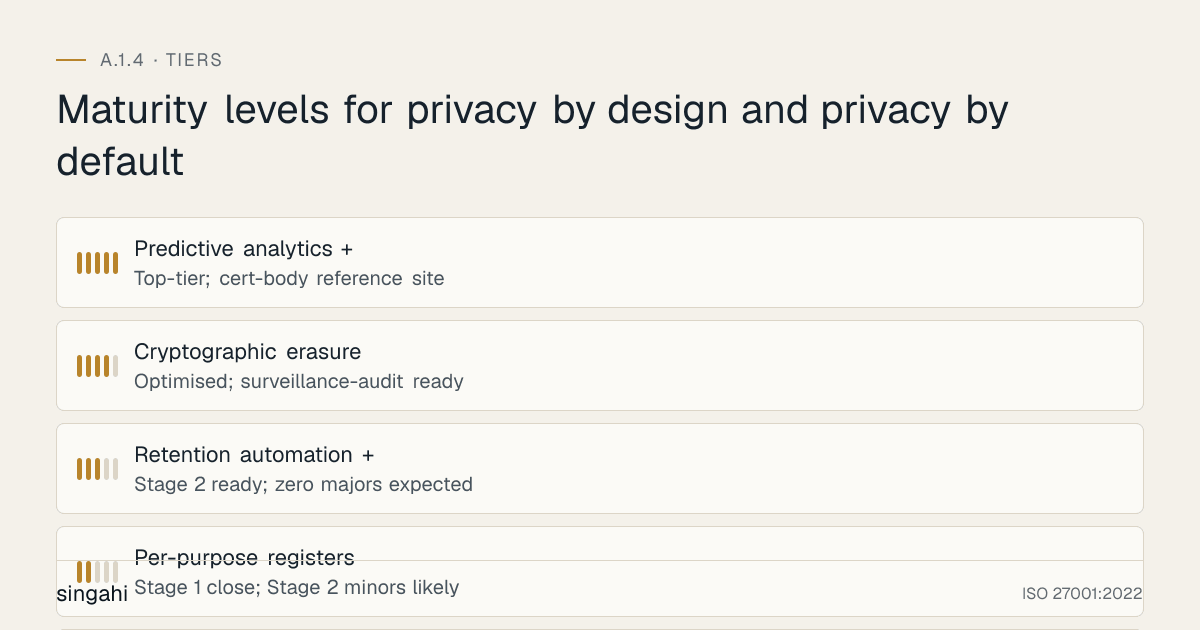
Level 1, Initial / Ad-hoc
Characteristics. No Privacy by Design Policy. No per-purpose collection register. No per-purpose processing register. No accuracy register. No documented minimisation objectives. No end-of-processing register. No temporary-file inventory. No retention schedule (retention is "indefinite until customer asks"). No disposal-methods register (disposal is "delete the row"). No transmission inventory. No design-stage gate. No disposal-incident drill.
Typical artefacts. A privacy policy that mentions data minimisation. The production database. The shared-drive folder accumulating exports.
Investment to reach L1. None, this is the floor.
The investment covers the inventory, the quick wins, the per-purpose registers, the retention schedule build, the top-three processing-activity remediation.
Level 2, Repeatable / Defined
Characteristics. A documented Privacy by Design Policy. A current processing-activity inventory (ROPA) with the A.1.4 dimensions. The per-purpose collection register and the per-purpose processing register built. The retention schedule documented. The transmission inventory drafted. The default-configuration register started. The design-stage gate designed but not yet enforced for every new launch.
Typical artefacts. The PbD Policy; the per-purpose collection and processing registers; the retention schedule; the transmission inventory (draft); the design-stage gate template.
The investment covers the retention automation, the disposal-vendor chain, the transmission re-architecture, the temporary-file purge automation, the design-stage gate enforcement.
Level 3, Managed / Measured
Characteristics. The retention schedule automated with the 48-hour pre-erasure notice. The disposal-vendor chain operating with the certificate-of-destruction workflow. The transmission re-architecture complete (mTLS for sensitive flows; no daily-CSV-by-email pattern). The temporary-file purge automated at the source. The design-stage gate enforced for every new launch. The first full disposal-incident drill run; the dual-clock pattern documented. The fifteen KPIs reporting; the first management-review pack produced.
Typical artefacts. The operational retention schedule with automation; the disposal log; the transmission inventory (live); the default-configuration register; the design-stage gate records; the disposal-incident drill report; the KPI dashboard; the first internal-audit report on A.1.4.
The investment covers the SDF DPIA integration (where applicable), the algorithmic-software review (where ADM in scope), the full disposal-incident drill programme (semi-annual), the KPI maturity, the developer-environment synthetic-data build.
Level 4, Quantitatively Managed
Characteristics. The cryptographic-erasure pipeline operating with the key-management discipline. The SDF DPIA integrated into the design-stage gate (where the controller is an SDF). The algorithmic-software review operating for every ADM pipeline. The disposal-incident drill running semi-annually with the CERT-In six-hour clock, the DPDP breach clock (intimation without delay; seventy-two-hour report) and the sector-regulator clocks met. The drift-detection discipline firing quarterly; each drift feeding Clause 10.2 corrective action. The KPI targets consistently met; the management-review pack driving Clause 10.1 improvement.
Typical artefacts. The cryptographic-erasure evidence; the SDF DPIA records; the algorithmic-software review reports; the drift-detection log; the management-review minutes with KPI trend analysis.
Level 5, Optimising
Characteristics. The minimisation analysis is a continuous engineering discipline (every new feature refreshes the minimisation objective; every model refresh re-runs the algorithmic-software review). The data estate is governed by a unified retention-and-disposal automation that spans databases, file systems, cloud storage, SaaS apps and backups. The transmission architecture is zero-trust (mTLS for every flow; signed-and-encrypted webhooks; API authentication per service). The disposal-incident drill is run quarterly with multi-incident scenarios. The KPI programme produces predictive analytics (drift prediction; over-retention prediction; principal-churn prediction from data-quality dynamics). The A.1.4 architecture is integrated with the broader privacy engineering practice (privacy-by-design gates in the product development lifecycle; the retention automation is the system-of-record for the entire data estate).
Typical artefacts. The continuous-improvement log; the predictive-analytics dashboard; the algorithmic-fairness trend reports; the privacy-engineering integration evidence; the zero-trust transmission architecture documentation.
Maturity-model quick-reference
| Level | Distinguishing artefact | Typical certification readiness |
|---|---|---|
| L1 | Privacy policy mentions minimisation | Stage 1 major nonconformity |
| L2 | Per-purpose registers + retention schedule (documented) | Stage 1 close; Stage 2 minors likely |
| L3 | Retention automation + transmission re-architecture + design-stage gate + drill | Stage 2 ready; zero majors expected |
| L4 | Cryptographic erasure + SDF DPIA + algorithmic-software review + drift detection | Optimised; surveillance-audit ready |
| L5 | Predictive analytics + continuous improvement + engineering integration | Top-tier; cert-body reference site candidate |
Emerging Trends
The DPDP Rules' phased commencement
The DPDP Rules 2025 (notified 13 November 2025) phase in through 2026 and 2027. The retention-and-erasure timelines (with the 48-hour pre-erasure notice) and the SDF DPIA format are the A.1.4-relevant slices. Controllers that build the retention automation, the 48-hour notice workflow and the SDF DPIA integration ahead of the full-enforceability window (estimated May 2027) will have a two-to-three-year advantage over those that retrofit in 2027 and 2028.
The algorithmic-software overlay under DPDP Rule 13(3)
For SDFs, DPDP section 10 introduces an algorithmic-software review covering the algorithmic software used on personal data (Rule 13(3)). The algorithmic-software review interacts with A.1.4.4 (accuracy, biased or stale input data produces unfair decisions) and A.1.4.5 (minimisation, the input-data minimisation is the first fairness treatment). The emerging practice is to run the algorithmic-software review on every ADM pipeline, regardless of SDF status, and to maintain the fairness KPIs alongside the accuracy KPIs. The DPBI's early orders (once available) will shape the operational practice.
Privacy-enhancing technologies (PETs) going mainstream
PETs, pseudonymisation, tokenisation, differential privacy, federated learning, homomorphic encryption, synthetic data, are moving from research to mainstream operations. The drivers: the A.1.4 minimisation pressure; the Rule 13(3) algorithmic-software overlay; the cross-border transfer dimension (PETs are the most natural supplementary measure for cross-border flows under DPDP section 16 and GDPR Chapter V); the AI-training-data dimension (PETs enable model training on sensitive data without exposing the underlying personal data). Controllers building today should design the A.1.4 architecture to accommodate PET-based patterns as they mature.
The convergence of consent management and data minimisation
Consent management (the A.1.2.5 question, does the principal agree to the processing?) and data minimisation (the A.1.4.5 question, is the processing itself designed to minimise the data?) are converging in the enterprise privacy-tool market. The Singahi view is that the convergence is sound, the principal-facing experience should be unified, but the two must remain analytically distinct. The consent state is the lawful-basis question; the minimisation objective is the architectural question. The two are correlated but not identical (a controller may have valid consent for a poorly-minimised processing; a well-minimised processing may rely on a non-consent basis).
The cross-border transmission dimension under DPDP section 16
DPDP section 16's negative-list approach to cross-border transfer (transfer permitted to any country except those notified as restricted) differs from the GDPR Chapter V approach (adequacy / safeguards / derogations). For A.1.4.10 transmission controls, the cross-border dimension requires the controller to screen the destination against the negative list at the onboarding gateway, and to maintain the screening evidence. As the Central Government notifies the restricted countries (the first notifications are expected through 2026 and 2027), the controller's transmission inventory must be updated and the affected flows re-architected.
The convergence of A.1.4 with AI governance
The Rule 13(3) algorithmic-software overlay is the leading edge of a broader convergence between the A.1.4 family and AI governance. The input-data minimisation (A.1.4.5); the input-data accuracy (A.1.4.4); the retention of training data (A.1.4.8); the disposal of training data and model weights (A.1.4.9); the transmission of training data to the model-training environment (A.1.4.10), all are A.1.4 questions applied to AI pipelines. The emerging practice is to treat AI governance as an extension of A.1.4, with the algorithmic-software review as the AI-specific overlay.
The emergence of the data-mesh and the implications for A.1.4
The data-mesh architectural pattern, distributed data ownership, domain-oriented data products, federated governance, is being adopted by some Indian enterprises for analytics-scale data estates. The implications for A.1.4: the retention schedule, the disposal chain and the transmission inventory must operate across the mesh; the minimisation objective must be set per domain; the design-stage gate must fire for each new data product. The mesh is operationally complex; controllers adopting it should design the A.1.4 discipline in parallel, not as an afterthought.
The convergence of privacy-by-design and security-by-design
Privacy by design (A.1.4) and security by design (ISO/IEC 27002:2022 control 8.25 / secure development life cycle; ISO/IEC 27001:2022 clause 6.1.2 / information security risk assessment) are converging in the engineering practice. The two disciplines share the design-stage gate, the default-configuration register, the integrity dimension and the breach-vector analysis. Controllers building today should design the two disciplines in parallel, a single design-stage gate that covers both the privacy dimension (minimisation objective; accuracy controls; retention period; disposal route; transmission routes) and the security dimension (threat model; attack surface; security controls; incident-response hooks).
References and Further Reading
Standards and regulations
- ISO/IEC 27701:2025, Privacy information management system, Requirements and guidance (published 14 October 2025).
- ISO/IEC 27001:2022, Information security management systems, Requirements.
- ISO/IEC 27002:2022, Information security controls (only control 5.34 is PII-specific; control 8.10 information deletion is the security-side backstop for A.1.4.6, A.1.4.7, A.1.4.8, A.1.4.9).
- ISO/IEC 27018:2019, Code of practice for protection of PII in public clouds acting as PII processor (clause 7 minimisation; clause 10 cross-border; clause 11 end-of-processing disposal).
- ISO/IEC 27017:2015, Code of practice for cloud security.
- ISO/IEC 29100:2011, Privacy framework (eleven privacy principles, Collection Limitation; Data Minimisation; Use, Retention and Disclosure Limitation; Accuracy and Quality).
- ISO/IEC 29134:2017, Guidelines for privacy impact assessment.
- ISO/IEC 27706:2025, PIMS certification-scheme competence (Ed 1, October 2025; replaces ISO/IEC TS 27006-2:2021).
- ISO/IEC 17021-1:2015, Management-system certification-body requirements.
- ISO/IEC 27006 (current edition), ISMS certification-body requirements.
Indian regulatory instruments
- Digital Personal Data Protection Act, 2023 (Act No. 22 of 2023, enacted 11 August 2023; eGazette notification 247847). Source: meity.gov.in.
- Digital Personal Data Protection Rules, 2025 (notified 13 November 2025; phased commencement). Source: meity.gov.in.
- Information Technology Act, 2000 (Act No. 21 of 2000), sections 43A and 72A. Source: indiacode.nic.in.
- Information Technology (Reasonable Security Practices and Procedures and Sensitive Personal Data or Information) Rules, 2011 (notified 11 April 2011).
- CERT-In Directions No. 20(3)/2022-CERT-In (28 April 2022) under section 70B(6) of the IT Act, 2000. Source: cert-in.org.in.
- RBI, Storage of Payment System Data, RBI circular DPSS.CO.OD.No.1098/06.08.005/2017-18 (6 April 2018). Source: rbi.org.in.
- RBI, Digital Lending Guidelines, RBI circular DOID.CO.PPG.SEC.09/14.14.001/2022-23 (2 September 2022). Source: rbi.org.in.
- RBI, Tokenisation of Card transactions, RBI circular DPSS.CO.RPPD.No.S-35/07.01.005/2021-22 (22 September 2021; full effect 1 October 2022).
- SEBI, KYC Registration Agencies Regulations, 2011 (as amended); KRA Master Circular (May 2024). Source: sebi.gov.in.
- SEBI, Cybersecurity and Cyber Resilience Framework (CSCRF) 2024, circular SEBI/HO/ITD-1/ITD_CSC_EXT/P/CIR/2024/113 (20 August 2024). Source: sebi.gov.in.
- IRDAI, Information and Cyber Security Guidelines, 2023 (24 April 2023). Source: irdai.gov.in.
- Consumer Protection (E-Commerce) Rules, 2020.
- The Limitation Act, 1963 (Act No. 36 of 1963).
Jurisprudence
- K.S. Puttaswamy v. Union of India, (2017) 10 SCC 1 (judgment delivered 24 August 2017 by a nine-judge Bench of the Supreme Court of India).
- Justice K.S. Puttaswamy (Retd.) v. Union of India (Aadhaar), (2019) 1 SCC 1 (26 September 2018, five-judge Bench).
- Case C-311/18, Data Protection Commissioner v. Facebook Ireland and Maximillian Schrems (Schrems II), EU:C:2020:559 (Court of Justice of the European Union, Grand Chamber, 16 July 2020).
Global regulations (mapped in Section 16)
- Regulation (EU) 2016/679 (General Data Protection Regulation), OJ L 119, 4.5.2016, p. 1; application from 25 May 2018. Source: eur-lex.europa.eu.
- Article 5(1)(b) (purpose limitation), Article 5(1)(c) (data minimisation), Article 5(1)(d) (accuracy), Article 5(1)(e) (storage limitation), Article 25 (data protection by design and by default), Article 32 (security of processing), Article 33 (breach notification, seventy-two hours), Article 35 (DPIA).
- Commission Implementing Decision (EU) 2021/914 of 4 June 2021, modernised Standard Contractual Clauses.
- European Commission adequacy decision on the EU-US Data Privacy Framework (10 July 2023).
- UK GDPR; Data Protection Act 2018 (c. 12); UK International Data Transfer Agreement (IDTA) and UK Addendum to EU SCCs.
- California Consumer Privacy Act / California Privacy Rights Act (Cal. Civ. Code 1798.100 et seq.); CCPA effective 1 January 2020; CPRA effective 1 January 2023.
- Virginia Consumer Data Protection Act (Va. Code § 59.1-575 et seq.), effective 1 January 2023.
- Colorado Privacy Act (C.R.S. § 6-1-1301), effective 1 July 2023.
- Brazil, LGPD (Lei nº 13.709/2018), effective 18 September 2020.
- China, PIPL, effective 1 November 2021.
- Singapore, PDPA 2012 (No. 26 of 2012) as amended; mandatory breach notification effective 1 February 2021.
- Canada, PIPEDA (S.C. 2000, c. 5); mandatory breach notification since 1 November 2018.
- Australia, Privacy Act 1988; Australian Privacy Principles; Notifiable Data Breaches scheme effective 22 February 2018.
- South Korea, PIPA (Act No. 10469 of 2011, as amended 2023).
- UAE, Federal Decree-Law No. 45 of 2021 (PDPL).
- Saudi Arabia, PDPL (Royal Decree M/19), in force 14 September 2023; full enforcement 14 September 2024.
- South Africa, POPIA (Act 4 of 2013), fully in force 1 July 2021.
Frameworks and guidance
- NIST Privacy Framework v1.0: A Tool for Improving Privacy Through Enterprise Risk Management, NIST.CSWP.01162020 (16 January 2020). Source: nist.gov/privacy-framework.
- AICPA, 2017 Trust Services Criteria for Security, Availability, Processing Integrity, Confidentiality and Privacy (TSC 2017; 2022 Points of Focus update). The Privacy criteria: P1.0 (Notice), P2.0 (Choice and consent), P3.0 (Collection), P4.0 (Use, retention, and disposal), P5.0 (Access), P6.0 (Disclosure and notification), P7.0 (Quality), P8.0 (Monitoring and enforcement).
- European Data Protection Board, Guidelines 4/2019 on Article 25 (data protection by design and by default); Guidelines 05/2020 on consent; Guidelines 9/2022 on personal data breach notification; Recommendations 01/2020 on supplementary measures.
- Article 29 Working Party, WP248 rev.01, Guidelines on Data Protection Impact Assessment (DPIA criteria).
- ICO (UK) Accountability Framework; CNIL (FR) PIA methodology.
Certification-scheme and practitioner references (generic)
- IAF (International Accreditation Forum), note: no PIMS-specific IAF MD identified as of mid-2026.
- Accreditation bodies active in PIMS: ANAB, UKAS, DAkkS, COFRAC, JAB, CNAS, and others.
- The certification-scheme rule-set: ISO/IEC 17021-1:2015; ISO/IEC 27006; ISO/IEC 27706:2025.