
On this page
- Quick Reference (60 Seconds)
- What the Standard Actually Requires
- Why This Control Matters
- Scope and Applicability
- Key Definitions and Terminology
- Relationship to Other Clauses and Frameworks
- Detailed Implementation Guidance, The Seven Operational Moves
- Tools, Technologies, and Solutions
- Policy and Procedure Templates
- Operational Risk Assessment and Treatment
- Audit and Compliance Checklist
- Metrics and KPIs
- Common Pitfalls and Audit Failures
- Illustrative Scenario 1: Failure, Avani Retail and the Uncontrolled Cross-Border Sub-processor (Illustrative)
- Illustrative Scenario 2: Success, Charu Wealth Builds the Seven-Process Operational Discipline (Illustrative)
- Multi-Framework Mapping
- Implementation Roadmap
- FAQ
- Industry-Specific Requirements
- Maturity Model
- Emerging Trends
- References and Further Reading
Quick Reference (60 Seconds)
| Attribute | Detail |
|---|---|
| Clause | ISO/IEC 27701:2025 Clause 8.1, Operational Planning and Control. The first sub-clause of the PIMS Operation block (Clause 8), structurally aligned to the Harmonized Structure shared by ISO/IEC 27001:2022 Clause 8.1, ISO 22301:2019 Clause 8.1, ISO 9001:2015 Clause 8.1 and ISO/IEC 42001:2023 Clause 8.1. Where 6.1 builds the privacy risk methodology and 6.2 sets the objectives, and where 8.2 carries the operational-layer privacy risk assessment and 8.3 the operational-layer privacy risk treatment, 8.1 is the umbrella over the operational processes themselves, it asks the organisation to plan, run and control the day-to-day PIMS processes (ROPA, consent, rights, DPIA, transfer, breach, processor management) by setting criteria for each, controlling each against its criteria, controlling planned and unintended changes to those processes, and controlling the privacy processing outsourced to processors and sub-processors. |
| What it asks for (paraphrase) | ISO/IEC 27701:2025 Clause 8.1 asks organizations to plan, run, and control the processes needed to meet privacy requirements. Four load-bearing ideas do the work. The organisation determines the criteria for each PIMS process, what "good" looks like for each of the seven core processes (ROPA, consent, rights, DPIA, processor management, transfer, breach). The organisation implements control of each process per its criteria, the repeatable day-to-day operational control that keeps every process on its rails. The organisation controls planned changes to those processes and mitigates unintended changes, operational drift is the canonical 8.1 failure mode. And the organisation controls the privacy processing it outsources to processors and sub-processors, the operational thread that connects 8.1 to Annex A.2, GDPR Article 28 and DPDP Act 2023 sections 6 and 8. |
| The marquee insight competitors miss | Most practitioner commentary treats Clause 8.1 as the generic ISO operational-planning clause, a thin "run your processes to plan" overlay. That under-uses the clause for a PIMS in three ways. First, in a PIMS the "processes" are not generic business processes, they are the privacy-processing operations the DPDP Act and GDPR regulate (ROPA under DPDP section 8 and GDPR Article 30; consent under DPDP sections 5 to 6 and GDPR Articles 7 to 8, including the Indian Consent Manager construct under section 2(1)(g); rights under DPDP sections 11 to 14 and GDPR Articles 15 to 22; DPIA under DPDP section 10 and GDPR Article 35; transfer under DPDP section 16 and GDPR Chapter V; breach under DPDP section 8(6) and GDPR Articles 33 to 34; processor management under DPDP sections 6 and 8 and GDPR Article 28). Second, the Privacy Process-Criteria Register is the load-bearing 8.1 artefact that almost no competitor discusses, a single living inventory of "for each PIMS process, what are the acceptance criteria against which the operational output is controlled?". Third, outsourced privacy processing is the PIMS-specific operational load that distinguishes 8.1 from its infosec analogue, when the organisation engages a processor, the processing is outsourced but the accountability for the principal's rights is not. |
| Domain | Operation (Clause 8). 8.1 sits beside 8.2 (operational privacy risk assessment, the deeper per-processing-activity risk work) and 8.3 (operational privacy risk treatment, the modify-option execution in operations). The Clause 8 block is where the PIMS stops being a planning artefact and becomes a running system; 8.1 is the umbrella that holds the operational processes, and their criteria, control, change discipline and outsourcing governance, together. Without 8.1, the operational risk work in 8.2 and 8.3 has no governed processes to assess and treat. |
| What you must produce | (a) A PIMS Operational Planning and Control Policy committing top management to criteria-based operational control of the seven PIMS processes, change discipline, and outsourced-processing governance; (b) a Privacy Process-Criteria Register, for each of the seven processes, the documented acceptance criteria, control mechanism, owner, cadence, evidence source; (c) an Operational Control Matrix mapping each criterion to its control point, owner, KPI, evidence location; (d) the seven process procedures (ROPA, consent and notice, rights, DPIA, processor management, cross-border transfer, breach), each a Documented Information artefact under Clause 7.5; (e) a Privacy Process Change-Control Procedure complementing Clause 6.3 with the operational-process change loop; (f) an Outsourced Privacy Processing Procedure covering the processor lifecycle (due diligence, DPA, sub-processor authorisation, infringing-instruction handling, audit cooperation, data return and deletion, cross-border chain); (g) a Drift Detection and Mitigation mechanism wired into Clause 9.1 monitoring, the canonical 8.1 unintended-change control. |
| Typical owner | Top management owns the operational PIMS at the strategic level, Clause 8.1, like the rest of Clause 8, derives its authority from Clause 5.1. The DPO / Privacy Lead owns the Process-Criteria Register, the Operational Control Matrix and the seven process procedures. The CISO / Security Lead co-owns the A.3 security-overlay processes (the breach detection pipeline, the access-control operation, the logging operation). Legal and Compliance own the regulatory-criteria dimension. Business-process owners own the operational execution (the product owner owns the consent UX; the marketing lead owns the consent-quality of the lead-capture forms; the customer-support lead owns the rights-response SLA; the procurement lead owns the processor due-diligence intake; the engineering lead owns the technical controls and the breach-detection pipeline). The Privacy Operations Lead (where the function exists, typical of mid-sized and enterprise) runs the day-to-day operational control room. Internal Audit tests the Process-Criteria Register, the Operational Control Matrix and the process evidence at the internal audit (Clause 9.2). |
| Minimum viable actions | (1) Enumerate the seven PIMS processes and assign each an owner; (2) for each process, draft the acceptance criteria by reference to the applicable DPDP sections, GDPR articles and sector rules; (3) stand up the Privacy Process-Criteria Register and the Operational Control Matrix; (4) write or refresh the seven process procedures; (5) wire the planned-change loop for processes into the existing Clause 6.3 change process; (6) stand up the drift-detection mechanism (the monthly reconciliation between documented state and operational reality); (7) build the Outsourced Privacy Processing Procedure; (8) wire the DPA intake into procurement so no processor goes live without the Article 28 / Annex A.2 / DPDP section 8 terms; (9) operationalise the dual-clock breach-notification playbook with a quarterly table-top drill; (10) wire the process evidence into the management review (Clause 9.3). |
| Maturity floor (L1) | A "policy-on-the-wall" PIMS: the seven processes are described in the policy and the SoA but are not operational, the ROPA is a static spreadsheet; the consent platform runs on defaults; the rights workflow is an ad-hoc email to the DPO; the DPIA register is empty; the processor map is in someone's inbox; the cross-border transfer register does not exist; the breach playbook is a draft from two years ago. The single most common Clause 8.1 audit nonconformity in the Indian growing-company segment. |
| Maturity target (L4 to L5) | A "criteria-controlled" PIMS: every one of the seven processes has documented acceptance criteria, an operating procedure, a control mechanism that produces evidence against the criteria, a named owner, a KPI and a cadence; the Process-Criteria Register and the Operational Control Matrix are living artefacts; the drift-detection mechanism fires monthly; the Outsourced Privacy Processing Procedure governs every processor from due-diligence to deletion; the dual-clock breach playbook has been drilled in the last six months; the process evidence reconciles with the ROPA, the contract inventory, the DPIA register and the change log. |
| Audit red flag | A Process-Criteria Register that does not exist or that cannot be reconciled with the operational evidence. The 8.1 audit test is always the same: the auditor picks a recent operational event (a rights request, a processor onboarded, a sub-processor change notice, a breach drill, a new processing activity, a cross-border transfer) and asks "show me the process this routed through, the criteria against which it was controlled, the control evidence, the owner sign-off, the deviation log." If the answer is "we handled it ad-hoc" or "we will document it for next cycle", the PIMS has an 8.1 finding. The second-most-common red flag is the outsourced-processing blind spot. The third is the drift-undetected failure, the documented state and the operational reality have diverged, nobody noticed. |
| Time to implement (first cycle) | Growing companies (50 to 250 staff): 8 to 14 weeks. Mid-sized (250 to 2,000): 14 to 24 weeks, usually requiring the integrated product / procurement workflow wiring, the processor-map reconciliation against the full ROPA, and the dual-clock breach drill executed end-to-end. Multi-entity enterprise: 6 to 12 months, integrated with the enterprise operations function, the group privacy governance, the multi-jurisdiction processor ecosystem and the SDF operating model under DPDP section 10. |
| Related clauses | 4.1 (context shapes the operational risk landscape), 4.2 (requirements are the source of every process criterion, each DPDP / GDPR / sector requirement translates into one or more operational process criteria), 4.3 (scope defines the operational boundary), 4.4 (the PIMS is run through these processes), 5.1 (top management owns the operational discipline), 5.2 (policy commits to operational privacy), 5.3 (process owners are assigned), 6.1 (the planning-layer risk methodology produces the framework the operational processes apply), 6.2 (objectives cascade to operational KPIs), 6.3 (planned changes to the PIMS route through 6.3, operational-process changes route through 8.1's process-change-control as the operational layer of 6.3), 7.1 (resources for the operational processes), 7.2 (competence of process operators), 7.3 (awareness of process criteria), 7.4 (communication about the operational processes, principal notices, regulator filings, processor instructions), 7.5 (Documented Information, the seven process procedures, the Process-Criteria Register, the Operational Control Matrix, the evidence), 8.2 (the operational-layer privacy risk assessment, the per-processing-activity risk work that 8.1's processes feed and that 8.1 controls), 8.3 (the operational-layer privacy risk treatment, the modify-option execution that 8.1 operationalises), 9.1 (monitoring tests the process criteria and the KPIs), 9.2 (internal audit tests the Process-Criteria Register and the evidence), 9.3 (management review receives the operational profile), 10.2 (corrective action on process failure, the reactive complement to 8.1's operational control), 10.1 (improvement cycles feed off the drift-detection findings). Annex A.1 (controller controls, the obligations the operational processes satisfy), Annex A.2 (processor controls, the obligations the outsourced-processing governance operationalises), Annex A.3 (security controls, the technical operation that 8.1 controls alongside the privacy operation). 8.1 is the operational spine every downstream Clause 8 sub-clause and every Annex A control hangs from. |
| Critical Indian context-bearing instruments the process criteria must reflect | DPDP Act 2023 (Act 22/2023, enacted 11 August 2023), section 4 grounds; section 5 notice; section 6 consent (free, specific, informed, unconditional, unambiguous, clear affirmative action, as-easy-to-withdraw, via the Consent Manager under section 2(1)(g)); section 7 legitimate uses; section 8 Data Fiduciary general obligations, including 8(5) reasonable security safeguards and 8(6) breach notification (without delay to the Board, with a detailed report within seventy-two hours via DPDP Rules 2025 Rule 7) and 8(7) erasure; section 9 children (verifiable parental consent; no behavioural monitoring or targeted advertising); section 10 SDF (DPO, SDF DPIA, independent data audit, algorithmic-software review); sections 11 to 14 rights (access, correction/erasure, grievance, nomination); section 16 cross-border negative list; section 18 the Data Protection Board of India; section 33 + Schedule penalty maxima (up to two hundred and fifty crore rupees for section 8(5) failure; two hundred crore for sections 8(6) and 9; one hundred and fifty crore for section 10). DPDP Rules 2025 (notified 13 November 2025), Rule 7 (breach intimation without delay, the seventy-two-hour detailed report, format, dual-clock pattern); consent-notice content and language; verifiable parental consent; SDF thresholds and SDF DPIA cadence; retention and erasure timelines (including the forty-eight-hour pre-erasure notice); Consent Manager registration; grievance-redressal response periods. Puttaswamy v. Union of India (2017) 10 SCC 1; Aadhaar judgment (2019) 1 SCC 1. CERT-In Directions 20(3)/2022-CERT-In of 28 April 2022 (the six-hour clock and the dual-clock pattern). RBI Storage of Payment System Data (6 April 2018); RBI Digital Lending Guidelines (2 September 2022); SEBI CSCRF (20 August 2024); IRDAI Information and Cyber Security Guidelines (24 April 2023). Each operational criterion in the Process-Criteria Register must name the instrument it derives from. |
If you only read one thing: Clause 8.1 is where the PIMS stops being a planning artefact and becomes a running, criteria-controlled, evidence-producing operation. An 8.1-conformant PIMS is one in which the organisation has enumerated the seven core privacy-processing operations (ROPA, consent and notice, rights, DPIA, processor and sub-processor, cross-border transfer, breach), set documented acceptance criteria for each, runs each against its criteria every day, controls planned changes, detects and corrects drift, and governs the privacy processing it outsources end-to-end. Not a policy that says "we operate privacy by plan"; a Process-Criteria Register and an Operational Control Matrix that prove it. The certification auditor will pick a recent operational event and walk it through the process, the criteria, the control evidence and the deviation log; the Data Protection Board of India will, after a complaint or a breach, ask which process governed the event, which criteria applied, and where the operational evidence is. Get 8.1 wrong, no Process-Criteria Register, no operational procedures, no drift detection, no outsourced-processing governance, and however strong the Clause 6 planning architecture is, the PIMS does not exist as an operational system.
What the Standard Actually Requires
The paraphrased requirement
ISO/IEC 27701:2025 Clause 8.1 asks organizations to plan, run, and control the processes needed to meet privacy requirements. Four load-bearing ideas sit inside that paraphrase, and auditors test each separately.
The organisation must plan the operational PIMS, determine what processes are needed to meet the privacy requirements identified in Clause 4.2 and to deliver the controls selected in the PIMS Statement of Applicability under Clause 6.1.3. For a PIMS, those processes are not generic; they are the privacy-processing operations the regulatory regime governs. The seven canonical processes (introduced in Section 1 and detailed in Section 7) are: (i) records of processing activities; (ii) the consent and notice lifecycle; (iii) the data-principal rights workflow; (iv) the DPIA pipeline; (v) the processor and sub-processor management loop; (vi) the cross-border transfer mechanism; (vii) the breach detection, notification and response operation. The 8.1 plan enumerates these processes and assigns each an owner.
The organisation must control each process by setting and applying documented criteria. The verb "control" is the operational verb, not "write a policy about", but "set acceptance criteria and verify the output against them". For the consent process, the criteria include the DPDP section 6 consent qualities (free, specific, informed, unconditional, unambiguous, clear affirmative action, as-easy-to-withdraw as to give) and the Rules' language and accessibility requirements; for the breach process, the criteria include the dual-clock adherence (CERT-In six hours from awareness; DPDP section 8(6) without delay to the Board, with a detailed report within seventy-two hours via Rule 7; sector-regulator clocks where applicable) and the prescribed content; for the rights workflow, the criteria include the prescribed response periods and the completeness and accuracy of the response. The Process-Criteria Register is the artefact in which these criteria are documented.
The organisation must control planned changes to those processes and mitigate the consequences of unintended changes. Planned changes, a new consent UX, a new processor, a new cross-border destination, a refreshed breach playbook, route through the 8.1 process-change-control loop (which is the operational-layer complement to the Clause 6.3 management-system change discipline). Unintended changes, operational drift, are detected through monitoring (Clause 9.1) and corrected through corrective action (Clause 10.2). The drift-detection discipline is the canonical 8.1 operational-control discipline.
The organisation must control the privacy processing it outsources to processors and sub-processors. This is the PIMS-specific operational load that distinguishes 8.1 from its infosec analogue. When a Data Fiduciary engages a Data Processor under DPDP, or a PII controller engages a PII processor under GDPR Article 28, the processing is outsourced but the accountability for the principal's rights is not. The 8.1 control of outsourced processing covers the full lifecycle: due diligence, the data-processing agreement (DPA) terms, the sub-processor authorisation and change-notification mechanism, the infringing-instruction handling process, the audit-cooperation mechanism, the data-return and deletion confirmation, the cross-border transfer chain, the breach-notification-to-controller clock. This control is the operational expression of Annex A.2 (PII processor controls) and GDPR Article 28, and of the DPDP obligations the Data Fiduciary carries under section 8 for the acts of its processors.
The seven operational PIMS processes
The Singahi seven-process catalog (toolkit doc 02 Section 4) operationalises the planning requirement. Every 8.1-conformant PIMS runs these seven processes; some run additional ones (a privacy-by-design gate, a retention and erasure operation, a vendor-recertification cycle), but the seven below are the load-bearing minimum. Section 7 details each with criteria, control mechanism, evidence source and regulatory anchors.
Process 1, Records of Processing Activities (ROPA). The inventory artefact recording, for each processing activity, the Article 30 / DPDP section 8 fields (purpose, data categories, principal categories, recipients, transfers, retention, technical and organisational measures, lawful basis, DPO contact). The 8.1 ROPA process is the maintenance operation, how new activities are added, changed activities updated, retired activities removed, and the ROPA reconciled against the operational reality on a cadence.
Process 2, Consent and notice lifecycle. The load-bearing lawful-basis operation for most consumer-facing Fiduciaries. Covers notice delivery (DPDP section 5; GDPR Articles 12 to 14), consent capture (DPDP section 6 seven qualities; GDPR Article 7; Article 8 child), consent management, withdrawal (as-easy-to-withdraw), and the Consent Manager integration under DPDP section 2(1)(g), the registered, interoperable, principal-side intermediary with no direct GDPR analogue.
Process 3, Data-principal rights workflow. The intake, authentication, scoping, execution, response and recording of rights requests. DPDP set: sections 11 (access), 12 (correction and erasure), 13 (grievance redressal within the prescribed period; the Grievance Officer), 14 (nomination). GDPR set: Articles 15 to 22.
Process 4, DPIA pipeline. The structured screening of every processing activity against the DPIA triggers; the DPIA where a trigger fires; the consultation where residual risk remains high; the review on material change. Anchors: DPDP section 10 (SDF DPIA); GDPR Article 35 (DPIA), 35(11) (review), 36 (prior consultation); ISO/IEC 29134:2017.
Process 5, Processor and sub-processor management. The operational control of outsourced privacy processing, due diligence, the DPA (Article 28 / Annex A.2 / DPDP section 8 terms), the sub-processor authorisation and change-notification clock, the infringing-instruction handling, the audit cooperation, the data return and deletion, the cross-border chain, the breach-notification-to-controller clock. This is the operational thread connecting 8.1 to Annex A.2 and Article 28; detail in Section 7.8.
Process 6, Cross-border transfer mechanism. The destination screen (DPDP section 16 negative list; GDPR Chapter V adequacy / safeguards / derogations), the transfer-impact assessment (post-Schrems II, CJEU C-311/18, 16 July 2020), the contractual basis (the SCCs of Implementing Decision (EU) 2021/914; the IDTA or UK Addendum; the contractual clauses for the DPDP baseline), the supplementary measures, the transfer register.
Process 7, Breach detection, notification and response. Detection, containment, assessment, notification, review. The dual-clock pattern (CERT-In six hours + DPDP without delay plus a seventy-two-hour detailed report + sector-regulator clocks where applicable) from the same awareness event is the canonical Indian operational signature; GDPR Articles 33 to 34 apply for EU-relevant processing.
The seven processes are not mutually exclusive. A single operational event, say, a ransomware incident at a processor that exposes the controller's principals, engages processes 5, 6, 7 and 1 simultaneously. The 8.1 discipline is that each process is governed, criteria-ised and evidence-producing in its own right, so that when an event engages several at once, each runs cleanly.
The Process-Criteria Register, the load-bearing 8.1 artefact
The Process-Criteria Register is the artefact almost no competitor discusses. It is a single living inventory that records, for each of the seven PIMS processes, the acceptance criteria against which the operational output is controlled. The Singahi Process-Criteria Register template (toolkit doc 02) has the following fields per process:
- Process name and ID, the canonical label.
- Process owner, the named individual accountable for the operational execution.
- Process objective, what the process is for, in operational terms.
- Acceptance criteria, the documented, measurable standards the operational output must meet. The criteria derive from the regulatory instruments (DPDP sections, GDPR articles, sector rules) and from the organisation's own commitments (the privacy policy, the customer DPAs, the certifications).
- Control mechanism, how the criteria are verified operationally, a real-time check, a periodic reconciliation, a sampling audit, a quarterly drill, a table-top exercise.
- KPI / metric, the quantitative measure of process performance, with target, threshold and cadence.
- Evidence source, where the operational evidence lives (the consent ledger, the rights-request ticketing system, the breach register, the processor inventory, the DPIA register, the transfer register).
- Cadence, how often the process is run and how often the control is verified.
- Deviation handling, the corrective-action pathway when the output fails the criteria (the link to Clause 10.2).
- Regulatory anchors, the DPDP sections, GDPR articles and sector rules from which the criteria derive, so that every operational control is traceable to the legal obligation.
The Register is reviewed at the management review (Clause 9.3) and reconciled against the ROPA, the contract inventory, the change log and the DPIA register. A typical Register for an Indian growing company has 30 to 80 criteria across the seven processes; for a growing firm, 80 to 200; for an enterprise or SDF, 200 to 600.
Outsourced privacy processing, the PIMS-specific 8.1 load
The control of outsourced privacy processing is the operational load that distinguishes Clause 8.1 from its infosec analogue. The PIMS-specific load is the Article 28 / Annex A.2 / DPDP section 8 triangle: the controller's accountability for the processor's acts runs end-to-end. Under DPDP section 8 the Data Fiduciary is responsible for the acts of its processor performed under the Fiduciary's instructions; under GDPR Article 28 the controller must use only processors providing sufficient guarantees and must have a written contract with the Article 28(3) terms; under Annex A.2 the PII processor controls (A.2.2.x conditions, A.2.5.x disclosure, the sub-processor chain) are the control surface the controller's process must operationalise.
The seven lifecycle elements of the 8.1 outsourced-processing control are: (i) due diligence before engagement; (ii) the DPA with the Article 28(3) / Annex A.2 / DPDP section 8 terms; (iii) the sub-processor authorisation and change-notification clock (GDPR Article 28(2), typically ten to thirty days; the customer's right to object); (iv) the infringing-instruction handling process (the processor's duty to refuse and notify, the load-bearing A.2 operational control whose absence is the canonical processor-side 8.1 finding); (v) the audit-cooperation mechanism (Article 28(3)(h); ISO/IEC 27018:2019 for cloud processors); (vi) the data-return and deletion confirmation (Article 28(3)(g); DPDP section 8(7)); (vii) the cross-border transfer chain where the processor's geography engages DPDP section 16 or GDPR Chapter V. The processor's breach-notification-to-controller clock (Article 33(2); typically twenty-four to seventy-two hours in the customer DPA) is the parallel operational discipline. The seven lifecycles are detailed in Section 7.8; the Singahi Outsourced Privacy Processing Procedure (toolkit doc 08) is the load-bearing artefact.
The line between 6.1 (planning-layer risk) and 8.x (operational-layer risk)
A frequent demarcation question is how Clause 8.1 relates to Clause 6.1 and to Clauses 8.2 and 8.3. The four are complementary, not duplicative.
Clause 6.1 builds the planning-layer risk methodology, the framework, criteria, treatment-option taxonomy, the PIMS Statement of Applicability, the risk-acceptance discipline. Clause 8.1 is the umbrella over the operational processes themselves, how the seven PIMS processes are planned, run and controlled day-to-day, including how the controls selected in the 6.1.3 SoA are operated in production. The Process-Criteria Register and the Operational Control Matrix are the 8.1 artefacts. Clause 8.2 carries the operational-layer privacy risk assessment, the per-processing-activity risk work, fed by the ROPA. Clause 8.3 carries the operational-layer privacy risk treatment, the modify-option execution in operations (the privacy-by-design gates, the conditions-for-processing checks, the rights fulfilment, the obligations-to-principals operations).
In practice, an integrated 8.1 + 8.2 + 8.3 architecture runs the seven processes under 8.1, applies the per-activity risk methodology under 8.2, and operates the treatment controls under 8.3. The three sub-clauses interlock; the auditor will trace the same operational event across all three.
Planned changes and unintended changes (drift)
The 8.1 change discipline has two tracks. Planned changes, a new processing purpose, a new processor, a new sub-processor, a new cross-border destination, a refreshed breach playbook, a new consent UX, route through the 8.1 process-change-control loop (the operational-layer complement to Clause 6.3). The loop re-runs the affected process criteria, re-assesses the risk under 6.1, re-runs the DPIA where a trigger fires (per ISO/IEC 29134 and GDPR Article 35(11)), and updates the Operational Control Matrix.
Unintended changes, operational drift, are the canonical 8.1 failure mode. Drift surfaces when the documented process state and the operational reality diverge: the ROPA is stale; the consent platform has been reconfigured without change control; a sub-processor swap was not notified; a new form field was added without the privacy review; the breach playbook was last drilled two years ago. The 8.1 drift-detection mechanism (wired into Clause 9.1 monitoring) surfaces drift through periodic reconciliation: the monthly ROPA reconciliation; the quarterly processor-map reconciliation; the quarterly consent-record reconciliation; the semi-annual breach drill; the annual DPA refresh. Drift is corrected through Clause 10.2 corrective action; patterns feed Clause 10.1 continual improvement.
What the standard does NOT require (the demarcation)
- 8.1 does not require every process to be automated. Manual processes with documented criteria and a verifiable evidence trail are acceptable for the first cycle; automation is a maturity upgrade.
- 8.1 does not require a single GRC platform. A spreadsheet-based Process-Criteria Register is acceptable if the criteria are documented, the control is verifiable, and the evidence is retrievable.
- 8.1 does not require the seven-process catalog specifically. The seven are the Singahi recommended default; the organisation may add (a privacy-by-design gate, a retention and erasure operation, a vendor-recertification cycle) or merge, but must enumerate its own catalog and justify it.
- 8.1 does not require zero deviations. The discipline is to detect, document, correct and improve.
- 8.1 does not require the controller to perform the processor's operational work. The control of outsourced processing is governance of the processor's operation (the DPA, the audit, the change-notification, the deletion confirmation), not the performance of the processor's tasks.
- 8.1 does not require the operational processes to be separate from the infosec processes. The integrated-with-distinction posture from Clause 6.1 carries through; many operational controls are shared with the ISMS.
The companion guidance, Annex B is normative in 2025
In 27701:2019 the implementation guidance lived in informative Annex F. In 27701:2025 the guidance lives in Annex B (Implementation Guidance for PII Controllers and Processors), and Annex B is normative. For Clause 8.1 specifically, the Annex B guidance (numbered to mirror the clause) explains how the operational processes should be governed, how the process criteria should be set and verified, and how the outsourced-processing control should be evidenced. Auditors will test against Annex B, not just against the clause text.
Five external anchors are most relevant for Clause 8.1.
- ISO/IEC 27001:2022 Clause 8.1 (Operational planning and control) is structurally identical on the infosec side; the integrated-with-distinction posture uses the shared structure.
- ISO/IEC 27002:2022 (Information security controls) is the source of the operational security controls that the 8.1 processes invoke; only control 5.34 (Privacy and protection of PII) is PII-specific in 27002:2022. Controls 5.19 to 5.23 (supplier relationships), 5.24 to 5.27 (incident management lineage), 5.34 (PII), 8.x (technological controls) are the operational backbone.
- ISO/IEC 27018:2019 (Code of practice for protection of PII in public clouds acting as PII processor) is the cloud-processor reference; Annex A.2 of 27701:2025 cross-references it via Annex E.
- ISO/IEC 27017:2015 (Cloud security controls) augments 27002 for cloud contexts.
- GDPR Articles 24 (controller responsibility), 28 (processor terms), 30 (ROPA), 32 (security), 33 to 34 (breach), 35 to 36 (DPIA) are the operational anchors for EU-relevant processing.
- NIST Privacy Framework v1.0 (NIST.CSWP.01162020, 16 January 2020), Control-P and Protect-P functions are the US-flavoured structural analogues of the 8.1 operational discipline.
What auditors actually check
The certification auditor's Clause 8.1 examination has seven predictable moves.
First, the auditor opens the Process-Criteria Register. Is there one? Is it dated, version-controlled, signed off by the DPO? Does it cover the seven core processes? Does each entry name the regulatory anchor (DPDP section, GDPR article, sector rule) from which the criteria derive? If the artefact does not exist, major nonconformity.
Second, the auditor picks a recent operational event and walks it through the process. A rights request received last month, a processor onboarded last quarter, a sub-processor change notice received last week, a breach drill run last quarter, a new processing activity launched in the last six months, a cross-border transfer executed last month, a consent withdrawal exercised last week. For each: through which of the seven processes did this event route? What criteria applied? Where is the control evidence? Who signed off? Was there a deviation? If the answer is "we handled it ad-hoc" or "we will document it next cycle", the PIMS has an 8.1 finding.
Third, the drift test. The auditor samples three to five processing activities from the ROPA and asks: do these exist in production? Do they match the documented purpose, data types, recipients, retention? Are the criteria in the Process-Criteria Register being met in the operational output? Drift is the canonical 8.1 finding pattern.
Fourth, the auditor opens the Outsourced Privacy Processing Procedure. Does it cover the seven lifecycle elements (due diligence, DPA, sub-processor authorisation, infringing-instruction handling, audit cooperation, deletion, cross-border chain)? Is the processor inventory reconciled with the ROPA? Does the DPA stack cover every active processor? Has the infringing-instruction process ever been exercised?
Fifth, the auditor tests the dual-clock breach process. Is the playbook operational? Has it been drilled in the last six to twelve months? Are the regulator-portal credentials (CERT-In, the DPBI once operational, the sector regulator) tested and current? Is the Rule 7 intimation content pre-staged?
Sixth, the auditor checks the change-control trail. Has any process criterion been changed since the last audit? If so, was the change assessed, authorised, communicated and reviewed? Is the Operational Control Matrix updated? Is the drift-detection mechanism firing on cadence? Is the deviation log feeding Clause 10.2 corrective actions and Clause 10.1 improvement?
Why This Control Matters
The operational processes as the engine of every other clause
Every other clause and annex of ISO/IEC 27701:2025 is delivered through the operational processes governed by Clause 8.1. The policy (5.2) is operationalised through the consent UX, the rights workflow, the breach playbook; the objectives (6.2) cascade to the operational KPIs (the rights-response SLA, the breach-detection-to-notification time, the DPIA coverage, the processor-recertification cadence); the roles (5.3) are assigned to process owners; the competence (7.2) trains process operators; the awareness (7.3) communicates the process criteria; the communication (7.4) reports on the operational posture; the Documented Information (7.5) lives in the process evidence; the operational risk assessment (8.2) is fed by the ROPA process; the operational risk treatment (8.3) is executed through the operational processes; the monitoring (9.1) tests the process KPIs; the internal audit (9.2) tests the Process-Criteria Register and the evidence; the management review (9.3) receives the operational profile; the corrective action (10.2) responds to process deviations; the continual improvement (10.1) sharpens the processes.
Without 8.1, the rest of the PIMS is unmoored from the operational reality. The most damaging finding a privacy programme can carry is the auditor's verdict that "the policy describes a system that does not exist in operations"; 8.1 is the clause that prevents that verdict by insisting the operational processes are enumerated, criteria-ised, controlled and evidenced.
The Indian regulatory weight behind 8.1
In India, Clause 8.1 has a regulatory weight that goes beyond the ISO standard itself. The DPDP Act 2023 (Act 22 of 2023, enacted 11 August 2023) and the DPDP Rules 2025 (notified 13 November 2025) make every one of the seven operational processes a statutory necessity, because the Act's substantive obligations attach to operational acts, not planning abstractions.
The section 6 consent qualities are operational criteria for Process 2: the consent capture UX must produce consent that is free, specific, informed, unconditional, unambiguous and the result of a clear affirmative action, and the consent withdrawal must be as easy as the consent give. The section 8(6) breach-notification duty is an operational criterion for Process 7: the breach clock (intimation without delay; seventy-two-hour report) to the Board, the Rule 7 intimation content, the without-undue-delay principal notification. The sections 11 to 14 rights are operational criteria for Process 3: the prescribed response periods, the Grievance Officer charter, the access-summary completeness, the correction-and-erasure workflow. The section 10 SDF DPIA is an operational criterion for Process 4: an SDF DPIA is due every 12 months (Rule 13(1)). The section 16 negative list is an operational criterion for Process 6: every cross-border destination must be screened. The section 8 Data Fiduciary accountability for the processor's acts is the operational pressure behind Process 5: the Fiduciary's processor management is not optional governance, it is the discharge of statutory accountability.
The dual-clock pattern is the uniquely Indian operational signature of Process 7. A single personal-data-breach event triggers two parallel reporting clocks under two parallel regimes: the CERT-In six-hour clock (CERT-In Directions 20(3)/2022-CERT-In of 28 April 2022, the ICT-incident angle) and the DPDP breach clock (intimation without delay, then a seventy-two-hour report; DPDP Act section 8(6) read with DPDP Rules 2025 Rule 7, the personal-data angle). For BFSI and listed entities, a third clock applies (RBI six hours; SEBI six hours; IRDAI twenty-four to seventy-two hours). The breach playbook must run all applicable clocks from the same awareness event; the operational discipline to do that, repeatedly and in evidence, is the canonical Process 7 maturity test.
The Consent Manager integration (DPDP section 2(1)(g)) is the uniquely Indian operational signature of Process 2. The Consent Manager is a registered, interoperable, principal-side intermediary through which a Data Principal gives, manages, reviews and withdraws consent across multiple Data Fiduciaries. The operational integration, the consent API, the consent record exchange, the withdrawal-signal honouring, the interoperability test, is uniquely DPDP-shaped; no GDPR consent management platform is the same animal. The 8.1 Process 2 must integrate with the Consent Manager ecosystem as it emerges through 2026 and 2027; the consent-quality criteria in the Process-Criteria Register must include the Consent Manager integration.
The penalty exposure underscores the operational weight. Section 33 and the Schedule set the maxima: up to two hundred and fifty crore rupees for section 8(5) failure (reasonable security safeguards, the operational security of the processing); up to two hundred crore for section 8(6) failure (breach notification, the operational Process 7); up to two hundred crore for section 9 failure (children's data, the operational Process 2 and 4 criteria); up to one hundred and fifty crore for section 10 failure (SDF obligations, the operational Process 4 cadence and the algorithmic-software review). These exposures attach to operational failures, not planning failures; the operational processes are where the penalty risk lives.
The lineage is the wedge. K.S. Puttaswamy v. Union of India, (2017) 10 SCC 1 (judgment delivered 24 August 2017 by a nine-judge Bench of the Supreme Court) declared the right to privacy, including informational privacy, a fundamental right under Articles 14, 19 and 21 of the Constitution. The Aadhaar judgment, Justice K.S. Puttaswamy (Retd.) v. Union of India, (2019) 1 SCC 1 (26 September 2018, five-judge Bench) set the proportionality test that the DPDP operational processes must meet. After multiple draft Bills (2019, 2022, 2023), the DPDP Act was enacted on 11 August 2023. The DPDP Rules 2025 were notified on 13 November 2025 with phased commencement. ISO/IEC 27701:2025 was published on 14 October 2025, twelve days before the DPDP Rules were notified. The two instruments were, in effect, made for each other; the operational processes are where the legal landscape meets the day-to-day work of the privacy function.
The cost of non-compliance
The cost of a Clause 8.1 failure breaks down into four bands.
Direct DPDP penalty exposure for an organisation whose operational processes missed a statutory criterion can run to the Schedule maxima, up to two hundred and fifty crore rupees for section 8(5) failure; up to two hundred crore for section 8(6) (breach not notified within the breach clock (intimation without delay; seventy-two-hour report) because the dual-clock playbook was not operational); up to two hundred crore for section 9 (a K-12 platform that ran behavioural monitoring because the consent UX did not enforce the section 9 prohibition); up to one hundred and fifty crore for section 10 (an SDF that did not run the SDF DPIA because the Process 4 pipeline was not operational).
Indirect regulatory consequences are larger and slower. An operational-process failure (a missed rights response, a stale ROPA, an unmanaged sub-processor swap, undetected drift) cascades through every other clause. The DPBI, once operational, will request the operational evidence after a complaint or a breach; the absence of the evidence is itself an aggravating factor in the penalty determination.
Commercial cost is significant. The Indian privacy incidents most cited in board rooms, Juspay (approximately 35 million records in 2021, publicly acknowledged), BigBasket (approximately 20 million records alleged in 2020), Air India / SITA (approximately 4.5 million customers affected by the SITA breach disclosed in 2021), MobiKwik (contested allegations, denied by the company), all carried post-incident examinations that tested whether the operational processes were governed, whether the criteria were documented, and whether the evidence was retrievable.
Certification cost is the most immediate. Recoverable; entirely avoidable.
The board-level question
The board-level question for an Indian Data Fiduciary is no longer "do we have a privacy policy?", it is "can we show, with operational evidence, that the seven privacy processes ran correctly this month?". The Process-Criteria Register is the artefact that converts the policy question into the operational question.
Scope and Applicability
By organisation size
Growing companies (50 to 250 staff). A compact operational architecture: a single Process-Criteria Register of 30 to 80 criteria across the seven processes, seven short procedures (8 to 15 pages each), an Operational Control Matrix as a spreadsheet, a processor inventory of 15 to 60 entries, a DPA stack covering the top 10 to 20 processors, a drift-detection mechanism wired into the monthly review, and a breach-response playbook that has been drilled at least once. The first cycle is deliverable in 8 to 14 weeks of internal effort plus external advisory.
Mid-sized (250 to 2,000 staff). A more granular architecture: a Process-Criteria Register of 80 to 200 criteria, seven procedures at full depth (15 to 30 pages each), an Operational Control Matrix integrated with the GRC platform, a processor inventory of 60 to 300 entries, a DPA stack with the standard Article 28 / Annex A.2 / DPDP section 8 terms, an integrated product / procurement / vendor-management workflow wiring, a drift-detection mechanism with monthly reconciliation and quarterly sampling audits, a breach-response playbook drilled twice a year, and a Consent Manager integration tested for interoperability. The first cycle typically takes 14 to 24 weeks.
Multi-entity enterprise (2,000+ staff or multi-jurisdiction). A layered operational architecture: a group Process-Criteria Register plus entity-level criteria annexes, a group Operational Control Matrix reconciled across entities, a processor ecosystem of 300 to 2,000+ entries, the SDF operating model under DPDP section 10 (DPO, SDF DPIA, independent data audit, algorithmic-software review), an integrated management system combining the PIMS with the ISMS and (where applicable) the AIMS, a continuous monitoring capability with a security operations centre feeding the breach process, and a Consent Manager integration live across the principal-facing surfaces. Typically 6 to 12 months for the first cycle, with an embedded privacy operations function.
By PIMS role
PII controller (Data Fiduciary) primary. All seven processes apply at full density. The ROPA leads the controller-side processing; the consent and notice process is densest (most consumer-facing Fiduciaries); the rights workflow handles the full DPDP section 11 to 14 and GDPR Article 15 to 22 sets; the DPIA pipeline runs on the controller-side triggers; the processor management loop is the discharge of the Fiduciary's section 8 accountability for the processor's acts; the cross-border process is densest where the Fiduciary operates across jurisdictions; the breach process carries the dual-clock obligation directly.
PII processor (Data Processor) primary. All seven processes apply but with a processor-side load. The ROPA records the processing performed for each controller customer; the consent process is replaced (operationally) by the instruction-handling process (the lawful-basis operation belongs to the controller, but the processor must respect the scope of the instruction); the rights workflow is the cooperation-with-the-controller workflow (the processor cannot itself respond to a principal's request without routing through the controller); the DPIA pipeline cooperates with the controller's DPIAs; the processor management loop is replaced by the sub-processor management loop (the processor's own outsourced processing); the cross-border process is the chain-disclosure to the controller; the breach process is the breach-notification-to-controller clock. The processor's process criteria derive from the customer DPAs and from Annex A.2; the DPA terms with sub-processors must mirror the customer DPA terms (the "back-to-back" discipline).
Both controller and processor. The most common shape for Indian growing companies, the ITeS firm that is a processor for its overseas customers but a controller for its own employees, marketing-lead contacts and beta-test users; the SaaS firm that is a processor in the customer-data plane but a controller in the engineering plane; the BFSI player that is a controller for its customers but a processor for partner-bank data. The Process-Criteria Register carries both the controller-side and the processor-side criteria, and the Operational Control Matrix tags each criterion by role.
By sector
Sector-specific overlays are addressed in Section 21. The headline sectors, BFSI, Healthcare, IT-ITeS, E-commerce, Edtech, Manufacturing, each carry distinctive operational profiles: the BFSI dual-regulator exposure and the payment-data localisation (RBI Storage of Payment System Data 6 April 2018; RBI Digital Lending Guidelines 2 September 2022); the Healthcare health-data sensitivity and the clinical-data confidentiality; the IT-ITeS processor-side scale and the cross-border processor chains; the E-commerce consumer-privacy expectations and the children's-data exposure where minors are in the user base; the Edtech verifiable-parental-consent regime under DPDP section 9; the Manufacturing OT-IT convergence and the supply-chain processor ecosystem.
Key Definitions and Terminology
Privacy process. A repeatable, criteria-controlled operational activity by which the organisation discharges one or more privacy obligations. The seven canonical privacy processes are records of processing, consent and notice, data-principal rights, DPIA, processor management, cross-border transfer, and breach. A privacy process has an owner, an objective, acceptance criteria, a control mechanism, a KPI, and an evidence source.
Process criterion (plural: criteria). The documented, measurable standard the operational output of a privacy process must meet. A criterion derives from a regulatory instrument (DPDP section, GDPR article, sector rule) or from the organisation's own commitment (policy, customer DPA, certification). The Process-Criteria Register is the artefact in which criteria are documented.
Operational control. The act of verifying that the process output meets the criteria, real-time checks, periodic reconciliations, sampling audits, drills, table-top exercises that produce the evidence of compliance. The Operational Control Matrix maps each criterion to its control mechanism.
Process owner. The named individual accountable for the operational execution of a privacy process and for the process criteria being met. The DPO owns the Register.
ROPA (Records of Processing Activities). The inventory artefact recording, for each processing activity, the Article 30 / DPDP section 8 fields (purpose, data categories, principal categories, recipients, cross-border transfers, retention, TOMs, lawful basis, DPO contact). The ROPA is the Process 1 output and the input to almost every other process.
Consent (DPDP). Under section 6, consent is free, specific, informed, unconditional, unambiguous, the result of a clear affirmative action; withdrawable as easily as given; capable of being given, managed, reviewed and withdrawn through a Consent Manager registered with the Board.
Consent Manager. Under DPDP section 2(1)(g), a person registered with the Board who acts as a single point of contact to enable a Data Principal to give, manage, review and withdraw consent. A distinctive Indian construct, registered, interoperable, principal-side; not the same as a generic consent management platform.
DPIA. Data Protection Impact Assessment, the term in both GDPR Article 35 and DPDP section 10(2)(c)(i) (for SDFs). The DPIA follows the ISO/IEC 29134:2017 / Article 35(7) structure.
Data Principal / Data Fiduciary / Data Processor. The individual to whom the personal data relates (section 2(1)(h)); the entity that determines the purpose and means of processing (section 2(1)(i); GDPR "controller"); the entity that processes on behalf of the Fiduciary (section 2(1)(k); GDPR "processor"). The Fiduciary is accountable for the operational processes and for the acts of its processors.
Outsourced privacy processing. Any processing of personal data performed by a processor (or sub-processor) on behalf of the organisation as controller. The 8.1 control covers the full lifecycle: due diligence, DPA, sub-processor authorisation, infringing-instruction handling, audit cooperation, deletion confirmation, cross-border chain.
Data Processing Agreement (DPA). The written contract between controller and processor (and between processor and sub-processor) setting out the Article 28(3) / Annex A.2 / DPDP section 8 terms.
Infringing instruction. An instruction from the controller customer that, if followed, would breach the DPDP, the GDPR or another applicable law. The processor's duty is to refuse and notify; the controller's duty is to not issue infringing instructions. The infringing-instruction handling process is the load-bearing A.2 operational control.
Process drift. The divergence between the documented process state and the operational reality, the ROPA out of sync with actual processing; the consent platform reconfigured without change control; the sub-processor swap unnotified. The drift-detection mechanism is the canonical 8.1 operational control.
Dual-clock breach pattern. The uniquely Indian operational signature of the breach process: a single personal-data-breach event triggers the CERT-In six-hour clock (CERT-In Directions 20(3)/2022-CERT-In of 28 April 2022), the DPDP breach clock (intimation without delay, then a seventy-two-hour report; DPDP Act section 8(6) and DPDP Rules 2025 Rule 7), and (for BFSI and listed entities) the sector-regulator clocks (RBI six hours; SEBI six hours; IRDAI twenty-four to seventy-two hours), running in parallel from the same awareness event.
Transfer Impact Assessment (TIA). The case-by-case assessment (post-Schrems II, CJEU C-311/18, 16 July 2020) of whether the SCCs or other transfer tools can be complied with in the destination country, and what supplementary measures are needed. The DPDP section 16 negative-list screen is the DPDP analogue.
Significant Data Fiduciary (SDF). Under DPDP section 10, a Data Fiduciary designated by the Central Government on prescribed thresholds. The SDF carries enhanced operational obligations: a DPO based in India; an SDF DPIA every 12 months; a periodic independent data audit; an algorithmic-software review (Rule 13(3)).
Data Protection Board of India (DPBI / the Board). Established under DPDP section 18, the independent regulatory authority that receives breach notifications under section 8(6), engages on DPIA consultations, and adjudicates penalties under section 33 and the Schedule.
Relationship to Other Clauses and Frameworks
Inside ISO/IEC 27701:2025
- 4.1, 4.2, 4.3, 4.4: context shapes the operational risk landscape; the requirements register (4.2) is the source of every process criterion, each DPDP section, GDPR article or sector rule translates into one or more operational criteria; scope (4.3) defines the operational boundary.
- 5.1, 5.2, 5.3: the policy commits to operational privacy; the roles assign process owners.
- 6.1, 6.2, 6.3: the planning-layer risk methodology produces the framework the operational processes apply; objectives cascade to the operational KPIs; 8.1's process-change-control is the operational-layer complement to the management-system change discipline.
- 7.1 to 7.5: resources, competence, awareness, communication, documented information, all in service of the operational processes.
- 8.2 (operational-layer risk assessment): the per-processing-activity risk work that the operational processes feed and that 8.1 controls. The ROPA process (Process 1) is the input to 8.2.
- 8.3 (operational-layer risk treatment): the modify-option execution; the operational processes are the execution surface, the consent UX, the rights workflow, the breach playbook, the DPIA pipeline, the processor DPA terms, the cross-border TIA are all 8.3 treatments operationalised under 8.1.
- 9.1, 9.2, 9.3: monitoring tests the process KPIs and the drift-detection findings; internal audit tests the Process-Criteria Register and the Operational Control Matrix; the management review receives the operational profile.
- 10.2, 10.1: corrective action responds to process deviations; continual improvement sharpens the processes.
- Annex A.1 (controllers): the obligations the operational processes satisfy, A.1.2.x conditions (Process 2 and 4); A.1.3.x obligations to PII principals (Process 3); A.1.4.x privacy by design; A.1.5.x sharing and transfer (Process 5 and 6).
- Annex A.2 (processors): the obligations the outsourced-processing governance operationalises.
- Annex A.3 (security): the technical operation that 8.1 controls alongside the privacy operation.
Cross-framework
- ISO/IEC 27001:2022 Clause 8.1, structurally identical on the infosec side; the integrated-with-distinction posture uses the shared structure.
- ISO/IEC 27002:2022, the operational security controls the privacy processes invoke. Only 5.34 (Privacy and protection of PII) is PII-specific. 5.19 to 5.23 (supplier relationships, the processor DPA backbone), 5.24 to 5.27 (incident management lineage, the breach process backbone) are the operational backbone.
- ISO/IEC 27018:2019 (cloud PII processor); ISO/IEC 27017:2015 (cloud security), operational sub-processor and cloud security criteria.
- ISO/IEC 29100:2011 (privacy framework, 11 principles), the conceptual ancestor of the operational criteria. ISO/IEC 29134:2017 (DPIA methodology that Process 4 follows).
- GDPR, Articles 24 (controller responsibility), 28 (processor terms, 28(2) sub-processor authorisation; 28(3)(g) deletion; 28(3)(h) audit; 33(2) processor-to-controller breach notification), 30 (ROPA), 32 (security), 33 to 34 (breach), 35 to 36 (DPIA). The operational anchors for EU-relevant processing.
- NIST Privacy Framework v1.0 (NIST.CSWP.01162020, 16 January 2020), Control-P and Protect-P functions are the US-flavoured structural analogues.
- SOC 2 (AICPA TSC 2017), CC7 (System Operations), CC8 (Change Management); the Privacy category P-criteria depend on the operational processes (P3.0 Collection on the ROPA; P5.0 Access on the rights workflow; P6.0 Disclosure on the processor DPA and breach; P8.0 Monitoring on the drift-detection mechanism).
- DPDP Act 2023, section 4 grounds; section 5 notice; section 6 consent and the Consent Manager integration; section 8(5) security; section 8(6) breach notification; section 8(7) erasure; section 9 children; section 10 SDF (DPIA and algorithmic-software review); sections 11 to 14 rights; section 16 transfer; section 18 the Board.
- CERT-In Directions 20(3)/2022-CERT-In of 28 April 2022, the six-hour clock and the dual-clock pattern in Process 7. RBI Storage of Payment System Data (6 April 2018); RBI Digital Lending (2 September 2022); SEBI CSCRF (20 August 2024); IRDAI ICS 2023 (24 April 2023), sector-regulator overlays.
Inside the harmonized structure, what 8.1 inherits
The harmonized structure (HS) is the shared skeleton ISO uses for management-system standards (27701:2025, 27001:2022, 22301:2019, 9001:2015, 14001:2015, 45001:2018, 42001:2023). For 8.1: the clause text is structurally identical across all HS standards; an integrated 27001 + 27701 programme can run a single combined operational-planning discipline with sub-sections per domain. The "determine criteria, implement control, control changes, control outsourced processes" four-move structure is common; the drift-detection and corrective-action pathway (to Clause 10.2) is common; the audit-evidence discipline is common. The Singahi integrated operational-planning-and-control procedure (toolkit doc 02) supports the HS-combined pattern.
Detailed Implementation Guidance, The Seven Operational Moves
Figure · Process
What Clause 8.1 asks you to do
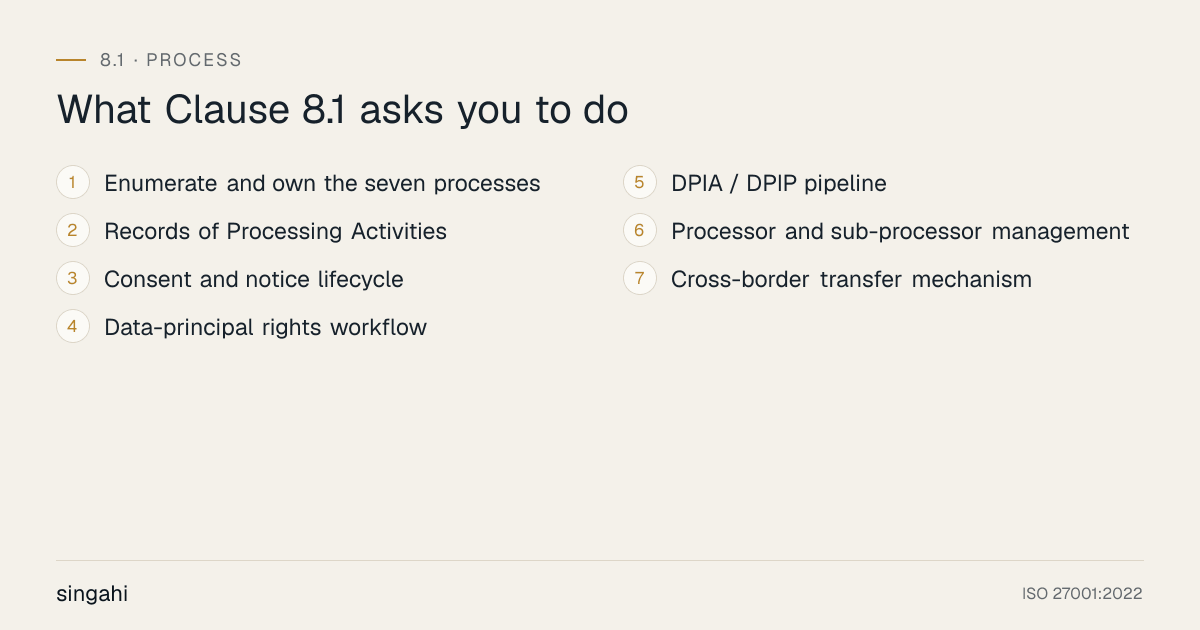
This section is the operational core of Clause 8.1. It walks the seven privacy processes, the process-change-control discipline, and the outsourced-processing governance. Each move is structured around the four 8.1 ideas: enumerate, criteria-ise, control, evidence.
Move 0, Enumerate and own the seven processes
Before any criterion is written, the organisation must enumerate its privacy processes and assign each an owner. The Singahi seven-process catalog is the recommended default; the organisation may add (a privacy-by-design gate as Process 0; a retention and erasure operation as Process 3b; a vendor-recertification cycle as Process 5b; an algorithmic-software review as Process 4b for SDFs) or merge, but the catalog must be explicit and the justifications documented.
The process owners for a typical Indian growing company:
- Process 1 (ROPA), DPO with the business-process owners as input providers.
- Process 2 (consent and notice), Head of Product / Engineering for the consent UX and the consent platform; Head of Marketing for the lead-capture forms; DPO for the consent criteria and the Consent Manager integration.
- Process 3 (rights), Head of Customer Support for the intake; DPO for the legal scoping; Head of Engineering for the data retrieval.
- Process 4 (DPIA), DPO with the business-process owners as the source of new processing activities.
- Process 5 (processor and sub-processor), Head of Procurement for the intake; DPO for the privacy due diligence; Head of Legal for the DPA; Head of Engineering / IT for the operational onboarding.
- Process 6 (cross-border transfer), DPO with Head of Engineering for the data-flow mapping; Head of Legal for the contractual basis.
- Process 7 (breach), CISO for the detection and containment; DPO for the regulatory notification; Head of Legal for the privilege dimension; Head of Communications for the principal-facing messaging.
The process owners are recorded in the Operational Control Matrix (toolkit doc 03) and the RACI matrix (toolkit doc 13).
Move 1, Records of Processing Activities (Process 1)
Objective. Maintain a current, accurate and complete inventory of processing activities that satisfies DPDP section 8 (records the Fiduciary must keep), DPDP section 10 (SDF audit records) and GDPR Article 30 (controller and processor ROPA content).
Acceptance criteria. (a) The ROPA covers every in-scope processing activity, completeness reconciled against the business-process, application, vendor and data-flow inventories. (b) Each entry records the Article 30 / DPDP section 8 fields (purpose, data categories, principal categories, recipients including processors and sub-processors, cross-border transfers with destination and basis, retention, TOMs, lawful basis, DPDP section 4 / 7 ground or GDPR Article 6 basis, DPO contact). (c) The ROPA is current within the documented cadence. (d) New processing activities are added within thirty days of launch; for SDFs, before launch. (e) Retired activities are removed and the data routed to the retention and erasure operation.
Control mechanism + evidence. Monthly reconciliation against the business-process, application and vendor inventories. Quarterly sampling audit (10 to 20 entries verified end-to-end). Annual full refresh at the management review. Event-trigger update on new activity, processor, jurisdiction, regulation, post-incident. Evidence: the ROPA itself (spreadsheet, GRC module, or ROPA-discovery tool output); the reconciliation log; the sampling-audit report; the change-trigger log.
Move 2, Consent and notice lifecycle (Process 2)
Objective. Operate a consent and notice lifecycle that produces DPDP-compliant consent, free, specific, informed, unconditional, unambiguous, the result of a clear affirmative action, as-easy-to-withdraw as to give, and delivers notice meeting the content, language and accessibility requirements of the Rules.
Acceptance criteria. (a) Notice is delivered before or at consent capture, in the prescribed content (DPDP section 5, purpose, data categories, rights, redressal, withdrawal), in the prescribed language(s), in an accessible format. (b) Consent capture produces the seven DPDP qualities. (c) The consent record includes principal identifier, purpose, timestamp, interface, language, notice version, affirmative action taken. (d) Withdrawal is honoured within the documented SLA (Singahi default: immediate cessation of the processing; system propagation within twenty-four to seventy-two hours). (e) The Consent Manager integration is live and the withdrawal signal is honoured. (f) Children's data: verifiable parental or legitimate-guardian consent under DPDP section 9; no behavioural monitoring or targeted advertising of children; age-assurance operational. (g) Special-category data: heightened consent standard enforced where prescribed.
Control mechanism + evidence. Real-time platform checks (the consent platform enforces the criteria by configuration). Monthly consent-record reconciliation. Quarterly consent-UX audit. Annual Consent Manager interoperability test. Quarterly children's-data and special-category-data audit. Evidence: the consent ledger; the notice version register; the withdrawal log; the Consent Manager integration log; the children's-data audit trail; the quarterly audit reports.
Move 3, Data-principal rights workflow (Process 3)
Objective. Receive, authenticate, scope, execute, respond to and record every rights request from every principal within the prescribed period and with the prescribed completeness and accuracy.
Acceptance criteria. (a) Intake channels accessible, web form, email, Grievance Officer contact, in-app mechanism, Consent Manager for consent-related requests. (b) Authentication operational before response dispatch (to prevent unauthorised access). (c) SLA met, DPDP Rules 2025 prescribed periods (Grievance Officer under section 13; access, correction, erasure under sections 11 and 12); GDPR one-month (extendable by two) under Article 12(3). (d) Response complete and accurate, access response includes personal data processed, identities of Data Fiduciaries and Consent Managers shared with (DPDP section 11), categories of processing, retention, rights; correction/erasure confirm the action; grievance addresses the complaint. (e) Nomination-handling workflow operational (DPDP section 14). (f) Escalation path documented for SLA-at-risk requests.
Control mechanism + evidence. Real-time ticketing with named owner and SLA. Monthly rights-response reconciliation (received vs closed-within-SLA; escalations). Quarterly sampling audit (10 to 20 requests reviewed end-to-end). Annual Grievance Officer performance review. Evidence: the rights-request ticketing system; the Grievance Officer's log; the response archive; the authentication records; the sampling-audit reports.
Move 4, DPIA pipeline (Process 4)
Objective. Screen every processing activity against the DPIA triggers, produce a DPIA where a trigger fires, engage the consultation where residual risk remains high, review on material change.
Acceptance criteria. (a) Trigger test runs on every new processing activity and every material change. Sources: DPDP section 10 (SDF, DPIA, every 12 months under Rule 13(1)); GDPR Article 35 + WP248 rev.01 nine criteria (any two of evaluation/scoring, automated decision-making with legal or similar significant effect, systematic monitoring, sensitive or highly personal data, large scale, matching or combining datasets, vulnerable subjects, innovative use, transfer outside the EU without adequacy); ISO/IEC 29134:2017. (b) Where a trigger fires, a DPIA is produced following the 29134 / Article 35(7) structure (systematic description, context, necessity and proportionality, principal-impact, risk evaluation, mitigations, residual risk, consultation). (c) Where residual risk remains high, consultation is engaged, DPBI under section 10; supervisory authority under Article 36. (d) DPIA reviewed on material change (Article 35(11)) and at the annual cycle. (e) For SDFs: SDF DPIA cadence operational; independent data audit; algorithmic-software review on every AI-driven activity.
Control mechanism + evidence. Trigger test on every new activity (change-trigger log feeds the test). DPIA register reconciled monthly against the ROPA. DPIA quality sampling audit quarterly. SDF DPIA cadence audited annually. Algorithmic-software review audited annually for AI-driven processing. Evidence: the DPIA register; the trigger-test log; the DPIA documents; the consultation records; the independent data audit report (SDF); the algorithmic-software review report.
Move 5, Processor and sub-processor management (Process 5)
This move is the operational core of the outsourced-privacy-processing thread, detailed in Section 7.8 and in the Singahi Outsourced Privacy Processing Procedure (toolkit doc 08). Headline criteria: (a) every processor onboarded through documented due diligence covering privacy and security; (b) every processor has a DPA with the Article 28(3) / Annex A.2 / DPDP section 8 terms; (c) the sub-processor chain is documented and the change-notification clock is operational; (d) the infringing-instruction handling process is documented and has been exercised; (e) the audit-cooperation right is operationalised (controller-side audit, independent audit report, or certification); (f) data-return and deletion confirmation on record for every offboarded processor; (g) the cross-border chain documented where the processor's geography engages section 16 or Chapter V.
Move 6, Cross-border transfer mechanism (Process 6)
Objective. Screen every destination, apply the appropriate transfer basis, run the transfer-impact assessment where required, maintain the transfer register.
Acceptance criteria. (a) Every cross-border destination screened against the DPDP section 16 negative list. (b) Where the GDPR applies, the transfer basis is documented, adequacy (Article 45, the EU–US Data Privacy Framework adopted 10 July 2023; EU–Japan mutual adequacy; EU–UK bridging), appropriate safeguards (Article 46, SCCs of Implementing Decision (EU) 2021/914; BCRs under Article 47; codes of conduct; certifications), or derogations (Article 49). (c) TIA performed where the destination lacks adequacy, the Schrems II (CJEU C-311/18, 16 July 2020) case-by-case duty, with supplementary measures (encryption, pseudonymisation, contractual, organisational) where needed. (d) UK trajectory uses the IDTA or the UK Addendum. (e) The transfer register records every cross-border flow, destination, basis, supplementary measures, recipients, principal categories, data categories, retention.
Control mechanism + evidence. Quarterly transfer-register reconciliation against the ROPA and the data-flow map. Annual TIA refresh per destination. Event-trigger update on new destination, new processor geography, new negative-list notification, new adequacy decision, new SCC version. Evidence: the transfer register; the TIA documents; the SCC instances; the IDTA / Addendum instances; the supplementary-measures documentation; the negative-list screening log.
Move 7, Breach detection, notification and response (Process 7)
Objective. Detect, contain, assess, notify and review personal-data-breach events, running the dual-clock notification from the same awareness event.
Acceptance criteria. (a) Detection mechanism operational, the monitoring, alerting and triage pipeline that surfaces a potential breach event. (b) Triage and assessment against the breach-assessment template (personal-data angle, principal-impact, scale, sensitivity, containment status). (c) Dual-clock notification dispatch operational, CERT-In six-hour clock (CERT-In Directions 20(3)/2022-CERT-In of 28 April 2022); DPDP breach clock (intimation without delay; seventy-two-hour report) to the Board (DPDP Act section 8(6) + DPDP Rules 2025 Rule 7, in the prescribed intimation content); sector-regulator clocks where applicable (RBI six hours; SEBI six hours; IRDAI twenty-four to seventy-two hours); GDPR seventy-two-hour clock to the supervisory authority under Article 33 for EU-relevant processing; principal notification without undue delay under Article 34 (GDPR) and the Rules (DPDP). (d) Principal notification in plain language describing the breach, consequences, mitigation. (e) Post-incident review within thirty days feeding Clause 10.2 corrective action.
Control mechanism + evidence. Quarterly table-top drill (simulated breach event run end-to-end, including the dual-clock dispatch, the regulator-portal credential test, the principal-notification dispatch, the post-incident review). Monthly breach-detection-pipeline reconciliation. Annual full breach-playbook review. Evidence: the breach register; the breach-assessment template; the notification dispatch records; the regulator-portal confirmation receipts; the principal-notification archive; the post-incident review reports; the table-top drill reports.
The Outsourced Privacy Processing Procedure, the seven lifecycle controls (Move 5 in depth)
The Singahi Outsourced Privacy Processing Procedure (toolkit doc 08) is the load-bearing artefact for the 8.1 outsourced-processing control. It operationalises the seven lifecycle controls.
Lifecycle 1, Due diligence. Before onboarding, the controller performs a privacy and security due diligence: the processor's certifications (ISO/IEC 27001, 27701, 27018 for cloud processors, SOC 2); the processor's own sub-processor chain; the cross-border geography; the breach history; the technical and organisational measures; the cooperation with prior controller audits. The output is a documented decision to engage or not, with conditions where applicable.
Lifecycle 2, The DPA. The data-processing agreement sets out the Article 28(3) / Annex A.2 / DPDP section 8 terms: subject, duration, nature, purpose; data types; principal categories; technical and organisational measures (Annex A.3 / ISO/IEC 27002:2022); sub-processor terms (Article 28(2) and (4)); the infringing-instruction clause; audit cooperation (Article 28(3)(h)); data return or deletion (Article 28(3)(g)); breach notification (Article 33(2), without undue delay, typically within twenty-four to seventy-two hours); cross-border-transfer clause; cooperation-with-rights-requests (Article 28(3)(e)); deletion-and-certification at end of engagement. The Singahi DPA clause library (toolkit doc 10) provides sample "shall" clauses of Singahi's own drafting.
Lifecycle 3, Sub-processor authorisation and change-notification. The DPA either requires prior authorisation for each sub-processor (Singahi default for sensitive processing) or grants a general written authorisation with the right to object and the change-notification clock (typical cloud-processor default, ten to thirty days advance notice, with the customer's right to object and the remedy pathway). The processor maintains the sub-processor list (publishing for cloud processors is the ISO/IEC 27018:2019 pattern); the controller tracks change notifications and objection decisions.
Lifecycle 4, Infringing-instruction handling. The processor's documented procedure: the receiving staff member documents the instruction; the processor's DPO and Legal review it; the processor refuses in writing with the legal basis; the processor notifies the controller customer; if the controller insists, the processor escalates to its own governance and, where the breach has materialised, to the regulator (CERT-In six-hour clock; the DPBI once operational). The controller-side: receive the refusal, engage Legal, withdraw or re-issue, and, where the breach materialised, run Process 7. The process is exercised at least annually in a table-top.
Lifecycle 5, Audit cooperation. The controller's right to audit or to receive an independent audit report: the cadence (annual for sensitive, biennial for moderate, triennial for low-risk); the scope (Annex A.3 / ISO/IEC 27002:2022 and ISO/IEC 27018:2019 for cloud processors); the audit-report intake; the finding-remediation tracking; the recertification cycle. A current ISO/IEC 27001 + 27701 certification audit report may satisfy the cooperation, subject to scope and recency.
Lifecycle 6, Data return and deletion. At end of engagement, the processor returns or deletes the personal data per the DPA. The deletion certification (the documented confirmation of destruction in line with the technical measures) is the load-bearing evidence. Residual-data handling (backups, logs, cached data) is addressed in the DPA, typically residual data is deleted within the backup retention window. The controller maintains the deletion certifications as the closing evidence.
Lifecycle 7, Cross-border transfer chain. Where the processor's geography engages DPDP section 16 or GDPR Chapter V, the controller documents the full chain, controller to processor to sub-processor(s) to destination geography, with the contractual basis (SCCs of Implementing Decision (EU) 2021/914 for GDPR; IDTA or UK Addendum for the UK; contractual clauses for the DPDP baseline; CAC standard contract or security assessment for China-relevant processing) and the supplementary measures. The transfer register records the chain.
The process-change-control discipline (Move 8)
The 8.1 process-change-control is the operational-layer complement to the Clause 6.3 management-system change discipline. Where 6.3 governs changes to the PIMS itself (the scope, the policy, the roles, the objectives, the SoA, the procedures), 8.1's process-change-control governs changes to the operational fabric: changes to the process criteria, to the control mechanism, to the procedure (the seven process procedures), to the processors, to the sub-processors, to the cross-border destinations, to the breach playbook.
The Singahi Privacy Process Change-Control Procedure (toolkit doc 09) operationalises the discipline. The change-request template captures: the change description; the affected process(es); the affected criteria; the privacy-impact assessment (re-runs the 6.1.2 methodology on the changed state); the DPIA re-run trigger test (re-runs the DPIA where a trigger fires per ISO/IEC 29134 and GDPR Article 35(11)); the authorisation (the process owner plus the DPO; major changes go to the Change Advisory Board); the communication (the affected staff, principals where the change is principal-facing, customers where the change affects a processor-side obligation, regulators where applicable); the post-change review (within thirty days).
The drift-detection mechanism (Move 9)
Drift is the canonical 8.1 unintended change. The Singahi drift-detection mechanism (wired into the Clause 9.1 monitoring) surfaces drift through periodic reconciliation.
The monthly reconciliation. The ROPA reconciliation (sample three to five processing activities and verify they exist in production as documented). The processor-map reconciliation (verify the processor inventory matches the operational vendor list). The consent-record reconciliation (the count of active consents against the count of active principals). The rights-ticket reconciliation (the count of open tickets against the SLA). The breach-alert reconciliation (the count of alerts triaged against the count notified).
The quarterly reconciliation. The sampling audit (10 to 20 entries per process sampled and verified end-to-end). The sub-processor change-notification reconciliation (the count of change notifications received against the count logged). The DPA-stack reconciliation (every active processor against the DPA on file). The transfer-register reconciliation (every cross-border flow against the ROPA).
The semi-annual / annual reconciliation. The breach table-top drill. The DPA refresh. The SDF designation analysis (DPDP section 10 thresholds). The algorithmic-software review for AI-driven processing. The Consent Manager interoperability test.
Drift findings feed Clause 10.2 corrective action; patterns of drift feed Clause 10.1 continual improvement.
Worked example, the seven-process operating model in numbers
To make the seven moves concrete, a first-cycle 8.1 build for a growing Indian organisation typically produces: the seven processes enumerated and owned (the DPO owning ROPA, DPIA, and transfer; the Head of Product owning consent; the Head of Customer Support owning rights; the Head of Procurement owning processor management; the CISO owning breach); a Process-Criteria Register of 80 to 200 criteria across the seven processes, each tagged to its DPDP / GDPR / sector anchor; the seven procedures as Documented Information of 12 to 24 pages each; the Operational Control Matrix as a single spreadsheet; the Outsourced Privacy Processing Procedure covering 30 to 150 active processors with the Article 28(3) / Annex A.2 / DPDP section 8 DPA terms; the dual-clock breach playbook drilled quarterly with regulator-portal credentials tested; the drift-detection mechanism wired into the Privacy Operations Lead's monthly cycle and Internal Audit's quarterly cycle. The first-cycle effort is 14 to 24 weeks; the artefact set typically passes Stage 1 at first attempt with zero 8.1 findings; the process-change-control loop captures 15 to 30 process changes during the cycle. The worked organisational example is in Section 15 (Charu Wealth).
Tools, Technologies, and Solutions
The tool categories
Privacy management platforms (the GRC-with-privacy flavour). These are the platforms that host the Process-Criteria Register, the Operational Control Matrix, the ROPA, the DPIA register, the processor inventory, the breach register and the rights-request ticketing. Selection criteria: India-DPDP coverage (most global platforms are GDPR-heavy and DPDP-thin); Consent Manager integration readiness; the seven-process support as first-class artefacts rather than free-form text fields; SoA support with current-state evidence; integration with the existing GRC stack.
Consent and preference management platforms (CMPs). Operational tools that implement the consent controls (DPDP section 6, A.1.2.3, A.1.2.4, A.1.3.5) and produce the consent-ledger evidence. Selection criteria: the seven DPDP consent qualities enforceable by configuration; the Consent Manager API and interoperability; multi-lingual notice support; the withdrawal-signal honouring latency; the audit trail quality.
Consent Manager interoperability layer. A separately licensed category in the Indian market as the Consent Manager ecosystem emerges through 2026 and 2027. The interoperability layer is the technical glue between the Fiduciary's systems and the Consent Manager(s) the principal uses.
DSAR / DPRR (data-subject access request / data-principal rights request) platforms. Workflow tools that operationalise Process 3, the intake, authentication, scoping, retrieval, redaction, response dispatch and SLA tracking.
DPIA workflow tools. Specialised platforms that operationalise Process 4, the trigger test, the 29134 / Article 35(7) DPIA template, the routing, the consultation record, the review trigger.
Vendor / processor risk-management platforms. Tools that operationalise Process 5, the due-diligence intake, the DPA tracking, the sub-processor register, the audit-cooperation cadence, the recertification cycle, the deletion-certification intake.
ROPA / processing-activity discovery tools, breach-response platforms, cross-border transfer monitoring, and threat-intelligence feeds. These are the supporting categories, discovery tools surface undocumented processing activities; breach-response platforms operationalise Process 7; cross-border monitoring tracks flows against the transfer register; threat-intelligence feeds (CERT-In advisories, sector feeds) support Process 7 detection and drift detection.
Selection criteria + build vs buy
Select on: India-DPDP coverage (seven-process support; Consent Manager integration readiness; dual-clock breach support; section 16 transfer support); the integrated-with-distinction posture (PIMS and ISMS operational data in one platform with role-tagging); integration with the existing GRC / ITSM / vendor-management stack; alert quality; audit-trail integrity; cost-to-value for the Indian growing-company segment.
Most growing companies should buy the GRC-with-privacy platform, the consent platform, the DSAR platform and the breach-response platform; build the Process-Criteria Register and the Operational Control Matrix in-house (these are organisation-specific and too strategically load-bearing to outsource); use external advisory for the first-cycle construction; and migrate the breach drill and the DPIA pipeline to in-house operation by year two.
Policy and Procedure Templates
PIMS Operational Planning and Control Policy (sample of our own drafting)
The organisation operates a PIMS that is planned, run and controlled through seven core operational processes (ROPA, consent and notice, data-principal rights, DPIA, processor and sub-processor management, cross-border transfer, breach detection and notification). Each process has a documented owner, an objective, acceptance criteria derived from the DPDP Act 2023, the GDPR (where applicable) and the sector instruments, a control mechanism, a KPI, an evidence source and a cadence. The DPO maintains the Privacy Process-Criteria Register and the Operational Control Matrix as the load-bearing Documented Information artefacts. Process owners are accountable for the operational execution and the criteria being met. The organisation controls planned changes to its operational processes through the Privacy Process Change-Control Procedure and detects unintended changes through the drift-detection mechanism wired into the monitoring function. The organisation controls the privacy processing it outsources through the Outsourced Privacy Processing Procedure (due diligence, DPA, sub-processor authorisation, infringing-instruction handling, audit cooperation, data return and deletion, cross-border chain). Top management reviews the operational profile at the management review.
Privacy Process-Criteria Register Policy (sample of our own drafting)
The Privacy Process-Criteria Register is the single living inventory of acceptance criteria against which each of the seven operational PIMS processes is controlled. Each criterion is tagged to its regulatory anchor (DPDP section, GDPR article or sector rule). Each criterion has a documented control mechanism, a KPI with target and threshold, an evidence source and a cadence. The Register is reviewed at the management review and reconciled monthly against the ROPA, the contract inventory, the DPIA register and the change log. Deviations are routed to Clause 10.2 corrective action; patterns feed Clause 10.1 continual improvement. The DPO owns the Register; the process owners own the criteria for their processes.
Outsourced Privacy Processing Policy (sample of our own drafting)
The organisation controls the privacy processing it outsources end-to-end. No processor is onboarded without due diligence. No processor goes live without a DPA containing the Article 28(3), Annex A.2 and DPDP section 8 terms. The sub-processor chain is documented and the change-notification clock is operational. The infringing-instruction handling process is documented, exercised at least annually, and routed through the processor's DPO and Legal. The audit-cooperation right is operationalised through the annual audit cycle or the certification audit report. The data-return and deletion confirmation is on record for every offboarded processor. The cross-border transfer chain is documented where the processor's geography engages DPDP section 16 or GDPR Chapter V.
Process-change-control and dual-clock breach Policies (sample of our own drafting)
Process change-control. Changes to the operational fabric, the process criteria, the control mechanism, the procedure, the processors, the sub-processors, the cross-border destinations, the breach playbook, route through the Privacy Process Change-Control Procedure. Each change is captured in a change request with the description, the affected processes, the privacy-impact assessment, the DPIA re-run trigger test result, the authorisation, the communication plan and the post-change review commitment. Major changes route to the Change Advisory Board. Process-change-control is the operational-layer complement to Clause 6.3.
Dual-clock breach notification. A personal-data-breach event triggers the dual-clock notification pattern from the same awareness event. The CERT-In six-hour clock (CERT-In Directions 20(3)/2022-CERT-In of 28 April 2022) runs in parallel with the DPDP breach clock (intimation without delay, then a seventy-two-hour report; DPDP Act section 8(6) and DPDP Rules 2025 Rule 7) and, for BFSI and listed entities, the sector-regulator clock (RBI six hours; SEBI six hours; IRDAI twenty-four to seventy-two hours). Where the processing engages GDPR, the Article 33 seventy-two-hour clock to the supervisory authority and the Article 34 principal notification apply. The breach-response cell convenes within ninety minutes; the regulator-portal credentials are tested quarterly; the principal-notification template library is maintained in the principal population's languages.
The seven-process operational procedures (sample structure, of our own drafting)
Each of the seven procedures follows the same structure (the full text is in toolkit docs 02, 04, 06, 08, 09 and 10): (1) purpose and scope; (2) the acceptance criteria tagged to regulatory anchors; (3) the control mechanism; (4) the procedure steps from intake to closure; (5) roles and responsibilities; (6) the KPI and reporting; (7) the deviation-handling pathway; (8) the Documented Information control per Clause 7.5.
Operational Risk Assessment and Treatment
This section is the operational complement to the Clause 6.1 risk methodology. Where 6.1 builds the framework and 8.2 applies it per-processing-activity, the operational risk layer (the 8.1 contribution) assesses the process risk, the risk that a process fails its criteria.
The process-risk dimensions
For each of the seven processes, the process-risk assessment evaluates four dimensions:
Dimension 1, Criteria failure. The risk that the operational output fails to meet the documented criteria. For Process 2, a consent capture that does not produce the seven DPDP qualities; for Process 3, a rights response that misses the SLA or the completeness standard; for Process 5, a processor onboarded without due diligence; for Process 7, a breach detected but not notified within the dual-clock.
Dimension 2, Drift. The risk that the documented state and the operational reality diverge. The ROPA out of sync; the consent platform reconfigured without change control; the sub-processor swap unnotified; the new form field unreviewed.
Dimension 3, Outsourcing. The risk that an outsourced processor's act produces a criteria failure or a regulatory exposure for the controller. The infringing-instruction scenario; the sub-processor swap unauthorised; the breach-notification-to-controller clock missed; the deletion confirmation absent.
Dimension 4, Regulatory non-compliance. The risk that the process fails a regulatory criterion, the section 8(6) clock; the section 16 negative list; the section 10 SDF DPIA cadence; the section 9 children's-data regime; the Article 28(3) DPA terms.
The process-risk register
The Singahi process-risk register (toolkit doc 09) records, per risk: the process, the dimension, the risk description, the principal-impact (using the six-dimension scale from Clause 6.1, autonomy, dignity, financial standing, safety, non-discrimination, rights), the organisational-impact, the likelihood, the inherent risk, the treatment (the control point that brings the residual risk within the risk-appetite), the residual risk, the risk owner, the review date.
The 12 canonical 8.1 process-risks
| Risk | Process | Dimension | Treatment |
|---|---|---|---|
| ROPA stale (processing undocumented) | 1 | Drift | Monthly reconciliation; new-activity trigger within thirty days |
| Consent capture not meeting DPDP qualities | 2 | Criteria failure | Real-time platform checks; quarterly consent-UX audit |
| Consent withdrawal not honoured within SLA | 2 | Criteria failure | Withdrawal-signal monitoring; Consent Manager integration |
| Children's data without verifiable parental consent | 2 / 4 | Regulatory | Age-assurance mechanism; section 9 audit |
| Rights response missed SLA or incomplete | 3 | Criteria failure | Ticketing with SLA; sampling audit; Grievance Officer charter |
| DPIA not run where trigger fires | 4 | Criteria failure | Trigger test on every new activity; DPIA pipeline |
| SDF DPIA cadence not operational | 4 | Regulatory | SDF operating model under section 10 |
| Processor onboarded without due diligence | 5 | Outsourcing | Procurement-intake control; due-diligence template |
| Sub-processor swap unnotified | 5 | Outsourcing | Sub-processor register; change-notification clock |
| Infringing-instruction process absent | 5 | Outsourcing | Documented procedure; annual table-top |
| Cross-border transfer without TIA | 6 | Regulatory | Transfer register; TIA on every non-adequacy destination |
| Breach not notified within dual-clock | 7 | Criteria failure | Dual-clock playbook; quarterly drill |
The high-impact, high-likelihood risks to treat first are: the breach-not-notified-within-dual-clock; the processor-onboarded-without-due-diligence; the DPIA-not-run-where-trigger-fires; the rights-response-missed-SLA. These four risks account for most of the 8.1 audit nonconformities in the Indian growing-company segment.
Audit and Compliance Checklist
The 28 questions below cover the audit-evidence surface for Clause 8.1. Expected evidence and red flags noted. Most can be answered from the toolkit doc 04 audit-evidence checklist.
- Is there a Privacy Process-Criteria Register? Expected: dated, version-controlled, signed by the DPO; covers the seven core processes (or the organisation's justified catalog); each entry tagged to its regulatory anchor. Red flag: missing.
- Is there an Operational Control Matrix mapping each criterion to its control point, owner, KPI, evidence location and cadence?
- Are the seven process procedures (or the organisation's justified catalog) in place as Documented Information per Clause 7.5?
- Does the ROPA cover every in-scope processing activity? Is completeness reconciled against the business-process inventory, the application inventory and the vendor inventory?
- Does each ROPA entry record the Article 30 / DPDP section 8 fields (purpose, data categories, principal categories, recipients, transfers, retention, TOMs, lawful basis, DPO contact)?
- Is the consent process producing the seven DPDP consent qualities (free, specific, informed, unconditional, unambiguous, clear affirmative action, as-easy-to-withdraw)?
- Is the consent record complete (principal identifier, purpose, timestamp, interface, language, notice version, affirmative action)?
- Is consent withdrawal honoured within the documented SLA?
- Is the Consent Manager integration live and tested for interoperability?
- For children's data, is the verifiable parental consent mechanism operational under DPDP section 9? Is the no-behavioural-monitoring-or-targeted-advertising control enforced?
- Does the rights workflow meet the prescribed response periods under DPDP Rules 2025 (and Article 12(3) one-month under GDPR where applicable)?
- Is the Grievance Officer charter operational under DPDP section 13? Is the contact published?
- Is the DPIA trigger test run on every new processing activity and every material change?
- Where a trigger fires, is the DPIA produced following the 29134 / Article 35(7) structure?
- For SDFs, is the SDF DPIA cadence operational under DPDP section 10? Is the independent data audit commissioned on the prescribed cadence? Is the algorithmic-software review running on every AI-driven processing activity?
- Is every processor onboarded through documented privacy and security due diligence?
- Does every active processor have a DPA with the Article 28(3) / Annex A.2 / DPDP section 8 terms?
- Is the sub-processor register complete? Is the change-notification clock operational? Are customer-DPA notifications dispatched within the clock?
- Is the infringing-instruction handling process documented? Has it been exercised in a table-top in the last twelve months?
- Is the audit-cooperation right operationalised (controller audit, independent audit report, or certification)?
- Is the data-return and deletion confirmation on record for every offboarded processor?
- Is the cross-border transfer register complete? Is every destination screened against the DPDP section 16 negative list and the GDPR Chapter V adequacy / safeguards / derogations?
- Where the destination lacks adequacy, is the transfer-impact assessment performed and the supplementary measures documented?
- Is the dual-clock breach playbook operational? Has it been drilled in the last six to twelve months? Are the regulator-portal credentials (CERT-In, the DPBI once operational, the sector regulator) tested and current? Is the Rule 7 intimation content pre-staged?
- Is the drift-detection mechanism firing on cadence? Are drift findings feeding Clause 10.2 corrective action?
- Is the process-change-control discipline operational? Are process-criteria changes captured in change requests with impact assessment and authorisation?
- Is the Operational Control Matrix reconciled with the ROPA, the contract inventory, the DPIA register and the change log?
- Is the operational profile reported to the management review (Clause 9.3), the KPI dashboard, the deviation log, the drift findings, the table-top outcomes, the recertification cycle status?
The 28 questions above cover the full audit-evidence surface for Clause 8.1. The minimum-evidence set is the Process-Criteria Register and Operational Control Matrix, the ROPA, the consent ledger extract, the Grievance Officer charter, the DPIA register, the processor inventory with DPAs, the sub-processor register, the infringing-instruction procedure, the breach register, the transfer register, the drift-detection logs, and the process-change-control log. Sample reconciliations (one ROPA entry cross-referenced to its DPIA, processor DPA, rights-response ticket, transfer entry, and any breach entry) are the canonical auditor walk-through.
Common Stage-1 nonconformities the auditor will write up
- NC pattern 1: Process-Criteria Register missing or thin. Major NC. Remediation: register construction, 6 to 12 weeks.
- NC pattern 2: Operational reality does not match the documented state (drift). Major NC. Remediation: drift-correction sprint; reconciliation discipline, 8 to 16 weeks.
- NC pattern 3: Outsourced-processing blind spot. Processor inventory incomplete; DPA stack partial; sub-processor change-notification clock not honoured; infringing-instruction process absent. Major NC. Remediation: processor remediation sprint, 8 to 16 weeks.
- NC pattern 4: Dual-clock breach playbook not drilled. Minor or major NC depending on the gap. Remediation: drill planning and execution, 4 to 8 weeks.
- NC pattern 5: DPIA trigger test not run. Major NC. Remediation: trigger-test refresh and DPIA pipeline, 6 to 14 weeks.
- NC pattern 6: Rights-response SLA not met. Minor or major NC depending on the count and the delay. Remediation: ticketing refresh and Grievance Officer charter, 4 to 8 weeks.
- NC pattern 7: Process-change-control absent. Minor NC. Remediation: change-control discipline, 4 to 8 weeks.
Metrics and KPIs
Figure · Measures
The measures that show Clause 8.1 is working
- ROPA currency100%Periodic
- ROPA reconciliation driftzeroPeriodic
- Consent-quality score100%Periodic
- Consent-withdrawal honouring latencyunder 24 hoursPeriodic
- Rights-response SLA adherence100%Periodic
- ROPA currency, percentage of processing activities reviewed within the last 90 days. Target: 100%.
- ROPA reconciliation drift, count of processing activities in production but not in the ROPA. Target: zero.
- Consent-quality score, percentage of consent captures meeting the seven DPDP qualities (sampled). Target: 100%.
- Consent-withdrawal honouring latency, median time from withdrawal request to cessation of processing. Target: under 24 hours; under 1 hour for the Consent Manager signal.
- Rights-response SLA adherence, percentage of rights requests closed within the prescribed period. Target: 100%.
- Grievance Officer response within prescribed period, percentage. Target: 100%.
- DPIA trigger-test coverage, percentage of new processing activities with the trigger test run. Target: 100%.
- DPIA completion rate, percentage of triggered DPIAs completed within the target SLA. Target: 100% within 90 days of trigger.
- Processor due-diligence coverage, percentage of active processors onboarded through documented due diligence. Target: 100%.
- DPA stack coverage, percentage of active processors with the Article 28(3) / Annex A.2 / DPDP section 8 terms on file. Target: 100%.
- Sub-processor change-notification clock adherence, percentage of sub-processor change notifications dispatched to controller customers within the contractual clock. Target: 100%.
- Breach table-top drill cadence, count of drills in the last 12 months. Target: 2 or more.
- Breach dual-clock adherence, in actual breach events or simulated drills, percentage where the CERT-In 6-hour clock and the DPDP breach clock (intimation without delay; 72-hour report) are both met. Target: 100%.
- Drift findings per reconciliation cycle, count, with the corrective-action closeout rate. Target: downward trend; closeout rate above 90% within 30 days.
- Process-change-control compliance, percentage of process changes captured in the change-request process. Target: 100%.
Common Pitfalls and Audit Failures
Pitfall 1, The policy-only PIMS. The policy describes the seven processes but they do not run operationally; the surveillance audit is the first time the gap surfaces. Treatment: stand up the Process-Criteria Register and the Operational Control Matrix; run the seven processes in evidence.
Pitfall 2, The ROPA as a static spreadsheet. The ROPA was last refreshed before the last audit; it does not reflect processing activities launched since. Treatment: monthly reconciliation; event-trigger update on new activity.
Pitfall 3, The consent-platform-default failure. The consent platform runs on the vendor's default configuration; the seven DPDP qualities are not enforced; the withdrawal-signal honouring latency is undocumented; the Consent Manager integration is absent. Treatment: configure the platform against the criteria; Consent Manager integration; interoperability test.
Pitfall 4, The rights-response email-to-DPO. The rights workflow is an email to the DPO with no SLA, no ticketing, no sampling audit. Treatment: ticketing platform with SLA; Grievance Officer charter; sampling audit.
Pitfall 5, The DPIA gap. The trigger test has never been run; DPIAs are missing for triggered activities; the SDF DPIA cadence is not operational. Treatment: trigger test on every new activity; DPIA pipeline.
Pitfall 6, The processor-onboarded-through-procurement-only failure. The processor was onboarded through procurement without the privacy due diligence; the DPA is the vendor's standard contract without the Article 28(3) / Annex A.2 / DPDP section 8 terms. Treatment: privacy due diligence as a procurement gate; DPA with the required terms.
Pitfall 7, The sub-processor invisible. The sub-processor register does not exist; changes are not notified to controller customers; the change-notification clock has never been honoured. Treatment: sub-processor register; change-notification dispatch.
Pitfall 8, The infringing-instruction absent. The processor has no documented procedure for handling infringing instructions; the staff do not know what to do when the controller customer asks for something that breaches the DPDP. Treatment: documented procedure; annual table-top.
Pitfall 9, The deletion-unconfirmed. Processors are offboarded but the deletion certification is not on file; residual data on backups is not addressed. Treatment: deletion certification as the offboarding gate; residual-data handling in the DPA.
Pitfall 10, The transfer-blind. Cross-border flows are not inventoried; the DPDP section 16 negative list is not screened; the GDPR Chapter V analysis is not performed; the TIA is absent for non-adequacy destinations. Treatment: transfer register; TIA pipeline.
Pitfall 11, The single-clock breach failure. The breach playbook handles the DPDP breach clock (intimation without delay; seventy-two-hour report) but not the CERT-In six-hour clock (or vice versa); the sector-regulator clock is missing for BFSI / listed entities; the regulator-portal credentials have atrophied; the principal notification is ignored. Treatment: dual-clock (or triple-clock) playbook with quarterly drill; quarterly credential test; principal-notification template library.
Pitfall 12, The breach-undetected. The detection mechanism is weak; the breach is detected late; the dual-clock countdown starts late; the principal impact is amplified. Treatment: detection pipeline; alerting; triage SLA.
Pitfall 13, The drift-undetected. The documented process state and the operational reality diverge over the cycle; nobody notices; the surveillance audit surfaces the gap. Treatment: drift-detection mechanism; monthly reconciliation.
Pitfall 14, The future-state Operational Control Matrix. The Matrix describes controls that are planned but not yet in operation; the evidence does not exist on the audit day. Treatment: current-state discipline; planned controls in the treatment plan.
Pitfall 15, The process-change-without-impact-assessment. Process changes are made through the engineering or product workflow without the privacy-impact assessment or the DPIA re-run test. Treatment: process-change-control discipline; change request with impact assessment.
Pitfall 16, The SDF-oblivion + algorithmic-software review gap. The organisation crosses the SDF threshold without realising it; the section 10 obligations are not operational; AI-driven processing runs without the algorithmic-software review. Treatment: SDF designation analysis at every annual review; algorithmic-software review pipeline.
Pitfall 17, The DPO-as-the-only-process-owner. The DPO is named the owner of all seven processes; the business-process owners are absent; the operational execution fails because the DPO cannot run day-to-day operations alone. Treatment: process-owner assignment to the business leads; the DPO as the methodology owner.
Pitfall 18, The annual-only reconciliation. The reconciliation happens in the 30 days before the surveillance audit; the rest of the year is dark. Treatment: monthly reconciliation; quarterly sampling audit.
Illustrative Scenario 1: Failure, Avani Retail and the Uncontrolled Cross-Border Sub-processor (Illustrative)
Illustrative scenario, a composite example for guidance, not a specific Singahi engagement or a verified outcome. It is set after 13 May 2027, when the DPDP Act's duties and the Board's inquiry and penalty powers take effect.
Illustrative scenario. Avani Retail is a fictional Bengaluru-based direct-to-consumer e-commerce platform with 600 staff and approximately 4.2 million registered users; the facts are composite from publicly reported sector patterns and should not be attributed to any real organisation.
Avani Retail built its PIMS in 2024 ahead of a planned ISO/IEC 27701:2019 certification. The seven processes were described in the policy and the SoA but were not operationalised in evidence: the ROPA was a static spreadsheet of 47 entries last refreshed in March 2024; the consent platform ran on the vendor's defaults; the rights workflow was an email to the DPO; the DPIA register had two launch-year entries; the processor inventory was in the Head of Procurement's inbox; the sub-processor and cross-border registers did not exist; the breach playbook was a 2023 draft.
In Q1 2028 the engineering team launched an AI-driven recommendation engine processing approximately 4.2 million users' behavioural data. The engine was built on a new sub-processor, a US-headquartered analytics vendor, onboarded through the procurement workflow without the privacy due diligence, without the Article 28(3) / Annex A.2 / DPDP section 8 DPA terms, without the customer-DPA notification, and without the DPIA re-run that the trigger test would have mandated (the AI-driven profiling plus the cross-border transfer plus the large-scale processing fired three of the WP248 criteria). The Consent Manager integration had not been built; the section 9 age-assurance was not enforced.
In April 2028 the new sub-processor suffered a misconfiguration exposing approximately 1.8 million users' behavioural profiles for an estimated 11 days before an external researcher detected it. Avani's breach playbook had never been drilled; the CERT-In portal credentials had atrophied; the DPBI engagement pathway was not operational. The CERT-In six-hour clock was missed by approximately 54 hours; the DPDP section 8(6) breach clock (intimation without delay; seventy-two-hour report) by approximately 38 hours; the customer-DPA notification was dispatched on day 24.
The DPBI preliminary inquiry (under section 18) and a parallel CERT-In investigation identified the operational process failure as the root cause. The certification body issued a major nonconformity on Clause 8.1 at the next surveillance audit, cascading into nonconformities on 6.1, 6.3, 7.4, 8.2, Annex A.1.2.x, A.1.5.x, A.2.x and A.3.x. The certificate was suspended pending remediation.
Commercial cost: a 9-month freeze on enterprise sales (the banking-partaker programme paused), brand damage in a competitive D2C market, a 16-month remediation programme costing approximately 7.2 crore rupees, and a section 33 penalty exposure approaching the section 8(6) two hundred crore ceiling (the final DPBI order, when issued, was contested). The remediation re-engineered the entire operational architecture: the seven processes were stood up with documented criteria; the Process-Criteria Register and the Operational Control Matrix became the load-bearing artefacts; the processor inventory was rebuilt (132 processors across the global supply chain); the DPA stack refreshed end-to-end; the dual-clock breach playbook drilled quarterly; the Consent Manager integration built; the DPIA pipeline operationalised.
The lessons: a policy-only PIMS fails the audit and the regulator because the operational processes do not exist in evidence; the processor-onboarding gate is the canonical place where the absence surfaces; the DPIA re-run on material change is not optional; the dual-clock breach playbook must be drilled, not drafted.
Illustrative Scenario 2: Success, Charu Wealth Builds the Seven-Process Operational Discipline (Illustrative)
Illustrative scenario. Charu Wealth is a fictional Mumbai-based wealth-tech platform with 1,400 staff, a SEBI-registered investment adviser entity and approximately 1.1 million retail investors; the facts are composite from publicly reported sector patterns and should not be attributed to any real organisation.
Charu Wealth ran an integrated ISO/IEC 27001:2022 + ISO/IEC 27701:2019 programme with a strong infosec operational culture but a thin PIMS operational layer. The seven processes were partially documented; the DPIA register had 5 entries; the processor inventory was at 80% coverage; the sub-processor change-notification clock had not been honoured in two cases; the dual-clock breach playbook had been drilled only once in 18 months; the cross-border transfer register was 60% complete.
In Q4 2025 the DPO commissioned an 8.1 refresh ahead of the 27701:2025 transition. The workshop surfaced six material shifts: (1) the seven processes were re-enumerated and re-owned at the business-lead level (not the DPO alone); (2) the Process-Criteria Register was built from scratch with 167 criteria tagged to DPDP / GDPR / SEBI anchors; (3) the consent process was re-configured against the seven DPDP qualities; the Consent Manager integration was built and the interoperability test run; the children's-data regime was enforced on the custodial-account opening flow (a section 9 exposure previously under-addressed); (4) the DPIA trigger test was re-run on every activity, 14 processing activities triggered (the AI-driven portfolio-recommendation engine, the cross-border analytics flow, the marketing-lead scoring, the voice-recording of advisory calls, the biometric customer-onboarding, nine others), and the DPIA register was rebuilt to the 29134 / Article 35(7) depth; (5) the processor inventory was reconciled end-to-end, 47 active processors; 47 DPAs refreshed with the Article 28(3) / Annex A.2 / DPDP section 8 terms; 132 sub-processors registered; the two unnotified 2025 sub-processor changes retroactively notified to controller customers; the infringing-instruction process documented and exercised in a Q1 table-top; (6) the dual-clock breach playbook was rebuilt; the regulator-portal credentials (CERT-In, SEBI SCORES, the DPBI portal once operational) tested quarterly; the table-top drill run in Q1 and Q3; the principal-notification template library built in six languages.
The avoided costs were substantial, the DPIA pipeline on the AI-driven portfolio-recommendation engine identified the algorithmic-bias risk early enough to remediate before public-launch exposure (avoiding DPDP section 10 and SEBI exposure); the processor inventory reconciliation surfaced 9 processors operating without the current DPA terms (potential section 8 contractual liability); the dual-clock Q1 drill surfaced a 40-minute lag in the CERT-In portal credential chain, remediated before any real breach (avoided section 8(6) exposure); the Consent Manager integration positioned Charu ahead of the ecosystem emergence (6 to 12 months of strategic advantage).
The lessons: the seven-process operational discipline is the highest-use 8.1 move for most Indian growing companies; the Process-Criteria Register is the artefact that makes the operational architecture visible and auditable; the dual-clock drill is cheap insurance against the section 8(6) penalty; the DPIA pipeline is a regulatory and commercial hedge, not a compliance overhead.
Multi-Framework Mapping
| 27701:2025 8.1 theme | GDPR article | DPDP Act (India) section | NIST Privacy Framework | SOC 2 TSC | ISO 27001 / 27002 / 27018 / 27017 / 29100 / 29134 | ISO 29100 principle |
|---|---|---|---|---|---|---|
| Operational planning (8.1 umbrella) | Art 24 (controller responsibility) | s.8 general obligations | Control-P (Data-processing policies, DEP, DUA) | CC7.1 (System Operations); CC8.1 (Change Management) | 27001 Clause 8.1; 27002 5.34 (PII) | Accountability |
| Process criteria (the load-bearing addition) | Art 5(2) accountability; Art 24(1) | s.4 grounds; s.8 general obligations; s.10 SDF | Control-P (data-processing policies) | CC7.1; CC7.2 (Change Management) | 27002 5.34 (privacy in systems); 29100 (11 principles) | Accountability |
| ROPA maintenance (Process 1) | Art 30 (ROPA content) | s.8 records; s.10 SDF audit records | Identify-P (Data Mapping) | P3.0 (Collection); P7.0 (Quality) | 27001 Clause 7.5; 27002 5.34 | Accountability; Collection limitation |
| Consent and notice lifecycle (Process 2) | Art 7 (consent); Arts 12–14 (transparency/notice); Art 8 (child) | s.5 notice; s.6 consent; s.2(1)(g) Consent Manager; s.9 children | Control-P; Communicate-P (transparency) | P1.0 (Notice); P2.0 (Choice/consent) | 27002 5.34; 29100 | Consent & choice; Openness/transparency/notice |
| Rights workflow (Process 3) | Arts 15–22 (access, rectification, erasure, restriction, portability, objection, ADM) | ss.11–14 (access, correction/erasure, grievance, nomination) | Communicate-P (Data-review) | P5.0 (Access); P6.0 (Disclosure) | (none PII-specific beyond 5.34) | Individual participation & access |
| DPIA pipeline (Process 4) | Art 35 (DPIA); Art 35(11) (review); Art 36 (prior consultation) | s.10 SDF DPIA; s.18 DPBI engagement | Identify-P (Risk Assessment) | CC3.2 (Risk assessment); P8.0 (Monitoring) | 29134:2017 (DPIA); 27557 (impact) | Accountability |
| Processor / sub-processor management (Process 5, the outsourced thread) | Art 28 (DPA; 28(2) sub-processor authorisation; 28(3)(g) deletion; 28(3)(h) audit); Art 33(2) breach-to-controller | s.8 (Fiduciary's accountability for processor); s.2(1)(k) processor | Control-P (DUA, data-use agreements) | P6.0 (Disclosure); CC9.2 (Vendor Risk) | 27002 5.19–5.23 (supplier relationships); 27018:2019 (cloud processor); 27017:2015 (cloud security) | Accountability |
| Cross-border transfer mechanism (Process 6) | Chapter V (Arts 44–49: 45 adequacy, 46 safeguards/SCCs, 47 BCRs, 49 derogations); Schrems II TIA | s.16 (negative list) | Control-P (Data-Processing Management, geography) | P6.0 (Disclosure) | (not in 27002) | Use/retention/disclosure limitation |
| Breach detection, notification, response (Process 7) | Art 33 (72h to SA); Art 34 (to data subjects) | s.8(6) (intimation without delay and 72-hour detailed report to the Board); CERT-In 6h; RBI/SEBI/IRDAI clocks | (implicit, Protect-P recovery) | CC7.3 (Incident Response); CC7.4 (Recovery); P6.0 (Disclosure) | 27002 5.24–5.27 (incident management lineage) | Security safeguards; Accountability |
| Outsourced-privacy-processing control (the PIMS-specific load); Infringing-instruction handling; Sub-processor change-notification | Art 28 (processor terms); Art 24 (controller responsibility for processor acts); Art 28(3) (documented instructions); Art 29 (joint controllers); Art 28(2) (sub-processor authorisation) | s.8 (Fiduciary's accountability for processor); s.2(1)(k) processor | Control-P (DUA, data-use agreements) | P6.0 (Disclosure); CC9.2 (Vendor Risk) | 27002 5.19–5.23 (suppliers); 27018 (cloud PII processor); 27017 (cloud security) | Accountability |
| Process drift detection (unintended change) | Art 5(2) accountability; Art 24(1) | s.8 general obligations | Protect-P; Govern-P | CC7.1; CC7.2 (Monitoring) | 27001 Clause 9.1; 27002 5.34 | Accountability |
| Dual-clock breach notification (the Indian signature) | Art 33 (72h to SA); Art 34 (to data subjects) | s.8(6) (without delay to Board; detailed report within 72 hours); CERT-In 6h; sector clocks | (implicit, Protect-P recovery) | CC7.3; CC7.4 | 27002 5.24–5.27; CERT-In Directions | Security safeguards |
| Consent Manager integration (the Indian signature) | (no direct EU analogue, Art 7(3) withdrawal-as-easy underpins it) | s.2(1)(g) Consent Manager; s.6 consent | Control-P; Communicate-P | P2.0 (Choice/consent) | 27002 5.34 | Consent & choice; Individual participation |
| SDF operational overlay (SDF DPIA / independent audit / algorithmic-software review) | (no direct EU SDF analogue) | s.10 SDF (DPO + SDF DPIA + independent audit + algorithmic-software review) | Govern-P (Risk-management strategy) | CC3 + CC4 (Monitoring); P8.0 | 29134:2017; 42001:2023 | Accountability; (emerging) Non-discrimination |
The densest cross-framework mappings are at the consent row (GDPR Art 7 / DPDP ss.5–6 / NIST Control-P / SOC2 P1+P2 / ISO 29100), the rights row (GDPR Arts 15–22 / DPDP ss.11–14 / SOC2 P5), the processor-management row (GDPR Art 28 / DPDP s.8 / ISO/IEC 27018 / ISO/IEC 27002 5.19–5.23), and the breach row (GDPR Art 33–34 / DPDP s.8(6) / CERT-In / sector clocks). The unique-to-India rows are the dual-clock breach pattern, the Consent Manager integration (no direct GDPR analogue), and the SDF operational overlay (no direct EU SDF analogue at the designation level). These three are distinctive Indian constructs that the 8.1 guide must address head-on.
Implementation Roadmap
30 days
- Convene the operational-process framing workshop (Move 0), the DPO, the CISO, the Head of Legal, the Head of Procurement, the top five business-process owners. Walk the seven processes with one real operational event each. Confirm the catalog (the seven, plus any additions or merges).
- Assign the process owners (Move 0). Record in the Operational Control Matrix draft.
- Issue the workshop pre-read: the existing policy, the existing SoA, the ROPA, the contract inventory, the requirements register from 4.2, the top 10 customer DPAs, the top 10 processor agreements.
- Stand up the Process-Criteria Register skeleton (toolkit doc 02) with the seven processes and the regulatory anchors per process.
90 days
- Populate the Process-Criteria Register with the full criteria set for the seven processes. Tag each criterion to its regulatory anchor.
- Build the Operational Control Matrix (toolkit doc 03), the single-sheet operational picture.
- Write (or refresh) the seven process procedures, one per process. Each Documented Information per Clause 7.5.
- Stand up the Outsourced Privacy Processing Procedure (toolkit doc 08). Reconcile the processor inventory against the ROPA. Refresh the DPA stack with the Article 28(3) / Annex A.2 / DPDP section 8 terms for every active processor.
- Stand up the drift-detection mechanism (Move 9). Run the first monthly reconciliation. Run the first quarterly sampling audit.
- Run the first table-top drill of the dual-clock breach playbook.
180 days
- Operationalise the DPIA pipeline (Move 4). Run the trigger test on every in-scope processing activity. Commission the DPIAs for the triggered activities.
- Operationalise the Consent Manager integration (Move 2). Run the interoperability test.
- Exercise the infringing-instruction handling process in a table-top (Move 5 Lifecycle 4).
- Run the second table-top drill of the dual-clock breach playbook. Test the regulator-portal credentials.
- Wire the process-change-control discipline (Move 8) into the product / procurement / vendor-management workflows.
- Run the first SDF designation analysis (DPDP section 10). If the thresholds are approachable, design the SDF operating model.
- Present the operational profile to the board / Risk Management Committee.
12 months
- Run the first full annual review at the management review (Clause 9.3). Report the KPI dashboard, the deviation log, the drift findings, the table-top outcomes, the recertification cycle status.
- Update the Process-Criteria Register to reconcile with the full ROPA and the full requirements register.
- Run an internal-audit test against the Section 11 checklist (Clause 9.2).
- Calibrate the metrics against the Section 12 targets.
- Reassess the SDF designation analysis in light of the data-volume growth.
- For SDFs, commission the independent data audit and the algorithmic-software review per the section 10 cadence.
- Refresh the DPA stack; refresh the cross-border transfer register and the TIA documents.
FAQ
Q1. We already run ISO/IEC 27001:2022 Clause 8.1 operational planning for our ISMS. Can we reuse it for 27701?
Yes, with the integrated-with-distinction migration. The ISMS Clause 8.1 covers the security operational planning; the PIMS Clause 8.1 adds the privacy-specific load, the seven privacy processes, the process-criteria register, the outsourced-privacy-processing control, the dual-clock breach pattern, the Consent Manager integration. Most Indian growing companies run a single combined operational-planning discipline with two clearly labelled process inventories.
Q2. Our seven processes are partially documented across different teams. Do we need to consolidate?
Consolidation into a single Process-Criteria Register and a single Operational Control Matrix is the recommended default. The artefacts are the auditor's first stop; scattered documentation across teams is the canonical 8.1 finding pattern. The consolidation is a 4 to 8 week exercise for most growing companies.
Q3. We are a processor for overseas customers. Do the seven processes apply to us?
Yes, with the processor-side load. The ROPA records the processing performed for each controller customer; the consent process is replaced by the instruction-handling process; the rights workflow is the cooperation-with-the-controller workflow; the DPIA pipeline cooperates with the controller's DPIAs; the processor management loop is replaced by the sub-processor management loop; the cross-border process is the chain-disclosure to the controller; the breach process is the breach-notification-to-controller clock. Your process criteria derive from the customer DPAs and from Annex A.2.
Q4. We have a generic consent management platform. Is that enough for the Consent Manager integration?
No. The Consent Manager (DPDP section 2(1)(g)) is a registered, interoperable, principal-side intermediary, not the same animal as a generic consent management platform. The integration is a separate piece of engineering; the interoperability test is a separate discipline. Plan the integration as the Consent Manager ecosystem emerges through 2026 and 2027.
Q5. How do we honour the dual-clock breach pattern?
Run both clocks from the same awareness event. The CERT-In six-hour clock (CERT-In Directions 20(3)/2022-CERT-In of 28 April 2022) covers the ICT-incident angle; the DPDP breach clock (intimation without delay, then a seventy-two-hour report; DPDP Act section 8(6) and DPDP Rules 2025 Rule 7) covers the personal-data angle. For BFSI and listed entities, add the sector-regulator clocks. The breach-response cell convenes within ninety minutes; the regulator-portal credentials are tested quarterly; the principal-notification template library is maintained in the principal population's languages. The quarterly table-top drill is the muscle-memory mechanism.
Q6. Our processor inventory is incomplete and the sub-processor register does not exist. Where do we start?
Start with the ROPA reconciliation, every processing activity has recipients, the recipients are the processors; reconcile against the procurement vendor list. Then send a sub-processor attestation request to every active processor (sub-processor list, geography, processing performed, contractual basis); the attestation becomes the register. Then refresh the DPA stack with the Article 28(3) / Annex A.2 / DPDP section 8 terms, and wire the change-notification clause into the next DPA refresh so future sub-processor changes come through the contract rather than ad-hoc attestation. Most growing companies complete the rebuild in 6 to 12 weeks.
Q7. We have never run the infringing-instruction process. How do we start?
Draft the procedure (the staff intake, the DPO and Legal review, the refusal, the notification, the escalation). Then run a table-top with one realistic scenario, a controller customer asking for a data export that would breach the DPDP, or a marketing-driven instruction to use data beyond the consented purpose. The table-top surfaces the gaps; the remediation closes them.
Q8. We are a small organisation (under 100 staff). Do we need all seven processes?
Yes, but at lighter depth. The seven processes are the load-bearing minimum regardless of size; what changes is the depth of the criteria, the cadence of the control, and the cost of the tooling.
Q9. We operate only in India. Do we need to worry about the GDPR Article 28 processor terms?
If you process EU/EEA personal data, as a processor for an EU customer, or as a controller reaching EU principals, yes. If you operate only in India and process only Indian principals' data, the DPDP is the load-bearing instrument. But the Article 28(3) terms are good practice regardless and mirror the DPDP section 8 expectations; the Singahi DPA clause library (toolkit doc 10) is GDPR-aware and DPDP-anchored.
Q10. How is 8.1 different from 8.2 and 8.3?
8.1 is the umbrella over the operational processes themselves, the seven processes, the criteria, the control, the drift detection, the outsourced-processing governance. 8.2 is the operational-layer privacy risk assessment, the per-processing-activity risk work that applies the 6.1 methodology. 8.3 is the operational-layer privacy risk treatment, the modify-option execution in operations. The three sub-clauses interlock; the auditor will trace the same operational event across all three.
Q11. Our SDF designation analysis has not been done. Do we need it?
Yes, annually. The DPDP section 10 SDF thresholds (volume, sensitivity, risk to principals, sovereignty or electoral-democracy impact) can be crossed without the organisation realising it. Once designated, the section 10 obligations (DPO, SDF DPIA, independent audit, algorithmic-software review) become mandatory. Run the analysis annually; if the thresholds are approachable, build the operating model ahead of the designation.
Q12. Our audit found that the documented state and the operational reality diverged. How do we fix it?
That is the drift-undetected finding, the canonical 8.1 failure. The remediation is the drift-detection mechanism: monthly reconciliation against the ROPA, the processor map, the consent records, the rights tickets, the breach alerts. Quarterly sampling audit. Semi-annual drill. Annual refresh. Drift findings feed Clause 10.2 corrective action; drift patterns feed Clause 10.1 improvement. Most growing companies close the drift finding in 8 to 16 weeks.
Q13. How often should we refresh the DPA stack?
Annually as the baseline cadence, plus event-trigger refresh on every material change (new processor, new sub-processor, new geography, new regulation, new processing purpose). The annual DPA refresh cycle is the operational-layer complement to the Clause 7.5 Documented Information control.
Industry-Specific Requirements
BFSI
Banks, NBFCs, payment aggregators, payment gateways, insurers. The seven operational processes carry the heaviest regulatory load: the DPDP section 8(5) safeguards, section 8(6) breach notification (intimation without delay and a seventy-two-hour report), section 10 SDF obligations (most large BFSI players are likely SDFs); the RBI Storage of Payment System Data directive (6 April 2018), payment-system data stored end-to-end in India; the RBI Digital Lending Guidelines (2 September 2022), borrower consent, device-data minimisation, privacy-by-design for lending apps; the RBI Tokenisation circular (22 September 2021), card-on-file replaced by tokens; the RBI Cybersecurity Directions 2026 (31 July 2026), incident reporting within six hours; the SEBI Cybersecurity and Cyber Resilience Framework (20 August 2024); the IRDAI Information and Cyber Security Guidelines 2023 (24 April 2023). The seven processes must surface the triple-clock pattern (CERT-In six hours, DPDP without delay plus a seventy-two-hour detailed report, RBI and SEBI six hours, IRDAI per its own guidelines) and the BFSI-specific harm scenarios (financial fraud, identity theft, credit-discrimination). The DPIA register typically covers 30 to 100 processing activities for a mid-sized BFSI player; the algorithmic-software review is critical for credit-scoring, fraud-detection and collections engines. The processor inventory typically includes the Payment Aggregator / Payment Gateway / card-network / core-banking / CRM / analytics / cloud providers, each carrying the Article 28(3) / Annex A.2 / DPDP section 8 terms.
Healthcare
Hospitals, telemedicine platforms, healthtech, insurers processing health data. The seven processes must flag the heightened sensitivity of health data (the DPDP section 9 analog for vulnerable data subjects; the SPDI Rules' explicit inclusion of health data; clinical-data-confidentiality expectations; the IRDAI framework where insurance is involved). The DPIA threshold is low, most material processing activities require DPIA treatment. The principal-impact "safety" dimension is load-bearing for clinical-data risks. The role declaration is complex, hospitals are controllers for patient data, processors for some insurance-claim data, joint controllers with referring physicians in some cases. The DPIA pipeline must cover the AI-driven diagnostic engines, the telemedicine video-consultation features, the chronic-care management engines, the cross-border second-opinion flows. The breach process carries the dual-clock pattern plus the sector-regulator clocks where applicable (IRDAI for insurers). The consent process must integrate with the Consent Manager ecosystem for patient-facing services; the rights workflow must handle the access-to-medical-records dimension (a frequent rights-request category).
IT-ITeS and SaaS
IT services firms, BPOs, SaaS providers, cloud processors. The seven processes are almost always "both", the customer's principals reached through the organisation's processing (processor-side risks), and the organisation's own employees, marketing-lead contacts and beta-test users (controller-side risks). The cross-border transfer issue is central, most ITeS firms process data of overseas principals under GDPR / CCPA jurisdiction; the DPIA trigger fires frequently. The standalone-PIMS scoping decision lets SaaS firms scope a PIMS to the customer-data plane only. The sub-processor register is typically dense (cloud SaaS firms often run hundreds of sub-processors); the change-notification clock discipline is the load-bearing Process 5 control. The infringing-instruction process is exercised more frequently than in other sectors because the customer-driven instruction pressure is higher.
E-commerce and Retail
D2C brands, marketplaces, e-commerce platforms, omni-channel retailers. The seven processes must address consumer-privacy expectations at scale, the children's-data regime where minors are in the user base, the marketing-lead consent regime, the supplier-ecosystem processor chains, the payment-data overlays (RBI Tokenisation, the Payment Aggregator obligations). The DPIA register typically covers the recommendation engine, the marketing-lead scoring, the cross-border analytics, the loyalty programme (often a joint-controller arrangement under Annex A.1.2.8 / GDPR Article 26). The Consent Manager integration (DPDP section 2(1)(g)) is particularly relevant; the consent-quality risk (consent not as-easy-to-withdraw) is a frequent finding. The breach process must handle large-scale consumer notifications, often in multiple languages.
Edtech
K-12 platforms, higher-edtech, skilling platforms, test-prep. The children's-data regime (DPDP section 9) is the central operational issue, the principal is a minor, the consent dynamic is parental, the section 9 verifiable-parental-consent plus no-behavioural-monitoring-or-targeted-advertising regime is load-bearing. The DPIA threshold is low. The DPIA pipeline must cover the recommendation engine (the behavioural-monitoring risk under section 9), the marketing-lead scoring, the AI-driven adaptive-learning features, the cross-border flows. The principal-impact "safety" and "dignity" dimensions are load-bearing. The breach process for children's data is high-sensitivity, the section 9 penalty exposure (up to two hundred crore) demands a particularly rigorous playbook.
Manufacturing
Discrete and process manufacturing, automotive, chemicals, pharma manufacturing. The seven processes must address the OT-IT convergence (operational technology systems increasingly connected, with PII exposure in HR, contractor and visitor data), the supply-chain processor ecosystem, the geopolitical context for cross-border manufacturing data flows. The principal set includes employees, contractors, visitors, customers (where D2C), and patients (for pharma manufacturing with patient-level pharmacovigilance data). The DPIA register typically covers the employee-monitoring tools, the contractor-management systems, the pharmacovigilance reporting. The processor inventory typically includes the ERP / MES / SCADA / CRM / HR / cloud providers; the OT-IT convergence increases the security-overlay density under Annex A.3. The breach process must address the operational-technology angle (the OT breach can have physical-safety consequences, not just data consequences).
Cross-sector patterns
Three patterns recur across sectors and are worth flagging in any 8.1 operational architecture regardless of industry.
The processor-side scale pattern. Indian ITeS, BPO, SaaS and cloud-processor firms typically process personal data at volumes that easily cross the DPDP SDF thresholds even though their consumer brand is small. The principal-as-affected-population runs into millions; the SDF-designation analysis must use the volume of data processed (not the headcount) as the threshold proxy.
The dual-regulator pattern. BFSI and listed entities carry dual-regulator exposure, DPDP via the Data Protection Board plus the sector regulator (RBI, SEBI, IRDAI). The seven processes must capture both regulatory streams and the dual-clock pattern they create (CERT-In six hours, DPDP without delay plus a seventy-two-hour detailed report, sector six hours).
The AI-driven profiling pattern. AI-driven processing activities (credit-scoring, marketing-lead scoring, recommendation engines, fraud detection, adaptive learning, algorithmic hiring) trigger multiple DPIA criteria (WP248 "evaluation or scoring" plus "automated decision-making" plus "innovative use") and require the algorithmic-software review regardless of sector. The Process 4 pipeline must surface these activities explicitly.
Maturity Model
Figure · Tiers
Maturity levels for operational planning and control
- OptimisedContinuous operational-excellence
- ManagedA criteria-controlled PIMS
- DefinedAll seven processes operate
- ReactiveSome of the seven processes operate
- InitialA "policy-on-the-wall" PIMS
| Level | Description |
|---|---|
| L1, Initial | A "policy-on-the-wall" PIMS: the seven processes are described in the policy but are not operationalised; the ROPA is a static spreadsheet; the consent platform runs on defaults; the rights workflow is ad-hoc; the DPIA register is empty; the processor inventory is partial; the sub-processor register does not exist; the cross-border register does not exist; the breach playbook is a draft. No Process-Criteria Register. No drift detection. |
| L2, Reactive | Some of the seven processes operate but are not criteria-ised or evidence-producing; the ROPA is current in some areas but stale in others; the consent platform runs with some DPDP configuration; the rights workflow is ticketed but the SLA is informal; the DPIA register has a few entries; the processor inventory is at 70 to 90 percent; the sub-processor register exists but the change-notification clock is unevenly honoured; the breach playbook exists but is drilled rarely. Process-Criteria Register partial. Drift detection informal. |
| L3, Defined | All seven processes operate with documented criteria; the Process-Criteria Register and the Operational Control Matrix are living artefacts; the ROPA is reconciled monthly; the consent platform is configured against the DPDP qualities; the rights workflow is ticketed with the prescribed SLA; the DPIA register covers the triggered activities; the processor inventory is complete with the DPA terms; the sub-processor register tracks the changes; the cross-border register is complete; the breach playbook is drilled annually. Drift detection runs on cadence. |
| L4, Managed | A criteria-controlled PIMS: every process has documented acceptance criteria, an operating procedure, a control mechanism that produces evidence against the criteria, a named owner, a KPI and a cadence. The Process-Criteria Register and the Operational Control Matrix are reconciled with the ROPA, the contract inventory, the DPIA register and the change log. The Outsourced Privacy Processing Procedure governs every processor from due diligence to deletion. The infringing-instruction process has been exercised. The dual-clock breach playbook has been drilled in the last six months. The drift findings feed corrective action; the patterns feed continual improvement. The Consent Manager integration is live. The DPIA pipeline covers every triggered activity. Cross-framework reconciliation (DPDP / GDPR / NIST / SOC 2 / ISO 27001 / 27002 / 27018 / 27017 / 29100 / 29134). |
| L5, Optimised | Continuous operational-excellence capability. Real-time monitoring wired into the drift detection. ROPA-discovery tool feeds the Process 1 automatically. Consent-platform configuration continuously verified against the DPDP qualities. Rights workflow integrated with the GRC and the principal-notification platform. DPIA pipeline automated from the ROPA. Algorithmic-software review integrated with the MLOps pipeline (for SDFs). Processor lifecycle automated from procurement to deletion. Dual-clock breach playbook drilled quarterly with continuous regulator-portal credential testing. Operational profile demonstrably drives every downstream clause and is the spine of the PIMS. For SDFs, the SDF DPIA / independent-audit / algorithmic-software review cadence is fully operational. |
Emerging Trends
Consent Manager ecosystem emergence. The DPDP Rules 2025 prescribe Consent Manager registration conditions; the first Consent Managers are expected to be registered through 2026 and 2027. As the ecosystem emerges, the Consent Manager integration becomes a default operational expectation for consumer-facing Data Fiduciaries; the interoperability test, the withdrawal-signal honouring, the principal-side management all become operational criteria in the Process-Criteria Register.
SDF designations and the DPBI operational emergence. The first SDF designations are expected through 2026 and 2027 as the DPDP Rules phased commencement completes; designated SDFs must operationalise the SDF DPIA / independent-data-audit / algorithmic-software review cadence under section 10. In parallel, the Data Protection Board of India (under section 18) is emerging through 2026 and 2027, its early orders, its interpretation of the Schedule penalty maxima, its engagement patterns on DPIA consultations, its precedent on the breach-notification clock, and its operational portal for section 8(6) notifications will reshape the seven processes for every Indian Data Fiduciary.
Cross-border transfer regime evolution. The DPDP negative list under section 16, the EU–US Data Privacy Framework adequacy decision (10 July 2023), the UK IDTA / Addendum, the China PIPL cross-border mechanisms (the CAC security assessment, the CAC standard contract, certification), and the geopolitical risk environment are all in flux. The Process 6 transfer register must monitor this dimension continuously.
AI-driven processing and the algorithmic-fairness operation. The Rule 13(3) algorithmic-software review, the parallel development of ISO/IEC 42001:2023 (AI Management System), and the growing customer and regulator focus on AI-driven processing are reshaping the seven processes. For organisations using AI/ML on personal data, the algorithmic-fairness operation becomes a candidate eighth process; the DPIA pipeline must include the algorithmic-software review for every AI-driven activity. The use of generative AI inside the privacy function itself (ROPA automation, DPIA drafting, rights-request triage, breach-notification drafting) is an 8.1 risk in its own right, the process criteria must consider the generative-AI-specific risks (training-data leakage, prompt-injection-driven disclosure, model hallucination).
Integrated management systems. The harmonized structure enables integrated 27001 + 27701 + 42001 + 22301 governance. The operational-planning discipline (Clause 8.1) is the natural point of integration, a single combined operational architecture with clearly labelled sub-sections. The integrated-with-distinction posture from Clause 6.1 carries through to 8.1. Vendor-risk management is consolidating across privacy, security and resilience; the 8.1 Outsourced Privacy Processing Procedure is the natural anchor for the consolidated discipline.
Privacy by design as default market expectation. Customer expectations (especially enterprise customers running their own privacy programmes) are driving privacy by design into procurement requirements. The Process-Criteria Register must capture the market-driven privacy demands alongside the regulatory ones, the customer DPA is increasingly the strictest source of operational criteria.
Sector-regulator convergence + quantum horizon. RBI, SEBI and IRDAI are each tightening their privacy-adjacent rules (RBI Digital Lending; SEBI CSCRF; IRDAI ICS 2023). The DPDP Act sits as a horizontal layer above these sectoral instruments; the seven processes must monitor both streams. On a longer horizon, the post-quantum-cryptography transition (NIST PQC standards, ISO/IEC 18033, ISO/IEC 20889) is a candidate process-criterion entry, long-retention personal data may need re-encryption, and the regulator may impose PQC-readiness expectations on the technical and organisational measures under DPDP section 8(5).
References and Further Reading
Primary instruments (India). Digital Personal Data Protection Act, 2023 (Act No. 22 of 2023, enacted 11 August 2023), MeitY, in particular sections 4 (grounds), 5 (notice), 6 (consent, the seven qualities), 7 (legitimate uses), 8 (general obligations; 8(5) reasonable security safeguards; 8(6) breach notification; 8(7) erasure), 9 (children and persons with disability), 10 (SDF, DPO, SDF DPIA, independent data audit, algorithmic-software review), 11–14 (rights, access, correction/erasure, grievance redressal, nomination), 16 (cross-border negative list), 18 (Data Protection Board of India), 33 + Schedule (penalty maxima up to two hundred and fifty crore for section 8(5) failure; two hundred crore for sections 8(6) and 9; one hundred and fifty crore for section 10). Digital Personal Data Protection Rules, 2025 (notified 13 November 2025), MeitY, Rule 7 (breach intimation without delay, the seventy-two-hour detailed report and format); the consent-notice content and language requirements; the verifiable parental consent mechanism; the SDF designation thresholds and the SDF DPIA cadence; the data retention and erasure timelines (including the forty-eight-hour pre-erasure notice); the Consent Manager registration conditions; the grievance-redressal response periods. Information Technology Act, 2000, sections 43A, 72A, 70B. IT (Reasonable Security Practices and Procedures and Sensitive Personal Data or Information) Rules, 2011 (notified 11 April 2011). CERT-In Directions 20(3)/2022-CERT-In (28 April 2022), the six-hour clock. RBI Storage of Payment System Data (6 April 2018); RBI Digital Lending Guidelines (2 September 2022); RBI Tokenisation (22 September 2021); RBI Cybersecurity Directions 2026 (31 July 2026). SEBI Cybersecurity and Cyber Resilience Framework (20 August 2024). IRDAI Information and Cyber Security Guidelines 2023 (24 April 2023). Companies Act 2013, sections 134(3)(n), 177; SEBI LODR Regulation 21.
Primary jurisprudence (India). K.S. Puttaswamy v. Union of India, (2017) 10 SCC 1 (nine-judge Bench, 24 August 2017). Justice K.S. Puttaswamy (Retd.) v. Union of India (Aadhaar), (2019) 1 SCC 1 (five-judge Bench, 26 September 2018).
Primary instruments (global). Regulation (EU) 2016/679 (GDPR), OJ L 119, 4.5.2016, p. 1; application from 25 May 2018, Articles 5(2), 24 (controller responsibility), 28 (processor terms, 28(2) sub-processor authorisation; 28(3) mandatory clauses; 28(3)(g) deletion; 28(3)(h) audit), 30 (ROPA), 32 (security), 33 (breach, seventy-two hours), 33(2) (processor-to-controller notification), 34 (breach to data subjects), 35 (DPIA), 35(7) (DPIA content), 35(11) (DPIA review trigger), 36 (prior consultation), Chapter V (Articles 44 to 49, transfers). European Commission Implementing Decision (EU) 2021/914 (modernised SCCs, 4 June 2021). EU–US Data Privacy Framework adequacy decision (10 July 2023). CJEU, Schrems II, C-311/18, 16 July 2020 (the transfer-impact-assessment duty). UK International Data Transfer Agreement (IDTA) / UK Addendum to the EU SCCs. EDPB Guidelines 05/2020 on consent; Guidelines 9/2022 on personal data breach notification; Recommendations 01/2020 on supplementary measures. Article 29 Working Party WP248 rev.01 (the nine-criteria DPIA-trigger list). NIST Privacy Framework v1.0, NIST.CSWP.01162020, 16 January 2020, the Control-P and Protect-P functions. NIST SP 800-37 Rev. 2 (Risk Management Framework). NIST SP 800-61 Rev. 2 (Computer Security Incident Handling Guide). AICPA, 2017 Trust Services Criteria (with 2022 Points of Focus update), CC7 (System Operations), CC7.3 (Incident Response), CC8 (Change Management), CC9.2 (Vendor Risk), and the Privacy category P1.0 to P8.0. Brazil LGPD, Lei no 13.709/2018. China PIPL, Article 38 (cross-border mechanisms), Article 55 (mandatory PIA).
ISO/IEC standards. ISO/IEC 27701:2025 (2nd ed., published 14 October 2025), Clause 8.1 (operational planning and control), Clauses 8.2 (operational privacy risk assessment) and 8.3 (operational privacy risk treatment) as the operational sub-clauses 8.1 governs; Annex A.1 (controllers, the obligations the seven processes satisfy), A.2 (processors, the obligations the outsourced-processing governance operationalises), A.3 (security, the technical operation 8.1 controls alongside the privacy operation), Annex B (normative in 2025, the implementation guidance). ISO/IEC 27701:2019 (1st ed., for transition reference, Annex F operational guidance). ISO/IEC 27001:2022 Clause 8.1 (infosec operational planning and control). ISO/IEC 27002:2022, only 5.34 is PII-specific; 5.19 to 5.23 (supplier relationships) carry the processor-DPA backbone; 5.24 to 5.27 (incident management lineage) carry the breach-process backbone. ISO/IEC 27018:2019 (cloud PII processor, the operational sub-processor-management criteria for cloud processors). ISO/IEC 27017:2015 (cloud security). ISO/IEC 29100:2011 (privacy framework, 11 principles, the conceptual ancestor of the operational criteria). ISO/IEC 29134:2017 (DPIA guidelines, Process 4 methodology). ISO/IEC 27557 (impact assessment criteria). ISO 31000:2018 (risk management). ISO/IEC 42001:2023 (AI Management System, algorithmic-fairness cross-reference). ISO/IEC 27706:2025 (PIMS cert-scheme competence). ISO/IEC 27001:2022 Amendment 1:2024 (climate-change addition to 4.1; mirrored in 27701:2025 for 4.1 / 4.2, intersects with operational risk).
Edition-transition sources (practitioner commentary used as research input). ANAB Heads Up #550 (transition timeline). The 2025 edition's structure, the harmonized-structure Clause 8.1 alignment, the Annex A.1 / A.2 / A.3 consolidation, the normative-Annex-B change, and the operational-process emphasis are confirmed from the official 2025 PDF (OCR) and corroborated by tier-1 practitioner commentary. The common-nonconformity patterns (the policy-only PIMS; the operational-reality-diverges-from-documented-state drift failure; the outsourced-processing blind spot; the dual-clock breach failure; the DPIA-not-run-where-trigger-fires failure) are drawn from tier-1 cert-body practitioner commentary. All clause text in this guide is paraphrased; the official text is copyrighted by ISO/IEC and has not been reproduced.
Singahi references. The Singahi Clause 8.1 toolkit (17 docs + README) accompanies this guide. The Singahi 27701:2025 series covers all MSS clauses (4 to 10) and Annex A.1 / A.2 / A.3 controls; sibling guides for 4.1, 4.2, 4.3, 4.4, 5.x, 6.x, 7.x, 8.2, 8.3 and the rest of the standard are available.
This guide is published by Singahi. The ISO/IEC 27701:2025 clause text is copyrighted by ISO/IEC and has not been reproduced; all requirements are paraphrased. Brand names of competitors, cert bodies, and reference books are intentionally omitted. Scenarios are illustrative and should not be attributed to any real organisation.