
On this page
- Quick Reference (60 Seconds)
- What the Control Asks For
- Why This Control Matters
- Scope and Applicability
- Key Definitions and Terminology
- Relationship to Other Controls
- Detailed Implementation Guidance
- Tools, Technologies, and Solutions
- Policy and Procedure Templates
- Risk Assessment and Treatment
- Audit and Compliance Checklist
- Metrics and KPIs
- Common Pitfalls / Audit Failures & How to Avoid Them
- Illustrative Scenarios
- Multi-Framework Mapping
- Implementation Roadmap
- FAQ
- References and Further Reading
Quick Reference (60 Seconds)
| Attribute | Detail |
|---|---|
| Control ID | A.5.29 |
| Title | Information security during disruption |
| Objective | Ensure the organization continues to protect information and maintain information security when normal operations are interrupted by crisis, disaster, pandemic, cyber attack, natural calamity, supply-chain failure, civil unrest, or any other disruptive event. |
| Domain | Organizational controls |
| Reference | ISO/IEC 27001:2022 Annex A 5.29 |
| Control Type | Preventive and Corrective (27002 concepts: Protect, Respond) |
| What You Must Do | Plan, document, test, and maintain processes to sustain information security during and after disruption, including secure remote working, emergency access, alternate-site operations, degraded-mode controls, and secure return to normal. |
| Owner | CISO / Business Continuity Manager / Crisis Management Lead |
| Maturity Level 1 | Ad-hoc reactions; no documented security considerations in business continuity plans. |
| Maturity Level 2 | Basic security steps added to existing BCP/DR plans; limited testing. |
| Maturity Level 3 | Documented information-security-during-disruption procedure; tested annually; covers critical systems. |
| Maturity Level 4 | Regular exercises with security scenarios; secure alternate sites and hot desks defined; supply-chain resilience integrated. |
| Maturity Level 5 | Continuous resilience program; automated failover; threat-informed disruption simulations; culture of secure continuity embedded across the enterprise. |
| Audit Red Flag | BCP/DR plans contain no information-security controls, emergency passwords are shared, backups are untested, no exercises conducted, or security is sacrificed for speed during a real disruption. |
| Quick Win | Add a one-page "Information Security During Disruption" checklist to your existing incident response and BCP folders; test it in a tabletop exercise this quarter. |
| Time to Implement | 4–8 weeks for initial documentation and planning; 12–16 weeks for full testing and cultural embedding; ongoing maintenance and exercises forever. |
| Related Controls | A.5.24 (Information security incident management planning and preparation), A.5.25 (Assessment and decision on information security events), A.5.26 (Response to information security incidents), A.5.27 (Learning from information security incidents), A.5.28 (Collection of evidence), A.5.30 (ICT readiness for business continuity), A.6.7 (Remote working), A.8.13 (Information backup), A.8.14 (Redundancy of information processing facilities), A.5.30 (ICT readiness for business continuity) |
| ISO 27002 attributes | Control type: Preventive, Corrective · Properties: Confidentiality, Integrity, Availability · Concepts: Protect, Respond · Capabilities: Continuity · Domains: Protection, Resilience |
What the Control Asks For
The Control in Brief
ISO 27001:2022 Annex A 5.29 asks organizations to plan how to keep information security at an appropriate level during disruption.
Do you need this control?
A.5.29 is not mandatory in itself: under clause 6.1.3 you include it if your risk assessment calls for it, and record the decision in your Statement of Applicability. Include it if disruptions (outages, disasters, crises) could weaken security while you recover, which is nearly everyone. Organisations with a mature BCM programme often meet it by adding security requirements to existing continuity plans.
This is a short, deliberately broad statement. It does not limit disruption to earthquakes or fires; it includes any event that prevents the organization from operating in its normal mode. The control obliges the organization to think about information security not only when everything is running smoothly, but also when people are stressed, systems are failing, networks are unreliable, sites are inaccessible, vendors are unavailable, and the pressure to "just get back online" is intense.
ISO 27002:2022 Implementation Guidance (Section 5.29)
ISO 27002 5.29 asks you to determine your requirements for adapting information security controls during disruption, building on the business impact analysis and risk assessment, and to include information security requirements in business continuity management. Plans should be developed, implemented, tested, reviewed and evaluated so that the security of critical business processes is maintained or restored at the required level and within the required time frames. In particular, implement and maintain:
- (a) information security controls, supporting systems and tools within business continuity and ICT continuity plans
- (b) processes to maintain existing controls during disruption
- (c) compensating controls for those that cannot be maintained
27002 also notes that, in the BIA, the consequences of loss of confidentiality and integrity should be considered alongside availability. The practical points below build on this:
- Integration with business continuity and ICT readiness: Information security during disruption should not be a separate silo. It should be embedded into business continuity plans, disaster recovery plans, ICT readiness for business continuity arrangements, and incident response plans.
- Risk-based planning: The organization should identify scenarios that could disrupt information security processes and define how security controls will be maintained when those scenarios occur.
- Process and procedure documentation: Plans should be documented, including roles, responsibilities, escalation paths, communication methods, and decision criteria.
- Testing and exercising: The organization should test the processes and procedures at planned intervals to ensure they remain effective and familiar to personnel.
- Review and update: Plans should be reviewed and updated after tests, incidents, significant organizational changes, or changes to the threat landscape.
Shall/Should Analysis
| Term | Implication for the Organization |
|---|---|
| shall (ISO 27001) | Mandatory. The organization must have planned processes and procedures for information security during disruption. Auditors will look for documented, approved, tested, and maintained plans. |
| should (ISO 27002) | Recommended best practice. The organization is expected to demonstrate that it considered integration with BCP/DR, risk-based scenarios, documentation, testing, and review. |
What Auditors Actually Check
| Auditor Action | What They Want to See |
|---|---|
| Review documented plans | A procedure or plan explicitly titled or scoped for "information security during disruption" that is approved and version-controlled. |
| Verify integration | Evidence that security considerations are embedded in BCP, DR, incident response, and ICT readiness plans. |
| Check risk assessment | Risk assessment that identifies disruption scenarios and their information-security impacts. |
| Test evidence | Records of exercises, drills, tabletop simulations, or full failover tests that include security checkpoints. |
| Inspect emergency access controls | Process for granting emergency access, temporary privileges, or break-glass accounts with logging, approval, and revocation. |
| Verify alternate-site security | Security controls at alternate work locations, hot desks, recovery sites, or third-party facilities. |
| Review communication plans | Secure communication channels and contact lists usable during disruption. |
| Check backup and redundancy | Backup policy, redundancy arrangements, and test results that support security during disruption. |
| Interview staff | Employees can explain what to do if the primary office, system, or network is unavailable. |
| Review post-exercise reports | Lessons learned, corrective actions, and plan updates after tests or real disruptions. |
Why This Control Matters
The Real-World Risk Narrative
Disruptions do not announce themselves politely. A ransomware attack locks your primary data center on a Friday evening. The Chennai floods make your headquarters inaccessible for a week. A global pandemic forces 80% of your workforce to work from home within 48 hours. A key cloud region in Mumbai experiences an outage during month-end financial closing. A vendor that hosts your identity provider files for bankruptcy without notice.
In each case, the immediate business imperative is to keep operating. But the security imperative does not disappear, it intensifies. Attackers know that organizations are more vulnerable during crises. Phishing emails spike after natural disasters. Ransomware gangs target organizations that are already down. Insider threats increase when oversight mechanisms are relaxed. Regulatory scrutiny intensifies when customer data is exposed because backups were not tested or emergency access was not controlled.
Control A.5.29 exists to ensure that when the organization shifts into crisis mode, information security shifts with it.
Indian Regulatory Context
India's regulatory environment makes A.5.29 especially relevant. Organizations operating in India must consider the following:
| Regulation / Body | Relevant Requirement | Connection to A.5.29 |
|---|---|---|
| Digital Personal Data Protection (DPDP) Act, 2023 | Data fiduciaries must implement reasonable security safeguards and notify the Data Protection Board of personal data breaches. During disruption, safeguards must not collapse. | A.5.29 requires plans to maintain personal data protection during crises. |
| CERT-In Directions, 2022 | Organizations must report cyber incidents within 6 hours, maintain logs for 180 days, and synchronize ICT system clocks. | Disruption plans must include incident reporting and log preservation even when primary systems are down. |
| Reserve Bank of India (RBI) | Banks, NBFCs, payment system operators, and regulated entities must have BCP/DR, cyber crisis management plans, and annual testing. RBI Master Direction on Information Technology Governance, Risk, Controls and Assurance Practices (2023, which replaced the 2017 NBFC IT framework), Cyber Security Framework in Banks (2016) Framework in Banks, and UCBs directions all mandate resilience. | A.5.29 is essentially a security overlay on RBI-mandated BCP/DR and cyber crisis management. |
| Securities and Exchange Board of India (SEBI) | Market infrastructure institutions, brokers, depositories, and asset managers must have BCP/DR, cyber security, and incident response frameworks. SEBI's CSCRF (August 2024) sets cyber resilience requirements, including BCP/DR drills. | Trading continuity and investor data protection during disruption are core SEBI expectations. |
| Insurance Regulatory and Development Authority of India (IRDAI) | Insurers must protect policyholder data, maintain BCP, and report cyber incidents. IRDAI's cyber security guidelines and master circular on information and cyber security require resilience. | A.5.29 supports IRDAI requirements for secure continuity of insurance operations. |
| Information Technology Act, 2000 (as amended) | Section 43A (with the SPDI Rules, until DPDP s.44(2) commences, about May 2027) imposes compensation for failure to protect sensitive personal data; Section 66C/66D penalize identity theft and cheating by impersonation; Sections 70B and 69 empower CERT-In and government agencies. | A breach caused by poor security during disruption can trigger IT Act liability. |
| CERT-In / sector CSIRTs | Sector CSIRTs (e.g. CSIRT-Fin for the financial sector, under CERT-In) may require sector-specific reporting and resilience measures. | A.5.29 plans should align with sector CERT expectations. |
Industry-Specific Consequences
| Industry | Consequence of Poor Security During Disruption |
|---|---|
| BFSI | Loss of transaction integrity, unauthorized fund transfers, regulatory penalties from RBI/SEBI/IRDAI, erosion of depositor/investor confidence, mandatory forensic audits. |
| IT/ITES / SaaS | Customer SLA breaches, data leakage from unmanaged home devices, loss of ISO 27001/SOC 2 certification, churn, contractual penalties. |
| Healthcare / Pharma | Protected health information exposure, clinical trial data compromise, drug supply-chain integrity failures, DPDP Act and clinical-trial regulatory penalties. |
| E-commerce / Retail | Payment card data exposure, PCI DSS non-compliance, fraud, brand damage, revenue loss during peak seasons. |
| Manufacturing | IP theft from emergency file shares, operational technology (OT) disruption, supply-chain fraud, safety incidents. |
| Government / Public Sector | Citizen data exposure, national security implications, RTI and data-protection scrutiny, loss of public trust. |
Cost of Non-Compliance with Statistics
Research consistently shows that disruptions are expensive, and insecure responses make them worse:
- IBM Cost of a Data Breach Report 2024 found the global average data breach cost reached USD 4.88 million. Breaches where remote work was a factor took longer to identify and contain.
- Downtime costs for Indian BFSI and SaaS organizations can be substantial, depending on size and criticality; estimate yours in the BIA.
- Ransomware incidents in India rose significantly in 2023–2024, with many organizations paying ransoms because backups were either encrypted or untested.
- Regulatory fines under the DPDP Act 2023 can reach INR 250 crore for certain personal data breaches, independent of sector-specific penalties from RBI, SEBI, or IRDAI.
- Customer churn after a breach-related disruption is a major cost; IBM's annual reports consistently list lost business among the largest breach cost components.
A.5.29 is not a "nice to have" continuity add-on. It is a financial, legal, and reputational imperative.
Scope and Applicability
What This Control Covers
A.5.29 covers all processes and procedures required to maintain information security when the organization cannot operate in its normal mode. This includes:
- People security during disruption: Secure remote working, emergency staffing, role changes, temporary workers, contractor surge, fatigue management, insider threat controls.
- Physical security during disruption: Alternate offices, hot desks, recovery sites, home offices, co-working spaces, temporary data centers, equipment movement.
- Technical security during disruption: Failover systems, cloud bursting, backup restoration, break-glass access, emergency privileged accounts, degraded-mode security controls, network reconfiguration.
- Information security during disruption: Data classification handling under stress, secure information sharing, media handling, backup integrity, data leakage prevention.
- Third-party security during disruption: Vendor failover, supplier BCP invocation, cloud provider alternate regions, managed security service continuity, supply-chain security.
- Governance and communication: Crisis decision-making, secure communication channels, regulatory reporting, customer communication, internal escalation.
Who It Applies To
A.5.29 applies to:
- All employees, contractors, interns, and temporary staff.
- All information systems, networks, applications, and data.
- All locations, primary offices, branch offices, data centers, DR sites, cloud regions, home offices, and mobile work environments.
- All third parties that process, store, or transmit the organization's information or provide critical services.
- All business units and functions, including IT, HR, finance, legal, operations, customer support, R&D, sales, and marketing.
Role Categories
| Role Category | A.5.29 Responsibilities |
|---|---|
| Top Management / Board | Approve crisis management and disruption security framework; allocate resources; receive post-incident briefings. |
| CISO / Information Security Manager | Own the information-security-during-disruption procedure; integrate security into BCP/DR; conduct tests; report to management. |
| Business Continuity Manager | Maintain BCP/DR plans; ensure security requirements are embedded; coordinate exercises. |
| CIO / IT Director | Ensure ICT readiness, backup, redundancy, failover, and emergency technical access. |
| Crisis Management Team / Incident Response Team | Activate disruption plans; make security-aware decisions during crisis. |
| Department Heads / Process Owners | Identify critical processes; define minimum security controls during degraded operation. |
| HR | Manage emergency staffing, remote-work authorization, awareness, and welfare. |
| Legal / Compliance | Advise on regulatory reporting, contractual obligations, and evidence preservation. |
| All Employees | Follow secure disruption procedures, report incidents, protect information, and maintain vigilance. |
Size-Based Applicability
| Organization Size | How A.5.29 Applies |
|---|---|
| Micro / Startup (1–25 employees) | Keep it simple: one-page disruption security checklist, cloud backups, MFA, secure remote-work policy, and quarterly tabletop exercise. |
| Small (25–100 employees) | Documented procedure covering critical systems, alternate work arrangements, emergency contacts, and annual test. |
| Medium (100–500 employees) | Formal plan with scenario-based playbooks, alternate site, DR testing, supplier resilience checks, and role-specific training. |
| Large (500+ employees) | Enterprise resilience program with multiple disruption scenarios, dedicated crisis management, automated failover, regional redundancy, and regular exercises. |
| Regulated / Critical Infrastructure | Must meet sector-specific requirements (RBI, SEBI, IRDAI, CERT-In) with mandatory testing, reporting, and board-level oversight. |
Key Definitions and Terminology
| Term | Definition |
|---|---|
| Disruption | Any event that interrupts normal business operations and requires the organization to operate in an alternate, degraded, or emergency mode. Includes cyber incidents, natural disasters, pandemics, civil unrest, supply-chain failures, power outages, and human errors. |
| Business Continuity (BC) | The strategic and tactical capability of the organization to plan for and respond to incidents and business disruptions in order to continue business operations at an acceptable predefined level. |
| Disaster Recovery (DR) | The process, policies, and procedures related to preparing for recovery or continuation of technology infrastructure critical to an organization after a natural or human-induced disaster. |
| ICT Readiness for Business Continuity (IRBC) | The capability of ICT services, including computing, networking, data, and applications, to support business continuity objectives, often measured by RTO and RPO. |
| Recovery Time Objective (RTO) | The maximum acceptable time within which a business process or system must be restored after a disruption. |
| Recovery Point Objective (RPO) | The maximum acceptable amount of data loss measured in time (e.g., last 4 hours of data). |
| Minimum Business Continuity Objective (MBCO) | The minimum level of services and products that must be delivered to achieve business objectives during disruption. |
| Degraded Mode Operation | Operating critical processes with reduced functionality, capacity, or control environment due to disruption. |
| Break-Glass Account / Emergency Access | A controlled, pre-authorized account or process that allows access to systems when normal authentication mechanisms are unavailable, with enhanced logging and approval. |
| Alternate Work Location | Any location other than the primary office used to continue operations during disruption, including DR sites, branch offices, co-working spaces, and home offices. |
| Hot Site / Warm Site / Cold Site | Recovery site configurations: hot = immediately available; warm = available within hours/days; cold = basic facility requiring equipment installation. |
| Crisis Management | The overall coordination of an organization's response to a sudden and significant negative event, including strategic decisions, stakeholder communication, and resource allocation. |
| Tabletop Exercise | A discussion-based simulation where participants walk through disruption scenarios and their roles to identify gaps and improve plans. |
| Failover | The automatic or manual switching to a redundant or standby system, component, or facility upon the failure or abnormal termination of the previously active one. |
| Redundancy | The duplication of critical components or functions of a system with the intention of increasing reliability and availability. |
| Supply-Chain Resilience | The ability of a supply chain to prepare for, respond to, and recover from unexpected events that disrupt the flow of goods, services, or information. |
| Social Engineering | Psychological manipulation of people into performing actions or divulging confidential information, often intensified during disruptions when vigilance is lower. |
Relationship to Other Controls
A.5.29 does not stand alone. It is the security bridge that connects continuity, incident response, access control, backup, redundancy, remote working, and third-party management.
Upstream Controls
| Control | Relationship to A.5.29 |
|---|---|
| A.5.1, Policies for information security | Provides the master policy framework under which disruption security procedures are approved and maintained. |
| A.5.2, Information security roles and responsibilities | Defines who does what during disruption, including crisis roles and decision authority. |
| Clauses 6.1.2 and 8.2, Risk assessment | Identifies disruption scenarios and evaluates their information-security impacts, feeding A.5.29 planning. |
| A.5.36, Compliance with policies, rules and standards | Ensures that disruption-mode operations still comply with security policies and legal obligations. |
| A.6.3, Information security awareness, education and training | Ensures staff know secure disruption behaviors before a crisis occurs. |
| A.8.1, User endpoint devices | Defines baseline security for devices that may be used during remote or alternate-site working. |
Parallel / Integrated Controls
| Control | Relationship to A.5.29 |
|---|---|
| A.5.24, Information security incident management planning and preparation | A.5.29 procedures are often activated alongside incident response plans during cyber-related disruptions. |
| A.5.25, Assessment and decision on information security events | Decisions made during disruption must classify events and determine whether to activate A.5.29 procedures. |
| A.5.26, Response to information security incidents | The response phase may require degraded-mode operation; A.5.29 ensures security is maintained during response. |
| A.5.27, Learning from information security incidents | Lessons from disruptions and exercises feed back into A.5.29 plan updates. |
| A.5.28, Collection of evidence | Evidence must be preserved securely even when systems are failing or being recovered. |
| A.5.30, ICT readiness for business continuity | The technical counterpart to A.5.29; together they ensure both ICT and information security are ready for disruption. |
| A.6.7, Remote working | Directly activated during many disruptions; A.5.29 ensures remote working scales securely under crisis conditions. |
| A.8.13, Information backup | Backups are the foundation of recovery during disruption; A.5.29 governs secure backup use and restoration. |
| A.8.14, Redundancy of information processing facilities | Redundancy enables continuity; A.5.29 ensures redundant facilities meet security requirements. |
Downstream Controls
| Control | Relationship to A.5.29 |
|---|---|
| A.5.18, Access rights | Emergency and break-glass access must be granted, logged, and revoked according to access-rights principles. |
| A.5.16, Identity management | Identity systems must remain available or have secure fallback during disruption. |
| A.8.5, Secure authentication | Authentication mechanisms must be resilient; MFA fallback procedures are part of A.5.29. |
| A.5.14, Information transfer | Secure transfer mechanisms must remain available for crisis communication and data movement. |
| A.8.15, Logging | Security logging must continue or be recoverable during disruption to support investigation and compliance. |
| A.8.16, Monitoring activities | Security monitoring (SOC, SIEM, IDS/IPS) should continue or have a documented degraded mode. |
| A.5.19, Information security in supplier relationships | Supplier disruption plans must be reviewed as part of A.5.29 third-party resilience. |
Detailed Implementation Guidance
Figure · Matrix
How the options compare: Tabletop exercise to Red team / purple team
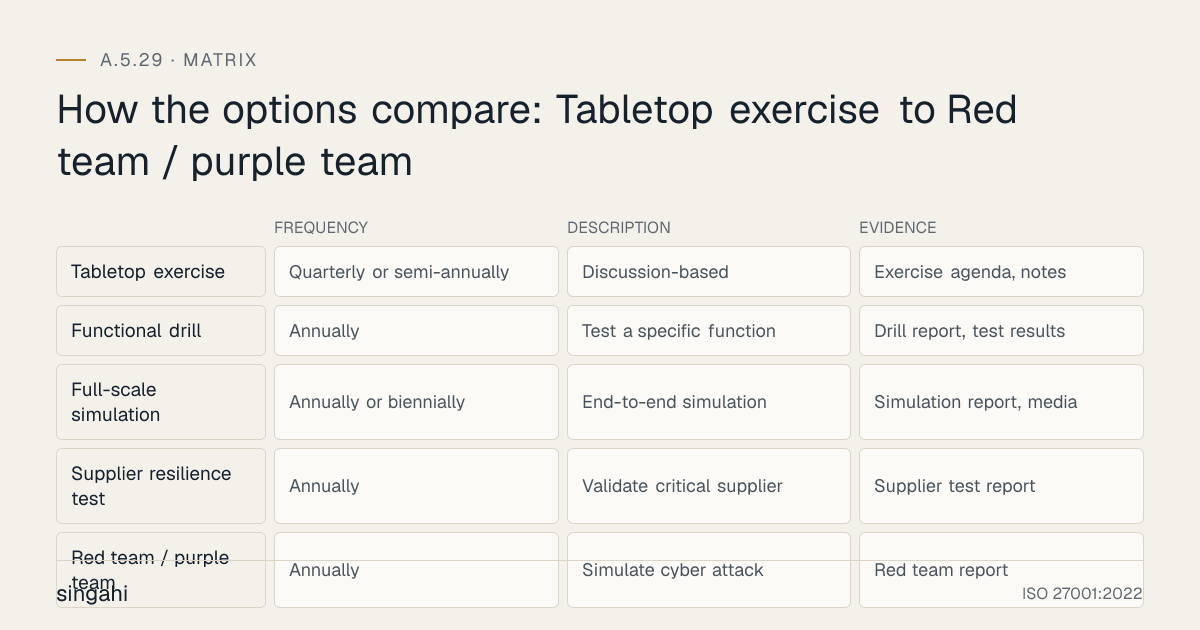
A.5.29 implementation can be structured into seven workstreams. Each workstream contains concrete steps, ownership, evidence, and Indian-market considerations.
Workstream 1: Establish Governance and Ownership
Objective: Define who owns information security during disruption and how decisions are made.
| Step | Action | Owner | Evidence |
|---|---|---|---|
| 1.1 | Designate A.5.29 control owner (typically CISO or BC Manager) and assign a deputy. | CISO | Appointment email / RACI matrix |
| 1.2 | Establish a Crisis Management Team (CMT) with defined roles: Incident Commander, Security Lead, Communications Lead, IT Lead, HR Lead, Legal/Compliance Lead, Business Continuity Lead. | CEO / CISO | CMT charter, contact roster |
| 1.3 | Define activation criteria: when does a normal incident become a disruption requiring A.5.29 procedures? | CISO / BC Manager | Activation criteria document |
| 1.4 | Create an escalation matrix with primary and secondary contacts, including mobile numbers and out-of-band communication channels. | CISO / BC Manager | Escalation matrix |
| 1.5 | Obtain top-management approval for the disruption security framework, including resource allocation for testing. | CISO / CEO | Approved policy / meeting minutes |
Indian context: For RBI-regulated entities, the CMT should include a nodal officer for cyber security as required by the Cyber Security Framework in Banks. SEBI-regulated entities should align the CMT with their cyber crisis management plan structure.
Workstream 2: Identify Disruption Scenarios and Critical Processes
Objective: Understand what could go wrong and which processes must be protected.
| Step | Action | Owner | Evidence |
|---|---|---|---|
| 2.1 | Maintain a Business Impact Analysis (BIA) that identifies critical business processes, their RTO/RPO/MBCO, and supporting systems. | BC Manager | BIA report |
| 2.2 | Develop a disruption scenario register covering: cyber (ransomware, DDoS, data breach), natural (flood, earthquake, cyclone), health (pandemic), infrastructure (power, internet, cloud region outage), supply chain (vendor failure), civil unrest, and human factors. | CISO / Risk Manager | Scenario register |
| 2.3 | For each scenario, identify information-security impacts: loss of confidentiality, integrity, availability; increased phishing; physical security gaps; insider threats; third-party risks. | CISO / Risk Manager | Risk assessment |
| 2.4 | Map each critical process to minimum security controls required during degraded operation. | Process Owners | Process-security mapping |
Indian scenario examples:
- Monsoon flooding in Mumbai/Chennai makes the primary office inaccessible.
- A cloud provider's Mumbai region experiences a multi-hour outage.
- A ransomware attack encrypts on-premise file servers and backups.
- A pan-India internet outage affects VPN concentrators.
- A pandemic wave forces 100% work-from-home within 24 hours.
- A key SaaS vendor (e.g., email, IAM) suffers a global outage.
Workstream 3: Design Security Controls for Disruption Modes
Objective: Define how each security control adapts during normal, degraded, and emergency modes.
People Security During Disruption
- Awareness refreshers: Conduct annual secure-disruption training and just-in-time reminders when a disruption is declared.
- Home office security: Require secure Wi-Fi, device encryption, screen locks, and a physically private workspace for roles handling confidential data.
- Fatigue and insider threat: Rotate crisis-response staff; monitor for abnormal access; maintain supervision of temporary or surge staff.
- Emergency staffing: Pre-clear background-verified backup personnel for critical roles; document emergency delegation of authority.
- Communication discipline: Use only approved channels for crisis communication; warn staff about phishing and disinformation during crises.
Physical Security During Disruption
- Alternate sites: Pre-approve and assess security of DR sites, branch offices, co-working spaces, and hot desks.
- Equipment movement: Use asset inventory, secure transport, chain-of-custody forms, and encryption for devices moved during disruption.
- Home office: Provide lockable storage, privacy screens, and secure disposal bins for sensitive printouts.
- Visitor control: At alternate sites, maintain visitor logs, badges, and escort requirements even during crisis.
Technical Security During Disruption
- Identity and access: Maintain MFA on all remote access; define break-glass account procedure; ensure identity provider (IdP) has redundancy or offline fallback.
- Network security: Require VPN for all corporate access; have backup internet links (e.g., LTE/5G failover); segment crisis-response networks.
- Endpoint security: Ensure all devices used during disruption have EDR, patching, encryption, and DLP agents.
- Backup and recovery: Maintain offline, immutable, encrypted backups; document restoration procedures; test regularly.
- Monitoring: Define SOC degraded-mode operations; ensure critical alerts still reach on-call staff via redundant channels.
- Cloud resilience: Use multi-region or multi-AZ deployments; document cloud-provider DR procedures; test failover.
Information Handling During Disruption
- Data classification: Reiterate handling rules for confidential/restricted data during crisis; prohibit storage on personal cloud or email.
- Information transfer: Use only approved encrypted channels; avoid USB drives unless authorized and scanned.
- Print and media: Secure printing at alternate sites; shred sensitive documents; label removable media.
- Records retention: Ensure legal hold and regulatory records are preserved despite disruption.
Workstream 4: Document the Information Security During Disruption Procedure
The procedure should be a living document. Key sections include:
- Purpose and scope
- Definitions
- Roles and responsibilities
- Activation and de-activation criteria
- Communication plan
- Secure remote working procedures
- Alternate site procedures
- Emergency access and break-glass procedures
- Backup and restoration procedures
- Third-party and supplier procedures
- Evidence preservation and forensic readiness
- Return-to-normal procedures
- Post-disruption review
- Plan maintenance and testing
A template is provided below.
Workstream 5: Test, Exercise, and Validate
Objective: Prove that the plans work before a real disruption occurs.
| Exercise Type | Frequency | Description | Evidence |
|---|---|---|---|
| Tabletop exercise | Quarterly or semi-annually | Discussion-based walkthrough of scenarios with CMT. | Exercise agenda, notes, action register |
| Functional drill | Annually | Test a specific function, e.g., failover to DR site or restoration of critical backup. | Drill report, test results |
| Full-scale simulation | Annually or biennially | End-to-end simulation including alternate-site activation, emergency access, and secure remote working. | Simulation report, media, lessons learned |
| Supplier resilience test | Annually | Validate critical supplier BCP/DR plans and failover. | Supplier test report |
| Red team / purple team | Annually | Simulate cyber attack that forces degraded-mode operation. | Red team report, remediation plan |
Testing principles:
- Include security checkpoints in every exercise (e.g., verify MFA still enforced, verify backups are clean, verify logs captured).
- Test out-of-band communication separately from corporate systems.
- Rotate scenarios to cover cyber, natural, health, and supply-chain disruptions.
- Document failures and corrective actions; update the procedure within 30 days.
Workstream 6: Integrate with Incident Response and BCP/DR
A.5.29 should not be a separate document that sits on a shelf. It must be referenced in:
- Incident Response Plan: Include a "disruption declared" branch that invokes A.5.29 procedures.
- Business Continuity Plan: Add security controls to each BCP work area.
- Disaster Recovery Plan: Include security validation steps before failover and before failback.
- ICT Readiness for BC documentation: Align RTO/RPO with security control availability.
- Crisis Communication Plan: Use pre-approved secure templates.
Workstream 7: Maintain and Improve
- Review the A.5.29 procedure at least annually and after any significant change or real disruption.
- Update contact lists, asset inventories, supplier lists, and technology dependencies quarterly.
- Track exercise findings to closure.
- Report A.5.29 status to management review (per Clause 9.3).
Workstream 8: Sector-Specific Considerations for Indian Regulated Entities
Indian regulated sectors have additional expectations that should be embedded into A.5.29 planning from the start, not bolted on after a crisis.
Banking and NBFCs (RBI)
The Reserve Bank of India's Cyber Security Framework in Banks (2016) and the Master Direction on Information Technology Governance, Risk, Controls and Assurance Practices (2023), which replaced the 2017 NBFC IT framework, require a Cyber Crisis Management Plan (CCMP), BCP/DR, annual testing, and reporting of unusual cyber incidents. For A.5.29:
- Include a "cyber attack leading to disruption" scenario in the CCMP and A.5.29 procedure.
- Define recovery priorities for critical payment systems, customer channels, and regulatory reporting.
- Maintain a nodal officer for cyber security and alternate contacts for off-hours activation.
- Document how the organization will continue regulatory reporting (e.g., RBI returns, NEFT/RTGS/UPI reconciliation) securely during disruption.
- Test failover to the alternate data center or cloud DR region at least annually and include security validation.
- Preserve transaction logs and audit trails for RBI inspection even when operating in degraded mode.
Securities Market (SEBI)
SEBI's CSCRF (2024) applies to market infrastructure institutions, stock brokers, depository participants, asset management companies, and others. Key A.5.29 implications:
- Ensure trading continuity and investor data protection during disruption.
- Pre-approve secure communication channels for market operations and investor grievance handling.
- Maintain immutable logs of trading activity and system access.
- Define how to notify SEBI, stock exchanges, and depositories of cyber incidents that disrupt market operations.
- Conduct annual cyber resilience testing including scenarios that combine cyber attack with infrastructure failure.
Insurance (IRDAI)
IRDAI's information and cyber security guidelines require insurers to protect policyholder data, maintain BCP, and report cyber incidents. For A.5.29:
- Prioritize continuity of policy issuance, claims processing, and regulatory filings.
- Ensure agent and intermediary portals remain secure during disruption.
- Define secure handling of policyholder personal data when staff work remotely.
- Align incident notification with IRDAI's reporting requirements.
All Sectors (CERT-In and DPDP Act 2023)
- Any cyber incident reportable to CERT-In must be reported within 6 hours of noticing or being notified of the incident. A.5.29 activation should not delay this.
- Personal data breaches under the DPDP Act 2023 require notification to the Data Protection Board and affected data principals. The communication plan must include legal review and secure notification methods.
- Maintain logs for 180 days and synchronize clocks per CERT-In Directions; disruption plans must not lose this capability.
Startups and Non-Regulated Tech Companies
Even without sector regulators, these organizations face contractual SLA and customer trust pressures. A.5.29 should focus on:
- Cloud-native resilience (multi-AZ, multi-region).
- Fast, secure WFH enablement.
- Transparent customer communication during outages.
- Demonstrable backup and recovery for SOC 2 and enterprise customer audits.
Tools, Technologies, and Solutions
The following tools support A.5.29 implementation. Selection should be based on organization size, risk profile, and budget.
Category: Business Continuity and Incident Management
| Vendor / Solution | Type | Key Features | Indian / Global | Pricing model |
|---|---|---|---|---|
| ServiceNow Business Continuity Management | Enterprise BC platform | BIA, plan management, exercise management, crisis communication | Global | Enterprise quote |
| MetricStream Business Continuity | GRC / BC platform | Integrated risk, BC, and incident management | Global | Enterprise quote |
| SAI360 | Resilience platform | BCM, crisis management, vendor risk | Global | Growing companies to enterprise |
| Noggin | Resilience / crisis management | Incident management, crisis communication, BC planning | Global | Growing-company quote |
| Druva | Cloud backup and DR | Backup, disaster recovery, cyber resilience, data forensics | Global / India presence | Per-user / per-TB |
| Veeam | Backup and DR | VM and cloud backup, replication, immutable backups | Global / India partners | Per-workload |
| Zerto | DR and resilience | Continuous replication, ransomware resilience, failover automation | Global | Per-workload |
| AWS Elastic Disaster Recovery | Cloud DR | Fast, scalable DR to AWS | Global | Pay-as-you-go |
| Azure Site Recovery | Cloud DR | Replicate and failover Azure / on-prem workloads | Global | Pay-as-you-go |
| Google Cloud Backup and DR | Cloud DR | Centralized backup and DR for Google Cloud | Global | Pay-as-you-go |
Category: Secure Remote Working and Identity
| Vendor / Solution | Type | Key Features | Indian / Global | Pricing model |
|---|---|---|---|---|
| Microsoft Entra ID (Azure AD) | Identity / IAM | MFA, conditional access, emergency break-glass accounts | Global | Per-user/month |
| Okta | Identity / IAM | SSO, MFA, lifecycle management | Global | Per-user/month |
| JumpCloud | Directory / IAM | Cloud directory, MFA, device management | Global | Per-user/month |
| Duo Security (Cisco) | MFA / Zero Trust | MFA, device trust, secure access | Global | Per-user/month |
| Zscaler / Cloudflare Access | Zero Trust network access | Secure remote access without VPN | Global | Per-user/month |
| Tata Communications / Airtel MPLS & SD-WAN | Secure networking | Managed network with failover and redundancy | Indian | Enterprise quote |
| Seqrite / Quick Heal | Endpoint security | EDR, DLP, encryption for Indian enterprises | Indian | Per-endpoint/year |
Category: Communication and Collaboration
| Vendor / Solution | Type | Key Features | Indian / Global | Pricing model |
|---|---|---|---|---|
| Microsoft Teams | Collaboration | Chat, calls, meetings, channels; can run in crisis mode | Global | Bundled with M365 |
| Slack / Slack Gov / Enterprise Grid | Collaboration | Channels, workflows, external communications | Global | Per-user/month |
| WhatsApp Business / API | Out-of-band communication | Widely used in India for quick team alerts | Global / India | API usage based |
| Everbridge / OnSolve (formerly xMatters) | Mass notification / IT alerting | Multi-channel crisis alerts, on-call scheduling | Global | Enterprise quote |
| PagerDuty / Opsgenie | Incident response / on-call | Alert routing, escalation, incident command | Global | Per-user/month |
Category: Monitoring and Forensics
| Vendor / Solution | Type | Key Features | Indian / Global | Pricing model |
|---|---|---|---|---|
| Splunk / Splunk SOAR | SIEM / SOAR | Centralized logging, automated response | Global | Per-GB ingestion |
| Microsoft Sentinel | SIEM / SOAR | Cloud-native SIEM, SOAR, threat intelligence | Global | Per-GB ingestion |
| IBM QRadar | SIEM | Enterprise SIEM, incident investigation | Global | Enterprise quote |
| ManageEngine Log360 / EventLog Analyzer | SIEM / log management | Indian-friendly pricing, compliance reporting | Indian / Global | Per-node |
| Kaspersky / CrowdStrike / SentinelOne | EDR / XDR | Endpoint detection, threat hunting, remote isolation | Global | Per-endpoint/year |
Selection Guidance
- Startups and SMEs: Use cloud-native services (Microsoft 365 / Google Workspace), Duo MFA, cloud backup (Druva / Veeam), and free/lightweight tabletop exercises.
- Growing companies: Add a dedicated BC/DR tool, SIEM, managed SOC, and structured crisis communication platform.
- Enterprise / Regulated: Implement integrated GRC/BC platforms, immutable backup with air-gapping, multi-region cloud architecture, and regular red-team exercises.
Policy and Procedure Templates
Template 1: Information Security During Disruption Policy
INFORMATION SECURITY DURING DISRUPTION POLICY
[Organization Name]
Version: 1.0
Effective Date: [Date]
Review Date: [Date + 12 months]
Classification: Internal
Approved by: [CEO / Managing Director]

---

1. PURPOSE AND SCOPE

1.1 Purpose
This policy establishes the requirements for maintaining information security
when normal business operations are disrupted by incidents such as cyber
attacks, natural disasters, pandemics, infrastructure failures, supply-chain
failures, civil unrest, or any other event that prevents the organization from
operating in its normal mode.

1.2 Scope
This policy applies to all employees, contractors, temporary staff, vendors,
and third parties who access, process, store, or transmit [Organization Name]
information assets during a disruption. It covers all locations, systems,
networks, applications, and data.

2. POLICY STATEMENT

[Organization Name] is committed to protecting the confidentiality, integrity,
and availability of its information assets at all times, including during
disruptions. The organization shall plan, document, test, and maintain
processes and procedures for information security during disruption.

3. ROLES AND RESPONSIBILITIES

3.1 Top Management
• Approve this policy and the resources required for its implementation.
• Receive briefings from the Crisis Management Team during significant
  disruptions.
• Support a culture where security is not sacrificed for speed during crisis.

3.2 Chief Information Security Officer (CISO)
• Own this policy and the associated procedure.
• Ensure integration of information security into BCP, DR, and incident
  response plans.
• Plan and oversee exercises to validate security during disruption.

3.3 Business Continuity Manager
• Maintain BCP/DR plans with embedded security requirements.
• Coordinate Business Impact Analysis and disruption scenario planning.
• Track exercise findings to closure.

3.4 CIO / IT Director
• Ensure ICT readiness, backup, redundancy, failover, and emergency access.
• Maintain technical playbooks for secure failover and failback.

3.5 Crisis Management Team
• Activate and manage the organization's response to disruption.
• Make security-aware decisions and escalate where required.

3.6 All Employees
• Comply with secure remote working, alternate-site, and emergency
  procedures during disruption.
• Report security incidents, suspicious activity, or policy violations
  immediately.

4. KEY REQUIREMENTS

4.1 Planning
• A documented Information Security During Disruption procedure shall be
  maintained.
• Disruption scenarios shall be identified and risk-assessed.
• Critical processes, systems, and data shall have defined RTO, RPO, and
  minimum security controls for degraded operation.

4.2 Activation
• Disruption shall be declared by authorized personnel per the escalation
  matrix.
• The Crisis Management Team shall convene within [15 minutes / 1 hour] of
  activation.
• Secure communication channels shall be used for all crisis coordination.

4.3 Secure Remote and Alternate-Site Working
• MFA shall be enforced for all remote access.
• Only organization-managed or approved devices shall access corporate
  information.
• Sensitive information shall not be stored, printed, or discussed in
  insecure locations.

4.4 Emergency Access
• Break-glass and emergency privileged access shall be pre-authorized,
  logged, time-bound, and revoked immediately after use.
• Emergency access shall require approval from the CISO or designated deputy.

4.5 Backup and Recovery
• Backups shall be encrypted, immutable, tested, and stored separately from
  primary systems.
• Restoration shall follow documented procedures and include security
  validation before returning to production.

4.6 Third Parties
• Critical suppliers shall have documented BCP/DR plans and security
  commitments.
• Supplier failover procedures shall be tested annually.

4.7 Communication
• Pre-approved crisis communication templates shall be used.
• Internal and external stakeholders shall be informed through secure,
  authorized channels.
• Regulatory notifications (e.g., CERT-In, RBI, SEBI, IRDAI, DPDP Act) shall
  be made within mandated timeframes.

4.8 Return to Normal
• A structured return-to-normal plan shall ensure systems, networks, and
  processes are restored securely.
• Evidence preservation and forensic requirements shall be met before
  rebuilding affected systems.

4.9 Testing and Review
• The procedure shall be tested at least annually through tabletop,
  functional, or full-scale exercises.
• The policy and procedure shall be reviewed annually and after any
  significant disruption, change, or exercise finding.

5. COMPLIANCE

Non-compliance with this policy may result in disciplinary action, including
termination, and may expose the organization to legal, regulatory, and
contractual liability.

6. REVIEW AND APPROVAL

This policy is reviewed annually. Changes are approved by top management.

APPROVED BY:
[Name]                    [Title]                    [Date]
Template 2: Information Security During Disruption Procedure
INFORMATION SECURITY DURING DISRUPTION PROCEDURE
[Organization Name]
Version: 1.0
Owner: CISO / Business Continuity Manager

1. ACTIVATION

1.1 Activation Triggers
Activation occurs when any of the following affect critical operations:
• Ransomware or significant cyber attack
• Natural disaster (flood, earthquake, cyclone, fire)
• Pandemic or health emergency
• Primary office or data center inaccessible
• Critical cloud/service provider outage
• Major supply-chain failure
• Civil unrest or government-imposed restrictions
• Any event where the Crisis Management Team determines that normal
  operating mode cannot maintain information security

1.2 Activation Authority
Primary: CISO or CEO
Deputy: Business Continuity Manager or CIO

1.3 Activation Steps
1. Declare disruption via approved communication channel.
2. Convene Crisis Management Team.
3. Notify relevant regulators if required (CERT-In within 6 hours for cyber
   incidents; RBI/SEBI/IRDAI per sector timelines; DPDP Act for personal
   data breaches).
4. Activate secure communication channel.
5. Invoke BCP/DR and A.5.29 security procedures.

2. SECURE COMMUNICATION

• Use [out-of-band channel, e.g., WhatsApp Business group, SMS gateway,
  Everbridge] if corporate email/Teams is unavailable.
• Authenticate all participants using a pre-agreed code word or second
  factor before sharing sensitive information.
• Do not discuss confidential matters on unapproved social media or public
  channels.

3. SECURE REMOTE / ALTERNATE-SITE OPERATIONS

3.1 Remote Working
• Employees must use organization-managed devices with EDR, encryption,
  and patched OS.
• Connect only via VPN or approved Zero Trust access.
• Home Wi-Fi must use WPA2/WPA3 and a strong passphrase; avoid public Wi-Fi
  for confidential work.
• Maintain physical privacy; lock screens when away.

3.2 Alternate Site
• Verify site access control, CCTV, network segmentation, and visitor
  management before occupation.
• Issue temporary badges; maintain visitor log.
• Scan all devices connecting to the alternate-site network.
• Use locked storage for sensitive documents and equipment.

4. EMERGENCY ACCESS AND BREAK-GLASS

4.1 Request
• Requestor submits emergency access form with business justification,
  systems required, and duration.
• Approval required from CISO or designated deputy.

4.2 Grant
• Enable time-limited break-glass account or temporary privilege escalation.
• Log all actions; monitor session in real time if possible.

4.3 Revocation
• Revoke access immediately upon completion or expiry.
• Review logs within 24 hours; document any anomalies.

5. BACKUP AND RECOVERY

5.1 Before Restoration
• Verify backup integrity and malware scan results.
• Confirm restoration target environment is clean and patched.
• Preserve forensic evidence where investigation is ongoing.

5.2 During Restoration
• Follow documented RTO/RPO targets.
• Validate data integrity and access controls before releasing systems to
  users.

5.3 After Restoration
• Re-enable monitoring, logging, and alerting.
• Conduct security validation tests.

6. THIRD-PARTY COORDINATION

• Contact critical suppliers via pre-defined escalation paths.
• Confirm supplier recovery status and security posture before re-establishing
  integrations.
• Document any supplier security exceptions with risk acceptance.

7. RETURN TO NORMAL

7.1 Return Criteria
• Primary systems and sites are restored and validated.
• Security controls are operating at normal levels.
• Regulatory and legal obligations are met.
• CMT approves return-to-normal.

7.2 Return Steps
1. Migrate users from alternate sites / remote crisis mode to normal mode.
2. Revoke all emergency access and temporary privileges.
3. Collect and securely destroy any sensitive documents or media from
   alternate sites.
4. Reconcile asset inventory and access rights.
5. Conduct post-disruption review.

8. POST-DISRUPTION REVIEW

Within [5 / 10 / 15] business days:
• Document timeline, decisions, and security incidents.
• Identify lessons learned and root causes.
• Update BCP/DR, incident response, and A.5.29 procedure.
• Close corrective actions.
• Report to management review.
Risk Assessment and Treatment
A.5.29 planning must be grounded in risk assessment. The following table provides a starting risk register for information security during disruption. Organizations should adapt likelihood and impact ratings based on their specific threat landscape, location, and industry.
Risk Register: Information Security During Disruption
| Risk ID | Risk Description | Likelihood | Impact | Risk Level | Treatment | Owner |
|---|---|---|---|---|---|---|
| R-001 | Ransomware encrypts primary systems and backups, forcing payment or prolonged downtime. | Medium | Critical | High | Maintain immutable offline backups; segment networks; EDR; IR plan; regular restore tests; user awareness. | CISO |
| R-002 | Sudden WFH mandate exposes confidential data through unmanaged home devices and insecure networks. | High | High | High | Enforce MFA/VPN; managed-device policy; DLP; home-office security guidance; secure collaboration tools. | CISO / HR |
| R-003 | Primary office becomes inaccessible due to flood, fire, or civil unrest. | Medium | High | High | Alternate-site agreement; hot-desk security; remote-work readiness; BCP testing. | BC Manager |
| R-004 | Cloud region or SaaS provider outage disrupts authentication, email, or critical apps. | Medium | High | High | Multi-region architecture; IdP redundancy; backup communication channels; supplier failover testing. | CIO |
| R-005 | Break-glass / emergency access is abused or not revoked, leading to unauthorized access. | Low | High | Medium | Pre-authorization; time-bound access; logging; approval workflow; post-use review. | CISO |
| R-006 | Security monitoring and logging fail during disruption, hiding attacker activity. | Medium | High | High | Redundant logging; SIEM failover; SOC out-of-band alerting; log integrity protection. | SOC Manager |
| R-007 | Critical supplier fails to recover, causing data exposure or service degradation. | Medium | Medium | Medium | Supplier BCP/DR due diligence; contractual security requirements; annual supplier resilience test. | Procurement / CISO |
| R-008 | Fatigue and reduced oversight during crisis increase insider threat and errors. | Medium | Medium | Medium | Staff rotation; supervision; least privilege; anomaly detection; welfare checks. | HR / CISO |
| R-009 | Sensitive documents or devices lost/stolen at alternate sites or during relocation. | Low | Medium | Low-Medium | Asset tracking; encryption; secure transport; locked storage; clear-desk policy. | IT / Facilities |
| R-010 | Regulatory notification deadlines missed because of disrupted communication. | Low | High | Medium | Pre-approved notification templates; regulatory contact list; out-of-band communication; legal review. | Legal / Compliance |
| R-011 | Phishing and social engineering spike during disruption, exploiting staff anxiety. | High | Medium | Medium-High | Crisis-specific awareness; email filtering; incident reporting; DMARC/SPF/DKIM. | CISO |
| R-012 | Restoration from backup reintroduces malware or misconfigured security controls. | Low | High | Medium | Malware scanning; patch validation; configuration baseline checks; security acceptance testing. | CIO / CISO |
Treatment Options
| Treatment | When to Use | Example for A.5.29 |
|---|---|---|
| Mitigate | Reduce likelihood or impact through controls | Implement MFA, immutable backups, alternate sites, and monitoring redundancy. |
| Transfer | Shift risk to a third party | Cyber insurance; cloud provider DRSLAs; managed SOC. |
| Accept | Residual risk is within appetite and cost of mitigation is disproportionate | Document risk acceptance for low-likelihood, limited-impact scenarios with management approval. |
| Avoid | Stop the activity causing the risk | Decommission legacy systems that cannot be recovered securely; avoid single-region dependencies. |
Audit and Compliance Checklist
Use the following 25 questions to prepare for internal and external audits of A.5.29.
| # | Audit Question | Expected Evidence | Red Flag |
|---|---|---|---|
| 1 | Is there a documented and approved procedure for information security during disruption? | Approved A.5.29 policy/procedure, version-controlled. | No document or document is generic. |
| 2 | Is the A.5.29 procedure integrated with BCP, DR, and incident response plans? | Cross-references, integrated activation flow. | Siloed document not referenced elsewhere. |
| 3 | Has the organization identified disruption scenarios relevant to its context? | Scenario register, risk assessment. | No scenario planning. |
| 4 | Is there a Business Impact Analysis (BIA) with RTO/RPO for critical processes? | BIA report with security considerations. | BIA missing or outdated. |
| 5 | Are roles and responsibilities for disruption security defined and communicated? | RACI matrix, CMT charter, contact roster. | Unclear ownership or missing deputies. |
| 6 | Are secure remote working requirements defined for disruption scenarios? | Remote working policy, secure WFH checklist. | No secure WFH guidance. |
| 7 | Are alternate sites assessed for physical and information security? | Site security assessment reports. | Alternate site never assessed. |
| 8 | Is there a break-glass / emergency access procedure? | Emergency access procedure, sample approvals. | Shared admin passwords or no approval process. |
| 9 | Are backups encrypted, immutable, tested, and geographically separated? | Backup policy, restore test records, encryption confirmation. | Backups untested or stored on same network. |
| 10 | Is there a process to verify integrity of restored data and systems? | Restoration validation checklist. | Systems restored without security checks. |
| 11 | Are critical suppliers required to have BCP/DR and security commitments? | Supplier contracts, security questionnaires. | No supplier resilience requirements. |
| 12 | Are supplier failover procedures tested? | Supplier test reports, attestations. | Critical suppliers never tested. |
| 13 | Is there a secure crisis communication plan and out-of-band channel? | Communication plan, contact list, channel test records. | Only corporate email/Teams used for crisis. |
| 14 | Are employees trained on secure behavior during disruption? | Training records, awareness materials. | No disruption-specific training. |
| 15 | Are exercises conducted to test information security during disruption? | Exercise schedules, reports, action registers. | No exercises in past 12 months. |
| 16 | Do exercises include security validation checkpoints? | Exercise scenarios with security checks. | Exercises ignore security. |
| 17 | Are exercise findings tracked to closure and used to update plans? | Action register, updated procedure versions. | Findings not closed or plans not updated. |
| 18 | Is there a return-to-normal procedure with security steps? | Return-to-normal procedure. | No structured return process. |
| 19 | Are logs and evidence preserved during disruption for investigation? | Logging policy, evidence-handling procedure. | Forensic evidence lost during recovery. |
| 20 | Are regulatory notification requirements included in disruption plans? | Regulatory matrix, notification templates. | Missing CERT-In/RBI/SEBI/DPDP notification steps. |
| 21 | Is there a process to manage temporary staff and contractors during surge? | Emergency staffing procedure, background checks. | Unvetted temporary staff given access. |
| 22 | Are information classification and handling rules maintained during disruption? | Data handling guidance for crisis mode. | Sensitive data handled without controls during crisis. |
| 23 | Is ICT readiness aligned with information-security requirements? | IRBC documentation with security checkpoints. | ICT failover lacks security validation. |
| 24 | Is the A.5.29 procedure reviewed after significant changes or disruptions? | Review records, change log. | Procedure unchanged for years. |
| 25 | Does management review include A.5.29 status? | Management review minutes. | A.5.29 not reported to top management. |
Metrics and KPIs
Figure · Measures
The measures that show A.5.29 is working
- A.5.29 Procedure Currency≤ 365 daysQuarterly
- Exercise Completion Rate100%Annually
- Exercise Findings Closure Rate≥ 95%Quarterly
- RTO Achievement Rate≥ 95%Per exercise
- RPO Achievement Rate≥ 98%Per exercise
Track the following metrics to demonstrate A.5.29 effectiveness and drive continuous improvement.
| # | KPI | Formula / Definition | Target | Frequency |
|---|---|---|---|---|
| 1 | A.5.29 Procedure Currency | Days since last review/update of the procedure. | ≤ 365 days | Quarterly |
| 2 | Exercise Completion Rate | Number of disruption exercises completed / number planned. | 100% | Annually |
| 3 | Exercise Findings Closure Rate | Findings closed / findings identified. | ≥ 95% | Quarterly |
| 4 | RTO Achievement Rate | Number of critical systems restored within RTO / total tested. | ≥ 95% | Per exercise |
| 5 | RPO Achievement Rate | Restorations meeting RPO target / total tested. | ≥ 98% | Per exercise |
| 6 | Backup Restoration Success Rate | Successful restores / attempted restores. | ≥ 99% | Monthly/quarterly |
| 7 | Backup Immutability Coverage | Systems with immutable backup / total critical systems. | 100% | Quarterly |
| 8 | Emergency Access Reviews Completed | Emergency access uses reviewed within 24 hours / total uses. | 100% | Per use |
| 9 | Critical Supplier Resilience Coverage | Critical suppliers with tested BCP/DR / total critical suppliers. | 100% | Annually |
| 10 | Alternate Site Security Assessment Coverage | Alternate sites assessed / total alternate sites. | 100% | Annually |
| 11 | Crisis Communication Channel Availability | Uptime of out-of-band crisis communication channel. | ≥ 99.9% | Monthly |
| 12 | Employee Disruption Security Training Completion | Staff trained / total staff. | ≥ 95% | Annually |
| 13 | Security Incidents During Disruption | Number of security incidents that occurred during a disruption. | Trending down | Per incident |
| 14 | Mean Time to Activate Secure Crisis Mode | Time from disruption declaration to full CMT activation and secure communication. | ≤ 1 hour | Per exercise/incident |
| 15 | Return-to-Normal Security Validation Pass Rate | Return-to-normal security checks passed / total checks. | 100% | Per disruption |
Common Pitfalls / Audit Failures & How to Avoid Them
| # | Pitfall / Audit Failure | Root Cause | Fix |
|---|---|---|---|
| 1 | "Our BCP already covers it" | A.5.29 treated as redundant to BCP without explicit security overlay. | Create a dedicated A.5.29 procedure that references and supplements BCP/DR. |
| 2 | Shared emergency passwords | Pressure to restore quickly leads to shared credentials. | Implement break-glass accounts with individual identity, approval, and logging. |
| 3 | Untested backups | Backups are assumed good but never restored. | Schedule monthly restore tests; verify integrity and malware status. |
| 4 | No secure remote-work plan | WFH assumed to be the same as normal remote work. | Document crisis-mode remote working with heightened controls and device constraints. |
| 5 | Alternate site never visited | DR site contracted but not assessed for security. | Conduct annual site security assessments and walkthroughs. |
| 6 | ICT failover without security validation | DR tests only check availability, not security. | Add security checkpoints to all failover tests (MFA, logging, patching, access). |
| 7 | Supplier resilience ignored | Critical supplier BCP/DR not reviewed. | Include supplier resilience in procurement and test annually. |
| 8 | Communication plan depends on failed systems | Crisis contact list stored only in corporate email. | Maintain out-of-band contact list and tested communication channel. |
| 9 | No regulatory notification playbook | Legal/compliance not involved in disruption planning. | Build regulatory notification matrix and templates into the procedure. |
| 10 | Fatigue-driven mistakes | Long crisis hours reduce vigilance. | Rotate staff, set shift limits, and monitor for anomalies. |
| 11 | Restoring malware from backups | Backups not scanned before restoration. | Scan backups and validate target environment before restore. |
| 12 | Failure to preserve evidence | Systems rebuilt before forensic capture. | Freeze evidence, capture images, and involve forensic experts before recovery. |
| 13 | No return-to-normal discipline | Crisis ends abruptly without security reconciliation. | Mandate return-to-normal checklist and CMT approval. |
| 14 | Exercises are scripted theater | Scenarios avoid hard questions; no findings recorded. | Use independent facilitators, realistic injects, and mandatory action tracking. |
| 15 | Plan sits on shelf | Procedure created for certification but not maintained. | Assign owner, schedule reviews, integrate with change management. |
Illustrative Scenarios
Illustrative scenario, a composite example for guidance, not a specific Singahi engagement or a verified outcome.
Illustrative Scenario 1: Indian SaaS Startup, Ransomware Disruption and Secure Recovery
Organization: A Bengaluru-based B2B SaaS company with 120 employees serving 400 enterprise customers in India and Southeast Asia.
Challenge: On a Sunday evening, a ransomware group deployed a locker across the company's primary AWS VPC and on-premise file server. The attackers also deleted visible snapshots. The company discovered the issue Monday morning when customer support tickets began reporting service unavailability. The incident threatened customer data, SLA commitments, and an upcoming ISO 27001 Stage 2 audit.
What Went Wrong Initially:
- The company had backups but had not tested restoration in six months.
- The disaster recovery plan did not include a security validation step before failback.
- Several engineers shared a break-glass AWS root account password via a group chat to "fix things quickly."
- The crisis communication plan relied on the same Microsoft 365 tenant that was partially affected.
- There was no predefined procedure for notifying CERT-In or customers under the DPDP Act 2023 framework.
Solution Implemented with external support:
- Activated the incident response plan and declared a disruption under A.5.29.
- Isolated affected environments and preserved forensic evidence before any recovery.
- Identified immutable backups in a separate AWS account that had not been compromised.
- Restored critical services to a clean, hardened environment in a different AWS region.
- Replaced shared break-glass credentials with individual, time-bound, MFA-protected emergency access with full CloudTrail logging.
- Used an out-of-band WhatsApp Business group and SMS alerts for crisis communication.
- Engaged legal counsel to assess CERT-In, customer contract, and DPDP Act notification obligations.
- Conducted a post-incident review and updated BCP, DR, IR, and A.5.29 procedures.
Results:
- Critical services restored within 36 hours; full restoration completed in 72 hours.
- Zero customer data exfiltration confirmed through forensic analysis.
- Passed the ISO 27001 Stage 2 audit four weeks later with only one minor observation.
- Customer churn limited to two accounts; most customers appreciated transparent communication.
- Implemented quarterly backup restore tests and bi-annual ransomware recovery drills.
Lessons Learned:
- Backups are only as good as the last successful restore test.
- Shared emergency credentials create more risk than the incident itself.
- A.5.29 must be integrated with IR, BCP, DR, and regulatory notification workflows.
- Out-of-band communication is essential when primary systems are suspect.
Illustrative Scenario 2: Indian NBFC, Flooding, WFH Surge, and Regulatory Continuity
Organization: A mid-sized Non-Banking Financial Company (NBFC) headquartered in Chennai with 18 branches across South India and 850 employees.
Challenge: Severe flooding in Chennai made the head office and primary data center inaccessible for nine days. Simultaneously, the RBI issued a directive requiring regulated entities to maintain critical financial operations with no degradation in security controls. The NBFC had to shift nearly 70% of operations to remote work within 24 hours while ensuring loan processing, payments, and customer data remained protected.
What Worked:
- A BCP existed and alternate sites had been pre-identified.
- Core banking systems were hosted in a Mumbai data center with redundancy.
- VPN infrastructure was already in place for some users.
What Did Not Work:
- VPN licenses covered only 30% of the workforce.
- There was no secure WFH procedure for customer-facing roles handling PAN, Aadhaar, and bank account data.
- Branch staff began using personal email and WhatsApp to share loan documents.
- The BCP did not address how to verify identity and authorize transactions when staff were dispersed.
- Backup power at the alternate site was insufficient for full operations.
Solution Implemented with external support:
- Declared a disruption and activated the Crisis Management Team.
- Procured additional VPN/Zero Trust licenses and enforced MFA for all remote access.
- Issued a secure WFH directive prohibiting personal email/USB for customer data and mandating privacy screens and encrypted devices.
- Deployed a virtual desktop infrastructure (VDI) for customer-facing roles so data never resided on personal devices.
- Implemented daily transaction reconciliation and dual authorization for high-value disbursements.
- Established a secure file-sharing portal with DLP to replace informal channels.
- Coordinated with the Mumbai data center and cloud DR provider to validate failover.
- Updated RBI reporting with timely incident and continuity-status notifications.
Results:
- Loan disbursements resumed at 85% capacity within 48 hours.
- No reportable data breach occurred during the disruption.
- RBI inspection six months later commended the NBFC's cyber crisis management and secure continuity posture.
- The organization achieved a mature A.5.29 implementation and reduced its cyber insurance premium by 12%.
- Post-event, the NBFC adopted a permanent hybrid work model with security controls that exceeded pre-flood levels.
Lessons Learned:
- WFH capacity must be planned for the entire workforce, not a subset.
- Customer-facing financial processes need stronger controls during disruption than back-office processes.
- Informal communication channels become the default in a crisis unless secure alternatives are ready.
- Sector-specific regulatory expectations (RBI) must be hard-wired into A.5.29 procedures.
Multi-Framework Mapping
A.5.29 aligns with multiple global and Indian frameworks. Use this table to demonstrate cross-framework compliance and avoid duplicate work.
| Framework | Control / Requirement | Mapping Notes |
|---|---|---|
| ISO 27001:2022 | A.5.29, Information security during disruption | Primary control. |
| ISO 27002:2022 | 5.29, Information security during disruption | Implementation guidance. |
| SOC 2 (2017 Trust Services Criteria) | A1.2 (environmental protections, backup and recovery infrastructure), A1.3 (recovery plan testing), CC7.5 (recovery from incidents), CC9.1 (business disruption risk mitigationness partner relationships), A1.2 (System availability), A1.3 (System capacity) | A.5.29 supports availability, incident response, and vendor management criteria. |
| PCI DSS v4.0.1 | Requirement 12.10 (Implement an incident response plan), Requirement 9 (Physical security), Requirement 11.5 (Intrusion detection and change detection), Requirement 12.1 (Security policy and procedures) | Incident response and continuity plans must protect cardholder data environment during disruption. |
| NIST SP 800-53 Rev. 5 | CP-2 (Contingency Plan), CP-4 (Contingency Plan Testing), CP-6 (Alternate Storage Site), CP-7 (Alternate Processing Site), CP-8 (Telecommunications Services), CP-9 (Information System Backup), CP-10 (Information System Recovery and Reconstitution), IR-4 (Incident Handling), IR-8 (Incident Response Plan), PE-17 (Alternate Work Site) | A.5.29 maps strongly to the NIST Contingency Planning (CP) and Incident Response (IR) control families. |
| CIS Controls v8 | Control 11 (Data Recovery), Control 12 (Network Infrastructure Management), Control 13 (Network Monitoring and Defense), Control 17 (Incident Response Management) | A.5.29 supports data recovery, network resilience, and incident response controls. |
| COBIT 2019 | DSS04 (Managed Continuity), DSS05 (Managed Security Services), APO12 (Managed Risk), DSS03 (Managed Problems) | A.5.29 aligns with COBIT's continuity and security service management domains. |
| GDPR | Article 32 (Security of processing), Article 33 (Personal data breach notification) | Organizations must maintain security of processing and notify the supervisory authority within 72 hours even during disruption. |
| DPDP Act 2023 (India) | Section 8(5) (reasonable security safeguards), Section 8(6) and the DPDP Rules (breach intimation: without delay; detailed report within 72 hours), Sections 11–14 (Data Principal rights, which must still be honoured during disruption) | Data fiduciaries must implement reasonable safeguards and report breaches to the Board and data principals; A.5.29 helps ensure safeguards survive disruption. |
| RBI Cyber Security Framework | Cyber Crisis Management Plan (CCMP), BCP/DR requirements, incident reporting, annual testing | A.5.29 is the security layer on top of RBI-mandated CCMP and BCP/DR. |
| SEBI CSCRF (2024) | BCP/DR, incident response, annual testing, cyber resilience for MIIs, brokers, etc. | A.5.29 supports SEBI's continuity and resilience requirements. |
| IRDAI Cyber Security Guidelines | BCP, incident reporting, protection of policyholder data | A.5.29 helps insurers maintain secure continuity. |
| CERT-In Directions, 2022 | Incident reporting within 6 hours, log retention, clock synchronization, information sought by CERT-In | Disruption plans must preserve reporting capability and logs. |
Implementation Roadmap
Figure · Timeline
Rollout in order
- Week 3Draft Information Security During
- Week 4Define secure remote working
- Week 5Integrate A.5.29 into IR, BCP, DR
The following 12-week roadmap takes an organization from initial planning to an audit-ready A.5.29 implementation.
Phase 1: Foundation (Weeks 1–2)
| Week | Activities | Deliverables |
|---|---|---|
| 1 | Designate A.5.29 owner; establish Crisis Management Team; review existing BCP/DR/IR plans. | RACI matrix, CMT charter, gap list. |
| 2 | Conduct BIA refresh; identify disruption scenarios; define RTO/RPO for critical processes. | Updated BIA, scenario register, RTO/RPO sheet. |
Phase 2: Planning and Documentation (Weeks 3–5)
| Week | Activities | Deliverables |
|---|---|---|
| 3 | Draft Information Security During Disruption policy and procedure. | Draft policy/procedure. |
| 4 | Define secure remote working, alternate-site, emergency access, backup/recovery, and communication procedures. | Detailed procedures. |
| 5 | Integrate A.5.29 into IR, BCP, DR, and supplier management documents. | Updated plans with cross-references. |
Phase 3: Technical and Operational Readiness (Weeks 6–8)
| Week | Activities | Deliverables |
|---|---|---|
| 6 | Implement/improve backup immutability, MFA, VPN/Zero Trust, and monitoring redundancy. | Technical controls configured. |
| 7 | Assess alternate sites; establish out-of-band communication; configure break-glass accounts. | Site assessments, communication channel test. |
| 8 | Validate supplier BCP/DR; update contracts with security continuity clauses. | Supplier attestation register. |
Phase 4: Testing and Training (Weeks 9–10)
| Week | Activities | Deliverables |
|---|---|---|
| 9 | Conduct tabletop exercise; train staff on secure disruption behavior. | Exercise report, training records. |
| 10 | Perform functional DR test with security validation; review findings. | DR test report, action register. |
Phase 5: Review and Audit Preparation (Weeks 11–12)
| Week | Activities | Deliverables |
|---|---|---|
| 11 | Close corrective actions; update all documentation; conduct internal audit. | Closed actions, updated documents, internal audit report. |
| 12 | Present A.5.29 status to management review; finalize evidence pack. | Management review minutes, audit evidence pack. |
Ongoing Activities
- Quarterly contact-list and asset-inventory updates.
- Semi-annual tabletop exercises.
- Annual full-scale exercise or supplier resilience test.
- Annual policy/procedure review or review after significant change/incident.
FAQ
Q1: Is A.5.29 the same as business continuity planning?
No. Business continuity planning focuses on keeping the business running. A.5.29 focuses specifically on maintaining information security while the business is operating in disruption mode. The two must be integrated, but A.5.29 adds the security lens.
Q2: Do small organizations need a full A.5.29 procedure?
Yes, but proportionally. A 20-person startup can have a concise checklist, cloud backups, MFA, and a quarterly tabletop exercise. A 2,000-person bank needs a complete, tested program. The standard expects planning appropriate to the organization's context and risk.
Q3: What counts as a "disruption" for A.5.29?
Any event that prevents normal operation and requires alternate working methods. Examples include ransomware, floods, fires, pandemics, power failures, internet outages, civil unrest, supply-chain failures, and major cloud provider outages.
Q4: How often should we test A.5.29 plans?
At minimum, annually. Best practice includes a semi-annual tabletop exercise, an annual functional or full-scale exercise, and quarterly backup restore tests. Test after significant changes as well.
Q5: Should A.5.29 be a separate document or part of the BCP?
It can be a standalone procedure that references the BCP, or a dedicated section within the BCP. The key requirement is that information-security-during-disruption is explicitly planned, documented, tested, and maintained.
Q6: How do we handle emergency access during a disruption without creating audit failures?
Use pre-defined break-glass accounts, require approval from a designated authority, enforce MFA, limit duration, log all activity, and conduct a post-use review within 24 hours. Never share passwords.
Q7: What if our cloud provider fails, does A.5.29 apply?
Yes. A.5.29 requires planning for any disruption, including cloud or SaaS provider outages. This includes multi-region deployment, backup providers, alternate communication channels, and supplier failover testing.
Q8: How does A.5.29 relate to COVID-19-style work-from-home mandates?
A.5.29 is exactly the kind of control that should have guided secure WFH during the pandemic. Organizations that had planned for secure remote operation could scale it with fewer emergency exceptions.
Q9: What regulatory notifications are required during a disruption in India?
It depends on the cause. Cyber incidents must be reported to CERT-In within 6 hours. Personal data breaches may require notification under the DPDP Act 2023. RBI, SEBI, and IRDAI have sector-specific timelines. Include these in your A.5.29 communication plan.
Q10: Can A.5.29 help reduce cyber insurance premiums?
Yes. Insurers increasingly look for evidence of resilience, backup testing, incident response readiness, and business continuity. A strong A.5.29 program can positively influence underwriting.
References and Further Reading
Standards and Frameworks
- ISO/IEC 27001:2022, Information security, cybersecurity and privacy protection, Information security management systems, Requirements.
- ISO/IEC 27002:2022, Information security, cybersecurity and privacy protection, Information security controls.
- ISO 22301:2019, Security and resilience, Business continuity management systems, Requirements.
- ISO/IEC 27031:2025, ICT readiness for business continuity (replaced the 2011 edition).
- ISO 22313:2020, Business continuity management systems, Guidance on the use of ISO 22301.
- ISO/IEC 27035 series, Information security incident management.
- ISO/TS 22317:2021, Guidelines for business impact analysis.
- NIST SP 800-53 Rev. 5, Security and Privacy Controls for Information Systems and Organizations.
- NIST SP 800-34 Rev. 1, Contingency Planning Guide for Federal Information Systems.
- CIS Controls v8, Center for Internet Security.
- COBIT 2019, ISACA.
Indian Regulations and Guidelines
- Digital Personal Data Protection Act, 2023 (India).
- Information Technology Act, 2000 (as amended).
- CERT-In Directions, 2022 (Information Security Practices, Procedure, Prevention, Response and Reporting of Cyber Incidents for Safe & Trusted Internet).
- Reserve Bank of India, Master Direction on Information Technology Framework for the NBFC Sector; Cyber Security Framework in Banks.
- Securities and Exchange Board of India, Cyber Security and Cyber Resilience framework for MIIs, stock brokers, depository participants, etc.
- Insurance Regulatory and Development Authority of India, Guidelines on Information and Cyber Security for Insurers.
Useful Resources
- RBI Cyber Security Framework for Banks: https://www.rbi.org.in
- SEBI CSCRF (20 August 2024): https://www.sebi.gov.in
- CERT-In: https://www.cert-in.org.in
- MeitY, DPDP Act 2023: https://www.meity.gov.in
- ISO 27001:2022 Annex A control mapping resources.
- Singahi ISO 27001 Blog and Resources: /
End of guide.