
On this page
- Quick Reference: A.5.30 in 60 Seconds
- What the Control Asks For
- Why This Control Matters
- Scope and Applicability
- Key Definitions and Terminology
- Relationship to Other Controls
- Detailed Implementation Guidance
- Tools, Technologies, and Solutions
- Policy and Procedure Templates
- Risk Assessment and Treatment
- Audit and Compliance Checklist
- Metrics and KPIs
- Common Pitfalls / Audit Failures & How to Avoid Them
- Illustrative Scenarios
- Multi-Framework Mapping
- Implementation Roadmap
- FAQ
- References and Further Reading
Quick Reference: A.5.30 in 60 Seconds
| Attribute | Detail |
|---|---|
| Control ID | A.5.30 |
| Title | ICT readiness for business continuity |
| Objective | Ensure the availability of information and other associated assets during disruption, by having ICT services ready to continue or recover in line with business continuity objectives. |
| Domain | Organizational |
| Reference | ISO/IEC 27001:2022 Annex A 5.30 |
| Control Type | Corrective; property Availability (27002 concepts: Respond; capability: Continuity; domain: Resilience) |
| What You Must Do | Embed ICT continuity requirements into business continuity planning; identify critical ICT services; define recovery objectives; establish redundancy, failover, backup, and restoration capabilities; test and exercise continuity arrangements; and maintain ICT readiness over time. |
| Owner | Chief Information Security Officer (CISO) / Head of IT Infrastructure / Business Continuity Manager |
| Maturity Level 1 | Ad-hoc backups exist; no formal recovery objectives or documented ICT continuity plan. |
| Maturity Level 2 | Critical ICT services identified; basic backup policy in place; informal restore testing. |
| Maturity Level 3 | Documented ICT continuity plan with RTO/RPO; redundant systems for critical services; annual tabletop exercises. |
| Maturity Level 4 | Automated failover, DR site, integrated BCP/DRP/ISMS; bi-annual exercises; continuous monitoring of ICT readiness. |
| Maturity Level 5 | Resilience engineering, chaos engineering, automated recovery orchestration, real-time RTO/RPO dashboards, and continuous improvement through AI-driven predictive analytics. |
| Audit Red Flag | No RTO/RPO defined; backups never restored; DR site outdated; no exercise records; ICT continuity not linked to BIA. |
| Quick Win | Run a one-day business impact analysis for the top 10 ICT services and document RTO/RPO. |
| Time to Implement | 8–16 weeks for a foundational ICT readiness program; 6–12 months for enterprise resilience. |
| Related Controls | A.5.29 (Information security during disruption), A.5.24 (Information security incident management planning and preparation), A.5.25 (Assessment and decision on information security events), A.5.26 (Response to information security incidents), A.5.27 (Learning from information security incidents), A.8.13 (Information backup), A.8.14 (Redundancy of information processing facilities), A.8.15 (Logging), A.5.30 (ICT readiness for business continuity, technological perspective), A.8.16 (Monitoring activities). |
| ISO 27002 attributes | Control type: Corrective · Properties: Availability · Concepts: Respond · Capabilities: Continuity · Domains: Resilience |
What the Control Asks For
The Control in Brief
ISO 27001:2022 Annex A 5.30 asks organizations to plan, implement, maintain, and test ICT readiness so services can be recovered to meet business continuity objectives.
Do you need this control?
A.5.30 is not mandatory in itself: under clause 6.1.3 you include it if your risk assessment calls for it, and record the decision in your Statement of Applicability. Include it if your business depends on ICT services being available, which is nearly everyone. The scale of ICT continuity (backups only, warm standby, active-active) should follow your business impact analysis.
ISO 27002:2022 Implementation Guidance (Section 5.30)
ISO 27002 5.30 bases ICT readiness on the business impact analysis (BIA). Paraphrased:
- the BIA identifies prioritised activities and gives each a recovery time objective (RTO); it then identifies the resources those activities need, including ICT services, and gives them RTOs too, and can define performance and capacity requirements and recovery point objectives (RPO) for the information involved
- from the BIA and risk assessment, choose ICT continuity strategies covering before, during and after disruption, then develop, implement and test plans to meet the required availability and time frames
- ensure (a) an adequate organisational structure with people who have the responsibility, authority and competence to prepare for and respond to disruption; (b) ICT continuity plans, with response and recovery procedures, that are regularly exercised and tested and approved by management; and (c) plans that state performance and capacity specifications, the RTO of each prioritised ICT service with restoration procedures, and the RPO of prioritised information with restoration procedures
The practical points below build on this (ISO/IEC 27031:2025 and ISO/TS 22317 give further guidance):
-
Identification of ICT resources: The organization should identify all information and other resources required to support business continuity plans and procedures. This includes hardware, software, data, networks, cloud services, third-party services, documentation, and personnel.
-
Availability of resources: Once identified, these resources should be made available. This means procuring, configuring, and maintaining redundant capacity, alternate processing sites, backup media, standby systems, and recovery documentation.
-
Readiness for use: Resources must be ready for use when needed. This includes regular testing, exercising, maintenance, and validation of recovery arrangements to ensure they will work during an actual disruption.
-
Alignment with business continuity requirements: ICT readiness should be driven by business impact analysis (BIA) and should support the organization's recovery time objectives (RTO), recovery point objectives (RPO), maximum tolerable downtime (MTD), and service delivery objectives (SDO).
-
Integration with incident management: ICT continuity arrangements should be integrated with information security incident management and crisis management processes.
-
Change management: Changes to ICT infrastructure, applications, or services should be assessed for their impact on ICT readiness and business continuity capabilities.
-
Awareness and training: Personnel involved in ICT continuity should be trained and aware of their roles and responsibilities.
"Shall" vs "Should" Analysis
| Requirement Type | Clause | Implication |
|---|---|---|
| Shall | The organization must plan, implement, maintain, and test ICT readiness so services can be recovered to meet business continuity objectives | Required once A.5.30 is included in your SoA. The organization must have a defensible, documented process to identify, provide, and maintain ICT continuity resources. |
| Should | Methods for identifying resources (BIA, risk assessment, asset inventory). | Flexible. The standard does not prescribe a specific methodology, but BIA is the universally accepted approach. |
| Should | Mechanisms for making resources available (redundancy, DR site, cloud multi-region, backups). | Flexible. The organization chooses mechanisms appropriate to its risk appetite and budget. |
| Should | Frequency and type of testing (tabletop, simulation, full failover, chaos engineering). | Flexible. Testing must be periodic and effective; the exact form depends on risk and scale. |
What Auditors Actually Check
| Auditor Action | What They Want to See |
|---|---|
| Review BIA | Documented business impact analysis identifying critical ICT services and their RTO/RPO/MTD. |
| Check ICT continuity plan | Documented plan covering roles, activation criteria, recovery procedures, communication, and escalation. |
| Verify resource availability | Evidence of redundant infrastructure, backup systems, DR site, cloud multi-region, standby hardware. |
| Test backup restoration | Records of backup restore tests with success criteria and issue remediation. |
| Review exercise records | Records of ICT continuity exercises (tabletop, simulation, full invocation) with lessons learned. |
| Check change management linkage | Evidence that changes are assessed for impact on ICT continuity. |
| Verify vendor continuity | Contracts and assessments showing key ICT vendors have their own BCP/DR capabilities. |
| Interview personnel | Staff can explain their roles during an ICT disruption. |
| Review metrics and KPIs | RTO/RPO achievement rates, exercise frequency, recovery test success rates. |
| Check incident integration | ICT continuity invoked or referenced during incident response tests or actual incidents. |
| Review management review minutes | ICT continuity status, issues, and improvements discussed at management reviews. |
Common Misinterpretations of A.5.30
| Misinterpretation | Reality |
|---|---|
| "ICT readiness is just backups" | Backups are one component. A.5.30 covers the full stack: compute, network, data, applications, people, documentation, and third parties. |
| "Business continuity is the BCP team's job; IT just provides support" | ICT readiness requires IT ownership. The CISO and IT leadership must co-own ICT continuity. |
| "Our cloud provider handles DR, so we're compliant" | Cloud DR is shared responsibility. The customer must configure, test, and validate recovery. |
| "We tested once three years ago; that's enough" | Readiness degrades. Testing must be periodic and tied to changes. |
| "RTO/RPO are IT metrics" | RTO/RPO are business metrics derived from business impact analysis, not arbitrary IT targets. |
| "A DR site alone satisfies A.5.30" | A DR site is useless if staff don't know how to use it, data can't be restored, or failover doesn't work. |
Why This Control Matters
The Business Risk Narrative
In an era where every business process is digitized, ICT availability is no longer a technical concern, it is a board-level survival issue. IBM's Cost of a Data Breach reports consistently show business disruption and lost business among the largest breach cost components.
A.5.30 addresses the readiness dimension: it is not enough to plan for continuity; the ICT resources that make continuity possible must be identified, available, and validated as ready. This control bridges the gap between business continuity theory and operational reality.
Consider what happens when ICT readiness fails:
- A bank (composite example) suffered a long core banking outage because the failover cluster had not been tested after a software patch. Customers could not access accounts, UPI transactions failed, and the bank faced regulatory scrutiny from RBI.
- A Mumbai-based NBFC lost two days of loan processing data because its backup replication to a secondary site had silently failed for six weeks.
- A Bengaluru SaaS unicorn suffered an 8-hour outage when its primary cloud region went down. Although it had a DR site, runbooks were outdated and engineering teams spent four hours just locating current credentials and configuration documentation.
These are not isolated incidents. They are predictable failures of ICT readiness, failures that A.5.30 is specifically designed to prevent.
Indian Regulatory Context
India's regulatory landscape makes ICT readiness a compliance imperative, not merely a best practice.
Digital Personal Data Protection Act, 2023 (DPDP Act)
While the DPDP Act primarily governs personal data protection, its data principal rights and security safeguards imply that organizations must ensure availability of personal data. A breach of availability, such as permanent loss of personal data due to failed backups, can be construed as a compromise of data integrity and security. Penalties under the DPDP Act reach ₹250 crore for failing to take reasonable security safeguards. ICT readiness directly supports the principle of data security by ensuring personal data remains available and recoverable.
Reserve Bank of India (RBI) Guidelines
RBI's Master Direction on Information Technology Governance, Risk, Controls and Assurance Practices (2023), which consolidated earlier guidance including the 2011 Gopalakrishna Working Group guidelines and replaced the 2017 NBFC IT framework, together with the Cyber Security Framework in Banks (2016), mandate:
- Business continuity planning and disaster recovery with defined RTO and RPO.
- Annual DR drills, including full-site failover at least once a year for banks.
- Maintenance of a secondary site within India for critical systems.
- Reporting of significant cyber incidents within defined timeframes.
- Board and senior management oversight of cyber resilience.
Non-compliance can result in monetary penalties, restrictions on business operations, and public enforcement actions.
Securities and Exchange Board of India (SEBI)
SEBI's CSCRF (2024), which now covers stock brokers and depository participants requires:
- Business continuity and disaster recovery plans.
- Defined RTO and RPO for critical systems.
- Periodic testing and reporting of DR readiness.
- Maintenance of backup sites and redundant infrastructure.
Market infrastructure institutions and intermediaries face strict reporting and audit requirements.
Insurance Regulatory and Development Authority of India (IRDAI)
IRDAI's Guidelines on Information and Cyber Security for Insurers require insurers to implement business continuity and disaster recovery plans, maintain data backups, conduct DR drills, and protect policyholder data availability.
Information Technology Act, 2000
Sections 43, 43A, and 66 of the IT Act 2000 cover compensation for failure to protect sensitive personal data and penalties for unauthorized access, damage to computer systems, and data theft. While not explicitly mandating BCP, the reasonable security practices requirement (Section 43A read with the Information Technology (Reasonable Security Practices and Procedures and Sensitive Personal Data or Information) Rules, 2011) implies that organizations must maintain safeguards to prevent and recover from disruptions.
CERT-In Directions
The Indian Computer Emergency Response Team (CERT-In) Directions, 2022 require organizations to report cyber incidents within six hours, maintain logs for 180 days, and synchronize ICT system clocks. Effective ICT readiness ensures organizations can respond to, recover from, and report incidents within these windows.
Industry-Specific Consequences
| Industry | Consequence of ICT Readiness Failure |
|---|---|
| Banking & NBFCs | RBI enforcement, customer panic, UPI/NEFT/RTGS disruption, fraud risk, capital adequacy concerns. |
| Insurance | IRDAI penalties, inability to process claims, policyholder data loss, reinsurance complications. |
| Capital Markets | SEBI action, trading halt, settlement failures, investor lawsuits, reputational crisis. |
| Healthcare | Patient safety risk, disruption to diagnostics and telemedicine, regulatory action under clinical establishment laws. |
| E-commerce & Retail | Revenue loss, cart abandonment, logistics failure, customer churn. |
| SaaS / Technology | SLA breaches, churn, data loss, vendor contract disputes, loss of enterprise customers. |
| Manufacturing | Production halt, supply chain disruption, OT/IT convergence risks. |
| Logistics | Fleet tracking failure, dispatch errors, perishable goods loss. |
Cost of Not Being Ready
| Cost Category | Estimate | Source/Context |
|---|---|---|
| Average cost of a data breach in India | ₹19.5 crore (INR 195 million) | IBM Cost of a Data Breach Report 2024 |
| DPDP Act maximum penalty for failing to take reasonable security safeguards | ₹250 crore | DPDP Act 2023, Schedule |
| Cost of downtime | Varies widely by sector and size: calculate yours in the BIA | Your BIA |
These figures do not capture the harder-to-quantify costs: loss of customer trust, employee morale damage, media scrutiny, and opportunity cost during recovery.
Scope and Applicability
Figure · Matrix
Comparison: Micro to Enterprise
What A.5.30 Covers
A.5.30 covers the identification, availability, and readiness of all ICT resources required by business continuity plans and procedures. This includes:
- Information assets: Databases, files, application data, configuration data, logs, source code, documentation.
- Technology infrastructure: Servers, storage, network devices, firewalls, load balancers, endpoints, OT/ICS systems.
- Software and applications: Business applications, middleware, operating systems, databases, security tools, monitoring tools.
- Networks and connectivity: Internet links, MPLS, SD-WAN, VPN, DNS, CDN, inter-data-centre links.
- Cloud services: IaaS, PaaS, SaaS, container orchestration, serverless functions, cloud databases.
- Third-party and outsourced ICT services: Hosting providers, MSPs, cloud vendors, telecom providers, SOC-as-a-service.
- People and skills: Personnel with continuity roles, on-call rosters, trained recovery teams.
- Documentation and runbooks: BCP, DRP, runbooks, contact lists, architecture diagrams, recovery procedures.
- Physical resources: Alternate sites, backup media, spare hardware, power and cooling.
Who It Applies To
A.5.30 applies across the organization, with specific responsibilities falling to:
| Role Category | Application |
|---|---|
| Top Management / Board | Accountability for resilience; approval of BCP/DR strategy, budget, and risk acceptance. |
| CISO / Information Security Manager | Co-owner of ICT readiness; ensures security controls are maintained during continuity events. |
| Head of IT / CTO | Owner of ICT infrastructure recovery; ensures systems can be restored within RTO/RPO. |
| Business Continuity Manager | Integrates business requirements with ICT recovery capabilities. |
| Application Owners | Define criticality, dependencies, and recovery requirements for their systems. |
| Infrastructure / Cloud Teams | Implement redundancy, backups, replication, failover, and monitoring. |
| Database Administrators | Ensure database backups, log shipping, point-in-time recovery, and data integrity. |
| Network Engineers | Maintain redundant connectivity, DNS failover, and secure remote access for recovery. |
| Vendor / Procurement Teams | Ensure third-party contracts include continuity and DR obligations. |
| HR / Facilities | Support alternate site access, staff relocation, and emergency communication. |
| All Employees | Follow BCP/DR procedures, report incidents, and participate in exercises. |
Size-Based Applicability
| Organization Size | Applicability | Typical Approach |
|---|---|---|
| Micro (1–10 employees) | Expected; keep it pragmatic. | Cloud-native backups, documented runbooks, basic RTO/RPO, quarterly restore tests. |
| Small (11–50 employees) | Expected. | Cloud-based DR, single alternate region, basic BCP/DRP, annual tabletop exercise. |
| Medium (51–500 employees) | Expected, and more formal. | BIA-driven RTO/RPO, secondary site or multi-region cloud, automated backups, bi-annual exercises. |
| Large (501–5,000 employees) | Expected, and rigorous. | Full DR site, automated failover, integrated crisis management, quarterly exercises, dedicated BCM team. |
| Enterprise (5,000+ employees) | Expected, and often regulated. | Multiple DR sites, active-active architecture, chaos engineering, real-time resilience dashboards, board reporting. |
Scenarios Where A.5.30 is Triggered
A.5.30 readiness must be demonstrable for scenarios such as:
- Natural disasters: floods, earthquakes, cyclones, landslides.
- Infrastructure failures: data centre power/cooling failure, hardware failure, storage corruption.
- Cyber incidents: ransomware, destructive malware, supply chain compromise.
- Human error: accidental deletion, misconfiguration, failed change.
- Third-party failures: cloud region outage, ISP failure, MSP collapse.
- Public emergencies: pandemic, civil unrest, terror events, government-mandated shutdowns.
- Cascading failures: a failure in one system triggers downstream outages.
Key Definitions and Terminology
| Term | Definition |
|---|---|
| Business Continuity (BC) | Strategic and tactical capability of the organization to plan for and respond to incidents and business disruptions in order to continue business operations at an acceptable predefined level. |
| Business Continuity Plan (BCP) | Documented procedures that guide organizations to respond, recover, resume, and restore to a pre-defined level of operation following disruption. |
| Business Impact Analysis (BIA) | Process of analysing business functions and the effect that a business disruption might have upon them. |
| Disaster Recovery (DR) | Process of regaining access to data, hardware, software, and networking equipment to resume critical business operations after a natural or human-induced disaster. |
| ICT Readiness | State of being prepared to continue, restore, or recover ICT services and resources to support business continuity requirements. |
| Recovery Time Objective (RTO) | Maximum acceptable time after a disruption that a business process or ICT service must be restored to avoid unacceptable consequences. |
| Recovery Point Objective (RPO) | Maximum acceptable amount of data loss measured in time. It defines the point in time to which data must be restored. |
| Maximum Tolerable Downtime (MTD) | Total amount of time the system owner or authorizing official is willing to accept for a business process disruption and includes all impact considerations. |
| Mean Time to Recover (MTTR) | Average time required to repair or recover a failed component, system, or service. |
| Mean Time Between Failures (MTBF) | Average time between inherent failures of a system during operation. |
| High Availability (HA) | Design approach that ensures a system meets an agreed level of operational performance for a higher-than-normal period. |
| Failover | Automatic or manual switching to a redundant or standby system, component, or network upon failure or abnormal termination of the previously active one. |
| Redundancy | Duplication of critical components or functions to increase reliability, typically in the form of a backup or fail-safe. |
| Replication | Process of copying data from one location to another to ensure consistency and availability. |
| Active-Active | Architecture where two or more sites/processes simultaneously process traffic, providing load balancing and near-instant failover. |
| Active-Passive | Architecture where a standby system remains inactive until the primary system fails. |
| Chaos Engineering | Discipline of experimenting on a system to build confidence in its capability to withstand turbulent conditions in production. |
| Site Reliability Engineering (SRE) | Set of principles and practices that incorporates software engineering aspects to IT operations to create ultra-scalable and highly reliable software systems. |
| Runbook | Documented set of routine and emergency procedures for operating and recovering an ICT system. |
| Crisis Management | Overall coordination of an organization's response to a crisis, including strategic decisions, stakeholder communication, and resource mobilization. |
Relationship to Other Controls
A.5.30 does not operate in isolation. It is the organizational hinge that connects business continuity, incident management, backup, redundancy, and change management.
Upstream Controls
| Control | Relationship to A.5.30 |
|---|---|
| A.5.1, Policies for information security | Provides the policy framework under which ICT continuity policy is defined, approved, and maintained. |
| A.5.2, Information security roles and responsibilities | Defines who owns ICT continuity, DR, and resilience roles. |
| A.5.4, Management responsibilities | Requires management to ensure ICT continuity resources are resourced, reviewed, and integrated into business processes. |
| A.5.35, Independent review of information security | Internal audits review whether ICT readiness arrangements are effective and compliant. |
| A.5.36, Compliance with policies, rules and standards for information security | Ensures personnel follow ICT continuity policies and procedures. |
| A.6.1, Screening | Ensures personnel with continuity responsibilities are trustworthy. |
| A.6.3, Information security awareness, education and training | Ensures staff know continuity procedures and their roles. |
Parallel / Integrating Controls
| Control | Relationship to A.5.30 |
|---|---|
| A.5.24, Information security incident management planning and preparation | ICT continuity plans are invoked during major incidents; incident response and DR must be aligned. |
| A.5.25, Assessment and decision on information security events | Determines whether an event warrants invoking ICT continuity procedures. |
| A.5.26, Response to information security incidents | DR and failover are often part of incident containment and recovery. |
| A.5.27, Learning from information security incidents | Lessons from incidents and exercises feed into ICT readiness improvements. |
| A.5.28, Collection of evidence | Forensic evidence must be preserved even during recovery operations. |
| A.5.29, Information security during disruption | A.5.30 ensures the ICT resources are ready; A.5.29 governs how security is maintained during the disruption. |
| A.5.30, ICT readiness for business continuity | This is the focal control itself. |
| A.5.31, Legal, statutory, regulatory and contractual requirements | Ensures continuity arrangements meet regulatory obligations (RBI, SEBI, IRDAI, DPDP). |
| A.5.33, Protection of records | Records required for continuity and recovery must be protected. |
| A.5.37, Documented operating procedures | Runbooks and operating procedures must exist and be current. |
Downstream / Technological Controls
| Control | Relationship to A.5.30 |
|---|---|
| A.8.1, User endpoint devices | Endpoint recovery, remote work continuity, and secure access during disruption. |
| A.8.13, Information backup | Backups are a primary ICT resource that must be ready for restoration. |
| A.8.14, Redundancy of information processing facilities | Redundancy is a key mechanism for making ICT resources available. |
| A.8.15, Logging | Logs are needed during recovery for forensic analysis and troubleshooting. |
| A.8.16, Monitoring activities | Monitoring detects failures that may trigger continuity actions. |
| A.8.20, Networks security | Network redundancy and failover enable ICT continuity. |
| A.8.21, Security of network services | Third-party network services must have their own continuity arrangements. |
| A.8.22, Segregation of networks | Network segmentation affects how failover and recovery are designed. |
| A.8.23, Web filtering | Maintaining secure internet access during disruption. |
| A.8.24, Use of cryptography | Encryption keys must be available during recovery; key escrow and HSM redundancy are critical. |
Note: ICT continuity was covered by ISO 27001:2013 A.17.1 and A.17.2; in the 2022 edition it is A.5.30.
How the Controls Work Together
Business Impact Analysis (A.5.30 input)
        │
        ▼
Risk Assessment (clauses 6.1.2, 8.2) + Asset Management (A.5.9)
        │
        ▼
ICT Continuity Plan + Backup + Redundancy (A.5.30, A.8.13, A.8.14)
        │
        ▼
Incident Detection + Response (A.5.24, A.5.25, A.5.26, A.8.15, A.8.16)
        │
        ▼
Recovery Execution + Crisis Management (A.5.29, A.5.27)
        │
        ▼
Lessons Learned + Continuous Improvement (A.5.27, A.5.35, A.5.36)
Detailed Implementation Guidance
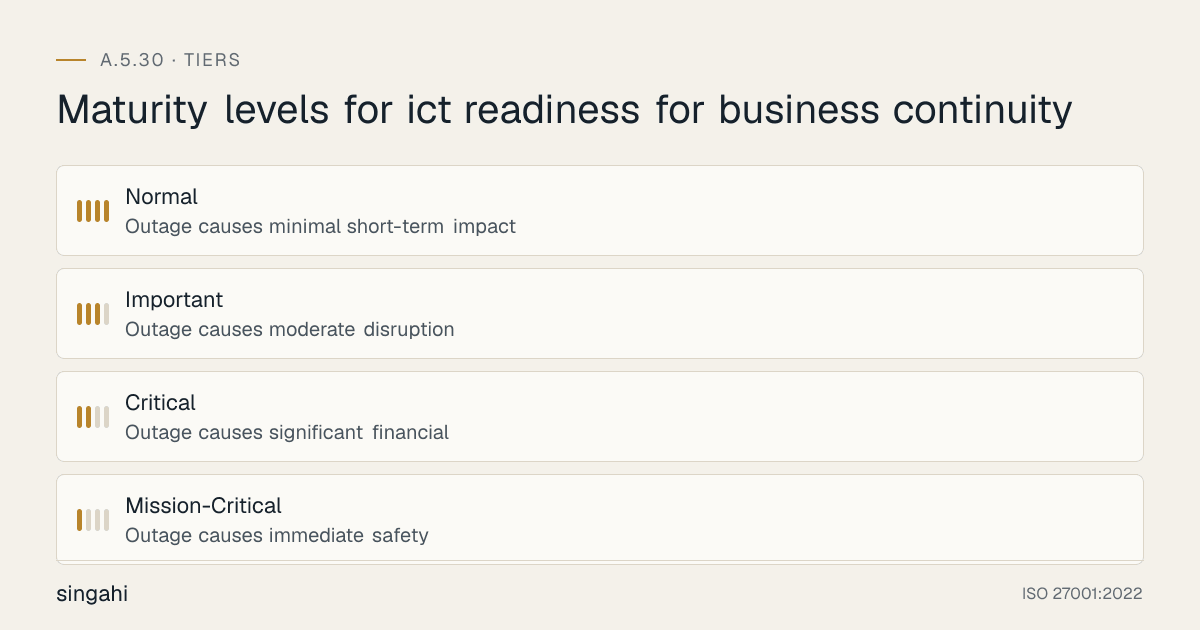
Figure · Tiers
Maturity levels for ict readiness for business continuity
Implementing A.5.30 requires a structured, risk-based approach. The following steps provide a complete implementation pathway, tiered by organization maturity.
Step 1: Establish Governance and Accountability
Before designing technical solutions, define who owns ICT readiness and how decisions are made.
Actions:
- Appoint an ICT Readiness Owner, typically the CISO or Head of Infrastructure.
- Form a Business Continuity Steering Committee with representatives from IT, security, operations, legal, HR, facilities, and key business units.
- Define a charter that includes authority, budget, reporting lines, and escalation paths.
- Document the ICT readiness policy (template provided in Section 9).
- Integrate ICT readiness into the ISMS scope statement and management review agenda.
Evidence: Policy document, committee charter, meeting minutes, management review records.
Step 2: Conduct Business Impact Analysis (BIA)
The BIA is the foundation of ICT readiness. Without it, RTO and RPO are guesses.
Actions:
- Inventory all business processes and ICT services.
- For each service, identify:
- Business owner
- Users and customers affected
- Financial impact per hour of outage
- Regulatory and contractual impact
- Reputational impact
- Interdependencies with other services
- Determine Maximum Tolerable Downtime (MTD).
- Derive Recovery Time Objective (RTO) and Recovery Point Objective (RPO).
- Classify services as Critical, Important, or Normal.
- Document dependencies: applications depend on databases; databases depend on storage; storage depends on networks; networks depend on ISPs.
- Validate BIA with business owners and management.
BIA Classification Table:
| Tier | Description | Typical RTO | Typical RPO | Examples |
|---|---|---|---|---|
| Tier 0, Mission-Critical | Outage causes immediate safety, regulatory, or severe financial harm. | 0–4 hours | 0–15 minutes | Core banking, trading platform, hospital EMR, payment gateway |
| Tier 1, Critical | Outage causes significant financial or operational damage. | 4–24 hours | 15 minutes – 1 hour | ERP, CRM, e-commerce platform, claims processing |
| Tier 2, Important | Outage causes moderate disruption but is manageable. | 24–72 hours | 4–24 hours | HR systems, expense management, internal collaboration |
| Tier 3, Normal | Outage causes minimal short-term impact. | 72 hours – 1 week | 24 hours – 1 week | Intranet, archive systems, non-critical reporting |
Evidence: BIA report, service inventory, RTO/RPO matrix, management sign-off.
Step 3: Identify Required ICT Resources
For each critical ICT service, identify every resource required for recovery.
Actions:
- Create a Critical ICT Service Register.
- For each service, document:
- Application stack (OS, middleware, database, application code)
- Infrastructure (compute, storage, network)
- Data stores and data flows
- Configuration files, secrets, certificates, API keys
- Third-party dependencies (SaaS, cloud, telecom, MSP)
- Documentation and runbooks
- Personnel with recovery skills
- Physical resources (hardware, alternate site)
- Map dependencies using a dependency graph or CMDB.
- Identify single points of failure.
Evidence: Critical ICT Service Register, dependency maps, CMDB extracts.
Step 4: Make Resources Available
Once resources are identified, procure, configure, and maintain them so they are available when needed.
Actions:
-
Backup strategy
- Implement the 3-2-1-1-0 rule: 3 copies of data, 2 different media, 1 offsite, 1 offline/air-gapped, 0 errors after restore verification.
- For ransomware resilience, maintain immutable backups.
- Encrypt backups and secure encryption keys separately.
- Document backup schedules, retention, and recovery procedures.
-
Redundancy and high availability
- Deploy clustering, load balancing, and auto-scaling for critical services.
- Use multi-AZ or multi-region deployments in cloud environments.
- Maintain redundant network paths and ISPs.
- Use redundant power (UPS, generator) and cooling.
-
Disaster recovery site
- Choose an appropriate model: hot site, warm site, cold site, or cloud-based DR.
- Ensure the DR site is geographically separated from the primary site to avoid correlated risks (e.g., same flood zone, same power grid).
- For Indian regulated entities, prefer in-country secondary sites where required.
-
Cloud and SaaS continuity
- Configure cross-region replication.
- Understand shared responsibility model, cloud provider ensures infrastructure resilience; customer ensures configuration, data, and recovery testing.
- Maintain vendor continuity clauses and exit strategies.
-
Documentation and runbooks
- Write step-by-step recovery runbooks.
- Include contact lists, decision trees, escalation paths, and rollback procedures.
- Store runbooks in multiple accessible formats (online, offline, printed).
-
Personnel readiness
- Maintain an on-call roster and succession plan.
- Train recovery teams and conduct skills assessments.
- Cross-train personnel to avoid single-person dependency.
Evidence: Backup architecture diagrams, DR site configuration, runbooks, training records, vendor contracts.
Step 5: Ensure Readiness Through Testing
Resources that are not tested are not ready. Testing validates that recovery will actually work.
Types of Tests:
| Test Type | Description | Frequency | Maturity Level |
|---|---|---|---|
| Tabletop Exercise | Discussion-based walkthrough of scenarios. | Quarterly | 2–3 |
| Simulation Exercise | Partial activation of continuity plans without full failover. | Semi-annually | 3–4 |
| Full Failover Test | Complete switchover to DR site or alternate region. | Annually | 4–5 |
| Backup Restore Test | Restore data from backup to a test environment. | Monthly to quarterly | 2–5 |
| Chaos Engineering | Deliberately inject failures to test resilience. | Continuous | 5 |
| Application DR Drill | Recover a specific application end-to-end. | Quarterly | 3–5 |
Actions:
- Develop an annual ICT continuity exercise schedule.
- Define test objectives, scope, success criteria, and rollback plans.
- Conduct tests in a controlled manner to avoid production impact.
- Document results, issues, and remediation actions.
- Update plans and runbooks based on lessons learned.
- Report results to management.
Evidence: Exercise plans, test results, issue logs, remediation tracker, management reports.
Step 6: Integrate with Incident and Crisis Management
ICT continuity is not a separate silo. It must be triggered by incident response and crisis management processes.
Actions:
- Define criteria for invoking ICT continuity plans (e.g., outage exceeding RTO, ransomware, site loss).
- Align escalation paths between SOC, incident response team, crisis management team, and business continuity team.
- Include DR invocation steps in incident response playbooks.
- Ensure communication plans cover internal teams, customers, regulators, vendors, and media.
- Practice integrated exercises that combine cyber incident response with DR invocation.
Evidence: Incident response playbooks, crisis communication templates, integrated exercise records.
Step 7: Manage Changes and Continuous Improvement
ICT environments change constantly. Every change can affect continuity readiness.
Actions:
- Include continuity impact assessment in change management.
- Update BIA and RTO/RPO when business processes change.
- Review and update ICT continuity plans at least annually.
- Update runbooks after every test, incident, or major change.
- Track continuity-related metrics and KPIs.
- Conduct management reviews of ICT readiness status.
Evidence: Change request records with continuity impact, updated plans, management review minutes.
Implementation by Organization Maturity
Level 1, Reactive
- Maintain basic backups.
- Document a simple recovery procedure.
- Test backup restore at least annually.
- Assign an informal DR owner.
Level 2, Developing
- Conduct BIA for top 10 services.
- Define RTO/RPO.
- Implement offsite backups.
- Create an ICT continuity plan.
- Conduct tabletop exercise annually.
Level 3, Defined
- Complete BIA and service inventory.
- Automated backups with monitoring.
- Warm DR site or cloud multi-region.
- Documented runbooks for critical services.
- Bi-annual exercises including simulation.
Level 4, Managed
- Active-active or near-active DR.
- Automated failover for critical services.
- Integrated incident and crisis management.
- Quarterly exercises.
- Real-time dashboards for RTO/RPO and backup health.
Level 5, Optimizing
- Chaos engineering and continuous resilience testing.
- AI-driven predictive failure analysis.
- Self-healing systems.
- Board-level resilience reporting.
- Continuous improvement culture.
Tools, Technologies, and Solutions
Tool Categories for ICT Readiness
| Category | Purpose | Examples |
|---|---|---|
| Backup & Recovery | Create, manage, and restore backups | Veeam, Commvault, Rubrik, Cohesity, Druva, Acronis |
| Cloud DR / Replication | Replicate workloads to cloud regions | AWS Elastic Disaster Recovery, Azure Site Recovery, Google Cloud Disaster Recovery |
| Infrastructure Monitoring | Detect failures and performance degradation | Datadog, New Relic, Dynatrace, PRTG, Nagios, Zabbix |
| IT Service Management (ITSM) | Manage incidents, changes, and CMDB | ServiceNow, Jira Service Management, Freshservice, BMC Remedy |
| Configuration Management Database (CMDB) | Track ICT assets and dependencies | ServiceNow CMDB, Lansweeper, Device42, ManageEngine |
| Chaos Engineering | Test resilience through controlled failure injection | Gremlin, Chaos Monkey, Litmus, AWS Fault Injection Simulator |
| Communication & Alerting | Notify teams during disruptions | PagerDuty, Opsgenie, Twilio, Exotel, Freshstatus |
| Documentation & Runbooks | Maintain recovery procedures | Confluence, Notion, GitLab Wiki, IT Glue |
| Security Operations | Detect and respond to cyber incidents | SIEM (Splunk, Sentinel, Chronicle), SOAR (Palo Alto XSOAR, Swimlane) |
| Data Protection | Ensure data availability and immutability | Immutable backup storage, object lock (AWS S3 Object Lock, Azure Immutable Blob) |
Vendor Comparison Matrix
| Vendor / Solution | Category | Best For | Pricing model | Pros | Cons |
|---|---|---|---|---|---|
| Veeam Backup & Replication | Backup & DR | On-premise, VMware/Hyper-V, cloud | Commercial, per workload | Mature, reliable, wide support | Licensing complexity |
| Druva | Cloud backup | SaaS, endpoints, cloud workloads | Commercial, per user | Cloud-native, global deduplication | Requires internet for restore |
| AWS Elastic Disaster Recovery | Cloud DR | AWS and on-prem to AWS | Pay per protected server + storage | Native AWS integration, fast RTO | AWS-only target |
| Azure Site Recovery | Cloud DR | Microsoft-centric environments | Commercial, per VM | Strong Azure integration | Complexity for multi-cloud |
| Cohesity | Backup & data management | Enterprise multi-workload | Enterprise pricing (POA) | Unified platform, ransomware recovery | Higher cost for SMBs |
| Rubrik | Backup & data security | Enterprise, ransomware resilience | Enterprise pricing (POA) | Strong security features | Premium pricing |
| Datadog | Monitoring | Cloud-native observability | Commercial, per host | Complete observability | Cost can escalate |
| ServiceNow | ITSM / CMDB | Enterprise ITSM | Commercial, per user | Integrated platform | Complex implementation |
| Jira Service Management | ITSM / CMDB | Agile teams, growing companies | Commercial, per user | Easy adoption, Atlassian ecosystem | Limited out-of-box CMDB |
| ManageEngine ServiceDesk Plus | ITSM | Indian SMBs and growing companies | Commercial, per user | efficient, local support | Less enterprise depth |
| PagerDuty | Incident alerting | DevOps/SRE teams | Commercial, per user | Excellent on-call orchestration | Pricing for large teams |
| Gremlin | Chaos engineering | Cloud-native enterprises | Commercial, per host | Controlled failure injection | Requires mature DevOps |
| AWS Fault Injection Simulator | Chaos engineering | AWS workloads | Pay per action | Native AWS, lightweight | AWS-only |
Indian Vendor Options
| Vendor | Offering | Notes |
|---|---|---|
| Netmagic (NTT) | Managed DR, data centre, cloud | Strong presence in India; data centres widely used by RBI-regulated entities. |
| Sify Technologies | Data centre, cloud DR, managed security | Suitable for regulated Indian enterprises. |
| Tata Communications | Network redundancy, cloud connect, DR | Global network with India-focused DR solutions. |
| CtrlS Datacenters | Tier-4 data centres, DRaaS | Indian Tier-4 data centre provider. |
| STT GDC India | Colocation and DR sites | Multiple India locations. |
| ZNet Technologies | Cloud backup and DR distribution | Partner for Veeam, Acronis, and cloud DR. |
Technology Selection Criteria
When selecting ICT readiness tools, evaluate:
- RTO/RPO support: Can the solution meet your recovery objectives?
- Scalability: Can it grow with your data and workload volumes?
- Compatibility: Does it support your OS, applications, databases, and cloud platforms?
- Security: Does it offer encryption, immutability, RBAC, and audit logging?
- Ease of recovery: How complex is the restore/failover process?
- Automation: Does it support automated failover and orchestration?
- Cost: Include licensing, storage, bandwidth, and operational costs.
- Vendor stability: Is the vendor financially stable and compliant with Indian regulations?
- Support: Is 24/7 support available in India?
- Integration: Does it integrate with your ITSM, SIEM, and monitoring tools?
Policy and Procedure Templates
ICT Readiness for Business Continuity Policy
ICT READINESS FOR BUSINESS CONTINUITY POLICY
[Organization Name]
Version: 1.0
Approved by: [CEO / Managing Director]
Date: [Date]
Review Date: [Date + 12 months]
Classification: Internal

1. PURPOSE AND SCOPE

1.1 Purpose
This policy establishes the framework for ensuring that information and
communication technology (ICT) resources required by the organization's
business continuity plans and procedures are identified, made available,
and ready for use when needed.

1.2 Scope
This policy applies to all ICT services, systems, data, networks, cloud
services, third-party ICT providers, and personnel that support the
organization's critical business processes.

2. POLICY STATEMENT

[Organization Name] is committed to maintaining ICT readiness to ensure
business continuity during disruptions. The organization shall:

a) Conduct and maintain a Business Impact Analysis (BIA) for all ICT
   services.
b) Define and document Recovery Time Objectives (RTO), Recovery Point
   Objectives (RPO), and Maximum Tolerable Downtime (MTD).
c) Identify all ICT resources required to support business continuity.
d) Make those resources available through backup, redundancy, disaster
   recovery sites, and alternate processing arrangements.
e) Ensure resources are ready for use through regular testing, exercising,
   and maintenance.
f) Integrate ICT readiness with incident response and crisis management.
g) Review and update ICT continuity arrangements at planned intervals and
   when significant changes occur.

3. ROLES AND RESPONSIBILITIES

3.1 Board / Top Management
   • Approve the ICT readiness strategy, policy, and budget.
   • Review ICT readiness status at management reviews.
   • Accept residual risks where treatment is not feasible.

3.2 CISO / Information Security Manager
   • Co-own ICT readiness with IT leadership.
   • Ensure security controls are maintained during continuity events.
   • Integrate ICT readiness into the ISMS.

3.3 Head of IT / CTO
   • Own ICT infrastructure recovery.
   • Ensure systems can be restored within defined RTO/RPO.
   • Maintain DR site, backups, and redundancy.

3.4 Business Continuity Manager
   • Coordinate BIA and business requirements.
   • Maintain the business continuity plan and ICT continuity plan.
   • Schedule and facilitate continuity exercises.

3.5 Application Owners
   • Define criticality and recovery requirements for their applications.
   • Participate in BIA and testing.
   • Approve recovery priorities.

3.6 All Employees
   • Follow ICT continuity procedures.
   • Report incidents and disruptions promptly.
   • Participate in training and exercises.

4. BUSINESS IMPACT ANALYSIS

The BIA shall be conducted at least annually and whenever significant
changes occur. It shall identify:
   • Critical ICT services
   • Dependencies
   • RTO, RPO, and MTD
   • Financial, operational, regulatory, and reputational impacts

5. ICT CONTINUITY ARRANGEMENTS

5.1 Backup
   • Backups shall be performed according to defined schedules.
   • Backup data shall be encrypted, tested, and stored securely offsite
     or in a separate cloud region.
   • Immutable backups shall be maintained for ransomware protection.

5.2 Redundancy
   • Critical systems shall use clustering, load balancing, or multi-region
     deployment.
   • Network links shall be redundant where feasible.

5.3 Disaster Recovery Site
   • A DR site or cloud-based recovery environment shall be maintained.
   • The DR site shall be geographically separated from the primary site.

5.4 Third-Party ICT Services
   • Contracts shall include continuity, DR, and incident notification
     requirements.
   • Key vendors shall provide evidence of their BCP/DR capabilities.

6. TESTING AND EXERCISING

ICT readiness shall be tested through:
   • Quarterly backup restore tests
   • Semi-annual tabletop or simulation exercises
   • Annual full failover tests for critical systems
   • Ad-hoc tests after major changes or incidents

7. CONTINUOUS IMPROVEMENT

Test results, incident reviews, and audit findings shall be used to
improve ICT readiness. Plans shall be updated accordingly.

8. COMPLIANCE

This policy aligns with ISO 27001:2022 Annex A 5.30, RBI cyber security
guidelines, SEBI CSCRF (2024), IRDAI guidelines, the DPDP
Act 2023, and the IT Act 2000.

9. POLICY REVIEW

This policy is reviewed annually and after significant changes.

APPROVED BY:
[CEO Name]                    Date: [Date]
[CISO Name]                   Date: [Date]
[Head of IT Name]             Date: [Date]
ICT Continuity Procedure
PROCEDURE: ICT CONTINUITY ACTIVATION AND RECOVERY
Version: 1.0
Owner: Business Continuity Manager / Head of IT

1. PURPOSE
This procedure describes how to activate and execute ICT continuity
arrangements during a disruption.

2. SCOPE
Applies to all incidents or disruptions that threaten the availability
of critical ICT services beyond their defined RTO.

3. ACTIVATION CRITERIA
ICT continuity plans may be activated when:
   • A critical ICT service is unavailable and RTO will be exceeded.
   • A site, region, or major facility is inaccessible.
   • A ransomware or destructive cyber-attack is detected.
   • A natural disaster, fire, or civil emergency affects ICT operations.
   • A third-party service failure impacts critical operations.
   • The Crisis Management Team or CISO declares a crisis.

4. ACTIVATION STEPS

Step 1: Detect and Assess
   • Incident response team or monitoring system detects disruption.
   • Assess impact, affected services, and estimated recovery time.
   • Notify Business Continuity Manager and CISO.

Step 2: Decide on Activation
   • If recovery within RTO is unlikely, recommend activation.
   • Crisis Management Team or authorized owner approves activation.

Step 3: Notify Stakeholders
   • Activate communication tree.
   • Notify internal teams, vendors, customers, and regulators as needed.

Step 4: Execute Recovery
   • Follow runbooks for affected services.
   • Restore from backups, failover to DR site, or activate alternate
     processing.
   • Verify integrity and security of recovered systems.

Step 5: Resume Operations
   • Validate that services meet acceptance criteria.
   • Gradually restore user access.
   • Monitor for anomalies.

Step 6: Stand Down
   • When primary systems are restored, plan failback.
   • Verify data consistency and system integrity.
   • Return to normal operations.

5. COMMUNICATION
   • Use predefined communication templates.
   • Maintain a call tree and contact list.
   • Designate a single spokesperson for external communication.

6. DOCUMENTATION
   • Maintain an incident log with timestamps and decisions.
   • Record all recovery actions.
   • Capture evidence for post-incident review.

7. POST-EVENT REVIEW
   • Conduct a lessons-learned session within 5 working days.
   • Update BIA, plans, and runbooks as needed.
   • Report to management review.
Risk Assessment and Treatment
Risk Identification
| Risk ID | Risk Description | Threat Source | Vulnerability | Likelihood | Impact | Risk Level | Treatment |
|---|---|---|---|---|---|---|---|
| R1 | Backup restoration fails when needed | Hardware failure, ransomware | Untested backups, no restore validation | Medium | Critical | High | Implement automated backup testing; 3-2-1-1-0 strategy; immutable backups |
| R2 | DR site is out of sync or unavailable | Configuration drift, vendor issue | Infrequent DR testing | Medium | Critical | High | Quarterly DR sync checks; annual full failover; automated health monitoring |
| R3 | Single point of failure in network connectivity | ISP outage, cable cut | Single ISP, no redundant link | Medium | High | High | Dual ISP; SD-WAN; 4G/5G fallback |
| R4 | RTO/RPO not met due to slow recovery | Human error, outdated runbooks | Lack of automation, unclear procedures | Medium | High | High | Automate failover; maintain current runbooks; conduct regular exercises |
| R5 | Cloud provider regional outage | Natural disaster, provider failure | Single-region deployment | Low | Critical | High | Multi-region active-active or warm standby |
| R6 | Loss of critical personnel during crisis | Pandemic, travel restrictions | Key-person dependency | Medium | Medium | Medium | Cross-training; documented runbooks; remote access for recovery team |
| R7 | Third-party SaaS outage impacts operations | Vendor incident | No vendor BCP review | Medium | High | High | Vendor BCP assessments; contractual RTO/RPO; backup vendors |
| R8 | Data corruption replicated to DR site | Malware, logical error | Synchronous replication without point-in-time recovery | Low | Critical | High | Immutable backups; point-in-time recovery; air-gapped copies |
| R9 | Insufficient capacity at DR site | Unexpected load | DR site sized for partial load only | Low | High | Medium | Size DR site for full production load; cloud burst capacity |
| R10 | Communication failure during crisis | Telecom outage | Single communication channel | Medium | High | High | Multiple channels: email, SMS, WhatsApp Business, satellite phone, web status page |
| R11 | Regulatory reporting failure due to downtime | Extended outage | No integration between incident response and regulatory reporting | Medium | High | High | Pre-drafted regulatory reporting templates; trained compliance liaison |
| R12 | Cryptographic keys unavailable during recovery | HSM failure, key loss | Keys not backed up or escrowed | Low | Critical | High | HSM clustering; key escrow; offline key storage |
Risk Treatment Plan
| Risk ID | Treatment Option | Owner | Target Date | Residual Risk |
|---|---|---|---|---|
| R1 | Mitigate | Head of IT | Q1 | Medium |
| R2 | Mitigate | Business Continuity Manager | Q1 | Medium |
| R3 | Mitigate | Network Manager | Q2 | Low |
| R4 | Mitigate | CISO + Head of IT | Q2 | Medium |
| R5 | Mitigate | Cloud Architect | Q2 | Medium |
| R6 | Mitigate | HR + IT | Q3 | Low |
| R7 | Mitigate + Transfer | Vendor Manager | Q2 | Medium |
| R8 | Mitigate | Database Manager | Q1 | Low |
| R9 | Mitigate | Infrastructure Manager | Q3 | Low |
| R10 | Mitigate | Crisis Management Team | Q2 | Low |
| R11 | Mitigate | Compliance Officer | Q2 | Low |
| R12 | Mitigate | CISO | Q1 | Low |
Audit and Compliance Checklist
Use this checklist to prepare for internal and certification audits.
| # | Audit Question | Expected Evidence | Red Flag |
|---|---|---|---|
| 1 | Is an ICT readiness policy defined, approved, and communicated? | Signed policy, distribution records | No policy or outdated policy |
| 2 | Is a Business Impact Analysis (BIA) conducted and maintained? | BIA report, RTO/RPO matrix | No BIA or BIA older than 12 months |
| 3 | Are critical ICT services identified with owners? | Service inventory, ownership register | No clear ownership |
| 4 | Are RTO, RPO, and MTD defined and agreed? | Documented objectives, management approval | Arbitrary values not tied to business needs |
| 5 | Are ICT resources required for continuity identified? | Critical ICT resource register | Missing resources or dependencies |
| 6 | Are backups performed according to defined schedules? | Backup logs, schedules | Backups missing or irregular |
| 7 | Are backups tested for successful restoration? | Restore test records | No restore tests in last 12 months |
| 8 | Are backups encrypted and stored securely? | Encryption configuration, access logs | Unencrypted backups or shared keys |
| 9 | Is redundancy implemented for critical systems? | Architecture diagrams, configuration | Single points of failure |
| 10 | Is a DR site or alternate recovery environment maintained? | DR site contract, configuration | No DR site or DR site unmaintained |
| 11 | Is the DR site geographically separated from the primary site? | Site addresses, risk assessment | DR site in same building or flood zone |
| 12 | Are failover and recovery runbooks documented and current? | Runbooks, version history | Outdated or missing runbooks |
| 13 | Are ICT continuity exercises conducted periodically? | Exercise plans, attendance, reports | No exercises in last 12 months |
| 14 | Are exercise findings remediated and plans updated? | Issue log, updated plans | Open critical findings, no updates |
| 15 | Are third-party ICT providers assessed for continuity? | Vendor assessments, contracts | No vendor BCP/DR requirements |
| 16 | Are changes assessed for impact on ICT continuity? | Change records with continuity impact | Changes approved without continuity review |
| 17 | Are personnel trained on ICT continuity roles? | Training records, attendance | Untrained recovery team |
| 18 | Is there an on-call roster for continuity events? | On-call schedule, contact list | No roster or single-person dependency |
| 19 | Are ICT continuity plans integrated with incident response? | Incident response playbook, DR invocation steps | Siloed plans |
| 20 | Are communication plans in place for disruptions? | Communication templates, contact lists | No customer/regulator communication plan |
| 21 | Are metrics and KPIs tracked for ICT readiness? | Dashboards, reports | No measurement of readiness |
| 22 | Is ICT readiness reviewed at management reviews? | Management review minutes | Never discussed at management review |
| 23 | Are logs and evidence preserved during recovery? | Logging policy, recovery procedures | Evidence destruction during recovery |
| 24 | Are cryptographic keys and credentials available during recovery? | Key escrow, HSM clustering, secure credential store | Keys only on failed system |
| 25 | Is there a documented process for returning to normal operations? | Failback procedure | No failback plan |
| 26 | Are regulatory reporting requirements addressed in continuity plans? | Regulatory reporting templates | Missing RBI/SEBI/CERT-In reporting steps |
| 27 | Is the ICT continuity plan aligned with the overall BCP? | BCP and DRP cross-references | BCP and DRP contradict each other |
| 28 | Are single points of failure identified and treated? | SPOF analysis, treatment plan | Known SPOFs not addressed |
| 29 | Is there a process for invoking ICT continuity during a cyber incident? | Decision tree, escalation matrix | No link between SOC and DR team |
| 30 | Are lessons learned from incidents and exercises incorporated? | Improvement log, updated procedures | Same issues recur |
Metrics and KPIs
Figure · Measures
The measures that show A.5.30 is working
- RTO Achievement Rate≥ 95%Per exercise /
- RPO Achievement Rate≥ 98%Per exercise /
- Backup Success Rate≥ 99.5%Weekly
- Backup Restore Test Success Rate100%Monthly
- DR Exercise Frequency≥ 2 per yearQuarterly
| # | KPI | Formula | Target | Frequency | Owner |
|---|---|---|---|---|---|
| 1 | RTO Achievement Rate | (Number of exercises/incidents meeting RTO / Total exercises/incidents) × 100 | ≥ 95% | Per exercise / incident | Head of IT |
| 2 | RPO Achievement Rate | (Number of recoveries within RPO / Total recoveries) × 100 | ≥ 98% | Per exercise / incident | Database Manager |
| 3 | Backup Success Rate | (Successful backups / Total scheduled backups) × 100 | ≥ 99.5% | Weekly | Backup Administrator |
| 4 | Backup Restore Test Success Rate | (Successful restore tests / Total restore tests) × 100 | 100% | Monthly | Backup Administrator |
| 5 | DR Exercise Frequency | Number of DR exercises conducted in period | ≥ 2 per year | Quarterly | BCM |
| 6 | Mean Time to Recover (MTTR) | Total recovery time / Number of incidents | ≤ 50% of RTO | Monthly | Head of IT |
| 7 | Critical System Availability | (Uptime / Total time) × 100 | ≥ 99.9% | Monthly | Infrastructure Manager |
| 8 | Recovery Test Coverage | (Critical systems tested / Total critical systems) × 100 | 100% | Quarterly | BCM |
| 9 | Runbook Currency | (Runbooks updated in last 6 months / Total runbooks) × 100 | 100% | Quarterly | BCM |
| 10 | SPOF Remediation Rate | (SPOFs remediated / SPOFs identified) × 100 | ≥ 90% | Quarterly | Head of IT |
| 11 | Vendor BCP Assessment Coverage | (Critical vendors assessed / Total critical vendors) × 100 | 100% | Annually | Vendor Manager |
| 12 | Training Completion Rate | (Trained continuity staff / Total continuity staff) × 100 | 100% | Annually | HR / BCM |
| 13 | Incident-to-DR Activation Time | Time from incident declaration to DR activation | ≤ 30 minutes | Per incident | Incident Manager |
| 14 | DR Site Synchronization Lag | Time lag between primary and DR for critical data | ≤ RPO | Continuous | Infrastructure Manager |
| 15 | Management Review Readiness Score | Aggregate score from readiness metrics | ≥ 90% | Quarterly | CISO |
Common Pitfalls / Audit Failures & How to Avoid Them
| # | Pitfall / Audit Failure | Root Cause | How to Avoid |
|---|---|---|---|
| 1 | Backups exist but never restored | Focus on backup completion, not restore validation | Schedule monthly automated restore tests; require success criteria |
| 2 | DR site is a "checkbox" exercise | DR site procured but never updated or tested | Quarterly sync checks; annual full failover; treat DR as production |
| 3 | RTO/RPO are IT guesses | No BIA or business involvement | Conduct formal BIA; get business owner sign-off on RTO/RPO |
| 4 | Runbooks are outdated | No process to update after changes | Update runbooks after every change, test, or incident; version control |
| 5 | Single-person dependency | Recovery knowledge concentrated in one person | Cross-train; document; use runbooks; maintain succession plan |
| 6 | Cloud DR is assumed to "just work" | Misunderstanding shared responsibility | Configure, test, and validate cloud recovery; don't rely on defaults |
| 7 | Ignoring application dependencies | Recovery of one app fails because another is down | Map dependencies; recover in sequence; test end-to-end |
| 8 | No communication plan | Focus only on technical recovery | Pre-draft customer, regulator, and internal messages |
| 9 | DR tests disrupt production | Poorly planned exercises | Use isolated test environments; schedule low-impact windows |
| 10 | Vendor continuity not verified | Contracts lack BCP/DR clauses | Include RTO/RPO and audit rights in contracts; assess annually |
| 11 | Data replicated corruption to DR | Synchronous replication without immutability | Use point-in-time recovery; maintain immutable backups |
| 12 | Keys and credentials lost | No key escrow or credential backup | HSM clustering; secure offline key storage; password manager with DR access |
| 13 | Plans not integrated with incident response | Separate teams and documents | Joint exercises; shared escalation matrix; unified playbooks |
| 14 | Only testing happy path | Fear of production impact | Include realistic failure scenarios: ransomware, site loss, key personnel unavailable |
| 15 | Ignoring regulatory reporting during crisis | Crisis team not trained on reporting | Pre-drafted RBI/SEBI/CERT-In reporting templates |
Illustrative Scenarios
Illustrative scenario, a composite example for guidance, not a specific Singahi engagement or a verified outcome.
Illustrative Scenario 1: Indian Private Sector Bank, Core Banking Failover Failure
Organization: A private sector bank with 1,200+ branches and 15 million customers.
Challenge: In early 2023, the bank experienced a 14-hour outage of its core banking solution (CBS). The primary data centre lost power due to a transformer failure. The uninterruptible power supply (UPS) worked, but the generator failed to auto-start because of a fuel-line issue. When IT attempted to fail over to the secondary data centre, they discovered that the last successful database replication had occurred 36 hours earlier due to a network configuration change that had silently broken replication. The DR site had the application stack but not current data. Recovery required manual database reconstruction from backup tapes, extending the outage.
Impact:
- 14-hour outage of net banking, mobile banking, UPI, and branch operations.
- RBI issued a show-cause notice and mandated an independent forensic audit.
- Customer complaints flooded social media and banking ombudsman channels.
- Reputational damage took nine months to recover.
Root Causes:
- Generator maintenance was not tied to business continuity testing.
- Replication health was not monitored after a network change.
- DR drills were tabletop-only; no full failover had been attempted in three years.
- Change management did not assess impact on DR replication.
- Runbooks did not include verification steps for data currency at DR site.
Solution Implemented (with external support):
- Conducted a complete BIA across all 180 ICT services and defined tiered RTO/RPO.
- Redesigned DR architecture with synchronous replication for Tier 0 and near-synchronous for Tier 1.
- Implemented automated replication monitoring with alerting.
- Established quarterly full-site DR drills and monthly backup restore tests.
- Integrated change management with ICT continuity impact assessment.
- Created detailed runbooks with decision trees and data-currency checks.
- Trained 80+ personnel across IT, security, operations, and communications.
Results:
- RTO for Tier 0 services reduced from 14 hours to 45 minutes.
- RPO for Tier 0 services reduced from 36 hours to 5 minutes.
- First successful full-site DR drill completed within 90 days.
- RBI closed the enforcement action after verifying sustained improvement.
- Bank achieved ISO 27001:2022 surveillance audit with zero major nonconformities.
Illustrative Scenario 2: Bengaluru HealthTech SaaS, Ransomware Recovery Through Immutable Backups
Organization: A Bengaluru-based HealthTech SaaS provider serving 400+ hospitals and clinics across India.
Challenge: In late 2023, the company was hit by a ransomware attack that encrypted production servers, databases, and backups stored on a network-attached storage (NAS) device. The attackers had been inside the environment for 21 days before detonating the ransomware. They gained access through a compromised VPN account and moved laterally to the backup server. Because backups were not immutable and were reachable from the production network, they were also encrypted. The company faced a choice: pay the ransom or rebuild from scratch.
Impact:
- 72-hour outage of the patient management platform.
- Potential exposure of 2.8 million patient records.
- Regulatory notification obligations under the IT Act (CERT-In) and the DPDP Act (breach duties apply once the Rules' transition ends, about May 2027).
- Customer churn of 18% in the following quarter.
Root Causes:
- Backups were not air-gapped or immutable.
- VPN lacked multi-factor authentication (MFA).
- Lateral movement was not detected due to weak network segmentation.
- No incident response and DR integration.
- RTO/RPO were not formally defined; recovery was ad-hoc.
Solution Implemented (with external support):
- Deployed immutable backup solution with 30-day object lock and offline/air-gapped copies.
- Implemented MFA for all remote access and privileged accounts.
- Segregated networks and restricted backup infrastructure access.
- Defined RTO (4 hours) and RPO (15 minutes) for the patient platform.
- Built an automated recovery pipeline that could rebuild the entire environment from immutable backups.
- Integrated incident response with ICT continuity activation procedures.
- Conducted quarterly ransomware recovery drills.
- Implemented 24/7 SOC monitoring and EDR.
Results:
- Successful ransomware recovery drill completed in 3.5 hours (within RTO).
- Data loss limited to 8 minutes (well within RPO).
- Zero ransom paid.
- Regained customer trust; churn stabilized and new customer acquisition resumed.
- Passed a follow-up ISO 27001:2022 certification audit and a customer-led security assessment.
Illustrative Scenario 3: Mumbai NBFC, Cloud Region Outage and Multi-Region Resilience
Organization: A Mumbai-based non-banking financial company (NBFC) with a large loan book.
Challenge: In 2024, the NBFC's cloud provider experienced a multi-hour outage in the Mumbai region, affecting the NBFC's loan origination system, customer portal, and internal collections platform. Although the cloud provider restored service, the NBFC had no multi-region failover configured. Loan disbursements halted for six hours, and customer service teams were overwhelmed. The outage occurred during a peak festival season, compounding revenue impact.
Impact:
- 6-hour outage affecting 12,000 active loan applications.
- Negative media coverage and customer complaints.
- Internal pressure to move away from cloud entirely (which would have been a damaging overreaction).
Root Causes:
- Single-region cloud deployment.
- No multi-region DR strategy.
- Assumption that cloud availability equals application availability.
- No BIA or formal RTO/RPO for digital lending platforms.
Solution Implemented (with external support):
- Conducted BIA for all digital lending and collections platforms.
- Designed active-passive multi-region architecture with automatic DNS failover.
- Implemented cross-region database replication with 1-minute RPO.
- Created runbooks for regional failover and failback.
- Conducted bi-annual regional failover exercises.
- Negotiated cloud contract amendments for priority support during outages.
Results:
- RTO reduced to 15 minutes for critical lending platforms.
- RPO reduced to 1 minute.
- Successful regional failover exercise completed within 4 months.
- Management approved resilience budget as a strategic investment.
- Improved customer SLA posture and competitive positioning.
Multi-Framework Mapping
| ISO 27001:2022 A.5.30 Requirement | SOC 2 | PCI DSS v4.0.1 | NIST SP 800-53 Rev. 5 | CIS Controls v8 | COBIT 2019 | DPDP Act / GDPR |
|---|---|---|---|---|---|---|
| BIA-driven RTO/RPO and capacity | A1.1 (capacity), A1.2 (environmental protections, backup and recovery) | 12.10.1 (business recovery and continuity procedures in the incident response plan) | CP-2 (contingency plan), CP-2(8) (identify critical assets) | Control 11 (data recovery) | DSS04.02 (maintain business resilience) | DPDP s.8(5); GDPR Art. 32(1)(b)–(c) |
| Backups, redundancy, alternate sites | A1.2 | 12.10.1; 9.4.1 (secure backup media) | CP-6, CP-7, CP-8, CP-9, CP-10 | 11.1–11.4 | DSS04.03 (develop and implement a business continuity response) | GDPR Art. 32(1)(c) |
| Exercise and test | A1.3 (recovery plan testing) | 12.10.2 (plan tested at least annually) | CP-4 (contingency plan testing) | 11.5 (test data recovery) | DSS04.04 (exercise, test and review the BCP) | Accountability |
| Management approval and review | CC1.2, CC4.1 | 12.4.1 (executive responsibility) | CP-2, PM-14 | - | DSS04.01, DSS04.08 | Accountability |
| Supplier continuity | CC9.1 (business disruption risk), CC9.2 | 12.8.4 | CP-2(6), SA-9 | 15.4 | APO10 | DPDP s.8(2) |
Mapping Notes
- SOC 2 Trust Services Criteria: the Availability criteria A1.1–A1.3 (capacity, recovery infrastructure, recovery testing) are the direct match; CC9.1 covers business disruption risk.
- PCI DSS v4.0.1: business recovery and continuity procedures sit in the incident response plan (12.10.1), tested annually (12.10.2); backup media security is 9.4.1.
- NIST 800-53: The Contingency Planning (CP) control family is the primary mapping; Incident Response (IR) and Audit (AU) families are secondary.
- CIS Controls v8: Control 11 (Data Recovery) is the most direct mapping; Controls 4, 7, 8, and 17 provide supporting controls.
- COBIT 2019: DSS04 (Managed Continuity) is the direct match.
- GDPR / DPDP Act 2023: Both frameworks require appropriate technical and organizational measures to ensure security, including availability and resilience. The DPDP Act's data fiduciary duty reinforces the need for ICT readiness.
Implementation Roadmap
Figure · Timeline
Rollout in order
- Phase 1: Init…Weeks 1–2
- Phase 2: Asse…Weeks 3–5
- Phase 3: Desi…Weeks 6–9
- Phase 4: Impl…Weeks 10–14
- Phase 5: TestWeeks 15–16
- Phase 6: Oper…Ongoing
Phase-Based Roadmap
| Phase | Duration | Focus | Key Deliverables |
|---|---|---|---|
| Phase 1: Initiate | Weeks 1–2 | Governance, policy, and scope | Steering committee, ICT readiness policy, project plan |
| Phase 2: Assess | Weeks 3–5 | BIA, service inventory, risk assessment | BIA report, RTO/RPO matrix, risk register |
| Phase 3: Design | Weeks 6–9 | Architecture, backup, redundancy, DR strategy | DR architecture, backup design, vendor contracts |
| Phase 4: Implement | Weeks 10–14 | Deploy solutions, document runbooks | Configured backups, DR site, runbooks, training |
| Phase 5: Test | Weeks 15–16 | Exercises and validation | Exercise reports, remediation plan, updated plans |
| Phase 6: Operate & Improve | Ongoing | Monitor, review, and improve | KPI dashboards, management reviews, annual updates |
Week-by-Week Plan
Week 1: Governance Kickoff
- Appoint ICT Readiness Owner and steering committee.
- Define scope, objectives, and success criteria.
- Review existing BCP/DR documents.
Week 2: Policy and Planning
- Draft ICT readiness policy.
- Develop project plan and RACI.
- Identify tools and budget.
Week 3: Business Impact Analysis, Part 1
- Inventory business processes and ICT services.
- Interview business owners.
- Draft criticality classification.
Week 4: Business Impact Analysis, Part 2
- Define RTO/RPO/MTD.
- Validate with management.
- Finalize BIA report.
Week 5: Risk and Dependency Assessment
- Map dependencies and single points of failure.
- Update risk register.
- Define treatment plan.
Week 6: Backup Strategy Design
- Design backup architecture (3-2-1-1-0).
- Select backup tools.
- Define retention and encryption.
Week 7: Redundancy and DR Architecture
- Design HA/DR architecture.
- Select DR site or cloud region strategy.
- Define failover mechanisms.
Week 8: Vendor and Third-Party Continuity
- Review critical vendor contracts.
- Issue BCP/DR questionnaires.
- Update contracts with continuity clauses.
Week 9: Documentation Design
- Develop ICT continuity plan template.
- Create runbook templates.
- Design communication templates.
Week 10: Backup Implementation
- Deploy backup solution.
- Configure schedules and retention.
- Set up monitoring and alerting.
Week 11: DR Implementation
- Configure replication/failover.
- Set up DR site or cloud recovery environment.
- Validate network connectivity.
Week 12: Runbooks and Procedures
- Write runbooks for critical services.
- Document activation and recovery procedures.
- Create contact lists and communication trees.
Week 13: Training and Awareness
- Train recovery teams.
- Conduct awareness sessions for all staff.
- Distribute quick reference cards.
Week 14: Initial Testing
- Conduct backup restore tests.
- Perform tabletop exercise.
- Log issues and update plans.
Week 15: Simulation Exercise
- Conduct simulation or partial failover.
- Validate communication and escalation.
- Measure RTO/RPO achievement.
Week 16: Full DR Drill and Closure
- Conduct full failover test (if feasible).
- Conduct post-exercise review.
- Update plans, runbooks, and KPI baselines.
- Present results to management.
Ongoing Activities
| Activity | Frequency | Owner |
|---|---|---|
| Backup restore test | Monthly | Backup Administrator |
| DR health check | Quarterly | Infrastructure Manager |
| Tabletop exercise | Quarterly | BCM |
| Full DR drill | Annually | BCM + Head of IT |
| BIA review | Annually | BCM |
| Policy review | Annually | CISO |
| Vendor BCP assessment | Annually | Vendor Manager |
| Training | Annually + onboarding | HR / BCM |
| Management review | Quarterly | Top Management |
| Post-incident review | After each incident | Incident Manager |
FAQ
Q1: Is A.5.30 only for large enterprises? No. A.5.30 applies to all organizations certified to or pursuing ISO 27001:2022. Small organizations can implement pragmatic, cloud-based continuity arrangements.
Q2: What is the difference between A.5.30 and A.5.29? A.5.30 ensures ICT resources are identified, available, and ready for use. A.5.29 focuses on maintaining information security during disruption. They are complementary.
Q3: Do we need a physical DR site, or is cloud DR acceptable? Cloud DR is acceptable if it meets your RTO/RPO and regulatory requirements. Many Indian organizations use cloud multi-region or hybrid DR strategies.
Q4: How often should we test DR? At minimum: annual full failover, semi-annual simulation, quarterly tabletop, and monthly backup restore tests. Regulated industries may require more frequent testing.
Q5: What RTO and RPO should we target? RTO and RPO are business decisions, not IT decisions. They depend on the financial, operational, and regulatory impact of downtime and data loss for each service.
Q6: Is backup alone sufficient for A.5.30? No. Backups are necessary but not sufficient. You also need redundancy, DR capability, tested recovery procedures, trained personnel, and integration with incident management.
Q7: How do we handle ICT readiness for SaaS vendors? Include BCP/DR clauses in contracts, review vendor SOC 2 or ISO 27001 reports, understand their RTO/RPO, and maintain your own data exports where possible.
Q8: What role does the CISO play in A.5.30? The CISO co-owns ICT readiness with IT leadership, ensuring security controls are preserved during failover and recovery, and integrating continuity into the ISMS.
Q9: How do we maintain runbook currency? Update runbooks after every major change, exercise, or incident. Assign owners, schedule periodic reviews, and track currency as a KPI.
Q10: Can we use chaos engineering for A.5.30? Yes. Chaos engineering is an advanced practice that demonstrates and improves resilience. It is most appropriate for mature organizations with strong observability.
Q11: How does A.5.30 relate to RBI cyber security guidelines? RBI guidelines require banks and NBFCs to maintain DR capabilities, define RTO/RPO, conduct drills, and report incidents. A.5.30 provides the ISO framework for meeting these expectations.
Q12: What evidence do auditors typically request for A.5.30? Auditors request BIA, RTO/RPO definitions, ICT continuity plan, backup and restore test records, DR exercise records, vendor contracts, change management records, training records, and management review minutes.
References and Further Reading
Standards and Guidelines
- ISO/IEC 27001:2022, Information security, cybersecurity and privacy protection, Information security management systems, Requirements, Annex A.5.30.
- ISO/IEC 27002:2022, Information security, cybersecurity and privacy protection, Information security controls, Section 5.30.
- ISO 22301:2019, Security and resilience, Business continuity management systems, Requirements.
- ISO 22313:2020, Security and resilience, Business continuity management systems, Guidance on the use of ISO 22301.
- NIST SP 800-34 Rev. 1, Contingency Planning Guide for Federal Information Systems.
- NIST SP 800-53 Rev. 5, Security and Privacy Controls for Information Systems and Organizations.
- CIS Controls v8, Safeguards 11, 17, and related controls.
Indian Regulations
- Digital Personal Data Protection Act, 2023 (India).
- Information Technology Act, 2000 (India).
- Information Technology (Reasonable Security Practices and Procedures and Sensitive Personal Data or Information) Rules, 2011.
- Reserve Bank of India, Master Direction on Information Technology Framework for the NBFC Sector.
- Reserve Bank of India, Cyber Security Framework in Banks.
- Reserve Bank of India, Guidelines on Information Security, Electronic Banking, Technology Risk Management, and Cyber Frauds.
- Securities and Exchange Board of India, Cybersecurity and Cyber Resilience Framework for Stock Brokers/Depository Participants.
- Insurance Regulatory and Development Authority of India, Guidelines on Information and Cyber Security for Insurers.
- Indian Computer Emergency Response Team (CERT-In), Directions under Section 70B of the IT Act, 2022.
Industry Reports
- IBM Security, Cost of a Data Breach Report 2024.
- Uptime Institute, Annual Data Center Survey.
- Gartner, Market Guide for Disaster Recovery as a Service.
- Reserve Bank of India annual reports and enforcement actions on IT outages.
Useful Books and Resources
- Business Continuity and Disaster Recovery Planning for IT Professionals, Second Edition, Susan Snedaker.
- The Phoenix Project, Gene Kim, Kevin Behr, George Spafford.
- Chaos Engineering: System Resiliency in Practice, Casey Rosenthal and Nora Jones.
- NIST Computer Security Resource Center, csrc.nist.gov.
- ISO Online Browsing Platform, iso.org/obp.
End of guide: ISO 27001:2022 Annex A 5.30, ICT readiness for business continuity.