
On this page
- Quick Reference: A.5.33 in 60 Seconds
- What the Control Asks For
- Why Protection of Records Matters
- Scope and Applicability
- Key Definitions and Terminology
- Relationship to Other Controls
- Detailed Implementation Guidance
- Tools, Technologies, and Solutions
- Policy and Procedure Templates
- Risk Assessment and Treatment
- Audit and Compliance Checklist
- Metrics and KPIs
- Common Pitfalls / Audit Failures & How to Avoid Them
- Illustrative Scenarios
- Multi-Framework Mapping
- Implementation Roadmap
- FAQ
- References and Further Reading
Quick Reference: A.5.33 in 60 Seconds
| Attribute | Detail |
|---|---|
| Control ID | A.5.33 |
| Title | Protection of Records |
| Objective | Ensure records are protected from loss, destruction, falsification, unauthorised access, and unauthorised release throughout their lifecycle, in line with legal, regulatory, statutory, and business requirements. |
| Domain | Organisational controls (A.5) |
| What You Must Do | Establish and maintain a records protection programme: classify records, define retention and disposal rules, enforce access controls, ensure integrity (WORM/hashing/digital signatures), maintain secure storage, keep chain-of-custody logs, and review against changing legal and business needs. |
| Owner | CISO / Records Manager / Compliance Officer (with Legal and Department Heads) |
| Maturity Level 1 | Ad-hoc records storage; no retention schedule; data kept in personal drives and file cabinets; disposal by deletion/trash. |
| Maturity Level 2 | Basic inventory of critical records exists; some retention rules documented; backups performed but not tested; disposal is informal. |
| Maturity Level 3 | Formal records protection policy and retention schedule in place; records classified; access controls and backups implemented; secure disposal procedures defined. |
| Maturity Level 4 | Automated retention management; WORM / cryptographic integrity protection; role-based access with regular recertification; disposal audited and witnessed; backup restore tested quarterly. |
| Maturity Level 5 | Continuous monitoring, predictive analytics for record risks, AI-driven classification, immutable blockchain audit trails, and board-level reporting on records governance. |
| Audit Red Flag | No records retention schedule; records stored only on local drives; production databases used without masking for historical records; no disposal evidence; unapproved record deletions; inability to retrieve a 3-year-old audit log. |
| Quick Win | Create a single-page records classification and retention matrix for the top 20 record types, publish it, and assign owners. |
| Time to Implement | 4–8 weeks for a basic programme; 12–16 weeks for enterprise-grade records protection with automation. |
| Related Controls | A.5.1 (Policies), A.5.12 (Classification), A.5.13 (Labelling), A.5.35 (Independent Review), A.5.37 (Documented Operating Procedures), A.8.10 (Information Deletion), A.8.11 (Data Masking), A.8.13 (Information Backup), A.8.16 (Monitoring Activities), A.8.24 (Use of Cryptography) |
| ISO 27002 attributes | Control type: Preventive · Properties: Confidentiality, Integrity, Availability · Concepts: Identify, Protect · Capabilities: Legal and compliance, Asset management, Information protection · Domains: Defence |
What the Control Asks For
The Control in Brief
ISO 27001:2022 Annex A 5.33 asks organizations to protect records from loss, destruction, falsification, unauthorized access, and unauthorized release.
Do you need this control?
A.5.33 is not mandatory in itself: under clause 6.1.3 you include it if your risk assessment calls for it, and record the decision in your Statement of Applicability. Include it if you keep records that must be protected for legal, regulatory or business reasons, which is nearly everyone in India given tax, company-law and CERT-In requirements. A retention schedule is the practical core.
ISO 27002:2022 Implementation Guidance (Section 5.33)
ISO 27002:2022 expands A.5.33 into a complete records management framework. The guidance states that organisations should:
- Establish records management guidelines that address usability, integrity, authenticity, and reliability of records, supported by topic-specific policies for storage, handling, disposal, and preventing manipulation.
- Maintain a records retention schedule specifying how long different record types are kept, linked to their business purpose and legal/regulatory obligations.
- Define storage and handling processes that consider prevailing laws for commercial record keeping and societal expectations for responsible information governance.
- Destroy records securely as soon as the retention period expires, using methods appropriate to the sensitivity of the information and the media type.
- Categorise records according to security risk, retention period, and media type, covering personnel, legal, accounting, and business transaction records.
- Ensure adequate retrieval times for records requested internally or by third parties (regulators, auditors, courts).
- Address technology obsolescence for electronic records by maintaining cryptographic details, format documentation, and migration plans so records remain recoverable. 27002 specifically mentions keeping the cryptographic keys and programs needed to read encrypted or signed archives for as long as the records are kept (see A.8.24).
- Manage media deterioration by following the manufacturer's recommendations for storing and handling the media records are kept on.
- Consider media deterioration and follow manufacturer instructions for storing and managing electronic records, including environmental controls and media refresh cycles.
Shall vs. Should Analysis
| Requirement | Wording | Interpretation |
|---|---|---|
| Shall | The organization must protect records from loss, destruction, falsification, unauthorized access, and unauthorized release | Mandatory. The organisation must have controls that demonstrably prevent these five risks. |
| Should | "Rules should be established..." / "Records should be categorised..." | Strong recommendation. Treat as mandatory for audit purposes unless you can justify an alternative approach. |
| Must (in ISO 27002 guidance) | Retention schedule, secure disposal, retrieval capability | Effectively mandatory because auditors expect to see these elements as proof of the shall statement. |
What Auditors Actually Check
| Auditor Action | What They Want to See |
|---|---|
| Review records protection policy | Documented, approved, communicated, and current |
| Inspect records retention schedule | Record types, retention periods, legal basis, disposal trigger |
| Sample physical and electronic records | Classification labels, storage location, access controls |
| Verify disposal records | Destruction logs, certificates of destruction, witness signatures |
| Check access controls | RBAC, least privilege, recertification, privileged access reviews |
| Test record retrieval | Ask for a specific record from 2–3 years ago and time the retrieval |
| Verify integrity controls | WORM storage, checksums/hashes, digital signatures, audit logs |
| Review backup and recovery | Backup schedules, restore tests, off-site/encrypted copies |
| Interview record owners | "Who owns this record?" "How long do you keep it?" "How is it destroyed?" |
| Check legal and regulatory mapping | Citation of IT Act, DPDP Act, RBI, SEBI, Companies Act, tax laws |
| Review third-party handling | Contracts with archiving vendors, cloud storage providers, destruction services |
| Examine change management | How records systems are changed without compromising integrity |
Why Protection of Records Matters
The Business Risk Narrative
Records are the evidentiary backbone of your organisation. Every invoice, contract, audit log, employee file, customer consent, security incident report, and board resolution is a record that proves what happened, when, and who was responsible. Unlike documents, records are historical evidence, once created, they must not be altered. If records are lost, destroyed, falsified, leaked, or accessed without authorisation, the consequences go far beyond operational inconvenience:
- Legal and regulatory action: Inability to produce records during litigation, tax assessment, or regulatory inquiry can lead to adverse inference, penalties, or criminal liability.
- Reputational damage: Customers, investors, and partners lose trust when an organisation cannot account for its own data.
- Financial loss: Fines, litigation costs, contract termination, and lost business opportunities can run into crores.
- Operational paralysis: Without reliable records, business continuity, dispute resolution, and knowledge management break down.
Indian Regulatory Context
Indian organisations operate in a layered compliance environment where record protection is not optional:
| Regulation / Framework | Record-Related Requirement | Consequence of Non-Compliance |
|---|---|---|
| Digital Personal Data Protection Act, 2023 (DPDP Act) | Data fiduciaries must implement reasonable security safeguards, maintain data principal rights records, document consent, and report breaches. Section 8(7) requires erasure of personal data once the purpose is served or consent is withdrawn. | Penalties up to ₹250 crore for failing to take reasonable security safeguards; up to ₹200 crore for children's-data or breach-notification failures; up to ₹50 crore for other breaches. |
| IT Act, 2000 (as amended) | Section 43A imposes compensation for failure to protect sensitive personal data. Section 67C empowers the government to mandate data retention and preservation. | Civil liability, government blocking orders, and criminal penalties for non-compliance with retention directions. |
| CERT-In Directions, 2022 | Designated organisations must report specified cyber incidents within 6 hours, maintain ICT asset inventories, user logs, and cyber security records. | Non-compliance can lead to blocking of services, prosecution, and reputational damage. |
| RBI Cyber Security Framework in Banks / NBFCs | Board-approved cyber security policy, reporting of cyber incidents to RBI within 2 to 6 hours, independent audit records, transaction logs, and BCP drill records. | Monetary penalty, restriction on business, downgrade in ratings, and regulatory restrictions. |
| SEBI CSCRF (2024) | Market infrastructure institutions must maintain cybersecurity records, quarterly reporting, incident logs, and audit trails. | Penalties, trading restrictions, and mandatory remedial action. |
| IRDAI Cyber Security Guidelines | Insurers must maintain records of cyber risk assessments, incident reports, third-party risk assessments, and board reviews. | Regulatory censure, fines, and licence implications. |
| Companies Act, 2013 | Section 128 mandates books of account and other books and papers be kept in proper manner; Section 206 empowers inspection and Section 209 search and seizure. Failure to maintain books attracts penalties under Section 128(6). | Penalties on the managing director, CFO and other responsible officers (s.128(6)). |
| Income Tax Act, 1961 | Books and documents must be kept for 6 years from the end of the relevant assessment year (Rule 6F), and longer while an assessment or reassessment is pending; many organisations keep 8 years as a buffer. (The Income-tax Act, 2025 replaces the 1961 Act from 1 April 2026; check the corresponding rules.) | Disallowance of expenses, penalties, and prosecution for tax evasion. |
| GST Act, 2017 | Records, accounts, and documents must be maintained for 72 months from the due date of filing annual return; electronic records must be authenticated. | Penalties under CGST Act s.122 and s.125, and cancellation of registration in severe cases. |
| Prevention of Money Laundering Act, 2002 (PMLA) | Records of transactions and client identity must be maintained for 5 years from the date of transaction. | Imprisonment up to 5 years and heavy fines for non-maintenance. |
| Right to Information Act, 2005 | Public authorities must maintain records in a manner consistent with the RTI Act and publish relevant information proactively. | Penalties under Section 20 for destruction of records and disciplinary action. |
| OSH Code 2020 (replaced the Factories Act 1948) / Industrial Relations Code 2020 (standing orders; replaced the Industrial Employment (Standing Orders) Act 1946) | Employers must maintain attendance, wages, leave, and safety records for prescribed periods. | Fines and prosecution for failure to maintain statutory registers. |
| Code on Social Security 2020 (replaced the EPF and Miscellaneous Provisions Act 1952) | EPF records, contribution statements, and member details must be retained as per EPFO requirements. | Penalties and recovery proceedings for non-maintenance. |
Specific Retention Periods by Indian Law
| Record Type | Minimum Retention | Legal Basis |
|---|---|---|
| Books of account and relevant books and papers (companies) | 8 financial years before the current year; longer if an investigation is ordered | Companies Act 2013, s.128(5) |
| Board and general meeting minutes | Permanently | Companies Act 2013, s.118; Secretarial Standards SS-1/SS-2 |
| Annual financial statements | 8 financial years (part of books of account); many keep permanently | Companies Act 2013, s.128(5) |
| Invoices, accounts and records (GST) | 72 months from the due date of the annual return for the year | CGST Act 2017, s.36 |
| Income tax books and documents | 6 years from the end of the relevant assessment year (longer if proceedings are pending); 8 years is a common buffer | Income-tax Rules, Rule 6F (Income-tax Act 2025 from 1 April 2026) |
| Payroll, wage and attendance registers | As prescribed in the Code on Wages and OSH Code rules (central and state); align with tax periods | Code on Wages 2019; OSH Code 2020 |
| Employee provident fund records | As prescribed by EPFO; keep while the member is active and for the period the scheme requires | Code on Social Security 2020 and EPF Scheme |
| Contracts | Term of the contract plus the limitation period (3 years from breach for most contract claims; longer for deeds and decrees); many keep 8 years to match accounts | Limitation Act 1963, Art. 55 |
| Indoor patient records (hospitals) | At least 3 years from start of treatment; longer for medico-legal cases or where state rules or NABH standards require | NMC (formerly MCI) ethics regulations; state Clinical Establishments rules |
| Clinical trial records | At least 5 years after completion of the trial | New Drugs and Clinical Trials Rules 2019 |
| Transaction records and KYC (regulated entities) | 5 years after the transaction; KYC 5 years after the relationship ends | PML Act 2002, s.12; RBI KYC Master Direction |
| ICT logs | 180 days, in India | CERT-In Directions 2022 |
| DPDP logs and related personal data | At least 1 year for detecting and investigating breaches, unless another law requires longer | DPDP Rules 2025 |
| Personal data generally | Erase once the purpose is served and no law requires keeping it | DPDP Act s.8(7) |
Industry-Specific Consequences
- Banking and Financial Services: Inability to produce loan documentation, KYC records, or transaction logs can trigger RBI enforcement, customer disputes, and fraud investigations.
- Healthcare: Loss or tampering of patient medical records violates DPDP Act obligations and can lead to malpractice claims and loss of accreditation.
- SaaS and Technology: Customer audit logs and consent records are essential for enterprise sales; gaps can block deals and trigger SLA penalties.
- Manufacturing: IP records, quality control logs, and supplier certifications must be preserved for product liability and export compliance.
- Government and Public Sector: Citizen service records, grievance records, and audit trails are subject to RTI, CAG audits, and public accountability.
Cost of Non-Compliance: Statistics
- The average cost of a data breach in India reached ₹19.5 crore (INR 195 million) in 2024 (IBM Cost of a Data Breach Report).
- DPDP Act penalties can reach ₹250 crore for failure to implement reasonable security safeguards.
- Missing or incomplete records weaken your position in tax and GST disputes and can lead to disallowance of expenses.
- Poorly indexed or inaccessible records raise litigation support costs.
Scope and Applicability
What This Control Covers
A.5.33 applies to all records created, received, or maintained by the organisation in the course of business, regardless of form or medium:
- Digital records: Databases, files, emails, instant messages, audit logs, system logs, configuration files, video recordings, audio files, images, and metadata.
- Physical records: Paper files, signed contracts, invoices, personnel files, board minutes, cheques, vouchers, and microfilm.
- Hybrid records: Scanned documents with embedded signatures, printed reports generated from systems, and backup tapes stored off-site.
- Records held by third parties: Cloud storage providers, archiving vendors, payroll processors, legal counsel, and auditors.
Who It Applies To
| Role Category | Responsibility |
|---|---|
| Top Management / Board | Approve records protection policy and retention schedule; ensure resources; review compliance. |
| CISO / Information Security Manager | Design and oversee technical controls for record integrity, access, and disposal. |
| Records Manager / Compliance Officer | Maintain retention schedule, coordinate classification, disposal, and audit response. |
| Legal Counsel | Identify legal and regulatory retention obligations; advise on litigation holds. |
| Department Heads / Record Owners | Classify records in their domain; enforce handling rules; approve disposal. |
| IT / Cloud Administrators | Implement access controls, backups, WORM storage, logging, and encryption. |
| Facilities / Admin | Secure physical record storage, manage off-site archives, supervise destruction. |
| All Employees | Handle records per policy; report loss or suspected compromise; complete training. |
Size-Based Applicability
| Organisation Size | Focus Areas |
|---|---|
| Small (1–50 employees) | Focus on financial, tax, HR, and customer records. Use simple cloud storage with versioning, MFA, and a basic retention schedule. |
| Medium (50–500 employees) | Implement a records management policy, classify records into 3–4 levels, define disposal procedures, and use backup plus DLP. |
| Large (500+ employees) | Deploy enterprise content management, automated retention, WORM storage for audit logs, and integration with GRC tools. |
| Enterprise / Regulated | Add legal hold workflows, chain-of-custody automation, blockchain/ immutable audit trails, and board-level reporting. |
Records That Must Be Protected (Examples)
| Category | Examples |
|---|---|
| Governance | Board minutes, shareholder resolutions, ethics complaints, whistleblower reports |
| Financial | Invoices, receipts, ledgers, bank statements, GST returns, tax filings, audit reports |
| HR | Employee files, payroll records, background checks, training certificates, exit records |
| Legal | Contracts, NDAs, litigation files, IP registrations, trademark records |
| Customer / Sales | Orders, quotations, CRM records, consent forms, complaints, refunds |
| Information Security | Risk assessments, audit logs, incident reports, access reviews, penetration test reports |
| Operations | Change records, backup logs, maintenance records, quality control logs, supplier records |
| Privacy / DPDP | Consent records, data principal requests, breach notifications, DPIA reports |
| Regulatory | RBI/SEBI/IRDAI filings, CERT-In reports, compliance attestations |
Key Definitions and Terminology
| Term | Definition |
|---|---|
| Record | Information created, received, and maintained as evidence and as an asset by an organisation or person, in pursuit of legal obligations or in the transaction of business. |
| Document | A "live" instruction or policy that can be edited. A record is historical evidence that should not be altered. |
| Retention Schedule | A document specifying how long each record type must be kept, the legal or business justification, and the disposal method. |
| Disposition / Disposal | The final action taken on records after retention expires, including destruction, transfer to archives, or permanent preservation. |
| Records Lifecycle | The stages through which records pass: creation/receipt, classification, active use, inactive storage, retention, and final disposal. |
| Chain of Custody | A documented trail that records the sequence of custody, control, transfer, analysis, and disposition of records. |
| WORM (Write Once Read Many) | Storage technology that prevents modification or deletion of data after it is written, used to protect record integrity. |
| Hashing / Checksum | A cryptographic value computed from record content; any change to the record changes the hash, enabling integrity verification. |
| Digital Signature | An electronic signature that provides authentication, integrity, and non-repudiation for digital records. |
| Legal Hold / Litigation Hold | A suspension of normal record disposal for records relevant to actual or anticipated litigation, investigation, or audit. |
| Metadata | Data about data, creation date, author, version, classification, retention category, and access history, essential for records management. |
| Authenticity | The property that a record is what it purports to be and was created by the person or system it claims. |
| Integrity | The property that a record is complete and unaltered since creation or authorised modification. |
| Reliability | The property that a record accurately represents the activity or fact it documents. |
| Usability | The property that a record can be located, retrieved, presented, and interpreted in a timely manner. |
Relationship to Other Controls
Upstream Controls (Provide Inputs to A.5.33)
| Control | Relationship |
|---|---|
| A.5.1, Policies for Information Security | Provides the master policy framework under which the records protection policy sits. |
| A.5.12, Classification of Information | Defines classification scheme used to categorise records by sensitivity and retention. |
| A.5.13, Labelling of Information | Requires labels so records can be identified and handled correctly. |
| A.5.35, Independent Review of Information Security | Provides audit records that must themselves be protected under A.5.33. |
| A.5.37, Documented Operating Procedures | Procedures create records (logs, change tickets, incident reports) that need protection. |
Downstream Controls (A.5.33 Provides Inputs To)
| Control | Relationship |
|---|---|
| A.8.10, Information Deletion | Records disposal must be secure and irreversible when retention expires. |
| A.8.11, Data Masking | Applies when production records are used in non-production environments. |
| A.8.12, Data Leakage Prevention | Prevents unauthorised release of records. |
| A.8.13, Information Backup | Ensures records remain available and recoverable. |
| A.8.16, Monitoring Activities | Generates logs that are records requiring protection. |
| A.8.24, Use of Cryptography | Provides hashing, encryption, and digital signatures for record integrity. |
Parallel Controls (Work Together)
| Control | Relationship |
|---|---|
| A.5.15, Access Control | Restricts record access to authorised personnel. |
| A.5.18, Access Rights | Ensures access to records is reviewed and recertified. |
| A.5.24, Information Security Incident Management Planning | Incident reports are records; A.5.33 ensures they are preserved. |
| A.6.6, Confidentiality or Non-Disclosure Agreements | Employees and vendors with record access must be bound by NDAs. |
| A.8.9, Configuration Management | Configuration records must be protected to ensure system integrity. |
Detailed Implementation Guidance
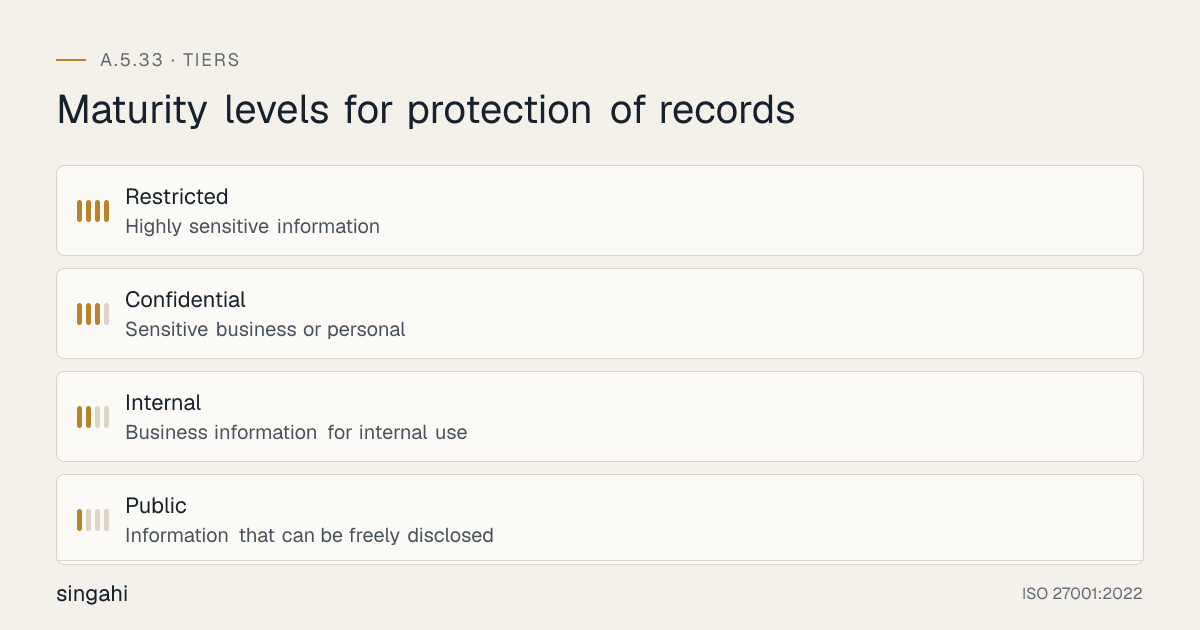
Figure · Tiers
Maturity levels for protection of records
Establish Governance for Records Protection
Before implementing tools, define who owns records protection and how decisions are made:
- Appoint a Records Protection Owner. In most Indian organisations this is the CISO, Compliance Officer, or a dedicated Records Manager. For regulated entities, a Data Protection Officer (DPO) under the DPDP Act also plays a key role.
- Form a cross-functional Records Governance Committee with representatives from Legal, IT, HR, Finance, Operations, and Information Security. Meet quarterly.
- Publish a Records Protection Policy approved by top management. The policy must mandate the retention schedule, classification, storage, access, integrity, and disposal requirements.
- Create a Records Master Index listing all record categories, owners, systems, retention periods, and disposal methods.
- Integrate with the ISMS. Records protection must be part of risk assessments, internal audits, and management reviews.
Develop a Records Retention Schedule
The retention schedule is the heart of A.5.33 compliance. It must be:
- Complete: Cover all record categories across the organisation.
- Legally grounded: Cite the specific law, regulation, or contract requiring retention.
- Business justified: When no legal requirement exists, state the business reason.
- Media aware: Address digital, physical, and hybrid records.
- Disposal linked: Specify the authorised disposal method for each category.
Example retention schedule excerpt:
| Record Category | Examples | Retention Period | Legal / Business Basis | Disposal Method |
|---|---|---|---|---|
| Financial ledger | GL entries, trial balance | 8 financial years | Companies Act s.128(5) | Secure erase / shred |
| Invoices (sales/purchase) | GST invoices, credit/debit notes | 72 months from annual return due date | CGST Act, 2017 | Secure erase / shred |
| Payroll records | Salary slips, PF records, TDS | 7 years | Income Tax Act, 1961; PF Act | Secure erase / shred |
| Employee personnel files | Appointment letters, appraisals, exits | 7 years after termination | Industrial Employment Act; DPDP Act | Secure erase / shred |
| Customer contracts | MSAs, SOWs, amendments | Duration + limitation period (8 years is a common choice) | Limitation Act, 1963; contractual | Secure erase / shred |
| Audit logs (security) | Login logs, admin actions | 1–3 years | ISO 27001; CERT-In; RBI | WORM / secure erase |
| Incident reports | Security incident records | 7 years | RBI/SEBI; business | WORM / secure erase |
| Board minutes | Board and committee minutes | Permanent | Companies Act, 2013 | Permanent archive |
| DPDP consent records | Consent forms, withdrawals | Duration of processing + required period | DPDP Act, 2023 | Secure erase |
| Tax returns and filings | ITR, TDS returns, GST returns | Income tax: 6 years from end of AY (Rule 6F; 8 as buffer); GST: 72 months | Income-tax Rules; CGST Act s.36 | Secure erase / shred |
Classify Records
Use a classification scheme aligned with A.5.12 and A.5.13. For records, classification determines storage, access, encryption, and disposal rigour.
| Classification | Description | Examples | Handling Requirements |
|---|---|---|---|
| Public | Information that can be freely disclosed | Press releases, public filings | Standard storage, no special access controls |
| Internal | Business information for internal use | Memos, internal reports | Access restricted to employees; standard backups |
| Confidential | Sensitive business or personal information | Financial statements, customer data, HR files | Encryption at rest and in transit; role-based access; audit logging |
| Restricted | Highly sensitive information; unauthorised disclosure causes severe harm | Board minutes, litigation files, security incident details, health and financial personal data | WORM storage; dual control; encryption; strict need-to-know; witnessed disposal |
Protect Record Integrity
Integrity is the assurance that a record has not been altered, corrupted, or tampered with since creation or last authorised modification.
Technical controls for integrity:
- WORM Storage: Use WORM-enabled storage for audit logs, financial records, and any record where tamper-proofing is required. Major cloud providers offer WORM/object lock (AWS S3 Object Lock, Azure Immutable Blob Storage, GCP Bucket Lock).
- Cryptographic Hashing: Compute SHA-256 hashes for critical records at creation and store hashes separately. Periodically recompute and compare.
- Digital Signatures: Apply PKI-based digital signatures to contracts, approvals, and regulatory filings where non-repudiation is required.
- Version Control: For records that legitimately have versions (e.g., contract amendments), maintain an immutable version history with audit trail.
- Audit Logging: Log every access, modification, copy, move, and deletion of protected records. Logs themselves are records and must be protected.
- Time Stamping: Use trusted time sources (NTP with authentication) so record timestamps are reliable and defensible.
Ensure Record Availability and Retrieval
Records must remain usable for as long as they are retained. Availability controls include:
- Backup Strategy: Align with A.8.13. Back up records according to criticality: daily for transactional systems, weekly for document repositories, monthly for archives.
- Restore Testing: Test backup restoration quarterly for critical records and annually for archives.
- Geographic Redundancy: Store copies in multiple availability zones or regions, respecting any sector localisation rules (the DPDP Act only restricts transfers to notified countries).
- Format and Technology Obsolescence Management: Maintain documentation of file formats, database schemas, encryption keys, and software versions. Plan migrations before formats become obsolete.
- Media Refresh: For tapes, optical media, and other degradable media, refresh copies every 3–5 years or per manufacturer guidance.
- Search and Indexing: Implement metadata tagging and full-text indexing so records can be retrieved within defined timeframes (e.g., 24 hours for active records, 48 hours for archived records).
Control Access to Records
Access controls for records should be at least as strict as for operational data:
- Role-Based Access Control (RBAC): Map roles to record categories. A junior accountant should not access board minutes; a developer should not access HR files.
- Least Privilege: Grant minimum access necessary for the job function.
- Need-to-Know: Even within a role, access should be justified on a per-record or per-category basis.
- Multi-Factor Authentication (MFA): Enforce MFA for all repositories holding Confidential or Restricted records.
- Privileged Access Management (PAM): Administrators with access to record storage must use PAM with session recording and approval workflows.
- Access Reviews: Recertify access quarterly for Restricted records, semi-annually for Confidential, and annually for Internal.
- Logging and Monitoring: Log all record access and generate alerts for anomalous activity (bulk downloads, off-hours access, external sharing).
Secure Storage of Physical Records
Physical records require the same rigour as digital records:
- Secure Storage Areas: Use lockable cabinets, access-controlled rooms, and fireproof safes for Restricted records.
- Environmental Controls: Maintain appropriate temperature, humidity, and fire suppression for paper and media archives.
- Access Logs: Maintain sign-in/sign-out logs for physical files and media.
- Transport Security: Use sealed, tamper-evident packaging and tracked courier services for physical records moved off-site.
- Off-Site Archives: Use certified records management vendors with contractual security clauses and periodic audit rights.
- Media-Specific Handling: Store backup tapes in anti-static cases, away from magnetic fields, and rotate media per manufacturer specifications.
Implement Secure Disposal
Disposal must be secure, irreversible, and auditable:
Digital records:
- Use cryptographic erasure (erase encryption keys) or secure wipe tools that overwrite data multiple times (e.g., NIST SP 800-88 Clear/Purge/Destroy methods).
- For cloud records, ensure provider deletion propagates to all replicas, backups, and logs.
- For SSDs and mobile devices, use vendor-specific secure erase commands.
Physical records:
- Use cross-cut shredders (DIN P-4 or higher) for Confidential records.
- Use pulverisation or incineration for Restricted records.
- Use certified destruction vendors and obtain certificates of destruction.
Disposal workflow:
- Retention period expires.
- Record owner reviews and approves disposal (unless legal hold applies).
- Disposal method selected per classification.
- Disposal executed by authorised personnel.
- Disposal log updated with date, method, record description, and witness (for Restricted).
- Certificate of destruction retained.
Manage Legal Holds
A legal hold overrides normal retention and disposal schedules:
- Trigger: Litigation, regulatory investigation, audit, or reasonable anticipation of any of these.
- Notification: Legal counsel issues a hold notice to record owners and IT.
- Suspension: Relevant records are protected from disposal, even if retention expires.
- Scope: Hold covers all locations, local drives, email, mobile devices, cloud apps, backups, and physical files.
- Monitoring: Track compliance with the hold; document any exceptions.
- Release: Disposal resumes only after Legal formally releases the hold.
Address Records in Third-Party Custody
When records are stored or processed by vendors:
- Contractual clauses: Require the vendor to protect records per your policy and applicable law.
- Right to audit: Include audit rights and incident notification obligations.
- Data localisation: Ensure sector rules (for example RBI's payment-data storage directive) and any DPDP Act s.16 restrictions are met.
- Return and disposal: Define procedures for returning or securely disposing of records at contract end.
- Due diligence: Assess vendor security before engagement and periodically thereafter.
Tiered Implementation by Organisation Maturity
| Maturity | Actions |
|---|---|
| Level 1, Initial | Create emergency inventory of critical records; stop using personal drives for business records; implement basic backups. |
| Level 2, Managed | Draft retention schedule for top 20 record types; implement MFA on cloud storage; begin secure disposal for paper. |
| Level 3, Defined | Approve records protection policy; classify all record categories; deploy RBAC; establish disposal logs; integrate with ISMS. |
| Level 4, Quantitative | Automated retention workflows; WORM for audit/financial logs; quarterly access recertification; backup restore tests; KPI dashboards. |
| Level 5, Optimized | AI classification; blockchain/ immutable audit trails; predictive legal hold; board reporting; continuous control monitoring. |
Industry-Specific Records Protection Requirements
Records protection requirements vary significantly by industry. The following guidance helps Indian organisations align A.5.33 with sector-specific obligations.
Banking, Financial Services, and Insurance (BFSI)
| Record Category | Specific Requirement | Control |
|---|---|---|
| Customer KYC records | Retain for 5 years after account closure; RBI mandates periodic updation and safe storage | WORM storage, restricted access, encrypted archives |
| Transaction logs | Maintain detailed audit trails for fraud detection and regulatory reporting | Immutable logs, SIEM retention, quarterly review |
| Loan and credit files | Preserve until repayment + limitation period; support legal recovery actions | Document management system with legal hold |
| Cyber incident records | Report serious incidents to RBI within 6 hours; retain investigation records | WORM incident repository, chain of custody |
| Board and committee minutes | Permanent retention; support governance and regulatory scrutiny | Permanent archive, restricted access |
BFSI organisations should map every record category to RBI Master Direction on KYC, RBI Cyber Security Framework, SEBI circulars, IRDAI guidelines, and PMLA obligations. Annual internal audits must verify retention and disposal compliance.
Healthcare and Pharma
| Record Category | Specific Requirement | Control |
|---|---|---|
| Patient medical records | Indoor patients at least 3 years (NMC); longer for medico-legal cases, state rules or NABH; confidentiality duties | Restricted access, encryption, access logs |
| Diagnostic images and reports | Linked to patient records; must remain retrievable | PACS with backup, metadata tagging |
| Clinical trial records | At least 5 years after completion (NDCT Rules 2019); ICH E6 at least 2 years after the last marketing approval | WORM archive, audit trail, sponsor access controls |
| Drug batch records | GMP requirements; support recall and pharmacovigilance | Immutable batch records, long-term archive |
| DPDP consent and health data | Consent records and data principal rights under DPDP Act | Consent management system, immutable audit logs |
Healthcare providers must balance clinical accessibility with confidentiality. Emergency access procedures should be documented and audited.
SaaS and Technology
| Record Category | Specific Requirement | Control |
|---|---|---|
| Customer contracts and SLAs | Duration + limitation period; support dispute resolution | Contract repository, legal hold integration |
| Audit logs and access records | Enterprise customers require 1–3 year retention and integrity | Immutable log storage, customer-accessible reports |
| Subprocessor and vendor records | DPDP Act and customer contracts require vendor accountability | Vendor security assessments, contract clauses |
| Consent and privacy records | DPDP Act Section 6 and 8 requirements | Consent management platform, WORM audit trail |
| Security incident records | Support customer audits and regulatory reporting | Incident management system, immutable case files |
SaaS companies should design records protection into their multi-tenant architecture, ensuring tenant isolation and customer-specific retention rules.
Manufacturing and Industrial
| Record Category | Specific Requirement | Control |
|---|---|---|
| Quality control records | ISO 9001 and product liability requirements | Long-term archive, tamper-proof storage |
| Supplier certifications | Validate supplier quality and compliance over time | Supplier record repository, expiry alerts |
| IP and design files | Protect trade secrets and patent evidence | Restricted access, DLP, watermarking |
| Environmental and safety records | OSH Code 2020, environmental clearances | Retention per statute, secure off-site storage |
| OT/SCADA logs | Cyber-physical security and incident investigation | Air-gapped or segmented log storage |
Manufacturers must protect intellectual property records with particular rigour, as these are high-value targets for industrial espionage.
Government and Public Sector
| Record Category | Specific Requirement | Control |
|---|---|---|
| Citizen service records | RTI Act and DPDP Act requirements | Access controls, proactive disclosure logs |
| Procurement and tender records | CVC and CAG audit requirements | Permanent archive, integrity protection |
| Confidential government records | Official Secrets Act and classification rules | Physical and digital controls per classification |
| Grievance records | Citizen charter and accountability | Workflow tracking, audit trail |
Government organisations must align records protection with the Public Records Act, 1993, and relevant MeitY/NCIIPC directives.
Tools, Technologies, and Solutions
Records Management and ECM Platforms
| Vendor / Product | Type | Key Features | Pricing model | Best For |
|---|---|---|---|---|
| Microsoft Purview Records Management | Cloud-native | Retention labels, event-based retention, disposition review, legal hold, integration with M365 | Commercial | M365-dependent organisations |
| OpenText Content Suite / Documentum | Enterprise ECM | Records management, workflow, WORM, compliance modules | Custom enterprise pricing | Large enterprises, regulated industries |
| IBM FileNet | Enterprise ECM | Records management, case management, governance | Custom enterprise pricing | Banks, insurance, government |
| M-Files | Growing-company ECM | Metadata-driven, automated workflows, retention | Commercial | Mid-sized Indian companies |
| Zoho Workdrive / Docs | Indian SaaS | Document management, versioning, access control | Commercial | SMEs, startups |
| Newgen OmniDocs | Indian ECM | Document management, records retention, workflow automation | Custom pricing | Indian enterprises, BFSI |
| Veeva Vault | Life sciences | Validated records management, eTMF, quality docs | Custom pricing | Pharma, healthcare |
| SharePoint / Confluence with retention policies | Collaboration platform | Versioning, permissions, basic retention | Low incremental cost | Small and medium organisations |
Backup and Archive Solutions
| Vendor / Product | Type | Key Features | Pricing model | Best For |
|---|---|---|---|---|
| Veeam Backup & Replication | Backup | Immutable backups, restore testing, cloud integration | Commercial | Virtualised environments |
| Acronis Cyber Backup | Backup + cyber protection | Immutable backups, anti-ransomware | Commercial, per TB | SMBs, distributed endpoints |
| AWS Backup / S3 Glacier | Cloud backup/archive | Vault locks, cross-region copy, lifecycle policies | Pay-as-you-go | Cloud-native organisations |
| Azure Backup / Archive Storage | Cloud backup/archive | Immutable storage, long-term retention | Pay-as-you-go | Azure-centric organisations |
| Google Cloud Storage / Backup and DR | Cloud backup/archive | Bucket locks, lifecycle, archive tiers | Pay-as-you-go | GCP-centric organisations |
| Commvault | Enterprise backup | Data governance, legal hold, e-discovery | Custom enterprise pricing | Large enterprises |
WORM and Immutable Storage
| Solution | Deployment | Notes |
|---|---|---|
| AWS S3 Object Lock | Cloud | Compliance or Governance retention modes; legal hold |
| Azure Immutable Blob Storage | Cloud | Time-based retention and legal hold policies |
| GCP Bucket Lock | Cloud | Retention policies with locked holds |
| NetApp SnapLock | On-prem / hybrid | WORM volumes for compliance |
| Dell EMC Isilon SmartLock | On-prem / hybrid | Enterprise WORM storage |
Data Discovery and Classification
| Vendor / Product | Type | Best For |
|---|---|---|
| Microsoft Purview Information Protection | Cloud-native | M365 data classification and labelling |
| Symantec / Broadcom DLP | Enterprise DLP | Large organisations with heterogeneous data |
| Forcepoint DLP | Enterprise DLP | Regulated industries |
| Digital Guardian | Endpoint DLP | Intellectual property protection |
| Netwrix Auditor | Change and access auditing | Records access logging |
| Varonis DatAdvantage | Data governance | Permission analysis and access monitoring |
Secure Disposal and Destruction Services (India)
| Vendor / Service | Capabilities |
|---|---|
| Iron Mountain India | Secure shredding, media destruction, off-site archiving |
| ** Recall (India)** | Document and media destruction, certificates of destruction |
| Shred-it India | On-site and off-site shredding |
| Local certified e-waste recyclers | Hard drive shredding, degaussing, certificate issuance |
Open-Source and lightweight Tools
| Tool | Use Case |
|---|---|
| sha256sum / md5sum | Compute file hashes for integrity verification |
| Veracrypt | Encrypt offline record archives |
| BleachBit / shred | Secure file deletion on Linux |
| DBAN (Darik's Boot and Nuke) | Wipe hard drives |
| Cryptomator | Encrypt cloud-stored records |
Emerging Technologies for Records Protection
- AI-Powered Classification: Machine learning models can automatically classify records based on content, reducing manual labelling effort and improving consistency. Tools like Microsoft Purview auto-labelling and third-party AI classifiers are increasingly affordable for growing Indian organisations.
- Blockchain Audit Trails: For high-integrity requirements (board resolutions, regulatory filings, land records), blockchain or distributed ledger technology can provide tamper-evident timestamping and proof of existence.
- Federated Search: Unified search across email, SharePoint, databases, and physical archives helps locate records quickly during audits, litigation, or customer requests.
- Data Loss Prevention (DLP) Integration: Modern DLP tools can enforce records protection policies by blocking unauthorised sharing of classified records via email, cloud apps, or removable media.
- e-Discovery Platforms: For litigation and regulatory response, e-discovery tools index records across sources and support legal hold, review, and production workflows.
Policy and Procedure Templates
Records Protection Policy (Extract)
RECORDS PROTECTION POLICY
[Organisation Name]
Version: 1.0
Approved by: [CEO / Managing Director]
Date: [Date]
Review Date: [Date + 12 months]
Classification: Internal

1. PURPOSE
This policy establishes the framework for protecting [Organisation Name] records
from loss, destruction, falsification, unauthorised access, and unauthorised release
throughout their lifecycle.

2. SCOPE
This policy applies to all records, in any form or medium, created, received, or
maintained by [Organisation Name], its employees, contractors, and third parties.

3. POLICY STATEMENTS
3.1 All records shall be classified according to the Information Classification Policy.
3.2 A records retention schedule shall be maintained and reviewed annually.
3.3 Records shall be stored securely with access restricted to authorised personnel.
3.4 Confidential and Restricted records shall be encrypted at rest and in transit.
3.5 Critical records (audit logs, financial records, board minutes) shall be stored
      on WORM or otherwise integrity-protected media.
3.6 Records shall be disposed of securely and irreversibly when the retention
      period expires, unless a legal hold is in effect.
3.7 All record disposal shall be logged and, for Restricted records, witnessed.
3.8 Records held by third parties shall be protected by contract and audited.
3.9 Record access, modification, and disposal events shall be logged and monitored.
3.10 Employees shall complete records protection training annually.

4. ROLES AND RESPONSIBILITIES
4.1 CISO / Records Manager: Own the policy, retention schedule, and compliance metrics.
4.2 Legal Counsel: Identify legal and regulatory retention requirements and issue legal holds.
4.3 Department Heads: Classify records in their domain and approve disposals.
4.4 IT: Implement technical controls for storage, access, backup, encryption, and logging.
4.5 All Employees: Handle records per policy and report incidents.

5. COMPLIANCE
Violation of this policy may result in disciplinary action, including termination and
legal proceedings where applicable.

6. REVIEW
This policy is reviewed annually and when significant legal, regulatory, or business
changes occur.
Record Handling Procedure (Extract)
RECORD HANDLING PROCEDURE
[Organisation Name]

1. CREATION / RECEIPT
   • Create records in approved systems or forms.
   • Capture required metadata: title, owner, date, classification, retention category.
   • Do not store business records on personal drives, USB devices, or unapproved cloud services.

2. CLASSIFICATION
   • Apply the classification label at creation: Public, Internal, Confidential, Restricted.
   • For Restricted records, request approval from the record owner and CISO.

3. STORAGE
   • Store records in the designated repository based on classification.
   • Encrypt Confidential and Restricted records at rest.
   • Apply RBAC and MFA to repositories holding Confidential/Restricted records.

4. USE AND SHARING
   • Share records only with authorised recipients using approved channels.
   • External sharing of Restricted records requires encryption and approval.
   • Do not print Restricted records unless approved and physically secured.

5. RETENTION
   • Retain records per the approved retention schedule.
   • Do not delete records before the retention period expires unless authorised.

6. DISPOSAL
   • Review records approaching disposal date.
   • Confirm no legal hold applies.
   • Dispose using the method defined in the retention schedule.
   • Complete the Record Disposal Log.

7. INCIDENT REPORTING
   • Report suspected loss, unauthorised access, or unauthorised disclosure immediately
     to the CISO / Information Security team.
Record Disposal Log Template
| Disposal ID | Record Category | Description | Retention Expiry | Legal Hold? | Method | Executed By | Witness | Date | Certificate Reference |
|---|---|---|---|---|---|---|---|---|---|
| DSP-001 | Financial invoices | FY 2017–18 invoices | 2026-03-31 | No | Cross-cut shred | Ramesh K. | Priya S. | 2026-04-15 | CERT-2026-089 |
| DSP-002 | Security audit logs | Server logs Q1 2023 | 2026-03-31 | No | Cryptographic erase | IT Ops | N/A | 2026-04-10 | CERT-2026-090 |
Risk Assessment and Treatment
Risk Identification
| Risk ID | Risk Description | Likelihood | Impact | Risk Level | Treatment |
|---|---|---|---|---|---|
| R1 | Records lost due to hardware failure or ransomware without recoverable backup | Medium | High | High | Implement immutable backups, test restore quarterly, deploy anti-ransomware controls |
| R2 | Records destroyed accidentally or maliciously by insider | Low | High | Medium | RBAC, privileged access management, audit logging, separation of duties |
| R3 | Records falsified or tampered with, undermining audit evidence | Low | High | Medium | WORM storage, cryptographic hashing, digital signatures, immutable audit logs |
| R4 | Unauthorised access to Confidential/Restricted records | Medium | High | High | Encryption, MFA, RBAC, access recertification, DLP, monitoring |
| R5 | Unauthorised release of records through email, cloud sharing, or third party | Medium | High | High | DLP, data classification, secure sharing policies, vendor controls, training |
| R6 | Inability to retrieve records due to obsolete formats or systems | Medium | Medium | Medium | Format documentation, migration plans, periodic recovery testing |
| R7 | Records retained beyond legal requirement, increasing breach exposure and DPDP liability | Medium | Medium | Medium | Enforce retention schedule, automated disposal workflows, legal hold process |
| R8 | Records disposed of prematurely, violating legal hold or retention obligation | Low | High | Medium | Approval workflow, legal hold integration, disposal logs |
| R9 | Physical records damaged by fire, flood, or environmental failure | Low | High | Medium | Fireproof safes, off-site archives, environmental monitoring, insurance |
| R10 | Third-party vendor loses or leaks records | Medium | High | High | Contractual security clauses, due diligence, audits, breach notification |
Risk Treatment Plan
| Risk ID | Treatment Option | Control Owner | Target Date |
|---|---|---|---|
| R1 | Mitigate | IT Director | Q1 |
| R2 | Mitigate | CISO | Q1 |
| R3 | Mitigate | CISO | Q2 |
| R4 | Mitigate | CISO | Q1 |
| R5 | Mitigate | CISO + DPO | Q1 |
| R6 | Mitigate | Records Manager | Q2 |
| R7 | Mitigate | Compliance Officer | Q2 |
| R8 | Mitigate | Legal Counsel | Q2 |
| R9 | Mitigate | Facilities Manager | Q2 |
| R10 | Mitigate + Transfer (insurance) | Procurement + Legal | Q2 |
Audit and Compliance Checklist
Auditor Questions and Expected Evidence
| # | Auditor Question | Expected Evidence | Red Flag |
|---|---|---|---|
| 1 | Show me your records protection policy. | Approved policy, version history, communication records | No policy or outdated policy |
| 2 | Do you have a records retention schedule? | Retention schedule with legal citations | No schedule or generic schedule |
| 3 | How do you classify records? | Classification scheme, labelled records, training records | No classification or inconsistent labels |
| 4 | How do you protect records from unauthorised access? | RBAC matrix, MFA evidence, access reviews | Open access, shared accounts |
| 5 | How do you prevent record falsification? | WORM config, hashing/digital signature evidence, audit logs | No integrity controls |
| 6 | Can you retrieve a record from 3 years ago? | Live retrieval demonstration, retrieval time log | Cannot retrieve within defined SLA |
| 7 | How are records backed up and recovered? | Backup policy, restore test records, backup logs | No restore testing |
| 8 | How do you dispose of records? | Disposal logs, certificates of destruction | No disposal evidence |
| 9 | How do you handle legal holds? | Legal hold procedure, hold notices, release records | No legal hold process |
| 10 | How do you manage third-party records? | Contracts, due diligence reports, audit rights | No contractual controls |
| 11 | How do you ensure DPDP Act compliance for personal data records? | Consent logs, data principal request records, breach logs | Missing consent or breach records |
| 12 | How do you protect audit logs? | WORM/ immutable log storage, log review records | Logs stored on editable systems |
| 13 | Show me records access logs. | SIEM / repository access logs | No logging or unreviewed logs |
| 14 | How do you manage records on employee laptops or personal devices? | MDM policy, encryption evidence, remote wipe | Records on unencrypted personal drives |
| 15 | How do you manage physical records? | Physical access logs, storage inspection, disposal certificates | Unsecured paper records |
| 16 | How do you address technology obsolescence? | Migration plan, format inventory, recovery test records | No plan for obsolete formats |
| 17 | How do you train staff on records protection? | Training records, quiz results, awareness materials | No training |
| 18 | How do you review records protection effectiveness? | Internal audit reports, KPI dashboards, management review minutes | No review cycle |
| 19 | Show me disposal approval workflow. | Approval emails/tickets, disposal logs | Disposal without approval |
| 20 | How do you protect records during disruption? | BCP/DR plan, backup restore tests, alternate site records | No DR plan for records |
Metrics and KPIs
Figure · Measures
The measures that show A.5.33 is working
- Records with defined retention period100%Quarterly
- Records classified100%Quarterly
- Records access recertification completion100%Quarterly
- Backup restore success rate100%Quarterly
- Disposal compliance100%Monthly
| # | KPI | Formula | Target | Frequency |
|---|---|---|---|---|
| 1 | Records with defined retention period | (Records with retention category / Total records inventory) × 100 | 100% | Quarterly |
| 2 | Records classified | (Classified records / Total records) × 100 | 100% | Quarterly |
| 3 | Records access recertification completion | (Recertified access / Total access grants) × 100 | 100% | Quarterly |
| 4 | Backup restore success rate | (Successful restore tests / Total restore tests) × 100 | 100% | Quarterly |
| 5 | Disposal compliance | (Disposals with approved log / Total disposals) × 100 | 100% | Monthly |
| 6 | Records retrieval SLA achievement | (Retrievals within SLA / Total retrieval requests) × 100 | > 95% | Monthly |
| 7 | Records-related incidents | Count of loss, unauthorised access, or release incidents | 0 | Monthly |
| 8 | Records protection training completion | (Trained staff / Total staff) × 100 | 100% | Annually |
| 9 | Retention schedule review currency | Days since last retention schedule review | < 365 days | Annually |
| 10 | Legal hold compliance | (Holds acknowledged and enforced / Total active holds) × 100 | 100% | Per hold |
| 11 | Third-party record audit completion | (Vendors audited / High-risk vendors) × 100 | 100% | Annually |
| 12 | Integrity check success rate | (Records passing hash/integrity check / Total checked) × 100 | 100% | Quarterly |
| 13 | Records stored outside approved repositories | Count of records on personal drives / shadow IT | 0 | Quarterly |
| 14 | Average record retrieval time | Total retrieval time / Number of retrieval requests | < 24 hours (active), < 48 hours (archive) | Monthly |
| 15 | Cost of records management per record | Total records management cost / Number of records | Trend down | Annually |
Common Pitfalls / Audit Failures & How to Avoid Them
| # | Pitfall / Finding | Cause | Fix | Timeline |
|---|---|---|---|---|
| 1 | No records retention schedule | Records management seen as "filing" | Create retention schedule with Legal input; board approve | 4–6 weeks |
| 2 | Retention periods not legally grounded | Schedule copied from internet without Indian context | Map each category to Indian law and business need | 2–4 weeks |
| 3 | Records stored on personal drives / shadow IT | Lack of central repository and governance | Deploy approved DMS; migrate records; enforce policy | 8–12 weeks |
| 4 | No disposal logs or certificates | Informal shredding/deletion | Implement disposal workflow and log template | 2–4 weeks |
| 5 | Audit logs not protected | Logs treated as operational data, not records | Move logs to WORM/immutable storage | 4–6 weeks |
| 6 | Inability to retrieve old records | Obsolete formats, lost indexes, no backups | Create format inventory; migrate; test restore | 8–12 weeks |
| 7 | Over-retention increasing risk | Fear of deleting anything | Enforce retention schedule with automated disposition | 4–8 weeks |
| 8 | Premature deletion under legal hold | Legal not consulted before disposal | Integrate legal hold flag into disposal workflow | 2–4 weeks |
| 9 | Weak physical record security | Paper records left unattended | Secure cabinets, access logs, clean desk policy | 2–4 weeks |
| 10 | Third-party records not governed | Assumption that cloud provider handles everything | Add contract clauses; conduct vendor audits | 4–8 weeks |
| 11 | No integrity checks for critical records | Belief that storage replication equals integrity | Implement hashing/WORM for audit/financial records | 4–6 weeks |
| 12 | Records protection not in risk assessments | ISMS treats records as an afterthought | Include records in risk register and internal audits | 2–4 weeks |
Illustrative Scenarios
Illustrative scenario, a composite example for guidance, not a specific Singahi engagement or a verified outcome.
Illustrative Scenario 1: Mumbai NBFC, Ransomware Exposes Backup Gap
Background: A mid-sized Non-Banking Financial Company (NBFC) in Mumbai with 400 employees held customer loan records, KYC documents, and transaction logs on on-premise servers and network-attached storage. The company had backups but had never tested restoration.
The Incident: In October 2024, a ransomware attack encrypted the primary file server and spread to the backup server because both were on the same network segment. The attackers demanded a ransom. The NBFC discovered that their "daily backups" had been failing silently for six weeks and that no immutable backup copies existed.
Impact:
- Customer records for the past six weeks were unrecoverable.
- RBI was notified under the 6-hour serious incident reporting rule.
- The NBFC had to reconstruct transaction data from email trails and partner statements, and 3 months of effort.
- RBI issued a supervisory letter citing inadequate records protection and backup controls.
Root Cause Analysis:
- Backups were not segregated from production networks.
- No immutable or air-gapped backup strategy.
- Backup restore testing was not performed.
- Records protection was not part of the ISMS risk assessment.
- No WORM or integrity protection for critical financial records.
Remediation with external support:
- Week 1–2: Incident response and containment; rebuilt servers from last known good backup.
- Week 3–4: Deployed immutable backup solution (Veeam with S3 Object Lock) and segregated backup network.
- Week 5–8: Created records retention schedule aligned with RBI, Companies Act, and Income Tax Act requirements.
- Week 9–12: Implemented WORM storage for audit logs and transaction records; configured quarterly restore testing.
- Ongoing: Added records protection to internal audit scope and management review agenda.
Results:
- Zero unrecoverable record loss in a subsequent simulated ransomware exercise.
- RBI follow-up inspection passed with no major findings.
- Backup restore RTO reduced from "unknown" to 4 hours.
- Records retrieval SLA improved from days to under 4 hours.
Illustrative Scenario 2: Bengaluru SaaS Company, DPDP Consent Records Chaos
Background: A 250-employee SaaS company in Bengaluru provided HR-tech software to Indian enterprises. After the DPDP Rules 2025 were notified in November 2025 (most duties apply from about May 2027), the company needed to demonstrate consent, data principal rights, and breach records to customers and regulators. However, consent records were scattered across CRM, email, and spreadsheet exports.
The Incident: During an enterprise customer audit, the company failed to produce a complete audit trail of consent for 12,000 employee records processed on behalf of a client. Consent forms existed but were not version-controlled, some were missing, and withdrawal requests were tracked in personal inboxes. The customer suspended a contract renewal pending remediation.
Impact:
- Contract renewal delayed by 6 months.
- DPDP Act compliance gap identified.
- Potential penalty exposure under the DPDP Act (s.8(5) safeguards; consent records under s.6), once its duties apply.
- Engineering resources diverted for 4 months to rebuild consent infrastructure.
Root Cause Analysis:
- No records protection policy for personal data records.
- Consent records were not classified as Restricted records.
- No WORM or immutable storage for consent and rights-request logs.
- Disposal of old consent records was uncontrolled.
- No integration between marketing consent tools and the central records repository.
Remediation with external support:
- Week 1–2: Declared consent records, data principal request records, and breach logs as Restricted records under the Records Protection Policy.
- Week 3–6: Migrated consent and rights records into a centralised, immutable repository with WORM locks.
- Week 7–10: Built automated workflows for consent capture, withdrawal, and deletion requests with full audit trail.
- Week 11–12: Trained customer success, legal, and engineering teams on DPDP record-keeping requirements.
- Ongoing: Quarterly internal audits of consent record completeness and integrity.
Results:
- Contract renewal secured with added security commitments.
- DPDP Act readiness assessment passed.
- Consent record retrieval time reduced from days to under 30 minutes.
- No consent-related findings in subsequent ISO 27001 surveillance audit.
Illustrative Scenario 3: Delhi Manufacturing Company, Physical Records Fire and Compliance Penalty
Background: A 600-employee automotive component manufacturer in Delhi maintained a mix of digital ERP records and physical quality control sheets, supplier certifications, and environmental compliance files. Physical records were stored in a basement archive with minimal fire protection and no inventory system.
The Incident: In November 2024, an electrical short circuit caused a fire in the basement archive. Approximately 40% of physical records from the past 8 years were destroyed, including ISO/TS 16949 quality records, supplier audit reports, and environmental audit evidence required by the State Pollution Control Board.
Impact:
- ISO 9001 and IATF 16949 surveillance audit was suspended pending reconstruction of quality records.
- A major OEM customer placed the company on probation, threatening a large annual contract.
- The State Pollution Control Board issued a show-cause notice for inability to produce environmental compliance records.
- Insurance claim was partially denied due to lack of inventory and off-site backup of critical records.
- Estimated direct and indirect cost exceeded .
Root Cause Analysis:
- No physical records inventory or classification.
- No fire suppression, environmental monitoring, or off-site backup for physical records.
- Critical records existed only in paper form with no digitisation.
- No business impact analysis for records storage.
- No periodic review of physical record protection by the ISMS.
Remediation with external support:
- Week 1–2: Emergency salvage and documentation of surviving records; notified insurers, customers, and regulators.
- Week 3–6: Digitised active quality and environmental records using scanning and OCR; implemented document management system with metadata tagging.
- Week 7–10: Established fire-resistant archive room, off-site storage with certified vendor, and environmental monitoring.
- Week 11–14: Rebuilt retention schedule for manufacturing records aligned with ISO 9001, IATF 16949, and environmental laws.
- Ongoing: Quarterly physical archive inspections and annual fire drill for records storage areas.
Results:
- ISO surveillance audit completed 5 months later with only minor observations.
- OEM customer lifted probation after demonstrating digitised records and off-site backup.
- Pollution Control Board accepted the reconstructed records with an improvement plan.
- Insurance premium reduced in the following year after demonstrating improved controls.
- Physical record retrieval time reduced from days to under 2 hours.
Multi-Framework Mapping
| ISO 27001:2022 | SOC 2 Type II | PCI DSS 4.0 | NIST 800-53 Rev 5 | CIS Controls v8 | COBIT 2019 | GDPR / DPDP Act 2023 |
|---|---|---|---|---|---|---|
| A.5.33 | CC6.1, CC7.2 | 3.4.1, 3.5.1, 9.4.5, 12.3.3 | MP-2, MP-3, MP-4, MP-6, SI-12 | Control 3, Data Protection | APO11.02, APO11.03, APO11.04, APO12.01, BAI09.01 | GDPR Art. 5(1)(e), Art. 17, Art. 30; DPDP Act s.8(5), s.8(7) (erasure), DPDP Rules (minimum log retention) |
| A.5.12 | CC6.1 | 3.2.1 | RA-2 | Control 3 | APO12.02 | GDPR Art. 5; DPDP Act Section 6 |
| A.5.35 | CC4.1, CC4.2 | 12.4.2 | CA-2, CA-7 | Control 7 | MEA01.01 | GDPR Art. 32; DPDP Act Section 8(5) |
| A.8.10 | CC6.1 | 3.2.2, 3.3.1 | MP-6, SI-12 | Control 3 | BAI09.03 | GDPR Art. 17; DPDP Act s.8(7) (erasure) |
| A.8.11 | CC6.1 | 3.4.1, 3.5.1 | SI-12, SC-28 | Control 3 | BAI02.01 | GDPR Art. 32; DPDP Act Section 8(5) |
| A.8.13 | A1.2 | 12.3.1, 12.3.2 | CP-9, CP-10 | Control 11 | BAI09.01 | GDPR Art. 32; DPDP Act Section 8(5) |
| A.8.16 | CC7.2 | 10.2.1, 10.3.1 | AU-6, AU-12 | Control 8 | MEA01.04 | GDPR Art. 32; DPDP Act Section 8(5) |
| A.8.24 | CC6.1, CC6.6, CC6.7 | 3.5.1, 4.2.1 | SC-13, SC-28 | Control 3 | BAI02.01 | GDPR Art. 32; DPDP Act Section 8(5) |
Implementation Roadmap
Figure · Matrix
Comparison: Phase 1: Foundation to Phase 3: Validate
Figure · Timeline
Rollout in order
- Phase 1: Foun…1–30
- Phase 2: Embed31–60
- Phase 3: Vali…61–90
12-Week Implementation Roadmap
| Week | Phase | Activities | Deliverable |
|---|---|---|---|
| 1 | Discovery | Inventory record types and storage locations; identify legal/regulatory requirements; appoint Records Protection Owner. | Records inventory v1.0 |
| 2 | Governance | Draft Records Protection Policy; form Records Governance Committee; define classification scheme. | Policy draft, committee charter |
| 3–4 | Retention Schedule | Develop retention schedule with Legal; map to Indian laws and business needs; get management approval. | Approved retention schedule |
| 5–6 | Technical Controls | Implement RBAC, MFA, encryption, backups, WORM for critical logs; migrate records to approved repositories. | Technical controls deployed |
| 7–8 | Disposal and Legal Hold | Create disposal workflow, disposal log, and legal hold procedure; train record owners. | Disposal process operational |
| 9–10 | Third-Party and Physical | Review vendor contracts; secure physical storage; implement off-site archive controls. | Vendor controls, physical security improvements |
| 11 | Testing and Training | Conduct backup restore test; run records retrieval drill; deliver staff training. | Test reports, training completion records |
| 12 | Review and Audit | Internal audit of records protection; update risk register; present to management review. | Audit report, management review minutes |
90-Day Sprint for Regulated Organisations
| Phase | Days | Focus |
|---|---|---|
| Phase 1: Foundation | 1–30 | Policy, retention schedule, inventory, classification, critical records WORM |
| Phase 2: Embed | 31–60 | Disposal workflow, legal holds, third-party controls, physical security |
| Phase 3: Validate | 61–90 | Restore tests, retrieval drills, internal audit, KPI dashboard, management review |
FAQ
What is the difference between a document and a record?
A document provides instructions and can be updated (e.g., a policy). A record is historical evidence of an activity and should not be altered after creation (e.g., an audit report, signed contract, or incident log). A.5.33 protects records; A.5.1 protects policies and documents.
Is a records retention schedule mandatory for ISO 27001?
Not by ISO 27001 itself. No Annex A control is mandatory. Under clause 6.1.3 you choose the controls your risk assessment calls for, then record A.5.33 in your Statement of Applicability as included (and how) or excluded (and why). If you include it, a retention schedule is the most practical way to show how records are protected and for how long, and auditors will usually ask to see one. Separately, Indian law sets many retention periods (for example the Companies Act, GST law and CERT-In's 180-day log rule), so most organisations need a schedule anyway.
How long should we keep security audit logs?
The retention period depends on your legal and regulatory environment. In India, RBI/SEBI regulated entities often retain security logs for 1–3 years. CERT-In directions and the DPDP Act also support retention for investigation purposes. Define the period in your retention schedule.
Do we need WORM storage for all records?
No. WORM or immutable storage is typically required for high-integrity records such as audit logs, financial transaction records, board minutes, incident reports, and DPDP consent records. Other records may use standard access controls and backups.
How do we handle records on employee laptops?
Business records should not be stored solely on employee laptops. Use a centralised document management system with MFA, encryption, and remote wipe capability. If local copies are necessary, encrypt the device and synchronise to the approved repository.
What is a legal hold and when do we need one?
A legal hold suspends normal record disposal when litigation, investigation, or audit is anticipated or active. It is issued by Legal Counsel and remains in effect until formally released. Failing to implement a hold can lead to sanctions and penalties.
How do we protect records stored in the cloud?
Use cloud providers with appropriate certifications (ISO 27001, SOC 2). Enable encryption at rest and in transit, MFA, RBAC, immutable backups, and audit logging. Include records protection clauses in contracts and exercise audit rights.
What disposal method is acceptable for physical records?
Confidential paper records should be cross-cut shredded (DIN P-4 or higher). Restricted records should be pulverised or incinerated. Use certified destruction vendors and obtain certificates of destruction.
How does the DPDP Act, 2023 affect records protection?
The DPDP Act requires data fiduciaries to protect personal data, maintain consent records, honour data principal rights, report breaches, and delete data when no longer necessary. These obligations directly map to A.5.33 controls for retention, integrity, access, and disposal.
How often should we review the records protection programme?
Review the policy and retention schedule annually at minimum. Also review after significant legal/regulatory changes, major incidents, mergers/acquisitions, new technology adoption, or audit findings.
Do backup copies also need to follow the retention schedule?
Yes. Backups are records too. Define backup retention periods in the schedule and ensure that backups are disposed of securely when retention expires. For regulatory or audit purposes, you may need to retain certain backup copies even after original production records are deleted.
Can we keep all records forever "just to be safe"?
No. Over-retention increases breach risk, storage cost, and DPDP Act liability. The DPDP Act requires that personal data not be retained longer than necessary. Keep records only as long as legally or business required, then dispose securely.
How do we protect records in email and chat applications?
Email and chat records should be subject to the same classification and retention rules. Use archiving solutions (e.g., Microsoft Purview, Google Vault, Zoho Mail archival) with retention policies, e-discovery capabilities, and access controls. Prohibit use of personal email for business records.
What is event-based retention?
Event-based retention starts the retention clock from a specific event rather than creation date. For example, employee records may be retained for 7 years from the date of termination, not from the date of creation. This requires tracking the triggering event accurately.
How do we handle records in foreign jurisdictions?
If your organisation operates globally, you may need to maintain records in specific jurisdictions to comply with data localisation laws. In India, RBI and other sector rules (and any DPDP Act s.16 restrictions) may restrict cross-border transfers of certain records. Maintain local copies where required and document the legal basis for transfer.
What should a records disposal log contain?
A disposal log should include: disposal ID, record category, description, retention expiry date, legal hold status, disposal method, person who executed disposal, witness (for Restricted records), date, and certificate of destruction reference.
How do we prove record integrity to an auditor?
Provide evidence of WORM configuration, cryptographic hashes, digital signatures, immutable audit logs, access control matrices, and backup restore test results. Demonstrate that critical records cannot be altered or deleted without authorisation and detection.
Are system-generated logs considered records under A.5.33?
Yes. System logs, audit logs, access logs, and security event logs are records. They often require special protection because they provide evidence of system activity and security incidents. Treat them as Confidential or Restricted depending on content.
How does records protection support business continuity?
By ensuring records are backed up, recoverable, and stored in multiple locations, records protection supports rapid recovery from disasters, ransomware, and system failures. It also ensures that critical evidence remains available during investigations and disputes.
References and Further Reading
Standards and Frameworks
- ISO/IEC 27001:2022, Annex A 5.33, Protection of Records
- ISO/IEC 27002:2022, Section 5.33, Protection of Records
- ISO 15489-1:2016, Information and documentation, Records management
- ISO 23081, Information and documentation, Metadata for records
- NIST SP 800-88 Rev 1, Guidelines for Media Sanitization
- NIST SP 800-53 Rev 5, Security and Privacy Controls for Information Systems and Organisations
Indian Regulations
- Digital Personal Data Protection Act, 2023
- Information Technology Act, 2000 (as amended)
- CERT-In Directions, 2022
- Reserve Bank of India, Cyber Security Framework in Banks (2016); Master Direction on Information Technology Governance, Risk, Controls and Assurance Practices (2023, in force from 1 April 2024)
- Securities and Exchange Board of India, Cyber Security and Cyber Resilience Framework
- Insurance Regulatory and Development Authority of India, Cyber Security Guidelines
- Companies Act, 2013
- Income Tax Act, 1961
- Central Goods and Services Tax Act, 2017
- Prevention of Money Laundering Act, 2002
- Right to Information Act, 2005
Industry Guidance
- Association for Intelligent Information Management (AIIM), Records Management Best Practices
- International Council on Archives, Records Management Principles
- Indian Institute of Banking and Finance, Cyber Security Guidelines for Banks