
On this page
- Quick Reference: A.5.34 in 60 Seconds
- What the Control Asks For
- Why This Control Matters
- Scope and Applicability
- Key Definitions and Terminology
- Relationship to Other Controls
- Detailed Implementation Guidance
- Tools, Technologies, and Solutions
- Policy and Procedure Templates
- Risk Assessment and Treatment
- Audit and Compliance Checklist
- Metrics and KPIs
- Common Pitfalls / Audit Failures & How to Avoid Them
- Illustrative Scenarios
- Multi-Framework Mapping
- Implementation Roadmap
- FAQ
- References and Further Reading
Quick Reference: A.5.34 in 60 Seconds
| Attribute | Details |
|---|---|
| Control ID | A.5.34 |
| Title | Privacy and protection of PII |
| Objective | Ensure the organization identifies, implements, and maintains privacy and PII protection obligations arising from laws, regulations, and contractual commitments. |
| Domain | Organizational controls, Governance, Risk & Compliance |
| What You Must Do | Define a privacy governance structure, maintain a PII inventory, map legal/contractual requirements, publish privacy notices, manage consent, operationalize data-subject rights, protect PII throughout its lifecycle, and demonstrate compliance to auditors. |
| Typical Owner | Data Protection Officer (DPO) / Privacy Lead, supported by CISO, Legal, and Head of Engineering |
| Maturity Level 1 | Ad-hoc: PII identified informally; privacy clauses in contracts only; no formal privacy officer. |
| Maturity Level 2 | Defined: Privacy policy exists; basic PII inventory; privacy notice on website; manual DSAR handling. |
| Maturity Level 3 | Managed: PII inventory maintained; DPIAs performed for high-risk processing; consent logs; structured DSAR workflow; regular training. |
| Maturity Level 4 | Measured: Automated data discovery; privacy KPIs tracked; integration with security monitoring; processor audits scheduled; breach response tested. |
| Maturity Level 5 | Optimized: Privacy-by-design embedded in product and engineering; real-time consent and rights automation; predictive risk analytics; continuous regulatory alignment. |
| Audit Red Flag | No PII inventory, missing privacy notice, no consent records, ad-hoc DSAR responses, undisclosed third-party sharing, no breach notification process. |
| Quick Win | Publish a privacy notice, launch a PII data-mapping sprint, and create a DSAR intake mailbox/portal this week. |
| Time to Implement | 8–16 weeks for a strong baseline; ongoing maturity improvements continuously. |
| Related Controls | A.5.33 (Protection of records), A.5.36 (Compliance with policies and standards), A.5.37 (Documented operating procedures), A.6.3 (Information security awareness), A.6.6 (Confidentiality agreements), A.8.1 (User endpoint devices), A.8.2 (Privileged access rights), A.8.5 (Secure authentication), A.5.9 (Inventory of information and other associated assets), A.8.10 (Information deletion), A.8.11 (Data masking), A.8.12 (Data leakage prevention), A.8.15 (Logging), A.8.16 (Monitoring activities), A.8.24 (Use of cryptography) |
| ISO 27002 attributes | Control type: Preventive · Properties: Confidentiality, Integrity, Availability · Concepts: Identify, Protect · Capabilities: Information protection, Legal and compliance · Domains: Protection |
What the Control Asks For
The Control in Brief
ISO 27001:2022 Annex A 5.34 asks organizations to identify and meet the requirements for protecting personally identifiable information (PII), in line with applicable laws and regulations.
Do you need this control?
A.5.34 is not mandatory in itself: under clause 6.1.3 you include it if your risk assessment calls for it, and record the decision in your Statement of Applicability. Include it if you process personal data, which is nearly everyone. In India the DPDP Act duties apply from about May 2027; until then, the IT Act SPDI Rules and contracts still apply.
This single sentence places a broad, principle-based obligation on the organization. It does not prescribe a specific law or methodology. Instead, it requires the organization to:
- Identify all applicable privacy and PII protection requirements (statutory, regulatory, contractual).
- Implement controls, processes, and organizational measures that satisfy those requirements.
- Maintain those measures over time and demonstrate that PII is protected.
ISO/IEC 27002:2022 Implementation Guidance
ISO 27002 expands A.5.34 into practical implementation guidance. The key themes include:
| Guidance Theme | What It Means in Practice |
|---|---|
| Legal and regulatory register | Maintain an up-to-date register of all privacy laws, sectoral regulations, and contractual privacy obligations that apply to the organization. |
| Privacy governance | Assign responsibility for privacy to a named role or function (e.g., DPO, Privacy Officer). |
| Privacy notices | Inform data subjects about what PII is collected, why, how it is used, who it is shared with, how long it is kept, and what rights they have. |
| Procedures communicated | 27002 asks that privacy procedures be communicated to everyone involved in processing PII. It points to ISO/IEC 29100, 27701, 27018 and 29134 for further guidance. |
| Consent and lawful basis | Ensure PII is processed lawfully. Where consent is the basis, it must be freely given, specific, informed, and unambiguous, with records retained. |
| Data subject rights | Establish processes for the rights each applicable law grants. Under the DPDP Act: access to information (s.11), correction, completion, updating and erasure (s.12), grievance redressal (s.13) and nomination (s.14). GDPR adds restriction, portability and objection for EU data. |
| Privacy by design and default | Build privacy into processes, products, and services from the outset, minimizing data collection and retention by default. |
| PII inventory and data flows | Know what PII you hold, where it resides, who can access it, and where it flows inside and outside the organization. |
| Security safeguards | Apply technical and organizational security controls appropriate to the risk to PII, including encryption, access control, and monitoring. |
| Processor management | Ensure processors and sub-processors protect PII according to contractual and legal requirements. |
| Breach notification | Detect, report, and document breaches involving PII in line with regulatory timeframes. |
| Training and awareness | Train personnel who handle PII on privacy obligations and secure handling practices. |
"Shall" vs "Should" Analysis
| Term | Source | Implication |
|---|---|---|
| shall | ISO 27001 A.5.34 | Mandatory. The organization must ensure privacy and PII protection in accordance with applicable requirements. |
| should | ISO 27002 guidance | Recommended good practice. Deviations must be justified and risk-assessed. |
| applicable requirements | ISO 27001 A.5.34 | Context-dependent. Could be DPDP Act 2023, GDPR, RBI master direction, SEBI circulars, IRDAI guidelines, IT Act 2000 + SPDI Rules, or contractual DPAs. |
What Auditors Actually Check
| Auditor Action | Evidence They Want to See |
|---|---|
| Review legal and contractual register | A maintained register listing applicable privacy laws, customer DPAs, and regulator notifications. |
| Confirm privacy ownership | Appointment letter or role description of DPO / Privacy Lead; reporting lines to top management. |
| Inspect PII inventory | Spreadsheet or data-discovery tool output showing PII categories, systems, owners, retention, lawful basis, and locations. |
| Test privacy notice | Published notice aligned to processing activities; version history; accessible to data subjects. |
| Verify consent management | Records of consent collection, withdrawal, and timestamps; consent wording and lawful basis documented. |
| Review DSAR process | Procedure, intake log, response templates, SLA attainment, redaction standards, and sample closed tickets. |
| Check DPIAs / privacy assessments | DPIA methodology, completed assessments for high-risk processing, remediation tracking. |
| Examine processor agreements | Contracts or DPAs with processors containing security, sub-processing, breach notification, and audit clauses. |
| Verify security controls | Encryption, access control, DLP, logging, and deletion controls applied to PII systems. |
| Test breach response | Incident tickets, breach register, notification records to regulators/data subjects within required timeframes. |
| Interview staff | Employees understand how to handle PII, where the privacy notice is, and how to report a breach. |
| Review training records | Privacy training completion, role-specific modules, phishing / social engineering training. |
Why This Control Matters
The Business Risk Narrative
Personal data is among the most valuable and sensitive assets a B2B technology company handles. It fuels customer onboarding, payment processing, identity verification, support, analytics, and AI training. But every collection point is also a potential liability. A single misconfigured S3 bucket, an over-broad data-sharing clause, or a delayed breach notification can convert a growth story into a regulatory, legal, and reputational crisis.
For Indian organizations and global companies serving Indian data principals, A.5.34 is no longer a "nice-to-have" compliance add-on. It is a board-level control that directly intersects with revenue, customer trust, investor diligence, and regulatory survival.
Indian Regulatory Context
India has moved from a patchwork of sectoral privacy rules to a complete data protection law and tightened sectoral guidance.
| Regulation / Body | Relevant Privacy Obligations |
|---|---|
| Digital Personal Data Protection Act, 2023 (DPDP Act) | India's overarching data protection law. Defines Data Fiduciary, Data Principal, and Significant Data Fiduciary. Requires notice, consent, data principal rights, data protection officer (for certain fiduciaries), grievance mechanisms, data breaches to Board and principals, children's data protections, and penalties of up to ₹250 crore per instance (DPDP Schedule). |
| IT Act, 2000 + SPDI Rules, 2011 | Still applies to "sensitive personal data or information" (SPDI) until DPDP Act s.44(2) commences (about May 2027), when s.43A and the SPDI Rules lapse. Mandates consent, privacy policy, reasonable security practices, and compensation for negligence. Rule 8 requires disclosure to government agencies under lawful order. |
| CERT-In Directions, 2022 | Requires mandatory incident reporting to CERT-In within 6 hours for specific incidents, including data breaches and unauthorized access to IT systems. |
| RBI Master Direction on IT Governance, Risk, Controls and Assurance Practices (2023) | NBFCs, banks, and payment system operators must classify customer PII as "confidential information," enforce need-to-know access, encryption, consent, data localization for payment data, and periodic audits. |
| SEBI CSCRF (2024) | Registrars, brokers, mutual funds, and market infrastructure must protect investor PII, report incidents, conduct audits, and maintain data classification. |
| IRDAI Guidelines on Information and Cyber Security | Insurers must protect policyholder PII, maintain data classification, perform risk assessments, and notify IRDAI of incidents. |
| Telecom Regulatory Authority of India (TRAI) | Telecom and communication apps face consent, spam, and data-localization expectations. |
Consequences of Non-Compliance
| Risk Category | Impact |
|---|---|
| Regulatory penalties | DPDP Act penalties reach ₹250 crore for failing to take reasonable security safeguards and ₹200 crore for breaching children's-data or breach-notification duties. The Data Protection Board decides the amount case by case (Section 33). |
| Sectoral enforcement | RBI can impose monetary penalties, restrict business expansion, or revoke licenses. SEBI can debar intermediaries. IRDAI can cancel registrations. |
| Litigation | Class-action suits and consumer complaints under the IT Act and consumer protection laws are increasing in India. |
| Customer churn | B2B buyers increasingly require privacy certifications, DPIAs, and DPA terms. A privacy failure can terminate enterprise contracts. |
| Reputational damage | Data breaches are front-page news. Trust erosion can depress valuation and fundraising. |
| Operational disruption | Incident response, forensic investigations, regulator inquiries, and remediation consume engineering and leadership bandwidth for months. |
Cost of Non-Compliance, By the Numbers
- IBM's 2024 Cost of a Data Breach Report placed the global average breach cost at USD 4.88 million; breaches involving personally identifiable information consistently rank among the highest-impact categories because of notification, legal, and regulatory response costs.
- Indian organizations report that regulatory scrutiny and customer due diligence are now the top two drivers for privacy spending, ahead of pure security risk.
- A single DPDP Act penalty at the upper limit can exceed the annual privacy budget of many growing Indian SaaS companies, making proactive compliance a financial imperative.
Why B2B Tech Companies Are Especially Exposed
B2B tech firms often process PII at scale on behalf of customers (as processors) while also collecting employee, website visitor, and lead data (as controllers/fiduciaries). This dual role creates overlapping obligations:
- Controller/Fiduciary obligations: Notice, consent, data principal rights, breach notification.
- Processor obligations: Security, sub-processor governance, return/deletion of data, assistance with DSARs and breach response.
- Enterprise customer obligations: Contractual DPAs, audit rights, data localization, SOC 2 Type II privacy criteria, and GDPR Article 28 addenda.
A.5.34 is the ISO 27001 control that forces the organization to harmonize all of these obligations into a single, auditable operating model.
Scope and Applicability
What This Control Covers
A.5.34 applies to the entire lifecycle of personally identifiable information (PII), including:
- Collection and capture (web forms, mobile apps, APIs, integrations, offline channels)
- Storage and processing (databases, data lakes, CRM, HR systems, SaaS tools)
- Use and sharing (analytics, marketing, support, AI/ML, third-party processors)
- Retention and archival (backup systems, logs, long-term archives)
- Disposal and deletion (secure erasure, decommissioning, data subject deletion requests)
Who It Applies To
| Role Category | Scope |
|---|---|
| Employees and contractors | HR records, payroll, background checks, device enrollment, performance data. |
| Customers and users | Registration profiles, contact details, financial information, usage data, support tickets. |
| Leads and prospects | Marketing forms, website cookies, email lists, event registrations. |
| Website visitors | IP addresses, cookies, device identifiers, analytics data. |
| Vendors and partners | Contact persons, KYC data, credentials, and shared PII in procurement systems. |
| Data processors / sub-processors | Any third party that processes PII on behalf of the organization. |
Size-Based Applicability
| Organization Size | Application |
|---|---|
| Startups (1–50 employees) | Even lean teams collect employee and customer PII. A lightweight privacy register, a published privacy notice, and a basic DSAR process are minimum requirements. |
| Mid-market (50–500 employees) | Expect a full PII inventory, DPIAs for new products, processor agreements, and a named privacy owner. |
| Large enterprises (500+ employees) | Require enterprise privacy tools, automated DSAR workflows, cross-border transfer assessments, and board-level privacy reporting. |
| Regulated entities | Banks, NBFCs, insurers, brokers, and payment companies face overlapping RBI/SEBI/IRDAI/CERT-In rules and must meet the highest baseline. |
In-Scope Systems and Channels
| System Type | Examples |
|---|---|
| Production applications | Web apps, mobile apps, APIs, microservices |
| Databases and data stores | PostgreSQL, MongoDB, Snowflake, S3, Azure Blob, Google BigQuery |
| SaaS platforms | Salesforce, HubSpot, Zendesk, Slack, Google Workspace, Microsoft 365 |
| Marketing tools | Mailchimp, WebEngage, Clevertap, Segment, Google Analytics, Meta Pixel |
| HR systems | Darwinbox, GreytHR, Zoho People, Workday |
| Finance and billing | Razorpay, Chargebee, Zoho Books, Tally integrations |
| Support and communication | Intercom, Freshdesk, WhatsApp Business API, email servers |
| Logs and monitoring | SIEM, APM, error tracking, application logs |
| Backups and archives | Cloud backups, tape archives, disaster-recovery sites |
Key Definitions and Terminology
| Term | Definition |
|---|---|
| Personally Identifiable Information (PII) | Any information relating to an identified or identifiable natural person (data principal), either on its own or in combination with other data. Examples include name, email, phone, Aadhaar, PAN, IP address, device ID, location data, and biometric data. |
| Personal Data | The term used in the DPDP Act 2023 and GDPR. Substantively overlaps with PII but is interpreted broadly to include identifiers and online identifiers. |
| Data Principal | Under the DPDP Act 2023, the individual to whom the personal data relates. Includes children and persons with disabilities, who receive enhanced protections. |
| Data Fiduciary | Under the DPDP Act 2023, any person who, alone or with others, determines the purpose and means of processing personal data. Similar to a "controller" under GDPR. |
| Data Processor | An entity that processes personal data on behalf of a Data Fiduciary. Processors act under contract and cannot determine purpose/means independently. |
| Significant Data Fiduciary (SDF) | A class of Data Fiduciary designated by the Indian government based on volume/sensitivity of data, risk to electoral democracy, state security, or public order. SDFs face additional obligations including independent DPO, data auditor, and DPIA. |
| Consent | A free, specific, informed, unconditional, and unambiguous indication of the Data Principal's wishes. Under the DPDP Act, consent must be obtained through a clear affirmative action and can be withdrawn as easily as given. |
| Data Protection Impact Assessment (DPIA) | A structured assessment of the privacy risks of a processing activity, especially where it involves large-scale sensitive data, systematic monitoring, or vulnerable individuals. |
| Data Protection Officer (DPO) | A designated individual responsible for overseeing privacy compliance, advising the organization, and acting as a contact point for data principals and regulators. |
| Data Subject Access Request (DSAR) | A request from a data principal to access, correct, delete, port, or restrict processing of their personal data. Sometimes called DSR or DPO request. |
| Privacy Notice | A public-facing statement that describes how the organization collects, uses, shares, and protects personal data, and what rights data principals have. |
| Pseudonymization | Processing personal data so it can no longer be attributed to a specific individual without the use of additional information, which is kept separately and protected. |
| Anonymization | Irreversibly converting personal data so that the individual is no longer identifiable. Anonymized data generally falls outside privacy law scope. |
| Cross-Border Data Transfer | Moving personal data outside India to a foreign jurisdiction. Section 16 of the DPDP Act 2023 permits transfers except to countries the Central Government restricts by notification; sector rules may be stricter. |
| Breach Notification | The obligation to notify regulators and/or affected individuals when a personal data breach occurs, within statutory timeframes. |
| Lawful Basis / Legitimate Uses | Grounds other than consent that permit processing under privacy law, such as legitimate uses for employment, legal claims, or state functions as defined in the DPDP Act. |
Relationship to Other Controls
| Related Control | Relationship to A.5.34 |
|---|---|
| A.5.33, Protection of records | Privacy obligations extend to the retention, integrity, and disposal of records containing PII. A.5.34 defines what must be protected; A.5.33 governs how records are managed. |
| A.5.36, Compliance with policies and standards | Privacy requirements must be embedded in policies and verified through compliance monitoring. |
| A.5.37, Documented operating procedures | DSARs, breach response, consent management, and data deletion must be documented as operating procedures. |
| A.6.3, Information security awareness, education and training | Staff who handle PII must be trained on privacy-specific handling, phishing, and social engineering. |
| A.6.6, Confidentiality or non-disclosure agreements | Employees and contractors with access to PII must sign confidentiality agreements. |
| A.8.1, User endpoint devices | Laptops and mobiles containing PII must be secured, encrypted, and remotely wipeable. |
| A.8.2, Privileged access rights | Privileged accounts often have broad access to PII; least privilege and monitoring are essential. |
| A.8.5, Secure authentication | MFA and strong authentication prevent unauthorized access to PII systems. |
| A.5.9, Inventory of information and other associated assets | You cannot protect PII if you do not know where it is. The asset inventory underpins the PII inventory. |
| A.8.10, Information deletion | Privacy requires data minimization and secure deletion when retention periods expire or deletion rights are exercised. |
| A.8.11, Data masking | Masking and pseudonymization reduce privacy risk in non-production and analytics environments. |
| A.8.12, Data leakage prevention | DLP tools detect and block unauthorized exfiltration of PII. |
| A.8.15, Logging | Logs support breach investigation and DSAR evidence but must themselves avoid over-collection of PII. |
| A.8.16, Monitoring activities | Security monitoring must balance threat detection with employee and user privacy. |
| A.8.24, Use of cryptography | Encryption of PII at rest and in transit is a core technical safeguard. |
Detailed Implementation Guidance
Figure · Tiers
Maturity levels for privacy and protection of pii
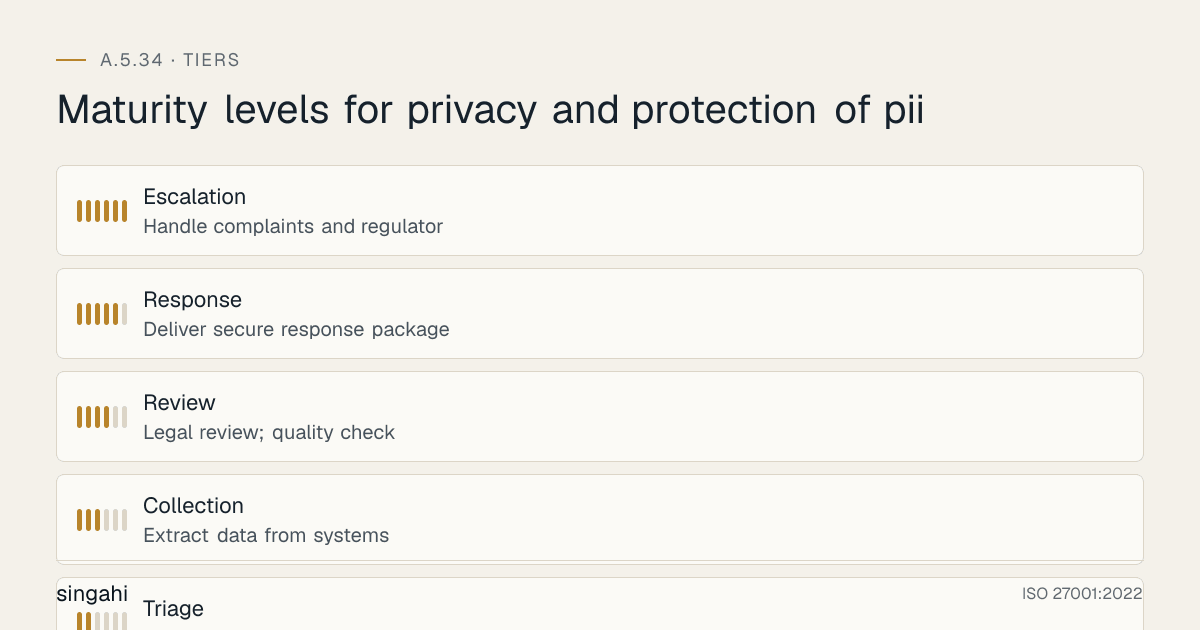
Figure · Matrix
Comparison: Customer account data to Employee records
This section provides a practical, step-by-step implementation path for A.5.34. The steps are designed for Indian B2B technology companies but can be adapted to any sector or size.
Establish Privacy Governance
Privacy cannot be a side project. It needs clear ownership, authority, and resources.
| Action | Owner | Evidence |
|---|---|---|
| Designate a Data Protection Officer (DPO) or Privacy Lead | CEO / Board | Appointment letter, job description, RACI matrix |
| Define reporting lines to top management and the board | DPO | Organization chart, board update minutes |
| Create a Privacy Steering Committee | DPO + CISO + Legal + Engineering | Charter, meeting schedule, minutes |
| Allocate budget for privacy tools, training, and legal review | CFO / CEO | Budget line item, purchase orders |
| Integrate privacy into the ISMS risk register | Risk Manager | Risk register entries, treatment plan |
Under the DPDP Act 2023, only Significant Data Fiduciaries must appoint a DPO based in India (s.10(2)(a)); every other Data Fiduciary must publish the business contact details of a person who can answer questions about processing (s.8(9)). Even if not legally required, ISO 27001 auditors expect a named privacy owner.
Build a PII Inventory and Data-Flow Map
A PII inventory is the foundation of every privacy program. Without it, notices are incomplete, DSARs are guesswork, and breach response is slow.
Step-by-step data-mapping process:
- Identify data collection points: Web forms, mobile screens, API endpoints, onboarding flows, support channels, marketing landing pages, HR portals, and IoT devices.
- Catalog PII categories: Contact data, identity documents, financial data, health data, biometrics, location, behavioral data, employment data, and inferred data.
- Map systems and owners: For each PII category, document the system of record, data owner, engineering owner, and business owner.
- Trace data flows: Draw flows from collection → processing → storage → sharing → retention → deletion. Include internal systems, third-party integrations, and cross-border transfers.
- Document lawful basis: Under DPDP Act, document whether processing relies on consent or a legitimate use (e.g., employment, legal obligation). For GDPR-facing data, document Article 6 basis.
- Define retention periods: Align retention to legal requirements, business need, and contractual obligations. Avoid "indefinite."
- Classify sensitivity: Public, Internal, Confidential, Restricted. Apply corresponding security controls.
Sample PII inventory columns:
| PII Category | Source | System | Owner | Country | Lawful Basis | Retention | Encrypted |
|---|---|---|---|---|---|---|---|
| Email, phone | Website sign-up | PostgreSQL | Product Lead | India | Consent | 3 years after account closure | Yes |
| PAN, bank details | KYC flow | Third-party KYC provider | Compliance | India | Legal obligation | 8 years | Yes |
| Support transcripts | Chat widget | Freshdesk | Support Lead | India | Contract performance | 2 years | Yes |
| Employee salary, PF | HRMS | GreytHR | HR Director | India | Employment | 7 years post-exit | Yes |
| Cookie IDs, IP | Website analytics | Google Analytics 4 | Marketing | EU/US | Consent | 14 months | N/A |
Map Applicable Privacy Requirements
Organizations operating in India often face overlapping obligations. A requirements register prevents gaps.
| Requirement Source | Trigger / Obligation | Owner | Review Frequency |
|---|---|---|---|
| DPDP Act 2023 | Notice, consent, rights, DPO, breach notification, children's data | DPO + Legal | Quarterly |
| GDPR (if EU data subjects) | Lawful basis, Articles 13/14 notices, Article 28 DPAs, cross-border SCCs | DPO + Legal | Quarterly |
| IT Act + SPDI Rules | Reasonable security practices, privacy policy, compensation for negligence | Legal | Annually |
| CERT-In Directions | 6-hour breach reporting for defined incidents | CISO + DPO | Per incident |
| RBI master direction | Customer data confidentiality, consent, localization, encryption | Compliance | Quarterly |
| SEBI circulars | Investor data protection, incident reporting | Compliance | Quarterly |
| IRDAI guidelines | Policyholder data protection, data classification | Compliance | Quarterly |
| Customer DPAs | Contractual notice periods, sub-processor restrictions, audit rights | Legal + Procurement | Per contract |
Update the register whenever a new product, market, customer segment, or regulation emerges.
Publish Privacy Notices and Manage Consent
Privacy notice essentials:
- Identity and contact details of the Data Fiduciary (and DPO)
- Categories of personal data collected
- Purposes of processing
- Legal basis / legitimate use
- Recipients or categories of recipients, including processors
- Cross-border transfers and safeguards
- Retention periods or criteria
- Data principal rights and how to exercise them
- Grievance officer / complaint mechanism
- Cookie and tracking disclosures
- Date of last update
Consent management best practices:
- Use granular consent options (not bundled terms).
- Record timestamp, version of notice, mechanism of consent, and scope.
- Make withdrawal as easy as giving consent.
- Re-obtain consent if the purpose changes materially.
- Do not rely on consent when a statutory or employment legitimate use applies.
Operationalize Data Subject Rights (DSARs)
The DPDP Act 2023 grants data principals rights to access, correction and erasure, grievance redressal, and nomination. Build a workflow:
| Stage | Activity | SLA | Owner |
|---|---|---|---|
| Intake | Receive request via portal/email; verify identity; log ticket | 1 business day | Privacy Team |
| Triage | Classify request type and scope; identify systems | 2 business days | Privacy Team |
| Collection | Extract data from systems; apply redaction; exclude others' data | 10 business days | System Owners |
| Review | Legal review; quality check; redaction validation | 3 business days | DPO / Legal |
| Response | Deliver secure response package; close ticket | 15 business days total | Privacy Team |
| Escalation | Handle complaints and regulator referrals | As required | DPO |
For GDPR, the response SLA is 30 days (extendable). Under the DPDP Rules 2025, grievances must be resolved within 90 days; publish your own response times for rights requests within that limit, and align with customer contracts.
Conduct Data Protection Impact Assessments (DPIAs)
Under the DPDP Act a DPIA is mandatory only for Significant Data Fiduciaries (s.10(2)(c)); GDPR Art. 35 requires one for high-risk processing of EU data. For everyone else, a DPIA for high-risk processing is good practice and auditors commonly look for one under A.5.34.
DPIA stages:
- Describe the processing purpose and data flows.
- Assess necessity and proportionality.
- Identify risks to data principals (unauthorized access, discrimination, identity theft, reputational harm).
- Evaluate existing controls.
- Identify residual risks and mitigation actions.
- Obtain sign-off from DPO and business owner.
- Monitor and re-assess on material change.
Trigger DPIAs for: large-scale biometric processing, employee monitoring, automated decision-making, children's platforms, health/financial data integration, and new cross-border data flows.
Apply Privacy by Design and Default
| Principle | Implementation |
|---|---|
| Proactive not reactive | Build privacy requirements into PRDs and design documents. |
| Privacy as default | Collect the minimum data by default; opt-in analytics; short retention presets. |
| Embedded into design | Include privacy review gates in SDLC; require sign-off before launch. |
| Full functionality | Do not sacrifice security for privacy; balance both. |
| End-to-end lifecycle protection | Encrypt at collection, transit, rest, and deletion. |
| Visibility and transparency | Users can see what data you hold and why. |
| Respect for user privacy | Granular controls; easy opt-out; no dark patterns. |
Implement Data Minimization and Purpose Limitation
- Review forms and API schemas to remove non-essential fields.
- Disable collection of unused data fields.
- Define and enforce allowed purposes in code and database access policies.
- Use field-level encryption or tokenization for sensitive identifiers.
- Delete or anonymize data when the original purpose is fulfilled.
Manage Retention and Secure Deletion
| Data Type | Typical Retention Driver | Disposal Method |
|---|---|---|
| Customer account data | Contract + legal requirements | Cryptographic erasure or secure deletion; proof retained |
| Transaction records | RBI / SEBI / tax laws (5–8 years) | Archive encrypted; delete after period |
| Marketing leads | Consent validity + business need | Bulk deletion workflow |
| Logs with PII | Operational need + CERT-In guidance | Redact or truncate PII; retain non-PII logs |
| Employee records | Labour laws (often 7+ years) | Secure archive; restricted access |
When a deletion request is received, delete from production, backups (or schedule deletion at end of backup lifecycle), caches, logs where feasible, and third-party integrations.
Govern Processors and Sub-processors
For each processor that handles PII:
- Execute a Data Processing Agreement (DPA) with security, confidentiality, breach notification, sub-processor, audit, and return/deletion clauses.
- Maintain a processor register with location, data categories, and security certifications.
- Conduct risk-based due diligence before onboarding.
- Review annually or on material change.
- Require notification of new sub-processors with right to object.
- Verify SOC 2, ISO 27001, or equivalent assurance.
Manage Cross-Border Data Transfers
Under DPDP Act s.16, personal data may be transferred outside India except to countries the Central Government restricts by notification; stricter sectoral rules still apply. In practice:
- Map all cross-border data flows.
- Check each destination against any notified restricted list.
- Put a processing contract in place with overseas processors (s.8(2)) and use technical safeguards (encryption, pseudonymisation).
- For EU personal data you export, GDPR applies its own rules (adequacy, SCCs and transfer impact assessments).
- Watch for sectoral localization requirements (e.g., RBI payment data localization).
Apply Security Safeguards to PII
| Safeguard | Control Detail |
|---|---|
| Encryption at rest | AES-256 for databases, object storage, backups, and laptops. |
| Encryption in transit | TLS 1.2 minimum; TLS 1.3 preferred for external APIs. |
| Access control | Role-based access; least privilege; MFA for privileged and remote access. |
| Authentication | SSO, strong passwords/biometrics, session timeouts. |
| Data masking | Mask PAN, Aadhaar, and account numbers in non-production and support views. |
| DLP | Endpoint and network DLP to detect PII exfiltration. |
| Logging and monitoring | Audit access to PII; alert on bulk exports and anomalous queries. |
| Vulnerability management | Regular scanning and patching of PII-bearing systems. |
| Secure development | Input validation, output encoding, secret management, and privacy review gates. |
| Physical security | Secure data centers, clean desk, and secure disposal of media. |
Detect, Respond to, and Report Breaches
A PII breach response playbook must address both security containment and regulatory notification.
| Step | Action | Owner | Timing |
|---|---|---|---|
| 1. Detect & contain | Stop ongoing unauthorized access; preserve evidence | SOC / Incident Response | Immediate |
| 2. Assess scope | Identify PII categories, data principals, systems, and likely impact | DPO + Forensics | Within hours |
| 3. Notify internal stakeholders | Alert DPO, legal, compliance, communications, and leadership | Incident Commander | Within 1 hour |
| 4. Notify regulators and individuals | CERT-In within 6 hours for reportable incident types; DPDP Board and each affected Data Principal without delay, detailed report to the Board within 72 hours (DPDP Rules 2025; duties apply from about May 2027) | DPO / CISO | As stated |
| 5. Notify affected principals | When required, in clear and plain language | DPO + Communications | Per regulation |
| 6. Remediate & learn | Close vulnerabilities, update controls, document lessons learned | Engineering + DPO | Post-incident |
Train and Raise Awareness
| Audience | Training Content | Frequency |
|---|---|---|
| All employees | Privacy principles, phishing, clean desk, acceptable use, reporting breaches | Annual |
| Engineering & Product | Privacy by design, data minimization, secure coding, DSAR handling | Quarterly |
| HR | Employee data handling, background checks, exit data deletion | Annual |
| Sales & Marketing | Lead data, consent, cookie compliance, cold outreach rules | Quarterly |
| Support | DSAR intake, PII redaction, escalation | Quarterly |
| Executives | Board reporting, breach decision-making, regulatory trends | Annual |
Monitor, Audit, and Continuously Improve
- Schedule quarterly privacy self-assessments against the legal requirements register.
- Include privacy controls in the internal audit program.
- Track KPIs (see Section 12) and report to the Privacy Steering Committee.
- Update policies, notices, and consents when laws or processing change.
- Conduct tabletop exercises for breach response and DSAR surge scenarios.
Tools, Technologies, and Solutions
The privacy technology market has matured significantly. Indian organizations can choose between global enterprise suites, Indian compliance platforms, and cloud-native security tools. The right mix depends on data volume, regulatory complexity, and integration needs.
| Vendor / Tool | Primary Capability | Best For |
|---|---|---|
| BigID | Data discovery, classification, PII inventory, data rights automation | Growing companies to enterprise with hybrid/cloud data |
| Securiti | PrivacyOps, consent, DSAR, data governance, AI governance | SaaS companies, multi-cloud environments |
| TrustArc | Privacy program management, assessments, cookie consent, DSAR | Global companies needing regulator-recognized assessments |
| VComply | GRC platform with privacy register, risk, policy, control mapping | Indian growing companies seeking integrated GRC |
| Tsaaro / PrivacyPrime | Indian privacy consultancy + tooling for DPDP Act readiness | Indian organizations needing local expertise |
| CookieYes / UniConsent | Cookie consent, CMP, privacy notice widgets | Websites and marketing teams |
| ManageEngine AD360 / DataSecurity Plus | Identity governance, file-server PII scanning, DLP | On-premises and Microsoft-centric environments |
| Microsoft Purview | Data classification, DLP, retention, eDiscovery, DSAR support | Microsoft 365 / Azure ecosystems |
| Google Cloud DLP / AWS Macie | Cloud-native discovery and classification of PII | Cloud-native engineering teams |
| Salesforce Shield / Privacy Center | Platform encryption, event monitoring, DSAR handling | Salesforce-heavy CRM environments |
| Zendesk / Freshdesk apps | Ticket redaction, DSAR workflows | Customer support teams |
Selection Criteria
| Criterion | Why It Matters |
|---|---|
| DPDP Act alignment | Tool should support Indian consent, notice, rights, and breach concepts, not just GDPR. |
| Data discovery coverage | Must scan databases, SaaS, cloud storage, endpoints, and email where relevant. |
| Integration with engineering stack | APIs, webhooks, and CI/CD plugins reduce manual work. |
| DSAR workflow | End-to-end automation from intake to secure delivery, with audit trail. |
| Reporting and dashboards | Privacy KPIs, risk heatmaps, and auditor-ready evidence exports. |
| Localization | Data residency, Indian support, and understanding of local regulators. |
| overall value | Factor in implementation, training, integrations, and ongoing managed services. |
Policy and Procedure Templates
The following templates are designed to be adapted to your organization. They are intentionally detailed because A.5.34 requires both policy direction and operational procedure.
PII Protection and Privacy Policy
PERSONAL DATA / PII PROTECTION AND PRIVACY POLICY
[Organization Name]
Version: 1.0
Effective Date: [Date]
Review Date: [Date + 12 months]
Classification: Internal
Owner: Data Protection Officer
Approved by: [CEO / Managing Director]

1. PURPOSE
This policy establishes the principles, roles, and controls for the protection
of personally identifiable information (PII) and personal data processed by
[Organization Name] in compliance with ISO 27001:2022 A.5.34, the Digital
Personal Data Protection Act 2023, the IT Act 2000, and other applicable laws.

2. SCOPE
This policy applies to all employees, contractors, consultants, suppliers,
and third parties who process PII on behalf of [Organization Name]. It covers
all systems, applications, databases, physical records, and communication
channels used to collect, store, process, transmit, or destroy PII.

3. POLICY STATEMENTS

3.1 Lawfulness and Fairness
   • PII shall be processed lawfully, fairly, and transparently.
   • A valid lawful basis or legitimate use shall be documented before processing.

3.2 Data Minimization
   • Only PII necessary for the specified purpose shall be collected.
   • Unnecessary fields in forms and APIs shall be disabled or removed.

3.3 Purpose Limitation
   • PII shall not be used for purposes incompatible with the original notice.
   • New purposes require legal review and, where required, renewed consent.

3.4 Accuracy
   • PII shall be kept accurate and up to date.
   • Data principals may request correction of inaccurate PII.

3.5 Storage Limitation
   • PII shall be retained only as long as required by law, contract, or
     documented business need.
   • Secure deletion shall occur at the end of the retention period or upon
     valid deletion request.

3.6 Integrity and Confidentiality
   • PII shall be protected by appropriate technical and organizational
     security measures, including encryption, access control, monitoring,
     and secure disposal.

3.7 Accountability
   • [Organization Name] maintains records of processing activities,
     privacy impact assessments, and compliance evidence.
   • The DPO is accountable for privacy governance and regulatory liaison.

4. ROLES AND RESPONSIBILITIES

4.1 Board / Top Management
   • Approve privacy policy and strategy.
   • Provide resources for privacy compliance.

4.2 Data Protection Officer (DPO)
   • Maintain the privacy program, legal register, and PII inventory.
   • Oversee DSAR, breach, and DPIA processes.
   • Report privacy risk to top management.

4.3 System / Data Owners
   • Ensure PII in their systems is classified, protected, and disposed of correctly.
   • Respond to DSAR and breach requests within SLA.

4.4 All Employees
   • Handle PII only as authorized.
   • Report suspected breaches immediately.
   • Complete privacy awareness training.

5. CONSENT AND NOTICE
   • Privacy notices shall be published for all data collection points.
   • Consent shall be freely given, specific, informed, and unambiguous.
   • Consent records shall include timestamp, scope, mechanism, and version.

6. DATA SUBJECT RIGHTS
   • Requests shall be logged, identity-verified, and fulfilled within the
     documented SLA.
   • Responses shall be secure and, where required, redacted to protect
     others' privacy.

7. THIRD-PARTY PROCESSORS
   • Processors shall be assessed and governed by written data processing
     agreements.
   • Sub-processors require prior notification and, where contractually
     required, approval.

8. BREACH RESPONSE
   • Suspected PII breaches shall be escalated to the DPO and CISO immediately.
   • Notifications to regulators and affected principals shall be made within
     statutory timeframes.

9. TRAINING AND AWARENESS
   • All personnel shall receive privacy training at onboarding and annually.
   • Role-specific training shall be provided for engineering, support, HR,
     sales, and marketing.

10. POLICY REVIEW
    This policy is reviewed annually and whenever significant legal, technical,
    or organizational changes occur.

APPROVED BY:
[Name, Title]                    Date:
[Name, Title]                    Date:
Privacy Notice Template
PRIVACY NOTICE — [Organization Name]
Last Updated: [Date]

1. WHO WE ARE
[Organization Name] is the Data Fiduciary responsible for your personal data.
Contact: [DPO email and postal address].

2. WHAT DATA WE COLLECT
We may collect: name, email, phone, company name, job title, IP address,
cookie identifiers, payment information, identity documents (where required
by law), support transcripts, and usage data.

3. HOW WE USE YOUR DATA
• To provide our products and services
• To process transactions and send invoices
• To communicate updates, security alerts, and marketing (where consented)
• To comply with legal and regulatory obligations
• To improve our products and detect fraud or abuse

4. LEGAL BASIS / LEGITIMATE USE
We process data based on your consent, contractual necessity, legal obligation,
or, under the DPDP Act, a legitimate use listed in Section 7 (the DPDP Act has no general "legitimate interests" basis; use GDPR Art. 6(1)(f) only for EU data).

5. WHO WE SHARE DATA WITH
• Service providers (hosting, payment, analytics, support)
• Regulators and law enforcement when legally required
• Affiliates and business partners (only with appropriate safeguards)

6. INTERNATIONAL TRANSFERS
Your data may be transferred to countries outside India. We use contractual
safeguards and encryption to protect such transfers.

7. YOUR RIGHTS
Under the DPDP Act you may request information about your personal data,
correction, completion, updating or erasure; withdraw consent; nominate
another person to exercise your rights; and raise a grievance, which we will
resolve within [X] days (no more than 90). If you are not satisfied, you may
complain to the Data Protection Board of India. [EU residents: you also have
GDPR rights to restriction, portability and objection.] Contact us at
[privacy@company.com].

8. RETENTION
We retain personal data for as long as necessary to fulfill the purposes
outlined above and to comply with legal obligations.

9. SECURITY
We use encryption, access controls, and monitoring to protect your data.

10. CHANGES TO THIS NOTICE
We may update this notice. The latest version will be posted on our website
with the effective date.
DSAR Handling Procedure
DATA SUBJECT ACCESS REQUEST (DSAR) PROCEDURE
Version: 1.0 | Owner: DPO

1. INTAKE
   • Accept requests via privacy portal, email, or in writing.
   • Record date, channel, requester identity evidence, and request type.

2. VERIFICATION
   • Verify identity using account credentials, OTP, or government-issued ID.
   • For third-party agents, verify authorization (e.g., power of attorney).

3. SCOPING
   • Confirm requested right. DPDP: information/access (s.11), correction,
     completion, updating, erasure (s.12), grievance (s.13), nomination (s.14).
     GDPR (EU data only): also restriction, portability, objection.
   • Identify systems and time range involved.

4. DATA COLLECTION
   • System owners extract relevant PII.
   • Exclude data that reveals other individuals' PII or is legally privileged.

5. REDACTION AND REVIEW
   • Redact third-party PII and confidential business information.
   • DPO reviews completeness and legal exceptions.

6. RESPONSE
   • Provide response via secure channel (encrypted email or portal download).
   • Include explanation of rights and grievance mechanism.

7. CLOSURE AND RECORDING
   • Close ticket; retain audit record.
   • Track SLA and reasons for any extension.

EXCEPTIONS
   • Requests may be refused where manifestly unfounded, excessive, or
     prohibited by law. Document rationale.
Risk Assessment and Treatment
The following risk scenarios are specific to PII processing and A.5.34. Use your organization's likelihood and impact scales.
| ID | Risk Scenario | Likelihood | Impact | Risk Level | Treatment |
|---|---|---|---|---|---|
| R1 | Unauthorized access to customer PII due to weak authentication | Medium | Critical | High | Enforce MFA, least privilege, and privileged access monitoring. |
| R2 | PII exposed through misconfigured cloud storage | Medium | Critical | High | Automated posture scanning, bucket policies, DLP, and periodic audits. |
| R3 | Failure to honor a DSAR within statutory / contractual SLA | Medium | High | High | Implement DSAR workflow, ticketing, and escalation. |
| R4 | Processing PII without valid consent or lawful basis | Medium | High | High | Maintain lawful basis register and consent logs; legal review of new processing. |
| R5 | PII shared with an unapproved sub-processor | Low | High | Medium | DPA clauses, sub-processor register, and change-notification process. |
| R6 | Retention of PII beyond legal / business need | Medium | Medium | Medium | Enforce retention schedules and secure deletion procedures. |
| R7 | Insider exfiltration of PII by employee | Low | Critical | High | DLP, access logging, background checks, and awareness training. |
| R8 | Delayed breach notification to CERT-In / DPDP Board | Low | Critical | High | Breach playbooks, 24/7 escalation, and pre-approved communication templates. |
| R9 | Inadequate privacy notice leading to regulatory complaint | Medium | Medium | Medium | Regular notice review, plain-language drafting, and user testing. |
| R10 | Cross-border transfer to non-notified jurisdiction | Medium | High | High | Transfer impact assessment, SCCs, and encryption. |
| R11 | Over-collection of PII in product forms | Medium | Medium | Medium | Data minimization review and field-level validation. |
| R12 | Logs containing PII retained indefinitely | Medium | Medium | Medium | Log retention policy, PII masking, and automated deletion. |
Residual risk target: All "High" risks treated to Medium or Low within 90 days; Medium risks accepted with documented rationale and monitoring.
Audit and Compliance Checklist
Use this checklist to prepare for internal audits, certification audits, and regulator inspections. Each item includes expected evidence and common red flags.
| # | Audit Question | Expected Evidence | Red Flag |
|---|---|---|---|
| 1 | Is a DPO or Privacy Lead appointed? | Appointment letter, org chart, job description | No named privacy owner; role buried under IT |
| 2 | Is there a privacy policy approved by top management? | Signed policy, version history, review date | Generic policy not tailored to the organization |
| 3 | Is there a register of applicable privacy requirements? | Requirements register, legal review records | Register missing DPDP Act, RBI, SEBI, or customer DPAs |
| 4 | Is a PII inventory maintained? | Inventory spreadsheet or tool export; data-flow diagrams | No inventory; PII locations unknown |
| 5 | Are lawful bases / consent documented? | Consent logs, legitimate-use assessments | Processing based on vague "legitimate interest" without analysis |
| 6 | Is a privacy notice published and current? | Website notice, version history, accessibility test | No notice; notice outdated; hidden deep in site |
| 7 | Are data collection points mapped? | PRDs, data-flow maps, API documentation | Marketing pixel or form not in inventory |
| 8 | Is there a DSAR procedure and tracking? | Procedure, ticket samples, SLA metrics | DSARs handled ad-hoc via email with no SLA |
| 9 | Are DSAR responses secure and redacted? | Redaction standards, secure delivery records | Raw exports sent over unencrypted email |
| 10 | Are DPIAs performed for high-risk processing? | DPIA methodology, completed DPIAs, remediation logs | No DPIAs; high-risk processing launched without review |
| 11 | Are processors governed by DPAs? | DPA templates, signed agreements, register | Verbal agreements or standard terms without privacy clauses |
| 12 | Is sub-processor change control enforced? | Sub-processor register, notification records, objection logs | New sub-processors added without notice |
| 13 | Are cross-border transfers assessed? | Transfer impact assessments, SCCs, encryption evidence | Transfers to any country without assessment |
| 14 | Is PII encrypted at rest and in transit? | Cryptography policy, configuration baselines, scan reports | Plain-text PII in databases or email |
| 15 | Is access to PII based on least privilege? | Access control matrix, quarterly reviews, MFA records | Shared accounts; broad admin access |
| 16 | Is PII deletion executed per retention schedule? | Deletion procedures, logs, backup handling | No retention schedule; backups retained forever |
| 17 | Are logs and monitoring configured for PII systems? | SIEM rules, log review records, alerting thresholds | No audit logs for PII access |
| 18 | Is DLP in place to detect PII exfiltration? | DLP policy, incident records, tuning history | No DLP; bulk downloads unnoticed |
| 19 | Is there a breach response playbook for PII? | Playbook, contact trees, notification templates | No breach notification timeline |
| 20 | Are breaches reported within regulatory timeframes? | Breach register, CERT-In notifications, evidence | Delayed or missing notifications |
| 21 | Is privacy training delivered to relevant staff? | Training plan, completion records, quiz results | No role-specific privacy training |
| 22 | Are confidentiality agreements in place for PII handlers? | Signed NDAs, contract clauses | Contractors without NDAs accessing PII |
| 23 | Is privacy integrated into change management? | Change records with privacy review gate | Product changes launched without privacy review |
| 24 | Are children / vulnerable data principals protected? | Age-gating, parental consent, enhanced safeguards | No process for children's data |
| 25 | Is there a grievance redressal mechanism? | Grievance procedure, register of complaints | No complaint channel published |
| 26 | Are privacy metrics reported to management? | Dashboard, management review minutes | Privacy not on management review agenda |
| 27 | Is there a data localization compliance plan? | Mapping of localized vs. non-localized data | Payment or sensitive data stored outside required jurisdiction |
| 28 | Are cookie and tracking technologies disclosed? | Cookie policy, CMP records, consent banners | Tracking cookies deployed without consent |
| 29 | Is there a nominated grievance officer under DPDP Act? | Contact details, appointment record | Missing grievance officer contact |
| 30 | Are lessons learned from incidents incorporated? | Post-incident reports, updated controls | Same breach pattern repeats |
Metrics and KPIs
Figure · Measures
The measures that show A.5.34 is working
- PII inventory coverage≥ 95%Monthly
- DSAR response SLA≥ 95%Monthly
- DSAR backlog0Weekly
- Consent record completeness100%Quarterly
- Privacy training completion100%Quarterly
Privacy programs must be measurable. The following KPIs support A.5.34 and management review.
| # | KPI | Formula | Target | Frequency |
|---|---|---|---|---|
| 1 | PII inventory coverage | (# systems in inventory with PII tagged / total systems processing PII) × 100 | ≥ 95% | Monthly |
| 2 | DSAR response SLA | (# DSARs closed within SLA / total DSARs closed) × 100 | ≥ 95% | Monthly |
| 3 | DSAR backlog | Count of open DSARs beyond SLA | 0 | Weekly |
| 4 | Consent record completeness | (# consents with timestamp + scope + version / total consents) × 100 | 100% | Quarterly |
| 5 | Privacy training completion | (# trained / # required) × 100 | 100% | Quarterly |
| 6 | DPIA completion rate | (# high-risk projects with completed DPIA / total high-risk projects) × 100 | 100% | Per project |
| 7 | Processor DPA coverage | (# processors with signed DPA / total processors handling PII) × 100 | 100% | Quarterly |
| 8 | Sub-processor notification compliance | (# changes notified on time / total changes) × 100 | 100% | Per change |
| 9 | PII-related incidents | Count of confirmed unauthorized access or loss events | Trend downward | Monthly |
| 10 | Mean time to notify breach | Average hours from detection to regulator notification | ≤ 4 hours for CERT-In | Per incident |
| 11 | Data retention adherence | (# records deleted per schedule / due for deletion) × 100 | ≥ 98% | Quarterly |
| 12 | Encryption coverage for PII systems | (# PII systems encrypted at rest and in transit / total PII systems) × 100 | 100% | Quarterly |
| 13 | DLP alert closure time | Average hours to investigate/close DLP alert | ≤ 24 hours | Weekly |
| 14 | Privacy policy acknowledgment | (# acknowledged / total relevant personnel) × 100 | 100% | Quarterly |
| 15 | Audit finding closure rate | (# closed privacy findings / total findings) × 100 | 100% within 60 days | Per audit |
Common Pitfalls / Audit Failures & How to Avoid Them
| Pitfall | Root Cause | Fix |
|---|---|---|
| No single owner for privacy | Privacy treated as a legal or IT afterthought | Appoint a DPO with board visibility and mandate |
| PII inventory is a one-time spreadsheet | Lack of tooling and ownership | Implement data-discovery scans and assign system owners |
| Privacy notice copied from a competitor | Legal review skipped | Draft notice from processing inventory; validate with legal |
| Consent buried in terms of service | UX-driven dark pattern | Use standalone, granular consent with clear withdraw path |
| DSARs handled over email | No workflow or tooling | Deploy a privacy portal / ticketing workflow |
| Over-retention of PII | Fear of deleting data | Define retention schedules tied to law and business need |
| No DPA with processors | Procurement speed over governance | Make DPA a mandatory procurement gate |
| Cross-border transfers ignored | Engineering convenience | Map flows; use SCCs and encryption; watch RBI localization |
| Logs contain raw PII indefinitely | Poor logging hygiene | Mask PII in logs; enforce retention; redact on export |
| Privacy training is generic | One-size-fits-all content | Role-based modules for engineering, support, HR, sales |
| Breach notification delayed | No pre-approved templates | Maintain regulator contact list and notification playbooks |
| Children's data unprotected | No age verification | Implement age-gating and parental consent where relevant |
| Same findings repeat across audits | No root-cause analysis | Close findings with CAPA and verify effectiveness |
Illustrative Scenarios
Illustrative scenario, a composite example for guidance, not a specific Singahi engagement or a verified outcome.
Illustrative Scenario 1: Indian Fintech NBFC, From Regulatory Warning to Audit-Ready Privacy Program
Background: A Bengaluru-based NBFC offering personal loans and credit-line products processed PAN, Aadhaar (voluntarily collected for KYC), bank statements, employment details, and device data from over 2 million customers. The company had grown rapidly and relied on a generic privacy policy, manual DSAR responses via email, and ad-hoc processor contracts.
Challenge: Following an RBI thematic review, the NBFC received observations on:
- Lack of a data classification and PII inventory.
- Customer consent not demonstrably recorded for data sharing with analytics partners.
- No documented process for honoring deletion requests.
- Cross-border analytics flows to a US-based BI tool without transfer safeguards.
Solution: The NBFC engaged an external security consultant to implement an ISO 27001-aligned privacy program under A.5.34.
- Governance: Appointed a full-time DPO reporting to the board; established a Privacy Steering Committee with Legal, Compliance, IT, Product, and Operations.
- Inventory: Conducted a 4-week data-mapping sprint across mobile app, website, CRM, loan management system, document vault, and BI tools. Tagged all PII fields and assigned system owners.
- Legal mapping: Built a requirements register covering DPDP Act 2023, RBI master direction, IT Act, SPDI Rules, and GDPR for NRI customers.
- Consent and notices: Re-designed app onboarding with granular consent screens, consent logging to an immutable store, and an updated privacy notice in plain English, Hindi, and Tamil.
- DSAR automation: Implemented a privacy portal integrated with the loan management system, reducing manual data extraction from 6 hours to 30 minutes per request.
- Processor governance: Standardized DPA clauses; renegotiated contracts with 14 processors; created a sub-processor register with objection rights.
- Cross-border transfers: Replaced US BI tool with an India-region instance for customer PII; executed Standard Contractual Clauses for analytics pseudonymized data.
- Security: Enabled field-level encryption for Aadhaar/PAN, implemented DLP on document exports, and restricted support agents' access via dynamic masking.
Results:
- Cleared RBI observations within 90 days.
- Achieved ISO 27001:2022 certification in the next audit cycle with zero major nonconformities related to A.5.34.
- Reduced DSAR response time from 21 days to 4 days.
- Customer complaints related to data usage dropped by 62%.
- Won two large enterprise partnerships that previously stalled due to privacy due diligence.
Illustrative Scenario 2: Indian EdTech Scale-Up, Building Privacy by Design into a Global Product
Background: A Hyderabad-based EdTech company served K–12 students, college learners, and working professionals. Its platform collected names, emails, phone numbers, academic records, payment details, video recordings of classes, and behavioral analytics. The company planned expansion into the EU and Middle East and needed a privacy framework that satisfied multiple jurisdictions.
Challenge:
- Children's data was processed without age-verification or parental consent workflows.
- Recorded classes and chat logs were retained indefinitely.
- Marketing and admissions teams shared lead lists via spreadsheets and WhatsApp.
- No DSAR process existed; support agents manually searched multiple tools.
- The product roadmap had no privacy review gate.
Solution: The company implemented a privacy-by-design program aligned with A.5.34.
- Role and governance: Hired a DPO and formed a cross-functional Privacy Council that met bi-weekly.
- PII inventory: Mapped data across the LMS, video platform, CRM, payment gateway, marketing automation, and mobile app. Identified that recorded class videos contained minors' images and voices.
- Children's data protection: Implemented age-gating, verifiable parental consent that checks the parent's identity and age through reliable details or a token (for example via DigiLocker), as the DPDP Rules require, and restricted tracking and targeted advertising for users under 18. Added watermarks and download restrictions on recorded content.
- Data minimization: Removed unnecessary fields from lead forms; stopped collection of permanent address unless required for certification delivery.
- Retention and deletion: Automated deletion of recorded classes after 180 days unless downloaded by the student; implemented a soft-delete + cryptographic erasure workflow for account closure.
- DSAR portal: Built a self-service portal where learners could request access, correction, and deletion. Integration with CRM, LMS, and video platform reduced manual effort by 80%.
- Marketing controls: Replaced spreadsheet sharing with a CRM workflow; enforced consent tags and unsubscribe links; deployed a cookie consent manager.
- Engineering integration: Added a "privacy review" ticket type in Jira; every new feature required sign-off from the DPO before release.
- Training: Launched role-based privacy training for engineering, support, sales, and content teams, with quarterly refreshers.
Results:
- Launched successfully in the EU with GDPR compliance and in the GCC region with localized notices.
- Reduced PII-bearing systems from 34 to 21 by decommissioning shadow IT and consolidating marketing tools.
- DSAR volume surged to 300+ per month but was handled within 5 business days on average.
- Passed a customer-led SOC 2 Type II audit with privacy criteria and an ISO 27001 surveillance audit with no findings in A.5.34.
Multi-Framework Mapping
A.5.34 does not exist in isolation. Mapping it to other frameworks helps organizations use one set of controls for multiple audits and customer questionnaires.
| Framework / Standard | Relevant Requirement | How A.5.34 Maps |
|---|---|---|
| ISO 27001:2022 Annex A | A.5.34, Privacy and protection of PII | Direct mapping. This is the control. |
| ISO 27002:2022 | Section 5.34 | Implementation guidance on governance, notice, consent, rights, DPIA, processor management, breach, and training. |
| SOC 2 (Trust Services Criteria) | CC6.1, CC6.6, CC7.2, CC9.1, P1.1, P2.1, P3.1, P4.1, P5.1, P6.1, P7.1 | Privacy criteria (P series) and confidentiality/security criteria directly overlap with PII inventory, consent, rights, retention, and security safeguards. |
| PCI DSS v4.0.1 | Req 3 (protect stored account data), Req 4 (encryption), Req 7 (access control), Req 8 (authentication), Req 10 (logging), Req 12 (policies) | Cardholder data is a subset of PII; A.5.34 governance and security controls support PCI DSS scope reduction and protection. |
| NIST SP 800-53 Rev 5 | PT-1, PT-3, PT-5, PM-18, PM-20, PM-24, SI-12, AC-3, AC-17, AU-6, SC-8, SC-28 | Rev 5 PII processing and transparency controls (PT family), privacy program management (PM-18, PM-20), and technical safeguards map closely to A.5.34. |
| CIS Controls v8 | Control 3 (Data Protection), Control 4 (Secure Configuration), Control 5 (Account Management), Control 6 (Access Control), Control 8 (Audit Log Management), Control 13 (Network Monitoring), Control 16 (Application Software Security) | CIS data protection and security controls provide the technical foundation for protecting PII. |
| COBIT 2019 | APO12 (Managed Risk), APO13 (Managed Security), APO14 (Managed Data), BAI05 (Managed Organizational Change), BAI06 (Managed IT Changes), DSS01 (Managed Operations), DSS05 (Managed Security Services), DSS06 (Managed Business Process Controls) | Privacy governance, risk, and data management align with COBIT management objectives. |
| GDPR (EU 2016/679) | Articles 5 (principles), 6 (lawfulness), 12–14 (transparency), 15–22 (rights), 25 (PbD/PbD), 28 (processors), 30 (records), 32 (security), 33–34 (breach) | A.5.34 operationalizes GDPR principles through inventory, notices, consent, rights, DPAs, and breach response. |
| DPDP Act 2023 (India) | Sections 4–11 (consent, notice, rights), 12 (duties of principal), 15 (children), 18 (grievance), 22–25 (breach), 27 (Significant Data Fiduciary obligations), 28 (DPO), 33 (penalties) | A.5.34 provides the ISO 27001 structure for implementing DPDP Act obligations. |
| RBI Master Direction on Information Technology Governance, Risk, Controls and Assurance Practices (2023, in force from 1 April 2024) | Information security and cyber security governance, data protection, incident reporting (replaced the 2017 IT Framework for NBFCs) | PII protection for financial customers maps to A.5.34 plus A.8 encryption and access controls. |
| SEBI CSCRF (2024) | Investor data protection, incident reporting, periodic audits, data classification | A.5.34 governance supports SEBI-mandated protection of investor PII. |
| IRDAI Guidelines on Information and Cyber Security | Policyholder data protection, data classification, risk assessment, incident reporting | A.5.34 and related Annex A controls map to insurer privacy obligations. |
Implementation Roadmap
The following 8-week roadmap is suitable for a growing Indian B2B tech company. Adjust the pace based on size, complexity, and regulatory pressure.
| Week | Phase | Key Deliverables | Owner |
|---|---|---|---|
| Week 1 | Discover & Govern | Appoint DPO; form Privacy Steering Committee; kick-off data-mapping; issue privacy policy draft. | CEO, DPO |
| Week 2 | Inventory & Requirements | Complete PII inventory v1; publish data-flow diagrams; finalize legal/regulatory requirements register (DPDP Act, RBI, SEBI, IRDAI, GDPR, customer DPAs). | DPO, Legal, System Owners |
| Week 3 | Notice & Consent | Publish updated privacy notice; implement consent management at key collection points; start consent log. | Product, Marketing, DPO |
| Week 4 | Rights & DPIA | Launch DSAR intake process; train support and privacy team; conduct DPIA for top 3 high-risk processing activities. | DPO, Support, Engineering |
| Week 5 | Processors & Transfers | Execute DPAs for all PII processors; build sub-processor register; document cross-border transfer safeguards. | Procurement, Legal, DPO |
| Week 6 | Security & Technical Controls | Encrypt PII at rest and in transit; enforce MFA; implement DLP; mask PII in non-production; review logging. | CISO, Engineering |
| Week 7 | Retention, Deletion & Training | Approve retention schedule; execute secure deletion pilot; deliver role-based privacy training; launch breach response tabletop exercise. | DPO, HR, Engineering |
| Week 8 | Measure & Audit | Finalize metrics dashboard; conduct internal audit against A.5.34; close gaps; present privacy report to board; integrate into ISMS management review. | Internal Audit, DPO, Board |
Post-Implementation Sustainment
| Frequency | Activity |
|---|---|
| Weekly | DSAR backlog review; DLP alert triage |
| Monthly | PII inventory reconciliation; privacy KPI review |
| Quarterly | Privacy Steering Committee meeting; processor risk review; training completion check; legal register update |
| Semi-annually | DPIA refresh for high-risk processing; breach tabletop exercise |
| Annually | Full privacy policy review; internal audit; management review; board privacy report |
| Trigger-based | New product, new market, new processor, new regulation, or material breach |
FAQ
Q1: Is A.5.34 only about GDPR?
No. A.5.34 requires compliance with all applicable privacy and PII protection requirements. For Indian organizations, that includes the DPDP Act 2023, IT Act 2000 + SPDI Rules, CERT-In directions, RBI/SEBI/IRDAI rules, and contractual DPAs. GDPR applies only if you process EU residents' personal data.
Q2: Do all Indian companies need a DPO?
The DPDP Act 2023 requires a DPO only for Significant Data Fiduciaries; other fiduciaries need a published contact person (s.8(9)). Even without a legal mandate, ISO 27001 auditors expect a named privacy owner for A.5.34.
Q3: What is the difference between PII and personal data?
PII is the ISO 27001 terminology. Personal data is the term used in the DPDP Act 2023 and GDPR. They overlap heavily. Personal data is generally interpreted more broadly to include online identifiers and inferred data.
Q4: Can we rely on a single global privacy notice for India and other countries?
You can have a single notice if it accurately covers all jurisdictions, but it is often clearer to have a base notice with jurisdiction-specific sections (e.g., DPDP Act rights for India, GDPR rights for the EU). Avoid using only GDPR language for Indian users.
Q5: How do we handle DSARs when PII is spread across many SaaS tools?
Maintain a PII inventory that maps each PII category to the systems containing it. Use a DSAR workflow that assigns extraction tasks to system owners. For high-volume requests, consider a privacy tool with automated connectors.
Q6: What counts as a PII breach that must be reported?
A breach is any unauthorized access, disclosure, alteration, or destruction of PII. Reporting obligations depend on the law: CERT-In Directions require reporting certain incidents within 6 hours; the DPDP Act (s.8(6)) requires intimation of every personal data breach to the Data Protection Board and to each affected Data Principal, without delay, with a detailed report to the Board within 72 hours under the DPDP Rules.
Q7: Do we need consent for every processing activity?
No. The DPDP Act 2023 allows processing under "legitimate uses" such as employment, legal claims, or state functions, in addition to consent. Document your lawful basis for each activity rather than defaulting to consent.
Q8: How does A.5.34 relate to SOC 2 privacy criteria?
SOC 2 privacy criteria (P1.1–P7.1) cover notice, choice and consent, collection, use, retention, disposal, access, disclosure, quality, monitoring, and enforcement. A.5.34 plus the supporting controls in this guide directly satisfy those criteria.
Q9: What is the quickest way to show A.5.34 compliance to an auditor?
Present: (1) privacy policy and legal register, (2) PII inventory and data flows, (3) privacy notice and consent records, (4) DSAR procedure and closed tickets, (5) processor DPAs and register, (6) breach response playbook, and (7) training records.
Q10: Should children's data be treated differently?
Yes. The DPDP Act 2023 provides enhanced protections for children (persons under 18). You must obtain verifiable parental consent, avoid tracking, behavioral monitoring, or targeted advertising directed at children, and conduct a DPIA for such processing.
Q11: How do we balance privacy with security monitoring and logging?
Security logs are essential, but they should not retain unnecessary PII. Mask or truncate identifiers where possible, limit log access to authorized personnel, define retention periods, and conduct a proportionality assessment before deploying employee monitoring tools. Document the business necessity and alternative measures considered.
Q12: What should a privacy clause in an enterprise customer DPA include?
Key clauses include: processing instructions, permitted sub-processors and objection rights, security measures, DSAR assistance, breach notification timelines, audit rights, data localization or transfer safeguards, return/deletion obligations, and liability/indemnity. Align the clause with both ISO 27001 A.5.34 and the DPDP Act 2023.
Q13: Is pseudonymized data still considered PII?
Yes, in most cases. Pseudonymization reduces risk but does not make data anonymous because it can be re-identified with additional information. Continue to protect pseudonymized data as PII, and treat anonymized data as outside scope only after a rigorous irreversibility assessment.
Q14: How do we handle employee monitoring under privacy law?
Employee monitoring must be necessary, proportionate, and transparent. Inform employees through clear policies, limit monitoring to business purposes, avoid covert surveillance except in defined investigations, and consult the DPO and Legal before deploying BYOD, CCTV, keystroke, or productivity-monitoring tools.
Q15: What are Privacy Enhancing Technologies (PETs), and when should we use them?
PETs include differential privacy, federated learning, homomorphic encryption, secure multi-party computation, and synthetic data. Use them when you need to derive value from data while minimizing PII exposure, particularly in analytics, AI/ML, and cross-organizational research scenarios.
References and Further Reading
Standards
- ISO/IEC 27001:2022, Annex A, Control 5.34, Privacy and protection of PII.
- ISO/IEC 27002:2022, Section 5.34, Implementation guidance for privacy and protection of PII.
- ISO/IEC 27701:2025, Privacy information management systems (now a standalone management system standard; replaced the 2019 extension).
- ISO/IEC 29100:2011, Privacy framework.
- ISO/IEC 29134:2023, Privacy impact assessment.
Indian Laws and Regulations
- Digital Personal Data Protection Act, 2023 (India).
- Information Technology Act, 2000 and Information Technology (Reasonable Security Practices and Procedures and Sensitive Personal Data or Information) Rules, 2011.
- CERT-In Directions, 2022 (Indian Computer Emergency Response Team).
- Reserve Bank of India, Master Direction on Information Technology Governance, Risk, Controls and Assurance Practices (2023).
- Securities and Exchange Board of India, Cybersecurity and Cyber Resilience Framework for Stock Exchanges, Clearing Corporations, and Depositories; circulars for intermediaries.
- Insurance Regulatory and Development Authority of India, Guidelines on Information and Cyber Security for insurers.
International Frameworks
- General Data Protection Regulation (EU) 2016/679.
- NIST SP 800-53 Rev 5, Security and Privacy Controls for Information Systems and Organizations.
- NIST Privacy Framework: A Tool for Improving Privacy through Enterprise Risk Management, Version 1.0.
- CIS Controls Version 8.
- COBIT 2019 Framework.
- AICPA Trust Services Criteria (SOC 2).
- PCI DSS v4.0.1.
Industry Reports and Resources
- IBM Security, Cost of a Data Breach Report 2024.
- OECD Privacy Framework.
- Data Protection Board of India (notifications and guidance as issued).
- Singahi ISO 27001 Implementation Guides for related Annex A controls.
End of guide.