
On this page
- Quick Reference: A.5.31 in 60 Seconds
- What the Control Asks For
- Why This Control Matters
- Scope and Applicability
- Key Definitions and Terminology
- Relationship to Other Controls
- Detailed Implementation Guidance
- Tools, Technologies, and Solutions
- Policy and Procedure Templates
- Risk Assessment and Treatment
- Audit and Compliance Checklist
- Metrics and KPIs
- Common Pitfalls / Audit Failures & How to Avoid Them
- Illustrative Scenarios
- Multi-Framework Mapping
- Implementation Roadmap
- FAQ
- References and Further Reading
Quick Reference: A.5.31 in 60 Seconds
| Attribute | Detail |
|---|---|
| Control ID | A.5.31 |
| Title | Legal, statutory, regulatory and contractual requirements |
| Objective | Ensure the organization identifies, documents, maintains, and integrates all legal, statutory, regulatory, and contractual information security requirements into the ISMS and operations. |
| Domain | Organisational controls (Governance & Compliance) |
| What You Must Do | Build and maintain a Legal and Compliance Register; assign ownership; review at planned intervals; translate obligations into policies, procedures, and technical controls; demonstrate compliance to auditors. |
| Typical Owner | Chief Information Security Officer (CISO) / Compliance Officer / General Counsel |
| Maturity Level 1 | Ad-hoc awareness of major laws; compliance obligations tracked in scattered documents or memory. |
| Maturity Level 2 | Basic register exists; periodic manual reviews; some contractual requirements captured in legal files only. |
| Maturity Level 3 | Formal Legal and Compliance Register maintained; annual review cycle; obligations mapped to policies, controls, and owners; evidence stored centrally. |
| Maturity Level 4 | Register integrated with risk management, change management, and vendor management; automated alerts for regulatory changes; quarterly management reporting. |
| Maturity Level 5 | Real-time regulatory intelligence; predictive compliance analytics; automated evidence collection; continuous improvement tied to business strategy. |
| Audit Red Flag | No register, outdated register, no evidence of review, failure to implement a known contractual requirement, missing customer-mandated security clauses. |
| Quick Win | Create a single Legal and Compliance Register this week listing all applicable Indian laws, regulations, and top 20 customer contracts with security obligations. |
| Time to Implement | 4–8 weeks for initial register and integration; ongoing maintenance forever. |
| Related Controls | A.5.32 (Intellectual property rights), A.5.33 (Protection of records), A.5.34 (Privacy and protection of PII), A.5.35 (Independent review of information security), A.5.36 (Compliance with policies, rules and standards for information security), A.5.37 (Documented operating procedures), A.6.3 (Information security awareness, education and training), A.8.8 (Management of technical vulnerabilities), A.8.15 (Logging), A.8.16 (Monitoring activities), A.5.19–A.5.22 (Supplier relationships). |
| ISO 27002 attributes | Control type: Preventive · Properties: Confidentiality, Integrity, Availability · Concepts: Identify · Capabilities: Legal and compliance · Domains: Governance and ecosystem, Protection |
What the Control Asks For
The Control in Brief
ISO 27001:2022 Annex A 5.31 asks organizations to identify, document and keep up to date the legal, statutory, regulatory and contractual requirements relevant to information security, and the organization's approach to meeting them.
Do you need this control?
A.5.31 is not mandatory in itself: under clause 6.1.3 you include it if your risk assessment calls for it, and record the decision in your Statement of Applicability. Effectively always included, because every organisation is subject to some laws, regulations and contracts relevant to information security. The work is keeping an up-to-date register of those obligations and how you meet them.
That single sentence is deceptively simple. It hides an enterprise-grade obligation: every law, regulation, contractual clause, industry standard, and statutory order that touches information security must be explicitly identified, written down, assigned, reviewed, and used to shape the ISMS.
ISO 27002:2022 Implementation Guidance (Section 5.31)
ISO 27002 5.31 guidance (paraphrased) has four parts:
General. Take external requirements into account when: (a) writing policies and procedures; (b) designing, implementing or changing controls; (c) classifying information and setting requirements for internal needs or supplier agreements; (d) assessing and treating risks; (e) defining security processes, roles and responsibilities; and (f) setting suppliers' contractual requirements and the scope of what they supply.
Legislation and regulations. (a) Identify all legislation and regulation relevant to your information security; (b) consider other countries' laws if you do business there, use their products or services, or move information across borders; (c) review the list regularly to catch changes and new laws; (d) define and document the processes and individual responsibilities for meeting each requirement.
Cryptography. Consider legal requirements on: (a)–(b) import or export of hardware and software that performs or can be given cryptographic functions; (c) restrictions on using cryptography; (d) mandatory or discretionary access by national authorities to encrypted information; (e) validity of digital signatures, seals and certificates. Take legal advice, especially when encrypted information or crypto tools cross borders.
Contracts. Include security requirements from contracts with clients, contracts with suppliers (A.5.20), and insurance contracts.
In practice, record each requirement in a register with its source, applicability, owner, the approach you take to meet it, evidence and review date.
Shall / Should / Analysis
| Term | Implication | Audit Expectation |
|---|---|---|
| shall be identified | Mandatory discovery process | Auditor expects a documented method for identifying requirements |
| shall be documented | Mandatory evidence | A register or equivalent document must exist |
| shall be kept up to date | Continuous maintenance | Evidence of periodic review and updates |
| should identify (27002) | Strong recommendation | Best practice guidance |
| should establish a process (27002) | Strong recommendation | Process documentation expected at higher maturity |
| should review (27002) | Strong recommendation | Defined review cycle expected |
What Auditors Actually Check
| Auditor Action | What They Want to See |
|---|---|
| Request the Legal and Compliance Register | A current, version-controlled document or system |
| Sample laws and regulations | Evidence that each listed requirement is relevant and current |
| Sample customer contracts | Security clauses extracted and assigned to owners |
| Check review records | Annual or periodic reviews with management minutes |
| Verify integration | Policies and procedures referencing legal/contractual obligations |
| Test awareness | Interviews with legal, HR, IT, and security staff on known obligations |
| Inspect change triggers | Evidence that new regulations or contracts trigger updates |
| Check ownership | Named individuals responsible for specific requirements |
| Verify evidence of compliance | Records demonstrating fulfilment (e.g., logs, training records, certifications) |
| Examine management review | Compliance status reported at management review meetings |
Why This Control Matters
The Business Risk Narrative
Organizations today operate inside a tightening web of obligations. A single overlooked contractual clause can cost a major enterprise customer. A missed regulatory amendment can trigger penalties. A forgotten statutory reporting deadline can escalate into a criminal complaint. A.5.31 is the control that prevents these failures by forcing the organization to know, document, and act on every information security-related obligation.
Without A.5.31, compliance is reactive. With A.5.31, compliance becomes a managed, measurable, improvable system.
The Indian Regulatory Context
India has one of the most dynamic and expanding digital regulatory frameworks in the world. An ISO 27001 legal register for an Indian organisation will usually need to cover the following:
Digital Personal Data Protection Act, 2023 (DPDP Act)
India's first complete data protection law imposes obligations on Data Fiduciaries and Significant Data Fiduciaries:
- Grounds for processing (Section 4): consent (Section 6) or certain legitimate uses (Section 7). ("Deemed consent" was in the 2022 draft, not the enacted Act.)
- Notice requirements (Section 5): Granular notice at the time of data collection.
- Data Principal rights (Sections 11–14): access, correction and erasure, grievance redressal, nomination.
- Significant Data Fiduciaries (Section 10): DPO based in India, independent data auditor, periodic DPIA and audits.
- Data Fiduciary duties (Section 8): Reasonable security safeguards and breach notification.
- Breach intimation (Section 8(6) and the DPDP Rules): inform the Board and each affected Data Principal without delay, with a detailed report to the Board within 72 hours. (Section 9 covers children's data.)
- Penalties (Section 33 and the Schedule): up to ₹250 crore for failing to take reasonable security safeguards; up to ₹200 crore each for failing to notify a breach or for breaching children's-data duties; up to ₹150 crore for SDF duties; up to ₹50 crore for other breaches.
- Status: the DPDP Rules 2025 were notified in November 2025; most duties apply from about May 2027.
A.5.31 requires organizations to document these obligations, assign owners, and integrate them into the ISMS.
Information Technology Act, 2000 (IT Act 2000)
- Section 43A: Compensation for failure to protect sensitive personal data or information (SPDI), until DPDP s.44(2) omits it (about May 2027).
- Section 66C: Punishment for identity theft.
- Section 66D: Punishment for cheating by personation using computer resources.
- Section 66E: Punishment for violation of privacy.
- Section 72A: Punishment for disclosing personal information in breach of a lawful contract.
- Section 69: Powers to issue directions for interception, monitoring, or decryption.
- Section 70B: Powers of the Indian Computer Emergency Response Team (CERT-In).
CERT-In Directions, 2022
The Indian Computer Emergency Response Team (CERT-In) issued mandatory directions on 28 April 2022, effective 27 June 2022:
- Synchronous logs: Maintain logs of ICT systems for 180 days within Indian jurisdiction.
- Incident reporting: Report cyber incidents within 6 hours of noticing or being notified.
- KYC and contact data: Maintain accurate KYC records and 24×7 contact points.
- VPN and cloud registration: Data centres, VPS providers, cloud service providers, and VPN providers must retain user data for 5 years.
- Cryptocurrency exchanges: Maintain KYC and transaction records for 5 years.
Failure to comply can result in imprisonment up to 1 year, a fine up to ₹1 lakh, or both, under Section 70B(7) of the IT Act.
Reserve Bank of India (RBI) Regulations
For banks, NBFCs, payment system operators, and fintechs:
- Master Direction on Information Technology Governance, Risk, Controls and Assurance Practices (2023), which replaced the 2017 NBFC IT framework.
- Cyber Security Framework in Banks.
- Master Direction on Outsourcing of Information Technology Services (2023).
- Master Direction on Digital Payment Security Controls.
- Mandatory reporting of cyber incidents to RBI within 2–6 hours depending on severity.
Securities and Exchange Board of India (SEBI)
For stock brokers, depository participants, mutual funds, and market infrastructure institutions:
- SEBI CSCRF (20 August 2024): replaced the 2015 cyber security and cyber resilience framework for market infrastructure institutions (CIR/MRD/DP/13/2015) and the later intermediary frameworks
- SEBI cloud services framework (March 2023): applies alongside the CSCRF where regulated entities use cloud services
- Requirements for annual cyber audit, CISO appointment, incident reporting, and vendor due diligence.
Insurance Regulatory and Development Authority of India (IRDAI)
- IRDAI Information and Cyber Security Guidelines, 2023 (which replaced the 2017 guidelines).
- IRDAI Master Circular on Information and Cyber Security for Insurers.
- Requirements for governance, risk assessment, incident reporting, third-party management, and business continuity.
Telecom Regulatory Authority of India (TRAI)
For telecom and internet service providers:
- Telecom Commercial Communications Customer Preference Regulations.
- Telecom Commercial Communications Customer Preference Regulations (TCCCPR), 2018, where you send commercial communications.
- Telecommunications Act, 2023: which replaced the Indian Telegraph Act (interception under s.20 and the 2024 interception rules).
- Data localization and lawful interception obligations.
Other Key Indian Laws
- Indian Contract Act, 1872: Governs contractual obligations.
- Copyright Act, 1957: Protects software and content.
- Patents Act, 1970: Protects inventions and algorithms.
- Trade Marks Act, 1999: Protects brand identity.
- Information Technology (Reasonable Security Practices and Procedures and Sensitive Personal Data or Information) Rules, 2011.
- Information Technology (Intermediary Guidelines and Digital Media Ethics Code) Rules, 2021.
- Companies Act, 2013: Board responsibilities, secretarial standards, record keeping.
- Consumer Protection Act, 2019: E-commerce rules and data protection.
- Prevention of Money Laundering Act, 2002: KYC and record retention.
Industry-Specific Consequences
| Industry | Key Risk | Potential Consequence |
|---|---|---|
| Fintech / Payments | RBI non-compliance, PCI DSS failure | Authorisation revocation, monetary penalties under the Payment and Settlement Systems Act and Banking Regulation Act, business restrictions |
| SaaS / Cloud | Customer contractual breach, DPDP violation | Contract termination, contractual penalties, reputational loss |
| Healthcare / Pharma | SPDI Rule breach, ICMR data guidelines | Litigation, drug trial suspension, regulator action |
| E-commerce / Retail | Consumer Protection Act breach, DPDP notice failure | Penalties, class-action risk, platform restrictions |
| BFSI | RBI/SEBI/IRDAI cyber incident reporting failure | Regulatory restrictions, downgrade in ratings |
| Manufacturing / OT | Critical infrastructure obligations, export controls | Operational shutdown, export bans |
| EdTech | DPDP consent failure, child data mishandling | Penalties of up to ₹200 crore for children's-data breaches; app store delisting |
| Government / PSU | RTI, data localization, e-Governance standards | Blacklisting, criminal liability |
Cost of Non-Compliance with Statistics
- IBM Cost of a Data Breach Report 2024: the average data breach in India cost ₹19.5 crore (INR 195 million).
- DPDP Act penalties: Up to ₹250 crore for failure to take reasonable security safeguards (Section 33).
- CERT-In non-compliance: Imprisonment up to 1 year, a fine up to ₹1 lakh, or both (IT Act s.70B(7)).
- RBI penalties: monetary penalties under the Banking Regulation Act and the Payment and Settlement Systems Act, published in RBI press releases; amounts depend on the contravention.
- SEBI penalties: under the SEBI Act, up to ₹1 crore for contraventions with no specific penalty (s.15HB); much higher amounts apply to market abuse (for example s.15HA: up to ₹25 crore or three times the profits made).
- Customer contract damages: enterprise contracts often include service credits, indemnities or liquidated damages for security breaches; check your own contracts.
- Reputational cost: Indian B2B buyers increasingly require ISO 27001, SOC 2, and DPDP readiness before procurement. Losing a major enterprise tender can cost crores.
Scope and Applicability
What A.5.31 Covers
A.5.31 covers every legal, statutory, regulatory, and contractual requirement that has a bearing on information security. This includes:
- Statutory laws passed by Parliament or state legislatures (e.g., IT Act 2000, DPDP Act 2023, Bharatiya Nyaya Sanhita provisions on theft and breach of trust (the BNS replaced the Indian Penal Code in July 2024)).
- Subordinate legislation such as rules, regulations, directions, circulars, and notifications (e.g., CERT-In Directions 2022, SPDI Rules 2011).
- Regulatory guidelines issued by sectoral regulators (RBI, SEBI, IRDAI, TRAI, PFRDA).
- International laws that apply due to cross-border operations or customer locations (e.g., GDPR for EU data subjects, CCPA for California residents, PDPA for Singapore residents).
- Contractual obligations in customer agreements, vendor contracts, NDAs, SLAs, DPAs, MSAs, order forms, and statements of work.
- Industry standards that have contractual or regulatory force (PCI DSS for card data, ISO 27017/27018 for cloud, ISO 27701 for privacy).
- Internal policies and commitments that create enforceable obligations (e.g., public privacy notices, security whitepapers, SOC 2 commitments).
Who It Applies To
A.5.31 applies to the entire organization and its extended enterprise:
- All employees: Must know and comply with relevant policies derived from legal/contractual obligations.
- Contractors and consultants: Subject to contractual security clauses and statutory duties.
- Third-party suppliers and processors: Must meet security obligations flowing down from the organization's legal and contractual requirements.
- Subsidiaries and affiliates: Must comply with group-level legal and compliance register.
- Cloud and offshore partners: Must respect data localization, cross-border transfer, and incident reporting obligations.
Role Categories Affected
| Role Category | A.5.31 Responsibilities |
|---|---|
| Board / Top Management | Approve compliance strategy, allocate resources, accept residual risks, review compliance status |
| General Counsel / Legal | Interpret laws and contracts, maintain legal register, advise on contractual clauses |
| CISO / Information Security | Translate requirements into controls, evidence compliance, report status |
| Compliance Officer / DPO | Own the register, coordinate reviews, manage regulator interactions |
| Risk Manager | Include legal/regulatory risks in enterprise risk register |
| Procurement / Vendor Management | Capture security clauses in contracts, ensure supplier compliance |
| HR | Employment law compliance, training, disciplinary processes |
| IT / Engineering | Implement technical controls required by law and contracts |
| Sales / Business Development | Understand customer security requirements, avoid uncommitted obligations |
| Customer Success / Account Management | Communicate compliance posture, manage customer audits |
Size-Based Applicability
| Organization Size | A.5.31 Approach |
|---|---|
| Small (1–50 employees) | Simple spreadsheet register; legal counsel on retainer; focus on DPDP Act, IT Act, CERT-In, and top 5 customer contracts. |
| Medium (50–500 employees) | Structured register with owners and review dates; annual legal review; integration with risk register and policies. |
| Large (500+ employees) | Dedicated compliance management system; automated regulatory alerts; quarterly compliance committee; sector-specific regulatory tracking. |
| Enterprise (5000+ employees) | Global regulatory intelligence platform; regional compliance registers; board-level compliance dashboard; automated evidence aggregation. |
Key Definitions and Terminology
| Term | Definition |
|---|---|
| Legal requirement | An obligation imposed by statute, ordinance, or judicial precedent (e.g., IT Act 2000, DPDP Act 2023). |
| Statutory requirement | A requirement set out in legislation or delegated legislation, often carrying criminal or civil penalties for non-compliance. |
| Regulatory requirement | A rule, guideline, direction, or circular issued by a regulator (e.g., RBI, SEBI, IRDAI, CERT-In). |
| Contractual requirement | A security or data protection obligation arising from a contract, agreement, or statement of work. |
| Compliance obligation | Any legal, statutory, regulatory, contractual, or policy requirement that must be met. |
| Legal and Compliance Register | The central document or system that records all identified obligations, owners, status, evidence, and review dates. |
| Regulatory change management | The process of tracking, assessing, and implementing changes in laws and regulations. |
| Compliance evidence | Records that demonstrate a requirement has been met (e.g., logs, reports, certificates, acknowledgments). |
| Materiality | The significance of a requirement in terms of legal exposure, business impact, or regulator priority. |
| Significant Data Fiduciary | A Data Fiduciary designated by the DPDP Board as significant based on volume and sensitivity of personal data, risk to electoral democracy, state security, or public order. |
| Data Principal | An individual to whom personal data relates under the DPDP Act 2023. |
| Lawful Contract | A contract recognized by law; breach leads to civil liability, and disclosing personal information in breach of it can be an offence under Section 72A of the IT Act. |
| Reasonable Security Practices and Procedures | The security standard defined under the IT Act SPDI Rules 2011, often mapped to ISO 27001. |
| Independent Review | A formal assessment of the ISMS by internal audit or external parties, required by A.5.35. |
| Cross-border data transfer | Transfer of personal data outside India, regulated under DPDP Act and sectoral guidelines. |
| Data localization | Requirement to store certain categories of data within Indian territory. |
| Incident reporting timeline | The regulator-mandated window within which a cyber incident must be reported (e.g., CERT-In 6 hours, RBI 2–6 hours). |
Relationship to Other Controls
A.5.31 is a horizontal governance control that feeds information into many other Annex A controls.
Upstream Controls (Inputs to A.5.31)
| Control | Relationship |
|---|---|
| A.5.1, Policies for information security | The master policy and compliance policy authorize the legal and compliance register. |
| A.5.2, Information security roles and responsibilities | Defines who owns compliance roles (Legal, CISO, DPO). |
| A.5.4, Management responsibilities | Top management provides resources and approves compliance strategy. |
| A.5.35, Independent review of information security | Audit findings identify gaps in legal/compliance awareness. |
Downstream Controls (Outputs from A.5.31)
| Control | How A.5.31 Feeds It |
|---|---|
| A.5.32, Intellectual property rights | Legal register identifies IP laws and license obligations. |
| A.5.33, Protection of records | Legal and contractual retention requirements drive record retention schedules. |
| A.5.34, Privacy and protection of PII | DPDP Act, GDPR, and contractual privacy obligations feed privacy controls. |
| A.5.36, Compliance with policies, rules and standards | A.5.31 identifies the external rules; A.5.36 checks internal adherence. |
| A.5.37, Documented operating procedures | Procedures implement legal and contractual requirements. |
| A.6.3, Information security awareness, education and training | Training content includes legal and regulatory obligations. |
| A.8.8, Management of technical vulnerabilities | CERT-In and contractual SLAs drive patching timelines. |
| A.8.15, Logging | CERT-In 180-day log retention requirement. |
| A.8.16, Monitoring activities | Regulatory requirements for SIEM, SOC, and anomaly detection. |
| A.5.19–A.5.22, Supplier relationships | Contractual security clauses flow down to suppliers. |
Parallel Controls
| Control | Parallel Relationship |
|---|---|
| A.5.35, Independent review of information security | Auditors test whether A.5.31 obligations are implemented. |
| A.5.36, Compliance with policies, rules and standards | A.5.31 knows the rules; A.5.36 enforces the rules. |
| A.5.37, Documented operating procedures | Procedures translate legal obligations into operational steps. |
Detailed Implementation Guidance
Phase 1: Establish Governance
Step 1.1: Define the Compliance Operating Model
Before building a register, decide who does what. The recommended model for Indian organizations is:
┌─────────────────────────────────────────────────────────────────────┐
│  BOARD / TOP MANAGEMENT                                               │
│  • Approve compliance strategy and risk appetite                      │
│  • Review compliance status at management review                      │
└─────────────────────────────────────────────────────────────────────┘
                                  │
                                  ▼
┌─────────────────────────────────────────────────────────────────────┐
│  COMPLIANCE COMMITTEE (Quarterly)                                     │
│  • CISO, General Counsel, DPO, Risk Manager, HR Head, IT Director     │
│  • Reviews register, escalations, and regulatory changes              │
└─────────────────────────────────────────────────────────────────────┘
                                  │
                                  ▼
┌─────────────────────────────────────────────────────────────────────┐
│  LEGAL AND COMPLIANCE REGISTER OWNER                                  │
│  • Compliance Officer / DPO / CISO (depending on org structure)       │
│  • Maintains the register, coordinates reviews, reports metrics       │
└─────────────────────────────────────────────────────────────────────┘
                                  │
                                  ▼
┌─────────────────────────────────────────────────────────────────────┐
│  REQUIREMENT OWNERS (Per law / contract / clause)                     │
│  • Legal: Statutory and regulatory interpretation                     │
│  • CISO: Security control implementation                              │
│  • DPO: Privacy and data protection obligations                       │
│  • Procurement: Supplier contractual obligations                      │
│  • Sales: Customer contractual obligations                            │
│  • HR: Employment law and training obligations                        │
│  • IT/Engineering: Technical implementation                           │
└─────────────────────────────────────────────────────────────────────┘
Step 1.2: Issue a Compliance Policy
See Section 9 for the full Compliance and Legal Requirements Policy template. At minimum, the policy must define:
- Purpose and scope
- Definitions
- Responsibilities
- Register structure and maintenance
- Review frequency
- Change management triggers
- Escalation and non-compliance handling
- Integration with ISMS
Phase 2: Identify Requirements
Step 2.1: Map the Internal Landscape
Before searching externally, understand what the organization already knows:
| Source | What to Look For |
|---|---|
| Customer contracts and MSAs | Security clauses, audit rights, breach notification SLAs, data residency, confidentiality |
| Vendor and supplier contracts | Security obligations, incident reporting, audit rights, data processing terms |
| Employment contracts and HR policies | Confidentiality, acceptable use, data protection, disciplinary clauses |
| Privacy notices and consent forms | Stated commitments to data principals |
| Security questionnaires and RFP responses | Commitments made to prospects and customers |
| Previous audit reports | Findings related to legal/compliance gaps |
| Incident history | Regulator interactions, legal disputes, customer escalations |
| Product and service documentation | Claims about security, availability, backups |
Step 2.2: Build the Legal and Regulatory Universe
For an Indian B2B tech organization, the legal universe typically includes:
National Cyber and Data Laws
- Information Technology Act, 2000
- Information Technology (Reasonable Security Practices and Procedures and Sensitive Personal Data or Information) Rules, 2011
- Information Technology (Intermediary Guidelines and Digital Media Ethics Code) Rules, 2021
- Digital Personal Data Protection Act, 2023
- CERT-In Directions, 2022
- Telecommunications Act, 2023 (replaced the Indian Telegraph Act, 1885; interception under s.20)
- Bharatiya Sakshya Adhiniyam, 2023 (electronic evidence, s.63; replaced the Indian Evidence Act from 1 July 2024)
- Bharatiya Nyaya Sanhita, 2023 (replaced the Indian Penal Code from 1 July 2024): theft s.303, criminal breach of trust s.316, cheating s.318
Sectoral Regulations
- RBI Master Directions on IT and Cyber Security
- SEBI Cybersecurity and Cyber Resilience Framework (CSCRF) for SEBI Regulated Entities, circular of 20 August 2024
- IRDAI Information and Cyber Security Guidelines
- TRAI Directions and QoS Regulations
- National Health Authority / ICMR data guidelines
Commercial and IP Laws
- Indian Contract Act, 1872
- Copyright Act, 1957
- Patents Act, 1970
- Trade Marks Act, 1999
- Designs Act, 2000
- Companies Act, 2013
- Competition Act, 2002
Employment and Labour Laws
- Industrial Relations Code 2020 (standing orders; replaced the Industrial Employment (Standing Orders) Act 1946)
- Shops and Establishments Acts (state-specific)
- Sexual Harassment of Women at Workplace Act, 2013
- OSH Code 2020 (replaced the Contract Labour Act 1970)
Consumer and e-Commerce
- Consumer Protection Act, 2019
- Consumer Protection (E-Commerce) Rules, 2020
Financial Crime
- Prevention of Money Laundering Act, 2002
- Prevention of Money Laundering (Maintenance of Records) Rules, 2005
International Applicability
- GDPR (if EU data subjects)
- UK GDPR / Data Protection Act 2018
- CCPA / CPRA (if California residents)
- Singapore PDPA
- UAE PDPL
- Saudi Arabia PDPL
- Any other jurisdiction where customers or users are located
Step 2.3: Extract Contractual Requirements
For each significant customer contract, extract:
| Field | Example |
|---|---|
| Contract reference | MSA-2025-AcmeCorp |
| Counterparty | AcmeCorp Technologies Pvt Ltd |
| Effective date | 01-Apr-2025 |
| Security clauses | ISO 27001 certification, SOC 2 Type II, encryption at rest/transit, MFA |
| Audit rights | Annual right to audit, 30 days notice, scope limited to services |
| Breach notification | Notify within 24 hours of discovery |
| Data residency | Personal data to be stored in India |
| Subprocessor approval | Prior written consent required |
| Liability cap | 12 months of fees |
| Penalties for non-compliance | Service credits, termination for material breach |
| Owner | Account Manager + CISO |
| Review date | 31-Mar-2026 |
Phase 3: Document the Register
Step 3.1: Register Structure
The Legal and Compliance Register should contain the following columns:
| Column | Purpose |
|---|---|
| Register ID | Unique identifier (LCR-001, LCR-002, etc.) |
| Category | Law / Regulation / Contract / Standard / Policy commitment |
| Name / Title | Name of the law, regulation, or contract |
| Jurisdiction | India / EU / USA / Global / State-specific |
| Applicable to us? | Yes / No / Partially |
| Specific requirement / clause | Verbatim or summarized obligation |
| Security relevance | How it affects information security |
| Owner | Named individual responsible |
| Control / procedure reference | Where implemented |
| Evidence location | Where compliance evidence is stored |
| Status | Compliant / Partially compliant / Non-compliant / Not assessed |
| Risk level | High / Medium / Low |
| Review frequency | Annual / Quarterly / Trigger-based |
| Last review date | Date of last review |
| Next review date | Date of next scheduled review |
| Notes / actions | Open items, changes pending |
Step 3.2: Sample Register Entries
| ID | Category | Name | Jurisdiction | Requirement | Owner | Control Ref | Status | Risk |
|---|---|---|---|---|---|---|---|---|
| LCR-001 | Law | IT Act 2000, Section 43A | India | Protect SPDI; pay compensation for negligence | CISO | Access Control Policy, Encryption Policy | Compliant | High |
| LCR-002 | Law | DPDP Act 2023, Section 8 | India | Implement reasonable security safeguards | CISO | ISMS controls, risk treatment plan | Compliant | High |
| LCR-003 | Regulation | CERT-In Directions 2022 | India | Report cyber incidents within 6 hours; retain logs 180 days | SOC Lead | Incident Response Plan, Logging Policy | Compliant | High |
| LCR-004 | Regulation | RBI Cyber Security Framework | India | Annual cyber audit, CISO appointment, incident reporting | CISO | Cyber Resilience Policy | Partially compliant | High |
| LCR-005 | Contract | MSA-AcmeCorp | Contractual | ISO 27001 certification, SOC 2 Type II, 24h breach notice | CISO + AM | Customer Security Addendum | Compliant | Medium |
| LCR-006 | Contract | DPA-GlobalBank | Contractual | Data localization, DPO contact, DPIA for high-risk processing | DPO | Privacy Program, DPA register | Partially compliant | High |
| LCR-007 | Standard | PCI DSS v4.0.1 | Industry | Protect cardholder data | CISO | PCI DSS Program | Compliant | High |
| LCR-008 | Law | Copyright Act 1957 | India | Protect software and content IP | Legal | IP Policy, Asset Management | Compliant | Medium |
| LCR-009 | Law | IT Act 2000, Section 72A | India | No disclosure of information in breach of lawful contract | CISO + Legal | NDA Policy, Access Control | Compliant | High |
| LCR-010 | Policy | Public Privacy Notice | Self-imposed | Delete data within 30 days of account closure | DPO | Data Retention Procedure | Compliant | Medium |
Phase 4: Integrate into the ISMS
Step 4.1: Translate Obligations into Policies
Every high-risk obligation should be traceable to at least one policy or procedure. Examples:
| Obligation | Policy / Procedure |
|---|---|
| DPDP Act reasonable security safeguards | Information Security Policy, Risk Treatment Plan |
| CERT-In 6-hour incident reporting | Incident Response Procedure, Communication Plan |
| CERT-In 180-day logs | Logging Policy, SIEM Configuration Standard |
| Customer 24-hour breach notification | Customer Incident Notification Procedure |
| Data localization clause | Data Residency and Cross-Border Transfer Procedure |
| GDPR data subject rights | DPO Procedure, Data Subject Request Playbook |
| RBI cyber audit | Cyber Resilience Policy, Internal Audit Plan |
| IP license compliance | Software Asset Management Procedure |
| Record retention requirements | Records Retention Schedule |
Step 4.2: Embed in Risk Assessment
Legal and regulatory non-compliance should be treated as a risk scenario in the enterprise risk register:
- Risk: Failure to comply with DPDP Act 2023 leading to penalty and customer churn.
- Likelihood: Medium (new law, evolving guidance).
- Impact: Very High (regulatory penalties and reputational damage).
- Risk Level: High.
- Treatment: Implement privacy program, appoint DPO, conduct DPIA, update consent flows, train staff.
Step 4.3: Trigger Change Management
New laws, regulations, or contracts must trigger the change management process:
| Trigger | Action | Timeline |
|---|---|---|
| New law enacted | Legal review, impact assessment, register update | 30 days |
| New regulator circular | Interpret, assess applicability, update controls | 15 days |
| New customer contract | Extract security clauses, assign owner, update register | Before signing |
| Contract amendment | Review changes, update register, communicate | 7 days |
| New product launch | Assess legal and contractual applicability | During design |
| Geographical expansion | Identify new jurisdiction requirements | Before launch |
Phase 5: Maintain and Review
Step 5.1: Regulatory Intelligence
Set up a regulatory intelligence process:
- Sources: Official gazettes, regulator websites, legal news (Live Law, SCC Online, Bar and Bench), industry associations (NASSCOM, DSCI), law firm newsletters, compliance tools.
- Frequency: Daily automated alerts; weekly manual scan; monthly summary.
- Owner: Legal Counsel or external compliance retainer.
Step 5.2: Review Cadence
| Review Type | Frequency | Participants | Output |
|---|---|---|---|
| Register maintenance | Continuous | Register owner | Updated entries |
| Compliance team review | Monthly | CISO, Legal, DPO | Action items |
| Compliance committee | Quarterly | Compliance Committee | Risk dashboard |
| Management review | Annual / Semi-annual | Top management | Strategic decisions |
| Ad-hoc review | Trigger-based | Relevant owner | Register update |
Step 5.3: Version Control and Evidence
- Maintain version history of the register.
- Store evidence centrally (document management system, GRC tool, or secure shared drive).
- Link evidence to register entries.
- Protect evidence integrity (read-only storage, access logs).
Sector-Specific Implementation Notes
A.5.31 is universal in principle but highly specific in practice. The legal and contractual universe of a payment fintech differs dramatically from that of a hospital SaaS provider or an e-commerce marketplace. Below are implementation notes for major Indian B2B sectors.
Banking, Financial Services, and Insurance (BFSI)
BFSI organizations face the densest regulatory environment. The register must include:
- RBI: Master Direction on Information Technology Governance, Risk, Controls and Assurance Practices (2023, in force from 1 April 2024), Master Direction on Outsourcing of IT Services (2023), Cyber Security Framework in Banks (2016), Digital Payment Security Controls, incident reporting timelines (2–6 hours depending on severity), annual cyber audit, CISO appointment, vendor risk management.
- SEBI: SEBI CSCRF (Cybersecurity and Cyber Resilience Framework for SEBI Regulated Entities, 20 August 2024), plus the cloud services framework (2023).
- IRDAI: Information and Cyber Security Guidelines for insurers, including governance, risk assessment, third-party management, and business continuity.
- NPCI: UPI, RuPay, and IMPS operating guidelines.
- PCI DSS: Mandatory for card data processing.
- Contracts: Enterprise customers demand SOC 2 Type II, ISO 27001, encryption, audit rights, and strict breach notification.
Implementation tip: Use a GRC platform with pre-built RBI and SEBI content. Appoint a dedicated regulatory intelligence owner who scans regulator websites weekly. Run quarterly mock incident reporting drills to ensure CERT-In and RBI timelines are met.
SaaS and Cloud Technology
SaaS companies typically face a contract-heavy compliance universe rather than a regulator-heavy one. The register must capture:
- DPDP Act 2023: Consent, notice, Data Principal rights, breach notification, cross-border transfers, Significant Data Fiduciary designation risk.
- Customer contracts: Each enterprise MSA, DPA, and order form may contain unique security clauses, audit rights, data residency, and subprocessor restrictions.
- GDPR / UK GDPR / CCPA: If serving global customers or end-users.
- CERT-In Directions 2022: Log retention and incident reporting.
- Cloud-specific standards: ISO 27017, ISO 27018, CSA STAR, SOC 2.
Implementation tip: Build a "Customer Compliance Register" separate from the legal register. Integrate contract review into the CRM/quote-to-cash workflow so security clauses are extracted before signature, not after.
Healthtech and Healthcare
Healthtech companies handle sensitive health data and must navigate:
- DPDP Act 2023: health data is personal data (the Act has no separate sensitive category); ABDM and health-sector rules add requirements.
- SPDI Rules 2011: Reasonable security practices for sensitive personal data or information (in force until DPDP Act s.44(2) commences, about May 2027).
- ICMR National Ethical Guidelines for Biomedical and Health Research Involving Human Participants: For research data.
- Clinical Establishments Act and state-specific regulations: For patient records.
- IRDAI guidelines: If integrating with insurers.
- Customer hospitals: Often impose HIPAA-like obligations through contracts.
- Telemedicine Guidelines 2020: Data protection and retention for teleconsultation platforms.
Implementation tip: Conduct a Data Protection Impact Assessment (DPIA) for all health data processing. Ensure encryption, access logging, and retention schedules meet both legal and contractual hospital requirements.
E-commerce and Retail
E-commerce platforms must track:
- Consumer Protection Act 2019 and E-Commerce Rules 2020: Data protection, grievance redressal, and seller information.
- DPDP Act 2023: Consent and notice for customer data.
- Payment Card Industry (PCI DSS): For card data.
- Foreign Direct Investment (FDI) Policy: For marketplace model compliance (not information security directly, but often linked to data governance).
- Logistics partner contracts: Data sharing and security obligations.
Implementation tip: Map every seller and logistics partner contract into the register. Ensure grievance officer contact details and data retention policies are accurate and published.
Manufacturing and Operational Technology (OT)
Manufacturing organizations with OT/ICS environments must add:
- National Critical Information Infrastructure Protection Centre (NCIIPC) guidelines if designated as critical infrastructure.
- OSH Code 2020 (replaced the Factories Act) and state industrial safety rules.
- Export control regulations for dual-use technology.
- Vendor contracts for industrial control systems and IoT devices.
Implementation tip: Create a separate OT compliance section in the register. Map OT-specific incident reporting requirements and ensure IT and OT security teams share regulatory intelligence.
Tools, Technologies, and Solutions
GRC and Compliance Management Platforms
| Tool | Type | Key Features | Pricing model | Best For |
|---|---|---|---|---|
| MetricStream | Enterprise GRC | Policy management, regulatory change, risk, audit | Custom enterprise pricing | Large enterprises, banks |
| RSA Archer | Enterprise GRC | Compliance management, vendor risk, regulatory content | Custom enterprise pricing | Global enterprises |
| ServiceNow GRC | Enterprise GRC | Integrated with ITSM, automated controls | Custom enterprise pricing | ServiceNow users |
| VComply | SaaS GRC | Compliance register, task management, evidence | Commercial | Indian SMBs and growing companies |
| LogicGate | SaaS GRC | No-code workflow, risk, compliance | Custom growing-company pricing | Growing companies |
| ZenGRC | SaaS GRC | Policy, risk, audit, vendor | Custom | Growing companies |
Regulatory Intelligence Tools
| Tool / Source | Use Case |
|---|---|
| Thomson Reuters Regulatory Intelligence | Global regulatory news and analysis |
| Bloomberg Law / Tax & Accounting | Legal and regulatory tracking |
| Wolters Kluwer | Compliance and legal research |
| SCC Online / Manupatra | Indian case law and statutory updates |
| Live Law, Bar and Bench | Indian legal news |
| RegulatoryBody websites (CERT-In, RBI, SEBI, IRDAI) | Primary source for directions and circulars |
| NASSCOM / DSCI publications | Sector guidance and best practices |
Contract Lifecycle Management (CLM)
| Tool | Use Case | Pricing model |
|---|---|---|
| Icertis | Enterprise CLM with AI extraction | Enterprise |
| Agiloft | Contract management and workflow | Growing companies/Enterprise |
| SpotDraft | Indian SaaS CLM | Commercial |
| Leegality | Indian e-signatures and CLM | Affordable for Indian SMBs |
| DocuSign CLM | Integrated e-signature and contract | Growing companies |
| Zoho Contracts | SMB contract management | Part of Zoho One |
Document and Evidence Management
| Tool | Use Case |
|---|---|
| Microsoft SharePoint / Purview | Policy repository, evidence storage |
| Google Workspace / Drive | Document collaboration and storage |
| Confluence | Wiki-style policy and procedure repository |
| Notion | Lightweight compliance documentation |
| Box / Dropbox Business | Secure evidence storage with audit logs |
Spreadsheet Option
For small organizations, a well-structured Excel or Google Sheet register is acceptable if it includes:
- Unique IDs
- Categories and jurisdictions
- Requirement text
- Owners and review dates
- Status and evidence links
- Version control (filename with date)
Policy and Procedure Templates
Legal, Regulatory and Contractual Compliance Policy
LEGAL, REGULATORY AND CONTRACTUAL COMPLIANCE POLICY
[Organization Name]
Version: 1.0
Approved by: [CEO / Managing Director]
Date: [Date]
Review Date: [Date + 12 months]
Classification: Internal

---

1. PURPOSE AND SCOPE

1.1 Purpose
This policy establishes the framework for identifying, documenting, maintaining, and
integrating all legal, statutory, regulatory, and contractual requirements relevant to
information security into the ISMS.

1.2 Scope
This policy applies to all employees, contractors, vendors, suppliers, and third parties
who access, process, store, or transmit [Organization Name] information assets. It covers
all jurisdictions where the organization operates and all contracts with security or data
protection obligations.

2. POLICY STATEMENT

[Organization Name] shall:
2.1 Maintain a Legal and Compliance Register of all applicable legal, statutory,
     regulatory, and contractual requirements.
2.2 Assign ownership for each requirement.
2.3 Review the register at planned intervals (at least annually) and when significant
     changes occur.
2.4 Translate requirements into policies, procedures, and technical controls.
2.5 Demonstrate compliance through maintained evidence.
2.6 Report compliance status to management review.
2.7 Ensure all personnel are aware of their compliance responsibilities.

3. ROLES AND RESPONSIBILITIES

3.1 Top Management
    • Approve this policy and the compliance strategy.
    • Provide resources for compliance management.
    • Review compliance status at management review.

3.2 Compliance Officer / CISO
    • Own the Legal and Compliance Register.
    • Coordinate reviews and updates.
    • Report metrics and incidents.

3.3 General Counsel / Legal Counsel
    • Interpret laws, regulations, and contracts.
    • Advise on new and changed requirements.
    • Review contractual security clauses.

3.4 Data Protection Officer (if applicable)
    • Own privacy-related obligations.
    • Manage Data Principal rights and breach notifications.

3.5 Department Heads
    • Implement compliance controls within their domain.
    • Provide evidence of compliance.

3.6 All Employees
    • Comply with policies and procedures derived from legal/contractual requirements.
    • Report suspected non-compliance.

4. LEGAL AND COMPLIANCE REGISTER

4.1 The register shall include, as a minimum:
    • Unique identifier
    • Category (law, regulation, contract, standard, policy commitment)
    • Name and jurisdiction
    • Applicability
    • Requirement text or summary
    • Owner
    • Control / procedure reference
    • Evidence location
    • Status
    • Risk level
    • Review frequency and dates

4.2 The register shall be stored centrally with controlled access.
4.3 Changes shall be version-controlled.

5. IDENTIFICATION OF REQUIREMENTS

5.1 Internal Sources
    • Customer contracts and MSAs
    • Vendor and supplier agreements
    • Employment contracts
    • Privacy notices
    • Security questionnaires and RFP responses
    • Audit reports and incident history

5.2 External Sources
    • Central and state legislation
    • Regulator directions, circulars, and notifications
    • Industry standards
    • International laws applicable to operations

6. REVIEW AND MAINTENANCE

6.1 The register shall be reviewed at least annually.
6.2 Triggers for ad-hoc review include:
    • New or amended legislation
    • New regulator guidance
    • New or amended contracts
    • Mergers, acquisitions, or divestitures
    • New products, services, or geographies
    • Significant incidents or audit findings
    • Changes in business model or technology

7. INTEGRATION WITH ISMS

7.1 Requirements shall be mapped to policies, procedures, and controls.
7.2 Compliance risks shall be included in the risk register.
7.3 Training shall include awareness of relevant legal and contractual obligations.
7.4 Internal audit shall verify implementation.

8. NON-COMPLIANCE AND ESCALATION

8.1 Non-compliance shall be recorded and escalated to the Compliance Committee.
8.2 Remediation plans shall be defined with timelines and owners.
8.3 Repeated or material non-compliance shall be escalated to top management.

9. POLICY REVIEW

This policy shall be reviewed annually and when significant changes occur.

APPROVED BY:
[CEO Name]                          Date: [Date]
[CISO Name]                         Date: [Date]
[General Counsel Name]              Date: [Date]
Procedure for Maintaining the Legal and Compliance Register
PROCEDURE: MAINTENANCE OF THE LEGAL AND COMPLIANCE REGISTER
Version: 1.0
Owner: Compliance Officer

1. PURPOSE
To define the steps for identifying, documenting, reviewing, and updating the Legal and
Compliance Register.

2. SCOPE
All legal, statutory, regulatory, and contractual requirements relevant to information
security.

3. PROCEDURE

3.1 Identification
    a. Legal Counsel reviews internal contracts and external legal/regulatory sources.
    b. CISO reviews customer security requirements and industry standards.
    c. DPO reviews privacy laws and data protection obligations.
    d. Procurement reviews supplier security clauses.
    e. HR reviews employment law obligations.

3.2 Documentation
    a. Compliance Officer creates or updates register entries using the standard template.
    b. Each entry is assigned a unique ID, owner, status, risk level, and review date.
    c. Evidence locations are linked.

3.3 Review
    a. Annual review: Compliance Officer initiates full review 60 days before the anniversary.
    b. Ad-hoc review: Triggered by change events; owner updates within defined timelines.
    c. Reviewers verify applicability, status, and evidence.

3.4 Approval
    a. Updated register is approved by Compliance Officer and Legal Counsel.
    b. Significant changes are reported to Compliance Committee.

3.5 Communication
    a. Relevant personnel are informed of new or changed obligations.
    b. Training is updated if needed.

3.6 Evidence Maintenance
    a. Owners upload evidence to the designated repository.
    b. Evidence is reviewed for completeness during audits.

4. RECORDS
    • Legal and Compliance Register (master and archived versions)
    • Review meeting minutes
    • Evidence files
    • Training records

5. REVIEW
This procedure is reviewed annually.
Contract Security Review Checklist
CONTRACT SECURITY REVIEW CHECKLIST
Contract Name: __________________________
Counterparty: __________________________
Review Date: __________________________
Reviewer: __________________________

□ Information security standards required (ISO 27001, SOC 2, PCI DSS, etc.)
□ Data protection and privacy obligations defined
□ Data residency and localization requirements
□ Subprocessor and third-party restrictions
□ Audit rights and frequency
□ Security assessment / questionnaire requirements
□ Incident reporting timelines
□ Breach notification timelines
□ Confidentiality and NDA terms
□ IP ownership and license terms
□ Data return / deletion on termination
□ Liability and indemnification clauses
□ Insurance requirements
□ Business continuity / DR obligations
□ Penalties / service credits for non-compliance
□ Change notification requirements
□ Governing law and dispute resolution
□ Records retention requirements
□ Cross-border data transfer mechanism
□ Data subject rights obligations

Owner Assigned: __________________________
Register Updated: __________________________
Risk Assessment and Treatment
Risk Scenarios Specific to A.5.31
| ID | Risk Scenario | Likelihood | Impact | Risk Level | Treatment |
|---|---|---|---|---|---|
| R-001 | Failure to identify applicable DPDP Act obligations leading to penalty | Medium | Very High | High | Appoint DPO, conduct DPIA, implement privacy program, update register quarterly |
| R-002 | Missed CERT-In 6-hour incident reporting deadline | Low | High | Medium | Implement incident response playbook, train SOC, automate reporting workflow |
| R-003 | Customer contract security clause breached | Medium | High | High | Extract clauses into register, assign owners, verify before renewal |
| R-004 | Outdated Legal and Compliance Register at audit | Medium | Medium | Medium | Annual review, change triggers, version control, evidence links |
| R-005 | Uncommitted security promise in customer RFP | Medium | High | High | Legal/security review of all RFP responses, pre-approved statement library |
| R-006 | Supplier fails contractual security obligation | Medium | High | High | Supplier security assessments, contractual audit rights, monitoring |
| R-007 | New state law (e.g., data localization) not captured | Low | High | Medium | Regulatory intelligence, legal retainer, ad-hoc review triggers |
| R-008 | Employee discloses information in breach of contract (Section 72A) | Low | High | Medium | NDAs, access control, monitoring, training, disciplinary process |
| R-009 | Failure to maintain records per retention law | Medium | Medium | Medium | Records retention schedule, periodic review |
| R-010 | Cross-border transfer without valid mechanism | Medium | Very High | High | Map transfer mechanisms, update DPAs, implement standard contractual clauses |
Risk Treatment Plan Template
| Risk ID | Treatment Option | Control / Action | Owner | Target Date | Residual Risk |
|---|---|---|---|---|---|
| R-001 | Mitigate | Implement DPDP compliance program | DPO | 31-Dec-2025 | Medium |
| R-002 | Mitigate | Automate CERT-In reporting workflow | SOC Lead | 30-Sep-2025 | Low |
| R-003 | Mitigate | Contract clause extraction and review | Legal + CISO | Ongoing | Medium |
| R-005 | Mitigate | RFP response approval workflow | Sales + Legal | Ongoing | Low |
| R-010 | Mitigate | Transfer impact assessment and SCCs | DPO + Legal | 31-Oct-2025 | Medium |
Audit and Compliance Checklist
Internal Audit Checklist for A.5.31
| # | Audit Question | Expected Evidence | Red Flag |
|---|---|---|---|
| 1 | Is there a documented policy for legal, regulatory, and contractual compliance? | Approved policy | No policy or outdated policy |
| 2 | Is a Legal and Compliance Register maintained? | Register document/system | No register exists |
| 3 | Does the register cover Indian laws (IT Act, DPDP Act, CERT-In)? | Entries for each law | Missing key Indian laws |
| 4 | Does the register cover sectoral regulations (RBI/SEBI/IRDAI if applicable)? | Sector-specific entries | No sectoral entries |
| 5 | Are customer contracts reviewed for security obligations? | Contract review records | No contract review process |
| 6 | Are supplier contracts reviewed for security obligations? | Supplier contract register | Supplier obligations not tracked |
| 7 | Are owners assigned to each requirement? | Register with owner column | Missing owners |
| 8 | Is the register reviewed at planned intervals? | Review meeting minutes / approval records | No review records |
| 9 | Are ad-hoc reviews triggered by new laws/contracts? | Change records / emails | Register not updated after changes |
| 10 | Are requirements mapped to policies and controls? | Mapping document / register columns | No traceability |
| 11 | Is compliance status reported at management review? | Management review minutes | Not discussed |
| 12 | Is there evidence of compliance for high-risk requirements? | Logs, certificates, reports | No evidence |
| 13 | Are legal/regulatory risks in the enterprise risk register? | Risk register entries | Missing compliance risks |
| 14 | Is regulatory intelligence conducted? | News subscriptions, scan records | No process to monitor changes |
| 15 | Are staff trained on relevant legal/contractual obligations? | Training records | No training |
| 16 | Is version control maintained for the register? | Version history | Multiple uncontrolled copies |
| 17 | Are records retained per legal requirements? | Retention schedule | No retention schedule |
| 18 | Are data subject rights requests handled per DPDP Act? | DSR log and procedure | No DSR procedure |
| 19 | Is incident reporting compliant with CERT-In / regulator timelines? | Incident records with timestamps | Late reporting |
| 20 | Are contractual breach notification timelines met? | Customer communication records | Missed customer SLAs |
| 21 | Are cross-border transfers authorized and documented? | Transfer impact assessments | Undocumented transfers |
| 22 | Is data localization complied with where required? | Architecture / data flow diagrams | Data stored outside India in breach |
| 23 | Are subprocessor engagements approved where required? | Subprocessor approval records | Unauthorized subprocessors |
| 24 | Are audit rights exercised per contracts? | Audit reports / calendars | Audit rights ignored |
| 25 | Are IP rights protected per law and licenses? | Asset inventory / license records | Unlicensed software |
| 26 | Are employment contracts aligned with confidentiality obligations? | Employment contract samples | Missing confidentiality clauses |
| 27 | Is there a process for handling non-compliance? | Non-conformance log, CAPA | No escalation process |
| 28 | Are public privacy notices accurate and current? | Published notice + review records | Outdated notice |
| 29 | Are RFP responses reviewed for uncommitted promises? | RFP review records | Ad-hoc commitments |
| 30 | Is the register integrated with change management? | Change records linked to register | Siloed process |
Metrics and KPIs
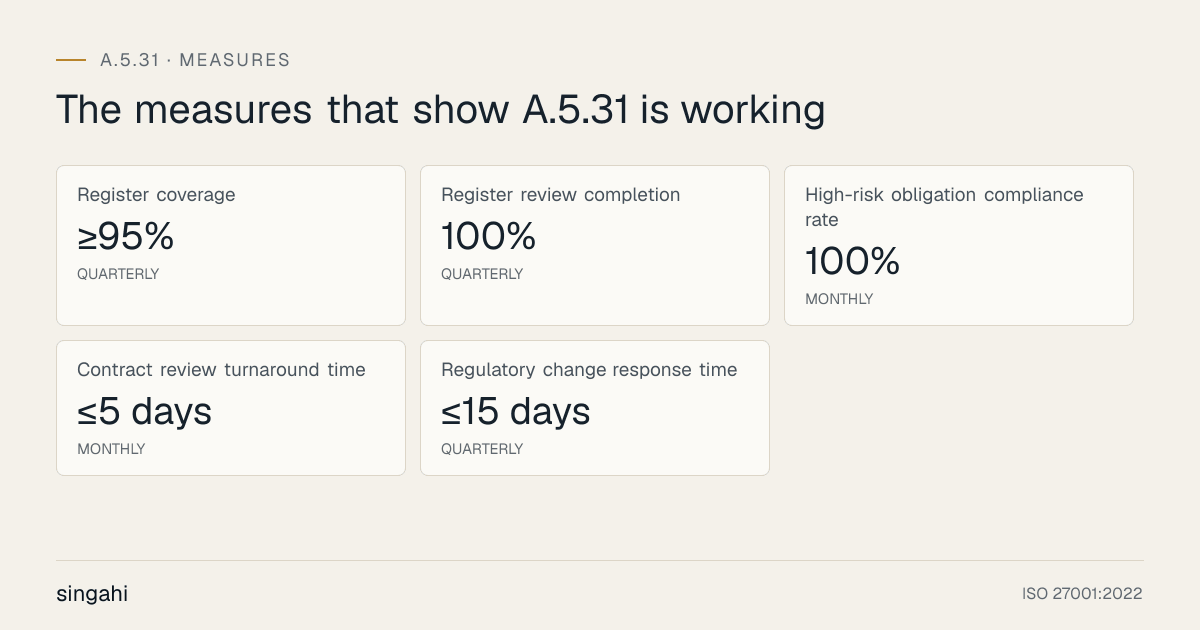
Figure · Measures
The measures that show A.5.31 is working
| # | KPI | Formula | Target | Frequency | Owner |
|---|---|---|---|---|---|
| 1 | Register coverage | (# of identified requirements / # of expected requirement categories) × 100 | ≥95% | Quarterly | Compliance Officer |
| 2 | Register review completion | (# reviewed on time / # due for review) × 100 | 100% | Quarterly | Compliance Officer |
| 3 | High-risk obligation compliance rate | (# high-risk compliant / total high-risk) × 100 | 100% | Monthly | CISO |
| 4 | Contract review turnaround time | Average days from receipt to register update | ≤5 days | Monthly | Legal |
| 5 | Regulatory change response time | Average days from new regulation to impact assessment | ≤15 days | Quarterly | Legal |
| 6 | Incident reporting compliance | (# incidents reported within regulator timeline / total reportable incidents) × 100 | 100% | Per incident | SOC Lead |
| 7 | Customer breach notification SLA | (# customer notifications within SLA / total notifications) × 100 | 100% | Per incident | CISO |
| 8 | Management review coverage | (# compliance agenda items / total agenda items) × 100 | ≥20% | Per review | Compliance Officer |
| 9 | Training completion rate | (# trained / # targeted) × 100 | ≥95% | Quarterly | HR + Compliance |
| 10 | Audit findings related to A.5.31 | Count of findings | 0 major | Per audit | CISO |
| 11 | Open remediation items | Count of overdue compliance actions | 0 overdue | Monthly | Compliance Officer |
| 12 | Evidence completeness | (# requirements with current evidence / total requirements) × 100 | ≥95% | Quarterly | Compliance Officer |
| 13 | Data subject request SLA | (# DSRs closed within SLA / total DSRs) × 100 | ≥98% | Monthly | DPO |
| 14 | Cross-border transfer documentation | (# transfers with valid mechanism / total transfers) × 100 | 100% | Quarterly | DPO |
| 15 | Supplier compliance rate | (# suppliers meeting contractual security obligations / total assessed) × 100 | ≥90% | Annually | Procurement |
Common Pitfalls / Audit Failures & How to Avoid Them
| # | Pitfall / Audit Failure | Root Cause | Fix |
|---|---|---|---|
| 1 | No Legal and Compliance Register | Compliance seen as legal's job, not ISMS | Create a register owned by Compliance Officer / CISO with legal support |
| 2 | Register is outdated | No review process or triggers | Define annual and trigger-based review cycles |
| 3 | Missing customer contract obligations | Sales signs contracts without security review | Mandate legal/CISO review for all contracts with security clauses |
| 4 | Missing sectoral regulations | Generic ISO register, no sector focus | Include RBI/SEBI/IRDAI/TRAI entries based on business |
| 5 | Requirements not mapped to controls | Register is a list, not integrated | Add control/procedure reference and evidence columns |
| 6 | No evidence of compliance | Controls exist but not documented | Establish evidence collection at the time of implementation |
| 7 | Late regulator incident reporting | Manual process, unclear thresholds | Automate reporting workflow and train SOC on thresholds |
| 8 | Undocumented cross-border transfers | Engineering deploys globally without compliance review | Include data flow review in architecture/design approval |
| 9 | Uncommitted promises in RFPs | Sales over-promises to win deals | Create pre-approved security response library |
| 10 | Supplier obligations not monitored | Contracts signed, no follow-up | Add supplier security assessments and monitoring |
| 11 | Privacy notice does not match practices | Marketing drafts notice without DPO review | DPO must approve all external privacy notices |
| 12 | Version control chaos | Multiple copies of register | Central repository with version history |
| 13 | Training not updated for new laws | Training is static | Update training within 30 days of significant legal change |
| 14 | Records destroyed too early | No retention schedule | Create and enforce records retention schedule |
| 15 | Non-compliance not escalated | Fear of reporting | Define clear escalation path and non-punitive reporting |
Illustrative Scenarios
Illustrative scenario, a composite example for guidance, not a specific Singahi engagement or a verified outcome.
Illustrative Scenario 1: Indian Fintech Avoids RBI Enforcement Action Through Proactive Compliance Register
Organization: A Bengaluru-based payments fintech with 400 employees processing UPI and card transactions.
Challenge: In early 2024, the fintech faced a ransomware incident that encrypted several non-production systems. The CISO discovered that the incident response team was unsure whether the event was reportable to RBI within 2 hours, to CERT-In within 6 hours, or only to customers. Customer contracts had varying breach notification timelines ranging from 4 hours to 48 hours. The organization had no central register of these overlapping obligations. As a result, the incident was reported late to one regulator and two enterprise customers, exposing the company to enforcement risk and contract penalties.
Solution: The fintech engaged an external security consultant to implement A.5.31:
- Built a Legal and Compliance Register covering IT Act 2000, DPDP Act 2023, CERT-In Directions 2022, RBI Cyber Security Framework, PCI DSS v4.0, and 35 active customer MSAs.
- Mapped each obligation to an owner, policy, procedure, and evidence location.
- Created an incident reporting decision tree with clear thresholds and timelines for RBI, CERT-In, NPCI, and customers.
- Automated alerts in the SIEM and GRC tool for reportable incidents.
- Trained the SOC, CISO office, and customer success team on the new process.
- Added a contract review gate in Salesforce so no customer contract with security clauses could be signed without CISO and Legal approval.
Results:
- Incident reporting compliance improved from 60% to 100% within two quarters.
- Zero late regulator reports in the following 12 months.
- RBI cyber audit in 2025 found no major observations related to compliance obligations.
- ISO 27001 surveillance audit passed with zero non-conformities on A.5.31.
Illustrative Scenario 2: Indian SaaS Company Loses Enterprise Customer Due to Contractual Compliance Gap
Organization: A Pune-based HR-tech SaaS provider serving 800+ customers, including several multinational corporations.
Challenge: The SaaS provider had ISO 27001 certification and assumed it was fully compliant with customer security requirements. During a routine customer audit, a Fortune 500 customer discovered that the provider had not implemented several contractual obligations embedded in the MSA signed three years earlier:
- Annual third-party penetration testing by a CERT-In empanelled auditor.
- Encryption of backups using customer-managed keys.
- Restriction on subprocessors without prior written approval.
- 24-hour breach notification for any unauthorized access.
The provider's register contained only laws (IT Act, GDPR) but no customer-specific contractual obligations. The customer terminated the contract, citing material breach, and demanded data migration within 30 days.
Solution: After the loss, the provider rebuilt its A.5.31 program:
- Extracted security obligations from all 800+ customer contracts using a CLM tool and manual review for top 50 customers.
- Created a Customer Compliance Register as a subset of the Legal and Compliance Register.
- Assigned customer obligation owners to account managers, with technical owners in engineering and security.
- Built a pre-signing contract checklist requiring CISO review of all security clauses.
- Implemented quarterly compliance attestations for high-risk customers.
- Integrated the register with Jira for action tracking and Confluence for evidence storage.
Results:
- Customer churn related to security compliance dropped to zero in the next 12 months.
- The company won back the lost enterprise customer after 18 months by demonstrating the new program.
- Annual contract value at risk reduced by .
- ISO 27001 recertification audit in 2025 highlighted A.5.31 as a strength.
Illustrative Scenario 3: Indian Healthtech Start-Up Prepares for DPDP Act Using A.5.31
Organization: A 120-employee healthtech start-up collecting patient vitals, lab reports, and insurance information.
Challenge: With the DPDP Act 2023 coming into force, the start-up needed to demonstrate reasonable security safeguards, consent management, Data Principal rights, and breach notification readiness. The company had scattered awareness of SPDI Rules 2011 but no structured compliance register. Investors and hospital customers were demanding DPDP readiness proof.
Solution: The start-up implemented A.5.31 as the foundation for DPDP compliance:
- Identified all applicable laws: DPDP Act 2023, IT Act 2000, SPDI Rules 2011, ICMR data guidelines, IRDAI guidelines (for insurance integrations), and customer hospital contracts.
- Documented obligations in the register with owners from legal, product, engineering, and customer success.
- Mapped DPDP obligations to controls: consent notice (product), security safeguards (CISO), Data Principal rights (DPO), breach notification (SOC + DPO).
- Conducted a Data Protection Impact Assessment (DPIA) for high-risk processing.
- Updated privacy notice, consent flows, and data retention schedules based on the register.
- Trained all staff on DPDP and contractual hospital obligations.
Results:
- Closed a Series B funding round with compliance as a key diligence strength.
- Passed customer security audits by two major hospital chains.
- Zero findings on legal and contractual compliance in ISO 27001 Stage 2 audit.
- Positioned as a DPDP-ready vendor in enterprise sales.
Multi-Framework Mapping
| ISO 27001:2022 A.5.31 Requirement | SOC 2 | PCI DSS v4.0.1 | NIST 800-53 Rev 5 | CIS Controls v8 | COBIT 2019 | DPDP Act / GDPR |
|---|---|---|---|---|---|---|
| Identify and document requirements | CC1.1, CC2.3 (external parties and requirements); the compliance objective in the Trust Services Criteria | 12.1.1 (security policy addresses requirements) | PM-1, PL-1; "-1" policy controls in each family reference applicable laws | 15.2 (service provider policy, for contractual terms) | MEA03.01 (identify external compliance requirements) | GDPR Art. 5(2), 24; DPDP s.8(1) |
| Approach and responsibilities | CC1.3 | 12.1.3 (roles and responsibilities) | PM-2, PM-3 | - | MEA03.02 (optimise response to external requirements), APO01 | GDPR Art. 37 (DPO); DPDP s.8(9), s.10 |
| Keep up to date | CC2.1 | 12.1.2 (policy reviewed at least annually) | PM-9, CA-2 | - | MEA03.03 (confirm external compliance) | - |
| Contracts | CC9.2 | 12.8.2 (written agreements) | SA-4, SA-9 | 15.4 (contracts include security requirements) | APO10.03 | GDPR Art. 28; DPDP s.8(2) |
| Cryptography laws | - | 3.6, 3.7 (key management) | SC-13 (cryptographic protection) | 3.10, 3.11 | APO13 | - |
| Assurance | CC4.1 | 12.4 (executive responsibility, periodic reviews for service providers) | CA-2, CA-7 | - | MEA03.04 (obtain assurance of external compliance) | - |
Implementation Roadmap
Figure · Timeline
Rollout in order
- Week 1Define compliance operating model
- Week 1Identify all internal sources
- Week 2Identify all external legal/regulatory
- Week 2Select tool
Week-by-Week Roadmap
Phase 1: Foundation (Weeks 1–2)
| Week | Activities | Deliverables | Owner |
|---|---|---|---|
| 1 | Define compliance operating model, issue policy, appoint register owner | Compliance Policy v1.0, RACI | CISO |
| 1 | Identify all internal sources (contracts, notices, audit reports) | Internal source inventory | Compliance Officer |
| 2 | Identify all external legal/regulatory sources relevant to industry | External source inventory | Legal Counsel |
| 2 | Select tool (spreadsheet or GRC platform) | Tool selected and configured | Compliance Officer |
Phase 2: Build the Register (Weeks 3–5)
| Week | Activities | Deliverables | Owner |
|---|---|---|---|
| 3 | Extract obligations from top 20 customer contracts | Contract obligation extraction | Legal + Sales |
| 3 | Extract obligations from vendor/supplier contracts | Supplier obligation extraction | Procurement |
| 4 | Build legal and regulatory entries | Register v1.0 | Compliance Officer |
| 4 | Assign owners, risk levels, review dates, evidence links | Complete register entries | Compliance Officer |
| 5 | Map requirements to policies, procedures, and controls | Requirement-to-control matrix | CISO + Compliance Officer |
| 5 | Integrate compliance risks into risk register | Updated risk register | Risk Manager |
Phase 3: Implement and Integrate (Weeks 6–8)
| Week | Activities | Deliverables | Owner |
|---|---|---|---|
| 6 | Update affected policies and procedures | Policy updates approved | Policy Owners |
| 6 | Implement incident reporting workflow for CERT-In / RBI / customers | Incident reporting playbook | SOC Lead |
| 7 | Conduct awareness training on legal/contractual obligations | Training delivered, records saved | HR + Compliance |
| 7 | Set up evidence repository and links | Evidence repository live | Compliance Officer |
| 8 | Pilot internal audit of A.5.31 | Internal audit report | Internal Audit |
| 8 | Remediate gaps | CAPA closure | Relevant owners |
Phase 4: Operate and Improve (Ongoing)
| Frequency | Activity | Owner |
|---|---|---|
| Weekly | Regulatory news scan | Legal Counsel |
| Monthly | Compliance team review of register | Compliance Officer |
| Quarterly | Compliance Committee review | CISO |
| Annually | Full register review and management review | Compliance Officer + Top Management |
| Trigger-based | Register update on new law/contract/incident | Relevant owner |
FAQ
Q1: Does A.5.31 require us to list every law in India? No. It requires you to identify every legal, statutory, regulatory, and contractual requirement relevant to information security. Focus on laws and contracts that affect your business, industry, data types, and geographies.
Q2: Is a spreadsheet enough for the Legal and Compliance Register? For small organizations, a well-maintained spreadsheet is acceptable. For medium and large organizations, a GRC tool or dedicated compliance platform is recommended for scalability, evidence linking, and audit readiness.
Q3: How often must the register be reviewed? At planned intervals, typically annually, and whenever significant changes occur (new laws, new contracts, mergers, incidents, etc.).
Q4: Who should own the register? Typically the CISO, Compliance Officer, or DPO. Legal Counsel supports interpretation. Each requirement should have a named owner responsible for implementation and evidence.
Q5: Do customer contracts need to be in the register? Yes. Contractual security and data protection obligations are explicitly in scope of A.5.31. Extract key clauses and assign owners.
Q6: How does A.5.31 relate to DPDP Act compliance? A.5.31 is the mechanism by which DPDP Act obligations are identified, documented, and integrated into the ISMS. DPDP-specific controls are then implemented under A.5.34 and other controls.
Q7: What happens if we miss a new regulation? That is a compliance risk. Mitigate through regulatory intelligence, legal retainers, industry associations, and trigger-based register reviews.
Q8: Is A.5.31 only about Indian laws? No. If your organization handles EU, US, Singapore, or other jurisdictions' data or has customers there, those laws must also be in the register.
Q9: Can we use our legal team alone for A.5.31? Legal interprets laws and contracts, but A.5.31 requires integration into the ISMS. The CISO, DPO, risk manager, and operational owners must be involved.
Q10: What evidence do auditors expect? The register itself, review records, policies/procedures referencing obligations, evidence of compliance (logs, reports, certificates), training records, and management review minutes.
References and Further Reading
Standards
- ISO/IEC 27001:2022, Information security, cybersecurity and privacy protection, Information security management systems, Requirements.
- ISO/IEC 27002:2022, Information security, cybersecurity and privacy protection, Information security controls.
- ISO/IEC 27701:2019, Privacy information management systems.
- ISO/IEC 27017:2015, Code of practice for information security controls based on ISO/IEC 27002 for cloud services.
- ISO/IEC 27018:2019, Protection of personally identifiable information (PII) in public clouds.
Indian Laws and Regulations
- Digital Personal Data Protection Act, 2023.
- Information Technology Act, 2000.
- Information Technology (Reasonable Security Practices and Procedures and Sensitive Personal Data or Information) Rules, 2011.
- Information Technology (Intermediary Guidelines and Digital Media Ethics Code) Rules, 2021.
- CERT-In Directions, 2022.
- Reserve Bank of India, Master Direction on Information Technology Framework for the NBFC Sector.
- Reserve Bank of India, Cyber Security Framework in Banks.
- SEBI Cybersecurity and Cyber Resilience Framework (CSCRF) for SEBI Regulated Entities, circular of 20 August 2024 (replaced the 2015 MII framework, CIR/MRD/DP/13/2015).
- SEBI CSCRF (Cybersecurity and Cyber Resilience Framework for SEBI Regulated Entities, 20 August 2024)
- IRDAI Information and Cyber Security Guidelines, 2023 (which replaced the 2017 guidelines).
- IRDAI Master Circular on Information and Cyber Security for Insurers.
- Consumer Protection Act, 2019.
- Consumer Protection (E-Commerce) Rules, 2020.
- Companies Act, 2013.
- Copyright Act, 1957.
- Patents Act, 1970.
- Trade Marks Act, 1999.
- Prevention of Money Laundering Act, 2002.
International Laws
- General Data Protection Regulation (EU) 2016/679.
- UK Data Protection Act 2018.
- California Consumer Privacy Act (CCPA) / California Privacy Rights Act (CPRA).
- Singapore Personal Data Protection Act 2012.
- UAE Personal Data Protection Law.
Guidance and Reports
- NASSCOM-DSCI Data Security Council of India, Best Practices.
- RBI Cyber Security Framework in Banks.
- IBM Cost of a Data Breach Report 2024.
- ENISA Threat Landscape Reports.